Feb
15
A Nice Story, by Victor Niederhoffer
February 15, 2007 | Leave a Comment
There is a nice story in Newsweek , 2/19, page E4, that describes an entrepreneur who started a business selling unicycles by web, and then guitars, his two life passions, with 700 dollars. Now he has franchises in several countries and unicycles are making a profit for him and getting people some great exercise. This is a typical story of the entrepreneurial drive that's behind the some 50% of all people that, according to old data from Wilenski, have, are, or will start a business. It's the main reason, that returns of 10% a year, the drift will continue, along with science and trade.
Feb
14
For Love Of Money: Casanova And The Speculators, by Victor Niederhoffer and Laurel Kenner
February 14, 2007 | 1 Comment
Valentine's Day, a chance encounter on a busy street — and the start of something big. Plus: Vic's V-Day market pattern.
Not only did he never hesitate, but he never imagined that he could hesitate. — Albert de Musset, reviewing Casanova's memoirs.
 I first met him around Valentine's Day 1999. He was limping across an intersection in midtown Manhattan, near where I worked. In one hand he grasped a sheaf of computer outputs that flapped in the breeze, and in the other was an ancient copy of Casanova's memoirs. He carried a cane under his arm. It was the dead of winter, but he wore a blue-and-white cotton seersucker suit.
"May I help you across the street?" I said. "Your papers look like they're going to blow away in the wind." And you do, too, I thought to myself.
"Yes," he said. "If you promise me one thing. I've often admired your sweetness, wit and bearing on television, and I've read your columns on the wire. Please don't unload any untested stuff about moving averages or buying on up-volume on me."
"I won't," I promised.
"In that case, as Casanova said, 'Opportunity is like fortune — one must seize it or it will run away and not return.' Would you consider it overly presumptuous if I suggested we leaven the quantitative analysis of the predictive properties of interactions between stock prices with a bit of food?" he said, allowing me to take his papers. "I guarantee that it will not be entirely without profit to you."
"I don't even know who you are," I said.
"I'm just a speculator," he said. He handed me a card. Revolutions fomented, it said. Damsels rescued. Ballyhoo deflated.
Something clicked. I had seen this man on a book cover playing checkers.
"Do you fancy yourself a Casanova with damsels?" I asked.
"I admire Casanova for many things," he replied. "He was a great speculator, a gifted gambler and mathematician, and translated many of the great French masterpieces into Italian. He was the first to design a derivatives product in the fixed-income market, and created the first French lottery. His memoirs provide the best depiction of 18th century European life. His escape from prison in Venice is one of the great flight stories of all time, and we all could learn from the careful attention to detail that led to its success. Regrettably, I lack Casanova's aptitude in the romantic arts he is so well known for."
"What's the cane for?" I said, curiously. He had a lurching gait, but he wasn't using the cane.
"I always carry a cane after the S&P 500 ($INX) has declined more than 4% in the past week," he replied. "That's how the old-time speculators made all their money. When panic came to Wall Street, they'd buy to the full extent of their bank balances. Casanova, for example, often profited from buying stocks during panics and was quite generous with the proceeds in his chivalrous adventures.
"Cane investing still works," he added. "Over the past six years, there were 64 weeks when the S&P fell more than 4%, and the average change during the next seven trading days was a 3% rise."
"That seems rather humdrum."
"Well, the numbers can be fascinating. If you come tonight, I will show you a special Valentine's Day pattern. Will you come?"
"Mind if I take my laptop?"
He started laughing. He said that reminded him of the scene in "The Fountainhead" where Gail Wynand comes back from a publishers' convention all ready for a private evening with Dominique Francon and she tells him to get dressed because they're going to see a play, "No Skin Off Your Nose."
He said it would be ideal if I brought my laptop. The salad bar at a certain nearby restaurant had some great imitation crab, he said, as well as an electrical outlet by the soft-drink machine for my computer. "I will await your arrival with zeal, young damsel."
I surmised that my new friend's interest in Casanova may have been strengthened by the latter's frequent speculative losses in foreign markets and subsequent struggles back to prosperity in the derivatives markets. It seemed entirely possible that similar misfortunes were forcing him to entertain at the local deli.
I handed him back his papers and told him I had an appointment with a value manager. This seemed to greatly agitate him. Casanova, he said, often found that the best antidote to waiting was a little speculation, and accordingly he planned to do a little speculation of his own while I was away. He appeared somewhat mollified when I told him that the manager just wanted me to hype his stocks, and that I would be careful.
First, Some Necessary Diversions
The value manager was waiting for me when I arrived at the bar of the St. Regis. I swung into the booth. "So, Alan. Tell me what you've been buying."
"I picked up some Bethlehem Steel (BS, news, msgs) the other day," the man said. "P/E of 5."
I couldn't help yawning. "Yeah, and sales are growing at about 7%. The stock has been going down for 20 years."
"My screens say that the stock is a great pick," the man said, a little huffily. "Why, it was a member of the Dow Industrials ($INDU) just a couple of years ago. We're also recommending Carmike Cinemas (CKECQ, news, msgs)," he said. "It trades at 1.7 times book value. By contrast, the rest of the market is trading at more than six times book."
That doesn't mean Carmike won't go to 0.08 times book, I thought to myself. I escaped after three-quarters of an hour and went on to my next appointment. Jack Flanders was a famous technical analyst, and I wanted to persuade him to send his updates to us before he gave them to Brand X. Jack needed no prompting to talk.
"I have spent over 10 years developing a technical indicator, the Guaranteed Known Thing (GKT), using number sequences that occur throughout nature," he said. "It has made me a fortune. The GKT is based on the work of two famous mathematicians, Johann Heinrich Lambert (1728-1777) and Leonardo Pisano Fibonacci (1170-1250).
"Lambert is renowned among physicists as the founder of the theory of light measurement, and his Cosmological Letters are famous among astronomers. Lambert attempted to explain the structure of the universe in these writings. My GKT uses Lambert's series of color-triangles, which proceed from 45 hues built from yellow, cinnabar and azurite to smaller, brighter triangles with hues numbering 28, 15, 10, 6, 3 and finally 1, a total of 108.
"I check the entire universe of stocks for action around the 45- and 108-day moving averages, then look for golden-hued crosses at the moving averages corresponding to the hues in Lambert's other triangles. I then screen the surviving stocks for Fibonacci Fan and Arc intersections. So powerful is this analysis that I caught the start, top and bottom of the entire Internet move.
"But I am not greedy, and have decided to divulge the stocks picked by the GKT indicator on my new hotline, the King's Ransom. You can be my first subscriber."
"Have you back-tested it?" I asked.
"That would be difficult," he said. "But it works."
"Do you give complimentary subscriptions to the media?" I asked. "Since you've done so well…."
"Sorry, gorgeous. Can't do it. What will you have to drink?"
I don't drink the hard stuff, but at that point I might gladly have tossed back a double Scotch. Instead, I politely excused myself and slipped out through the glass doors, winking at the doorman. What a bunch of mumbo jumbo, I thought.
The Romance of Stocks
Finally it was time to see the speculator. As I walked the few blocks to the deli, I realized that I had been thinking about him all evening. Somebody had already claimed the table by the soft-drink machine. I sat down and took out my laptop anyway and was scrutinizing the latest earnings reports when he suddenly appeared at my side. I hadn't realized how tall he was. His blue eyes alight with amusement, he handed me a plastic container of imitation fish. I opened it and stuck a plastic fork into the red-and-white contents, hoping he would be satisfied with a gesture of polite intent.
"What do you do when you're not playing checkers?" I said.
"I conduct experiments."
"What kind?"
"I look for patterns that investors haven't seen yet. That's why I came to you. I saw those stories you wrote about how 'Moby Dick' and the All-Star break are related to the market. That kind of writing gives your readers a meal for a lifetime. Much better than the usual stuff that reporters write, quoting tired advisers with mediocre records hyping the stocks they finished buying a few days or weeks ago, or back-patting themselves with reports of their timely sales."
He put his computer outputs on the table. "If it's knowledge, it's quantifiable," he told me. "For example, I've noticed a special Valentine's Day pattern. The V. It happens when the S&P falls more than 10 one day and then rises more than 10 the next day."
"Anything significant?"
"Quite. It will make you about 1%, on average, by buying at the close of the rising day. And as Casanova said, 'Money can buy the same degree of happiness whether in Italy or France.'"
We talked about the market all evening. My companion told one fascinating story after another.
"Do your patterns work with individual stocks?" I asked.
"I don't trade them," he said. "Futures are more liquid."
"But you're missing half the fun and romance, Vic. Individual stocks have stories. The great entrepreneurial themes are like instruments in the market orchestra."
"Perhaps we could hoist our sails together," he said, looking at me with interest. "I understand there's a good port in Seattle that's open to this sort of union. You could help me with the stories, Laurel, and I could help you with the numbers."
And that, dear reader, is how this site began.
P.S. One of the gravest errors in the area of testing and counting is the assumption that if something is statistically significant in one period it will be predictive in the next (in markets or life). Oh, how many fortunes and dreams have been, and will be lost because of this error. In the above article, which was written on 02/14/01, we look at a Valentines pattern, that was statistically significant — It was bullish and frequent and significant in the five years ending in 01. Regrettably it has hardly ever has happened since. I asked Doc. Castaldo to update the study for the prospective period, the out of sample period, or the period within which the pattern would have been approved by the old duck hunters club et al. … An excerpt of his report follows:
"Regrettably…. the effect has completely disappeared. From 1996 to 2/15/2001 buying the S&P after it was down more than 10 points one day, up more than 10 the next, gave profits of 5.5 S&P points for the following day, statistically significant, z=2.2. After the publication of the article, that is from 2/15/2005 to 1/30/2007, the profit was 0.6 S&P points, statistically indistinguishable from zero." What seasonal studies have stopped working, what fixed systems have gone from black to red, because of the crucial neglected factor?"
Feb
14
A Word on Triumph of the Optimists, from Hanny Saad
February 14, 2007 | Leave a Comment
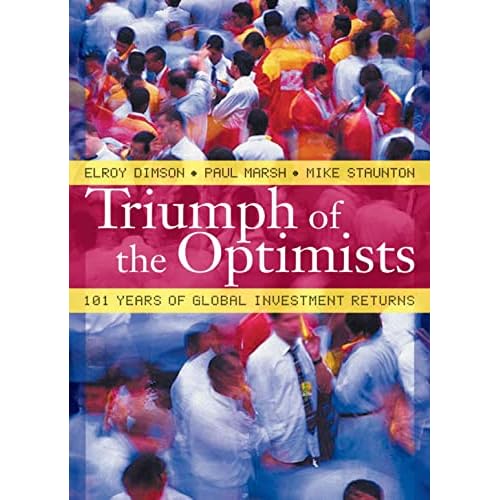 Triumph of the Optimists: 101 Years of Global Investment Returns, by Elroy Dimson, Paul Marsh, and Mike Staunton, is considered by many to be the best book written about markets and in so many ways it actually is. The authors went to great lengths to collect the most accurate data available from sources including century-old newspapers and dusty books from university libraries among others. Their efforts were very rewarding in the sense that their findings debunked some mainstream beliefs.
In general, this is an outstanding work and one of the best-researched books on markets to date. It suffers none of the biases that previous research by Fama and French or Malkiel and O'Shaugnessy were guilty of, namely the easy data bias: the bias from incorrect rights-issue adjustment, bias of hindsight choice of companies, bias of hindsight choice of sector, and survivorship bias. All these biases are so well covered in the book that there is no need for me to repeat or explain them here. In this sense, the book is exemplary research and the authors deserve to be applauded for their efforts.
The book was recommended first by Victor Niederhoffer in his posts to the list and in his book as the best book written about markets. And in terms of data accuracy and elimination of biases I have to agree with Victor. No other book I am aware of before the trio came close to offering such a comprehensive study of markets with this impeccable accuracy, even uncovering the beauty of ever-changing cycles in some cases, as with the small cap out performance that stopped working once widely discovered, and its return in 2000 and so forth.
But (didn't you see this coming?), there is some critical observation I have about the trio's great research. In the few cases the authors gave their personal opinions and played the forecaster's role, they failed miserably as there was no empirical support whatsoever.
One notable example in one of the most crucial segments of the first part of the book, The Conclusion, the authors mention that an optimist as stated by Archy the cockroach is a guy that has never had much experience, and in this spirit they state, "statistical logic tells us that future expectations must lie below today's optimists' dreams. We cannot expect the optimists to triumph in the future. Future returns from equities are likely to be lower. As Archy the cockroach warned us, experience should teach us realism not optimism.
How deflating. After reading this conclusion I felt as if I had such a build up of pleasure with the great data provided, but failed to climax reading the conclusion. Isn't 101 years of data over 16 countries a sufficient dose of realism? Didn't their own research show how the stock market outperformed through two world wars, a Wall Street crash and Great depression, hyperinflationary and economic turmoil?
Yet the authors don't expect the future to be as rosy and they call it realism. I believe the authors' opinions were influenced by the tech sector crash prior to the book's publication. Other examples include their conclusion about value versus growth.
This is a great book only if you can skip the authors' opinions and concentrate on the data. I may well be the guy who has never had much experience. As in Archy the cockroach, the authors referred to but failed to provide me with empirical reasons not to be the optimist as opposed to realist according to their definition above. In fact, their research and data make me believe that, if anything, the next hundred years should even be better that the past, given the overall political stability (please don't thow at me the war in Iraq or the Israeli-Palestinian conflict, since they fade in compared to two world wars). The great technological advances are the universal availability of information for executives to make more informed decisions.
From Steve Ellison:
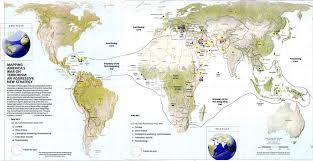
In one important respect, the 21st century has a head start on the 20th century: the number of people engaged in trade. Thomas P. M. Barnett, in The Pentagon's New Map, identified three periods of globalization.
The first was "proto-globalization" from 1871 to 1914 involving Western Europe, the United States, and Canada. After the two world wars came "Globalization I," involving approximately the same countries plus Japan. "Globalization II," since 1980, has brought China, Korea, India, Russia, and Brazil, among others, into the global economy. One would expect the trend of increasing international trade, if not reversed, to increase wealth creation and opportunities for profit.
From Stefan Jovanovich:
Dr. Barnett is the perfect theorist for an age when no one knows any history. Free trade had its most dramatic worldwide expansion in the period from the abolition of the Corn Laws to the adoption of Imperial Preference. The period of "proto-globalization" that Barnett refers to was precisely the period when the clear advantages of open economic exchange began to be overridden by the kind of awful grandiose geopolitical doodling that led to WWI and is still the essence of all "strategic planning." Barnett's popularity is, alas, one of those terrible hints that the anarchy of growing international trade is once again about to be brought to heel by the superior wisdom of the people who have seen the latest Power Point presentation.
Feb
14
Costs of Advertising, by Jim Sogi
February 14, 2007 | Leave a Comment
Sometimes it costs some money to make money. You have your advertising. You have your expenses and normal overhead. Sometimes you have to fix up the merchandise to make it look good. You have to pay off your shills. You have to paint up them horses so they look nice to the buyers. Sometimes you have to give a bit on some inventory to get the action going, get the customers interested.
 Hopefully the costs won't exceed the ultimate rake in, but you've got to spend a little hopefully to make a little. I'm not a gambler, but I guess you have to get the mark interested in the game by giving him a few pots before the rake. The problem is, I can never tell who the sucker is at the table when I play. Hmmm.
Feb
14
Writing of Love, from Jay Pasch
February 14, 2007 | Leave a Comment
 In keeping with the tradition of honoring St.Valentine, a few readings are offered here:
Kaballah, A Love Story, by Rabbi Lawrence Kushner:
This is a unique and very well written amalgamation of Hebrew mysticism, Kabbalist theosophy, the Zorah, cosmology, and human love. The novel prompts the reader to ponder the odds of how a group of Dusty Ones, from a time before written language, could have randomly developed the conscious thought of the universe's creation from a single father spark, the Botzina d'qardinuta, that is only now being affirmed as a leading theory of the universe's creation through the use of our present-day tools of advanced mathematics, astrophysics, cosmology, and astronomy, allowing us to reach back in time nearly to the event horizon of the universe's origin.
Darwin's Wink, A Novel of Nature and Love, by Allison Anderson:
True to the interests of Speclist, Darwin's Wink is a compelling story that weaves the emotional explorations of love, fertility, evolution, and survival, against an exotic and lush island setting.
Essential Manners For Men, by Peter Post:
The great-grandson of Emily post offers the male gender guidance on proper form, etiquette, and manners, on what to do, when to do it, and why, in the areas of daily life, out on the town, on the job, sharing a habitat, meeting and greeting, dating, and flirting.
Feb
14
Background on Dutch Flower Auctions, from Ryan Carlson
February 14, 2007 | Leave a Comment

The function of auctions is to concentrate offer and demand. Everyday approximately 10,000 specialized breeders deliver their products to the auction. From that offer, approximately 5000 buyers make their choice. An important instrument is the auction clock, by which batches or individual units of products are sold by Dutch auction to the customer that first causes the clock to stand still. Handling approximately 100,000 transactions each day, the auctions distribute a vast, homogenous offer among a large number of different parties. The auctions work as an international marketplace.
Initially, the auctions handled only sales by local breeders and later by regional breeders. Nowadays, however, members of other auctions can offer their products as well. Towards the end of the 1970s it was decided that the auctions would also admit products from abroad. At this time imports constitute approximately 15% of the offer for the clock. The principal countries for import are Kenya, Israel and Zimbabwe. In this way, approximately 60% of the international cut flower trade is handled by auctions in the Netherlands, which thus have a pivotal role in the international trade of flowers and plants.
For traders the auction provides a virtually complete, deep and wide, range of 16,000 floricultural products on a single site. For producers, the auction guarantees their daily sales and the payment for them. The auction also offers a transparent market and an objective operation of the price mechanism. A minimum price is set for each product. It a batch is not sold, it is withdrawn (and destroyed). This leads to a stable pricing system, which in turn promotes a stable offer and stable demand.
Not all products are sold for the clock. In recent years direct sales between sellers and buyers, breeders and traders have become increasingly important. For houseplants and garden plants, approximately 50% of sales are realized through direct sales, almost always under forward contracts. For cut flowers, a day-fresh product, direct sales have no more than a marginal role at present. More than 90% of cut flowers are still auctioned.
Feb
14
Conservation of Money, from Philip McDonnell
February 14, 2007 | Leave a Comment
Two summers ago, at the Spec Party in Central Park, Victor said something to me which was at once profound yet seemingly too simple. "There is only so much money." To someone who did not understand,it would seem rather sophomoric, or even downright cryptic. But it was all he needed to say because I had read his books.
The statement referred to a simple conservation law much like the conservation laws of physics. In physics, energy and mass are the most significant variables in most mechanical systems. So we have laws such as Conservation of Energy, Conservation of Mass and Conservation of Momentum. In financial markets a similar law applies. Money is conserved. At any given time there is only so much money.
Let us imagine an island economy where there are only two stocks, X and Y. There is only so much money on the island. When the traders on the island decide they want to invest in X they need to figure out how to pay for the purchase. The only liquid source of money is stock Y. So they sell Y. The price of X goes up and Y goes down.
Let us draw this on an X-Y coordinate plot and assign some real numbers to it. The relationship between X and Y would show up as a line from high up on the Y axis sloping downward to some point of a large X value. Suppose the amount of money was $100. If everyone wanted to own Y and no one wanted X then we would have Y=100, X=0.
Conversely if everyone wanted X and not Y then Y=0 and X=100. We can think of the distance of the current market valuations as the distance from the origin which is equal to the buying power of the money. It is a simple conservation law on our island. The $100 defines a radius from the origin. It therefore defines a circle. It is easy to draw on a 2D chart or even in 3D. Drawing a 5000 dimensional sphere for the 5000 actively traded stocks is a project still in progress.
Feb
14
Ninety Minutes, from Scott Brooks
February 14, 2007 | 1 Comment
 I have a business partner in another venture who sleeps only between 2 a.m. and 5 a.m., sometimes less.
He's been involved in several sleep studies and has taught me a few things about sleep. One is that humans go through 90 minute sleep cycles. If you're awakened during a sleep cycle, you are groggy and have less energy during the day.
The key to good sleep is to arrange to sleep in 90 minute increments (sleep an amount of time that is evenly divisible by 90).
Therefore, don't sleep for eight hours. You are better off sleeping for 7.5 hours or nine hours than for eight.
I've tried it and found that I am much more alert and productive with this methodology. I used to suffer from terrible insomnia, but it hardly affects me anymore.
I've also gone from needing eight hours of sleep down to sleeping only six. My goal is to work myself down to needing only 4.5 hours.
Each of us needs different amounts of sleep. And each of our "sleep cycles" is slightly different, but 90 minutes is pretty much on the money for the majority of people. Try experimenting and finding what is right for you.
It will take at least 20 - 30 days to get into a pattern. But once you do, you'll be glad you did it.
It has helped me out a lot.
Feb
14
Into the Vacuum, from Tom Ryan
February 14, 2007 | Leave a Comment
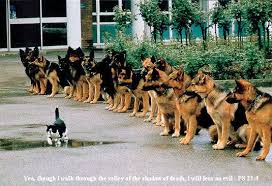 One of the 10 million things that the Specs have said either on Daily Spec or to me personally in the past five years that made complete sense is how the first priority for the evildoers is to get you to question not your facts or even your beliefs but your own version of reality.
They do this by attacking you on a very personal level such that you begin to question your own ability to think clearly about an issue, to use your abilities to reason. This is accomplished generally by intimidation, by peer pressure, or by insinuating that they have access to knowledge that you don't, thereby denigrating your intellect. Then into that vacuum of logic they can insert their own ideology.
J. T. Holley adds:
 A very good example of this is shown in the movie, "A Bug's Life," by Disney via Pixar. The following is the logline from Yahoo! Movies:
"A colony of ants is threatened by a gang of grasshoppers led by the evil Hopper. Flik, a common ant and a misfit, has an uncommon vision when he tries to rise to heroic proportions by enlisting a band of circus fleas to help him defend his colony from the grasshoppers."
The amazing story is how the libertarian heroic Flik utilizes individualism and technology to bring about change in the ant colony and helps them realize they have the strength and the numbers to stand up against the evil Hopper and his grasshoppers. Up until then the way the psychological edge was maintained by Hopper and Tom's "questioning your own ability" was wonderfully demonstrated. No one single ant ever challenged Hopper due to this very thing.
Nice to see Heroes and Individualism rising above "Colonies" thoughts and overcomes in the end and is a great lesson for children! That is one movie my kids love to watch over and over!
Incredibles! is another also Pixar! I know Jobs is high up the food chain there at Pixar, but there has to be some other Libertarian, Rand-loving someone who keeps cranking these brilliant movies out every five years? Anyone know who?
Tons of hypothesis and good speculating questions are espoused during the film as well by the way.
Ken Smith adds:
Propaganda is the mechanism of the market also. Money seeping away from investors at a higher rate than should occur is the consequence of the media's flooding the public mind with anodyne.
Investors can ameliorate the losing process by cancelling the Wall Street Journal, Financial Times, Money Magazine, and so on; additionally cancelling all subscriptions to advisory letters.
What's more put a block on emails from services that recommend stock picks, ETFs, puts and calls, and those that promote trading platforms such as Metastock and Tradestation.
Feb
14
A Gem, Noticed by Brett Steenbarger
February 14, 2007 | 1 Comment
A gem, noticed by Brett Steenbarger:
Henry Carstens's latest article, Introduction To Testing Trading Ideas, is a gem. It walks traders through the process of historical testing, significance testing, and portfolio allocation.
From Yishen Kuik:
I've found this other "how-to" guide to testing informative as well.
The market is jai alai.
Feb
14
Beating an Index, by Bill Rafter
February 14, 2007 | 3 Comments
 Dr. Bruno had posed the idea of beating an index by deleting the worst performers. This is an area in which we have done considerable work. Please note that we do not consider this trend following. The assets are not charted, just ranked.
Let us imagine an investor who is savvy enough to identify what is strong about an economy and invest in sectors representative of those areas, while avoiding sectors representing the weaker areas of the economy. Note that we are not requiring our investor to be prescient. She does not need to see what will be strong tomorrow, just what is strong and weak now, measured by performance over a recent period.
What is a market sector? Standard & Poors does that work for us, and breaks down the overall market (that is, the S&P500) into 10 Sectors. They then further break it down into 24 Industry Groups, and further still into 60-plus Industries and 140-plus Sub-Industries. The number of the various groups and their constituents change from time to time as the economy evolves, but essentially the 500 stocks can be grouped in a variety of ways, depending on the degree of focus desired. Some of the groupings are so narrow that only one company represents that group.
Our investor starts out looking at the 10 Sectors and ranks them according to their performance (such as their quarterly rate of change). She then invests in those ranked first through fourth (25 percent in each), and maintains those holdings until the rankings change. How does she do? Not bad, it turns out.
www.mathinvestdecisions.com/Best_4_of_10.gif
From 1990 through 2006, which encompasses several types of market conditions, the overall market managed an eight percent compound annual rate of return. Our savvy investor achieved 10.77%. A less savvy investor who had the bad fortune to pick the worst six groups would have earned 7.23%. Those results are below. (Note, for comparison purposes, all results excluded dividends.)
www.mathinvestdecisions.com/Worst_6_of_10.gif
How can our savvy investor do better? By simply sharpening focus, major improvements can be achieved. If instead of ranking the top four of 10 Sectors, our savvy investor invests in a similar number (say the top 4, 5, or 6) of the 24 Industry Groups, she achieves a 13.12% compounded annual rate of return over the same period. Note that the same stocks are represented in the 10 Sectors and the 24 Industry Groups. At no time did she have to be prescient.
www.mathinvestdecisions.com/Going_to_24_groups.gif
One thing you will notice from the graphs above is that the equity curves of our savvy and unlucky investors mimic the rises and declines of the market index itself. Being savvy makes money but it does not insulate one from overall bad markets because the Sectors and even the Industry Groups are not significantly diversified from the overall market.
Why not keep going further out and rank all stocks individually? That clearly results in superior returns, but the volume of trading is such that it can only be accomplished effectively in a fund structure - not by the individual. And even ranking thousands of stocks will not insulate an investor from an overall market decline, if she is only invested in equities. The answer of course is diversification.
It is possible to rank debt and alternative investment sectors alongside equities, in the hope of letting their performances dictate what the investor should own. However, the debt and commodities markets have different volatilities than the equities markets. Anyone ranking them must make adjustments for their inherent differences. That is, when ranking really diverse assets, one must rank them on a risk-adjusted basis for it to be a true comparison. But if we make those adjustments and rank treasury bonds (debt) against our 24 Industry Groups (equity) we can avoid some of the overall equity declines. We refer to this as a Strategic Overlay:
www.mathinvestdecisions.com/Strategic_diversification.gif
Adding this Strategic Overlay increases the returns slightly, but more important, it diversifies the investor away from some periods of total equity market decline. We are not talking of a policy of running for cover every time the equities markets stall. In the long run, the investor must be in equities.
Invariably in ranking diverse assets such as equities, debt, and commodities, our investor will be faced with a decision that she should be completely out of equities. It is likely that will occur during a period of high volatility for equities, but one that has also experienced great returns. Thus our investor would be abandoning equities when her recent experience would suggest otherwise. And since timing can never be perfect, it is further likely that the equities she abandons will continue to outperform for some period. On an absolute basis, equities may rank best, but on a risk-adjusted basis, they may not. It is not uncommon for investors to ignore risk in such a situation, to their subsequent regret.
Ranking is not without its problems. For example, if you are selecting the top four groups of whatever category, there is a fair chance that at some time the assets ranked 4 and 5 will change places back and forth on a daily basis. This "flutter" can be easily solved by providing those who make the cut with a subsequent incumbency advantage. For a newcomer to replace a list member, it then must outrank the current assets on the selected list by the incumbency advantage. This is very similar to the manner in which thermostats work. We have found adding an incumbency advantage to be a profitable improvement without considering transactions costs. When one also considers the reduced transaction costs, the benefits increase even more.
Another important consideration is the "lookback" period. Above we used the example of our savvy investor ranking assets on the basis of their quarterly growth. Not surprising, the choice of lookback period can have an effect on profitability. Since markets tend to fall more abruptly than they rise, lookback periods that perform best during rising markets are markedly different from those that perform best during falling markets. Determining whether a market is rising or falling can be problematic, as it can only be done with certainty in retrospect. However, another key factor influencing the choice of lookback period is volatility, which can be determined concurrently. Thus an optimal lookback period can be automatically determined based on volatility.
There is certainly no question that a diligent investor can outperform the market. By outperforming the market we mean that she will achieve a greater average rate of return than the market, while limiting the maximum drawdown (or percentage equity decline) to less than that experienced by the market. But the average investor is generally not up to the diligence or persistence required.
In the research work illustrated above, all transactions were executed on the close of the day following a decision being made. Thus the strategy illustrated is certainly executable. Nothing required a forecast; all that was required was for the investor to recognize concurrently which assets have performed well over a recent period. It is not difficult, but requires daily monitoring.
Feb
14
Book Review: Adventures of a Red Sea Smuggler, from Craig Cuyler
February 14, 2007 | 1 Comment
Adventures of a Red Sea Smuggler, by Henry De Monfreid.
 I came across this great book a while ago and for all those who enjoy books like horse-trading, this is a winner. There are more than the obvious analogies to speculation. The book is set in a world where the price of goods, like mother of pearl, can crash from 7500 francs to 1500 and then climb back again.
I loved his quotes about human nature, gems like, "I dared not be happy; for all my life I have had to pay with sorrow for every bit of happiness I have ever known. That is the fundamental law of the destiny of man." Also, "There was no use worrying about the possible difficulties to come, they always loom very large and terrible in the distance, but when one arrives at the foot of a wall there is always some foothold that enables one to climb it."
This book is about a bored French farmer who decides to embark on a life of smuggling in search for meaning in his life. It is set in the 1920s in, as the cover says, a world populated by Chinese hermits, Greek priest smugglers, Arab robber barons and Bedouins. A classic written by a guy who ended up living well into his 90s and writing over 40 volumes of his adventures.
Feb
14
The Best Benchmark, from Bill Rafter
February 14, 2007 | 1 Comment
 I heartily recommend the use of the compounded value of cash as a multidimensional tool. That is, one takes the daily 3-month bill rate and compounds it. (If you are looking at market days, it is the cumulative product of the 252nd root of 1 + the rate.)
I had previously illustrated how year-on-year changes of that data are an excellent indicator as to whether Fed policy is accommodative or restrictive. Now I recommend comparing that data as a benchmark to whatever else you are trading. The point is obvious: If whatever you are trading does not outperform cash (i.e., 3-month bills), then don't own it at that time; it's a dog!
Consider the broad market. Compare a buy-and-hold S&P to the strategy of switching to cash if the yearly growth (252 market days) of the cash is less than that of the S&P. Results of that daily strategy (4300+ days since 1989) are illustrated here:
www.mathinvestdecisions.com/cash_comp_v_tr_spx.gif
This is not difficult, and the savings for the investor can be substantial. Ranking your other assets versus cash can be even more rewarding.
Feb
13
Game Theories, by Nigel Davies
February 13, 2007 | 1 Comment
 Some time back I mentioned the book Gm-Ram: Essential Grandmaster Chess Knowledge , by Rashid Ziyatdinov, and ordered a copy for review. It is a chess book with little text, no notes to the games and no solutions to the 256 positions…
Alan Millhone writes:
But few of us are in that 'elite' category that we need neither instruction nor guidance. As an average checker player I look for books that are well annotated and full of diagrams and solutions towards the back of the book.
Every checker book in my library would be the opposite of his book on chess. The late English Grand Master Derek Oldbury once wrote a book called Move Over, but it is written in non-checker notation and most difficult to follow. Our current 3-Move World Checker Champion recently wrote a book he calls Sixth, and it is well annotated and full of diagrams. It is as if Alex is talking to you in the first person all the way through … Ah, my kind of book.
Nigel Davies adds:
Yes, but the problem is that your understanding will tend to be 'second hand' rather than unique and cutting edge. My best results always came after individual creative work where I went my own way. I might end up agreeing via a roundabout route, but my agreement would carry much greater depth.
Alan Millhone replies:
But keep something in mind: I am just an average tournament checker player. The skill levels of someone like Alexander Mosieyev or Suki King of Barbados, and myself, are miles apart. Perhaps someday I can hammer out my own individual lines of play. Most top players study the greats in our game then try to improve on those tried-and-true lines of defense and attack. I am not at that level yet, may never be, but I love to compete!
Nigel Davies writes:
 But what comes first, the chicken or the egg? Do you not try to forge your own lines because you are an average tournament player, or are you average because you are not doing this work?
I believe that one of the major problems 'late improvers' face is in changing their attitudes and habits. Teenagers are notoriously disrespectful, and this allows them to challenge everything. So those who were full-timers as teenagers developed the habit to challenge, whilst hobby players developed the habit to accept.
I think it's good to find just one thing at which you can be the best, but being the best necessarily involves refutation of the old.
Feb
13
Buy the Rat; Sell the Koala, by Nigel Davies
February 13, 2007 | 1 Comment
 Cuddly rats seem to be on offer in Ikea right now. I got a junior one for just GBP 1.99, rats probably being heavily discounted because they weren't selling well. Here in the West we think of them as plague carriers and vermin, but in China rats are considered to be enterprising and courageous little fellows. I shouldn't include all Westerners. Gunter Grass wrote a novel entitled The Rat, written from the rat's perspective.
I believe there are many good lessons here. There is a lesson in prejudice, the rat being hated despite its good qualities, whilst lazy koalas are loved despite sleeping 23 hours a day (apologies to all koalas and their federations if I have this figure wrong). Once rats are recognized as being lovable, more people will jump on the bandwagon. Woes betide anyone who castigates them as lazy, useless bastards.
There is a lesson in value, my immediate thought being to buy a shipment of rats from Ikea and sell them to China in exchange for some cuddly koalas. If I get four koalas for each rat and sell the koalas at four times what I got the rats for, that's a 16x profit potential, excluding costs.
There's also a lesson in objectivity. Why should it be that koalas are so highly valued? Nobody speaks admiringly of your child's rat, and I can speak with authority on the matter having road tested the situation in town this morning. You may hear people say "What a cute koala," but the words "What a cute rat" never seem to occur to them. There were a few wry smiles and one "Is that a rat?"
Last but not least there seems to be a lesson in speculation. Where do people's sympathies lie and do these really make sense? It seems to me that this is the essence of trading, buy the rat and sell the koala.
Feb
13
“Living Old,” from Craig Mee
February 13, 2007 | Leave a Comment
 Here are a few interesting points on the upcoming TV program, Living Old.
"The bad news is the price that they will be paying for the extra decade of healthy longevity, is up to a decade of anything but healthy longevity."
Within the next 25 years, the number of Americans 85 yrs of age and older will reach 60 million.
A few rough calculations have me assuming that this is currently the amount of people in the U.S. 65 and over. I realize we have spoken about health care as being a future booming sector, but 20% of the current U.S. population being 85 and over is astounding.
One key point: of all the elderly people interviewed, the lady who looked the "most with it" was a 94-year-old stockbroker, still belting orders down the phone, and yelling at her broker not to chase it…superb!
Feb
13
Excalibur, by Gordon Haave
February 13, 2007 | Leave a Comment
 "I dreamt of the dragon."
"I have awoken him."
"Can't you see all around you the dragon's breath?"
From one of the greatest movies of all time.
I watched the director's cut of Blade Runner, which is fantastic, and finally in this cut it becomes apparent that Deckard himself is a replicant.
Now, I am watching the movie with the above lines, where, interestingly, Patrick Stewart plays a role.
Feb
12
A Down Home Approach To Markets, by Victor Niederhoffer
February 12, 2007 | 2 Comments
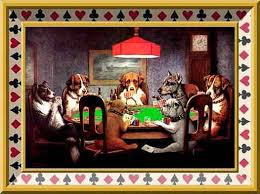 We are accustomed to reading short stories like Aces Up, or Inside Straight, where the action somehow relates to the sequence of bidding and uncertainty in various card games. Yes, life often imitates the bluffing, counting, bidding, random elements, path dependence, money management, reading, and choice inherent in a good poker game. And, of course, it will be no surprise to say that in many ways the market is like a poker game, with some of the cards hidden, some showing, and random factors to come.
Indeed, I have a dozen pages in Ed Spec on it (the most worthless in the book in my opinion) mainly because I am not an educated poker player, and all I've done is read books on how much I didn't know when I did play. Another approach to poker is to think of the cards coming into your hand, say on first, second, and third street, etc., in a five card stud hi-lo game with bidding after each card, as similar to the market moves each of the 5 days of the week. When should you bid, call, fold, or cash in?
Cashing in is always possible with the market mistress. Still, like the "doing business" which characterizes many such card games, the opponent may exercise a high price if you fold. Rite now the market has dealt three of a kind, with three down days in a row. Should you hold, raise, or fold? Readers of this humble site will know the Scarnesque, Malmudesque answer already and always have their canes at hand for such a deal.
If you are long, another player has the trips, and if you are short, you're holding them. Other common hands the market might deal you are the four card outside straight, if you're holding to Thursday, for example, and are long a call at 1450 with the options expiry on Friday, and the market now at 1439. Should you draw to that straight or 3 card flush or not?
Indeed, this seems to me a rather fruitful way of looking at things. On first, second, and third street, all the way up, a good card player knows what the correct play is depending on the cards that he is dealt and whether he's playing for low or high. Do market players have similar guidelines as to how to play the hand after sequential cards are dealt to all the players? We can answer such questions for many hands that the player is dealt during the week.
For example, after you've put up a big ante it might make sense to wait around for the big announcement that's going to cause great uncertainty, like the Humphrey Hawkins testimony on Wednesday. Or at least you shouldn't have called in the first place if you weren't ready to stay in, because you knew there would be a big raise after third street that you'd have to meet.
The question emerges as to what is the best way to simulate a 52-card deck with 13 numerical and face cards, and four suits. This will enable you to come up with rules of thumb as to when it pays to go for it based on expectations at various stages.
I would again propose using the five-card high-low as an analogy that, depending on whether you're long, short or straddling, you divide up the cards.
Since I know even less about poker than I know about trees or electronics or most of the other things I write about, besides the defunct game of hard ball squash, I had better leave this as an exercise for the reader. I'm not hubristic enough to give my own solution now knowing that so many better ones will come to the table. Subject to my admission of ignorance, however, if none comes I'll take a crack at it.
Steve Leslie adds:
 There was a time, when hold 'em was not the game of choice in poker rooms around America. In fact, if you were to speak to the old timers, many were totally unfamiliar with the game. It has only recently become a phenomenon, brought on by the technology of the 21st century and the ability to see the players' hole cards. Along with television came the great exposure of the World Series and as a result the game of choice today is no limit tournament style hold 'em.
Although the game is termed the Cadillac of poker, in the 90s the game I played was 7-card stud, or eight or better. I played this game for three years or so and I can honestly say that I consider myself to be one of the best stud players around. It plays into my skills very nicely as it is the most statistical of poker games. It also has the most information available as you get to see most of the cards. Players with have photographic memories and those who can think quickly have a great advantage.
This is a variation of the traditional 7-card stud, where the high hand and the low hand split the pot. In order to win the low hand, however, you have to have five cards out of seven that are no higher than an eight and the best possible hand is A, 2, 3, 4, 5. This is called a wheel. Straights and flushes do not count toward the low hand but they do for the high hand. Therefore, you can win both the low hand and the high hand at the same time.
Other than that 7-card stud, eight or better is very straightforward and there is very little bluffing. The true objective of the game is extreme patience and waiting for a starting hand that gives you the highest probability of success.
Here is the great secret to playing 7-card stud, 8 or better. Start out by playing only toward a low hand with an objective of also filling out your hand and winning both the high and the low. This is called sweeping the pot. In order to be profitable in this game you want to win one big pot an hour and sweeping is the best way to do so.
Therefore, you start out with three cards, two down and one up. The best starting hands are three cards that are in a row and of the same suit. A 3, 4, and 5, of spades for example. This constitutes the first round of betting. After that there will be four rounds remaining and one card at a time will be dealt to you and the last card will be dealt down.
If your first four cards are eight or less, then the likelihood that you will make a low is 80%. If you have four cards to a low after the fifth card is dealt, then your chance of success is 50%. There are two critical decisions that the stud player makes in the game. That is after third street and after fifth street. If by fifth street you don't have four low cards, you give up the hand. If you have four to a low by fifth street, you are committed to seeing it all the way to the end. It is really that simple. Properly played it is just beautiful. Poorly played it is absolutely brutal.
People get into trouble by playing high hands. The worst thing to have happen is to play a high hand only and come in second. This is very expensive, especially if someone makes her low and starts raising the pots as she should. And if the low also makes a high then the high is swimming against the current along the way.
The corollaries to a 5-day trading week are self evident. With respect to stocks, using William O'Neill's approach, your highest probability of success is by selecting stocks that have an eps rating of 80 or better and a Relative Share rating of 80 or better and investing in those. This will be your starting hand of three. If the stocks go down seven percent or more after investing in them, you let them go. This is the same as letting your hand go after 5th street as it just did not fill out as you have would liked.
Now I don't necessarily espouse the theory of the 7% rule, as I deem it as too tight for my tastes. It does not give the story time to play out. I rather have a more flexible stop loss level and do not overplay my hand. That is to say I do not chase cards. I do not commit too much of my capital to any one stock either. And if I feel I have a winning stock with good earnings, good relative strength, and in a good group, then I am willing to play it out to the end. Eventually, it will be recognized for its value. If I have an accommodating market on top of those variables chances increase to where I can get both the high and the low. This is where the great reward comes in. Once again, patience is the key. And having the earnings and the relative strength on you side helps provide the patience.

I hope this illustration is helpful. For a more in-depth discussion of the study of 7-card stud, eight or better see me offline.
Larry Williams writes:
"[R]esearch on strategic behavior in economic games has identified a wide range of situations in which thinking one step ahead of an opponent provides a decisive advantage. Research on behavior in markets shows that failing to think carefully about other participants' likely actions leads to adverse consequences, such as the ‘winner's curse’ (the tendency for auction winners to pay too much)."
From On Making the Right Choice : The Deliberation-Without-Attention Effect, by Ap Dijksterhuis, Maarten W. Bos, Loran F. Nordgren and Rick B. van Baaren Department of Psychology, University of Amsterdam
Feb
12
A Travel Suggestion, from Marion Dreyfus
February 12, 2007 | 1 Comment
 Tel Aviv had ignored its amazing seacoast for decades. Then real estaters suddenly realized the city faced away from the coast, and poof, the construction was on, redirecting the direction of the entire coastal area, and making a tasty spot for coffee during the day, and romance at night. Nice hotels. The most literate crowd in the region — 98% literacy, more than the US, actually.
Ari Oliver adds:
I was in Tel Aviv about two years ago. I was amazed at the number of second hand bookstores. It seemed like they were on every second block. It's amazing what books you can get. Obviously it is indicative of a strong intellectual climate.
J. P. Highland writes:
I'm currently in Israel, where I plan to stay for the next two weeks. This morning while visiting the Western Wall I heard a blast and screaming coming from the other side of the wall where the mosque is located. Everyone ran to take cover while I found a safe spot next to the CNN crew.
Israelis are digging next to a mosque and some Muslims are convinced that this is a plan to destroy their sacred place. Now everything seems to be OK. Fortunately, my hotel is next to the U.S. Consulate in case things go terribly wrong.
I've been in Israel for only 24 hours but I'm highly impressed with the country. Infrastructure in Tel Aviv is impressive, people are nice and well-educated and food is great. A lot of construction seems to be taking place.
Marion Dreyfus replies:
Israel has the highest per capita literacy level, much higher, in fact, than that of the U.S. Large clumps of the U.S. have little truck with book-learning, whereas in Israel, few can be so far from civilization that books are not a really proximal commodity, and preferred in many instances to the next choice. The Israel Philharmonic is, this week, 70 years old, which — doing the math –pre-existed the very birth of the State of Israel. Theatre and music are also highly attended, democratically priced and appreciated.
It is a truism that Israel is technologically advanced far beyond its age and size. In a recent science exposition I attended at the Science & Industry Library in NYC, there was a globe with countries represented in proportion to the patents sought and achieved. Israel was as large as Germany and Japan on this 'globe' of science interest. To some extent, Israel has no choice. Lacking easy access to raw materials, Israel thrives on intellect, or perishes.
Feb
11
Fundamental Laws, by Victor Niederhoffer
February 11, 2007 | 2 Comments
 The moves in markets often seem to imitate the kinds of things we see in nature: in gas; in water; and in electricity. For example, the gentle back and forth of the stock market last week, gradually building up pressure and then exploding on the downside, is like a cork bursting from a bottle of champagne, or a volcano erupting.
In electronic circuits we often see a signal gently oscillating between set points, then gathering a slight bit of amplitude on one side or the other, and finally tripping the set point thereby triggering a major change in the output. In capacitor resistor circuits, we find the same buildup of charge, with little change in the output until the time constant of the capacitor is fulfilled and the output suddenly and dramatically changes.
The reason for these similarities is they are all results of various energy conservation laws. Energy coming into a system cannot just disappear. One major conservation law in electronics is Kirchoff's Current law. It holds that current going into the confluence of two wires equals the current coming out. Another major law is Kirchoff's voltage law. It states the voltage that's input to a closed circuit is equal to all the voltage used up in work in the circuit.
I find the major applications of conservation laws in markets relating to some input from outside a system. Usually, some information or money flow gets distributed to the various components, companies, and markets of the system. A major merger announcement affects not just one company but all companies related to it. An increase in liquidity in the system gets distributed according to market's laws similar to Kirchoff's laws in electronics.
Click here for information on Kirchoff's laws.
To be continued.
Philip McDonnell adds:
 Two summers ago, in Central Park, the Chair said something to me which was at once profound yet seemingly too simple. "There is only so much money." That was all that he said. To someone who did not understand, it would seem rather sophomoric or even downright cryptic. But it was all he needed to say because I had read his books.
The statement referred to a simple conservation law much like the conservation laws of physics. In physics energy and mass are the most significant variables in most mechanical systems. So we have laws such as the Conservation of Energy, Conservation of Mass and Conservation of Momentum. In financial markets a similar law applies. Money is conserved. At any given time 'there is only so much money'.
Let us imagine an island economy where there are only two stocks X and Y. There is only so much money on the island. When the traders on the island decide they want to invest in X they need to figure out how to pay for the purchase. The only liquid source of money is stock Y. So they sell Y. The price of X goes up and Y goes down.
Let us draw this on an X-Y coordinate plot and assign some real numbers to it. The relationship between X and Y would show up as a line from high up on the Y axis sloping downward to some point of a large X value. Suppose the amount of money were $100. If everyone wanted to own Y and no one wanted X then we would have Y=100, X=0. Conversely if everyone wanted X and not Y then Y=0 and X=100.
We can think of the distance of the current market valuations as the distance from the origin that is equal to the buying power of the money. It is a simple conservation law on our island. The $100 defines a radius from the origin. It thus defines a circle. It is easy to draw on a two-dimensional chart or even in 3D. Drawing a 5000 dimensional sphere for the 5000 actively traded stocks is a project still in progress.
Charles Sorkin adds:
Is it not the beauty of Eurodollars that since there is no reserve requirement (being out of the country and not under the auspices of the Fed), foreign banks can create and loan as many dollars as they want?
Gregory van Kipnis adds:
Not quite. After the Eurodollar blew up in 1974, central bankers convened at the behest of the Bank of England to put a lid on the runaway growth of the Eurodollar market. It was agreed that each CB would be responsible for defaults of the banks they regulate even if the default were in the Eurodollar market. Following that, each foreign CB put reserve requirements on Eurodollar deposits.
From: George R. Zachar:
Not quite. After the eurodollar blow up in 1974 of Bank Herstadt, central bankers convened at the behest of the Bank of England to put a lid on the runaway growth of the eurodollar market. It was agreed that each CB would be responsible for defaults of the banks they regulate even if the default were in the eurodollar market. Following that, each foreign CB put reserve requirements on eurodollar deposits. /Gregory van Kipnis/
Given
1) That central banks are increasingly players themselves,
2) The clubby incestuous relationships within the govt/bank community in places like Italy,
3) The fact that one major central bank has had a high official murdered by someone he regulated (Russia),
4) The asset explosion in nations whose financial infrastructure hasn't been tested (the Gulf States),
5) The nil possibility that govt bankers grok the array and scope of derivatives…
I would not assume the central banking clerisy is on top of things. They might be, but there's reason for doubt.
Easan Katir writes:
The moves in markets often seem to imitate the kinds of things we see in nature… VN
 To continue the Chair's analogy, it would seem the next practical question is how do we predictively discover the impedance of that market capacitor which discharged on February 8, provided the "3 of a kind," then tripped another point of capacitance and surged in the opposite direction for the past 4 days? What voltmeter can we use to measure the current passing through?
Or is this market more like a big kid bouncing on a "40-day moving average" trampoline for the past seven months?
Feb
11
Gold and The Dollar, by Craig Mee
February 11, 2007 | Leave a Comment
 The back of my brain has been telling me for the last month of price action, as I glance through the numbers, that gold and the U.S. dollar are no longer best of friends (or at least reverse market indicators).
It appears to me that gold and the dollar index had a ambiguous correlation in the past, but all this has changed recently. Through the last month, gold has put on 8.3% (+55.9), while the dollar index has actually added .03% (basically flat).
I believe the Chair has shown in the past that relying on these inter-market relationships will lead to a diet of two-minute noodles. It looks like another one, at least for the moment, joins the graveyard.
Feb
11
“There Is Beauty In The Lashing Of The Tail,” by Victor Niederhoffer
February 11, 2007 | Leave a Comment
 The market's decline of 1% on Friday, from March Futures of 1456.8 which was a 6½ year high in the S&P Index, was beautiful on many different levels.
There was the beauty of covering 31 points on a one box continuation, one box reversal point, and figure basis, versus an average of 10 the previous five days, the startling move after the narrowest five non-holidays in history.
There was the beauty of two declines in a row to get the reversal boys leaning on the wrong foot. There was the beauty of one of the all-time highs in futures volume with 1.41 million contracts traded, the highest except for the January 25 volume of 1.42 million contracts in three months. There was the beauty of crashing below the key level boys stop points at 1448 where three previous one-day lows hit, the general beauty of a completely unexpected extraordinarily volatile day after such a lull with VIX moving from below 10 the previous Friday to above 11 on February 9, and the beauty of it going down on interest rate woes during the week while bond prices were actually up a half point on the week after setting a one month high on Thursday, February 8.
It brings to mind the Duet from he Mikado:
There is beauty in the bellow of the blast,
There is grandeur in the growling of the gale,
There is eloquent outpouring when the lion is a-roaring,
And the tiger is a-lashing of his tail.
Daily Speculations is very fortunate to have as its cofounder a collaboratrix who in my opinion is the world's greatest lyricist (her lyrics to a number of spec songs appear on Google). I have no doubt that she will put this, as well as the beautiful idea of the market's going down, on Fed Speak, about how vigilant they are about inflation.
Feb
11
Google’s Book Project, from Alston Mabry
February 11, 2007 | Leave a Comment
 Just discovering Google's book project. They're scanning in books from various libraries and have an ambitious plan to scan every book ever published (New Yorker article by Toobin).
A search for "speculator" brings up these full, searchable texts (among many others):
Arthur Crump: The Theory of Stock Exchange Speculation; London, 1874, John Hill, Jr. (of the Chicago Board of Trade).
Gold Bricks of Speculation; Chicago, 1904, A Study of Speculation and Its Counterfeits, and an exposé of the methods of bucketshop, and "get-rich-quick" swindles.
Harrison H. Brace: The Value of Organized Speculation; New York, 1913. A prize-winning essay from a contest run by Chicago, Columbia, Michigan, NYU, and Harvard, and sponsored by, "…Hart, Schaffner & Marx, of Chicago, who have shown a special interest in trying to draw the attention of American youth to the study of economic and commercial subjects."
Jim Sogi writes:
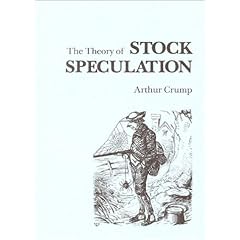 Thanks to Alston Mabry for pulling this one up. It will surely be a favorite of the Chair.
Arthur Crump appears to talk about the English markets, but the lessons are the same. Crump charges out of the gate with some great formulas for risk, such as, "…the sum risked must be only such proportion of the possible gain as the mathematical probability of gaining it is of unity." This is brilliant. "A man should not hazard his all on any terms."
Imagine this quantitative risk measurement in the 19th century. Closer to current one-day drops he speaks of typical drops of 2-3% a day with very gradual gains, familiar scenario indeed.
Crump identifies the pitfalls that await the unwary.
A typical reason many beginners convince themselves speculation is simple is they say to themselves the market can only go up or down and his chances are at least 50-50. Their mistake is overlooking path dependency in calculating the odds, thinking reversing position might have avoided losses.
"The outsider's stakes are too large a proportion of their means."
"Multiply each gain or loss by the probability of the event on which it depends; compare the total result of the gains with that of the losses. The balance is the average required and is known by the name of mathematical expectation."
It follows from this that the player must be able to stand a number of plays to realize the expectation. Furthermore, the gains must be greater than the expenses.
"Those whose only business it is to be in the stock markets must of course know that the outside public are always dropping their money."
"If a speculator has not learnt the alphabet of recurring intervals, he has not learned the alphabet of his business."
More later, but this is fun and good book in nice quaint old print.
More Crump Quotes from Jim Sogi:
"Any jackass can take a profit, but it requires a devilish clever fellow to cut a loss. After he has once realized the importance of having his accounts open and ready for the periodic haves to carry him in and land his profit, the difficulty is to get him to realize the importance of keeping out while the water weeps back, carrying with it the gray speculators who were not content to take their profits"
Good advise these last few days.
"It is as necessary to the success of his operation that he posses no more regard for the feelings or pockets of other people than a hungry tiger would for him, if he were airing himself unconcernedly in a Bengal jungle. He has a purpose in view, just as a surgeon has when the amputation of a leg has been decided upon."
"Deception in all its form will be found in the armory
of the professional speculator, and the weapons, two-edged, are employed.""Then there is the fatal blunder made by almost every inexperienced speculator, of never being satisfied with a moderate profit. If he buys, and the price rises 1/2, he cannot make up his mind to take it, but must wait for 3/4th. When it has reached that he must have 1 per cent and when that rise has been attained too, he wants another 1/8th to cover the commission. Like a dog in attempting to grasp the shadow of his bone, he loses all."
Feb
11
Characteristics of Successful World Businesses, by Nigel Davies
February 11, 2007 | Leave a Comment
Having returned home from visiting Chessbase in Hamburg yesterday, and having the privilege of being associated with two other successful businesses (Gambit, the World leader in chess book publication plus the Chair's shop), I noticed some similarities that I thought might be worth sharing. Whilst they are reminiscent of one of Jack Aubrey's commands, how many other businesses are there like these, and can it be formulated into an investment strategy? I imagine there are a few software producers and small biotech companies which share these characteristics, but how does one find them for investment purposes?
· Everyone gets on with his job.
· Whilst there are outstanding specialists in
particular fields, there is a certain degree of interchangability between roles.
· There's an absense of office politics and little or no authoritarianism.
· Nobody is counting the hours worked and several people work from home ('Gambit' is entirely virtual).
· The atmosphere is distinctly low key.
Feb
9
Accuracy and Precision, from Gordon Haave
February 9, 2007 | Leave a Comment
 Accuracy and precision are conflicting traits in any forecast. Most market forecasters are completely inaccurate, is it because they are trying to be too precise? After all, what kind of forecaster would get paid if he didn't at least try to nail down next year's market return within 5%?
Perhaps more value can be added by drastically reducing the attempted precision, and so I offer the following:
The market gives 10% per year to those who are willing to freely accept it. This 10% includes big drawdowns such as 2000-2002, and fall 1987.
Therefore, if one could target precision of simply "is there a high chance of a 30% drop in the market", one could add a worthwhile amount of return to the 10% offered by the market.
The P/E ratio is probably the ratio that is most commonly used in inaccurate forecasts, but I give you the following:
I don't know which direction the market is going to go, and I don't know what will happen to corporate earnings.
I do know the following per the graph: Despite the strong bull market since 2003, the PE ratio is exactly where it was at the start of the late 1990's bull market. Combine that with the fact that the Earnings yield on the SPX - the 10 year yield is positive (and it was negative in 2000 and late 1987), we can perhaps safely assume that a negative 30% year is not in the cards, and therefore the expected return on the stock market this year is greater than 10%.
Feb
9
Factoid of the Day, from Sam Humbert
February 9, 2007 | Leave a Comment
 From PriorityMagazine.com: "Starbucks spent more money on employee healthcare in 2005 than it did on coffee beans."
Maybe Peter Navarro should write a sequel: "If It's Raining $$$ in Chappaqua, Sell Starbucks."
Feb
9
Depletable Commodities, by Larry Williams
February 9, 2007 | 6 Comments
 Perhaps another myth:
As prices go higher, new materials are used to substitute: fiber optics; plastic for cars rather than iron and steel; etc.
Global warming (if it exists, which I doubt) seems mostly bearish for most agrarian items. This is because it will mean longer growing seasons and production in areas now too cold, hence larger supply.
Reply from George Zachar:
This should be countable. Has planted acreage spread north? Are grain shipments up on Canada's railways? Is the mix of crops changing in ways consistent with warmer climes at higher latitudes?
Two of my "you're a moron" global warming refutations are the facts that Greenland was under the plow, not ice, 1000 years ago, and there were vineyards north of London several centuries ago.
From Steve Leslie:
For those of you who are interested in global warming and the debate surrounding it, I recommend you read Michael Creighton's State of Fear.
It has plenty of suspense and intrigue as well as discussion of the merits of the scientific studies of global warming. It is very much a scientific novel.
From Henry Gifford:
My understanding is that it is written by a fine writer who is not a scientist, and I'm not aware of any debate among scientists about what is causing global warming.
I have a copy of the Irish physisict John Tyndall's paper to The Royal Society wherin he identified CO2 as a greenhouse gas, which I understand was where the debate ended, over 150 years ago.
Stefan Jonanovich writes:
No one questions the increase in CO2 emissions as the result of human activity. What many scientists have questioned is, (1) whether CO2 is a significant contributor to the "greenhouse" mechanism as opposed to, for example, water vapor condensation triggered by increased gamma radiation, and (2) whether the recent observations of warming in some (but not all) parts of the globe have other and possibly more significant causes such as increased solar radiation.
These are reasonable questions. What is irrational is the extent to which discussion is being actively repressed even in the scientific community in the name of unanimity. What is shameful is that this global "emergency" has taken precedence over trivial matters like clean water for the million or so children who die every year of diarrhea, and cooking fuels other than wood fires for the millions of women whose lung functions are destroyed.
Feb
9
Review of Robert Kaplan’s “Balkan Ghosts” by Stefan Jovanovich
February 9, 2007 | 1 Comment
 Robert Kaplan can write. But in Balkan Ghosts, he did not get close to understanding how deep the anger was or is against the Croats (including Tito) and the Muslims among the Serbs who survived WW II.
Srebrenica, for example, is the part of Bosnia where the local Muslims were particularly vicious to the Serb minority during the German and Italian occupation. The Bosnian Serbs saw the organized murder there as justified revenge. I don't accept that explanation or justification, but I know many otherwise reasonable people who do.
In treating the Balkan (and in particular the Serb and gypsy) memories as "ghostly," rather than fresh and raw, Kaplan failed to see how deep-seated the anger really was. He saw Milosevic as somehow provoking it when like most politicians he was merely chasing after the parade to get in front of it. It is as if Kaplan had written a book about the awfulness of Menachem Begin and bombing of the King David Hotel without mentioning the Holocaust.
One of the many reasons I adored my grandfather is that he believed people could go beyond the ideologies of history. He married a Polish Catholic, and his three children married a Ukrainian Eastern Rite Catholic, a Croat born-again Protestant, and an Alabama Methodist. He told me I should learn history but I should be wary of its lessons. That was, he said, one of the true beauties of America; people here were less interested in the past than they were in present, as a path to the future.
Feb
9
Alibi Tim, by George Zachar
February 9, 2007 | Leave a Comment
 An atypically gooey NY Times puff piece on NY Fed Pres. Tim Geithner includes this anecdote worthy of L'Amour:
"He looks like he's distracted and not listening, and then he'll say, 'Well, I don't know much about this' and then he starts talking and five paragraphs later you realize there is a logical string that connects all of it. And then you realize this kid who doesn't know anything just outdid everyone."
It's fair to assume this morning's wet kiss on paper is purposeful, and that the newly anointed fair-haired boy will be going places.
Feb
8
Fedwatching, an Update, by Bill Rafter
February 8, 2007 | 1 Comment
 The Monetary Base is composed of 2 items: currency and deposits in Fed banks. The two are an interesting combination. If you look at the spikes in Monetary Base, the first one (Y2K) is entirely due to currency. The second one (9/11) is entirely due to the Fed goosing the deposits. That points out that despite some opinions to the contrary, the Fed definitely has some control over the process. Which is to say that changes in Fed policy can have significant effect.
Deviation from the fit does not correlate well with bullish or bearish equities, just as high or low interest rates (unless excessively so) also do not correlate well. The equities markets can get used to a level of interest rates, but uncertainty or volatility of those rates can have a deleterious effect on the stock market. That is, it's not the level, but the volatility of the changes. Because there are not enough examples, however, the analysis must be considered anecdotal.
Regarding the Fed's policy, they were restrictive during the 1996-99 period. But the decision to be less restrictive after the combined Asian Contagion, Russian Bond default, and collapse of LTCM, really sent the stock market soaring.
I ask the rhetorical question that if the Fed should back off their restrictive policy, what will happen to the stock market? However, I believe it is unlikely that they would back off without a triggering event.
Feb
8
Trading at the Dead Sea, by Laurence Glazier
February 8, 2007 | Leave a Comment
 Although it has been quite a challenge, I have been able to place some trades and face the test of covering short options in the upcoming expiry week.
The InterMat terminals at the Nirvana are fun; it helps to know a little Hebrew, and to have a Google personalized home page. Yesterday a chap asked me how much net access cost as he needed to place some stock market trades. Turned out he was trading options on the TA25. He departed in haste, perhaps as that market was changing directions. "It's crazy here," he told me.
Farther afield, in Ein Bokek, is McDonalds, surrounded by hotels. This generous company provides free Wi-Fi. It has unaccountably stopped working for me, however, so I have moved to a nearby hotel.
This country definitely exists, despite being generally missing from weather maps (bracketed on Sky by Qatar Airways ads) and BBC Middle East business programs. One suspects these deals - if deals they be, are conducted with a knowing glance, as with the persecution of actors accused of communist ties in the days of McCarthyism.
Feb
8
The Oil Factor, by Craig Mee
February 8, 2007 | Leave a Comment
 The book titled The Oil Factor outlines a number of key points. Of note moving forward is negative price action. Oil this time last year was trading around 64, now it hovers around 58. If the March and April equities sell off materializes this year, and oil stays relatively flat from here (at least without any major shocks), there looks to be far too many positives not to open up the cupboard and polish up the cane.
When oil rose by 100% or more over a 12-month period, stocks during the next 18 months experienced an average monthly decline of 27%. (Sample period 1973-2003. That is to say, if oil rose by 100% 15 times, then this figure is the average of the percentage decline in the markets of the 18 months for those 15 years.) The smallest decline was 13%. It, too, wasn't straight down. There where times when stocks rose. But the average maximum gain of stocks following 100% rise in oil was only 4%.
Therefore, over 12-month periods where the rise in oil is greater than 100%, results of the following 18 months returns in stocks average are: 27% loss and 4% gain. Further breakdown as follows:
· 50-100% increase in price of oil: average loss 11%, average gain 17%
· 25-50% increase in price of oil; average loss 7%, average gain 25%
· 0-25% increase in price of oil; average loss 3%, average gain 21%
· Less than 0% increase in price of oil; average loss 1%, average gain 30%
Feb
8
Negative Feedback and Trend Following, by Victor Niederhoffer
February 8, 2007 | Leave a Comment
 There has been entirely too little thought given to the mechanism, pathways and reasons that negative feedback works in markets. Perhaps the main reason is that the feeding web is based on a reasonable stability in what and how much is being eaten and recycled.
The people who consume and redistribute must maintain a ready and stable supply of those who produce. They develop mechanisms to keep everything going. One of them is the specialization and great efficiency in their activities. If markets deviate too much from the areas and levels within which the specialization has developed, then much waste and new effort and mechanisms will be necessary.
Aside from the grind that trend following causes (i.e. the losses in execution), and the negative feedback system of movements in the supply and demand schedules that equilibrate, which Marshall pioneered and are now standard in economics, and the numerous other reasons I've set forth (e.g. the fixed nature of the system and the flexibility to profit from it), this appears to me to be the main reason that trend following doesn't work.
Here are a few interesting articles on the subject:
How Great Traders Make Millions in Up or Down Markets
Does Trend Following Work On Stocks?
Interviews At RealWorld Trading
Bill Rafter writes:
Dr. Bruno had posed the idea of beating an index by deleting the worst performers. This is an area in which we have done considerable work. Please note that we do not consider this trend-following. The assets are not charted, just ranked.
Let us imagine an investor who is savvy enough to identify what is strong about an economy and invest in sectors representative of those areas, while avoiding sectors representing the weaker areas of the economy. Note that we are not requiring our investor to be prescient. He does not need to see what will be strong tomorrow, just what is strong and weak now, measured by performance over a recent period.
What is a market sector? The S&P does that work for us, and breaks down the overall market (that is, the S&P 500) into 10 Sectors. They further break it down into 24 Industry Groups, and further still into 60-plus Industries and 140-plus Sub-Industries. The number of the various groups and their constituents changes from time to time as the economy evolves, but essentially the 500 stocks can be grouped in a variety of ways, depending on the degree of focus desired. Some of the groupings are so narrow that only one company represents that group.
Our investor starts out looking at the 10 Sectors and ranks them according to their performance (such as their quarterly rate of change). He then invests in those ranked first through fourth (25 percent in each), and maintains those holdings until the rankings change. How does he do? Not bad, it turns out.
www.mathinvestdecisions.com/Best_4_of_10.gif
From 1990 through 2006, which encompasses several types of market conditions, the overall market managed an 8 percent compound annual rate of return. Our savvy investor achieved 10.77%. A less savvy investor who had the bad fortune to pick the worst six groups would have earned 7.23%. Those results are below. (Note, for comparison purposes, all results excluded dividends.)
www.mathinvestdecisions.com/Worst_6_of_10.gif
How can our savvy investor do better? By simply sharpening one's focus, major improvements can be achieved. If instead of ranking the top 4 of10 Sectors, our savvy investor invests in a similar number (say the top 4, 5 or 6) of the 24 Industry Groups, he achieves a 13.12% compoundedannual rate of return over the same period. Note that the same stocks are represented in the 10 Sectors and the 24 Industry Groups. At no time did he have to be prescient.
www.mathinvestdecisions.com/Going_to_24_groups.gif
One thing you will notice from the graphs above is that the equity curves of our savvy and unlucky investors mimic the rises and declines of the market index itself. Being savvy makes money but it does not insulate one from overall bad markets because the Sectors and even the Industry Groups are not significantly diversified from the overall market.
Why not keep going further out and rank all stocks individually? That clearly results in superior returns, but the volume of trading is such that it can only be accomplished effectively in a fund structure - not by the individual. And even ranking thousands of stocks will not insulate an investor from an overall market decline, if he is only invested in equities. The answer of course is diversification.
It is possible to rank debt and alternative investment sectors alongside equities, in the hope of letting their performances dictate what the investor should own. However the debt and commodities markets have different volatilities than the equities markets. Anyone ranking them must make adjustments for their inherent differences. That is, when ranking really diverse assets, one must rank them on a risk-adjusted basis for it to be a true comparison. However if we make those adjustments and rank treasury bonds (debt) against our 24 Industry Groups (equity) we can avoid some of the overall equity declines. We refer to this as a Strategic Overlay:
www.mathinvestdecisions.com/Strategic_diversification.gif
Adding this Strategic Overlay increases the returns slightly, but more important, diversifies the investor away from some periods of total equity market decline. We are not talking of a policy of running for cover every time the equities markets stall. In the long run, the investor must be in equities.
Invariably in ranking diverse assets such as equities, debt and commodities, our investor will be faced with a decision that he should be completely out of equities. It is likely that will occur during a period of high volatility for equities, but one that has also experienced great returns. Thus, our investor would be abandoning equities when his recent experience would suggest otherwise. And since timing can never be perfect, it is further likely that the equities he abandons will continue to outperform for some period. On an absolute basis, equities may rank best, but on a risk-adjusted basis, they may not. It is not uncommon for investors to ignore risk in such a situation, to their subsequent regret.
Ranking is not without its problems. For example, if you are selecting the top 4 groups of whatever category, there is a fair chance that at some time the assets ranked 4 and 5 will change places back and forth on a daily basis. This "flutter" can be easily solved by providing those who make the cut with a subsequent incumbency advantage. For a newcomer to replace a list member, it then must outrank the current assets on the selected list by the incumbency advantage. This is very similar to the manner in which thermostats work. We have found adding an incumbency advantage to be a profitable improvement without considering transactions costs. When one also considers the reduced transaction costs, the benefits increase even more.
Another important consideration is the "lookback" period. Above we used the example of our savvy investor ranking assets on the basis of their quarterly growth. Not surprisingly, the choice of a lookback period can have an effect on profitability. Since markets tend to fall more abruptly than they rise, lookback periods that perform best during rising markets are markedly different from those that perform best during falling markets. Determining whether a market is rising or falling can be problematic, as it can only be done with certainty in retrospect. However, another key factor influencing the choice of a lookback period is volatility, which can be determined concurrently. Thus an optimal lookback period can be automatically determined based on volatility.
There is certainly no question that a diligent investor can outperform the market. By outperforming the market we mean that he will achieve a greater average rate of return than the market, while limiting the maximum drawdown (or percentage equity decline) to less than that experienced by the market. But the average investor is generally not up to the diligence or persistence required.
In the research work illustrated above, all transactions were executed on the close of the day following a decision being made. Thus the strategy illustrated is certainly executable. Nothing required a forecast; all that was required was for the investor to recognize concurrently which assets have performed well over a recent period. It is not difficult, but requires daily monitoring.
www.mathinvestdecisions.com/about.htm
Charles Pennington writes:
Referring to the MathInvestor's plot:
www.mathinvestdecisions.com/Worst_6_of_10.gif :
At first glance it appears that the "Best" have been beating the "Worst" consistently.
In fact, however, all of the outperformance was from 1990 through 1995. From 1996 to present, it was approximately a tie.
Reading from the plot, I see that the "Best" portfolio was at about 2.1 at the start of 1996. It grew to about 5.5 at the end of the chart for a gain of about 160%. Over the same period, the "Worst" grew from 1.3 to 3.2, a gain of about 150%, essentially the same.
So for the past 11 years, this system had negligible outperformance.
One should also consider that the "Best" portfolio benefits in the study from stale pricing, which one could not capture in real trading. Furthermore, dividends were not included in the study. My guess is that the "Worst" portfolio would have had a higher dividend yield.
In order to improve this kind of study, I would recommend:
1.) Use instruments that can actually be traded, rather than S&P sectors, in order to eliminate the stale pricing concern.
2.) Plot the results on a semilog graph. That would have made it clear that all the outperformance happened before 1996.
3.) Finally, include dividends. The reported difference in compound annual returns (10.8% vs 8.0%) would be completely negated if the "Worst" portfolio had a yield 2.8% higher than the "Best".
Bill Rafter replies:
Gentlemen, please! The previously sent illustration of asset ranking is not a proposed "system," but simply an illustration that tilting one's portfolio away from dogs and toward previous performers can have a beneficial effect on the portfolio. The comparison between the 10 Sectors and the 24 Industry Groups illustrates the benefits of focus. That is, (1) don't buy previous dogs, and (2) sharpen your investment focus. Ignore these points and you will be leaving money on the table.
We have done this work with many different assets such as ETFs and even Fidelity funds (which require a 30-day holding period), both of which can be realistically traded. They are successful, but not overwhelmingly so. Strangely, one of the best asset groups to trade in this manner would be proprietarily-traded small-cap funds.
Unfortunately if you try trading those, your broker will disown you. I mention that example only to suggest that some assets truly do have "legs," or "tails" if you prefer. I think their success is attributed to the fact that some prop traders are better than others, and ranking them works. An asset group with which we have had no success is high-yield debt funds. I have no idea why.
A comment from Jerry Parker:
 I wrote an initial comment to you via your website [can be found under the comments link by the title of this post], disputing your point of view, which a friend of mine read, and sent me the following:
I read your comment on Niederhoffer's Daily Spec in response to his arguments against trend following. Personally, I don't think it boils down to intelligence, but rather to ego. Giving up control to an ego-less computer is not an easy task for someone who believes so strongly in the ability of the human mind. I have great respect for his work and his passion for self study, but of course disagree with his thoughts on trend following. On each trade, he is only able to profit if it "trends" in a favorable direction, whether the holding period is 1 minute or 1 year. Call it what you will, but he trades trends all day.
He's right. I was wrong. Trend following is THE enemy of the 'genius'. You and your friends can't even see how stupid your website is. You are blinded by your superior intelligence and arrogance.
Victor Niederhoffer responds:
Thanks much for your contributions to the debate. I will try to improve my understanding of this subject and my performance in the future so as not to be such an easy target for your critiques.
Ronald Weber writes:
When you think about it, most players in the financial industry are nothing but trend followers (or momentum-players). This includes analysts, advisors, relationship managers, and most fund or money managers. If there is any doubt, check the EE I function on Bloomberg, or the money flow/price functions of mutual funds.
The main reason may have more to do with career risk and the clients themselves. If you're on the right side while everyone is wrong, you will be rewarded; if you're on the wrong side like most of your peers you will be ok; and if you're wrong while everyone is right then you're in trouble!
In addition, most normal human beings (daily specs not included!) don't like ideas that deviate too much from the consensus. You are considered a total heretic if you try to explain why, for example, there is no link between the weak USD and the twin deficits. This is true, too, if you would have told anyone in 2002 that the Japanese banks will experience a dramatic rebound like the Scandinavian banks in the early '90s, and so on, or if you currently express any doubt on any commodity.
So go with the flow, and give them what they want! It makes life easier for everyone! If you can deal with your conscience of course!
The worse is that you tend to get marginalized when you express doubt on contagious thoughts. You force most people to think. You're the boring party spoiler! It's probably one reason why the most successful money managers or most creative research houses happen to be small organizations.
Jeremy Smith offers:
 Not arguing one way or the other here, but for any market or any stock that is making all time highs (measured for sake of argument in years) do we properly say about such markets and stocks that there is no trend?
Vincent Andres contributes:
I would distinguish/disambiguate drift and trend.
"Drift": Plentifully discussed here. "Trend": See arcsine, law of series, etc.
In 2D, the French author Jean-Paul Delahaye speaks about "effet rateau" (rake effect), here and here .

Basically, our tendency is to believe that random equals equiprobability everywhere (2D) or random equals equiprobability everytime (1D), and thus that nonequiprobability everywhere/everytime equals non random
In 1D, non equiprobability everytime means that the sequence -1 +1 -1 +1 -1 +1 -1 +1 is in fact the rare and a very non random sequence, while the sequences -1 +1 +1 +1 +1 +1 -1 +1 with a "trend" are in fact the truly random ones. By the way, this arcsine effect does certainly not explain 100% of all the observed trends. There may also be true ones. Mistress would be too simple. True drift may certainly produce some true trends, but certainly far less than believed by many.
Dylan Distasio adds:
For those who don't believe trend following can be a successful strategy, how would you explain the long-term performance of the No Load Fund X newsletter? Their system consists of a fairly simple relative strength mutual fund (and increasingly ETF) model where funds are held until they weaken enough in relative strength to swap out with new ones.
The results have been audited by Hulbert and consistently outperform the S&P 500 over a relatively long time frame (1980 onwards). I think their results make a trend following approach worth investigating…
Jerry Parker comments again:
All you are saying is that you're not smart enough to develop a trend following system that works. What do you say about the billions of dollars traded by trend following CTAs and their long term track records?
Steve Leslie writes:
If the Chair is not smart enough to figure out trend following, what does that bode for the rest of us?
There is a very old yet wise statement: Do not confuse brains with a bull market.
Case in point: prior to 2000 the great tech market run was being fueled by the hysteria surrounding Y2K. Remember that term? It is not around today but it was the cause for the greatest bull market seen in stocks ever. Dot.com stocks and new issues were being bought with reckless abandon.
New issues were priced overnight and would open 40-50 points higher the next trading day. Money managers had standing orders to buy any new issues. There was no need for dog-and-pony or road shows. It was an absolute classic and chaotic case of extraordinary delusion and crowd madness.
Due diligence was put on hold, or perhaps abandoned. A colleague of mine once owned enough stock in a dot.com that had he sold it at a propitious time, he would have had enough money to purchase a small Hatteras yacht. Today, like many contemporary dot.coms, that stock is essentially worthless. It would not buy a Mad magazine.
Corporations once had a virtual open-ended budget to upgrade their hardware and software to prepare for the upcoming potential disaster. This liquidity allowed service companies to cash in by charging exorbitant fees. Quarter to quarter earnings comparisons were beyond belief and companies did not just meet the numbers, they blew by them like rocket ships. What made it so easy to make money was that when one sold a stock, all they had to do was purchase another similar stock that also was accelerating. The thought processes where so limited. Forget value investing; nobody on the planet wanted to talk to those guys. The value managers had to scrape by for years while they saw their redemptions flow into tech, momentum, and micro cap funds. It became a Ponzi scheme, a game of musical chairs. The problem was timing.
The music stopped in March of 2000 when CIO's need for new technology dried up coincident with the free money, and the stock market went into the greatest decline since the great depression. The NASDAQ peaked around 5000. Today it hovers around 2500, roughly half what it was 7 years ago.
It was not as if there were no warning signs. Beginning in late 1999, the tech market began to thin out and leadership became concentrated in a few issues. Chief among the group were Cisco, Oracle, Qwest, and a handful of others. Every tech, momentum, and growth fund had those stocks in their portfolio. This was coincident with the smart money selling into the sectors. The money managers were showing their hands if only one could read between the lines. Their remarks were "these stocks are being priced to perfection." They could not find compelling reasons not to own any of these stocks. And so on and on it went.
After 9/11 markets and industries began to collapse. The travel industry became almost nonexistent. Even Las Vegas went on life support. People absolutely refused to fly. Furthermore, business in and around New York City was in deep peril. This forced the Fed to begin dramatically reducing interest rates to reignite the economy. It worked, as corporations began to refinance their debt and restructure loans, etc.
The coincident effect began to show up in the housing industry. Homeowners refinanced their mortgages (yours truly included) and took equity out of their homes. Home-buyers were thirsty for real estate and bought homes as if they would disappear off the earth. For $2000 one could buy an option on a new construction home that would not be finished for a year. "Flipping" became the term du jour. Buy a home in a hot market such as Florida for nothing down and sell it six months later at a much higher price. Real estate was white hot. Closing on real estate was set back weeks and weeks. Sellers had multiple offers on their homes many times in the same day. This came to a screeching halt recently with the gradual rise in interest rates and the mass overbuilding of homes, and the housing industry has slowed dramatically.
Houses for sale now sit on the blocks for nine months or more. Builders such as Toll, KB, and Centex have commented that this is the worst real estate market they have seen in decades. Expansion plans have all but stopped and individuals are walking away from their deposits rather than be upside down in their new home.
Now we have an ebullient stock market that has gone nearly 1000 days without so much as a 2% correction in a day. The longest such stretch in history. What does this portend? Time will tell. Margin debt is now at near all-time highs and confidence indicators are skewed. Yet we hear about trend followers and momentum traders and their success. I find this more than curious. One thing that they ever fail to mention is that momentum trading and trend following does not work very well in a trendless market. I never heard much about trend followers from June 2000 to October 2002. I am certain that this game of musical chairs will end, or at least be temporarily interrupted.
As always, it is the diligent speculator who will be prepared for the inevitable and capitalize upon this event. Santayana once said, "Those who cannot remember the past are condemned to repeat it."
From "A Student:"
Capitalism is the most successful economic system in the history of the world. Too often we put technology up as the main driving force behind capitalism. Although it is true that it has much to offer, there is another overlooked hero of capitalism. The cornerstone of capitalism is good marketing.
The trend following (TF) group of fund managers is a perfect example of good marketing. As most know, the group as a whole has managed to amass billions of investor money. The fund operators have managed to become wealthy through high fees. The key to this success is good marketing not performance. It is a tribute to capitalism.
The sports loving fund manger is a perfect example. All of his funds were negative for 2006 and all but one was negative over the last 3 years! So whether one looks at it from a short-term one year stand point or a three year perspective his investors have not made money. Despite this the manager still made money by the truckload during this period. Chalk it up to good marketing, it certainly was not performance.
The secret to this marketing success is intriguing. Normally hedge funds and CTAs cannot solicit investors nor even publicly tout their wares on an Internet site. The TF funds have found a way around this. There may be a web site which openly markets the 'concept' of TF but ostensibly not the funds. On this site the names of the high priests of TF are repeatedly uttered with near religious reverence. Thus this concept site surreptitiously drives the investors to the TF funds.
One of the brilliant marketing tactics used on the site is the continuous repetition of the open question, "Why are they (TF managers) so rich?" The question is offered as a sophist's response to the real world question as to whether TF makes money. The marketing brilliance lies in the fact that there is never a need to provide factual support or performance records. Thus the inconvenient poor performance of the TF funds over the last few years is swept under the carpet.
Also swept under the rug are the performance figures for once-great trend followers who no longer are among the great, i.e., those who didn't survive. Ditto for the non-surviving funds in this or that market from the surviving trend followers.
Another smart technique is how the group drives investor traffic to its concept site. Every few years a hagiographic book is written which idolizes the TF high priests. It ostensibly offers to reveal the hidden secrets of TF.
Yet after reading the book the investor is left with no usable information, merely a constant repetition of the marketing slogan: How come these guys are so rich? Obviously the answer is good marketing but the the book is moot on the subject. Presumably, the books are meant to be helpful and the authors are true believers without a tie-in in mind. But the invisible hand of self-interest often works in mysterious ways.
In the latest incarnation of the TF book the author is presented as an independent researcher and observer. Yet a few days after publication he assumes the role of Director of Marketing for the concept site. Even the least savvy observer must admit that it is extraordinary marketing when one can persuade the prospect to pay $30 to buy a copy of the marketing literature.
Jason Ruspini adds:
"I attribute much of the success of the selected bigs to being net long leveraged in fixed income and stocks during the relevant periods."
I humbly corroborate this point. If one eliminates long equity, long fixed income (and fx carry) positions, most trend-following returns evaporate.
Metals and energies have helped recently, after years of paying floor traders.
Victor replies:
I don't agree with all the points above. For example, the beauty of capitalism is not its puffery, but the efficiency of its marketing and distribution system as well as the information and incentives that the prices provide so as to fulfill the pitiless desires of the consumers. Also beautiful is in the mechanism that it provides for those with savings making low returns to invest in the projects of entrepreneurs with much higher returns in fields that are urgently desired by customers.
I have been the butt of abuse and scorn from the trend followers for many years. One such abusive letter apparently sparked the writer's note. Aside from my other limitations, the trend following followers apparently find my refusal to believe in the value of any fixed systems a negative. They also apparently don't like the serial correlation coefficients I periodically report that test the basic tenets of the trend following canon.
I believe that if there are trends, then the standard statistical methods for detecting same, i.e., correlograms, regressions, runs and turning point tests, arima estimates, variance ratio tests, and non-linear extensions of same will show them.
Such tests as I have run do not reveal any systematic departures from randomness. Nor if they did would I believe they were predictive, especially in the light of the principle of ever changing cycles about which I have written extensively.
Doubtless there is a drift in the overall level of stock prices. And certain fund managers who are biased in that direction should certainly be able to capture some of that drift to the extent that the times they are short or out of the market don't override it. However, this is not supportive of trend following in my book.
Similarly, there certainly has been over the last 30 years a strong upward movement in fixed income prices. To the extent that a person was long during this period, especially if on leverage, there is very good reason to believe that they would have made money, especially if they limited their shorts to a moiete.
Many of the criticisms of my views on trend following point to the great big boys who say they follow trends. To the extent that those big boys are not counterbalanced by others bigs who have lost, I attribute much of the success of the selected bigs to being net long leveraged in fixed income and stocks during the relevant periods.
I have no firm belief as to whether such things as trends in individual stocks exist. The statistical problem is too complex for me because of a paucity of independent data points, and the difficulties of maintaining an operational prospective file.
Neither do I have much conviction as to whether trends exist in commodities or foreign exchange. The overall negative returns to the public in such fields seem to be of so vast a magnitude that it would not be a fruitful line of inquiry.
If I found such trends through the normal statistical methods, I would suspect them as a lure of the invisible evil hand to bring in big money to follow trends after a little money has been made by following them, the same way human imposters work in other fields. I believe that such a tendency for trend followers to lose with relatively big money after making with smaller amounts is a feature of all fixed systems. And it's guaranteed to happen by the law of ever-changing cycles.
The main substantive objection to my views that I have found in the past, other than that trend followers know many people who make money following trends (a view which is self-reported and selective and non-systematic, and thus open to some of the objections of those of the letter-writer), is that they themselves follow trends and charts and make much money doing it. What is not seen by these in my views is what they would have made with their natural instincts if they did not use trend following as one of their planks. This is a difficult argument for them to understand or to confirm or deny.
My views on trend following are always open to new evidence, and new ways of looking at the subject. I solicit and will publish all views on this subject in the spirit of free inquiry and mutual education.
Jeff Sasmor writes:
Would you really call what FUNDX does trend following? Well, whatever they do works.
I used their system successfully in my retirement accounts and my kids' college UTMA's and am happy enough with it that I dumped about 25% of that money in their company's Mutual Funds which do the same process as the newsletter. The MFs are like an FOF approach. The added expense charges are worth it. IMO, anyway. Their fund universe is quite small compared to the totality of funds that exist, and they create classes of funds based on their measure of risk.
This is what they say is their process. When friends ask me what to buy I tell them to buy the FUNDX mutual fund if their time scale is long. No one has complained yet!
It ain't perfect (And what is? unless your aim is to prove that you're right) but it's better than me fumfering around trying to pick MFs from recommendations in Money Magazine, Forbes, or Morningstar.
I'm really not convinced that what they do is trend following though.
Dylan Distasio Adds:
For those who don't believe trend following can be a successful strategy, how would you explain the long-term performance of the No Load Fund X newsletter?
Michael Marchese writes:
In a recent post, Mr. Leslie finished his essay with, "I never heard much about trend followers from June 2000 to October 2002." This link shows the month-to-month performance of 13 trend followers during that period of time. It seems they did OK.
Hanny Saad writes:
Not only is trend following invalid statistically but, looking at the bigger picture, it has to be invalid logically without even running your unusual tests.
If wealth distribution is to remain in the range of 20 to 80, trend following cannot exist. In other words, if the majority followed the trend (hence the concept of trends), and if trend following is in fact profitable, the majority will become rich and the 20-80 distribution will collapse. This defeats logic and history. That said, there is the well-covered (by the Chair) general market upward drift that should also come as no surprise to the macro thinkers. The increase in the general population, wealth, and the entrepreneurial spirit over the long term will inevitably contribute to the upward drift of the general market indices as is very well demonstrated by the triumphal trio.
While all world markets did well over the last 100 yrs, you notice upon closer examination that the markets that outperformed were the US, Canada, Australia, and New Zealand. The one common denominator that these countries have is that they are all immigration countries. They attract people.
Contrary to what one hears about the negative effects of immigration, and how immigrants cause recessions, the people who leave their homelands looking for a better life generally have quite developed entrepreneurial spirits. As a result, they contribute to the steeper upward curve of the markets of these countries. When immigrants are allowed into these countries, with their life savings, home purchases, land development, saving and borrowing, immigration becomes a rudder against recession, or at least helps with soft landings. Immigration countries have that extra weapon called LAND.
So in brief, no - trends do not exists and can not exist either statistically or logically, with the exception of the forever upward drift of population and general markets with some curves steeper than others, those of the countries with the extra weapon called land and immigration.
A rereading of The Wealth And Poverty Of Nations, by Landes, and the triumph of the optimist may be in order.
Steve Ellison adds:
So Mr. Parker's real objective was simply to insult the Chair, not to provide any evidence of the merits of trend following that would enlighten us (anecdotes and tautologies that all traders can only profit from favorable trends prove nothing). I too lack the intelligence to develop a trend following system that works. When I test conditions that I naively believe to be indicative of trends, such as crossovers of moving averages, X-day highs and lows, and the direction of the most recent Y percent move, I usually find negative returns going forward.
Bacon summarized his entire book in a single sentence: "Always copper the public play!" My more detailed summary was, "When the public embraces a particular betting strategy, payoffs fall, and incentives (for favored horsemen) to win are diminished."
Trend Following — Cause, from James Sogi:
Generate a Brownian motion time series with drift in R
WN <-rnorm(1024);RW<-cumsum(WN);DELTAT<-1/252;
MU<-.15*DELTAT;SIG<-.2*sqrt(DELTAT);TIME<-(1:1024)/252 stock<-exp(SIG*RW+MU*TIME) ts.plot(stock)
Run it a few times. Shows lots of trends. Pick one. You might get lucky.
Trend Following v. Buy and Hold, from Yishen Kuik
The real price of pork bellies and wheat should fall over time as innovation drives down costs of production. Theoretically, however, the nominal price might still show drift if the inflation is high enough to overcome the falling real costs of production.
I've looked at the number of oranges, bacon, and tea a blue collar worker's weekly wages could have purchased in New York in 2000 versus London in the 1700s. All quantities showed a significant increase (i.e., become relatively cheaper), lending support to the idea that real costs of production for most basic foodstuffs fall over time.
Then again, according to Keynes, one should be able to earn a risk premium from speculating in commodity futures by normal backwardation, since one is providing an insurance service to commercial hedgers. So one doesn't necessarily need rising spot prices to earn this premium, according to Keynes.
Not All Deer are Five-Pointers, from Larry Williams
 What's frustrating to me about trading is having a view, as I sometimes do, that a market should be close to a short term sell, yet I have no entry. This betwixt and between is frustrating, wanting to sell but not seeing the precise entry point, and knowing I may miss the entry and then see the market decline.
So I wait. It's hard to learn not to pull the trigger at every deer you see. Not all are five-pointers… and some will be bagged by better hunters than I.
From Gregory van Kipnis:
 Back in the 70s a long-term study was done by the economic consulting firm of Townsend Greenspan (yes, Alan's firm) on a variety of raw material price indexes. It included the Journal of Commerce index, a government index of the geometric mean of raw materials and a few others. The study concluded that despite population growth and rapid industrialization since the Revolutionary War era, that supply, with a lag, kept up with demand, or substitutions (kerosene for whale blubber) would emerge, which net-net led to raw material prices being a zero sum game. Periods of specific commodity price rises were followed by periods of offsetting declining prices. That is, raw materials were not a systematic source of inflation independent of monetary phenomena.
It was important to the study to construct the indexes correctly and broadly, because there were always some commodities that had longer-term rising trends and would bias an index that gave them too much weight. Other commodities went into long-term decline and would get dropped by the commodity exchanges or the popular press. Just as in indexes of fund performance there can be survivor bias, so too with government measures of economic activity and inflation.
However, this is not to say there are no trends at the individual commodity level of detail. Trends are set up by changes in the supply/demand balance. If the supply/demand balance changes for a stock or a commodity, its price will break out. If it is a highly efficient market, the breakout will be swift and leave little opportunity for mechanical methods of exploitation. If it is not an efficient market (for example, you have a lock on information, the new reality is not fully understood, the spread of awareness is slow, or there is heavy disagreement, someone big has to protect a position against an adverse move) the adjustment may be slower to unfold and look like a classic trend. This more often is the case in commodities.
Conversely, if you find a breakout, look for supporting reasons in the supply/demand data before jumping in. But, you need to be fast. In today's more highly efficient markets the problem is best summarized by the paradox: "look before you leap; but he who hesitates is lost!"
Larry Williams adds:
I would posit there is no long-term drift to commodities and thus we have a huge difference in these vehicles.
The commodity index basket guys have a mantra that commodities will go higher - drift - but I can find no evidence that this is anything but a dream, piquant words of promotion that ring true but are not.
I anxiously stand to be corrected.
Marlowe Cassetti writes:
"Along a similar vein, why would anybody pay Powershares to do this kind of work when the tools to do it yourself are so readily available?"
The simple answer is if someone wishes to prescribe to P&F methodology investing, then an ETF is a convenient investment vehicle.
With that said, this would be an interesting experiment. Will the DWA ETF be another Value Line Mutual Fund that routinely fails to beat the market while their newsletter routinely scores high marks? There are other such examples, such as IBD's William O'Neal's aborted mutual fund that was suppose to beat the market with the fabulous CANSLIM system. We have talked about the great track record of No-Load Fund-X newsletter, and their mutual fund, FUNDX, has done quite well in both up and down markets (an exception to the above mentioned cases).
For full disclosure I have recently added three of their mutual funds to my portfolio FUNDX, HOTFX, and RELAX. Hey, I'm retired and have better things to do than do-it-yourself mutual fund building. With 35 acres, I have a lot of dead wood to convert into firewood. Did you know that on old, dead juniper tree turns into cast iron that dulls a chain saw in minutes? But it will splinter like glass when whacked with a sledgehammer.
Kim Zussman writes:
…about the great track record of No-Load Fund-X newsletter and their mutual fund FUNDX has done quite well in both up and down markets… (MC)
Curious about FUNDX, checked its daily returns against ETF SPY (essentially large stock benchmark).
Regression Analysis of FUNDX versus SPY since inception, 6/02 (the regression equation is FUNDX = 0.00039 + 0.158 SPY):
Predictor Coef SE Coef T P
Constant 0.00039 0.000264 1.48 0.14
SPY 0.15780 0.026720 5.91 0.00
S = 0.00901468 R-Sq = 2.9% R-Sq (adj) = 2.8%
The constant (alpha) is not quite significant, but it is positive, so FUNDX did out-perform SPY. Slope is significant and the coefficient is about 0.16, which means FUNDX was less volatile than SPY.
This is also shown by F-test for variance:
Test for Equal Variances: SPY, FUNDX
F-Test (normal distribution) Test statistic = 1.17, p-value = 0.009 (FUNDX<SPY)
But t-test for difference between daily returns shows no difference:
Two-sample T for SPY vs FUNDX
N Mean St Dev SE Mean
SPY 1169 0.00041 0.0099 0.00029
FUNDX 1169 0.00045 0.0091 0.00027 T=0.12
So it looks like FUNDX has been giving slight/insignificant out-performance with significantly less volatility; which makes sense since it is a fund of mutual funds and ETFs.
Even better is Dr Bruno's idea of beating the index by deleting the worst (or few worst) stocks (new additions?).
How about an equal-weighted SP500 (which out-performs when small stocks do), without the worst 50 and double-weighting the best 50.
Call it FUN-EX, in honor of the fun you had with your X that was all mooted in the end.
Alex Castaldo writes:
The results provided by Dr. Zussman are fascinating:
The fund has a Beta of only 0.157, incredibly low for a stock fund (unless they hold a lot of cash). Yet the standard deviation of 0.91468% per day is broadly consistent with stock investing (S&P has a standard deviation of 1%). How can we reconcile this? What would Scholes-Williams, Dimson, and Andy Lo think when they see such a low beta? Must be some kind of bias.
I regressed the FUNDX returns on current and lagged S&P returns a la Dimson (1979) with the following results:
Regression Statistics
Multiple R 0.6816
R Square 0.4646
Adjusted R Square 0.4627
Standard Error 0.0066
Observations 0.1166
ANOVA
df SS MS F Significance F
Regression 4 0.0444 0.0111 251.89 8.2E-156
Residual 1161 0.0511 4.4E-05
Total 1165 0.0955
Coefficients Standard Error t-Stat P-value
Intercept 8.17E-05 0.000194 0.4194 0.6749
SPX 0.18122 0.019696 9.2007 1.6E-19
SPX[-1] 0.60257 0.019719 30.5566 6E-151 SPX[-2] 0.08519 0.019692 4.3260 1.648E-05 SPX[-3] 0.04524 0.019656 2.3017 0.0215
Note the following:
(1) All four S&P coefficients are highly significant.
(2) The Dimson Beta is 0.914 (the sum of the 4 SPX coefficients). The mystery of the low beta has been solved.
(3) The evidence of price staleness, price smoothing, non-trading, whatever you want to call it is clear. Prof. Pennington touched on this the other day; an "efficiently priced" asset should not respond to past S&P price moves. Apparently though, FUNDX holds plenty of such assets (or else the prices of FUNDX itself, which I got from Yahoo, are stale).
S. Les writes:
Have to investigate the Fund X phenomenon. And look to see how it has done in last several years since it was post selected as good. Someone has to win a contest, but the beaten favorites are always my a priori choice except when so many others use that as a system the way they do in sports eye at the harness races, in which case waiting for two races or two days seems more apt a priori. VN
I went to the Fund X website to read up, and the information is quite sparse. It is a very attenuated website. I called the toll free number and chatted with the person on the other line. Information was OK, but, in my view, I had to ask the proper questions. One has several options here. One is to purchase the service and do the fund switching themselves based on the advice of their experts. The advisory service tracks funds that have the best relative strength performance and makes their recommendations from there, www.fundx.com.
Another is to purchase one of four funds available. They have varying levels of aggressiveness. Fund 3 appears to be the recommended one.
If one purchases the style 3 one will get a very broad based fund of funds. I went to yahoo to look up the holdings at www.finance.yahoo.com/q/hl?s=FUNDX.
Top ten holdings are 47.5% of the portfolio, apparently concentrated in emerging markets and international funds at this time.
In summary, if money were to be placed into the Fund X 3 portfolio, I believe it would be so broad based and diversified that returns would be very watered down. Along with risk you would certainly be getting a lot of funds. You won't set the world on fire with this concept, but you won't get blown up, either.
Larry Williams adds:
My 2002 book, Right Stock at the Right Time, explains such an approach in the Dow 30. The losers were the overvalued stocks in the Dow.It is a simple and elegant idea…forget looking for winners…just don't buy overvalued stocks and you beat the idex.
This notion was developed in 1997, when i began actually doing it, and written about in the book. This approach has continued to outperform the Dow, it is fully revealed.
Craig Cuyler writes:
Larry's comment on right stock right time is correct and can be used to shed a little bit of light on trend following. This argument is at the heart of fundamental indexation, which amongst other points argues that cap weighting systematically over-weights overvalued stocks and under-weights undervalued stocks in a portfolio.
Only 29% of the top 10 stocks outperformed the market average over a 10yr period (1964-2004) according to Research Affiliates (this is another subject). The concept of "right stock right time" might be expressed another way, as "right market right time." The point is that constant analysis needs to take place for insuring investment in the products that are most likely to give one a return.
The big error that the trend followers make, in my mind, is they apply a homogeneous methodology to a number of markets and these are usually the ones that are "hot" at the time that the funds are applied. The system is then left to its own devices and inevitably breaks down. Most funds will be invested at exactly the time when the commodity, currencies, etc., are at their most overvalued.
Some worthwhile questions are: How does one identify a trend? Why is it important that one identifies a trend? How is it that security trends allow me to make money? In what time frame must the trend take place and why? What exactly is a trend and how long must it last to be so labeled?
I think it is important to differentiate between speculation using leverage and investing in equities because, as Vic (and most specs on the list) point out, there is a drift factor in equities which, when using sound valuation principles, can make it easier to identify equities that have a high probability of trending. Trend followers don't wait for a security to be overvalued before taking profits. They wait for the trend to change before then trying to profit from the reversal.
Jeff Sasmor adds:
As a user of both the newsletter and the FUNDX mutual fund I'd like to comment that using the mutual fund removes the emotional component of me reading the newsletter and having to make the buys and sells. Perhaps not an issue for others, but I found myself not really able to follow the recommendations exactly - I tend to have an itchy trigger finger to sell things. This is not surprising since I do mostly short-term and day trades. That's my bias; I'm risk averse. So the mutual fund puts that all on autopilot. It more closely matches the performance of their model portfolio.
I don't know how to comment on the comparisons to Value Line Arithmetic Index (VAY). Does anyone follow that exactly as a portfolio?
My aim is to achieve reasonable returns and not perfection. I assume I don't know what's going to happen and that most likely any market opinion that I have is going to be wrong. Like Mentor of Arisia, I know that complete knowledge requires infinite time. That and beta blockers helps to remove the shame aspect of being wrong. But there's always an emotional component.
As someone who is not a financial professional, but who is asked what to buy by friends and acquaintances who know I trade daily (in my small and parasitical fashion), I have found that this whole subject of investing is opaque to most people. Sort of like how in the early days of computing almost no one knew anything about computers. Those who did were the gatekeepers, the high priests of the temple in a way. Most people nowadays still don't know what goes on inside the computer that they use every day. It's a black box - opaque. They rely on the Geek Squad and other professionals to help them out. It makes sense. Can't really expect most people to take the time to learn the subject or even want to. Should they care whether their SW runs on C++ or Python, or what the internal object-oriented class structure of Microsoft Excel is, or whether the website they are looking at is XHTML compliant? Heck no!
Similarly, most people don't know anything about markets; don't want to learn, don't want to take the time, don't have the interest. And maybe they shouldn't. But they are told they need to invest for retirement. As so-called retail investors they depend on financial consultants, fee-based planners, and such to tell them what to do. Often they get self-serving or become too loaded with fees (spec-listers who provide these services excepted).
So I think that the simple advice that I give, of buying broad-based index ETFs like SPY and IWM and something like FUNDX, while certainly less than perfect, and certainly less profitable than managing your own investments full-time, is really suitable for many people who don't really have the inclination, time, or ability to investigate the significant issues for themselves or sort out the multitudes of conflicting opinions put forth by the financial media.
You may not achieve the theoretical maximum returns (no one does), but you will benefit from the upward drift in prices and your blended costs will be reasonable. And it's better than the cash and CDs that a lot of people still have in their retirement accounts.
BTW: FOMA = Foma are harmless untruths, intended to comfort simple souls.
An example : "Prosperity is just around the corner."
I'm not out to defend FUNDX, I have nothing to do with them. I'm just happy with it.
Steve Ellison writes:
One might ask what the purpose of trends is in the market ecosystem. In the old days, trends occurred because information disseminated slowly from insiders to Wall Streeters to the general public, thus ensuring that the public lost more than it had a right to. Memes that capture the public imagination, such as Nasdaq in the 1990s, take years to work through the population, and introduce many opportunities for selling new investment products to the public.
Perhaps some amount of trending is needed from time to time in every market to keep the public interested and tossing chips into the market. I saw this statement at the FX Money Trends website on September 21, 2005: "[T]he head of institutional sales at one of the largest FX dealing rooms in the US … lamented that for the past 2 months trading volume had dried up for his firm dramatically because of the 'lack of trend' and that many 'system traders' had simply shut down to preserve capital."
I saw a similar dynamic recently at a craps table when shooters lost four or five consecutive points, triggering my stop loss so that I quit playing. About half the other players left the table at the same time. "The table's cold," said one.
To test whether a market might trend out of necessity to attract money, I used point and figure methodology with 1% boxes and one-box reversals on the S&P 500 futures. I found five instances in the past 18 months in which four consecutive reversals had occurred and tabulated the next four points after each of these instances (the last of which has only had three subsequent points so far). The results were highly non-predictive.
Starting Next 4 points
Date Continuations Reversals
01/03/06 3 1
05/23/06 1 3
06/29/06 2 2
08/15/06 2 2
01/12/07 1 2
—– —–
9 10
Anthony Tadlock writes:
I had intended to write a post or two on my recent two week trip to Cairo, Aswan, and Alexandria. There is nothing salient to trading but Egypt seems to have more Tourist Police and other guards armed with machine guns than tourists. It is a service economy with very few tourists or middle/upper classes to service. Virtually no westerners walk on the streets of Cairo or Alexandria. I did my best to ignore my investments and had closed all my highly speculative short-term trades before leaving for the trip.
While preparing for taxes I was looking over some of my trades for last year. Absolute worst trade was going long CVS and WAG too soon after WalMart announced $2 generic pricing. I had friends in town and wasn't able to spend my usual time watching and studying the market. I just watched them fall for two days and without looking at a chart, studying historical prices and determining how far they might fall, decided the market was being stupid and went long. Couldn't wait to tell my visitors how "smart" a trader I was and my expected profit. It was fun, until announcement after announcement by WalMart kept causing the stocks to keep falling. The result was panic selling near the bottom, even though I had told myself before the trade that I could happily buy and hold both. Basically, I followed all of Vic's rules on "How to Lose."
Trends: If only following a trend meant being able to draw a straight line or buy a system and buy green and sell red. The trend I wrote about several months ago about more babies being born of affluent parents still seems to be intact. I have recently seen pregnant moms pushing strollers again. Planes to Europe have been at capacity my last two trips and on both trips several crying toddlers made sleep difficult, in both directions. Are people with young children using their home as an ATM to fund a European trip? Are they racking up credit card debt that they can't afford? Depleting their savings? (Oh wait - Americans don't save anything.) If they are, then something fundamental has changed about how humans behave.
From James Sogi:
My daughter the PhD candidate at Berkeley in bio-chem is involved in some mind-boggling work. It's all very confidential, but she tried to explain to me some of her undergrad research in words less than 29 letters long. Molecules have shapes and fit together like keys. The right shape needs to fit in for a lock. Double helices of the DNA strand are a popular example, but it works with different shapes. There is competition to fit the missing piece. They talk to each other somehow. One of her favorite stories as a child was Shel Silverstein's Missing Piece. Maybe that's where her chemical background arose. Silverstein's imagery is how I picture it at my low level.
Looking at this past few months chart patterns it is impossible not to see the similarity in how the strands might try fit together missing pieces in Wykoffian functionality. The math and methods must be complicated, but might supply some ideas for how the ranges and strands in the market might fit together, and provide some predictive methods along the lines of biochemical probability theory. I'll need some assistance from the bio-chem section of the Spec-list to articulate this better.
From Kim Zussman:
Doing same as Alex Castaldo, using SPY daily change (cl-cl) as independent and FUNDX as dependent gave different resluts:
Regression Analysis: FUNDX versus SPY ret, SPY-1, SPY-2
The regression equation is FUNDX = 0.000383 + 0.188 SPY ret - 0.0502 SPY-1 - 0.0313 SPY-2
Predictor Coef SE Coef T P
Constant 0.000383 0.00029 1.35 0.179
SPY ret 0.187620 0.03120 6.01 0.000* SPY-1 -0.050180 0.03136 -1.60 0.110 SPY-2 -0.031250 0.03121 -1.00 0.317 *(contemporaneous)
S = 0.00970927 R-Sq = 3.2% R-Sq (adj) = 3.0%
Perhaps FUNDX vs a tradeable index is the explanation.
Feb
8
The President of the Old Speculators Club on the Market’s Recent Run
February 8, 2007 | Leave a Comment
I recently read the quote:
"Could it be that all the bruised and battered hold-outs from '00-'03 will finally join in and we resume the incessant trek toward the summit of market-based capitalism?"
Perhaps partially, but they're certainly not the key drivers in the market's recent run (without a significant dip). I suggested a couple of years ago that, though it might be counter-intuitive, an ever-increasing deficit in our balance of trade is actually a GOOD thing for the market.
Many words have been expended attributing ever-falling bond prices to the re-investment of these excesses. However, foreign interest in American assets goes well beyond bonds. Americans, as individuals, as corporations, and as a government have considerable assets - worth many trillions of dollars. And for the last several years they have been for sale - cheap - and getting cheaper.
Though the Dow and the S&P may have had impressive runs, so too have many of the major markets of the world. Back in '01 when everything was going to hell, Friedman of Stratfor hammered at the idea that the situation was unusually precarious because world markets, generally asynchronous, were, for once synchronized. He believed asynchronous markets were preferable as that gave asset allocators a range of choices in which substantive risk could be balanced with relative safety - with the exception of the Great Depression, there had always existed profitable markets.
I'm speculating that we are currently experiencing the opposite of Friedman's in-sync bear markets. And while our trade imbalances have contributed to our market's upward move, the fact is that governments, worldwide, contribute also by over-printing their currencies. As a result, with a few anomalies, it's become very difficult to find a "bad" market - but it's easy to find bad stocks (I know).
Additionally, commodity prices, despite recent setbacks, remain very high. Art, and I don't mean just the work of the masters but crap like Warhol's stuff, is once again selling at incredible prices. I understand coin collecting is once again becoming hot with higher prices not necessarily tied to metallic content. And other collectibles, at least from the occasional hour spent watching the Antique Road Show, are also escalating.
Wrapping it up, I see the current situation resulting from our trade deficit creating necessary purchases by foreigners, tax cuts increasing our own expendable funds, central banks creating lots of extra cash (some available at below market rates), and the re-emergence of the "battered hold-outs." The latter, though, are buying some of the other "real assets" mentioned.
Feb
7
Impotent Hawks, by George Zachar
February 7, 2007 | Leave a Comment
Philadelphia Fed President Charles Plosser lays out the case for further funds rate hikes, even enlisting ECB chief Trichet's favored signal word "vigilant."
But Plosser doesn't vote this year. Neither does the other hawk, Richmond's Lacker.
Feb
7
A New Regime, by Victor Niederhoffer
February 7, 2007 | 1 Comment
The stock market has emerged in last 5 days and it isn't captured, I dont think, by the normal things. Here are the high and low closes for recent days:
date open high low close
206 1454.0 1454.8 1447.8 1453.3
205 1451.5 1454.0 1448.1 1453.7
202 1452.2 1454.0 1448.1 1453.7
201 1446.3 1451.7 1444.0 1450.8
The average absolute change in highs, lows, and closed, from day to day, is 1. This has to be an all time non-holiday low. IBM also is trading at exactly 100 after swinging back and forth 4 times in last month above and below. What does it portend?
Not having any keys, although I do have the book by Ken Follett, I would like to consider some childlike questions about it. Others might think about this and the generalizations of same, I think, with value.
Sushil Kedia writes:
The lull before the storm. A single day's behaviour such as this would be dismissed as indecision.
Similarly, a second day would, at best, be termed market failed to get out of its indecision.
A third day again like this would make one tilt towards thinking the simplest of possible explanations, that a lull often is seen before the storm.
As distinct from any breakouts, which might not exist for a profit seeker, a simpler visualization appeals here. In ball games, from a football to a cricket ball, the point in the trajectory where a noticeable spin seems to be developing is a similar moment of quickly vanishing lull. Not a point of reversal, not a point of inflexion, just a point where the mistress will try to shuffle out the maximum number of players diving in either direction.
I clearly have no clue how I could translate this string of thought into a testable hypothesis.
Kim Zussman writes:
SPY, daily partitioned into 10d non-overlapping periods (from today's close) back to 2000; every 10d period checked standard deviation of daily closes, return for this 10 days, and return for next 10d.
Ten day return regressed against concurrent 10d standard deviation was negatively correlated (T=-1.9). Regression of next 10d return against prior 10d standard deviation and return showed positive correlation with prior standard deviation (t=1.8), and slight positive with prior 10d return (t=0.9).
Going to 5d non-overlapping, the current 5d standard deviation is 6th lowest of 352. The same regressions showed different results, with slight/NS correlation between 5d returns and concurrent standard deviation. The multiple regressions for next 5d return showed significant negative correlation with prior 5d return (t=-3), and slight positive/NS with prior 5d standard deviation (t=0.24).
So it looks like over short intervals, SPY returns related more to prior returns than volatility; but in longer intervals prior standard deviation is more important.
Vincent Andres writes:
"The average absolute change in highs, lows, and closed, from day to day, is 1. This has to be an all time non-holiday low. IBM also is trading at exactly 100 after swinging back and forth 4 times in last month above and below. What does it portend?
Not having any keys, although I do have the book by Ken Follett, I would like to consider some childlike questions about it. Others might think about this and the generalizations of same, I think, with value."
Some related thoughts:

1.) K. Lorenz often put emphasis on the pair: stimulus and duration (and duration is often considered on spec list). Not surprisingly, in general, the longer the duration, the smaller the needed stimulus to provoke an identical reaction. Maybe wrong, but I wouldn't be surprised if duration were often a good candidate to explain our stats, residues, and even more.
On more elaborated stimuli, K. Lorenz and Tinbergen speaks about "triggering schema" (schéma déclencheur). This concept may be an appropriate frame for some of our stimuli. Tinbergen got the Nobel Prize with Lorenz and Frisch. R. Dawkins was a student of Tinbergen.
2.) Remembering the previous "trend" thread, we may consider non-trending phases as quite rare events. So, if the stimulus part alone is rare, this seems a condition propitious for the whole pattern being non-random.
Apologies, no counts (… not yet).
PS: "I have found the missing link between the higher ape and civilized man: It is we." K. Lorenz.
Feb
7
Playing Cards with the Market Mistress, by Henrik Andersson
February 7, 2007 | Leave a Comment
 I was playing with the thought of analyzing the market with the help of a card game analogy. Assume you have a deck of cards with the daily returns for the last five years for the S&P 500. If you draw the cards one by one what would the optimal strategy be, that is, when would you stop in order to maximize your return?
This doesn't seem like an easy problem to solve by hand, so I performed some Monte Carlo simulations. With a simple fixed return-based stop, it seems like a maximum return can be achieved by stopping when you are at around 50% return for an average return of some 40%. The average waiting time for this game strategy is almost 3 years.
For the last five years the S&P 500 moved from 1090 to 1447, a 32.75% return. I believe a more complex analysis of this kind could possibly yield some interesting results. This was inspired by a question in "Heard on the Street: Quantitative Questions from Wall Street Job Interviews" by Timothy Falcon Crack, where one is asked to calculate the optimal stopping rule from 52 playing cards if red cards pay you a dollar and black cards fine you a dollar.
Philip McDonnell writes:
If the market truly has a long term upward drift then there is no good stopping point. In a sense this may be the wrong question. Perhaps the better question is when to enter the market with new money or when to increase one's leverage. The idea is that this implicitly recognizes that buy and hold is very difficult to beat.
The market also differs from the card deck in that the investment horizon is very long, not just 52 known cards. Another difference is that the card deck analogy is a model without replacement. If you have seen unfavorable cards so far then one need only stay in the game to the end to be guaranteed at least a break-even outcome. One is guaranteed a form of mean reversion because cards are drawn without replacement. To assume that the market distribution acts in a mean reverting fashion is a major assumption which should be tested first.
Feb
7
Wyckoff on Charts and Fixed Rules, by Martin Lindkvist
February 7, 2007 | Leave a Comment
"In and out of many brokerage offices there hustled wild-eyed individuals with charts under their arms, who would hold forth and show you just where and how and why the ‘big fellows’ were doing this or that with their favorite stocks. Yet none of them seemed to have much money. Possibly it was because they followed a strict set of rules and did not use much intelligence. It seems that the charts told them exactly what to do!"
From "How I Trade and Invest in Stocks and Bonds," by Richard D. Wyckoff, 1924.
Feb
6
A Comment from Mathew Hayward, Author of ‘Ego Check’
February 6, 2007 | Leave a Comment
[See Vic's Review of Mathew Hayward's Book, Below]
 During the 1980s I worked as an investment banker in Australia at what was then and still is the nation’s strongest franchise (Potter Partners now UBS); it was the first choice for finance graduates and corporate clients. Corporate raiders made investment banking a very hot business; and we were faced with the choice between defending Australia’s leading company, BHP, from Robert Holmes a Court, or dumping BHP. As events transpired, we dumped BHP, Holmes a Court could not get control of BHP and our other corporate clients started leaving us. On another deal we underwrote an equity offering, accepted the client’s terms not to have an ‘out’ provision and were left holding stock as the market crashed in 1987. On both deals we had no doubt that we were right; after all we were the smartest people in the room.Little did I know at the time that hubris is man’s cardinal sin, that it is latent in all of us and that it needs to be managed.
In 1992 I started a PHD at Columbia to explore all of that. Contrary to Vic’s assertion [below], the book is not based on anecdotal evidence. It is based on behavioral decision theory which has spawned the field of behavioral finance, in which overconfidence in decision making is found to be the most important and pervasive bias in finance and business. The factors that cause hubris in the work place and beyond, those that Vic mentions in his review, are all based on large sample empirical evidence not a small number of anecdotal examples.Ego Check is a checklist-based approach to help you manage your ego, both personally and professionally. It will stand the test of time because it is based on sound theory and large sample research with senior executives, traders and senior executives.I invite you to visit me at ego-check.com . The knowledge contained in the book would have saved me (and Vic probably) a fortune if I had adhered to it throughout my career. In my experience, it’s a lot more fun to undertake the self improvement that the book points to. On the other hand, if you already have all the answers, this book is probably not for you.
Feb
6
Review of Mathew Hayward’s “Ego Check,” by Victor Niederhoffer
February 6, 2007 | 1 Comment
The book Ego Check, by Mathew Hayward, seems like it was written exactly for me. It's about the tendency towards overconfidence in striving individuals. The four major hallmarks of same are: excessive pride and boastfulness; failure to listen to foils who tell you when you're wrong; refusal to get feedback about the outcome of your activities; and not planning for problems, consequences, and corrective measures in advance.
The author gives case studies that show how these four faults led to disaster in the case of mountain climber Rob Hall, business executives Jean Messiers, Meg Whitman, Steve Jobs, Michael Dell, Dean Kamen, Merck in the Vioxx disaster, NASA in the Challenger and Columbia disasters, and The National Kidney program.
Hayward could have included me in his case studies because I have succumbed in each area. In my career in sports and markets, I have paid much too much attention to trying to be number one. I have not relied enough on family (especially my father, when he told me to take it easy), and executives within my own organization who doubted the wisdom of my activities. I have not relied enough on checkpoints to see if the original reasons for my activities were no longer valid, and I have not done enough war gaming to see what to do when my decisions or game plans go astray.
I hope that now that I have confessed these faults, which I understand is one of the keys to self-improvement, to which I will not so readily succumb in the future.
The main problem with the book is that it relies mainly anecdotal methodology to prove its points. It includes numerous cases where pride was very successful, such as Apple and Dell, where the same executive was guilty of hubris and of perfectly rational overconfidence. It espouses people like Jack Welch and Warren Buffet as role models for how not to let hubris get the better of their organization. But anyone who seriously studies these executives' activities might conclude, as I do, that these are sanctimonious scoundrels who are masterful at retrofitting their personae into a form that the media will love and whose judgment is superior to the free market.
As I read the book, I found myself thinking about my hobby, electric circuits. So many of them go into short circuits and uncontrollable output because the output is tied to the input in a positive feedback loop rather than a negative one that dampens the volatility and controls the output. Anyone who plays with op amps or amplifier circuits will know exactly how important is the dampening influence of monitoring the output and then controlling it when it gets out of a range.
A bit of modeling with economic, electrical, or game theoretic concepts like this would have helped to put many of the points in a more systematic form for me and would have led to many more testable hypotheses. And yet, Hayward is a Columbia PhD who collaborated on Harvard works, and professor of psychology at Colorado University, who has interviewed many of the actors in the case studies that he writes about. I find him particularly insightful. And I agree with his point that hubris is the key fault that leads to great disaster in striving individuals.
To his credit, Hayward realized that the mantra espoused by Collins in Good to Great, i.e., that the successful executive should be meek and humble and prudent at all times, is retrospective mumbo jumbo not suitable for the risks and leadership role successful executives must take in today's dynamic and uncertain world. The problem is how to differentiate the overconfidence that has a positive expectation, from the ones that will lead to disaster.
Vincent Andres writes:
"Retrofitting their persona into a form that the media will love . . ."
Those words trigger others. I believe media, as do many, prefer it the simple way. That is to say it's easier to agree than to disagree. (Disagreeing needs proof to work. Agreeing needs just to believe or rely on others' work.
Thus agreeing implies *resonance*. In other words the initial signal is enlarged. No added value/*information*, but *added power*/energy.
But, the public hearing many loudspeakers, gets the impression that so many loudspeakers equals so many (independents) sources, which is dramatically untrue.
And this may also be linked to the "halo effect." With resonance, the halo's envelop grows and grows, becoming a bubble, pumping plenty of energy/power … but pumping, in fact, little true information.
But, doesn't this give us our daily bread?
Model attempt: If we liken information to halo's envelope and energy to halo's volume, as the halo grows, if there is no added information, then we get a thiner and thiner envelope, until a given point, where the too unbalanced ratio ends with … blood on the walls.
See also: "Larsen Effect" at wikipedia.org/wiki/Audio_feedback
Feb
6
Grossman, Not That it Matters, by John Tierney
February 6, 2007 | 1 Comment

Keeping in mind that I maintained my record of not watching more than 10 minutes of any NFL game this season, from all that I've read, Grossman has never been considered more than a mediocre QB. That the Bears went as far as they did is surprising (and as a Packer fan I have little use for the Bears).
The real comparison between the QBs (for me) occurred at my Monday exercise class. In Tennessee, Peyton is still regarded as a hometown hero. The Indianapolis win was almost as big as a Titan's win would have been. But nobody in the class (and there are some big Manning fans there) remarked on him having a great game. In fact, the consensus was that he didn't deserve the MVP award. (Last night Letterman, an Indianapolis native, wanted to recognize the QB who won the team it's championship: Rex Grossman.)
I'll leave to those who saw the game to determine whether or not the award was deserved.
Victor Niederhoffer writes:
While I can't understand anything that the President is talking about, let alone its relevance to markets, one has learned that he is always far above us in all specs of hunting, and we place it on web with the humble and reverential mien that we always have when the President's bag of ducks bulges so much greater than our own.
Feb
6
The Halo Effect, by Vincent Andres
February 6, 2007 | Leave a Comment
 The Halo Effect, discovered by the psychologist E. Thorndike, refers to the human tendency to attribute all kinds of positive traits to people we admire.
As the Yiddish proverb says "If I were wealthy, I would be handsome and a good dancer also."
In French, "Et dans l'objet aimé, tout leur devient aimable." (And in the loved person, everything becomes lovable.")
This is also strongly linked to the hardwearing theme of "news always after numbers."
Feb
6
Quotable Quotes, by George Zachar
February 6, 2007 | Leave a Comment
Long, droning BBG article on the continued orgy in credit default swapland had these two wonderful quotes:
"As long as the money pours in, I see no reason for spreads to widen again.''
and
"It's like a free lunch. You're immune to default.''
Feb
6
Quick ‘N Dirty On ‘Green’ Stocks…Now, by Craig Mee
February 6, 2007 | Leave a Comment
Maybe its time to run a water portfolio for the coming year….
I believe a recent post pointed out water utilities could narrow this down, as I believe a recent post mentioned this would be a good area in the field. A unit of General Electric will on Tuesday announce its first investment in the European water market, signaling its belief that water could soon rival the energy sector as a destination for infrastructure investment.
news.moneycentral.msn.com
Feb
6
Bid Offer, Time, and Execution Ramblings, by Craig Mee
February 6, 2007 | Leave a Comment
 If a market trades with regular volume of 20 lots a side, and trades fairly rapid fire throughout the day, you can bet your kids college fund on the fact that if a market then goes 2 lots on the bid and 80 on the offer and holds there for 4 x plus of a time period greater than the normal time of an execution without the small volume being given, that offer will be lifted pronto.
You can almost count it 1 … 2 … 3 … mine.
Victor Niederhoffer writes:
This is a most interesting and creative observation that suggests many fruitful extensions. It may be the best way to show that volume matters - of course it's the opposite way from what is usually thought. Still, Justin Mamis had similar speculative insights.
Hanny Saad writes:
Very well stated and I agree with you [Craig]. Do you care to take a stab at what you think might be happening behind the scenes?
Craig Mee replies:
There're probably a few options here, but certainly at times you do have one or two key buyers or sellers driving the market. When this happens, the small retail traders will lean against solid offers time and again. This will continue until a situation develops where the market has traded through several levels and where no more small sellers are there to be found, yet the one or two hungry sharks are still circling. Thus you get the situation, whereby we have only two on the bid (all retail punters are now already short or have been burned trying to lean against offers) and 80 on the offer. Thereby no one hits the bid, market holds, 1/2/3/ bang… the big fish can get size on and lift the offer….
So, in a nutshell, one reason this happens, I believe is due to one or two large corporations shipping in volume for a hedge (though I'm sure the list could offer other reasons). And if you have big enough pockets it can often pay to fade this move. Its not, however, always a smart move, unless you have a direct line to God.
Bruno Ombreux writes:
"[A]nd if you have big enough pockets in can often pay to fade this move, however its not always a smart move…"
That's one thing I've seen a few times when I was a professional oil trader. It is entirely anecdotic and not testable, but relevant to the subject. The nice thing about being a professional, is that one has people on the floor, and they comment on what's happening like, "Goldman on the bid for 10,000 lots."
Now, in the 1990s, 10,000 lots WTI was big size. And if it were Goldman, and not their commodity subsidiary J. Aron, it meant they were acting as brokers for a fund that was an outsider. When professional traders tried to move size, they rarely showed it that way. They worked it all day long, preferably through several floor brokers, to hide one's intentions.
What usually happened in bygone days, is that a lot of small people tried to front-run the 10,000 lots, on the theory that a big buy order is like a free call option. They probably expected it to be taken piecemeal, if it were to be taken, which would leave time to sell and get out if the size showed signs of being eaten away. And if the market went the other way instead of filling the order, it was free money.
But instead of the order being eaten piecemeal, we often got information like, "Hess just booked Goldman." Which meant a commercial filled the 10,000 lots in one go, probably for hedging purposes.
The market moved toward size and the result was that all the frontrunners saw nothing below, and got into a panic. It cascaded as they hurried up out of their longs and the market collapsed. It can be really fun if it happens a few minutes before the close.
Feb
6
Automotive News, by Alan Millhone
February 6, 2007 | Leave a Comment
 I got a card in the mail today saying Nissan Altima, etc. will be out with a hybrid. Also a V-6 and a V-4. Ford may be history, but the ingenious foreign carmakers will be on the cutting edge of technology.
Feb
6
Romanian Real Estate Question, from “A Scientist”
February 6, 2007 | Leave a Comment
 Is anyone on the list familiar with real estate or related investment aspects of Bucharest, Romania?
A friend is doing some work in Bucharest and asks my advice about her idea of investing her entire life savings buying (rather than renting) an apartment there. Sounds a little crazy to me, even if Romania's recent EU membership is causing a boom. Does anyone have any knowledge or insight that would change my view?
Charles Sorkin writes:
What's the real underlying question here? It's easy to look at the performance data on loans that were originated with strong underwriting standards (like Freddie Mac mortgages) and conclude that the middle class credit-worthy borrowers aren't having many problems. Not surprising… these are high-quality loans to people with jobs, and who had their down payments on hand.
It might also be safe to assume that there will be buyers of last resort to support prices of properties foreclosed upon from sub-prime borrowers.
Thus, in answer to the question: "How is the real estate market?"… one could say that it is holding up reasonably well.
But is that what macro investors care about? Or ought we to be more concerned with the question: Will the financial difficulties encountered by sub-prime borrowers be sufficient to diminish consumer spending and trigger a recession?
Jaime Klein writes:
(1) Romania is a new member of the European Union, so its currency is strong and stable, property rights are safe, it is melting into the Eastern wing of the Union (Hungary, Bulgaria, Czech Republic, Poland) and real estate prices are very fast leveling with those countries'. Your niece arrived late to the party. Bucharest is Europe again and real estate prices are rocketing, it is difficult to find something reasonable in dollar terms. Five years ago prices were dirt cheap, and even a year ago you could find good value.
(2) Real estate development in Eastern Europe (and increasingly in Russia itself) is dominated by Israeli companies. They had people familiar with the area and the languages, and they entered very early in the local residential and commercial construction business. Eastern Europe's first mall was built by Motti Zisser (Elbit Medical - it is not a pharma co.) and it was a great success. He was followed by about a hundred Israeli developers, many quoted in TASE (Summit, Ahora, Olympia, Ofek, Yoab, Africa Israel, which is unrelated to Africa. It is a holding company with vast real estate business in Russia, owned by Lev Levayev), Kardan, Profit, Dor, Damari, Rothstein, Dori, etc. The sector doubled its value in 2006 and is still growing very fast. Most of them had been silently accumulating land in expectation of the countries becoming members of the European Union and are well positioned to take advantage of the coming boom.
(3) On the level of anecdote, I returned to Hungary ten years ago, when the government gave back the properties "nationalized" in 1948 from the "bourgeois" class. I went to see a "forest" (erdo) that the Communists took from my Father. My forest had become the downtown of that provincial capital. I accepted to be compensated with certificates and gave up all claims to the land. Others bought factories and property with those certificates; I sold them. Those who bought real estate saw their investment's value go up 1000%. Budapest's prices are now equal to those of the rest of Europe, and it can be presumed that the same will happen to Bucharest's in a few years from now.

(4) The action is moving to further frontiers like Ukrayna (which actually means border lands) and oil-rich Central Asian towns. If your niece wants to invest in a nice historic town with mild Black Sea climate and great untapped potential, I think Odessa would be a good place to look around.
Feb
6
George Zachar Contributes to the Department of Free Enterprise
February 6, 2007 | Leave a Comment
Just as every failure of Soviet communism was ascribed to anything BUT central planning…
Just as every bad Soviet harvest was blamed on weather…
Just as every evil to befall the Soviet people was blamed on foreign plots…
Just as markets were always cast as exploitive when they arose spontaneously to right the wrongs of the planners…
So this morning's New York Times whitewashes Mugabe's single-handed destruction of Zimbabwe by not once mentioning his power-mad authoritarianism and race-based lust for theft.
A front-page story that completely omits the central truth of its subject? Journalism historians would have to dig out Pravda's archive of the Brezhnev years for parallels.
This is important not because it's fun and easy to mock the once-august New York Times. It is important because, counterintuitively in the age of the web, there are powerful elements afoot that still believe they can get away with egregiously misrepresenting reality on a global scale.
Caveat reader.
Feb
6
Underperformance, by Gordon Haave
February 6, 2007 | 1 Comment
I currently monitor how many managers beat the relevant indexes every quarter. It appears to be surprisingly cyclical. For 2006, most managers (defined by separate accounts in the PSN database ) underperformed the indices. In fact, in many categories only 20% of managers beat their indices. The issue, though, is finding an explanation for this. What is it about the average separate account manager that he underperformed this year?
I postulate trend following. Most managers outperformed in some prior years, and I wonder if perhaps a trend following instinct leads them all to be overweight in, say, oil compared to the indices, and then oil breaks and they all get hit hard.
I suspect the fund flow out of active managers differs from the fund flow into ETFs. If someone withdraws money from a manager who closely tracks the S&P 500 and puts it into an SPY, there will not be any change in the outperformance of managers vs. the index.
Perhaps, though, the ETFs are representing a total allocation that is different from all the active managers combined. Active managers must hold a significant, say, a few percent at least, of stocks that aren't covered by the better-known indices, and these holdings are hurting them.
This should be testable in various ways. For example, stocks that are more heavily overlapped in indices should be outperforming now.
Alston Mabry replies:
Portfolio-weighting may play a role, too, as it interacts with changes in the small cap/large cap cycle. Indices are cap-weighted, so in order to produce a return different from the index, a fund portfolio must move some distance away from the cap-weighted index, towards equal - or random - weighted portfolios. When small cap/midcap stocks are doing well relative to large caps, there's a greater chance that an equal/random - weighted portfolio will beat the S&P. The reverse is true when large caps are the best performers.
I'm conflating funds that would say they have different benchmarks (large, mid, small, value, growth); but I would think that the analysis holds up even when restricted to subsets of stocks.
Feb
6
Language Lesson, by Sam Humbert
February 6, 2007 | 1 Comment
This morning, offlist, a trader asked after the etymology of "bucket shop."
Allwords.com says: Nineteenth century; originally US, meaning "a shop or bar selling alcoholic drink from open buckets," the drink therefore being of questionable origin.
Wikipedia says: A "bucket shop" in its original format was a shop with a counter under which was a bucket. It offered a high rate of interest on clients' deposits, took money in, put it in the bucket, and when someone withdrew their (sic) money, would take capital and income from the bucket.
But surely the right answer can be found in one of the old-time Wall Street books. Any insights from List scholars?
Alston Mabry writes:
From H. S. Irwin, Legal Status of Trading in Futures (1938):
Bucket shops accepted customers' orders and funds but did not execute the orders on any exchange. Rather, they simply bet the customer would lose and kept the customer's money when they did. If the customer won too much, the bucket shop would simply fold its operations and move to a new location.
Comparative Analysis, John Hill, Jr.; Gold Bricks Of Speculation (1904):
The term "bucketshop" as now applied in the United States was first used in the late 1870s, but it is very evident that it was coined in London as many as 50 years before, when it had absolutely no reference to any species of speculation or gambling. It appears that beer swillers from London's East Side went from street to street with a bucket, draining every keg they came across and picking up castoff cigar butts.
Arriving at a den, they gathered for social amusement around a table and passed the bucket as a loving cup. The den soon became called a bucket shop. Later on, the term was applied, both in England and the United States, as a byword for reproach, to small places where grain and stock deals were counterfeited.
www.brooklaw.edu/students/journals/blr/blr70iv_keaveny.pdf
Feb
5
Update: “What Would the Fed Model Do?” Found by George R. Zachar
February 5, 2007 | Leave a Comment
Victor Niederhoffer and crew at Daily Speculations recently updated an outlook for the S&P 500 index via Fed model analysis (based on a regression fit for 1980-2006), forecasting a 17.3% gain for 2007. This analysis is somewhat similar to our blog entry of 1/8/07, which uses historical data from our Real Earnings Yield Model and Reversion-to-Value Model to generate a comparable forecast. Stimulated by their update, we refresh our alternate perspective on Fed model dynamics.
To calculate valuation benchmarks, we use daily historical yields over the period 1990-2006 for the following: the 10-year Treasury note (T-note); the 3-month Treasury bill (T-bill); and the S&P 500 (using operating earnings yield - E/P - as calculated for our REY Model). To generate an outlook, we use the current Standard and Poor's operating earnings projection for 2007.
Feb
5
Pain Frequency By Kim Zussman
February 5, 2007 | Leave a Comment
On 2/5/07, Andrea Ravano wrote:
Evidence from Capuchin Monkey Trading behavior: The study confirms for animals, what behavioral studies have shown for human beings; that to offset a loss of 1 you must have a profit 2.5 times as big. In other words the perception of your pain is greater than that of your pleasure.
That pain of loss is 2.5 greater than pleasure of gain, in absolute terms, has been bandied about in literature for a while. What is the nature of a trader's state of mind as a function of trading (or more specifically, position checking) frequency?
One check on this is to look at the effect of multiplying losses by 2, and comparing with gains scaled at 1. Using SPY returns since 1993, checked average returns for daily, weekly, and monthly intervals:
Daily Weekly Monthly
Ave: -0.003 -0.005 -0.002
Pos: 1855 411 411
Tot: 3529 730 169
%Pos: 52 56 65
When the "effect" of losses on your soul is double that of gains, you are suffering, on average, in all intervals. Therefore, it is no coincidence there are so many psychologists/psychiatrists involved in trading. Percentage of the positive, however, scales up with longer intervals, so you feel bad less often.
Philip McDonnell adds:
Consider what happens when you lose: How much is required to break even?
Loss Required Gain Ratio
-20% 25% 1.25
-25 33.3% 1.33
-50 100 2.00
-75 300 4.00
Average Ratio 2.15
The ratio of how much is required to break even rises rapidly as the losses increase. Although the above unscientific data points appear to be in the ball park of the putative 2.5 ratio, the underlying ratios are clearly non-linear and NOT well described by a simple number. In fact any simple ratio is far too simplistic to be a good measure.
I would argue that a log linear utility function is what an investor, and any rational individual, would want. In their famous paper on Prospect Theory, Kahnemann and Tversky identified what appeared to be irrational behavior on the part of university students and some faculty when presented with hypothetical bets. The Nobel Prize winning professors concluded that the students chose irrationally as compared to the Gold standard of statistical expectations based on an arithmetic utility of money.
But if money compounds, one would want a log utility of money. When the examples cited in the study were recalculated with a log utility based on the relative net worth of typical students the results showed that the student subjects were invariably quite consistent with a log utility function. This re-opens the question: Were the subjects or the professors the irrational ones?
If one expresses the gains and losses in the above table as the natural log of the price relative, then the negative logs of the losses exactly cancel the logs of the gains.
Charles Pennington adds:
These experiments that psychology professors run on students invariably involve the students' winning or losing maybe $100 or less. That's a small amount by any reasonable metric.
$100 is very small, for example, compared with their first year's salary out of school. So it's quite reasonable for the professors to assume that the amount is in the limit of a "small" amount, in the sense that it (1+x) is approximately x if x is "small."
Any reasonable person, offered the opportunity to bet with a 50% chance of winning $250 and a 50% chance of losing $100, should take the bet. That's true even if he only has $250 to his name, because he also has prospects for future earnings.
In this case, the professors are more rational than the monkeys.
J. T. Holley wrote:
"Could it be that all the bruised and battered hold-outs from '00 - '03 will finally join in, and we resume the incessant trek toward the summit of market-based capitalism?" kz
How about this simple fact: For the first time in recent years that I can remember, the Dow and S&P indexes (headline purposes) outperformed the price appreciation, across America, of houses or real estate. This is roughly a two to one ratio. Now for the sake of simplicity, how many of the '00 - '03 bruised and battered people are going to scratch their heads and say, "twice as much, huh?"
I think the "Confidence Index" mentioned by Carret has a ways to go fellas; but this must obviously be tested.
Philip McDonnell adds:
"Any reasonable person, offered the opportunity to bet with a 50% chance of winning $250 and a 50% chance of losing $100, should take the bet, and that's true even if he only has $250 to his name, because he also has prospects for FUTURE earnings."
I would agree that future earnings can be and perhaps should be factored in. But to a freshman with $100 (not $250) the 50% chance of no beer, pizza, and dating for four years might seem an unacceptable risk. Losing it all results in a utility of Ln (zero), the way I look at things. Ln asymptotically approaches negative infinity.
A few points:
1. KT did include some bets in the thousands of dollars.
2. Most of the KT bets were fairly close calls even viewed from an expected arithmetic value as opposed to a log utility.
3. KT never concluded that the indifference ratio was 2.5 or any other number in their ground-breaking paper.
Feb
5
Sunny Days, by Kim Zussman
February 5, 2007 | Leave a Comment
Currently we have strong earnings, tame inflation, a smug Fed showing signs of a Bernanke-put, high productivity without wage pressure, declining oil and commodity prices, new all-time high on Dow, new six year high on SP500, stock earnings yield higher than bonds, and near record low volatility. Tests of new highs, big advances, and consecutive up-months don't show any signs of trouble ahead.
Could it be that all the bruised and battered hold-outs from '00-'03 will finally join in and we resume the incessant trek toward the summit of market-based capitalism?
Looking further into VIX, partitioned daily VIX closes into ten non-overlapping 70 day periods, 1/04-present. For each period, the regressed VIX vs. date is shown, and it is noted whether the slope of the fitted line was significant (i.e. T<-2 means VIX declined significantly, T>2 means it went up). Here is the data for the ten periods, shown with corresponding slope T score:
Date VIX slopeT
10 -0.2 (period ending at present)
9 -13.2
8 5.6
7 -0.3
6 -5.4
5 4.9
4 2.4
3 -3.1
2 -4.8
1 -4.5
0 1.1 (starting 1/04)
These line segments follow rise and declines in volatility, as well as "flat" periods like the current one. Last summer's volatility spike shows in period eight, T = 5.6, followed famously by the decline of period nine (T = -13.2). Although there does appear to be some periodicity (see roller-coaster diagram), there are also consecutive runs of up and down slope.
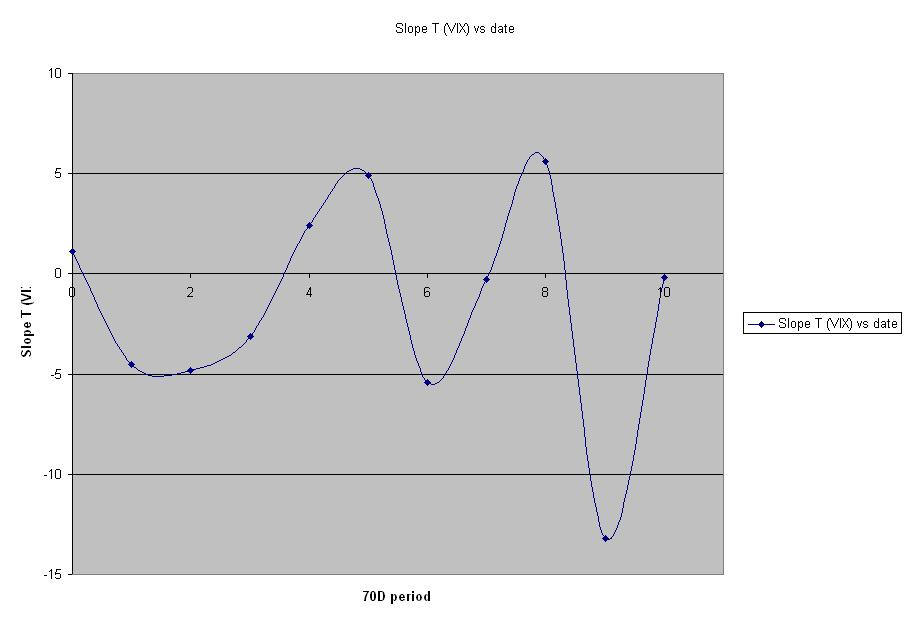
Feb
4
BBQ and Map Update, by Alston Mabry
February 4, 2007 | Leave a Comment
If one wants to experiment with BBQ sauces, there are plenty out there. I've added a page to the BBQ Map, listing some award-winning sauces available online (disclosure: no financial interest in any).
I also added the following to the maps:
La Fiesta De Los Vaqueros - Tucson Rodeo - Tucson AZ - Feb 17-25
1st Annual Route 66 BBQ Contest - Apple Valley CA - Jun 8-10
West Coast Championship BBQ Cook-Off - Fairfield CA - Aug 10-11
National Grits Festival - Warwick GA - Apr 14
National Oldtime Fiddlers' Contest (Weiser, ID: Fiddling Capital of the World) - Weiser ID - Jun 18-23
Lake in the Hills Rockin Ribfest - Lake in the Hills IL - Jul 6-8
Naperville Exchange Club's Ribfest - Naperville IL - Jun 30-4
10th Annual BBQ Ribfest - Fort Wayne IN - Jun 14-17
Canada's National Ukrainian Festival (since 1966) - Dauphin MB
The Belleville National Strawberry Festival - Belleville MI - Jun 15-17
44th Annual National Blueberry Festival - South Haven MI - Aug 9-12
Cass Lake Rib Fest - Cass Lake MN - Jul 20-22
Northern International Livestock Exhibition Stock Show and Rodeo - Billings MT - Oct 17-20
84th Annual Killdeer Mountain Roundup Rodeo (and BBQ) - Killdeer ND - Jul 3-4
National Hamburger Festival - Akron OH - Jul 21-22
Hot Ribs Cool Jazz - Columbus OH - Jul 20-22
12th Annual Canada's Largest Ribfest - Burlington ON - Aug 31-3
Thornbury-Clarksburg Rotary Club's 23rd Annual Blue Mountains Chili Cookoff - Collingwood ON - Jul 7
London Boys and Girls Club Rib-Fest - London ON - Aug 2-6
Gloucester Fair - Canadian BBQ Chmp qualifier - Ottawa ON - May 24-27
Scarborough Ribfest - Scarborough ON - Aug 3-Jul 4
8th Annual Toronto Ribfest - Toronto ON - Jun 29-Sep3
43rd Annual National Apple Harvest Festival - Arendtsville PA - Oct 6-14
85th Annual Days of 76 Rodeo - Deadwood SD - Jul 24-Jul2
Spirit of the West Festival (with a Dutch oven cookoff) - Siuox Falls SD - Sep 14-16
Ribfest and Wings - Gatlinburg TN - Apr 19
National Cornbread Festival, with the 11th Annual National Cornbread Cookoff - South Pittsburg TN - Apr 28-29
34th Annual Brady/McCulloch County World Championship Goat Cookoff (125 teams) - Brady TX - Aug 31-1
Montgomery County Fair BBQ Cookoff (120 teams) - Conroe TX - Mar 29-1
LaSalle County Wild Hog Cook-Off & Fair - Cotulla TX - Mar 8-11
Czhilispiel Chili and BBQ Cookoffs - Flatonia TX - Oct 26-28
Galveston County Fair and Rodeo BBQ, Chili and Seafood Cookoff (260 BBQ teams) - Hitchcock TX - Apr 20-28
Houston Livestock Show and Rodeo World's Championship BBQ Contest - Houston TX - Feb 22-24
8th Annual ACS Hardin County Relay for Life Bar-B-Que Cook-Off - Sour Lake TX - Apr 13-14
Terlingua International Chili Championship - Terlingua TX - Nov 3-Sep1
West Virginia Strawberry Festival - Buckhannon WV - May 16-20
West Virginia Black Walnut Festival - Spencer WV - Oct 12-15
Feb
4
Rare Green PR Misstep, by George Zachar
February 4, 2007 | Leave a Comment
The press campaign promoting the latest global warming hoax was timed poorly. The depths of the Northern Hemisphere winter plus the American football championship build-up make a poor setting for pretending that human action is more powerful than solar oscillation.
I suspect the timing was driven by a desire to capitalize on anticipated post-Davos momentum and the start of the U.S. legislative session.
Feb
4
A Dog That Saves You When You’re Under Water, by Pamela Van Giessen
February 4, 2007 | Leave a Comment
You have a Newfoundland dog on hand to save you from drowning. No doubt specs, I wish man's best friend could be trained to rescue drowning stocks. Read Pooch Saves a Drowning Dog
Feb
4
Vic Queries About Tree Growth
February 4, 2007 | Leave a Comment
Vic Queries:
There are only a few people I know who know more about trees than Bill Craft does. He's a forester and things like the laws of uniform stress are second nature to him. I feel like sitting on a log with him and asking such questions as
1. Why do the canopies of trees tend to grow to the same height in a stand?
1a. Is there such a thing as hubris in trees and is it dangerous the way it is in markets?
2. Why do trees decide to have a single trunk rather than several?
3. What are the strategies that determine the horizontal versus the vertical growth of trees?
4. What predictions can be made from the distribution of different species of trees at a time as to the ultimate succession and climax community?
5. When does the growth of a tree decelerate relative to its mortality, i.e. the risk return of a tree?
6. Is there a systematic difference in subsequent expectations of growth between the tree strategists that spend their time developing a trunk resistant to disease and attack from flora and fauna and those that just shoot way up with attention to getting to the sun as fast as possible without regard to the buffets of time?
7. Are the relative occupancy levels of various size trees in a forest predictive of movements between them, eg. if there is a relative clustering of numbers of trees of 100 feet and 25 feet tall, does that imply that there will be a growth in the numbers of trees with a height of 50 feet?
8. What is the relative success of trees at each size range in a stand?
9. How does the shape of leaves determine the success of a tree?
I could go on with many child-like questions and I might be able to answer similar questions if they were directed to the defunct game of hard ball squash, but I believe that thinking in such areas might lead to good insights into markets, over and above the natural drift.
Bill Craft replies:
Generally trees/plants, whether woody or herbaceous, grow as a response to light stimulation and the subsequent internal chemistry/clock/aspect/elevation/latitude etc. Thank the sun for all our biomass, hydrocarbons and friends.
1. Why do the canopies of trees tend to grow to the same height in a stand?
1a. Is there such a thing as hubris in trees and is it dangerous the way it is in markets?
Canopies of stands (similar soil/site/age/population) tend toward the same height as a response to this demand for energy. Genetics and position in a stand determine what individual will be dominant or codominant in the group. Being in a dominant position, a stem forms a large Wolfy crown able to utilize energy and transfer it to diameter growth at a faster rate.
But this exposes the dominant stem to more risk, breakage, lightning, ice storms and such. Therefore, the majority of thriving individuals in a stand are co-dominant, in a less risky position, swapping, by chance, growth for support from neighbors/cohorts.
2.Why do trees decide to have a single trunk rather than several?
Tree species have varying responses to gravity and utilization of sunlight. Generally, the softwoods grow straight and tall (excludes understory Hemlock et al) and the ones that are more shade (uses less light if need be) tolerant, such as oak/hickory/beech, have larger spreading crowns. They are programmed to respond within certain bounds of energy and competition. Multiple limbs form the crown, which is in a lower position, chemically, from the dominant top bud/buds, and is called apical dominance.
When the controlling bud is lost, dominance is transferred resulting in more crown or several stems. Pines that have poor apical dominance will have multiple stems or ramicorn branches. An example is the white pines' response to bud damage. In hardwood forests, a Coppice method can used to regenerate a stand. Harvest the stem, and multiple fast growth (already have a root system) leaders appear.
3. What are the strategies that determine the horizontal versus the vertical growth of trees?
It depends on the need for light, how crowded the stand is, and the level of competition (they all do better with some stress/competition). This results in better form, better wood, better yield and so on.
4. What predictions can be made from the distribution of different species of trees at a time as to the ultimate succession and climax community?
If undisturbed, stands tend toward species' compositions most capable of reproducing under the canopy in lower light. Here, if one sees similar species in the canopy and understory, you possibly reached the late successional stages. Most things are not undisturbed, so some things are guesswork, swags if you will. I always wonder what the vocally enamored mean by old growth? Where would the discussion be if we still have Castanea Dentata? Now there's a big burr under the saddle! Many species react differently to location and types of competition. At Yellowstone, there is the lodge pole pine, armed with its serotinous cones, and the stands reproduce with response to full sun and bare mineral soil. In other areas, lodge poles act differently. (Please read under Associated Forest Cover. Ya gotta know in what ecosystem you stand.)
5. When does the growth of a tree decelerate relative to its mortality, i.e. the risk return of a tree?
This is measured using stand tables, age expectancy (there are economic and biologic rotation ages), projected growth rates (Hello CO2,) and mortality. In an economic setting, when one drops below a growth rate relative to standard density, it is time to thin or regenerate. Try to thin prior to or at the asymptote to prevent slowing. Boot leather says to thin when you have less than 25% live crown ratio. Sophisticated thinning/harvesting Max IRR etc. programs have been developed. Another reason to shorten the rotation is the replacement with better 'genetics,' which is in fact a great plan. These have more genetic diversity than the original local seed sources. What's the next hot stock?
6. Is there a systematic difference in subsequent expectations of growth between the tree strategists that spend their time developing a trunk resistant to disease and attack from flora and fauna and those that just shoot way up with attention to getting to the sun as fast as possible without regard to the buffets of time?
Yes, the genetic 'diversity' of i.e. Loblolly I am planting is great. Genetic material from many sources, prodegeny tests (takes time). Increases of 10 to 15% growth without soil amendments i.e. same site, better form, more compact crowns (use less space, more efficient user of sunlight), less repeating spiral grain (as pines grow away from gravity they twist, see one hit by lightning with the barber pole effect), and disease resistance. Insect resistance from being more thrifty can repeal attacks. Older seeds were from localized sources. Less genetic diversity is due to deforestation for crops. One interesting note is: In my duties, when trying to prepare a harvest with seed tree for regeneration, I have to cut it, and it is hard to find stems with abundant cones that are straight, not as limby, low disease etc. Better to replant now. The cone response is one of/to stress, just like pruning an apple/peach tree to get the max amount of blooms. The geneticists are always working, holding those few/precious sought after seeds that will benefit us all.
7. Are the relative occupancy levels of various size trees in a forest predictive of movements between them, eg. if there is a relative clustering of numbers of trees of 100 feet and 25 feet tall, does that imply that there will be a growth in numbers of trees of height 50 feet tall?
Yes, in similar stands and between species, if not too old and if mixed, the shorter ones are more shade tolerant. If the height differences are different as a 'group' then that group is a stand. We try not to get the stands too small. Edge effect takes over and can reduce expectation, i.e. A planting of Loblolly fails (rarely), do not interplant the surviving with newer seedlings. This means losing on year's growth. This edge effect is remarkable even at very young ages and one will not know this until 12 to 15 years out when this interaction causes lower growth.
If the stand is mixed, Loblolly and some sweetgum (ubiquitous here), then by measuring relative growth rates and the density and prices of the material, there is an argument for growing the hardwood for pull or pallet. Hey money is money. (Density = Basal area, described in square feet or meters, which is the sum of all the cross sectional areas of the stump if the stems were cut off at 4.5 feet (dbh) expressed on an acre or HA basis. It describes stems/acre and 'thickness' or diameter relative to age.)
8. What is the relative success of trees at each size range in a stand?
In a stand, the bigger get bigger, and the small bonzai die out, which equals increased mortality. The larger are more 'successful' per value and survival, and also take up more canopy. Live Oaks can deploy enough taninc acid within the drip line to stop most competition. They have to capture (harvest) that growth or it will be lost to mortality.
9. How does the shape of leaves determine the success of a tree ?
Wider leaves are bigger solar panels, mostly deciduous here, and they are generally more shade tolerant and love better ground. They only last a season, and they need rest.
Long needle Conifers shed the ice and snow and whistle in the wind. They are generally more shade intolerant but they are able to survive in poorer spots.
Surviving in poorer spots is a good strategy.
Feb
4
Why Some Diplomats Park Illegally, sent by Alston Mabry
February 4, 2007 | 1 Comment
Why Some Diplomats Park Illegally
There is a strong correlation between illegal parking and existing measures of home country corruption. Even when stationed thousands of miles away, diplomats behave in a manner highly reminiscent of officials in the home country. [Read more here]
Feb
4
Seger Sounding Like a Spec On His New Album, sent by Bill Egan
February 4, 2007 | Leave a Comment
Song: Won’t Stop
Artist: Bob Seger
Album: Face the Promise 2006
You can cry if you want to
You can rage at the night
You can blame all your wounds on the world if you like
you can drink from the bottle
no ice and no glass
you can lie in the morning and say it's your last
but you won't stop there
no you won't stop there
you can tell yourself different but you won't stop there
you can study the ancients
you can learn every fact
you can follow the cycles that leave and come back
how everything changes
it's better with us
one day you're a comet
the next day you're dust
but you won't stop there
no you won't stop there
there's always the future and you won't stop there
tyrants and kings do their usual things
and you try to stay out of their way
follow the truth and you'll find what you need everyday
there's always tomorrow
always a chance
that you can stand in the spotlight
and not have to dance
you can find something solid
stronger than steel
and it might touch your heart
cause it just might be real
but you won't stop there
no you won't stop there
it's not in your nature and you won't stop there
no you won't stop there
no you won't stop there
there's always tomorrow so you won't stop there
Feb
4
Coffee Roaster, by James Sogi
February 4, 2007 | 1 Comment
With this last year's crop of parchment back from the millers in the form of fresh green beans, the old Zach and Danni (now known as Nesco) coffee roaster bit the dust, and in shopping for a new one, discovered a good review of roasters here. I decided on a programmable I Roast 2. The review says that Nesco did not do a good dark roast as well and was a bit slow making a 'dead' cup, which I did experience with the Nesco. In the meantime, roasting is done on the Wok on the stove. Cast Iron fry pan is what the old time farmers used and it gives a very complex flavor but kicks off some smoke. The fry pan allows graduated programmable roast also, but requires standing there stirring the beans. Hopefully I will have heavenly coffee, better than a millionaire's money can buy. Fresh roast is the best way to go.
Alan Millhone writes:
Interesting article. My Daughter likes to grind her own fresh coffee and likes Caribou for grinding. My Wife and I are lazy and have been members of Gevalia for a number of years. Each month we get our standard shipment of 4 to 8 oz. boxes.
Every so often we get an additional special of some coffee. In front of me I have Maragogype from Mexico, Papua New Guinea, and Antigua that have come as additional shipments. Recently from Gevalia we got a nice coffeemaker and two boxes of coffee for $10.00. Another time or two I notified them that our pot went on the blink and we were shipped a new pot for no charge. They also sell teas, but to date have not tried them. In Belpre this morning the wind chill was three below zero, and I am currently having a cup of Bigelow brand Constant Comment tea  . It's an old favorite of my grandfather's and mine. He started me drinking it many years ago. I readily admit there is nothing like the aroma of fresh ground beans being brewed. My best friends are Greek and they like Bravo brand of coffee from Greece.
Tom Larsen adds:
On vacation in Florida this week, I was driving on I-75, yawning like crazy. I knew I needed coffee and MCD saved me. I didn't even have to get out of the car to buy it and I thought about the Chair's earlier post about McDonald's coffee. I would have had some food too, if my wife weren't with me!
James Sogi reports:
Reporting back on the new coffee roaster, I-Roast-2, which produced a beautiful cup, roasted to perfection medium dark with a hint of sheen. Highly recommended over Nesco. What is interesting is that it has different programmable temperatures for first crack and second crack and finish so the oils don't come out too soon. It came with a nice variety of exotic green beans from Sumatra, Peru, Guatemala, Mexico, East Africa, Timor, so it will be fun to try the different varieties. The roast finished in less than 15 minutes, as coffee should not roast longer at the risk of getting flat.
Feb
3
Headline Writing Morphs to Appease Google, by George Zachar
February 3, 2007 | Leave a Comment
This is relevant to earlier threads discussing how info mongers will increasingly game their meme streams to influence algorithm-based search/analytics.
News organizations that generate revenue from advertising are keenly aware of the problem and are using coding techniques and training journalists to rewrite the print headlines, thinking about what the story is about and being as clear as possible. The science behind it is called SEO, or search engine optimization, and it has spawned a whole industry of companies dedicated to helping Web sites get noticed by Google's search engine. [Read more here]
Feb
3
Random Observations, by C. Kin
February 3, 2007 | Leave a Comment
On the topic of bonds - one of my trading partners was recently grousing that she would only see requests for quotes and markets posted by other dealers on investment grade products until about 10:30AM (EST) day-after-day. High-yield securities however, are quoted at a uniform pace all throughout the normal trading session. Application to markets? Perhaps it is that large institutions are less reactive (more algorithmic) to intraday market forces than ever in recent times? Is there a parallel in other markets, which have facilitated enormous degrees of customer mechanization over the past couple of years? I certainly see it in equities …
On the topic of cycles, and the elapsed time since key events - a quick search of my e-mail history shows that the last substantive message that used the word "lobagola" took place in February 2006. Are the elephants extinct?
Feb
3
Some Thoughts On Excecutive Hubris by Mathew Hayward
February 3, 2007 | Leave a Comment
Hubris Threatens Every Leader and Business
In fact, hubris is man's cardinal sin. Consider how the hubris of leaders of state has shaped defining events of past centuries. In 1764 and 1765, British Prime Minister George Grenville overestimated his ability to tax the American colonies, and underestimated the potential for the Americans to revolt, which led to the American Revolution. In 1812, Emperor Napoleon Bonaparte's false confidence in his ability to conquer the Russian heartland led to France's disastrous Russian invasion. And, in 1939, Adolf Hitler had Germany invade Poland.
We're all too aware of how CEO hubris is stamped on business failures, from Parmalat, Swissair, and Vivendi in Europe, to Enron and WorldCom in the United States, to the National Kidney Foundation in Singapore. Very often hubris is the handiwork of egotistical and reckless leaders of business and state. We hear about the downfall of these individuals on almost a daily basis, and you probably have no trouble conjuring your favorite example of an executive whose excessive ego and stubborn pride has resulted in financial and professional disaster.
For now, put that person out of your mind. Because he or she will distract you from the more present and pressing reality: Hubris is so deeply ingrained in our culture that it is a latent force within each of us, whether we are leaders or not. See hubris in the losses that we investors take as we overestimate our ability to make winning deals and trades. Watch hubris in the damage that we do to our health by trying to "play doctor" by diagnosing our own illnesses, and when real doctors join forces with pharmaceutical companies in overestimating the benefits of their treatments. Listen to the hubris of rookie executives who exaggerate how far their inflated grades will carry them — and our business. Many people take false comfort from being 'very confident' that they can retire comfortably even when their actual savings are inadequate.
Hubris helps to explain why leaders make decisions that are bound to fail. Most conspicuously, mergers and acquisitions are at near-record levels, even though seasoned CEOs know that most of those deals fail. Joe Roth, who has run movie production at 20th Century Fox, Disney, and Revolution Studios, notes that movie houses release a disproportionate number of movies in May, especially around Memorial Day in the United States, even though their executives know that there are not enough moviegoers to support that many simultaneous film releases. Leaders who make these deals believe that they are the exceptions who will beat the odds of failure when, on balance, logic dictates that they cannot.
Hubris originates with our need to be highly confident and our propensity for turning that confidence into overconfidence. So long as crystal balls remain elusive, we're going to be wrong on some judgments that matter most, including those that involve at least some leap of faith and trust, such as taking a job, choosing a partner, or investing in a major project. And, if we are going to be wrong by being underconfident or overconfident, we should err on the side of overconfidence — we must be highly confident to win in business and life, even if that makes us more susceptible to overconfidence. Overconfidence is not uncommon nor need it be damaging. We can act with the best intentions and data and still overestimate next year's sales, our promotion and pay prospects, or the returns from our ventures, projects, and investments. The optimism bred by such overestimation can help spur us on to achieve more than we otherwise might have done. Overconfidence, as an integral part of the discovery process, is also instrumental to scientific and economic progress. Picture, for instance, Thomas Edison testing over 10,000 combinations of materials before perfecting the light bulb. Throughout the testing process, Edison remained supremely confident, believing a breakthrough would come earlier than it did. "I have not failed," he said at the time; "I've just found 10,000 ways that won't work."
The Four Sources of Hubris
In fact, when extraordinary confidence is grounded in the best available data, it is authentic, and a positive force for advancement. It is when our confidence is false, when we are confident for the wrong reasons, that two serious problems arise. First, we are more susceptible to being overconfident than if our confidence were authentic. Second, such overconfidence is more likely to translate into actions and decisions that will damage us and others. Hubris refers to the damaging consequences that arise from the decisions and actions that reflect false confidence and the resulting overconfidence. Having conducted scores of studies and interviews, I have determined that there are four sources of false confidence:
1. Being too full of ourselves. Excessive pride leads to a contrived view of whom we are and an inflated view of our achievements and capabilities, one which often depends on external approval and validation.
2. Getting our own way. Our pride can lead us to tackle single-handedly decisions or actions that could be better addressed by or in conjunction with trusted advisors, or what I call "foils."
3. Kidding ourselves about our situation. We indulge in overconfidence when we fail to see, seek, share, and use full and balanced feedback to gain a more grounded assessment of our situation. We need accurate, pertinent, timely, and clear feedback, whether positive or negative, to ground our knowledge about what's going on around us.
4. Bravely managing tomorrow today. Because we may not know whether we're acting with unhealthful confidence, we need to manage the consequences of our decisions ahead of time. To be courageous is to consider fully the risks and consequences of making and implementing decisions, and then to proceed mindfully. To be brave, however, is to jump in heedlessly, without adequately considering the risks and consequences that will result from your decisions and actions.
Experimenting and probing allow us to see courageously and first hand the consequences of our decisions. By contrast, planning often makes us more confident and brave without increasing our ability to get the job done. False confidence is to hubris what bad cholesterol is to heart disease. Just as the cure for heart disease is to reduce bad cholesterol rather than all cholesterol, the cure for hubris is to fight the sources of false confidence, rather than to reduce confidence altogether.
A fundamental and unheralded challenge for any executive and leader, therefore, is to identify and manage such sources. It is a matter that I've examined as an executive and researcher over the last 20 years, from the time when I first felt and saw hubris as a young investment banker. Based on this research, I have written Ego-Check: Why Executive Hubris Is Wrecking Careers and Companies-And How to Avoid the Trap, to help you learn how to remain highly confident — both personally and professionally — without falling victim to the false confidence that produces overconfident decisions and actions that fuel hubris. This article encapsulates the leadership implications of this research. Please visit me at ego-check.com.
To follow up, a comment from Vic:
I have read the book Ego-Check and find it valuable for all traders. It gives poignant case studies of those who suceeded often for a time, and then failed. It analyzes the main reasons these people failed and provides a checklist of how to prevent it from happening in the future. It is based on his own interviews with business leaders and researchers in the field. In my case, I have implemented a series of planning for the future now, feedback loops, and hallmarks of hubris that hopefully will prevent me from succombing too much again.The subject is particuarly resonant because my father did much scholarly work in the field and I didn't pay enough attention to it in the past — until now. Vic
Nigel Davies adds:
I wonder if much of what is recognized and diagnosed as 'hubris' might not be explained in other ways. For example:
a) The 'hubristic' act was not much different to previous risks, it's just that the 'hubristee's' luck finally ran out.
b) Too much success in one area caused one particular well to run dry, forcing the 'hubristee' to seek other fields. I think this might be applicable to Steve Irwin. The public (and his producers) just had enough of crocs, so he was forced to seek other fields to maintain his lifestyle.
c) If the 'hubristee' has opponents who can influence the dynamics of the game, perhaps it's a question of time before they adjust to his 'style.' This has been true of a lot of risk taking chess players, for example, Tal once noted something to the effect that his opponents started protecting e6 and f7 very securely. Kramnik similarly discovered that a good way to play against Kasparov was to exchange queens and play equal or inferior endgames against him. And once he'd won, everyone started to notice Kasparov's apparent 'hubris.'
Stefan Jovanovich offers:
Hitler's invasion of Poland was hardly an act of hubris. At the time, to most Americans and many Europeans, including a plurality of the British and French public, it seemed an arguably justifiable act by Germany to reestablish its 1914 eastern border. To the German public, it was wildly popular, not as an act of aggression but as the rectification of the last remaining crime of Versailles. Elite public opinion in all "Western" countries was far more upset at the Soviet's unprovoked attacks on Latvia, Lithuania and Estonia; those seemed completely unjustified. After all, the Germans had only asked that the Danzig corridor be removed and that East Prussia be reunited with the rest of Germany. If the Poles had not been so stubborn in their refusals, the war need not have happened at all. The difficulties over Czechoslovakia and Austria had been resolved without bloodshed. Why were the Poles being so difficult?
It does not fit Mathew Hayward's construct, but in 1939 Neville Chamberlain was considered to be the European statesman who was acting out of hubris. How could he presume to drag Britain and France into a war with Germany solely because the British had given their word to the Poles that they would defend them? The Poles, for God sake! If that were not bad enough, Chamberlain was committing the Empire to a one-front war. Hitler had avoided the mistake of 1914; his invasion of Poland had led to a Pact with Stalin that secured Germany's Eastern front and guaranteed a reliable supply of oil and grain. As I have noted before, Chamberlain is the poster boy for "appeasement" in the "kill 'em all - tough guys always win" comic book that passes for military-political history these days. (That seems to be the same tome that some list members are reading from when they join the T-shirt sellers on Telegraph Avenue in describing the current situation in America as "Fascism.")
Chamberlain's real crime is that he was "guilty" of recognizing how weak Britain's position was and how limited its options were. Instead of being its allies in this conflict, Italy and Japan would be Britain's enemies; and the Soviet Union would, at best, be neutral. Given their incredible sacrifices of the First World War, the French could not be expected to match their efforts of 1914-1918. In 1938, the British public remained as isolationist as the Americans were. In describing Czechoslovakia as a "far off land," Chamberlain was offering the compromise position between Churchill's bellicosity and the Left in Britain, questioning why even France should be an ally. Chamberlain knew that, without American help, Britain and France could at best hope to stalemate Germany. He also knew that the French would not go to war over the Sudetenland, but they would accept Poland as a casus belli. In measuring his statesmanship against Churchill's, it is useful to remember that Chamberlain, not Churchill, was the Prime Minister who committed Britain to rearmament in the years before Munich. Hayward should have used Churchill instead of Hitler if he wanted an example of CEO arrogance. When the Russo-Finnish War began, Churchill's recommendation to the Cabinet was that the RAF bomb Moscow! That would have been hubris.
Stefan Jovanovich continues:
Hitler's invasion of Poland was hardly an act of hubris. At the time, to most Americans, many Europeans, and a plurality of the British and French public, it seemed a justifiable act by Germany to reestablish its 1914 eastern border. To the German public it was wildly popular, not as an act of aggression but as the rectification of the last remaining crime of Versailles. Elite public opinion in all "Western" countries was far more upset at the Soviet's unprovoked attacks on Latvia, Lithuania and Estonia; those seemed completely unjustified.
Feb
3
How to Make Money in Longer Term Holds, by Craig Mee
February 3, 2007 | 1 Comment
To make money in longer term holds, you need several things to work in your favor:
-A market that trends well, and fundamentals that lend themselves to this condition.
i.e. commodities - the time it takes for inventory build up once resources are called upon,
interest rates - the four year business cycle/election period that lends itself to market moves being ongoing once trends change (and certainly lately at least, a federal reserve which promotes transparency that contains volatility which reassures market participants),
equities - the upward drift (taking long trades only), which may be due to many things however if companies do not make money and they don't stay in business; with technology moving forward, and manufacturing becoming cheaper, companies' ability to excel is greatly enhanced (the human desire to better themselves will be ongoing … we are not static creatures)
- With these underlying conditions, the trader slowly moves from a point of disadvantage to a point where he can cope with the cost of the churn … he can make suitable and ongoing decisions whereby he may move into the front seat at the movies.
This allows for greater than 50% of trades to move into the positive camp, and with multiple contracts on board, several escape hatches for the trader present themselves.
Of these 50% winning trades, if even 80% are scratched out against the the loses and only 20% move forward to multiple gains, the account balance should begin to move from the bottom left to the top right of the page
With persistence, consistency, discipline and patience, victory can be ours.
Feb
3
Shilling Website, by Gordon Haave
February 3, 2007 | Leave a Comment
 OK, it's been settled. We have found the winner for the influential financier with the most vague, yet still wrong predictions award.
I was thinking of commenting on it line by line, but there are no good markers for how to separate the different ideas. It is one continual BS stream of consciousness. Notice of course that three of his predictions use the term "might," and how he congratulates himself for his predication that a renewed bear market in U.S. stocks might occur.
A year ago, Gary Shilling, in his monthly INSIGHT newsletter,
outlined his 6 investment themes for 2005.He said three of them were likely to develop in 2005
while three would maybe unfold last year.What made those six ideas stand out
was that they were not simply a rehash
of what most Wall Street analysts, economic forecasters
and other cheerleaders were saying at the time.In fact, all six were non-consensus and, therefore, could produce
significant investment rewards.
One year ago, Gary Shilling
1. predicted a rally in the dollar.
2. forecast spreading deflationary expectations.
3. said the yield curve would continue to flatten.
4. said the housing bubble might burst.
5. said a renewed bear market in U.S. stocks might occur.
6. stated that a hard landing in China might happen.How did things turn out? The dollar rallied. Deflationary
expectations spreading beyond autos and into appliance stores,
department stores, computers and recreational vehicles. The yield
curve flattened and, late in Dec. 2005, inverted. While the housing
bubble hasn't burst, that red-hot market has evidently cooled. While
U.S. equities didn't plummet like they did in the 2000-2002 bear
market, the Dow Jones Average last year was down while the S&P 500 and
Nasdaq registered only slight gains. And despite efforts to cool an
overheated economy without dumping it into a recession, China's
economy appears to be facing serious difficulties.Gary Shilling has often been way ahead of the crowd. [Read more here]
Feb
3
The Third Trick, by Victor Niederhoffer
February 3, 2007 | 1 Comment
There are other ways kids can learn besides opening and closing, taking in and out, and peek a boo. One way children can learn is by touching a person, and that other person responds by tickling them. This would be equivalent to buying after the down day, or going against the immediate reaction to an announcement, or buying before the earnings announcement.
Feb
3
Kids’ Games, by Victor Niederhoffer
February 3, 2007 | 1 Comment
I have been thinking about kids' games. The purpose of these games is to prepare them for a productive and happy life. The game they seem to play first is one where they take something out of a bag and put it back in. I wonder how many market situations are like this in which the game prepares you. The gap to a new level is one. The refusal to go up a certain large amount is another. The inability of a market to be number one is another. Other situations include when the price hasn't been fulfilled, and when the stop hasn't been hit. I will attempt to quantify this and other lessons that we can learn from kids, and would appreciate your help and suggestions.
Mark Goulston comments:
While you're on the subject of kids' games, you might want to check out zoooos here. It's an educational interactive toy/device that three year olds can use to interface with educational DVD's rather than plopping in front of a tv.
J.T. Holley offers:
I have been thinking about kids' games. The purpose of these games is to prepare them for a productive and happy life.
When my three kids were each around one or two, my favorite activity was to play the interaction/game Peekaboo. That purpose, it seems, is to spawn and draw out those beautiful smiles and giggles in that specific stage of development. But it also could very well be the initial training of anticipation for earnings announcements, IPO's, government figures, AP headlines, CNBC guests talking, and spin offs. We all know what's coming within a half a deviation most of the time, but we so easily giggle and get all bent out of shape with enthusiasm and expectation. It's as if the Mistress places her hands over her face knowing that she can make us all giddy and put a smile on our faces. She controls our giggles.
Jeff Sasmor comments:
My younger daughter learned to read whilst playing Role Playing Games (RPGs) where there's a lot of dialogue popped up for everyone to read aloud. Many games are also good for hand/eye control improvement. That said, Grand Theft Auto is NG and other M-rated games are not for kids. Excessive use of games and videos as babysitters is also bad. It's also no good for kids to be so booked up with sports, tutoring, music, et al after school that they don't have any free time and can't have a social life!
But not everyone can afford a nanny and parents need some rest once in a while. What parent hasn't envied the DVD player in the minivan? What parent hasn't plunked down their child in front of the TV to watch Lion King so they could rest? A kid with a Gameboy in the back seat of the car lets you concentrate on the road rather than having to concentrate on the child's needs while driving. A kid reading a book in a car may throw up. And checkers in a car? Well, maybe magnetic checkers …
Many video games teach logic and thought in the same way that chess or checkers do. For example, strategy games where you battle various players against the AI in the game. You move around players and pieces which have various move types and capabilities - and the game tries to knock your players out. These games are very much like chess in spirit.
Both my kids have had an unrestricted diet (but a well selected choice!) of video games and computer use (but no games on school nights so I get a chance to play) and they're intelligent children & excellent students.
Parents have to modulate choices for children, but it's too easy for Grups to blanket-condemn a whole lifestyle and genre because some parents are too lazy to monitor what their kids do. Guidance and monitoring is what's important. Kids deserve to have some fun of a type that they choose. We don't need to control everything down to the last molecule.
Alan Millhone adds:
On our ACF website I always say: Checkers — the mental sport alternative to video games. Children of today are too addicted to video games and TV as babysitters. Children's minds have to be challenged in any way we as parents and grandparents can.
J.T. Holley adds:
On our ACF website I always say: Checkers — the mental sport alternative to video games. Children of today are too addicted to video games and TV as babysitters. Children's minds have to be challenged in any way we as parents and grandparents can.
OK I'll speak up on this one. Now guys, really, I'm not a spring chicken and I grew up with a Stretch Armstrong, Green Machine, Red Rider, various board games, Cable TV, microwaves, and yes Atari. I also had a Commodore 64 that I won in a raffle from a minor league baseball fund raiser, and I also had my favorite 64 in one electronics kit from Radio Shack. That was only to establish background.
My point is "the ole gray mare ain't what she used to be." I do not, repeat, do not allow my children carte blanche the ability to watch hours and hours of tv, but have ya'll watched what is out there for children these days? I mean in the 70's when I watched tv it was Captain Kangaroo, Electric Company and Sesame Street and all those lingering cartoons from the 50's and the 60's that had smoking, gun shootin', Popeye's tatto's, and fist fights. These days it's Dora teachin' Spanish, Wonderpets dishing out principles, Little Einsteins introducing Classical Music to three year olds, Bear in the Big Blue house teaching four year olds to "Clean up the house," and my favorite on Discovery Kids Prehistoric Planet educating my children about dinosaurs that we were never told about! The bottom line is that it's good stuff and educational in content and delivery as long as you stay away from old man Turners Cartoon Network (junk) and be selective with duration and channel.
Now having said that, tv is no substitute for reading, flipping index cards with numbers and letters, and interacting with your children in the traditional sense. Heck, my little Addie loves reading Dick and Jane.
On the topic of boardgames, I'm an addict and I will say that we've advanced to higher levels as well, as far as education and skills. To once again show my lineage, I grew up with Risk, Stratego, Checkers w/ Grand Daddy Holley, Connect Four, Monopoly, Chutes & Ladders, Pay Day, Perfection, Simon, and Axis and Allies, my favorite game around 16 years old. These board games today made by Cranium are out of this world. If you want to see your children ages three to eight stimulated and become a ball of laughs while learning competition and creativity, then go buy Cranium's Hullabaloo either on DVD or with the Simon-esque plastic voice box. The other that I highly recommend is a newer game called Zingo! It is a mix of Memory and Bingo. Once again, the bottom line is that kids these days have far greater choices and boardgames to play than the classics that we had. If you play enough of these newer boardgames, you'll see that children at an earlier age are picking them up than it seemed before.
I won't even go into Leapad, Leapster, and the other computer stuff that exists out there in the electronics world today. It ain't all Doom, Drive-by Shoot 'em up either!
Yes, myself and my children spend countless hours walking paths identifying trees, birds, rocks and such. We run, bike, hike, and swim too! We also do Tae Kwan Do, Soccer, Golf, Bocce, Badmitton, Croquet, and Kick the Can.
James Sogi offers:
A favorite kid's game is "drop it." My kids would say, Dad pick it up … drop it, Dad pick it up, drop it etc. It's lots of fun.
A favorite market game is market drops. Dad picks it up … market drops, Dad picks it up … lots of fun. It's profitable too.
Nigel Davies adds:
I'd like to put in a word for computer games for kids, which don't necessarily include shooting aliens or others with laser guns etc. You not only get strategy and problem solving in quite realistic scenarios (well kind of realistic!), but also the development of computer and motor skills. The characters can also talk in context. The 'Thomas the Tank Engine' series are especially good, especially 'Thomas Saves the Day.'
Even with board games I think they can be made much more fun if they're on a computer with nice graphic presentations, warnings about illegal moves, ready made opponents etc. You and your child can take the same side against computer generated play, much better than having you beat them or letting them win I think.
My son's a bit young for chess right now but when I do start him off, it will be with Chessmaster, not a strong program but with nice graphics and teaching facilities.
Feb
3
Some Suggested Reading on Custer, by Stefan Jovanovich
February 3, 2007 | Leave a Comment
For those Specs wanting to know more about Custer, Evan Connell's book, Son of the Morning Star, is exceptional. Connell is a marvelous writer; His books of essays on adventurers and discoverers, which include the Long Desire and The White Lantern (a used copy of this is $.01 plus shipping from Amazon) are treasures.
Feb
2
Stocks and Jobs, sent by George R. Zachar
February 2, 2007 | Leave a Comment
… stock market dispersion appears to provide a good explanation for the movement of the labor market in the past few years. [Read more here]
Feb
2
How Often Do You Never Lose In 10 Years?, by Kim Zussman
February 2, 2007 | Leave a Comment
If you had bought the SP500 index at the end of each calendar week since 1950, in the ten years subsequent to each buy, how much of the time would you never go negative?
Using SP500 weekly closes up until 520 weeks ago (7/8/96), 277/2428 buys never saw red (11.4%). Another way to look at it is that for long-term investors, about 8/9 weekly stock purchases were underwater at some time during the next ten years.
This sounds rather unpleasant for holders of buying, however the return for the ten years (overlapping, for all weeks) averaged +40%, with 96% positive. The few negatives were the unlucky folks (like parents of someone close) who bought stocks in the mid 60's and held them to the mid-70's.
In memory of such long extinct anguish, here are the buy weeks which lost ten years later:
Date 10y ret
03/16/64 -0.21 (-21%)
05/18/64 -0.19
03/09/64 -0.18
05/25/64 -0.17
02/24/64 -0.16
06/08/64 -0.16
06/01/64 -0.15
05/04/64 -0.15
06/29/64 -0.14
05/11/64 -0.14
06/15/64 -0.13
07/06/64 -0.12
04/06/64 -0.12
06/22/64 -0.11
03/02/64 -0.10
04/27/64 -0.10
03/23/64 -0.10
03/30/64 -0.10
07/13/64 -0.08
04/13/64 -0.08
07/31/67 -0.08
02/17/64 -0.08
08/14/67 -0.08
09/11/67 -0.07
02/03/64 -0.07
09/18/67 -0.07
08/07/67 -0.07
02/10/64 -0.07
11/12/68 -0.06
04/20/64 -0.06
11/25/68 -0.06
07/20/64 -0.06
10/21/68 -0.05
09/05/67 -0.05
06/10/68 -0.05
12/02/68 -0.05
06/03/68 -0.05
02/23/65 -0.05
07/17/67 -0.05
07/24/67 -0.05
11/18/68 -0.05
07/10/67 -0.04
12/09/68 -0.04
04/29/68 -0.04
08/21/67 -0.04
10/14/68 -0.04
09/25/67 -0.04
08/28/67 -0.04
11/04/68 -0.04
02/01/65 -0.03
05/27/68 -0.03
09/14/64 -0.03
10/28/68 -0.03
10/02/67 -0.03
05/06/68 -0.03
12/16/68 -0.03
04/22/68 -0.03
09/30/68 -0.02
12/23/68 -0.02
05/17/65 -0.02
12/30/68 -0.02
07/27/64 -0.02
04/08/68 -0.02
07/03/67 -0.02
01/27/64 -0.02
08/12/68 -0.02
06/17/68 -0.02
01/25/65 -0.01
10/07/68 -0.01
03/08/65 -0.01
07/01/68 -0.01
04/07/69 -0.01
03/01/65 -0.01
06/26/67 -0.01
03/15/65 -0.01
07/15/68 -0.01
08/10/64 -0.01
01/18/65 -0.01
04/17/67 -0.01
02/15/65 -0.01
05/24/65 -0.01
05/13/68 -0.01
05/20/68 -0.01
Feb
2
Remember General Custer, by James Sogi
February 2, 2007 | Leave a Comment
When a small scouting party goes out at night and gets ambushed in the early predawn hours, they need to try and hold out since the ambush party is often also small, especially when in new territory, or at least territory that has not been visited for many years, until the cavalry comes to the rescue. The cavalry can fend off the ambushers long enough to get most if not all the scouting party back to the fort. Undoubtedly, there may be some minor casualties and injuries since that is the name of the game. But if most of the troops make it back to the fort, there will be good new intelligence, some progress in the campaign and the troops will be safe with a draw or win rather than an ignominious defeat caused by poorly planned strategy and bad execution. It helps to have a large force ready at all times on stand by for rescue missions. Ideally, a regular posse can make surgical tactical strikes with laser precision and perfect timing, hit and run, and return to the fort with the objective achieved and with no casualties. It is harder for a large force to do so without undue risk except once in a while when an obvious and good opening appears when the enemy capitulates and the force can move in. However, always remember General Custer.
Feb
2
Value Line 1 and 2 Ranked Stocks Under Ten, by Ken Smith
February 2, 2007 | Leave a Comment
2/4/2006 - As of this date, the 150 stocks listed in The Value Line 600 analysis of stocks rated #1 and #2 had an average yield of .75%.
If you think 'Growth Stocks' will give you a better return, you are mistaken. If your portfolio held the 100 Growth Stocks promoted by Valueline in October 2006, your return would be less than one-percent (.92% exactly).
The previous paragraph is a strong argument for investing in bonds and CD's rather than stocks. United States Treasury issues are returning yields of 4-5-6% - why take less?
Steve Ellison comments:
Why take a measly 4.8% return from Treasury bonds when stocks have a better-than-average likelihood of double-digit capital gains? Using trailing 12-month earnings, the S&P 500 earnings yield is about 5.4%, compared to about 4.8% for the 10-year bond. Thus the ratio of the S&P earnings yield to the bond yield is about 1.12. The average of this ratio since 1988 is 0.79, suggesting stocks are cheap relative to bonds.
One who ignored capital gains and believed stock returns consisted solely of current-year dividends would have been bearish on stocks since 1958, when the major market averages' dividend yields fell below Treasury bond yields (maybe that is the reason the weekly columnist has been bearish all these years). The historical record does not indicate that such bearishness would have been a winning investment strategy.
Tim Melvin adds:
Here's this year's list:
q
tibx
flws
anad
amcc
brcd
ceva
cbb
cmos
cry
gab
gmst
pdf
hlit
incy
lscc
oste
rfmd
read
skil
slr
stei
sunw
scmr
tsty
ctc
ctc
tqnt
uis
utsi
wtsla
Only q and tibx are rated one. The others rank two.
Feb
2
A Review of “Crazy Horse,” by Sam Humbert
February 2, 2007 | Leave a Comment
I enjoyed Larry McMurtry's quasi-biography Crazy Horse despite its shortcomings — it's a bit scattershot. It's from the Penguins Lives Series, and I also admire Penguin's creativity and ambition in bringing out a series of brief biographies written by literary authors rather than historians/biographers.
The life of Crazy Horse has an ephemerality akin to that of a great religious figure. Little documentation of it remains and so McMurtry had to do some scrabbling to make a book of it. A similar venture is poet Robert Pinsky's vividly-imagined Life of David, which I'm reading now.
Feb
2
Parallel Auction Markets on the QT, by East Sider
February 2, 2007 | Leave a Comment
Mulling over the scraps I've overheard at recent soirees, it seems there are parallel auction markets for ambassadorships at work. Within a given "sales territory," in my case, zip codes 10028 and 10128, there's fierce competition between fund-raisers as to which of them gets credit for any money going to Hillary.
The one who brings in the biggest sack o' cash gets some plum ambassadorship.
One "target" said he was going to tell each money-raiser that he couldn't be seen favoring any one of them over another, so he was going to give directly to a PAC that bypassed all their fingerprints.
Looked at a different way, if one wants to play that game, one is playing not only the party and candidate, but the sub-faction through which one channels the cash … as if having the right bookie is nearly as important as having the right horse. And presumably the bookies are busy cutting each other's throats when no one else is looking.
I suspect this is all very similar to what was happening around the Senate in ancient Rome, and in Berlin's back rooms circa 1938.
Feb
1
Trading, by Ken Smith
February 1, 2007 | Leave a Comment
I found out the hard way that one should not trade unless one is an expert gambler and also unless one knows how the market works.
How the market works is explained, in part, on my website. I am not an expert. I am not a professional. I am not a loser either … in the sense that I learned my lessons by losing.
If you cannot predict what will happen then you should not trade; to do so is to gamble.
Nevertheless and regardless of warnings, people will trade and people will gamble. Those who make money in the market and casinos are those controlling the flow: the House and its occupants. Get a job with the House.
« go back — keep looking »Archives
- October 2026
- September 2026
- August 2026
- July 2026
- June 2026
- May 2026
- April 2026
- March 2026
- February 2026
- January 2026
- December 2025
- November 2025
- October 2025
- September 2025
- August 2025
- July 2025
- June 2025
- May 2025
- April 2025
- March 2025
- February 2025
- January 2025
- December 2024
- November 2024
- October 2024
- September 2024
- August 2024
- July 2024
- June 2024
- May 2024
- April 2024
- March 2024
- February 2024
- January 2024
- December 2023
- November 2023
- October 2023
- September 2023
- August 2023
- July 2023
- June 2023
- May 2023
- April 2023
- March 2023
- February 2023
- January 2023
- December 2022
- November 2022
- October 2022
- September 2022
- August 2022
- July 2022
- June 2022
- May 2022
- April 2022
- March 2022
- February 2022
- January 2022
- December 2021
- November 2021
- October 2021
- September 2021
- August 2021
- July 2021
- June 2021
- May 2021
- April 2021
- March 2021
- February 2021
- January 2021
- December 2020
- November 2020
- October 2020
- September 2020
- August 2020
- July 2020
- June 2020
- May 2020
- April 2020
- March 2020
- February 2020
- January 2020
- December 2019
- November 2019
- October 2019
- September 2019
- August 2019
- July 2019
- June 2019
- May 2019
- April 2019
- March 2019
- February 2019
- January 2019
- December 2018
- November 2018
- October 2018
- September 2018
- August 2018
- July 2018
- June 2018
- May 2018
- April 2018
- March 2018
- February 2018
- January 2018
- December 2017
- November 2017
- October 2017
- September 2017
- August 2017
- July 2017
- June 2017
- May 2017
- April 2017
- March 2017
- February 2017
- January 2017
- December 2016
- November 2016
- October 2016
- September 2016
- August 2016
- July 2016
- June 2016
- May 2016
- April 2016
- March 2016
- February 2016
- January 2016
- December 2015
- November 2015
- October 2015
- September 2015
- August 2015
- July 2015
- June 2015
- May 2015
- April 2015
- March 2015
- February 2015
- January 2015
- December 2014
- November 2014
- October 2014
- September 2014
- August 2014
- July 2014
- June 2014
- May 2014
- April 2014
- March 2014
- February 2014
- January 2014
- December 2013
- November 2013
- October 2013
- September 2013
- August 2013
- July 2013
- June 2013
- May 2013
- April 2013
- March 2013
- February 2013
- January 2013
- December 2012
- November 2012
- October 2012
- September 2012
- August 2012
- July 2012
- June 2012
- May 2012
- April 2012
- March 2012
- February 2012
- January 2012
- December 2011
- November 2011
- October 2011
- September 2011
- August 2011
- July 2011
- June 2011
- May 2011
- April 2011
- March 2011
- February 2011
- January 2011
- December 2010
- November 2010
- October 2010
- September 2010
- August 2010
- July 2010
- June 2010
- May 2010
- April 2010
- March 2010
- February 2010
- January 2010
- December 2009
- November 2009
- October 2009
- September 2009
- August 2009
- July 2009
- June 2009
- May 2009
- April 2009
- March 2009
- February 2009
- January 2009
- December 2008
- November 2008
- October 2008
- September 2008
- August 2008
- July 2008
- June 2008
- May 2008
- April 2008
- March 2008
- February 2008
- January 2008
- December 2007
- November 2007
- October 2007
- September 2007
- August 2007
- July 2007
- June 2007
- May 2007
- April 2007
- March 2007
- February 2007
- January 2007
- December 2006
- November 2006
- October 2006
- September 2006
- August 2006
- Older Archives
Resources & Links
- The Letters Prize
- Pre-2007 Victor Niederhoffer Posts
- Vic’s NYC Junto
- Reading List
- Programming in 60 Seconds
- The Objectivist Center
- Foundation for Economic Education
- Tigerchess
- Dick Sears' G.T. Index
- Pre-2007 Daily Speculations
- Laurel & Vics' Worldly Investor Articles
