Oct
7
Victor Niederhoffer – The Market Speculator
October 7, 2026 | Leave a Comment
Speaking to Legends: #9 Victor Niederhoffer – The Market Speculator
July 01, 2020
Victor Niederhoffer is one of the most famous investors and a true pioneer. After rubbing shoulders with a few of the future Nobel Laureates at the University of Chicago, he started a trading firm and made $20 million from the starting capital of $50k within 6 months. In the 90s, he was the right hand man of George Soros and with a 34% rate of return over 20 years, in 1996, he was recognised as the world’s best trader. However, next year he was on the wrong side of the trade and lost all of the capital. In this episode, we discuss the emergence of quant investing, how he started trading for Soros, what are some of the lessons he learnt while being an active market participant for 60 years straight and why he think that Jesse Livermore was a horrible trader.
Sep
25
Night returns, from Zubin Al Genubi
September 25, 2026 | Leave a Comment
The Disappearing Overnight Drift, Federal Reserve Bank of New York (Liberty Street Economics, July 1, 2026
Overnight returns used to be quite regular the last 10 years but the edge has faded. Used to be .02% mean, but this year .003%. More changing cycles.
In a 2021 Liberty Street Economics post, we documented the “overnight drift”—a large, persistent return to holding U.S. equity futures in the narrow window between 2:00 and 3:00 a.m. Eastern time, when European equity markets open. Five additional years of data later, that pattern appears to have faded: the 2:00–3:00 window that previously generated roughly 3.7 percent per annum has averaged close to zero since 2021. In this post, we revisit the overnight drift in light of the post-publication sample and use our inventory-risk framework to ask which of three observable channels—the dispersion of closing order imbalances, the level of return variance, or the risk-bearing capacity of liquidity providers—accounts for the change.
Sep
20
Stock/Bond ratio, from Zubin Al Genubi
September 20, 2026 | Leave a Comment
I am re reading Practical Speculation and it's a gold mine that I didn't understand when I first read it 20 years ago. Vic and Laurel wrote in Prac Spec that some times are not good to buy stocks. "An increase in the stock-bond ratio (the number of 30-year Treasury bonds it requires to “buy” the level of the current S&P 500 futures contract)."
Stock/Bond Ratios
2026 3.6
2025 2.4
2024 2.3
2023 1.8
Cagdas Tuna asks:
Is this calculation futures contract price divided by each one or contract size also included?
Peter Ringel responds:
I think, It does not matter. Ratios have scale invariance ( was that the term ? ). The shape will be the same.
Zubin Al Genubi clarifies:
ES 50×7709 = $385,450
ZB 1000×107 = $107,000
Cagdas Tuna writes:
Thanks for confirming the calculation. I respect the findings however the concentration in S&P (not to mention Nasdaq) has changed in the last years. While any fixed income instrument weighs the same US indexes weighting have shifted a lot.
Steve Ellison writes:
I have tracked this ratio ever since reading Practical Speculation 20+ years ago. One thing I quickly found is that the stock market has drift, but the bond market does not, so comparing ratios from different eras is not very meaningful. To assess whether the ratio was high or low, I graphed it with a 50-day moving average and Bollinger bands.
For the ratio calculation, I pulled the 10-year bond yield from Yahoo Finance and used the bond pricing formula to calculate the net present value of a 10-year bond given the current yield. I then calculated the ratio of the S&P 500 index price to the bond value.
As of yesterday's close, this ratio was below its 50-day average, but well within the Bollinger bands. I start paying attention when the ratio falls below the lower Bollinger band.
Aug
27
Herbert Dow, the Monopoly Breaker
August 27, 2026 | Leave a Comment
Herbert Dow, the Monopoly Breaker
By Dr. Burton W. Folsom
The Mackinac Center for Public Policy
Above all, Dow was stubborn and hated being bluffed by a bully. When Jacobsohn stormed out of his office, Dow continued to sell bromine to countries from England to Japan. Before long, the Bromkonvention went on a rampage: It poured bromine into America at 15 cents a pound, well below its fixed price of 49 cents, and also below Dow’s 36 cent price.
The imaginative Dow worked out a daring strategy. He had his agent in New York discreetly buy hundreds of thousands of pounds of German bromine at the cartel’s 15 cent price. Then Dow repackaged the German product and sold it in Europe—including Germany!—at 27 cents a pound. "When this 15-cent price was made over here," Dow said, "instead of meeting it, we pulled out of the American market altogether and used all our production to supply the foreign demand. This, as we afterward learned, was not what they anticipated we would do."
Indeed, the Germans were befuddled. They expected to run Dow out of business; and this they thought they were doing. But why was U. S. demand for bromine so high? And where was this flow of cheap bromine into Europe coming from? Was one of the Bromkonvention members cheating and selling bromine in Europe below the fixed price? Powerful tensions surfaced from within the Bromkonvention. According to Dow, "the German producers got into trouble among themselves as to who was to supply the goods for the American market…."
The confused Germans kept cutting U. S. prices—first to 12 cents and then to 10.5 cents a pound. Dow meanwhile kept buying the stuff and reselling it in Europe for 27 cents. Even when the Bromkonvention finally caught on to what Dow was doing, it wasn’t sure how to respond. As Dow said, "We are absolute dictators of the situation." He also wrote, "One result of this fight has been to give us a standing all over the world… We are in a much stronger position than we ever were…"
Aug
7
Victor Niederhoffer, 1943-2026, 1964 Intercollegiate Individual Champion
August 7, 2026 | Leave a Comment
Victor Niederhoffer, 1943-2026, 1964 Intercollegiate Individual Champion, by Rob Dinerman
Niederhoffer is the only player, man or woman, to ever capture the Individuals without ever having played or even seen squash prior to entering college. He had, however, as a youngster growing up in Brooklyn excelled at tennis and in a number of the many “wall games” played at the Brighton Beach Baths, a sports complex located near the Niederhoffers’ home that featured more than 20 one-wall handball courts and was therefore known as a mecca for that sport. Although Harvard’s legendary coach Jack Barnaby usually didn’t directly oversee a player’s development until he became a sophomore — leaving the task of coaching freshmen to Harvard’s longtime freshman squash coach Corey Wynn — he made an exception in Niederhoffer’s case, spending at least 45 minutes in the court almost every day with his fast-developing prodigy, the rough edges of whose game and personality Barnaby gradually smoothed over, and whose learning and improvement curves were so steep that Barnaby later remarked that he “never had a boy who learned faster, assimilating everything I threw at him and coming back for more.”
Aug
4
The Best Player ever to play Capitalist Squash
No player who plays squash in the US should go without knowing the name of Victor Niederfoffer who was, in my opinion, the preeminent amateur player ever to play the game in the US.
In fact, let me say that it was Victor Niederhoffer who inspired me to pursue a path of competitive squash.
An abundance of virtues that I admired were represented by Niederhoffer, by the game of hardball squash, and by how he played the game. One aspect of the hardball is the blinding speed of the game which keeps a typical rally relatively short, thereby compelling the player in a match to think about ending a point with outright winners rather than by keeping the ball in play. The game rewards boldness of shot and for a player, in a typical rally, to recognize shot openings very quickly and for a player to immediately put the next shot in that opening, (something that Niederhoffer executed better than anyone else during that era), rather than for a player to exercise restraint and patience by defaulting to keeping the ball in play.
Aug
3
UBS Global Investment Returns Yearbook 2026
August 3, 2026 | Leave a Comment
Global Investment Returns Yearbook 2026
The Global Investment Returns Yearbook, a body of work assembled by Professor Paul Marsh and Dr. Mike Staunton of London Business School, together with Professor Elroy Dimson of Cambridge University, provides an invaluable foundation for understanding the long-term evolution of global financial markets. UBS is proud to continue supporting this authoritative reference, which remains highly relevant for our clients and the broader investment community.
Jul
4
Holiday Ideas for Americans, from U. S. Humbert
July 4, 2026 | Leave a Comment
A new Cato Institute/Morning Consult survey finds that 46 percent of Americans don't know what Saturday commemorates.
Idea 1: Lead a family event where the Declaration of Independence is read in its entirety.
For the fuller, messier version of the origin story, see "The 'Two Ships' Theory of American History" in the August Atlantic — James Traub's review of historian David Reynolds's Two Ships, on why Americans have never agreed on where their country began.
Full disclosure: the author is a confirmed descendant of both Mayflower passengers and Jamestown settlers — and a relation of Oliver Cromwell besides. If Reynolds is right that America was separated at birth, the divide runs straight through my DNA.
Then read the Mayflower Compact, written 156 years before the Declaration. Notice that the principle Jefferson would make famous — government by "consent of the governed" — is already at work in it: the signers "covenant and combine ourselves together into a civil body politic," binding themselves to laws of their own making.
Idea 2: Look for local mattress sales.
Stefan Jovanovich writes:
Six men who were delegates to Congress on July 1 and 2, 1776 declined to vote for the resolutions that authorized the Declaration of Independence. Four were from Pennsylvania: John Dickinson, Charles Humphreys, Robert Morris and Thomas Willing. John Alsop was from New York and George Read from Delaware. Two of the men would actually sign the Declaration when the document was presented to Congress on August 2nd; Robert Morris, who had abstained, and George Read who had voted no. John Dickinson would leave Philadelphia in July; Charles Humphreys and Thomas Willing would be removed from the Pennsylvania delegation before the document signing date.
Of the four men who said “no” and meant it, Thomas Willing would become the most important; President Washington would nominate him to become the first President of the Bank of the United States. and join the Pennsylvania militia; he would return in 1779. John Alsop would formally resign from Congress on July 16th. The other two delegates from Pennsylvania – Willing and Humphreys – would be removed from their delegation before the Declaration’s formal signing on August 2nd. Robert Morris and George Read would sign the physical declaration when it was presented to Congress.
Thomas Willing would stay in Philadelphia and work with his former business partner Robert Morris to fund the Continental Army. Morris, like the other members of Congress, would skedaddle to York when General William Howe and his British army arrived on September 26, 1777. The Loyalists would celebrate their arrival with parties and celebrations; Willing and his family, who were the richest people in the Philadelphia, would refuse to attend. When Willing was sent the formal oath of allegiance to King George III that Howe’s command was requiring of all prominent residents of the city, Willing refused to sign. Howe let Willing stay because there was at least some hope that Britain and the Americans could end their war. At the end of October, the rumor reached Philadelphia that a motion had been presented to Congress to rescind the vote for independence and it has lost by only one vote. On November 2, 1777 Howe would meet with Willing and his colleague John Brown. (Willing and Brown would be among the founders of the Bank of North America.) At the meeting Howe would express his desire to see a cease fire and peace settlement based on having the status of affairs in the thirteen colonies return to what they had been in 1763 and the Declaration being withdrawn. The Americans agreed to pass on the message. Henry Laurens, President of Congress, would report the proposals to George Washington. In his response, Washington would write: “it has been the unvaried custom of the enemy, from the commencement of the present contest, to try every artifice and device to delude the people. The message sent through John Brown was calculated for this end. I am surprised Thomas Willing should suffer himself to be imposed on by such flimsy measures. He knows that there is a plain, obvious way for General and Lord Howe to communicate … to Congress, without the intervention of a second or third hand. But this would not suit their views.”
A decade and a half later Washington would appoint Willing to be President of the Bank of the United States. When asked why he had voted no on the Declaration of Independence, Willing wrote: :“I voted against this declaration in Congress not only because I thought America at that time unequal to such a conflict as must ensue—having neither arms, ammunition, or military experience—but chiefly because the delegates of Pennsylvania were not then authorized by their instructions from the assembly as the voice of the people at large, to join in such a vote.”
Jul
3
The Cost of Chasing Zero, from V. Humbert
July 3, 2026 | Leave a Comment
The Trump administration is revising the radiation rules for commercial nuclear power. Headlines suggest a safety rollback. The reality is closer to retiring a rule that outlived its purpose. The savings may prove modest; the principle at stake is whether regulation should require spending to address risks too small to measure.
The rule is ALARA — "As Low As Reasonably Achievable." Developed by international radiation-protection bodies in the 1950s and adopted by U.S. regulators in the mid-1970s, it now sits in NRC regulation at 10 CFR 20.1101(b). It requires licensees to push doses as far below the legal limits — 5 rem per year for workers, 100 millirem for the public — as is reasonably achievable.
On paper, ALARA is a cost-benefit test; economics is built into its definition. In practice, it has drifted toward open-ended dose minimization. A U.S. plant's contribution to public exposure is now a fraction of the roughly 300 millirem that Americans receive annually from natural background radiation. Yet designers must keep spending — on shielding, staffing, and procedures — to drive those trivial numbers even lower. I have stood inside the containment building of an operating reactor — Big Rock Point, at full power — and the visit was routine under the plant's radiation protection program.
The fix is underway. A May 2025 executive order directed the NRC to reconsider ALARA; the Energy Department struck it from the directives governing its own facilities in January; and the NRC has begun replacing ALARA requirements for commercial facilities with fixed dose limits. NRC’s final rules are expected in November. New-build developers stand to benefit most, with lighter shielding and construction requirements.
Two cautions for investors. Even the industry's position is layered: the Nuclear Energy Institute has urged the NRC to replace the ALARA requirement with a practical dose threshold, while signaling that operating plants — where ALARA programs have kept worker doses low — would retain those practices voluntarily. Critics also allege procedural shortcuts that invite litigation, so the savings shouldn't be banked yet. Fair points, both. But a requirement to spend without limit against risks below background has run its course.
Jun
30
Money and the Meaning of Life, from Humbert P.
June 30, 2026 | Leave a Comment
Money and the Meaning of Life, by Jacob Needleman
Needleman shows how money slowly began to haunt us, from the invention of coins in Biblical times (when money was created to rescue the community good, not for self gain), through its hypnotic appeal in our money-obsessed era. This is a remarkable book that combines myth and psychology, the poetry of the Sufis and the wisdom of King Solomon, along with Jacob Needleman's searching of his own soul and his culture to explain how money can become a unique means of self-knowledge.
Jun
17
The best intuition for convexity, from Asindu Drileba
June 17, 2026 | Leave a Comment
A convex function can be thought of as one where the output (in this case prices) accelerates with time. Case study of NVIDIA stock:
1999 - $0.04 (ipo price)
2022 - $14.64 (366x gain, 23 year holding period)
2026 - $211 (5,275x gain, 4 years extra holding period)
Total overview:
27 year holding period
$1 turns to $5,275
14.8% of the holding period (4/27 years) accounts for 93% of the total gains today ((5,275 -366)/5,275)
If you sold NVDA in 2022 you would have missed out on 93% of the gains — even though you held it for 23 years (from the ipo price). What's even crazier is that, if you just held it for only 4 more years (only 14.8% longer) (2022 to 2026), you would have made $5,275 instead of $366 from a $1 investment.
An interesting reason to consider buy and hold or following the drift. I also found it to be a very good illustration of a convex function applied to thinking about market.
William Huggins comments:
that analysis misses out on the notion that someone buying in 2022 would not have achieved (x5275 less x366 = x4909), instead they would achieve closer to (x5275 divided by x366 = x14.4). the vast majority of the gains on nvda were long gone by the time this most recent order of magnitude came around. there is no way anyone buying in now could achieve a similar x10 on nvda in the next 4 years without them becoming, singularly, more than half of US market cap.
Jeff Watson points out:
Unfortunately, hindsight is 20/20.
Asindu Drileba responds:
that analysis misses out on the notion that someone buying in 2022
You are right in your case. Buying in 2022 would only yield about 14x. But as I described, I was referring to only holding for an extra 4 years, from the IPO.
- holding from IPO price to 2022 - 366x
- holding from IPO price to 2026 - 5,275x
The difference of just holding for 4 extra years from IPO price, is what makes the difference. The idea is that the biggest moves might happen towards the end of the holding period. And that by getting out early, you miss out on more than you think.
Stefan Jovanovich offers:
The doctor-daughter has a husband who does tape outs for Nvidia.
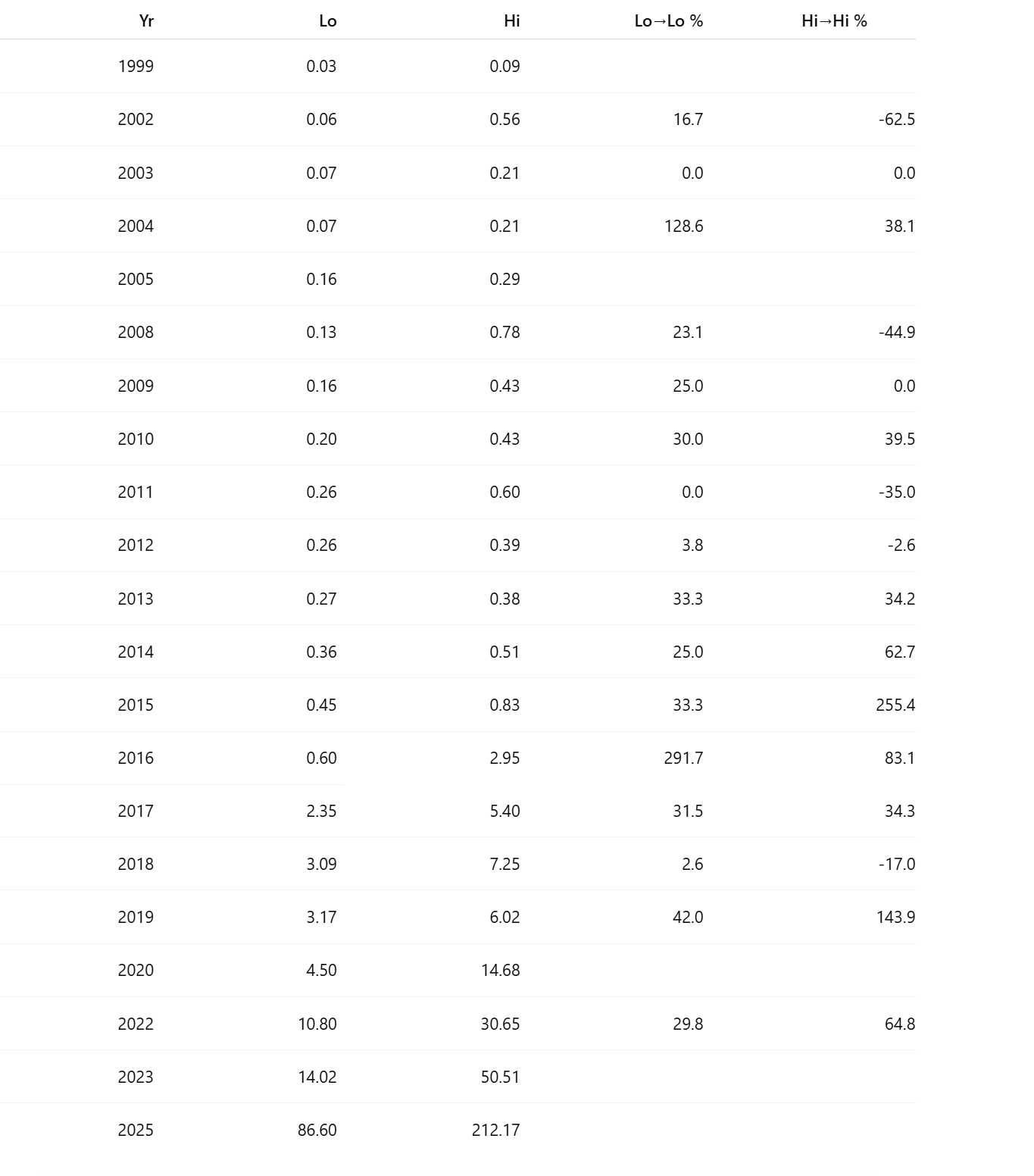
Asindu's narrative is a wonderful story; but it is not the history of how people behaved as owners of NVDA. The SIL aka SEF15 was the oddball in his lab because, unlike the older veterans, he did not immediately convert his incentive shares into cash once they could be sold. The chart [click for full view] is a year-over-year Hi-Lo price history for the stock; it explains why the veterans were not fools, why some of you are smart enough to be able to trade, and why the SIL puts up with me because I told him to keep every share. The years that are omitted are those where stock-splits made the calculations too hard for ChatGPT and me.
Jun
12
Jane Street AI training data center, from Humbert X.
June 12, 2026 | Leave a Comment
Dwarkesh Goes Inside Jane Street's Latest AI Data Center (video)
Twenty years ago, our "cluster" was just 6 Dells stacked on the floor of our office. Today, come tour our new Texas datacenter: 4,032 GPUs, liquid cooled.
Asindu Drileba writes:
Their hiring is surprisingly very meritocratic, if you can solve any of their monthly puzzles, they will unconditionally grant you an interview & likely a job offer.
For the current offer: Jane Street: Puzzles
And an archive of previous puzzles (with solutions).
Oliver Joseph comments:
For those who are computer science oriented their podcast signals and threads is lots of fun I recommend it. In particular they interview Daniel Pontecorvo on their facilities in general. Some of the solutions they have come up are very interesting and reminded me of some solutions we used in the music world. For example they use a raised platform to run air, data and electricity to workstations on casters so they can move workstations often. This is how we would rig up outdoor tours. Racks and amps on casters and modular raised stages were safer and faster to set up.
Of course I always enjoy time in server rooms. While I’ve never had the pleasure of working on one quite like the one you have linked. “Started with six dells on the floor” It’s a great lesson never despise small beginnings.
Jun
7
Opinion - After the Crude Premium: Pricing the Product Shock, from Humbert Z.
June 7, 2026 | Leave a Comment
The market spent three months pricing the barrel. The next 90 to 180 days will be decided by the products refined from it.
Crude shock is now understood; product shock is not. Since the effective closure of the Strait of Hormuz, attention has shifted to crude oil. Brent peaked at roughly $138 in early April and now trades in the low $100s, with WTI in the high $90s and the Brent–WTI spread near $10–$12 a barrel, wider than its customary $4–$6. That is the visible price. The less visible, more consequential story over the next 90 to 180 days is what happens to the products refined from crude — jet fuel, gasoline, diesel, and fuel oil. Crude can be rerouted; refined products are produced by configured refineries, and refineries sit at the far end of a supply chain measured in weeks, not hours.
“Energy independent” describes volume, not chemistry. The United States produces more crude than it consumes, but the crude it produces is the wrong type for the products it needs. Shale oil recovered by fracking is very light and sweet; it yields LPG, naphtha, gasoline, and some kerosene, but little of the middle distillates — diesel and jet — and almost none of the residual fuel oil that a complex economy runs on. Those heavier products require medium and heavy sour crude: the grades that flow from the Persian Gulf, Canada, and Latin America, and that Gulf Coast refineries were built to process. The Hormuz closure removes medium and sour barrels from the global pool — precisely the barrels whose yield is weighted toward diesel and fuel oil. That puts a premium on the heavy crude the US can still reach — and Canada is the backbone of it: heavy, sour Western Canadian barrels piped straight to US refineries, by far the largest single source of US crude imports. With Venezuela unable to raise output quickly and Mexican volumes in slow decline, Canadian crude and the sour grades released from the Strategic Petroleum Reserve must carry more of the load. So even as crude prices ease from their peak, the product slate can tighten because the marginal barrel lost is the one that produced the scarce products.
May
30
Ras Laffan repriced LNG’s geopolitical risk premium, and the market structure that existed through 2025 can no longer be assumed.
On March 18 and 19, 2026, Iranian missile and drone strikes on QatarEnergy’s Ras Laffan Industrial City damaged two of fourteen LNG trains and one of two gas-to-liquids facilities. The result is the largest single supply disruption in LNG’s history: roughly 12.8 MTPA — about 17% of Qatari export capacity — sidelined for three to five years. Replacement gas turbines for the refrigeration compressors have lead times of two to four years from three global manufacturers. QatarEnergy declared force majeure to buyers in China, South Korea, Italy, and Belgium; Shell declared force majeure downstream; and Omani trading house OQ did the same for Bangladesh. As of late May, force majeure has been extended through mid-August for some buyers, and the Strait of Hormuz remains largely closed to tanker traffic under a fragile U.S.–Iran ceasefire.
The 2025 trade matrix is the appropriate reference for determining where LNG lands.
The baseline. In 2025, global LNG trade totaled approximately 426 MTPA. Asia accounted for 63.6% (271 MTPA), Europe for 29.3%, the Middle East and Africa for 4.2%, and the Americas for 2.8%. On the supply side, the Atlantic basin produced 41.3% (176 MTPA), the Pacific 35.9% (153), and the Middle East 22.8% (97). The country-level figures behind these shares were concentrated: the United States, Australia, and Qatar each exported between 78 and 85 MT in 2024, while on the import side, China, Japan, and South Korea each imported between 47 and 79 MT. The headline reading was that Asia was the diversified buyer — 56.5% Pacific, 30.3% Middle East, 13.3% Atlantic — Europe was Atlantic-captive (92.8%), and the Pacific basin’s entire output flowed to Asia. That matrix described an integrated market at the macro level; in practice, it was three regional sub-markets stitched together by arbitrage.
Where the shock lands hardest. Asia’s 30.3% share of Middle East supply — long treated as a supply-security buffer — has been revealed to be a concentrated tail risk, yet resilience within Asia is asymmetric. China and South Korea both sit on QatarEnergy’s force majeure list, and their long-term oil-indexed sale-and-purchase agreements (SPAs) do not pay out at $18 JKM. South Korea has no real alternatives; China does and is using them. Europe’s exposure is structurally different: only 9 MTPA flowed from the Middle East in 2025, but Europe’s higher spot share means it absorbs the global price shock regardless of direct exposure. TTF traded around $14.80/MMBtu in late April, roughly 35% above pre-conflict levels; JKM traded in the high $16s to low $18s through May.
Where the buffer is — and isn’t. The Pacific basin has no spare capacity. Its 153 MTPA ran flat-out to Asia in 2025, and LNG Canada’s Kitimat ramp has not yet meaningfully changed that arithmetic. The Atlantic basin — the U.S. Gulf in particular — becomes the swing supplier, but the swing is tighter than headlines suggest. U.S. LNG exports averaged 17.6 bcf/d in February 2026, roughly 3 bcf/d (about 22 MTPA annualized) above year-ago levels as Plaquemines and Corpus Christi III ramped — the first meaningful offset to the Gulf disruption, though existing terminals are now running essentially at nameplate. Henry Hub has remained range-bound, and the stability is structural rather than coincidental. U.S. LNG export prices are indexed to Henry Hub plus liquefaction tolling fees, and the great majority of U.S. liquefaction is already committed under long-term offtake contracts. With no surplus capacity to respond to a higher-priced global market, international arbitrage cannot pull additional U.S. volumes through, and therefore cannot pull Henry Hub higher; the spread accrues instead to the off-takers holding Henry Hub-indexed cargoes that they sell into JKM and TTF markets trading at multiples of their input cost. The new wave of U.S. projects under construction — Plaquemines, Corpus Christi III, Rio Grande, Port Arthur, and Golden Pass — is now pricing into a different world than the one for which their final investment decisions (FIDs) were made.
Where the demand response is taking the strain. The shock has been absorbed less by supply replacement than by buyer behavior, and Asia and Europe are responding very differently. Chinese LNG imports for January through April totaled 18.0 MT, down roughly 10% year-over-year and the lowest since 2019. Chinese buyers are actively re-offering Qatari long-term cargoes into the European spot market (Kemp, LSEG Commodities Forum, May 2026). China can do this because Qatari LNG accounted for only about 15% of total Chinese gas imports in 2024 — pipeline gas from Turkmenistan, Russia, Kazakhstan, Myanmar, and Uzbekistan supplied roughly 53 MTPA, with Australian LNG adding another 26 — and because 47% of Chinese gas demand is industrial, allowing manufacturing-margin demand destruction that Europe’s household-and-power-dominated load cannot easily match. South Korea, with no comparable buffer, is bearing the brunt of the disruption directly. Europe, meanwhile, has paradoxically deferred LNG purchases despite storage at 36.7% on May 18, compared with a 10-year norm of 45–49%. EU LNG send-out in April was essentially flat year-over-year at 131 TWh, well below the technical capacity of 238 TWh. The European bet is on price retracement; if it does not arrive, the summer refill window will be tight.
The Hormuz dimension compounds the kinetic damage. Of the roughly 84 MTPA of Qatar and UAE LNG sent through the Strait of Hormuz in 2024, 12.8 MTPA represents the kinetic loss, expected to take three to five years to recover; the balance is suspended by the chokepoint closure and will return as the Strait reopens. The market is therefore pricing two recoveries on different timelines and writing the security premium against the worst of them. The premium on Middle Eastern LNG will remain higher than the 2025 cost stack assumed, regardless of how quickly the kinetic damage is repaired — buyers signing 20-year SPAs after March 2026 will not include the same indemnity language, and lenders underwriting new Middle Eastern liquefaction will not assume the same return profile.
Russia is the latent alternative — held by politics, not geology. Russia sits on some of the world’s largest unmonetized gas reserves and remains the most consequential variable not yet in the trade matrix. Russian LNG exports totaled 33.5 MT in 2024 — primarily from Yamal LNG on the Arctic peninsula and Sakhalin-2 in the Pacific, with Arctic LNG 2 largely sidelined by Western sanctions on shipping, equipment, and finance. About half of Yamal LNG continues to flow to Europe under pre-existing contracts. Pipeline gas to Europe collapsed from roughly 150 bcm in 2021 to about 25 bcm in 2024, following the 2022 invasion of Ukraine and the January 1, 2025, expiration of the Ukraine transit corridor. Power of Siberia 1 to China reached approximately 31 bcm in 2024, on track for its 38 bcm design capacity, with a contractually agreed expansion to 44 bcm.
The proposed Power of Siberia 2 — a 50 bcm/yr line from Yamal to China via Mongolia — is the single largest piece of latent supply in global gas. Moscow signed a legally binding memorandum with Beijing in September 2025 and had hoped the Iran war would push final commitment at the May 20–21, 2026 Putin–Xi summit. It did not. Talks remain stalled over pricing (China wants gas close to Russia’s domestic rates; Russia wants European-style market indexation), financing terms, and Beijing’s reluctance to deepen single-supplier dependence after Hormuz had demonstrated that risk in reverse. Chinese industry sources estimate construction at eight to ten years even after FID. Russia therefore has the resource base to displace a meaningful share of the post-Ras Laffan market, but its three near-term levers — Arctic LNG 2, Yamal LNG expansion, and Power of Siberia 2 — are all gated by political rather than physical constraints.
The expansion question. Qatar’s North Field East and North Field South projects — together adding roughly 48 MTPA between 2026 and 2030 — remain on the books, with the first NFE train still nominally targeted for Q3 2026, pending infrastructure integrity assessments. Whether that schedule holds is now the central question for global supply growth through 2028. Every quarter of slippage shifts pricing power to U.S. Gulf and Australian producers and improves the marginal economics of projects further out: Mozambique, the GTA project off Senegal–Mauritania, and Alaska LNG if it reaches FID.
Local pressures point in the same direction. Peru is reexamining export priorities as Camisea reserves face roughly two decades at current rates, and Australia is debating reserving east-coast gas for domestic use. The Qatar event accelerates the same logic globally — producing nations will price domestic supply and energy-security considerations more aggressively into export decisions, and importing nations will think more carefully about their exposure to chokepoints.
Repricing the security premium. The 2025 matrix described a market in which geography determined trade flows, contract structure allocated risk, and basin diversification served as a form of supply security. Ras Laffan demonstrated that the same geographic rigidity that defines LNG also concentrates geopolitical risk in specific producers and chokepoints. LNG remains the indispensable mechanism for monetizing stranded gas, and roughly 150 MTPA of liquefaction under construction suggests that demand will continue to absorb it. But it is now priced with a security premium that the 2025 cost stack did not anticipate. Even a sanctions realignment would not relax that premium quickly: LNG export terminals take years to design and build and require billions of dollars of capital, underpinned by long-term offtake contracts that sanctioned producers cannot readily attract. For Atlantic producers, that premium accrues as netback; for Asian importers, as the cost of holding redundancy; for Europe, as the cost of structural exposure to a global spot market whose marginal supplier just sat behind a chokepoint that closed.
Note: Figures are in million tonnes per annum (MTPA). The 2025 trade matrix is the author’s construction. Country-level 2024 reference figures and the demand-side analysis of Chinese imports, European storage, and U.S. export ramp draw heavily on John Kemp’s May 21, 2026, presentation to the LSEG Commodities Forum (Base Research), with underlying data from GIIGNL, Gas Infrastructure Europe, China General Administration of Customs, and the U.S. Energy Information Administration. The Russia section draws on Gazprom export disclosures and contemporaneous reporting on the May 20–21, 2026, Putin–Xi summit. Price data are current as of late May 2026.
May
11
ChatGPT moment for robotics?, from Humbert Q.
May 11, 2026 | Leave a Comment
I've Covered Robots for Years. This One Is Different
From sorting chicken nuggets to screwing in lightbulbs, Eka’s robotic claw feels like we're approaching a ChatGPT moment for the physical world.
Dendi Suhubdy offers deep analysis:
I have put some thought into that:
The Perception–Planning Gap: What's Actually Hard About Visual AI in 2026
The thesis I want to defend in this piece is structural: perception in pixels is largely solved at the representation level; perception for action is not, and the gap between the two is the central unsolved problem of visual AI in 2026. Frontier vision-language models can pass medical-board questions and explain radiographs at attending-physician level. Frontier robots, after a decade of foundation-model progress, still cannot reliably load an arbitrary dishwasher. Moravec’s paradox is not a quaint historical observation; it is the daily lived experience of every embodied-AI lab.
Big Al responds:
Thanks for sharing. Much I don't understand, but when I scroll down to the summary, I think I get the general ideas. I hadn't thought about the challenge of having effective testing/evaluation standards.
Asindu Drileba writes:
I thought this was going to be about humanoid robots (like Figure & Optimus). That still have very many problems. Industrial robotics how ever has always been making mind blowing, but quiet progress.
Good case studies are Amazon (robots operating in a warehouse about 10 years ago, its now way better), and Tesla, also 10 years back.
The reason is that the edge cases of these industrial robots are very few and can be comprehensively thought about. I think this robot ChatGPT moment already occurred in industry & manufacturing.
May
10
A tug-of-war within America’s deregulated power markets, from Humbert X.
May 10, 2026 | Leave a Comment
Today, we are witnessing a tug-of-war within America’s deregulated power markets. It's between those advocating for free-market operations and state policymakers intervening in those markets. In the process, consumers of all kinds are paying unnecessarily high prices. Let me explain:
In deregulated power markets, energy producers are theoretically dispatched in economic order based on their production costs, excluding owners' capital costs. The last producer to clear the market sets the market-clearing price. In general, this order begins with producers with the lowest marginal costs—such as wind and solar—and ends with the least efficient assets that use the highest-cost fuel: typically oil, coal, or inefficient natural gas plants.
When markets attract more cost-leading producers, costlier assets are sidelined, and market-clearing prices fall. Even if cost leaders offer intermittent availability, consumers benefit on average because their aggregate energy costs decline.
Data centers consume massive amounts of electricity (and water). The global buildout of thousands of new data centers has increased demand for power generation. As a result, power markets now reward higher-cost producers that rely on expensive fuels. Consequently, market-clearing prices are rising, and consumers are paying more. As clearing prices rise, cost leaders' margins also increase.
A potential solution to higher power prices is to increase the number of cost-leading producers. Even if new cost leaders offer intermittent production, the strategy benefits consumers through lower average clearing prices, though backup sourcing merits consideration. This approach creates winners and losers: owners of costlier production assets lose when average clearing prices fall. Consequently, the costliest market participants oppose the introduction of new cost leaders.
In January 2025, the Trump administration began implementing policies to restrict investments in cost-leading production. The administration rescinded permits for wind projects and, by April 2026, had negotiated about $2 billion in payouts to compensate investors to walk away from permitted and partially completed offshore wind projects. Additionally, since August 2025, the Pentagon has delayed reviews of165 onshore wind projects (30 GW of capacity), citing unspecified national security concerns.
When energy policy restricts cost-leading producers from participating in markets, consumers pay higher energy prices. This dynamic creates competing interests: while owners of costlier generation assets benefit from reduced competition, all electricity consumers—including data center operators—face higher costs.
The solution is straightforward: remove the barriers. Instead of spending $2 billion in taxpayer dollars to prevent investment, use those same funds (or none) to let the market allocate resources based on market forces. If permitted, capital will flow to cost-leading producers in response to the buildout and rising prices.
Bud Conrad writes:
I'll add some less-discussed items: We all know that about 20% less oil is flowing out of the Strait. But the Ukraine war is hidden behind the I run daily policy changes. Both the Russian and Ukraine sides have escalated massively since the beginning of April by doubling their daily barrage of drones and missiles. Specifically, the energy generation systems of both sides are being attacked, and the relatively less noticed is that Russian refineries and ports have been getting hammered. The result is that, while Russia has reserves, its ability to deliver amid already reduced supplies has been damaged. Nobody knows how much, but multiple cities deep into Russia have been attacked with huge clouds of smoke. St. Petersburg ports and some cities 2,000 Km into Russia have been damaged.
It takes up to 2 months to get tankers from the Persian Gulf to customers. So to restart, it will take something like that time, from the Strait opening. Oil production from most Gulf states has been attacked and stopped, and it will take more than months to restart. The US Strategic Petroleum Reserve is adding supply but cannot continue much longer, since it was already depleted, in an attempt to keep prices low to weaken Russia during the Ukraine war. In the tit for tat between Zalen ski and Moscow, Russia asked for a ceasefire on the Memorial Parade March 9 (Tomorrow), which has already been rejected by Ukraine, and Russia has announced plans to attack the center of Kiev with Oreshiks.
The pressure for oil prices to go much higher seems obvious.
Apr
23
The Art of War by Sun Tzu, from Q. Humbert (Updated)
April 23, 2026 | 1 Comment

Good book to re-read. Are all those crisis meetings are just choreography? In order to "sell" something unpopular (a war) to the managed masses in the West (or whatever system there is in Iran respectively). Humanitarian aid talks often precede wars as well.
Jeffrey Hirsch offers:
Art of the Deal. Seasonality edition
Nils Poertner responds:
Top notch analysis! (I'm wondering though, we in the West value transactions and deal making a lot - whereas in some countries, which are more religious…they may rather die than surrender).
Steve Ellison writes:
I just borrowed The Art of the Deal from the library because the Chair's brother says that the President's thinking process is all laid out in that book, and one ought not to react to his statements at face value because they are negotiating positions.
Jeffrey Hirsch adds:
Ever since Liberation day and the tariff tumble last year have had the President’s truth social posts as the only lock screen alert coming through my phone.

Kiran Kaur comments:
Free markets used to be a natural hand that would correct markets when they were inflated, avoiding catastrophes. But now we have the hand of government that removes the natural corrections that are supposed to occur and take out zombie companies. We have a few actors taking meetings behind closed doors to set the cycles, using regulation as a key mechanism. its nice for us because we are close to the liquidity that sets the rest of the markets.. Have you read Edward Chancellor's The Price of Time?
Asindu Drileba writes:
One opinion I heard recently is that, this conflict is actually doing exactly what "they" want. The constant talk of colonising Canada & previous "take over" of Venezuela is because these are oil rich countries. The conspiracy is as follows:
Shut down the strait.
Make Middle Eastern oil suffer logistics issues (price oil higher?)
Oil from Americas moved ok (priced cheaper?)
Demand for Americas oil increases. Subsequently, demand for USD also increases.
Finally weaken & decapitate BRICS.
Does this make sense? Or is it imaginary 5D chess?
Kiran Kaur responds:
Absolutely the most sane analysis i can imagine. Especially after reading the blueprint of the genius act and the user's guide to global trade. Increasing demand for us debt, oil, and the dollar, while decreasing dependencies on global players are agendas directly mentioned in both of those papers.
Apr
21
Ellen Langer experiment, from Q. Humbert
April 21, 2026 | Leave a Comment
2014 NYT reports about the Professor Ellen Langer experiment on how the mindset affects aging (or can reverse it).
Back in the 1980s, Senior citizens (some of them on crutches) were invited into a hotel with furniture /music reminding them at the time they were young - and they weren't allowed to speak about illnesses or their challenges. And their ailments improved, some started walking more effortlessly / dancing etc. Interesting anomaly (in this case how the mind affects the body and vice versa).
In trading we are looking for anomalies as well (coz there is the juice!!, whereas ordinary folks tend to brush off anomalies as a mistake.)
Apr
18
How Costly Is Permitting in Housing Development?
Evan Soltas, Jonathan Gruber
February 2026
Permitting costs are widely cited, but little analyzed, as a key burden on housing development in leading U.S. cities. We measure them using an implicit market for “ready-to-issue” permits in Los Angeles, where landowners can prepay permitting costs and sell pre-approved land to developers at a premium. Using a repeat-listing difference-in-differences estimator, we find developers pay 50 percent more ($48 per square foot) for pre-approved land. Comparing similar proposed developments, pre-approval raises the probability of completing construction within four years of site acquisition by 10 percentage points (30 percent). Permitting can explain one third of the gap in Los Angeles between home prices and construction costs.
Apr
14
Two new trends, from X. Humbert
April 14, 2026 | Leave a Comment
Two new trends will likely emerge from the Iranian caper: renewable energy and nuclear power. Smart money will aggressively pursue renewable energy assets (including derivatives). Sovereigns will likely pursue nuclear power assets if they can afford the price tags.
Humbert A. responds:
An interesting thesis, The Economist had an interesting article in their 3/21/26 edition entitled "Burnout" of most interest in your line of thinking was a graph that showed Daily Wholesale electricity prices in 2026 in euros per MWh for France Italy Germany and Spain. The Economist posited Spain and Frances wholesale prices adjusted to the downside more quickly than Germany or Italy based on investments they had made in renewables and diversifying their sources of electricity. Your thesis seems to follow a general trend of dis-integration we have seen for some years now with supply chains. How far up and down stream can we disintegrate? Also BTW what does NFW mean I am assuming Not for web but I am new here.
Henry Gifford writes:
I have heard a lot about investing in renewable energy, but am not clear on how to do it. For actual real renewables I think of hydroelectric (dams with generators turned by the water) and geothermal (heat from hot springs generating electricity or heating buildings, not electricity powered equipment that cools the groundwater to heat a building, which the federal government treats as a form of renewable energy despite it using electricity) and solar panels and wind turbines.
No new rivers are likely to be discovered, and here in the US dams are being removed at a steady and fairly rapid clip to help the fish, etc. No new hot springs are likely to be discovered, as the best way to find them is to check road maps for places with the words “hot springs” as part of the name.
Solar panels can heat water to heat a building or heat water for showers and faucets, but many of them don’t work, especially here in the US, as the technical skills just don’t exist. In Europe they are sold as part of a boiler system, and come complete with electronics and pipe connections and clear instructions. Many of them work. They are installed by local plumbers and manufactured by giant companies such as Viessman and Buderis, who also sell boilers here in the US, but without the solar components, due to lack of demand and lack of expertise. Outside of the US and Europe these solar systems are virtually unknown in some areas, and super popular in other areas, especially areas where outdoor temperatures do not drop below the freezing temperature of water.
Solar panels that produce electricity are of course popular here in the US. The last time there was a market price for those systems, about 15 years ago, the systems cost $9.00 per summer noon watt of capacity. This is for the whole system, including panels, mounting racks, electronics to convert the DC the panels produce to AC at the correct voltage and phase to connect to the grid, wires, labor, permits, etc. If angled at latitude degrees from horizontal, oriented South, and never shaded, these systems produce, on an annual basis, an amount of electricity equal to about 1,200 times what they produce at noon during the summer. Sure, Arizona gets a lot of sun, but the panels don’t like the high temperature there. Seattle gets less sun, but the panels like the temperature there better. Thus for all the lower 48 states the output is fairly close to the 1,200 noon-hour equivalent. After losses in the wires and the electronics, one watt of capacity produces about 1,000 watt-hours of electricity. That 1,000 watt-hours is called a kilowatt hour by the utility company, and sold for an average of $0.09 at the time the systems sold for $9.00/watt. This makes the simple payback (no allowance for maintenance, change of value of electricity, change of value of money, etc.) the result of dividing $9.00 by $0.09. As this is very politically incorrect division, I will leave that to others. But, the payback is frustratingly long, especially as the panels only last for 20 to 25 years and start degrading the day they are manufactured, and the electronics might only last half that long.
One might wonder; if the payback is so terrible, why are they so popular? Because you are paying for them. And, because you are paying for them, very few are installed facing exactly South, angled at latitude degrees from horizontal, and never shaded, which of course makes the payback much longer than the math above implies. Even a small bit of shading, such as from a telephone wire, lowers the voltage of all the panels in an array, and can damage the panels, although the in-laws won’t notice and you will still pay the same amount.
The crazy long payback is why you don’t see them installed on roofs of warehouses and big box stores, where they can be oriented perfectly, angled perfectly, never shaded, and can offset the purchase of electricity at the much higher commercial rates those utility customers pay.
So, with such a horrible payback, the whole arrangement is as financially sound as a soup kitchen or a homeless shelter. Sure, lots of people bring home lots of money from those operations, but how would one go about investing in the soup kitchen “industry”? Solar electric panels are now heavily subsidized at both the installation end and the manufacturing end, thus any investment depends heavily on the winds of politics, not on any actual value added or created.
For wind turbines, the small ones mounted on buildings and lampposts are mostly for show. The only study I ever saw about how much electricity they produce said the measured amount was 0.2% of the claimed amount, but that study was based on a very few measured measurements.
I suspect very large utility scale wind turbines have a very good payback, but I have no idea how to sort out the claims made. Perhaps someone can invest in the companies that make and install those, but recent politics put a halt to large projects when they were 80% complete, which will probably bankrupt companies in that industry.
I still scratch my head when people talk about investing in renewable energy. If anyone has any ideas, please let us know – I think it certainly is the future in the not-too-distant future.
Zubin Al Genubi writes:
In Hawaii lots of people have solar panels. Electricity is .22 during the day but .64 from 5-9pm. I was going to get a battery and charge it with everyone else's panels and harvest the differential. Seems like battery tech is an idea.
Asindu Drileba comments:
Yes, it seems for seasonal renewable energy like wind, solar etc. The overarching strategy is to invest in battery tech (people with relevant patents & Lithium miners). Since the energy needs to be stored anyways. Maybe the FIT etf can satisfy this?
Some people like Lyn Alden have suggested that people have some Uranium ETFs. However, for stuff like hydro and geo-thermal, maybe a copper futures allocation since everything with a turbine has use for it.
The risk with commodities is that a large repository maybe discovered that will make prices fall. Investing in corporations with relevant patents for battery tech seems safer. But I also think a small commodities allocation (Uranium, Copper, Lithium miners) is worth it.
Humbert A. writes:
Our family looked at making an investment in solar. The project was on the small side right under 100 acres we were operating in a state in the U.S. that at the time had very attractive tax incentives. The most attractive option on the menu was a land lease which when the dust settled we decided it still wasn’t worth it. Our thinking was why convert 100 acres of perfectly good mushroom hunting ground into an unsightly solar array? This of course in addition to the actual math already mentioned.
Our experience however in our other operations, automobile retail our utility provider had a very interesting program we did take advantage of. Without going into needless detail it was a program where we had been paying into with our utility and we were able to make an investment in some approved “green project” solar investment was on the menu and with car lots in our region very attractive. Our is region prone to hail and extreme heat solar panels could shade and protect the inventory and in our case potentially reduce insurance cost in an event (it’s not uncommon to carry separate policies on New and Used vehicles thus having to pay two or even three deductibles in an event) we opted however for upgrading to LED lot lighting.
At least in the U.S. I tend to think successful investment in renewables will be more decentralized. For example the recent success of the Generac gas systems. Households through various utility and tax schemes will make emotional decisions to make their families energy use more diverse and secure at great cost to them and great benefit to the retailer. Essentially solving the problem at the household level Europe is trying to solve at the national level. Behind every blade of grass in America is an alternative energy generator.
Apr
12
The “attention economy”, from D. Humbert
April 12, 2026 | Leave a Comment
Media ("attention economy") marginalizes positive stories of ordinary people building solutions from the ground up. That is why trading + media exposure during the day needs to be balanced in off hours to see that ((helping the neighbour, inviting to parties, gardening, anything that gives us joy). And this will be even more important in coming years (as social moods probably drops a lot…initially felt in Europe / Asia and later in the US. The US is not long convexity it is also short IMO).
Steve Ellison writes:
I have always followed Livermore's admonition to neither seek out nor follow tips, not even those from the brilliant members of this list. On X, I follow a number of accounts that I find add value by providing economic and market insight, but some of my favorite recent follows have been people who talk more about psychology and mindset than about particular markets.
For example, Ben Calusinski has some very interesting ideas. One is that authenticity is the one thing that AI can never replace. Another is that you have access to more information than any human in recorded history, simply by being alive today, so there is no excuse to not succeed. Possibly related to Mr. Humbert's point, Mr. Calusinski envisions a future in which 90% of the population is so dopamine-addicted by their devices that they achieve nothing, but a person who resists the siren call of social media and actually builds something, ideally something that aligns well with their authentic self, can do quite well.
Apr
3
Continued VFR into IMC, from Humbert B.
April 3, 2026 | Leave a Comment

In terms of trading, this makes me think of when rapid changes in market conditions push the trader's P&L into the red, and the trader gets tunnel vision and makes bad decisions.
Analysis of the helicopter crash by experienced pilot:
What REALLY Happened To Kobe Bryant's Helicopter?
The key issue is Continued VFR into IMC:
Continued VFR into IMC is when an aircraft operating under visual flight rules intentionally or unintentionally enters into instrument meteorological conditions. Flying an aircraft without visual reference to the ground can lead to a phenomenon known as spatial disorientation, which can cause the pilot to misperceive the angle, altitude, and speed at which the aircraft is traveling. This is considered a very serious safety hazard in general aviation. According to AOPA's Nall Report, approximately 4% of general aviation accidents are weather related, yet these accidents account for more than 25% of all fatalities.
Measures to reduce continued VFR into IMC accidents include improved preflight decision-making, enhanced weather awareness tools, simulator-based training and recurrent instrument practice for pilots who normally fly under VFR.
Nils Poertner responds:
Spot on. Good to slow down now anyway, walk slowly, speak softly, take good breaks. Have a dog and a cat nearby - they both remind me to not get too serious about things and slow down.
Mar
29
Women, men, and change, from Humbert X.
March 29, 2026 | Leave a Comment
Noticed when societies go a bit off kilter, women are much easier to talk to sometimes (Can't believe I ever say this). Or maybe women are less interest to go extreme in the first place (family, home, other values more important). I mean how many lawyers in the city of London make it to the top and are female. Or run hedge funds. Or go for 100km races. Anyway, big changes in societies come when men change - maybe we will see that soon.
Jeffrey Hirsch responds:
Interesting observations. My wife and I actually just watched the Louis Theroux documentary Inside the Manosphere - it’s a fascinating (if often cringey) look at these societal shifts. With two sons (18 and 21), I can see the validity of the motivation behind some of these trends, even if the execution is often extreme or 'trashy.'
I’d highly recommend Scott Galloway’s new book, Notes on Being a Man, as a counter-balance. It covers similar ground but with a focus on being a 'mensch' rather than a hustler. I actually gave copies to my sons this week after I finished it with a note about what fine young men they already are. It’s a great read.
Mar
26
AI use by firms, from B. Humbert
March 26, 2026 | Leave a Comment
NBER Working Paper Series: Firm Data On AI
We present the first representative international data on firm-level AI use. We survey almost 6000 CFOs, CEOs and executives from stratified firm samples across the US, UK, Germany and Australia. We find four key facts. First, around 70% of firms actively use AI, particularly younger, more productive firms. Second, while over two thirds of top executives regularly use AI, their average use is only 1.5 hours a week, with one quarter reporting no AI use. Third, firms report little impact of AI over the last 3 years, with over 80% of firms reporting no impact on either employment or productivity. Fourth, firms predict sizable impacts over the next 3 years, forecasting AI will boost productivity by 1.4%, increase output by 0.8% and cut employment by 0.7%. We also survey individual employees who predict a 0.5% increase in employment in the next 3 years as a result of AI. This contrast implies a sizable gap in expectations, with senior executives predicting reductions in employment from AI and employees predicting net job creation.
Mar
12
Pigeons in espionage, from Humbert X.
March 12, 2026 | Leave a Comment
The Rest Is History podcast episode
‘If it became necessary immediately to discard every line and method of communications used on the front, except one, and it were left to me to select that one method, I should unhesitatingly choose the pigeons’, wrote Major General Fowler, Chief of Signals and Communications of the British Army, after the First World War.
The book:
Operation Columba–The Secret Pigeon Service: The Untold Story of World War II Resistance in Europe

Between 1941 and 1944, British intelligence dropped sixteen thousand homing pigeons in an arc across Nazi-occupied Europe, from Bordeaux, France to Copenhagen, Denmark, as part of a spy operation code-named Columba. Returning to MI14, the secret government branch in charge of the "Special Pigeon Service," the birds carried messages that offered a glimpse of life under the Germans in rural France, Holland, and Belgium. Written on tiny pieces of rice paper tucked into canisters and tied to the birds’ legs, these messages were sometimes comic, often tragic, and occasionally invaluable—reporting details of German troop movements and fortifications, new Nazi weapons, radar systems, and even the deployment of the feared V-1 and V-2 rockets used to terrorize London.
Gyve Bones adds:
Recently watched a dramatization of this story of WWI in the Ardennes Forest, about the Lost Battalion of US Army that carried out their offensive orders too well, penetrating too far without the units supposedly on their flanks, and became isolated and surrounded by Germans, and their only means of communication with HQ was carrier pigeons, carried in cage backpack by the communications guy. It was a sort of inverse Battle of the Bulge, where the allied offensive bulged in and got cut off, but analogous to the situation of the 101st isolated and surrounded in Bastogne.
Excellent made for TV movie:
The Lost Battalion (2001)
Feb
26
Statistics in astronomy: John Michell, from Humbert X.
February 26, 2026 | Leave a Comment
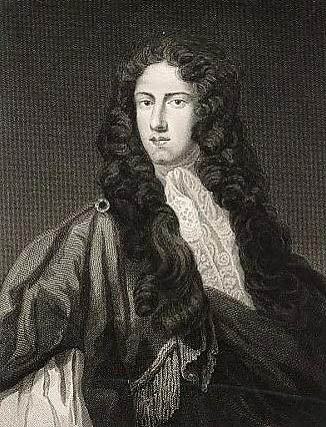
I was not familiar with John Michell (1724–1793) until I read that he did a statistical analysis to show that double stars seen in the night sky were far too numerous to exist by chance and thus must be actual binary star systems. He also essentially posited black holes - in the 18th century!
Michell was the first person to apply the new mathematics of statistics to the study of the stars, and demonstrated in a 1767 paper that many more stars occur in pairs or groups than a perfectly random distribution could account for. He focused his investigation on the Pleiades cluster, and calculated that the likelihood of finding such a close grouping of stars was about one in half a million. He concluded that the stars in these double or multiple star systems might be drawn to one another by gravitational pull, thus providing the first evidence for the existence of binary stars and star clusters. His work on double stars may have influenced his friend William Herschel's research on the same topic.
Jan
21
US Stock Mkt Value as pc of GDP (US), from Humbert X.
January 21, 2026 | Leave a Comment
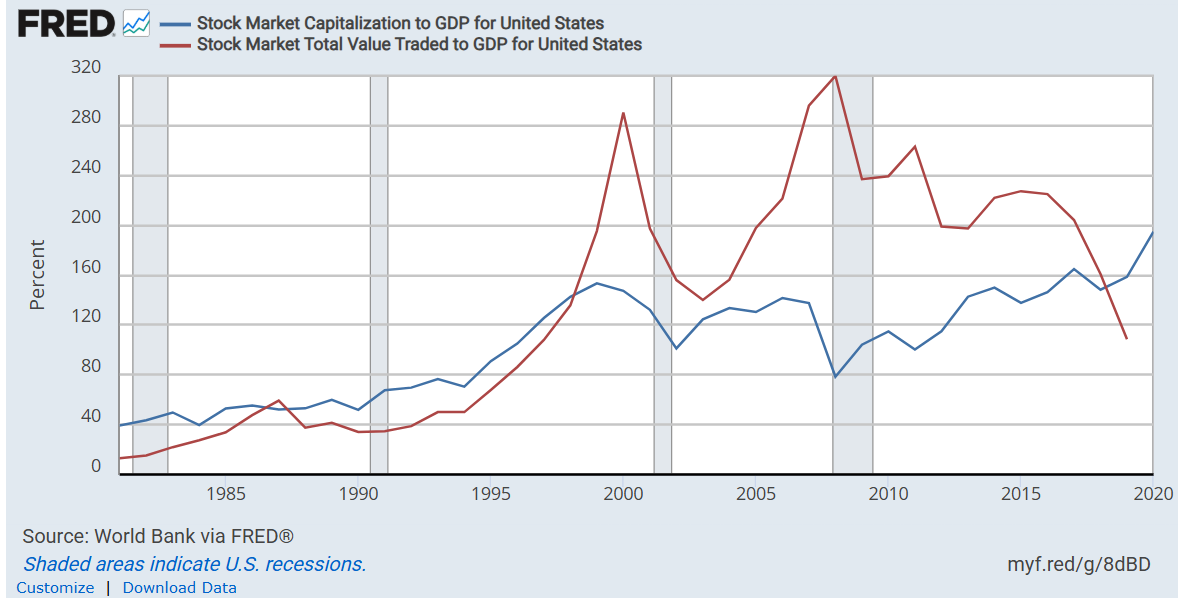
Used to be like sub 50pc in the 1990 and now well over 200pc. Not meant to be of any value for speculation (would have been rubbish in the past and don't think any value for future). but one wonders what it does in terms of tension (internal/ external) as we as shareholders would not like to give back gains so easily (and there is the drift etc). Tricks to be used to keep it up - see v recent events- not judging here.
Larry Williams offers a chart:
Big Al wonders:
I wonder to what extent the decline in "Stock Market Total Value Traded to GDP" reflects a shift to dark-pool/off-exchange trading.
Peter Ringel writes:
TY Larry, great data! looks like we are severely undervalued. A 90s style party is coming.
@BigAl this too is a valid point. If founders don't go the exchanges anymore. Is there data on this off-exchange size? At least for their exit they will most likely show up in equities. Why should early backers not do this in the end? Its too juicy.
related: If off-exchange sector really gets dominant, then FED policy becomes even more toothless.
They have no tools to influence this.
Big Al asks Gemini:
In the US, how much stock trading occurs in dark pools or otherwise off exchanges?
Over 50% of all U.S. stock trading volume now occurs off-exchange, in venues such as dark pools and through internalizers at major firms, exceeding the volume on public exchanges for the first time in early 2025.
Overall Off-Exchange Volume: While dark pools specifically account for a smaller portion of the off-exchange activity (around 13% of consolidated turnover), the overall off-exchange market, including internalizers and bilateral trades, accounts for the majority of U.S. equity trading volume.
Purpose of Dark Pools: Dark pools and other off-exchange venues are primarily used by large institutional investors to execute big orders anonymously, which helps them avoid significant market impact and predatory high-frequency trading (HFT) strategies that can occur on public "lit" exchanges.
Regulatory Oversight: Despite their name, dark pools are regulated as Alternative Trading Systems (ATS) by the SEC and must report executed trades to regulators like the FINRA on a delayed basis.
Market Share Trends: Off-exchange trading share has been on a general upward trend for years, driven by the desire for better execution quality and anonymity. This shift has implications for traditional price discovery on public exchanges.
Steve Ellison does some analysis:
The Shiller Cyclically Adjusted Price Earnings (CAPE) ratio is at its second highest level in history, exceeded only in 1999-2000. What I find interesting is that the 30-year moving average of this ratio has nearly doubled since 1990. My theory is that permanently lower interest rates in an aging population support generally higher stock valuations than in past eras when large families were the norm.
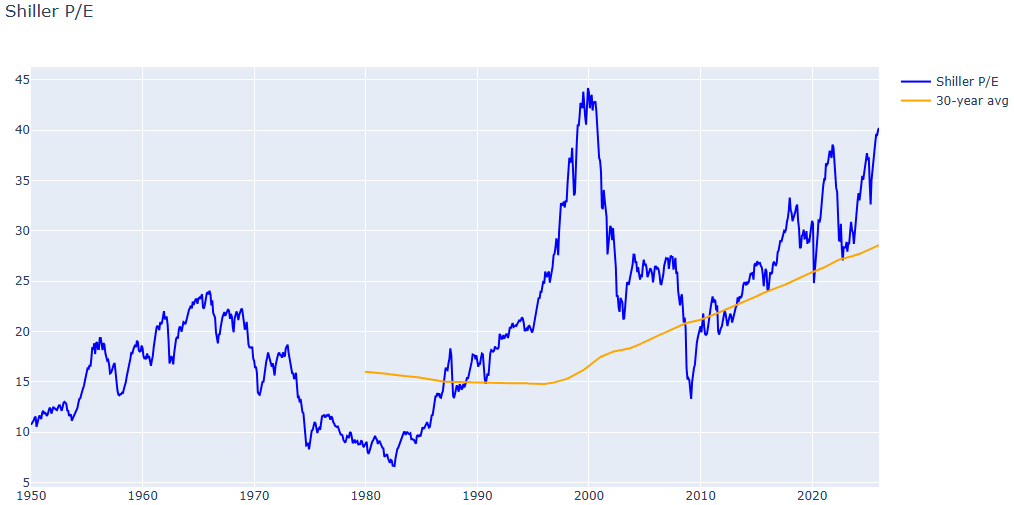
And in the spirit of the old Spec List, here is the Python code I used (.text file) to generate this graph.
Big Al adds:
Another issue is the effect of Mag7 stocks which are global in a new way, beyond US GDP.
Jan
18
Traders and Art/Music, from N. Humbert
January 18, 2026 | Leave a Comment

Noticed many of my trading friends have an affinity for either ART or MUSIC or both (active or passive) It occurred to me the other day, that both offer ways to somewhat stay sane, it allows the adult to play and have some fun /relax.
Because society as a whole has something matrix like (going to school, learn about consensus reality, fill out the forms, get a BS job, keep up with the JONES, feel empty..) and this is a nice way to see beyond it and feel a bit at ease. That is all.
Here is a lovely Schubert piece. enjoy
Schubert, Trio No. 2, Op. 100, Andante con moto | Ambroise Aubrun, Maëlle Vilbert, Julien Hanck
Asindu Drileba responds:
Narrator: "Fate had already determined that he will die childless and penniless."
Epilogue: "It was in the reign of George III that the aforesaid personages lived and quarreled; good or bad, handsome or ugly, rich or poor, they are all equal now."
Whenever I hear that piece, I think of those words from Barry Lyndon. It was such a good "slice of life" type film.
Jeffrey Hirsch recalls:
Yale was quite a composer. I tried to produce the musical he wrote about the Elephant Man called Merrick & Melissa. But he was a better composer than I was a producer.
Jan
14
Manipulation, from Humbert X.
January 14, 2026 | Leave a Comment
The allegation of “manipulation” is inevitably just code for “I just badly hosed a trade that seemed so good on paper.” Whereas the proper response to a bad trade is introspection and examination of one’s system. In the markets as elsewhere, there can be a general tendency towards the rejection of personal responsibility. This regularly surfaces in the “manipulation” allegation.
William Huggins responds:
not an opinion on anyone's trading but there is a "fun" bit of psych referred to as the fundamental attribution error in which my successes are the result of hard work and skill while the success of others boils down to luck. similarly, when things go wrong for me, its bad luck (or nefarious forces, "them") but when things go wrong for others, its their bad choices or immorality. pretty much every single person falls into this trap unless they spend a great deal of effort fighting back against the heroic narrative.
Humbert X. comments:
I find it does me little good to think about others, other than to identify when they are travelling in a herd and at an extreme level of emotion, for contrarian purposes. Though sometimes it is possible to learn from their successes and failures assuming they are being transparent about what went right or wrong, which is rare.
Nils Poertner writes:
Good to read Hannah Arendt on this note (free floating anxiety within any society have to go somewhere and sinister groups will use it for their advantage - if not a virus, then some other "Country-" Phobia, then climate change etc… So it would not be enough to change politicians , the anxiety is within the masses (and mostly unconscious).
The key for a speculator is to travel light in life and take things with a bit of distance (2 inches are often enough) - and focus on the process of making money!
Jan
7
News, from Duncan Coker
January 7, 2026 | Leave a Comment
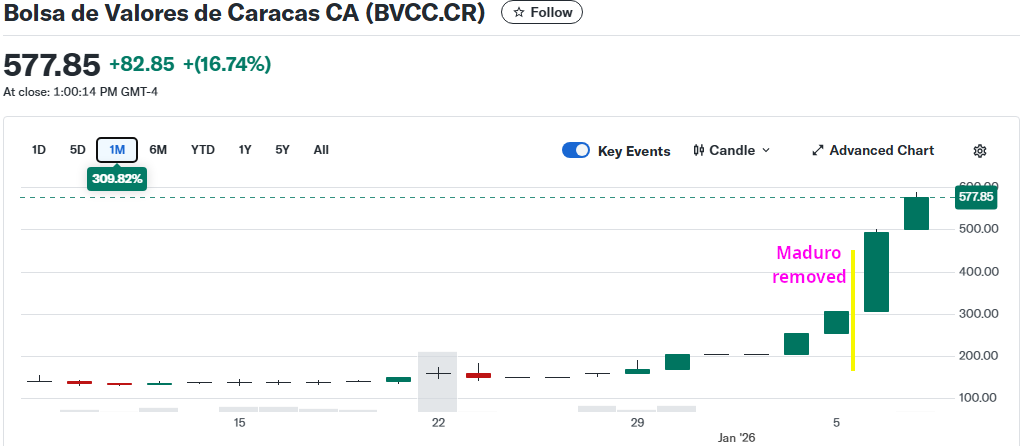
Interesting 40% move in Caracas stocks the days Before the capture. It is as if someone knew about the plans and acted on that information. News follows the markets as Larry has taught us.
Dec
30
Jobs: Rebirth, from Bill Rafter
December 30, 2025 | Leave a Comment
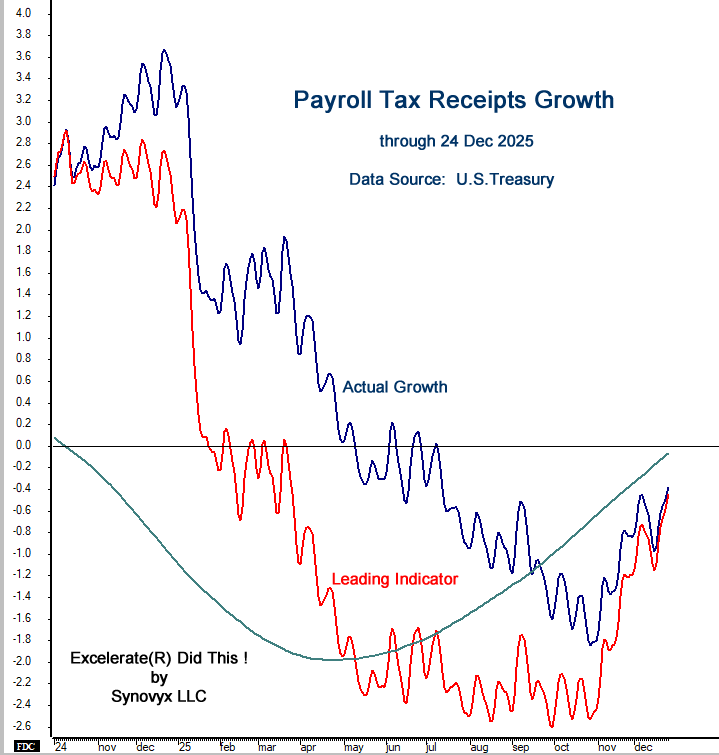
Monitoring the U.S. economy through job growth has been unusually difficult in recent months. Under normal circumstances, the labor data would offer a clean read on economic momentum. Instead, a politically driven government shutdown temporarily removed millions of workers from payrolls, distorting every major employment indicator. The strategy failed to achieve its political aims, but it forced millions of Americans to forgo paychecks until the shutdown ended—leaving analysts with a statistical mess to untangle.
The central question now is straightforward but critical: How much of the current job growth reflects genuine economic expansion, and how much is simply the reinstatement of furloughed workers—or seasonal part-time hiring for the holidays?
The next Non-Farm Payroll Report arrives Friday, January 2, 2026, and for the first time in months we may get a clearer signal. Our estimate points to a substantial increase in jobs, driven entirely by the behavior of Payroll Tax Receipts, which have long been our most reliable real-time indicator of labor market strength.
After a period of negative growth, Payroll Tax Receipts have turned sharply upward. As shown in the accompanying chart, the leading indicator (red line) has lagged the actual receipts (blue line) during the shutdown distortions, but is now crossing above and beginning to lead the series higher. This is not a temporary blip. It marks the beginning of a multi-year positive trend—one we forecasted months ago and which is now unfolding exactly as expected.
Our estimate for the January 2nd NFP Report: +162,000 jobs
If this projection holds, it will confirm that the underlying economy has regained its footing and that the Payroll Tax Receipt signal is once again pointing the way forward.
Sorry — 4.3% GDP Growth Isn’t Real
Several major outlets (Bloomberg, CNBC, Axios) recently reported that the U.S. economy grew at an annualized 4.3% pace in Q3 2025. The number comes from a delayed BEA release (12/23) that extrapolated partial quarterly data into an annual rate. But that headline figure simply doesn’t match real-time economic activity.
Payroll Tax Receipts Tell the Truth
Our most reliable indicator of economic momentum has always been Payroll Tax Receipts. They reflect actual wages and actual jobs — not model-based projections.
Here’s what the tax data shows:
During Q3 2025, Payroll Tax Receipt growth was never positive.
Annualized growth for the quarter averaged 1.42%, and that’s looking back over a full year.
Current annualized growth through Christmas 2025 is under 0.5%.
Those numbers are nowhere near 4.3%.
Why the BEA Estimate Misleads
The BEA’s figure is:
Annualized — multiplying a partial quarter by four
Distorted by the government shutdown, which delayed data collection
Contradicted by real-time tax flows that never showed a surge
Even the BEA notes this is an initial estimate, replacing two missed releases. It is unusually fragile and backward-looking.
Interpretations Will Vary — But the Data Doesn’t
Some may speculate that an unexpectedly high GDP print could influence monetary policy by suggesting renewed inflation pressure. Whether or not one believes that, the conclusion is straightforward:
The 4.3% GDP claim cannot be supported by real economic data.
Payroll Tax Receipts — the cleanest, least-manipulable indicator we have — show growth well under 1%, not 4%.
Larry Williams adds:
One of the best predictors of jobs is the stock market, which is also forecasting more people back to work.
Dec
26
Fantastic Veritasium video on power laws, from Asindu Drileba
December 26, 2025 | Leave a Comment
With direct application to speculation (featuring VC's):
You've (Likely) Been Playing The Game of Life Wrong
The world is not Normal.
Dec
24
Stubby Pringle’s Christmas, from Dailyspeculations
December 24, 2025 | 8 Comments
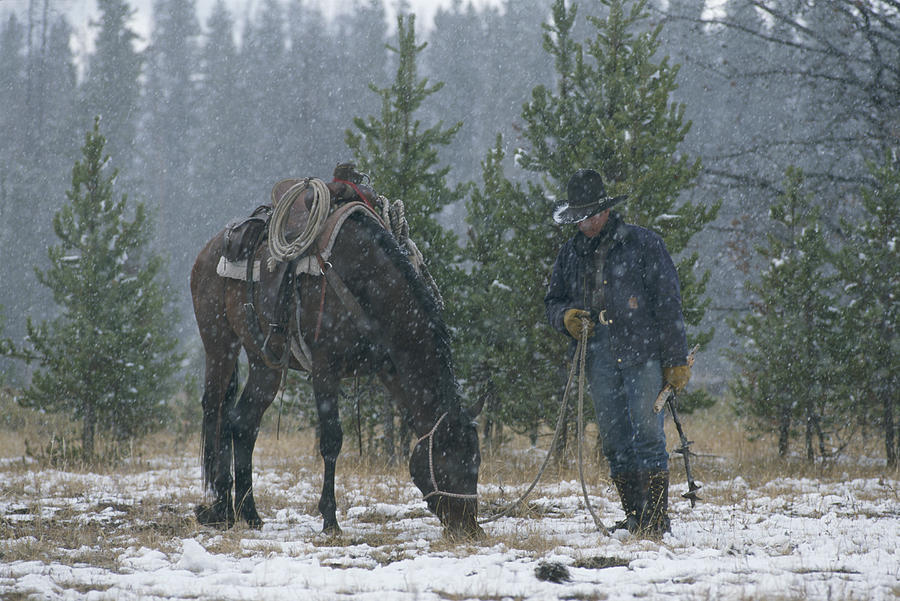 This is one of my favorite stories. I hope you enjoy it, and I wish you a Merry Christmas. — Victor Niederhoffer
High on the mountainside by the little line cabin in the crisp clean dusk of evening Stubby Pringle swings into saddle. He has shape of bear in the dimness, bundled thick against cold. Double stocks crowd scarred boots. Leather chaps with hair out cover patched corduroy pants. Fleece-lined jacket with wear of winters on it bulges body and heavy gloves blunt fingers. Two gay red bandannas folded together fatten throat under chin. Battered hat is pulled down to sit on ears and in side pocket of jacket are rabbit-skin earmuffs he can put to use if he needs them.
Stubby Pringle swings up into saddle. He looks out and down over worlds of snow and ice and tree and rock. He spreads arms wide and they embrace whole ranges of hills. He stretches tall and hat brushes stars in sky. He is Stubby Pringle, cowhand of the Triple X, and this is his night to howl. He is Stubby Pringle, son of the wild jackass, and he is heading for the Christmas dance at the schoolhouse in the valley.
[For the entire text of the story, please follow this link].
Dec
23
Force of destiny
December 23, 2025 | Leave a Comment
force of destiny sp at 7000 now at 6900.
Dec
22
Bitcoin Historical Drawdowns, from Cagdas Tuna
December 22, 2025 | 1 Comment
It will be the first time mainstream institutions, such as ETFs, banks etc. are so heavily involved with this asset class if it is repeating the historical pattern.
Cycle 1 (2010 - 2013)
• Peak: December 2013
• Drawdown: 93% from ATH
Cycle 2 (2014 to 2017)
• Peak: December 2017
• Drawdown: ~86-87% from ATH
Cycle 3 (2018 to 2021)
• Peak: November 2021
• Drawdown: ~75-77% from ATH
Cycle 4 (2025 to ???)
• Peak: October
• Drawdown: 30% from ATH for now
If 70-80% drawdown repeats, Bitcoin will be below 40000 and Crypto Treasury geniuses will be meeting with Trump for a bailout! But Who will bailout Trump?
Dec
22
Tales from the pit, from Jeff Watson
December 22, 2025 | Leave a Comment
Chuck Proctor (video interview)
In this episode of In The Harbor, we sit down with Chuck Proctor, a seasoned spread trader specializing in 30-year Treasury bond futures. Chuck takes us through his remarkable rise on the trading floor—from starting as a runner, to becoming a clerk, and ultimately earning his place as a local trader.
Together, we revisit the golden era of open-outcry pit trading: the chaos, the camaraderie, the competition, and the moments that shaped a generation of traders. Chuck shares firsthand stories of what it was like to survive—and thrive—in an environment built on instinct, speed, and human connection.
We then shift to the present day to examine the “death of the pits” and the takeover of markets by computers and algorithms. Chuck offers candid insights on how the culture of trading has evolved, what was lost, and where opportunity still exists for those willing to adapt.
Dec
20
Low range of S&P
December 20, 2025 | Leave a Comment
amazingly low range of sp last 2 months with half of all prices in 6800 handle and sd of 9.
Dec
16
Oil at $55
December 16, 2025 | Leave a Comment
oil at $55 a barrel. all inflation numbers very bull for S&P and USD. definitely deserving of a rate reduction. except for chance gardner posturing.
Dec
4
A large piece of history from the age of sail
December 4, 2025 | Leave a Comment
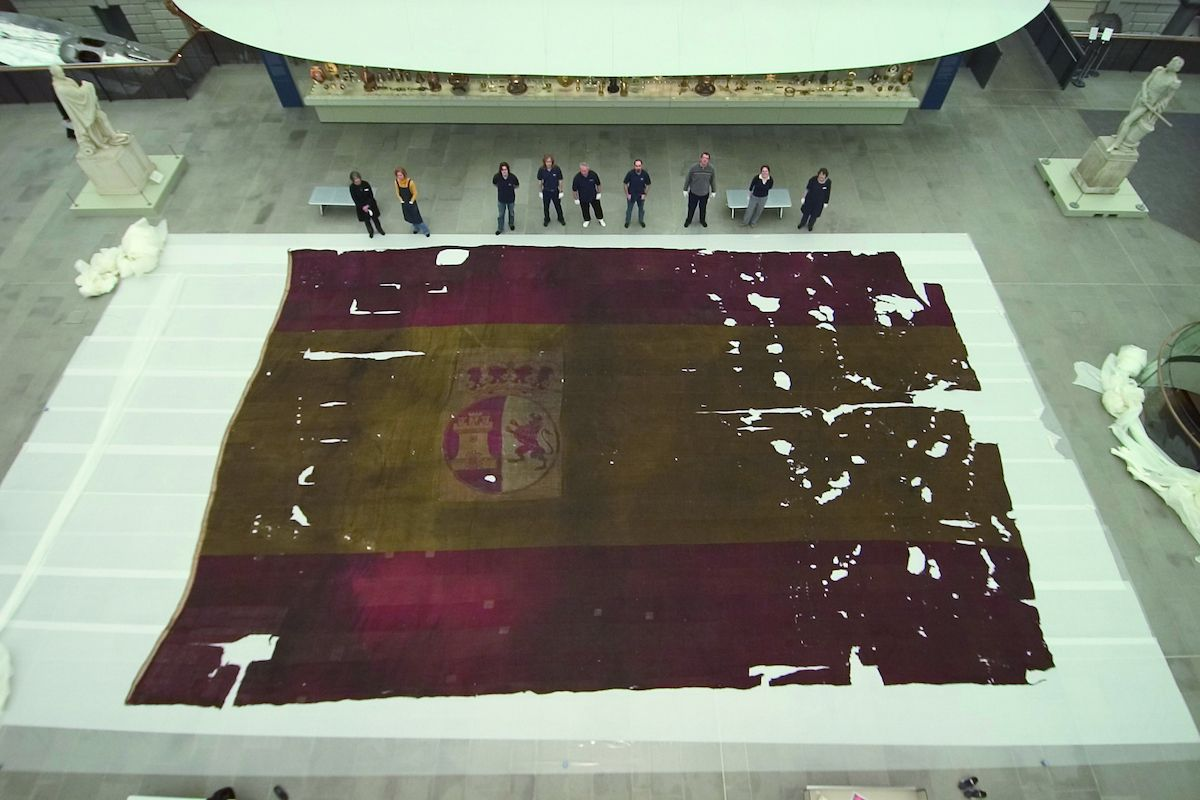
The Battle of Trafalgar and the Ensign of the San Ildefonso: A Testament to Naval Supremacy
The Battle of Trafalgar, fought on October 21, 1805, marked a defining moment in history, securing Britain’s unchallenged supremacy as a naval power. Under the brilliant leadership of Admiral Horatio Nelson, the British Royal Navy triumphed over a larger Franco-Spanish fleet, despite being outnumbered in both manpower and firepower. This clash not only demonstrated tactical brilliance but also symbolized the resilience and innovation of the British naval force.
One of the most remarkable artifacts from this legendary battle is the massive ensign flown by the Spanish warship San Ildefonso. This flag, an enduring symbol of Trafalgar's legacy, provides an extraordinary glimpse into the scale and intensity of 19th-century naval warfare.
Measuring an astonishing 33 feet wide and 47.5 feet long, the San Ildefonso’s flag is a colossal piece of history. Made of wool, it served as the ship’s battle ensign—a flag so large that it could be seen through the dense smoke of cannon fire, ensuring that allies and enemies alike could identify the ship’s status.
Nov
30
Sometimes those elevator door buttons actually work, from Henry Gifford
November 30, 2025 | 1 Comment

Once upon a time I measured how much electricity it takes to ride on an elevator – I measured about 50 elevators – and seem to be the only person who ever measured that and got the results published. Before, there were numerous scholarly papers published on elevator energy use, all guesses or estimates or computer models (same thing), very “scholarly” because they had footnotes referencing other published guesses and because you paid a lot of money for someone to do that “research”. Several multinational elevator companies were selling energy efficient elevators, but none of the companies knew how much energy a ride took – they had “data” on how much their elevator used in one year vs. an ordinary elevator – an unspecified number of rides, unspecified number of stops (floors), unspecified weight in the cab, etc. All just made up “data”. Surprise, none of the manufacturers wanted me to measure their elevator.
Read the full post with additional comments.
Nov
28
Lucky charms, from M. Humbert
November 28, 2025 | Leave a Comment

Anyone have any favorite good luck charms/rituals to help with trading results?
Peter Ringel writes:
some of the old floor traders, we had on this list, reported how superstitious some of the traders were. Cloths, bathroom time…
Asindu Drileba comments:
Lucky charms may sound delusional but they are actually more common than we think. They are more like placebos. I take pill X, my headache goes away. (But pill X is made from wheat flour and a bitter "filler" and has exactly zero pharmaceutical contents, yet it works).
Have you ever pushed the button that opens the door of an elevator? Well, those buttons are completely fake! Elevator doors are pre-programmed to open and close at hard coded intervals. Pushing the button does nothing. They simply exist to give people a sense of control.
Nils Poertner writes:
To have a strong belief one can learn (from mkts or others) is a good start.
ie allowing for mistakes to happen, not fretting them. (many cultures are guilt-ridden, like the German culture on so many fronts. All it takes is sometimes to muster up enough courage and learn from mistakes and don't judge).
Zubin Al Genubi offers:
I'm reading Kidding Ourselves, Hidden Power of Self Deception, by Hallinan, in which he describes real physical and psychological effects of psychosomatic causes such as death, hallucinations. You see what you want to see. You are and become what you believe yourself to be. It affects health, performance, money. He also describes how a feeling of lack of control can be debilitating and even deadly. Some feel a lack of control in that they don't control the market, but one can easily (physically at least) click the keys to buy and sell any time.
From scientific studies: Our results suggest that the activation of a superstition can indeed yield performance-improving effects.
Nov
13
The $38 Trillion Question, from Humbert X.
November 13, 2025 | Leave a Comment
The $38 Trillion Question: An Interview with Stanford Professor Hanno Lustig
Hanno Lustig: I started thinking about the valuation of government debt by looking at the valuation of all Treasuries. What do we have to believe to get to a number like $38 trillion? You must believe there will be a huge fiscal correction, because ultimately the value of debt should be backed by future primary government surpluses. When you do the numbers, you realize that either bond investors are pricing in a huge fiscal correction that seems impossible, or Treasuries are significantly overpriced.

Carder Dimitroff notes:
The interest on debt is approaching $1 trillion per year and continues to compound. Interest costs currently exceed Department of Defense spending.
Larry Williams disagrees:
Meaningless measure look at debt vs gdp
Carder Dimitroff responds:
Yes, that makes sense. However, from a different perspective, it becomes meaningful under the One Beautiful Budget Bill when automatic sequestrations are implemented. Unless new legislation is passed, sequestrations will result in Medicare cuts and other reductions in expenditures. Current projections suggest sequestration will present in early 2026.
Big Al checks with FRED:
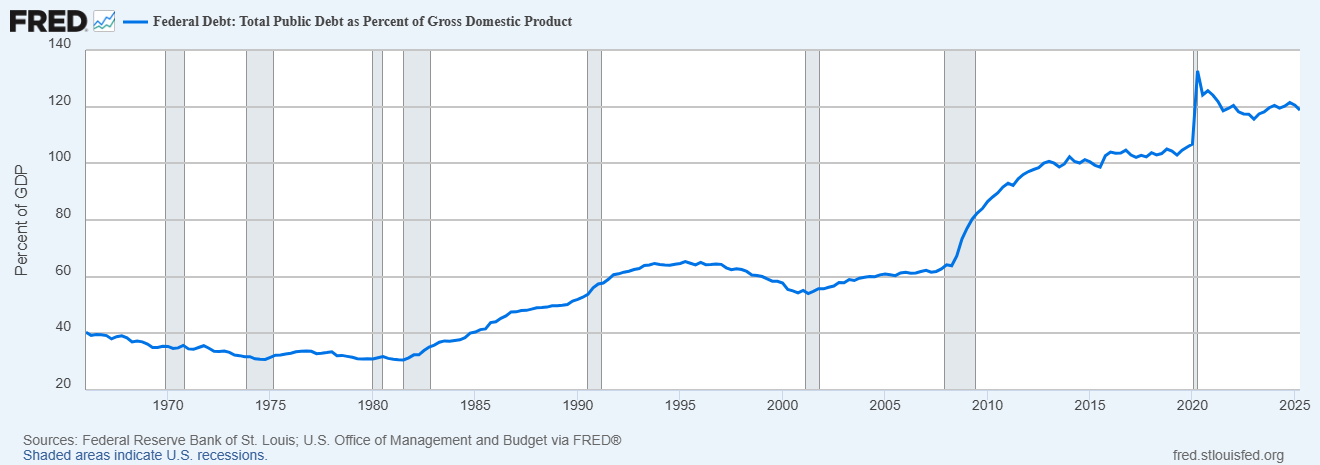
Nils Poertner writes:
recession + zero short term rates + lots of QE ….leading to a lot more public debt
maybe that is more likely path.
Stefan Jovanovich offers some history:
This chart shows the solvency ratios that can be found from the Census and other data [by decade 1880 to 2020] - how much "we the people" have in money divided by how much the American governments promise to pay.
Nov
12
David Hand’s probability lever, from Nils Poertner
November 12, 2025 | Leave a Comment
intellectual support / motivation to look at more extreme scenarios from time to time (extreme only appearing in the moment of course).
Hand writing: The Improbability Principle
The law of the probability lever is to do with choosing models. With poor assumptions even highly likely events can seem very improbable. Small changes in initial conditions can have an extremely large effect on outcomes.
Nov
11
Deutsche Bank sums it up, from Humbertus B.
November 11, 2025 | Leave a Comment
Long-Term Asset Return Study - The Ultimate Guide to Long-Term Investing
This study examines how asset classes have performed across a wide range of macroeconomic, policy, and valuation environments. Drawing on data that in some cases stretches back to the 18th century, we analyse both nominal and real returns to understand how different assets have behaved under varying conditions. We explore correlations with key drivers such as real and nominal GDP growth, inflation, interest rates, bond yields, debt and deficit levels, and more — with the goal of helping investors tilt the odds in their favour.
Nov
10
Best indicators for inflation, from Asindu Drileba
November 10, 2025 | Leave a Comment
The more goods cost, the more money visa makes since the fees they charge Issuing banks & acquiring banks are based on a percentage basis. So, higher prices (inflation) –> better predicted revenues for Visa? Inspired by a nice documentary on the history of VISA.
I wonder what the best indicator for inflation would be for testing this? CPI? Oil?

Cagdas Tuna writes:
I was thinking as to find a similar indicator for economic slow turn, spending cuts. It came to my mind to follow sales slips. I live in Malta which is a very tech friendly country for spending habits such as Apple/Google Pay availabilities, many digital banks access etc. I often asked if I need a receipt that I usually don’t. It depends for every country but if there is a rule for stores/restaurants to keep at least a copy for each transaction then it might be the indicator to follow. It might be used for inflation as well but of course needs detailed information.
Pamela Van Giessen comments:
To the best of my knowledge, merchants are not required to keep receipts. We track each sale but it will be the credit card processor or platform such as Square that holds the credit card or Apple or Google pay receipts. I can’t imagine that merchants would be willing to share their sales data. I know I wouldn’t.
Visa doesn’t care how much goods cost. They get their nearly 3% processing fee (+ .10 or .15 per transaction) whether there are 20 transactions for $100/ea or 40 transactions for $50/ea. In fact, they make more $ on a higher volume of transactions.
I don’t think tracking Visa or MC, etc could be a meaningful prediction of inflation as all the credit card companies continuously fight for market share. Note that they all send out multiple credit card offers to everyone all the time. Then, you have a store like Costco that only accepts their credit card (Citibank).
Additionally, there are people who use primarily cash. Those $ would be left out. You may say that cash use is low, and maybe it is. What I can tell you is that today at a market 80% of my sales were cash and that was likely the case for all the other merchants at this market. Older people especially use cash a lot. Just like drug dealers.
I have a theory that the cash economy is much bigger than everyone thinks. Insight into that might be more interesting.
Carder Dimitroff responds:
After considering Panela's cash sales point, I remembered that several companies required customers to switch from credit card payments to bank transfers. Additionally, several small establishments offer incentives for customers to pay in cash. They may be attempting to simplify their accounting and tax reporting. I do know that the federal government has immediate access to individual credit card transactions.
Pamela Van Giessen adds:
I thought it was the Fed that used to report on aggregated credit card data.
The other challenge with using credit card financials is that the credit card processors raise their % cut all the time. This is not due to actual inflation; it is due to them having a government protected moat that allows them to take more and more whenever they want because merchants are stuck with the whole system and consumers don’t realize that they will pay for the service — in increased prices. Every time Square, PayPal, etc., send me notices that they will be increasing fees, I increase my prices. I guess that is a kind of proxy for inflation but it’s a lousy sort of financial market induced inflation not based on anything more than their desire for more profits. I am all about free markets but the credit card processing biz is not even close to a free market.
The government using credit card processing to surveil us may be one reason I see more and more people using cash.
Larry Williams suggests:
Stock market is good predictor of inflation.
Nov
9
Prestigious consulting firm, from Nils Poertner
November 9, 2025 | Leave a Comment

Came to our financial firm 2007 and gave a 100 page presentation full of bullet points and cartesian logic (why housing boom will last). Either 3,5, or 9 bullet points per page.
At the end of the presentation I was tempted to go over to the presenter and ask him "why do you love your wife? (I didn't). The answer might have been bullet points.
Pamela Van Giessen writes:
Michael Korda tells in his memoir, Another Life, of the time that Simon & Schuster hired probably the same prestigious consulting firm to study how to improve revenues/profitability. Prestigious consulting firm (after taking the prestigious consulting firm fee) told the publishing company that they should publish more bestsellers.
Laurel Kenner comments:
I bet the prestigious firm concluded with ‘Key Takeaways’ as a final insult to the intelligence of the client.
Asindu Drileba writes:
I heard that people pay consultancy firms not for their knowledge, but for the fact that executives use them as a scape goat. If an executive wants to pursue policy X. They simply hire a consultancy to recommend policy X. If policy X ends up as a disaster (legally, morally or financially). They can simply say "Policy X was an idea from XYZ consultancy", we had nothing to do with it.
Peter Ringel adds:
a variation of this are fighting owners/ partners about policy. If decision pipelines are blocked, external council is used. Like a neutral arbitrator. I think, these are the main situations externals are used. Usually a good reason to short the entity, especially outside of markets. If they don't have the capability to decide and act on strategy in-house, it‘s a red flag.
Henry Gifford responds:
Even better is hiring a licensed engineer to instruct everyone to do something stupid that they know won’t work, so everyone who did as the engineer decided is blameless.
Jeff Watson offers:
A consultant is a person who knows 1000 ways to make love to a woman…..but he doesn’t know any women.
Nov
8
Tevye the Dairy Man
November 8, 2025 | Leave a Comment
"Tevye the Dairy Man" - one of my favs in High school.
In those days I was not the same person I am now. That is, I was the same Tevye, but different. As they say, the same old woman but under a different veil was then - may this never happen to you - as poor as poor can be, although, to tell the truth, I am by far no rich man today. You and I together should this summer earn what I would need to be as rich as Brodsky, but as compared to those days I am today a well-to-do man with my own horse and wagon, with a couple of, knock on wood, milch cows and another cow that is due to calve any day now. It would be a sin to complain, we have cheese and butter and fresh cream every day, all earned with our own labor, we all work, nobody is idle. My wife, bless her, milks the cows, the children carry the jugs and churn the butter, while I myself, as you see, drive to the market early every morning and call at every Boiberik dacha. I get to meet this person, that person, all the important people from Yehupetz, I chat a while with them and this makes me feel that I am also worth something in the world, that I am, as they say, no "lame tailor".
Tevye the Dairyman and the Other Stories, by Sholom Aleichem.
Nov
7
Ten days since an ATH
November 7, 2025 | Leave a Comment
10 days since all-time high. very bullish.
Steve Ellison comments on CAPE:
[Click chart for original post on X.]

6637-6660 is an important level for the ES December contract; not breaching this level (yet) in today's selloff is short-term bullish in my opinion, but the second highest valuation in history means the longer-term risk is high.
And I'm not sure exactly what the "rolling historical average" is, but by my calculation, the 30-year average CAPE is 28, which might make 40 somewhat less overvalued.
Nov
6
Percentages versus discrete values, from Duncan Coker
November 6, 2025 | 1 Comment
I notice how journalist select for stories to use percentages versus discrete values to server their own interests and the "public" is easily confused. Today, they pick the number nearing 1T to describe Mr. Tesla's pay which seems high. But they could have framed the story as he could be raising his ownership to 12% to 25% of a company he founded. Not much of a story there. Other places like crime statistics they usually go with the %. As in violent crime has risen 100%, this could mean 1 homicide to 2. Without the data with percent's the conclusions are obfuscatory. Percents can never go down more than 99.9%, but they can rise by an infinite amount. This fact also leaves much room for spurious selection.
Nov
4
Edmund Clarence Stedman, from Stefan Jovanovich
November 4, 2025 | Leave a Comment
Edmund Clarence Stedman was the editor of this history, The New York Stock Exchange, quoted below on this site.
From Grok:
Edmund Clarence Stedman (1833–1908) was a prominent American poet, literary critic, and essayist, often dubbed the "Bard of Wall Street" for his successful dual career in literature and finance. Born in Hartford, Connecticut, on October 8, 1833, he was orphaned young after his father's death from tuberculosis and raised by relatives. He briefly attended Yale University (expelled after two years but later honored with a degree) before launching into journalism in the 1850s, working for outlets like the New York Tribune and New York World, including as a Civil War correspondent. He studied law and briefly served as private secretary to U.S. Attorney General Edward Bates.
Connection to the New York Stock Exchange
Stedman's ties to the New York Stock Exchange (NYSE) spanned over three decades, from 1865 to 1900, where he worked as a banker and stockbroker on Wall Street. This financial role provided stability amid his literary endeavors, allowing him to support his family while pursuing poetry and criticism. After retiring from the Exchange in 1900, he remained deeply involved in its institutional history. In 1905, at age 71, he served as editor of the landmark publication The New York Stock Exchange: Its History, Its Contribution to National Prosperity, and Its Relation to American Finance at the Outset of the Twentieth Century, a comprehensive two-volume work commissioned by the Stock Exchange Historical Company. Co-edited with Alexander N. Easton and others, it chronicled the NYSE's evolution from its founding in 1792 under the Buttonwood Agreement through its role in American economic growth. The book, limited to 3,000 copies (with a rare signed edition of 50 for select members), is a key historical resource on early 20th-century finance.
Literary and Other Achievements
Parallel to his NYSE career, Stedman produced influential works like Poems, Lyrical and Idyllic (1860), Victorian Poets (1875), and massive anthologies such as A Library of American Literature (1888–1890, 11 volumes) and An American Anthology (1900). He also dabbled in science, proposing an early rigid airship design in 1879. Elected to the American Academy of Arts and Letters in 1904, he died in New York City on January 18, 1908, from heart disease, survived by two sons.
Nov
2
Optimism fulfilled
November 2, 2025 | Leave a Comment
The New York Stock Exchange
Its history, its contribution to national prosperity, and its relation to American finance at the outset of the twentieth century
Edmund Clarence Stedman, Editor
Stock Exchange Historical Company
New York, 1905
From the preface:
The present writer remembers the impression left upon an educated Englishman, a well-known publicist, who made a visit to Wall Street some eighteen years ago. He had been taken through the largest commercial structures in the vicinity, and even to the Stock Exchange itself, without giving expression to unusual interest. But on returning to his friend's offices, upon the upper floor of a building in the rear of the Exchange, he saw a sight that instantly gave him a realization of the extent of our peopled territory, and of the meaning of the Stock Exchange as the focus to which all currents of American purpose and energy converge. It was shortly before the time when the wires of New York's electric system were buried, by enactment, out of sight. Through the air, over New Street, hundreds, seemingly thousands, of these wires stretched toward the Exchange. No bird could fly through their network, a man could almost walk upon them; in fact, they darkened the street and the windows below their level. The visitor's host suggested that those going north, west, south were carrying messages to and from scores of inland cities and towns — financial ganglia of this land of national wealth and effort — names of which were mentioned. Certain wires were transcontinental, communicating with the towns of the Pacific States. Others served the uses of Montreal, Toronto and kindred points in the Great Dominion. Finally, the competing ocean cables were of course laden with incessant "arbitrage" and other messages to and from London, Paris and Berlin. This ocular demonstration of the relations of the New York Exchange to the Republic in its entirety, and even to the world overseas, proved almost startling to the English traveller. He asserted that within this central field of financial energy and intercommunication it was impossible not to have the imagination aroused, and the reason convinced of the enormous interests of which Wall Street, through its representative Exchange, is the ceaseless regulator. With philosophic impartiality, he predicted the time when even the largest money centres of the old world would become more or less subsidiary to this dominant market of the Western hemisphere.
Oct
30
Demand, Supply, and Electricity Prices, from Carder Dimitroff
October 30, 2025 | Leave a Comment
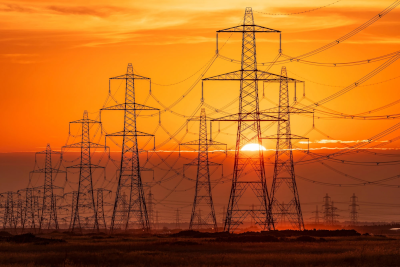
Funded by the U.S. Department of Energy, five scientists associated with California's Lawrence Berkeley National Laboratory claim that data centers are not a significant cause of retail electricity price increases. Counterintuitively, they suggest that data centers could have a beneficial effect in lowering costs. But more research is needed.
Factors influencing recent trends in retail electricity prices in the United States
Summarizing their "Ten Key Findings":
4.1. National-average retail electricity prices have tracked inflation in recent years.
4.2. State-level retail electricity price trends vary widely.
4.3. Residential customers and investor-owned utilities experienced greater increases.
4.4. Load growth has tended to depress retail electricity prices in recent years.
4.5. Behind-the-meter solar was associated with higher prices.
4.6. Utility-scale wind and solar are not—alone—broadly related to recent price increases.
4.7. State renewables portfolio standards are associated with recent price increases.
4.8. Exposure to natural gas price risk increases electricity prices when gas prices rise.
4.9. Hurricanes, storms, and wildfires have increased retail prices.
4.10. Several other variables appear to have limited statistical explanatory power.
Oct
29
An attempt
October 29, 2025 | Leave a Comment
An attempt by chair to halt margin of victory in 2026 for opposition.
Oct
29
The latest from Laurel Kenner
October 29, 2025 | 1 Comment
70++ Trades the Miners
Laurel Kenner
When China suggested Oct. 9 it would strangle rare earth metal exports to the U.S., U.S. mining stocks looked like the easiest way to make a killing since the Internet bubble in 1999.
Being arrogant enough to believe myself among the few who saw the opportunity, I bought a mining stock targeted by Goldman Sachs for a 100% gain.
The stock rose. Then swooned. I sold.
It quickly rose past the earlier high. I bought again. It tumbled below where I had sold the first time.
Greed had led me to forget old investment wisdom. Such as a warning against trying to get even, from Max Gunther’s 1985 “The Zurich Axioms.” Entitled “Stubbornness”, the 11th Major Axiom accurately describes my trade.
I also should have remembered advice from Nick Colas, head of DataTrekResearch, who made his bones at Credit Suisse and Steve Cohen’s SAC Capital. It’s my job, he explained years ago, to know things before they land in the media.
Meaning that if someone is giving tips to news outlets, keep in mind that he inevitably will take better care of his interests than yours.
Read the full post:
Oct
28
Entertaining valuation exercise, from Big Al
October 28, 2025 | Leave a Comment
Looking at some of the megacaps and comparing their share price growth and FCF growth between Q2 2015 and Q2 2025. The price/FCF figures are the most recent.
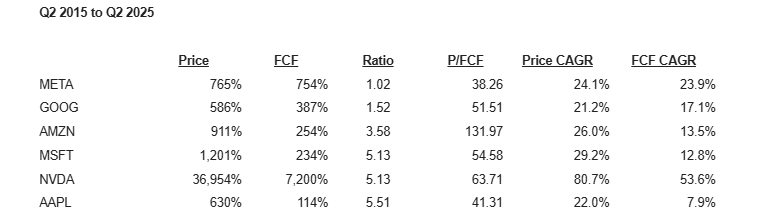
Oct
27
State debt, from Jeff Watson
October 27, 2025 | Leave a Comment
Here’s an interesting breakdown and analysis of the debt of individual states. All the usual subjects are near the top.
Report ranks every state’s debt, from California’s $497 billion to South Dakota’s $2 billion
State governments had $2.7 trillion in debt at the end of 2023, a new Reason Foundation analysis finds. This state debt is equivalent to approximately $8,000 per person nationally.
On a per capita basis, Connecticut had the highest state debt, with $26,187 of debt per state resident at the end of 2023. With $22,968 in debt per resident, New Jersey was the only other state with more than $20,000 in liabilities per capita.
Reason Foundation finds 13 states—Connecticut, New Jersey, Hawaii, Delaware, Illinois, Massachusetts, Wyoming, Alaska, North Dakota, California, Washington, New York, and Vermont—had more than $10,000 in debt per resident.
Oct
26
The forgotten janitor who discovered the logic of the mind, from B. Humbert
October 26, 2025 | Leave a Comment
AI relevant:
Finding Peter Putnam
The forgotten janitor who discovered the logic of the mind
Every game needs a goal. In a Turing machine, goals are imposed from the outside. For true induction, the process itself should create its own goals. And there was a key constraint: Putnam realized that the dynamics he had in mind would only work mathematically if the system had just one goal governing all its behavior.
That’s when it hit him: The goal is to repeat. Repetition isn’t a goal that has to be programmed in from the outside; it’s baked into the very nature of things—to exist from one moment to the next is to repeat your existence. “This goal function,” Putnam wrote, “appears pre-encoded in the nature of being itself.”
Stefan Jovanovich offers, with a bit of irony:
From Grok:
Peter Putnam (1927–1987) was an American physicist and theoretical neuroscientist whose work anticipated many modern concepts in cognitive science, artificial intelligence, and philosophy of mind. He studied under prominent figures like Albert Einstein, Niels Bohr, and John Archibald Wheeler, and his ideas influenced early developments in computational theory of mind, though he remained largely unpublished and obscure during his lifetime. Putnam's writings, now digitized and discussed in recent scholarship (particularly following the 2025 rediscovery and publication of his papers), propose a functional model of the nervous system that integrates physics, game theory, and neuropsychology. His theory emphasizes how the brain achieves order and learning through mechanisms like Hebbian plasticity, distributed neural networks, and conflict resolution—ideas that predate similar concepts in predictive processing and reinforcement learning. Putnam's work is not a single, neatly packaged "theory of repetition" but rather a core principle woven throughout his model of cognition and behavior. Repetition serves as a foundational "goal function" for existence, learning, and induction (the process of generalizing from specific experiences).
Oct
25
Second favorite Hungarian, from Venkatesh Medabalimi
October 25, 2025 | Leave a Comment
György Buzsáki is my second favorite Hungarian [after Paul Erdős]. Brain Prize winner, he is from a later cohort. One of the few neuroscientists with a good theory for the Brain, a field that was ~mostly into measuring neural responses in parts of the brain to external stimuli and then telling a story around it. A great talk by him for the interested:
Ways to think about the brain: Emergence of cognition from action | ISTA Lecture with Gyorgy Buzsaki
Oct
24
The gentlemen don’t believe
October 24, 2025 | Leave a Comment
a new all time high at 6825 but the gentlemen don't believe it as it drops 20 points in the last 30 min.
Oct
24
Another Historical Analogy, from Stefan Jovanovich
October 24, 2025 | Leave a Comment
Grok and I have produced this summary of the growth of the electric utilities industry in the United States from 1910 to 1930. [Click on chart for full view.]
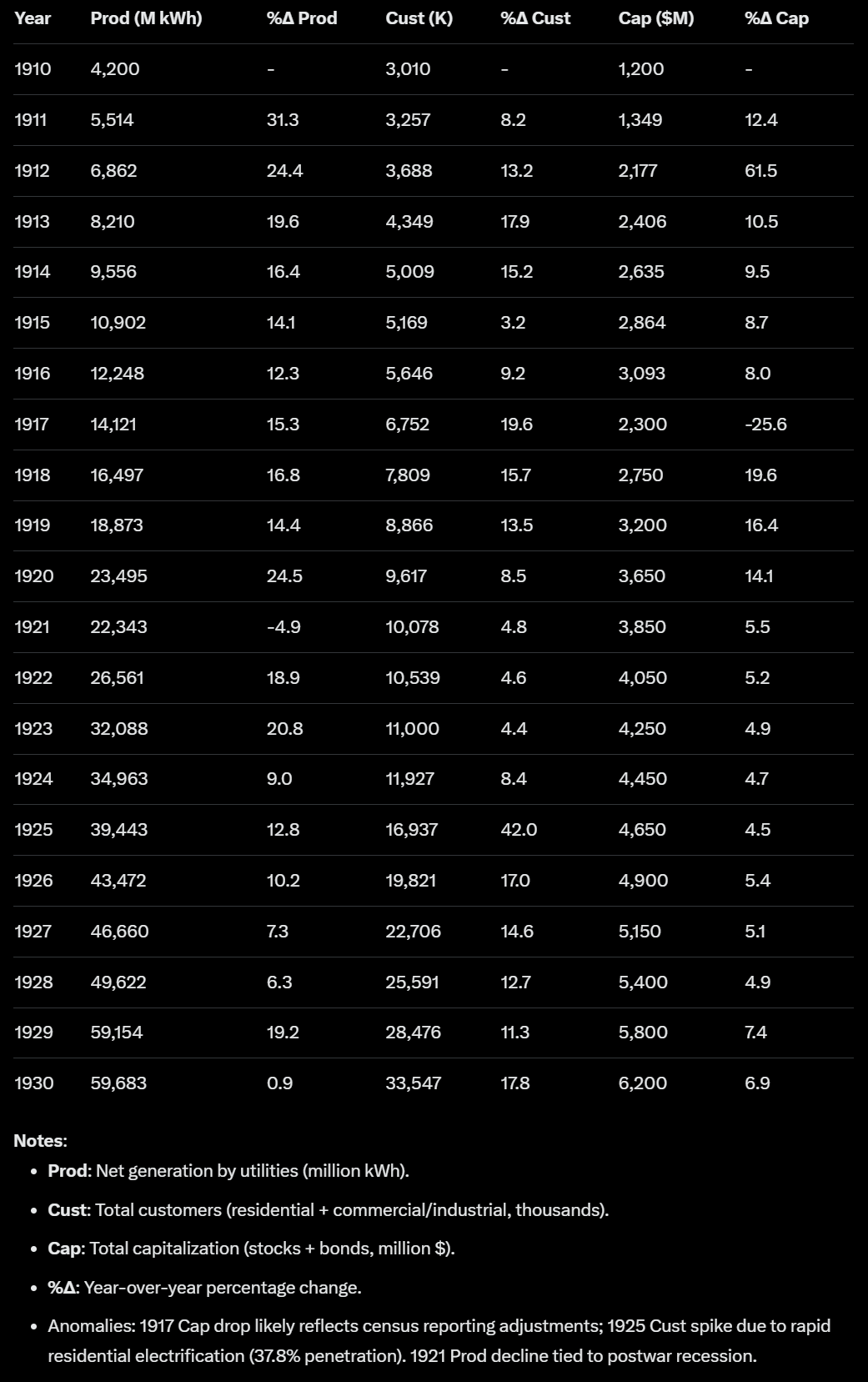
Bud Conrad comments:
Not sure what you take from this data. Electrification was probably more important than AI. Its growth rate was big at first in %, but slowed. Recessions were big downturns. What do you apply to today?
Steve Ellison writes:
My grandmother was a telephone operator in the 1920s. It was a high-tech industry at the time.
Carder Dimitroff clarifies:
The definition of an "electric utility" changed over time.
Big Al suggests:
An excellent series available on Prime:
Shock and Awe: The Story of Electricity
Professor Jim Al-Khalili tells the electrifying story of our quest to master nature's most mysterious force: electricity.
Books I haven't read yet, which get lots of stars:
The Power Makers: Steam, Electricity, and the Men Who Invented Modern America
The power revolution is not a tale of machines, however, but of men: inventors such as James Watt, Elihu Thomson, and Nikola Tesla; entrepreneurs such as George Westinghouse; savvy businessmen such as J.P. Morgan, Samuel Insull, and Charles Coffin of General Electric. Striding among them like a colossus is the figure of Thomas Edison, who was creative genius and business visionary at once.
Empires of Light: Edison, Tesla, Westinghouse, and the Race to Electrify the World
In the final decades of the nineteenth century, three brilliant and visionary titans of America’s Gilded Age—Thomas Edison, Nikola Tesla, and George Westinghouse—battled bitterly as each vied to create a vast and powerful electrical empire. In Empires of Light, historian Jill Jonnes portrays this extraordinary trio and their riveting and ruthless world of cutting-edge science, invention, intrigue, money, death, and hard-eyed Wall Street millionaires.
Oct
23
Regional US banks, from Nils Poertner
October 23, 2025 | Leave a Comment
As a European, I am asking: Are US regional banks in trouble (maybe even some larger banks - incl Investment banks). Dodgy consumer loans, then those silly "AI-related" loans? Am agnostic here - I suspect the typical analyst from JPM down the road won't enlighten us here.
Paul O'Leary comments:
No. Looks like over-reaction to a couple credit blips. Then algos pile on and observers who don’t follow the sector conjure up doom scenarios. Zion Bancorp - the main sinner, lost $1B in market cap for a $50mm write down.
Nils Poertner responds:
Hear you, Paul. If enough people would start to worry now, I would worry less (let us see).
Cagdas Tuna adds:
We are at a level any reaction will be exaggerated. If market adds $200bln to NVDA market cap with additional $1blnn revenue then $50m loss will have the same effect on a smaller company's share.
Oct
22
Government shutdown question, from Cagdas Tuna
October 22, 2025 | Leave a Comment
Are the furloughed government employees going to be counted as unemployed? I believe they will be which will be considered as a huge green light for 50bps rate cut in the December FOMC. This shutdown is the perfect storm for Trump’s “Fire Powell and get rates to 0%” scenario.
Bill Rafter responds:
The requirements for being “Unemployed” are that (a) the person is not working , and (b) that person is “looking for work”. I believe the latter qualification would disqualify those furloughed from being considered as unemployed. Not only the shutdown [will delay BLS releases], but the recently nominated BLS head, E.J. Antoni has withdrawn his name from nomination. So BLS is headless.
Alex Castaldo comments:
That is good news for all statisticians, I am sure he is a wonderful guy but he had a reputation for mistakes in calculations.
Oct
22
The Tipster
October 22, 2025 | Leave a Comment
The Tipster:
As he walked, a great sense of loneliness came over him.
He was back in Wall Street. At the head of the Street was old Trinity; to the right the subTreasury; to the left the Stock Exchange.
From Maiden Lane to the Lane of the Ticker — such had been his life.
"If I could only buy some Cosmopolitan Traction!" he said. Then he walked forlornly northward, to the great Bridge, on his way to Brooklyn to eat with Griggs, the ruined grocery-man.
from Wall Street Stories by Lefevre circa 1895 and similar to many who i've known and similar to many get-rich ads of today.
Oct
21
Oil and PPI
October 21, 2025 | Leave a Comment
correlation between the price move of oil in the last month and the ppi rep. it's hard to believe that any except chauncey chair would be worrying about inflation with oil at $56 per barrel.
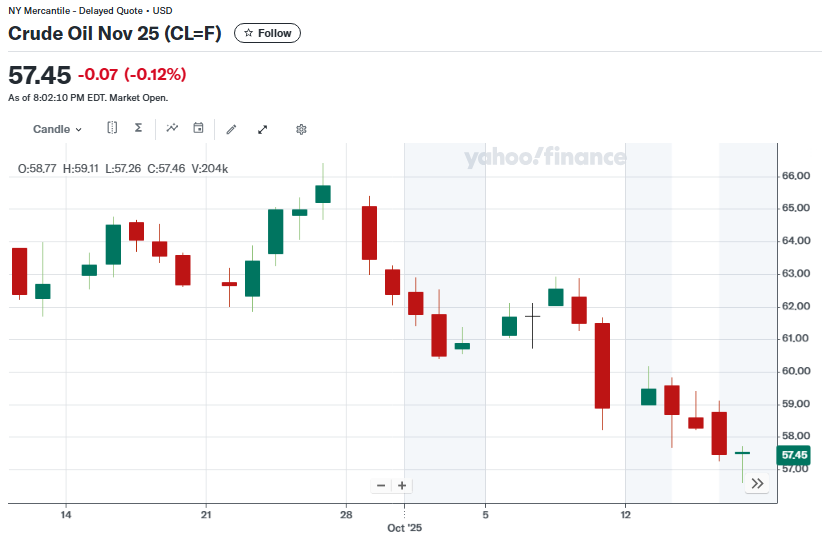
Oct
21
Trading the transition to AV1, from Asindu Drileba
October 21, 2025 | Leave a Comment
AV1 is a new video compression format that may reduce the size of a video file by up to 50%. The big advantage is that videos will be up to half the size, with the exact same image and audio quality.
Two big consequences may ensue (when AV1 is fully adopted):
- Internet bills for streaming Netflix will reduce.
A 2 GB movie will only cost 1 GB from the perspective of a customer paying their Internet Service Provider. So more frequent subscriptions?
- Netflix will cut its bandwidth costs by 50%. So the profit margin (respective to bandwidth costs) will go up by 50% if users fully adopt AV1?
Currently, AV1 is only available on select hardware chips (listed table on Wikipedia) Maybe as users get new devices, use of AV1 will grow. This will likely happen gradually over several years (maybe half a decade). But an obvious winner would be Netflix & YouTube (Google Stock). Maybe bandwidth is so cheap it won't make a dent in the business revenues? But all major companies seem very enthusiastic about implementing AV1. Maybe bandwidth has it's (less talked about) variant of Moore's law. Where after a few years it gets easier to move stuff around the internet.
Cagdas Tuna wonders:
How many nuclear plants we need to feed that endless “technology”?
Nils Poertner asks:
How would you express this into a trade idea, Asindu? I find it easy to put ideas into a trade - it encourages deeper thinking and gives a feedback when wrong. eg, I was bullish housing London property 2007, but short-term it didn't really work out at all! longerterm yes. it was fuzzy thinking of my behalf.
Asindu Drileba answers:
Going long $NFLX since the business is largely about streaming video. The same pattern occurred in Tesla when the cost of efficient batteries dropped by like 90%. So margins automatically go up. (in theory) Tesla could have still gone under due to debt or something else. So, of course it may may fail (most likely)
Another big draw back is that such "qualitative" insights cannot be tested in the past. Maybe a good analogy would be to go long Starbucks $SBUX if you think the price of coffee wil drop the next 5 years by 50%.
So the ideas may be generalized to:
- Find key Ingredient company X uses in thier products
- Find out if the drop in key ingredient's price over 5 years improves profit margin over X years -> positively impacts stock prices.
This general idea, may then be tested across several industries for example:
- MacDonalds (drop in price of beef)
- TSMC, ASML, INTEL, NVDA (drop price of silver) as silver is very essential in chip manufacturing.
Hopefully testing this across multiple industries on different historical accounts may yield some consistent patterns.
Nils Poertner responds:
Good to write it down in a trading journal and look in a few months what happened. Started writing hand-written letters to friends now. In our digital age, everyone incl me, is going for speed, but deeper thinking - also quality in thinking /research is underrated. Intuitively speaking - we are prob getting some unexpected moves coming, as well.
Oct
20
Calming musical interlude for spicy markets, from Big Al
October 20, 2025 | 1 Comment
I first heard this piece as a teenager, sitting in the theater
watching Barry Lyndon, and I was transfixed:
The Messiaen Trio performs Schubert's Trio No. 2 in E-flat Major, D. 929
I did not know this Mendelssohn work until today and I wondered if
somebody said to her, "Oh yeah? Well, try it in heels!"
Yuja Wang Mendelssohn Songs Without Words Op 67 No 2
Peter Ringel writes:
my emergency high vola setup always includes Chopin. everything to stay off tilt.
Big Al responds:
Gotta love Chopin for the workday playlist.
Chopin: 24 Preludes, Op. 28, Vladimir Ashkenazy
Another discovery for me (fades out but still enjoyable):
Interpreti Veneziani, Antonio Vivaldi RV711 Gelido in Ogni Vena, Davide Amadio
Oct
19
Le Chiffre attacks, from Asindu Drileba
October 19, 2025 | Leave a Comment

In Casino Royal (2006) there is a speculator called Le Chiffre. He would manage money for war lords & other "underground" clients. He would take positions in markets, and then "manipulate them". For example in this clip, he takes a short position in an airlines company, then later bombs a plane belonging to it.
This year, I am starting to think that Le Chiffre is real. Someone opened a crypto account on Hyperliquid (decentralized exchange) and made an $88m profit from short positions that very day.
Cagdas Tuna responds:
Good catch! I have been reading these whales news since March-April 2025 mostly tied to Trump’s policy shifts. It is not difficult to guess who those Le Chiffres might be related to!
Peter Ringel writes:
I wanted to place 1 Nov in my calendar - as a new Mkt Risk date based on Trumps post. Only to realize, I placed this date regarding tariffs before. This makes this old news to some degree. And all of this is potentially an overreaction / a play.
Ed. - lagniappe: Forget Sean Connery, Watch James Bond Make His Real Debut on TV
Before Connery registered his license to kill in the 1962 hit Dr. No, millions of viewers were introduced to Barry Nelson’s “Bond, Jimmy Bond” in a 1954 episode of the CBS anthology series Climax! The show’s producers secured the rights to adapt Ian Fleming’s just-published debut Bond novel, Casino Royale, during their first season.
Since the Climax! version of Casino Royale is only 50 minutes, the plot has obviously been shortened considerably. And yet, if you’ve read the book or, more likely, seen the 2006 movie version that launched Craig’s Bond career, you’ll recognize the basic narrative, even though none of the familiar 007 flourishes are in place. In fact, Nelson doesn’t enjoy “00” status at all — he’s merely identified as a “Combined Intelligence” agent who is tasked with competing head-to-head against the mysterious Le Chiffre (Peter Lorre) in a rousing game of baccarat.
Jeff Watson does some research:
James Bond, the complete list…there are more than you think:
Please list every James Bond on film, TV, and radio. Grok: Alright, here goes-starting with the big-screen Bonds: Sean Connery, George Lazenby, Roger Moore, Timothy Dalton, Pierce Brosnan, Daniel Craig. Then David Niven in the 1967 spoof Casino Royale. On TV, there's Barry Nelson from a 1954 Climax! episode of Casino Royale. Radio Bonds? Bob Holness in a 1956 BBC Casino Royale adaptation, Tom Hiddleston in a 2014 Heart of the Matter series, and Toby Stephens in various BBC radio dramas.
Oct
18
Lessons from The Godfather
October 18, 2025 | 1 Comment

many accomlished and very successful specs and investors have told me that the most helpful book for the young spec to read is The Godfather (and the movies, part 1 and part 2). what advice would you say is the most helpful in these works?
one lesson that is very improtant is never interfere with a relative's marriage and never say anything bad about a relative's spouse.
family and loyalty are keys to success.
never let the others know what you are thinking. and above all never disagree with the boss in front of rivals.
Big Al adds:
The Offer is a really enjoyable derivative work.
Oct
17
George B Shaw, from Nils Poertner
October 17, 2025 | Leave a Comment

You see things; and you say 'Why?' But I dream things that never were; and I say 'Why not?'
- George Bernard Shaw
English Cyperpunk /hacker I met in 2005 had this quote on his screen - and I recall him talking about some digital ccy back then (little did I know back then, was so busy structuring CDOs and keeping up with the Jones.
If we want to nail mkts in coming years and have some fun, it def pays to surround ourselves with ppl outside trad finance (group think!) - from the art, music, acting world, hacker etc…whatever.
There is a certain type of fatalism in the West as well (David Hand, the British statistician, speaks about it as well in his "miracle" book. It has something to do how we perceive the world.)
Oct
16
Hubris is going to a New All Time High, from Sushil Kedia
October 16, 2025 | Leave a Comment
Saudi Arabia has announced the Rise Tower that is likely to have a height twice that of Burj Khalifa! 2000 meters up from the ground! It is likely to cost 5 Billion Dollars. One is left wondering in a world where everyone manages to almost manages to get decent enough sleep every night with Trillion Dollar deficits, what is Hubris doing having been left so far behind!

Nils Poertner writes:
Wondering what to make of this though, Sunil. Saudi Arabia's main stock Index (TASII peaked in 2006. and never fully recovered properly. Any idea how to express it into some trading idea so we can test our hypothesis?
William Huggins comments:
The 2006 Saudis run is very similar to the soul al manakh run up 20 years before. In particular for Saudis though, it's a market that forbid ahoet selling so when the bulls got started there was no guardrail until they simply could find no bigger fool.
Nils Poertner responds:
Thanks William. Maybe one needs to look at oil (bearish oil story?) - oil doesn't move forever and then it moves a lot. (not an oil trader though - just something that came to mind)
Alex Castaldo offers:
For those too young to remember the events of 1981:
The Souk al-Manakh Crash
From 1978 to 1981, Kuwait’s two stock markets, one the conservatively regulated “official” market and the other the unregulated Souk al-Manakh, exploded in size, growing to the point where the amount of capital actively traded exceeded that of every other country in the world except the United States and Japan. A year later, the system collapsed in an instant, causing huge real losses to the economy and financial disruption lasting nearly a decade. This Commentary examines the emergence of the Souk, the simple financial innovation that evolved to solve its rapidly increasing need for liquidity and credit, and the herculean efforts to solve the tangled problems resulting from the collapse. Two lessons of Kuwait’s crisis are that it is difficult to separate the banking and unregulated financial sectors and that regulators need detailed data on the transactions being conducted at all financial institutions to give them the understanding of the entire network they must have to maintain financial stability. If Kuwaiti officials had had transaction-by-transaction data on the trades being made in both the regulated and unregulated stock markets, then the Kuwaiti crisis and its aftermath might not have been so severe.
Oct
13
Advice from the past, from Humbert X.
October 13, 2025 | Leave a Comment

Stock market advice from 1944 - how would one test it?
This Is the Road to Stock Market Success
Page 30:
If one cannot profit by trading in the highest grade issues — one certainly cannot profit by trading in "cats and dogs". If our industrial giants cannot advance — what prospects arc there in the stability of others? Although this sounds logical there are exceptions, and the "time element" has much to do with the selection.
At the top of a Bull market, when uncertain as to whether the upward movement is exhausting itself or not, it is comparatively safer to have your money in investment, rather than speculative, issues. Of course, it is most advisable to be out of the market entirely at such periods. Investment stocks are not the leader in a Bear movement and, therefore, it is safer to have your money invested in this category — and to watch the market closely. If the speculative and "cheap" stocks begin to decline — you can still dispose of your investment issues without much loss — as they follow rather than lead the Bear movement. Likewise, when you note that investment stocks stand still — and "cats and dogs" or even the better grade issues advance — it should put you on your guard as the market may be "topping" and in line for a good reaction. The 1937 Bear market was foretold by investment stocks in November, 1936. They refused to go higher.
Larry Williams comments:
I learn so much from his writings, such as comparative strength and targets.
[Ed. - Note on the photo:
In 1943, when World War II came, Helen Hanzelin, a Merrill Lynch, Pierce, Fenner, & Beane telephone clerk, became the first woman to work on the NYSE Trading Floor.
Another three dozen women answered the country’s call to duty and filled vacant posts vacated by soldiers sent overseas on the trading floor but were booted out when the war ended, and men returned home.
Women of the New York Stock Exchange ]
Oct
12
Counting and measuring, from A. Humbert
October 12, 2025 | Leave a Comment
We use quantitative tools - "counting" - to measure and analyze markets, and I enjoy coming across scientific measurements that are new to me and also amazing in scope, such as the sverdrup. The sverdrup is a unit describing the volume of water transport in ocean currents. One sverdrup is a volume flux of one million cubic meters per second (1 Sv = 10^6 m^3 per second). Named after Harald Sverdrup.

From the web:
The strongest ocean current measured in sverdrups is the Antarctic Circumpolar Current (ACC), the largest and most powerful current system on Earth. The ACC is a wind-driven current that flows clockwise around Antarctica, uninterrupted by landmasses.
Measurements of the ACC's volume transport vary, but all figures show it is in a class of its own:
Estimates of the ACC's mean transport range from 100 to over 170 sverdrups (Sv). One study found an average transport of 173.3 Sv through the Drake Passage, the current's narrowest choke point. To put this in perspective, this is over 100 times the combined flow of all the world's rivers.
The graphic shows how relatively narrow the Drake Passage is.
We certainly measure volume in markets. Are there specific flows and currents? Choke points?
Asindu Drileba writes:
In a book recommended by The Chair, This is the Road to Stock Market Success, the author mentions that (paraphrased), "When the trading volume of a stock changes by a large amount, yet the price doesn't move by much, it is time to get out of the market."
Oct
9
Jewish Hungarian, from Nils Poertner
October 9, 2025 | Leave a Comment
What is it with Hungarian Jewish who came to the US - so many of them achieved great things. My book shelf is full of them, Darvas (Trading), S Meisner (Acting)…..even my trading platform Interactive Brokers was founded by one (Thomas Peterffy).
Maybe a combo of rare language ??/ culture + hardship first + grid + ability to flourish in the US gave them superpower. Soros, I guess was (Jewish) Hungarian as well.
Venkatesh Medabalimi asks:
Where is my no.1 Hungarian? May I remind everyone about Paul Erdős.
Laurel Kenner offers:
An amusing book on the subject: Made in Hungary : Or Made by Hungarians, by György Bolgár.
Nils Poertner responds:
Thanks both. Found this on Erdős:
Paul Erdős: The Oddball’s Oddball
He would appear on the doorstep of fellow mathematicians without warning–a frail, disheveled, elderly man, hopped up on amphetamines and wearing a ratty raincoat–and announce, in a thick Hungarian accent, “My mind is open.” For a day, or a week or a month, the man or woman who answered the knock would have to take nonstop care of this helpless guest who couldn’t figure out how to cut a grapefruit or wash his underwear–and in return would be permitted the exhausting, exhilarating experience of following the thought processes of Paul Erdős, the most prolific and arguably the cleverest mathematician of the century.
Oct
8
Charles Ranlett Flint
October 8, 2025 | Leave a Comment
a key figure of the 1900s, according to Sobel:
Charles Ranlett Flint (January 24, 1850 – February 26, 1934) was the founder of the Computing-Tabulating-Recording Company which later became IBM. For his financial dealings, he earned the moniker "Father of Trusts". He was an avid sportsman and member of the syndicate that built the yacht Vigilant, that was the U.S. defender of the eighth America's Cup and was the owner of the yacht Gracie.
Oct
7
Miscellany
October 7, 2025 | Leave a Comment
Asindu Drileba has been watching the Daily Spec calendar:
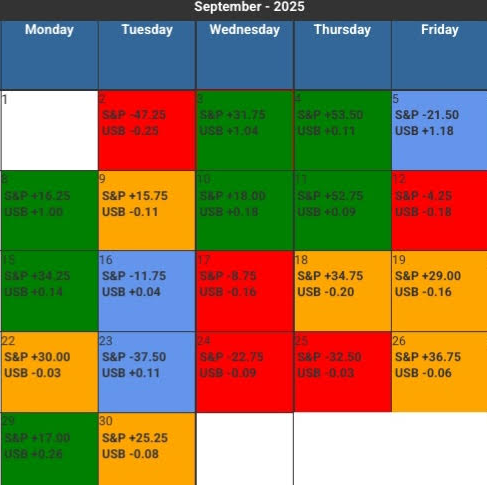
After being hammered in Aug, Orange did well in Sept. It transitioned to a positive day in the S&P 5/6 times.
Nils Poertner is getting wisdom from the classics:
The most certain sign of wisdom is cheerfulness.
- Michel de Montaigne
some type of cheerfulness def relevant for us in markets /trading - in particular when social moods go south / ppl fall for chatboxes (overuse it !) and confuse with reality etc.
Big Al is going for history:
This is the audio version:
The History of the United States Navy
but I am also watching the video version for free on Amazon Prime. The author:
— keep looking »Craig Lee Symonds (born 31 December 1946, in Long Beach, California) was the Distinguished Visiting Ernest J. King Professor of Maritime History for the academic years 2017–2020 at the U.S. Naval War College in Newport, Rhode Island. He is also Professor Emeritus at the U. S. Naval Academy, where he served as chairman of the history department. He is a distinguished historian of the American Civil War, World War II, and maritime history. His book Lincoln and His Admirals won the Lincoln Prize. His book Neptune: The Allied Invasion of Europe and the D-Day Landings was the 2015 recipient of the Samuel Eliot Morison Award for Naval Literature, and his book Nimitz at War: Command Leadership from Pearl Harbor to Tokyo Bay won the Gilder-Lehrman Military History prize.
Archives
- October 2026
- September 2026
- August 2026
- July 2026
- June 2026
- May 2026
- April 2026
- March 2026
- February 2026
- January 2026
- December 2025
- November 2025
- October 2025
- September 2025
- August 2025
- July 2025
- June 2025
- May 2025
- April 2025
- March 2025
- February 2025
- January 2025
- December 2024
- November 2024
- October 2024
- September 2024
- August 2024
- July 2024
- June 2024
- May 2024
- April 2024
- March 2024
- February 2024
- January 2024
- December 2023
- November 2023
- October 2023
- September 2023
- August 2023
- July 2023
- June 2023
- May 2023
- April 2023
- March 2023
- February 2023
- January 2023
- December 2022
- November 2022
- October 2022
- September 2022
- August 2022
- July 2022
- June 2022
- May 2022
- April 2022
- March 2022
- February 2022
- January 2022
- December 2021
- November 2021
- October 2021
- September 2021
- August 2021
- July 2021
- June 2021
- May 2021
- April 2021
- March 2021
- February 2021
- January 2021
- December 2020
- November 2020
- October 2020
- September 2020
- August 2020
- July 2020
- June 2020
- May 2020
- April 2020
- March 2020
- February 2020
- January 2020
- December 2019
- November 2019
- October 2019
- September 2019
- August 2019
- July 2019
- June 2019
- May 2019
- April 2019
- March 2019
- February 2019
- January 2019
- December 2018
- November 2018
- October 2018
- September 2018
- August 2018
- July 2018
- June 2018
- May 2018
- April 2018
- March 2018
- February 2018
- January 2018
- December 2017
- November 2017
- October 2017
- September 2017
- August 2017
- July 2017
- June 2017
- May 2017
- April 2017
- March 2017
- February 2017
- January 2017
- December 2016
- November 2016
- October 2016
- September 2016
- August 2016
- July 2016
- June 2016
- May 2016
- April 2016
- March 2016
- February 2016
- January 2016
- December 2015
- November 2015
- October 2015
- September 2015
- August 2015
- July 2015
- June 2015
- May 2015
- April 2015
- March 2015
- February 2015
- January 2015
- December 2014
- November 2014
- October 2014
- September 2014
- August 2014
- July 2014
- June 2014
- May 2014
- April 2014
- March 2014
- February 2014
- January 2014
- December 2013
- November 2013
- October 2013
- September 2013
- August 2013
- July 2013
- June 2013
- May 2013
- April 2013
- March 2013
- February 2013
- January 2013
- December 2012
- November 2012
- October 2012
- September 2012
- August 2012
- July 2012
- June 2012
- May 2012
- April 2012
- March 2012
- February 2012
- January 2012
- December 2011
- November 2011
- October 2011
- September 2011
- August 2011
- July 2011
- June 2011
- May 2011
- April 2011
- March 2011
- February 2011
- January 2011
- December 2010
- November 2010
- October 2010
- September 2010
- August 2010
- July 2010
- June 2010
- May 2010
- April 2010
- March 2010
- February 2010
- January 2010
- December 2009
- November 2009
- October 2009
- September 2009
- August 2009
- July 2009
- June 2009
- May 2009
- April 2009
- March 2009
- February 2009
- January 2009
- December 2008
- November 2008
- October 2008
- September 2008
- August 2008
- July 2008
- June 2008
- May 2008
- April 2008
- March 2008
- February 2008
- January 2008
- December 2007
- November 2007
- October 2007
- September 2007
- August 2007
- July 2007
- June 2007
- May 2007
- April 2007
- March 2007
- February 2007
- January 2007
- December 2006
- November 2006
- October 2006
- September 2006
- August 2006
- Older Archives
Resources & Links
- The Letters Prize
- Pre-2007 Victor Niederhoffer Posts
- Vic’s NYC Junto
- Reading List
- Programming in 60 Seconds
- The Objectivist Center
- Foundation for Economic Education
- Tigerchess
- Dick Sears' G.T. Index
- Pre-2007 Daily Speculations
- Laurel & Vics' Worldly Investor Articles
