Aug
23
Appreciating The Chair
August 23, 2026 | 1 Comment
Obituary: Victor Niederhoffer - December 10, 1943 – August 4, 2026
Alex Castaldo:
I think I was lucky to know Vic for so many years. He was very generous to me and although he liked to do things unconventionally sometimes, it was because he sincerely felt everyone should do things their own way and never just to be eccentric or shock people. He always had interesting points of view on many issues not just work related.
Pamela Van Giessen:
It was my great honor and privilege to publish Education of a Speculator. In fact, working on the book with Victor was the highlight of my career. I knew in my heart that whether the book sold 1 copy or 100,000 copies or more, it was an important work. Throughout the process Victor drove me crazy, but mostly in a good way. He was always challenging the status quo, often spot on. He was one of the most generous people I have ever encountered, and I will carry to my grave all the lessons he taught me, along with the many interesting people he introduced me to including Marty Reisman who negotiated the publishing contract with me/Wiley on Victor’s behalf (and wasn’t that just a trip!) and, of course, Bo, among so many others.
The most beautiful person Victor introduced me to was his amazing wife, Susan. If we were fortunate to know Victor, Victor was beyond fortunate to have Susan in his life. May the hole in your heart, and the hearts of your children, be filled with Victor’s love for you and the love of all those around you.
Vince Fulco:
Terribly, terribly sad to hear this news. Working for him was among the best years of my life. I would have carried his ammo can in any trench, in any war.
May his memory be a blessing. Warmest condolences to all who knew him.
Jared Albert:
I sent this to Vic in June and it seems like I should just share it as my commemoration of the man of extraordinarily outsized importance in my life. My deepest condolences to Susan and all of their children.
Dear Vic,
I was sorry to read that you weren’t feeling that well these days, and I wanted to thank you again, while there’s time in this world, for taking a shot on me 20 years ago. Although it didn’t work out like I hoped, it gave me a kind of seal of approval at a pretty low point in my early 30’s and I’ve always appreciated that you did that.
You've remained a central positive figure in my life and I wish you all the best for a full recovery.
James Sogi:
Condolences to his extended family and past business associates and partners . Vic was truly one of the all time greats of the financial world who helped many and changed the markets. He changed my life and my family through his help. I am very sad to hear of his passing. I will always treasure my association and times with him as one of the highlights of my life.
Tyler Cowen:
In addition to his well-known public roles, he worked very hard to help and befriend me when I was younger. Here are the Google searches for Victor. Less well known about Victor is that he had one of the world’s best collections of private letters. He also once gave me a very nice small painting by Jack Savitzky, for which I remain grateful.
Michael Brush:
Vic did a lot of things, but one thing he did for all of us was to generously introduce us to new worlds, new worlds of ideas, and new people.
Vic was really great man. Meeting him was one of those “before and after” moments in my life, back when he started writing for MSN Money when I wrote there.
I remember our last conversation while leaving one of his parties.
Me: Vic you were such a big influence in my life.
His answer surprised me and to this day I am not sure I know what it really meant: “I hope in a good way.”
I will really miss you Vic. Thanks again for everything.
Steve Ellison:
I posted a photo on X (then Twitter) when the Chair played handball against the Senator at the 2015 Spec Party.
William Weaver:
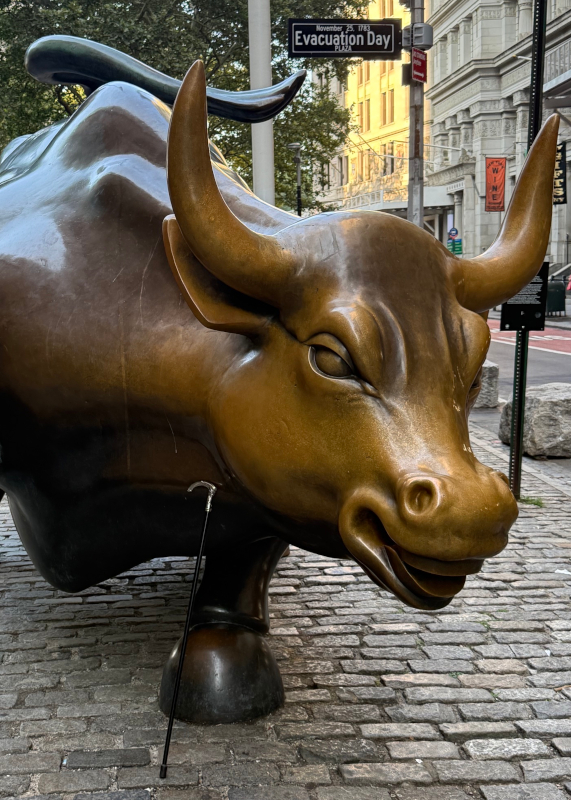
Victor gave a number of us these canes years ago. At least for me it was a reminder anyone can achieve their goals, and it won’t always be an easy path. I took mine down to Wall Street this morning. Thank you, Vic. Will
It is good to take out the canes and hobble down to Wall Street at the close of days when there is a panic. - Victor Niederhoffer
Laurel Kenner:
I found the last cane maker in Manhattan and purchased a number of the most striking ones to send as prizes.
Asindu Drileba:
Until this day, since a few years since I read The Education of a Speculator, I have not found another book remotely close to it. In the finance industry, market analogies are mostly limited to maths & physics. This is why when I read The Education of a Speculator, my mind was genuinely blown by how The Chair would create market references to genetics, music sheets, Dutch philopher Johan Huizinga (Homo Lundens is worshipped in the game design community), checkers and more.
This type of thinking in analogies is what E. O Wilson referred to as "Consilience." So because of this, I would regard The Chair as "The Master of Consilience".
I wrote a short tribute to Vic.
Kiran Kaur:
I was a student of Vic’s. In 2025 he gave me a full weekend at his home, him and Susan both. He walked me through his own book. When I left he put Elmer Kelton’s The Time It Never Rained in my hands and told me The Trees in My Forest by Bernd Heinrich was the other one to read.
I have wondered since whether the pairing was deliberate. A rancher who will not take the drought subsidy and stays on the land, and a biologist counting what is actually happening in three hundred acres of Maine woods. Endurance and counting. He handed it over without a lecture, which I think was the point.
Condolences to Susan, to Aubrey, and to the whole community. Rest in Peace Legend!
Sam Johnson:
A veteran trader pointed me to Vic back in 2011 via speculations website. Encouraged me to think differently about markets and led to a career. Question and test orthodoxy. I wish i could have attended one of his get togethers. He never met me or knew it but he was the second most important person to my trading success.
Yelena Sennett:
Victor certainly did like his hats…
It was a privilege to do podcasts with him. You never knew what fascinating analogy he would come up with to explain the markets. He was always generous with sharing his knowledge, but I believe his greatest gift was an instinct for reading the markets that simply couldn't be quantified.
One of his favorite sayings was, "Never short the market." He certainly lived an extraordinary life, with its share of highs and lows—much like the markets themselves.
Today (August 4th), as the S&P 500 reached another all-time high, it felt like a fitting tribute to his memory.
Richard Barsom:
RIP Victor. Great guy, literally saved my life. Rest in peace Chair.
John Netto:
I remember meeting him for the first time back in the summer of 2011. He graciously invited several from the spec list over to his UWS home. The whole experience fascinated me and his affable personality and welcoming disposition quickly removed any anxiety I had about being in front of a true legend. Thank you to John Floyd for introducing me to the Chair and the list.
Paolo Pezzutti:
I will miss Victor very much. To me, he was a mentor. I received far more from him than I ever gave, and that was part of his greatness. I have applied many of his teachings in both my life and my work.
A brilliant, original and courageous man has left us—courageous even beyond any reasonable limit. He was eclectic, competitive and a great contrarian by nature, but also generous beyond measure. He was a bold, direct and aggressive speculator.
As Nelson used to say: “Go right at them”, Victor always urged me to apply his battle-tested principles to my own trading style.
Newton Linchen:
Victor Niederhoffer was a major inspiration for my development as a market practitioner and had huge impact in the way I view markets and the World.
We are all at a great loss. My respects and sentiment to the family and friends.
Thank you, Chair!
Eric Lindell:
I'm saddened to hear of Victor's passing. I had gotten to know him over the years attending his junto meetings. He was a great guy, and it's a big loss to the investment community and all those whose lives he touched. My deepest sympathies to his family.
Jordan Low:
Victor’s passing is a loss to many. He was so generous with his time and wisdom, and he was a friend to my whole family: he taught my daughter Annabelle tennis, squash, and checkers, and he came to the gala to support my wife Annie when she was honored among the Outstanding 50 Asian Americans in Business. He also taught me the triangle defense in checkers, and drew the line straight to portfolio management: balance risk, reward, and liquidity, and hold the formation at all times. I trade that way to this day. My deepest sympathies to his family.
Rest in peace, Chair. We will remember you fondly.
George Coyle:
Feb
4
2026 Bullish Confirmation, from Larry Williams
February 4, 2026 | Leave a Comment
Yale Hirsch and his son Jeff have shown that a positive change, from the last trading day of the year to the 5th trading day of the new year, portends a bullish year (positive first 5-day percent change).*
Consider this … in the last 76 years of trading, the S&P 500 has declined for the year 20 times or 26% of the time. In other words, 74% of the time, there has been a yearly gain.
Jeff’s numbers show that in those last 76 years, 49 years showed a positive first 5-day percent change. Only 8 of those years went on to close down for the year. That’s an 84% bias for the year to close higher when we have a positive first 5-day percent change.
My add-on to Yale’s and Jeff’s work was to look at the years that gained 1.2% or more in the first 5 days of trading. There were 28 such years. Of those years, only 2 were down for the year. That’s a 93% bias for the year to close higher. What an improvement from the average 74%!
In 2026, the first 5-day** change for the Dow Jones 30 was +3%.
In 2026, the first 5-day** change for the S&P 500 was +1.6%.
Those 28 years had an average annual return of 14%. The remaining years had an annual gain of 5.3%. I see this as excellent confirmation of the bullishness of my Forecast 2026 Report.
Cagdas Tuna writes:
There is no need for a statistical analysis to assume any given year will be positive for US indices. It is almost guaranteed to be positive every year. No offense to any list member.
Larry Williams responds:
Wrong 24% of time we close down for the year.
Michael Brush is surprised:
Wow did not know it was that high.
Larry Williams agrees:
I was taken back by it as well.
Asindu Drileba asks:
2026 is bullish? But Senator, you said you expect a recession in 2026 with 100% certainty. Is this a contradiction? Or maybe its possible for the market to be bullish even during a recession?
Larry Williams answers:
Yes, there was a projection made a year ago for a 2026 sell off —in the last 12 months data changed—large improvements in fundamentals and hopefully I got a little better understanding of long term cycles. New Data matters.
Nils Poertner writes:
Asindu- there would be simply too many variables out to make that statement with such a certainty in advance. Just impossible. It remains a probability game. Used to subscribe to some cycle research that claimed to have things figured out yrs in advance. quite pricey subscription. it was HOOK, LINE and SINKER (for me).
Denise Shull comments:
New Data matters.
Indeed it does. Wonder why it’s challenging for many to incorporate?
Nils Poertner responds:
Good question. On this note… (Pure) data analysts believe pattern matching on large datasets will solve our problems. But what if the really vital information isn't being collected? What if it's invisible to our trained systems?
Dec
23
Low status jobs becoming high status, from Nils Poertner
December 23, 2025 | Leave a Comment

Fascinating to watch how former low status jobs, like cybersecurity, have become high status now. Same is true the other way around as well (eg (male) technician at the London tube system who makes a quarter of his wife who is in real estate - although that is changing now). Wondering what low type jobs / or ppl are on the fringes today will be in high demand in coming years.
Carder Dimitroff responds:
Try these:
Any of the crafts. Specifically, licensed electricians, plumbers, and HVAC techs. Many make more than engineers.
Public response teams. Specifically, firefighters, EMTs, and law enforcement. Many make more than lawyers, particularly when pensions are considered.
Career military. Specifically, for those with 20 years of service. Lifetime benefits are incredible (free college, unlimited grad schools, pensions w/colas, lifetime medical insurance, VA benefits, hiring preferences).
Pamela Van Giessen suggests:
Car mechanics
Henry Gifford writes:
My friend who fixed boilers said to his sophisticated, suit-and-tie, well educated in-laws “I’m not the smartest guy around. I’ve only read two or three books in my life. I don’t think I’m smart enough to come up with a sophisticated investment plan (nods all around the room at this point). So I just buy one piece of New York City real estate each year and hope for the best”. No more nodding at that point.
Guess what blue collar people who don’t have vices do with their money? They buy property. Who is better suited to own real estate? People who fix things and have friends who fix things, or lawyers?
And what nobody mentions is that some people are much better at those sorts of work than others. Simply finding someone to show up and try to do those things is hard. Someone who is good at one of those trades is in even higher demand.
Those fantastic benefits for former military people are not limited to the military – all federal employees get all those benefits after twenty years of work. If someone joins the military at 18, and gets out at 38, or gets out sooner and then works in the post office or etc. until they “get their twenty”, they get full salary with increases for life. Income that will survive any lawsuit, even the IRS can’t take it all. They maybe collect a total of three years of salary for every year worked.
Nils Poertner responds:
Certainly good to encourage young men (or women) to follow a path that interests them - and not just follow a path that is currently "high status". This "Yousef" guy who was my IT guy at Bankers Trust decades ago (low status in my eyes back then) became a cyberpunk in 2008…you get the idea. That said, it is a power game outside. young men need wives etc.
Henry Gifford adds:
I judge the level of a single woman’s interest in me by counting the seconds until she says “what do you do?”.
No woman has ever asked me if I like what I do, or am good at what I do – not important.
Many men have a choice between coming home miserable to a wife, or coming home happy to an empty house. Age old dilemma, no known fix, as all our DNA has evolved to enhance survival, which for a woman over the millennia has meant marrying the chief’s son, or someone else with high status.
Larry Williams recalls:
When I was dating all women ever asked me is your place or mine. Must have been doing something wrong.
Michael Brush is curious:
Do you have a cycle chart for that?
Larry Williams clarifies:
Yes but there are not enough examples to draw a conclusion.
May
28
Adapting to the situation, from Big Al
May 28, 2025 | Leave a Comment

Street smarts: how a hawk learned to use traffic signals to hunt more successfully
But what was really interesting, and took me much longer to figure out, was that the hawk always attacked when the car queue was long enough to provide cover all the way to the small tree, and that only happened after someone had pressed the pedestrian crossing button. As soon as the sound signal was activated, the raptor would fly from somewhere into the small tree, wait for the cars to line up, and then strike.
Easan Katir predicts:
Next iteration: the hawk will be pressing the pedestrian crossing button!
Michael Brush quips:
Pavlov’s birds.
Henry Gifford writes:
When I was hiking down The Grand Canyon I sat on a rock at the edge of the trail and took out a sandwich and started to eat. A bird came flying from my left side, toward the sandwich in my right hand. I reacted by pulling the sandwich back, to the right side of my head. Another bird came from behind and grabbed it.
Later I heard the birds’ favorite food is tuna fish, which they steal cans of from hikers. They open the can by grabbing it in their beak and flying above the one of the three cabins at the bottom of the canyon where the park rangers live and dropping it on the roof. The rangers have been trained to comply by opening the can and placing it on a convenient rock.
Pamela Van Giessen responds:
Was it a raven? They are particularly smart birds when it comes to getting food out of visitors to the national parks we have visited.
Asindu Drileba writes:
Crows & ravens would make good scientists. Here for example a video of a crow showing that it understands water displacement in different scenarios.
Bo Keely, from the desert:
Yesterday at the meteor crater in Death Valley two crows perched on the rim. They had grown feather sunglasses and asked for food. I went to the car & they followed and I gave them whole wheat bread. Then I got in & drove a couple miles down the road, pulled over to check directions, and they landed outside the driver's door asking for more bread.
May
11
Echoes from the past, from Jeff Watson
May 11, 2025 | Leave a Comment
I have heard every single one of these more than once on the floor. This is the G version; the X version would be very inappropriate for this venue.
You’re long hope and short reality.
He couldn’t trade his way out of a wet paper straddle.
You’re bidding like it’s your wife’s money.
His stops have stops.
He buys the high, sells the low, and thinks he’s range trading.
If brains were dynamite, he couldn’t blow his nose.
He's so underwater, Aquaman just waved.
Tighter than a bull’s ass in fly season.
Your size is what we use for toilet paper.
He’s a momentum trader—in reverse.
He couldn’t fill a corn order, let alone an order ticket.
That guy trades like he’s reading Braille.
He thinks ‘limit down’ means he hit the jackpot.
He trades like he’s got a rearview mirror taped to his glasses.
He’s scalping—his own account.
Nice fade. If I ever need a contrary indicator, I’ll call you.
He went from hero to sandwich in one tick.
I’ve seen better risk management at a toddler’s birthday party.
Market’s moving—better go ask your horoscope.
You trading or just making donations today?
He’s got a 30-lot mouth and a 1-lot account.
That guy’s P&L looks like an EKG flatline.
You're not trading—you're gambling, but slower.
He’s so unlucky, he’d lose money in a rigged market where he’s the rigger.
The guy’s charts look like modern art—ugly, meaningless, and overpriced.
He averages losers like he’s building a position in failure.
Don’t worry, he’ll blow up before lunch.
His fills are like Bigfoot—plenty of stories, no proof.
That trade had more slippage than a greased pig at a county fair.
He went full margin—and full stupid.
Asindu Drileba writes:
I watched the documentary "Floored" that was about the extinction of pit traders due to the advent of computer driven traders. A lot of the traders seemed to have their edge in bullying and intimidation that was both physical and psychological.
I made a pit trading playlist that I binged on, and this seemed consistent even to pit traders in the currency pits of London.
One of the pit traders called the computer "The most vile invention ever made." I think he was just sad that his bullying was no longer an advantage. You can't insult a computer, or use your big body to push it away so you can have the edge, or seduce it with good looks.
Michael Brush responds:
Behind every computer, there is a person.
“The offer is $25.”
“But my computer says $45.”
“So sell it to your computer.”
Pamela Van Giessen adds:
For those interested in a biography of a once famous and beloved pit trader, I recommend Charlie D: The Story of the Legendary Bond Trader by William Falloon.
Francesco Sabella adds:
It's an incredible book! I read it years ago, I even saw a 2 hour video of Charlie D. when i was in high school where he gave a lecture on trading on 1989.
Larry Williams writes:
Charly D was one stand up guy. He loved the Bears and suggested a bet with a young lady trader for a nickel on the weekend's game. She said sure…and won. Monday morning Charley D gave her 5 grand (a nickel in betting parlance). She was astounded, told him she meant 5 cents not 5G's. No way could she risk that or take the money. He left it in her hand and walked away.
I was fortunate, thanks to T Demark, to be part of his Vegas support group - he was just amazing to hang with.
Nov
10
The Old Right was a principled band of intellectuals and activists, many of them libertarians, who fought the “industrial regimentation” of the New Deal, and were the first to note that, in America, statism and corporatism are inseparable.
Despite some current claims, however, these writers ardently defended capitalism, including big business and corporations, celebrated the profit motive, and took a strict laissez-faire attitude towards international trade. They loathed tariffs, and saw protectionism as a species of socialist planning.
Humbert H. writes:
Current restrictionist trade theories in the conservative movement, therefore, are not those of the Old Right. Their intellectual legacy is more likely British mercantilism.
The British did pretty well under mercantilism. I have always supported free (meaning from both sides) trade with equally situated countries, like US and Canada, but I love restrictionism and tariffs imposed on countries like China. It's crazy, in my opinion, to have "free trade" with a country that can and routinely does restrict imports, has slave labor, no "social safety net", steals intellectual property in a variety of ways, and can chose to focus on any trade area to bankrupt it's counterparts in a "free" country. The ability to produce a variety of goods is fundamental to the strength of the country. In wars, pandemics, and trade wars the other country starts having domestic capabilities is crucial. When this debate was first discussed in France, restricting the imports of oranges from Spain and Portugal into France was used as an example of what not to do, and that's a poor example compared to importing steel and semiconductors.
Larry Williams comments:
Hamilton's use of tariffs made America great.
Stefan Jovanovich writes:
Hamilton made his living as a private attorney in New York representing the marine insurance companies whose policies required shippers to be "woke" - i.e. perfect observers of their policies' neutrality warranties.
Pamela Van Giessen adds:
Silent Cal Coolidge the Vermonter was also good with tariffs and preferred them to income taxes.
Along with Secretary of the Treasury Andrew Mellon, Coolidge won the passage of three major tax cuts. Using powers delegated to him by the 1922 Fordney–McCumber Tariff, Coolidge kept tariff rates high in order to protect American manufacturing profits and high wages. He blocked passage of the McNary–Haugen Farm Relief Bill, which would have involved the federal government in the persistent farm crisis by raising prices paid to farmers for five crops. The strong economy combined with restrained government spending produced consistent government surpluses, and total federal debt shrank by one quarter during Coolidge's presidency.
Michael Brush responds:
Smoot-Hawley worsened the Great Depression.
Humbert H. cautions:
That's not really a fact, it's a debatable point. There's a range of opinions there from "it caused it" to "it did nothing to worsen it". It's one of those things like "what caused the fall of Rome" that can't be decisively proven.
Stefan Jovanovich offers:
Effective date of Smoot-Hawley Tariff: June 17, 1930
Tariff collections:
Fiscal Year 1931: $378,354,005.05
Fiscal Year 1932: $327,754,969.45
Fiscal Year 1933: $250,750,251.27
Total tax collections by Treasury:
Fiscal Year 1931: $2,118,092,899.01
Fiscal Year 1932: $2,118,092,899.01
Fiscal Year 1933: $2,576,530,202.00
Pamela Van Giessen writes:
Amity Shlaes goes into detail about how the depression was extended (or recovery didn’t come) in The Forgotten Man. She attributes the worsening of the depression, especially in the late ‘30s, to a combination of government interventions that included the Smoot-Hawley tariff, government (and union) demands to keep wages high, banking regulation, over-regulation, and FDR’s new deal, among other government interventions. In short, there doesn’t seem to be just one cause though it seems reasonable to blame each of the interventions.
Art Cooper adds:
I also found Murray Rothbard's America's Great Depression to have worthwhile insights.
Mar
24
An alternate understanding of a market being at all time high (market reaching new prices it has never encountered) is this: "Everyone that has ever bought that stock or instrument is now in profit". What might be the psychological implications of this?
Kim Zussman comments:
It is possible (and probable) to buy, then sell after a decline and stay out only to see it reverse and go up further. This (timing) is one reason it is so much easier to do better with B/H than trading.
Big Al adds:
The other advantage to B&H is that the opportunity cost viz time/attention required is basically zero. I have looked at various index timing approaches and have not found anything that beats B&H, especially when considering the vig and opportunity cost. However, should one need to scratch the itch, timing strategies may work better with individual stocks. But again, opportunity cost.
Humbert H. writes:
I've always been believer in B&H vs. trading. But even in B&H the debate between indexing and individual stock selection never dies. I don't like indexing, but I don't have a mathematical basis for that. It's a fundamental belief that buying things without any regard to their economic value has to fail in time, at least relative to paying some attention to it.
Zubin Al Genubi adds more:
Another aspect of buy and hold that Rocky pointed out is the capital gain tax severely eats into returns. The richest guys hold for years and have only unrealized untaxable gains.
Art Cooper agrees:
There was an excellent article in the Jan 7, 2017 issue of Barron's by Leslie P. Norton on VERY long-lived closed end mutual funds which have surpassed the S&P's performance. They have all followed buy and hold strategies.
Michael Brush offers:
Far more money has been lost by investors in preparing for corrections, or anticipating corrections, than has been lost in the corrections themselves.
- Peter Lynch
Steve Ellison brings up an important point:
And yet trading is one of the focal points of this list. The way I square this circle is to keep most of my trading account in an equity index fund at all times. When I think I have an edge, I make trades using margin.
Larry Williams writes:
B&H is the keys to the kingdom, but…the massive fortunes of Livermore were short term trades despite his comment about sitting on your hands. Even the current high performers, Cohen, Dalio, Tudor etc use market timing. When I won world cup trading $10,000 to $1,100,000, it was all about timing and wild crazy money management. One approach wins big the other wins fast. A point to ponder.
Bill Rafter writes:
What we found in studying only the SPX/SPY is that in the long run a buy-and-hold yielded 9.5 percent compounded annually. That was from 1972 to recent. Our argument is that studies before 1972 are flawed. That 9.5 was great considering there were several collapses of ~50 percent. However if you could just eliminate the collapses you could raise the return to 13.5 percent compounded annually.
Eliminating the down moves did not involve prescience. You did not need to forecast recessions, only identify them when you were in one. That was not difficult, and timing was not a critical as one might think. We identified several algos that worked well.
When you were out of equities, you could either simply hold cash, or go long the 10-year ETF. The bonds were better, but not by much. Interestingly, long term holding of bond ETFs yielded low single-digit returns. Best avoided. Which also means that the Markowitz 60/40 strategy was a sub-performer.
Taxes are investor/vehicle specific. For example, if you use a no-tax vehicle, there are no taxes. Regarding turnover, there are very few transactions, as there are very few recessions. The strategy is basically B&H, but with holidays.
Asindu Drileba has concerns:
My problem with buy & hold Is that it has no risk management strategy. If you bought the S&P 500 in 1929 for example during the wrong month. It took you 25 years i.e until 1954 not even to make profit, but just to break even. The real question is, how do you know your not investing in a market path that will take 25 years just to break even?
Humbert H. responds:
That’s why, dollar cost averaging. I don’t think anyone thinks buy once in your lifetime and never interact with the stock market ever again. I think if you had averaged in monthly or quarterly from the summer 1929 through summer 1959 and then held and lived off dividends or cashed out/interest in retirement, you did well.
Art Cooper adds:
The year 1954 is almost universally given as the "break-even" year to recoup losses for buy & hold investors who bought at the 1929 peak. It's wrong to do so. First, it ignores dividends. Had dividends been re-invested the recovery year would have been much earlier. Second, it ignores the deflation which occurred during the Great Depression. In this column Mark Hulbert argues that someone who invested a lump sum at the 1929 peak would have recovered in real economic terms by late 1936.
I'm not arguing against dollar-cost averaging, merely pointing out a historical falsehood.
Hernan Avella writes:
What people should do while they are young and have human capital left is to leverage!
Life-Cycle Investing and Leverage: Buying Stock on Margin Can Reduce Retirement Risk
The most robust research, incorporating lifecycle patterns and relevant time horizons for long term investors tells us that the optimal allocation is 50/50 all equities, domestic and international. But most ppl don’t have the gumption to be 100% on equities.
Sep
6
Markets and recessions, from Yelena Sennett
September 6, 2023 | 1 Comment
Do markets lead recessions or do recessions cause markets to drop? I think Larry had a chart on this. Consumer is going to be spending less on discretionary spending. Retailers have already warned us of this.
- Student loan payments are due starting September
- Savings rates are down
- Employment situation is weakening a bit
- Consumer credit is slowing
- Interest payments rates are up on credit cards, cars, homes, etc.
Jeffrey Hirsch responds:
We had our U.S. recession on 2022 with back to back negative quarters of GDP Q1-Q2 2022. "They" changes the rules during Covid. Generally, markets lead recessions. This last time they ran concurrently.
Larry Williams comments:
No recession in sight with the indicators I keep…
Yelena Sennett asks:
thank you Larry, in sight means a few months or so? or a few quarters?
Larry Williams answers:
A year or so I would say.
Hernan Avella writes:
When was the last time the yield curve inversion (with the specific configuration by Campbell Harvey at Duke) didn't precede a recession in the out of sample period? It's a 8 out of 8 record I believe. While one would be foolish to act solely on this, this might be the best of all the bad recession indicators we have. Especially because it was conceived in 1986, has some rationale and we are experiencing the out of sample, Unlike Larry's drawings that are constantly overfitted to the data.
Larry Williams responds:
Me overfit data? Try my best not to but you Y-curvers refuse to acknowledge times of negative curve and massive stock rallies. Here is just one DJIA in red:

Hernan Avella replies:
But Larry, kindly stop straw-manning. The gist of the yc indicator, is the out of sample track record of preceding 8 out of the last 8 recessions. There's no controversy about this. Nobody serious has related this to stock returns. So you are trying to disprove a point that nobody is making.
Larry Williams writes:
Two points: (1) To say the curve has accurately predicted recessions you have to acknowledge it as often lead by 2 years. Wowsa!! Now there’s a real helpful tool. Gee those negative readings are not so precise. but maybe you are happy with that I am not. especially when there are so many better tools. (2) And if the YC and recessions don’t mean much to stocks, why would I care?
Hernan Avella responds:
Who said “predicted”. You keep making stuff up!. I can’t find the source, but the lag for the indicator is 12 or 18 months after 2 consecutive quarters of inversion of 3m-10y. Ignore it if you want. Just don’t straw-man the thing.
Larry Williams responds:
No straw man here—just look a the data its very poor indication recession is coming. now what did I make up???????
Hernan Avella states:
I don’t get it. 8 out of 8 within 18 months after 2 consecutive quarters of inversion….it could be luck, but let it at least fail once. Go to the source: Harvey’s 86’ dissertation.
Larry Williams says:
Curve went negative last April. you are the end of the time zone…better get ready for the sky to fall!
Michael Brush writes:
Yardeni charts yield curve inversion against stock returns. It has a good record but not quite as good as forecasting recessions. Agree no recession in sight.
Gary Phillips writes:
Not every yield curve inversion has been followed by a recession; however, every recession has been preceded by a yield curve inversion.
Larry Williams replies:
Agree but with a massive lead time. I want/need more precise timing and then—its not always market relevant.
Gary Phillips responds:
The clock doesn’t start ticking from the inception of the inversion, rather than when the curve begins to re-steepen.
Larry Williams offers:
Sure just like this:

Yelena Sennett writes:
Thank you for sharing your graphs and your concise points. “And if the YC and recessions don’t mean much to stocks why would I care?” Indeed, YC and recessions don’t seem to be very helpful or timely tools.
Peter Ringel comments:
highly subjective: the last break since July did not felt overly bearish. Low volume , a little deeper than I would like yes, but no gusto. Maybe a big range is developing, but more likely the drift kicks in and carries us higher. The AI - story is alive.
H. Humbert adds:
I agree with Larry that this time the YC inversion will not have forecasted a recession. It usually sparks a credit crisis which then causes recession, the normal procession of events. This time it seems to have only sparked the mini bank crisis which seems to have wound down. Of course we do not know if there will be another crisis that gets sparked. But so far, no, and to Larry’s point it has been quite some time now.
Jul
31
Equipment, from Zubin Al Genubi
July 31, 2022 | Leave a Comment
When you first start learning a sport equipment seems important. After years of practice and finally mastery you realize equipment doesn't matter. I suppose true. I suppose true life mastery makes you realize you don't even need equipment.
Peter Saint-Andre writes:
Recently I visited an uncle of mine for a few days and, to help while away the time, played a cheap guitar he had sitting around in his attic. I sure was happy to get home and play the nice Taylor 6-string I bought years ago on 48th Street (the now-vanished "Music Row") in NYC.
Steve Ellison adds:
I used my skis for 16 years. Good value for money, but in the meantime designs and materials improved. In recent years, my old skis were noticeably skinnier than those of others riding lifts with me. In March I bought new skis, and I hope I can be proficient with less effort.
Larry Williams writes:
Running shoes have made a major breakthrough with the carbon soles, etc. no way will I ever go back to my old Tigers.
Justin Klosek comments:
Musical instruments can improve over time, too — my Nord keyboard has terrific sounds (and effects) that used to require lots of pieces to achieve. now in one convenient package, and more reliable!
Michael Brush says:
Taylors are nice! Jewel used to borrow them from that store for recording sessions in NYC. She helped put Taylor on the map back then, and cutaways.
Peter Saint-Andre responds:
I bought my Taylor jumbo six-string (serial #690, made at their original workshop in Lemon Grove) in 1988, when Jewel was 14 years old and still living on a far.
Jeff Watson offers:
Interesting list of artists who play Taylors. Much more than Jewel.
Michael Brush replies:
Of course. But she put them on the map. I never bought one. I can't stand having to use Elixirs, and they got way to trendy. I have many Martins and Gibsons.
Big Al offers:
Some quotes from Yvon Chouinard:
You perfect a sport when you can do all of these things with less stuff. The most impressive ascent of Everest was by the Swedish guy who bicycled from Stockholm to Kathmandu and then soloed Everest and bicycled back to Stockholm. That is cool, as opposed to this huge multinational guided thing with computers and internet cafes at the base of Everest.
The more you know, the less you need.
The word adventure has gotten overused. For me, when everything goes wrong – that’s when adventure starts.
Jul
23
Put some junk in the trunk? from Michael Brush
July 23, 2022 | Leave a Comment
Junk bonds aren’t as junky as investors think – which makes them a good contrarian buy
Tim Melvin writes:
I was looking at BB and BBB shorter-term bonds yesterday…4-6% on five years and less. I prefer to own the bonds because it has a stated maturity….If junk market does go south I still get paid my principal at par at maturity.
Junk closed end fund discounts still well below levels that marked turning points in the past so more volatility and downside not out of the question.
Michael Brush responds:
Thanks Tim always happy to hear your views and I thought of you when I posted that here.
Ethics being what they are, people post our work. Also for future reference we do formally share with MSN so you can often find columns there. And with MW you get a few free hits so you can get around the paywall to some degree by using a different browser.
The T. Rowe manager is overweight CCC for the higher yield and greater rebound potential in a (junk and overall) market recovery, which does seem to be under way now.
Tim Melvin comments:
a gutsy move in the CCC but big returns if he is correct about broad rebound. I just want more one more year of 15%+ junk yields from decent businesses ala 2003 and I promise not to piss the money away this time.
Michael Brush responds:
P*ssing money away can be a lot of fun, but I don’t know what you bought and I am definitely not asking.
Kim Zussman scores:
"decent businesses ala 2003 and I promise not to piss the money away this time"
Jun
14
If Thursday, Friday, and Monday are all down, what is Tuesday? from Big Al
June 14, 2022 | Leave a Comment
For SPY since inception (1993):
observations: 127
positive: 79
% positive: 62.2%
mean move: 0.37%
sd: 1.61%
z vs all SPY days: 3.19
Jeffrey Hirsch comments:
Filtering for magnitude might be instructive.
Michael Brush suggests:
Would it need to be Thurs Fri Mon down ahead of a Wed Fed meeting? That seems to be the salient factor. For months markets have been weak in the days leading up to a Fed meeting, and then…
Kim Zussman adds:
There may also be a size effect, i.e., not just down, but down small vs big %.
May
26
Symmetry, from Zubin Al Genubi
May 26, 2022 | Leave a Comment
Symmetry is a characteristic property of the universe. The 24 May dip and bounce was good as it reflected a similar move 19 May. Question is will the big bar move of 18 May get reflected back up soon? Bears seem tired. Plus the news is all bearish and my brother is law wants to sell.
Getting the start today of completion of symmetry big bar.
Doug Martin suggests:
Maybe the folks at Davos gave the all clear signal, last friday's low was a nice looking pattern.
Michael Brush is bullish:
Let's get ready to rumble. This is from noon yesterday:
Strong insider buying suggests a 15% rally in the S&P 500 from here
One of the troubling things about this market downturn is that as brutal as it got, corporate insiders never showed much interest in their discounted stocks. That’s changed in a big way. They’re bullish now — signaling the stock market is oversold and due for at least a short-term bounce if not more. Using history as a guide, the S&P 500, the Dow Jones Industrial Average, and the Nasdaq Composite stand to advance 15%-20% over the next three months.
May
10
Fed pivots, from Michael Brush
May 10, 2022 | Leave a Comment
…also get sold: spring 2001 and fall 2007.
Zubin Al Genubi responds:
The great bull market ran from 82-2000, but during the mid 80's Volker ran rates up to 17% T Bonds. Lots of pain in real estate but the stock market stayed strong.
Laurel Kenner comments:
I still remember the free toasters banks gave out in 1979 and the 13% money market rates. My dad lost his job and pension for refusing to give inflated commercial RE appraisals for his REIT. The California government, perhaps greedy to participate in the housing bubble, raised property taxes so high that it led to the Prop 13 revolt in 1978, helping set off the Reagan revolution. Oh how the bureaucrats cried over that. By 1984 the Fed had to turn the money back on.
Inflation can result from a complex of factors. Supply issues, government spending, demand for the nation’s products (as in WWI & II, though the latter was temporarily suppressed by price controls). John Steele Gordon did a nice summary of US inflation this month for Hillsdale College’s Imprimus.
Steve Ellison provides the link:
Inflation in the United States, by John Steele Gordon
Aug
18
Who loves ya Kamila
August 18, 2020 | Leave a Comment
Michael Brush writes:
So the market got wind of this early and sold off near the close ahead of the announcement?
Futures down post announcement.
Adam Friedman writes:
Futures are actually up a little— I think market was nervous it was going to be Susan Rice.Kamala has friends on wall st
Stefan Jovanovich writes:
The reason I don't trade is that I never, ever understand how "Wall Street" thinks when it comes to political events. How could the choice of Ms. Harris be anything but a disaster for the Biden campaign? Trump now has no worries about producing videos that criticize Joe Biden; his campaign can just run the clips from the campaign of Harris accusing Biden of being a racist, sexist…Then they can pull the videos of her being "touch on crime" in California with punitive sentencing for black people. She comes from a state that the Democrats cannot possibly lose; at least Kaine won Virginia for Clinton. In the polls that his campaign took before the primary contest with Mrs. Clinton, Barack formerly known as Barry discovered that one of his serious weaknesses was among African-Americans, many of whom questioned whether or not he was truly "black". What the campaign discovered was that those questions all went away as soon as voters were presented with images of his wife and children. Someone who was considered a possible liability for the campaign became the essential partner; that is part of the explanation for how Michelle Obama became "the most admired woman in the world''. Kamala Harris may be thought of as a "black" candidate by white people; there is going to be considerable doubt about whether black people will apply that label to a woman who is the child of a "mixed" marriage and is married to a "white" man who has adult white children from a previous marriage.
Let's have a vote from the trading floor; who takes the over on Michelle Obama's being willing to risk her untouchable popularity by publicly embracing Kamala Harris and doing campaign commercials?
Michael Brush writes:
If anything about the current political environment makes sense, you probably have mental issues
Stefan Jovanovich writes:
So, MB, is that a vote for the over?
Aug
29
Right and Wrong, from David Lamb
August 29, 2007 | Leave a Comment
 What's right with the world? Paul Potts is rewarded for a true talent after years of struggle.
What's wrong with the world? Lauren Upton is rewarded almost immediately from the womb based on physical appearance, but receives her just deserts when forced to demonstrate more than that one "talent."
James Lackey replies:
Why is born smart different than born beautiful? If one is born smart and works to refine his natural talent into ability, we call that hard work. But if a beautiful girl works to refine her natural ability, beauty, we chime in with "what is wrong with this world?"
Michael Brush remarks:
The poor girl, give her a break. Have you ever spoken before a large crowd? I have. It is terrifying. This young lady had an audience of several million and she is only 17. It may be fun, but it is heartless to ridicule her for being nervous. I'd like to see you try speaking on national TV for the first time.
David Lamb replies:
If Paul Potts had her looks, or if Miss Teen had Paul Potts's looks, would their stories be the same? My point was that pageants look at skin first, than talent. And, perhaps, Potts didn't get much of a chance in the opera ring due to his looks, or lack of refinement. What is right about the world is that a show like that was able to place a person like Potts on center stage, in front of millions, to have them accept him or not, after he demonstrated his talent. There aren't many venues in this world that offer such an opportunity.
On the other hand, place a plain girl into a Miss Teen pageant and she won't even make it past the first interview, even though she may be able to give the correct answers without a moment's hesitation.
Steve Leslie remarks:
What is wrong with this world is people who get a sordid pleasure and a wicked delight out of tearing others down. Schadenfreude. Who try to start a controversy where there is none.
What is right with this world is those who exercise their inalienable right to pursue their own interests.
We are told by the greatest of teachers that he who is without sin may cast the first stone. And that he who is exalted shall be abased.
Archives
- October 2026
- September 2026
- August 2026
- July 2026
- June 2026
- May 2026
- April 2026
- March 2026
- February 2026
- January 2026
- December 2025
- November 2025
- October 2025
- September 2025
- August 2025
- July 2025
- June 2025
- May 2025
- April 2025
- March 2025
- February 2025
- January 2025
- December 2024
- November 2024
- October 2024
- September 2024
- August 2024
- July 2024
- June 2024
- May 2024
- April 2024
- March 2024
- February 2024
- January 2024
- December 2023
- November 2023
- October 2023
- September 2023
- August 2023
- July 2023
- June 2023
- May 2023
- April 2023
- March 2023
- February 2023
- January 2023
- December 2022
- November 2022
- October 2022
- September 2022
- August 2022
- July 2022
- June 2022
- May 2022
- April 2022
- March 2022
- February 2022
- January 2022
- December 2021
- November 2021
- October 2021
- September 2021
- August 2021
- July 2021
- June 2021
- May 2021
- April 2021
- March 2021
- February 2021
- January 2021
- December 2020
- November 2020
- October 2020
- September 2020
- August 2020
- July 2020
- June 2020
- May 2020
- April 2020
- March 2020
- February 2020
- January 2020
- December 2019
- November 2019
- October 2019
- September 2019
- August 2019
- July 2019
- June 2019
- May 2019
- April 2019
- March 2019
- February 2019
- January 2019
- December 2018
- November 2018
- October 2018
- September 2018
- August 2018
- July 2018
- June 2018
- May 2018
- April 2018
- March 2018
- February 2018
- January 2018
- December 2017
- November 2017
- October 2017
- September 2017
- August 2017
- July 2017
- June 2017
- May 2017
- April 2017
- March 2017
- February 2017
- January 2017
- December 2016
- November 2016
- October 2016
- September 2016
- August 2016
- July 2016
- June 2016
- May 2016
- April 2016
- March 2016
- February 2016
- January 2016
- December 2015
- November 2015
- October 2015
- September 2015
- August 2015
- July 2015
- June 2015
- May 2015
- April 2015
- March 2015
- February 2015
- January 2015
- December 2014
- November 2014
- October 2014
- September 2014
- August 2014
- July 2014
- June 2014
- May 2014
- April 2014
- March 2014
- February 2014
- January 2014
- December 2013
- November 2013
- October 2013
- September 2013
- August 2013
- July 2013
- June 2013
- May 2013
- April 2013
- March 2013
- February 2013
- January 2013
- December 2012
- November 2012
- October 2012
- September 2012
- August 2012
- July 2012
- June 2012
- May 2012
- April 2012
- March 2012
- February 2012
- January 2012
- December 2011
- November 2011
- October 2011
- September 2011
- August 2011
- July 2011
- June 2011
- May 2011
- April 2011
- March 2011
- February 2011
- January 2011
- December 2010
- November 2010
- October 2010
- September 2010
- August 2010
- July 2010
- June 2010
- May 2010
- April 2010
- March 2010
- February 2010
- January 2010
- December 2009
- November 2009
- October 2009
- September 2009
- August 2009
- July 2009
- June 2009
- May 2009
- April 2009
- March 2009
- February 2009
- January 2009
- December 2008
- November 2008
- October 2008
- September 2008
- August 2008
- July 2008
- June 2008
- May 2008
- April 2008
- March 2008
- February 2008
- January 2008
- December 2007
- November 2007
- October 2007
- September 2007
- August 2007
- July 2007
- June 2007
- May 2007
- April 2007
- March 2007
- February 2007
- January 2007
- December 2006
- November 2006
- October 2006
- September 2006
- August 2006
- Older Archives
Resources & Links
- The Letters Prize
- Pre-2007 Victor Niederhoffer Posts
- Vic’s NYC Junto
- Reading List
- Programming in 60 Seconds
- The Objectivist Center
- Foundation for Economic Education
- Tigerchess
- Dick Sears' G.T. Index
- Pre-2007 Daily Speculations
- Laurel & Vics' Worldly Investor Articles
