Mar
12
Pigeons in espionage, from Humbert X.
March 12, 2026 | Leave a Comment
The Rest Is History podcast episode
‘If it became necessary immediately to discard every line and method of communications used on the front, except one, and it were left to me to select that one method, I should unhesitatingly choose the pigeons’, wrote Major General Fowler, Chief of Signals and Communications of the British Army, after the First World War.
The book:
Operation Columba–The Secret Pigeon Service: The Untold Story of World War II Resistance in Europe

Between 1941 and 1944, British intelligence dropped sixteen thousand homing pigeons in an arc across Nazi-occupied Europe, from Bordeaux, France to Copenhagen, Denmark, as part of a spy operation code-named Columba. Returning to MI14, the secret government branch in charge of the "Special Pigeon Service," the birds carried messages that offered a glimpse of life under the Germans in rural France, Holland, and Belgium. Written on tiny pieces of rice paper tucked into canisters and tied to the birds’ legs, these messages were sometimes comic, often tragic, and occasionally invaluable—reporting details of German troop movements and fortifications, new Nazi weapons, radar systems, and even the deployment of the feared V-1 and V-2 rockets used to terrorize London.
Gyve Bones adds:
Recently watched a dramatization of this story of WWI in the Ardennes Forest, about the Lost Battalion of US Army that carried out their offensive orders too well, penetrating too far without the units supposedly on their flanks, and became isolated and surrounded by Germans, and their only means of communication with HQ was carrier pigeons, carried in cage backpack by the communications guy. It was a sort of inverse Battle of the Bulge, where the allied offensive bulged in and got cut off, but analogous to the situation of the 101st isolated and surrounded in Bastogne.
Excellent made for TV movie:
The Lost Battalion (2001)
May
25
Atlas Shrugged, from Francesco Sabella
May 25, 2025 | 1 Comment

This morning I finished rereading the classic Atlas Shrugged of Ayn Rand and every time I learn something new; her thought is monumental. I don’t agree with a lot of her ideas and I fully agree with others, but I’ve always found this book to be an impressive catalyst for thought; this is in my opinion her power: the ability in sparking debate.
Rich Bubb comments:
Atlas Shrugged is also available as a 3-part movie. I think the book was better.
Adam Grimes writes:
My opinion on her work has shifted over the years, in a strongly negative direction. Too much of my experience contradicts her metaphysics and epistemology, particularly the rigidity of her rational materialism, and, as someone who treasures the craft of writing, much of her prose lands as clunky and overly didactic. I'm also now unconvinced on the primacy and sufficiency of rational self-interest… but, as you said, perhaps her greatest value is in creating discussion.
Asindu Drileba adds:
Ayn Rand had a reading group called the "Ayn Rand Collective" — Which Alan Greenspan was part of. They [Greenspan, Rand and a "professor"] would meet at Rand's apartment to read every new chapter of her new book. She (Ayn Rand) then fell in love with the professor and they started dating.
After sometime, the "professor" encountered a pretty young student in his own class and he "fell in love with her". The professor told Rand about the affair, but Rand begged the professor to cancel it. The professor then said that he would dump Ayn Rand, and then exclusively date the young pretty student. He said that this was the right thing to do since he was following his "rational self-interest". Ayn Rand got angry, slapped the professor in the face twice and kicked him out of her reading group.
This was a good illustration of cognitive dissonance. Rand thought her readers should practice "rational-self interest" towards everyone else, except her.
Francesco Sabella met a girl:
I was very fascinated to meet a girl times ago who I knew for her philanthropic activities and for her ideas being the exact opposite of Rand; and I was surprised to see her carrying an Ayn Rand book and she told me she didn’t like at all her; it made me think of her ability in creating debates.
Victor Niederhoffer responds:
i would always marry a girl who admired the book. susan introduced me to it and i knew then i had to marry her. it was very good choice.
Mar
15
The Cosmic Distance Ladder, from Big Al
March 15, 2025 | Leave a Comment

Maybe the most fundamental thread on Spec List has been counting/data/figuring things out, so here is a marvelous two-part video by 3Blue1Brown, with Terrence Tao, about how we determined various cosmic distances.
The Cosmic Distance Ladder, Part 1
The Cosmic Distance Ladder, Part 2
Additional commentary and corrections from Prof Tau
Gyve Bones writes:
This was a fascinating lunch lecture. Thank you. I first became fascinated with the story of how science and technology developed with the 1977 PBS series by James Burke "Connections" which told the story, without the aid of CGI graphics in my high school years. I was given the companion book for the series that Christmas by my very thoughtful mom. (It's also the story that launched my falling away from the Catholic faith in which I was raised, my teenage rebellion.)
Here's the episode which details how the Babylonian star tables by Ptolemy used by Copernicus were preserved from the destruction of the Library of Alexandria, found on papyrus scrolls in a cave backup library:
James Burke Connections, Ep. 2 "Death in the Morning"
Asindu Drileba responds:
Connections is so good. I really wish there was a remastered version (in HD at least). One of the things I still don't understand is how government funded broadcast corporations like PBS, BBC and DW make such high quality non-fiction films. I would go to say the have the best non-fiction documentaries. Capitalism doesn't apparently do well when it comes to making non-fiction. What makes them so good? Are they just structured properly?
Gyve Bones replies:
Here is a very well mastered set of the videos for Connections (1978).
Peter Ringel adds:
there is a Conjecture, that astronomers are the more happy and humble people. I guess, this is because, it is all so vast and relative.
Feb
25
Spurious correlations, from A. Humbert
February 25, 2025 | Leave a Comment
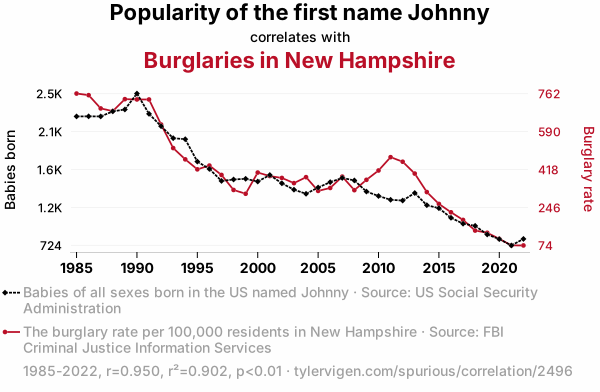
Lots of them! And with AI-generated explanations.
Asindu Drileba responds:
Wow. As much as the explanations may be wrong, they logically make sense. LLMs are really getting good. I didn't know they could do this.
Gyve Bones writes:
You can do similar things with astrological cycles and events, I came to realize when I built an ephemeris for the Market Information Machine and coded macros for ways to use the data. You can curve-fit any data to some combination of sinusoidal cycloids and get a 99% correlation, which then falls apart going forward because it was indeed a spurious back-fit with no reasonable causal linkage.
M. Humbert suggests:
If you track which countries where I’ve lived, those markets always experienced a bear market. I’m currently in the US. Advise strongly that you bet the farm, take out a 2nd mortgage, and buy out of the money put options the Magnificent 7.
Feb
7
The Licensing Racket, from Humbert Q.
February 7, 2025 | Leave a Comment

The Licensing Racket: How We Decide Who Is Allowed to Work, and Why It Goes Wrong
by Rebecca Haw Allensworth
A bottom-up investigation of the broken system of professional licensing, affecting everyone from hairdressers and morticians to doctors, lawyers, real estate agents, and those who rely on their services.
Pamela Van Giessen writes:
When my dad was suffering from dementia and it was too stressful on him to go places, I called in a podiatrist to take care of his feet and toe nails. I asked the doctor if he could also clip my dad’s fingernails, at least on his right hand which suffered constant trembles from a stroke. I did not feel confident doing it with the tremors.
The podiatrist informed me that he was not licensed to clip fingernails. I asked who was licensed and was told that in IL only manicurists and nurse aids in care homes can clip fingernails. I asked him if he thought it would be a good idea to take my dad to a manicurist (or have one come to dad) given his tremors. Dr said “no, and probably no manicurist wants to trim your dad’s fingernails.”
I called the state licensing board to complain and was told this rule existed for a good reason to protect people like my dad. I told them that this was absurd and not protective of anyone except this bizarre bureaucracy. I was told that I was being disrespectful and they hung up on me. Fortunately the podiatrist took pity on the situation after seeing my dad and broke the rules.
Licensing (and certification) is a racket. It is meant to keep some out and it is also a lucrative racket for states, licensing boards, and non-profit organizations. The CFA Institute makes over $275M annually on the CFA certification (and it costs less than 1/2 that to administer the program).
Sushil Rungta comments:
Agreed! Licensing is a racket and in many instances, unnecessary. Often, it is nothing more than a means to generate revenues for the licensing authority!
Rich Bubb writes:
I completely agree with the 'license Non-sense' of some (ahem) rationales. My basic take is that if some institute was involved, they were rarely better than learning-by-doing types (eg., me). When I was working thru attaining six sigma black belt (SSBB looked good on the resume), the major quality name (withheld) institution was over-hyping their SSBB program only as some sort of easy-to-attain achievement, [but] with their seminars/classes/literature/mentors/videos/etc., only. Truth to tell, I knew so-called 'withheld-name'-SSBB-certified wingnuts that knew nearly 10% of what I'd literally done already. Oftentimes by doing deep research and generally trying to learn more about More.
Henry Gifford provides the NY POV:
In New York City a plumbing license is like a license to print money. More and more work requires a permit, and therefore a license. Hire a licensed plumber for an agreed-on price of $10,000, usually the bill comes in at about double. Hire by the hour and keep careful track of the hours and you still get a bill for double. After you pay you notice the permit is not closed out (signed off by the licensed plumber), which becomes a violation on the property, and a bar to clean title at sale. Want it signed off? Maybe another $10K?
Word is that the number of licenses is fixed - they give them out only at the rate that licensed plumbers die. Applying for a license requires seven years of "experience", which is defined as being an employee of a licensed plumber - basically sons and nephews, someone with ambition who buys a van and tools and goes to work is nobody's employee, thus never can get a license. Then comes the written test.
Not long ago the written test had a drawing of all the drains in a building, with inch sizes marked next to each piece of pipe. The question required calculating how many ounces of lead are required to pour molten lead into all the joints in the drain pipes to connect them - something not done regularly for 50 years at the time of the test. The drawing was a copy of a copy of a copy, not legible - required guessing at the pipe sizes, or else buying the answer for cash.
Then comes the practical test, which not long ago required melting lead pipes together, but without the help of a propane torch or any other torch. Thee equipment supplied is a cast iron kettle and a stove - melt some lead or solder in the kettle, throw the molten lead at the joint, wipe it smooth with an asbestos rag or similar.
I know a guy who got his experience and passed both tests, but the city didn't give him a license. He went to court and sued the city, and after much time and expense finally won - hooray! The judge ordered the city to give him a license. But, last I heard, he still didn't have a license.
Other parts of the US are catching up. Most professional licenses cannot be transferred to another city. A friend of mine in NYC married a guy in Vermont who was a counselor to juvenile delinquents. His experience in Vermont was not transferrable to NY State - he would have to start all over, thus she moved to Vermont.
Does this system benefit anyone but holders of existing licenses, and the powers that be? I don't think so.
Stefan Jovanovich gets historical:
The licensing presumption goes back to the royal charters of the English kings and queens. The sovereign has the (God-given) authority to decide who has the right to practice a trade. The Saddler's Company received theirs from Edward I in 1272.
Gyve Bones writes:
Very interesting account of how the plumbers' trade operates in NYC. It reminded me of Mark Twain's account of how the Pilot's Association formed on the Mississippi River. Samuel Clemens, before he took the pen name "Mark Twain", was a riverboat pilot, and a member of the Association so he knows and tells the story well in Life on the Mississippi. He shows how at first the really good pilots avoided joining the Association out of pride and because they had such a good reputation they didn't need it. And the Association became the refuge of B and C rank pilots… at first. But Twain shows how the Association provided an information edge about the current state of the river conditions which the "outsiders" could not match, and were able to develop a monopoly once the underwriters found that Association pilots were better at avoiding claim losses.
Here's a link to Life on the Mississippi, Chapter XV which contains the story.
I think there are excellent insights in this story how any sort of trade establishes a guild system that protects the trade, creating moats to competition. We see it with doctors, lawyers, undertakers, nail salons, barbers, electricians &c. &c. ad infinitum. Lots of the work of legislatures is creating laws for these associations to institutionalize the moats with the force of law for the various guilds.
The previous chapters detail very interestingly on how riverboat pilots do their jobs, which is a fascinating context if you want a deeper dive. It's one of my favorite books of all time.
Feb
3
Inflation and it’s Causes, from Asindu Drileba
February 3, 2025 | Leave a Comment
What causes inflation? Suppose we define inflation simply as the rise in prices of commodities, stocks, real estate etc. What causes it?
1) A generic explanation people offer (acolytes of Milton Friedman & Margaret Thatcher for example) is to blame monetary policy. Simplified as, inflation is caused by "too much money chasing too few goods."
Many people blamed President Trump's COVID stimulus packages for the rise of prices during that period. It seems specs in this list agree upon this when it comes to stock prices, i.e., lower interest rates (higher money supply) -> Higher stock prices (inflated stock prices).
2) An alternative explanation is that higher prices are caused by supply chain issues.
So they would claim that higher commodity prices were so because it was extremely difficult to move them around during lockdowns, let alone processing them in factories. A member also described that egg prices may be going up because of disease (a chink in the supply chain) not necessarily monetary policy. I am thinking that supply chain issues are more important to look at, than monetary policy.
Larry Williams predicts:
Inflation is very, very cyclical so maybe the real cause resides in the human condition and emotions. It will continue to edge lower until 2026.

Yelena Sennett asks:
Larry, can you please elaborate? Do you mean that when people are optimistic about the future, they spend more, demand increases, and prices go up? And then the reverse happens when they’re pessimistic?
Larry Williams responds:
Just that it is very cyclical— as to what drives the cycles I am not wise enough to know…though I suspect…some emotional pattern dwells in the heart and souls of as all that creates human activity—along the lines of Edgar Lawrence Smiths work.
Jan
12
Recollections of a Cowpuncher
January 12, 2025 | Leave a Comment
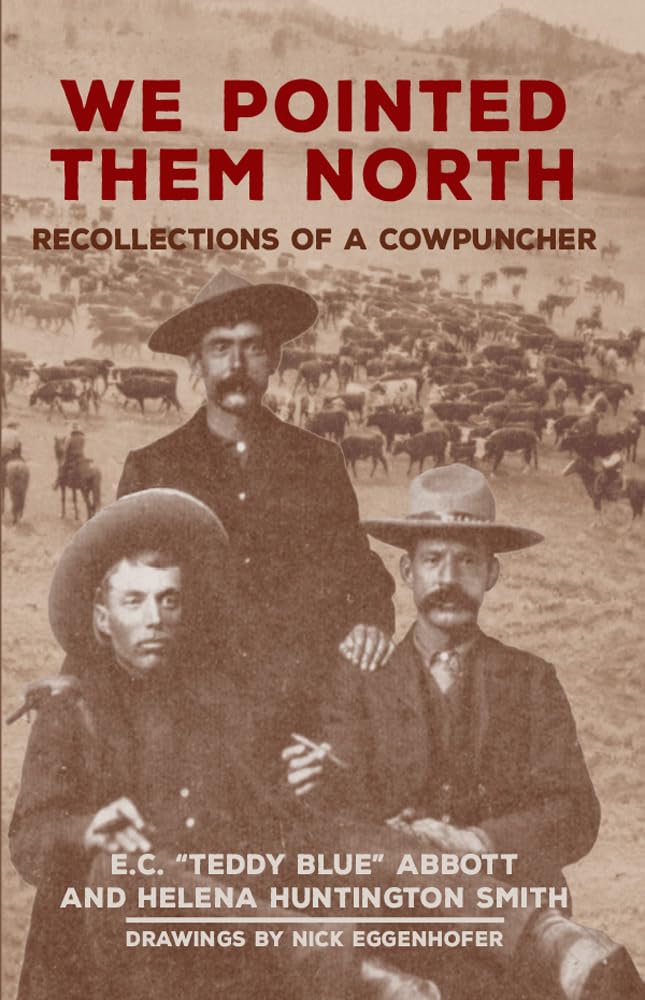
Perhaps the basis for Lonesome Dove:
We Pointed Them North: Recollections of a Cowpuncher
Edward Charles "Teddy Blue" Abbott was born in England in 1860. He came to the United States in 1871, with his parents, settling around Lincoln, Nebraska. Teddy Blue is hailed as one of the greatest of the cowboys who brought herds of Longhorns north from Texas. His charming looks and rebel ways have forever etched him into Montana history.
Gyve Bones offers:
If a storm came along and the cattle started running — you'd hear that low, rumbling noise along the ground and the men on herd wouldn't need to come in and tell you, you'd know — then you'd jump for your horse and get out there in the lead, trying to head them and get them into a mill before they scattered to hell-and-gone [The cowboys would attempt to make the cattle run in an ever-tightening circle until they could no longer move.] It was riding at a dead run in the dark, with cut banks and prairie dog holes all around you in a shallow grave…
One night it come up an awful storm. It took all four of us to hold the cattle and we didn't hold them, and when morning come there was one man missing. We went back to look for him, and we found him among the prairie dog holes, beside his horse. The horse's ribs was scraped bare of hide, and all the rest of the horse and man was mashed into the ground as flat as a pancake. The only thing you could recognize was the handle of his six-shooter. We tried to think the lightning hit him, and that was what we wrote his folks in Henrietta, Texas, but we couldn't really believe it ourselves. I'm afraid it wasn't the lightning. I'm afraid his horse stepped into one of them holes and they both went down before the stampede.
The awful part of it was that we had milled them cattle over him all night, not knowing he was there. That was what we couldn't get out of our minds. And after that, orders were given to sing when you were running with a stampede so the others would know where you were as long as they heard you singing, and if they didn't hear you they would figure something happened. After awhile, this grew to be a custom on the range, but you know, this was still a new business in the seventies and we was learning all the time.
- Teddy Blue Abbott, We Pointed Them North, Recollections of an Old Cowpuncher, 1939
Nov
30
Productivity and AI, from David Lillienfeld
November 30, 2024 | 1 Comment
When do we start seeing the effects of AI show up in national economic data? If you had invested $5K in a laptop and a word processing program, you could replace a secretary at multiples of the cost. When the web came in, there was Amazon squeezing out the costs of the middlemen.
But I don't see the savings for AI. I see lots of talk, some free programs, but in terms of real productivity, not so much. I'm also told that it's early days and I'm asking for too much in posing such a question, but I think we're now getting far enough into AI that it's not an unreasonable matter to bring up.
One thing that's clear is that AI isn't going to generate employment the way the last tech push did. But if it's going to really change the world as its advocates suggest that it will, those productivity gains should be apparent by now.
M. Humbert writes:
However AI productivity gains are measured, it’ll have to account for the productivity loss due to its high energy consumption. For the Austrian economics fans here. I’ve found Copilot to be a helpful time saving tool, so others probably do as well, so time savings definitely are occurring from AI use today.
Laurence Glazier responds:
Using it all the time, huge experiential benefit. Chatting to GPT every morning while reading Thoreau. Instant context. The other big breakthrough is spatial computing. All in the service of art.
Asindu Drileba comments:
From my experience, co-pilot and other LLMs, have not solved anything that could not already be done via ordinary Googling. Looking up solutions to code issues on stack overflow is no different from LLMs. And stack overflow is still better for some tasks (fringe computer languages like APL for example). LLMs are impressive, but are mostly just gimmicks. The only thing it has actually saved me time on is generating copyrighter material and filler text.
Jeffrey Hirsch adds:
Just had that discussion today about ordinary google still being even better than LLM Ais in finding info. Had some fun with AI editing and embellishing copy.
Asindu Drileba adds:
I suspect that the bad SWE job market is due to high interest rates, no AI. The SWE job market is enriched mostly by VC money. And VC money dried up when LPs withdraw to earn risk free money in treasuries instead of betting on start-ups whose success is on probability. I expect it to recover if interest rates come down to previous levels.
I think the LLM narrative was just something that tech executives parroted to show they had an LLM strategy. It's, Like how in 2018/2017 every executive had a "Blockchain" strategy. A lot of businesses assumed that LLMs would replace simple customer support jobs but they just saw their tickets pile up. Even the $2B valued, Peter Thiel financed, code assistant that would make you money on Up work as you sleep turned out to be a blatant scam.
Steve Ellison writes:
I don't have an answer for Dr. Lilienfeld's question about when AI effects will show up in productivity statistics. But I do hear anecdotally through my professional networks that AI projects are adding real value.
At the same time, Asindu is correct that the bad job market for techies, myself included, is more a consequence of rising interest rates–and I would add overhiring during the pandemic–than positions being replaced by AI. As Phyl Terry put it, "But this company [that announced layoffs] wants to go public so the better story is 'we are smart leaders using AI to become more efficient and profitable' vs 'we were idiots during the pandemic and have to lay off some people because we messed up.'"
Gyve Bones writes:
I find that the AI's ability to interpret my request and put together a coherent synthesis of several sources to be very helpful. Grok is nice because it provides a set of links to sources relevant to the prompt, and to related ??-posts and threads.
Laurence Glazier asks:
I usually have audio conversations with GPT rather than the older typed-in input/output. I just subscribed to X Premium to get access to Grok. Any good links for learning good usage? How nice Musk names it from the Heinlein novel.
Gyve Bones responds:
Check out the sample prompts Grok supplies on the [ / ] section in ??. The news analysis prompts for trending items is pretty cool.
Bill Rafter writes:
My business partner and I are in the process of marketing a new software application. Although we are rather literate, we have been running all of our marketing materials through Copilot, and we are amazed at the improvements Copilot makes to our text. It results not only in improved communication, but is a real time-saver. We even asked it to write a business plan, and it came back with a better one than our original.
Peter Penha offers:
I have not (yet) been on Grok but have found that the prompts do not differ very much across LLMs:
A Primer on Prompting Techniques, June 2024.
Prompt engineering is an increasingly important skill set needed to converse effectively with large language models (LLMs), such as ChatGPT. Prompts are instructions given to an LLM to enforce rules, automate processes, and ensure specific qualities (and quantities) of generated output. Prompts are also a form of programming that can customize the outputs and interactions with an LLM. This paper describes a catalog of prompt engineering techniques presented in pattern form that have been applied to solve common problems when conversing with LLMs. Prompt patterns are a knowledge transfer method analogous to software patterns since they provide reusable solutions to common problems faced in a particular context, i.e., output generation and interaction when working with LLMs. This paper provides the following contributions to research on prompt engineering that apply LLMs to automate software development tasks. First, it provides a framework for documenting patterns for structuring prompts to solve a range of problems so that they can be adapted to different domains. Second, it presents a catalog of patterns that have been applied successfully to improve the outputs of LLM conversations. Third, it explains how prompts can be built from multiple patterns and illustrates prompt patterns that benefit from combination with other prompt patterns.
This is earlier/shorter February 2023 paper - I am also a fan/follower of Prof. Jules White’s classes on Coursera why I flag the shorter/earlier paper as well.

Separate on the subject of AI - Eric Schmidt has a new book Genesis with Dr. Kissinger as a co-author (his last work before his passing) but Schmidt did a Prof G Pod Conversation released Nov 21st - in the podcast Schmidt goes over the threat from LLMs that are unleashed and noted that China in his view has open sourced an LLM equal to Llama 3 and that China instead of a being three years behind the USA on LLMs is a year behind. That China comment can be found here at 26:30.
Finally if anyone wants a great book I have read, on the history of the race to AGI going back to 2009: the Parmy Olsen book Supremacy on the histories of Sam Altman and Demis Hassabis is a wonderful read. Also breaks the world down between the AI accelerationists and the AI armaggedonists.
Big Al adds:
I do use Bard to learn or refresh my memory with R. For example, I am trying to use the "tidyverse" set of packages, and Bard is very useful when asked to write code for some task specifically using, say, tidyquant. The code almost never works first time cut & paste, but I can see how things are done differently and figure out what needs fixing. And I get answers to simpler problems faster than on Stack Exchange which is better for more complicated issues.
Laurence Glazier comments:
It's an inverted Turing test situation. The things that AI can't do help identify our humanity, our birthright.
Oct
22
I made a fake AI podcast about The Chair, from Asindu Drileba
October 22, 2024 | Leave a Comment
There is this new tool from Google called Notebook LM. It converts text into an audio of podcast format, two people conversing about the topic (a man & a woman). It's so good, I would say it's impossible for me to differentiate between a fake Notebook LM podcast and a real one. The AI's call him a "Renaissance Finance Man" and honestly speaking, I really enjoyed the fake podcast.
It's just 10 minutes long, if you want to listen to it, here it is. (You need to be signed into Gmail or a Google account to listen.)
Laurence Glazier responds:
Extraordinary. Will take a look at this. We need to be circumspect about everything we thought was real. Certainly any photos or new articles we see in the media.
Gyve Bones asks:
Very well done. What sources did you supply the LM?
Asindu Drileba explains:
The text was simply the About page of Daily Speculations. That's all I used. But I suspect it also added content else where from the internet and they mention stuff that isn't present in the about page.
Sep
7
An excellent book by someone we know
September 7, 2024 | 1 Comment

Buildings Don't Lie: Better Buildings by Understanding Basic Building Science
Hardcover – January 1, 2017
by Henry Gifford (Author)
A simple, clear, thorough, and complete explanation of basic building science applicable to any building in any climate. Over 1,000 large color drawings and photos, plus fun quizzes. No charts, graphs, or math. Read this book and become your own expert on making buildings comfortable, healthy, safe, durable, and very energy efficient, because you will understand the underlying science of the movement through buildings of heat, air, water, light, sound, fire, and pests, and how these can be controlled. This book also includes sections on designing building enclosures, indoor air quality, choosing heating and cooling systems, and how to ventilate, heat, and cool different types of buildings.
Henry Gifford comments:
Yes, I wrote and published that book, now in its fourth printing. Book is divided up into chapters on basic science, nothing about buildings, followed by that science applied to buildings, to learn the science better and to understand buildings better. Could ruin some of your teenage offspring for some college science classes.
Gyve Bones appreciates:
I am grateful and obliged to Henry for his magnificent book. I have long lamented not having an owner's manual for my house and this would seem to fill that need—not only the owner's manual, but the service manual as well, and along the way lessons in physics, fluid dynamics, thermodynamics, natural philosophy, and practical engineering. Very well illustrated and pains-takingly explained. I am enjoying learning so much I took for granted or was ignorant of in the science and technology of creating and maintaining a comfort-able habitable shelter.
Feb
24
Meals for a lifetime
February 24, 2024 | Leave a Comment
Auschwitz Survivor Reveals The Secret To Overcoming Any Obstacle In Life with Dr. Edith Eger.
As a Jew living in Eastern Europe under Nazi occupation, Edith was taken to Auschwitz concentration camp with her parents and sister, at the age of 16. She explains how she found her inner resources, how she came to view her guards as the real prisoners, turn hate into pity and, incredibly, she even describes her horrific experience as ‘an opportunity’. She has liberated herself from the prison of her past through forgiveness.
Sushil Rungta writes:
I am also very fortunate to have met Dr. Eger a few times. Every meeting was illuminating. She really inspires by her story and by her humility. Both her books, The Choice and The Gift are must reads. Coming to the United States when almost 50 years old and accomplishing all that she has is truly remarkable. Also worth noting that her son-in-law is Noble laureate in economics.
Gyve Bones offers:
Last night I watched this dramatized documentary of the life and death of Fr. Maximilian Kolbe, a Polish Catholic priest who, as a prisoner in Auschwitz, offered his life for the tenth man chosen by the commandant to die in the starvation bunker in retribution for an escape from that cell block. The man was married and had children. Fr. Kolbe stepped out of the assembled ranks, which normally would get a prisoner shot, and asked the commandant if he could take the man’s place. The offer was accepted. He turned the starvation bunker into a chapel, with him leading the nine other men in constant prayer and singing hymns. He was the last one remaining alive, and so the guards dispatched him by injecting carbolic acid into his veins, which makes the CO² bubbles in soda, and causes the heart pump to cavitate and fail.
Feb
18
What Makes for ‘Good’ Mathematics?
February 18, 2024 | Leave a Comment

Terence Tao, who has been called the “Mozart of Mathematics,” wrote an essay in 2007 about the common ingredients in “good” mathematical research. In this episode, the Fields Medalist joins Steven Strogatz to revisit the topic.
Gyve Bones offers:
Einstein, Address to German League of Human Rights:
Although I am a typical loner in daily life, consciousness of belonging to the invisible community of those who strive for truth, beauty, and justice has preserved me from feeling isolated. The most beautiful and deepest experience a mancan have is the sense of the mysterious. It is the underlying principle of religion as well as all serious endeavor in art and science. He who never had this experience seems to me, if not dead, then at least blind. To sense that behind anything that can be experienced there is a something that our mind cannot grasp and whose beauty and sublimity reaches us only indirectly and as a feeble reflection, this is religiousness. In this sense I am religious. To me it suffices to wonder at these secrets and to attempt humbly to grasp with my mind a mere image of the lofty structure of all that there is.
Richard Feynman, from The Pleasure of Finding Things Out:
I have a friend who’s an artist and has sometimes taken a view which I don't agree with very well. He'll hold up a flower and say “look how beautiful it is,” and I’ll agree. Then he says “I as an artist can see how beautiful this is but you as a scientist take this all apart and it becomes a dull thing,” and I think that he's kind of nutty. First of all, the beauty that he sees is available to other people and to me too, I believe. Although I may not be quite as refined aesthetically as he is, I can appreciate the beauty of a flower. At the same time, I see much more about the flower than he sees. I could imagine the cells in there, the complicated actions inside, which also have a beauty. I mean it’s not just beauty at this dimension, at one centimeter; there's also beauty at smaller dimensions, the inner structure, also the processes. The fact that the colors in the flower evolved in order to attract insects to pollinate it is interesting; it means that insects can see the color. It adds a question: does this aesthetic sense also exist in the lower forms? Why is it aesthetic? All kinds of interesting questions which the science knowledge only adds to the excitement, the mystery and the awe of a flower. It only adds. I don’t understand how it subtracts.
Pope Benedict XVI, On Beauty as a Way to God:
I remember a concert performance of the music of Johann Sebastian Bach—in Munich in Bavaria—conducted by Leonard Bernstein. At the conclusion of the final selection, one of the Cantate, I felt—not through reasoning, but in the depths of my heart—that what I had just heard had spoken truth to me, truth about the supreme composer, and it moved me to give thanks to God. Seated next to me was the Lutheran bishop of Munich. I spontaneously said to him: “Whoever has listened to this understands that faith is true”—and the beauty that irresistibly expresses the presence of God’s truth.
Dec
25
Holiday book rec that Aubrey-Maturin fans should enjoy
December 25, 2023 | Leave a Comment

Cochrane: Britannia's Sea Wolf
Daring and dashing, Thomas, Lord Cochrane led an extraordinary life. This bold commander, whose exploits far exceeded those of any fictional counterpart, was dubbed the "Sea Wolf" by no less than Napoleon himself. More than just a colorful military figure, however, Cochrane entered Parliament, became a radical reformer, and fought official corruption…earning powerful enemies in the process. They plotted revenge–and very nearly succeeded–but Cochrane's final triumph as a conquering hero remains one of the most amazing tales ever told.
Gyve Bones adds:
O'Brian based much of Jack Aubrey's character and several exploits from the life and naval adventures of Earl Cochrane. C.S. Forrester was inspired by Cochrane as well for his Horatio Hornblower novels.
Here are some public-domain works by Cochrane himself, memoirs of his service in (and out of) the Royal Navy.
Dec
22
Fire, from Nils Poertner
December 22, 2023 | Leave a Comment
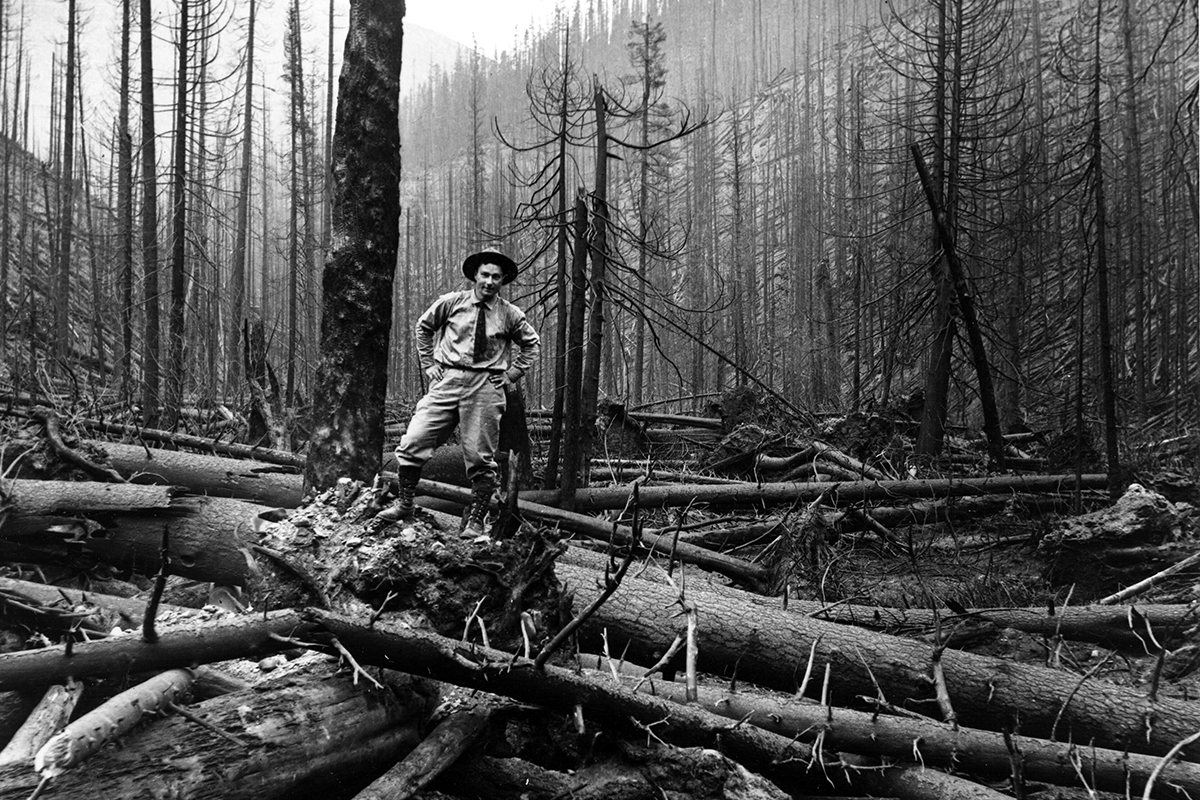
A number of factors contributed to the destruction caused by the Great Fire of 1910. The wildfire season started early that year because the winter of 1909–1910 and the spring and summer of 1910 were extremely dry, and the summer sufficiently hot to have been described as "like no others." The drought resulted in forests with abundant dry fuel, in an area which had previously experienced dependable autumn and winter moisture. Hundreds of fires were ignited by hot cinders flung from locomotives, sparks, lightning, and backfiring crews. By mid-August, there were 1,000 to 3,000 individual fires burning in Idaho, Montana, and Washington.
same as in mkts- the longer the rally…might not be one major fire but more a series coming.
Perhaps the most famous story of survival is that of Ranger Ed Pulaski, a U.S. Forest Service ranger who led a large crew of about 44 men to safety in an abandoned prospect mine outside of Wallace, Idaho, just as they were about to be overtaken by the fire. It is said that Pulaski fought off the flames at the mouth of the shaft until he passed out like the others. Around midnight, a man announced that he, at least, was getting out of there. Knowing that they would have no chance of survival if they ran, Pulaski drew his pistol, threatening to shoot the first person who tried to leave. In the end, all but five of the forty or so men survived. Pulaski has since been widely celebrated as a hero for his efforts; the mine tunnel in which he and his crew sheltered from the fire, now known as the Pulaski Tunnel, is listed on the National Register of Historic Places.
Stefan Jovanovich recommends:
Gyve Bones agrees:
I was tempted to mention that book, which I enjoyed. I read it after reading A River Runs Through It.
Pamela Van Giessen suggests:
For a comprehensive look at the fire of 1910 and how it was fought (and lost), The Big Burn: Teddy Roosevelt and the Fire that Saved America, by Timothy Egan, is interesting.
Big Al points to:
Fire Weather: A True Story from a Hotter World
About the Fort McMurray wildfire in 2016.
Dec
21
Thought Leaders: Christopher Alexander, from Nils Poertner
December 21, 2023 | 1 Comment
:no_upscale()/cdn.vox-cdn.com/uploads/chorus_asset/file/8742783/shutterstock_139851025.jpg "TX Capitol: Click for full view")
Chris Alexander on architecture (ugliness, beauty and a lot more) and why it matters to humans. He taught at Berkeley, California. The immediate surrounding (office, residential place) probably also influences how we view the world (even markets). (I always preferred City of London - the old square mile - vs the new Canary Wharf buildings etc.)
Gyve Bones writes:
H.L. Mencken wrote about this in the Baltimore Evening Sun, and the column was included in his Prejudices: Sixth Series (1927):
I have seen, I believe, all of the most unlovely towns of the world; they are all to be found in the United States….Here is something that the psychologists have so far neglected: the love of ugliness for its own sake, the lust to make the world intolerable. Its habitat is the United States. Out of the melting pot emerges a race which hates beauty as it hates truth.
Nils Poertner responds:
imagine people would slow down a bit in their lives and appreciate some of the better architecture (it is not that we don't have it).
Larry Williams differs:
Right! Americans love ugly, hate beauty …that’s why we go to the Grand Canyon, Glacier, Yosemite, the beaches, and have great museums. Mencken must have had a very long nose to look down upon.
William Huggins comments:
Best view on neoism was Chris Beckwith in Empires of the Silk Road: A History of Central Eurasia from the Bronze Age to the Present where he identified the problem as the belief in constant revolution, that there was no future unless the old was destroyed. This morphs into a fetish for the new, regardless of its merit. He clearly loves the classics and hates to communists for their desire to cast aside beauty for revolutionary.
Dec
19
Optimizing profit over time, from Zubin Al Genubi
December 19, 2023 | Leave a Comment
Most people search or try optimize for highest system return. It is not the most profitable over time. The amount of profit over time is determined by the money management you apply to the system more than by the system itself. This is mind boggling to me.
H. Humbert counters:
In one of the many money manager podcasts I listen to, one of them used this very assertion as an example of, shall we say politely, a less than optimal belief. But he used stronger language.
Peter Ringel writes:
It is still important to aim for a good naked system (without position sizing applied). The risk/drawdown vs overall return relation comes from the position sizing applied world. A better core system makes more aggressive position sizing possible.
Zubin Al Genubi replies:
A better core system makes more aggressive position sizing possible.
Disagree. According to Ralph Vince bets in excess of optimal f results in lower overall system returns due to larger drawdowns with larger size! Comparing core systems should be by geometric mean, not necessarily w/l, %win, t score, etc. Interestingly Sptiznagel says something very similar. There is something very important going on here that is being missed.
Gyve Bones comments:
Depending on the breaks of course, there is no money management system method that can turn a no-edge “loser” naked trading system into a winner apart from lucky breaks. But a winner with a naked edge can be ruinous with over-sized bets, or smothered by various vig drags if the bets are under-sized. As one guy put it in this article from 2000, the key is to find the sweet spot in between.
But as Ralph has shown, the sweet spot, the “optimal-ƒ”, means that the better the system, the higher the ƒ value, on a scale of 0.0 to 1.0 means that if the largest losing trade used in the sample ever re-occurs, your stake will have a single-trade drawdown equal to ƒ%. That is, if the optimal–ƒ is 0.65, and then you have a re-occurrence of the worst trade from the history of the system, you will have a 65% drawdown of the portfolio. But trading at ƒ is the only way to make sure you’re not over betting or under-betting in order to maximize the potential gains of the trading system, if you accept the premise that the series of trades you feed into the optimal-ƒ algorithm is a reasonable and realistic representative of the trade returns going forward trading that system.
Larry Williams has a definite view:
BETTER CORE SYSTEM ETC IS MEANINGLESS. The past is never the future and it takes only one trade to put a bullet through your skull when you mess up. Past ’good numbers’ from a trading strategy are meaningless.
Peter Ringel responds:
but even the Kamikaze-trader dialed it up to 11 to win championships in a stellar way and endured brutal drawdowns. and the final win, of course, impossible without an underlying strategy.
Larry Williams replies:
Kamikaze man was clueless, mindless and fearless as well as blessed with luck and Mr Vince to plug holes in the dyke.
Zubin Al Genubi gets statistical:
A benefit of using parametric techniques is that empirical data isn't required and we can do what if's as conditions change.
James Goldcamp writes:
When coming up with a position size rule it must be as with the system itself subjected to in and out of sample testing. We used to have a program circa 1998 that would calculate the optimal ("f") amount of capital over first X trades then apply to the rest of history using the optimal method. This led to hypothetical out of sample blow up not infrequently due to the instability of model returns (even for models that were to some degree still profitable on blind data).
My subjective belief is that most edges (perhaps other than those derived for market making ultra, frequent, or arbitrage/structural type trades) are way too unstable to try to extract anything approaching a past optimal bet size. It seems like the 3 questions or dimensions that one deals with are will it still work at all in future, if it does how much will it vary from the past (expectation and path), and how will the aforementioned two work in relation to other methods you have that work. The last point relates to in my observation the most common form of risk management, multiple bets with negative or low correlation, that's perceived to be a better way of managing risk than dialing leverage of any particular return stream. Any of the aspects are subject to the ever changing cycles.
Big Al adds:
Often the tricky part is finding uncorrelated assets that are reasonable trades or investments.
James Goldcamp responds:
I agree totally. For me it's the 3rd uncontrollable variable - if the ideas work, how well they repeat (robustness I guess), and how they continue to relate to other things. Hypothetical modeling of complex portfolios often assumes all of these properties will continue. There are lots of ways for a leg on your table to collapse!
H. Humbert comments:
Since the number of unknown important variables in complex real-world problems as opposed to simple games of chance of even poker can never be fully known, and the influence of even known variables, by themselves and in combination, can only be examined via past data and in no controlled experiments, it seems like any system can experience a catastrophic failure and/or change in being amenable to any strategy at any time. I admire traders who brave these unknowns and prefer to rely on drift that seems to be more robust and stopped only by major wars and revolutions.
Oct
30
Forbidden History, from Larry Williams
October 30, 2023 | Leave a Comment

I can only do a few paragraphs at a time there is so much in this book; turns thoughts upside down.
One I just read; Thomas Jefferson's illicit affair and fathering a child with his slave. Wait! Hold on a moment —while widely believed— all the DNA tests shows is there is Jefferson bloodline. That’s all it can show. There were 26 Jefferson's living in the area and Toms brother Ralph was caretaker and overseer of slaves.
Thomas? Ralph? Someone else? Will never know for sure but for sure it may well have been another Yet the revisionist historians have hung it on Tom. Lots more like this.
Peter Penha writes:
Just an anecdote on your example: I know of two families where a child was fathered/sired with a female who was a slave or an emancipated slave. Both families discuss it as part of the family history and each specified that a home was built for the mother/child and in one case the family name given to them.
Considering Thomas Jefferson finances, perhaps the answer would lie in the building records and who owned the home in Charlottesville where Ms. Hemings moved to after Jefferson's death with her sons.
I was recently searching for other books by Frederick Lewis Allen as IMHO a wonderful writer and objective historian of his day and that brought me to a series titled the Forbidden Bookshelf (27 books in the series) - I only picked up Allen’s The Lords of Creation but there were a few titles that were “out there” as subject matter.
Gyve Bones adds:
There was a lot more inter-mixing between Africans and French colonials in the Louisiana colony, which had a Code Noir body of ordinances governing who could own slaves (only Catholics, no Jews nor Mohommedans), and how they must be treated. As a Catholic nation France required that owners of slaves must educate and raise their slaves in the Catholic faith, and could not break up families in a sale. Slaves could purchase their own freedom, and in New Orleans there was a large population of "free people of color". Many of the wealthiest of these freedmen were slave traders, and there were several large plantations in French colony owned and operated by free persons of color. Slavery was not a racial thing—just a matter of property. There was much less stigma around the idea of "race", and that culture has persisted to an extent into current day New Orleans, although those seeking to divide people along racial lines for political purpose have made significant inroads in destroying inter-racial comity in that community.
History records that French Canadian trappers had very good relations with the indigenous populations, and there were many such mixed marriages made. This same phenomenon was seen in Mexico after Our Lady of Guadalupe converted 9 million indigenous Mexicans to the faith. The Mexican nationality gave birth to a new "mestizo" race which came about when the Spanish intermarried with the native population.
Zubin Al Genubi suggests:
Trust by Hernan Diaz. Pulitzer prize. Stories About a stock market operator in 1920's and his wife. Very good with minor market relevance.
Stefan Jovanovich links:
Aug
5
Trees, mostly
August 5, 2023 | Leave a Comment

old gray mare prob at 3-month hi at 35%.
Lott/Stossel: Election Betting Odds
books read this weekend:
The Hidden Life of Trees: What They Feel, How They Communicate - Discoveries from a Secret World
The Battle for Investment Survival
Trees: A Complete Guide to Their Biology and Structure.
i find the study of trees - especially how high they grow, and how they develop buttresses, and how they branch out and compete with other trees for light - immensely revealing for the various moves.
Big Al suggests:
The Age of Wood: Our Most Useful Material and the Construction of Civilization
Nils Poertner comments:
In many parts of central Europe, the Beech tree used to dominate the landscape thousands of yrs ago. Used to be well over 2/3 - and even today it is like 1/3 in Germany. Why? They tend to grow super and sort of take away all the light from slower growing trees. An oak tree would not stand a chance.
Gyve Bones suggests:
Long term strategy: planting a grove of oaks in a forest in France to be ready in 150 years to replace the roof of Notre Dame de Paris when it burns down.
Peter Saint-Andre offers:
Oxford's Oak Beams, and Other Tales of Humans and Trees in Long-Term Partnership
Peter Ringel writes:
For the last two years I am involved in a project for a German horticulture company. They mainly produce young plants of ornamental plants aka flowers. As a little side project (in early stages) they also produce Paulownia trees (as young plants).
Paulownia is the fastest growing tree in Europe. They originate from Asia. (Some criticize them as invasive species.) Typical commercial applications are wood for instrument manufacturing, wood pellets for energy production or particle boards. The wood is very light (caused by very fast-growing).
Propagation is a little challenging. Usually it is done in-vitro via Biotec-lab, which we have. It is not the easiest variety for in-vitro. We also had some success to propagate via cuttings from mother plants.
Laurel Kenner comments:
Terrible idea to grow these, down there with tree of heaven, kudzu and bamboo. Yes, they are quick to grow, but also impossible to eradicate or even to contain. I am not an eco-hippie, just a gardener.
Zubin Al Genubi adds:
A friend planted a tree farm about 25 years ago with rare exotic hardwoods such as Koa, Bubinga, Cedar, rosewood, mahogany, ebony. It is a multigenerational project but some early woods are being harvested. Some of the rare woods will be very valuable as they are disappearing in their disappearing native habitat. There are numerous governmental grants benefiting the project as well.
Laurel Kenner responds:
I like the project. The idea is not to grow "trees" that are in effect big weeds. Pawlonia is illegal in my state, CT, as is Norwegisn maple, another nasty weed-tree planted in a less enlightened day because it grew fast. They often come down in storms because they're weak. One memorably crashed over my driveway in a big blow and its eldritch too brach rang ny side doorbell.
Peter Ringel replies:
Yes, storms are an issue, especially during the first years. My big mouth was referring to the EU government as hippies, because subsidies and grant policies are highly ideological here. Not referring to anyone else.
The church of Greens has Europe tight in their grip and currently they like Paulownia. There is a trend / hype growing. Other psalms the church likes are "renewable raw materials" or "CO2 neutrality". Paulownia fit these mantras. (plants eat and need CO2 to confuse the church)
Paulownia are not really new to Europe. Introduced to Europe 100 years ago or so. So far they were unable to survive in the European wild in size. Maybe because of frequent stronger winds? On a farm, as industrial product it makes a lot of sense to me. I am obviously biased here, because this would be our customers. It is a nice economic product. E.g. after about the first 2 years of growth, farmers cut them back near the ground level. This timber can be sold. They rapidly grow back and faster than without cutting. A case of eat your cake and have it too. One argument is, to use this locally produced timber instead of importing from South America, Asia, Finland or Russia.
forgot: Paulownia on farms are usually all clones of hybrids. Like a mule, they can not reproduce themselves into surrounding areas.
Mar
24
Book recommendation, from Zubin Al Genubi
March 24, 2023 | Leave a Comment

Pirate Latitudes, by Michael Crichton. Aubriesque tale of privateers and Spanish Galleons.
As the SPEC list is about books, as well as markets, counting, and barbeque.
William Huggins adds:
single best book on the history of finance that i've come across is William Goetzmann's Money Changes Everything. He's a Yale finance prof with a background in art history and archeology and its shows throughout the book as he looks at the roots of our toolkit (sumerian word for "baby cow" is the same word they used for "interest", etc). a very good description of the 1720 bubble with the hypothesis that the bubble was a reasonable reaction to the shifting expectations around insurance companies and the lines of risk they could cover. he also suggests that Venetian gov debt (1172) snowballed into the creation of western capital markets, which in turn propelled the west ahead of "the rest" (to steal a ferguson quote). three solid chapters on the tools imperial China used to increase its "span of control" over its rugged territory. 10/10.
(I used to use it as the required reading in my history course until I realized too many were balking at its size)
Jeffrey Hirsch responds:
Appreciate the reco Mr. Sogi. Almost done with Pam V’s reco on Keith Richard’s autobiography, Life, which is far out. Here’s one from me, The Immortal Irishman, by Timothy Egan. Irish revolutionary becomes a Civil War general. Adventurous tale across many continents.
Laurel Kenner writes:
I offer Harpo Speaks, the autobiography of Harpo Marx, the silent brother. Plenty of poker, speculation, and spectacular success, including an account of his Soviet tour, to entertain this List well.
Pamela Van Giessen responds:
Harpo Speaks is fantastic. For a meditative introspective read on things out of our control and how the body copes A Match to the Heart, by Gretel Ehrlich.
Big Al suggests:
I will recommend The Biggest Bluff: How I Learned to Pay Attention, Master Myself, and Win, by Maria Konnikova.
First of all, it's just an entertaining, well-written story. But in her study of poker and portrait of one of the best professional players, Eric Seidel, there are many lessons for traders.
Penny Brown writes:
I recently re-read the cult classic, The Moviegoer, by Walker Percy. It has nothing to do with trading but the main character is a stockbroker. Read it for the wonderful prose and the delineation of Southern characters with great dialogue.
Also, re-read A Fan's Notes, Fredrick Exley's memoir of growing up under shadow of his father's football fame in Watertown. It's amazing that this book even got written since Exley makes three trips to mental institutions where he undergoes electro-shock and insulin therapy and was an inveterate alcoholic for his entire life. You can see the influence of Nabokov and Edmund Wilson (among his favorite writers) in his prose style.
And then I read Embrace the Suck - a book I literally found at my feet on the sidewalk - hey, the price was right - and I assumed it had a special message for me. It certainly did. It describes the training undergone to become a Navy SEAL including the infamously horrid "Hell Week" that resulted in the death of one participant. It has lots of lessons for traders as it extols the virtues of discipline, focus, planning and most of all, a willingness to embrace suffering, as a means of moving beyond mediocrity.
One guy's way of shaping up for the ordeal of SEAL training was to run the Badlands Ultramarathon - a little 100 mile race through the desert at temperatures over 110.
Okay, I'm not going to try that - never could have even in my prime. But it got me out of my chair committed to doing a full set of Bikram's yoga postures including the ones I hate because I can't do it - Salabhsana - or hate because it hurts - Supta-Vajrasana. As the author says, "you've got to embrace the suck everyday."
Gary Boddicker adds:
I recently read Mule Trader: Ray Lum’s Tales of Horses, Mules, and Men. I originally picked it up for the regional interest. Ray was based about 60 miles down Hwy 61 from me in Vicksburg, and traded mules and livestock throughout the Mississippi Delta…but, it turns out a few of the Chair’s favorite writers, Dr.Ben Green and Elmer Kelton, were running buddies of Ray and are mentioned and vouch for his character in the book. Many tales of trades, moving the herds as the tractors slowly replaced them from California to the Delta. In one case, he bought 80,000 horses in South Dakota, and arb’d them to where they could be used. The book rambles a bit, as it is essentially an oral history, but many lessons within.
It brought to mind a discussion I had years ago over dinner with an buddy of mine who farms about 20,000 acres in NE Louisiana. “Gary, there is isn’t a real farmer in Louisiana who picks up that government agricultural census and doesn’t mark down that he owns at least one mule. We are damn slow to admit we gave ‘em up.” I haven’t fact checked him, but a betting man says the mule census is Louisiana is overstated.
Gyve Bones responds:
I have two copies of that book… one autographed by the re-publishing editor. It’s a great book.
Mar
3
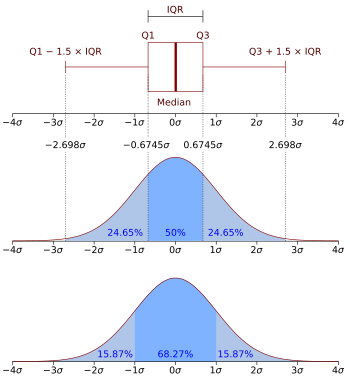
Calibration of Probabilities: The state of the art to 1980
Sponsored by OFFICE OF NAVAL RESEARCH
June 1981
This paper presents a comprehensive review of the research literature on an aspect of probability assessment called "calibration." Calibration measures the validity of probability assessments. Being well-calibrated is critical for optimal decision-making and for the development of decision-aiding techniques.
The first class is calibration for events for which the outcome is discrete…. For such tasks, the following generalizations are justified by the research:
1. Weather forecasters, who typically have had several years of experience in assessing probabilities, are quite well calibrated.
2. Other experiments, using a wide variety of tasks and subjects, show that people are generally quite poorly calibrated. In particular, people act as though they can make much finer distinctions in their degree of uncertainty than is actually the case.
3. Overconfidence is found in most tasks; that is, people tend to overestimate how much they know.
4. The degree of overconfidence untutored assessors show is a function of the difficulty of the task. The more difficult the task, the greater the overconfidence.
5. Training can improve calibration only to a limited extent.
The second class of tasks is calibration for probabilities assigned to uncertain continuous quantities…. For calibration of continuous quantities, the following results summarize the research.
1. A nearly universal bias is found: assessors' probability density functions are too narrow. For example, 20 to 50% of the true values lie outside the .01 and .99 fractiles, instead of the prescribed 2%. This bias reflects overconfidence; the assessors think they know more about the uncertain quantities than they actually do know.
2. Some data from weather forecasters suggests that they are not overconfident in this task. But it is unclear whether this is due to training, experience, special instructions, or the specific uncertain quantities they deal with (e.g., tomorrow's high temperature).
3. A few studies have indicated that, with practice, people can learn to become somewhat better calibrated.
Stefan Jovanovich writes
Grant's great virtue as a warrior was that he had seen the absence of certainty in war everywhere from the front line (having a fellow junior officer lose his head to a Mexican cannonball as the two them walked forward) to the far rear (where half the sick, women and children left behind in crossing the Isthmus die from cholera because the contracted mules do not arrive; Grant saved the others by buying pack animals at the market price and then spending the rest of his tour in California and Oregon arguing with the War par5ment about the waste of funds). Man proposes and God disposes.
Gyve Bones adds:
In preparing for battle I have always found that plans are useless, but planning is indispensable.
[General Dwight D. Eisenhower]
Dec
7
Trial and error, from Big Al
December 7, 2022 | Leave a Comment
Watching Victoria via PBS Masterpiece sub, and it's shown that, during the 19th century, one treatment for syphilis was basically a mercury sauna, inhaling the vapors - yikes!
The history of syphilis is an interesting case for seeing how quack medical treatments, such as mercury, were applied and killed people even more quickly. Of course, one shouldn't judge too harshly as they were treating things of which they had no understanding.
The relevance to trading is that humans have an impulse, when confronted with challenges they don't understand, to resort to superstition and to believe anything that is claimed with great confidence.
Penny Brown notes:
Flaubert took the mercury treatment for syphilis and as a result his tongue turned blue.
Laurel Kenner adds:
Qin Shi Huang, first emperor of China, drank mercury-infused wine to attain eternal life. Rivers of mercury surrounded his burial chamber, a depiction of China. Qin died at 49.
Gyve Bones writes:
We saw examples of that in the recent pandemic. At first "masks don't work. Don't wear masks." then… "Everyone must wear a mask at all times, even alone outside or in a car." Then "The virus stops dead in the vaccinated person, who will not get Covid, and won't spread it to others." then… "Anthony Fauci contracts COVID three times, but is certain it would have been worse had he not been quad-jabbed."
Now there's this disturbing study which shows the effects on infant cord blood and their immune systems from mothers who have been infected with COVID.
Henry Gifford comments:
The early instruction for people to not wear masks was so that security cameras could see people’s faces. The police seem to really love security cameras with an enthusiasm that strikes me as going above and beyond any usefulness to “fight crime”.
There was the time a landlord in NYC put a camera outside a tenant’s door to prove if the tenant was using the apartment as a “primary residence”, and would therefore still be entitled to rent protection or not. The tenant’s boyfriend put bubble gum on the lens and was promptly hunted down and arrested and charged with every crime the cops could think of, with an enthusiasm certainly not caused by anyone’s love for a NYC landlord.
Not being seen clearly on security cameras was, if I remember correctly, sometimes even stated as the reason to not wear masks, which made me wonder – if they think masks work, more people dying is OK as long as people can be seen on cameras?
Pamela Van Giessen responds:
Henry — There exists decades of research that show that masks do not reduce transmission. I have yet to see meaningful evidence (research or real world) that shows that they do work. The current situation in China would seem real world validation of the lack of mask effectiveness. Lockdowns don’t seem to work much either. Most people don’t die from covid either. They don’t even get very sick.
Henry Gifford writes:
I tend to believe things if they can be measured, if the measurements can be repeated by others, and if they can be explained by the laws of physics. I tend to not believe anything not meeting these three criteria. As the owner and fairly regular user of over fifty measuring instruments, the measuring part often means measured by me.
Aug
10
The Count, from Duncan Coker
August 10, 2022 | Leave a Comment
Rereading the Count of Monte Cristo with my highs schooler, I am struck by the fact the all the virtuous characters are failures at business (ship owner, tailor, inn owner), while all the evil ones are great financial successes (currency speculators, war profiteers, state bankers). Of course the Count rectifies this. His fortune comes by way of a cardinal in Italy, a secrete cave and 14 years in prison. Perhaps the author's ( Alexandre Dumas) message is that every great fortune has a dark past. Maybe that was true in his day, but ones hopes that is not the case today.
Kim Zussman comments:
Socialism is as old as the bell curve.
Gyve Bones writes:
I'm reading this book too, and have found it really interesting. I picked it up because I'd seen two different film adaptations of the story, one starring James Caviezel, who a year later would portray Jesus Christ in Mel Gibson's "The Passion", and an earlier one from the 1970s. The two were so different in many details that I wanted to see the real story in the book. Both movies were good, each in their own way.
Like Les Miserables, by Victor Hugo, the Dumas story is about French society dealing with the ripple effects of the French Revolution. Both have heroes who are sort of New Christ figures. Both characters are unjustly imprisoned. In the case of Danton, the "Count", it was a case of a corrupt prosecutor during a time much like now, where Napoleon is in exile, and his alleged supporters still in France are being hunted down and imprisoned. It reminds me a lot of this nation, which has sent a former president into exile on an island off the coast of Florida, and there is an official inquisition into his affairs which is imposing punitive political prison sentences on his political supporters, and making it a crime to speak with the former president on the phone, in order to thwart any attempt to organize a campaign to return to office.
There's a point where the Count uses and extols the virtues of hashish which you might want to be prepared to discuss with your teenager.
Project Gutenberg has a very nice illustrated edition of the book available, which is helpful in imagining the scenes described.
I had trouble with the size of the illustrated ePub version for my iOS Books app on my iPad. It's 76 megabytes with the images included and it would crash the app. So as an alternative workaround, I downloaded the image free ePub into the Books app, and keep a web page open on the index of the images, which are named according to the page numbers in the book, and I view them as needed as I'm reading along.
Stefan Jovanovich responds:
Dumas pere was anything but a socialist. He was an aristocrat who was beyond snobbery and sentimentality. Good people regularly get screwed by thieves, frauds and liars; but then, so do the thieves, frauds and liars by each other. That is the "moral" of the novel. The Count succeeds in his quest for revenge by turning the bad guys against one another. He is a truly great figure, and the wiki page does him proper justice.
Dumas was neither a monarchist nor a Bonapartist. He was a republican and a Freemason. The novel makes that very clear; and it got Dumas in real trouble when a second Bonaparte became Fuhrer. Dumas had to flee France for Brussels, which also helped him escape his creditors. Read the wiki page; it is a beautiful exposition of an extraordinary life.
Full disclosure: One of the Stefan's weird (academics don't even want to discuss it) speculations about Ulysses Grant is that he was reading Dumas' novels when he was at West Point when he was supposed to be studying "tactics". Grant did not have a full duplex brain when it came to language and music; he taught himself to read German and French, but he found it impossible to speak or understand the languages when spoken. He loved music, but could not play it or read it as anything but notation (i.e. he could not translate the symbols on the page to sounds in his head). Hence, his joking about himself that he only knew two songs - one was Yankee Doodle Dandy and the other was not. The biographers all assume that because Grant had no verbal fluency, he had not read Jomini. He had; he also knew it was complete crap, but why say so except to start an argument? (Grant definitely did not have the legal mind or temperament).
Gyve Bones counters:
Straw men are easy to knock over. I did not assert Dumas was either a monarchist or a Bonapartist. In the same way, Hugo, son of a mother of the ancien regime and a father who was a Revolutionary, he was a melding of the two, and the novel sort of becomes a Hegelian dialectic about the synthesis which emerges from the thesis (the old order) in conflict with the anti-thesis (the Revolution). Jean Valjean is his synthesis, the New Man, a man of Christian virtues without Christ and the sacraments of the Church He founded.
Steve Ellison adds:
Dumas lived a high life and was chronically in debt despite having a number of bestsellers. I still remember one sentence from the book, "He was denounced as a Bonapartist …" It made me think that the first totalitarian society was Revolutionary France, but I hesitate to make such a sweeping pronunciation in the presence of Mr. Jovanovich. In any case, current efforts to make modern denunciations similarly career-ending are a grave threat to liberty.
Stefan Jovanovich agrees:
Great comment, SE. The French revolution - as an event - has a scale and complexity that can only be matched by the global war that began in Spain in 1936 and China in 1937 and ended in Korea in 1954. What Dumas was describing was its net effect: everyone in France had become so kind of spy and snitch. So, yes, it was the first totalitarian society; but you need to give the Citizen Emperor the same credit that Stalin and Hitler deserve for so thoroughly organizing the tyranny.
Bill Rafter offers:
Pardon me for coming in late to this discussion, but there is a mistake: The tailor was Caderousse, one of the three co-conspirators against young Dantes. That failed tailor then became the owner of the Inn at Beauclaire, who then murdered the jeweler. The Inn itself failed because its location was bypassed by a newly constructed canal. That leaves Mr. Morrel, who failed because he was in a highly speculative business (the hedge fund of its time) and was not diversified. However his successors in the business, Emmanuel and Julie were certainly righteous and successful. They retired to a nice home in Paris.
Stefan Jovanovich writes:
Not mine. Dumas was very much someone who believed that an honorable life was the only one worth living, whatever its financial costs or rewards.
Henry Gifford writes:
When I was growing up in a part of New York City that was populated by about half Christians and half Jewish people, almost none of the Christian adults owned a business – they had jobs. The one Christian adult that I knew owned a business did not attend religious services. All the Jewish adults owned businesses except a few that were involved in organized crime (professional level: state senator, state assembly, etc.).
When I was a child attending a Christian school, they made us sing a song that included the words “oh lord, do until me as you would do unto the least of my brothers”. I didn’t sing it, even though I was required to, as I saw it as a request for the all the worst things that happened to other people to all happen to me. As a child I thought this included blindness, loss of multiple limbs, leprosy, locusts (even though I wasn’t sure what those were) etc.
I have never had a mentor in my life. The closest I came were adults who advised me to “make sure you learn a trade so you will have something to fall back on”, who I made sure to steer clear of after I nodded and smiled and made good my escape. When I was 16 I asked my father what he thought I should do when I grew up. He suggested I go on welfare. I never asked again, or brought up the topic of what I was doing with myself, etc. When I was about ten years into writing a book, I showed the almost-finished version to my parents, figuring they should see it while they were still alive. The only comment they had was a harsh criticism of the grammar on one page, which they insisted I correct. The “incorrect” grammar was part of an insightful and charming passage written by Benjamin Franklin in the 1700s.
A few years ago I was walking past a Jewish community center near where I live in Manhattan. On the bulletin board outside I saw a schedule of upcoming lectures. One was titled “The Five Risks Every Entrepreneur Should Take”. I picture a member of the community that sponsored that lecture stumbling in business a little while being surrounded by people who are supportive, and who applaud the person for trying, and then for getting up and going at it again. I doubt any member of that community would ask the person who stumbled if she or he had made sure to first learn a trade to fall back on, or demand that children sing a song like the one I and my classmates were required to sing.
I still manage to do OK financially. Among other endeavors I own or am part owner of property in nine US states, soon to be ten, all worth much more than I paid (including the properties I am contracted to buy on Monday). And I have never “paid my dues” by spending years doing something I hate, or by gaining all the easily available advantages of being dishonest. But the Christian kids I grew up with? I can’t think of one who owns a business, and I can only think of two who likely have enough investments to carry them for long if they didn’t keep working at their job. And I can’t think of any who seem to enjoy or gain much satisfaction from that which they spend their day doing.
As for the emotional toll religion has taken on people over the centuries, suffice to say that someone once summarized the difference between the emotional state of veterans of the US military during WW2 vs. those who were veterans of the Vietnam War as the emotional state of Vietnam War veterans being the embodiment of the result of one generation of young men being lied to by their father’s generation. Likewise, young people being lied to about what economic decisions they ought to make, meanwhile a different reality is there for the seeing, also has its cost.
When growing up I spent time in Jewish households when I could, as the people there seemed to me to have an upbeat and healthier attitude, compared to the funeral home ambience I sensed in most Christian households. But, of course, most people growing up in the US do not have that opportunity, and fewer take the opportunity if available. Most are simply beaten down by the forces of religious insanity and stay down for life. Just today I was waiting for a train and a person nearby was shouting into her phone on speaker, describing in an upbeat tone her life that struck me as horrible, while she periodically mentioned that “god is good.” Not to her, I think, but I didn’t argue with her.
Bo Keely responds:
henry, this is interesting from our comparative angles. I’ll bet the few kids like u and I would say the same thing. as a child, I also rejected the ‘do unto others…’ because it included negative things.
i also had no mentor throughout life. when I eventually took a teacher test that required answering, ‘describe your first mentor’ I wrote about an admitted imagined mentor.
likewise, when I was sixteen, my mother asked, ‘what do you want to do in life,’ on receiving a selective service notice. It had never donned on me, so I replied, ‘be a veterinarian’ since that was my summer job. that’s how I became a vet.
and, i also have never ‘paid my dues’ to society figuring i never owed any. The only real money I ever made was in rental housing in Lansing, MI with a strategy of buy cheap complexes, fix them up, and rent to tenants receiving monthly checks directly deposited into my account. i still do well financially with 25 published books that sell, on average, one each per month. my financial secret of life is to have negligible expenses. I have gained satisfaction from each of dozens of jobs too, and never lived hand-to-mouth. it’s long-term gratification.
I have reacted to the lies of my father’s generation by retreating from Babylon into an anarchic desert town. each is an independent citizen who thinks god is a stinking mess in the sky, and one should learn in youth to take care of himself.
Kim Zussman adds a coda:
After the revolution apartments and land was confiscated and living arrangements made equitably* by central committees.
Los Angeles voters to decide if hotels will be forced to house the homeless despite safety concerns
*government jobs, military, connections, etc.
Dec
10
Zeitgeist
December 10, 2021 | Leave a Comment
Nils Poertner offers:
“There is nothing that man fears more than the touch of the unknown. He wants to see what is reaching towards him, and to be able to recognize or at least classify it. Man always tends to avoid physical contact with anything strange. In the dark, the fear of an unexpected touch can mount to panic. Even clothes give insufficient security: it is easy to tear them and pierce through to the naked, smooth, defenseless flesh of the victim.”
- Elias Canetti, Crowds and Power
Larry Williams admits:
I fear margin calls a lot more than the unknown.
Zubin Al Genubi writes:
I don't fear margin calls due to careful use of risk management techniques as outlined in books by former list member Ralph Vince and Phil McDonnell. Together with diversification its one of the free cards in finance.
Larry Williams concurs:
Me too! My fear of margin calls is what forces RV’s money management rule upon me.
Give Bones asks:
You size your trades using optimal F?
Larry Williams answers:
Yes, a form of it I have adapted it to my trading style.
Archives
- October 2026
- September 2026
- August 2026
- July 2026
- June 2026
- May 2026
- April 2026
- March 2026
- February 2026
- January 2026
- December 2025
- November 2025
- October 2025
- September 2025
- August 2025
- July 2025
- June 2025
- May 2025
- April 2025
- March 2025
- February 2025
- January 2025
- December 2024
- November 2024
- October 2024
- September 2024
- August 2024
- July 2024
- June 2024
- May 2024
- April 2024
- March 2024
- February 2024
- January 2024
- December 2023
- November 2023
- October 2023
- September 2023
- August 2023
- July 2023
- June 2023
- May 2023
- April 2023
- March 2023
- February 2023
- January 2023
- December 2022
- November 2022
- October 2022
- September 2022
- August 2022
- July 2022
- June 2022
- May 2022
- April 2022
- March 2022
- February 2022
- January 2022
- December 2021
- November 2021
- October 2021
- September 2021
- August 2021
- July 2021
- June 2021
- May 2021
- April 2021
- March 2021
- February 2021
- January 2021
- December 2020
- November 2020
- October 2020
- September 2020
- August 2020
- July 2020
- June 2020
- May 2020
- April 2020
- March 2020
- February 2020
- January 2020
- December 2019
- November 2019
- October 2019
- September 2019
- August 2019
- July 2019
- June 2019
- May 2019
- April 2019
- March 2019
- February 2019
- January 2019
- December 2018
- November 2018
- October 2018
- September 2018
- August 2018
- July 2018
- June 2018
- May 2018
- April 2018
- March 2018
- February 2018
- January 2018
- December 2017
- November 2017
- October 2017
- September 2017
- August 2017
- July 2017
- June 2017
- May 2017
- April 2017
- March 2017
- February 2017
- January 2017
- December 2016
- November 2016
- October 2016
- September 2016
- August 2016
- July 2016
- June 2016
- May 2016
- April 2016
- March 2016
- February 2016
- January 2016
- December 2015
- November 2015
- October 2015
- September 2015
- August 2015
- July 2015
- June 2015
- May 2015
- April 2015
- March 2015
- February 2015
- January 2015
- December 2014
- November 2014
- October 2014
- September 2014
- August 2014
- July 2014
- June 2014
- May 2014
- April 2014
- March 2014
- February 2014
- January 2014
- December 2013
- November 2013
- October 2013
- September 2013
- August 2013
- July 2013
- June 2013
- May 2013
- April 2013
- March 2013
- February 2013
- January 2013
- December 2012
- November 2012
- October 2012
- September 2012
- August 2012
- July 2012
- June 2012
- May 2012
- April 2012
- March 2012
- February 2012
- January 2012
- December 2011
- November 2011
- October 2011
- September 2011
- August 2011
- July 2011
- June 2011
- May 2011
- April 2011
- March 2011
- February 2011
- January 2011
- December 2010
- November 2010
- October 2010
- September 2010
- August 2010
- July 2010
- June 2010
- May 2010
- April 2010
- March 2010
- February 2010
- January 2010
- December 2009
- November 2009
- October 2009
- September 2009
- August 2009
- July 2009
- June 2009
- May 2009
- April 2009
- March 2009
- February 2009
- January 2009
- December 2008
- November 2008
- October 2008
- September 2008
- August 2008
- July 2008
- June 2008
- May 2008
- April 2008
- March 2008
- February 2008
- January 2008
- December 2007
- November 2007
- October 2007
- September 2007
- August 2007
- July 2007
- June 2007
- May 2007
- April 2007
- March 2007
- February 2007
- January 2007
- December 2006
- November 2006
- October 2006
- September 2006
- August 2006
- Older Archives
Resources & Links
- The Letters Prize
- Pre-2007 Victor Niederhoffer Posts
- Vic’s NYC Junto
- Reading List
- Programming in 60 Seconds
- The Objectivist Center
- Foundation for Economic Education
- Tigerchess
- Dick Sears' G.T. Index
- Pre-2007 Daily Speculations
- Laurel & Vics' Worldly Investor Articles
