Aug
23
Appreciating The Chair
August 23, 2026 | 1 Comment
Obituary: Victor Niederhoffer - December 10, 1943 – August 4, 2026
Alex Castaldo:
I think I was lucky to know Vic for so many years. He was very generous to me and although he liked to do things unconventionally sometimes, it was because he sincerely felt everyone should do things their own way and never just to be eccentric or shock people. He always had interesting points of view on many issues not just work related.
Pamela Van Giessen:
It was my great honor and privilege to publish Education of a Speculator. In fact, working on the book with Victor was the highlight of my career. I knew in my heart that whether the book sold 1 copy or 100,000 copies or more, it was an important work. Throughout the process Victor drove me crazy, but mostly in a good way. He was always challenging the status quo, often spot on. He was one of the most generous people I have ever encountered, and I will carry to my grave all the lessons he taught me, along with the many interesting people he introduced me to including Marty Reisman who negotiated the publishing contract with me/Wiley on Victor’s behalf (and wasn’t that just a trip!) and, of course, Bo, among so many others.
The most beautiful person Victor introduced me to was his amazing wife, Susan. If we were fortunate to know Victor, Victor was beyond fortunate to have Susan in his life. May the hole in your heart, and the hearts of your children, be filled with Victor’s love for you and the love of all those around you.
Vince Fulco:
Terribly, terribly sad to hear this news. Working for him was among the best years of my life. I would have carried his ammo can in any trench, in any war.
May his memory be a blessing. Warmest condolences to all who knew him.
Jared Albert:
I sent this to Vic in June and it seems like I should just share it as my commemoration of the man of extraordinarily outsized importance in my life. My deepest condolences to Susan and all of their children.
Dear Vic,
I was sorry to read that you weren’t feeling that well these days, and I wanted to thank you again, while there’s time in this world, for taking a shot on me 20 years ago. Although it didn’t work out like I hoped, it gave me a kind of seal of approval at a pretty low point in my early 30’s and I’ve always appreciated that you did that.
You've remained a central positive figure in my life and I wish you all the best for a full recovery.
James Sogi:
Condolences to his extended family and past business associates and partners . Vic was truly one of the all time greats of the financial world who helped many and changed the markets. He changed my life and my family through his help. I am very sad to hear of his passing. I will always treasure my association and times with him as one of the highlights of my life.
Tyler Cowen:
In addition to his well-known public roles, he worked very hard to help and befriend me when I was younger. Here are the Google searches for Victor. Less well known about Victor is that he had one of the world’s best collections of private letters. He also once gave me a very nice small painting by Jack Savitzky, for which I remain grateful.
Michael Brush:
Vic did a lot of things, but one thing he did for all of us was to generously introduce us to new worlds, new worlds of ideas, and new people.
Vic was really great man. Meeting him was one of those “before and after” moments in my life, back when he started writing for MSN Money when I wrote there.
I remember our last conversation while leaving one of his parties.
Me: Vic you were such a big influence in my life.
His answer surprised me and to this day I am not sure I know what it really meant: “I hope in a good way.”
I will really miss you Vic. Thanks again for everything.
Steve Ellison:
I posted a photo on X (then Twitter) when the Chair played handball against the Senator at the 2015 Spec Party.
William Weaver:
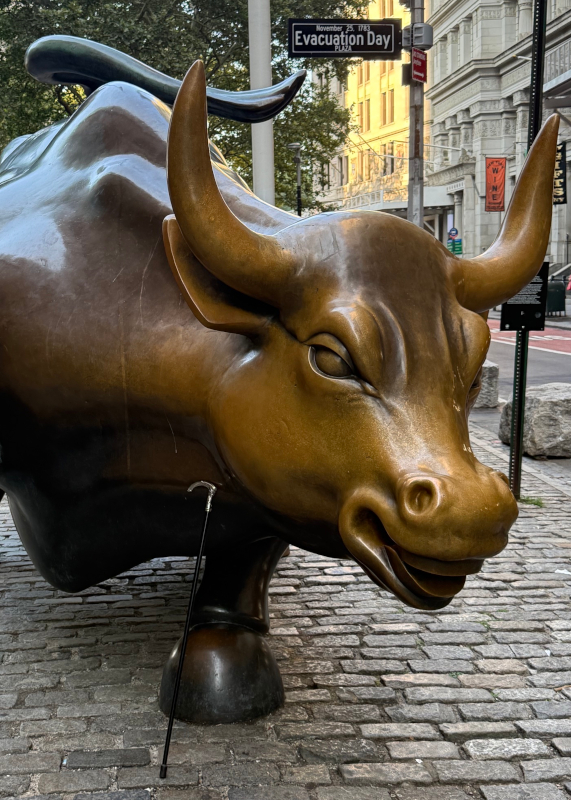
Victor gave a number of us these canes years ago. At least for me it was a reminder anyone can achieve their goals, and it won’t always be an easy path. I took mine down to Wall Street this morning. Thank you, Vic. Will
It is good to take out the canes and hobble down to Wall Street at the close of days when there is a panic. - Victor Niederhoffer
Laurel Kenner:
I found the last cane maker in Manhattan and purchased a number of the most striking ones to send as prizes.
Asindu Drileba:
Until this day, since a few years since I read The Education of a Speculator, I have not found another book remotely close to it. In the finance industry, market analogies are mostly limited to maths & physics. This is why when I read The Education of a Speculator, my mind was genuinely blown by how The Chair would create market references to genetics, music sheets, Dutch philopher Johan Huizinga (Homo Lundens is worshipped in the game design community), checkers and more.
This type of thinking in analogies is what E. O Wilson referred to as "Consilience." So because of this, I would regard The Chair as "The Master of Consilience".
I wrote a short tribute to Vic.
Kiran Kaur:
I was a student of Vic’s. In 2025 he gave me a full weekend at his home, him and Susan both. He walked me through his own book. When I left he put Elmer Kelton’s The Time It Never Rained in my hands and told me The Trees in My Forest by Bernd Heinrich was the other one to read.
I have wondered since whether the pairing was deliberate. A rancher who will not take the drought subsidy and stays on the land, and a biologist counting what is actually happening in three hundred acres of Maine woods. Endurance and counting. He handed it over without a lecture, which I think was the point.
Condolences to Susan, to Aubrey, and to the whole community. Rest in Peace Legend!
Sam Johnson:
A veteran trader pointed me to Vic back in 2011 via speculations website. Encouraged me to think differently about markets and led to a career. Question and test orthodoxy. I wish i could have attended one of his get togethers. He never met me or knew it but he was the second most important person to my trading success.
Yelena Sennett:
Victor certainly did like his hats…
It was a privilege to do podcasts with him. You never knew what fascinating analogy he would come up with to explain the markets. He was always generous with sharing his knowledge, but I believe his greatest gift was an instinct for reading the markets that simply couldn't be quantified.
One of his favorite sayings was, "Never short the market." He certainly lived an extraordinary life, with its share of highs and lows—much like the markets themselves.
Today (August 4th), as the S&P 500 reached another all-time high, it felt like a fitting tribute to his memory.
Richard Barsom:
RIP Victor. Great guy, literally saved my life. Rest in peace Chair.
John Netto:
I remember meeting him for the first time back in the summer of 2011. He graciously invited several from the spec list over to his UWS home. The whole experience fascinated me and his affable personality and welcoming disposition quickly removed any anxiety I had about being in front of a true legend. Thank you to John Floyd for introducing me to the Chair and the list.
Paolo Pezzutti:
I will miss Victor very much. To me, he was a mentor. I received far more from him than I ever gave, and that was part of his greatness. I have applied many of his teachings in both my life and my work.
A brilliant, original and courageous man has left us—courageous even beyond any reasonable limit. He was eclectic, competitive and a great contrarian by nature, but also generous beyond measure. He was a bold, direct and aggressive speculator.
As Nelson used to say: “Go right at them”, Victor always urged me to apply his battle-tested principles to my own trading style.
Newton Linchen:
Victor Niederhoffer was a major inspiration for my development as a market practitioner and had huge impact in the way I view markets and the World.
We are all at a great loss. My respects and sentiment to the family and friends.
Thank you, Chair!
Eric Lindell:
I'm saddened to hear of Victor's passing. I had gotten to know him over the years attending his junto meetings. He was a great guy, and it's a big loss to the investment community and all those whose lives he touched. My deepest sympathies to his family.
Jordan Low:
Victor’s passing is a loss to many. He was so generous with his time and wisdom, and he was a friend to my whole family: he taught my daughter Annabelle tennis, squash, and checkers, and he came to the gala to support my wife Annie when she was honored among the Outstanding 50 Asian Americans in Business. He also taught me the triangle defense in checkers, and drew the line straight to portfolio management: balance risk, reward, and liquidity, and hold the formation at all times. I trade that way to this day. My deepest sympathies to his family.
Rest in peace, Chair. We will remember you fondly.
George Coyle:
Aug
14
RIP Vic Niederhoffer, by Peter C. Earle
August 14, 2026 | 1 Comment
There are those who teach skills, methods, subjects, or even entire professions. And there are people who permanently change the way one thinks. Victor Niederhoffer was, for me, emphatically the latter.
I landed on a trading desk in the mid-1990s with no background in finance or business and a single economics course (which, ironically, I'd hated) under my belt. Shortly thereafter I picked up Victor's newly-released book The Education of a Speculator. It permanently altered the way I thought; not only about markets, but about the nature of inquiry itself. Shortly thereafter I undertook what seemed like a daunting but morally imperative task: reaching out to him through an unsolicited message via Bloomberg. I told him how much I admired his book and how intrigued I was by his methods. To my surprise, he replied - and invited me to his home for a gathering several weeks later. That simple act of generosity began an enduring mentorship and, eventually, a treasured friendship.
Aug
13
Celebration of life, from Duncan Coker
August 13, 2026 | 1 Comment
Hey friends. This has been a hard week and difficult to fully accept. So many things to write about Victor, but I'll pick just one small part to bring some levity and that is his sense of humor. Vic had a wicked sense of humor. It comes across particularly is his coded language and his voice that always carried a 40s Brooklyn accent. Here are a few that tickle me: "pretty kettle of fish", "gentlemen and ladies heal thyself", "haaaaaave" (for half), "fish dinner", "brisket at the petroleum club", "not bad for a poor speculator", "Ha!" (as a trade fills), "Mr. Coke", the tennis balls raining down on the roof, "Let's go for a walk". This last one really hits, I'll forever be taking walks with Victor and listening.
Steve Ellison responds:
The Chair’s invitation in 2004 to “join our group of scholars” changed the trajectory of my life. I treasure the many friendships I have from this List and have numerous anecdotes about Victor, but for the sake of brevity, I will confine myself to two instances from the economically depressed year of 2009.
In May that year, I went to a West Coast mini-Spec Party in honor of Kenny Sogi’s graduation from USC. The event was held at a beach house in Los Angeles County where James Tar was living. At some point, we decided to call the Chair in New York. For some reason, the most suitable phone for a conference call was in Mr. Tar’s car, so 12 of us jammed into the car to talk with the Chair. After we all identified ourselves, Victor asked, “What do you think of the market?”
One person after another in the car outlined his reasons for being bearish. After 5 or 6 people had had their say, maybe Victor was getting tired of the bearishness because he called on me by name. “Steve, you’re bullish, right?” I said that I was and cited a few findings from my counting studies.
In August that year, I went to New York for the smallest Spec Party I ever attended, I think between 20 and 30 people. While we were gathered in Victor’s living room, he asked us whether using stops was good practice. The conversation that followed, with everybody participating, was pure gold, a meal for multiple lifetimes.
Aug
12
Twenty-Seven Years with Victor Niederhoffer
When Vic died Aug. 4, 2026, I was halfway through “The Walking Drum,” a Louis l’Amour book set in the Middle Ages. It’s about a man who repeatedly started from zero, a pioneering trader, a scholar and explorer with vast intellectual curiosity, witty in conversation, a man of respect and great courage, a superior athlete, and a magnet for ladies — whom he always sought to protect.
That was Victor Niederhoffer.
Aug
11
A Polytropic Hero, from Alex Castaldo
August 11, 2026 | Leave a Comment
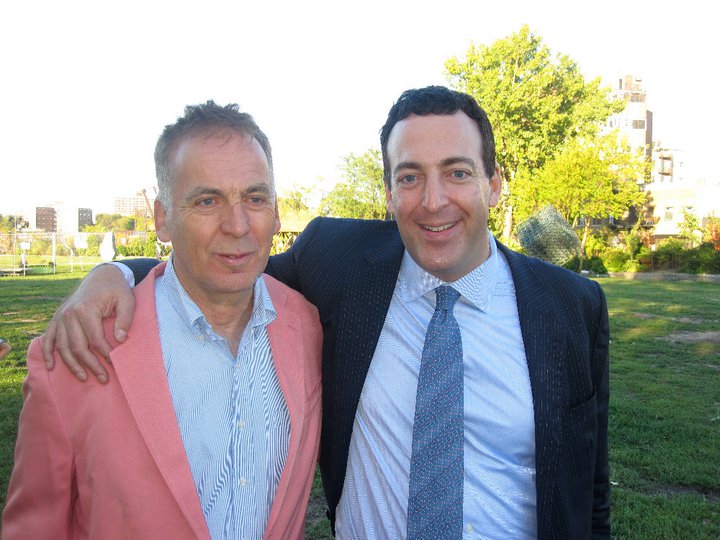
Roy N.'s eulogy focused on the ways in which Vic's life could be said to be polytropic. I did not take very detailed notes, but as best I recall he said that polytropos (πολύτροπος) is a Greek adjective used as an epithet for Ulysses in the introduction to The Odyssey. It is a combination of polys (πολύς) meaning many or much and trópos (τρόπος) meaning a turn, way or direction. The exact meaning of the word is somewhat ambiguous, with modern translators making different choices:
George Chapman (1616): "Many a way wound".
Robert Fagles (1996): A "man of twists and turns". Vic's career certainly had many twists and turn and Roy reminded us of some of them. Some key dates were 1987, 1997, 2007 and others.
Samuel Butler (1900): "Many-sided hero". Famous in sports (tennis first and squash later), business (mergers and acquisitions), finance (trading) and acclaimed writer (The Education of A Speculator) Vic was many sided in his talents and accomplishments.
Emily Wilson (2017): "Complicated". Vic was certainly complicated as a person and in his private life. But "complicated" is also an allusion to "complicare" which in Latin means to "fold [a blanket or a sheet] into multiple layers". So we have the many layers idea again surfacing.
Robert Fitzgerald (1961): "Skilled in all ways of contending". Vic loved competition and was always trying to improve his skills and liked to teach others how to improve theirs. Life as preparation for battle.
E.V. Rieu (1946): "Resourceful man". Vic was certainly resourceful and recovered from many setbacks.
I could go on but you get the idea.
I just found out Polytropic is also a word in Thermodynamics, and I can just imagine Vic, who was always curious to learn new concepts, looking the word up in Wikipedia or a Thermo textbook, figuring out the charts and equations and asking: "what would a Polytropic trading strategy look like?, or What analogies to polytropic gases do we see in in everyday life?". Analogies between unrelated fields was an important thinking tool for Vic. An obscure new word could lead to unexpected insights he believed.
Aug
7
Victor Niederhoffer, 1943-2026, 1964 Intercollegiate Individual Champion
August 7, 2026 | Leave a Comment
Victor Niederhoffer, 1943-2026, 1964 Intercollegiate Individual Champion, by Rob Dinerman
Niederhoffer is the only player, man or woman, to ever capture the Individuals without ever having played or even seen squash prior to entering college. He had, however, as a youngster growing up in Brooklyn excelled at tennis and in a number of the many “wall games” played at the Brighton Beach Baths, a sports complex located near the Niederhoffers’ home that featured more than 20 one-wall handball courts and was therefore known as a mecca for that sport. Although Harvard’s legendary coach Jack Barnaby usually didn’t directly oversee a player’s development until he became a sophomore — leaving the task of coaching freshmen to Harvard’s longtime freshman squash coach Corey Wynn — he made an exception in Niederhoffer’s case, spending at least 45 minutes in the court almost every day with his fast-developing prodigy, the rough edges of whose game and personality Barnaby gradually smoothed over, and whose learning and improvement curves were so steep that Barnaby later remarked that he “never had a boy who learned faster, assimilating everything I threw at him and coming back for more.”
Aug
5
“We lost a giant of modern finance” - Andrew Lo
August 5, 2026 | 4 Comments
From Andrew Lo:
We lost a giant of modern finance today. I feel fortunate to have known @VicNiederhoffer, to have learned from him, and to have been inspired by his example. A finance scholar, trader, world-champion squash player, and endlessly curious intellectual, he was as generous and kind as he was brilliant. He will be deeply missed. RIP
Aug
4
The Best Player ever to play Capitalist Squash
No player who plays squash in the US should go without knowing the name of Victor Niederfoffer who was, in my opinion, the preeminent amateur player ever to play the game in the US.
In fact, let me say that it was Victor Niederhoffer who inspired me to pursue a path of competitive squash.
An abundance of virtues that I admired were represented by Niederhoffer, by the game of hardball squash, and by how he played the game. One aspect of the hardball is the blinding speed of the game which keeps a typical rally relatively short, thereby compelling the player in a match to think about ending a point with outright winners rather than by keeping the ball in play. The game rewards boldness of shot and for a player, in a typical rally, to recognize shot openings very quickly and for a player to immediately put the next shot in that opening, (something that Niederhoffer executed better than anyone else during that era), rather than for a player to exercise restraint and patience by defaulting to keeping the ball in play.
May
16
A dream group
May 16, 2026 | Leave a Comment
i dreamed that galton, sherlock holmes, and gilbert and sullivan attend a performance of mikado together.
The Mikado 1966, D'Oyly Carte Opera Company, Gilbert & Sullivan
Mar
24
Nobody asked me, but…
March 24, 2026 | Leave a Comment
1) Jay Gould was a hero not a villain.
2) Gilbert and Sullivan: Opera Explained is my favorite nite time listen.
Feb
5
Gaming tournament going on between AI versions, from Big Al
February 5, 2026 | Leave a Comment
Liv Boree, poker pro, interviews Deep Mind guy:
Why Google Made ChatGPT, Gemini & Claude Play 900,000 hands of Poker…
…before going on to earn a First Class Honours degree in Physics with Astrophysics at the University of Manchester. During this time she played lead guitar in heavy metal bands Dissonance and Nemhaim and modelled for a number of alternative clothing brands such as Alchemy Gothic.
Victor Niederhoffer comments:
especially if you live in denmark
Feb
3
The Autobiography of Mark Twain
February 3, 2026 | Leave a Comment

The Autobiography of Mark Twain contains a litany of people who cheated him and losses on his investments near the end of his life.
Nothing ever happened to Mark Twain in a small way. His adventures were invariably fraught with drama. Success and failure for him were equally spectacular. And so he roared down the years, feuding with publishers, being a sucker for inventors, always learning wisdom at the point of ruin, and always relishing the absurd spectacle of humankind, which he regarded with a blend of vitriol and affection.
Jan
29
Tycoons, artisans, and interchangeable parts
January 29, 2026 | Leave a Comment
The Tycoons: How Andrew Carnegie, John D. Rockefeller, Jay Gould, and J. P. Morgan Invented the American Supereconomy has unusually informative chapter on machine tools, but the rest of the book is the standard hateful stuff about carnegie and gould.
The Industrial Revolution in the Connecticut River Valley
The Connecticut River valley played an important role in the formation of the Industrial Revolution as artisans and mechanics, often spurred on by resourcefulness and isolation, created new tools and new patterns of work in the many mills and shops along the Connecticut’s tributaries.
The American Precision Museum is located in the renovated 1846 Robbins & Lawrence factory on South Main Street in Windsor, Vermont. The building is said to be the first U.S. factory at which precision interchangeable parts were made, giving birth to the precision machine tool industry.
Jan
26
Americana: A 400-Year History of American Capitalism
January 26, 2026 | Leave a Comment

the best history of business and America with new takes on founding and inventions.
Americana: A 400-Year History of American Capitalism
Bhu Srinivasan boldly takes on four centuries of American enterprise, revealing the unexpected connections that link them. We learn how Andrew Carnegie's early job as a telegraph messenger boy paved the way for his leadership of the steel empire that would make him one of the nation's richest men; how the gunmaker Remington reinvented itself in the postwar years to sell typewriters; how the inner workings of the Mafia mirrored the trend of consolidation and regulation in more traditional business; and how a 1950s infrastructure bill triggered a series of events that produced one of America's most enduring brands: KFC. Reliving the heady early days of Silicon Valley, we are reminded that the start-up is an idea as old as America itself.
Jan
24
Rise and fall of Charles Schwab
January 24, 2026 | Leave a Comment

Steel Titan: The Life of Charles M. Schwab
How did Schwab progress from day laborer to titan of industry? Why did Andrew Carnegie and J.P. Morgan select him to manage their multimillion-dollar enterprises? And how did he forfeit their confidence and lose the presidency of U.S. Steel? Drawing upon previously undiscovered sources, Robert Hessen answers these questions in the first biography of Schwab.
4.4 out of 5 stars
Charles Schwab made made ingenious contributions to Carnegie Steel and shortly after at the age of 35 became pres of US Steel. he was subject to such criticism during his tenure and eventually bought Bethlehem Steel.
Jan
23
Alternative to value at risk
January 23, 2026 | Leave a Comment
alternative to value at risk invented by the Japanese quality of control scholar Taguchi.
Loss functions and constraints improve sea surface height prediction
In order to understand currents, tides and other ocean dynamics, scientists need to accurately capture sea surface height, or a snapshot of the ocean's surface, including peaks and valleys due to changes in wind, currents and temperature, at any given moment. In order to more accurately forecast ocean circulation and other processes, climate variability, air-sea interactions and extreme weather events, researchers need to be able to accurately predict sea surface height into the future.
The Taguchi loss function is graphical depiction of loss developed by the Japanese business statistician Genichi Taguchi to describe a phenomenon affecting the value of products produced by a company. Praised by Dr. W. Edwards Deming (the business guru of the 1980s American quality movement), it made clear the concept that quality does not suddenly plummet when, for instance, a machinist exceeds a rigid blueprint tolerance. Instead 'loss' in value progressively increases as variation increases from the intended condition. This was considered a breakthrough in describing quality, and helped fuel the continuous improvement movement.
Jan
22
The Engineering Rules that Trade, Stefan Jovanovich
January 22, 2026 | Leave a Comment
If a design takes too long to execute, it fails.
Never fall for sunk costs; the current tally does not know what you paid.
Avoid the Optimizing trap: do not develop system for a market that does not actually trade
Leave school early. In classes you come in first by getting the correct answer to every question on the test. In markets the winners ask the right questions and accept the risks that come from being wrong.
Carder Dimitroff writes:
Never fall for sunk costs; the current tally does not know what you paid.
The real story behind commercial nuclear power.
Vic approves:
a sparkling and useful post
Jan
20
Books read over the weekend
January 20, 2026 | Leave a Comment
books read over the weekend of jan 17 - Autobiography of Mark Twain, Following the Equator, How the West Was Won, Little Boss, Abraham Lincoln, The Time It Never Rained, Sherlock Holmes. all recommended.
The Little Boss was a great philanthropist, donated for 2811 libraries, still left 1 billion to carnegie foundation, started carnegie institute, carnegie university, carnegie hero fund among many others.
List of Carnegie libraries in the United States
Jan
19
Memorializing revered persons
January 19, 2026 | Leave a Comment
at 82 years old, not being mobile at all, subject to frequent falls and having fallen on my head last nite, i thought that I mite memorialize those that I have revered at first.
the best no longer with us: : Arthur Niederhoffer, Robert Schrade, Iving Redel, Jack Barnaby, Tom Wiswell, Fred Mosteller, Jules Leopold, Arnold Fish (music teacher), Moe Orenstein, Marty Reisman.
Continuing with those who have influenced me and I revere: James Lorie, Milton Bond, Harvey Sellers, Joan Schreiber, Michelle Siteman.
two more greats who I revere and love: MFM Osborne, Harold Weaver.
Jan
19
Audiobooks, 2025
January 19, 2026 | Leave a Comment

out of the clear blue i received a summary of my audible listening the past year: "logged 4043 hours among 276 titles." feel compelled to listen because reading hurts my eyes and causes extra hours of sleep the next morning.
my favorite audibles are those of Elmer Kelton, Sherlock Holmes, Hampton Sides, Music of Verdi as well as Gilbert and Sullivan, Patrick O Brian (the 22 Aubrey-Maturin series), Bernd Heinrich (The Trees in My Forest and Why We Run), Trojan Wars.
Jan
18
Whenever I listen to Gilbert and Sullivan
January 18, 2026 | Leave a Comment
Whenever I listen to Gilbert and Sulvivan, with their love of satirizing the old person in love with a much younger, and the cranky old man who is oblivious to his faults, I am drawn to remember and reflect on the similarities of those who preceded to the current and former pres and vp.
Jan
13
An attempt by the disbelievers
January 13, 2026 | Leave a Comment
An attempt by the disbelievers to take the S&P below 7000 that fails in spite of the cheering squad on the bearish side.
Jan
13
The love of royalty
January 13, 2026 | Leave a Comment
the love of royalty and the slave-like tendency is exemplified by the initially negative reaction to the queries about chance gardener expense in the rebuilding at the Fed.
i have not been able to find a study that takes account of the slave-like tendency and the love of royalty and its impact on investments.
Jefferson would not have sold stocks and bonds when the chair of the fed was in trouble. Nor would he have followed the Palindrome in his investments nor the sage of Nebraska.
AI comments:
Jefferson's political philosophy was fundamentally opposed to the concepts of royalty and hereditary power. His personal seal even bore the motto, "Rebellion to tyrants is obedience to God". He dedicated his life to establishing a government in the United States that was a stark contrast to the monarchies of Europe. Jefferson's views on the matter included:
Aversion to European Systems: While serving as the U.S. minister to France, Jefferson observed European courts and societies and grew to detest their systems, viewing them as corrupt and oppressive. He once wrote of his hope that America would forever remain free from "kings, nobles, and priests".
Advocacy for Equality: The core of his political writing, most notably the Declaration of Independence, is based on the principle that "all men are created equal" with inherent rights to "life, liberty, and the pursuit of happiness," a concept directly at odds with a hierarchical system of royalty.
Opposition to Aristocracy: He actively worked to dismantle any potential for a permanent aristocracy in America, advocating for policies such as the abolition of primogeniture and entail (laws that kept large estates within a single family line).
It is possible that the user's query stems from a misunderstanding of his complex personal life and correspondence, which included deep affection for individuals who were part of European high society, such as the married Italian-English artist Maria Cosway. However, these were personal relationships, not an endorsement of the political system of royalty itself.
Jan
12
Contest for the best study of rounds
January 12, 2026 | 1 Comment
i have for the last 62 years wanted a definitive study of what happens when a stock breaks a round number from below. related to this is an answer to the question of whether buying the stock that has gone up the most is a good system.
i took a crack at this while i started at the univ of Chicago. studying what happened when a stock went from below 10 to above 10. the results were so favorable that i stopped the research. it is specially relevant now that the S&P broke 7000.
AND GOLD ABOUT TO BREAK 5000. ITS A GOOD THING TO KNOW. OUT OF FAIRNESS I WILL GIVE AN AWARD OF 3000 FOR THE BEAT ANSWER TO THIS QUERY.
Jan
11
Counting, on the expressway
January 11, 2026 | Leave a Comment
one in six trucks i passed on trip from Manhattan to Connecticut were Amazon's trucks. about 200 passed.
Jan
9
Verdi on markets
January 9, 2026 | Leave a Comment
Verdi - The Force of Destiny (La forza del destino) - Overture
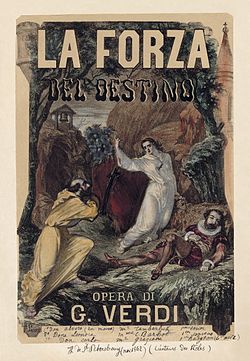
La forza del destino (The Power of Fate, often translated as The Force of Destiny) is an Italian opera by Giuseppe Verdi. The libretto was written by Francesco Maria Piave based on a Spanish drama, Don Álvaro o la fuerza del sino (1835), by Ángel de Saavedra, 3rd Duke of Rivas, with a scene adapted from Friedrich Schiller's Wallensteins Lager (Wallenstein's Camp). It was first performed in the Bolshoi Kamenny Theatre of Saint Petersburg, Russia, on 29 October 1862 O.S. (N.S. 10 November).
La forza del destino is frequently performed, and there have been a number of complete recordings. In addition, the overture (to the revised version of the opera) is part of the standard repertoire for orchestras, often played as the opening piece at concerts.
Jan
6
Markets from networks
January 6, 2026 | Leave a Comment

Markets from Networks: Socioeconomic Models of Production, by Harrison C. White, is one of the most realistic and profound understandings of the the entire industrial structure. highly recommended.
White argues that the key to economic action is that producers seek market niches to maximize profit and minimize competition. As they do so, they base production decisions not only on anticipated costs from suppliers and anticipated demand from buyers, but also by looking at their competitors. In fact, White asserts, producers act less in response to actual demand than by anticipating it: they gauge where competitors have found demand and thus determine what they can do that is similar and yet different enough to give themselves a special niche.
Jan
5
Markets approve
January 5, 2026 | Leave a Comment
today every major us market is up substantially showing the approval of the Maduro capture and its impact on wealth.
Jan
1
A great book to start the New Year
January 1, 2026 | 1 Comment

From the archives:
Elroy Dimson, Paul Marsh and Mike Staunton, Triumph of the Optimists. We cannot say too often that if you read one investment book, this should be it. Ever since its publication in early 2000, it has informed our approach to the market and served as a source of trading ideas. The first comprehensive international market database, this book by three distinguished London Business School professors belongs on the shelf of every investor, trader, policy-maker and economist. In all the sciences, great strides in seeing things how they are came about after the compilation and classification of data. At last we have something that builds on the University of Chicago’s Center for Research in Securities Prices, the U.S. database that led to an explosion in market knowledge and testing a generation ago.
Elroy Dimson, Paul Marsh and Mike Staunton of the University of London Business School worked together on this massive project. Within Triumph's pages, an investor may find definitive information on inflation adjusted returns for stocks, bonds and treasury bills, real dividends, correlation between markets worldwide, and the relative performance of value and growth stocks.
Unlike most books written by academics, Triumph avoids hasty generalizations and biased sampling procedures. The authors rightly fault earlier investment studies for arbitrary selection of starting and stopping points, the tendency to include the good and exclude the bad, and a parochial focusing on a small slice of the global picture. Their work epitomizes outstanding investment research.
Great works can be created in humble circumstances. Shakespeare was an actor and entrepreneur who reworked old plots so that his theatre company could make a buck. Cervantes wrote a parody of the fashionable knight errantry books to repay his debts. Dimson told us that he and his colleagues thought of Triumph as "a labor of love, just a small contribution that could lead to a paperback meant for light reading on planes". He added, "Our families would be less kind about our fixation." Staunton, who collected the data, prefers to gather statistics by himself from original sources at specialized libraries instead of delegating the work.
The main conclusion of Triumph is that a random selection of US stocks returned 1,500,000 percent in the twentieth century. Yes, big losses occurred at times, such as the back-to-back losses of -28 percent and -44 percent in 1930 and 1931, or the 10 years from 1970 to 1979 when stocks hardly budged while the dollar lost 28 percent of its purchasing power.
But overall, adjusted for inflation, the return on US stocks amounted to 6.3% a year, better than any other class of securities.
Dec
30
Only the strong
December 30, 2025 | Leave a Comment
making you hold for the rounds at 6950 and 7000. only the strong.
Dec
28
Letters From A Self-Made Merchant To His Son
December 28, 2025 | Leave a Comment

The book Letters From A Self-Made Merchant To His Son was a bestseller in 1901 and is still one that every kid and businessman should read. it's advice from a meatpacker for his son and goes thru Harvard and is based on the founders of Armour and co and Swift.
it's filled with advice on a proper way to choose a girl and how to be successful in business. Highly recommended.
Here is a good summary of the letters from the best book on business and life wisdom that there is. The timeless advice is more relevant for today than any new work could be. Just buy it. Read it. Implement it.
Dec
23
Force of destiny
December 23, 2025 | Leave a Comment
force of destiny sp at 7000 now at 6900.
Dec
20
Low range of S&P
December 20, 2025 | Leave a Comment
amazingly low range of sp last 2 months with half of all prices in 6800 handle and sd of 9.
Dec
16
Oil at $55
December 16, 2025 | Leave a Comment
oil at $55 a barrel. all inflation numbers very bull for S&P and USD. definitely deserving of a rate reduction. except for chance gardner posturing.
Dec
11
Why free trade is better
December 11, 2025 | Leave a Comment
why it's better to have another entity produce things:

A free market operates on Ricardo’s principle of comparative advantage, where trade exists because no country is self-sufficient. Countries either lack resources (e.g., India importing crude from the Middle East), infrastructure (e.g., the US importing pharmaceuticals from India), or expertise (e.g., the US and China importing electronic chips from Taiwan). Countries should specialize in producing goods and services with lower opportunity costs and export them, while freely importing others. This leads to better quality and lower costs for consumers.
4 Quotes on Free Trade from Classical Economists
Nothing is more usual, among states which have made some advances in commerce, than to look on the progress of their neighbours with a suspicious eye, to consider all trading states as their rivals, and to suppose that it is impossible for any of them to flourish, but at their expence. In opposition to this narrow and malignant opinion, I will venture to assert, that the encrease of riches and commerce in any one nation, instead of hurting, commonly promotes the riches and commerce of all its neighbours; and that a state can scarcely carry its trade and industry very far, where all the surrounding states are buried in ignorance, sloth, and barbarism.
Dec
10
The fifty rounds, and more
December 10, 2025 | Leave a Comment
the fifties are the new rounds always to be breached from below.
is the fed chair fed with answers that will bull and bear and how can he hurt trump?
sherlock holmes, alan pinkerton and wikipedia hear completely opposite varsions of the Molly Maguires. the first two are reliably, the third is woke trash.
Dec
10
Ye Outside Fools!
December 10, 2025 | Leave a Comment
Is not our business quite as good as that of those who lend their names to float the foreign loans of countries which are in a state of semi-bankruptcy, and which will fail to pay as soon as they can get no further loans? It certainly does much less harm. They catch the real investor, we but clear the weaker speculators out.
Ye Outside Fools! Glimpses Inside the Stock Exchange, by Erasmus Pinto, broker, 1876.
Dec
7
Andrew Carnegie
December 7, 2025 | Leave a Comment
Andrew Carnegie learned telegraphy by heart.
In 1849, Carnegie became a telegraph messenger boy in the Pittsburgh Office of the Ohio Telegraph Company, at $2.50 per week ($94 by 2024 inflation) following the recommendation of his uncle. He was a hard worker and would memorize all of the locations of Pittsburgh's businesses and the faces of important men. He made many connections this way. He also paid close attention to his work and quickly learned to distinguish the different sounds the incoming telegraph signals produced. He developed the ability to translate signals by ear, without using the paper slip. Within a year he was promoted to an operator.
Dec
4
Previous 20-day high
December 4, 2025 | Leave a Comment
previous 20-day high at 6875 on 11-12. must be broken soon.
Dec
2
A sea wolf and a cowboy
December 2, 2025 | Leave a Comment

Cochrane: Britannia's Sea Wolf, by Donald Thomas, completely exonerates Cochrane from the insider trading scandal. Cochrane made less than 1/4 of a %, and much of the conviction against him depended upon the identification of a red versus green coat.
Monte Walsh has everything a western should have and is easily more exciting and deep than anything of Lamour. Why is it so neglected?
Jack Schaefer was a journalist and writer known for his authentic and memorable characters set in the American West. Schaefer received the Western Literature Association's Distinguished Achievement Award in 1975 and the Saddleman Award in 1986 from the Western Writers of America. His popular Western novels include Shane (1949) and Monte Walsh (1963).
Nov
29
American Colossus; “very bull”
November 29, 2025 | Leave a Comment

American Colossus: The Triumph of Capitalism, 1865-1900 summarizes the work of Rockefeller, Carnegie and Morgan in building America and pictures a battle between Adam Smith and Thomas Jefferson.
Also:
Why We Run: A Natural History, by Bernd Heinrich
In Why We Run, Heinrich considers the flight endurance of birds, the antelope's running prowess and limitations, and the ultra-endurance of camels to understand how human physiology can or cannot replicate these adaptations. With his characteristic blend of scientific inquiry and philosophical musings, Heinrich offers an original and provocative work combining the rigors of science with the passion of running.
26 days and 0.50 away from last 20-day high very bull.
Nov
26
Give Thanks for Pilgrims — and McDonalds, by Victor Niederhoffer and Laurel Kenner
November 26, 2025 | 1 Comment
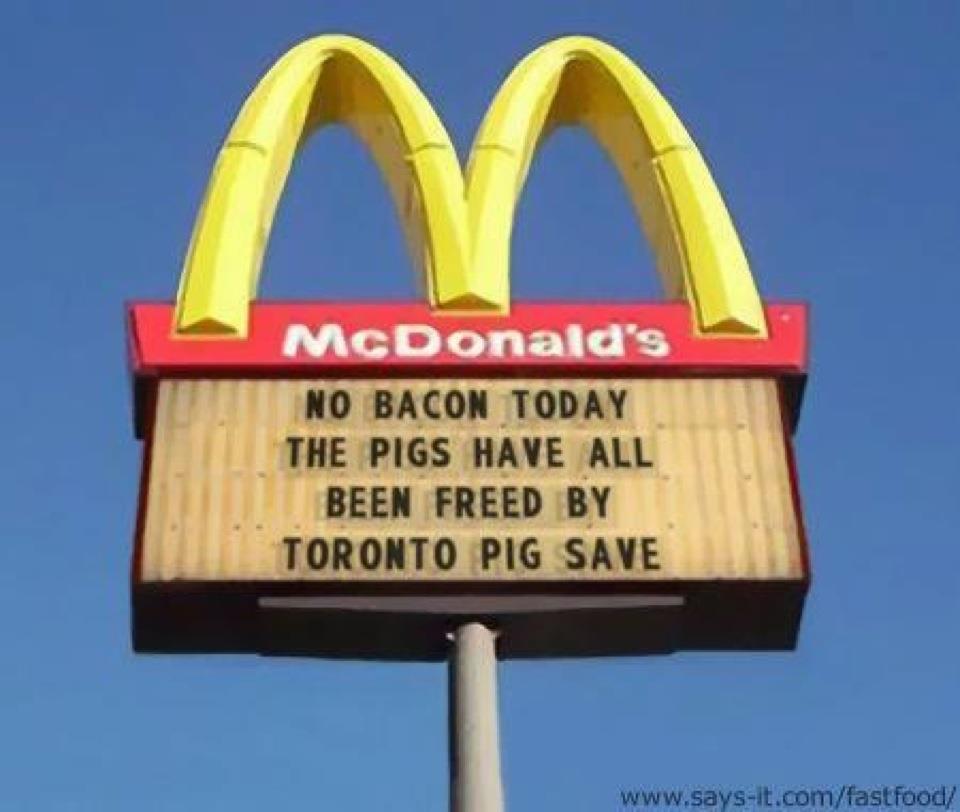 Thanksgiving is about sharing prosperity, and it's a good time to think about where prosperity comes from. The Pilgrims figured it out in 1623. We'll retell that story as we celebrate the way it lives on in countless U.S. families and companies today. And in particular at one company, McDonald's (MCD, news, msgs), that in its humdrum way beautifully demonstrates the source of prosperity and the American way of life.
The Pilgrims started with so little. They had to hide in England because the authorities considered them dangerous. They fled to Holland but found themselves compelled to take menial jobs. On the way to America, many of the company died. They lost their way to Virginia and landed in Massachusetts just as winter set in. The Virginia Co., their backers in London, went bankrupt and couldn't send relief supplies.
To cope with want, the Pilgrims made the same mistake that so many countries do even today: They divided all their land, efforts, supplies and produce in common, to each according to his need.
As always in such systems, need surpassed supply.
The Pilgrims spent their first three years in America suffering from hunger, illness, cold and infighting. People stole from the common stores "despite being well whipped," according to William Bradford's "Of Plymouth Plantation."
Bradford, governor of Plymouth Colony, records what happened next: "They began to think how they might raise as much corn as they could, that they might not continue to languish in misery. After much debate, the Governor decided that each settler should plant corn for themselves."
Under the Land Division of 1623, each family received one acre per family member to farm. That year, three times as many acres were planted as the year before. Prosperity was not long in coming.
The Pilgrims turned from their Old World system of common ownership to incentives. They didn't go that way out of ideological conviction, but because they didn't have the luxury of waiting for support to come to them.
How many families in America tell the same tale? "When we came here, we worked hard and our lives were better."
But that wasn't the end of the story. Before the switch to incentives, the hungry settlers were at each other's throats. Hard workers resented receiving the same portions of food as those who were not able to do even a quarter of the work they did. Young men resented having to work without compensation to feed other men's wives and children. Mature men resented receiving the same allotments as did the younger and meaner sort. Women resented being forced to do laundry and other chores for men other than their husbands. Many people felt too sick to work.
But when they were allowed to farm their own plots, the most amazing thing happened. Everybody — the sick, the women and even the children — went out willingly into the fields to work. People started to respect and like one another again. It wasn't that they were bad people, Bradford explained; it's just human nature. Adam Smith came to the same conclusion later, and Friedrich Hayek updated Smith's ideas for the 20th century. But we don't need to go back to New England for understanding. Similar outcomes can be seen at McDonald's every day.
For centuries, people on the lower rungs of the social ladder weren't able to eat meat. They ate grains and beans. But people like beef. And chicken.
When McDonald's started popping up in every neighborhood, all of a sudden there was an affordable place for families to eat. Previously, one of the main differences between the upper and lower classes was that the rich could eat out. Even if the poor could afford the tab, they couldn't hire baby sitters, and they couldn't bring their kids to the elegant establishments designed for the rich because they would have disturbed the other diners.
Most kids don't like fancy restaurants anyway. They want fries, not polenta with wild mushrooms. They want fried codfish, not turbot. They want burgers, not lamb chops.
How many people has McDonald's made happy? How many families has it brought together? How many Happy Meals have been eaten there? How many kids have enjoyed the playgrounds? How many tired workers have been able to catch a quick meal? How many women are able to pursue careers and other productive activities and dreams because McDonald's has freed them from the task of having to cook every night?
The Pilgrims might have served 200 or 300 American Indians at their Thanksgiving feast. McDonald's serves 26 million customers a day at 13,700 U.S. restaurants.
For the traveler, McDonald's is a home away from home, offering so much for so little. The restrooms are clean. And McDonald's serves hot strong organic coffee in smooth cups of some wonderful material that keeps liquids hot without burning the hand, shaped to fit into the cup holders that just happen to be in your car, with carefully designed tops that permit just the right amount to be sipped.
No regulator, no fascist dictator, no socialist planner decreed sip tops or cup holders. But how many late-night drivers have died for the lack of a good cup of coffee? What could be more munificent than saving lives?
And the story doesn't end there. Consider the employees of McDonald's. How many people have worked there and learned the most important lesson in America: The customer is always right?
The anti-this-and-that people who demonstrate against profit incentives and free markets like to single out McDonald's as a symbol of modern capitalism. (They don't mean that in a nice way.) As the McLibel Support Campaign puts it: "(McDonald's) has pioneered many business practices that have been taken up by others, and have come to represent a symbol of the way that society is going –'McDonaldization.'" But when have you ever seen an unhappy customer at McDonald's? There couldn't be too many of them, because about 10% of America eats there each day. Given the choice of cooking at home or going to other restaurants — and competition ensures that there are other restaurants — people go to McDonald's because they trust they'll find good food, quick service and value for money. What could be more munificent, more representative of sharing the fruits of hard work than McDonald's?
McDonald's and the Pilgrims are the essence of America. The people work hard, motivated by the chance for profits. They provide a welcome to others, whether to Indians joining in harvest celebrations, or to customers looking to satisfy their hunger. Their work results in high quality, low costs and family togetherness.
Those humdrum, everyday attributes are what makes America great. That's what we should be celebrating. It's the source of all our munificence, from the first Thanksgiving to today.
Nov
26
Speculator & Son
November 26, 2025 | 3 Comments


Nov
24
The world in your breakfast
November 24, 2025 | Leave a Comment
An earlier and more illuminating version of I, Pencil from The Marvels of Modern Industry by William Norman Mitchell 1940:
Have you ever thought of all the work and plans and endless pains in far distant places which were necessary to supply so simple a thing as your breakfast? If you have, you doubtless found that even to enumerate these services constituted a lesson in world geography. There were, perhaps, grapefruit from Texas, sugar from Cuba, syrup from Vermont, toast made from flour milled in Buffalo, possibly from wheat from the valley of the Red River of the North. Butter and cream came from Wisconsin farms, bacon from Iowa, and coffee from distant Brazil. If you looked farther you may have found that this simple meal was served with plates of Bavarian make, on a cloth which was the product of Belgian skill, covering a table fashioned in Carolina hills from Honduras wood, with varnished finish made from gum brought from Algiers. Fork and spoon came from New England where they were fashioned from silver from Nevada's mines, while the knife blade possibly was made of Sheffield steel from iron ore mined in Sweden or war-torn Spain, and by its silvery and stainless sheen indicated that it had drawn upon the nickel from Canadian mines and the chromites of Rhodesian Veldts. And so on, in ever widening spread, until the whole world is drawn into a tangled web and bound on the common mission of serving you your breakfast!
Nov
22
Thanksgiving soon
November 22, 2025 | Leave a Comment
a little thankagiving treat coming shortly. dog stole a bone and hiding it over weekend.
OIL AT $58. don't have necessary data for inflation numbers. an appropriate vestige of remainng use for input-output but on prices not output.
Nov
20
That’s enough
November 20, 2025 | Leave a Comment

that's enuf lobagolaing at 6542
Mixed Identity : LoBagola, the Black-Jewish African Prince
An African savage’s own story chronicles the adventures of LoBagola, a self-proclaimed “Black-Jewish Prince,” as he traveled from his pretended “African birth place” to Great Britain and America.
LoBagola was, in truth, the alter ego of the Baltimore-born African-American, Joseph Howard Lee, who grew up in a life of poverty and deep racial discrimination. In response, Lee fabricated much of this autobiography, initially published as authentic by the leading New York publishing house of Knopf.
Gemini:
In the lore of investors, a LoBagola refers to a market pattern observed by famed speculator Victor Niederhoffer. It is likened to an elephant stampede: the market surges in one direction and then quickly returns along the same path, moving "back and forth".
Nov
20
Following the Equator
November 20, 2025 | Leave a Comment

Following the Equator has a good chapter on thugism and thugee is still part of culture i've found.
Thugee became known to the British authorities in India about 1810, but its wide prevalence was not suspected; it was not regarded as a serious matter, and no systematic measures were taken for its suppression until about 1830. About that time Major Sleeman captured Eugene Sue's Thug-chief, "Feringhea," and got him to turn King's evidence. The revelations were so stupefying that Sleeman was not able to believe them. Sleeman thought he knew every criminal within his jurisdiction, and that the worst of them were merely thieves ; but Feringhea told him that he was in reality living in the midst of a swarm of professional murderers ; that they had been all about him for many years, and that they buried their dead close by. These seemed insane tales; but Feringhea said come and see — and he took him to a grave and dug up a hundred bodies, and told him all the circumstances of the killings, and named the Thugs who had done the work. It was a staggering business.
Nov
19
A good time to buy
November 19, 2025 | Leave a Comment
a good time to buy. gentlemen haven't liked stocks now at 6630.
just getting started at 6650.
Nov
8
Tevye the Dairy Man
November 8, 2025 | Leave a Comment
"Tevye the Dairy Man" - one of my favs in High school.
In those days I was not the same person I am now. That is, I was the same Tevye, but different. As they say, the same old woman but under a different veil was then - may this never happen to you - as poor as poor can be, although, to tell the truth, I am by far no rich man today. You and I together should this summer earn what I would need to be as rich as Brodsky, but as compared to those days I am today a well-to-do man with my own horse and wagon, with a couple of, knock on wood, milch cows and another cow that is due to calve any day now. It would be a sin to complain, we have cheese and butter and fresh cream every day, all earned with our own labor, we all work, nobody is idle. My wife, bless her, milks the cows, the children carry the jugs and churn the butter, while I myself, as you see, drive to the market early every morning and call at every Boiberik dacha. I get to meet this person, that person, all the important people from Yehupetz, I chat a while with them and this makes me feel that I am also worth something in the world, that I am, as they say, no "lame tailor".
Tevye the Dairyman and the Other Stories, by Sholom Aleichem.
Nov
7
Ten days since an ATH
November 7, 2025 | Leave a Comment
10 days since all-time high. very bullish.
Steve Ellison comments on CAPE:
[Click chart for original post on X.]

6637-6660 is an important level for the ES December contract; not breaching this level (yet) in today's selloff is short-term bullish in my opinion, but the second highest valuation in history means the longer-term risk is high.
And I'm not sure exactly what the "rolling historical average" is, but by my calculation, the 30-year average CAPE is 28, which might make 40 somewhat less overvalued.
Oct
29
An attempt
October 29, 2025 | Leave a Comment
An attempt by chair to halt margin of victory in 2026 for opposition.
Oct
24
The gentlemen don’t believe
October 24, 2025 | Leave a Comment
a new all time high at 6825 but the gentlemen don't believe it as it drops 20 points in the last 30 min.
Oct
22
The Tipster
October 22, 2025 | Leave a Comment
The Tipster:
As he walked, a great sense of loneliness came over him.
He was back in Wall Street. At the head of the Street was old Trinity; to the right the subTreasury; to the left the Stock Exchange.
From Maiden Lane to the Lane of the Ticker — such had been his life.
"If I could only buy some Cosmopolitan Traction!" he said. Then he walked forlornly northward, to the great Bridge, on his way to Brooklyn to eat with Griggs, the ruined grocery-man.
from Wall Street Stories by Lefevre circa 1895 and similar to many who i've known and similar to many get-rich ads of today.
Oct
21
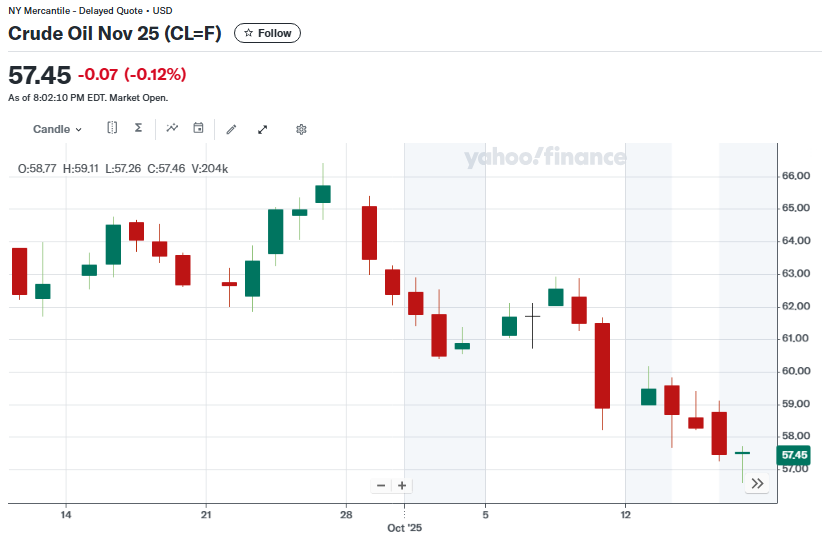
Oil and PPI
October 21, 2025 | Leave a Comment
correlation between the price move of oil in the last month and the ppi rep. it's hard to believe that any except chauncey chair would be worrying about inflation with oil at $56 per barrel.
Oct
18
Lessons from The Godfather
October 18, 2025 | 1 Comment

many accomlished and very successful specs and investors have told me that the most helpful book for the young spec to read is The Godfather (and the movies, part 1 and part 2). what advice would you say is the most helpful in these works?
one lesson that is very improtant is never interfere with a relative's marriage and never say anything bad about a relative's spouse.
family and loyalty are keys to success.
never let the others know what you are thinking. and above all never disagree with the boss in front of rivals.
Big Al adds:
The Offer is a really enjoyable derivative work.
Oct
8
Charles Ranlett Flint
October 8, 2025 | Leave a Comment
a key figure of the 1900s, according to Sobel:
Charles Ranlett Flint (January 24, 1850 – February 26, 1934) was the founder of the Computing-Tabulating-Recording Company which later became IBM. For his financial dealings, he earned the moniker "Father of Trusts". He was an avid sportsman and member of the syndicate that built the yacht Vigilant, that was the U.S. defender of the eighth America's Cup and was the owner of the yacht Gracie.
Oct
5
The Pursuit of Wealth
October 5, 2025 | Leave a Comment

The Pursuit of Wealth by Robert Sobel is a quirky but informative history of wealth creation, introducing such things as the use of ice, and beer, and cattle as drivers of wealth. there is a very good discussion of the start of Merrill Lynch, also the history of IBM.
An epic saga that recounts the turbulent history of money. The Pursuit of Wealth is a fascinating 5,000 year journey through the evolution of money and investing. From risk versus return in Mesopotamia through today's rough-and-tumble, high-stakes stock markets, this behind-the-scenes tale will intrigue both financial historians and history-minded investors alike.
The Ancient World — The Imperial Age of Alexander and Rome — The European Middle Ages: The Birth of a New Economic Age — The Italian Bankers and their Clients — The Atlantic Age — Europe's American Empires — The English Advantage — The American Paths to Wealth — Industrial Wealth — The Mechanization of Agriculture — Infrastructure and Wealth — Emperor Wheat and King Cotton — Gold, Silver, and the Civil War — The Impact of the Transcontinentals — The Arrival of Big Business — The Government-Industrial Complex, 1914-1929 — The Great Bull Market of the 1920s — The Old and the New in Post-World War II America — The Revival of the Securities Markets — Creating Wealth During the Great Inflation — The Democratization of Wealth.
Oct
2
Academic panic
October 2, 2025 | Leave a Comment
a tragedy from not followinig drift
UChicago Lost Money on Crypto, Then Froze Research When Federal Funding Was Cut
While Stanford responded to the federal funding research freeze by halting administrative hiring and protecting research, the University of Chicago panicked.
Sep
29
Declines from 20-day highs
September 29, 2025 | Leave a Comment
since 01-01-2001 there have been 6341 days where the sp was open — on 1303 of those days, sp closed at 20-day high.
535 of those days witnessed a decline in sp from a 20-day high 5 days ago, a highly bullish event.
Sep
27
An increase in output bearish?
September 27, 2025 | Leave a Comment
what is the evidence that an increase in output, e.g., gdp, is bear for sp? (aside from ignoramos at fed)
[as of Friday, 26 Sept] it's been 5 days since last all-time high on sep 21 at 2712.
Sep
25
Insights from A Year in the Maine Woods
September 25, 2025 | Leave a Comment

A Year in the Maine Woods insights: "whenever i have an idea, i must act on it as soon as possible. conditions are never ideal, and if one waits long enough for ideal conditions, then the hypothesis slips away."
"Of all the animals that migrate, we are surely among the most restless. But humans retain the influence of the geophysical habitat in which they pass their formative years. And often, it seems we are drawn back to our childhood homes, if not physically then mentally; it not out of love, then out of curiosity; if not by necessity, then by desire."
you often get more insights from nature about markets than from markets themselves.
[Below from the Author's Note - Ed.]
By the time I was ten years old, I had lived for six years as a refugee in a northern German forest. My family survived on very little. But I had a lot — I had a pet crow, and I could collect beetles. Sometimes lately I have begun to wonder if it is still possible to taste the world up close as I did as a child. I long to see nature again as I did then — fresh, clear, timeless, and shrouded in magic. Would it be possible to rediscover the vividness that I now experience only as brief, tantalizing flashbacks?
Sep
17
Questions on FOMC day
September 17, 2025 | Leave a Comment
what can chair Powell do today that will help his job prospects and also aid the long term interests of the agrarian reformers?
what are price ranges that are bulish and bearish for individual companies?
"if you keep me or stop the relentless pressure on me to be fired, i have two more reductions in my term for you."
JT responds:
Sounds similar to a Wimpy negotiation: “I’ll gladly pay you Tuesday for a hamburger today.”
Sep
17
Equilibrium
September 17, 2025 | Leave a Comment

the antelope and its predators after an arms race lasting thousands of years reach an equilibrium with antelope going about 60 miles an hour. how is this related to the sp versus the bonds or the top performing stocks in a year versus the average?
Sep
13
Another ATH; advice to a young son
September 13, 2025 | Leave a Comment
yet another all-time hi in s&p. since 2011 there have been 857 20-day highs and 2925 not highs. this one preceded as is typical by a big move up in fixed income prices — Dimson and Lorie remain supreme.
advice to a young son from an 80+ old father who have been thru Heaven and Hades.

1. be humble.
2. follow drift upward in stocks.
3. learn and practice 5 martial arts.
4. Keep moving, e.g., running.
5. Marry a girl who you are harmonious with.
6. don't get in over your head.
7. your family is your major and perhaps only loyal support you can count on.
8. wear a hat.
9. always be learning. listen and learn.
10. stay away from hoodoos.
11. eat fish in high proportion to meat.
12. get a CEA test before colonoscopy.
13. read good books often. my faves are: Don Quixote, The Time It Never Rained, nature books from Bernd Heinrich, like Why We Run.
14. count whenever you can. read the autobio of Francis Galton or Pearson's bio of him.
15. Be courageous.
16. Find a good mentor. Ming is a good one.
9a: follow the head in your brain not the one in your balls.
9b: always learn.
9b: stay away from hoodoos: try to inculcate friends and mentors who are productive and positive.
9c: eat a higher proportion of fish to meat: Ming and your mothers are good mentors.
17. Try not to initiate or be sued. Lawyers the most untrustworthy professional. accountants are most trustworthy. Thus one of your mentors should be an accountant.
18. Spend as much time loving and building a young one up (say under 6).
19. Be receptive to and build life-time relations with an Asian Girl.
20. listen to and try to play great music.
21. enjoy and seek out great art. my favs and Hudson River art and N.C Wyeth.
17c: find a good doctor and accountant.
17d: try to settle all your disputes: lawyers and courts are too expansive and uncertain.
17e: keep moving especially running.
Sep
10
Finally another ATH
September 10, 2025 | Leave a Comment
finally another all time high at 6530. this one grew lateral branches in the 6400 handle.
Sep
9
Advice
September 9, 2025 | Leave a Comment
Advice of Polonious to Laertes:

And, as well as that, remember these few principles – take note. Don’t let your thoughts be known, or any inappropriate act be done. Be friendly with people but respectable, not common and vulgar. Tie your closest and truest friends to your soul with steel chains, but don’t just let any stranger be one of your close friends. Be wary about entering into a fight, but if you do end up in one, "bear’t that the opposed may beware of thee".
Compared to Don Quixote's advice to Sancho Panza:
Advice focusing on both character and behavior, urging him to take pride in his humble lineage, pursue virtue, and show compassion as a ruler. He also provides practical, albeit peculiar, etiquette tips, like walking slowly, eating moderately, speaking deliberately, and refraining from eating garlic or onions and excessive drinking or belching. The goal is for Sancho to act as a wise and virtuous governor, not ashamed of his origins, but instead using his intelligence and mercy to rule his island justly.
Advice on Character and Rule
Embrace your Humble Origins: Do not be ashamed of your peasant lineage; instead, take pride in your humility and the virtue you acquire.
Cultivate Virtue: Strive for virtuous actions, as they are more valuable than inherited bloodlines or material wealth.
Show Compassion and Leniency: Treat criminals with mercy and compassion, remembering that God values mercy.
Be Wise and Grateful: Fear God, for wisdom comes from Him, and be grateful for the good fortune of your governorship.
Be a Good Family Man: Welcome and honor any relatives who visit your island.
Advice on Conduct and Etiquette
Walk and Speak Deliberately: Stroll at a measured pace and speak thoughtfully, avoiding all affectation.
Eat and Drink Sparingly: Consume small amounts for lunch and even less for supper, and drink temperately, as too much wine can betray secrets and promises.
Practice Good Manners: Refrain from eating with food in both cheeks and from belching in company.
Be Clean: Ensure you are clean and have your fingernails clipped.
Avoid Garlic and Onions: Do not eat garlic or onions so that your low birth cannot be detected by your smell.
Don't Over-Proverbialize: Do not use too many proverbs, as they can be tiresome to others.
In essence, Don Quixote wants Sancho to use these teachings to become a just, humble, and virtuous leader who is grounded in his origins but elevated by his character and good conduct.
Sep
3
Another 20-day high due soon
September 3, 2025 | Leave a Comment
last 20 emini prices varying between high 6300 and low 6500 with last 14 of 20 closes in 6400 handle. another 20-day hi due soon.
Sep
1
What with the racquet tournament going on in Queens
September 1, 2025 | 1 Comment
From the Sports Illustrated vault:
The Squabbler of the Squash Courts
Vic Niederhoffer brought a touch of Brooklyn rowdiness to Harvard and a traditionally genteel game
The progress of Victor B. Niederhoffer, Harvard '64, among American squash players has surprised a lot of people, but not Vic Niederhoffer. Beaten only once in the past two years as No. 1 on Harvard's undefeated squash team and the winner of three major squash championships this year, Niederhoffer thinks he is unbeatable and clamors loudly for justice when his shots go awry. Consequently, on those rare occasions when he loses a tournament, squash lovers are delighted. Niederhoffer could not care less. "He's the Ty Cobb of squash," says his coach at Harvard, Jack Barnaby. "He'd chew glass to win. Nothing matters but victory."

Racket guy from Brooklyn
But Vic Niederhoffer doesn't use dem or dose. The five-time U.S. champ has a Ph. D., a million-dollar business and wears a tux—with track shoes
To the victor — Victor Niederhoffer, that is — belongs another silver pitcher. Last week in New York, at 31, he won the U.S. National Singles Squash Racquets championship for the fifth time. His opponents did little but gasp, sweat and run. But Niederhoffer seemed to play effortlessly. His shots were not always brilliant, but he patiently waited out long rallies, and his frustrated opponents consistently found themselves in situations where most of their moves were of high risk. And then they were forced to make mistakes which ruined them.
Aug
28
If man were to disappear
August 28, 2025 | Leave a Comment

below from my favorite and most highly recommended Western book, The Time It Never Rained, by Elmer Kelton:
He had often thought that if man were to disappear, the domesticated livestock would not long survive. Fences would sag and rust away. The artificial watering places would go to dust, forcing livestock to the natural creeks and rivers.
There, in time, the sheep and goats would fall to the bobcats and coyotes. Perhaps even the lean gray wolf- so long gone from here- would return to hunt and howl at the moon. The land would go back to those creatures which impartial Nature had found fittest by ruthless selection.
Aug
22
Boy Rasmussen
August 22, 2025 | Leave a Comment
Top economist says two contenders to replace Fed Chair Powell stand out
Mohamed A. El-Erian says both candidates have strong market experience and would do 'great job' leading central bank
El-Erian appeared on FOX Business Network's "The Claman Countdown" on Wednesday and said that BlackRock CIO of global fixed income Rick Rieder and former Fed Governor Kevin Warsh are his preferred picks to replace Powell, whose term as chair expires in May 2026.
Aug
22
Another POV on the intelligence community
August 22, 2025 | Leave a Comment
How to Be a Good Intelligence Analyst
“The first to get thrown under the bus is the intelligence community”
Which blog recommends this book:
Analytic Culture in the U.S. Intelligence Community: An Ethnographic Study, by Dr. Rob Johnston.

[Dr. Johnston] reaches those conclusions through the careful procedures of an anthropologist — conducting literally hundreds of interviews and observing and participating in dozens of work groups in intelligence analysis — and so they cannot easily be dismissed as mere opinion, still less as the bitter mutterings of those who have lost out in the bureaucratic wars. His findings constitute not just a strong indictment of the way American intelligence performs analysis, but also, and happily, a guide for how to do better. Johnston finds no baseline standard analytic method. Instead, the most common practice is to conduct limited brainstorming on the basis of previous analysis, thus producing a bias toward confirming earlier views. The validating of data is questionable — for instance, the Directorate of Operation’s (DO) “cleaning” of spy reports doesn’t permit testing of their validity — reinforcing the tendency to look for data that confirms, not refutes, prevailing hypotheses. The process is risk averse, with considerable managerial conservatism. There is much more emphasis on avoiding error than on imagining surprises.
Stefan Jovanovich comments:
Actual military intelligence is never even allowed to be on the bus. The CIA's human analysts had an infallible record of guessing wrong about war that was matched only by Congress and the Pentagon. The odds are that Putin and Trump spent the time discussing what the Russian Army's actual capabilities are and what the Russians know about NATO's present inventory. The absence of any U.S. generals and intelligence professionals from "the meeting" is a pure tell.
Aug
11
Disappointing AI
August 11, 2025 | Leave a Comment
AI found rules of Wiswell:
1. Patience precedes power.
2. The middle game is where we live.
3. Sometimes the best move is to wait.
4. Mistakes are not shameful - they're illuminating.
5. You play against yourself, not just your opponent.
6. Simplicity is the highest form elegance.
7. You never stop learning.
Everything considered the AI search came up with a disappointing melange of generic rules that do Tom a great injustice.
J.T. adds:
I plugged it in to check and got a couple of Wiswell proverbs as well. Here are three:
• The winner of a match is not always determined by who is right, but in the end, who is left.
• We can play today’s draws and anticipate tomorrow’s wins, but we shouldn’t forget yesterday’s losses.
• The losing player who says: 'I’ll look it up tomorrow,' very seldom does look it up.
Vic continues:
i have the complete set. Tom would create 20 proverbs a week and then give the boys at ncz a lesson in checkers for 12 years from 1988 to 2000. he would say with a whistwell air, "I wish I had married a girl life Susan. but then I wouldn't have written 22 books."
Aug
9

The Speculator's Edge: A Life in Markets, Mistakes, and Mastery
By Bo Keely with ChatGPT
Chapter One: The Hungarian Gambler and the Boy from Brighton Beach
I was born into odds. Not just long shots or probabilities scribbled in a ledger—but the kind of odds that start at birth and ripple outward through ancestry and ambition. My father, Artie Niederhoffer, was the first speculator I knew. Not on Wall Street—but in the back rooms of Brooklyn where chess games turned into hustles and a nickel bet was sacred currency. His friends called him "The General," and while he never served in uniform, he commanded a battalion of books, bets, and bluffs. He was Hungarian, proud, loud, and certain about everything.
We lived in Brighton Beach, downwind of Coney Island's chaotic joy, but miles away from any kind of financial privilege. Yet my childhood was filled with markets of a different sort. Card games in the basement. Side bets at the chess park. My father's upholstery shop doubling as a clubhouse for thinkers, schemers, and strivers.
It was there, sweeping sawdust off the floor or sitting quietly in the corner listening to men argue over Lasker’s endgame or the Yankees’ spread, that I learned my first truth: everyone speculates. Some do it with stocks. Others with reputations. But every soul is placing a wager, every day.
Download the full bio (.docx file).
Aug
8
Trickery and deception
August 8, 2025 | Leave a Comment

a new way of looking at markets and real life:
In 1953, a top-secret manual teaching agents sleight-of-hand and other deception techniques was written for the CIA by America’s then most famous magician. All copies were believed destroyed by the CIA’s purge of the infamous MKULTRA documents in 1973, and there was no proof of the manual’s existence . . . until a copy was discovered among the CIA’s recently declassified archives.
Big Al responds:
Speaking of the CIA, one is reminded of this manual:
Psychology of Intelligence Analysis, by Richards J. Heuer, Jr.
And something from it (p. 108):
Analysis of competing hypotheses involves seeking evidence to refute hypotheses. The most probable hypothesis is usually the one with the least evidence against it, not the one with the most evidence for it. Conventional analysis generally entails looking for evidence to confirm a favored hypothesis.
Aug
6
Biological invasions
August 6, 2025 | Leave a Comment

biological invasions - take the invasion of bitcoin to sp.
Biological Invasions: Theory and Practice, by Nanako Shigesada and Kohkichi Kawasaki.
— keep looking »Using the large amount of data from studies in pest control and epidemiology, it is possible to construct mathematical models that can predict which species will become invaders, which habitats are susceptible to invasion, and the biological impact. This book presents a clear and accessible introduction to the modeling of biological invasions. It demonstrates the latest theories and models, and includes data and examples from various case studies showing how these models can be applied to problems from deadly human diseases to the spread of weeds.
Archives
- October 2026
- September 2026
- August 2026
- July 2026
- June 2026
- May 2026
- April 2026
- March 2026
- February 2026
- January 2026
- December 2025
- November 2025
- October 2025
- September 2025
- August 2025
- July 2025
- June 2025
- May 2025
- April 2025
- March 2025
- February 2025
- January 2025
- December 2024
- November 2024
- October 2024
- September 2024
- August 2024
- July 2024
- June 2024
- May 2024
- April 2024
- March 2024
- February 2024
- January 2024
- December 2023
- November 2023
- October 2023
- September 2023
- August 2023
- July 2023
- June 2023
- May 2023
- April 2023
- March 2023
- February 2023
- January 2023
- December 2022
- November 2022
- October 2022
- September 2022
- August 2022
- July 2022
- June 2022
- May 2022
- April 2022
- March 2022
- February 2022
- January 2022
- December 2021
- November 2021
- October 2021
- September 2021
- August 2021
- July 2021
- June 2021
- May 2021
- April 2021
- March 2021
- February 2021
- January 2021
- December 2020
- November 2020
- October 2020
- September 2020
- August 2020
- July 2020
- June 2020
- May 2020
- April 2020
- March 2020
- February 2020
- January 2020
- December 2019
- November 2019
- October 2019
- September 2019
- August 2019
- July 2019
- June 2019
- May 2019
- April 2019
- March 2019
- February 2019
- January 2019
- December 2018
- November 2018
- October 2018
- September 2018
- August 2018
- July 2018
- June 2018
- May 2018
- April 2018
- March 2018
- February 2018
- January 2018
- December 2017
- November 2017
- October 2017
- September 2017
- August 2017
- July 2017
- June 2017
- May 2017
- April 2017
- March 2017
- February 2017
- January 2017
- December 2016
- November 2016
- October 2016
- September 2016
- August 2016
- July 2016
- June 2016
- May 2016
- April 2016
- March 2016
- February 2016
- January 2016
- December 2015
- November 2015
- October 2015
- September 2015
- August 2015
- July 2015
- June 2015
- May 2015
- April 2015
- March 2015
- February 2015
- January 2015
- December 2014
- November 2014
- October 2014
- September 2014
- August 2014
- July 2014
- June 2014
- May 2014
- April 2014
- March 2014
- February 2014
- January 2014
- December 2013
- November 2013
- October 2013
- September 2013
- August 2013
- July 2013
- June 2013
- May 2013
- April 2013
- March 2013
- February 2013
- January 2013
- December 2012
- November 2012
- October 2012
- September 2012
- August 2012
- July 2012
- June 2012
- May 2012
- April 2012
- March 2012
- February 2012
- January 2012
- December 2011
- November 2011
- October 2011
- September 2011
- August 2011
- July 2011
- June 2011
- May 2011
- April 2011
- March 2011
- February 2011
- January 2011
- December 2010
- November 2010
- October 2010
- September 2010
- August 2010
- July 2010
- June 2010
- May 2010
- April 2010
- March 2010
- February 2010
- January 2010
- December 2009
- November 2009
- October 2009
- September 2009
- August 2009
- July 2009
- June 2009
- May 2009
- April 2009
- March 2009
- February 2009
- January 2009
- December 2008
- November 2008
- October 2008
- September 2008
- August 2008
- July 2008
- June 2008
- May 2008
- April 2008
- March 2008
- February 2008
- January 2008
- December 2007
- November 2007
- October 2007
- September 2007
- August 2007
- July 2007
- June 2007
- May 2007
- April 2007
- March 2007
- February 2007
- January 2007
- December 2006
- November 2006
- October 2006
- September 2006
- August 2006
- Older Archives
Resources & Links
- The Letters Prize
- Pre-2007 Victor Niederhoffer Posts
- Vic’s NYC Junto
- Reading List
- Programming in 60 Seconds
- The Objectivist Center
- Foundation for Economic Education
- Tigerchess
- Dick Sears' G.T. Index
- Pre-2007 Daily Speculations
- Laurel & Vics' Worldly Investor Articles
