Jul
28
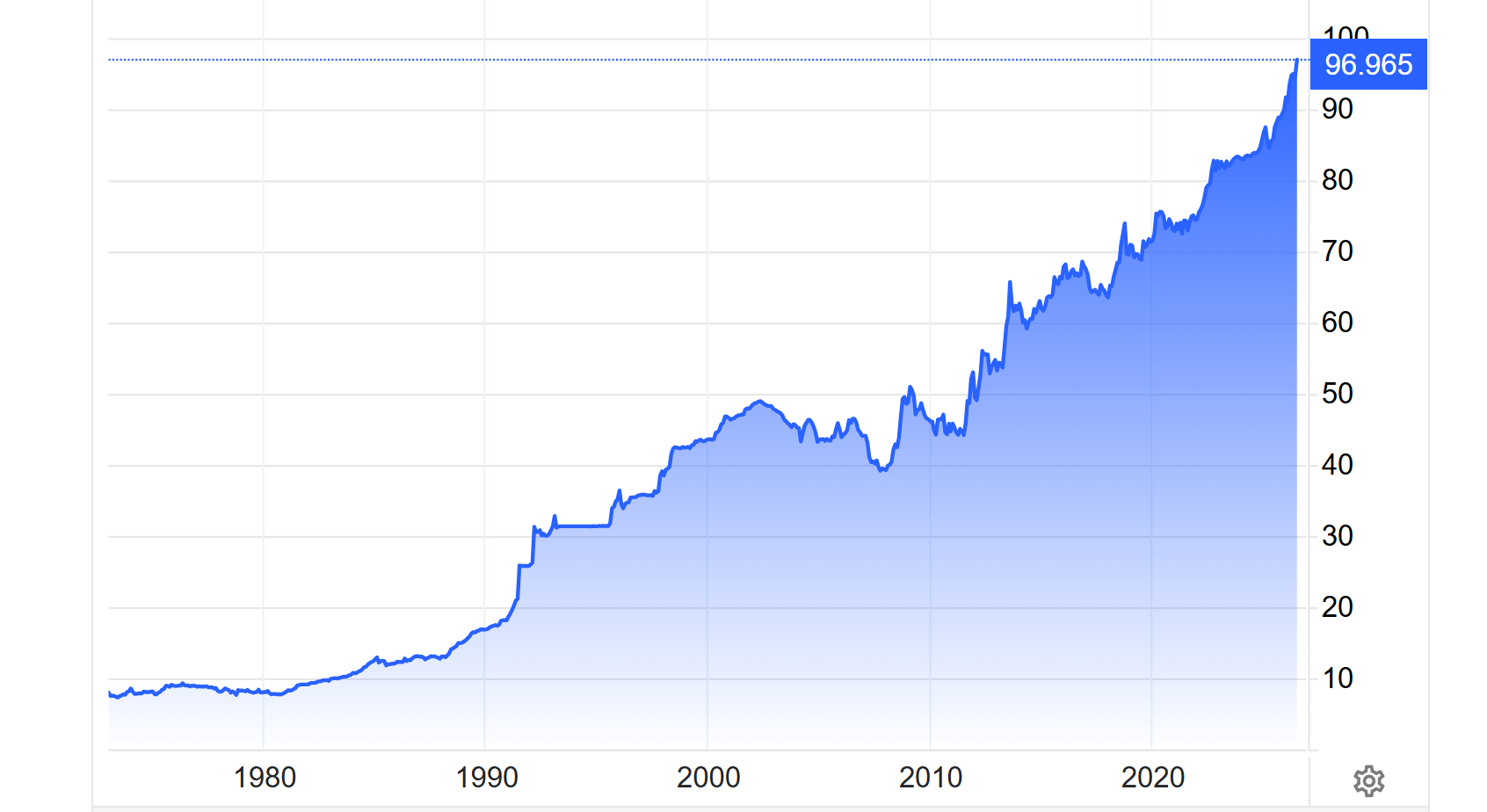
Indian Rupees to the US Dollar:
Steve Ellison writes:
Earlier this week I was recounting my tale of being in Turkey in 2003 when the currency notes in circulation were 1 million lira notes and 10 million lira notes. 1 million lira bought a cup of coffee; 10 million lira could buy a book. Both notes had 1 followed by a string of zeroes with no commas or periods; both had Atatürk's picture, and they were very hard to tell apart at a glance. I learned to turn them over and read the Turkish words as the fastest way to distinguish them.
Aside from that minor challenge, this Byzantine history enthusiast had a wonderful visit, and Istanbul is one of the world's great cities.
Bud Conrad adds:
The Indian ruble, at 90 to the dollar, is only half of the story. The dollar ain't what it used to be either. 1% of what it was in 1971 as measured in gold. How about Iran? 1.3 Million to the $.
Zubin Al Genubi recalls:
I remember Argentina a few years back with Lira 20 to the dollar. $10 US bill could buy crab dinner for two with nice Argentinian whitr wine.
Jul
4
Holiday Ideas for Americans, from U. S. Humbert
July 4, 2026 | Leave a Comment
A new Cato Institute/Morning Consult survey finds that 46 percent of Americans don't know what Saturday commemorates.
Idea 1: Lead a family event where the Declaration of Independence is read in its entirety.
For the fuller, messier version of the origin story, see "The 'Two Ships' Theory of American History" in the August Atlantic — James Traub's review of historian David Reynolds's Two Ships, on why Americans have never agreed on where their country began.
Full disclosure: the author is a confirmed descendant of both Mayflower passengers and Jamestown settlers — and a relation of Oliver Cromwell besides. If Reynolds is right that America was separated at birth, the divide runs straight through my DNA.
Then read the Mayflower Compact, written 156 years before the Declaration. Notice that the principle Jefferson would make famous — government by "consent of the governed" — is already at work in it: the signers "covenant and combine ourselves together into a civil body politic," binding themselves to laws of their own making.
Idea 2: Look for local mattress sales.
Stefan Jovanovich writes:
Six men who were delegates to Congress on July 1 and 2, 1776 declined to vote for the resolutions that authorized the Declaration of Independence. Four were from Pennsylvania: John Dickinson, Charles Humphreys, Robert Morris and Thomas Willing. John Alsop was from New York and George Read from Delaware. Two of the men would actually sign the Declaration when the document was presented to Congress on August 2nd; Robert Morris, who had abstained, and George Read who had voted no. John Dickinson would leave Philadelphia in July; Charles Humphreys and Thomas Willing would be removed from the Pennsylvania delegation before the document signing date.
Of the four men who said “no” and meant it, Thomas Willing would become the most important; President Washington would nominate him to become the first President of the Bank of the United States. and join the Pennsylvania militia; he would return in 1779. John Alsop would formally resign from Congress on July 16th. The other two delegates from Pennsylvania – Willing and Humphreys – would be removed from their delegation before the Declaration’s formal signing on August 2nd. Robert Morris and George Read would sign the physical declaration when it was presented to Congress.
Thomas Willing would stay in Philadelphia and work with his former business partner Robert Morris to fund the Continental Army. Morris, like the other members of Congress, would skedaddle to York when General William Howe and his British army arrived on September 26, 1777. The Loyalists would celebrate their arrival with parties and celebrations; Willing and his family, who were the richest people in the Philadelphia, would refuse to attend. When Willing was sent the formal oath of allegiance to King George III that Howe’s command was requiring of all prominent residents of the city, Willing refused to sign. Howe let Willing stay because there was at least some hope that Britain and the Americans could end their war. At the end of October, the rumor reached Philadelphia that a motion had been presented to Congress to rescind the vote for independence and it has lost by only one vote. On November 2, 1777 Howe would meet with Willing and his colleague John Brown. (Willing and Brown would be among the founders of the Bank of North America.) At the meeting Howe would express his desire to see a cease fire and peace settlement based on having the status of affairs in the thirteen colonies return to what they had been in 1763 and the Declaration being withdrawn. The Americans agreed to pass on the message. Henry Laurens, President of Congress, would report the proposals to George Washington. In his response, Washington would write: “it has been the unvaried custom of the enemy, from the commencement of the present contest, to try every artifice and device to delude the people. The message sent through John Brown was calculated for this end. I am surprised Thomas Willing should suffer himself to be imposed on by such flimsy measures. He knows that there is a plain, obvious way for General and Lord Howe to communicate … to Congress, without the intervention of a second or third hand. But this would not suit their views.”
A decade and a half later Washington would appoint Willing to be President of the Bank of the United States. When asked why he had voted no on the Declaration of Independence, Willing wrote: :“I voted against this declaration in Congress not only because I thought America at that time unequal to such a conflict as must ensue—having neither arms, ammunition, or military experience—but chiefly because the delegates of Pennsylvania were not then authorized by their instructions from the assembly as the voice of the people at large, to join in such a vote.”
Jun
19
Orange Is the New Green, from Humbert Z.
June 19, 2026 | Leave a Comment
The move from oil to electricity is driven by cost, risk, and security, not idealism—and it is redirecting where capital flows.
The energy transition is sold as a moral cause. It is really a trade. Economics, geopolitics, and risk are the forces that move capital, and the irony is that the biggest accelerants were never meant to decarbonize anything. The invasion of Iraq and the energy shocks of great-power rivalry each drove home the same lesson: no modern economy can afford to depend on a single, contested commodity. That lesson is now redrawing the map of capital flows.
Oil has never been a free market. It is indispensable and structurally constrained. Production is concentrated, capital-intensive, and exposed at every stage—extraction, transport chokepoints, and refining. Its price responds to geopolitics as much as to supply and demand. Call it what it is: a commodity that has never traded freely.
Electrons beat molecules. Electricity is the opposite—adaptable and decentralizing quickly. Regulated, yes, but its inputs keep multiplying: natural gas, nuclear, hydro, wind, solar, and storage, all feeding one grid. That diversity eliminates single points of failure and lets an economy swap one source for another, something oil never allowed. The more a country runs on electrons instead of molecules, the harder it is to hold hostage.
Hydrogen is often touted as the successor to hydrocarbons. For most uses, it is less efficient and far more infrastructure-intensive than electrification. The real fight is not hydrogen versus oil. It is electrons versus molecules.
Read the full post with additional comments.
Jun
4
Cy Young’s Rules, from Stefan Jovanovich
June 4, 2026 | Leave a Comment
Cy Young's Rules For Pitching Success
1. Pitchers, like poets, are born, not made.
2. Cultivate good habits: Let liquor severely alone, fight shy of cigarettes and be moderate in indulgence of tobacco, coffee and tea. A player should try to get along without any stimulants at all. Water, pure cool water is good enough for any man.
3. A man who is not willing to work from dewy morn until weary eve should not think about becoming a pitcher.
4. Learn to be patient and cool. These traits can be cultivated.
5. Take the slumps that come your way, ride over them and look forward.
6. Until you can put the ball over the pan whenever you choose, you have not acquired the command necessary to make a first-class pitcher. Therefore start to acquire command.
Published in "Baseball Magazine", 1908.
Apr
27
More on Sun Tzu, from Stefan Jovanovich
April 27, 2026 | Leave a Comment
Since Americans have been messing with the rest of the world ever since 1775 (our first act of rebellion was to invade Quebec), could we begin looking for historical parallels from our own history before we get to the Turning Points view? The first reference to The Art of War in U.S. military literature does not appear until the 1939 article in U.S. Naval Institute Proceedings (“The Constancy of Fundamental Military Considerations”). I realize that it is now one of the fundamental texts that is part of the military coursework, but those of us who were raised in the textbook business have learned to appreciate how little of what people actually do and think about money and power can be traced back to what they read in school. The List may want to consider looking back to the specifics of our country's history in the 1850s for a useful parallel to current events.
Viewed through that lens, President Trump seems to be following very closely Millard Fillmore's Whig plan to divorce the United States from the opinions of the rest of the "civilized" world and have our tariffs answer all questions about the price of the dollar in foreign exchange. By 1851 the United States of America was the world's largest exporter of what were considered to be the world's two most important commodities: gold and cotton fiber. In 1852 you had Admiral Perry setting out for Japan, the French being told to surrender all claims to Hawaii (they had occupied Honolulu in 1849), Taylor's Clayton-Bulwer Treaty being vigorously enforced, and a pro forma apology for the failure of the second Narciso López Filibuster expedition to Cuba was combined with a pointed declaration to both Britain and France by Secretary of State Edward Everett that Cuba was "almost essential" to U.S. safety. Central Europe did engage Americans public attention; Kossuth was invited to come and address Congress. But it was not at all comparable to the Zelensky show under the Biden Administration; the Europeans, and the Austrians in particular, were told that the U.S. had no interest at all - financial or otherwise - in Central European affairs.
There is only one reason this parallel does not fit rather neatly. A decade later the U.S. would be in a Civil War. Fillmore, Pierce and Buchanan all have to be blamed for it by all the people who get paid to look backwards. No doubt the same future textbooks that will look to Sun Tzu for wisdom will be grading Donald J. Trump with the same terrible marks that the first New Yorker President has gotten. But it does help to remember that during Sun Tzu’s traditional lifetime (c. 544–496 BC, late Spring and Autumn period), "the war" he writes about was entirely about the civil war among the vassal states of Zhou. There were no "foreign" wars during this period according to the records of the Zuo Zhuan.
(Correction: Martin Van Buren was the first New Yorker to become President. Millard Fillmore was the second.)
Jan
22
The Engineering Rules that Trade, Stefan Jovanovich
January 22, 2026 | Leave a Comment
If a design takes too long to execute, it fails.
Never fall for sunk costs; the current tally does not know what you paid.
Avoid the Optimizing trap: do not develop system for a market that does not actually trade
Leave school early. In classes you come in first by getting the correct answer to every question on the test. In markets the winners ask the right questions and accept the risks that come from being wrong.
Carder Dimitroff writes:
Never fall for sunk costs; the current tally does not know what you paid.
The real story behind commercial nuclear power.
Vic approves:
a sparkling and useful post
Jan
5
Oil, from Cagdas Tuna
January 5, 2026 | Leave a Comment

So where lies the thin line between liberating Venezuela and putting world into oil supply based recession?
Larry Williams comments:
The quality of their crude is a different issue we use to refine it here; sour, full of gravel etc.
Stefan Jovanovich writes:
Historically, before full sanctions in 2019, the US imported over 600,000 barrels per day (bpd) of Venezuelan crude, with refiners like Citgo (PDVSA-owned), Valero, Chevron, and Phillips 66 as top recipients.
More recently (post-2023 relief), Valero accounted for 44% of imports, Chevron 32%, and Phillips 66 10%.
Carder Dimitroff writes:
IMO, it's not about oil. The US is a net exporter. They're doing just fine without Venezuela. If heavy oil is desired for refining optimization, as some claim, there's a direct pipeline from Canada.
Stefan Jovanovich responds:
It would help if Carder focused on the use of heavy oil for marine diesel and bunker oil for steam turbines. Those are the essential propulsion fuels for China's Navy; hence, Hegseth's comment today assuring China that it would continue to receive its share of Venezuela's output.
Carder Dimitroff expands:
Globally, three major regions produce heavy crude: Russia, Canada, and Venezuela. Downstream, “heavy oil” or “heavy fuel oil” usually means the residual, high-boiling product left after lighter fractions (gasoline, diesel, kerosene, etc.) are distilled from crude. As Stefan suggests, heavy oil and bunker oil are growing markets, not only in China but also elsewhere.
In my opinion, the administration's interests in Venezuela reflect several interests. High on my list are Venezuela's untapped rare-earth elements (about 300,000 metric tons).
Pamela Van Giessen offers:
Interesting analysis here:
The Real Reason the Pentagon Approved Venezuela: Critical Minerals and Adversary Expulsion
The Department of War has allocated $7.5 billion under the One Big Beautiful Bill Act specifically for critical minerals, with $1 billion already deployed to stockpile antimony, bismuth, cobalt, indium, scandium, and tantalum. This is not economic policy. This is national security infrastructure. The United States is 100% import reliant for 12 critical minerals and over 50% reliant for 28 of the 50 minerals classified as essential to national security. These materials are not interchangeable. They cannot be substituted. They form the irreducible foundation of modern weapons systems.
Boris Simonder questions the thesis:
What rare earth does Venezuela hold that is proven and confirmed? Based on USGS Mineral Commodity Summaries 2025 and other sources like CSIS reports, Venezuela has no significant cobalt production or reserves listed. Antimony deposits exist but are small and underdeveloped, with declining output due to infrastructure issues.
Dec
21
Study of ancient languages. from Nils Poertner
December 21, 2025 | Leave a Comment
Idea for younger Specs: In School, some of us studied old languages, Latin, ancient Greek, one had to sit 1 hour to figure out what individual words could mean. And then put it all together. One could have the same approach for reading modern newspaper articles now. like this WSJ article here (I know that ppl can read "English" - I meant in a more reflective way. "Get the joke")
Five Reasons Investors Are Feeling Good About Stocks Again
and then check /study with "expected" vs "actual" in 1 week, 1 month, 1 quarter etc,
on a rolling basis to hone intuition /train memory.
Stefan Jovanovich recalls:
Arthur Sullivan - "no, I am not a descendant of the composer, whom none of you dunces will have heard of. He was English; I am Irish." - remains my favorite of all teachers. He lasted 1 year at Hackley - then a borstal boarding school for children who had to be warehoused, now a respectable Westchester County day school. He taught 9th grade Latin and turned it into a lesson in military tactics and strategy. The little Latin and less Greek are long gone, but I can still see his face and those of my classmates the day he explained to us how Caesar used a company of archers to conduct reconnaissance by fire.
Dec
17
John Freeborn, from Stefan Jovanovich
December 17, 2025 | Leave a Comment

His book Tiger Cub: The Story of John Freeborn DFC* is the best writing about the RAF in WW 2.
The facts are from Grok; the comments are mine.
John Connell Freeborn, DFC & Bar (1 December 1919 – 28 August 2010), was a distinguished British fighter pilot and flying ace in the Royal Air Force (RAF) during the Second World War. He was kicked out of Leeds Grammar School at 16 for fighting and found his calling when he joined the RAF 3 years later under a short service commission. After 4 hours and 20 minutes of flight time, he was allowed to solo. In 3 months he went from trainee to pilot officer.
During the Battle of Britain (July–October 1940) Freeborn flew more operational hours than any other RAF pilot—over 300 sorties. He is credit with 5 confirmed kills (Messerschmitt Bf 109s) and 3 shared kills.
Freeborn served as RAF liaison and test pilot in the United States (January–December 1942), commanded No. 118 Squadron (June 1943–January 1944), was wing commander of 286 Wing in Italy (1944–1945). He quit the RAF in 1946; it was, he said, "run by nincompoops".
Dec
14
Ever Changing Cycles in the NBA, from Andrew Moe
December 14, 2025 | Leave a Comment
Wonderful example of ever changing cycles in the NBA vis a vis the post up play which went dramatically out of favor when analytics reshaped the game into a three point shooting contest but now has come back into favor due to the spacing afforded by all those three point shooters.
How post-ups became the NBA's most efficient play
Stefan Jovanovich comments:
Steve Ellison is wistful:
Might one dare to hope that actually putting the ball in play for fielders might once again gain favor in baseball?
Dec
12
Comments on free trade, from Stefan Jovanovich
December 12, 2025 | Leave a Comment
"Free trade" never loses an argument; it is like being in favor of virtue. Even the worst sinner knows that vice is not to be publicly defended. The difficult for those of us in the bleachers is that we have never been able to avoid asking the follow-on question: if you don't like tariffs as taxes, what do you want to have instead? Adam Smith's answers were (1) domestic excises - the sugar is allowed to arrive untaxed and then have a tax levied when it is sold and (2) occupancy taxes - to be measured by how many windows a building had. What is never mentioned, of course, is that Smith was completely in support of the navigation acts; Britain would have "free trade" but only on cargoes carried on British ships that traveled directly to British ports. His specific comment on that question was: “Defense is of much more importance than opulence.”
William Huggins writes:
i'm all ears to hear what national security threat the us is responding to with their 50% tariff on aluminum processed where there is an abundance of clean energy to do so and (until recently) all but perfectly aligned nat sec interests with the processor?
Stefan Jovanovich responds:
The answer offered by the authors and voters who made the Constitution the national law was "protection". I offer this only as an historical explanation, not advocacy, since those of us who live on popcorn and waiting from spring (what Rogers Hornsby said he did after the baseball season ended) have abandoned all attempts to understand what is called "policy", whether monetary or otherwise.
Art Cooper asks:
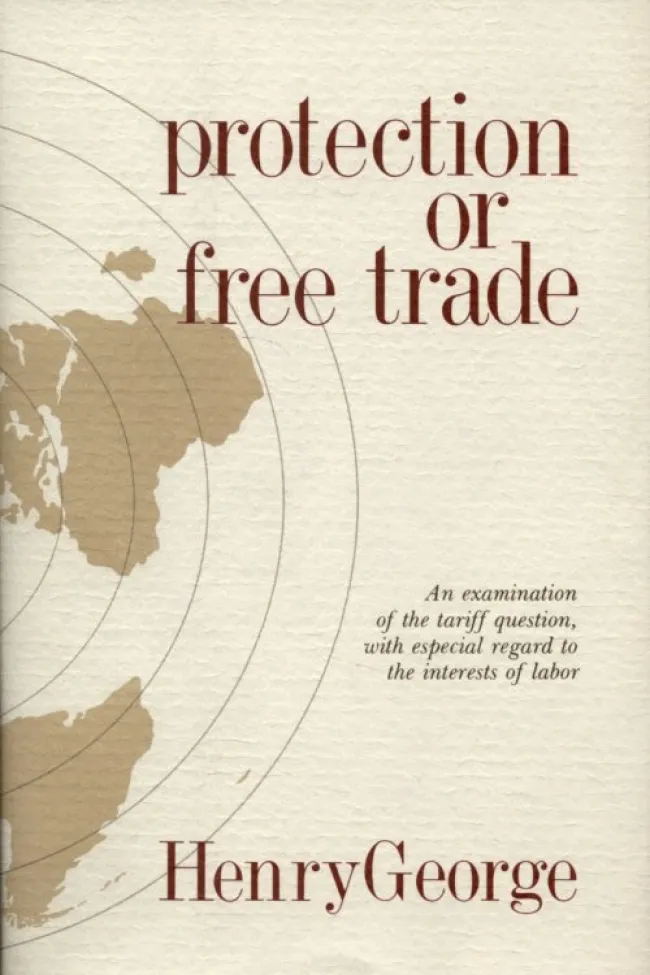
May I have your thoughts on Henry George's advocacy for the replacement of all other taxes by a land value tax?
Henry Gifford comments:
I think Henry George’s idea has a lot of merit, and not just because I heard that my father once taught at The Henry George School of Economics.
More than one calculation has shown that the cost of complying with tax laws in the US is about equal to the amount of taxes paid. If a land value tax eliminated all other taxes, almost all that cost would be saved. But, this would disadvantage the government because vague and complicated laws can be used by the strong against the weak, something not many in government want to see the end of.
Then there is the issue of jobs. The existing tax systems create a huge number of jobs, most of which would go away with a greatly simplified tax. Sure, those people could find more useful endeavors, increasing wealth for all, but if politicians started talking like that a lot of other things would be seen as folly.
Disagreements about the value of land could be handled like the ancient Greeks did – anyone claiming a lower value for their property can be challenged to sell it at that lower price.
A similar situation exists with the part of building design laws that regulate the energy efficiency of new buildings that get built. Now the laws run to hundreds of pages, which makes them very difficult to enforce. The vagueness gives the government people more power, as they interpret the laws as they see fit, or as they are paid under the table to do. For a time I was advocating a simple energy code: limit the size of the heating and cooling systems installed per the size of the building (you-tube: “The Perfect Energy Code”). Governments around the US were loathe to adopt a simplified energy code, because then jobs would be “lost” and the power to make arbitrary decisions would be reduced and the laws would actually be enforceable. A simplified tax collecting system will probably always be unpopular for similar reasons, despite what I think is a lot to recommend it.
Stefan Jovanovich responds:
Smith agreed with Henry George. He thought a land tax had all the attributes of a good tax, unlike income and employment taxes, which were the worst possible ones. Even tariffs had some virtues compared to those that required citizens to tell the state everything.
Nov
13
The $38 Trillion Question, from Humbert X.
November 13, 2025 | Leave a Comment
The $38 Trillion Question: An Interview with Stanford Professor Hanno Lustig
Hanno Lustig: I started thinking about the valuation of government debt by looking at the valuation of all Treasuries. What do we have to believe to get to a number like $38 trillion? You must believe there will be a huge fiscal correction, because ultimately the value of debt should be backed by future primary government surpluses. When you do the numbers, you realize that either bond investors are pricing in a huge fiscal correction that seems impossible, or Treasuries are significantly overpriced.
Carder Dimitroff notes:
The interest on debt is approaching $1 trillion per year and continues to compound. Interest costs currently exceed Department of Defense spending.
Larry Williams disagrees:
Meaningless measure look at debt vs gdp
Carder Dimitroff responds:
Yes, that makes sense. However, from a different perspective, it becomes meaningful under the One Beautiful Budget Bill when automatic sequestrations are implemented. Unless new legislation is passed, sequestrations will result in Medicare cuts and other reductions in expenditures. Current projections suggest sequestration will present in early 2026.
Big Al checks with FRED:
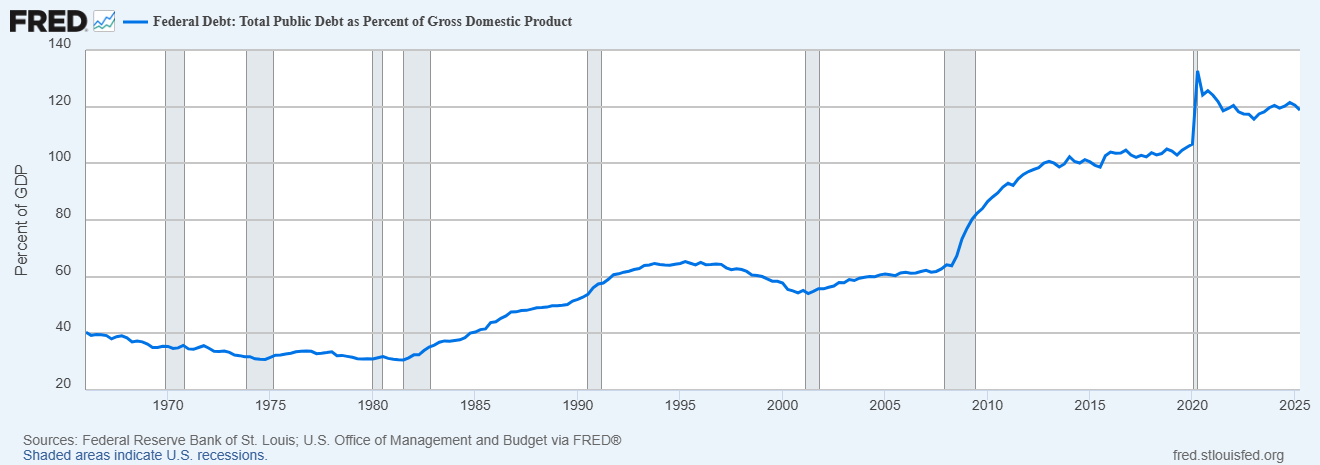
Nils Poertner writes:
recession + zero short term rates + lots of QE ….leading to a lot more public debt
maybe that is more likely path.
Stefan Jovanovich offers some history:
This chart shows the solvency ratios that can be found from the Census and other data [by decade 1880 to 2020] - how much "we the people" have in money divided by how much the American governments promise to pay.
Nov
4
Edmund Clarence Stedman, from Stefan Jovanovich
November 4, 2025 | Leave a Comment
Edmund Clarence Stedman was the editor of this history, The New York Stock Exchange, quoted below on this site.
From Grok:
Edmund Clarence Stedman (1833–1908) was a prominent American poet, literary critic, and essayist, often dubbed the "Bard of Wall Street" for his successful dual career in literature and finance. Born in Hartford, Connecticut, on October 8, 1833, he was orphaned young after his father's death from tuberculosis and raised by relatives. He briefly attended Yale University (expelled after two years but later honored with a degree) before launching into journalism in the 1850s, working for outlets like the New York Tribune and New York World, including as a Civil War correspondent. He studied law and briefly served as private secretary to U.S. Attorney General Edward Bates.
Connection to the New York Stock Exchange
Stedman's ties to the New York Stock Exchange (NYSE) spanned over three decades, from 1865 to 1900, where he worked as a banker and stockbroker on Wall Street. This financial role provided stability amid his literary endeavors, allowing him to support his family while pursuing poetry and criticism. After retiring from the Exchange in 1900, he remained deeply involved in its institutional history. In 1905, at age 71, he served as editor of the landmark publication The New York Stock Exchange: Its History, Its Contribution to National Prosperity, and Its Relation to American Finance at the Outset of the Twentieth Century, a comprehensive two-volume work commissioned by the Stock Exchange Historical Company. Co-edited with Alexander N. Easton and others, it chronicled the NYSE's evolution from its founding in 1792 under the Buttonwood Agreement through its role in American economic growth. The book, limited to 3,000 copies (with a rare signed edition of 50 for select members), is a key historical resource on early 20th-century finance.
Literary and Other Achievements
Parallel to his NYSE career, Stedman produced influential works like Poems, Lyrical and Idyllic (1860), Victorian Poets (1875), and massive anthologies such as A Library of American Literature (1888–1890, 11 volumes) and An American Anthology (1900). He also dabbled in science, proposing an early rigid airship design in 1879. Elected to the American Academy of Arts and Letters in 1904, he died in New York City on January 18, 1908, from heart disease, survived by two sons.
Oct
26
The forgotten janitor who discovered the logic of the mind, from B. Humbert
October 26, 2025 | Leave a Comment
AI relevant:
Finding Peter Putnam
The forgotten janitor who discovered the logic of the mind
Every game needs a goal. In a Turing machine, goals are imposed from the outside. For true induction, the process itself should create its own goals. And there was a key constraint: Putnam realized that the dynamics he had in mind would only work mathematically if the system had just one goal governing all its behavior.
That’s when it hit him: The goal is to repeat. Repetition isn’t a goal that has to be programmed in from the outside; it’s baked into the very nature of things—to exist from one moment to the next is to repeat your existence. “This goal function,” Putnam wrote, “appears pre-encoded in the nature of being itself.”
Stefan Jovanovich offers, with a bit of irony:
From Grok:
Peter Putnam (1927–1987) was an American physicist and theoretical neuroscientist whose work anticipated many modern concepts in cognitive science, artificial intelligence, and philosophy of mind. He studied under prominent figures like Albert Einstein, Niels Bohr, and John Archibald Wheeler, and his ideas influenced early developments in computational theory of mind, though he remained largely unpublished and obscure during his lifetime. Putnam's writings, now digitized and discussed in recent scholarship (particularly following the 2025 rediscovery and publication of his papers), propose a functional model of the nervous system that integrates physics, game theory, and neuropsychology. His theory emphasizes how the brain achieves order and learning through mechanisms like Hebbian plasticity, distributed neural networks, and conflict resolution—ideas that predate similar concepts in predictive processing and reinforcement learning. Putnam's work is not a single, neatly packaged "theory of repetition" but rather a core principle woven throughout his model of cognition and behavior. Repetition serves as a foundational "goal function" for existence, learning, and induction (the process of generalizing from specific experiences).
Oct
24
Another Historical Analogy, from Stefan Jovanovich
October 24, 2025 | Leave a Comment
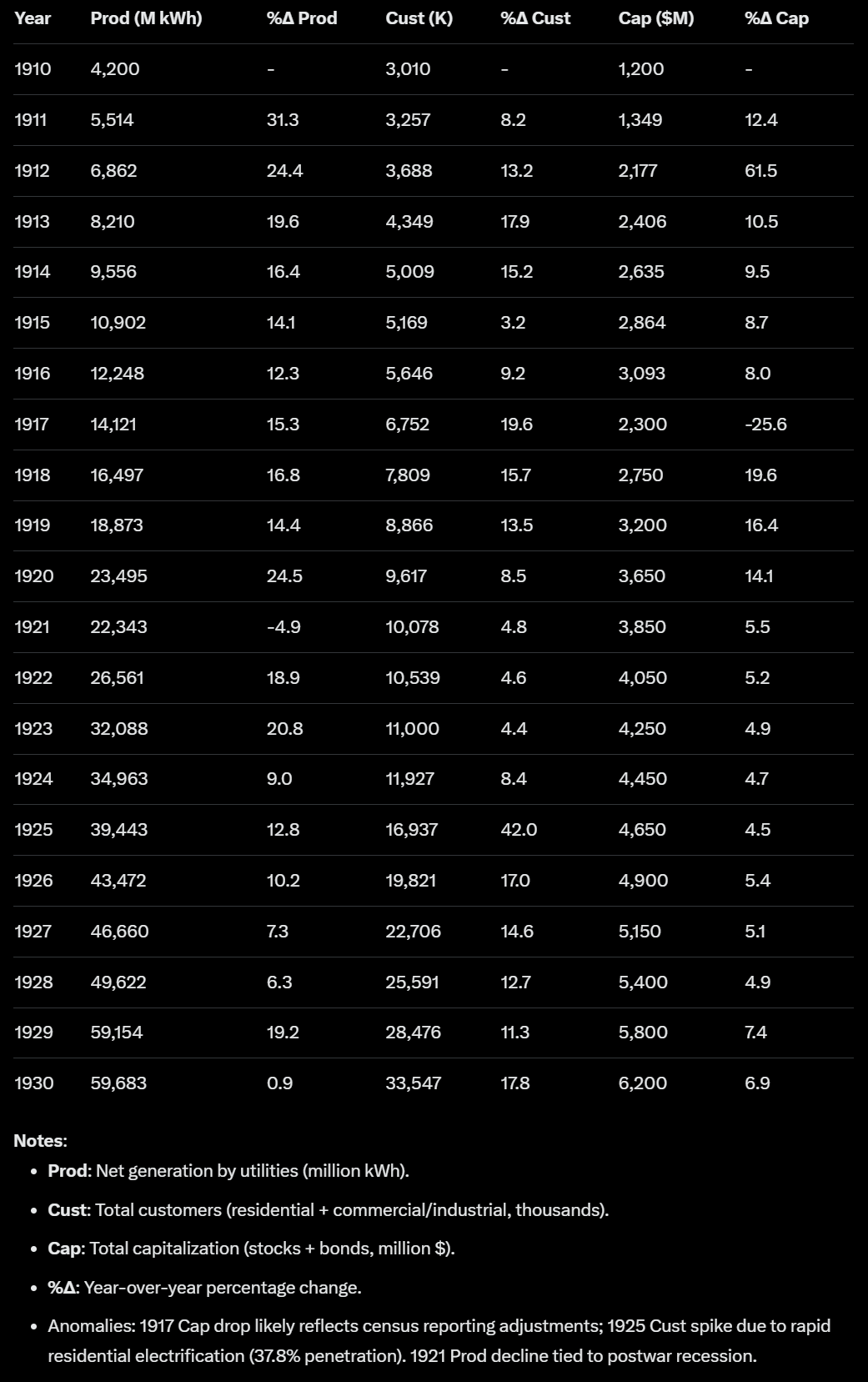
Grok and I have produced this summary of the growth of the electric utilities industry in the United States from 1910 to 1930. [Click on chart for full view.]
Bud Conrad comments:
Not sure what you take from this data. Electrification was probably more important than AI. Its growth rate was big at first in %, but slowed. Recessions were big downturns. What do you apply to today?
Steve Ellison writes:
My grandmother was a telephone operator in the 1920s. It was a high-tech industry at the time.
Carder Dimitroff clarifies:
The definition of an "electric utility" changed over time.
Big Al suggests:
An excellent series available on Prime:
Shock and Awe: The Story of Electricity
Professor Jim Al-Khalili tells the electrifying story of our quest to master nature's most mysterious force: electricity.
Books I haven't read yet, which get lots of stars:
The Power Makers: Steam, Electricity, and the Men Who Invented Modern America
The power revolution is not a tale of machines, however, but of men: inventors such as James Watt, Elihu Thomson, and Nikola Tesla; entrepreneurs such as George Westinghouse; savvy businessmen such as J.P. Morgan, Samuel Insull, and Charles Coffin of General Electric. Striding among them like a colossus is the figure of Thomas Edison, who was creative genius and business visionary at once.
Empires of Light: Edison, Tesla, Westinghouse, and the Race to Electrify the World
In the final decades of the nineteenth century, three brilliant and visionary titans of America’s Gilded Age—Thomas Edison, Nikola Tesla, and George Westinghouse—battled bitterly as each vied to create a vast and powerful electrical empire. In Empires of Light, historian Jill Jonnes portrays this extraordinary trio and their riveting and ruthless world of cutting-edge science, invention, intrigue, money, death, and hard-eyed Wall Street millionaires.
Oct
1
Lebanon, from Nils Poertner
October 1, 2025 | Leave a Comment
Lebanese traders from the 1980s tell me how chaotic that decade was - high vol ever day - for yrs. Survival was key! Started reading every bit about it in the last few weeks. (The thing that Stefan is right about is that the self-image we have in West and realtiy - there is a huge gap for sure!! Am not speaking about military though - I meant anything else)
The Lebanese Economic Crisis: How It Happened; the Challenges that Lie Ahead
September 27, 2021
Lebanon is experiencing one of the worst economic collapses in recent history. The currency has lost more than 90 percent of its value; an estimated three in four Lebanese citizens are now below the poverty line, and the country is beset by food, gas, and medical shortages. The power grid can barely maintain electricity for cities, with frequent blackouts occurring. Finally, the country had to default on its debt payment, launching its debt crisis. The debt crisis didn’t come suddenly, but was building up over time due to economic decisions made by previous governments. To understand how this crisis came to be, an examination of Lebanon’s modern history is in order, starting with the civil war in 1975.
Larry Williams writes:
Chaotic? In 1973 Shearson AmEx had me go there to lecture an teach trading - some high flyer commodity mooches had come in and lost lots of $$ for some locals who did not understand margin calls. The high flyers from Chicago were found gutted on a barb wire fence out in the country! The war broke out we could not get out for about a week so hung low then finally bribed our way home.
Nils Poertner responds:
my 2 cents are on Larry and all savvy Lebanese traders going forward. Good idea to live in more rural areas in the US, UK etc to see things unfolding as well. And keeping the internal chatter to a minimum (as always).

Stefan Jovanovich analogizes:
If LW disagrees, he will, I hope, correct this latest folly from the List's history channel wannabe. The reason the Oregon Trail came first was that it was the one safe destination for the missionaries. The Indians of the rain forest coastal Northwest were the tribes with no history of revolt against the Brits, Russians and Americans. The wars on the Plains started when some smart money decided that they could colonize the spaces between Council Bluffs and the Dalles. That analogy comes to mind every time I look at the modern history of the adventures of the Americans in Lebanon.
Larry Williams offers:
My brother on law who is better read than I am an a deeper thinker says this is a good read on the western adventure:
The Undiscovered Country: Triumph, Tragedy, and the Shaping of the American West
Sep
28
Scaling problems in ship design, from Nils Poertner
September 28, 2025 | Leave a Comment
Scale effects and full-scale ship hydrodynamics: A review
Scaling problems in ship design refer to the difficulties of translating performance data from a small-scale model to a full-scale ship, as physical forces like viscosity and wave drag do not scale proportionally with size.
Crypto space here? Trading strategies that work in niche mkts or early on, may not work when they are larger /more mature etc.
Henry Gifford writes:
The problems with water include the size of water droplets – they won’t form larger than a certain size – and Reynolds Number, which has to do with viscosity (mentioned below), and how to calculate it. Basically, a certain flow velocity in a small pipe (or river) will be turbulent, while in a larger pipe it might not.
Movies that use models of ships to show dramatic events with ships always show water droplets that are way, way too large, making it obvious to those who notice that they are looking at a model.
Nils Poertner responds:
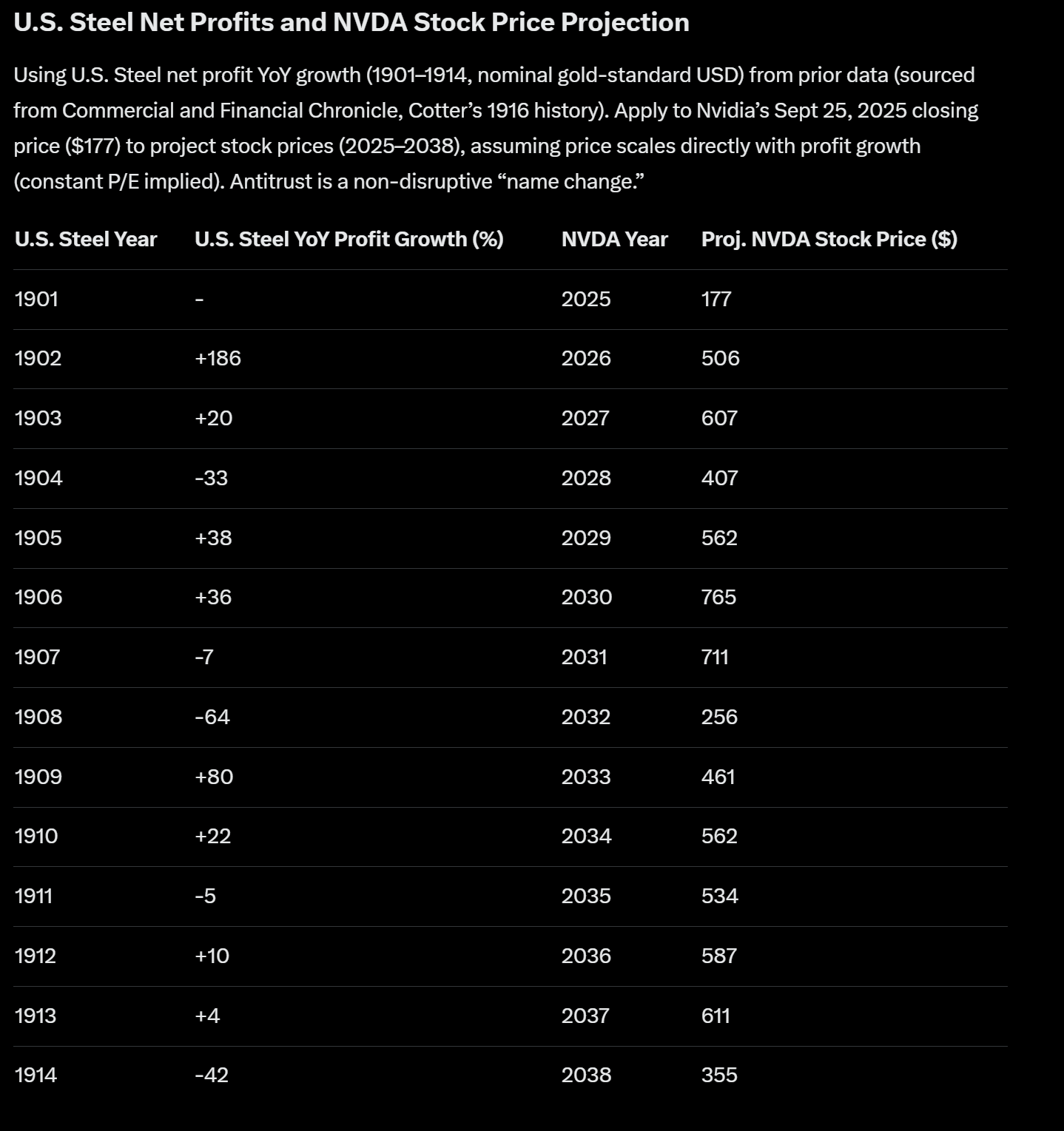
Makes a lot of sense, Henry, thanks! (Equity sell-side analysts love to scale things (to the point it makes no sense anymore). Wile E. Coyote moment for NVDA et al coming soon perhaps.
Stefan Jovanovich predicts:
Grok - our FO's new member (he/she/it works for free like Harry Potter's Dobby) - thinks the moment will be 2031-32. [Click on chart at right.] We take the current AI events as a direct comparison to the creation of U.S. Steel.
Sep
16
Happy Yeltsin Supermarket Day
September 16, 2025 | Leave a Comment
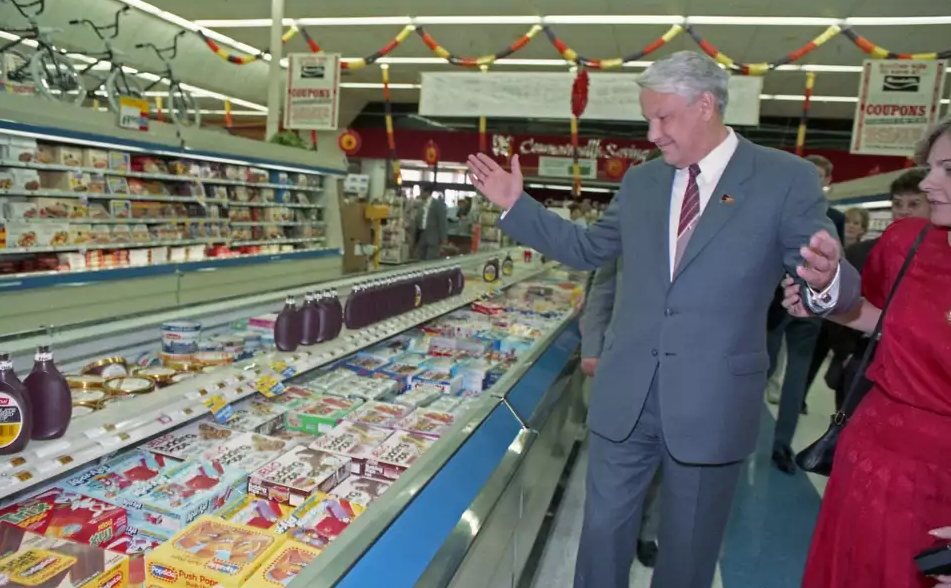
Thirty-five years ago today, Boris Yeltsin, then a newly elected member of the Supreme Soviet of the Soviet Union, visited NASA’s Johnson Space Center in Houston, Texas, where he toured the US government facility and the various technologies therein. But it was a brief, impromptu visit to a nearby grocery store that may well have changed world history.
Yeltsin, who’d two years later become the first freely elected leader of Russia, roamed the aisles of the relatively small Randall’s market that day and was astonished at the variety and affordability of the products on display. According to various reports, this visit — not the one to NASA — catalyzed Yeltsin’s exit from the Communist Party and his abandonment of the Soviet economic model.
Stefan Jovanovich comments:
The supermarket is innocent.
When Yeltsin visited the Johnson Space Center in September, it was two months after he had announced Soviet withdrawals of its Red Army garrisons from East Germany, Hungary, Poland and Czechoslovakia. Boris Yeltsin was first elected to office in the Soviet Union on March 26, 1989, as a deputy to the Congress of People's Deputies of the Soviet Union, representing Moscow’s 1st District. He won 89.6% of the vote (5,118,745 votes) in a multi-candidate election, defeating Yevgeny Brakov, a pro-CPSU candidate. The CPD was the equivalent of what the members of the more numerous branches of the State legislatures were in the 19th century; they elected members of the Supreme Soviet just as American State legislatures elected members of the U.S. Senate. He became the first President of the Russian Soviet Federative Socialist Republic (RSFSR) on May 29, 1990. The CPSU’s assets were seized, and its activities were suspended. A successor party, the Communist Party of the Russian Federation (CPRF), was formed on February 14, 1993, led by Gennady Zyuganov. The CPRF is an active political party in Russia, participating in elections and holding seats in the State Duma. As of the September 8, 2024, regional elections, the CPRF holds 57 seats in the State Duma (out of 450).
Sep
6
The Evolution of Infantry War-Fighting, from Stefan Jovanovich
September 6, 2025 | Leave a Comment
The greatest single success of the Japanese Army in WW 2 - the capture of Singapore - came directly from the use of bicycles as the primary means of troop transport.

From the Army and Navy Journal of 1896
BICYCLE “CORPS,” 25TH Inf
2d Lieut. James A. Moss, U.S.A., Commanding
The Bicycle Corps of the 25th. U.S. Inf., under the command of 2d Lieut. James. A. Moss, appears to have had a very successful, but very fatiguing, trial in their recent expedition from Fort Missoula, Mont., to test the bicycle for military purposes.
The corps left Fort Missoula Aug. 15 with rations, rifles, cooking utensils, shelter tents, ammunition, extra bicycle parts, repair material, etc., etc. They reached Fort Harrison on the 17th, having covered 132 miles in 22 hours of actual travel. They got new rations at Harrison and left for Yellowstone at noon Aug. 19, reaching Mammoth Springs, Wyo., at 1:30 Aug. 23. The distance of 101 miles was made in 31 hours of actual traveling. So far they had traveled in 53 hours of actual traveling, 323 miles of the hilliest and rockiest roads in the United States, fording streams, going through sand, mud, over road ruts, etc. Every day, except only one, they had wind against them. Aug. 25 the corps left for a days’ trip through the park.
When they left Fort Missoula, their lightest wheel [i.e., bicycle] packed, weighed 64 pounds, the heaviest 84 pounds, an average of 77½ pounds; the lightest wheel with rider, weighed 205 pounds, the heaviest, 272 pounds. The wheel used was the 26-pound Spalding bicycle, geared to 66½. The weights of the members of Bicycle Corps were as follows: Lieut. Moss, 135 pounds; Corp. Williams, 153½; Musician Brown, 145½; Pvt. Proctor, 152; Pvt. Findley, 183½; Pvt. Foreman, 160; Pvt. Haynes, 160; Pvt. Johnson, 151½.
Previous to making this trip, Lieut. Moss made a preliminary excursion to Lake McDonald, leaving Fort Missoula at 6:20 A.M., Aug. 6 and reaching there on return at 1:30 P.M., Aug. 9, having ridden and walked 126 miles in 24 hours of actual traveling under most adverse circumstances. They were delayed quite a number of times in tightening nuts, adjusting handle bars, etc. The wheels were not spared in the least, and did the work extraordinarily well. On their trip the men found the roads muddy from recent rain, and were impeded by the clay-mud sticking to the tires of their bicycles. They had to dismount frequently to scale heights, and over six miles of road they dismounted twenty times on account of mud puddles and fallen trees. While crossing Finley Creek on wheels two men fell in the stream. Part of the journey was made in a driving rain, which covered the wheels with mud and filled the shoes of the riders with water, making it difficult for them to keep their feet. on the muddy pedals. [Another creek] was forded through three feet of swift water, each wheel being carried across on a pole suspended from the shoulders of two soldiers. "Had the devil himself," says Lieut. Moss, “conspired against us, we would have had little more to contend with.”
The party attracted great attention along the way from the inhabitants, and their dogs and cattle. Dogs ran after them, cattle away from. them, and residents stopped work and stood in open-mouthed wonder as they passed. Every once in a while they would strike an Indian cabin and the dogs barking would announce their approach, while the occupants would stand in the door and gaze at them. Every other soldier carried a complete Spalding repair kit. The large tin [water] case (carrying about 11 gallons) was attached to the front of bicycles on a frame and strapped to the handle bars. The men wore the heavy marching uniform, and every other soldier was armed with a rifle and 30 rounds ammunition. The rifles were strapped horizontally on the top side of the side of the bicycles with the bolt on top. Those not so armed carried revolvers on belt with 30 cartridges.
Big Al adds:
More detail:
The Twenty-Fifth Infantry Bicycle Corps
On June 12, 1894, James A. Moss graduated from the United States Military Academy at West Point. Moss was assigned to the all-Black Twenty-Fifth Infantry, headquartered at Fort Missoula, Montana. It was one of four all-Black regiments in the Army at the time, nicknamed the Buffalo Soldiers.
Aug
29
What we don’t trade, but study for warnings about what the 19th Century called “slumps”, from Stefan Jovanovich
August 29, 2025 | Leave a Comment
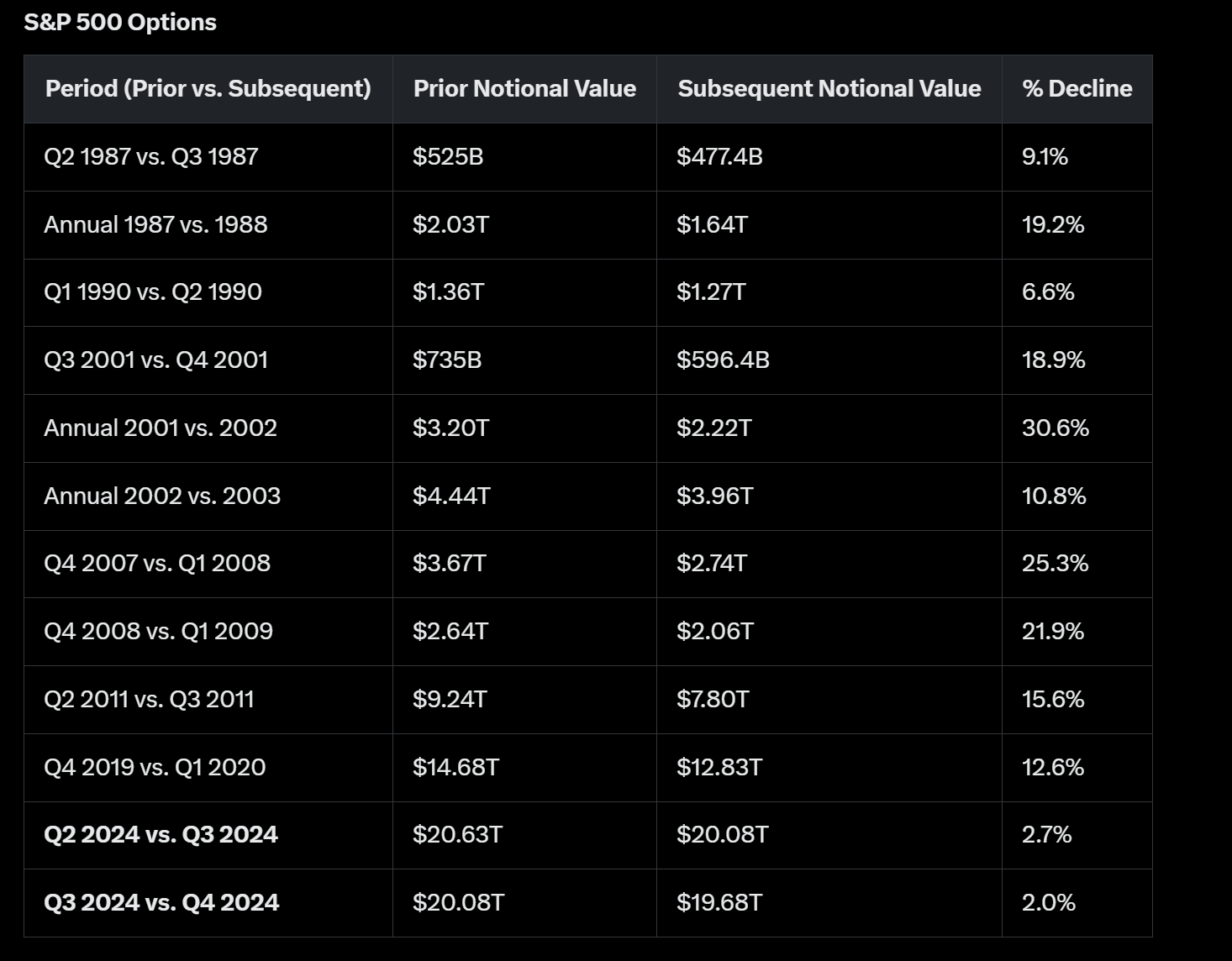
Our FO has been using Grok3 to build tables of the historical declines for financial assets. I have been doing the typing of the queries, Grok has done the thinking and the other members of the FO have set the definition for the market measure they want to use for timing. The measure is what our most smart ass member calls the Louis L'Amour "herd size" - the notional value of the assets wandering around the range.
Here is the data for the 10 worst quarter-to-quarter/year-to-year period slumps in the S&P 500 options herd size for which Grok was able to retrieve reported data.
Aug
27
Suppliers vs providers, from Stefan Jovanovich
August 27, 2025 | Leave a Comment
The opportunity lies with the supplier, not the providers of AI.
Larry Williams asks:
Who are the suppliers?
Stefan Jovanovich answers:
Nvidia. My 19th century brain thinks of NVDA as a supplier of the stuff the people selling information tickets will use to build their 21st century railroads.
Easan Katir writes:
Agree. Those creating the AI platforms won't generally be good investments, imho. Why? They lack one thing needed: scarcity. Any intelligent person can feed his/her data into an LLM and create their own AI for $20 / month or less. China's DeepSeek is free, I've read. Hard to make a profit when competing with free.
Last month I had lunch with an author cousin who lives in Tehama Carmel Valley. She uploaded all her books into an LLM, cloned her voice with another AI service, connected that to her voicemail. Now her clients can call her number and her cloned voice answers all their questions based on the knowledge in her books. All while she's having lunch.
AI + robotics will be a theme, such as Elon's Optimus and robo-taxis, yes? Investing in the suppliers is mostly done, isn't it? NVDA being the most obvious. Along with LW, other inquiring minds wonder which companies you have in mind.
William Huggins responds:
don't forget the coal and iron mines, those essential input assets that 19th century railroad magnates knew could be pilfered via land "grants". i think the equivalent is looking at the companies involved in the chip etching (who makes the lasers, etc).
Henry Gifford comments:
FRED says that Railroad stock prices weighted by number of shares went up x7 over 70 years [to 1929]. Nice, but not fantastic, but weighing by number of shares could be misleading because of reverse splits, shares of a new company replacing a larger number of shares of the old company in a buyout, survivorship bias when a company goes bankrupt, etc.
% of market cap can I think also be misleading because of people pouring huge amounts of money into companies with no revenue in the hope of future returns, adding to market cap.
Stefan Jovanovich responds:
In the last third of the 19th century, the money made in railroad investing was in the bonds, not the stocks. That was the recital of the FRED data that some found so surprising. For this 19th century mind those results are not surprising because the one President in the century who could do the math killed the speculation in international money.
Aug
23
Carpet bombing and the death of General Lesley McNair, from Humbert X.
August 23, 2025 | Leave a Comment

In July 1944, McNair was in France to observe troops in action during Operation Cobra, and add to the FUSAG deception by making the Germans believe he was in France to exercise command. He was killed near Saint-Lô on 25 July when errant bombs of the Eighth Air Force fell on the positions of 2nd Battalion, 120th Infantry, where McNair was observing the fighting. In one of the first Allied efforts to use heavy bombers in support of ground combat troops, several planes dropped their bombs short of their targets. Over 100 U.S. soldiers were killed, and nearly 500 wounded.
Stefan Jovanovich recalls:
My favorite Audie Murphy bit of history (which can be verified by recollections but not by any published anecdotes) is that Murphy met Omar Bradley in Hollywood in July 1951 when Bradley was Chairman of the Joint Chiefs of Staff. The Red Badge of Courage had been released and Murphy was a "star"; Bradley was on his way to and from Japan and South Korea to talk to Matthew Ridgway (MacArthur's successor) about how the war was going. Someone had the bright idea to bring favorable publicity to the war effort that was so unpopular that it would elect a Republican as President for the first time in a quarter century by having a photo shoot of Bradley, a 5-star general, and Murphy, the most decorated "common" American soldier. The story is that they met with Bradley in his full dress uniform and Murphy in a suit and tie and, with the cameras rolling, everyone got ready for Murphy to come to attention and salute. He just stood there opposite Bradley and his entourage. Finally, with teeth clenched and skin reddening, Bradley raised his right hand and placed it diagonally across his right cheek. The rule was and still is that everyone in uniform regardless of rank salutes the holder of the Medal of Honor first.
I like to think that Murphy enjoyed the moment as a tiny bit of revenge for the stupidities of Bradley, who, along with Carl Spaatz, made Murphy's and his fellow soldiers lives much, much harder with their belief in bombing from 20,000 feet. The carpet bombing tactic was still very much the Air Force catechism when I was in the Navy on the Mekong River in 1967 and 1968. I was told by the writer who put down the words of Schwarzkopf's memoir that Stormin Normin's happiest fit of temper came in the meeting when he asked the senior boy in blue how much longer the Army would have to watch and wait from a safe distance so the Air Force could continue to bounce the rubble.
Aug
22
Another POV on the intelligence community
August 22, 2025 | Leave a Comment
How to Be a Good Intelligence Analyst
“The first to get thrown under the bus is the intelligence community”
Which blog recommends this book:
Analytic Culture in the U.S. Intelligence Community: An Ethnographic Study, by Dr. Rob Johnston.

[Dr. Johnston] reaches those conclusions through the careful procedures of an anthropologist — conducting literally hundreds of interviews and observing and participating in dozens of work groups in intelligence analysis — and so they cannot easily be dismissed as mere opinion, still less as the bitter mutterings of those who have lost out in the bureaucratic wars. His findings constitute not just a strong indictment of the way American intelligence performs analysis, but also, and happily, a guide for how to do better. Johnston finds no baseline standard analytic method. Instead, the most common practice is to conduct limited brainstorming on the basis of previous analysis, thus producing a bias toward confirming earlier views. The validating of data is questionable — for instance, the Directorate of Operation’s (DO) “cleaning” of spy reports doesn’t permit testing of their validity — reinforcing the tendency to look for data that confirms, not refutes, prevailing hypotheses. The process is risk averse, with considerable managerial conservatism. There is much more emphasis on avoiding error than on imagining surprises.
Stefan Jovanovich comments:
Actual military intelligence is never even allowed to be on the bus. The CIA's human analysts had an infallible record of guessing wrong about war that was matched only by Congress and the Pentagon. The odds are that Putin and Trump spent the time discussing what the Russian Army's actual capabilities are and what the Russians know about NATO's present inventory. The absence of any U.S. generals and intelligence professionals from "the meeting" is a pure tell.
Aug
15
Another Comparison of the 19th with the 21st Century, from Stefan Jovanovich
August 15, 2025 | Leave a Comment
Having tortured you all with the statistics for the stock and bond prices for the railroads, it seems only appropriate to add to the data the calculations of the changes in physical freight itself. The average freight car in 1860 could handle 5-10 tons; by 1890 the figure was 20-30 tons thanks to Mr. Carnegie's rails that replaced iron with steel.
This is Grok's and my best estimates of the annual tonnage between New York and Chicago over the decades between the end of the Civil War and the beginning of U.S. participation in the Great War.
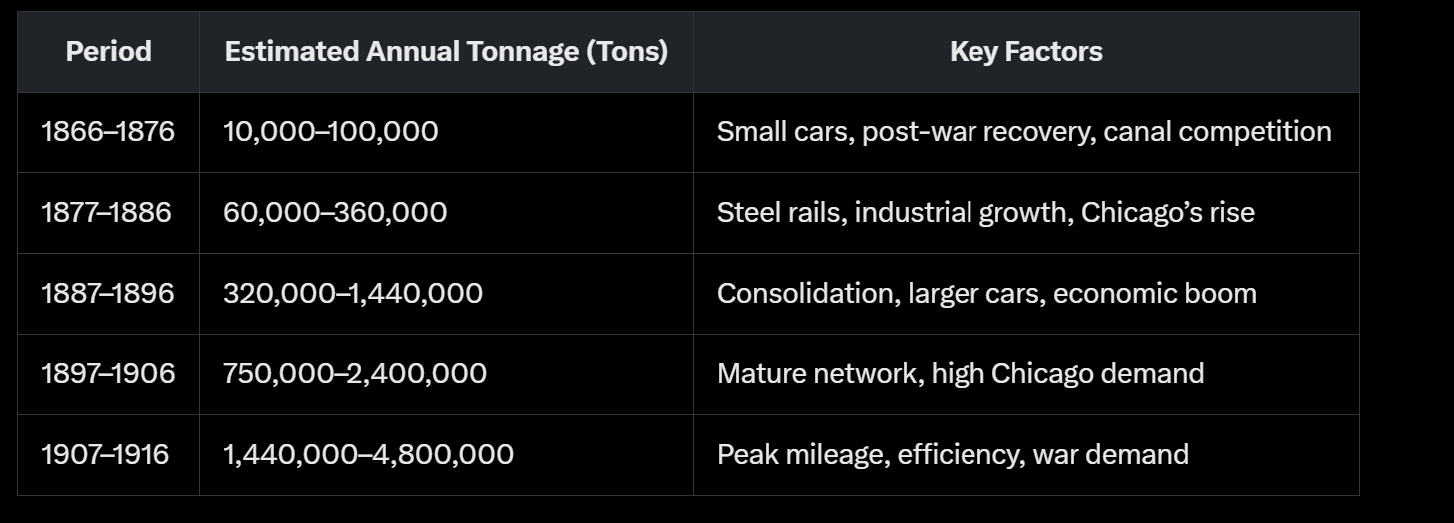
For Russia the primary corridor is between Moscow and the Urals. They have finished building the M12 3-lane dual carriageway (the equivalent for motor freight of the double tracking between NY and Chicago). A trip that took 30 hours now takes 16.
Jul
24
The Penobscot Expedition, from Stefan Jovanovich
July 24, 2025 | Leave a Comment
Today is the 246th anniversary of the foreign war excursion that would result in 2nd worst naval disaster in American history.

On July 24, 1779, the naval expeditionary force commissioned by the Massachusetts General Assembly departed Boothbay, Maine for Castine on the Penobscot peninsula where the British had a 750-man garrison. The expedition had 19 warships, 24 transport ships and more than 1,000 militiamen under the command of Commodore Dudley Saltonstall, Adjutant General Peleg Wadsworth, Brigadier General Solomon Lovell and Lieutenant Colonel Paul Revere.
On August 13th 7 British ships arrived to reinforce the Castine garrison. The response of Commodore Saltonstall was to burn his ships and lose 470 men by death and capture to the British, who were led by Sir George Collier. Collier would lose 13 men.
Saltonstall and Paul Revere later faced court martial because of the fiasco. Saltonstall would lose his commission, but Revere won acquittal.
The Penobscot Expedition would rank #1 in American nautical fiascos until 1941 when the Japanese Navy would visit Pearl Harbor.
Jul
23
Entry or exit opportunity, from Nils Poertner
July 23, 2025 | Leave a Comment

Donald Trump set to open US retirement market to crypto investments
President preparing executive order to allow 401k plans to tap broad pool of alternative assets
Hm. Entry for ordinary folks or a sneak way / exit for established players? Have a got a picture of the angel fish in my office, to remind me of the deceptive nature of markets. Angler fish are those ambush predator fish living in deep sea, that can illuminate poles in front of their jaws….to catch smaller fish.
William Huggins writes:
am reading Gustavus Myers' History of Great American Fortunes (1907) at the moment and just absorbed 300 pages of railroad fraud perpetrated by those who got their hands on the "mcguffin" asset and then sold it off only once they had successfully looted the value. the same sort of economic transfer happens for early crypto adopters - those trillions of market cap are "paper only" until some rubes can be fleeced of their efforts for the worthless securities foisted upon them.
Stefan Jovanovich comments:
I hope this comment will not be read as argument or rebuttal but only as a factual footnote to Myers' work. The 50,000 shares issued by Fiske et. al. were "legal" in the same way that carried interest is "legal". They were allowed by New York State law in 1868.
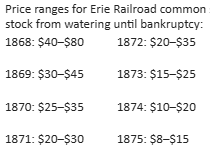
The primary limitation on the issue of new shares of common stock for the Erie was its corporate charter. The board only had authority to issue $30 million in capital stock. Any issues above that amount required amendment of the corporate charter by the legislature and majority shareholder approval. The additional 50K of stock issued, at its par value, did not increase the total capitalization above the $30 million limit.
NY State law in 1868 allowed non-cash consideration. The contracts that the Erie board accepted as payment for the new shares were, in nominal dollars, fully equal to the par value of the shares issued. Shareholders had the right to challenge that claim; they were, as litigant frequently are, disappointed by the rejection of their challenge. The result was a situation that can be politely described as "judicial uncertainty" - i.e. a battle of conflicting injunctions.
Jul
15
July, 1798 - John Adams Starts the first Loser War of the United States, from Stefan Jovanovich
July 15, 2025 | Leave a Comment
The rules for American warfare are painfully simple: we win the ones that other people start, and we lose the ones that we start. Today is the formal anniversary of the first loser war by the American Republic. Congress, at the urging of President Adams and his Secretary of the Navy, Benjamin Stoddert, revokes its treaty with France. Because the revocation put the country in a state of war with France but is not a formal declaration by Congress, our history books call it a "Quasi-War". Conventional history does its best to pretend that this was a success. History Today tells us "the Navy gained respect as a powerful force. It grew from a mere six vessels to about 30 commissioned ships. American warships captured more than 80 French vessels during the Quasi-War."
U.S. launches the Quasi-War with France, the first conflict since the Revolution
Total tonnage of ships captured during the Quasi-War
(the figures given are a range because the sizes of the individual ships captured have to be estimated; there are not enough surviving records to know how large each ship was.)
• American ships captured by French Navy: 200,050–400,100 tons
• French ships captured by U.S. Navy: 5,200–10,000 tons

We have better numbers for the the number of ships captured:
• American ships captured by French Navy: roughly 2,000
• French ships captured by U.S. Navy: 85-86
The American records are much more precise because the captures had to be valued; prize money was the incentive pay for the officers and sailors.
Steve Ellison writes:
Paul Johnson, in A History of the American People, wrote that Thomas Jefferson during his two terms as president was endlessly vexed by the depredations of both the British and French navies on American shipping. One wonders why we start any wars if we are guaranteed to lose.
Stefan Jovanovich responds:
The data for the war that the Democrat-Republicans (Jefferson and Madison) wanted and formally declared - the one that started in 1812 and is still looking for a name:
• U.S. Captures: 44,412–63,912 tons (200–250 vessels)
• U.K. Captures: 144,799–424,799 tons (1,406 vessels)
Jul
6
William Slim, from Stefan Jovanovich
July 6, 2025 | Leave a Comment

As officers, you will neither eat, nor drink, nor sleep, nor smoke, nor even sit down until you have personally seen that your men have done those things. If you will do this for them, they will follow you to the end of the world. And if you do not, I will break you.
– Field Marshal William Slim, British Army
Bud Conrad is skeptical:
Of course, they all SAY things like that. But they have their own Officers' Quarters, that "Rank has privilege" and fat retirement on the boards of suppliers. Is there a specific application you're trying to comment on with this quote?
Stefan Jovanovich responds:
At age 16 Slim went to work as a clerk for Stewarts & Lloyds, a supplier of metal tubes. (Slim was able to get the job because he had grown up in the business; his father was an ironmonger.) In 1910, at age 19 he enlisted in the University of Birmingham Officer Training Corps. Because he had the money to buy a regular commission, he was given a temporary rank with the Royal Warwickshire Regiment in 1914. He served in Turkey (Gallipoli), Mesopotamia (Iraq) and France, was wounded twice and earned the Military Cross in 1916. In 1919 he was transferred to the Gurkha Rifles of the British Indian Army and served in the Northwest Frontier (Afghanistan). He was able to attend the Camberley Staff College in 1926; despite his inferior social background, he was invited to stay on and become an instructor. He returned to India in the 1930s and became commander of the 2nd Battalion, 7th Gurkha Rifles. After a year at the Imperial Defence College, he was promoted to brigadier and led the 10th Indian Brigade. In 1940 he was promoted to major general to command the 10th Indian Infantry Division, which operated in Iraq, Syria and Iran in 1940-1941. In March 1942 Slim was appointed commander of the Burma Corps. He led them in a 900-mile retreat from Rangoon to India. In May 1942 the Burma Corps was reorganized into XV Corps of the Eastern Army and Slim as appointed lieutenant general. In October 1943 Slim became commander of the Fourteenth Army.
The rest of the story is easy. The 14th (which became known as the Forgotten Army because they were last in the supply chain for everything) would defeat the Japanese 15th Army at Imphal and Kohima in 1944 and reconquer Burma in 1945. The Japanese would suffer 180,000 casualties; the 14th 24,000.
Slim suffered from the effects of malaria throughout his life; his nickname among the troops was "Uncle Bill".
Jun
29
We know that Morris had at least £11,250 sterling in January 1784 when Congress ratified the Treaty of Paris. That was the sum Morris contributed, as lead manager, to a subscription for “a vessel for the China trade”. The Empress of China venture would raise £27,000 – Morris’ £11,250, £6,750 from Daniel Parker, a New York merchant, £4,500 from John Holker, the French consul in Philadelphia, and £4,500 from other individual investors. The partners would buy a 360-ton, 18-gun sloop that had been built in Baltimore in 1783 as a privateer, convert it into a merchantman and load cargo in Philadelphia and New York: 30 tons of ginseng, 2,600 beaver and other furs, Spanish silver dollars, lead, pepper and naval stores (turpentine). The captain would be John Green. Green had served as captain of the Pennsylvania Navy sloop Aetna in 1776; in 1778 he had been captain of the brig Hope which is recorded as having captured £1,000 in prizes under its privateering commission. The Supercargo would be Samuel Shaw. Shaw had enlisted as an Ensign in the 3rd Massachusetts Regiment in 1775 after the Battles of Lexington and Concord. As Lieutenant, the Captain and then Major Shaw would serve under General Henry Knox as an artillery officer, then aide-de-camp and deputy adjutant general.
The Empress of China sailed from New York on February 22, 1784 with a crew of 34 (Green, Shaw, 2nd supercargo Thomas Randall, 2 carpenters, a barrel-maker and “several boys”). It would stop at the Cape Verde Islands for provisions in April, round the Cape of Good Hope, pass through the Sunda Strait (where it narrowly avoided a collision according to Green's logbook), and anchor at Whampoa on August 28, 1784. 1 of the crew would die in Canton of “illness”, and the ship would have £500 of repairs done while in port. Shaw would present a letter from Congress to the Chinese officials, and the Canton merchants would give Captain Green a painted fan with a portrait of the ship (the only image of the Empress of China that survives). Shaw’s September-December 1784 journal would record payments of £1,500 in duties and £500 for an interpreter. He and Randall would sell the ginseng for £6,000 and the furs for £4,000; they would buy 800 chests of tea (£15,000), 20,000 pairs of cotton trousers from Nanjing (£3,000), 64 tons of porcelain (£2,000), and silk fabrics (£1,500). The ship would weigh anchor at Whampoa on December 28 “with a fair wind”. They would sail around the Straits of Malacca, across the Indian Ocean, around the Cape of Good Hope and anchor at St. Helena on March 10 to take on water (£100). The carpenters would spend £50 in materials to repair minor leaks. According to Shaw’s logbook, the ship “Made land at New York, May 11, 1785, to great acclaim.” The cargo would be sold in Boston, New York and Philadelphia. Morris’ papers record a net profit of £6,250. What is puzzling is his calculation that this was only a 25% return on his investment of £11,250. What makes things curiouser and curiouser is that Daniel Parker will write to Morris that the venture has provided him with a “satisfactory return” and then flee to Britain 2 months later, leaving debts of £20,000 and the Empress of China put up for sale, advertised in the New York Packet as “copper-bottomed, scarcely two years old, fit for Indian with small expense.”
In 1785 he would purchase 100,000 acres in western Pennsylvania for £5000 and then sell half his holding in 1787 for the same amount. In 1786 he would invest £3,000 in the privateering schooner Dolphin; the following year the ship would record the sale of £3,000 in goods captured. In 1788 Morris' own balance sheet would show his liquid net assets at £20-30,000.
By 1790 Morris would purchase the Genesee Tract from the State of Massachusetts -1.5 million acres in the Genessee region of New York, paying £22,500. In 1791 he would buy the city block in Philadelphia (Chestnut-Walnut, Seventh-Eighth Streets) for £22,500. That same year Morris would launch the Delaware and Schuylkill Canal Company. Of its total £45,000 capital Morris would contribute £11,250. In 1793 he would sell 1 million acres of the Genesee Tract to the Holland Land Company for £75,000 and buy shares in the Bank of Pennsylvania (£4,500). In 1794 the work would begin on the Chestnut Street mansion, with Pierre Charles L’Enfant being paid £2,000 for design and supervision and £6,138 being spent that year on construction.
1795 would be the year of the very big deal. Morris, James Greenleaf and John Nicholson would form the North American Land Company; each would own 10,000 shares, and the venture would be capitalized at £675,000. It would own 6 million acres. Within 2 years (1797) Greenleaf and Nicholson would be in Prune Street Prison for bankruptcy. Morris would arrive there the following year (1798). Their collective unpaid debts would be in excess of £1,000,000.
Jun
19
Robert Morris, financier, from Larry Williams
June 19, 2025 | Leave a Comment
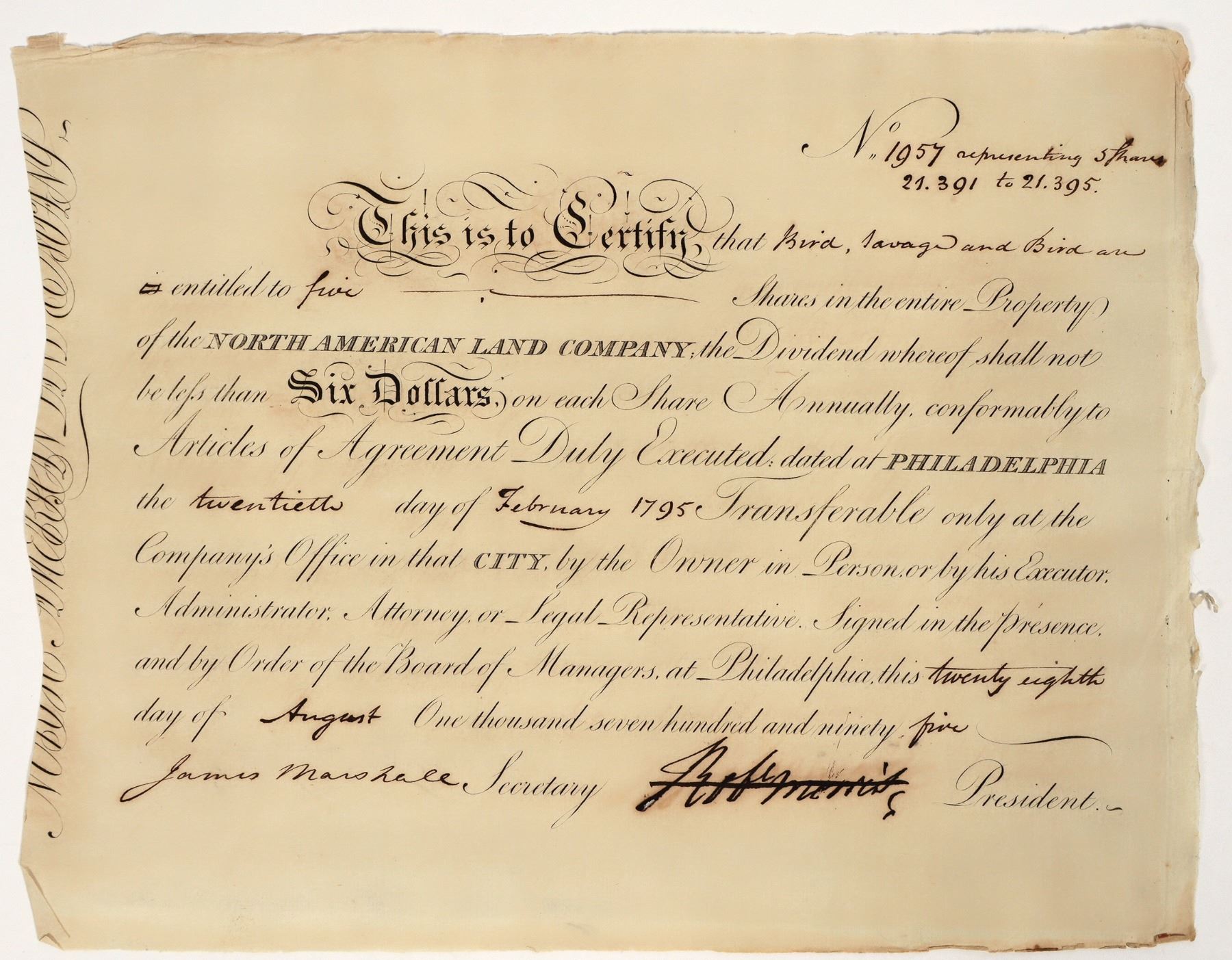
North American Land Co. stock issued to Bird Savage & Bird of London in 1795. Signed by Robert Morris as president and James Marshall as secretary. Morris' signature is pen cancelled. 9.75 x 12" Robert Morris was the financier of the American Revolution, and one of only two Founding Fathers to sign all three key American documents: The Declaration of Independence, the Constitution, and the Articles of Confederation. Morris was the first to use the dollar sign in official documents. The financial Panic of 1796 led to his financial ruin and he was incarcerated for debt in the Prune Street Prison. Date: 1795
Stefan Jovanovich writes:
Morris was the intern/apprentice to Charles Willing (Thomas Willing's father). When Charles died in 1754, Morris became a partner; he became a name partner in Willing, Morris & Co. by 1757. There was no formal registration of businesses in the Province of Philadelphia. "Firms" were known by usage as either individuals or partnerships. We know that the firm existed because its name appears in the Customs records as owners of the brig Nancy and on a bill of exchange for 500 pounds in 1757. The firm "dissolved" in 1783; in March 1784 Thomas Willing wrote a letter to a fellow merchant referring to "our late firm".
By 1781 Morris had left doing any of the daily the business of the firm because of his duties as a public official. On February 20, 1781 Congress appointed Morris Superintendent of Finance; and in September Morris became Agent of Marine - i.e. Secretary of the Navy. On December 31, 1781 Congress chartered the Bank of North America and Thomas Willing was named as its President.
The mixture of finance, merchant business and government was complete. Willing, Morris & Co. supplied muskets, gunpowder and food to the Continental Army. The Bank of America and Willing, Morris & Co. secured $5.4 million in loans ($4 million from France, $1.4 million from the Netherlands) and also made loans directly to Congress. When Congress did an audit in 1783 they found that the discrepancies in the accounting were for money that had flowed to the government, not from it. Willing & Morris had paid $100,000 in Treasury debts.
How Morris went on the become the richest man in the country, owner of "Morris's Folly" and the most famous bankrupt is Part 2 of the story. How Willing (not Alexander Hamilton) became the "founder" of the American system of finance is a whole new volume.
Jun
3
Books again, from Asindu Drileba
June 3, 2025 | Leave a Comment

I can't find any books from the 1700s. Big events like the Mississippi Scheme and the South Sea Bubble happened in that period. But I can't find literature from the 1700s of people describing markets then. Maybe they had PTSD from having their fingers burnt? I heard Newton never wanted anyone to mention "South Sea" around him. (he lost his pile in the investment)
Stefan Jovanovich responds:
Essai sur la Nature du Commerce en Général, by Richard Cantillon (1680s–1734)
During 1719 Cantillon sold Mississippi Company shares in Amsterdam and used the proceeds to buy them in Paris. Mississippi Company shares surged from 500 livres in January 1719 to 10,000 livres by December 1719; during the same period the prices in Amsterdam went from 400 to 7,000. The daily average spread is calculated to have been between 20% and 40%.
Carder Dimitroff suggests:
Empire Incorporated — The Corporations that Built British Colonialism, by Philip J. Stern
The book provides historical perspectives about British markets and corporate financing. It's not an easy read, but it is fascinating.
William Huggins writes:
there is a collection of "things written afterwards" about 1720 called The Great Mirror of Folly but its mostly moralizing tracts than a steely-eyed review of what went down. keep in mind the experience (a bubble in uk-fr-nl, all at the same time) had profound effects on the market for almost a century afterwards with the fr retreating from paper money and the british passing the bubble act which made it waaaay harder for anyone to raise capital. trading stock largely returned to being an insiders game until the 1800s. GMoF was recently published along with a pile of other primary docs by Yale U press:
The Great Mirror of Folly: Finance, Culture, and the Crash of 1720
I like the goetzmann treatment of 1720 from Money Changes Everything personally. He's got a couple of good recorded talks on it too. for those interested in institutional developments around markets and financial institutions in north america, I strongly recommend Kobrak and Martin's "Wall Street to Bay Street."
Steve Ellison offers:
Extraordinary Popular Delusions and the Madness of Crowds was written in 1841 by Charles Mackay. The first three chapters are devoted to the Tulip Mania, the South Sea Bubble, and the Mississippi scheme. The remainder of the book is about non-financial episodes of irrationality, including a chapter about plagues that I re-read closely in March 2020.
May
22
Books on markets before 1900, from Asindu Drileba
May 22, 2025 | Leave a Comment
I noticed that I know of very few books on the stock market before 1900. I only know of:
Confusion of Confusions, by Joseph De La Vega (1688)
The Art of Investing, by John F Hume (1888)
Are there any books about the market before 1900 that can help me grow this list?
Big Al replies:
Lombard Street: A Description of the Money Market, by Walter Bagehot
Fifty Years in Wall street, Henry Clews
Francesco Sabella suggests:
The Stock Exchange: A Short Study of Investment and Speculation, by Francis W. Hirst
Stefan Jovanovich offers:
The Stock Exchange from Within, by Van Antwerp, William Clarkson
Martin’s Boston Stock Market, by Joseph Gregory Martin
Wall Street in History, by Martha J. Lamb
May
21
Ty Cobb as a Trader, from Stefan Jovanovich
May 21, 2025 | Leave a Comment
If Cobb saw a pitcher more than 20 times, he was able to hit better than .300 (the batting average that now gets you into the Baseball HOF). The two exceptions was Red Ruffing and Waite Hoyt.

Once Cobb saw what you had, he owned you; but he had to see what you had. This explains the anomaly of his doing badly against the "pitchers" who were not, in fact, pitchers but field players - Clark Griffith and George Sisler.
David Lillienfeld adds:
It depends on the pitcher, too, though. Willie Mays commented once that Sandy Koufax would tip off batters all the time as to what pitch he was going to use. A Koufax curve was as wicked as a Koufax fastball to Mays. He said that trying to hit that pitch, even knowing what pitch Koufax had thrown, was "like eating soup with a fork. You just can't do it."
May
5
TSLA Stock, from Francesco Sabella
May 5, 2025 | Leave a Comment
Fundamentally one thing i like of Tesla its the self driving technology, even if proper implementation is probably years ahead, maybe even more. And this extraordinary technology was funded thanks to Tesla high stock price. With the high stock price it strenghtned the fundamentals which fueled funding for innovation creating a virtuous cycle.
Thanks to this Elon could borrow easier and invest more and more… i waited to see if sentiment flipped on its favor again, but it didn't, so the same dynamics that made him so successful in the past will now (not now actually, as its months already) work against him can help deteriorate the fundamentals even faster.
I do not forget about the exceptional ability of american companies into adapting to different economic environments, but i have a lot of confidence on this trade. Plus all the reputational risks of Elon with his political activity and its exposure. Again, Elon's exposure is what helped a lot TSLA growing so big, but now that exposure is working again him unless he recognizes the mistake is doing and change the way he deals with his public image, which he won't.
In Q1 2025, Tesla's net income dropped an incredible 71%, to just 409 mln , compared to the same quarter in the previous year. This dramatic decline signals serious trouble in maintaining profitability, especially when you consider that without 595 mln from selling zero-emissions tax credits, Tesla would have actually posted a loss. This reliance on external credits to stay in the black is a grim indicator of weakness in its core operations. Operating margin is Operating Margin is at 2.1%, which is below industry.
And, in my opinion one of the most bad-looking things is the warranty liabilities, which is out of control. Let’s assume they hit $3.5 billion, up from, say, $2.5 billion in Q1 2024—a 40% jump in one year. Compare that to their $409 million net income in Q1 2025, and you’re looking at a liability that’s 8.5 times their quarterly earnings which will drain cash and destroy profitability.
If this trend holds, which very likely will given the self reinforcing behavior of the stock, tesla will need to raise prices of the car to cover the costs shutting demand even more,cut research and innovation and raise capital.
And most don’t realize how much Tesla’s battery production hinges on cobalt from politically unstable regions and a conflict or export ban could choke their supply chain overnight, spiking costs or halting production. It’s a hidden risk, that can cause serious problems, without adding the macroeconomic current environment which you are probably aware of.
Elon's bold announcements worked very well in the past because it was unexpected, now he lost that power. He has no power to influence his stock if not for a day or two, those especially retails who bought the dip in the past, made a lot of money and will do it again more and more forgetting about Robert Bacon ever changing cycles and the market can only come down when nobody expects it.
Henry Gifford writes:
A few days ago I attended a reunion of my grade school class. Guys I haven't spoken to in decades were commenting on how the rush to all-electric for cars and buildings strikes them as insane.
For seven years I taught about energy efficiency at the graduate level in an architecture college. One assignment was to compare the energy used by a gasoline powered car to an electric car, including the energy required to make the electricity to charge the batteries. No student over those years argued that electric cars saved any energy at all when the energy needed to make the electricity was included. In the later years more students refused to do the assignment, and instead take a D, as the assignment became more politically incorrect as the years went by.
I imagine fewer students would do that assignment these days, but sooner or later those who don't believe electric cars save energy, or reduce burning of fossil fuels, will get even more tired of keeping quiet to avoid being seen as an outcast. Remember, it was a kid who pointed out that the emperor was naked - no adult dared say that. But sooner or later, something along these lines will have a large effect on TSLA stock. Or, there simply won't be enough electricity around, and/or the price will be so high people will not want to buy the electricity and stop buying TSLA cars.
Without the backstory that TSLA is good for the environment, or saving the planet, it wouldn't be much more than a cool looking, inconvenient car that will need a very expensive battery replacement long before a gas engine needs replacement.
Sam Johnson responds:
Electric cars seem the best optimized for full self driving (individual tire motor control, acceleration/deceleration). They will take over in most climates for this reason alone. Everyone will want the tech, even if "less green."
Stefan Jovanovich comments:
The point of Tesla from its inventor's point of view was that it would provide ideal learning curves for (1) advanced fabrication and (2) autonomous machine thinking. If you were going to visit Mars in your lifetime, you had to have a rocket and a planetary construction technology that used (1) and (2). The instinctive mistrust of Elon Musk by short sellers and Democrats has not been misplaced; he is the consummate hustler. Since we (the BW and I) never trade or speculate, we have never once been tempted to go long or short on TSLA.
For us the connection there is an unavoidable connection between TSLA and NVDA; and we have, as a family, been long on NVDA for a dozen years now. We had no choice; our one and only child chose one of its engineers for her true love, and he chose her. We had to study Nvidia as a business because we were financially married to it. What we found is that rare company that can have repeated growth spurts like a child's - where everything financial - revenues, earnings, cash flows - increases 10 times faster than the financial world around it while its "bad" years never see declines any greater than the figures that Wall Street considers normal for a "recession". It did this without ever once getting the permanent subsidy that Musk had to depend on for TSLA.
I agree with HG about TSLA's technology; he is confirming Carroll Shelby's prediction that, in the end, hybrids would be the best engineering solution to the question of how you match electrical motor drives to automobiles.
TSLA as a car brand can disappear, and Musk will not care; he will have acquired the knowledge needed to build rockets at scale. Given his wonderful abilities as a financial hustler - PayPal remains to this day a wonderful invention of something no one needed but everyone bought into, Musk may find a way to get others to buy him out (has anyone ever actually made money in Ford after it went public?).
Update to earlier Idiot advice about common stocks: NVDA and PHM are now Owns, not Buys. TOL is the one company we are still punching on the Buffett bus ticket. We will continue to be married to NVDA financially because its climb to vertical integration is only half-way done. I asked the SIL if there was any comparison between Carnegie's acquiring the coal, iron ore, clay and earth metals that his mills used and Nvidia's "investment" in America. He wisely deferred to offer any opinion since that would be, in the small minds of SEC lawyers, "inside" information. He did offer a general comment: for the world of ICs and their users, the vertical integration is already happening; it is AI.
Apr
17
The Theory Of Societal Stupidity, from Jeff Watson
April 17, 2025 | Leave a Comment
Any market parallels?
The Theory Of Societal Stupidity
by Dietrich Bonhoeffer
Dietrich Bonhoeffer (4 February 1906 – 9 April 1945) was a German Lutheran pastor, neo-orthodox theologian and anti-Nazi dissident who was a key founding member of the Confessing Church. His writings on Christianity's role in the secular world have become widely influential; his 1937 book The Cost of Discipleship is described as a modern classic. Apart from his theological writings, Bonhoeffer was known for his staunch resistance to the Nazi dictatorship, including vocal opposition to Nazi euthanasia program and genocidal persecution of Jews.
Stefan Jovanovich asks:
Why do we need a theory?
Steve Ellison adds:
Gustave Le Bon in his 1895 book The Crowd noted that the intellect of any crowd was far lower than that of any of its members. And he considered all political parties to be crowds.
Apr
16
The Invisible Gorilla in the Room, from Stefan Jovanovich
April 16, 2025 | Leave a Comment
That is the creature Hugh Hendry - the Acid Capitalist - says we have to find in order to profit from our speculations.
The events in Ukraine are that gorilla. They are predicting the likelihood that Trump, Putin and the Muslim oil producers will establish a Drill, Baby, Drill world of orderly energy production and supply priced in U.S. $. The effects on the European and Asian consumers will be comparable to what happened to the German-speaking world and its silver standard when the French fulfilled the terms of the Treaty of Frankfurt by paying their reparations in gold.

Big Al needs some help:
Perplexity answers the question, "What happened to the German-speaking world and its silver standard when the French fulfilled the terms of the Treaty of Frankfurt by paying their reparations in gold?"
Stefan Jovanovich answers:
They = "events, dear boy". The prediction is that the new cartel of oil and gas exporters will establish "orderly production" that manages the risks of overproduction in the same artful manner that OPEC once operated before the invention of fracking.
William Huggins responds:
So you are suggesting us producers will submit to directives from moscow or Riyadh to limit their production? No evidence of anything but predation among those players but somehow trump purs them all on the same page? I have a bridge for sale….
Apr
12

Bessent 's most recent public comments about Treasuries seem to me the best answer to the suggestion that "they" want to debase the dollar:
In his remarks to the American Bankers Association on April 9, 2025, Bessent criticized the current regulatory framework, noting that leverage capital restrictions, such as the Supplementary Leverage Ratio (SLR), can become overly restrictive. He pointed out that these rules sometimes treat Treasuries—the safest assets—as if they carry significant risk, requiring banks to hold additional capital against them. Bessent suggested that regulators should reconsider this approach, hinting at reforms that could allow banks to hold Treasuries with less punitive capital requirements. He emphasized the need for a regulatory system that supports economic growth and questioned why "the safest asset in the country" faces such constraints under current leverage rules.
The question to be asked about "the dollar" is the one Hamilton and Willing tried to answer: who will own the Treasuries IOUs? Since the Americans had no savings, Hamilton thought the answer would have to be foreigners. Willing was clever enough to realize that Treasuries could become the savings if banks gave up the fantasy that deposits could be lent. The banks had to be discounters of each others' notes and dealers in personal loans/commercial paper. They could accumulate Treasuries as capital and leave leveraging to private capital (Astor became, by far, the richest man in the country by being Fannie and Freddie for his own and others' properties).
I doubt that Bessent, of all people, has any plan for the exchange price for the dollar any more than Willing had any belief that the BUS (which owned half the capital of the entire country) could set the discount rate. As he said yesterday, “Up 10 down 5 is not a bad reaction.”
Apr
5
Time for the canes?, from Doug Martin (Updated)
April 5, 2025 | Leave a Comment

I'm liking the look of that huge spike down in ES, out of my euro and sterling, that was a crazy move too. Technically it's nice looking low, from a chart perspective. I'm liking the low interest rate and commodity softening posture, I'm pretty damn bullish on equities.
William Huggins responds:
the shock moment is not when the canes come out - those metaphorically come out when the bulls have given up. those are generational moments related to the culling of new speculators who have only known rising markets (ie, anyone who joined robin hood with their stimulus checks in hand). as long as there are people willing to pay x60-100 earnings for hype, i don't think its quite time for a shift in strategic allocation.
this is simply the first serious wakeup call for anyone who thought this administration is doing anything remotely like macroeconomic analysis when it sets policy. according to the executive, there will be more such shocks to come so as many were fond of suggesting in mid-november "buckle up" (your 401k, and the usd, have both been liberated from gravity!)
Steve Ellison comments:
The S&P 500 has not even gone off the bottom of my hand-drawn chart. The move down since yesterday strikes me as more an efficient market repricing of reduced economic prospects than an emotional panic or forced selling.
By contrast, my hand-drawn chart on February 28, 2020.
Adam Grimes states:
Canes? Nowhere close, in my opinion. And the fact that many people think this is a crash is just a lack of perspective (and a misunderstanding of potential.) Again, all in my opinion, which may change with any tick.
UPDATE: Stefan Jovanovich has a shopping list:
The idiot list is the catalog of companies that our model collects on the presumption that their common stocks will be worth more in 5 years than they are now. I publish it when we guess that our stupidity is within the 25% range - i.e. we won't lose more than $1 out of every $4 we invest in those companies if they liquidate. Thanks to the List and others, we have learned not to trade so the publication is, in no sense, a "Buy"; it is simply an indication that prices have gotten low enough that the list has more than 10 companies on it. (A month ago it had 5.)

Mar
1
Sampler
March 1, 2025 | Leave a Comment
Carder Dimitroff points to:
Michigan’s Palisades nuclear plant nearing reopening
Michigan’s Palisades Nuclear Generating Station is one step closer to becoming the first nuclear power plant in the United States to reopen. After closing in 2022, the company that was set to decommission the plant has changed course, aided by a $1.5 billion loan from the U.S. Department of Energy to restart operations.
And a new SMR will be added on the same property in about 2030:
Michigan: First nuclear re-start is scheduled for this August
FWIW, the federal regulator (NRC) may be immune from budget cuts. Their licensing and regulatory activities are funded by the industry, not taxpayers.
Asindu Drileba suggests:
Great podcast on LLMs:
What kind of Intelligence is an LLM
[Part 3 of a 6-part series on intelligence in the Complexity podcast series by the Santa Fe Institute.]
Stefan Jovanovich finds:
The best underdog story in professional baseball in US:
The Best Underdog Story of 2025
Payton Eeles #11
St. Paul Saints
Minnesota Twins
Triple-A Affiliate
2BB/T: L/R5' 5"/180Age: 25
Feb
13
Silver, from Anatoly Veltman
February 13, 2025 | Leave a Comment
I paused Asindu-posted link at time-stamp 1.33.30, to turn your attention to 150 years ago - when Silver first got demonetized:
The Money Masters - The Rise Of The Bankers
Below is where we are this decade, at the 90:1 Gold/Silver ounce/ounce price ratio (click to expand):

Silver has a special place in my conscience, since I lost my first million on April 28th, 1987 - having misjudged the magnitude potential of COMMODITY EXCHANGE floor shenanigans, which cost me that much in mere minutes (of failed calendar spread execution) between the Limit-up lock and the Limit-Down lock in the May contract. I then managed to recoup, and by the end of 1989 achieved my goal of heading a COMEX member firm. Memoirs aside: the above Bullish-projecting chart is nailing the fate of Silver - as one of industrial metals of today. Take the above as note of importance to listers in the commodities space.
Stefan Jovanovich gets into the history:
Silver was not demonetized in 1873. Coin continued to be minted in record volumes and used for the China trade. Grant ended the wonderful arbitrage that had made the Treasury everyone's bitch by limiting the amount of metal that the Mint had to accept for exchange. So, no more bringing silver and asking for gold when the market had taken silver lower than the ratio set by the Coinage Act and no more bringing gold and selling it to the Mint to buy China dollars when the ratio was the opposite. The ability of the Congress to issue money was voided by ending all presumption that Federal debt could be legal tender. Greenbacks had to be exchanged for coin whenever presented to the Treasury.
Those remained the rules until 1914 when the Treasury and the Federal Reserve agreed that European central bank IOUs dud not have to be cleared in coin or specie.
Peter Penha writes:
My favorite metal Silver (at these prices) and relative to Gold both for the Gold/Silver ratio long term and in Ag's natural occurring parts per million of ore in mining vs Au. Stefan’s comment about changing les règles du jeu is a reminder that it will happen again as it always does to try to hold things together.
The US Government is adding to our debt at $1 trillion every 90 days. Gold mined annually ~3000 tonnes (~1.9% of above ground reserves) * 31500 ounces * $3000 = $ 283 billion dollars worth - I trust that more than 1/2 of that gold that is mined cannot ever come to market as taken directly by the Chinese government & other central banks directly now to offset that very US treasury printing press. The silver market is 25000 tonnes a pittance in terms of nominal value of $24 billion at $30 an ounce - this is added to our national debt every 2 1/2 days.
I understand the debasement of our national currency is the upside drift in markets this list teaches as the key thing to take advantage of long term via the s&p 500 and equities, but things do sometimes get out of line on a relative value basis.
The world’s 3rd largest producer of Silver is Peru (after Mexico and China) and iI read somewhere as part of a let’s move off the USD for trading commodities, that Peru as part of the construction of the giant deep water port north of Lima built by China/COSCO (with it's potential dual military/commercial use) has agreed to send all its physical silver output to China for processing.

Stefan Jovanovich comments:
I am not qualified to assess the usefulness of The Money Masters documentary to traders. Its description of the 19th century assumes that there was a continuing debate after the Civil War over the rules for "moneyness" - the quality that gives a paper and coin its status as legal final payment - and how much the government would supply. No. On those questions Grant as President won an unconditional victory: the government would have no control over the supply other than the Bureau of Engraving being responsible for printing the notes for each United States Bank. (Grant lost that argument with Senator Sherman; he wanted each bank to have the ability to order its notes directly from the printer because he knew how the Treasury monopoly over printing would reply in a crisis.)
"Gold" would not be the only form of coined money, but the dealers would no longer have the opportunity to engage in serial arbitrage in foreign exchange. The limits on the amount of silver that the Mint would exchange were not a restriction on the domestic money supply (I look to Peter to confirm this based on the amounts of silver dollars that survive to this day). The Panic of 1893 can largely be explained by the market's fear that Congress signalling was about to return the U.S. to bimetallism for foreign exchange - at the very time when the British were ending direct currency exchanges between India (on the silver standard) and the United Kingdom whose banks cleared everything in sovereigns.
Feb
9
A biography of Jay Gould, from David Lillienfeld
February 9, 2025 | Leave a Comment
American Rascal: How Jay Gould Built Wall Street's Biggest Fortune, by Greg Steinmetz
If you needed to pick out major figures of the Gilded Age, such characters as Rockefeller or Carnegie immediately come to mind. If you were in the midwest, you might include Armour in that list. When I was growing up in the 1960s, Jay Gould might have gotten a mention, but chances are good that he certainly wouldn't have been the first to come to mind. This is unfortunate, insofar as Gould was one of the wealthiest Americans of his day, leaving a fortune of some $75+ million in the 1890s. While some like the Vanderbilts (arguably with a greater net worth) succeeded in one major industry in railroading or Carnegie in steel, Gould's success was in multiple industries, including railroading, telecommunications (think Western Union), finance, and fashion (his early success was in leather goods). Gould not only had an impact in these industries, his actions had national impact, triggering panics, new means of communication (not the technology so much as the scale), political scandals (one of the more stark scandals of the Grant Administration, though that's probably subject to some argument), and even the manner in the US financial world grew on the world stage (though surely not at the scale that JP Morgan or Jacob Schiff did). He left an indelible mark on the United States during a crucial time in its immediate post-Civil War period as the industrial revolution was taking hold in the US.
Steinmetz offers a brief, easy-to-read biography of Gould. Some might argue it's a little too easy to read. It is definitely more of an overview than a deep study of the financier that was Gould. Gould was one of the foci around which some of the more colorful scoundrels that defined Wall Street in the post war period assembled. Daniel Drew, for instance, or Jim Fisk as another. The problem with this biography is that it is good only as an overview. And if that's what you seek, it functions perfectly well. But as Steinmetz did with his biography of Fugger (The Richest Man Who Ever Lived), there's just enough meat to do more than whet the appetite.
If you would like to learn more about the Erie War, there's The Scarlet Woman of Wall Street - not light reading but a tad more insightful than Steinmetz. Or the first Black Friday, when in 1869, Gould tried to corner the gold market, and had all the success that the Hunts would later experience in trying to do the same with silver a century or so later. Steinmetz gives just enough to whet one's appetite, but not enough that one is casting about looking for something meatier. Gould was the force behind Western Union's dominance of the telegraph industry, the world's first internet. He was one of the creators of an empire of transcontinental railroads, as well as elevated local train transit in New York City. Any one of these could be the subject of an in-depth study, but Steinmetz doesn't provide enough to forestall someone from having to consult another book or two.
Some might say that Gould epitomized the Robber Barons on the age, but he actually had little use for any sort of cabals. Sure, he appreciated a monopoly as much as any, but like Commodore Vanderbilt, with whom he waged war of a sort during the Erie War, he ran his businesses with a focus on profitability without necessarily having a monopoly or oligopoly. There are some instances where Gould drove the price of the product down, not hiking it. In building his empire, he demonstrated a shrewd sense of timing and of the anticipated direction of human events.
Jeff Watson writes:
I enjoyed that book. Here’s a lagniappe:
Dark Genius of Wall Street, from Jeff Watson
Stefan Jovanovich adds:
People liked him, and he was - until facial neuralgia destroyed his looks and tuberculosis robbed him of his general health - a charmer.
In 1879 Thurlow Weed said this about him: “I am Mr. Gould’s philanthropic adviser. Whenever a really deserving charity is brought to my attention, I explain it to Mr. Gould. He always takes my word as to when and how much to contribute. I have never known him to disregard my advice in such matters. His only condition is that there shall be no public blazonry of his benefactions. He is a constant and liberal giver, but doesn’t let his right hand know what his left hand is doing. Oh, there will be a full page to his credit when the record is opened above.”
Feb
7
The Licensing Racket, from Humbert Q.
February 7, 2025 | Leave a Comment

The Licensing Racket: How We Decide Who Is Allowed to Work, and Why It Goes Wrong
by Rebecca Haw Allensworth
A bottom-up investigation of the broken system of professional licensing, affecting everyone from hairdressers and morticians to doctors, lawyers, real estate agents, and those who rely on their services.
Pamela Van Giessen writes:
When my dad was suffering from dementia and it was too stressful on him to go places, I called in a podiatrist to take care of his feet and toe nails. I asked the doctor if he could also clip my dad’s fingernails, at least on his right hand which suffered constant trembles from a stroke. I did not feel confident doing it with the tremors.
The podiatrist informed me that he was not licensed to clip fingernails. I asked who was licensed and was told that in IL only manicurists and nurse aids in care homes can clip fingernails. I asked him if he thought it would be a good idea to take my dad to a manicurist (or have one come to dad) given his tremors. Dr said “no, and probably no manicurist wants to trim your dad’s fingernails.”
I called the state licensing board to complain and was told this rule existed for a good reason to protect people like my dad. I told them that this was absurd and not protective of anyone except this bizarre bureaucracy. I was told that I was being disrespectful and they hung up on me. Fortunately the podiatrist took pity on the situation after seeing my dad and broke the rules.
Licensing (and certification) is a racket. It is meant to keep some out and it is also a lucrative racket for states, licensing boards, and non-profit organizations. The CFA Institute makes over $275M annually on the CFA certification (and it costs less than 1/2 that to administer the program).
Sushil Rungta comments:
Agreed! Licensing is a racket and in many instances, unnecessary. Often, it is nothing more than a means to generate revenues for the licensing authority!
Rich Bubb writes:
I completely agree with the 'license Non-sense' of some (ahem) rationales. My basic take is that if some institute was involved, they were rarely better than learning-by-doing types (eg., me). When I was working thru attaining six sigma black belt (SSBB looked good on the resume), the major quality name (withheld) institution was over-hyping their SSBB program only as some sort of easy-to-attain achievement, [but] with their seminars/classes/literature/mentors/videos/etc., only. Truth to tell, I knew so-called 'withheld-name'-SSBB-certified wingnuts that knew nearly 10% of what I'd literally done already. Oftentimes by doing deep research and generally trying to learn more about More.
Henry Gifford provides the NY POV:
In New York City a plumbing license is like a license to print money. More and more work requires a permit, and therefore a license. Hire a licensed plumber for an agreed-on price of $10,000, usually the bill comes in at about double. Hire by the hour and keep careful track of the hours and you still get a bill for double. After you pay you notice the permit is not closed out (signed off by the licensed plumber), which becomes a violation on the property, and a bar to clean title at sale. Want it signed off? Maybe another $10K?
Word is that the number of licenses is fixed - they give them out only at the rate that licensed plumbers die. Applying for a license requires seven years of "experience", which is defined as being an employee of a licensed plumber - basically sons and nephews, someone with ambition who buys a van and tools and goes to work is nobody's employee, thus never can get a license. Then comes the written test.
Not long ago the written test had a drawing of all the drains in a building, with inch sizes marked next to each piece of pipe. The question required calculating how many ounces of lead are required to pour molten lead into all the joints in the drain pipes to connect them - something not done regularly for 50 years at the time of the test. The drawing was a copy of a copy of a copy, not legible - required guessing at the pipe sizes, or else buying the answer for cash.
Then comes the practical test, which not long ago required melting lead pipes together, but without the help of a propane torch or any other torch. Thee equipment supplied is a cast iron kettle and a stove - melt some lead or solder in the kettle, throw the molten lead at the joint, wipe it smooth with an asbestos rag or similar.
I know a guy who got his experience and passed both tests, but the city didn't give him a license. He went to court and sued the city, and after much time and expense finally won - hooray! The judge ordered the city to give him a license. But, last I heard, he still didn't have a license.
Other parts of the US are catching up. Most professional licenses cannot be transferred to another city. A friend of mine in NYC married a guy in Vermont who was a counselor to juvenile delinquents. His experience in Vermont was not transferrable to NY State - he would have to start all over, thus she moved to Vermont.
Does this system benefit anyone but holders of existing licenses, and the powers that be? I don't think so.
Stefan Jovanovich gets historical:
The licensing presumption goes back to the royal charters of the English kings and queens. The sovereign has the (God-given) authority to decide who has the right to practice a trade. The Saddler's Company received theirs from Edward I in 1272.
Gyve Bones writes:
Very interesting account of how the plumbers' trade operates in NYC. It reminded me of Mark Twain's account of how the Pilot's Association formed on the Mississippi River. Samuel Clemens, before he took the pen name "Mark Twain", was a riverboat pilot, and a member of the Association so he knows and tells the story well in Life on the Mississippi. He shows how at first the really good pilots avoided joining the Association out of pride and because they had such a good reputation they didn't need it. And the Association became the refuge of B and C rank pilots… at first. But Twain shows how the Association provided an information edge about the current state of the river conditions which the "outsiders" could not match, and were able to develop a monopoly once the underwriters found that Association pilots were better at avoiding claim losses.
Here's a link to Life on the Mississippi, Chapter XV which contains the story.
I think there are excellent insights in this story how any sort of trade establishes a guild system that protects the trade, creating moats to competition. We see it with doctors, lawyers, undertakers, nail salons, barbers, electricians &c. &c. ad infinitum. Lots of the work of legislatures is creating laws for these associations to institutionalize the moats with the force of law for the various guilds.
The previous chapters detail very interestingly on how riverboat pilots do their jobs, which is a fascinating context if you want a deeper dive. It's one of my favorite books of all time.
Feb
4
Francis Galton’s Travel Map, from Stefan Jovanovich
February 4, 2025 | Leave a Comment
Travel times from London in 1881 (click for full view in new window):

Jan
22
A Trader in Cotton: Morris Ranger, from Stefan Jovanovich
January 22, 2025 | Leave a Comment
Morris Ranger: The Rise and Fall of the Liverpool Cotton Market’s Greatest Speculator, 1835 to 1887
by Nigel Hall

In the period 1878 to 1883 there was heavy speculation in the Liverpool raw cotton market associated with a trader named Morris Ranger. Little has previously been written about Ranger and his background. Ranger was born in Germany and emigrated to the United States in 1855. He initially traded in tobacco but branched out into cotton during the American Civil War. He settled in Liverpool in 1870. His cotton speculations were enormous, but he fell bankrupt in 1883. The speculations associated with Ranger involved other Liverpool traders and drew heavy criticism from the spinning industry. The speculations played a part in a reorganisation of the Liverpool market and attempts to circumvent it, including the building of the Manchester Ship Canal.
This caught my eye because it was a parallel to what happened in NY during the Crews era with the railroads and the Adams' brothers Chapters of Erie.
In the late 1860s, the spectacular growth of the American economy created an unprecedented concentration of power. The corporate directors that emerged possessed tremendous amounts of economic leverage, and often they flagrantly abused it. The Adams brothers, Charles and Henry, were appalled by this unscrupulous behavior and sought to expose the financial machinations behind it. Charles examined the practices of those running the Erie Railroad while Henry focused on the efforts of Jay Gould and Jim Fisk to corner the gold market. The results of their work are the articles presented in Chapters of Erie. While the term "investigative journalism" did not exist in the Adams brothers' time, their essays show fine examples of it. The Adams brothers' well-researched, perceptive, and sometimes sardonic writing will appeal to anyone interested in the history of big business in the United States and how it affected economics and politics. Students of journalism, especially those with an interest in early muckraking, also will appreciate this groundbreaking work. All readers cannot help but notice a striking similarity between the corporate leaders of the 1860s and the financial power brokers who dominate today's headlines.
Jan
10
Energy, from Carder Dimitroff
January 10, 2025 | Leave a Comment
I believe 2024 will be remembered as the year of great awakening. First, the so-called "hydrogen economy," pushed by several administrations and countries, is struggling. Plug Power, Ballard Power, Bloom Energy, and Hyyvia have all experienced losses and related financial challenges. Wood Mackenzie warns that green hydrogen projects are near collapse, with several projects likely to be canceled or deferred (how does it make economic sense to consume electricity to make hydrogen, compress it, move it, store it, and then consume it to make electricity?).
Second, Big Tech is colonizing local power grids at a scale and speed few anticipated. Policymakers are slowly realizing that demand is eclipsing supplies, and at the current rate that demand grows, supplies will quickly be exhausted.
Third, there are unrealistic expectations that the industry can respond in time to avert troubles by increasing supply. Many assume that energy supplies are commodities and can respond to market forces. With new baseload power projects taking at least five years and an average of ten years to initiate and complete, the only realistic option is to manage demand. This conclusion presents significant implications for Big Tech and local consumers.
Like biotech, the electric and gas industries will face an uncertain future in 2025. In the United States, states and Regional Transmission Operators have ultimate control, with the federal government's role limited to providing economic incentives. Consequently, the nation will likely witness various responses depending on local interests.
In any case, Big Tech's demand for power may be severely checked. If investors see unlimited growth in AI and related technologies, they may want to consider the challenges.
The alternative is less pleasant. If Big Tech successfully colonizes the nation's grids to the needed levels, the price of electricity and gas for other industries, commercial properties, and residential consumers will jump, resulting in more inflation.
Either way, the current situation is not sustainable. Solutions will be implemented in 2025 and beyond, but new nuclear power and transmission lines will not be among them for several years.
Remember that there are always winners and losers in energy; there's rarely an easy win-win opportunity. Higher prices produce substantial margins for those previously invested. For cost leaders, supply-demand mismatches present a happy outcome at the bottom line. Even marginal assets, like old nuclear and coal, could become more attractive. However, pipeline capacity issues could create growing challenges for natural gas assets.
The consumer is at risk. Self-generation is attractive to upper-income consumers. Avoiding the purchase of any watt-hours at any time of the day could produce significant savings.
Stefan Jovanovich writes:
The appeal of the income tax was that it promised a tiered system of pricing - i.e. the rich would pay more. There could be an Americans First progressive movement in this century that demanded the same system of pricing for electricity, health care and other services that have become rights. The "average" Americans could pay one rate; the corporations and wealthy users could pay a higher one.
A question for CD. Assuming that politics produces an Americans First tiered system for utility and other pricing where the "average" Americans are guaranteed priority over the large volume consumers, what would the effects be for the utilities? Don't current rate structures give large users a unit discount because they provide so much more demand?
Carder Dimitroff responds:
Remember, a utility's primary mission is/should be to rent its wires or pipes. Every wire and pipe used by utilities in the United States is economically regulated to ensure its owners earn a margin above its levelized costs. Theoretically, utilities' gross margins for wires and pipes are guaranteed no matter how individual tariff books are constructed.
In states where utilities have not deregulated their power plants, utility commissioners may create sophisticated tariffs where utility returns consider the combination of wires, power plants, commodities, and services. If a utility upsets its state commissioners, it could see margins thinned. This frequently happened with nuclear utilities when they delivered new power plants late and over budget. But the penalty is temporary; their full returns were restored later.
Tariffs are [intentionally] complicated. Large power users are frequently offered a break on their energy costs. However, they pay more for services that are not charged to residential consumers. Historically, one hefty example has been the utilities' demand charges, which large consumers hate. Another is for power factor charges, which require large customers to actively manage how they consume energy. In addition, many states require large power users to pay the utility for their capital costs to place transformers on customers' properties and to compensate utilities for stringing high-voltage power cables to those transformers. However, every state is different, and utilities within states negotiate different tariffs.
Big Al adds:
AI Needs So Much Power, It’s Making Yours Worse
AI data centers are multiplying across the US and sucking up huge amounts of power. New evidence shows they may also be distorting the normal flow of electricity for millions of Americans, threatening billions in damage to home appliances and power equipment. 75% of highly-distorted power readings across the country are within 50 miles of significant data center activity.
Nov
14
Crypto and the money supply, from Bill Rafter
November 14, 2024 | Leave a Comment
Should the market cap of crypto currencies be included in money supply for macroeconomic purposes?
William Huggins replies:
I'd you cant use it to pay taxes it doesn't count (just another asset, like a stamp).
Kim Zussman asks:
Why not? They add because if you pay taxes with fiat you can buy merch with crypto.
William Huggins responds:
you can barter wine or chocolate for a ton of things online too but we don't count those either. if money is "anything taken as payment" then we have to get very serious about "degrees of moneyness" (hence m0,m1,etc). in that spectrum, its pretty clear that the only things on the list are legal tender so unless you live in the land of bukele, it doesn't count (also, whose money supply does crypto count as exactly?)
Peter Penha:
I will volunteer that there is no moneyness to crypto as it was determined a 100% haircut asset by the DTC.
I think this leaves Blackrock and other crypto ETF managers in the interesting position that they cannot include crypto ETFs in one of their asset allocation funds or a target date fund, etc - inclusion would pollute.
Crypto in the USA appears to be a walled garden - the only contagion I can see to the financial world would be to holders of Micro Strategy Convertible Debt.
Stefan Jovanovich writes:
The question you all are raising here has a history - how far can "the law" go to monetize promises to pay? Originally, the answer was not one step. The Constitution says that legal tender can only be Coin. Article I, Section 8.
The lawyers have been working around that limitation ever since. Their greatest difficulty has been getting around the literalist non-lawyer Presidents who keep following the actual instructions the People established by vote as "the law".
Success came with the Aldrich-Vreeland Act which authorized banks with Federal charters to form "currency associations". Those were given authority to issue emergency currency could be backed by securities other than U.S. bonds, including commercial paper, state and local bonds, and other miscellaneous securities.
Section 18 of the Act: "The Secretary of the Treasury may, in his discretion, extend from time to time the benefits of this Act to all qualified State banks and trust companies, which have joined the Federal reserve system, or which may contract to join within fifteen days after the passage of this Act: Provided, That such State banks and trust companies shall be subject to the same regulations and restrictions as are national banks under this Act: And provided further, That the circulating notes issued under this Act shall be lawful money and a legal tender in payment of all debts, public and private, within the United States."
Everything since 1908 has been a variation on that theme - "lawful money" can be whatever Congress says it is.
Bill Rafter comments:
I started this question because I am working on a slight variation of digitally quantifying inflation. With the loose definition of inflation being “too much money chasing too few goods”, then the “money” part should include all that can conceivably buy the “goods”. Since one can increasingly buy a whole lot of stuff with crypto, then crypto deserves inclusion. If one were to fast-forward to a time of massive currency instability (this is just a thought experiment), having included the cryptocurrency might have facilitated greater forecasting.
Stefan Jovanovich adds:
For me the paradox of Bitcoin is that it has been a spectacularly successful asset - like a share of Berkshire Hathaway stock bought in the days before Buffett even went public - but it has never been a money. If I had Bill's brain and cleverness, I would try to include in the calculations the sum of personal and corporate credit that the lenders cannot easily pull away from the table (the potential moneyness supply) and the amount of credit actually used; and then seek the correlations to the fluctuations in that spread. In the days before central banking, speculators watched the net supply of commercial paper as such an indicator.
Nov
10
The Old Right was a principled band of intellectuals and activists, many of them libertarians, who fought the “industrial regimentation” of the New Deal, and were the first to note that, in America, statism and corporatism are inseparable.
Despite some current claims, however, these writers ardently defended capitalism, including big business and corporations, celebrated the profit motive, and took a strict laissez-faire attitude towards international trade. They loathed tariffs, and saw protectionism as a species of socialist planning.
Humbert H. writes:
Current restrictionist trade theories in the conservative movement, therefore, are not those of the Old Right. Their intellectual legacy is more likely British mercantilism.
The British did pretty well under mercantilism. I have always supported free (meaning from both sides) trade with equally situated countries, like US and Canada, but I love restrictionism and tariffs imposed on countries like China. It's crazy, in my opinion, to have "free trade" with a country that can and routinely does restrict imports, has slave labor, no "social safety net", steals intellectual property in a variety of ways, and can chose to focus on any trade area to bankrupt it's counterparts in a "free" country. The ability to produce a variety of goods is fundamental to the strength of the country. In wars, pandemics, and trade wars the other country starts having domestic capabilities is crucial. When this debate was first discussed in France, restricting the imports of oranges from Spain and Portugal into France was used as an example of what not to do, and that's a poor example compared to importing steel and semiconductors.
Larry Williams comments:
Hamilton's use of tariffs made America great.
Stefan Jovanovich writes:
Hamilton made his living as a private attorney in New York representing the marine insurance companies whose policies required shippers to be "woke" - i.e. perfect observers of their policies' neutrality warranties.
Pamela Van Giessen adds:
Silent Cal Coolidge the Vermonter was also good with tariffs and preferred them to income taxes.
Along with Secretary of the Treasury Andrew Mellon, Coolidge won the passage of three major tax cuts. Using powers delegated to him by the 1922 Fordney–McCumber Tariff, Coolidge kept tariff rates high in order to protect American manufacturing profits and high wages. He blocked passage of the McNary–Haugen Farm Relief Bill, which would have involved the federal government in the persistent farm crisis by raising prices paid to farmers for five crops. The strong economy combined with restrained government spending produced consistent government surpluses, and total federal debt shrank by one quarter during Coolidge's presidency.
Michael Brush responds:
Smoot-Hawley worsened the Great Depression.
Humbert H. cautions:
That's not really a fact, it's a debatable point. There's a range of opinions there from "it caused it" to "it did nothing to worsen it". It's one of those things like "what caused the fall of Rome" that can't be decisively proven.
Stefan Jovanovich offers:
Effective date of Smoot-Hawley Tariff: June 17, 1930
Tariff collections:
Fiscal Year 1931: $378,354,005.05
Fiscal Year 1932: $327,754,969.45
Fiscal Year 1933: $250,750,251.27
Total tax collections by Treasury:
Fiscal Year 1931: $2,118,092,899.01
Fiscal Year 1932: $2,118,092,899.01
Fiscal Year 1933: $2,576,530,202.00
Pamela Van Giessen writes:
Amity Shlaes goes into detail about how the depression was extended (or recovery didn’t come) in The Forgotten Man. She attributes the worsening of the depression, especially in the late ‘30s, to a combination of government interventions that included the Smoot-Hawley tariff, government (and union) demands to keep wages high, banking regulation, over-regulation, and FDR’s new deal, among other government interventions. In short, there doesn’t seem to be just one cause though it seems reasonable to blame each of the interventions.
Art Cooper adds:
I also found Murray Rothbard's America's Great Depression to have worthwhile insights.
Oct
30
For Those of Us Who Are Chronically Late to the Party, from Stefan Jovanovich
October 30, 2024 | Leave a Comment
Larry Williams interview with Jason Shapiro:
Masterclass with Larry Williams: COT, Market Cycles & Trading Secrets Revealed
Join Jason Shapiro, a renowned contrarian trader, as he unravels the complexities of the COT Report with legendary trader Larry Williams in this must-watch deep dive. Discover the market insights and trading strategy secrets that have led to their success, as they discuss everything from the impact of macroeconomics on trading decisions to the nuances of technical and sentiment analysis.
Oct
14
1924 Immigration Act, from Stefan Jovanovich
October 14, 2024 | Leave a Comment

This year is the 100th anniversary of the Johnson-Reed Immigration Act signed into law in 1924 by President Coolidge. It was a modification of the 1917 Immigration Act which was the first law to establish quotas for entry into the United States.
Before 1917 the only numerical restrictions on entry to the United States was the Chinese Exclusion Act of 1882, which excluded EVERYONE Chinese. Immigration acts had placed restrictions on individuals (1882 - no convicts, indigents, prostitutes, lunatics, idiots; 1903 - no anarchists, epileptics, crazies; 1907 - no infected, mentally or physically handicapped who could not work), but there had been no quotas. The 1917 Immigration Act continued the exclusion of the Chinese but extended it to everyone else in East Asia except the Japanese and the Filipinos. The law also imposed a literacy test for anyone over 16, but the test was for the person's own language, not just English.
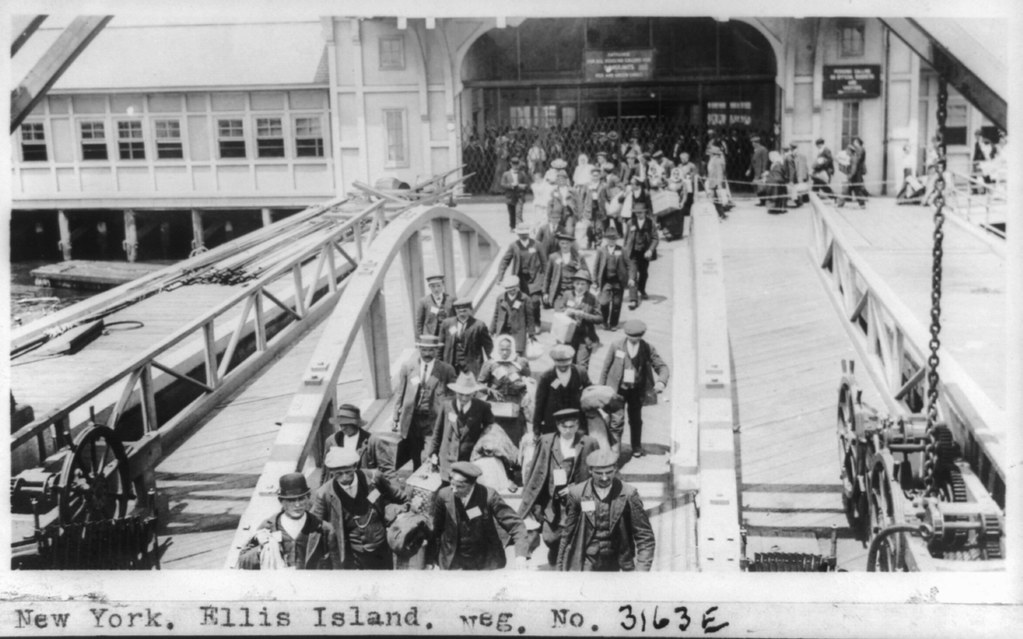
The 1924 Act extended the outright exclusion to the Japanese and can reasonably be identified as the triggering event that allowed Fascists to take control over the government of Japan and spend the next decade and a half convincing the people who had embraced representative democracy, American jazz and baseball that they should choose their own race as the one to come first.
Humbert H. comments:
It’s interesting how some reasons for excluding specific groups from being able to immigrate have changed over time. “Strong economic competitor” has completely disappeared, whereas it was one of two main reasons for excluding the Japanese. There must be some sort of widespread recognition that importing groups that demonstrate great achievement in some economic areas is good for the country even though there is certainly some collateral damage to the established population.
Stefan Jovanovich rejoins:
GR and I have different readings about the exclusion for the Japanese. It was not economic competition; the U.S. had a healthy positive trade balance with Japan between the two world wars. We sent them oil and wheat; they sent us toys and trinkets.
The political pressures for exclusion came from
(1) Teddy Roosevelt's complete hatred of the Japanese AND the Russians (Give a President the Nobel Peace prize and bad things always happen). That made disdain for the Nips into a bedrock belief of all progressive Republicans (Thank you Earl Warren)
(2) The continuing negotiations after the signing of the Washington Naval Treaty of 1922
Humbert H. clarifies:
I didn’t mean economic competition with Japan, but with Japanese immigrants, mainly in California
Asindu Drileba writes:
I heard from somewhere, that before World War 1, passports & visas where not enforced that seriously. You could just show up to any place you wanted to go to without many formal requirements. I just imagine if the world was like that? Anyone can show up anywhere anytime without any legal hurdles?
Noam Chomsky (MIT linguist) says that there are two kinds of globalization.
Globalization 1: Is the free movement of people (labour) around the world with less restrictions.
Globalization 2: Is the free movement of capital & goods (products) with little legal restrictions.
He says that as we we're entering the 21st century, there has been a sharp decrease in Globalization 1 and a sharp increase in Globalization 2. It has been described that Globalization 2 has benefited corporations a lot (some even claim it has benefited the economy as a whole).
Can a country benefit economically (can corporations & markets see gains?) by making immigration as easy as it is to send money around the world? That is, people (labour) moving around with very little restrictions?
Jeff Watson offers:
It would be better this way:
A world of free movement would be $78 trillion richer
Yes, it would be disruptive. But the potential gains are so vast that objectors could be bribed to let it happen.
Humbert H. responds:
Of course anyone with a minimal economic education would realize that free movement of “labor” or entrepreneurs would result in creation of enormous wealth. In the real world though, new immigrants going on the dole has become a feature and not a bug in many wealthy countries. You read anything from England, and that seems like an accepted fact there. The list of various culture-clash and crime issues is long and only irritates people who are for unrestricted immigration. So this not a pure economics problem but more multifaceted. My point was that something, perhaps better knowledge of economics or personal experience, or maybe less dog-eats-dog competition for survival, taught the populace that importing highly capable people usually leads to good outcomes.
Jordan Low adds:
Do you enjoy Bing Cherries? He lost his farm in the act.
Ah Bing was a 19th century horticulturalist and credited as the cultivator and namesake of the popular Bing cherry. Bing migrated to the U.S. around 1855 and worked as foreman in the Lewelling family fruit orchards in Milwaukie, Oregon.
Jul
21
Classic SPEC reading list (with movies, too)
July 21, 2024 | 1 Comment
From the original version of the Daily Spec site and worth a review:
Jeff Watson writes:
Being There is a movie adapted from Jerzy Kosinski’s book about a gardener who took Washington DC by storm. His name was Chance and he could not read or write, but the public thought he was a genius. He ultimately became the President of the United States. The book should also be on the list.

Stefan Jovanovich suggests:
Asindu Drileba offers:
- Risk Savvy by Gerd Gigerenzer. How to cut your cancer risk by 50%, how to beat Nobel Prize portfolio strategies, why certainty is an illusion. I think everyone can benefit at least one thing from reading this book. It doesn't matter if you're a spec or not.
- The Visual Display of Quantitative Information (everything by Edward R. Tufte is worth reading)
- Adam Curtis documentaries. He has dedicated his life talking about "Power", mostly the relationship between Markets, Politics, Science, Religion & Philosophy. He informed alot of my thinking about the relationship between those. An incomplete assortment.
- Zurich Axioms. This was recommended by on a podcast. I think it was Larry Williams (but I am not sure). It's a very good book of aphorisms, useful to get your psychology right.
- This is the Road to Stock Market Success (1944). Recommend by Vic. I also find the book very instrumental in developing a psychological edge.
Zubin Al Genubi recommends:
Conrad, J, Heart of Darkness. A river trip into Africa loses grip.
Khilav Majmudar agrees:
Loved Heart of Darkness. Conrad's writing is hypnotic.
Humbert H. adds:
Heart of Darkness is kind of similar to Kafka’s writing in that it’s mysterious and unusual, and nobody knows what it’s really about after reading it. It was famously an inspiration for the movie Apocalypse Now which is arguably even stranger.
Jul
15
Possible demand-supply mismatch coming in the power markets, from Carder Dimitroff
July 15, 2024 | Leave a Comment

Only some people agree, but the power industry believes there may be a demand-supply mismatch from AI data centers. Here are some summary views - from the American Nuclear Society's Nuclear Newswire (April 2024):
Major tech companies see artificial intelligence (AI) as something that will transform their industry, and there is a race to be first. When they look for clean, dependable power 24/7, nuclear clearly stands out as a good match. Constellation [the nation's largest nuclear utility] summarized it best in its recent forecast:
• AI and data center growth will drive power demand.
• Major tech companies are expected to invest $1 trillion in data centers over the next five years.
• In the next five years, consumers and businesses will generate twice as much data as all the data created over the past 10 years.
• AI data center racks could require seven times more power than traditional data center racks.
• Between now and 2030, domestic data center electricity consumption is expected to grow anywhere from 6.5 percent to 7.5 percent (335 terawatt-hours to 390 terawatt-hours).
• In its report, Data Centers 2024 Global Outlook, global real estate services company JLL has said that "AI is driving extreme scale for new developments with requirements now ranging from 300 megawatts (MW) to over 500 MW."
From the IEEE Spectrum (June 2024):
Scientists have predicted that by 2040, almost 50 percent of the world's electric power will be used in computing. What's more, this projection was made before the sudden explosion of generative AI.
From Data Center Dynamics (May 2024):
US utility Dominion expects to connect 15 more data centers to the grid in Virginia over the course of 2024, after connecting 15 facilities last year totaling almost a gigawatt of capacity [1 gigawatt = 1 nuclear plant]. In its most recent earnings presentation this week, the company said it had connected 94 data centers with more than 4GW of capacity in Northern Virginia since 2019. This included 15 data centers totaling 933MW in 2023, and 15 more are due to be connected in 2024. The company didn't include the capacity of those 15 facilities going live this year, and in the earnings call, CEO Robert Blue said he doesn't know how quickly they will ramp up to full capacity.
For those who think new nuclear power is the solution (2024), this is not a quote but a fact: The new Vogtle nuclear power plant took about 20 years to design and build, from concept to commercial operations. This recent construction schedule was set by an experienced nuclear utility that previously built access to transmission on a nuclear site they've owned for decades.
The critical metric is not the overall demand. Data centers' demand sits on the grid 24/7, so generating capacity must be available 24/7. While massive amounts of energy are already oversupplying some US power markets, most new sources originate from part-time wind, solar, and battery assets. Those part-time assets cannot serve the 24/7 load demanded by data centers. Therefore, the critical metric is the difference between the base supply and the constant load.
With growing 24/7 demand, a fleet of legacy power plants (natural gas, nuclear, coal) is needed to fill in the [significant] gaps left by part-time renewable energy sources. That fleet currently exists, but its overall capacity is declining. Retired plants (to the extent they can be summoned) and new generation will be needed.
However, any new base generation will experience poor capacity factors and difficult gross revenues. Both impair investors' revenues and erode their expected levelized cost of energy. Even if investors overcome profitability concerns, the time it takes to commercialize any new traditional generating asset exceeds the expected demand for new power (extreme example: Georgia Power).
These projections and concerns appear to contradict current trends. Demand has declined in the United States, Europe, and the United Kingdom. Current reporting suggests there could be too much supply, particularly in Europe. However, if projections described by ANS, IEEE, and utilities are correct, the opposite problem could be presented: insufficient supply. If supply becomes the issue as expected, scarcity curves will be taxed, unprofitable generating assets will become profitable, and residential, commercial, and industrial consumers will pay more. This issue is not limited to North America.
Humbert H. writes:
I was listening to an interview of some fund manager from Reno earlier today and he was talking about power shortage around where he lives due to AI server farms. He said they could be quickly and cheaply addressed with new gas powered plants, but due to the Biden administration now requiring all such plants to have complete carbon sequestration this stopped them from being a practical solution.
H. Humbert writes:
Increased the energy supply for data centers is the obvious and near-term brute-force solution. Of course (almost) everybody not in the tech industry assumes that the joule per bit per second for data centers can't be improved and hence producing more energy is the only solution using nuke. In fact Sam Altman said that too, what conventional thinking can possibly go wrong, right?
Zubin Al Genubi asks:
What would be a good way to invest in modern nuclear power? How about Bill Gates project?
Asindu Drileba adds:
I would suspect via buying Uranium ETFs? I first saw this conjecture from following the financier Lyn Alden.
Mark Zuckerberg of recent also mentioned in an interview that Energy and not Compute will be the number 1 bottle neck to AI progress.
H. Humbert responds:
The energy being the presumed AI investment proxy won't last in the long term. Increasing the energy supply is just an incremental engineering no-brainer approach to solve a longer term problem and the approach is not disruptive and it doesn't change the world.
Stefan Jovanovich offers:
Radiant Nuclear
Kaleidos: a Portable Nuclear Microreactor that Replaces Diesel Generators
Peter Penha writes:
A relevant interview on the Hidden Forces podcast with Brian Janous who was hired by Microsoft in 2011 to focus on energy (Google had just hired someone themselves as they thought the cloud might become something) - wound up as VP of Energy.
AI data centers need to be where they can individually draw the electricity of a city like Seattle (800 MWh) - so away from major urban areas - discusses the history of the grid from Sam Insull through to where we are going…also on the efficiency / consumption of AI chips - his view with AI is Jevons Paradox will apply and the more efficient the chips and the (new) grid gets the more consumers will demand.
Jun
29
Canary?, from Zubin Al Genubi
June 29, 2024 | 1 Comment

Seen yesterday in Kona Hawaii, billionaire's playground:
1 private jet at FBO. Very unusual.
25% commercial vacancies in prime retail.
Tourism down 9%
(Galtonesque count)
Stefan Jovanovich comments:
ZAG's reports are a treasure - and a source of future profits.
Nils Poertner wonders:
easier to be bullish on European /UK equities than having bearish view on US stocks?
Jun
10
Stock/Bond ratio, from Hernan Avella
June 10, 2024 | Leave a Comment
I use a slightly modified version, I think is apt to use a rolling vol adjustment. Using VFINX (stocks) Long, VUSTX (long bonds) short. The stock bond ratio is higher than it was in 2000. the chart will show whatever you want; however, if you make the assumption that stocks and bonds have similar RISK ADJUSTED returns, mean reversion should be expected….at some point, but I don't think there's an actionable point here other than stay diversified. Here's a visual:

Stefan Jovanovich writes:
In the 40 years between the return of the dollar to the Constitutional standard (i.e. all paper issued by the Treasury had to be redeemable in coin) and the creation of a central bank that guaranteed that call money would always be available, the returns on the stock and bond markets had similar risk adjusted returns. For investors it was a choice whether to buy the common stocks of railroads with their wonderful but variable dividends or the secured bonds of the same companies.
A reversion to the mean could be a return to a period when cash, bonds and stocks all competed with one another in a connected equilibrium. That world saw creations of extraordinary fortunes; but against the one successful oil trust one had to measure the losses of all the enterprises that were unable to compete with Rockefeller's price-cutting for kerosene. What if AI means that sourcing for semiconductors only needs a few large relentlessly successful companies?
Vic asks:
how about no roll, no averaging on the bonds stock ratio?
May
5
For the O’Brian fans
May 5, 2024 | Leave a Comment

Six Frigates, by Ian W. Toll (2006).
From the NYT review:
This first book by Toll, a former financial analyst and political speechwriter, is a fluent, intelligent history of American military policy from the early 1790s, when Congress commissioned six frigates to fight the Barbary pirates, through the War of 1812. But the book’s real value, and the pleasures it provides, lies in Toll’s grasp of the human dimension of his subject, often obscured in the dry tomes of naval historians. The battle depictions are worthy of Patrick O’Brian (whose fictional hero, Jack Aubrey, he cleverly uses to illustrate a scene in the December 1812 shootout between the American frigate Constitution and the British frigate Java).
Stefan Jovanovich adds:
Here is a discussion with Toll about his book on the last two years of WW 2 in the Pacific.
May
4

The Doctor Is In. And He’s an Orangutan.
For the first time, researchers have seen a wild animal treat an open wound with a medicinal plant. After getting injured—probably in a brawl with another male—a wild Sumatran orangutan chewed the stems and leaves of a vine humans use to treat wounds and ailments such as dysentery, diabetes and malaria. The orangutan then repeatedly smeared the makeshift salve on an open gash on its cheek until it was fully covered. After the treatment, scientists saw no signs of infection. The wound closed within five days. And it healed within a month.
Jeffrey Hirsch is enthusiastic:
This is awesome! An good friend of mine spent several years in Borneo working with Orangutans under Birute Galdikas’ program. They are super crafty and smart. Don’t doubt this.
Humbert H. writes:
And nobody can explain how they know to do this in these situations. There is obviously a lot of learning apes can acquire from others, but this? There is also no way the current understanding of how genetic information is passed on that can explain this. There is something very mysterious about the mind and animals doing non-obvious things is the best example, this is not a simple biological phenomenon.
Asindu Drileba comments:
One of the things I hear in the AI research community in the pursuit of of AGI (Artificial General Intelligence) is people thinking of intelligence as something hierarchical like height.
In The Singularity is Near Raymond Kurzweil makes a plot of Computers approaching AGI. He puts insects at the bottom and manuals later then humans at the top. You often hear some people say that "We haven't yet reached dog level AI, so we can't say we can reach human level AI soon." That statement makes the assumption that A humans intelligence is more than that of a dog. But it has been reported in some cases a dog's sense of smell can be 100,000 more acute than that of a human being! And not just that it can tell time just by smelling what's around. Another example is also how birds can sense magnetic fields and use them like a compass.
Anyway my point is that just by the (limited) way humans perceive reality we have access to some secrets we can't pass to animals. My suspicion is that animals also have their own secrets that they cannot pass to us.
Humbert H. adds:
They have recently discovered that some insects are self-aware. The test that's used for animals is that they recognize their reflection in the mirror as themselves judging by their reaction. Usually only dolphins, apes, and some corvids (crows) pass the test.
But more importantly, what I meant was that animals seem to "know" how to do things that no current scientific understanding can explain. This means we don't understand basic things about animal (and human) mind. AI is a machine function: an algorithm using some data provides some outputs in response to inputs. A mind is like that too, except we really don't understand the nature of self-awareness, nor do we understand how animals just "know" things. Sometimes they call it "instinct" but there is no real science behind that word. And in this case it's not even that, apes have no "instinct" to cure wounds with specific processed plant material.
Jeff Watson writes:
Here is an interview with cognitive psychologist, Donald Hoffman. Some find him brilliant, some a flake. His ideas are unconventional to say the least, but the questions that come to mind out of his interview will break one’s brain. Many moments in the video, I pause and ask myself how this applies to markets.
Stefan Jovanovich gets philosophical:
The wheel of time turns on the axle of our self-awareness: Transcendentalism.
Apr
15
Reading (and viewing) recommendations
April 15, 2024 | Leave a Comment
From Easan Katir:
The Hall of Uselessness: Collected Essays, by Simon Leys.
Simon Leys is a Renaissance man for the era of globalization. A distinguished scholar of classical Chinese art and literature and one of the first Westerners to recognize the appalling toll of Mao’s Cultural Revolution, Leys also writes with unfailing intelligence, seriousness, and bite about European art, literature, history, and politics and is an unflinching observer of the way we live now.
From Zubin Al Genubi:
Pathogenesis: History of the World in Eight Plagues, by Jonathan Kennedy.
According to the accepted narrative of progress, humans have thrived thanks to their brains and brawn, collectively bending the arc of history. But in this revelatory book, Professor Jonathan Kennedy argues that the myth of human exceptionalism overstates the role that we play in social and political change. Instead, it is the humble microbe that wins wars and topples empires.
From Asindu Drileba:
Math Without Numbers, by Milo Beckman.
Math Without Numbers is a vivid, conversational, and wholly original guide to the three main branches of abstract math—topology, analysis, and algebra—which turn out to be surprisingly easy to grasp. This book upends the conventional approach to math, inviting you to think creatively about shape and dimension, the infinite and infinitesimal, symmetries, proofs, and how these concepts all fit together. What awaits readers is a freewheeling tour of the inimitable joys and unsolved mysteries of this curiously powerful subject.
Peter Ringel is watching:
Voltaire: The Rascal Philosopher
I discovered a terrible knowledge gap and missed details of a great one. so many angles to be impressed. his writings seem to be the least of it. he even gamed the king's lottery and won with a group of investors & mathematicians.
William Huggins suggests a somewhat older work:
A General History of The Most Prominent Banks, by Thomas H. Goddard, published in 1831.
its dry - but if you are interested in the 1819 panic, there are some good details. the book is mistitled imo as 3/4 of its pages and 2/3 of its text centers on the history of central/national banking in the united states from 1786 through 1831 (publication). on titular matters, it had a couple of interesting tidbits on the bank of genoa and some "interesting" statistical information for archivists but there are better modern sources on major banks in venice, the netherlands, england, and france (for example, the author skips over how the bankers of geneva funded the french revolution to knock the bank of genoa off its perch, etc). i suspect such deficiencies are because the text was designed as ammo in the "bank wars" of the early 1830s rather than a deep exposition on titular topics.
its exposition on us matters feels remarkably haphazard, i presume because the author's intended audience would have the context to appreciate why it includes what it does, including a description of the bank of north america, hamilton's report to congress on the need for a bank, and a brief on the First Bank of the US. where it begins to shine is in the next set of docs, which includes an auditor's report and statement by the president of the Second Bank of the US on how the panic of 1819 was navigated. it follows with mcduffie's 1930 report to congress on the SBUS (includes more details on the rise and fall of FBUS), and closes with a statistical archive of the "monied institutions of the US" and an appendix on how banking and commercial exchange granularly worked in the 1800s.
Stefan Jovanovich comments:
I was puzzled by the "decline and fall" description, since the Bank did not fail but simply had its charter expire without renewal because George Clinton did not like what Thomas Willing had done as President of the Bank. (Clinton failed to cast what would have been the winning vote for renewal.)
William Huggins responds:
"fall" referring to its near brush with survival, not any sort of mismanagement or fraud as in 1819. mcduffie describes FBUS as the victim of partisan politics, but one of such import that the same party who killed it started calling for a replacement almost immediately.
Stefan Jovanovich adds:
They wanted what Willing would not give them - a central bank that would do what the Fed does now - discount the Treasury's IOUs at par. Can't have a war without that.
Feb
3
Russ Roberts likes Milei’s economics
February 3, 2024 | Leave a Comment
Russ Roberts@EconTalker
Ninety seconds of economics. Shockingly clear and shockingly subtle.
Stefan Jovanovich comments:
This is the usual slight of hand by "free traders". Instead of discussing tariffs as a question of taxation, they always present it as a matter of personal liberty good vs. bad. Yet somehow that discussion never moves over to employment taxes; having the government take a quarter of everything even the lowest paid worker earns is not to be examinged as a matter of personal liberty.
The truth about tariffs as taxes is what Americans knew in the 19th century. If you want the revenue, the rate has to be low enough - 20% on average - that there is less pain in paying it than in smuggling or cheating. You cannot have quotas (funny how, in matters of employment taxes, we have them; no one is allowed to work for less than the minimum wage). Unlike employment taxes, tariffs take their money first from the wealthy; that was the Southern "way of life" complaint about them before and after the Civil War.
Jan
28
Revelations of The Prisoners Dilemma, from Asindu Drileba
January 28, 2024 | Leave a Comment

This is my favourite channel an YouTube. And I liked this particular episode so much it may be my favourite so far:
What The Prisoner's Dilemma Reveals About Life, The Universe, and Everything
The prisoners dilemma is a choice participants need to make that are as follows:
1. If both participants cooperate, they both get $10 each.
2. If only one of the participants cooperate, the defector gets $1, and the one trying to cooperate (be honest) gets $0.
3. If both participants defect (both are dishonest to each other), they both get $1, which is way less than the $10 they would each get by both cooperating.
These are the only four possible states or outcomes of the game. The objective is simple, if the game is repeated for several rounds, under different environments (varying ratio of cooperators & defectors). What strategy should one choose to make the most money? Several agents choose independent strategies and play against each other with whatever strategy they have chosen. All with the aim of making the most money. It turns out that the best strategy for this game amongst different agents is one they call "Tit for Tat". It can be summarised as, "Be Nice, Try to forgive, But don't be a doormat/push over."
Stefan Jovanovich writes:
Pinched from a Stanford course catalog from 1998/9: Axelrod's Tournament:
In 1980, Robert Axelrod, professor of political science at the University of Michigan, held a tournament of various strategies for the prisoner's dilemma. He invited a number of well-known game theorists to submit strategies to be run by computers. In the tournament, programs played games against each other and themselves repeatedly. Each strategy specified whether to cooperate or defect based on the previous moves of both the strategy and its opponent.
Big Al adds:
The Evolution of Cooperation, by Robert Axelrod
We assume that, in a world ruled by natural selection, selfishness pays. So why cooperate? In The Evolution of Cooperation, political scientist Robert Axelrod seeks to answer this question. In 1980, he organized the famed Computer Prisoners Dilemma Tournament, which sought to find the optimal strategy for survival in a particular game. Over and over, the simplest strategy, a cooperative program called Tit for Tat, shut out the competition. In other words, cooperation, not unfettered competition, turns out to be our best chance for survival.
Kim Zussman gets biological:
Cooperation and Darwin:
Humbert H. comments:
The original prisoner’s dilemma was about literal prisoners who didn’t get to play even twice with the same “partners”. There are a lot of situations in the real world that map to the prisoner’s dilemma, but a lot fewer that map to playing the same game with the same partners who are rational and capable of learning.
Big Al appends:
Yale Game Theory Course (24 videos), with Dr. Benjamin Polak.
Peter Grieve goes deep:
I am convinced that the principal functions of a healthy society are (1) to get to the good payoff of the Prisoner's Dilemma, and (2) to find an acceptable solution for the Trolley Problem.
Jan
9
Books, from Zubin Al Genubi
January 9, 2024 | Leave a Comment

Option Volatility and Pricing: Advanced Trading Strategies and Techniques, Sheldon by Natenberg. Recommended in by Ralph Vince.
The Dao of Capital: Austrian Investing in a Distorted World, by Mark Spitznagel and Ron Paul.
This is a magnificent, scintillating book that I will read over and over again. It provides a theoretic and practical framework for understanding the insights of all the greats that a student of markets will encounter—Soros, Baldwin, Klipp, Buffett, Cooperman (albeit these greats might not realize or acknowledge it). It teaches you things about war, trees, martial arts, opera, baseball, board games. Every page is eye-opening, with numerous areas for testing and profits in every chapter. I will share the book with all my traders, friends, and circles of influence. Here’s an unqualified, total, heartfelt recommendation, which coming from me is a rarity, and possibly unique.
- Victor Niederhoffer (from inside cover)
Quite exciting tale of 1939 failed Russian invasion of Finland:
A Frozen Hell: The Russo-Finnish Winter War of 1939-1940
And a classic from Ralph Vince:
The Mathematics of Money Management: Risk Analysis Techniques for Traders
Martin Lindkvist writes:
Many years ago in 2006 I had a heated discussion on this list with Stefan J about the Finnish winter war as well as WW2 and what conclusions could be drawn from them about Sweden's position. Suffice to say that we both thought we won and still left the argument amicably.
There is a very good film from 2017 as well as a Netflix series about the "Continuation War" called Tuntematon Sotilas/Unknown Soldier. This war was from 1941-1944 and started after Germany used Finnish territory for part of Operation Barbarossa, and as the Soviets started to bomb Finland, they seized the opportunity to try to take back lost territory from the Winter war.
Stefan Jovanovich replies:
Martin won. He was then, as now, gracious to a fault. These links provide some background:
[Also of interest: The Winter War (Talvisota) DVD - Uncut (70 min. longer than U.S release) -Ed.]
Dec
22
Fire, from Nils Poertner
December 22, 2023 | Leave a Comment

A number of factors contributed to the destruction caused by the Great Fire of 1910. The wildfire season started early that year because the winter of 1909–1910 and the spring and summer of 1910 were extremely dry, and the summer sufficiently hot to have been described as "like no others." The drought resulted in forests with abundant dry fuel, in an area which had previously experienced dependable autumn and winter moisture. Hundreds of fires were ignited by hot cinders flung from locomotives, sparks, lightning, and backfiring crews. By mid-August, there were 1,000 to 3,000 individual fires burning in Idaho, Montana, and Washington.
same as in mkts- the longer the rally…might not be one major fire but more a series coming.
Perhaps the most famous story of survival is that of Ranger Ed Pulaski, a U.S. Forest Service ranger who led a large crew of about 44 men to safety in an abandoned prospect mine outside of Wallace, Idaho, just as they were about to be overtaken by the fire. It is said that Pulaski fought off the flames at the mouth of the shaft until he passed out like the others. Around midnight, a man announced that he, at least, was getting out of there. Knowing that they would have no chance of survival if they ran, Pulaski drew his pistol, threatening to shoot the first person who tried to leave. In the end, all but five of the forty or so men survived. Pulaski has since been widely celebrated as a hero for his efforts; the mine tunnel in which he and his crew sheltered from the fire, now known as the Pulaski Tunnel, is listed on the National Register of Historic Places.
Stefan Jovanovich recommends:
Gyve Bones agrees:
I was tempted to mention that book, which I enjoyed. I read it after reading A River Runs Through It.
Pamela Van Giessen suggests:
For a comprehensive look at the fire of 1910 and how it was fought (and lost), The Big Burn: Teddy Roosevelt and the Fire that Saved America, by Timothy Egan, is interesting.
Big Al points to:
Fire Weather: A True Story from a Hotter World
About the Fort McMurray wildfire in 2016.
Dec
17
Holiday history and the nature of money
December 17, 2023 | Leave a Comment

Thanksgiving menu at the Plaza Hotel, 1899.
From the NYPL collection of menus.
H. Humbert comments:
All under a dollar. Special holiday dinner for well-to-do customers. Anyone wants to make the case that those who deliberately cause deficit spending are not deranged animals? Is this price change good? Milei just said he will abolish the Fed of Argentina. Non negotiable. Of course he didn’t kill himself, I mean if there are ever any health problems in his immediate future.
Stefan Jovanovich offers:
The BW recommends Turback's book, What a Swell Party It Was!: Rediscovering Food & Drink from the Golden Age of the American Nightclub; it has menus and venues from the great age of actual fun and dancing.
William Huggins writes:
looks like every single government since the 1950s were full of "animals" - not a single one seems capable of maintaining a surplus for more than 3 years (and that was Clinton…):
United States Federal Government Budget
Andrew Aiken adds:
There was never a surplus in the 1990s, at least by the accounting principles that a business is required to use. The “surplus” was entirely due to short-term overages in payroll taxes for Social Security, and they were wasted and not used to shore up the system.
Stefan Jovanovich comments:
Since the purpose of central banking is to allow legislatures to increase their debts, is it surprising that "deficits" are now the cultural equivalent of what "sin" was in the ages when most everyone went to church? Everyone is against it, in principle, but not where principal and interest are concerned.
Larry Williams applauds:
+10 QUOTE OF THE DAY!!
William Huggins responds:
i wouldn't say the "purpose" of centrals is to enable money printing, rather I would say that's how governments prefer to use centrals but since the last of the independents were taken over by the end of WW2, that may have become an irrelevant distinction in the modern world. the main reason for pointing it out is that we could easily return to a world without state controlled centrals and their purpose would be notably quite different (usually running the payments system, think Amsterdamsche Wisselbank).
Stefan Jovanovich replies:
The Federal Reserve does not print our money; the Treasury does. In allowing its member banks to hold Federal government IOUs at par as their reserves, our central banking system effectively outlaws the pricing of all legal tender. Actual money can only be exchanged for itself, whatever the amount. The result is a wonderful inversion of monetarism as a theory. Money can be printed, without limit, but only if Congress votes to expand the supply of collateral that the banks can buy and endlessly rediscount.
William Huggins disagrees:
this is incorrect - the Fed can and does use several other assets aside from federal government debt to back its liabilities. back in 2010, they held more mortgage debt than government debt. the choice of backing asset is often dominated by gov debt but the BoJ (among others) is also sitting on corp debt (and equity for that matter)
Peter Penha writes:
I disagree and it is because of who is on the hook first. The Federal Reserve can only purchase government guaranteed debt for its account (including FNM FRE GNMA which it did in GFC and in amounts greater than existed - the w/i mtge owed the Fed at one point was around $1 trillion and at a spread below treasuries when adjusted for the embedded prepayment option by the borrower.
All the MS pledging boxes of toilet paper at the Fed window in late 2008 & the HY ETF purchases in March 2020 were against a Treasury guaranteed account at the Fed. If you care to argue that in difficult times there is no difference between Fed & Treasury as the Fed takes orders, that there is a myth of central bank independence - no argument.
The Fed now losing some $200 billion a year from it asset/liability mismatch is putting those losses against a future Treasury payments owed account - so the Fed does not need a capital call from its losses. If however the Fed decided it did need capital - that gets taken from its shareholders who are the money center / fed member banks. JPM is on the hook for Fed insolvency (or BAML and C trading below book tell you they will be forced sellers of equity below book to shore up their capital).
Perry Mehrling (the professor Zoltan wishes he had had in college) does a great history course (and free) on the hierarchy of money, and how private (CHIPS) and public (Fed Wire) clearing houses are allowed to create credit out of thin air to make up for shortfalls - guaranteed by all the other members.
Your money deposited in the bank is not money it is you extending credit to the bank and an IOU (down the tier). In normal times they all appear equal and settle normally but a Eurodollar is not the same as a dollar (see SVB dollar deposits made whole / offshore SVB deposits a general creditor (gone) as per the FDIC statement on SVB).
Stefan Jovanovich suggests:
Money and Empire: Charles P. Kindleberger and the Dollar System
Oct
30
Forbidden History, from Larry Williams
October 30, 2023 | Leave a Comment

I can only do a few paragraphs at a time there is so much in this book; turns thoughts upside down.
One I just read; Thomas Jefferson's illicit affair and fathering a child with his slave. Wait! Hold on a moment —while widely believed— all the DNA tests shows is there is Jefferson bloodline. That’s all it can show. There were 26 Jefferson's living in the area and Toms brother Ralph was caretaker and overseer of slaves.
Thomas? Ralph? Someone else? Will never know for sure but for sure it may well have been another Yet the revisionist historians have hung it on Tom. Lots more like this.
Peter Penha writes:
Just an anecdote on your example: I know of two families where a child was fathered/sired with a female who was a slave or an emancipated slave. Both families discuss it as part of the family history and each specified that a home was built for the mother/child and in one case the family name given to them.
Considering Thomas Jefferson finances, perhaps the answer would lie in the building records and who owned the home in Charlottesville where Ms. Hemings moved to after Jefferson's death with her sons.
I was recently searching for other books by Frederick Lewis Allen as IMHO a wonderful writer and objective historian of his day and that brought me to a series titled the Forbidden Bookshelf (27 books in the series) - I only picked up Allen’s The Lords of Creation but there were a few titles that were “out there” as subject matter.
Gyve Bones adds:
There was a lot more inter-mixing between Africans and French colonials in the Louisiana colony, which had a Code Noir body of ordinances governing who could own slaves (only Catholics, no Jews nor Mohommedans), and how they must be treated. As a Catholic nation France required that owners of slaves must educate and raise their slaves in the Catholic faith, and could not break up families in a sale. Slaves could purchase their own freedom, and in New Orleans there was a large population of "free people of color". Many of the wealthiest of these freedmen were slave traders, and there were several large plantations in French colony owned and operated by free persons of color. Slavery was not a racial thing—just a matter of property. There was much less stigma around the idea of "race", and that culture has persisted to an extent into current day New Orleans, although those seeking to divide people along racial lines for political purpose have made significant inroads in destroying inter-racial comity in that community.
History records that French Canadian trappers had very good relations with the indigenous populations, and there were many such mixed marriages made. This same phenomenon was seen in Mexico after Our Lady of Guadalupe converted 9 million indigenous Mexicans to the faith. The Mexican nationality gave birth to a new "mestizo" race which came about when the Spanish intermarried with the native population.
Zubin Al Genubi suggests:
Trust by Hernan Diaz. Pulitzer prize. Stories About a stock market operator in 1920's and his wife. Very good with minor market relevance.
Stefan Jovanovich links:
Sep
16
Accounting gimmicks, from H. Humbert
September 16, 2023 | Leave a Comment
have not idea really about health of US regional banks and to what extent some use creative accounting to say it that way.
What makes me wonder is only that European banks (and Japanese) are quite good with their gimmicks and I have seen this pattern before. Many US analysts slacking off foreign banks and they are prob right here. and then we had those 2 US banks earlier this year …oh, no they were only a special case (allegedly). and what happens if the econ surprises to the downside? remember we live in times when people are low re irony, and highly suggestible and lack imagination.
Henry Gifford comments:
I think those two banks were a special case because they made loans on rent-regulated New York City apartment buildings, and held those loans in their portfolios.
New rent regulations passed in 2019 severely limit rent increases, require most increases to be rolled back after thirty years, eliminate all paths to deregulate an apartment, etc., thus the buildings are worth less than owed on them, and as the five-year loans come up for renewal they go into foreclosure. Few banks were stupid enough to make loans on those buildings. I think definitely a special case.
Humbert H. is skeptical:
Seems like a stretch to attribute SVB to just those loans give the well-documented run on the bank and the treasuries they were forced to sell and recognize their market value vs. book, the possibility of the latter being the commonly attributed trigger for the run, along with the slower liquidity crunch at the client startups causing high withdrawals.
Henry Gifford elaborates:
Word in New York real estate circles is that the run on the bank was caused by depositors hearing about the bad loans and rushing to get their money out. Selling treasuries and etc. were all after the run. Here in NYC, nobody is surprised to hear about craziness when it comes to regulations and the effects later. The stories here don’t mention liquidity crunches at startups. Maybe the banks made two types of risky loans?
The printed articles stuck to good journalistic standards by avoiding saying just what % of loans in the portfolio were on rent-regulated buildings. It might have been a minor %, but still caused a panic, or it might have been a large % - presumably rent-regulated buildings paid higher interest than other buildings, thus an incentive to make more loans.
If a bank already has enough loans to force them under if the political pendulum in NY swung hard in favor of tenants, there would be no reason to not make more of them, thus they might have had a large % of them. But, nobody seems to be saying. I think the only real word would come from the depositors – maybe the ones who got their money out first.
Humbert H. replies:
There were pictures of lines both in Silicon Valley and NYC. Peter Thiel's recommendation to the portfolio companies of his fund supposedly played a role. It's hard to do a thorough analysis on the anatomy of a run, too chaotic and not well documented in terms of why anyone did anything in particular. To this day there's contradictory information on the collapse of the tulip craze.
Steve Ellison writes:
Jim Bianco has been saying that the banking issues this cycle are more likely to occur in slow motion, as depositors individually decide to take low-yielding money out of banks in favor of T-bills and other higher yield instruments. As deposits shrink, banks are cutting back on credit, and there was an upsurge in bankruptcies in August.
Humbert H. responds:
This is true, but there is a contrary trend of low-yielding treasuries maturing as well as getting sold, and new money invested in higher-yielding treasuries thus making the balance sheets less of a work of fiction and improving that side of the cash flow equation.
Humbert X. adds:
Bank loan to deposit ratio is actually at very low levels, historically speaking. The problem is demand.
Humbert H. disagrees:
Can't be just demand. There are zillions of articles out there about banks significantly tightening their lending standards. Some of these came out almost a year ago, but right after the spring banking crisis, around 50% were reporting that they had tightened their standards and through the summer the trend continued and/or was reported expected to continue.
Humbert X. processes:
Excellent. You just identified consensus. Now, do you want to bet against it, based on fact based observations of data? Or go with the crowd. Always the ultimate question in investing.
Stefan Jovanovich offers:
We now have the same financial system that Ulysses Grant forced Congress to accept by unconditional surrender during his two terms as President. The savings of bank depositors were going to be guaranteed by the promises to pay of the U.S. Treasury.
The SVB collapse established a basic rule that all deposits by people and their entities are utterly safe. There can be no bank runs by depositors because the FDIC and the other financial satraps created by Congress are not allowed to default. If you want a comparison from more recent political history, the old people chasing Dan Rostenkowski in the parking lot is an appropriate one. The rest of the government's promises might be at risk; but Social Security was never going to default.
Humbert X. replies:
Except that two banks just blew up because of bank runs.
Humbert H. analyzes:
I don’t find bank stocks very interesting at this point regardless of the exact nature of what ails them. Banks aren’t very transparent to begin with. I’ve owned three for a long time, I’ll stick with those, but won’t explore any new ones. Those that are expert bank balance sheet readers can separate the wheat from the chaff, but overall this is mostly a macro bet.
Stefan Jovanovich replies:
"Bank runs by depositors" vs. bank runs by shareholders and bondholders.
Humbert H. asks:
What does that second category even mean? A bank run deprives the bank of cash and can in some instances cause a quick collapse via various mechanisms (like not having the cash to operate or having to redeem underwater securities). Shareholders and bondholders selling their property is in a totally different category, while certainly not welcome by the management or the remaining s/b-holders. You can call it a "run", but it's just a common market reaction to bad news or rumors.
Stefan Jovanovich expands:
United States banks could expand their cash issuances to the full extent of the face value of their holdings of Treasury bonds. That meant that it was impossible in practice for a U. S. bank to be "deprived of cash" as GR puts it. U. S. banks were required to have their required statutory capital invested in Treasuries; in an era where bank's total liabilities rarely exceeded 3 times that capital, banks could draw on the Comptroller of the Currency for notes equal 30%-40% of their total deposits. The result was that there was not a single failure of a United States bank between 1865 and their disappearance in the years after the passage of the Federal Reserve Act. (There were bank failures but those were limited to the state chartered banks, which were not restricted from investing in real estate and were not regulated under such an inflexible standard by the Comptroller of the Currency.) It was this very inflexibility that the Federal Reserve Act was supposed to solve.
The current guarantees of deposits under the FDIC produce the same net result; no one will have to worry about getting "cash" from a bank for their deposits. Shareholders and bondholders, on the other hand, now have to wonder what a bank franchise is worth if the depositors will have to be reassured by the promises of yields comparable to those offered by the Treasury market and the Federal guarantors are looking at a future where politics demands that they make good on all accounts of the banks small enough to fail.
Humbert H. expands:
SVB failed precisely because customers who had more cash on deposit than the FDIC limit started withdrawing that cash, which led to a chain reaction when other customers started worrying even more about THEIR ability to withdraw cash once the first batch initiated the run, which in the age of modern communications became public within hours or even minutes. They called the bank and formed lines outside the branches, but SVB simply didn't have enough cash to give them and actually stopped giving it them. To the contrary of what you're saying, they could not simply issue cash. Many of their customers faced bankruptcy, and I personally knew a couple of them. The bank, in fact, was forced to mark their treasuries to market, was thus insolvent, and would have to declare bankruptcy had the FDIC not stepped in. The VAST MAJORITY of deposits was above the FDIC limit, so "no one" having to worry is pure fiction.
Stefan Jovanovich responds:
You are describing what the rules were before SVB's failure, not what they are now. The FDIC was forced by circumstance to effectively remove all limits to its deposit guarantees. Are you saying that there were depositors of SVB who have not been 100% made good?
Humbert H. explains:
No, I'm not saying that, the last part. The FDIC did not explicitly change the rules, so people have to worry even now. You can interpret their actions as an iron-clad guarantee, but that's just that, an interpretation. They, with rare exceptions, had not let depositors lose money even before SVB, and yet people were still worried. There were billions withdrawn from regional banks after SVB precisely because people were worried about the same thing happening there, and a lot of that money went into the systemically important banks and other safer places/instruments. Now it all kind of died down, arguably because no similar runs requiring FDIC intervention happened.
Stefan Jovanovich is appreciative:
Thx, HH. I am basing my assumption about the de facto extension of the FDIC guarantee to all deposits on the Pew Research data.
As banking industry observers wonder whether more dominoes will fall, about a third of Americans (36%) say they’re very concerned about the stability of banks and financial institutions – considerably smaller than the shares expressing that level of concern about consumer prices and housing costs – according to a recent Pew Research Center survey.
Aug
23
Neutral position, from Nils Poertner
August 23, 2023 | 1 Comment
Paul Tudor Jones used to say that whenever one of his portfolio managers was going through a divorce, he would pull his money. Sooner or later, he or she would drop some money. (fear/flight center activated)
Most of us may not go through a divorce, but I often wonder: In a car, that has an automatic gear system that has this one position that is hardly used. And it is called "N" for neutral. When we operate from a neutral/stress-free point of view, then we probably trade the best. (compare that with ppl who engage in endless personal drama or drag you in w emotional stories or looking for a fight.)
Zubin Al Genubi agrees:
Good advice. Don't trade during a life crisis.
Stefan Jovanovich writes:
The real gear heads among us will already know that "neutral" exists in automatic transmissions so that the driver has a positional clutch. Naval engine room telegraphs have the same feature.
Nils Poertner adds:
there is a fx strategist on twitter (I think he gets paid by some supra-national now, ex Goldie). anyway, he has strong FX views /shares data etc - and at the same time strong political views. I often wonder: how would he do as lone trader over time?
Aug
19
Is America winning? from Bill Rafter
August 19, 2023 | Leave a Comment
In response to the President’s rant, the data shows that Payroll Tax Receipt growth turned negative in March 2022. Despite an “almost” rally last Christmas season, the Payroll Tax growth has been negative the entire time. The data shows the current rate of decline at ~2 percent per annum. Given the vehemence of the rant, any government official who might be tempted to say otherwise might lose his/her career. Reminds one of “The Emperor’s New Clothes”.
Ayn Rand: We can ignore reality, but we cannot ignore the consequences of ignoring reality.
Bud Conrad comments:
Your work on taxes is the best I've seen. It is a bit of a tle cycle indicator confirming economic slowing. as seen in the standard government numbers below.

So has the government hidden that we are in a recession with cooked up numbers, say from understated inflation so real GDP looks more positive than it really is? and that unemployment is low from birth death over additions to jobs, and disabilities not in the workforce?
Bill Rafter responds:
IMO it’s misdirection. The government picks something on which they want us (and the media) to focus. Usually it’s the unemployment rate, which is determined by a poll, and then they have the birth/death adjustment (i.e. the fudge factor). So it’s impossible to get a definitive “just the facts, ma'am” story if the gummint wants otherwise.
Regarding leads/lags, the payroll tax receipts numbers are accumulated electronically. There have been days when Treasury was closed, but the data was released anyway (automatically). That data is released with a one-day lag from when it hits the Treasury bank account.
The raw Payroll Tax Receipts data just looks like static. To make sense it must be seasonally adjusted (it’s highly seasonal). That is why it is ignored by gummint and the media, because they do not know how to seasonally adjust the data. MRL and DB have shops that work with the data and their output is barely intelligible.
Stefan Jovanovich adds:
As Bill knows better than any of us, "employment" is the category box that compels the people writing the checks to add contributions to the American-Prussian scheme that protects the worker through unemployment payments. Neither self-employment (i.e. real estate brokers) nor independent contractor (Uber drivers) is a worker category that requires employment tax payments or has eligibility for unemployment.
Larry Williams writes:
I would argue, with vigor, that stocks predict tax receipts; it is not the other way around. Lead time is a little over one quarter. Stocks (red) lead receipts:

Steve Ellison writes:
Anecdotally, having been removed from a payroll a few months ago, I am having the most difficult job hunt of my life, not at all what I would have expected given the headline unemployment rate of 3.5% (I'm an experienced data analyst with a passion for finding truth and extracting insights that lead to actions and better business decisions. I have thorough knowledge of data warehousing, SQL, optimizing queries in big data environments, and data visualization). Boston Consulting, where I know a partner, laid off 20% of its workforce this year.
Despite the sanguine reports from the BLS, Pete Earle examined state-level data in May and found rising trends in initial claims for unemployment and in WARN filings (advance notices of layoffs as required by the Worker Adjustment and Retraining Notification Act).
Stefan Jovanovich comments:
There is also the problem of delay. The Census produces a count of the receipts of what they call "Non-Employer" entities using income tax returns. Everyone who is self-employed and reports income as an individual separate from any business dba and everyone who is an independent contractor falls into this category. Today the Bureau proudly announced that "we tentatively plan to release the 2021 Non-employer Statistics estimates in the spring of 2024."
Aug
13
Inflation back up because, from Larry Williams
August 13, 2023 | Leave a Comment
Inflation back up because fed has raised rates—when will they figure it out - high rates cause inflation.
William Huggins responds:
That's what Erdogan believed in turkey too but those beliefs crashed the lira. Rates (chosen) are a response to inflation (explicitly too).
Larry Williams replies:
Higher rates mean more money into the economy…hence inflationary.
John Floyd writes:
I think Larry probably has some careful thought or evidence behind this in and is not likely influenced by a Crucian Thanksgiving upcoming, MMT in the ‘hood or the like. I am not sure I agree given MV=PY, the collapse of M in the US, UK, Europe, rising financial stress, China headwinds, etc. But I would love to hear the other side.
Larry Williams responds:
MMT has some deep insights—rates cause inflation is one of them.
Stefan Jovanovich writes:
Apologies to all for what is another heretical comment from someone who thinks the United States lost its greatest advantage when it joined the other nations of the world in establishing a central bank as the issuer of sovereign currency IOUs. "Inflation" is always and everywhere a credit phenomenon; the supply of legal tender - the unit of account by which loans are measured - is never the cause. It is, as William implies in his remark about Turkey, the response; the hyperinflations in Germany, Zimbabwe and the moderately awful ones in Argentina and Turkey and elsewhere are not caused by money printing. The money is printed in response to the fact that the country's credit supply has been destroyed; all that is left is to run the rapid wheel of money supply. The prices for things have gone up because the Covid shutdown and regulations were the economic equivalent of a war; the regulations destroyed businesses (including our family office's last operating company; we formally dissolved at the end of last year because there was no reason left for us members to own securities collectively). The destruction reduced the supply; the transfer payments from Trump and Biden gave people the additions to their personal balance sheets that allowed them to spend more.
H. Humbert comments:
Only those with a lot of cash get more money, any new borrowers wind up with less money, and many potential borrowers are scared off by the high cost of debt. Do people with a lot of cash to begin with have a high propensity to spend their extra 2-3% after taxes, enough to compensate for the countereffects?
Larry Williams disagrees:
Wrong. The largest payer of rates is the Gummint - it goes, one way or another to many. Soon I will post chart to prove point but look at Japan and low rates to inflation.
Nils Poertner writes:
we live in a predatorial world - in which inflation is obviously deliberately created to benefit some and hurt others. it still goes in cycles - eg EM fx and inflation - Turkish Lira and Brazilian Real the fx and inflation figures may go the other way - as in previous yrs…as those countries were pretty early w tightening and it is going backwards now.
Larry Williams responds [tongue in cheek?]:
That is so so wrong that someone causes inflation to hurt/help others.
Big Al posits:
Governments need inflation to reduce the future value of their present promises.
John Floyd writes:
There is a myriad more drivers in Japan both economically and culturally driving things. Debt, money velocity, ethos on bankruptcy, ethos on price hikes, demographics, zombification, lost decades. yes govt ownership of debt growth depends on whether money spent or saved.
While I on the topic, those are the headlines generally carried in Turkey and created the narrative; beneath that and related are many different ingredients that put Turkey where it is today, and those are the things to watch for a turn one way or the other; you can be sure the current leader is not going to do a public about face on the below causality belief system, but there are other things happening geopolitically and on the macro. I wrote in 2020 about the challenges; they are pretty much unchanged and give clues what to watch for.
Larry Williams responds:
Sure always drivers but some are race car drivers and mean more and as a general rule.
Stefan Jovanovich offers:
The NY Fed's definition of what they call Underlying Inflation
Their August 2023 reading of the UIG
Bud Conrad writes:
My views on what causes rising prices and declining purchasing power of the dollar:
I follow the simple axiom that inflation will rise when too much money is chasing fewer goods. (And the reverse). The rising quantity of money starts with Federal Government deficits: They print Treasuries to cover the deficit, borrowing new money they spend that exceeds taxes. Traditionally, the public would buy Treasuries to gain guaranteed interest. Banks did the same. When banks make loans they do that by printing money out of thin air given as new deposits at the banks for borrowers to spend; as for example in buying a house with a mortgage. As loans expand, money supply expands almost by definition. A few decades ago, much of Treasury issuance was bought by foreigners with the dollars they accumulated from their trade surplus from the US buying more foreign goods than it sold. The Trade Deficit became the support for the US government Budget Deficit. Foreigners took the dollars that exporters gained and exchanged at their Central Banks for local currency to pay workers, and the foreign Central Banks bought Treasuries. China and Japan had $1.3 trillion each in Treasuries backing their own currency issuance. But foreigners have begun to slow such purchases as they realize that the US dollar is not as good as gold. China has sold a third of its Treasuries, and Russia sold all of its holdings. So foreigners are not the buyers of our government debt now. They are trying to de-dollarize for both financial and political reasons, with the risk that if they turned to net sellers, they could drive rates higher. While domestic institutions provide some buying for themselves and customers, they are not big enough to cover all deficits.
In the current situation, of $ trillion deficits, the Fed becomes the "lender of last resort" that prints up new money to accommodate the new treasury issues, in the form of QE and expanding their balance sheet; which is accomplished by creating new deposits with which to buy Treasuries (and MBS). They increased the money supply, now by about $6 trillion since 2009. They supplied enough buying power that interest rates were kept low. Inflation as measured by consumer goods purchasing was commensurately low, because foreign consumer goods were manufactured in Asia at a wage rate of one fifth of the US. We could just print money to buy cheap goods. The government CPI is manipulated lower with hedonic substitution, calling technological improvements like more powerful computers as a decrease in price, and using rental equivalent housing prices. Their resulting measure of inflation is about half what it should be. Even more seriously: a comprehensive measure of what the dollar can purchase should include asset prices; namely stocks, bonds and accurate housing; and commodities like oil to be a more inclusive indication of changes in the purchasing power of the currency. We had low CPI but higher asset prices when the Fed forced rates below usual market levels, and that drove stock prices higher, (which is not included in the government inflation measure). In summary, the foreign expanded supply of goods kept CPI low, so inflation was below the expected growth in money alone might have indicated.
We are in a different world from before 1971 when international trade was settled in gold, and currency issuance was limited by having backup gold. Our government (and the rest of the world) are creating new deficits and new money at unsustainable levels. The expected new gold backed Currency from the BRICS is expected to replace the importance of dollars to world trade. Politically, the US dominance is declining with losing wars and over spending. Deficits will expand to cover the aging baby boomers demographics. The Fed will be creating trillions to buy the Treasuries to fund the deficits. This quarter Treasury funding is scheduled at $1 Trillion new money and Q4 is planned to be $800Billion (maybe more when the taxes slow in recession). There will be cycles, but the big move is to create new money by the government and banks which will decrease the purchasing power of the dollar in the decade ahead.
Summary differences from common beliefs:
1. Inflation starts from government deficits. (It is affected by many things, but this is the fundamental driver. (not wage push, consumer demand, price gouging, interest rates))
2. Cutting inflation requires less government deficit.
3. Raising interest rates by the Fed is not a very effective way to control inflation.
4. The Fed is forced to raise rates when government deficits and inflation rise; to keep the markets functioning so lenders get some real return. (Not the reverse)
5. We can get a slowing economy AND inflation together. With no anchor to the currency, this is the usual pattern and has happened a hundred times in many countries. (The opposite is expected in the Fed raising rates to fix inflation)
6. Inflation can go much higher than in 1980 when it hit 20%, because we have 120% Debt to GDP now, and it was 30% then. It took three waves.
7 Expect currency destabilization, inflation, and no deflation in the foreseeable future.
Zubin Al Genubi comments:
Credit creation cycle fuels inflation. As credit is given, asset prices go up at the margin. More collateral leads to more credit in a self reinforcing cycle. In contrast to financial assets, Prices of goods demand/supply curve is linear. Financial assets are convex crating booms busts. FED should focus on financial asset price not goods cpi.
John Floyd responds:
Look at money supply, fin stress indicators, consumer buying power info adjusted as savings rate is below pre Covid stimulus in many countries , etc…that will tell you a bit of odds of prospective future infl from demand side …supply side a bit trickier as reshoring, ESG govt led direction takes away Mr Smiths can’t see hand. Simpler equation is to ask how many times the CB’s get it right.
Stefan Jovanovich adds:
Goods can boom and bust because of the order cycle. Customers will double even triple orders on the upcycle and then threaten to pull them in the down cycle.
Jul
28
Science and Social Science, from Stefan Jovanovich
July 28, 2023 | 1 Comment

Scientists stand on the shoulders of giants and knowledge advances. Economists on the other hand keep stepping on the same rake. @GrantsPub
Bud Conrad writes:
The underlying science for Economics is not agreed upon, and so predictions are as often wrong as they are right. Economists spend lots of time criticizing each other. The different names for schools of economics are debated. No one debates what school of Algebra of Chemistry is right.
I spent quite a bit of time trying to fit data to the IS/LM model that is the bedrock of first year Macro Economics, and found it flawed. The most used book was by John Taylor (the Taylor Rule and one time assistant Secretary of the Treasury), and Robert Hall (NABE, and Stanford professor). I showed my analysis to Hall, who agreed that the model didn't work.
So it is not a joke about stepping on a rake. It is fundamentally an unsound intellectual base, that is the cause.
H. Humbert adds:
FWIW, even scientists don't agree when it comes to quantum mechanics. The 2022 Nobel Prize in Physics has been awarded to three scientists for their contributions to understanding quantum entanglement and advancing the field of quantum information. The existence of quantum entanglement proves Einstein wrong. If you care what that means, you can read the following. But I guess most on this list won't give a damn about quantum mechanics and not to mention quantum entanglement.
How Einstein challenged quantum mechanics and lost
Stefan Jovanovich comments:
Thx to KKL for making the point BC and I are sharing. The simple test of science is that its rules can predict the future successfully. We all accept the quantum theory's ability to predict motions in time and space so that GPS in our phones continues to work. Einstein was not "wrong"; his ideas "failed" to be a completely successful predictive model for everything we want to know. Economics has no successful predictive models about anything. If it did, our silk tie Marxist and others would make far less money as croupiers in the finance casino.
Peter Grieve writes:
Newton was the last alchemist. Einstein was the last classical physicist. He was wrong about a few quantum things, but right about so much.
In physics we talk about "background". Background is something that affects the world, but is not affected by it. The background is not a dynamical variable. God is background in most modern religions. A set of non-accelerating frames is background in Newtonian physics, along with a Pythagorean method for measuring distances ( "metric"). Einstein reduced the background by making the two things above (really just one thing) into dynamical variables. He also found a revolutionary new symmetry of the world, called Lorentz symmetry. This is everywhere, including in quantum theories.
I forgive him for being wrong about some quantum stuff. I share his distaste for certain aspects, but the mathematics of quantum theory is so beautiful. I don't think quantum mechanics can be a final theory. There will have to be something much different, and much better, still to come. Of course I'm speaking a bit loosely in the above.
Stefan Jovanovich asks:
Question for PG: What do you think of Dirac's criticism that normalization is "wrong" because it is ugly?
Peter Grieve replies:
I agree with Dirac. Feynman thought that the renormalization series actually diverged! The Hamiltonian diverges too, but physicists don't mind, because it works. Quantum field theory has a lot of ad hoc features.
The French mathematician Michel Talagrand often jokes about this sort of thing. He mentions "…the physicists' fairyland, where they discuss mathematical objects that don't exist, and even prove theorems about them!"
My wife's specialty is nonlinear differential equations. She uses the first few terms of divergent series also, and gets good approximations. Renormalization is ugly, but the rest is gorgeous.
Nils Poertner asks:
do you have any example/application for trading/investing - so there is benefit for a wider audience?
Peter Grieve answers:
Unfortunately, I don't. Perhaps someone at the dinner party might be stimulated by this thread, and further the discussion. Free range conversation sometimes has this effect.
Zubin Al Genubi comments:
Science is not what people agree on, it is only what can be disproven as random.
Kim Zussman writes:
What about quantum economics? Predictions are validated by going backwards in time.
H. Humbert responds:
If one is looking for short term trades related to quantum science, the short answer is No. If one is looking for emerging technologies that will give birth to new technology industries, there are indeed something there depending on the time horizon. You often see the average Wall Street analysts on CNBC throwing jargons like quantum computing around as if they know something. I can tell you they don't know squat.
If anyone is interested in where this technology is heading, you can perhaps watch this long video which is approved for public release.
Peter Grieve writes:
I recently learned that a derogatory graffito about my student residence at Caltech is written on the Moon. I lived in Dabney House, and at least in the 50s through the 80s the graffito "DEI" was everywhere. It stood for "Dabney Eats It". Apparently, residents of our house liked a food service item that other students found unpalatable.
Anyway, the astronaut Harrison Schmitt was also a Dabney House guy (before my time), and while he was on the Moon during Apollo 17 he scratched DEI into the Lunar surface.
There is also a story that DEI is inscribed on the back of the plaque on the Pioneer 10 or 11 mission. These plaques were intended to be a possible first written communication with alien life.
Christopher Cooper adds:
And as I recall, “Eats it Raw” was the follow-up phrase. Or, at least it was when heard in my House, Fleming (next door to Dabney).
Jul
14
Bonds, from Nils Poertner
July 14, 2023 | Leave a Comment
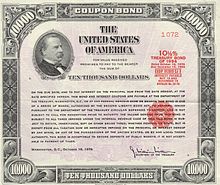
like Sidney Homer used to say- "sooner or later every generation is shocked by the behaviour of interest rates."
Hernan Avella disagrees:
I don't think many people can be shocked, given the data we have from the 80's. Most asset holders are older folks anyways, that have the memories of the Volker era deep in their heads.
Stefan Jovanovich offers:
Edward Chancellor interview
High Interest Rates To “Slay” Zombified Companies | Edward Chancellor & Joseph Wang
Kim Zussman adds:
America’s Retirees Are Investing More Like 30-Year-Olds
At Vanguard, one-fifth of taxable brokerage account investors aged 85 or older have nearly all their money in stocks
William Huggins responds:
i suspect a good part of that boils down to how one's asset portfolio is defined. most studies of brokerage accounts don't account (haha) for the real estate, pension, insurance, or physical assets of those being studied. if most of my income is derived from a secure pension, its (mathematically) a pretty good approximation to drawing the yield from a large investment grade bond portfolio (less the liquidity). owning your home (usual by 85) would similarly constitute a "housing cost equivalent" yield, as would any reliable health benefits being drawn. seen in that way, one's discretionary funds being kept in equities would be quite reasonable.
Zubin Al Genubi reminisces:
Sure would have been nice to own 17% bonds. 5% not too bad though.
Nils Poertner offers:
Big investors rush into bonds after ‘cataclysmic’ year
Capital Group predicts $1tn will flow into debt markets in next few years as investors move to lock in higher yields
Henry Gifford writes:
In the 1970s my father bought some New York City municipal bonds. At the time there were rumors that the city government was going to go broke. I heard my father say “How can the government go broke? When they want money all they have to do is send people bills.”
The city government defaulted on the bonds. It was widely reported in the news as a disaster, with various solutions to the terrible problem proposed. I was only a teenager, but didn’t see a problem with the government not being able to borrow money any more. I still think it would be great. But, most people believed it was a terrible problem, with disaster looming.
My father reacted by buying more of the bonds – “default” meant they mailed his checks one week late. The bonds were triple tax free: no federal income taxes, no NY State income taxes, and no NY City income taxes. The bonds paid 28%. It was the only time in my father’s life that he borrowed money – to buy more of those 28% bonds. I have no idea for how many years he was collecting 28%.
I started buying apartment houses in Manhattan when I was 20. It was normal to pay 12% interest. One time I bought a small building – only four families – with the goal of replacing the 12% seller-financed loan with an 8% bank loan on an owner-occupied property. I moved into the building, fixed it up, but never managed to get a city inspector to come inspect and remove all the violations without inventing some new ones, as I never bribed an inspector. But for a long time I dreamed of refinancing a little bit of my real estate at 8%.
Nils Poertner responds:
tangentially speaking . we would need to have experience from bond traders of the 1970s and 1980s, today is more leverage though and we have more complex system so not sure how much that would really help. collective mind has been in a long mental bear mkts as well. we need nerves of steel in coming yrs and imagination.
Jun
1
Steel Box Indicator, from Stefan Jovanovich
June 1, 2023 | Leave a Comment

In the first quarter of 2023, container output contracted by 71% compared to the previous year, with only 306,000 TEUs produced, marking the lowest level since 2010. Drewry estimates that full-year production will not exceed 1.8 million TEUs, the lowest since the recession-hit year of 2009.
Container Production Slumps to Lowest Level in 14 Years, Says Drewry
Henry Gifford writes:
What sort of time lag can be expected between ordering the containers and their actual use? I order cardboard boxes, and they are used to ship goods a few weeks later, I expect a shorter time lag for larger cardboard box users. But I expect it takes time to ramp up steel container production and delivery.
Stefan Jovanovich responds:
Top 10 Shipping Container Manufacturers In USA
Steve Ellison adds:
Maybe the shipping container industry does not have just in time inventory replenishment, or maybe it did, but the policies did not survive the covid pandemic. In a previous career in supply chain management, I needed to be aware of how inventory and decision lags downstream in the supply chain amplified demand fluctuations upstream, on manufacturers for example. This is known as the bullwhip effect.
Pamela Van Giessen comments:
There was an article in the WSJ earlier this year/late last year (the months seem to fly by) that shipping has fallen off a cliff. Part due to less goods needed/wanted, overstock because of covid era over ordering, and backlogs having caught up. Could it be there is an oversupply of containers based on things normalizing and/or a temp decrease while everything catches up?
I have been interested in knowing what the rail freight looks like but haven’t been able to find a source that provides that info (also haven’t looked that hard). Living in a rail town, it was much definitely quieter 6 mos ago than it has been lately. But maybe it’s just more coal out of the Powder River basin for China, India, etc. At least 3 long trains of coal/day. Every time I hear the environmentalists cry about CO2 emissions and how we have to get rid of xyz in the US, I have to laugh at the latest pet peeve (gas stoves & furnaces, increasing energy efficiency in dishwashers, wash machines, etc), it will never make a dent against all that coal being fired up in other parts of the world.
Jeff Watson offers:
Stefan Jovanovich adds:
Container Shipping Industry Faces Unprecedented Slump in Long-Term Rates
The container shipping industry experienced a significant downturn in global long-term freight rates during the month of May, as the contracted cost of shipping containers plummeted by a staggering 27.5%, according to Xeneta’s Shipping Index (XSI®). This marks the ninth consecutive month of rate drops and represents the largest monthly fall ever recorded on the platform.
Mar
3
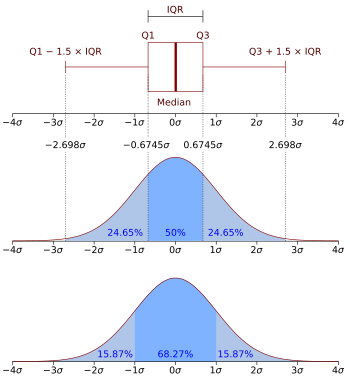
Calibration of Probabilities: The state of the art to 1980
Sponsored by OFFICE OF NAVAL RESEARCH
June 1981
This paper presents a comprehensive review of the research literature on an aspect of probability assessment called "calibration." Calibration measures the validity of probability assessments. Being well-calibrated is critical for optimal decision-making and for the development of decision-aiding techniques.
The first class is calibration for events for which the outcome is discrete…. For such tasks, the following generalizations are justified by the research:
1. Weather forecasters, who typically have had several years of experience in assessing probabilities, are quite well calibrated.
2. Other experiments, using a wide variety of tasks and subjects, show that people are generally quite poorly calibrated. In particular, people act as though they can make much finer distinctions in their degree of uncertainty than is actually the case.
3. Overconfidence is found in most tasks; that is, people tend to overestimate how much they know.
4. The degree of overconfidence untutored assessors show is a function of the difficulty of the task. The more difficult the task, the greater the overconfidence.
5. Training can improve calibration only to a limited extent.
The second class of tasks is calibration for probabilities assigned to uncertain continuous quantities…. For calibration of continuous quantities, the following results summarize the research.
1. A nearly universal bias is found: assessors' probability density functions are too narrow. For example, 20 to 50% of the true values lie outside the .01 and .99 fractiles, instead of the prescribed 2%. This bias reflects overconfidence; the assessors think they know more about the uncertain quantities than they actually do know.
2. Some data from weather forecasters suggests that they are not overconfident in this task. But it is unclear whether this is due to training, experience, special instructions, or the specific uncertain quantities they deal with (e.g., tomorrow's high temperature).
3. A few studies have indicated that, with practice, people can learn to become somewhat better calibrated.
Stefan Jovanovich writes
Grant's great virtue as a warrior was that he had seen the absence of certainty in war everywhere from the front line (having a fellow junior officer lose his head to a Mexican cannonball as the two them walked forward) to the far rear (where half the sick, women and children left behind in crossing the Isthmus die from cholera because the contracted mules do not arrive; Grant saved the others by buying pack animals at the market price and then spending the rest of his tour in California and Oregon arguing with the War par5ment about the waste of funds). Man proposes and God disposes.
Gyve Bones adds:
In preparing for battle I have always found that plans are useless, but planning is indispensable.
[General Dwight D. Eisenhower]
Feb
23
Analysis of Train Derailment in East Palestine, Ohio, from Stefan Jovanovich
February 23, 2023 | Leave a Comment

Starts at Minute 4:00: A Failed Defect Detector and the Train Derailment at East Palestine
The achievement of railroads is that they can carry massive loads thousands of miles with an economic efficiency that no other form of ground transport can come close to matching. To do this they have to violate the first rule of all practical mechanical engineering and have metal scrape against metal without any lubrication. The wheels and rails are steel against steel. If an air brake fails for a wheel, it stops it dead and the wheel becomes a giant flint throwing sparks and then flames. The only solution to this problem is to slow the train to walking speed and move it to a siding. If the train continues at speed (30-40 mph in developed areas), that car will eventually derail. The unanswered question for this incident is why the train crashed in the pattern of an emergency stop by the engine, not the derailment of a single car. That could have been caused by the engineer not having the skill and temperament required to avoid literally slamming on the brakes because "the train is on fire". But, that is pure speculation by those of us sitting safe in the bleachers.
Bud Conrad writes:
Thank you for the explanation in bigger picture context. There seems to be something much more unusual about this particular incident, than just a mechanical failure, of a type that must happen frequently because steel is riding on steel.
Jeffery Rollert comments:
Modern rail cars have systems that brake all cars at once (locomotives included). It’s done by a radio signal or wire, and no longer a pneumatic propagation. I know, because a very good friend designed and built the system decades ago. Cars derail, when the locomotive derails and effectively becomes the brake. So why did the locomotive derail?
I haven’t seen the video, but strongly suspect something in the tracks or a switch was improperly diverted that the locomotive couldn’t handle the redirection at that speed.
Henry Gifford explains:
Steel rolling on steel is a great idea because there is such a small amount of friction. An adult human can allegedly push a fully loaded (200,000 Pounds or more) railroad car along a level track (but not get it started – another story). Rubber covered wheels, in contrast, require much more energy because heat is generated as the rubber flexes (internal friction from molecules rubbing on each other). But, if the railroad train car bearings seize up, steel is sliding on steel – still lower friction than rubber rubbing on a road, thus the locomotive(s) can drag it along until derailment…
Read the full discussion here.
Jan
2
Thoughts on EUR for January 2023, from Alex Castaldo
January 2, 2023 | 2 Comments
I do not focus on foreign currencies in my trading. And there are people here, such as Mr. John Floyd, who are far more knowledgeable about FX. So some of you may find these thoughts a bit simplistic; keep in mind I am an amateur!
I believe that a factor that makes a country's currency attractive to investors is the success (or lack thereof) that foreign investors have investing in the country in question. We can gauge this success by using ETF's that specialize in particular countries. For example SPY measures the performance of stock investors in the US, while EZU tracks investing in Eurozone stock markets.
What do we see? In recent months EZU has been performing better than SPY. For example in the last 6 months of 2022 SPY had a total return of 2.03% and EZU 9.56%. For 2022 as a whole SPY -18.38% and EZU -16.67%, two ugly numbers, but EZU did better. (These numbers will change between now and Dec 31, but not by much).
In my view this kind of comparison (especially given that Europe did poorly the previous few years, so it's a remarkable turnaround) will attract additional US investors to Europe, strengthening the currency. That is why I am bullish on EURUSD for the month of January 2023.
Bud Conrad responds:
Your logic is that if the stock market of a country rises, the currency of that country will rise in exchange rate. In the early days of this Speclist, the chair would ask me if I had "counted" the historical experience, which you cite for the last six months and year, but usually you need something like three cycles of inflection to get confidence.
The more usual comparison for currency strength are the Interest Rate Parity, using the futures market expected exchange rate and the difference in Interest rates.
And there the International Fisher Effect, also described here.
Often international traders look at trade balances for the country that has a trade surplus to be more attractive so the currency might rise. Trade surpluses mean they are a lender and not in debt to other countries. The US is the world's largest debtor, but the currency has been doing well.
John Floyd writes:
Doc makes the broadest, cleanest, and most accurate point about what drives currencies: what are expectations for return by BOTH domestic and foreign participants, and how does that drive investment flows into equities, FI, FDI, etc, which shows up in the BOP and Capital Account - on the other side of the ledge is the Current Account and the Errors and Omissions.
Admittedly I don’t know much about currencies and this is the area I know least about, but flow data is well researched and document by many at banks, independent research firms, IIF, IMF, BIS, etc. One challenge is it is often very much lagged, so Doc’s idea of looking at actual market instruments makes sense, and this is often particularly useful for emerging markets.
Capital account flows can fund a current account deficit for a very long period of time. Look at the US now or look at the Asian Currencies pre the crisis: errors and omissions become important given capital flight, particularly EM. Think Russia pre ’98 and Swiss bank accounts, etc.
As Doc well knows infinitely better than me, we need some more data and this can all be tested.
More broadly, outside of equity flows, Bud’s point of interest differentials will drive some capital flows. Also consider FDI from Europe to North America to diversify dependence on European energy costs and to friend shore manufacturing capacity.
And I would be remiss to not mention Italy (sorry Doc). Italy is in a Euro straightjacket that not even Houdini could get of. ECB is tightening with inflation at 10%, Italy 150% debt to GDP, Italian per capita GDP is barely higher than when joined Euro in 1999, Italy needs circa $250 billion in funding in 2023, 10 year yields in Italy up from 1 to 4.5%, all Italy issuance past few years was essentially bought by the ECB. This is not politically sustainable. Just look at the evolution of recent German politics. The ECB’s TPI is there but is intended for temporary dislocations and will require Italian political concessions. Oh and Italy is 10x Greece and the world’s 3rd largest sovereign debt market behind the US and Japan.
Read the full discussion here with additional contributors and charts.
Dec
27
Recession Can’t Come Soon Enough, from Gary Phillips
December 27, 2022 | 1 Comment
The market has always been a discursive struggle between the bulls and the bears. A system of oppositions that one might think, would logically or functionally negate each other. Of course, the relationship never stays linear for long and the inevitable convexity leads to a Hegelian resolution of thesis and antithesis.
The dialectical tension between an "impending" (but reluctant to manifest) recession (inverted yield curve) and a resilient economy (Q3 GDP +3.2) and labor market (unemployment 3.7%) underscores the struggle between the "higher for longer" bears, and the bulls who believe in the equivocation of "pause" with "pivot."
A reactive Fed will continue to focus on a strong jobs market and keep its tightening bias, which WILL inevitably cause a deep recession; however, the recession won't come "soon enough" for the Fed to save the day. And, the seemingly gradual descent into negative growth, will allow the recession trade to dominate its opposition.
Larry Williams responds:
The actual economy down but not out or negative:

Gary Phillips replies:
i get what you're saying. (perhaps the economy is strong enough we never have to endure a recession in 2023.)
but, methinks you're missing MY point: the longer the economy "holds on", and the longer it takes for a recession to rear its ugly head, the longer the Fed continues QT ( good news is very bad news). on the other hand, if there was an impulsive and deep, drop in growth, (bad news would be welcomed with open arms) the Fed would be more inclined to pause or pivot sooner (de facto put).
Read the full discussion here with additional contributors and charts.
Dec
7
Trial and error, from Big Al
December 7, 2022 | Leave a Comment
Watching Victoria via PBS Masterpiece sub, and it's shown that, during the 19th century, one treatment for syphilis was basically a mercury sauna, inhaling the vapors - yikes!
The history of syphilis is an interesting case for seeing how quack medical treatments, such as mercury, were applied and killed people even more quickly. Of course, one shouldn't judge too harshly as they were treating things of which they had no understanding.
The relevance to trading is that humans have an impulse, when confronted with challenges they don't understand, to resort to superstition and to believe anything that is claimed with great confidence.
Penny Brown notes:
Flaubert took the mercury treatment for syphilis and as a result his tongue turned blue.
Laurel Kenner adds:
Qin Shi Huang, first emperor of China, drank mercury-infused wine to attain eternal life. Rivers of mercury surrounded his burial chamber, a depiction of China. Qin died at 49.
Gyve Bones writes:
We saw examples of that in the recent pandemic. At first "masks don't work. Don't wear masks." then… "Everyone must wear a mask at all times, even alone outside or in a car." Then "The virus stops dead in the vaccinated person, who will not get Covid, and won't spread it to others." then… "Anthony Fauci contracts COVID three times, but is certain it would have been worse had he not been quad-jabbed."
Now there's this disturbing study which shows the effects on infant cord blood and their immune systems from mothers who have been infected with COVID.
Henry Gifford comments:
The early instruction for people to not wear masks was so that security cameras could see people’s faces. The police seem to really love security cameras with an enthusiasm that strikes me as going above and beyond any usefulness to “fight crime”.
There was the time a landlord in NYC put a camera outside a tenant’s door to prove if the tenant was using the apartment as a “primary residence”, and would therefore still be entitled to rent protection or not. The tenant’s boyfriend put bubble gum on the lens and was promptly hunted down and arrested and charged with every crime the cops could think of, with an enthusiasm certainly not caused by anyone’s love for a NYC landlord.
Not being seen clearly on security cameras was, if I remember correctly, sometimes even stated as the reason to not wear masks, which made me wonder – if they think masks work, more people dying is OK as long as people can be seen on cameras?
Pamela Van Giessen responds:
Henry — There exists decades of research that show that masks do not reduce transmission. I have yet to see meaningful evidence (research or real world) that shows that they do work. The current situation in China would seem real world validation of the lack of mask effectiveness. Lockdowns don’t seem to work much either. Most people don’t die from covid either. They don’t even get very sick.
Henry Gifford writes:
I tend to believe things if they can be measured, if the measurements can be repeated by others, and if they can be explained by the laws of physics. I tend to not believe anything not meeting these three criteria. As the owner and fairly regular user of over fifty measuring instruments, the measuring part often means measured by me.
Nov
17
FTX surprise
November 17, 2022 | Leave a Comment
H. Humbert writes:
I find it amazing that an exchange with monopolistic market making, and no Manning Rule equivalent can ever lose money. As bad as stealing customer funds to cover trading losses sounds, I wonder if there's even worse to come because it sounds so incompetent. However, once again the value of crypto to nefarious actors is demonstrated by the 'asset classes' anti-fragility. Some flavor of the notion of honor among thieves.
Zubin Al Genubi replies:
Market makers can't handle big fast moves, of which we've seen some breathtaking one recently. I believe they are caused in part by the market makers and the ones who are just a bit slower get eaten by the lion. Of course this is sheer speculation on mu part.
H. Humbert comments:
With respect, your model of what a market maker is hasn't existed for about 15-20 years. Market making today is machine driven, speed of light kind of thing, and balanced/correlated across a firm's book. It is almost touchless for the most part.
So for example, if you are a Manning-Rule-free exchange, and you have your own internal market making operation that sees the flow first, you can, at the speed of light, see the direction of the order flow, front run it, sell into it, take the other side of the stupid trades ie the trades that are 'random' going against the flow that you are seeing, see the limit orders and the stop orders and run those etc etc. You see the flow first and decide how to execute against or with it or pass to the punters on the exchange.
It seems impossible to lose money at this and if you don't believe me, look at how few losing days Virtu and Citadel put up and they only get to see about 90% of just the retail flow in equities and they generally can't front run it. They can only decide if they want to take the other side or pass the order on to the market. Imagine if you had no fiduciary responsibility at all and no any kind of rule of best execution.
Anyway I go on and on, but point is, that FTX's Alameda lost money and a lot of it is very strange. Also, I should add, that I know absolutely nothing about crypto.
I can't help but notice that another of Vic's flags is prominent in this FTX story, and that's all the charity work they were doing. All while seemingly running some crazy embezzling thing to cover what? How were they generating these huge losses?
I knew a living human market maker at Schwab in the dot com era. His boss took and traded a single security(I won't name it) and split the rest of the book up. My living human associate got like m-z or something and one day he's long a zillion XLNX. Supervisor screams at him 'What are you and ANAL-IST?"–meaning what ever you think you know, get back to making markets and leave the positions to the buy side suckers. So maybe the losses are from directional market supporting efforts or some such.
Zubin Al Genubi suggests:
Maybe machine/com speed now determines winners?
William Huggins agrees:
can't see why that wouldn't be the case. on a precisely related note, a friend (ex-mit) gave a talk on algos in finance a decade ago, noting at one point how buildings were then being hollowed out to reduce microseconds of lag (i start the clip where its juicy).
H. Humbert writes:
This is one issue with co-location of servers at the exchanges, why it costs so much, why IEX markets a 200ms 'speedbump' to protect resting orders, why dark pools offer some very strange order types, etc etc but ultimately, the winners and losers imo, are determined by rent seeking in the regulations. Ban payment for order flow and Virtu disappears, ban internalization and Schwab has to charge commission, make best execution mean best possible all in price at the moment the order is received and all brokers will institute intermarket sweeps and order flow will go to exchanges, etc.
Stefan Jovanovich comments:
I hope H. Humbert will agree with this comment from the financial bleachers. The anti-trust laws, including agricultural marketing restrictions, have offered the same opportunities for rent-seeking around regulation without having any of the pushback from innovation - i.e. new and better ways to game the system. So, we have an age of inflation at the same time transaction and carry costs for retail customers have gone steadily down.
Duncan Coker writes:
This is a great description of the rent seeking infrastructure or "top feeders" as vic would say. It is all sell-side as that is where the stable income resides. Still as a lowly buy-sider if my choice is to get fleeced by the exchange/locals or the hft hedge funds I think I would go with the later. At least the hedge funds are competing against one other to steal from me. Don't even get me started with the wirehouses. Used to be 100 bp to execute/clear a trade back in the 80s, off exchange that is.
H. Humbert replies:
In the US equity world, which is the only thing I know anything about, the issue that that the HFT shops segment the order flow into smart and dumb and pay for the dumb order flow, which they get first look at and first dibs on off-exchange - through FINRA, which has it's own rules on order handling.
Segmenting the flow makes the rest of the market(not the internalizes, not the payment for flow(PFOF)), both lit and dark, more toxic in terms of adverse selection to resting quotes. This widens the spread, which makes internalization/PFOF more profitable - virtuous cycle kind of thing and also increases the concentration of who gets to see the flow first and decided where to fill.
Given the midterms, I think Chair Gensler has enough political capital to push through some of the rule changes he's been talking about: “Competition and the Two SECs” Remarks Before the SIFMA Annual Meeting
To me, the most likely significant change to get through easily is SEC's own Best Execution rule(amazing I know that there is none currently) and that could dramatically change where orders get filled. We'll see.
— keep looking »Archives
- October 2026
- September 2026
- August 2026
- July 2026
- June 2026
- May 2026
- April 2026
- March 2026
- February 2026
- January 2026
- December 2025
- November 2025
- October 2025
- September 2025
- August 2025
- July 2025
- June 2025
- May 2025
- April 2025
- March 2025
- February 2025
- January 2025
- December 2024
- November 2024
- October 2024
- September 2024
- August 2024
- July 2024
- June 2024
- May 2024
- April 2024
- March 2024
- February 2024
- January 2024
- December 2023
- November 2023
- October 2023
- September 2023
- August 2023
- July 2023
- June 2023
- May 2023
- April 2023
- March 2023
- February 2023
- January 2023
- December 2022
- November 2022
- October 2022
- September 2022
- August 2022
- July 2022
- June 2022
- May 2022
- April 2022
- March 2022
- February 2022
- January 2022
- December 2021
- November 2021
- October 2021
- September 2021
- August 2021
- July 2021
- June 2021
- May 2021
- April 2021
- March 2021
- February 2021
- January 2021
- December 2020
- November 2020
- October 2020
- September 2020
- August 2020
- July 2020
- June 2020
- May 2020
- April 2020
- March 2020
- February 2020
- January 2020
- December 2019
- November 2019
- October 2019
- September 2019
- August 2019
- July 2019
- June 2019
- May 2019
- April 2019
- March 2019
- February 2019
- January 2019
- December 2018
- November 2018
- October 2018
- September 2018
- August 2018
- July 2018
- June 2018
- May 2018
- April 2018
- March 2018
- February 2018
- January 2018
- December 2017
- November 2017
- October 2017
- September 2017
- August 2017
- July 2017
- June 2017
- May 2017
- April 2017
- March 2017
- February 2017
- January 2017
- December 2016
- November 2016
- October 2016
- September 2016
- August 2016
- July 2016
- June 2016
- May 2016
- April 2016
- March 2016
- February 2016
- January 2016
- December 2015
- November 2015
- October 2015
- September 2015
- August 2015
- July 2015
- June 2015
- May 2015
- April 2015
- March 2015
- February 2015
- January 2015
- December 2014
- November 2014
- October 2014
- September 2014
- August 2014
- July 2014
- June 2014
- May 2014
- April 2014
- March 2014
- February 2014
- January 2014
- December 2013
- November 2013
- October 2013
- September 2013
- August 2013
- July 2013
- June 2013
- May 2013
- April 2013
- March 2013
- February 2013
- January 2013
- December 2012
- November 2012
- October 2012
- September 2012
- August 2012
- July 2012
- June 2012
- May 2012
- April 2012
- March 2012
- February 2012
- January 2012
- December 2011
- November 2011
- October 2011
- September 2011
- August 2011
- July 2011
- June 2011
- May 2011
- April 2011
- March 2011
- February 2011
- January 2011
- December 2010
- November 2010
- October 2010
- September 2010
- August 2010
- July 2010
- June 2010
- May 2010
- April 2010
- March 2010
- February 2010
- January 2010
- December 2009
- November 2009
- October 2009
- September 2009
- August 2009
- July 2009
- June 2009
- May 2009
- April 2009
- March 2009
- February 2009
- January 2009
- December 2008
- November 2008
- October 2008
- September 2008
- August 2008
- July 2008
- June 2008
- May 2008
- April 2008
- March 2008
- February 2008
- January 2008
- December 2007
- November 2007
- October 2007
- September 2007
- August 2007
- July 2007
- June 2007
- May 2007
- April 2007
- March 2007
- February 2007
- January 2007
- December 2006
- November 2006
- October 2006
- September 2006
- August 2006
- Older Archives
Resources & Links
- The Letters Prize
- Pre-2007 Victor Niederhoffer Posts
- Vic’s NYC Junto
- Reading List
- Programming in 60 Seconds
- The Objectivist Center
- Foundation for Economic Education
- Tigerchess
- Dick Sears' G.T. Index
- Pre-2007 Daily Speculations
- Laurel & Vics' Worldly Investor Articles
