Oct
11
Days of the week 2026, from Zubin Al Genubi
October 11, 2026 | Leave a Comment
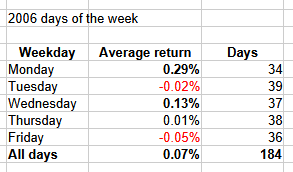
Consistent with randomness.
Adam Grimes writes:
I agree that it looks consistent with sampling error. Did you run a permutation test? Would prefer that to assumptions of distributions.
"Hey Claude, I would like to write a Python program to take a time series of daily net changes to the S&P 500 and run a simulation in which the daily returns are randomly grouped into 5 bins. Calculate the average and standard deviation of each bin, and repeat the simulation 1000 times."
Steve Ellison offers:
Hey Claude, I would like to write a Python program to take a time series of daily net changes to the S&P 500 and run a simulation in which the daily returns are randomly grouped into 5 bins. Calculate the average and standard deviation of each bin, and repeat the simulation 1000 times.
Output: I believe the last item is the test for significance. Unless the difference between the best day and the worst day is at least 0.50%, the null hypothesis is not refuted.
Data: 188 daily changes
Overall mean = 0.000646 std = 0.008266
Simulations: 1,000 Bins: 5
Bins ranked by mean within each simulation:
avg mean 5th pct 95th pct avg std
Lowest -0.000888 -0.002053 0.000051 0.008245
#2 -0.000011 -0.000864 0.000659 0.008176
#3 0.000660 0.000013 0.001289 0.008179
#4 0.001320 0.000667 0.002063 0.008185
Highest 0.002149 0.001251 0.003346 0.008230
Spread (highest bin mean - lowest bin mean):
average = 0.003037 5th–95th pct = [ 0.001343, 0.005003]
Peter Ringel comments:
Significance - Schmicnificance. Nobody likes Lasagna Mondays, eh? (roll out the pillories)
I did the counting again for 2025,2026 on NDX & NQ EoD data and found: exactly the same lack of significance, as you guys. On intraday I found significance, but also found a bug in my script for the test from how the baseline slices are constructed. EoD and intraday should be nearly the same. None of this is vibe-coded.
The problem is, I already had a relation with Mondays before I did the counting. I shouldn’t even start talking about Thursdays. And I am thinking to start a relation with Wednesday. I really expect to find at least something weak in the stats. I tried to push it a little, e.g. via only looking at up-days. Still nothing.
This isn't over. Mondays are great (for now)
Jeffrey Hirsch writes:
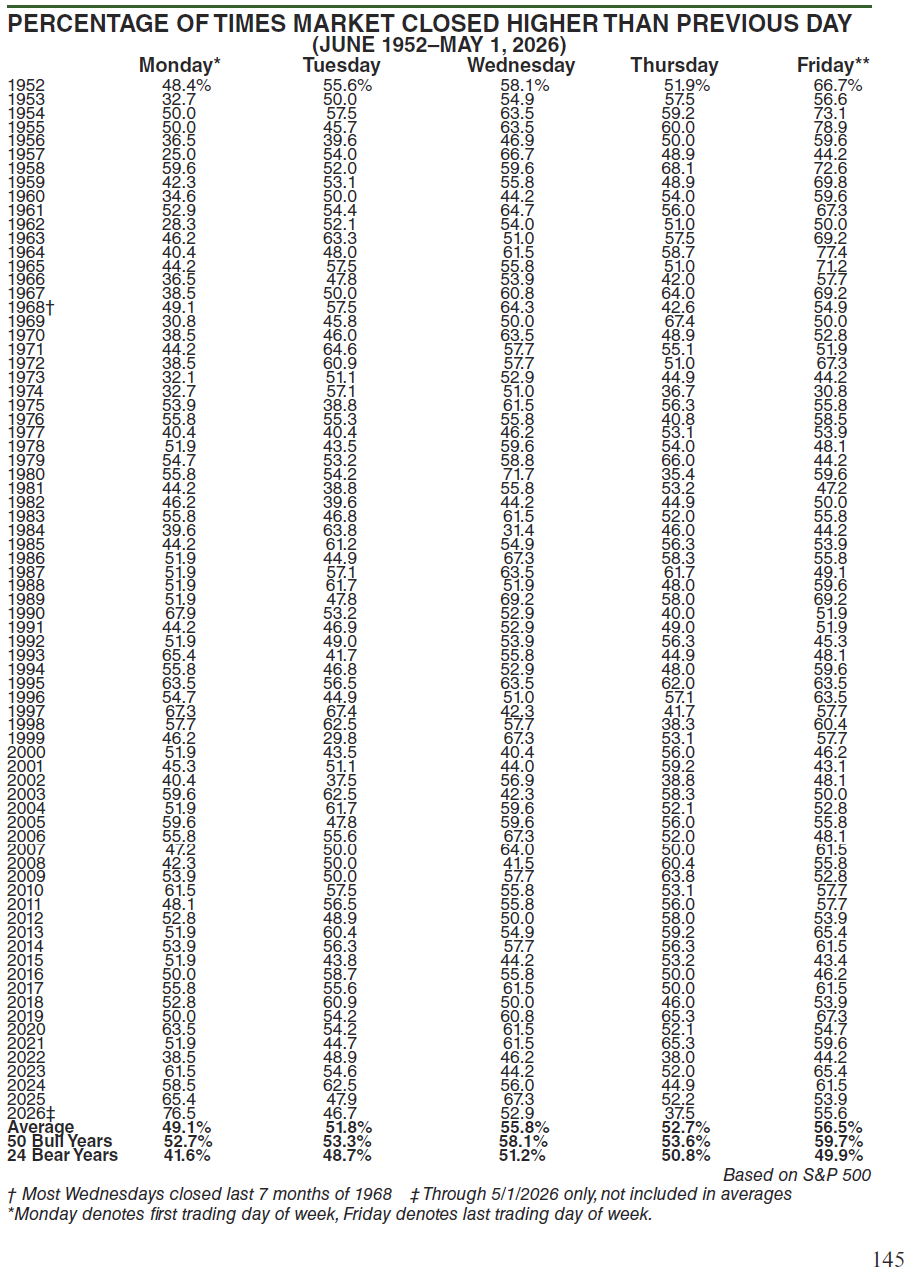
Here’s my latest daily on the S&P from page 145 of the 2027 Almanac (click on table for full view). There’s more on pages 143-146 and other data and stats in the data bank section pages 122-183. We also run studies through our internal LLM. 2026 through 10/2 is below. (*Monday is first trading day of the week except when Monday is a holiday. Friday is last trading day of the week except when Friday is a holiday.)
S&P DAILY PERFORMANCE EACH YEAR SINCE 1952
To determine if market trend alters performance of different days of the week, we separated 24 bear years—1953, ’56, ’57, ’60, ’62, ’66, ’69, ’70, ’73, ’74, ’77, ’78, ’81, ’84, ’87, ’90, ’94, 2000, ’01, ’02, ’08, ’11, ’15, ’22, and ’24 from 50 bull market years. While Tuesdays and Thursdays did not vary much between bull and bear years, Mondays and Fridays were sharply affected. There was a swing of 11.1 percentage points in Monday’s and 9.8 in Friday’s performance.
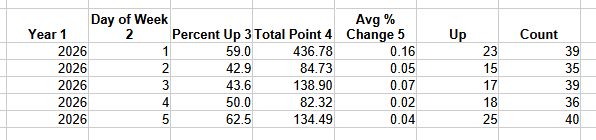
For 2026 we get:
Adam Grimes writes:
I have a set of tools that I developed over many years that start with an event study and move potentially interesting ideas through a simulated trading platform, with options for out-of-sample and forward testing. (None of this originally vibe coded, and the methodology a blend of academic + practical).
I fed it the discussion on weekdays, which was a pretty easy question. I've always been suspicious of seasonal influences because I rarely see them rise above noise, but thought this was worth considering. Attached is a fairly comprehensive result. (I would be especially wary of methodologies that categorize days in retrospect. For example, categorizing a day as "in a bull or bear year" based on a year-end lookback introduces fatal bias.) Results in the pdf:
Larry Williams responds:
Great work but change the exit strategy to make it tradeable. A make the hold a little longer.
Adam Grimes wonders:
Maybe I'm missing something here, but the test shows no edge beyond the market's natural drift (which any weekday entry gets). Won't a longer hold just capture more of that drift? The historical hold that worked was Monday's close to Friday, which was about +0.18% per week over the average day 1953-1977, dropping to +0.02 since 1980.
I would think the key question here is historical stability. Some holds will show an edge over some period of time, but the real question is whether those persist into following periods. Happy to look at this any way you'd find helpful. I can easily run every entry day against every exit day (and even into following weeks if you want longer holds). But I'm reading these results as a conclusive evidence that the old Monday effect is gone since about 1980 and that no weekday stands out from chance. Any random day entry and exit will probably show a profit (due to the drift), but the question I'm judging against is whether any chosen hold makes money above that random hold.
Oct
6
Markets as buffers, Zubin Al Genubi
October 6, 2026 | Leave a Comment
A quote from myself from the 2007 Spec Party on Vic's Central Park Rose Garden talk which I remember vividly. "Chairman espoused his theory of the markets as the mechanism that mediates between government and the the populace…that causes not only the obvious capital allocation but buffers the power of government to protect the needs of the populace through price and capital demands. It is a novel theory which I have never heard discussed anywhere else. The market itself is the mechanism that effects large scale social and political change through changes in incentives, attitudes and demand, and is more than merely shuffling money. Understanding the markets as a social and political driver can lead to long term trading strategies and keep the trader on the right course."
As Bonds hit multidecade lows, I ask (rhetorically) who is more powerful, the market or the government? What does it portend?
James Gavrity writes:
That question raises more questions than it answers. I could answer with a long macro analysis, but the answer to these two sub-questions will give us the answer to the original.
I ask myself: which one is more fearful of the other? And which one tries to exert control and influence over the other? The one that's more fearful and tries to exert the most control is typically the least powerful.
James Carville famously hung a sign in the Little Rock campaign war room during the 1992 election that read: "The economy, stupid."
Who tries to control the price of fuel and eggs? Who takes credit for a booming market? In my view, the market is the most powerful force, whether you live in a democracy or not. Quoting James Carville, "The economy, stupid"—this is what has the power to change governments of all types.
Jeff Watson is unambivalent:
Markets are bigger than governments, hands down.
Larry Williams comments:
Great point. When everyone is a millionaire thanks to the stock market Bernie Sanders pitch falls on deaf ears—just one example of this theory.
William Huggins writes:
while its clear that markets are quite powerful, its important to remember that the sorts of markets we are talking about (capital markets) can only really thrive when there are enforcement mechanisms and dispute resolution - both of which are often supplied by the "force monopolists" of the state. this pattern extends into the bronze age (see: Assur)
imo, states and markets have a symbiotic relationship. either could exist in isolation but would be much poorer and weaker than they are today. in that context, i'm inclined to consider whether one of the two symbiants might try to "devour" the other for its own survival - it would certainly spell the end of a beautiful marriage.
James Gavrity responds:
IMO. As a trader and businessman, I am no expert here; this is just my perspective from where I sit. The market is the boss in that relationship. The Market is the King Maker And Wealth Creator.
The government is the tail attempting to wag the dog, The theory at hand the way I see it doesn't view the market as a quote board; it's the ultimate check on the politicians. The government pushes fiat and mandates, but the market reflects what people are actually doing with their money. When D.C. overspends, overregulates, or debases the dollar, the market acts as a shock absorber. It reprices risk and pulls the leash on the government before ideological policies can completely wipe out the public's economic foundation.
Price discovery doesn't lie. If they print money to fund a political agenda without creating real value, the market violently reprices hard assets and demands a premium to hold Treasuries. It’s not just shuffling cash around; it’s capital voting against political arrogance. It forces a behavioral shift by making it too expensive for the government to keep running its game, which ultimately protects the public from total ruin.
To your question: the market wins, hands down. Central banks can manipulate and suppress rates like the QE we've dealt with for over a decade but that's just building a dam. The market is the water. The government might write the rules, give away free stuff and tax our Income, but the market enforces the economic physics. Eventually, the dam breaks and gravity takes over.
With the long bond hitting multi-decade lows, the market is effectively ripping up the sovereign blank check. If you look at this through the macro cycles, it points to a few massive structural shifts:
The Bond Vigilantes Are Back: The market is stepping in to enforce the fiscal discipline the politicians refuse to legislate. As debt service eats the national budget alive, the government is going to be backed into a corner—austerity, higher taxes, or financial repression—regardless of who is in office. The market is forcing their hand.
Flight to Hard Assets: The era of zero-interest-rate easy money is dead. The mechanism is actively rotating capital out of paper promises and fiat debt, and moving it into commodities, precious metals, and real production. It’s a classic defensive posture against debasement.
Social and Political Friction: Cheap debt has numbed the public to government incompetence for a long time. Turn off that spigot, and the real cost of these policies hits home. When the public actually feels that economic pain, it drives massive shifts in societal attitudes and intense political turnover.
When you watch the tape through this lens, it means looking past the daily noise and short-term setups to see the tectonic plates shifting. When the bond market moves like this, it’s not just another trade. Understanding the market as a social and political driver keeps us on the right side of the trend long-term.
Carder Dimitroff offers:
I generally agree that markets, rather than governments, can be kingmakers. But not all markets are equally independent of the state. Sovereigns establish and enforce the legal order within which markets function, and they control access to territory, airspace, waters, natural resources, strategic infrastructure, and military procurement. Some markets would scarcely exist without that framework; others operate only by license and under close state supervision. When a government judges that national security or another core interest is at stake, firms in those markets must adapt, exit, or risk losing access to the market itself. In that sense, the king may not choose every winner—but it can still decide who remains in the game.
James Gavrity again:
Agreed my thoughts were focused on the 10,000-foot view. Yes they can pick a choose winners and losers. When a government judges that national security or another core interest is at stake, firms in those markets must adapt, exit, or risk losing access to the market itself. In that sense, the government may not choose every winner—but it can still decide who remains in the game. Like Intel and others, from the bigger, broader picture, there is a sequence of order to this. The hubris of the state always brings it to a Marie Antoinette moment: "Let them eat cake." Ultimately, the markets will bring the government and those consensus elites exactly that fate, regardless of how many kings they make along the way. That quote was not her actual words. "Let them eat cake." was a political myth popularized to fit a narrative. Historically her actual last words were an apology to her executioner after accidentally stepping on his foot on the scaffold: "Pardon me, sir. I did not do it on purpose." When the steak and lobster are gone, a new king will be crowned.
Sep
24
Motto to trade by, from Zubin Al Genubi
September 24, 2026 | 1 Comment
Limit your losses, and gains and growth will take care of itself.
Asindu Drileba wonders:
Strategies for limiting losses?
1. Position sizing
2. OTM options
3. A friend of mine holds long VIX positions
Questions?
- What other strategies exist?
- What is best? 1, 2 or 3?
Zubin Al Genubi responds:
Those are all good strategies. Another way is to lower your expectation return targets in time or returns which in turn lowers loss expectations. In a competitive scenario this may or may not be acceptable but if you have enough, why take on more risk.
Larry Williams offers:
Once you set your stop loss, don't move it. Ever. Never.
Jul
18

example of something in our Western culture when we "over-use", overly rely on numbers to give meaning to something. Clever marketing idea though. A bit like those French Phds at BNP who looked at their credit derivs spreadsheets in summer 2007 and couldn't see what is behind those numbers as reality is more complex. Humour helps for sure.
Robert Parker's 100-point wine rating system
One of the most influential and controversial features of Parker's wine criticism is his 100-point rating system, which he popularized in conjunction with his friend Victor Morgenroth. Parker designed the system to counter what he believed to be confusing or inflated ratings by other wine writers—many of whom he accused of a conflict of interest, as they often had a financial interest in the wines they rated. The scale, now widely imitated in other publications (such as Wine Spectator[23]), ranks wine on a scale from 50 to 100 points based upon the wine's color and appearance, aroma and bouquet, flavor and finish, and overall quality level or potential. Therefore, 51 rather than 100 different ratings are possible.
Zubin Al Genubi writes:
Other wine makers copy the style of wine with high points and the result is the uniform oaky California wine that all tastes the same and that one guy likes. French say Vive la difference with weather, soils allowing subtle differences in vintages, locations. Its like everyone piling into the same trade or trend in markets.
Big Al comments:
There is research on rating scales - confirmed by my own experience back in the day as a consultant - showing that raters rarely use any scale as designed, but wind up using only part of the scale. So, you have to normalize ratings in some way. Wine ratings show this in that an 88 is wine you don't want to buy - has to be 90 or over, with 92 maybe being the magic number.
Grade inflation would be another current example. Harvard:
Faculty decisively approve grading changes
Cap on A grades and shift from GPA to ‘average percentile rank’ set to go into effect fall 2027
Faculty voted by a wide margin to limit the total number of A’s in undergraduate classes, as part of a broader effort to rein in grade inflation and recenter academics at Harvard College — with proponents hailing the adoption as a principled collective effort to restore meaning to grades and address a complex issue in higher education.
Nearly 70 percent of voting faculty approved the grading cap — which would limit A grades to 20 percent of the undergraduates in any course plus an additional four students, with no limit on A-minuses — with a 458 to 201 vote, in weeklong balloting that closed late Tuesday and was tabulated and audited Wednesday. The policy will take effect in the fall of 2027.
Zubin Al Genubi observes wryly:
The Gentleman's C.
Larry R Williams comments:
Too many wine raters now if you are really into it 98 and above is the good stuff.
Nils Poertner reasons:
As long as people don't take it too seriously - it is all good.
Asindu Drileba writes:
One thing I picked up for western people is the obsession with IQ. In the Terman Study of the Gifted, over 1,000 children with high IQs were tracked since the 1920s. They were given recommendation letters to prestigious programs and backtracked through prestigious schools. But none of them ever got a Nobel prize. What is very ironic was that two kids that were "measured" for the program, but rejected from it for having "too low IQs" ended up winning a Nobel prize.
Another ironic twist was when James D Watson, a eugenics proponent ended up having a child that was intellectually "special needs". If he was under a serious eugenics regime like Nazi germany, he & his entire family would likely be euthanized. Watson still insisted after this that he was still pro-eugenics.
American Military contractor's exploited this religious dedication to numbers during the cold war by providing systems analysts complicated equations that were intentionally blowing up their budgets so they could get bigger contracts. This was harder for non-technical people to question (you would be declared stupid for not understanding the complex equations that computed how many planes we need for the cold war)
There are so metrics in finance that I don't understand. One time, I laughed a bit on seeing a video where Mr. Mark Spitznagel angrily screamed at someone, "You can't eat Sharpe ratio!"
Nils Poertner responds:
for speculation, many ppl over-use rational thinking and lack curiosity, flexiblity etc. too much rational thinking often acts as "barrier" for intuition, too. (those 2 French Phds I had in mind back in 2007, I love to make fun of the French Phds as they are not in the room).
May
7
Consumer sentiment, from Steve Ellison
May 7, 2026 | Leave a Comment
The US consumer sentiment surveys have become completely politicized and useless for economic analysis. When Biden was president, respondents who preferred the Republicans said they felt very bad about the economy. After Trump was elected, they felt very optimistic. Respondents who preferred the Democrats did the opposite. And yet bad consumer sentiment as expressed in surveys never turned into action. Consumers did not actually reduce spending.
Larry Williams suggests:
Use this one then:
May
4
What Makes a Trading Strategy Work?
In quant trading finding an alpha is not enough.
What is the edge you have that others do not?
A backtest is not the hard part.
The hard part is explaining why the opportunity exists, why others have not competed it away, and why it should continue to exist in the future.
In practice, most real strategy edges come from one or more of these: …
Some good discussion in the comments also. In response to a question about spinoffs:
Tad Haley Spinoffs are one of the best examples of an opportunity that can be visible without being equally tradable.
The edge is often not in spotting the situation. It is in understanding who has to sell, who cannot own it, who can actually fund and hold it, and how long the implementation friction lasts.
That brings in mandate and tolerance, liquidity, balance sheet, and constraints all at once. Information still matters, especially in separating flow-driven weakness from real fundamental weakness, but a lot of the opportunity exists because the natural ownership base is temporarily broken.
Larry Williams responds:
Is it really that complex? You find out what fundamental conditions drive a market. Maybe it's supply, maybe it's good earnings, and take advantage of that impact.
Zubin Al Genubi comments:
Its good to understand market structure in addition to stats. Structure is changing from a few years ago.
Nils Poertner adds:
Excellent, Yes Zubin. Also the trader may change and develop a bit of an ego after yrs of success….that is why trading requires constant shedding of false personality.
Asindu Drileba writes:
I have also come across three recurring reasons why some edges still exist.
Liquidity: So common in the Bitcoin markets, more in smaller cryptos markets. I have heard people with serious AUM complain about how the can't deploy $30m positions. But small specs don't have this problem.
Impatience: Even though some long term strategies like following the drift, indexing, work people are impatient, often demanding salary like consistency from the market like Robert Bacon suggests.
High stress strategies: Some people are patient, though can't handle strategies that are profitable, but have a very high frequency of losses. I have suggested some (buy) options strategies to my friends, but they just can't endure the 70% to 90% losing rates.
Larry Williams writes:
The big edge is to think forward, to see the future before other people do there are fundamental facts to this game, like insider buying. Mister Brush has written so much about. There are advantages, and they're very simple.
Apr
28
How to account on the principle of ever changing cycles?, from Asindu Drileba
April 28, 2026 | Leave a Comment
This principle outlines the idea that markets change their behaviour. For example:
- the 13th business day of the month made money for 5 years ( lost for some days in the year, but overall ended the year profitable)
then the market changes and
- the same 13th business day of the month loses money for 5 years ( won for some days in the year, but overall ended the year at a loss)
If you tested the data set for the last 10 years as a single block, (5 years losing + 5 years winning) the regularity would completely cancel out. The only thing I can think of is testing data sets in chunks of say 1 year, but over 10 years. and avoiding large blocks in general. Any suggestions?
Steve Ellison writes:
I agree with the idea of shortening the lookback period. I remember the Chair suggesting 60 days as a typical lookback period, but obviously you would need a much longer lookback for an event that only occurred once per month.
I would also suggest assessing, if there really is an edge here, why? In this example, which market participants have reasons to sell (buy) on the 11th and 12th days of the month that override price sensitivity, such that others come in to buy (sell) on the 13th day? There is a lot more noise than signal in market price movements, and some of the noise may appear statistically significant if you torture the data long enough, but without an underlying reason, a regularity is unlikely to continue.
Jeffrey Hirsch responds:
The 11th and 12th trading days of the month – what we refer to in the Almanac as the mid-Month spike is driven by automatic payroll deductions bi-monthly or every 2 weeks into 401Ks and other retirement accounts where fund managers are required by law to invest. I discussed this with Steve Eisman on his podcast, The Real Eisman Playbook, recently where he comes in and helps me prove the point. It starts at the 19-minute mark and runs for about 2 minutes.
20:37: mutual funds are only allowed to have a certain amount of cash. So generally, let's say 5%. They're not allowed to have more than 5%. So, if all of a sudden people are putting money in because of their 401k, they got to buy. It's not optional.
Asindu Drileba adds:
I was playing with Google's decision tree Python library called YDF. (it's shockingly easy to use)
I simply used days of the month as features against, up or down days. Mid month dates showed very strong regularities (some up to 60% up days). I never understood why they occurred, until I remembered Mr. Hirsch talking about payrolls hitting brokerage accounts. What's different is that I found these in crypto. But it was harder to trade than I thought.
Larry R Williams writes:
It's been that way for years: the eleventh trading day of the month in stocks is usually a rally day, going way back to the 1980s when I first started trading this.
Apr
17
What made America great, from Larry Williams
April 17, 2026 | Leave a Comment
"While you may make many mistakes," J. P. Morgan's father advised his son,"never be a bear on your country or you will surely go broke."
Apr
16
What can’t happen, from Steve Ellison
April 16, 2026 | Leave a Comment
In 2007 some pairs trades moved 25 standard deviations from their historical norms. If markets were truly random walks, such events would have had miniscule probabilities of ever occurring even had the stock market been in existence since the Big Bang.
As Augustin Lebron said in his excellent book The Laws of Trading, the more market participants assume some event can't happen, the more certain it becomes that the event will happen. Remember when house prices never went down?
William Huggins responds:
that 25 st devs quip just shows you what the spread of their calibration set was, and where the real problem was imo - assuming recent stability was some established fact (one of the problems with exponential weight decay)
Nils Poertner recalls:
Italian friend of mine (big hitter at US bank) had a burn out in 2007, and his wife checked him into a monastery (ora and labora Benedectiner type). Ora is contemplative - it is receiving (not thinking, thinking, thinking) it is what we don't know. Whether you have "AI" or "science models" it is like standing in a room full of mirrors and putting more mirrors into them and thinking one knows the future.
William Huggins writes:
My favourite way out of echo chambering one's self (and to avoid the lure of gurus as this august list taught me forever ago) comes from 17th century Japanese poet Matsuo Basho: "Do not seek to follow in the footsteps of the wise. Seek what they sought". In any competitive domain (markets, chess, etc), you have to learn how to think like a master rather than proverbially copying some smart kid's homework.
An overreliance on historical data instead of trying to imagine what could (quite reasonably) be, is one of the contributing factors that led the 2007/8 crash. In their August 2007 conference call (see pg 21), AIG's Joe Cassano told analysts (regarding their CDS business), "it is hard for us, and without being flippant, to even see a scenario within any realm of reason that would see us losing $1 in any of those transactions".
25 st devs indeed…
Larry R Williams adds:
People talking and over talking their book is a massive clue. Like tom lee this and last year.
Apr
8
I was thinking of designing a custom Consumer Price Index:
Oil
Copper
Wheat
Sugar
Anything important missing? or something that needs to be removed? My aim was to add something that is actually used everyday by ordinary people around the world.
Larry Williams asks:
Why? There are several very good ones already
https://doi.org/10.26509/frbc-ec-201002, Michael F. Bryan, and Brent H. Meyer
The Sticky Price Consumer Price Index (CPI) is calculated from a subset of goods and services included in the CPI that change price relatively infrequently. Because these goods and services change price relatively infrequently, they are thought to incorporate expectations about future inflation to a greater degree than prices that change on a more frequent basis. One possible explanation for sticky prices could be the costs firms incur when changing price.
Asindu Drileba responds:
Why a custom CPI? I honestly have no reason. It's more of a fishing expedition. The goal is to have a small list (under 10) of commodities and see if it produces some regularities.
It seems there are two kinds of commodities: Those that make people angry when the price goes up (life gets harder) like Oil, Sugar, Wheat. Those that make people happy (or indifferent), when the price goes up. Gold. I was thinking of making a small custom CPI based off 1). Which is why I excluded Gold. I was thinking of adding currencies to 1) like USD/EUR, USD/JPY & USD/CNY. Then maybe see what (this CPI) it may be good for.
Larry Williams contributes:
Add a booze stock.
Ed Kozun writes:
I agree in the past on the booze stock, but it sure seems like trends are changing and a lot of people are walking away from the sauce.
Larry Williams again:
Mary jane stock?
Zubin Al Genubi suggests:
Beer, wine, gas, hamburgers.
Ed Kozun ponders:
You’ve got my thinking about these indexes and what they are useful for and can you strip it down to essentials to think about pain points for “ordinary.”
1. any staple grain
2. residential energy per kWh.
3. cooking fuel(cost of making that grain into a meal)
4. Urban public transport ticket price.
5. Basic medicine. What cost does amoxicillin turn an infection into something that is not financially manageable.
Asindu Drileba continues:
Inflation usually doesn't affect wealthy people. (unless it's at levels of post WWI Germany, Mugabe's Zimbabwe & 1970s Cambodia). Petrol doubling in price may be annoying, but it won't change their behaviour.
As for the "others". Inflation causes 2 things. (these are untested suspicions)
Belt tightening. Spending on priorities first and less on luxuries. Will Live Nation stock be affected? Since less people go for concerts during periods of high inflation?
Will it still be worth it to buy the exact same iPhone as of last year that simply has a different name? Less visits to LVMH brands?
Red queen effects. People spending/borrowing more to stay in the same place. Payment processors collect more (since goods are the same, but transaction volume in $ goes up?)?
More leverage in markets (bigger "Open to High" & "Open to Low" ranges due to vol)? This may be more true in crypto where users are given up to 125x Leverage In some cases.
Mar
9
Rates vs inflation, Larry Williams
March 9, 2026 | 1 Comment
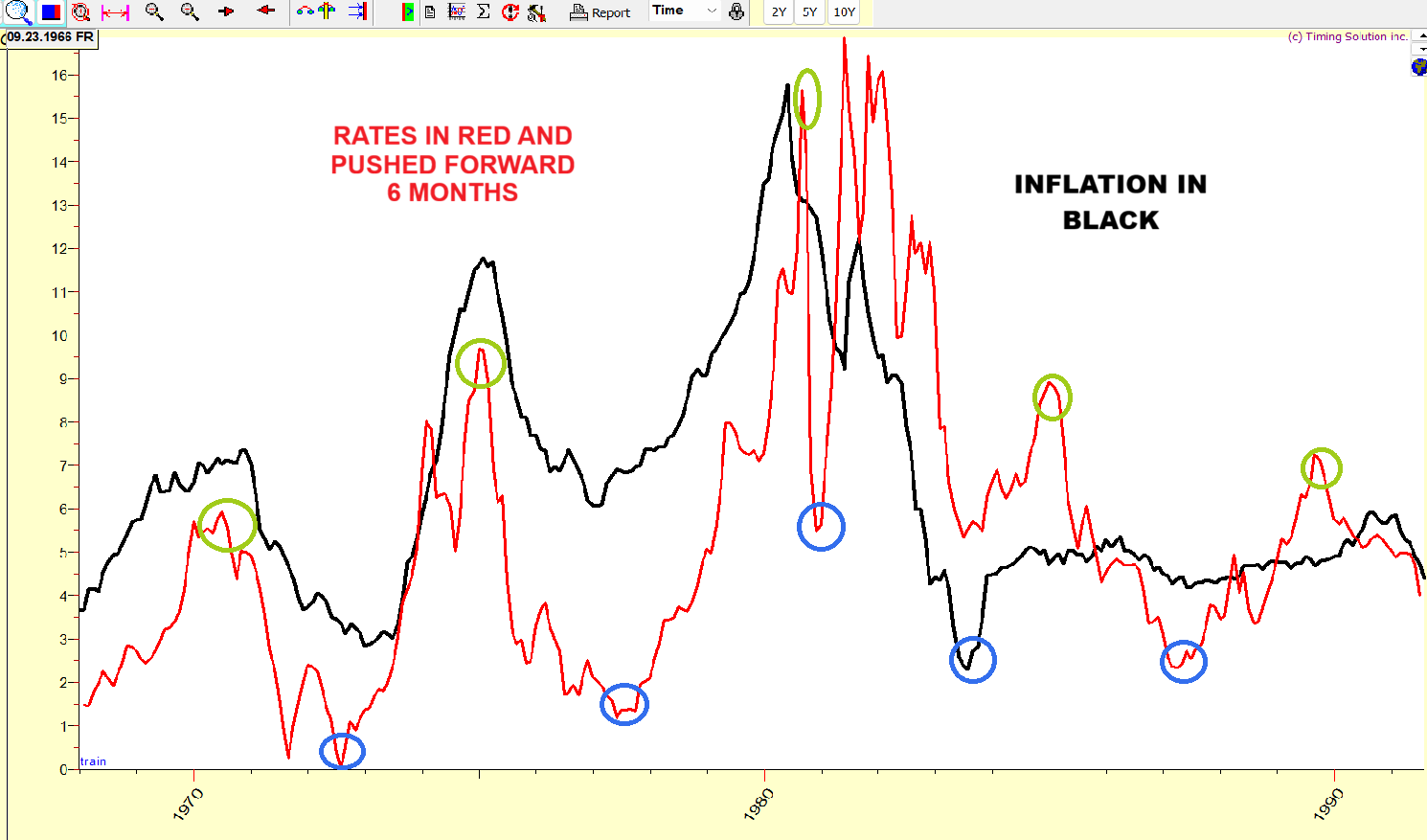
As promised, rates drive inflation:
Nils Poertner writes:
With a bit of imagination, one could see that we may get to zero (or even negative short-term rates in the US)
Larry Williams adds:
Zero rates in Japan did not lead to inflation as most econ minds claimed it would.
William Huggins offers:
Richard Koo from Nomura explains why that was - and it has nothing at all to do with the notion that interest rates -cause- inflation.
Larry Williams asks:
Great post thanks.
Inflation is a result of 1) people raising prices and 2) people paying up so what causes that?
William Huggins responds:
as econ understands things (in the MV = PY framework), inflation would be a rise in P, which can result from a shock to any of the other three variables. the most common oversight though is that V is affected by how people behave too - the willingness to extend (or deny) credit has a huge impact on whether or not a transaction (PY) even takes place.
economic historians have long noted the relationship between M and changes in PY which shows up when Mansa Musa dumps a ton (actually several tons) of gold into the Egyptian economy in the 14th century, when the Spanish flood Europe with Inca and Aztec gold (and again when they "discover" Potosi), and during various state-induced hyperinflationary periods in the 20th century (USSR, Germany, Hungary, etc). but as the US from 1873-1893 shows, changes in V (which almost halved during that period) can influence inflation too which was negative for the period, despite increasing M and Y throughout.
overall, the record shows that big increases in the money supply (as in 2020/21) tend to set off inflation with a bit of a lag (digestion time) unless there are equally significant countervailing forces. the big assumption monetarists make (that Koo questions) is that people -will- borrow as rates come down. his argument (for those who didn't watch) is that if you have negative equity, borrowing at any rate is insanity - the whole mechanism of juicing aggregate demand by lowering interest rates relies on the idea that people who can will. as Koo/Japan points out, there is a limit to such linear thinking.
Mar
3
FED interest rate decisions are often associated with the SPY.
1) Interest rate decrease –> Increase in SPY
2) Interest rate increase –> Decrease in SPY
Polymarket has a market for FED decisions. Could a combination of Long SPY & Polymarket contracts (betting on rates increasing) provide some kind of arbitrage opportunity?
Larry Williams responds:
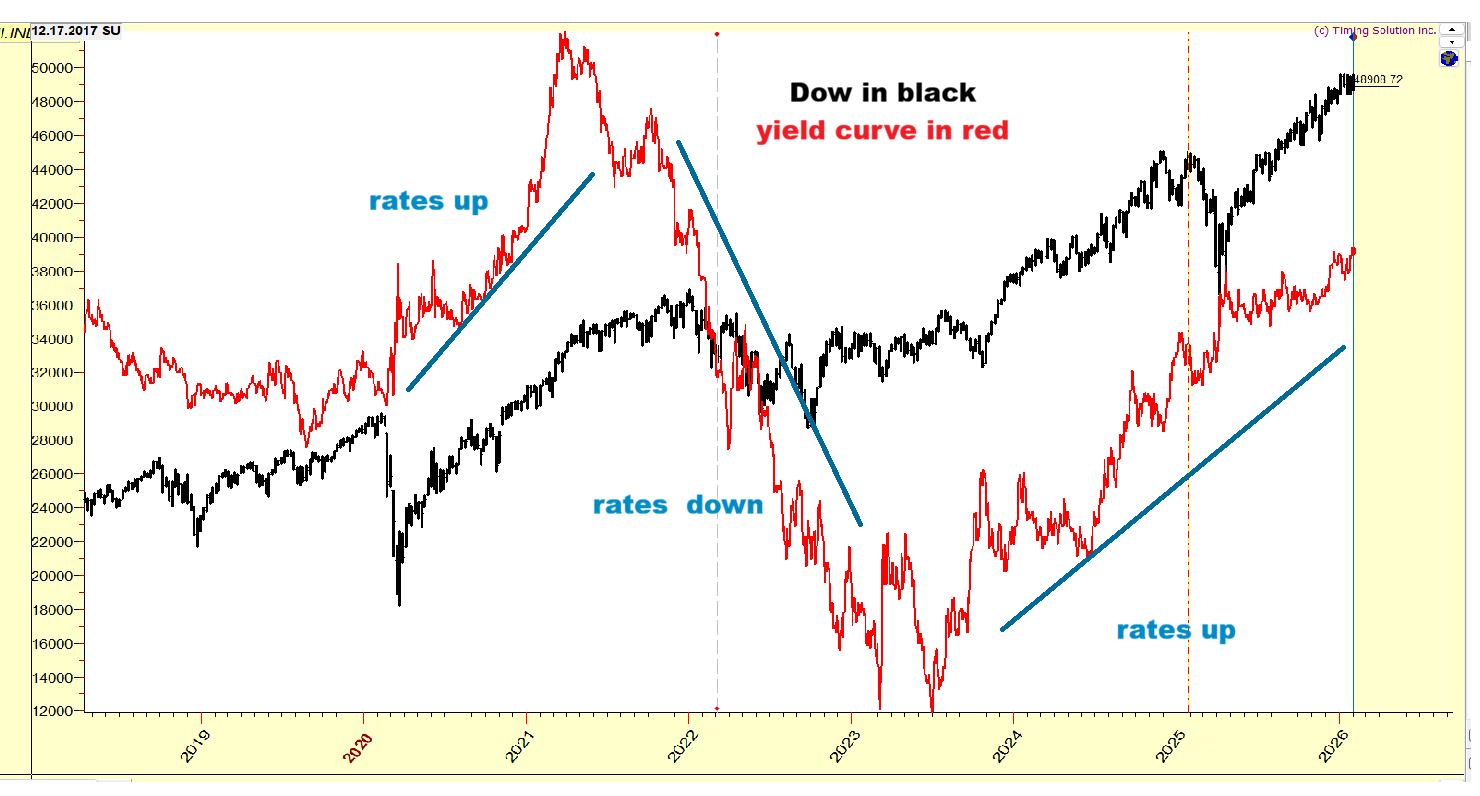
This not correct Interest rate hikes are bullish for stocks—most the time. [See chart below.]
William Huggins writes:
the most important issue with any arbitrage situation is the volume at price is not unlimited, meaning there is a functional "size" to the exploit. my intuition is that such inefficiencies can persist for structural reasons until that size crosses some operator's threshold at which point they trade it until it holds back against the efficient exploit horizon. i don't know what the market depth is like on polymarket but i also suspect the liquidity that such a trade would count on could evaporate such faster than SPY.
Asindu Drileba asks:
[Larry's] pattern indicates:
- Rate increases -> Stock Market up
- Rate decrease -> Stock market down
But for longer periods i.e several subsequent days after.
Since the Polymarket contracts actually expire (resolve) on the day of the announcement. I was thinking this was a strategy that would close on the day of rate announcements. Are stocks also mostly bullish *on the same day* for announcements of a rate increase? (and vice versa)
Feb
15
6950, from Ani Sachdev [Updated]
February 15, 2026 | 1 Comment
I counted the number of crossings of the ES future past 6950. I counted the using the nearest expiry future. I counted using 30 min increments. Since October 29, 2025:
ES crossed from close to close across 6950, 78 times. 39 times up, 39 times down - true Logbola.
ES traded through and touched 6950 at any time at least 154 times (counted when there was low < 6950 < high).
Curious if any specs have used data like this to predict future prices.
Zubin Al writes:
14 hourly crosses night and open [Friday, 13 Feb.].
Cagdas Tuna comments:
I find the fact that whether call it NY Fed or Blackrock or other main street banks whoever single handedly controls and manage to keep VIX below 20 that is ultimate power controls the US stock market.
Larry Williams responds:
No one is holding anything down—or up—my vix fix is essentially same as $vix it cannot be controlled.
Cagdas Tuna is skeptical:
Yes, nothing is controlled!
Zubin Al Genubi prefers market dynamics:
Vix suppression is caused by: 1) heavy ODTE trade, while VIX is calculated on options 23-37 days out; 2) dispersion in SP index (dispersion meaning Mag 7 vs other 493; see RTY almost up 2%); 3) Big fund/ETF imbalances balancing deltas; 4) mean reversion of VIX/and buy the dip, which can break down at some point.
Larry Williams gets cosmic:
The universe is always expanding, Hawking proved. Stocks are part of that.
Feb
4
2026 Bullish Confirmation, from Larry Williams
February 4, 2026 | Leave a Comment
Yale Hirsch and his son Jeff have shown that a positive change, from the last trading day of the year to the 5th trading day of the new year, portends a bullish year (positive first 5-day percent change).*
Consider this … in the last 76 years of trading, the S&P 500 has declined for the year 20 times or 26% of the time. In other words, 74% of the time, there has been a yearly gain.
Jeff’s numbers show that in those last 76 years, 49 years showed a positive first 5-day percent change. Only 8 of those years went on to close down for the year. That’s an 84% bias for the year to close higher when we have a positive first 5-day percent change.
My add-on to Yale’s and Jeff’s work was to look at the years that gained 1.2% or more in the first 5 days of trading. There were 28 such years. Of those years, only 2 were down for the year. That’s a 93% bias for the year to close higher. What an improvement from the average 74%!
In 2026, the first 5-day** change for the Dow Jones 30 was +3%.
In 2026, the first 5-day** change for the S&P 500 was +1.6%.
Those 28 years had an average annual return of 14%. The remaining years had an annual gain of 5.3%. I see this as excellent confirmation of the bullishness of my Forecast 2026 Report.
Cagdas Tuna writes:
There is no need for a statistical analysis to assume any given year will be positive for US indices. It is almost guaranteed to be positive every year. No offense to any list member.
Larry Williams responds:
Wrong 24% of time we close down for the year.
Michael Brush is surprised:
Wow did not know it was that high.
Larry Williams agrees:
I was taken back by it as well.
Asindu Drileba asks:
2026 is bullish? But Senator, you said you expect a recession in 2026 with 100% certainty. Is this a contradiction? Or maybe its possible for the market to be bullish even during a recession?
Larry Williams answers:
Yes, there was a projection made a year ago for a 2026 sell off —in the last 12 months data changed—large improvements in fundamentals and hopefully I got a little better understanding of long term cycles. New Data matters.
Nils Poertner writes:
Asindu- there would be simply too many variables out to make that statement with such a certainty in advance. Just impossible. It remains a probability game. Used to subscribe to some cycle research that claimed to have things figured out yrs in advance. quite pricey subscription. it was HOOK, LINE and SINKER (for me).
Denise Shull comments:
New Data matters.
Indeed it does. Wonder why it’s challenging for many to incorporate?
Nils Poertner responds:
Good question. On this note… (Pure) data analysts believe pattern matching on large datasets will solve our problems. But what if the really vital information isn't being collected? What if it's invisible to our trained systems?
Jan
27
Ralph Vince’s latest, from Larry Williams
January 27, 2026 | Leave a Comment

Ralph Vince's newest book. Not about the markets.
The Theology of Lust follows Ricky “Pork Chop” White — a wounded, self-mythologizing erotic savant — as he stumbles through desire, regret, and violent entanglements, trying to turn raw masculinity into something redemptive. It’s a darkly funny, psychologically unfiltered journey where erotic obsession, betrayal, and a lurking murder plot converge on one man’s desperate attempt to find some sort of salvation out of the mess he calls a life.
Asindu Drileba writes:
Nice! I remember Ralph Vince mentioned that one of his favourite books was The Bible. There is a strange relationship between speculation, theology & computers(artificial intelligence) that no one has comprehensively talk about. Hopefully, I will learn more about theology from this book.
Peter Ringel comments:
When I read the senator writing "the greatest project of his life", I immediately feared, that he fell victim to French, Spanish or Portuguese girls. The title seems to confirm this.
Larry Williams responds:
Good guess but not quite Ralph has a new steal proof coin coming out the book is a year old but was just translated to English from French.
Steve Ellison recalls:
We had a long-ago list member who would frequently draw parallels between never-ending market arguments such as fundamental vs. technical analysis and the European religious wars of the 1600s or theological debates such as predestination vs. free will.
Jan
16
Tacit knowledge, life lessons, and roast beef
January 16, 2026 | Leave a Comment

Nils Poertner suggests:
there is a wonderful book by Michael Polanyi - on tacit knowledge (unlike explicit knowledge one has to develop that skill oneself). not trying to proselytize here that is quite good of a book) and worth many gold nuggets
Jeff Watson offers:
There are some great nuggets in this video - 100 quotes, 100 meals for a lifetime:
100 Harsh Life Lessons That Made My Life So Much Better
Larry Williams knows where the beef is:
America's Top Roast Beef Sandwiches, According to Food Critics
Peter Ringel follows up:
Classical Music for When You're in a Food Coma
Jan
12
Zugzwang, from Zubin Al Genubi
January 12, 2026 | 1 Comment

In chess, zugzwang refers to a situation where a player has to move, but every move worsens the player's position. When a portfolio manager's risk limits are hit or losses are thought to be unacceptable, the situation is quite the same. - Hari Krishnan
The Immortal Zugzwang Game is a chess game between Friedrich Sämisch and Aron Nimzowitsch, played in Copenhagen in March 1923. It gained its name because the final position is sometimes considered a rare instance of zugzwang occurring in the middlegame. According to Nimzowitsch, writing in the Wiener Schachzeitung in 1925, this term originated in "Danish chess circles".
Nils Poertner writes:
on this note (lack of imagination), see David Hand's probability lever concept:
The Law of the Probability Lever essentially states that slight changes in the circumstances or assumptions of a statistical model can dramatically change the calculated probabilities of events.
Larry Williams states:
ZUGZWANG The life of a trader in one word—always in too early or out too late, also out too early or too late.
Jan
5
Oil, from Cagdas Tuna
January 5, 2026 | Leave a Comment
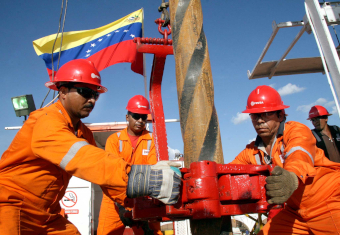
So where lies the thin line between liberating Venezuela and putting world into oil supply based recession?
Larry Williams comments:
The quality of their crude is a different issue we use to refine it here; sour, full of gravel etc.
Stefan Jovanovich writes:
Historically, before full sanctions in 2019, the US imported over 600,000 barrels per day (bpd) of Venezuelan crude, with refiners like Citgo (PDVSA-owned), Valero, Chevron, and Phillips 66 as top recipients.
More recently (post-2023 relief), Valero accounted for 44% of imports, Chevron 32%, and Phillips 66 10%.
Carder Dimitroff writes:
IMO, it's not about oil. The US is a net exporter. They're doing just fine without Venezuela. If heavy oil is desired for refining optimization, as some claim, there's a direct pipeline from Canada.
Stefan Jovanovich responds:
It would help if Carder focused on the use of heavy oil for marine diesel and bunker oil for steam turbines. Those are the essential propulsion fuels for China's Navy; hence, Hegseth's comment today assuring China that it would continue to receive its share of Venezuela's output.
Carder Dimitroff expands:
Globally, three major regions produce heavy crude: Russia, Canada, and Venezuela. Downstream, “heavy oil” or “heavy fuel oil” usually means the residual, high-boiling product left after lighter fractions (gasoline, diesel, kerosene, etc.) are distilled from crude. As Stefan suggests, heavy oil and bunker oil are growing markets, not only in China but also elsewhere.
In my opinion, the administration's interests in Venezuela reflect several interests. High on my list are Venezuela's untapped rare-earth elements (about 300,000 metric tons).
Pamela Van Giessen offers:
Interesting analysis here:
The Real Reason the Pentagon Approved Venezuela: Critical Minerals and Adversary Expulsion
The Department of War has allocated $7.5 billion under the One Big Beautiful Bill Act specifically for critical minerals, with $1 billion already deployed to stockpile antimony, bismuth, cobalt, indium, scandium, and tantalum. This is not economic policy. This is national security infrastructure. The United States is 100% import reliant for 12 critical minerals and over 50% reliant for 28 of the 50 minerals classified as essential to national security. These materials are not interchangeable. They cannot be substituted. They form the irreducible foundation of modern weapons systems.
Boris Simonder questions the thesis:
What rare earth does Venezuela hold that is proven and confirmed? Based on USGS Mineral Commodity Summaries 2025 and other sources like CSIS reports, Venezuela has no significant cobalt production or reserves listed. Antimony deposits exist but are small and underdeveloped, with declining output due to infrastructure issues.
Dec
31
There is market manipulation, from Larry Williams
December 31, 2025 | Leave a Comment
Every time I take a position the market manipulates my emotions. Every damn time.
Humbert Y. agrees:
Ha! As always, Larry nails it. This is the only relevant manipulation to be on guard for, and it is not an easy task…
W. Humbert comments:
My entrances are typically during what I perceive as a manipulation, I look for them.
Dec
23
Low status jobs becoming high status, from Nils Poertner
December 23, 2025 | Leave a Comment
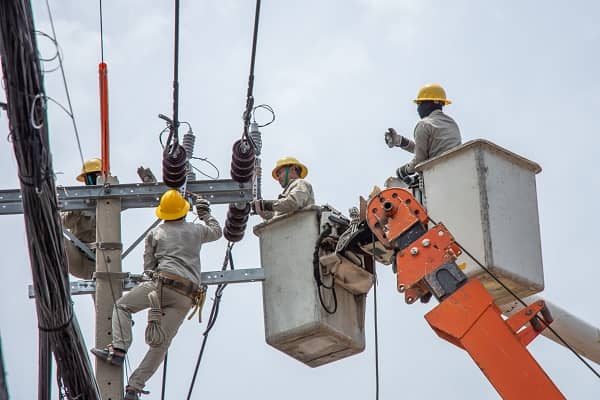
Fascinating to watch how former low status jobs, like cybersecurity, have become high status now. Same is true the other way around as well (eg (male) technician at the London tube system who makes a quarter of his wife who is in real estate - although that is changing now). Wondering what low type jobs / or ppl are on the fringes today will be in high demand in coming years.
Carder Dimitroff responds:
Try these:
Any of the crafts. Specifically, licensed electricians, plumbers, and HVAC techs. Many make more than engineers.
Public response teams. Specifically, firefighters, EMTs, and law enforcement. Many make more than lawyers, particularly when pensions are considered.
Career military. Specifically, for those with 20 years of service. Lifetime benefits are incredible (free college, unlimited grad schools, pensions w/colas, lifetime medical insurance, VA benefits, hiring preferences).
Pamela Van Giessen suggests:
Car mechanics
Henry Gifford writes:
My friend who fixed boilers said to his sophisticated, suit-and-tie, well educated in-laws “I’m not the smartest guy around. I’ve only read two or three books in my life. I don’t think I’m smart enough to come up with a sophisticated investment plan (nods all around the room at this point). So I just buy one piece of New York City real estate each year and hope for the best”. No more nodding at that point.
Guess what blue collar people who don’t have vices do with their money? They buy property. Who is better suited to own real estate? People who fix things and have friends who fix things, or lawyers?
And what nobody mentions is that some people are much better at those sorts of work than others. Simply finding someone to show up and try to do those things is hard. Someone who is good at one of those trades is in even higher demand.
Those fantastic benefits for former military people are not limited to the military – all federal employees get all those benefits after twenty years of work. If someone joins the military at 18, and gets out at 38, or gets out sooner and then works in the post office or etc. until they “get their twenty”, they get full salary with increases for life. Income that will survive any lawsuit, even the IRS can’t take it all. They maybe collect a total of three years of salary for every year worked.
Nils Poertner responds:
Certainly good to encourage young men (or women) to follow a path that interests them - and not just follow a path that is currently "high status". This "Yousef" guy who was my IT guy at Bankers Trust decades ago (low status in my eyes back then) became a cyberpunk in 2008…you get the idea. That said, it is a power game outside. young men need wives etc.
Henry Gifford adds:
I judge the level of a single woman’s interest in me by counting the seconds until she says “what do you do?”.
No woman has ever asked me if I like what I do, or am good at what I do – not important.
Many men have a choice between coming home miserable to a wife, or coming home happy to an empty house. Age old dilemma, no known fix, as all our DNA has evolved to enhance survival, which for a woman over the millennia has meant marrying the chief’s son, or someone else with high status.
Larry Williams recalls:
When I was dating all women ever asked me is your place or mine. Must have been doing something wrong.
Michael Brush is curious:
Do you have a cycle chart for that?
Larry Williams clarifies:
Yes but there are not enough examples to draw a conclusion.
Dec
19
Request for “off topic” books on speculation, from Asindu Drileba
December 19, 2025 | Leave a Comment
Often when I listen to specs I hear "off-topic" book recommendations. Examples:
"The most important book to do with trading is Secrets of Professional Turf Betting by Robert Bacon" — The Chair. A book about parimutuel horse betting.
"The most important book to do with the stock market is Horse Trading by Ben Green" — A game theorist & friend of The Chair. A book about selling horses
"I can find new trading strategies on almost every new page (Thinking Fast and Slow by Daniel Khaneman)" — The Chair's Brother (Mr. Roy Niederhoffer). A psychology book
"Our entire investment philosophy is based off this book (Snow Crash by Neal Stephenson) — Fred Wilson of Union Square Ventures, a Tier 1 VC firm. Its a sci-fi book.
"One of the most important things you can learn todo with investing is creative writing" — Jeffrey Hirsch. Not a book but still an off-topic research recommendation.
I have never regretted reading an "off-topic" book. Any more of such recommendations?

Nils Poertner responds:
Coaching Plain & Simple, by P. Szabo, D. Meier (book about learning - how to coach oneself in a way)
Asindu - what books to get rid off, to burn, what is an obstacle in your life is also relevant. Early 2008, I visited a French friend on Lehman trading floor in London. V nice guy, senior analyst for their credit models, high IQ 130 plus, bit gullible though. He was surrounded by over 20 books of advanced math on either side of his desk. I had the urge to get a huge sledgehammer and whack down the books…you know.
Larry Williams suggests:
Zurich axioms. A must read.
Peter Ringel agrees with Larry:
I have them on my wall. Besides some of the lists by Vic, Larry, Adam Grimes and some other. Valuable.
And did you find the Daily Speculations booklist?
Asindu Drileba writes:
Yes. I forgot about Zurich Axioms. Thanks. This Daily Speculations list is good, I actually wasn't aware of it.
Nov
21
VIX Intraday Range, from Cagdas Tuna
November 21, 2025 | 1 Comment
Yesterday's range in VIX was one of the widest & wildest one I have seen in a very long time that happened without any major news. Wednesday close to Thursday low 18% decline followed by 46% rally to the day's high. Is there anyone who can check the occurrences in the past and how SPX traded in the following days of such a massive range explosion?
Asindu Drileba responds:
The Chairman's book, Practical Speculation, has a detailed analysis of the multivariate relationship between the VIX and the SPY. Unfortunately I forgot the page, and I am currently not close to my copy. [see pages 107-110] But it has something to do with how the fluctuations around the average of the VIX affects the SPY.
Paolo Pezzutti does some counting:
#VIX +11.71% at 26.43
Highest close since 24 April
Since 2020 VIX>26 has occurred 290 times.
After 4 days the Emini S&P Futures:
+27.01 pts Mean, 63.4% Wins, 1.63 Profit Factor
Larry Williams cuts to the chase:
Vix goes up when stocks go down they are inverse of each other—no magic there are all.
Nov
15
Tax receipts, from Larry Williams
November 15, 2025 | Leave a Comment
Federal government current tax receipts: Taxes on production and imports: Customs duties

Asindu Drileba writes:
I remember when Trump spoke at a recent market open. (NYSE market opens at around 4:30pm in Uganda). Crypto closed very bullish on that day. Every time he mentioned "Tax Cuts" the market blipped some more. Laffer Curve at work?
Rich Bubb adds:
I was idea hunting and found Wisdom from Larry Williams:
Larry Williams: Why Gold, Bitcoin, and Stocks Are Flashing Warning Signs
Nov
13
The $38 Trillion Question, from Humbert X.
November 13, 2025 | Leave a Comment
The $38 Trillion Question: An Interview with Stanford Professor Hanno Lustig
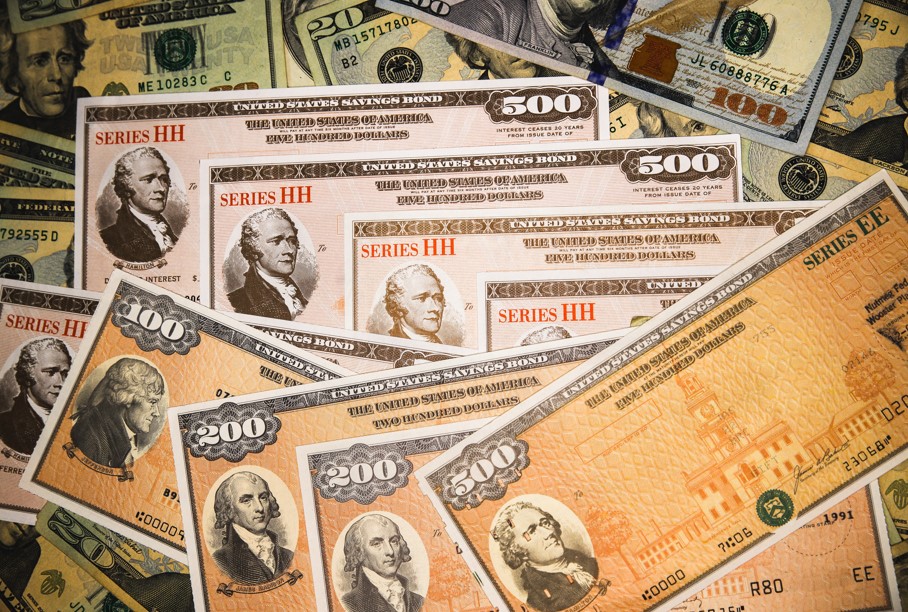
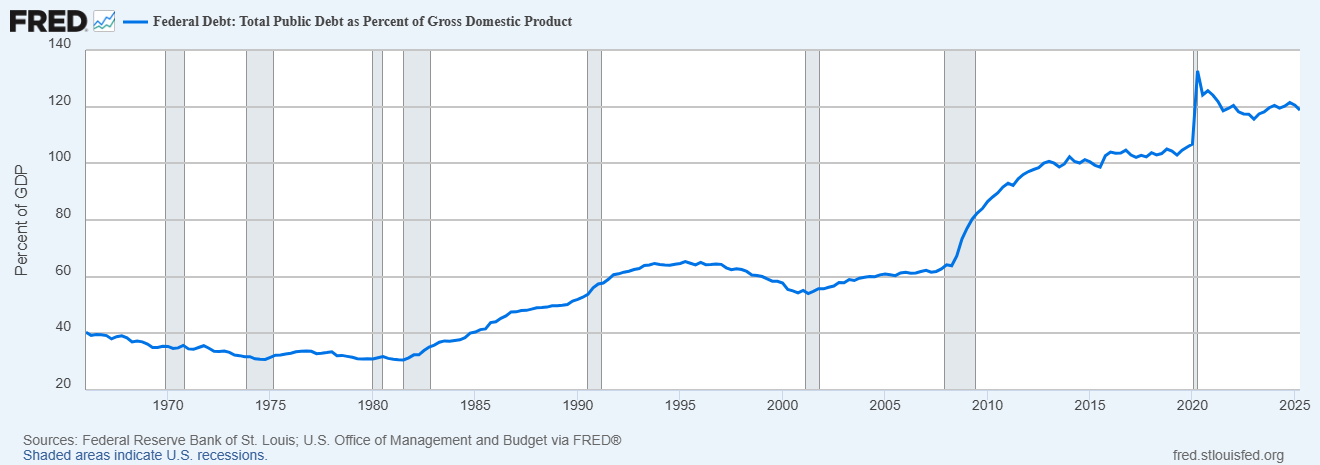
Hanno Lustig: I started thinking about the valuation of government debt by looking at the valuation of all Treasuries. What do we have to believe to get to a number like $38 trillion? You must believe there will be a huge fiscal correction, because ultimately the value of debt should be backed by future primary government surpluses. When you do the numbers, you realize that either bond investors are pricing in a huge fiscal correction that seems impossible, or Treasuries are significantly overpriced.
Carder Dimitroff notes:
The interest on debt is approaching $1 trillion per year and continues to compound. Interest costs currently exceed Department of Defense spending.
Larry Williams disagrees:
Meaningless measure look at debt vs gdp
Carder Dimitroff responds:
Yes, that makes sense. However, from a different perspective, it becomes meaningful under the One Beautiful Budget Bill when automatic sequestrations are implemented. Unless new legislation is passed, sequestrations will result in Medicare cuts and other reductions in expenditures. Current projections suggest sequestration will present in early 2026.
Big Al checks with FRED:
Nils Poertner writes:
recession + zero short term rates + lots of QE ….leading to a lot more public debt
maybe that is more likely path.
Stefan Jovanovich offers some history:
This chart shows the solvency ratios that can be found from the Census and other data [by decade 1880 to 2020] - how much "we the people" have in money divided by how much the American governments promise to pay.
Nov
10
Best indicators for inflation, from Asindu Drileba
November 10, 2025 | Leave a Comment
The more goods cost, the more money visa makes since the fees they charge Issuing banks & acquiring banks are based on a percentage basis. So, higher prices (inflation) –> better predicted revenues for Visa? Inspired by a nice documentary on the history of VISA.
I wonder what the best indicator for inflation would be for testing this? CPI? Oil?

Cagdas Tuna writes:
I was thinking as to find a similar indicator for economic slow turn, spending cuts. It came to my mind to follow sales slips. I live in Malta which is a very tech friendly country for spending habits such as Apple/Google Pay availabilities, many digital banks access etc. I often asked if I need a receipt that I usually don’t. It depends for every country but if there is a rule for stores/restaurants to keep at least a copy for each transaction then it might be the indicator to follow. It might be used for inflation as well but of course needs detailed information.
Pamela Van Giessen comments:
To the best of my knowledge, merchants are not required to keep receipts. We track each sale but it will be the credit card processor or platform such as Square that holds the credit card or Apple or Google pay receipts. I can’t imagine that merchants would be willing to share their sales data. I know I wouldn’t.
Visa doesn’t care how much goods cost. They get their nearly 3% processing fee (+ .10 or .15 per transaction) whether there are 20 transactions for $100/ea or 40 transactions for $50/ea. In fact, they make more $ on a higher volume of transactions.
I don’t think tracking Visa or MC, etc could be a meaningful prediction of inflation as all the credit card companies continuously fight for market share. Note that they all send out multiple credit card offers to everyone all the time. Then, you have a store like Costco that only accepts their credit card (Citibank).
Additionally, there are people who use primarily cash. Those $ would be left out. You may say that cash use is low, and maybe it is. What I can tell you is that today at a market 80% of my sales were cash and that was likely the case for all the other merchants at this market. Older people especially use cash a lot. Just like drug dealers.
I have a theory that the cash economy is much bigger than everyone thinks. Insight into that might be more interesting.
Carder Dimitroff responds:
After considering Panela's cash sales point, I remembered that several companies required customers to switch from credit card payments to bank transfers. Additionally, several small establishments offer incentives for customers to pay in cash. They may be attempting to simplify their accounting and tax reporting. I do know that the federal government has immediate access to individual credit card transactions.
Pamela Van Giessen adds:
I thought it was the Fed that used to report on aggregated credit card data.
The other challenge with using credit card financials is that the credit card processors raise their % cut all the time. This is not due to actual inflation; it is due to them having a government protected moat that allows them to take more and more whenever they want because merchants are stuck with the whole system and consumers don’t realize that they will pay for the service — in increased prices. Every time Square, PayPal, etc., send me notices that they will be increasing fees, I increase my prices. I guess that is a kind of proxy for inflation but it’s a lousy sort of financial market induced inflation not based on anything more than their desire for more profits. I am all about free markets but the credit card processing biz is not even close to a free market.
The government using credit card processing to surveil us may be one reason I see more and more people using cash.
Larry Williams suggests:
Stock market is good predictor of inflation.
Oct
13
Advice from the past, from Humbert X.
October 13, 2025 | Leave a Comment

Stock market advice from 1944 - how would one test it?
This Is the Road to Stock Market Success
Page 30:
If one cannot profit by trading in the highest grade issues — one certainly cannot profit by trading in "cats and dogs". If our industrial giants cannot advance — what prospects arc there in the stability of others? Although this sounds logical there are exceptions, and the "time element" has much to do with the selection.
At the top of a Bull market, when uncertain as to whether the upward movement is exhausting itself or not, it is comparatively safer to have your money in investment, rather than speculative, issues. Of course, it is most advisable to be out of the market entirely at such periods. Investment stocks are not the leader in a Bear movement and, therefore, it is safer to have your money invested in this category — and to watch the market closely. If the speculative and "cheap" stocks begin to decline — you can still dispose of your investment issues without much loss — as they follow rather than lead the Bear movement. Likewise, when you note that investment stocks stand still — and "cats and dogs" or even the better grade issues advance — it should put you on your guard as the market may be "topping" and in line for a good reaction. The 1937 Bear market was foretold by investment stocks in November, 1936. They refused to go higher.
Larry Williams comments:
I learn so much from his writings, such as comparative strength and targets.
[Ed. - Note on the photo:
In 1943, when World War II came, Helen Hanzelin, a Merrill Lynch, Pierce, Fenner, & Beane telephone clerk, became the first woman to work on the NYSE Trading Floor.
Another three dozen women answered the country’s call to duty and filled vacant posts vacated by soldiers sent overseas on the trading floor but were booted out when the war ended, and men returned home.
Women of the New York Stock Exchange ]
Oct
3
Where am i wrong, from Larry Williams
October 3, 2025 | 2 Comments
Zero sum game: for every $ that wins the same amount will be lost. REALLY? you bought at 7 sold to me at 10 I sell at 20 and the contract goes off the board and delivered at 22 who lost? We lost that we could have made more $$ but where is a net loss?
Steve Ellison comments:
Adverse selection can make us all feel like losers. If I sold at 10, I should have held to 22. Or I should have put on more size. If I bought at 7, and it went to 5, that would have been even worse.
Jeff Watson goes literary:
But Yossarian still didn't understand either how Milo could buy eggs in Malta for seven cents apiece and sell them at a profit in Pianosa for five cents.
[ … ]
Milo chortled proudly. "I don't buy eggs from Malta," he confessed… "I buy them in Sicily at one cent apiece and transfer them to Malta secretly at four and a half cents apiece in order to get the price of eggs up to seven cents when people come to Malta looking for them."
"Then you do make a profit for yourself," Yossarian declared.
"Of course I do. But it all goes to the syndicate. And everybody has a share. Don't you understand? It's exactly what happens with those plum tomatoes I sell to Colonel Cathcart."
"Buy," Yossarian corrected him. "You don't sell plum tomatoes to Colonel Cathcart and Colonel Korn. You buy plum tomatoes from them."
"No, sell," Milo corrected Yossarian. "I distribute my plum tomatoes in markets all over Pianosa under an assumed name so that Colonel Cathcart and Colonel Korn can buy them up from me under their assumed names at four cents apiece and sell them back to me the next day at five cents apiece. They make a profit of one cent apiece, I make a profit of three and a half cents apiece, and everybody comes out ahead."
Oct
1
Lebanon, from Nils Poertner
October 1, 2025 | Leave a Comment
Lebanese traders from the 1980s tell me how chaotic that decade was - high vol ever day - for yrs. Survival was key! Started reading every bit about it in the last few weeks. (The thing that Stefan is right about is that the self-image we have in West and realtiy - there is a huge gap for sure!! Am not speaking about military though - I meant anything else)
The Lebanese Economic Crisis: How It Happened; the Challenges that Lie Ahead
September 27, 2021
Lebanon is experiencing one of the worst economic collapses in recent history. The currency has lost more than 90 percent of its value; an estimated three in four Lebanese citizens are now below the poverty line, and the country is beset by food, gas, and medical shortages. The power grid can barely maintain electricity for cities, with frequent blackouts occurring. Finally, the country had to default on its debt payment, launching its debt crisis. The debt crisis didn’t come suddenly, but was building up over time due to economic decisions made by previous governments. To understand how this crisis came to be, an examination of Lebanon’s modern history is in order, starting with the civil war in 1975.
Larry Williams writes:
Chaotic? In 1973 Shearson AmEx had me go there to lecture an teach trading - some high flyer commodity mooches had come in and lost lots of $$ for some locals who did not understand margin calls. The high flyers from Chicago were found gutted on a barb wire fence out in the country! The war broke out we could not get out for about a week so hung low then finally bribed our way home.
Nils Poertner responds:
my 2 cents are on Larry and all savvy Lebanese traders going forward. Good idea to live in more rural areas in the US, UK etc to see things unfolding as well. And keeping the internal chatter to a minimum (as always).

Stefan Jovanovich analogizes:
If LW disagrees, he will, I hope, correct this latest folly from the List's history channel wannabe. The reason the Oregon Trail came first was that it was the one safe destination for the missionaries. The Indians of the rain forest coastal Northwest were the tribes with no history of revolt against the Brits, Russians and Americans. The wars on the Plains started when some smart money decided that they could colonize the spaces between Council Bluffs and the Dalles. That analogy comes to mind every time I look at the modern history of the adventures of the Americans in Lebanon.
Larry Williams offers:
My brother on law who is better read than I am an a deeper thinker says this is a good read on the western adventure:
The Undiscovered Country: Triumph, Tragedy, and the Shaping of the American West
Aug
27
Suppliers vs providers, from Stefan Jovanovich
August 27, 2025 | Leave a Comment
The opportunity lies with the supplier, not the providers of AI.
Larry Williams asks:
Who are the suppliers?
Stefan Jovanovich answers:
Nvidia. My 19th century brain thinks of NVDA as a supplier of the stuff the people selling information tickets will use to build their 21st century railroads.
Easan Katir writes:
Agree. Those creating the AI platforms won't generally be good investments, imho. Why? They lack one thing needed: scarcity. Any intelligent person can feed his/her data into an LLM and create their own AI for $20 / month or less. China's DeepSeek is free, I've read. Hard to make a profit when competing with free.
Last month I had lunch with an author cousin who lives in Tehama Carmel Valley. She uploaded all her books into an LLM, cloned her voice with another AI service, connected that to her voicemail. Now her clients can call her number and her cloned voice answers all their questions based on the knowledge in her books. All while she's having lunch.
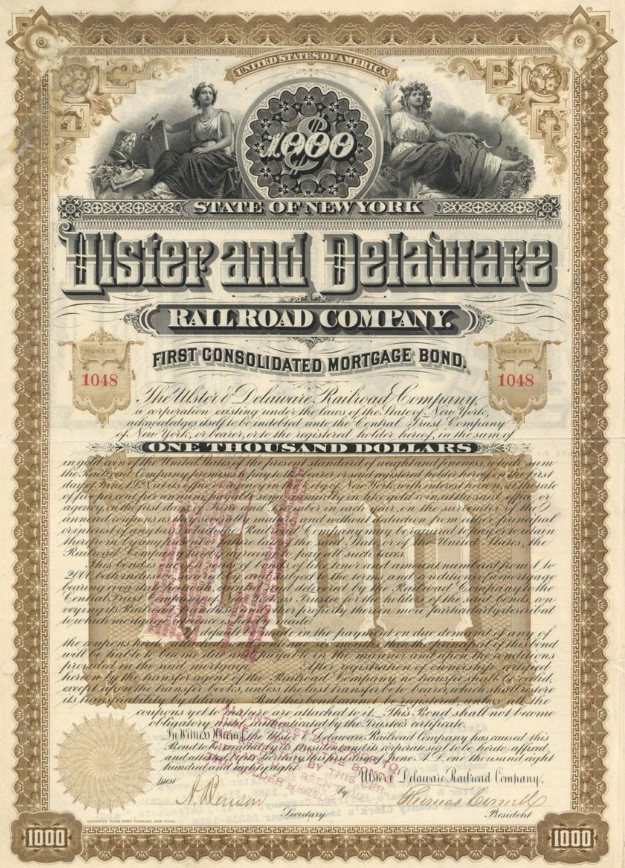
AI + robotics will be a theme, such as Elon's Optimus and robo-taxis, yes? Investing in the suppliers is mostly done, isn't it? NVDA being the most obvious. Along with LW, other inquiring minds wonder which companies you have in mind.
William Huggins responds:
don't forget the coal and iron mines, those essential input assets that 19th century railroad magnates knew could be pilfered via land "grants". i think the equivalent is looking at the companies involved in the chip etching (who makes the lasers, etc).
Henry Gifford comments:
FRED says that Railroad stock prices weighted by number of shares went up x7 over 70 years [to 1929]. Nice, but not fantastic, but weighing by number of shares could be misleading because of reverse splits, shares of a new company replacing a larger number of shares of the old company in a buyout, survivorship bias when a company goes bankrupt, etc.
% of market cap can I think also be misleading because of people pouring huge amounts of money into companies with no revenue in the hope of future returns, adding to market cap.
Stefan Jovanovich responds:
In the last third of the 19th century, the money made in railroad investing was in the bonds, not the stocks. That was the recital of the FRED data that some found so surprising. For this 19th century mind those results are not surprising because the one President in the century who could do the math killed the speculation in international money.
Jun
27
General semantics, from Nils Poertner
June 27, 2025 | Leave a Comment
Drive Yourself Sane: Using the Uncommon Sense of General Semantics, by Susan Presby Kodish
GS is based on a careful study of human behavior and scientific problem-solving, bridging applied psychology and practical philosophy. Drive Yourself Sane provides time-tested methods for critical and creative thinking and constructive communicating with a variety of problem-solving applications for mental hygiene, personal development, education, business, etc.
.jpg!Large.jpg "Magritte: Ceci n'est pas une pomme")
Easy to read book about Global Semantics. Why relevant? Because we often confuse the image of something with reality. And that is recipe for insanity. eg. Dalio has this "machine" analogy for mkts and the econ. Fair enough. But the econ and markets are much more: Living organism etc (good to use "etc" as it reminds oneself that it is a lot more…) There is a famous picture that shows an "apple" and underneath the painter wrote: "This is not an Apple."
Humbert G. comments:
Image v. Reality. Dialio is the perfect example. What’s with all the gloomy billionaires?
Larry Williams writes:
Dalio sure looks like a loser always bemoaning the world same as Cooperman how did these guys rise so far?? Then I have been accused of not being smart enough to put my feet on the ground if it weren’t for gravity.
Rich Bubb ponders:
I've been thinking that Dalio is using historical events to try to not repeat AVOIDABLE/PREVENTABLE mistakes. Yet the rhyming of those events is intriguing. Especially the given nature of Nature, current hot wars, insane debt levels, growing militarization actions, natural resource over usage/abuse, wealth distribution, Us vs. Them polarizations, etc. Yep, gloomy.
His 'machine' concept of the Markets & Economics is an "approximation of a likely future" (my words). The coincidences of the factors Dalio describes at some pressure point will often start Change Cycles. We've witnessed this in our own short-lived & humble lifetimes.
The problem is that 'history' will not exactly repeat in some-yet-unknown terms but might rhyme in concept. The timeline/s of historical examples Dalio uses for large changes is/are very long. And the salient concepts, e.g., reserve currency, debt irrationality, Dalio's Big Cycle (some spanning decades or longer), "Dynastic Cycles' Stages", etc., are historically documented and presented in "The Changing World Order" (2021). The tables and 'chartwork' are visual reinforcements throughout, yet intriguing patterns do persistently re-occur.
My takeaway is generally that Major Powers' (Markets, Econ, military conflicts, extinction-level weapons/WMD^6, etc.) either don't see the cliff they are eventually going to go over, or those major powers refuse to find solutions to the recurring Root Causes that Dalio writes about.
I'm not finished with his 'Changing World Order' book. From what I have read, Dalio seems to try to codify history into significantly huge cycles, leading to changes in the World's Order. IMO, given the current situation (in our time, i.e., now) it isn't too difficult to extrapolate what's ahead… gloomy indeed. Maybe Dalio is "gloomy" for one or more reason/s.
Jun
19
Robert Morris, financier, from Larry Williams
June 19, 2025 | Leave a Comment
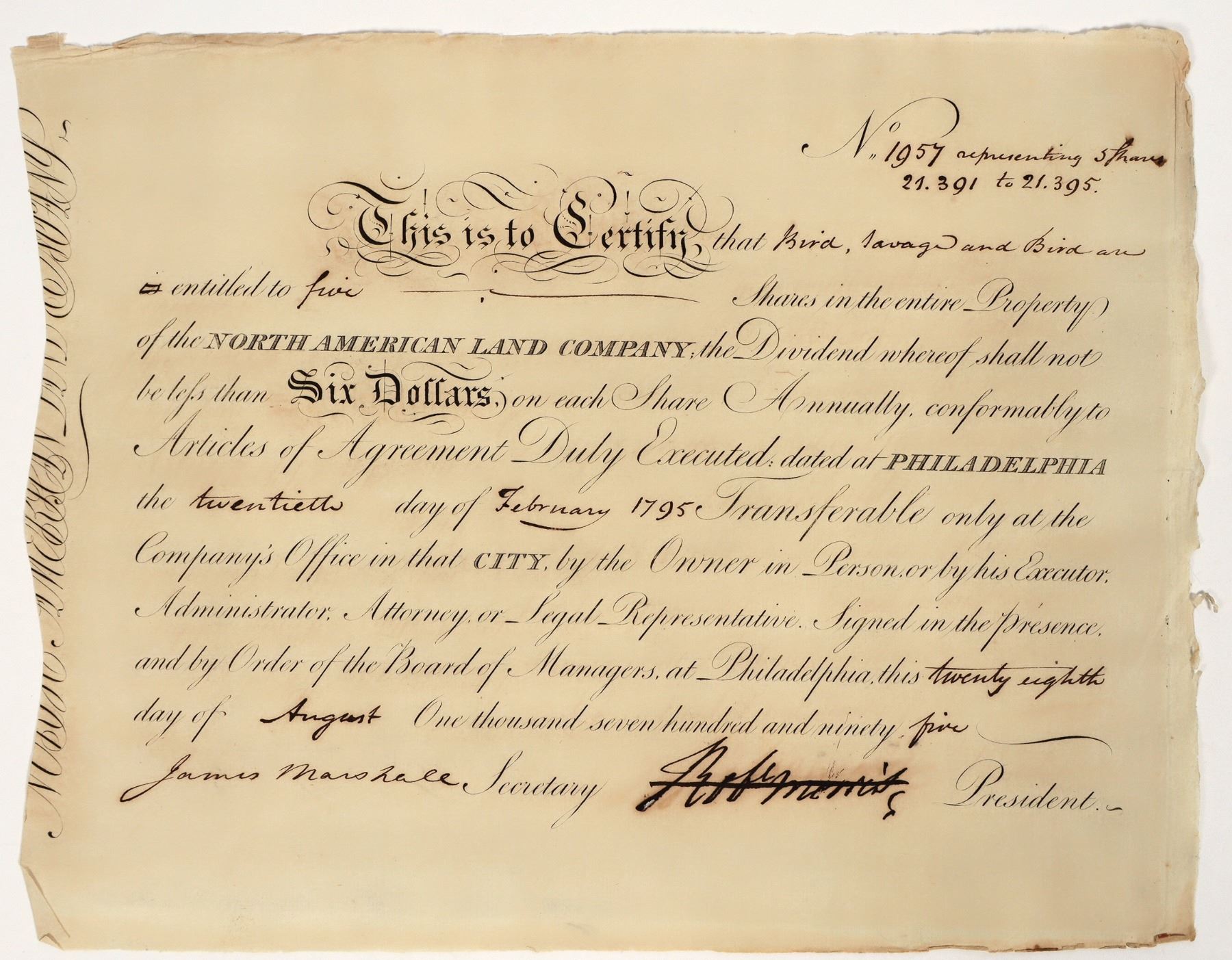
North American Land Co. stock issued to Bird Savage & Bird of London in 1795. Signed by Robert Morris as president and James Marshall as secretary. Morris' signature is pen cancelled. 9.75 x 12" Robert Morris was the financier of the American Revolution, and one of only two Founding Fathers to sign all three key American documents: The Declaration of Independence, the Constitution, and the Articles of Confederation. Morris was the first to use the dollar sign in official documents. The financial Panic of 1796 led to his financial ruin and he was incarcerated for debt in the Prune Street Prison. Date: 1795
Stefan Jovanovich writes:
Morris was the intern/apprentice to Charles Willing (Thomas Willing's father). When Charles died in 1754, Morris became a partner; he became a name partner in Willing, Morris & Co. by 1757. There was no formal registration of businesses in the Province of Philadelphia. "Firms" were known by usage as either individuals or partnerships. We know that the firm existed because its name appears in the Customs records as owners of the brig Nancy and on a bill of exchange for 500 pounds in 1757. The firm "dissolved" in 1783; in March 1784 Thomas Willing wrote a letter to a fellow merchant referring to "our late firm".
By 1781 Morris had left doing any of the daily the business of the firm because of his duties as a public official. On February 20, 1781 Congress appointed Morris Superintendent of Finance; and in September Morris became Agent of Marine - i.e. Secretary of the Navy. On December 31, 1781 Congress chartered the Bank of North America and Thomas Willing was named as its President.
The mixture of finance, merchant business and government was complete. Willing, Morris & Co. supplied muskets, gunpowder and food to the Continental Army. The Bank of America and Willing, Morris & Co. secured $5.4 million in loans ($4 million from France, $1.4 million from the Netherlands) and also made loans directly to Congress. When Congress did an audit in 1783 they found that the discrepancies in the accounting were for money that had flowed to the government, not from it. Willing & Morris had paid $100,000 in Treasury debts.
How Morris went on the become the richest man in the country, owner of "Morris's Folly" and the most famous bankrupt is Part 2 of the story. How Willing (not Alexander Hamilton) became the "founder" of the American system of finance is a whole new volume.
May
31
All higher forms of math and statistics are useless in uncovering regularities, from Asindu Drileba
May 31, 2025 | Leave a Comment
I was browsing the Daily Speculations archive and found this:
10 Things I’ve Learned About Markets, from Victor Niederhoffer
No. 11 is, "All higher forms of math and statistics are useless in uncovering regularities."
Define "higher form". To someone that has just learned basic arithmetic, basic algebra seems "higher form". Does The Chair maybe mean "PhD level" math? Or does he mean that basic "counting" is the only proper way to uncover regularities?
Fazil Ahmed responds:
I think Ralph Vince has explained well, copying from the post:
Certainly in a post-'08 world, quants are out of favor, and for good reason. Most anyone I know who DOES make money in the markets, does so with very simple, robust techniques. Having considered going to quant school, and studied a good deal of it, I finally came to the conclusion that they are simply working with "models." Models of how the world behaves. unlike hard sciences like Physics and such where you can perform a test, come back a year from now, perform it again and get the same results, you don't have this in financial modeling. And I think this is where the quants have fallen short. Models are NOT reality, and they never got down to the bedrock, the reality of what his game is about. Of course it had to fail, and in a large way, at some point. A good rule of thumb is that if I need a computer, if it isn't simple enough to do in my head on the fly in the foxhole after I have been awake for over 100 hours, I can't use it.
Larry Williams comments:
This gets down to there are hard questions: What is the capitol of Montana? Only one answer: Helena.
And soft questions: How many people are in Montana? Varies from hour to hour.
May
30
The problem facing China, from Larry Williams
May 30, 2025 | Leave a Comment
Perplexity says it best:
The U.S. population is projected to keep growing through the end of the century, mainly due to immigration, even as deaths begin to outnumber births after 203325. By 2055, the U.S. is expected to reach 372 million people, with net immigration as the primary driver of growth. In contrast, China faces a rapidly aging population: by 2050, about one-third of its population will be over 65, and the number of elderly will vastly outnumber children, creating an “inverted pyramid” demographic structure. This aging trend is expected to slow China’s growth and strain its social systems, leading some to describe China as “becoming a nursing home” by century’s end. Meanwhile, the U.S., thanks to sustained immigration, will remain younger and larger than it would be from natural increase alone.
Asindu Drileba writes:
Professor Bejan's constructal law guarantee's that China will go bust on a long enough time horizon. I attribute this to China's rigid political system. Like Daenerys Targaryen said, "Those that don't bend, will break." Professor Bejan's TED Talk.
William Huggins responds:
for entirely different reasons, both Daron Acemoglu (econ Nobel 24) and Peter Zeihan are also in the China-bear camp long term - the former due to hitting the limits of "growth under extractive institutions", the latter due largely to demography (even if his tone is alarmist). Dalio's indicators suggest the opposite but all his data comes from a demographic regime of pyramids, not chimneys or inverted pyramids so i'm not sure his forecast will play out.
May
29
The latest from Larry Williams
May 29, 2025 | 1 Comment
Larry Williams on the Fed, Interest Rates & Markets! What’s Next?
Larry Williams breaks down the latest GDP cycles, shares his predictions on the Fed's next move on interest rates, and analyzes TSLA, NVDA, AAPL, and XLP.
May
26
Every trade a loser, from Larry Williams
May 26, 2025 | Leave a Comment
I believe every trade I enter will be a loser–that is my most powerful trading belief. That concept keep me on guard and alert. Emotions are strictly Money Management. If/when you are too emotional, it just means your position size is too big for your emotions.
H. Humbert responds:
The attitude will tend to put you in contrarian positions at the best times, the times of maximum fear in the market or towards a stock. What you said is the same as saying "your best purchases are the ones that are the hardest to make." Of course if you recognize that you are a contrarian, at the same time on some level you have faith that the position will work out. It just depends on what level you want to think about it, emotionally. First derivative second derivative stuff.
The point is, with money in the market based on who is, or who is not, playing tennis (times 10,000 investors with their own 10,000 irrational superstitions), there are bound to be mispriced securities somewhere. Our job is to find them. Despite all their spreadsheets, NPVs, TA, back testing and “counting,” investors remain among the most irrational and emotional creatures on the planet. That is a good thing. That has always created mispricing, and opportunities. In essence, trading is about betting against human nature.
Galen Cawley writes:
I would say that thinking in advance that every trade will be a loser does not provide a positive edge so much as it prevents behavioral errors.
1) If you are a completely algorithmic trader, then the question is largely moot.
2) On the discretionary side, focusing on potential losses prevents unforced errors such as overconfidence manifested in the form of both overtrading (size and frequency).
3) Visualizing worst-case outcomes can prevent you from going on tilt during a crisis or during a string of losses.
Asindu Drileba agrees:
I have this attitude too. I assume every position will be a loss. So practically it helps me size my positions modestly. When I am placing a trade. A position is only in two states: a) I am over betting, in which case I may blow up. b) I am under betting, in which case I won't blow up. The only way to make sure that you are on the side of b) is to: 1) over estimate your losses; and then 2) under estimate your wins.
Another reason for assuming that your position is going to be a loosing one is that you are proactive to your trades, not reactive. Reactive means that you improvise when surprised by how things have gone. Of which you may not be in the right head space to make a decision. Proactive means you already assumed the trade was going to loose, so you had a plan ahead of time (when you were clear headed). I, for example know exactly the maximum I can loose on each trade, and it is always an amount that doesn't make me panic. Do I get Annoyed? Disappointed? Yes. But I never panic.
May
11
Echoes from the past, from Jeff Watson
May 11, 2025 | Leave a Comment
I have heard every single one of these more than once on the floor. This is the G version; the X version would be very inappropriate for this venue.
You’re long hope and short reality.
He couldn’t trade his way out of a wet paper straddle.
You’re bidding like it’s your wife’s money.
His stops have stops.
He buys the high, sells the low, and thinks he’s range trading.
If brains were dynamite, he couldn’t blow his nose.
He's so underwater, Aquaman just waved.
Tighter than a bull’s ass in fly season.
Your size is what we use for toilet paper.
He’s a momentum trader—in reverse.
He couldn’t fill a corn order, let alone an order ticket.
That guy trades like he’s reading Braille.
He thinks ‘limit down’ means he hit the jackpot.
He trades like he’s got a rearview mirror taped to his glasses.
He’s scalping—his own account.
Nice fade. If I ever need a contrary indicator, I’ll call you.
He went from hero to sandwich in one tick.
I’ve seen better risk management at a toddler’s birthday party.
Market’s moving—better go ask your horoscope.
You trading or just making donations today?
He’s got a 30-lot mouth and a 1-lot account.
That guy’s P&L looks like an EKG flatline.
You're not trading—you're gambling, but slower.
He’s so unlucky, he’d lose money in a rigged market where he’s the rigger.
The guy’s charts look like modern art—ugly, meaningless, and overpriced.
He averages losers like he’s building a position in failure.
Don’t worry, he’ll blow up before lunch.
His fills are like Bigfoot—plenty of stories, no proof.
That trade had more slippage than a greased pig at a county fair.
He went full margin—and full stupid.
Asindu Drileba writes:
I watched the documentary "Floored" that was about the extinction of pit traders due to the advent of computer driven traders. A lot of the traders seemed to have their edge in bullying and intimidation that was both physical and psychological.
I made a pit trading playlist that I binged on, and this seemed consistent even to pit traders in the currency pits of London.
One of the pit traders called the computer "The most vile invention ever made." I think he was just sad that his bullying was no longer an advantage. You can't insult a computer, or use your big body to push it away so you can have the edge, or seduce it with good looks.
Michael Brush responds:
Behind every computer, there is a person.
“The offer is $25.”
“But my computer says $45.”
“So sell it to your computer.”
Pamela Van Giessen adds:
For those interested in a biography of a once famous and beloved pit trader, I recommend Charlie D: The Story of the Legendary Bond Trader by William Falloon.
Francesco Sabella adds:
It's an incredible book! I read it years ago, I even saw a 2 hour video of Charlie D. when i was in high school where he gave a lecture on trading on 1989.
Larry Williams writes:
Charly D was one stand up guy. He loved the Bears and suggested a bet with a young lady trader for a nickel on the weekend's game. She said sure…and won. Monday morning Charley D gave her 5 grand (a nickel in betting parlance). She was astounded, told him she meant 5 cents not 5G's. No way could she risk that or take the money. He left it in her hand and walked away.
I was fortunate, thanks to T Demark, to be part of his Vegas support group - he was just amazing to hang with.
Apr
16
The Invisible Gorilla in the Room, from Stefan Jovanovich
April 16, 2025 | Leave a Comment
That is the creature Hugh Hendry - the Acid Capitalist - says we have to find in order to profit from our speculations.
The events in Ukraine are that gorilla. They are predicting the likelihood that Trump, Putin and the Muslim oil producers will establish a Drill, Baby, Drill world of orderly energy production and supply priced in U.S. $. The effects on the European and Asian consumers will be comparable to what happened to the German-speaking world and its silver standard when the French fulfilled the terms of the Treaty of Frankfurt by paying their reparations in gold.

Big Al needs some help:
Perplexity answers the question, "What happened to the German-speaking world and its silver standard when the French fulfilled the terms of the Treaty of Frankfurt by paying their reparations in gold?"
Stefan Jovanovich answers:
They = "events, dear boy". The prediction is that the new cartel of oil and gas exporters will establish "orderly production" that manages the risks of overproduction in the same artful manner that OPEC once operated before the invention of fracking.
William Huggins responds:
So you are suggesting us producers will submit to directives from moscow or Riyadh to limit their production? No evidence of anything but predation among those players but somehow trump purs them all on the same page? I have a bridge for sale….
Feb
19
Strange AI twist, from Larry Williams (updated)
February 19, 2025 | Leave a Comment

We sent my 2025 annual forecast to the Copyright office. They would not copyright it saying, “it was AI generated so could not be copyrighted.” We replied it was not AI, showing why so were finally approved. This raises an unraised question about AI protection. What is/will be the law??
Asindu Drileba comments:
The purpose of AI regulation is just so the big players can build a cartel and lock in the market. This is why people like Sam Altman say they "welcome it".
Big Al gets conspiratorial:
Not to be too conspiratorial, but…
OpenAI whistleblower found dead at 26 in San Francisco apartment
A former OpenAI employee, Suchir Balaji, was recently found dead in his San Francisco apartment, according to the San Francisco Office of the Chief Medical Examiner. In October, the 26-year-old AI researcher raised concerns about OpenAI breaking copyright law when he was interviewed by The New York Times.
Peter Ringel writes:
I always suspected, that the senator is a robot. His performance is inhuman!
Your work is obviously your work. But, what if one uses AI for ones work, creations and everything? It should be still your IP. We have musicians on this list, who use AI for inspirations and research. I constantly lookup code via AI, b/c I am not a good coder. But the final script is mine. I even run AI models locally. The opensource models like Facebook's LAMA. (for an easy install, i can recommend: msty.app)
There is creativity in asking questions, to squeeze the right results out of AI. Prompt engineering is a thing.
Pamela Van Giessen prompts:
No doubt every single publishers’ lawyers are fighting the ability for AI generated anything to be copyrighted because so much AI is taking from existing copyrighted works, usually without permission or payment. Some publishers are feeding into AI programs with permission/payment (I think my previous employer, Wiley, is feeding at least some content into AI, for instance). This is a lousy deal for the authors and artists. The publishers will make vast sums, much like Spotify, and the content creators (I really hate that phrase) will get less than pennies on the dollar.
Liberals have done a great job of deflecting the real problem with platforms (omg, no content moderation or fact checking, TikTok is spying on Americans, the world will end!). The real problem with platforms is that they steal content, outright theft. And where is your government protecting you from this theft? NOWHERE.
Easan Katir relates:
I sent an unpublished manuscript to an Oxford-educated editor, asking her to edit. She asked if any of it was AI. I replied truthfully that I wrote most of it but I asked AI to add some. She declined the job, I guess making a stand: humans vs. AI. Fortunately or not, we know which is going to win.
Peter Ringel offers:
Pamela Van Giessen comments:
I imagine that the courts are going to get involved at some point. Since much AI is from existing copyrighted material, some (most?) used without permission, someone is going to challenge copyrighted AI that is really someone else’s material.
Jordan Low agrees:
precisely. i have been seeing a lot of content creators complain that their work is just automatically reworded into another article without attribution.
Update: Big Al offers an historical lagniappe:
The battle of Cúl Dreimhne (also known as the Battle of the Book) took place in the 6th century in the túath of Cairbre Drom Cliabh (now County Sligo) in northwest Ireland. The exact date for the battle varies from 555 AD to 561 AD. 560 AD is regarded as the most likely by modern scholars. The battle is notable for being possibly one of the earliest conflicts over copyright in the world.
Stefan Jovanovich writes:
The first written mention of the Battle of the Book occurs in the Life of Saint Columba composed by Manus O'Donnell in 1532. Britain did not have a formal copyright law until the passage of the Statute of Anne in 1710; that gave authors their first ownership claim to their writings. Until then the Stationers' Company had an exclusive right to all printing and publishing in Britain. The term "copyright" comes from the right a member of the Stationers' Company had to copy a written manuscript into print after the text had been registered with the Stationers' Company. The charter for the Stationers' Company was granted in 1557 by Queen Mary and King Philip, then confirmed in 1559 by Queen Elizabeth. The Company had the authority to seize "offending books".
Carder Dimitroff adds:
From March's Library: Early printed books were customized with hand-painted illumination for the wealthy.
Feb
3
Inflation and it’s Causes, from Asindu Drileba
February 3, 2025 | Leave a Comment
What causes inflation? Suppose we define inflation simply as the rise in prices of commodities, stocks, real estate etc. What causes it?
1) A generic explanation people offer (acolytes of Milton Friedman & Margaret Thatcher for example) is to blame monetary policy. Simplified as, inflation is caused by "too much money chasing too few goods."
Many people blamed President Trump's COVID stimulus packages for the rise of prices during that period. It seems specs in this list agree upon this when it comes to stock prices, i.e., lower interest rates (higher money supply) -> Higher stock prices (inflated stock prices).
2) An alternative explanation is that higher prices are caused by supply chain issues.
So they would claim that higher commodity prices were so because it was extremely difficult to move them around during lockdowns, let alone processing them in factories. A member also described that egg prices may be going up because of disease (a chink in the supply chain) not necessarily monetary policy. I am thinking that supply chain issues are more important to look at, than monetary policy.
Larry Williams predicts:
Inflation is very, very cyclical so maybe the real cause resides in the human condition and emotions. It will continue to edge lower until 2026.
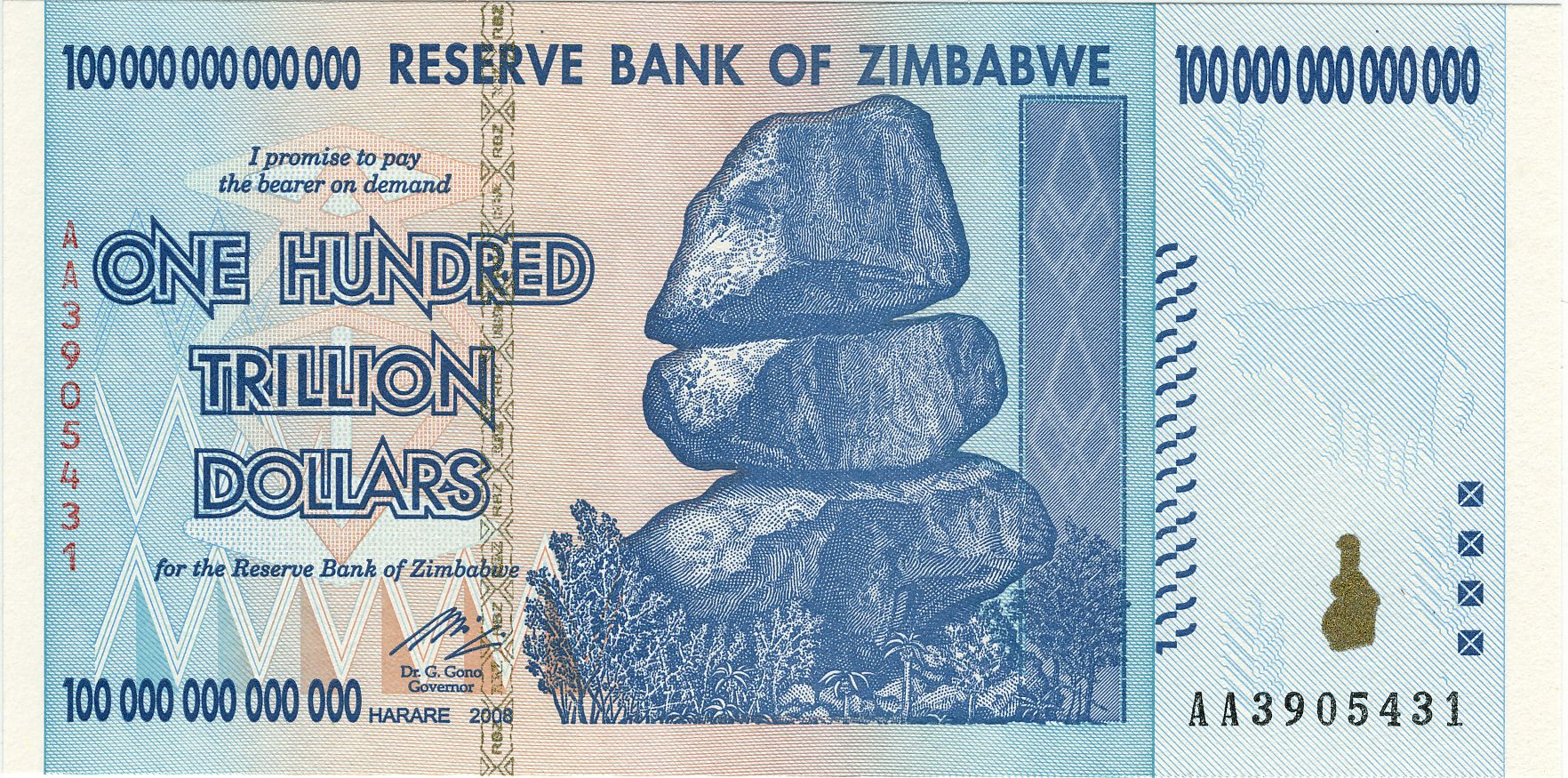
Yelena Sennett asks:
Larry, can you please elaborate? Do you mean that when people are optimistic about the future, they spend more, demand increases, and prices go up? And then the reverse happens when they’re pessimistic?
Larry Williams responds:
Just that it is very cyclical— as to what drives the cycles I am not wise enough to know…though I suspect…some emotional pattern dwells in the heart and souls of as all that creates human activity—along the lines of Edgar Lawrence Smiths work.
Jan
19
Some guy built a complete AI-driven hedge fund, from Asindu Drileba
January 19, 2025 | Leave a Comment
Here is the original thread.
All of the agents show their reasoning so you can see how they work.
1 • Market Data Agent: gathers market data like stock prices, fundamentals, etc.
2 • Quant Agent: calculates signals like MACD, RSI, Bollinger Bands, etc.
3 • Fundamentals Agent: analyzes profitability, growth, financial health, and valuation.
4 • Sentiment Agent: looks at insider trades to determine insider sentiment.
5 • Risk Manager: determines risk metrics like volatility, drawdown, and more.
6 • Portfolio Manager: makes final trading decisions and generates orders.
Here is the GitHub repository.
Why would this work or be good at? Why would it not work? I don't think it will work since the same model will be used my many if successful and the gains will be cancelled out.
Larry Williams comments:
Ultimate curve fit - wait a year to know.
Hernan Avella writes:
This is absolutely the way to go, but there’s a bit more to what we get to call “Agent”. Also his quant module is looking at dumb shit.
Julian Rowberry responds:
horses had a good track record before cars. AI is making key opinion leaders redundant too.
Dec
27
Slab City photos, from Larry Williams
December 27, 2024 | 1 Comment

50 Photos of The Last Free Place in America
Hidden in Southern California’s desert is a small squatter’s paradise affectionately known as “The Last Free Place in America”.
More on Slab City
Slab City, also called The Slabs, is an unincorporated, off-the-grid alternative lifestyle community consisting largely of snowbirds in the Salton Trough area of the Sonoran Desert, in Imperial County, California. It took its name from concrete slabs that remained after the World War II Marine Corps Camp Dunlap training camp was torn down. Slab City is known for attracting people who want to live outside mainstream society.
Dec
20
On your last leg, from Kim Zussman
December 20, 2024 | Leave a Comment
How Old Are You? Stand on One Leg and I'll Tell You
I’m always interested in ways to quantify how my body is aging, independent of how many birthdays I have passed. And, according to a new study, there’s actually a really easy way to do this: Just stand on one leg.
Pamela Van Giessen writes:
I slipped on black ice a few years ago and broke my wrist. It was awful and I exclaimed that I would do everything possible to avoid that happening again. I have never had great balance to begin with. I started doing lots of planks. Minor improvement. This year I started running and walking backwards for ~10 mins/day (and I increased the planks to 4 mins). I have been doing this at least 5 days/week since January. I also do about 3 mins/day (7 days/week) sideways leg lifts (one leg at a time and then alternating) with my eyes closed.

HUGE improvement. On recent hikes I was able to rock hop over creeks without my usual falling on my rear and walked several round tree trunks over creeks (like a balance beam) successfully. Two yrs ago I would have had to scootch over those tree trunks on my butt.
Falls are one of the leading causes of mortality as we age because when people fall and hurt themselves it takes longer to recover and they get really nervous about it happening again so they become more sedentary. Peter Attia spends a lot of time discussing this in his book and podcast.
Larry Williams offers:
I had this in my February letter:
We are all aware of how dangerous falls can be for older people. I did not realize it was this dangerous; “The mortality rate for falls increases dramatically with age in both sexes and in all racial and ethnic groups, with falls accounting for 70 percent of accidental deaths in persons 75 years of age and older.” Am Fam Physician.
Most say older people fall because they lose their balance, surely that is part of it. But, there’s another part you can start working on now that costs nothing.
When you start to lose your balance, your body immediately corrects it with how you are standing. Weak ankles, as I see it, are the problem. I first realized this when training for the Sr Olympics. Faster sprinters have stronger ankles. Weak ankles mean you can’t “catch yourself” as you start to fall. To strengthen your ankles, walk barefoot. Walk on your toes, then walk on your heels (careful) to build up these muscles and protect you from falling. Lots of YouTube videos on this as well. Strong people fall less. Muscle loss and ankle strength will keep you upright.
A good exercise is to rock back on your heels, may want to hold on to something, to develop balance and strength
Andrew Moe adds:
Walking backwards uphill, dragging a big weight sled backwards and doing squats on an incline board are all favorites of the Knees Over Toes guy. He's an innovator who believes in building strength from the ground up. Also combines strength and flexibility. Worked for me and is now part of my regular exercise.
Nov
24
Stops, from Hernan Avella
November 24, 2024 | Leave a Comment

Contrary to what has often been repeated on this esteemed list over the years, the art and process of trading is fundamentally the art and process of setting the right stops. Simpletons may claim that adding stops to a system (trading ES) reduces profitability, but that's only because the system itself is flawed, with laziness baked into its design. Setting the right stop is an integral process—it involves gauging current and expected volatility, weighing potential paths, and accounting for the bias.
Steve Ellison writes:
One of my best experiences with this list was that at the sparsely attended Spec Party in summer 2009, the 20 or so of us who were there had a very spirited discussion in Victor's living room about whether it was advisable to use stops or not. Many excellent points were made both pro and con.
Speaking for myself, I usually don't enter stop orders because they become part of the market, but I have mental stops. On the rare occasions when I actually have a profit, I am determined to not let it turn into a loss. And if a trade goes against me (by a nontrivial amount), that's new information that apparently my original analysis missed; in that case I am determined not to let a small loss turn into a big loss.
To put it another way, I entered a trade because I thought I had an edge, but the market moved in the wrong direction. Maybe something bigger is going on than, say, my analysis of the last 10 post-options-expiration weeks.
Big Al offers:
Stop Orders in Select Futures Markets
Nicholas Fett and Lihong McPhail
Office of the Chief Economist
Commodity Futures Trading Commission
August 29, 2017
This paper analyzes trade and order book audit trail data to provide a detailed summary of the use of stop orders in select futures markets; specifically E-mini S&P 500 Futures, Ten Year Treasury Note Futures, and WTI Crude Oil Futures. Recent flash rallies and the ever increasing speed of futures markets have called into question the appropriateness of traditional stop order strategies. By utilizing metrics related to both placement of and execution of stop orders, we show that stop orders are being used in these futures contracts with varying frequency and the strategy of stop order placement varies greatly by participant. As expected, trades involving stop orders are found to be highly correlated with intraday price volatility. Existence of stop orders is generally unknown to market participants as stop orders are not visible in the orderbook but must be triggered by a trade in the market at the corresponding price. More importantly, our analysis indicates that many traders are not only using stop orders for hedging purposes but also using them for latency reduction strategies. We provide a background on the usage and depth associated with stop orders in selected futures markets.
Larry Williams responds:
THANKS FOR THE POST. This should dispel the notion "they are going after my stops."
Asindu Drileba writes:
I don't actually use stops at all. My position size is my stop. I only bet a maximum of 3% of my bankroll. I really only get out of the market when I am liquidated. I sleep knowing that if I am to loose, my maximum loss is capped at 3%. I don't even respond to margin call emails. I often want to capture the moves between the daily open and the close. So what happens in between is something I usually ignore.
Nov
10
The Old Right was a principled band of intellectuals and activists, many of them libertarians, who fought the “industrial regimentation” of the New Deal, and were the first to note that, in America, statism and corporatism are inseparable.
Despite some current claims, however, these writers ardently defended capitalism, including big business and corporations, celebrated the profit motive, and took a strict laissez-faire attitude towards international trade. They loathed tariffs, and saw protectionism as a species of socialist planning.
Humbert H. writes:
Current restrictionist trade theories in the conservative movement, therefore, are not those of the Old Right. Their intellectual legacy is more likely British mercantilism.
The British did pretty well under mercantilism. I have always supported free (meaning from both sides) trade with equally situated countries, like US and Canada, but I love restrictionism and tariffs imposed on countries like China. It's crazy, in my opinion, to have "free trade" with a country that can and routinely does restrict imports, has slave labor, no "social safety net", steals intellectual property in a variety of ways, and can chose to focus on any trade area to bankrupt it's counterparts in a "free" country. The ability to produce a variety of goods is fundamental to the strength of the country. In wars, pandemics, and trade wars the other country starts having domestic capabilities is crucial. When this debate was first discussed in France, restricting the imports of oranges from Spain and Portugal into France was used as an example of what not to do, and that's a poor example compared to importing steel and semiconductors.
Larry Williams comments:
Hamilton's use of tariffs made America great.
Stefan Jovanovich writes:
Hamilton made his living as a private attorney in New York representing the marine insurance companies whose policies required shippers to be "woke" - i.e. perfect observers of their policies' neutrality warranties.
Pamela Van Giessen adds:
Silent Cal Coolidge the Vermonter was also good with tariffs and preferred them to income taxes.
Along with Secretary of the Treasury Andrew Mellon, Coolidge won the passage of three major tax cuts. Using powers delegated to him by the 1922 Fordney–McCumber Tariff, Coolidge kept tariff rates high in order to protect American manufacturing profits and high wages. He blocked passage of the McNary–Haugen Farm Relief Bill, which would have involved the federal government in the persistent farm crisis by raising prices paid to farmers for five crops. The strong economy combined with restrained government spending produced consistent government surpluses, and total federal debt shrank by one quarter during Coolidge's presidency.
Michael Brush responds:
Smoot-Hawley worsened the Great Depression.
Humbert H. cautions:
That's not really a fact, it's a debatable point. There's a range of opinions there from "it caused it" to "it did nothing to worsen it". It's one of those things like "what caused the fall of Rome" that can't be decisively proven.
Stefan Jovanovich offers:
Effective date of Smoot-Hawley Tariff: June 17, 1930
Tariff collections:
Fiscal Year 1931: $378,354,005.05
Fiscal Year 1932: $327,754,969.45
Fiscal Year 1933: $250,750,251.27
Total tax collections by Treasury:
Fiscal Year 1931: $2,118,092,899.01
Fiscal Year 1932: $2,118,092,899.01
Fiscal Year 1933: $2,576,530,202.00
Pamela Van Giessen writes:
Amity Shlaes goes into detail about how the depression was extended (or recovery didn’t come) in The Forgotten Man. She attributes the worsening of the depression, especially in the late ‘30s, to a combination of government interventions that included the Smoot-Hawley tariff, government (and union) demands to keep wages high, banking regulation, over-regulation, and FDR’s new deal, among other government interventions. In short, there doesn’t seem to be just one cause though it seems reasonable to blame each of the interventions.
Art Cooper adds:
I also found Murray Rothbard's America's Great Depression to have worthwhile insights.
Oct
31
US National Debt possible consequences & hedges, from Asindu Drileba
October 31, 2024 | Leave a Comment
There is a lot of talk about how precarious US Debt situation is. Two questions:
1. What possible disaster may come out of this? I am thinking Zimbabwe type hyper inflation. What other kind of disaster can happen?
2. What can retail level people do to protect themselves from this? Buy Swiss Francs? Gold & Silver? Bitcoin? What?
Larry Williams responds:
Gloom and doomers here is the chart to look at:

Bud Conrad writes:
Gold 1 year is up 24%. Silver 1 year is up 50%. The circumstances today are still very bad for the dollar. (Which is what is actually declining.)
The BRICS+ are meeting in Russia tomorrow Putin, Xi, Modi, Iran, Saudi Arabia (observer only), UAE etc.) to continue de-dollarization with non-dollar-denominated trade through non-SWIFT transactions for international Central Bank settlement. NO body is talking about this, being focused on how much the candidates will print up to bribe us for votes. The $1.1 T for interest on the $35 T of official Government Debt could rise, as the 10 year Treasury rate hit 4.2% while the Fed CUT short-term rate. Including unfunded liabilities for Social Security and Medicare would say the debt obligations are more like $200 T.
This is 10 year Treasury. Red pointer is when Fed Cut short term rate:

There is no way around avoiding the money printing required. Inflation and price rises are inevitable, as foreigners divest their $8 T of Treasury holdings, to avoid US asserting sanctions or seizing assets like the $300B of Russia holdings. They want out of US Hegemony fast, because of 14 rounds of sanctions on Russia.
Oct
30
For Those of Us Who Are Chronically Late to the Party, from Stefan Jovanovich
October 30, 2024 | Leave a Comment
Larry Williams interview with Jason Shapiro:
Masterclass with Larry Williams: COT, Market Cycles & Trading Secrets Revealed
Join Jason Shapiro, a renowned contrarian trader, as he unravels the complexities of the COT Report with legendary trader Larry Williams in this must-watch deep dive. Discover the market insights and trading strategy secrets that have led to their success, as they discuss everything from the impact of macroeconomics on trading decisions to the nuances of technical and sentiment analysis.
Oct
5

Larry Williams comments:
Yield curve is very bullish at this time - it is so misunderstood.
Peter Ringel does some counting:
I found a FED Cut gives some bear pressure on SPY 5, 10 days after. Then it goes into meaningless regarding SPY.

only T+5 , T+10 are probably significant. We just crossed the end of that bearish pressure.
T+1 10000 reshuffled - Observed difference: -0.03, Bootstrap p-value: 0.8573
T+5 10000 reshuffled - Observed difference: -0.96, Bootstrap p-value: 0.0206
T+10 10000 reshuffled - Observed difference: -1.13, Bootstrap p-value: 0.0514
T+20 10000 reshuffled - Observed difference: -0.88, Bootstrap p-value: 0.2829
(a work in progress)
Jul
30
Intermittent fasting and your noodle, from Kim Zussman
July 30, 2024 | 1 Comment
Two Diets Linked to Improved Cognition, Slowed Brain Aging
An intermittent fasting (IF) diet and a standard healthy living (HL) diet focused on healthy foods both lead to weight loss, reduced insulin resistance (IR), and slowed brain aging in older overweight adults with IR, new research showed. However, neither diet has an effect on Alzheimer's disease (AD) biomarkers.
Although investigators found both diets were beneficial, some outcomes were more robust with the IF diet.
Larry Williams adds:
A “dry” fast loses weight more than wet fast.
Big Al writes:
Sergei's AI says:
The main difference between dry fasting and wet fasting, also known as water fasting, is whether you consume liquids:
Dry fasting: Restricts both food and liquids, including water, broth, and tea. It can be done as part of intermittent fasting, which cycles between eating and fasting. For example, you might restrict food for 16 hours and eat during an 8-hour window. Wet fasting: Allows you to drink water, and sometimes certain teas.
Dry fasting can be dangerous, especially for long periods of time. Some potential side effects include: Dehydration, Nutrient deficiencies, Urinary problems, Kidney issues, Heat injury, and Swollen or ruptured cells.
Jul
23

We cheered on Larry who competed in the Big Sky Games, Sunday, July 21.
Big Al adds:
Larry had a great result in the 5k.
Larry Williams writes:
Pam’s donuts, she kindly brought a box to Red Lodge were the most beautiful I have ever seen (cute little ones) and best tasting…well worth a trip to the Home of Dan Bailey.
Big Al is enthusiastic:
Daisy Donuts look great!
Pamela Van Giessen responds:
Not great pic of the mini donuts Larry enjoyed. I should have taken a photo before we left instead of in the car while driving. For anyone venturing to Red Lodge MT, we highly recommend the pig races in Bear Creek. And a nice visit with Larry!
Jun
11
Recession of recession indicator, from Kim Zussman
June 11, 2024 | Leave a Comment
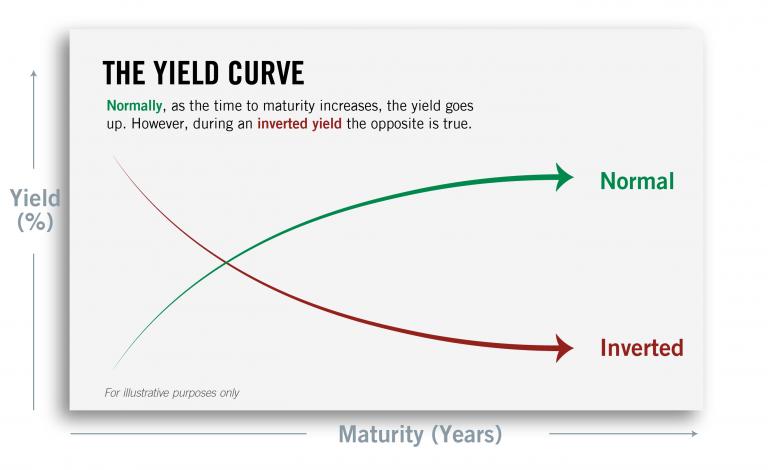
Wall Street’s Favorite Recession Indicator Is in a Slump of Its Own
Treasury yields have been inverted for the longest stretch on record
One of Wall Street’s favorite recession indicators looks broken. An anomaly known as an inverted yield curve, in which yields on short-term Treasurys exceed those of longer-term government debt, has long been taken as a nearly surefire signal that an economic pullback looms. In each of the previous eight U.S. downturns, that has happened before the economy sputtered. There haven’t been any glaring false alarms.
Now, though, that streak is threatened. The yield curve has been inverted for a record stretch—around 400 trading sessions or more by some measures—with no signs of a major slowdown. U.S. employers added a solid 175,000 jobs last month, and economic growth this quarter is expected to pick up from earlier in the year.
Big Al snarks:
If a recession doesn’t materialize soon, it could do lasting damage to the yield curve’s status as a warning system.
I'd hate to have to spend my day thinking up stuff like that.
Larry Williams writes:
A close up study of it shows it has often been way wrong—this is just one more time.
Nils Poertner comments:
As those "indicators" lose their importance, the more ppl (and WSJ and FT in particular!!) talk about it. "get the joke" Lack would have said.
Jeffrey Hirsch responds:
NBER that said 2020 was a recession. Fed started cutting rates in 2019 and the curve inverted then.
The recession lasted two months, which makes it the shortest US recession on record.
It is just a shame bond market traders didn’t tell the rest of us that covid was coming. And what about the 2 back-to-back negative quarters of GDP in Q1&2 of 2022? That looked like a recession as well IMHO.
Big Al adds:
The Fed (from before the GFC) says levels matter, too:
The Yield Curve and Predicting Recessions
Jonathan H. Wright, Federal Reserve Board, Washington DC
February 2006
Abstract:
The slope of the Treasury yield curve has often been cited as a leading economic indicator, with inversion of the curve being thought of as a harbinger of a recession. In this paper, I consider a number of probit models using the yield curve to forecast recessions. Models that use both the level of the federal funds rate and the term spread give better in-sample fit, and better out-of-sample predictive performance, than models with the term spread alone. There is some evidence that controlling for a term premium proxy as well may also help. I discuss the implications of the current shape of the yield curve in the light of these results, and report results of some tests for structural stability and an evaluation of out-of-sample predictive performance.
May
28
The Last Bear, from Humbert H.
May 28, 2024 | 1 Comment
The last bear on Wall Street: Why JPMorgan's Marko Kolanovic is sticking by his forecast for a 20% market sell-off
• JPMorgan's Marko Kolanovic sees no reason to turn bullish on the stock market despite record highs.
• In a Monday note, Kolanovic reiterated his view that the S&P 500 could fall 20% to 4,200.
• "We do not see equities as attractive investments at the moment and we don't see a reason to change our stance," Kolanovic said.
Larry Williams responds:
Here is something from what I have been writing:
Led by “Rich Dad, Poor Dad” Robert Kiyosaki’s warning of, “Be careful, it’s the biggest crash in world history,” the bears have come out of their winter caves. “We can’t make it past 2025,” warns Patrick Bet-David. Wells-Fargo is saying it’s recession time. Mark Spitznagel, who serves as chief investment officer of Universa Investments, is predicting “Biggest market crash since 1929."
They always walk among us…if they can only last until late 2025.
May
24
Slow to adapt, from Big Al
May 24, 2024 | Leave a Comment
It's been 44 years since the introduction of the 3-point line in the NBA. To me, it's a curious case of slow adaptation. Of course, you have new generations of players growing up shooting the 3, but surely players in the early 80s were capable of learning and practicing. The low number of 3s seems like a failure of analysis, failure to understand the impact on points-per-possession, which wasn't much of a moneyball concept yet.
Also, early on it was pretty much just guards who shot the 3 well, with the big exception of Larry Bird. But now, lots of players 6-10 or taller shoot 3s with considerable accuracy. To me, this is more an issue of assumptions, that big men couldn't shoot from long. And then some big men put in more practice and showed they could do it, opening up the possibilities.
Interesting how there are thresholds people believe can't be crossed…until somebody crosses them…and then lots of people are running sub-4-minute miles.
The 3-Point Revolution, by Stephen Shea:
A gimmick? A publicity stunt? That’s what many thought of the 3-point line when the NBA adopted it for the 1979-80 season. Back in 1979, Washington Bullets coach Dick Motta commented, “The three-point field goal will definitely make things interesting.” He meant interesting in the sense that a game that would have been over might now be sent to overtime by a desperation heave. Neither Coach Motta nor anyone else foresaw an NBA game played like it is today.
Five years after its inception, NBA teams were only averaging 2.4 three-point attempts (3PA) per game. This past season, James Harden alone averaged ten. Teams averaged 29.
[ More data on 3-point shooting. ]
Larry Williams comments:
Good point!! …like the 4 minute mile…and we can only beat the averages by a few points…
Vic wonders:
what adjustments have markets been slow to adapt to in last 5 years?
Big Al adds:
An interesting sidebar from 2017:
The Basketball Team That Never Takes a Bad Shot
The NBA’s most efficient offenses seek out layups and threes. A high school in Minnesota takes the idea to the extreme.
By Ben Cohen
PINE CITY, Minn.—Jake Rademacher made a mid-range jumper in a recent high-school basketball game. But as soon as the ball left his hands, even before it banked in, Rademacher knew it was a bad shot. And his team doesn’t take bad shots.
Pine City High School seeks out only the most valuable shots in basketball: from underneath the rim or beyond the 3-point line. They play as if they’re allergic to all the space in between.
May
19

Apropos worry wall:
- Unprecedented US debt
- Presidential candidates to debate from jail cell vs hospital room
- Democracy in decline
Humbert H. writes:
Sooner or later, everyone is right.
Larry Williams responds:
Bob Prechter would like to hear that!
Steve Ellison adds:
My pinned tweet documents 53 bricks in a 53-year wall of worry. But Venita Van Caspel made the original chart in her 1983 book The Power of Money Dynamics. I just added 40 years of additional worries.

Apr
21
Very bullish
April 21, 2024 | Leave a Comment
very bullish when S&P is down 7 days in a row - only occurred 5 times since 1996, expectation in 2 days is +39 big. 6 20-day minimums in a row, happened 7 times since 1996, expectation in 4 days 100% up, mean gain 45 big.
Hernan Avella agrees:
I imagine the 2 or 3 fellow specs that still trade a significant size in this list are already loaded up with enough spu, because one expects fireworks next week.
From the department of non predictive studies: Choose your favorite trend indicator, or better yet, create an ensemble of trend indicators. Choose a measure of persistence of extreme readings (intensity and duration). Look back in history what happens after your signal gets triggered, look at different time frames.
I get 12 signals since 1980: 1985, 1987, 1991, 1994, 2001, 2007, 2008, 2009, 2011 and 2022.
Good luck next week.
Larry Williams comments:
We have only seen 6 down days in a row here in S&P 500 and not that in the Dow.
Big Al suggests:
Regarding the Dow vs S&P divergence, a relevant comparison below. INTC is the only shared component.

Apr
16
Higher for longer, from Nils Poertner
April 16, 2024 | Leave a Comment
Investors wrongfooted as ‘higher for longer’ rates return to haunt markets
Zubin Al Genubi asks:
Interest alone on US debt is 1 trillion dollars a year! Anyone concerned?
Larry Williams is definite:
NOPE. NOT AT ALL.
Art Cooper, however:
*I* am certainly concerned, in the long term. When the coverage ratio on gov't debt auctions drops close to 1.0, it will be time to take meaningful action, with a major re-allocation of investment portfolios.
Larry Williams responds:
Not to worry…says MMT guys…as long as we are not gold-backed $, it's all just accounting numbers.
Kim Zussman wonders:
Reallocate to what? (he says looking around twice with stocks near ATHs)
Art Cooper suggests:
There are a universe of hard assets out there, including gold (though GLD could easily go far higher). Because I like to emulate the Sage and shop in the bargain basement, I personally find extremely distressed income-producing real estate of interest. Babies are being thrown out with the bath water.
Larry Williams writes:
The public debt is just $ in savings accounts at the Federal Reserve Bank. When it matures the Fed transfers those dollars to checking accounts (aka reserves) at the same Fed. It's just a debit of securities accounts and a credit of reserve accounts. All internal at the Fed. When gov sells new Tsy secs, the Fed debits the reserve accounts and credits securities accounts. Those $ only exist as balances in one account or the other.
Asindu Drileba adds:
David Graeber once mentioned that the US can never default on its debts since the Fed is the largest holder of Treasuries.
William Huggins comments:
its not that the US -can't- default on its debts, its that 70% of those debts are to americans. so what is the probability of americans voting to default on themselves when they have the ready alternative of printing money? more important might be whether or not the 30% foreign holders will keep playing along but that analysis is an exercise in ranking "next best alternative" for them. when one starts looking under the hood at the alternatives, its boils out like china's bank regulator said in early 2009, "except for treasuries, what can you hold? gold? you don't hold japanese government bonds or uk bonds. us treasuries are the safe-haven. for everyone, including china, it is the only option: "we hate you guys but there is nothing much we can do."
H. Humbert replies:
The Americans would be about equally unlikely to default if most of the debt was held by foreigners. If you can print money there is no need to piss off any of your "customers". It's not like things worked out super well for Argentina, at least until they hit bottom.
Apr
13
Memorylessness, from Asindu Drileba
April 13, 2024 | Leave a Comment
This is a topic that keeps appearing when people talk about probability. I don't seem to have a good intuition for it. Is the stock market with memory or without memory? Why? What would be your intuitive explanation of what memory is?
From Memorylessness:
In probability and statistics, memorylessness is a property of certain probability distributions. It usually refers to the cases when the distribution of a "waiting time" until a certain event occurs does not depend on how much time has elapsed already. To model memoryless situations accurately, we must constantly 'forget' which state the system is in: the probabilities would not be influenced by the history of the process.
Only two kinds of distributions are memoryless: geometric distributions of non-negative integers and the exponential distributions of non-negative real numbers.
Humbert H. responds:
Of course it's not completely memoryless otherwise there would be no point to any spec of this list trying to beat the market. It's ALMOST memoryless, and that's why it's hard to beat, but there are still some irregularities, like days of the week, month, season, reaction to events, like increased volatility following a big change. It would have a lot more memory if people didn't try to take advantage of the irregularities, because market participants have emotions and also information doesn't spread instantaneously even in this day and age.
Eric Lindell comments:
Blackjack is with memory, provided the number of decks is finite. As you play with more and more decks, the game becomes less memory-dependent. A small player in a huge market makes trades that are less memory-dependent than a big player's trades. The bigger the portion of the total market a trader trades, the more memory-dependent it becomes.
Wikipedia's discussion of a memoryless probability distribution refers to a poisson process. The time before the next car arrives at a toll booth doesn't depend on the time since the last car arrived — provided the cars' arrivals are truly random. This would NOT be the case with a nonrandom distribution, as when more cars arrive per minute during rush hour.
Zubin Al Genubi writes:
A normal distribution of a series of events, indicates that the events are independent of each other, in that the occurrence of one does not affect the probability of another. Of course the market has memory and emotion. We are looking for the regularities to trade that are not random with a high degree of confidence.
Larry Williams agrees:
Amen! People react in similar fashion to events and those reactions create patterns. Plus, there are unique time elements to many markets; jewelry is mostly sold at Christmas, hogs live and die in 18 months etc.
Penny Brown adds:
Investors who suffer a big, sudden decline in a stock remember it. Often they vow to hold on until they are made "whole". This can cause a stock to sell off as it approaches that spot. But if the stock clears this area, the weak hands are gone, and the stock can move up sharply.
Big Al suggests:
For further study, re the quality of "memoryless" and possible applications:
Also, Vic has referred to Markov processes relating to the market calendar at the top of this site.
Mar
24
An alternate understanding of a market being at all time high (market reaching new prices it has never encountered) is this: "Everyone that has ever bought that stock or instrument is now in profit". What might be the psychological implications of this?
Kim Zussman comments:
It is possible (and probable) to buy, then sell after a decline and stay out only to see it reverse and go up further. This (timing) is one reason it is so much easier to do better with B/H than trading.
Big Al adds:
The other advantage to B&H is that the opportunity cost viz time/attention required is basically zero. I have looked at various index timing approaches and have not found anything that beats B&H, especially when considering the vig and opportunity cost. However, should one need to scratch the itch, timing strategies may work better with individual stocks. But again, opportunity cost.
Humbert H. writes:
I've always been believer in B&H vs. trading. But even in B&H the debate between indexing and individual stock selection never dies. I don't like indexing, but I don't have a mathematical basis for that. It's a fundamental belief that buying things without any regard to their economic value has to fail in time, at least relative to paying some attention to it.
Zubin Al Genubi adds more:
Another aspect of buy and hold that Rocky pointed out is the capital gain tax severely eats into returns. The richest guys hold for years and have only unrealized untaxable gains.
Art Cooper agrees:
There was an excellent article in the Jan 7, 2017 issue of Barron's by Leslie P. Norton on VERY long-lived closed end mutual funds which have surpassed the S&P's performance. They have all followed buy and hold strategies.
Michael Brush offers:
Far more money has been lost by investors in preparing for corrections, or anticipating corrections, than has been lost in the corrections themselves.
- Peter Lynch
Steve Ellison brings up an important point:
And yet trading is one of the focal points of this list. The way I square this circle is to keep most of my trading account in an equity index fund at all times. When I think I have an edge, I make trades using margin.
Larry Williams writes:
B&H is the keys to the kingdom, but…the massive fortunes of Livermore were short term trades despite his comment about sitting on your hands. Even the current high performers, Cohen, Dalio, Tudor etc use market timing. When I won world cup trading $10,000 to $1,100,000, it was all about timing and wild crazy money management. One approach wins big the other wins fast. A point to ponder.
Bill Rafter writes:
What we found in studying only the SPX/SPY is that in the long run a buy-and-hold yielded 9.5 percent compounded annually. That was from 1972 to recent. Our argument is that studies before 1972 are flawed. That 9.5 was great considering there were several collapses of ~50 percent. However if you could just eliminate the collapses you could raise the return to 13.5 percent compounded annually.
Eliminating the down moves did not involve prescience. You did not need to forecast recessions, only identify them when you were in one. That was not difficult, and timing was not a critical as one might think. We identified several algos that worked well.
When you were out of equities, you could either simply hold cash, or go long the 10-year ETF. The bonds were better, but not by much. Interestingly, long term holding of bond ETFs yielded low single-digit returns. Best avoided. Which also means that the Markowitz 60/40 strategy was a sub-performer.
Taxes are investor/vehicle specific. For example, if you use a no-tax vehicle, there are no taxes. Regarding turnover, there are very few transactions, as there are very few recessions. The strategy is basically B&H, but with holidays.
Asindu Drileba has concerns:
My problem with buy & hold Is that it has no risk management strategy. If you bought the S&P 500 in 1929 for example during the wrong month. It took you 25 years i.e until 1954 not even to make profit, but just to break even. The real question is, how do you know your not investing in a market path that will take 25 years just to break even?
Humbert H. responds:
That’s why, dollar cost averaging. I don’t think anyone thinks buy once in your lifetime and never interact with the stock market ever again. I think if you had averaged in monthly or quarterly from the summer 1929 through summer 1959 and then held and lived off dividends or cashed out/interest in retirement, you did well.
Art Cooper adds:
The year 1954 is almost universally given as the "break-even" year to recoup losses for buy & hold investors who bought at the 1929 peak. It's wrong to do so. First, it ignores dividends. Had dividends been re-invested the recovery year would have been much earlier. Second, it ignores the deflation which occurred during the Great Depression. In this column Mark Hulbert argues that someone who invested a lump sum at the 1929 peak would have recovered in real economic terms by late 1936.
I'm not arguing against dollar-cost averaging, merely pointing out a historical falsehood.
Hernan Avella writes:
What people should do while they are young and have human capital left is to leverage!
Life-Cycle Investing and Leverage: Buying Stock on Margin Can Reduce Retirement Risk
The most robust research, incorporating lifecycle patterns and relevant time horizons for long term investors tells us that the optimal allocation is 50/50 all equities, domestic and international. But most ppl don’t have the gumption to be 100% on equities.
Feb
7
Nvidia $200 Billion in 3 Days, from Cagdas Tuna
February 7, 2024 | Leave a Comment
It is not hard to see this is very late stages of speculative madness but I really would like to know how the risk management teams approve buying Nvidia stock here after adding $200 billion to market cap in 3 days?
Larry Williams offers:
Maybe my cycle forecast for NVDA would help:

Asindu Drileba writes:
I don't know why people are still buying Nvidia. But this is what I personally think of the stock. Nvidia has an 80% market share in the Graphics Card business. Their bread and butter used to be video gaming, 3d animation, video editing, later crypto mining, AI (computer vision), AI (Large Language Models), AI (Image generation) possible new advances may occur in Molecular Dynamics, Self driving cars etc. The CEO had an interesting interview where he talked about possible areas Nvidia may venture into.
But here is one strange thing about high performance computing (Nvidia's Niche): We would think that the better (higher performing) their products are, the less people would buy because people would do more with less right? It's actually the opposite.
— In gaming for example, when graphics cards improved people moved to less polygon looking characters and wanted more details like finer hair & plants. From there they even went to more computationally intensive algorithms like ray tracing that mimic real world scattering of light. Requiring even more compute in subsequent algorithmic advances.
— In Bitcoin, many people using Nvidia GPUs made it more difficult to earn money from crypto mining. Which requires people to have even more Nvidia GPUs just to continue earning the same income.
— In AI, when ever a new breakthrough was made, researchers often trained models with larger datasets, using more & more GPUs. Chat GPT for example was trained on 1 Trillion corpus of text.
So if they do maintain this 80% market share and these underlying industries continue to grow (and make new break throughs). It makes sense that Nvidia will be very valuable in the near or distant future. Buying now (at all time highs) is definitely dangerous but, even if the bubble pops, the underlying industries it facilitates will still be present. And if more breakthroughs in these industries are made, it makes sense that Nvidia still has some value left in it.
Cagdas Tuna responds:
Good fundamental points and there I have 2 counter outlook:
-Gaming industry; I almost everyday play an online game called Destiny 2, and their developer Bungie has reduced workforce around 10%. I know many other gaming companies are reducing/reduced workforce which doesn't give too much optimism in that area.
-Bitcoin mining; there is halving in a few weeks and this will require more powerful computers but it will also increase the cost which in the end will end up new miners losing money in most cases. Only way to maintain gains in mining is Bitcoin price to double or triple in a year.
Even on the best possible scenario it will not add 200 billion dollars worth growth in many many years.
Steve Ellison comments:
Words of wisdom from Rocky's Ghost, posted in the Spec List on April 4, 2017. And yes, I am long NVDA. I believe this is the study Rocky referred to.
Soros and I share very little. However, I have come to agree with him that the right position is to be long "bubble" (however defined). I used to subscribe to Anatoly's view and to be bearish during bubbled but I discovered that from a risk-adjusted-return perspective, it's better to be right "today" than right "tomorrow." Along this point, I read a study that shows a substantial percentage of stock returns occur during the last surge in a "bull market". If you miss this surge, it's very difficult to keep up with the indices in the short term. And in the long term, we're all dead.
Asindu Drileba replies:
Gaming Revenue was about $142B just in 2022. If cloud gaming, something Nvidia is planning todo is successful, I expect this to jump by several multipliers. I expect Cloud gaming to be a bigger business than say AWS. Gaming is really big, I believe you have heard about gaming being bigger than movies & music combined.
The Crypto market cap is $1.6T, a lot of these Crypto currencies use graphics cards to mine their currencies. So I don't think $200B is too much. For Nvidia which is well positioned in these industries, i.e., owning 80% of that market.
Humbert H. adds:
One fundamental point about predicting the future of NVIDIA. It's a complete accident (lucky for NVIDIA) that the hardware optimized matrix multiplication used for 3D graphics pipelines was also useful for AI.
K. K. Law riffs on The Great One:
Confirmation bias. And this is where the AI computation puck is at of course.
Cagdas Tuna realizes:
Now I see why everyone chasing this momentum with FOMO as all assumptions based on Nvidia will get all of the cake in the market!
Jan
27
Bitcoin forecast, from Larry Williams
January 27, 2024 | Leave a Comment

Asindu Drileba writes:
A lot of Bitcoiners are expecting a crazy bull run incoming. Their conjecture is that after the halvening, a shock of supply in BTC will cause the price to sky rocket. Previous bull runs have followed this halvening event. It is very refreshing to see a completely different original opinion.
Sam Johnson asks:
You certainly don't need to reveal the source or methodology of the red line data from your timely bitcoin forecast if you don't wish. But when choosing cycles to forecast markets, is there consistency in the order in which you approach finding good cyclical indicators? Do you begin by "chart matching" or finding a leading indicator that visually/numerically correlates well and front-runs certain markets, or do you start with a hypothesis, testing, and then using or discarding such forecasting cycles?
Larry answers:
The forecast here is really simple: it’s just the longer-term cycle forecast for GBTC. I arrive at it by doing a complete cycle search the meld together the 3 with the highest fit.
Andy Aiken asks:
How do you account for the fact that GBTC was a closed-end fund trading at a discount for the past several years, but the discount closed prior to it recharacterizing as an ETF on Jan. 11? This is a one-time event specific to GBTC, not subject to a cycle. What is the significance for bitcoin?
Larry answers (again):
I just use the back-adjusted data as provided.
Andy Aiken adds:
Speaking of mining rewards, the next halving (in which future mining rewards are cut in half, resulting in less reward from mining as well as less inventory to be sold by miners interested only in cash flow), is in about 100 days. This has been historically a (bullish) tailwind.
But with GBTC being converted to a spot ETF, several bankrupt entities are selling their inventory. FTX is now finished selling about $1B in GBTC since Jan. 11, but 3AC has yet to start selling, and that firm had more on its books than FTX. While I am more bullish than your projection, it's interestingly contrarian and would screw with traders' heads as markets like to do.
Jan
14
The Wisdom of Rationals, from Asindu Drileba
January 14, 2024 | Leave a Comment

I have an interest in prediction markets (also known as information markets or idea futures), such as election betting odds, that allows people to place bets on who they think will be the next president. I wrote an article on my blog some time back (2020) describing the phenomena referred to as the "wisdom of the crowds" that makes these prediction markets possible:
For years now I have been fascinated by prediction markets. The source of excitement is the idea is that you can use financial markets to do inference — just like machine learning. A famous example of such prediction markets are the orange futures. The orange futures market is one that allows entities to buy oranges in advance. How it works, is that one can pay $1,000 to receive 1,000 oranges that will be delivered next year. An interesting side effect of this orange futures market is how it accurately predicts temperatures in certain locations more specifically, the temperature of the locations where the oranges are from.
Peter Ringel writes:
this is a clever thought, and also a terrible situation. I too noticed that it seems - in places - to be easier to predict pockets of the real economy with the financial markets. Of course, traders like it the other way around. Mkts got so efficient. The outside world has way more inefficiency left. (Also enjoyed your mention of "J" language - never heard about it before.) the source of excitement is the idea is that you can use financial markets to do inference.
Zubin Al Genubi comments:
The difference between prediction markets and financial markets is that prediction markets are binary outcomes and markets have non binary outcomes. The distributions are different.
Larry Williams responds:
What a great point. That’s a massive difference….then add in position size.
H. Humbert writes:
An option price seems awfully similar to a prediction market price: both deal with a discrete event at a particular time in the future (or at least close enough for most prediction markets), and right before expiration both, in a way, create a binary choice. I don't trade options, but that's what it appears like.
Zubin Al Genubi replies:
One big difference is options are subject to arbitrage. The prediction markets are not and get wildly inaccurate swings.
Big Al offers:
Binary Option
Superforecasting: The Art and Science of Prediction
Brier scores
From an interview with Michael Mauboussin:
…when you have an investment thesis to buy or sell something, that means you believe you're going to generate an excess return, or there's a mispricing in the market. And…that thesis should have sub-components to it that will allow us to create a scoring system. The most common of these or known of these is called a Brier Score….To have a Brier score you only need three things. You need an outcome that we can agree upon, within a time period that we are finite, with some probability….And so my argument is break down your thesis and put it into some Brier score ready predictions…what I find is the very discipline of writing those things down will force you or compel you to think more…deeply about them. For example, if you're assigning probabilities, you're going to immediately start searching for base rates.
Jan
8
Futures beat forex again, from Larry Williams
January 8, 2024 | Leave a Comment
Year in and year out the winners of trading contests do better in futures than FOREX yet forex has better margins. Big lesson here.

Martin Lindkvist comments:
Interesting, Serghey Magala is on both lists. Anybody knows him? Might be good addition to this board.
And I note Robert Miner (Dynamic Trader) is on the Forex list. Another trading expert (apart from the Senator) that actually trades, and trades well it seems.
Jan
1
Quant ballyhoo, from Zubin Al Genubi
January 1, 2024 | Leave a Comment
A main goal of the spec list is discrediting ballyhoo: Many so-called quant this quant that show the arithmetic capital appreciation and a fixed bet creating an artificially inaccurate accumulation. Some show the max loss, but due to volatility drag (33% needed to recover 25% drawdown) the growth will not be as their charts show. Instead of $100,000 bet every trade, after a 25% loss the fund is under water.
On the upside geometric returns will rapidly outpace the arithmetic returns due to compounding rather than a fixed trade amount but they don't use that either. So the quant charts twitter charts are wrong in 2 of the most important aspects.
Larry Williams:
What I have come to believe and practice that in money management is all that matters is the trade I’m in right now. The past numbers of the strategy have no bearing on what I will do. Why? Its like a gunfight —you will kill or killed. The trade I am in now will lose or win. There are no other options. That is the hard reality I deal with and protect myself accordingly.
Jeff Watson agrees:
Bingo!
H. Humbert asks:
So are you all saying you literally have to create a new strategy or a version of the old strategy from scratch in every single trade, without regard for the past. This can't be right, can it?
Larry Williams replies:
Oh no, not at all each trade offers the same odds of winning, 50/50, so ‘bet’ accordingly.
Dec
31
A diet shock Bill Gates does not mention, from Larry Williams
December 31, 2023 | Leave a Comment

Mr Fake Meats does not support is own research:
Findings: In 2017, 11 million (95% uncertainty interval [UI] 10-12) deaths and 255 million (234-274) DALYs were attributable to dietary risk factors. High intake of sodium (3 million [1-5] deaths and 70 million [34-118] DALYs), low intake of whole grains (3 million [2-4] deaths and 82 million [59-109] DALYs), and low intake of fruits (2 million [1-4] deaths and 65 million [41-92] DALYs) were the leading dietary risk factors for deaths and DALYs globally and in many countries. Dietary data were from mixed sources and were not available for all countries, increasing the statistical uncertainty of our estimates. [Funding: Bill & Melinda Gates Foundation.]
Note meat does not pop up in this data.
Jeffrey Hirsch writes:
Lot’s of meat works for me. Keto, exercise and sleep. I’m down 50lbs. Skipping the Booze was a big help.
Pamela Van Giessen comments:
Virtually all nutrition studies are pretty meaningless because it is almost impossible to confine study to one food to the exclusion of all else (do people who eat red meat also not drink and exercise regularly; do people who eat low grain diets also eat a lot of processed food and lack exercise, and so on).
Maybe you can hack your health and longevity with diet. Maybe not. I’d err on the maybe not side and get a lot of good exercise (mix of cardio and strength training), dial back the alcohol and soft drinks, drink a goodly amount of water, eat everything in moderation but be sure to get good protein, green veggies, and fruit, especially as you age. But know that your diet is meaningless without the exercise, good mental health, and purpose in life — whatever it may be for you.
Pretty much what my grandmother, born in 1901, used to say. Except I also drink a glass of athletic greens every morning. Can’t hurt. And stretch and do planks/core work. Both are super important to maintaining balance and agility. More ill health and deaths start with falls than anything else.
K. K. Law wonders:
No argument about the benefit of exercising. But a simple and cursory inspection of the regional maps of (a) and (b) show the people in the regions highlighted by red ellipses appear to have lowest death rates. Do they have something in common in their diets that lead to longer lives?
Pamela Van Giessen responds:
Shouldn’t the question be to first isolate commonalities in everything among the people in those regions as opposed to assuming it is solely a food such as fatty fish? Is it just omega 3 or do peoples in those areas also have lower obesity rates, for instance? If they have lower obesity rates (and where there are lower obesity rates, there are routinely lower premature death rates), how come? What are they doing? Is it all diet or are there other variables?
That said, I try to eat fish at least twice a week. Fortunately I have a neighbor who likes to fish but he doesn’t like to eat fish. So we have a steady stream of fresh Montana trout. And elk. Elk meat is fantastic.
Kim Zussman adds:
Genes are a big factor in longevity, likely the biggest factor (besides distance from windows in Moscow). Could explain regional performance since primates primarily mate locally. The best tactic is to choose your parents carefully.
H. Humbert writes:
The media story on how the 100 yr old lived that long because he had one shot of whiskey per day or ate French fries three times a week always crack me up. I’m not saying nutrition (and exercise) do not matter, but of course their longevity is most likely because they won the gene pool lotto and not because of whatever quirky dietary habit they had.
“Virtually all nutrition studies are pretty meaningless”. This comment always cracks me up. It is untrue. Of course epidemiological and observational studies (observation) have value, even if they are not double blind placebo. For example, if you observe four people eat strychnine and die, would you not conclude that it might be dangerous? Would you stay in line to be the fifth person, even though you have merely done an observational study, and strictly speaking causation is unproven by a scientific study? If your answer is “no” then you must believe that epidemiological and observational studies have some value. Otherwise, you would be “blinded by science” (and dead).
Humbert H. responds:
Of course simple studies, like is strychnine dangerous, are useful. However, studies of subtle effects are generally useless, because of the various biases involved. It is to this day not possible to know if Ivermectin helps fight Covid, or if so, to what degree. Partly is because people are invested in the outcome and the set up of the studies appears suspect, and partly is because the effect is seemingly not overwhelming. Hearing about various "Coffee is good/bad for your health" through the years is a more common example.
Big Al adds:
Another issue with broader studies is that we are learning more about how different individuals with different genetics respond differently to coffee or salt or red wine or a high-fat diet. It becomes more difficult to make conclusions like "coffee is good/bad for you".
Humbert H. replies:
I agree completely. Coffee, if I drink it for a week and than stop, gives me terrible, incapacitating headaches, and if I keep drinking it, eventually I will get the same headaches. I don't know anyone else who has the same side effects, but I can only drink it once in a while. So all the recent studies I've read about the positive effects of its consistent use are of no use to me.
H. Humbert agrees:
Yes, this is absolutely true. And the genes may respond differently to foods over time, as other lifestyle factors change. Epigenetics.
Big Al offers:
An interesting show to watch:
Live to 100: Secrets of the Blue Zones
Though thinking about the stats, you would assume there would be pockets of longevity around the world just by chance. Also stat-wise, he claims there is a correlation in Corsica between the longevity of people in towns with the steepness of the streets in the town (steeper = longer lived). Haven't seen the data, but that's an interesting one on an intuitive basis. Maybe you could compare NYC residents on the first floor vs those on the fourth floor of a walkup building. 
Peter Saint-Andre is skeptical:
That Blue Zone hypothesis is somewhat questionable. Here's one critique.
My impression from previous reading is that in some of these remote and frankly somewhat backward areas (e.g., Sardinia, Ikaria), the original cohort of centenarians contained a large number of people who faked their ages (e.g., to obtain government benefits), which they could do because they were born before birth certificates were common. The centenarian numbers didn't hold up in cohorts born after documentation of birth dates kicked in.
Pamela Van Giessen maintains:
The comment is true. Nutrition studies are meaningless. It’s a backward science in crisis with a host of issues starting with what gets published (and then reported) to garbage analytical studies on the same data sets, most of which have null results (but don’t get published) done from a laptop in about an hour.
Until people spend some time learning how “science” gets funded and what gets published, and demanding change, our knowledge will remain more antiquated than my grandmother’s guidance which was at least practical and based on real world experience.
John McPhee wrote about the funding problem in geology in Annals of the Former World. His observations apply to most fields. In short, what gets funded is what is trendy until it is not and then the new trend gets funded. This process takes about 100 yrs. In nutrition it may be worse. Vinay Prasad does a nice recap of the problems.
Dec
21
Thought Leaders: Christopher Alexander, from Nils Poertner
December 21, 2023 | 1 Comment
:no_upscale()/cdn.vox-cdn.com/uploads/chorus_asset/file/8742783/shutterstock_139851025.jpg "TX Capitol: Click for full view")
Chris Alexander on architecture (ugliness, beauty and a lot more) and why it matters to humans. He taught at Berkeley, California. The immediate surrounding (office, residential place) probably also influences how we view the world (even markets). (I always preferred City of London - the old square mile - vs the new Canary Wharf buildings etc.)
Gyve Bones writes:
H.L. Mencken wrote about this in the Baltimore Evening Sun, and the column was included in his Prejudices: Sixth Series (1927):
I have seen, I believe, all of the most unlovely towns of the world; they are all to be found in the United States….Here is something that the psychologists have so far neglected: the love of ugliness for its own sake, the lust to make the world intolerable. Its habitat is the United States. Out of the melting pot emerges a race which hates beauty as it hates truth.
Nils Poertner responds:
imagine people would slow down a bit in their lives and appreciate some of the better architecture (it is not that we don't have it).
Larry Williams differs:
Right! Americans love ugly, hate beauty …that’s why we go to the Grand Canyon, Glacier, Yosemite, the beaches, and have great museums. Mencken must have had a very long nose to look down upon.
William Huggins comments:
Best view on neoism was Chris Beckwith in Empires of the Silk Road: A History of Central Eurasia from the Bronze Age to the Present where he identified the problem as the belief in constant revolution, that there was no future unless the old was destroyed. This morphs into a fetish for the new, regardless of its merit. He clearly loves the classics and hates to communists for their desire to cast aside beauty for revolutionary.
Dec
19
Our fellow Spec LW does a new interview, from Easan Katir
December 19, 2023 | Leave a Comment
Larry Williams 2024 Market Outlook
Dec
19
Optimizing profit over time, from Zubin Al Genubi
December 19, 2023 | Leave a Comment
Most people search or try optimize for highest system return. It is not the most profitable over time. The amount of profit over time is determined by the money management you apply to the system more than by the system itself. This is mind boggling to me.
H. Humbert counters:
In one of the many money manager podcasts I listen to, one of them used this very assertion as an example of, shall we say politely, a less than optimal belief. But he used stronger language.
Peter Ringel writes:
It is still important to aim for a good naked system (without position sizing applied). The risk/drawdown vs overall return relation comes from the position sizing applied world. A better core system makes more aggressive position sizing possible.
Zubin Al Genubi replies:
A better core system makes more aggressive position sizing possible.
Disagree. According to Ralph Vince bets in excess of optimal f results in lower overall system returns due to larger drawdowns with larger size! Comparing core systems should be by geometric mean, not necessarily w/l, %win, t score, etc. Interestingly Sptiznagel says something very similar. There is something very important going on here that is being missed.
Gyve Bones comments:
Depending on the breaks of course, there is no money management system method that can turn a no-edge “loser” naked trading system into a winner apart from lucky breaks. But a winner with a naked edge can be ruinous with over-sized bets, or smothered by various vig drags if the bets are under-sized. As one guy put it in this article from 2000, the key is to find the sweet spot in between.
But as Ralph has shown, the sweet spot, the “optimal-ƒ”, means that the better the system, the higher the ƒ value, on a scale of 0.0 to 1.0 means that if the largest losing trade used in the sample ever re-occurs, your stake will have a single-trade drawdown equal to ƒ%. That is, if the optimal–ƒ is 0.65, and then you have a re-occurrence of the worst trade from the history of the system, you will have a 65% drawdown of the portfolio. But trading at ƒ is the only way to make sure you’re not over betting or under-betting in order to maximize the potential gains of the trading system, if you accept the premise that the series of trades you feed into the optimal-ƒ algorithm is a reasonable and realistic representative of the trade returns going forward trading that system.
Larry Williams has a definite view:
BETTER CORE SYSTEM ETC IS MEANINGLESS. The past is never the future and it takes only one trade to put a bullet through your skull when you mess up. Past ’good numbers’ from a trading strategy are meaningless.
Peter Ringel responds:
but even the Kamikaze-trader dialed it up to 11 to win championships in a stellar way and endured brutal drawdowns. and the final win, of course, impossible without an underlying strategy.
Larry Williams replies:
Kamikaze man was clueless, mindless and fearless as well as blessed with luck and Mr Vince to plug holes in the dyke.
Zubin Al Genubi gets statistical:
A benefit of using parametric techniques is that empirical data isn't required and we can do what if's as conditions change.
James Goldcamp writes:
When coming up with a position size rule it must be as with the system itself subjected to in and out of sample testing. We used to have a program circa 1998 that would calculate the optimal ("f") amount of capital over first X trades then apply to the rest of history using the optimal method. This led to hypothetical out of sample blow up not infrequently due to the instability of model returns (even for models that were to some degree still profitable on blind data).
My subjective belief is that most edges (perhaps other than those derived for market making ultra, frequent, or arbitrage/structural type trades) are way too unstable to try to extract anything approaching a past optimal bet size. It seems like the 3 questions or dimensions that one deals with are will it still work at all in future, if it does how much will it vary from the past (expectation and path), and how will the aforementioned two work in relation to other methods you have that work. The last point relates to in my observation the most common form of risk management, multiple bets with negative or low correlation, that's perceived to be a better way of managing risk than dialing leverage of any particular return stream. Any of the aspects are subject to the ever changing cycles.
Big Al adds:
Often the tricky part is finding uncorrelated assets that are reasonable trades or investments.
James Goldcamp responds:
I agree totally. For me it's the 3rd uncontrollable variable - if the ideas work, how well they repeat (robustness I guess), and how they continue to relate to other things. Hypothetical modeling of complex portfolios often assumes all of these properties will continue. There are lots of ways for a leg on your table to collapse!
H. Humbert comments:
Since the number of unknown important variables in complex real-world problems as opposed to simple games of chance of even poker can never be fully known, and the influence of even known variables, by themselves and in combination, can only be examined via past data and in no controlled experiments, it seems like any system can experience a catastrophic failure and/or change in being amenable to any strategy at any time. I admire traders who brave these unknowns and prefer to rely on drift that seems to be more robust and stopped only by major wars and revolutions.
Dec
17
Holiday history and the nature of money
December 17, 2023 | Leave a Comment

Thanksgiving menu at the Plaza Hotel, 1899.
From the NYPL collection of menus.
H. Humbert comments:
All under a dollar. Special holiday dinner for well-to-do customers. Anyone wants to make the case that those who deliberately cause deficit spending are not deranged animals? Is this price change good? Milei just said he will abolish the Fed of Argentina. Non negotiable. Of course he didn’t kill himself, I mean if there are ever any health problems in his immediate future.
Stefan Jovanovich offers:
The BW recommends Turback's book, What a Swell Party It Was!: Rediscovering Food & Drink from the Golden Age of the American Nightclub; it has menus and venues from the great age of actual fun and dancing.
William Huggins writes:
looks like every single government since the 1950s were full of "animals" - not a single one seems capable of maintaining a surplus for more than 3 years (and that was Clinton…):
United States Federal Government Budget
Andrew Aiken adds:
There was never a surplus in the 1990s, at least by the accounting principles that a business is required to use. The “surplus” was entirely due to short-term overages in payroll taxes for Social Security, and they were wasted and not used to shore up the system.
Stefan Jovanovich comments:
Since the purpose of central banking is to allow legislatures to increase their debts, is it surprising that "deficits" are now the cultural equivalent of what "sin" was in the ages when most everyone went to church? Everyone is against it, in principle, but not where principal and interest are concerned.
Larry Williams applauds:
+10 QUOTE OF THE DAY!!
William Huggins responds:
i wouldn't say the "purpose" of centrals is to enable money printing, rather I would say that's how governments prefer to use centrals but since the last of the independents were taken over by the end of WW2, that may have become an irrelevant distinction in the modern world. the main reason for pointing it out is that we could easily return to a world without state controlled centrals and their purpose would be notably quite different (usually running the payments system, think Amsterdamsche Wisselbank).
Stefan Jovanovich replies:
The Federal Reserve does not print our money; the Treasury does. In allowing its member banks to hold Federal government IOUs at par as their reserves, our central banking system effectively outlaws the pricing of all legal tender. Actual money can only be exchanged for itself, whatever the amount. The result is a wonderful inversion of monetarism as a theory. Money can be printed, without limit, but only if Congress votes to expand the supply of collateral that the banks can buy and endlessly rediscount.
William Huggins disagrees:
this is incorrect - the Fed can and does use several other assets aside from federal government debt to back its liabilities. back in 2010, they held more mortgage debt than government debt. the choice of backing asset is often dominated by gov debt but the BoJ (among others) is also sitting on corp debt (and equity for that matter)
Peter Penha writes:
I disagree and it is because of who is on the hook first. The Federal Reserve can only purchase government guaranteed debt for its account (including FNM FRE GNMA which it did in GFC and in amounts greater than existed - the w/i mtge owed the Fed at one point was around $1 trillion and at a spread below treasuries when adjusted for the embedded prepayment option by the borrower.
All the MS pledging boxes of toilet paper at the Fed window in late 2008 & the HY ETF purchases in March 2020 were against a Treasury guaranteed account at the Fed. If you care to argue that in difficult times there is no difference between Fed & Treasury as the Fed takes orders, that there is a myth of central bank independence - no argument.
The Fed now losing some $200 billion a year from it asset/liability mismatch is putting those losses against a future Treasury payments owed account - so the Fed does not need a capital call from its losses. If however the Fed decided it did need capital - that gets taken from its shareholders who are the money center / fed member banks. JPM is on the hook for Fed insolvency (or BAML and C trading below book tell you they will be forced sellers of equity below book to shore up their capital).
Perry Mehrling (the professor Zoltan wishes he had had in college) does a great history course (and free) on the hierarchy of money, and how private (CHIPS) and public (Fed Wire) clearing houses are allowed to create credit out of thin air to make up for shortfalls - guaranteed by all the other members.
Your money deposited in the bank is not money it is you extending credit to the bank and an IOU (down the tier). In normal times they all appear equal and settle normally but a Eurodollar is not the same as a dollar (see SVB dollar deposits made whole / offshore SVB deposits a general creditor (gone) as per the FDIC statement on SVB).
Stefan Jovanovich suggests:
Money and Empire: Charles P. Kindleberger and the Dollar System
Dec
13
Trade N, dispersion, Expectation, from Zubin Al Genubi
December 13, 2023 | Leave a Comment

With a positive expectation (actually doesn't matter how great) increasing N and or decreasing dispersion of returns of trades will increase terminal net wealth in direct proportion! If you understand this you can succeed in trading. Each variable is a leg on a right triangle solvable by the Pythagorean equation!
- James Sogi
Decreasing stop loss to reduce sd will reduce N and may reduce overall return.
Jeff Watson writes:
I only use mental stops, and strive for 100% personal compliance when pulling the trigger to get out. My rationale is that any stops on an exchange or broker server…or in a broker’s deck, become part of the market. That’s too much information to give to the market.
Peter Ringel comments:
yes, quite a few studies show, that stops degrade systems. mental stops but with technical alert levels seem useful. fight for exit - fight for entry. catastrophic hard stop still makes sense.
Larry Williams advises:
Not having a stop has been the death of more traders than having stops.
Humbert H. writes:
To me a "stop" is a trading concept, not an investing concept. It's almost devoid of meaning if you're an investor. Traders operate on price movements, investors operate on price vs. value. Just the way I understand it from observing the lingo in the two "camps", and what it means to be one vs. the other. Of course if you're an investor and there is a huge unexpected price movement, you have to rethink what you know and don't know about the asset.
H. Humbert adds:
My Step 1: Monitor all stops. This is from an Aught's (maybe '03 or '07?) Spec-Gathering in Central Park, per Larry Williams' Wisdom. It is also so appreciated that The Chair, his Dinner Table Guests & Friends, His Co-Opetition Friends (Spec-Listers) & his Superior Employees' annual efforts.
Nov
16
Herd mentality, from Zubin Al Genubi
November 16, 2023 | Leave a Comment

Everyone went to Hawaii last year. They all went to Europe this year. Everyone drives the same vehicle. People love to follow the herd. Hedgies, quants, teckies all looking at the same data, same correlations, all doing the same trade.
Nils Poertner writes:
being in a herd somewhat offers protection and one can save energy - as our brains like to save energy (constant decision making and testing stuff costs energy and our brains are already weakened via e-smog etc etc).
as a trader though - one cannot make any money long term if one is constantly part of the group - one is more like that rabbit that is hypnotized with the headlight of the oncoming vehicle. so one has to find a niche. energy is key in my view- to keep the energy up - as traders often lose it as time goes by (maybe a talent to not give a f*** about anything, too).
William Huggins comments:
i would argue that running with the herd minimizes the energy lost scrambling in all directions looking for an edge. unless someone has a refined technique for discovering edges and implementing them, its hard to conceive that active selection would overcome the "drift of industrialization". numerous studies (most famously jack bogle's) have shown that buying and holding the index is just fine and does in fact make decent money over the long term. when you factor in the costs of active trading, you really need an edge to overcome the friction imposed.
clearly, both strategies can be successful but one requires much more skill (and earns commensurate rewards) so i think its misguided to suggest that "one cannot make any money long term" by following the herd. you just won't earn exceptional returns.
Nils Poertner adds:
I think it is time to sharpen up in coming yrs- the reality is that most folks in finance (in particular at large firms) really don't have special skills compared to other professions in non-finance (yet they get paid so much more). The whole financial system has just gotten a bit too big - and time will be for those who go the extra mile - and not sit comfortably and hope mediocracy will be work out. many things will change anyway…many….medicine got to change - see how unfit and mentally challenged most citizens are by now.
Humbert H. asks:
You think if they don't know how to sharpen up just getting that advice will somehow help them find the way? What exactly do they need to do?
Nils Poertner replies:
1980 - til 2021 - bond bull mkts and good for lev assets (private equity, real estate), neg real rates. easy money - favouring a few more than others. with rising nominal rates, that is going to change. (had a lot more in mind - people are somewhat depressed, highly suggestible, joy missing, too)
William Huggins expands:
predicting regime shifts (and their direction) has proven to be quite challenging so i would start by ensuring that one doesn't get knocked out of the game when they come (position limits with exit numbers away from rounds, etc). that way, you might at least survive the turn. resilience seems essential but people who only know one-directional markets don't put enough stock in it.
something related i'm teaching tonight is that people's beliefs always trump the facts. i don't mean pie in the sky fantasies, i mean what people think the facts are, and what the implications of those things should be. but when the herd's thinking changes, their volume moves markets. perhaps the key is to identify the early rumbling (or other signs) that precedes a stampede? i'm inclined to expect a high risk of false positives though as it is a well-worn strategy to spook the herd from time to time.
Henry Gifford writes:
I used to wonder how running with the herd helped animals in the wild. Sure, some will likely survive, but what is the incentive for an individual to be part of that large target?
Then I found out about one technique deer and many deer-like animals use. Someone, maybe a human who can outrun a deer on a hot day (furry animals generally can't sweat, people can, thus people can cool themselves very effectively). chases after a herd. After a brief sprint one member of the pack takes off in a direction away from the pack. The human or other hunter might choose to go after the individual animal, thinking it is easier prey than the pack, and safer because there are only four hooves to avoid, not dozens. But the deer aren't stupid - one of the fastest and fittest is running alone. After a while the individual circles back into the pack. Now the pack, which wasn't running fast, or maybe not at all, is more rested than the hunter, who ran a longer distance chasing the individual deer. Now the pack takes off again, with the hunter after them, then another fit and rested individual animal takes off away from the pack, again and again. I assume they have other strategies.
Art Cooper adds:
This is the mirror image of how wolves hunt their prey.
Humbert H. responds:
Being in a herd offers lots of benefits. Clearly there are lots of pairs of eyes facing in multiple directions to alert others about approaching predators and emit warning sounds. Also, many predators tend to surround a isolated victim for a few reasons, one of them being that it's much harder for an individual animal to fight back when attacked from all sides. Obviously it's almost impossible to use this method with a herd. It's also more distracting for a predator to have to focus on multiple targets. Large herd animals find it a lot easier to fight a predator while facing them and a herd can protect the backs of all of it's members.
Now being a part of a "herd" or market participants is quite different. Market participants have no incentives and, typically, means to protect each other, and metaphorical market predators, whatever they are, don't really behave like a pack of wolves or a pride of lions. It's much harder to jump on an isolated market participant, unless it's some "whale" known to be in distress, and distressed "whales" don't run in herds anyway. You often have no idea why a market stampede has started, so imitation is more dangerous than for a herd animal. All the physicality of being a grazing herd animal goes out the window and this analogy seems of dubious value.
Henry Gifford continues:
The discussion was about pack animal behavior. The description from the deer expert sounds like he was adventurous and curious and brave enough to chase a solitary deer. I don't think North American deer exhibit pack animal behavior - I've never seen them in packs, only family groups, maybe they don't form packs at all - I don't know. I wish I knew why some fish swim in a group ("school"), but I don't.
I think I can judge the budget of a zoo by seeing how many deer-like animals they have. Such animals look much like deer, thus my description, and presumably have evolved to survive much like deer: eating leaves and running away. Zoos that I think have low budgets don't have the interesting predator animals kids see in books, but instead have many deer-like animals with only minor variations from one species to another, from one animal enclosure to another. Suffice to say there are many animals in the world similar to deer, but which are not North American deer, especially in Africa, where many or all those species found in low-budget zoos come from. Presumably some run in packs, even if North American deer don't.
The story that humans ate by outrunning deer-like animals has been around a while, but was finally documented by anthropologist Louis Liebenberg, who reportedly, in 1990, witnessed human hunters !Nam!kabe, !Nate, Kayate, and Boro//xao run down antelope in the heat of the day in the Kalahari desert in Botswana. Please don't ask me how to pronounce those guys' names. One time when I was googling around on the topic I saw maps created with the aid of electronic tracking devices that showed one or more of the parties to such chasing running fairly straight for a while, then circling around, then straight, etc. I don't remember if the tracking device was on a human or animal or both.
Another method has multiple humans chasing a pack of animals. One human gets tired chasing the animal that left the pack, chasing it on a zigzag or circular path, while the other humans jog slowly, on a shorter route, following footprints left by the pack, and soon the animal that left the pack rejoins the pack while the pack of humans is very close to the pack, with only one tired human in the pack of humans. If Randy has tried that method it would be nice to hear how he and his friends made out.
I suspect all the above has implications for trading in the same sense others have posted about pack behavior and trading.
Those guys in Botswana have at least one of the three factors some say are the reasons why marathon runners tend to come from Kenya and that area (the Rift Valley). One is that their ancestors lived in a hot climate (Africa) for tens of thousands of years, thus they developed limbs that have a relatively high surface/area ratio: long and skinny, optimal for cooling, and also optimal for moving back and forth (running) with minimal energy (low WRsquared) compared to short, stubby limbs (similar to the physics of pendulums). The second factor is that their ancestors lived at sea level for thousands of years, thus they have the ability to produce more hemoglobin (moves Oxygen to muscles) readily when they are at altitude. The third factor is that they grew up at a mountain altitude, thus they developed large lungs. I don't know if the hunters in Botswana had any of the other two. A mass migration from sea level to high altitude is I think not so common (or people from other areas would also be winning marathons), but reportedly many humans ate via chasing down animals for many years, presumably many who didn't have all three of these factors in their favor.
Then there was the argument in a Welsh pub that led to the annual 22 mile Man vs. Horse race, run since 1990. I suspect, but cannot confirm, that alcohol was involved. Some years the humans win. The human ability to sweat, and therefore cool the body, keeping it in a temperature range necessary for metabolic processes to function (running, breathing, not dying, etc.), is key - presumably the humans would do better in a warmer climate or in a longer race. I think it would be interesting to track the temperature and relative humidity of different race years vs. who won, but I don't have the data handy, and don't know if it is available on a Bloomberg terminal.
Larry Williams writes:
Correct on deer. Antelope and buffalo go in herds-packs, if you will. so do elk - a beautiful sight to see as the bugle sounds.
Zubin Al Genubi adds:
The Gwich'in natives in the Arctic run down the caribou on snowshoes. Caribou bolt, rest, bolt. Man runs runs runs without rest up to 60-100 miles.
The caribou vadzaih is the cultural symbol and a keystone subsistence species of the Gwich'in, just as the buffalo is to the Plains Indians.[4] In his book entitled Caribou Rising: Defending the Porcupine Herd, Gwich-'in Culture, and the Arctic National Wildlife Refuge, Sarah James is cited as saying, "We are the caribou people. Caribou are not just what we eat; they are who we are. They are in our stories and songs and the whole way we see the world. Caribou are our life. Without caribou we wouldn't exist."
I met Sarah James and spent a week with her in Arctic Village and up at hunting camp. She is an amazing person. The villagers and tribe have a beautiful philosophy of life and respect for nature.
Rich Bubb comments:
the herding/grouping re/actions is/are common in so many species' game plans & their instincts, then there's their need to hunt, defend, fight-flight, etc en-masse because of their evolutionary status vs predecessors. Humans same; hopefully.
Pamela Van Giessen writes:
Bison herds are led by a cow. And when she decides to move, they all move. Quickly. You definitely don’t want to be in the path of a bison herd on the move. Elk herds will go around you or they will make you wait for them to pass. Antelope herds will outrun everything. More deer get hit by cars than any other creature (except maybe raccoons). Perhaps they are at higher risk because they do not travel in large herds. The type of herd matters. One imagines there must be similar parallels in the markets.
Rich Bubb recounts:
about those cute furry deer etc… having a mini-herd slam into vehicle on a highway is rarely something I can evade. Got Deer'd 4 times in NE Indiana, only?. I think 1 of the mini-herds died, the rest either bounced off or got bumped out of the way, which also? causes very extensive collision expenses! When a shifty insurance office-drone tried to blame me once that I as to blame for the deer-car (b/c I was driving the car, not the deer). After the ofc-drone ranted at me for while, I said, "Here's how much time I had react (GOING 55MPH), then slam the phone's receiver down on my desk, hard. The drone lost that one.
Steve Ellison understands:
I never hit an animal while driving, but once I was on a state highway in Idaho headed to Hells Canyon through a forest. A deer shot out from the trees on a dead run and crossed the highway some distance ahead of me. I only saw it for a second or two, and it was gone. I was lucky to see it from a distance, because it would not have been possible to stop a car traveling 55 miles per hour in one second.
Richard Barsom offers:
Turkeys, they are super smart. I mean despite their rather undeserved reps of being "Turkeys" . They travel in large groups but send scouts out in various directions. The scouts are usually so fast that they send hunters on a wild goose chase so to speak. This is done on purpose to alert the group and frustrate the we be hunters. You could learn a lot from a turkey.
Oct
30
Forbidden History, from Larry Williams
October 30, 2023 | Leave a Comment

I can only do a few paragraphs at a time there is so much in this book; turns thoughts upside down.
One I just read; Thomas Jefferson's illicit affair and fathering a child with his slave. Wait! Hold on a moment —while widely believed— all the DNA tests shows is there is Jefferson bloodline. That’s all it can show. There were 26 Jefferson's living in the area and Toms brother Ralph was caretaker and overseer of slaves.
Thomas? Ralph? Someone else? Will never know for sure but for sure it may well have been another Yet the revisionist historians have hung it on Tom. Lots more like this.
Peter Penha writes:
Just an anecdote on your example: I know of two families where a child was fathered/sired with a female who was a slave or an emancipated slave. Both families discuss it as part of the family history and each specified that a home was built for the mother/child and in one case the family name given to them.
Considering Thomas Jefferson finances, perhaps the answer would lie in the building records and who owned the home in Charlottesville where Ms. Hemings moved to after Jefferson's death with her sons.
I was recently searching for other books by Frederick Lewis Allen as IMHO a wonderful writer and objective historian of his day and that brought me to a series titled the Forbidden Bookshelf (27 books in the series) - I only picked up Allen’s The Lords of Creation but there were a few titles that were “out there” as subject matter.
Gyve Bones adds:
There was a lot more inter-mixing between Africans and French colonials in the Louisiana colony, which had a Code Noir body of ordinances governing who could own slaves (only Catholics, no Jews nor Mohommedans), and how they must be treated. As a Catholic nation France required that owners of slaves must educate and raise their slaves in the Catholic faith, and could not break up families in a sale. Slaves could purchase their own freedom, and in New Orleans there was a large population of "free people of color". Many of the wealthiest of these freedmen were slave traders, and there were several large plantations in French colony owned and operated by free persons of color. Slavery was not a racial thing—just a matter of property. There was much less stigma around the idea of "race", and that culture has persisted to an extent into current day New Orleans, although those seeking to divide people along racial lines for political purpose have made significant inroads in destroying inter-racial comity in that community.
History records that French Canadian trappers had very good relations with the indigenous populations, and there were many such mixed marriages made. This same phenomenon was seen in Mexico after Our Lady of Guadalupe converted 9 million indigenous Mexicans to the faith. The Mexican nationality gave birth to a new "mestizo" race which came about when the Spanish intermarried with the native population.
Zubin Al Genubi suggests:
Trust by Hernan Diaz. Pulitzer prize. Stories About a stock market operator in 1920's and his wife. Very good with minor market relevance.
Stefan Jovanovich links:
Oct
19
Bonds…close, from Larry Williams
October 19, 2023 | 2 Comments

Bonds oh so close to major buy point.
Humbert H. writes:
I just keep rolling over T-bills because I don't know any better. Higher for longer or something. At least the interest pays for my recent losses trying to buy all kinds of value stocks at the lows, only to see them broken. That's OK, the next bull market will bail me out completely.
Laurel Kenner comments:
You are never free to deny the truth. You cannot make it up ad you go along.
I bow to Larry. The biggest gains occur in insane bear markets. Because the government has seized control of the bobd market, he is right, especislly leading up to an election. You all should heed him when he gives the buy sign. But it still stinks. I guess you need the nose for success.
Larry Williams replies:
Well lets hope I get this one right and earn those kind words - the ultimate sweet spot to buy is not here yet but it is coming.
Zubin Al Genubi adds:
When the time to buy comes, you won't want to. Like 17% bonds in the 80's.
Richard Bubb writes:
So is the FED [Powell & Co.& etc.] gonna raise the rate, or try the Higher-For-Longer road? Personally I'm thinking the HFL is their better option. Reason: The Fed is notorious for doing one too many rate 'adjustments' that would fix itself if they hit the pause button/s. Back to my 'raise concern'…I think the 2% target is a chimera and going there is an unwinnable move for the Fed.
Humbert H. assumes:
Well they can’t inflate the debt away fast enough at 2% nor is it easy for them to achieve so I’ll assume inflation will stay higher for longer.
Allen Gillespie writes:
While there is a strong seasonal trade that kicks end here around Oct. 19-23 - good till Christmas, such that even during bond bear markets the market held levels for a couple of month, the fundamental issues are the following.
1. Fed Funds Futures are beginning to project a cut in short rates around May 2024 which then continue through the first quarter of 2025 and reach down to a level of about 4.5%.
2. Historical, average spread relations therefore suggest we are seeing a Niederhoffer switch in here where short rates go into the 4-4.5% range and longer instruments up the the around of the current fed funds rates and budget deficit amount. A true switheroo.
3. There is a strong seasonal here (particularly Oct. 19-23) which held even during bond bear markets. IA flush after a weekend would seem about right. In the bond bear markets, however, the range was only good for a couple of month.
4. The long-term fundamental backdrop is the following:
According to the CBO, "since 1973, the annual deficit has averaged 3.6 percent of GDP. In CBO’s projections, deficits equal or exceed 5.5 percent of GDP in every year from 2024 to 2033."
This is the inflation rate - so, if you want a real return on bonds your rates needs to be higher than these levels. That is now just barely true in corporates, but it is not true for government bonds.
If you just charge the inflation rate, there is no real no real return available to bonds. Granted, in the long run government should be neutral offering neither gains nor confiscation, but at any moment they are on either side of that reality.
Today, the CBO projects the deficit will run 6.1% for the next two years. They do have a core adjusted for timing shifting of 3.4% - but do you trust them will all the war supplemental budgets.
Humbert H. responds:
A cut in short rates in May? We have high deficits, strong likelihood of inflation above 2%, no real signs of recession, "higher for longer" is seemingly the consensus of the mainstream economists, but fed fund futures are projecting a cut? Doesn't seem to make much sense.
Allen Gillespie replies:
Election years start getting discounted about Feb/March - so market may start looking past the Biden agenda and the housing season come May will be in the dumps. Forward oil also 10% lower for next year on economic weakness. Oil ran in 3Q because someone probably knew. The energy squeeze in 1973 was 1 year long. Exxon just bought Pioneer, so they can export LNG - trade seems to be setting up to be long domestic production for export.
Oct
12
Wall of worry
October 12, 2023 | Leave a Comment

JPMorgan’s Marko Kolanovic braces for 20% market plunge, delivers recession warning
H. Humbert comments:
Nobody knows anything. If anyone could predict that stuff with any degree of certainty, they’d be worth a trillion dollars over 5-10 years. I listen to what all kinds of analysts say and they modulate their own predispositions by reality, but it’s all worth nothing.
Zubin Al Genubi sees the bright side:
Excellent wall of worry.
He indicates a near-term bounce is still possible because a lot hinges on economic reports over the next few months. "[We’re] not necessarily calling for an immediate sharp pullback,” he said. “Could there be another five, six, seven percent upside in equities? Of course… But there’s a downside."
(Really stupid)
I'll also make a Popperesque non-disprovable prediction: Market might go up, but then again it might go down too.
Laurel Kenner writes:
Sometimes the wall of worry is made of steel-reinforced concrete, viz., late 1999 & 2007.
Humbert H. comments:
This particular wall of worry is made of cotton candy. Not many people on either side predicted the behavior of the market in the last 4 months. Whatever idea people have, they typically expect to be proven right or wrong relatively quickly, and usually proven right.
Laurel Kenner replies:
The smartest bond investor, Paul deRosa, quit several years ago because he no longer understood the bond market after what I think of as the 2008 financial coup. The market hasn't existed since then. This thing that has been committed will bear evil fruit. George Zachar, am I right?
Sure, it could take a long time. Homeowners and businesses locked in those crazy low rates. But the central powers can't keep up the charade. The bond market, what's left of it, will scream. Do we look away now?
Larry Williams doesn't mince words:
This is bullish.
Humbert H. comments:
I wouldn't dismiss any "frame" for predicting the future even if I don't agree with or can't evaluate the premise. Scott Adams, to whom I listen religiously, has a number of "frames" that sound crazy to me but may work. For instance "the most entertaining outcome is the most likely". I don't trade per-se, and the closest I come to is to try to buy value stocks at a local bottom, or sell a current holding to buy a new one of the "local bottom" variety an activity I used to be reasonably good at but have completely failed lately. I do think there is some sort of a possible "scientific" framework to predicting IPOs as they seem to have widely divergent short, medium, and long-term behaviors, seemingly more so than the universe of similar stocks in general. Some of the reasons are obvious, such as the lack of a track record, but even with that emotions seem to play an outsized role.
William Huggins writes:
years ago as a student we ran an investment club with real money that did quite well. the problem, as usual, is leadership succession so in time the org attracted a technical analyst who had lots of prophecies but would offer no reasoning for them ("i'll explain if i'm right…."). this charade impressed some of the newbies but not the vets who demanded to know the basis under which their funds would be invested. being in the skeptical camp, i offered a simple binary prediction exercise: presented with 15 1-year price charts, he simply had to indicate whether to following year would be up or down (we could have corrected for drift but were sufficiently confident his methods were hogwash that we didn't care). if he could get 11 of them correct, that would constitute (roughly) 95% confidence that whatever his techniques were, they weren't producing random results. we didn't tell him but we used 15 of our actual previous holdings which we knew the results of. he got 4/15 correct and promptly stopped trying to inject "woo" into our investment process.
Sep
8
Reliability of econ figures, from H. Humbert
September 8, 2023 | 1 Comment
More an open question - don't have the answer…To what extent are economic figures released from gov and gov related entities are really representative of the whole eco situation in the US and Canada? Eg have a number of friends in the US who have lost their jobs in recent months in various industries - and find it hard to get back in. Of course these are all anecdotes only.
The thing I noticed about so many analysts now (also traders) is that they take everything for granted- but our world is based (at least to some extent) on smoke and mirrors.
Larry Williams responds:
For years I have heard this argument: the Gummint guys cook the books, yet their data has, indeed, reflected reality. As I see it, the Shadow Stat crowd just seeks something to prove they are right about being wrong.
Humbert H. comments:
This weekend some figures came out with a huge drop in employment of the native-born Americans and a large increase in the employment of the foreign-born. Supposedly, Bureau of Labor statistics show that 1.2 million native-born workers lost their jobs last month while the number of foreign-born workers increased by 668,000 in August. So depending on who your friends are, you can get a vastly different impression of the overall employment situation.
Steve Ellison comments:
The labor market is very much a mixed bag. The Wall Street Journal had a feature article in May about the "white-collar recession", while it appears that job openings for blue-collar and service workers are going begging.
The big tech company layoffs this year included significant numbers of H-1B visa holders. An H-1B visa holder who is laid off must find a new job within 60 days or leave the US. I read a month or so ago that 90% of the laid-off H-1B visa holders had found re-employment. That situation might be exacerbating the white-collar recession for native-born workers as even in good economic times, many companies use H-1Bs as a way to pay below-market salaries. It is easy to imagine that in a tech market glutted with job seekers, most companies choose the cut-rate H-1B holders.
I looked in the latest BLS report:
Comparing apples to apples (in thousands):
first number July - second number August
Foreign-born employed: 29728 - 30396
Foreign-born unemployed: 1142 - 1171
Native employed: 132254 - 131031
Native unemployed: 5230 - 5452
Big Al writes:
When I think of economic data, I think about how the releases affect markets. As has been posted on the list before, the question is: If you knew the number beforehand, could you trade it? How will the market react? And in today's market, there may be many black boxes programmed to trade each release in particular ways, and then adapting to the reactions to previous releases. And then one must wonder whether some players get the number faster than others.
I asked ChatGPT for examples of data breaches, and it provided these:
US Federal Reserve Lockup Breach (2020): In March 2020, it was reported that a former Federal Reserve employee and his contacts had allegedly leaked confidential economic information to a financial analyst, who then provided it to traders. This case raised concerns about the security of the Federal Reserve's data release process and led to a review of its procedures.
UK Pre-Release of Budget Information (2013): In 2013, it was discovered that some traders had gained access to the UK government's budget information a day before its official release. This breach resulted in regulatory investigations and legal actions against those involved.
Australian Bureau of Statistics Data Leak (2016): In 2016, the Australian Bureau of Statistics had to delay the release of its employment data due to concerns about leaks. The incident highlighted the importance of maintaining data integrity and security in the release process.
European Central Bank Data Leak (2016): The European Central Bank had a data leak in 2016 when it accidentally released sensitive market-moving information to a select group of media organizations a day ahead of the official announcement. This breach raised questions about data handling procedures.
Kim Zussman adds:
NGOs too:
Unusual Option Market Activity and the Terrorist Attacks of September 11, 2001
Eric Lindell asks:
Relative to which indicators would you say their data reflects reality? The government misdirects on so many things, why would their data be reliable? Cost projections for scientific or national security projects are not reliable. Remember when they redefined unemployment to make it drop a few points? Didn't they stop reporting M2? Didn't they lose a couple trill in the pentagon budget? Have recently reported CPI numbers reflected actual costs to consumers? From what I've seen in stores, CPI numbers seem low.
Nils Poertner answers:
exactly. Eric, or see this Gell-Mann amnesia effect. People (not just medical doctors) correctly knew about "misreporting" related to some viral infections, but then read the WSJ and think CPIs numbers are all correct.
H. Humbert comments:
My take is the labor market is just fine and doing exactly what we want to see. Labor participation is rising. Demand for workers is falling.
Sep
6
Markets and recessions, from Yelena Sennett
September 6, 2023 | 1 Comment
Do markets lead recessions or do recessions cause markets to drop? I think Larry had a chart on this. Consumer is going to be spending less on discretionary spending. Retailers have already warned us of this.
- Student loan payments are due starting September
- Savings rates are down
- Employment situation is weakening a bit
- Consumer credit is slowing
- Interest payments rates are up on credit cards, cars, homes, etc.
Jeffrey Hirsch responds:
We had our U.S. recession on 2022 with back to back negative quarters of GDP Q1-Q2 2022. "They" changes the rules during Covid. Generally, markets lead recessions. This last time they ran concurrently.
Larry Williams comments:
No recession in sight with the indicators I keep…
Yelena Sennett asks:
thank you Larry, in sight means a few months or so? or a few quarters?
Larry Williams answers:
A year or so I would say.
Hernan Avella writes:
When was the last time the yield curve inversion (with the specific configuration by Campbell Harvey at Duke) didn't precede a recession in the out of sample period? It's a 8 out of 8 record I believe. While one would be foolish to act solely on this, this might be the best of all the bad recession indicators we have. Especially because it was conceived in 1986, has some rationale and we are experiencing the out of sample, Unlike Larry's drawings that are constantly overfitted to the data.
Larry Williams responds:
Me overfit data? Try my best not to but you Y-curvers refuse to acknowledge times of negative curve and massive stock rallies. Here is just one DJIA in red:

Hernan Avella replies:
But Larry, kindly stop straw-manning. The gist of the yc indicator, is the out of sample track record of preceding 8 out of the last 8 recessions. There's no controversy about this. Nobody serious has related this to stock returns. So you are trying to disprove a point that nobody is making.
Larry Williams writes:
Two points: (1) To say the curve has accurately predicted recessions you have to acknowledge it as often lead by 2 years. Wowsa!! Now there’s a real helpful tool. Gee those negative readings are not so precise. but maybe you are happy with that I am not. especially when there are so many better tools. (2) And if the YC and recessions don’t mean much to stocks, why would I care?
Hernan Avella responds:
Who said “predicted”. You keep making stuff up!. I can’t find the source, but the lag for the indicator is 12 or 18 months after 2 consecutive quarters of inversion of 3m-10y. Ignore it if you want. Just don’t straw-man the thing.
Larry Williams responds:
No straw man here—just look a the data its very poor indication recession is coming. now what did I make up???????
Hernan Avella states:
I don’t get it. 8 out of 8 within 18 months after 2 consecutive quarters of inversion….it could be luck, but let it at least fail once. Go to the source: Harvey’s 86’ dissertation.
Larry Williams says:
Curve went negative last April. you are the end of the time zone…better get ready for the sky to fall!
Michael Brush writes:
Yardeni charts yield curve inversion against stock returns. It has a good record but not quite as good as forecasting recessions. Agree no recession in sight.
Gary Phillips writes:
Not every yield curve inversion has been followed by a recession; however, every recession has been preceded by a yield curve inversion.
Larry Williams replies:
Agree but with a massive lead time. I want/need more precise timing and then—its not always market relevant.
Gary Phillips responds:
The clock doesn’t start ticking from the inception of the inversion, rather than when the curve begins to re-steepen.
Larry Williams offers:
Sure just like this:

Yelena Sennett writes:
Thank you for sharing your graphs and your concise points. “And if the YC and recessions don’t mean much to stocks why would I care?” Indeed, YC and recessions don’t seem to be very helpful or timely tools.
Peter Ringel comments:
highly subjective: the last break since July did not felt overly bearish. Low volume , a little deeper than I would like yes, but no gusto. Maybe a big range is developing, but more likely the drift kicks in and carries us higher. The AI - story is alive.
H. Humbert adds:
I agree with Larry that this time the YC inversion will not have forecasted a recession. It usually sparks a credit crisis which then causes recession, the normal procession of events. This time it seems to have only sparked the mini bank crisis which seems to have wound down. Of course we do not know if there will be another crisis that gets sparked. But so far, no, and to Larry’s point it has been quite some time now.
Aug
19
Is America winning? from Bill Rafter
August 19, 2023 | Leave a Comment
In response to the President’s rant, the data shows that Payroll Tax Receipt growth turned negative in March 2022. Despite an “almost” rally last Christmas season, the Payroll Tax growth has been negative the entire time. The data shows the current rate of decline at ~2 percent per annum. Given the vehemence of the rant, any government official who might be tempted to say otherwise might lose his/her career. Reminds one of “The Emperor’s New Clothes”.
Ayn Rand: We can ignore reality, but we cannot ignore the consequences of ignoring reality.
Bud Conrad comments:
Your work on taxes is the best I've seen. It is a bit of a tle cycle indicator confirming economic slowing. as seen in the standard government numbers below.

So has the government hidden that we are in a recession with cooked up numbers, say from understated inflation so real GDP looks more positive than it really is? and that unemployment is low from birth death over additions to jobs, and disabilities not in the workforce?
Bill Rafter responds:
IMO it’s misdirection. The government picks something on which they want us (and the media) to focus. Usually it’s the unemployment rate, which is determined by a poll, and then they have the birth/death adjustment (i.e. the fudge factor). So it’s impossible to get a definitive “just the facts, ma'am” story if the gummint wants otherwise.
Regarding leads/lags, the payroll tax receipts numbers are accumulated electronically. There have been days when Treasury was closed, but the data was released anyway (automatically). That data is released with a one-day lag from when it hits the Treasury bank account.
The raw Payroll Tax Receipts data just looks like static. To make sense it must be seasonally adjusted (it’s highly seasonal). That is why it is ignored by gummint and the media, because they do not know how to seasonally adjust the data. MRL and DB have shops that work with the data and their output is barely intelligible.
Stefan Jovanovich adds:
As Bill knows better than any of us, "employment" is the category box that compels the people writing the checks to add contributions to the American-Prussian scheme that protects the worker through unemployment payments. Neither self-employment (i.e. real estate brokers) nor independent contractor (Uber drivers) is a worker category that requires employment tax payments or has eligibility for unemployment.
Larry Williams writes:
I would argue, with vigor, that stocks predict tax receipts; it is not the other way around. Lead time is a little over one quarter. Stocks (red) lead receipts:

Steve Ellison writes:
Anecdotally, having been removed from a payroll a few months ago, I am having the most difficult job hunt of my life, not at all what I would have expected given the headline unemployment rate of 3.5% (I'm an experienced data analyst with a passion for finding truth and extracting insights that lead to actions and better business decisions. I have thorough knowledge of data warehousing, SQL, optimizing queries in big data environments, and data visualization). Boston Consulting, where I know a partner, laid off 20% of its workforce this year.
Despite the sanguine reports from the BLS, Pete Earle examined state-level data in May and found rising trends in initial claims for unemployment and in WARN filings (advance notices of layoffs as required by the Worker Adjustment and Retraining Notification Act).
Stefan Jovanovich comments:
There is also the problem of delay. The Census produces a count of the receipts of what they call "Non-Employer" entities using income tax returns. Everyone who is self-employed and reports income as an individual separate from any business dba and everyone who is an independent contractor falls into this category. Today the Bureau proudly announced that "we tentatively plan to release the 2021 Non-employer Statistics estimates in the spring of 2024."
— keep looking »Archives
- October 2026
- September 2026
- August 2026
- July 2026
- June 2026
- May 2026
- April 2026
- March 2026
- February 2026
- January 2026
- December 2025
- November 2025
- October 2025
- September 2025
- August 2025
- July 2025
- June 2025
- May 2025
- April 2025
- March 2025
- February 2025
- January 2025
- December 2024
- November 2024
- October 2024
- September 2024
- August 2024
- July 2024
- June 2024
- May 2024
- April 2024
- March 2024
- February 2024
- January 2024
- December 2023
- November 2023
- October 2023
- September 2023
- August 2023
- July 2023
- June 2023
- May 2023
- April 2023
- March 2023
- February 2023
- January 2023
- December 2022
- November 2022
- October 2022
- September 2022
- August 2022
- July 2022
- June 2022
- May 2022
- April 2022
- March 2022
- February 2022
- January 2022
- December 2021
- November 2021
- October 2021
- September 2021
- August 2021
- July 2021
- June 2021
- May 2021
- April 2021
- March 2021
- February 2021
- January 2021
- December 2020
- November 2020
- October 2020
- September 2020
- August 2020
- July 2020
- June 2020
- May 2020
- April 2020
- March 2020
- February 2020
- January 2020
- December 2019
- November 2019
- October 2019
- September 2019
- August 2019
- July 2019
- June 2019
- May 2019
- April 2019
- March 2019
- February 2019
- January 2019
- December 2018
- November 2018
- October 2018
- September 2018
- August 2018
- July 2018
- June 2018
- May 2018
- April 2018
- March 2018
- February 2018
- January 2018
- December 2017
- November 2017
- October 2017
- September 2017
- August 2017
- July 2017
- June 2017
- May 2017
- April 2017
- March 2017
- February 2017
- January 2017
- December 2016
- November 2016
- October 2016
- September 2016
- August 2016
- July 2016
- June 2016
- May 2016
- April 2016
- March 2016
- February 2016
- January 2016
- December 2015
- November 2015
- October 2015
- September 2015
- August 2015
- July 2015
- June 2015
- May 2015
- April 2015
- March 2015
- February 2015
- January 2015
- December 2014
- November 2014
- October 2014
- September 2014
- August 2014
- July 2014
- June 2014
- May 2014
- April 2014
- March 2014
- February 2014
- January 2014
- December 2013
- November 2013
- October 2013
- September 2013
- August 2013
- July 2013
- June 2013
- May 2013
- April 2013
- March 2013
- February 2013
- January 2013
- December 2012
- November 2012
- October 2012
- September 2012
- August 2012
- July 2012
- June 2012
- May 2012
- April 2012
- March 2012
- February 2012
- January 2012
- December 2011
- November 2011
- October 2011
- September 2011
- August 2011
- July 2011
- June 2011
- May 2011
- April 2011
- March 2011
- February 2011
- January 2011
- December 2010
- November 2010
- October 2010
- September 2010
- August 2010
- July 2010
- June 2010
- May 2010
- April 2010
- March 2010
- February 2010
- January 2010
- December 2009
- November 2009
- October 2009
- September 2009
- August 2009
- July 2009
- June 2009
- May 2009
- April 2009
- March 2009
- February 2009
- January 2009
- December 2008
- November 2008
- October 2008
- September 2008
- August 2008
- July 2008
- June 2008
- May 2008
- April 2008
- March 2008
- February 2008
- January 2008
- December 2007
- November 2007
- October 2007
- September 2007
- August 2007
- July 2007
- June 2007
- May 2007
- April 2007
- March 2007
- February 2007
- January 2007
- December 2006
- November 2006
- October 2006
- September 2006
- August 2006
- Older Archives
Resources & Links
- The Letters Prize
- Pre-2007 Victor Niederhoffer Posts
- Vic’s NYC Junto
- Reading List
- Programming in 60 Seconds
- The Objectivist Center
- Foundation for Economic Education
- Tigerchess
- Dick Sears' G.T. Index
- Pre-2007 Daily Speculations
- Laurel & Vics' Worldly Investor Articles
