Jul
18

example of something in our Western culture when we "over-use", overly rely on numbers to give meaning to something. Clever marketing idea though. A bit like those French Phds at BNP who looked at their credit derivs spreadsheets in summer 2007 and couldn't see what is behind those numbers as reality is more complex. Humour helps for sure.
Robert Parker's 100-point wine rating system
One of the most influential and controversial features of Parker's wine criticism is his 100-point rating system, which he popularized in conjunction with his friend Victor Morgenroth. Parker designed the system to counter what he believed to be confusing or inflated ratings by other wine writers—many of whom he accused of a conflict of interest, as they often had a financial interest in the wines they rated. The scale, now widely imitated in other publications (such as Wine Spectator[23]), ranks wine on a scale from 50 to 100 points based upon the wine's color and appearance, aroma and bouquet, flavor and finish, and overall quality level or potential. Therefore, 51 rather than 100 different ratings are possible.
Zubin Al Genubi writes:
Other wine makers copy the style of wine with high points and the result is the uniform oaky California wine that all tastes the same and that one guy likes. French say Vive la difference with weather, soils allowing subtle differences in vintages, locations. Its like everyone piling into the same trade or trend in markets.
Big Al comments:
There is research on rating scales - confirmed by my own experience back in the day as a consultant - showing that raters rarely use any scale as designed, but wind up using only part of the scale. So, you have to normalize ratings in some way. Wine ratings show this in that an 88 is wine you don't want to buy - has to be 90 or over, with 92 maybe being the magic number.
Grade inflation would be another current example. Harvard:
Faculty decisively approve grading changes
Cap on A grades and shift from GPA to ‘average percentile rank’ set to go into effect fall 2027
Faculty voted by a wide margin to limit the total number of A’s in undergraduate classes, as part of a broader effort to rein in grade inflation and recenter academics at Harvard College — with proponents hailing the adoption as a principled collective effort to restore meaning to grades and address a complex issue in higher education.
Nearly 70 percent of voting faculty approved the grading cap — which would limit A grades to 20 percent of the undergraduates in any course plus an additional four students, with no limit on A-minuses — with a 458 to 201 vote, in weeklong balloting that closed late Tuesday and was tabulated and audited Wednesday. The policy will take effect in the fall of 2027.
Zubin Al Genubi observes wryly:
The Gentleman's C.
Larry R Williams comments:
Too many wine raters now if you are really into it 98 and above is the good stuff.
Nils Poertner reasons:
As long as people don't take it too seriously - it is all good.
Asindu Drileba writes:
One thing I picked up for western people is the obsession with IQ. In the Terman Study of the Gifted, over 1,000 children with high IQs were tracked since the 1920s. They were given recommendation letters to prestigious programs and backtracked through prestigious schools. But none of them ever got a Nobel prize. What is very ironic was that two kids that were "measured" for the program, but rejected from it for having "too low IQs" ended up winning a Nobel prize.
Another ironic twist was when James D Watson, a eugenics proponent ended up having a child that was intellectually "special needs". If he was under a serious eugenics regime like Nazi germany, he & his entire family would likely be euthanized. Watson still insisted after this that he was still pro-eugenics.
American Military contractor's exploited this religious dedication to numbers during the cold war by providing systems analysts complicated equations that were intentionally blowing up their budgets so they could get bigger contracts. This was harder for non-technical people to question (you would be declared stupid for not understanding the complex equations that computed how many planes we need for the cold war)
There are so metrics in finance that I don't understand. One time, I laughed a bit on seeing a video where Mr. Mark Spitznagel angrily screamed at someone, "You can't eat Sharpe ratio!"
Nils Poertner responds:
for speculation, many ppl over-use rational thinking and lack curiosity, flexiblity etc. too much rational thinking often acts as "barrier" for intuition, too. (those 2 French Phds I had in mind back in 2007, I love to make fun of the French Phds as they are not in the room).
Jul
2
Best Patrick O’Brian entry point?, Asindu Drileba
July 2, 2026 | Leave a Comment

I need your advice. What is the best entry point for his work?
Paolo Pezzutti responds:
No doubt. Master and Commander.
Big Al adds:
Yes, it's a series, and the first volume is Master & Commander.
A fascinating biography of a man who was some of the inspiration for O'Brian's writing:
Cochrane: Britannia's Sea Wolf
Jun
22
The Lost World of the Kalahari, from Nils Poertner
June 22, 2026 | Leave a Comment

In The Lost World of the Kalahari, Laurens van der Post writes about living among the Bushmen of the Kalahari Desert and describes how shocked they were that he couldn’t hear the stars.
At first they thought he must be joking or lying. When they realized he really couldn’t hear the stars, they concluded he must be very ill and expressed great sorrow. For the Bushmen knew anyone who can’t hear nature must have the gravest sickness of all.
Intuition? Navigational skills? whatever is meant in the above. Have friends who are using GPS to go their local grocery shop which is 2km away, as if they don't know the way anymore.
Zubin Al Genubi writes:
The National Park service has a category of accidents called death by GPS. People walk off cliffs looking at iphone. A tourist in Hawaii drove into the harbor on a boat ramp until her car sank trying to get to a boat located on the map.
Big Al offers:
With a nice explanation of how GPS works:
Something is jamming GPS over Europe. Here's what we found - Veritasium
Nils Poertner responds:
From the point of those Kalahari Bushman we (modern people) are probably all quite ill anyway. GPS could be seen as metaphor who is guiding us in life anyway (we are kept like electronic doggies who are meant to chase electric rabbits but never meant to get them).
Henry Gifford suggests:
I highly recommend the movie The Gods Must Be Crazy, about some Kalahari Bushmen’s perception of the “civilized” world.
Jun
1
Book reccy, from Zubin Al Genubi
June 1, 2026 | Leave a Comment
Who We Are and How We Got Here: Ancient DNA and the New Science of the Human Past, by David Reich
Highly recommended. Turns ancient history on its head. Absolutely fascinating.

Big Al adds:
He does an interesting quick summary of current paleogenetics:
Your ancestors aren't who you think they are | David Reich
Over the last 15 years, data on ancient DNA has upended the old story of human history. In this full-length interview, geneticist David Reich explains how new findings have challenged the family tree model of ancestry and revealed a past shaped by migration, interbreeding, disappearance, and constant change.
From Neanderthals and Denisovans to the myths of purity that still shape modern identity, Reich shows how the last decade of research has rewritten what we thought we knew about human origins. The result is a much stranger, more dynamic picture of the human story, one that forces us to rethink ancestry, evolution, and the deep history of who we are.
May
26
A deck of cards, from Jeff Watson
May 26, 2026 | Leave a Comment

A standard deck of cards contains 52! combinations after riffle shuffling at least 7 times to ensure randomness. Expressed as a number, there are 8.06×10^67 total combinations. To put this in perspective, there are 4.37×10^17 seconds since the big bang. It is estimated there are 5×10^18 grains of sand and 10^50 atoms on earth. There are 10^46 molecules in all of the oceans. The estimated number of stars in the observable universe is 10^23. It’s a certainty that two entire 52 card decks have never ever matched, let alone more than once. They never will. Here’s another way of looking at it, if a billion people shuffled a deck of cards every second since the big bang, it would total 2×10^32 shuffles, which is still 10^22 less than the total. All of that said, there are some elegant propositional bets that can be derived from this material.
Nils Poertner responds:
Yes - incredible numbers. LIfe itself is a miracle (I don't buy into this bing bang thing) - but would not be able to bet against the odds you described here.
Asindu Drileba offers:
Leo Susskind explains that many constants in physics need to be fine tuned for the universe to exist in the way we see it. Some cannot be deviated by as low as 5%. All these constants needed to be fine tuned concurrently. Otherwise, stars would not even form.
Big Al writes:
If you assume that order matters, then when dealing cards for a game of Texas Holdem at a 9-seat table (18 hole cards and 5 community cards), there are 52!/29! possible permutations. That's roughly 9 x 10^36, or 9 x (1 billion)^4. Which means that, though possible, it is highly unlikely that any game (at a fair table) has ever been dealt the same way twice.
May
14
Study of Deception, from Sushil Kedia
May 14, 2026 | Leave a Comment

The Chair has emphasized the value of studying and understanding deception endlessly, I believe.
Now, if I wish to focus and devote my energies to be thoroughly studious about it, I urge my requests below are not misunderstood as a lazy desire, but an earnest and keen wish to be methodical about it.
What would the Spec-list citizens recommend as the ideal list of:
a) Movies to watch,
b) Books to read.
One thing that hit me suddenly some weeks ago is that nature devised deception as a tool to economize the struggle for propagation of this world and its entities into the future. Without deception a Tiger would run endlessly, perhaps consuming more calories in capturing its prey, than it would get in eating the prey, as one example.
What are the other utilities the matured, experienced minds on this competent list and other curious minds as me feel that deception provides?
Another layer of study that makes me curious is, when our own mind as defined by Edward De Bono, as a self organizing pattern seeking system is the personal deception machinery that takes us into deviant behaviour from data, stats on the table and rigorous study then how does the autonomous deception inflicted by our mind engage with the deceptions inflicted upon this world by the high and mighty? Are the mighty studying how the hoi pollois is living in self deceiving modes and then playing it?
What more rigorous questions will the list members be happy to throw at someone who is now hungry to study deception, in depth? Please provide your questions too for me to compile into a list of questions to ponder over, gather information and insights on.
William Huggins writes:
it would seem the heart of the matter is one's ability to "hack" the target's heuristics. concealment/distraction plays an important role in this. the obvious benefit of deception being a misallocation (from the allocator's pov) of energy that can be exploited by the deceptive.
Nils Poertner comments:
What traders do in their free time and are already good at is of interest to me. (eg. someone reading crime novels, can find patterns here, another one practises Judo, finds patterns of deception there, and then you can go from there. Work with what you have already)
Big Al offers:
An interesting story with possibly multiple levels of deception:
The Rosenhan experiment or Thud experiment was a disputed study regarding the validity of psychiatric diagnosis. For the experiment, participants submitted themselves for evaluation at various psychiatric institutions and feigned hallucinations in order to be accepted, but acted normally from then onward. Each was diagnosed with a psychiatric disorder and given antipsychotic medication. The study was arranged by psychologist David Rosenhan, a Stanford University professor, and published by the journal Science in 1973 with the title On Being Sane In Insane Places.
Asindu Drileba adds:
When it comes to movies, my favorite movie to do with deception is The Conversation (1974) by Francis Ford Coppola. As for books, on my "yet to read" list I have The Confidence Game by Maria Konnikova. You see, "conman" comes from the phrase "confidence man".
I have studied several scammers like SBF, Madoff, Enron executives. What I have noticed is that deception never looks like "deception" it often looks like opportunity. The "confidence man" entrapped their victims by having "good visuals", dressing well & moving amongst those in high circles.
SBF was branded as a type of prodigy, Madoff was the chairman of Nasdaq, Enron guys where The Smartest Guys In The Room (you should watch this one, just for the fantastic music playlist), Jeffrey Epstein displayed the all patterns. Take away? Beware of bombastic talk, especially one that boosts your confidence in an investment.
Rich Bubb writes:
Not exactly a movie-to-watch, a former co-worker recommended I watch "Lie To Me" series. I'd be interested to see if anyone has trained and AI system to visually detect micro-expressions. The thought is that if somebody/-ies is the 'prey', maybe AI could detect deceptive interactions better than me. I have tried to teach myself to recognize micro-expressions. It's nice to know when I'm being lied to.
Oliver Joseph writes:
I'm a big fan of Joe Navarro's work. "What Every Body is Saying" is classic. There is a certain amount of gamesmanship in deception and its detection which he elegantly describes. Of course there are certain "strong signs" like pupil dilation that are impossible for normal human beings to conceal. Sussing out the meaning and separating the signal from the noise is part of the game, a problem everyone on the spec list is used to dealing with I'm sure. I myself as a former car dealer am quite unfamiliar with deception and its detection and so eagerly await further recommendations.
May
11
ChatGPT moment for robotics?, from Humbert Q.
May 11, 2026 | Leave a Comment
I've Covered Robots for Years. This One Is Different
From sorting chicken nuggets to screwing in lightbulbs, Eka’s robotic claw feels like we're approaching a ChatGPT moment for the physical world.
Dendi Suhubdy offers deep analysis:
I have put some thought into that:
The Perception–Planning Gap: What's Actually Hard About Visual AI in 2026
The thesis I want to defend in this piece is structural: perception in pixels is largely solved at the representation level; perception for action is not, and the gap between the two is the central unsolved problem of visual AI in 2026. Frontier vision-language models can pass medical-board questions and explain radiographs at attending-physician level. Frontier robots, after a decade of foundation-model progress, still cannot reliably load an arbitrary dishwasher. Moravec’s paradox is not a quaint historical observation; it is the daily lived experience of every embodied-AI lab.
Big Al responds:
Thanks for sharing. Much I don't understand, but when I scroll down to the summary, I think I get the general ideas. I hadn't thought about the challenge of having effective testing/evaluation standards.
Asindu Drileba writes:
I thought this was going to be about humanoid robots (like Figure & Optimus). That still have very many problems. Industrial robotics how ever has always been making mind blowing, but quiet progress.
Good case studies are Amazon (robots operating in a warehouse about 10 years ago, its now way better), and Tesla, also 10 years back.
The reason is that the edge cases of these industrial robots are very few and can be comprehensively thought about. I think this robot ChatGPT moment already occurred in industry & manufacturing.
Apr
20
Podcast series on Trafalgar, from Big Al
April 20, 2026 | Leave a Comment
The Royal Navy is one of the themes of the list, not least because of the Chair's love of the Aubrey-Maturin novels by Patrick O'Brian.
I have posted about a podcast I enjoy, The Rest Is History, and they did a nice three-parter on the Battle of Trafalgar. The newest information for me was the first episode, being the story of how the Royal Navy became the amazing fighting force that it was by 1805.
The episodes:
243. Trafalgar: A World at War
244. Trafalgar: Countdown to Annihilation
Mar
17
The T35 is an index that tracks the largest 35 stocks on the Tel-Aviv Stock exchange. I noticed that the T35 skyrockets during episodes of political aggression. On combing through the actual stocks, it turns out that the largest cap stock (about 10% of the index) is ESLT, a defence contractor.
Gold spikes usually before confirmed acts of political aggression. Oil also has some relationship with that political aggression in the middle east. The T35, mostly ESLT driven also has a relationship with war.
Might some combination of these make a good multivariate predictor?
Spike in Gold predicting a spike in ESLT (T35)?
Spike in ESLT predicting spike Oil?
Big Al writes:
It was often thought that the move of the TASE on Sunday was a predictor for the S&P on at least Monday. However, the TASE stopped Sunday trading in January and shifted from a Sunday-Thursday week to a Monday-Friday week.
Mar
15
Keith Jarrett, from Nils Poertner
March 15, 2026 | 1 Comment
Keith Jarrett – The Köln Concert [Full Album 1975]
Keith Jarrett - quite an unusual artist, music almost from another planet. He believed ppl who like music often listen to it in the car But ppl who understand - don't!
Big Al adds:
Famous story:
TLDR: They got the wrong piano and it had many flaws. Jarrett was exhausted when he arrived and at first refused to play that piano, but the 18-year-old girl who was the organizer convinced him to go ahead. He was forced to improvise within the constraints of the crappy instrument. The recording of the concert went on to become one of the best selling jazz albums of all time and consistently makes "best albums ever" lists.
Adam Grimes writes:
Keith Jarrett is on my top 3 list of living pianists. (Which might be surprising when you find who the others are.)
I've always respected his technique, melodic sense, but more than anything his sense of time is literally impeccable. Also worth noting that he suffered a stroke and the world has lost this voice. A few links off the beaten path. (I'd encourage you to listen to the Blue Note recordings and also of course the famous Köln concert.) But here are two you might not encounter.
I think this will go on record as one of the greatest artistic utterances mankid ever produced. (If posterity cares, that is):
and, melodic sense, and time… wow:
Keith Jarrett - Old Man River (Live from Antibes) - Transcription

Nils Poertner responds:
Terrific, Adam. Whether Musician or Speculator: We got an "Intuitive Mind" which has something vital to say. But it can't come to our "Thinking Mind" as the latter is constantly chatting…this music reminds me / relaxes me.
Oliver Joseph comments:
Keith Jarrett is a great artist and a huge inspiration. A wonderful counterpoint to the above story of the busted baby Bösendorfer at the Köln concert is the album Staircase. Jarrett had gone to record a track at Davout Studio in Paris and really liked the Piano and stuck around and recorded the album with the extra studio time they had. In particular the track Staircase part 3 is just amazing to me. It is a very beautiful and simple piece.
Feb
5
Gaming tournament going on between AI versions, from Big Al
February 5, 2026 | Leave a Comment
Liv Boree, poker pro, interviews Deep Mind guy:
Why Google Made ChatGPT, Gemini & Claude Play 900,000 hands of Poker…
…before going on to earn a First Class Honours degree in Physics with Astrophysics at the University of Manchester. During this time she played lead guitar in heavy metal bands Dissonance and Nemhaim and modelled for a number of alternative clothing brands such as Alchemy Gothic.
Victor Niederhoffer comments:
especially if you live in denmark
Feb
1
Does January predict the next 11 months?, from Big Al
February 1, 2026 | Leave a Comment
In this quick study the answer is no.
Jeffrey Hirsch has a different take:
From my newsletter issue published last night:
Jan
21
US Stock Mkt Value as pc of GDP (US), from Humbert X.
January 21, 2026 | Leave a Comment
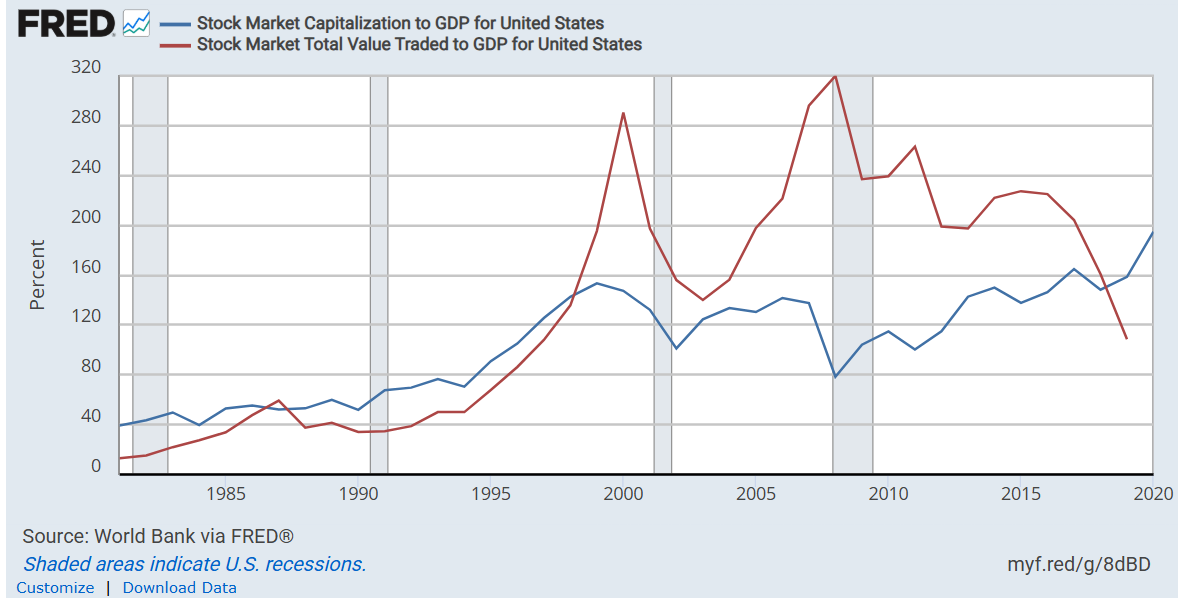
Used to be like sub 50pc in the 1990 and now well over 200pc. Not meant to be of any value for speculation (would have been rubbish in the past and don't think any value for future). but one wonders what it does in terms of tension (internal/ external) as we as shareholders would not like to give back gains so easily (and there is the drift etc). Tricks to be used to keep it up - see v recent events- not judging here.
Larry Williams offers a chart:
Big Al wonders:
I wonder to what extent the decline in "Stock Market Total Value Traded to GDP" reflects a shift to dark-pool/off-exchange trading.
Peter Ringel writes:
TY Larry, great data! looks like we are severely undervalued. A 90s style party is coming.
@BigAl this too is a valid point. If founders don't go the exchanges anymore. Is there data on this off-exchange size? At least for their exit they will most likely show up in equities. Why should early backers not do this in the end? Its too juicy.
related: If off-exchange sector really gets dominant, then FED policy becomes even more toothless.
They have no tools to influence this.
Big Al asks Gemini:
In the US, how much stock trading occurs in dark pools or otherwise off exchanges?
Over 50% of all U.S. stock trading volume now occurs off-exchange, in venues such as dark pools and through internalizers at major firms, exceeding the volume on public exchanges for the first time in early 2025.
Overall Off-Exchange Volume: While dark pools specifically account for a smaller portion of the off-exchange activity (around 13% of consolidated turnover), the overall off-exchange market, including internalizers and bilateral trades, accounts for the majority of U.S. equity trading volume.
Purpose of Dark Pools: Dark pools and other off-exchange venues are primarily used by large institutional investors to execute big orders anonymously, which helps them avoid significant market impact and predatory high-frequency trading (HFT) strategies that can occur on public "lit" exchanges.
Regulatory Oversight: Despite their name, dark pools are regulated as Alternative Trading Systems (ATS) by the SEC and must report executed trades to regulators like the FINRA on a delayed basis.
Market Share Trends: Off-exchange trading share has been on a general upward trend for years, driven by the desire for better execution quality and anonymity. This shift has implications for traditional price discovery on public exchanges.
Steve Ellison does some analysis:
The Shiller Cyclically Adjusted Price Earnings (CAPE) ratio is at its second highest level in history, exceeded only in 1999-2000. What I find interesting is that the 30-year moving average of this ratio has nearly doubled since 1990. My theory is that permanently lower interest rates in an aging population support generally higher stock valuations than in past eras when large families were the norm.
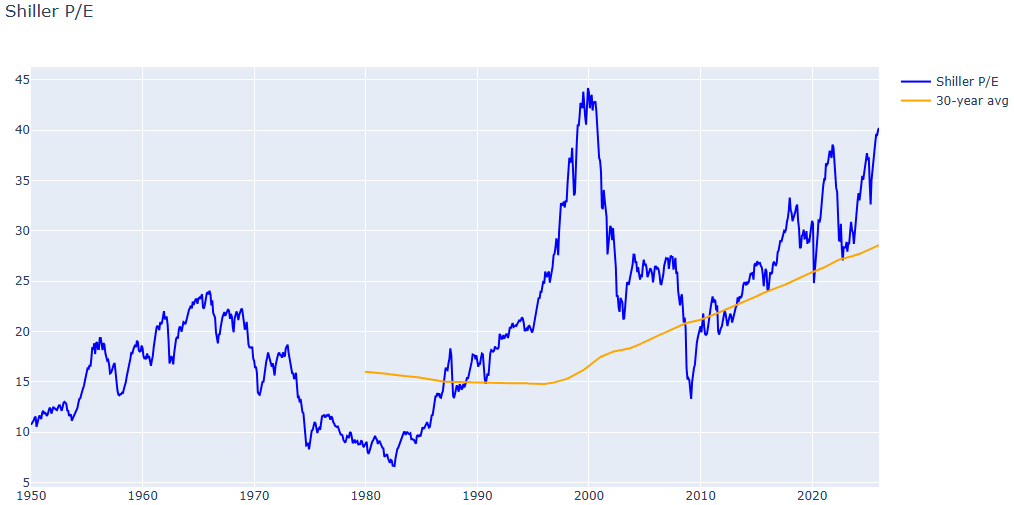
And in the spirit of the old Spec List, here is the Python code I used (.text file) to generate this graph.
Big Al adds:
Another issue is the effect of Mag7 stocks which are global in a new way, beyond US GDP.
Jan
8
Relevant animal behavior study, from Big Al
January 8, 2026 | Leave a Comment
Self-control is definitely an issue in trading! I kept thinking of the crayfish pov. They probably shined him up by telling him he was "preferable".
Can this Cuttlefish Pass an Intelligence Test Designed for Children?
Nils Poertner responds:
Very good. For specs / traders the self-control is tested now with media trying to steal our energy (emotional vampires) with high amygdala stories - whereas the mkts does whatever it does. "get the joke"
Dec
9
Interesting AI read, from Big Al
December 9, 2025 | Leave a Comment
The Structural Collapse: How Google’s Integrated Stack Is Dismantling the OpenAI Thesis
Shanaka Anslem Perera
Nov 22, 2025
A leaked internal memo reveals the tectonic shift reshaping artificial intelligence, where platform economics are defeating venture-backed innovation at the exact moment markets assumed the opposite.
Carder Dimitroff writes:
My Australian daughter is a Google employee. She recently completed Google's 3-month AI training program in the US. From what I understand, Google's AI capabilities are big. When demonstrated to Google's large-cap clients, they were surprised.
Based on her comments, I've concluded that AI technologies will displace accountants, engineers, lawyers, financial analysts, medical staff, educators, sales, and more.
Obviously, leaders in those disciplines will continue to do well. While most normal positions can be eliminated, there must be a human somewhere in the mix. There's an ongoing need to manage the architecture of the questions and review AI responses. Anyone who wants to remain in the game may wish to develop expertise in leadership, program management, systems management, and communication.
Then again, there will be an ongoing need for the crafts. They will reap while others weep.
Musk is right. Work will become optional. But he was not the first.
Nov
17
Corporate earnings, from Zubin Al Genubi
November 17, 2025 | Leave a Comment
I see they are down [at least through Q2]:
FRED: Corporate Profits After Tax (without IVA and CCAdj)
Steve Ellison responds:
Interesting. S&P 500 earnings per share were up both year to date and year over year. And Q3 so far looks better than Q2.
S&P source spreadsheet: Click link to download file: S&P 500 Earnings.
Big Al wonders:
So maybe the big firms are doing better than the smaller ones?
Nils Poertner remembers:
Investment Bank earnings 2007…My very cerebral friend Maurice at the time: "IBs are cheap - look at their PE ratios."
Nov
13
The $38 Trillion Question, from Humbert X.
November 13, 2025 | Leave a Comment
The $38 Trillion Question: An Interview with Stanford Professor Hanno Lustig
Hanno Lustig: I started thinking about the valuation of government debt by looking at the valuation of all Treasuries. What do we have to believe to get to a number like $38 trillion? You must believe there will be a huge fiscal correction, because ultimately the value of debt should be backed by future primary government surpluses. When you do the numbers, you realize that either bond investors are pricing in a huge fiscal correction that seems impossible, or Treasuries are significantly overpriced.

Carder Dimitroff notes:
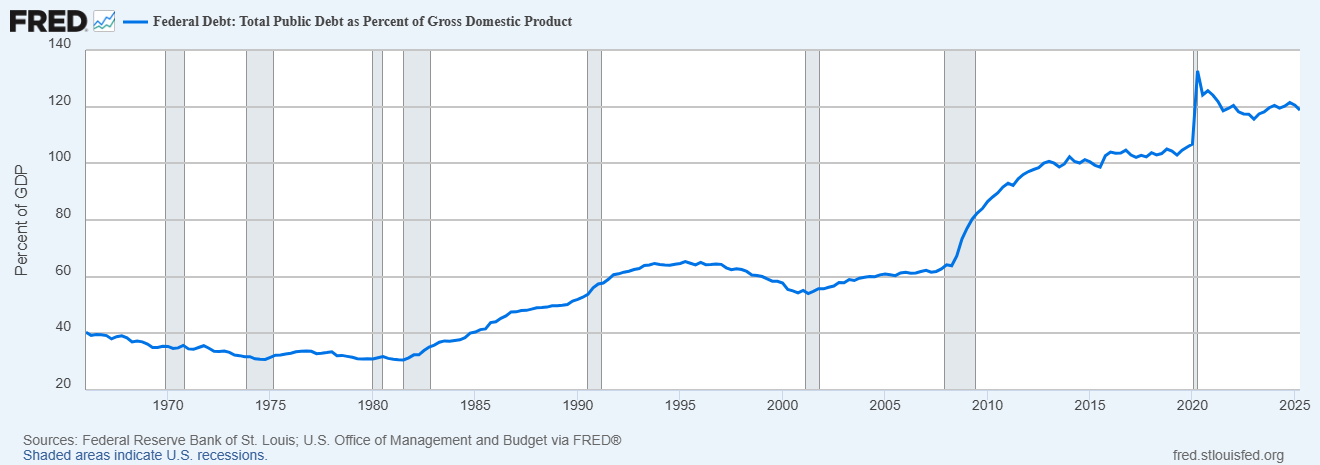
The interest on debt is approaching $1 trillion per year and continues to compound. Interest costs currently exceed Department of Defense spending.
Larry Williams disagrees:
Meaningless measure look at debt vs gdp
Carder Dimitroff responds:
Yes, that makes sense. However, from a different perspective, it becomes meaningful under the One Beautiful Budget Bill when automatic sequestrations are implemented. Unless new legislation is passed, sequestrations will result in Medicare cuts and other reductions in expenditures. Current projections suggest sequestration will present in early 2026.
Big Al checks with FRED:
Nils Poertner writes:
recession + zero short term rates + lots of QE ….leading to a lot more public debt
maybe that is more likely path.
Stefan Jovanovich offers some history:
This chart shows the solvency ratios that can be found from the Census and other data [by decade 1880 to 2020] - how much "we the people" have in money divided by how much the American governments promise to pay.
Oct
28
Entertaining valuation exercise, from Big Al
October 28, 2025 | Leave a Comment
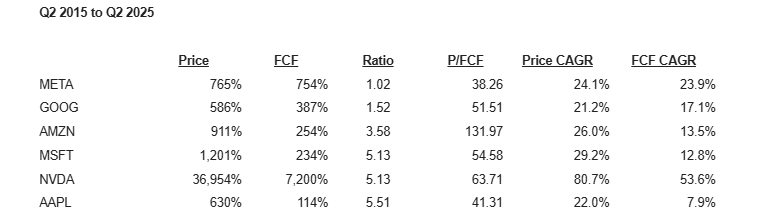
Looking at some of the megacaps and comparing their share price growth and FCF growth between Q2 2015 and Q2 2025. The price/FCF figures are the most recent.
Oct
24
Another Historical Analogy, from Stefan Jovanovich
October 24, 2025 | Leave a Comment
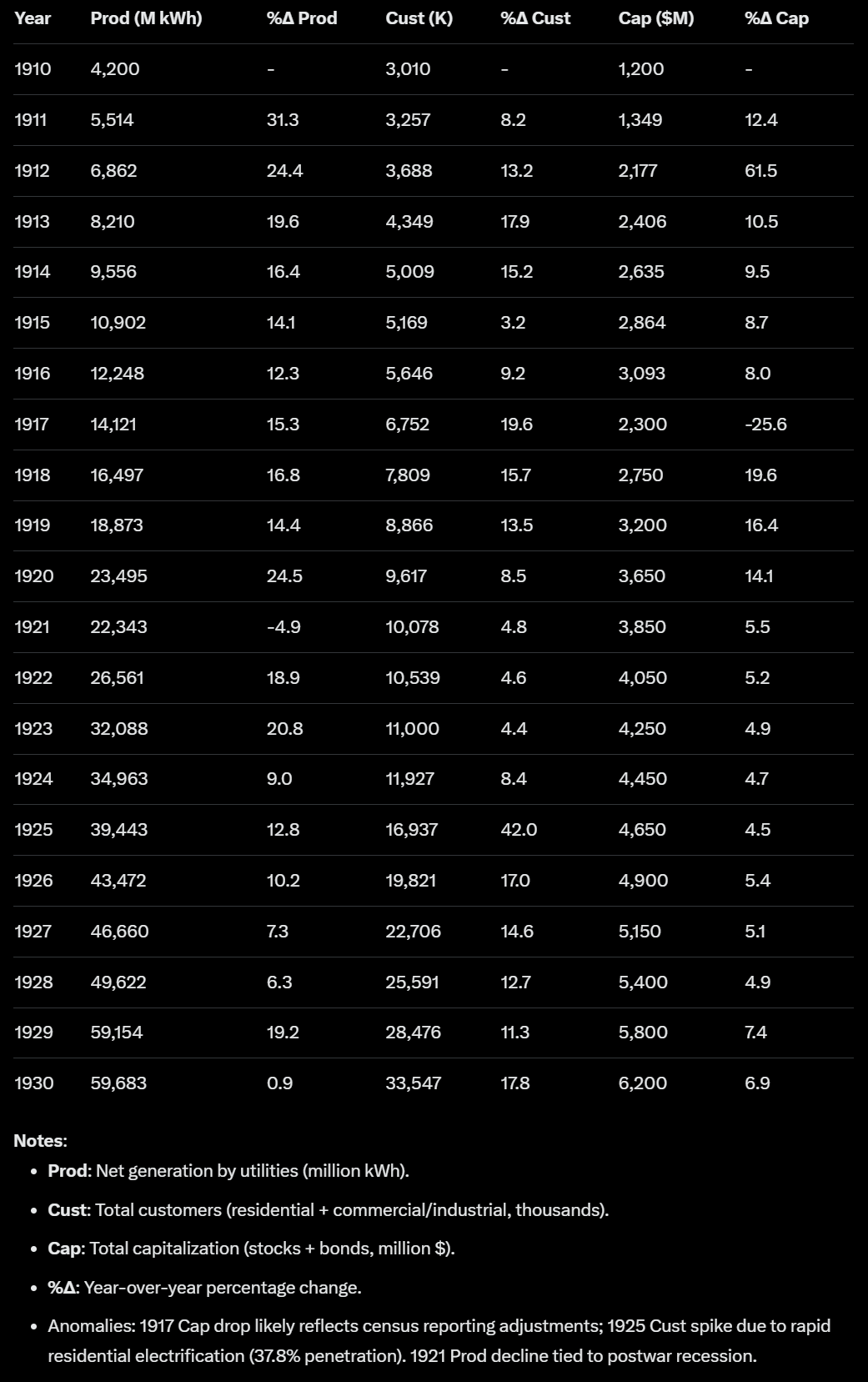
Grok and I have produced this summary of the growth of the electric utilities industry in the United States from 1910 to 1930. [Click on chart for full view.]
Bud Conrad comments:
Not sure what you take from this data. Electrification was probably more important than AI. Its growth rate was big at first in %, but slowed. Recessions were big downturns. What do you apply to today?
Steve Ellison writes:
My grandmother was a telephone operator in the 1920s. It was a high-tech industry at the time.
Carder Dimitroff clarifies:
The definition of an "electric utility" changed over time.
Big Al suggests:
An excellent series available on Prime:
Shock and Awe: The Story of Electricity
Professor Jim Al-Khalili tells the electrifying story of our quest to master nature's most mysterious force: electricity.
Books I haven't read yet, which get lots of stars:
The Power Makers: Steam, Electricity, and the Men Who Invented Modern America
The power revolution is not a tale of machines, however, but of men: inventors such as James Watt, Elihu Thomson, and Nikola Tesla; entrepreneurs such as George Westinghouse; savvy businessmen such as J.P. Morgan, Samuel Insull, and Charles Coffin of General Electric. Striding among them like a colossus is the figure of Thomas Edison, who was creative genius and business visionary at once.
Empires of Light: Edison, Tesla, Westinghouse, and the Race to Electrify the World
In the final decades of the nineteenth century, three brilliant and visionary titans of America’s Gilded Age—Thomas Edison, Nikola Tesla, and George Westinghouse—battled bitterly as each vied to create a vast and powerful electrical empire. In Empires of Light, historian Jill Jonnes portrays this extraordinary trio and their riveting and ruthless world of cutting-edge science, invention, intrigue, money, death, and hard-eyed Wall Street millionaires.
Oct
20
Calming musical interlude for spicy markets, from Big Al
October 20, 2025 | 1 Comment
I first heard this piece as a teenager, sitting in the theater
watching Barry Lyndon, and I was transfixed:
The Messiaen Trio performs Schubert's Trio No. 2 in E-flat Major, D. 929
I did not know this Mendelssohn work until today and I wondered if
somebody said to her, "Oh yeah? Well, try it in heels!"
Yuja Wang Mendelssohn Songs Without Words Op 67 No 2
Peter Ringel writes:
my emergency high vola setup always includes Chopin. everything to stay off tilt.
Big Al responds:
Gotta love Chopin for the workday playlist.
Chopin: 24 Preludes, Op. 28, Vladimir Ashkenazy
Another discovery for me (fades out but still enjoyable):
Interpreti Veneziani, Antonio Vivaldi RV711 Gelido in Ogni Vena, Davide Amadio
Sep
11
Power Laws in Economics and Finance, from Big Al
September 11, 2025 | Leave a Comment
Gappy (Giuseppe Paleologo) posted this on X, and it prompted me to wonder if a power law would apply to the skill differences and win rates of tennis players viz their rankings. Need to find some easily accessible data for that. And of course, how PLs apply to the distribution of returns with the S&P 500 in a given time period. But could it be predictive?
Power Laws in Economics and Finance
Xavier Gabaix, Stern School, NYU
A power law (PL) is the form taken by a large number of surprising empirical regularities in economics and finance. This review surveys well-documented empirical PLs regarding income and wealth, the size of cities and firms, stock market returns, trading volume, international trade, and executive pay. It reviews detail-independent theoretical motivations that make sharp predictions concerning the existence and coefficients of PLs, without requiring delicate tuning of model parameters. These theoretical mechanisms include random growth, optimization, and the economics of superstars, coupled with extreme value theory. Some empirical regularities currently lack an appropriate explanation. This article highlights these open areas for future research.
Asindu Drileba writes:
One of the funniest commodities traded in Uganda (my country) is Vanilla. The price fell from, $156 per kilo, to $1.14 per kilo. A -99% drop during the 2020 covid lock down.

Vanilla cultivation is special in that it can't be farmed mechanically.
- It only flowers once a year
- The flower is only open for 24 hours in one year
- It can only be hand pollinated
- If you miss those 24 hours in one year, your done, wait for the next season.
So a lot of the cultivation is by small "artisanal" farmers.
Madagascar produces close to 80% of the world's vanilla. All other countries produce the rest. So its a power law distribution. The smallest hiccup in Madagascar can cause the vanilla price to skyrocket or drop.
I think power laws outside prices (like supply chains of vanilla) can be used to predict what asset, commodity or instrument will be volatile (large moves both up & down). I think these underlying setups in assets are what echo as power law distributions into prices.
Sep
6
The Evolution of Infantry War-Fighting, from Stefan Jovanovich
September 6, 2025 | Leave a Comment
The greatest single success of the Japanese Army in WW 2 - the capture of Singapore - came directly from the use of bicycles as the primary means of troop transport.

From the Army and Navy Journal of 1896
BICYCLE “CORPS,” 25TH Inf
2d Lieut. James A. Moss, U.S.A., Commanding
The Bicycle Corps of the 25th. U.S. Inf., under the command of 2d Lieut. James. A. Moss, appears to have had a very successful, but very fatiguing, trial in their recent expedition from Fort Missoula, Mont., to test the bicycle for military purposes.
The corps left Fort Missoula Aug. 15 with rations, rifles, cooking utensils, shelter tents, ammunition, extra bicycle parts, repair material, etc., etc. They reached Fort Harrison on the 17th, having covered 132 miles in 22 hours of actual travel. They got new rations at Harrison and left for Yellowstone at noon Aug. 19, reaching Mammoth Springs, Wyo., at 1:30 Aug. 23. The distance of 101 miles was made in 31 hours of actual traveling. So far they had traveled in 53 hours of actual traveling, 323 miles of the hilliest and rockiest roads in the United States, fording streams, going through sand, mud, over road ruts, etc. Every day, except only one, they had wind against them. Aug. 25 the corps left for a days’ trip through the park.
When they left Fort Missoula, their lightest wheel [i.e., bicycle] packed, weighed 64 pounds, the heaviest 84 pounds, an average of 77½ pounds; the lightest wheel with rider, weighed 205 pounds, the heaviest, 272 pounds. The wheel used was the 26-pound Spalding bicycle, geared to 66½. The weights of the members of Bicycle Corps were as follows: Lieut. Moss, 135 pounds; Corp. Williams, 153½; Musician Brown, 145½; Pvt. Proctor, 152; Pvt. Findley, 183½; Pvt. Foreman, 160; Pvt. Haynes, 160; Pvt. Johnson, 151½.
Previous to making this trip, Lieut. Moss made a preliminary excursion to Lake McDonald, leaving Fort Missoula at 6:20 A.M., Aug. 6 and reaching there on return at 1:30 P.M., Aug. 9, having ridden and walked 126 miles in 24 hours of actual traveling under most adverse circumstances. They were delayed quite a number of times in tightening nuts, adjusting handle bars, etc. The wheels were not spared in the least, and did the work extraordinarily well. On their trip the men found the roads muddy from recent rain, and were impeded by the clay-mud sticking to the tires of their bicycles. They had to dismount frequently to scale heights, and over six miles of road they dismounted twenty times on account of mud puddles and fallen trees. While crossing Finley Creek on wheels two men fell in the stream. Part of the journey was made in a driving rain, which covered the wheels with mud and filled the shoes of the riders with water, making it difficult for them to keep their feet. on the muddy pedals. [Another creek] was forded through three feet of swift water, each wheel being carried across on a pole suspended from the shoulders of two soldiers. "Had the devil himself," says Lieut. Moss, “conspired against us, we would have had little more to contend with.”
The party attracted great attention along the way from the inhabitants, and their dogs and cattle. Dogs ran after them, cattle away from. them, and residents stopped work and stood in open-mouthed wonder as they passed. Every once in a while they would strike an Indian cabin and the dogs barking would announce their approach, while the occupants would stand in the door and gaze at them. Every other soldier carried a complete Spalding repair kit. The large tin [water] case (carrying about 11 gallons) was attached to the front of bicycles on a frame and strapped to the handle bars. The men wore the heavy marching uniform, and every other soldier was armed with a rifle and 30 rounds ammunition. The rifles were strapped horizontally on the top side of the side of the bicycles with the bolt on top. Those not so armed carried revolvers on belt with 30 cartridges.
Big Al adds:
More detail:
The Twenty-Fifth Infantry Bicycle Corps
On June 12, 1894, James A. Moss graduated from the United States Military Academy at West Point. Moss was assigned to the all-Black Twenty-Fifth Infantry, headquartered at Fort Missoula, Montana. It was one of four all-Black regiments in the Army at the time, nicknamed the Buffalo Soldiers.
Sep
3
Data centers and power demand, from Big Al
September 3, 2025 | Leave a Comment
I post these wondering what Carder D thinks:
Big Tech’s A.I. Data Centers Are Driving Up Electricity Bills for Everyone
Electricity rates for individuals and small businesses could rise
sharply as Amazon, Google, Microsoft and other technology companies
build data centers and expand into the energy business.
14 August, 2025
AI Boom Reshapes Power Landscape as Data Centers Drive Historic Demand Growth
Monday, March 3, 2025
The power industry was once considered slow-moving and perhaps even boring. That is no longer the case as technology has expanded and power demand projections skyrocket. New reports released by analysts at Enverus and Deloitte are examined to provide insight on what’s likely to evolve in the power industry over the coming year and beyond.

Carder Dimitroff responds:
I believe these articles present several issues that could benefit investors:
1) Transformers (not pole transformers). The queue for new transformers is long, and about half are manufactured offshore. Data centers need transformers as do new power sources.
2) Gas turbines. Same situation as transformers. For efficient turbines, the queue is about 5 years.
3) Solar panels. Those who previously invested in solar will see their ROIs grow faster than they expected.
4) Retail consumers. They will see their gas and electric utility bills grow as they pay for higher costs of energy and subsidize infrastructure costs to support new loads.
5) New manufacturing. Several geographical options will present better opportunities than others, as the cost of power is regional and seasonal.
6) Forget new nuclear as a near-term solution.
Asindu Drileba asks:
What do you think about nuclear fusion? Is it really close? The joke is that nuclear fusion has always been ready in 5 years for many decades. But I recently heard Chris Sacca (one of the best VCs ever, made over 250x for his entire fund), mention it is genuinely close and that his new fund, Lower Carbon existing partly to capture the incoming advancements in nuclear fusion.
Carder Dimitroff replies:
Today, nuclear fusion is a science project. Keep in mind that fusion requires operating temperatures of over 100 million degrees (at this level, the distinction between Fahrenheit and Celsius is irrelevant). Producing bulk power from this technology is more than ten years away. At these temperatures, it's unlikely they will be operating near population centers.
Aug
17
Best video on Punnett square, from Asindu Drileba
August 17, 2025 | Leave a Comment
Concerning the transitions of colour, on the daily spec website. The chair recommended The Punnett square as a research topic. This was the best video I could find. It's amazing how he broke down the essentials in just 6 minutes:
Genotype, Phenotype and Punnet Squares Made EASY!
Big Al offers:
Great vid on Markov, and Markov chains leading to LLMs:
The Strange Math That Predicts (Almost) Anything - Markov Chains
Aug
1
How do you fight the Vig?, from Asindu Drileba
August 1, 2025 | 1 Comment
I interpret the "Vig" as the collective term for:
1) bid-ask spread (difference in prices between buying & selling) due to market makers
2) transaction fees (for limit & market orders) charged by the exchange
3) slippage (an instrument is more expensive the deeper in the order book you go) due to how liquid an asset is.
Possible solutions for each?
1) Can be fought with the exclusive use of limit orders instead of market orders.
"Be patient and you will have the edge", The Chair in, Practical Speculation — The fine art of bargaining for an edge
2) I noticed (at least in crypto markets) that the more volume you trade, the less fees you pay (on a percentage basis)
3) Restrict yourself to deep and very liquid markets.
Also, one technique is to trade as less often as you can (buy & hold). That way you will automatically pay less of all the three sources of Vig. I think this is so important as I often found many "edges", then accounted for the vig and they often became loosing strategies.
Big Al writes:
I would also add "opportunity cost" as part of the "Meta Vig" (MV), i.e., the total costs associated with trying to trade the markets. The MV would also include the negative effects of cortisol on the human body.
Henry Gifford suggests:
I think two good steps are to ask others what the big is, and to try to calculate it yourself. Both exercises will no doubt be educational. A few times over the years I have asked horse bettors what the big is, but none seemed to know. As for calculating yourself, one hopefully will learn how much it varies by, and maybe also gain insight into hidden vig.
Steve Ellison responds:
There is no free lunch with limit orders because of adverse selection. Sooner or later, you will place a limit order on a security that simply moves up and never looks back. It would have been your best trade ever, had you actually been filled. In the opposite scenario, for example when I bought Coca-Cola in 1998, and it was already down 25 percent by the T + 3 settlement date, you will of course be filled.
Studies of retail investing accounts have shown a negative correlation between number of transactions and investment returns. In one study, accounts that had been inactive for 18 months because their owners had died, and their estates had not been settled, outperformed the vast majority of their retail account peers.
Peter Ringel writes:
Generally, the lower you go ( smaller time frame - smaller scope of the trade ) the larger the relative Vig costs. a subclass of opportunity costs is spent time of (daily) preparation. my required prep is nearly the same over many time-frames - but the scope of a trade is way lower for lower time-frames. in cash equities, the resale of your order-flow by your broker to some HF shop can be counted as Vig too. is this a common practice in option markets too? Yes, the Vig greases the fin-industry, but it is mostly unavoidable paying / avoiding the Vig does not lead to success or failure in mkts IMHO.
Vic simplifies:
just trade once a quarterfrom long side
Zubin Al Genubi comments:
The biggest vig is capital gain taxes. The richest people in the world hold their single company stock 10000x and realize no gain. Its very hard to beat a long term hold.
Jul
26
Dispersion, from Big Al
July 26, 2025 | Leave a Comment
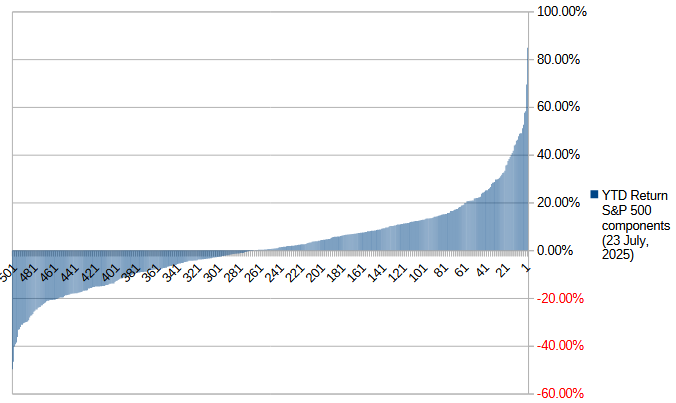
There is a debate over the effects of passive investing, eg, whether it causes all stocks to be more correlated in their movements, makes markets less efficient, etc. Here's an interesting take:
Index Investing Makes Markets and Economies More Efficient.
I’m going to argue that the trend towards passive management is not only sustainable, but that it actually increases the accuracy of market prices. It does so by preferentially removing lower-skilled investors from the market fray, thus increasing the average skill level of those investors that remain. It also makes economies more efficient, because it reduces the labor and capital input used in the process of price discovery, without appreciably impairing the price signal.
As for the correlation issue, one can still see dispersion. Here are the S&P components sorted by YTD % return as of 23 July (data source), with stocks such as PLTR, NRG and NEM on the right (+) end, and UNH, LULU, ENPH and DECK on the left (-) end:
Jul
22
Smörgåsbord
July 22, 2025 | Leave a Comment
Big Al offers:
Very nice Veritasium vid on randomness and information:
Asindu Drileba likes a new interview:
I learned about Gappy Paleologo from this list. He has a new interview on a Bloomberg podcast. In it, he talks about:
- Why he suspects Astrophysicists make good quants
- Why AI can't fully take over trader's jobs (in principle)
- What makes a "good quant"
Jeff Watson is following the floor traders last stand:
Old-School Floor Traders Finally Get Their Day in Court Against CME
Trial opens in the Chicago plaintiffs’ long-running lawsuit claiming harm from the launch of electronic markets
The plaintiffs, who estimate that they are owed about $2 billion in damages plus interest, say the company broke its promises to them when it opened a data center for electronic trading that effectively doomed the old trading floors. CME has called the lawsuit baseless.
A spokeswoman for CME declined to comment. The company repeatedly tried to get the suit thrown out, but failed each time.
The lawsuit, filed in 2014, has dragged on so long that one of the original plaintiffs has died. Hundreds of former floor traders could be affected by the outcome. The trial, being held at a county courthouse in downtown Chicago, kicked off Monday with jury selection. It is expected to last several weeks.
Jul
21
CPI Data Quality Declining
July 21, 2025 | Leave a Comment
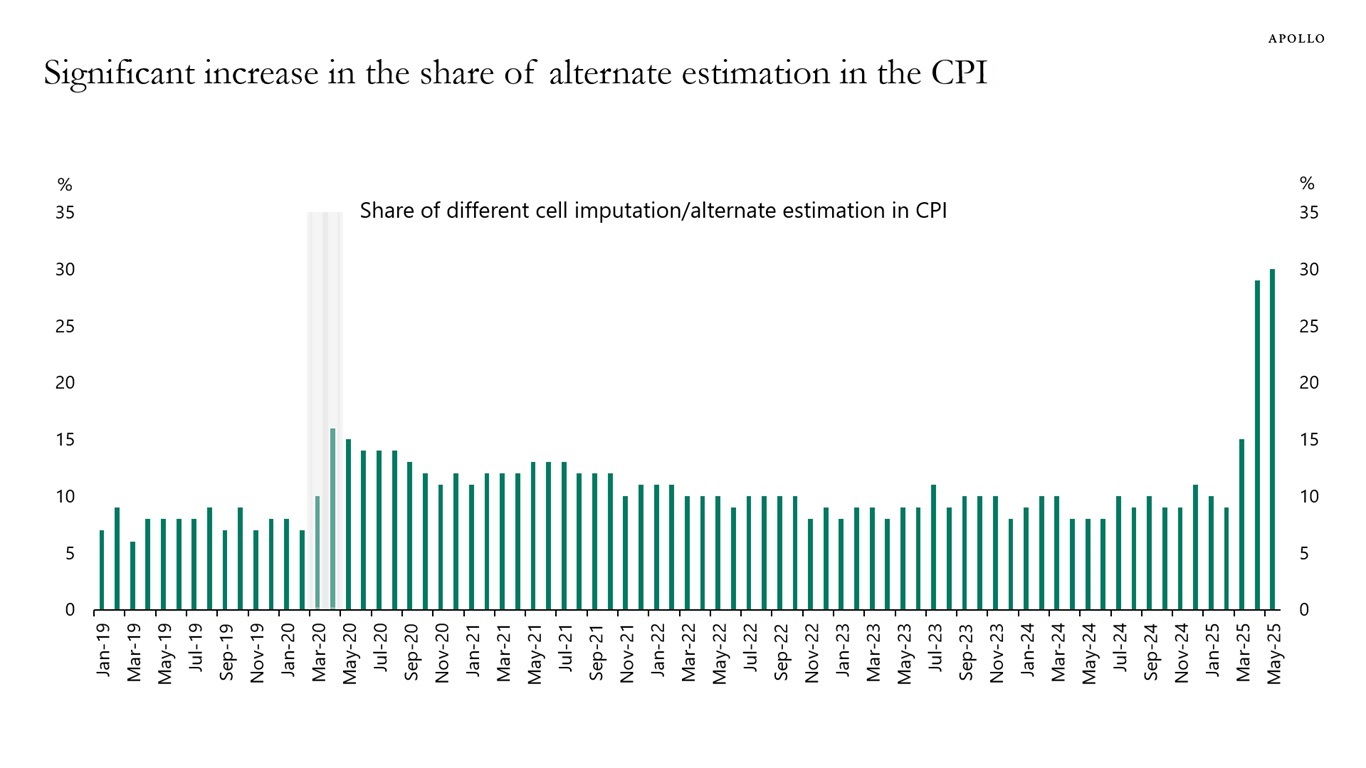
CPI Data Quality Declining
June 20, 2025
Torsten Sløk
Apollo Chief Economist
To calculate CPI inflation, BLS teams collect about 90,000 price quotes every month covering 200 different item categories, and there are several hundred field collectors active across 75 urban areas.
When data is not available, BLS staff typically develop estimates for approximately 10% of the cells in the CPI calculation. However, in May, the share of data in the CPI that is estimated increased to 30%, see chart below.
In other words, almost a third of the prices going into the CPI at the moment are guesses based on other data collections in the CPI.
Bill Rafter writes:
Would anyone in the data business be surprised by this? I’m not.
Peter Ringel wonders:
Doge related?
Big Al offers:
US Labor Department reducing CPI collection sample amid hiring freeze
By Reuters
June 4, 2025
The U.S. Labor Department's economic statistics arm said on Wednesday it was reducing the Consumer Price Index collection sample in areas across the country due to resource constraints, but the move should have "minimal impact" on the overall CPI data.
Jul
5
DailySpeculations calendar colors, from Big Al
July 5, 2025 | Leave a Comment
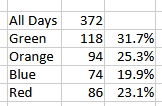
The calendar here at Daily Speculations puts market days into four groups, based on the daily changes in S&P futures and bond futures:
Green = Stocks Up, Bonds Up
Orange = Up, Down
Blue = Down, Up
Red = Down, Down
Using daily data for the S&P and for TLT, from 2 January, 2024, to 28 June, 2025, I determined which color each day is, and then did the count for each color, and what % that color day is of all days:
Then I counted what follows each day, i.e., a Green day could be followed by another Green day, or an Orange, or Blue, or Red day. With a random distribution of days, you would expect random following days, i.e., if 40% of days are Green, and 30% are Orange, then you would expect any given day to be followed by a Green day ~40% of the time and an Orange day ~30% of the time. You could then look at deviations, e.g., Blue days followed by Orange days only 25% of the time could be counted as -5%-point deviation.
So I did this kind of counting with the calendar days, with these results, where you see, for example, the number of times a Green day follows a Green day (39), what % of the time this represents (33.1%), and the deviation from expected, measured in % points (1.33%).

• What follows Green days looks random (i.e., the numbers in the deviation column are close to zero percent).
• Orange days are somewhat more likely to be followed by Red days and less likely by another Orange day.
• Blue days look random.
• Red days are more likely to be followed by Orange days.
I keep thinking I should study Markov processes, especially "Hidden". I don't know if this kind of counting is a simple version of a Markov process, and if there is more that could be done.
Jul
3
Sports $$$, from Big Al
July 3, 2025 | Leave a Comment
The news is the Buss family selling the Lakers (and the online discussion whether the Lakers were a better investment over time than, say, the S&P).
I wanted to look at the value of college athletics and found this page:
What the top 75 college sports programs are worth
Then I used Perplexity and elbow (or mouse finger) grease to build this table showing revenue per student, sorted high-to-low. There are many possible errors in this data but it's just for fun and seems intuitively roughly correct.
Below is the top set of rows - click here for the full sheet (all 75 schools) which will appear zoomed out - click on it to zoom in.

Jun
26
Increase in yields, from Jeff Watson
June 26, 2025 | Leave a Comment

Adam Grimes comments:
Cool chart. Interesting data. We have some farmers in the family but I would not have expected such a big difference.
Peter Ringel writes:
I think, this productivity boost shows Norman Borlaug‘s Green Revolution. There would be no India or China as we know it . And in the West too. The topic seems close to not being politically correct in our upside-down world.
Michael Ott brings expertise:
The Y axis is Mg/hectare, which is a different way to measure weight per unit area. Technically, a bushel is a unit of volume (8 gallons) that is understood to be equivalent to 56 pounds of corn or 60 pounds of soybeans. Most US farmers measure in bushels per acre, which is a different way to express weight per unit area.
The major increase in corn came from breeding AND fertilization. GMO corn was introduced in 1996 and reached 50% market share around 2001, which is pretty fast adoption for agriculture. Biotech traits certainly help with yield, but more so prevent disasters from insects and weeds, which harm yields.
Big Al finds another chart interesting:

May
28
Adapting to the situation, from Big Al
May 28, 2025 | Leave a Comment

Street smarts: how a hawk learned to use traffic signals to hunt more successfully
But what was really interesting, and took me much longer to figure out, was that the hawk always attacked when the car queue was long enough to provide cover all the way to the small tree, and that only happened after someone had pressed the pedestrian crossing button. As soon as the sound signal was activated, the raptor would fly from somewhere into the small tree, wait for the cars to line up, and then strike.
Easan Katir predicts:
Next iteration: the hawk will be pressing the pedestrian crossing button!
Michael Brush quips:
Pavlov’s birds.
Henry Gifford writes:
When I was hiking down The Grand Canyon I sat on a rock at the edge of the trail and took out a sandwich and started to eat. A bird came flying from my left side, toward the sandwich in my right hand. I reacted by pulling the sandwich back, to the right side of my head. Another bird came from behind and grabbed it.
Later I heard the birds’ favorite food is tuna fish, which they steal cans of from hikers. They open the can by grabbing it in their beak and flying above the one of the three cabins at the bottom of the canyon where the park rangers live and dropping it on the roof. The rangers have been trained to comply by opening the can and placing it on a convenient rock.
Pamela Van Giessen responds:
Was it a raven? They are particularly smart birds when it comes to getting food out of visitors to the national parks we have visited.
Asindu Drileba writes:
Crows & ravens would make good scientists. Here for example a video of a crow showing that it understands water displacement in different scenarios.
Bo Keely, from the desert:
Yesterday at the meteor crater in Death Valley two crows perched on the rim. They had grown feather sunglasses and asked for food. I went to the car & they followed and I gave them whole wheat bread. Then I got in & drove a couple miles down the road, pulled over to check directions, and they landed outside the driver's door asking for more bread.
May
22
Books on markets before 1900, from Asindu Drileba
May 22, 2025 | Leave a Comment
I noticed that I know of very few books on the stock market before 1900. I only know of:
Confusion of Confusions, by Joseph De La Vega (1688)
The Art of Investing, by John F Hume (1888)
Are there any books about the market before 1900 that can help me grow this list?
Big Al replies:
Lombard Street: A Description of the Money Market, by Walter Bagehot
Fifty Years in Wall street, Henry Clews
Francesco Sabella suggests:
The Stock Exchange: A Short Study of Investment and Speculation, by Francis W. Hirst
Stefan Jovanovich offers:
The Stock Exchange from Within, by Van Antwerp, William Clarkson
Martin’s Boston Stock Market, by Joseph Gregory Martin
Wall Street in History, by Martha J. Lamb
May
17
Runs of “up” days in the S&P, from Big Al
May 17, 2025 | Leave a Comment
An analysis of runs of "up" days (i.e., Close-Close change is positive) in the S&P, through 2 May of this year:

And then I asked an AI to model flipping a coin biased in the same way (53.7% heads), and you can see the results here.
Anatoly Veltman comments:
Yes you're putting numbers out - no complaint there. Huge complaint on the premise: why would 9-day "run" into tomorrow bear same fruit as some totally different 9-day "run"?? What's a "run"; why would different-size price increases under all different relevant variables have the same impact on further trajectory - just because you assigned the same "9-day length" value to current "run"??? IMHO this sort of input can't be expected to help much.
Big Al responds:
That's actually the point: when we assign importance to runs of days, we have to be careful because the run distribution in actual data looks like the distribution you get doing a coin-tossing exercise with a market-biased coin. Which doesn't mean that analyzing runs can't produce anything useful, just that there is a high hurdle.
Anatoly Veltman adds:
My point is mostly about DIFFERENTLY-SIZED up-days. Some days could've been up $2, while others $200…Some days might have been not up-days in SP500 index, while up-days in SP500 futures. And dozen other variabilities that would make one "9-day run" be vastly different from other "9-day run" in impact on future expectations. Not that there are many ideal ways of Input, but this sort may just be prohibitively flawed.
May
13
A call for great new books, from Jeffrey Hirsch
May 13, 2025 | Leave a Comment

I am putting together a list of the Best Investments Books of the Year. I am not seeing many great books on trading, investing, finance, markets, crypto, options, futures, cycles, etc. I would love to hear if you folks know of any great books out in the past 6 months or so or coming soon.
Matthew Gasda is justifiably proud:
Big Al offers:
This is high-level quant stuff - ie, over my head, and despite "Elements" in the title - but a fun stretch:
The Elements of Quantitative Investing (Wiley Finance) 1st Edition, by Giuseppe A. Paleologo
His more basic 2021 book is "Advanced":
Advanced Portfolio Management: A Quant's Guide for Fundamental Investors, by Giuseppe A. Paleologo
Carder Dimitroff suggests:
This book is about historical finance and may not be a direct response to the question.
Empire, Incorporated: The Corporations That Built British Colonialism, by Philip J. Stern
William Huggins responds:
on a similar (historical) note, one of my students just recommended this title to me. looking forward to cracking it later this month:
Ages of American Capitalism: A History of the United States, by Jonathan Levy
Asindu Drileba adds:
If you would regard a speculator/investor as someone who also builds businesses:
Never Enough: From Barista to Billionaire, by Andrew Wilkinson
Andrew is building Tiny. His intention is to build the Berkshire Hathaway of Tech and software. He is inspired by Monish Pabrai (The Dhando Investor). So he is more in the "Value investing" camp not really quantitative.
May
3
Domestication, from Big Al
May 3, 2025 | Leave a Comment

Some in these areas of science (genetics, animal development and behavior) have proposed that humans have essentially domesticated ourselves during the Holocene.
The domesticated silver fox (Vulpes vulpes forma amicus) is a form of the silver fox that has been to some extent domesticated under laboratory conditions. The silver fox is a melanistic form of the wild red fox. Domesticated silver foxes are the result of an experiment designed to demonstrate the power of selective breeding to transform species, as described by Charles Darwin in On the Origin of Species. The experiment at the Institute of Cytology and Genetics in Novosibirsk, Russia, explored whether selection for behaviour rather than morphology may have been the process that had produced dogs from wolves, by recording the changes in foxes when in each generation only the most tame foxes were allowed to breed. Many of the descendant foxes became both tamer and more dog-like in morphology, including displaying mottled- or spotted-coloured fur.
But there has been criticism of the breeding experiment and conclusions.
Asindu Drileba responds:
My definition of "domestication" used to be that of "Animals simply living under the care of other animals". When I watched a PBS Eons video some years back, I learned that Paleontologist's had a very different definition of "domestication". They define it as "the dependence on the care of other living things, to the extent that they cannot no longer live in their natural environment (the wild) anymore."
In the animal context, humans domesticated dogs and stray dogs (dogs with no owner) are riddled with wounds and in general don't do well. They would probably die if left in a forest. Foxes however look good in the wild.
In the human context, a human being with no owner (a government, a parent or an employer) usually does as badly in the manner of the stray dog. This human would perfectly fit the paleontological definition of what would be a "domestic human". The same applies for the ownership class/ruling class. They have used the working classes to domesticate themselves so they too, also can't survive with out them either. An undomesticated human would be people that can survive in an environment urban dwellers can't, the natural environment.
Like how the Khoisan do well in the desert, or tribes in the deep Amazon also do well. If you dumped a random urban dweller in the Amazon rain forest or the Kahalari desert (under same circumstances as the natives) 99% of them would die within weeks.
Apr
24
Planck’s principle, from Nils Poertner
April 24, 2025 | Leave a Comment

A new scientific truth does not triumph by convincing its opponents and making them see the light, but rather because its opponents eventually die and a new generation grows up that is familiar with it…
An important scientific innovation rarely makes its way by gradually winning over and converting its opponents: it rarely happens that Saul becomes Paul. What does happen is that its opponents gradually die out, and that the growing generation is familiarized with the ideas from the beginning: another instance of the fact that the future lies with the youth.
— Max Planck, Scientific autobiography, 1950, p. 33, 97
relevance of how new ideas are being adopted in science, markets, everywhere.
Jeff Watson responds:
Science by consensus is not science. Just ask Galileo.
Pamela Van Giessen writes:
John McPhee wrote extensively about this and how the science of geology advanced over a few centuries in Annals of the Former World. Scientific community consensus is pernicious, and it is clear that there is mostly no convincing it.
William Huggins comments:
the foundation of science rests of replicability - anyone with the same data should be able to replicate results (even if they disagree about the mechanism). once replication is established, the difficult questions come from "is this data sufficient and representative?"; "is the data generating process stable or dynamic?"; "did i gather data in support of my hypothesis or to try to disprove it?". the fun stuff.
philosophy of science ensures we ask good questions and have good tools to tackle them with. this is why the Ph in PhD is short for "philosophy."
correction: "same data" is the wrong phrase - "equivalent, out-of-sample" would be a better choice of words.
Asindu Drileba writes:
The problem with the human mind is that it has too many glitches. You can verify data successfully and still be wrong. Here are two examples from Astronomy. First, The Mayans had models that would accurately predict eclipses. So, your data of when eclipses occur would replicate really well with their model. However the model of the solar system the Mayans used, had the Earth at the centre and the Sun revolved around it. The assumptions of the model were completely wrong, but the data (predictions) were accurate.
Second, is Newton's models, that predicted the movement of a comet accurately. Then you often here people say that Einstein proved Newton wrong with Relativity.
I think when it comes to science, explanations are very flimsy. What should matter is if the idea useful or not.
Francesco Sabella responds:
I think it’s a very good exercise to start from the point of view that our mind is bound to make mistakes, have glitches and start to work from that assumption; even if it’s not always true but it can be good as working hypothesis.
Big Al recalls:
Years ago, doing simple quantitative analyses to post to this list, I learned that one of the biggest pitfalls was my own desire to get a nice result.
Apr
18
I know The Chair uses linear regression and so do some hedge funds. But what are you people using it for? Predicting earnings? Stock Returns? Stock Prices?
What kind of inputs make sense to insert into a linear regression model? What mistakes do you think people make when using linear regression?
Big Al responds:
A book the Chair has recommended:
Applying Regression and Correlation: A Guide for Students and Researchers
I've used correlation for exploring lots of simple questions like, "Does the move on Monday predict the move on Tuesday?" The basic model is just "does A predict B?"
One mistake often made when looking at time series like stock prices is to use absolute dollar/point changes rather than % changes. Always use % changes.
Apr
16
The Invisible Gorilla in the Room, from Stefan Jovanovich
April 16, 2025 | Leave a Comment
That is the creature Hugh Hendry - the Acid Capitalist - says we have to find in order to profit from our speculations.
The events in Ukraine are that gorilla. They are predicting the likelihood that Trump, Putin and the Muslim oil producers will establish a Drill, Baby, Drill world of orderly energy production and supply priced in U.S. $. The effects on the European and Asian consumers will be comparable to what happened to the German-speaking world and its silver standard when the French fulfilled the terms of the Treaty of Frankfurt by paying their reparations in gold.

Big Al needs some help:
Perplexity answers the question, "What happened to the German-speaking world and its silver standard when the French fulfilled the terms of the Treaty of Frankfurt by paying their reparations in gold?"
Stefan Jovanovich answers:
They = "events, dear boy". The prediction is that the new cartel of oil and gas exporters will establish "orderly production" that manages the risks of overproduction in the same artful manner that OPEC once operated before the invention of fracking.
William Huggins responds:
So you are suggesting us producers will submit to directives from moscow or Riyadh to limit their production? No evidence of anything but predation among those players but somehow trump purs them all on the same page? I have a bridge for sale….
Mar
30

The hypothesis is that at the end of a quarter in which bonds are up while stocks are down, institutions need to rebalance their asset allocations by selling bonds and buying stocks.
I found 14 such quarters since 2002, not including the current quarter. In the last 5 trading days of those 14 quarters, SPY was up 8 times and down 6 times, with an average net change of 0.9% with a t score of 0.76–statistically insignificant.
My Python code that I used to obtain the above results.
Big Al responds:
That's an event I hadn't thought about in a long time. It's hard to imagine a lot of big institutions running a simple strategy like that these days, which doubt your study would appear to support. But it does make me wonder if there are other, more complex balances or relationships that big players do manage on a calendar basis.
Alex Castaldo comments:
The general idea of trying to take advantage of "fixed behavior" by others is a good one IMO.
Paolo Pezzutti agrees:
It's like finding regularities end of month or Holiday's behavior or several others. I think there may be many still uncovered. Steve on Github has made public a number of Python notebooks. Very nice work to stimulate curiosity in searching patterns. It's not rocket science based on Artificial Intelligence, but I think this methodology has still value.
Asindu Drileba writes:
The rebalancing edge is real. In BTC for example, I realized that the most consistently active, "high activity" period is the time around 0:00 UTC (Server time). Something interesting is always happening during that period.
It turns out alot of people trade BTC daily and it just makes sense to rebalance the position size at midnight. I too even choose it sub-consciously. I don't think many people are choosing 03:00 UTC , 17: 43 UTC etc. Unfortunately, you need second by second, price quotes over many days, weeks, months and years to investigate this activity further. So I put it on pause. But the "activity" still exists.
M. Humbert adds:
Window dressing at quarters end is probably still occurring as well.
William Huggins writes:
several years ago i followed in Markman's steps of investigating the S&P500 drops and additions for irregularities (they did exist but have since been arb'd out). the driving mechanism was that index fund managers were paid to minimize tracking errors, not maximize performance so they would all trade at the same time, causing a secondary effect on the day the change actually took place (there was a preliminary change the day of announcement). it was a pretty basic academic event study but the most valuable part was uncovering "why" big money was doing a thing that created opportunities for fast moving traders (email me if you want it, but the trade doesn't work anymore)
Mar
27
Spec roundup
March 27, 2025 | Leave a Comment
Jeff Watson has been watching the CME:
Anyone else notice the increase in seat prices (trading rights) recently?

Big Al found a history lagniappe:
BabelColour
@StuartHumphryes
Travel back in time 117 years to the Russia of 1908. I have enhanced for you this rare colour photo of the Russian writer Leon Tolstoy, regarded as one of the greatest and most influential authors of all time. It was taken in the grounds of his house at Yasnaya Polyana, near Tula, Russia. It is original colour, not colourised.
Steve Ellison provided his own:
Since one might be well advised to beware the Ides of March, here is a picture I took in 2017 of the ruins of the Theater of Pompey.
Asindu Drileba has been reading:
The importance of contrarianism emphasized by Jeff Bezos, from the Amazon 2020 Letter to Shareholders:
Differentiation is Survival and the Universe Wants You to be Typical
Our bodies, for instance, are usually hotter than our surroundings, and in cold climates they have to work hard to maintain the differential. When we die the work stops, the temperature differential starts to disappear, and we end up the same temperature as our surroundings….While the passage is not intended as a metaphor, it’s nevertheless a fantastic one, and very relevant to Amazon. I would argue that it’s relevant to all companies and all institutions and to each of our individual lives too. In what ways does the world pull at you in an attempt to make you normal? How much work does it take to maintain your distinctiveness? To keep alive the thing or things that make you special?…This phenomenon happens at all scale levels. Democracies are not normal. Tyranny is the historical norm. If we stopped doing all of the continuous hard work that is needed to maintain our distinctiveness in that regard, we would quickly come into equilibrium with tyranny….We all know that distinctiveness – originality – is valuable. We are all taught to “be yourself.” What I’m really asking you to do is to embrace and be realistic about how much energy it takes to maintain that distinctiveness. The world wants you to be typical – in a thousand ways, it pulls at you. Don’t let it happen.
Mar
15
The Cosmic Distance Ladder, from Big Al
March 15, 2025 | Leave a Comment

Maybe the most fundamental thread on Spec List has been counting/data/figuring things out, so here is a marvelous two-part video by 3Blue1Brown, with Terrence Tao, about how we determined various cosmic distances.
The Cosmic Distance Ladder, Part 1
The Cosmic Distance Ladder, Part 2
Additional commentary and corrections from Prof Tau
Gyve Bones writes:
This was a fascinating lunch lecture. Thank you. I first became fascinated with the story of how science and technology developed with the 1977 PBS series by James Burke "Connections" which told the story, without the aid of CGI graphics in my high school years. I was given the companion book for the series that Christmas by my very thoughtful mom. (It's also the story that launched my falling away from the Catholic faith in which I was raised, my teenage rebellion.)
Here's the episode which details how the Babylonian star tables by Ptolemy used by Copernicus were preserved from the destruction of the Library of Alexandria, found on papyrus scrolls in a cave backup library:
James Burke Connections, Ep. 2 "Death in the Morning"
Asindu Drileba responds:
Connections is so good. I really wish there was a remastered version (in HD at least). One of the things I still don't understand is how government funded broadcast corporations like PBS, BBC and DW make such high quality non-fiction films. I would go to say the have the best non-fiction documentaries. Capitalism doesn't apparently do well when it comes to making non-fiction. What makes them so good? Are they just structured properly?
Gyve Bones replies:
Here is a very well mastered set of the videos for Connections (1978).
Peter Ringel adds:
there is a Conjecture, that astronomers are the more happy and humble people. I guess, this is because, it is all so vast and relative.
Mar
10
If war is a racket, where are the market gains?, from Asindu Drileba
March 10, 2025 | Leave a Comment

A few years ago, I read Brig. General Smedley Darlington Butler's War is a Racket (full text). Sample passages:
In the World War a mere handful garnered the profits of the conflict. At least 21,000 new millionaires and billionaires were made in the United States during the World War. That many admitted their huge blood gains in their income tax returns. How many other war millionaires falsified their income tax returns no one knows.
The Nye Committee uncovered some astounding information about the munitions industry, including a confession to profits as high as 800 percent.
Inspired by the book, I looked up publicly listed defense companies and marked out dates for conflicts like the Gulf War, Iraq invasion, Assassinations, Ukraine Vs Russia, Palestine Vs Gaza. While there were some blips on defense stocks, they were not that impressive. So if people say the US defense "complex" is fleecing the government, where exactly is this money going? What doesn't it reflect on stock prices?
Gold on the other hand frighteningly has so many coincidents, when it actually "predicts" aggression. The price of Gold for example went up for a moment before Qasem Soleimani was killed in a drone strike by the Trump regime. Not to mention how it behaved during the previous "Gaza - Israel" & "Ukraine - Russia" conflicts. I also found a similar observation in The Education of a Speculator:
Then, out of the clear blue, from 2 P.M. to 3 P.M., gold jumped $7. No reason for the rise, just technical buying by the funds, we were told. But that weekend, around 4 A.M. on Sunday, U.S. Navy fighter planes shot down a Libyan jet flying over the Mediterranean. This caused tremendous tension, always good in those days for at least a good run in gold. After all, nuclear war in the Mideast was now possible.
— Chapter 4, Subsection (Practical Losses)
Why is Gold way better at predicting political aggression than defense stocks?
Big Al responds:
I find the tricky thing with macro events is being precise enough with dates. Some events, like Fed announcements or other econ data releases, can be timed more precisely. With bigger, geopolitical events, it's less definite. With defense stocks, I would look at their performance in the months before the event, on the assumption that the market would be anticipating rather than reacting. As for strong reactions, look at the chart of Rheinmetall since the start of the Ukraine war and also since the US election.
As for gold, here's an interesting approach, looking at market sectors:
Navigating crises: Gold's role as a safe haven for U.S. sectors
This paper investigates the correlation between U.S. sectors and gold, and whether gold can serve as a safe haven for investors in specific U.S. sectors during the global financial crisis, COVID-19, and the Russia-Ukraine war. We use data from the Standard & Poor's Depository Receipts (SPDR) Select Sector Exchange Traded Fund (ETF) to capture the performance of the respective sectors. Our findings document that gold is a weak safe haven for most U.S. sectors. Gold is not a safe investment for energy, materials, utilities, and consumer staples. Gold does provide vital protection for financial, consumer discretionary, industrial, technology, and healthcare.
Asindu Drileba comments:
Thanks for pointing me to RHM.DE. I didn't even know the company existed. It is exactly how I expected US defense stocks to behave during the Ukraine-Russia & Gaza-Palestine conflicts.
Feb
21
Spec sampler
February 21, 2025 | Leave a Comment
Asindu Drileba recommends:
The Count of Monte Cristo was my favourite movie of 2024. I would recommend it to specs as it has a very interesting stock market trading segment. The stock trading segment was brilliant in that it incorporated ideas from poker (previously discussed in this list). It's also a good demonstration Howard Mark's "Second level thinking", and the use of deception in the market.
Also, the best description of the Fourier transform I have seen so far.
Jeffrey Hirsch is on IBD:
How To Trade Trump 2.0 And Why DeepSeek Is Not The End Of The AI World | Investing With IBD
Big Al offers:
Humorous and with many lessons:
How I Helped to Make Fischer Black Wealthier
Jay R. Ritter, Cordell Professor of Finance at the University of Florida
Hillary Clinton wasn't the only person who made money speculating in the futures market during the late 1970s and early 1980s. A lot of finance professors did, including me. However, I used a different strategy than Hillary. Following the advent of stock index futures trading in 1982, many finance professors started playing the turn-of-the-year effect. The most popular approach was to buy the Value Line futures and short the S&P 500 futures. This is what I did. Of course, if there is easy money to be made, prices should adjust as the market learns, and a perpetual money machine will cease to exist. But I figured out a way to still make money. Or so I thought. Unfortunately, there was an unexpected danger in my strategy. In 1986, Fischer Black of Goldman Sachs figured it out and took me to the cleaners.
Feb
19
Strange AI twist, from Larry Williams (updated)
February 19, 2025 | Leave a Comment

We sent my 2025 annual forecast to the Copyright office. They would not copyright it saying, “it was AI generated so could not be copyrighted.” We replied it was not AI, showing why so were finally approved. This raises an unraised question about AI protection. What is/will be the law??
Asindu Drileba comments:
The purpose of AI regulation is just so the big players can build a cartel and lock in the market. This is why people like Sam Altman say they "welcome it".
Big Al gets conspiratorial:
Not to be too conspiratorial, but…
OpenAI whistleblower found dead at 26 in San Francisco apartment
A former OpenAI employee, Suchir Balaji, was recently found dead in his San Francisco apartment, according to the San Francisco Office of the Chief Medical Examiner. In October, the 26-year-old AI researcher raised concerns about OpenAI breaking copyright law when he was interviewed by The New York Times.
Peter Ringel writes:
I always suspected, that the senator is a robot. His performance is inhuman!
Your work is obviously your work. But, what if one uses AI for ones work, creations and everything? It should be still your IP. We have musicians on this list, who use AI for inspirations and research. I constantly lookup code via AI, b/c I am not a good coder. But the final script is mine. I even run AI models locally. The opensource models like Facebook's LAMA. (for an easy install, i can recommend: msty.app)
There is creativity in asking questions, to squeeze the right results out of AI. Prompt engineering is a thing.
Pamela Van Giessen prompts:
No doubt every single publishers’ lawyers are fighting the ability for AI generated anything to be copyrighted because so much AI is taking from existing copyrighted works, usually without permission or payment. Some publishers are feeding into AI programs with permission/payment (I think my previous employer, Wiley, is feeding at least some content into AI, for instance). This is a lousy deal for the authors and artists. The publishers will make vast sums, much like Spotify, and the content creators (I really hate that phrase) will get less than pennies on the dollar.
Liberals have done a great job of deflecting the real problem with platforms (omg, no content moderation or fact checking, TikTok is spying on Americans, the world will end!). The real problem with platforms is that they steal content, outright theft. And where is your government protecting you from this theft? NOWHERE.
Easan Katir relates:
I sent an unpublished manuscript to an Oxford-educated editor, asking her to edit. She asked if any of it was AI. I replied truthfully that I wrote most of it but I asked AI to add some. She declined the job, I guess making a stand: humans vs. AI. Fortunately or not, we know which is going to win.
Peter Ringel offers:
Pamela Van Giessen comments:
I imagine that the courts are going to get involved at some point. Since much AI is from existing copyrighted material, some (most?) used without permission, someone is going to challenge copyrighted AI that is really someone else’s material.
Jordan Low agrees:
precisely. i have been seeing a lot of content creators complain that their work is just automatically reworded into another article without attribution.
Update: Big Al offers an historical lagniappe:
The battle of Cúl Dreimhne (also known as the Battle of the Book) took place in the 6th century in the túath of Cairbre Drom Cliabh (now County Sligo) in northwest Ireland. The exact date for the battle varies from 555 AD to 561 AD. 560 AD is regarded as the most likely by modern scholars. The battle is notable for being possibly one of the earliest conflicts over copyright in the world.
Stefan Jovanovich writes:
The first written mention of the Battle of the Book occurs in the Life of Saint Columba composed by Manus O'Donnell in 1532. Britain did not have a formal copyright law until the passage of the Statute of Anne in 1710; that gave authors their first ownership claim to their writings. Until then the Stationers' Company had an exclusive right to all printing and publishing in Britain. The term "copyright" comes from the right a member of the Stationers' Company had to copy a written manuscript into print after the text had been registered with the Stationers' Company. The charter for the Stationers' Company was granted in 1557 by Queen Mary and King Philip, then confirmed in 1559 by Queen Elizabeth. The Company had the authority to seize "offending books".
Carder Dimitroff adds:
From March's Library: Early printed books were customized with hand-painted illumination for the wealthy.
Feb
10
Sports betting; prediction markets (updated)
February 10, 2025 | Leave a Comment

Gambler: Secrets from a Life at Risk, by Billy Walters. A spectacle of compulsive gambling in every field by a very flawed individual with a template of ever changing factors that influence football betting.
Andrew Moe agrees:
Would also recommend Gambler, by Walters - in particular for the two chapters where he details his method of handicapping NFL games. He uses a variety of factors to build his own line and compares that to the public line. The bigger the difference, the bigger the bet. Lots of quantitative factors, for example being the home team on a Thursday night game is worth 0.4 spread points. If home and away have different playing surfaces (grass/turf), it's worth 0.2 spread points. A great team coming off a bye and away is worth 1.6 points - if they are home off a bye, it's worth 1.4 pts.
Big Al writes:
I have read various pieces re online sports betting recently. I also have been listening to season 4 of Michael Lewis's podcast, Against the Rules, which is all about sports betting.
The podcast reinforces points made by others, the main one being that Draft Kings and Fan Duel weed out the winners and allow only losers to make bets. Pros try to find ways around this, but amateurs are just suckers. Also, thanks to software, the system is largely automatic.
When I compare this to markets, I think of market makers on one side, and retail traders on the other, along with the whole ecology of touts that try to get retail's attention and make you think you should be buying this or selling that.
One specific bit from the Lewis podcast I thought was interesting: A pro was talking about prop bets on individual player performance and he said that people like to see things happen as opposed to not happen, so usually betting the under is advantageous because the over is over bet.
Asindu Drileba comments:
I think the days of the bookies are numbered. I am confident the future of sports betting rests in prediction markets like Khalshi, Poly Market, Smarkets etc. The odds will be better, will change in real time, and best of all, there will be no need to kick out winners. It will be like the futures market.
Only two reasons why bookies still exist: 1. The infrastructure for these "Event Derivatives" has not yet been built. 2. Regulatory hurdles.
Big Al offers:
A very interesting deep read:
Why prediction markets aren’t popular, by Nick Whitaker & J. Zachary Mazlish:
Rather than regulation, our explanation for the absence of widespread prediction markets is a straightforward demand-side story: there is little natural demand for prediction market contracts, as we observe in practice. We think that you can classify people who trade on markets into three groups, but each is largely uninterested in prediction markets.
Savers: who enter markets to build wealth. Prediction markets are not a natural savings device. They don’t attract money from pensions, 401(k)s, bank deposits, or brokerage accounts.
Gamblers: who enter markets for thrills. Prediction markets are not a natural gambling device, due to various factors including their long time horizons and often esoteric topics. They rarely attract sports bettors, day traders, or r/WallStreetBets users.
Sharps: who enter markets to profit from superior analysis. Without savers or gamblers, sharps who might enter the market to profit off superior analysis are not interested in participating. They also largely don’t need prediction markets to hedge their other positions.
Update: Asindu Drileba remains confident:
I see the article was written in May 2024. Towards the US presidential election, close to $2B in real money was placed on Polymarket. Polymarket is extremely difficult to use (you need to buy the right crypto, install the proper wallet, just to get it working). Last year Americans spent $100+ Billion on sports betting.
Sports betting books can simply be restructured to work by having their odds computed by a prediction market and not bookies. It would also be the best way to buy insurance. On say hurricanes, earthquakes, fires. I see a lot of catastrophe insurance gravitating towards prediction markets.
If someone asked me. "What trillion dollar business is no one building?" I would respond, "A well done prediction market." Trust me, the demand is there.
Feb
3
Inflation and it’s Causes, from Asindu Drileba
February 3, 2025 | Leave a Comment
What causes inflation? Suppose we define inflation simply as the rise in prices of commodities, stocks, real estate etc. What causes it?
1) A generic explanation people offer (acolytes of Milton Friedman & Margaret Thatcher for example) is to blame monetary policy. Simplified as, inflation is caused by "too much money chasing too few goods."
Many people blamed President Trump's COVID stimulus packages for the rise of prices during that period. It seems specs in this list agree upon this when it comes to stock prices, i.e., lower interest rates (higher money supply) -> Higher stock prices (inflated stock prices).
2) An alternative explanation is that higher prices are caused by supply chain issues.
So they would claim that higher commodity prices were so because it was extremely difficult to move them around during lockdowns, let alone processing them in factories. A member also described that egg prices may be going up because of disease (a chink in the supply chain) not necessarily monetary policy. I am thinking that supply chain issues are more important to look at, than monetary policy.
Larry Williams predicts:
Inflation is very, very cyclical so maybe the real cause resides in the human condition and emotions. It will continue to edge lower until 2026.

Yelena Sennett asks:
Larry, can you please elaborate? Do you mean that when people are optimistic about the future, they spend more, demand increases, and prices go up? And then the reverse happens when they’re pessimistic?
Larry Williams responds:
Just that it is very cyclical— as to what drives the cycles I am not wise enough to know…though I suspect…some emotional pattern dwells in the heart and souls of as all that creates human activity—along the lines of Edgar Lawrence Smiths work.
Jan
10
Energy, from Carder Dimitroff
January 10, 2025 | Leave a Comment
I believe 2024 will be remembered as the year of great awakening. First, the so-called "hydrogen economy," pushed by several administrations and countries, is struggling. Plug Power, Ballard Power, Bloom Energy, and Hyyvia have all experienced losses and related financial challenges. Wood Mackenzie warns that green hydrogen projects are near collapse, with several projects likely to be canceled or deferred (how does it make economic sense to consume electricity to make hydrogen, compress it, move it, store it, and then consume it to make electricity?).
Second, Big Tech is colonizing local power grids at a scale and speed few anticipated. Policymakers are slowly realizing that demand is eclipsing supplies, and at the current rate that demand grows, supplies will quickly be exhausted.
Third, there are unrealistic expectations that the industry can respond in time to avert troubles by increasing supply. Many assume that energy supplies are commodities and can respond to market forces. With new baseload power projects taking at least five years and an average of ten years to initiate and complete, the only realistic option is to manage demand. This conclusion presents significant implications for Big Tech and local consumers.
Like biotech, the electric and gas industries will face an uncertain future in 2025. In the United States, states and Regional Transmission Operators have ultimate control, with the federal government's role limited to providing economic incentives. Consequently, the nation will likely witness various responses depending on local interests.
In any case, Big Tech's demand for power may be severely checked. If investors see unlimited growth in AI and related technologies, they may want to consider the challenges.
The alternative is less pleasant. If Big Tech successfully colonizes the nation's grids to the needed levels, the price of electricity and gas for other industries, commercial properties, and residential consumers will jump, resulting in more inflation.
Either way, the current situation is not sustainable. Solutions will be implemented in 2025 and beyond, but new nuclear power and transmission lines will not be among them for several years.
Remember that there are always winners and losers in energy; there's rarely an easy win-win opportunity. Higher prices produce substantial margins for those previously invested. For cost leaders, supply-demand mismatches present a happy outcome at the bottom line. Even marginal assets, like old nuclear and coal, could become more attractive. However, pipeline capacity issues could create growing challenges for natural gas assets.
The consumer is at risk. Self-generation is attractive to upper-income consumers. Avoiding the purchase of any watt-hours at any time of the day could produce significant savings.
Stefan Jovanovich writes:
The appeal of the income tax was that it promised a tiered system of pricing - i.e. the rich would pay more. There could be an Americans First progressive movement in this century that demanded the same system of pricing for electricity, health care and other services that have become rights. The "average" Americans could pay one rate; the corporations and wealthy users could pay a higher one.
A question for CD. Assuming that politics produces an Americans First tiered system for utility and other pricing where the "average" Americans are guaranteed priority over the large volume consumers, what would the effects be for the utilities? Don't current rate structures give large users a unit discount because they provide so much more demand?
Carder Dimitroff responds:
Remember, a utility's primary mission is/should be to rent its wires or pipes. Every wire and pipe used by utilities in the United States is economically regulated to ensure its owners earn a margin above its levelized costs. Theoretically, utilities' gross margins for wires and pipes are guaranteed no matter how individual tariff books are constructed.
In states where utilities have not deregulated their power plants, utility commissioners may create sophisticated tariffs where utility returns consider the combination of wires, power plants, commodities, and services. If a utility upsets its state commissioners, it could see margins thinned. This frequently happened with nuclear utilities when they delivered new power plants late and over budget. But the penalty is temporary; their full returns were restored later.
Tariffs are [intentionally] complicated. Large power users are frequently offered a break on their energy costs. However, they pay more for services that are not charged to residential consumers. Historically, one hefty example has been the utilities' demand charges, which large consumers hate. Another is for power factor charges, which require large customers to actively manage how they consume energy. In addition, many states require large power users to pay the utility for their capital costs to place transformers on customers' properties and to compensate utilities for stringing high-voltage power cables to those transformers. However, every state is different, and utilities within states negotiate different tariffs.
Big Al adds:
AI Needs So Much Power, It’s Making Yours Worse
AI data centers are multiplying across the US and sucking up huge amounts of power. New evidence shows they may also be distorting the normal flow of electricity for millions of Americans, threatening billions in damage to home appliances and power equipment. 75% of highly-distorted power readings across the country are within 50 miles of significant data center activity.
Dec
12
Positively aging, from Kim Zussman
December 12, 2024 | Leave a Comment
Want to Live a Long and Fulfilling Life? Change How You Think About Getting Old
Research consistently shows our attitudes and beliefs influence our health and longevity.
Data is mounting, much of it from research by Yale epidemiologist Becca Levy, about the impact our attitudes and beliefs have on our health and longevity. Levy’s interest in the connection began in the 1990s, when she traveled to Japan to try to understand why the Japanese had the longest lifespan in the world. She was familiar with explanations that attributed this longevity to diet—Japanese people consume less meat, dairy products, sugar and potatoes than other wealthy countries. But what stood out to her was how the culture respected and celebrated older people.
“It struck me as very different to what I had observed in the U.S.,” she told me. “So I began to wonder if these positive age beliefs could contribute to the longer lifespan in Japan.”
Nils Poertner writes:
Psychology plays a huge role here - eg. excessive nostalgia means one does not appreciate the moment - in my view it is also linked to far-sightedness (went farsighted at the age of 15! which is rare and then recovered). there is somewhat a placebo in life - and the joke is on us really.
Big Al comments:
There are maybe complicated issues around causality, e.g., do people with a positive attitude live longer and better, or do people with underlying factors that promote health and longevity tend to have a positive attitude? But I will stipulate that we might as well try it. Which leads to the issue of people feeling like they have failed if they *don't* have a positive attitude. Perhaps as a way of avoiding this pitfall, we could be given information on how to *practice* a positive attitude. Then, over time and with practice, we might see a benefit.
Nov
30
Productivity and AI, from David Lillienfeld
November 30, 2024 | 1 Comment
When do we start seeing the effects of AI show up in national economic data? If you had invested $5K in a laptop and a word processing program, you could replace a secretary at multiples of the cost. When the web came in, there was Amazon squeezing out the costs of the middlemen.
But I don't see the savings for AI. I see lots of talk, some free programs, but in terms of real productivity, not so much. I'm also told that it's early days and I'm asking for too much in posing such a question, but I think we're now getting far enough into AI that it's not an unreasonable matter to bring up.
One thing that's clear is that AI isn't going to generate employment the way the last tech push did. But if it's going to really change the world as its advocates suggest that it will, those productivity gains should be apparent by now.
M. Humbert writes:
However AI productivity gains are measured, it’ll have to account for the productivity loss due to its high energy consumption. For the Austrian economics fans here. I’ve found Copilot to be a helpful time saving tool, so others probably do as well, so time savings definitely are occurring from AI use today.
Laurence Glazier responds:
Using it all the time, huge experiential benefit. Chatting to GPT every morning while reading Thoreau. Instant context. The other big breakthrough is spatial computing. All in the service of art.
Asindu Drileba comments:
From my experience, co-pilot and other LLMs, have not solved anything that could not already be done via ordinary Googling. Looking up solutions to code issues on stack overflow is no different from LLMs. And stack overflow is still better for some tasks (fringe computer languages like APL for example). LLMs are impressive, but are mostly just gimmicks. The only thing it has actually saved me time on is generating copyrighter material and filler text.
Jeffrey Hirsch adds:
Just had that discussion today about ordinary google still being even better than LLM Ais in finding info. Had some fun with AI editing and embellishing copy.
Asindu Drileba adds:
I suspect that the bad SWE job market is due to high interest rates, no AI. The SWE job market is enriched mostly by VC money. And VC money dried up when LPs withdraw to earn risk free money in treasuries instead of betting on start-ups whose success is on probability. I expect it to recover if interest rates come down to previous levels.
I think the LLM narrative was just something that tech executives parroted to show they had an LLM strategy. It's, Like how in 2018/2017 every executive had a "Blockchain" strategy. A lot of businesses assumed that LLMs would replace simple customer support jobs but they just saw their tickets pile up. Even the $2B valued, Peter Thiel financed, code assistant that would make you money on Up work as you sleep turned out to be a blatant scam.
Steve Ellison writes:
I don't have an answer for Dr. Lilienfeld's question about when AI effects will show up in productivity statistics. But I do hear anecdotally through my professional networks that AI projects are adding real value.
At the same time, Asindu is correct that the bad job market for techies, myself included, is more a consequence of rising interest rates–and I would add overhiring during the pandemic–than positions being replaced by AI. As Phyl Terry put it, "But this company [that announced layoffs] wants to go public so the better story is 'we are smart leaders using AI to become more efficient and profitable' vs 'we were idiots during the pandemic and have to lay off some people because we messed up.'"
Gyve Bones writes:
I find that the AI's ability to interpret my request and put together a coherent synthesis of several sources to be very helpful. Grok is nice because it provides a set of links to sources relevant to the prompt, and to related ??-posts and threads.
Laurence Glazier asks:
I usually have audio conversations with GPT rather than the older typed-in input/output. I just subscribed to X Premium to get access to Grok. Any good links for learning good usage? How nice Musk names it from the Heinlein novel.
Gyve Bones responds:
Check out the sample prompts Grok supplies on the [ / ] section in ??. The news analysis prompts for trending items is pretty cool.
Bill Rafter writes:
My business partner and I are in the process of marketing a new software application. Although we are rather literate, we have been running all of our marketing materials through Copilot, and we are amazed at the improvements Copilot makes to our text. It results not only in improved communication, but is a real time-saver. We even asked it to write a business plan, and it came back with a better one than our original.
Peter Penha offers:
I have not (yet) been on Grok but have found that the prompts do not differ very much across LLMs:
A Primer on Prompting Techniques, June 2024.
Prompt engineering is an increasingly important skill set needed to converse effectively with large language models (LLMs), such as ChatGPT. Prompts are instructions given to an LLM to enforce rules, automate processes, and ensure specific qualities (and quantities) of generated output. Prompts are also a form of programming that can customize the outputs and interactions with an LLM. This paper describes a catalog of prompt engineering techniques presented in pattern form that have been applied to solve common problems when conversing with LLMs. Prompt patterns are a knowledge transfer method analogous to software patterns since they provide reusable solutions to common problems faced in a particular context, i.e., output generation and interaction when working with LLMs. This paper provides the following contributions to research on prompt engineering that apply LLMs to automate software development tasks. First, it provides a framework for documenting patterns for structuring prompts to solve a range of problems so that they can be adapted to different domains. Second, it presents a catalog of patterns that have been applied successfully to improve the outputs of LLM conversations. Third, it explains how prompts can be built from multiple patterns and illustrates prompt patterns that benefit from combination with other prompt patterns.
This is earlier/shorter February 2023 paper - I am also a fan/follower of Prof. Jules White’s classes on Coursera why I flag the shorter/earlier paper as well.

Separate on the subject of AI - Eric Schmidt has a new book Genesis with Dr. Kissinger as a co-author (his last work before his passing) but Schmidt did a Prof G Pod Conversation released Nov 21st - in the podcast Schmidt goes over the threat from LLMs that are unleashed and noted that China in his view has open sourced an LLM equal to Llama 3 and that China instead of a being three years behind the USA on LLMs is a year behind. That China comment can be found here at 26:30.
Finally if anyone wants a great book I have read, on the history of the race to AGI going back to 2009: the Parmy Olsen book Supremacy on the histories of Sam Altman and Demis Hassabis is a wonderful read. Also breaks the world down between the AI accelerationists and the AI armaggedonists.
Big Al adds:
I do use Bard to learn or refresh my memory with R. For example, I am trying to use the "tidyverse" set of packages, and Bard is very useful when asked to write code for some task specifically using, say, tidyquant. The code almost never works first time cut & paste, but I can see how things are done differently and figure out what needs fixing. And I get answers to simpler problems faster than on Stack Exchange which is better for more complicated issues.
Laurence Glazier comments:
It's an inverted Turing test situation. The things that AI can't do help identify our humanity, our birthright.
Nov
24
Stops, from Hernan Avella
November 24, 2024 | Leave a Comment

Contrary to what has often been repeated on this esteemed list over the years, the art and process of trading is fundamentally the art and process of setting the right stops. Simpletons may claim that adding stops to a system (trading ES) reduces profitability, but that's only because the system itself is flawed, with laziness baked into its design. Setting the right stop is an integral process—it involves gauging current and expected volatility, weighing potential paths, and accounting for the bias.
Steve Ellison writes:
One of my best experiences with this list was that at the sparsely attended Spec Party in summer 2009, the 20 or so of us who were there had a very spirited discussion in Victor's living room about whether it was advisable to use stops or not. Many excellent points were made both pro and con.
Speaking for myself, I usually don't enter stop orders because they become part of the market, but I have mental stops. On the rare occasions when I actually have a profit, I am determined to not let it turn into a loss. And if a trade goes against me (by a nontrivial amount), that's new information that apparently my original analysis missed; in that case I am determined not to let a small loss turn into a big loss.
To put it another way, I entered a trade because I thought I had an edge, but the market moved in the wrong direction. Maybe something bigger is going on than, say, my analysis of the last 10 post-options-expiration weeks.
Big Al offers:
Stop Orders in Select Futures Markets
Nicholas Fett and Lihong McPhail
Office of the Chief Economist
Commodity Futures Trading Commission
August 29, 2017
This paper analyzes trade and order book audit trail data to provide a detailed summary of the use of stop orders in select futures markets; specifically E-mini S&P 500 Futures, Ten Year Treasury Note Futures, and WTI Crude Oil Futures. Recent flash rallies and the ever increasing speed of futures markets have called into question the appropriateness of traditional stop order strategies. By utilizing metrics related to both placement of and execution of stop orders, we show that stop orders are being used in these futures contracts with varying frequency and the strategy of stop order placement varies greatly by participant. As expected, trades involving stop orders are found to be highly correlated with intraday price volatility. Existence of stop orders is generally unknown to market participants as stop orders are not visible in the orderbook but must be triggered by a trade in the market at the corresponding price. More importantly, our analysis indicates that many traders are not only using stop orders for hedging purposes but also using them for latency reduction strategies. We provide a background on the usage and depth associated with stop orders in selected futures markets.
Larry Williams responds:
THANKS FOR THE POST. This should dispel the notion "they are going after my stops."
Asindu Drileba writes:
I don't actually use stops at all. My position size is my stop. I only bet a maximum of 3% of my bankroll. I really only get out of the market when I am liquidated. I sleep knowing that if I am to loose, my maximum loss is capped at 3%. I don't even respond to margin call emails. I often want to capture the moves between the daily open and the close. So what happens in between is something I usually ignore.
Nov
2
And the law won
November 2, 2024 | Leave a Comment

From Big Al:
The more any quantitative social indicator is used for social decision-making, the more subject it will be to corruption pressures and the more apt it will be to distort and corrupt the social processes it is intended to monitor.
Variation:
When a measure becomes a target, it ceases to be a good measure.
Nils Poertner writes:
if one could find a way to increase the odds of Sod's law happening to oneself (trading or otherwise, outside trading). one could find a way to be less exposed to that law. don't have an exact formula here it is just a question.
This book The Improbability Principle: Why Coincidences, Miracles, and Rare Events Happen Every Day, by David Hand, did flip a lever in my brain many yrs back. in this book he described that we have an inadequate idea of probabilities and nature is far more dynamic than we think and that perhaps our own actions and belief systems play a much larger role…(btw, am not saying fate never plays a role)
Rich Bubb writes:
Having witnessed (pre-retirement in 2020) multiple project, engineering & quality failures related to Murphy and/or SOD variants, the engineering & technicians [and often-times myself] that had to deal with the 'Magic Wand' mgmt insane dreams-up are/is best avoided by 'stepping away from the problem, asap'. In some areas, this 'stepping-away' is also known as the "Do NOTHING Rule". Corollary: "Ain't My Job Rule."
Or, knowing that everything rarely goes according to plan (Unknown Unknowns), & expect something-to-hit-the-proverbial-fan. One method I used (more often than I should admit), is a Reverse Fishbone/Ishikawa Diagram. The method has the "Result" of anything going wrong replacing the assumed desired effect , aka the 'Fish-head', then working backwards trying to determine Man, Method, Environment, Measurement, Machine, etc., possible snafu's, & mitigate or pre-fix problems.
Sometimes the Reverse Fishbone is done after the problem is revealed. And the $$$ Cost of mitigation are sometimes 'argued-away' by the cost-benefit folks controlling the situation's budget. This is one reason many engineers fear &/or loathe accountants (but not out loud).
Asindu Drileba adds:
Sods law seems related to a set of precepts used in computer science called the Fallacies of distributed computing.
When building a trading system assume that;
- The market's returns will arrive at the worst possible sequence.
- Your orders will not get filled exactly the way you want.
- Transaction fees are going to eat all your gains
- Your broker is going to scam you (a là FTX)
- You trading system might go offline for arbitrary reasons
- Regulations might change against your favour. (up tick rule, no shorting stocks)
Building a trading system based on such pessimistic assumptions will actually result it a system that will go through alot of muck and still be reliable.
Oct
19
Basic counting, applied to the healthcare system, from Big Al
October 19, 2024 | Leave a Comment
In 1973, when John Wennberg published his first journal article on unwarranted variations in the delivery of healthcare, he was largely ignored. But over the past 40 years, Wennberg—the founder of the Dartmouth Atlas Project and the Peggy Y. Thomson Professor Emeritus in the Evaluative Clinical Sciences at Geisel—has helped to change the way physicians and patients approach medical decision making and shaped efforts to reform the nation's health-care system.
Over the course of two days at Dartmouth, Jack and his colleagues laid out the content of their work—leaving me to sort out its revolutionary implications. Elliott Fisher, David Goodman, and H. Gilbert Welch, all physicians, showed me data suggesting that in regions of the country and at individual hospitals that delivered the most medical services—as measured by days in the hospital, tests, procedures, and visits from multiple specialists—patients did not, on average, live longer. It also did not appear that regions whose patients were the sickest on average—and therefore potentially most in need of more treatment—were the ones where the most care was delivered. Jack and the others went on to show me that many patients were unwittingly getting elective surgeries (including cardiac bypass, mastectomy, and prostate surgery) that could cause side effects that patients did not know about or fully understand, raising the question of whether they would have wanted the surgeries had the pros and cons been explained to them in a way they could grasp.
Tracking Medicine: A Researcher's Quest to Understand Health Care, by John E. Wennberg.
Kim Zussman adds:

There are financial incentives to do procedures (both for drs and hospitals), creating moral hazard. I.e., it is more likely for an interventional cardiologist to recommend an angiogram than it is for a non-interventional to do so. Note the income difference in the table. Click on the image for full view or go to the article:
Cardiology salaries on the rise, how does yours compare?
According to Modern Healthcare’s 2017-2018 By the Numbers report, most physician specialties have seen an increase in average salary since 2015-2016. Interventional and non-invasive cardiology are no exception.
Oct
15
Jensen’s inequality, from Big Al
October 15, 2024 | Leave a Comment
Nicely-done video on Jensen's inequality.
And some interesting reads:
Jensen’s Inequality As An Intuition Tool
Jensen’s Inequality guides our predictions by forcing us to deliberately consider how the average input maps to the average output. When the function that maps the input to the output is non-linear, Jensen’s Inequality tells us in which direction our predictions will be biased. Stated another way: Jensen’s Inequality informs us when an average occurance is a poor predictor of the average result.
Jensen’s Inequality (2): Unlocking Optimization and Decision-Making Power
Jensen’s inequality is a simple yet powerful concept. In short, it states that for a convex function, the function’s value at the average of some points is less than or equal to the average of the function’s values at those points. At first glance, this may seem rather abstract. But its implications are profound. Jensen’s inequality allows us to derive bounds and build intuition about complex systems.
Oct
8
Government planning and efficiency, from Big Al
October 8, 2024 | Leave a Comment
Originally, 32 ships were planned, with $9.6 billion research and development costs spread across the class. As costs overran estimates, the number was reduced to 24, then to 7; finally, in July 2008, the Navy requested that Congress stop procuring Zumwalts and revert to building more Arleigh Burke destroyers. Only three Zumwalts were ultimately built. The average costs of construction accordingly increased, to $4.24 billion, well exceeding the per-unit cost of a nuclear-powered Virginia-class submarine ($2.688 billion), and with the program's large development costs now attributable to only three ships, rather than the 32 originally planned, the total program cost per ship jumped. In April 2016 the total program cost was $22.5 billion, $7.5 billion per ship.
Henry Gifford disagrees with the implication:
I am no fan of runaway government spending, and waste, and stealing, but I applaud the decision to stop construction of the Zumwalt ships when it became apparent they were not what the navy wanted. It would have been better for the egos and careers of senior Navy officers to make believe the Zumwalt ships were desirable and keep making them, then quietly retiring.
The "peacetime" military has a huge challenge predicting what weapons will work well in the next war. At the same time, the military needs to maintain some shipbuilding capacity in the US, so that ships can be made in the US in the future. Maintaining shipbuilding capacity requires continuously building navy ships, needed or not needed, as the capacity to build ships in the future is critical. I haven't heard about anyone putting numbers on the value of this capacity.

Before WW2 the US has a robust shipbuilding industry that shifted to building navy ships, and ramped up for increased production. In the years since, that industry has gone away, except for a few pleasure boats and for military craft. One version I heard was that the last time ships were manufactured in the US installing a porthole required work by members of thirteen different unions, a problem presumably not faced in the places where the shipbuilding industry is robust today. With no significant shipbuilding industry in the US now, outside of military ships, the navy needs to keep building ships. (I think navy ships don't have many portholes, which probably avoids on of the challenges formerly faced by the commercial shipbuilding industry in the US).
One version of the Zumwalt story I heard is that much of the Zumwalt superstructure was made of Aluminum, to save weight, especially high up where saving weight increases stability and/or frees up capacity for mounting weapons high up, while the lower parts of the structure and hull were made of steel, and the dissimilar metals reacted with each other (happens quickly in the presence of salt water), resulting in terrible corrosion and structural damage. The Aluminum superstructure idea has been tried on naval ships before, but as Aluminum burns in a fire, it is not without risk to crew and ship in battle.
Another version of the story I heard is that the ship was designed for weapons which never materialized, thus the ships were cancelled. It all sounds logical, but somehow doesn't have the ring of truth that the version above has.
I also note that the Zumwalt ships were significantly larger than the Burke class ships made before and after it, and it seems quite believable (to me) that the navy simply wanted a larger number of smaller ships. Once upon a time the larger a battleship was the larger the guns it could carry and thus it had the firepower to shoot further than opponents, which meant it had the capability to maneuver to where an enemy was within range of its guns, while staying out of range of the enemy's guns. This battle-winning capability was worth the cost of huge ships. Now in the age of missiles and radar, the size of a ship is not nearly as relevant. During WW2 German soldiers reportedly said "one of our panzer tanks is worth ten of those American Sherman tanks, but every time we build one panzer they build eleven Shermans". As tank-on-tank battles were not the main, or main intended use of tanks, eleven OK tanks had many, many advantages over one superior tank. The US Navy might have decided that for similar reasons they are much better off with a larger number of smaller ships than a smaller number of Zumwalt ships. I would be surprised if the actual truth about the decision is ever made public, and more surprised if I was ever convinced that I was convinced the real reason(s) was made public.
The math about per-unit cost when development cost is amortized over the number of units produced is, I think, useful, but implies that development cost for something that never saw production or only went into limited production was somehow wasted.
The US navy now has hard data on the seakeeping ability of a full-scale tumblehome hull ship design, which I think nobody had before the Zumwalt actually went to sea. No, testing a scale model is not a robust test because much in fluid dynamics does not scale (google "Reynolds Number"). And if computer modeling alone was good enough nobody would have wind tunnels. The history of airplane development is full of planes that were built and flown in very small numbers, with the data helping to inform future designs. As the Zumwalt was such a radical design, departing so far from normal shipbuilding experience and formulas (google "metacentric height", "center of buoyancy", and "center of gravity"), it, I think, deserves to be thought of in much the same way as plane designs that saw very limited production and saw testing, and informed future designs in a useful way.
The US navy also has hard data on the radar signature of a tumblehome hull design, which nobody else has unless they pointed their radar sets at a Zumwalt class ship while configured for battle. I somehow doubt the US Navy sailed the Zumwalts close to the coast of Russia unless they added radar reflectors to them to mask their actual wartime radar signatures.
Maybe someone on the list developed and tested a trading strategy and found it lacking, then used the insights gained to test another strategy that turned out to be useful. Was the cost of developing and testing the first strategy wasted? I think not.
Carder Dimitroff writes:
Henry, your comment about aluminum reminded me of nuclear power plant design. For the reasons you state, aluminum is not allowed inside the containment (reactor building). Copper and stainless steel are used in place of aluminum. Outside the containment, aluminum is everywhere. I assume the US Navy requires similar standards for their nuclear submarines and aircraft carriers. Many design features in commercial nuclear plants originate from the nuclear navy.
Oct
4
The multiple comparisons problem, from Big Al
October 4, 2024 | Leave a Comment
A paper co-authored by Andrew Gelman who is a high-profile writer on statistics at Columbia:
Why we (usually) don’t have to worry about multiple comparisons*
Andrew Gelman, Jennifer Hill, Masanao Yajima
July 13, 2009
Abstract
Applied researchers often find themselves making statistical inferences in settings that would seem to require multiple comparisons adjustments. We challenge the Type I error paradigm that underlies these corrections. Moreover we posit that the problem of multiple comparisons can disappear entirely when viewed from a hierarchical Bayesian perspective. We propose building multilevel models in the settings where multiple comparisons arise.
Multilevel models perform partial pooling (shifting estimates toward each other), whereas classical procedures typically keep the centers of intervals stationary, adjusting for multiple comparisons by making the intervals wider (or, equivalently, adjusting the p-values corresponding to intervals of fixed width). Thus, multilevel models address the multiple comparisons problem and also yield more efficient estimates, especially in settings with low group-level variation, which is where multiple comparisons are a particular concern.
[ … ]
The Bonferroni correction directly targets the Type 1 error problem, but it does so at the expense of Type 2 error. By changing the p-value needed to reject the null (or equivalently widening the uncertainty intervals) the number of claims of rejected null hypotheses will indeed decrease on average. While this reduces the number of false rejections, it also increases the number of instances that the null is not rejected when in fact it should have been. Thus, the Bonferroni correction can severely reduce our power to detect an important effect.
Here is a widely-read blog Gelman co-authors.
Oct
2
Maybe G*d plays dice after all, from Kim Zussman
October 2, 2024 | Leave a Comment

Anyone else sick of the idea that gamblers are best at financial markets? Why aren't the champion players the richest in the world? Would you hire a gambler to manage your life savings? Don't gamblers (Livermore, etc) die broke?
Why This Wall Street Firm Wants Its Traders to Play Poker
Young traders who join the trading giant Susquehanna International spend at least 100 hours playing cards during a 10-week training program. When the stock market closes at 4 p.m., they often head straight from the trading floor to a dedicated poker room at the firm’s headquarters in the Philadelphia suburbs.
Jeff Yass, Susquehanna’s co-founder, sometimes joins in, scrutinizing hands new hires play and gauging how effectively they bluff. Thousands of employees, from traders to technologists, participate in the firm’s annual poker tournament. At least three have notched wins at the World Series of Poker in Las Vegas.
Big Al offers:
Peter Ringel writes:
I agree to all the points from the trading side. I know the basics of poker, but not a skilled player. Not even a novice. It makes sense to use the filter "skilled poker player" for manager selection. But how to become a skilled player ? Is it easier to become skilled in poker vs a skilled trader? I suspect it is a similar hard battle.
Asindu Drileba comments:
The problem with "skill level" is that they kind of translate differently. Warren Buffet for example is a Bridge addict. (Bridge is also a game of chance like poker) He (Buffet) is definitely an "above average skill player", but nit amongst the top 20 in the world. In investing however, Buffet may be regarded as part of the top 5.
The same goes for other financiers. Sam Altman (top VC in Silicon Valley), Jason Calcanis (Top VC in Silicon Valley), Charlie Munger were probably above average poker players but their edges were stronger in the finance & investing world — but all these attribute poker to their success.
Big Al writes:
1. Poker is very different from other casino games. There is a lot of skill involved, a lot of math (at the higher levels), a deep understanding of game theory (at the very high levels), and there are many more decisions to be made in poker compared to, say, roulette. Most poker pros probably wouldn't call poker "gambling", though some are degen gamblers when they walk away from the poker table.
2. Poker is a lot like the other casino games in that, for most people, the best decision is not to play. Like in markets, where the best decision for most is not to trade but just buy a diversified portfolio and hold it for a long time.
3. But firms like Susquehanna are not advising "most people" and they're not buying and holding SPY. For them, poker is a good way to assess and develop various skills that are relevant to hacking the market and making big bets. Poker is a great laboratory for testing "risk tolerance".
4. The poker "ecosystem" is a lot like the trading market in that there is a need to keep getting new suckers to enter at the bottom level and convince them they can win.
Sep
30
Ed Thorp hosts Joseph Granville at UC Irvine (1981), from Big Al
September 30, 2024 | Leave a Comment
Interesting, for the history of market prognostication:
On May 27, 1981, Joseph Granville addressed a standing-room-only audience in the Science Lecture Hall at the University of California, Irvine campus. The event was sponsored by the Graduate School of Management and I served as the Master of Ceremonies.
In the first hour Joseph Granville was supposed to explain his theories to us. The hour proved entertaining with many anecdotes and stories, but the theories were not explained.
Peter Ringel offers:
You guys probably already found his interview on CWT:
EP 109: The man who beat the dealer, and later, beat the market – Edward Thorp
The man gamed Casino Roulette on a mechanical level and was probably targeted by the mafia back then.
Sep
27
Hedge funds and the positive idiosyncratic volatility effect, from Big Al
September 27, 2024 | Leave a Comment
I am curious about the claim that hedge fund alpha derives from timing entries and exits in high-vol stocks. There are lots of interesting trailhead links provided, too.
Hedge funds and the positive idiosyncratic volatility effect
Turan G. Bali, McDonough School of Business, Georgetown University
Florian Weigert, Institute of Financial Analysis, University of Neuchatel, Switzerland and Centre for Financial Research, Cologne, Germany
This Version: July 2023
Abstract
While it is established that idiosyncratic volatility is negatively priced in the cross-section of stock returns, the relation between idiosyncratic volatility and hedge fund returns is largely unexplored. We document that hedge funds with high idiosyncratic volatility earn higher future risk-adjusted returns of 6 percent p.a. than hedge funds with low idiosyncratic volatility. The outperformance arises because hedge funds trade high idiosyncratic volatility stocks wisely. They pick high volatility stocks when they are underpriced and short-sell high volatility stocks when they are overpriced. Our results support the notion that hedge funds’ idiosyncratic volatility is a measure of managerial skill.
Sep
15
Streaks of down days, from Big Al
September 15, 2024 | Leave a Comment
Vic tweeted that "after 5 down days in a row for S&P, it's very bullish. 5 days later only 2 of ten down with high positive expectation especially with bonds up and last one down."
That provoked a quick counting project. The main issue with this analysis is that everything is overlapping, but nonetheless I think it's an interesting result.

The data is SPY adjusted closes from inception thru 6 Sept. I identified all the down days and the streaks of down days, including 1-day "streaks", up to the longest which were 8-day streaks. So each down day fell into a bin, 1 up to 8. Each down day was put in a bin, whether it was the last day in a streak or not. (This eliminates the look-ahead bias of just considering only the final day of streaks.)
Then I calculated the 5-, 10- and 20-day % moves for every day in the data and compared the results for all the down days with the % moves for all days.
The table shows the results, with the best outcomes - streaks of 3, 4, and 5 days - highlighted.
Sep
10
A statistical read relevant to trader research, from Big Al
September 10, 2024 | Leave a Comment
It's a critique of the relatively famous Kahneman et al study on how meal breaks affected sentencing by judges:
Which also led to more background, because I had not heard of "Cohen's d":
Aug
25
Counting and ML, from Paolo Pezzutti
August 25, 2024 | Leave a Comment
What is the role of Machine Learning models and Features selection in this "counting" philosphy? Have all these "new" methodologies overcome and made useless the traditional counting and statistical approach? Or can they coexist, as long as one can find a niche in which to conduct profitable operation?
William Huggins responds:
ML and feature selection run on "traditional statistics", which is basically about comparing empirical data to what randomness around a benchmark should look like. think of them as like hydraulics, which transformed the shovel into the backhoe for large operations but without rendering the "basic version" obsolete.
Big Al links:
In the Google Crash Course in Machine Learning, the first model is Linear Regression.
Aug
23
Counting is one thing, statistics is another, from Carder Dimitroff
August 23, 2024 | Leave a Comment
Today, the U.S. Energy Information Administration (EIA) is counting how many power plants were added in the first half of 2024 and projecting how many will be added in the last half.
It's all wonderful news. About 20.2 GW (the equivalent of about 18 nuclear power plants) were added. By the end of the year, EIA expects about 62 GW of new capacity. About 95 percent of these additions are intermittent sources (wind, solar, batteries).
Offsetting this new capacity are retirements. Utilities plan to retire 7.6 GW, all of which use coal, natural gas, and petroleum as fuel. They are likely being retired because they are uneconomic and rarely dispatched. Their levelized costs exceed revenues, and investors want to tidy up their books.
Statistics unearth a problem that counting hides. The problem is not on the supply side; it's on the demand side. Specifically, counting 24/7 demand reveals tremendous growth (e.g., baseload). It appears there's a hidden mismatch between supply and demand. While there will be hours on most days when the grid is flooded with cheap power, there will also be hours on other days when there will not be enough supply to serve all loads.
Retail prices will jump. In fact, they already have. PJM is the Regional Transmission Organization (RTO) that manages bulk power markets for the mid-Atlantic region. It's one of the largest of the nation's ten RTOs. In addition to transmission line responsibilities, PJM manages energy and capacity auctions for power plant production.
PJM conducts an auction for capacity each year. Power plant asset owners may enter the auction and offer their prices. Owners are paid a daily rate for each megawatt if their bids clear. Auction results:
2024/2025
$28.92 / MW-day
2025/2026
$269.92 / MW-day
Next year, a 1,000 MW power plant can earn $269,920 daily compared to $28,920 this year. These payments are in addition to any revenues earned from energy auctions.
While these auctions seem arcane to the average consumer, they will feel it in their pocketbooks—and not just in one part of the country—it's everywhere. All these costs will flow to the consumer, who will have only the choice of paying or reducing consumption.
Two options may become quickly viable. One is to build gas turbines as fast as possible. To attract investors, capacity payments have to be attractive. But starting new projects today may be too late.
The other option is "demand-response," where consumers are enticed to reduce demand for a price. Demand response is in place today but has yet to be aggressively implemented. It appears grid operators like PJM (not the government) will be forced to become aggressive and offer lucrative demand-response programs.
Lastly, those who invest in "behind-the-meter" assets like their own renewable energy sources, including geothermal, will avoid some of these accelerating costs. Those who have already invested will likely experience returns higher than expected.
The roots of this problem germinated decades ago. That is its own story for another time.
Kim Zussman wonders:
XLU?
Big Al observes:
XLU up 25% from Feb low.
Jeffrey Hirsch was there before us:
Our recommendation at the outset of XLU/Utes seasonal bullish March-Oct period.
Humbert H. writes:
Nuclear is clearly the real solution as the current generation of nuclear reactors are pretty much (we hope) not vulnerable to meltdowns. But as the situation stands, battery technology is likely to receive an ever-increasing amount of investment, and also reused old EV batteries will be more and more prevalent as storage banks for solar and wind. Intermittent sources = more and more need for battery capacity.
William Huggins offers:
one possible solution to transmission problems is to use rail-bound batteries.
Aug
17
Index of stocks nixed from indexes, from Kim Zussman
August 17, 2024 | Leave a Comment
Wall Street’s Trash Contains Buried Treasure
Investors buying index-fund castoffs could have made 74 times their money since 1991
Rebound relationships are best avoided, but maybe not in the stock market.
In a paper that starts out by stating that “no one enjoys getting dumped,” two investing quants reveal some surprising, and potentially lucrative, traits of companies that have really let themselves go. With about half of the money invested in American stocks now sitting in index funds, and many active managers holding portfolios that resemble them — just try beating the market these days without “Magnificent 7” stocks such as Nvidia or Microsoft — index castoffs have a hard time meeting someone new.
That is when investors should pounce, says Rob Arnott, chairman of advisory firm Research Affiliates, with colleague Forrest Henslee. This week they are unveiling a stock index named NIXT that would have earned investors about 74 times their money since 1991 by buying stocks kicked out of indexes.
Big Al links:
The Disappearing Index Effect
Robin Greenwood & Marco Sammon, Harvard Business School
Revised, November 2023
The abnormal return associated with a stock being added to the S&P 500 has fallen from an average of 7.4% in the 1990s to 0.3% over the past decade. This has occurred despite a significant increase in the share of stock market assets linked to the index. A similar pattern has occurred for index deletions, with large negative abnormal returns during the 1990s, but only 0.1% between 2010 and 2020. We investigate the drivers of this surprising phenomenon and discuss implications for market efficiency. Finally, we document a similar decline in the index effect among other families of indices.
Aug
16
Smart guy talks about AI, from Big Al
August 16, 2024 | Leave a Comment

The Potential for AI in Science and Mathematics - Terence Tao
Terry Tao is one of the world's leading mathematicians and winner of many awards including the Fields Medal. He is Professor of Mathematics at the University of California, Los Angeles (UCLA). Following his talk, Terry is in conversation with fellow mathematician Po-Shen Loh.
Po-Shen Loh is an American mathematician specializing in combinatorics. Loh teaches at Carnegie Mellon University, and formerly served as the national coach of the United States' International Mathematical Olympiad team. He is the founder of educational websites Expii and Live, and lead developer of contact-tracing app NOVID.
Aug
10
Grip strength, chair rise-time, one-legged balance predict life expectancy, Kim Zussman
August 10, 2024 | Leave a Comment
Physical capability in mid-life and survival over 13 years of follow-up: British birth cohort study
Grip strength was measured isometrically with an electronic handgrip dynamometer. The dynamometers were calibrated at the start of testing by using a back-loading rig and are accurate, linear, and stable to within 0.5 kg. The retest variability within individual participants for maximal voluntary tests of strength in those unused to such measurements is about 9%. Two values were recorded for each hand and the highest used in analyses. Chair rise time was measured with a stopwatch as the time taken to rise from a sitting to a standing position with straight back and legs and then to sit down again 10 complete times as fast as possible. For high scores to indicate good performance, we calculated chair rise speed by dividing the number of rises (that is, 10) by the time taken to complete 10 rises (in minutes). Standing balance time was measured, using a stopwatch, as the longest time, up to a maximum of 30 seconds, participants could maintain a one-legged stance in a standard position with their eyes closed.
Big Al lists:
I've been doing balance exercises with a stopwatch, but mostly eyes-open. With eyes closed, I've only gotten up to 12 seconds.

Humbert H. comments:
It seems the article deliberately stayed away from remedies. It noted that certain things (most of which I have seen before in similar contexts, so this isn't entirely new) are associated with increased mortality. Exercise is universally recognized as positive, but there wasn't even a hint that doing anything specific about any of the indicators reduces mortality. Causation and what to do about any of these need a lot more research, it seems.
Big Al responds:
Yes. Causation arrow pointing one way: Eyes-closed balance measures some more complex internal state of health that predicts longevity. Flip the arrow: I practice balance exercises to improve my balance and thus reduce the chance of falling which is a major cause of hospitalization and death in older cohorts.
Humbert H. agrees:
Excellent point, that can be generalized as follows: when you don't understand the root cause of the problem, limiting its negative effects is always the right strategy.
James Goldcamp writes:
The eyes closed one leg stand is exceptionally hard.
I used to measure grip strength and own a hand dynameter. I found grip strength could vary/range as much 145 lbs to 177 lbs in the same month based on rest and recovery state.
Since these are all basically a function of power and strength (standing up and rate), and neurological efficiency (grip/ balance) unilateral leg strengthening (e.g. pistols to a chair of suitable height) and carrying objects (walk around room it yard with a dumbbell or kettlebell within ones level of strength) would be the obvious activities. Another challenge as we age is doing any resistance activity for power (vs strength)since the obvious choices carry injury risk (sprinting, box jumping, Olympic lifts, med ball throwing).
However, I believe its less a matter of training to these qualities than these measurements select for people who have maintained power/strength generally (strength trumps muscle for longevity though they obviously overlap).and are thus less susceptible to falls and things like hip fractures that cascade people downwards. It would be interesting to know how much of the longevity is predicated on fall reduction and or recovery after.
Aug
9
To be silent the whole day long, see no newspaper, hear no radio, listen to no gossip, be thoroughly and completely lazy, thoroughly and completely indifferent to the fate of the world is the finest medicine a man can give himself.
- Henry Miller
Nils Poertner responds:
Excellent. Media is like Queen Mab and we are Merlin - and Merlin had to learn to not care too much about Queen Mab…
Aug
5
How bacteria use the Kelly criterion, from Asindu Drileba
August 5, 2024 | Leave a Comment
From Cellular bet-hedging:
Today, we seek to gain some insight into how bacteria bet hedge. We will imagine that we are designing the stress response system for a custom, designer super-bacterium. Our goal is to maximize its survival and proliferation. To help it out, we provide it with an array of sensors, information processing circuits, and responses—exactly the sorts of circuits we have been studying.

A poor little bacterium doesn’t stand a chance of accurately predicting future temperature, salt, toxins, antibiotics, and attacking immune cells all by itself. Instead, it uses a form of biological bet hedging, in which the shared genome of a clonal cell population effectively spreads its bets, in the form of individual cells, across multiple physiological states, each adapted to a different possible future.
It is part of a larger course called Biological Circuit Design. I really don't like reading maths as I don't understand most of it. But fortunately, this course also has Python implementations for a lot of the concepts they outline.
Big Al adds:
You might also call this a good example of portfolio diversification.
The portfolio concept in ecology and evolution
Biological systems have similarities to efficient financial portfolios; the emergent properties of aggregate systems are often less volatile than their components. These portfolio effects derive from statistical averaging across the dynamics of system components, which often correlate weakly or negatively with each other through time and space. The “portfolio” concept when applied to ecological research provides important insights into how ecosystems are organized, how species interact, and how evolutionary strategies develop. It also helps identify appropriate scales for developing robust management and conservation schemes, and offers an approach that does not rely on prescriptive predictions about threats in an uncertain future. Rather, it presents a framework for managing risk from inevitable perturbations, many of which we will not be able to understand or anticipate.
Jul
30
Intermittent fasting and your noodle, from Kim Zussman
July 30, 2024 | 1 Comment
Two Diets Linked to Improved Cognition, Slowed Brain Aging
An intermittent fasting (IF) diet and a standard healthy living (HL) diet focused on healthy foods both lead to weight loss, reduced insulin resistance (IR), and slowed brain aging in older overweight adults with IR, new research showed. However, neither diet has an effect on Alzheimer's disease (AD) biomarkers.
Although investigators found both diets were beneficial, some outcomes were more robust with the IF diet.
Larry Williams adds:
A “dry” fast loses weight more than wet fast.
Big Al writes:
Sergei's AI says:
The main difference between dry fasting and wet fasting, also known as water fasting, is whether you consume liquids:
Dry fasting: Restricts both food and liquids, including water, broth, and tea. It can be done as part of intermittent fasting, which cycles between eating and fasting. For example, you might restrict food for 16 hours and eat during an 8-hour window. Wet fasting: Allows you to drink water, and sometimes certain teas.
Dry fasting can be dangerous, especially for long periods of time. Some potential side effects include: Dehydration, Nutrient deficiencies, Urinary problems, Kidney issues, Heat injury, and Swollen or ruptured cells.
Jul
23

We cheered on Larry who competed in the Big Sky Games, Sunday, July 21.
Big Al adds:
Larry had a great result in the 5k.
Larry Williams writes:
Pam’s donuts, she kindly brought a box to Red Lodge were the most beautiful I have ever seen (cute little ones) and best tasting…well worth a trip to the Home of Dan Bailey.
Big Al is enthusiastic:
Daisy Donuts look great!
Pamela Van Giessen responds:
Not great pic of the mini donuts Larry enjoyed. I should have taken a photo before we left instead of in the car while driving. For anyone venturing to Red Lodge MT, we highly recommend the pig races in Bear Creek. And a nice visit with Larry!
Jul
22
Probability matching, from Big Al
July 22, 2024 | Leave a Comment
Probability matching is an interesting phenomena, a bit subtle as to trading.
Probability matching is a decision strategy in which predictions of class membership are proportional to the class base rates. Thus, if in the training set positive examples are observed 60% of the time, and negative examples are observed 40% of the time, then the observer using a probability-matching strategy will predict (for unlabeled examples) a class label of "positive" on 60% of instances, and a class label of "negative" on 40% of instances.
Andrew Lo takes a very deep dive into probability matching:
Evolutionary Foundations of Economic Behavior, Bounded Rationality, and Intelligence
Andrew W. Lo, Massachusetts Institute of Technology
Institute for Pure and Applied Mathematics, UCLA May 19, 2015
Jul
13
Goldman Sachs prediction, from K. K. Law
July 13, 2024 | Leave a Comment

I am sure there are people who treat what Goldman Sachs says as Gospel.
GEN AI: Too much spend, too little benefit?
Tech giants and beyond are set to spend over $1tn on AI capex in coming years, with so far little to show for it. So, will this large spend ever pay off? MIT’s Daron Acemoglu and GS’ Jim Covello are skeptical, with Acemoglu seeing only limited US economic upside from AI over the next decade and Covello arguing that the technology isn’t designed to solve the complex problems that would justify the costs, which may not decline as many expect.
Big Al writes:
The main critique seems to be one of cost/benefit: benefits are, as of now, too small, and costs too high. But it's apparent, even from the cheap seats, that lots of very smart people are devoting lots of resources to (1) improving existing models and creating new ones, thus increasing benefit; and (2) improving the efficiency of the hardware (and related software) to improve processing efficiency and reduce power consumption. Given how quickly things have developed over the last few years, it's hard to predict where we will be even 2-3 years from now.
Fwiw, this caught my attention:
GS US semiconductor analysts Toshiya Hari, Anmol Makkar, and David Balaban argue that chips will indeed constrain AI growth over the next few years, with demand for chips outstripping supply owing to shortages in High-Bandwidth Memory technology and Chip-on-Wafer-on-Substrate packaging—two critical chip components.
So I asked Gemini:
What companies produce High-Bandwidth Memory?
There are a few major companies that produce High-Bandwidth Memory
(HBM), but the top three are:Micron Tech
Samsung
SK Hynix (https://en.wikipedia.org/wiki/SK_Hynix)
These companies have been producing HBM since its introduction in 2014, and they continue to develop new and improved versions of the technology. HBM is used in a variety of high-performance computing applications, including artificial intelligence (AI), graphics processing units (GPUs), and supercomputers.
What companies produce Chip-on-Wafer-on-Substrate packaging?
Chip-on-Wafer-on-Substrate (CoWoS) packaging is a type of advanced packaging technology that is becoming increasingly important for high-performance computing applications. Here are some of the leading companies that produce CoWoS packaging:
TSMC (Taiwan Semiconductor Manufacturing Company)
Intel
Samsung
ASE (Advanced Semiconductor Engineering)
Amkor Technology
JCET Group: JCET Group is a Chinese company that is a leading provider
of OSAT services in China.
K. K. Law comments:
Regarding the bandwidth constraints, the other one is communication bandwidth which still has yet to catch up with the computational speed. There are limits as to how close they can move their chips closer together even using 3-D integration to shorten the latency caused by propagation delay. In the near term, there are companies, including Intel, working to move the optical communication pipelines to the chip level. That in and of itself also soon presents a challenge as there are only so many optical fibers can be accommodated right next to the chip.
The generative AI appears to the biggest elephant for now because that gets the most attention from general public. However, AI/ML is penetrating into all sorts of applications that have not got much attention. The Goldman Sachs people, despite they are highly paid, they are surprisingly ignorant in this subject mater.
Jul
6
Identifying Tourism Opportunities With Credit Default Swaps, from Asindu Drileba
July 6, 2024 | Leave a Comment

I just listened to this guy who uses Credit Default Swaps for countries (sovereign CDS) as an indicator to evaluate if a country is good for tourism investments. He claims his methods can make between 15% to 20% annually. The person interviewing (Joe De Sena) was also a trader on wall street for 20 years and asked some questions I liked.
Do all countries have these sovereign credit default swaps? I did some Googling and I could only find a few dozen listed on here. If more countries have them, is there a comprehensive list where I can look them up? I need those of Kenya right now for example.
In this episode, Joe De Sena, chats with his friend Kalojan Georgiev, currently residing in Zanzibar. Kalojan provides an engaging insight into the untapped potential of Zanzibar as a prime investment destination and a wonderful place to live.
Big Al responds:
There is some web data.
Nils Poertner comments:
by and large, CDS on sov not really relevant at all for so many reasons. better to look at traded bonds in USD (or EUR) and look at volume, too. in any case, test everything!
Asindu Drileba adds:
I don't know if anyone here is following what's happening in Kenya but it's falling apart:
- They are heavily in debt (foreign debts are 65% of GDP)
- They government wanted to increase taxes to service the debts
- We are seeing heavy protests in Nairobi & other Kenyans cities
- The new tax Bills have been withdrawn
- Protests are still intensifying
- Interest rates on treasuries are at 19% (I often laugh when I hear Americans complain about 5% interest rates)
I just wanted to know how the Sovereign CDS are pricing the events or if the predicted them.
Nils Poertner writes:
plenty of opportunities coming for EM markets (listed equity) - one needs to do a lot of research, as always (and look beneath the surface and dig deeper and test ideas and express it in a trade and learn and so on). your search, Asindu is your search alone and am not laying out the road map, just saying it is possible.
Jun
26
Bonds, from Hernan Avella
June 26, 2024 | Leave a Comment
Bonds, especially long-term bonds, seem to be the most disliked asset class at the moment. However, they are not only great diversifiers but now might also be an opportune time to start investing in them or increase your current allocation. Here are a few considerations from my perspective:
- Duration Matching: Align the duration of your bonds with your investment horizon. Being relatively young, it makes sense for me to opt for longer durations.
- Capital Efficiency of Futures: Utilizing the capital efficiency of futures can be challenging with current borrowing rates. Nevertheless, if leverage is used productively, it can still yield benefits.
- Inflation Protection: Enhance your fixed income exposure with assets that are protected against inflation.
- 12M Stock-Bond Correlation is at max (as of 17 June):

There's a fourth dimension that complicates implementation. When examining term premiums, such as the spread between 30-year and 5-year yields, the benefits of long-term exposure are minimal—aside from the potential convexity benefits if rates significantly decline.

Furthermore, historical data indicates that long bonds have a lower Sharpe ratio compared to short bonds. However, short bonds lack sufficient volatility to effectively diversify an equity-heavy portfolio. Consider the hypothetical performance of buying short-term (~5 years) versus long-term bonds, adjusted for volatility:
Strategy CAGR Stdev Max DD Sharpe Corr w/ S&P 500
Short-Term Bonds 4.19% 4.81% -14.45% 0.39 -0.06
Long-Term Bonds 4.86% 11.11% -45.29% 0.27 -0.07
Leveraged ST Bonds 6.03% 11.11% -38.11% 0.37 -0.04
The question remains: Is it possible to 'have our cake and eat it too' by leveraging short bonds?
Big Al asks:
In your model, what is the implementation of "Leveraged ST Bonds"?
Hernan Avella answers:
Long VFTIX 2.35x, short 3M Bills as proxy to futures embedding financing costs.
Jun
17
NVDA, from Big Al
June 17, 2024 | Leave a Comment

Yes, the chart looks like a moonshot. Two things:
1. NVDA is selling for about 37x revs, which looks very expensive. But at that P/S ratio, it's selling for only 70x earnings. The reason is that it's a profit monster, with ttm operating income almost 60% of ttm revs.
2. Maybe tech gurus can comment on this: Looking into GPUs, I find they have a limited lifespan, especially if run 24/7 at high workload, which AI seems to demand. Even ignoring upgrades, I'm thinking the chips NVDA is selling today may need to be replaced in as little as 3-4 years. Maybe I'm wrong, but I don't read about this aspect of their business model.
Humbert H. writes:
What matters is whether anyone will catch up. That is truly an open question. They're the leader, but more so due the inertia of their customers and not because nobody can replicate their technology. That's the thing about super-highly valued tech growth stocks, nobody can predict their situation even two years from now. Starting before the dotcom era, Microsoft has been growing forever, Cisco not as much, Nortel even less so, to put it mildly.
High-end AI chips are replaced due to obsolescence much more so that "wearing out". Some will certainly fail, but less so than the graphics card-type GPUs, and that's not the driving force for the replacement cycle. Trying to decide if Nvidia is properly valued is a pointless exercise. There are always people who will know 100x about the situation, and if they could truly value it properly, they'd find a way to follow up.
H. Humbert comments:
I would think as the computing power of the GPU or TPU (tensor processing unit) increases, the communication bandwidth among the chips, server chassis and server racks is the limiting factor that affects the overall computing speed of the entire AI high performance computing center's performance. The latter is a complicated issue, depending on the data center's server connection topology and so forth. I am sure NVDA knows about the issue and they will come up with a solution to resolve some of the speed bottlenecks either organically or by M&A. As a result, they will come up with next-gen solutions and products undoubtedly. There are designed obsolesces built into the products.
There is another issue. The training of the LLMs requires exorbitant amount of energy that it can't be sustained. The energy trajectory is almost exponential. Somehow these issues need to be mitigated. The increasing amount of energy expended also translates to the huge burden of cooling for the data center. So either NVDA or other companies may come up with the solutions to address some or all of the issues. Long story short, the product lifecycle remains relatively short.
The culmination of these issues and hence the potential solutions are of course good business for those who sell the gadgets. Both of the private sectors and the brain trust of the government and the defense departments worldwide are well aware of these issues and have been working hard to come up with some viable solutions.
Asindu Drileba writes:
There are other areas like Gaming, Molecular Dynamics Simulation, 3D Rendering/Computer Graphics, Video Editing, Crypto Mining that are GPU heavy and expected to grow in the future. As for AI, I think Nvidia riding on the AI hype is a bit precarious. Yes. They have mostly "locked in" AI tooling such that it makes no sense to compete with them.
What makes it precarious, is that a single paper that finally describes how to perform current AI applications with very cheap compute i.e CPU compute. Will destroy a lot the stock. As this problem is more of a software problem and not a hardware problem. So I expect it to move & get adopted very fast if it is actually solved. Several companies like Symbolica are working on such a solution.
Dylan Distasio adds:
No comment on the investing angle or future of the industry, but modern day chips are capable of handling pretty high temperatures for a very long time. Running at 24/7 high work load at a stable temp within the safe zone probably would actually result in a longer life than a gamer situation where the chip is stressed/heated and cooled down repeatedly. In any case, I don't think lifespan and failure due to thermal issues (if maintained properly) is a significant concern with GPUs. They'd be replaced due to obsolescence first.
Humbert Humbert writes:
This is a position for electrical interconnect. The current NVDA Blackwell chiplets are connected with very short electrical interconnects which are reaching their speed limits. The speed resolutions are to bring the optical connects closer to the edges of the chips. A few years ago DAPRA has a program called PIPES is to do just that using optical fibers. I don't recall the spec and I believe it has energy spec in terms of how many femtojoules per bit as it have been recognized a number of years ago that the digital switching energy will become an energy burden. But this solution may eventually run into chip edge real estate problem because of the size of the optical fiber core.
There are limits with the current state of the art digital neural network even though it is the hottest subject in town. Analog neural network may have its niche applications that could compute at higher speed and with lower power consumption. The following is one of the many example programs that the DoD is investing in.
— keep looking »Archives
- October 2026
- September 2026
- August 2026
- July 2026
- June 2026
- May 2026
- April 2026
- March 2026
- February 2026
- January 2026
- December 2025
- November 2025
- October 2025
- September 2025
- August 2025
- July 2025
- June 2025
- May 2025
- April 2025
- March 2025
- February 2025
- January 2025
- December 2024
- November 2024
- October 2024
- September 2024
- August 2024
- July 2024
- June 2024
- May 2024
- April 2024
- March 2024
- February 2024
- January 2024
- December 2023
- November 2023
- October 2023
- September 2023
- August 2023
- July 2023
- June 2023
- May 2023
- April 2023
- March 2023
- February 2023
- January 2023
- December 2022
- November 2022
- October 2022
- September 2022
- August 2022
- July 2022
- June 2022
- May 2022
- April 2022
- March 2022
- February 2022
- January 2022
- December 2021
- November 2021
- October 2021
- September 2021
- August 2021
- July 2021
- June 2021
- May 2021
- April 2021
- March 2021
- February 2021
- January 2021
- December 2020
- November 2020
- October 2020
- September 2020
- August 2020
- July 2020
- June 2020
- May 2020
- April 2020
- March 2020
- February 2020
- January 2020
- December 2019
- November 2019
- October 2019
- September 2019
- August 2019
- July 2019
- June 2019
- May 2019
- April 2019
- March 2019
- February 2019
- January 2019
- December 2018
- November 2018
- October 2018
- September 2018
- August 2018
- July 2018
- June 2018
- May 2018
- April 2018
- March 2018
- February 2018
- January 2018
- December 2017
- November 2017
- October 2017
- September 2017
- August 2017
- July 2017
- June 2017
- May 2017
- April 2017
- March 2017
- February 2017
- January 2017
- December 2016
- November 2016
- October 2016
- September 2016
- August 2016
- July 2016
- June 2016
- May 2016
- April 2016
- March 2016
- February 2016
- January 2016
- December 2015
- November 2015
- October 2015
- September 2015
- August 2015
- July 2015
- June 2015
- May 2015
- April 2015
- March 2015
- February 2015
- January 2015
- December 2014
- November 2014
- October 2014
- September 2014
- August 2014
- July 2014
- June 2014
- May 2014
- April 2014
- March 2014
- February 2014
- January 2014
- December 2013
- November 2013
- October 2013
- September 2013
- August 2013
- July 2013
- June 2013
- May 2013
- April 2013
- March 2013
- February 2013
- January 2013
- December 2012
- November 2012
- October 2012
- September 2012
- August 2012
- July 2012
- June 2012
- May 2012
- April 2012
- March 2012
- February 2012
- January 2012
- December 2011
- November 2011
- October 2011
- September 2011
- August 2011
- July 2011
- June 2011
- May 2011
- April 2011
- March 2011
- February 2011
- January 2011
- December 2010
- November 2010
- October 2010
- September 2010
- August 2010
- July 2010
- June 2010
- May 2010
- April 2010
- March 2010
- February 2010
- January 2010
- December 2009
- November 2009
- October 2009
- September 2009
- August 2009
- July 2009
- June 2009
- May 2009
- April 2009
- March 2009
- February 2009
- January 2009
- December 2008
- November 2008
- October 2008
- September 2008
- August 2008
- July 2008
- June 2008
- May 2008
- April 2008
- March 2008
- February 2008
- January 2008
- December 2007
- November 2007
- October 2007
- September 2007
- August 2007
- July 2007
- June 2007
- May 2007
- April 2007
- March 2007
- February 2007
- January 2007
- December 2006
- November 2006
- October 2006
- September 2006
- August 2006
- Older Archives
Resources & Links
- The Letters Prize
- Pre-2007 Victor Niederhoffer Posts
- Vic’s NYC Junto
- Reading List
- Programming in 60 Seconds
- The Objectivist Center
- Foundation for Economic Education
- Tigerchess
- Dick Sears' G.T. Index
- Pre-2007 Daily Speculations
- Laurel & Vics' Worldly Investor Articles
