Feb
28
Gold, from Peter C. Earle
February 28, 2026 | Leave a Comment
Gold at $5,000 is not a rally. It’s a verdict.
These prices are not expressions of optimism about growth or productivity; they are expressions of doubt about currencies, governments, and institutions charged with preserving economic stability.
Feb
26
Statistics in astronomy: John Michell, from Humbert X.
February 26, 2026 | Leave a Comment

I was not familiar with John Michell (1724–1793) until I read that he did a statistical analysis to show that double stars seen in the night sky were far too numerous to exist by chance and thus must be actual binary star systems. He also essentially posited black holes - in the 18th century!
Michell was the first person to apply the new mathematics of statistics to the study of the stars, and demonstrated in a 1767 paper that many more stars occur in pairs or groups than a perfectly random distribution could account for. He focused his investigation on the Pleiades cluster, and calculated that the likelihood of finding such a close grouping of stars was about one in half a million. He concluded that the stars in these double or multiple star systems might be drawn to one another by gravitational pull, thus providing the first evidence for the existence of binary stars and star clusters. His work on double stars may have influenced his friend William Herschel's research on the same topic.
Feb
23
Book recommendation for Chair Vic, from Zubin Al Genubi
February 23, 2026 | Leave a Comment
On Growth and Form, by D'Arcy Thompson
The quest of physical causes merges with another great Aristotelian theme—the search for relations between things apparently disconnected, and for ‘similitude in things to common view unlike’. Newton did not show the cause of the apple falling, but he showed a similitude between the apple and the stars. By doing so he turned old facts into new knowledge; and was well content if he could bring diverse phenomena under ‘two or three Principles of Motion’.
The author's goal was to show organic forms exist in conformity with physical and mathematical laws. This was Chair Victor Niederhoffer's genius: to take similitudes from trees, surfing, checkers and give mathematical form to the chaos of the markets. The search for causes is in vain. Quantifying a relationship can provide meals for a lifetime.
All we can do meanwhile is to analyse, bit by bit, those parts of the whole to which the ordinary laws of the physical forces more or less obviously and clearly and indubitably apply. But even the ordinary laws of the physical forces are by no means simple and plain. In the winding up of a clock (so Kelvin once said), and in the properties of matter which it involves, there is enough and more than enough of mystery for our limited understanding: ‘a watchspring is much farther beyond our understanding than a gaseous nebula.’ We learn and learn, but never know all, about the smallest, humblest thing.
This famous quote is by the astronomer Johannes Kepler:
Plurimum amo analogias, fidelissimos meos magistros, omnium Naturae arcanorum conscios
Here is the translation from Latin to English:
I love analogies most of all, my most faithful teachers, acquainted with all the secrets of Nature.
Feb
18
Vol in percent versus dollars, from Zubin Al Genubi
February 18, 2026 | Leave a Comment
More on the points vs % argument. % vol or Vix is misleading and inaccurate measurement of vol. A better measure is abs vol in points/$ because we live and measure ultimately in dollars.
Accordingly at 7000 abs vol is 350% of what is was a few years ago at 2000. Trading has to adjust accordingly to maintain the same portfolio volatility of returns. Thus leverage, targets, systems, time have to adjust to match.
Adam Grimes disagrees:
because we live and measure ultimately in dollars
This does not strike me as coherent. Returns are the only reasonable way to understand market movements. Just imagine a portfolio of two assets, one at $1 and the other at $100,000 (or other arbitrarily wide handles). The only way to think about those is to normalize for price via %, so it follows that volatility would be equally incoherent measured in points. (Sorry for the Finance 001 example, but I think 'Explain It Like I'm Five Years Old' cuts through a lot of confusion.)
% and vol measured as vol of %'s (i.e., returns) is the only thing that makes actual sense here unless I'm misunderstanding the argument. What am I missing?
Accordingly at 7000 abs vol is 350% of what is was a few years ago at 2000.
Scratching my head here. "So what?" and "of course" are the only things I could manage to say here.
I'm probably missing something, though. What is it? (btw VIX sucks as much as any other clunky measurement of implied vol. I'll agree with you on that one, but I don't think that's your point.)
Zubin Al Genubi responds:
1 ES contract used to move 7 points as an average range 20 years ago. You made or lost $350. 1 contract now moves 50 or 100 points a day, same percentage, but your account is up or down $5000. The volatility in your account in dollars is higher than 20 years ago. If you lost 1% in 2000, its $600, but 1% now is $3500 per contact. You don't see too many 2% days like before. Abs vol is up while Vix or % vol is down. Its apples and oranges.
The trading style, research should change. Straight percentages for expectations, returns, targets don't work like they used to, especially using historical data. Silver now has micro contract because $5000 a dollar too is high volatility in dollars with $20 or more ranges. I guess I'm suggesting using abs vol as a better measure of vol.
Appropriate here, Feynman in 6 Not so easy pieces, cites Wyle on symmetry, "Suppose we build a certain piece of apparatus, and then build another apparatus five times bigger in every part, will it work exactly the same way? The answer is, in this case, no!" My point is the market does not the same way as it did 25 years ago in large part because it is bigger. The fact that the laws of physics are not unchanged under a change of scale was discovered by Galileo. He realized that the strengths of materials were not in exactly the right proportion to their sizes. [Ibid]
Adam Grimes writes:
I'm sorry, but I still find these points trivially obvious. Of course nominal price swings are bigger because price levels are higher, so of course holding a single contract would result in larger dollar swings. Who's holding a single contract? Position size takes care of all of this.
And I don't think the physical analogs add anything beyond confusion. Physical properties scale differently. For instance volume scales as cube and surface area as square. This is why we could not have a science fiction 100 ft tall lobster in reality…because of material constraints. There's no market analog to this. A 1% move is a 1% move. There's no hidden non linearity there.
If your claim is that markets don't move the same they did 25 years ago I would challenge that claim. What's the evidence for this? Statistically there's always the issue of non-stationarity but it seems to me you're claiming there's something more meaningful here. What am I missing?
Asindu Drileba comments:
I think Zubin is simply trying to say that he had found measuring volume in dollar terms (absolute terms) more relevant than measuring it in percentage terms.
Richard Hamming has an interesting talk, You get what you measure
Here us a good summary:
You may think that the title means if you measure accurately you will get an accurate measurement, and if not then not; it refers to a much more subtle thing - the way you choose to measure things controls to a large extent what happens. I repeat the story Eddington told about the fisherman who went fishing with a net. They examined the size of the fish they caught and concluded there was a minimum size to the fish in the sea. The instrument you use clearly affects what you see.
I for example, completely stopped measuring market returns in percentage terms a few years ago. I now exclusively use log returns. Why did I stop using percentages? The problem with percentages is that they are not equal to each other (ignoring the negative sign). (a 50% move) + ( a -50% move ) does not give you 0 in dollar terms. But what you get is 0% in percentage terms. Percentages are not symmetrical. Does this mean they don't measure growth? They actually do. But they simply should not be compared. As the absolute values may mean something different.
- A 0% return percentage may (erroneously)
indicate that you have broken even.
- The same 0% percent return may also show that you are actually loosing money in absolute (dollar) terms
Adam Grimes writes:
Of course log returns are well known, and this is more finance 101. There are several qualities that make them more attractive for some analyses. (just dont mix percents and log returns!)
But that's not the same as measuring market movements in raw dollars (which is the only reasonable companion to volatility measured in absolute dollars (or points).
And as for measuring what you see, methodology (and perhaps even experimenter expectations) greatly affecting outcomes and conclusions, we're on the same page there. This is fascinating territory for discussion and I'd welcome it.
But his point about volatility only extends to someone trading a single contract in 2001 and also trading a single contract today. That is irrelevant.
If there's something at work here and legitimately some way the market "doesn't move the same way" it did decades ago… I'm all ears and very interested. Always looking to learn more about what I don't know or might be missing.
Zubin Al Genubi does some counting:
There were 31 days in 2006 and 67 days in the last year with percent moves >1%. This is due to Big Tech being 32% of ES with higher beta and the speed and intraday persistence of algorithmic trading. Lastly, it 'feels' different. A 120 point drop trades different than a 13 point drop in 2002.
Stated quantitatively, now nearly half of our trading days have abs vol hi-lo >1% while in 2006 only a quarter of days had abs vol >1%. That is a big difference and clearly explains why trading is different (better) now. Today is just 1 of the many such days.
Cagdas Tuna adds:
All futures contracts of index products have adjusted to gross notional value of underlying stocks. At the same time VIX contract specifications and notional value it can represent almost remain unchanged. Although calculation method of VIX is the same, the number of futures contracts hedgers need to cover notional values they trade in underlying assets are totally different.
Adam Grimes writes:
Stated quantitatively, now nearly half of our trading days have abs vol hi-lo >1% while in 2006 only a quarter of days had abs vol >1%.
I'm sorry but I have to be direct. I find this annoying. You have moved the goalposts and are now making a completely different argument. You began advocating for measuring volatility in absolute dollars and now you are using a percentage measure. You are literally using the metric you said was wrong to support your argument that the metric is wrong.
Furthermore, your data are bad. It's simply a volatile measure. Volatility is volatile. Here's a look at the FULL history of the ES futures [first chart] (back-adjusted so this may not be fully accurate, but I think the % adjustment fixes the back-adjustment distortion) counting the number of trading days in each calendar year that had abs(high-low) / close > 1%. It's simply an unstable measure and I don't know what is to be drawn from this.
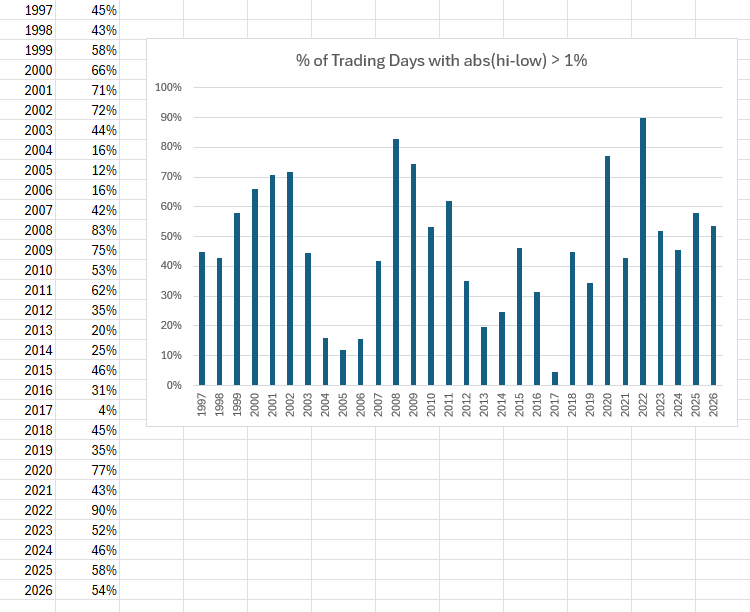
If your argument is that there are more days with "surprise" distortions, this is maybe nominally true, but better measured with better tools. I use a tool that expresses each day in terms of the mean average absolute closing difference [second chart]. Taking an arbitrary bound of 3 for that, the argument that this year is on track to show more surprise shocks than usual is true (but also reflective of a generally lower baseline).
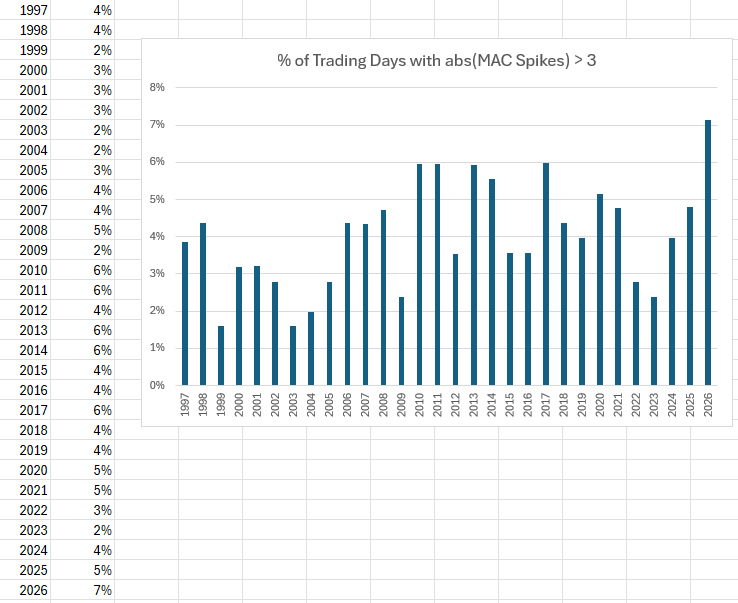
You've flipped to percentage measures and we're left with hand waving "it feels different now." That's a different claim and it's qualitative, perhaps has value, but not in supporting your original claim.
I'll reiterate my position: percentage measures are the only thing that make sense. Point values are arbitrary and can be easily handled via position sizing (within the limits of granularity of instruments vs account size.) I don't think this is revolutionary or controversial. This is truly finance 101.
Feb
15
6950, from Ani Sachdev [Updated]
February 15, 2026 | 1 Comment
I counted the number of crossings of the ES future past 6950. I counted the using the nearest expiry future. I counted using 30 min increments. Since October 29, 2025:
ES crossed from close to close across 6950, 78 times. 39 times up, 39 times down - true Logbola.
ES traded through and touched 6950 at any time at least 154 times (counted when there was low < 6950 < high).
Curious if any specs have used data like this to predict future prices.
Zubin Al writes:
14 hourly crosses night and open [Friday, 13 Feb.].
Cagdas Tuna comments:
I find the fact that whether call it NY Fed or Blackrock or other main street banks whoever single handedly controls and manage to keep VIX below 20 that is ultimate power controls the US stock market.
Larry Williams responds:
No one is holding anything down—or up—my vix fix is essentially same as $vix it cannot be controlled.
Cagdas Tuna is skeptical:
Yes, nothing is controlled!
Zubin Al Genubi prefers market dynamics:
Vix suppression is caused by: 1) heavy ODTE trade, while VIX is calculated on options 23-37 days out; 2) dispersion in SP index (dispersion meaning Mag 7 vs other 493; see RTY almost up 2%); 3) Big fund/ETF imbalances balancing deltas; 4) mean reversion of VIX/and buy the dip, which can break down at some point.
Larry Williams gets cosmic:
The universe is always expanding, Hawking proved. Stocks are part of that.
Feb
11
New Fed Chair Not So Bearish, from Jeffrey Hirsch
February 11, 2026 | Leave a Comment
…we present the S&P 500’s performance following a change in leadership at the Fed. Historically, performance is not all that bearish. Aside from the 3 months later interval, all other interval’s frequency of advance (% Higher) are above our standard 60% bullish threshold and average performance is positive.
Going one additional step, let’s say Eugene Meyer was not responsible for the Great Depression and Alan Greenspan probably did not cause the market’s crash in 1987. Bad timing, perhaps? Removing them from the data essentially removes the most bearish data. Average performance across all intervals goes up and is positive while frequency of gains also improves noticeably and performance 1-year later jumps to an average gain of 12.7%, with the S&P 500 higher 90% of the time.
Feb
10
Stops, from Zubin Al Genubi
February 10, 2026 | Leave a Comment

We should never get stopped out of a trade just because we have lost money. We exit trades if we no longer like them—losing money, while deeply unpleasant, should never be the sole criterion for exiting.
Peter Penha responds:
The last stop I left was a stop loss in Platinum futures sub $800 and the market took the contract down $65 and stopped me out, made one lower print $5 below me, and then came back up. Probably was the low print post March 2020.
I have had horrific experience with Schwab/thinkorswim…they once sold me out (partially) of calls on Sugar that were deep in the money at a make believe bid price way off market and below intrinsic value. When I challenged them noting that equity markets were open and they could easily have raised cash in many liquid ways - they told me they reserve the right to do what they want. I have multiple snapshots of them marking positions below intrinsic value, and lately while I was long silver futures they would mark my long Sugar contract to zero (I would see a negative futures cash position equivalent to the notional value of my long position).
I have been thinking of Marty Zweig and how he did very well leaving trailing stops on individual stocks and need to find my copy and revisit Winning on Wall Street and see how he did it (successfully).
Rich Bubb writes:
I AI'd trailing stops info thru Gemini.
The rule-of-thumb I currently/usually use is 8%-15% TSL% (trailing stop loss %). And typically use a lower-is-better TSL%. The volatility and economic tea leaves divination determine the TSL%. If I have less conviction in a position, I'll reduce TSL% to (sometimes) let the Market tell me how wrong I initially was.
And I got burned at the start of Great Recession, where I had TSL%s way-too relaxed; upper teens TSL%. The TSL%s all worked, but by then I'd lost about 15%+. Painful lesson.
Feb
8
CIO predicts 2026, too
February 8, 2026 | Leave a Comment
Expect Equity Markets to Broaden in 2026, Led by Small Caps, International
Both fiscal and monetary stimulus should boost earnings in the U.S. and abroad, with dollar weakness continuing to underpin international stocks.
Nils Poertner comments:
Back in High School, they gave a 1 pager of Latin and we had 1 hour to translate it (since it is an ancient language I was spending a lot of time to see what this all meant.) We all know English more or less. These days, I read a 1 pager in English (like this page) in 1 minute. My modern brain actually agrees with the whole article. Yummy. In reality there are probably a lot of cliches in it….
Zubin Al Genubi writes:
AI is about training data otherwise it gets stale and cliched. Like a person reading the same newspaper every day. Google has lots of data. Musk is merging SpaceX with AI because as internet provider he will have access to unlimited global data. I wonder what their contract disclosures say about data privacy.
Steve Ellison responds:
"Expect"? I have seen the broadening occurring since November. There was an extended non-confirmation of Dow Theory last summer into fall as the Industrials were making new highs, but the Transports remained below their November 2024 high. Not only did the Transports finally make an all time high, now they are making new highs before the Industrials do. Similarly, the equal-weighted S&P 500 ETF RSP, which was badly lagging the cap-weighted SPY in the 2025 rally off the "Liberation Day" tariff lows, made a new high yesterday while the cap-weighted index only partially regained some of its losses from earlier in the week.
I said on X [6 Feb.], "Lots of strength in the broader market. While technology stocks were selling off the last few days, the Industrial, Materials, Consumer Staples, and Energy sector ETFs all made new highs".
Feb
7
Filming Electrons at 1 Quadrillion FPS, from Jeff Watson
February 7, 2026 | Leave a Comment
Veritasium: Filming Electrons at 1 Quadrillion FPS
Explore slow motion like never before, from century-old strobe techniques to a quadrillion FPS camera. Witness light's journey through objects and the movement of electrons within molecules. Discover how scientists use sound and incredibly short laser pulses to capture these breathtaking moments.
Feb
5
6 new lows, from Zubin Al Genubi
February 5, 2026 | Leave a Comment
The last few down swings each had 6 new lows before a bottom. Today, marking a new low for this swing after hours will end up a new low number 5 by the end of tomorrow.
Steve Ellison writes:
Interesting. I have been experimenting with multi-level point and figure charts. Using a box size of 1.4% (a long-term average true daily range) and a 3-box reversal, SPY is still within 4.2% of its all-time high and hence in an uptrend. Drill down with smaller box sizes and shorter time intervals, and interesting price structures appear. At a 1/4 ATR box size, today's close was at a similar level to the Jan. 20 low.
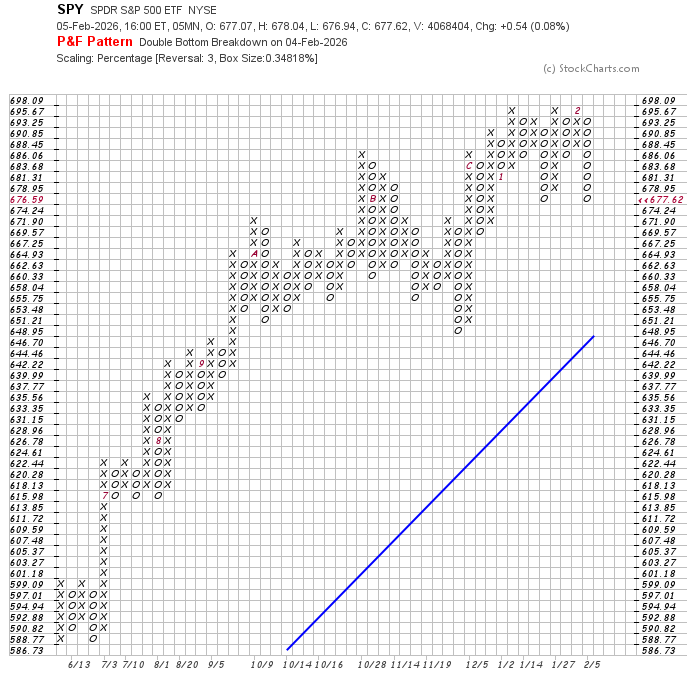
Lots of sector rotation under the surface. If 2025 was the year of the magnificent 7 and the flatlining 493, this year may be the opposite. While technology was getting beaten down this week, the Industrial, Materials, Consumer Staples, and Energy sector ETFs all made new highs.
Zubin Al Genubi adds:
Lots of late night shenanigans going on. Asian markets trading open in late thin US futures creating imbalances. Price action appears algo driven.
Nils Poertner comments:
I like the pattern with 6 new lows. Well spotted. Otoh, if the pattern does not repeat the surprise for mkts is bigger. nature offers "patterns" and "break of patterns" and both are relevant - else it would be a museum.
Cagdas Tuna predicts:
Then it is going to be a rough year for market cap weighted indices in US.
Peter Ringel writes:
While I would always give a study, like Big Al‘s more weight to remove opinion. I wonder, if there is a January effect regarding regime type or sector or general trading type. Not necessary % performance. Will the rest if the year trade like January? Would give a 2015 type year.
Nils Poertner responds:
yes. for practical purpose, it may be easier to trade mkts which receive less attention by the wider financial community /media.
Feb
5
Gaming tournament going on between AI versions, from Big Al
February 5, 2026 | Leave a Comment
Liv Boree, poker pro, interviews Deep Mind guy:
Why Google Made ChatGPT, Gemini & Claude Play 900,000 hands of Poker…
…before going on to earn a First Class Honours degree in Physics with Astrophysics at the University of Manchester. During this time she played lead guitar in heavy metal bands Dissonance and Nemhaim and modelled for a number of alternative clothing brands such as Alchemy Gothic.
Victor Niederhoffer comments:
especially if you live in denmark
Feb
4
2026 Bullish Confirmation, from Larry Williams
February 4, 2026 | Leave a Comment
Yale Hirsch and his son Jeff have shown that a positive change, from the last trading day of the year to the 5th trading day of the new year, portends a bullish year (positive first 5-day percent change).*
Consider this … in the last 76 years of trading, the S&P 500 has declined for the year 20 times or 26% of the time. In other words, 74% of the time, there has been a yearly gain.
Jeff’s numbers show that in those last 76 years, 49 years showed a positive first 5-day percent change. Only 8 of those years went on to close down for the year. That’s an 84% bias for the year to close higher when we have a positive first 5-day percent change.
My add-on to Yale’s and Jeff’s work was to look at the years that gained 1.2% or more in the first 5 days of trading. There were 28 such years. Of those years, only 2 were down for the year. That’s a 93% bias for the year to close higher. What an improvement from the average 74%!
In 2026, the first 5-day** change for the Dow Jones 30 was +3%.
In 2026, the first 5-day** change for the S&P 500 was +1.6%.
Those 28 years had an average annual return of 14%. The remaining years had an annual gain of 5.3%. I see this as excellent confirmation of the bullishness of my Forecast 2026 Report.
Cagdas Tuna writes:
There is no need for a statistical analysis to assume any given year will be positive for US indices. It is almost guaranteed to be positive every year. No offense to any list member.
Larry Williams responds:
Wrong 24% of time we close down for the year.
Michael Brush is surprised:
Wow did not know it was that high.
Larry Williams agrees:
I was taken back by it as well.
Asindu Drileba asks:
2026 is bullish? But Senator, you said you expect a recession in 2026 with 100% certainty. Is this a contradiction? Or maybe its possible for the market to be bullish even during a recession?
Larry Williams answers:
Yes, there was a projection made a year ago for a 2026 sell off —in the last 12 months data changed—large improvements in fundamentals and hopefully I got a little better understanding of long term cycles. New Data matters.
Nils Poertner writes:
Asindu- there would be simply too many variables out to make that statement with such a certainty in advance. Just impossible. It remains a probability game. Used to subscribe to some cycle research that claimed to have things figured out yrs in advance. quite pricey subscription. it was HOOK, LINE and SINKER (for me).
Denise Shull comments:
New Data matters.
Indeed it does. Wonder why it’s challenging for many to incorporate?
Nils Poertner responds:
Good question. On this note… (Pure) data analysts believe pattern matching on large datasets will solve our problems. But what if the really vital information isn't being collected? What if it's invisible to our trained systems?
Feb
3
The Autobiography of Mark Twain
February 3, 2026 | Leave a Comment

The Autobiography of Mark Twain contains a litany of people who cheated him and losses on his investments near the end of his life.
Nothing ever happened to Mark Twain in a small way. His adventures were invariably fraught with drama. Success and failure for him were equally spectacular. And so he roared down the years, feuding with publishers, being a sucker for inventors, always learning wisdom at the point of ruin, and always relishing the absurd spectacle of humankind, which he regarded with a blend of vitriol and affection.
Feb
2
Dollar Weakens as Markets Reprice US Political Risk, from Peter C. Earle
February 2, 2026 | Leave a Comment
For decades, US dollar dominance rested on a simple but profound foundation. Predictable institutions made the dollar stable, on the belief — sometimes overstated — that the United States would not deliberately undermine its own currency. That belief is now visibly eroding.
The dollar has fallen to its weakest level in nearly four years, not because of a recession or crisis at home, but because investors are increasingly uneasy about the direction of American policy. Against a basket of other currencies, the US dollar is approaching the lows seen during the COVID pandemic as markets are beginning to price in something more corrosive than cyclical weakness. Political and institutional risk is emanating from Washington itself.
Dollar Weakens as Markets Reprice US Political Risk
Feb
1
Does January predict the next 11 months?, from Big Al
February 1, 2026 | Leave a Comment
In this quick study the answer is no.
Jeffrey Hirsch has a different take:
From my newsletter issue published last night:
Archives
- September 2026
- August 2026
- July 2026
- June 2026
- May 2026
- April 2026
- March 2026
- February 2026
- January 2026
- December 2025
- November 2025
- October 2025
- September 2025
- August 2025
- July 2025
- June 2025
- May 2025
- April 2025
- March 2025
- February 2025
- January 2025
- December 2024
- November 2024
- October 2024
- September 2024
- August 2024
- July 2024
- June 2024
- May 2024
- April 2024
- March 2024
- February 2024
- January 2024
- December 2023
- November 2023
- October 2023
- September 2023
- August 2023
- July 2023
- June 2023
- May 2023
- April 2023
- March 2023
- February 2023
- January 2023
- December 2022
- November 2022
- October 2022
- September 2022
- August 2022
- July 2022
- June 2022
- May 2022
- April 2022
- March 2022
- February 2022
- January 2022
- December 2021
- November 2021
- October 2021
- September 2021
- August 2021
- July 2021
- June 2021
- May 2021
- April 2021
- March 2021
- February 2021
- January 2021
- December 2020
- November 2020
- October 2020
- September 2020
- August 2020
- July 2020
- June 2020
- May 2020
- April 2020
- March 2020
- February 2020
- January 2020
- December 2019
- November 2019
- October 2019
- September 2019
- August 2019
- July 2019
- June 2019
- May 2019
- April 2019
- March 2019
- February 2019
- January 2019
- December 2018
- November 2018
- October 2018
- September 2018
- August 2018
- July 2018
- June 2018
- May 2018
- April 2018
- March 2018
- February 2018
- January 2018
- December 2017
- November 2017
- October 2017
- September 2017
- August 2017
- July 2017
- June 2017
- May 2017
- April 2017
- March 2017
- February 2017
- January 2017
- December 2016
- November 2016
- October 2016
- September 2016
- August 2016
- July 2016
- June 2016
- May 2016
- April 2016
- March 2016
- February 2016
- January 2016
- December 2015
- November 2015
- October 2015
- September 2015
- August 2015
- July 2015
- June 2015
- May 2015
- April 2015
- March 2015
- February 2015
- January 2015
- December 2014
- November 2014
- October 2014
- September 2014
- August 2014
- July 2014
- June 2014
- May 2014
- April 2014
- March 2014
- February 2014
- January 2014
- December 2013
- November 2013
- October 2013
- September 2013
- August 2013
- July 2013
- June 2013
- May 2013
- April 2013
- March 2013
- February 2013
- January 2013
- December 2012
- November 2012
- October 2012
- September 2012
- August 2012
- July 2012
- June 2012
- May 2012
- April 2012
- March 2012
- February 2012
- January 2012
- December 2011
- November 2011
- October 2011
- September 2011
- August 2011
- July 2011
- June 2011
- May 2011
- April 2011
- March 2011
- February 2011
- January 2011
- December 2010
- November 2010
- October 2010
- September 2010
- August 2010
- July 2010
- June 2010
- May 2010
- April 2010
- March 2010
- February 2010
- January 2010
- December 2009
- November 2009
- October 2009
- September 2009
- August 2009
- July 2009
- June 2009
- May 2009
- April 2009
- March 2009
- February 2009
- January 2009
- December 2008
- November 2008
- October 2008
- September 2008
- August 2008
- July 2008
- June 2008
- May 2008
- April 2008
- March 2008
- February 2008
- January 2008
- December 2007
- November 2007
- October 2007
- September 2007
- August 2007
- July 2007
- June 2007
- May 2007
- April 2007
- March 2007
- February 2007
- January 2007
- December 2006
- November 2006
- October 2006
- September 2006
- August 2006
- Older Archives
Resources & Links
- The Letters Prize
- Pre-2007 Victor Niederhoffer Posts
- Vic’s NYC Junto
- Reading List
- Programming in 60 Seconds
- The Objectivist Center
- Foundation for Economic Education
- Tigerchess
- Dick Sears' G.T. Index
- Pre-2007 Daily Speculations
- Laurel & Vics' Worldly Investor Articles
