Aug
23
Appreciating The Chair
August 23, 2026 | 1 Comment
Obituary: Victor Niederhoffer - December 10, 1943 – August 4, 2026
Alex Castaldo:
I think I was lucky to know Vic for so many years. He was very generous to me and although he liked to do things unconventionally sometimes, it was because he sincerely felt everyone should do things their own way and never just to be eccentric or shock people. He always had interesting points of view on many issues not just work related.
Pamela Van Giessen:
It was my great honor and privilege to publish Education of a Speculator. In fact, working on the book with Victor was the highlight of my career. I knew in my heart that whether the book sold 1 copy or 100,000 copies or more, it was an important work. Throughout the process Victor drove me crazy, but mostly in a good way. He was always challenging the status quo, often spot on. He was one of the most generous people I have ever encountered, and I will carry to my grave all the lessons he taught me, along with the many interesting people he introduced me to including Marty Reisman who negotiated the publishing contract with me/Wiley on Victor’s behalf (and wasn’t that just a trip!) and, of course, Bo, among so many others.
The most beautiful person Victor introduced me to was his amazing wife, Susan. If we were fortunate to know Victor, Victor was beyond fortunate to have Susan in his life. May the hole in your heart, and the hearts of your children, be filled with Victor’s love for you and the love of all those around you.
Vince Fulco:
Terribly, terribly sad to hear this news. Working for him was among the best years of my life. I would have carried his ammo can in any trench, in any war.
May his memory be a blessing. Warmest condolences to all who knew him.
Jared Albert:
I sent this to Vic in June and it seems like I should just share it as my commemoration of the man of extraordinarily outsized importance in my life. My deepest condolences to Susan and all of their children.
Dear Vic,
I was sorry to read that you weren’t feeling that well these days, and I wanted to thank you again, while there’s time in this world, for taking a shot on me 20 years ago. Although it didn’t work out like I hoped, it gave me a kind of seal of approval at a pretty low point in my early 30’s and I’ve always appreciated that you did that.
You've remained a central positive figure in my life and I wish you all the best for a full recovery.
James Sogi:
Condolences to his extended family and past business associates and partners . Vic was truly one of the all time greats of the financial world who helped many and changed the markets. He changed my life and my family through his help. I am very sad to hear of his passing. I will always treasure my association and times with him as one of the highlights of my life.
Tyler Cowen:
In addition to his well-known public roles, he worked very hard to help and befriend me when I was younger. Here are the Google searches for Victor. Less well known about Victor is that he had one of the world’s best collections of private letters. He also once gave me a very nice small painting by Jack Savitzky, for which I remain grateful.
Michael Brush:
Vic did a lot of things, but one thing he did for all of us was to generously introduce us to new worlds, new worlds of ideas, and new people.
Vic was really great man. Meeting him was one of those “before and after” moments in my life, back when he started writing for MSN Money when I wrote there.
I remember our last conversation while leaving one of his parties.
Me: Vic you were such a big influence in my life.
His answer surprised me and to this day I am not sure I know what it really meant: “I hope in a good way.”
I will really miss you Vic. Thanks again for everything.
Steve Ellison:
I posted a photo on X (then Twitter) when the Chair played handball against the Senator at the 2015 Spec Party.
William Weaver:
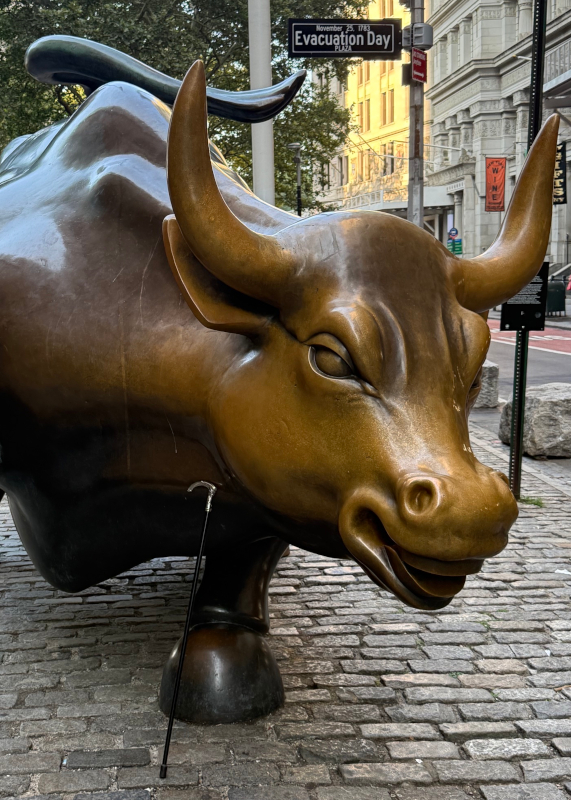
Victor gave a number of us these canes years ago. At least for me it was a reminder anyone can achieve their goals, and it won’t always be an easy path. I took mine down to Wall Street this morning. Thank you, Vic. Will
It is good to take out the canes and hobble down to Wall Street at the close of days when there is a panic. - Victor Niederhoffer
Laurel Kenner:
I found the last cane maker in Manhattan and purchased a number of the most striking ones to send as prizes.
Asindu Drileba:
Until this day, since a few years since I read The Education of a Speculator, I have not found another book remotely close to it. In the finance industry, market analogies are mostly limited to maths & physics. This is why when I read The Education of a Speculator, my mind was genuinely blown by how The Chair would create market references to genetics, music sheets, Dutch philopher Johan Huizinga (Homo Lundens is worshipped in the game design community), checkers and more.
This type of thinking in analogies is what E. O Wilson referred to as "Consilience." So because of this, I would regard The Chair as "The Master of Consilience".
I wrote a short tribute to Vic.
Kiran Kaur:
I was a student of Vic’s. In 2025 he gave me a full weekend at his home, him and Susan both. He walked me through his own book. When I left he put Elmer Kelton’s The Time It Never Rained in my hands and told me The Trees in My Forest by Bernd Heinrich was the other one to read.
I have wondered since whether the pairing was deliberate. A rancher who will not take the drought subsidy and stays on the land, and a biologist counting what is actually happening in three hundred acres of Maine woods. Endurance and counting. He handed it over without a lecture, which I think was the point.
Condolences to Susan, to Aubrey, and to the whole community. Rest in Peace Legend!
Sam Johnson:
A veteran trader pointed me to Vic back in 2011 via speculations website. Encouraged me to think differently about markets and led to a career. Question and test orthodoxy. I wish i could have attended one of his get togethers. He never met me or knew it but he was the second most important person to my trading success.
Yelena Sennett:
Victor certainly did like his hats…
It was a privilege to do podcasts with him. You never knew what fascinating analogy he would come up with to explain the markets. He was always generous with sharing his knowledge, but I believe his greatest gift was an instinct for reading the markets that simply couldn't be quantified.
One of his favorite sayings was, "Never short the market." He certainly lived an extraordinary life, with its share of highs and lows—much like the markets themselves.
Today (August 4th), as the S&P 500 reached another all-time high, it felt like a fitting tribute to his memory.
Richard Barsom:
RIP Victor. Great guy, literally saved my life. Rest in peace Chair.
John Netto:
I remember meeting him for the first time back in the summer of 2011. He graciously invited several from the spec list over to his UWS home. The whole experience fascinated me and his affable personality and welcoming disposition quickly removed any anxiety I had about being in front of a true legend. Thank you to John Floyd for introducing me to the Chair and the list.
Paolo Pezzutti:
I will miss Victor very much. To me, he was a mentor. I received far more from him than I ever gave, and that was part of his greatness. I have applied many of his teachings in both my life and my work.
A brilliant, original and courageous man has left us—courageous even beyond any reasonable limit. He was eclectic, competitive and a great contrarian by nature, but also generous beyond measure. He was a bold, direct and aggressive speculator.
As Nelson used to say: “Go right at them”, Victor always urged me to apply his battle-tested principles to my own trading style.
Newton Linchen:
Victor Niederhoffer was a major inspiration for my development as a market practitioner and had huge impact in the way I view markets and the World.
We are all at a great loss. My respects and sentiment to the family and friends.
Thank you, Chair!
Eric Lindell:
I'm saddened to hear of Victor's passing. I had gotten to know him over the years attending his junto meetings. He was a great guy, and it's a big loss to the investment community and all those whose lives he touched. My deepest sympathies to his family.
Jordan Low:
Victor’s passing is a loss to many. He was so generous with his time and wisdom, and he was a friend to my whole family: he taught my daughter Annabelle tennis, squash, and checkers, and he came to the gala to support my wife Annie when she was honored among the Outstanding 50 Asian Americans in Business. He also taught me the triangle defense in checkers, and drew the line straight to portfolio management: balance risk, reward, and liquidity, and hold the formation at all times. I trade that way to this day. My deepest sympathies to his family.
Rest in peace, Chair. We will remember you fondly.
George Coyle:
Mar
13
Contextualization, from Asindu Drileba
March 13, 2024 | Leave a Comment
I found this podcast episode very interesting.
Contextualization Within a Framework of Conditional Probabilities w/ Will Gogolak
As a risk officer with the Chicago Mercantile Exchange, Will Gogolak was setting margin requirements and saw a wide variety of traders’ accounts and what separated the winning traders from the losing ones, before leaving to pursue his own trading and obtaining a PHD in finance and share his knowledge of quantitative analysis and market experience with students at Carnegie Mellon University. Combining his market experience with knowledge of statistics helps William create his custom buy the dip strategy with futures and leveraged ETFs, and focusing on probabilities and determining market direction for informed trading decisions.
Peter Ringel agrees:
Love the hole series. Half of speclist was a guest.
Big Al offers:
Also very informative are these interviews with "Uncle Roy", on Top Traders Unplugged:
Zubin Al Genubi comments:
Speaking of cognitive bias, I realize that if I feel bearish, so does everyone else. You have to go against how you feel and against the consensus.
Sam Johnson asks:
Do you need to go against the cognitive bias of how everyone FEELS or how everyone is positioning?
Zubin Al Genubi responds:
Don't most traders and their systems trade and position for that past regime? As Roy said, trend followers are all piled in at the turns and all will reverse at the same time. With the widespread use of systems everyone is doing basically the same trade. You can't get a fill after the turn as we saw last fall. You have to pre-position…be in position ahead of the enemy forces.
Jan
27
Bitcoin forecast, from Larry Williams
January 27, 2024 | Leave a Comment

Asindu Drileba writes:
A lot of Bitcoiners are expecting a crazy bull run incoming. Their conjecture is that after the halvening, a shock of supply in BTC will cause the price to sky rocket. Previous bull runs have followed this halvening event. It is very refreshing to see a completely different original opinion.
Sam Johnson asks:
You certainly don't need to reveal the source or methodology of the red line data from your timely bitcoin forecast if you don't wish. But when choosing cycles to forecast markets, is there consistency in the order in which you approach finding good cyclical indicators? Do you begin by "chart matching" or finding a leading indicator that visually/numerically correlates well and front-runs certain markets, or do you start with a hypothesis, testing, and then using or discarding such forecasting cycles?
Larry answers:
The forecast here is really simple: it’s just the longer-term cycle forecast for GBTC. I arrive at it by doing a complete cycle search the meld together the 3 with the highest fit.
Andy Aiken asks:
How do you account for the fact that GBTC was a closed-end fund trading at a discount for the past several years, but the discount closed prior to it recharacterizing as an ETF on Jan. 11? This is a one-time event specific to GBTC, not subject to a cycle. What is the significance for bitcoin?
Larry answers (again):
I just use the back-adjusted data as provided.
Andy Aiken adds:
Speaking of mining rewards, the next halving (in which future mining rewards are cut in half, resulting in less reward from mining as well as less inventory to be sold by miners interested only in cash flow), is in about 100 days. This has been historically a (bullish) tailwind.
But with GBTC being converted to a spot ETF, several bankrupt entities are selling their inventory. FTX is now finished selling about $1B in GBTC since Jan. 11, but 3AC has yet to start selling, and that firm had more on its books than FTX. While I am more bullish than your projection, it's interestingly contrarian and would screw with traders' heads as markets like to do.
Archives
- October 2026
- September 2026
- August 2026
- July 2026
- June 2026
- May 2026
- April 2026
- March 2026
- February 2026
- January 2026
- December 2025
- November 2025
- October 2025
- September 2025
- August 2025
- July 2025
- June 2025
- May 2025
- April 2025
- March 2025
- February 2025
- January 2025
- December 2024
- November 2024
- October 2024
- September 2024
- August 2024
- July 2024
- June 2024
- May 2024
- April 2024
- March 2024
- February 2024
- January 2024
- December 2023
- November 2023
- October 2023
- September 2023
- August 2023
- July 2023
- June 2023
- May 2023
- April 2023
- March 2023
- February 2023
- January 2023
- December 2022
- November 2022
- October 2022
- September 2022
- August 2022
- July 2022
- June 2022
- May 2022
- April 2022
- March 2022
- February 2022
- January 2022
- December 2021
- November 2021
- October 2021
- September 2021
- August 2021
- July 2021
- June 2021
- May 2021
- April 2021
- March 2021
- February 2021
- January 2021
- December 2020
- November 2020
- October 2020
- September 2020
- August 2020
- July 2020
- June 2020
- May 2020
- April 2020
- March 2020
- February 2020
- January 2020
- December 2019
- November 2019
- October 2019
- September 2019
- August 2019
- July 2019
- June 2019
- May 2019
- April 2019
- March 2019
- February 2019
- January 2019
- December 2018
- November 2018
- October 2018
- September 2018
- August 2018
- July 2018
- June 2018
- May 2018
- April 2018
- March 2018
- February 2018
- January 2018
- December 2017
- November 2017
- October 2017
- September 2017
- August 2017
- July 2017
- June 2017
- May 2017
- April 2017
- March 2017
- February 2017
- January 2017
- December 2016
- November 2016
- October 2016
- September 2016
- August 2016
- July 2016
- June 2016
- May 2016
- April 2016
- March 2016
- February 2016
- January 2016
- December 2015
- November 2015
- October 2015
- September 2015
- August 2015
- July 2015
- June 2015
- May 2015
- April 2015
- March 2015
- February 2015
- January 2015
- December 2014
- November 2014
- October 2014
- September 2014
- August 2014
- July 2014
- June 2014
- May 2014
- April 2014
- March 2014
- February 2014
- January 2014
- December 2013
- November 2013
- October 2013
- September 2013
- August 2013
- July 2013
- June 2013
- May 2013
- April 2013
- March 2013
- February 2013
- January 2013
- December 2012
- November 2012
- October 2012
- September 2012
- August 2012
- July 2012
- June 2012
- May 2012
- April 2012
- March 2012
- February 2012
- January 2012
- December 2011
- November 2011
- October 2011
- September 2011
- August 2011
- July 2011
- June 2011
- May 2011
- April 2011
- March 2011
- February 2011
- January 2011
- December 2010
- November 2010
- October 2010
- September 2010
- August 2010
- July 2010
- June 2010
- May 2010
- April 2010
- March 2010
- February 2010
- January 2010
- December 2009
- November 2009
- October 2009
- September 2009
- August 2009
- July 2009
- June 2009
- May 2009
- April 2009
- March 2009
- February 2009
- January 2009
- December 2008
- November 2008
- October 2008
- September 2008
- August 2008
- July 2008
- June 2008
- May 2008
- April 2008
- March 2008
- February 2008
- January 2008
- December 2007
- November 2007
- October 2007
- September 2007
- August 2007
- July 2007
- June 2007
- May 2007
- April 2007
- March 2007
- February 2007
- January 2007
- December 2006
- November 2006
- October 2006
- September 2006
- August 2006
- Older Archives
Resources & Links
- The Letters Prize
- Pre-2007 Victor Niederhoffer Posts
- Vic’s NYC Junto
- Reading List
- Programming in 60 Seconds
- The Objectivist Center
- Foundation for Economic Education
- Tigerchess
- Dick Sears' G.T. Index
- Pre-2007 Daily Speculations
- Laurel & Vics' Worldly Investor Articles
