Feb
12
A Down Home Approach To Markets, by Victor Niederhoffer
February 12, 2007 |
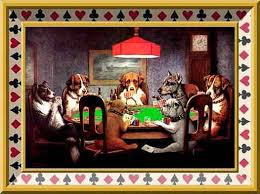 We are accustomed to reading short stories like Aces Up, or Inside Straight, where the action somehow relates to the sequence of bidding and uncertainty in various card games. Yes, life often imitates the bluffing, counting, bidding, random elements, path dependence, money management, reading, and choice inherent in a good poker game. And, of course, it will be no surprise to say that in many ways the market is like a poker game, with some of the cards hidden, some showing, and random factors to come.
Indeed, I have a dozen pages in Ed Spec on it (the most worthless in the book in my opinion) mainly because I am not an educated poker player, and all I've done is read books on how much I didn't know when I did play. Another approach to poker is to think of the cards coming into your hand, say on first, second, and third street, etc., in a five card stud hi-lo game with bidding after each card, as similar to the market moves each of the 5 days of the week. When should you bid, call, fold, or cash in?
Cashing in is always possible with the market mistress. Still, like the "doing business" which characterizes many such card games, the opponent may exercise a high price if you fold. Rite now the market has dealt three of a kind, with three down days in a row. Should you hold, raise, or fold? Readers of this humble site will know the Scarnesque, Malmudesque answer already and always have their canes at hand for such a deal.
If you are long, another player has the trips, and if you are short, you're holding them. Other common hands the market might deal you are the four card outside straight, if you're holding to Thursday, for example, and are long a call at 1450 with the options expiry on Friday, and the market now at 1439. Should you draw to that straight or 3 card flush or not?
Indeed, this seems to me a rather fruitful way of looking at things. On first, second, and third street, all the way up, a good card player knows what the correct play is depending on the cards that he is dealt and whether he's playing for low or high. Do market players have similar guidelines as to how to play the hand after sequential cards are dealt to all the players? We can answer such questions for many hands that the player is dealt during the week.
For example, after you've put up a big ante it might make sense to wait around for the big announcement that's going to cause great uncertainty, like the Humphrey Hawkins testimony on Wednesday. Or at least you shouldn't have called in the first place if you weren't ready to stay in, because you knew there would be a big raise after third street that you'd have to meet.
The question emerges as to what is the best way to simulate a 52-card deck with 13 numerical and face cards, and four suits. This will enable you to come up with rules of thumb as to when it pays to go for it based on expectations at various stages.
I would again propose using the five-card high-low as an analogy that, depending on whether you're long, short or straddling, you divide up the cards.
Since I know even less about poker than I know about trees or electronics or most of the other things I write about, besides the defunct game of hard ball squash, I had better leave this as an exercise for the reader. I'm not hubristic enough to give my own solution now knowing that so many better ones will come to the table. Subject to my admission of ignorance, however, if none comes I'll take a crack at it.
Steve Leslie adds:
 There was a time, when hold 'em was not the game of choice in poker rooms around America. In fact, if you were to speak to the old timers, many were totally unfamiliar with the game. It has only recently become a phenomenon, brought on by the technology of the 21st century and the ability to see the players' hole cards. Along with television came the great exposure of the World Series and as a result the game of choice today is no limit tournament style hold 'em.
Although the game is termed the Cadillac of poker, in the 90s the game I played was 7-card stud, or eight or better. I played this game for three years or so and I can honestly say that I consider myself to be one of the best stud players around. It plays into my skills very nicely as it is the most statistical of poker games. It also has the most information available as you get to see most of the cards. Players with have photographic memories and those who can think quickly have a great advantage.
This is a variation of the traditional 7-card stud, where the high hand and the low hand split the pot. In order to win the low hand, however, you have to have five cards out of seven that are no higher than an eight and the best possible hand is A, 2, 3, 4, 5. This is called a wheel. Straights and flushes do not count toward the low hand but they do for the high hand. Therefore, you can win both the low hand and the high hand at the same time.
Other than that 7-card stud, eight or better is very straightforward and there is very little bluffing. The true objective of the game is extreme patience and waiting for a starting hand that gives you the highest probability of success.
Here is the great secret to playing 7-card stud, 8 or better. Start out by playing only toward a low hand with an objective of also filling out your hand and winning both the high and the low. This is called sweeping the pot. In order to be profitable in this game you want to win one big pot an hour and sweeping is the best way to do so.
Therefore, you start out with three cards, two down and one up. The best starting hands are three cards that are in a row and of the same suit. A 3, 4, and 5, of spades for example. This constitutes the first round of betting. After that there will be four rounds remaining and one card at a time will be dealt to you and the last card will be dealt down.
If your first four cards are eight or less, then the likelihood that you will make a low is 80%. If you have four cards to a low after the fifth card is dealt, then your chance of success is 50%. There are two critical decisions that the stud player makes in the game. That is after third street and after fifth street. If by fifth street you don't have four low cards, you give up the hand. If you have four to a low by fifth street, you are committed to seeing it all the way to the end. It is really that simple. Properly played it is just beautiful. Poorly played it is absolutely brutal.
People get into trouble by playing high hands. The worst thing to have happen is to play a high hand only and come in second. This is very expensive, especially if someone makes her low and starts raising the pots as she should. And if the low also makes a high then the high is swimming against the current along the way.
The corollaries to a 5-day trading week are self evident. With respect to stocks, using William O'Neill's approach, your highest probability of success is by selecting stocks that have an eps rating of 80 or better and a Relative Share rating of 80 or better and investing in those. This will be your starting hand of three. If the stocks go down seven percent or more after investing in them, you let them go. This is the same as letting your hand go after 5th street as it just did not fill out as you have would liked.
Now I don't necessarily espouse the theory of the 7% rule, as I deem it as too tight for my tastes. It does not give the story time to play out. I rather have a more flexible stop loss level and do not overplay my hand. That is to say I do not chase cards. I do not commit too much of my capital to any one stock either. And if I feel I have a winning stock with good earnings, good relative strength, and in a good group, then I am willing to play it out to the end. Eventually, it will be recognized for its value. If I have an accommodating market on top of those variables chances increase to where I can get both the high and the low. This is where the great reward comes in. Once again, patience is the key. And having the earnings and the relative strength on you side helps provide the patience.

I hope this illustration is helpful. For a more in-depth discussion of the study of 7-card stud, eight or better see me offline.
Larry Williams writes:
"[R]esearch on strategic behavior in economic games has identified a wide range of situations in which thinking one step ahead of an opponent provides a decisive advantage. Research on behavior in markets shows that failing to think carefully about other participants' likely actions leads to adverse consequences, such as the ‘winner's curse’ (the tendency for auction winners to pay too much)."
From On Making the Right Choice : The Deliberation-Without-Attention Effect, by Ap Dijksterhuis, Maarten W. Bos, Loran F. Nordgren and Rick B. van Baaren Department of Psychology, University of Amsterdam
Comments
Archives
- October 2026
- September 2026
- August 2026
- July 2026
- June 2026
- May 2026
- April 2026
- March 2026
- February 2026
- January 2026
- December 2025
- November 2025
- October 2025
- September 2025
- August 2025
- July 2025
- June 2025
- May 2025
- April 2025
- March 2025
- February 2025
- January 2025
- December 2024
- November 2024
- October 2024
- September 2024
- August 2024
- July 2024
- June 2024
- May 2024
- April 2024
- March 2024
- February 2024
- January 2024
- December 2023
- November 2023
- October 2023
- September 2023
- August 2023
- July 2023
- June 2023
- May 2023
- April 2023
- March 2023
- February 2023
- January 2023
- December 2022
- November 2022
- October 2022
- September 2022
- August 2022
- July 2022
- June 2022
- May 2022
- April 2022
- March 2022
- February 2022
- January 2022
- December 2021
- November 2021
- October 2021
- September 2021
- August 2021
- July 2021
- June 2021
- May 2021
- April 2021
- March 2021
- February 2021
- January 2021
- December 2020
- November 2020
- October 2020
- September 2020
- August 2020
- July 2020
- June 2020
- May 2020
- April 2020
- March 2020
- February 2020
- January 2020
- December 2019
- November 2019
- October 2019
- September 2019
- August 2019
- July 2019
- June 2019
- May 2019
- April 2019
- March 2019
- February 2019
- January 2019
- December 2018
- November 2018
- October 2018
- September 2018
- August 2018
- July 2018
- June 2018
- May 2018
- April 2018
- March 2018
- February 2018
- January 2018
- December 2017
- November 2017
- October 2017
- September 2017
- August 2017
- July 2017
- June 2017
- May 2017
- April 2017
- March 2017
- February 2017
- January 2017
- December 2016
- November 2016
- October 2016
- September 2016
- August 2016
- July 2016
- June 2016
- May 2016
- April 2016
- March 2016
- February 2016
- January 2016
- December 2015
- November 2015
- October 2015
- September 2015
- August 2015
- July 2015
- June 2015
- May 2015
- April 2015
- March 2015
- February 2015
- January 2015
- December 2014
- November 2014
- October 2014
- September 2014
- August 2014
- July 2014
- June 2014
- May 2014
- April 2014
- March 2014
- February 2014
- January 2014
- December 2013
- November 2013
- October 2013
- September 2013
- August 2013
- July 2013
- June 2013
- May 2013
- April 2013
- March 2013
- February 2013
- January 2013
- December 2012
- November 2012
- October 2012
- September 2012
- August 2012
- July 2012
- June 2012
- May 2012
- April 2012
- March 2012
- February 2012
- January 2012
- December 2011
- November 2011
- October 2011
- September 2011
- August 2011
- July 2011
- June 2011
- May 2011
- April 2011
- March 2011
- February 2011
- January 2011
- December 2010
- November 2010
- October 2010
- September 2010
- August 2010
- July 2010
- June 2010
- May 2010
- April 2010
- March 2010
- February 2010
- January 2010
- December 2009
- November 2009
- October 2009
- September 2009
- August 2009
- July 2009
- June 2009
- May 2009
- April 2009
- March 2009
- February 2009
- January 2009
- December 2008
- November 2008
- October 2008
- September 2008
- August 2008
- July 2008
- June 2008
- May 2008
- April 2008
- March 2008
- February 2008
- January 2008
- December 2007
- November 2007
- October 2007
- September 2007
- August 2007
- July 2007
- June 2007
- May 2007
- April 2007
- March 2007
- February 2007
- January 2007
- December 2006
- November 2006
- October 2006
- September 2006
- August 2006
- Older Archives
Resources & Links
- The Letters Prize
- Pre-2007 Victor Niederhoffer Posts
- Vic’s NYC Junto
- Reading List
- Programming in 60 Seconds
- The Objectivist Center
- Foundation for Economic Education
- Tigerchess
- Dick Sears' G.T. Index
- Pre-2007 Daily Speculations
- Laurel & Vics' Worldly Investor Articles
