Oct
11
Days of the week 2026, from Zubin Al Genubi
October 11, 2026 | Leave a Comment
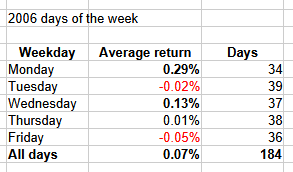
Consistent with randomness.
Adam Grimes writes:
I agree that it looks consistent with sampling error. Did you run a permutation test? Would prefer that to assumptions of distributions.
"Hey Claude, I would like to write a Python program to take a time series of daily net changes to the S&P 500 and run a simulation in which the daily returns are randomly grouped into 5 bins. Calculate the average and standard deviation of each bin, and repeat the simulation 1000 times."
Steve Ellison offers:
Hey Claude, I would like to write a Python program to take a time series of daily net changes to the S&P 500 and run a simulation in which the daily returns are randomly grouped into 5 bins. Calculate the average and standard deviation of each bin, and repeat the simulation 1000 times.
Output: I believe the last item is the test for significance. Unless the difference between the best day and the worst day is at least 0.50%, the null hypothesis is not refuted.
Data: 188 daily changes
Overall mean = 0.000646 std = 0.008266
Simulations: 1,000 Bins: 5
Bins ranked by mean within each simulation:
avg mean 5th pct 95th pct avg std
Lowest -0.000888 -0.002053 0.000051 0.008245
#2 -0.000011 -0.000864 0.000659 0.008176
#3 0.000660 0.000013 0.001289 0.008179
#4 0.001320 0.000667 0.002063 0.008185
Highest 0.002149 0.001251 0.003346 0.008230
Spread (highest bin mean - lowest bin mean):
average = 0.003037 5th–95th pct = [ 0.001343, 0.005003]
Peter Ringel comments:
Significance - Schmicnificance. Nobody likes Lasagna Mondays, eh? (roll out the pillories)
I did the counting again for 2025,2026 on NDX & NQ EoD data and found: exactly the same lack of significance, as you guys. On intraday I found significance, but also found a bug in my script for the test from how the baseline slices are constructed. EoD and intraday should be nearly the same. None of this is vibe-coded.
The problem is, I already had a relation with Mondays before I did the counting. I shouldn’t even start talking about Thursdays. And I am thinking to start a relation with Wednesday. I really expect to find at least something weak in the stats. I tried to push it a little, e.g. via only looking at up-days. Still nothing.
This isn't over. Mondays are great (for now)
Jeffrey Hirsch writes:
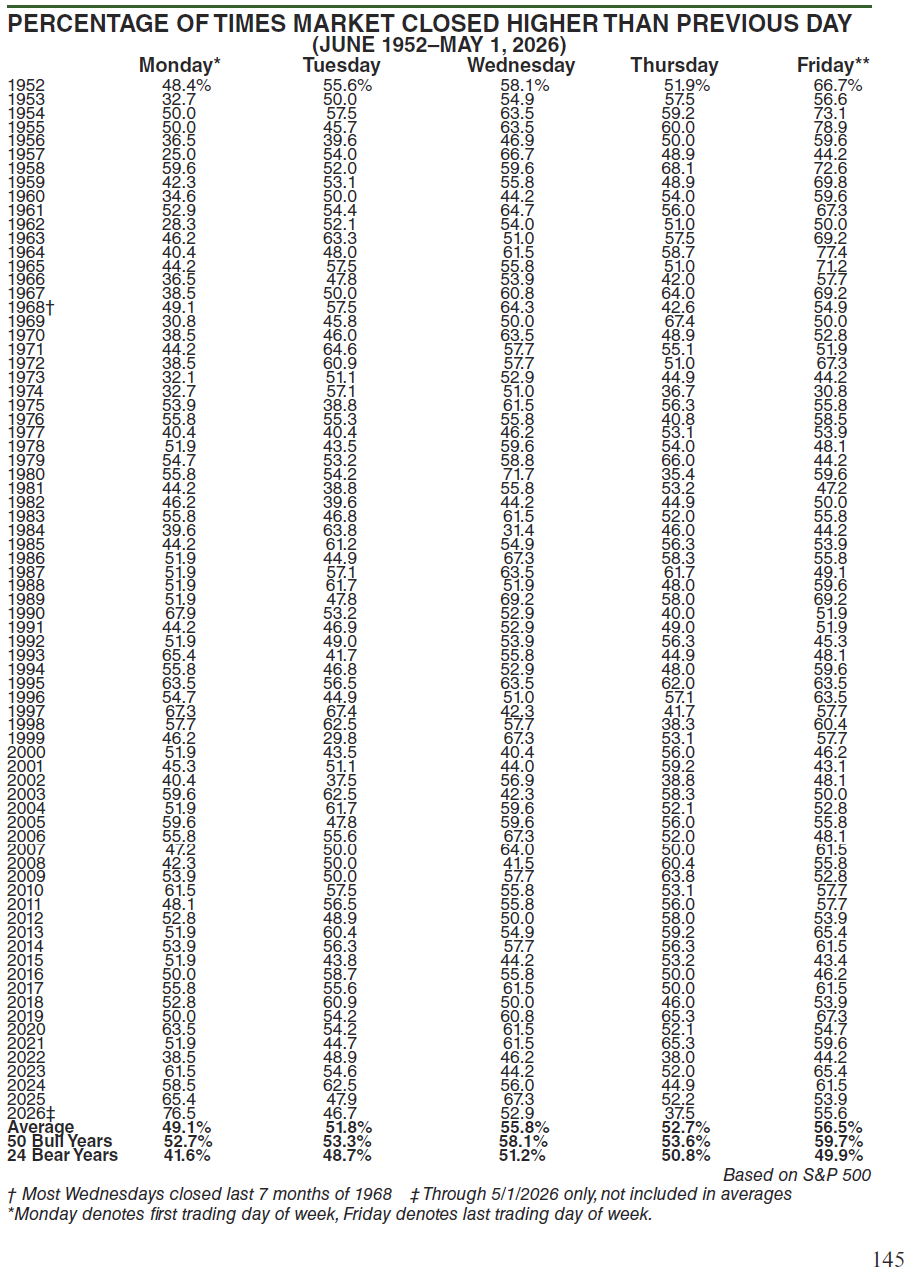
Here’s my latest daily on the S&P from page 145 of the 2027 Almanac (click on table for full view). There’s more on pages 143-146 and other data and stats in the data bank section pages 122-183. We also run studies through our internal LLM. 2026 through 10/2 is below. (*Monday is first trading day of the week except when Monday is a holiday. Friday is last trading day of the week except when Friday is a holiday.)
S&P DAILY PERFORMANCE EACH YEAR SINCE 1952
To determine if market trend alters performance of different days of the week, we separated 24 bear years—1953, ’56, ’57, ’60, ’62, ’66, ’69, ’70, ’73, ’74, ’77, ’78, ’81, ’84, ’87, ’90, ’94, 2000, ’01, ’02, ’08, ’11, ’15, ’22, and ’24 from 50 bull market years. While Tuesdays and Thursdays did not vary much between bull and bear years, Mondays and Fridays were sharply affected. There was a swing of 11.1 percentage points in Monday’s and 9.8 in Friday’s performance.
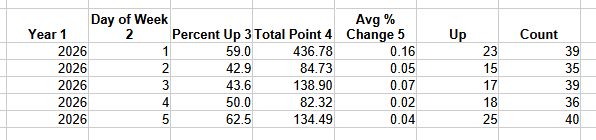
For 2026 we get:
Adam Grimes writes:
I have a set of tools that I developed over many years that start with an event study and move potentially interesting ideas through a simulated trading platform, with options for out-of-sample and forward testing. (None of this originally vibe coded, and the methodology a blend of academic + practical).
I fed it the discussion on weekdays, which was a pretty easy question. I've always been suspicious of seasonal influences because I rarely see them rise above noise, but thought this was worth considering. Attached is a fairly comprehensive result. (I would be especially wary of methodologies that categorize days in retrospect. For example, categorizing a day as "in a bull or bear year" based on a year-end lookback introduces fatal bias.) Results in the pdf:
Larry Williams responds:
Great work but change the exit strategy to make it tradeable. A make the hold a little longer.
Adam Grimes wonders:
Maybe I'm missing something here, but the test shows no edge beyond the market's natural drift (which any weekday entry gets). Won't a longer hold just capture more of that drift? The historical hold that worked was Monday's close to Friday, which was about +0.18% per week over the average day 1953-1977, dropping to +0.02 since 1980.
I would think the key question here is historical stability. Some holds will show an edge over some period of time, but the real question is whether those persist into following periods. Happy to look at this any way you'd find helpful. I can easily run every entry day against every exit day (and even into following weeks if you want longer holds). But I'm reading these results as a conclusive evidence that the old Monday effect is gone since about 1980 and that no weekday stands out from chance. Any random day entry and exit will probably show a profit (due to the drift), but the question I'm judging against is whether any chosen hold makes money above that random hold.
Oct
3
Trend days, from Zubin Al Genubi
October 3, 2026 | Leave a Comment
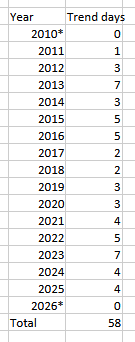
Remember trend days? Recently trade has been, I wouldn't say choppy, but with a lot of reversals. The legs are better than trend days in the past, point wise at least. Which led me to study trend days over the years. See how they cluster, and there have been none this year, at least how I defined them. Interesting to say the least. What does it mean? Algos? …that's my theory.
Adam Grimes asks:
What definition are you using?
Zubin Al Genubi answers:
Pick one, any one will do. The moral of the story is the same. Hint: These were up days only.
Adam Grimes responds:
I think the definition matters quite a bit. I would typically work with a definition like:
- opens near the low, closes near the high
- range > X * ATR(20) (starting with values of something like 3 for X)
Key concept is a larger-than-average day with open and close at opposite ends of the day. The reason I asked is I count far more than you do so I wondered if you were looking at "truly exceptional" days. I'll take a look at distribution by year later today.
I don't see any value in thinking in points, either. Saying the legs are longer point-wise when the price level is so much higher doesn't say anything at all, right?
I don't replicate your numbers at all. These are using open and close in the bottom/top X of the range. One table for day's range > 1.5 * ATR, the second for > 2 * ATR. I can't imagine the usefulness of extremely restrictive criteria for trend days, which is why I asked how you were defining them. At any rate, ES futures do not bear out your claim. What am I missing?
[Click to view tables.]
Bullish days: high-low range > 1.5 * ATR(20) table.
Bullish days: high-low range > 2 * ATR(20) table.
And why only look at bullish days? The thesis collapses further when we consider both directions (which I would argue we should do).
Bearish days: high-low range > 1.5 * ATR(20) table
Bearish days: high-low range > 2 * ATR(20) table
Is my math off? (Seriously asking, working with a relatively new and somewhat unvetted system here.) Or what am I missing?
Zubin Al Genubi writes:
Adam, My definition was pretty tight so your math is not off, my def is not too good. I subsequently did down days, which were larger than up days, and fewer of them. I am trying to find conditions that precede trend days. The only thing I am seeing is other trend days, like those 3 big up days 2 months ago ( which my system did not catch) Still playing with it as well.
Adam Grimes offers:
Interesting timing. I'm redoing some old work on the same subject:
A new look at measuring trend days
Catching the wave: ideas for finding trend days
Finding trend days in index futures
Ralph Vince offers:
Isn't it vital as well that the open be nearly the same as the low or the high!
Zubin Al Genubi responds:
There are a lot of interesting ways to define it, and I like your percent of new bar highs one. The range constriction break out is a good precursor. I've found there's not that many trend days so it doesn't seem like something to count on. I have a few more definitions I will be looking at: range efficiency |C-O|/(H-L), Kaufman efficiency ratio: |C-O|/\sum|\Delta C|, Choppiness-type ratio: total path divided by daily range, e.g. \sum|\Delta C|/(H-L). I just used retracement for the post.
I found an average of 28 trading days between trend days, but with wide dispersion over the years. Some years more, some less. That's what led me to the study, my observation of few trend days, lots of Z days this year, with long too straight un-choppy, overly efficient legs, caused by (in my theory) by bots.
Looking at your low vol triggers (for example NR5,NR7) over that last 5 years, I'm finding it persists to the next day. Not what I would have expected. Also, I found 0 instances of 3-consecutive-decreasing inside days (Russian Doll set up) over the last 10yrs!
Adam Grimes writes:
Yes, that no longer surprises me (failure of low vol triggers). Technical analysis literature and marketing has a lot to say about compression as a trigger. I don't think it's any kind of trigger. What's the best predictor of tomorrow's volatility? In models, the answer is today's volatility, by a wide margin. (Consider ARCH and GARCH models.) So low vol tends to lead to further low vol. (Also the observation one of our list members misses when he's concerned about low VIX = impending market crash.)
But if and when you DO get a move out of low vol it tends to be more directional and probably leads to a higher probability of trend days. One issue with all of this work is that good trend days are sparse enough you can't really generate reliable stats.
Zubin Al Genubi observes:
There were only 7 bottom tick/top tick day in the last 15 years and no perfect down days. So the definition needs to be wider. I used 10/90.
Adam Grimes responds:
Yes it has to be something like this. There's also a trend day subset where one part of the day might be a powerful and large trend and the other a range or a trend in the opposite direction. Intraday data can obviously untangle this, but one of the limitations of using daily data is that these types of days will be missed in the count.
Mar
15
Keith Jarrett, from Nils Poertner
March 15, 2026 | 1 Comment
Keith Jarrett – The Köln Concert [Full Album 1975]
Keith Jarrett - quite an unusual artist, music almost from another planet. He believed ppl who like music often listen to it in the car But ppl who understand - don't!
Big Al adds:
Famous story:
TLDR: They got the wrong piano and it had many flaws. Jarrett was exhausted when he arrived and at first refused to play that piano, but the 18-year-old girl who was the organizer convinced him to go ahead. He was forced to improvise within the constraints of the crappy instrument. The recording of the concert went on to become one of the best selling jazz albums of all time and consistently makes "best albums ever" lists.
Adam Grimes writes:
Keith Jarrett is on my top 3 list of living pianists. (Which might be surprising when you find who the others are.)
I've always respected his technique, melodic sense, but more than anything his sense of time is literally impeccable. Also worth noting that he suffered a stroke and the world has lost this voice. A few links off the beaten path. (I'd encourage you to listen to the Blue Note recordings and also of course the famous Köln concert.) But here are two you might not encounter.
I think this will go on record as one of the greatest artistic utterances mankid ever produced. (If posterity cares, that is):
and, melodic sense, and time… wow:
Keith Jarrett - Old Man River (Live from Antibes) - Transcription
Nils Poertner responds:
Terrific, Adam. Whether Musician or Speculator: We got an "Intuitive Mind" which has something vital to say. But it can't come to our "Thinking Mind" as the latter is constantly chatting…this music reminds me / relaxes me.
Oliver Joseph comments:
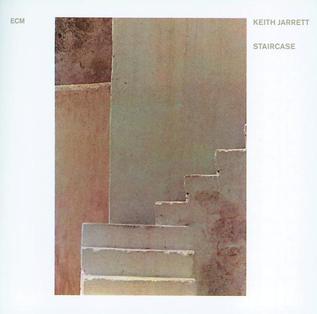
Keith Jarrett is a great artist and a huge inspiration. A wonderful counterpoint to the above story of the busted baby Bösendorfer at the Köln concert is the album Staircase. Jarrett had gone to record a track at Davout Studio in Paris and really liked the Piano and stuck around and recorded the album with the extra studio time they had. In particular the track Staircase part 3 is just amazing to me. It is a very beautiful and simple piece.
Feb
18
Vol in percent versus dollars, from Zubin Al Genubi
February 18, 2026 | Leave a Comment
More on the points vs % argument. % vol or Vix is misleading and inaccurate measurement of vol. A better measure is abs vol in points/$ because we live and measure ultimately in dollars.
Accordingly at 7000 abs vol is 350% of what is was a few years ago at 2000. Trading has to adjust accordingly to maintain the same portfolio volatility of returns. Thus leverage, targets, systems, time have to adjust to match.
Adam Grimes disagrees:
because we live and measure ultimately in dollars
This does not strike me as coherent. Returns are the only reasonable way to understand market movements. Just imagine a portfolio of two assets, one at $1 and the other at $100,000 (or other arbitrarily wide handles). The only way to think about those is to normalize for price via %, so it follows that volatility would be equally incoherent measured in points. (Sorry for the Finance 001 example, but I think 'Explain It Like I'm Five Years Old' cuts through a lot of confusion.)
% and vol measured as vol of %'s (i.e., returns) is the only thing that makes actual sense here unless I'm misunderstanding the argument. What am I missing?
Accordingly at 7000 abs vol is 350% of what is was a few years ago at 2000.
Scratching my head here. "So what?" and "of course" are the only things I could manage to say here.
I'm probably missing something, though. What is it? (btw VIX sucks as much as any other clunky measurement of implied vol. I'll agree with you on that one, but I don't think that's your point.)
Zubin Al Genubi responds:
1 ES contract used to move 7 points as an average range 20 years ago. You made or lost $350. 1 contract now moves 50 or 100 points a day, same percentage, but your account is up or down $5000. The volatility in your account in dollars is higher than 20 years ago. If you lost 1% in 2000, its $600, but 1% now is $3500 per contact. You don't see too many 2% days like before. Abs vol is up while Vix or % vol is down. Its apples and oranges.
The trading style, research should change. Straight percentages for expectations, returns, targets don't work like they used to, especially using historical data. Silver now has micro contract because $5000 a dollar too is high volatility in dollars with $20 or more ranges. I guess I'm suggesting using abs vol as a better measure of vol.
Appropriate here, Feynman in 6 Not so easy pieces, cites Wyle on symmetry, "Suppose we build a certain piece of apparatus, and then build another apparatus five times bigger in every part, will it work exactly the same way? The answer is, in this case, no!" My point is the market does not the same way as it did 25 years ago in large part because it is bigger. The fact that the laws of physics are not unchanged under a change of scale was discovered by Galileo. He realized that the strengths of materials were not in exactly the right proportion to their sizes. [Ibid]
Adam Grimes writes:
I'm sorry, but I still find these points trivially obvious. Of course nominal price swings are bigger because price levels are higher, so of course holding a single contract would result in larger dollar swings. Who's holding a single contract? Position size takes care of all of this.
And I don't think the physical analogs add anything beyond confusion. Physical properties scale differently. For instance volume scales as cube and surface area as square. This is why we could not have a science fiction 100 ft tall lobster in reality…because of material constraints. There's no market analog to this. A 1% move is a 1% move. There's no hidden non linearity there.
If your claim is that markets don't move the same they did 25 years ago I would challenge that claim. What's the evidence for this? Statistically there's always the issue of non-stationarity but it seems to me you're claiming there's something more meaningful here. What am I missing?
Asindu Drileba comments:
I think Zubin is simply trying to say that he had found measuring volume in dollar terms (absolute terms) more relevant than measuring it in percentage terms.
Richard Hamming has an interesting talk, You get what you measure
Here us a good summary:
You may think that the title means if you measure accurately you will get an accurate measurement, and if not then not; it refers to a much more subtle thing - the way you choose to measure things controls to a large extent what happens. I repeat the story Eddington told about the fisherman who went fishing with a net. They examined the size of the fish they caught and concluded there was a minimum size to the fish in the sea. The instrument you use clearly affects what you see.
I for example, completely stopped measuring market returns in percentage terms a few years ago. I now exclusively use log returns. Why did I stop using percentages? The problem with percentages is that they are not equal to each other (ignoring the negative sign). (a 50% move) + ( a -50% move ) does not give you 0 in dollar terms. But what you get is 0% in percentage terms. Percentages are not symmetrical. Does this mean they don't measure growth? They actually do. But they simply should not be compared. As the absolute values may mean something different.
- A 0% return percentage may (erroneously)
indicate that you have broken even.
- The same 0% percent return may also show that you are actually loosing money in absolute (dollar) terms
Adam Grimes writes:
Of course log returns are well known, and this is more finance 101. There are several qualities that make them more attractive for some analyses. (just dont mix percents and log returns!)
But that's not the same as measuring market movements in raw dollars (which is the only reasonable companion to volatility measured in absolute dollars (or points).
And as for measuring what you see, methodology (and perhaps even experimenter expectations) greatly affecting outcomes and conclusions, we're on the same page there. This is fascinating territory for discussion and I'd welcome it.
But his point about volatility only extends to someone trading a single contract in 2001 and also trading a single contract today. That is irrelevant.
If there's something at work here and legitimately some way the market "doesn't move the same way" it did decades ago… I'm all ears and very interested. Always looking to learn more about what I don't know or might be missing.
Zubin Al Genubi does some counting:
There were 31 days in 2006 and 67 days in the last year with percent moves >1%. This is due to Big Tech being 32% of ES with higher beta and the speed and intraday persistence of algorithmic trading. Lastly, it 'feels' different. A 120 point drop trades different than a 13 point drop in 2002.
Stated quantitatively, now nearly half of our trading days have abs vol hi-lo >1% while in 2006 only a quarter of days had abs vol >1%. That is a big difference and clearly explains why trading is different (better) now. Today is just 1 of the many such days.
Cagdas Tuna adds:
All futures contracts of index products have adjusted to gross notional value of underlying stocks. At the same time VIX contract specifications and notional value it can represent almost remain unchanged. Although calculation method of VIX is the same, the number of futures contracts hedgers need to cover notional values they trade in underlying assets are totally different.
Adam Grimes writes:
Stated quantitatively, now nearly half of our trading days have abs vol hi-lo >1% while in 2006 only a quarter of days had abs vol >1%.
I'm sorry but I have to be direct. I find this annoying. You have moved the goalposts and are now making a completely different argument. You began advocating for measuring volatility in absolute dollars and now you are using a percentage measure. You are literally using the metric you said was wrong to support your argument that the metric is wrong.
Furthermore, your data are bad. It's simply a volatile measure. Volatility is volatile. Here's a look at the FULL history of the ES futures [first chart] (back-adjusted so this may not be fully accurate, but I think the % adjustment fixes the back-adjustment distortion) counting the number of trading days in each calendar year that had abs(high-low) / close > 1%. It's simply an unstable measure and I don't know what is to be drawn from this.
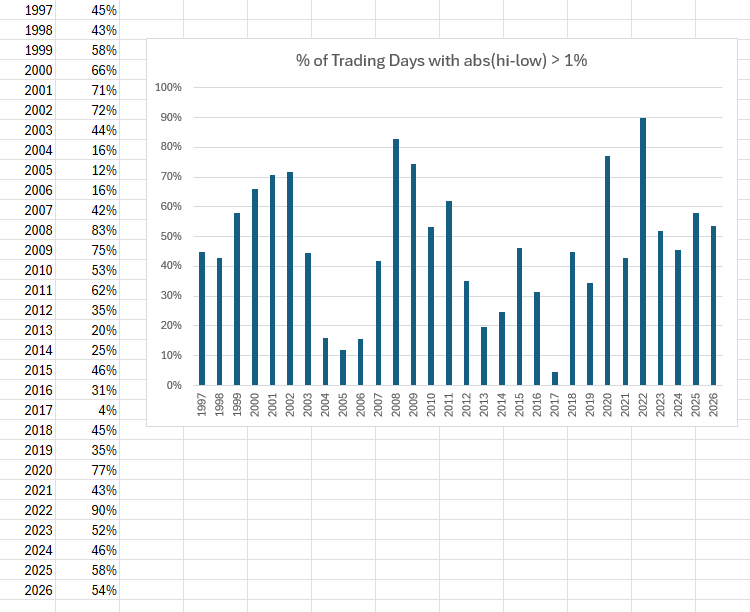
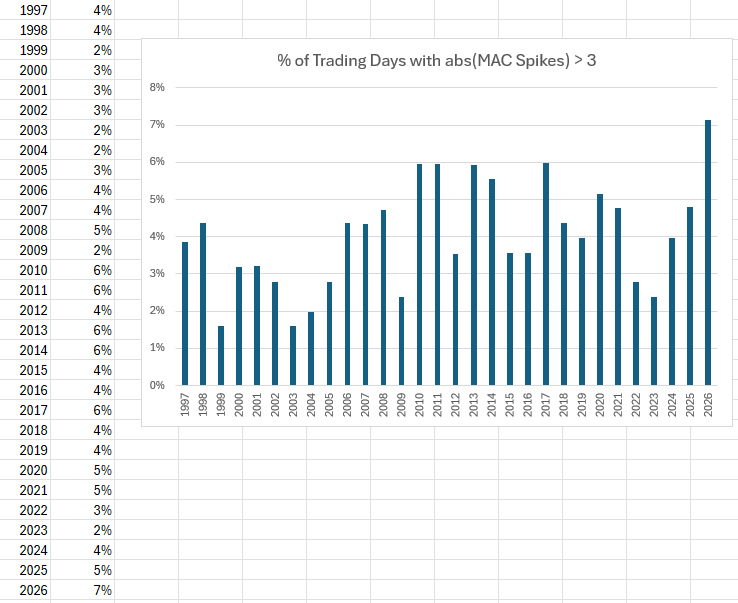
If your argument is that there are more days with "surprise" distortions, this is maybe nominally true, but better measured with better tools. I use a tool that expresses each day in terms of the mean average absolute closing difference [second chart]. Taking an arbitrary bound of 3 for that, the argument that this year is on track to show more surprise shocks than usual is true (but also reflective of a generally lower baseline).
You've flipped to percentage measures and we're left with hand waving "it feels different now." That's a different claim and it's qualitative, perhaps has value, but not in supporting your original claim.
I'll reiterate my position: percentage measures are the only thing that make sense. Point values are arbitrary and can be easily handled via position sizing (within the limits of granularity of instruments vs account size.) I don't think this is revolutionary or controversial. This is truly finance 101.
Sep
7
Music and longevity, from B. Humbert
September 7, 2025 | Leave a Comment
Menahem Pressler played this concert in his 95th year:
Mozart: Piano Concerto No. 23 | Menahem Pressler, Gulbenkian Orchestra & Leo Hussain
Adam Grimes responds:
Thank you. That's lovely. Mozart always requires such precision. That was the second concerto I learned! Near and dear to my heart.
Laurel Kenner writes:
A very great concerto, a very great pianist.
Even monsters have been touched by this haunting music. A vignette re Mozart’s K488 and Stalin, from LA Phil program notes:
In his final years Stalin became addicted to listening to music on the radio, on one occasion a performance of Mozart’s K. 488, played by Maria Yudina, a particular favorite of his – surprisingly, since she was as celebrated for her non-conforming political views as for her interpretations of Shostakovich (of whom she was a close friend), Bach, and Mozart. Instead of playing encores at her recitals, she would read poems by banned Russian writers and recite the sayings of Russian Orthodox clerics: rather than hiding her beliefs, she trumpeted them, so to speak.
Stalin asked Moscow Radio for a copy of Yudina’s K. 488 and they agreed to send it immediately. The problem was that this was a live performance and it had not been recorded. The radio people called Yudina and hastily assembled an orchestra late that night, delivering the recording to Stalin the following day. Volkov relates Shostakovich’s words: “Soon after [Stalin heard the recording] Yudina received an envelope with 20,000 rubles… To which she responded: ‘I thank you, Joseph Vissarionovich… I will pray for you day and night and that the Lord forgive you your great sins…’” The pianist is said to have donated the 20,000 rubles to her church.
Oddly, Yudina was never censured nor imprisoned for any of her renegade acts and her career continued until shortly before her death in 1970. “They [who?] say [according to Shostakovich/Volkov] that her recording of the Mozart concerto was on the record player when the leader was found dead in his dacha [in 1953]. It was the last thing he had listened to.”
Whether one believes all, parts, or none of the story, Yudina did make the recording.
Like Adam, I also played this concerto, written by Mozart at 30. Perhaps you need to be 95 to do it justice. Bravo, Menahem Pressler.
[ One from a list of her performances: Maria Yudina plays Bach Toccata in C minor, BWV 911 - live 1950 -Ed. ]
Laurel Kenner adds:
Yudina's Chromatic Fantasy & Fugue is killer.
Jun
26
Increase in yields, from Jeff Watson
June 26, 2025 | Leave a Comment

Adam Grimes comments:
Cool chart. Interesting data. We have some farmers in the family but I would not have expected such a big difference.
Peter Ringel writes:
I think, this productivity boost shows Norman Borlaug‘s Green Revolution. There would be no India or China as we know it . And in the West too. The topic seems close to not being politically correct in our upside-down world.
Michael Ott brings expertise:
The Y axis is Mg/hectare, which is a different way to measure weight per unit area. Technically, a bushel is a unit of volume (8 gallons) that is understood to be equivalent to 56 pounds of corn or 60 pounds of soybeans. Most US farmers measure in bushels per acre, which is a different way to express weight per unit area.
The major increase in corn came from breeding AND fertilization. GMO corn was introduced in 1996 and reached 50% market share around 2001, which is pretty fast adoption for agriculture. Biotech traits certainly help with yield, but more so prevent disasters from insects and weeds, which harm yields.
Big Al finds another chart interesting:

May
25
Atlas Shrugged, from Francesco Sabella
May 25, 2025 | 1 Comment

This morning I finished rereading the classic Atlas Shrugged of Ayn Rand and every time I learn something new; her thought is monumental. I don’t agree with a lot of her ideas and I fully agree with others, but I’ve always found this book to be an impressive catalyst for thought; this is in my opinion her power: the ability in sparking debate.
Rich Bubb comments:
Atlas Shrugged is also available as a 3-part movie. I think the book was better.
Adam Grimes writes:
My opinion on her work has shifted over the years, in a strongly negative direction. Too much of my experience contradicts her metaphysics and epistemology, particularly the rigidity of her rational materialism, and, as someone who treasures the craft of writing, much of her prose lands as clunky and overly didactic. I'm also now unconvinced on the primacy and sufficiency of rational self-interest… but, as you said, perhaps her greatest value is in creating discussion.
Asindu Drileba adds:
Ayn Rand had a reading group called the "Ayn Rand Collective" — Which Alan Greenspan was part of. They [Greenspan, Rand and a "professor"] would meet at Rand's apartment to read every new chapter of her new book. She (Ayn Rand) then fell in love with the professor and they started dating.
After sometime, the "professor" encountered a pretty young student in his own class and he "fell in love with her". The professor told Rand about the affair, but Rand begged the professor to cancel it. The professor then said that he would dump Ayn Rand, and then exclusively date the young pretty student. He said that this was the right thing to do since he was following his "rational self-interest". Ayn Rand got angry, slapped the professor in the face twice and kicked him out of her reading group.
This was a good illustration of cognitive dissonance. Rand thought her readers should practice "rational-self interest" towards everyone else, except her.
Francesco Sabella met a girl:
I was very fascinated to meet a girl times ago who I knew for her philanthropic activities and for her ideas being the exact opposite of Rand; and I was surprised to see her carrying an Ayn Rand book and she told me she didn’t like at all her; it made me think of her ability in creating debates.
Victor Niederhoffer responds:
i would always marry a girl who admired the book. susan introduced me to it and i knew then i had to marry her. it was very good choice.
Apr
5
Time for the canes?, from Doug Martin (Updated)
April 5, 2025 | Leave a Comment

I'm liking the look of that huge spike down in ES, out of my euro and sterling, that was a crazy move too. Technically it's nice looking low, from a chart perspective. I'm liking the low interest rate and commodity softening posture, I'm pretty damn bullish on equities.
William Huggins responds:
the shock moment is not when the canes come out - those metaphorically come out when the bulls have given up. those are generational moments related to the culling of new speculators who have only known rising markets (ie, anyone who joined robin hood with their stimulus checks in hand). as long as there are people willing to pay x60-100 earnings for hype, i don't think its quite time for a shift in strategic allocation.
this is simply the first serious wakeup call for anyone who thought this administration is doing anything remotely like macroeconomic analysis when it sets policy. according to the executive, there will be more such shocks to come so as many were fond of suggesting in mid-november "buckle up" (your 401k, and the usd, have both been liberated from gravity!)
Steve Ellison comments:
The S&P 500 has not even gone off the bottom of my hand-drawn chart. The move down since yesterday strikes me as more an efficient market repricing of reduced economic prospects than an emotional panic or forced selling.
By contrast, my hand-drawn chart on February 28, 2020.
Adam Grimes states:
Canes? Nowhere close, in my opinion. And the fact that many people think this is a crash is just a lack of perspective (and a misunderstanding of potential.) Again, all in my opinion, which may change with any tick.
UPDATE: Stefan Jovanovich has a shopping list:
The idiot list is the catalog of companies that our model collects on the presumption that their common stocks will be worth more in 5 years than they are now. I publish it when we guess that our stupidity is within the 25% range - i.e. we won't lose more than $1 out of every $4 we invest in those companies if they liquidate. Thanks to the List and others, we have learned not to trade so the publication is, in no sense, a "Buy"; it is simply an indication that prices have gotten low enough that the list has more than 10 companies on it. (A month ago it had 5.)

Jul
27

Here's a performance of a one-movement sonata for flute and piano I wrote a few years ago.
Traditionally, sonatas were three or four movements. My goal here was to respect that structure, but to do so in a highly compressed format. The piece is built around a recurring pattern (an ostinato) that the flute first "discovers" before it lands in the bass of the piano. The middle section begins with a nod to a more primitive, primal flute. Again, a pattern is discovered that is worked and reworked in counterpoint between the instruments. This little sonata is a pretty solid reflection of my musical aesthetic: I'm striving for a whole that makes sense, but also exploring some extremes.
What I think might be interesting to the group is that some elements of this piece were generated from financial market data. (Think of a GARCH-type process.) Aspects of volatility were allowed to dictate some elements of harmonic density and texture in the piece. I bent this to my overall musical concept as opposed to leaving it bare. (I don't find much engaging in process-driven compositions… they are far more interesting to write and maybe to talk about then to hear, in most cases.)
Sushil Rungta appreciates:
Very much enjoyed it. It was marvelous. Thanks for sharing.
Peter Ringel responds:
Beautiful. TY Adam.
some elements of this piece were generated from financial market data. (Think of a GARCH-type process.)
This seems brilliant. I have no doubt that volatility is deeply human. Sadly, my ear is too poorly trained to understand your translation of this into composition.
Somewhat related: I use order-flow audible sounds during my day-trading. Like the old guys used floor noise. There is a non-regular rhythm to it. For me it is so ingrained now, I feel naked without it. It also helps with not needing to stare at the screen all the time. The Mkt- music will alert me if necessary.
[ Lagniappe: Sonata, pl. sonate; from Latin and Italian: sonare [archaic Italian; replaced in the modern language by suonare], "to sound"), in music, literally means a piece played as opposed to a cantata (Latin and Italian cantare, "to sing"), a piece sung. -Ed ]
Jun
15
Megacaps in Random Land, from Big Al
June 15, 2024 | Leave a Comment
Lots going around about how NVDA dominates; and MSFT, NVDA and AAPL now account for about 20% of the S&P 500. I was curious to see what happened in a toy index and so did an experiment (using R):
1. Create an index of 500 stocks, each with a starting value of $100.
2. Each year, for 40 years, each stock's value is multiplied by 1 + a value randomly drawn from a normal distribution with mean 8% and sd 15%, roughly what you might see with the S&P 500.
3. The starting value of the index was $50,000. The final value after 40 years was $1,152,446.
4. The final summed value of the largest 10 out of 500 stocks was $142,320, or 12.35% of the 500-stock index.
I was curious to see if megacaps would emerge from a simple toy model. I ran it only once, and they did. For me, this is a comment on the perennial alarm stories about "Only X% of stocks account for Y% of the market!" Even with a simple model, you wind up with something like that.
Adam Grimes agrees:
Can confirm. Have done variations of this test with more sophisticated rules, distribution assumptions, index rebalancing, etc. Get similar results.
Peter Ringel responds:
so we can take this ~12% of the index as a base value, that develops naturally or by chance? Then a clustering of being 20% of a total index (only greater by 8%) does not look so outrageous.
William Huggins is more concerned:
keep in mind it's 10 companies making up 12% (~1.2% each) vs 3 companies making up 20% (8.3% each) - in that sense, the concentration DOES look pretty high. am reminded of when NT was 1/5 of the entire CDN index in 99/00.
Peter Ringel replies:
You are right, I failed to catch this difference of only 3 stocks. In general, I am not so much surprised about the concentration. Money always clusters. Always clusters into the perceived winners of the day. Should they blow up, money flows into the next winner. To me, the base for this is herd mentality.
Adam Grimes comments:
It's Pareto principle at work imo. I'm not making any claims about exact numbers or percents, but as you use more realistic distribution assumptions (e.g., mixture of normals) the clustering becomes more severe. There's nothing in the real data that is a radical departure from what you can tease out of some random walk examples. Winners keep on winning. Wealth concentrates. (As Peter correctly points out.)
Asindu Drileba offers:
Maybe you try replacing the normal distribution of multiples with a distribution of multiples constructed with those historically present in the S&P 500? It may reflect the extreme dominance in the market today.
To me, the base for this is herd mentality.
It is also referred to as preferential attachment:
A preferential attachment process is any of a class of processes in which some quantity, typically some form of wealth or credit, is distributed among a number of individuals or objects according to how much they already have, so that those who are already wealthy receive more than those who are not. "Preferential attachment" is only the most recent of many names that have been given to such processes. They are also referred to under the names Yule process, cumulative advantage, the rich get richer, and the Matthew effect. They are also related to Gibrat's law. The principal reason for scientific interest in preferential attachment is that it can, under suitable circumstances, generate power law distributions.
Zubin Al Genubi writes:
Compounding of winners is also at work and returns will geometrically outdistance other stocks. No magic, just martini glass math.
Anna Korenina asks:
So what are the practical implications of this? Buy or sell them? Anybody in the list still owns nvda here? If you don’t sell it now, when?
Zubin Al Genubi replies:
Agree about indexing. Hold the winners, like Buffet, Amazon, Microsoft, NVDIA. Or hold the index. Compounding takes time. Holding avoids cap gains tax which really drags compounding. (per Rocky) Do I? No, but should. It also works on geometric returns. Avoid big losses.
Humbert H. wonders:
But what about the Nifty Fifty?
Dec
26
Laurel Kenner’s Musical Christmas Card 2023
December 26, 2023 | Leave a Comment
Merry Christmas to all Specs. I hope you enjoy my latest musical Christmas Card. It has been 23 years since the Chair and I, with the assistance of James Goldcamp and now Big Al and Alex Castaldo, founded the SpecList, starting with early readers of our column at TheStreet. The Specs have contributed so much value and humor to our lives. I thank you and wish you all a Happy New Year.
Laurel Kenner's Musical Christmas Card 2023
Laurel Kenner Plays J.S. Bach Prelude in C minor
Laurel Kenner performs Bach's Fugue in C minor, WTC Book I
Adam Grimes responds:
Thank you for sharing! Glorious piece, and such a great set. I continue to chip away through the Goldbergs…a bit at a time. Cheers, Happy Holidays, and perhaps a hint of Peace in these troubled times.
Laurel Kenner encourages:
The Goldbergs are a very worthy pursuit, Adam. Go for it! I’ll look forward to your musical Christmas card!
Sep
15
Music-related experimenting with ChatGPT, from Laurence Glazier
September 15, 2023 | Leave a Comment
AI discusses Laurence Glazier’s ‘Horn Concerto’ (!)
by Laurence Glazier
Peter Saint-Andre writes:
Interesting. I see that ChatGPT has become more upbeat and chatty since I last used it. Do you find significant value in interacting with this LLM for composition purposes?
Laurence Glazier responds:
So far it has only helped for technical issues about notation and instruments. It occasionally slips up, as in the blog post. I’m experimenting in communicating about structural thematic elements using the binary Parsons code. While GPT can’t leap out of bed with an inspired tune, it is a helpful copilot! Some interesting emergent behaviour yesterday - it has started asking me questions proactively.
Adam Grimes comments:
That is interesting. I have been using ChatGPT as an editor for (text) writing, and have found its output to be highly variable. I look at it as a language game, albeit a good one, at times.
Its output to you is interesting, especially the miss on the Gb=tonic, and no mention of the tonic/dominant relationship ("Gb and Db is close, being a perfect fourth apart"… any musician would have immediately seen Db is dominant of Gb, not the P4 inverted relationship which, while obviously true, isn't really significant here)… nor any suggestion to consider a minor key movement or a note that this is "potentially a lot of Gb", from a tonal perspective… nor that the trio of scherzo is often in the relative mode (or subdominant at times) more commonly than dominant… I think these are things that any observant human would have immediately noted. Also, the discussion of dynamics reads like a student orchestrator… a more experienced answer is something like 'be careful of layered dynamics or of modifying dynamics to get the playback you want from software. live musicians will infer from notation and make correct adjustments naturally' or something like that.
Its discussion of the double flat also didn't quite connect… I felt like I was listening to a student explain it, not someone who had full knowledge behind the explanation.
Also, retuning timpani, at even a proficient high school level (let alone college and up) is actually very fast, so it's a kind of strange thing for ChatGPT to focus on… and the sort of hidden implication that timpani can provide tonal bass in absence of cb (+vc?) pizz. is also misleading, at least based on my experience. You don't get nearly the same foundation from the drum as from the section.
Anyway… interesting… but this matches my experience using ChatGPT in other domains… the /way/ it says things… its use of language… is often more substantial than content. (I'm assuming this will change, and possibly very quickly, as the tools evolve.) Great exercise and thank you for sharing!!
Laurence Glazier replies:
It is indeed an interesting exercise which is ongoing. To some extent it is reflecting back to me what I am already thinking. It may have assessed me as without musical education (which is true, though I have hired one-to-one sessions from composers), and therefore talking to me at the appropriate level.
What is particularly interesting here is the Turing test element. As the machine cannot hear a tune, it raises questions of communication. I have established a way of talking about themes and motifs using the Parsons Code, which is like a binary key which can identify many tunes. But presumably the concept of inspiration is of special interest to a machine. I can only help to a limited extent by providing data - keys, modes, descriptions of structure, durations in time and numbers of measures/bars in sections. Partly on its advice, I have switched from Miro to Inkscape for the graphic blueprint of the whole symphony, as it is more likely to be an unlimited vector graphic solution for infinite zooming in and out. (Time will tell.) But no matter how much I tell it, it will never be able to hear the symphony (unless you believe in emergent consciousness).
It strikes me that in the same way, however much data we get about the stars through spectrography and new telescopes, we might likewise be missing what is really there. Of course this is the only rational approach to trading, however!
So the Turing test needs some updating, perhaps to be whether the machine can produce a beautiful fugue. Current LLM's have a particular difficulty with palindromes, so a test involving retrograde musical themes might work.
May
18
Simple modeling, from Zubin Al Genubi
May 18, 2023 | Leave a Comment

What are the most basic market states traders might need to model?
1. Going up
2. Going down
3. Reversing
Ranges, trends are subsets of the 3.
Next step is modeling what simple mechanism causes the 3.
Hernan Avella writes:
There are no “simple mechanisms”. But I would start with the microscopic dynamics of “the turn”. Yesterday [2 May] was a good day to study.
Big Al offers:
An interesting thought experiment is to imagine that you have a chart of a random walk but you still have to trade it. Money management, trade sizing, stops, limits - could you still trade it?
Zubin Al Genubi responds:
Random walk with drift would be the default basic state (S) with random factor u say with sd2. What simple rules might model market activity. Like ants and bees following simple rules but building coordinated complex structures. Adam Smith first mentioned emergence in his invisible hand.
Hernan Avella responds:
Isn't this the basis for most uniform trading that occurs?. While the other big chunk of participants "think" they have a model, "think" they have patterns, but are essentially doing a version of the same?
This reminds me of the infamous Kirilenko paper:
We examine the profitability of a specific class of intermediaries, high frequency
traders (HFTs). Using transaction level data with user identifications, we find that high frequency trading (HFT) is highly profitable: 31 HFTs earn over $29 million in trading profits in one E-mini S&P 500 futures contract during one month. The profits of HFTs are mainly derived from Opportunistic traders, but also from Fundamental (institutional) traders, Small (retail) traders and Non-HFT Market Makers. While HFTs bear some risk, they generate an unusually high average Sharpe ratio of 9.2. These results provide insight into the efficiency of markets at high-frequency time scales and raise the question of why we don’t see more competition among HFTs.
Zubin Al Genubi adds:
Yes HFT guys probably have done it at market maker level. Chair says yes you can trade random walk with drift with buy and hold due to drift. MM and HFT may also have order flow info they buy which may or may not be a different process.
Adam Grimes writes:
Absolutely and of course… that's why the hurdle rate for any test has to be the baseline (unconditional) drift in the sample.
[Re the "thought experiment"] Unless I'm missing something, not profitably (over a large sample size). All these other things are important, but they, at best, keep you at breakeven in a RW environment (i.e., no "signal" or "edge" possible). In real life, a comparable approach keeps you paying the vig with consistency. As for the thought experiment, correct?
Big Al responds:
For me, the thought experiment doesn't have a correct answer but forces me to think more rigorously about issues such as money management, trade sizing, stops, limits.
Andrew Moe writes:
Chair often advised that rather than considering just up/down or above/below a given threshold, one might look at "up big"/"up small"/"down small"/"down big" as classifiers. This is particularly salient in information theoretic calcs (ie, entropy) but interestingly moving to deciles offers little or no improvement.
Zubin Al Genubi adds:
I've been interest in agent based modeling of complex systems using simple rules. A new wrinkle would be adding a random factor following power law distribution in tails which stock data displays.
Jeff Watson responds:
That sounds like a perfect task for ChatGPT.
Gary Phillips adds:
Absent from the previous post on modeling was any mention of time frame. There is greater model risk the shorter the time frame you’re trading in, because price action is more random. Realized volatility, liquidity, gamma, and 0DTE options can and will, shape the trading environment. And, has been demonstrably evident the past 10 weeks, each day has its own ecosystem and market structure. This makes modeling in a short time frame a fool’s errand, and its participants useful liquidity providers.
As one moves to a higher time frame, positioning, money flows and sentiment become most important. Fund flows and positioning, along with cross asset flows, target dated funds, corporate buybacks, seasonal factors, and factor flows take on more meaning.Yet, even if one could ascertain the above factors with certainty, he wouldn’t know if the data was priced into the market or not.
And finally, while there may be a lag or even a disconnect on a long term time frame, macro economic factors, geo-political factors and CB policy, will inevitably exert its influence on the market. But, we don't know if we have experienced the event(s), nor know how traders will react to the event(s), that will finally move the market out of its current trading range.
A pragmatist's model then, is to know the market one’s trading, and to have a well defined process. Then one can make (bias free) observations and accurate, probability-based assumptions.
Mar
11
One-Minute Piano Lessons, from Laurel Kenner
March 11, 2022 | Leave a Comment
One-Minute Piano Lessons
Inflation-fighting practical tips for a lifetime of playing
A friend of mine used to joke that teaching piano is easy because it required only four words: Faster. Slower. Louder. Softer.
He exaggerated. Teachers devote years to impart artistry, theory, and history to their students. Yet much lesson time is spent on the humble practicalities like fingering, tone production, and overcoming technical difficulties.
In this book I present a collection of practical tricks, tips, and secrets from a lifetime of lessons, practice, and performance. Most take just a minute to read but will bear fruit as they are put into practice.
Laurence Glazier comments:
Nice. Very Leschetizky.
Laurel Kenner responds:
Thanks, Lawrence. Like so many other pianists, I studied with teachers whose teachers studied with Leschetizky.
Adam Grimes writes:
I read your book. I think it's very good. A few random points (some reinforcing, some maybe slightly contradicting):
- I struggled with poor technique for a long time, and I got by, but the thing that made a difference for me was realizing that there is exactly, precisely ONE ideal alignment of hand, wrist, and forearm for each finger. You can find it by pretending you are going to exert maximum pressure through a single, extended finger. (Like you are going to push a refrigerator or something, but don't actually do it!) It's not always possible to have that alignment for every note played, but knowing what it is and seeking it is the key to technique.
-I don't think there's much value to exercises in general. I did Hanon, Czerny, Dohnanyi (dangerous, imo) for years. Complete waste of time, at least for me. All the technique we need is in the literature. Everything needed to play Classic and before period music is in the Beethoven c minor variations… extract exercises from Chopin (not saying just play the Etudes… make exercises from the Waltzes, the Berceuse, from difficult passages in any piece.)
-Absolutely agree on pain being a big STOP signal. And, as for relaxation, this is often confused, but the key is you don't want to have antagonistic muscles activated at the same time. our brains can't tel a muscle to do anything specific, so we have to work through body motion.
-100% agree about piano being a percussion instrument, though with great capabilities to sing. Play Schubert to make the piano sing… then Chopin. I used to tell my students that legato on the piano was a lie… but it can be told as an utterly convincing lie. Listen to great violinists and singers to understand real legato.
-I would prioritize ear training. It's very hard to create something from the instrument that cannot be vividly experienced internally first.
-I have a very long list of practice techniques. Some of my favorites are rhythms, articulations, practicing fast stuff slow and super-expressively, and practicing small sections up to tempo asap.
-With the metronome, suggest using it on "large" beats. For instance, it's obvious a Chopin waltz you'd set the metronome on the dotted half. But consider the first fugue from the WTC… a good way to practice is with a metronome click ONLY on the downbeat… or maybe on 2 and 4. Doing this requires the player to internalize the pulse more than the typical use of metronome on every beat.
-The technique of slowly speeding up with a metronome only works if the player knows how to play fast… it fails with students because there is a speed wall. (Essentially, there's pretty much only one (or a very limited) way you can play a fast passage at tempo, but slowly? If you're playing slowly you can do ANYTHING!) So, I find that doing big jumps close to target tempo is effective. For instance: let's say the target is q=144 and you find the passage easy at 75. Play it 3X perfectly at 65. Then turn metronome up to 130 and try it. (Absolute disaster, of course.) Try it a few times at tempo, then go back to 70… then back to 130… then 72, etc. This is a way to bring the coordination from fast speeds back to slow practice. Your body gradually will find the right way to make it work.
-Another key to doing the slow speeding up thing (which i do sometimes… it's valuable in some situations) is to also practice back to a slower tempo. For instance, play a passage 3X at 62 (I won't use actual mm here just close), 3X 68, 3X 72,… etc 3x 132… which is your target tempo… but don't stop there! Now do 2X 120, 2x 100, 2X 80. Why? Because tension will inevitably arise as you are ratcheting the tempo… tension can become a learned part of a passage… taking the tempo back down allows you to learn relaxation also.
-Divide practice into small sessions. It's ideal if you can nap after a session.
-Most things won't be fixed today. Your brain will consolidate the work while you sleep. If you aren't dreaming about the work, you're probably not working hard enough. (Personal observation, maybe not true for all.)
-Check the volume in your practice room. I discovered mine was spiking 110+ dB! Permanent hearing damage is certainly possible with the piano.
Bo Keely suggests:
the weights should go on top the fingers, to eventually lighten the touch.
Laurence Glazier adds:
My first Leschetizky teacher, along with all the shaking of hands and relaxation, advised playing each note as if with the whole arm. It may seem strange. But I liked it. At the time I was studying ki aikido and it struck me that several exercises were in both.
I didn't take piano playing very far. Loved learning to play from jazz chord symbols.
The magic of music always finds a way to flourish. The development of jazz. The great songs of the Beatles, who did not know the notation. We need knowledge, but must not let it get in the way.
Feb
12
Composition project update, from Adam Grimes
February 12, 2022 | Leave a Comment
I just thought I'd share with the list. Almost two weeks ago, I mentioned here that I had committed to doing regular music composition for 100 days in a row…after a year of producing essentially nothing!
Today, I have a small piano piece finished that I can share with you. This piece is interesting because it has quite a bit of obvious math embedded in it…and it's a little more process-oriented than most of my pieces.
I'm also learning (and re-learning) things I thought I knew about the creative process…so far, this project has been worthwhile and rewarding.
Peter Saint-Andre asks:
Excellent work, Adam! Do I hear a whiff of Debussy in the harmonies?
Adam Grimes answers:
Debussy? Not deliberately. (Though I'm far from an expert on his music…I'm sure I haven't played two dozen of his pieces over the years.) But the harmony is very ambiguous at times, which might be the tie-in you're hearing…so, yes, I can see that!
Feb
3
Musical intuition, from Nils Poertner
February 3, 2022 | Leave a Comment
From Einstein On Creative Thinking: Music and the Intuitive Art of Scientific Imagination:
In other interviews, he (Albert Einstein) attributed his scientific insight and intuition mainly to music. "If I were not a physicist," he once said, "I would probably be a musician. I often think in music. I live my daydreams in music. I see my life in terms of music…. I get most joy in life out of music" (Calaprice, 2000, 155). His son, Hans, amplified what Einstein meant by recounting that "[w]henever he felt that he had come to the end of the road or into a difficult situation in his work, he would take refuge in music, and that would usually resolve all his difficulties."
btw, today [3 Feb] is the birthday of Felix Mendelssohn Bartholdy.
Stefan Jovanovich writes:
I don't really think; the few insights I have come from early training in copy editing and a certain skill for moving 3D objects around in space so they fit better (in the good old days this was called warehousing). For that kind of mind mulling, Haydn's Piano Trios have become the essential daily brain food for over a year now.
Nils Poertner replies:
perhaps there is a type of music, or composer, or melody, that resonates with a certain person for a while - almost like good medicine? a little goes a long way though.
Adam Grimes comments:
Speaking personally, I can't listen to complex music and do any other task. My attention is too easily diverted to the music and I spend too much time focusing on the music, which is an obvious reflection of how my brain has been trained. (I do think there are some fundamental differences in the way musicians perceive music compared to "everyone else", and different types of musicians also perceive differently, based on my experience.)
I do, however, like a wide range of musics, and I find bluegrass and old-school country are especially conducive to writing and programming. (Again, a very personal perspective.)
I do think musical training teaches people to hold and to manipulate patterns in a special way. There's also a lot to be said for the work ethic and focus of a musician. (When I was younger, I spent 6+ hours in front of my instrument, day after day. That requires a degree of focus and attention to detail that most people don't encounter very often.) But I'm still a little skeptical about wide-ranging benefits… maybe they are there, but expertise can be frustratingly domain-specific. I suspect there might be something in the pattern recognition and manipulation aspects that's meaningful, though.
Stefan Jovanovich responds:
For one thing, AG, you all actually hear the music. I can recognize the differences between the F-Minor (#26) and the E-Flat Minor (#31) because I have heard the pieces often enough to distinguish one combination of noises from the other; but that is all. I do not perceive the music.
Zubin Al Genubi adds:
After training and practice you can hear in your mind the perfect pitch of a note out of thin air and tell if a note is not in tune. Its another thing to train your voice to hit that perfect pitch.
Adam Grimes writes:
The skill of "perfect pitch" (absolute pitch), which is the ability to name notes out of thin air, is actually not trainable, despite a lot of work and effort. It appears to be a skill that probably all babies have, just as babies have the ability to hear all phonemes in all human languages. At some point, early on, the brain changes and unused (unheard) phonemes become relatively inaccessible (which is why, for instance, native French speakers struggle with the English "th" (and there are many other examples), and this appears to be the window that closes on developing perfect pitch. If musical training begins at a young age, this skill of absolute pitch may continue into adulthood.
It's also interesting that there's a range of pitches that will be accepted as "A", just as there are a range of mouth sounds that will be perceived as a specific phoneme. (in other words, not all speakers will produce the same sounds in a language exactly the same, and the same speaker might produce sounds slightly differently in different words, but the brain adjusts by categorizing.) I don't have absolute pitch myself (though I do have a few absolute "notes" that I can recognize or pull from memory), but in working with people who do, I've noticed they don't have quite the precision of a tuning fork. What they do have is a radically different perception of music than the rest of us, though the rest of us aren't as handicapped as we would be inclined to think.
There's a lot of very interesting work done and being done on perception. David Huron has written a few books that are both precise and accessible–always a nice combination of attributes!
Though perfect pitch can't be trained, what CAN be trained is the ability to judge relative pitches and to hear multiple notes played with precision. As you say, training the voice is another skill. I'm a very poor singer, but producing pitches with the voice is a critical part of internalizing pitch (and music, in general) for instrumentalists.
Big Al adds:
I think one of the most important lessons in music, especially for young people, is that you can begin studying something you know nothing about and, through practice, master it. Many people do not learn this and schools don't overtly teach it.
Jan
31
Composition project, from Adam Grimes
January 31, 2022 | Leave a Comment
Given the recent music discussions on the list, I thought I would share a few things. First, I spent much of last year (as a pianist) digging into Bach. Over the past few months, I've been playing a lot of Chopin, and reading contemporary accounts of his teaching and playing–always trying to understand this music more like the composer himself might have.
I recently recorded this famous Nocturne. It's not a difficult piece by any means, but is a gorgeous aria for piano. (There's a little bit of sparkle at the end that often captures amateur performances off guard!) My performance of this piece isn't flawless, but I hope you enjoy it!
This piece also has some famous tie-ins with yesterday's Holocaust Remembrance Day which you can read about in the wiki.
Also, I'll be doing 100 days of composition, and sharing some of the progress daily. This is primarily a tool for myself to create some accountability, as I've been inexcusably lazy on the creative front over the past year. I invite you to follow along here. I'll update that post and probably share some snippets of work as I produce them. I've never done a project like this publicly, so I don't quite know what to expect–it may be a complete flop, but let's see what happens.
Vic replies:
very good and relevant post thank you
James Lackey responds:
Yea man awesome. So what’s the musical that beats describes this week? We had more dipsy than doodle weak close big up open ground hog days. My deal if trading I’d be so exhausted I’d be flat by lunch and not look at those screens again til Sunday night. I can only imagine how costly that was to Mr Vic and my bank balances years ago.
Stefan Jovanovich offers:
Sviatoslav Richter - Chopin - Etudes
Adam Grimes responds:
I absolutely love Richter's playing. His Bach was one of the biggest reasons I became a musician…as a kid, I was transfixed by some of his Bach recordings.
Jan
30
Loving and Loathing Kenny G
January 30, 2022 | Leave a Comment
Penny Lane on Loving and Loathing Kenny G
Love it or hate it, but you've definitely heard it: the so-called "smooth jazz" of saxophonist Kenny G. Filmmaker Penny Lane talks about her documentary, Listening to Kenny G, with EconTalk host Russ Roberts. They discuss the pursuit of perfection, the power of vulnerability in art, and why Kenny G is loved by the people and reviled by the critics.
Here is the trailer for the documentary.
Jeff Watson comments:
If I was forced to listen to Kenny G, I would welcome an increase in the rate of my deafness, in fact deafness would be my safe space.
Zubin Al Genubi writes:
In contrast to Kenny G I've really been into John Coltrane. Took a number of years to truly appreciate his music.
Adam Grimes adds:
I absolutely loathe smooth jazz and New Age music (Einaudi, et. al.). I'm not completely sure why, but I've always had a very strong visceral reaction to music like this. And I DO embrace a lot of simplicity and minimalism… so it's not that… Perhaps it's music that is obviously intended to be trivial.
James Lackey writes:
Well joy! Who loves listening to the same key trillion not low tech music? Kenny G blah blah blah. Charlie Parker on a 50s Miles album. If the ever frustrates me is because I can’t play it. Branford Marcellus probably the best ripper sax ever but whatever. Some may think taking pop tunes re sketch them into EDM is silly or lazy. It’s not hard but it’s hard to do and who wants women to dance anyways.
The point was Kenny G hit a note and held it then. Did not hit a note a rest then hit a note on same scale coming from and angle and your eyebrows raised. Damn!
And guys the emotional response to music rests rhythmic beats to each his own. Like the markets please remember the scientific evidence. Down 20% is always going to be emotional. The first 10, I’m not sure if any of us should lift a brow.
Jeffrey Hirsch writes:
I get into some of that old jazz from time to time. But I am a rocker at heart. Recent highlights:
Grateful Dead in Honolulu Jan 23, 1970, with Pig Pen and an extended Turn On Your Lovelight. It's on Dicks Picks.
Little Feat - Electric Lycanthrope – recent release of a live studio performance in 1974
Laurel Kenner responds:
I'm with Adam — I hate the phony sentimentalism/exhibitionism.
Antonio Porres Miranda suggests:
I end up always defaulting to what ever has to do with Antonio Carlos Jobim.
Laurel Kenner approves:
Jobim is impeccable — good choice!
Vic offers:
i always and continuously listen to Verdi. every aria is a perfect blend of instrumental music and singing. each aria is designed to please. and he's very innovative in his orchestration, sometimes 7 basses, other times 4 clarinets. beautiful augmentation of life for me, heartily recommend it.
Maria Callas - Early Verdi arias
Dec
12
Arrival of the Queen of Sheba - G.F. Händel, from Nils Poertner
December 12, 2021 | Leave a Comment
A music piece by Händel - the Arrival of the Queen of Sheba. One could tell that the organ player is enjoying himself.
So many of us finance do terribly well - financially speaking. But then we see it as toil. Some go to the theater or listen to concert in the eve- but perhaps we got it all backward then?
Laurence Glazier writes:
Let’s remember that Handel was enjoying himself too.
Nils Poertner replies:
Wasn't he a pretty good investor as well?
Most (good) musicians experience life in greater fullness than ordinary folks (like us) and express it via their music, eg, the late US singer Johnny Cash…same thing with him. also good lyric with toil and feeling depressed and the sun comforting him etc. some of my more narrow minded friends are like: "I am rich, I can buy happiness." No, you can't. It is an illusion.
Vic adds:
i listen to verdi whenever i need cheer. every one of his arias and chorus pieces is bite sized to enjoy. verdi was a genius in all things like mozart and brahms. a great investor also was about the richest man in Italy when he passed. maintained amazing secrecy about his mistresses also.
Jeff Watson offers:
Whenever I need cheering up, I listen to Steve Fromholz sing his epic Texas Trilogy, and his Man With a Big Hat. (If that one doesn’t bring a tear to your eye, have someone check you for a pulse.)Beautiful music that celebrates real men, freedom, and the open range.
Adam Grimes writes:
Thank you for the share, Nils. This is a fun piece… I've played arrangements of it literally hundreds of times in church services and weddings, etc.
By the way, if any of you play piano, Handel's keyboard music is vastly underrated. Almost all of it is super accessible and a real joy to play. Worth checking out!
I've been more successful in the past few years finding a balance between my artistic, creative life as a musician and the markets. It's a terribly hard balance to maintain and I haven't quite got it right yet.
James Lackey writes:
The Blues Travelers Run Around, the blues brothers and the prison movies Shawshank Redemption, Clint Eastwood Alcatraz always cheer me.
Verdi is fantastic for its simple yet full and rich chord structure and the similar movie sound tracks. Or how about that chord and crescendo on the TDX patented movie surround sound vrrrrmph there is nothing like the sounds of a properly tuned full blown racing engine at idle then a single thump of the throttle and shut it down to silence.
Simon and Garfunkel the sound of silence is wonderful with the remakes of recent rockers.
The sound of silence trading is one thing, like sunshine itself that is either one of the most beautiful things a day or annoying. The sounds of a single fan on in a room across the hall, a car door, mumbled sounds of laughter on the next block. In a panic as your fingers cut plastic keyboard buttons and you search for an honorable retreat. A big rally, the escape with a proper reduction, back to even you laugh as your holding what you’ve got for the duration as we mumble we should have had the balls to hold all to close.
Then like the sun rising over a few covered manicured field of dreams. You whisper, Put some music on brother…Why is it so quiet in here?
Life without music is death.
Laurence Glazier responds:
Nicely put, Lack, with a great rhythm and turn of phrase. Music is a force of nature we cannot tame, but we can be its instrument.
A quote from the painter David Hockney's latest book, Spring Cannot Be Cancelled:
I intend to carry on with my work, which I now see as very important. We have lost touch with nature, rather foolishly as are a part of it, not outside it. This will in time be over and then what? What have we learned? I am almost 83 years old, I will die. The cause of death is birth. The only real things in life are food and love, in that order, just like our little dog Ruby, I really believe this and the source of art is love. I love life.
Larry Williams suggests:
Food and love?? How about air? How about something to be passionate about—like trading or whatever turns you on.
James Lackey :
Larry as you know "trading for a living" opens up self - I we me - to the world in a very simple output PnL and you can not fake it for long. To complete on the worlds stage full time is to immerse yourself. If you give the market 80% effort perhaps you’ll end up with a 20% loss. Give it 98% maybe you’ll get a 2% profit after expenses and paying yourself a working wage. Go all in and it’s literally limitless. All the money fame fortune a many can ever want.
Take back 2% of your time? The mistress of the market is a very jealous person. If she doesn’t kill you your cohorts running at 100% will.
Trading is one of the best things that has ever consumed me and mine. Yet it consumes me.
Laurence Glazier comments:
Better the passion is in the art than the artist.
Nils Poertner writes:
well said. there is nothing wrong with some healthy ego. but the ego that modern man (modern woman) has formed is perhaps way too narcissistic. We are co-creators in fife and that spirit is encapsulated in many religious books- even by Ralph Walter Emerson. one has to feel it - it has nothing to do with IQ.
In The Gospel of Emerson, Ralph Waldo Emerson is quoted as saying:
"There is a principle which is the basis of things . . . a simple, quiet, undescribed, indescribable presence, dwelling very peacefully in us . . . we are not to do, but to let do; not to work, but to be worked upon."
James Lackey adds:
The gist of whatever m saying comes from my dad and army guys and y’all:
Give a smart man time he finds problems.
Give a real smart guy time he finds solutions.
Give a genius time they find the right questions.
With leadership all 3!work together and create the undiscovered unlimited human potential. Alone without leadership and a dose of pain you get what my dad called "lost souls". Time is the 21st century issue most have too much time to think of problems. Those with solutions have no voice as they live in fear. The genius sit alone talking to the connections.
The genius around the globe never before without a middle man or government wishing some one would take charge and get it done. What is it? That list is now so long it’s an infinity symbol. No begging. No end.
Alston Mabry suggest:
Speaking of music, the Fresh Air podcast has a 3-part Sondheim
retrospective. It's really interesting to hear somebody at that level
talk about his work.
Nov
8
J. S. Bach, from Nils Poertner
November 8, 2021 | Leave a Comment

JS Bach was once asked why he wrote so much music.
His answer:
1. "To the glory of God" (not sure whether he meant it, nevermind)
2. To amuse himself.
Maybe some like this piece here as well:
Bach - Concerto in D minor BWV 596 - Van Doeselaar | Netherlands Bach Society
In the first notes of the Concerto in D minor, performed by Leo van Doeselaar for All of Bach, it is immediately clear that this is not the usual Bach. This piece is an organ version of a concerto for two violins and orchestra from Antonio Vivaldi’s L’Estro Armonico. Vivaldi’s music was popular throughout Europe and Germany was no exception. During his years at the court in Weimar, Bach made a series of arrangements of Italian concerto music for organ and harpsichord, including six concertos by Vivaldi.
Gyve Bones adds:
From 20 arguments for the existence of God, from Prof. Peter Kreeft, Department of Philosophy, Boston College:
17. The Argument from Aesthetic Experience
There is the music of Johann Sebastian Bach.
Therefore there must be a God.
You either see this one or you don't.
Alston Mabry writes:
There is a scene in Professor T (Antwerp version) where T is talking to his cellmate and says very sadly something like, "Is there a God?". And his cellmate says something like, "There is Bach. Bach is God." And T smiles and says "Yes, Bach is God."
Peter Saint-Andre offers:
A quote from Pablo Casals:
For the past eighty years I have started each day in the same manner. It is not a mechanical routine but something essential to my daily life. I go to the piano, and I play two preludes and fugues of Bach. I cannot think of doing otherwise. It is a sort of benediction on the house. But that is not its only meaning for me. It is a rediscovery of the world of which I have the joy of being a part. It fills me with awareness of the wonder of life, with a feeling of the incredible marvel of being a human being. The music is never the same for me, never. Each day it is something new, fantastic and unbelievable. That is Bach, like nature, a miracle!
Nils Poertner responds:
that's great. I always try to listen in the moment - whatever works for ppl - life works a bit by invitation anyway. one can't force stuff. a basic sense of joy and harmony is certainly missing in our era (the media, the drama etc outside).
Jeffrey Hirsch recalls:
An English professor whose class I was in asked the question why people write poetry. Answer: Because they have to. Similar reason why Bach wrote so much music. Because he had to.
Richard Owen wonders:
Does Bach have an Onlyfans? I can't see it in the search.
Laurence Glazier suggests:
There are free versions of Sibelius. May I recommend the pleasures of composing now available to all?
Richard Owen admits:
Thank you Laurence, an answer from a real musician of note I think? I should therefore disclose, because you are a decent and proper individual of good character and standing… my question was touched with satire. Google Onlyfans via google news, and you might learn something about the debasement of our culture.
Nils Poertner makes a connection:
btw…I always wondered whether one could re-train a musician becoming good trader? Why? Coz good musicians (of any style) tend to enjoy the process of learning - and are the complete opposite of end-gainers. perhaps they are not interested in financial markets enough- otherwise it would be an interesting project. any idea?
Duncan Coker writes:
I am not in the class or universe of LG in terms of composing, but I do write country songs as a hobby. One thing I have found useful is, often I have to throw something away that I thought was good, a melody, a lyric and start from scratch. The more easily and quickly I scrap an idea, the easier it is to start over. You can't force it. This is true for trading.
James Lackey expands:
Dunc is not gonna get mad at me because we never argue. However sure we can force it and to add to the comment of "those people". As if a career makes a man!?)@“”
Anyways path dependence omg I sound like the geek I am. Ok in a sport or music the pleasure has to be the process of practicing or doing it every damn day. As parents we teach this as in brush your hair teeth good girl boy kiddo! The pleasure of rewriting written words must be higher than start from scratch or least effort kicks in no?
I do not care if she likes my poems. I love them. I’m not sure if it’s a coin toss but I can’t fathom whether I like the poems I wrote in one blast or over 6 hours weeks days or? Good is good and great is better than 6 years ago and awesome is when she says so.
I wrote an awful poem once. Many bad but awful because you can hear the blood hit the floor. I gave it to a song writer buddy and he said damn that’s awesome. I said write a song. He said no man you never write over another mans blood sweat or tears.
In trading the get the joke one liners or 5 lots are cute and won’t hurt anyone much can’t kill you but will never inspire romance. The all in big line can and will get you the one, the forever girl or death one way or the other every 7 years death to the marriage of business and of the romantic life.
They say you’ll get what you need out of trading the market. I think perhaps that’s what separates us from the other guys. We need we want we just can’t help ourselves, we need everything. We want it all!
Adams Grimes writes:
I do think there are some fairly intense connections between music and successful trading/investing. There are the obvious issues of "sticktuitiveness" and grit… I'm currently working my way through one of the Bach Partitas and spent about 4 hours yesterday on 2 measures of music. (For reference that's probably 4-6 seconds, when performed). That degree of focus on detail is absolutely normal for musicians, but is not normal for most peoples' experience, at least in the modern world.
In markets, we get kicked in the head (if we're lucky) or the balls (or, more likely, both) on a regular basis. Some degree of stubbornness and a willingness to just not give up.
I think there are also some profound tie-ins in terms of pattern recognition. For me, I think this worked both ways… after taking a decade away from music I discovered my "musical brain" and compositional skills were probably better than they were, in some ways, when I was focusing my life around music. (My keyboard technique emphatically DID NOT improve, as that's something that does take a fair amount of maintenance.)
Serious, important, and maybe even interesting epistemological questions lurk here.
It's hard to have a favorite Bach piece… his works are surprisingly even in quality across his output, but let me share one that is at the top of my list. This has always been one of my favorites:
Bach: Trio Sonata in G major BWV 530 - I. Vivace - Koopman
(And, for sounding so simple and transparent, it's a nasty little nightmare to perform!)
Gyve Bones harmonizes:
I first heard this performed in the 1970s by Walter/Wendy Carlos on the “Switched-On Bach” on Moog synthesizer, and it has remained a favorite piece of music since then. There are various settings of the piece for guitar and piano as well. Here is a full symphony rendition… It is a song of gratitude to God for his many blessings.
Bach - Sinfonia from Cantata BWV 29 | Netherlands Bach Society
Peter Saint-Andre responds:
I had a similar experience with one of the Bach Cello Suites last night. There is much effort (both time and concentration) involved in learning these pieces. And he probably just dashed them off!
BTW, many years ago there was a software company that specifically recruited music majors because they were highly trainable for programming. And music majors also scored quite high on the even older IBM Programmer's Aptitude Test.
Adam Grimes comments:
And he probably just dashed them off!
This, for me, is one of the biggest and probably eternally unanswerable questions in music history. I suspect our performance standards today are probably far higher than they were historically. It's possible we have an army of at least highly technically competent instrumentalists who've devoted more time to, say, the Chopin scherzi than he ever did himself. We know that Beethoven's playing of his own pieces was, according to contemporary accounts, thrilling but filled with mistakes. When Czerny (a student of Beethoven) proposed playing Beethoven's pieces from memory, Beethoven replied that it was impossible to get all the details without looking at the score… and then admitted he was incorrect on that assumption.
Reading between the lines of what CPE Bach wrote (the Essay on the True Art… is a must-read) I suspect contemporary performance practice was much more improvisatory and perhaps less detail-oriented than we'd expect. We know many of these Bach cantatas were written, rehearsed, and performed in a week. These performers were not super human… the only thing that makes sense to me is that our performance standards and expectations (which approach technical perfection, due to the advent and growth of recording) might be much higher than in past ages.
But perhaps I'm wrong on that.
Interesting on the programming front. I would think those are two quite different modes of thinking (and knowing the expertise is domain-specific in many cases), but I'm a far better programmer than I should be given my level of actual training in the discipline. Maybe there's something to that.
Peter Saint-Andre writes:
In his book "Baroque Music Today", Nikolaus Harnoncourt notes that before music was recorded, people most likely heard any given piece of music only once and didn't want to keep listening to the same music over and over as we do but instead continually sought out whatever was new. Perhaps there was a sense of discovery as composers explored the potentials of the tonal system; once those potentials were exhausted and composers started to produce extremely chromatic or even atonal music in the 20th century, listeners were turned off by the new and sought refuge in the old (thus Western art music ceased to be a living tradition for most listeners). Thankfully composers like Adam Grimes and Laurence Glazier are bucking that trend!
Laurence Glazier writes:
One would expect coding and music skills to be correlated. A symphony is partly an encoded instruction set, whether performed by a computer or an orchestra. The conductor is the "crystal", the timer that pumps the flow. But oh, so much more, than that.
It would be very hard to combine the music and trading fields. To be attentive to the Muse and the S&P at the same time? Surely both are all-consuming. But trading, with its psychological dimension, of self-awareness and development, is a fine path. Alexander Borodin managed to combine composing with a distinguished career in science, as did Charles Ives in insurance.
Sep
2
Music and Math: The Genius of Beethoven
September 2, 2021 | Leave a Comment
Music and Math: The Genius of Beethoven
Laurence Glazier comments:
Very nice, I would add that Bach was the engineer who enabled Beethoven and everyone else to write in lots of different keys. 1.5^12 and 2^7, in music 12 fifths and 7 octaves, are almost but not quite the same. Bach fixed this with a tuning system which averages out the difference.
Peter Saint-Andre adds:
Indeed, there were a lot of tuning systems developed around then: Neidhardt (seemingly Bach's preferred system), Werckmeister (he developed several), etc. Just last night I read all about them in The Esoteric Keyboard Temperaments of J. S. Bach. These folks were the quants of their day!
Peter Grieve comments:
Yes, the problem with getting good fifths and good octaves in the same scale is find a power of 3 that is equal to a power of 2. This is because a fifth is a ratio of 3/2, and an octave is a ratio of two.
Of course, there is no power of 3 that is exactly equal to a power of 2. There is a fairly good match at 3^5=243, and 2^8=256. The power of 5 on the 3 means that this corresponds to a pentatonic scale. And 3^12=531,441 while 2^19=524,288, (proportionately a better match) which as Laurence says is the basis of a diatonic scale.
Because the matches aren't exact, something's gotta give, and this is what Bach's temperment ideas addressed (as Laurence said).
There are other near matches at larger powers, but a scale with dozens or hundreds of notes has limited appeal.
Laurence Glazier writes:
Excellent attachment on the tunings, esoteric is the right word. The fact that this is being rediscovered after hundreds of years, is of special interest to me.
Adam Grimes adds:
I have built and played harpsichords for many years. When you play harpsichords, you also tune them. A lesser-known fact is how quickly this instrument goes out of tune… you can have it in tune for a concert and then it will need a touch up at intermission.
So, harpsichord players quickly become very familiar with these tunings. Some are much more useful than others, but it also explains what composers meant when they talked about affects or emotions associated with certain keys. This was a very real thing, in some of the older tuning systems, but has been completely lost (for better or worse) with modern equal temperament.
Another interesting aside is that I find these historical tunings don't work that well on the modern piano. Completely aside from the temperament issues, there's also the issue of inharmonicity (the deviation of a physical string from the theoretical ideal). All strings have this, but the piano has A LOT because of the thickness of the strings. (Certain types of harpischords (Italian) have scalings that are much closer to the theoretical ideals.) A piano is tuned ever-sharper in higher octaves so that it is in tune with its own overtones rather than the actual pitches. It's subtle, but it's real and important… and it also obliterates the precision of these historical tunings. (Another interesting aside is that once your ear learns to hear in these historical tunings, moving back to ET is a kick in the gut. You'll sit down at a piano, play a chord, and think "wow. everything really IS out of tune." which is the compromise of ET. (For the record, ET is a beautiful and useful thing, as well.)
What I don't see much value in are the microtonal modern experiments, but I understand what drives that line of thought.
For any musicians, if you haven't had the experience of singing pure-tempered intervals against a drone I'd highly encourage it. You can spend hours or even weeks exploring the beauty and power of these resonances… and you'll know musical materials as an EXPERIENCE of resonance rather than a sound or a theoretical construct.
One might imagine that it was these experiences of resonance that encouraged early humans to sing, to seek sound, and maybe even to seek language… maybe in those caves where they left us paintings of mystery and power… somewhere a very long time ago.
But, seriously, go get a bass drone sound and sing some pure octaves, fifths, and thirds against it. You'll never hear the same way again.
A reader adds:
Each open tuning has a special resonance that is different than the same notes played in concert. Similarly chord inversions carry different overtones from base fingering.
Jeff Watson adds:
I love Fripp’s New Standard Tuning, CGDAEG. The mnemonic for recalling it is “California guitarists drop acid every gig.”
Adam Grimes responds:
yeah but slightly different. Fretted instruments are ET. You could potentially bend some notes, but you're still working in an ET world. (Scordatura certainly changes the timbre of instrument, and resonance of open strings, etc., but is a substantially different thing from temperaments.)
Laurence Glazier writes:
Thanks Adam, fascinating thoughts.
When transcribing from inspiration, I am sometimes unable to use the note I hear in my mind, which lies somewhere between a pair of adjacent semitones. As my software uses ET tuning, I have on occasion resorted to using MIDI control instructions to nudge the pitch into place, but in the light of your post, I now see that the issue may be with the tuning system. On one of the historical keyboard instruments, the note I require might simply be there.
I have enjoyed writing music in the past for clavichord, because of the pressure sensitivity, but am now writing mainly for orchestra.
As you say, experience trumps academic construct. I personally consider music to be an elemental force of nature, and species evolve to sense it along with every other aspect of reality. It's also interesting that lunar and planetary orbits often lock into similar ratios. The Pythagorean Comma has a counterpart in the slight divergence between the lunar and solar calendars. The term live music, in my opinion, is literally true.
Adam Grimes responds:
Clavichord is a beautiful and intensely problematic (at least in my experience!) instrument.
I own one. The intimacy of it is incredible… it puts the player's finger in almost direct, expressive contact with the vibrating string… but that brings up so many issues of control and it's such a different technique than any other keyboard instrument. To say nothing of the whisper-soft sound level (that defies amplification, which might seem to be the obvious answer.)
And you're right… all those "in between" notes exist as a possibility on that instrument. Not hard to imagine someone playing in a remote key and instinctively bending the out of tune notes into an acceptable range.
Zubin comments:
Guitar players always bend notes giving infinite micro tones. Squeezing the string to approach the note can give great feeling. Of course singers all do it too.
Vic is reminded of a Beethoven story:
During a performance of one of his piano concertos Beethoven was the soloist, and he got so carried away with conducting that at one point he forgot to play the piano. He flung his arms wide and knocked the candlesticks off each side of the piano. The audience burst out laughing, and Beethoven got so mad that he ordered the orchestra to start over again.
Two choirboys were enlisted to hold the candlesticks out of harm's way. One of them got increasingly intrigued by the piano score and came in closer and closer just as a loud passage broke forth. Out went Beethoven's arm, knocking the choirboy in the mouth so that he dropped his candlestick. The other choirboy, having followed Beethoven's motions more cautiously, ducked, to the complete delight of the audience.
Beethoven fell into such a rage that on the first chord of his solo he pounded the piano so forcefully that he broke half a dozen strings. Die-hard music lovers in the audience tried to restore order, but failed. After that debacle Beethoven became increasingly reluctant to give concerts.
From Wisconsin Public Radio: The Catastrophic Conductor
Archives
- October 2026
- September 2026
- August 2026
- July 2026
- June 2026
- May 2026
- April 2026
- March 2026
- February 2026
- January 2026
- December 2025
- November 2025
- October 2025
- September 2025
- August 2025
- July 2025
- June 2025
- May 2025
- April 2025
- March 2025
- February 2025
- January 2025
- December 2024
- November 2024
- October 2024
- September 2024
- August 2024
- July 2024
- June 2024
- May 2024
- April 2024
- March 2024
- February 2024
- January 2024
- December 2023
- November 2023
- October 2023
- September 2023
- August 2023
- July 2023
- June 2023
- May 2023
- April 2023
- March 2023
- February 2023
- January 2023
- December 2022
- November 2022
- October 2022
- September 2022
- August 2022
- July 2022
- June 2022
- May 2022
- April 2022
- March 2022
- February 2022
- January 2022
- December 2021
- November 2021
- October 2021
- September 2021
- August 2021
- July 2021
- June 2021
- May 2021
- April 2021
- March 2021
- February 2021
- January 2021
- December 2020
- November 2020
- October 2020
- September 2020
- August 2020
- July 2020
- June 2020
- May 2020
- April 2020
- March 2020
- February 2020
- January 2020
- December 2019
- November 2019
- October 2019
- September 2019
- August 2019
- July 2019
- June 2019
- May 2019
- April 2019
- March 2019
- February 2019
- January 2019
- December 2018
- November 2018
- October 2018
- September 2018
- August 2018
- July 2018
- June 2018
- May 2018
- April 2018
- March 2018
- February 2018
- January 2018
- December 2017
- November 2017
- October 2017
- September 2017
- August 2017
- July 2017
- June 2017
- May 2017
- April 2017
- March 2017
- February 2017
- January 2017
- December 2016
- November 2016
- October 2016
- September 2016
- August 2016
- July 2016
- June 2016
- May 2016
- April 2016
- March 2016
- February 2016
- January 2016
- December 2015
- November 2015
- October 2015
- September 2015
- August 2015
- July 2015
- June 2015
- May 2015
- April 2015
- March 2015
- February 2015
- January 2015
- December 2014
- November 2014
- October 2014
- September 2014
- August 2014
- July 2014
- June 2014
- May 2014
- April 2014
- March 2014
- February 2014
- January 2014
- December 2013
- November 2013
- October 2013
- September 2013
- August 2013
- July 2013
- June 2013
- May 2013
- April 2013
- March 2013
- February 2013
- January 2013
- December 2012
- November 2012
- October 2012
- September 2012
- August 2012
- July 2012
- June 2012
- May 2012
- April 2012
- March 2012
- February 2012
- January 2012
- December 2011
- November 2011
- October 2011
- September 2011
- August 2011
- July 2011
- June 2011
- May 2011
- April 2011
- March 2011
- February 2011
- January 2011
- December 2010
- November 2010
- October 2010
- September 2010
- August 2010
- July 2010
- June 2010
- May 2010
- April 2010
- March 2010
- February 2010
- January 2010
- December 2009
- November 2009
- October 2009
- September 2009
- August 2009
- July 2009
- June 2009
- May 2009
- April 2009
- March 2009
- February 2009
- January 2009
- December 2008
- November 2008
- October 2008
- September 2008
- August 2008
- July 2008
- June 2008
- May 2008
- April 2008
- March 2008
- February 2008
- January 2008
- December 2007
- November 2007
- October 2007
- September 2007
- August 2007
- July 2007
- June 2007
- May 2007
- April 2007
- March 2007
- February 2007
- January 2007
- December 2006
- November 2006
- October 2006
- September 2006
- August 2006
- Older Archives
Resources & Links
- The Letters Prize
- Pre-2007 Victor Niederhoffer Posts
- Vic’s NYC Junto
- Reading List
- Programming in 60 Seconds
- The Objectivist Center
- Foundation for Economic Education
- Tigerchess
- Dick Sears' G.T. Index
- Pre-2007 Daily Speculations
- Laurel & Vics' Worldly Investor Articles
