Sep
26
1873, from David Lilienfeld
September 26, 2026 | Leave a Comment

There are four major depressions in the history of the United States, identified for our purposes by the years in which they started: 1837, 1873, 1930, and 2007. Each in sequence has been deemed "The Great Depression." Then another one hits and the Great Depression doesn't seem so great anymore by comparison and the new depression takes on the moniker. Growing up in the 1960s and 1970s, the shadow of the Great Depression of the 1930s was omnipresent in discussions of economics, politics, and investing. How much that depression related to the 1929 crash remains a subject of some debate. There was quite a crash in 1987 and the economy did fine. The depression of 1837 is thought related to an over-issuance of bonds to support the construction of canals in the US. Others have noted that the absence of a central bank may have been contributory. Regardless, it's safe to say that the depression of 1837 is one of the least known economic events for most Americans.
That brings us to our current topic, the depression of 1873. A volume about it by Liaquat Ahamed appeared this past June. The author may be familiar to listers as the author of Lords of Finance. There are several aspects worth noting about this particular inquiry. First, it's popular at the moment. My local library system has 8 copies and there were some 47 holds on it. Will it remain as such remains to be seen. Second, on the cover, there is reference to the Rothschilds. It's not unusual to see the Rothschilds pop up in something talking about mid-19th century finance. Still, it's the first time I've seen it pop up in this context. Maybe that's testimony to the lack of publications about 1873. I recall being taught that the depression of 1873 was all about the civil war overhang in the US, overexpansion of US railroads, and the collapse of Jay Cooke and Co. Not much mention of the Rothschilds. Ahamed talks about what type of a depression 1873 brought in its wake. In central Europe, the impact on bourses was considerable, with Vienna's stock exchange dropping by 40%. In the US, the economic hit was smaller. I'm really just getting into the book, so I'll have to see (and report back) where Ahamed goes with the story line. So far, it reads quite comfortably and may make for a nice beach read during the coming end of August/early September holiday period. At a little over 300 pages, it's not a long read. It may just be worth your while giving it a go. Maybe even from your library if you can get a hold of a copy.
May
21
Ty Cobb as a Trader, from Stefan Jovanovich
May 21, 2025 | Leave a Comment
If Cobb saw a pitcher more than 20 times, he was able to hit better than .300 (the batting average that now gets you into the Baseball HOF). The two exceptions was Red Ruffing and Waite Hoyt.

Once Cobb saw what you had, he owned you; but he had to see what you had. This explains the anomaly of his doing badly against the "pitchers" who were not, in fact, pitchers but field players - Clark Griffith and George Sisler.
David Lillienfeld adds:
It depends on the pitcher, too, though. Willie Mays commented once that Sandy Koufax would tip off batters all the time as to what pitch he was going to use. A Koufax curve was as wicked as a Koufax fastball to Mays. He said that trying to hit that pitch, even knowing what pitch Koufax had thrown, was "like eating soup with a fork. You just can't do it."
May
15
I went to China recently. What I saw and nearly all the people I talked to were not happy about the economic situation there and almost everyone thinks Xi is stupid.
Humbert A. responds:
This has been the status quo since pre-Covid times imo.
David Lillienfeld writes:
Peter Drucker observed that the problem with totalitarian regimes is that with only one person in charge and no one in a position to offer alternatives/challenge that individual, there is no means of identifying and developing managerial talent in a society and the society inherently slows until the person in charge dies and there is a contest/market for new leadership. There will be problems showing in China soon enough–it has a demographic hurdle coming and it shows no signs of having any idea how to deal with it. It has lots of domestic health issues that will likely cost it considerably within the next decade. Maybe Xi will demonstrate Drucker as being wrong, but I doubt it. Barely three decades ago, the concern in the US was that Japan was about to walk all over the US. It didn't. I'm not sure that China is going to do any better.
Asindu Drileba writes:
This is my exact suspicion.
1950s to Soviet collapse — US Vs Russia (Narrative is Russians will take over USA)
1980s to Asia Currency Crisis — USA Vs Japan (Narrative is Japan will take over USA)
Early 2000s to Present — USA Vs China (Narrative is China will take over USA)
Peter Ringel adds:
There is a perverse stickiness to it. I grew up in one of these shit-holes ( not Japan ! ) - East Germany in my case. All the models and all the data point to implosion. And then it takes decades and centuries and more. And finally, when it collapses everyone is surprised, and no one was expecting it.
Apr
14
Looking back at 2008
April 14, 2025 | 1 Comment
A Few Observations, from Victor Niederhoffer
October 12, 2008
1. Of the 100 biggest markets around the world, almost all are down 40- 60% in dollar terms with the exceptions' being Tunisia and Botswana. The impact of the decline this week, unless rapidly reversed, is going to be very severe on purchases. The previous 20% caused great angst; imagine what this decline will do to those who rely on retirements. The positive feedback of the decline in a negative direction also impacts the election results with every market decline making it more likely the Republicans will be blamed for the situation.
2. The worst aspect of the decline this week from a health point of view was that fixed income around the world cratered, thereby reducing world wealth by a good 15% as opposed to the normal situation where the equities go down 10% and the fixed incomes go up 8% leaving total wealth down only a little. And the people that talked about how bearish it was for stocks because commodities were up would never say that it's bullish now because commodities are down 40% over the past four months.
3. A new word should enter the market vocabulary, a waterboarding decline, being a decline that seems to have a breath of life at the open before going into a death spiral.
4. Because of the decline in all sectors, the wealth/price ratio has stayed relatively constant with corn, copper, soybeans, wheat and oil down 40- 50% since June 30, thereby keeping the number of bushels and barrels we can buy with one DJIA relatively constant, making the number of ounces of gold you can buy with the Dow less than 10 for the first time in a googol, and looking like a bargain for the Dow.
Cagdas Tuna writes:
The plan was to make US assets cheap and make everyone afraid to invest in them(thanks to VIX spike Monday). We all make joke of him but Trump’s post few hours before 90 days pause was the peak. Look at inflation numbers it is officially coming down as most companies were planning this sh*t beforehand. The more we see bad news the bullish stocks are.
David Lillienfeld responds:
You're making the assumption that we're done. I don't know that we are.
Nils Poertner comments:
in any case - def good to watch out for anomalies, or things that shouldn't happen and then they happen - and then there is more of it normally.
Feb
9
A biography of Jay Gould, from David Lillienfeld
February 9, 2025 | Leave a Comment
American Rascal: How Jay Gould Built Wall Street's Biggest Fortune, by Greg Steinmetz
If you needed to pick out major figures of the Gilded Age, such characters as Rockefeller or Carnegie immediately come to mind. If you were in the midwest, you might include Armour in that list. When I was growing up in the 1960s, Jay Gould might have gotten a mention, but chances are good that he certainly wouldn't have been the first to come to mind. This is unfortunate, insofar as Gould was one of the wealthiest Americans of his day, leaving a fortune of some $75+ million in the 1890s. While some like the Vanderbilts (arguably with a greater net worth) succeeded in one major industry in railroading or Carnegie in steel, Gould's success was in multiple industries, including railroading, telecommunications (think Western Union), finance, and fashion (his early success was in leather goods). Gould not only had an impact in these industries, his actions had national impact, triggering panics, new means of communication (not the technology so much as the scale), political scandals (one of the more stark scandals of the Grant Administration, though that's probably subject to some argument), and even the manner in the US financial world grew on the world stage (though surely not at the scale that JP Morgan or Jacob Schiff did). He left an indelible mark on the United States during a crucial time in its immediate post-Civil War period as the industrial revolution was taking hold in the US.
Steinmetz offers a brief, easy-to-read biography of Gould. Some might argue it's a little too easy to read. It is definitely more of an overview than a deep study of the financier that was Gould. Gould was one of the foci around which some of the more colorful scoundrels that defined Wall Street in the post war period assembled. Daniel Drew, for instance, or Jim Fisk as another. The problem with this biography is that it is good only as an overview. And if that's what you seek, it functions perfectly well. But as Steinmetz did with his biography of Fugger (The Richest Man Who Ever Lived), there's just enough meat to do more than whet the appetite.
If you would like to learn more about the Erie War, there's The Scarlet Woman of Wall Street - not light reading but a tad more insightful than Steinmetz. Or the first Black Friday, when in 1869, Gould tried to corner the gold market, and had all the success that the Hunts would later experience in trying to do the same with silver a century or so later. Steinmetz gives just enough to whet one's appetite, but not enough that one is casting about looking for something meatier. Gould was the force behind Western Union's dominance of the telegraph industry, the world's first internet. He was one of the creators of an empire of transcontinental railroads, as well as elevated local train transit in New York City. Any one of these could be the subject of an in-depth study, but Steinmetz doesn't provide enough to forestall someone from having to consult another book or two.
Some might say that Gould epitomized the Robber Barons on the age, but he actually had little use for any sort of cabals. Sure, he appreciated a monopoly as much as any, but like Commodore Vanderbilt, with whom he waged war of a sort during the Erie War, he ran his businesses with a focus on profitability without necessarily having a monopoly or oligopoly. There are some instances where Gould drove the price of the product down, not hiking it. In building his empire, he demonstrated a shrewd sense of timing and of the anticipated direction of human events.
Jeff Watson writes:
I enjoyed that book. Here’s a lagniappe:
Dark Genius of Wall Street, from Jeff Watson
Stefan Jovanovich adds:
People liked him, and he was - until facial neuralgia destroyed his looks and tuberculosis robbed him of his general health - a charmer.
In 1879 Thurlow Weed said this about him: “I am Mr. Gould’s philanthropic adviser. Whenever a really deserving charity is brought to my attention, I explain it to Mr. Gould. He always takes my word as to when and how much to contribute. I have never known him to disregard my advice in such matters. His only condition is that there shall be no public blazonry of his benefactions. He is a constant and liberal giver, but doesn’t let his right hand know what his left hand is doing. Oh, there will be a full page to his credit when the record is opened above.”
Jan
3
Five-year US load growth forecast, from Carder Dimitroff
January 3, 2025 | Leave a Comment
1 GW = about 1 nuclear power plant
Five-year US load growth forecast [for power] surges to 128 GW
U.S. electricity demand is forecast to increase 15.8% by 2029, according to a new report from Grid Strategies. Six regions of the country are driving the growth
The report's load growth estimates are based on annual planning reports submitted to the Federal Energy Regulatory Commission by electric balancing authorities and updated with additional data from utilities and planning regions.

Consider this question from another list member: What would happen to the grid if Silicon Valley companies found technologies a decade hence that would provide similar server services with less electric power?
Answer 1a: The utility could face stranded assets, including underutilized power plants, transmission lines, substations, and distribution systems. Remember that most utility investments are 30-year-plus assets, are leveraged, and have their levelized costs, plus margin, firmly embedded in utility bills.
Answer 1b: How would investors hedge their position if they considered building a $1 billion gas turbine in states that deregulated their power plants?
David Lillienfeld responds:
Basically, you're going to see a mismatch between where demand from data centers are and where there's generating capacity. You can build demand a lot faster than you can build supply though, and if you get efficiency on the demand end, you have overpriced supply relative to the ability of the region to pay for the power generated. At some point, someone's going broke.
But here's the curious question–how much economic activity can be attributed to a server building? It's like a parking lot for data–nothing more than that. And if there isn't that much taxable revenues that it's generating, what's the appeal to governments–the risk for the electorate of holding the bag at the end of the day is non-trivial it would seem. So what's the appeal?
Henry Gifford writes:
In other industries power saving strategies are known but not adopted yet, but could be at any time without much warning.
Take cars for example. I heard that in about three years the whole car industry in Europe is going to switch from the now-standard twelve volt electrical system (actually about fifteen volts) to seventy-six volts. One advantage of voltage about five times higher is that electric motors can be about one-fifth the size they are now. This includes the starter motor used to start the engine, the motors used to raise and lower the windows, the heating/cooling system’s fan motor, the engine’s cooling fan motor, the alternator (which is basically a motor wired to work in reverse), and others. As motors are made in large part from Copper and rare earth magnets, smaller motors can save a lot of money. Another advantage is that the wires, usually made from Copper, can be about one-fifth the cross sectional area. Another advantage is that some things typically driven directly off the engine by rubber belts, such as the air conditioning system’s refrigerant compressor and the power steering pump can instead be driven by a small electric motor that can be located anyplace the designer chooses, instead of now having to be located in line with a belt wrapped around part of the engine. Shrinking all these things would make the car lighter, saving fuel. Voltages higher than seventy-six would of course extend these advantages in an ever-diminishing way, but be more capable of going through a person’s skin, thus seventy-six is thought to be the best choice.
The problem is, I heard the three year prediction about twenty years ago, and a few times after that, but not more recently than about ten years ago. So maybe it won’t happen anytime soon, or ever, but the technology and advantages are well known and waiting to be used.
Similar changes could gradually or suddenly drop the power used by data centers.
Dec
23
Tariffs on Canadian goods, from David Lillienfeld
December 23, 2024 | 1 Comment

So now we're going to get an interesting experiment in what happens when you impose tariffs on your neighbor. To wit:
1. The DEW Line? Probably going to be history very quickly
2. The Keystone Pipeline? The first pipeline to nowhere (why would Canada bother?)
3. Drug interdiction? I doubt the Canadians are interesting in dealing with drug gangs, but they will also have little reason to look kindly on us.
4. NATO? It's a goner already.
I'm not sure that we gain all that much in this tit for tat, but it will be interesting to see what's conjured up.
Carder Dimitroff responds:
It's more than oil from the Keystone Pipeline. As the name suggests, TC Energy (formerly TransCanada) is a Canadian company that exports significant amounts of oil and natural gas to the United States and US natural gas to Canada.
The Keystone Pipelines and the oil they transport are assets owned by Canadian companies rather than US companies. New tariffs on Canadian oil and natural gas traversing TC Energy's pipelines could increase wholesale energy prices within the US. Of course, higher prices help domestic producers.
The US produces more oil and natural gas than it consumes and is a net exporter of natural gas, oil, and byproducts. However, exports could decline if US wholesale feedstock prices increase relative to global markets.
Nov
30
Productivity and AI, from David Lillienfeld
November 30, 2024 | 1 Comment
When do we start seeing the effects of AI show up in national economic data? If you had invested $5K in a laptop and a word processing program, you could replace a secretary at multiples of the cost. When the web came in, there was Amazon squeezing out the costs of the middlemen.
But I don't see the savings for AI. I see lots of talk, some free programs, but in terms of real productivity, not so much. I'm also told that it's early days and I'm asking for too much in posing such a question, but I think we're now getting far enough into AI that it's not an unreasonable matter to bring up.
One thing that's clear is that AI isn't going to generate employment the way the last tech push did. But if it's going to really change the world as its advocates suggest that it will, those productivity gains should be apparent by now.
M. Humbert writes:
However AI productivity gains are measured, it’ll have to account for the productivity loss due to its high energy consumption. For the Austrian economics fans here. I’ve found Copilot to be a helpful time saving tool, so others probably do as well, so time savings definitely are occurring from AI use today.
Laurence Glazier responds:
Using it all the time, huge experiential benefit. Chatting to GPT every morning while reading Thoreau. Instant context. The other big breakthrough is spatial computing. All in the service of art.
Asindu Drileba comments:
From my experience, co-pilot and other LLMs, have not solved anything that could not already be done via ordinary Googling. Looking up solutions to code issues on stack overflow is no different from LLMs. And stack overflow is still better for some tasks (fringe computer languages like APL for example). LLMs are impressive, but are mostly just gimmicks. The only thing it has actually saved me time on is generating copyrighter material and filler text.
Jeffrey Hirsch adds:
Just had that discussion today about ordinary google still being even better than LLM Ais in finding info. Had some fun with AI editing and embellishing copy.
Asindu Drileba adds:
I suspect that the bad SWE job market is due to high interest rates, no AI. The SWE job market is enriched mostly by VC money. And VC money dried up when LPs withdraw to earn risk free money in treasuries instead of betting on start-ups whose success is on probability. I expect it to recover if interest rates come down to previous levels.
I think the LLM narrative was just something that tech executives parroted to show they had an LLM strategy. It's, Like how in 2018/2017 every executive had a "Blockchain" strategy. A lot of businesses assumed that LLMs would replace simple customer support jobs but they just saw their tickets pile up. Even the $2B valued, Peter Thiel financed, code assistant that would make you money on Up work as you sleep turned out to be a blatant scam.
Steve Ellison writes:
I don't have an answer for Dr. Lilienfeld's question about when AI effects will show up in productivity statistics. But I do hear anecdotally through my professional networks that AI projects are adding real value.
At the same time, Asindu is correct that the bad job market for techies, myself included, is more a consequence of rising interest rates–and I would add overhiring during the pandemic–than positions being replaced by AI. As Phyl Terry put it, "But this company [that announced layoffs] wants to go public so the better story is 'we are smart leaders using AI to become more efficient and profitable' vs 'we were idiots during the pandemic and have to lay off some people because we messed up.'"
Gyve Bones writes:
I find that the AI's ability to interpret my request and put together a coherent synthesis of several sources to be very helpful. Grok is nice because it provides a set of links to sources relevant to the prompt, and to related ??-posts and threads.
Laurence Glazier asks:
I usually have audio conversations with GPT rather than the older typed-in input/output. I just subscribed to X Premium to get access to Grok. Any good links for learning good usage? How nice Musk names it from the Heinlein novel.
Gyve Bones responds:
Check out the sample prompts Grok supplies on the [ / ] section in ??. The news analysis prompts for trending items is pretty cool.
Bill Rafter writes:
My business partner and I are in the process of marketing a new software application. Although we are rather literate, we have been running all of our marketing materials through Copilot, and we are amazed at the improvements Copilot makes to our text. It results not only in improved communication, but is a real time-saver. We even asked it to write a business plan, and it came back with a better one than our original.
Peter Penha offers:
I have not (yet) been on Grok but have found that the prompts do not differ very much across LLMs:
A Primer on Prompting Techniques, June 2024.
Prompt engineering is an increasingly important skill set needed to converse effectively with large language models (LLMs), such as ChatGPT. Prompts are instructions given to an LLM to enforce rules, automate processes, and ensure specific qualities (and quantities) of generated output. Prompts are also a form of programming that can customize the outputs and interactions with an LLM. This paper describes a catalog of prompt engineering techniques presented in pattern form that have been applied to solve common problems when conversing with LLMs. Prompt patterns are a knowledge transfer method analogous to software patterns since they provide reusable solutions to common problems faced in a particular context, i.e., output generation and interaction when working with LLMs. This paper provides the following contributions to research on prompt engineering that apply LLMs to automate software development tasks. First, it provides a framework for documenting patterns for structuring prompts to solve a range of problems so that they can be adapted to different domains. Second, it presents a catalog of patterns that have been applied successfully to improve the outputs of LLM conversations. Third, it explains how prompts can be built from multiple patterns and illustrates prompt patterns that benefit from combination with other prompt patterns.
This is earlier/shorter February 2023 paper - I am also a fan/follower of Prof. Jules White’s classes on Coursera why I flag the shorter/earlier paper as well.

Separate on the subject of AI - Eric Schmidt has a new book Genesis with Dr. Kissinger as a co-author (his last work before his passing) but Schmidt did a Prof G Pod Conversation released Nov 21st - in the podcast Schmidt goes over the threat from LLMs that are unleashed and noted that China in his view has open sourced an LLM equal to Llama 3 and that China instead of a being three years behind the USA on LLMs is a year behind. That China comment can be found here at 26:30.
Finally if anyone wants a great book I have read, on the history of the race to AGI going back to 2009: the Parmy Olsen book Supremacy on the histories of Sam Altman and Demis Hassabis is a wonderful read. Also breaks the world down between the AI accelerationists and the AI armaggedonists.
Big Al adds:
I do use Bard to learn or refresh my memory with R. For example, I am trying to use the "tidyverse" set of packages, and Bard is very useful when asked to write code for some task specifically using, say, tidyquant. The code almost never works first time cut & paste, but I can see how things are done differently and figure out what needs fixing. And I get answers to simpler problems faster than on Stack Exchange which is better for more complicated issues.
Laurence Glazier comments:
It's an inverted Turing test situation. The things that AI can't do help identify our humanity, our birthright.
Oct
31
US National Debt possible consequences & hedges, from Asindu Drileba
October 31, 2024 | Leave a Comment
There is a lot of talk about how precarious US Debt situation is. Two questions:
1. What possible disaster may come out of this? I am thinking Zimbabwe type hyper inflation. What other kind of disaster can happen?
2. What can retail level people do to protect themselves from this? Buy Swiss Francs? Gold & Silver? Bitcoin? What?
Larry Williams responds:
Gloom and doomers here is the chart to look at:

Bud Conrad writes:
Gold 1 year is up 24%. Silver 1 year is up 50%. The circumstances today are still very bad for the dollar. (Which is what is actually declining.)
The BRICS+ are meeting in Russia tomorrow Putin, Xi, Modi, Iran, Saudi Arabia (observer only), UAE etc.) to continue de-dollarization with non-dollar-denominated trade through non-SWIFT transactions for international Central Bank settlement. NO body is talking about this, being focused on how much the candidates will print up to bribe us for votes. The $1.1 T for interest on the $35 T of official Government Debt could rise, as the 10 year Treasury rate hit 4.2% while the Fed CUT short-term rate. Including unfunded liabilities for Social Security and Medicare would say the debt obligations are more like $200 T.
This is 10 year Treasury. Red pointer is when Fed Cut short term rate:

There is no way around avoiding the money printing required. Inflation and price rises are inevitable, as foreigners divest their $8 T of Treasury holdings, to avoid US asserting sanctions or seizing assets like the $300B of Russia holdings. They want out of US Hegemony fast, because of 14 rounds of sanctions on Russia.
Oct
24
Spec variety pack
October 24, 2024 | Leave a Comment
Hernan Avella provides a quick book review:
The Biggest Bluff is a decent book, light enough to enjoy in audiobook format. The book follows a simple narrative, weaving decision theory and cognitive biases into the context of the author’s journey learning poker while being mentored by one of the best ever. There are many useful nuggets for the discretionary trader throughout. In today’s markets, where speed and computational power are abundant—much like the solver and GTO approach in poker—the wisdom of the great Eric Seidel can be distilled as follows:
• Focus and pay attention
• Emphasize the decision-making process, iterate, and improve upon it—don’t obsess over results.
• Don’t complain about bad beats; take randomness stoically.
• There’s always something to learn, and always be humble.
David Lillienfeld on GLP-1s and Alzheimer's:
It's rare that one can say much that's definitive about Alzheimer's–other than that we don't know much. However, it seems there's some reason for hope coming from the GLP-1:
Ozempic predecessor suggests potential for GLP-1 drugs in Alzheimer’s in early trial
A small clinical trial suggests that drugs like Ozempic could potentially be used not just for diabetes and weight loss but to protect the brain, slowing the rate at which people with Alzheimer’s disease lose their ability to think clearly, remember things and perform daily activities. The results need to be borne out in larger trials, which are already underway, before the medicines could receive approval for the disease.

Kim Zussman on happiness, money, and "olfactory enrichment":
The Price of Happiness
What is the shape of the relationship between money and happiness, and what are its implications?
People typically think about money in raw units such as dollars. Yet research on money and happiness typically examines the association between happiness and the logarithm of income, or Log(income). This logarithmic association between income and happiness is frequently either overlooked or misunderstood. To help address this, the present report examines this association and makes five key points….
Conclusion: Minimal olfactory enrichment administered at night produces improvements in both cognitive and neural functioning. Thus, olfactory enrichment may provide an effective and low-effort pathway to improved brain health.
Oct
21
Nuclear: Back to the Future, from Carder Dimitroff
October 21, 2024 | Leave a Comment
The media is buzzing about nuclear power as the silver bullet. Two commercial nuclear power plants are in the process of coming out of retirement.

The odds of the two retired nuclear plants successfully navigating their way out of retirement are high. The Michigan unit (Palisades) won a $1.52 billion federal loan guarantee, $300 million from the state, [significant] tax benefits, and bipartisan support from state lawmakers. In addition, Palisades has already signed long-term Power Purchase Agreements for the full power output with rural electric co-ops Wolverine Power Cooperative and Hoosier Energy, which serve rural communities in Michigan, Illinois, and Indiana. DOE will also provide $1.3 billion in funding to two Michigan area power cooperatives to boost power purchases from the Palisades plant.
The Pennsylvania unit (Three Mile Island) is about two years behind Palisades. Their 20-year offtake agreement is with Microsoft. They may decline federal loan guarantees but take advantage of aggressive tax advantages (federal loans have feisty terms).
Both plants will require extensive and high-paying workforces. They will generate significant state and local property taxes and create economic multipliers for local, state, and regional areas.
While each plant may appear old, its components are relatively new. Over the years, each plant has undergone preventive maintenance that required replacing components and maintaining federal safety standards. While each plant is relatively small (under 900 MW), they can safely run for an additional 20 years with routine maintenance.
The validity of the proposed restart schedules is a question. I wonder if they can access new fuel in time because of a rigid queue to support the nation's nuclear fleet. I also question whether there is enough time to overcome the hurdles of the federal regulator (NRC). These are external activities that developers can manage but cannot control.
The natural question is about other nuclear plants. Specifically, how many more retired nuclear plants can be restarted? The answer is that it depends. It depends on how far a plant has been decommissioned, who owns the title, the degree to which the state supports continued operations, whether government incentives can overcome costs, and how desperate consumers are for power.
David Lillienfeld comments:
I find it hard to believe that the community around TMI is going to accept a restart all that easily.
Carder Dimitroff replies:
Thank you. This is an important point. TMI has two nuclear power plants (two reactors and two generators). Only one unit was involved in the TMI incident. Until it retired in late 2019, the other had operated reliably for 40 years after the incident. It retired for financial reasons, and local property taxes jumped when it did.
Not all, but most communities hosting nuclear power plants appreciated the employment, economic, and tax benefits the facility provided. When plants approached retirement age, community leaders sought opportunities to extend or replace the facility.
With one operating unit, TMI was the biggest employer in the county, with nearly 700 high-paying workers. Local businesses depended on the plant for their economic success. In addition, schools and other government departments enjoyed robust budgets while average homeowners' property taxes remained relatively low.
For these reasons, most communities would likely support continued operations. As always, some will want to see the asset permanently decommissioned. While there are no public safety issues that differ from those of any other nuclear plant, those most concerned about TMI would have moved years ago.
David Lillienfeld responds:
There was a documentary about TMI made in the last decade (I think). There were a lot of local residents who registered anger that the reactors had been built there in the first place. I'm not so confident that they would have moved by now. That said, your comments about the economics make a strong case for moving forward with a restart. I guess the big winners are Microsoft shareholders.
Oct
13
FL insurance markets, from David Lillienfeld
October 13, 2024 | 1 Comment

Milton's travel through Florida had the eye wall intact straight through until it got to the Atlantic. Strong storm. Among the 4 strongest in the history of the Atlantic. One thing is clear though: There's a lot of destruction from this storm.
Hence, I have to wonder if there are going to be any insurers left in the Florida market, and if there are any left, which ones? I'm not sure that those insurers still there will make for good investment, but maybe they'll be able to survive in that market. It just seems unlikely.
Art Cooper responds:
There will certainly be private P&C insurers (in addition to state-created Citizens Property Insurance Company) continuing to do business in FL after Milton, but I strongly suspect they will continue to increase their restrictions on coverage. I understand that many victims of Hurricane Helene who thought they had coverage for its damage are being shocked to find out they either didn't, or did not to the extent to which they'd believed.
Historically, the aftermath of an event causing massive insurance claims is an opportune time to invest in carriers doing a lot of business in the affected area, because marginal carriers cease writing policies, thereby minimizing competition, and the event provides cover for dramatic rate increases. (Buy when there's "blood in the streets".) If you're bullish on the P&C sector, wait till after billions of dollars of claims are made, then try to buy at support levels.
I don't have any numbers on net migration out of FL, but I can attest anecdotally that the pandemic-induced flood into the state has ended. Bear in mind, however, that migration to FL has been characterized by wild swings for the past 100 years, and I'm confident it will continue to be volatile. Weather events such as Helene and Milton, and more importantly the greatly increased cost of homeowner's insurance, will of course be inhibiting factors going forward.
Carder Dimitroff writes:
I understand why some would consider NEE for short positions. I can see why the market might ping them. If the price sinks and the value is right for you, consider buying NEE as others sell.
Why? NEE Florida's assets are regulated. Within the state, they operate on a cost-plus-a-margin basis. They have a good relationship with the state's regulators (the state needs them). Their power plants and wires may be damaged, but the state's ratepayers will likely cover all their losses. There may be a temporary cash flow issue, but even those costs will be covered. For traders, it might take a year for NEE to recover financially.
Oct
12
Asking for recommendations, from Steve Ellison
October 12, 2024 | Leave a Comment
Recommendations for an intro to multivariate statistics?
Bill Egan replies:
Here are four excellent multivariate statistics books I have used for many years. I suggest tackling them in this order.
1. Jerrold Zar - Biostatistical Analysis, 5th ed. (this is half univariate and half multivariate)
2. Neter, Kutner, Wasserman, Nachtsheim - Applied Linear Statistical Models, 4th ed (there is now a 5th ed and you can find the pdf by googling)
3. Alvin Rencher - Methods of Multivariate Analysis (there is now a 3rd ed.)
4. Mardia, Kent, Bibby - Multivariate Analysis (there is now a 2nd ed.)

You need to understand linear algebra to do this, e.g., at the level of Strang's Introduction to Linear Algebra, 6th ed. (his lectures are on MIT's opencourse website). Rencher, Neter, and Mardia all use that notation extensively. You also need to understand and be able to do univariate stats at the level of:
• Snedecor and Cochran - Statistical Methods, 8th ed.
• Riffenburgh and Gillen - Statistics in Medicine, 4th ed.
You will really learn multivariate methods only if you code them. Matlab is the best (Matlab Home is cheap), and yes, I coded everything in these books and a lot more work of my own invention in Matlab.
David Lillienfeld adds:
Snedecor and Cochran is the grand old lady of texts. Neter et al is still pretty popular on campuses.
Asindu Drileba asks:
Concerning statistical packages. I often hear some data science communities complain about how there are simply too many bugs & wrong implementations in the Python space. Maybe this is why you are recommending MATLAB? What do think of R or Julia?
Bill Egan responds:
I have used Matlab since 1993 for many things - research, papers, patents, commercial scientific software products. Matlab stands for matrix laboratory. The original data structure was scalar, vector, matrix. If you like to work in matrix/linear algebra notation, or need to, Matlab is the program to use. Other data structures have been added on, such as tables for mixed data types, but like al ladd-ons, this does not always work well. Quality control of the software is great. Very widely used by engineers. Very high level language, so you can see the algorithm without getting lost in the details like you do in C++.
R is not so good for linear algebra because the original data structure is a table for mixed data types. Matrix work is more difficult. Quality control of core R and major packages is good despite R being open source (although it has license restrictions) because it is used by many academic statisticians. I used R for analysis for a couple of years. Fairly high level language. Better for classical stats work where you make a table out of the data and have mixed data types.
Python is completely open source and the people who created and use it most have no knowledge of statistics and that shows. We used it primarily as a scripting/control language inside one of my software products. Available packages do have bugs/errors or are missing methods for stats. We tested them and could not use them; I had my guys code any stats related stuff from scratch. It is not as high level a language as R or Matlab, so you have to do more work. Do not recommend it.
I have no experience with Julia.
Oct
7
What some Specs are keeping an eye on
October 7, 2024 | Leave a Comment
From Carder Dimitroff:
Note: 1 GW = about 1 nuclear power plant.
US DOE/EIA: Batteries are a fast-growing secondary electricity source for the grid.
Utility-scale battery energy storage systems have been growing quickly as a source of electric power capacity in the United States in recent years. In the first seven months of 2024, operators added 5 gigawatts (GW) of capacity to the U.S. electric power grid, according to data in our July 2024 electric generator inventory. In 2010, only 4 megawatts (MW) of utility-scale battery energy storage was added in the United States. In July 2024, more than 20.7 GW of battery energy storage capacity was available in the United States.
From Kim Zussman:
Argentina Scrapped Its Rent Controls. Now the Market Is Thriving.
For years, Argentina imposed one of the world’s strictest rent-control laws. It was meant to keep homes such as the stately belle epoque apartments of Buenos Aires affordable, but instead, officials here say, rents soared.
Now, the country’s new president, Javier Milei, has scrapped the rental law, along with most government price controls, in a fiscal experiment that he is conducting to revive South America’s second-biggest economy.
The result: The Argentine capital is undergoing a rental-market boom. Landlords are rushing to put their properties back on the market, with Buenos Aires rental supplies increasing by over 170%. While rents are still up in nominal terms, many renters are getting better deals than ever, with a 40% decline in the real price of rental properties when adjusted for inflation since last October, said Federico González Rouco, an economist at Buenos Aires-based Empiria Consultores.
From Asindu Drileba:
Charles Piller and the team here at Science dropped a big story yesterday morning, and if you haven't read it yet, you should. It's about Eliezer Masliah, who since 2016 has been the head of the Division of Neuroscience in the National Institute on Aging (NIA), and whose scientific publication record over at least the past 25 years shows multiple, widespread, blatant instances of fraud. There it is in about as few words as possible.
It turns out that alot of FDA drug approvals where based on this guy's research (a few listed in the article). I wonder what effect it may have on pharmaceutical businesses based off his research. Imagine spending decades & billions on a drug whose prior research turn's out to be completely forged (photoshopped images). This looks really bad for the Alzheimer's drug focused pharmaceutical industry.
From David Lillienfeld:
This is a comparison of international drug prices. U.S. gross prices are higher than those in comparison countries for all drugs and for brand-name originator drugs but lower for unbranded generic drugs.
Sep
28
What is in Brooklyn?, from Asindu Drileba
September 28, 2024 | Leave a Comment

Lana Del Rey — My boyfriends really cool, but he is not as cool as me. Cause I'm a Brooklyn Baby. An interview recently posted here with The Chair — "I attribute your being humble to being from Brooklyn" (interviewer referring to The Chair). Another person I listen to - Such mistakes can only be made by people who have not spent a lot of time in Brooklyn. Brooklyn comes up so many times. What's is there to know about it? Of course I have heard of people talking about other cities.
But people that talk about Brooklyn always say it like there is something they know which others don't know. What is in Brooklyn? What does it do to people?
David Lillienfeld adds:
In the epidemiology world, when one of the organizations meets in Manhattan, inevitably someone will suggest to the younger members to go across the Brooklyn Bridge and experience Brooklyn. There is definitely something about Brooklyn that focuses one's thoughts.

Steve Ellison offers:
The Chair wrote a whole chapter on this topic, the first chapter of Education of a Speculator, titled Brighton Beach Training.
Laurel Kenner suggests:
Survivors go there when they get to America.
Alex Castaldo responds:
Agreed, immigrants from Central and Eastern Europe often arrived in Brooklyn as a first step towards success and acceptance in America.
H. Humbert writes:
There is a hierarchy among the real estate developers of New York. Those who develop real estate (especially large commercial buildings) in the central area (the island of Manhattan, also known as New York County) consider themselves socially above the multimillionaires who develop property in the boroughs of Brooklyn, Queens, Bronx and Staten Island. They refer to Manhattan as simply "the City" and seldom go to the other boroughs (other than to take an airplane at LGA or JFK airports, which are in Queens).
Donald Trump's father was a developer of large number of properties all of which were in Queens and Brooklyn and he considered Manhattan development too financially risky. He was quite wealthy but in view of the above was not considered a "major New York developer", like Roth, Reichmann and other well known names.
His son Donald was very ambitious and wanted to move up in society. Contrary to his father's policy he took a gamble and decided to put up a large building, the Grand Hyatt Hotel on 42d street in Manhattan. The project was completed in 1978 and Donald Trump joined the ranks of major NY real estate developers. (What the other developers thought of his operation is another subject and requires a separate article). Even if he wasn't fully accepted by all, when his daughter married a member of the Kushner family, another prominent Manhattan developer, a few years later, it confirmed that the Trump family had reached the first rank among New York's wealthy families. But Donald Trump, having overcome his Queens handicap and shown that he could do better than his father, was not quite satisfied and he decided to enter national politics.
In summary, there is a slight prejudice against people from Queens and Brooklyn, which sometimes causes people to be even more motivated to succeed and be accepted.
In addition Brooklyn has its own distinct accent, which causes the prejudice to be slightly greater. If you would like to know what a Brooklyn accent sounds like you can listen to any speech by Janet Yellen. When she was in line for a top job in Washington, a previous Treasury secretary (probably hoping to get the job himself) mentioned her accent as a reason she should not be appointed. She got the job anyway. Another success for Brooklyn.
Jeff Watson gets musical:
Steely Dan nailed it.
Sep
25
Smörgåsbord
September 25, 2024 | Leave a Comment
Jeff Watson likes info on the softs:
Here’s a copy of a magazine that offers a high level view of all things agricultural:
Carder Dimitroff is watching lithium batteries:
Utility Dive: Lithium battery oversupply, low prices seen through 2028
Despite falling raw material costs and U.S. policy support, North American battery suppliers are delaying or canceling planned capacity investments
Bloomberg: Why Public EV Chargers Almost Never Work as Fast as Promised
Most public machines in the US average about half their maximum speed, a gap that risks hindering further adoption of electric cars.
David Lillienfeld follows pharma:
Immuno-oncology drugs have changed oncology and required rewriting of many sections of medical texts. They have created a revolution. That doesn't mean they are without downsides.
A decade of cancer immunotherapy: Keytruda, Opdivo and the drugs that changed oncology
Medicines that can rev up the immune system against tumors have reshaped expectations of what cancer treatment can accomplish. Their success has hit limits, however.
Jan
30
Sad News from the Diamond, from David Lillienfeld
January 30, 2019 | Leave a Comment
 For those who did not live in Baltimore in the 1960s, it is difficult to adequately explain the significance of Frank Robinson's arrival in Charm City in 1966. Sure, Brooks Robinson, in his MVP season practically carried the Orioles into the post-season, before the Yanks saw fit to destroy that dream in the 1964 season. The Colts were the sports team of Baltimore. They were one of the powers of the NFL. Johnny Unitas was so revered by boys under 13 that half of them sported the same crew cut that Unitas wore. The Colts were in. The Orioles? Well, it was a fun afternoon with your dad in the bleachers.
Frank changed that. He taught the Birds how to win. The clubhouse loosened up as the 31 year old would demonstrate that he wasn't over the hill, that the Reds made what may have been the second worst trade in baseball history. The 1966 season put his talents—defensive as well as offensive—on display. Back when the Grey Lady on 33rd Street was still standing, aka Memorial Stadium, there was a pennant on the outer rim of the building somewhere just behind about the middle of left field, flapping in the breeze. It was black, and on it was "HERE" in orange. That's all it said. Nothing about the 586 feet shot that Frank hit clear out of the park—the only ball ever hit outside of the Stadium.
Robinson's career was tied up with the Orioles well beyond his playing days. He was the Bird's manager during one of the worst season starts in baseball history. He also did much in fostering the desegregation of Baltimore.
It seems that Frank Robinson, one of the great competitors of baseball through the ages, is ailing. The specifics are not, as yet, known. Let's hope that this baseball GOAT is still with us for many years to come.15 days until Orioles pitchers and catchers report.
Play ball!
Dec
25
Contrarian Indicator, from David Lillienfeld
December 25, 2018 | Leave a Comment
 If there were ever a contrarian indicator of a down market in 2019, this may be it. The number of analysts predicting a down market in 2019: zero. (From Twitter)
Ralph Vince writes:
My numbers call for at LEAST a 40% move from here (closer to 50% really, but even that sounds crazy to me), and no prospect of a recession until at least 2021 more likely at least 2022 at this point.
David Lillienfeld writes:
With a tightening Fed (not the discount rate, the inventory)?
Stefan Jovanovich writes:
Yes.
Sentiment, by any measure I keep, is as bad if not more so than it was in 08 — but the backdrop, not just in the credit markets but in terms of energy, corporate profits, etc., profoundly different than 08, and the drop is minor by comparison. Further, unlike '08, earnings continue to grow, even over this past week.
Capital must find a home, must seek a return. Cash is a temporary placeholder, cover for the rainstorm, and for liability-driven fiduciaries, a very temporary one when you have >4% annual liabilities. How would you manage a pension in Germany or Japan? The US capital markets, with our rich return on treasuries across the maturity spectrum and equities markets that have increasing earnings are the most viable place on the planet.
And all this has come about as QE has ended, ZIRP has snuck out of it's hole to viable, st rates, and a divided congress, who needs to spend and screech like a middle-aged woman who is about to cough up her gizzard, will only find common ground on a pending transportation bill (think QE4), so "yes," to your question.
Sep
7
Letter from Union Street, from David Lillienfeld
September 7, 2018 | Leave a Comment
Today is my (our, I guess) 29th anniversary. To celebrate, we decided to go the day before up to San Francisco. Sunday rather than Monday since the parking is better. One of the first places in San Francisco we went when we first met and came out west to visit friends was Union Street. It's a nice shopping district. Lots of nice cafes. Perfect for a Sunday. (Granted, it's summer, so the city was a tad cold, and the stiff breeze didn't help, but still, it's San Francisco. The place of lonely hearts (well, they're out on a hill, so they must be lonely. Or at least alone.)
Something seemed strange to me though. In 5 blocks, I counted 12 stores available for lease and 5 available for sale. Empty stores. That's unusual for this street. Three years ago, it was bustling. Today , not so much. Not many people walking on the street either. Schools reopened a couple of weeks ago, but maybe everyone is coincidentally taking off at the same time. Probably not, though.
I made a similar observation in May on upper Madison Avenue in Manhattan. Both are places where traditionally, it's been pretty easy to fill an empty store. Sure, those are places that are a bit expensive, but in San Francisco at least, there's lots of money floating around the city. That money is going somewhere. It's not all for 80 inch monitors. Union Street tended to get its "fair share" in the past. Consumer confidence is at record highs. I know that Amazon and the rest of the net has taken over much of retailing, but there's still a need for neighborhood shops for impulse purchases—as in, " forgot it's our anniversary." Or "If I don't do something for her birthday, it'll be a week of sleeping on the couch."
I have to wonder, then, as the Fed drones on about the need to hike, if the economy really is as healthy as many suggest. After all, 20 years ago, when the same measures used today were in use, it wasn't a gig economy. The Fed may have hiked, but it wasn't concurrently selling off its portfolio of debt instruments. And while there are lots of "for hire" signs out, the wages of a given job may not be what they once were. Just some observations and speculations.
Peter Drucker used to note that if what you see doesn't agree with the data at hand, maybe the data at hand are misleading. I have to wonder if the same thing is going on here. The numbers look good, but is the economy really as good as the numbers suggest? If it is, why are the shops now empty? 6 mos to a year ago they weren't. Did Amazon move that fast? Maybe, but somehow, that just seems unlikely. The disruption in retail has already hit the bricks and mortar stores. Except for Sears, which seems to have missed the memo.
Or is the Fed really justified in raising rates, as it did in 2007 and 2000 and 1990?
Mr. Isomorphisms writes:
Low interest rates benefit only those who have access to them (established firms). Another decade of QE wouldn't help America's poor; only change can do that.
Alan Wolfe, in "the seamy side of democracy", argues that the USA is a story of conflict between stability and freedom–and that stability has always taken precedence. This was 1973.
Yes, people can and do take dogsh__ companies public (doesn't make their bonds good), but that's still different from healthy capitalism. Dynamism requires failure. With regard to everything being expensive but empty, I posted a note about Al Jazeera east 101's takes on paper holdings of China's million millionaires. As a simplistic story, ask yourself where the USA's lost manufacturing wealth 1980-2010 went. Then ask where they park their money. Vancouver is one answer for Chinese wealth. London/NYC are an answer for Saudi money. Qatar had the good sense to make their own BBC, investing in people instead of buildings.
Then turn in your copy of Sidney Homer's history of interest rates to the part where a Swede buys California ranching property based on figures, with no knowledge of how to run the thing.
anonymous writes:
It is easy to get caught in the echo chambers of the two coasts. I've often heard, but only recently, recently how "nice" people are in the Midwest and South. Foreigners here in Los Angeles are frequently replacing locals who are leaving for many reasons. My town's Chinese population has jumped dramatically in the last 18 months.
Stefan Jovanovich writes:
Data from IHL: "Grocery, drug stores, mass merchants/supercenters, and convenience stores are adding a net 2,694 stores in 2018 on top of 3,115 net new stores in 2017. Department stores, specialty soft goods (apparel, shoes), and specialty hardgoods (DIY, electronics, sporting goods, books, furniture) are closing a net 682 stores in 2018 on top of 2,557 net closings in 2017."
Henry Gifford writes:
High end retail areas in New York City, such as Madison Avenue (as mentioned on this site a couple of days ago) have higher vacancy rates than last year. But, retail rents outside of the 6 or 8 fanciest areas went up since a year ago, and vacancies remain fairly low.
All I've written above is to be taken with a grain of salt, however, as nobody really knows what retail rents go for, and even vacancies are hard to track with the increasing popularity of temporary (pop-up) stores. Apartment rents are easy to track, but retail leases usually include the building owner spending some money on repairs/buildout, and the owner usually gives some months of free rent. Owners used to bring electricity and water and sewer into retail spaces, and maybe nothing else, but now more and more owners pay large sums of money toward the cost of building out a space.
The reason is that the more money the owner pays, the higher the rent will be, and thus the larger the mortgage the owner can get on the building - based on the reported rent. If/when mortgage rates change, or mortgage availability changes, owners will pay more or less toward buildouts, and the retail rents will change accordingly, making any effort to track retail rents very difficult.
Aug
19
The Hapless 2018 Baltimore Orioles, from David Lillienfeld
August 19, 2018 | 1 Comment
/cdn.vox-cdn.com/uploads/chorus_image/image/59049391/856025960.jpg.0.jpg) For those on the list following the Birds, they are finally above .333 on their win-loss percentage. But I have great faith in these boys of 2018, and if they make an effort at it, I'm sure they will continue to pursue and exceed the 1962 Mets record for the most losses in a season (at least I think it's the Mets). After all, those arms are only going to get weaker with the further along we go in the season. Not that they were ever strong to begin with. Actually, pretty weak to begin with.
For those on the list following the Birds, they are finally above .333 on their win-loss percentage. But I have great faith in these boys of 2018, and if they make an effort at it, I'm sure they will continue to pursue and exceed the 1962 Mets record for the most losses in a season (at least I think it's the Mets). After all, those arms are only going to get weaker with the further along we go in the season. Not that they were ever strong to begin with. Actually, pretty weak to begin with.
There is one upside to this season of ignomy: It is almost impossible (though I'm sure there may be only a non-zero (read: epsilon) chance) to imagine the GM Danny Duquette surviving into next year. Even Peter Angelos will be hard pressed to excuse the miserable team that goes under the name of the Baltimore Orioles.
And when the end of the season comes and the Os have successfully displaced the 1962 Mets, I suggest noting the epicenter of the strongest earthquake experienced on the East Coast of the United States in millennia. It will be at Earl Weaver's grave.
Mar
17
Theranos, from Garrett Baldwin
March 17, 2018 | Leave a Comment
This IBD article proves how easy it is to manipulate the press with hyperbole and misdirection.
"Theranos Founder Known as Next Steve Jobs' Pays $500,000 to Settle 'Massive Fraud Charges'"
"The next Steve Jobs"
Uh huh.
One should be less biblical in their retorts when another person questions the next tech craze or the sanity of capital pouring into an idea that is too good to be true on the surface, and transparency issues around data make it impossible to reach a solid conclusion.
I find this one especially close to another big name in the tech space whose promises continue to under deliver… yet his moonshot ideas allow him to burn through other peoples money…
Thanks, CNBC.
Henry Gifford writes:
I don't think Theranos is a scam.
As soon as I heard about the company's plans to sell blood tests that are much less expensive, and easier to do, and maybe better in other ways, I thought about all the companies that would be hurt by them, and how heavily regulated those companies are, and how hard those companies will fight back, presumably using regulations as part of their defense.
Then I looked and saw the founder has three strikes against her: she's female, she's good looking, she's young. This shouldn't make any difference, but when combined with being an industry outsider, the jealousy factor can be expected to go up, and the ease with which entrenched companies can create doubt and negative publicity is I think greatly increased.
An early battle the company lost was when the regulators declared that the small container they collect blood samples in is a "medical device," and therefore subject to all sorts of regulations, thus they are not allowed to use it. Sure smells to me like regulators looking for something to start a fight about – how many years could the regulators cut off the company's cash flow while they consider the regulatory merits of a small plastic container which will not contact the body? I didn't hear anything about blood collection containers having previously been regulated, so this is extra perfect – it will take a few years to write the regulations….
When the gloves came off and the regulators cut the company down to being allowed to sell one test only – for herpes – I thought that was perfect – the company from Stanford and Palo Alto with the young founder is now associated with a sexually transmitted disease, but barred from testing for glucose, etc.
Looking at the recent press gives me many reasons to be skeptical that the recent reports of fraud are accurate, or have any merit at all.
One article entitled something like "Patients get different test results with Theranos vs. hospital labs" quoted one patient as claiming a potassium test was about 11.3 with Theranos and 9.6 (or so, as far as I remember) with a hospital lab (implied as being the gold standard). Nothing about what they normal variation is, which I understand is significant, or what period of time elapsed between tests, or what the results might have been with 10 or 100 tests done with each technology. The other patient quoted said she got a glucose reading of 103 in a hospital, and 96 (or 99?) from Theranos. Glucose levels in blood can be expected to change by at least that much after a patent walks across a parking lot, even if every test was going to give the same result every time. No article I saw had any other "bad" numbers quoted, but they still made this sound horrible.
The actions of the regulators were described in one article as "State and federal authorities started investigations into the accuracy of the company's blood testing work. In 2016 the Centers for Medicare and Medicaid Services, which oversees blood testing labs in the U.S., banned Holmes from operating a lab and revoked Theranos' blood testing licence." The first sentence describes the beginning of the process, and the second sentence described the end of the process. There was no mention of anything in the middle – did they find anything? If so, what did they find? Was the suspension of the blood testing license related to anything they found other than non-compliance with the declaration that the sample container was a medical device that should be regulated? If they found anything wrong, why was this not mentioned in this article or any other I've seen?
The company, in their defense, claimed to have offered to demonstrate the machine in the offices of The Wall Street Journal, and provided or offered to provide thousands of test results and etc. evidence that their technology worked, but reportedly got no response.
Most recent articles quoted several people as not having been able to find out anything about how their new machine works. Neither journalists at The Wall Street Journal nor anyplace else could find out anything, or find anyone who knew anything. This is consistent with the box the company came up with being a hollow cardboard box, or some other fraud. But, I know how to find out what is inside the box, and what is inside the company's labs. With a quick search I found about 190 patents assigned to Theranos, all for technologies related to what they claim they are doing. I know a thing or two about patents, and a couple of years ago I read some of the patents assigned to Theranos, including some whose inventor was the company founder (there are many of those). The patents are complex but I think mostly well written – this I think says a lot in a field where I think most patents are so poorly written they are worthless. Theranos hired an expensive law firm that specializes in bio patents – a good sign. The US Patent and Trademark Office makes about as many mistakes as any other large organization, but probably not more, and is not quick to grant patents that do not meet the standards, including not being anticipated by prior art – someone else's idea that came first. Getting patents means they probably came up with something. The patents are mostly different enough from each other to not be minor variations on the same theme. Getting about 190 patents, a huge number, means they are apparently working hard and really coming up with things. Many things, probably very valuable. But, most importantly, anyone who works in bio or writes regularly about bio and claims they have no idea what Theranos is doing, and has no way of finding out what Theranos is doing, is not making any mistake – they are lying. They are surely lying because bio is a field that is very dependent on patents. All the articles I've read are consistent with 100% of the people quoted knowing the company has many patents in their core area, but playing dumb and lying by claiming to have no idea what is going on. The existence of the patents means that if they are good patents, which I expect they are, Theranos really has a lock on much better blood tests for years to come. I think it is quite possible that Theranos came up with much, much better blood tests, so much better that they could dominate the field for decades to come (as old patents expire then-current and evolving technologies are covered by newer patents). All evidence I have seen points to this being possible, and not unlikely. If this is the case, then the real story is as follows:
Young dropout comes up with much better blood testing methods, gets strong patents, raises money and actually brings the technology to market fairly quickly – patents, company, and sales, the unusual dream come true, actually done at lightning speed in an industry where patents are almost expired when products come to market (drugs, frequently). Founder stacks the board with powerful people that are not industry insiders, to help defend against the inevitable attacks from the entrenched competitors. Regulators and competitors in one of the most regulated industries can't find any real problem, so they invent a technicality related to exactly what makes the company special – the small collection container. Then they allow the company to test only for a sexually transmitted disease. Fill in the details after this.
Then they find the founder guilty of fraud – but no news reports explain the nature of the fraud, or mention any law or regulation that was broken. Perhaps the fraud was using the small sample container without approval before the approval was required?
I don't know the real story, but none of the stores I've read ring true.
I suspect the real fraud is what the regulators have done, and what the competitors continue to sell while better technologies exist.
anonymous writes:
I always love a good contrarian position, so thanks for posting yours. Here is what I don't get:
She wasn't doing this on a shoestring budget. She has hundreds of millions.
If the thing works, couldn't she just show the world?
If the thing works, wouldn't Walgreens be out there saying "no wait, this thing works everybody, we of course tested it before we entered into an agreement with Theranos"?
David Lillienfeld writes:
I'll go beyond that: Not everyone in the valley was pushing to get into the company. There were many who weren't. That's in contrast to, say, 23andme a decade ago or Gilead a couple of decades ago.
The first BoD was stocked with major names in American politics–with absolutely little if any healthcare expertise. Maybe that makes sense to some, it doesn't to me. George Schultz may have been a great SecState, but I fail to see the value add for healthcare. Maybe because it's simply not there. It's not always a matter of hearing the right answer as even knowing what are the right questions to ask.
As for shoestring budget, the office bldg. (I pass it every day) sits on a commanding bluff on Page Mill and Porter. It's hardly low-cost. The company may not have spent like drunken sailors, but low budget doesn't seem to have been its thing either. Not Brooks Brothers, not Jos A Banks, maybe Paul Stuart. I guess the finance people could be grateful it wasn't Savile Row.
Now, let's look at the founder. She has little knowledge of the deeply regulated environment that is healthcare in the US. Rage against those regulations all you want, they define much of the marketplace. Her age means she hasn't lived through the inevitable crises in the healthcare world, for which knowledge of FDA, EMA, ECs, IRBs, etc is invaluable. Think it's an accident that there are very few young CEOs in the biotech world–start-ups or otherwise?
Think surgeons. Do you want the surgeon who just finished her training to do your Whipple procedure, or the chief of surgery? I'll take the latter, just as I'd prefer the former for my appendectomy. Theranos was a Whipple–high risk, big potential reward. Age wasn't in her favor. Enough said.
I'll leave aside the scientific basis for Theranos's products–it simply wasn't there.
As I put it to someone else on the list who asked me for an evaluation of Theranos a few years back when this person had been approached about making an investment in the company, if something looks too good to be true, it probably is.
Dec
7
Bugs and a Bad Cancer, from Kim Zussman
December 7, 2017 | Leave a Comment
"Researchers find bacteria tied to esophageal cancer"
December 1, 2017
David Lillienfeld writes:
There was a Nobel award in the early part of last century for the discovery of the bacterial cause of cancer. The work was subsequently found to be deficient.
anonymous writes:
If they give Nobel Prizes for common sene then my Grandfather should receive one. As a nine year old boy I was heartbroken when my Granddad told me that our black Lab Duke was sick and not going to get better. I asked him what was wrong and he told me he had cancer, a sickness where the body turns against itself with healthy tissue being taken over by the disease. "Why? What causes this?" I asked. "Well it was probably from his food (diet) or on the instructions he got from his mom and dad since he was a puppy (ie. Genes)".
So why do humans get cancer? Same reason: our diet and our genes. Why do elephants not get cancer? Going out on a limb here… their diet and their genes.
The highest rates of cancer outside of humans in higher order species are the very ones in which we human control the diet: livestock and pets. Given that dog's frequently consume the scraps of their human family's meals one would EXPECT to see a significant correlation to diet induced disease. Veterinarians note that cancer has become much more prevalent in man's best friend in the last half century and again–Captain Obvious–it has also increased discernably in man.
Nov
6
The Silence is Deafening, from Tim Melvin
November 6, 2017 | 3 Comments
Do you hear that?
This new and sudden silence is deafening.
No crack of the bat. No slap of the mitt. No murmur in the stands. No roar of the crowd. No police whistles as they break up a fight at Citifield. No melodious tones of the announcers as they describe how the pitcher overcame juvenile explosive diarrhea to attain Major League success. Hell, I would go even put up with Joe Bucks annoying cadence and nonsense of the would turn the lights back on and open the turnstiles once more. But it is not to be. The 2017 baseball season is gone now. It had a good, exciting long life-extending as far as the rules allow but it has left the world leaving us only memories of its glory and grandeur. Spring training is 100 days away, and the silence is deafening.
Gone are the bright colors and melodic songs of the Blue Jays. Cardinals and Orioles. The Marlins and Rays scamper among the waves no longer. The Padres and Mariners have both ended their voyages for now. Though they are champions only memories of the Astros light the night sky now. The Rangers and Indians alike have retreated from the plains. The delights of spring and summer are gone once again along with the extreme passion and grand intensity of October.
Ahead lies only winter with Timberwolves, Grizzlies, Warriors, and Raptors to hold our attention to any degree. They won't work for me as I find most NBA basketball to be absolutely unwatchable on TV. One can almost succumb to tears comparing Havlicek, Monroe, West, Frazier, Bird, and Magic to the run and slam version of the game played today. I must confess I do watch the highlights most nights but a whole game would be too much for me.
I have pondered my loss of interest in the NFL a great deal. Part of it is the fact that the game is shit. The referees seem to be determined to have more airtime than the two starting quarterbacks and flags fly out more consistency that many airlines have ever shown. While I am a fan of celebrating achievements watching some idiot do a victory dance because he sacked the quarterback while his team is losing 31-7 late in the 4th quarter disgusts me. If we are honest, it is just not a very good game anymore.
Part of it I think is social. Football is an excuse for the single, or no kids crowd to head to the bar at noon on Sunday and avoid the emptiness of an apartment on Sunday with no work or events to distract you. It is something to do when the snow is up to the low edge of your ass, and the idea of venturing outside is about as welcome as inviting a politician to dinner. It helps pass the winter and gives you something to think about besides frozen pipes salted driveways.
I am now married these past seven years and live in Florida. I am not a big fan of day drinking unless I can get a nap before dinner, so I don't head out to the sports bars much anymore. There is always something to do in Florida and weather that allows you to do things.
I am sure it is a combination of things, but the NFL just does not hold my interest. I follow and watch Notre Dame and Navy at the college level but have no interest in the pro version of the game. No, baseball is the game for me. An evening with a book, while the games played on the TV, has been the preferred activity of many of the last 249 days. Checking the MLB app on a regular basis when the wife wants to watch something else has also been a significant part of my life. Games on the radio version of the app while running around town doing errands while engaging in Florida things has also been a regular activity. Now, that's over. One catch, one toss from Altuve to first base and baseball is over. No more home runs, double plays, dumb baserunning, brilliant pitches, astounding catches, stretching a single or stealing a base. No more second-guessing the manager, yelling at umpires encased in my flat screen or wondering how in the hell Chris Davis could let that pitch go by without swinging. No more box score searching, mathematical determinations of how we can catch the division leaders with a little run of luck. There will be the hot stove league, trades and all sorts of managerial stuff going on all winter to follow. I will probably go sit at the bar during the Winter meetings next weekend to get a little fix. But none of it will enough.
The silence is deafening.
Stefan Jovanovich writes:
There is the NHL - where all the fans and players stand for 2 national anthems whenever American and Canadian franchises compete and they know the words to both. It is the only team sport other than baseball where 1 player–pitcher, goalie–can single handedly lead a weaker team to victory–something neither Michael Jordan nor Barry Sanders could do.
Tim Melvin writes:
I have gone to some minor league hockey games and enjoyed them…but find the sport unwatchable on TV. The only ice I want to see most of the time is my glass. While I am watching a baseball game.
Oct
13
From Our SF Bay Area Correspondent, from David Lillienfeld
October 13, 2017 | Leave a Comment
 Here in Shangri-La, aka the SF Bay area, the air is full of the smell of oak. Burned oak. What you might smell if you're downwind of your neighbor burning oak logs in the fireplace to warm a house in winter (the few times one needs to do so in these environs) as I do. It can be a pleasant enough smell. Except in this instance, it's the smell of communities dying. Or at least undergoing significant body blows. The concentration of particulates in the air south of San Francisco is high—among the highest recorded in the SF Bay area. Ever. My wife tells me that trying to run in it is at best challenging. She gave up after a half mile. I don't run, but I can attest to the effects based on how sore my eyes have felt when I've been outside for more than an incidental period for the better part of the week.
This invasion of particulates has its origins in the North Bay, with those particulates noted (and impactful) 80-90 miles to the south in the South Bay. In the North Bay, the area is known as Wine Country. One of the tourist Meccas of California. Fire. Lots of fire. We have such fires on a regular basis across the state. When I lived in San Diego a few years back, we had such fires just northeast of the city. At their height, the fires were moving a football field every 5-10 minutes. We were about 7-8 miles from them—you could smell the burning wood but no vision of the fire. That didn't mean there wasn't concern. Sometime one afternoon, the local authorities concluded that with the breezes would push the flames across I-15, where a last ditch effort was being mounted to staunch the spread of the burn. Evacuations were ordered.
It's one thing to see an evacuation like that in New Orleans in the wake of Katrina. It's another to be part of one. In this case, 750,000 plus persons evacuated. Going up I-5 near Camp Pendleton. Something I can't recommend as one of those life experiences to be savored.
In the North Bay, there are a variety of fires with lots of evacuations. Some are for communities likely familiar to enophiles—particularly those of Napa and Sonoma wines. For instance, Calistoga, a quiet community of 5K or so persons. There are wineries all around it, some award-winning, most not. Lots of vineyards. Only 15 or so wineries are known to have burned to the ground, but it seems likely there are others still to be found. An energetic effort is being mounted to staunch the flames from jumping across State Route 29. With 40 mph winds expected tonight, I have my doubts about the chances of success.
A friend of mine lives (or at least lived) in Santa Rosa. She's at least 10 miles from any forested area. According to the last appraisal (about 3 years ago), she had an art collection worth $8-9 million. Past tense. One of her neighbors snuck back into the neighborhood before being noticed by the MPs and escorted out and told my friend that her house no longer exists. Her husband's prized XKE that he was restoring was still in what had been the garage, its tires melted into the concrete floor, the green body now covered with acidic ash. He doesn't know how disfiguring the ash might be, but he's hopeful that there's something left to work with. My friend is prepared to find otherwise. They left the house with about 5 minutes before the fire hit—and they weren't cavalier. But it's hard to know to evacuate to avoid a fire moving 3 football fields every 5 minutes. Or least thought to be moving that fast.
The areas of the fires are still off-limits because of concerns of re-burning or simmering embers. We'll see soon enough, I'm sure. As the number of wineries impacted goes up, so do the lost jobs. I guess the rebuilding will generate jobs too, just not those that the employment-displaced have the requisite training. Then there are the hotels and restaurants and the rest of the now no-longer functioning tourist industry. Gone. At least for a little while. Long enough that many of those in those communities living from paycheck to paycheck are already assessing where to move to be able to provide for their families.
Once the fires have been extinguished, the assessments of the damage will begin. Expect those estimates to rapidly climb. An estimated 5+ percent of the housing stock in Santa Rosa is now gone. Scenes of those neighborhoods look like pictures of Berlin after WW2 (or Hiroshima after the appearance of Little Boy). If the winds fulfill their feared effects, other parts of Santa Rosa will also cease to exist. The current estimate is that there's at least $1.5 billion of damage just in Santa Rosa, but an insurance adjuster who lives in the area opined on the radio this morning that that amount is "way low." How low? He paused and said that while it wasn't Harvey, it would be "significant just in Santa Rosa." He refused to speculate on other areas. Lest you think that the damage is limited to Calistoga, Santa Rosa, or Sonoma, consider: the eastern side of Napa (the city) has been progressively evacuated. There's still many residences between the fire and downtown, but the country fire chief said at a press conference this afternoon that if the 60 mph winds predicted for tonight, downtown Napa will be at risk. He's not sure how to stop the fire from moving west after that. There's too much wood housing stock available to burn on the west side of the city.
How will this end? Possibly over the weekend. Possibly not. While the winds are forecast to return tonight, the temperature is expected to warm into the upper 80s/lower 90s on Sunday/Monday. Perfect burning weather. Perfect for re-ignition. Maybe the firefighters will get at least enough of a respite to catch some sleep before again take on an earthly form of hell. So even if you hear that the fires have been controlled and the worst of it has now passed, don't be surprised if those statements turn out to be off the mark.
Shangri-La indeed.
Jim Sogi writes:
My theory is the smoke and ash will block the sun, cooling the air down, and seeding the clouds resulting in more snow, and cooler temperatures this year. While its good for skiing, I wonder if it will affect agriculture and commodities in Western US?
Anecdotally, there have been early snow storms across the West this year. One ski area in Colorado is opening today.
Sep
4
My Question, from David Lillienfeld
September 4, 2017 | Leave a Comment
/https%3A%2F%2Fblueprint-api-production.s3.amazonaws.com%2Fuploads%2Fcard%2Fimage%2F574706%2F9ae45d95-fc22-47dd-b5f7-0426894a2201.jpg) Forget the unemployment numbers.
Forget the unemployment numbers.
The question I've got is how much of a bump to the GDP is generated by the rebuilding of Houston and the rest of Texas hit by the recent inundation?
anonymous writes:
This will help: "The Parable of the Broken Window"
George Devaux writes:
I am not sure about the truth of the parable.
Consider that for years people transferred wealth to insurance companies. The insurance companies put liabilities on their balance sheets, and used the cash to generate net wealth.
With the event, the insurance companies transfer cash to the people (and reduce the liabilities on the insurance companies) to restore the destructed wealth. The insurance companies retain the net wealth.
In the longer term, people having seen the destruction build differently. The people are also more prone to secure insurance. The insurance companies use their collective wisdom to innovate solutions or at least improvements that reduce future destruction.
In summary, destruction forces improvements.
Russ Sears writes:
Banks and insurance companies cause the multiplier effect. the higher the leverage, the higher the multiplier effect is. Holding more reserves and surplus slows the speed of money. Hence rather than just GDP, it should have an "inflationary" effect as the speed of money increases. Prices also increase because of demand and supply shocks. We've already seen the effect on gasoline.
Rocky Humbert writes:
This is actually a complex analysis with many feedback loops. It is possible, but not necessarily true that short-term US GDP will increase due to the hurricane rebuild. Nor is it necessarily true that this will be inflationary, however, certain prices (such as local lumber and wallboard) will likely increase. I believe that the primary determinant on short-term and longer-term US GDP is what activities and investments and jobs will be sacrificed/diverted to the hurricane rebuild; what income will be temporarily or permanently lost; and what the relative multiplier effects are between these alternative uses of capital and labor and the hurricane rebuild. Furthermore, if the economy were in a recession with a high unemployment rate, the effect on GDP would probably be greater than the effect in a modestly expanding economy with a low unemployment rate.
For illustration, if my house was destroyed by a hurricane, and even if I have flood insurance, I will surely still have uncovered losses. I will therefore likely immediately reduce other spending, such as a trip to Disney World and eating out at restaurants and buying new clothes. I might also delay the purchase of a new car and other big ticket items because I will need to buy replacement furniture. More generally, local businesses will likely be disrupted — and productive local service employees will be laid off for days/weeks/months — resulting in less economic activity in the region — offset by an increased need for carpenters, plumbers, and tradesmen.
There is a debate among economists about the real multiplier effect from infrastructure spending. But even that debate assumes that the infrastructure will be upgraded and improved — not simply hauled away and replaced. But the multiplier effect is beyond the question on the table. The bottom line is: it's complicated…..
Jun
6
Weather Test, from Larry Williams
June 6, 2017 | 4 Comments
 August is the hottest month in my home state of Montana so I went to Intellicast to see how the temperature has risen since Global Warming began.
The hottest August temp recorded was in 1934 at a smoking 107.
Looking at each day of the month none of the hottest days ever recorded were in this century. One has to go back to 1988 to get a record setting day.
So I thought maybe GW is not heating up the summer months but at least the cold months should be showing a warming effect so I looked at January. What I found was the coldest January was 1930 with -39 below.
Highest temp ever seen in a January was 1897. The average hi has been 37, average low 13.
Again I looked at each day of the month to see when the coldest and warmest ones were to be found expecting to see warming in this century. There it was! 2 days out of the 31 were record setters, 1/24 and 25 with 64 and 59. I had to go back to 1992 to find the next record setting days.
From this limited data it I hard pressed to see any warming trend. Suggest other try it on their home towns etc. We did the same thing for US Virgin Islands and again you have to go way back to get the hottest days.
David Lillienfeld writes:
The discussions on this site about global warming remind me of the discussions about cigarette smoking and lung cancer. One of the early arguments from the Tobacco Institute, that domicile of wise, impartial men, was that cigarette smokers didn't die only of lung cancer—there were other diseases that they died from, and at higher rates. All true, but not particularly relevant.
Then there was the TI's argument that most cigarette smokers didn't even die of cancer. Also true. Also irrelevant.
Then there was the argument that there were other reasons, like psychological factors, that led those with a predilection to lung cancer to smoke. Well, there actually is, but it's too small to explain the relationship.
Then there was the argument the TI made that lung cancer among cigarette smokers was the result of occupational exposures to carcinogens. Also true. But cigarette smoking has a stronger, some might opine much stronger, relationship to lung cancer than the occupationally-related cases. And in some cases, like asbestos, there is an interaction between smoking and occupational carcinogens.
The TI was successful, to a point, in constantly changing the focus of the discussion.
I could go on.
While any scientific hypothesis should account for observed phenomena, one must be careful in how one phrases the hypothesis. Let's be clear about what we are talking about, since I sense in these discussions (and I think this is round ninety-one or so) are often about more than one hypothesis.
Just an observation.
anonymous writes:
Increased CO2 is measurable, and more a function of our numbers than our behavior.
What is enigmatic is the expected temperature increase is not manifest in recent decades.
Why? Not an ideological answer to "Why?" But actual, scientific (repeatable by experiment) why. If the stakes really ARE so high then why be ignorant about this? The answer may buttress the AGW debate (in which case, we must periodically cull our numbers so that aggregate CO2 output is sustainable, for those who have he stomach for such) or it may not.
But blindly arguing either side from a standpoint of ignorance is only done to support one's interest.
May
28
Cryptocurrencies, from David Lillienfeld
May 28, 2017 | 1 Comment
 I have a friend, fairly young (today is his 20th birthday) guy in London. He has no university degree, and has spent not very much time there. Working as a project manager at some IT company, he was earning about what my daughter will be at Morningstar (where she will start in about two weeks—let's hear it for the econ major, better yet, let's hear it for mom and dad who warned about the perils of an English or history major—and can point to the lack of jobs those folks have now that they've graduated) at a ridiculous salary (not that she's complaining).
He just snagged a job at one of the major consulting companies building a blockchain group as the program manager at about 4.5 times (no, not a typo) what he was earning before (with barely 4 mos experience). At first I didn't believe him, but I heard overnight from another friend that an announcement had circulated among a few folks at the consulting firm confirming that this fellow was starting on Monday as program lead.
Absurd? Perhaps—but that's what the market rate is. For those of us who lived through the dot-com bust, it suggests just how out of kilt the area seems to to be—not merely the valuations of the currencies but the perceived opportunities by corporations. At the height of the dot-com bubble, some kid with minimal work experience and a high school diploma could create an idea (like Hotmail) and implement it with 2 days of programing (like Hotmail) and then sell it for a cool $100 million (like Hotmail). Or be hired as a COO for a start-up at a $200 million valuation at a ridiculous salary—and no product (though they had a photo of a whiteboard sketching out a potential produce with a price point no one knew had any basis in reality. Or…you get the message. But if companies are willing to invest in the area to the degree that it seems to be with him, I have to wonder if we're looking at the side of the picture, not its center.
Blockchains are in that situation, as the money flows into them. Or are they? Real products doing real work with real pricing (for the systems supporting the blockchains). So while we can argue about ethers vs bitcoins and whether they are too high or too low, the basis for those currencies to exist is undergoing explosive growth. And that's really the story here. You might get burned on the specific currencies, but investing in blockchains is a low risk-high reward proposition right now. And the question du jour is how to invest in blockchains, not the currencies.
Levi Strauss made as much as many of the 49er miners, and he kept doing so long after they had passed from the scene. Selling the pickaxes may not create as much wealth as using them, but it's a lot safer and will yield a lot of profit.
Sentiments about cryptocurrencies may be hard to assess. Sentiments about blockchains is another matter altogether. That's not only real but with significant money behind it. While I am happy for my friend, I think he would acknowledge that he's not sure how to explain the orders of magnitude change in salary except as suggesting a lot of confidence in this area as one of the building blocks of the future (or present, I suppose).
This thread may be about the blockchain du jour, cryptocurrencies.
Perhaps it should be about blockchains, the emerging technology of informational interchange.
Henrik Andersson writes:
I believe this sentiment described by David to be deeply flawed. The current bubble is in blockchain, the technology. Typically you hear these type of arguments from non technical, consultant type of people. The reason for using a blockchain in the first place is its trust less nature, it needs to be public, open and will be open source - thus this is not where the economic value lies. The banks and the consultants preying on their fear of being disrupted are using blockchain as a buzzword but without a token, it becomes nothing more than an inefficient database. R3 is maybe the best example - they recently realized tis and have abandoned the blockchain technology altogether! There is nothing revolutionary in a private blockchain, it is a shared database, not an immutable ledger. The economic value will lie in the tokens of these blockchains - they become the fat protocols that now can be monetized directly for the first time. The value lies not in the many times free software underlying these tokens. This is a good think piece: "Thoughts on Tokens".
Apr
20
The Most Valuable Thing in the World, from Ralph Vince
April 20, 2017 | Leave a Comment
 QE is over, it's back to the same old money creation we've had for centuries — an idea which has actually levered the resourceful potential of man.
Your going to see a car drive in front of you as you stand on the curb, and it will be sans driver.
Your going to see a man in a drone, in a park, lift off the ground.
These things are here, and united airlines isn't in the game. Or any of the others for that matter.
And faster than you can gobble un croque monsieur, they will collide in a 3d, computer controlled "roadway," obsoleting cars and every minor roadway, parking lot and driveway,and traffic jams will be viewed as lice infestations of the past.
But it will take some forward-thinking and planning here. Wasting a trillion-dollar is rebuilding these roads, airports, etc. on an infrastructure plan, is not the equivalent social investment as building the interstate system in the 19 fifties was. This would be a trillion dollar simply to maintain that which we currently have, when the future is about to take an Abrupt turn. That's where we are to be funding things with public monies, as that's where the enormous multiplier in terms of social benefit derived from money spent will be seen much as it was when we built the interstate system originally. To spend that money an existing infrastructure which will soon become obsolete, is equivalent to porkulus, on a diluted scale.
Victor Niederhoffer writes:
Mr. Vince makes a subtle point that I think he means. The most valuable thing in the world is a person. They can make tremendous contributions that all can benefit from. Julian Simon is very good on providing statistics for this. And it is no accident that standards of living are so highly correlated coterminously with population like during the industrial revolution. As to which causes the the other, it's mute.
Ralph Vince adds:
It is a bad bet to bet against the likes of Jonas Salk. But for every Jonas Salk, how many others of equal insight go untapped throughout their lives?
The population of the earth in 1960, five years after his vaccine was announced, was about 3 billion. It is now 250% of that. For every Jonas Salk of 1960, we would expect 2 1/2 of them….and for every untapped Jonas Salk….2 1/2 of those as well.
And virtually every varlet and their harlot(s) who are not the equivalent of Salk posses some sort of potential to add to the cumulative progress.
Why would you bet against the resourcefulness of man? All bear markets, since the invention of the hand axe, have been short-lived compared to their bullish counterparts, and every single market top over those millennia have been exceeded (save for 3/1/2017…..yet).
To bet against the resourcefulness of man is silly, ultimately futile, and it requires one to time things perfectly. It is a far easier proposition to load up long as when things are selling off, and manage your powder to see it through to the next new highs.
David Lillienfeld writes:
Two thoughts:
1. There's lots of infrastructure spending to be done to support some of the newer technologies to which you refer. And it's beyond broadband. Just air traffic control alone could use a shot in the arm (well, more actually). There's also the reality that people like to physically move. And the way the society is configured, tire's no doubt that will figure out ways to do so as efficiently as they can within whatever infrastructure exists. Until motivations like sex or control disappear (which seems unlikely in the life span most of us associate with being on the face of the good earth), keeping the existing infrastructure going will also have its benefits. The interest in sex, for instance, isn't disappearing anytime soon, especially among those in their teens, who will do just about anything to get away from the clutches, eyes and ears, of their parents. That takes infrastructure.
2. I recall at the 1964 World's Fair, there was the ATT building in which there were picture phones with an assurance that certainly within 20 years, they would be omnipresent. Didn't seem to work that way. Ditto GM and the future of transportation. I've heard about the new technologies coming into use for more than 5 decades. Yes, the technologies do make it into use. But it takes a lot longer than anyone at first thought likely. Remember commercial supersonic aviation? I don't think it was ever fiscally viable. The story of how RCA came to dominate wireless communications is a case in point. Eventually, the new technology did triumph, but it took longer than anyone had considered likely.
Plank's law comes into play and is part of the explanation, inertia and lack of understanding of the potential of the new technology is another. Remember Amazon in the 1990s when it was starting to hit at sales at Books a Million and the other retail outlets? It still took 15 years for Amazon to practice its hegemony—which represented the triumph of the net over physical bricks and mortar. And even now, Amazon is putting up bricks and mortar. Isn't the internet supposed to displace such things?
anonymous writes:
Sure trucks and jumbos full-o-junk and folks crossing oceans will still be needed.
But technology gets here in less than half the time anyone ever thinks it will.
And if we're going to spend 1-2 trillion on infrastructure, rebuilding existing assets will not pay off the way they paid off when they were first built; that's only a little better than giving it away to teacher's unions and far-lefty organizations. The electronic infrastructure for tomorrow's transportation would be a much wiser investment than rebuilding existing infrastructure.
J.T. Holley writes:
Bruce's "Glory Days" lyrics give a beginning of explaining why throwing money at fixing all the decrepit bridges in Pittsburgh is a bad idea.
Now I think I'm going down to the well tonight
I'm going to drink to I get my fill
And when I get old I hope I don't sit around thinking about it
But I probably will
Yeah, just sitting back trying to recapture
A little of the glory of, well time slips away
And leaves you with nothing mister but
Boring stories of glory days
That is all that throwing 1 trillion is going to produce. Eventually just "boring stories". It's just to pacify the unions, steel, and cement industries. The Rust Belt vote will be needed in the future. Hats the only forward looking that is taking place.
Jan
23
The Big Ideas that Ain’t in Education, from David Lillienfeld
January 23, 2017 | Leave a Comment
 There are some interesting observations in this little piece "5 Big Ideas in Education that Don't work":
1. Spending for education, as for health care, is high in the US, especially compared with the results.
2. All the thinking about charter schools and the like should probably be focused instead on other topics. In 5 days, of course, that won't much matter as we will have a SecEd who sees charter schools as one solution to the problems of the US primary and secondary education systems. Then again, maybe she may be too busy shutting the DoE down to care much.
3. Class size doesn't likely mean anything close to what advocates of smaller classes claim it does.
But hey, why let facts get in the way, right?
Mr. Isomorphisms writes:
I believe if you look into those "facts" you will find they are contentious.
To orient yourself there was a counter-documentary produced against "waiting for superman" by some brooklyn area elem. ed. teachers.
Think about 3 things to start:
a) spending varies widely, covarying with parents' success/$
b) "spending on education" itself is ill-defined. do you pay teachers more (and for what? more degrees? VAM*?) or pay for better science lab? Or pay for support staff (which is what the counter-documentary advocates) to help keep the kids quiet? Greg Wilson posted a book claiming that "what works in education" shows the highest returns to removing the most disruptive child from a classroom.
c) the metrics for success itself are bad. You can read the College Board's own rhetoric about the S.A.T., which they say measures "college and career readiness".
* The American Statistical Association says value-added modelling is not sufficiently good for decision-makers to rely upon it.
There are several EconTalk episodes dealing with education. You can look into the work of the researchers interviewed; I found those analyses wanting. As with the economics literature on college earnings (eg David Card). There is a reason Angrist & Pischke call the study of returns to education an econometrician's pastime rather than a success.
John Taylor Gatto: "Trying to change education is like wrestling a pig. The pig is going to get away and you're going to get dirty." (from memory)
I recommend Gatto's book (lauded by the WSJ) An Underground History of American Education for those who are interested in the topic. There is also some Brookings research finding, eg, poor students with few-to-no family members who attended university, will apply to Harvard only (1 moonshot, and it's the same moonshot for all), when they would be better served applying at -1, 0, +1, +2 deciles above their SAT-score ability — for example a solid state school or the best community college. Those students often cannot tell the difference between 3rd decile and 8th.
Stefan Jovanovich writes:
From Gatto's wonderful screed:
"In 1899, James spoke to an idealistic new brigade of teachers recruited by Harvard, men and women meant to inspirit the new institution then rising swiftly from the ashes of the older neighborhood schools, private schools, church schools, and home schools. He spoke to the teachers of the dream that the entire planet could be transformed into a vast Chautauqua."
James' Chautauqua dream is what textbooks, in fact, became: the sanitized politically-acceptable consensus opinion. Those made my father his - at one time - considerable fortune; and had almost nothing to do with his own education.
At the end of his life my dear father fully came to terms with how he himself had actually been "taught". He had had tutoring from his own father almost from the day he was born. As soon as he could wear pants, he would set out every morning with grandfather and his work crew; he would be sat on the porch of whatever house they were working on, literally with an apple and a reader. When he was 5 1/2, he got rheumatic fever so he was spared having to go to school; instead he spent the next 2+ years at home, reading. By the time he was ready to go to school, he was doing a daily reading for his father and mother and two older sisters in whatever newspaper or magazine they wanted to hear that evening, whether it was in Polish, Serbo-Croatian or English.
"I had a 19th century aristocrat's home schooling," he told me. By the time I actually had to sit in class each day, my mind was already fully formed so I could learn from the good teachers and ignore the bad ones AND follow the cardinal rule for both."
That brought the usual laugh from both of us. For those who don't know it, the cardinal rule in schooling is: "write down everything the teacher says and then write it back down again when you take the examinations."
What was sad, for him and for me, was that his John Stuart Mill education was not to be repeated.
What saved me, at least somewhat, was growing up in post-WW II Bronx and Harlem. The schools were on double-sessions and the education bureaucracy that now rules almost every school district was already in place. If you really didn't care about your "permanent record", you could literally skip out on entire semesters and go to the Polo Grounds. I didn't have to "go to school" until Dad started earning a respectable executive salary and we moved to Westchester. I don't think, until recently, that I ever fully forgave him for the tortures of being sent to "good" schools.
Jan
5
Israel, from David Lillienfeld
January 5, 2017 | Leave a Comment
 It's not particularly well understood that there were a lot of Jewish settlements in the West Bank prior to partition that were eliminated by the Jordanians.
It's not discussed much—the same way no one pays any attention to the Jews who were summarily kicked out of Arab countries post-partition (and all the way to 1967, when the Egyptian Jewish community was given 24 hours to leave the country before becoming enemies of the state.
As for the, "it's ours now," the Israelis tried that and it didn't get them very far. That was the Begin narrative. Guess what. The world didn't care. The Arabs had the oil, the Arabs had the money, and both were used to "convince" the rest of the world that Zionism was a form of racism and so on.
It's only been during the past 25 years, post-Oslo, that the Said story has taken hold, that Israel is a colony of Europe and that Europeans are responsible for all Israeli activities/actions and should be punished accordingly, absent some form of punishment of Israel.
The one thing that has been constant during the past two thousand years in Jewish history is that anti-semitism has been present, often government or religiously sponsored, and governing the circumstances in which Jewish communities lived. So I respectfully doubt that time will change much from the present—it hasn't up to now and there's no reason to believe (other than the tooth fairy concept) that it will change in the foreseeable future.
Israelis have a Masada complex because that's the situation Israel has been in almost since its founding.
And for those insisting that the US provides an umbrella of security for Israel, I cite the past 8 years, the 4 years of Bush 1, the 8 years of Nixon-Ford, the 8 years of Kennedy-Johnson, and the 8 years of Eisenhower. US policy was at best indifferent absent some overwhelming externality—like the cold war and Soviet intervention. In fact, twice before the US has insisted that Israel return captured territory—in 1956 and in 1973. In both instances, the US used pressures that the Israelis could not resist.
Unfortunately, time isn't on Israel's side. It hasn't been in the past, and there's little basis for thinking it will in the future.
Dec
31
The Next 25 Months, from David Lillienfeld
December 31, 2016 | Leave a Comment
 If one were to look back at the first two years (or even 1 year, if you prefer) of W's reign, which investments had the greatest returns within equities? Does anyone have that info readily available?
For the value investors, were there any particular investments during those two years that were particularly notable wrt return?
To what degree can we pare back expected returns because of the impact of productivity enhancements (read: automation)? Again, some may have already looked at this issue abstractly. I wonder if there are any concrete estimates one might use.
Stephanie Harvey writes:
I did some quick searches (no data mining) and two things to note:
2000 - was the optical fiber bubble
2001 - the fourth quarter skewed things with 9/11
A few fun links for the value investor question
2000s 10 best and worst performing stocks
Comparing Sector Performance During the Last Two Bear Markets
Ralph Vince comments:
By the second quarter of 2001, things were slowing. By the third, everyone could tell we were entering a recession. The aftermath of 9/11 brought everything to an entire seizure for the quarter, which lingered well through 02.
But the economic decline was noticeable (at least in the manufacturing sector) by the second quarter of 01.
Now, however, by the third quarter of I saw an acceleration in job demand (per me) and corporate profits again rising.
Scott Brooks writes:
The markets were trying to recover after the dotcom bubble burst, but 911 knocked it on its butt. The markets were fairly resilient pretty quickly after 911 and trying to recover, then came the Enron/ArthurAnderson debacle (Worldcom, Global Crossing, etc. etc.).
Of the three years in the downturn (2000,2001, and 2002), 2002 was, by far, the worst.
I think people were surprised by the dotcom bubble burst, but not shocked. Any thinking person with an IQ north of 90 inherently knew that the bubble would burst someday.
I think people were shocked by 911, but it also steeled a lot of resolve in the US.
But the Enron, Arthur Anderson, Global Crossing, etc. was a devastating blow to the US psyche as people started to learn that Wall Street was not being honest with them.
Dec
29
The Zerhouni Rule, from David Lillienfeld
December 29, 2016 | Leave a Comment
 Some may remember when Zerhouni, prior to his time served at Sanofi, directed the NIH. There are some rumors that he may yet be recruited back to that same job (if Peter Thiel's efforts are thwarted—taking the path Thiel has proposed would be akin to taking Ron Johnson and putting him in charge of a bank; I think the results of that approach can be seen in the near death spiral that Johnson put JCPenney's into).
In any case, Zerhouni has an observation that some of us have been noting for many years. Not all acquisitions should be integrated into a parent pharmaceutical company, and not all promising pharma start-up have value as acquisitions.
Dylan Distasio writes:
Tangentially, Thiel's pick of Jim O'Neill would be one of the best things ever to happen at the FDA. I, for one, am hoping Thiel's efforts are NOT thwarted!
If O'Neill was able to successfully roll back the Kefauver Harris Amendment to the Food, Drug, and Cosmetics Act of 1938, my assertion is that we could get back to a cheaper, quicker NDA process that would benefit everyone outside of power hungry government bean counters. IMO, efficacy should have never been added as a requirement to the drug testing and approval process. Getting rid of it could potentially usher in a golden age of treatment options and save many lives in the process.
David Lillienfeld responds:
1. It is impossible to assess safety information in the absence of efficacy data.
2. In the absence of randomized trials, implemented principally to meet K-H Amend requirements, many adverse events due to the underlying disease would likely have been attributed to the drug with the result being a lack of use by the medical community and a withdrawal from the market.
The best example of the need for K-H Amend is laetrile. Wonderful drug. No efficacy. Lots of toxicity. Lots of criticism of FDA (for more than two decades that I'm aware of) for not allowing the drug on the US market and consigning hundreds (if not thousands) of patients to certain death. The laetrile hastened the deaths of many, and there is no data to suggest any benefit. (I'll leave aside the oral contraceptive story—1st and 2nd generations. Or clozapine.)—I've got other examples for off-list discussion.
I have all sorts of problems with the spontaneous reporting system institutionalized by KH Amend. But the need to show efficacy I don't quarrel with. You would be absolutely shocked to see what would have been unloaded into the marketplace in the absence of a need to demonstrate efficacy. I might not like the cost of the new HepC drugs, but they are cost-effective—they do cure HepC. Compare that with Panalba.
 The notion that you would have an outpouring of new drugs in the absence of the FDA is a myth. One of the biggest problems that we have in the US is that de facto cutbacks at the NIH and CDC have not only reduced the R&D workforce available to the US pharmaceutical industry (limiting its ability to produce the drugs need to address today's unmet medical needs) but also the lack of understanding of the pathophysiology of diseases. That's the single biggest problem, for instance, with Alzheimer's, Parkinson's (which is no longer just a movement disorder), and sepsis. There have been lots of drugs for sepsis put forward. Only one was allowed onto the market, with lots of concerns registered within FDA and by the medical community. While efficacy wasn't great, FDA argued that there was nothing else available that held any potential benefit approaching this drug's. The drug was a commercial flop and Lilly subsequently withdrew it from the market. Or aerosolized insulin—but that's a pretty involved story.
Alternative stories in which drugs that might otherwise never have made it to market in the absence of the FDA are Tracleer and thalidomide. (Yes, FDA facilitated re-introducing it back in 2000.)
I suggest looking into the history of the Biologicals Control Act (see my paper: The first pharmacoepidemiologic investigations: national drug safety policy in the United States, 1901-1902. Perspectives Biology Medicine 2008; 51:188-98) for an example where the industry begged for the FDA (actually its predecessor—see the paper) to implement regulations to assure the public of the safety of its nostrums.
If you prefer, you might think of it in terms of surgeries. Was every CABG in the 1970s and 1980s (and 1990s, for that matter) efficacious? No; there's pretty good data that single and double were not beneficial and probably resulted in lots of deaths, and not a small number of strokes (~5%). There are lots of other surgical examples, whether they be radical mastectomies (vs simple mastectomies), internal-external carotid bypasses, and some forms of bariatric surgery just as starters. Just because some surgeon figured out a way to cut doesn't mean it was beneficial to the patient, and it's not as though the surgery is without its own risk.Substitute therapeutics for surgical procedures, and one gets the same result. I've been offered surgical procedures many times that I have declined in the absence of data indicating that it was efficacious.
My father (chair of epidemiology at Johns Hopkins) declined to have a triple CABG until the data indicated that there was a benefit at least commensurate with the stroke risk (did you know that when the Cleveland Clinic first started CABGs, the post-op ICU was nicknamed "the stroke ward"?), never mind death.
There are lots of issues present at FDA, especially on the food side. But the notion that FDA is the reason why more life-changing drugs haven't ben introduced in the US is more a case of political philosophy trumping scientific data in the presence of asymmetry of information (Ackerlof's lemons come to mind). The biggest challenge in getting more drugs to market in the US has been the slowness in the development of our understanding of how disease happens. The NIH funded the work that indicated there may be a role for statins—the work on the HMG receptor. The industry took the risks in discovering and developing statins, not the NIH. But in having the NIH budget as a political football, the creation of new drugs has been retarded.
Little understood in all of this is that the pharmaceutical industry is one of the net exporters (big time) from the US, that the effects of the drugs that it does develop are usually cost-effective (despite the assumed to be outrageous prices for them (generics don't merit some of the pricing that they are allowed, though)—and save the economy lots of money, that 2% of the US GDP is now the pharmaceutical industry (not a small number of jobs or wealth production) or that the rate of return on investments in NIH/CDC research is pretty significant.
Bottom line: I don't think KH Amend are the problem they are often held up to be. The data simply aren't there to support the argument. Of course, if you want to oppose them on philosophical grounds, that's a different story.
There's lots of stuff that one can criticize the government for in regard to the health care system. The health care provided by the military and the VA is a great example—they've been underfunded for years and the result is some horrific health care being delivered (though it's better than it was 5-10 years ago). I could go on and on, even insofar as the effect that the way we fund medical education in revving up the use of procedures, like endoscopies or surgical procedures, of questionable need. But that's a different discussion.
But if one assumes homo economicus and no information asymmetries, then maybe the KH Amend might be superfluous. But that world exists only in the minds of economists—even the one-armed ones.
Oct
31
Israel, from Victor Niederhoffer
October 31, 2016 | Leave a Comment
 One likes to use Israel open to close for prediction of US markets the next day over the weekend. This must be counted out. Strange to see it down 7% year to date versus our S&P up 4% year to date.
Anatoly Veltman writes:
A few considerations:
1. A short term indicator - intraday trend Sunday morning as predictor of the intraday trend Sunday evening - may well be valid. One better know make-up of participation "over there". Are foreign "actively trading funds" significant participants?
The above notwithstanding, and to address the second observed anomaly
2. Longer term trends may be cyclical, and they may also be lagging. Being "surprised" with 11% discrepancy is not everything (yet). What was the delta in FX for the same period? (I'm assuming their index is in shekels). Maybe shekel also depreciated 11%, and under-performance is actually 22%…Interest rate differentials and trends are another variable. Finally, U.S. aid and geopolitical threats loom huge over any Israel forecast.
I wonder if anyone can weigh in on "Dem vs. Rep" impact on Israel's future.
Rocky Humbert writes:
Please. Two stocks, Teva Pharma and Perrigo Pharma account for 20% of the TA-100 index. Both stocks have declined massively over the past 12 months and can account for the index underperformance.
As anyone who is sentient should know, the bio, pharma, and generic drug stocks have performed horribly over the past twelve months — beginning with Valiant and Shkreli and Hilliary's tweet — and more recently on bad R&D and earnings news and speculation about the end of price-hike-led earnings growth. When I was buying the drug stocks during the last Hillary-scare, the pe multiples were 9x to 12x. The multiples today are 15x to 23x — even after the declines.
Someone should tell the "public" …
TA-100 Index: The TA-100 Index, typically referred to as the Tel Aviv 100, is a stock market index of the 100 most highly capitalised companies listed on the Tel Aviv Stock Exchange…
David Lillienfeld writes:
It seems likely to me that the generic manufacturers are going to come under a lot of pricing pressure moving forward. The ethicals? I'm not so sure. Yes, there's looking to be a potential product failure on Regeneron's cholesterol drug, likely partly because of price, but almost half of all drug development today is for orphan drugs—and I haven't seen much in the way of push back from the market with regard to them. Lots of kvetching, no changes in purchases.
One of the "wake-up calls" for the industry has been what happened with Gilead's Hep C franchise. (When Gilead bought Parmassett, from whom it got this franchise, everyone thought they grossly overpaid—not unlike Pfizer and Wyeth for Lipitor. It was the deal of the century thus far—for Gilead.) It made a lot of money—short term. There was lots of grousing about the high cost, never mind that it was curative in ways that existing treatments were not, i.e., it was cost-effective even if insurers didn't appreciate the fact immediately. What few understood was that most of that revenue—and profits—resulted from a backlog of patients, now emptied, through which Gilead had to recover its costs and pays the piper for past failed efforts. Did it overcharge beyond that? Depends whom you ask.
There were other viral diseases (Gilead's specialty) it was supposed to have turned its attentions to, as well as (finally) some performance from its oncology unit. About 6-7 weeks ago, though, I noticed that construction on the Gilead campus had slowed. Not stopped, though. I tried speaking with people that I know there, make that knew there, and heard that a couple of retired and have fallen off the grid. One was pretty disgusted and turned up at Genentech—and was unwilling to talk except to say that he was still detoxing.
Look at pharma companies like BioMarin and Ultragenyx and you might find companies with lots of pricing power. Also lots of waiting-to-be acquired power. Will they be hauled in front of a Congressional committee? Perhaps, but I doubt it. That's the nature of an orphan drug—and I don't see that changing anytime soon. The costs of development (fixed costs) are almost as high as for those intended for more common conditions. Yes, there are fewer patients, but they may also be harder to find (= expense). And there are the drug failures. Go ask Bristol-Myers Squibb about the impact of those—BMS is in the process of hacking off a good portion of its R&D department after a major failed trial/program.
Two thoughts: First, stay away from cancer immunotherapy. Yes, someone will win big there—maybe. No one has any clue as to whom/if. In 5 years, probably a different story, but at the moment, not ready for prime-time. (If you like to gamble, go to Vegas or Macau.) Think of this area as the equal of NASH. Maybe Intercept will be a big winner. I'm not so sure. One thing is clear—there's an increasing amount of roadkill on that highway.
So yes, Rocky, the generic manufacturers are challenged—and given the size of the generics marketplace and some of the price hikes that have taken place, I don't see that ending any time soon.
But the pharma space still offers opportunities, just not with the larger companies.
Oct
10
The Third Transportation Revolution, from Leo Jia
October 10, 2016 | 3 Comments
 A very interesting article written by Lyft co-founder:
"The Third Transportation Revolution: Lyft’s Vision for the Next Ten Years and Beyond"
What are your thoughts? Any investment ideas in light of this?
One fact mentioned in the article is "The average vehicle is used only 4% of the time and parked the other 96%."
I guess it is tempting to fix this huge inefficiency, but unfortunately the 4% usage time is not arbitrary, probably 90% of people have concurrent usage time: to commute to/from work.
Jim Sogi writes:
Not only that, but when it is used, only one person is in the car. Better to have a small form factor car.
David Lilienfeld writes:
I keep thinking about the Segway. Wasn't it supposed to revolutionize transportation too?
Stefanie Harvey writes:
The issue I find with the Segway is battery life and time to become comfortable using it. I have a Ninebot mini Segway pro; it took two rides to get comfortable with it but I almost returned it after the first.
Navigating uneven roads and curbs are also a challenge. Weather is challenging and it's sufficiently heavy that carrying it on/off bus or train is suboptimal (heavier than a commuter bike.)
Jeff Watson writes:
My son and I were early adopters of hoverboards (a mini-Segway clone), a year before they got big. These days we don't ride them any more due to safety concerns, and quality issues. But then again, why would one ride a hoverboard, when one can ride a one wheel. My son and I got a couple of them in summer 2015 and haven't looked back. They will go anywhere, on any terrain, fast, dangerously fast. The boards are well made, fly like the wind, and one can even use them at the beach as long as they are not totally submerged. The battery charge lasts longer than one's legs. One Wheel's are seductively dangerous. My go to board that every day I ride around the neighborhood is still the boosted board. Expensive, but worth every penny.
Vincent Praver writes:
Many of the ideas in the blog post reflect common wisdom in the sector.
A recent presentation from morgan stanley's auto analyst [related link ] covers these ideas well.
Jim Sogi writes:
I have 150 miles on my electric bike so far and now ride it everywhere under 10 miles. It does 25 mph and most of the roads around here are 25-30 mph so get there almost as fast as a car, and can maneuver in close, park at the door, and be out faster than a car. I can visit 4 places in the time it takes to park. It THE way to go. I put some grocery bags on the back. It has tail lights and headlights. Its great exercise and feels great to be in the out of doors. Mine has electric automatic continuously variable gears by Nuuvinci. I got the custom Moto wood laminate pedals with skateboard grip to ride in slippers. It has a 750W mid drive motor and a big battery.
The small factor electric vehicle is the wave of the future.
Vincent Paver elaborates:
Three tidal waves of the future, breaking simultaneously:
electric vehicles
autonomous vehicles
shared vehicles
They are highly complementary to each other, empowered by software, and will fundamentally change transportation.
It's a question of when, not if. Will we substantively change in the next decade, or will it take 2 or 3 decades?
Oct
10
October 6th, from David Lillienfeld
October 10, 2016 | Leave a Comment
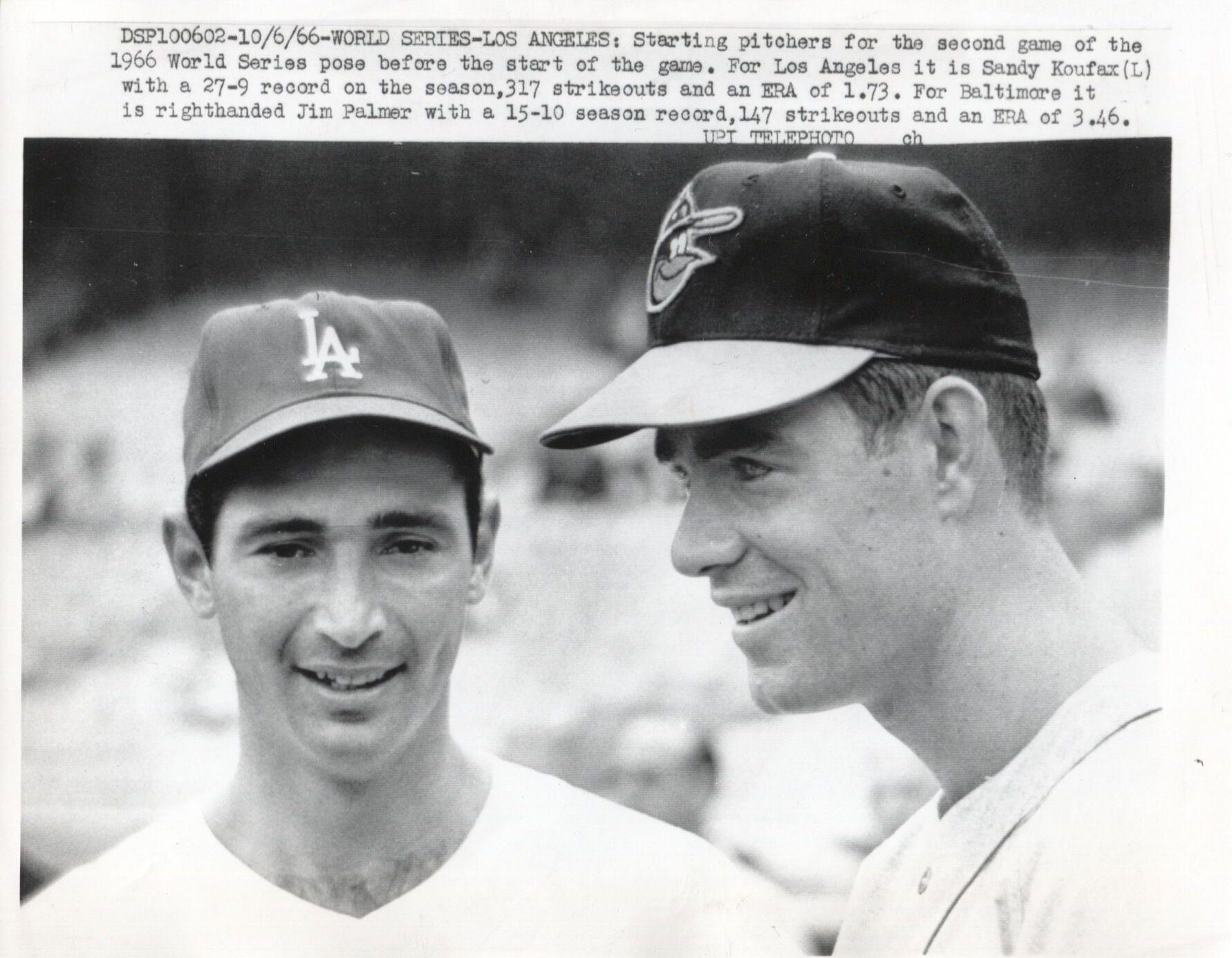 We're getting through the first week of October and just starting the post-season. But it wasn't always like that. The World Series was called the October Classic. These days, though, it's getting close to being the November Classic. But it wasn't always like that. These days, one has pitchers who go maybe 100 pitches ("oops, have to make a pitching change"). But it wasn't always like that.
Fifty years ago, on October 6, 1966, in game 2 of the October Classic, the Orioles were playing in Los Angeles against the Dodgers. The match up was Jimmy Palmer, just days away from his 21st birthday, vs Sandy Koufax, the Dodger ace pitcher. Koufax had had a series of seasons pitching that can perhaps best be described as incredible. Not only did he dominate the NL (if not all of baseball—and you had Whitey Ford and Bob Gibson playing at the time) with multiple Triple Crowns, he was also awarded not only the Cy Young but was also the MVP.
Back in 1965, Koufax had established a different reputation—he refused to pitch game 1 of the Series against the Twins (or Twinkies, if you prefer) because it was Yom Kippur. Across America, Jewish mothers who thought a squeeze play was something you did with an orange and that a hit and run was a type of car accident came to know about Sandy Koufax.
Back to 1966. It was Palmer vs Koufax. Palmer's first World Series game. Koufax's last. The Orioles had had just an OK first game, though they won it and I guess in the end that's all that mattered. But in the middle of game 1, the Birds' bullpen kicked into gear, and from the middle of that game through the rest of the Series, the Dodgers did not score a run. I think it still stands as a record. (Cal Ripken's wasn't the first baseball streak in Baltimore.)
Koufax had had another stunning season in 1966. 27 wins (he started 41—find someone with that kind of stamina today!). A 1.73 ERA. No surprise that he received his third Cy Young Award in 1966. (The story goes that in the 1963 World Series, NYY vs LAD, Yogi Berra (NYY catcher and the key to so many NYY pennants and World Series championships) and Maury Wills (Dodger shortstop) were watching Koufax warm up before the game. Berra said to Wills, "I understand how he won 25 games. What I don't understand is how he lost 5." To which Wills responded, "He didn't. We lost them for him." (1963 was Koufax's first CY Young Award, as well as MVP.)
Coming into that second game, it isn't hard to understand that Palmer may have been a bit intimidated. If so, he didn't show it. The game was a pitchers' duel through the 4th. In the 5th, though, Koufax's defense failed him (shades of Maury Wills from three years before). In that inning, the Orioles scored three times, with Dodger center fielder Willie Davis committing three error—in that inning! (The next day, in Baltimore, Davis was spoken of as the 10th Oriole.) Those runs would be all the Orioles needed. Palmer shut the door, becoming the youngest pitcher to throw a complete game shutout in the Series.
Koufax was pulled after the 6th inning, having given up an additional run. Davey Johnson, the O's second baseman, got the last hit off of Koufax. Andy Etchebarren, the O's catcher, was the last player to ever face Koufax. After the Dodgers lost the Series, Koufax hung up his cleats in an effort not to further injure his left elbow, already arthritic. Thirty years old and retired. Six years later, Koufax would be inducted in the Hall of Fame—the youngest such player, and I think either the least or second least number of wins for a pitcher. The induction, though, surprised no one. It had been well earned.
As for Palmer, over the years when he was announcing on radio/tv, he would occasionally talk about that game, one inning at a time, one inning per game announced (at most), ball by ball.
50 years ago today—Sandy Koufax's last game. Back from when pitchers weren't coddled, they started 40 games in a season, and they pitched complete games.
Aug
6
On August 5th…from David Lillienfeld
August 6, 2016 | Leave a Comment
 August 5 is a special day for baseball fans. Many probably don't appreciate it, though. Baltimore Os fans should find it of interest even as it was 3 years before the Browns moved into Memorial Stadium. You see, there's are lots of connections between the Giants and the Os—and in 1951, that connection showed itself, so to speak. For on Aug 5, 1951, the Giants began what may have been the most improbable of comebacks seen in baseball history. And if began on Aug 5. For on August 5, the Giants completed a series against the Cards, coming off a 10-0 shutout the day before, winning 8-4. And in so doing, they captured the series. It was the first of many such series wins during the last third of the 1951 season.
The 1951 team had lots of connections to the Os—well beyond the Giants taking on the Os colors, the black and orange.
1951 saw the arrival of William "Say hey" Mays, the season's Rookie of the Year. The Giants played in the Polo Grounds back then, in Manhattan across the Harlem River from the Bronx Bombers, the Yanks. Mays was made for the Polo Grounds—not so much his bat (though there was that dimension to his place on a roster) but his legs. He could run around in the Polo Grounds' center field better than anyone else in the game. It was because of that need to run like crazy to field center field in that ball park that Mays developed his over the shoulder basket catch—the one that the PTO issued a patent to him because basically it was his. Mays once saw the Os' Paul Blair playing center field. After watching Blair make some outstanding plays, Mays commented that he thought Blair was better as a center fielder than he, Mays, was. Quite a compliment!
Nor was it that Leo Durocher, a deserved legend in the game, was managing the team. (Durocher would rival O's skipper Earl Weaver both in results and lifetime ejections—they are tied for the latter; Weaver had the better win pct, Durocher the greater number of wins. I don't know, though, if Durocher was ever ejected even once, never mind twice, before the first pitch was made as Earl had.) Both Weaver and Durocher would also secure reputations as trainers of future managers, though the 1951 Giants had I think 5 such players. Durocher is probably best remembered for his misquote—he said, "Nice guys. Finish last." The reference was to the Giants (and Mel Ott, in specific) when Durocher managed the Dodgers. That didn't stop the observation from being "Nice guys finish last." Durocher did have a connection, though not through the Giants. Before managing New York, Durocher managed the Dodgers, woking for Larry MacPhail. He an MacPhail would go out drinking some evenings, and MacPhail would fire Durocher, only to rehire him in the morning when sobriety ruled.
Think George Steinbrenner and Billy Martin had an interesting owner-manager relationship? It was nothing compared with Durocher and MacPhail. The connection to the Os is that MacPhail's son Lee was the GM of the Os who began the negotiations that brought Frank Robinson to the Orioles.
For Durocher, competitiveness was everything. If you competed, you had no problems with him. When Jackie Robinson joined the Dodgers in the last 1940s, Durocher said he didn't care about a man's color, just whether the guy wanted to win. (Vince Lombardi was of the same mindset. "During his first year in Green Bay, Lombardi called his team together on the practice field and delivered a rare lecture on racism. 'If I ever hear nigger or dago or kike or anything like that around here, regardless of who you are, you're through with me. You can't play for me if you have any kind of prejudice.' His actions that year were often more quiet behind the scenes, like paying Tunnell's hotel bill when it was hard to find suitable housing, or making sure the black players had enough money to go to Milwaukee or Chicago on off-days. But as his status and power increased in his second season, his sensitivity to racial inequities intensified as well, and his responses became more overt. Before the season began, Lombardi spread the word among Green Bay's tavern and restaurant owners that any establishment that did not welcome his black players would be declared off limits to the entire team. At Tunnell's suggestion, he allowed the black players to leave the St. Norbert training camp twice during the preseason for quick trips down to Milwaukee, the closest city where they could find barbers who knew how to cut their hair." (There was also Lombardi's intolerance of any expression of any homophobic sentiment, perhaps reflective of his basic human decency, perhaps the result of having a gay brother and being aware of the cultural challenges gays faced at the time).
But I digress.
I mentioned that many members of the 1951 team, like Alvin Dark and Eddie Stanky, would go on to manage their own teams. Not that Weaver did ok by that measure too, but perhaps most notable wasn't a player but a coach. A key member of the coaching staff—George Bamberger. Bamberger was a ne'er do well pitcher for the Giants. He didn't find his place in baseball until he began coaching. And it was coaching, as the pitching coach for the Os, that Bamberger would make his mark. In 1967, when Bamberger took on the assignment. He was familiar with the Gray Lady on 33rd Street from when he pitched, briefly, for the Os during the 1959 season. No stranger to Memorial Stadium he.
In 1967, the Os had trouble just about everywhere—but pitching most of all. The arms were sore that season. Bamberger went to work. When Weaver came on board in 1968, he found in Bamberger the man to run the pitching staff. (Weaver was a shrewd judge of hitters and fielders. Pitchers? Not so much. Palmer, no stranger to the art of the pitching craft, once observed that "the only thing Earl knows about a curve ball is that he couldn't hit one." Bamberger was the orchestrator of the 4 20-game winners in 1971. The oversight of Jimmy Palmer as he ascended to become the dominant pitcher in the AL during the 1970s. Bamberger was a connection.
So today has significance in baseball history, at least for Os' fans. Today was when the Giants' hunt for the Dodgers began that season. 65 years ago. In New York City. The Giants would lose only one more series during the remainder of the season—and that was to the Dodgers—the next series, in fact. And after that series, the Giants not only did not lose a series for the remainder of the season. They didn't lose a game to the Dodgers. I'll leave Bobby Thompson for another time.
Jul
18
The All-Star Break, from David Lillienfeld
July 18, 2016 | Leave a Comment
We are coming off the All-Star break, the mid-point of the 2016 baseball season. And in response to some requests, I've been somewhat quiet about the boys in the orange and black. (No, not the Giants—they got their colors from the Os.) How fare the Birds of Baltimore, the Orioles? They sit 2 games ahead of the Bosox astride the top of the AL East. This is in contrast to all the other divisions, in which there is a clearly dominant team.
The reality is that the Os on the road are barely OK. They play under .500 on the road. But in Camden Yards, they are a very different team thus far in 2016, a strong team with an offense that is second best in the AL (only the Bosox, who play with the Green Monster at Fenway half the time, are better). The Os lead the majors in home runs (this is becoming the Os preferred way of scoring), but they definitely lack speed on the base paths—dead last in triples. Mark Trumbo and Chris Davis are responsible for the four baggers, but others are doing their share too.
Fielding is just OK—fifth best.
And pitching is just awful. There's only one Os starter of note this year—Chris Tillman. Putting Ubaldo Jimenez on the mound is the equivalent of staking the opposing team to 6 runs. It must be nice for $4 mil a year. The Os badly need an Eddie Watt or Sammy Steward, someone with a rubber arm for long relief who can start the occasional game when needed. And the bullpen is graced by Zach Brittan, arguably the best closer in baseball (perfect on saves-save opportunities, as are many others right now, but none with an ERA below 1.00—Zach's is 0.7). Middle relief and the set-up is Darren O'Day, who's not having such a great year—nothing anywhere near last year's beautiful performance. Maybe the second half will serve him better. We'll see. Pitching, though, remains a weak point—and Danny Duquette, the O's GM, shows no sign of evaluating pitchers with any success. Tim Melvin and I have spent much of the first half bemoaning to each other the poor pitching staff and the horrible player decisions from the GM's office. I can't say that pitching is pathetic—the Birds win games. But pitching doesn't seem to be a big factor in the wins.
So the Os start the second half of the season with lots of power, OK fielding and weak pitching. For those of us from the Weaver era, this is nothing close to pitching, defense and the three run home run. I miss that trio. It served the Os well. Buck may be a great manager, but he needs players with some talent. The pitching staff comes up short on that area. Some personnel changes are in order. Maybe bring up some of the pitchers from the minors—they could hardly do worse than the current staff.
Somehow, the Os are winning, but I'm not completely sure how. There are just so many HRs that a team can hit. The pitching staff simply has to perform. There's still a long ways to go until October (or is it November yet?). Maybe the staff will find its groove.
One peeve that I have these days isn't limited to the Os. It's the challenges. These really slow the game down. I wonder how many are successful. Personally, I'll take my chances with the field umps. They may be blind, but the time for the challenge system is just too much—it ruins the rhythm of the game. Eliminate it. Please? Pretty please?
Play ball!!
Jul
18
Book Review: “The Lady Tasting Tea”, from Russ Sears
July 18, 2016 | Leave a Comment
 The book The Lady Tasting Tea: How Statistics Revolutionized Science in the Twentieth Century is a one person historical account of the greatest statisticians.
While one may quibble with the authors choice of who the greatest statisticians where or how much he wrote on the statisticians he personally knew, its strength is also because this book is written by a student of R. A. Fischer. a statistician known for introducing statistical research methods into science and furthering Galton's regression analysis.
The "lady tasting tea" is a test if a lady can taste if tea is mixed into milk or if milk is mixed into tea. Highly recommended for those that love history and/ or statistics.
David Lillienfeld writes:
Let's stop this myth. Fisher's contribution to research methods was in "translating" Pearson. Pearson had actually derived the mathematical formulation well before Fisher, and that Fisher "stole" (from Pearson's view) what became the F test and the like was the basis for a long-standing animosity between the two. Bringing in statistical methods into science was the work of others, not Fisher.
Pearson started that task in the early 1900s for biology and medicine, work continued by Major Greenwood (Pearson's protege, though some might argue that Egon Pearson, Karl Pearson's son, of Neyman-Pearson Lemma fame among other things, took on that role ) and then A Bradford Hill (Greenwood's protege). Hill was among the first tobacco-lung cancer studies (frequently not noted is that Richard Doll was Hill's protege).
Hill was also the genius behind the first modern randomized trial, the MRC Streptomycin Trial in 1948 (conducted as a randomized trial to eliminate bias and not to allow for significance testing). (The trial was necessitated by the cost of streptomycin as a treatment for TB and the essential bankruptcy of Britain post WW2. If the drug didn't "work", the British government didn't want the expense of buying it.) In the US, it was Harold Dorn's work bringing stats into medical research. Dorn and Hill studied together in 1933-5 under Pearson (Egon, not Karl) in London. That was just before Hill published his book on statistics in medical research, which itself translated Pearson for medical researchers.
On the social science side, there was F. Stuart Chapin methodologically, and a bunch of students of Franklin Gittings on the pure stats side. (Gitting's statistical empiricism contrasted with the case-study methods championed at the University of Chicago—which wouldn't change until Sam Stouffer went to it from the University of Wisconsin, where he was the thesis advisor to Harold Dorn.
These were all statisticians, with the exception of Chapin, who strode the fence between stats and subject matter.
Fisher's fame derived out of a book that allowed people to understand Pearson's accomplishments, significant but hardly the person to bring stats into scientific research.
Frank Yates, Fisher's contemporary and teacher to Bill Cochran (of Cochran's theorem—the basis of all contingency table analyses since about 1940 (and yes, Fisher's exact test is still sometimes used, but not anywhere near as much as the tests deriving off of Cochran's work, including log-likelihood, Mantel-Haenszel (also known as Cochran-Mantel-Haenszel today), as well as sampling and queuing theory). That work (Cochran's) had as much to do with bringing "modern" stats into science as Fisher did—but he didn't write much. Yates is also significant in the development of the analysis of variance, but the foundational work there was Fisher's. The AoV was important for agriculture and some laboratory work, though some might argue that Student (Gossett)—another student of Pearon's was the more significant figure there—it is, after all, Student's t-test, not Fisher's t-test. It was the F-test which was named for Fisher.
Fisher was the Richard Feynman of stats, though some might argue, reasonably, that Cochran's book (aka Snedecor and Cochran) taught at least two or three magnitudes more people in science about stats than Fisher ever did, holds as much claim to that title as Fisher did. Cochran went to the US because he and Fisher had quite a falling out after Cochran published what has become known as Cochran's Theorem (which demonstrated, among other things, that the sum of a series of chi-squares was a chi-square and that one could thereby combine contingency tables for analytic purposes).
That was 1938, and the Cochran-Mantel-Haenszel work started in 1954—M-H was 1959). Cochran told me that he and Fisher were good friends before that, sharing a "smoke and afternoon tea" together. (Cochran was well along in suffering from strokes by the time I got to know him, so he might have that history a bit wrong, though Tony Hill agreed with Cochran's recollections—Cochran was well known in London by 1936/7.) Cochran's great "sin" was his refusal to "genuflect" (his word) before the "alter of Fisher" when he published this theorem and stating that the idea was Fisher's—Cochran said it was not. Interesting is that aside from Fisher's exact test, he never did much with contingency tables.
Fisher was a genius, but his impact in stats has been way overblown in its significance (pun intended), much as Feynman was a phenomenal teacher—rainbows on the blackboard—but his impact on physics was normative, not transformative. Pearson has a stronger claim to being the person who brought statistics, notably mathematical statistics, into scientific research, though as the above discussion suggests, he was seminal but hardly alone.
anonymous writes:
Fisher's Fundamental Theorem of Natural Selection, from his 1930 work, "The Genetical Theory of Natural Selection," which speaks to the relationship of "the relationship of "increase in fitness," (the aggregate of the means, we can think of this as) and "variance," states:
"The rate of increase in fitness of any organism at any time is equal to its genetic variance in fitness at that time."
But Fisher was, in looking at the natural world, only therefore considering a narrow band of the spectrum — things, for whatever reasons, are "bound" in the natural world (for example, if I double my height, I end up squaring my weight in order to maintain proportionality, and my legs buckle under the weight [they are probably close to do so now]). Further I contend, this same mechanism, which we only see a sliver of the spectrum manifesting in the natural world (and the overarching question then becomes "why?") manifests in spread of a population of bacteria, spread of disease within cells of an organism, or spread of infected individuals within a population, to the growth rate of national deficits (the idea, to my great satisfaction, having FINALLY found an ear and an excitement with the powers who can do something about this on an international level), and, as we've seen in trading (and which demonstrates that variance in returns is equivalent to negative returns, not to "risk.") The following graphic, which I hope comes through, illuminates the idea:
The black curved line is the average, compounded growth rate (the average [geometric] rate of population growth, what Fisher calls "the increase in fitness of a population"), the hypotenuse, the mean growth in population size per period, the base of the triangles, the variance in growth in those periods. Clearly, Fisher saw in the natural world, a sliver, to the left of the peak of this mathematical relationship.
In very many things, we see this relationship over and over, but often because of natural bounds, we see but a sliver (trading, being an abstraction [until the margin department calls] however, experiences the full spectrum).
Jul
11
Last night (Friday), some of the key players of the 1966 World Series-winning Orioles team gathered to reminisce about the magical 1966 season. There were some notable events that season. The "Here" pennant, the Ron White catch, the back to back HRs in Game 1 of the Series. It was a year the Birds flew high—and they've never been higher since.
The year was worthy of any Trivial Pursuits game. Jim Palmer, the last pitcher to win against Koufax. Davey Johnson, the last hit against Koufax. Willie Davis (the "tenth Oriole"), the first player to commit three errors in in a World Series game (I recall being in the same inning, but I'm sure I'm wrong on that one). The excellence of the pitching staff in the Series. The tightness of the infield.
50 years since that season.
It's not apparent today, but the 1960s, at least until 1966, Baltimore was very much a football town. The Colts had won some championships, and the stadium, looked at from above, even looked like a horseshoe. In the early-to-mid 1960s, there were some boys without a Unitas crew-cut, but not many.
And one should not forget that in 1966, Frank Robinson, the man who taught the Os how to win for championship, could not find a house to rent. He was black and many landlords refused to rent to him.
The videos are worth a look. Maybe not at the level of the post-game ceremonies at the closing of Memorial Stadium in 1991, but a look all the same.
I just wish Frank had been there, too.
There would be other notable seasons—the 1969 collapse, the 1970 Orange Crush dismemberment of the Big Red Machine, the 1971 pitching staff and the 1979 Orioles Magic team, and Cal's record. But the Birds never surpassed 1966.
Jul
5
The EU, from David Lillienfeld
July 5, 2016 | 1 Comment
 The people driving the EU would have been for awful divorce attorneys. If you want to consummate a deal quickly, you don't stand there saber rattling. You take a deep breathe and acknowledge that there's some tough negotiating ahead that will take time. The notion that you're going to be punitive in the hope of intimidating other nations from leaving suggests a lack of understanding of human nature. (Then again, it is the EU.) Alternatively, if speed of the divorce is your focus, accepting many of the other party' demands is the way to proceed.
The EU is a confederation, and as such, survives only by providing a compelling reason for its member states to maintain their membership. While the EU has its problems/limitations, it could have been reformed. That it wasn't (and hasn't had much discussion of that need) suggests that the UK will not be the only country leaving it. For the purposes of trading and harmonization of legal matters, the EU has a raison d'être.
It's worth noting that you've had a sustained period when there was no fighting in Western or Central Europe. Has there been a similar period before? Perhaps between 1815 and 1870? I guess that depends on how one looks at 1848.
May
30
 We've had the discussion many times on the list about today's pitchers versus those a half century ago. I contend that the arms today simply aren't as strong, pitchers aren't trained to throw 300 innings (which would probably be healthier for them), and baseball is the loser.
As for the argument that pitchers today are up against better conditioned batters and that's the reason for the smaller number of innings pitched in a season, I say nonsense. The problem is that the arms are aging prematurely as kids in little league and high school throw breaking stuff. That's the problem. Fifty years ago that wasn't the pattern—and the arms grew stronger in consequence.
Palmer himself is nothing if not the epitome of class. And his wind up was pretty unique, almost ballet like in its smoothness, the high kick, the rising fastball and the devastating slider. If you spoke about dominant pitchers of the 1970s, Palmer is certainly in that group.
I'm throwing in a SNL skit revolving around PalmerPitching the Jim Palmer way—and Frank Robinson. Both are Baltimore legends, and it's interesting that both still live in the city.
May
29
Memorial Day, from David Lililenfeld
May 29, 2016 | 3 Comments
 When I lived in San Diego, one of my neighbors one day had a big sign hanging outside their house—at least 4 ft top to bottom—saying, "Welcome Home Kevin!" festooned with balloons and streamers. It was not an usual sign as San Diego goes. It is, after all, the home of the Pacific fleet, and Kevin I knew was a marine. However, the signs (and houses or, more commonly, apartment houses that went with them) were more frequent on the south side of town, near where "Naval Station San Diego" could be found or much farther north, near Camp Pendleton, there were such signs in the northern part, too. The family had asked that everyone let the Kevin take in returning home before coming by to say hello. What was striking, though, was that when Kevin arrived home and went from the car to the house in a wheel chair, absent both legs, one arm, and one eye.
As I would learn, he also had PTSD among other challenges. That was, however, just the start of his problems emanating from an IED. He encountered what he insisted was discrimination. His wife too. Whether there was or not I can't say. But I can imagine a potential employer wondering about the challenges presented in hiring Kevin. You would think that there might be a little bit more welcome than that in San Diego—and you would be wrong. Kevin's wife had become a member of a support group—organized by the affected families—and I heard much the same from them when they would meet next door.
We are told that Memorial Day is about remembering those who died in service to America living. Mr. Tim has noted that we do so, in part and at least by some, in our celebration of what that sacrifice wrought. Veterans' Day is a celebration of all who served in the armed forces.
 Other countries have their own Memorial Days. In Israel, one of the more poetic ones, at 8 PM on the day, the air raid sirens across the country sound and everyone, even those on the expressways, stop their cars, turn off their motors, and get out of the car for a minute of silence. After that minute, the country resumes its activities. Perhaps that observance grew out of the fact that in the many hot conflicts in which Israel has had over the years, there is barely a family that either has been affected or knows of one affected by a fallen soldier.
But what of those disabled in the course of their service. Those from the Vietnam were basically forgotten more or less. They were, after all, "baby killers," right? But it wasn't only those left disabled from their Vietnam service who have been forgotten—or at least seemingly so. There are those who will argue that at least some politicians are working to improve the lot of these veterans. Kevin's wife responds that they do what they do only when the tv cameras are rolling. She will tell you that the families are told that these politicians will insist that 50% is better than nothing. She responds that 50% is great if you're among the 50% to get a prostethis. Otherwise, you're out of luck.
I don't know what became of Kevin and his family. They sold the house soon afterwards and wouldn't tell anyone where they were moving to. Just "somewhere else, somewhere far away from San Diego." A family of 5. Three young children, the oldest being 6.
So, is Memorial Day truly about just those who died in the military? That's a physical death. Their families will mourn and grieve. They won't forget, but at least some will move on with their lives, perhaps remarry, children adopted, and so on. What about these disabled veterans? Profoundly disabled. Are they not dead too—not physically, but in many cases emotionally. Certainly for many, their futures have died. The promise of a young family has died.
What exactly are we remembering on Memorial Day—graves, or the living who during their service have seen one or more aspects of their lives die. Are they not worthy of our remembrance on this Memorial Day? Or is this just one more time when they are forgotten by their country?
May
16
Here, from David Lillienfeld
May 16, 2016 | Leave a Comment
 Luis Tiant was never a popular pitcher in Baltimore, which isn't too surprising considering that Tiant never played for the Orioles. But there was one day—May 8, 1966–when Baltimoreans actually enjoyed seeing him on the mound. They didn't think that they would when the bottom of the first inning began in a game at the Old Grey Lady on 33rd Street, aka Memorial Stadium. By the end of that inning, though, Tiant's name would ascend into the immortality associated with baseball memories. Not that he was pleased to be so, I'm sure.
You see, during that bottom of the first, the number 3 batter in the Orioles lineup, Frank Robinson—he being the "over the hill" guy that the Reds traded for Milt Papas in what is arguably the worst trade in baseball since the Boston Red Sox traded Babe Ruth to NY in exchange for the money needed to fund a new Broadway musical—took a swing at a Tiant fastball and not only lifted it up for a home run. He hit it so high and hard enough that the ball sailed clear out of the ball park. In the four decades the Os would play at Memorial Stadium, no other player did likewise—Orioles or visitors. To commemorate the event, the Os installed a flagpole at the point where the ball cleared the stadium and put a flag on it that simply said, "HERE"—black lettering in a sea of orange.
Visitors to Baltimore who went to an O's game often didn't know what the flag was all about, much as many didn't understand the turn to the south by many during the playing of the national anthem (usually not aware that about 5 miles south of the stadium lay Fort McHenry, where the lyrics were composed). The story wasn't hard to tell, and for any resident of Charm City during Frank Robinson's reign, the story was well known. But the visitors, though, didn't know; many, once told, would just look at the flag as it fluttered in the gentle breeze of a typically sweltering Baltimore summer evening.
The year 1966 was a magical one for Robinson. In addition hitting the only ball out of Memorial Stadium, he made the catch of the year about a little over a month later (June 21, to be specific) in Yankee Stadium, when in the bottom of the ninth inning of the first game of a double header, he caught a Ron White fly ball and in the process, went over the fence defining the outfield. Of course, it was the bottom of the 9th, and of course, the catch meant a Yankee loss. And of course, Robinson was met with beer cans and the like when he went out to play during the second game. Memorable.
If there Barry Levinson's Diner were ever updated, I'm sure that "the catch" as many in Baltimore came to refer to the event and the story of "HERE" would be among items of essential knowledge discussed in the diner.
In Baltimore, say the name "Robinson" and many will think of Brooks Robinson. Almost four decades after he retired, and Brooks is still known across the metro area as Mr. Oriole. Say "Frank", though, and everyone will also know that you're referring to Frank Robinson.
As the man said, "There are ballplayers, and then there's Frank."
"Remembering Frank Robinson's historic, outside-the-park home run, 50 years later"
May
4
The South Sea Beckons…The South China Sea, That Is, from David Lillienfeld
May 4, 2016 | Leave a Comment
I don't know if anyone happened across this piece earlier in the day: "China's urgency to stockpile oil tells us 2 things"". Looking at it, I was struck by two things: If China were anticipating a geopolitical disruption to the oil markets, the easiest means by which it would anticipate such is if it were planning military action somewhere. The most obvious place to me would be some sort of play in the South China Sea. On the other hand, if there isn't some military standoff pushing up the price of oil, oil demand to sustain the current price is going to disappear once China's finished with its inventory build. It will be interesting to see what China does with the inventory build in the fall as the election here approaches.
Larry Williams writes:
Adding fuel to this fire…
The governor of the Virgin Islands is on his way to China to work with Sinopec to see about the possibility of reopening the refinery here in St. Croix which, at one time, was the third largest refinery in this hemisphere.
It's very upsetting to me that the United States does not see the future… is not, from what I can tell, interested in stockpiling energy resources.
China thinks so far ahead of us. I am leaving this morning for a month in China and will post comments about what I see there along the way. It is always frustrating for me to be there, to see the growth, the new buildings, the expansion of everything while nothing seems to be taking place in America.
If there was ever a monument to what deficit financing can do it certainly has been the expansion and growth of China from a nothing economy to probably soon the world's largest
May
2
 I'd always thought of bottled water as a display of the ultimate success in marketing. Not selling but marketing. Creating demand for a product that no one even knew they needed. Intel did that with the microprocessor. Many think that Fairchild did it with the integrated circuit—but it didn't. Integrated circuits simply cut the time and expense of electronics manufacturing. Microprocessors were, for lack of a better term, manufactured demand. That's one of the reason the Microma watch failed—no economic advantage, no performance advantage. Other than a marathoner, do you really care if the time on the watch is accurate to the nanosecond?
Back to water. Go to the local supermarket and take a look at the price of the bottled water. Then compare it to the price of a water bottle and tap water from the sink. It's hard to beat the latter on cost. Arguably, the latter takes more time, but I never thought of that as a major driver for bottled water sales. No, it was convincing people to buy something that they never knew they needed. Marketing. (I'm sure there are many on the list already scratching their heads and wondering why that's marketing.)
But there's something in this piece that's a little different from what I had initially expected:
"It has to do with the disappearance of good water fountains — with the failure, frankly, of water fountain companies to innovate cool, interesting, appealing water fountains."
I hadn't considered the situation in that construct. Do I agree with it? I'm not sure yet. I'll get back to you in a week after I've had a chance to "kick the tires" a bit first.
"Selling Bottled Water that's Better for the Planet"
May
2
Coffee, from David Lillienfeld
May 2, 2016 | 1 Comment
 Coffee has been in the dumps for over a year. I heard on NPR that there is a drought in India where they grow coffee and the crop may be reduced. This might be robusta. ICE has a robusta future. I'm checking to see what the CME contract uses.
Robusta is real crap coffee, the stuff they put in flavored. Coffee snobs should only drink Arabica.
Speaking of which, I bought some KIVA Northwest roasters Columbian coffee for $9/lb. It was smooth and delicious. A much better value than Kona coffee for close to $40 or $50 /lb. But Kona coffee is the only US sourced coffee and I grow it on my farm.
Apr
18
E-Class, from David Lillienfeld
April 18, 2016 | 2 Comments
 At the gym yesterday, I was struck in the parking lot by how many Teslas were there. They seemed to be all over the lot. In Silicon Valley, having a Tesla is no longer much of a status symbol. There are simply too many of them. I suppose a Ferrari or a Maybach counts for something in the status wars seemingly omnipresent out here. But you don't see many of them (and fortunately, even the Ferraris have reasonable colors—no pink ones like I saw in San Diego—maybe she was a Mary Kay salesperson). On the Stanford University lots near the engineering section of campus, the proclivity of Porsche Carreras is hard not to notice.
Not many Jags, though. At one time, Jaguar was among the leaders in the sports car market. The premium sports car market. Jags could (and did) win at Le Mans and other racing venues (D-type had that honor). The problem with Jags was that in order to buy one, you needed to be prepared to pay for the mechanic who would live in your home to keep the car going. Even so, Jaguar, to its credit, made some gorgeous cars. Some that were works of art. Many in the 1960s lusted for the Aston Martin, especially after Goldfinger was released.
My favorite, though, is the Jaguar XKE, sometimes referred to as the E-class. Simply exquisite. I contend that there has never been a finer car built, from an appearance perspective, than the Series 2 XKE, which was more drivable than the Series 1. The Series 3 is the one I like least of all (it strikes me as overdeveloped)l but I'd take it in an instant with the right opportunity.
I don't know which version of the XKE he was looking at when he said it, but Ferrari (as in Mr. Ferrari) thought it the most beautiful car ever built. The Roadster XKE is in the permanent collection of the Museum of Modern Art. It's not a car easily found these days—there were fewer than 75K ever manufactured. At one time, I had a dream of buying one that had seen better days and rehabbing it. As it turns out, that concept and Jaguars, at least for the XKE, do not mix.
As I write this, I'm hearing one of my neighbors barreling down the street in his Lamborghini, the automobile version of a Harley. At least everyone that I've seen is loud. The cop who's now chasing him down the road wouldn't have had a chance at catching up on an interstate, but here in the neighborhood, there's likely to be a ticket issued and accepted.
As for the Teslas, I'm still waiting for the company to post a profit. Any damned fool can produce something at a loss, especially with a government subsidiary.
There are those who enjoy Lamborghinis, though I'm not one of them. But the XKE? Now there was a car.
Apr
11
I Robot, from David Lillienfeld
April 11, 2016 | Leave a Comment
 My friend Roger Arnold, among others, has been writing about the approaching economic cliff presented by the automation of our society. It's not hard to see that in maybe 5 years and surely 10, jobs in warehouses like Amazon's will be but a memory. In 20 years, much of what we now call "jobs in the economy" will likely become "machines in the economy."
The link describes the tensions the economic transition in China is unleashing, and I have to wonder if the US isn't going to live something similar (tension wise). We're already seeking what is arguably one of the most contested presidential primary elections in decades (it's now April and there's no clue who will be the nominees; there may be some bets, but in terms of anything with certainty? Nada—not this year) and I suggest that some of that contestation is the result of tensions already forming.
Whenever there are losers (such as with jobs that are just disappearing for eternity), there are winners, too. Who will be the winners over the next 20 years as the US enters the I Robot era?
"China is trying to make a huge industrial shift that could have disastrous consequences"
Apr
11
The Bunt in Baseball and Survival, from Bo Keely
April 11, 2016 | Leave a Comment
 I watched a beautiful bunt sacrifice attempt last night at the local high school baseball field. A runner on first, the pitch, with the batter already squared with bat set to bunt, as the entire field moves poetically. The catcher rocked forward on his heels, the first and third basemen raced toward the batter, the second baseman covered first, center fielder moved in to cover second base, and the fastball sped toward the bat. The ball popped up to the first baseman who caught it on the fly ten feet from home plate, he wheeled and lobbed the ball to the second baseman covering first base, and the runner was out too, as the umpire in black jerked his thumb toward the stars and screamed, 'Double play!' The sacrifice had failed, but it often succeeds.
The bunt in baseball is a special type of offensive technique. The goal is to tap the ball into fair territory to advance the base runner in a sacrifice of the batter. It requires great physical dexterity, concentration, and a knowledge of the fielders' positions, and foresight of the pitcher's most likely pitches. One of the sport's most famous early figures, Dickey Pierce, used this 'tricky hit' to effect as the rules permitted it to roll foul and still be counted as a hit. The bunt did not become common until the 1880s, and it has been accepted as a baseball strategy, with periodic waves of acceptance and dominance, to this day. During the 'dead ball' era of the 1960s, bunting was an important offensive weapon. Conversely, and now in the 'fast ball' and 'money ball' era of staying ahead of the economic curve of the fan in the stands who demand big hits, the bunt is seldom seen. Nevertheless,the role of the sacrifice bunt in baseball strategy is one of the daily discussions for baseball fans.
It is an exciting moment in the game. It reminds me of chess where every move is as strategic, making chess more exciting than baseball with at least as much sweat. Some situations in the board game that parallel the bunt are any gambit, pin into a weak position, zugzwang, or piece sacrifice to lose the position but win the game.
Likewise,with upright humans, there are various sacrifices that parallel the bunt. In a true sacrifice, the officer will have to play with less soldiers to capture the objective. In a sham sacrifice, a fake flank attack gains leverage in a territory. In speculative sacrifices, the commander risks losing something that he believes will soon regain material of the same or greater value.
In survival, after many years of baseball and chess, but none at war, the bunt is a repeated metaphor. To live, you must be able to bunt, over and over. For example, in hoboing you board a 'dog' slow train, and hop off as it pulls away to climb aboard a 'hotshot' to evade the bull. In the Amazon jungle, you raise your arms on greeting a wild mammal to feign a taller profile, while risking balance and putting your hands in reach of an anaconda. In the mountains, you risk crossing a snowy pass to reach a village before starving. In the desert, you walk at night to avoid the heat at the risk of stepping on snakes. On skid row, you may 'chuck a dummy' by faking a fainting fit in order to get a sympathy coin. In a dark alley, you take one on the chest to put on on his chin.
Learn the strategy of the bunt and you're almost home in baseball, into the mid-game of a good chess match, gotten the upper hand in a fight, and are half way out of the woods in survival.
David Lillienfeld writes:
With all due respect, I cite Earl Weaver: All that you do with a bunt is give up an out. You've only got three in an inning. Why give one up? Some of the time (I've lost track of the stats on it), the sacrifice is a twofer, as in a double play.
As noted, bunts require much dexterity, they also require lots of speed if one is bunting for a base hit (I think even Weaver was supportive of such) if the infield was back far enough. Rod Carew was perhaps the most able bunter I've seen who could/would bunt for a hit. Ricky Henderson was pretty good it, too, though showing less control the bat than Carew (admittedly subjective assessment).
Pitching, three run homers, and great defense was the Weaver prescription. There were no sacrifice bunts in that formula. (Weaver wasn't a great lover of the sacrifice fly, either, but he figured the batter had had a shot at a hit and at least the runner(s) could advance, maybe even score (if on 3rd).)
If sacrifice bunting ever becomes part of the Orioles game plans at Camden Yards, don't be surprised if there's a rumble in the ground by home plate; the ghost of Weaver will have been awakened.
Apr
8
Alzheimer’s Disease, from David Lillienfeld
April 8, 2016 | Leave a Comment
 Developing diagnostic tests for Alzheimer's hasn't been quite the burial grounds that developing therapeutics for the disease has been. That's mostly because there has been even less progress on basic science underlying diagnostic testing than that on the therapeutic one.
I don't know if much of the electorate appreciates that while there is much work taking place on Alzheimer's disease, particularly therapeutics, a significant portion of that work is based around one hypothesis for the etiology of the disease—amyloid. For 30 years, advocates of the amyloid hypothesis have pushed for research funding (perhaps more than 30, I know just the past 30) into that particularly line of thought. Other areas haven't received quite as much funding even as the amyloid hypothesis work hasn't been able to show much progress on the therapeutic front. Perhaps that will change if there is a diagnostic test for an earlier stage of disease when more neuronal pathways presumably remain intact.
A similar focus was made in the national War on Cancer. The research hypothesis then was viruses, and because the Nixon and Ford Administrations were convinced that scientists outside the government (and even most of those in it) were people who were wasting precious government funds proceeding in an organized manner, those administrations issued contracts for research mostly into a viral etiology. Perhaps there is a viral etiology to cancer; the research conducted certainly didn't find it, and the bureaucrats in the White House who directed the NCI to contract this research at academic medical centers and contract research organizations (think RAND, Batelle, and so on) were insistent that this be the singular focus of the NCI. (BTW, funding to develop stealth technology was originally declined by the White House because it was too "fanciful"—the term used by the analysts in the Office of Management and Budget and work on the Internet (then known as the Arpanet) almost met the same fate except that it was sheltered in the ARPA budget; the assertion by the White House then was that if the ARPAnet really had any value, it would developed by private industry, not the government.)
Not much progress was made on either the etiological or therapeutic fronts (in contrast to heart disease, where the research program of the government, spearheaded by the NIH) rested on a variety of etiological and treatment hypotheses) with cancer. Indeed, for thirty years, the major achievements of the War on Cancer was the reduction in the incidence of lung cancer. That result was achieved principally through smoking cessation programs (the culmination of research at the NSF as well as the NIH—some from the heart institute, some the cancer one), not the contracted basic science work. With lung cancer incidence in decline, the NCI decided to roll the dice with other prevention programs, principally diet and supplements. The basis for such an approach was not nearly as developed as for smoking cessation (for which the epidemiologic base was solid), and it has not been nearly as productive.
The knowledge on viruses was useful, just not for cancer. Peter Ducker notes that this research was still valuable for discerning that viruses were not the etiological approach to be further pursued (at least not then) and that the information gleaned in the course of that research was nearly as valuable as if the research had been successful. The response to the AIDS epidemic, when research funds were finally made available, was greatly facilitated by having that knowledge base about viral etiologies of disease available. And in that respect, it's probably one of the reasons AZT, originally developed as a treatment for cancer before work with it was discontinued, found its way into the treatment regimens for the disease. It took some time to develop a sufficient basic science basis for the develop therapeutics for HIV infection, and we still lack a cure (and for all the hoopla about how those with HIV live almost as long as those without it, the reality is that resistance is developing to the available medications so the need to develop new medicines is still present).
One of the lessons of the success of the smoking cessation programs compared with the other approaches to cancer was that the basic science work needed for those programs—from epidemiology and behavioral science—was established by the time the cessation programs were developed. (The same can be said for high blood pressure control and stroke.)
The problem with the moon shot approach to biomedical research is two-fold: 1. It needs to be coordinated by the government (and as NCI demonstrated, picking the winners in such research isn't something the government does well—better to take the ideas from the medical community and pursue the leads meeting with increasing success) and 2. (as Peter Drucker has noted on many cases) in the absence of an established research base, such efforts are doomed to failure. For both Manhattan Project and Apollo, the scientific base was established before the "moon shot programs" developed.
Don't be surprised if the current moon shot approach to cancer meets with the same fate as the viral etiology one.
As for Alzheimer's, maybe this diagnostic test will mark the beginning of a different approach to the etiology and treatment of the disease.
Apr
6
Slow Economic Growth: A Hypothesis, from David Lillienfeld
April 6, 2016 | 1 Comment
 There's been much hand-wringing since the Great Recession to explain not only why the US economy hasn't grown faster but why the global economy is in such a morose state. Explanations include the overhang of personal/government/corporate (take your pick) debt, demography/aging of the population, central bank interference, among others.
Carder and I had a discussion today about this subject. Somehow, the topic of 9/11 came up, and he noted that we've spent a small fortune in responding to the security issues presented by that event. There have now been a number of other terrorist attacks in Europe, and I expect that there has been a considerable amount of money spent in shoring up security there, too.
I therefore wonder if the two aren't connected. First, the amount that was spent on security infrastructure and operations was not available for investment or any other economic use. Second, that the tightening/less open state of Western society in the hopes of creating a sense of security (in the pursuit of zero incidents) has created enough impediments to wealth creation in itself that the performance of Western economies has been rendered sluggish. To rephrase, that the West has, in its search for security, reduced the openness of the society that created the wealth which placed a target on the West in the first place.
If that hypothesis were correct, then the terrorists will have succeeded in at least some of their aims without having exploded yet another bomb.
I'm sure there are those who disagree with that hypothesis, likely including many on this list. I put the idea out here for discussion.
Nigel Davies writes:
Yes, as Nimzovitsch pointed out, the threat is stronger than the execution. Much of chess mastery consists of the correct gauging of 'threats', defending by minimal means and keeping every part of your position equally weak (Lasker). The problem is that in a democracy the clamor for resources will not be based on this kind of logic but rather than influence over the electorate per unit cost.
Peter Grieve writes:
Excellent point. Imagine a chess game where millions of people vote to decide the next move, and subgroups receive a different share of the winnings depending on which pieces are left on the board at the end. Laskerian principles might be hard to maintain in this case.
Not a perfect analogy, of course, but I think it hits Nigel's idea.
Apr
5
Bitcoin, from David Lillienfeld
April 5, 2016 | Leave a Comment
 We've had many discussions about bitcoin over the last couple of years. It seems the Swiss like to focus on banknotes, not bitcoin. For some countries, such notes provide a means of artistic expression, and in others a way of providing a history class. The subjects of banknotes may also reflect the values of the country itself.
Stock certificates,when they were still used, provided a similar venue for artistic expression. Then, of course, there were cultural phenomena at work. Sometimes a Bar Mitzvah boy would get a share of Apple, given with the physical stock certificate. At other times, it might be a share of Playboy.
Some collect mint quality banknotes as a reflection of the country's artistry and values. Like antique maps, some frame such bills and use them for wall decoration.
The same is true for stock certificates. My own collection is based around Israeli companies, with the underlying contention that in those certificates lay the economic story of the state.
I wonder if the same holds true for banknotes. Somehow, I don't think so, but I'm sure there are those on the list with better knowledge of the subject than I do.
"Cash is Still King in Switzerland"
Apr
4
Play Ball! from David Lillienfeld
April 4, 2016 | Leave a Comment
Tomorrow, at 3:05 in the afternoon (Eastern Time), one of those moments of celestial perfection will transpire, a moment when all seems possible and nothing has been tarnished by the dropping of the grains in the hourglass, the passage of time. Boys of the deep South will understand that moment as the baseball equivalent of the moment before Pickett's Charge. At that moment, in Camden Yards, arguably the king of all ballparks and certainly the grandad of the current retro design parks, Chris Tillman will reach back in his windup to throw the hardest fastball he can as the 2016 season opens—at least the Orioles' 2016 season.
For golf fans, the green jacket of the Master's champion will find a new bearer for the year, and the US and British Opens loom large. For basketball fans, the Final Four beckon. For ice hockey fans, well, I don't know, I've never followed ice hockey.
The unfolding disaster that is the Rio games will soon come into view. But for the moment at least, one's attention is on baseball, on the opening of the season, and one's vision turns to Orioles Park at Camden Yards. Or Camden Yards for the cognoscenti. Or just the Yards for Baltimoreans.
Camden Yards has not yet ascended into the annals of baseball as sacred ground the way the Old Gray Lady of 33rd Street, Memorial Stadium, site of 1966 World Series with the dominance of the Orioles over the Dodgers, site of the last game Sandy Koufax ever pitched, the site of the "Here" pennant, the site of Brooksie, Frank, Pancakes and Cueller, the Kingdom of Earl and much of Cal Ripken's streak, no tomato plants by which one could time when the club would start to perform, never mind the Colts and all that went with that tradition before the Indianapolis theft (of the name, not the team—starting with the shape of the stadium from above—has. Like other storied venues, like Ebbet's Field, the grandeur that was once there has been reduced to a plaque that future generations can walk by with little understanding conveyed of the significance of the site that they are standing by.
The Yards with Boog's barbecue. With the 6:30 minyans. With the kosher (glatt this year?) hot dogs. All are the sentinels of an approaching game that evening.
Tillman will rear back and let loose a fastball because throughout his career, when Tillman starts off a batter with a breaking pitching ("curve ball" is so passe´—particularly since kids in Little League are so determined to throw curve balls that it screws up their arms and leaves the Show with little more than a 5 man rotation and a bunch of weak arms (compared to the ear before the 1980s)), there's a 4-fold greater chance of the hitter assuring that the ball becomes the new acquisition of some child in the bleachers than if Tillman throw some heat. There may be a shift, though why baseball refuses to follow the example of the St Louis Cards I do not know. Regardless, for that one moment after the ump (hopefully with glasses and a certificate attesting to his visual prowess) screams, "Play ball!" and Tillman winds up and throws, for that one moment as the pitch sails towards home plate, when the standards show all teams tied for first place, for that moment the world sits in an state of quiet perfection, with the ills of seasons past banished and the promise of 162 games going into the win column unfolding, for that one moment peace is on earth and there is goodwill towards all.
Then the ball hits hard into the catcher's mitt. Thump! And the call will be heard throughout the ballpark, "Strike 1!" as the ump, in a demonstration of his visual skills, holds up his right arm with the index finger extended.
The 2016 season will have begun.
How will the Orioles fare this year? Probably not at the level the Card will. Scott, you will have a much easier season, I am sure.
For Baltimore fans, there will be much gnashing of the teeth, wonderment that Danny Duquette decided that paying a pitcher like Ubando Jimenez $4+ million to learn how to pitch—again, questioning of why Duquette did so little to address the seemingly perpetual weakness of starting pitching (and this from the club which 45 years ago had 4 20 game winners (only one of whom, Jimmy Palmer, made it to the HoF), and hoping that for once, the pitching and defense are actually in sync with the hitting. Some questions remain: Will Manny Machado make it through the season without an injury—if so, he starts to look like a worthy successor to Brooksie and Cal; will Davis hit now that he's no longer looking at free agency; will the bullpen perform—particularly Zach Britton; and will Kevin Gaussman finally show that his future isn't always in the future. We'll know soon enough. six months hence. 162 games, to be exact.
It is a time when all is possible, and a young man's fancy turns from the cold snows of winter to the hummingbirds of spring. And the knock of the bat hitting the ball.
Play ball!
Apr
1
Zika, the Risk Expands, from David Lillienfeld
April 1, 2016 | Leave a Comment
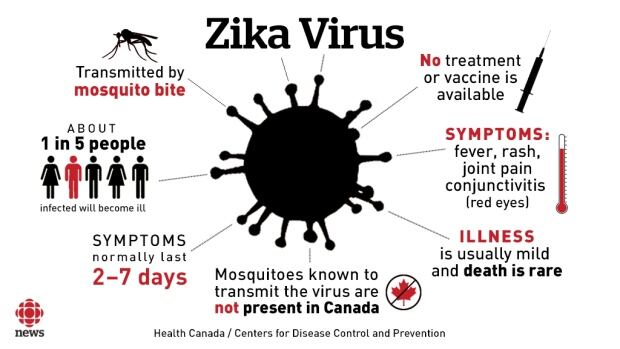 Zika presents a clear and present danger to the US, both medically and economically. Think not? Remember the economic impact of SARS a little more than a decade ago? Those empty planes and hotels?
Then there are the costs associated with the births. And the neurological consequences (which seem to include GBS).
Will there definitely be an outbreak? No. But the setting for there to be is definitely there.
And the economic hit? You can't just write it off. Hopefully, it will be a lot better than the worst case scenario.
Mar
22
Andrew Grove RIP, from David Lillienfeld
March 22, 2016 | Leave a Comment
 There are many whom one might point to and declare that they are an architect of our society, or that the world would likely be dramatically different had they not strode upon the face of the Earth. Some might go so far as to suggest that the impact of someone is so great that the current world is practically impossible to conjure in the absence of that individual. Andrew Carnegie, Alfred P Sloan, Steve Jobs, and Bill Gates are all in that category.
So is Andrew Grove. Or I should say, was Andrew Grove, who passed early in the day:
I wrote recently about Grove’s place among the Intel Trinity. Unlike his peers at Intel (Moore and Noyce), Grove was directly involved in the creation of Wintel and all that it encompassed. Whether one thinks in terms of PCs, the internet, or the electronic controllers in automobiles (among other places), one sees Grove’s handiwork. It would be easy to wax poetically about the man and his accomplishments. He was not only a phenomenal CEO who shone in an age of phenomenal CEOs, he was a phenomenal teacher, both at Intel and at Stanford University. His course in the Graduate School of Business was easily the course most in-demand on the entire campus. At one point, there was a waiting list of GBS students hoping to take the course, never mind from disparate parts of the university.
A refugee (escapee might be a better description) from communist Hungary, Grove might have taken a stance on the political right. He did not, and was among those who championed the Democratic Party in one of the few geographical areas in California in which the GOP was even somewhat competitive. He was a tireless support of the Silicon Valley Jewish community and worked furtively to develop strong ties between SV and Israel. It was no accident that Israel became not only one of Intel’s research centers but also a major microprocessor manufacturing center—and that faith was returned when the plant remained open during numerous attacks on Israel over the years, with barely a hiccup in production.
There is the oft-uttered phrase “We shall not see his likes again in our lifetime.” It seems likely to apply to Dr. Grove. I hope that it does not, however. The world could use many Andy Groves. He will be missed.
Mar
15
Book Review: The Intel Trinity, from David Lilienfeld
March 15, 2016 | 1 Comment
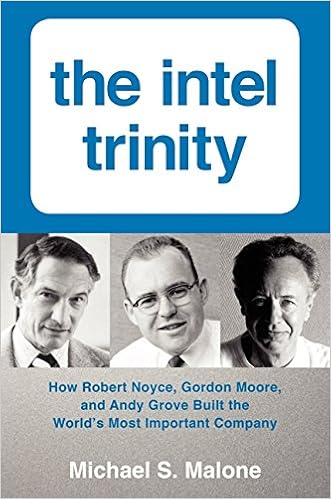
The Intel Trinity
by Michael S. Malone
First, this is an outstandingly written book, the post-war industrial biography of the Santa Clara Valley in California. It reads like a novel: Isaac Asimov meets Tom Clancy in the ease of reading. And the story presented is a compelling one. In short, it was an enjoyable read. Let’s dig a little deeper.
One of my majors in college was electrical engineering/computer science. It’s a bygone era. No one remembers much now about Unix, Version 6 (the first version that allowed the computer, typically a PDP-8 or -11) to perform such that one didn’t think there was really a washing machine trapped inside the cabinet of blinking lights. I doubt that many recall when MSI stood for middle scale integration or LSI for large scale integration, indicative of the density of transistors on the chip. Ask an engineering student about an 8080 and you’re as likely to be told that that’s a low starting monthly salary for her to receive upon hiring just after graduation. That the 8080 (and arguably the 8008) is the origin of the modern PC is probably something about which she has no idea.
[This review continues here.]
Feb
23
The Orioles Spring Training Camp, from David Lillienfeld
February 23, 2016 | 1 Comment
 Sixty feet six inches. The distance a baseball with minimal spin flutters in the the breeze as it meanders its way towards home plate. The knuckleball. Generally, if the batter swings at the pitch, he would likely look foolish—he has no better idea of where the ball may go than anyone else—pitcher included—does. And in catching the pitch, the catcher may also look pretty foolish. David Skaggs, a one-time catcher for the Orioles, kept an extra-large mitt when his battery mate was a knuckleball pitcher. (Take a look at one such pitch The only pitch that made a batter look nearly at foolish was the Sandy Koufax curve—attested to by both Willie Mays and Hank Aaron, neither of whom was exactly a slouch in the batter's box. (Yogi Berra is reputed to have observed—whether at a World Series or spring training game—during a Koufax warm-up, "I understand how he won 27. What I don't understand is how he lost 5." Maury Wills, the Dodger's infielder, responded, "He didn't. We lost them for him.") Arguably, Mariano Riviera's cutter came close, too.
The knuckleball is one of the more difficult pitches to master in baseball, so much so that it merited exploration in a documentary. It can be effective as a means to dominate a line-up, though, and it's easy on the arm (which means it may be better for those little leaguers who are determined to screw up their arms in throwing curve after curve after curve). RA Dickey demonstrated a few seasons back that its mastery can lead to that pinnacle of pitching performance, the Cy Young Award. And recently too, Tim Wakefield has used it to great effect too. The physics of the knuckleball is described in this link. I'll leave that part of the pitch alone.
Supposedly, it can be traced back to the early years of last century, but I suspect it was around even before, though probably unnamed as a pitch. A knuckleball travels at a seemingly impossible speed of only 60 or so mph. Not much force behind it, also one of the features that aids in minimal wear and tear on the throwing arm. Of course, with that speed, stealing a base or getting a good jump on the pitch is easier. I don't know the stats on runners thrown out trying to steal when a knuckler was on the mound.
It will be interesting to see if Gamboa makes it to the starting roster in Apri. Hoyt Wilhelm was also a knuckler. Also an Oriole. I wonder how many teams have had one knuckles, never mind two, in their history, though the Senators had an starting rotation of knuckleballers during WW2. Only 75 pitchers in major league history have thrown knuckleballs as more than an incidental pitch, i.e., in a deliberate way.
The Orioles have made a concerted effort at developing knucklers, with Phil Neikro attending a few of the Os' training camps. Buck Showalter was the one who started Dickey on the knuckleball path; A Cy Young suggests that it was a good decision by all. It's not hard to understand Showalter's thinking: Throwing the knuckleball is a long-term commitment, one that may not mature for several years. But it's a pitch that's easy on the arm. Speculating a bit, it's not hard to imagine going back to a 4 man rotation with 3 or 4 knucklers in the starting rotation. That means there's space for another hitter or a stronger bullpen. Win-win. Moreover, an older pitching staff means more maturity during the inevitable ups and downs of season—and good minds to train younger players who might even be in the minors and attending spring training. And those arms, even on an older pitching staff may not be quite the headwind that it would be if the staff were based around 95 mph hardball throwers or breaking ball pitchers.
This year's Orioles spring training camp promises to be an interesting one. Perhaps the season will be a fruitful one.
In any case: Play ball!
Feb
6
Zika Watch, from David Lillienfeld
February 6, 2016 | Leave a Comment
 Mosquitoes aren't going to be the means by which this virus spreads in the US. And health officials have likely made a mistake suggesting that the risk in the US is low. That's not a statement that an outbreak is imminent, just that there's more to this virus than just swatting flies.
And don't be surprised at the economic effects. SARS, you may recall, led to essentially empty planes flying to and from Hong Kong for a period (albeit somewhat short) of time.
Any sense of what the impact of zika will have on the Olympics this summer? Not that Brazil needs any help in figuring out new ways to torture its economy (the nationalization of Petrobras being Exhibit A), zika may have an economic dimension the effects of which aren't yet fully appreciated. I wonder how big the tourism industry is in Brazil.
Stay tuned, same bat time, same bat station.
"Brazil Finds Zika Virus in Human Urine and Saliva, but Risk Is Unclear"
Jan
18
Chris Davis, from David Lillienfeld
January 18, 2016 | Leave a Comment
 It will come as no surprise to readers of this list that I am an Orioles fan. Like most fans,
(In 33 days, Orioles pitchers and catchers report. Spring is almost here. It's raining in NorCal and there's snowpack at Lake Tahoe. Almost all is right in the world.)
I enjoyed the dominance of the 1970s (actually, 1969) through the early 1980s, and living through the dim times at the beginning of this century. The Orioles traditionally were built around pitching defense and the 3-run home run (aka Earl Weaver Specials). Speed didn't much matter, contact hitting didn't much matter, bunting and such didn't have much of a place, hit and run wasn't of consequence (though these days, the Os are hardly unique in that regard), and so on. And Orioles Park at Camden Yards (aka Camden Yards, or just Yards for the locals—23 years young and still one of the greatest, if not the greatest, places to watch a ball game in the baseball universe) is certainly a ballpark made for power hitting left-handers, with 318 ft down the right field line.
Of course, not every major hitter the Os have sent to the plate at the Yards has been a left handed one. Cal Ripken spent half of his epic career (no, not just the streak, but the 400 HR and 3,000 hits) at the Yards—always as a righty. More recently, Nellie Cruz dominated the HR race as a righty at the Yards. But lefties have an advantage.
Enter Chris Davis, the Os All Star first baseman. Davis started his career in Texas, and it's pretty clear that it's principally been since coming to the Os that he's experienced success. Lots of success. Twice leading the AL in homers, once in RBIs, and if he didn't strike out so much chasing some awful pitches, he may have gotten a Triple Crown. Alas, it was not to be.
This year, Davis is a free agent. He's been offered $150+ mil for 7 years. Not chump change. But the Os have made it clear to Davis's agent, Scott Boras, that the offer is what it is. Some have even suggested that the offer has been withdrawn )including the Os). But if Davis were interested in accepting it, I doubt there would be the least hesitation from the Orioles front office in putting it back on the table. Meanwhile, Boras is shopping Davis as a first baseman-left fielder. That latter one is interesting. I can't imagine Davis hitting as well while learning left field on a permanent basis. But he is getting shopped around, and some have suggested that Detroit will pick him up and drop him into left field. Maybe. But one of the things that no one has ever suggested about the Os, even during the awful 2000-2010 period, is that the team lacks heard, lacks soul. Cruz made it pretty clear that he wanted to stay in Baltimore. Seattle apparently made him an offer impossible to refuse.
So what will happen with Chris Davis? If I were a betting man, I'd bet that Davis is going to play for the Tigers next year. Fortunately, there are only a limited number of games that the Os would have to face him. I think he might find that his performance isn't quite what he's used to, at least for a year while he learns a new position. As for relations between Scott Boras and the Os, well, it's baseball, there's always next year. At least Duquette actually did something this winter.
Nov
2
US Manufacturing, from David Lillienfeld
November 2, 2015 | Leave a Comment
Let's say that US manufacturing continues to comeback. How much of an impact will that have on the US economy. Manufacturing doesn't seem to generate the jobs it once did. Roger Arnold's suggested that it's unlikely to ever do so again. It may generate wealth, but for whom, and where does that wealth go? Back into the US economy? Outside the US? Would such a development foster income inequality? The re-unionizing of the economy? If manufacturing begins to again create wealth in the US to an increased degree than in the past, will that lead to a strong dollar? Lower interest rates? Perhaps an increase in the velocity of money?
Or is manufacturing sufficiently small as a part of the economy that the effect is muted at best, no matter what it might be?
Or is the effect irrelevant because once oil prices rise (albeit not to their former highs), manufacturing in the US again becomes inefficient compared to elsewhere in the world and this is just a temporary blip best ignored.
anonymous writes:
Where any wealth goes is a function of taxes.
Assume for a moment that energy is free, such that manufacturing could occur anywhere. Where then would it occur? That depends on the other costs. Labor immediately comes to mind, but quickly followed by robots who tend not to unionize. So labor might not be a determining factor. Proximity to bulky raw materials might be an issue, but with free energy the costs of shipping are minimized. What then? Taxes, friends, are the ultimate cost of production. Of course certain politicians don't believe this because they have never run a business. However there are examples. Consider those businesses in which the end product is a service. Where do they locate; why in the most tax-friendly place. And those businesses in which the variable cost of production is small, such as pharmas, have been merging to locate the head office in a favorable tax jurisdiction.
Nov
2
China and the Plane, from David Lillienfeld
November 2, 2015 | Leave a Comment
China is building a commercial plane. One might expect nothing less from the world's largest economy. However, that said, China still has not "created" a new industry. Neither has Japan. Given the focus on the group as opposed to the individual, I doubt that either ever will. Innovation is, at its core, an individual activity, a gift for the West deriving out of the Renaissance. (I am sure some of the scholars on the list will contest that interpretation, but I submit that it is one reason why economies in countries lacking freedom of expression have little in the way of innovation—if an individual fears saying something, the chances of creating or developing a new idea are notably reduced (if not practically eliminated).
By new industries, I do not mean a new variant in an existing industry but rather something that is transformative. For instance, the British with steel and coal (maybe railroading—I'm still undecided on that one). Italy with banking and music, possibly wool (again, I'm not sure about this one). The US with oil, aerospace, entertainment (media generally? I'm not sure of that one), computers and the net, electronics, atomic energy (and commercial energy for that matter), automobiles. The British, news. The Dutch corporate finance. (sufficiently different from banking as to qualify as a new industry.) Germany, publishing. (I'm not sure about defense and Germany.) And so on.
Britain's development of radar was an innovation, sure. It didn't create a whole new industry. Ditto for Japanese innovation in the atomic energy industry. (Carder's counter to this idea.) And for all of the economic growth in the Union associated with the American Civil War, US economic leadership would await its industrial revolution which didn't start until well after that in Britain and wouldn't pass the British untill the 1900s when autos, oil, and entertainment began as industries in the US.
Not every industry was created by one country. The pharmaceutical industry for instance was a creation of Germany, Switzerland, and the US. Ditto for chemicals. The British and Germans together developed the chemical industry.
I don't think it's an accident that creating these industries took place during the height of the economic influence of these countries. China and Japan have shown an amazing ability to grow economically by perfecting existing industries, but there is a limit to how much one can grow an economy in taking this approach. This may be contributing to the Japanese malaise. The Soviets did the same thing in its push to industrialize during the 1930s. It caught up. It didn't create. And it was no accident that the Soviet economy topped out in growth in the 1970s.
There are some interesting corollaries from this idea. First, for all of the rancor about the US going in the wrong direction, the US has been creating new industries. The internet was an industry created in the 2000s. (Were there internet companies in the 1990s. Sure, but as an industry? I think one can reasonably challenge that idea. It wasn't sustainable as an industry until the 2000s.) That said, I'm a bit challenged to name other examples in the US, though I'm equally challenge to do the same for the rest of the world. Maybe that's why global growth is slowing down. Just a thought on that one. I have to wonder though, what new industries will develop in the digital economy. And I'm not sure how to categorize the "sharing" industries like Airbnb. Is there even an industry there?
And for all of the problems of a government program (centrally planned) like Apollo or the Manhattan project, there were whole new industries created in their wake—developments that in diverse ways paid for the costs of those programs. (I'll note as well that for both Apollo and Manhattan, the science was pretty much established by the time the projects were launched.)
Another corollary is that for all of the interest in the economic growth of Europe, the Europeans haven't produced a new industry in at least a century. European economic growth will likely be stymied until one again sees new industries emerging in it.
Is this thesis flawed? Maybe in some aspect, but I think the observation stands. Is such innovation the cause of economic growth? I won't go that far. But it is at least an indicator not only of economic growth but of economic leadership. I don't see such leadership coming from China or Japan anytime soon. Will China remain the largest economy? Perhaps. But as the Soviets demonstrated, there are real limits to how far an economy under a totalitarian government can take an economy (and that's beyond just being centrally planned, which has its own set of problems).
Aug
14
Humboldt’s Law, from David Lillienfeld
August 14, 2015 | Leave a Comment
Since Rocky is taking a 4 week from posting, I will take the opportunity to miss a usually well deserved intellectual slap to the back of the head and note that we will soon have a test of Humboldt's Law on the importance of the time versus magnitude of a bubble versus the intensity of the deflation.
In Canada, housing has been on a 12 year bubble. It will deflate at some point. 12 years is, I suggest, a long period for a bubble. Let's see what happens during the inevitable deflation.
Alex Castaldo clarifies:
Humboldt's Law of climate says that the temperature at a certain point on the Earth depends on both the altitude above see level (the higher the altitude the colder it is) and on the latitude (the further away from the Equator, the colder). Humboldt's Law of market crashes is David Lilienfeld's idea that the severity of the crash depends both on the price runup and the length of time the bubble lasted,
Aug
10
Canary in the Mine Shaft? from David Lillienfeld
August 10, 2015 | 1 Comment
 Since the situation may well be worse than this data suggests, my question is how can China maintain 5% growth this year, never mind 7%. Or will the economy hit a wall?
Ralph Vince writes:
It is not like our economy at all. Whereas we panic over QE this or that, there the government owns everything. It can go on forever.
Jul
23
Coffee, from David Lillienfeld
July 23, 2015 | 3 Comments
 As some might recall, I follow coffee pretty closely. And while coffee trading may be a relatively closed shop, the price still responds to supply and demand. I recall from my econ class that even monopolies have to factor in the reduction in demand consequent to an increase in price unless the good is inelastic. That's four decades old, though, so maybe my recollection is off.
Here's the thing: oil's dropping as the supplies bulge and the dollar strengthens. Gold's weak as well. That fits a deflationary environment. Increasing interest rates fits an inflationary one. Coffee remains weak, trolling multi-year lows. What's intriguing to me about this is that evidence continues to grow that the el Nino taking place is getting stronger, and there's now discussion of whether this year's even might be stronger that the record one in 97-98. El Ninos generally mean the coffee crop is smaller than average. So while weather developments suggest a reduction in supply, pricing suggests a marked decline in demand, too. Either that or deflation with a stronger dollar.
Maybe I'm missing something here. (I probably am.) Anyone care to help me understand this better?
anonymous writes:
Procter & Gamble, Starbucks, Sara Lee, Kraft, Tchibo and Nestlè control 60% of the market. Actually they are in overproduction, 120 million bags (sixty pounds) of coffee products, 105 consumed. The inventories accumulates from year to year.
They are trying to introduce into the market a GMO coffee variety whose seeds ripen all at the same time, greatly cutting production costs and collection costs, allowing automatation. They are destroying the lives of 125 million people, mostly small-scale farmers and their families for profit in exchange for a coffee built in the laboratory.
Andrew Goodwin writes:
Has anyone else made the same observation that nearly without fail, the same people who make the sternest warnings about climate change are the same ones who mostly firmly protest GMO food?
If the climate is changing then please explain why the crops that worked in the old climate will succeed in the new one. Sometimes it is enough to make me think these folks are going to succeed in starving us all.
In this case, respectfully, it seems that some parties would rather see higher coffee prices, which they think will help some number of people. They don't consider that the destruction of the Brazilian rainforest to make room for coffee plantations, profitable only with prices at higher levels, might have catastrophic impact on humanity in the longer term.
Michael Ott writes:
I've noticed that those that are vocal about climate change tend to make arguments based on the overwhelming scientific evidence. Yet when pressed with overwhelming evidence about the safety and benefits of GMOs they ignore it or claim it's a conspiracy. They make fun of those who ignore climate change science or claim it's a conspiracy. It's all hypocritical. This article was thought provoking: "Unhealthy Fixation: the war against genetically modified organisms is full of fearmongering, errors, and fraud. Labeling them will not make you safer."
Jim Sogi writes:
The Kona Coffee specialty crop will be big this year. There are a lot of beans and just starting to ripen. We had some big rains right at the beginning of the season and there were rows of fragrant coffee flowers early on. The coffee borer was bad last year, but as with many natural cycles, it is not as bad this year. With the trees stronger from good rain, the pests can't get as big a foot hold. There is not enough Kona Coffee to make even a drop in the world wide market, but it's what I grow, harvest, process, dry, roast, grind and drink. There's not many coffee gourmets who can say that.
My son got me a nice Rancilio grinder. It's made a huge difference and now I enjoy real Italian style espresso and cappucinos. It's a game changer compared to the cheapo grinders and results in a very even fine fine grind which you can't get any other way.
Stef Estebiza writes:
There is a ton of material about the problems with GMOs, and not only with the way in which they are then treated with pesticides. The list is long, but lobbyists' interests are mor profitable and important than your health. Here are two articles:
"Cancer Viruses Are Deliberately Inserted Into Your Food"
GMO: Study Shock, Toxic to Animals and Man
Michael Ott replies:
Stef,
Those articles are perfect examples of unfounded claims. This quote is just false: "because they are heavily contaminated with the toxic herbicide, Roundup". Literally dozens to hundreds of tests have been performed and prove the opposite.
False: "petunia plant which is a nightshade. That means folks with nightshade-induced arthritis can now get arthritis from soybean products." This has never been shown in a valid scientific study. Rather it's been repeated by pseudoscientists from a base false claim.
The second article showed results based on massive unrealistic doses and has been widely discredited.
Jul
16
Fintech, from David Lillienfeld
July 16, 2015 | Leave a Comment
Four years ago, I asked some investment bankers about fintech supplanting their businesses. They laughed and opined that there's too much personal interaction, the human touch is key they said for their businesses to operate. I recall hearing the same thing from car dealers a bit more than a decade ago (shortly before I bought my current car—a Honda Civic with 110,000 miles under the hood (ain't stick shifts great!)) and they insisted that people needed to see and touch a car to buy one. Then there were realtors. I'm not sure that real estate has quite reached the stage that car buying has, and the need for in person inspections prior to signing the paperwork will likely continue for sometime, but there may be some improvements.
Looking at successful internet companies like Facebook or LinkedIn suggests that they owe their success in taking a key human activity and digitalizing it. Banking beyond loans or brokerage-related activities would seem ripe for such exploitation. There are already such efforts moving forward in the VC space. In Africa, mobile banking of all sorts is the growth sector of the banking industry. But I know of no investment banks that have been digitalized, never mind successfully so. Does anyone know of any instances of this?
"Bitcoin is the 'Napster' of finance — and there'll be an iTunes"
Jul
5
Greece, from David Lillienfeld
July 5, 2015 | Leave a Comment
 I was looking at Greece's unemployment rates historically last night and found something interesting. The Greek economy seemed to hit a pothole in 1981 from which it never extricated itself. Between 1980 and 1982, unemployment tripled, and has stayed that way as a base since then. (I say 1981 because the rate didn't return to where it was, it increased.) Now, there were recessions in the US in 1980 and 1982, and Greece is a tourism-based economy. So a short-term increase in the rate can be explained in that way. However, that doesn't explain that the rate didn't go down in the 1980s. Why? Any suggestions as to the reason? It seems to me that that reason may provide more insights to the current situation than simply that the Greeks lived beyond their means. Something changed in their means.
Alex Castaldo writes:
According to Greek analyst Nick Tsafos, one reason for the low growth rate that started in 1981 was monetary mismanagement.
From 1953 to 1973 the 'third drachma' like most currencies was tied to the dollar; the exchange rate was 30 GRD per USD. This was the period that Greece experienced its best economic performance.
After the mid 70's the currency floated. It was (in round numbers) 58 in June 1981, 148 at the end of 1985, 157 at the end of 1989, 240 at the end of 1994, 328 at the end of 1999 and 325 in 2002. (In 2002 the Euro was introduced).
In other words from 1981 to 2001 the GRD was a 'soft currency' that allowed the Greek government to finance itself easily at the cost of higher inflation and currency depreciation. It could create government jobs, pay generous retirement benefits and get away with it by issuing more drachma. And the Greek politicians were masters at this kind of thing, buying support with monetarily financed expenditures.
The inflation ended in 2002 with the introduction of an externally managed currency, the Euro. For a time everything seemed wonderful. But old habits die hard and the politicians kept up their old ways of solving problems. Government debt increased but interest rates were very low, so it did not seem to matter. But the debt this time was hard debt, that inflation and devaluation would not erase…
Now for a rhetorical question: if Greece abandons the Euro and introduces the new drachma, how do you think the new currency will be managed? The past history is not encouraging.
Jun
25
The Next Debt-Based Crisis May Not Be in the US or the EU, from David Lillienfeld
June 25, 2015 | Leave a Comment
 Will China liquidate its holdings of US debt to pay for the recovery?
"BLACKROCK WARNS: China's debt has lost its potency and is now 'turning into poison'"
Jordan Low asks:
What would they do with the US dollar? Convert it back to RMB and hurt Chinese exporters?
Rudy Hauser writes:
To get rid of dollars they could import goods and services, make investments dominated in other currencies or buy other currencies. They could just invest in other U.S. investment possibilities (including equities, real estate, etc.) In the aggregate the only way foreigners can get rid of U.S. dollars is to buy goods and services. They can also make fixed investments, but the returns and proceeds upon sale would be in U.S. dollars, so they would not really have reduced their dollar holdings. They can of course make investments in the U.S. that decline in value. (They could also convert to currency and burn it, but that is not a logical choice.) An other alternative is to give the dollars to Americans as a gift, another unlikely choice. Yes, the Chinese could buy RMB for dollars if they find someone who has RMB to sell. To the extent Americans hold RMB that they would sell for US dollars, the gross positions would change but not the net positions.
Jun
22
 I like the part of The Boys in the Boat where the freshman coach pretends that Cal can beat them handily. The necks of Cal swell even further making it even for Washington to cut them off. I followed the same principle in squash, and never admitted that I had a chance to win. I also never admit to a profit in the market for the same reason. It will be interesting to hear what Mr. Rafter has to say about The Boys in the Boat because he has won many national rowing championships. In particular the wisdom and ability of George Peacock, the world's best boat builder, whose materials in wood have now gone with the wind.
David Lillienfeld writes:
The beauty and terror of baseball is that there is no clock; and the second you stop thinking about the next pitch, you are on the way to losing no matter how big a lead you have. What made last year's 7th game so good is that neither team ever once lost that focus; the game score was as close as one can be, but neither team ever for a moment got "tight" thinking about the end result before play was over.
Alston Mabry writes:
Yes, in games like basketball or football or soccer, you can work the clock. But baseball and tennis have that exciting element of the game not being over until it's over.
anonymous writes:
I have had the pleasure of seeing some true greats in action over extended periods of time in the markets. The only time these guys really lost any money was when they ignored time.
A fixed clock on any speculation in the organized macro markets is vital in my opinion and experience.
Unlike most things we discuss, the addition of fixed clocks (or predetermined holding periods for individual speculations) is actually countable and its efficacy is testable.
Jun
19
The Phillies, from David Lillienfeld
June 19, 2015 | Leave a Comment
 The Phillies this year stink. Simply stated, they can’t get out of their own way. The team is off on so many different dimensions, it would difficult to overstate just how bad things are. And there comes a point where the random sorts of things, like injuries, maybe aren’t so random given that players begin to push well beyond what they should out of frustration. Case in point, the injury to Williams, pitching on Tuesday in the Os vs Phillies game. (And that was why I took a look at the Phillies.) Granted, it was just a blowout, but a 19-3 blowout isn’t just a matter of pitching batting practice for the opposing team. On Tuesday, it got so bad that a position player was brought in to pitch—and he did at least as good a job as the real pitching staff. Or at least no worse. Perhaps in a nutshell, that communicates why this team is at .333 this late into the season.
Yesterday, the Phillies entertained the Os just up I-95. I thought that as the home team, the Phillies might hunker down and make a good game of it. A good enough game that the tedium accompanying a good 40 minutes on the bike at the gym could be relieved by watching the game. Fat chance!
The Orioles won 6-4. The score doesn’t sound so bad, right? Perhaps, but consider this: An American League pitcher with a career batting average of 0.115 (from his time at Colorado) not only legs it out for an infield base hit, but also rings up an RBI! That’s pretty bad.
I guess the question now is whether Ryan Sandberg (the Phillies’ field manager) makes to the All Star break, or is he fired in the next few weeks.
I gotta feel for Phillies fans. I’ve been there, and it’s not much fun.
Jun
10
Argentina, from David Lillienfeld
June 10, 2015 | Leave a Comment
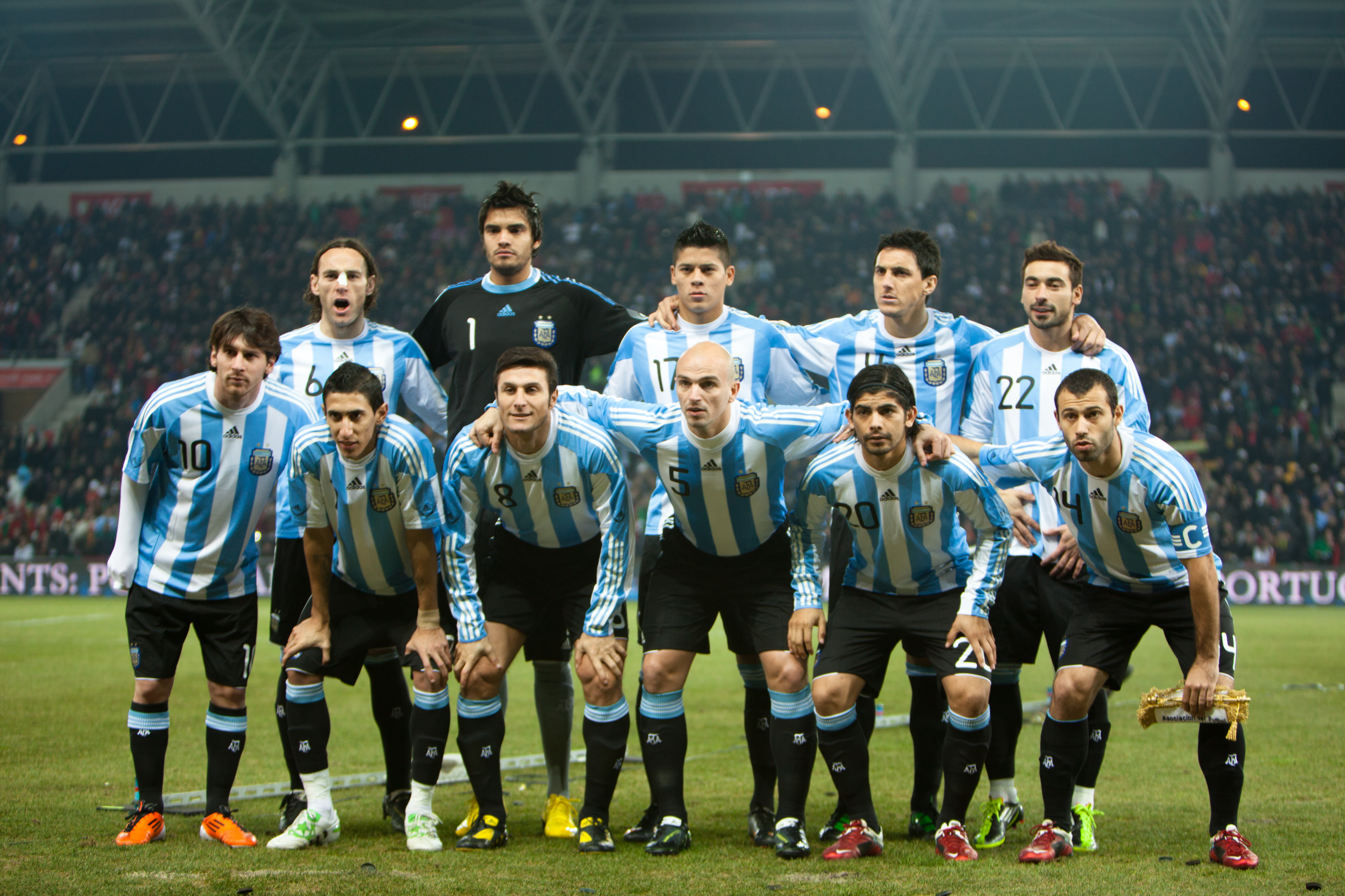 It's lots of money, but it doesn't sound like any of the debt is held by banks: "A judge ruled Argentina owes $5.4 billion, not $1.7 billion — now here's the freakout everyone expected"
anonymous writes:
The basic problem is that there is no international bankruptcy court. The reality is that the vast majority of the bondholders accepted the restructured notes. Had this been a domestic bankruptcy with that many noteholders accepting a deal, bankruptcy court could have been used to force the others to accept it as well.
anonymous writes:
Argentina offers great travel value with exchange rates, I'm guessing here, on street of probably close to 20 pesos to the dollar. They're hungry for the dollar. The wine is very very good,the food very tasty. The countryside is beautiful. The mountains big and snow covered. So their problem is our opportunity. It is much more cosmopolitan than I had imagined and there are many lively young people. It is much more European than Mexico and many of the people have European ancestry and it retains cultural affinity with Italy and Germany in some areas, hence the good wines.
anonymous writes:
There is a black market for US$ as well as a blue market, even better rates for yanks. Easiest way for us to change there earlier this year was at casinos that were substantially better than black market. Their rate, of course, on the bet you would wager so we took the bet at their excellent rate and walked happily out of the casinos. Mendosa is a must for wine and foodies.
anonymous writes:
Agreed with Larry.
If I had to give it all away and go somewhere, I would move to Buenos Aires in a flash. Buy a motorcycle and travel the country on a motorbike.
Jun
8
 He's the first pitcher in MLB history since 1995 (and second since 1900) to throw with both arms.
But he's by far the best to do it. I never thought he would make it to the bigs given that he has velocity issues… but what a great debut.
He's not an Eddie Gaedel gimmick. This could be fun to watch for a few years. And, his story is very interesting.
Go Elephants!
Jun
1
The Crack of the Bat, from David Lillienfeld
June 1, 2015 | Leave a Comment
 A recent post by Tim Melvin noted that Baltimore may be a shit hole, but it's our shit hole. That of many of us on the list. Even if we no longer live there, we identify with it. The glory of Fort McHenry. The commanding of Johns Hopkins. The ignominy of Bankruptcy Tower. The notoriety of Payoff Row. The poverty and lack of hope for a better life in some places in the city. And of course, The Block. Once two blocks (go figure), it's now not even one. Maybe that's the effect of being right next to the police HQ. Add in a dysfunctional education system in the city, the three decades of the departure of industry and the conversion of the town to a bedroom community for DC (in part), and you have a shit hole. I'm sure that some (many?) may contest that conclusion, but try contesting the elements leading me to it.
In the 1960s and early 1970s, if one were to hear a screaming crowd at Memorial Stadium, 33rd Street, Baltimore, chances were good that it was Sunday and the Colts were playing at home. The stadium was usually sold out. It was the era (the "Diner" era—and the Hilltop Diner really did exit, across Reisterstown Road from the Crest Theater—providing relief from the infernal Baltimore summers—and Barcelona Nut Shop) when Colts season tickets were inherited and valued as much as a car or a prized bottle of Lafite or Mouton. It was the golden era for the Orioles, but they did not commandeer the attention, the love the Colts did.
But all of that changed in 1979, specifically June 22, 1979. Edward Bennett Williams had just bought the Os and was complaining about the lack of enthusiasm (and attendance) by the good people of Baltimore. Maybe the team should move to Washington. Lots of interest in DC. and it took forever to drive back to DC. By his chauffeur. The BCPD tailed him once and clocked his trip as 45 minutes, not much more than from York, Pennsylvania (Birdland North) to the Grey Lady of 33rd Street It was the night of the birth of "Orioles Magic," which eventually had an accompanying song (until "You can do magic" replaced it for when relievers entered the game in a tight pitching situation during the early 1980s).
So 1979 wasn't shaping up to be a great year for the Os. Until June 22, 1979. On that night, in the bottom of the ninth, with one on, Doug DeCinces homered to left field. Anyone in the stadium that night will surely remember it. The roar of the crowd was deafening, and the stadium didn't really begin to empty for at least 15-20 minutes after then. Carley Eckman's call (I was listening on a transistor radio, not unusual for someone in the bleachers, not far from the orange and black "Here" flag) was memorable, too. Objective calling of the game flew out the window that moment. The entirety of the Orioles team greeted DeCinces at the plate (for DeCinces, the hit became, at least in part, redemption; it's hard being the position successor to a baseball legend, the "human vacuum cleaner" aka Brooks Robinson), making for an award-winning photo. The next day, a Saturday, that HR was the talk of the town. The following Monday, discussions around the water coolers and over coffee included at least some mention—and often much more—of the HR. 1979 wore on, and the Birds flew high. No one expected much of that team. There were few dominant players, and it was the rare season when Jim Palmer was out of sorts during the season. The World Series that year found the Os against the Pirates, losing in seven games with the final one at home. It was the last time that a visiting team won the series in seven games.
The night of May 29, 2015, also a Friday night, may go down as the renaissance of Orioles Magic. The game was a hard fought pitchers' dual. Gonzalez had pitched a good 8 innings for Baltimore, giving up only one run—earned. Going into the ninth, the score tied, at 1-1, Darren O'Day, a journeyman pitcher who had become the Os middle relief/setup man, came in, proceeded to give up back-to-back hits and promptly loaded the bases with no one out. A situation pregnant for a hit and an RBI to take the lead. But that wasn't the script that was followed on that Friday eve. What followed were two strikeouts and the final out of the inning, a grounder by Elmore to Machado for an unassisted out at third. O'Day had thrown 24 pitches that inning. 24 (or was it 25?). One inning. That's a lot of pitches. For that final out, the crowd was on its feet and the Camden Yards reverberated with cheers and stomps. The bottom of the inning found Os on 1st and 3rd with 2 down. JJ Hardy, an infield specialist with a batting average south of .200 (Orioles faithful will recall Mark Belanger as having somewhat better production at the plate, which isn't saying much), strode to the plate and promptly hit a single to left field. It was all that was needed. Somewhere between 1st and 2nd, after the winning run had been scored, the Os mobbed Hardy as the sellout crowd registered its approval.
The night felt like that of June 22, 1979. One of those days when many in Birdland can recall where they were when DeCinces homered. Will the Magic reappear? The excitement? Hard to say. Let's revisit it in a month. This year's Os are hardly dominant in just about any position on the field, save maybe Zach Britton as a closer. Jimenez is having a good year, and compared with 2014, a great one. But that's about it. And the Os are in 3rd place in the AL East as a result. One game under .500 and one game behind the Yanks. Who ever would have thought that a third of the way through the season the pace would be set by a team one game over .500. At least the Birds have the best home record in the division. So the team has its work cut out for the next three months—not to violate the first rule of holes for the next month as it gets its act together and the, in a reprise of last year's performance—rise to the top.
We've had some discussions recently about the decline of baseball in the US, and yes, the sport has had its troubles. But it's always managed to find a champion and grittily renew its place in the national entertainment firmament. Babe Ruth, Cal Ripken.The sport is shaking off the self-induced haze of the steroid era. And the helicoptering of kids doesn't auger well for a rebirth of the national pastime, which has indeed become passed time. As the country struggles economically with a recession possibly looming over the horizon, with dysfunction in DC and political sex scandals seeming to be the order of the day (I don't recall them being this common, but maybe it's like FDR's wheelchair, no one ever reported them)—the latest being inappropriate touching by the pre-political life former Speaker of the House (does it much matter that it was pre-political life?)—it must have been some serious touching to merit a $3+ million payoff—the country needs to rally around something. As President Snow observed, hope is the only emotion stronger than fear, and while complacency is the rule on Wall Street for the moment, there's some fear being voiced by those with memories of times before ZIRP, of times when interest rates actually ascended, not declined. Memories of the early 1980s. With deflation the concern du jour of the NFL if not the BEA, it may be baseball's time to shine again.
So, in Baltimore, is it Orioles Magic, 2015 edition? We'll see. As for the moment, it's to be savored. Go to war, Miss Agnes! Let's go Os!
Play ball!
Stefan Jovanovich writes:
This notion of baseball's "decline" is entirely a construct of the Fairness Police. There is now, in fact, far greater "diversity" (sic) among the players of Major League Baseball than there ever has been; the only problem is that the darkest-skinned players are more likely to be Cubans than American blacks. Measured by money paid to the players (baseball, unlike football and basketball and hockey, does not have a hard salary cap), valuations for franchises, television revenues, ticket sales, and concession revenues, these are the best of times. And, regarding the play itself, Buck Showalter is right: "this is the Golden Age".
Paul Marino writes:
Here is a great video of the great player for the Buccos, Andrew McCutchen, making some little kids' life last night when playing in San Diego.
Would love to see Pitt make a run at playoffs again, but in a tough division with the best organization in the league St. Louis playing .660 ball, almost a clean + .50bps win % over entire MLB.
anonymous adds:
I hated the fact that the Giants had to play Pittsburgh for the wild card; they have a wonderful ball park and a really great organization and they are all around good guys. So, clearly the plan for this year is that the Giants beat the Dodgers outright and the Bucs have their wild card game on the road.
Having your loyal fans cheer for you can be a tremendous handicap when it is all or nothing. The Giants have been lucky to be the road team in their "Big Games". The last 4 times they have won the World Series - 1954, 2010,2012,2014 - the deciding game was in the other guys' park. The one time it was at home - 1962 - they lost even though they had Willie McCovey at bat and the winning run on second base and he absolutely smoked the ball - right into the Yankees' second baseman's glove.
May
27
Clustering of Events, from anonymous
May 27, 2015 | 3 Comments
 Here is an article from the world of transport engineering. It's not too much of a stretch to apply something similar to observations and timings of magnitudes in financial markets:
Extract: "Why Buses Bunch at Single Stops"
Maybe you've waited at a bus stop for longer than usual, and your bus finally shows up. And then, immediately after, a second bus on the same route pulls up right behind. What gives? Why can't they stay evenly spaced to improve everyone's waiting time? Lewis Lehe provides an explanation in a small interactive game.
Two buses travel along the same route, starting off in opposite positions. They make stops and pick up passengers right on schedule. But then add in your own small delays, and you see bunching relatively quickly. It really doesn't take much to throw off the equal spacing…..'
Jim Sogi writes:
Watch the ocean for a while, or the beach. Random waves cluster to form set waves, larger than the rest, or rogue waves, which can be magnitudes greater than the average. I believe this is a function of randomness or alternately pattern formation from simple binary functions a la Wolfram.
Here's some good information about Three Phase Traffic Theory.
Jim Sogi writes:
When I go to the US Mainland and drive the big freeways for long distances, I try to drive about 2 or 3 miles per hour slower than traffic. Most try to drive as fast as they can and bump up against slower traffic groups, and results in waves of clusters of cars. It's more effort and emotional cost to try drive fast and requires more attention to try pass, notice and avoid slower cars, and cars next door. Driving a bit slower requires less attention, less stress as you set you speed, and allow other drivers to pass, avoids coming up on slower traffic, and allows you to drive in the spaces between clusters, the "lulls" so to speak. I'm not in a rush and find it more relaxing and you can see the clusters in the distance, and adjust to drive between them. In large urban areas, the clusters tend to be time of day (rush hours) and location oriented, except for accidents.
In markets, vol clusters and it's good to be aware of the lulls and clusters, the timing of them, the length of the lulls. It's like the lulls and sets in surfing. Trading also seems to cluster around the rounds, and time of day (arc sine).
In playing and composing music, it's important to leave "space" in the music, where there are fewer notes to allow emotional development.
Jonathan Bower writes:
 Mr. Sogi makes some very good observations. I drive 150 miles round trip every day for work. I see people in such a rush to "slow down" when they inevitably meet slower traffic (or jam). Maintaining a high average speed is much more important in determining length of drive (and better on gas). There is also a strong behavior bias to get in the left lane that frequently staying right, particularly in heavy stop and go, is frequently and consistently optimal.
Jim Wildman writes:
And mathematically, except on long, open road drives, speeding won't save you signification time even assuming you succeed in increasing your average speed.
You can't save 5 minutes on the typical 20 minute commute by speeding. You can if you are willing (and able) to run stop signs and stoplights.
I used to drive from East Texas (Longview area) into Dallas every day (about 115 miles). It was my observation that most radical speeding (10 MPH over) occurred where it would do the least good. Very few drivers speed in the truly rural areas, but once you get into the more potentially congested areas, the number of speeders goes up.
David Lillienfeld adds:
I've found that the frequency of speeding is inversely proportional to the density of police cars on the side of the road. The result is that you have lots of speeding going on on the interstates, punctuated by islands of drivers going at the stated speed limit. I don't know that the state makes much off of speeding tickets in this setting; I do know that it presents a nice the opportunity for accidents as cars slow down and then speed up. Twice, I've seen cars flip in the course of trying to avoid an accident while slowing down—once was just out of range of a radar gun.
Stefan Martinek writes:
I found that a good solution is to reverse the time zone. I had one period when I was living in the US time zone while in Europe. It is always good to avoid crowds. Gyms are also nice and empty around midnight. No clustering.
May
23
Memorial Day, from David Lillienfeld
May 23, 2015 | Leave a Comment
 This coming Monday is Memorial Day. That means different things to different people. For me, it will be my mother's yahrzeit, as well as remembering those whose efforts provided the cover under which the USA lives. But it also means the running of the Indy 500. And switching to the summer comforters. For one of my neighbors, it's setting up the outside grill for the summer—which he does after visiting his brother's grave (he died in Vietnam) at the national cemetery up the road. I'm sure there are lots of similar activities at one another's homes. Some many no longer give much thought to those whose deeds provide that cover, to those who sacrifice assured that we may live under it. But they should.
A couple of years back, Tim Melvin penned a piece that encapsulates the meaning—for at least some of us—of the day. (It will be reposted below)
It is one of the more eloquent expositions of the holiday.
Stefan Jovanovich comments:
 First of all, it was not Memorial Day. It was Decoration Day; the particular day on which the public would officially do what people regularly did on their own–go to the cemetery and put flowers on the graves of the departed. And it was a Sunday, not a Monday.
Second of all, how does anyone presume to speak for the dead in war? That is the sickest of all sick jokes. If you are lucky/skillful enough to survive one, the one thing you know is that medals for the living are pure vanity; and Grant was–as with so many things– right: parades are only tolerable if they are parties where you throw ticker tape out the windows (ticker tape, windows?) and can make noise in praise of the living. For the dead there should only be flowers, no speeches.
FWIW, the first decoration day was on May 1, 1865 in Charleston, SC. It was held in honor of the Union soldiers who had been held and died as prisoners of war and buried in a common grave. After the Federals occupied Charleston, one of the first things they did was give each of the soldiers' remains its own individual burial and marker. In gratitude for their liberation the Negroes in Charleston built a fence around the new burial ground and an arch over the carriage entrance. The "Union" cemetery was opened that May Day; according to the newspaper reports ten thousand people came to walk among the graves and put flowers on them. (This is what David Blight of the Rocky Ghostly Academy concludes from his research into the subject.)
For "Memorial Day" and this bathetic dishonesty, we have to wait for World War I and segregated mourning.
At least baseball still does it right; people simply stand in silence for a moment, as they did when they remembered Christy Mathewson, a casualty of that truly awful war.
May
23
It’s Memorial Day. Remember Me, from Tim Melvin
May 23, 2015 | 1 Comment
 David Lillienfeld writes:
Last year, Tim Melvin posted a classic piece about Memorial Day. It brought me to tears then, and it did so this morning when I went through it again. It is some of the most eloquent writing I have seen about Memorial Day, and it's a shame that it hasn't received more notice outside of this site than it has to date—it certainly merits it.
Tim Melvin writes:
They call to you this weekend. From Flanders Field, from Normandy, Khe San, Gettysburg, Concord and Lexington, the Chosin Reservoir, from the hull of the Arizona, and from all the hundreds of thousands of resting places marked and unmarked they call to you. The call to you from the depths of the Pacific and the jungle of Asia, from the deserts of the American Southwest, from the fields and cities of Europe, from Cuba, from around the world they call you with a request this weekend. Remember me.
Remember who I was and the hopes and dreams I willingly laid upon the altar of the great American experiment. Remember that like you I was once flesh and blood and I gave that up to secure a portion of the American Dream and secure essential liberties at home and even for people around the world. You may not have agreed with the rational for some of the conflicts we have ensnared ourselves in over the centuries and I am not even sure I fully understood it. But our nation called and I answered. Liberty carries a price tag and I paid it for you. Remember me.
War is an idiotic human endeavor and I wish we never had to go engage in such a wasteful exercise. But at times throughout history it has been necessary for good men to take up arms to secure our freedom from tyranny and defends ourselves against expressions of pure evil and hatred. When such times have arisen I have taken arms and defended the freedom and liberty in which I believed and for which all humanity years. Remember me.
Do not remember me with tears and sadness. Pray solemnly and shed tears if you must but that it is not my preference. Remember me in a violent celebration of all that is America. Take your families to the seashore and frolic as man has done since we merged from the sea. Go out on your boats and go as fast as you can over the waves with the winds of a free land and a free people blowing back your hair. Fire up your grill and invite the neighbors up for food, drink and laughter. This is why I laid down my life. Not so you would cry for me but so you could enjoy your life and your family, your loved ones and friends. Remember me in the laughter and joy of being alive.
Hear me in the sound of loud music coming from a dock bar. Hear me in the growling of a stock car engine taking a green flag or the whine of Indy car hitting 200 mph on the backstretch. Hear me in the laughter of a child skipping in the surf or running through the sprinkler in the back yard. Hear me in the chatter of friends around a BBQ pit. Hear me in the swell of an orchestral pop concert on a wide meadow as the sun settle over the land. In all the joyous raucous noises of being alive, hear me and remember me.
 See me in the flag unwinding in the breeze. See me on the baseball diamond, the soccer pitch the basketball court. See me at the bar with my friends raining a glass to good times gone by and still to come. See me in the smile of your wife, your girlfriend or male equivalent thereof. See me in the hammock beneath the tree taking a slow summer nap. See me in all the moments and times of that make life special. See me and remember me.
Remember me best in living well. Think of me when you are passing around the steaks and steamed crabs. Remember me as you sip the cold gin and tonic in a sweaty solo cup under a shade tree. Think of me in the fisszt of a beer bottle opening, the fizzing of soda pop in a glass, the shaking of a martini, the pop of a cork, and the tinkle of ice. Remember me in the sounds of the party of life.
I do not want you to remember me in solemn sweaty ceremonies and pompous parades of politicians. You do not need to go to the cemetery to remember me for I am not there. I am at the beach, the ballgame and in the backyard. I am at the lake, on the boat and fishing on the riverbank. Do not remember me simply because I died. Forgetting to duck or being ordered to charge impregnable positions is a crappy legacy if you ask me. Remember me because I lived and I died protecting your right and ability to live and experience all the joys and madness that is life.
I am not merely a dead soldier who died in the service of his country. I am all the things that were made possible by freedom gained and protected. I am Mark Twain, William Faulkner and Hunter Thompson and all the words written by the geniuses spawned in the America. I am the music spawned among a free and talented people. I am Robert Johnson, Miles Davis Liberace and Ted Nugent. I'm all the great scientists and inventors that have graced this land. I am Edison, I am Feynman and I am Ford. I am all the great athletes born in the towns and cities of this nation. I am Mantle. I am Unitas. I am Jesse Owens and Jim Thorpe. I am every greatness achieved by this nation born in a sea of blood and protected by rivers of it over centuries. Do not mourn me for the time has past for that, but remember me.
Remember me for I am also the future of this great nation I died to build. Remember me as you live, as you build as you work and as your create. Remember me as youprotect my legacy from the charlatans, thieves and idiots who make up our political class. Remember me when you refuse to cede personal liberties I died for to those who have good intentions and bad ideas. Remember me when you take chances and reach for your dreams and ideal. Remember me when you refuse to participate in limiting freedom or opportunity based on skin color, sexual preference or genital make up. Remember me when you dream, when you achieve and when you celebrate. These are things for which I died and for which I would be remembered.
My voice calls to you today. Life, love, laugh dream, build achieve. Do this in remembrance of me.
Happy Memorial Day. Remember me.
Stefan Jovanovich writes:
 Memorial Day used to be Decoration Day — the day when the graves of soldiers were draped in flags — and there was no official Federal date. In Gettysburg it was held on November 19, the day the cemetery was dedicated. In the South it was on various dates in the Spring. It was never, ever a day for speeches until the official South decided that the soldiers graves should be part of a general uprising to justify the Rebellion — the same political movement that gave us official segregation; at that same time - the late 1880s — the states began legislating official holidays for Decoration Day, they also made Jefferson Davis' birthday a state holiday. What we now observe dates only from WW II, and the date itself was fixed in the 1960s. It is strictly a Cold War ritual that has been revived for the war against unspecified terrors.
I hope Tim finds an equilibrium somewhere between thinking that everyone who ever died in uniform as a hero and believing war is everywhere and always to be considered the worst of all things. I hope everyone enjoys the ceremonies today. If I don't, it is not out of disrespect for what people have done. I don't like official remembrances for the same reason Grant hated parades; they tend, by their very nature, to be organized lies.
They allow the people in the reviewing stands to preen and they present a picture of order that is the very last thing that wars ever are.
The truth is that some wars are worth their awfulness and some are completely stupid. The people best qualified to judge are the ones who have done the fighting; as with so many other things in life, those who know the most are the very ones who don't say much. There are exceptions, like Professor Sledge:
"War is brutish, inglorious, and a terrible waste… The only redeeming factors were my comrades' incredible bravery and their devotion to each other. Marine Corps training taught us to kill efficiently and to try to survive. But it also taught us loyalty to each other - and love. That espirit de corps sustained us."
"Until the millennium arrives and countries cease trying to enslave others, it will be necessary to accept one's responsibilities and be willing to make sacrifices for one's country - as my comrades did."
anonymous comments:
I differ…greatly.
I preface by saying I have not served in the services nor in a war.
Yet I've known many…young, naive or foolish men who have answered the call. Many didn't believe in the cause and thought their superiors to be idiots. Yet they stayed and fought. I respect and remember that loyalty, and buy dinner or drinks for them and their family when I come into contact with them. I do it out if loyalty and not guilt. They upheld their end of the bargain. The least I can do is acknowledge them.
These are not the she-men that appear to surround me, those who talk about shat should be done yet are never there to do it. They have loyalty to no one.
There are pieces meant to rouse the animal spirits and conscripted ranks. I felt Tim's piece wasn't a call to enlist as other pieces.
The generation of Vietnam castigated those who were drafted and required to fight. That double bind or catch-22 has always bothered me. There's a similar thinking in DC now, where you are encouraged to break laws and obey them simultaneously.
One if the primary social contracts is to take care of your own. Tim's piece echoed that sentiment. The Chair demonstrates it too, as do many on the list.
In the Catholic Church, there are many celebrations of saints. I have learned, not having been raised Catholic, that many saints were far from perfect. There was a similar idea in his piece. Monday isn't a celebration of personal perfection or success in war. As Tim writes, it is recalling the guy who once sat in the empty chair at our table.
Semper Fi et Ductus Exemplo.
Ralph Vince writes:
There is nothing more inadvertently dangerous than a young man.
There is nothing more potentially vicious than a woman on her own.
One must tread carefully around these.
— keep looking »Archives
- October 2026
- September 2026
- August 2026
- July 2026
- June 2026
- May 2026
- April 2026
- March 2026
- February 2026
- January 2026
- December 2025
- November 2025
- October 2025
- September 2025
- August 2025
- July 2025
- June 2025
- May 2025
- April 2025
- March 2025
- February 2025
- January 2025
- December 2024
- November 2024
- October 2024
- September 2024
- August 2024
- July 2024
- June 2024
- May 2024
- April 2024
- March 2024
- February 2024
- January 2024
- December 2023
- November 2023
- October 2023
- September 2023
- August 2023
- July 2023
- June 2023
- May 2023
- April 2023
- March 2023
- February 2023
- January 2023
- December 2022
- November 2022
- October 2022
- September 2022
- August 2022
- July 2022
- June 2022
- May 2022
- April 2022
- March 2022
- February 2022
- January 2022
- December 2021
- November 2021
- October 2021
- September 2021
- August 2021
- July 2021
- June 2021
- May 2021
- April 2021
- March 2021
- February 2021
- January 2021
- December 2020
- November 2020
- October 2020
- September 2020
- August 2020
- July 2020
- June 2020
- May 2020
- April 2020
- March 2020
- February 2020
- January 2020
- December 2019
- November 2019
- October 2019
- September 2019
- August 2019
- July 2019
- June 2019
- May 2019
- April 2019
- March 2019
- February 2019
- January 2019
- December 2018
- November 2018
- October 2018
- September 2018
- August 2018
- July 2018
- June 2018
- May 2018
- April 2018
- March 2018
- February 2018
- January 2018
- December 2017
- November 2017
- October 2017
- September 2017
- August 2017
- July 2017
- June 2017
- May 2017
- April 2017
- March 2017
- February 2017
- January 2017
- December 2016
- November 2016
- October 2016
- September 2016
- August 2016
- July 2016
- June 2016
- May 2016
- April 2016
- March 2016
- February 2016
- January 2016
- December 2015
- November 2015
- October 2015
- September 2015
- August 2015
- July 2015
- June 2015
- May 2015
- April 2015
- March 2015
- February 2015
- January 2015
- December 2014
- November 2014
- October 2014
- September 2014
- August 2014
- July 2014
- June 2014
- May 2014
- April 2014
- March 2014
- February 2014
- January 2014
- December 2013
- November 2013
- October 2013
- September 2013
- August 2013
- July 2013
- June 2013
- May 2013
- April 2013
- March 2013
- February 2013
- January 2013
- December 2012
- November 2012
- October 2012
- September 2012
- August 2012
- July 2012
- June 2012
- May 2012
- April 2012
- March 2012
- February 2012
- January 2012
- December 2011
- November 2011
- October 2011
- September 2011
- August 2011
- July 2011
- June 2011
- May 2011
- April 2011
- March 2011
- February 2011
- January 2011
- December 2010
- November 2010
- October 2010
- September 2010
- August 2010
- July 2010
- June 2010
- May 2010
- April 2010
- March 2010
- February 2010
- January 2010
- December 2009
- November 2009
- October 2009
- September 2009
- August 2009
- July 2009
- June 2009
- May 2009
- April 2009
- March 2009
- February 2009
- January 2009
- December 2008
- November 2008
- October 2008
- September 2008
- August 2008
- July 2008
- June 2008
- May 2008
- April 2008
- March 2008
- February 2008
- January 2008
- December 2007
- November 2007
- October 2007
- September 2007
- August 2007
- July 2007
- June 2007
- May 2007
- April 2007
- March 2007
- February 2007
- January 2007
- December 2006
- November 2006
- October 2006
- September 2006
- August 2006
- Older Archives
Resources & Links
- The Letters Prize
- Pre-2007 Victor Niederhoffer Posts
- Vic’s NYC Junto
- Reading List
- Programming in 60 Seconds
- The Objectivist Center
- Foundation for Economic Education
- Tigerchess
- Dick Sears' G.T. Index
- Pre-2007 Daily Speculations
- Laurel & Vics' Worldly Investor Articles
