Jan
31
A strange glut of silver, from Laurel Kenner
January 31, 2026 | Leave a Comment

With silver at $110 an ounce, it seemed like a good idea to raid the family heirlooms.
But my friendly coin dealer wasn’t having any. He’s buying nothing but Eagle coins. The usual buyers — industry, mints, and jewelers — don’t have the capacity to handle the inflow.
Read the full post on Laurel's Substack: Nobody Asked Me, But…A strange glut of silver
Jan
30
Another volatility measure, from Zubin Al Genubi
January 30, 2026 | 1 Comment
Take a price corridor by forming a double barrier (rounds might be nice) delta up and delta down from the initial spot price. When the barrier is touched, we note the exit time, t1, and reset the barrier around the current price. This generates a sequence of exit times t1, t2,…,tn from which we want to estimate volatility. This shows how fast price moved.
Peter Ringel writes:
TY, this looks like a clever approach. I do something similar with zigzag vol and time. It is computational heavier. Yours sounds lighter. Will try it.
Jan
29
Tycoons, artisans, and interchangeable parts
January 29, 2026 | Leave a Comment
The Tycoons: How Andrew Carnegie, John D. Rockefeller, Jay Gould, and J. P. Morgan Invented the American Supereconomy has unusually informative chapter on machine tools, but the rest of the book is the standard hateful stuff about carnegie and gould.
The Industrial Revolution in the Connecticut River Valley
The Connecticut River valley played an important role in the formation of the Industrial Revolution as artisans and mechanics, often spurred on by resourcefulness and isolation, created new tools and new patterns of work in the many mills and shops along the Connecticut’s tributaries.
The American Precision Museum is located in the renovated 1846 Robbins & Lawrence factory on South Main Street in Windsor, Vermont. The building is said to be the first U.S. factory at which precision interchangeable parts were made, giving birth to the precision machine tool industry.
Jan
28
Triage in medicine, from Nils Poertner
January 28, 2026 | Leave a Comment
process of rapidly sorting and prioritizing patients based on the severity of their condition and the urgency of their need for care, especially during emergencies
Amateur /untrained person coming to a traffic accident (w multiple casualties) would rush to help those who cry the loudest (eg maybe just a broken arm) whilst neglecting those who need urgent attention (eg unconscious - about to pass out).
Analogy to speculation? Ordinary investors (ie untrained) getting hooked to "loud" and in your face "stories" in mass fin media - but perhaps neglecting the vital, more silent trends in mkts - which would help them make money over time.
Jan
27
Ralph Vince’s latest, from Larry Williams
January 27, 2026 | Leave a Comment

Ralph Vince's newest book. Not about the markets.
The Theology of Lust follows Ricky “Pork Chop” White — a wounded, self-mythologizing erotic savant — as he stumbles through desire, regret, and violent entanglements, trying to turn raw masculinity into something redemptive. It’s a darkly funny, psychologically unfiltered journey where erotic obsession, betrayal, and a lurking murder plot converge on one man’s desperate attempt to find some sort of salvation out of the mess he calls a life.
Asindu Drileba writes:
Nice! I remember Ralph Vince mentioned that one of his favourite books was The Bible. There is a strange relationship between speculation, theology & computers(artificial intelligence) that no one has comprehensively talk about. Hopefully, I will learn more about theology from this book.
Peter Ringel comments:
When I read the senator writing "the greatest project of his life", I immediately feared, that he fell victim to French, Spanish or Portuguese girls. The title seems to confirm this.
Larry Williams responds:
Good guess but not quite Ralph has a new steal proof coin coming out the book is a year old but was just translated to English from French.
Steve Ellison recalls:
We had a long-ago list member who would frequently draw parallels between never-ending market arguments such as fundamental vs. technical analysis and the European religious wars of the 1600s or theological debates such as predestination vs. free will.
Jan
26
Americana: A 400-Year History of American Capitalism
January 26, 2026 | Leave a Comment

the best history of business and America with new takes on founding and inventions.
Americana: A 400-Year History of American Capitalism
Bhu Srinivasan boldly takes on four centuries of American enterprise, revealing the unexpected connections that link them. We learn how Andrew Carnegie's early job as a telegraph messenger boy paved the way for his leadership of the steel empire that would make him one of the nation's richest men; how the gunmaker Remington reinvented itself in the postwar years to sell typewriters; how the inner workings of the Mafia mirrored the trend of consolidation and regulation in more traditional business; and how a 1950s infrastructure bill triggered a series of events that produced one of America's most enduring brands: KFC. Reliving the heady early days of Silicon Valley, we are reminded that the start-up is an idea as old as America itself.
Jan
25
The Chair’s quest, from Peter Ringel
January 25, 2026 | Leave a Comment
Vic gives out a quest (a research quest).
I swear, I did see Vic's X post only afterwards. I too was thinking about the levels / rounds and how to test them today during my drive. Probably everybody is tired of starring at the same levels and so the mind wonders and wanders.
I am thinking of this approach:
utilize volume profile / volume per price level
(here a buffer bin can be applied / granularity from tick to x points)
(this will become important)
slice / bin the time series in segments of x
x needs to be defined,
I am thinking simple price ranges right now
normalize the segments
create a summary volume profile of all the segments ( an average or total sum )
plot it and hope something stands out
then a deeper statistical analysis of the volume profile, which is a frequency distribution
another approach could be to look at the "rejection power" of a price level after a crossing / touching event.
the crossing / touching events are often fuzzy in time
maybe remove time here a la range bars
after the event qualify the price range traveled for a fix time interval
so price-no-time vs price-time
Zubin Al Genubi writes:
The sample generally is biased bullish. Maybe take a look at bear regimes to see how hypothesis hold up. Also need to use unadjusted prices to retain rounds.
Peter Ringel responds:
TY. I am also thinking cash and virgin levels (around ATHs). the question of prices vs percentages will come up here too again.
If one sticks to prices and assumes an underlying behavioural cause of rounds, there probably are regimes with more or less black and white borders (fast transition) from 50 with weight to 100 with weight to maybe back to 50 in low volatility environments. Also the question, what difference does it make, if the index is 7000 vs 700.
William Huggins suggests:
it may be worth seeing if there are "liquidity cliffs" at rounds rather than sticky prices (order clustering as opposed to price clustering)
Peter Ringel adds:
The open interest at rounds at the option chain is usually noticeable higher vs all other steps.
Now I am thinking to look at the waning of these. Are they getting eaten up. Would explain the multiple crossings of a round needed till we get new ATHs.
Jan
24
Rise and fall of Charles Schwab
January 24, 2026 | Leave a Comment

Steel Titan: The Life of Charles M. Schwab
How did Schwab progress from day laborer to titan of industry? Why did Andrew Carnegie and J.P. Morgan select him to manage their multimillion-dollar enterprises? And how did he forfeit their confidence and lose the presidency of U.S. Steel? Drawing upon previously undiscovered sources, Robert Hessen answers these questions in the first biography of Schwab.
4.4 out of 5 stars
Charles Schwab made made ingenious contributions to Carnegie Steel and shortly after at the age of 35 became pres of US Steel. he was subject to such criticism during his tenure and eventually bought Bethlehem Steel.
Jan
23
Alternative to value at risk
January 23, 2026 | Leave a Comment
alternative to value at risk invented by the Japanese quality of control scholar Taguchi.
Loss functions and constraints improve sea surface height prediction
In order to understand currents, tides and other ocean dynamics, scientists need to accurately capture sea surface height, or a snapshot of the ocean's surface, including peaks and valleys due to changes in wind, currents and temperature, at any given moment. In order to more accurately forecast ocean circulation and other processes, climate variability, air-sea interactions and extreme weather events, researchers need to be able to accurately predict sea surface height into the future.
The Taguchi loss function is graphical depiction of loss developed by the Japanese business statistician Genichi Taguchi to describe a phenomenon affecting the value of products produced by a company. Praised by Dr. W. Edwards Deming (the business guru of the 1980s American quality movement), it made clear the concept that quality does not suddenly plummet when, for instance, a machinist exceeds a rigid blueprint tolerance. Instead 'loss' in value progressively increases as variation increases from the intended condition. This was considered a breakthrough in describing quality, and helped fuel the continuous improvement movement.
Jan
22
The Engineering Rules that Trade, Stefan Jovanovich
January 22, 2026 | Leave a Comment
If a design takes too long to execute, it fails.
Never fall for sunk costs; the current tally does not know what you paid.
Avoid the Optimizing trap: do not develop system for a market that does not actually trade
Leave school early. In classes you come in first by getting the correct answer to every question on the test. In markets the winners ask the right questions and accept the risks that come from being wrong.
Carder Dimitroff writes:
Never fall for sunk costs; the current tally does not know what you paid.
The real story behind commercial nuclear power.
Vic approves:
a sparkling and useful post
Jan
21
US Stock Mkt Value as pc of GDP (US), from Humbert X.
January 21, 2026 | Leave a Comment
Used to be like sub 50pc in the 1990 and now well over 200pc. Not meant to be of any value for speculation (would have been rubbish in the past and don't think any value for future). but one wonders what it does in terms of tension (internal/ external) as we as shareholders would not like to give back gains so easily (and there is the drift etc). Tricks to be used to keep it up - see v recent events- not judging here.
Larry Williams offers a chart:
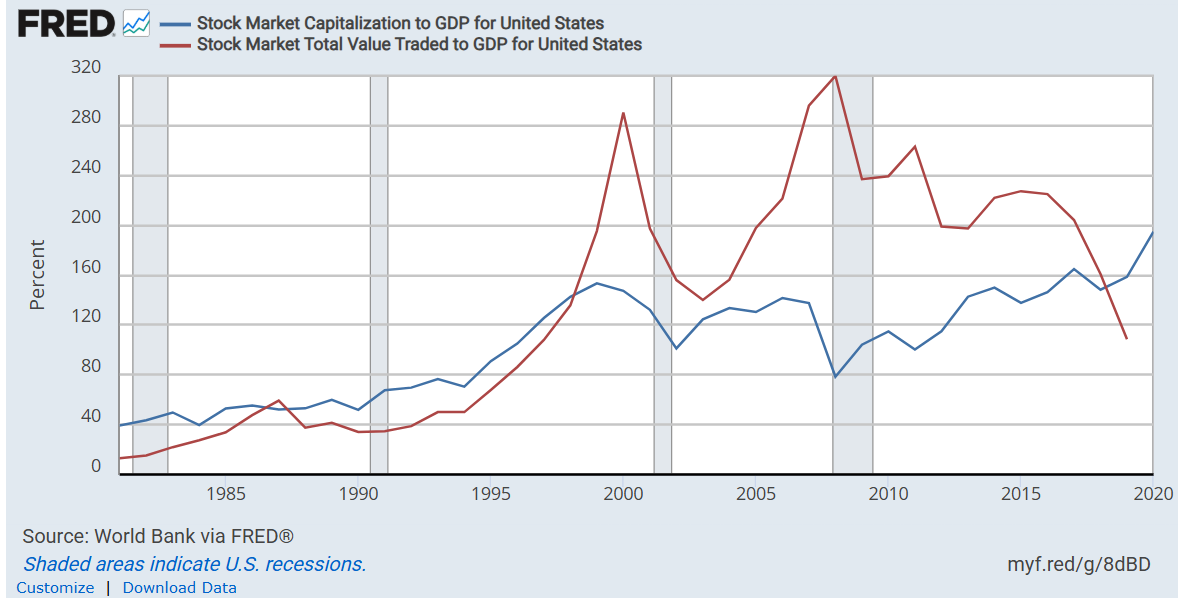
Big Al wonders:
I wonder to what extent the decline in "Stock Market Total Value Traded to GDP" reflects a shift to dark-pool/off-exchange trading.
Peter Ringel writes:
TY Larry, great data! looks like we are severely undervalued. A 90s style party is coming.
@BigAl this too is a valid point. If founders don't go the exchanges anymore. Is there data on this off-exchange size? At least for their exit they will most likely show up in equities. Why should early backers not do this in the end? Its too juicy.
related: If off-exchange sector really gets dominant, then FED policy becomes even more toothless.
They have no tools to influence this.
Big Al asks Gemini:
In the US, how much stock trading occurs in dark pools or otherwise off exchanges?
Over 50% of all U.S. stock trading volume now occurs off-exchange, in venues such as dark pools and through internalizers at major firms, exceeding the volume on public exchanges for the first time in early 2025.
Overall Off-Exchange Volume: While dark pools specifically account for a smaller portion of the off-exchange activity (around 13% of consolidated turnover), the overall off-exchange market, including internalizers and bilateral trades, accounts for the majority of U.S. equity trading volume.
Purpose of Dark Pools: Dark pools and other off-exchange venues are primarily used by large institutional investors to execute big orders anonymously, which helps them avoid significant market impact and predatory high-frequency trading (HFT) strategies that can occur on public "lit" exchanges.
Regulatory Oversight: Despite their name, dark pools are regulated as Alternative Trading Systems (ATS) by the SEC and must report executed trades to regulators like the FINRA on a delayed basis.
Market Share Trends: Off-exchange trading share has been on a general upward trend for years, driven by the desire for better execution quality and anonymity. This shift has implications for traditional price discovery on public exchanges.
Steve Ellison does some analysis:
The Shiller Cyclically Adjusted Price Earnings (CAPE) ratio is at its second highest level in history, exceeded only in 1999-2000. What I find interesting is that the 30-year moving average of this ratio has nearly doubled since 1990. My theory is that permanently lower interest rates in an aging population support generally higher stock valuations than in past eras when large families were the norm.
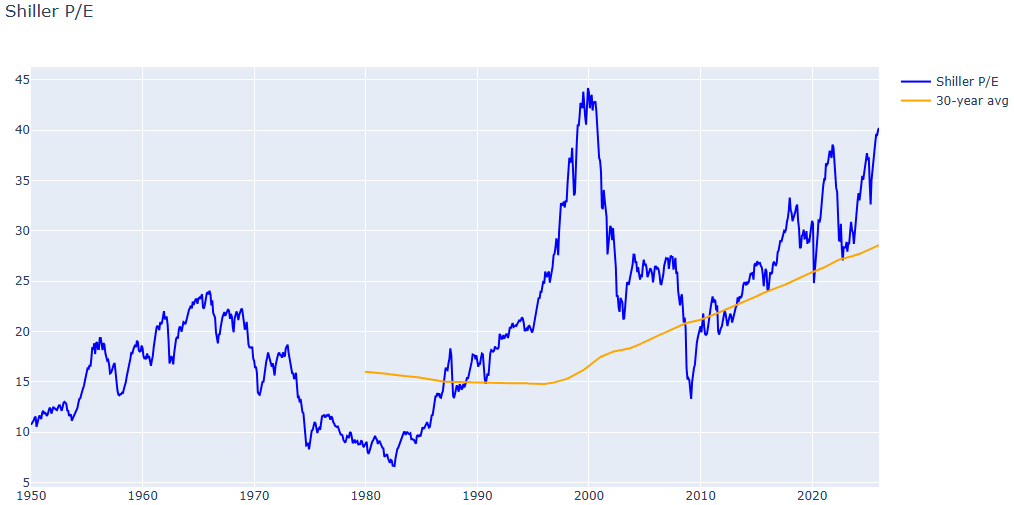
And in the spirit of the old Spec List, here is the Python code I used (.text file) to generate this graph.
Big Al adds:
Another issue is the effect of Mag7 stocks which are global in a new way, beyond US GDP.
Jan
20
Books read over the weekend
January 20, 2026 | Leave a Comment
books read over the weekend of jan 17 - Autobiography of Mark Twain, Following the Equator, How the West Was Won, Little Boss, Abraham Lincoln, The Time It Never Rained, Sherlock Holmes. all recommended.
The Little Boss was a great philanthropist, donated for 2811 libraries, still left 1 billion to carnegie foundation, started carnegie institute, carnegie university, carnegie hero fund among many others.
List of Carnegie libraries in the United States
Jan
19
Memorializing revered persons
January 19, 2026 | Leave a Comment
at 82 years old, not being mobile at all, subject to frequent falls and having fallen on my head last nite, i thought that I mite memorialize those that I have revered at first.
the best no longer with us: : Arthur Niederhoffer, Robert Schrade, Iving Redel, Jack Barnaby, Tom Wiswell, Fred Mosteller, Jules Leopold, Arnold Fish (music teacher), Moe Orenstein, Marty Reisman.
Continuing with those who have influenced me and I revere: James Lorie, Milton Bond, Harvey Sellers, Joan Schreiber, Michelle Siteman.
two more greats who I revere and love: MFM Osborne, Harold Weaver.
Jan
19
Audiobooks, 2025
January 19, 2026 | Leave a Comment

out of the clear blue i received a summary of my audible listening the past year: "logged 4043 hours among 276 titles." feel compelled to listen because reading hurts my eyes and causes extra hours of sleep the next morning.
my favorite audibles are those of Elmer Kelton, Sherlock Holmes, Hampton Sides, Music of Verdi as well as Gilbert and Sullivan, Patrick O Brian (the 22 Aubrey-Maturin series), Bernd Heinrich (The Trees in My Forest and Why We Run), Trojan Wars.
Jan
18
Whenever I listen to Gilbert and Sullivan
January 18, 2026 | Leave a Comment
Whenever I listen to Gilbert and Sulvivan, with their love of satirizing the old person in love with a much younger, and the cranky old man who is oblivious to his faults, I am drawn to remember and reflect on the similarities of those who preceded to the current and former pres and vp.
Jan
18
Traders and Art/Music, from N. Humbert
January 18, 2026 | Leave a Comment

Noticed many of my trading friends have an affinity for either ART or MUSIC or both (active or passive) It occurred to me the other day, that both offer ways to somewhat stay sane, it allows the adult to play and have some fun /relax.
Because society as a whole has something matrix like (going to school, learn about consensus reality, fill out the forms, get a BS job, keep up with the JONES, feel empty..) and this is a nice way to see beyond it and feel a bit at ease. That is all.
Here is a lovely Schubert piece. enjoy
Schubert, Trio No. 2, Op. 100, Andante con moto | Ambroise Aubrun, Maëlle Vilbert, Julien Hanck
Asindu Drileba responds:
Narrator: "Fate had already determined that he will die childless and penniless."
Epilogue: "It was in the reign of George III that the aforesaid personages lived and quarreled; good or bad, handsome or ugly, rich or poor, they are all equal now."
Whenever I hear that piece, I think of those words from Barry Lyndon. It was such a good "slice of life" type film.
Jeffrey Hirsch recalls:
Yale was quite a composer. I tried to produce the musical he wrote about the Elephant Man called Merrick & Melissa. But he was a better composer than I was a producer.
Jan
16
Tacit knowledge, life lessons, and roast beef
January 16, 2026 | Leave a Comment

Nils Poertner suggests:
there is a wonderful book by Michael Polanyi - on tacit knowledge (unlike explicit knowledge one has to develop that skill oneself). not trying to proselytize here that is quite good of a book) and worth many gold nuggets
Jeff Watson offers:
There are some great nuggets in this video - 100 quotes, 100 meals for a lifetime:
100 Harsh Life Lessons That Made My Life So Much Better
Larry Williams knows where the beef is:
America's Top Roast Beef Sandwiches, According to Food Critics
Peter Ringel follows up:
Classical Music for When You're in a Food Coma
Jan
15
Boids, from Asindu Drileba
January 15, 2026 | Leave a Comment
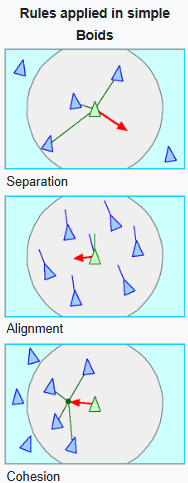
Their is a more interesting school of Artificial Intelligence branded as "Artificial Life" (AL). Their goal is mostly on how to simulate living things in nature, in contrast to Artificial Intelligence where the goal is to solve day to day human problems (it doesn't matter to AI people if the solutions are not consistent with how nature actually does it, but for AL people it does).
An Artificial Life researcher at Nvidia in the 1980s came up with the idea of Boids. It was a very simple algorithm for the simulation of collective intelligence i.e schools of fish, flocks of birds, herds of herbivores. If you have watched The Lord of the Rings, the battle scenes are generated using boids.
One of the parameters of boids is "cohesion". Cohesion is the tendency of "boids" (individual entities in a flock) to move towards their "center of mass". Cohesion is computed by listing the individual coordinates of each "boid" and then finding their average.
In markets, the "current price" can be thought of as the "center of mass" or "cohesion", an "average" of offerings on the order books. Traders may prefer to place orders close to current prices to get filled faster.
When I trade manually and get filled, I am often tempted to close my position in event of small loss (away from the average). Or take profit in event of a small win (still away from the average). I feel like a "boid", and It seems like my need to undergo "cohesion" or chase the "center of mass".
Jan
14
Manipulation, from Humbert X.
January 14, 2026 | Leave a Comment
The allegation of “manipulation” is inevitably just code for “I just badly hosed a trade that seemed so good on paper.” Whereas the proper response to a bad trade is introspection and examination of one’s system. In the markets as elsewhere, there can be a general tendency towards the rejection of personal responsibility. This regularly surfaces in the “manipulation” allegation.
William Huggins responds:
not an opinion on anyone's trading but there is a "fun" bit of psych referred to as the fundamental attribution error in which my successes are the result of hard work and skill while the success of others boils down to luck. similarly, when things go wrong for me, its bad luck (or nefarious forces, "them") but when things go wrong for others, its their bad choices or immorality. pretty much every single person falls into this trap unless they spend a great deal of effort fighting back against the heroic narrative.
Humbert X. comments:
I find it does me little good to think about others, other than to identify when they are travelling in a herd and at an extreme level of emotion, for contrarian purposes. Though sometimes it is possible to learn from their successes and failures assuming they are being transparent about what went right or wrong, which is rare.
Nils Poertner writes:
Good to read Hannah Arendt on this note (free floating anxiety within any society have to go somewhere and sinister groups will use it for their advantage - if not a virus, then some other "Country-" Phobia, then climate change etc… So it would not be enough to change politicians , the anxiety is within the masses (and mostly unconscious).
The key for a speculator is to travel light in life and take things with a bit of distance (2 inches are often enough) - and focus on the process of making money!
Jan
13
An attempt by the disbelievers
January 13, 2026 | Leave a Comment
An attempt by the disbelievers to take the S&P below 7000 that fails in spite of the cheering squad on the bearish side.
Jan
13
The love of royalty
January 13, 2026 | Leave a Comment
the love of royalty and the slave-like tendency is exemplified by the initially negative reaction to the queries about chance gardener expense in the rebuilding at the Fed.
i have not been able to find a study that takes account of the slave-like tendency and the love of royalty and its impact on investments.
Jefferson would not have sold stocks and bonds when the chair of the fed was in trouble. Nor would he have followed the Palindrome in his investments nor the sage of Nebraska.
AI comments:
Jefferson's political philosophy was fundamentally opposed to the concepts of royalty and hereditary power. His personal seal even bore the motto, "Rebellion to tyrants is obedience to God". He dedicated his life to establishing a government in the United States that was a stark contrast to the monarchies of Europe. Jefferson's views on the matter included:
Aversion to European Systems: While serving as the U.S. minister to France, Jefferson observed European courts and societies and grew to detest their systems, viewing them as corrupt and oppressive. He once wrote of his hope that America would forever remain free from "kings, nobles, and priests".
Advocacy for Equality: The core of his political writing, most notably the Declaration of Independence, is based on the principle that "all men are created equal" with inherent rights to "life, liberty, and the pursuit of happiness," a concept directly at odds with a hierarchical system of royalty.
Opposition to Aristocracy: He actively worked to dismantle any potential for a permanent aristocracy in America, advocating for policies such as the abolition of primogeniture and entail (laws that kept large estates within a single family line).
It is possible that the user's query stems from a misunderstanding of his complex personal life and correspondence, which included deep affection for individuals who were part of European high society, such as the married Italian-English artist Maria Cosway. However, these were personal relationships, not an endorsement of the political system of royalty itself.
Jan
12
Contest for the best study of rounds
January 12, 2026 | 1 Comment
i have for the last 62 years wanted a definitive study of what happens when a stock breaks a round number from below. related to this is an answer to the question of whether buying the stock that has gone up the most is a good system.
i took a crack at this while i started at the univ of Chicago. studying what happened when a stock went from below 10 to above 10. the results were so favorable that i stopped the research. it is specially relevant now that the S&P broke 7000.
AND GOLD ABOUT TO BREAK 5000. ITS A GOOD THING TO KNOW. OUT OF FAIRNESS I WILL GIVE AN AWARD OF 3000 FOR THE BEAT ANSWER TO THIS QUERY.
Jan
12
Zugzwang, from Zubin Al Genubi
January 12, 2026 | 1 Comment

In chess, zugzwang refers to a situation where a player has to move, but every move worsens the player's position. When a portfolio manager's risk limits are hit or losses are thought to be unacceptable, the situation is quite the same. - Hari Krishnan
The Immortal Zugzwang Game is a chess game between Friedrich Sämisch and Aron Nimzowitsch, played in Copenhagen in March 1923. It gained its name because the final position is sometimes considered a rare instance of zugzwang occurring in the middlegame. According to Nimzowitsch, writing in the Wiener Schachzeitung in 1925, this term originated in "Danish chess circles".
Nils Poertner writes:
on this note (lack of imagination), see David Hand's probability lever concept:
The Law of the Probability Lever essentially states that slight changes in the circumstances or assumptions of a statistical model can dramatically change the calculated probabilities of events.
Larry Williams states:
ZUGZWANG The life of a trader in one word—always in too early or out too late, also out too early or too late.
Jan
11
Movie Recommendations for Specs, from Asindu Drileba
January 11, 2026 | Leave a Comment
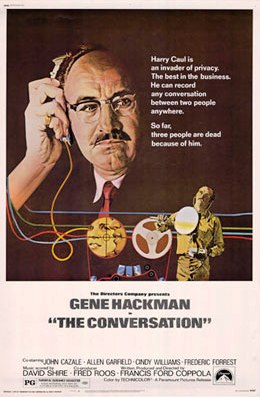
In case you're looking for some movies for the holiday season that may be of interest to a "spec persona", I have a few I recommend:
1. Uncut Gems: Perfect depiction of the of the life of a speculator with no risk management or "system".
2. The Count of Monte Cristo: Perfect illustration of Howard Mark's second level thinking, deception & poker in the markets.
3. The Game: Good movie on self reflection.
4. The Conversation : Deception in the context of corporate board members. To lure his prey, an apex predator (played by Harrison Ford) baits his victims with a "weak target". The Godfather is Francis Coppola's most popular film, but this one is definitely my favourite of his movie's. Also, if you like Jazz music you will love this!
5. The International: Evil specs (arms dealing & nation state money lending). The movie has a very serious tone. No unnecessary jokes or unrealistic fight scenes. Based off the real BCCI scandal.
Jan
11
Counting, on the expressway
January 11, 2026 | Leave a Comment
one in six trucks i passed on trip from Manhattan to Connecticut were Amazon's trucks. about 200 passed.
Jan
10
Original music from Duncan Coker
January 10, 2026 | Leave a Comment
Duncan Coker - Roadside Attractions

Duncan Coker likes to leave a little distance between himself and the characters that narrate his songs. That way he’s free to imagine himself as a long haul trucker, a cowboy or a young singer with dreams of a Nashville music career. He can put himself back a decade, feign an accent or wind up on a different side of the continent. Whatever it takes to move the story forward. What else is songwriting but real feelings channeled through fiction? Every character a sideways version of its author but in another multiverse.
Still, Coker’s songs are true-to-life. He keeps his antenna up, always looking for the signals in the noise. He is a stenographer of the human condition. You might even catch him in the dairy aisle, thumb-typing a phrase he overheard into his phone, destined for a spot in his next verse. Coker’s songs also grapple with the realness of life—the loss of his father or his love for his wife Julie. He enjoys the puzzle of conveying big emotions with a few choice words that rhyme.
Jan
9
Verdi on markets
January 9, 2026 | Leave a Comment
Verdi - The Force of Destiny (La forza del destino) - Overture
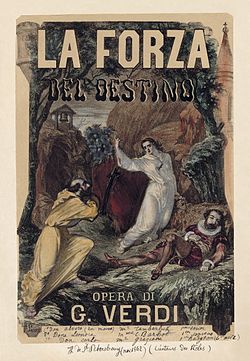
La forza del destino (The Power of Fate, often translated as The Force of Destiny) is an Italian opera by Giuseppe Verdi. The libretto was written by Francesco Maria Piave based on a Spanish drama, Don Álvaro o la fuerza del sino (1835), by Ángel de Saavedra, 3rd Duke of Rivas, with a scene adapted from Friedrich Schiller's Wallensteins Lager (Wallenstein's Camp). It was first performed in the Bolshoi Kamenny Theatre of Saint Petersburg, Russia, on 29 October 1862 O.S. (N.S. 10 November).
La forza del destino is frequently performed, and there have been a number of complete recordings. In addition, the overture (to the revised version of the opera) is part of the standard repertoire for orchestras, often played as the opening piece at concerts.
Jan
8
Relevant animal behavior study, from Big Al
January 8, 2026 | Leave a Comment
Self-control is definitely an issue in trading! I kept thinking of the crayfish pov. They probably shined him up by telling him he was "preferable".
Can this Cuttlefish Pass an Intelligence Test Designed for Children?
Nils Poertner responds:
Very good. For specs / traders the self-control is tested now with media trying to steal our energy (emotional vampires) with high amygdala stories - whereas the mkts does whatever it does. "get the joke"
Jan
7
News, from Duncan Coker
January 7, 2026 | Leave a Comment
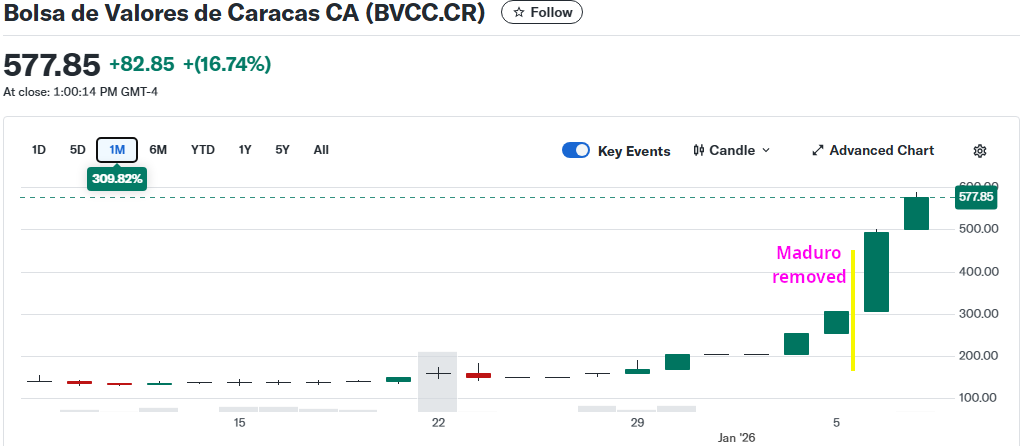
Interesting 40% move in Caracas stocks the days Before the capture. It is as if someone knew about the plans and acted on that information. News follows the markets as Larry has taught us.
Jan
6
Leather jacket indicator, from Cagdas Tuna
January 6, 2026 | Leave a Comment
I asked Gemini if the Nvdia stock price milestone dates associated with Jensen Huang's famous leather jackets. Here is the timeline of Jensen's jacket evolution alongside Nvidia’s stock milestones:
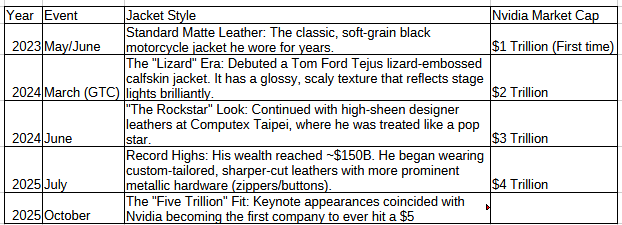
The one that caught my attention is Lizard Era in March 2024. At that time Nvdia price was around $100 and after Jensen's Lizard Jacket appearance Nvdia stock fell 20-25%. And here is Jensen while debuting new chips last night. We will learn soon if the Lizard Jacket is a helpful tool for front running Nvdia stock!
Steve Ellison likes the idea:
Very unique and insightful analysis. My wife read a biography of Mr. Huang. When he was growing up in Oregon, his immigrant relatives wanted to put him in a private school, but the school they enrolled him in was a reformatory. After that life experience, I am pretty sure that Mr. Huang can't be intimidated by Donald Trump or Xi Jinping.
Peter Ringel adds:
agree. probably useful insights can come from seemingly absurd corners. Like the weather of sports teams in NYC.
Jan
6
Markets from networks
January 6, 2026 | Leave a Comment

Markets from Networks: Socioeconomic Models of Production, by Harrison C. White, is one of the most realistic and profound understandings of the the entire industrial structure. highly recommended.
White argues that the key to economic action is that producers seek market niches to maximize profit and minimize competition. As they do so, they base production decisions not only on anticipated costs from suppliers and anticipated demand from buyers, but also by looking at their competitors. In fact, White asserts, producers act less in response to actual demand than by anticipating it: they gauge where competitors have found demand and thus determine what they can do that is similar and yet different enough to give themselves a special niche.
Jan
5
Markets approve
January 5, 2026 | Leave a Comment
today every major us market is up substantially showing the approval of the Maduro capture and its impact on wealth.
Jan
5
Oil, from Cagdas Tuna
January 5, 2026 | Leave a Comment

So where lies the thin line between liberating Venezuela and putting world into oil supply based recession?
Larry Williams comments:
The quality of their crude is a different issue we use to refine it here; sour, full of gravel etc.
Stefan Jovanovich writes:
Historically, before full sanctions in 2019, the US imported over 600,000 barrels per day (bpd) of Venezuelan crude, with refiners like Citgo (PDVSA-owned), Valero, Chevron, and Phillips 66 as top recipients.
More recently (post-2023 relief), Valero accounted for 44% of imports, Chevron 32%, and Phillips 66 10%.
Carder Dimitroff writes:
IMO, it's not about oil. The US is a net exporter. They're doing just fine without Venezuela. If heavy oil is desired for refining optimization, as some claim, there's a direct pipeline from Canada.
Stefan Jovanovich responds:
It would help if Carder focused on the use of heavy oil for marine diesel and bunker oil for steam turbines. Those are the essential propulsion fuels for China's Navy; hence, Hegseth's comment today assuring China that it would continue to receive its share of Venezuela's output.
Carder Dimitroff expands:
Globally, three major regions produce heavy crude: Russia, Canada, and Venezuela. Downstream, “heavy oil” or “heavy fuel oil” usually means the residual, high-boiling product left after lighter fractions (gasoline, diesel, kerosene, etc.) are distilled from crude. As Stefan suggests, heavy oil and bunker oil are growing markets, not only in China but also elsewhere.
In my opinion, the administration's interests in Venezuela reflect several interests. High on my list are Venezuela's untapped rare-earth elements (about 300,000 metric tons).
Pamela Van Giessen offers:
Interesting analysis here:
The Real Reason the Pentagon Approved Venezuela: Critical Minerals and Adversary Expulsion
The Department of War has allocated $7.5 billion under the One Big Beautiful Bill Act specifically for critical minerals, with $1 billion already deployed to stockpile antimony, bismuth, cobalt, indium, scandium, and tantalum. This is not economic policy. This is national security infrastructure. The United States is 100% import reliant for 12 critical minerals and over 50% reliant for 28 of the 50 minerals classified as essential to national security. These materials are not interchangeable. They cannot be substituted. They form the irreducible foundation of modern weapons systems.
Boris Simonder questions the thesis:
What rare earth does Venezuela hold that is proven and confirmed? Based on USGS Mineral Commodity Summaries 2025 and other sources like CSIS reports, Venezuela has no significant cobalt production or reserves listed. Antimony deposits exist but are small and underdeveloped, with declining output due to infrastructure issues.
Jan
4
Natural Gas, from Nils Poertner [Update]
January 4, 2026 | Leave a Comment
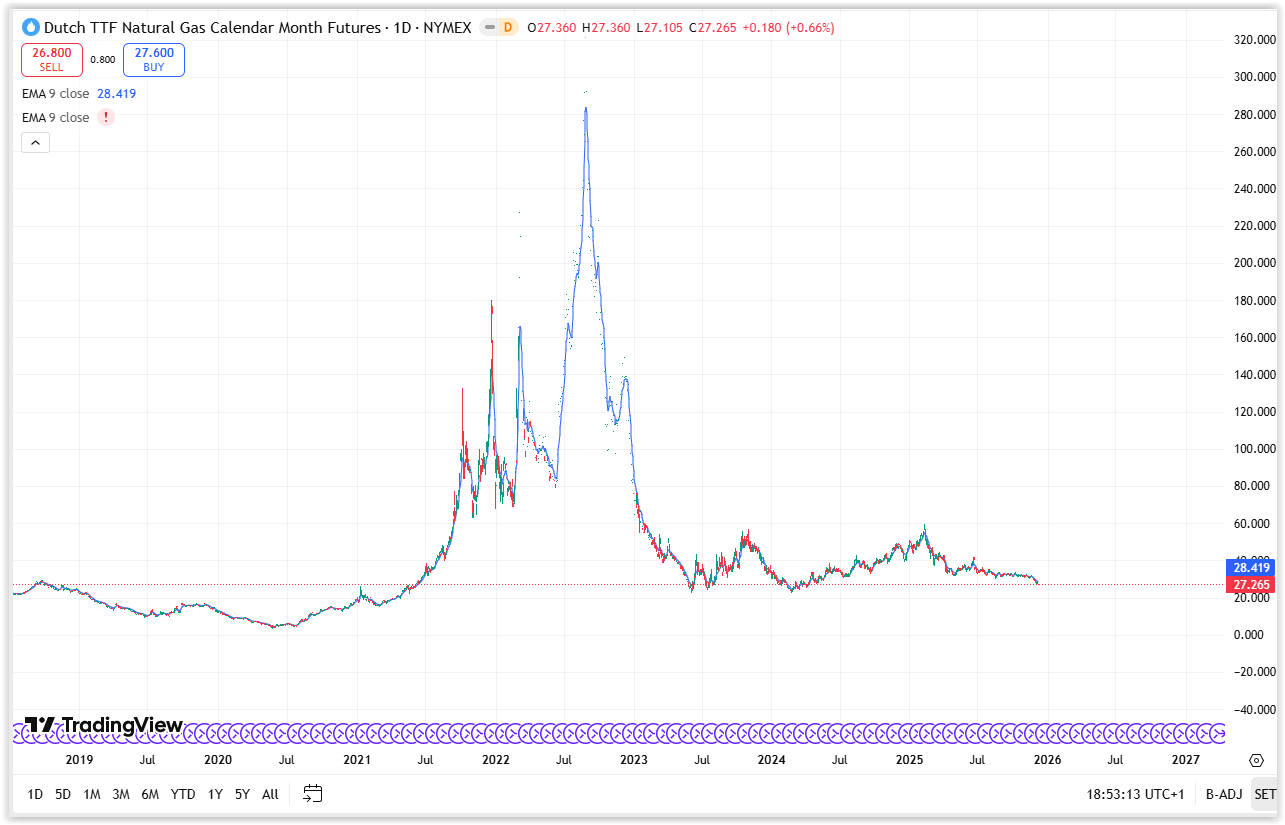
European Natural gas - not that far to test 2024 lows, and perhaps even pre-Ukraine-war levels eventually? Peace coming (?) Or general decline in Gas prices (US natty has gone the other direction for a while).
"Price move first - fundamentals later." When something moves (even though I don't trade it - or have expertise in it yet), I often look at it and wonder what it could mean. Mass financial media hasn't picked up on this theme either (much) - another reason to consider what it means…
Carder Dimitroff comments:
For me, this is an important observation. EU-US fundamentals have changed. The current US administration "encouraged" the EU to accept US LNG imports. At the same time, US LNG export capacity has increased. For Europe, the supply-demand dynamics changed. In the next several months, it will continue to change:
• 14.49 Bcfd US LNG export capacity - current.
• 21.81 Bcfd US LNG export capacity - under construction.
• 13.24 Bcfd US LNG export capacity - approved but not under construction.
• 12.49 Bcfd US LNG export capacity - proposed and seeking approval.
Most of this LNG use capacity uses, and will use, Texas/Louisiana natural gas as its feedstock. Feedstock and LNG prices will likely be correlated with Henry Hub prices. If most of this capacity is built, the following trends are likely to emerge:
• US citygate (NG) average prices will float higher.
• US LMP (electric) average prices will float higher.
• US NGL average prices will sink.
• EU NG average NG and LMP prices will stabilize.
More importantly, global LNG markets are changing and will continue to change. Keep in mind:
• Global LNG capacity is expanding
• The US is not the LNG cost leader and never can be.
• As the US dominates EU imports, global markets adjusted accordingly.
Of course, traders should be indifferent about these long-term fundamentals. But long-term investors might consider options.
Stefan Jovanovich asks:
Follow-up question for Carder and others: "What do you think about the Doombird thesis that the Permian drillers and the mid-stream connectors will shift to have natural gas be the hydrocarbon asset that they look to make money from and oil will be the secondary source of income?"
Carder Dimitroff replies:
If the question concerns long-term prospects, global demand for diesel, jet fuel, plastics, and related products is expected to grow. Gasoline consumption may be slowing, but it is not crashing. But who knows where the economy is headed?
For the US, natural gas as a bridging fuel makes sense if it can reach consumers. In the US, domestic delivery is a problem. Globally, LNG delivery is also a problem, but for different reasons. Because they deliver to Henry Hub, producers should be indifferent between the two markets. Beyond Henry, LNG is becoming increasingly accessible, whereas citygates will continue to struggle.
The US is also a net exporter of oil and oil products. Again, the product supports two separate markets.
Most Permian wells produce oil and associated gas (and they are getting gassier). It's not a choice. They get both.
For me, the short-term challenge is global overproduction. Geopolitical considerations rather than economic factors drive the decision to overproduce and erode margins. It will end, and the markets will revert. Until then, it will be difficult for American producers to finance new wells.
Jan
3
Fund manager’s bizarre apology video, from Jeff Watson
January 3, 2026 | Leave a Comment
From 2018: Investment boss in tearful video apology over losses
And a recent take on it: Fund Manager's Bizarre Apology Video
J. Humbert responds:
Reminds me of this one from a few years ago…
Fleeing investment manager offers victims teary bon voyage – Chicago Tribune
Charles Harris wiped tears from his eyes, looked straight at one of his friends and apologized for lying about the value of the commodity pool he oversaw.
This scene was recorded on one of three DVDs made aboard Harris’ boat as it was apparently heading away from the U.S. and the federal authorities who are looking for Harris.
Jan
1
A great book to start the New Year
January 1, 2026 | 1 Comment

From the archives:
Elroy Dimson, Paul Marsh and Mike Staunton, Triumph of the Optimists. We cannot say too often that if you read one investment book, this should be it. Ever since its publication in early 2000, it has informed our approach to the market and served as a source of trading ideas. The first comprehensive international market database, this book by three distinguished London Business School professors belongs on the shelf of every investor, trader, policy-maker and economist. In all the sciences, great strides in seeing things how they are came about after the compilation and classification of data. At last we have something that builds on the University of Chicago’s Center for Research in Securities Prices, the U.S. database that led to an explosion in market knowledge and testing a generation ago.
Elroy Dimson, Paul Marsh and Mike Staunton of the University of London Business School worked together on this massive project. Within Triumph's pages, an investor may find definitive information on inflation adjusted returns for stocks, bonds and treasury bills, real dividends, correlation between markets worldwide, and the relative performance of value and growth stocks.
Unlike most books written by academics, Triumph avoids hasty generalizations and biased sampling procedures. The authors rightly fault earlier investment studies for arbitrary selection of starting and stopping points, the tendency to include the good and exclude the bad, and a parochial focusing on a small slice of the global picture. Their work epitomizes outstanding investment research.
Great works can be created in humble circumstances. Shakespeare was an actor and entrepreneur who reworked old plots so that his theatre company could make a buck. Cervantes wrote a parody of the fashionable knight errantry books to repay his debts. Dimson told us that he and his colleagues thought of Triumph as "a labor of love, just a small contribution that could lead to a paperback meant for light reading on planes". He added, "Our families would be less kind about our fixation." Staunton, who collected the data, prefers to gather statistics by himself from original sources at specialized libraries instead of delegating the work.
The main conclusion of Triumph is that a random selection of US stocks returned 1,500,000 percent in the twentieth century. Yes, big losses occurred at times, such as the back-to-back losses of -28 percent and -44 percent in 1930 and 1931, or the 10 years from 1970 to 1979 when stocks hardly budged while the dollar lost 28 percent of its purchasing power.
But overall, adjusted for inflation, the return on US stocks amounted to 6.3% a year, better than any other class of securities.
Archives
- October 2026
- September 2026
- August 2026
- July 2026
- June 2026
- May 2026
- April 2026
- March 2026
- February 2026
- January 2026
- December 2025
- November 2025
- October 2025
- September 2025
- August 2025
- July 2025
- June 2025
- May 2025
- April 2025
- March 2025
- February 2025
- January 2025
- December 2024
- November 2024
- October 2024
- September 2024
- August 2024
- July 2024
- June 2024
- May 2024
- April 2024
- March 2024
- February 2024
- January 2024
- December 2023
- November 2023
- October 2023
- September 2023
- August 2023
- July 2023
- June 2023
- May 2023
- April 2023
- March 2023
- February 2023
- January 2023
- December 2022
- November 2022
- October 2022
- September 2022
- August 2022
- July 2022
- June 2022
- May 2022
- April 2022
- March 2022
- February 2022
- January 2022
- December 2021
- November 2021
- October 2021
- September 2021
- August 2021
- July 2021
- June 2021
- May 2021
- April 2021
- March 2021
- February 2021
- January 2021
- December 2020
- November 2020
- October 2020
- September 2020
- August 2020
- July 2020
- June 2020
- May 2020
- April 2020
- March 2020
- February 2020
- January 2020
- December 2019
- November 2019
- October 2019
- September 2019
- August 2019
- July 2019
- June 2019
- May 2019
- April 2019
- March 2019
- February 2019
- January 2019
- December 2018
- November 2018
- October 2018
- September 2018
- August 2018
- July 2018
- June 2018
- May 2018
- April 2018
- March 2018
- February 2018
- January 2018
- December 2017
- November 2017
- October 2017
- September 2017
- August 2017
- July 2017
- June 2017
- May 2017
- April 2017
- March 2017
- February 2017
- January 2017
- December 2016
- November 2016
- October 2016
- September 2016
- August 2016
- July 2016
- June 2016
- May 2016
- April 2016
- March 2016
- February 2016
- January 2016
- December 2015
- November 2015
- October 2015
- September 2015
- August 2015
- July 2015
- June 2015
- May 2015
- April 2015
- March 2015
- February 2015
- January 2015
- December 2014
- November 2014
- October 2014
- September 2014
- August 2014
- July 2014
- June 2014
- May 2014
- April 2014
- March 2014
- February 2014
- January 2014
- December 2013
- November 2013
- October 2013
- September 2013
- August 2013
- July 2013
- June 2013
- May 2013
- April 2013
- March 2013
- February 2013
- January 2013
- December 2012
- November 2012
- October 2012
- September 2012
- August 2012
- July 2012
- June 2012
- May 2012
- April 2012
- March 2012
- February 2012
- January 2012
- December 2011
- November 2011
- October 2011
- September 2011
- August 2011
- July 2011
- June 2011
- May 2011
- April 2011
- March 2011
- February 2011
- January 2011
- December 2010
- November 2010
- October 2010
- September 2010
- August 2010
- July 2010
- June 2010
- May 2010
- April 2010
- March 2010
- February 2010
- January 2010
- December 2009
- November 2009
- October 2009
- September 2009
- August 2009
- July 2009
- June 2009
- May 2009
- April 2009
- March 2009
- February 2009
- January 2009
- December 2008
- November 2008
- October 2008
- September 2008
- August 2008
- July 2008
- June 2008
- May 2008
- April 2008
- March 2008
- February 2008
- January 2008
- December 2007
- November 2007
- October 2007
- September 2007
- August 2007
- July 2007
- June 2007
- May 2007
- April 2007
- March 2007
- February 2007
- January 2007
- December 2006
- November 2006
- October 2006
- September 2006
- August 2006
- Older Archives
Resources & Links
- The Letters Prize
- Pre-2007 Victor Niederhoffer Posts
- Vic’s NYC Junto
- Reading List
- Programming in 60 Seconds
- The Objectivist Center
- Foundation for Economic Education
- Tigerchess
- Dick Sears' G.T. Index
- Pre-2007 Daily Speculations
- Laurel & Vics' Worldly Investor Articles
