Oct
13
Writing it down, from Nils Poertner
October 13, 2026 | 1 Comment
Young, more inexperienced specs would benefit from writing down all the observations, patterns, even subjective things they picked up and compare in the future (1wk, 1mo, etc), not just today but in particular this month. Instead of reading research paper no 3241.
William Huggins writes:
i recall a quarter century ago doc Steenbarger had done some private work for high figure chicago traders on their biases that he could only discuss with the list in the most general sense (ie, this not my work, just shouting back so its value is not lost to time). one of his "summary takeaways" for us that stuck, that i teach in my own classes on investments, is to write down -why- you think something is a good trade for the purpose of auditing your own thinking when it fails. if i recall correctly, the analogy he used was that of a professional sports team watching their own lost games to understand how to contain failure rather than seeking out the (supposed) source of success. the behavioral nugget on that one being the desire to fit our success to a heroic narrative often makes failure analysis more objective and hence productive. if you aim to improve, write down the reasons for your trades and then ruthlessly analyze failures in the aftermath.
Nils Poertner responds:
Wholeheartedly agree William! Victor always suggested to pass on "meals for life" and that would be one of them.
Asindu Drileba adds:
One of my favorite quotes is:
A good decision is still a good decision even if it turns out bad
& a bad decision is still a bad decision even if it turns out good.
A few months back I watched the Michael Jordan movie, Air (2023). A similar quote from the movie I liked:
Just because you're losing, does not mean you placed the wrong bet. - Sonny Vaccaro
Gary Boddicker offers:
Brings to mind the key concept from David Sklansky's classic, The Theory of Poker:
Any time you make a bet with the best of it, where the odds are in your favor, you have earned something whether you actually win or lose the bet. By the same token, when you make a bet with the worst of it, where the odds are not in your favor, you have lost something, whether you actually win or lose the bet.
Jul
30
Greedyness, from Nils Poertner
July 30, 2026 | Leave a Comment
Asked a trader friend what he thought would make a good trader and he said, "Greedyness." Was a bit surprised, but on second thought I concur. By being aware of it, it does take out the toxicity a bit as well.
Jeffrey Hirsch writes:
John Bollinger once said, “Greed is simply fear of not having enough.” Here’s the full quote from the Almanac:
Securities pricing is, in every sense a psychological phenomenon that arises from the interaction of human beings with fear. Why not greed and fear as the equation is usually stated? Because greed is simply fear of not having enough.
Nils Poertner adds:
Some traders feel sort of guilty of making money and later self-sabotage themselves (subconsciously). It is all a game at the end.
Zubin Al Genubi comments:
Searching for the last 20% can be dangerous and stressful. The first 20%, 80% of the time is easier, though with lower return but also lower and fewer losses. Toning down the greed helps trading as in the long run as its the losses that lower end wealth, more than the gains that compound over time.
Nils Poertner responds:
That is so true. (There is a chance we are having unprecedented manias in coming yrs (not now), but after the disinflationary impulse is over …the wheels may only come off only when nominal rates are double digits imo.)
Jul
18

example of something in our Western culture when we "over-use", overly rely on numbers to give meaning to something. Clever marketing idea though. A bit like those French Phds at BNP who looked at their credit derivs spreadsheets in summer 2007 and couldn't see what is behind those numbers as reality is more complex. Humour helps for sure.
Robert Parker's 100-point wine rating system
One of the most influential and controversial features of Parker's wine criticism is his 100-point rating system, which he popularized in conjunction with his friend Victor Morgenroth. Parker designed the system to counter what he believed to be confusing or inflated ratings by other wine writers—many of whom he accused of a conflict of interest, as they often had a financial interest in the wines they rated. The scale, now widely imitated in other publications (such as Wine Spectator[23]), ranks wine on a scale from 50 to 100 points based upon the wine's color and appearance, aroma and bouquet, flavor and finish, and overall quality level or potential. Therefore, 51 rather than 100 different ratings are possible.
Zubin Al Genubi writes:
Other wine makers copy the style of wine with high points and the result is the uniform oaky California wine that all tastes the same and that one guy likes. French say Vive la difference with weather, soils allowing subtle differences in vintages, locations. Its like everyone piling into the same trade or trend in markets.
Big Al comments:
There is research on rating scales - confirmed by my own experience back in the day as a consultant - showing that raters rarely use any scale as designed, but wind up using only part of the scale. So, you have to normalize ratings in some way. Wine ratings show this in that an 88 is wine you don't want to buy - has to be 90 or over, with 92 maybe being the magic number.
Grade inflation would be another current example. Harvard:
Faculty decisively approve grading changes
Cap on A grades and shift from GPA to ‘average percentile rank’ set to go into effect fall 2027
Faculty voted by a wide margin to limit the total number of A’s in undergraduate classes, as part of a broader effort to rein in grade inflation and recenter academics at Harvard College — with proponents hailing the adoption as a principled collective effort to restore meaning to grades and address a complex issue in higher education.
Nearly 70 percent of voting faculty approved the grading cap — which would limit A grades to 20 percent of the undergraduates in any course plus an additional four students, with no limit on A-minuses — with a 458 to 201 vote, in weeklong balloting that closed late Tuesday and was tabulated and audited Wednesday. The policy will take effect in the fall of 2027.
Zubin Al Genubi observes wryly:
The Gentleman's C.
Larry R Williams comments:
Too many wine raters now if you are really into it 98 and above is the good stuff.
Nils Poertner reasons:
As long as people don't take it too seriously - it is all good.
Asindu Drileba writes:
One thing I picked up for western people is the obsession with IQ. In the Terman Study of the Gifted, over 1,000 children with high IQs were tracked since the 1920s. They were given recommendation letters to prestigious programs and backtracked through prestigious schools. But none of them ever got a Nobel prize. What is very ironic was that two kids that were "measured" for the program, but rejected from it for having "too low IQs" ended up winning a Nobel prize.
Another ironic twist was when James D Watson, a eugenics proponent ended up having a child that was intellectually "special needs". If he was under a serious eugenics regime like Nazi germany, he & his entire family would likely be euthanized. Watson still insisted after this that he was still pro-eugenics.
American Military contractor's exploited this religious dedication to numbers during the cold war by providing systems analysts complicated equations that were intentionally blowing up their budgets so they could get bigger contracts. This was harder for non-technical people to question (you would be declared stupid for not understanding the complex equations that computed how many planes we need for the cold war)
There are so metrics in finance that I don't understand. One time, I laughed a bit on seeing a video where Mr. Mark Spitznagel angrily screamed at someone, "You can't eat Sharpe ratio!"
Nils Poertner responds:
for speculation, many ppl over-use rational thinking and lack curiosity, flexiblity etc. too much rational thinking often acts as "barrier" for intuition, too. (those 2 French Phds I had in mind back in 2007, I love to make fun of the French Phds as they are not in the room).
Jul
13
Turing test, from Zubin Al Genubi
July 13, 2026 | Leave a Comment
The Turing Test, originally introduced by British mathematician and computer scientist Alan Turing in his 1950 paper "Computing Machinery and Intelligence," is a proposal for evaluating whether a machine can exhibit intelligent behavior indistinguishable from that of a human.
This is more relevant today than ever. Applied to the market some moves appear very machine like. Other moves not so much. A large proportion if trades now are computer generated. Maekt making must all be computer managed. Humans still can game the machines as their rules are fixed.
Peter Ringel writes:
The Turing Test is fuzzy. Useful, but not precise. The underlying question is: Is AI conscious? My answer is: NO! but it is a freakishly good imposter.
It is also domain specific. In my opinion, in the general domain, AI broke the Turing Test in 2024. Humans can't distinguish anymore responses from robots to humans in the general domain. In specific domains it is different. The low to mid level is broken, the mid to high is not. OTOH, recently we had news that open AI proofed some longstanding Math hypothesis (I lack the knowledge to judge). And we all know about Google's AlphaFold. Both domain specific. High End.
Market making was algo based before AI. I indeed, try to game this with my human discretion. (At least in the sort-term part of my trading. It is not relevant for longer TF.) AI definitely facilitates research. This makes markets more efficient and faster efficient. I think we are seeing this currently.
Creativity is not broken. I hope, as of now.
Oliver Joseph writes:
A conversation that I find endlessly fascinating. In my opinion the current technology stack with regards to LLMs and machine learning tools in general is an absolute game changer. The barriers of entry associated with software seem to have been lowered significantly, however to use another tech analogy the "last mile" still remains elusive. By that I mean that the LLM really needs help to get certain complex problems over the finish line. That said, what we are dealing with is essentially a cliche generator. Humans tend to anthropomorphize, and personally I have found myself pondering the meaning of consciousness as I use the latest generation of LLM's ( I don't think we are dealing with consciousness here). Rich Suttons essay "The Bitter Lesson" from 2019 concludes with the idea that we want "AI agents that can discover like we can not which contain what we have discovered" arguing that by using experts to build in their knowledge it makes it harder to even see how the discovering process happens in the first place. He emphasizes a focus on what he calls scaleable general purpose methods primarily search and learning. It is interesting to me as I work with locally run models to see what output the <| think |> control token actually generates. I have one of those old IBM notepads that says think on it, however I must say I am prodded to think myself as I see this machine chugging through the art of thinking clearly with such mechanical precision (now we're in Dobelli of the beast). In conclusion I agree with the above sentiment that creativity is not broken but rather like where T.S. Eliot was wrestling with the concept of historical sense in his art; we now find ourselves with a large portion of human knowledge existing simultaneously in one place frozen in time, embalmed and pacified. It is up to us to be creative and let the tool inform our creative throughput.
On another tangent when I produce and or record music my workflow (and output) is changed by the tools I use. Ableton on a Macbook with VSTs gives me a different feeling and results than using an Atari 1040st and an Akai S950. I get the same feeling as I use LLM's for certain tasks.
Zubin Al Genubi adds:
I find AI helpful but AI doesn't quite get the joke. Kind of like a super-smart nerdy guy.
Nils Poertner comments:
From a spec point of view, there are tremendous opportunities where human creativity is always finding something which LLMs not seeing…as they have built mirrors in a mirror rooms and confusing this room with reality (but reality remains mysterious, indescribable and so on…and fuzzy logic or jain logic is already a slight improvement to our "either-or" logic that is so prevalent in our times).
Peter Ringel responds:
Yes, the tools we use define culture. Music culture, trading culture - binned per generation. AI is a tool (as of now).
If I close my eyes, I still can hear the metronome signal of Cubase through a crappy 1040 sound speaker ( or was it the monitor ?): "meeeep, mup mup mup" for a four to the floor. Cubase and similar tools made it easy to create a typical track structure. Probably long and repetitive. This defined the 90 and 2000 pop music. Before that - with some overlap - Sound-tracker. The UK in the 90 is unthinkable without it. Way more interesting. Then Fruity loops and similar. More questionable structure. Then Ableton. It freed the structure again, the creativity. I don't know, what the kids prefer now.
Nils Poertner responds:
Yes, very good. Real speculators are incredibly good in finding opportunities in mkts (and not just go with the latest fashion and think that's it). For older specs it will be "how to keep and possibly improve health" and for younger ones, I suppose it is how to turn their frustration/ anger into creativity and learn the game.
Oliver Joseph writes:
I love that Peter. Yes, Cubase was and is a fantastic tool precisely because of its constraints.
LLM’s being another cool new tool it is worthwhile to make an attempt to understand its uses and constraints. As a very simple thought experiment I asked three different models de jour to generate a random number between 0 and 500. I ran 500 iterations of the prompt per model. The “think” tokens generated reasoning from the models that stated basically “I’ll just pick a number that sounds random”. The “think” token of course being obscured from the end user. Going through such gesticulations is completely unnecessary other than I think that conceptually it's important to understand that here we ask for an output (the random number) and what we actually get is a number within the bounds of the below graph. Importantly we run the risk of thinking it's what we actually asked for. Surprise! It's not. Everyone on the spec list knows the right tool for the above job is a HRNG or TRNG or who knows what all else; lava lamps and wristwatches.
To my mind it is one of those inexplicably beautiful facts of history that Wall Street was thus named for a wall that separated traders and speculators from livestock. In the car business we have a large vocabulary derived mostly from farming and the cattle business. One thing that we would commonly do is go out and “put hands on” our “stock” go physically touch and look at the car. Statements are a representation of inventory I am supposed to have and obviously they have their use.
In summary as has been the case for the last 6000 years of recorded human history the farmer has asked the farmhand “where is the cow?” and the farmhand sometimes just said “over by the watering hole.” even though he actually had no clue. We equate the representation of the thing and the thing in and of itself at our peril. As speculators we should endeavor to identify the places in our experience where an incorrect representation is believed in more so than the thing in and of itself. I believe it pays to every now and again to hop the liminal.
Jun
22
The Lost World of the Kalahari, from Nils Poertner
June 22, 2026 | Leave a Comment

In The Lost World of the Kalahari, Laurens van der Post writes about living among the Bushmen of the Kalahari Desert and describes how shocked they were that he couldn’t hear the stars.
At first they thought he must be joking or lying. When they realized he really couldn’t hear the stars, they concluded he must be very ill and expressed great sorrow. For the Bushmen knew anyone who can’t hear nature must have the gravest sickness of all.
Intuition? Navigational skills? whatever is meant in the above. Have friends who are using GPS to go their local grocery shop which is 2km away, as if they don't know the way anymore.
Zubin Al Genubi writes:
The National Park service has a category of accidents called death by GPS. People walk off cliffs looking at iphone. A tourist in Hawaii drove into the harbor on a boat ramp until her car sank trying to get to a boat located on the map.
Big Al offers:
With a nice explanation of how GPS works:
Something is jamming GPS over Europe. Here's what we found - Veritasium
Nils Poertner responds:
From the point of those Kalahari Bushman we (modern people) are probably all quite ill anyway. GPS could be seen as metaphor who is guiding us in life anyway (we are kept like electronic doggies who are meant to chase electric rabbits but never meant to get them).
Henry Gifford suggests:
I highly recommend the movie The Gods Must Be Crazy, about some Kalahari Bushmen’s perception of the “civilized” world.
Jun
2
Food prices in UK (or Europe), from Nils Poertner
June 2, 2026 | Leave a Comment
Looking at longer dated charts (eg. Wheat, Oil etc…) and knowing how easily every new government in the UK will yield to public moods makes me think. (There were calls by politicians to cap food prices.) Maybe not immediately relevant, but perhaps later this year or next.
Call for food price caps ‘completely preposterous’, says M&S boss
Stuart Machin argues government should reduce tax and regulatory burden on supermarkets instead
May
26
A deck of cards, from Jeff Watson
May 26, 2026 | Leave a Comment

A standard deck of cards contains 52! combinations after riffle shuffling at least 7 times to ensure randomness. Expressed as a number, there are 8.06×10^67 total combinations. To put this in perspective, there are 4.37×10^17 seconds since the big bang. It is estimated there are 5×10^18 grains of sand and 10^50 atoms on earth. There are 10^46 molecules in all of the oceans. The estimated number of stars in the observable universe is 10^23. It’s a certainty that two entire 52 card decks have never ever matched, let alone more than once. They never will. Here’s another way of looking at it, if a billion people shuffled a deck of cards every second since the big bang, it would total 2×10^32 shuffles, which is still 10^22 less than the total. All of that said, there are some elegant propositional bets that can be derived from this material.
Nils Poertner responds:
Yes - incredible numbers. LIfe itself is a miracle (I don't buy into this bing bang thing) - but would not be able to bet against the odds you described here.
Asindu Drileba offers:
Leo Susskind explains that many constants in physics need to be fine tuned for the universe to exist in the way we see it. Some cannot be deviated by as low as 5%. All these constants needed to be fine tuned concurrently. Otherwise, stars would not even form.
Big Al writes:
If you assume that order matters, then when dealing cards for a game of Texas Holdem at a 9-seat table (18 hole cards and 5 community cards), there are 52!/29! possible permutations. That's roughly 9 x 10^36, or 9 x (1 billion)^4. Which means that, though possible, it is highly unlikely that any game (at a fair table) has ever been dealt the same way twice.
May
14
Study of Deception, from Sushil Kedia
May 14, 2026 | Leave a Comment

The Chair has emphasized the value of studying and understanding deception endlessly, I believe.
Now, if I wish to focus and devote my energies to be thoroughly studious about it, I urge my requests below are not misunderstood as a lazy desire, but an earnest and keen wish to be methodical about it.
What would the Spec-list citizens recommend as the ideal list of:
a) Movies to watch,
b) Books to read.
One thing that hit me suddenly some weeks ago is that nature devised deception as a tool to economize the struggle for propagation of this world and its entities into the future. Without deception a Tiger would run endlessly, perhaps consuming more calories in capturing its prey, than it would get in eating the prey, as one example.
What are the other utilities the matured, experienced minds on this competent list and other curious minds as me feel that deception provides?
Another layer of study that makes me curious is, when our own mind as defined by Edward De Bono, as a self organizing pattern seeking system is the personal deception machinery that takes us into deviant behaviour from data, stats on the table and rigorous study then how does the autonomous deception inflicted by our mind engage with the deceptions inflicted upon this world by the high and mighty? Are the mighty studying how the hoi pollois is living in self deceiving modes and then playing it?
What more rigorous questions will the list members be happy to throw at someone who is now hungry to study deception, in depth? Please provide your questions too for me to compile into a list of questions to ponder over, gather information and insights on.
William Huggins writes:
it would seem the heart of the matter is one's ability to "hack" the target's heuristics. concealment/distraction plays an important role in this. the obvious benefit of deception being a misallocation (from the allocator's pov) of energy that can be exploited by the deceptive.
Nils Poertner comments:
What traders do in their free time and are already good at is of interest to me. (eg. someone reading crime novels, can find patterns here, another one practises Judo, finds patterns of deception there, and then you can go from there. Work with what you have already)
Big Al offers:
An interesting story with possibly multiple levels of deception:
The Rosenhan experiment or Thud experiment was a disputed study regarding the validity of psychiatric diagnosis. For the experiment, participants submitted themselves for evaluation at various psychiatric institutions and feigned hallucinations in order to be accepted, but acted normally from then onward. Each was diagnosed with a psychiatric disorder and given antipsychotic medication. The study was arranged by psychologist David Rosenhan, a Stanford University professor, and published by the journal Science in 1973 with the title On Being Sane In Insane Places.
Asindu Drileba adds:
When it comes to movies, my favorite movie to do with deception is The Conversation (1974) by Francis Ford Coppola. As for books, on my "yet to read" list I have The Confidence Game by Maria Konnikova. You see, "conman" comes from the phrase "confidence man".
I have studied several scammers like SBF, Madoff, Enron executives. What I have noticed is that deception never looks like "deception" it often looks like opportunity. The "confidence man" entrapped their victims by having "good visuals", dressing well & moving amongst those in high circles.
SBF was branded as a type of prodigy, Madoff was the chairman of Nasdaq, Enron guys where The Smartest Guys In The Room (you should watch this one, just for the fantastic music playlist), Jeffrey Epstein displayed the all patterns. Take away? Beware of bombastic talk, especially one that boosts your confidence in an investment.
Rich Bubb writes:
Not exactly a movie-to-watch, a former co-worker recommended I watch "Lie To Me" series. I'd be interested to see if anyone has trained and AI system to visually detect micro-expressions. The thought is that if somebody/-ies is the 'prey', maybe AI could detect deceptive interactions better than me. I have tried to teach myself to recognize micro-expressions. It's nice to know when I'm being lied to.
Oliver Joseph writes:
I'm a big fan of Joe Navarro's work. "What Every Body is Saying" is classic. There is a certain amount of gamesmanship in deception and its detection which he elegantly describes. Of course there are certain "strong signs" like pupil dilation that are impossible for normal human beings to conceal. Sussing out the meaning and separating the signal from the noise is part of the game, a problem everyone on the spec list is used to dealing with I'm sure. I myself as a former car dealer am quite unfamiliar with deception and its detection and so eagerly await further recommendations.
May
5
The Strategy of Conflict, from Nils Poertner
May 5, 2026 | 1 Comment
The Strategy of Conflict (pdf), by Thomas C. Schelling
At the beginning of the book he says that some ppl just thrive on conflicts - the more the better basically. That is true within corporations as well, everywhere we can see it on world stage.
– THE RETARDED SCIENCE OF INTERNATIONAL STRATEGY
Among diverse theories of conflict—corresponding to the diverse meanings of the word “conflict” — a main dividing line is between those that treat conflict as a pathological state and seek its causes and treatment, and those that take conflict for granted and study the behavior associated with it. Among the latter there is a further division between those that examine the participants in a conflict in all their complexity—with regard to both “rational” and “irrational” behavior, conscious and unconscious, and to motivations as well as to calculations—and those that focus on the more rational, conscious, artful kind of behavior. Crudely speaking, the latter treat conflict as a kind of contest, in which the participants are trying to “win.”
May
4
What Makes a Trading Strategy Work?
In quant trading finding an alpha is not enough.
What is the edge you have that others do not?
A backtest is not the hard part.
The hard part is explaining why the opportunity exists, why others have not competed it away, and why it should continue to exist in the future.
In practice, most real strategy edges come from one or more of these: …
Some good discussion in the comments also. In response to a question about spinoffs:
Tad Haley Spinoffs are one of the best examples of an opportunity that can be visible without being equally tradable.
The edge is often not in spotting the situation. It is in understanding who has to sell, who cannot own it, who can actually fund and hold it, and how long the implementation friction lasts.
That brings in mandate and tolerance, liquidity, balance sheet, and constraints all at once. Information still matters, especially in separating flow-driven weakness from real fundamental weakness, but a lot of the opportunity exists because the natural ownership base is temporarily broken.
Larry Williams responds:
Is it really that complex? You find out what fundamental conditions drive a market. Maybe it's supply, maybe it's good earnings, and take advantage of that impact.
Zubin Al Genubi comments:
Its good to understand market structure in addition to stats. Structure is changing from a few years ago.
Nils Poertner adds:
Excellent, Yes Zubin. Also the trader may change and develop a bit of an ego after yrs of success….that is why trading requires constant shedding of false personality.
Asindu Drileba writes:
I have also come across three recurring reasons why some edges still exist.
Liquidity: So common in the Bitcoin markets, more in smaller cryptos markets. I have heard people with serious AUM complain about how the can't deploy $30m positions. But small specs don't have this problem.
Impatience: Even though some long term strategies like following the drift, indexing, work people are impatient, often demanding salary like consistency from the market like Robert Bacon suggests.
High stress strategies: Some people are patient, though can't handle strategies that are profitable, but have a very high frequency of losses. I have suggested some (buy) options strategies to my friends, but they just can't endure the 70% to 90% losing rates.
Larry Williams writes:
The big edge is to think forward, to see the future before other people do there are fundamental facts to this game, like insider buying. Mister Brush has written so much about. There are advantages, and they're very simple.
Apr
23
The Art of War by Sun Tzu, from Q. Humbert (Updated)
April 23, 2026 | 1 Comment

Good book to re-read. Are all those crisis meetings are just choreography? In order to "sell" something unpopular (a war) to the managed masses in the West (or whatever system there is in Iran respectively). Humanitarian aid talks often precede wars as well.
Jeffrey Hirsch offers:
Art of the Deal. Seasonality edition
Nils Poertner responds:
Top notch analysis! (I'm wondering though, we in the West value transactions and deal making a lot - whereas in some countries, which are more religious…they may rather die than surrender).
Steve Ellison writes:
I just borrowed The Art of the Deal from the library because the Chair's brother says that the President's thinking process is all laid out in that book, and one ought not to react to his statements at face value because they are negotiating positions.
Jeffrey Hirsch adds:
Ever since Liberation day and the tariff tumble last year have had the President’s truth social posts as the only lock screen alert coming through my phone.

Kiran Kaur comments:
Free markets used to be a natural hand that would correct markets when they were inflated, avoiding catastrophes. But now we have the hand of government that removes the natural corrections that are supposed to occur and take out zombie companies. We have a few actors taking meetings behind closed doors to set the cycles, using regulation as a key mechanism. its nice for us because we are close to the liquidity that sets the rest of the markets.. Have you read Edward Chancellor's The Price of Time?
Asindu Drileba writes:
One opinion I heard recently is that, this conflict is actually doing exactly what "they" want. The constant talk of colonising Canada & previous "take over" of Venezuela is because these are oil rich countries. The conspiracy is as follows:
Shut down the strait.
Make Middle Eastern oil suffer logistics issues (price oil higher?)
Oil from Americas moved ok (priced cheaper?)
Demand for Americas oil increases. Subsequently, demand for USD also increases.
Finally weaken & decapitate BRICS.
Does this make sense? Or is it imaginary 5D chess?
Kiran Kaur responds:
Absolutely the most sane analysis i can imagine. Especially after reading the blueprint of the genius act and the user's guide to global trade. Increasing demand for us debt, oil, and the dollar, while decreasing dependencies on global players are agendas directly mentioned in both of those papers.
Apr
16
What can’t happen, from Steve Ellison
April 16, 2026 | Leave a Comment
In 2007 some pairs trades moved 25 standard deviations from their historical norms. If markets were truly random walks, such events would have had miniscule probabilities of ever occurring even had the stock market been in existence since the Big Bang.
As Augustin Lebron said in his excellent book The Laws of Trading, the more market participants assume some event can't happen, the more certain it becomes that the event will happen. Remember when house prices never went down?
William Huggins responds:
that 25 st devs quip just shows you what the spread of their calibration set was, and where the real problem was imo - assuming recent stability was some established fact (one of the problems with exponential weight decay)
Nils Poertner recalls:
Italian friend of mine (big hitter at US bank) had a burn out in 2007, and his wife checked him into a monastery (ora and labora Benedectiner type). Ora is contemplative - it is receiving (not thinking, thinking, thinking) it is what we don't know. Whether you have "AI" or "science models" it is like standing in a room full of mirrors and putting more mirrors into them and thinking one knows the future.
William Huggins writes:
My favourite way out of echo chambering one's self (and to avoid the lure of gurus as this august list taught me forever ago) comes from 17th century Japanese poet Matsuo Basho: "Do not seek to follow in the footsteps of the wise. Seek what they sought". In any competitive domain (markets, chess, etc), you have to learn how to think like a master rather than proverbially copying some smart kid's homework.
An overreliance on historical data instead of trying to imagine what could (quite reasonably) be, is one of the contributing factors that led the 2007/8 crash. In their August 2007 conference call (see pg 21), AIG's Joe Cassano told analysts (regarding their CDS business), "it is hard for us, and without being flippant, to even see a scenario within any realm of reason that would see us losing $1 in any of those transactions".
25 st devs indeed…
Larry R Williams adds:
People talking and over talking their book is a massive clue. Like tom lee this and last year.
Apr
5
Thinking Sideways, from Nils Poertner
April 5, 2026 | Leave a Comment
Video: Jennifer Shahade On The Hidden Cost of Thinking Too Far Ahead

Ordered the book written by a 2 times US female Chess player- it is about the dangers in thinking too far ahead (high IQ ppl like to do that and miss out the important turns when situations change…and keep getting too carried away). Good book for our special times IMO.
Thinking Sideways: How to Think Like a Chess Player and Win at Life
In Thinking Sideways, Shahade shows you don't have to be a great chess player to think more like a chess player. From building mind palaces to crafting decision trees, she reveals the most useful strategies from the ancient game that we can use in our daily lives. Drawing on examples from business, sports, and psychology, as well as her own experiences touring the world as a chess and poker player, Shahade transforms our understanding of what success looks like, and how to achieve it for ourselves.
Apr
3
Continued VFR into IMC, from Humbert B.
April 3, 2026 | Leave a Comment

In terms of trading, this makes me think of when rapid changes in market conditions push the trader's P&L into the red, and the trader gets tunnel vision and makes bad decisions.
Analysis of the helicopter crash by experienced pilot:
What REALLY Happened To Kobe Bryant's Helicopter?
The key issue is Continued VFR into IMC:
Continued VFR into IMC is when an aircraft operating under visual flight rules intentionally or unintentionally enters into instrument meteorological conditions. Flying an aircraft without visual reference to the ground can lead to a phenomenon known as spatial disorientation, which can cause the pilot to misperceive the angle, altitude, and speed at which the aircraft is traveling. This is considered a very serious safety hazard in general aviation. According to AOPA's Nall Report, approximately 4% of general aviation accidents are weather related, yet these accidents account for more than 25% of all fatalities.
Measures to reduce continued VFR into IMC accidents include improved preflight decision-making, enhanced weather awareness tools, simulator-based training and recurrent instrument practice for pilots who normally fly under VFR.
Nils Poertner responds:
Spot on. Good to slow down now anyway, walk slowly, speak softly, take good breaks. Have a dog and a cat nearby - they both remind me to not get too serious about things and slow down.
Mar
27
Self-importance in trading, from Nils Poertner
March 27, 2026 | 1 Comment
Self-importance really does weaken humans.
Got a call from 2 (mediocre), young traders. Asked them how they do. They are really in their heads 90pc of their time as their thoughts go in circles (missing out on nuances in markets / changing patterns now.)
Inner dialogue
"How I am doing?"
"Whether am up or down with someone else"
"My career path"
"My degree from this or that famous school" who cares I thought!
"My P/L" or "L"…
etc etc etc
Complete self absorption. Recipe for disaster.
Sushil Kedia responds:
The purpose of all work is to annihilate and subsume the sense of self by focusing as deeply as one can on the task at hand.
Financial Markets have the fastest feedback mechanism and thus any trader is constantly suffering feedback he is right, he is wrong, he is right, he is right, he is wrong, he is wrong, he is wrong.
The speed with which financial markets will make saints out any man is unparalleled as compared to any other work. Those who will realize and learn sooner, will know that no one can hope to be paid at all, forget about getting paid consistently without adding value. To add value one has to be other-centric. When markets are panicking absorb that panic with your cash. When markets are euphoric to the extreme absorb that euphoria by giving away your securities. That's just one example of adding value. When bid-ask has gotten significantly wider than usual, fill up the void. That's just another example of adding value.
All amateurs, with or without articulating to themselves these basic tenets that in no economic activity anyone can get paid without adding value, do grow up.
The whole idea of data reigns supreme amongst all sensorial inputs and that testing matters more than anything is the opposite of self absorbed judgemental behaviour.
Let baptism happen by the fire. No one burns, but just gets baptised.
Mar
22
Specs in other disciplines, Nils Poertner
March 22, 2026 | Leave a Comment
The moment specs apply their approach (test ideas, challenge group beliefs, count, be curious etc etc) to other disciplines - eg medicine, botanics, anything really.
One can easily see that one has learned "cliche-thinking" in university/school. And that most normies never leave that cliche thinking. That is fine with me. Gell-Mann effect is real as well. Good to keep it tight and focus on markets though.
Oliver Joseph writes:
To challenge established thinking in any human endeavor whether hard or soft sciences will in my mind invariably produce push back, most of the time. While perhaps a bit hyped right now the K-means algorithm offers in my mind an interesting way to conceptualize group think. In a simplified market context x1= Bull x2= Bear K=2 Bull vs Bear When a local minimum is reached for a cluster often time depending on the data set it makes sense and is workable however there are times where you must reinitialize based on your understanding of the dataset and the results your getting. If we are driving towards a conclusion in a field of endeavor we will reach a local minimum for a variety of reasons. Sometimes what works just works of course conversely sometimes we will converge to a local minimum that does not match our understanding of the dataset. Until we converge we don’t know. Darwin's theory of natural selection represents one such conceptual reinitialization in my mind (with the unfortunate delay in the theories convergence due to many years spent looking at barnacles). There is profound wisdom in the comment by George Soros “buy the lie”. An understanding that the prevailing conclusion is wrong but due to various frictions that exist in the conclusion generator the music will keep playing. Of course until the risks involved in staying with the group's conclusion exceed those of breaking off from convention. The higher the stakes the more pushback from the conventional crowd. Or perhaps Gustave Le Bon:
For it must not be supposed that merely because the justness of an idea has been proved it can be productive of effective action even on cultivated minds. This fact may be quickly appreciated by noting how slight is the influence of the clearest demonstration on the majority of men.
I often ask myself, what barnacles am I staring at?
Mar
15
Keith Jarrett, from Nils Poertner
March 15, 2026 | 1 Comment
Keith Jarrett – The Köln Concert [Full Album 1975]
Keith Jarrett - quite an unusual artist, music almost from another planet. He believed ppl who like music often listen to it in the car But ppl who understand - don't!
Big Al adds:
Famous story:
TLDR: They got the wrong piano and it had many flaws. Jarrett was exhausted when he arrived and at first refused to play that piano, but the 18-year-old girl who was the organizer convinced him to go ahead. He was forced to improvise within the constraints of the crappy instrument. The recording of the concert went on to become one of the best selling jazz albums of all time and consistently makes "best albums ever" lists.
Adam Grimes writes:
Keith Jarrett is on my top 3 list of living pianists. (Which might be surprising when you find who the others are.)
I've always respected his technique, melodic sense, but more than anything his sense of time is literally impeccable. Also worth noting that he suffered a stroke and the world has lost this voice. A few links off the beaten path. (I'd encourage you to listen to the Blue Note recordings and also of course the famous Köln concert.) But here are two you might not encounter.
I think this will go on record as one of the greatest artistic utterances mankid ever produced. (If posterity cares, that is):
and, melodic sense, and time… wow:
Keith Jarrett - Old Man River (Live from Antibes) - Transcription

Nils Poertner responds:
Terrific, Adam. Whether Musician or Speculator: We got an "Intuitive Mind" which has something vital to say. But it can't come to our "Thinking Mind" as the latter is constantly chatting…this music reminds me / relaxes me.
Oliver Joseph comments:
Keith Jarrett is a great artist and a huge inspiration. A wonderful counterpoint to the above story of the busted baby Bösendorfer at the Köln concert is the album Staircase. Jarrett had gone to record a track at Davout Studio in Paris and really liked the Piano and stuck around and recorded the album with the extra studio time they had. In particular the track Staircase part 3 is just amazing to me. It is a very beautiful and simple piece.
Mar
9
Rates vs inflation, Larry Williams
March 9, 2026 | 1 Comment
As promised, rates drive inflation:
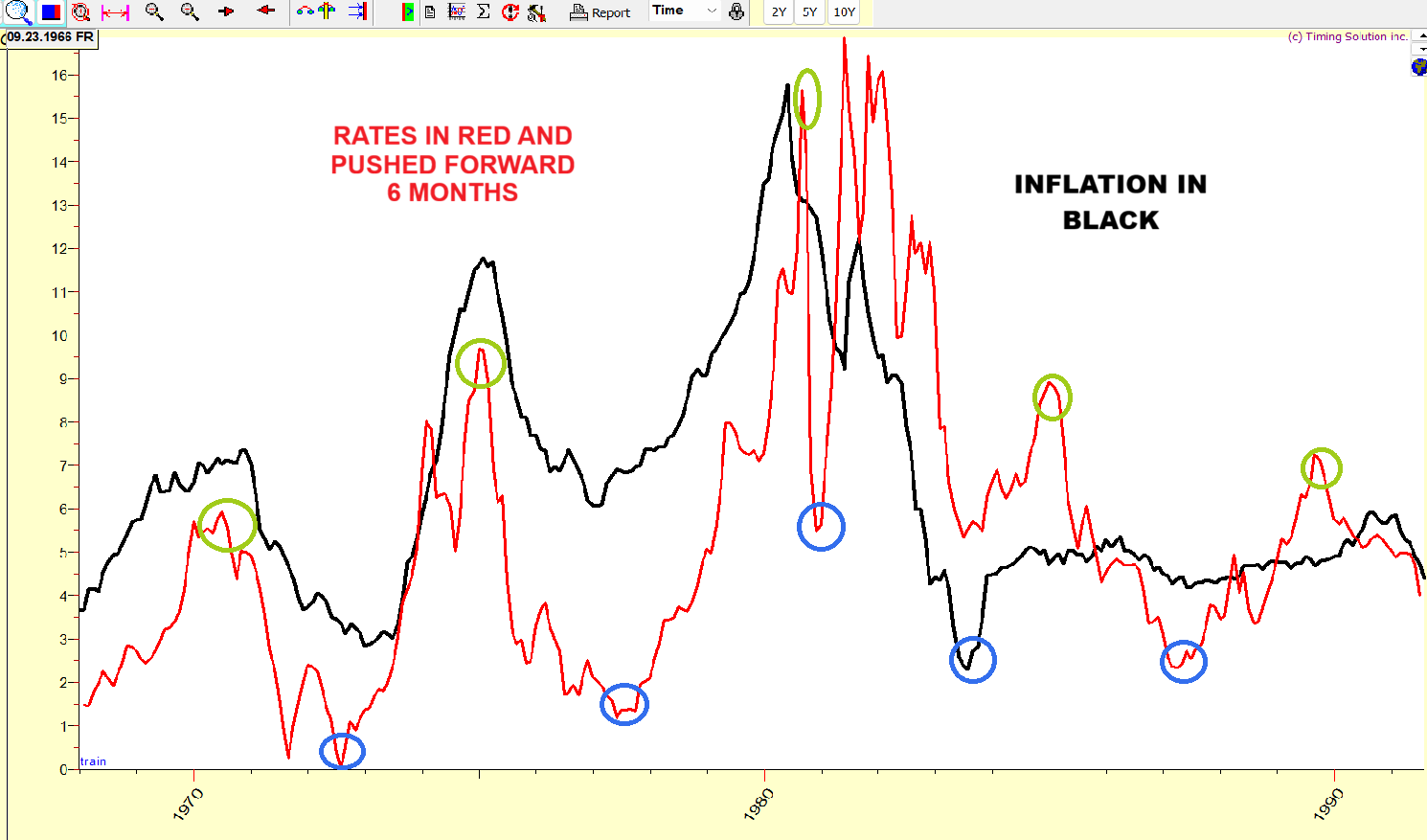
Nils Poertner writes:
With a bit of imagination, one could see that we may get to zero (or even negative short-term rates in the US)
Larry Williams adds:
Zero rates in Japan did not lead to inflation as most econ minds claimed it would.
William Huggins offers:
Richard Koo from Nomura explains why that was - and it has nothing at all to do with the notion that interest rates -cause- inflation.
Larry Williams asks:
Great post thanks.
Inflation is a result of 1) people raising prices and 2) people paying up so what causes that?
William Huggins responds:
as econ understands things (in the MV = PY framework), inflation would be a rise in P, which can result from a shock to any of the other three variables. the most common oversight though is that V is affected by how people behave too - the willingness to extend (or deny) credit has a huge impact on whether or not a transaction (PY) even takes place.
economic historians have long noted the relationship between M and changes in PY which shows up when Mansa Musa dumps a ton (actually several tons) of gold into the Egyptian economy in the 14th century, when the Spanish flood Europe with Inca and Aztec gold (and again when they "discover" Potosi), and during various state-induced hyperinflationary periods in the 20th century (USSR, Germany, Hungary, etc). but as the US from 1873-1893 shows, changes in V (which almost halved during that period) can influence inflation too which was negative for the period, despite increasing M and Y throughout.
overall, the record shows that big increases in the money supply (as in 2020/21) tend to set off inflation with a bit of a lag (digestion time) unless there are equally significant countervailing forces. the big assumption monetarists make (that Koo questions) is that people -will- borrow as rates come down. his argument (for those who didn't watch) is that if you have negative equity, borrowing at any rate is insanity - the whole mechanism of juicing aggregate demand by lowering interest rates relies on the idea that people who can will. as Koo/Japan points out, there is a limit to such linear thinking.
Feb
8
CIO predicts 2026, too
February 8, 2026 | Leave a Comment
Expect Equity Markets to Broaden in 2026, Led by Small Caps, International
Both fiscal and monetary stimulus should boost earnings in the U.S. and abroad, with dollar weakness continuing to underpin international stocks.
Nils Poertner comments:
Back in High School, they gave a 1 pager of Latin and we had 1 hour to translate it (since it is an ancient language I was spending a lot of time to see what this all meant.) We all know English more or less. These days, I read a 1 pager in English (like this page) in 1 minute. My modern brain actually agrees with the whole article. Yummy. In reality there are probably a lot of cliches in it….
Zubin Al Genubi writes:
AI is about training data otherwise it gets stale and cliched. Like a person reading the same newspaper every day. Google has lots of data. Musk is merging SpaceX with AI because as internet provider he will have access to unlimited global data. I wonder what their contract disclosures say about data privacy.
Steve Ellison responds:
"Expect"? I have seen the broadening occurring since November. There was an extended non-confirmation of Dow Theory last summer into fall as the Industrials were making new highs, but the Transports remained below their November 2024 high. Not only did the Transports finally make an all time high, now they are making new highs before the Industrials do. Similarly, the equal-weighted S&P 500 ETF RSP, which was badly lagging the cap-weighted SPY in the 2025 rally off the "Liberation Day" tariff lows, made a new high yesterday while the cap-weighted index only partially regained some of its losses from earlier in the week.
I said on X [6 Feb.], "Lots of strength in the broader market. While technology stocks were selling off the last few days, the Industrial, Materials, Consumer Staples, and Energy sector ETFs all made new highs".
Feb
5
6 new lows, from Zubin Al Genubi
February 5, 2026 | Leave a Comment
The last few down swings each had 6 new lows before a bottom. Today, marking a new low for this swing after hours will end up a new low number 5 by the end of tomorrow.
Steve Ellison writes:
Interesting. I have been experimenting with multi-level point and figure charts. Using a box size of 1.4% (a long-term average true daily range) and a 3-box reversal, SPY is still within 4.2% of its all-time high and hence in an uptrend. Drill down with smaller box sizes and shorter time intervals, and interesting price structures appear. At a 1/4 ATR box size, today's close was at a similar level to the Jan. 20 low.
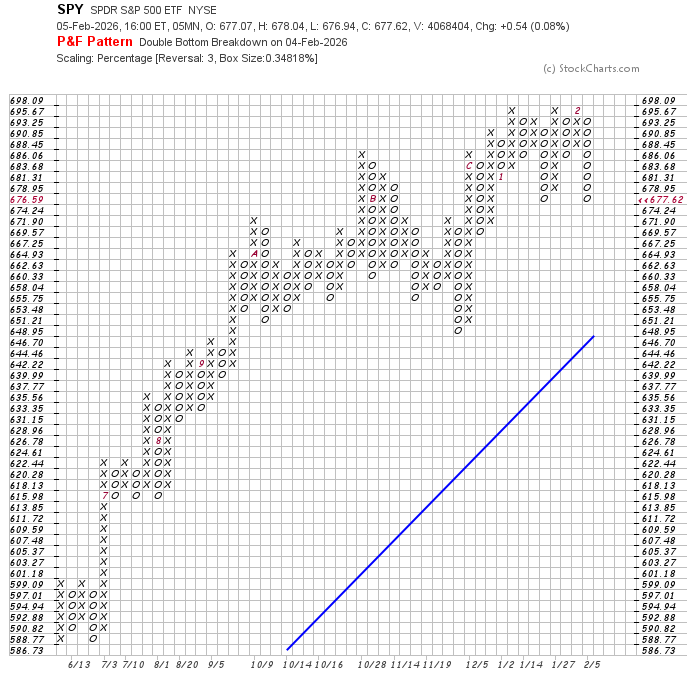
Lots of sector rotation under the surface. If 2025 was the year of the magnificent 7 and the flatlining 493, this year may be the opposite. While technology was getting beaten down this week, the Industrial, Materials, Consumer Staples, and Energy sector ETFs all made new highs.
Zubin Al Genubi adds:
Lots of late night shenanigans going on. Asian markets trading open in late thin US futures creating imbalances. Price action appears algo driven.
Nils Poertner comments:
I like the pattern with 6 new lows. Well spotted. Otoh, if the pattern does not repeat the surprise for mkts is bigger. nature offers "patterns" and "break of patterns" and both are relevant - else it would be a museum.
Cagdas Tuna predicts:
Then it is going to be a rough year for market cap weighted indices in US.
Peter Ringel writes:
While I would always give a study, like Big Al‘s more weight to remove opinion. I wonder, if there is a January effect regarding regime type or sector or general trading type. Not necessary % performance. Will the rest if the year trade like January? Would give a 2015 type year.
Nils Poertner responds:
yes. for practical purpose, it may be easier to trade mkts which receive less attention by the wider financial community /media.
Feb
4
2026 Bullish Confirmation, from Larry Williams
February 4, 2026 | Leave a Comment
Yale Hirsch and his son Jeff have shown that a positive change, from the last trading day of the year to the 5th trading day of the new year, portends a bullish year (positive first 5-day percent change).*
Consider this … in the last 76 years of trading, the S&P 500 has declined for the year 20 times or 26% of the time. In other words, 74% of the time, there has been a yearly gain.
Jeff’s numbers show that in those last 76 years, 49 years showed a positive first 5-day percent change. Only 8 of those years went on to close down for the year. That’s an 84% bias for the year to close higher when we have a positive first 5-day percent change.
My add-on to Yale’s and Jeff’s work was to look at the years that gained 1.2% or more in the first 5 days of trading. There were 28 such years. Of those years, only 2 were down for the year. That’s a 93% bias for the year to close higher. What an improvement from the average 74%!
In 2026, the first 5-day** change for the Dow Jones 30 was +3%.
In 2026, the first 5-day** change for the S&P 500 was +1.6%.
Those 28 years had an average annual return of 14%. The remaining years had an annual gain of 5.3%. I see this as excellent confirmation of the bullishness of my Forecast 2026 Report.
Cagdas Tuna writes:
There is no need for a statistical analysis to assume any given year will be positive for US indices. It is almost guaranteed to be positive every year. No offense to any list member.
Larry Williams responds:
Wrong 24% of time we close down for the year.
Michael Brush is surprised:
Wow did not know it was that high.
Larry Williams agrees:
I was taken back by it as well.
Asindu Drileba asks:
2026 is bullish? But Senator, you said you expect a recession in 2026 with 100% certainty. Is this a contradiction? Or maybe its possible for the market to be bullish even during a recession?
Larry Williams answers:
Yes, there was a projection made a year ago for a 2026 sell off —in the last 12 months data changed—large improvements in fundamentals and hopefully I got a little better understanding of long term cycles. New Data matters.
Nils Poertner writes:
Asindu- there would be simply too many variables out to make that statement with such a certainty in advance. Just impossible. It remains a probability game. Used to subscribe to some cycle research that claimed to have things figured out yrs in advance. quite pricey subscription. it was HOOK, LINE and SINKER (for me).
Denise Shull comments:
New Data matters.
Indeed it does. Wonder why it’s challenging for many to incorporate?
Nils Poertner responds:
Good question. On this note… (Pure) data analysts believe pattern matching on large datasets will solve our problems. But what if the really vital information isn't being collected? What if it's invisible to our trained systems?
Jan
28
Triage in medicine, from Nils Poertner
January 28, 2026 | Leave a Comment
process of rapidly sorting and prioritizing patients based on the severity of their condition and the urgency of their need for care, especially during emergencies
Amateur /untrained person coming to a traffic accident (w multiple casualties) would rush to help those who cry the loudest (eg maybe just a broken arm) whilst neglecting those who need urgent attention (eg unconscious - about to pass out).
Analogy to speculation? Ordinary investors (ie untrained) getting hooked to "loud" and in your face "stories" in mass fin media - but perhaps neglecting the vital, more silent trends in mkts - which would help them make money over time.
Jan
16
Tacit knowledge, life lessons, and roast beef
January 16, 2026 | Leave a Comment

Nils Poertner suggests:
there is a wonderful book by Michael Polanyi - on tacit knowledge (unlike explicit knowledge one has to develop that skill oneself). not trying to proselytize here that is quite good of a book) and worth many gold nuggets
Jeff Watson offers:
There are some great nuggets in this video - 100 quotes, 100 meals for a lifetime:
100 Harsh Life Lessons That Made My Life So Much Better
Larry Williams knows where the beef is:
America's Top Roast Beef Sandwiches, According to Food Critics
Peter Ringel follows up:
Classical Music for When You're in a Food Coma
Jan
14
Manipulation, from Humbert X.
January 14, 2026 | Leave a Comment
The allegation of “manipulation” is inevitably just code for “I just badly hosed a trade that seemed so good on paper.” Whereas the proper response to a bad trade is introspection and examination of one’s system. In the markets as elsewhere, there can be a general tendency towards the rejection of personal responsibility. This regularly surfaces in the “manipulation” allegation.
William Huggins responds:
not an opinion on anyone's trading but there is a "fun" bit of psych referred to as the fundamental attribution error in which my successes are the result of hard work and skill while the success of others boils down to luck. similarly, when things go wrong for me, its bad luck (or nefarious forces, "them") but when things go wrong for others, its their bad choices or immorality. pretty much every single person falls into this trap unless they spend a great deal of effort fighting back against the heroic narrative.
Humbert X. comments:
I find it does me little good to think about others, other than to identify when they are travelling in a herd and at an extreme level of emotion, for contrarian purposes. Though sometimes it is possible to learn from their successes and failures assuming they are being transparent about what went right or wrong, which is rare.
Nils Poertner writes:
Good to read Hannah Arendt on this note (free floating anxiety within any society have to go somewhere and sinister groups will use it for their advantage - if not a virus, then some other "Country-" Phobia, then climate change etc… So it would not be enough to change politicians , the anxiety is within the masses (and mostly unconscious).
The key for a speculator is to travel light in life and take things with a bit of distance (2 inches are often enough) - and focus on the process of making money!
Jan
12
Zugzwang, from Zubin Al Genubi
January 12, 2026 | 1 Comment

In chess, zugzwang refers to a situation where a player has to move, but every move worsens the player's position. When a portfolio manager's risk limits are hit or losses are thought to be unacceptable, the situation is quite the same. - Hari Krishnan
The Immortal Zugzwang Game is a chess game between Friedrich Sämisch and Aron Nimzowitsch, played in Copenhagen in March 1923. It gained its name because the final position is sometimes considered a rare instance of zugzwang occurring in the middlegame. According to Nimzowitsch, writing in the Wiener Schachzeitung in 1925, this term originated in "Danish chess circles".
Nils Poertner writes:
on this note (lack of imagination), see David Hand's probability lever concept:
The Law of the Probability Lever essentially states that slight changes in the circumstances or assumptions of a statistical model can dramatically change the calculated probabilities of events.
Larry Williams states:
ZUGZWANG The life of a trader in one word—always in too early or out too late, also out too early or too late.
Jan
8
Relevant animal behavior study, from Big Al
January 8, 2026 | Leave a Comment
Self-control is definitely an issue in trading! I kept thinking of the crayfish pov. They probably shined him up by telling him he was "preferable".
Can this Cuttlefish Pass an Intelligence Test Designed for Children?
Nils Poertner responds:
Very good. For specs / traders the self-control is tested now with media trying to steal our energy (emotional vampires) with high amygdala stories - whereas the mkts does whatever it does. "get the joke"
Jan
4
Natural Gas, from Nils Poertner [Update]
January 4, 2026 | Leave a Comment
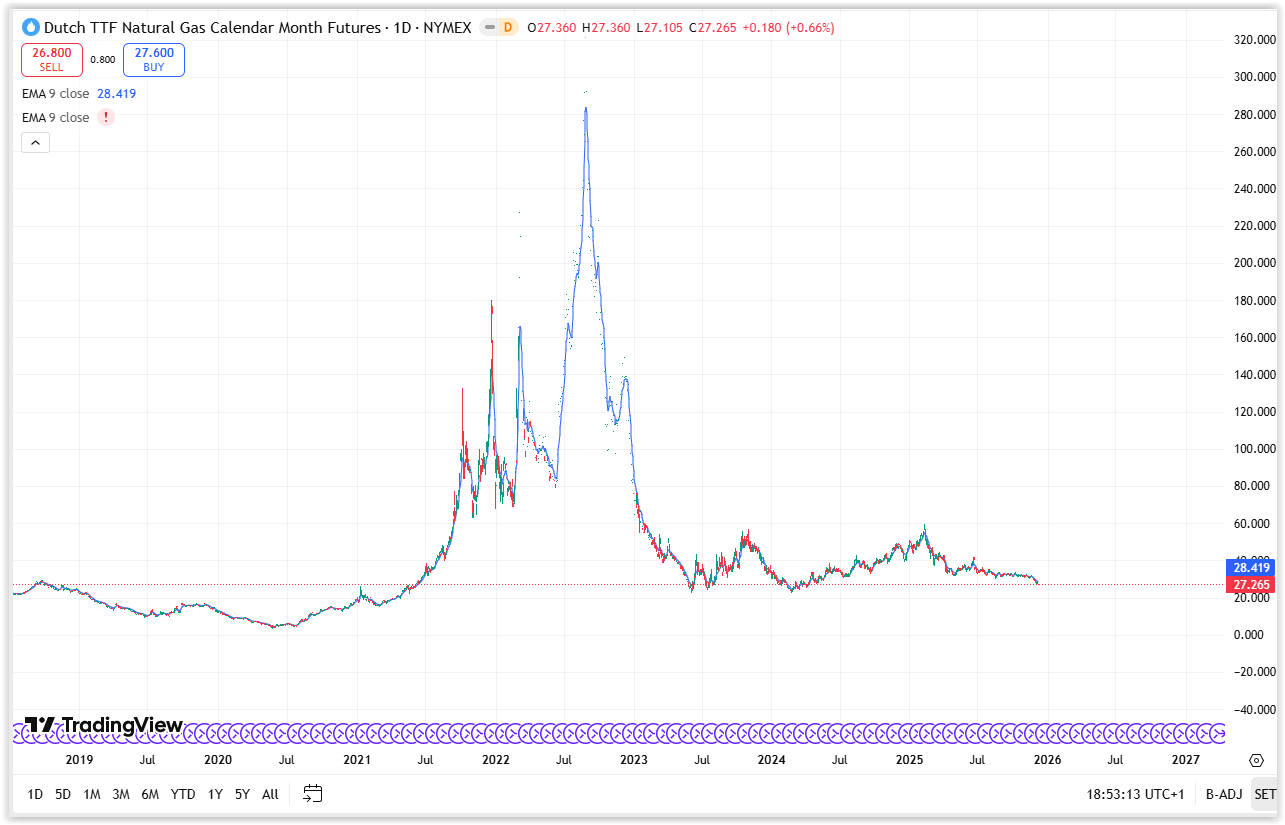
European Natural gas - not that far to test 2024 lows, and perhaps even pre-Ukraine-war levels eventually? Peace coming (?) Or general decline in Gas prices (US natty has gone the other direction for a while).
"Price move first - fundamentals later." When something moves (even though I don't trade it - or have expertise in it yet), I often look at it and wonder what it could mean. Mass financial media hasn't picked up on this theme either (much) - another reason to consider what it means…
Carder Dimitroff comments:
For me, this is an important observation. EU-US fundamentals have changed. The current US administration "encouraged" the EU to accept US LNG imports. At the same time, US LNG export capacity has increased. For Europe, the supply-demand dynamics changed. In the next several months, it will continue to change:
• 14.49 Bcfd US LNG export capacity - current.
• 21.81 Bcfd US LNG export capacity - under construction.
• 13.24 Bcfd US LNG export capacity - approved but not under construction.
• 12.49 Bcfd US LNG export capacity - proposed and seeking approval.
Most of this LNG use capacity uses, and will use, Texas/Louisiana natural gas as its feedstock. Feedstock and LNG prices will likely be correlated with Henry Hub prices. If most of this capacity is built, the following trends are likely to emerge:
• US citygate (NG) average prices will float higher.
• US LMP (electric) average prices will float higher.
• US NGL average prices will sink.
• EU NG average NG and LMP prices will stabilize.
More importantly, global LNG markets are changing and will continue to change. Keep in mind:
• Global LNG capacity is expanding
• The US is not the LNG cost leader and never can be.
• As the US dominates EU imports, global markets adjusted accordingly.
Of course, traders should be indifferent about these long-term fundamentals. But long-term investors might consider options.
Stefan Jovanovich asks:
Follow-up question for Carder and others: "What do you think about the Doombird thesis that the Permian drillers and the mid-stream connectors will shift to have natural gas be the hydrocarbon asset that they look to make money from and oil will be the secondary source of income?"
Carder Dimitroff replies:
If the question concerns long-term prospects, global demand for diesel, jet fuel, plastics, and related products is expected to grow. Gasoline consumption may be slowing, but it is not crashing. But who knows where the economy is headed?
For the US, natural gas as a bridging fuel makes sense if it can reach consumers. In the US, domestic delivery is a problem. Globally, LNG delivery is also a problem, but for different reasons. Because they deliver to Henry Hub, producers should be indifferent between the two markets. Beyond Henry, LNG is becoming increasingly accessible, whereas citygates will continue to struggle.
The US is also a net exporter of oil and oil products. Again, the product supports two separate markets.
Most Permian wells produce oil and associated gas (and they are getting gassier). It's not a choice. They get both.
For me, the short-term challenge is global overproduction. Geopolitical considerations rather than economic factors drive the decision to overproduce and erode margins. It will end, and the markets will revert. Until then, it will be difficult for American producers to finance new wells.
Dec
23
Low status jobs becoming high status, from Nils Poertner
December 23, 2025 | Leave a Comment
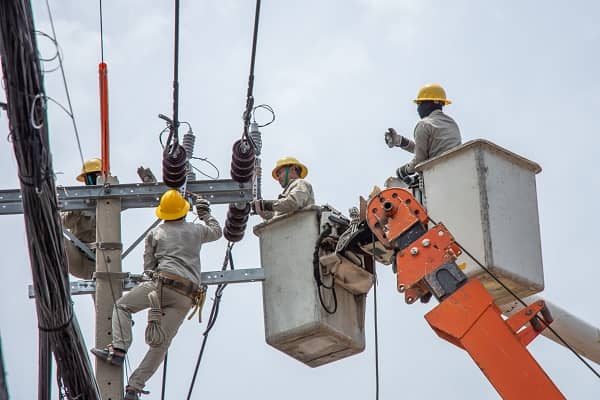
Fascinating to watch how former low status jobs, like cybersecurity, have become high status now. Same is true the other way around as well (eg (male) technician at the London tube system who makes a quarter of his wife who is in real estate - although that is changing now). Wondering what low type jobs / or ppl are on the fringes today will be in high demand in coming years.
Carder Dimitroff responds:
Try these:
Any of the crafts. Specifically, licensed electricians, plumbers, and HVAC techs. Many make more than engineers.
Public response teams. Specifically, firefighters, EMTs, and law enforcement. Many make more than lawyers, particularly when pensions are considered.
Career military. Specifically, for those with 20 years of service. Lifetime benefits are incredible (free college, unlimited grad schools, pensions w/colas, lifetime medical insurance, VA benefits, hiring preferences).
Pamela Van Giessen suggests:
Car mechanics
Henry Gifford writes:
My friend who fixed boilers said to his sophisticated, suit-and-tie, well educated in-laws “I’m not the smartest guy around. I’ve only read two or three books in my life. I don’t think I’m smart enough to come up with a sophisticated investment plan (nods all around the room at this point). So I just buy one piece of New York City real estate each year and hope for the best”. No more nodding at that point.
Guess what blue collar people who don’t have vices do with their money? They buy property. Who is better suited to own real estate? People who fix things and have friends who fix things, or lawyers?
And what nobody mentions is that some people are much better at those sorts of work than others. Simply finding someone to show up and try to do those things is hard. Someone who is good at one of those trades is in even higher demand.
Those fantastic benefits for former military people are not limited to the military – all federal employees get all those benefits after twenty years of work. If someone joins the military at 18, and gets out at 38, or gets out sooner and then works in the post office or etc. until they “get their twenty”, they get full salary with increases for life. Income that will survive any lawsuit, even the IRS can’t take it all. They maybe collect a total of three years of salary for every year worked.
Nils Poertner responds:
Certainly good to encourage young men (or women) to follow a path that interests them - and not just follow a path that is currently "high status". This "Yousef" guy who was my IT guy at Bankers Trust decades ago (low status in my eyes back then) became a cyberpunk in 2008…you get the idea. That said, it is a power game outside. young men need wives etc.
Henry Gifford adds:
I judge the level of a single woman’s interest in me by counting the seconds until she says “what do you do?”.
No woman has ever asked me if I like what I do, or am good at what I do – not important.
Many men have a choice between coming home miserable to a wife, or coming home happy to an empty house. Age old dilemma, no known fix, as all our DNA has evolved to enhance survival, which for a woman over the millennia has meant marrying the chief’s son, or someone else with high status.
Larry Williams recalls:
When I was dating all women ever asked me is your place or mine. Must have been doing something wrong.
Michael Brush is curious:
Do you have a cycle chart for that?
Larry Williams clarifies:
Yes but there are not enough examples to draw a conclusion.
Dec
21
Study of ancient languages. from Nils Poertner
December 21, 2025 | Leave a Comment
Idea for younger Specs: In School, some of us studied old languages, Latin, ancient Greek, one had to sit 1 hour to figure out what individual words could mean. And then put it all together. One could have the same approach for reading modern newspaper articles now. like this WSJ article here (I know that ppl can read "English" - I meant in a more reflective way. "Get the joke")
Five Reasons Investors Are Feeling Good About Stocks Again
and then check /study with "expected" vs "actual" in 1 week, 1 month, 1 quarter etc,
on a rolling basis to hone intuition /train memory.
Stefan Jovanovich recalls:
Arthur Sullivan - "no, I am not a descendant of the composer, whom none of you dunces will have heard of. He was English; I am Irish." - remains my favorite of all teachers. He lasted 1 year at Hackley - then a borstal boarding school for children who had to be warehoused, now a respectable Westchester County day school. He taught 9th grade Latin and turned it into a lesson in military tactics and strategy. The little Latin and less Greek are long gone, but I can still see his face and those of my classmates the day he explained to us how Caesar used a company of archers to conduct reconnaissance by fire.
Dec
19
Request for “off topic” books on speculation, from Asindu Drileba
December 19, 2025 | Leave a Comment
Often when I listen to specs I hear "off-topic" book recommendations. Examples:
"The most important book to do with trading is Secrets of Professional Turf Betting by Robert Bacon" — The Chair. A book about parimutuel horse betting.
"The most important book to do with the stock market is Horse Trading by Ben Green" — A game theorist & friend of The Chair. A book about selling horses
"I can find new trading strategies on almost every new page (Thinking Fast and Slow by Daniel Khaneman)" — The Chair's Brother (Mr. Roy Niederhoffer). A psychology book
"Our entire investment philosophy is based off this book (Snow Crash by Neal Stephenson) — Fred Wilson of Union Square Ventures, a Tier 1 VC firm. Its a sci-fi book.
"One of the most important things you can learn todo with investing is creative writing" — Jeffrey Hirsch. Not a book but still an off-topic research recommendation.
I have never regretted reading an "off-topic" book. Any more of such recommendations?

Nils Poertner responds:
Coaching Plain & Simple, by P. Szabo, D. Meier (book about learning - how to coach oneself in a way)
Asindu - what books to get rid off, to burn, what is an obstacle in your life is also relevant. Early 2008, I visited a French friend on Lehman trading floor in London. V nice guy, senior analyst for their credit models, high IQ 130 plus, bit gullible though. He was surrounded by over 20 books of advanced math on either side of his desk. I had the urge to get a huge sledgehammer and whack down the books…you know.
Larry Williams suggests:
Zurich axioms. A must read.
Peter Ringel agrees with Larry:
I have them on my wall. Besides some of the lists by Vic, Larry, Adam Grimes and some other. Valuable.
And did you find the Daily Speculations booklist?
Asindu Drileba writes:
Yes. I forgot about Zurich Axioms. Thanks. This Daily Speculations list is good, I actually wasn't aware of it.
Dec
18
Clustering, from Nils Poertner
December 18, 2025 | 2 Comments
There is this known phenomenon that coffee chains (Starbucks, Costa Coffee) in a city are often next to each other. Same for gas (petrol) Stations. Makes no sense for the customer but applying game theory it certainly does.
Perhaps the same could be said for analysts forecasts by major broker dealers?
Early 2010 (pre Eurocrisis) I recall speaking to a Deutsche Banker covering Italian regional banks. She said she would have loved to write a more bearish story but was afraid of internal repercussions (as they were trying to win other business from those Italian banks).
Dec
16
Only the paranoid survive, from Nils Poertner
December 16, 2025 | Leave a Comment

written by another smart Hungarian (who came to the US). Andy Grove (late Intel CEO), real name is Gróf, András István. Jewish Hungarian middle class. András Gróf was born to a middle-class Jewish family in Budapest in 1936.
typically it does not pay to be surrounded by paranoid ppl in business or speculating (one reason I don't like preppers in my vicinity as they irritate me too much) -OTOH, perhaps there is some value to adding here and there a friend who is a bit paranoid at times.
Dec
15
Harvard Club antisemitism, from Jeff Watson
December 15, 2025 | Leave a Comment
No comment needed.
The Harvard Club of New York Cancels Dershowitz Book Event
The Harvard Club of New York is being accused of censorship after abruptly cancelling a book event featuring famed Harvard professor Alan Dershowitz. In a statement, Dershowitz says that invitations were sent out and the event was approaching when he was suddenly told that the Harvard Club would have none of it. He blamed his representation of President Donald Trump for the cancellation. For a club that bills itself as offering “unique experiences,” it appears that hearing from opposing or different views is not one of them. Dershowitz has been associated with Harvard for over 60 years and remains one of its best known law faculty members.
Nils Poertner comments:
Large Universities in the US, Canada and parts of Europe are doomed beyond repair. No error correction process happening- built through collapse.
Henry Gifford writes:
Harvard was just used as an example when Trump tried to cancel “their” research funding (polite word for money). I didn’t pay attention to the details of the outcome - the point got made that universities better step into line.
Sure, Trump’s objection had something to do with DEI and being too liberal, but as all colleges are dependent on not paying taxes, and on government loans for most tuition, and government research money, they can hardly be anything but socialist in thinking, and can be expected I think to stay that way.
If they paid taxes and people had to pay to go there and research had to be paid for by someone spending their own money things would, I think, be greatly improved, but that is not the world we live in.
The government is basically paying the universities to breed socialism. In New York City we even have colleges that teach people to be bureaucrats.
Dec
6
Sancho Panza proverbs, from Nils Poertner
December 6, 2025 | Leave a Comment
Sancho Panza's Porverbs and others that occur in Don Quixote
half of the proverbs contain the word "ass" in it - like this one which I found timely:
When the broom sprouts, the ass is born to eat it.
Nov
28
Lucky charms, from M. Humbert
November 28, 2025 | Leave a Comment

Anyone have any favorite good luck charms/rituals to help with trading results?
Peter Ringel writes:
some of the old floor traders, we had on this list, reported how superstitious some of the traders were. Cloths, bathroom time…
Asindu Drileba comments:
Lucky charms may sound delusional but they are actually more common than we think. They are more like placebos. I take pill X, my headache goes away. (But pill X is made from wheat flour and a bitter "filler" and has exactly zero pharmaceutical contents, yet it works).
Have you ever pushed the button that opens the door of an elevator? Well, those buttons are completely fake! Elevator doors are pre-programmed to open and close at hard coded intervals. Pushing the button does nothing. They simply exist to give people a sense of control.
Nils Poertner writes:
To have a strong belief one can learn (from mkts or others) is a good start.
ie allowing for mistakes to happen, not fretting them. (many cultures are guilt-ridden, like the German culture on so many fronts. All it takes is sometimes to muster up enough courage and learn from mistakes and don't judge).
Zubin Al Genubi offers:
I'm reading Kidding Ourselves, Hidden Power of Self Deception, by Hallinan, in which he describes real physical and psychological effects of psychosomatic causes such as death, hallucinations. You see what you want to see. You are and become what you believe yourself to be. It affects health, performance, money. He also describes how a feeling of lack of control can be debilitating and even deadly. Some feel a lack of control in that they don't control the market, but one can easily (physically at least) click the keys to buy and sell any time.
From scientific studies: Our results suggest that the activation of a superstition can indeed yield performance-improving effects.
Nov
25
Book recommendation from Zubin Al Genubi
November 25, 2025 | Leave a Comment

Zapped: From Infrared to X-rays, the Curious History of Invisible Light
From beloved popular science writer Bob Berman, ZAPPED tells the story of all the light we cannot see, tracing infrared, microwaves, ultraviolet, X-rays, gamma rays, radio waves and other forms of radiation from their historic, world-altering discoveries in the 19th century to their central role in our modern way of life, setting the record straight on health costs (and benefits) and exploring the consequences of our newest technologies.
Nils Poertner suggests:
The HoHo Dojo, by Billy Strean.
Laughter and humor are therapeutic allies in healing.
Nov
23
Suprises, from Nils Poertner
November 23, 2025 | Leave a Comment
Whether it is the "Mambani win", Brexit, Covid, Ukraine war, whatever - had someone told me 6 months before that this could happen - the answer would have been "no-way…" whereas in 20-20 hindsight - it is always like "oh yes, there were obvious signs."
Zubin Al Genubi responds:
History is made on the edges by outliers which shifts the averages way over in its direction.
Nov
17
Corporate earnings, from Zubin Al Genubi
November 17, 2025 | Leave a Comment
I see they are down [at least through Q2]:
FRED: Corporate Profits After Tax (without IVA and CCAdj)
Steve Ellison responds:
Interesting. S&P 500 earnings per share were up both year to date and year over year. And Q3 so far looks better than Q2.
S&P source spreadsheet: Click link to download file: S&P 500 Earnings.
Big Al wonders:
So maybe the big firms are doing better than the smaller ones?
Nils Poertner remembers:
Investment Bank earnings 2007…My very cerebral friend Maurice at the time: "IBs are cheap - look at their PE ratios."
Nov
13
The $38 Trillion Question, from Humbert X.
November 13, 2025 | Leave a Comment
The $38 Trillion Question: An Interview with Stanford Professor Hanno Lustig
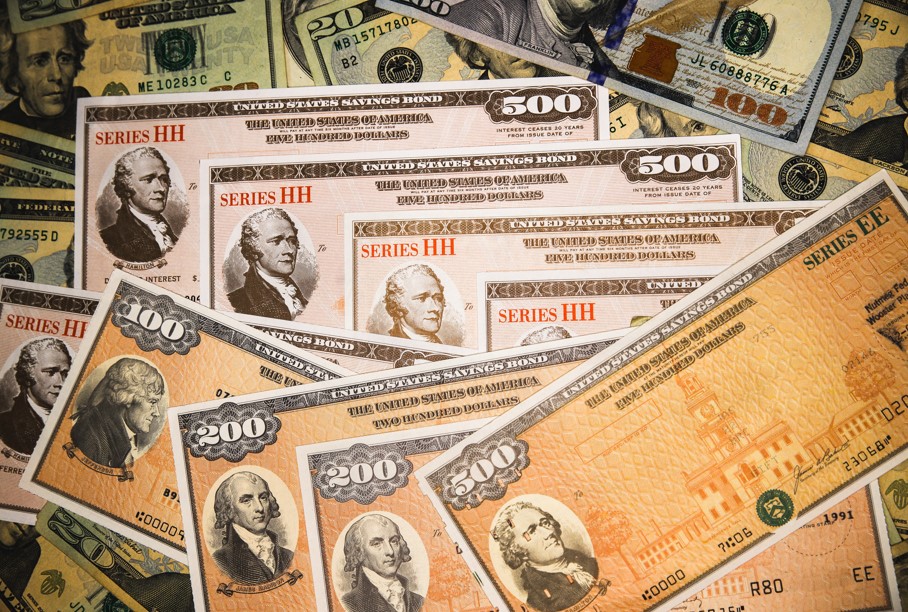
Hanno Lustig: I started thinking about the valuation of government debt by looking at the valuation of all Treasuries. What do we have to believe to get to a number like $38 trillion? You must believe there will be a huge fiscal correction, because ultimately the value of debt should be backed by future primary government surpluses. When you do the numbers, you realize that either bond investors are pricing in a huge fiscal correction that seems impossible, or Treasuries are significantly overpriced.
Carder Dimitroff notes:
The interest on debt is approaching $1 trillion per year and continues to compound. Interest costs currently exceed Department of Defense spending.
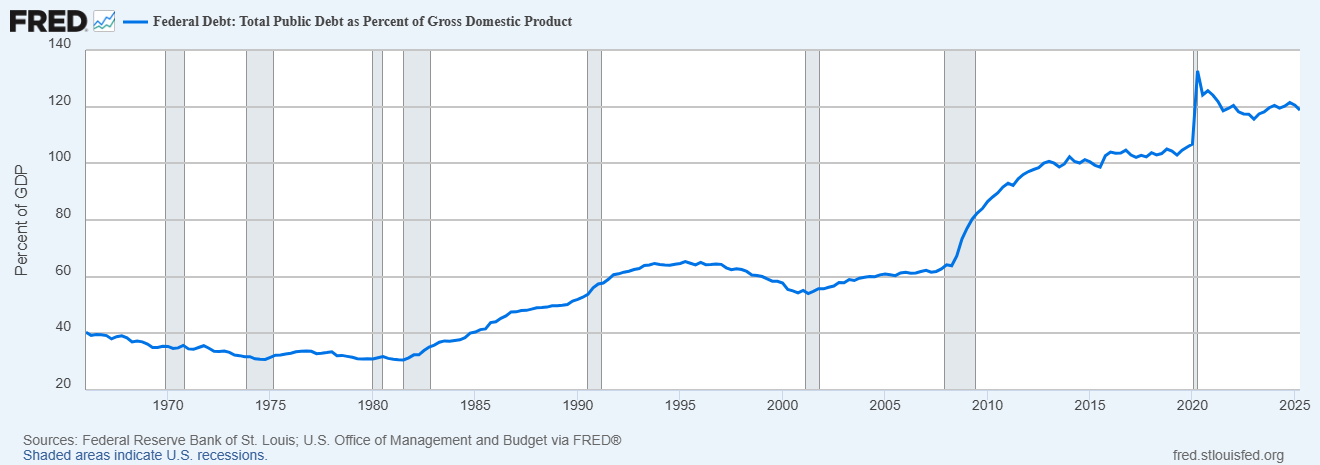
Larry Williams disagrees:
Meaningless measure look at debt vs gdp
Carder Dimitroff responds:
Yes, that makes sense. However, from a different perspective, it becomes meaningful under the One Beautiful Budget Bill when automatic sequestrations are implemented. Unless new legislation is passed, sequestrations will result in Medicare cuts and other reductions in expenditures. Current projections suggest sequestration will present in early 2026.
Big Al checks with FRED:
Nils Poertner writes:
recession + zero short term rates + lots of QE ….leading to a lot more public debt
maybe that is more likely path.
Stefan Jovanovich offers some history:
This chart shows the solvency ratios that can be found from the Census and other data [by decade 1880 to 2020] - how much "we the people" have in money divided by how much the American governments promise to pay.
Nov
12
David Hand’s probability lever, from Nils Poertner
November 12, 2025 | Leave a Comment
intellectual support / motivation to look at more extreme scenarios from time to time (extreme only appearing in the moment of course).
Hand writing: The Improbability Principle
The law of the probability lever is to do with choosing models. With poor assumptions even highly likely events can seem very improbable. Small changes in initial conditions can have an extremely large effect on outcomes.
Nov
9
Prestigious consulting firm, from Nils Poertner
November 9, 2025 | Leave a Comment

Came to our financial firm 2007 and gave a 100 page presentation full of bullet points and cartesian logic (why housing boom will last). Either 3,5, or 9 bullet points per page.
At the end of the presentation I was tempted to go over to the presenter and ask him "why do you love your wife? (I didn't). The answer might have been bullet points.
Pamela Van Giessen writes:
Michael Korda tells in his memoir, Another Life, of the time that Simon & Schuster hired probably the same prestigious consulting firm to study how to improve revenues/profitability. Prestigious consulting firm (after taking the prestigious consulting firm fee) told the publishing company that they should publish more bestsellers.
Laurel Kenner comments:
I bet the prestigious firm concluded with ‘Key Takeaways’ as a final insult to the intelligence of the client.
Asindu Drileba writes:
I heard that people pay consultancy firms not for their knowledge, but for the fact that executives use them as a scape goat. If an executive wants to pursue policy X. They simply hire a consultancy to recommend policy X. If policy X ends up as a disaster (legally, morally or financially). They can simply say "Policy X was an idea from XYZ consultancy", we had nothing to do with it.
Peter Ringel adds:
a variation of this are fighting owners/ partners about policy. If decision pipelines are blocked, external council is used. Like a neutral arbitrator. I think, these are the main situations externals are used. Usually a good reason to short the entity, especially outside of markets. If they don't have the capability to decide and act on strategy in-house, it‘s a red flag.
Henry Gifford responds:
Even better is hiring a licensed engineer to instruct everyone to do something stupid that they know won’t work, so everyone who did as the engineer decided is blameless.
Jeff Watson offers:
A consultant is a person who knows 1000 ways to make love to a woman…..but he doesn’t know any women.
Oct
23
Regional US banks, from Nils Poertner
October 23, 2025 | Leave a Comment
As a European, I am asking: Are US regional banks in trouble (maybe even some larger banks - incl Investment banks). Dodgy consumer loans, then those silly "AI-related" loans? Am agnostic here - I suspect the typical analyst from JPM down the road won't enlighten us here.
Paul O'Leary comments:
No. Looks like over-reaction to a couple credit blips. Then algos pile on and observers who don’t follow the sector conjure up doom scenarios. Zion Bancorp - the main sinner, lost $1B in market cap for a $50mm write down.
Nils Poertner responds:
Hear you, Paul. If enough people would start to worry now, I would worry less (let us see).
Cagdas Tuna adds:
We are at a level any reaction will be exaggerated. If market adds $200bln to NVDA market cap with additional $1blnn revenue then $50m loss will have the same effect on a smaller company's share.
Oct
17
George B Shaw, from Nils Poertner
October 17, 2025 | Leave a Comment

You see things; and you say 'Why?' But I dream things that never were; and I say 'Why not?'
- George Bernard Shaw
English Cyperpunk /hacker I met in 2005 had this quote on his screen - and I recall him talking about some digital ccy back then (little did I know back then, was so busy structuring CDOs and keeping up with the Jones.
If we want to nail mkts in coming years and have some fun, it def pays to surround ourselves with ppl outside trad finance (group think!) - from the art, music, acting world, hacker etc…whatever.
There is a certain type of fatalism in the West as well (David Hand, the British statistician, speaks about it as well in his "miracle" book. It has something to do how we perceive the world.)
Oct
16
Hubris is going to a New All Time High, from Sushil Kedia
October 16, 2025 | Leave a Comment
Saudi Arabia has announced the Rise Tower that is likely to have a height twice that of Burj Khalifa! 2000 meters up from the ground! It is likely to cost 5 Billion Dollars. One is left wondering in a world where everyone manages to almost manages to get decent enough sleep every night with Trillion Dollar deficits, what is Hubris doing having been left so far behind!
Nils Poertner writes:
Wondering what to make of this though, Sunil. Saudi Arabia's main stock Index (TASII peaked in 2006. and never fully recovered properly. Any idea how to express it into some trading idea so we can test our hypothesis?
William Huggins comments:
The 2006 Saudis run is very similar to the soul al manakh run up 20 years before. In particular for Saudis though, it's a market that forbid ahoet selling so when the bulls got started there was no guardrail until they simply could find no bigger fool.
Nils Poertner responds:
Thanks William. Maybe one needs to look at oil (bearish oil story?) - oil doesn't move forever and then it moves a lot. (not an oil trader though - just something that came to mind)
Alex Castaldo offers:
For those too young to remember the events of 1981:
The Souk al-Manakh Crash
From 1978 to 1981, Kuwait’s two stock markets, one the conservatively regulated “official” market and the other the unregulated Souk al-Manakh, exploded in size, growing to the point where the amount of capital actively traded exceeded that of every other country in the world except the United States and Japan. A year later, the system collapsed in an instant, causing huge real losses to the economy and financial disruption lasting nearly a decade. This Commentary examines the emergence of the Souk, the simple financial innovation that evolved to solve its rapidly increasing need for liquidity and credit, and the herculean efforts to solve the tangled problems resulting from the collapse. Two lessons of Kuwait’s crisis are that it is difficult to separate the banking and unregulated financial sectors and that regulators need detailed data on the transactions being conducted at all financial institutions to give them the understanding of the entire network they must have to maintain financial stability. If Kuwaiti officials had had transaction-by-transaction data on the trades being made in both the regulated and unregulated stock markets, then the Kuwaiti crisis and its aftermath might not have been so severe.
Oct
9
Jewish Hungarian, from Nils Poertner
October 9, 2025 | Leave a Comment
What is it with Hungarian Jewish who came to the US - so many of them achieved great things. My book shelf is full of them, Darvas (Trading), S Meisner (Acting)…..even my trading platform Interactive Brokers was founded by one (Thomas Peterffy).
Maybe a combo of rare language ??/ culture + hardship first + grid + ability to flourish in the US gave them superpower. Soros, I guess was (Jewish) Hungarian as well.
Venkatesh Medabalimi asks:
Where is my no.1 Hungarian? May I remind everyone about Paul Erdős.
Laurel Kenner offers:
An amusing book on the subject: Made in Hungary : Or Made by Hungarians, by György Bolgár.
Nils Poertner responds:
Thanks both. Found this on Erdős:
Paul Erdős: The Oddball’s Oddball
He would appear on the doorstep of fellow mathematicians without warning–a frail, disheveled, elderly man, hopped up on amphetamines and wearing a ratty raincoat–and announce, in a thick Hungarian accent, “My mind is open.” For a day, or a week or a month, the man or woman who answered the knock would have to take nonstop care of this helpless guest who couldn’t figure out how to cut a grapefruit or wash his underwear–and in return would be permitted the exhausting, exhilarating experience of following the thought processes of Paul Erdős, the most prolific and arguably the cleverest mathematician of the century.
Oct
1
Lebanon, from Nils Poertner
October 1, 2025 | Leave a Comment
Lebanese traders from the 1980s tell me how chaotic that decade was - high vol ever day - for yrs. Survival was key! Started reading every bit about it in the last few weeks. (The thing that Stefan is right about is that the self-image we have in West and realtiy - there is a huge gap for sure!! Am not speaking about military though - I meant anything else)
The Lebanese Economic Crisis: How It Happened; the Challenges that Lie Ahead
September 27, 2021
Lebanon is experiencing one of the worst economic collapses in recent history. The currency has lost more than 90 percent of its value; an estimated three in four Lebanese citizens are now below the poverty line, and the country is beset by food, gas, and medical shortages. The power grid can barely maintain electricity for cities, with frequent blackouts occurring. Finally, the country had to default on its debt payment, launching its debt crisis. The debt crisis didn’t come suddenly, but was building up over time due to economic decisions made by previous governments. To understand how this crisis came to be, an examination of Lebanon’s modern history is in order, starting with the civil war in 1975.
Larry Williams writes:
Chaotic? In 1973 Shearson AmEx had me go there to lecture an teach trading - some high flyer commodity mooches had come in and lost lots of $$ for some locals who did not understand margin calls. The high flyers from Chicago were found gutted on a barb wire fence out in the country! The war broke out we could not get out for about a week so hung low then finally bribed our way home.
Nils Poertner responds:
my 2 cents are on Larry and all savvy Lebanese traders going forward. Good idea to live in more rural areas in the US, UK etc to see things unfolding as well. And keeping the internal chatter to a minimum (as always).

Stefan Jovanovich analogizes:
If LW disagrees, he will, I hope, correct this latest folly from the List's history channel wannabe. The reason the Oregon Trail came first was that it was the one safe destination for the missionaries. The Indians of the rain forest coastal Northwest were the tribes with no history of revolt against the Brits, Russians and Americans. The wars on the Plains started when some smart money decided that they could colonize the spaces between Council Bluffs and the Dalles. That analogy comes to mind every time I look at the modern history of the adventures of the Americans in Lebanon.
Larry Williams offers:
My brother on law who is better read than I am an a deeper thinker says this is a good read on the western adventure:
The Undiscovered Country: Triumph, Tragedy, and the Shaping of the American West
Sep
28
Scaling problems in ship design, from Nils Poertner
September 28, 2025 | Leave a Comment
Scale effects and full-scale ship hydrodynamics: A review
Scaling problems in ship design refer to the difficulties of translating performance data from a small-scale model to a full-scale ship, as physical forces like viscosity and wave drag do not scale proportionally with size.
Crypto space here? Trading strategies that work in niche mkts or early on, may not work when they are larger /more mature etc.
Henry Gifford writes:
The problems with water include the size of water droplets – they won’t form larger than a certain size – and Reynolds Number, which has to do with viscosity (mentioned below), and how to calculate it. Basically, a certain flow velocity in a small pipe (or river) will be turbulent, while in a larger pipe it might not.
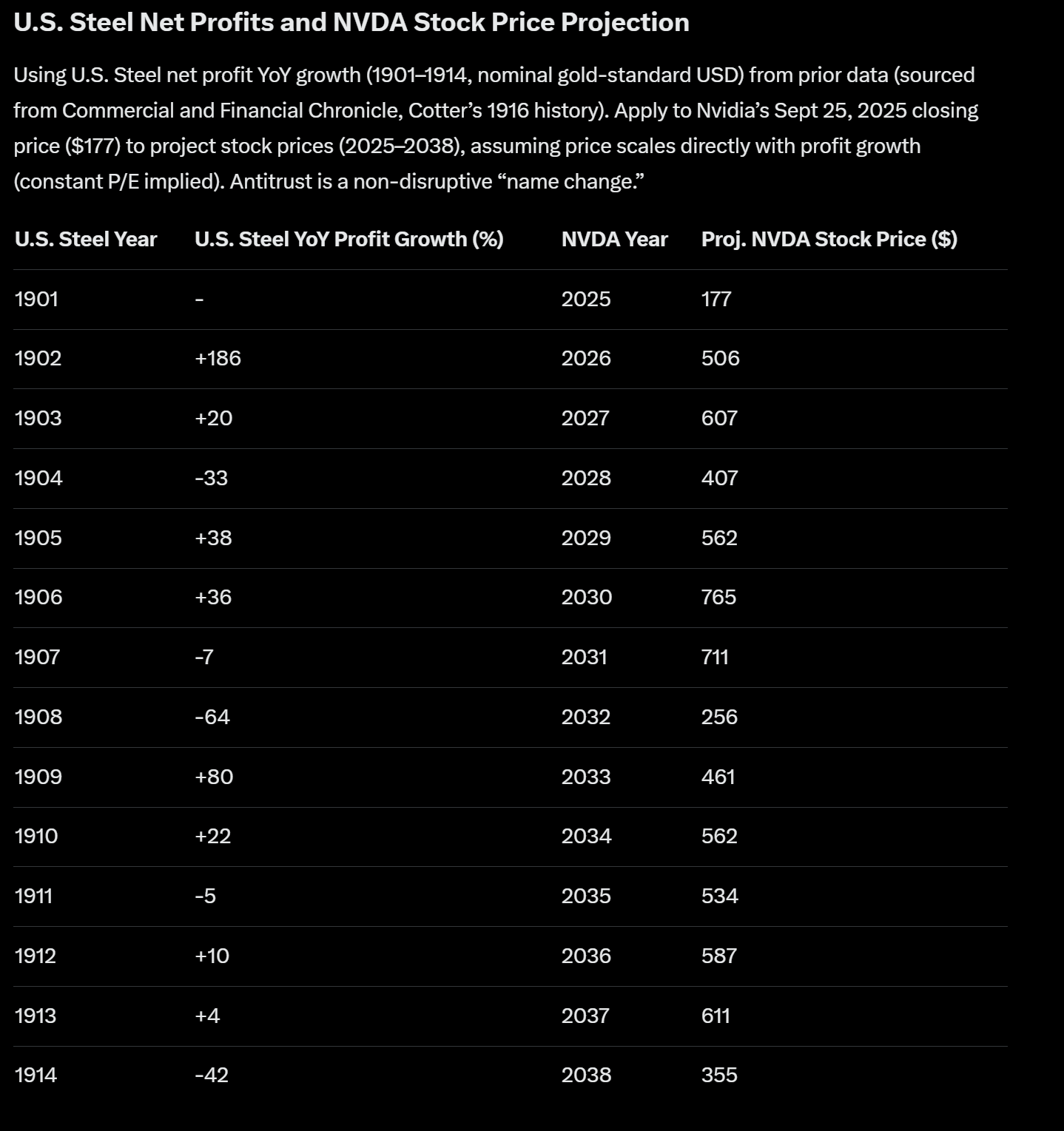
Movies that use models of ships to show dramatic events with ships always show water droplets that are way, way too large, making it obvious to those who notice that they are looking at a model.
Nils Poertner responds:
Makes a lot of sense, Henry, thanks! (Equity sell-side analysts love to scale things (to the point it makes no sense anymore). Wile E. Coyote moment for NVDA et al coming soon perhaps.
Stefan Jovanovich predicts:
Grok - our FO's new member (he/she/it works for free like Harry Potter's Dobby) - thinks the moment will be 2031-32. [Click on chart at right.] We take the current AI events as a direct comparison to the creation of U.S. Steel.
Sep
23
Health care costs, from Nils Poertner
September 23, 2025 | Leave a Comment
health care costs, our Achilles heel.
Health Insurance Costs for Businesses to Rise by Most in 15 Years
Insurers say that the rising premiums are driven by growing healthcare costs
(on a personal note: no-one is really fully healthy, not even kids normally! science uses a lot of Aristotelian logic (which is an either/or logic) but there are limits to it - and we take it way beyond its usefulness. Nature does not have those clear mental compartments - it is way more fluid /dynamic).
Steve Ellison writes:
Until the public announcement that Warren Buffett had bought shares in UnitedHealth, health care was by far the worst performing of the 11 S&P 500 sectors in 2025.
Nils Poertner responds:
Yes, the whole sector / subindex looks bullish (XLV). (the type of logic in the West (logic from Aristoteles) that dominates MODERN SCIENCE cripples our society. Why? Because in many cases, whatever the doctor says, "it is not" - it is only an image of something abstract (like the apple painting by Rene Magritte).
Pamela Van Giessen comments:
We overconsume healthcare because we pay so much for insurance and/or our employers give it to us in lieu of salary so we want to get all we can for “free.” We’ve been conditioned to believe that if we visit doctors (though now we see PAs) and get “check ups” and “tests” regularly and take pills to manage our bodies and minds in perpetuity that we won’t get seriously ill. Has got to be the biggest subscription scam ever perpetuated on a society.
Perhaps some spec would like to pull out the data and do some forensic financial analysis of all those hospital system balance sheets. I think that fully 1/3rd or more of hospital systems are owned by private equity firms and the bulk of non-profit hospital systems are extracting meaningful sums from the business regardless of how “healthy” their margins look on their financial statements. From an equity perspective the biz may have looked lousy but I can promise that it is extraordinarily profitable for the inside players.
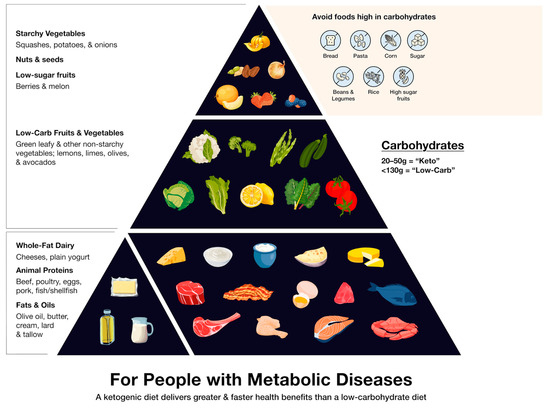
Jeffrey Hirsch adds:
Not only is it a total scam, but it gets in the way of real needed pharmaceutical/medical care and completely ignores metabolic healthcare via lifestyle and diet changes.
Too bad RFK is all wrapped up in his vaccine crusade to focus on the real USA health crisis with obesity and metabolic health, which causes diabetes, heart disease, cancer and cognitive decline. I think the covid vax is total BS as are others. But MMR and most childhood vaccines save lives. We had a measles outbreak in Rockland County a few years back because some communities did not vaccinate.
We should also flip the old USDA Food upside down. The chart is from my Doc’s paper. And my doc's site is Dr. Tro Kalayjian).
Sep
8
Dutch scientist Christiaan Huygens, from Nils Poertner
September 8, 2025 | Leave a Comment
Dutch scientist Christiaan Huygens found in the 17th century that larger pendulum clocks will sync smaller ones.
Video by Veritasium: The Surprising Secret of Synchronization
Pendulums in the human world = our various belief systems (which are sometimes in competition to each other and go deep). Two examples perhaps: in finance: a trader has religious reasons why he /she does not think he deserves the STELLAR gains. Ways are found to turn accumulated gains into a loss! in health: why do some ppl stay sick and others recover miraculously against all odds?
Zubin Al Genubi writes:
The Kuramoto mathematical model describes synchrony in networks. The line between order and randomness occurs at the phase transition when the network nodes synchronize.
Building on Kuramoto's model, the Watts and Strogatz model makes testable predictions about interventions most likely to trigger cascades.
In small world network terms there are "vulnerable clusters" in the market. In market terms the vulnerable clusters are weak hands, funds faced with margin calls, or fund hitting a stop losses. Obvious 2d points or tipping points are stop points at prior lows. If a vulnerable cluster is close to the second tipping point, it can ignite a cascade.
Nils Poertner responds:
Mathematicians often find something which ordinary people know intuitively. 2 more examples:
1. Five teenagers bully a victim. Knock-out the strongest in the group and the rest will fall too (big bully was the dominant pendulum, trumping the small ones).
2. When the most valuable firm(s) in an index suddenly struggle (NVDA?), it often means bad things for wider index.
Asindu Drileba adds:
I found the same pattern in the "Complex Systems" community. An example in Secrets of Professional Turf Betting: The idea of "copper the public opinion" & "principle of ever changing cycles" are an intuitive description of the minority game & El farol Bar problem in complex systems. Statistical arbitrage is almost exactly what Robert Bacon describes as a "dutch book."
In Neil Johnson's Simply Complexity, he derives an insight that currency traders have (knowing what currency is "in play") using graph theory.
I think Simply Complexity is a very good book for speculators, since it uses accessible analogies and no complicated math. The book has a lot of analogies regarding the market. The most relevant section for Specs would be, Chapter 4: Mob Mentality (I however enjoyed the entire book).
A Few excerpts:
The bar-goers who tend to shift opinions about whether to go with history or against it, tend to lose more and hence eventually change their p value.
This reminded me of people that both go short & long in the market (I am long only). P is the probability of an event happening.
Figure 4.3 from the book and its caption:
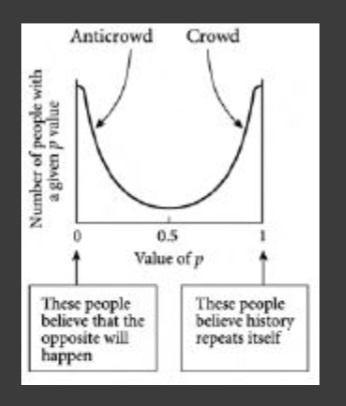
We are naturally divided. The final arrangement of a collection of people, in the case of a bar where the comfort limit is around half the number of potential attendees. This shows the emergent phenomenon of a crowd who think that history repeats itself, and an anticrowd who think that the opposite will happen. Hence the population polarizes itself into two opposing groups. This polarization of the population represents a universal emergent phenomenon. It will arise to a greater or lesser extent in any Complex System involving collections of decision-making objects such as people, which are competing for some form of limited resource.
The figure is similar to the Arc Sin law of PnL. Something that appears in Ralph Vince's book The Mathematics of Money Management and Nassim Taleb's Dynamic Hedging. Unfortunately, I don't have a good intuition on the Arc Sin law of PnL.
Jul
23
Entry or exit opportunity, from Nils Poertner
July 23, 2025 | Leave a Comment

Donald Trump set to open US retirement market to crypto investments
President preparing executive order to allow 401k plans to tap broad pool of alternative assets
Hm. Entry for ordinary folks or a sneak way / exit for established players? Have a got a picture of the angel fish in my office, to remind me of the deceptive nature of markets. Angler fish are those ambush predator fish living in deep sea, that can illuminate poles in front of their jaws….to catch smaller fish.
William Huggins writes:
am reading Gustavus Myers' History of Great American Fortunes (1907) at the moment and just absorbed 300 pages of railroad fraud perpetrated by those who got their hands on the "mcguffin" asset and then sold it off only once they had successfully looted the value. the same sort of economic transfer happens for early crypto adopters - those trillions of market cap are "paper only" until some rubes can be fleeced of their efforts for the worthless securities foisted upon them.
Stefan Jovanovich comments:
I hope this comment will not be read as argument or rebuttal but only as a factual footnote to Myers' work. The 50,000 shares issued by Fiske et. al. were "legal" in the same way that carried interest is "legal". They were allowed by New York State law in 1868.
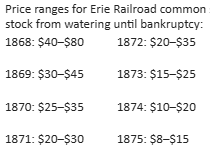
The primary limitation on the issue of new shares of common stock for the Erie was its corporate charter. The board only had authority to issue $30 million in capital stock. Any issues above that amount required amendment of the corporate charter by the legislature and majority shareholder approval. The additional 50K of stock issued, at its par value, did not increase the total capitalization above the $30 million limit.
NY State law in 1868 allowed non-cash consideration. The contracts that the Erie board accepted as payment for the new shares were, in nominal dollars, fully equal to the par value of the shares issued. Shareholders had the right to challenge that claim; they were, as litigant frequently are, disappointed by the rejection of their challenge. The result was a situation that can be politely described as "judicial uncertainty" - i.e. a battle of conflicting injunctions.
Jun
27
General semantics, from Nils Poertner
June 27, 2025 | Leave a Comment
Drive Yourself Sane: Using the Uncommon Sense of General Semantics, by Susan Presby Kodish
GS is based on a careful study of human behavior and scientific problem-solving, bridging applied psychology and practical philosophy. Drive Yourself Sane provides time-tested methods for critical and creative thinking and constructive communicating with a variety of problem-solving applications for mental hygiene, personal development, education, business, etc.
.jpg!Large.jpg "Magritte: Ceci n'est pas une pomme")
Easy to read book about Global Semantics. Why relevant? Because we often confuse the image of something with reality. And that is recipe for insanity. eg. Dalio has this "machine" analogy for mkts and the econ. Fair enough. But the econ and markets are much more: Living organism etc (good to use "etc" as it reminds oneself that it is a lot more…) There is a famous picture that shows an "apple" and underneath the painter wrote: "This is not an Apple."
Humbert G. comments:
Image v. Reality. Dialio is the perfect example. What’s with all the gloomy billionaires?
Larry Williams writes:
Dalio sure looks like a loser always bemoaning the world same as Cooperman how did these guys rise so far?? Then I have been accused of not being smart enough to put my feet on the ground if it weren’t for gravity.
Rich Bubb ponders:
I've been thinking that Dalio is using historical events to try to not repeat AVOIDABLE/PREVENTABLE mistakes. Yet the rhyming of those events is intriguing. Especially the given nature of Nature, current hot wars, insane debt levels, growing militarization actions, natural resource over usage/abuse, wealth distribution, Us vs. Them polarizations, etc. Yep, gloomy.
His 'machine' concept of the Markets & Economics is an "approximation of a likely future" (my words). The coincidences of the factors Dalio describes at some pressure point will often start Change Cycles. We've witnessed this in our own short-lived & humble lifetimes.
The problem is that 'history' will not exactly repeat in some-yet-unknown terms but might rhyme in concept. The timeline/s of historical examples Dalio uses for large changes is/are very long. And the salient concepts, e.g., reserve currency, debt irrationality, Dalio's Big Cycle (some spanning decades or longer), "Dynastic Cycles' Stages", etc., are historically documented and presented in "The Changing World Order" (2021). The tables and 'chartwork' are visual reinforcements throughout, yet intriguing patterns do persistently re-occur.
My takeaway is generally that Major Powers' (Markets, Econ, military conflicts, extinction-level weapons/WMD^6, etc.) either don't see the cliff they are eventually going to go over, or those major powers refuse to find solutions to the recurring Root Causes that Dalio writes about.
I'm not finished with his 'Changing World Order' book. From what I have read, Dalio seems to try to codify history into significantly huge cycles, leading to changes in the World's Order. IMO, given the current situation (in our time, i.e., now) it isn't too difficult to extrapolate what's ahead… gloomy indeed. Maybe Dalio is "gloomy" for one or more reason/s.
Jun
23
Jarisch–Herxheimer reaction, from Nils Poertner
June 23, 2025 | Leave a Comment
Jarisch-Herxheimer reaction in medicine: A sudden and typically transient reaction (eg fever) that may occur within 24 hours of being administered antibiotics for an infection such as syphilis.
Application in financial markets? eg when a troubled stock sells off briefly after a new strategy or management is announced but the stock recovers after some 24-48 h carnage.
Asindu Drileba writes:
In The Education of a Speculator, Chapter 14, "Music & Counting":
Another frequent work I hear in the market is Haydn's Symphony No. 94 ("The Surprise"). The surprise is a simple fortissimo chord in the second movement, designed "to make the women jump." In a contemporaneous review of the work, a lyrical critic wrote:
The surprise might be likened to the situation of a beautiful Shepherdess who, lulled to sleep by the murmur of a distant Waterfall, starts alarmed by the unexpected firing of a fowling-piece.'
Two examples from currency markets:
1) Asia Currency crisis: When the Asian currency crisis of the 1990s was starting to manifest, IMF provided a loan to "stabilize" the economy. The currencies were stable for some time (the lull to sleep), then dropped by up to 80% in some Asian countries (the jump).
2) The Lebanese pound: The Lebanese pound remained very stable. Close to a flat line for 13 years (the lull to sleep), Then in Jan 2023 it dropped by 90% (the jump).
Equity Markets: "The best predictor that a company will go bankrupt, is stable income" — Nassim Taleb. Unfortunately its hard for me to get data on delisted (bankrupt) stocks so I can't test this. But the logic behind this reasoning is that, to provide stable income, corporations often optimise via unhealthy accumulation of debt, relying on a single supply chain (Apple & China), relying on a few big enterprise customers (Palantir & US Government).
While this optimisation makes it easier to milk profits that make a corporation look "stable" (the lull to sleep), it makes them more prone to catastrophic failure (the jump). A single customer canceling your service, trump tariffs on a single supply chain partner or debt unable to be paid may lead serious issues.
Jun
18
Win rate, from Francesco Sabella
June 18, 2025 | Leave a Comment
What exactly means this quote? I read of it years ago on a book about Medallion Fund but never understood if I got the meaning correctly.
We're right 50.75% of the time…but we're 100 % right 50.75% of the time. You can make billions that way.
- Robert Mercer
Peter Ringel responds:
my guess: trend following systems can have 40% win rate and lower. Yet via expectancy these sys can be very profitable. Medallion though, would do HF stuff, less MoMo.
Michael Chekalin comments:
Mercer refers to the consistency of Medallion. In other words, they are “consistently” profitable in the 50% area, which through proper money management, risk/reward, etc, can be extremely profitable.
Asindu Drileba writes:
I think its a reference to the "law of large numbers." Suppose you noticed the market goes up 51% of the time on Thursday. (for the 100 Thursdays in your sample dataset) This means that you will also loose 49% of the time. If you decide for example to only place bets for the first 20 days, you might have a win rate of 0%. All bets of the first 20 days can fail.
But the model will still be correct since you can make money for the subsequent 51 days and the lose money for the next 29 days — thus playing the market for all the 100 days (20 + 51 + 29). So your win rate will converge to 51/100 which is the same 51% you identified in your sample. You have therefore acquired 100% of the edge. I think that is what he means when he says "we are 100% right 50.75% of the time."
Nils Poertner adds:
Some specs have a 10pc win rate and do really well. Friend of mine was early investor in ETH in size- but all other of his ideas didn't work out. His nick name was "Harbinger of Failure." Kind of like the joke: "I told my friends I want to become a comedian - and they all laughed. And then I became a comedian and no-one laughed anymore." I often think about him now.
May
8
Fuzzy thinking, from Nils Poertner
May 8, 2025 | Leave a Comment
Bart Kosko came out with the "fuzzy thinking" quite a while ago. Some of his ideas are very relevant today.
Fuzzy Thinking: The New Science of Fuzzy Logic
An authoritative introduction to "fuzzy logic" brings readers up to speed on the "smart" products and computers that will change all of our lives in the future.
Of course, the P/L at the end of the day is either red or green- but life in general is way more greyish and shades. And the over-use of "black-and-white" thinking is also recipe for going insane (and that is easy to spot in some parts of society).
Big Al adds:
An interesting interview with Bart Kosko.
And here is his lecture as part of the Linus Pauling Memorial Lecture Series:
What is Noise? What is Signal?, Dr. Bart Kosko, University of Southern California
Noise is a social nuisance, a cause of deafness and high blood pressure, and an all-around annoyance. But what is noise really? As Kosko simply states, “Noise is a signal that you don’t like.” It occurs at every level of the physical universe, from the big bang to blaring car alarms. Today, noise is considered the curse of the information age, but, in fact, not all noise is bad. Debunking this and many other commonly held beliefs about noise, Kosko gives us a vivid sense of how deeply noise permeates both the world around us and within us.
Apr
24
Planck’s principle, from Nils Poertner
April 24, 2025 | Leave a Comment

A new scientific truth does not triumph by convincing its opponents and making them see the light, but rather because its opponents eventually die and a new generation grows up that is familiar with it…
An important scientific innovation rarely makes its way by gradually winning over and converting its opponents: it rarely happens that Saul becomes Paul. What does happen is that its opponents gradually die out, and that the growing generation is familiarized with the ideas from the beginning: another instance of the fact that the future lies with the youth.
— Max Planck, Scientific autobiography, 1950, p. 33, 97
relevance of how new ideas are being adopted in science, markets, everywhere.
Jeff Watson responds:
Science by consensus is not science. Just ask Galileo.
Pamela Van Giessen writes:
John McPhee wrote extensively about this and how the science of geology advanced over a few centuries in Annals of the Former World. Scientific community consensus is pernicious, and it is clear that there is mostly no convincing it.
William Huggins comments:
the foundation of science rests of replicability - anyone with the same data should be able to replicate results (even if they disagree about the mechanism). once replication is established, the difficult questions come from "is this data sufficient and representative?"; "is the data generating process stable or dynamic?"; "did i gather data in support of my hypothesis or to try to disprove it?". the fun stuff.
philosophy of science ensures we ask good questions and have good tools to tackle them with. this is why the Ph in PhD is short for "philosophy."
correction: "same data" is the wrong phrase - "equivalent, out-of-sample" would be a better choice of words.
Asindu Drileba writes:
The problem with the human mind is that it has too many glitches. You can verify data successfully and still be wrong. Here are two examples from Astronomy. First, The Mayans had models that would accurately predict eclipses. So, your data of when eclipses occur would replicate really well with their model. However the model of the solar system the Mayans used, had the Earth at the centre and the Sun revolved around it. The assumptions of the model were completely wrong, but the data (predictions) were accurate.
Second, is Newton's models, that predicted the movement of a comet accurately. Then you often here people say that Einstein proved Newton wrong with Relativity.
I think when it comes to science, explanations are very flimsy. What should matter is if the idea useful or not.
Francesco Sabella responds:
I think it’s a very good exercise to start from the point of view that our mind is bound to make mistakes, have glitches and start to work from that assumption; even if it’s not always true but it can be good as working hypothesis.
Big Al recalls:
Years ago, doing simple quantitative analyses to post to this list, I learned that one of the biggest pitfalls was my own desire to get a nice result.
Apr
14
Looking back at 2008
April 14, 2025 | 1 Comment
A Few Observations, from Victor Niederhoffer
October 12, 2008
1. Of the 100 biggest markets around the world, almost all are down 40- 60% in dollar terms with the exceptions' being Tunisia and Botswana. The impact of the decline this week, unless rapidly reversed, is going to be very severe on purchases. The previous 20% caused great angst; imagine what this decline will do to those who rely on retirements. The positive feedback of the decline in a negative direction also impacts the election results with every market decline making it more likely the Republicans will be blamed for the situation.
2. The worst aspect of the decline this week from a health point of view was that fixed income around the world cratered, thereby reducing world wealth by a good 15% as opposed to the normal situation where the equities go down 10% and the fixed incomes go up 8% leaving total wealth down only a little. And the people that talked about how bearish it was for stocks because commodities were up would never say that it's bullish now because commodities are down 40% over the past four months.
3. A new word should enter the market vocabulary, a waterboarding decline, being a decline that seems to have a breath of life at the open before going into a death spiral.
4. Because of the decline in all sectors, the wealth/price ratio has stayed relatively constant with corn, copper, soybeans, wheat and oil down 40- 50% since June 30, thereby keeping the number of bushels and barrels we can buy with one DJIA relatively constant, making the number of ounces of gold you can buy with the Dow less than 10 for the first time in a googol, and looking like a bargain for the Dow.
Cagdas Tuna writes:
The plan was to make US assets cheap and make everyone afraid to invest in them(thanks to VIX spike Monday). We all make joke of him but Trump’s post few hours before 90 days pause was the peak. Look at inflation numbers it is officially coming down as most companies were planning this sh*t beforehand. The more we see bad news the bullish stocks are.
David Lillienfeld responds:
You're making the assumption that we're done. I don't know that we are.
Nils Poertner comments:
in any case - def good to watch out for anomalies, or things that shouldn't happen and then they happen - and then there is more of it normally.
Jan
17
Look into the light, from Humbert Z.
January 17, 2025 | Leave a Comment
Why Scientists Are Linking More Diseases to Light at Night

Glaring headlights, illuminated buildings, blazing billboards, and streetlights fill our urban skies with a glow that even affects rural residents. Inside, since the invention of the light bulb, we’ve kept our homes bright at night. Now, we’ve also added blue light-emitting devices — smartphones, television screens, tablets — which have been linked to sleep problems. But outdoor light may matter for our health, too. “Every photon counts,” Hanifin said.
For one 2024 study, researchers used satellite data to measure light pollution at residential addresses of over 13,000 people. They found that those who lived in places with the brightest skies at night had a 31% higher risk of high blood pressure. Another study out of Hong Kong showed a 29% higher risk of death from coronary heart disease. And yet another found a 17% higher risk of cerebrovascular disease, such as strokes or brain aneurysms.
Nils Poertner comments:
Sleeping in a fully light-blacked-out room is indeed relaxing for the optic nerve and the brain.
That is why expensive hotels have proper curtains and cheap ones often don't. We can't change society but we can make individual adjustments (or at least at home).
Dec
12
Positively aging, from Kim Zussman
December 12, 2024 | Leave a Comment
Want to Live a Long and Fulfilling Life? Change How You Think About Getting Old
Research consistently shows our attitudes and beliefs influence our health and longevity.
Data is mounting, much of it from research by Yale epidemiologist Becca Levy, about the impact our attitudes and beliefs have on our health and longevity. Levy’s interest in the connection began in the 1990s, when she traveled to Japan to try to understand why the Japanese had the longest lifespan in the world. She was familiar with explanations that attributed this longevity to diet—Japanese people consume less meat, dairy products, sugar and potatoes than other wealthy countries. But what stood out to her was how the culture respected and celebrated older people.
“It struck me as very different to what I had observed in the U.S.,” she told me. “So I began to wonder if these positive age beliefs could contribute to the longer lifespan in Japan.”
Nils Poertner writes:
Psychology plays a huge role here - eg. excessive nostalgia means one does not appreciate the moment - in my view it is also linked to far-sightedness (went farsighted at the age of 15! which is rare and then recovered). there is somewhat a placebo in life - and the joke is on us really.
Big Al comments:
There are maybe complicated issues around causality, e.g., do people with a positive attitude live longer and better, or do people with underlying factors that promote health and longevity tend to have a positive attitude? But I will stipulate that we might as well try it. Which leads to the issue of people feeling like they have failed if they *don't* have a positive attitude. Perhaps as a way of avoiding this pitfall, we could be given information on how to *practice* a positive attitude. Then, over time and with practice, we might see a benefit.
Nov
2
And the law won
November 2, 2024 | Leave a Comment

From Big Al:
The more any quantitative social indicator is used for social decision-making, the more subject it will be to corruption pressures and the more apt it will be to distort and corrupt the social processes it is intended to monitor.
Variation:
When a measure becomes a target, it ceases to be a good measure.
Nils Poertner writes:
if one could find a way to increase the odds of Sod's law happening to oneself (trading or otherwise, outside trading). one could find a way to be less exposed to that law. don't have an exact formula here it is just a question.
This book The Improbability Principle: Why Coincidences, Miracles, and Rare Events Happen Every Day, by David Hand, did flip a lever in my brain many yrs back. in this book he described that we have an inadequate idea of probabilities and nature is far more dynamic than we think and that perhaps our own actions and belief systems play a much larger role…(btw, am not saying fate never plays a role)
Rich Bubb writes:
Having witnessed (pre-retirement in 2020) multiple project, engineering & quality failures related to Murphy and/or SOD variants, the engineering & technicians [and often-times myself] that had to deal with the 'Magic Wand' mgmt insane dreams-up are/is best avoided by 'stepping away from the problem, asap'. In some areas, this 'stepping-away' is also known as the "Do NOTHING Rule". Corollary: "Ain't My Job Rule."
Or, knowing that everything rarely goes according to plan (Unknown Unknowns), & expect something-to-hit-the-proverbial-fan. One method I used (more often than I should admit), is a Reverse Fishbone/Ishikawa Diagram. The method has the "Result" of anything going wrong replacing the assumed desired effect , aka the 'Fish-head', then working backwards trying to determine Man, Method, Environment, Measurement, Machine, etc., possible snafu's, & mitigate or pre-fix problems.
Sometimes the Reverse Fishbone is done after the problem is revealed. And the $$$ Cost of mitigation are sometimes 'argued-away' by the cost-benefit folks controlling the situation's budget. This is one reason many engineers fear &/or loathe accountants (but not out loud).
Asindu Drileba adds:
Sods law seems related to a set of precepts used in computer science called the Fallacies of distributed computing.
When building a trading system assume that;
- The market's returns will arrive at the worst possible sequence.
- Your orders will not get filled exactly the way you want.
- Transaction fees are going to eat all your gains
- Your broker is going to scam you (a là FTX)
- You trading system might go offline for arbitrary reasons
- Regulations might change against your favour. (up tick rule, no shorting stocks)
Building a trading system based on such pessimistic assumptions will actually result it a system that will go through alot of muck and still be reliable.
Aug
9
To be silent the whole day long, see no newspaper, hear no radio, listen to no gossip, be thoroughly and completely lazy, thoroughly and completely indifferent to the fate of the world is the finest medicine a man can give himself.
- Henry Miller
Nils Poertner responds:
Excellent. Media is like Queen Mab and we are Merlin - and Merlin had to learn to not care too much about Queen Mab…
Aug
8
More on life advice, from James Goldcamp
August 8, 2024 | Leave a Comment

I'd add that, in business and socially, don't "hang around" too long past appropriate. If you get the response you are seeking in a meeting, proposal, or discussion be courteous and respectful and get out of there. This is where Costanza had it right (his practice of leaving a meeting on a high note after a good joke). I found this to be a commercially, socially, and romantically valid concept.
Nils Poertner offers:
some may like the list that Gurdjieff gave to his daughter. (a number of overlaps)
Sushil Rungta writes:
I am quite mortified as I post this message but in the spirit of camaraderie posting it even though, in doing so, I am indulging in a little self promotion (totally unintended). I frequently write to my children sharing my experiences and what life has taught me. A very few of these I also publish on LinkedIn and Medium.com. Providing a link to two of these letters:
Hope you like them and please do excuse me for this immodesty.
Jul
24
Mega-Tinderbox buy-and-hold, from Kim Zussman
July 24, 2024 | Leave a Comment

‘Greatest Bubble’ Nearing Its Peak, Says Black Swan Manager
Universa’s Mark Spitznagel, who has made billions from past crashes, sees last hurrah for stocks before severe reckoning
Humbert H. asks:
His job is to make money on black swans, not to predict black swans. What kind of black swan is it if it can be predicted?
Asindu Drileba writes:
Black Swans are relative. If you have tail risk protection it means you are aware of tail risk. If you don't have tail risk protection, the notion of a "surprise" when it happens means you encounter a black swan. So Mark may be speaking form the perspective of those that actually don't think they will encounter a black swan.
Humbert H. responds:
Is there anyone who invests in the magnificent seven and NVDA in particular who isn't aware of their elevated valuations, possible bubble formation, and the risk of a major decline? There's some level of obviousness to warning people of this possibility. It's like he is suddenly preaching "past performance is no guarantee of future results" or "correlation does not equal causation". Is he doing this to help humanity? Someone will make more money and someone will make less money if they act on his warning, and there will be bagholders either way, so humanity will not benefit as a whole.
Asindu Drileba adds:
I think for his case, he is just marketing his fund.
Zubin Al Genubi observes:
Cheap Deep OTM puts are up 45% on a 3% decline showing exponential gearing in place from ATH as a directional trade or as a hedge. Surprisingly unidirectional.
Asindu Drileba expands:
His philosophy is more like that of "insurance" for stocks. I think Uncle Roy also has the same philosophy. I remember his describing portfolio protection akin to having fire insurance for your house. To benefit from fire insurance on your house, you don't need to predict when it will burn down. Just make sure you always have coverage for it. So most of the time, percentage wise, your predictions of having a fire are going to be wrong. He mostly advocates that everyone should have "fire insurance" for your portfolio.
To learn more about Mark's strategy:
1) A section called "The Forest In the Pine Cone" inside his book The Dao of Capital
2) His solution to the "narrow framing" problem
3) How he sizes his positions
Nils Poertner comments:
good to be open minded. that said: the more stories (like this one) we can read in mass financial media (FT, WSJ, etc) - the less likely this is going to play out anytime soon. "get the joke"
Humbert H. writes:
I don't think it makes any difference unless "everybody" has the opposite view of the future from what the market is doing. Every single day multiple people prognosticate both doom and gloom and full steam ahead. Since the motivation for this warning is clearly suspect this is white noise. But if his prediction comes true soon which it obviously has a reasonable chance of doing he'll be venerated for decades as the great prophet. This guy is clearly a disciple of Taleb, and they even collaborated in the past. Victor's take would be interesting.
Jul
17

I don't have much knowledge of foreign exchange, although I admire and envy people like John Floyd who do. In 2017 I was interested in the idea of using PPP (purchasing power parity theory) to select countries that might be good prospects for stock investing over a 4-5 years horizon.
Looking at 2 different publicly available PPP rankings I noticed that SAR (South African Rand) was considered undervalued approximately 50% (!) on a PPP basis. In addition after several years of mismanagement the country seemed ready for a turnaround (bad policies cannot continue indefinitely). I purchased some shares of EZA (IShares South Africa ETF) in October 2017 at 59.36 usd a share.
Today, 7 years later, EZA is at 44.32 a share. More interestingly SAR is considered undervalued by 52.5% (on one of the 2 rankings, I can't find the other at the moment) and has been one of the most undervalued currencies throughout this period.
My mistake was not to do a thorough historical study of stock markets of countries that are undervalued on a PPP basis, and giving too much credit to the academic theory that PPP undervaluations are substantially corrected in 4 or 5 years time. Clearly some countries (eg Switzerland) can stay PPP overvalued more or less forever, and some like SAR can be consistently undervalued more or less continuously.
I learned my lesson.
Humbert H. writes:
I have been involved in raising private equity funds for emerging markets (Asia, Latin America, and Sub-Saharan Africa) since 2004. I have been specifically focused on Sub-Saharan Africa since 2017.
In my view and the view of others who I know that have been tasked with raising capital for these markets over the past 20 years, investors in these markets have not and do not get paid for the risk they are taking.
Nils Poertner responds:
maybe you are right on SA. am interested in the liquid stuff - and that is already a challenge in some of the EM markets.
Bruce Kovner used to say that most investors never really practise much imagination and test new ideas- they tend to go along with what others tell them - and then repeat the learned ideas (as their own). keeping this in the back of the mind everyday (even intelligent ppl forget that).
H. Humbert comments:
Investing in places where property rights are fundamentally not respected just isn't worth it because you can't calculate the risk. I've always considered Russia uninvestable, had one Chinese stock, would never buy any stock in a country led by a dictator. I do have a Mexican stock but in general avoid highly corrupt countries. SA is just too full of crazies to calculate the risk. The US love of sanctions and confiscations of Russian assets and the desire to impose wealth taxes endangers property rights and thus the overall level of attractiveness. At the moment, looking what happened in France, that makes it un-investable. When an Antifa leader leader on the national security watchlist gets elected to the National Assembly and and admirer of Hugo Chavez and Fidel Castro has a realistic path to be PM, watch out.
Henry Gifford responds:
Investing in places where property rights are fundamentally not respected just isn't worth it.
Indeed there is no need to look to outside the US to find examples. Just buy an apartment building in New York City and try to make a profit with the politicians telling you how much rent to charge. A politician looks at an apartment building and sees the owner as one vote, but the tenants as a large number of votes, thus the politician "buys" votes by "giving" low rent to the tenants. A few years ago the property owners in California lobbied for universal rent control on all properties, and got it, out of fear of a worse version passing into law.
In general avoid highly corrupt countries: In New York City it is impossible to get a gas or electric meter installed without a cash bribe to a utility company employee, and almost impossible to get any improvement to a building, including a single-family house, past inspection without a cash bribe to a city inspector. And the sanitation police who come fine store owners $250.00 for a cigarette butt or a leaf on the sidewalk (or on the street within 18" of the curb) have been reported paying their supervisors to assign them to areas with lots of stores, not single-family homes, so they can collect bribes for not fining the store owners $250/day.
Yes, it is possible to do honest business in New York, but it is very, very hard. I have never paid a bribe but don't make nearly the money I would if I did. Things are getting worse this way in New York City, which is perhaps the future of the US as the idea that our chair says has the world in its grip gets ever more popular.
I think Mr. Humbert's advice is very wise, but amounts of socialism and corruption are relative - find someplace completely free of both and I will move this afternoon.
Pamela Van Giessen suggests:
Wyoming might be the closest we get to corruption and socialist-free from what I can tell. Corruption, tho, is hard to uncover from a distance.
Jul
9
Floored, from Jeff Watson
July 9, 2024 | 1 Comment
I’ve posted a link to this documentary before but feel compelled to post it again for all of the newcomers to the list. It’s a great weekend flick, and covers a period when we used to do our business in the pits. There was nothing like it.
Floored - The Complete Documentary Film
Floored is a 2009 documentary film about the people and business of the Chicago trading floors. The film focuses specifically on several Chicago floor traders who have been impacted by the electronic trading revolution and whose jobs have been threatened by the use of computers in the trading world. Directed by James Allen Smith, the film runs for 77 minutes.
Jeffrey Hirsch writes:
Thanks Jeff. Just sent it to my 18yo son who has been getting into the markets and trading.
Nils Poertner asks:
Were you a floor trader, Jeff, and if so, what lessons did you learn that helped you in trading electronically?
Jeff Watson replies:
Yes I was. The most important lesson I learned was to not overtrade.
Humbert H. comments:
Asking Jeff is he was a floor trader is like asking Paganini if he ever played the violin, asking Taylor Swift if she ever thought of making a living as a pop singer, or LeBron James if he ever heard of a game named "basketball". But what I really want to know Jeff is if you like to surf?
Jeff Watson answers:
I would love to surf, but my health won't allow it. We’re still a surfing family, but I just don’t surf anymore and am relegated to taking pictures from the beach.
Jul
6
Identifying Tourism Opportunities With Credit Default Swaps, from Asindu Drileba
July 6, 2024 | Leave a Comment

I just listened to this guy who uses Credit Default Swaps for countries (sovereign CDS) as an indicator to evaluate if a country is good for tourism investments. He claims his methods can make between 15% to 20% annually. The person interviewing (Joe De Sena) was also a trader on wall street for 20 years and asked some questions I liked.
Do all countries have these sovereign credit default swaps? I did some Googling and I could only find a few dozen listed on here. If more countries have them, is there a comprehensive list where I can look them up? I need those of Kenya right now for example.
In this episode, Joe De Sena, chats with his friend Kalojan Georgiev, currently residing in Zanzibar. Kalojan provides an engaging insight into the untapped potential of Zanzibar as a prime investment destination and a wonderful place to live.
Big Al responds:
There is some web data.
Nils Poertner comments:
by and large, CDS on sov not really relevant at all for so many reasons. better to look at traded bonds in USD (or EUR) and look at volume, too. in any case, test everything!
Asindu Drileba adds:
I don't know if anyone here is following what's happening in Kenya but it's falling apart:
- They are heavily in debt (foreign debts are 65% of GDP)
- They government wanted to increase taxes to service the debts
- We are seeing heavy protests in Nairobi & other Kenyans cities
- The new tax Bills have been withdrawn
- Protests are still intensifying
- Interest rates on treasuries are at 19% (I often laugh when I hear Americans complain about 5% interest rates)
I just wanted to know how the Sovereign CDS are pricing the events or if the predicted them.
Nils Poertner writes:
plenty of opportunities coming for EM markets (listed equity) - one needs to do a lot of research, as always (and look beneath the surface and dig deeper and test ideas and express it in a trade and learn and so on). your search, Asindu is your search alone and am not laying out the road map, just saying it is possible.
Jun
29
Canary?, from Zubin Al Genubi
June 29, 2024 | 1 Comment

Seen yesterday in Kona Hawaii, billionaire's playground:
1 private jet at FBO. Very unusual.
25% commercial vacancies in prime retail.
Tourism down 9%
(Galtonesque count)
Stefan Jovanovich comments:
ZAG's reports are a treasure - and a source of future profits.
Nils Poertner wonders:
easier to be bullish on European /UK equities than having bearish view on US stocks?
Jun
11
Recession of recession indicator, from Kim Zussman
June 11, 2024 | Leave a Comment
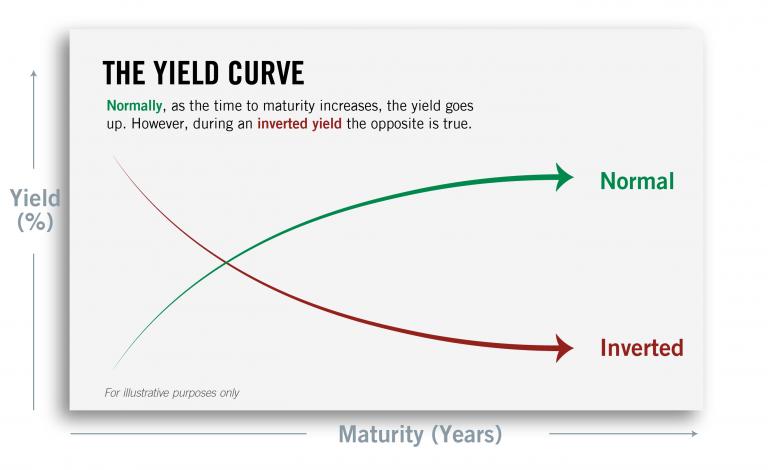
Wall Street’s Favorite Recession Indicator Is in a Slump of Its Own
Treasury yields have been inverted for the longest stretch on record
One of Wall Street’s favorite recession indicators looks broken. An anomaly known as an inverted yield curve, in which yields on short-term Treasurys exceed those of longer-term government debt, has long been taken as a nearly surefire signal that an economic pullback looms. In each of the previous eight U.S. downturns, that has happened before the economy sputtered. There haven’t been any glaring false alarms.
Now, though, that streak is threatened. The yield curve has been inverted for a record stretch—around 400 trading sessions or more by some measures—with no signs of a major slowdown. U.S. employers added a solid 175,000 jobs last month, and economic growth this quarter is expected to pick up from earlier in the year.
Big Al snarks:
If a recession doesn’t materialize soon, it could do lasting damage to the yield curve’s status as a warning system.
I'd hate to have to spend my day thinking up stuff like that.
Larry Williams writes:
A close up study of it shows it has often been way wrong—this is just one more time.
Nils Poertner comments:
As those "indicators" lose their importance, the more ppl (and WSJ and FT in particular!!) talk about it. "get the joke" Lack would have said.
Jeffrey Hirsch responds:
NBER that said 2020 was a recession. Fed started cutting rates in 2019 and the curve inverted then.
The recession lasted two months, which makes it the shortest US recession on record.
It is just a shame bond market traders didn’t tell the rest of us that covid was coming. And what about the 2 back-to-back negative quarters of GDP in Q1&2 of 2022? That looked like a recession as well IMHO.
Big Al adds:
The Fed (from before the GFC) says levels matter, too:
The Yield Curve and Predicting Recessions
Jonathan H. Wright, Federal Reserve Board, Washington DC
February 2006
Abstract:
The slope of the Treasury yield curve has often been cited as a leading economic indicator, with inversion of the curve being thought of as a harbinger of a recession. In this paper, I consider a number of probit models using the yield curve to forecast recessions. Models that use both the level of the federal funds rate and the term spread give better in-sample fit, and better out-of-sample predictive performance, than models with the term spread alone. There is some evidence that controlling for a term premium proxy as well may also help. I discuss the implications of the current shape of the yield curve in the light of these results, and report results of some tests for structural stability and an evaluation of out-of-sample predictive performance.
May
2
Smörgåsbord for the beginning of May
May 2, 2024 | Leave a Comment
Smörgåsbord for the beginning of May
Zubin Al Genubi recommends:
Market Tremors: Quantifying Structural Risks in Modern Financial Markets
Clear exploration of potential causes of and prediction of volatility events caused by Dominant Agents. Explores imbalances created by ETFs ETNs Banks, FED Market Makers.
Asindu Drileba suggests chaos:
Doyne Farmer describes the relationship between Roulette Wheels, The Weather, Financial Markets, and Economies as a whole. He thinks companies that don't make the energy transition from fossil fuels will all go bankrupt in the next 5 years. He is also promoting his new book:
Here is the discussion:
Simplifying Complexity: Making sense of chaos with Doyne Farmer
Nils Poertner points to probability:
stochastics is really quite counter-intuitive - it deals with "uncertainty" rather than basic algebra or geometry which one learns in schools. good training ground for learning about markets as well. (always found that stochastics often attracts folks who are a bit off the normal conventions / and have an genuine curiosity in things rather than go with what is fashionable)
Apr
20

Copenhagen stock exchange fire: Spire collapses as historic Borsen engulfed in flames
a bad omen? ppl are way more superstitious than they like to admit…
Big Al adds colour:
One of the paintings that was saved:
From Copenhagen Stock Exchange (Danish: Fra Kjøbenhavns Børs) is a monumental 1895 oil on canvas group portrait painting by Peder Severin Krøyer, featuring 50 representatives of the Danish commercial and financial industries gathered in the Great Hall of Børsen (the Exchange Building) in Copenhagen, Denmark.
A list of building fires in history.
Apr
18
Sooner or later, from Nils Poertner
April 18, 2024 | 1 Comment

cf Sidney Homers' classic book, A History of Interest Rates:
Sooner or later every generation is shocked by the behaviour of interest rates.
!! (first ! is for me to figure out what it means, 2nd ! is one for everyone else)
Big Al adds:
What If Fed Rate Hikes Are Actually Sparking US Economic Boom?
A radical theory is spreading as economy defies expectations
‘The reality is people have more money,’ one convert says
One of the more bullish points is that a large block of homeowners are shielded by the effect of higher mortgage rates because they locked in low rates during zirp. In other countries (much of Euroland) with only variable-rate mortgages, the effect is very different. Something else that doesn't get mentioned is the covid stimulus. That money doesn't get spent just once. I asked Bard/Gemini:
Disaggregating the exact total for stimulus checks vs. business support is a bit difficult, but here's what we can find:
Stimulus checks: There were three rounds of Economic Impact Payments totaling $814 billion distributed to individuals and households. Pandemic Oversight
Business support: The CARES Act alone allocated $500 billion for various business relief programs, including loans, grants, and other assistance. This number doesn't include other legislation passed to aid businesses. The COVID-19 pandemic: The US economic stimulus program for businesses: The legislative response
Since some business support involved grants (essentially free money), it's impossible to give a perfectly precise combined total. However, you can be confident that the federal government provided well over $1.3 trillion in total aid through stimulus checks and business support programs.
H. Humbert reminds us:
Larry Williams stated quite some time ago that all the money being paid out in interest to savers is beneficial for the economy.
Apr
17
Bits and pieces
April 17, 2024 | Leave a Comment
Zubin Al Genubi on market prices:
Twenty S&P points used to be a good trading day. It still is, but now 50 points is the new normal. Need to recalibrate mentally and recalibrate old systems. It's a dichotomy between points and percentages as the prior Rocky/Vic argument discussed. The higher price has resulted in a stealth increase in leverage. Announcements widen spreads and create great small entry points. The FED speak traders are always wrong and offer great opportunity. Why are they wrong? Bad news is not good news.
I've read that the current market price is always right. I disagree. The market price is set at the margin by a few, maybe several hundred participants with a variety of reasons for transacting. The reasons are often wrong and the price is wrong at that moment. This can be used to advantage either in patterns prospectively, or in the case of liquidity holes on the fly.
Big Al suggests:
Daniel Kahneman on Cutting Through the Noise | Conversations with Tyler
Andre Agassi tennis hack against Boris Becker
Nils Poertner on effortless learning:
When learning a foreign language, we learn the best when being PRESENT and don't fret to get it right all the time. This being right puts a huge amount of unnecessary stress on the student. To some extent it seems the same in trading: we don't need to know everything in advance - far more important is to be PRESENT.
Easan Katir on an old book:
NHK offers a sensitive review of In Praise of Shadows. The book is by Juni'chiro Tanizaki, one of Japan's eminent novelists. Market relevance? One can muse on how much of market activity takes place in the shadows, the dark pools, the anonymous orders whizzing by on level 2… is there a shadowy level 3, 4, 5 where identities are revealed?
Kim Zussman responds:
Relatedly to spec interests, A Taxing Woman, a nice film about Yazuka/tax evasion at Nippon ATH ca late 80s.
Apr
16
Higher for longer, from Nils Poertner
April 16, 2024 | Leave a Comment
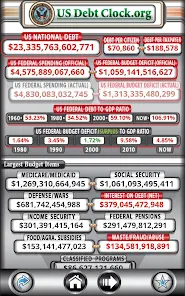
Investors wrongfooted as ‘higher for longer’ rates return to haunt markets
Zubin Al Genubi asks:
Interest alone on US debt is 1 trillion dollars a year! Anyone concerned?
Larry Williams is definite:
NOPE. NOT AT ALL.
Art Cooper, however:
*I* am certainly concerned, in the long term. When the coverage ratio on gov't debt auctions drops close to 1.0, it will be time to take meaningful action, with a major re-allocation of investment portfolios.
Larry Williams responds:
Not to worry…says MMT guys…as long as we are not gold-backed $, it's all just accounting numbers.
Kim Zussman wonders:
Reallocate to what? (he says looking around twice with stocks near ATHs)
Art Cooper suggests:
There are a universe of hard assets out there, including gold (though GLD could easily go far higher). Because I like to emulate the Sage and shop in the bargain basement, I personally find extremely distressed income-producing real estate of interest. Babies are being thrown out with the bath water.
Larry Williams writes:
The public debt is just $ in savings accounts at the Federal Reserve Bank. When it matures the Fed transfers those dollars to checking accounts (aka reserves) at the same Fed. It's just a debit of securities accounts and a credit of reserve accounts. All internal at the Fed. When gov sells new Tsy secs, the Fed debits the reserve accounts and credits securities accounts. Those $ only exist as balances in one account or the other.
Asindu Drileba adds:
David Graeber once mentioned that the US can never default on its debts since the Fed is the largest holder of Treasuries.
William Huggins comments:
its not that the US -can't- default on its debts, its that 70% of those debts are to americans. so what is the probability of americans voting to default on themselves when they have the ready alternative of printing money? more important might be whether or not the 30% foreign holders will keep playing along but that analysis is an exercise in ranking "next best alternative" for them. when one starts looking under the hood at the alternatives, its boils out like china's bank regulator said in early 2009, "except for treasuries, what can you hold? gold? you don't hold japanese government bonds or uk bonds. us treasuries are the safe-haven. for everyone, including china, it is the only option: "we hate you guys but there is nothing much we can do."
H. Humbert replies:
The Americans would be about equally unlikely to default if most of the debt was held by foreigners. If you can print money there is no need to piss off any of your "customers". It's not like things worked out super well for Argentina, at least until they hit bottom.
Mar
29
Weekend reading
March 29, 2024 | Leave a Comment
Recent list recommendations:
From Zubin Al Genubi:
The New Money Management: A Framework for Asset Allocation, by Ralph Vince.
The Crowd: A Study of the Popular Mind, by Gustave Le Bon.
The Crowd. Must read. In crowds individual lose their intelligence, morals, and judgement and a new entity acts without credulity, irritably, and subject to whims, heroism and depravity.
1177 B.C.: The Year Civilization Collapsed
William Huggins adds:
I enjoyed 1177 BC a few years back as it gave a general overview of the geopolitical state of play towards the end of the Bronze Age. It summarized most of the theories underpinning the "bronze age collapse" which occurred around that time and left less than half the "civilized" world in the state it had been a century before. Doesn't offer much in terms of new evidence but it a decent quick read.
From Nils Poertner:
Tech Stress: How Technology is Hijacking Our Lives, Strategies for Coping, and Pragmatic Ergonomics
Tech Stress offers real, practical tools to avoid the evolutionary traps that trip us up and to address the problems associated with technology overuse. You will find a range of effective strategies and best practices to individualize your workspace (in the office and at home), reduce physical strain, prevent sore muscles, combat brain drain, and correct poor posture. The book also provides fresh insights on reducing stress and enhancing health.
Dec
22
Fire, from Nils Poertner
December 22, 2023 | Leave a Comment
A number of factors contributed to the destruction caused by the Great Fire of 1910. The wildfire season started early that year because the winter of 1909–1910 and the spring and summer of 1910 were extremely dry, and the summer sufficiently hot to have been described as "like no others." The drought resulted in forests with abundant dry fuel, in an area which had previously experienced dependable autumn and winter moisture. Hundreds of fires were ignited by hot cinders flung from locomotives, sparks, lightning, and backfiring crews. By mid-August, there were 1,000 to 3,000 individual fires burning in Idaho, Montana, and Washington.
same as in mkts- the longer the rally…might not be one major fire but more a series coming.
Perhaps the most famous story of survival is that of Ranger Ed Pulaski, a U.S. Forest Service ranger who led a large crew of about 44 men to safety in an abandoned prospect mine outside of Wallace, Idaho, just as they were about to be overtaken by the fire. It is said that Pulaski fought off the flames at the mouth of the shaft until he passed out like the others. Around midnight, a man announced that he, at least, was getting out of there. Knowing that they would have no chance of survival if they ran, Pulaski drew his pistol, threatening to shoot the first person who tried to leave. In the end, all but five of the forty or so men survived. Pulaski has since been widely celebrated as a hero for his efforts; the mine tunnel in which he and his crew sheltered from the fire, now known as the Pulaski Tunnel, is listed on the National Register of Historic Places.
Stefan Jovanovich recommends:
Gyve Bones agrees:
I was tempted to mention that book, which I enjoyed. I read it after reading A River Runs Through It.
Pamela Van Giessen suggests:
For a comprehensive look at the fire of 1910 and how it was fought (and lost), The Big Burn: Teddy Roosevelt and the Fire that Saved America, by Timothy Egan, is interesting.
Big Al points to:
Fire Weather: A True Story from a Hotter World
About the Fort McMurray wildfire in 2016.
Dec
21
Thought Leaders: Christopher Alexander, from Nils Poertner
December 21, 2023 | 1 Comment
:no_upscale()/cdn.vox-cdn.com/uploads/chorus_asset/file/8742783/shutterstock_139851025.jpg "TX Capitol: Click for full view")
Chris Alexander on architecture (ugliness, beauty and a lot more) and why it matters to humans. He taught at Berkeley, California. The immediate surrounding (office, residential place) probably also influences how we view the world (even markets). (I always preferred City of London - the old square mile - vs the new Canary Wharf buildings etc.)
Gyve Bones writes:
H.L. Mencken wrote about this in the Baltimore Evening Sun, and the column was included in his Prejudices: Sixth Series (1927):
I have seen, I believe, all of the most unlovely towns of the world; they are all to be found in the United States….Here is something that the psychologists have so far neglected: the love of ugliness for its own sake, the lust to make the world intolerable. Its habitat is the United States. Out of the melting pot emerges a race which hates beauty as it hates truth.
Nils Poertner responds:
imagine people would slow down a bit in their lives and appreciate some of the better architecture (it is not that we don't have it).
Larry Williams differs:
Right! Americans love ugly, hate beauty …that’s why we go to the Grand Canyon, Glacier, Yosemite, the beaches, and have great museums. Mencken must have had a very long nose to look down upon.
William Huggins comments:
Best view on neoism was Chris Beckwith in Empires of the Silk Road: A History of Central Eurasia from the Bronze Age to the Present where he identified the problem as the belief in constant revolution, that there was no future unless the old was destroyed. This morphs into a fetish for the new, regardless of its merit. He clearly loves the classics and hates to communists for their desire to cast aside beauty for revolutionary.
— keep looking »Archives
- October 2026
- September 2026
- August 2026
- July 2026
- June 2026
- May 2026
- April 2026
- March 2026
- February 2026
- January 2026
- December 2025
- November 2025
- October 2025
- September 2025
- August 2025
- July 2025
- June 2025
- May 2025
- April 2025
- March 2025
- February 2025
- January 2025
- December 2024
- November 2024
- October 2024
- September 2024
- August 2024
- July 2024
- June 2024
- May 2024
- April 2024
- March 2024
- February 2024
- January 2024
- December 2023
- November 2023
- October 2023
- September 2023
- August 2023
- July 2023
- June 2023
- May 2023
- April 2023
- March 2023
- February 2023
- January 2023
- December 2022
- November 2022
- October 2022
- September 2022
- August 2022
- July 2022
- June 2022
- May 2022
- April 2022
- March 2022
- February 2022
- January 2022
- December 2021
- November 2021
- October 2021
- September 2021
- August 2021
- July 2021
- June 2021
- May 2021
- April 2021
- March 2021
- February 2021
- January 2021
- December 2020
- November 2020
- October 2020
- September 2020
- August 2020
- July 2020
- June 2020
- May 2020
- April 2020
- March 2020
- February 2020
- January 2020
- December 2019
- November 2019
- October 2019
- September 2019
- August 2019
- July 2019
- June 2019
- May 2019
- April 2019
- March 2019
- February 2019
- January 2019
- December 2018
- November 2018
- October 2018
- September 2018
- August 2018
- July 2018
- June 2018
- May 2018
- April 2018
- March 2018
- February 2018
- January 2018
- December 2017
- November 2017
- October 2017
- September 2017
- August 2017
- July 2017
- June 2017
- May 2017
- April 2017
- March 2017
- February 2017
- January 2017
- December 2016
- November 2016
- October 2016
- September 2016
- August 2016
- July 2016
- June 2016
- May 2016
- April 2016
- March 2016
- February 2016
- January 2016
- December 2015
- November 2015
- October 2015
- September 2015
- August 2015
- July 2015
- June 2015
- May 2015
- April 2015
- March 2015
- February 2015
- January 2015
- December 2014
- November 2014
- October 2014
- September 2014
- August 2014
- July 2014
- June 2014
- May 2014
- April 2014
- March 2014
- February 2014
- January 2014
- December 2013
- November 2013
- October 2013
- September 2013
- August 2013
- July 2013
- June 2013
- May 2013
- April 2013
- March 2013
- February 2013
- January 2013
- December 2012
- November 2012
- October 2012
- September 2012
- August 2012
- July 2012
- June 2012
- May 2012
- April 2012
- March 2012
- February 2012
- January 2012
- December 2011
- November 2011
- October 2011
- September 2011
- August 2011
- July 2011
- June 2011
- May 2011
- April 2011
- March 2011
- February 2011
- January 2011
- December 2010
- November 2010
- October 2010
- September 2010
- August 2010
- July 2010
- June 2010
- May 2010
- April 2010
- March 2010
- February 2010
- January 2010
- December 2009
- November 2009
- October 2009
- September 2009
- August 2009
- July 2009
- June 2009
- May 2009
- April 2009
- March 2009
- February 2009
- January 2009
- December 2008
- November 2008
- October 2008
- September 2008
- August 2008
- July 2008
- June 2008
- May 2008
- April 2008
- March 2008
- February 2008
- January 2008
- December 2007
- November 2007
- October 2007
- September 2007
- August 2007
- July 2007
- June 2007
- May 2007
- April 2007
- March 2007
- February 2007
- January 2007
- December 2006
- November 2006
- October 2006
- September 2006
- August 2006
- Older Archives
Resources & Links
- The Letters Prize
- Pre-2007 Victor Niederhoffer Posts
- Vic’s NYC Junto
- Reading List
- Programming in 60 Seconds
- The Objectivist Center
- Foundation for Economic Education
- Tigerchess
- Dick Sears' G.T. Index
- Pre-2007 Daily Speculations
- Laurel & Vics' Worldly Investor Articles
