May
14
Study of Deception, from Sushil Kedia
May 14, 2026 | Leave a Comment
The Chair has emphasized the value of studying and understanding deception endlessly, I believe.
Now, if I wish to focus and devote my energies to be thoroughly studious about it, I urge my requests below are not misunderstood as a lazy desire, but an earnest and keen wish to be methodical about it.
What would the Spec-list citizens recommend as the ideal list of:
a) Movies to watch,
b) Books to read.
One thing that hit me suddenly some weeks ago is that nature devised deception as a tool to economize the struggle for propagation of this world and its entities into the future. Without deception a Tiger would run endlessly, perhaps consuming more calories in capturing its prey, than it would get in eating the prey, as one example.
What are the other utilities the matured, experienced minds on this competent list and other curious minds as me feel that deception provides?
Another layer of study that makes me curious is, when our own mind as defined by Edward De Bono, as a self organizing pattern seeking system is the personal deception machinery that takes us into deviant behaviour from data, stats on the table and rigorous study then how does the autonomous deception inflicted by our mind engage with the deceptions inflicted upon this world by the high and mighty? Are the mighty studying how the hoi pollois is living in self deceiving modes and then playing it?
What more rigorous questions will the list members be happy to throw at someone who is now hungry to study deception, in depth? Please provide your questions too for me to compile into a list of questions to ponder over, gather information and insights on.
William Huggins writes:
it would seem the heart of the matter is one's ability to "hack" the target's heuristics. concealment/distraction plays an important role in this. the obvious benefit of deception being a misallocation (from the allocator's pov) of energy that can be exploited by the deceptive.
Nils Poertner comments:
What traders do in their free time and are already good at is of interest to me. (eg. someone reading crime novels, can find patterns here, another one practises Judo, finds patterns of deception there, and then you can go from there. Work with what you have already)
Big Al offers:
An interesting story with possibly multiple levels of deception:
The Rosenhan experiment or Thud experiment was a disputed study regarding the validity of psychiatric diagnosis. For the experiment, participants submitted themselves for evaluation at various psychiatric institutions and feigned hallucinations in order to be accepted, but acted normally from then onward. Each was diagnosed with a psychiatric disorder and given antipsychotic medication. The study was arranged by psychologist David Rosenhan, a Stanford University professor, and published by the journal Science in 1973 with the title On Being Sane In Insane Places.
Asindu Drileba adds:
When it comes to movies, my favorite movie to do with deception is The Conversation (1974) by Francis Ford Coppola. As for books, on my "yet to read" list I have The Confidence Game by Maria Konnikova. You see, "conman" comes from the phrase "confidence man".
I have studied several scammers like SBF, Madoff, Enron executives. What I have noticed is that deception never looks like "deception" it often looks like opportunity. The "confidence man" entrapped their victims by having "good visuals", dressing well & moving amongst those in high circles.
SBF was branded as a type of prodigy, Madoff was the chairman of Nasdaq, Enron guys where The Smartest Guys In The Room (you should watch this one, just for the fantastic music playlist), Jeffrey Epstein displayed the all patterns. Take away? Beware of bombastic talk, especially one that boosts your confidence in an investment.
Rich Bubb writes:
Not exactly a movie-to-watch, a former co-worker recommended I watch "Lie To Me" series. I'd be interested to see if anyone has trained and AI system to visually detect micro-expressions. The thought is that if somebody/-ies is the 'prey', maybe AI could detect deceptive interactions better than me. I have tried to teach myself to recognize micro-expressions. It's nice to know when I'm being lied to.
Oliver Joseph writes:
I'm a big fan of Joe Navarro's work. "What Every Body is Saying" is classic. There is a certain amount of gamesmanship in deception and its detection which he elegantly describes. Of course there are certain "strong signs" like pupil dilation that are impossible for normal human beings to conceal. Sussing out the meaning and separating the signal from the noise is part of the game, a problem everyone on the spec list is used to dealing with I'm sure. I myself as a former car dealer am quite unfamiliar with deception and its detection and so eagerly await further recommendations.
Feb
10
Stops, from Zubin Al Genubi
February 10, 2026 | Leave a Comment

We should never get stopped out of a trade just because we have lost money. We exit trades if we no longer like them—losing money, while deeply unpleasant, should never be the sole criterion for exiting.
Peter Penha responds:
The last stop I left was a stop loss in Platinum futures sub $800 and the market took the contract down $65 and stopped me out, made one lower print $5 below me, and then came back up. Probably was the low print post March 2020.
I have had horrific experience with Schwab/thinkorswim…they once sold me out (partially) of calls on Sugar that were deep in the money at a make believe bid price way off market and below intrinsic value. When I challenged them noting that equity markets were open and they could easily have raised cash in many liquid ways - they told me they reserve the right to do what they want. I have multiple snapshots of them marking positions below intrinsic value, and lately while I was long silver futures they would mark my long Sugar contract to zero (I would see a negative futures cash position equivalent to the notional value of my long position).
I have been thinking of Marty Zweig and how he did very well leaving trailing stops on individual stocks and need to find my copy and revisit Winning on Wall Street and see how he did it (successfully).
Rich Bubb writes:
I AI'd trailing stops info thru Gemini.
The rule-of-thumb I currently/usually use is 8%-15% TSL% (trailing stop loss %). And typically use a lower-is-better TSL%. The volatility and economic tea leaves divination determine the TSL%. If I have less conviction in a position, I'll reduce TSL% to (sometimes) let the Market tell me how wrong I initially was.
And I got burned at the start of Great Recession, where I had TSL%s way-too relaxed; upper teens TSL%. The TSL%s all worked, but by then I'd lost about 15%+. Painful lesson.
Nov
15
Tax receipts, from Larry Williams
November 15, 2025 | Leave a Comment
Federal government current tax receipts: Taxes on production and imports: Customs duties

Asindu Drileba writes:
I remember when Trump spoke at a recent market open. (NYSE market opens at around 4:30pm in Uganda). Crypto closed very bullish on that day. Every time he mentioned "Tax Cuts" the market blipped some more. Laffer Curve at work?
Rich Bubb adds:
I was idea hunting and found Wisdom from Larry Williams:
Larry Williams: Why Gold, Bitcoin, and Stocks Are Flashing Warning Signs
Jun
27
General semantics, from Nils Poertner
June 27, 2025 | Leave a Comment
Drive Yourself Sane: Using the Uncommon Sense of General Semantics, by Susan Presby Kodish
GS is based on a careful study of human behavior and scientific problem-solving, bridging applied psychology and practical philosophy. Drive Yourself Sane provides time-tested methods for critical and creative thinking and constructive communicating with a variety of problem-solving applications for mental hygiene, personal development, education, business, etc.
.jpg!Large.jpg "Magritte: Ceci n'est pas une pomme")
Easy to read book about Global Semantics. Why relevant? Because we often confuse the image of something with reality. And that is recipe for insanity. eg. Dalio has this "machine" analogy for mkts and the econ. Fair enough. But the econ and markets are much more: Living organism etc (good to use "etc" as it reminds oneself that it is a lot more…) There is a famous picture that shows an "apple" and underneath the painter wrote: "This is not an Apple."
Humbert G. comments:
Image v. Reality. Dialio is the perfect example. What’s with all the gloomy billionaires?
Larry Williams writes:
Dalio sure looks like a loser always bemoaning the world same as Cooperman how did these guys rise so far?? Then I have been accused of not being smart enough to put my feet on the ground if it weren’t for gravity.
Rich Bubb ponders:
I've been thinking that Dalio is using historical events to try to not repeat AVOIDABLE/PREVENTABLE mistakes. Yet the rhyming of those events is intriguing. Especially the given nature of Nature, current hot wars, insane debt levels, growing militarization actions, natural resource over usage/abuse, wealth distribution, Us vs. Them polarizations, etc. Yep, gloomy.
His 'machine' concept of the Markets & Economics is an "approximation of a likely future" (my words). The coincidences of the factors Dalio describes at some pressure point will often start Change Cycles. We've witnessed this in our own short-lived & humble lifetimes.
The problem is that 'history' will not exactly repeat in some-yet-unknown terms but might rhyme in concept. The timeline/s of historical examples Dalio uses for large changes is/are very long. And the salient concepts, e.g., reserve currency, debt irrationality, Dalio's Big Cycle (some spanning decades or longer), "Dynastic Cycles' Stages", etc., are historically documented and presented in "The Changing World Order" (2021). The tables and 'chartwork' are visual reinforcements throughout, yet intriguing patterns do persistently re-occur.
My takeaway is generally that Major Powers' (Markets, Econ, military conflicts, extinction-level weapons/WMD^6, etc.) either don't see the cliff they are eventually going to go over, or those major powers refuse to find solutions to the recurring Root Causes that Dalio writes about.
I'm not finished with his 'Changing World Order' book. From what I have read, Dalio seems to try to codify history into significantly huge cycles, leading to changes in the World's Order. IMO, given the current situation (in our time, i.e., now) it isn't too difficult to extrapolate what's ahead… gloomy indeed. Maybe Dalio is "gloomy" for one or more reason/s.
May
25
Atlas Shrugged, from Francesco Sabella
May 25, 2025 | 1 Comment

This morning I finished rereading the classic Atlas Shrugged of Ayn Rand and every time I learn something new; her thought is monumental. I don’t agree with a lot of her ideas and I fully agree with others, but I’ve always found this book to be an impressive catalyst for thought; this is in my opinion her power: the ability in sparking debate.
Rich Bubb comments:
Atlas Shrugged is also available as a 3-part movie. I think the book was better.
Adam Grimes writes:
My opinion on her work has shifted over the years, in a strongly negative direction. Too much of my experience contradicts her metaphysics and epistemology, particularly the rigidity of her rational materialism, and, as someone who treasures the craft of writing, much of her prose lands as clunky and overly didactic. I'm also now unconvinced on the primacy and sufficiency of rational self-interest… but, as you said, perhaps her greatest value is in creating discussion.
Asindu Drileba adds:
Ayn Rand had a reading group called the "Ayn Rand Collective" — Which Alan Greenspan was part of. They [Greenspan, Rand and a "professor"] would meet at Rand's apartment to read every new chapter of her new book. She (Ayn Rand) then fell in love with the professor and they started dating.
After sometime, the "professor" encountered a pretty young student in his own class and he "fell in love with her". The professor told Rand about the affair, but Rand begged the professor to cancel it. The professor then said that he would dump Ayn Rand, and then exclusively date the young pretty student. He said that this was the right thing to do since he was following his "rational self-interest". Ayn Rand got angry, slapped the professor in the face twice and kicked him out of her reading group.
This was a good illustration of cognitive dissonance. Rand thought her readers should practice "rational-self interest" towards everyone else, except her.
Francesco Sabella met a girl:
I was very fascinated to meet a girl times ago who I knew for her philanthropic activities and for her ideas being the exact opposite of Rand; and I was surprised to see her carrying an Ayn Rand book and she told me she didn’t like at all her; it made me think of her ability in creating debates.
Victor Niederhoffer responds:
i would always marry a girl who admired the book. susan introduced me to it and i knew then i had to marry her. it was very good choice.
Apr
11
Lessons from a previous crisis, from Rich Bubb
April 11, 2025 | Leave a Comment
I was searching for 'Lobogola' in my saved files… Found this…
Ten Lessons From the Recent Bear Markets, from Victor Niederhoffer
February 3, 2008
1. There is no such thing as a bear market, only markets that have gone down a lot from a previous high in a reasonable time frame.
2. The market had its best week in 5 years two weeks after having the worst week in 5 years.
3. When the vol rises to above 30, expect a 1-2% gain in next two days with say a 90% prob.
4. The differential between the discount rate and the 10 year rate is an excellent predictor of short and long term movements in the market.

5. The market likes to set a big minimum at the beginning of the week and all the limits downs have occurred on such days.
6. The knowledge of a big forced seller in the market will filter out and effect everything and the market will go to unprecedented low levels until the sales are requited.
7. The Fed chair thanked Milton Friedman for insuring with his research that the Fed would never again cause a depression by tightening the money supply during a time of economic doldrum and we may thank Milton Friedman and the Fed chair, and Mr Kerviel for insuring that no such depression or recession will be induced again by such activity.
8. The market will go back up along the same path that it went down, i.e. Lobagola lives. (Remember Lobagola's story about the elephants). [More on Lobagola and the elephants below. -Ed.]
9. Buy and hold must not be leveraged too high for it to work.
10. The tried and true patterns are the most dangerous during times of crisis. (Beware of patterns with a 90% chance of success).
Scalawags: Bata Kindai Amgoza ibn LoBagola
But his assumed name lives on amongst the lore of investors. In his book, he tells the story of an elephant stampede. The beasts rush through an area and always return the same way. When there is a surge of the market that soon ceases and comes back again down that same path, that’s called a LoBagola.
Feb
7
The Licensing Racket, from Humbert Q.
February 7, 2025 | Leave a Comment

The Licensing Racket: How We Decide Who Is Allowed to Work, and Why It Goes Wrong
by Rebecca Haw Allensworth
A bottom-up investigation of the broken system of professional licensing, affecting everyone from hairdressers and morticians to doctors, lawyers, real estate agents, and those who rely on their services.
Pamela Van Giessen writes:
When my dad was suffering from dementia and it was too stressful on him to go places, I called in a podiatrist to take care of his feet and toe nails. I asked the doctor if he could also clip my dad’s fingernails, at least on his right hand which suffered constant trembles from a stroke. I did not feel confident doing it with the tremors.
The podiatrist informed me that he was not licensed to clip fingernails. I asked who was licensed and was told that in IL only manicurists and nurse aids in care homes can clip fingernails. I asked him if he thought it would be a good idea to take my dad to a manicurist (or have one come to dad) given his tremors. Dr said “no, and probably no manicurist wants to trim your dad’s fingernails.”
I called the state licensing board to complain and was told this rule existed for a good reason to protect people like my dad. I told them that this was absurd and not protective of anyone except this bizarre bureaucracy. I was told that I was being disrespectful and they hung up on me. Fortunately the podiatrist took pity on the situation after seeing my dad and broke the rules.
Licensing (and certification) is a racket. It is meant to keep some out and it is also a lucrative racket for states, licensing boards, and non-profit organizations. The CFA Institute makes over $275M annually on the CFA certification (and it costs less than 1/2 that to administer the program).
Sushil Rungta comments:
Agreed! Licensing is a racket and in many instances, unnecessary. Often, it is nothing more than a means to generate revenues for the licensing authority!
Rich Bubb writes:
I completely agree with the 'license Non-sense' of some (ahem) rationales. My basic take is that if some institute was involved, they were rarely better than learning-by-doing types (eg., me). When I was working thru attaining six sigma black belt (SSBB looked good on the resume), the major quality name (withheld) institution was over-hyping their SSBB program only as some sort of easy-to-attain achievement, [but] with their seminars/classes/literature/mentors/videos/etc., only. Truth to tell, I knew so-called 'withheld-name'-SSBB-certified wingnuts that knew nearly 10% of what I'd literally done already. Oftentimes by doing deep research and generally trying to learn more about More.
Henry Gifford provides the NY POV:
In New York City a plumbing license is like a license to print money. More and more work requires a permit, and therefore a license. Hire a licensed plumber for an agreed-on price of $10,000, usually the bill comes in at about double. Hire by the hour and keep careful track of the hours and you still get a bill for double. After you pay you notice the permit is not closed out (signed off by the licensed plumber), which becomes a violation on the property, and a bar to clean title at sale. Want it signed off? Maybe another $10K?
Word is that the number of licenses is fixed - they give them out only at the rate that licensed plumbers die. Applying for a license requires seven years of "experience", which is defined as being an employee of a licensed plumber - basically sons and nephews, someone with ambition who buys a van and tools and goes to work is nobody's employee, thus never can get a license. Then comes the written test.
Not long ago the written test had a drawing of all the drains in a building, with inch sizes marked next to each piece of pipe. The question required calculating how many ounces of lead are required to pour molten lead into all the joints in the drain pipes to connect them - something not done regularly for 50 years at the time of the test. The drawing was a copy of a copy of a copy, not legible - required guessing at the pipe sizes, or else buying the answer for cash.
Then comes the practical test, which not long ago required melting lead pipes together, but without the help of a propane torch or any other torch. Thee equipment supplied is a cast iron kettle and a stove - melt some lead or solder in the kettle, throw the molten lead at the joint, wipe it smooth with an asbestos rag or similar.
I know a guy who got his experience and passed both tests, but the city didn't give him a license. He went to court and sued the city, and after much time and expense finally won - hooray! The judge ordered the city to give him a license. But, last I heard, he still didn't have a license.
Other parts of the US are catching up. Most professional licenses cannot be transferred to another city. A friend of mine in NYC married a guy in Vermont who was a counselor to juvenile delinquents. His experience in Vermont was not transferrable to NY State - he would have to start all over, thus she moved to Vermont.
Does this system benefit anyone but holders of existing licenses, and the powers that be? I don't think so.
Stefan Jovanovich gets historical:
The licensing presumption goes back to the royal charters of the English kings and queens. The sovereign has the (God-given) authority to decide who has the right to practice a trade. The Saddler's Company received theirs from Edward I in 1272.
Gyve Bones writes:
Very interesting account of how the plumbers' trade operates in NYC. It reminded me of Mark Twain's account of how the Pilot's Association formed on the Mississippi River. Samuel Clemens, before he took the pen name "Mark Twain", was a riverboat pilot, and a member of the Association so he knows and tells the story well in Life on the Mississippi. He shows how at first the really good pilots avoided joining the Association out of pride and because they had such a good reputation they didn't need it. And the Association became the refuge of B and C rank pilots… at first. But Twain shows how the Association provided an information edge about the current state of the river conditions which the "outsiders" could not match, and were able to develop a monopoly once the underwriters found that Association pilots were better at avoiding claim losses.
Here's a link to Life on the Mississippi, Chapter XV which contains the story.
I think there are excellent insights in this story how any sort of trade establishes a guild system that protects the trade, creating moats to competition. We see it with doctors, lawyers, undertakers, nail salons, barbers, electricians &c. &c. ad infinitum. Lots of the work of legislatures is creating laws for these associations to institutionalize the moats with the force of law for the various guilds.
The previous chapters detail very interestingly on how riverboat pilots do their jobs, which is a fascinating context if you want a deeper dive. It's one of my favorite books of all time.
Nov
2
And the law won
November 2, 2024 | Leave a Comment

From Big Al:
The more any quantitative social indicator is used for social decision-making, the more subject it will be to corruption pressures and the more apt it will be to distort and corrupt the social processes it is intended to monitor.
Variation:
When a measure becomes a target, it ceases to be a good measure.
Nils Poertner writes:
if one could find a way to increase the odds of Sod's law happening to oneself (trading or otherwise, outside trading). one could find a way to be less exposed to that law. don't have an exact formula here it is just a question.
This book The Improbability Principle: Why Coincidences, Miracles, and Rare Events Happen Every Day, by David Hand, did flip a lever in my brain many yrs back. in this book he described that we have an inadequate idea of probabilities and nature is far more dynamic than we think and that perhaps our own actions and belief systems play a much larger role…(btw, am not saying fate never plays a role)
Rich Bubb writes:
Having witnessed (pre-retirement in 2020) multiple project, engineering & quality failures related to Murphy and/or SOD variants, the engineering & technicians [and often-times myself] that had to deal with the 'Magic Wand' mgmt insane dreams-up are/is best avoided by 'stepping away from the problem, asap'. In some areas, this 'stepping-away' is also known as the "Do NOTHING Rule". Corollary: "Ain't My Job Rule."
Or, knowing that everything rarely goes according to plan (Unknown Unknowns), & expect something-to-hit-the-proverbial-fan. One method I used (more often than I should admit), is a Reverse Fishbone/Ishikawa Diagram. The method has the "Result" of anything going wrong replacing the assumed desired effect , aka the 'Fish-head', then working backwards trying to determine Man, Method, Environment, Measurement, Machine, etc., possible snafu's, & mitigate or pre-fix problems.
Sometimes the Reverse Fishbone is done after the problem is revealed. And the $$$ Cost of mitigation are sometimes 'argued-away' by the cost-benefit folks controlling the situation's budget. This is one reason many engineers fear &/or loathe accountants (but not out loud).
Asindu Drileba adds:
Sods law seems related to a set of precepts used in computer science called the Fallacies of distributed computing.
When building a trading system assume that;
- The market's returns will arrive at the worst possible sequence.
- Your orders will not get filled exactly the way you want.
- Transaction fees are going to eat all your gains
- Your broker is going to scam you (a là FTX)
- You trading system might go offline for arbitrary reasons
- Regulations might change against your favour. (up tick rule, no shorting stocks)
Building a trading system based on such pessimistic assumptions will actually result it a system that will go through alot of muck and still be reliable.
Nov
16
Herd mentality, from Zubin Al Genubi
November 16, 2023 | Leave a Comment

Everyone went to Hawaii last year. They all went to Europe this year. Everyone drives the same vehicle. People love to follow the herd. Hedgies, quants, teckies all looking at the same data, same correlations, all doing the same trade.
Nils Poertner writes:
being in a herd somewhat offers protection and one can save energy - as our brains like to save energy (constant decision making and testing stuff costs energy and our brains are already weakened via e-smog etc etc).
as a trader though - one cannot make any money long term if one is constantly part of the group - one is more like that rabbit that is hypnotized with the headlight of the oncoming vehicle. so one has to find a niche. energy is key in my view- to keep the energy up - as traders often lose it as time goes by (maybe a talent to not give a f*** about anything, too).
William Huggins comments:
i would argue that running with the herd minimizes the energy lost scrambling in all directions looking for an edge. unless someone has a refined technique for discovering edges and implementing them, its hard to conceive that active selection would overcome the "drift of industrialization". numerous studies (most famously jack bogle's) have shown that buying and holding the index is just fine and does in fact make decent money over the long term. when you factor in the costs of active trading, you really need an edge to overcome the friction imposed.
clearly, both strategies can be successful but one requires much more skill (and earns commensurate rewards) so i think its misguided to suggest that "one cannot make any money long term" by following the herd. you just won't earn exceptional returns.
Nils Poertner adds:
I think it is time to sharpen up in coming yrs- the reality is that most folks in finance (in particular at large firms) really don't have special skills compared to other professions in non-finance (yet they get paid so much more). The whole financial system has just gotten a bit too big - and time will be for those who go the extra mile - and not sit comfortably and hope mediocracy will be work out. many things will change anyway…many….medicine got to change - see how unfit and mentally challenged most citizens are by now.
Humbert H. asks:
You think if they don't know how to sharpen up just getting that advice will somehow help them find the way? What exactly do they need to do?
Nils Poertner replies:
1980 - til 2021 - bond bull mkts and good for lev assets (private equity, real estate), neg real rates. easy money - favouring a few more than others. with rising nominal rates, that is going to change. (had a lot more in mind - people are somewhat depressed, highly suggestible, joy missing, too)
William Huggins expands:
predicting regime shifts (and their direction) has proven to be quite challenging so i would start by ensuring that one doesn't get knocked out of the game when they come (position limits with exit numbers away from rounds, etc). that way, you might at least survive the turn. resilience seems essential but people who only know one-directional markets don't put enough stock in it.
something related i'm teaching tonight is that people's beliefs always trump the facts. i don't mean pie in the sky fantasies, i mean what people think the facts are, and what the implications of those things should be. but when the herd's thinking changes, their volume moves markets. perhaps the key is to identify the early rumbling (or other signs) that precedes a stampede? i'm inclined to expect a high risk of false positives though as it is a well-worn strategy to spook the herd from time to time.
Henry Gifford writes:
I used to wonder how running with the herd helped animals in the wild. Sure, some will likely survive, but what is the incentive for an individual to be part of that large target?
Then I found out about one technique deer and many deer-like animals use. Someone, maybe a human who can outrun a deer on a hot day (furry animals generally can't sweat, people can, thus people can cool themselves very effectively). chases after a herd. After a brief sprint one member of the pack takes off in a direction away from the pack. The human or other hunter might choose to go after the individual animal, thinking it is easier prey than the pack, and safer because there are only four hooves to avoid, not dozens. But the deer aren't stupid - one of the fastest and fittest is running alone. After a while the individual circles back into the pack. Now the pack, which wasn't running fast, or maybe not at all, is more rested than the hunter, who ran a longer distance chasing the individual deer. Now the pack takes off again, with the hunter after them, then another fit and rested individual animal takes off away from the pack, again and again. I assume they have other strategies.
Art Cooper adds:
This is the mirror image of how wolves hunt their prey.
Humbert H. responds:
Being in a herd offers lots of benefits. Clearly there are lots of pairs of eyes facing in multiple directions to alert others about approaching predators and emit warning sounds. Also, many predators tend to surround a isolated victim for a few reasons, one of them being that it's much harder for an individual animal to fight back when attacked from all sides. Obviously it's almost impossible to use this method with a herd. It's also more distracting for a predator to have to focus on multiple targets. Large herd animals find it a lot easier to fight a predator while facing them and a herd can protect the backs of all of it's members.
Now being a part of a "herd" or market participants is quite different. Market participants have no incentives and, typically, means to protect each other, and metaphorical market predators, whatever they are, don't really behave like a pack of wolves or a pride of lions. It's much harder to jump on an isolated market participant, unless it's some "whale" known to be in distress, and distressed "whales" don't run in herds anyway. You often have no idea why a market stampede has started, so imitation is more dangerous than for a herd animal. All the physicality of being a grazing herd animal goes out the window and this analogy seems of dubious value.
Henry Gifford continues:
The discussion was about pack animal behavior. The description from the deer expert sounds like he was adventurous and curious and brave enough to chase a solitary deer. I don't think North American deer exhibit pack animal behavior - I've never seen them in packs, only family groups, maybe they don't form packs at all - I don't know. I wish I knew why some fish swim in a group ("school"), but I don't.
I think I can judge the budget of a zoo by seeing how many deer-like animals they have. Such animals look much like deer, thus my description, and presumably have evolved to survive much like deer: eating leaves and running away. Zoos that I think have low budgets don't have the interesting predator animals kids see in books, but instead have many deer-like animals with only minor variations from one species to another, from one animal enclosure to another. Suffice to say there are many animals in the world similar to deer, but which are not North American deer, especially in Africa, where many or all those species found in low-budget zoos come from. Presumably some run in packs, even if North American deer don't.
The story that humans ate by outrunning deer-like animals has been around a while, but was finally documented by anthropologist Louis Liebenberg, who reportedly, in 1990, witnessed human hunters !Nam!kabe, !Nate, Kayate, and Boro//xao run down antelope in the heat of the day in the Kalahari desert in Botswana. Please don't ask me how to pronounce those guys' names. One time when I was googling around on the topic I saw maps created with the aid of electronic tracking devices that showed one or more of the parties to such chasing running fairly straight for a while, then circling around, then straight, etc. I don't remember if the tracking device was on a human or animal or both.
Another method has multiple humans chasing a pack of animals. One human gets tired chasing the animal that left the pack, chasing it on a zigzag or circular path, while the other humans jog slowly, on a shorter route, following footprints left by the pack, and soon the animal that left the pack rejoins the pack while the pack of humans is very close to the pack, with only one tired human in the pack of humans. If Randy has tried that method it would be nice to hear how he and his friends made out.
I suspect all the above has implications for trading in the same sense others have posted about pack behavior and trading.
Those guys in Botswana have at least one of the three factors some say are the reasons why marathon runners tend to come from Kenya and that area (the Rift Valley). One is that their ancestors lived in a hot climate (Africa) for tens of thousands of years, thus they developed limbs that have a relatively high surface/area ratio: long and skinny, optimal for cooling, and also optimal for moving back and forth (running) with minimal energy (low WRsquared) compared to short, stubby limbs (similar to the physics of pendulums). The second factor is that their ancestors lived at sea level for thousands of years, thus they have the ability to produce more hemoglobin (moves Oxygen to muscles) readily when they are at altitude. The third factor is that they grew up at a mountain altitude, thus they developed large lungs. I don't know if the hunters in Botswana had any of the other two. A mass migration from sea level to high altitude is I think not so common (or people from other areas would also be winning marathons), but reportedly many humans ate via chasing down animals for many years, presumably many who didn't have all three of these factors in their favor.
Then there was the argument in a Welsh pub that led to the annual 22 mile Man vs. Horse race, run since 1990. I suspect, but cannot confirm, that alcohol was involved. Some years the humans win. The human ability to sweat, and therefore cool the body, keeping it in a temperature range necessary for metabolic processes to function (running, breathing, not dying, etc.), is key - presumably the humans would do better in a warmer climate or in a longer race. I think it would be interesting to track the temperature and relative humidity of different race years vs. who won, but I don't have the data handy, and don't know if it is available on a Bloomberg terminal.
Larry Williams writes:
Correct on deer. Antelope and buffalo go in herds-packs, if you will. so do elk - a beautiful sight to see as the bugle sounds.
Zubin Al Genubi adds:
The Gwich'in natives in the Arctic run down the caribou on snowshoes. Caribou bolt, rest, bolt. Man runs runs runs without rest up to 60-100 miles.
The caribou vadzaih is the cultural symbol and a keystone subsistence species of the Gwich'in, just as the buffalo is to the Plains Indians.[4] In his book entitled Caribou Rising: Defending the Porcupine Herd, Gwich-'in Culture, and the Arctic National Wildlife Refuge, Sarah James is cited as saying, "We are the caribou people. Caribou are not just what we eat; they are who we are. They are in our stories and songs and the whole way we see the world. Caribou are our life. Without caribou we wouldn't exist."
I met Sarah James and spent a week with her in Arctic Village and up at hunting camp. She is an amazing person. The villagers and tribe have a beautiful philosophy of life and respect for nature.
Rich Bubb comments:
the herding/grouping re/actions is/are common in so many species' game plans & their instincts, then there's their need to hunt, defend, fight-flight, etc en-masse because of their evolutionary status vs predecessors. Humans same; hopefully.
Pamela Van Giessen writes:
Bison herds are led by a cow. And when she decides to move, they all move. Quickly. You definitely don’t want to be in the path of a bison herd on the move. Elk herds will go around you or they will make you wait for them to pass. Antelope herds will outrun everything. More deer get hit by cars than any other creature (except maybe raccoons). Perhaps they are at higher risk because they do not travel in large herds. The type of herd matters. One imagines there must be similar parallels in the markets.
Rich Bubb recounts:
about those cute furry deer etc… having a mini-herd slam into vehicle on a highway is rarely something I can evade. Got Deer'd 4 times in NE Indiana, only?. I think 1 of the mini-herds died, the rest either bounced off or got bumped out of the way, which also? causes very extensive collision expenses! When a shifty insurance office-drone tried to blame me once that I as to blame for the deer-car (b/c I was driving the car, not the deer). After the ofc-drone ranted at me for while, I said, "Here's how much time I had react (GOING 55MPH), then slam the phone's receiver down on my desk, hard. The drone lost that one.
Steve Ellison understands:
I never hit an animal while driving, but once I was on a state highway in Idaho headed to Hells Canyon through a forest. A deer shot out from the trees on a dead run and crossed the highway some distance ahead of me. I only saw it for a second or two, and it was gone. I was lucky to see it from a distance, because it would not have been possible to stop a car traveling 55 miles per hour in one second.
Richard Barsom offers:
Turkeys, they are super smart. I mean despite their rather undeserved reps of being "Turkeys" . They travel in large groups but send scouts out in various directions. The scouts are usually so fast that they send hunters on a wild goose chase so to speak. This is done on purpose to alert the group and frustrate the we be hunters. You could learn a lot from a turkey.
Oct
19
Bonds…close, from Larry Williams
October 19, 2023 | 2 Comments

Bonds oh so close to major buy point.
Humbert H. writes:
I just keep rolling over T-bills because I don't know any better. Higher for longer or something. At least the interest pays for my recent losses trying to buy all kinds of value stocks at the lows, only to see them broken. That's OK, the next bull market will bail me out completely.
Laurel Kenner comments:
You are never free to deny the truth. You cannot make it up ad you go along.
I bow to Larry. The biggest gains occur in insane bear markets. Because the government has seized control of the bobd market, he is right, especislly leading up to an election. You all should heed him when he gives the buy sign. But it still stinks. I guess you need the nose for success.
Larry Williams replies:
Well lets hope I get this one right and earn those kind words - the ultimate sweet spot to buy is not here yet but it is coming.
Zubin Al Genubi adds:
When the time to buy comes, you won't want to. Like 17% bonds in the 80's.
Richard Bubb writes:
So is the FED [Powell & Co.& etc.] gonna raise the rate, or try the Higher-For-Longer road? Personally I'm thinking the HFL is their better option. Reason: The Fed is notorious for doing one too many rate 'adjustments' that would fix itself if they hit the pause button/s. Back to my 'raise concern'…I think the 2% target is a chimera and going there is an unwinnable move for the Fed.
Humbert H. assumes:
Well they can’t inflate the debt away fast enough at 2% nor is it easy for them to achieve so I’ll assume inflation will stay higher for longer.
Allen Gillespie writes:
While there is a strong seasonal trade that kicks end here around Oct. 19-23 - good till Christmas, such that even during bond bear markets the market held levels for a couple of month, the fundamental issues are the following.
1. Fed Funds Futures are beginning to project a cut in short rates around May 2024 which then continue through the first quarter of 2025 and reach down to a level of about 4.5%.
2. Historical, average spread relations therefore suggest we are seeing a Niederhoffer switch in here where short rates go into the 4-4.5% range and longer instruments up the the around of the current fed funds rates and budget deficit amount. A true switheroo.
3. There is a strong seasonal here (particularly Oct. 19-23) which held even during bond bear markets. IA flush after a weekend would seem about right. In the bond bear markets, however, the range was only good for a couple of month.
4. The long-term fundamental backdrop is the following:
According to the CBO, "since 1973, the annual deficit has averaged 3.6 percent of GDP. In CBO’s projections, deficits equal or exceed 5.5 percent of GDP in every year from 2024 to 2033."
This is the inflation rate - so, if you want a real return on bonds your rates needs to be higher than these levels. That is now just barely true in corporates, but it is not true for government bonds.
If you just charge the inflation rate, there is no real no real return available to bonds. Granted, in the long run government should be neutral offering neither gains nor confiscation, but at any moment they are on either side of that reality.
Today, the CBO projects the deficit will run 6.1% for the next two years. They do have a core adjusted for timing shifting of 3.4% - but do you trust them will all the war supplemental budgets.
Humbert H. responds:
A cut in short rates in May? We have high deficits, strong likelihood of inflation above 2%, no real signs of recession, "higher for longer" is seemingly the consensus of the mainstream economists, but fed fund futures are projecting a cut? Doesn't seem to make much sense.
Allen Gillespie replies:
Election years start getting discounted about Feb/March - so market may start looking past the Biden agenda and the housing season come May will be in the dumps. Forward oil also 10% lower for next year on economic weakness. Oil ran in 3Q because someone probably knew. The energy squeeze in 1973 was 1 year long. Exxon just bought Pioneer, so they can export LNG - trade seems to be setting up to be long domestic production for export.
Mar
4
More on Wolves in Yellowstone, from Rich Bubb
March 4, 2014 | Leave a Comment
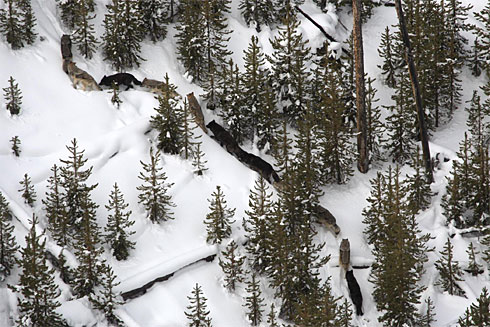 The post on the site about introducing wolves into Yellowstone and seeing changes in river flow a while back got me thinking. It's like adding one or more random but significant variables to a relatively stable process and not expecting any change. It's almost the negative definition of insanity, doing same thing and expecting different results… I see it in manufacturing all the time. It seems to affect hubristic management the most. And seems like politicians do both all the time too.
Example: Stable system + some random change(s) = *total surprise it blows up*
vs.
Stable system + system left alone = *total surprise it doesn't blow up*
The safest method I've found is introducing small variables for a short time, recording results, then removing variables, and recording the results. Repeat two more times. If ALL results are similar, then the variable + system can be characterized. Just cranking a knob or dial and hoping is roulette with nearly loaded gun.
A nice method is Evolutionary Operation or EVOP. I bought this software, but couldn't get it to work any better than manual method. I just think it might have a viable use in trading schema.
Jan
23
The 5 Whys Method, from Rich Bubb
January 23, 2014 | Leave a Comment
I have been thinking about trying to use the 5 Whys Method to analyze trading errors on my account (and then check the "images" tab for actual users' examples).
But the exogenous events (Black Swans, terrorist actions, bad actors with undesirable or stupid agendas, etc) that are beyond a small investor's control, for example: Das Fed; China changing its economic or monetary policies seemingly at whim; whale trading errors; etc., leads me to think that without either (1) an ultra conservative approach that isn't going to yield much investment return, and/or (2) insurance like put-call strategies that I admittedly know little about, a simplistic equation might look like this:
P = G + D *a * b, or [1]
P = G + D * e
where:
P = investment profit
G = growth of investment
D = dividends (if applicable)
(a) likely risks I know about that are possibly going to occur, and
(b) unknown risks I don't know about that might or might not occur
(a) and (b) collectively = e … an acceptable amount of uncertainty ("Implementing Six Sigma" by Breyfogle III, 2nd ed, Wiley, page 1029)
roughly translates to:
Investment Profit = growth of investment share price + dividends if applicable * risks I know about that are possibly going to occur (beta-likely things) * unknown risks I don't know about that are possibly going to occur (exogenous things)
I view these 'e' uncertainties of the market/s as gravitational-like-affecting forces, similar to a planet (the Market) and its multiple 'e' moons affecting the planet tides. Then, if one doesn't know the orbits of the moons (see 'a' above) and/or their respective orbits are random / erratic (see 'b' above), the 'e' effects exert influences that push and pull the market. Sometimes the direction is good, sometimes not.
Which all reminds me of the Chair's recent Lotak Volterra equations information, and a lecture during a university optimization class where Dr. Pugh (Indiana-Purdue Fort Wayne chair of Engineering Technology Dept) went through a very similar discussion about "Why Things that are Normally Stable Suddenly Change". He was diagramming essentially identical graphs using Hare and Fox populations.
Leo Jia writes:
Why 5 whys?
Welcome to the list, Rich.
Jan
23
Thanks For Adding Me to the Spec List, from Rich Bubb
January 23, 2014 | 1 Comment
 Although I do not post regularly on the Spec-List, I do regularly read many of the postings and conversation threads on this site. I have purposefully placed myself on radio-silence/posting-probation due to just plain financial ignorance, and more importantly, that I have found that I learn much more from people who are more knowledgeable/intelligent than I if I am in learn mode vs. expositional mode.
Part of this problem is my area/s of expertise is manufacturing engineering, quality engineering, six sigma methods (I am a SS Black Belt in my day job, designer of 20 successful experiments, self-taught in Evolutionary Operations, Sequential Simplex Optimization, and Theory of Constraints, blah-blah-blah), and Toyota Production System (TPS) and lean production systems, all of which have almost nothing to do with investing/finance. In the former, I am near the top of the heap as far as successful project implementation goes compared to former co-workers. But I continually pursue auto-didactic improvement.
A few examples would serve to speak to this. At a recent job, I was instrumental in lowering PPM (parts per million defects) from 7.4 to 3.8 in slightly more than one year (that translates to the facilities' production of 21 million assemblies and only making 80 defects, or 0.00000381% defect rate). I didn't do all of it myself, but worked on greater than 70% of it. At another position, I implemented a Kanban system that saved greater than $50k in first month it was used and reduced WIP (Work In Process) by 16.2% in $$$ saved terms and reduced % of WIP by 67%, 55% and 11% respectively in the three areas it was used; then followed that up by fixing their clearly non-functional 5S program in less than three weeks.
Again, these examples are not trivia in standard manufacturing environs, but not relevant sometimes for Spec-List postings and conversations. I have asked a few folks (read: local friends) to apply for ~LIST Membership, to no avail. Personally I recognize the benefit of the SPEC-LIST, and OPEN-LIST for my erudition. I think the friends read portions of the daily speculations website and got scared off. It is such a wealth of knowledge, even though many NFW items never get there. Try as I might, these non-LIST friends do not get the joke, and they're worse off because of those insular mental restraints, and I've told a few of them just that.
~LIST membership places one in a group of extraordinary and obviously gifted individuals. Yet some people wouldn't know a gold mine if they were led there by the nose.
Just a personal comment: The TV shows, "How It's Made", and "Ultimate Factories" are the best entertainment available.
Best regards,
Richard Bubb
Oct
11
The News From China, by Stefan Jovanovich
October 11, 2011 | 1 Comment
Wang Jingbo: “The world revolves around money, and it makes its own rules.”, quoted in Patrick Chovanec's article on Chinese Trusts
Richard Bubb is shocked:
After reading the article linked, I think I smell a bubble regarding this seemingly unregulated financial house of cards. From the article:"The big concern the chain-reaction that could unfold if those developers run out of ready financing and go bust: There are signs the real estate market is already cooling . . . Hungry for cash, some developers are borrowing at 12 percent to 25 percent . . ."" “Medium-sized property developers appear to have borrowed heavily for short-term and bridge loans,” said Il Houng Lee, the IMF’s senior representative in China. “Property developers’ strains could hit trusts.” and,"Any sign of weakness in China’s real estate market could have a chilling effect on trusts and their investors, said Jason Bedford, a manager at KPMG LLP in Beijing. “Imagine that you have a real estate product and suddenly the real estate markets start to plummet,” Bedford said. “What was a liquid product suddenly becomes very illiquid as investors pull out and can’t be replaced." and,“It will cause a significant amount of wealth destruction,” [Michael Werner at Sanford C. Bernstein & Co. in Hong Kong] said. “The party goes on until someone turns on the lights and you can’t roll over these assets. There will be wealth destruction. The question is how much.” Just my 2 cents.
Aug
6
Tracks of Bizarre Robot Trading, from Rich Bubb
August 6, 2010 | Leave a Comment
 I thought this should be on the dailyspec, though I don't really believe that robots are doing the trading. From a slashdot post:
Jamie spotted a fascinating story at The Atlantic about "mysterious and possibly nefarious trading algorithms [that] are operating every minute of every day in" the stock market:
"Unknown entities for unknown reasons are sending thousands of orders a second through the electronic stock exchanges with no intent to actually trade. Often, the buy or sell prices that they are offering are so far from the market price that there's no way they'd ever be part of a trade. The bots sketch out odd patterns with their orders, leaving patterns in the data that are largely invisible to market participants."
Spotting the behavior of these bots was possible by looking at much finer time slices than casual traders ever see — cool detective work, but as the story points out, discovering it is just the beginning: "[W]e're witnessing a market phenomenon that is not easily explained. And it's really bizarre."
Jun
13
Algos Better Than Mere Humans, from David Aronson
June 13, 2010 | 1 Comment
 There is a vast literature supporting the use of mechanistic decision in repetitive situations, [instead of] over relying on human expertise. Forgetting about accuracy for a moment, which is key, humans are quite inconsistent in the way they use information. Show an expert the same fact set on repeated occasions and the conclusions only correlate at about 0.50. In other words, the facts only account for about 25% of the variation in the expert’s final conclusion. This suggest that the way information is being weighted from instance to instance is inconsistent or the expert is considering information outside of the fact set. When it comes to accuracy the decision algos do better, overall.
Rich Bubb adds:
Here is an interesting example. Soon all of you will be replaced by machines [LOL]:
[An automated investing] system was developed by Robert P. Schumaker of Iona College in New Rochelle and and Hsinchun Chen of the University of Arizona, and was first described in a paper published early this year.
It's called the Arizona Financial Text system, or AZFinText, and it works by ingesting large quantities of financial news stories (in initial tests, from Yahoo Finance) along with minute-by-minute stock price data, and then using the former to figure out how to predict the latter. Then it buys, or shorts, every stock it believes will move more than 1% of its current price in the next 20 minutes" and it never holds a stock for longer."
Source: MIT Technology Review Blog
Nigel Davies writes:
That's a pretty sad comment on fund management standards. Humans have put up one hell of a fight against computers on the chess board using raw (unaided) brain power and still beat the best machines if they're armed with an ordinary PC and have a longer time limit. And that's to say nothing of the drubbing that Go players have given computers, even giving so far as to give them odds.
Jun
30
Toyota’s New Thought Vehicle, from Rich Bubb
June 30, 2009 | 1 Comment
It is a mind-reading wheelchair.
I've been interested in this type of technology as my uncle was employed in the 1960s on a top secret program to have military fighter pilots control their planes using the same thought controlling concept.
Other possible applications include a mind-reading robot, or a lie detector test.
May
4
The Good Old Days, from Rich Bubb
May 4, 2009 | 4 Comments
 When I was a kid, adults used to bore me to tears with their tedious diatribes about how hard things were. When they were growing up; what with walking 25 miles to school every morning. Uphill… Barefoot… both ways
Yadda, yadda, yadda
And I remember promising myself that when I grew up, there was no way in hell I was going to lay a bunch of garbage like that on kids about how hard I had it and how easy they've got it!
But now that I'm over the ripe old age of 40, I can't help but look around and notice the youth of today.
You've got it so easy! I mean, compared to my childhood, you live in a damn Utopia!
And I hate to say it but you kids today you don't know how good you've got it!
I mean, when I was a kid we didn't have the Internet. If we wanted to know something, We had to go to the damn library and look it up ourselves, in the card catalog!
There was no email! We had to actually write somebody a letter, with a pen! Then you had to walk all the way across the street and put it in the mailbox and it would take like a week to get there! Stamps were 10 cents!
Child Protective Services didn't care if our parents beat us. As a matter of fact, the parents of all my friends also had permission to kick our ass! Nowhere was safe!
There were no MP3s or Napsters! You wanted to steal music, you had to hitchhike to the damn record store and shoplift it yourself! Or you had to wait around all day to tape it off the radio and the DJ'd usually talk over the beginning and messed it all up!
There were no CD players! We had tape decks in our car. We'd play our favorite tape and eject it when finished and the tape would come undone, cause that's how we rolled, dig?
We didn't have fancy garbage like Call Waiting! If you were on the phone and somebody else called they got a busy signal, that's it!
And we didn't have fancy Caller ID either! When the phone rang, you had no idea who it was! It could be your school, your mom, your boss, your Bookie, your drug dealer, a collections agent, you just didn't know! You had to pick it up and take your chances, Mister!
We didn't have any fancy Sony Playstation video games with high-resolution 3D graphics! We had the Atari 2600, with games like Space Invaders and Asteroids. Your guy was a little square! You actually had to use your imagination!! And there were no multiple levels or screens, it was just one screen forever!
And you could never win. The game just kept getting harder and harder and faster and faster until you died! Just like life!
You had to use a little book called a TV Guide to find out what was on! You were screwed when it came to channel surfing! You had to get off your butt and walk over to the TV to change the channel! There was no Cartoon Network either! You could only get cartoons on Saturday Morning. Do you hear what I'm saying!?! We had to wait ALL WEEK for cartoons, you spoiled little rats!
And we didn't have microwaves, if we wanted to heat something up we had to use the stove… Imagine that!
That's exactly what I'm talking about! You kids today have got it too easy.
You're spoiled. You guys wouldn't have lasted five minutes back in 1980 or before!
Regards,
The Over 40 Crowd
John Lamberg writes:
At least you had an Atari. When I was a kid, all I had to play with were model rockets (and I could go to the hobby store and buy Jetx fuse, not that silly battery powered electronic igniter), chemistry set, erector set, slot cars, CB radio, build your own shortwave radio from Heathkit, and I actually had to ride my bike to go fishing… Hey, that sounds like more fun than an Atari.
Mar
23
Buying a Home, from Corbin Bates
March 23, 2009 | Leave a Comment
 Given the current mortgage rates and the fall of the housing market, I want to purchase my first home. Since I am stationed at Fort Hood in Texas, I have been doing heavy research in the Killeen / Harker Heights area. I thought I would ask for some advice. I spoke with Tim Melvin about this earlier, and he mentioned that I should never pay more than 10 times the annual rental rate of comparable houses. Does anyone else have any other good valuation metrics like this or have any knowledge / advice that would help me out as a first time homebuyer?
Legacy Daily replies:
I have found 10x to be used in two cases:
1. High house prices relative to rent — get one to cool off and think more clearly about an investment and do additional homework 2. Low house prices relative to rent - get one to jump in without thinking clearly on a "bargain" investment without doing any additional homework
Some initial questions worth clarifying:
1. Is this a home or a leveraged investment? a. home — ignore rules like this and find the best place to live, raise a family, pursue happiness… b. leveraged investment — do enough homework to be confident enough about the decision to ignore all general rules.
Assuming investment:
2. What is the holding horizon? What future plans could interfere with that holding horizon? 3. What is the appreciation potential for the country, state, county, city, town, neighborhood, subdivision, this property…? I have not yet been able to come up with sufficient justification to buy for income alone when it comes to residential real estate. 4. What segment of rental market would the property (subdivision, neighborhood, town, etc.) attract? Is that the segment one wants to serve? Real estate agent needed to rent? 5. How predictable is the income stream? How would economic booms/busts affect it?
6. What are the worst case scenarios? What could go wrong?
7. Financial analysis — P&L, tax impact, financing options, downpayment flexibility (very illiquid), initial estimated repairs, etc. 8. Legal analysis — zoning issues, easements, property title issues, locality department issues, neighbor issues, etc. etc.
Couple additional points:
1. Decent real estate attorney representing one's interests can save from numerous headaches (especially true in foreclosure/short sale cases). 2. Avoiding a buyer's broker saves one money, gives additional negotiating room, makes the seller's broker more willing to work extra hard for the deal. 3. Inspections are money well spent, even if one does not end up buying the property. 4. The market is generally very efficient (yes even during this recession). Why has the property one's considering not sold yet? etc.
I hope you find this useful.
Jim Rogers writes:
The rule of thumb I've heard used is 1% of sales price should be equal to or less than comparable monthly rent (that's a little more aggressive than Tim Melvin's measure, especially when you factor in the mortgage tax shield). I'd say, use either and stick to your guns.
Sam Marx replies:
Don't trust what the real estate broker says about a house's value or price. Do your own research.
Try to find prices of recent sales of similar houses in same neighborhood.
Check with the local banks to see what houses they now own and what are their asking prices.
If you can go to foreclosure sales, do it, not to buy a house but to get an idea of what the market in houses is and remember those prices when negotiating with a broker.
I don't recommend buying at a foreclosure unless you're experienced at it.
Don't be shy about making offers 25-30% below asking price when dealing with a broker.
Watch for estate sales, the heirs are motivated sellers.
I don't know your area, maybe it's reached a bottom, but in FL, housing prices are still too high. The stock of St. Joe Land (JOE), FL's largest landowner, was 69 a few years ago — now it's 15.
Phil McDonnell advises:
 Buying a first home can be a frightening prospect. It should start with a realistic look at your needs. How many bedrooms and baths do you need now and in the future? If your life involves one or more women strongly consider the extra bath. If you have the skills a fixer upper my be of interest.
I frequently advise my Realtor wife on the statistical aspects of our local real estate market. Pricing in this market is especially tricky. It is a declining market but that also means buyers have much more negotiating leverage. To measure your local market ask a local Realtor for the latest stats on number of homes on the market and number of sales in the last few months in your area of interest. For a normal market this is about a four month supply of homes at the current monthly sales rate. In this market it is running about 10 months of inventory per home sold. Hence the declining prices as sellers compete. One should consider staying out of the market until the inventory show signs of declining. However do not be fooled by a one month decline in local inventory. Buyers in the Seattle area are negotiating prices an average of 4% below asking. Get the similar number in your area.
As a buyer in this market it is best to view the prices as a price distribution. Suppose we have ten houses in your area. But only 1 will sell in the area in the next month. Clearly it is most likely to be the one that offers the best value on a relative basis. The other nine are over priced for these market conditions. By staying on the market for another month they will probably lose something like 1% in value per month.
There is an old saying in real estate. One should buy the least expensive house in the neighborhood. Generally this is true. After numerous regressions on homes it can be said that among comparables the most important single factor is square foot of the house. For the best resale find out which area has the best schools. Even if you do not have kids the people who ultimately buy your home may have them and it will help resale in the long run.
Check out all the government mortgage deals and tax subsidies. They are offering a tax credit of up to $8,000 for first time buyers. 30 year fixed rates are below 5%. The military may offer even better deals. Remember the $8,000 credit is only paid the following year via a refund so you do not have it to use as a down payment. It is more beneficial the smaller the house you buy. I saw a recent home sold for something like $80,000 in Killeen. The $8k represents 10% on that home, but only 5% on a $160k home.
Dr. McDonnell is the author of Optimal Portfolio Modeling, Wiley, 2008
Henry Gifford adds:
Home prices, in general, are still falling in the US, therefore waiting will probably bring lower prices.
As property prices fluctuate, one sign of high prices is easy loans. Times when prices are better tend to be times when loans are hard to get, with of course reasons for this relationship. But, as an affiliate of the military, there are sometimes special deals available to you that are not available to other people, which means you can be one of the few buyers out there at a good time to buy. Some of these loan deals only exist on paper now, as the price limits and interest rates make them impractical, therefore nobody talks about them, but because they are government programs which get updated slowly, and usually out of sync with the market, they can be really good deals at times. Therefore there may come a time when you can get both a good price and a good loan.
Buying near a military base involves risk of base closure (I owned a whole bunch of houses near a base that closed) or downsizing, and since you're in Texas where there is lots of land, upsizing the base won't put much pressure on prices - people will simply build more houses. Perhaps you can ask around inside the gates to get a feel for this.
Buying and selling property involves large costs for brokers, taxes, title insurance, etc., which penalize short term ownership, meanwhile you can get transferred to another base at a moment's notice, which puts you in the position of being in a hurry to sell. If, instead, you buy a commercial property, you can own it as long as you live, with far less management headache, which makes owning it while living elsewhere more realistic than renting a house to someone.
Phil McDonnell responds:
I think the truth in this statement is based on a defect in the way people perceive value. Suppose the average home in a neighborhood sells for $500k but yours is worth $400k. Then if the average goes up to $600k the innumerate masses will think that all homes have gone up $100k not the 20% they really should have. When they do this the $400k home appreciates by 25% not 20%. In other words people add when they should multiply by a percent increase factor.
Dr. McDonnell is the author of Optimal Portfolio Modeling, Wiley, 2008
David Hillman writes:
Another part of that defect is focusing on the value of the improvements v. the value of the land.
Some years back, a close friend bought a lousy house on a great piece of property in the best neighborhood. Even though it was a prestigious address in a 'branded' area, he got a deal on the property because the house was so undesirable. The plan all along was to demo the house and built a new one to suit, which is exactly what he did. He had realized the land was worth perhaps 90% of the true total value of the property before the new construction.
Many county auditors, etc. have searchable tax records online with the assessed values of land/ improvements parsed out. One might use that to figure a reasonable estimate of market value of land v. improvements. Don't forget the old saws apply….'land, they're not making any more of it'….and….'location, location, location.'
Bill Egan writes:
In the last 10 years, I have bought three homes and sold two. Did not plan to, but that's the way it worked out due to job changes. Sold both houses in < 1 week for a profit despite forced timing. We were not in subprimeville, either, and the last sale was 2001 before the real estate madness.
My wife and I kept resale value in mind because you never know what can happen to you. We made sure we bought homes that were average to excellent on the following criteria:
- School quality
- Exterior appearance and interior layout — good and normal
- Quiet, safe neighborhood that looks good
- Reasonable size (3/2 or larger)
- Likely demand due to commuting routes/distance to jobs
For example, I was working at a biotech in NJ from 1999-2001. We bought a 3/2.5 in a newer development, nice neighborhood in Burlington County, right next to an average-quality elementary school. However, the area was less horridly expensive than the homes closer to Princeton, where I commuted to. There was strong demand from people priced out of the homes closer to NYC/Princeton.
Rich Bubb replies:
1. look at the neighbors. C-L-O-S-E-L-Y… look at the state of their domiciles (even getting "invited-in" for a look see if at all possible), and the state of the upkeeping… especially the immediate next door folk. You might end up living next door to your own personal nightmare. Believe me, it is Not Enjoyable. Even after almost 20 years. Thankfully everyone else on the entire block is somewhat more sane and respectful of their neighbors than my nextdoor nightmare. Or to put it another way: you might get the best deal that no one else could stand…
2. if you really know somebody in the real estate biz (my sister is an agent), have them look around for you. she got her daughter's family a fabulous deal in a great neighborhood. Or to put it another way: sometimes real professionals Do Know what they're doing.
3. look long at the deal, bid low for the deal (Game Theory might help a little here, here is a cool intro), then be prepared to walk away… even if not doing the deal means you'll have to go back and start the whole search-etc process all over again, and don't put pressure on yourself or let anyone pressure you into buying. My wife was not prepared to walk away from her last car purchase. She still got a good vehicle, but she could've strengthened her bargaining position by uttering the words, "Let me think about it." And then purposefully heading for the door. We went outside and argued between ourselves about leaving. She *wanted the vehicle*. It cost her almost $5k more than I wanted her to pay.
4. Consider the cost of long term ownership. I mean, Really figure it out… what's the cost of x, and y, and z, and can you afford it if those costs all hit at once.
5. Tangentially to #1 above, if there'll be kids living next door… would you:
(a) invite them in?, or
(b) chase them away?, or
(c) start scouting for really out-of-the-way burial sites?, or
(d) let them borrow your most deadly power tools?
Just mentioning this as my siblings and I were the 'b-c-d' and almost always the Never-more-than-once 'a'. And the neighborhood's less-than-model parents would often let their barbarians-in-training train at our place… Or to put it another way: your neighbors' kids might have fiends, er friends, worse than they already are…
Hmmm, karma might really exist…
Russ Herrold adds:
A anonymous blogger, 'Benjamin.Publicus' on Thomas Paine's blog had this this observation:
… The author lives in a community that is (or was) at the epicenter of the mortgage crisis. The developer aggressively marketed the homes to young, first time home buyers, many of whom renters. No money down, own instead of rent, mortgage payments the same as the rent, etc, etc. The development was started in 2001, so the first wave of 5 year ARM's hit in 2006.
…and it goes on from there.
I have spoken to that author (and a couple others) about contributing to DailySpec, but he has been busy.
Dr. Herrold is Principal of Owl River Company, a high-end Unix consultancy
Rich Bubb adds:
As mentioned previously, my sister is a real estate agent. following are her comments on home shopping & buying.
Get a Real Estate Agent to represent YOU as a BUYER. Sign a contract as such. Tell them what YOU want.
There are surely things important to you that you would like to have in one of the biggest investment decisions you will make.
TAKE NOTES of likes/dis-likes of each home you view. re: Basement, Garage, Four Bedroom, Square Footage, LOCATION. I stress location because it can make or break the satifaction of your purchase.
Drive through the neighborhoods you are considering at different times of the day to see what the atmosphere is.Pay attention to the neighbors up keeping of their property. Schools?, established neighborhood?, new additions? child / adult ratio?
Comparison shop, don't just jump at the first home you look at just because you can afford it. Ask your agent to provide you with a CMA (a market analisis of a surrounding area - 5 mile radius ).
Get pre-approval from your lender, look at homes a bit higher than your range and offer LESS - the worst that can happen is, they will say NO or counter-offer and you may wind up with a nicer quality home.
BE Strong in making the decisions of your offers. Be prepared to give and take.
Then BE PATIENT thru the purchase process which seems like it takes forever because we are a see it, buy it, want it now, kind of people. It is a process that is in place to protect you. re: CLEAR TITLE
Again, don't just settle for a home, get as close to what you want as possible.
Oct
11
The Stats, from Kim Zussman
October 11, 2008 | Leave a Comment
Everyone knows last week's 18% drop was the worst in DJIA history (10/28-present). Here are the stats excluding that week (but including Great Depression weeks):
Descriptive Statistics: week ret
Variable Mean SE Mean StDev Minimum Median Maximum
week ret 0.0012 0.00038 0.02442 -0.1554 0.0025 0.1821
So last week's return (return?) of -0.18 was about 7.4 STDEV below the mean.
Not only not normal, but where to look for example periods to model quant strategies? We now see it was a mistake to exclude 00-02. Even 29-40. What about the KT boundary?
In honor of this occasion, one will ditch the clever-as-if-it-was-known tone of this web site, and offer an opinion:
There are periods when markets behave well and are amenable to characterization (quantitative or otherwise). And there are periods when they are not. If you could know this with any precision, you would be extremely wealthy; which by design makes it about impossible to know.
Markets wouldn't trade actively if there weren't opportunities, or if it were easy to tell genius from luck.
There are periods when markets behave well and are amenable to characterization (quantitative or otherwise). And there are periods when they are not. If you could know this with any precision, you would be extremely wealthy; which by design makes it about impossible to know.
Markets wouldn't trade actively if there weren't opportunities, or if it were easy to tell genius from luck.
Rich Bubb responds:
So this "characterization" could be a 3×3 cube plotted representation (albeit this might be a little simplistic for most of the SPEC-Listers), with axes listed, in no particular order:
x aka a bubble exists in sector/commodity, scale might read: "no chance" at far left end; hysteresis happening and/or lobagola should happen or just did happen being in the mid-zone/s; and price/cost up n% in m-time meaning "here there be the bubble monster" and tread lightly or get out as fast as feasible.
y aka the interest rate du jour… scale trending down means economy &/or mkt trending down; scale trending up means economy &/or mkt trending up… but the scale would be visually represented by an upside down bell curve. So, for example, if fed rate is trending down, then the might be converted to a z-scale transformed scale with 0 in the mid of the scale, +3 on high end of scale, and -3 (std devs) at the low end.
z aka axis might be volatility or put-call ratio, or money supply, or OBOS%, or your indicator of choice.
With enough data points one might be able to observe the rate of change in 3D as things (x, y, z) move about.
I think this could be done with the charting tools in Excel…
Phil McDonnell observes:
The analysis Rich Bubb has described is essentially a 3D scatter plot. There are many examples of 2D scatter plots in Education of a Speculator and Practical Speculation as well as any introductory stat book that covers regression. The 2D plots relate to regression of one variable in an attempt to explain or predict another. The 3D case would relate to the case of using 2 variables to explain a third one. The regression would be of the form:
Z = a * X + b * Y
The usual caution is to avoid variables which are serially correlated. Usually price CHANGE variables are not correlated because an efficient market will remove any such correlation. By the same token price LEVELS are always highly correlated. One notes in passing that interest rates are a kind of reciprocal of the price level of the underlying debt instrument. Thus interest rates would be expected to be highly correlated but CHANGES in interest rates or prices would not be correlated.
Volatility is a more interesting animal. Volatility and therefore Vix levels are highly correlated. Again it is probably better to use changes in Vix than levels.
A final note is that one can perform a two variable regression of the above form even in Exc3l. To do that you need to have the Analysis Tools Add-In loaded. The data columns should be right next to each other (vertically). Then the regression analysis can be performed by clicking 'Tools/DataAnalysis/Regression'.
Sep
19
Guitar Duel, from Rich Bubb
September 19, 2007 | Leave a Comment
Steve Vai Battles Karate Kid is the best guitar duel i've ever seen/heard. Long, 8:46. No vocals. Even without knowing aforehand the Devil was in the audience, one can easily see why he tore up the "contract."
Sep
14
For Star Trek Fans, from Jeff Sasmor
September 14, 2007 | 1 Comment
New Star Trek episode: World Enough and Time, based in the original Star Trek milieu. Starring George Takei ("Sulu") and a few other originals you'll notice (like Yeoman Janice Rand). Really quite well done; consistent with the original in style. Highly recommended for those who enjoyed classic Star Trek! The ending is quite touching. Following the ending, there's a teaser for the next episode. Streaming video, 65 minutes, requires Flash player.
Rich Bubb agrees:
World Enough and Time rivals any of the original and the subsequent Star Trek spin-offs. Very well done writing, good plot weaving. Special effects and sound effects are very similar to the original Star Trek, but not exact copies. The actors are darn good too. And no commercials!
Vitaliy N. Katsenelson extends:
TV-Links contains links to every TV show and most newly-released movies. Not all the links work but a good portion do. I tried Stargate Atlantis and Star Trek: The Next Generation — both work. I even watched The Illusionist.
Aug
23
Interesting Architechture, from Rich Bubb
August 23, 2007 | Leave a Comment
After last year's Sunday morning Stock Talk in Central Park, my wife and I decided to visit the NYC Guggenheim Museum. We had no idea they were exhibiting Zaha Hadid's brilliant works. After seeing her work for five seconds, I thought she was the 22nd century literal reincarnation of Frank Lloyd Wright.
Today I was cruising through her website and found language and building designs.
Jul
18
Crop Report, from Rich Bubb
July 18, 2007 | 2 Comments
 A few weeks ago my wife and I took a day trip to Shipshewana, an Amish community in northern Indiana specializing in agribusiness and tourism. Along the drive there I noticed many fields with monstrously large portable/movable irrigation spraying systems. Some of them were in operation, spraying water in mass quantities on crops. The fields using this method were nice and green. Those that weren't were stunted.
The corn crops we drove past had their uppermost leaves pointing straight up, which is a sign the corn needs water. We saw "tasseling" but few ears of corn on the stalks. We had heard some farmers are getting ready to plow under their existing crops and wait it out until next year, but didn't see any evidence of this yet. My drive to work takes me through about 20 miles of farmland, so it'll be easy to see this happen.. if it does.
Scott Brooks explains:
It's when corn is tassling that rain is most critical. When corn tassles is a largely a function of when it was planted. The amount of rain it gets in the pre-tassling stage also plays a role in when it will tassle, but not as much as when it was planted. Tassling occurs most often in July.
Apr
16
Fiat Lux, from Henry Gifford
April 16, 2007 | Leave a Comment
 The efficacy of white LEDs is about 12 to 19 lumens/Watt, which is much less than the 36 to 55 claimed by manufacturers. Compact florescents have efficacies 1.5 to 3 times higher than LEDs.It it said that compact florescents last indefinitely, which is far from true. The screw-in types last much longer than incandescent bulbs, but don't last forever, and their life is shortened by the fact that the "ballast," the electronic guts, is located very close to the bulb, thus the heat shortens its life.
It used to be true that compact florescents were expensive, gave off a harsh light, and could not be dimmed. But now the screw-ones cost less than $2.00 in quantity (not everyone agrees with this, but I'll sell anyone who doesn't believe it as many as he wants for $2.00 each).
The best deal is a real florescent fixture, as the reflector is shaped optimally for the bulb, and the ballast is remote, thus protected from the heat, and is seperate, so it doesn't need to be replaced when the bulb goes bad. The bulbs are available in five different colors and more and more of them are dimmable, especially those made by Phillips.
florescents are now hard to tell apart from incandescents without taking the fixture apart and looking, so energy geeks are resorting to using fancy light filters to tell them apart without climbing on a ladder.
Rich Bubb remarks:
Our firm has been using the spiral bulbs for five years. Recently I was in the room where we'd installed the earliest ones, and noticed an odd smell. Then the bulb burned out. Probably the mercury in the bulb vaporizing.
I didn't know they contained mercury at the time of the first burn-out. From now on we'll raise the windows and go outside to let the fumes dissipate. Maybe go get a cup of coffee in the meantime.
Mar
21
Mathematicians, from Peter Grieve
March 21, 2007 | 1 Comment
 The sentence, "Even mathematicians don't have all the answers" is a frightening one. Mathematicians strain hard to have all practical answers. Even engineers go up a zillion blind alleys, and often don't know that the alleys are blind until they've already been announced as the answer.
"It may well turn out, of course, that what they need are more mathematicians." Heaven help IBM, and us.
The classic mid-life arc of the mathematician (esp. the pure one) goes like this:
- At 42 - Notice that some friends are getting rich.
- At 44 - Notice that zillions of "idiots" are getting rich.
- At 47 - Form company based on brilliant idea. Insist on maintaining complete control, to avoid corruption of idea by idiots.
- At 50 - Declare bankruptcy.
- Later - New buyer of company makes a success out of it, sometimes a greatone.
I must admit that the high-tech age has reduced the probability of step 4 to, say, 96%. I am not writing as an outsider.
Rich Bubb adds:
Here is an article about one of IBM's chief mathematicians, and the real-world problems her department is solving.
Kim Zussman writes:
Re: "Zillions of 'idiots' are getting rich:"
This is actually the key to everything. You will never get over how many less (intelligent/educated/motivate/ethical) people have more than you can ever hope to, and the explanations about randomness will fall on the deaf ears of all significant others.
What is much harder and more important to appreciate is how many of your betters will always live in incomprehensible hopelessness.
Feb
19
Desalination, from Rich Bubb
February 19, 2007 | 1 Comment

Some Specs have been discussing water-related investment opportunities. This article describes a working desalination pilot plant in Long Beach, CA.The use of nano-filtration is described, and the method is discussed in an overview manner. Unfortunately, the online article does not include the diagrams and illustrations in the print version of the article that appears in the February 2007 Water Technology magazine.
Following is intro to the article:
The Long Beach Water Department (LBWD) has developed and patented a two-pass nanofiltration (NF) process, called NF/NF, to desalinate seawater to drinking water. Over the past several years, the LBWD has been testing the hybrid desalination process in the 9,000-gallon-per-day (gpd) pilot scale unit at its groundwater treatment plant. The two-pass, multistage nanofiltration membrane process can treat water at a lower operating pressure and energy than a conventional, single-pass seawater reverse osmosis (SWRO) desalination process that uses cellulose acetate or thin-film composite membranes. A key component is the second-pass concentrate recycle loop, which dilutes the feedwater and makes the use of nanofiltration membranes feasible. LBWD has constructed a 300,000-gpd prototype seawater desalination facility to validate the performance results observed during initial pilot testing, and to test the long-term operating characteristics of the hybrid desalination process.
Nov
20
Robert Engle interviewed by F. X. Diebold, sent in by Rich Bubb
November 20, 2006 | Leave a Comment
I stumbled upon an interesting interview of Prof. Robert F. Engle by Prof. Francis X. Diebold (guest speaker at the December NYC Junto) from 2003. The whole interview is quite readable.
Archives
- October 2026
- September 2026
- August 2026
- July 2026
- June 2026
- May 2026
- April 2026
- March 2026
- February 2026
- January 2026
- December 2025
- November 2025
- October 2025
- September 2025
- August 2025
- July 2025
- June 2025
- May 2025
- April 2025
- March 2025
- February 2025
- January 2025
- December 2024
- November 2024
- October 2024
- September 2024
- August 2024
- July 2024
- June 2024
- May 2024
- April 2024
- March 2024
- February 2024
- January 2024
- December 2023
- November 2023
- October 2023
- September 2023
- August 2023
- July 2023
- June 2023
- May 2023
- April 2023
- March 2023
- February 2023
- January 2023
- December 2022
- November 2022
- October 2022
- September 2022
- August 2022
- July 2022
- June 2022
- May 2022
- April 2022
- March 2022
- February 2022
- January 2022
- December 2021
- November 2021
- October 2021
- September 2021
- August 2021
- July 2021
- June 2021
- May 2021
- April 2021
- March 2021
- February 2021
- January 2021
- December 2020
- November 2020
- October 2020
- September 2020
- August 2020
- July 2020
- June 2020
- May 2020
- April 2020
- March 2020
- February 2020
- January 2020
- December 2019
- November 2019
- October 2019
- September 2019
- August 2019
- July 2019
- June 2019
- May 2019
- April 2019
- March 2019
- February 2019
- January 2019
- December 2018
- November 2018
- October 2018
- September 2018
- August 2018
- July 2018
- June 2018
- May 2018
- April 2018
- March 2018
- February 2018
- January 2018
- December 2017
- November 2017
- October 2017
- September 2017
- August 2017
- July 2017
- June 2017
- May 2017
- April 2017
- March 2017
- February 2017
- January 2017
- December 2016
- November 2016
- October 2016
- September 2016
- August 2016
- July 2016
- June 2016
- May 2016
- April 2016
- March 2016
- February 2016
- January 2016
- December 2015
- November 2015
- October 2015
- September 2015
- August 2015
- July 2015
- June 2015
- May 2015
- April 2015
- March 2015
- February 2015
- January 2015
- December 2014
- November 2014
- October 2014
- September 2014
- August 2014
- July 2014
- June 2014
- May 2014
- April 2014
- March 2014
- February 2014
- January 2014
- December 2013
- November 2013
- October 2013
- September 2013
- August 2013
- July 2013
- June 2013
- May 2013
- April 2013
- March 2013
- February 2013
- January 2013
- December 2012
- November 2012
- October 2012
- September 2012
- August 2012
- July 2012
- June 2012
- May 2012
- April 2012
- March 2012
- February 2012
- January 2012
- December 2011
- November 2011
- October 2011
- September 2011
- August 2011
- July 2011
- June 2011
- May 2011
- April 2011
- March 2011
- February 2011
- January 2011
- December 2010
- November 2010
- October 2010
- September 2010
- August 2010
- July 2010
- June 2010
- May 2010
- April 2010
- March 2010
- February 2010
- January 2010
- December 2009
- November 2009
- October 2009
- September 2009
- August 2009
- July 2009
- June 2009
- May 2009
- April 2009
- March 2009
- February 2009
- January 2009
- December 2008
- November 2008
- October 2008
- September 2008
- August 2008
- July 2008
- June 2008
- May 2008
- April 2008
- March 2008
- February 2008
- January 2008
- December 2007
- November 2007
- October 2007
- September 2007
- August 2007
- July 2007
- June 2007
- May 2007
- April 2007
- March 2007
- February 2007
- January 2007
- December 2006
- November 2006
- October 2006
- September 2006
- August 2006
- Older Archives
Resources & Links
- The Letters Prize
- Pre-2007 Victor Niederhoffer Posts
- Vic’s NYC Junto
- Reading List
- Programming in 60 Seconds
- The Objectivist Center
- Foundation for Economic Education
- Tigerchess
- Dick Sears' G.T. Index
- Pre-2007 Daily Speculations
- Laurel & Vics' Worldly Investor Articles
