Oct
13
Writing it down, from Nils Poertner
October 13, 2026 | 1 Comment
Young, more inexperienced specs would benefit from writing down all the observations, patterns, even subjective things they picked up and compare in the future (1wk, 1mo, etc), not just today but in particular this month. Instead of reading research paper no 3241.
William Huggins writes:
i recall a quarter century ago doc Steenbarger had done some private work for high figure chicago traders on their biases that he could only discuss with the list in the most general sense (ie, this not my work, just shouting back so its value is not lost to time). one of his "summary takeaways" for us that stuck, that i teach in my own classes on investments, is to write down -why- you think something is a good trade for the purpose of auditing your own thinking when it fails. if i recall correctly, the analogy he used was that of a professional sports team watching their own lost games to understand how to contain failure rather than seeking out the (supposed) source of success. the behavioral nugget on that one being the desire to fit our success to a heroic narrative often makes failure analysis more objective and hence productive. if you aim to improve, write down the reasons for your trades and then ruthlessly analyze failures in the aftermath.
Nils Poertner responds:
Wholeheartedly agree William! Victor always suggested to pass on "meals for life" and that would be one of them.
Asindu Drileba adds:
One of my favorite quotes is:
A good decision is still a good decision even if it turns out bad
& a bad decision is still a bad decision even if it turns out good.
A few months back I watched the Michael Jordan movie, Air (2023). A similar quote from the movie I liked:
Just because you're losing, does not mean you placed the wrong bet. - Sonny Vaccaro
Gary Boddicker offers:
Brings to mind the key concept from David Sklansky's classic, The Theory of Poker:
Any time you make a bet with the best of it, where the odds are in your favor, you have earned something whether you actually win or lose the bet. By the same token, when you make a bet with the worst of it, where the odds are not in your favor, you have lost something, whether you actually win or lose the bet.
Sep
24
Motto to trade by, from Zubin Al Genubi
September 24, 2026 | 1 Comment
Limit your losses, and gains and growth will take care of itself.
Asindu Drileba wonders:
Strategies for limiting losses?
1. Position sizing
2. OTM options
3. A friend of mine holds long VIX positions
Questions?
- What other strategies exist?
- What is best? 1, 2 or 3?
Zubin Al Genubi responds:
Those are all good strategies. Another way is to lower your expectation return targets in time or returns which in turn lowers loss expectations. In a competitive scenario this may or may not be acceptable but if you have enough, why take on more risk.
Larry Williams offers:
Once you set your stop loss, don't move it. Ever. Never.
Sep
17
Niederhofferisms, from Asindu Drileba
September 17, 2026 | Leave a Comment
Beautiful article:
RIP Vic Niederhoffer, by Peter C. Earle
Unfortunately for me, I don't have a comprehensive understanding of all the Niederhofferisms. I understand hoodoos, flexions, LoBagolas, constructal numbers (not so much though I'm familiar with Professor Adrian Bejan's work).
Could someone help elaborate these two?
"agrarians" & "constructal numbers"
Andrew Aiken responds:
agrarians = believers in egalitarianism, "the idea that has the world in its grip", and leveling
constructal numbers = significant numbers in the price pattern of a series, a generalization of support and resistance. They reveal a structure in price action.
Alex Castaldo expands:
"Agrarians" or "Agrarian Reformers" was a sarcastic term used by Vic to refer to Mao Zedong and his followers, and by extension to others who are Communist. In a wider sense it also could refer to American leftists who due to a lack of common sense refused to believe that Mao was a true Communist in the 1940's and 50's. They believed instead that Mao was an "agrarian reformer" who was trying to improve Chinese agriculture by making various "reforms" in the countryside, rather than a brutal collectivization of agriculture in the Soviet style.
I don't know whether Edgar Snow used the term "agrarian reformer" in his famous book Red Star Over China (1937) or not, but he is an example of the kind of naive America supporter of Mao that Vic had in mind. It is not a term that you hear much nowadays.
Aug
23
Appreciating The Chair
August 23, 2026 | 1 Comment
Obituary: Victor Niederhoffer - December 10, 1943 – August 4, 2026
Alex Castaldo:
I think I was lucky to know Vic for so many years. He was very generous to me and although he liked to do things unconventionally sometimes, it was because he sincerely felt everyone should do things their own way and never just to be eccentric or shock people. He always had interesting points of view on many issues not just work related.
Pamela Van Giessen:
It was my great honor and privilege to publish Education of a Speculator. In fact, working on the book with Victor was the highlight of my career. I knew in my heart that whether the book sold 1 copy or 100,000 copies or more, it was an important work. Throughout the process Victor drove me crazy, but mostly in a good way. He was always challenging the status quo, often spot on. He was one of the most generous people I have ever encountered, and I will carry to my grave all the lessons he taught me, along with the many interesting people he introduced me to including Marty Reisman who negotiated the publishing contract with me/Wiley on Victor’s behalf (and wasn’t that just a trip!) and, of course, Bo, among so many others.
The most beautiful person Victor introduced me to was his amazing wife, Susan. If we were fortunate to know Victor, Victor was beyond fortunate to have Susan in his life. May the hole in your heart, and the hearts of your children, be filled with Victor’s love for you and the love of all those around you.
Vince Fulco:
Terribly, terribly sad to hear this news. Working for him was among the best years of my life. I would have carried his ammo can in any trench, in any war.
May his memory be a blessing. Warmest condolences to all who knew him.
Jared Albert:
I sent this to Vic in June and it seems like I should just share it as my commemoration of the man of extraordinarily outsized importance in my life. My deepest condolences to Susan and all of their children.
Dear Vic,
I was sorry to read that you weren’t feeling that well these days, and I wanted to thank you again, while there’s time in this world, for taking a shot on me 20 years ago. Although it didn’t work out like I hoped, it gave me a kind of seal of approval at a pretty low point in my early 30’s and I’ve always appreciated that you did that.
You've remained a central positive figure in my life and I wish you all the best for a full recovery.
James Sogi:
Condolences to his extended family and past business associates and partners . Vic was truly one of the all time greats of the financial world who helped many and changed the markets. He changed my life and my family through his help. I am very sad to hear of his passing. I will always treasure my association and times with him as one of the highlights of my life.
Tyler Cowen:
In addition to his well-known public roles, he worked very hard to help and befriend me when I was younger. Here are the Google searches for Victor. Less well known about Victor is that he had one of the world’s best collections of private letters. He also once gave me a very nice small painting by Jack Savitzky, for which I remain grateful.
Michael Brush:
Vic did a lot of things, but one thing he did for all of us was to generously introduce us to new worlds, new worlds of ideas, and new people.
Vic was really great man. Meeting him was one of those “before and after” moments in my life, back when he started writing for MSN Money when I wrote there.
I remember our last conversation while leaving one of his parties.
Me: Vic you were such a big influence in my life.
His answer surprised me and to this day I am not sure I know what it really meant: “I hope in a good way.”
I will really miss you Vic. Thanks again for everything.
Steve Ellison:
I posted a photo on X (then Twitter) when the Chair played handball against the Senator at the 2015 Spec Party.
William Weaver:
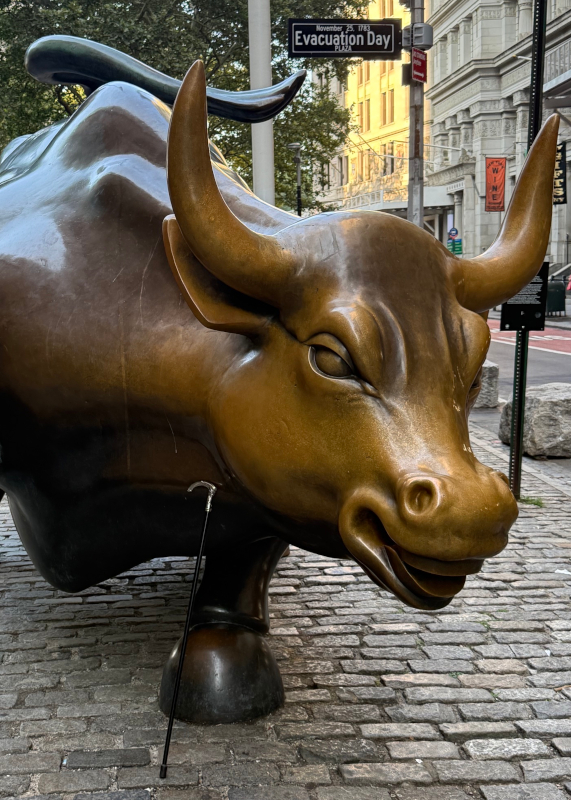
Victor gave a number of us these canes years ago. At least for me it was a reminder anyone can achieve their goals, and it won’t always be an easy path. I took mine down to Wall Street this morning. Thank you, Vic. Will
It is good to take out the canes and hobble down to Wall Street at the close of days when there is a panic. - Victor Niederhoffer
Laurel Kenner:
I found the last cane maker in Manhattan and purchased a number of the most striking ones to send as prizes.
Asindu Drileba:
Until this day, since a few years since I read The Education of a Speculator, I have not found another book remotely close to it. In the finance industry, market analogies are mostly limited to maths & physics. This is why when I read The Education of a Speculator, my mind was genuinely blown by how The Chair would create market references to genetics, music sheets, Dutch philopher Johan Huizinga (Homo Lundens is worshipped in the game design community), checkers and more.
This type of thinking in analogies is what E. O Wilson referred to as "Consilience." So because of this, I would regard The Chair as "The Master of Consilience".
I wrote a short tribute to Vic.
Kiran Kaur:
I was a student of Vic’s. In 2025 he gave me a full weekend at his home, him and Susan both. He walked me through his own book. When I left he put Elmer Kelton’s The Time It Never Rained in my hands and told me The Trees in My Forest by Bernd Heinrich was the other one to read.
I have wondered since whether the pairing was deliberate. A rancher who will not take the drought subsidy and stays on the land, and a biologist counting what is actually happening in three hundred acres of Maine woods. Endurance and counting. He handed it over without a lecture, which I think was the point.
Condolences to Susan, to Aubrey, and to the whole community. Rest in Peace Legend!
Sam Johnson:
A veteran trader pointed me to Vic back in 2011 via speculations website. Encouraged me to think differently about markets and led to a career. Question and test orthodoxy. I wish i could have attended one of his get togethers. He never met me or knew it but he was the second most important person to my trading success.
Yelena Sennett:
Victor certainly did like his hats…
It was a privilege to do podcasts with him. You never knew what fascinating analogy he would come up with to explain the markets. He was always generous with sharing his knowledge, but I believe his greatest gift was an instinct for reading the markets that simply couldn't be quantified.
One of his favorite sayings was, "Never short the market." He certainly lived an extraordinary life, with its share of highs and lows—much like the markets themselves.
Today (August 4th), as the S&P 500 reached another all-time high, it felt like a fitting tribute to his memory.
Richard Barsom:
RIP Victor. Great guy, literally saved my life. Rest in peace Chair.
John Netto:
I remember meeting him for the first time back in the summer of 2011. He graciously invited several from the spec list over to his UWS home. The whole experience fascinated me and his affable personality and welcoming disposition quickly removed any anxiety I had about being in front of a true legend. Thank you to John Floyd for introducing me to the Chair and the list.
Paolo Pezzutti:
I will miss Victor very much. To me, he was a mentor. I received far more from him than I ever gave, and that was part of his greatness. I have applied many of his teachings in both my life and my work.
A brilliant, original and courageous man has left us—courageous even beyond any reasonable limit. He was eclectic, competitive and a great contrarian by nature, but also generous beyond measure. He was a bold, direct and aggressive speculator.
As Nelson used to say: “Go right at them”, Victor always urged me to apply his battle-tested principles to my own trading style.
Newton Linchen:
Victor Niederhoffer was a major inspiration for my development as a market practitioner and had huge impact in the way I view markets and the World.
We are all at a great loss. My respects and sentiment to the family and friends.
Thank you, Chair!
Eric Lindell:
I'm saddened to hear of Victor's passing. I had gotten to know him over the years attending his junto meetings. He was a great guy, and it's a big loss to the investment community and all those whose lives he touched. My deepest sympathies to his family.
Jordan Low:
Victor’s passing is a loss to many. He was so generous with his time and wisdom, and he was a friend to my whole family: he taught my daughter Annabelle tennis, squash, and checkers, and he came to the gala to support my wife Annie when she was honored among the Outstanding 50 Asian Americans in Business. He also taught me the triangle defense in checkers, and drew the line straight to portfolio management: balance risk, reward, and liquidity, and hold the formation at all times. I trade that way to this day. My deepest sympathies to his family.
Rest in peace, Chair. We will remember you fondly.
George Coyle:
Jul
18

example of something in our Western culture when we "over-use", overly rely on numbers to give meaning to something. Clever marketing idea though. A bit like those French Phds at BNP who looked at their credit derivs spreadsheets in summer 2007 and couldn't see what is behind those numbers as reality is more complex. Humour helps for sure.
Robert Parker's 100-point wine rating system
One of the most influential and controversial features of Parker's wine criticism is his 100-point rating system, which he popularized in conjunction with his friend Victor Morgenroth. Parker designed the system to counter what he believed to be confusing or inflated ratings by other wine writers—many of whom he accused of a conflict of interest, as they often had a financial interest in the wines they rated. The scale, now widely imitated in other publications (such as Wine Spectator[23]), ranks wine on a scale from 50 to 100 points based upon the wine's color and appearance, aroma and bouquet, flavor and finish, and overall quality level or potential. Therefore, 51 rather than 100 different ratings are possible.
Zubin Al Genubi writes:
Other wine makers copy the style of wine with high points and the result is the uniform oaky California wine that all tastes the same and that one guy likes. French say Vive la difference with weather, soils allowing subtle differences in vintages, locations. Its like everyone piling into the same trade or trend in markets.
Big Al comments:
There is research on rating scales - confirmed by my own experience back in the day as a consultant - showing that raters rarely use any scale as designed, but wind up using only part of the scale. So, you have to normalize ratings in some way. Wine ratings show this in that an 88 is wine you don't want to buy - has to be 90 or over, with 92 maybe being the magic number.
Grade inflation would be another current example. Harvard:
Faculty decisively approve grading changes
Cap on A grades and shift from GPA to ‘average percentile rank’ set to go into effect fall 2027
Faculty voted by a wide margin to limit the total number of A’s in undergraduate classes, as part of a broader effort to rein in grade inflation and recenter academics at Harvard College — with proponents hailing the adoption as a principled collective effort to restore meaning to grades and address a complex issue in higher education.
Nearly 70 percent of voting faculty approved the grading cap — which would limit A grades to 20 percent of the undergraduates in any course plus an additional four students, with no limit on A-minuses — with a 458 to 201 vote, in weeklong balloting that closed late Tuesday and was tabulated and audited Wednesday. The policy will take effect in the fall of 2027.
Zubin Al Genubi observes wryly:
The Gentleman's C.
Larry R Williams comments:
Too many wine raters now if you are really into it 98 and above is the good stuff.
Nils Poertner reasons:
As long as people don't take it too seriously - it is all good.
Asindu Drileba writes:
One thing I picked up for western people is the obsession with IQ. In the Terman Study of the Gifted, over 1,000 children with high IQs were tracked since the 1920s. They were given recommendation letters to prestigious programs and backtracked through prestigious schools. But none of them ever got a Nobel prize. What is very ironic was that two kids that were "measured" for the program, but rejected from it for having "too low IQs" ended up winning a Nobel prize.
Another ironic twist was when James D Watson, a eugenics proponent ended up having a child that was intellectually "special needs". If he was under a serious eugenics regime like Nazi germany, he & his entire family would likely be euthanized. Watson still insisted after this that he was still pro-eugenics.
American Military contractor's exploited this religious dedication to numbers during the cold war by providing systems analysts complicated equations that were intentionally blowing up their budgets so they could get bigger contracts. This was harder for non-technical people to question (you would be declared stupid for not understanding the complex equations that computed how many planes we need for the cold war)
There are so metrics in finance that I don't understand. One time, I laughed a bit on seeing a video where Mr. Mark Spitznagel angrily screamed at someone, "You can't eat Sharpe ratio!"
Nils Poertner responds:
for speculation, many ppl over-use rational thinking and lack curiosity, flexiblity etc. too much rational thinking often acts as "barrier" for intuition, too. (those 2 French Phds I had in mind back in 2007, I love to make fun of the French Phds as they are not in the room).
Jul
8
They are history’s geniuses. But were they any good at investing?, from Asindu Drileba
July 8, 2026 | 1 Comment
Brilliant podcast from Financial Times. Analyses the investment styles of Charles Dawrin, Isaac Newton, Winston Churchill (blew up his GBP 80 million account), the painter J. M. W. Turner doing fixed income arbitrage, J. M Keynes out performing Warren Buffet.
They are history’s geniuses. But were they any good at investing? | The Story of Money Podcast
Does scientific, artistic or political brilliance translate into investing success? It’s a topical question with hedge funds today accused of sucking talent away from the rest of the economy. So, the FT’s Gillian Tett and Robin Wigglesworth sat down with reporter Toby Nangle, who has dug into the archives to assess the investment portfolios of Isaac Newton, Charles Darwin, Winston Churchill, John Maynard Keynes and other widely regarded geniuses of the past. What Toby found may surprise you, as will the historical wildcard he’s unearthed.
Jul
2
Best Patrick O’Brian entry point?, Asindu Drileba
July 2, 2026 | Leave a Comment

I need your advice. What is the best entry point for his work?
Paolo Pezzutti responds:
No doubt. Master and Commander.
Big Al adds:
Yes, it's a series, and the first volume is Master & Commander.
A fascinating biography of a man who was some of the inspiration for O'Brian's writing:
Cochrane: Britannia's Sea Wolf
Jun
17
The best intuition for convexity, from Asindu Drileba
June 17, 2026 | Leave a Comment
A convex function can be thought of as one where the output (in this case prices) accelerates with time. Case study of NVIDIA stock:
1999 - $0.04 (ipo price)
2022 - $14.64 (366x gain, 23 year holding period)
2026 - $211 (5,275x gain, 4 years extra holding period)
Total overview:
27 year holding period
$1 turns to $5,275
14.8% of the holding period (4/27 years) accounts for 93% of the total gains today ((5,275 -366)/5,275)
If you sold NVDA in 2022 you would have missed out on 93% of the gains — even though you held it for 23 years (from the ipo price). What's even crazier is that, if you just held it for only 4 more years (only 14.8% longer) (2022 to 2026), you would have made $5,275 instead of $366 from a $1 investment.
An interesting reason to consider buy and hold or following the drift. I also found it to be a very good illustration of a convex function applied to thinking about market.
William Huggins comments:
that analysis misses out on the notion that someone buying in 2022 would not have achieved (x5275 less x366 = x4909), instead they would achieve closer to (x5275 divided by x366 = x14.4). the vast majority of the gains on nvda were long gone by the time this most recent order of magnitude came around. there is no way anyone buying in now could achieve a similar x10 on nvda in the next 4 years without them becoming, singularly, more than half of US market cap.
Jeff Watson points out:
Unfortunately, hindsight is 20/20.
Asindu Drileba responds:
that analysis misses out on the notion that someone buying in 2022
You are right in your case. Buying in 2022 would only yield about 14x. But as I described, I was referring to only holding for an extra 4 years, from the IPO.
- holding from IPO price to 2022 - 366x
- holding from IPO price to 2026 - 5,275x
The difference of just holding for 4 extra years from IPO price, is what makes the difference. The idea is that the biggest moves might happen towards the end of the holding period. And that by getting out early, you miss out on more than you think.
Stefan Jovanovich offers:
The doctor-daughter has a husband who does tape outs for Nvidia.
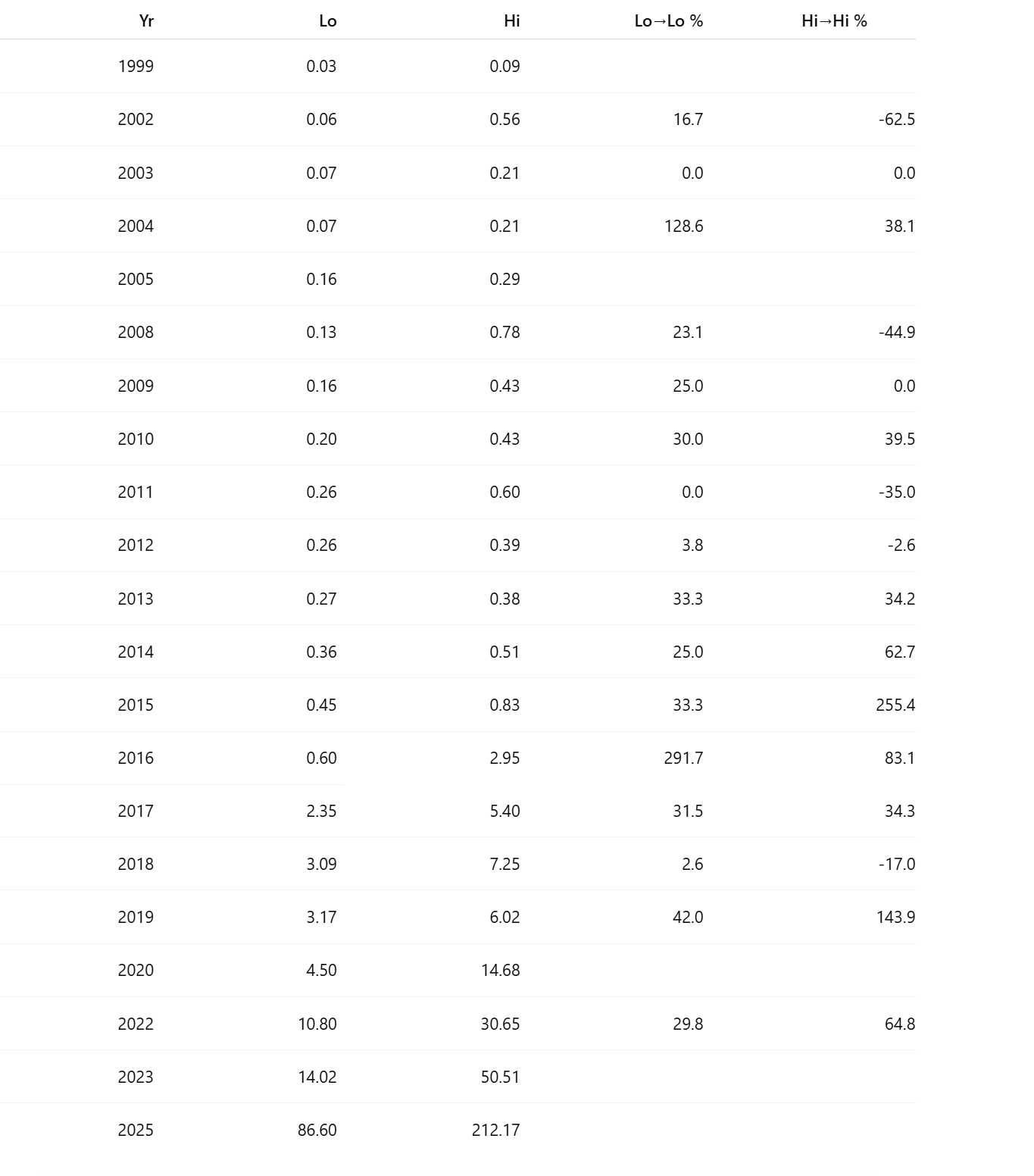
Asindu's narrative is a wonderful story; but it is not the history of how people behaved as owners of NVDA. The SIL aka SEF15 was the oddball in his lab because, unlike the older veterans, he did not immediately convert his incentive shares into cash once they could be sold. The chart [click for full view] is a year-over-year Hi-Lo price history for the stock; it explains why the veterans were not fools, why some of you are smart enough to be able to trade, and why the SIL puts up with me because I told him to keep every share. The years that are omitted are those where stock-splits made the calculations too hard for ChatGPT and me.
Jun
12
Jane Street AI training data center, from Humbert X.
June 12, 2026 | Leave a Comment
Dwarkesh Goes Inside Jane Street's Latest AI Data Center (video)
Twenty years ago, our "cluster" was just 6 Dells stacked on the floor of our office. Today, come tour our new Texas datacenter: 4,032 GPUs, liquid cooled.
Asindu Drileba writes:
Their hiring is surprisingly very meritocratic, if you can solve any of their monthly puzzles, they will unconditionally grant you an interview & likely a job offer.
For the current offer: Jane Street: Puzzles
And an archive of previous puzzles (with solutions).
Oliver Joseph comments:
For those who are computer science oriented their podcast signals and threads is lots of fun I recommend it. In particular they interview Daniel Pontecorvo on their facilities in general. Some of the solutions they have come up are very interesting and reminded me of some solutions we used in the music world. For example they use a raised platform to run air, data and electricity to workstations on casters so they can move workstations often. This is how we would rig up outdoor tours. Racks and amps on casters and modular raised stages were safer and faster to set up.
Of course I always enjoy time in server rooms. While I’ve never had the pleasure of working on one quite like the one you have linked. “Started with six dells on the floor” It’s a great lesson never despise small beginnings.
May
26
A deck of cards, from Jeff Watson
May 26, 2026 | Leave a Comment

A standard deck of cards contains 52! combinations after riffle shuffling at least 7 times to ensure randomness. Expressed as a number, there are 8.06×10^67 total combinations. To put this in perspective, there are 4.37×10^17 seconds since the big bang. It is estimated there are 5×10^18 grains of sand and 10^50 atoms on earth. There are 10^46 molecules in all of the oceans. The estimated number of stars in the observable universe is 10^23. It’s a certainty that two entire 52 card decks have never ever matched, let alone more than once. They never will. Here’s another way of looking at it, if a billion people shuffled a deck of cards every second since the big bang, it would total 2×10^32 shuffles, which is still 10^22 less than the total. All of that said, there are some elegant propositional bets that can be derived from this material.
Nils Poertner responds:
Yes - incredible numbers. LIfe itself is a miracle (I don't buy into this bing bang thing) - but would not be able to bet against the odds you described here.
Asindu Drileba offers:
Leo Susskind explains that many constants in physics need to be fine tuned for the universe to exist in the way we see it. Some cannot be deviated by as low as 5%. All these constants needed to be fine tuned concurrently. Otherwise, stars would not even form.
Big Al writes:
If you assume that order matters, then when dealing cards for a game of Texas Holdem at a 9-seat table (18 hole cards and 5 community cards), there are 52!/29! possible permutations. That's roughly 9 x 10^36, or 9 x (1 billion)^4. Which means that, though possible, it is highly unlikely that any game (at a fair table) has ever been dealt the same way twice.
May
14
Study of Deception, from Sushil Kedia
May 14, 2026 | Leave a Comment

The Chair has emphasized the value of studying and understanding deception endlessly, I believe.
Now, if I wish to focus and devote my energies to be thoroughly studious about it, I urge my requests below are not misunderstood as a lazy desire, but an earnest and keen wish to be methodical about it.
What would the Spec-list citizens recommend as the ideal list of:
a) Movies to watch,
b) Books to read.
One thing that hit me suddenly some weeks ago is that nature devised deception as a tool to economize the struggle for propagation of this world and its entities into the future. Without deception a Tiger would run endlessly, perhaps consuming more calories in capturing its prey, than it would get in eating the prey, as one example.
What are the other utilities the matured, experienced minds on this competent list and other curious minds as me feel that deception provides?
Another layer of study that makes me curious is, when our own mind as defined by Edward De Bono, as a self organizing pattern seeking system is the personal deception machinery that takes us into deviant behaviour from data, stats on the table and rigorous study then how does the autonomous deception inflicted by our mind engage with the deceptions inflicted upon this world by the high and mighty? Are the mighty studying how the hoi pollois is living in self deceiving modes and then playing it?
What more rigorous questions will the list members be happy to throw at someone who is now hungry to study deception, in depth? Please provide your questions too for me to compile into a list of questions to ponder over, gather information and insights on.
William Huggins writes:
it would seem the heart of the matter is one's ability to "hack" the target's heuristics. concealment/distraction plays an important role in this. the obvious benefit of deception being a misallocation (from the allocator's pov) of energy that can be exploited by the deceptive.
Nils Poertner comments:
What traders do in their free time and are already good at is of interest to me. (eg. someone reading crime novels, can find patterns here, another one practises Judo, finds patterns of deception there, and then you can go from there. Work with what you have already)
Big Al offers:
An interesting story with possibly multiple levels of deception:
The Rosenhan experiment or Thud experiment was a disputed study regarding the validity of psychiatric diagnosis. For the experiment, participants submitted themselves for evaluation at various psychiatric institutions and feigned hallucinations in order to be accepted, but acted normally from then onward. Each was diagnosed with a psychiatric disorder and given antipsychotic medication. The study was arranged by psychologist David Rosenhan, a Stanford University professor, and published by the journal Science in 1973 with the title On Being Sane In Insane Places.
Asindu Drileba adds:
When it comes to movies, my favorite movie to do with deception is The Conversation (1974) by Francis Ford Coppola. As for books, on my "yet to read" list I have The Confidence Game by Maria Konnikova. You see, "conman" comes from the phrase "confidence man".
I have studied several scammers like SBF, Madoff, Enron executives. What I have noticed is that deception never looks like "deception" it often looks like opportunity. The "confidence man" entrapped their victims by having "good visuals", dressing well & moving amongst those in high circles.
SBF was branded as a type of prodigy, Madoff was the chairman of Nasdaq, Enron guys where The Smartest Guys In The Room (you should watch this one, just for the fantastic music playlist), Jeffrey Epstein displayed the all patterns. Take away? Beware of bombastic talk, especially one that boosts your confidence in an investment.
Rich Bubb writes:
Not exactly a movie-to-watch, a former co-worker recommended I watch "Lie To Me" series. I'd be interested to see if anyone has trained and AI system to visually detect micro-expressions. The thought is that if somebody/-ies is the 'prey', maybe AI could detect deceptive interactions better than me. I have tried to teach myself to recognize micro-expressions. It's nice to know when I'm being lied to.
Oliver Joseph writes:
I'm a big fan of Joe Navarro's work. "What Every Body is Saying" is classic. There is a certain amount of gamesmanship in deception and its detection which he elegantly describes. Of course there are certain "strong signs" like pupil dilation that are impossible for normal human beings to conceal. Sussing out the meaning and separating the signal from the noise is part of the game, a problem everyone on the spec list is used to dealing with I'm sure. I myself as a former car dealer am quite unfamiliar with deception and its detection and so eagerly await further recommendations.
May
11
ChatGPT moment for robotics?, from Humbert Q.
May 11, 2026 | Leave a Comment
I've Covered Robots for Years. This One Is Different
From sorting chicken nuggets to screwing in lightbulbs, Eka’s robotic claw feels like we're approaching a ChatGPT moment for the physical world.
Dendi Suhubdy offers deep analysis:
I have put some thought into that:
The Perception–Planning Gap: What's Actually Hard About Visual AI in 2026
The thesis I want to defend in this piece is structural: perception in pixels is largely solved at the representation level; perception for action is not, and the gap between the two is the central unsolved problem of visual AI in 2026. Frontier vision-language models can pass medical-board questions and explain radiographs at attending-physician level. Frontier robots, after a decade of foundation-model progress, still cannot reliably load an arbitrary dishwasher. Moravec’s paradox is not a quaint historical observation; it is the daily lived experience of every embodied-AI lab.
Big Al responds:
Thanks for sharing. Much I don't understand, but when I scroll down to the summary, I think I get the general ideas. I hadn't thought about the challenge of having effective testing/evaluation standards.
Asindu Drileba writes:
I thought this was going to be about humanoid robots (like Figure & Optimus). That still have very many problems. Industrial robotics how ever has always been making mind blowing, but quiet progress.
Good case studies are Amazon (robots operating in a warehouse about 10 years ago, its now way better), and Tesla, also 10 years back.
The reason is that the edge cases of these industrial robots are very few and can be comprehensively thought about. I think this robot ChatGPT moment already occurred in industry & manufacturing.
May
4
What Makes a Trading Strategy Work?
In quant trading finding an alpha is not enough.
What is the edge you have that others do not?
A backtest is not the hard part.
The hard part is explaining why the opportunity exists, why others have not competed it away, and why it should continue to exist in the future.
In practice, most real strategy edges come from one or more of these: …
Some good discussion in the comments also. In response to a question about spinoffs:
Tad Haley Spinoffs are one of the best examples of an opportunity that can be visible without being equally tradable.
The edge is often not in spotting the situation. It is in understanding who has to sell, who cannot own it, who can actually fund and hold it, and how long the implementation friction lasts.
That brings in mandate and tolerance, liquidity, balance sheet, and constraints all at once. Information still matters, especially in separating flow-driven weakness from real fundamental weakness, but a lot of the opportunity exists because the natural ownership base is temporarily broken.
Larry Williams responds:
Is it really that complex? You find out what fundamental conditions drive a market. Maybe it's supply, maybe it's good earnings, and take advantage of that impact.
Zubin Al Genubi comments:
Its good to understand market structure in addition to stats. Structure is changing from a few years ago.
Nils Poertner adds:
Excellent, Yes Zubin. Also the trader may change and develop a bit of an ego after yrs of success….that is why trading requires constant shedding of false personality.
Asindu Drileba writes:
I have also come across three recurring reasons why some edges still exist.
Liquidity: So common in the Bitcoin markets, more in smaller cryptos markets. I have heard people with serious AUM complain about how the can't deploy $30m positions. But small specs don't have this problem.
Impatience: Even though some long term strategies like following the drift, indexing, work people are impatient, often demanding salary like consistency from the market like Robert Bacon suggests.
High stress strategies: Some people are patient, though can't handle strategies that are profitable, but have a very high frequency of losses. I have suggested some (buy) options strategies to my friends, but they just can't endure the 70% to 90% losing rates.
Larry Williams writes:
The big edge is to think forward, to see the future before other people do there are fundamental facts to this game, like insider buying. Mister Brush has written so much about. There are advantages, and they're very simple.
Apr
28
How to account on the principle of ever changing cycles?, from Asindu Drileba
April 28, 2026 | Leave a Comment
This principle outlines the idea that markets change their behaviour. For example:
- the 13th business day of the month made money for 5 years ( lost for some days in the year, but overall ended the year profitable)
then the market changes and
- the same 13th business day of the month loses money for 5 years ( won for some days in the year, but overall ended the year at a loss)
If you tested the data set for the last 10 years as a single block, (5 years losing + 5 years winning) the regularity would completely cancel out. The only thing I can think of is testing data sets in chunks of say 1 year, but over 10 years. and avoiding large blocks in general. Any suggestions?
Steve Ellison writes:
I agree with the idea of shortening the lookback period. I remember the Chair suggesting 60 days as a typical lookback period, but obviously you would need a much longer lookback for an event that only occurred once per month.
I would also suggest assessing, if there really is an edge here, why? In this example, which market participants have reasons to sell (buy) on the 11th and 12th days of the month that override price sensitivity, such that others come in to buy (sell) on the 13th day? There is a lot more noise than signal in market price movements, and some of the noise may appear statistically significant if you torture the data long enough, but without an underlying reason, a regularity is unlikely to continue.
Jeffrey Hirsch responds:
The 11th and 12th trading days of the month – what we refer to in the Almanac as the mid-Month spike is driven by automatic payroll deductions bi-monthly or every 2 weeks into 401Ks and other retirement accounts where fund managers are required by law to invest. I discussed this with Steve Eisman on his podcast, The Real Eisman Playbook, recently where he comes in and helps me prove the point. It starts at the 19-minute mark and runs for about 2 minutes.
20:37: mutual funds are only allowed to have a certain amount of cash. So generally, let's say 5%. They're not allowed to have more than 5%. So, if all of a sudden people are putting money in because of their 401k, they got to buy. It's not optional.
Asindu Drileba adds:
I was playing with Google's decision tree Python library called YDF. (it's shockingly easy to use)
I simply used days of the month as features against, up or down days. Mid month dates showed very strong regularities (some up to 60% up days). I never understood why they occurred, until I remembered Mr. Hirsch talking about payrolls hitting brokerage accounts. What's different is that I found these in crypto. But it was harder to trade than I thought.
Larry R Williams writes:
It's been that way for years: the eleventh trading day of the month in stocks is usually a rally day, going way back to the 1980s when I first started trading this.
Apr
23
The Art of War by Sun Tzu, from Q. Humbert (Updated)
April 23, 2026 | 1 Comment

Good book to re-read. Are all those crisis meetings are just choreography? In order to "sell" something unpopular (a war) to the managed masses in the West (or whatever system there is in Iran respectively). Humanitarian aid talks often precede wars as well.
Jeffrey Hirsch offers:
Art of the Deal. Seasonality edition
Nils Poertner responds:
Top notch analysis! (I'm wondering though, we in the West value transactions and deal making a lot - whereas in some countries, which are more religious…they may rather die than surrender).
Steve Ellison writes:
I just borrowed The Art of the Deal from the library because the Chair's brother says that the President's thinking process is all laid out in that book, and one ought not to react to his statements at face value because they are negotiating positions.
Jeffrey Hirsch adds:
Ever since Liberation day and the tariff tumble last year have had the President’s truth social posts as the only lock screen alert coming through my phone.

Kiran Kaur comments:
Free markets used to be a natural hand that would correct markets when they were inflated, avoiding catastrophes. But now we have the hand of government that removes the natural corrections that are supposed to occur and take out zombie companies. We have a few actors taking meetings behind closed doors to set the cycles, using regulation as a key mechanism. its nice for us because we are close to the liquidity that sets the rest of the markets.. Have you read Edward Chancellor's The Price of Time?
Asindu Drileba writes:
One opinion I heard recently is that, this conflict is actually doing exactly what "they" want. The constant talk of colonising Canada & previous "take over" of Venezuela is because these are oil rich countries. The conspiracy is as follows:
Shut down the strait.
Make Middle Eastern oil suffer logistics issues (price oil higher?)
Oil from Americas moved ok (priced cheaper?)
Demand for Americas oil increases. Subsequently, demand for USD also increases.
Finally weaken & decapitate BRICS.
Does this make sense? Or is it imaginary 5D chess?
Kiran Kaur responds:
Absolutely the most sane analysis i can imagine. Especially after reading the blueprint of the genius act and the user's guide to global trade. Increasing demand for us debt, oil, and the dollar, while decreasing dependencies on global players are agendas directly mentioned in both of those papers.
Apr
8
I was thinking of designing a custom Consumer Price Index:
Oil
Copper
Wheat
Sugar
Anything important missing? or something that needs to be removed? My aim was to add something that is actually used everyday by ordinary people around the world.
Larry Williams asks:
Why? There are several very good ones already
https://doi.org/10.26509/frbc-ec-201002, Michael F. Bryan, and Brent H. Meyer
The Sticky Price Consumer Price Index (CPI) is calculated from a subset of goods and services included in the CPI that change price relatively infrequently. Because these goods and services change price relatively infrequently, they are thought to incorporate expectations about future inflation to a greater degree than prices that change on a more frequent basis. One possible explanation for sticky prices could be the costs firms incur when changing price.
Asindu Drileba responds:
Why a custom CPI? I honestly have no reason. It's more of a fishing expedition. The goal is to have a small list (under 10) of commodities and see if it produces some regularities.
It seems there are two kinds of commodities: Those that make people angry when the price goes up (life gets harder) like Oil, Sugar, Wheat. Those that make people happy (or indifferent), when the price goes up. Gold. I was thinking of making a small custom CPI based off 1). Which is why I excluded Gold. I was thinking of adding currencies to 1) like USD/EUR, USD/JPY & USD/CNY. Then maybe see what (this CPI) it may be good for.
Larry Williams contributes:
Add a booze stock.
Ed Kozun writes:
I agree in the past on the booze stock, but it sure seems like trends are changing and a lot of people are walking away from the sauce.
Larry Williams again:
Mary jane stock?
Zubin Al Genubi suggests:
Beer, wine, gas, hamburgers.
Ed Kozun ponders:
You’ve got my thinking about these indexes and what they are useful for and can you strip it down to essentials to think about pain points for “ordinary.”
1. any staple grain
2. residential energy per kWh.
3. cooking fuel(cost of making that grain into a meal)
4. Urban public transport ticket price.
5. Basic medicine. What cost does amoxicillin turn an infection into something that is not financially manageable.
Asindu Drileba continues:
Inflation usually doesn't affect wealthy people. (unless it's at levels of post WWI Germany, Mugabe's Zimbabwe & 1970s Cambodia). Petrol doubling in price may be annoying, but it won't change their behaviour.
As for the "others". Inflation causes 2 things. (these are untested suspicions)
Belt tightening. Spending on priorities first and less on luxuries. Will Live Nation stock be affected? Since less people go for concerts during periods of high inflation?
Will it still be worth it to buy the exact same iPhone as of last year that simply has a different name? Less visits to LVMH brands?
Red queen effects. People spending/borrowing more to stay in the same place. Payment processors collect more (since goods are the same, but transaction volume in $ goes up?)?
More leverage in markets (bigger "Open to High" & "Open to Low" ranges due to vol)? This may be more true in crypto where users are given up to 125x Leverage In some cases.
Mar
17
The T35 is an index that tracks the largest 35 stocks on the Tel-Aviv Stock exchange. I noticed that the T35 skyrockets during episodes of political aggression. On combing through the actual stocks, it turns out that the largest cap stock (about 10% of the index) is ESLT, a defence contractor.
Gold spikes usually before confirmed acts of political aggression. Oil also has some relationship with that political aggression in the middle east. The T35, mostly ESLT driven also has a relationship with war.
Might some combination of these make a good multivariate predictor?
Spike in Gold predicting a spike in ESLT (T35)?
Spike in ESLT predicting spike Oil?
Big Al writes:
It was often thought that the move of the TASE on Sunday was a predictor for the S&P on at least Monday. However, the TASE stopped Sunday trading in January and shifted from a Sunday-Thursday week to a Monday-Friday week.
Mar
3
FED interest rate decisions are often associated with the SPY.
1) Interest rate decrease –> Increase in SPY
2) Interest rate increase –> Decrease in SPY
Polymarket has a market for FED decisions. Could a combination of Long SPY & Polymarket contracts (betting on rates increasing) provide some kind of arbitrage opportunity?
Larry Williams responds:
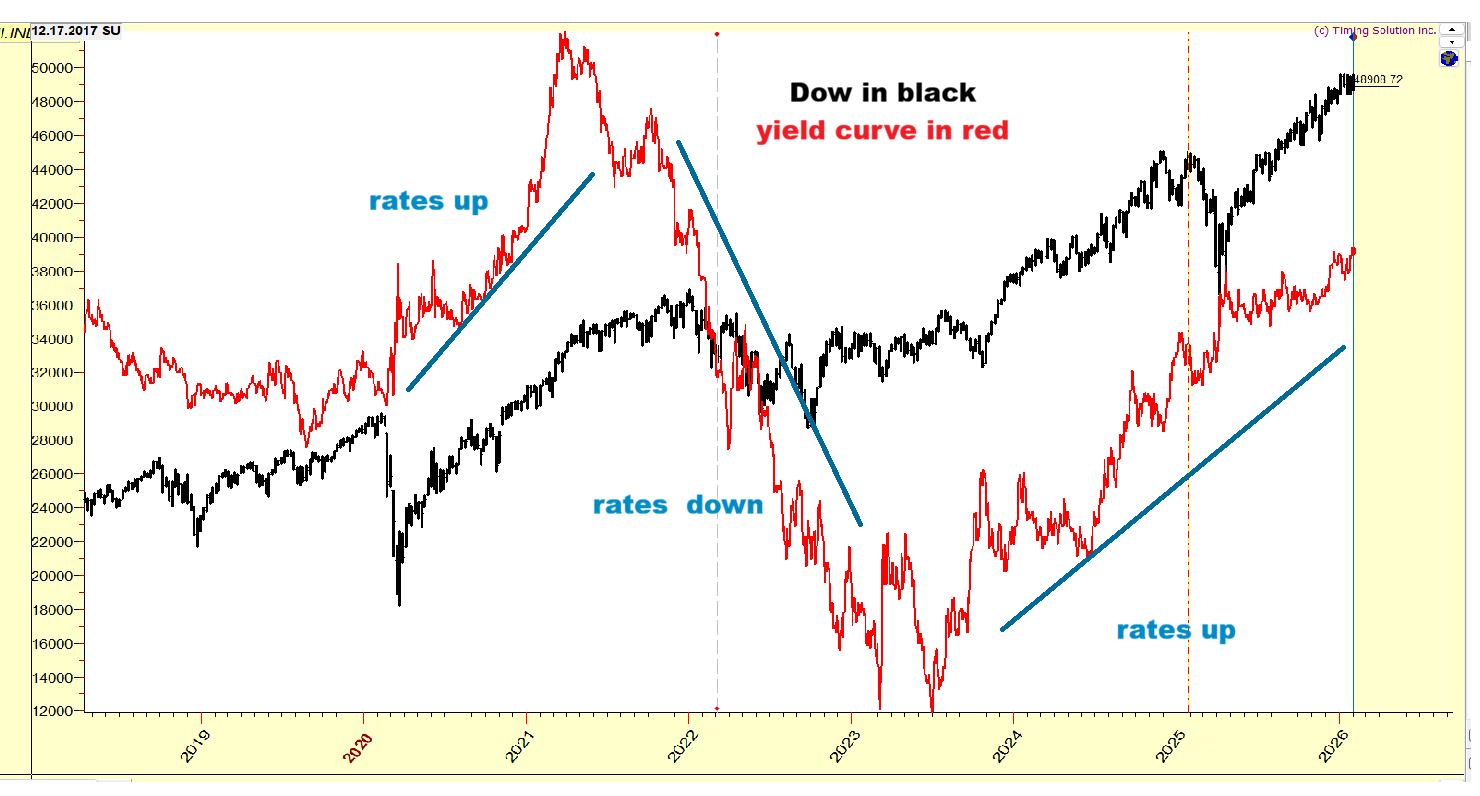
This not correct Interest rate hikes are bullish for stocks—most the time. [See chart below.]
William Huggins writes:
the most important issue with any arbitrage situation is the volume at price is not unlimited, meaning there is a functional "size" to the exploit. my intuition is that such inefficiencies can persist for structural reasons until that size crosses some operator's threshold at which point they trade it until it holds back against the efficient exploit horizon. i don't know what the market depth is like on polymarket but i also suspect the liquidity that such a trade would count on could evaporate such faster than SPY.
Asindu Drileba asks:
[Larry's] pattern indicates:
- Rate increases -> Stock Market up
- Rate decrease -> Stock market down
But for longer periods i.e several subsequent days after.
Since the Polymarket contracts actually expire (resolve) on the day of the announcement. I was thinking this was a strategy that would close on the day of rate announcements. Are stocks also mostly bullish *on the same day* for announcements of a rate increase? (and vice versa)
Feb
18
Vol in percent versus dollars, from Zubin Al Genubi
February 18, 2026 | Leave a Comment
More on the points vs % argument. % vol or Vix is misleading and inaccurate measurement of vol. A better measure is abs vol in points/$ because we live and measure ultimately in dollars.
Accordingly at 7000 abs vol is 350% of what is was a few years ago at 2000. Trading has to adjust accordingly to maintain the same portfolio volatility of returns. Thus leverage, targets, systems, time have to adjust to match.
Adam Grimes disagrees:
because we live and measure ultimately in dollars
This does not strike me as coherent. Returns are the only reasonable way to understand market movements. Just imagine a portfolio of two assets, one at $1 and the other at $100,000 (or other arbitrarily wide handles). The only way to think about those is to normalize for price via %, so it follows that volatility would be equally incoherent measured in points. (Sorry for the Finance 001 example, but I think 'Explain It Like I'm Five Years Old' cuts through a lot of confusion.)
% and vol measured as vol of %'s (i.e., returns) is the only thing that makes actual sense here unless I'm misunderstanding the argument. What am I missing?
Accordingly at 7000 abs vol is 350% of what is was a few years ago at 2000.
Scratching my head here. "So what?" and "of course" are the only things I could manage to say here.
I'm probably missing something, though. What is it? (btw VIX sucks as much as any other clunky measurement of implied vol. I'll agree with you on that one, but I don't think that's your point.)
Zubin Al Genubi responds:
1 ES contract used to move 7 points as an average range 20 years ago. You made or lost $350. 1 contract now moves 50 or 100 points a day, same percentage, but your account is up or down $5000. The volatility in your account in dollars is higher than 20 years ago. If you lost 1% in 2000, its $600, but 1% now is $3500 per contact. You don't see too many 2% days like before. Abs vol is up while Vix or % vol is down. Its apples and oranges.
The trading style, research should change. Straight percentages for expectations, returns, targets don't work like they used to, especially using historical data. Silver now has micro contract because $5000 a dollar too is high volatility in dollars with $20 or more ranges. I guess I'm suggesting using abs vol as a better measure of vol.
Appropriate here, Feynman in 6 Not so easy pieces, cites Wyle on symmetry, "Suppose we build a certain piece of apparatus, and then build another apparatus five times bigger in every part, will it work exactly the same way? The answer is, in this case, no!" My point is the market does not the same way as it did 25 years ago in large part because it is bigger. The fact that the laws of physics are not unchanged under a change of scale was discovered by Galileo. He realized that the strengths of materials were not in exactly the right proportion to their sizes. [Ibid]
Adam Grimes writes:
I'm sorry, but I still find these points trivially obvious. Of course nominal price swings are bigger because price levels are higher, so of course holding a single contract would result in larger dollar swings. Who's holding a single contract? Position size takes care of all of this.
And I don't think the physical analogs add anything beyond confusion. Physical properties scale differently. For instance volume scales as cube and surface area as square. This is why we could not have a science fiction 100 ft tall lobster in reality…because of material constraints. There's no market analog to this. A 1% move is a 1% move. There's no hidden non linearity there.
If your claim is that markets don't move the same they did 25 years ago I would challenge that claim. What's the evidence for this? Statistically there's always the issue of non-stationarity but it seems to me you're claiming there's something more meaningful here. What am I missing?
Asindu Drileba comments:
I think Zubin is simply trying to say that he had found measuring volume in dollar terms (absolute terms) more relevant than measuring it in percentage terms.
Richard Hamming has an interesting talk, You get what you measure
Here us a good summary:
You may think that the title means if you measure accurately you will get an accurate measurement, and if not then not; it refers to a much more subtle thing - the way you choose to measure things controls to a large extent what happens. I repeat the story Eddington told about the fisherman who went fishing with a net. They examined the size of the fish they caught and concluded there was a minimum size to the fish in the sea. The instrument you use clearly affects what you see.
I for example, completely stopped measuring market returns in percentage terms a few years ago. I now exclusively use log returns. Why did I stop using percentages? The problem with percentages is that they are not equal to each other (ignoring the negative sign). (a 50% move) + ( a -50% move ) does not give you 0 in dollar terms. But what you get is 0% in percentage terms. Percentages are not symmetrical. Does this mean they don't measure growth? They actually do. But they simply should not be compared. As the absolute values may mean something different.
- A 0% return percentage may (erroneously)
indicate that you have broken even.
- The same 0% percent return may also show that you are actually loosing money in absolute (dollar) terms
Adam Grimes writes:
Of course log returns are well known, and this is more finance 101. There are several qualities that make them more attractive for some analyses. (just dont mix percents and log returns!)
But that's not the same as measuring market movements in raw dollars (which is the only reasonable companion to volatility measured in absolute dollars (or points).
And as for measuring what you see, methodology (and perhaps even experimenter expectations) greatly affecting outcomes and conclusions, we're on the same page there. This is fascinating territory for discussion and I'd welcome it.
But his point about volatility only extends to someone trading a single contract in 2001 and also trading a single contract today. That is irrelevant.
If there's something at work here and legitimately some way the market "doesn't move the same way" it did decades ago… I'm all ears and very interested. Always looking to learn more about what I don't know or might be missing.
Zubin Al Genubi does some counting:
There were 31 days in 2006 and 67 days in the last year with percent moves >1%. This is due to Big Tech being 32% of ES with higher beta and the speed and intraday persistence of algorithmic trading. Lastly, it 'feels' different. A 120 point drop trades different than a 13 point drop in 2002.
Stated quantitatively, now nearly half of our trading days have abs vol hi-lo >1% while in 2006 only a quarter of days had abs vol >1%. That is a big difference and clearly explains why trading is different (better) now. Today is just 1 of the many such days.
Cagdas Tuna adds:
All futures contracts of index products have adjusted to gross notional value of underlying stocks. At the same time VIX contract specifications and notional value it can represent almost remain unchanged. Although calculation method of VIX is the same, the number of futures contracts hedgers need to cover notional values they trade in underlying assets are totally different.
Adam Grimes writes:
Stated quantitatively, now nearly half of our trading days have abs vol hi-lo >1% while in 2006 only a quarter of days had abs vol >1%.
I'm sorry but I have to be direct. I find this annoying. You have moved the goalposts and are now making a completely different argument. You began advocating for measuring volatility in absolute dollars and now you are using a percentage measure. You are literally using the metric you said was wrong to support your argument that the metric is wrong.
Furthermore, your data are bad. It's simply a volatile measure. Volatility is volatile. Here's a look at the FULL history of the ES futures [first chart] (back-adjusted so this may not be fully accurate, but I think the % adjustment fixes the back-adjustment distortion) counting the number of trading days in each calendar year that had abs(high-low) / close > 1%. It's simply an unstable measure and I don't know what is to be drawn from this.
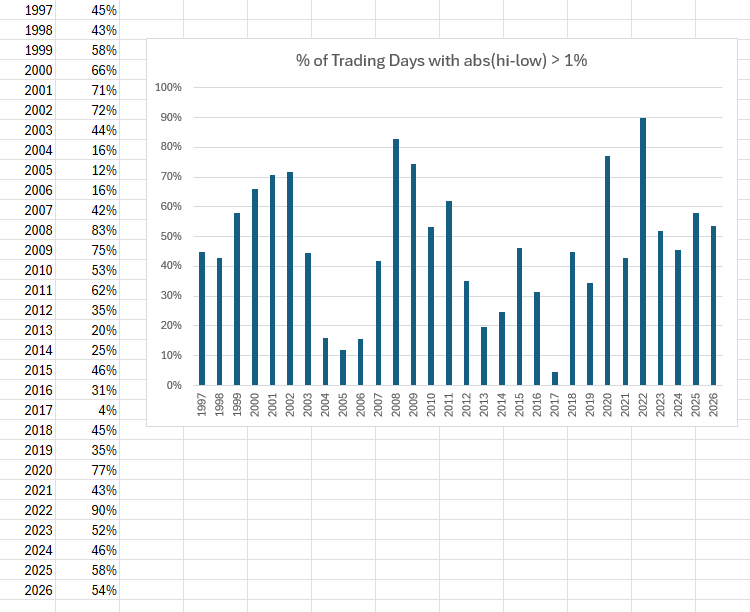
If your argument is that there are more days with "surprise" distortions, this is maybe nominally true, but better measured with better tools. I use a tool that expresses each day in terms of the mean average absolute closing difference [second chart]. Taking an arbitrary bound of 3 for that, the argument that this year is on track to show more surprise shocks than usual is true (but also reflective of a generally lower baseline).
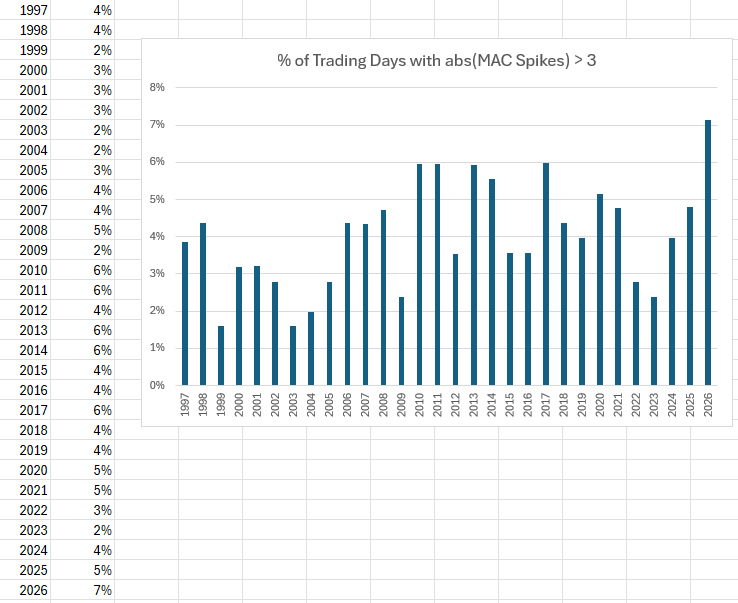
You've flipped to percentage measures and we're left with hand waving "it feels different now." That's a different claim and it's qualitative, perhaps has value, but not in supporting your original claim.
I'll reiterate my position: percentage measures are the only thing that make sense. Point values are arbitrary and can be easily handled via position sizing (within the limits of granularity of instruments vs account size.) I don't think this is revolutionary or controversial. This is truly finance 101.
Feb
4
2026 Bullish Confirmation, from Larry Williams
February 4, 2026 | Leave a Comment
Yale Hirsch and his son Jeff have shown that a positive change, from the last trading day of the year to the 5th trading day of the new year, portends a bullish year (positive first 5-day percent change).*
Consider this … in the last 76 years of trading, the S&P 500 has declined for the year 20 times or 26% of the time. In other words, 74% of the time, there has been a yearly gain.
Jeff’s numbers show that in those last 76 years, 49 years showed a positive first 5-day percent change. Only 8 of those years went on to close down for the year. That’s an 84% bias for the year to close higher when we have a positive first 5-day percent change.
My add-on to Yale’s and Jeff’s work was to look at the years that gained 1.2% or more in the first 5 days of trading. There were 28 such years. Of those years, only 2 were down for the year. That’s a 93% bias for the year to close higher. What an improvement from the average 74%!
In 2026, the first 5-day** change for the Dow Jones 30 was +3%.
In 2026, the first 5-day** change for the S&P 500 was +1.6%.
Those 28 years had an average annual return of 14%. The remaining years had an annual gain of 5.3%. I see this as excellent confirmation of the bullishness of my Forecast 2026 Report.
Cagdas Tuna writes:
There is no need for a statistical analysis to assume any given year will be positive for US indices. It is almost guaranteed to be positive every year. No offense to any list member.
Larry Williams responds:
Wrong 24% of time we close down for the year.
Michael Brush is surprised:
Wow did not know it was that high.
Larry Williams agrees:
I was taken back by it as well.
Asindu Drileba asks:
2026 is bullish? But Senator, you said you expect a recession in 2026 with 100% certainty. Is this a contradiction? Or maybe its possible for the market to be bullish even during a recession?
Larry Williams answers:
Yes, there was a projection made a year ago for a 2026 sell off —in the last 12 months data changed—large improvements in fundamentals and hopefully I got a little better understanding of long term cycles. New Data matters.
Nils Poertner writes:
Asindu- there would be simply too many variables out to make that statement with such a certainty in advance. Just impossible. It remains a probability game. Used to subscribe to some cycle research that claimed to have things figured out yrs in advance. quite pricey subscription. it was HOOK, LINE and SINKER (for me).
Denise Shull comments:
New Data matters.
Indeed it does. Wonder why it’s challenging for many to incorporate?
Nils Poertner responds:
Good question. On this note… (Pure) data analysts believe pattern matching on large datasets will solve our problems. But what if the really vital information isn't being collected? What if it's invisible to our trained systems?
Jan
27
Ralph Vince’s latest, from Larry Williams
January 27, 2026 | Leave a Comment

Ralph Vince's newest book. Not about the markets.
The Theology of Lust follows Ricky “Pork Chop” White — a wounded, self-mythologizing erotic savant — as he stumbles through desire, regret, and violent entanglements, trying to turn raw masculinity into something redemptive. It’s a darkly funny, psychologically unfiltered journey where erotic obsession, betrayal, and a lurking murder plot converge on one man’s desperate attempt to find some sort of salvation out of the mess he calls a life.
Asindu Drileba writes:
Nice! I remember Ralph Vince mentioned that one of his favourite books was The Bible. There is a strange relationship between speculation, theology & computers(artificial intelligence) that no one has comprehensively talk about. Hopefully, I will learn more about theology from this book.
Peter Ringel comments:
When I read the senator writing "the greatest project of his life", I immediately feared, that he fell victim to French, Spanish or Portuguese girls. The title seems to confirm this.
Larry Williams responds:
Good guess but not quite Ralph has a new steal proof coin coming out the book is a year old but was just translated to English from French.
Steve Ellison recalls:
We had a long-ago list member who would frequently draw parallels between never-ending market arguments such as fundamental vs. technical analysis and the European religious wars of the 1600s or theological debates such as predestination vs. free will.
Jan
18
Traders and Art/Music, from N. Humbert
January 18, 2026 | Leave a Comment

Noticed many of my trading friends have an affinity for either ART or MUSIC or both (active or passive) It occurred to me the other day, that both offer ways to somewhat stay sane, it allows the adult to play and have some fun /relax.
Because society as a whole has something matrix like (going to school, learn about consensus reality, fill out the forms, get a BS job, keep up with the JONES, feel empty..) and this is a nice way to see beyond it and feel a bit at ease. That is all.
Here is a lovely Schubert piece. enjoy
Schubert, Trio No. 2, Op. 100, Andante con moto | Ambroise Aubrun, Maëlle Vilbert, Julien Hanck
Asindu Drileba responds:
Narrator: "Fate had already determined that he will die childless and penniless."
Epilogue: "It was in the reign of George III that the aforesaid personages lived and quarreled; good or bad, handsome or ugly, rich or poor, they are all equal now."
Whenever I hear that piece, I think of those words from Barry Lyndon. It was such a good "slice of life" type film.
Jeffrey Hirsch recalls:
Yale was quite a composer. I tried to produce the musical he wrote about the Elephant Man called Merrick & Melissa. But he was a better composer than I was a producer.
Jan
15
Boids, from Asindu Drileba
January 15, 2026 | Leave a Comment
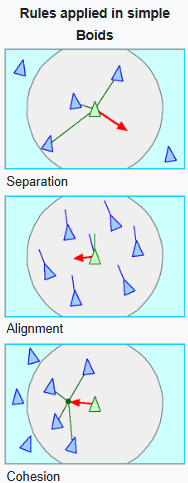
Their is a more interesting school of Artificial Intelligence branded as "Artificial Life" (AL). Their goal is mostly on how to simulate living things in nature, in contrast to Artificial Intelligence where the goal is to solve day to day human problems (it doesn't matter to AI people if the solutions are not consistent with how nature actually does it, but for AL people it does).
An Artificial Life researcher at Nvidia in the 1980s came up with the idea of Boids. It was a very simple algorithm for the simulation of collective intelligence i.e schools of fish, flocks of birds, herds of herbivores. If you have watched The Lord of the Rings, the battle scenes are generated using boids.
One of the parameters of boids is "cohesion". Cohesion is the tendency of "boids" (individual entities in a flock) to move towards their "center of mass". Cohesion is computed by listing the individual coordinates of each "boid" and then finding their average.
In markets, the "current price" can be thought of as the "center of mass" or "cohesion", an "average" of offerings on the order books. Traders may prefer to place orders close to current prices to get filled faster.
When I trade manually and get filled, I am often tempted to close my position in event of small loss (away from the average). Or take profit in event of a small win (still away from the average). I feel like a "boid", and It seems like my need to undergo "cohesion" or chase the "center of mass".
Jan
11
Movie Recommendations for Specs, from Asindu Drileba
January 11, 2026 | Leave a Comment
In case you're looking for some movies for the holiday season that may be of interest to a "spec persona", I have a few I recommend:
1. Uncut Gems: Perfect depiction of the of the life of a speculator with no risk management or "system".
2. The Count of Monte Cristo: Perfect illustration of Howard Mark's second level thinking, deception & poker in the markets.
3. The Game: Good movie on self reflection.
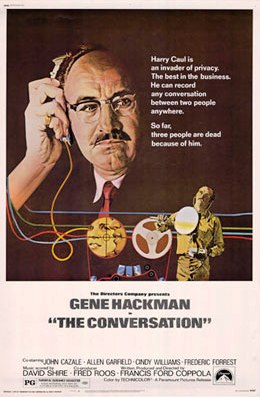
4. The Conversation : Deception in the context of corporate board members. To lure his prey, an apex predator (played by Harrison Ford) baits his victims with a "weak target". The Godfather is Francis Coppola's most popular film, but this one is definitely my favourite of his movie's. Also, if you like Jazz music you will love this!
5. The International: Evil specs (arms dealing & nation state money lending). The movie has a very serious tone. No unnecessary jokes or unrealistic fight scenes. Based off the real BCCI scandal.
Dec
26
Fantastic Veritasium video on power laws, from Asindu Drileba
December 26, 2025 | Leave a Comment
With direct application to speculation (featuring VC's):
You've (Likely) Been Playing The Game of Life Wrong
The world is not Normal.
Dec
19
Request for “off topic” books on speculation, from Asindu Drileba
December 19, 2025 | Leave a Comment
Often when I listen to specs I hear "off-topic" book recommendations. Examples:
"The most important book to do with trading is Secrets of Professional Turf Betting by Robert Bacon" — The Chair. A book about parimutuel horse betting.
"The most important book to do with the stock market is Horse Trading by Ben Green" — A game theorist & friend of The Chair. A book about selling horses
"I can find new trading strategies on almost every new page (Thinking Fast and Slow by Daniel Khaneman)" — The Chair's Brother (Mr. Roy Niederhoffer). A psychology book
"Our entire investment philosophy is based off this book (Snow Crash by Neal Stephenson) — Fred Wilson of Union Square Ventures, a Tier 1 VC firm. Its a sci-fi book.
"One of the most important things you can learn todo with investing is creative writing" — Jeffrey Hirsch. Not a book but still an off-topic research recommendation.
I have never regretted reading an "off-topic" book. Any more of such recommendations?

Nils Poertner responds:
Coaching Plain & Simple, by P. Szabo, D. Meier (book about learning - how to coach oneself in a way)
Asindu - what books to get rid off, to burn, what is an obstacle in your life is also relevant. Early 2008, I visited a French friend on Lehman trading floor in London. V nice guy, senior analyst for their credit models, high IQ 130 plus, bit gullible though. He was surrounded by over 20 books of advanced math on either side of his desk. I had the urge to get a huge sledgehammer and whack down the books…you know.
Larry Williams suggests:
Zurich axioms. A must read.
Peter Ringel agrees with Larry:
I have them on my wall. Besides some of the lists by Vic, Larry, Adam Grimes and some other. Valuable.
And did you find the Daily Speculations booklist?
Asindu Drileba writes:
Yes. I forgot about Zurich Axioms. Thanks. This Daily Speculations list is good, I actually wasn't aware of it.
Nov
28
Lucky charms, from M. Humbert
November 28, 2025 | Leave a Comment

Anyone have any favorite good luck charms/rituals to help with trading results?
Peter Ringel writes:
some of the old floor traders, we had on this list, reported how superstitious some of the traders were. Cloths, bathroom time…
Asindu Drileba comments:
Lucky charms may sound delusional but they are actually more common than we think. They are more like placebos. I take pill X, my headache goes away. (But pill X is made from wheat flour and a bitter "filler" and has exactly zero pharmaceutical contents, yet it works).
Have you ever pushed the button that opens the door of an elevator? Well, those buttons are completely fake! Elevator doors are pre-programmed to open and close at hard coded intervals. Pushing the button does nothing. They simply exist to give people a sense of control.
Nils Poertner writes:
To have a strong belief one can learn (from mkts or others) is a good start.
ie allowing for mistakes to happen, not fretting them. (many cultures are guilt-ridden, like the German culture on so many fronts. All it takes is sometimes to muster up enough courage and learn from mistakes and don't judge).
Zubin Al Genubi offers:
I'm reading Kidding Ourselves, Hidden Power of Self Deception, by Hallinan, in which he describes real physical and psychological effects of psychosomatic causes such as death, hallucinations. You see what you want to see. You are and become what you believe yourself to be. It affects health, performance, money. He also describes how a feeling of lack of control can be debilitating and even deadly. Some feel a lack of control in that they don't control the market, but one can easily (physically at least) click the keys to buy and sell any time.
From scientific studies: Our results suggest that the activation of a superstition can indeed yield performance-improving effects.
Nov
21
VIX Intraday Range, from Cagdas Tuna
November 21, 2025 | 1 Comment
Yesterday's range in VIX was one of the widest & wildest one I have seen in a very long time that happened without any major news. Wednesday close to Thursday low 18% decline followed by 46% rally to the day's high. Is there anyone who can check the occurrences in the past and how SPX traded in the following days of such a massive range explosion?
Asindu Drileba responds:
The Chairman's book, Practical Speculation, has a detailed analysis of the multivariate relationship between the VIX and the SPY. Unfortunately I forgot the page, and I am currently not close to my copy. [see pages 107-110] But it has something to do with how the fluctuations around the average of the VIX affects the SPY.
Paolo Pezzutti does some counting:
#VIX +11.71% at 26.43
Highest close since 24 April
Since 2020 VIX>26 has occurred 290 times.
After 4 days the Emini S&P Futures:
+27.01 pts Mean, 63.4% Wins, 1.63 Profit Factor
Larry Williams cuts to the chase:
Vix goes up when stocks go down they are inverse of each other—no magic there are all.
Nov
10
Best indicators for inflation, from Asindu Drileba
November 10, 2025 | Leave a Comment
The more goods cost, the more money visa makes since the fees they charge Issuing banks & acquiring banks are based on a percentage basis. So, higher prices (inflation) –> better predicted revenues for Visa? Inspired by a nice documentary on the history of VISA.
I wonder what the best indicator for inflation would be for testing this? CPI? Oil?

Cagdas Tuna writes:
I was thinking as to find a similar indicator for economic slow turn, spending cuts. It came to my mind to follow sales slips. I live in Malta which is a very tech friendly country for spending habits such as Apple/Google Pay availabilities, many digital banks access etc. I often asked if I need a receipt that I usually don’t. It depends for every country but if there is a rule for stores/restaurants to keep at least a copy for each transaction then it might be the indicator to follow. It might be used for inflation as well but of course needs detailed information.
Pamela Van Giessen comments:
To the best of my knowledge, merchants are not required to keep receipts. We track each sale but it will be the credit card processor or platform such as Square that holds the credit card or Apple or Google pay receipts. I can’t imagine that merchants would be willing to share their sales data. I know I wouldn’t.
Visa doesn’t care how much goods cost. They get their nearly 3% processing fee (+ .10 or .15 per transaction) whether there are 20 transactions for $100/ea or 40 transactions for $50/ea. In fact, they make more $ on a higher volume of transactions.
I don’t think tracking Visa or MC, etc could be a meaningful prediction of inflation as all the credit card companies continuously fight for market share. Note that they all send out multiple credit card offers to everyone all the time. Then, you have a store like Costco that only accepts their credit card (Citibank).
Additionally, there are people who use primarily cash. Those $ would be left out. You may say that cash use is low, and maybe it is. What I can tell you is that today at a market 80% of my sales were cash and that was likely the case for all the other merchants at this market. Older people especially use cash a lot. Just like drug dealers.
I have a theory that the cash economy is much bigger than everyone thinks. Insight into that might be more interesting.
Carder Dimitroff responds:
After considering Panela's cash sales point, I remembered that several companies required customers to switch from credit card payments to bank transfers. Additionally, several small establishments offer incentives for customers to pay in cash. They may be attempting to simplify their accounting and tax reporting. I do know that the federal government has immediate access to individual credit card transactions.
Pamela Van Giessen adds:
I thought it was the Fed that used to report on aggregated credit card data.
The other challenge with using credit card financials is that the credit card processors raise their % cut all the time. This is not due to actual inflation; it is due to them having a government protected moat that allows them to take more and more whenever they want because merchants are stuck with the whole system and consumers don’t realize that they will pay for the service — in increased prices. Every time Square, PayPal, etc., send me notices that they will be increasing fees, I increase my prices. I guess that is a kind of proxy for inflation but it’s a lousy sort of financial market induced inflation not based on anything more than their desire for more profits. I am all about free markets but the credit card processing biz is not even close to a free market.
The government using credit card processing to surveil us may be one reason I see more and more people using cash.
Larry Williams suggests:
Stock market is good predictor of inflation.
Nov
9
Prestigious consulting firm, from Nils Poertner
November 9, 2025 | Leave a Comment

Came to our financial firm 2007 and gave a 100 page presentation full of bullet points and cartesian logic (why housing boom will last). Either 3,5, or 9 bullet points per page.
At the end of the presentation I was tempted to go over to the presenter and ask him "why do you love your wife? (I didn't). The answer might have been bullet points.
Pamela Van Giessen writes:
Michael Korda tells in his memoir, Another Life, of the time that Simon & Schuster hired probably the same prestigious consulting firm to study how to improve revenues/profitability. Prestigious consulting firm (after taking the prestigious consulting firm fee) told the publishing company that they should publish more bestsellers.
Laurel Kenner comments:
I bet the prestigious firm concluded with ‘Key Takeaways’ as a final insult to the intelligence of the client.
Asindu Drileba writes:
I heard that people pay consultancy firms not for their knowledge, but for the fact that executives use them as a scape goat. If an executive wants to pursue policy X. They simply hire a consultancy to recommend policy X. If policy X ends up as a disaster (legally, morally or financially). They can simply say "Policy X was an idea from XYZ consultancy", we had nothing to do with it.
Peter Ringel adds:
a variation of this are fighting owners/ partners about policy. If decision pipelines are blocked, external council is used. Like a neutral arbitrator. I think, these are the main situations externals are used. Usually a good reason to short the entity, especially outside of markets. If they don't have the capability to decide and act on strategy in-house, it‘s a red flag.
Henry Gifford responds:
Even better is hiring a licensed engineer to instruct everyone to do something stupid that they know won’t work, so everyone who did as the engineer decided is blameless.
Jeff Watson offers:
A consultant is a person who knows 1000 ways to make love to a woman…..but he doesn’t know any women.
Oct
21
Trading the transition to AV1, from Asindu Drileba
October 21, 2025 | Leave a Comment
AV1 is a new video compression format that may reduce the size of a video file by up to 50%. The big advantage is that videos will be up to half the size, with the exact same image and audio quality.
Two big consequences may ensue (when AV1 is fully adopted):
- Internet bills for streaming Netflix will reduce.
A 2 GB movie will only cost 1 GB from the perspective of a customer paying their Internet Service Provider. So more frequent subscriptions?
- Netflix will cut its bandwidth costs by 50%. So the profit margin (respective to bandwidth costs) will go up by 50% if users fully adopt AV1?
Currently, AV1 is only available on select hardware chips (listed table on Wikipedia) Maybe as users get new devices, use of AV1 will grow. This will likely happen gradually over several years (maybe half a decade). But an obvious winner would be Netflix & YouTube (Google Stock). Maybe bandwidth is so cheap it won't make a dent in the business revenues? But all major companies seem very enthusiastic about implementing AV1. Maybe bandwidth has it's (less talked about) variant of Moore's law. Where after a few years it gets easier to move stuff around the internet.
Cagdas Tuna wonders:
How many nuclear plants we need to feed that endless “technology”?
Nils Poertner asks:
How would you express this into a trade idea, Asindu? I find it easy to put ideas into a trade - it encourages deeper thinking and gives a feedback when wrong. eg, I was bullish housing London property 2007, but short-term it didn't really work out at all! longerterm yes. it was fuzzy thinking of my behalf.
Asindu Drileba answers:
Going long $NFLX since the business is largely about streaming video. The same pattern occurred in Tesla when the cost of efficient batteries dropped by like 90%. So margins automatically go up. (in theory) Tesla could have still gone under due to debt or something else. So, of course it may may fail (most likely)
Another big draw back is that such "qualitative" insights cannot be tested in the past. Maybe a good analogy would be to go long Starbucks $SBUX if you think the price of coffee wil drop the next 5 years by 50%.
So the ideas may be generalized to:
- Find key Ingredient company X uses in thier products
- Find out if the drop in key ingredient's price over 5 years improves profit margin over X years -> positively impacts stock prices.
This general idea, may then be tested across several industries for example:
- MacDonalds (drop in price of beef)
- TSMC, ASML, INTEL, NVDA (drop price of silver) as silver is very essential in chip manufacturing.
Hopefully testing this across multiple industries on different historical accounts may yield some consistent patterns.
Nils Poertner responds:
Good to write it down in a trading journal and look in a few months what happened. Started writing hand-written letters to friends now. In our digital age, everyone incl me, is going for speed, but deeper thinking - also quality in thinking /research is underrated. Intuitively speaking - we are prob getting some unexpected moves coming, as well.
Oct
19
Le Chiffre attacks, from Asindu Drileba
October 19, 2025 | Leave a Comment

In Casino Royal (2006) there is a speculator called Le Chiffre. He would manage money for war lords & other "underground" clients. He would take positions in markets, and then "manipulate them". For example in this clip, he takes a short position in an airlines company, then later bombs a plane belonging to it.
This year, I am starting to think that Le Chiffre is real. Someone opened a crypto account on Hyperliquid (decentralized exchange) and made an $88m profit from short positions that very day.
Cagdas Tuna responds:
Good catch! I have been reading these whales news since March-April 2025 mostly tied to Trump’s policy shifts. It is not difficult to guess who those Le Chiffres might be related to!
Peter Ringel writes:
I wanted to place 1 Nov in my calendar - as a new Mkt Risk date based on Trumps post. Only to realize, I placed this date regarding tariffs before. This makes this old news to some degree. And all of this is potentially an overreaction / a play.
Ed. - lagniappe: Forget Sean Connery, Watch James Bond Make His Real Debut on TV
Before Connery registered his license to kill in the 1962 hit Dr. No, millions of viewers were introduced to Barry Nelson’s “Bond, Jimmy Bond” in a 1954 episode of the CBS anthology series Climax! The show’s producers secured the rights to adapt Ian Fleming’s just-published debut Bond novel, Casino Royale, during their first season.
Since the Climax! version of Casino Royale is only 50 minutes, the plot has obviously been shortened considerably. And yet, if you’ve read the book or, more likely, seen the 2006 movie version that launched Craig’s Bond career, you’ll recognize the basic narrative, even though none of the familiar 007 flourishes are in place. In fact, Nelson doesn’t enjoy “00” status at all — he’s merely identified as a “Combined Intelligence” agent who is tasked with competing head-to-head against the mysterious Le Chiffre (Peter Lorre) in a rousing game of baccarat.
Jeff Watson does some research:
James Bond, the complete list…there are more than you think:
Please list every James Bond on film, TV, and radio. Grok: Alright, here goes-starting with the big-screen Bonds: Sean Connery, George Lazenby, Roger Moore, Timothy Dalton, Pierce Brosnan, Daniel Craig. Then David Niven in the 1967 spoof Casino Royale. On TV, there's Barry Nelson from a 1954 Climax! episode of Casino Royale. Radio Bonds? Bob Holness in a 1956 BBC Casino Royale adaptation, Tom Hiddleston in a 2014 Heart of the Matter series, and Toby Stephens in various BBC radio dramas.
Oct
12
Counting and measuring, from A. Humbert
October 12, 2025 | Leave a Comment
We use quantitative tools - "counting" - to measure and analyze markets, and I enjoy coming across scientific measurements that are new to me and also amazing in scope, such as the sverdrup. The sverdrup is a unit describing the volume of water transport in ocean currents. One sverdrup is a volume flux of one million cubic meters per second (1 Sv = 10^6 m^3 per second). Named after Harald Sverdrup.

From the web:
The strongest ocean current measured in sverdrups is the Antarctic Circumpolar Current (ACC), the largest and most powerful current system on Earth. The ACC is a wind-driven current that flows clockwise around Antarctica, uninterrupted by landmasses.
Measurements of the ACC's volume transport vary, but all figures show it is in a class of its own:
Estimates of the ACC's mean transport range from 100 to over 170 sverdrups (Sv). One study found an average transport of 173.3 Sv through the Drake Passage, the current's narrowest choke point. To put this in perspective, this is over 100 times the combined flow of all the world's rivers.
The graphic shows how relatively narrow the Drake Passage is.
We certainly measure volume in markets. Are there specific flows and currents? Choke points?
Asindu Drileba writes:
In a book recommended by The Chair, This is the Road to Stock Market Success, the author mentions that (paraphrased), "When the trading volume of a stock changes by a large amount, yet the price doesn't move by much, it is time to get out of the market."
Oct
7
Miscellany
October 7, 2025 | Leave a Comment
Asindu Drileba has been watching the Daily Spec calendar:
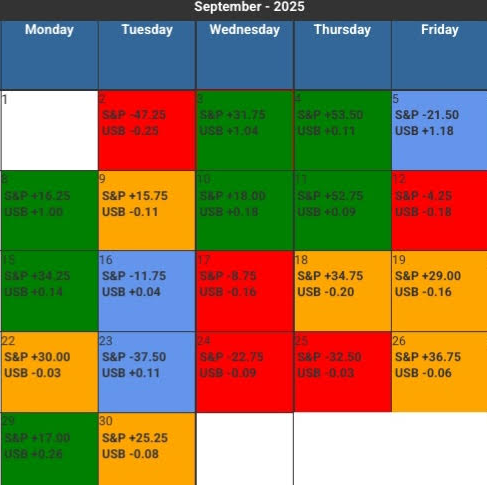
After being hammered in Aug, Orange did well in Sept. It transitioned to a positive day in the S&P 5/6 times.
Nils Poertner is getting wisdom from the classics:
The most certain sign of wisdom is cheerfulness.
- Michel de Montaigne
some type of cheerfulness def relevant for us in markets /trading - in particular when social moods go south / ppl fall for chatboxes (overuse it !) and confuse with reality etc.
Big Al is going for history:
This is the audio version:
The History of the United States Navy
but I am also watching the video version for free on Amazon Prime. The author:
Craig Lee Symonds (born 31 December 1946, in Long Beach, California) was the Distinguished Visiting Ernest J. King Professor of Maritime History for the academic years 2017–2020 at the U.S. Naval War College in Newport, Rhode Island. He is also Professor Emeritus at the U. S. Naval Academy, where he served as chairman of the history department. He is a distinguished historian of the American Civil War, World War II, and maritime history. His book Lincoln and His Admirals won the Lincoln Prize. His book Neptune: The Allied Invasion of Europe and the D-Day Landings was the 2015 recipient of the Samuel Eliot Morison Award for Naval Literature, and his book Nimitz at War: Command Leadership from Pearl Harbor to Tokyo Bay won the Gilder-Lehrman Military History prize.
Sep
11
Power Laws in Economics and Finance, from Big Al
September 11, 2025 | Leave a Comment
Gappy (Giuseppe Paleologo) posted this on X, and it prompted me to wonder if a power law would apply to the skill differences and win rates of tennis players viz their rankings. Need to find some easily accessible data for that. And of course, how PLs apply to the distribution of returns with the S&P 500 in a given time period. But could it be predictive?
Power Laws in Economics and Finance
Xavier Gabaix, Stern School, NYU
A power law (PL) is the form taken by a large number of surprising empirical regularities in economics and finance. This review surveys well-documented empirical PLs regarding income and wealth, the size of cities and firms, stock market returns, trading volume, international trade, and executive pay. It reviews detail-independent theoretical motivations that make sharp predictions concerning the existence and coefficients of PLs, without requiring delicate tuning of model parameters. These theoretical mechanisms include random growth, optimization, and the economics of superstars, coupled with extreme value theory. Some empirical regularities currently lack an appropriate explanation. This article highlights these open areas for future research.
Asindu Drileba writes:
One of the funniest commodities traded in Uganda (my country) is Vanilla. The price fell from, $156 per kilo, to $1.14 per kilo. A -99% drop during the 2020 covid lock down.

Vanilla cultivation is special in that it can't be farmed mechanically.
- It only flowers once a year
- The flower is only open for 24 hours in one year
- It can only be hand pollinated
- If you miss those 24 hours in one year, your done, wait for the next season.
So a lot of the cultivation is by small "artisanal" farmers.
Madagascar produces close to 80% of the world's vanilla. All other countries produce the rest. So its a power law distribution. The smallest hiccup in Madagascar can cause the vanilla price to skyrocket or drop.
I think power laws outside prices (like supply chains of vanilla) can be used to predict what asset, commodity or instrument will be volatile (large moves both up & down). I think these underlying setups in assets are what echo as power law distributions into prices.
Sep
8
Dutch scientist Christiaan Huygens, from Nils Poertner
September 8, 2025 | Leave a Comment
Dutch scientist Christiaan Huygens found in the 17th century that larger pendulum clocks will sync smaller ones.
Video by Veritasium: The Surprising Secret of Synchronization
Pendulums in the human world = our various belief systems (which are sometimes in competition to each other and go deep). Two examples perhaps: in finance: a trader has religious reasons why he /she does not think he deserves the STELLAR gains. Ways are found to turn accumulated gains into a loss! in health: why do some ppl stay sick and others recover miraculously against all odds?
Zubin Al Genubi writes:
The Kuramoto mathematical model describes synchrony in networks. The line between order and randomness occurs at the phase transition when the network nodes synchronize.
Building on Kuramoto's model, the Watts and Strogatz model makes testable predictions about interventions most likely to trigger cascades.
In small world network terms there are "vulnerable clusters" in the market. In market terms the vulnerable clusters are weak hands, funds faced with margin calls, or fund hitting a stop losses. Obvious 2d points or tipping points are stop points at prior lows. If a vulnerable cluster is close to the second tipping point, it can ignite a cascade.
Nils Poertner responds:
Mathematicians often find something which ordinary people know intuitively. 2 more examples:
1. Five teenagers bully a victim. Knock-out the strongest in the group and the rest will fall too (big bully was the dominant pendulum, trumping the small ones).
2. When the most valuable firm(s) in an index suddenly struggle (NVDA?), it often means bad things for wider index.
Asindu Drileba adds:
I found the same pattern in the "Complex Systems" community. An example in Secrets of Professional Turf Betting: The idea of "copper the public opinion" & "principle of ever changing cycles" are an intuitive description of the minority game & El farol Bar problem in complex systems. Statistical arbitrage is almost exactly what Robert Bacon describes as a "dutch book."
In Neil Johnson's Simply Complexity, he derives an insight that currency traders have (knowing what currency is "in play") using graph theory.
I think Simply Complexity is a very good book for speculators, since it uses accessible analogies and no complicated math. The book has a lot of analogies regarding the market. The most relevant section for Specs would be, Chapter 4: Mob Mentality (I however enjoyed the entire book).
A Few excerpts:
The bar-goers who tend to shift opinions about whether to go with history or against it, tend to lose more and hence eventually change their p value.
This reminded me of people that both go short & long in the market (I am long only). P is the probability of an event happening.
Figure 4.3 from the book and its caption:
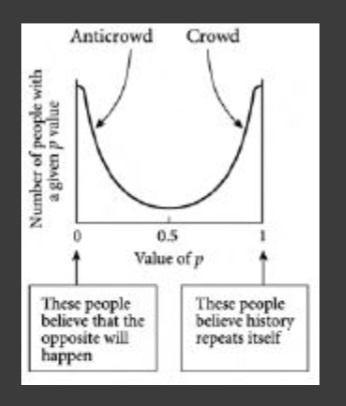
We are naturally divided. The final arrangement of a collection of people, in the case of a bar where the comfort limit is around half the number of potential attendees. This shows the emergent phenomenon of a crowd who think that history repeats itself, and an anticrowd who think that the opposite will happen. Hence the population polarizes itself into two opposing groups. This polarization of the population represents a universal emergent phenomenon. It will arise to a greater or lesser extent in any Complex System involving collections of decision-making objects such as people, which are competing for some form of limited resource.
The figure is similar to the Arc Sin law of PnL. Something that appears in Ralph Vince's book The Mathematics of Money Management and Nassim Taleb's Dynamic Hedging. Unfortunately, I don't have a good intuition on the Arc Sin law of PnL.
Sep
3
Data centers and power demand, from Big Al
September 3, 2025 | Leave a Comment
I post these wondering what Carder D thinks:
Big Tech’s A.I. Data Centers Are Driving Up Electricity Bills for Everyone
Electricity rates for individuals and small businesses could rise
sharply as Amazon, Google, Microsoft and other technology companies
build data centers and expand into the energy business.
14 August, 2025
AI Boom Reshapes Power Landscape as Data Centers Drive Historic Demand Growth
Monday, March 3, 2025
The power industry was once considered slow-moving and perhaps even boring. That is no longer the case as technology has expanded and power demand projections skyrocket. New reports released by analysts at Enverus and Deloitte are examined to provide insight on what’s likely to evolve in the power industry over the coming year and beyond.

Carder Dimitroff responds:
I believe these articles present several issues that could benefit investors:
1) Transformers (not pole transformers). The queue for new transformers is long, and about half are manufactured offshore. Data centers need transformers as do new power sources.
2) Gas turbines. Same situation as transformers. For efficient turbines, the queue is about 5 years.
3) Solar panels. Those who previously invested in solar will see their ROIs grow faster than they expected.
4) Retail consumers. They will see their gas and electric utility bills grow as they pay for higher costs of energy and subsidize infrastructure costs to support new loads.
5) New manufacturing. Several geographical options will present better opportunities than others, as the cost of power is regional and seasonal.
6) Forget new nuclear as a near-term solution.
Asindu Drileba asks:
What do you think about nuclear fusion? Is it really close? The joke is that nuclear fusion has always been ready in 5 years for many decades. But I recently heard Chris Sacca (one of the best VCs ever, made over 250x for his entire fund), mention it is genuinely close and that his new fund, Lower Carbon existing partly to capture the incoming advancements in nuclear fusion.
Carder Dimitroff replies:
Today, nuclear fusion is a science project. Keep in mind that fusion requires operating temperatures of over 100 million degrees (at this level, the distinction between Fahrenheit and Celsius is irrelevant). Producing bulk power from this technology is more than ten years away. At these temperatures, it's unlikely they will be operating near population centers.
Aug
31
George Pólya, from N. Humbert
August 31, 2025 | Leave a Comment
George Pólya came up with the term Inventor Paradox.
Basically, if one thinks about a problem more deeply, something else may open up. And one can achieve extraordinary results! Plenty of examples in finance, engineering, medicine.
Steve Ellison writes:
From the Wikipedia link about the inventor's paradox:
When solving a problem, the natural inclination typically is to remove as much excessive variability and produce limitations on the subject at hand as possible. Doing this can create unforeseen and intrinsically awkward parameters.
Very interesting idea with applications in many fields. As one example, I recently told my daughter, who is a partner at Boston Consulting, that I was reading a book about strategy by a professor at Harvard Business School. She told me, "Boston Consulting literally wrote the book on strategy": Your Strategy Needs a Strategy.
I ordered that book and so far have read the first chapter. One of the key questions is how predictable the business environment is. Another is, how much can you influence the environment? "Classical strategy" as taught in business schools generally assumes that the environment can be forecast and that the company has very limited influence over it. A case study was the Mars candy bar company.
But if you cannot forecast the environment, a very different approach is called for, with heavy emphasis on learning and iterating. And if you can in fact shape the business environment, you might want to find some partners and create an ecosystem.
As a footnote, the book I was originally reading, which I also found informative, was by Richard Rumelt: Good Strategy, Bad Strategy.
Asindu Drileba offers:
Optimize the Overall System Not the Individual Components, interview given by Edwards Deming. Excerpts:
The results of a system must be managed by paying attention to the entire system. When we optimize sub-components of the system we don’t necessarily optimize the overall system.
Optimizing the results for one process is not the same as operating that process in the way that leads to the most benefit for the overall system.
Applied to markets:
- It's easier to do well on the S&P 500 index (the general market), than do well in a single stock (picking).
- Attributed Mark Spitznagel, we should judge the buying of far OTM puts based on how they help the entire portfolio. Not the individual PnLs of buying the far OTM puts.
- Attributed to Roy Niederhoffer, many traders turn off trading strategies once they start loosing money, but different trading strategies make money at different times.
Aug
17
Best video on Punnett square, from Asindu Drileba
August 17, 2025 | Leave a Comment
Concerning the transitions of colour, on the daily spec website. The chair recommended The Punnett square as a research topic. This was the best video I could find. It's amazing how he broke down the essentials in just 6 minutes:
Genotype, Phenotype and Punnet Squares Made EASY!
Big Al offers:
Great vid on Markov, and Markov chains leading to LLMs:
The Strange Math That Predicts (Almost) Anything - Markov Chains
Aug
7
Learning From Data, from Asindu Drileba
August 7, 2025 | Leave a Comment

The best data science course I have ever watched. In fact, probably the best data science course ever made is Prof. Yaser Abu-Mostafa's "Learning from Data" at Caltech. I am not exaggerating, and if you think I am, just read the comments section from the first video of the course The Learning Problem — its almost exclusively high praise.
This course is really old, as its from 2012. I watched it probably in 2017 or 2018. But its still very relevant today. Why its relevant today? Most courses focused on describing techniques that were popular then, but later became irrelevant. For example, GANs were replaced by Diffusion Models and core ML Architectures have shifted to Transformers.
Prof. Yaser's course is different because he covers Theory, Techniques and Concepts (most books/courses only describe ML algorithms/Techniques or how to use features in python libraries).
- Theory, refers to mathematical descriptions of ideas like "Is learning feasible" for your problem or dataset?, "Training vs Testing", "The theory of generalization" and the "Bias-Variance trade off".
- Techniques, refers to actual ML algorithms like Neural Networks, SVMs.
- Concepts, describes auxiliary things that are not really Machines Learning but useful to understand well. Like how to interpret/deal with Error & Noise, Sampling of data.
I also recently came across a comment about a book he wrote to accompany the course which made me remember him: Learning From Data.
Aug
1
How do you fight the Vig?, from Asindu Drileba
August 1, 2025 | 1 Comment
I interpret the "Vig" as the collective term for:
1) bid-ask spread (difference in prices between buying & selling) due to market makers
2) transaction fees (for limit & market orders) charged by the exchange
3) slippage (an instrument is more expensive the deeper in the order book you go) due to how liquid an asset is.
Possible solutions for each?
1) Can be fought with the exclusive use of limit orders instead of market orders.
"Be patient and you will have the edge", The Chair in, Practical Speculation — The fine art of bargaining for an edge
2) I noticed (at least in crypto markets) that the more volume you trade, the less fees you pay (on a percentage basis)
3) Restrict yourself to deep and very liquid markets.
Also, one technique is to trade as less often as you can (buy & hold). That way you will automatically pay less of all the three sources of Vig. I think this is so important as I often found many "edges", then accounted for the vig and they often became loosing strategies.
Big Al writes:
I would also add "opportunity cost" as part of the "Meta Vig" (MV), i.e., the total costs associated with trying to trade the markets. The MV would also include the negative effects of cortisol on the human body.
Henry Gifford suggests:
I think two good steps are to ask others what the big is, and to try to calculate it yourself. Both exercises will no doubt be educational. A few times over the years I have asked horse bettors what the big is, but none seemed to know. As for calculating yourself, one hopefully will learn how much it varies by, and maybe also gain insight into hidden vig.
Steve Ellison responds:
There is no free lunch with limit orders because of adverse selection. Sooner or later, you will place a limit order on a security that simply moves up and never looks back. It would have been your best trade ever, had you actually been filled. In the opposite scenario, for example when I bought Coca-Cola in 1998, and it was already down 25 percent by the T + 3 settlement date, you will of course be filled.
Studies of retail investing accounts have shown a negative correlation between number of transactions and investment returns. In one study, accounts that had been inactive for 18 months because their owners had died, and their estates had not been settled, outperformed the vast majority of their retail account peers.
Peter Ringel writes:
Generally, the lower you go ( smaller time frame - smaller scope of the trade ) the larger the relative Vig costs. a subclass of opportunity costs is spent time of (daily) preparation. my required prep is nearly the same over many time-frames - but the scope of a trade is way lower for lower time-frames. in cash equities, the resale of your order-flow by your broker to some HF shop can be counted as Vig too. is this a common practice in option markets too? Yes, the Vig greases the fin-industry, but it is mostly unavoidable paying / avoiding the Vig does not lead to success or failure in mkts IMHO.
Vic simplifies:
just trade once a quarterfrom long side
Zubin Al Genubi comments:
The biggest vig is capital gain taxes. The richest people in the world hold their single company stock 10000x and realize no gain. Its very hard to beat a long term hold.
Jul
22
Smörgåsbord
July 22, 2025 | Leave a Comment
Big Al offers:
Very nice Veritasium vid on randomness and information:
Asindu Drileba likes a new interview:
I learned about Gappy Paleologo from this list. He has a new interview on a Bloomberg podcast. In it, he talks about:
- Why he suspects Astrophysicists make good quants
- Why AI can't fully take over trader's jobs (in principle)
- What makes a "good quant"
Jeff Watson is following the floor traders last stand:
Old-School Floor Traders Finally Get Their Day in Court Against CME
Trial opens in the Chicago plaintiffs’ long-running lawsuit claiming harm from the launch of electronic markets
The plaintiffs, who estimate that they are owed about $2 billion in damages plus interest, say the company broke its promises to them when it opened a data center for electronic trading that effectively doomed the old trading floors. CME has called the lawsuit baseless.
A spokeswoman for CME declined to comment. The company repeatedly tried to get the suit thrown out, but failed each time.
The lawsuit, filed in 2014, has dragged on so long that one of the original plaintiffs has died. Hundreds of former floor traders could be affected by the outcome. The trial, being held at a county courthouse in downtown Chicago, kicked off Monday with jury selection. It is expected to last several weeks.
Jul
2
Gem from Operations Research, from Asindu Drileba
July 2, 2025 | Leave a Comment

I recently came to the conclusion that a lot of quants come from the field of Operations Research. I noticed a paper of MFM Osbourne was also published in an Operations Research Journal. After a bit of research with in this space I came across an approach called "Metaheuristics."
I think its very relevant to this list. Mr. Jim Sogi once described The Chair's approach to thinking as "Neiderhoffian thought." E. O Wilson called it "Consilience." "Metaheuristics", "Neiderhoffian Thought" and "Consilience" are all related, in that, they champion the idea that we can come across novel solutions via thinking in analogies & metaphors.
There is a table of curated Metaheuristics. It has algorithms inspired by Ants, Buffaloes, Rivers, Art (yes, like paintings), Squirrels, Wasps and Korean TV Shows (Squid Game Optimizer).
The gem I am talking about is a book called Advanced Optimization by Nature-Inspired Algorithms, by Omid Bozorg-Haddad. The book has 15 Algorithms. Notable mentions are:
- League Championship Algorithm (Inspired by sports)
- Shark Smell Optimisation (Inspired by how sharks use their sense of smell to find prey)
- Ant Lion Optimizer (Inspired by how larvae of Antlions entrap prey)
I consider the book well written. Each of the 15 algorithms are described in 4 ways. For example, the Ant Lion Optimiser algorithm:
1) It's done in plain English to give you a verbal understanding of what the algorithm does.
2) It's done in mathematics so you can know how to better understand the algorithm in math notation.
Example of math description of ant-lion algorithm
3) It's described using flow charts.
4) It's described in pseudocode so you can better know how to code the algorithms up.
All the 15 algorithms are described in this way. This was something I appreciated so much.
Jun
30
Daily Spec Calendar Transitions
June 30, 2025 | Leave a Comment
sp and bonds 1-day changes similar to Mendel's independent moves to next generation. when an event occurs that throws one of pair of bond or sp off, treat it as a mutation.

The Punnett square is a square diagram that is used to predict the genotypes of a particular cross or breeding experiment. It is named after Reginald C. Punnett, who devised the approach in 1905. The diagram is used by biologists to determine the probability of an offspring having a particular genotype. The Punnett square is a tabular summary of possible combinations of maternal alleles with paternal alleles. These tables can be used to examine the genotypical outcome probabilities of the offspring of a single trait (allele), or when crossing multiple traits from the parents.
Asindu Drileba writes:
Orange (S&P Up, Bonds Down) and Green (S&P Up, Bonds Up)
Orange appeared 4 times. In 3/4 times, Orange transitioned to Green with an average point gain of 35.4 in the SPY.How long will this continue? I noticed the pattern last month, unfortunately I didn't "count" it. Was it around for longer periods of time?
Jun
23
Jarisch–Herxheimer reaction, from Nils Poertner
June 23, 2025 | Leave a Comment
Jarisch-Herxheimer reaction in medicine: A sudden and typically transient reaction (eg fever) that may occur within 24 hours of being administered antibiotics for an infection such as syphilis.
Application in financial markets? eg when a troubled stock sells off briefly after a new strategy or management is announced but the stock recovers after some 24-48 h carnage.
Asindu Drileba writes:
In The Education of a Speculator, Chapter 14, "Music & Counting":
Another frequent work I hear in the market is Haydn's Symphony No. 94 ("The Surprise"). The surprise is a simple fortissimo chord in the second movement, designed "to make the women jump." In a contemporaneous review of the work, a lyrical critic wrote:
The surprise might be likened to the situation of a beautiful Shepherdess who, lulled to sleep by the murmur of a distant Waterfall, starts alarmed by the unexpected firing of a fowling-piece.'
Two examples from currency markets:
1) Asia Currency crisis: When the Asian currency crisis of the 1990s was starting to manifest, IMF provided a loan to "stabilize" the economy. The currencies were stable for some time (the lull to sleep), then dropped by up to 80% in some Asian countries (the jump).
2) The Lebanese pound: The Lebanese pound remained very stable. Close to a flat line for 13 years (the lull to sleep), Then in Jan 2023 it dropped by 90% (the jump).
Equity Markets: "The best predictor that a company will go bankrupt, is stable income" — Nassim Taleb. Unfortunately its hard for me to get data on delisted (bankrupt) stocks so I can't test this. But the logic behind this reasoning is that, to provide stable income, corporations often optimise via unhealthy accumulation of debt, relying on a single supply chain (Apple & China), relying on a few big enterprise customers (Palantir & US Government).
While this optimisation makes it easier to milk profits that make a corporation look "stable" (the lull to sleep), it makes them more prone to catastrophic failure (the jump). A single customer canceling your service, trump tariffs on a single supply chain partner or debt unable to be paid may lead serious issues.
Jun
18
Win rate, from Francesco Sabella
June 18, 2025 | Leave a Comment
What exactly means this quote? I read of it years ago on a book about Medallion Fund but never understood if I got the meaning correctly.
We're right 50.75% of the time…but we're 100 % right 50.75% of the time. You can make billions that way.
- Robert Mercer
Peter Ringel responds:
my guess: trend following systems can have 40% win rate and lower. Yet via expectancy these sys can be very profitable. Medallion though, would do HF stuff, less MoMo.
Michael Chekalin comments:
Mercer refers to the consistency of Medallion. In other words, they are “consistently” profitable in the 50% area, which through proper money management, risk/reward, etc, can be extremely profitable.
Asindu Drileba writes:
I think its a reference to the "law of large numbers." Suppose you noticed the market goes up 51% of the time on Thursday. (for the 100 Thursdays in your sample dataset) This means that you will also loose 49% of the time. If you decide for example to only place bets for the first 20 days, you might have a win rate of 0%. All bets of the first 20 days can fail.
But the model will still be correct since you can make money for the subsequent 51 days and the lose money for the next 29 days — thus playing the market for all the 100 days (20 + 51 + 29). So your win rate will converge to 51/100 which is the same 51% you identified in your sample. You have therefore acquired 100% of the edge. I think that is what he means when he says "we are 100% right 50.75% of the time."
Nils Poertner adds:
Some specs have a 10pc win rate and do really well. Friend of mine was early investor in ETH in size- but all other of his ideas didn't work out. His nick name was "Harbinger of Failure." Kind of like the joke: "I told my friends I want to become a comedian - and they all laughed. And then I became a comedian and no-one laughed anymore." I often think about him now.
Jun
11

One must admire the first guy to introduce Brownian Motion into a theory about speculation.
Louis Bachelier's Theory of Speculation: The Origins of Modern Finance
Asindu Drileba wrires:
If you like that, you may find Louis Bachelier's other book Sketches in Quantitative Finance interesting. It's very accessible as it has no complex math and describes many concepts in probability/statistics in a very straightforward way. In it, he say's for example that despite Martingale strategies looking lucrative, "no one has gotten rich by using this method."
Jun
3
Books again, from Asindu Drileba
June 3, 2025 | Leave a Comment

I can't find any books from the 1700s. Big events like the Mississippi Scheme and the South Sea Bubble happened in that period. But I can't find literature from the 1700s of people describing markets then. Maybe they had PTSD from having their fingers burnt? I heard Newton never wanted anyone to mention "South Sea" around him. (he lost his pile in the investment)
Stefan Jovanovich responds:
Essai sur la Nature du Commerce en Général, by Richard Cantillon (1680s–1734)
During 1719 Cantillon sold Mississippi Company shares in Amsterdam and used the proceeds to buy them in Paris. Mississippi Company shares surged from 500 livres in January 1719 to 10,000 livres by December 1719; during the same period the prices in Amsterdam went from 400 to 7,000. The daily average spread is calculated to have been between 20% and 40%.
Carder Dimitroff suggests:
Empire Incorporated — The Corporations that Built British Colonialism, by Philip J. Stern
The book provides historical perspectives about British markets and corporate financing. It's not an easy read, but it is fascinating.
William Huggins writes:
there is a collection of "things written afterwards" about 1720 called The Great Mirror of Folly but its mostly moralizing tracts than a steely-eyed review of what went down. keep in mind the experience (a bubble in uk-fr-nl, all at the same time) had profound effects on the market for almost a century afterwards with the fr retreating from paper money and the british passing the bubble act which made it waaaay harder for anyone to raise capital. trading stock largely returned to being an insiders game until the 1800s. GMoF was recently published along with a pile of other primary docs by Yale U press:
The Great Mirror of Folly: Finance, Culture, and the Crash of 1720
I like the goetzmann treatment of 1720 from Money Changes Everything personally. He's got a couple of good recorded talks on it too. for those interested in institutional developments around markets and financial institutions in north america, I strongly recommend Kobrak and Martin's "Wall Street to Bay Street."
Steve Ellison offers:
Extraordinary Popular Delusions and the Madness of Crowds was written in 1841 by Charles Mackay. The first three chapters are devoted to the Tulip Mania, the South Sea Bubble, and the Mississippi scheme. The remainder of the book is about non-financial episodes of irrationality, including a chapter about plagues that I re-read closely in March 2020.
May
31
All higher forms of math and statistics are useless in uncovering regularities, from Asindu Drileba
May 31, 2025 | Leave a Comment
I was browsing the Daily Speculations archive and found this:
10 Things I’ve Learned About Markets, from Victor Niederhoffer
No. 11 is, "All higher forms of math and statistics are useless in uncovering regularities."
Define "higher form". To someone that has just learned basic arithmetic, basic algebra seems "higher form". Does The Chair maybe mean "PhD level" math? Or does he mean that basic "counting" is the only proper way to uncover regularities?
Fazil Ahmed responds:
I think Ralph Vince has explained well, copying from the post:
Certainly in a post-'08 world, quants are out of favor, and for good reason. Most anyone I know who DOES make money in the markets, does so with very simple, robust techniques. Having considered going to quant school, and studied a good deal of it, I finally came to the conclusion that they are simply working with "models." Models of how the world behaves. unlike hard sciences like Physics and such where you can perform a test, come back a year from now, perform it again and get the same results, you don't have this in financial modeling. And I think this is where the quants have fallen short. Models are NOT reality, and they never got down to the bedrock, the reality of what his game is about. Of course it had to fail, and in a large way, at some point. A good rule of thumb is that if I need a computer, if it isn't simple enough to do in my head on the fly in the foxhole after I have been awake for over 100 hours, I can't use it.
Larry Williams comments:
This gets down to there are hard questions: What is the capitol of Montana? Only one answer: Helena.
And soft questions: How many people are in Montana? Varies from hour to hour.
May
30
The problem facing China, from Larry Williams
May 30, 2025 | Leave a Comment
Perplexity says it best:
The U.S. population is projected to keep growing through the end of the century, mainly due to immigration, even as deaths begin to outnumber births after 203325. By 2055, the U.S. is expected to reach 372 million people, with net immigration as the primary driver of growth. In contrast, China faces a rapidly aging population: by 2050, about one-third of its population will be over 65, and the number of elderly will vastly outnumber children, creating an “inverted pyramid” demographic structure. This aging trend is expected to slow China’s growth and strain its social systems, leading some to describe China as “becoming a nursing home” by century’s end. Meanwhile, the U.S., thanks to sustained immigration, will remain younger and larger than it would be from natural increase alone.
Asindu Drileba writes:
Professor Bejan's constructal law guarantee's that China will go bust on a long enough time horizon. I attribute this to China's rigid political system. Like Daenerys Targaryen said, "Those that don't bend, will break." Professor Bejan's TED Talk.
William Huggins responds:
for entirely different reasons, both Daron Acemoglu (econ Nobel 24) and Peter Zeihan are also in the China-bear camp long term - the former due to hitting the limits of "growth under extractive institutions", the latter due largely to demography (even if his tone is alarmist). Dalio's indicators suggest the opposite but all his data comes from a demographic regime of pyramids, not chimneys or inverted pyramids so i'm not sure his forecast will play out.
May
28
Adapting to the situation, from Big Al
May 28, 2025 | Leave a Comment

Street smarts: how a hawk learned to use traffic signals to hunt more successfully
But what was really interesting, and took me much longer to figure out, was that the hawk always attacked when the car queue was long enough to provide cover all the way to the small tree, and that only happened after someone had pressed the pedestrian crossing button. As soon as the sound signal was activated, the raptor would fly from somewhere into the small tree, wait for the cars to line up, and then strike.
Easan Katir predicts:
Next iteration: the hawk will be pressing the pedestrian crossing button!
Michael Brush quips:
Pavlov’s birds.
Henry Gifford writes:
When I was hiking down The Grand Canyon I sat on a rock at the edge of the trail and took out a sandwich and started to eat. A bird came flying from my left side, toward the sandwich in my right hand. I reacted by pulling the sandwich back, to the right side of my head. Another bird came from behind and grabbed it.
Later I heard the birds’ favorite food is tuna fish, which they steal cans of from hikers. They open the can by grabbing it in their beak and flying above the one of the three cabins at the bottom of the canyon where the park rangers live and dropping it on the roof. The rangers have been trained to comply by opening the can and placing it on a convenient rock.
Pamela Van Giessen responds:
Was it a raven? They are particularly smart birds when it comes to getting food out of visitors to the national parks we have visited.
Asindu Drileba writes:
Crows & ravens would make good scientists. Here for example a video of a crow showing that it understands water displacement in different scenarios.
Bo Keely, from the desert:
Yesterday at the meteor crater in Death Valley two crows perched on the rim. They had grown feather sunglasses and asked for food. I went to the car & they followed and I gave them whole wheat bread. Then I got in & drove a couple miles down the road, pulled over to check directions, and they landed outside the driver's door asking for more bread.
May
27
An interesting read, from Humbert X.
May 27, 2025 | Leave a Comment
Drawdowns and Recoveries: Base Rates for Bottoms and Bounces
Michael J. Mauboussin
Dan Callahan, CFA
Long-term wealth creation for companies is also heavily skewed.
Hendrik Bessembinder, a professor of finance at Arizona State
University, studied the roughly 28,600 public companies that have been
listed in the U.S. from 1926 to 2024. Key to his definition of wealth
creation is that a stock produce returns in excess of one-month
Treasury bills.His data show that just under 60 percent of the sample failed to match
the returns of Treasury bills, destroying $10.1 trillion in value
through December 2024. The other 40 percent or so created $89.5
trillion in value. Just 2 percent of the companies produced 90 percent
of the aggregate wealth creation of $79.4 trillion, and the top 6
(Apple, Microsoft, NVIDIA, Alphabet, Amazon, and ExxonMobil) alone
added $17.1 trillion.Had you been astute enough to buy and hold any of these super wealth
creators you would have suffered meaningful drawdowns. For example,
the lifetime wealth creation of Amazon, a technology company known for
e-commerce and cloud computing, was $2.1 trillion from its initial
public offering in 1997 to year-end 2024. Yet Amazon shares dropped 95
percent from December 1999 to October 2001. The average maximum
drawdown for the stocks of the top 6 companies was 80.3 percent,
similar to the average of the full sample.
Asindu Drileba responds:
This is fairly consistent with the findings of Robert J Frey (former Managing Director of Rentech). He gave a talk titled 180 years of Market Drawdowns. The main point of the talk is that since the 1830s to present, the structure of the market has changed a lot.
- Different political regimes
- Different sets of stocks
- The creation of a central bank (in 1913)
- The advent of electronic trading
- The rise of high frequency trading
- The creation of the SEC (1934)
- Many new regulations
- Different people trading the markets in those 180 years.
But one thing has remained constant in those 180 years: The S&P is in a drawdown 75% of the time. He defines draw downs as a period between the decline from an all time high [where somebody bought] to the point that they break even. So psychologically speaking, 75% of the time, [some] investors in the S&P are in a state of regret. I am thinking that if you can find a way of trading this, the edge will probably last forever.
May
26
Every trade a loser, from Larry Williams
May 26, 2025 | Leave a Comment
I believe every trade I enter will be a loser–that is my most powerful trading belief. That concept keep me on guard and alert. Emotions are strictly Money Management. If/when you are too emotional, it just means your position size is too big for your emotions.
H. Humbert responds:
The attitude will tend to put you in contrarian positions at the best times, the times of maximum fear in the market or towards a stock. What you said is the same as saying "your best purchases are the ones that are the hardest to make." Of course if you recognize that you are a contrarian, at the same time on some level you have faith that the position will work out. It just depends on what level you want to think about it, emotionally. First derivative second derivative stuff.
The point is, with money in the market based on who is, or who is not, playing tennis (times 10,000 investors with their own 10,000 irrational superstitions), there are bound to be mispriced securities somewhere. Our job is to find them. Despite all their spreadsheets, NPVs, TA, back testing and “counting,” investors remain among the most irrational and emotional creatures on the planet. That is a good thing. That has always created mispricing, and opportunities. In essence, trading is about betting against human nature.
Galen Cawley writes:
I would say that thinking in advance that every trade will be a loser does not provide a positive edge so much as it prevents behavioral errors.
1) If you are a completely algorithmic trader, then the question is largely moot.
2) On the discretionary side, focusing on potential losses prevents unforced errors such as overconfidence manifested in the form of both overtrading (size and frequency).
3) Visualizing worst-case outcomes can prevent you from going on tilt during a crisis or during a string of losses.
Asindu Drileba agrees:
I have this attitude too. I assume every position will be a loss. So practically it helps me size my positions modestly. When I am placing a trade. A position is only in two states: a) I am over betting, in which case I may blow up. b) I am under betting, in which case I won't blow up. The only way to make sure that you are on the side of b) is to: 1) over estimate your losses; and then 2) under estimate your wins.
Another reason for assuming that your position is going to be a loosing one is that you are proactive to your trades, not reactive. Reactive means that you improvise when surprised by how things have gone. Of which you may not be in the right head space to make a decision. Proactive means you already assumed the trade was going to loose, so you had a plan ahead of time (when you were clear headed). I, for example know exactly the maximum I can loose on each trade, and it is always an amount that doesn't make me panic. Do I get Annoyed? Disappointed? Yes. But I never panic.
May
25
Atlas Shrugged, from Francesco Sabella
May 25, 2025 | 1 Comment

This morning I finished rereading the classic Atlas Shrugged of Ayn Rand and every time I learn something new; her thought is monumental. I don’t agree with a lot of her ideas and I fully agree with others, but I’ve always found this book to be an impressive catalyst for thought; this is in my opinion her power: the ability in sparking debate.
Rich Bubb comments:
Atlas Shrugged is also available as a 3-part movie. I think the book was better.
Adam Grimes writes:
My opinion on her work has shifted over the years, in a strongly negative direction. Too much of my experience contradicts her metaphysics and epistemology, particularly the rigidity of her rational materialism, and, as someone who treasures the craft of writing, much of her prose lands as clunky and overly didactic. I'm also now unconvinced on the primacy and sufficiency of rational self-interest… but, as you said, perhaps her greatest value is in creating discussion.
Asindu Drileba adds:
Ayn Rand had a reading group called the "Ayn Rand Collective" — Which Alan Greenspan was part of. They [Greenspan, Rand and a "professor"] would meet at Rand's apartment to read every new chapter of her new book. She (Ayn Rand) then fell in love with the professor and they started dating.
After sometime, the "professor" encountered a pretty young student in his own class and he "fell in love with her". The professor told Rand about the affair, but Rand begged the professor to cancel it. The professor then said that he would dump Ayn Rand, and then exclusively date the young pretty student. He said that this was the right thing to do since he was following his "rational self-interest". Ayn Rand got angry, slapped the professor in the face twice and kicked him out of her reading group.
This was a good illustration of cognitive dissonance. Rand thought her readers should practice "rational-self interest" towards everyone else, except her.
Francesco Sabella met a girl:
I was very fascinated to meet a girl times ago who I knew for her philanthropic activities and for her ideas being the exact opposite of Rand; and I was surprised to see her carrying an Ayn Rand book and she told me she didn’t like at all her; it made me think of her ability in creating debates.
Victor Niederhoffer responds:
i would always marry a girl who admired the book. susan introduced me to it and i knew then i had to marry her. it was very good choice.
May
22
Books on markets before 1900, from Asindu Drileba
May 22, 2025 | Leave a Comment
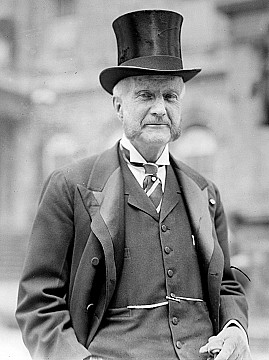
I noticed that I know of very few books on the stock market before 1900. I only know of:
Confusion of Confusions, by Joseph De La Vega (1688)
The Art of Investing, by John F Hume (1888)
Are there any books about the market before 1900 that can help me grow this list?
Big Al replies:
Lombard Street: A Description of the Money Market, by Walter Bagehot
Fifty Years in Wall street, Henry Clews
Francesco Sabella suggests:
The Stock Exchange: A Short Study of Investment and Speculation, by Francis W. Hirst
Stefan Jovanovich offers:
The Stock Exchange from Within, by Van Antwerp, William Clarkson
Martin’s Boston Stock Market, by Joseph Gregory Martin
Wall Street in History, by Martha J. Lamb
May
16
Be careful with AI, from Asindu Drileba
May 16, 2025 | Leave a Comment
The chair recently made a tweet about a Galton book he was reading. I could read the text on the image but had to squint. I later took a copy of the image as asked Grok to extract for me the text so I can read it comfortably. Grok could only extract the text "Natural Inheritance."
After that, it didn't tell me it failed to extract the rest. it just made up its own fictional text that sounded plausible. I quickly learned it was just slop since I had already read some of the actual text in the picture.
My worry is that some people are using these LLM tools for medical records, creating legal documents. The latest AI gimmick is the so called "Agents" that will supposedly be used to file tax returns, book flights and do actual tasks on behalf of humans. My opinion would be to completely cut out all AI tools for critical tools.
Steve Ellison responds:
I am very, very careful about what I enter at an AI prompt, especially when doing proprietary or confidential work, lest my ideas become part of the cloud.
Laurence Glazier comments:
For this sort of thing use NotebookLM. Choose your sources for it, it will give you citation and preview.
May
15
I went to China recently. What I saw and nearly all the people I talked to were not happy about the economic situation there and almost everyone thinks Xi is stupid.
Humbert A. responds:
This has been the status quo since pre-Covid times imo.
David Lillienfeld writes:
Peter Drucker observed that the problem with totalitarian regimes is that with only one person in charge and no one in a position to offer alternatives/challenge that individual, there is no means of identifying and developing managerial talent in a society and the society inherently slows until the person in charge dies and there is a contest/market for new leadership. There will be problems showing in China soon enough–it has a demographic hurdle coming and it shows no signs of having any idea how to deal with it. It has lots of domestic health issues that will likely cost it considerably within the next decade. Maybe Xi will demonstrate Drucker as being wrong, but I doubt it. Barely three decades ago, the concern in the US was that Japan was about to walk all over the US. It didn't. I'm not sure that China is going to do any better.
Asindu Drileba writes:
This is my exact suspicion.
1950s to Soviet collapse — US Vs Russia (Narrative is Russians will take over USA)
1980s to Asia Currency Crisis — USA Vs Japan (Narrative is Japan will take over USA)
Early 2000s to Present — USA Vs China (Narrative is China will take over USA)
Peter Ringel adds:
There is a perverse stickiness to it. I grew up in one of these shit-holes ( not Japan ! ) - East Germany in my case. All the models and all the data point to implosion. And then it takes decades and centuries and more. And finally, when it collapses everyone is surprised, and no one was expecting it.
May
13
A call for great new books, from Jeffrey Hirsch
May 13, 2025 | Leave a Comment

I am putting together a list of the Best Investments Books of the Year. I am not seeing many great books on trading, investing, finance, markets, crypto, options, futures, cycles, etc. I would love to hear if you folks know of any great books out in the past 6 months or so or coming soon.
Matthew Gasda is justifiably proud:
Big Al offers:
This is high-level quant stuff - ie, over my head, and despite "Elements" in the title - but a fun stretch:
The Elements of Quantitative Investing (Wiley Finance) 1st Edition, by Giuseppe A. Paleologo
His more basic 2021 book is "Advanced":
Advanced Portfolio Management: A Quant's Guide for Fundamental Investors, by Giuseppe A. Paleologo
Carder Dimitroff suggests:
This book is about historical finance and may not be a direct response to the question.
Empire, Incorporated: The Corporations That Built British Colonialism, by Philip J. Stern
William Huggins responds:
on a similar (historical) note, one of my students just recommended this title to me. looking forward to cracking it later this month:
Ages of American Capitalism: A History of the United States, by Jonathan Levy
Asindu Drileba adds:
If you would regard a speculator/investor as someone who also builds businesses:
Never Enough: From Barista to Billionaire, by Andrew Wilkinson
Andrew is building Tiny. His intention is to build the Berkshire Hathaway of Tech and software. He is inspired by Monish Pabrai (The Dhando Investor). So he is more in the "Value investing" camp not really quantitative.
May
11
Echoes from the past, from Jeff Watson
May 11, 2025 | Leave a Comment
I have heard every single one of these more than once on the floor. This is the G version; the X version would be very inappropriate for this venue.
You’re long hope and short reality.
He couldn’t trade his way out of a wet paper straddle.
You’re bidding like it’s your wife’s money.
His stops have stops.
He buys the high, sells the low, and thinks he’s range trading.
If brains were dynamite, he couldn’t blow his nose.
He's so underwater, Aquaman just waved.
Tighter than a bull’s ass in fly season.
Your size is what we use for toilet paper.
He’s a momentum trader—in reverse.
He couldn’t fill a corn order, let alone an order ticket.
That guy trades like he’s reading Braille.
He thinks ‘limit down’ means he hit the jackpot.
He trades like he’s got a rearview mirror taped to his glasses.
He’s scalping—his own account.
Nice fade. If I ever need a contrary indicator, I’ll call you.
He went from hero to sandwich in one tick.
I’ve seen better risk management at a toddler’s birthday party.
Market’s moving—better go ask your horoscope.
You trading or just making donations today?
He’s got a 30-lot mouth and a 1-lot account.
That guy’s P&L looks like an EKG flatline.
You're not trading—you're gambling, but slower.
He’s so unlucky, he’d lose money in a rigged market where he’s the rigger.
The guy’s charts look like modern art—ugly, meaningless, and overpriced.
He averages losers like he’s building a position in failure.
Don’t worry, he’ll blow up before lunch.
His fills are like Bigfoot—plenty of stories, no proof.
That trade had more slippage than a greased pig at a county fair.
He went full margin—and full stupid.
Asindu Drileba writes:
I watched the documentary "Floored" that was about the extinction of pit traders due to the advent of computer driven traders. A lot of the traders seemed to have their edge in bullying and intimidation that was both physical and psychological.
I made a pit trading playlist that I binged on, and this seemed consistent even to pit traders in the currency pits of London.
One of the pit traders called the computer "The most vile invention ever made." I think he was just sad that his bullying was no longer an advantage. You can't insult a computer, or use your big body to push it away so you can have the edge, or seduce it with good looks.
Michael Brush responds:
Behind every computer, there is a person.
“The offer is $25.”
“But my computer says $45.”
“So sell it to your computer.”
Pamela Van Giessen adds:
For those interested in a biography of a once famous and beloved pit trader, I recommend Charlie D: The Story of the Legendary Bond Trader by William Falloon.
Francesco Sabella adds:
It's an incredible book! I read it years ago, I even saw a 2 hour video of Charlie D. when i was in high school where he gave a lecture on trading on 1989.
Larry Williams writes:
Charly D was one stand up guy. He loved the Bears and suggested a bet with a young lady trader for a nickel on the weekend's game. She said sure…and won. Monday morning Charley D gave her 5 grand (a nickel in betting parlance). She was astounded, told him she meant 5 cents not 5G's. No way could she risk that or take the money. He left it in her hand and walked away.
I was fortunate, thanks to T Demark, to be part of his Vegas support group - he was just amazing to hang with.
May
6
Shtetl, Asindu Drileba
May 6, 2025 | Leave a Comment
Shtetl (full documentary) | FRONTLINE
This is a very depressing video about envy and how bad things can become. I think it also adds to previous discussions about madness of crowds (how ordinary people start participating in senseless murder) and illustrates that there is really no limit to how primal humans can become as long as they are given the green light.
Two take aways:
a) Don't hang around envious people.
b) Always make sure you have as little as possible that people can envy you over.
May
3
Domestication, from Big Al
May 3, 2025 | Leave a Comment

Some in these areas of science (genetics, animal development and behavior) have proposed that humans have essentially domesticated ourselves during the Holocene.
The domesticated silver fox (Vulpes vulpes forma amicus) is a form of the silver fox that has been to some extent domesticated under laboratory conditions. The silver fox is a melanistic form of the wild red fox. Domesticated silver foxes are the result of an experiment designed to demonstrate the power of selective breeding to transform species, as described by Charles Darwin in On the Origin of Species. The experiment at the Institute of Cytology and Genetics in Novosibirsk, Russia, explored whether selection for behaviour rather than morphology may have been the process that had produced dogs from wolves, by recording the changes in foxes when in each generation only the most tame foxes were allowed to breed. Many of the descendant foxes became both tamer and more dog-like in morphology, including displaying mottled- or spotted-coloured fur.
But there has been criticism of the breeding experiment and conclusions.
Asindu Drileba responds:
My definition of "domestication" used to be that of "Animals simply living under the care of other animals". When I watched a PBS Eons video some years back, I learned that Paleontologist's had a very different definition of "domestication". They define it as "the dependence on the care of other living things, to the extent that they cannot no longer live in their natural environment (the wild) anymore."
In the animal context, humans domesticated dogs and stray dogs (dogs with no owner) are riddled with wounds and in general don't do well. They would probably die if left in a forest. Foxes however look good in the wild.
In the human context, a human being with no owner (a government, a parent or an employer) usually does as badly in the manner of the stray dog. This human would perfectly fit the paleontological definition of what would be a "domestic human". The same applies for the ownership class/ruling class. They have used the working classes to domesticate themselves so they too, also can't survive with out them either. An undomesticated human would be people that can survive in an environment urban dwellers can't, the natural environment.
Like how the Khoisan do well in the desert, or tribes in the deep Amazon also do well. If you dumped a random urban dweller in the Amazon rain forest or the Kahalari desert (under same circumstances as the natives) 99% of them would die within weeks.
May
2
Working thorium reactor, from Asindu Drileba
May 2, 2025 | Leave a Comment
:max_bytes(150000):strip_icc()/GettyImages-465426935-edcdf31401e94eb3a3df656656509326.jpg "Thorium")
I wanted to ask Carder's opinion on this article that I came across titled:
China builds world’s first working thorium reactor using declassified US documents
It uses molten salt to carry the fuel and manage heat, while thorium serves as the radioactive fuel source. Experts have long viewed thorium reactors as the next leap in energy innovation. Some scientists estimate that a single thorium-rich mine in Inner Mongolia could theoretically supply China’s energy needs for tens of thousands of years with far less radioactive waste than current uranium-based reactors.
Carder Dimitroff responds:
Thorium is a fuel that is currently used in some commercial reactors. Canadian reactors can accept thorium and other nuclear materials in their CANDU reactors. (Read more: We can use thorium.)
One reason that the US, EU, and other reactors do not use thorium is that their reactors and related supply lines were not designed to accept that type of fuel. In US PWRs and BWRs, the reactor relies on precise fuel physics to achieve optimal performance. Changing the type of fuel would present a tough, if not impossible, outcome in terms of performance, let alone capital and operating costs.
When compared to a plant's production costs, nuclear fuel is surprisingly inexpensive, including the cost of disposal. Most of its energy is wasted. Consequently, there is little motivation to change the nuclear fuel's value chain.
Molten salt reactors are not new. In 1959, the US built the "Sodium Reactor Experiment" in California. Since then, several other countries have improved the design. Today, it is a viable technology, particularly in the Small Module Reactor (SMR) market. One example is TerraPower's Natrium Project (Bill Gates). They are currently testing the liquid sodium fuels for their Small Modular Reactor (SMR) product. (Read more: Terrapower: Natrium)
Apr
24
Planck’s principle, from Nils Poertner
April 24, 2025 | Leave a Comment

A new scientific truth does not triumph by convincing its opponents and making them see the light, but rather because its opponents eventually die and a new generation grows up that is familiar with it…
An important scientific innovation rarely makes its way by gradually winning over and converting its opponents: it rarely happens that Saul becomes Paul. What does happen is that its opponents gradually die out, and that the growing generation is familiarized with the ideas from the beginning: another instance of the fact that the future lies with the youth.
— Max Planck, Scientific autobiography, 1950, p. 33, 97
relevance of how new ideas are being adopted in science, markets, everywhere.
Jeff Watson responds:
Science by consensus is not science. Just ask Galileo.
Pamela Van Giessen writes:
John McPhee wrote extensively about this and how the science of geology advanced over a few centuries in Annals of the Former World. Scientific community consensus is pernicious, and it is clear that there is mostly no convincing it.
William Huggins comments:
the foundation of science rests of replicability - anyone with the same data should be able to replicate results (even if they disagree about the mechanism). once replication is established, the difficult questions come from "is this data sufficient and representative?"; "is the data generating process stable or dynamic?"; "did i gather data in support of my hypothesis or to try to disprove it?". the fun stuff.
philosophy of science ensures we ask good questions and have good tools to tackle them with. this is why the Ph in PhD is short for "philosophy."
correction: "same data" is the wrong phrase - "equivalent, out-of-sample" would be a better choice of words.
Asindu Drileba writes:
The problem with the human mind is that it has too many glitches. You can verify data successfully and still be wrong. Here are two examples from Astronomy. First, The Mayans had models that would accurately predict eclipses. So, your data of when eclipses occur would replicate really well with their model. However the model of the solar system the Mayans used, had the Earth at the centre and the Sun revolved around it. The assumptions of the model were completely wrong, but the data (predictions) were accurate.
Second, is Newton's models, that predicted the movement of a comet accurately. Then you often here people say that Einstein proved Newton wrong with Relativity.
I think when it comes to science, explanations are very flimsy. What should matter is if the idea useful or not.
Francesco Sabella responds:
I think it’s a very good exercise to start from the point of view that our mind is bound to make mistakes, have glitches and start to work from that assumption; even if it’s not always true but it can be good as working hypothesis.
Big Al recalls:
Years ago, doing simple quantitative analyses to post to this list, I learned that one of the biggest pitfalls was my own desire to get a nice result.
Apr
20
An interesting article that is making me think its mostly IP theft:
An image of an archeologist adventurer who wears a hat and uses a bullwhip
One of the internet-est things to come out of the most recent update to GPT image generation is the Studio Ghibli-zation of everything - another reminder of how OpenAI (and everyone else) trains on images that are very obviously someone else’s work.
Carder Dimitroff adds:
It's also an energy thief. Some data center owners are trying to get ratepayers to cover infrastructure costs through the state ratemaking process. On top of the capital costs, ratepayers are also expected to pay elevated marginal power costs. It's not just power. It's also natural gas:
This proposed gas plant to power a data center campus is massive
The soaring power needs of data centers continue to raise eyebrows, and nowhere is this more evident than at one Pennsylvania project, where a massive proposed natural gas plant would replace a legacy coal facility.
Pamela Van Giessen responds:
Thanks for sharing this. Every publishing/media legal department should read this, along with all artist guilds. And then they should do their own tests. AI was always theft.
Asindu Drileba offers:
There is a developing case NYT vs OpenAI:
Judge explains order for New York Times in OpenAI copyright case
April 4 (Reuters) - The New York Times made its case, for now, that OpenAI and its most prominent financial backer, Microsoft, were responsible for inducing users to infringe its copyrights, a New York federal judge said in a court opinion on Friday explaining an order from March 26.
Ars Technica did a more comprehensive article about it a year ago.
Apr
18
I know The Chair uses linear regression and so do some hedge funds. But what are you people using it for? Predicting earnings? Stock Returns? Stock Prices?
What kind of inputs make sense to insert into a linear regression model? What mistakes do you think people make when using linear regression?
Big Al responds:
A book the Chair has recommended:
Applying Regression and Correlation: A Guide for Students and Researchers
I've used correlation for exploring lots of simple questions like, "Does the move on Monday predict the move on Tuesday?" The basic model is just "does A predict B?"
One mistake often made when looking at time series like stock prices is to use absolute dollar/point changes rather than % changes. Always use % changes.
Apr
17
Options Market Are Prediction Markets, from Asindu Drileba
April 17, 2025 | 1 Comment
An interesting analysis of the options market on April 9th Trump Tariff fiasco. It seems the options market was aware of incoming policies before they were enacted.
$70 Million in 60 Seconds: How Insider Information Helped Someone 28x Their Money
On April 9, 2025, someone risked $2.5 million on SPY call options—and walked away with $70+ million in under an hour. The trade was placed at 1:01 pm. At 1:30 pm, Trump announced tariff pauses. The market exploded upward. These options that cost 85 cents were suddenly worth more than $25.
It wasn’t just the profit. It was the precision. The market moved before the news. The options were bought before the rally. The volume spiked in contracts that almost never see this kind of interest unless something is expected. And the pattern wasn’t visible on previous trading days. This wasn’t a trend. It was a singular event. — $70m in 60 Seconds.
Apr
16
The Invisible Gorilla in the Room, from Stefan Jovanovich
April 16, 2025 | Leave a Comment
That is the creature Hugh Hendry - the Acid Capitalist - says we have to find in order to profit from our speculations.
The events in Ukraine are that gorilla. They are predicting the likelihood that Trump, Putin and the Muslim oil producers will establish a Drill, Baby, Drill world of orderly energy production and supply priced in U.S. $. The effects on the European and Asian consumers will be comparable to what happened to the German-speaking world and its silver standard when the French fulfilled the terms of the Treaty of Frankfurt by paying their reparations in gold.

Big Al needs some help:
Perplexity answers the question, "What happened to the German-speaking world and its silver standard when the French fulfilled the terms of the Treaty of Frankfurt by paying their reparations in gold?"
Stefan Jovanovich answers:
They = "events, dear boy". The prediction is that the new cartel of oil and gas exporters will establish "orderly production" that manages the risks of overproduction in the same artful manner that OPEC once operated before the invention of fracking.
William Huggins responds:
So you are suggesting us producers will submit to directives from moscow or Riyadh to limit their production? No evidence of anything but predation among those players but somehow trump purs them all on the same page? I have a bridge for sale….
Apr
15
Trade deficits, from Steve Ellison
April 15, 2025 | Leave a Comment

The president seems to believe that trade deficits are evil and must be stamped out. If he ever actually succeeded at meaningfully reducing the trade deficit (so far the reverse is happening), what would be the implications for capital flows into and out of the US, and how might those changes affect markets?
Humbert L. responds:
Finance professor Jeremy Siegal wrote a piece decades ago about how the trade deficit is driven in part to demographics. Currently, the US is consuming more than it can produce, due to baby boomers retiring, no longer working, while still consuming. China is on the other side of the coin, with a younger workforce that is producing more than it's consuming.
Eventually the demographics will reverse, along with the trade deficit. The old folks in the US pass away, along with their consumption, and the US will start producing more than it's consuming, while China's young ones become old, retire, and they start consuming more than they are producing.
Asindu Drileba writes:
This sounds like a very plausible explanation for the phenomenon of "cycles" in the stock market, as described by the senator.
Mar
27
Spec roundup
March 27, 2025 | Leave a Comment
Jeff Watson has been watching the CME:
Anyone else notice the increase in seat prices (trading rights) recently?

Big Al found a history lagniappe:
BabelColour
@StuartHumphryes
Travel back in time 117 years to the Russia of 1908. I have enhanced for you this rare colour photo of the Russian writer Leon Tolstoy, regarded as one of the greatest and most influential authors of all time. It was taken in the grounds of his house at Yasnaya Polyana, near Tula, Russia. It is original colour, not colourised.
Steve Ellison provided his own:
Since one might be well advised to beware the Ides of March, here is a picture I took in 2017 of the ruins of the Theater of Pompey.
Asindu Drileba has been reading:
The importance of contrarianism emphasized by Jeff Bezos, from the Amazon 2020 Letter to Shareholders:
Differentiation is Survival and the Universe Wants You to be Typical
Our bodies, for instance, are usually hotter than our surroundings, and in cold climates they have to work hard to maintain the differential. When we die the work stops, the temperature differential starts to disappear, and we end up the same temperature as our surroundings….While the passage is not intended as a metaphor, it’s nevertheless a fantastic one, and very relevant to Amazon. I would argue that it’s relevant to all companies and all institutions and to each of our individual lives too. In what ways does the world pull at you in an attempt to make you normal? How much work does it take to maintain your distinctiveness? To keep alive the thing or things that make you special?…This phenomenon happens at all scale levels. Democracies are not normal. Tyranny is the historical norm. If we stopped doing all of the continuous hard work that is needed to maintain our distinctiveness in that regard, we would quickly come into equilibrium with tyranny….We all know that distinctiveness – originality – is valuable. We are all taught to “be yourself.” What I’m really asking you to do is to embrace and be realistic about how much energy it takes to maintain that distinctiveness. The world wants you to be typical – in a thousand ways, it pulls at you. Don’t let it happen.
Mar
15
The Cosmic Distance Ladder, from Big Al
March 15, 2025 | Leave a Comment

Maybe the most fundamental thread on Spec List has been counting/data/figuring things out, so here is a marvelous two-part video by 3Blue1Brown, with Terrence Tao, about how we determined various cosmic distances.
The Cosmic Distance Ladder, Part 1
The Cosmic Distance Ladder, Part 2
Additional commentary and corrections from Prof Tau
Gyve Bones writes:
This was a fascinating lunch lecture. Thank you. I first became fascinated with the story of how science and technology developed with the 1977 PBS series by James Burke "Connections" which told the story, without the aid of CGI graphics in my high school years. I was given the companion book for the series that Christmas by my very thoughtful mom. (It's also the story that launched my falling away from the Catholic faith in which I was raised, my teenage rebellion.)
Here's the episode which details how the Babylonian star tables by Ptolemy used by Copernicus were preserved from the destruction of the Library of Alexandria, found on papyrus scrolls in a cave backup library:
James Burke Connections, Ep. 2 "Death in the Morning"
Asindu Drileba responds:
Connections is so good. I really wish there was a remastered version (in HD at least). One of the things I still don't understand is how government funded broadcast corporations like PBS, BBC and DW make such high quality non-fiction films. I would go to say the have the best non-fiction documentaries. Capitalism doesn't apparently do well when it comes to making non-fiction. What makes them so good? Are they just structured properly?
Gyve Bones replies:
Here is a very well mastered set of the videos for Connections (1978).
Peter Ringel adds:
there is a Conjecture, that astronomers are the more happy and humble people. I guess, this is because, it is all so vast and relative.
Mar
11
More on ‘attention’, from X. Humbert
March 11, 2025 | Leave a Comment

I think a lot about how attention, like a searchlight, moves around the markets. I like, too, the simple logic that when retail investors are deciding what to buy, they have a huge array of choices, but when deciding what to sell, they are limited to what they own. (Leaving out the idea of looking at thousands of options to try to decide what to short.) Maybe index ETFs simplify this process, but then, before index ETFs we had mutual funds, so maybe not.
All That Glitters: The Effect of Attention and News on the Buying Behavior of Individual and Institutional Investors
Brad M. Barber, Graduate School of Management, University of California, Davis
Terrance Odean, Haas School of Business, University of California, Berkeley
Advance Access publication December 24, 2007
We test and confirm the hypothesis that individual investors are net buyers of attention-grabbing stocks, e.g., stocks in the news, stocks experiencing high abnormal trading volume, and stocks with extreme one-day returns. Attention-driven buying results from the difficulty that investors have searching the thousands of stocks they can potentially buy. Individual investors do not face the same search problem when selling because they tend to sell only stocks they already own. We hypothesize that many investors consider purchasing only stocks that have first caught their attention. Thus, preferences determine choices after attention has determined the choice set.
Asindu Drileba writes:
Laslo Barabasi has a model called preferential attachment. His model can simply be defined as "people usually prefer to bet on a horse that is already winning". I hear night club promoters also do this. To pull in customers, you create artificially fake long lines. These long lines make a night club appear popular, and thus make people interested in going in.
For the S&P index for example, index rebalancing algorithms are at times market cap weighted. That is, stocks with a larger cap, get more money than those with smaller market caps. Which will increase their future allocations, as their market caps grow. Retailers and others seeking "Blue chips" cannot invest in the top 500 stocks. They may focus on the top 20, which further distorts the market caps. Barabasi claims that this is partly why stock market caps have a pareto-like distribution. 20% for stocks may hold 80% of the index value market cap. (I am not saying this so what is exhibited it's just an illustration).
Peter Ringel comments:
I hear night club promoters also do this. To pull in customers, you create artificially fake long lines. These long lines make a night club appear popular, and thus make people interested in going in.
This is one of the many cognitive biases of humans. Any group over 5 attracts attention by by-passers. It even works with cutouts of >5 humans. The research papers above immediately bring my thoughts to manipulation. The searchlight is a daily reality in markets to me. But someone is holding it and is pointing it. Wyckoff style manipulation games on and on. For hundred years. I do disagree a little with the paper about retail trader as the main victim. Institutional smart money today - in one corner of the market - is tomorrows dump money in another corner. They are easily also susceptible to the manipulation games.
Mar
10
If war is a racket, where are the market gains?, from Asindu Drileba
March 10, 2025 | Leave a Comment
A few years ago, I read Brig. General Smedley Darlington Butler's War is a Racket (full text). Sample passages:
In the World War a mere handful garnered the profits of the conflict. At least 21,000 new millionaires and billionaires were made in the United States during the World War. That many admitted their huge blood gains in their income tax returns. How many other war millionaires falsified their income tax returns no one knows.
The Nye Committee uncovered some astounding information about the munitions industry, including a confession to profits as high as 800 percent.
Inspired by the book, I looked up publicly listed defense companies and marked out dates for conflicts like the Gulf War, Iraq invasion, Assassinations, Ukraine Vs Russia, Palestine Vs Gaza. While there were some blips on defense stocks, they were not that impressive. So if people say the US defense "complex" is fleecing the government, where exactly is this money going? What doesn't it reflect on stock prices?
Gold on the other hand frighteningly has so many coincidents, when it actually "predicts" aggression. The price of Gold for example went up for a moment before Qasem Soleimani was killed in a drone strike by the Trump regime. Not to mention how it behaved during the previous "Gaza - Israel" & "Ukraine - Russia" conflicts. I also found a similar observation in The Education of a Speculator:
Then, out of the clear blue, from 2 P.M. to 3 P.M., gold jumped $7. No reason for the rise, just technical buying by the funds, we were told. But that weekend, around 4 A.M. on Sunday, U.S. Navy fighter planes shot down a Libyan jet flying over the Mediterranean. This caused tremendous tension, always good in those days for at least a good run in gold. After all, nuclear war in the Mideast was now possible.
— Chapter 4, Subsection (Practical Losses)
Why is Gold way better at predicting political aggression than defense stocks?
Big Al responds:
I find the tricky thing with macro events is being precise enough with dates. Some events, like Fed announcements or other econ data releases, can be timed more precisely. With bigger, geopolitical events, it's less definite. With defense stocks, I would look at their performance in the months before the event, on the assumption that the market would be anticipating rather than reacting. As for strong reactions, look at the chart of Rheinmetall since the start of the Ukraine war and also since the US election.
As for gold, here's an interesting approach, looking at market sectors:
Navigating crises: Gold's role as a safe haven for U.S. sectors
This paper investigates the correlation between U.S. sectors and gold, and whether gold can serve as a safe haven for investors in specific U.S. sectors during the global financial crisis, COVID-19, and the Russia-Ukraine war. We use data from the Standard & Poor's Depository Receipts (SPDR) Select Sector Exchange Traded Fund (ETF) to capture the performance of the respective sectors. Our findings document that gold is a weak safe haven for most U.S. sectors. Gold is not a safe investment for energy, materials, utilities, and consumer staples. Gold does provide vital protection for financial, consumer discretionary, industrial, technology, and healthcare.
Asindu Drileba comments:
Thanks for pointing me to RHM.DE. I didn't even know the company existed. It is exactly how I expected US defense stocks to behave during the Ukraine-Russia & Gaza-Palestine conflicts.
Mar
1
Sampler
March 1, 2025 | Leave a Comment
Carder Dimitroff points to:
Michigan’s Palisades nuclear plant nearing reopening
Michigan’s Palisades Nuclear Generating Station is one step closer to becoming the first nuclear power plant in the United States to reopen. After closing in 2022, the company that was set to decommission the plant has changed course, aided by a $1.5 billion loan from the U.S. Department of Energy to restart operations.
And a new SMR will be added on the same property in about 2030:
Michigan: First nuclear re-start is scheduled for this August
FWIW, the federal regulator (NRC) may be immune from budget cuts. Their licensing and regulatory activities are funded by the industry, not taxpayers.
Asindu Drileba suggests:
Great podcast on LLMs:
What kind of Intelligence is an LLM
[Part 3 of a 6-part series on intelligence in the Complexity podcast series by the Santa Fe Institute.]
Stefan Jovanovich finds:
The best underdog story in professional baseball in US:
The Best Underdog Story of 2025
Payton Eeles #11
St. Paul Saints
Minnesota Twins
Triple-A Affiliate
2BB/T: L/R5' 5"/180Age: 25
Feb
25
Spurious correlations, from A. Humbert
February 25, 2025 | Leave a Comment
Lots of them! And with AI-generated explanations.
Asindu Drileba responds:
Wow. As much as the explanations may be wrong, they logically make sense. LLMs are really getting good. I didn't know they could do this.
Gyve Bones writes:
You can do similar things with astrological cycles and events, I came to realize when I built an ephemeris for the Market Information Machine and coded macros for ways to use the data. You can curve-fit any data to some combination of sinusoidal cycloids and get a 99% correlation, which then falls apart going forward because it was indeed a spurious back-fit with no reasonable causal linkage.
M. Humbert suggests:
If you track which countries where I’ve lived, those markets always experienced a bear market. I’m currently in the US. Advise strongly that you bet the farm, take out a 2nd mortgage, and buy out of the money put options the Magnificent 7.
Feb
21
Spec sampler
February 21, 2025 | Leave a Comment
Asindu Drileba recommends:
The Count of Monte Cristo was my favourite movie of 2024. I would recommend it to specs as it has a very interesting stock market trading segment. The stock trading segment was brilliant in that it incorporated ideas from poker (previously discussed in this list). It's also a good demonstration Howard Mark's "Second level thinking", and the use of deception in the market.
Also, the best description of the Fourier transform I have seen so far.
Jeffrey Hirsch is on IBD:
How To Trade Trump 2.0 And Why DeepSeek Is Not The End Of The AI World | Investing With IBD
Big Al offers:
Humorous and with many lessons:
How I Helped to Make Fischer Black Wealthier
Jay R. Ritter, Cordell Professor of Finance at the University of Florida
— keep looking »Hillary Clinton wasn't the only person who made money speculating in the futures market during the late 1970s and early 1980s. A lot of finance professors did, including me. However, I used a different strategy than Hillary. Following the advent of stock index futures trading in 1982, many finance professors started playing the turn-of-the-year effect. The most popular approach was to buy the Value Line futures and short the S&P 500 futures. This is what I did. Of course, if there is easy money to be made, prices should adjust as the market learns, and a perpetual money machine will cease to exist. But I figured out a way to still make money. Or so I thought. Unfortunately, there was an unexpected danger in my strategy. In 1986, Fischer Black of Goldman Sachs figured it out and took me to the cleaners.
Archives
- October 2026
- September 2026
- August 2026
- July 2026
- June 2026
- May 2026
- April 2026
- March 2026
- February 2026
- January 2026
- December 2025
- November 2025
- October 2025
- September 2025
- August 2025
- July 2025
- June 2025
- May 2025
- April 2025
- March 2025
- February 2025
- January 2025
- December 2024
- November 2024
- October 2024
- September 2024
- August 2024
- July 2024
- June 2024
- May 2024
- April 2024
- March 2024
- February 2024
- January 2024
- December 2023
- November 2023
- October 2023
- September 2023
- August 2023
- July 2023
- June 2023
- May 2023
- April 2023
- March 2023
- February 2023
- January 2023
- December 2022
- November 2022
- October 2022
- September 2022
- August 2022
- July 2022
- June 2022
- May 2022
- April 2022
- March 2022
- February 2022
- January 2022
- December 2021
- November 2021
- October 2021
- September 2021
- August 2021
- July 2021
- June 2021
- May 2021
- April 2021
- March 2021
- February 2021
- January 2021
- December 2020
- November 2020
- October 2020
- September 2020
- August 2020
- July 2020
- June 2020
- May 2020
- April 2020
- March 2020
- February 2020
- January 2020
- December 2019
- November 2019
- October 2019
- September 2019
- August 2019
- July 2019
- June 2019
- May 2019
- April 2019
- March 2019
- February 2019
- January 2019
- December 2018
- November 2018
- October 2018
- September 2018
- August 2018
- July 2018
- June 2018
- May 2018
- April 2018
- March 2018
- February 2018
- January 2018
- December 2017
- November 2017
- October 2017
- September 2017
- August 2017
- July 2017
- June 2017
- May 2017
- April 2017
- March 2017
- February 2017
- January 2017
- December 2016
- November 2016
- October 2016
- September 2016
- August 2016
- July 2016
- June 2016
- May 2016
- April 2016
- March 2016
- February 2016
- January 2016
- December 2015
- November 2015
- October 2015
- September 2015
- August 2015
- July 2015
- June 2015
- May 2015
- April 2015
- March 2015
- February 2015
- January 2015
- December 2014
- November 2014
- October 2014
- September 2014
- August 2014
- July 2014
- June 2014
- May 2014
- April 2014
- March 2014
- February 2014
- January 2014
- December 2013
- November 2013
- October 2013
- September 2013
- August 2013
- July 2013
- June 2013
- May 2013
- April 2013
- March 2013
- February 2013
- January 2013
- December 2012
- November 2012
- October 2012
- September 2012
- August 2012
- July 2012
- June 2012
- May 2012
- April 2012
- March 2012
- February 2012
- January 2012
- December 2011
- November 2011
- October 2011
- September 2011
- August 2011
- July 2011
- June 2011
- May 2011
- April 2011
- March 2011
- February 2011
- January 2011
- December 2010
- November 2010
- October 2010
- September 2010
- August 2010
- July 2010
- June 2010
- May 2010
- April 2010
- March 2010
- February 2010
- January 2010
- December 2009
- November 2009
- October 2009
- September 2009
- August 2009
- July 2009
- June 2009
- May 2009
- April 2009
- March 2009
- February 2009
- January 2009
- December 2008
- November 2008
- October 2008
- September 2008
- August 2008
- July 2008
- June 2008
- May 2008
- April 2008
- March 2008
- February 2008
- January 2008
- December 2007
- November 2007
- October 2007
- September 2007
- August 2007
- July 2007
- June 2007
- May 2007
- April 2007
- March 2007
- February 2007
- January 2007
- December 2006
- November 2006
- October 2006
- September 2006
- August 2006
- Older Archives
Resources & Links
- The Letters Prize
- Pre-2007 Victor Niederhoffer Posts
- Vic’s NYC Junto
- Reading List
- Programming in 60 Seconds
- The Objectivist Center
- Foundation for Economic Education
- Tigerchess
- Dick Sears' G.T. Index
- Pre-2007 Daily Speculations
- Laurel & Vics' Worldly Investor Articles
