Dec
30
Driving is like Trading, from Craig Mee
December 30, 2012 | Leave a Comment
 Driving a motor car or motor bike is probably the best analogy I can think of for trading.
Start, Stop, traffic lights, dogs and cats on the road, cows, give way signs, t intersections, signs saying "kangaroos for next 50 kilometres ahead–and that is just in the first few 100 metres of leaving home– and then when you hit the express way, and consider yourself in the clear, there may be road works, or fog, and unsighted hazards ahead.
It's very rare you can enter an express way…of start to finish, or finish a journey uninterrupted.
It is our jobs as traders to close down all risks as they appear, in whatever form, to cause minimal bumps and bruises to ourselves. Problematic situations will appear when you expect OR when you least expect them, and when you do get uninterrupted runs, you appreciate them, since it is what you have planned for, but see less often than one may hope for.
Be flexible, bend like the tree, always give way when on the road, and when you hear the sirens move top the left and beware of trouble ahead.
Peter Tep writes:
"Be like water" - Bruce Lee
Nice post Craig. I liken trading to Bruce's Jeet June Do methodology– using all the skills we have to move forward and strike the opponent down.
What worked yesterday may not work tomorrow. Especially with the presence of HFT, SMSF, central bank presence.
Chris Tucker adds:
If one were to "always give way when on the road" in NYC, one would never get anywhere. Cabbies will eat you alive if you let them, they will try to force their way in front of you and then look at you as if you are a criminal when you fail to yield.
Yes, always giving way is a much less stressful way to navigate, but there is no victory in it!
Jeff Sasmor writes:
Depends on how aggressive you want to be and what sort of car you are driving. If you are driving a beat up car and honk and go, they give way. I speak from personal experience on both sides of that transaction.
Jim Lackey adds:
Look where you want to go. Do not look where you don't want to end up. In a slide, if you look at the wall, you'll run right into it. If you look ahead down the race track it's amazing, you'll auto steer and correct your way out of the spin. In a crash, hold on, and do your best not to get hurt and head for the pits for repairs.
Last night during the 200 MI trip from the hill outside of Birmingham, AL, the transmission cooler lines on my BMX van broke. It must have been a sight as trans fluid was all over the engine trans and back of van in a cloud of smoke. Good thing we didn't have a fire. You know what I did? I eased it back to the pits. I exited, dumped some fluid into the trans and made it home. This AM all fixed.
I froze my tail off shooting weapons for 12 hours in the Bama country with my Sisters family. They have more weapons than anyone I know. My son did the walk balk with the AK-47 and I burst out laughing as another teenager was taking some hot brass as they ejected from the chamber. I told the kid to move. Good fun safe day. I can still hit a 300 meter tager with a .22 rifle 2nd shot after 20 years of no practice. Okay, it wasn't 300, but simulated as a 4" target X meters away…bing…
My nephew made the comment, all these weapons are so easy to use it's ridiculous. Yeah, that is how and why there are 10 year olds in the militia in Africa. The only reason I shot at all was the current news flow. I really have no interest in firearms. After shooting the 150MM main gun and killing tanks at 4,000 meters on the move, with F-15's as cover and the Apache on my 6 and MLRS destroying 1k by 1k boxes at a time… real war is reprehensible. All the arm chair warriors really need to tone it down a bit. The only comment I agree in the past 4 weeks of talk was Professor Stefan with his Bellini. If you want to put on the show of defense, that is the smartest idea I have ever read. Those shot guns are world class and perhaps I'd buy it from him. I own no weapons.
I am still thawing out after 13 hours outdoors then the 3 hour drive home then the work this am. My water heaters theromcouple died.. Lowes and HD are useless! Ugh, Ace hardware has all the parts they are amazing, but after inspection my buy American just bit me… Standard brands, made here in TN, has a special thermocouple. I asked the local heater man if he'd be kind enough to drop one off in my mailbox. He said sure, but the clerks said they have to charge me 69 bucks for the Sunday trip. I can wait a day. The part is 14.99. I can do it myself. It's already apart.
I am a man. The ladies must have hot water now. Ill sacrifice my McDonalds budget for Jan and have my man stop by. Perhaps he will find another problem as well.
Back to Carz racing and trading… it's not the one big edge that makes a champion…it's the 10,000 little things all done perfect that adds up to a big edge. The biggest edge of all is the drift over 100 years. After two crashes and a dozen panics the past 12 years, I find it hard to believe that buying every panic with prudence over the next decade will not produce a fine profit.
Dec
30
Movie Review: Barbara, from Marion Dreyfus
December 30, 2012 | Leave a Comment

Barbara
Directed by Christian Petzold
With a time-frame starting back in 1980, the accumulating tension of time and place in Barbara begins as physician Barbara Wolff (Nina Hoss) arrives at a modest rural pediatric hospital in East Germany, clearly transferred there not with her acquiescence, from a prestigious hospital in Berlin by never-named Authorities. Her 'crime' is obliquely referred to as that she had had the unmitigated gall to commit a request for an exit visa.
What comes to mind is the Orwell book and film 1984 (1984), where remorseless monitoring, and literally rewriting reality into a never-was 'history,' are the norm. Adding to the received nerve-rattling classics of life under surveillance as the German The Lives of Others (2006), and 2007's Romanian 4 Months 3 Weeks and 2 Days, director Christian Petzold—one of Germany's leading contemporary filmmakers—visits the perturbed, seething yet everyday calamities and wastes of the East German totalitarian era: Paranoia goes deep. But, heavily draped with an Iron Curtain, paranoia is entirely justified.
The Barbara we see for the preponderance of this meticulously reported could-be reality is cool to stand-offish with colleagues—even a handsome, responsive doctor named Andre (Ronald Zehrfeld) who gallantly batters against the wall of her reserve. No matter her remoteness from her physician coworkers, she comes to life with immediate sensitivity, professionalism and warmth when dealing with her sometimes desperate patients, who suffer from a plethora of socially induced ills. A century ago, these women would have been given a DX of "hysteria," but here, their paroxysms and longeuers have readily apparent etiologies. People cannot live healthily under constant fear, badgering, harassment and humiliations large and small.
We see from constant random body searches and intrusive shakedowns of her apartment that Barbara has ample reason to maintain her reserve. Anyone, everyone, in Cold War-era East Germany could be an informant or "a cadre" (as my grad students in China called class informants they surreptitiously, and cautiously, pointed out to me). Through another ocular, by the same token, anyone can also be an anonymous, clandestine hero. This however takes planning and cunning.
We see from constant random body searches and intrusive shakedowns of her apartment that Barbara has ample reason to maintain her reserve. Anyone, everyone, in Cold War-era East Germany could be an informant or "a cadre" (as my grad students in China called class informants they surreptitiously, and cautiously, pointed out to me). Through another ocular, by the same token, anyone can also be an anonymous, clandestine hero. This however takes planning and cunning.
With spare narrative and a dead-on sense of physical and emotional atmosphere, Petzold creates an unbearably vivid portrait of a period that, in the intervening decades, has come to seem strangely both current as well as fractured-old. Facial expressions do not alter with time, nor does the practice of medicine; even the era-clothing is not distinctive enough—as in the new American release about adoptive restrictions to non-typical couples in the early 1980s, Any Day Now, which shouts gaudy gauche gefehrlach post-psychedelic America to such an extent that you keep wanting to bring in the wardrobe mistress—to spank her for such transgressions against good taste. Filmed in strong mustards, greens, blues, it nevertheless reads like a grainy black-and-white feature of Russian 1950s vintage.
Filmed in the verdant, lush, blustery province of Brandenburg, Barbara is often ravishing to the eye, especially as the lithe eponymous character pedals through forests, windblown fields and country roads. As she appeared in the harrowing WW II A Woman in Berlin (2008), Hoss, who never smiles for the first two-thirds of the film, exerts an almost-hypnotic effect, drawing us in steadily to unveil a character whose single-minded goal, only gradually glimpsed, slowly yields to more, and more complex, issues. John Le Carré spycraft sensibility threads the story. Secrets are harder to keep when one's office, home and bodily orifices are searched at whim. As the story transmogrifies to assume the lineaments of a thriller, it might be open to debate whether the film ends the way Westerners are accustomed. Is it a 'happy' end? Such questions are often irrelevant to serious filmgoers, as they are noxious to fair consideration of the handling of important themes.
This is not a manicured, made for TV all-ends-tied-together pastiche. In this sophisticated, deftly crafted portrayal of grass-roots Communistic realpolitik, Petzold leaves viewers with the sense that, when it comes to such events, people and issues, neat packages are rarely available. Nor, to be fair, ought they be.
The residuum is a silent acknowledgment that, indeed, some progress has moved the needle forward. Injustices and totalitarianism still exist, but a few of the worst have in time been ameliorated. There is some sort of hope in that.
In German. English subtitles.
Dec
27
The Contest, from Arthur Khaldarov
December 27, 2012 | Leave a Comment
Dr.
I just noticed you are running a contest on best investment idea for the year (2012). Yes, I even have time to read dailyspecs when I am in Cambodia. I don't know if its to late to qualify, but I have couple for this year. Short Yen and long Vietnamese stock market. My thinking goes, Japanese would have to come up with something drastic and they will, to stop appreciation of yen, and as much as i don't like people's thinking in Vietnam, long Vietnamese exchange (hnx or ho chi minh), median age is 27, hungry and ready consumers. And there is a want among the young to be westernized as fast as possible. I met lots of ex-pats from US in Vietnam who came back to open up small business in Vietnam. One other important thing is the communication infrastructure around the country, internet wifi is everywhere and inexpensive due to cut throat competition.
I wish I could say the same about Cambodia, my god, people are wonderful, but if you move 5 minutes from the center, streets are not paved yet no running water and forget about electricity, and there is 0 infrastructure (again, thats outside the center. The whole place is running on charity. I am not sure why this is (not long enough here), every business man I meet says, it takes forever to get anything done here. Third one is a gamble (its all a gamble, this one is a bigger one), long Euro, I hate euro, and there is 0 reason for its existence, but everyone hates euro these days, so I went long (today actually), there is no way (anything is possible) on the election year we will see collapse and/or deterioration of the currency, it will happen, but not yet (at least that's my thinking).
If I still qualify and win, make winnings go to the charity of your choice, I am sure you looked into many already (but not to 9/11 museum fund, you know how I feel about those salaries). After South E.A. the salaries and lifestyle of most Americans seem obscene (I am living with my wife in as much comfort as we need and want on $15-$20 a day and that's A LOT here, (including rent). Good observations on Paris and London, Paris is not the same anymore and moving into a sadder state every year (same is with my ex-favorite city Florence, compare to 1999 now its just a Chinese clothing market).
Arthur Khaldarov adds:
Just to clarify: This was written and emailed on Thu, Jan 5, 2012.
Dec
26
Trading with SVMs (Support Vector Machines), from Leo Jia
December 26, 2012 | 1 Comment
This report "Trading With SVMs: Performance" sounds very interesting. The result on trading the S&P500 (without leverage, I think) since 1952 is 32.59% of annualized return while during the same period Buy&Hold is only 15.14%.
Here is Wikipedia's article on SVMs.
I wonder if anyone has used SVMs in real trading. Could you kindly share any experience about it?
Victor Niederhoffer writes:
One of my very rare strengths counterbalanced by many much more glaring weaknesses is that I can usually look at any paper in statistical finance and find its weaknesses in 30 seconds or less. I looked at support vector machines in that context and could not figure out why it should do better than discriminant analysis or similarity analysis. I was turned off by the statement that armi garch results using the last 5 changes gave similar alluring results, as I don't believe they will work unless they are retrofitted during particular periods. The non-linear features that SVM tries to capture would not be predictable or repeatable I would think nor would it in any case be immune to ever changing cycles. I will look at this much more carefully with the doc before I can render a totally worthless opinion on this.
Dec
20
Inside the Iquitos Prison, from Bo Keely
December 20, 2012 | 1 Comment
 The Iquitos Prison occupies twenty acre surrounded by a 12´concrete wall with four corner turrets that rise like rooks over the denuded jungle within. Eight pavilions house 160 prisoners each for a total of 1300 while forty guards stroll the garden patched complex to keep order. The prison uniform is street clothes but long pants only, while the guards sport tight black T-shirts inscribed INPE in gold on the back. They are armed with .45´s.
On my last day in Peru I visited the prison, first stopping across the street to rent long pants and a dress shirt for $1.00 for admittance. I turned to face the prison entrance, an arched gateway with a short line of visitors.
Inside this walled town inmates are indistinguishable from citizens outside who at any moment may end up right here due to the evil Amazon mothers-in-law and the crooked court system that convicts on bribes and rarely justice. You are put here and kept here depending on your pocketbook, not the crime. The four main convictions in order are sex crimes, drugs, robbery and last fighting. After talking with about one hundred prisoners today I will conclude that half are innocent and nearly all have overextended sentences as the system and their ex-girlfriends slowly squeeze money out of them over the days and years.
Some of the very females in the visitor´s line batting eyes in front and behind me, who lied in the first place to thrust their boyfriends here, and now of legal age, visit each Sunday to draw the curtains before the bunks. Each is paid for sex and, anticlimactically, the boyfriend urges her to retract the original rape charge.
The queue of fifty visitors, lovers, contraband runners and Sunday ministers moves quickly with eight at a time admitted through a ten-foot iron gate in the wall. Then there´s a pause at each of five stations where guards copy identification information, a green chicken imprint is stamped on my right forearm, at the next pause a visitor number is drawn in yellow magic marker below the chicken, at the next another black number 3-16 who is the prisoner I´m fated to visit, at the ensuing a beautifully engraved chit # 43 is traded for my passport photocopy, as I keep my original taped to my side that soon escapes a quick frisk at the final station.
The chit and number penned in red at the bottom of my arm journal prove I´m a visitor rather than convict and I´m told to return in five hours by 2pm or spend the night in the Crossbar Hotel. A pleasant guard in black and gold points me to a plank path across a muddy field to Pavilion 3 to ask for Ruso, the only gringo inmate in the entire complex. I briskly walk the wood plank expecting to find an Italian in for drug smuggling, and a guard politely steps off the one lane into the mud to let me pass, tipping his hat, and pointing ahead for ´Ruso´.
After walking the plank, the guard at Pavilion Gate 3 reads my arm moving his lips, pulls the single skeleton key to unlock the ancient lock, it opens with a creak, and locks behind me. I march a dim aisle like an alley on a moonlit night with open door cells on either side as inmates stare stunned, gape and a few cup their hands to mouths whooping, ´Ruso!´
I turn into Cell 16 and am surprised as a shaggy head pops out from the bed screen, giant bare feet hit the floor, and a huge hand envelops mine with a hardy ´PriVet´ (Hello!) in Russian. This is Ruso, which I quickly learn is Spanish for Russian rather than his name, though he is known throughout the system as Ruso.
A solitary black chess pawn sits on the desk in front of his bed as a clear invitation that I ignore for the moment. Our conversation is in Spanish as he speaks little English.
Ruso exports wood, and has lived in Lima for six years. One year ago he and his brother arrived in the heart of the Amazon at Iquitos to search for wood. His brother got in a fight with three men and bested them, and was subsequently arrested for beating a man to the pulp. Ruso was not at the fight but his crime in Peru is being the brother of the man who fled to avoid trail to Russia. In the perverse Peruvian court system Ruso was put behind bars to serve his brother´s aggravate assault sentence of three years. Before coming to Lima to start the wood business he earned an economy degree, is keen eyed, moves purposely with a royal bearing, twenty-eight, powerfully built, and no worry lines on a square face that begs a shave and haircut.
We make short small talk for he´s anxious to introduce me to the Teacher whom he claims will open every nook of the prison, even places I don’t want to go.
First, we tour his Pavilion, or concrete blockhouse with two flights of stairs and long cement halls connecting about twenty cells with eight beds each that are flung open each morning. Each 30´ square room has one toilet and shower, and each inmate has painted his space with a personal color scheme and hung posters of politicians, scantily clad girls or his own artwork. Ruso´s space is glossy white, tidy like the others, and stacked with non-fiction books on economics, nature and biographies from the block library.
We amble to the Block core that hems a 30´ x 60´ concrete soccer area alive with kicks and shouts over a deflated excuse of a soccer ball. Around the mini-field a dozen inmates run picnic table cafe´s, gambling rings, a crafts shop and barber shop. Prisoners whittle and fashion knickknacks, some paint, and others design or patch clothes to barter or sell to each other to eke a living. A weight lifting area with bars through concrete blocks as dumbbells and barbells gets constant use as many inmates are heavily muscled like Mastiffs. A rousing sermon well attended by forty hand clapping, foot stomping inmates screams through the windows over the soccer field. The scene is a sort of Eden in the Sunday morning sunshine away from the dank cells. It is hardly different from outside the walls except for the thick iron locks.
An 8-foot chain link fence with razor wire hugs the Pavilion with one gate to liberty to roam the twenty acres compound… and enter, if you can afford a ticket at each gate, the other seven Pavilions. It´s a macabre Disneyland. The chief guard at each gate, not his helper screw, has a key, for he has worked the system for years to attain this commanding post to accept or snub bribes to admit or refuse anyone to his Pavilion. So prisoners are free to walk within their own walled blocks in daytime, are locked in their cells from 10pm to 6am, and may leave the same way visitors enter, by bribing the guard chiefs.
´Money talks inside,´ Ruso quips and winks, adding, ´You are my guest,´ and palms the equivalent of $2 with a hand pump to the guard chief at the exit. It is a large sum where outside the minimum wage is $1 an hour. The guard pockets the money, claps Ruso on the back, and opens the gate to exit Pavilion 3 onto the main grounds where the other six pavilions and turrets reach to the sky like War of the Worlds. Few prisoners see this for years because of the price.
We pass Pavilion 2 adjacent to the prison perimeter wall where the last prison escape attempt in 2007 failed when the guards allowed via bribes a 19-inch diameter, 30-meter tunnel to be dug for six months from inside the Block and under the wall to the street, and then swooped in for the capture of 35 escapees. The breakthrough day that Peru´s national soccer team was to play the first qualifying round of the World Cup was smartly timed thinking the guards would be watching the soccer game and not tending to their posts, but someone squealed.
We slip into the carpenter shop within a 20-meter square hut with a log saw to cross-section and cut planks, planer and other equipment. Ruso brushes his hand gently across the wood like a lover´s cheek, explaining that he spends a lot of time here filling orders for civilians for tables, chests and beds. They´re custom crafted and picked up on visitor´s day. It would also be a tight place to hollow a log or furniture leg to store or transport contraband.
On reaching Pavilion 4 that resembles and is minimum security like Ruso´s Block, he pulls the chief guard aside to grease his palm while I chat with the backup screw who informs that the two guards per Pavilion gate work 24 hours straight, and then are off for two days. He avows the turnkeys prefer this arrangement that requires them to work only ten days a month. Each of the dozen guard´s I´ve bumped into is savvy, amicable toward the prisoners and me and, according to my tour guide, on the take. The chief gives him a big bear hug, shakes my hand, and admits us into the Block. We search the bobbing heads on a concrete cafeteria floor that fills the core area instead of soccer. Five cafes and as many pushcart vendors do a bustling business as prisoners chat, play cards and board games as if at Starbucks. This is a more affluent crowd with many seniors, and I´m tipped it is the white color crime Block.
One graying man with twinkling eyes holds an erect posture that stands out so brightly that I inquire of him. He is the former Pevas Mayor, a large jungle town downriver one day by boat, where he was convicted four years ago of accepting money while in office, and for some reason has chosen not to or cannot afford to bribe the court for a get-out-of-jail card. I was told that anyone with a non-violent crime may pay via an attorney to the court about $3000 for quick release, or $10,000 for the worst crime.
The majority of the men are sex criminals, or better termed victims, serving an average ten years for having an affair with an underage (17 years or below) girl; or twenty years for so-called rape. One man I speak to has spent a month short of twenty years inside for having sex with a drunken legal age girl who told police and testified in court that he raped her. He will be released in one month and is anxious for freedom. A few other men tell me, yes, they had sex with a teenage girl like most other Peruvian males, but that the mothers-in-law came at them with claws bribing the police for arrest unless they paid the girl´s family a queenly sum. They cannot afford that game and end up skewered in the penal system.
Ruso spots and yells over the mill to the Teacher. A shout back, and a tall thin man with spectacles above a perpetual smile weaves to draw the Russian´s hand and, on learning that I not only speak but have taught English, clears the floor with a jig. He is respected inside as the official English instructor- the guards address him in English as Teacher- with thirty students in all eight Blocks whom he charges pocket change. He picked up a little English in his youth as a jungle guide, strengthened it inside by reading books, and I am the first person who speaks better whom he has met in three of his six year sentence for having sex with a 16-year-old minor. There was leniency since she was his steady girlfriend that he planned to marry until she brought up the rape charge.
Ruso buys the Teacher a coffee and me lemonade, and on finishing suggests that we walk outside around the yard. Teacher bows his head in shame admitting he cannot afford the standard $1 bribe to leave the Block, but Ruso tells him not to be silly, that Teacher is our guide and the Russian foots the bill.
On swinging gaits with new elbow room we saunter the twenty acre compound, greeting ´Hola´ to the guards and ´Buenas´ to inmate gardeners of little jungle patches outside the Pavilions. Then past a tangle of construction equipment and abandoned bunkers from years gone by to the maximum security Block. .
In maximum men are stripped of their faculties by drugs and time served and so sadly are seen to their core, ragtag and clawing the chain link fence thrusting bubblegum and trinkets at me for coins to support their habits. They beg and alternately roar like lions. ‘You are dangerous!’ the Russian scolds them cheerfully, and then whispers to me, ‘Do you want to go inside?´’
‘Sure,’ I reply, and we turn the fence corner past the frantic men to the Sergeant with the key in to their cage.
It is a din inside. The halls are littered with men sitting sleeping with their foreheads on their knees and gum wrappers. Only six inmates watch TV, hardly any smoke cigarettes due to the cost, many sell candy or dirty girl sketches for change to fill out their emaciated frames or empty minds. The Block houses a younger crowd with strained faces, wild eyed, and doomed to spend decade sentences for crimes of violence, usually robbery or rape.
An atypically rotund middle-aged inmate with accountant eyes seeks out Ruso like a viper, wraps his arms like an anaconda around him and all the while narrows his eyes at me. The alert Russian squeezes him back hard, nods okay at me, and the man releases and smiles warmly. I get the feeling he believes I’m there to buy something, which is fixed when he introduces himself as the prison drug kingpin. Willie Sutton said he went to banks because ´That’s where the money is´, and the kingpin apparently has placed himself in this miserable Block because that’s where the business is. Marijuana and coke for personal use are legal in Peru, but heroin also works through the visitors and guards to the kingpin. ´Anything you want,´ he tells me, ´I can get,´ and then bows out politely that cues a circle of young unkempt inmates to tighten around us.
Yet a man of simian proportions parts them to grin broadly at my guide who nods a second okay that prompts him to utter, ´I am the Block Enforcer, and if you need help just whisper my name Pedro and your fears will go away.` He then steps back through the circle that breaks to allow his graceful exit, and a dozen young convicts approach without touching to beg cigarettes, offer marijuana, and sell candy.
Word echoes along the hard hallways that a gringo is in maximum! and fifty men more shyly than not come up in tactful groups of three to five. Many move directly to the Teacher to show off their new English vocabulary to which he grunts and grins and solicits my corrections. I hold court and teach everyone the words for sky and hope…
Two Mongrel pups prance down the hall sniffing for scraps and accepting tender pats from the inmates. The dogs are in far better flesh than the men in leading a Life of Riley with Carte Blanche to scratch and exit without bribing the guard and, no doubt, to enter another Block where the pickins ain´t so slim.
The dogs pass under a 6×12´ exactingly painted ´Rules and Regulations´ sign in rainbow colors that strictly forbids contraband such as drugs, electronic devices, weapons, fighting, and touching a guard. The punishment is solitary confinement in the Hole for stealing, fighting or breaking most of the other rules. The Hole which a few of the men cringe to recall is 1×2 meters by 2 meters high with only a mattress from which a person may not leave for his stay of one week to two months on bread and water.
I don’t meet the maximum Block Leader but he and the other Leaders seem to run the penal institution. Eight Pavilions with eight Leaders, as outside where chiefs run villages. Their responsibility as mediators is to iron out problems before they would annoy the authority. The guards are loath to enter any of the Blocks for any reason without a SWAT team, and so the Leader keeps them out of the loop. I am told that the guards never taunt or hit a prisoner. Let’s say an inmate infracts the most commonly broken rule of no fighting that if not for the in-house system would result in being sent to the Hole for two weeks and going stir. Instead, the offender is brought by the Enforcer to the Leader who listens patiently, decides on a short counsel, or as often as not doles out harder encouragement. That discipline, as in my school days, is a hit across the hands with a ruler, except in this case the offending prisoner is made to cross his hands and given blows on the palms with a heavy rattan stick. One young guy displayed bruised swollen hands, and attested, ´The stick hurts like heck!,’ but cheerfully accepted it in lieu of the Hole.
In contrast, American prisons host fairer courts, shorter sentences, broken rules, snitches, fighting and gangs, and combative guards. The Iquitos penal complex is more like an American turn of 20th century rural town except no one is at liberty to leave.
The Russian as the sole gringo in the community seems to be the King of all and kept in check only by the guards and his Block Leader who also respect him, if not for his physical prowess and sharp mind, then for his wallet that is always padded for bribes to get nearly anything he wants. He is totally at ease among the Peruvians on both sides of the bars who all seem in awe of his size, wealth, intellect and communication skills.
His parents do not know he’s in prison because it would embarrass them, and the returned brother to Russia has told them their son is walking in the jungle looking for wood. He has served one of a three year sentence and is content to fill in for his brother except that he’s bored to tears. It is more expensive to bribe himself out because of his noteworthy case and large bankroll that may be pinched longer by the court and jail. Yet, he claims that after one year imprisonment the balance has tipped in his favor and he is working with two Lima lawyers on the proper fee to be sprung.
‘How do you communicate with the lawyers all the way in Lima,’ I ask after we drop off the Teacher at the carpenter shop and stroll on to Pavilion 3. He smiles quickly and silently, guiding me by the elbow past the turnkey, down the hall where I first walked in alone and into his cell. The black chess pawn sits lonely on the desk. He asks if I play. I say I used to. He remarks that he started playing at age six, but it is just a hobby. ‘Chess is to Russians as baseball is to Americans.’ He pulls a board from under the mattress, I sit on his bunk and he on a crate with his back to the cell door. He extends fists across the board and I choose the left, that opens to a white pawn and we quickly set up the pieces. The Teacher walks in with something in his hand too, hops surreptitiously into the bunk behind me and draws the curtain.
There is no chess clock except the game must end in one hour to get me out before the end of visiting hours at 2pm, and if the game has no winner in that time we agree in advance to a draw. I have one strong opening, the King’s Gambit, and push the King’s pawn two jumps ahead against the Russian. The Gambit is taken and the game evolves into a wild and wooly middle with hands flying over pieces like a Bruce Lee movie. In thirty minutes of nearly flawless play at one of the most beautiful games of my life, in a King and pawn end game I am a pawn up. He rises and tips his king, shakes my hand, and then draws open the curtain behind me.
The Teacher is reclined on the bunk texting his attorney to get out of jail in three months for $1000 to a judge. He has brought the contraband phone perhaps from the carpenter shop to escape the weekly scrutiny of unannounced Swat Team cell shakedowns. I nod in understanding at them both and turn for a long walk out without looking back.
The Iquitos prison visit was an invaluable seminar where I learned that behind walls and wire and bars life goes on not so differently as outside on the streets of Peru. It is the most pleasant Crossbar Hotel of ten I’ve visited around the world, and nearly anyone could bear a year looking through the slats here though I have no desire to return except for a good chess game.
Dec
17
D’Antoni, from T.K Marks
December 17, 2012 | 1 Comment
 As far as emotional bloodsports go, there promises to be a bit of athletic theater at MSG in NYC tonight.
Mike D'Antoni and his Ritalin offense, both recently of the Knicks, come to town with his newest victims, the low-ebb Lakers, a roster of all-stars suddenly resembling the cast of a Jerry Springer show in their collective dysfunction.
Carmelo Anthony didn't exactly see eye-to-eye with D'Antoni when they were both here in NY last year so Melo is probably going to try to put on a show to rub it in to his erstwhile nemesis. While on the other hand, Kobe Bryant never likes ceding the spotlight to anybody so he's probably he's going to try light things up as well.
As for D'Antoni, this does not exactly shape up as a MacArthuresque return, as the crowd is probably not going to be very hospitable. There will be nothing genteel about any of this. D'Antoni probably won't need a Kevlar vest but a pocketful of Xanax might be strongly advisable.
Victor Niederhoffer comments:
This was written before Antoni trash talked the team after his loss and boos. Someone has to say, "coach, it's not the players, it is your system".
Uncle Howie Eisenberg writes in:
Agreed. His system obviously doesn't work for the current Laker roster and he keeps trying to shove square pegs into round holes. He is the anti-Jackson who became the greatest coach or manager that ever lived by getting the most out of what every player brought to the table. Case in point: Instead of capitalizing on Pau Gasol's great ability inside which puts him among the top 3 power forwards or centers in the league, he has him on the perimeter where his outside shooting is middling and berates him for not being in shape to run full speed all the time. He (actually) is a Hatfield in need of a McCoy to run him out of town. Unfortunately Jim Buss by his early morning rejection phone call to the Zen Master has forever precluded the return of the guy who could have best exploited the 4 HOFers on the Lakers while enabling the others to transcend themselves.
As far as the defense is concerned I don't know whether it is as Felton said not getting back in time, or the over emphasis of the fast moving offense that causes players to either not put out on defense or maybe not have the energy to do it on both ends of the floor.
Dec
14
Beating Slots, from Daniel, a commenter
December 14, 2012 | 3 Comments
In the middle of the 90s I was beating slots here in Greece where I come from like butterfly cherry master or similar video 3 reel slots so I even had rng. I could 'read' these machines, or we had an electronic device to cheat royal poker, so I'm just trying to say that nowadays slots can be beaten if you only know a very small detail of software.
Dec
1
Sequoias, from Pitt T. Maner III
December 1, 2012 | Leave a Comment
 I loved this article with new findings about the giant sequoias.
"They are so old because they have survived all the threats that could have killed them. They're too strong to be knocked over by wind. Their heartwood and bark are infused with tannic acids and other chemicals that protect against fungal rot. Wood-boring beetles hardly faze them. Their thick bark is flame resistant. Ground fires, in fact, are good for sequoia populations, burning away competitors, opening sequoia cones, allowing sequoia seedlings to get started amid the sunlight and nurturing ash. Lightning hurts the big adults but usually doesn't kill them. So they grow older and bigger across the millennia."
and
"Among the striking discoveries made by Sillett's team is that even the rate of growth of a big tree, not just its height or total volume, can increase during old age. An elderly monster like the President actually lays down more new wood per year than a robust young tree. It puts that wood around the trunk, which grows wider, and into the limbs and the branches, which grow thicker.
This finding contradicts a long-held premise in forest ecology—that wood production decreases during the old age of a tree. That premise, which has justified countless management decisions in favor of short-rotation forestry, may hold true for some kinds of trees in some places, but not for giant sequoias (or other tall species, including coast redwoods). Sillett and his team have disproved it by doing something that earlier forest ecologists didn't: climbing the big trees—climbing all over them—and measuring them inch by inch."
Nov
27
A Post, from Victor Niederhoffer
November 27, 2012 | 2 Comments
A post purporting to show that buy and hold investing does not work has appeared on our list. It is reprehensible propaganda and total mumbo. They do not take account of the distribution of returns to investing over long periods that have been enumerated by the Dimson group and Fisher and Lorie. It is sad to see this on our site. The arguments against buy and hold seem to be that the professors found that short term investing didn't work so they erroneously concluded that long term investing must be the alternative. Shiller is mentioned and cited with approval.
Alston Mabry writes:
To explore this issue numerically, I took the monthly data for SPY (1993-present) and compared some simple fixed systems. In each system the investor is getting $1000 per month to invest. If during that month, the SPY falls a set % below the highest price set during a specific lookback period (the 3, 6, 12, 18, 24 or 36 months previous to the current month), then the investor buys SPY with all his current cash (fractional shares allowed). If the SPY does not hit the target buy point this month, then the $1000 is added to cash. Once the investor buys SPY shares, he holds them until the present.
For example, let's say the drop % is 10%, and the lookback period is 12 months. In May of year X, we look at the high for SPY from May, year X-1, thru April, year X, and find that it is 70. We're looking for a 10% drop, so our target price would be 63. If we hit it, then spend all available cash to buy SPY @ 63. Otherwise we add $1000 to cash.
Each combination of % drop and lookback period is a separate fixed system.
Over the time period studied, if the investor just socks away the cash and never buys a share (and earns no interest), he winds up with $239,000. On the other hand, if he never keeps cash but instead buys as much SPY each month as he can for $1000, then he winds up with over $446,000, which amount I use as the buy-and-hold benchmark.
If the investor uses the fixed system described, he winds up with some other amount. The table of results shows how each combination of % drop and lookback period compared to the benchmark $446,000, expressed as a decimal, e.g., 0.78 would that particular combination produced (0.78 * 446000 ) dollars.
Results in this table.
)
The best system was { 57% drop, 18+ month lookback }, or just to wait from 1993 until March 2009 to buy in. Of course, it's hard to know that 57% ex ante. The next best system was { 7% drop, 3 month lookback } coming in at 0.99.
This study is just food for thought. It leaves out options for investing cash while not in the market. And it sticks with fixed %'s without exploring using standard deviation of realized volatility as a measure. So, there are other ways to play with it.
Charles Pennington comments:
Thank you — that is a remarkable "nail-in-the-coffin" result.
Nothing beat buy-and-hold except for the ones with the freakish 57% threshold, and it won by a tiny margin, and it must have been dominated by a few rare events–57% declines–and therefore must have a lot of statistical uncertainty..
That's very surprising and very convincing.
(Now some wise-guy is going to ask what happens if you wait until the market is UP x% over the past N months rather than down!)
Kim Zussman writes:
Here are the mean monthly returns of SPY (93-present) for all months, months after last month was down, and months after last month was up (compared to mean of zero):
One-Sample T: ALL mo, aft DN mo, aft UP mo
Test of mu = 0 vs not = 0
Variable N Mean StDev SE Mean 95% CI T
ALL mo 237 0.0073 0.0437 0.0028 ( 0.0017, 0.0129) 2.58
aft DN mo 90 0.0050 0.0515 0.0054 (-0.0057, 0.0158) 0.92
aft UP mo 146 0.0083 0.0380 0.0031 ( 0.0021, 0.0145) 2.65
The means of all months and months after up months were significantly different from zero; months after down months were not.
Comparing months after down vs months after up, the difference is N.S.:
Two-sample T for aft DN mo vs aft UP mo
N Mean StDev SE Mean
aft DN mo 90 0.0050 0.0515 0.0054 T=-0.53
aft UP mo 146 0.0084 0.0381 0.0032
Bill Rafter writes:
A few years ago I published a short piece illustrating research on Buy & Hold. It contrasted a perfect knowledge B&H with a variation using less-than-perfect knowledge using more frequent turnover. Here's the method, which can easily be replicated:
Pick a period (say a year) and give yourself perfect look-ahead bias, akin to having the newspaper one year in the future. Identify those stocks (say 100) that perform best over that period, and simulate buying them. Over that year you cannot do better. That's your benchmark.
Then over that same period do the following: Buy those same 100 stocks, but sell them half-way thru the period. Replace them at the 6-month mark with the 100 stocks perfectly forecast over the next 12 months. Again sell them after holding them for just half the period. Thus the return from the stocks that you have owned and rotated are the result of less-than-perfect knowledge. Compare that return to the benchmark.
Do this every day to eliminate start-date bias, and then average all returns. The less-than-perfect knowledge results far exceeded the perfect-knowledge B&H. Actually they blew them away in every time frame. It's really obvious when you do this with monthly and quarterly periods as you have so many of them.
The funny thing about this is the barrage of hate mail that I received from dedicated B&H investment advisors, who somehow felt their future livelihoods were threatened.
If anyone wants that old article, send me a message off the list. We called it "Cassandra" after someone with perfect knowledge that was scorned.
Anton Johnson writes in:
Here is a link to BR's excellent study "Cassandra", as it lives on in cyberspace.
Nov
22
Thanksgiving 2012, from Victor Niederhoffer and Laurel Kenner
November 22, 2012 | Leave a Comment
Following DailySpec tradition we repost here our article on Thanksgiving and economic incentives. Happy Thanksgiving to all our readers!
Nov
19
Umberto Eco, from Victor Niederhoffer
November 19, 2012 | 3 Comments
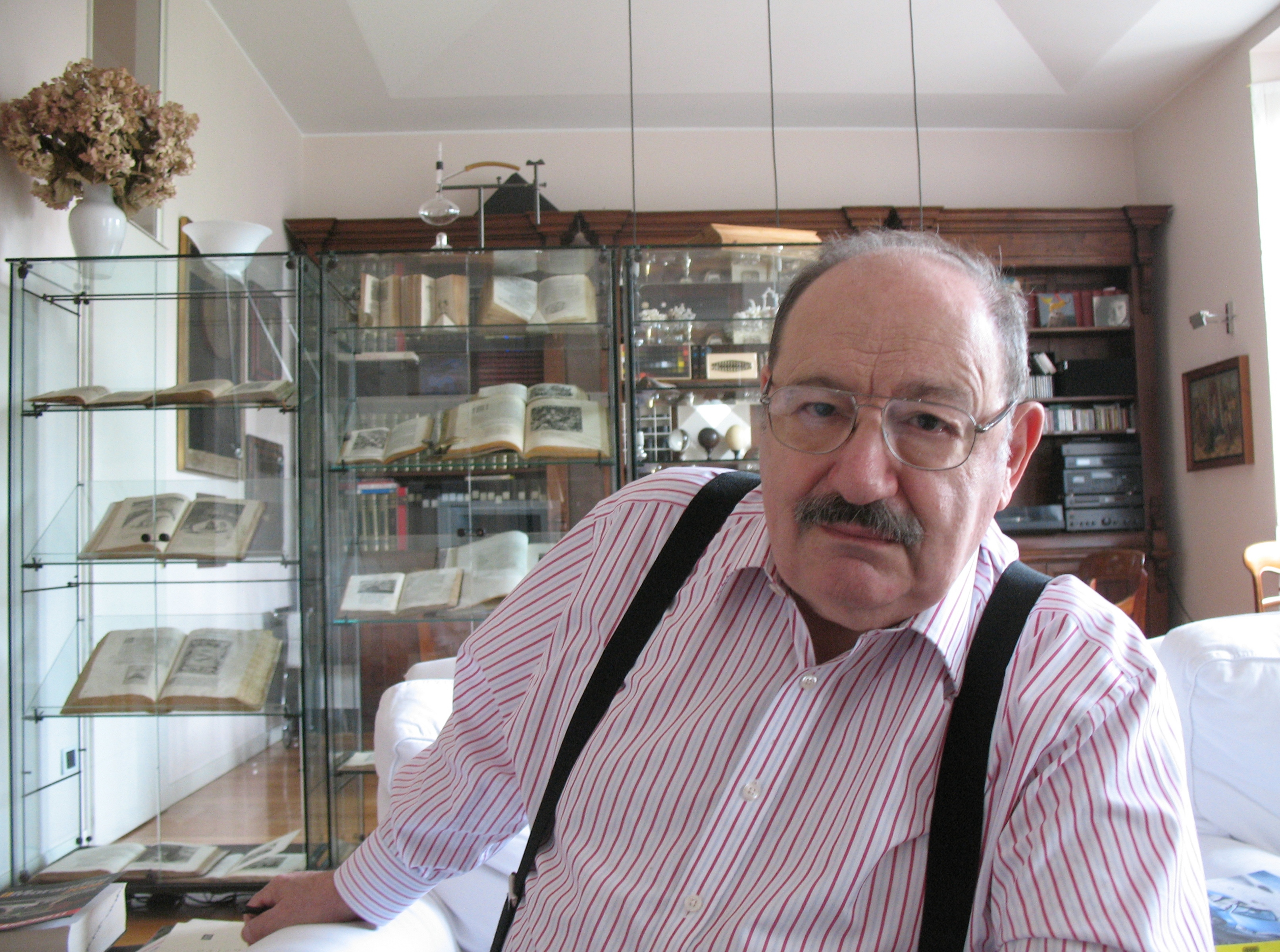 Umberto Eco, in his studies of mass media and culture, has an essay on popular new devices. His thesis is that they start out by being used by the wealthy and then get used by the common man, and lose much of their value from the law of diminishing marginal returns.
He uses the railroad and cell phones as examples. I have found that many new things like the smart phone have decreased their marginal productivity. Studies show that 30% of users sleep with their smart phone next to their bed. I have not had the displeasure of being interrupted in romance by a smart phone ringing yet and answered, but I am told it is common.
What are the implications of this for market analysis, especially of individual stocks. I find that my past research which did not use "as is" files and was heavily dependent on compustat is deeply flawed. Indeed my approach seems flawed. I am trying to improve for the future. My kids seem to make money with their stock purchases based strictly on the future growth of popular products among the younger generation. I wonder how to improve.
Thomas Miller writes:
Maybe Peter Lynch was on to something although I don't see how his "method" can be quantified.
Nov
18
Op-Ed on Dodd-Frank, from Don Coursey
November 18, 2012 | 4 Comments
 I wanted to share my latest oped with dailyspec, as I thought you might find it interesting, and perhaps worth writing about.
In the piece, I explain why Dodd-Frank, the federal law designed to regulate Wall Street, is actually harming farmers — and could end up raising food prices for ordinary Americans. The law's ham-fisted approach to derivatives is wreaking havoc on the "swaps" that farmers use to guard against swings in the price of their crops.
—
The Dodd-Frank Net Might Ensnare the Family Meal
Federal regulators recently roiled America's farmers with the release of new rules for financial instruments. The Commodity Futures Trading Commission, one of the agencies charged with implementing the Dodd-Frank Wall Street Reform Act, officially announced the new requirements and said they would take effect by year's end.
What does Dodd-Frank, passed in response to the 2008 economic crisis and aimed at reforming a vast swathe of the financial sector, have to do with farmers?
A great deal. Among the instruments covered by the Commission's proposals are agricultural commodity "swaps." Basically, swaps empower farmers, ranchers, agribusinesses and other food suppliers to hedge against certain risks common to their trade, like bad weather or a crash in the price of a food item they sell.
Swaps might sound like they serve some distant, exotic purpose far removed from the lives of average Americans. But they play a key role in providing food producers with a basic level of financial security through tough times, which helps to ensure price stability for consumers.
Consequently, the way the Commission imposes Dodd-Frank rules on these instruments will have a profound effect on Americans' pocketbooks. And right now, all signs indicate the Commission's approach to implementing Dodd-Frank is going to inadvertently smother agricultural swaps with over-regulation.
In the rush to prevent another crisis, it has cast its net too wide. As a result, Dodd-Frank could make risk management significantly more costly for America's farmers, driving up volatility in the market and potentially leading to huge price increases for consumers.
The Commission's new rules affect agricultural commodity swaps that aren't sold on exchanges and don't run through third-party intermediaries –so-called "over-the-counter" swaps.
Consider a bread baker in Kansas City. He buys thousands of pounds of flour each year. Because of this year's droughts, though, he's worried that America's wheat supply will shrink, driving up flour prices over the next twelve months.
So, to hedge against a price spike, he buys $10,000 in over-the-counter flour swaps today to guarantee that next year he'll be able to purchase up to 10,000 pounds of flour for $1 per pound. In 12 months, if the price of flour is dramatically higher, he'll have saved himself a huge amount of money. The price could also be lower, of course, but that's the risk he runs in order to guarantee he won't go bankrupt.
Right now, over-the-counter agricultural swaps are mostly unregulated. But that shouldn't be a point of concern — these instruments had nothing to do with the financial meltdown.
Nevertheless, this new round of Dodd-Frank rules would impose a slew of new requirements on these instruments. Buyers and sellers would have to trade them on approved exchanges, and they would need to have a certain level of capital on hand to trade. Reporting rules regarding profits and losses would be ratcheted up.
There would also be mandatory "clearing," meaning swap trades would be required to run through certified middlemen. This is a particularly backwards idea.
The over-the-counter agriculture swap market has been running safely and efficiently for years without mandatory middlemen. No one — not even the regulators charged with implementing Dodd-Frank — claims otherwise.
On the other hand, the traditional futures market operating under mandatory clearing rules has been home to some of the biggest financial meltdowns of the last few years. About a billion dollars evaporated before the brokerage firm MF Global declared bankruptcy in October 2011. And Peregrine Financial had racked up a $200 million shortfall in customer funds before it was forced to shut down in July.
The clearing rules regulators are so eager to foist on over-the-counter agricultural swaps were in full force for both MF Global and Peregrine. And yet, the system still suffered massive losses. This regulatory structure is obviously broken.
So implementing Dodd-Frank as planned means forcing agriculture swaps to move from a regulatory environment that is universally acknowledged to be working well to one that has failed repeatedly to prevent fraud and abuse. That's just senseless.
Overregulation can be just as dangerous and costly as under-regulation. And in this case, these invasive Dodd-Frank rules could dramatically drive up operation costs for farmers, ranchers, and others involved in food production. The rise in expenses would, in turn, be passed along to American consumers in the form of higher food prices.
Some farmers would no doubt be driven out of the swaps market altogether. With no way to manage financial risk, the next hurricane or tornado could put them out of business.
At the very least, regulators need to give themselves more time to study this issue by installing a three-year moratorium on the Dodd-Frank rules governing agricultural commodities. Blindly marching ahead and imposing strict new requirements on these instruments would wind up doing substantially more harm than good.
*Don Coursey is Ameritech Professor of Public Policy Studies at the Harris School of the University of Chicago.
Nov
18
Prediction Markets: Unusually Wide Arbitrage Opportunity, from Igor Z
November 18, 2012 | Leave a Comment
 I found something interesting and unusual today that I thought would be most appropriate on your site.
An exploitable arbitrage opportunity is developing on the eve of the US Presidential election on some of the more active prediction markets. The following quotes are as of Nov. 5 8:19 PM EDT:
- Intrade sells Obama to win at $6.76 (meaning you can buy a binary futures contract that pays $10.00 in the event of an Obama victory for $6.76). There is about $50,000 worth of unmatched contracts ready to be sold instantly between $6.76 and $7.00.
- Betfair has matched 1.28 odds on Obama (meaning you can win $1.28 for each dollar bet on Romney). There is about $60,000 worth of contracts ready to be matched instantly between 1.29 and 1.31.
Assuming you buy $50,000 of Obama above market on Intrade at an average price of $6.88, and sell $58,140 of Obama at an average bet of 1.3 on Betfair, your payoff at expiry (i.e. most likely within 48 hours) will be as follows:
Obama victory: $(72,674-50,000)+(58,140-75,582) = $5,232 profit. Romney victory: $(0-50,000)+(58,140-0)*0.95 = $5,233 profit.
That's a 4.8% *risk-free* return in two days (note that this is after all transaction costs), which is a conservative estimate since it assumed that you play aggressively and snap up market orders at a significant premium. If playing with more than $100,000, say $1M, the return goes down to about 3%, which is still nothing to scoff at considering the time-frame is two days.
The reason that this arbitrage exists is that, unlike more conventional markets, this one is difficult for US citizens and some Europeans to exploit for structural reasons. The IRS, for example, won't allow tax write-offs for losses on either market (in fact the activity altogether 'may' not even technically be legal for US citizens). For this reason, a law-abiding American would wind up paying so much in taxes on the winning side that the net would be negative.
But for someone from a country with less hostile online gambling laws, and a little quantitative know-how to find the right asset mix, there is free money to be extracted from this preposterously inefficient market. If I weren't the law-abiding American I am, I'd be picking it up right now; having to watch others do it because of my country's puritanical laws is more than a little annoying.
Maybe your readers would enjoy this little slap in the face to efficient market theory, even if not in time to make proper use of it. Thanks for your time!
Regards,
Igor Z.
Nov
13
Analogy of the Day, from anonymous
November 13, 2012 | Leave a Comment
Mumboism is to trade flexionics as Petraeus' wife is to Petraeus?
Available ex-ante mumboism mined trading signals is useful even to anti-mumboists?
Nov
8
Romney’s Campaign, from Dan Grossman
November 8, 2012 | 1 Comment
 I voted for Gary Johnson, but come on, Romney didn't commit all kinds of blunders. He ran a decent, energetic campaign. Far better than McCain or Dole or probably even the Bushes. It took Romney until late in the campaign to hit his stride, but by the end he sounded far better on the stump than did Obama. And of course he won the debates.
But every time Romney opened his mouth, the press crucified him for a blunder. When he made a very mild and presumably knowledgeable comment in London on preparations for the Olympics, the nationalist, socialist English press cried he had insulted their country and the US press piled on that his foreign trip was a disaster. When he happened to mention being supplied with binders of women, it was absolutely the worst, most anti-women comment anyone could every make. When he questioned the apologetic US reaction to the Libyan riots, the press said he was politicizing a tragedy. Meanwhile the President could ignore pleas to send support for our diplomats, resulting in the murder of our ambassador and shorted-handed former Navy Seal security team, and the press was totally uninterested in looking into or even reporting the matter.
But the real trouble was structural, as Vic pointed out. It is now, and certainly will be in the future, impossible for a Republican presidential candidate to win.
Based on exit polls, Romney won 58% of the White vote, Trouble for him was that Obama won 93% of the Black vote, 67% of the Hispanic vote, and 75% of the Asian vote. BTW Romney also won 60% of the married vote of all races — an incredible figure never mentioned in the blizzard of commentary about Romney's "war on women." These are figures that would have resulted in a landslide for Eisenhower or Kennedy or Reagan.
All in all, Romney won the traditional American vote. What Obama won could somewhat unfairly but not totally unreasonably be characterized as the anti-American vote — the alienated minorities, those on the dole given Obamaphones and such, the capitalist cronies, the lefties and naive young, the Hollywood dabblers, the academics and a large chunk of the intellectuals.
Nov
5
The 1% and Big Government, from Omid Malekan
November 5, 2012 | 1 Comment
 Today's little relief mission to the hard hit Rockaways area was very telling. Fema and NYC relief crews were nowhere to be seen, and everything was being run by a local city councilman and an army of volunteers.
The folks who run the public library down there had decided to turn it into a makeshift relief center, and we were able to get them a much needed generator and some other supplies. The most relief was provided by millionaire hedge fund manager Roy Niederhoffer, who in 1 day managed to put together an army of people to bring down cars and even a 26 foot u-haul truck with enough pre-sorted food to support 100 families of 4 people for days. Note he didn't just write a check, but he actually quarterbacked the entire operation (for the second day in a row).
Oh, and when we were leaving trucks for the New York Daily News (owned by billionaire Mort Zuckerberg) rolled up to drop off much needed blankets.
I wish Mitt Romney had written a check for $10 million bucks and called up his other wealthy CEO buddies who run companies like Costco or Home Depot and had them divert a bunch of trucks down to the hart hit areas. That would have been the best answer to the constant ridicule by liberals that he's just too darn rich.
Mick Tierney writes:
Just to provide a little balance to the "1% big government" post, here's a story I heard just this morning.
Our 73 year-old pastor takes three weeks off every Spring and Fall to re-visit small churches in Virginia, West Virginia, and North Carolina (a routine he established about 17 years ago). He takes another four weeks each summer for a church/school/medical facility he has established in Haiti (a project begun about 20 years ago).
This year he was asked to make a first visit to a small church (35) in the vicinity of the SETI Institute — obviously in the middle of Nowhere, WV. While there he and his wife were invited to dinner by one of the church members. After discussing various local issues, he asked if his hosts had ever met any of the SETI staff.
They replied that they had receive one visit. Late one afternoon a gentleman knocked at their door and announced that he had a heating blanket for them. They thanked him kindly but refused as they already had one.
He informed them that he was aware of this, but that their current blanket had developed a short. They checked and discovered he was right - without explanation he gave them the blanket and left.
Now you can return to the possibilities of election day computer hacking.
Nov
2
How to Tell if You Are the Target of Bullies, from anonymous
November 2, 2012 | 3 Comments
 Bullies, as adults, generally abuse their authority. If you stand for excellence and have some success you will attract the attention of bullies. It has been my experience that bullies hate a good success story but despise the successful more for the attention and admiration of others than their success. The heroes of myths, Bible stories, and legends are often victims of the drummed up accusations of bullies. Apparently, most ancient cultures were gravely concerned with bullies in everyday adult life.
Here are several tells that a bully's complaint against you is a witch hunt rather than legitimate complaint:
1. You are singled out after publicity.
2. Many interviews are held and are fishing expeditions of your weaknesses.
3. In these interviews, there are two types of witnesses, those that routinely support the bully and those that are intimidated and gladly rat out their neighbor to get the bully to leave their doorstep.
4. The interviews are one sided.
(It is widely known that the bully and their cohorts have immunity for much more corruption. Interrogations do not happen for them. Romance, money and power are often a triangular core. The bully often is a mistress of the ruler in the stories)
5. The bully often will intimidate and harasses the friends and family who would give the moral support to the victim.
6. It makes no financial sense for the bully to waste so many resources pointing out your minor faults.
It makes sense to do whatever it takes to rid yourself of an organization that allows one to be bullied.
I wonder if the moral implication of the ancient stories is correct, that rampant bullying is a subtle sign of an empire or emperors impending sudden chaotic demise…
Nov
1
NYC Junto, from Victor Niederhoffer
November 1, 2012 | 1 Comment
 The NYC Junto will still be meeting at the usual place, the Mechanics Institute, 20 West 44th Street New York, NY, at 7pm Thursday November 1, 2012 with Mr. Greg Rehmke delivering a talk on evolution of economic behavior.
Hope to see you all there!
Sincerely,
Victor Niederhoffer and Dailyspec
Nov
1
Flood Insurance, from Alan Millhone
November 1, 2012 | 1 Comment
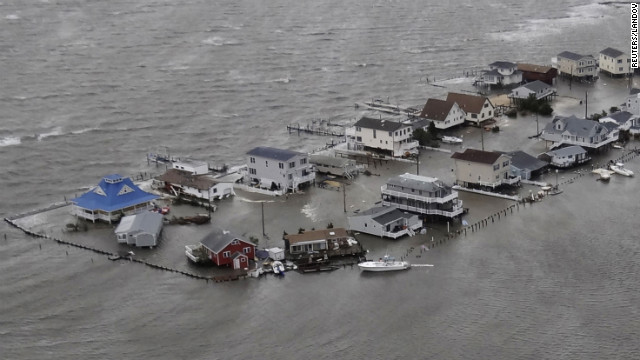 I wonder how many homes are not covered due to lack of flood insurance or not being able to get coverage on Jersey Shores etc. ?
Anonymous writes:
Flood insurance is easy to get. There is a "basic" version and an add-on. The basic version on our Jersey Seashore house cost $20 per $100k of coverage and the add-on was an extra $47, PER YEAR. It is subsidized by the Federal government, which is why it is so cheap. Only an idiot would not have it. And yes, there are idiots out there. If you are in a flood-prone area, you want as much insurance as you can get.
If you are not in the defined "flood plain" it can be difficult to get flood insurance because the Feds do not subsidize it. We also had a lakefront property that somehow managed to be out of the designated flood plain. Coverage for that property was about 3 times that of the beach house. And that property did have some minor flood damage, although I chose not to submit it.
Bill Herrmann adds:
Federally subsidized flood insurance is a very good example of government incentives pushing the economy in the wrong direction. Just as “Too Big to Fail” encourages some institutions to take larger risks then they would otherwise, federal subsidized flood insurance encourages building in the flood plain. (Which is generally not a good idea.)
Oct
18
Truck-care, from anonymous
October 18, 2012 | Leave a Comment
 I took my aging beloved 100k plus mile truck to her certified primary care provider (dealer) recently and they identified $5000 worth necessary procedures which they printed in a very nice report. With same report I got a second opinion from a smaller family run care provider (garage) who I trust, at one fifth the cost. Since I am paying this is out of pocket I opted for the cheaper one. If another party was paying this for me I would have been indifferent.
anonymous comments:
For those going on Medicare, the death panels are not panels but cost containment measures put into place.
What has changed treatment the most in the last few year is "adverse" reaction to treatment. The Doctors have to pay for treatment out of their own pockets if after initial treatment, the patient has an adverse response within set time periods based on the condition.
The doctor not wanting to risk the lose of income and time, therefore will only accept the most physically fit for hip replacement or even cardio operations.
"He is a smoker that overweight, what does he expect if his hip goes out…we don't guarantee miracles." is a typical response felt if not said.
One wonders if this will actually cause the working poor and lower class to receive less treatment than before, at least at their most critical point in their lives, as these are often are the people with the highest probability of "adverse events".
an anonymous person comments:
Well, what are some thoughts around the notion that if individual people are more financially responsible for their own health care, they will take better care of themselves?
anonymous responds:
This I believe is the most insidious part, most people that get medicare trust the government way too much to question that they will be getting less care not more, under a medicare plan. Handouts are seen as "free money" without consideration for their second order effects on incentives and motivations.
This is especially true amongst the working poor class in my opinion. It will be generation X and Y before the "lesson" (they need to take better care of themselves) will be accepted. By then either medicare will be cut so far back or rationed to a point where by the time you are 65, everyone, if they have half a brain, becomes a "Medicare conservative" because they have seen Government work.
Oct
3
October 4th Junto, from Dailyspeculations
October 3, 2012 | 1 Comment
Tomorrow night, Thursday, October 4th, is the Junto.
It will be held at the General Society Library,
on 20 West 44 St., between 5th and 6th Aves.
Gary Hoover will be giving a talk called Think Like An Entrepreneur.
The talk will begin promptly at 8pm but we will socialize beginning at 7pm.
All are welcome.
From Victor and Dailyspeculations
Oct
2
The Value of One Vote, from Pete Earle
October 2, 2012 | Leave a Comment
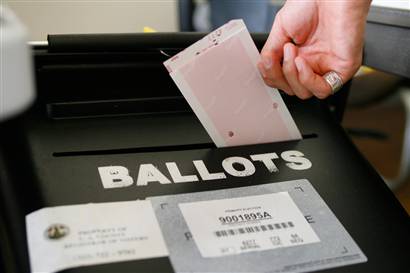 If the average welfare recipient receives something on the order of $43,000/yr, and the average American's salary is $46,000/yr, the personal discount rate is approximately 6.52%.
There's no initial capital laid out to get on welfare, just a lot of forms and standing in line; But many welfare recipients don't really forgo income to stand in line, so I'm using $0.
Given that the Presidential term is 4 years, the total welfare benefit over those 4 years is $172,000; applying the simple NPV, is a single vote "worth" approximately $156K?
Gary Rogan writes:
A single vote, for some specific person, is worth ANY amount of money to that person if they aren't the ones paying for it. The now violent riots in Spain and the free phone lady and the $16 trillion deficit are all consequences of that one simple fact.
Sep
28
The Value of a Bachelor’s Degree, from anonymous
September 28, 2012 | 7 Comments
She had wanted to go to Wesleyan. It had everything she was after–small liberal arts school with lots of on campus activities, a strong record of graduate/work placements, small size, and a school where parties were not the rule of the day. Oh, and that it was on the other coast, away from my wife and me, only increased her interest in the school. She was also looking at Wellesley, Colby, Bowdoin, Carleton, Grinnell, and so on. Some public ivies too–U Wisconsin Madison, U Washington, and even some of the U of Californias, though the latter is her safety school.
The problem with the liberal arts colleges is that they now cost a fortune. Generally north of $45K a year and often north of $50K. The situation with the ivies isn't much different–they also cost a small fortune. The out-of-state tuitions for many universities (including the public ivies) are in the mid-20K range, and the chances of finishing in 4 years when attending them is diminishing by the semester. Needing to attend a U of Cal for 6 years to finish a major used to be a rarity. Not anymore. And there is no reason to think the status quo will improve any time soon. Here in California, the system developed by Pat Brown (the current governor's father) had the U of California system, the Cal State system, and then regional community college system. Not only are these systems struggling to find some way of increasing their capacity, but they are doing so at a time when the state government is cutting funding for education throughout the state, including these three post-secondary systems. This problem is not limited to California. In the SUNY system, all tuition goes to Albany, and the state legislature decides how much goes back to the individual campuses, rather than looking at each campus as a P&L center (as U of C campuses do).
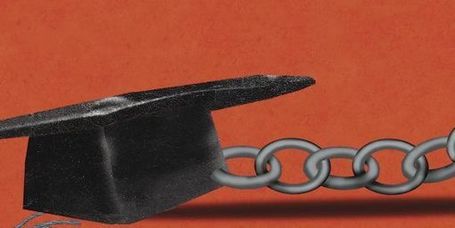
Why bring all this up? My daughter is now contending with the question of what's the best value for getting a college education rather than what's the "perfect place" for her. So far, so good. This was what we discussed last night at dinner, and it got me thinking about the post-secondary education system here in the US. At the college level, that system has been in place for three centuries or so. At the graduate/professional level, the current system came into being during the mid-to-late 1800s. The problem is that with the current levels of tuition, the cost of a baccalaureate is rapidly becoming (if not already there) out of reach for much of the middle class population. Using loans is rapidly becoming untenable in the face of college grads unable to find jobs and one-in-twelve of the workforce unemployed. (I won't get into the loan fiasco as regards professional grads–the average medical student having debt north of $150K and for more than a third, it's in excess of $200K.) For many of the existing loans, it seems likely that someone other than the college grad will be left paying the bill. That's debt of about $1.2 trillion at risk. The bottom line is that the current system is rapidly becoming–if it is not already–unsustainable.
The question must be asked about what is the value of a bachelor's degree. I ask the question because it is becoming easy to have access online to some of the outstanding courses available at many of America's premiere universities. Will a degree really have much value when an employer is interested in what you have learned somewhere–online or in person? It used to be that the only way to obtain the knowledge was to attend a college or university in a degree program. The degree was a proxy for knowledge. But there are now other sources for obtaining that knowledge–does spending the money on a college degree make sense any longer?
The situation is even more daunting when you consider that during the mid-1970s, when I went to Johns Hopkins, tuition was about $3K a year. That was also the price of a Chevy Nova car at that time. A Chevy Spark now costs under $15K, and has a MSRP of $12K and change. Tuition at Johns Hopkins today? $50K.
All those contributions to one's alma mater are prolonging the day of reckoning for a system that will need to undergo extensive reform, and that reform will need to accommodate other forms of education rather than only in-person class attendance. Western Governor's University (www.wgu.edu) may be one example, but insofar as it is built around actual degrees, I'm not sure that it's the only type of solution.
An educated workforce is a major prerequisite for a competitive United States, yet the education system is in the middle of a crisis about which there is precious little discussion. That has to change.
Richard Owen writes:
Education is becoming the quintessential branded luxury, taking a commodity input and stamping it with a brand.
Markets are made at the margins: the price driver has been (i) the rising share of wealth located abroad and (ii) the higher percentage of production available to the best paid domestic workers. The West is importing the GINI ratio of the Emerging Markets when it comes to high end property, education, etc.
Take British public schools: fees are now $45k/yr for the full school life, rather than just a terminal three years at college. For three children that's $135k/yr post-tax wage dollars. 7% of the UK is privately educated historically, yet the former figure is well into the 1% income range. Whats made up the marginal demand? Wealthy foreigners with untrammeled, untaxed, EM boom dollars. London is undergoing a reverse colonization. Hence in some bijou streets in the capital, residential is up 40% in two years, (having fallen not at all during the crisis, so that's not a bounce off the lows).
Carder Dimitroff adds:
I have two daughters in their 20s. Both have Ivy-league degrees. Frankly, I'm not sure Ivy matters.
There are wonderful state and private colleges. Most decent universities offer inquiring minds incredible opportunities. If a student is looking to learn and grow, most "average" universities can dish out more than most students can handle.
A good example is my cousin's daughter. She attended a low profile public college in Florida. She went in with the attitude of learning and developing. She and several of her classmates became Fulbright Scholars. Now she is Ph.D. candidate at Duke.
If you look at Ph.D. candidates at the nation's leading research institutions, you may notice most of them never attended Harvard, Yale or Princeton. The same can be said for many business, political and military leaders.
Each school has its own culture. In my opinion, a key to a parent's success is matching the college with the student's personality. If the student love the place from day one, all is good.
Sep
27
The Diaoyu/Senkaku Islands Dispute, from Craig Mee
September 27, 2012 | Leave a Comment
 For anyone who is interested…it seems this event involves quite a bit of he said she said, with some good old miscommunications, and selected curve fitting thrown in for good measure.
"The Inconvenient Truth Behind the Diaoyu/Senkaku Islands" :
My research of over 40 official Meiji period documents unearthed from the Japanese National Archives, Diplomatic Records Office, and National Institute for Defense Studies Library clearly demonstrates that the Meiji government acknowledged Chinese ownership of the islands back in 1885.
Anonymous adds:
In the current drama of this event, the very ownership of the island, though seemingly at the core, is actually a very secondary issue. What is worth watching are the following.
1) In a country where there is zero tolerance for demonstrations and even public gatherings, how come there were suddenly so many demonstrators on the streets?
2) Why is there is so much resemblance between the main slogans, banners and pictures? Who made them?
3) During some demonstrations in front of Japanese embassies, why weren't passersbys allowed to join in? Who were those allowed?
4) Of the people leading most of the violence in the streets, how come many are short-haired, tan-faced, strong-muscled, young and well-coordinated? How come they had no fear of the police when doing the violence?
5) At a time when Bo Xilai is being judged and when the Party leaders are fighting in closed doors for who will take charge in the future, is all this just a coincidence?
Sep
21
What the Hell is Happening in the World, from Peter Tep
September 21, 2012 | 1 Comment
Afternoon esteemed (daily)specs,
I haven't done any research on the data and the numbers but even a fool like me can observe world wide stock markets, look at the release of data of economic indicators and see that something fishy is going on. I'm referring particularly to the Australian market and the release of the Chinese PMI Manufacturing numbers, and the dropping of iron ore prices.
Ready to take notes…..
Sep
20
i got 104 points in scrabble, from Aubrey Niederhoffer
September 20, 2012 | 3 Comments
 i almost beat your record points in scrabble with 104 points with disquiet. i scored bingo points and triple word score and double letter score on my u. love, aubrey
Uncle Roy replies:
WHOA!! Good work! I can't wait to play with you sometime. Here are some helpful tips:
Make sure to think about having even numbers of vowels and consonants in your rack after you play your word - so on your next rack you won't have all vowels or all consonants.
Leaving double letters in your rack for next turn is usually bad, except E which is only a little bad.
Try to score at least 60 points with each blank you get.
Learn all the 2 letter words (there aren't that many") and play words parallel to each other for extra points.
On your first move, if you don't score 18-20 (including the double word), pass and draw new tiles to try to get a bingo if you think you're close.
QI and ZA are very useful… and don't forget trying to use X on a triple in two directions which scores 52 at a minimum.
Think about what you "leave" in your rack for next move. If these letters are "good" letters like ETAION SHRDLU (the most common letters in English words), you're likely to draw some more of them, and then be able to make a bingo.
Unless you have two S's,don't use an S unless it is an above average score (for you) - usually average is about 20 so try to make S really count.
Good players get an average of 1.5 bingos per game. You should be getting at least an average of 1 for now… and 1.25 when you learn some more words as you get older.
At the end of the game, think whether the other player has a Q, Z or X. If they do, don't get let them play them by making ZA or QI or QAT.
Here is a list of two and three letter words which is worth learning.
I love you! See you very soon!!!!
Love Uncle Roy
AA AB AD AE AG AH AI AL AM AN AR AS AT AW AX AY BA BE BI BO BY DE DO ED EF EH EL EM EN ER ES ET EX FA GO HA HE HI HM HO ID IF IN IS IT JO KA LA LI LO MA ME MI MM MO MU MY NA NE NO NU OD OE OF OH OM ON OP OR OS OW OX OY PA PE PI RE SH SI SO TA TI TO UH UM UN UP US UT WE WO XI XU YA YE YO
——————————————————————————-
AAH AAL AAS ABA ABO ABS ABY ACE ACT ADD ADO ADS ADZ AFF AFT AGA AGE AGO AHA AID AIL AIM AIN AIR AIS AIT ALA ALB ALE ALL ALP ALS ALT AMA AMI AMP AMU ANA AND ANE ANI ANT ANY APE APT ARB ARC ARE ARF ARK ARM ARS ART ASH ASK ASP ASS ATE ATT AUK AVA AVE AVO AWA AWE AWL AWN AXE AYE AYS AZO
BAA BAD BAG BAH BAL BAM BAN BAP BAR BAS BAT BAY BED BEE BEG BEL BEN BET BEY BIB BID BIG BIN BIO BIS BIT BIZ BOA BOB BOD BOG BOO BOP BOS BOT BOW BOX BOY BRA BRO BRR BUB BUD BUG BUM BUN BUR BUS BUT BUY BYE BYS
CAB CAD CAM CAN CAP CAR CAT CAW CAY CEE CEL CEP CHI CIS COB COD COG COL CON COO COP COR COS COT COW COX COY COZ CRY CUB CUD CUE CUM CUP CUR CUT CWM
DAB DAD DAG DAH DAK DAL DAM DAP DAW DAY DEB DEE DEL DEN DEV DEW DEX DEY DIB DID DIE DIG DIM DIN DIP DIS DIT DOC DOE DOG DOL DOM DON DOR DOS DOT DOW DRY DUB DUD DUE DUG DUI DUN DUO DUP DYE
EAR EAT EAU EBB ECU EDH EEL EFF EFS EFT EGG EGO EKE ELD ELF ELK ELL ELM ELS EME EMF EMS EMU END ENG ENS EON ERA ERE ERG ERN ERR ERS ESS ETA ETH EVE EWE EYE
FAD FAG FAN FAR FAS FAT FAX FAY FED FEE FEH FEM FEN FER FET FEU FEW FEY FEZ FIB FID FIE FIG FIL FIN FIR FIT FIX FIZ FLU FLY FOB FOE FOG FOH FON FOP FOR FOU FOX FOY FRO FRY FUB FUD FUG FUN FUR
GAB GAD GAE GAG GAL GAM GAN GAP GAR GAS GAT GAY GED GEE GEL GEM GEN GET GEY GHI GIB GID GIE GIG GIN GIP GIT GNU GOA GOB GOD GOO GOR GOT GOX GOY GUL GUM GUN GUT GUV GUY GYM GYP
HAD HAE HAG HAH HAJ HAM HAO HAP HAS HAT HAW HAY HEH HEM HEN HEP HER HES HET HEW HEX HEY HIC HID HIE HIM HIN HIP HIS HIT HMM HOB HOD HOE HOG HON HOP HOT HOW HOY HUB HUE HUG HUH HUM HUN HUP HUT HYP
ICE ICH ICK ICY IDS IFF IFS ILK ILL IMP INK INN INS ION IRE IRK ISM ITS IVY
JAB JAG JAM JAR JAW JAY JEE JET JEU JEW JIB JIG JIN JOB JOE JOG JOT JOW JOY JUG JUN JUS JUT
KAB KAE KAF KAS KAT KAY KEA KEF KEG KEN KEP KEX KEY KHI KID KIF KIN KIP KIR KIT KOA KOB KOI KOP KOR KOS KUE
LAB LAC LAD LAG LAM LAP LAR LAS LAT LAV LAW LAX LAY LEA LED LEE LEG LEI LEK LET LEU LEV LEX LEY LEZ LIB LID LIE LIN LIP LIS LIT LOB LOG LOO LOP LOT LOW LOX LUG LUM LUV LUX LYE
MAC MAD MAE MAG MAN MAP MAR MAS MAT MAW MAX MAY MED MEL MEM MEN MET MEW MHO MIB MID MIG MIL MIM MIR MIS MIX MOA MOB MOC MOD MOG MOL MOM MON MOO MOP MOR MOS MOT MOW MUD MUG MUM MUN MUS MUT
NAB NAE NAG NAH NAM NAN NAP NAW NAY NEB NEE NET NEW NIB NIL NIM NIP NIT NIX NOB NOD NOG NOH NOM NOO NOR NOS NOT NOW NTH NUB NUN NUS NUT
OAF OAK OAR OAT OBE OBI OCA ODD ODE ODS OES OFF OFT OHM OHO OHS OIL OKA OKE OLD OLE OMS ONE ONS OOH OOT OPE OPS OPT ORA ORB ORC ORE ORS ORT OSE OUD OUR OUT OVA OWE OWL OWN OXO OXY
Sep
14
To Whom We Owe Much, from Carter Dimitroff
September 14, 2012 | Leave a Comment
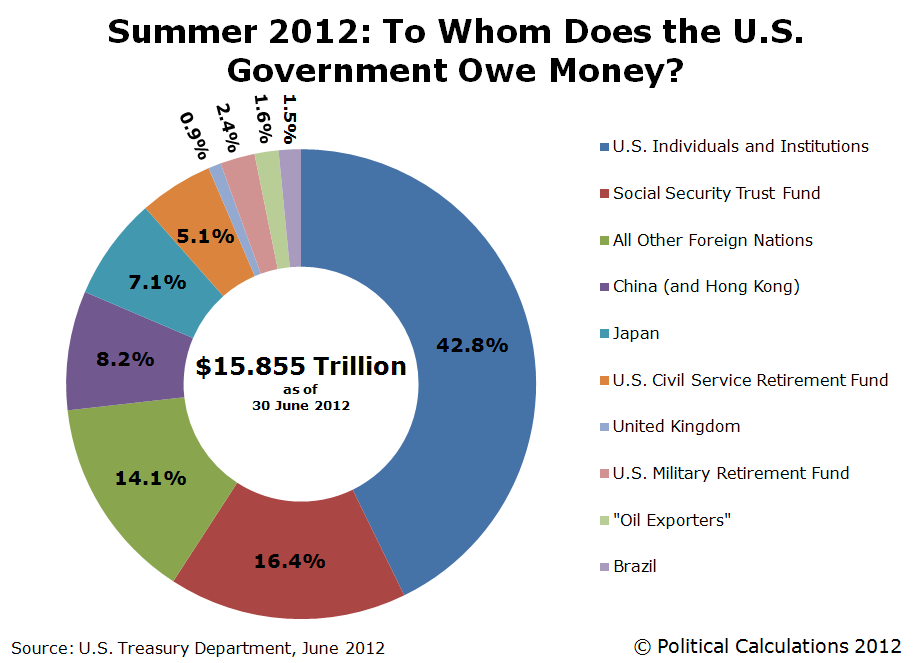
I saw this chart on the esteemed Political Calculations web site. I notice the graph shows Japan, U.K. and Brazil holding some of our debt. How much debt does the US hold in other nations? If that debt were added, would a net debt picture look better?
Aug
31
Five Steps to Critical Thinking, from Bo Keely
August 31, 2012 | 3 Comments
 Graham Greene wrote in The Quiet American, "Innocence is like a dumb leper who has lost his bell, wandering the world, meaning no harm."
For me at ten years the loss of innocence was trying to look out the Idaho living room window one evening with a light on inside and snow outside and I was surprised to see my reflection. For an instant there was confusion to who I was: the reflection or what it saw. I moved slightly to feel my body and determined thereon to be the person inside it.
A second mindful decision occurred twenty years later in a Michigan kitchen alone reading and a sentence from Carl Jung´s Memories, Dreams and Reflections. I looked up abruptly from archetypes as universal thoughts, symbols, or images having a large amount of unconscious power, and are shared… and it popped into my head from that point on to control my own thoughts. With willful effort I practiced the multiplication tables for ten minutes until the answer to 2 x 2 did not arrive until I caused it.
The third grave verdict that has shaped my life took place in a Michigan basement while reading Lewis Carroll's Through the Looking Glass where the page turned to the hideous monster poem ´Jabberwocky´. It´s written in mirror text, and it doesn't matter that I was reading in a coffin lined with electric blankets against the icy wind whooshing through the wall cracks, or that I was reading with an Edmond Scientific top grade mirror to reverse the text so the Jabberwocky came alive from left to right. Suddenly it dawned on me that I could turn the book upside down to cause the print to flow right to left and dispense with the mirror and monster. That´s how I´ve read hundreds of book to date, and the reason is to balance the body, eyes and brain to a more perfect symmetry to think better critically.
The fourth waypoint on the road to objective thinking was learning the chessmen and their moves that is as much a model as computers for the thought process.
The fifth rest stop is quotations that has become a lifelong study, and one of the best on critical thinking (that is attributed to no one) is "Critical thinking is thinking about your thinking while you're thinking in order to make your thinking better."
So in a long march to discovery of self along the best road I know how, in the first step I determined the body manufactures the thoughts; in the second that I could control the thoughts, on the third that the body must remain healthy and symmetrical to think better; on the fourth to use models to understand how the mind functions, and at the fifth to stand on other´s shoulders and pass along their advice.
Howard Zinn said, "History can come in handy. If you were born yesterday, with no knowledge of the past, you might easily accept whatever the government tells you. But knowing a bit of history- while it would not absolutely prove the government was lying in a given instance- might make you skeptical, lead you to ask questions, make it more likely that you would find out the truth." I might add this is not only true of government but of medicine, business, sports and anything else worth thinking about. The trick is to balance being skeptical and open. If you are only skeptical then no new ideas filter through to you and nothing new is learned. On the other hand, if you are open to the stretch of gullibility without an ounce of skepticism, then you won´t be able to distinguish the useful from the worthless.
The one skill everyone on the planet needs is the ability to think with objectivity. If we are prepared to think for ourselves, and learn how to do it well, there is little danger of becoming slaves to the ideas and values of others that is taking the earth and limiting self-potential. The list of core critical thinking skills includes observation, interpretation, analysis, comparison, evaluation and explanation
There are some training workouts: math, read Sherlock Holmes, logic riddles, and conversing with other critical thinkers. The number and direction of steps up from fuzzy thinking to a height of acute awareness varies from person to person. The ultimate step a quantum leap because no problem can be solved from the same level of consciousness that created it.
The adventure of critical thinking is the finding of self. You develop insights into what is and can be. I´ve found as much as possible, and the chase goes on.
Aug
31
Hurricane Isaac was Over Hyped, from Sam Marx
August 31, 2012 | 2 Comments
 I've lived in southeast FL for 13 years and have gone through Category 2 & 1 hurricanes and a borderline Category 2/3 hurricane.
Category 2 can cause severe damage, Categories 3 & 4 can be disastrous.
With some preparation, Category 1 can be slept through.
Tropical storms can cause inconveniences such as road flooding but not much damage. Isaac has been a tropical storm and a Category 1 . As such it has been overhyped.
I suspect there was a political reason for this.
Jeff Watson writes:
At the beach, on the Gulf side, even a direct hit from a Cat 1 is frightening, and that's why we have to evacuate even from a 1. Storm surge at high tide is a sight to behold.
Sam Marx comments:
People who live at the water's edge should be prepared for hurricanes or shouldn't live there at all.
Outside of the water's edge, a Cat 1 hurricane does not do much damage , except, inland, for road flooding and damaging some houses built under the very old building codes.
Isaac became a Cat 1 over water and quickly dropped to a tropical storm over land. It should not have received the excessive media coverage it got.
Tradercraft adds:
Tell that to the half a million people in New Orleans who are sweltering without air conditioning right now, and their frozen foods spoiling (can be several hundred dollars worth of food), and unlikely to get power back for a week, Entergy announced. Not something one can easily sleep through.
Sam Marx writes:
I believe there never has been so much media coverage over a Cat 1 hurricane or tropical storm in the past as given to hurricane Isaac.
Gibbons Burke writes:
The fact that it followed a path very similar to that of Katrina, and actually hit New Orleans on the seventh anniversary of that storm had something to do with the attention it received. But the fact that it was early on slated to hit Tampa during the RNC convention certainly got the media's interest in the storm going, and once they get started on something, they often like to beat it to death.
Victor Niederhoffer writes:
The wisdom of Gann in predicting confusion and uncertainty and volatility during the anniversaries of vivid events is underlined.
Anton Johnson adds:
Tips for live coverage of minimal hurricanes.
1. Wear loose-fitting rain gear, preferably with an open hood to better accentuate wind gusts.
2. Stand with feet sholder width apart and knees bent. Lean torso and head into the direction of the wind for effect.
3. Use minimal wind-screen on microphone, speak loudly as if straining.
4. Position shot to include a fluttering small diameter palm, and a dilapidated structure with flapping corrugated metal.
5. Adjust light filter for gloomy effect.
6. Cut to animated overly-enhanced color radar during lulls.
7. Pan to blowing fronds, leaves and trash if possible.
Aug
31
On Leaking News, from anonymous
August 31, 2012 | Leave a Comment
The increase in leaked govt news releases coincides with the rise in curated "machine readable" dedicated news feeds hawked by the various data mongers. Everyone in that product chain has an incentive to front-run. And it would make sense that the robot news traders would have the same moral compass as the quote-stuffing HFT crowd.
Aug
31
Family Ties, from Russ Sears
August 31, 2012 | Leave a Comment
Last year I visited Spain, visiting a friend who came to the states for education and then went back. He has a job in the Ag Dept. What he said was that family and tradition run deep. He said it was rare for young people to even think of doing what he did, graduate studies abroad outside Europe.
My impression was that family was the safety net beyond the government. Besides the Gypsies and hostel tourists, there were few homeless people. Few drug addicts or winos on the streets. I asked and he said the families take care of them for the most part.
I suspect that those not in denial may think the government cannot be counted on but surely their families will hold together.
Aug
31
Surfonomics, from Jeff Watson
August 31, 2012 | Leave a Comment
This is near to my heart, approaches 100% correct, and is the right way to approach any environmental issue.
"Surfonomics Quantifies the Worth of Waves"
Aug
28
Free Probabilistic Graphical Models Course, from Linden Doerr
August 28, 2012 | Leave a Comment
I found this excellent Stanford course recently and wanted to share it with the site.
Probabilistic Graphical Models
Daphne Koller, Professor
"In this class, you will learn the basics of the PGM representation and how to construct them, using both human knowledge and machine learning techniques."
Pros:
-online
-respected teacher
-no money cost for course
-textbook is $85 at Amazon (or $100 less discount through MIT Press)
-time cost (8-10 hr/wk for 11 wks)
-prereqs: one programming language, access to Matlab or Octave, and the ability to do some abstract thinking
Aug
27
How to Start Trading, from Lars Gutt
August 27, 2012 | 13 Comments
 Dear Mr Niederhoffer,
I really like your website dailyspeculations. There are a lot of fascinating and interesting articles that lead to new ideas and inspiration.
I read in the "About V.N & L.K" section that you trained some very successful traders and hedge fund managers. I am a student of business administration in Germany and want to work as a trader in the future.
It would be interesting to know how the training of your traders was structured and what were the most important things you focused on during the training? If you were now in my age (25 to 30 years), how would you start and where would you try to get the sufficient education for this business?
I hope that you can help me with your insights.
I wish you all the best and hope you will continue to share your insights on the markets.
Kindest regards,
Lars Gutt
Victor Niederhoffer writes:
This is a good question. Does anyone have a good answer besides reading a good statistics book like [the old] Snedecor, Horse Trading by Ben Green, Bacon's Professional Turf Betting, and starting a hypothetical trading account, and doing some hypotheses testing from a field they know something about?
Jeff Watson writes:
A big question is why you would want to trade. Trading is a pretty thankless job, very tough, and maybe you only see the media presentation, or you want to tell people at a cocktail party, "I'm a trader," but I'd like to see a why.
Having a good mentor, someone that you can apprentice to, is the most important thing in learning how to trade. A good instructor is much more important than Ivy League Degrees, how to manuals, internet chat rooms, books, systems, gurus, the financial media, and all the other mind numbing stuff out there.
My mentor when I first started was an 85 year old guy who was first trained by Art Cutten. He learned well from old man Cutten, and taught me how to keep out of trouble. The main lesson to learn in trading, more than anything else, is how to keep out of trouble. Manage to keep out of trouble, keep your own counsel, and the mistress might give you a second or third date.
George Coyle writes:
Series 3 study guide is a great (relatively brief) overview of the commodity futures industry. It touches on styles of trading as well as goes through lots of the unexciting but important details (order types, etc.). (Outline of material covered in exam [pdf]). (Online version of Study Guide by Investopedia).
From there the Market Wizard books are good to look at the different styles to see which sounds the best to you.
If quant focused I would say read something on how casino games work (odds and such–Richard Epstein's Theory of Gambling and Statistical Logic book is good) and think of how that might be applied to markets with the trader acting as the casino. Focus on keeping it simple, think of what is practical and possible when working with data.
Read your books of course. Read interviews with William Eckhardt. Larry Williams' recent book (LT Secrets for ST Trading) does a good job of outlining how quant works specifically, as does Charles Wright's Trading as a Business. Livermore's How to Trade in Stocks is a good one too (less popular than Reminiscences but more of a "how to" manual).
Deitel and Deitel C++ How to Program is the best C++ manual out there in my opinion. I dodged it for years but it is crucial and so useful. www.thenewboston.com is a great website to watch youtube vids on various languages to get your feet wet (but Deitel is necessary if you really want to learn the specifics).
And just start trading. The best teacher is experience. Even if equipped with all the great logic from above it seems real experience is necessary to actually follow the rules.
Craig Mee writes:
Understand valuation. Get a handle on all things that move a market price. Maybe have an 8 week internship of your own making with 8 different dealers. Corn farmer, art dealer, financial dealer, car dealer, importer, etc, and understand that whatever you're trading, you potentially should be able to move in theory from one to the other seamlessly. You are a valuer first and foremost, and if you value it wrong, you will also see how most of these choose to cut their positions. This might help to keep in the forefront of your mind what your mission actually is.
George Parkanyi writes:
Well if you can get past the fact that he finally went bust and blew his brains out, I found Reminiscences of a Stock Operator, about Jesse Livermore, to be quite useful. The most notable things I remember are (1) "making the most money when he was sitting, not trading" – meaning a position needs time to make really big money, and (2) to Jeff's point about staying out of trouble – averaging UP a position once its already showing a profit, and never averaging down a losing position. (The latter is especially important when trading with leverage.)
Ultimately, it still comes down to a style you are comfortable with – keeping the staying out of trouble part in mind; however you do that. And this may or may not involve the things mentioned above.
David Lilienfeld writes:
Go through some psychology texts–learn to understand human behavior and get to know one's own temperament. Understanding on an intellectual level doesn't help much if one's temperament is suited to trading. I have an old friend from high school who was on the Solomon trading in the mid-to-late 1980s. He hated it, often spent the weekends sweating his positions, etc. He moved on to be a buy side analyst, became the portfolio manager for a number of funds that succeeded pretty well under his direction and prospered. He had no trouble sleeping as a portfolio manager, and as I said, his funds did very well. A college roommate became a sell side analyst and was bored as could be doing his job. He did OK with it, but not great. He changed employers (at one point he thought about leaving the industry if he wasn't hired by someone to do something other be an analyst), started in its training program and found himself on the trading floor. He enjoyed it immensely and retired last year (I'm still not sure if he "retired" or was retired by his employer; looking at his homes, it's not as though he's wanting for much, so maybe he really did retire–but it's also not been a topic open to discussion, at least not with me). My guess is that just about everyone on this list has friends with similar stories. The bottom line: You have to know your temperament. You can learn the math, but if you don't have the fortitude, the math doesn't much matter.
The psychology part is understanding what people are about. Understanding gambling is about the mathematics of risk. Important stuff to be sure. But people matter too, and understanding what they are all about is also important.
Those are my recommendations. Lucking into a good mentor helps, but observing for a while is also one of the best teachers.
Aug
20
Air Fees, from David Lilienfeld
August 20, 2012 | Leave a Comment
 I'm headed to Barcelona on Tuesday for a week of business meetings. I decided to start using my old US Air FF miles for the trip (with more than a 1.2 million miles and given that I've stopped using USAir back in 2008, this seemed like a good use of them). Imagine my surprise to open my email this morning and find US Air's wonderful missive offering me citrus-marinated chicken skewers or vegetarian Portobello mushroom tortellini for the lovely price of $20. (I assume since this will happen somewhere over the Atlantic, there's no tax.)
And the airlines wonder why people complain about air travel?
It would be good if someone took a look at how much the airlines are actually making off of their baggage fees, too. Yes, it's revenue, but the consequence is that everyone who can brings their luggage as walk-ons. While it took maybe 15 minutes to board a plane in the 1990s, these days it's at least 30 minutes and often longer. That's time lost from being in the air, which is after all what the airlines are in business for in the first place. I don't know anymore which I dislike more–air travel or airline stocks.
Aug
12
Cold Reading and the Art of Fishing, from Craig Mee
August 12, 2012 | Leave a Comment
 Cold reading has much in common with market charlatans:
"There seem to be three common factors in these kinds of readings. One factor involves fishing for details. The psychic says something at once vague and suggestive, e.g., "I'm getting a strong feeling about January here." If the subject responds, positively or negatively, the psychic's next move is to play off the response. E.g., if the subject says, "I was born in January" or my mother died in January" then the psychic says something like "Yes, I can see that," anything to reinforce the idea that the psychic was more precise that he or she really was. If the subject responds negatively, e.g., "I can't think of anything particularly special about January," the psychic might reply, "Yes, I see that you've suppressed a memory about it. You don't want to be reminded of it. Something painful in January. Yes, I feel it. It's in the lower back [fishing]…oh, now it's in the heart [fishing]…umm, there seems to be a sharp pain in the head [fishing]…or the neck [fishing]." If the subject gives no response, the psychic can leave the area, having firmly implanted in everybody's mind that the psychic really did 'see' something but the subject's suppression of the event hinders both the psychic and the subject from realizing the specifics of it. If the subject gives a positive response to any of the fishing expeditions, the psychic follows up with more of "I see that very clearly, now. Yes, the feeling in the heart is getting stronger."
Jeff Watson writes:
Here's a great how-to" book on cold reading.
Bill Egan writes:
A complementary resource I recommend is "The Definitive Book of Body Language" by Allan and Barbara Pease. Always watch peoples' body language and compare it to their words, and watch how both change over time. For example, when the fraud thinks he has you, there is often a split second where he will shift his body position and display a chilling facial expression like a fox looking at a chicken. That half-a-second is real important to you.
Jim Sogi writes:
Trial lawyers look for cues in the jury's race, clothes, hair styles, books or magazines, shoes, apparent class, education, prior experiences who they speak with, their background information on their questionnaires to get a read on how they might decide a case. Trial consultants use broader data on how similar groups might react to similar situation. During Voir Dire, a short question and answer period, the lawyer can ask the prospective juror some questions that might shed light on the juror's prejudices that would justify being removed from the panel or dispose the juror against the lawyer's client. Again, all forms of cold reading.
A fun game I like to play while people watching in restaurants, or on the street is to look at people and try to figure out without anything more than watching from a distance, where they are from, what they do, what the relationships are between members of the group, what they might be like. Family groups on vacation are a pretty easy read as well as their internal family dynamic. Old couples are straight forward. Groups of young people tend to send strong signals. Groups of business men, groups of tourists, newlyweds all have characteristic mannerisms. The next level to try discern their relationship, what they are like and get an idea about them from only external signals.
Aug
3
Wave Action, from Jim Sogi
August 3, 2012 | Leave a Comment
 Even granting the the Elliott stuff is garbage, the opposing linear forces of buyers against sellers subject to a vig forms wave like patterns. All other waves can be modeled. Why not market waves?
Leo Jia writes:
I'd love to hear others' comments on this. My take is as follows.
The market waves are actually constantly measured and modeled by market participants. These people then use their models to conduct trades on the market. This very action, as performed by many, then causes the underlying market wave to change its attributes, which then fades the models in use and causes the people using the models to lose money. This gives many the impression that market waves can not be modeled.
Perhaps akin to Heisenberg's uncertainty principle, which was initially mistaken as the observer effect, the above view of the market might be misconstrued. The uncertainty principle was later understood to actually state the matter-wave dual nature of quantum objects, regardless of the observation.
Aren't market participants very similar to quantum objects in this sense? What is the dual nature of people? Can't we say greed-fear?
Jeff Rollert writes:
I would argue the periodicity, or perhaps wavelengths, vary as do ocean wave patterns reflect long distance, off shore storms.
Long ago, I read somewhere that polynesian males hung over the side of boats naked, so their "sack" could sense current vs waves for navigation.
Perhaps the model should include waves and divergent currents.
Aug
1
Article of the Day, from Victor Niederhoffer
August 1, 2012 | Leave a Comment
 "Geithner Urges U.S. Congress, Europe to Spur Economic Growth"
A shot across the bow before the Wednesday announcement?
Garrett Baldwin writes:
I'm out at Indiana this week for my Purdue residency, and the first thing that I heard out of the trade econ professor's mouth is KEYNES, KEYNES, KEYNES justification…
Time to break out the spoons and start digging. We'll eventually make it to China so we can pay them back.
I am attempting to justify a question on this. How do you print or borrow the size of a stimulus you want… at trillions… and expect our economic and political system to somehow get the targeted stimulus that they proclaim possible? There will be buy-offs, write-offs, handshakes, and so one… And by the time we get down to it, the very areas they want to stimulate that have any economic merit will be 3 percent of the money spent. I'd rather just go with the helicopter plan.
Jul
18
The Real Class Warfare, Garett Baldwin
July 18, 2012 | 4 Comments
 Here's the brewing problem that I think about every day: "The Real Class Warfare is Baby Boomers vs. Younger Americans".
I'd claim it drives me to drink, but do I really need excuses?
While my parents worry about my future… I worry about the solvency of the programs that their generation built… and how 14 percent of my freelance revenues might as well be lit on fire because (let's be honest) my social security and medicare taxes are not coming back with the same purchasing power or benefits guarantees (The healthcare system in 2053 will be tremendous, I'm sure).
These programs obviously need some means testing, as Pelosi's generation and anyone with 20-30 years of business experience will likely be much better off in the U.S. at their age then my generation will at 50 through 70, given resources, expanded competition from abroad and so on.
I personally feel sorry for anyone under the age of 27.
I graduated in 2004 (in a bad job market) and was still just able to sneak out and get 4-5 years of solid experience before the bottom fell out in 2009. Then I was able to go onto grad schools…I think I barely escaped. But it appears that fewer and fewer in 2008-2011 undergraduate classes are able to get the practical experience before they hit 30.
I spend a lot of time researching the impact of the recession on MBA education, and I'm seeing the ages go up, and applicants 22-27 being shown the door before they even get a chance to say hello. How we're going to sustain and educate our next crop will be a new gap. I am interested to see if there will be a significant pay gap between individuals 30-40 today, and individuals 30-40 in ten years.
Every day, Australia looks better and better to me for a 2014-2015 move. Too bad the IRS will meet me at the docks once I get off that slow boat.
Ralph Vince writes:
Garrett,
Thanks for your posting. Your post deserves comments from the more geezerly here. Permit me to be the voice of those despised boomers.
I agree with you on inter-generational warfare notion. I hear it incessantly from the younger (<35) crowd, and not that it is without merit, I find it's rather one-sided. I am left wondering, despite the miserable economy and resultant job market of recent years, why the animosity? I, for one, twice your age, having been paying into the Ponzi schemes at over 18% per year for over 4 decades of my working life. Most in my circle seek to dismantle these Ponzi social programs, and agree the place to begin is clearly through means testing. I too don't expect to see a dime from these systems (not that I would qualify under means testing, but I would prefer we stop the Ponzi nonsense and consolidate it all under Welfare. Actually, I would prefer they do away with it entirely for that matter!)
Don't forget, roughly half of us boomers have been relentlessly voting against any of this nonsense our entire lives, and have sought to have it dismantled, but we have been outnumbered by the handout crowd — I believe your generation fear the boomers now becoming the handout crowd, an understandable concern given the demographic imbalances. Here is what they evidently don't teach in grad school (and I don't say this with condescension, rather because I find a conformity in perspective among the < 35 crowd). Straight-line forecasts into the future never work. The image presented to those your age — the straight line, cause and effect, demographically created scenario — that demographic doomsday isn't going to happen. Things always, invariably, descend from outside the system, rendering the straight-line forecast of the masses substantially wrong.
I don't know precisely WHAT those outside influences will be, but I'm pretty certain they will be severely pro- economic growth. This will have profound and far-reaching economic effects on the generation of workers now < 35. I'm not talking in the distant future either, but rather this decade. Don't be surprised to see home values surge, 200 to 300 percent over an 18 month stretch — when people least expect it. Don't be surprised if we need to bring in a few million qualified tradesman, or real competition among medical services in the US, wrought from outside the US. Don;t be surprised with plentiful, inexpensive oil and electricity. There are a myriad of factors now conspiring to create an enormous economic boom. Don't buy the "We are going the route of Japan" scenario. We are not Japan. Don't be surprised by double-digit GDP growth at some point this decade. The ground is shaking right now, and the < 35 crowd is unwittingly standing atop a mountain of opportunity for those who can shed the yoke of perspective that has been sold to them.
Lastly, Australia? Forget about it. Throughout my entire adult life, I have been of the mind that the US is really NOT the place to be if one wants opportunity and economic growth. I believe that is now flipped, and the states very likely presents the prospect for great growth and opportunity in the coming decade. This is a time to sit tight, take chances, and if things soften more, risk more, buy into it.
That's my two cent take, I wish I was young enough to capitalize on it the way a young man could, but I'll stake my future entitlements on it.
Jul
17
Loss Leaders, from Stefan Jovanovich
July 17, 2012 | 4 Comments
We had a recent debate on the economics of medicine that — unfortunately– veered over into the realm of politics. I hope these facts will be considered solely as a question of how the business of medicine has evolved recently for hospitals:
According to the NEJM ED (emergency department) visit rates increased by more than a third between 1997 and 2007…The number of hospital admissions increased by 15.0%, from 34.3 million in 1993 to 39.5 million in 2006; admissions from the ED increased by 50.4%, from 11.5 million to 17.3 million.
The proportion of all inpatient stays involving admission from the ED increased from 33.5 to 43.8%.EDs have become the primary growth area for what all hospitals must have in order to make money - a supply of patients who stay for more than 1 night and have a major procedure.
Jeff Watson writes:
I suspect the hospitals realize Stefan's observation. All around my town, Doctor's Hospital has billboards up with a real time wait numeric display for the wait time of the emergency room posted. If they say that the ER an 11 minute wait, a 2 minute wait, or a 30 minute wait, and they advertise this all over town, is it really an emergency room? FWIW, they also have smart phone apps doing the same thing.
Dan Grossman writes:
I doubt anyone who has received or seen a hospital emergency room bill in recent years would regard it as a loss leader.
It is a mystery to me why Medicaid, Medicare and other programs do not encourage patients to go, if possible, to one of those for-proftt medi-quick clinics for a $150 bill, instead of to a hospital emergency room for a $1,500 bill.
Bud Conrad writes:
I fell off my bicycle. (In Calf.)
I was strapped to a board and taken against my will to the Stanford hospital where I was in a neck brace for hours and was X rayed. Cat scanned and get this: given a sonogram! I guess they thought I might be pregnant. The 10 minute ride to the hospital was $1500 the emergency room about $15,000, and a couple of days later in a different hospital the surgery for a broken arm was $103,000 - not including the doctor, anesthesiologist, nurse or follow up care.
This system is broken beyond repair and a disgrace. From my point of view a POX on the whole lot of doctors, lawyers and government sponsored payments system!
Jul
15
It Is Interesting to See, from Victor Niederhoffer
July 15, 2012 | Leave a Comment
It is interesting to see that the sage was the one that blew the whistle on their competitor AIG, in a so typical gesture of deflection, self-servingness, sanctimony, and fellow travelership. How many others beside Sobel and Greenberg has he deflected.
Mr. Krisrock comments:
Buffett hates hedge funds, high tech, anyone who has lots of money and like him hasn't created foundations that pay no cap gains or ordinary taxes…he doesn't buy new cars, he gave up his reinsurance insurance CEO…he is truly the last angry man.
Jul
13
Facebook, from David Lilienfeld
July 13, 2012 | 1 Comment
 Perhaps someone can explain this one for me:
Facebook is valued at an astronomical amount. Its revenue base is, basically advertising. But FB is sustained, use-wise, by kids and young adults ( <30 ), who at one time had a fair bit of purchasing power and/or influenced significantly what a typical family bought.
Today, however, that demographic group doesn't have that kind of purchasing power. So what's the appeal for advertisers in supporting FB? Is there any data to suggest that ad buys on FB have a higher ROI than other media venues?
If not, is FB just a lousy investment, or a good one because these things are temporary?
Anatoly Veltman writes:
Also, consider the theory of reflexivity in the case of FB, of self-perpetuation. I notice that my 11 y.o. daughter has gained self-confidence (and self-absorption) via FB-ing.
Those kids flaunt their "social edge" over the older purse-holders, and pull on purse-strings with ever-increasing zeal.
Like Henry Ford said, "I'll pay my workers enough to buy my cars", FB is fostering its own consumer channel.
Gary Rogan writes:
The hope with large end-user software companies has always been that they (a) create dominance in their particular specialty (b) use this dominance to figure out as yet unpredictable way to monetize way beyond their current valuation (c) use this dominance and their speed of execution to stay ahead of adverse end-user trends. If often hasn't worked out this way, but of course when it does you get outsized returns.
Stefan Jovanovich writes:
For the most recent quarter FB generated roughly $.5B in EBITDA - the same result that my favorite submarine with screendoor investment - AMAT - produced. FB did it with 1/4th the number of employees and 40% of the revenue. Does that justify a valuation 5 times what the market now pays for Applied Materials? Yes - if the belief continues that network effects will predominate in social media as they have in paid search. The world will need the production of foundries - both steel and silicon - but it will only pay a premium for businesses that promise that their profit margins will increase on marginal sales because there is no used/distressed inventory out there to compete with the "new" products. The answer will be No only if the world of corporations and teenagers decides that Google+ is a better way to sell their virtual images to the world. (Note to file: since those of us here at Chaos Manor now buy and own stocks as if they were cars and houses - i.e. once we find one we like well enough to buy, it is usually a decade and more before we even think about selling, these comments are only for people - all 3 of you - still willing to attend early morning mass at the church of Buy and Hold.)
Peter Tep adds:
Above all else, Facebook is just a huge time sink and besides being a networking tool, is another place for people to gloat and boast or climb the social hierarchy — meant in a non negative way. With so many kids using it and literally connected to it 24-7, it's probably going to be a good investment if Facebook finds more ways to market to it's users on an even more emotional level. Has anyone seen the series posted on Ritzholtz blog about this?
I guess it is a great investment because it keeps people emotionally connected, like a great movie is playing out in front of them and they are part of it. If Facebook refines its marketing strategies even more using its users' data, then I guess the sky's the limit.
Jack Tierney writes:
David asks some important questions regarding FB and its value. I agree that the current price is astronomical, but have very little knowledge of the operation — I am not a member and, barring any unforeseen developments, will not join. I have followed FB for sometime and have not joined because of the incredible amount of information they can gather regarding your personal history, preferences, and affiliations.
That very knowledge, though, explains why this could be a very rewarding investment. Back when I was still employed I did some work with the "research and marketing" groups. One of the first puzzling discoveries I made while going over some data was that, although our newspaper regularly received a huge amount of national food advertising, the relatively small markets covered by the Miami Herald and the Milwaukee Journal, received more.
It was explained to me that both cities were unique in that they were split almost evenly demographically. The wealthy, well-to-do, and upper middle class occupied one half of town, those not that well off, the other. This gave General Mills, Coca-Cola, Proctor & Gamble, etc. ideal platforms from which to launch new products, different packaging, innovative couponing programs, size and container preferences (12 oz. cans vs. 16 oz. bottles).
These two cities gave marketers some valuable insight into buyer preferences…yet it was no where near good enough. The Holy Grail, what each individual preferred, was not only impossible to discover, but impractical to reach. That may now be achievable with FB.
While many who are members argue that they reveal very little about their preferences, few are aware of how much their "friends", directly or indirectly, reveal about them. The most memorable story sent to me regarded an English woman who had been "on the dole" for a couple of years, receiving whatever that country's monthly stipend is for an unmarried, unemployed woman with two children. Someone from Inland Revenue (apparently the equivalent to our IRS) decided to check up on her. Rather than checking her page, he started with the pages of some of her friends.
He happened to come across one that featured a several month old picture of the woman in question, relaxing on a beach in some exotic, expensive European resort — with her new husband. Her friend also happened to mention how fortunate she had been to have an employer who let her take a month long paid vacation.
Well, the outcome was not a pretty one. But the story illustrates that if a "friend" should just happens to mention you're a pizza lover, expect to get an uncommonly large number of pizza promotions - from Pizza Parlors in your very own neighborhood. (How did they know???)
If FB plays this right, they could pull in billions. Marketing has always been about reaching the maximum number of potential buyers for the least cost. From what I've read about FB, this is within their reach. If they follow through, or allowed to follow through, their reach is incredible and I would consider buying.
J.T Holley writes:
I'm 41. I choose to "like" The Jefferson Theater so that I could see the feeds/updates of concerts that were being booked. I got notice that they were having a Southern Rock Band "Blackberry Smoke" play on July 25th. They also said that if you "liked" the announcement then you would be put into a drawing for free tickets. I won. I have two free tickets and allowed them (they asked) if they could say that I won.
GM and all others that don't understand the power of FB are foolish. It reminds me of A. Miller's "Death of a Salesman" and Charley's wise words:
"The only thing you got in this world is what you can sell. And the funny thing is that you're a salesman, and you don't know that." Charley
and he best double negative ever to be used in writing when Charley addresses Willy (foreshadowing).
"Nobody's worth nothin' dead." Charley
Google became the yellow pages.
FB is becomin' greater than the yellow pages.
It's a tectonic shift that many aren't willin' to accept or grasp. I'm nobody and humble and I get it.
Dylan Distasio writes:
While I think your example is a good one of what Facebook COULD monetize, they are far behind Google on most advertising metrics and have a very low click through rate on the ads they do allow. It's understandable, Google is in the business of ads and has been at it for longer. Zuckerberg seems hesitant to admit or embrace the fact that FB is also in the business of advertising.
And the fact that Google is a yellow pages should not be scoffed at. It is a large part of why their ads in search work and demand higher prices. They are for things people are looking for and highly targeted.
I think with the amount of personal data Facebook has, they have great potential to monetize ads. The big question is whether they are interested, and if so, will they be able to execute.
The current issue of MIT Technology Review has a great article on a team at FB that is looking at the bigger picture in sociological terms of what they can do with the data. While their explicit goal is not focused on monetizing the data, some interesting techniques for doing so may come out of it indirectly.
Facebook has to be careful about how far they go in using people's data in the interest of monetizing it, and has to build a more sophisticated toolbox of ad types and techniques if they want to compete with Google. While they have certainly reached what appears to be critical mass as a social network, people can be fickle with their allegiances, and are happy to jump ship to something else when they get bored or feel slighted. FB will be forced to walk the same tightrope Google does if they want to seriously compete with them.
It should be an interesting couple of years watching this unfold. That said, I think based on the current view of things, FB is tremendously overvalued unless they are willing to start heavily exploiting the data in their possession. I'm not sure Zuckerberg is willing to, and he controls the company with 51% of voting shares. He's now a billionaire and can run his own agenda for quite awhile at the shareholders expense. As an example, I would question his acquistion of Instagram for $1 billion dollars but I guess time will tell. It will help them in the mobile space where FB is currently very weak, but we'll see if it was worth a billion to buy a company with no revenue.
Jul
13
Home Construction, from David Lilienfeld
July 13, 2012 | Leave a Comment
 There are those, like Doug Kass, who are pounding the table and screaming about the dawn of a multi-year housing boom in the US.
Yet I remember reading in Barron's a few years back that the major determinant of long-term housing trends is the formation of new households. Many kids, who have had trouble finding a job that pays sufficiently for them to run their own household or not having a job at all, have moved back in with their parents (the boomerangers). We've deported a lot of folks, too (who might otherwise form households), and there's been no increase in immigration quotas. In general, it's only the middle-aged and elderly that are growing in size, and those age groups aren't known for lots of new (or net) household formations.
So where's the increase in households going to come from to drive that boom in the market? What makes me even more confused is the comment on the Toll Brothers call that the company finally has pricing power in 16 or its top 20 markets.
Something's not right here.
If there is a boom, or even a boomlet, do you go with Toll? Lennar? Ryland? Or the suppliers (small caps like Lumber Liquidator or large caps like Home Depot)?
Thoughts, ladies and gentlemen?
Jul
6
The market continued its inexorable advance while I was away in Ocean City, New Jersey, one of the finest resorts I have even been privileged to be in. A reason for its harmony is the absence of alcohol. I have been reading Master and Commander again, and find many fantastic insights in it–Nelson always said that since you were always five minutes and a few pieces of wood away from a terrible disaster, you had to be eternally vigilant. What will the employment figures look like tomorrow. There will not be as much pressure on the employees to adjust them upward one would think with the favorable supreme court ruling to them.
Jul
6
Stocks vs. Bonds Again, from Victor Niederhoffer
July 6, 2012 | 2 Comments
I was thinking while away that someone is going to make the case soon that stocks should be 10 times higher than they are now, because they are comparably volatile to bonds, and yield 10% return on equity + growth of 5% versus 2% on bonds via the Gordon model or some such.
Jul
4
Happy Fourth, from Alex Castaldo
July 4, 2012 | Leave a Comment
A Happy Fourth of July to all our readers. Enjoy the fireworks.
Jul
1
To Add to the Debate, from Duncan Coker
July 1, 2012 | 1 Comment
Some non partisan predictions based on the ACA implemented as it appears it will be. Simple supply and demand tells me with an additional 30-50m people having subsidized access it must drive up health care costs. If there was a pure index on health care costs I would go long. Premiums on average will go higher as the costs are just passed through and the incentives are structured to consume more not less heath care.
Health insurance only companies I think will be driven out of business by two factors; they can no longer perform their basic function which is actuarial expertise. Second their gross margins are capped at 20% and most margins will be lower as premiums won't be able to keep up with the rising cost. I would not want to be in that business.
However, the more diverse companies like Wellpoint and United Health have a valuable asset. This is decades of health care record on millions on individuals. So these companies and other like them will convert themselves to care providers, administrators of self insured plans, and offer diagnostic or preventative care services. These I see as big growth areas. Retail companies with direct access to consumers like Walmart will expand further into providing heath care services to meet rising demand.
From the market reaction this week it seems the ruling was a non event. The added burden to large Fortune 500 companies will be passed on to employees in the form of higher co pays. As long as the expense deduction is there, providing health insurance is still a good way to transfer compensation to employees void of taxed. The middle range companies (50-100 employees) will do the same or can opt our entirely and pay a fine. Of all the articles I read in last two weeks I found Sowell and Asness had some insightful writings on the subject.
Stefan Jovanovich adds:
The Armed Forces have been privatized. Conscription is no longer -politically - available. Intraservice competition among what are now 4 branches of the service - Army, Navy, Air Force and Marines - and the effective abolition of the draft have forced the official dealers in death and destruction to continue to innovate. It no longer requires 55,000 bullets to kill a single enemy (that was the effective kill ratio in the Viet-Nam war). If we had the "single payer" system David wants and the one Truman wanted for the defense department as well as for American healthcare, we would have seen the U.S. follow the disastrous path the Canadians and Europeans and now - sadly - even the British have followed. The budgets would have remained largely intact (as they have for NATO), but the ability to break things would have disappeared.
As with so many quasi-political arguments on the List, this debate really comes down to the fact that "yes, the conservatives want the government to cheat just the way the liberals do". As, I hope, David would agree, political conservatives like DeMint wave the bloody flag for freedom but still want the full-employment act for prison guards and cops (aka the drug laws). But, this is hardly news. Adam Smith observed the phenomenon over 200 years ago. The fact that Jim DeMint also argued for a monopoly system is hardly an argument in favor of autarky; it is a reminder that liberty - like virtue - needs to be practiced in the small things every day no matter how tempting it is to believe that cheating just this once won't really do any harm.
As for the defense contractors, they have been going broke since the end of WW II. The process has been masked - just as it has in American farming - by the fact that the losers have sold up to their larger, better financed competitors rather than simply sold off their assets at auction (that, too, has happened); if large medical insurers and hospital companies had faced the same competitive pressures, there would be - as there is in the weapons business - half a dozen suppliers, not the hundreds that not only exist but continued to thrive and prosper under a cost-plus system that would have made even the pirates at Ling-Tempco-Vought blush for shame.
P.S. American medicine still has conscription - for the customers. People are not allowed to sell their organs, to get pricing information about medical services in advance of purchase, to buy catastrophic only insurance coverage. The absence of fundamental liberty - for the providers and the customers - in the area of medicine is truly staggering.
And further, why is 20% of GDP the magic number for healthcare spending? Shouldn't people be free to spend their money as they choose? If people, as opposed to the government, want to spend half their incomes on everything from Botox to liver transplants, isn't that their choice?
There have, in fact, been numerous proposals to abolish single payer. Here is one.
As for no one having much trouble with Medicare, you have got to be kidding. No sensible doctor in private practice is willing to accept Medicare patients any more; they will - out of loyalty to their existing patients - continue to treat those who shift from private insurance to Medicare; but for new patients with only Medicare and no supplemental insurance, forget it. I know this because I have just gone through the process of finding a new cardiologist and internist here in North Carolina; if it is any comfort, this part of the nationalization of medicine has succeeded - my internist and cardiologist back in California told me the same thing years ago.
Very few people think we have a "high quality system" in medicine any more than we have a "high quality" system in plumbing fixtures. There is an awful lot of crap out there. What people know is that, if competition is allowed to flourish, the mediocre providers who are now sheltered by government monopoly protections - those at the VA and government hospitals and those in private practice who use government payers as their sole source of revenue - will have to face the intolerable discipline of the marketplace.
The arguments used in favor of drug regulation are the same ones used in favor of zoning, gun control and all other bureaucratic restraints in the name of the public good. They rely on the horror stories to justify restraints whose costs are far more murderous. A hundred times more people die every month now because they cannot buy organs from willing donors than died or were maimed from thalidomide. But no one takes photographs of their slow declines or charts their pain unto death. We can't let people use their money to save their own lives; that would be against the greater good - i.e the full employment of professional minders of other people's business.
Jun
26
China Cooking the Books? from Mick Tierney
June 26, 2012 | Leave a Comment
 Last night (very late) I put down my reading and turned to Book TV. The weekend interviews and presentations are usually fairly interesting and highly partisan - generally speaking, both sides are given significant representation. I just happened to catch the middle and end portions of a presentation given by one Dambisa Moyo. She was talking about her latest book, Winner Take All.
It's an overview of China's methods and actions in acquiring the resources it feels will be necessary in the near and very distant future. Its investment rationale, unlike those we're familiar with, have nothing to do with discounted cash flow models, but with perceived need. As a result it will purchase whatever it wants at prices that may seem outrageously high. The government's only concern is remaining in power and that it will do anything to do so. This includes cooking the books, manipulating the currency, and over-building just to keep the labor force content.
Her views are remarkably different from this I hear from either the China bulls or bears. Simply put, the Chinese leadership cares nothing about Western investment models or practices — it does whatever is necessary to secure its future access to vital resources - and, unlike many of our policies, to do so in the least intrusive way, with many carrots and few sticks.
This is a very bright, literate woman who gives a great presentation and, I believe, some fresh insights into the world's most interesting country.
Her website is dambisamoyo.com
You can check your cable listings for her current interview which, as I recall, was recorded on 6/24
While these types of allegations have certainly been made in the past, does anyone close to China have any thoughts on this? Leo?
As the Chinese economy continues to sputter, prominent corporate executives in China and Western economists say there is evidence that local and provincial officials are falsifying economic statistics to disguise the true depth of the troubles. Record-setting mountains of excess coal have accumulated at the country's biggest storage areas because power plants are burning less coal in the face of tumbling electricity demand. But local and provincial government officials have forced plant managers not to report to Beijing the full extent of the slowdown, power sector executives said. Electricity production and consumption have been considered a telltale sign of a wide variety of economic activity. They are widely viewed by foreign investors and even some Chinese officials as the gold standard for measuring what is really happening in the country's economy, because the gathering and reporting of data in China is not considered as reliable as it is in many countries.
Indeed, officials in some cities and provinces are also overstating economic output, corporate revenue, corporate profits and tax receipts, the corporate executives and economists said. The officials do so by urging businesses to keep separate sets of books, showing improving business results and tax payments that do not exist.
The executives and economists roughly estimated that the effect of the inaccurate statistics was to falsely inflate a variety of economic indicators by 1 or 2 percentage points. That may be enough to make very bad economic news look merely bad. The executives and economists requested anonymity for fear of jeopardizing their relationship with the Chinese authorities, on whom they depend for data and business deals.
The National Bureau of Statistics, the government agency in Beijing that compiles most of the country's economic statistics, denied that economic data had been overstated."This is not rooted in evidence," an agency spokeswoman said.
Carder Dimitroff comments:
I would not focus on one commodity. Coal in China is a complex issue. I believe many coal-fired power plants are running on the margin, and many are privately owned (AES, for one). When a power plant is on the margin, there is no gross margin. No private owner will operate in the face of negative gross margins, so units with high production costs (fuel cost and heat rate) sit idle until prices return.
Coal is on one leg of the dark spread, the consumer is on the other. My understanding is the government placed a cap on electricity prices. I understand they want to curb inflation and keep electricity prices low. That cap keeps the dark spread compressed. Leo may be able to provide insight in this area.
However, I think the overall conclusions might be correct. While I'm an amateur in Chinese economics, I did research publicly traded utilities and found implausible balance sheets. If you believe their quick ratios, the should have been out of business years ago. Colleagues warned that the numbers were meaningless.
I've worked with a number of project developers that were either working on projects in China or were using Chinese money for foreign investments. They warned that Chinese investors don't always care about pro formas and they will buy into projects that others might shun.
One example is their huge investment in new nuclear power plants. It's impressive, it's aggressive and it makes no economic sense if anyone looks at the levelized costs. However, if only production costs are analyzed, nuclear makes a lot of sense. This is confirmation the Chinese are in fact ignoring capital costs to achieve an altered goal.
Others may be in a better position to comment, but overall China's economy seems to be struggling. Combining the coal situation with oil, iron ore, copper, it seems like a slowdown.
Jun
23
Jungle Economics, from Andre Clapp
June 23, 2012 | 1 Comment
 The works of Charles Darwin and Adam Smith are often compared. My wife the high-school science teacher has informed me that despite the descriptor "Darwinian" often being attached to economic or capitalist ideas (Darwinian capitalism, Darwinian economics), rather it was Darwin who got his ideas for Evolution from Adam Smith. Hence we should really say "Smithian" in reference to Evolution, rather than Darwinian in reference to Economics. Nevertheless, that is the way the language has evolved. In the world of Nature or Evolution, the incentive structure is that of "jungle capitalism". That is where the term originates, I believe.
That being said, I don't find the line between "jungle capitalism" and what most of us believe in, which for contrast is often referred to as "rule-of-law capitalism" to always be that clear-cut or well defined! Well known Capitalists (e.g Gupta) often cross the line into jungle capitalism, and vice versa (refer to the "Godfather" movies where the mafia goes "legit" in Las Vegas, but still using violence and their ill-gotten capital to do so.) Other historical examples: union-busting by Andrew Carnegie and grey areas: anti-monopoly laws (a subject for the courts), "Bundling" by Microsoft (a subject for the courts), and most recently "too big to fail".
To my mind, too-big-to-fail clearly crosses the line into jungle capitalism. Here a company does not have to follow the same rules, or face the same risk profile of smaller competitors, simply because of their size. Granted there was presumably some merit involved in attaining this size, but once it has been attained the same merit is no longer required to maintain it. I like the idea of the Beekeeper! Perhaps we as a society should put legal incentives in place that incentivize large corporations to "swarm" once they reach a certain size. (Spin-offs, de-megers are obvious ways of doing this.) Although the benefits of size are well-known (and espoused by Jamie Dimon, was it?) the benefits of diversity are also fairly obvious (for ex, the honeybee, which has been around for roughly 100 million years). I am also a beekeeper, BTW.
Best Regards from vacation,
balloon boy
Jun
21
Behavioral Finance and Real Estate, from Andre Clapp
June 21, 2012 | Leave a Comment
 In a recent trip to the Netherlands, I noted the weakness in the Dutch real estate market. This brought back a memory of a speech by Alan Greenspan in Cambridge, referencing a PhD thesis, that a loss on the value of one's home (nest egg) had twice the impact on consumer spending as an equal loss in the stock market (risk capital). According to Behavioral finance, "errors" like this are a natural tendency of people, and hence persist (are not averaged out) by Mr. Market. In principle, a shrewd investor can take advantage of these market inefficiencies.
The problems with Dutch real estate, similar problems in Denmark, not to mention Spain, do not bode well for European consumer behavior to my mind, possibly for years to come. Does anyone have any thoughts or data on this?
Secondly, my hypothesis regarding the origins of the real estate problems in the US (also possibly Europe, Japan?) has to do with the "baby boom", (the overreaction to the loss of good men in WWII.) One definition of the baby "bubble" are people born between 1946 and 1964 (average 1955), which makes the average baby boomers roughly 57 today. My hypothesis goes like this: as the baby boomers retire, or approach retirement, they shed risk assets or assets they are overleveraged. In this case real estate. As this process ends or mitigates, the real estate market should improve, with dramatic consequences for US consumer behavior. (not tremendously original, I know.)
My question in this: Does anyone have any data on the demographics of people shedding assists, particularly real estate, related to retirement? That is, a graph hopefully showing the peak of asset shedding by people in their 50's and 60's?
Thanks in advance for your thoughts, criticisms, or data,
-balloon-boy
Andrei Kotlov writes:
Andre,
Two quick remarks (but no data) :
(1) Curtailed consumer spending is good for the economy (current consumption destroys capital; production is [mostly] in anticipation of future consumption).
(2) The U.S. housing bubble was caused by the easy-money policy of the Fed; rather, that policy ensured that *a* bubble would appear; other factors (e.g., acts of Congress) directed the easy money into the housing specifically. What you describe (shedding of real estate by the baby boomers) could explain the *burst* of the bubble—though, in my opinion, the burst occurred primarily because the Fed [temporarily] reversed its easy-money policy.
Cheers,
Andrei
Jack Tierney writes:
I don't know that your hypotheses will hold up. I agree that Boomers, and more significantly, their parents, will want to shed assets - including homes and equities. I believe Boomers, like current retirees will find it easy to sell their homes (or condos) IF they're willing to take a significant haircut. Despite what real estate cheerleaders might claim, there's no getting around the facts (from the Fed) that between '07 and '10 the average American household experienced a 39% decline in net worth. The following two years have seen no improvement. Traditionally, those most likely (and financially equipped) to purchase a single family home are college-educated professionals. Unlike those of other past generations, these will be populated by graduates who carry significant amounts of debt - and their creditor is the most relentless, and unforgiving, collector imaginable - the Federal government. Since these debts cannot be negotiated down, expunged by death, or bankrupted away, they will be paid down before capital accumulation can begin. As a result, the cohort most likely to support a resurgent real estate market will be, at best, delayed in bringing it about. Even then, there is and will continue to be a contraction in wages. Significantly, the post-Boomer generations (Gen-Xers and Millenials) will be, relatively speaking, financial beggars. We must remember that the technological advances we can't stop raving about came about as all business advances do - to reduce the cost of production…and wages are (or used to be) a big cost of production. Those few who have been able to overcome the "math is difficult" meme and obtain an education (and degree) in a handful of specialty fields will continue to do well…and will become home owners assuming they have also learned to save…a problematic assumption.
Another cohort, which will include a significant number of college grads, will fight for positions that offer something a little better than above average incomes…they may become home owners but their zip codes, like mine, will not be noted for country clubs, cotillions, or Chris Crafts. A similar cohort, but one slightly less fortunate and/or ambitious, will contain a fair representation of graduates from every level, and their lives will be marked by a payday-to-payday narrative. Some in this group will never repay their education loans and either move in with family members or migrate from one transient hotel to another. They will not contribute to a real estate boom or consumer spending. The final group will be composed of the poor - working and otherwise. I have no idea how big it will be, but am sure it will be substantial, it will be urban, and it will be restless. Public housing will be the order of the day but among its residents there will be those who recall the "good old days" when various government sponsored programs were numerous and sufficient. Some will recall the wealth that existed, how quickly and inexplicably it disappeared, and the culprits (real and imagined) who destroyed it. The primary concern of the government, whatever form it may have taken, will be, as it ever is, to maintain docility.
While these developments might well result in "dramatic consequences for US consumer behavior," I doubt we'll ever see a housing market or the level of consumerism like that we experienced following WW II. It not only requires great wealth, but a great concentration of wealth. The kind that exists only when your major competitors have destroyed their manufacturing bases not once, but twice, in three decades - and yours remains unscathed. Under those circumstance you can build homes or automobiles with varying degrees of quality, pay substantial wages, and still have an incredible boom.
Andre Clapp responds:
Hi Jack,
Alas, I think I agree with you. Looks like we're in for some tough sledding for at least another decade, maybe longer. Not to sound too much like the writer of "Generation X", but I think that the argument can be made that this older generation (including me) has very much "borrowed" or "stolen" from the younger generation. (Pay as you go SS might be an example of this. The high cost of healthcare, the national debt, etc.)
In this sense, I am somewhat sympathetic (often unpopular in financial circles) to the inflationary monetary policies of the Fed and the ECB. Although I agree that printing all this money amounts to "confiscation" of wealth from Savers and bond holders, I think it may be morally justifiable as a politically feasible way to transfer wealth from the older to the younger generations. At least give the younger generation some motivation to work, invest, and take some risk, as opposed to moving in with their parents/grandparents and playing video games all day. I believe we have seen the later in Japan, which to my mind decided to let deflation run its course (and protect the savers and bond holders, which of course are predominantly the older generation.)
What do you think of this?
Also, it is notable that despite the trillions of dollars that have been injected into western economies by the Fed and ECB, it has yet to produce meaningful inflation… Any thoughts on this? Is the psychological impact so great that no amount of monetary easing will produce inflation? Can't push on a string kind of thing?
I couldn't help noticing that the Danish government recently sold bonds at a negative yield.
Best Regards,
-Andre
Andrei Kotlov writes:
Andre,
Two quick thoughts:
(1) Inflation (money printing) amounts to enriching those who stands by the printing press (the gov't) and confiscation from those who are removed from the printing press, in proportion to their distance. The savers (the older gen) will suffer just as much as the future lenders (the younger gen) who will pay the higher rates.
(2) Money printing has not lead to 'meaningful inflation' *yet* because it has been done concurrently with the naturally-occurring deflation (caused by the contraction of credit).
Gary Rogan writes:
To advocate as "morally justifiable" the despicable activity aiming "to transfer wealth from the older to the younger generations" is itself not morally justifiable, regardless of how much the younger generation is expected to benefit.
Also another reason why this activity hasn't resulted in inflation yet is because the Fed is paying banks significantly higher than the market rate to keep their excess reserves on deposit there. Sooner or later this music will stop, and there will be a flood of inflation that will be declared "unexpected" for months on end, just like the number of unemployment claims has been.
Russ Sears writes:
For a bigger picture that takes finance into the picture look at the census data on home ownership before and after the bubble .
The meal for a life-time I believe is in the anatomy of a bubble contained in the home ownership percentages.
Ownership rate in the US was 63.9% in 1990 with the magic of Mortgage Backed Securities, the Fannie and Freddie programs this was raised to 67.4% by 2000. Then came the push into sub-prime and this was raised to 69.0% by 2004… It hoovered at this unsustainable level a couple years where the greater fool seemed to take over before the dam broke in 2007 with a drop of 0.7% (68.8%/2006 to 68.1%/2007) and the QE fix was in to keep it from continuing the crash and clearing the market. The home ownership in 2010 still stood at 66.9% off 0.5% from 2009. I suspect your conclusions are correct that with the lose of government subsidized financing the ownership rates need to get back to closer to 1990 levels.
However, looking at the numbers it would appear that the older ages have continued to value home ownership.. Those aged 65+ followed a similar path of the overall demographic until recently. (76.3%/1990; 80.4%/2000; 81.1%/2004
80.9%/2006)
With the lower rates they appear to be the ones that currently are taking advantage of them to purchase housing. going from 80.1% in 2008 to 80.5% /2009 and 2010)
This group may very well continue to drop below to the 1990 levels once the rates are not being stimulated.
However, as an actuary well aware of the risk of out living your wealth, I would argue that the home ownership is many elderly household's main hedge against long term inflation. Plus the nostalgia of setting roots and maintaining an inheritance. They would need to be clearly convinced deflation is here to stay before they give up on home ownership.
Gary Rogan writes:
Andre, I'm not sure which intergenerational theft mechanism you mean (one could argue that say Social Security is some for of that type of theft or whatever), but regardless:
Just talking about returning wealth to its rightful owner is communist rhetoric and implies collective punishment for a class of people. There is no justice in making a group of people pay for something they didn't individually undertake. There is no justice in making members of this group pay out of any proportion to how much each of them supposedly "stole". There is no justice in an unelected and unappointed (for this purpose) body extracting this retribution, especially without even a semblance of due process. There is no justice in this body using a totally spurious explanation because it's politically convenient for undertaking this sort of justice.
Of course as a practical matter, this is just theft in order to make the constituent banks whole and to impose taxation by more palatable means mainly to support those in power staying in power. Nobody has any intention helping the younger generation. But to me, justifying collective theft as collective punishment or justice is simply abhorrent.
Jun
21
Walgreens and the Walrus, from Rocky Humbert
June 21, 2012 | Leave a Comment
 Yesterday's announcement that WAG will buy Boots (from KKR) provides a textbook example of the lifecycle of corporations. For decades, WAG was a mid-teens growing company (longterm return S&P500-plus 500 bp), with a stellar balance sheet and a strong competitor to CVS and other small retailers. Their growth was mostly driven by new-store openings, the organic growth in prescription demand, and the gradual expansion of general merchandise and food product offerings. Yet, the ubiquity of their stores, the evolution of the prescription drug market, and most recently, the loss of one of their largest pharmacy customers (they refused to accept the realities of the current market) left them with negative comps and all of the arrows pointing downwards.
So, what do they do? They raise their dividend. Good. They buy back stock. Good. They announce a massive lateral acquisition at a very rich 11X Ebitda. Very very very bad.
They will pay for the Boots acquisition with mostly debt, which will whack their credit rating; produce no obvious growth; and make them bigger, not better.
This smells of desperation. Not strategic vision. Boot's CDS(debt) had been trading at +428 bp ; but immediately tightened by about 250 bp on the deal. In contrast, WAG's enterprise value is about 5.4x EBITDA and CVS trades at 7.5x EBITDA. So even if one believes in a 20% or 30% takeover premium, that still doesn't justify an 11x EBITDA multiple. (WAG justifies the premium because they will have "synergies" in negotiating prices with generic drug manufacturers. But given the nuances of global pharmaceutical pricing, and their inability to cut a deal with ExpressScripts, this sounds like continued denial of market reality.)
Who negotiated this deal? Did they hire Leo Apotheker when I wasn't looking? http://en.wikipedia.org/wiki/L%C3%A9o_Apotheker
One submits that WAG has decided to aggressively pursue the zombie world of no-growth companies who run faster and faster to stand still, rather than running their existing businesses better — and accepting (rather than denying) the changing competitive landscape.
And if I worked for KKR, at the same time that I was selling Boots at 11x EBITDA, I'd be thinking about using the proceeds to eventually buy Walgreen stock at 5x EBITDA.
JetCat1 writes:
Seems like an international problem of shop front retailers, having huge internal problems trying to make massive adjustments with policy, in turning the ship around. It would appear, it shouldn't be so difficult, but one would think no one wants to make the big call that are needed, early in the piece. Just like having replays at the Euro Football championships 2012. Ukraine gets the ball over the line, still no goal against England. At what stage has technology not being up to the job, of having a TV replay settle the matter in the last 30 years, and still the rubbish of bad calls persist. It seems the larger the flexionic group, the lack of balls, for want of a better word, to stand up and say "this isn't good enough, this is the direction that needs to be taken".
Rocky Humbert replies:
I respectfully disagree with both your metaphors and your conclusions. If WAG has simply re-negotiated their ExpressScripts deal at the market-clearing price, their stock would be north of 40. Not south of 30. Walgreens is an excellent operator. It's not about turning the ship around. It's about living in today's world. Not yesterday's. Put simply: The competitive landscape for retail drug stores have changed over the past several years. WAG used to be a price maker. But they are now a price taker. Rather than accepting this reality, they decided to pay (too much) for another price taker (Boots) with the vision of re-establishing their negotiating (price-making) power over suppliers … in the spirit of Walmart's business strategy. It's not crazy, and if they had paid a reasonable price for the acquisition, it might have even worked a little bit. But if you pay too much, you are doomed. Their transaction has all of the hallmarks of a McKinsey/Bain/Booz/BCG study on it. If I were the CEO, I would have renegotiated the deal with Express Scripts.And some day, when KKR was really desperate, I might have let them him my bid. At 5x Ebitda.
Jun
20
Bloomberg, Soda and Freedom, from Matt Laponte
June 20, 2012 | 6 Comments
 On Tuesday, Mayor Bloomberg's proposal to limit sugary drinks served in New York City restaurants to 16 ounces was submitted to the city's board of health. Setting aside for now the question of whether the proposal is justified, I wish to show that one thing in particular which Bloomberg has said – that the proposal does not take away your freedoms –can't be true.
This may seem obvious to some, but, as Bloomberg has pointed out, "we're not banning you from getting the stuff." Though individual drinks couldn't exceed 16 ounces, you'd still be allowed to buy as many as you wanted of them, and this fact is the basis for Bloomberg's defense: the proposal won't take away your freedoms because it allows you to buy any amount of soda that you were allowed buy before.
This defense invokes a natural idea about freedom, which is that your freedoms haven't been taken away if you are still allowed to do what you were previously allowed to do. As a defense, though, it is self-defeating. There is at least one thing which the proposal would not allow you to do which you could do before, namely buy a soda larger than 16 ounces at an NYC restaurant. The proposal fails to meet Bloomberg's own standard of freedom preservation.
Jun
18
Father’s Day Ramblings, from Tim Melvin
June 18, 2012 | Leave a Comment
 Ahh Fathers Day. That annual day to offset the fact that most of the year we are just the surly man in the background yelling for quiet and some crap about getting the chores done. All over America men are unwrapping ties they will never wear and the 209th coffee cup to add to their collection and eating a breakfast cooked by some decidedly unculinary offspring. Later we will probably get to fire up the grill and grill some stuff and thank the heavens we are not Moms and so at least the dreaded brunch is not in the equation.
I am lucky in this regard. My kids are in their twenties and my stepdaughter is heading off with her dad today so I get to be taken out to eat crabs drink beer and hopefully watch the Orioles smack the Braves around the diamond. My wife and my kids are my three best friends on the planet so it's going to be a pleasant day and I have a quasi-legal excuse to skip most chores. The little one has already started the day off with a pretty cool gift and card. Having a curmudgeonly ogre for a step dad is tough when you are a 9 year old princess but she makes the most of it.
One can't help but think about the journey and adventure that is fatherhood on this day. I don't give a shit if it is a Hallmark created day that exists to sell greeting cards, ugly ties and charcoal. It still makes me think to the past 28 years and all the steps, missteps, adventures and disasters that have led to this particular Father's Day. It has been an interesting experience and worthy of reflection.
 I never set out to be a Father. It was never high on my list of life's priorities. Both my kids just sort of happened along the way. They frequently give thanks to Scotch for the miracle of their birth. I had no idea what I was doing and just sort of made it all up as I went along. I may not have set out to be Dad but I cannot imagine what my life would have been like if I wasn't.
I can still, as I am sure most fathers can, recall the moments of my children's respective births. To be clear I was not, and still am not, a huge fan of the whole father in the operating room bit. I was dragged from my mother's heavily sedated body while my father sat in the waiting room chain smoking and nipping from a flask with other soon to be poppas and that's a system that makes perfect sense to me. But I was there and the one single moment will stay with me forever.
Lisa came into the world screaming and making noise (this is no surprise to anyone that knows her. The child is just loud). She was born with a full head of hair and eyes that took up about half her face. She was making all kinds of bellicose noises right up until they scrubbed all the yuck off, wrapped her in a blanket and handed her to me. She stopped crying and those enormous eyes looked up at me with a look that said she knew me and was glad to be here. Of course she ruined the moment by taking a giant crap shortly thereafter and I had to change my first diaper before we could present her to the rest of the family in the waiting room.
Tommy ,on the other hand, didn't cry at first. As the little Asian doctor lifted him up so the nurse could cut the cord he decided, like most guys after a long period of confinement that he needed to take a leak. He pissed all over the little doctor as a way of introducing himself to the world. That's been pretty much his approach to life ever since.
 I have been a divorced father pretty much most of their lives. Lisa was 6 and Tommy 2 when their mother and I split up. My perspective is perhaps not the same as one who lived in an Ozzie and Harriet family but is probably more the norm these days. I have learned a few lessons along the way and thought I would write them down while I was reflecting on fatherhood. They may or may not be of any value but it is too early to drink beer and the game does not start for several hours so this will help me pass the time. I don't know how much of it is because of anything I did but my kids have turned out to be amazing. I hope I played at least a small part in that and that the lessons learned along the way have some value.
I always get a kick out of those who tell me that kids won't change their life. Of course they will. You are not going to be taking the stroller to happy hour and kids are frowned up in casinos. You and Jr, are not going to hit the racetrack on Saturday or take in the symphony that night. Baseball games and war movies are going to be replaced by little damn purple dinosaurs, robots, princesses and other horrible little creations. Life is going to change more than you can possibly imagine. Don't blame the kids however. It doesn't matter if your offspring were procreated in a moment of candles and whispers or during wild monkey sex on the kitchen table after a drunken night at the dock bar. They are here now and your life is going to change. You made them and it's your job to mold them.
It's not always easy. We all have those nights where you come home after a shitty day. The market took a crap on your portfolio, you biggest client wants to know why they don't own latest piece of shit.com and is talking about taking his account to Goldman Sucks. You firm made the front page of the WSJ and not in a good way. The SEC called and by the way the audit is tomorrow. You assistant discovered the joys of cocaine and disappeared with all copies of your presentation to the largest pension fund in the area. You just want to sit back drink some scotch, watch some mindless TV and forget the damn day.
Tough shit pal. The algebra has to get done and the whole concept of this damn solve for x thing is not penetrating your daughters brain. Your son has a report due on Tom Sawyer and wants to know if he can watch it on DVD instead of reading the book. They haven't had dinner yet and unlike you they do not live on beer and leftovers from the diner. And by the way the pinewood derby race is this weekend and that block of wood on the table is probably not going to perform well with no wheels or decorations. You can relax some other time, say in 10 or 15 years.
There's more to it that that I am afraid. If you are going to do this right they have to come first much of the time. That trip to the Keys is out of the question if it coincides with the little league tournament. That dream job in New York is going to be delayed if the ex has custody and lives in Peoria. That date with the hot chick you met at the bar will have to be cancelled if someone has a fever. You can still live your life but you will have to make choices and modification along the way. You made em, you raise them.
I have one key to raising kids that has served me well over the years. You have to love them. I don't mean hugs and kisses and all that crap as nice as that is. You have to love them enough to tell them no early and often. No they cannot have jello and chips for breakfast. No they can't say up to watch Charlie Sheen's new show. No, they cannot leave the house dressed like that No, they cannot do their homework later. No they can't go hang out at the mall with all the budding trailer trash and lounge lids from school. No they can't take the car tonight.
You have to love them enough to be the bad guy. In my general experience Moms suck at being the bad guy. No matter what is going on with your ex or how much you wish she would run off to the far corners of hell with her biker tennis pro boyfriend she needs to be able to scare the shit our of your kids by threatening to call you. You need to love them enough to hop in the car and go over spank their little asses or ground them for eternity to whatever it takes to restore discipline. You and your ex can hate each other on your own time. When it comes to the kids you still have to fill the dad disciplinarian role.
You need to love them enough to let them fall and stumble. Mom can kiss their boo-boos. They are good at that. Unless there is vomiting or stitches involved dad needs to get them brushed off and back in the game. Teach to take the bumps of bruises of life and get back up. Its dads job to teach time how to overcome setbacks, that broken hearts don't last forever and that pretty much everything can be overcome if you want it bad enough.
Love them enough to be an asshole. You know, the asshole that turns off the TV and kicks them outside on a nice day. The kind of asshole that puts passwords on the computer and won't let them have an iPhone until they can pay of it themselves. Be the kind of absolute asshole who makes them contribute to their first car and pay their own insurance. Be the unbearable bastard who grounds them for anything less than honor roll. Be that dad who won't let them read the cliff notes or watch the movie, the one who just doesn't give a shit what Susie and Johnny s parents let them do. Set your standards and be enough of an asshole to hold your kids to them.
As they get older it gets tougher because you have to hold your own instincts in check enough to let them trust you. Your kids will experiment with sex, drugs and booze. They will make some incredibly stupid mistakes and questionable decision. In other words there is a very good chance that your teenagers will do the same type of stuff you did. If your kids trust you and can talk to you without a self-righteous angry response perhaps you will be able to guide them through these difficult years. If you're as lucky as I was your kids will do only a fraction of the truly stupid shit you did at their age.
It is not all being the hard ass tough guy. You have to take time to play with your kids. Wrestle with them, tickle them until they pee. Take them outside and teach them to throw a baseball. Teach them chess and checkers. Go to all the little league games and dance recitals you possibly can because as big a pain in the ass as they are now they will be big memories for all of you later in life
Fatherhood is not easy. It takes effort, concentration and balls the size of your average wild alligator wrestler. Some of the stuff you thought you wanted is going to have to be set aside. I have had to make a lot of choices and decisions over the years that would have been no brainers if I didn't have kids. I do not regret a single one of them. The success of my kids and their happiness in life so far is proof that I made the right decision. As a result I am far happier with my own life.
When I look at my life so far I am more than satisfied with my legacy to date. I didn't cure cancer; I am not the biggest hedge fund a manger in the entire world. I didn't build any libraries or endow any foundations. I did play a part in bringing the world an honest hard working business man with integrity and a school teacher who is devoted to teaching your kids to read, to learn and to grow as individuals. Erin and I are working on bringing you a Pulitzer prize winning author who is also the world's most famous fashion designer in her off hours. I have done much in my life but if my only achievement was my children I would be proud to stand on my record. That's the secret of being a dad.
Now, I am off to stick the little shits with my bar bill for a change. Happy Fathers Day to all.
Jun
15
An Economic Theory of my Own, from Andrei Kotlov
June 15, 2012 | 1 Comment
My 'own' economic theory starts with the observation that man, unlike other [social] species, has invented an alternative to plunder/defense from plunder: *explicit* exchanges. While ants/bees/wolves/lions/etc know division of labor, all their exchanges are implicit, within 'economic units'; theirs is a subsistence 'economy.'
(At this junction, I would offer replacing Mises's "man acts" with "man exchanges.")
This observation prompts defining *production* as the result of that [human] activity which is performed with an explicit exchange in mind, i.e. above and beyond subsistence economy. More formally, the value of one's production is the [perceived] improvement in one's utility as the result of exchanges, over what could be accomplished by autonomous activity.
Since [perceived] improvements in individual utilities are hardly additive, it seems hopeless to speak of the total value (volume) of production in an economy. However, changes in utilities may manifest themselves in exchanges, especially when—as is typically the case in a modern economy—common media of exchange are involved.
From these definition and observation, one can prove the following 'theorem': if a coercive transfer of resources increases the total volume of production, then such a reallocation can also be achieved voluntarily, via mutually-beneficial exchanges. I.e., laissez-faire capitalism is the most efficient system of production.
An equivalent theorem is the claim that laissez-faire capitalism fulfills J.S.Mill's (or, rather, Bentham's) greatest-happiness principle: if a coercive transfer of resources can increase the total utility in a society, then this increase can also be achieved voluntarily, via mutually-beneficial exchanges.
To summarize, what can be established is that voluntary exchanges are the most efficient way to grow society's prosperity. As a word of caution, what is *not* established is that coercion is unnecessary. This is because an exchange is only a good alternative to plunder when the price of plunder is too high. Therefore, private property must be secured. I view this condition as primary to free market's existence; this puts me at odds with anarcho-capitalists.
Second part of 'my' theory is the theory of money. I view 'money' as an adjective rather than a noun, meaning that many things can have quality of common media of exchange, and to a varying degree at that. Gold, silver, and other commodities may have quality of money, but so do financial instruments, such as banknotes (IOUs)/etc. I strongly feel that it is a mistake to call bank IOUs fraudulent documents, as Rothbard does. Else, everything which involves uncertainty—e.g., insurance—is a fraud. In a free market (e.g, with no FDIC) banks would develop mechanisms such as redemption gates to guard against runs, and thus attract customer deposits. Needless to say, if one is to be prescriptive, gov't must be completely divorced from regulating money; in particular, there should be no national currency (unless free market [temporarily] comes up with one)—and, certainly, no fiat money.
By recognizing IOUs and other financial documents as having quality of money, one understands a mechanism for natural inflation/deflation cycles. One view is that banks, by issuing credit, de facto anticipate the rate of economic expansion over the life of the loan. When they are, on the average, too optimistic, inflation ensues, followed by a corrective deflation; when they are too pessimistic, vice versa. E.g., currently we should be experiencing a significant deflation—but are hardly, because the Fed is printing money, trading it for the gov't IOUs. So: a [permanent] gov't inflation (caused by fiat-money printing) concealed by the simultaneous deflation (caused by credit contraction). This is [one of the] bad news. (Aside from creating a permanent inflation, the Fed is blowing and bursting bubbles by resp. lowering and raising interest rates (this is well understood by the Austrian school, via Hayekian triangle)—then 'cures' them with more of the same!)
Finally, consumer spending is detrimental to production. (This thought is far from being original; I am only including it here because the opposite opinion seems prevailing.) Production is in anticipation of a *future* consumption; the *current* consumption destroys resources (capital) which could instead be used (invested) in production. Postponed gratification hence allows for a future consumption that is larger in absolute terms, but smaller as a percentage of the economy. Thus, if one is to tax anything, it'd better be consumption. However, tax it too heavily, and you have encouraged subsistence economy (i.e., zero production, by my definition)—a bad move.
Rocky Humbert writes:
Welcome Andrei. Thank you for sharing your thoughts. I am the self-appointed SpecList curmudgeon, liberal and insomniac, so please take my words with good humor (and a shot of vodka).
You write: "This observation prompts defining *production* as the result of that [human] activity which is performed with an explicit exchange in mind, i.e. above and beyond subsistence economy. " If you want to redefine words, that's your prerogative. However, as a mathematician, you understand that a correct definition is critical to a meaningful theorem and proof. And one can't just change definitions willy-nilly. So when you define "production…is the result of human activity which is performed with an explicit exchange in mind," you have re-defined the word production — hence you can no longer use that term "production" in any other generally accepted economic manner. If I pick up a shovel and dig a black rock out of the ground in my backyard (which just happens to be a nugget of coal), that is an act of production — and the utility of that nugget of coal (specifically the calories of energy) are the same whether my act of digging was motivated by the coal stove in my kitchen or the steel mill up the road. The successful act of production produces utility (nugget of coal). Because the MOTIVATION for the act of production (the steel mill or the kitchen stove) is independent from the UTILITY of the act of production,the motivation is irrelevant. So your definition seemingly fails. You write: "if a coercive transfer of resources increases the total volume of production, then such a> reallocation can also be achieved voluntarily, via mutually-beneficial exchanges. I.e., laissez-faire capitalism is the most efficient system of production." Here again you are playing fast and loose with the rules of logic and accounting. You seemingly are confusing mixing the income statement(volume of production) with the balance sheet (total wealth). It is basic economic theory that the coercive transfer of resources (i.e. a tax) can never increase the total volume of production (except in the unusual cases of war or exceptional circumstance.) I challenge you to find any normal example where the coercive transfer of resources increases GDP! (The only exception I can find is slavery … where the resource coercively being transferred is labor!)
Jun
14
The Fermentation Fervorist, from Pitt T. Maner III
June 14, 2012 | Leave a Comment
 (With hat tips to Shinya's work and promotion of fermented vegetables, the previous posts on sauerkraut, Mr. Sogi's kimchi recipes, and the recent increase in number of articles on the human gut bacteria).
I recently read this great article about the Lost Art of Fermentation and Katz's Deli.
Katz's journey to fermentation missionary from food novice began in a little Jerusalem of microbially enhanced delicacies: New York City's Upper West Side. Jewish cuisine is littered with the handiwork of invisible bacteria working their magic: pickles, challah, sauerkraut, salami, Sabbath wine. When Katz was a kid, Zabar's, the legendary food emporium on Broadway, was a critical feature of his food landscape — the place where barrels of crunchy, pungent pickles were always at the ready.
Here is a link to Katz's New Book (he has lots of free info too on his website)
And the latest issue of Nature is out and like Science this journal is featuring articles on human microbiome research.
Makes you want to run to Walmart and pick up some quart-size pickling jars and give it a try.
Jun
14
Systematic Counting System, from George Coyle
June 14, 2012 | 4 Comments
I often ask about ways to test a system to know when to stick with it or abandon. Quality control/TCM is one of the ways people mention of knowing how far removed your model or process if from the expected. I thought of another semi related way borrowed from blackjack.
In blackjack counters use a system wherein certain cards are given a +1 value, others a -1, and then some receive 0. Idea behind this is low cards (2,3,4,etc.) benefit the dealer while high cards (10, j, q, k, etc) benefit the player. If a player sees a lot of low cards come out successively, the count goes up by +1 per low card and the odds go up. When the count gets high the players have a decided advantage.
I think an interesting way to apply this to markets, mainly via systematic models, would be to line up the overall stats/odds of a given model. Then one could paper trade it keeping a sort of count for high probability entry. So if paper trading and you see the model loses 6 straight trades and this has only happened <5% of the time over a large N and the historical info shows that the odds (in both frequency and magnitude terms) favor a win on trade 7, you go live. The "count" has given you a high probability entry within a high probability system.
An ultimate stop loss per model could be assigned. You could give the model maybe 10% total drawdown potential. Subdivide this into 4 parts of
2.5%. Enter when the odds or "count" go in your favor (as described above). If you start making money then great, let it ride. If however you lose 2.5% (even after entering at the high probability point) you stop trading, wait some predetermined amount of time, and try again with the approach above. If the model experiences a 10% drawdown after 4 attempts with the count approach then you shelf it.
The same could be applied to the winning side but I would be more inclined to just let it run if in the black. If playing with the house's money why not let it ride.
This logic could also be used to size trades, increasing size when the count gets high and decreasing when the count gets low.
Jim Sogi writes:
Since stops degrade performance, the alternative is to use trade size to prevent disaster. Yet smaller trade size decreases performance as well. Is there a study stop systems vs a trade size systems comparing the two with some sweet spot data on lower drawdowns, and ultimate returns? I think the long term historical optimum was 1.9 leverage. 2.1 leverage went bust long term in the big crashes.
Phil McDonnell writes:
In my opinion trade size is the only reliable way to control risk. I am not sure why Mr. Sogi believes that reducing size reduces performance. If you have a stock picking method that gives you many stocks then the edge should be similar for each of them with no loss of edge. I suspect he is assuming something else.
Jun
10
Article of the Day, from Jeff Watson
June 10, 2012 | 1 Comment
Pete Earle wrote a magnificent article: "Of Krugman and Diocletian"
May
28
Europe, from David Lilienfeld
May 28, 2012 | Leave a Comment
 Isn't what we are seeing in the EMU just an economic version of the US Civil War?
Stefan Jovanovich responds:
It seems to me a difficult parallel to apply if we are talking about geography. The "northerners" - the Germans and French - has always controlled the EU; but in the United States it was the Southern Democrats were the majority party for the first 5 decades of the country's history. Starting with Marshall, they controlled the Supreme Court. It is difficult for "conservatives" at George Mason and elsewhere to admit it, but most of the precedents for extension of Federal executive authority (the Louisiana Purchase, for example) came from the Democrats whose children and grandchildren would discover the doctrine of states rights. Of the 15 Presidents before Lincoln, only 4 were Whigs. Of those Whigs Harrison and Fillmore were the only ones born north of the Mason-Dixon line; neither was re-elected and between them they only served the equivalent of a single Presidential term. The only other exception to Southern domination was John Adams, who - along with his son (who was not a Federalist but a member of Jefferson's Democratic-Republican party) - had the distinction of being roundly rejected when they ran for re-election. The first 5 Southerners, on the other hand, (Washington, Jefferson, Madison, Monroe, Jackson) were all elected to second terms.
If David's suggestion is that the Germans are the Southerners, then I can see why that might be an apt comparison. The Panic of 1857 certainly led the Southerners to believe that "the north needed the south" - as the wikipedia entry suggests. What is difficult to see, however, is any comparison that has Spain, Portugal, Greece and Italy taking the place of Ohio and New York in 1859.
May
24
Enoch Powell, from Victor Niederhoffer
May 24, 2012 | 1 Comment
 Enoch Powell predicted in the 1970's exactly what would happen to the Euro when a individual country's interests were opposite to the greater good of the European community as a whole. It is amazing to see it playing out. I predicted that Brussels would be the best real estate market in the world when I visited in 2002.
I predicted this because of the expected build up in the European community infrastructure, and the associated NGO's and lobbyists and purveyors. I felt that this build up would be even greater than Washington DC, which has never had a down real estate market, because there would be less countervailing force for economy from the heterogeneous and distant countries that make up the E.U. as compared to the individual states in the U.S.
It would be interesting to see if that prediction turned out to be true.
Peter C. Earle comments:
It was sheerly utopian in the Marxist sense to expect that nations as diverse as found in Europe might be corralled into a single currency unit, a classic conflation of proximity with uniformity. Sic semper alvei.
Here's my hoping, but not expecting, that in Greece the forces of Gresham will be brought to bear in the selection of a new currency.
An anonymous contributor adds:
It is debatable whether having a common currency is adverse to a country's interests — if there is labor mobility and free trade. In fact, Hayek free market/hard money theory might? argue the opposite. But this is predicated on certain RULES being followed. The reality is that Greece etc. decided to break the rules and follow short-sighted expedient policies. A skeptic would argue that this was inevitable….
Uncle Milton (Friedman) was also negative/skeptical on the Euro, but (like me) was surprised that they were able to put it together in 1999. (One recalls that part of LTCM's implosion were the Eurozone convergence trades that blew up when Russian defaulted in 1998. I was on the right side of that trade for entirely wrong reasons.)
Here is a nice Cato institute essay that quotes Uncle Milton.
"Not only are member countries unable to finance government
spending through inflation, they are bound by the Stability Pact to
keep their deficit at less than 3 percent of GDP. Except under
unusual recessionary circumstances, violators would face automatic
or semi-automatic and massive fines (The Economist 1996). As long
as these rules are respected, discretionary fiscal policy on the part of
national governments will disappear. Finally, the adoption of a single
European currency would mean the end of arbitrary manipulations
of the exchange rate-"exchange rate policy," as it was called, would
vanish. In its intentions at least, the Maastricht world is one of strict
and impartial rules, a living monument to the market-liberal wisdom."
Can the euro be considered an application of the lessons we have
learned from Milton Friedman? In a sense yes, in a sense no, and in
yet another maybe. Yes, the monetary constitution embedded in the
euro construction is Friedmanian in that it aims at price stability,rules out debt monetization, and helps prevent exchange rate manipulation. No, because the European Central Bank's accountability is
very weak and because the monetary rule is not made explicit.
Nothing is said about how price stability will be achieved. Maybe,
because the monetary authorities could pursue a stable course,
avoiding both stagnation and inflation (yes, in this case), but they also
have the power to destabilize the entire European economy (obviously no, if this happens).
Also, the construct is still based on the rule of man rather than the
rule of law: if things go wrong, there is no provision for remedying the
situation. Milton would not have approved this particular facet. He was
well aware that the unrestrained power to do good is also the
unchecked possibility to do harm. The liberal wisdom, at least since
David Hume, has always assumed that, since it is possible that knaves
could end up ruling, we should draw constitutions on that assumption.
Not because that scenario is inevitable but because it is possible.
So far the ECB has behaved acceptably and it has succeeded in
resisting pressures from national governments, but we have no guarantee that this is going to be the rule in the future. As Milton often
said: "Money is too important to be entrusted to central bankers." He
may prove to be right once more.
John Floyd writes:
Those are pretty big "IFS". While Greece is the headline culprit du jour remember both France and Germany also "excused" themselves from following the rules. I don't have the exact number on hand but I believe various Maastricht or other rule violations would number in the dozens. The economics and politics speak for themselves currently as to the validity of the system working. Remember this currency was borne almost entirely of political will.
The interesting questions to me going forward are:
Does the Greek election even matter anymore?
How large are the feedback loops and knock on impact from future European developments?
Is the market too sanguine given firepower of monetary, fiscal, and bailout money is perhaps largely exhausted?
If the actions of a butterfly flapping its wings in a place like Iceland was a contributing cause to much turmoil how might Europe be viewed?
Who else has positions and exposure similar to JPM?
What about US money market fund exposure to Europe?
What about the size of Spanish private sector non-financial debt?
Why can't the Euro trade at .50?
I would also posit that well beyond current events there will be future attempts at a New Euro of some sort.
May
24
Cold Cures, from Charles Pennington
May 24, 2012 | 2 Comments
 I've had a terrible head cold for the past week, and it's made me think about what a weak approach the world takes to the common cold. Doing a little wiki search you'll find that people are out of commission for something like 2 weeks per year. Tens of millions get poured into some cancer drugs that are viewed as successes because they increase life expectancies from one month to three months. But when you go to the pharmacy for your cold, 80% of what you see is junk, and what's not junk is just barely. (I'm making up a lot of the actual numbers in this post, but you get the idea.)
Here's a rundown on some of the pharmacy items:
Long-last 12-hour nasal decongestants, inhaled (like Afrin): This stuff works for awhile and provides actual relief, but 1) it doesn't work for 12 hours–more like three, and 2) they tell you you can only use it twice per day and up to a maximum of three days. OK, well I'll just have to make sure my cold only lasts three days! If you consider how people treat the warnings about drugs like crystal meth, I would imagine that a lot of people use Afrin for longer than three days and more than twice per day and don't get badly hurt. The CVS pharmacist kind of hinted that that was the case. But on the other hand, I don't want to get a permanent stopped-up nose and Afrin addiction.
Short-last nasal decongestants, inhaled (like Neo-Synephrine): These are supposed to work for 4 hours, but of course they don't. There are scattered hints that they don't pose much dependency risk, but the label says otherwise–use no more than once every 4 hours and not for more than 3 days.
Oral pill nasal decongestants — phenylepedrine — These don't do diddly. I discovered this on my own, but later the pharmacist told me that everybody pretty much knew it.
Oral pill nasal decongestant — pseudo-ephedrine — For these, you have to go to the pharmacist and show your drivers license so that they can check that you're not making crystal meth. Usually I don't want to go to that kind of trouble, but word on the street is that phenylephrine, which is the new pseudo-pseudo-ephedrine, like the one that Mother gave Alice, doesn't do anything at all–you have to get the REAL pseudo-ephedrine. Anyway, I got some 12-hour slow-release capsules of pseudo-ephedrine. They seemed to have some slightly helpful effect, but not nearly enough to give comfort.
"Nite-time" stuff — There are literally dozens of varieties of this at CVS including multiple store-brand versions of the same thing. They're all equal to Tylenol+Phenylephrine (useless) + Dextromethorphan HBr + Chlorpheniramine Maleate. The Dextro… is described as a "Cough Suppressant" and "Chlor…" as an antihistamine. I know what Tylenol and Phenylephrine are. I don't really understand the last two drugs, but I think their real purpose is to put you to SLEEP. That's not the worst thing in the world, but they only last for about 4 hours or so. So then I wake up at 3am and want some more, but I worry about taking more because I've been reading that it's easy to overdose on Tylenol and mess up your liver.
Various Zinc stuff, acidophilus, Vitamin C — I already pretty much know that Vitamin C doesn't work, since I already take a lot of it, having read Linus Pauling's book years ago, but I still get plenty of colds, and they last a good, long time. It's possible that some of the other stuff could work. The typical story is that one study showed good results in 1996, but it had some kind of flaw in its setup. Of the remaining studies about half showed something good and half got nulls. Well gosh, 1996 was 16 years ago, and we're talking about alleviating the common cold, which keeps the entire world out of commission for two weeks per year. Why in the heck doesn't somebody do the definitive study? Meanwhile, I have the option of paying the toll to what I suspect are charlatans.
I read about a real company called Biota in Australia that supposedly has something that pretty much cures the common cold, though it's not on the market yet, and it will be very expensive and perhaps only available to asthmatics [I will apply to become one]. However, in the best of circumstances I can't imagine the FDA approving something like that in less than two decades because it will be argued that since nobody dies from the common cold, it's fine for us to just suffer.
I'd be very interested to hear helpful tips.
Leo Jia writes:
Prolonged exposure to negative psychological states such as fear, tension, anxiety and etc, which seem to be inherent but unconscious to most traders, can make one's immune system weak. The immune system is key in fighting cold and other abnormalities in the body. Best things to me that help strengthen the immune system and alleviate negative senses are physical exercises combined with meditation, Yoga or Zen practices. For me personally, playing the violin helps a lot also as the dedicated playing puts one into a concentrated mental state that can be close to meditation.
Victor Niederhoffer writes:
To what extent do we catch most of our colds from the classmates of our kids at school or our coworkers at work? Is one of the great advantages of home schooling aside from the fact that the kids don't have to spend every weekend with a wasteful birthday party, that they are healthier and don't catch colds as much? And similarly for work at home.
Bill Egan writes:
We homeschool six children. The kids tend to be less sick than the kids of my colleagues at work. Ours still manage to contract a sufficient number of plagues from other kids in our homeschool network, the YMCA, choir, etc.
May
17
 There is a problem with every opportunity.
The following situation enforces the truth of the subject.
A few years ago, I finished decorating a house. It is in a gated and somewhat upscale community of about 400 single or attached houses, built somewhat after 2000 and just at the edge of a big metropolitan area. People here appear to be very wealthy — premium cars are common — some have 2 Mercedeses, 2 BMW's, or 2 Porsches. But please don't over imagine it –by North American standards, this is still way too shabby and crowded. Each 250-450 square-meter house has about 100-200 square meters of yard. Outside the yard, there is some limited public area, in the form of roads, trails, greens, woods, and somewhere, streams and lake. My closest neighbor is about a few yardsticks away.
I was quite excited and happy to move in the community after having stayed in downtown apartments for many years. The city life made me a schedule of going to bed at about 12am and getting up at 8am. One usually has to shut all windows at night just to be quiet. Now at this community, I was thinking that windows can be kept open (in spring, fall or summer) for the night as it is much quieter. There are trees outside and the air is cleaner.
It turned out that some home owners were raising chickens and roosters, and the many roosters crow starting at about 3am. I was shocked and angry, and wondered why other people didn't have problems with it as they moved in a few years earlier than I did. I made quite some effort in talking to property management and also seeking to find and talk with the owners. It got alleviated somewhat but never went away. I was struggling and suffering.
Gradually, partly due to the lack of sleep, I started to turn in earlier. It helped. Now years have passed, I adopted a schedule of going to bed just after 9pm and getting up at 5am, and I am very happy about it. Not only that, I also cut the propagandistic cable service into my house and have not wasted my life on it. In its place, I read more books and play more music.
P.S. there is still one rooster now in the community, but it doesn't bother me much.
May
16
Hedge, from Anonymous
May 16, 2012 | Leave a Comment
 It is interesting how words can become watered down and lose or change meaning. In a current context, Hedge (verb) is one of those. Not so long ago it meant to offset or reduce the exposure of an underlying position. In a new context there is hedging for profit (JP), broker hedging customer orders (white glove firm), hedge funds in general (Paulson down 50%, not really hedged), hedgerow (great led zeppelin lyric).
The Volcker Rule in Dodd-Frank, though I've not read, I am sure is littered with wording around acceptable and non acceptable hedging. Since hedging can not really be defined, this is a vague area that will be applied subjectively and retrospectively. As a rule one would want a hedge to lose money, as the larger underlying position would then be gaining, but somehow I don't think this applies.
May
11
Fun Facts about JP Morgan, from Gary Rogan
May 11, 2012 | Leave a Comment
 There are some fun "facts" and observations in the JPM 2011 Annual Report:
p. 159: Chief Investment Office ("CIO") VaR in 2011: Avg: 57 Min: 30 Max: 80
(That's $mil)
On p 108, Treasury and CIO (together, whatever that means)
Security gains: in 2011, 2010, 2009 $ 1,385 2,897 1,147
Avg Portfolio: $ 330,885 323,673 324,037
So supposedly they had 57 mil at risk on a 330 bil (perhaps) porfolio while making 1-3 billion in profit.
The 57 mil sounds "funny" for the lack of a better word, but a $2 bil loss doesn't sound like it's a lot compared to the portfolio size, and not totally unexpected given the past gain.
On a separate note, the guy running the unit is named "Achilles" and he has a 6 foot photo of a missile in flight on his wall. He preferred to hire Greeks, and endearing quality, although Bruno seems fully French. What could go wrong?
It's also interesting that if you trace "the story", it really broke around April 6th.
Or as you can read in the comments to this video even before, with various Bloomberg and other "booster shots" on April 13th but it took this long to come to fruition.
The JPM stock broke a pretty steady uptrend on April 3rd.
You can also find that the woman who ran the CIO office (not sure how she shared power with Achilles) was one of the highest paid JPM executives for several years running making around $15 mil per year. 2011 was a down year for her.
May
7
 One asks: When was the last time that Russia's (or the USSR's) top military officer delivered a direct ultimatum, and nobody (other than readers of the Drudge Report) noticed???
"Russia Threatens to Strike NATO Missile Defense Site":
Russia’s top military officer warned Thursday that Moscow would strike NATO missile-defense sites in Eastern Europe before they are ready for action, if the U.S. pushes ahead with deployment.“
A decision to use destructive force pre-emptively will be taken if the situation worsens,” Russian Chief of General Staff Nikolai Makarov said at an international missile-defense conference in Moscow attended by senior U.S. and NATOofficials. Gen. Makarov’s threat comes amid an apparent stalemate in talks between U.S. and Russian negotiators over the missile-defense system, part of President Obama’s policy to “reset” relations with Moscow.
The threat also elicited shock and derision from Western missile-defense experts.“It’s remarkable,” said James Ludes of the Pell Center for International Relations and Public Policy at Salve Regina University in Newport, R.I. “That Makarov would make this kind of threat in a public forum is chilling.”“He must have been drunk,” said Barry Blechman, a distinguished fellow at the Stimson Center think tank.
Apr
26
Book Rec: White Jacket by Herman Melville, from anonymous
April 26, 2012 | Leave a Comment
 For those of us addicted (Vic's fault) to 19th century naval fiction, but having run out (several times over) of the fix–Aubry/Maturin, Bolitho, Hornblower, I'd like to recommend Herman Melvilles White Jacket. I listened to it on Librovox, which is another recommendation for public domain free audio books.
This is the blurb from Librivox on "White Jacket":
This is a tale based on Melville's experiences aboard the USS United States from 1843 to 1844. It comments on the harsh and brutal realities of service in the US Navy at that time, but beyond this the narrator has created for the reader graphic symbols for class distinction, segregation and slavery aboard this microcosm of the world, the USS Neversink. (Introduction by James K. White).
For me flogging, though graphic and clearly political, is not what makes the book so interesting. It's interesting because the viewpoint is truly from the lower deck, and it's written with Melville's incredible gift for humor and description.Those of us, who like me, have read the term "selvagee" many times, but really didn't understand what it was, will find this book a wealth of descriptions for the running of a 19th century wooden fighting ship.
Apr
16
One Spent Many Pleasant Moments, from Victor Niederhoffer
April 16, 2012 | 2 Comments
 One spent many pleasant moments this weekend after uncovering a cache of books that no one has seen for some 80 years: Squash and Badminton Annual, the magazine of winter court games of Massachusetts 1932, and 1933 and Set For Three, A Brief History of Squash Rackets I, Massachussets, 1905-1934, Volume 1. One saw pictures and history of the game that started by displacing squash tennis in 1905 and already by 1927 allowed women the privilege of playing the game in the mornings at the Union Boat Club and the Harvard Club. Eleonara Sears was the womens champion and she was closely followed by Mrs. George Wightman, Miss Maurine Boyen and Mrs. Will Howe, and Miss Priscilla Bartol. The game took a big change in 1921 when Harry Cowles became the coach at Harvard until 1932 and taught the college kids the short drop and the volley pioneered by Palmer Dixon. Jack Summers, coach at MIT and John Skillman, coach at Yale, were already prominent in the pro circuit. It is rare that I read something that I don't learn something about markets and it was the case here.
Here's a list from the April 1934 magazine of don'ts in badminton.
1. Don't alter your grip for any stroke
2. Don't lose short
3. Don't try to kill everything
4. Don't omit to feint but not too often
5. Don't do a half-hearted smash
6. Don't try impossible strokes
7. Don't underrate your opponent
8. Don't give up trying
9. Don't forget to encourage your partner
10. Don't get in your partner's way
11. Don't forget that to lose your temper generally loses the game
12. Don't ever stand still but be always on the move.
The advice is very good for all activities including trading. Don't alter your grip, I would say, means don't go long and short the same day. Don't lose short— they didn't mean it, but going short is much riskier of the squeeze than going long. What I think they mean is don't stand too far away from the net. I would say that one shouldn't stand too far away from the screen or leave it during pay. Never underrate your opponent. Don't ever succumb to thinking that the other side isn't very smart. It only takes a few smart people at the margin to put prices to where they should be. Particularly dangerous is the idea that fixed income people are foolish and that a big inflation awaits us with fixed income prices falling 30 or 50 points to 30 year rates of 4% or so but the foolish people in fixed income don't understand that increases in the monetary base or money supply are guaranteed to cause tremendous inflation. Don't try impossible strokes is don't try to fit your trades through a key hole and give yourself many options to get out of the trade rather than waiting for the one singular event. You get the picture. Yet another of the 523 different areas where market people can learn from another activity.
Apr
15
Free Markets, from Carder Dimitroff
April 15, 2012 | 1 Comment
 I offer the following question only because I would appreciate constructive criticism.
Free markets work well for short term investments, such as publicly traded commodities and equities. The free market falls down in long term investments because they lack liquidity and price discovery for investments lasting 5, 10, 15, 20, 30, 40 or 50 years.
How is a utility to finance capital improvement projects under such circumstances? I'm finding every investment organization I've talked to is unwilling to participate in a US deregulated power market asset because they cannot hedge their investment.
Today, few are financing power plants in deregulated regions because there is no bankable offtaker. The result is few power plants are being built in these areas.
What is the Austrian School's take on this challenge?
Thank you for considering the question.
Henry Gifford responds:
As for deregulated electricity markets, I think what is currently called "deregulated" is different from what I think of as free market. I will use the California deregulation as an example.
When California deregulated the electricity markets, they formed three new state government agencies, one with monopoly power to sell electricity at the wholesale level. I have no idea what the other two did. The agency signed long term sale contracts with local utilities, and bought electricity from both in-state and out of state (California is a net importer) suppliers on the spot market or on short-term contracts. I repeat - they signed short term purchase contracts, and signed long term sale contracts for set prices. The agency made a few billion dollars of profit in a few years, as buyers were barred by law from buying from anyone else (remember, I am describing deregulation), and the state bought for a lower price than they sold for. The inevitable happened - short term prices rose above the prices they had contracted to sell for. The state government did the inevitable: they passed price control laws, barring their suppliers from selling at a price that would be unprofitable for the state government (remember, I am describing deregulation). Out of state suppliers refused to sell at the lower prices, so the California governor asked the president to pass price controls for suppliers outside of California. The president did not do this. Meanwhile, suppliers went unpaid. I repeat - the state agency did not pay for what they had bought. Instead of paying, the state demanded to first investigate their allegations of "unfair profits" while the bills went unpaid. As out of state suppliers who were owed money were getting investigated, they refused to sell power to the state, and the lights went out. (repeat: I am describing deregulation). This gave deregulation a bad name for a generation, spawned the usual anti-freedom documentaries, and because the arrangement was called deregulation, free markets were also given a bad name. But, I don't think a government monopoly is a free market, and have never met anyone else who does. Instead, people just keep calling it deregulation and saying deregulation doesn't work, and the free market doesn't work, including many people who know the deregulation involved formation of monopolies, price controls, etc.
Now if you reread the description above, and think of the position you would be in if you were a producer of electricity in California, or were considering becoming a producer, or financing a new power plant, your lack of enthusiasm would be understandable, but have nothing to do with failure of what I think of as free markets, long term or short.
The statement that free markets fall down in long term investments is I think inaccurate. Lack of liquidity is priced into investments that are difficult to sell.
I don't know what "price discovery" is. Real Estate is rather illiquid, but prices for most transactions are a matter of public record, and advertised prices for comparable properties are always available.
I would invest in an electricity producing plant in California if I thought the price was right. With some looking I would tell you what that price would be, which I think indicates there is no lack of price discovery for long-term investments.
Apr
15
Value in Commodities, from George Coyle
April 15, 2012 | 2 Comments
 How does one find value in commodity markets? In stocks you can hang your hat on P/E, Breakup Values, P/B, etc. Bonds have relative value in rate differentials. Currencies tend to be driven by carry differentials (outside of a crisis). But how do you ascribe value to a commodity? I would think interest rates and/or inflation would apply to commodities in general, but not individually. Nat gas dropping sub $2 on the May '12 contract sparks my interest in the topic.
Carder Dimitroff responds:
Hi George:
You ask an interesting question. Dan Dicker wrote a book called Oil's Endless Bid on the issue of creating assets out of commodities. His conclusion is that indexed funds and ETFs based on, say oil is a mistake. It is was mistake to create them and it is a mistake to "invest" in them.
From my perspective, commodities have two types of investors. The first are hedgers. In the case of natural gas, they could be utilities locking in margin on future deliveries to retail consumers. They could also be drillers, who are monetizing future deliveries. They could also be independent power producers who have a fixed contract to deliver power. Until the ETFs arrived, I believe most transactions were from hedgers.
The second investor is the speculator. This is very tricky business because it has another dimension to their bet. Prices can differ by geography. Frankly, I do not know how speculators make money in the natural gas. I am hearing many aren't and are leaving the business.
One issue in commodities is that prices can go negative. You frequently see this is electric power. Just a couple of weeks ago, I captured a screen shot of power in West Virginia at -$25 at the same time it was $80 in New Jersey. If you send me a request off list, I would be happy to send you the picture.
I've been thinking natural gas prices could go negative. The problem is producers must produce, no matter what. You can see the issue in Ohio. Chesapeake is working the Utica Shale for oil. A byproduct of their oil production is natural gas, and a lot of it. Also, to maintain hold on leases, producers must produce during the contract period or lose the lease.
If prices go upside down, it would likely occur in the spring or the fall when overall demand is light.
There are more knowledgeable people on this list, but I thought I would start the conversation.
Bruno Ombreux states:
In my opinion, commodities are not meant to be invested in. They are meant to be traded.
A stock or a bond can be invested in, because it produces a future stream of cash-flows. This is what an investment is.
A commodity is meant to be consumed. Ultimately it vanishes: in a stomach, in a turbine, in an Atmospheric Distillation Unit… It does not produce any future income stream. It is not an investment.
George Coyle writes:
I disagree. I think a commodity is very much a viable investment and, on a long enough time horizon, nat gas will look like a home run at $2 in much the same way shorting bonds at current interest rates will. But the issue, in my mind, is the best means to express the investment. Futures require rolls, ETFs have contango priced in to the detriment of an investor, related equities are not pure plays. The lack of a pure play vehicle is the issue on trading vs investment. But that said, the original question is still valid if only hypothetical.
From November 26, 2004 to April 12, 2012 GLD is up 264% vs SPY up 16% (per Google finance).
Rocky Humbert writes:
I believe that it is with this statement, that Bruno's entire logical argument falls apart.
To wit, if gold is an exception, then so must be silver. Because silver has the same monetary characteristics.
And if silver, then so must copper…. And if copper, then so must platinum… And if platinum, then so must lead…
And then so must diamonds?
But what about the itinerant artist or court jester who provides a service to the king and is paid in room, board, food or a gold coin?
What about any merchant who uses his product in barter?
What about the farmer who stores his excess wheat over the winter and then barters his crop for some gold or silver? And then uses the silver as payment for a new pair of shoes for his kid ?
As I demonstrate linearly, all commodities can have monetary attributes. And historically did.
Hence Bruno's standard that only commods with monetary attributes are investments means all commodities are investments.
He may have other arguments, but this argument fails as illustrated in examples of barter. He also doesn't address art as an investment (which doesn't produce cash flow) but which clearly has investment characteristics. So cash flow is certainly important when valuing a piece of paper, but as illustrated commods have tangible value as well.
Craig Mee writes:
What maybe of further consideration is that nat gas at these levels is a direct result of crude trading 150 approx, in 2008. What other "secondary markets" to the main event see capital inflow when the "majors" price goes parabolic, and the secondary "stuff" is so much easier to find than the major, and supply is lifted sharply thus collapsing price for some time. Possibly instead of trying to sell the "major" near the high or on the turn, a better strategy may be to take a long dated position short the "secondary".
An anonymous commenter writes:
Hi Craig.
I'm not sure I fully understand the argument, but I would like to participate in the conversation
You said, "that nat gas, at these levels is a direct result of crude trading 150 approx, in 2008." I'm not sure this is true, but it might be.
I would like offer the following:
1. Natural gas is trading at these levels because, in the U.S., there is more supply than there is demand,
2. Demand is lower now than it was in 2008,
3. Supply is greater than it was in 2008, and
4. The U.S. gas market is entirely domestic, it cannot be exported and
it cannot respond to international market forces.
I believe there is more supply because oil prices floated over $100 making previously uneconomic plays economic. Some of those new plays come from stimulating shale where oil and gas are produced. Producers are exploiting oil but are also getting gas as a byproduct.
It turns out 2008 was a seminal year for another reason. It was the first time in decades were the downward production trend reversed. Every year starting 2008, the U.S. produced more oil than the previous year.
Leases are another driver. In order to maintain a leasehold, producers cannot sit on unproductive wells. They must produce or lose their rights (lease). As such, many are producing, even though they prefer to defer.
You ask, "What other "secondary markets" to the main event see capital inflow?" I recently learned of several. A big one is waste water wells. People are making fortunes constructing deep geologic waste water wells and providing producers access to those wells. Typically, producers see about one barrel of brine for each barrel of oil and they have to safely dispose every barrel.
Another is piping. Massive amounts of piping are needed to build the well and even more to transport product. I am aware of an Ohio company that is going to old wells and pulling out pipe, straightening it out and reselling to producers.
Another is specialty sand (and rail to deliver that sand). To stimulate rock requires truckloads a specific type of sand to lodge between the fissures. I am aware of a company that has developed special technology that produces pellets that work better than sand.
Finally, wet gas derivatives, or natural gas liquids. These are used to make all sorts of products, including plastics. The market will be flooded with these products.
Rather than going short on these secondaries, would it not be better to go long?
I may have completely missed your point. If that is the case, I hope others will add to this thread.
Craig Mee responds:
Very interesting points, thank you.
I suppose by "secondary" I was referring to Nat Gas as a secondary energy source to Crude (each obviously very specified in there uses though). However my thoughts were really that markets get bid up as the leader runs through the roof, bringing in fresh capital investment, but the overload increases supply x fold, where as the primary market i.e in this case crude, doesn't have the massive over supply coming through, no matter what the investment is that's pumped in…I suppose its a relative issue.
Price increase leads to capital investment generated by the leader(crude) = x increase in supply….. to related capital investment in the secondary = x increase in supply. If the investment in say gas, in this case, leads to large new finds, then the overall price maybe under some pressure for some time to come. (Interesting you mentioned that "Producers are exploiting oil but are also getting gas as a byproduct ) This only adding to the assistance of this potential strategy, since they are directly linked in exploration).
Hope that's a bit clearer, and no doubt there's lots to be quantified, when looking at a strategy such as this, where a deleveraged position is taken on (to maximise hold and volatility whipsaws), but I like the idea, that much interest is centered on the driver" i.e crude , but it's the passenger" i.e gas, which may prevent the better trade.
The anonymous commenter strikes again:
Hi Craig. I think I see where you are going. However, I believe crude is a special case.
First, I don't see crude as a pure commodity. The crude coming from the next well is not the same as the crude coming from the existing well. The only reason producers move to the next well is because of increasing prices. If prices were to decline, the next well would be off the table.
Arctic offshore and oil shale (kerogen) have production costs $100 and above. Oil sands have production costs of approximately $70 per barrel. Presalt deepwater has production costs of approximately $60 per barrel (not including litigation costs). Tight oil has a production cost of about $50 a barrel.
As the price of oil moves up and down, different types of oil are "discovered" or are lost. But, it is clear, the general trend for oil is up as the low hanging fruit is depleted and the costlier fields are gradually becoming economic.
Second, crude oil by itself is useless. It takes refining to extract the important commodities, namely gasoline, diesel, jet fuel, kerosene, and so on.
Third, I see natural gas, not oil, as the bubble. Actually, it is an inverted bubble. Natural gas is responding to market forces. Refiners can make gasoline, diesel and jet fuel out of natural gas. Qatar just invested $20 billion to do such. Canada is contemplating another facility and I'm waiting for the US to follow suit (if anyone can raise a few $B, the pro formas are unhedged but the earnings potential is insane).
Do these points shift your thinking on oil, or am I still missing an important point?
Apr
15
How to Measure Web Based Companies, from Gary Rogan
April 15, 2012 | Leave a Comment
 I'm very skeptical about ANY credible way to reliably value small and moderate tech companies. Scalability (in both directions) is a part of it. How do you value something that can be multiplied by 0.99 or 100 in short order? Having (or not having) complementary technology to someone else is another problem. For all you know, Instagram may have two competitors that didn't get chosen, but were close, and as a result their valuation got affected by perhaps a factor of 10 or more. The nature of this type of competition could even be such that there was a choice of different, unrelated technologies that some fixed (but knowable by an outside observer) amount of money was to be spent on, so these "competitors" could not be determined by any reasonable means. Then there is the effect of bugs, flaws that only get discovered with time, etc. Couple that with the subtle nature of tech management skills and technological ebbs and flows, and a myriad of other factors, and the whole thing looks hopeless to me.
Rishi Singh agrees:
Agreed,
I think attempting to predict the next big tech winner can be incredibly difficult and similar to picking "the next big penny stock."
The question I'm trying to dig into is established software companies -what separates AAPL from MSFT. Is GOOG heading in the direction of MSFT ( http://www.forbes.com/sites/robenderle/2011/10/27/steve-jobs-final-lesson-to-me-microsoft-google-and-obama/)? We could compare Microsoft today from 1998 or Google today from 2005. What can tech companies do to become better?
How do we backtest Steve Job's ideas of focusing and simplification to see if that's what separates successful tech companies, or is there something else?
Apr
9
The Ongoing Hotels Revolution in China, from anonymous
April 9, 2012 | 1 Comment
 Up until about a few years ago, I was quite afraid of going to cities smaller than 3rd tier. The reason was simply that there were no good places to stay The following concerns are among the tops.
1) room hygiene: linens, towels, floor, and toilet were not clean;
2) bad smells: smoke residual was everywhere, and worse, most sewage pipes in the bathroom release strong smells;
3) bed comfort: nearly all beds were hard solid;
4) disturbance: often girls would call on the phone or at the door asking whether a massage was needed in the middle of the night.
These seem largely changing in recent years.
To better understand some of the changes, one perhaps needs some brief knowledge of the history.
Before 1980, in any city, there were generally only a couple large hotels, and they were only for official events or dignitaries and did not receive normal travelers. There were many smaller places (which were termed as traveler's communes), usually with 2-4 beds in a room. They generally only received business travelers who carried a letter of recommendation from their respective state enterprises. When received, one only got one bed in a room shared with other total strangers. How were the conditions? Well, one would really thank god if he got a bed. During this time, travel was largely discouraged. If one had to travel, he had to find friends or relatives to stay with.
Since the 80s when the country was opening up, big foreign hotels started to operate modern hotels in first/second tier cities. These were only to receive foreign travelers. The Chinese could not afford them, nor were they allowed in. They were strictly guarded by some kind of police. Most of these foreign hotels (like Sheraton, Hilton, Crown Plaza etc.) were given 5-star ratings.
Since the late 80s, seeing what a hotel could really be like, many local governments and state enterprises started building their own modern hotels. But they were really mimicking the surfaces — the amenities and services were really not that good. These were generally given 3-4 stars. To compete with the foreign ones, they offered cheaper rates (if a foreign one charged 1000RMB/night for instance, the domestic ones would charge 300-600RMB). To be more attractive, they generally operated full-service massage parlors in the hotels. And up until the late 90s, most rich Chinese stayed at these ones. And, these are the ones that have my concerned problems listed above.
Though since long many Chinese could stay at the foreign hotels, up until mid-2000, the standards of the foreign hotels were not spread much to places below 3rd tier cities.
In the recent couple of years, there happen to be many private hotels, usually with 20-40 rooms each, across the country, even in very remote county-level towns. Among them, some have really high quality amenities (you name it) in the rooms, which could nearly compare with those in a typical 5-star foreign hotel in China (keep in mind that 5-stars are not that equal here). And the rates are really low.
As an example, in a town where typical real-estate price is 4000RMB per square-meter, a 25 square-meter room in a 4-star domestic hotel (which is most likely not too comfortable) costs about 600RMB. The similar-sized but nicer room in the private hotel costs about 100RMB. The difference from the big hotels is that the private hotels don't have dinning rooms, bars, business centers, conference halls etc, but they do offer mini-bars and broadband/wifi (or even computers) in the room.
How much is 100RMB? Today, the cost of gasoline is 8.2RMB per liter. So to drive a mid-size car for 100 kilometers would cost about 60RMB for the gas. Now nearly all highways in China are toll roads, which charge 40RMB per 100 kilometers (set by the government). So to drive the car on a highway costs 100RMB per 100 kilometers just for the two expenses. In a tourist town, a bottle of 300ml domestic beer in a nicer bar costs 30RMB, a small cup of freshly-made locally-produced coffee also costs 30RMB.
How to make economic senses for the hotels? The property cost today of the room is 25 x 4000RMB = 100,000RMB. A rough estimate for the decoration and furnishing is about 80,000RMB, yielding total initial cost of 180,000RMB. The fill-rate, though a wild guess, can be assumed as 50% in a town near some tourist attractions. So the annual income is 360 x 0.5 x 100RMB = 18,000RMB, 10% of the initial investments.
How could the owners consider that a good business? The big bet is the upward real-estate market and a booming tourism in the country. It has been long that many people invested in many units in a building and kept them empty for years. The rental from a 50 square-meter flat (double the size of the hotel room, but of course with much poorer decoration) in a similar town could be 500RMB per month. The reasoning for opening a hotel is that it takes advantage of the booming real-estate plus the booming tourism. It could also be that some owners are real-estate developers and the initial real-estate cost for the hotel was only on paper.
More on Chinese Hotels:
In China, one US dollar is exchanged for 6.3RMB (or CNY, or Yuan) at banks, which have a limit for a maximum of US$10K per day per person, and US$50K per year per person (accumulative of all bank transactions in the country). In the black market, the figure runs to 7RMB per dollar.
Ordinary wage for a waitress-type job is about 1000RMB per month plus room and board.
Stays at hotels are strictly controlled. The Ministry of Public Security (central police department) requires that each occupant present his/her ID card. Hotel personnel said that they have to transmit the copy of the ID cards to the local police station immediately. I don't know about a formal law as to where foreigners are not allowed, but it does appear that passport (even Chinese) is not accepted somewhere, and one has to hand in the domestic ID card.
There are a growing number of economy hotel chains now (being part of the revolution). A famous one (and the pioneer) is the Home Inns which is traded on the Nasdaq. The rooms are very nice and clean, and have basically everything you would need. Home Inns is very popular and has a high occupancy. These hotels generally buy very old buildings in good locations (mostly downtown) and fully renovate them. Rates are also good, generally below 200RMB. These chains have not penetrated to places below 3rd tier cities.
Apr
2
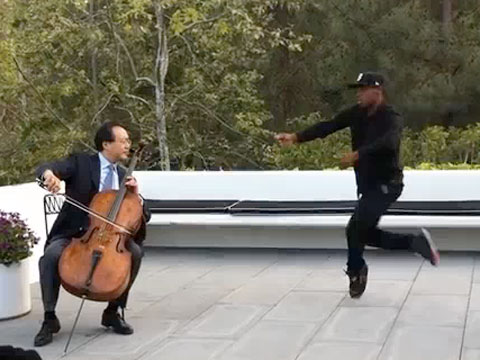 My friend is counseling his daughter who wants to pursue a career as a classical musician to double major. My daughter also is a music major and we have discussed this with her quite often. She is a freshman oboist in Chicago. You basically have to be a superstar in classical music, or close to it, to earn a good living and not be hugely dependent on income from teaching. If you love teaching, then its not so bad, but the competition for the larger orchestras is very intense. Plus, several symphony orchestras are cutting back, so the strained economics are more true now than ever. My daughter is on a double major track and it will be a year-by-year assessment process to determine what she does after graduation. Continue on with the oboe in a masters program, if the signs are reasonably positive that she can make it long term, or look for work (and probably a masters too) in her other field. Likely to be accounting or economics.
Laurel Kenner writes:
Studying music confers a multitude of qualities useful in business: discipline, an appreciation for timing, devotion to perfection, the ability to comprehend different voices, a readiness to "hear" change, competence in meeting deadlines, comfort in communicating with an audience. (And music can bring great personal joy.)
Not so long ago, classical musicians were mere servants in the households of the nobility or employees of the church. Even professional musicians today usually experience significant downward mobility from their parents' lifestyle. The pressure to be mobile — to accept jobs far and wide –makes it very difficult for them to maintain stable marriages and establish families. I recommend "Mozart in the Jungle" as a cautionary tale. The oboist in the story ended up becoming a journalist and wrote extensively about the economics of classic music today, as well as the pitfalls of the musician's personal life.)
I applaud the double major as a way to avoid starting at the bottom in an alternate career. But those kids are going to have to work twice as hard as anybody else.
Yishen Kuik writes:
Certain doubles can be pulled off quite easily - many classes can be applied to several majors. Statistics, for example, is a common requirement for many fields. Skilful negotiation can obtain cross credit approval for a class not yet listed as such.
The most unusual double/triple majors however will be the left brain right brain ones, which tend to have very little overlap. I have yet to meet someone else with my combination : math, economics, history of art.
I have noticed also that just as many Asians of my generation who went to good schools started their careers in the West to obtain better opportunities and experience, post the 1997 recession in Asia, I bump into many young Europeans and Americans starting fresh from school out here in Asia.
These economic migrants as it were have little to lose, no family to hold them back and can be found in all parts of China and Asia in junior jobs. I would not be surprised if in ten years, these intrepid job seekers return to Europe and the US as the next important community of business people who can move seamlessly between Wichita and Wuhan.
Mar
28
Quote of the Day, from Victor Niederhoffer
March 28, 2012 | 1 Comment
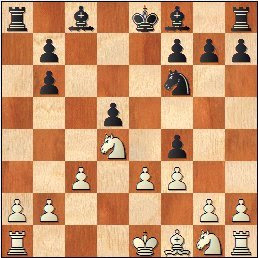 "Try to keep your pawns coordinated. Think of them as the foundation of your house. Every crack and every hole can eventually lead to disastrous consequences for the whole house."
- Jonathan Edwards, US Correspondence champ.
Tom Wiswell couldn't have said it much better. How does it apply to markets?
P.S It is interesting to note that in checkers the traps and gems are every bit as complex, hidden, and far removed as in chess. During the 25 years I took lessons from Wiswell, and he played against people like Leopold who was as good across the board, and his thousands of games with me, I never saw once that a good player fell into a trap in go as you please. Perhaps the Checker Pres will correct me but the main point is true. To play a good player and set a trap is the seeds of death or as Wiswell would say, "beware the spider".
Alan Millhone, the Checker Pres, replies:
Dear Chair
I moved myself into the Masters. I like playing the best. When you lose to the best rated players like Luba or Suki etc you never have to make an excuse for the loss. I also learn from every loss as the astute Market player should.
I never play for traps. Usually setting a trap will weaken your position if your opponent does not make the move you had hoped he would. I make my move assuming my opponent will always make the best reply.
"Come into my parlor said the spider to the fly "
In Checkers as the Market , research is critical before moving or execution of a trade.
Sincerely,
Alan
Anatoly Veltman writes:
There is difference between checker tactics and speculation, in that checker outcome is near binary (win, lose or draw) - while one sets up its market position based on a multi-dimensional scale of odds/size of risk VS reward. Thus, your checker inclination against playing for trap - doesn't profoundly manifest in speculation. My recollection of Silver Monday April 28th, 1987 is perfect example: because a record number of speculators fell into a limit-up trap, the TRADE OF THE LIFETIME proved to be SHORTING, if only for minutes! And multiple cases of not hearing about "that local" ever again.
Reminded me another war story: Tuesday October 20th, 1987 Eurodollar futures pit. That contract normally moved 10 points on a good day. But in the wake of Black Monday, the contract was called to gap in Chicago pit "much higher". How much? Well, speechless clerks and brokers speculated 100 higher!! So seconds before the opening bell, the Salomon Brothers runner fights his way to the pit broker with a ticket sporting conspicuously much ink on the left side. It turned out to be 3000-lot to buy at the market!
So instead of opening between 94.50 and 94.75 (a usual monthly range), the broker tells the offers to shut up and announces 97.00 bid for 3000. Everyone freezes up - except for one regular local, who leaps at him over multiple pit steps with a samurai grunt "Sold!" Price traded back down below 95.00 by the end of the opening sequence, the local covered and was never heard from again in continental United States
Michael Chuprin writes:
As the game begins, lets say within the first 5 or 10 moves, the players inform each other the kind of game that is going to be played by the way that they develop their pawns, whether it be a defensive or offensive or deceiving (luring into a trap) type of structure. After the "mood" is set, the rest of the game proceeds with the development of the heavy pieces and the pawns now act as a buffer between the two armies. Highly ranked players know that the pawns set the terrain as the heavy pieces approach each other, and this is why the accidental loss of a single pawn can shift the entire scaffolding the entire structure, much like a puncture in the hull of a battleship may incapacitate all of the ships cannons. It is no wonder why in many situations strong players give up after miscalculating a position and losing a single pawn. It may be like two martial artists fighting and one breaking a finger, the damage is relatively small, but its effects are conclusive.
Anatoly Veltman writes:
I can easily think of market analogy: personally, it was a memorable first loss of a million dollars on a single commodity position I had. The day was Monday April 28th, 1987. Silver futures were locked limit-up for third straight day, and the freely traded spot contract rushed up yet again to an $11.25 pinnacle. It may not sound high today - but it was a multi-year high back then, and more than double the price in one month! Why - a huge squeeze was put on Mexican and Chilean producers, biggest mines were stricken by labor woes, etc.
Lo'n'behold, Japan Finance Minister is a scheduled White House guest that day - what does that do to getting any more Silver out of the ground? Suddenly, as Silver, Gold and Platinum slowly edge off their intraday peaks - the financial wires begin spitting out lightly co-operative language of the bi-lateral Forex co-operation between the two economic powers, totally periferal to Silver production. Normally quiet lunch-time turns into history's never-before seen massacre, with Silver futures flipping from limit-up to limit-down lock across the board in the time space between the salad and the main course! Physical Silver plunges $4 (more than a third of its morning value), and next day brings further depreciation due to margin call liquidation… But of course nothing changed in the mines - and following the two down days, Silver rose every day for the next three months to achieve the same valuation. Only some Silver Bugs remained buried deep in the April 28th ruins. That day's volume stayed the Exchange's record for decades, although some locals' trading cards have been never found in the aftermath…
Mar
28
 From Politico's Morning Energy:
The EPA today will announce its greenhouse gas rule for new power plants, advancing a regulation that - if upheld - promises to change the way the U.S. gets its power.
The proposed standard would generally require that new power plants emit carbon dioxide at a rate comparable to or better than natural gas-fired power plants, which emit about 60 percent less greenhouse gases than coal plants.
In essence, that means that new coal-fired power plants will have to capture their carbon dioxide emissions - either for storage or, in many cases, to send the CO2 to oil and gas drilling operations where it can be used to help extract fossil fuels.
But the rule also includes a phase-in period, sources knowledgeable of the rule say, so that coal plants that are ready to build may move forward. The impending announcement was first reported Monday by The Washington Post.
Carbon capture is not a practical option. This rule will be the end for coal and it will also put an end to simple cycle gas turbines. This proposed rule seems to put the US in a box; reducing the capacity of base loaded power plants at the same time reducing peakers. If upheld, I don't see how this will end well.
Gary Rogan writes:
From the summary:
"The EPA in 2009 found that by causing or contributing to climate change, GHGs endanger both the public health and the public welfare of current and future generations."
Another offering to the false god.
Ron Schoenberg writes:
If the loss of Arctic ice, the decline in glaciers, the unprecedented extreme weather events such as eight serious droughts in the last ten years in Texas, tornadoes in January, the last decade's global temperatures being the hottest on record, the accelerating increase in sea level, unprecedented wildfires in Russia and other parts of the world, unprecedented droughts and floods in Australia, unprecedented insurance claims due to weather, if all of this fails to convince you of the seriousness of climate change, what would it take to convince you?
Like the mythical frog in the pot slowly being brought to a boil, you might get cooked if you fail to see what is happening. I'm genuinely interested, what would have to happen for you to decide that you needed to jump out of the pot? I'm not asking you to agree that it's happening. I'm not asking you to say there's a pot being brought to a boil. I'm just asking what would have to happen for you to admit that climate change is actually occurring.
Stefan Jovanovich responds:
Of course, the climate is changing; that has never been the question. The debate has been over 2 issues: (1) the loss of individual liberty for people who will have unelected authorities regulating the details of their lives in the name of "saving the planet" and (2) the cost to the poor and ordinary (sic) people of the world who will need the energy produced by fossil fuels if they are to have any hope of seeing their children become secure enough to afford ecological sensitivities.
The central fact of the climate (formerly known as "global warming") debate is that there are no longitudinal data sets for terrestrial temperatures that can be cross-checked much before 1780; for sea temperature the records are not available globally much before the 1870s. All the other "facts" on offer - the hockey stick, etc. - exist only in mathematical models. The first rule of any prescriptive science is "do no harm". The cures offered in the name of "saving the planet" will prevent people in most of the world from ever getting drinking water as potable as the stuff people have in their radiators right now (excluding the anti-freeze). Without the pumps fueled either by oil, gas or coal-powered electricity and the plastic piping, there is simply no way. Fortunately, people seem to be much more aware of the choices than they were when the Brave New World was first put on offer at Kyoto.
Charles Pennington adds:
It's worth noting that the most prominent physicists (as opposed to "climatologists") who have actually waded into this issue have tended to be on the skeptical side. These include:
Ivan Giaver (Nobelist)
Will Happer (heavy hitting Full Professor at Princeton)
Freeman Dyson (Feynman collaborator who probably should have gotten the Nobel for work they did together)
These guys were already so prominent when they spoke out on this issue that it was impossible to blackball them, but younger, less powerful scientists would risk being shunned if they spoke out–as the Climategate emails demonstrated.
Gary Rogan writes:
Yes, the increase in atmospheric concentrations of CO2 is an undeniable fact.
And yes, the consequence of adding more CO2 into the atmosphere is unknown.
100 ppm is one molecule in 10,000. Try to visualize 10,000 of anything and think about the effects of adding 1 to it. Conversely, if it has 3 of something, than adding 1 more could be significant. Yet we hear that other participants in that 10,000 are really important, like water and methane molecules. The oceans are also exceptionally important in both diluting and releasing CO2.
Every time I hear about some "unique" phenomenon I can visualize many other "unique" phenomena of unknown provenance or importance. Unique phenomena don't prove anything, especially if one side is highly motivated to tie these unique phenomena to the outcome they seem to be highly interested in for good or bad reasons.
Many are convinced that this is obviously true. I believe this is utter nonsense because of the political circus and evidence of fraud that surround it, but it certainly is not as implausible as many totally faith-based things because people really are releasing carbon into the atmosphere in significant quantities. All I ask for is from some predictive ability of this line of thinking before I agree that bankrupting whole industries and impoverishing millions if not billions is called for. "Can't you see, it's all around you" is not enough for me.
Mar
12
Fund Allocation, from Larry Williams
March 12, 2012 | Leave a Comment
 The other day I heard somebody say:
"Assuming the future behaves the same as the past, I reason that this way makes my funds efficiently used".
I wanted to say, my experience is that the past is never like the future so we waste valuable time and skills on a false postulate.
As I see it, it is better to have a core strategy to deal with equity drawdowns, etc –based on logic–as opposed to a strategy based on the past real results or back tested as that is for the most part a make believe world since it never happens quite that way again.
Gary Rogan writes:
Larry's statement seems to be exceptionally profound in what it's saying and in the unambiguous nature of what it's saying. Speculation seems to be about predicting the future. Is there anything but the past, in some sense, that can guide us towards correctly predicting the future? If so, and if it's not similarity, what is it about the past that can help predict the future?
John Netto comments:
There are ample proverbs espousing the merits of both deriving information on events which have taken place before us, as well as the the complexities in attempting to accurately predict the future due to the inherent uniqueness of the time we are living. As a speculator in the financial markets, sports arena, and poker, it's my experience the answer lies somewhere in between. For me, the ability to extract alpha is how well I can ascertain what qualitative aspects are unique and execute a strategy from there.
Two sayings which are both contradictory and complimentary:
"Past is not prologue" "Those who do not learn from history are doomed to repeat it"
Gary Rogan writes:
There are many ways to use the past, such as:
1. Under similar circumstances, Security A behaved a certain way during a statistically significant percentage of the time. I will therefore bet that Security A will do it again under similar circumstances.
2. In the past, a certain class of securities had a certain trajectory under similar circumstances. I will therefore bet that this new Security B, which seems fit to be a member of this class, is statistically likely to follow this trajectory close enough to bet on.
3. In the past, when people were this excited/depressed/confused you could bet with them/against them and make money. Let's do it again.
4. The past rarely repeats under these circumstances. Let's bet against the past.
I'm sure there is an infinite variety of similar observations. Yet in every case the past was used SOMEHOW. There is nothing but the past as the basis for human knowledge, and that's why I was so fascinated by Larry's statement, especially because he is a master of his game.
Craig Mee writes:
Running a stop with any position, regardless of the backtest, is both logical and prudent.
Stefan Jovanovich adds:
When the British and French were forced to give up their remaining military strength in the Arabian Peninsula and the eastern Mediterranean - abandoning the base in Aden, being forced to withdraw from their assault on the Suez Canal, the U.S. did not replace them on the ground. The great fear was that "the loss of the Canal" would result in "the oil weapon" being used against "the West". The actual result was the development of supertankers that by-passed the Canal entirely and increased by an order of magnitude the ability of the oil exporters to ship their crude to Europe and Asia. At the height of the Suez crisis the inflation-adjusted price of crude (using the 1947 nominal price of $15 as the baseline) rose to $18 a barrel - higher than it had been during the Korean War. A decade and a half later - even as U.S. supplies went from 40% of world production to 10% - the inflation-adjusted price fell by nearly a third, hitting a low of $13 in 1972 after production began flowing from the North Sea discoveries.
I find myself wondering if the U.S. eventual withdrawal from Afghanistan and the withdrawal from Iraq already largely completed will not have the same paradoxical effects as the Anglo-French withdrawals did. I realize that this question is completely irrelevant to the questions that anyone trading in commodities has to answer; but those of us in the bleachers are interested in what the professionals on the field think will be the effects of the closing of America's 25-year military misadventures in Southwest Asia.
Larry's maxim: "it never happens quite that way again" - certainly applies to political history. This is the second time in my lifetime that the American public has lost its belief in the virtue of our allies. Last time they were wrong; this time they are right.
Mar
3
Buddy Fletcher, from anonymous
March 3, 2012 | 5 Comments
 From a 1996 profile of Harvard's Buddy Fletcher in New Yorker:
His particular skill lies in devising vertiginously complex "hedges" to insure minimal loss if stocks decline while maintaining maximum profit potential if the stocks rise. His audited annual returns for the last five years have averaged over 350%, and on some days during that period his tiny firm has accounted for more than 5% of the trading volume at the New York Stock Exchange. A safe estimate would put his personal wealth at somewhere around $50 million.
There are many alarming items there — the Madoffian hedging so that really you can't go wrong while you're making 350%, the 5% of the NYSE trading volume (EdSpec observed that there are several hundred tiny firms that each control 5% of NYSE trading volume).
Charles Pennington writes:
I thumbed through the section in Buddy Fletcher in the Jack Schwager book Stock Market Wizards (excerpts can be found under Google Books), and he has what at first seem to be some reasonable ideas for making money:
–arbitrage between the different tax needs of U.S. and overseas clients, especially the treatment of dividends
–some kind of option arbitrage that exploits the mismatch between option prices that involve a risk-free interest rate and clients who have to pay a relatively high commercial interest rate to borrow
Now those seem like reasonable germs-of-ideas, but surely they'd have very limited capacity, and surely they'd become widely known pretty quickly. They don't seem consistent with the 1996 New Yorker article description:
"His audited annual returns for the last five years have averaged over 350%, and on some days during that period his tiny firm has accounted for more than 5% of the trading volume at the New York Stock Exchange."
Humbert Humbert replies:
An astute colleague explains that the fancy options ideas described by Fletcher in Schwager's "Stock Market Wizards" sound like nothing more than ways to take advantage of the cheap access to capital that he had from his firm. If the bank let him borrow to trade and pay below-market interest rates, then he could make money just by buying a money market fund. The fancy (and almost riskless) "box " options spreads that he describes probably served the purpose of a money market fund.
« go back — keep looking »Archives
- October 2026
- September 2026
- August 2026
- July 2026
- June 2026
- May 2026
- April 2026
- March 2026
- February 2026
- January 2026
- December 2025
- November 2025
- October 2025
- September 2025
- August 2025
- July 2025
- June 2025
- May 2025
- April 2025
- March 2025
- February 2025
- January 2025
- December 2024
- November 2024
- October 2024
- September 2024
- August 2024
- July 2024
- June 2024
- May 2024
- April 2024
- March 2024
- February 2024
- January 2024
- December 2023
- November 2023
- October 2023
- September 2023
- August 2023
- July 2023
- June 2023
- May 2023
- April 2023
- March 2023
- February 2023
- January 2023
- December 2022
- November 2022
- October 2022
- September 2022
- August 2022
- July 2022
- June 2022
- May 2022
- April 2022
- March 2022
- February 2022
- January 2022
- December 2021
- November 2021
- October 2021
- September 2021
- August 2021
- July 2021
- June 2021
- May 2021
- April 2021
- March 2021
- February 2021
- January 2021
- December 2020
- November 2020
- October 2020
- September 2020
- August 2020
- July 2020
- June 2020
- May 2020
- April 2020
- March 2020
- February 2020
- January 2020
- December 2019
- November 2019
- October 2019
- September 2019
- August 2019
- July 2019
- June 2019
- May 2019
- April 2019
- March 2019
- February 2019
- January 2019
- December 2018
- November 2018
- October 2018
- September 2018
- August 2018
- July 2018
- June 2018
- May 2018
- April 2018
- March 2018
- February 2018
- January 2018
- December 2017
- November 2017
- October 2017
- September 2017
- August 2017
- July 2017
- June 2017
- May 2017
- April 2017
- March 2017
- February 2017
- January 2017
- December 2016
- November 2016
- October 2016
- September 2016
- August 2016
- July 2016
- June 2016
- May 2016
- April 2016
- March 2016
- February 2016
- January 2016
- December 2015
- November 2015
- October 2015
- September 2015
- August 2015
- July 2015
- June 2015
- May 2015
- April 2015
- March 2015
- February 2015
- January 2015
- December 2014
- November 2014
- October 2014
- September 2014
- August 2014
- July 2014
- June 2014
- May 2014
- April 2014
- March 2014
- February 2014
- January 2014
- December 2013
- November 2013
- October 2013
- September 2013
- August 2013
- July 2013
- June 2013
- May 2013
- April 2013
- March 2013
- February 2013
- January 2013
- December 2012
- November 2012
- October 2012
- September 2012
- August 2012
- July 2012
- June 2012
- May 2012
- April 2012
- March 2012
- February 2012
- January 2012
- December 2011
- November 2011
- October 2011
- September 2011
- August 2011
- July 2011
- June 2011
- May 2011
- April 2011
- March 2011
- February 2011
- January 2011
- December 2010
- November 2010
- October 2010
- September 2010
- August 2010
- July 2010
- June 2010
- May 2010
- April 2010
- March 2010
- February 2010
- January 2010
- December 2009
- November 2009
- October 2009
- September 2009
- August 2009
- July 2009
- June 2009
- May 2009
- April 2009
- March 2009
- February 2009
- January 2009
- December 2008
- November 2008
- October 2008
- September 2008
- August 2008
- July 2008
- June 2008
- May 2008
- April 2008
- March 2008
- February 2008
- January 2008
- December 2007
- November 2007
- October 2007
- September 2007
- August 2007
- July 2007
- June 2007
- May 2007
- April 2007
- March 2007
- February 2007
- January 2007
- December 2006
- November 2006
- October 2006
- September 2006
- August 2006
- Older Archives
Resources & Links
- The Letters Prize
- Pre-2007 Victor Niederhoffer Posts
- Vic’s NYC Junto
- Reading List
- Programming in 60 Seconds
- The Objectivist Center
- Foundation for Economic Education
- Tigerchess
- Dick Sears' G.T. Index
- Pre-2007 Daily Speculations
- Laurel & Vics' Worldly Investor Articles
