May
30
Ras Laffan repriced LNG’s geopolitical risk premium, and the market structure that existed through 2025 can no longer be assumed.
On March 18 and 19, 2026, Iranian missile and drone strikes on QatarEnergy’s Ras Laffan Industrial City damaged two of fourteen LNG trains and one of two gas-to-liquids facilities. The result is the largest single supply disruption in LNG’s history: roughly 12.8 MTPA — about 17% of Qatari export capacity — sidelined for three to five years. Replacement gas turbines for the refrigeration compressors have lead times of two to four years from three global manufacturers. QatarEnergy declared force majeure to buyers in China, South Korea, Italy, and Belgium; Shell declared force majeure downstream; and Omani trading house OQ did the same for Bangladesh. As of late May, force majeure has been extended through mid-August for some buyers, and the Strait of Hormuz remains largely closed to tanker traffic under a fragile U.S.–Iran ceasefire.
The 2025 trade matrix is the appropriate reference for determining where LNG lands.
The baseline. In 2025, global LNG trade totaled approximately 426 MTPA. Asia accounted for 63.6% (271 MTPA), Europe for 29.3%, the Middle East and Africa for 4.2%, and the Americas for 2.8%. On the supply side, the Atlantic basin produced 41.3% (176 MTPA), the Pacific 35.9% (153), and the Middle East 22.8% (97). The country-level figures behind these shares were concentrated: the United States, Australia, and Qatar each exported between 78 and 85 MT in 2024, while on the import side, China, Japan, and South Korea each imported between 47 and 79 MT. The headline reading was that Asia was the diversified buyer — 56.5% Pacific, 30.3% Middle East, 13.3% Atlantic — Europe was Atlantic-captive (92.8%), and the Pacific basin’s entire output flowed to Asia. That matrix described an integrated market at the macro level; in practice, it was three regional sub-markets stitched together by arbitrage.
Where the shock lands hardest. Asia’s 30.3% share of Middle East supply — long treated as a supply-security buffer — has been revealed to be a concentrated tail risk, yet resilience within Asia is asymmetric. China and South Korea both sit on QatarEnergy’s force majeure list, and their long-term oil-indexed sale-and-purchase agreements (SPAs) do not pay out at $18 JKM. South Korea has no real alternatives; China does and is using them. Europe’s exposure is structurally different: only 9 MTPA flowed from the Middle East in 2025, but Europe’s higher spot share means it absorbs the global price shock regardless of direct exposure. TTF traded around $14.80/MMBtu in late April, roughly 35% above pre-conflict levels; JKM traded in the high $16s to low $18s through May.
Where the buffer is — and isn’t. The Pacific basin has no spare capacity. Its 153 MTPA ran flat-out to Asia in 2025, and LNG Canada’s Kitimat ramp has not yet meaningfully changed that arithmetic. The Atlantic basin — the U.S. Gulf in particular — becomes the swing supplier, but the swing is tighter than headlines suggest. U.S. LNG exports averaged 17.6 bcf/d in February 2026, roughly 3 bcf/d (about 22 MTPA annualized) above year-ago levels as Plaquemines and Corpus Christi III ramped — the first meaningful offset to the Gulf disruption, though existing terminals are now running essentially at nameplate. Henry Hub has remained range-bound, and the stability is structural rather than coincidental. U.S. LNG export prices are indexed to Henry Hub plus liquefaction tolling fees, and the great majority of U.S. liquefaction is already committed under long-term offtake contracts. With no surplus capacity to respond to a higher-priced global market, international arbitrage cannot pull additional U.S. volumes through, and therefore cannot pull Henry Hub higher; the spread accrues instead to the off-takers holding Henry Hub-indexed cargoes that they sell into JKM and TTF markets trading at multiples of their input cost. The new wave of U.S. projects under construction — Plaquemines, Corpus Christi III, Rio Grande, Port Arthur, and Golden Pass — is now pricing into a different world than the one for which their final investment decisions (FIDs) were made.
Where the demand response is taking the strain. The shock has been absorbed less by supply replacement than by buyer behavior, and Asia and Europe are responding very differently. Chinese LNG imports for January through April totaled 18.0 MT, down roughly 10% year-over-year and the lowest since 2019. Chinese buyers are actively re-offering Qatari long-term cargoes into the European spot market (Kemp, LSEG Commodities Forum, May 2026). China can do this because Qatari LNG accounted for only about 15% of total Chinese gas imports in 2024 — pipeline gas from Turkmenistan, Russia, Kazakhstan, Myanmar, and Uzbekistan supplied roughly 53 MTPA, with Australian LNG adding another 26 — and because 47% of Chinese gas demand is industrial, allowing manufacturing-margin demand destruction that Europe’s household-and-power-dominated load cannot easily match. South Korea, with no comparable buffer, is bearing the brunt of the disruption directly. Europe, meanwhile, has paradoxically deferred LNG purchases despite storage at 36.7% on May 18, compared with a 10-year norm of 45–49%. EU LNG send-out in April was essentially flat year-over-year at 131 TWh, well below the technical capacity of 238 TWh. The European bet is on price retracement; if it does not arrive, the summer refill window will be tight.
The Hormuz dimension compounds the kinetic damage. Of the roughly 84 MTPA of Qatar and UAE LNG sent through the Strait of Hormuz in 2024, 12.8 MTPA represents the kinetic loss, expected to take three to five years to recover; the balance is suspended by the chokepoint closure and will return as the Strait reopens. The market is therefore pricing two recoveries on different timelines and writing the security premium against the worst of them. The premium on Middle Eastern LNG will remain higher than the 2025 cost stack assumed, regardless of how quickly the kinetic damage is repaired — buyers signing 20-year SPAs after March 2026 will not include the same indemnity language, and lenders underwriting new Middle Eastern liquefaction will not assume the same return profile.
Russia is the latent alternative — held by politics, not geology. Russia sits on some of the world’s largest unmonetized gas reserves and remains the most consequential variable not yet in the trade matrix. Russian LNG exports totaled 33.5 MT in 2024 — primarily from Yamal LNG on the Arctic peninsula and Sakhalin-2 in the Pacific, with Arctic LNG 2 largely sidelined by Western sanctions on shipping, equipment, and finance. About half of Yamal LNG continues to flow to Europe under pre-existing contracts. Pipeline gas to Europe collapsed from roughly 150 bcm in 2021 to about 25 bcm in 2024, following the 2022 invasion of Ukraine and the January 1, 2025, expiration of the Ukraine transit corridor. Power of Siberia 1 to China reached approximately 31 bcm in 2024, on track for its 38 bcm design capacity, with a contractually agreed expansion to 44 bcm.
The proposed Power of Siberia 2 — a 50 bcm/yr line from Yamal to China via Mongolia — is the single largest piece of latent supply in global gas. Moscow signed a legally binding memorandum with Beijing in September 2025 and had hoped the Iran war would push final commitment at the May 20–21, 2026 Putin–Xi summit. It did not. Talks remain stalled over pricing (China wants gas close to Russia’s domestic rates; Russia wants European-style market indexation), financing terms, and Beijing’s reluctance to deepen single-supplier dependence after Hormuz had demonstrated that risk in reverse. Chinese industry sources estimate construction at eight to ten years even after FID. Russia therefore has the resource base to displace a meaningful share of the post-Ras Laffan market, but its three near-term levers — Arctic LNG 2, Yamal LNG expansion, and Power of Siberia 2 — are all gated by political rather than physical constraints.
The expansion question. Qatar’s North Field East and North Field South projects — together adding roughly 48 MTPA between 2026 and 2030 — remain on the books, with the first NFE train still nominally targeted for Q3 2026, pending infrastructure integrity assessments. Whether that schedule holds is now the central question for global supply growth through 2028. Every quarter of slippage shifts pricing power to U.S. Gulf and Australian producers and improves the marginal economics of projects further out: Mozambique, the GTA project off Senegal–Mauritania, and Alaska LNG if it reaches FID.
Local pressures point in the same direction. Peru is reexamining export priorities as Camisea reserves face roughly two decades at current rates, and Australia is debating reserving east-coast gas for domestic use. The Qatar event accelerates the same logic globally — producing nations will price domestic supply and energy-security considerations more aggressively into export decisions, and importing nations will think more carefully about their exposure to chokepoints.
Repricing the security premium. The 2025 matrix described a market in which geography determined trade flows, contract structure allocated risk, and basin diversification served as a form of supply security. Ras Laffan demonstrated that the same geographic rigidity that defines LNG also concentrates geopolitical risk in specific producers and chokepoints. LNG remains the indispensable mechanism for monetizing stranded gas, and roughly 150 MTPA of liquefaction under construction suggests that demand will continue to absorb it. But it is now priced with a security premium that the 2025 cost stack did not anticipate. Even a sanctions realignment would not relax that premium quickly: LNG export terminals take years to design and build and require billions of dollars of capital, underpinned by long-term offtake contracts that sanctioned producers cannot readily attract. For Atlantic producers, that premium accrues as netback; for Asian importers, as the cost of holding redundancy; for Europe, as the cost of structural exposure to a global spot market whose marginal supplier just sat behind a chokepoint that closed.
Note: Figures are in million tonnes per annum (MTPA). The 2025 trade matrix is the author’s construction. Country-level 2024 reference figures and the demand-side analysis of Chinese imports, European storage, and U.S. export ramp draw heavily on John Kemp’s May 21, 2026, presentation to the LSEG Commodities Forum (Base Research), with underlying data from GIIGNL, Gas Infrastructure Europe, China General Administration of Customs, and the U.S. Energy Information Administration. The Russia section draws on Gazprom export disclosures and contemporaneous reporting on the May 20–21, 2026, Putin–Xi summit. Price data are current as of late May 2026.
May
28
List member Duncan Coker’s music
May 28, 2026 | Leave a Comment

Late bloomer: Boulder singer-songwriter Duncan Coker drops long-awaited debut
Longtime Boulder singer-songwriter Duncan Coker has been honing his craft ever since he picked up his first guitar as a New Jersey teenager four decades ago. It was a Fender Squier, and it opened the door to a love for performing that’s going strong to this day.
After years of exclusively playing live, Coker felt the time was finally right to hit the studio and share his music in another format on his self-titled debut album, released in February.
It wasn’t his first time recording, though. Coker released an acoustic single in 2018, but says his latest material is his most well-rounded. He felt ready to lay it down in the studio, even if the path took longer than anticipated.
“I’m feeling now, in my mid-50s, very creative and prolific — like, I’m writing a lot. It just took me a while. It’s part of your life journey,” he says. “I’m really glad I waited to put out material that I was really proud of. I guess I peaked late in life.”
Duncan Coker Band live:
Duncan Coker Band - Rodeo Girl - LIVE@LUNCH on KRFC RadioVision
Duncan's music site:
May
26
A deck of cards, from Jeff Watson
May 26, 2026 | Leave a Comment

A standard deck of cards contains 52! combinations after riffle shuffling at least 7 times to ensure randomness. Expressed as a number, there are 8.06×10^67 total combinations. To put this in perspective, there are 4.37×10^17 seconds since the big bang. It is estimated there are 5×10^18 grains of sand and 10^50 atoms on earth. There are 10^46 molecules in all of the oceans. The estimated number of stars in the observable universe is 10^23. It’s a certainty that two entire 52 card decks have never ever matched, let alone more than once. They never will. Here’s another way of looking at it, if a billion people shuffled a deck of cards every second since the big bang, it would total 2×10^32 shuffles, which is still 10^22 less than the total. All of that said, there are some elegant propositional bets that can be derived from this material.
Nils Poertner responds:
Yes - incredible numbers. LIfe itself is a miracle (I don't buy into this bing bang thing) - but would not be able to bet against the odds you described here.
Asindu Drileba offers:
Leo Susskind explains that many constants in physics need to be fine tuned for the universe to exist in the way we see it. Some cannot be deviated by as low as 5%. All these constants needed to be fine tuned concurrently. Otherwise, stars would not even form.
Big Al writes:
If you assume that order matters, then when dealing cards for a game of Texas Holdem at a 9-seat table (18 hole cards and 5 community cards), there are 52!/29! possible permutations. That's roughly 9 x 10^36, or 9 x (1 billion)^4. Which means that, though possible, it is highly unlikely that any game (at a fair table) has ever been dealt the same way twice.
May
23
Sentiment, from Steve Ellison
May 23, 2026 | Leave a Comment
Here is my three-year graph of AAII's sentiment survey. I ignore the neutral voters and calculate the bullish percentage as = Bullish / (Bullish + Bearish).
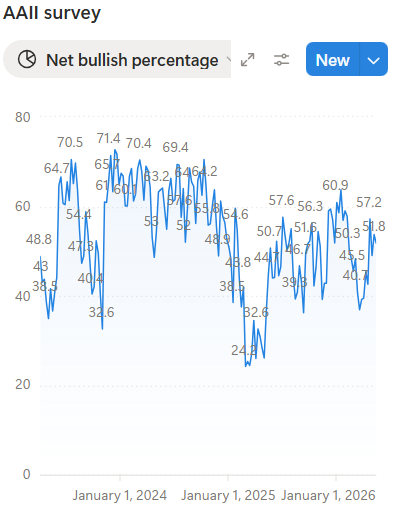
Sentiment as measured by this survey is middle-of-the-road, and has not had any extreme readings since the tariff tantrum in April 2025. The recent high was 63.7% on January 14, 2026, which fell short of a few 70-plus readings in 2023-24.
Jeffrey Hirsch writes:
This is cool Steve. I’ve been looking at trend and shape in addition to level with sentiment indicators as well as some of my seasonals and other analogs. The sentiment turns in Investors intelligence Bullish %-Bearish Percent and the VIX off the March Lows were not from as extreme levels as 2025 and others, but the shape of the sharp trend reversal was there.
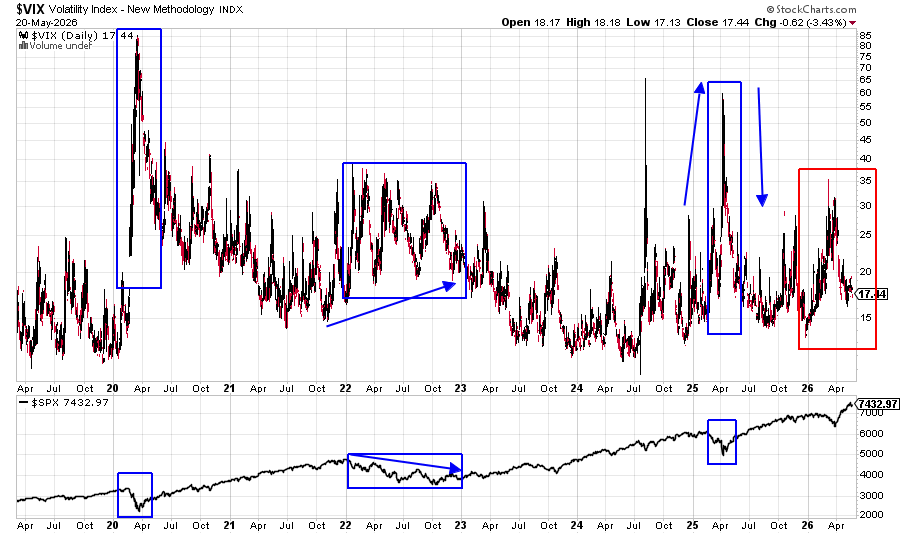
VIX for example only got to about 35 intraday and was in that nervous area of 20-30 where bear markets fester for most of March then it fell below 20 sharply after spiking quickly to 35. Same V in your AAII chart here. So perhaps correction end vs bear or near bear bottom. Also note the trend of higher lows during the 2022 bear market.
May
19
Artificial Intelligence, Real Misallocation
Artificial intelligence may well be the most important technological development of the coming decade-and that is exactly why the current capital surge around it warrants skepticism. History is littered with transformative innovations that were nonetheless disastrously overbuilt and mispriced in their early phases. Austrian Business Cycle Theory was never a children’s story in which every boom ends with clowns, ashes, and worthless machinery; its real claim is subtler and nastier. When the price of time is falsified-when interest rates are pushed below their natural rate-often proxied, however imperfectly, by modern estimates of the neutral rate-entrepreneurs are encouraged to undertake projects that are more roundabout, more capital-intensive, and more time-sensitive than underlying saving and final demand can actually support. The neutral rate is a policy construct; the natural rate is an economic reality. Some of those projects may still embody genuine innovation.
The problem is not that AI must be fake; it is that a very real technological advance can be financed, priced, and physically built in ways that are wildly uneconomic.
May
16
A dream group
May 16, 2026 | Leave a Comment
i dreamed that galton, sherlock holmes, and gilbert and sullivan attend a performance of mikado together.
The Mikado 1966, D'Oyly Carte Opera Company, Gilbert & Sullivan
May
14
Study of Deception, from Sushil Kedia
May 14, 2026 | Leave a Comment

The Chair has emphasized the value of studying and understanding deception endlessly, I believe.
Now, if I wish to focus and devote my energies to be thoroughly studious about it, I urge my requests below are not misunderstood as a lazy desire, but an earnest and keen wish to be methodical about it.
What would the Spec-list citizens recommend as the ideal list of:
a) Movies to watch,
b) Books to read.
One thing that hit me suddenly some weeks ago is that nature devised deception as a tool to economize the struggle for propagation of this world and its entities into the future. Without deception a Tiger would run endlessly, perhaps consuming more calories in capturing its prey, than it would get in eating the prey, as one example.
What are the other utilities the matured, experienced minds on this competent list and other curious minds as me feel that deception provides?
Another layer of study that makes me curious is, when our own mind as defined by Edward De Bono, as a self organizing pattern seeking system is the personal deception machinery that takes us into deviant behaviour from data, stats on the table and rigorous study then how does the autonomous deception inflicted by our mind engage with the deceptions inflicted upon this world by the high and mighty? Are the mighty studying how the hoi pollois is living in self deceiving modes and then playing it?
What more rigorous questions will the list members be happy to throw at someone who is now hungry to study deception, in depth? Please provide your questions too for me to compile into a list of questions to ponder over, gather information and insights on.
William Huggins writes:
it would seem the heart of the matter is one's ability to "hack" the target's heuristics. concealment/distraction plays an important role in this. the obvious benefit of deception being a misallocation (from the allocator's pov) of energy that can be exploited by the deceptive.
Nils Poertner comments:
What traders do in their free time and are already good at is of interest to me. (eg. someone reading crime novels, can find patterns here, another one practises Judo, finds patterns of deception there, and then you can go from there. Work with what you have already)
Big Al offers:
An interesting story with possibly multiple levels of deception:
The Rosenhan experiment or Thud experiment was a disputed study regarding the validity of psychiatric diagnosis. For the experiment, participants submitted themselves for evaluation at various psychiatric institutions and feigned hallucinations in order to be accepted, but acted normally from then onward. Each was diagnosed with a psychiatric disorder and given antipsychotic medication. The study was arranged by psychologist David Rosenhan, a Stanford University professor, and published by the journal Science in 1973 with the title On Being Sane In Insane Places.
Asindu Drileba adds:
When it comes to movies, my favorite movie to do with deception is The Conversation (1974) by Francis Ford Coppola. As for books, on my "yet to read" list I have The Confidence Game by Maria Konnikova. You see, "conman" comes from the phrase "confidence man".
I have studied several scammers like SBF, Madoff, Enron executives. What I have noticed is that deception never looks like "deception" it often looks like opportunity. The "confidence man" entrapped their victims by having "good visuals", dressing well & moving amongst those in high circles.
SBF was branded as a type of prodigy, Madoff was the chairman of Nasdaq, Enron guys where The Smartest Guys In The Room (you should watch this one, just for the fantastic music playlist), Jeffrey Epstein displayed the all patterns. Take away? Beware of bombastic talk, especially one that boosts your confidence in an investment.
Rich Bubb writes:
Not exactly a movie-to-watch, a former co-worker recommended I watch "Lie To Me" series. I'd be interested to see if anyone has trained and AI system to visually detect micro-expressions. The thought is that if somebody/-ies is the 'prey', maybe AI could detect deceptive interactions better than me. I have tried to teach myself to recognize micro-expressions. It's nice to know when I'm being lied to.
Oliver Joseph writes:
I'm a big fan of Joe Navarro's work. "What Every Body is Saying" is classic. There is a certain amount of gamesmanship in deception and its detection which he elegantly describes. Of course there are certain "strong signs" like pupil dilation that are impossible for normal human beings to conceal. Sussing out the meaning and separating the signal from the noise is part of the game, a problem everyone on the spec list is used to dealing with I'm sure. I myself as a former car dealer am quite unfamiliar with deception and its detection and so eagerly await further recommendations.
May
11
ChatGPT moment for robotics?, from Humbert Q.
May 11, 2026 | Leave a Comment
I've Covered Robots for Years. This One Is Different
From sorting chicken nuggets to screwing in lightbulbs, Eka’s robotic claw feels like we're approaching a ChatGPT moment for the physical world.
Dendi Suhubdy offers deep analysis:
I have put some thought into that:
The Perception–Planning Gap: What's Actually Hard About Visual AI in 2026
The thesis I want to defend in this piece is structural: perception in pixels is largely solved at the representation level; perception for action is not, and the gap between the two is the central unsolved problem of visual AI in 2026. Frontier vision-language models can pass medical-board questions and explain radiographs at attending-physician level. Frontier robots, after a decade of foundation-model progress, still cannot reliably load an arbitrary dishwasher. Moravec’s paradox is not a quaint historical observation; it is the daily lived experience of every embodied-AI lab.
Big Al responds:
Thanks for sharing. Much I don't understand, but when I scroll down to the summary, I think I get the general ideas. I hadn't thought about the challenge of having effective testing/evaluation standards.
Asindu Drileba writes:
I thought this was going to be about humanoid robots (like Figure & Optimus). That still have very many problems. Industrial robotics how ever has always been making mind blowing, but quiet progress.
Good case studies are Amazon (robots operating in a warehouse about 10 years ago, its now way better), and Tesla, also 10 years back.
The reason is that the edge cases of these industrial robots are very few and can be comprehensively thought about. I think this robot ChatGPT moment already occurred in industry & manufacturing.
May
10
A tug-of-war within America’s deregulated power markets, from Humbert X.
May 10, 2026 | Leave a Comment
Today, we are witnessing a tug-of-war within America’s deregulated power markets. It's between those advocating for free-market operations and state policymakers intervening in those markets. In the process, consumers of all kinds are paying unnecessarily high prices. Let me explain:
In deregulated power markets, energy producers are theoretically dispatched in economic order based on their production costs, excluding owners' capital costs. The last producer to clear the market sets the market-clearing price. In general, this order begins with producers with the lowest marginal costs—such as wind and solar—and ends with the least efficient assets that use the highest-cost fuel: typically oil, coal, or inefficient natural gas plants.
When markets attract more cost-leading producers, costlier assets are sidelined, and market-clearing prices fall. Even if cost leaders offer intermittent availability, consumers benefit on average because their aggregate energy costs decline.
Data centers consume massive amounts of electricity (and water). The global buildout of thousands of new data centers has increased demand for power generation. As a result, power markets now reward higher-cost producers that rely on expensive fuels. Consequently, market-clearing prices are rising, and consumers are paying more. As clearing prices rise, cost leaders' margins also increase.
A potential solution to higher power prices is to increase the number of cost-leading producers. Even if new cost leaders offer intermittent production, the strategy benefits consumers through lower average clearing prices, though backup sourcing merits consideration. This approach creates winners and losers: owners of costlier production assets lose when average clearing prices fall. Consequently, the costliest market participants oppose the introduction of new cost leaders.
In January 2025, the Trump administration began implementing policies to restrict investments in cost-leading production. The administration rescinded permits for wind projects and, by April 2026, had negotiated about $2 billion in payouts to compensate investors to walk away from permitted and partially completed offshore wind projects. Additionally, since August 2025, the Pentagon has delayed reviews of165 onshore wind projects (30 GW of capacity), citing unspecified national security concerns.
When energy policy restricts cost-leading producers from participating in markets, consumers pay higher energy prices. This dynamic creates competing interests: while owners of costlier generation assets benefit from reduced competition, all electricity consumers—including data center operators—face higher costs.
The solution is straightforward: remove the barriers. Instead of spending $2 billion in taxpayer dollars to prevent investment, use those same funds (or none) to let the market allocate resources based on market forces. If permitted, capital will flow to cost-leading producers in response to the buildout and rising prices.
Bud Conrad writes:
I'll add some less-discussed items: We all know that about 20% less oil is flowing out of the Strait. But the Ukraine war is hidden behind the I run daily policy changes. Both the Russian and Ukraine sides have escalated massively since the beginning of April by doubling their daily barrage of drones and missiles. Specifically, the energy generation systems of both sides are being attacked, and the relatively less noticed is that Russian refineries and ports have been getting hammered. The result is that, while Russia has reserves, its ability to deliver amid already reduced supplies has been damaged. Nobody knows how much, but multiple cities deep into Russia have been attacked with huge clouds of smoke. St. Petersburg ports and some cities 2,000 Km into Russia have been damaged.
It takes up to 2 months to get tankers from the Persian Gulf to customers. So to restart, it will take something like that time, from the Strait opening. Oil production from most Gulf states has been attacked and stopped, and it will take more than months to restart. The US Strategic Petroleum Reserve is adding supply but cannot continue much longer, since it was already depleted, in an attempt to keep prices low to weaken Russia during the Ukraine war. In the tit for tat between Zalen ski and Moscow, Russia asked for a ceasefire on the Memorial Parade March 9 (Tomorrow), which has already been rejected by Ukraine, and Russia has announced plans to attack the center of Kiev with Oreshiks.
The pressure for oil prices to go much higher seems obvious.
May
7
Consumer sentiment, from Steve Ellison
May 7, 2026 | Leave a Comment
The US consumer sentiment surveys have become completely politicized and useless for economic analysis. When Biden was president, respondents who preferred the Republicans said they felt very bad about the economy. After Trump was elected, they felt very optimistic. Respondents who preferred the Democrats did the opposite. And yet bad consumer sentiment as expressed in surveys never turned into action. Consumers did not actually reduce spending.
Larry Williams suggests:
Use this one then:
May
5
The Strategy of Conflict, from Nils Poertner
May 5, 2026 | 1 Comment
The Strategy of Conflict (pdf), by Thomas C. Schelling
At the beginning of the book he says that some ppl just thrive on conflicts - the more the better basically. That is true within corporations as well, everywhere we can see it on world stage.
– THE RETARDED SCIENCE OF INTERNATIONAL STRATEGY
Among diverse theories of conflict—corresponding to the diverse meanings of the word “conflict” — a main dividing line is between those that treat conflict as a pathological state and seek its causes and treatment, and those that take conflict for granted and study the behavior associated with it. Among the latter there is a further division between those that examine the participants in a conflict in all their complexity—with regard to both “rational” and “irrational” behavior, conscious and unconscious, and to motivations as well as to calculations—and those that focus on the more rational, conscious, artful kind of behavior. Crudely speaking, the latter treat conflict as a kind of contest, in which the participants are trying to “win.”
May
4
What Makes a Trading Strategy Work?
In quant trading finding an alpha is not enough.
What is the edge you have that others do not?
A backtest is not the hard part.
The hard part is explaining why the opportunity exists, why others have not competed it away, and why it should continue to exist in the future.
In practice, most real strategy edges come from one or more of these: …
Some good discussion in the comments also. In response to a question about spinoffs:
Tad Haley Spinoffs are one of the best examples of an opportunity that can be visible without being equally tradable.
The edge is often not in spotting the situation. It is in understanding who has to sell, who cannot own it, who can actually fund and hold it, and how long the implementation friction lasts.
That brings in mandate and tolerance, liquidity, balance sheet, and constraints all at once. Information still matters, especially in separating flow-driven weakness from real fundamental weakness, but a lot of the opportunity exists because the natural ownership base is temporarily broken.
Larry Williams responds:
Is it really that complex? You find out what fundamental conditions drive a market. Maybe it's supply, maybe it's good earnings, and take advantage of that impact.
Zubin Al Genubi comments:
Its good to understand market structure in addition to stats. Structure is changing from a few years ago.
Nils Poertner adds:
Excellent, Yes Zubin. Also the trader may change and develop a bit of an ego after yrs of success….that is why trading requires constant shedding of false personality.
Asindu Drileba writes:
I have also come across three recurring reasons why some edges still exist.
Liquidity: So common in the Bitcoin markets, more in smaller cryptos markets. I have heard people with serious AUM complain about how the can't deploy $30m positions. But small specs don't have this problem.
Impatience: Even though some long term strategies like following the drift, indexing, work people are impatient, often demanding salary like consistency from the market like Robert Bacon suggests.
High stress strategies: Some people are patient, though can't handle strategies that are profitable, but have a very high frequency of losses. I have suggested some (buy) options strategies to my friends, but they just can't endure the 70% to 90% losing rates.
Larry Williams writes:
The big edge is to think forward, to see the future before other people do there are fundamental facts to this game, like insider buying. Mister Brush has written so much about. There are advantages, and they're very simple.
Archives
- September 2026
- August 2026
- July 2026
- June 2026
- May 2026
- April 2026
- March 2026
- February 2026
- January 2026
- December 2025
- November 2025
- October 2025
- September 2025
- August 2025
- July 2025
- June 2025
- May 2025
- April 2025
- March 2025
- February 2025
- January 2025
- December 2024
- November 2024
- October 2024
- September 2024
- August 2024
- July 2024
- June 2024
- May 2024
- April 2024
- March 2024
- February 2024
- January 2024
- December 2023
- November 2023
- October 2023
- September 2023
- August 2023
- July 2023
- June 2023
- May 2023
- April 2023
- March 2023
- February 2023
- January 2023
- December 2022
- November 2022
- October 2022
- September 2022
- August 2022
- July 2022
- June 2022
- May 2022
- April 2022
- March 2022
- February 2022
- January 2022
- December 2021
- November 2021
- October 2021
- September 2021
- August 2021
- July 2021
- June 2021
- May 2021
- April 2021
- March 2021
- February 2021
- January 2021
- December 2020
- November 2020
- October 2020
- September 2020
- August 2020
- July 2020
- June 2020
- May 2020
- April 2020
- March 2020
- February 2020
- January 2020
- December 2019
- November 2019
- October 2019
- September 2019
- August 2019
- July 2019
- June 2019
- May 2019
- April 2019
- March 2019
- February 2019
- January 2019
- December 2018
- November 2018
- October 2018
- September 2018
- August 2018
- July 2018
- June 2018
- May 2018
- April 2018
- March 2018
- February 2018
- January 2018
- December 2017
- November 2017
- October 2017
- September 2017
- August 2017
- July 2017
- June 2017
- May 2017
- April 2017
- March 2017
- February 2017
- January 2017
- December 2016
- November 2016
- October 2016
- September 2016
- August 2016
- July 2016
- June 2016
- May 2016
- April 2016
- March 2016
- February 2016
- January 2016
- December 2015
- November 2015
- October 2015
- September 2015
- August 2015
- July 2015
- June 2015
- May 2015
- April 2015
- March 2015
- February 2015
- January 2015
- December 2014
- November 2014
- October 2014
- September 2014
- August 2014
- July 2014
- June 2014
- May 2014
- April 2014
- March 2014
- February 2014
- January 2014
- December 2013
- November 2013
- October 2013
- September 2013
- August 2013
- July 2013
- June 2013
- May 2013
- April 2013
- March 2013
- February 2013
- January 2013
- December 2012
- November 2012
- October 2012
- September 2012
- August 2012
- July 2012
- June 2012
- May 2012
- April 2012
- March 2012
- February 2012
- January 2012
- December 2011
- November 2011
- October 2011
- September 2011
- August 2011
- July 2011
- June 2011
- May 2011
- April 2011
- March 2011
- February 2011
- January 2011
- December 2010
- November 2010
- October 2010
- September 2010
- August 2010
- July 2010
- June 2010
- May 2010
- April 2010
- March 2010
- February 2010
- January 2010
- December 2009
- November 2009
- October 2009
- September 2009
- August 2009
- July 2009
- June 2009
- May 2009
- April 2009
- March 2009
- February 2009
- January 2009
- December 2008
- November 2008
- October 2008
- September 2008
- August 2008
- July 2008
- June 2008
- May 2008
- April 2008
- March 2008
- February 2008
- January 2008
- December 2007
- November 2007
- October 2007
- September 2007
- August 2007
- July 2007
- June 2007
- May 2007
- April 2007
- March 2007
- February 2007
- January 2007
- December 2006
- November 2006
- October 2006
- September 2006
- August 2006
- Older Archives
Resources & Links
- The Letters Prize
- Pre-2007 Victor Niederhoffer Posts
- Vic’s NYC Junto
- Reading List
- Programming in 60 Seconds
- The Objectivist Center
- Foundation for Economic Education
- Tigerchess
- Dick Sears' G.T. Index
- Pre-2007 Daily Speculations
- Laurel & Vics' Worldly Investor Articles
