Jun
30
Money and the Meaning of Life, from Humbert P.
June 30, 2026 | Leave a Comment
Money and the Meaning of Life, by Jacob Needleman
Needleman shows how money slowly began to haunt us, from the invention of coins in Biblical times (when money was created to rescue the community good, not for self gain), through its hypnotic appeal in our money-obsessed era. This is a remarkable book that combines myth and psychology, the poetry of the Sufis and the wisdom of King Solomon, along with Jacob Needleman's searching of his own soul and his culture to explain how money can become a unique means of self-knowledge.
Jun
24
World’s First Net-Worth Trillionaire Shows Us How Markets Price the Future, by Dr. Peter Earle
June 24, 2026 | Leave a Comment
World’s First Net-Worth Trillionaire Shows Us How Markets Price the Future
This is where capital structure becomes crucial. Musk’s companies have relied heavily on equity financing rather than debt, for good reason. Debt requires fixed repayment obligations on a schedule, making it more suitable for stable and predictable enterprises. Equity is more adaptable. If projects fail or underperform, shareholders bear the losses. If they succeed, shareholders participate in the upside. For ventures where outcomes range from complete failure to transformative success, equity is generally the more appropriate financing mechanism.
It could be wiser to view SpaceX’s speculative AI and orbital businesses as akin to a call option: investors pay today for exposure to a potentially enormous future payoff. The analogy is apt: equity financing permits firms to fund experiments with asymmetric outcomes, where failure is common but success can be civilization-altering. Investors voluntarily bear the downside in exchange for the possibility of enormous gains.
That distinction matters for the broader economy. Funding long-term, high-risk innovation with equity rather than leverage reduces systemic fragility. It lowers the likelihood that failed projects trigger cascading defaults or financial instability. At the same time, it permits firms to pursue ambitious and uncertain ideas without the burden of rigid repayment schedules. Historically, many major advances in transportation, communications, computing, and energy have emerged from precisely this type of financing environment. The gains extend beyond founders and investors to consumers and workers through better products, lower costs, and entirely new industries.
Jun
22
The Lost World of the Kalahari, from Nils Poertner
June 22, 2026 | Leave a Comment

In The Lost World of the Kalahari, Laurens van der Post writes about living among the Bushmen of the Kalahari Desert and describes how shocked they were that he couldn’t hear the stars.
At first they thought he must be joking or lying. When they realized he really couldn’t hear the stars, they concluded he must be very ill and expressed great sorrow. For the Bushmen knew anyone who can’t hear nature must have the gravest sickness of all.
Intuition? Navigational skills? whatever is meant in the above. Have friends who are using GPS to go their local grocery shop which is 2km away, as if they don't know the way anymore.
Zubin Al Genubi writes:
The National Park service has a category of accidents called death by GPS. People walk off cliffs looking at iphone. A tourist in Hawaii drove into the harbor on a boat ramp until her car sank trying to get to a boat located on the map.
Big Al offers:
With a nice explanation of how GPS works:
Something is jamming GPS over Europe. Here's what we found - Veritasium
Nils Poertner responds:
From the point of those Kalahari Bushman we (modern people) are probably all quite ill anyway. GPS could be seen as metaphor who is guiding us in life anyway (we are kept like electronic doggies who are meant to chase electric rabbits but never meant to get them).
Henry Gifford suggests:
I highly recommend the movie The Gods Must Be Crazy, about some Kalahari Bushmen’s perception of the “civilized” world.
Jun
19
Orange Is the New Green, from Humbert Z.
June 19, 2026 | Leave a Comment
The move from oil to electricity is driven by cost, risk, and security, not idealism—and it is redirecting where capital flows.
The energy transition is sold as a moral cause. It is really a trade. Economics, geopolitics, and risk are the forces that move capital, and the irony is that the biggest accelerants were never meant to decarbonize anything. The invasion of Iraq and the energy shocks of great-power rivalry each drove home the same lesson: no modern economy can afford to depend on a single, contested commodity. That lesson is now redrawing the map of capital flows.
Oil has never been a free market. It is indispensable and structurally constrained. Production is concentrated, capital-intensive, and exposed at every stage—extraction, transport chokepoints, and refining. Its price responds to geopolitics as much as to supply and demand. Call it what it is: a commodity that has never traded freely.
Electrons beat molecules. Electricity is the opposite—adaptable and decentralizing quickly. Regulated, yes, but its inputs keep multiplying: natural gas, nuclear, hydro, wind, solar, and storage, all feeding one grid. That diversity eliminates single points of failure and lets an economy swap one source for another, something oil never allowed. The more a country runs on electrons instead of molecules, the harder it is to hold hostage.
Hydrogen is often touted as the successor to hydrocarbons. For most uses, it is less efficient and far more infrastructure-intensive than electrification. The real fight is not hydrogen versus oil. It is electrons versus molecules.
Read the full post with additional comments.
Jun
17
The best intuition for convexity, from Asindu Drileba
June 17, 2026 | Leave a Comment
A convex function can be thought of as one where the output (in this case prices) accelerates with time. Case study of NVIDIA stock:
1999 - $0.04 (ipo price)
2022 - $14.64 (366x gain, 23 year holding period)
2026 - $211 (5,275x gain, 4 years extra holding period)
Total overview:
27 year holding period
$1 turns to $5,275
14.8% of the holding period (4/27 years) accounts for 93% of the total gains today ((5,275 -366)/5,275)
If you sold NVDA in 2022 you would have missed out on 93% of the gains — even though you held it for 23 years (from the ipo price). What's even crazier is that, if you just held it for only 4 more years (only 14.8% longer) (2022 to 2026), you would have made $5,275 instead of $366 from a $1 investment.
An interesting reason to consider buy and hold or following the drift. I also found it to be a very good illustration of a convex function applied to thinking about market.
William Huggins comments:
that analysis misses out on the notion that someone buying in 2022 would not have achieved (x5275 less x366 = x4909), instead they would achieve closer to (x5275 divided by x366 = x14.4). the vast majority of the gains on nvda were long gone by the time this most recent order of magnitude came around. there is no way anyone buying in now could achieve a similar x10 on nvda in the next 4 years without them becoming, singularly, more than half of US market cap.
Jeff Watson points out:
Unfortunately, hindsight is 20/20.
Asindu Drileba responds:
that analysis misses out on the notion that someone buying in 2022
You are right in your case. Buying in 2022 would only yield about 14x. But as I described, I was referring to only holding for an extra 4 years, from the IPO.
- holding from IPO price to 2022 - 366x
- holding from IPO price to 2026 - 5,275x
The difference of just holding for 4 extra years from IPO price, is what makes the difference. The idea is that the biggest moves might happen towards the end of the holding period. And that by getting out early, you miss out on more than you think.
Stefan Jovanovich offers:
The doctor-daughter has a husband who does tape outs for Nvidia.
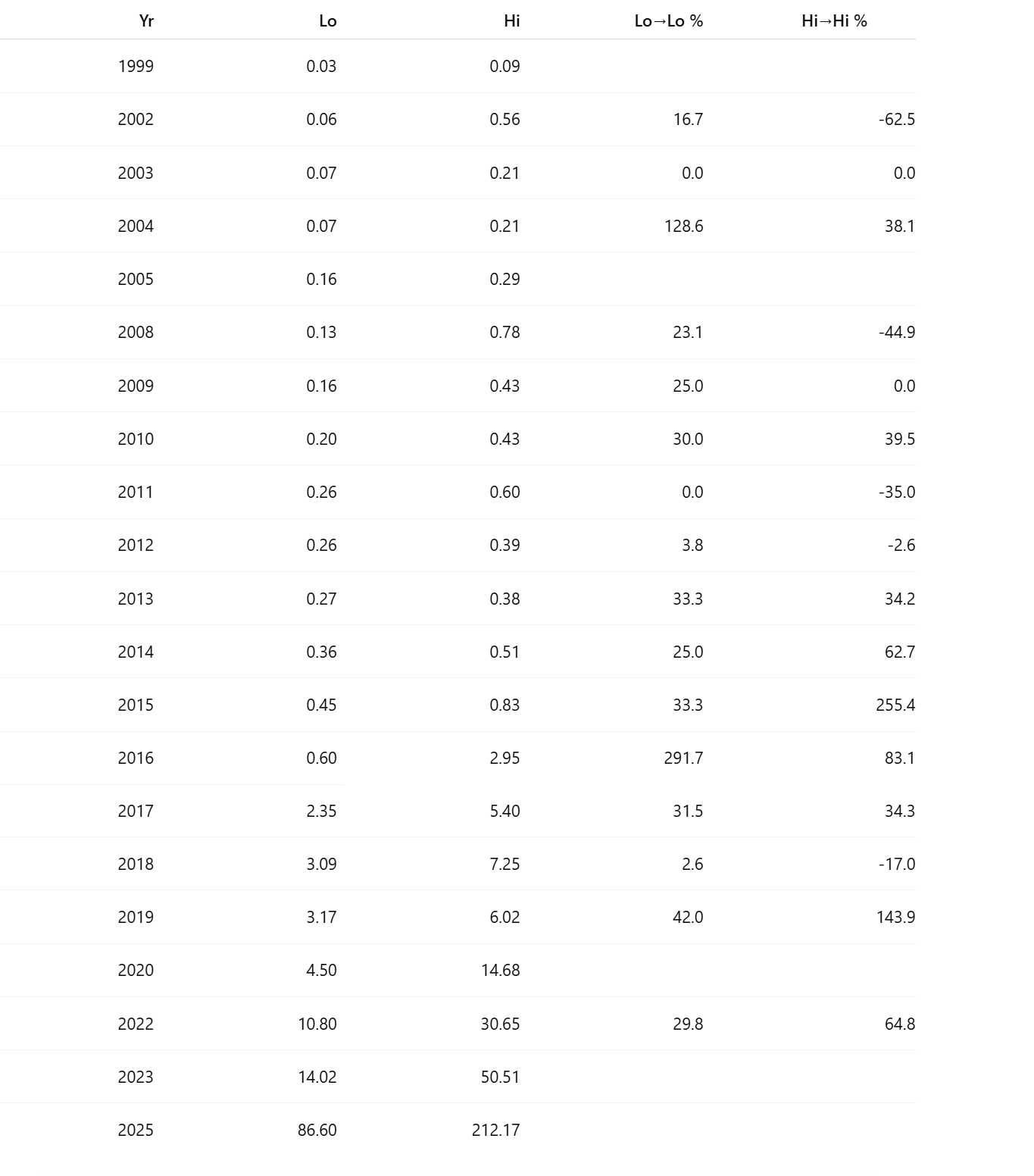
Asindu's narrative is a wonderful story; but it is not the history of how people behaved as owners of NVDA. The SIL aka SEF15 was the oddball in his lab because, unlike the older veterans, he did not immediately convert his incentive shares into cash once they could be sold. The chart [click for full view] is a year-over-year Hi-Lo price history for the stock; it explains why the veterans were not fools, why some of you are smart enough to be able to trade, and why the SIL puts up with me because I told him to keep every share. The years that are omitted are those where stock-splits made the calculations too hard for ChatGPT and me.
Jun
14
Where in the world is Aubrey Niederhoffer?
June 14, 2026 | 1 Comment
A 19-year-old Thiel fellow just raised $7.3 million to build an African ‘super app’

If he hadn’t dropped out, Aubrey Niederhoffer would be nearing the end of his sophomore year at UC Berkeley. Instead, the 19-year-old from the New York area is living in Lagos, where he just launched his food delivery app, Swoop. The 28-person company just booked $7.3 million in seed funding, and the teenager was named to the prestigious Thiel Fellowship.
The Thiel Fellowship, founded by billionaire investor Peter Thiel in 2011, offers young people $250,000 to skip or drop out of college and “build new things.” Notable recipients include Figma CEO and cofounder Dylan Field, Ethereum cocreator Vitalik Buterin, and at least one early employee at Elon Musk’s Department of Government Efficiency.
In an interview, Niederhoffer recounted how he grew interested in Africa while playing the online geography game GeoGuessr as a tween. When he was 15, he started a recruiting company focused on the labor pool in Eswatini, and would visit the southern African country during breaks from school.
Jun
12
Jane Street AI training data center, from Humbert X.
June 12, 2026 | Leave a Comment
Dwarkesh Goes Inside Jane Street's Latest AI Data Center (video)
Twenty years ago, our "cluster" was just 6 Dells stacked on the floor of our office. Today, come tour our new Texas datacenter: 4,032 GPUs, liquid cooled.
Asindu Drileba writes:
Their hiring is surprisingly very meritocratic, if you can solve any of their monthly puzzles, they will unconditionally grant you an interview & likely a job offer.
For the current offer: Jane Street: Puzzles
And an archive of previous puzzles (with solutions).
Oliver Joseph comments:
For those who are computer science oriented their podcast signals and threads is lots of fun I recommend it. In particular they interview Daniel Pontecorvo on their facilities in general. Some of the solutions they have come up are very interesting and reminded me of some solutions we used in the music world. For example they use a raised platform to run air, data and electricity to workstations on casters so they can move workstations often. This is how we would rig up outdoor tours. Racks and amps on casters and modular raised stages were safer and faster to set up.
Of course I always enjoy time in server rooms. While I’ve never had the pleasure of working on one quite like the one you have linked. “Started with six dells on the floor” It’s a great lesson never despise small beginnings.
Jun
10
Can Stock Indexes Afford to Ignore SpaceX?
Another side to the argument deserves more scrutiny than it receives amid enthusiasm for technological innovation and market capitalization milestones. Institutional incentives have changed radically since index inclusion became a major event. And the mechanism by which being a component of a stock index has become important is beyond merely symbolic. The growth of passive investing now triggers billions of dollars in mechanical purchases from index funds and exchange-traded funds benchmarked to major indices. In effect, index decision committees now exercise considerable influence in private capital allocation decisions that were once determined more organically through decentralized management decisions and market processes.
Jun
9
Rule of 16, from Zubin Al Genubi
June 9, 2026 | Leave a Comment
The 1-Day Expected Move calculation is the practical application of the "Rule of 16" described by Euan Sinclair and other volatility traders.
The Rule of 16 is a mathematical heuristic used to convert annualized implied volatility (the number you see on a quote screen, like 16%) into a daily expected move. The rule is derived from the "square root of time" principle in the standard deviation formula. Since there are approximately 252 trading days in a year, and the square root of 252 is roughly 15.87 (which traders round to 16). Divide VIX by 16 and get the percent expected daily move.
Or consider Parkinson absolute volatility, Expected Daily Absolute Range. By scaling the current VIX using the Parkinson volatility framework, calculate the total expected intraday path length - the absolute breadth from the high print to the low print of the session, independent of the previous day's close.
Useful but occasionally very wrong, like Friday. But a midday update of abs vol after Vix jump provided a fairly good bottom number.
Jun
7
Opinion - After the Crude Premium: Pricing the Product Shock, from Humbert Z.
June 7, 2026 | Leave a Comment
The market spent three months pricing the barrel. The next 90 to 180 days will be decided by the products refined from it.
Crude shock is now understood; product shock is not. Since the effective closure of the Strait of Hormuz, attention has shifted to crude oil. Brent peaked at roughly $138 in early April and now trades in the low $100s, with WTI in the high $90s and the Brent–WTI spread near $10–$12 a barrel, wider than its customary $4–$6. That is the visible price. The less visible, more consequential story over the next 90 to 180 days is what happens to the products refined from crude — jet fuel, gasoline, diesel, and fuel oil. Crude can be rerouted; refined products are produced by configured refineries, and refineries sit at the far end of a supply chain measured in weeks, not hours.
“Energy independent” describes volume, not chemistry. The United States produces more crude than it consumes, but the crude it produces is the wrong type for the products it needs. Shale oil recovered by fracking is very light and sweet; it yields LPG, naphtha, gasoline, and some kerosene, but little of the middle distillates — diesel and jet — and almost none of the residual fuel oil that a complex economy runs on. Those heavier products require medium and heavy sour crude: the grades that flow from the Persian Gulf, Canada, and Latin America, and that Gulf Coast refineries were built to process. The Hormuz closure removes medium and sour barrels from the global pool — precisely the barrels whose yield is weighted toward diesel and fuel oil. That puts a premium on the heavy crude the US can still reach — and Canada is the backbone of it: heavy, sour Western Canadian barrels piped straight to US refineries, by far the largest single source of US crude imports. With Venezuela unable to raise output quickly and Mexican volumes in slow decline, Canadian crude and the sour grades released from the Strategic Petroleum Reserve must carry more of the load. So even as crude prices ease from their peak, the product slate can tighten because the marginal barrel lost is the one that produced the scarce products.
Jun
4
Cy Young’s Rules, from Stefan Jovanovich
June 4, 2026 | Leave a Comment
Cy Young's Rules For Pitching Success
1. Pitchers, like poets, are born, not made.
2. Cultivate good habits: Let liquor severely alone, fight shy of cigarettes and be moderate in indulgence of tobacco, coffee and tea. A player should try to get along without any stimulants at all. Water, pure cool water is good enough for any man.
3. A man who is not willing to work from dewy morn until weary eve should not think about becoming a pitcher.
4. Learn to be patient and cool. These traits can be cultivated.
5. Take the slumps that come your way, ride over them and look forward.
6. Until you can put the ball over the pan whenever you choose, you have not acquired the command necessary to make a first-class pitcher. Therefore start to acquire command.
Published in "Baseball Magazine", 1908.
Jun
2
Food prices in UK (or Europe), from Nils Poertner
June 2, 2026 | Leave a Comment
Looking at longer dated charts (eg. Wheat, Oil etc…) and knowing how easily every new government in the UK will yield to public moods makes me think. (There were calls by politicians to cap food prices.) Maybe not immediately relevant, but perhaps later this year or next.
Call for food price caps ‘completely preposterous’, says M&S boss
Stuart Machin argues government should reduce tax and regulatory burden on supermarkets instead
Jun
1
Book reccy, from Zubin Al Genubi
June 1, 2026 | Leave a Comment
Who We Are and How We Got Here: Ancient DNA and the New Science of the Human Past, by David Reich
Highly recommended. Turns ancient history on its head. Absolutely fascinating.

Big Al adds:
He does an interesting quick summary of current paleogenetics:
Your ancestors aren't who you think they are | David Reich
Over the last 15 years, data on ancient DNA has upended the old story of human history. In this full-length interview, geneticist David Reich explains how new findings have challenged the family tree model of ancestry and revealed a past shaped by migration, interbreeding, disappearance, and constant change.
From Neanderthals and Denisovans to the myths of purity that still shape modern identity, Reich shows how the last decade of research has rewritten what we thought we knew about human origins. The result is a much stranger, more dynamic picture of the human story, one that forces us to rethink ancestry, evolution, and the deep history of who we are.
Archives
- October 2026
- September 2026
- August 2026
- July 2026
- June 2026
- May 2026
- April 2026
- March 2026
- February 2026
- January 2026
- December 2025
- November 2025
- October 2025
- September 2025
- August 2025
- July 2025
- June 2025
- May 2025
- April 2025
- March 2025
- February 2025
- January 2025
- December 2024
- November 2024
- October 2024
- September 2024
- August 2024
- July 2024
- June 2024
- May 2024
- April 2024
- March 2024
- February 2024
- January 2024
- December 2023
- November 2023
- October 2023
- September 2023
- August 2023
- July 2023
- June 2023
- May 2023
- April 2023
- March 2023
- February 2023
- January 2023
- December 2022
- November 2022
- October 2022
- September 2022
- August 2022
- July 2022
- June 2022
- May 2022
- April 2022
- March 2022
- February 2022
- January 2022
- December 2021
- November 2021
- October 2021
- September 2021
- August 2021
- July 2021
- June 2021
- May 2021
- April 2021
- March 2021
- February 2021
- January 2021
- December 2020
- November 2020
- October 2020
- September 2020
- August 2020
- July 2020
- June 2020
- May 2020
- April 2020
- March 2020
- February 2020
- January 2020
- December 2019
- November 2019
- October 2019
- September 2019
- August 2019
- July 2019
- June 2019
- May 2019
- April 2019
- March 2019
- February 2019
- January 2019
- December 2018
- November 2018
- October 2018
- September 2018
- August 2018
- July 2018
- June 2018
- May 2018
- April 2018
- March 2018
- February 2018
- January 2018
- December 2017
- November 2017
- October 2017
- September 2017
- August 2017
- July 2017
- June 2017
- May 2017
- April 2017
- March 2017
- February 2017
- January 2017
- December 2016
- November 2016
- October 2016
- September 2016
- August 2016
- July 2016
- June 2016
- May 2016
- April 2016
- March 2016
- February 2016
- January 2016
- December 2015
- November 2015
- October 2015
- September 2015
- August 2015
- July 2015
- June 2015
- May 2015
- April 2015
- March 2015
- February 2015
- January 2015
- December 2014
- November 2014
- October 2014
- September 2014
- August 2014
- July 2014
- June 2014
- May 2014
- April 2014
- March 2014
- February 2014
- January 2014
- December 2013
- November 2013
- October 2013
- September 2013
- August 2013
- July 2013
- June 2013
- May 2013
- April 2013
- March 2013
- February 2013
- January 2013
- December 2012
- November 2012
- October 2012
- September 2012
- August 2012
- July 2012
- June 2012
- May 2012
- April 2012
- March 2012
- February 2012
- January 2012
- December 2011
- November 2011
- October 2011
- September 2011
- August 2011
- July 2011
- June 2011
- May 2011
- April 2011
- March 2011
- February 2011
- January 2011
- December 2010
- November 2010
- October 2010
- September 2010
- August 2010
- July 2010
- June 2010
- May 2010
- April 2010
- March 2010
- February 2010
- January 2010
- December 2009
- November 2009
- October 2009
- September 2009
- August 2009
- July 2009
- June 2009
- May 2009
- April 2009
- March 2009
- February 2009
- January 2009
- December 2008
- November 2008
- October 2008
- September 2008
- August 2008
- July 2008
- June 2008
- May 2008
- April 2008
- March 2008
- February 2008
- January 2008
- December 2007
- November 2007
- October 2007
- September 2007
- August 2007
- July 2007
- June 2007
- May 2007
- April 2007
- March 2007
- February 2007
- January 2007
- December 2006
- November 2006
- October 2006
- September 2006
- August 2006
- Older Archives
Resources & Links
- The Letters Prize
- Pre-2007 Victor Niederhoffer Posts
- Vic’s NYC Junto
- Reading List
- Programming in 60 Seconds
- The Objectivist Center
- Foundation for Economic Education
- Tigerchess
- Dick Sears' G.T. Index
- Pre-2007 Daily Speculations
- Laurel & Vics' Worldly Investor Articles
