Mar
2
Utility of Gold, from Steve Ellison
March 2, 2012 | 2 Comments
 I find it pretty hard to argue with the Sage on this one. Here is what he actually said, in a Fortune magazine article (February 27, 2012 issue) based on his shareholder letter:
Today, the world's gold stock is about 170,000 metric tons. … At $1,750 per ounce … its value would be about $9.6 trillion.
…Let's now create a pile B costing an equal amount. For that, we could buy all U.S. cropland (400 million acres with output of about $200 billion annually), plus 16 Exxon Mobils (the world's most profitable company, one earning more than $40 billion annually). After these purchases, we would have about $1 trillion left over for walking-around money.
A century from now the 400 million acres of farmland will have produced staggering amounts of corn, wheat, cotton, and other crops–and will continue to produce that bounty, whatever the currency may be. Exxon Mobil will probably have delivered trillions of dollars in dividends to its owners (and, remember, you get 16 Exxons). The 170,000 tons of gold will be unchanged in size and still incapable of producing anything.
Stefan Jovanovich writes:
No one suggests that gold is somehow a magically superior investment; as Money it is not an investment at all, simply the means by which people can save wealth with the assurance that it will not be easily confiscated or corrupted by the government. Mr. Puffy has lived an indulged and indulgent life; since early childhood he has had the security of knowing that nobody would ever mess with him. Throughout human history many, many people have known that they would be the opposite of a Congressman's son. (Cue "Fortunate Son"). They have even been paranoid enough to think it wise to hold some of their wealth in a portable form. Calling the insurance company in order to collect on your policy might not be possible. As even the Oregano knows, there is always the regulatory risk that you may be on someone's shit list. At current prices I can fit the gold coinage equivalent of the average American's lifetime savings ($95K) in a tiny case; it will weigh less than an ultralite laptop. It is just such similarly-sized hoards of the stuff "incapable of producing anything" that allowed the Hugeunots, Moravians, Jews, Anabaptists, free thinkers and so many, many others to flee and save themselves and their families.
Comparing the world's Coin with the valuations of some of the things it could buy is a sensible exercise. Sometimes Money is overpriced, and sometimes it is not. That is for the market to decide. But using crude sums is a rhetorical trick that the Oregano really has to give up. It contradicts everything he has done in his own business practice. As he well knows, anyone who acquired even 10% of "all U.S. cropland" - let alone all of it and 16 Exxon Mobils - would find himself subject to envy regulation by the FDA and the entire Congress; the farmland would still be there a century from now - asteroid strikes being excluded as acts of God - but the returns on investment would not be. That is as certain as the fact that the people who regularly visit the White House will always want to assure the rest of us that the government's word is all we need.
The notion that the government should not "regulate" individuals' money savings is as radical these days as the idea that people have innate rights of liberty not subject to the will of the King was 250 years ago. I don't expect to win this argument in my lifetime; but things do change - sometimes even for the better.
George Parkanyi writes:
Stefan, I fully understand why people still invest in gold. They/we believe that in the future is can be exchanged first for whatever currency prevails, and then with that currency buy goods, hopefully with roughly equivalent, or perhaps greater purchasing power. My point is that when you think about it - gold itself has limited intrinsic economic value. It does not contribute all that much to actual wealth-creating productivity. It's mainly just used as a proxy for wealth - only because enough people still agree that it is. It's not a commodity that people use day-to-day except for decorative purposes (jewelry and art) and in electronics. It's not something we need with which to sustain ourselves. That to me is its vulnerability. Yes it's tangible, but it doesn't really do anything.
I find it fascinating that in some African rural areas people use transferable cell-phone minutes as currency. That's the kind of digital-age utility I'm talking about. I think that abuses and corruption aside (you find that everywhere anyway) - electronic money is just so much more convenient, and modern economies are now totally structured around that. Modern economies use their productivity as the "collateral" behind their currencies. That actually makes sense as long as you put enough governance around it so that people are willing to trust the currency, and computer and network technology facilitates trade like never before, hugely boosting productivity. Apart from straight barter with things like refrigerators, I can't think of anything more cumbersome to use as a medium of exchange than gold. It's heavy, not easily divisible. I can't even sell my gold coin (received as a gift) to a bank without the original purchase paperwork - otherwise there's an assay charge that goes along with it. What a pain in the ass(ay). And it may not help you all that much in a Mad-Max world either - if food, water, clothing, tools, and guns are at a premium, who wants to be lugging around a heavy gold bar?
I do agree that its not going away any time soon. The emperor may have no clothes, but everyone has universally agreed to pretend that he does.
Stefan Jovanovich replies:
The Founders and their British forebears like Isaac Newton were committed to milled coinage because, once one accepted the assay of the issuer - i.e. the Royal or U.S. Mint - the coins themselves could be valued simply by weight. Even sweating the coins (shaking them in a bag and then collecting the dust generated by the friction) and minor clipping would not affect their value because that was determined by the weight of the coins themselves, not the "face value". That is the point of the gold standard clause in the Constitution - Congress sets the weight and measure for a coin - i.e. so many ounces at the standard assay. That allowed a $20 gold piece that was worn to be discounted accordingly; the "gold clause" in a contract was a commitment to pay be weight and measure, not by face value alone. (And, yes, every store had a scale; one of the first demands of merchants for commercial regulation was to have scales themselves certified by state and county inspectors.) One of the many reasons Grant's Resumption and Legal Tender Bills (making greenbacks redeemable; setting gold as the only monetary standard for the first time in U.S. history) were so successful is that U.S. Notes - the promises of the Treasury to pay gold of a specified weight and measure - became more reliable than coin itself. The paper money did not itself have to be weighed and the printing and engraving and paper were sufficiently subtle that counterfeiting was too expensive to be profitable!
Feb
27
The Trophy, from Victor Niederhoffer
February 27, 2012 | 7 Comments

The awarding of the trophy to The Artist shows how 100% of voters are tilted towards the "change man". The trophy had to go to the show that had the least attendance during the season to keep man small, and to show how the public is stupid, and how the arbiters in the academy are on a higher plane of significance, a higher aesthetic than you and I.
How long before they all get invited to the Oval, and how consistent with the idea that has the world in its grip, and how bearish for the long term market.
John Tierney, the President of the Old Speculator's Club, writes:
Considering much of Hollywood's output, it's surprising The Artist didn't also capture Best Screen Play….
Victor Niederhoffer adds:
That's funny, Mr. President. But The Academy Awards is in the main a profit making deal which must cost 1.5 million a picture to enter, considering the perks and costs. The 1.5 million for the lowest budget film, The Artist representing a 10% capital contribution has the higher return to that input and is show in to win if it shows how deficient and low brow the public is in its taste. How beautiful to give it to one without talking that went out of style 100 years ago to show how we need redistribution and a raising of the capital gains rate as a solution to our problems.
Vince Fulco writes:
I was discussing a similar matter with someone this weekend re: Gingrich's plan for $2.50 gas. While not focusing on any one political party, what is it about the US citizenry that keeps them accepting (broken) promise after (broken) promise? Thereby guaranteeing they'll stay small.
Pete Earle writes:
I suspect that the GAP's ability, and willingness, to get snookered by political actors and parasitical systems time and time again is the dark side of what, turned over again, is an exceptional ability and willingness to imagine enterprises and undertakings which in many other places would be cast off as unrealistic, insurmountable, or unnecessary.
Essentially, I believe that productive/entrepreneurial optimism is yin to political optimism's yang.
Feb
24
The Shapes of Our Bubbles, from Kim Zussman
February 24, 2012 | 1 Comment
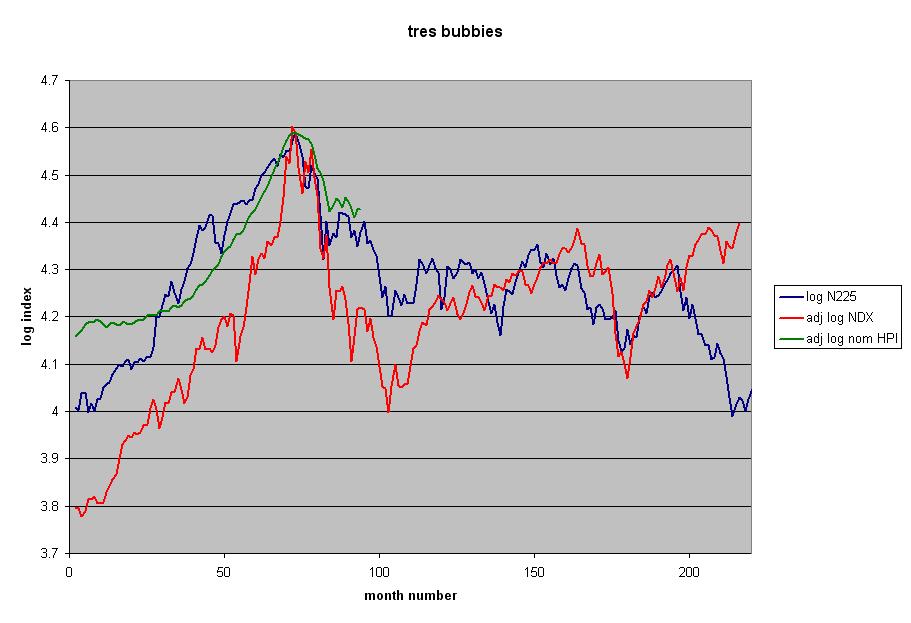
The above plots three asset price bubbles (defined in hindsight as big price run-ups followed by big declines); in Nasdaq, Nikkei 225, and nominal Shiller Home Price Index.
All three were sampled on a monthly basis. Values were transformed by taking the log (to allow % change in value to scale), and further adjusting the log values so all three bubbles peaked at the same nominal value. Timescale is in month numbers, with all three aligned so their respective bubble peaks coincided in time.
The Nasdaq cuts off at the present, rebounding much better than Nikkei did after the same elapsed time after peak. Nasdaq also had a faster/steeper gain than Nikkei, and commensurately faster/steeper decline. Nominal house prices show less noise and a slower move - rather similar to Nikkei - might be expected with lower liquidity.
A story still unfolding.
My friend asked me the other day about how I said lower "noise" might be a result of lower liquidity? How do I figure?
Perhaps incorrectly: How does transaction price behavior change when average transaction time goes from seconds to months? In the case of financial instruments, large bid-ask and long time between transactions could increase volatility. OTOH volatility spikes usually correlate with volume spikes.
The smoothness of Shiller HPI may also be due to price anchoring; loans don't get funded unless the house appraises, and appraisals are mostly based on recent comparable sales.
It is also possible that HPI is more flexionistic and with less valid price discovery than Nasdaq or Nikkei.
Feb
22
Global Warming and the System, from Gary Rogan
February 22, 2012 | Leave a Comment
Nowhere (arguably) has the peer-review system been hijacked more by "the system" than in the area of global warming. As it became essentially impossible to obtain public funding for any research that had an explicit goal of disproving any specific aspect of it, and it became much easier to obtain research funding for any related (and sometimes unrelated) subject by citing its connection to global warming as at least a partial goal of the proposal, "the system" organized itself to defeat any spontaneous or privately-funded challenges by any means necessary.
Ironically, it is the Socialist-leaning Sinclair who captured the phenomenon perfectly in the following quote:
"It is difficult to get a man to understand something, when his salary depends upon his not understanding it."
Ron Schoenberg writes:
I'm a econometrician with forty years experience in fitting statistical models. You can google me. The last 22 years I've been involved with writing computer programs for fitting statistical models. I was recently introduced to your web site and I haven't posted anything yet.
But I'm forced to respond to this post.
It's true that the peer-review system can sometimes fail. A better example is the graduate student who proposed that our continents float on tectonic plates. It took years for tectonic plates to be accepted. Global warming however is not a good example. Plate tectonics, Relativity, the heliocentric solar system were paradigmatic. Global warming isn't. A better comparison of global warming is with cigarettes causing lung cancer. Scientists were producing increasingly alarming connections of cigarette smoking with lung cancer. The cigarette companies were freaked out because this hit their bottom line. They funded scientists to produce confusion about the results the scientists were finding. They succeeded in delaying the results from being accepted.
In the same way oil companies are threatened by global warming. The value of their companies depends critically on the oil in the ground they have control over. The implication of climate science is that this oil should be left in the ground. Their valuation shrinks to next to nothing. All they going to have left is plastic (Cf. The Graduate). So they hire scientists to confuse the issue just like the cigarette companies did. The conflict of interest you point out among scientists over public funding is dwarfed by the conflict of interest created by oil companies funding of scientists. I know statistical modeling. The issues about modeling global warming are not paradigmatic. They are not like tectonic plates. And I can assure you the climate scientists are doing it right.
The impact of global warming is happening as we speak. Drought is having an impact on agricultural commodities. This is going to get worse. You need to be paying attention. If you have children who are going to live through this, you need to be paying attention.
Stefan Jovanovich replies:
Global warming and cigarette smoking share a paradigm as political economy. In both cases the reformers end up being the best possible advocates for the people whose economic interests are being threatened. Cigarette smoking was known to have health issues a hundred years ago. The cigarette companies did not "freak out" over Federal regulation; they pushed for it. Those warning labels on the cigarette packages delayed for 20 years any successful class actions challenging the fact that the tobacco companies were selling a product that met all the tests of strict liability - i.e. it was unavoidably damaging to the users.
The global warming advocates are the best friends the international oil companies ever had. Why else would BP have spent millions talking about how green they were? The international oil companies don't own the oil in the ground; the world's oil reserves are owned by state-owned monopolies. What the international oil companies still own are the means of distribution so they have every reason to want to see the oil stay in the ground rather than be pumped and used; high volumes are not profitable for distributors in competitive markets, low volumes are because they create sufficient barriers to entry.
Let's try to be more specific. What is your particular theory of global warming, Ron? Is it man-made CO2 or - as some of the unpopular scientists are beginning to suggest - is it the particulate emissions from wood fires, burning of hydrocarbons (but more importantly, the grinding of rubber tires into tiny particles) that are having serious climate effects?
The problem with conventional global warming advocacy is that it shares all of the nasty habits of 19th century Darwinism (for which Darwin himself should not be blamed); it took only a few decades for Darwin's hypothesis to become the principle justification for the racialism that became the justification for segregation and apartheid and vicious colonialism.
It has taken less time for MMGW to become the justification for preventing the vast majority of the people in the world to have access to the inexpensive energy needed for clean drinking water and cooking fires that do not produce far more lung cancer and other diseases than tobacco smoking ever has.
The science should be open to all opinion; the presumption that a hierarchy of the anointed should be given the power to destroy open markets in the name of progress is a folly that does not bear repeating. We didn't get segregation because street car companies wanted it; we got it because science confirmed the opinion of the all the "good" people that the darkies had to be quarantined - for their own good.
Jaime Klein replies:
Ron proposes the conspiracy theory that oil companies have an interest in fomenting confusion regarding global warming. Maybe it is so, but I can't see why they should be. Global warming, should it occur, will not affect the value of underground oil reserves. Only a tiny fraction of the oil is consumed by heating (6% in the USA) and I dare say the same amount or more is used in air conditioning. My summer electricity bills (in Israel) are the triple of winter ones and we use the same system for heat and cool the palace.
Quote: "Of the 20 million barrels of oil consumed each day, 40 percent is used by passenger vehicles, 24 percent by industry, 12 percent by commercial and freight trucks, 7 percent by aircraft, and 6 percent in residential and commercial buildings."
Computer modellers need no incentive to create confusion. They are quite capable of doing it for free.
Gary Rogan responds:
I'm not a global warming scientist nor someone who is collecting all relevant facts, so I make my conclusions based on the information I come across in my constant search for information. Let me explain how I reach my conclusions.
Earlier today I posted an article illustrated how Global Warming was used as a stepping stone for success by Margaret Thatcher years ago in a cynical (my interpretation) political ploy. This elevated an obscure theory to a politically and economically viable and important concept.
Years ago I observed how Al Gore and James Hansen made sure to introduce their ideas to Congress on what was expected to be the hottest day of the year, and how they also made sure that the windows were open. I've observed how a British Court determined that Al Gore's movie contained eleven material falsehood and the impact that had on using it as a teaching aid in the UK. This was never publicized to any degree in the US and I had to ask myself "Why?". I've seen Al Gore refuse to debate ANYONE on the merits and I also asked "Why?". I've seen Climategate and the length to which "Climate Scientists" would go to quash dissent. I've seen photos of drowning polar bears forged and the realities of their survival as a species "nuanced" in was beneficial to Global Warming proponents. I've heard HUNDREDS of people of good will (or so they appeared to me) question this theory. These were people who displayed uncommon sophistication and knowledge in areas I was more familiar with. The physics of the increase of one molecule of CO2 in 10,000 molecules of air making THAT much difference never made much sense to me, but that was more from imagining this one lonely molecule among 10,000 rather than any calculations, and of course CO2 isn't the only culprit (yet somehow the main target as oil companies seem like much more inviting targets than herds of cows). I've seen the importance of solar flares questioned, and I've seen all kinds of data about global warming stopping in 1998 or current high temperatures being on par with those in the late 30's and 40's. I have no idea really if the increase in droughts may not be caused by local agricultural practices given increasing world population and use of water and all the deforestation and soil erosion that's going on.
Last night I was listening to James Delingpole, a noted British author question this theory with great believability. When asked "How do you respond to someone who says we should not take any chances and shouldn't we spend whatever it takes in case Global Warming is indeed caused by human activity?" his answer was along the lines of "Can we be sure that aliens will not invade the Earth tomorrow? If not, let's spend billions to equip all airplanes and rockets with anti-alien laser weapons".
Let me just say this: the "theory" is being promoted as a hoax would be by a priori evil, dangerous people like Al Gore. Facts are being suppressed by the mainstream press and by the advocates of the theory. Third world hell holes demand all manner of reparations under the guise of being compensated for the damage done by Global Warming to them. It may very well be true, but if it walks like a hoax, quacks like a hoax, and all that, it probably is a hoax.
Mr. Krisrock writes:
It's preposterous that anyone thinks the same collectivists who are trying to run and control our economy through central planning could do the same thing to world weather.
It shows the outrageous arrogance of San Francisco modelers who think a model so large could work…it defies common sense and a response.
This guy is a dreamer, who takes his advice from the AZTECS who worshiped the sun god…that culture disappeared in case he didn't read the history book.
Sadly, the world can't add up its money to balance its debts despite all his silly models but to think there is NO POLITICAL AIM in global warming?
There is, it's all about a small group of power hungry idiots, no different than tyrants in another time, who create false idols …
The same people as him run the state of California…have run it into the ground financially…and refuse to admit their models don't work.
The smoking argument is bullshit…people will still die from something…but millions in Asia will die far happier than this idiot.
And I add this year we had the largest global harvest of RICE…so much for global warming bullshit…
T.K Marks writes:
"It is difficult to get a man to understand something, when his salary depends upon his not understanding it."
As one who defines the notion of salary broadly, that Sinclair quote might be the most succinct and trenchant definition of realpolitik that I've ever read.
Charles Pennington writes:
Climategate demonstrated "peer review" at its worst–faking data and conspiring to ostracize the naysayers. It was a lucky stroke that it was uncovered.
Stefan Jovanovich responds:
Ron: Please accept my sincere welcome to the List. As others will tell you, I am a professional pain in the ass; but I do mean well. What I was trying to convey about the cigarette companies is that their (largely successful) conspiracy was even worse than you alleged. The cigarette companies knew they were selling addiction long before any studies were done on lung cancer. The best cases against them were those that were based on the common law argument that the tobacco companies were knowingly selling a product that was per se harmful. Those cases only had to rely on the fact of addiction - which everyone conceded - and did not need to meet the much harder burden of proof that epidemiological correlation requires. The "reform" that produced the warning labels defeated all that litigation; the tobacco companies now had a safe harbor defense.
Allow me a few last comments before acknowledging the final call to Order from the Speaker of our Parliament.
(1) There is a rather significant difference between Copernicus' situation and that of the global warming skeptics. Copernicus was challenging the established church, which was the international authority on all matters spiritual and intellectual. Your part of the argument already has the international church aka the UN and the holy orders aka the publicly-funded universities on its side. The poor skeptics have to rely on their own money - as did Copernicus.
(2) Isaac Newton was never accused of heresy; on the contrary, he was the author of a number of religious tracts, among them The Chronology of Ancient Kingdoms Amended (1728) and Observations Upon the Prophecies of Daniel and the Apocalypse of St. John (1733). He was not even censured for his dabbling in alchemy even though reasonable minds might not consider that the best of hobby choices for someone appointed warden of the Royal Mint.
(3) Einstein first came to the U.S. in 1921 to raise funds for the planned Hebrew University of Jerusalem. He received the Barnard Medal and was treated like a rock star. After he won the Nobel Prize that same year, American universities fell over themselves competing to have him come join their faculty. Einstein preferred to return to Europe - which was his home; but he continued to visit the United States regularly throughout the 1920s without ever having any problem getting off the boat. Princeton finally persuaded him to accept a faculty position with them in 1932 on the condition that Einstein be allowed to return to Berlin each year for 5 months. What kept Einstein here in America were the Nazis. He left Berlin in December 1932 (the Nazis took power the following month) and never returned to Germany. Einstein became a U.S. citizen in 1940 but he retained dual Swiss citizenship. The only evidence of Einstein's having had any difficulty with visas or his citizenship application is in Fred Jerome's book - The Einstein File: J. Edgar Hoover's Secret War Against the World's Most Famous Scientist, by Fred Jerome. St. Martin's Press, 2002. 348 pages. ISBN 0-312-28856; and its only source is Einstein's FBI file, not State Department records.
NB: Those of us who have FBI files know from direct experience that the Feebies apply the vacuum cleaner theory of information - floor sweepings are given equal billing with birth certificates.
Peter Saint-Andre writes:
Over time I have come to see this phenomenon as controlled not by "the government" in some faceless way, but by individuals or classes of individuals who have used the levers of power (federal, state, county, city, etc.) to their own benefit. I have seen this in the city where I live: few things happen in city politics that do not benefit the real-estate developers, and certainly nothing happens that harms them. The same could likely be said for industries and policy areas that I have not studied as closely: defense, energy, finance, transportation, education, materials, you name it. There are people and companies who benefit, and who always emerge untouched. The rest of us are harmed and suffer, to a greater or lesser extent. Perhaps if one followed the money and influence to identify who precisely makes up the aristocracy of pull, one could indeed build a successful investment strategy. I don't think I have the stomach to do so.
And by the way, looking at things in this way makes me much more sympathetic to many self-styled "progressives" (while I think that their understanding of markets is quite incomplete, they too have a sense that the game is increasingly rigged).
Gary Rogan responds:
It seems difficult to take advantage of observed cronyism while being on the outside. One should only look at trying to invest in solar panel manufacturers, or ethanol producers, or defense contractors (after a certain point). Sooner or later the government runs out of money, and you have to be very close to the action to figure out when the gig is up. The health insurers were quite an interesting story to observe: a very political group that took a huge hit with Obamacare only to recover very nicely. You really have to know who was involved in shaping the legislation, and if possible the real effect. My own solution was to own what Rocky likes to call "world class" companies that seem flexionic, but would persist past any "abandonment" stage, or in companies that have a flexionic component, but that's not dominant (such as a chemical manufacturer with a large biodiesel component). It would be interesting to study if any of Sage's flexionic investments could be taken advantage of after his intent has become public, at least he always knows these days that the company will be saved if push comes to shove.
T.K Marks writes:
Not all variables are created equal. Some are unknown; others, unknowable.
Absent insider knowledge, politics for general investment purposes is but a fiefdom of unknowable variables, where knowledge is lord.
But 'knowledge' in such a sense is illegal, or unethical, or both.
At least it's supposed to be.
So one is better off trying to quantify things played out on fields more intrinsically level than politics.
Feb
21
Gasoline Fears, from Bill Rafter
February 21, 2012 | Leave a Comment
 This past week there was an item published about the drop in miles driven by the population. The point of the missive was to suggest that miles driven is a surrogate for economic activity, and that we should prepare for another recession because the miles driven showed a huge decline.
Part of the problem in analyzing the data is that mileage did not directly address the price of gasoline, and it is logical to assume that at a high price of gasoline, the public curtails some discretionary driving. So some of the drop in miles driven could be related to price. Another item could be the Cash for Clunkers program, which could offset the price rise to some extent as the newer cars generally get better mileage. The latter apparently did not happen to any large degree.
The chart presented with this link shows the allocation of household expenditures spent on gasoline (top panel) and the annual growth rate of those expenditures.

My conclusion: There is a drop in mileage driven, but I would not bet that it foretells further recession.
Mr. Krisrock comments:
105 dollars in crude tonight as Obama and his communist central planners try to figure out the new narrative and who to blame this on…
Feb
15
A Valentine’s Day Lesson, from anonymous
February 15, 2012 | Leave a Comment
 I was playing Texas Hold'em Poker online yesterday. For about an hour, I had some very good wins. Then my wife came in from outside, and we had the Valentine's greetings. It was for less than half a minute. During this time, someone called all-in. When I discovered, the software followed the bet for me when my response was timed out. So I lost it all.
Things of this nature happen more often and more easily than we think. This is just another alarm for me to take the lesson seriously.
Jeff Watson writes:
The real lesson here is to not play NL poker games. The risk of ruin in any NL game approaches 100%. Limit poker is much better for your longevity and bankroll….provided you are a good enough player to have an edge. If you don't have an edge, stay away from the game. This applies to any game, market, sport, or activity that is competitive in nature and has a win/lose outcome.
John Netto comments:
Jeff, I have a different perspective in the limit vs. no-limit game discussion. As you hit on, much like trading, issues like bankroll, rake, skill of opponents, and ability to extract the greatest amount of expected value all play a roll. When discussing the risk of ruin in a No Limit game, it is important to qualify one game vs. a career. Limit hold'em can impede the ability to extract bankroll from weaker players who will egregiously overpay to chase draws or call after they have been beat. Over the life of a professional speculator, forsaking this volatility can come at a cost of giving up even greater alpha (we are trying to push the efficient frontier up and left, not down and right)…
In fact, playing no-limit tournament poker vs. no limit cash games is a different discussion all together, considering the variance as a professional tournament player vs cash game player (almost akin to being long gamma vs short gamma strategies in the market).
The reason why I am a professional sports bettor, former cash game no-limit poker player, and commodities trader is the ability to put myself into asymmetrical bets and judiciously control my bankroll. In fact, as unfortunate Leo's misfortune was, operational risk is a part of trading and poker. Many poker sites will give the option to check or uncheck the "call" button. There are benefits and drawbacks to both situations.
Sam Marx writes:
 Can you imagine the damage a Flash-Crash would do if it occurred on an Option Expiration Day.
The previous Flash-Crash caused damage but much of it was later straightened out. But on an Option Expiration Day the damage might be insoluble
Ralph Vince writes:
On a similar note, given this creeping-up market of recent weeks, Prechter's prediction (which, I am not discounting one speck) I was thinking this morning how the 2008 crash closely correlated with Obama's imminent election (please, I am not arguing political idealogy here. I do not care one joy who is in charge of the Magic Kingdom and it means nothing to me at all).
Rather, given the landscape of the political backdrop here (and making the giant assumption that a large part of the drop of 08, planet-wide, was a consequence of Obama's imminent ascent) should I be en guarde for perhaps a replay of this into the Summer? Does anyone concur to a recent complacency regarding a rapid, precipitous drop similar (or worse) than '08 ?
Enjoy the etouffee,
Ralph Vince
Stefan Jovanovich adds:
These Presidents did not lose reelection during a war, but they did choose not to run again: Polk (the Treaty of Guadalupe-Hidalgo was signed in February and the last troops left Mexico in August 1848 but Polk had already announced that he would not stand for reelection), Johnson (Lyndon, not Andrew) and Truman. Eddy's Mom has the 30 months and out rule; if a war lasts more than 30 months, the incumbent President is in trouble. It seems to apply. The military winners have been Jefferson (Franco-American naval war), Madison (1812), McKinley (Spanish-American), Eisenhower (Korea) - none of whom had a war last more than 2 years while they were in office. That leaves Lincoln (who only won because of the votes of the Union soldiers themselves), Roosevelt (by 1944 everyone in America knew it was Roosevelt's last term and the Republicans invented the Michael Dukakis of their history - Dewey) and Bush I (which I think has to be discarded because 3+ person races throw out all the rules - vide 1860 and 1912). The only winner who has clearly violated the 30-month rule was Bush II. My explanation for that anomaly is that the Democrats lost because John Kerry was still trying to prove to himself and the world that he really earned all those medals he put in for. (Of all the issues on which to base a challenge, why would anyone choose: Incumbent reservist draft dodger vs. fake war hero?)
That leaves Obama. I agree with Prechter in his thesis about social mood; the arrow of causation runs in the opposite direction. The markets will tell us the fate of the President. So, if Ralph is right, elephants will be dancing in the streets in November.
Feb
13
Too Many Hustlers on the Street, from Craig Mee
February 13, 2012 | Leave a Comment
 With deleveraging on the frontfoot, for investment for the next 10 years, it may pay to disown countries with a service sector that represents over 65% of GDP.
No doubt there are a few caveats, like the ease with which to transact, and the ability to sort the chaff from the wheat, and hose down beaureacy and red tape quickly, though in the west this may be a non existent situation, since those in power look to justify their positions further and keep adding red tape, increasing the socialist feel rather than reducing it as conditions get difficult.
The numbers of real risk takers in life appear minimal, though there are a lot of yes men. We therefore should not be concerned about investing in countries that have a name for inappropriate ways of doing business in the past since, at least, they will have improving business conditions and stronger rates, so we will may have to only fight it on one front, unlike the west where we will now fight it on two.
Countries like Indonesia where agr 15.3% Industry 47%, and services a minnow 37.6% with interest rates at 5.75% may be worth the consideration.
Too many hustlers on the street.
List of Countries by GDP Sector Compositio.
Anonymous comments:
The mix of low-service sector countries is very interesting.
The 13 below the global average are:
Saudi Arabia 35.7%
Indonesia 37.6%
Thailand 42.9%
China 43%
Iran 47.3%
UAE 47.6%
Colombia 52.7%
India 55.2%
Norway 57.8%
South Korea 58.2%
Russia 59.1%
Argentina 59.8%
Venezuela 61.1%
The merits of international investing are said to be many, but I doubt many strategists would want to place significant sums in regions of the world particularly susceptible to capital controls and confiscation.
With great risk, comes great…
Maybe Big Al and I can come up with a salable "Political Risk" ETF.
Jan
30
Ten Steps One Should Take to Become a Successful Speculator, from Victor Niederhoffer
January 30, 2012 | Leave a Comment
 I am often asked what ten steps one should take to become a successful speculator.
I would start by reading the books of the 19th century speculators, 50 Years in Wall Street, The Reminiscences of a Stock Operator by Markman, and others.
Next I would read the papers of Alfred Cowles in the 1920s and try to compute similar statistics on runs and expectations for 5 or 10 markets.
Third I would get or write a program to pick out random dates from an array of prices, and see what regularities you find in it compared to picking out actual event or market based events.
Fourth, I would read Malkiel's book A Random Walk Down Wall Street and update his findings with the last 2 years of data.
Fifth, I would look at the work of Sam Eisenstadt of Value Line and see if you could replicate it in real life with updated results.
Sixth, I would start to keep daily prices, open, high, low, and close for 20 of so markets and individual stocks and go back a few years.
Seventh, I would go to a good business library and look at the old Investor Statistical Laboratory records of prices to see whether it gave you any insights.
Eighth, I would look for times when panic was in the air, and see if there were opportunities to bring out the canes on a systematic basis.
Ninth, I would apprentice myself to a good speculator and ask if I could be a helpful assistant without pay for a period.
Tenth, I would become adept at a field I knew and then try to apply some of the insights from that field into the market.
Eleventh, I would get a good book on Statistics like Snedecor or Anderson and be able to compute the usual measures of mean, variance, and regression in it.
Twelfth, I would read all the good financial papers on SSRN or Financial Analysts Journal to see what anomalies are still open.
Thirteenth, of course would be to read Bacon, Ben Green, and Atlas Shrugged.
I guess there are many other steps that should be taken that I have left out especially for the speculation in individual stocks. What additional steps would you recommend? Which of mine seem too narrow or specialized or wrong?
Rocky Humbert writes:
 All the activities mentioned are educational, however, notably missing is a precise definition of a "successful speculator." I think providing a clear, rigorous definition of both of these terms would be illuminating and a necessary first step — and the definition itself will reveal much truth.
Anatoly Veltman adds:
I think with individual stocks: one would have to really understand the sector, the company's niche and be able to monitor inside activity for possible impropriety. Individual stocks can wipe out: Bear Stearns deflated from $60 to $2 in no time at all. In my opinion: there is no bullet-proof technical approach, applicable to an individual enterprise situation.
A widely-held index, currency cross or commodity is an entirely different arena. And where the instrument can freely move around the clock: there will be a lot of arbitrage opportunities arising out of the fact that a high percentage of participation is inefficient, limited in both the hours that they commit and the capital they commit between time-zone changes. Small inefficiencies can snowball into huge trends and turns; and given the leverage allowed in those markets - live or die financial opportunities are ever present. So technicals overpower fundamentals. So far so good.
Comes the tricky part: to adopt statistics to the fact of unprecedented centralized meddling and thievery around the very political tops. Some of the individual market decrees may be painfully random: after all, pols are just humans with their families, lovers, ills and foibles. No statistical precedent may duly incorporate such. Plus, I suspect most centralized economies of current decade may be guilty of dual-bookeeping. Those things may also blow up in more random fashion than many decades worth of statistics might dictate. Don't tell me that leveraged shorting and flexionic interventions existed even before the Great Depression. Today's globalization, money creation at a stroke of a keyboard key, abominable trends in income/education disparity and demographics, coupled with general new low in societal conscience and ethics - all combine to create a more volatile cocktail than historical market stats bear out. 2001 brought the first foreign act of war to the American soil in centuries. I know that chair and others were critical of any a money manager strategizing around such an event. But was it a fluke, or a clue: that a wrong trend in place for some time will invariably produce an unexpected event? Why can't an unprecedented event hit the world's financial domain? In the aftermath of DSK Sofitel set-up, some may begin imagining the coming bank headquarter bombing, banker shooting or other domestic terrorism. I for one envision a further off-beat scenario: that contrary to expectations, the current debt spiral will be stopped dead. Can you imagine next market moves without the printing press? Will you find statistical precedent of zooming from 2 trillion deficit to 14 trillion and suddenly stopping one day?
Craig Mee comments:
 Very generous post, thanks Victor…
I would add, in this day and age, learn tough typing and keyboard skills for execution and your way around a keyboard, so you don't wipe off a months profit in the heat of battle. I would also add, learn ways of speed reading and information absorption, though these two may be more "what to do before you start out".
Gary Rogan writes:
Anatoly, I don't think really understanding the sector and and the niche is all that useful unless one knows what's going on as well as the CEO of the company, which means that in general understanding quite a bit about the company isn't useful to anyone without access to enormous amount of information. It's the subtle, little, invisible things that often make all the difference. There are a lot of people who know a lot about pretty much any company, so to out-compete them based on knowledge is usually pretty hopeless. It is nevertheless sometimes possible to out-compete those with even better knowledge by sticking with longer horizons or by being a better processor of information, but it's rare.
That said, it has been shown repeatedly that some combination of buying stocks that are out of favor by some objective measure, possibly combined with some positive value-creation characteristics, such as return on invested capital, do result in market-beating return. Certainly, just about any equity can go to essentially zero, but that's what diversification is for.
Jeff Watson adds:
 In the commodities markets it's essential to cultivate commercials who trade the same markets as you(especially in the grains.) One can glean much information from a commercial, information like who's buying. who's selling, who's bidding up the front month, who's spreading what, who's buying one commodity market and selling another, etc. When dealing with a commercial, be sure to not waste his time and have some valuable information to offer as a quid pro. Also, one necessary skill to develop is to determine how much of a particular commodity is for sale at any given time…. That skill takes a lot of experience to adequately gauge the market. Also, in addition to finding a good mentor, listen to your elders, the guys who have been successful speculators for decades, the guys who have seen and experienced it all. Avoid the clerks, brokers, backroom guys, analysts, touts, hoodoos etc. Learn to be cold blooded and be willing to take a hit, even if you think the market might turn around in the future. Learn to avoid hope, as hope will ultimately kill your bankroll. When engaged in speculation, find one on one games like sports, cards, chess, etc that pit you against another person. Play these games aggressively, and learn to find an edge. That edge might translate to the markets. Still, while being aggressive in the games, play a thinking man's game, play smart, and learn to play a strong defensive game……a respect for the defense will carry over to the way you approach the markets and defend your bankroll. Stay in good physical shape, get lots of exercise, eat well, avoid excesses.
Leo Jia comments:
Given that manipulation is still prevalent in some Asian markets, I would add that, for individual stocks in particular, one needs to understand manipulators' tactics well and learn to survive and thrive under their toes.
Bruno Ombreux writes:
Just to support what Jeff said, you really have to define which market you are talking about. Because they are all different. On one hand you have stuff like S&P futures with robots trading by the nanosecond, in which algorithms and IT would be the main skill nowadays, I guess. On the other hand, you have more sedate markets with only a few big players. This article from zerohedge was really excellent. It describes the credit market, but some commodity markets are exactly the same. There the skill is more akin to high stake poker, figuring out each of your limited number of counterparts position, intentions and psychology.
Rocky Humbert adds:
I note that the Chair ignored my request to precisely define the term "successful speculator," perhaps because avoiding such rigorousness allows him to define success and speculation in a manner as to avoid acknowledging his own biases. I'd further suggest that his list of educational materials, although interesting and undoubtedly useful for all students of markets, seems biased towards an attempt to make people to be "like him."
If gold is up a gazillion percent over the past decade, and you're up 20%, are you a successful speculator?If the stock market is down 20% over a six month period, and you're down 2%, are you a successful speculator?If you have beaten the S&P by 20 basis points/year, ever year, for the past decade, without any meaningful drawdowns, are you a successful speculator?If you trade once every year or two, and every trade that you do makes some money, are you a successful speculator?
If you never trade, can you be a successful speculator?
If you dollar cost average, and are disciplined, are you a successful speculator?
If you compound at 50% per year for 10 years, and then lose everything in an afternoon, are you a successful speculator?
If you lose everything in an afternoon, and then learn from your mistake, and then compound at 50% for the next 10 years, are you a successful speculator?
If you compound at 6% per year for 10 years, and never have a meaningful drawdown, are you a successful speculator?
If the risk free rate is 6%, and you are making 12%, are you a more successful speculator then if the risk-free rate is 0% and you are making 6%?
If you think you are a successful speculator, can you really be a successful speculator?
If you think you are not a successful speculator, can you be a successful speculator?
Who are the most successful speculators of the past 100 years? Who are the least successful speculators of the past 100 years?
An anonymous contributor adds:
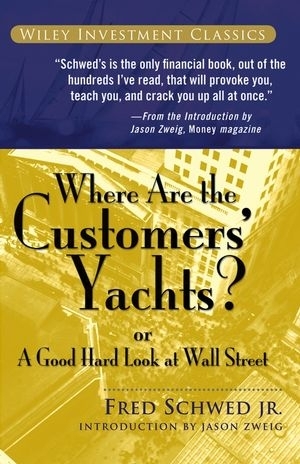 In conjunction with the chair's mention of valuable books and histories, I would append Fred Schwed's Where are the Customers' Yachts?.
While ostensibly written with a tongue-in-cheek hapless outsider view of 1920s and 1930s Wall Street, it has provided as many lessons and illustrations as anything by Henry Clews. In this case, I am reminded of the chapter in which Schwed wonders if such a thing as superior investment advice actually exists.
Pete Earle writes:
It is my opinion that the first thing that the would-be speculator should do, even before undertaking the courses of actions described by our Chair, is to open a small brokerage account and begin plunking around in small size, getting a feel for the market, the vagaries of execution quality, time delays, and the like. That may serve to either increase the appetite for such knowledge, or nip in the bud what could otherwise be a long and frustrating journey.
Kim Zussman adds:
The obligatory Wikipedia* definition of speculation is investment with higher risk:
Speculating is the assumption of risk in anticipation of gain but recognizing a higher than average possibility of loss. The term speculation implies that a business or investment risk can be analyzed and measured, and its distinction from the term Investment is one of degree of risk. It differs from gambling, which is based on random outcomes.
There is nothing in the act of speculating or investing that suggests holding times have anything to do with the difference in the degree of risk separating speculation from investing
By this definition one must define risk and decide what comprises high and low risk — which may be simple in extreme cases but (as we have seen repeatedly) is not very straightforward in financial markets
*Chair is quoted in the link
Alston Mabry writes in:
I'm successful when I achieve the goals I set for myself. And rather than a target in dollars or basis points or relative to any index or ex-post wish list, those goals may simply be to act with discipline in implementing a plan and then accepting the results, modifying the plan, etc.
Anatoly Veltman adds:
And don't forget Ed Seykota: "Everyone gets out of the market what they want". I find that everyone gets out of life what they want.
Plenty a market participant is not in it to make money. Fantastic news for those who are!
Bruno Ombreux writes:
This will actually bring me back to the question of what is a successful speculator.
In my opinion success in life is defined in having enough to eat, a roof, friendships and a happy family (as an aside, after near-death experiences, people tend to report family first). You can forget stuff like being famous, leaving a legacy or being remembered in history books. If you are interested in these things, you have chosen the wrong business. Nobody remembers traders or businessmen after their death except close family and friends. People who make history are military and political leaders, great artists, writers…
So you are limited to food, roof, friends and family. Therefore my definition of a successful speculator is a speculator that has enough of these, so that he doesn't feel he needs to speculate. I repeat, "a successful speculator does not need to speculate."
Paolo Pezzutti adds:
I simply think that a successful speculator is one who makes money trading. Among soccer players Messi, Ibrahimovic are considered very successful. They consistently score. They experience short periods without scoring. Similarly, traders should have an equity line which consistently prints new highs with low volatility and a short time between new highs. Like soccer players and other athletes it is their mental characteristics the main edge rather than knowledge of statistics. One can learn how to speculate but without talent cannot play the champions league of traders and will print an equity line with high drawdowns struggling losing too much when wrong and winning too little when right. Before dedicating time to find a statistical edge in markets one should assess his own talent and train psychologically. In this regard I like Dr Steenbarger work. In sports as in trading you very soon know yourself: your strengths and weakness. There is no mercy. You are exposed and naked. This is the greatness and cruelty of markets and competition. This is the area where one should really focus in my opinion.
Steve Ellison writes:
To elaborate a bit on Commander Pezzutti's definition, I would consider a successful speculator one who has outperformed a relevant benchmark for annual returns over a period of five years or more. Ideally, the outperformance should be statistically significant, but market returns can be so noisy that it might take much of a career to attain statistical significance.
Jeff Rollert writes:
I propose a successful speculator dies wealthy, with many friends. Wealth is not measured just in liquid terms.
Should a statistical method be preferred, I suggest he is the last speculator, with capital, from all the speculators of his college class.
In both cases, I suggest the Chair and Senator are deemed successful, each in their own way.
Leo Jia adds:
If I may wager my 2 cents here.
I would define a successful speculator as someone who has achieved a record that is substantially above the average record of all speculators in percentage terms during an extended period of time. The success here means more of a caliber that one has acquired which is manifested by the long-term record. Similarly regarded are the martial artists. One is considered successful when he has demonstrated the ability to beat substantially more than half of the people who practice martial arts, regardless of their styles, during an extended period of time. It doesn't mean that he should have encountered no failures during that time - everyone has failures. So, even if that successful one was beaten to death at one fight, he is still regarded as a successful martial artist because his past achievements are well revered.
With this view, I will try to answer Rocky's questions to illustrate.
Julian Rowberry writes:
An important step is to get some money. Preferably someone else's. [LOL ]
Jan
27
Billionaires Occupy Davos, from an Actuary
January 27, 2012 | 1 Comment
In 1930s Chicago you kissed the ring of the boss. In North Korea you mourn with as much sincerity as you can muster. In 2010's in the US you go to Davos and sing the same songs as the SOTU address:
"Billionaires Occupy Davos as 0.01% Bemoan Income Inequality".
Jan
24
Why the Oracle is Cryptic, from Daniel Cloud and Dailyspec
January 24, 2012 | Leave a Comment
 Daniel Cloud is the author of a masterful new book The Lily; Evolution, Play, and the Power of a Free Society. Here is a short piece he submitted for Daily Spec explaining in brief some of the main ideas contained in his book:
You sometimes hear people say that things would be better if only America were more like China, because without all this democracy and freedom, they can really get things done over there, can really commit to solar power, or nuclear fission, or budgetary discipline, or whatever the person thinks we need more of. Are they right? Historically, absolutely not. Freedom works. People are always saying that kind of thing - Stalin is the future, Louis XIV is just the sort of powerful monarch we should have here in England, the Spartans aren't soft like we Athenians, etc., etc., on and on. In the last four centuries, however, there are very few cases of an illiberal society permanently defeating or outcompeting a liberal one. But why?
Conventional wisdom assumes that it's competition in the market for explicit, rational ideas and plans of action that gives liberal societies their advantage. We must be free because we always are in a position to know what should be done, and just need the liberty to do it. Watching democracy in action, however, soon reveals that many of the plans actually proposed seem to be useless or even counterproductive, that the system in aggregate displays intransitive, inconsistent preferences, and that the people who lead democracies often seem remarkably unimpressive. It's precisely these features that made many Athenians or Florentines doubt that a free society was really a viable option. In their times and places, they were, as it turned out, right. What is it that makes the modern free society, in the last four hundred years, so much more successful? To answer this question correctly, we have to step back a bit, and look at the problem from thirty thousand feet.
There are only two possible explanations for any system that seems to behave in a way that's somehow optimal or effective. Either that optimal behavior was rationally planned by someone, or else it evolved through trial and error and competition. If the amount and quality of explicit rational planning we see doesn't adequately explain the degree of effectiveness observed in the behavior we see, some process akin to natural selection is the only available explanation. Does the modern free society work better than the unfree one because it's somehow a better arena for the evolutionary optimization of some set of teachable practices, or whole institutions?
In fact, in a human society, we should be able to tell, by inspection, which sort of process is responsible for some particular instance of optimal behavior. Optimal behavior that's the result of rational planning should be based on "knowledge" in the conventional sense of the word, true beliefs that come with some justification, or proof, that include an account of how the belief was arrived at and why it should be presumed to be true. They should be persuasive. On the other hand, highly effective behavior that is the result of some social analog of natural selection should be based on beliefs, probably true but possibly even false ones, or even mere dispositions to behave a certain way, for which the believer can provide no plausible justification, no warrant, that don't come wrapped in any convenient logos, but which nevertheless just happen to be exactly the right thing for the person to believe, from a practical point of view. They should be unpersuasive, at least without the help of a lot of deliberate clarification and anthem-writing, because the person didn't get the belief by being persuaded of it in debate, he got it as a result of it having worked out well, in practice, for him and the people he learned it from.
But this is simply a paraphrase of Plato's description of civic virtue, from Meno, as "mere true belief". The really virtuous citizen, Socrates informs us, often seems to know exactly what he must do, though he generally couldn't quite tell you why, or make his beliefs convincing in debate, which is very puzzling. Among economists, it's a long-standing folk-mystery (which never quite makes it into their formal professional discourse) that firms and households behave in ways that appear undeniably optimal, and yet if you go talk to the people involved, they couldn't explain why that way of doing things is optimal in a million years, and have all sorts of surprising and implausible explanations for their own behavior. There is actually quite a lot of this sort of evidence of a long history of social or cultural evolution, once you know to look for it, quite a few common-sense beliefs or attitudes, even within particular professions, that are probably very useful but not obviously justified.
The reason this all strikes us as paradoxical is that we've collectively failed to make a crucial distinction. Knowledge, in general, comes in two very different flavors, declarative knowledge (knowing that Neil Armstrong was the first man on the moon) and performative knowledge (knowing how to throw a baseball, write a contract, trade bonds, or solve a topology problem.) It's particularly easy to imagine some analog of natural selection happening to privately owned firms (conceived of as balls of money with people attached to them by contracts, which are fit or unfit depending on whether they have baby money the people associated with them can make new firms with.) The sort of knowledge this evolutionary process seems to produce is not, or not exclusively, declarative beliefs about facts that come with persuasive justifications. What the firm needs to prosper and grow is performative knowledge, knowledge of how to get things done, and whatever declarative knowledge is needed to support that. A lot of the "institutional culture", at any given institution, always consists of that sort of thing.
Skills and institutional cultures seem like the sorts of things that could evolve even as our public accounts of them don't. Modernity is, above all, rapid technological change, and perhaps the only efficient way of coping with rapid technological change and the radical Knightian uncertainty it continually creates is by creating a freely co-evolving population of firms and individual skill-sets, a system that isn't rigged in anyone's favor by people foolish enough to think they know what's going to happen next.
Why does any of this matter, who cares precisely how freedom produces optimality, if it does? To understand the difference between rational choice and natural or social selection, as mechanisms, it's useful to think about the difference between a computational simulation of airflows around some airplane design, and the tests we can perform, on the same design, using a model in a wind tunnel.
Simulation is cheap, and easy, and we can change anything we like. The problem with it is that its power is limited by the complexity of the problem we need to solve. If the problem gets very complicated, simulation becomes impossible, because you would have to write too many lines of code. (Often, when you run into a really bad simulation problem, you find that the lifetime of the universe wouldn't be long enough to write it all.) On the other hand, the wind tunnel is expensive, and wasteful, and cumbersome - but it just doesn't care at all how complicated the problem is, it isn't a thought or a simulation, it's part of the real natural universe, so it spits out a correct answer without any delay or hesitation, no matter what. We still don't know why that's the answer, but we can be sure that it is. The wind behaves just exactly the way it would behave, as it went around the model, as it goes around the model, because the real world is actually just like itself in every possible way. The wind tunnel is, effectively, what computer scientists call an 'oracle' for solving what philosophers call 'decision problems' (does the model work as expected, or not?) in no time at all.
 Natural selection is the same sort of thing as the wind tunnel, two vines or two prides of lions or two corporations in a real, un-simulated struggle to the death, and it too, is utterly indifferent to the complexity of the problems it is asked to solve. A contest between two complex modern states and a contest between two relatively simple bacteria or two saplings in a clearing can be resolved in the same amount of time, by the Judge of Battles, with exactly the same amount of work. (None.)
So, in general, there are these two very different sorts of optimization process operating in nature. One of them happens in brains, is cheap, is fast, and can conserve solutions to problems that only come up occasionally or locally. The problem with it is that it's limited in power, and gets less and less useful as the problem that needs dealing with gets more and more complicated. The other sort of optimization process doesn't only or primarily happen in brains - it also optimizes flu viruses, and falcons. It's expensive, it's slow, it's wasteful, and it only can conserve solutions to problems that come up repeatedly - but it isn't limited in power, in anything like the same way, it just doesn't care how complicated the problem it's been asked to solve is.
If it's the second kind of optimization process that is responsible for some of the optimality we see in human societies, as it is for all of the optimality observed in human cells (which we also don't fully understand, even though they're much simpler than a whole society of humans each made of trillions of cells) then there's nothing mysterious at all about the fact that societies built around free and fair arenas of limited evolutionary struggle should outperform ones built around attempts to substitute human judgment for this more wasteful but far more powerful mechanism. Perhaps people are, rationally, only able to accomplish just about as much as the economists themselves can - solving static, equilibrium optimization problems - and everything else only gets sorted out correctly if it's left for Nature to decide.
In planned economies, static problems must routinely get solved in ways that only make dynamic ones worse, and there's no obvious Darwinian corrective mechanism to put things back on track. (No real analogs of bankruptcy, or electoral defeat.) To the extent that the unfree society must rely on punishments to elicit the same sort of effort people would put in spontaneously if they thought of themselves as owners, it also suppresses the sort of variation in behavior any such process of social evolution would need as raw material. Nobody wants to be shot for trying some new way of doing things, some playful modification of an existing skill-set, or institutional culture, that doesn't end up working. Stalin was very successful at eradicating that sort of boldness. The problem is that unless people actually are constantly trying out exactly that sort of thing, in large and small ways, there's no source of variation in the population of skill-sets, and no way at all for the society to spontaneously percolate up to the highest point in its adaptive landscape. Thus you end up with the sort of enormous gap in even simple human skills, like the skill of cooking edible food for large numbers of people, that existed between the Soviet Union and the United States during the cold war, and that still must divide Korea today. (Nobody remembers Soviet cuisine now, the Kvass machines, the gristly, horrible "kutlet" smeared with some poisonous orange sauce, which only the really lucky people got…)
Narcissism trumps experience whenever we imagine that we can solve the sorts problems markets and elections exist to solve, because the reason we actually have markets and elections in the first place is that some of the problems we need to solve, in a modern society, are ones not soluble within the cognitive limitations that afflict us as individual humans. There's a kind of observation bias that constantly tempts us to make this mistake; we can see our own thoughts clearly, but our own customs are mostly invisible to us, so we tend to attribute to our cleverness whatever benefits we get from them. Glibness will only help us make fools of ourselves in these cases, because the mere truths that are most important to know and remember are precisely the ones that aren't readily explicable, or immediately persuasive in debate. In fact, what we all should have learned, from the great Communist experiment, is that there's really nothing worse for people than trying to live in the way that seems most reasonable to them on first hearing it described. That, actually, tends to end very badly, that tends to end with you standing in an endless line for a small piece of rotten meat, and very careful of what you say to the other people standing in line with you. (That's if you're lucky; the really bad outcomes are much worse.)
We need to be free, among other reasons, because we need to accomplish things, to have a cutting-edge modern society at all, that exceed our innate capabilities, in ways that defy our expectations. We do that by letting our institutions and skills and ways of speaking evolve freely, and building our whole society around the sort of fairness and respect for individual autonomy that's needed to make that possible. The leaders don't have to be impressive, for the system to work better than an unfree one, because the people at lower levels are, they're very skilled in an amazingly vast number of different skills, and that's what's crucial, that's what really drives the outperformance, the wild variety and vast depth of constantly evolving skills and institutions.
 It's a testament to human intelligence that we were capable of creating and managing a system that can do things impossible for human intelligence. Attempting to operate the system manually is, in fact, not advised; it routinely results in catastrophe, and in principle it shouldn't be possible. Sometimes you can get away with it for a few decades, when conditions are extremely favorable, for example when you start from a very low level of economic development with a very high level of literacy, but it isn't a good place you're ultimately heading towards, even then.
China only seems like an attractive alternative if you don't really know what's going on there; if you do, you know that what they're building isn't a real thing, it's a mere prelude, a temporary fantasy about beating the free world with one hand tied behind their backs, though that's been tried many times and really never succeeds in the long run. The problem is that the oracle of selection is necessarily cryptic, otherwise it would be redundant, so it requires some resolve to really submit ourselves completely to its judgments, and if you just don't have the right anthems, yet, that's difficult to do. (Even Deng Xiaoping couldn't quite make himself believe that the West is where it is because it's what it is.) In fact, we don't need to be more like them - they need to be even more like us, though everyone is now too polite, or too intimidated, to remind them of that. Not only does freedom work, but to sustain a really competitive form of modernity over the long run, nothing else will.
(Readers who found this interesting might also be interested in the more complete version of the argument contained in the author's new book, The Lily; Evolution, Play, and the Power of a Free Society, available from Amazon.)
Jan
22
Hats, from Victor Niederhoffer
January 22, 2012 | Leave a Comment
 I am researching and reviewing my contact with hats over a not uneventful life. I am considering their value, their uses, their symbolic significance, the great people I know who have worn them, the hat corporation of America I bought as my first trade, the hat that Tom Wiswell always wore to prevent sunburn and cover up baldness, the hat that Shane wore that made him an icon, the hat that the accountant in Monte Walsh wore that Hat Hendersson just couldn't resist noting was just right for a pistol shot, the hat that I wear now to show my respect for those previous, the man I called Hats H. because he always had a million different conflicts of interest while working for us. The importance of a hat outdoors in the West to shield from rain, sun, and the elements. Et al. What value do you see in hats these days? What anecdotes? They seem to have gone out of style because of the automobile. You don't need protection from the elements any more. Also they're hard to store. How do they relate to markets?
Alan Millhone writes:

Dear Chair,
I remember well the hat Tom wore. The ball cap I wear has a board on it (see picture). The Market trader might wear such a hat to remind them to look ahead and make the right moves (trades).
.
.
.
.
Sam Marx writes:
On the subject of "Hats". I am reminded of the aversion that John F. Kennedy had to hats and the picture that has stayed in my mind, since 1961, is of his carrying and not wearing his hat at his inauguration. I believe it was his attitude that caused the downswing in hat wearing in the U.S.
Tim Hesselsweet writes:
 Seems like a good example of ever-changing cycles. The hat has been making a comeback for the last several years. Kate Middleton has become a popular figure and she frequently wears hats. Upscale department stores like Saks now carry a large selection of hats as well.
Alston Mabry responds:
Yes, but…mens hats are a different dynamic:
Look at this photo of mens hats at a Liberty Rally in Columbus Circle, 1918, and mens Hats at the Horse Races 1920s style, and 1950s Men with hats.
Scott Brooks writes:
When I graduated high school, the guy who measured my head for my mortar board said, "Young man, I've been doing this for 35 years and you have the biggest head I've ever measured".
 As a result of my freakishly large cranium, hats rarely fit me. I wear one from time to time, but only out of necessity, and occasionally for functionality.
Necessity is when I need to keep my bald head from burning in the sun or freezing in the winter or dry in the rain. Never under estimate the insulating and protective qualities of hair.
Functionally is because I need a hat when I hunt to keep the sun out of my eyes when I'm scanning for game, peering through my scope to place the cross-hairs on the shoulder of my intended quarry, or placing the aiming pins of my bow in the middle of said quarries chest cavity.
I avoid hats otherwise as I can rarely get one big enough to fit. If I wear one too long, it gives me a headache. Therefore, when it comes to trading, if you see me placing a trade while wearing hat, fade my position as I'm likely making a losing trade because my mind is clouded by the hat that is squeezing my brain all to tightly.
Pete Earle writes:
I wear a hat, and have for seven or eight years. When I began to wear one, I expected to be lightly razzed by friends; that not only didn't deter me, but never occurred. Instead I've received unexpected compliments, and over the last few years other have seen a higher frequency of hat wearers in Manhattan, Washington D.C., and even when I'm down in Auburn and Atlanta.
Christopher Tucker writes:
The grandfather of my best friend from college was one of the kindest and most sensible men I have ever met. He was a traveling sales rep for the John B. Stetson company. The man always had the best (the absolute BEST) hats.
GAP Capital comments:
 Born and raised in Chicago, so "hats" remind me of only one person…Dorothy Tillman!!!
Anton Johnson writes:
"By some accounts, Christopher Michael Langan is the smartest man in America……….he has a fifty-two-inch chest, twenty-two-inch biceps, a cranial circumference of twenty-five and a half inches–a colossal head, more than three standard deviations above the norm"
Esquire article on "The Smartest Man"
Alan Millhone sends another photo:
Here is Tommie Wiswell with his trademark hat tilted back. Might also been used to keep
overhead light from his eyes while he focused on the many boards.

.
.
.
.
.
.
.
.
.
.
.
.
.
Russ Herrold writes:
 I am traveling, and so cannot conveniently post, but I placed orders this week for a new Stetson, a couple of Fedora designs, and some other … I forget …and have in my car, for the conference I am at this weekend, easily 5 or so, which I use both for their protection of my head from the cold, and also so I can 'do some branding' work in the community the conference represents (I also have other 'branding' in my clothing, and appearance), such that people I deal with, who don't know me by sight, can recognize me anyway.
Marion Dreyfus adds:
I think I am fairly well known as a hat person, and have been since I wore unusual chapeaux /to synagogue and school when 12 or 13.
Aside from style and stating an individualistic aspect, I think a hat harks back to a gentler, more mindful age, perhaps 100 years ago. It also keeps the head, inside of which are all these excellent ideas and scenes for a better tomorrow and a niftier evening today, comfy-cozy. Hats also show, oddly enough, respect. Hatless men in the 1970s were declaring their freedom from the mindfulness of suit and hat, and perhaps we are the poorer for having abandoned hats.
They also keep milliners in funds, and milliners I went to grad school with in the early 90s were aghast at the drop in hat-wearing citizens, alleviated only by temporary crazes or fads that fade as swiftly as they arise.
As a biker, for me, even mild days produce a breeze when one is on that leather seat, and a hat prevents sunstroke and sun in one's eyes as well as too much wind over one's head.
In the Orthodox world, wearing a hat connotes one is married, so it may be foolish of me to wear hats, because i communicate a status I do not currently entertain. But i do like the fashion and focus statement being made by wearing a lid, many of which, actually, i create myself.
Finally, one can maintain a superior air of mystery in a hat, which is impossible to the same degree in a hatless state.
Alan Millhone adds:
What really amazes me on hats are the clods at football games I attend who don't remove their head cover when the National Anthem is played.
Ken Drees muses:
 The baseball cap trend: rappers wearing the caps askew, wearing caps with logos of designers and companies, wearing caps for status/advertising, caps as gang signal, wearing caps in restaurants/indoors, wearing hoodies in lieu of caps, caps as fashion, caps on backwards, caps with brim curved just so, it all has to do with being cool. Lebron James wears Yankee cap to Indians games–it's all about me, fool.
Gary Phillips writes:
"Wearing a cap backwards is a baseball fan tradition that started with Yankee fans. It wasn't because they liked Yogi Berra, either. The Yankees and Red Sox have a century-old rivalry. A group of young guy Yankee fans, around 1980, took the train up to Boston to catch a couple of games. Boston fans are loud and boo other teams. The young Yankee fans were seated in front of loud Bostonians. The New Yorkers didn't want to start an altercation, but made statement. Those guys turned their Yankee caps around backwards to show the Bostons that they were Yanks fans and proud of it."
Anton Johnson writes:
On baseball's rally cap superstition:
"A rally cap is a baseball cap worn while inside-out and backwards or in another unconventional manner by players or fans, in order to will a team into a come-from-behind rally late in the game. The rally cap is primarily a baseball superstition."
And hockey's Hat-trick.
Victor Niederhoffer writes:
It would be nice if this worked in the market. But then the adversary could always tell if you were weak or strong, especialy if signals could be reflected from the hat. I was surprised to see that in all the uses for hats I have collected, including flopping the rump of your horse, and fanning a fire, and collecting water from a stream or the rain, I did not see many variants of using it as a signal to get a cab or alert a Native American that a interloper was near, or to collect bets, or to conceal a salt shaker. This latter is particularly effective in the west because to ask a man to remove his hat is akin to a date with boot hill.
Gary Phillips adds:
 Surely not a hat, barely a cap, let us not forget the kippah or yarmulke. The Talmud says that the purpose of wearing a kippah is to remind us God is the Higher Authority over us. He alone is Lord of Lords and King of Kings. When we pray and worship with our heads covered, we are saying that we are in total and complete submission to the will of God Almighty now and forever.
I was recently in the hunt for 2 of the crocheted variety for my 2 and 4 year olds to wear to school. My elder son demanded that the kippah be white with a blue Magen David. The synagogue gift shop was unable to fill our order, so I turned to a higher authority - E-bay. As J. Peterman would say, it is 6" in diameter — one size fits all. Handmade in Israel with a *very small* fine stitch. The yarmulkes are from Israel and are made by people who have made Aliyah; low income and handicap people, generating income to make a living.
I grew up and observant Jew until I had my first taste of bacon and blondes, and I never looked back. However, I now find myself lighting the candles, saying the hamotzi, and making Kiddish on Friday nights… Nice.
Jim Sogi writes:
 A hat is essential in Hawaii to keep off the sun, rain and wind, to keep glare out of your eyes, and at night on the mountain for warmth when it gets cold. There are different hats for different situations. A baseball cap is good all around since it keeps the sun off your face, stores easily, can be worn in a car and is cheap and stays on in a brisk wind. A good brim hat is good to keep the sun and rain off the back and shoulders as well. A nylon hat is light and can be washed. A waterproof rain hat is good for extended rain, and a light nylon brim is good for hot sun. A small brim bucket with a strap is worn in the water while surfing to keep intense sun at bay for hours in the water, and to stay on in the surf. A knit or fleece watch cap is good for boating at night or sleeping in the cold. A helmet is good for sports to protect the skull from boards, rocks, trees and impact. The Original Buff is an adaptable piece that can be worn as a hat, scarf, or facemask. A balaclava is good for winter conditions and can be used as a hat, or face mask in windy conditions. I must have 20 or more hats.
As with all equipment, each type of hat is specialized for specific conditions, and there is not one that is good for all conditions. As with markets, its good to have specialized systems and rules for the differing conditions or cycles and no one rule is good in all conditions but must be tailored to match the expected conditions.
Rudy Hauser writes:
I do not wear a hat indoors with the exception of trains and planes or if there is no good place to put the hat. If there is a draft from air conditioning it helps to keep me from getting a headache. But more important is that unless I just want to hold my hat in my hands there is no good place to put it. I prefer to read, not hold a hat. I once made the mistake of putting a Panama hat in the overhead rack in a plane. The motion of the plane bounced it around enough to ruin it. That gives me little choice but to wear it. If I have a hat without a brim, such as my winter hat, I can a do take it off aside from trains which are not that warm.
Bill Rafter adds:
 Glare, particularly from lensed overhead lights or high-hat floodlights can cause headaches and eyestrain. That can easily be counteracted by wearing a baseball cap or other large-brimmed hat indoors. I have kept one at my desk for decades.
For years I noticed that whenever I saw a certain actor & director, he was always wearing a hat, even indoors. Then I saw him entering a food emporium at a ski area and he removed his hat. I immediately understood why he always wore one — his particular baldness aged him at least 10 years. So his vanity choice was either a wig or a hat, and he chose the hat.
Hats indoors also provide a level of anonymity for those who do not want to be recognized in an airplane or robbing a bank.
My first "real" hat was a Homburg, which was required for one of my college jobs: pallbearer.
Jan
16
Low Volume Trading, from Gap Capital
January 16, 2012 | Leave a Comment
The continued outflow of money from mutual funds and other risk markets has resulted in ES liquidity being dominated by short time-frame players, i.e., large day traders and algos. They're demonstrating that they are not as quick, as in prior months, to flee the market at the first sign of trouble. This has been helping to make intra-day trading more counter-trend within concomitant smaller ranges (notwithstanding the slightly elevated range over the last two days).
We are still not seeing the large, concerted liquidity moves, with attendant price volatility and velocity, we had gotten used to in past months. Of course, it is way too early in the new year to panic, but the market may once again be morphing; this time to lower volume and thinner market conditions.
Not unlike, the effect the Volker Rule had on liquidity, the Fed’s recent announcement that it would substantially adopt the Basel III recommendations for bank regulations, may have caused many banks to re-think the scale and scope of their U.S.-based operations and, in some cases, to pull back from business and market-making. Ironically, monetary policymakers in virtually every corner of the globe are furiously pumping liquidity into the world’s economies increasing monetary liquidity, while the the markets appear to be losing transactional liquidity. Let's hope this phenomena is cyclical or secular at worst, and not structural.
That being said, the market appears to have returned to it’s old ways, in which the old adage is “don’t sell a dull market.” For now, breadth is good and the bullish trend is intact. February tends to be a trend continuation month and there has been some very positive relative strength coming out of the financial, materials, and industrial sectors, and European credit spreads have (hopefully) begun to narrow, along with already narrowing U.S credit spreads. Strength in the Treasuries continues to temper my bullish inclinations, however.
Frothy sentiment, intra-week seasonality and a 3 day weekend contributed to an early Friday 13th sell-off, only to see the bulls step up to the plate at the 1275.00-1270.00 high volume node/POC. If the market continues to hold these levels, weather opex next week,and close above the trendline formed by the May 2011 and July 2011 interim highs, the bulls should reassert in Feb.
Of note: Overnight trading has been responsible for much of the gains, which is common in a cyclical bull- what's uncommon is that this rally has not been supported by either the opening or closing hour–most unlike a cyclical bull.
Jan
12
Review of Thinking: Fast and Slow, from Russ Sears
January 12, 2012 | 2 Comments
 Thinking: Fast and Slow By Daniel Kahneman
Reviewed by Russell Sears
This book is a excellent example of why a single scale rating is not sufficient. If I were to rate this book solely on the criteria of "Must Read" , I would have to give it a 10. But if you are to rate a book on its pleasure to read or even its completeness, this title would not be as high.
There are three reasons why I believe you "must" read a book. The first reason is to learn something new. The second reason is it will challenge you; it will either change the way you conduct business and your life, or it will help you understand why what you do is working and strengthen your commitment. And the third reason is its influence on others. Even if it is wrong, or you do not believe it, it has already been influential or will change the world in which you live. Daniel Kahneman has changed the business world. This book would have to be given a 10 on all 3 of these criteria.
As an investment professional I have some expertise and experience with many of his topics. He gives much attention to biases, business analysis, other investment professionals' behavior. As an actuary, I also have experience with statistical analysis, research, the scientific method and regression analysis which are the "hero" of this book. I also have had many similar experiences as Daniel Kahneman, so I know how people react when the "thinking" worlds collide. This book tell you the psychological processes that are occurring when things like "expertise" conflict with hard numbers. This is were I have learned much from this book. Both about myself and about why others do the things they do.
First Daniel Kahneman has a Nobel Prize. He has already had a tremendous influence on how people do things. He has brought new insight into economics. Many of the stories reflect how he helped people change their lives or business. Further, many of his stories are about other influential colleagues and his collaboration and conflicts with them. It tells tales from how to improve a military to how a checklist decreased infant mortality. It shows that understanding, the way we think, can be improved. Because our thinking has holes in it, that we are just discovering. It is not always optimal. It is clear that he has helped change the way the world conducts business.
This book will make you think: about thinking like you never have before, unless you are already at the edge of psychological "thinking" research. It tells of "fast thinking" which is largely instinct/intuition. It also tells of "slow thinking" which is more analysis. But psychologists are beginning to understand how these two "systems" interact. The interaction, the how and when each system relates was fascinating. Sometimes one system has complete control and other times the other does. However, often the control is regulated and switched between them. One system will ask the other to influence it to help make the decision. It would seem, the way I read the book, which system we believe was in charge is often an illusion we wanted to believe. These ideas have revolutionized much of decision making.
While showing some admiration for how marvelous and powerful these systems can be, the book largely is about the ways these systems cause problems and errors. It should change the way you conduct business. It tells of common mistakes people have in thinking. It tells of shortcuts people take that do not work and of ways people over think when they should make things simpler and finally the way people, even scientists, fool themselves into believing things they should not.
And even when it does not change your methods, it should enhance how you think about business in two ways. Either challenge you to solidify the reasons why you do the things the way you do, Or help you understand why what you are doing works. It often calls for numbers to be put on the table. That calls for you to use the scientific method to validate your methods and develop better methods, methods that can be validated. Once developed you can determine when these methods should be ignored. Often ignoring the model is much rarer than people would think. People like to tinker, throw in their opinion and add their "expertise". However, If your methods are scientifically based, rarely does this improve things. The exception he calls the "broken leg rule", that it is ok to ignore the numbers modeled if the candidate has a totally unexpected event. For example the model compares quarterbacks can be ignored if one quarterback has "broken his leg" the day before.
I have made a list of how this book has changed my way of thinking and how I will conduct business and make decisions.
I cannot stress enough how much I think leaders should read this book.
However, this book can be a difficult read. In the intro, Daniel Kahneman, says that most of the opposition to his book on thinking is because it highlights the biases in thinking, and does not give enough respect to how amazing thinking is. He implies that people have a bias against changing the status quo. People have built up businesses on these illusions and they do not want them to change.
However, this book is hard to read and itself seems to over generalize and not always give the reader the scientific rigor he calls for from others. Being a Nobel prize winner, I would like to give him the benefit of the doubt, that much of these problems are to make the book convincing and readable to the lay person as well as the scientist. If you use regression analysis, much of the book will bore you, because it tries to simplify and explain it in words and stories how this method works. Likewise if you are not familiar and do not use these methods, it will probably be a difficult read.
Before the book got to this section however, many of his discoveries I found myself asking how solid was the evidence. For example when "system 2" (slow thinking) kicks in he states your heart rate WILL increase and pupils dilate. Simple enough, except are there exceptions to the rule, can people train themselves not to show this sign. Say perhaps a poker player. I do not know.
Many of the ideas on how these system process are stated as if they are clearly proven. While it would seem that the gray areas are not.
Further on some cases, when a few people's thinking do not show biases but most do the case of those that do is explored. While the case of those that reached the right conclusion is left as insignificant. For example a test were one person calls for help, and others have been put in isolation but perfectly capable of helping. Most do not help. Whereas if they knew nobody else was going to help they would have. Police have known this for a long time. No matter the statistics most people assume they would help if put into this situation. Social science students very familiar with statistics do not get this. Because their story of themselves disagree with the statistics. It is only after meeting these people in an interview and asked to predict if they would or would not help do they "get" what the statistics are saying. Only then do the students understand that it is difficult to predict what they would do in similar situation and catch the error when it happens. People like experiencing it for themselves is the conclusion. Not via statistics. He implies only experience/ personal stories convince, statistics do not, often even amongst scientists. However, statistics do convince some people to change their minds, not just stories. As an actuary, often this is when money is on the line, statistics can change minds. Numbers have always spoken to me, a good statistical argument has brought much more conviction than 100 sermons (my Dad was a preacher). But it has often been a puzzle to me why this same conviction did not occur to others.
I am not arguing that my thinking does not need to be changed due to this research. I am however, left wondering how much better my thinking could be corrected if those people that did not display biases were studied. Is it really so simple as these are the people that have learned to modify their natural way of thinking. Or do these people think differently?
I would like to give a Nobel laureate the benefit of the doubt, so I figured that this was simply due to trying to convince even the non-scientist of the benefits of the scientific method. However what I found the most shocking error was in his analysis of business world and investment professionals.
I would call this his repeated ignoring the "alpha" in regression statistics by focusing only on the correlation or the randomness of predictions. For example he tells the tale of visiting a investment firm which has 28 years of return on their professionals. The correlation from one year to the next turns out to have been near zero. His conclusion was that he had statistically proven that the professional had not added value and did not earn their bonuses. He had perhaps proven that their results still had random fluctuation and risks. However, he completely ignored did they add returns consistently, that is added alpha. For those that know nothing about linear regression, let me give an extreme example. Say return was 100% + a random variable every year. The correlation between years is still near zero but the pro has increased your return every year
He may have done this calculation but not tell it because it did not fit the story at hand. The lesson he was trying to prove was experts opinion is no better than a random guess. But the correlation statistic did not prove this.
While perhaps there is some explanation for why he ignored this alpha but he also gave a similar view on CEO and their bonuses and salaries. He used Google founders being turned down in their early attempt to sale the company for a mere million as an example hindsight bias being luck. He told of tales of book and magazine articles of overperformance leading to guru status being signs of "reversion to the mean". While I would agree that such advice is largely to be ignored, much of their success that year is due to random luck, not superior wisdom to the other CEO's in the S&P 500. The next year they are not as likely to be as "lucky" and return to the average. Similarly for the Sports Illustrated magazine cover supposed "curse".
Even great players need some luck to be good enough to be on the magazine cover. It is not a curse, but reversion to the mean, they have no lock on luck. However, in both cases, they belong to a pretty elite group. The CEO's that run S&P covers and the major league baseball players. He did not argue that the ball player did not add value however. Yet, that is what was argued with the CEO's bonus. Despite the 100 year drift of public stock companies. I can only imagine how hard it is to "run" a modern S&P company and keep that drift in place.
A few great seasons are all we expect from an athlete. After all he will get older and be replaced by young better trained with all the accumulated wisdom wiser athletes. Likewise should we expect different from CEOs? Do both add value well beyond most people. I will let the statistic on the table decide.
For this less than scientific rigor and in parts boring writing I would have to say while a must read it is not always a joy to read and would give it a 5 or average on that scale. Great ideas, not always great execution.
After all applying his own logic on revision to the mean and performance to a Nobel laureate, and writing to the masses seems fair.
Jan
9
Pool Hustling 101, from Howie Eisenberg
January 9, 2012 | 4 Comments
 Vic,
Vic,
I hope all is well with you and the family. I took an online course on writing autobiographies and thought you might enjoy the attached.
Happy new year.
Love,
Howie
—
"Never give a sucker an even break," uttered by W.C. Fields in the 1941 movie so entitled could well be the credo of the pool hustler. What does this have to do with me? Fleecing the less proficient at what is termed pocket billiards in some circles was a significant source of income for me from age 15 through college. It accorded me a much needed supplement to my meager allowance and/or the part time jobs that I held as a student.
At Brighton 5'th Street at the same level as the elevated subway train that runs along Brighton Beach Avenue, there existed a 2400 square foot den of iniquity that housed about a dozen pool tables. This sea of slate covered by green felt was not a billiard emporium by any means. In the mid 1950s, it was frequented by many of the neighborhood's young toughs and assorted characters like Mutt, Teddy the Twitch, Pittsburgh, the Guzzer, Sonny, Sam the Communist, Blackie, and Miguel. Sonny was a big muscular homosexual whom nobody messed with. Silver haired Sam was the best shooter in the pool room. Blackie a middle aged man was a close second as he ran rack after rack in straight pool, never taking off his hat. Miguel, a bookie who ran a cut poker game and was later shot to death after balking at sharing profits with the mafia was about as good as Blackie. Added to the mix were me and some of my school friends including Harvey Keitel, who later became a well known actor and Mark Reiner, a basketball star.
The pool room was a hustler's haven where we hung out after school until 1:00 A.M. closing when we weren't playing ball. Substituting time there for homework, our formal education may have been diminished but the street smarts we acquired were more than ample compensation. The proprietors were two diminutive men in their sixties, Izzie and Charlie, a pro boxer of some renown in the '20s. Despite their age and small stature they ruled their roost with an iron will. Roost was more than a figure of speech in this instance as there was a creaky stairway that led to the roof that housed Charlie's pigeon coop. He had preceded Mike Tyson in pugilistic affinity for our fine feathered friends by 4 decades.
The absolute power that Izzie and Charlie had over all of us was the specter of being barred from entry into this hallowed ground and being relegated to hanging out in less exalted venues. After learning the rudiments of the game, I gradually acquired a modicum of skill by observation, shared tips, and practice. Making a stable "bridge" with the non-shooting hand; keeping one's head down; and a smooth stroke were basic requisites. Learning where the object ball must be hit by the Q-ball to direct it into a pocket is essential. Although the ability to make difficult shots comes in handy, getting the Q-ball into position for an easy shot after making the preceding one is what distinguishes the more accomplished practitioners of the game.
"Position" is achieved using various methods. "Drawback" to make the Q-ball go back in the direction from whence it came after striking the object ball is accomplished by striking it low and snapping the wrist imparting back spin. "Follow-up" to make the Q-ball go forward is effected by striking the upper portion. Either of those techniques can be applied in conjunction with "English" to make the Q-ball go left or right after hitting a rail by striking it on the left or right side respectively. How hard the Q-ball is struck determines the distance it will traverse and its ultimate position..
Most games were played for money with the stakes ranging from "time", the 50 cent per hour charge for use of the table to many dollars. There were various handicaps given to supposedly level the playing field but after blowing my allowance a few times, I realized that you never play better players. They are not only better, they are more knowledgeable and better able to figure the "spot" that will still give them the edge.
Accomplished hustlers rarely play better than needed to win and frequently let the "fish" win for small amounts and reel him in when the stakes are raised. Another gambling precept was always put the money up with someone who can be trusted to pay off (the "house": Izzie or Charlie in most cases). This was especially important for me at 6' 1" and 150 pounds against many of my more burly adversaries.
I never became a great pool shooter but the level of proficiency was not nearly as important as applying these principles. The goal was always to have a "lockup" - a game where there is virtually no chance to lose. Another way of putting this is, "Never give a sucker an even break". As mentioned, hustling was a significant source of income for me during my school days. In actuality, outsmarting and outplaying my opponents was more important to me than the extra cash in my pocket. One of the greatest compliments I ever received was years later when I ran into a guy that I had known casually and he said, "I remember you. You used to make your living in the pool room".
P.S. In retrospect this sounds pretty crass but I didn't cheat anybody. Everybody was trying to get the edge. I was just more successful at it than most.
Jan
9
Harvard College: Squash & Scholarship, from Richard Kostelanetz
January 9, 2012 | 2 Comments
Richard Kostelanetz writes:
My friend Victor drafted this essay toward his autobiographical The Education of a Speculator (Wiley. 1996), only to obey his publisher’s command to reduce personal material, which he did, nonetheless leaving behind in his book a luminous opening chapter about growing up amid the handball courts in Coney Island, New York. Self-published in 1994, this essay inspired my own memoirs published here. Since Victor’s Harvard memoir is unavailable elsewhere, I'm pleased to reprint an excerpt of it, with his permission and my gratitude. I’ve omitted a few digressions in the original, while adding between brackets some clarifications. You can find the whole essay in my latest book.
HARVARD COLLEGE: SQUASH & SCHOLARSHIP
Victor Niederhoffer
Copyright c 1993, 1994.
Education at Harvard has always favored the dilettante, coddled the "gentleman's C" scholar and allowed those who concentrated on extracurricular activities such as football, computer programming or musical theater to survive. During my undergraduate years (1960-1964), of the 1,500 freshmen entering each year only a handful wouldn't graduate. To earn a degree with honors was as easy as getting a mosquito bite at a nudist colony; more than half the class received this token, even in those days When you consider that at least half the student body at Harvard hardly attends more than half of their classes, and most of the others are so totally committed to their extra-curricular activities that they have no time for reading the assigned course work, let alone any outside readings, the graduation rate becomes an example of noblesse oblige.
I was one of those students who would have been hard-put to survive in any other college. I have always had a reluctance to attend large lectures. And most of the popular undergrad courses were given by eminent professors in halls like Sanders and Emerson where 500 to 1,000 were in attendance, if not wakefulness. The smells in a lecture hall turn me off. I can't breathe well with all that carbon dioxide circulating back into the air. Besides, I like the idea of feedback. The ideal form of education to me has always seemed to be sitting on a log with some erudite professor on one end and me on the other, talking about areas of common concern. In this day of copiers and desk-top publishing, there is no reason why lectures should be delivered in a no-feedback format. Notes could be prepared in advance and distributed to students. This would force the instructor to be concise and accurate, as the printed word
demands more presentational logic and rigor than does the spoken lecture. I have found that only at prestigious universities and cabals do the lecturers balk at providing written notes.
During the 2 or 3% of the time in my waking life I have truly been interested in becoming educated I have garnered 99% of my learning. I suspect I am typical in this regard. The challenge to the educator, then, is to motivate the student to desire to learn, and then to figure out how to provide the product when it is desired.
On a more mundane level, I have always found it difficult to stay awake at morning activities after a strenuous day of exercise. And my mornings were invariably taken up with a squash match, and then a rush to finish up my homework. Having not yet developed the art of blindfold checkers or chess play, only way I could stay awake in class was to buy an advance copy of the Suffolk Downs Racing Form and handicap the races. Many of the professors seemed to me to have been coerced into teaching the undergraduate courses because they were over the hill. Others seemed more interested in the handful of attractive [Rad]Cliffies in the class than in engaging in dialogues with shallow Harvard youth.
I subsequently learned how right I was in this regard, at least with respect to the University of Chicago, where I read rhapsodic letters of recommendation for Michelle S., my sweetheart during my time there, of the professors independently wrote about how they looked at her constantly while lecturing for a feel for how it was going, and how uplifting it was to receive her approval when they delivered a particularly apt précis, how they valued the feedback she provided with her smile, frown and other body language. I noted that they found her body language equally uplifting outside of the lecture halls. She told me that once she was having a departmental dinner with four professors and four students at a table at the Faculty Club, and that three of the professors independently passed her notes to meet them afterward for a continuation. Needless to say, she graduated summa cum laude, one of two of her class (1966) to do so. As I was to learn some years later [while teaching] at the University of California at Berkeley, this incident was merely one example of a tendency endemic to academia.
Even with the policy of noblesse oblige, my education at Harvard was in jeopardy. Professor Williams, who taught my Introduction to Logic course, one day caught me in the act: he suddenly stopped his lecture, walked to my seat and grabbed my Racing Form, loudly upbraiding me in front of 500 eager scholars for my rudeness in handicapping races while he was droning on about such fascinating subjects as the difference between probabilities based on relative frequencies and degree of belief, and the Popperian view of probability as a revised estimate of one's knowledge based on various hypothetical experiments.
Since that time, I have found only one satisfactory motivation of probability. This was by Richard Hamming, a professor at the U.S. Naval Postgraduate School. Strangely enough many 'experts on probability theory have worked at military installations, especially in England. Hamming's view is that where you have events in a sample space, such as tosses of a die, that are symmetric, or interchangeable, the probabilities must all be equal. So if you take the number of events possible in the space, the probability of each event must be one divided by the number of events. As Hamming remarks in a typical passage, "Although very likely you have been interpreting many of the results in terms of frequencies, probability is still a measure derived from the symmetry of the initial situation." (The Art of Probability, 1991).
His extensions are sufficient to resolve all the philosophical questions that were the meat and potatoes of Professor Williams' class.
But first, I had to get through my classes without unduly antagonizing my teachers, as my performance on exams would never be sufficient to undo any bad impressions made on the professor, nor would I have enough sex appeal to barter for a good grade.
My solution was one of my masterpieces. I noted that most of my teachers were graduate students obviously down and out in terms of money, but who were teaching for the prestige and potential career advancement. When I saw them, they always seemed to be grinding away at their own course work in an effort to reverse their bad fortunes by garnering a job. Even then, Eastern Illinois University favored [hiring] assistant professors who had put in a stint as an adjunct assistant professor at Harvard earlier in their careers.
Now Harvard has always been masterful at maintaining low salaries among their employees. One of their techniques was to refuse to hire any of their graduate students until they had taught at some other school for at least five years. This policy was already famous in those days for having lost Paul Samuelson, the famed Nobel Prize-winning mathematical economist who popularized Keynesian economics in his best-selling textbooks of the 1960s, and who can still be counted on to trot out his theory favoring greater government spending and higher taxes for the benefit of any sitting or would-be President. Samuelson's doctoral thesis, written at Harvard in 1955, was entitled "The Foundations of Mathematical Economics", in which he quantified the interaction of the multiplier and the accelerator in fomenting government's impact on total output. This study is still considered one of the classics in the field, but it wasn't sufficient to break the Harvard taboo against hiring its own.
But there was a quid pro quo for the graduate students. In exchange for low wages, and no chance for tenure, the grad students were graded on a very high curve. The average grade in most of the graduate courses, A-, was considered quite good in those days before grade inflation, egalitarian marking, and numerous pass/fail courses — all of which have made most grade-point averages as meaningful as the chants of the whirling Dervishes.
I quickly realized that if I confined myself to graduate courses as an undergraduate, that even if I consistently copped the worst grade in the class, I would still be likely to pull a B+. And this would more than compensate for my bad study habits.
I was so successful at this approach that when the time came for a final class ranking of all the economics majors at Harvard I came in second out of 150. My technique did not pass unnoticed. Any time an undergraduate of apparently limited intellectual accomplishment took on a curriculum of mainly graduate courses he or she was said to be "Niederhoffering the curriculum." .
Years later, I ran into Professor Wassily Leontief, founder of input-output economics, at a [George] Soros party. Soros loves to stock his foundations with distinguished, collectivist emigrés from Eastern Europe and Russia. Leontief was at that time serving on the boards of some of Soros' foundations. He had been my professor in 1962 in graduate-level Microeconomics 201, where I had received a B+, the worst grade in the class. The Professor's basic idea, that there are fixed technological relations between the output of an economy and the raw materials necessary to produce them, makes about as much sense as the Russian notion that there are some genius master-planners in Washington responsible for all the wonderful variety of goods on American supermarket shelves. Nevertheless, Leontief had one of the sharpest minds I have ever encountered. He remembered me, after 25 years, and said, "Here you are Niederhoffering the commodity markets by picking up the detritus of Soros' trades, just as you did in my classes." As I was surrounded by government officials, foundation mavens, administrators, philantropists and other liberal types — as is the norm at a Soros party (and indeed at most other New York parties I have attended) — I held my tongue and played the respectful guest.
* * *
The Harvard Club of New York each year collects a scholarship fund for needy students with outstanding academic records. Somehow my credentials and my experiences at my high school, where the principal was actively working to keep me out of college, struck a responsive chord in some of the members of the scholarship committee, and I consequently was a beneficiary. Some of them, apparently, had also once been blackballed, and instead of working against me, my principal's active lobbying actually helped me. My experience coaching at Kaplan and the resulting improvement in my board scores didn't hurt either.
Even with the scholarship, my parents were making a heroic sacrifice to keep me at school. The then staggering tuition and board of $3,500 per year represented 25% of their pre-tax income. The balance of $1,000 they gave me for out-of-pocket expenses added further to their debt. It seemed only fair that I should reduce the burden by getting a job.
My first job at Harvard was in the Student Post Office. My duties were to sort the mail and run the route, delivering and picking up mail at all departments on the north side of the campus. The pay was the munificent sum of$1.80 an hour. After a few days on the job, I graduated to full-time mail carrier. My boss, an elderly Irishman with white hair and a Boston accent, was from the old school. His shoes were polished to a gleaming luster and his tie choked his neck in a perfect knot. As I left for a delivery one day in typical Boston fall weather, freezing rain with winds in the 50 mph range, he gave me some sharp advice. "Keep your head on your shoulders and whatever you do, don't miss picking up the mail at the Watson Laboratory in Biology. Since that professor won that Nobel Prize, he's thinks he owns the world, and when the mail isn't picked up twice a day, he calls up to complain. Last time we missed him, I found myself apologizing to a vice president of the corporation. "
Yes, Mr. McCarthy."
I have never been too good at sense of direction, and now, in retrospect, I see I was not well-suited to a career in mail carrying. My ideal career would probably be as the women's squash coach at a large university or director of research at a flavoring laboratory. But I needed the money from that mail job badly. Perhaps I was distracted by the rain, the secretary, or my studies, but I did manage to forget to pick up at Watson's lab. My boss's dismissal of me was abrupt.
"You're fired. How they let incompetents like you into Harvard, I'll never know. You don't even have enough sense to get out of the rain and come inside to pick up at the one place I told you over and over again not to forget. Get the Hades out of here and never come back."
I was crestfallen. This was the final blow. No way was I going to ask my parents for more money. It looked like I would be going back to Brooklyn College after all. Life seemed hopeless, so I called my father up and gave him the bad news.
"Don't worry about it. This could be a blessing in disguise. Remember what happened to Winston Churchill, as a young man in the British Army, on his arrival in India. Eager to disembark from a small boat that was tossing on the waves, he grabbed an iron ring fastened to the pier just as the boat fell sharply, and dislocated his shoulder. This injury stayed with him the rest of his life, and plagued him in every physical activity he undertook from then on, from polo games, to speaking in Parliament, to war.
"But as he says in his book, My Early Life, the injury probably saved his life during the battle of Omdurman. He was the only one in his cavalry to be unable to swing his sabre; but knowing his shoulder might give out at any time, he had purchased one of the newly-invented Mauser automatic pistols, and had practiced with it assiduously in preparation for the campaign. In one cavalry charge, he saw most of his colleagues cut to pieces around him by the dervishes' scimitars in their fierce resistance. But his skill with the Mauser saved his life, and he wrote of the experience, that one never knows when some apparent misfortune might actuaJly save one from something much worse.
"So remember, what seems to be a tragedy might actually be a lifesaver"
(to be continued).
RIchard Kostelanetz Books on Amazon
Richard Kostelanetz eBooks on Kindle
Dec
22
10 Things You Can Learn About the Market from Greek and Roman Times and Myths, from Victor Niederhoffer
December 22, 2011 | 2 Comments
 1. There is a critical point in the market, a critical decision that the market gods weigh on a scale like Zeus with his balance scale deciding whether Achilles or Hector will win, that determines the market fate, and it is key and should be the focus of all news stories and market considerations but never is.
2. Never trust anyone but your family and best friend because everyone is disloyal in a pinch. Peleus was left for dead by his father in law after killing his brother in law to become ruler and this led to the Trojan war. Caesar trusted his best friends but they turned on him when an opportunity for power, money, and romance reared its ugly head.
3. Deception is key. The most successful Greek was the Deceiver Odysseus, and he tricked everyone he dealt with as the market tries to trick you with Odyssean power.
4. The goal is always to come home. Odysseus went home, as does the market. The only loyal ones were the wife and son and the best servant. The market retraces and comes home to break even an inordinate number of times.
5. Never mix romance with business or the market. The Trojan was was started by Paris intervening in romance and being swept off his feet by Aphrodite, and Achilles killed tens of thousands and prolonged the war by 10 years when Menelaus stole his mistress.
6. Don't try to walk with the Gods. Peleus married a half God and married her the last time the Gods and mortals mingled at a celebration and it caused him to be the most distressful of men. Trying to emulate Soros or the other greats is the seed of destruction.
7. Okay, give me the rest. And correct and tighten the above. I'm out of my depth but wanted to get the gist across.
Ken Drees comments:
 Like using a mirror against Medusa, one must plan against the adversary and sometimes use their expected attacks to beat them. Like shielding oneself from the siren song, one must be totally prepared, seek council before the journey (the trade) about what dangers are expected.
Also, it seems every entity in mythology had a weak spot. It's probably best to note these weaknesses in your thinking and in your emotions, not how can I beat the market, but how can the market beat me today?
Bill Rafter writes:
The greatest two rules:
(1) nothing to excess and (2) know yourself.
Pete Earle writes:
One lesson from mythology which resonates with me is the oracles/prophets/predictors almost always forecast correctly, but rarely in an obvious or immediately relevant way. The predictions made are usually realized, but not before taking extremely circuitous, and usually counterintuitive ways to reach fulfillment.
In my experience, predictions regarding the direction of equities or commodities inferred from option markets so often prove accurate…but only after traveling in the most wrong, most unanticipated ways.
Alston Mabry responds:
 Pete, I think of that as "shaking the tree", i.e., we're gonna get there, but we're gonna shake out as many weak hands as we can along the way.
Peter Earle replies:
Absolutely. Stop-running and the like as the "gods" way of seeing who's "worthy"; who can withstand the flood, the fire, the sturm und drang.
Jim Lackey writes:
In 2008 I learned from Ryan Carlson– Sisyphus. There is a little useless book Wit and Wisdom from Wallstreet. So many of the quotes are the exact opposite from 3 pages ago… yet for a day they are seemingly sage advice. Worse for the long term. It's all good advice, yet in the mean time we must eat, and in the long term we all end up dust in the wind.
Traders lament when we miss profits. We are miserable when we lose. If we are not careful we are never happy. I have the habit of having to work myself up into a fury to win a race, pass a test or trade. My wife calls it "business mode" everyone else calls it being a jerk. Finally this year I have the ability to take a loss and this week miss a glorious rally and profit… yet at 4:20 PM its over. I am done pushing the boulder back up the hill for the day. I will return at 1:30am or by 7am, all but two business days a year. It can be torture if you do not like to trade, but if you love it…
Here is a quote from my kids music, "This is Our Science" by Astronautalis: "Our work is never done/ We are Sisyphus".
p.s I notice that if I don't like the rap beats I miss quite a bit of new poetry. I hear my teenagers say random lines and say what! That is amazing. Then I hear the song and say no wonder I never heard that line before. Damn drum machines.
Jack Tierney adds:
Recently I've been reading up on complexity, system dynamics, and the unpredictable consequences that occur when tinkering with non-linear systems. The markets seems subject to all and, if I'm even remotely correct in interpreting the literature, there's only one certainty: expecting linear consequences (e.g, provide banks with more liquidity, bringing about an increase in business borrowing, resulting in a resurgent economy) is rarely, if ever, realized.
Instead, the unseen effects on unimagined factors, almost always derails the logic train. A source I've referred to on occasion is "Cassandra's legacy." Appropriately enough, the custodian of that site provides an interesting historical allegory, in the form of Goth Princess/Roman Empress, Galla Placidia, and her part in the demise of the Roman Empire. It's a very lengthy read and, unless history like this interests you, tough going. So, a few highlights:
"Managing any large structure is difficult and we tend to do it badly; a whole empire may be an especially difficult case. To do it well, we would need to use a method what I mentioned before: system dynamics; which is a way to describe systems and the relation of the various elements that compose them.
"…every time that the Romans fought the Barbarians, they could win or lose, but each battle made the Empire a little poorer and a little weaker. The empire was using resources that could not be replaced; non-renewable resources, as we would say today….the solution was not more troops but less troops. It was not more imperial bureaucracy but less imperial bureaucracy, not more taxes but less taxes.
"In the end, the solution was right there and it was simple: it was Middle Ages. Middle ages meant getting rid of the suffocating imperial bureaucracy; it meant transforming the expensive legions into local militias; have people paying taxes locally, in short transforming the centralized empire into a decentralized constellation of small states. Without the terrible expenses of the Imperial court and of the Imperial bureaucracy, these small states had a chance to rebuild their economy and start a new phase of prosperity, as indeed it happened during the Middle Ages.
"What Placidia could do as an Empress was, mainly, to enact laws….It seems that Placidia was acting according to her style; ease the unavoidable, don't fight it….Placidia forbade the coloni, the peasants bound to the land, to enlist in the army. That deprived the army of one of its sources of manpower and we may imagine that it greatly weakened it. Another law enacted by Placidia, allowed the great landowners to tax their subjects themselves. This deprived the Imperial Court of its main source of revenues."
Stefan Jovanovich comments:
As much as King George's scribbler Edmund Gibbon despised Christianity, he had the Middle Ages even more because its bureaucracies were the worst of all — local and mean and stupid.
Professor Bard should revise his history. What he wrote here — "Middle ages meant getting rid of the suffocating imperial bureaucracy; it meant transforming the expensive legions into local militias; have people paying taxes locally, in short transforming the centralized empire into a decentralized constellation of small states. Without the terrible expenses of the Imperial court and of the Imperial bureaucracy, these small states had a chance to rebuild their economy and start a new phase of prosperity, as indeed it happened during the Middle Ages." - is nonsense.
The Roman Empire's tax collections were always "local"; that is why Roman politicians were willing to pay such enormous bribes to be appointed provincial governors. The legions were also "local"; the Empire's expansion came from granting "foreigners" - i.e. the people we would today call Spaniards, French and Syrians - the privileges of citizenship, which meant they were also qualified to serve in the local legions. This was equally true under the Republic; "crossing the Rubicon" would not persist as a bad metaphor if Rome's soldiery had been centralized.
As for economics, whatever the "terrible expenses of the imperial court", they were nothing compared to the ravages of coin clipping. The solidus of the Eastern Empire maintained an unchanged weight and measure for 4+ centuries - a record that is likely never to be broken. (It exceeds the span of sound money for the British Empire and the United States of America put together.) After Princess Placida's day coinage, under the wonderful decentralization of the Middle Ages, effectively disappeared.
"Dearth of provisions, too, increased by degrees, and the scarcity of good money was so great, from its being counterfeited, that, sometimes out of ten or more shillings, hardly a dozen pence would be received. The king himself was reported to have ordered the weight of the penny, as established in King Henry's time, to be reduced, because, having exhausted the vast treasures of his predecessor, he was unable to provide for the expense of so many soldiers. All things, then, became venal in England; and churches and abbeys were no longer secretly, but even publicly exposed to sale." - William of Malmsbury wrote this in 1140 AD - the period that Professor Bard praises so highly for its progress over the degeneracies of the Empire.
Hume deserves the last word on this and most other subjects that interested him.
"Mankind are so much the same, in all times and places, that history informs us of nothing new or strange in this particular. Its chief use is only to discover the constant and universal principles of human nature."
Easan Katir adds:
The Greeks have fooled people since the Bronze Age. Instead of a horse, they now have Trojan bonds.
Steve Ellison comments:
Jack, the Atlantic had an article about why projects that had successful pilots often failed when rolled out to the general population.
Why Pilot Projects Fail– Here are some excerpts:
Promising pilot projects often don't scale … Rolling something out across an existing system is substantially different from even a well run test, and often, it simply doesn't translate.
Sometimes the 'success' of the earlier project was simply a result of random chance …
Sometimes the success was due to what you might call a 'hidden parameter', something that researchers don't realize is affecting their test. Remember the New Coke debacle? …
Sometimes the success was due to the high quality, fully committed staff. …
Sometimes the program becomes unmanageable as it gets larger. You can think about all sorts of technical issues, where architectures that work for a few nodes completely break down when too many connections or users are added. …
Sometimes the results are survivor bias. This is an especially big problem with studying health care, and the poor. Health care, because compliance rates are quite low (by one estimate I heard, something like 3/4 of the blood pressure medication prescribed is not being taken 9 months in) and the poor, because their lives are chaotic and they tend to move around a lot … In the end, you've got a study of unusually compliant and stable people (who may be different in all sorts of ways) and oops! that's not what the general population looks like.
Dec
22
An Interesting Chart, from Leo Systrader
December 22, 2011 | Leave a Comment
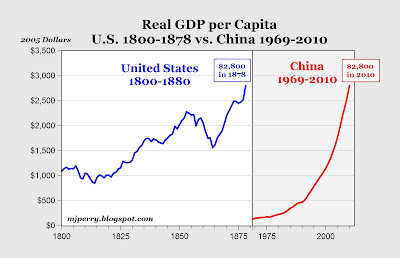 I wonder if there is anything economic to be learned from this chart from Mark Perry's blog. The per-capita growth from 1810 to 1850 was more than 120% in 40 years. According to the wiki, by 1860, manufacturing (primarily limited to the Northeast) accounted for 30% of the nation's income, with cotton cloth production the leading industry. This indicates that some strong contrast/conflicts between the industrial northeast and the farming south existed.
Is it reasonable to believe that these economic conflicts were among the underlying causes for the eventual war?
Obviously the economic conflicts were the result of a fast and an uneven development. Perhaps it serves as a very valuable indicator for today.
Dec
16
Are Introverts More Gifted? from Leo Systrader
December 16, 2011 | Leave a Comment
 I have heard that about 25 percent of the population are introverts, but as many as 60 percent of gifted children are introverts.
I don't find this strange. But our understanding about the brain is too minimal to explain for instance the intrinsic links between being an introvert and being gifted. In addition, the concept of being gifted is very vague– it perhaps simply means that he/she can perform something somewhat better than an ordinary human.
With all these unknowns, many wonders often appear to us.
Dec
16
Housing, from Duncan Coker
December 16, 2011 | 1 Comment
 One particularly nasty feature regarding the housing market which I am surprised to have seen no writing on is the treatment of capital loss. Losses on primary residences can not be deducted from other capital gains. What you eat, so to speak, you must pay tax again on making that capital back. Using a 20% tax rate of say 6 trillion in lost housing capital, that is roughly $1.2 trillion that the public will have to pay in incremental tax. (true if housing rebounds the loss may not be realized or incurred. Also true that some of the capital loss may be transferred to the banks if owner walk on the loan) But thinking like a politician and using government finance should they not include this potential for windfall tax receipts over the next decade or so as new "revenue". And why not just bring it all forward to 2012 and solve the whole budget gap for next year.
Dec
15
The Legend of Bo Keeley Grows, from Art Shay
December 15, 2011 | 1 Comment
 Here's a link to my article about Bo Keeley "The Legend of Bo Keeley grows". They or I got the photo credits goofed up. Sorry. Story comes out in NYC, SF, LA, Seattle, Austin, TX, DC, Chicago, Shanghai, London. Welcome home.
Ken Drees sends us a poem to honor Bo's welfare:
.
.
.
Bo Left Us Dead
(Written after reflection on good news of Bo Keely's safety)
Finished Bo's book, just put it down,
Next thing I hear
Sad tragic news,
Keely's not to be found.
No, not in anytown,
Got himself killed this time 'roun.
Them Mex think he's undercover narc,
Down there, too tall and off white
He sticks out,
One too many rides in the dark.
DocBo, The speculator surmises,
Has run plum out of lucky devices.
No facebook, email or phone, G*d please help Bo,
Sadly, its over for him;
No more of his stories, and that grin.
Please bring him back whole.
But if he's truly dead Lord,
Least his soul's in your yard.
Praying is over, Bo left us dead,
No more tales, rails or boxes
To inspire, tranfix,
To dazzle our heads.
Keely has jumped one reefer too far,
Somber, even the bulls at roundhouse bar.
And then like rain that drought licks for,
Bo's Alive for sure. For sure!
Been in the desert, all this time,
Playing with spiders, rocks, and slime.
Those mental puts on Bo expired,
Luckily not the man, that a freight train sired.
So comes the end of this tiny tale
Let the celebration begin,
Dead, now alive, its all win-win.
February's, cruel winter's gale,
Will no doubt herald,
A cupid hearted Hobo, quite undead sans peril.
Dec
14
Another Explanation for Webvan, from a Doctor Who Researches Stocks
December 14, 2011 | Leave a Comment
 Some one was telling me they thought "shutting down Hillarycare gave us about 15 years of safety from the cancer that is big government intrusion into our lives. Repealing Obamacare could protect us for, possibly the rest of our lives."
Our medical colleagues may not believe that. Insurance companies picked up the ball that Bill/Hill dropped (the meme that health care is too expensive) and turned free enterprise medical care into civil service (for the insurance companies).
The insurance bloc is government too.
Dec
7
No Lost Decade for S&P EW, from Kim Zussman
December 7, 2011 | Leave a Comment
Small cap stock out-performance explains at some or all of the equal-weighted SP500 out performing the cap-weighted version. The attached is the ratio of two tradeable ETF's: IWM (Russell 2000 stocks) and SPY (SP500 cap weighted), from May 2000 to present.
On a weekly-return basis, though IWM was was more than 2X higher than SPY they were not significantly different:
Two-Sample T-Test and CI: IWM week, SPY week
Two-sample T for IWM week vs SPY week
N Mean StDev SE Mean
IWM week 601 0.0016 0.0341 0.0014 T=0.6
SPY week 601 0.0006 0.0271 0.0011
Though as expected IWM did have significantly higher volatility:
Test for Equal Variances: IWM week, SPY week
95% Bonferroni confidence intervals for standard deviations
N Lower StDev Upper
IWM week 601 0.0320 0.0341 0.0364
SPY week 601 0.0254 0.0271 0.0289
F-Test (normal distribution)
Test statistic = 1.58, p-value = 0.000
Levene's Test (any continuous distribution)
Test statistic = 24.34, p-value = 0.000

Dec
7
Paying the Bill, from Anonymous
December 7, 2011 | 1 Comment
Nov
30
The Junto, from Alex Castaldo
November 30, 2011 | Leave a Comment
Economist David D. Friedman will be speaking on the use of free markets to solve difficult problems not usually thought of as market problems, on Thursday December 1, 2011 at General Society Library, 20 West 44 St., NYC, between 5th and 6th Aves, approx 7:30pm.
Nov
25
Grist for the Chair, from Scott Brooks
November 25, 2011 | 1 Comment
 Vic recently stated that we were not in a range bound market. I have held that we are in a long term secular bear market since at least 2000, and one could make an argument that we've been in a bear market since 1998.
When I look at the S&P monthly closing values starting in Dec. 1998, I see a figure of: 1229
When I look at the S&P monthly closing values through October 2001, I see a figure of 1253
Eyeballing the chart, I see a high of around 1549 and a low of around 735 during that time frame. I see the high approached several times and the low approached several times.
How can we trade in the above range for the last decade+ and it not considered to be a range bound market?
I've always contended on this list that secular bear markets and secular bull markets each have certain characteristics that you see to help you recognize them.
Bulls have lower volatility and have a general upward trend. They do have pullbacks and crashes (i.e. the bull of 1982 - 2000 had the 1987 crash). But as a general rule of thumb, you can set your sails and just ride the bull winds to profits.
Examples of secular bulls include, the roaring 20s, the 1950s/60s, the 1980s/90s.
Bears have higher volatility (often much, much higher). They shot up and down but basically end up where they started and often end up where the started several times. You need to pull your sails down, turn on your engine and use a lot of energy to navigate the rough waters of the bear.
Examples of secular bear markets include, the Dust Bowl Years, the Great Depression, the 1970s, 2000 - ?
Not being a counter or someone with great math or statistical skills, I'm sure that there is a way to refute my point. I'd be interested in better understanding where I'm wrong and where I might be right.
Steve Ellison writes:
Mr. Brooks has suggested that it is better to invest when stocks are in an upward trend with low volatility and to stay away when stocks are in a downward trend with high volatility.
Since Mr. Brooks is talking about very long periods, I used S&P 500 index data back to 1950 and Dow Jones Industrial Average data from 1928 to 1949. For each day I calculated a sort of normalized 1-year VIC: the average of the daily absolute percentage changes over the past year. Beginning on the day after Pearl Harbor, I determined the median 1-year volatility of all the previous dates. Thus, using data that could theoretically have been known at the time, I classified the 1-year volatility each day as high or low.
If the index was higher than a year previously, I categorized the trend as up; otherwise the trend was down.
I considered a bull market to be in effect if the previous day's close was higher than the close a year earlier and the previous day's 1-year volatility was below the historical median. I considered a bear market to be in effect if the previous day's close was lower than the close a year earlier, and the previous day's 1-year volatility was above the historical median. I considered all other days to be neutral.
By this method, a bull market was in effect continuously from March 12, 1992 to March 30, 1994. The market then flipped several times between bullish and neutral as volatility was low, but prices in 1994 sometimes dropped below year-earlier levels. The market was then continually bullish from February 7, 1995 to March 31, 1997. The market then moved to neutral status as volatility rose. Except for two days in October 1998 when a bear market was in effect, the market was neutral until November 10, 2000, when it moved to bearish. It stayed bearish for all but 6 days until June 2003. There was a continuous bull market from July 12, 2004 to October 26, 2007.
There was a continuous bear market from January 14, 2008 to October 7, 2009. Then the market was neutral (up trend but high volatility) until August 9, 2011. It was bearish for one day and then flipped back to neutral. There have been a few more flips between neutral and bearish, and after Wednesday's close, this indicator has again flipped from neutral to bearish.
Using this method to contemporaneously identify bull and bear markets, I got the following results since 1941.
Number Average Value of $1000
Type of market of days daily return invested on these days only
Bull 8118 0.034% $16335
Bear 2872 0.018% $1695
Neutral (downtrend 2163 0.004% $1094
but low volatility)
Neutral (uptrend 4463 0.031% $3933
but high volatility)
It does appear that investing in contemporaneously recognizable bull markets is better than investing in bear markets. But wait–is that just by random chance? For example, see the following graph of the cumulative results of 300 coin flips. The underlying process is completely random, but there appeared to be a long heads trend, followed by a Fibonacci retracement.

To answer this question, I ran 500 simulations in which I randomly chose 8118 of the daily returns since 1941. I then compared the total returns of these random selections to the total return of the 8118 bull market days. The actual return of the bull market days was in the 82nd percentile of the randomly generated 8118-day returns. Thus, I estimate the outperformance of bull market days has p=0.18 and falls short of statistical significance.
Charles Pennington writes:
I think Scott is saying that the market has been bounded ON THE UPSIDE, never going much above 1500 at any time over the past >10 years, although bumping up against that level a few times.
"Range bound" should mean that the market is tightly bound both on the upside and the downside–it has a tight RANGE. I think that when Vitaliy wrote his book, he was expecting that the market would have a true tight range going forward, and his readers might fairly have concluded it would be a good idea to sell some puts and calls to capitalize on the forthcoming tight range. Instead, of course, the market fell 50%. So Vitaliy re-interpreted his prediction to mean "bounded on the upside".
Victor Niederhoffer comments:
Yes. The professor has captured the gist of the promotion and huckstering and conversion of property and putting on the pretty face to hook the rich so typical of those raised in that environ that caused one to boot him off the site.
Anatoly Veltman writes:
May I twist the subject slightly…
We all remember Greenspan's only explanation of unusually long subdued inflationary pressures over the 90s decade and into the 00 decade: super-efficiency, labor achievements. And then came the real-estate bubble.
Bernanke's issue appears more deflation than inflation. However, the redistribution of means achieved politically creates somewhat of an asset bubble relative to real economy.So remembering that market is never favorite to go down, I'm still struggling with these fears: what if market's only nominal robustness is purely a devaluation phenomenon? Is equity investment then justified, or is some sort of hard-money is just as well (not gold necessarily– maybe oil, gas, agri commodities)?
Paolo Pezzutti writes:
Hmm…. Maybe gold or oil? It does not seem that for the moment gas is appealing to investors. That is why I decided to buy it, contrarian as usual, and UNG went down from12$ to 8$. And when I bought it I was thinking that it could not possibly go lower given the steep fall already printed. After all gas is something tangible and oil was relatively much more expensive. Who knows, may be things will change when someone will demonstrate that shale fracturing techniques damage the environment. If this downtrend continues soon they will gas for free at the corner of the Streets…
Bruno Ombreux comments:
I don't understand this concept of "investing" in a commodity.
A commodity is meant to be produced then consumed. How can anyone invest in that? It does not pay an interest or a dividend. You eat it, burnt it… Just taking one extreme: power. It is not storable. Supply must equal demand all the time.
I cannot think of anybody idiot enough to invest in commodities except hedge funds, who are really idiots.
No?
p.s. Gold is the only exception. Some people say it is a commodity. I do not agree but let us accept this to avid a semantic debate. You cannot invest in it but it is money. So you can buy it and keep it. But you don't really "invest" in gold.
Just to be clear, one can "speculate" in a commodity, as long as it is storable. As Keynes brilliantly showed, the economic role of the speculator is storage. So not only can you "speculate" but also you make the world a little bit better. But "invest"? Come on…
Gibbons Burke replies:
 Gary North, in an ebook he provides for free on his website, has an interesting description of times when commodities become money:
Now let’s take a real historical example, the famine era in Egypt. Joseph had warned the Pharaoh of the famine to come, and for seven years, the Pharaoh’s agents had collected one-fifth of the harvest and had stored it in granaries. Then the famine hit. The crops failed. The people of nearby Canaan also suffered. No one had enough food.
And Joseph gathered up all the money that was found in the land of Egypt and in the land of Canaan, for the grain which they bought; and Joseph brought the money into Pharaoh’s house. So when the money failed in the land of Egypt and in the land of Canaan, all the Egyptians came to Joseph and said, “Give us bread, for why should we die in your presence? For the money has failed” (Genesis 47:14-15).
What did they mean, “the money has failed”? They meant simply that compared to the value of life-giving grain, the money was worth nothing. Why would a man facing starvation want to give up his remaining supply of grain in order to get some money? What good would the money do him? He wanted life, not money, and grain offered life.
Because the money “failed,” it had fallen to almost zero value. Thus, in order to buy food, the people had been forced to spend all of their money. Now they were without food or money.
And Joseph said, Give your livestock, and I will give you bread for your cattle, if the money is gone. So they brought their livestock to Joseph: and Joseph gave them bread in exchange for the horses, the flocks, the cattle of the herds, and for the donkeys. Thus he fed them with bread in exchange for all their livestock that year (Genesis 47:16-17).
Were the Egyptians foolish? After all, all those cattle and horses were useful. But animals eat grain. The grain was too valuable during a famine to feed to animals. All that the animals were worth was whatever they would bring as food, and in Egypt, the meat wouldn’t last long. Dead animals in a desert country don’t remain valuable very long. Why not trade animals for grain, which survives the heat? The only reason the Pharaoh had any use for the animals and money is that he knew he had enough food to survive the famine. He knew that it would eventually end. Thus, he would be the owner of all the wealth of Egypt at the end of the famine. For him, the exchange was a good deal, but only because he had the food, and the army to defend it, and he also possessed what he believed to be accurate knowledge concerning when the famine would end. Joseph had told him it would last seven years.
Because he had a surplus of grain beyond mere survival, and because he had “inside information” about the duration of the famine, money and animals were valuable to the Pharaoh, even though they were not valuable to the people. Thus, a voluntary exchange became profitable for both sides. The Pharaoh gave up grain for goods that would again become very valuable in the future. The Egyptians gave up goods worth very little to them in the present in order to get absolutely vital present goods. Each side gave up something less valuable in exchange for something more valuable. Each side improved its economic position. Each side therefore gained in the transaction.
Notice here that we are not dealing with any so-called “equality of exchange.” This theory says that people exchange goods only when the goods are of equal value. It is true that in the marketplace, they may be of equal price, but they are not of equal value in the minds of the traders. What we are always dealing with in the case of voluntary exchange is inequality of exchange. One person wants to possess what the other person has more than he wants to keep what he already has. Because each person evaluates what the other has as more valuable, a voluntary exchange takes place.
Egypt’s money failed. In fact, grain became the new form of money, although the Bible doesn’t say this explicitly. What it says is that everyone was willing to trade whatever he had of former value in order to buy food. But if some item is what everyone wants, then we can say that it’s the true money.
The Properties of Money
Why would grain have served as money? Because it had the five essential characteristics that all forms of money must have:
1. Divisibility
2. Portability
3. Durability
4. Recognizability
5. Scarcity (high value in relation to volume and weight)Normally, grain doesn’t function as money. Why not? Because of characteristic number five. A particular cup of grain doesn’t possess high value, at least not in comparison to a cup of diamonds or a cup of gold coins. The buyer thinks to himself, “There’s lots more where that came from.” Normally, he’s correct; there is a lot more grain where that came from. But not during a famine.
Why divisibility? Because you need to count things. Five ounces of this for a brand-new that. Only three ounces for a used that. Both the buyer and the seller need to be able to make a transaction. The seller of the used “that” may want to go out and buy three other used “thats” in order to stay in the “that” business, so he needs some way to divide up the income from the initial sale. This means divisibility: ounces, number of zeroes on a piece of paper, or whatever.
Portability is obvious. It isn’t an absolute requirement. I have read that the South Pacific island culture of Yap uses giant stone doughnuts as money. They are too large to move. But they are a sign of wealth, and people are willing to give goods and services to buy them. Actually what are exchanged are ownership certificates of some kind. Normally, however, we prefer something a bit smaller than giant stone doughnuts. When we go to the market, we want to carry money with us. If it can’t be carried easily, it probably won’t function as money.
Durability is important, too. If your preferred money unit wears out fast or rots, you have to keep replacing it. That means trouble. A barrel of fresh fish in a world without refrigeration won’t serve as money. But there are exceptions to the durability rule. Cigarettes aren’t durable the way that metal is, but cigarettes have functioned as money in every known modern wartime prison camp. Their high value per unit of weight and volume overcomes the low durability factor. Also, they stay scarce: people keep smoking their capital.
Recognizability is crucial if you’re going to persuade anyone to trade with you. If he doesn’t see that it’s good, old, familiar money, he won’t risk giving up ownership of whatever it is that you’re trying to buy. If it takes a long time for him to investigate whether or not it’s really money, it eats into everyone’s valuable time. Investigations aren’t free of charge, either. So the costs of exchange go up. People would rather deal with a more familiar money. It’s cheaper, faster, and safer.
So what we say is that any object that possesses these five characteristics to one degree or another has the potential of serving a society as money. Some very odd items have served as money historically: sea shells, bear claws, salt, cattle, pieces of paper with politicians’ faces on them, and even women. (The problem with women is the divisibility factor: half a woman is worse than no woman at all.)
Rocky Humbert disagrees:
I'm not going to waste everyone's time articulating why Mr. Bruno is wrong. (You can find that in any reasonable textbook.) I will simply note that ALL investments (including commodities) have many complex and related attributes, including replacement cost, store-of-wealth, scarcity value, Graham & Dodd "margin of safety," and of course, cash flow and future expected value. (If Bruno doesn't understand how to derive cash flow and future expected value from a commodity and/or commodity futures investment, I'll be more than happy to tutor him at an hourly fee that appropriately compensates me for my annoyance in having to deal with a pompous windbag.) Whether one is "investing" (or "speculating") in a start-up company in someone's garage, in a T-bill (with a negative real return), in natural gas (which is trading below its fully-loaded marginal cost of production), in aluminum (which may have a worldwide supply deficit), in Groupon (because eventually they will make a profit), in BAC (because it's trading below Book value)….etc, etc, etc., the discipline, analysis and approach are consistent.
I have to hand it to Mr. Bruno — he now has two things in common with my brilliant wife. They both enjoy fine French wine, and they both think I am an "idiot." (The similarities end there — since my wife knows that California produces some wines that embarrass the French Premier Cru's — and she also knows that those with an IQ between 51 and 70 are "morons;" whereas "imbeciles" possess an IQ between 26 and 50. She sadly knows that as a hedge fund manager, I live in the "tail" of the distribution — as "idiots" have an IQ between 0 and 25.
Bruno Ombreux replies:
I am not going to retract. I think the hedge funds who say they invest in commodities are idiots. If they are not idiots they are crooks which is even worse.
You cannot invest in a commodity. If you present it as an investment, there are two possibilities:
1) You do not know it is not an investment, and then you are an idiot.
2) You know it is not an investment, and then you are a crook.
And I am sorry, I met many people from hedge funds. It is true they are nice people and sometime extremely clever, if often a bit naive. But the are not competent in trading commodities. They are clever marketers. That is they are clever at raising money. But most of them suck as traders or investors.
I wouldn't blame them if they took exception to your comment and demanded that you be keelhauled then ordered to buy a round of drinks for all. I know a couple hedge fund managers on the list and they seem to be the smartest people I've ever had the occasion to know.
Nov
22
US Debt and Europe, from P. Humbert
November 22, 2011 | 2 Comments
 A debt-reduction committee with special powers that was supposed to dissolve congressional gridlock in Washington is instead on the brink of failure, setting the stage for $1.2 trillion in automatic spending cuts.
Finally. Hopefully the US will show the Europeans that solving the economy problems by just issuing new debt is not an option. Markets have just reacted printing higher prices for EURUSD. It seems that the Euro continues to be relatively strong despite the situation in Europe.
How long can the markets be blind and not see the obvious?
Signed,
a frustrated short on the Euro.
Nov
8
An Strange Question, by Kim Zussman
November 8, 2011 | 2 Comments
Why would people PAY the government to take their money?
WSJ: Paying to Give U.S. Money? Some Like Idea [registration may be required]
By MIN ZENG
With yields plummeting on U.S. government bonds, the Treasury Department has quietly asked some banks if they would agree to buy new short-term bills offering yields below zero.
Effectively, the Treasury is asking investors if they are willing to pay the government to take their money. And some big banks have answered, "Yes."
It may sound crazy, but yields on Treasurys of less than three-month maturity are already occasionally trading below zero in the secondary market. Under current auction rules, though, the Treasury can't sell so-called T-bills with a negative yield. In the bond market, however, higher yields mean lower prices, so the Treasury is effectively losing out every time it sells bills with higher yields than the prevailing level in the market.
The question was included in a questionnaire the Treasury delivered on Oct. 14 to the 22 primary dealer banks that are obligated to bid on primary auctions of its debt.
[…]
Gibbons Burke comments:
It is just another form of protection racket. For a small tribute, you can keep your money.
Victor Niederhoffer comments:
The banks are so indebted to the government for their survival and bonuses and trading and purchase of distressed assets, and redeeming of sovereign debt, and capital at the funds rate, and bailouts, and investments et al , and freedom out of hotels that they are happy to accommodate their masters on the Hill with any emoluments like paying the master a fee for the privilege of holding the master's…
Oct
19
Comparing Two Mountains, from Victor Niederhoffer
October 19, 2011 | 7 Comments
Dear Steve,
Hope you are well. A statistical problem has come up. The idea of comparing two charts, in this case Netflix and Green Mountain Coffee. I wonder if statisticians have a way of handling this problem. I've seen some books on statistics on place but never this problem of comparing two mountains as to their similarities. I wonder if you could refer me to the proper area. I asked a geologist whether they have a way, and apparently they take into consideration many physical factors. I am going to enclose the chart separately.
Stephen Stigler replies:
Hi Vic,
Any statistical model would have to have a dynamical model for the mountain. It could be an empirical model, like if you had a sequence of mountains, as with predicting sunspot cycles or tides. But it would either need a number of examples (not just two) or a very strong math hypothesis. You might be able to generate a set of examples if you focus on a telling feature, like one day descent of x% after trading within + or - y% for z days.
Hope all is well with you & yours!
Best,
Steve
Pitt Maner comments:
A geomorphologist would have to consider many factors in trying to interpret how the hills and valleys were formed, the timing of such, and what they might look like in the future. Erosion is a key but it can occur at differing rates within a range of timescales based on rainfall, climate, vegetation, composition and homogeniety of the rocks, fractures, landslides, river sediment carrying capacities and as noted in the article below—Slope . There are instances, however, where the rate of erosion at the surface is offset by the continuing forces of uplift (denudational isostatic rebound for word lovers).
There are rules of thumb— with the higher slopes and steep mountain ridges eroding quite quickly —E. Himalayas at a whopping 2 to 3 mm/yr, as example. But those erosional rates will change over time to meet new equilibrium requiremen ts.
"I don't think we'll ever find the single smoking gun of erosion," says Portenga, "the natural world is so complex and there are so many factors that contribute to how landscapes change over time. But as this method develops, we will have a better sense of what variables are important — and which are not — in this erosion story."
For example, it has been a truism of geology for decades that rainfall is the biggest driver of erosion. Semi-arid landscapes with little vegetation and occasional major storms were understood to have the greatest rates of erosion. But this study challenges that idea. "It turns out that the greatest control on erosion is not mean annual precipitation," says Bierman. Instead, look at slope.
"People had always thought slope was important," Beirman says, "but these data show that slope is really important."
Oct
17
Deception Theory, from Victor Niederhoffer
October 17, 2011 | 10 Comments

I am reaching a point where I am frequently asked to give lectures on markets, a point usually related to about 3 to 5 years before one receives a bevy of awards, which is usually a year or two from the awarder's estimate of your death. I think I will try to develop a theory of deception from biology and game theory that will substitute for my usual talk on music and markets, which takes tremendous physical and financial resources, and is similarly poignant to the audience.
Alan Millhone comments:
Dear Chair
Most master checker players notate (record moves) while playing. A few would write down the wrong move and let their opponent see what they record on their game sheet — then they move elsewhere. I can see where this might disrupt their opponents thoughts.
Are there traders who position one way for all to see then do otherwise ?
Sincerely,
Alan
Anatoly Veltman writes:
Within the 1980s COMEX floor hierarchy, there was the Price Committee. Say, Gold traded 364.0-364.5 closing range. If I were going home short, I'd ask my influential broker, who was on that committee, to make sure day's settlement price is fixed at 364.2; if I were Long, I'd ask for 364.3. Sounds trivial– but when I carried 3,000-lot positions, it would put instant $30,000 in my pocket, day into day. I can only imagine shenanigans in the OPTIONS after-pit, where they settled hundreds of different strikes daily– and some might have carried 50% price discretion!
In any case, here comes the punchline: shrewd floor operators, who didn't carry overnight positions but loved to push Gold around during pit trading– kept tab of post-bell haggling. One fateful day, seeing Gold gap way against my position, they kept pushing the trend all day just to cause me margin liquidation. That one-day loss swallowed all of the settlement-print windfall collected for the year.
Jordan Low adds:
In Blink by Malcolm Gladwell, a game of chance drew cards from two piles. The bad pile that lead to losses was avoided at some point consciously, but the subconscious detected that pattern before the conscious. I, of course, tried to measure my sweat, heart rate etc before each trade. Am I deceiving myself on an opportunity when I am just trying to get a gambler's high? I couldn't find anything useful except that hearing the news is negative to my process. Reading subtitles and skipping the music is probably better. Perhaps there might be technology to read the general emotions on TV using facial recognition one day.
Jack Tierney, the President of the Old Speculator's Club writes:
This idea of yours, Victor, reminded me of a book I recently finished, River of Doubt. It's an interesting account of Teddy Roosevelt's post-presidential, near-fatal adventure into unknown portions of the Amazon. While much of the story revolves around the encounters, challenges, and actions of the discovery team, significant portions tell an interesting story of Amazonian flora and fauna adaptations.
Some of these occur over large portions of the region, others might exist in an area measured in square yards– almost all, though, occur with incredible rapidity and are developed to attack very specific prey. As one might expect, within another very short period of time, it, too, is the prey of a newly evolved predator.
Of the different adaptations briefly encountered in the book, the one that aroused my curiosity the most is called "masting." I had never before heard the term and subsequently looked it up and did a little research:
Mast is a noun… that refers to the accumulation of various kinds of nuts on the forest floor that serve as food for… animals. The process… is known as masting…. it is not a continuous process, but rather is cyclic. Approximately every three to five years certain trees produce prodigious quantities of nuts; in between the "masts" they will produce almost none. "There are two elements of the economy of scale hypothesis for masting variability: First, predator satiation - by producing a gargantuan nut crop, the predators become satiated [and enough] nuts will survive to succeed in propagation. The predator population is held in check during the non-mast years. Second, [p]ollination efficiency - masting trees are wind-pollinated…from staminate to pistillate flowers, a rather precarious and random process…it is therefore advantageous for them to fill the air with pollen from many trees at the same time.
The masting trees' surreptitious and unpredictable flowering, as well as the feast-or-famine results experienced by its "predator" classes might parallel some of the actions/consequences of the flexions as they periodically feed and starve the lesser fuana.
Oct
17
Big Reversals, from Kim Zussman
October 17, 2011 | Leave a Comment
In SP500, the last two calendar weeks rose about 8.2% and the prior two weeks dropped by almost 7%. Going back to 1950, identified 14 instances in which two consecutive up-weeks gained at least 5% (for two weeks), and the prior two weeks were both down and lost at least -5% (for two weeks).
For these 14 big reversals, here are the following two week returns:
One-Sample T: dip 2W
Test of mu = 0 vs not = 0
Variable N Mean StDev SE Mean 95% CI T P
dip 2W 14 0.0183 0.040 0.0106 (-0.0046, 0.0412) 1.73 0.108
10/14 up, but NS vs zero due to high variance. One notes the prior instance marked a long term bottom March 2009:
Date dip 2W
03/16/09 0.096
01/28/08 -0.033
10/14/02 0.019
10/01/01 0.002
10/19/98 0.066
12/14/87 -0.008
08/16/82 0.085
10/05/81 -0.023
12/22/80 -0.023
10/14/74 0.022
07/13/70 0.005
10/17/66 0.034
12/02/63 0.004
07/02/62 0.011
Oct
17
Thoughts on HFT, from Gordon Haave
October 17, 2011 | 3 Comments
How is it a boon to investors to get screwed on every transaction by people with better information? Mind you, it's not that they worked harder for more information about a companies prospects, they just paid a lot of money to get an unfair edge.
I know the standard response is "liquidity" but I also know that such liquidity disappears the second the "liquidity providers" aren't guaranteed profit. The normal justification for the money earned for providing liquidity is that it is a service and that risk is incurred.
With HFT it's just a guaranteed screwing over of everybody.
And people wonder why investors are buying gold and silver.
Oct
17
IBM THINK Exhibit at Lincoln Center, from Chris Tucker
October 17, 2011 | Leave a Comment
 For those New Yorkers that haven't seen it, there is an interesting IBM exhibit in Lincoln Center.
Located on Jaffe Drive at Lincoln Center in New York, the THINK exhibit combines three unique experiences to engage visitors in a conversation about how we can improve the way we live and work. Data wall
Visitors approaching the exhibit are drawn in by striking patterns displayed on a 123-foot digital wall. The wall visualizes, in real time, the live data streaming from the systems surrounding the exhibit, from traffic on Broadway, to solar energy, to air quality. Visitors discover how we can now see change, waste and opportunities in the world’s systems. Immersive film
Inside the exhibit space, visitors step into a media field composed of 40 seven-foot screens. As the screens come to life, visitors discover a 12-minute immersive film. A kaleidoscope of images and sound surrounds them. They are enveloped in a rich narrative about the pattern of progress, told through awe-inspiring stories of the past and present. They are inspired to think about humankind's quest for progress, and about making our world work better, today. Interactive experience
At the conclusion of the film, the 40 media panels become interactive touchscreens, transforming the space into a forest of discovery. Visitors can explore our quest to see more—from clocks and scales to microscopes and telescopes, RFID chips and biomedical sensors. They learn how maps have been used to track data, from early geographical maps to the most recent databases and data visualization platforms. They interact with the models used to understand the complex behaviors of our world—from weather prediction algorithms to virus spread simulations. They hear from leaders of world-changing initiatives about how they built belief. And they read about some of the most inspiring examples of systemic progress around the world. Each touchscreen also gives visitors the opportunity to provide their point of view and learn what others are thinking.
Oct
17
Article of the Day, from Jeff Watson
October 17, 2011 | 1 Comment
This is an article about a 100 year old man completed a full marathon in Toronto. What more can one say about this uplifting, heart warming feat.
Oct
17
Life Expectancy Indicator, from Victor Niederhoffer
October 17, 2011 | Leave a Comment
A good way of estimating someone's life expectancy is by the frequency and number of awards he receives.
Gibbons Burke adds:
A friend observed, after my uncle, international champion at the age of 20 and an Olympic Gold Medalist (Sailing, Acapulco, 1968), tactician for Ted Turner, drinking pal of fellow Star-boat sailors the kings of Greece and Spain, and frequent collector of silver trophies in Gulf Coast regattas his entire life, dropped dead one Monday morning of a heart attack at the age of fifty:
"Everyone is allotted a certain number of heartbeats… Buddy lived in such a way that he used up his quota."
Oct
17
The Film Indicator, from Stefan Jovanovich
October 17, 2011 | Leave a Comment
 The Three Musketeers (1921 film), a 1921 silent film version starring Douglas Fairbanks
The Three Musketeers (1935 film), a black and white RKO version featuring Walter Abel
The Three Musketeers (1939 film), a comedic version starring Don Ameche and the Ritz Brothers
The Three Musketeers (1948 film), an MGM production starring Gene Kelly, Van Heflin, Lana Turner, and June Allyson
The Three Musketeers (1973 film), and The Four Musketeers (film) (1974) a two-film adaptation starring Michael York, Oliver Reed, Frank Finlay, and Richard Chamberlain
The Three Musketeers (1993 film), a Disney production starring Charlie Sheen, Kiefer Sutherland, Chris O'Donnell, Oliver Platt, and Tim Curry
The Three Musketeers (2011 film), a 3D version of the film starring Logan Lerman, Ray Stevenson, Luke Evans, Christoph Waltz, Orlando Bloom, Milla Jovovich, Matthew Macfadyen.
Oct
17
Carolina Gold Rush, from Pitt Maner III
October 17, 2011 | Leave a Comment
It is conceivable that many long forgotten mineral and metal prospects in Georgia and Alabama and other southern states are now undergoing re-evaluation given improved techniques for assessing the extent, composition, geometry and economic value of ore bodies.It would seem to be a highly speculative field not without significant risks. Not an area for persons susceptible to hyperbole.
1) "A Canadian mining company and a tiny South Carolina town are leading what could be a modern gold rush to the southeastern United States."
These technical reports give an idea how these gold and metal deposits (some abandoned during the gold rush to California in 1849) are looked at today.
3) Chris Tucker mentioned mica and I remember quite vividly as a boy seeing large areas of ground near Rockford, AL shimmering with light reflected from small pieces of muscovite while hunting mine "spoil piles" for beryl crystals with my father.
There are "potential" pockets of minerals (pg 25 of linked document) all within and along the southern end of the Appalachian Mtns. Various regulations probably impact whether some of these deposits can be mined for profit.
http://www.gsa.state.al.us/documents/misc_gsa/IS64RMinerals.pdf
Oct
5
Bloomberg: U.S. Stocks Rise as S&P 500 Jumps in Final Hour, by Steve Ellison
October 5, 2011 | Leave a Comment
This article contains what has to be the quote of the day: " the market never goes up or down in a straight line ".
This quote by Zemsky is interesting: “There’s no sign of recession in the U.S. and yet the market is pricing for one."
As an anecdotal data point, I saw an advertisement for gold to protect against the double-dip recession on a market-oriented website today. I interpret this sort of advertising to mean that the meme of the coming recession is now general among the public.
Bud Conrad adds:
I have a different take on what happened: The margin reduction was leaked ahead of time. I'm getting pretty cynical about the manipulation of metals and stocks from the margin clerks at the CME:
ZeroHedge : Soaring Financial Vol Leads CME To Announce A 33% Margin…Cut
Victor Niederhoffer responds:
I believe the margin thing was key. The financial times is apparently manipulated the way the message boards are when they wish to bear a stock down. Was a foreign general disrespectful to one of our general's wives? I like Gen. McArthur's mother who accompanied him to West Point to make sure he studied.
Oct
2
Trading Opportunities Through Analyzing Baseball, from Chris W.
October 2, 2011 | 1 Comment
 If you got Pennington to find any valuable info when you asked him to develop quantitative analogies between forest life cycles and those of corporations to find some profitable trades you could certainly do the same in finding some numerical formula that could identify trade opportunities by analyzing baseball.
Each team– a stock, the aggregate teams– the market, each player– a corporate division, each salary– an investment made in the division and the company, each relevant performance statistic– a relevant performance statistic. Identify the right decision mix that makes teams perform better over time and improve over time and analyze similarities in companies doing the same.
The greatest liability is also the greatest asset– human decision and performance permeate the game of baseball from start to finish and one could question whether it's possible to find a truly consistent system as a result. I would argue that this complexity makes it a perfect analogy to market/company performance. It moves based on imbedded and sometimes unexplainable intellect and experience of its participants. The chaotic human decision making process is pervasive in both.
Sep
29
Reflections on the life of Carl Icahn and 9W Search, from Marc Strausberg
September 29, 2011 | Leave a Comment
 Reflections on the life of Carl Icahn and 9W Search: a SINGLE ANSWER TO MILLIONS OF FINANCIAL QUESTIONS (my latest venture).
Carl Icahn's “survival of the fittest and “greed is good” religion has fueled his 50 year+ rampage in the Wall Street jungle. His random attacks on peaceful, generally complacent, and then confused, corporate management (TWA, Clorox, Yahoo, Lion Gate et al) is the culmination of his life’s goal of victory over the corporate weak with no mercy to the fallen. His record of booting out any participants in his forays who thought they would share profits with Carl is pretty grim:
• an uncle (Elliot Scnall) who was the source of Carl’s money in his early career as corporate raider and extortionist
• Icahn company internal managers (plump Kingsley, Dr. Mark Rashefsky, overly ambitious Russell Glass, key operative Keith Meister;) all fools who expected to get paid what they were actually were worth to Carl
But Carl has an unusual witty side too. If you haven’t seen these two video you might be amazed by his story telling ability: “Texaco video" , "US Steel video ”
These videos present an aspect of his persona known to just a few friends (not counting his virtual dog). Carl’s view of friends: “if you want a friends, get a dog”. A new financial search engine from the founders of EDGAR Online, Inc, 9W returns the single correct answer (no scrolling like Google or clicking like Yahoo)
Go here, enter your email address, choose a password and see how 9W works.
Examples:
What was the latest Pfizer employee termination cost? Employee termination costs
COMPANY: PFIZER INC
RESULT: $189,000,000
AS OF: 1/4/2005 - 7/3/2011
Another question: “Hewlett Packard’s CEO bio”
Fri Sep 23, 2011
About 27,400,000 results (0.10 seconds).
Sep
29
When Things Change, from anonymous
September 29, 2011 | Leave a Comment
One posits that dependency on the past is sacrosanct to all trading/ investing, and when past relationships break down there is always the question whether the current instance is a temporary state or regime change. (2008-09 contained many such, as well as a few more recent examples).
This reduces further to how well success in markets (life, etc) tightly correlate with intelligence, learning from study and experience, and discipline, and what happens to successful trend followers (which all living creatures are) when the trend dies and nature deals out an extinction. The quaint notion that fear is conserved in the genome for a reason.
Ralph Vince writes:
As the Old Frenchman would have put it, stamping out his Gitane on the dashboard itself, "Adaptation…..The first rule of survival."
anonymous writes:
Clearly, it would be best to know in advance if things that worked in the past stop working. But aside from a very very few circumstances (true arb is the only one that comes to mind, and even that relies on technology working), do traders ever have this knowledge? Instead, isn't money management of some sort used?
With respect, for example, enter a tiny amount, if it works, put on more, if it doesn't work, but the idea remains the same, take off some and wait for a truly outrageous spread to try again, if it never works, exit and take it off the screen or something etc.
Ralph Vince talks about not needing to predict movement to make money and I keep thinking about this.
Sep
25
Non Profits, from Arthur Khaldarov
September 25, 2011 | Leave a Comment
 This is an article about a chronic problem I have noticed in most not-for-profit orgs. When we trade we create nothing but liquidity, no matter what you think of yourself, we are just vultures, exploiting many inefficiencies in the financial markets. Instead of curing diseases or engineering new products or even creating a work of art, we just trade. Call it what you want, but at the end of the day, if your mathematical formula didn't make a trade you didn't make anything. But in our free time however, some of us donate large amounts of money or seed interesting projects that most of the time are intellectually interesting, but hardly ever profitable. You work very hard for your money so I think you should demand from those companies that your money is spent wisely and not in a wasteful manner. I think Dell was one of the first guys and Mike Milken before him, who successfully asked and got results for his money.
Stefan Jovanovich comments:
Arthur's premise - "when we trade we create nothing but liquidity" - is certainly accurate; but his conclusion is shocking. Markets are the only successful means human beings have developed to define their state of knowledge about the fundamental fact of existence for all life on the planet - scarcity. Medical research, engineering and dramatic production (my favorite "art") are all wonderful gifts; but none of them can exist without the seemingly useless activity of the people who define prices. (If you have any serious doubt about that, examine the art, engineering and science being produced right now in Zimbabwe and North Korea.)
The difficulty with non-profit and for-profit salaries in organizations is that they are not set by any open bid-ask market; instead, they are the product of politics. That they tend towards being corrupt and ugly should hardly be surprising. The proposed solution - "demand that your money is spent wisely" - is the same fantasy of "reform" that keeps money flowing for "rehab" and has people believing that sick organizations can somehow be saved. It is no accident that the best example of sustained corporate benevolence - HP - is now turning to the solution of hiring a purely political "name".
Gary Rogan writes:
Well the bigger beautiful things are invariably created either involuntarily (the Colosseum built mainly by recently captured slaves, the original St. Petersburg which was built by serfs with a short life expectancy), through donations, like say the Vatican, most of the cathedrals and churches of Europe, or taxes and exploitation of peasant labor for money, like most of the other attractions in the old world. I wouldn't call the funds supplied by the Soviets and especially North Koreans "donations" though. It's also hard to say the grandeur of the results is a justification for subjecting people to the "donation process", in fact I would say just the opposite based on general moral principles and the net migration vectors involving the Soviet Union, Eastern Europe, and (when there is an opportunity) North Korea.
Stefan Jovanovich writes:
My dad was choleric by nature, but he did a good job of restraining his temper in business. The only time I ever saw him entirely lose it in public was when someone asked at a shareholders meeting why his company was not doing as good a job as ETS - the non-profit monopolist that literally owns the college and graduate school application testing market. His reply was: "If you allow me to run at a loss so I have no nasty profits and tax liabilities and persuade colleges and graduate schools that there should be competition in the test market, it will not be a problem. Until then, we have no hope of competing with those saints of American education in Princeton."
Kim Zussman adds:
For want of a bailout Lehman was lost.
For want of Lehman the market was lost.
For want of the market the economy was lost.
For want of the economy the election was lost.
For want of the election the kingdom was lost.
And all for the want of a bail
Ken Drees adds:
For want of another backdoor USA bailout Germany is pissed..
For want of a German handout the PIIGS are pissed.
For want of more austerity Germany stays pissed.
For want of continued power all the politicos are pissed.
For want of a viable solution the markets are pissed.
And all for the lack of a Euro Debt Bond
Alston Mabry adds:
What if the €uro experiment, instead of introducing the new currency, had simply been the proposition that all EU countries issue their sovereign bonds denominated in DMarks? Wouldn't it have been clear immediately that certain problems with such a scheme were unavoidable? And isn't that essentially where we are now?
Sep
25
The Eurobond Idea, from Alston Mabry
September 25, 2011 | Leave a Comment
 I'm skeptical of the eurobond idea because I don't think it addresses what to me is the underlying problem. The problem is not, for instance, "Greek debt". Rather, the issue is who owns the Greek debt, i.e., the banks. The problem is not whether the Greek government (or the Portugese or the Irish) is insolvent and should default — of course they are and should — but rather what the knock-on effects will be.
The Germans should put up a big chunk of money, and get others (France) to contribute what they can, and then do a Bernanke and announce a schedule by which they will purchase over time €X of PIIGS bonds from the eurobanks. They could drain the problem paper from the financial system, with some haircut for the bondholders, after which they could restructure that debt as they pleased, meanwhile putting some downward pressure on rates, but also allowing the market to continue to discipline profligate governments.
Germany gained the most from the €Mark, in one sense, so they are now in a position of paying off the problems created. I think the ECB sees US-style QE as poison, and that's why the ECB is not allowed to be the buyer of bad bonds (even though they have been, in fact, doing it under the radar to keep the banks from folding). So, put the money into the EFSF, buy the bonds back directly in the marketplace, and then restructure them as needed, while redesigning the "system". Moral hazard, for sure, because some players will think it's okay to lend to the PIIGS again because the bad bonds will be bought back -hence the need for some kind of haircut, enough of one to send the message that, "whenever we have to buy bonds back, the bondholders will take some kind of hit, so don't count of this as anything but a money-losing strategy". You've cleaned out the bulk of the Greek (or Portuguese, etc) balance sheet, and then they are left to the bond markets and must adjust their fiscal reality. And lenders know to be skeptical, but the eurobanks are on better footing. Then the Greeks get to decide whether they want to become more like the Germans, or whether they want to go "back to the drak".
Sep
19
A Must Read: “Letters from a Self Made Merchant Man to his Son”, from Bill Rafter
September 19, 2011 | 1 Comment
If you have not read this, you should: "Letters from a Self Made Merchant Man to his Son" by George Horace Lorimer.
Craig Mee writes:
I simply mention Stan in passing as an example of the fact that it isn’t so much knowing a whole lot, as knowing a little and how to use it that counts.
Oh, how I have learned this the hard way. As an old squadron commander told me in my 20s, “You get a whole lot more bees with honey than you do with vinegar, young man.” Great advice, and I am happy to say I am finally following it many years later.
Sep
17
Executive Hobo, from Victor Niederhoffer
September 17, 2011 | Leave a Comment
 The book Executive Hobo by Bo Keeley is an excellent read that is half Louis L'Amour, half John Steinbeck on a tour of the greatness of every day United States. Every page has an adventure and an ingenious escape and solution to a chess problem of nature and authorities against the little man that Bo solves. It is beautiful to read about the scenery and to vicariously experience the rhythm of a hobo tour of the original transcontinental line from Davis to Denver. Specs figure prominently in the book with Omid having taken part in the ride, the Eris Society a destination (co-instigator of the junta), and food for the 4 executive hobos provided by—– guess. Laurel Kenner.
Highly recommended.
Sep
9
Separating the Wheat from the Chaff in Technical Analysis, from Steve Ellison
September 9, 2011 | 2 Comments

The scientific method has two parts. There is theory, which requires knowledge and intuition to posit a cause and effect, and there is testing, collecting data to determine whether the observations refute the theory. If I understand your point correctly, empiricism is necessary but not sufficient. There should be a theory that is not entirely based on the observed data. As an imaginary example, “The S&P 500 is likely to decline on Friday afternoon because day traders are biased to the long side and want to be out of the market before the weekend” is better than “The S&P 500 was down on 19 of the past 30 Friday afternoons”.
Ralph Vince responds:
Steve, yes, but the premise, the cause, needs to be proven. “The S&P 500 is likely to decline on Friday afternoon because day traders are biased to the long side and want to be out of the market before the weekend” needs to be proven as causal, not merely posited as a possible cause.
Frankie Chui writes:
Yes, I always end up asking myself “why does it not work anymore after it has worked for so long?” when the moment I trade it the system stops working. It has also happened to me quite often where I backtest a strategy, everything seems ok, trade it for 2-3weeks and that’s the end of that system. Therefore, I am now experimenting with optimizing parameters in systems more frequently, perhaps once every two weeks on a rolling basis. Optimize two weeks of data, trade it for a week, optimize the past 2 weeks again, trade it for another week. Of course the 2 week/1 week time frame may not be the best (I just randomly chose it), but has anyone ever done anything with this kind if approach? I’m curious to see if this will work for day trading. I am new in mechanical trading, but I’m very curious to know if optimizing data fast enough will allow a trading system to work better and longer (for day trading).
Jeff Watson writes:
Frankie, you’re running up against Bacon’s ever changing cycles, which tend to render systems obsolete.
Phil McDonnell adds:
There is an insidious danger when you use optimization. The optimizer will fit the system to the data too well. It will never perform as well out of sample as in sample. It becomes especially important to use tests of statistical significance when you do optimizations.
The optimizer can actually create a multiple comparison problem in some cases. For example if you tested, looking for seasonality and wanted to find which month was the best to buy it would create a multiple comparison bias and any test for significance would have to have a much higher threshold than if you just tested September.
One way to judge a system and evaluate whether it will continue to work is to plot out the equity curve. If your testing assumes an equal sized investment each time then the system can be plotted on an ordinary arithmetic scale. If you compound it should be plotted on a log scale. Either way the most desirable system would be a system that looks like a smooth line going monotonically up to the right as time passes. If it starts to roll over then it may be a system about to fail.
Paolo Pezzutti writes:
The system should be quite robust. It should work pretty well with a sufficiently wide range of values of parameters. There should also be few parameters avoiding curve fitting.
Sep
7
Article of the Day, from Mr. Krisrock
September 7, 2011 | 1 Comment
One found that these informed people understand how changing the basis will improve employment next year when Obama needs jobs the most…as he works his employment miracle. Check out this article "U.S. changes how it measures long-term unemployment".
Sep
2
Hurricane, from David Ciocca
September 2, 2011 | Leave a Comment
How do they say Lobogola in the South.
Gibbons Burke writes:
"The South's Gonna Do It Again!".
Sep
1
Join Us at the Junto, from Victor Niederhoffer and Dailyspeculations.com
September 1, 2011 | 1 Comment
The next Junto speaker will be Richard Epstein on the topic of "simple rules for a complex society".
Please join us, Thursday, September 1st, at The Mechanics Institute at 20 West 44th Street.
The meeting starts at 7 pm and the speaker speaks at 8 pm. There will be feedback.
All are welcome.
Victor Niederhoffer commented on the night:
Richard Epstein a genius. Totally great. v
Eric Dennis writes:
It was an impressive performance, and characteristic of him from what I've seen.
While I agree that interpersonal value measurement is technically not well-defined, I think the larger problem for Richard Epstein's case is the historically demonstrated inability to constrain state power by stretchable, aggregate welfare-based rules. There is little doubt that if an army of Richard Epstein clones were to adjudicate, e.g., eminent domain proposals, they could find some cases where "takings" would increase aggregate welfare, however imprecisely defined. The problem is that we don't have an army of Richard Epsteins. We have bureaucrats with no appreciation for the Hayekian knowledge problem, bureaucrats who are incented to maximize votes and campaign contributions by means of talking about economic efficiency rather than by means of achieving it.
The innovation of defining laws by reference to rights rather than to notions of aggregate welfare is that the former provides a clear limit on state power comprehensible even to the simpleton. Once the principle of private property has been subordinated to some kind of collective goal, we rely on the ability of the simpleton to decode polticians' vague arguments about whose property it will be necessary to sacrifice in the name of that goal. We might as well just enact the New Deal at the start.
If we can get 95% of the way to some hypothetical Epsteinian efficiency by means of a system of rights-based law, why try to eek out the residual 5% by striking at the heart of that system's robustness? If there is a detailed historical case for why it's not actually just a 95/5 split, I'd like to hear it; otherwise, I think his own acknowledged presumption for non-coercion ought to be applied to at the level of legal philosophy rather than simply at the level of individual "takings" cases.
Gene Epstein comments:
Well put. I agree with what you just wrote, Eric–especially since you agree that the term "general welfare" is "imprecisely defined." You're certainly right that Ultimate Ep's world, if people like him were administering things, would be vastly superior to the one we live in.
However, as libertarians–or even as classical liberals–our default position is presumably to respect property rights, to recognize that all value is subjectve–hence recognizing that terms like "just compensation" also have no precise definition–and also to recognize that refusal to sell, or refusal to sell at the "just" price being offered–is a necesssary part of property rights.
On the other side, Ultimate Ep seems to be arguing that, if we respect these rights, roads will be built, but not quite enough roads to suit him. Even if he's right–and if you appreciate what entrepreneurs can do, it's debatable–private ownership of roads would bring other benefits, especially the more efficient allocation of this scarce commodity.
But Ultimate Ep is always a treat. And thanks again, Vic, for hosting the event.
Aug
26
The Folksy and Simplistic, from Pete Earle
August 26, 2011 | Leave a Comment
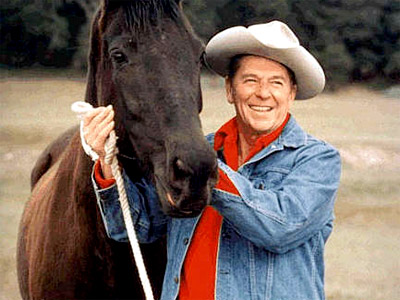 I view the adoration of the folksy and simplistic in finance as yin to the yang of irrational fear and hatred of allegedly "sophisticated"/"rocket science" instruments such as credit default swaps (which are, fundamentally, quite simple) and fundamentally mundane — while ostensibly terrifying — strategies and technology such as algorithmic trading.
It's a form of comforting primitivism, in my opinion.
Aug
24
Thoughts on the Federal Reserve Bank of SF Paper on Middle Savers and Old Spenders, from Mr. M.G.
August 24, 2011 | Leave a Comment
There is a paper making the rounds from the FRBSF that looks at the predictive relationship between "middle" savers (40-49) and "old" spenders (60-69) for equity market P/E ratios. The paper demonstrates a relationship between the M/O ratio and historical market P/E ratios from 1954-2010. The paper is a quick read.
The conclusion that is getting the attention reads:
Historical data indicate a strong relationship between the age distribution of the U.S. population and stock market performance. A key demographic trend is the aging of the baby boom generation. As they reach retirement age, they are likely to shift from buying stocks to selling their equity holdings to finance retirement. Statistical models suggest that this shift could be a factor holding down equity valuations over the next two decades.
A couple of quick points on the FRBSF economic letter:
1) The key paragraphs in terms of stock implications are:
Since we have forecast a path for the P/E ratio, predicting stock prices is straightforward if we can project earnings, the E part of the ratio. For this purpose, we assume that, in the next decade, real earnings will grow steadily at the same average 3.42% annual rate by which they grew from 1954 to 2010. To obtain real earnings, we deflate nominal earnings by the consumer price index.
The model-generated path for real stock prices implied by demographic trends is quite bearish. Real stock prices follow a downward trend until 2021, cumulatively declining about 13% relative to 2010. The subsequent recovery is quite slow. Indeed, real stock prices are not expected to return to their 2010 level until 2027. On the brighter side, as the M/O ratio rebounds in 2025, we should expect a strong stock price recovery. By 2030, our calculations suggest that the real value of equities will be about 20% higher than in 2010.
Note that they are using "real" stock prices. Converting this to nominal using currently depressed inflation expectations of 2.01% over the next decade (from TIP breakevens) implies an increase in stock prices that is roughly 50% higher than what is priced into long-term S&P options. If they are right (and I think they are wrong), then the returns to equities using long-term options should be around 3.7% over the next decade (better than government bonds) while the returns to holding the S&P should be roughly the same 3.65% due to dividends received over the next decade.
They are also making an assumption that trend earnings growth mimics that of 1954-2010. They are calculating this using a straight line two point growth. Fortunately, they ignore that 1954 earnings were roughly 50% above long-term trend lines while 2010 earnings are roughly 30% below trend. Using an actual trend line (rather than point to point) growth would imply that S&P earnings should grow 10% per year over the next decade (this makes more sense if you forget about "peak margin" nonsense and recognize the current profit levels are against a very depressed economic output line). Using their other data (dubious for reasons articulated above and below) and trend earnings would imply the S&P should rise roughly 83% over the next decade (to ~2,100). This would yield returns from long-term options of 22.3% per year over the next decade while holders of the S&P should receive returns of 8.1% per year.
2) They "fit" data from 1954 to 2010. There is a reason for this choice of data sets — it's the only one that works. The demographic data offers zero explanatory power for periods prior to 1954 for one very simple reason — the proportion of the population that was aged 60-69 (their "old" people who are supposedly liquidating assets) was far, far lower. This would imply that P/E ratios should have been stratospheric in the pre-1954 period. We can see a tease of this in their chart that shows rising P/E ratios from 1964-1954 on their "model generated" line. Pre-1954, this model generated P/E would have risen dramatically. In contrast, they were depressed. As a result, I would strongly question whether we can generate any real insights on the forward direction of P/E ratios from this analysis.

The reality of all this nonsense is that when equity markets are low and falling, most people will offer explanations for why they are low and falling. Those arguments will sound intelligent until equity prices begin rising inexplicably. Then they will rage against the "bubble" until they suddenly see the light and argue we are at a permanently higher plateau.
Kim Zussman writes:
This is a variant of the "sell to whom" question posed by Jeremy Siegel in "Stocks for the Long Run". ie, when boomers retire and they change from saving to consumption, who will buy their stocks?
Siegel's suggestion was younger people of developing nations / emerging markets. Given the known tendency for people to invest closer to home, why wouldn't up and coming Indians and Chinese buy domestic vehicles rather than SPY?
Jason Ruspini writes:
Whatever problems we think we see with such studies, it is an embarrassment for economics that the effects of demographics, globalization, and diffusion of technologies are not more widely studied and understood. This provides cover for all sorts of claims like "tax rates were higher in 1950 and 1990 and we had excellent growth then…"
Russ Sears adds:
While I agree that studying the effects of the predictable real economy on the real economy should get more study. Further I agree with your implication, that jumping from fiscal/monetary policy to real economy often hides a large amount of nonsense. However, I can not encourage a tunneled vision approach of narrow real effect to narrow real effect. Especially when I see the design of the study to be such that its intent is to keep people from following their natural ambitions and make sure the individual is smaller than he needs to be by discouraging investing in capitalism. They (the govt) only do these studies when this is the case. The nonsense comes by narrowing the line of vision to reach the conclusion that we need them to protect us from ourselves.
Jason Ruspini replies:
This sort of criticism was behind some of the controversy with Tyler's Cowen's book. To those on the right it sounded dangerously like " 'We' should do something! " To those on the left, " 'We' are poor and can't do anything…"
But I don't see why low average rates of return should discourage entrepreneurs. Situations like Apple and Facebook suggest that where there is growth in a low growth environment, money funnels to the innovators just the same if not more vigorously. Regarding Facebook, my sense is that part of the "problem" with current technologies as compared to those of the 19th-20th century is that the latter often compressed time in terms of more efficient communication, travel and production while the former largely serves to fill time with questionable effects on production and average asset returns. Additionally, the diffusion of the latter 20th century type across the world is now past its inflection point.
One other point..
Japan in the '80s through present might be a better complement to the Fed study than the pre-1950s world as suggested in Mr. Green's original email. Equity returns aside, all things equal, more retirees should translate to lower rates. Given sovereign debt, I guess one should say lower real rates.
Russ Sears responds:
The government is in competition with the private sector for capital…In the fiscal world should the retiriees give their capital to Government and let them continue to spend or should they give it to entrepreneuars and let them spend it.
In either case fewer real world projects will begin to those who loss the competition for capital. All things being equal if less money goes to the stock market, few projects are begun and cost of captial is raised. If they cannot get capital from issuing stock, they must issue more debt, real cost of borrowing goes up.
But if real demand for private sector goods are raised and fewer project in the private sector were funded, cost of loans will go up and the profits per $ in the stock market would also increase.
If more money goes to government, the more our government becomes addicted to the low cost of capital, and the more it spends on less and less productive projects.
Am I missing something?
Which do you think will raise the overall wealth the most? Would you believe a government study suggesting investing in the private sector is doomed to low real returns for decades?
Aug
23
Redistribution, from Victor Niederhoffer
August 23, 2011 | 2 Comments
 I have not seen a model yet that shows how all this redistribution causes weakness in economic activity. Certainly the incentives are hurt. But I think a model similar to what Friedman uses to show how money should grow with 2 or 3 people on a desert island would show how hurtful this is.
Tyler Cowen writes:
Moral hazard escalates.
Keep in mind that since bank failure is deflationary, the Fed can address bank failure by printing up a lot of money without a net inflationary effect. On the inflation front we are simply holding even, more or less.
But we are substituting interest-bearing reserves for M2, or public sector assets for private sector dealings, a very bad long-term trend.
Plus higher moral hazard and now European banks are Too Big To Save and don't have a real central bank behind them.
Did you see that JP Morgan is now forecasting 9.5 unemployment for 2012?
Aug
14
Detection of Other Universes, from Jeff Watson
August 14, 2011 | Leave a Comment
 National Geographic has an excellent article on the effort of scientists to determine whether they can detect the existence of other universes by carefully measuring the cosmic microwave radiation, (kind of a leftover radiation from the Big Bang), and determining whether our universe bumped into other universes shortly after they were created.
In this man's opinion, this is one of the better paths of study to determine whether our universe is alone, or if there are or were other universes in the multiverse. The scientists contention is that if there were collisions, and the collisions were detectable, they would have left behind some kind of evidence that present collection methods might be able to detect and data analysis might be able to interpret.
Aug
8
Cash is Trash, from Sushil Kedia
August 8, 2011 | Leave a Comment
 A Currency Note is akin to a Time Insensitive Zero Coupon Bond with zero regard to the idea of Inflation. Whether you present it now or a year later the Promissory Note that a Currency Note is will provide you with goods or whatever you have agreed to obtain against it at the face value that day.
Over simplification being a standard problem of modelling, the diversification with cash idea propounded by Markowitz is a numerical illusion. Since the face value of cash does not change it dampens volatility. We understand high school level Mathematica. Thank you very much Mr. Markowitz for showing us how by doing nothing one can reduce risk. I as a student of markets am interested in figuring out how can I reduce my risk while I am still doing something.
Yet, things could have been still tolerable had the negative rate of return on cash implicit due to unavoidable inflation would have been plugged in somewhere in the diversification model.
Holding cash for dampening volatility for a very short period of time is fine. But then Portfolio Management is such an aggrandized term that traders cannot even come remotely close to it and has to be a long term religion. How does anyone ever reduce risk by holding onto a guaranteed to lose investment in their portfolios?
Using even my high School standards only Maths I cannot accept to believe ever that cash that keeps getting trashed over time in value will ever add anything but negative returns in my portfolio and even if a theoretically flawed calculation of a dampened volatility is accepted as still correct then too bring me to a higher utility curve.
The higher investment utility curves built using cash to me appear similar to claims of reaching higher states of consciousness by starving. All I have known people reaching is altered states of consciousness by starving.
Hold cash and starve. Simple. Why do I need a celebrated model and an entire marketplace revolving around such a flawed reasoning. Well I need this since without such mass hysteria, where is the money to be made?
Mr. Krisrock writes:
Cash is a proxy for the currency… that's why the Japanese bond market can be among the best performers despite near zero rates. Smart bond men are willing to accept zero if the total return is simply the currency appreciation. Ask John Taylor he called all this…
Sushil Kedia replies:
I cannot agree more with your point here. Accepting zero interest is fine if the interest rates on other currencies are higher and thus the currency in which the zero interest rate bond is denominated will appreciate.
Yet that is a different point.
I am only crying over the years consumed in living with Portfolio Theory that was drilled down my brains in the MBA days.
Aug
5
Why Matt Damon Should Fire My Son Jim, from Gene Epstein
August 5, 2011 | 3 Comments
 A section of this brief Reason TV video on Matt Damon went viral.
Memo to Matt:
Matt, as for that "lousy cameraman" (Jim Epstein), would you fire him if he were shooting your movie?
No, I'm sure you'd keep him on because his salary is "shitty" compared to yours. And besides, firing people is what CEO's do!
Matt, I'm sure you send your kids to public schools. Exercising school choice–which charter schools and vouchers might allow poor people to engage in almost as much as rich people like you–is also striclty for the CEO's of this world.
*Please *don't tell me you send your kids to private schools! Isn't that what CEO's do?
Gene Epstein Economics & Books Editor Barron'sAug
2
Ten Reasons Roach is Wrong about China, from Douglas Roberts Dimick
August 2, 2011 | Leave a Comment
Did you read (and comment) the article Ten Reasons Why China is Different by Stephen S. Roach?
It appears the Yale faculty member of MS-Asia is attempting to sell a stale bushel of IB produce…
May be worth publishing here that which the commentator (vn 05:28 31 May 11) wrote in response to Roach a la "ten reasons why Stephen Roach is wrong…" [Ed.: we don't know the identity of the commentator].
"1. China's financial sector is in a mess. Read "Red Capitalism" by Carl Walter and Fraser Howie. Banks have been going through multiple recapitalizations but there continue to be piles of debt accumulating in a range of Ponzi schemes that would make the traders of Goldener Sacks and Lehman Brothers blush. And just as the global financial crisis came from nowhere, so will China's.
2. The seemingly wise, strategic, and committed leadership of the communist party that Roach so extols is as prone to crony capitalism, corruption, nepotism, and political patronage as the most capitalist societies. The state-owned corporations and banks of China are being carved up between communist party leaders, their families, relations, and friends.
3. The aggrandizement of China's export success as an example of superior strategy and impressive competitiveness actually rests on ever-increasing subsidies through low prices for energy, land, capital, water, and the environment, a labor force kept suppliant by the communist party, and an undervalued currency.
4. Continued high investment rates are being achieved by taxing households through a plethora of channels — including low interest rates, wages well below marginal productivity, and the delivery of health and education services at exorbitant prices.
5. China's gleaming cities have been built by migrant workers with no access to health, education, or housing services. Urban areas conduct a discreet form of apartheid where access to basic services depends on where people are born. (The so-called 户籍 system).
6. Inequality in consumption and income are rising — and inequality of asset ownership is probably at stratospheric levels. Yet popular discontent is repressed.
7. As a senior communist party official once remarked, China has privatized its government. It can no longer tell the difference between a public or a private good (or service). Most government departments and agencies have become profit centers, even the PLA. The China Banking Regulatory Commission — responsible for regulating China's powerful banking system — relies for its budget on the banks it is supposed to oversee. As it is, information asymmetries are powerful in banking — the incentives implicit in the Chinese supervisory system make them virtually insurmountable. The conflict of interest in the west’s credit rating agencies pale in comparison to the practices in China.
8. Mercantilist policies have created an accumulated environmental deficit that will take years to remedy – although the chances of reforms in this area are low given the close family and patronage ties between heads of large (polluting) firms and senior leaders in the party. Vested interests in the current arrangement have become very powerful.
9. The practice of “pragmatic, incremental” policy changes that China so prides itself in has created a complex web of interconnected policies, laws, guidelines, practices, and informal arrangements that make it very difficult to untangle. Even if the Chinese know what they want to change, they are not sure how to do it. Recent shortages in energy availability are a case in point. Power generation plants have had to close because of losses caused by high raw material costs and low administered energy prices – but raising energy prices would hurt energy-intensive industry; and raising public subsidies through the budget or banking system run counter to the government’s efforts to withdraw economic stimulus at a time when inflation is high and rising.
10. Encouraged by the success of the stimulus package, the government’s further encroachment into economic decision making by firms and individuals is moving in the opposite direction to where it should be going – if it is to become an innovative, flexible, and dynamic society. China’s leaders are drawing the wrong lessons from their past success. They believe it was because of the government’s superior decision making ability, when in reality it was because of the strength of markets."
Jul
23
Is the World Over Populated? from Pitt T. Maner III
July 23, 2011 | 3 Comments
Mara Hvistendahl , the author of "Unnatural Selection" was on TV a week or so ago and suggested male-female ratio imbalances will cause some Asian countries to become like the American "Wild West" and more war-like and aggressive in nature in the future. Interesting (if not flawed) idea with possible market implications (at least until equilibrium is re-established).
It sounded a bit Malthusian though too…
from an article on npr:
As men find it more difficult to find wives in these countries, Hvistendahl says, "it is leading to unrest and almost certainly will lead to more." Unmarried men are responsible for more violent crime than married men. And, Hvistendahl adds, research in eastern China showed a correlation between a high male-to-female sex ratio and the crime rate.
Don Boudreaux adds:
In light of the fact that the most creative and versatile resource (by far) is the human mind, world population today truly is not too great but, rather, too small. Far too small.
Jul
18
Marginal Tax Rates, from Rocky Humbert
July 18, 2011 | Leave a Comment
 I had a delightful dinner last night with a Porsche 911 owner and Swiss resident. In a discussion of marginal tax policy, he noted that Swiss traffic fines are increasingly based on personal wealth and income — rather than the American fixed penalty model.
This is a wonderful illustration of the BENEFITS of marginal tax policy: In crafting a deterrent for the reckless endangerment of innocent people, a 500 franc fine will have a different deterrent effects on a working man versus a multi-millionaire. Scott: It's impossible to quantify "power," but creating and destroying incentives can be observed and measured — and in this Swiss example, it can be measured in nearly real time.
Here's a Fox news story story from January 2010 that cites a $290,000 Swiss speeding ticket on a Ferrari driver. (In the unintended consequences/unintended incentives department, this might be just one more reason why people are buying gold and hiding visible assets.)
Jul
13
Paul Romer, from Victor Niederhoffer
July 13, 2011 | Leave a Comment
 I like this quote of Paul Romer's:
"Every generation has underestimated the potential for finding new recipes and ideas. We consistently fail to grasp how many ideas remain to be discovered. Possibillites do not add up. They multiply."
Would have been great to have him at the Tyler Cowen talk.
Tyler Cowen writes:
Over time Romer has come closer to my view. He did read my book and sent me some comments. I don't think he believes in "increasing returns" any more. I actually think Romer (the old Romer) is right about increasing returns, just over a longer time horizon, not over short horizons.
You should try inviting Bryan Caplan (linked is a good article of his) to speak.
Jul
11
The Fatal Flaws of Reason, from Mel Meljay
July 11, 2011 | 2 Comments
You at dailyspec say you are "animated by a desire to apply systematic, tested reasoning to improve our understanding, not by appeals to authority or the transition of charts."
To understand why you do not achieve your goal see:
"Why Do Humans Reason? Arguments for an Argumentative Theory" by Hugo Mercier and Dan Sperber
There is also discussion about it here and other places.
The claim is that human reasoning developed to win arguments and not to discover the truth. There is evidence for it at every meeting of the NYC Junto. The theory does a pretty good job of explaining phenomena like "confirmation bias" (i.e. your speakers basically confirm your beliefs) and that people first "emotionally" come to a conclusion and then find facts to support what they "feel" (as evidenced by audience comments and questions).
Jul
8
Some Books of Interest, from Richard Kostelanetz
July 8, 2011 | Leave a Comment
 May I announce that some major books of mine are now available on amazon kindle for single digit prices (cheap). Some are criticism.
The Art of Radio in North America:
This offers chapter-length appreciations acoustic excellence in radio comedy, John Cage, Norman Corwin, Glenn Gould, et. al.
Jewish Writings So Far:
What a surprise it was for me to recognize that I’d been writing about Jewish subjects or out of the Jewish tradition for more than four decades. Since there wasn't enough material to make a printed book, Jewish Writings So Far seemed an appropriate addition to my website, particularly in collecting materials unavailable elsewhere. This 2011 edition expands an earlier Kindle/Website text.
On Sports and Sportsmen:
This book collects essays written over the past four decades about sports and sportsmen. It reprints a New York Times Magazine profile of the legendary orthopedic surgeon James Nicholas, long the team physician for the New York Jets, as well as the profile of Detlef Schrimpf, the first German professional basketball player in America, “Working/Playing a Long Way from Leverkusen.” The book also contains an appreciation of European soccer and a critique of a patently under-researched book about baseball in Latin America. I include two essays on the esthetic and the esthetes’ appreciation of spectator sports —”Artistry in Football” & “The Opiate of the Intellectuals.”
A Book of Kostis:
Not unlike other prolific writers, I regard some of my texts as more classic than others; these represent my choices for My Most Classic under these topics: Abridgement, Abstract Film, Acoustic Fiction, Alternative “Poetry Readings”, Alternative Exposition, Alternative Publishing, Aphorisms, Art Prints, Arts History, Audio Documentary, Audiovideotapes, Autohistoriography, Avant-Garde Criticism , Book Art, Book Composition, Book Reviewing, Cameraless video, Choreographic scores, City Anti-Planning, Collective Translation, Conceptual scripts, Connecting people, Creative Nonfiction, Creative Photography, Critical Policing, Curating Exhibitions, Digital Art, Documentary Film, Documentary Photography, Drawing, Electro-Acoustic Composition, Exhaustive Narrative Film, Experimental Prose, Extended Interviews, Film & Video Criticism, Grants Criticism, Hörspiel (German Ear-Plays), Humor, Innovative Erotica, Intellectual History, Intellectual Portraiture, Interior design, Internet Correspondence, Inventing Categories, Investigative Reporting, Jewish Art, Journalism, Kinetic installations, Literary Criticism , Literary Demolition, Literary History, Literary Journal Editing, Live Media Presentations, Memoir, Minimal Literature, Multiplex Holography, Music Criticism, Music Journalism, Musical Composition, Musicology, Numerical Art, Numerical Literature, Organizing Assemblings, Performance Studies, Performance Texts, Photolinens, Political Commentary, Polyartist Criticism, Public Art Proposals, Public Intellectual , Radio Features, Radio Scripts, Randomly Accessed DVDs, Satire , Scenarios, Scholarship, Simultaneous Translation, Social History, Sound Poetry, Sports Writing, Straight Prose, Taste-Making Anthologies, Text objects, Texts for Composers, Theatrical Scripts, Thematic collecting, Humor, Thematic Dictionaries, Transmission Holography, Travel Writing, Urban Studies, Verbal Fiction, Verbal Poetry, Video Documentary, Video Narration, Video Poems & Stories, Visual Arts Criticism, Visual Fiction, Visual Poetry, Workshops in Innovative Writing
These others are cultural history:
The Maturity of American Thought:
This was begun in the late 1960s, with the help of a Guggenheim Fellowship. It was meant to be a comprehensive intellectual history of post-WWII America (1945-68), and its thesis was that only in the post-War period did American thinking in many fields achieve first-rank importance and major international influence. My strategy in writing this book was less to prove this thesis, which I took to be virtually self-evident to those who knew (and cared) than to identify and summarize what this major thinking was. I completed several chapters before putting the project aside to complete something else; it was never resumed. The chapters I finished beyond the introduction covered “Historiography,” “Sociology,” “Social Philosophy,” “Government,” “Anthropology,” “Esthetics,” “Architecture,” and “Literary Criticism.”
Autobiography:
Categories:
An elaborate summary of my work in several domains conventionally understood.
Remembering Everyone Met:
Short descriptions of many people remembered recently—my life entirely through others.
Fiction:
More Openings & Closings:
These stories are meant to be, alternately, the opening sentences or closing sentences in otherwise nonexistent fictions. They are differentiated in print with the Openings in roman type and the Closings in italics type. This text supplements, without duplication, the "Openings & Closings" published more than three decades ago.Openings: Just the opening sentences of otherwise nonexistent fictions.
Epiphanies Complete:
Just the heightened moments, no more than a single sentence long, in a multitude of stories, mostly written decades ago.
1001 Stories Enumerated:
One thousand One single-sentence fictions, each with its own number, as a contribution to Richard Kostelanetz's continuing exploration of minimal fiction–work frequently acknowledged in histories and encyclopedias of contemporary literature.
Minimal Audio Plays:
A large number of exchanges between two speakers, for self-reading or performances.
Lovings:
Several hundred erotic stories no more than a single sentence long.
Poetry:
English Incredible English:
Thousands of unfamiliar English words, in an extended investigation into “found poetry.”
OTHERS COMPLIMENT PREVIOUISLY PUBLISHED BOOKS:
Preambles to the New reprints all the prefaces written for previous books both published and unpublished over the past five decades.
Additions to the Rise and Fall of Artists’ SoHo has a chapter missing from the first edition as well as elaborations and updates.
to come soon:
Autobiographies @ 70
There No Such Thing as a “No-Cost Delay”
New Entries Toward a Third Edition of my Dictionary of the Avant-Gardes
The Rockaways: Fall & Rise of NYC’s Beach Towns
Jul
7
Tyler Cowen at Junto Tonight, from Victor Niederhoffer
July 7, 2011 | 1 Comment
Tyler Cowen will be speaking at the New York Junto, tonight, July 7th, on "the great stagnation of capitalism" at the Mechanics Institute at 8 pm. All are welcome.
Jun
21
Social Media Replaces News, from Vincent Andres
June 21, 2011 | Leave a Comment
 I have been having an interesting discourse with friends and family on the subject of social media versus the news services on the timely delivery and accuracy of "facts" presented. My thesis is that social media is replacing traditional news sources as a better, more up to date, more accurate, broader coverage, more accurate, more varied source of current events than traditional news. The case in point was the tsunami here in Hawaii Island which was totally lost to traditional news. Governmental sources were wildly inaccurate declaring the danger over when it was just beginning here. Facebook and Youtube and other blogs and social media had current up to date, accurate data, video, sensor readings and on-site reporting while government and news were still asleep. Twitter broke the Bin Laden story. Everyone has data collectors on their cell phones. On the other hand traditional news is biases, has limited coverage, is slow, limited reporting capacity and notorious for getting the story completely wrong.
Jim Sogi adds:
Here are some interesting links
Democracy 2.0: Iceland crowdsources its next constitution
Jun
18
RIMM, from Anonymous
June 18, 2011 | Leave a Comment
Technology is tricky, eh? It's great on the upswing, but it sure does hurt when it starts to get replaced by the next big thing.
I can't help but think of a friend of mine who is an engineer. About forty years ago he did consulting work for a small company that paid him partially with company stock, because actual cash was tight. The stock wasn't worth much, but he must have liked the people running the company, because he kept it. That little part of the account is now a 7-figure position that he can leave to the kids. The company's business? Gravel and rock.
Jun
17
Abandoned Baby, from Jim Sogi
June 17, 2011 | 2 Comments
 Steve Nison in Candlesticks describes the "Abandoned Baby" pattern where price gaps up, then gaps down the next day.
This occurred two days ago. The pattern was bearish (despite prior drop) according to traditional candlestick theory and modern scientific analysis.
Jun
10

The most accessible, and always the most popular, has been the beach that runs continuously from Coney Island to the west to Brighton Beach on the east. Over two miles long, only one long block away from the elevated MTA stations, it has for over a century been a proletarian playground with a wide spacious boardwalk that runs from end to end. So convenient to public transportation is this beach that the walk from the boardwalk to the water's edge is usually longer than that from the subway to the boardwalk. Likewise conveniently, several subway lines once again (after reconstruction) service the four stations parallel to the beach: Brighton Beach, Ocean Parkway, Aquarium-W. 8th Street, and Stillwell Avenue-Coney Island.
The subtle truth of this beach is self-segregation, which is to say that the successively numbered bays (divided usually by rock jetties running perpendicularly from the shore into the ocean) attract radically different cultural groups. Nowadays, most of the people at bays 1 to 6 are Russian immigrants from nearby Brighton and Sheepshead Bay. By contrast, the bays in front of the Stillwell Avenue and Aquarium stations, numbered 10 through 13 or so, have hosted for the past few decades mostly Latino crowds. No signs tell prospective bathers where to go, but there are good reasons why, say, the sellers of mangoes wrapped in plastic bags, poked with a thin stick, and freshened with hot sauce rarely go east of bay 9. (I can recall a Russian friend asking me, "What are those?") Needless to say perhaps, most guidebooks don't acknowledge this segregation in PC times.
 I myself have favored Bay 8, between the two crowds, because it has always been comparatively emptier, which is to say that the number of people at bays 9 or 7 are roughly 50% greater than that at bay 8 on weekends as well as weekdays. Bay 10 is likely to have twice as many people as Bay 8, and bay 11 yet more. The best way to explain why bay 8 should be so empty is, simply, that "no one goes there" for some three decades now. The only signs identifying the individual bays are small medallions mounted high on poles on the ocean side of the boardwalk; but if you can't locate them, ask the lifeguards. They usually know the official number of the bay to which they are assigned. Since I once before recommended Bay 8 in print without noticeable effect on the beach itself, I don't fear mentioning it again.
On the other side of bay 13 are beaches yet emptier, if they are open, but often closed with a make-shift fence, especially before July 4th, and patrolled by uniformed people threatening to arrest you if you bathe there. When open to water-lovers, these are the cleanest beaches for the simple reason that fewer people patronize them—don't forget the truth that human beings make the most water trash. On the western end of this beach is Sea Gate, a community secure behind a forbidding fence that goes out into the water; but just before (or east of) it is a beach that attracts people visibly different from Coney Island proper or Brighton. I'm told they are mostly Italian- Americans, but am not sure. Not knowing anyone residing in Sea Gate, I've never sampled its beaches; but my father, who did a summertime rental there with his buddies in the 1920s, tells me that they were great then. (Yes, 80 years ago, and he's still around, though not swimming.) You don't need to subscribe to the Gaia hypothesis to believe that Sea Gate beaches fronting into New York harbor are no less hospitable several decades later. Since most of the people on the entire Coney Island-Brighton beach speak languages other than English, the proletarian beach has become an immigrant beach, which means that their beach small talk thankfully won't be understood. The atmosphere is also pervasively mellow, even on the hottest days, mostly because most people plant themselves among their own kind with sufficient space between themselves and others; and everyone is as pleased as I am to be near the water. Indeed, public beaches are my model for mellow anarchy, where everyone is equal with respect to visible wealth or power, few trying to put down others. Or as a portly friend put it, his arm sweeping across the horizon, "Fashion models don't hang out here." If only the whole world could be forever like a public NYC beach.
For swimming, distance swimming, which is what I do, this beach can't be beat. Go out far enough and you can swim (and think) without needing to worry, as you might in a swimming pool, about colliding with someone else. If you visibly demonstrate that you know how to swim well, the lifeguards won't hassle you, no matter how far out you go. When I pointed to a slow swimmer chugging far out from shore, the chief lifeguard replied, confidently, "We know him." Though the water comes from the Atlantic Ocean, Coney Island/Brighton is actually a bay protected on the southwest by Sandy Hook, the New Jersey peninsula that extends north into New York harbor. and on the northeast by Breezy Point, the westernmost end of the Rockaways. Therefore, on most days the water here is placid; only with the threat of a hurricane will there be waves high enough to body surf. Surfboarding is unknown here.
 Bear in mind that all New York City beaches are officially "open" from 10 am to 6 pm., from Memorial Day to Labor Day, which is to say that only during those times will they be staffed with lifeguards and ancillary City workers who give first-aid and scare away fisherman. However, since the beach isn't fenced off, people do on warmer days stay after six pm., when newcomers carrying fishing poles emerge. Since the temperature of the water is higher in September than in June, some patronize New York City beaches after they are officially "closed"–after the lifeguards (and garbage cans) have departed. Others swim into the winter. (A lady friend and I once celebrated New Year's Eve with a dip before midnight, preceding the "polar bears" photographed running gleefully into the ocean on New Year's Day. Prancing through cold water is easier to so than one thinks, if you keep the back of your head out of the water and don't stay too long.)
On truly hot summer nights, some try to stay overnight on this beach, which would be reasonable, did the City not send out noisy trucks in the middle of the night to churn garbage out of the sand. Awaking to these dinosaurs can be, I'm told, an unforgettable nightmare. Decades ago, people homeless and otherwise, both loved and loveless, could spend the night under the broad boardwalk; but this has become less possible since the Army Corps of Engineers raised the level of the beach sand roughly to that of the boardwalk, thereby making a windowless cave of the areas under the planks.
On the other side of waterfront houses east of Brighton is Manhattan Beach, much smaller, which is accessible by public bus from the Brighton Beach subway station. Perhaps on a crowded weekend a visit here is worth the inconvenience of a bus ride. I've heard of yet another public beach on the other side of Coney island, on the northwest coast, just east of Sea Gate, facing New York harbor with a spectacular view of lower Manhattan; but since getting there would require a trek from public transportation, I've never sampled it.
As the subways to the NYC beaches eventually emerge into open air, you can with your own eyes observe if, since you began, the weather has turned bad, as it does often in the summer. (Forget about what the weather forecaster "predicted." I'd sooner trust horse- touts.) If clouds threaten, you can simply disembark your train, sniff some fresher air, and go over the other side of an express-train track before returning home at no extra cost. One persuasive advantage of the main Coney Island-Brighton beach is its proximity to an MTA subway with continuous service; so that if the weather suddenly turns foul while you're at the beach, the elevated subway is only a short hustle away. Pity the day chumps on Fire Island waiting in a sudden rainstorm for a scheduled ferry to get them to a scheduled bus to get them to a scheduled train before they can connect to the MTA. Perish the nightmare.
 The Rockaway beaches are different because they front on the Atlantic Ocean, much like the beaches in Fire Island or even the Hamptons, which is to say that here is salt water essentially no different (and no dirtier) than that in the purportedly classier watering holes to the east. A century ago, the Rockaway beaches attracted the same sorts of folk who nowadays go further east. I have a collection of century-old photographs from the Rockaways, portraying people looking prosperous not only on the boardwalk but overdressed in the water.
Sometimes the water on the Rockaway Beaches is placid; other times there are waves—real high waves, when this beach can be dangerous, especially to non-swimmers. The lifeguards here make many more saves than those at Coney Island, and several people drown here every year, usually before or after the lifeguards work or in areas that aren't watched. This Rockaway beach is over ten miles long; its boardwalk, while much narrower than that at Coney, is several miles long and remarkably empty in comparison.
Unfortunately, much of this beach is officially closed, sometimes purportedly for a lack of bathers, which is true, as the bungalows near the ocean between 35th and 72nd Streets were scandalously demolished in the name of "urban renewal" four decades ago, leaving miles of oceanfront property pathetically empty ever since. Other times they are closed for a "shortage of lifeguards," which seems dubious, given how little they are paid. Anyone trying to swim in these fenced-off areas will soon attract a visit from a uniformed official. When a local newspaper tried to make a photograph of me standing, but clothed, in the water at 67th Street last summer, a succession of guys in beach jeeps came by to ask what we were doing, until one assured us that he read the paper.
This beach too is self-segregating in ways reflecting two factors— the kinds of people living in the streets near the beach and the routes of public transport. The beach around 60th Street is roughly 300 yards wide, 50 feet deep, kept officially open to service a grim- looking low-rent housing project overlooking the ocean. Sometime last summer, an New York Times's intrepid beach reporter wrote that the project people didn't patronize this beach because they thought it "too dirty," which it isn't, or because they couldn't swim, which seems more true. Therefore, during the weekdays it might have two dozen patrons (at 2000 square feet apiece) along with several lifeguards. The water on one side of the dividing jetty I find best for body surfing; that on the other side of the jetty has 200 yards for continuous swimming. On weekends, Caribbean-American families arrive, crowding up the water; and in the playground behind the beach are generous barbecues, one mostly Latino Caribbean, another West Indian. This 60th Street beach is directly accessible from Manhattan and Brooklyn on the A-train marked "Far Rockaway," not Lefferts Avenue or Ozone Park, just three stops after Kennedy airport.
 The folks on the A-train with giant surfboards are probably going to the first stop, 90th Street, changing to the shuttle train that begins anew at Broad Channel, itself the first stop after JFK airport. The beach at 88th Street has been officially set aside for surfboarders. This shuttle train (marked "S") continues parallel to the ocean, only a few blocks away from the water, to its terminus at 116th Street, which is a shopping thoroughfare of sorts, with the only Rockaway stores offering beach paraphernalia (as well as Irish bars that are plentiful in this area, unlike, say, 60th Street, which has none). The beach at the end of 116th street is invariably the most crowded and boomboxy in the Rockaways, usually with teenagers and, I'm told, Brazilians. Older or quieter folks might prefer to get off at the shuttle stops at 98th or 105th Streets, the emptiest beach being around 103rd Street, or to walk west of 116th Street. The beaches in the 120s reflect the predominantly Irish-American population of Belle Harbor; those in the 130s and 140s the Jewish upper-middle-class of Neponsit. One reason why beaches here are under-populated is obnoxious street signs forbidding parking in the daytime during the summer months, which is to say that aspiring bathers driving here from elsewhere must either park in a friendly driveway or go somewhere else. The lack of public lavatories here also discourages outsiders.
Another way for the car-less to get to the Rockaway beaches is taking the public bus that originates near Brooklyn College, which is also the southern terminus of subways # 2 & 5. This bus # 35 proceeds down Flatbush Avenue over the Marine Parkway (aka Gil Hodges) Bridge to the Rockaways, where it swings east. The first stop is Jacob Riis Park, which is a large if aged New York State facility with lifeguards (some of whom wear spectacles, which are forbidden to NYC lifeguards) and locker facilities, as well as food concessions. Its 16 sections are likewise self-segregating. I've been reliably informed that at the eastern end is a beach favored nowadays by gays; two decades ago, it was the only nude beach within New York City. (Nowadays, those with Northern European "naturist" tastes go to Sandy Hook or eastern Long Island.) The section on the other, western end of Riis Park is reportedly favored by Italian-American teenagers who tend to get into fights among themselves. In between are a succession of crowds more subtlely defined. Need I mention that that entrance here, as in all the beaches mentioned favored by me, is free, that's FREE, which is my favorite price range, though the parking lot charges four bucks. Don't forget the inarguable truth of anarchist economics: the best things in life, in this case sunshine and surf, are free, absolutely free.
This # 35 bus can also take you through Neponsit and Belle Harbor, if you want to sample those sparse beaches, probably before walking down to 116th Street, where there is a public lavatory under the boardwalk, not to mention a subway home. Yet other public buses, # 21 and 53, come from Queens across Jamaica Bay over the other bridge to the east, Cross Bay, to run parallel to the shuttle train, likewise terminating at 116th Street.
On the other side of Riis Park is Fort Tilden, a sometime military base, which into the 1960s housed the Nike missiles facing out into the Atlantic. It has magnificent beaches that are officially closed and thus lacking lifeguards but nonetheless accessible. Indeed, several of us once celebrated Rosh Hashanah with a midnight swim here, and we were not alone on the beach at that time. Yet further to the west, well beyond public transportation, is Breezy Point, which is another gated community, much like Sea Gate, but far less secure, as its fences don't extend down the beach into the water. Here is certainly the most beautiful beach in New York City as well as the most isolated, separated by dozens of yards of sand dunes from the nearest housing.
 Breezy Point, at the western end of the Rockaway peninsula, miles away from any other residential community, is known affectionately as the Irish Riviera. With modest detached houses tightly packed next to one another, in the largest coop of single-family homes in the US, mostly owned by police and firemen, it is very much its own world, with its own rules, typified by burly folks carrying their cans and bottles of beer unwrapped, even though they would arrest you for doing the same in Brooklyn or Manhattan. Breezy Point doesn't take kindly to uninvited guests, even if they can legitimately enter it by walking along the beach or bicycling past by gate on the main road. Perhaps I shouldn't have mentioned it at all.
A friend recommends the beach at 25th Street, at the end of a row of classic bungalows still occupied, which is also accessible from the direct A-train. "It's quite wide with dunes and that same wave energy," he tells me, "protected from erosion by Atlantic Beach," which is the western tip of the barrier island called Long Beach. (The barrier strip beyond it has Jones Beach; the next extending out into the ocean, to the east, is Fire Island.) However, I don't claim to know the beaches east of 60th Street, because, not unlike others in the Rockaways, I tend to regard everything east of a certain point to be fearsome. (For those residing further to the west, the cut-off points can be 88th Street, 103rd Street, 116th Street, or even 132nd Street; but that's another Rockaways story.)
Because the New York City beaches are thankfully so accessible, I find that I can spend the morning writing, hop around noon into a subway where I read for an hour or so, swim for an hour and even take a nap before returning by subway home for dinner, an evening out or with my computer, and a night in my own bed. The only other cultural capital in the world where that is possible in my experience is Berlin, which has several comely lakes; but I'd rather body surf or swim in the ocean with its extra buoyancy than lap around a lake or a pool. And, accustomed to the easy access of MTA subway stations, my Metropass in hand, I'd prefer not to navigate all the hideous obstacles of Penn or Grand Central. Believe me, masochism need not be a prelude to the pleasure of a summertime beach.
Richard's website
Jun
3
Pete Earle wrote a very good article over at Mises.org.
The Aksumite civilization began coalescing approximately 400 years before the birth of Christ, with the aggregation of a number of tribes and clans in present-day Ethiopia.
Personally, I feel my heart swell knowing that I have friends as smart as Pete and the rest of the contributors to Dailyspeculations for that matter.
Jun
2
An Erudite and Informative Letter From A Reader of The Site, from Victor Niederhoffer
June 2, 2011 | 4 Comments
Dr. Niederhoffer,
I was always fascinated by your career. What's more interesting to me is your ability to stay in an excellent mental and physical shape. I recently read your "Letter to a Newborn Son", congratulations. I learned a lot from it, but your assumptions on Soviet system and Russian people were simply wrong. Everyone of course is entitled to their opinion, but because I learned a great deal of knowledge from your writings on how to trade and market in general, I felt obligated to correct the assumptions that you made.
Unlike you, I actually lived in Soviet Union, before, during and after collapse and in 1995 when I turned 15 we immigrated to US. Myth number one: "people had no incentives in Russia, no one worked hard, and they never produced what people wanted". The great example is simple, educational system in Soviet Union that put to shame any education that students receive in public US schools. My mom taught in school in Russia for most of her life, to the last day we stayed there. We lived through 3 hyperinflations and 2 devaluations, that wiped out all of her and my grandparents savings, and yet she diligently worked every day and taught to the best of her ability not for monetary compensation (she was getting bed linen sheets at one point as a salary), but for personal gratification of doing a good job (definition of a good job, her students learned the subject). And my father who worked as an engineer, and cared about his intellectual progress rather than how much and how he will be paid (died many years ago for disagreeing with some of the practices in that system). I was taught chess, tennis, piano and swimming all for free and all by excellent teachers while they were getting paid very little. A concept that is hard to grasp for most Americans.
Another example was both of my grandparents, who lived and worked in the Soviet time, and received University Education (even though they were both Jewish we were lucky enough to live in Tashkent where antisemitism was not as bad as in the rest of the Soviet Union) in engineering and in German language and both served during WW2.
I am surprised that you would write something like this, looking at the pattern of your performance it always seemed to me that money and performance is just a byproduct, and the important thing for you was/is an intellectual pursuit and making a right decision.
There are 2 groups of people that you met and talked with, group one: mostly ex cons, criminals, conniving, deceitful thieves that never produced anything of value in the Soviet system, those that despised "communists" and left Soviet Union in the 1970th and 80th, because they were smart enough to realized that the system is fixed and people in general are slaves in that system (unfortunately for them, they were not in charge).
Group two; those that are also conniving, deceitful thieves that never produced anything of value, but they used to be in charge of the system therefore there was no need to go anywhere (and they are still there).
I have a better explanation for the "phenomena" that you witnessed and experienced. I call it "homeless complex or slave complex". I walk around NYC and can't help, but notice that unlike in Russia homeless people are extremely obese, I decided to sit down with one and treat him for a dinner and ask him several questions. He finished everything we ordered and even though he was already full he ordered more and started eating more. I couldn't understand him and asked him why is he eating more if he was already full? He said "There might be nothing to eat tomorrow" (there are other reason why they obese, but I won't go into it here). When we came to America I worked with my mom in the pushcart that sold bagels, after everyday we gave all the leftover bagels to homeless people, the food never ended, day after day it would be the same homeless guys and yet they ate everything.
So the simple answer is "Russians" that you met are simply experiencing a "homeless complex" that if they won't steal everything today, from whomever they can (and outsiders like yourself make a perfect target) tomorrow it might run out. They learned from the experiences of the intellectuals that surrounded them and died in poverty and hopelessness. I also noticed that majority of people that buy cars that they can't afford are Russian and Chinese immigrants and African Americans. I call it "Slave complex". We are trying to make up for all those days of hunger.
At your level you never met true "socialists" that do things that make no sense for someone like me, who understands and lives in US system (I remembered we were getting paid $70 per day for 12 hour shifts (even though sales were close to $900 per day, that's lots of bagels and coffee). It was a cash business, and the owner (who came to America in the 70th) paid so little because he assumed that we will steal from him, and of course my "socialist" mother would not dare, and she simply said, if you are not interested in working, don't work here). And still, I can not understand why is my mom who is currently making 50k a year as a High School teacher, stays every day after school and makes sure that every student will understand the subject before they go home. Nobody is paying her extra for it, nobody will fire her (she is tenured) if she is not there. There is no incentive for it. In America we call people like that, dedicated idiots.
After visiting Russia many times in the recent years, I realized that there are still lots of people like my mom in the country, but they are a dying hopeless, and in some cases homeless, breed because in the new system you are mostly surrounded by people with "homeless/slave complex".
I love the American system. At the age 18 I became a trader by chance and did well (high frequency with leverage 50-100 to 1). I quit for almost 4 years for 2 reasons. First, health; I was too young and did stupid wild things that caused my health condition to deteriorate rapidly and second, for precisely the reason you described, every day I would get up from my chair see that I made over 400k a day and "produced" very little for society (except maybe commissions or as Goldman said "we provide liquidity". I was a vulture. I made peace with it over the years by talking with other traders, became a marathon runner, and went back to trading because nothing else that was available interested me, and with the money I make I can create things for society (good thing now, my black box can be a vulture and I can finish my PhD).
Again, we are shaped by our experiences and we do and think what we like, but for some crazy reason (maybe to show you other side of the story) I felt obligated to spend 30 minutes of my life to write this email. Maybe it's genetic. You are much smarter and older than I am and have had more experience in life and maybe there is a mathematical explanation for that behavior (but it is not a simple matter of improving oneself, or lack of incentive to work hard, there was an incentive for masses it just wasn't monetary (and for those that were in power I like what Mr. Soros said, that being an agency issue) that's what Ayn Rand didn't get).
Keep up the good work,
Love reading your material,
Arthur.
May
30
One of the more useful skills one can have, at least if one is a researcher, is knowing how to program a computer to extract online data, e.g. stock market prices.
I personally use VB.NET, but I'm sure most programming languages have built-in functions that make the process quite easy.
I wrote "quite" easy, as in everyone can do it, assuming they know basic programming. An introductory book, or a little tutoring from an experienced programmer, should be sufficient.
Two line are all it takes to download a web page:
Dim wc As New System.Net.WebClient wc.DownloadFile("http://EXAMPLE.com/DOWNLOADME.html", "savedFile.txt")
The above lines tell the computer to save the webpage's source as a text file named "savedFile.txt" in the same directory as the VB.NET program.
Naturally, one wouldn't make a program just to download a single page. It's when one needs to download dozens or more pages that the programming approach pays off. If these pages are numbered (they often are), then all one needs to do is to loop through them, e.g:
For i = 0 to 1000 Dim wc As New System.Net.WebClient wc.DownloadFile("http://EXAMPLE.com/DOWNLOADME.php?id=" & cstr(i), "savedFile-" & cstr(i) & ".txt") Next
With stock market data, one often needs to specify the tickers. Thankfully, this is easily overcome:
Dim tickerList() as String = {"ABC", "XYZ", "JPJ"} For i = 0 to tickerList.getUpperBound(0) Dim wc As New System.Net.WebClient wc.DownloadFile("http://EXAMPLE.com/DOWNLOADME.php?ticker=" & tickerList(i), "savedFile-" & tickerList(i) & ".txt") Next
If neither of these approaches work, then the process is slightly more challenging. One needs to search for links within the downloaded source files. It's doable, but too complicated to include in this text.
Although it's very fast to write the code for downloading webpages, the actual execution is very slow. This varies a lot with the internet line and proximity to the remote server, but a rule of thumb is that one page takes one second to download (one should also consider waiting a a short while between each download). One hour, as you know, exists of 3,600 seconds. One day is 86,400, and one month is 2.6 million seconds.
Because of these time concerns, I almost always download all the raw source files to a hard drive, and I do not manipulate them. You never want to find out that there's a bug in the data extraction algorithm, and then having to do all the downloading again. Once the files are on the hard drive, one can easily read them and then save the relevant information into new files again. Reading a file takes something like a hundredth of second or less. The downside with this approach, is that raw data takes up tremendous amounts of space. But with affordable 1TB external usb-connected drives, this is not a problem.
Although reading files from the HD is many, many times faster than downloading them in the first place, working with data loaded to the memory (RAM, as variables in the program) is many, many times faster than reading and writing files. I therefore prefer to make one, only one, text file (CSV) with all the relevant data from the raw data, and every time the program starts up, this file is loaded. When the program finishes, the manipulated variables are then saved to a text file.
I know I only scratched the surface here, but I hope this short text will inspire other researchers to learn the skill of automated data downloading. Once fluent in instructing computers to do your dirty work, you have an extremely valuable slave at your disposal.
P.S. Some useful codes can be found here.
Work in progress!
May
26
Greenblatt’s Magic, from Gary Rogan
May 26, 2011 | Leave a Comment
 I apologize in advance for [an article that starts with] a quote from Sage, but…
Five Magic Formula Stocks For The Next Year:
Ontario-based Research in Motion ($23 billion market cap) is the creator of the BlackBerry smartphone and its operating system. It's been producing tremendous growth in recent years, but has been losing some market share to Google's Android smartphones and the iPhone recently, which has spooked many investors. My Greenblatt-based model thinks that's made it a bargain. With an earnings yield of 22.2% and a return on capital of 66.6%, it's the 11th-highest-ranked stock in the market, according to this model.
James Goldcamp writes:
Interestingly when I run the screener on their own site (the strategy's author not Forbes) I don't get RIMM, but a host of other tech stalwarts like CSCO, MSFT, AMAT, HPQ, and DELL are returned in the screen of the 50 highest rated by the magic formula.
May
25
Query of the Day, from Victor Niederhoffer
May 25, 2011 | 6 Comments
 What % of NBA games these days are won by the team that puts in the first point, and can this be generalized to markets?
Jeff Watson writes:
My grandfather used to tell me that a fist fight among boys was usually won by the kid who got in (not threw) the first punch. As an aside, I wonder if markets are susceptible to rhetorical sucker punches?
Russ Sears writes:
In distance racing it is the opposite. You do not want to be out front at the start. This is especially true at High School races and at the big road races. Too much adrenalin spent at the beginning will waste it. The amount of aggression used at the start, may vary from sport to sport. But might I suggest that one on one sports or team against teams are different than sports like running or poker and trading where it is not just about beating the guy closest too you. You don't want to crush your opponent but use them or propel you to the front.
 On the other hand you must be watching for signs they can hold the pace. Exhaustion can be contagious if the pacer slows, all follow. Plus you must have confidence in your plan and stick to it. Do you beat all with a kick or do you win with a blistering last mile?
Having thousands chasing you can be a rush, but it is also very draining to wear the target on your back. You take the wind hardest without any wind blocks and you are also wasting mental energy setting the pace.
What I think all the comments below suggest is there are really 2 questions you need to ask yourself…How aggressive do you want to be at the start? And the second one is how intimidating should you be?
As Scott implies below, thugs will nip at you until they know you are or are not armed. But to answer these 2 questions in most civilized matter, you have to know yourself; be confident in your capabilities and and equally realistic about your limitations.
In racing, poker and trading, patience is the key. Be aggressive when you truly have the edge. Believe in yourself enough to wait for that edge.
What may be more fruitful questions are: what are the signs that the opponent has started too fast? And what are the signs that they are exhausted?
A Mr. T.C responds:
I spent years running, and I choose to disagree a bit. I don't know what type of resume is required, but I did manage two state championships and posted a 4:12 mile time in college.
Going out first doesn't always mean having to go out fast. Runners settle in as soon as someone takes the lead, whether it be track or cross country. If you can use just a quick burst at the beginning to get the lead, you can then set the pace you need in order to win. If it buries others, then great, but if you not, then you know what you have in terms of a kick when it comes to the finish because you set the pace.
Losing stinks, but there is nothing worse than losing and still having something left in the tank. That can happen if you let someone else set the pace, and you can't outkick them. Why? Because they set a pace knowing they could still have a strong finish. Yes, there are rabbits, but they are pretty easy to ferret out. They sprint out too far, too far, plus in any race you should have a pretty good idea of who your competition is not just who are the participants are. The wind is a factor, but only when the wind is actually a factor. Giving yourself some distance gives those behind you no benefit. They will hit the same wind. The idea of having to chase someone down can be tiring, and mentally it can crush you if you catch them, then they pull away.
The real key is any race with hills. A leader can really stretch a lead on the hills. It is where races are won and lost. I can tell you from experience, you do not want to be chasing on a hill nor do you want someone else to set your pace on a hill. If you have the discipline then being in front means you do not have to catch anyone else, and you merely only have to run the race. The same race you've trained for day in and day out. The same race you've run in your head so many times.
When I was good (and believe me when I say I am not good anymore), there was a span of 12 races that I did not lose (it was the 800m for those that care). In that time, I did not even trail a single lap. My first loss came when I altered strategy and ran with the pack. Through a combination of injury and mental roadblocks, I didn't win again after that…until the 4:12 road mile in which I never trailed. It is rarely about adrenalin. It is about preparation, planning, and running your race. And no, for some, it isn't from the front, but for others, they become almost unbeatable if you give them even an inch.
Russ Sears responds:
 Yes, there definitely are times to be the front runner. If you are better than everyone in the field and know it, taking the lead, pushing the pace is the way to go. Winning 8 races in a row shows that you had out grown your competition which does happen in high school and college. But as you imply, if a rabbit sprints to the lead let them go. The goal is not to win the first 100 meter, but the race.
A 4:12 mile would never have happened without preparation, planning and running your race, but also a personal record also never happens without digging deeper and find something extra within yourself at the end. As a 2:58 1200 meter runner, but only a 4:05 miler; I did not have a kick. So I understand that often you do not want to leave it down to the last 100 meter and you beat them when you can. But having to lead from start to finish sets yourself up for mental roadblocks in tough races.
Finally, I must disagree somewhat about the hills. If you are clearly better than your competition then the hills may further show this. But if your competition is equal or slightly better than you, extra resistance of the hills prevent you from putting too much distance between you.
On my hill workouts, I would practice relaxing at the punishing pace up a hill. In a race I would let my equal push trying to get away but near the top when the heart rates are at the highest, I take the lead. After the peak I then tried to stretch the lead on the level or down hill parts.
As a high school coach, kids would often think that we did hill work so we could beat the competition on the hills. So they would try to demolish the competition on the hills. But I would tell them it was to withstand the hills, and learn to relax while still giving the most effort, so that you can beat them when they are hurting the most. It is like buying the dips or taking out the cane.
Sam Marx writes:
4:05 is very impressive.
The greatest mile race I ever saw was Roger Bannister defeating John Landy at the Empire Games in the early 50s. For those of you unfamiliar with these names, etc., Bannister, of England, was the first one to run the mile in under 4 minutes, a major athletic feat at the time. John Landy, an Australian, broke Bannister's record shortly thereafter.
The two greatest milers in the world, both of English background, by a strange quirk of scheduling would then shortly meet thereafter and compete at the Empire Games.
In their race, Landy had the lead on the 4th lap going around the turn and looked over his left shoulder for Bannister. As Landy was looking, Bannister darted past him on the right took the lead for the last 100 yds and won.
It was the first time two men ran the mile in the same race in under 4 minutes or the first time anyone ran the mile in under 4 minutes and lost.
Maybe the film clip is on the net. An exciting race to watch and historic.
Russ Sears adds:
The distance runners are posting some incredible times. Granted the Boston marathon was wind aided point to point course, but simply amazing.
Thimes remained flat and perhaps a bit slower from 1985-1994 then times started dropping again.
Some of it is in the new training methods, some is due to the coaching available to most that show a promise, some is due to more ways to make a living while still coming up the ranks, and some may be due to the drugs available, but I suspect many of the best are clean, and those that aren't add motivation.
Jay Pasch writes:
Jeff, quite the interesting post as my father coached the same thing, and being small in stature, that it's not the size of the dog in the fight but the fight in the dog, and to work in tight, inside, where you have the advantage.
Scott Brooks writes:
Having grown up in a "rough" neighborhood and in light of the fact that I've been stabbed 3 times, I have always found that the best course of action was to avoid the fight at almost any cost.
I learned early on in life that there are "guys" out there who don't see the world the way 99% of the people do. They don't feel pain or fear like like 99% of the world. They are capable of a level of brutality and violence that is, quite simply, mind boggling. The way they fight and the things they are willing to do to their opponent in a fight is truly scary. They win fights because they are willing to go to a level of violence that 99% of the people in the world are not willing to escalate too.
My brother and three of uncles were "those guys". I witnessed them do things in fights that was truly stunning. My uncles grew up in one of the worst toughest neighborhoods in St. Louis. They were, hands down, the toughest guys in that neighborhood….no one was a close second to them. Two of these uncles were only a 2 - 5 years older than me.
 I remember one time when I was around 12 years old, I was over at my grandmothers house visiting. I was playing down the street from her house when these 4 guys came up to me and started to "accost" me. They surrounded me, started shoving me around and telling me to give them my money, and that they were going to beat the $#!% out of me. Basically, I think they picked on me because they didn't recognize me (they left the rest of the guys I was playing with alone….all of whom were from the neighborhood). One of the thugs asked me what I was doing in their neighborhood and I told them I was visiting my grandma. They kept picking on me. I was really scared and my mind was racing as they were starting "the process" of beating me up. It was then that a possible way out of this situation occurred to me. I asked the guys if they knew my uncles. They, of course, didn't care about knowing my uncles. So I said, you don't know my uncles, Mark and Kerry?
The next moment became frozen in time. You could have heard a pin drop. They immediately stopped shoving me around and all they stood perfectly still, first staring at me with a shocked look on their face, then their eyes began to dart from side to side looking at each other with the same stunned look on their face.
They immediately began to back peddle. They became my best friends and let me know that they were just joking around and were just messing with me. They said they were good friends with Mark and Kerry and that there was no reason to tell either of them. The "fear" in their eyes and their body language was as visible as lava pouring out of an erupting volcano. The mere mention of the names "Mark and Kerry" was like flipping on a light switch in a dark room. These guys who were just getting ready to steal my money and beat me up, who quickly became my friends, were now really anxious to leave the area as quickly as possible.
What happened next was really interesting.
When I saw my uncle Mark later in the day, I told him what had happened. He asked me to describe the guys who tried to mug me. Mark knew exactly who the guys were. Mark told me to stay at the house and he left. He returned some time later with bloody knuckles. He said he took care of the problem and that no one in the neighborhood would ever bother me again.
He was right. I was never bothered again. I saw those guys a few times after that. They not only never bothered me, they were semi-pleasant, while at the same time trying to get away from me as quickly as possible.
Between the level of violence that my uncles, my brother were capable of administering, I have decided that avoiding a fight is always the best policy….why take a chance on running into someone like my brother or uncles.
And anyway, even if you get into a fight and whip the other guys butt, if lands one good punch, you'll be laying in bed for the next week saying to yourself, "yeah, I won that fight, but man oh man, does my broken nose really hurt".
Call me a wuss if you want, but know this: I've been in more fights than most and had my butt WHUPPED by numerous people……and I never enjoyed any of them. I'll take "avoid" over fight any day of the week.
Sam Marx writes:
I grew up in the Weequahic section of Newark NJ, in the '40's (popularized in Phillip Roth's books).
We didn't fight we sued.
Steve Ellison writes:
I find it nearly impossible to literally score the first point in the market because of the bid-ask spread. If I hit the ask, chances are the next transaction will hit the bid. If I have a limit order to buy, it will not be filled unless the price is going lower. The best I can hope for is the analogy Mr. Sogi once made to a football play: the quarterback always has to retreat a few steps from the line of scrimmage to start the play. Similarly, the strategy on a hockey face-off is to draw the puck back to the defensemen so they can establish puck control and start a play.
Vince Fulco writes:
I often dream of being in the inner circle particularly under the scenarios of a nice outsized move off the O/N lows before the cash session. Then cash opens, declines all of 1/2 pt quickly, stops on a dime then zooms higher doubling the overall move.
Steve Ellison writes:
There are interesting parallels to the three choices for commerce posited by William J. Bernstein in his book A Splendid Exchange: trade, raid, or protect.
May
4
I Was A Ponziist, from Emmett Humbert
May 4, 2011 | 5 Comments
I was a white collar criminal. Convicted of securities fraud. I sold securities that were a classic ponzi. I went to a federal prison and served 33 months. Why did I do it? The answer is not easy. I am currently 41, and committed my crimes at the age of 27. I did it because I was impatient for success. I felt that the world was bitter and cold and that I should also be bitter and cold. I did it to impress my father. He never thought much of me and I desperately wanted his acceptance. I did it fulfill my own feelings of inadequacy. I did it for the money, it was easy and fast.
In retrospect, I was a monster. A sociopath. A very ugly person.
Would I do it again? If the stakes were right, I probably would. I have felt the terrible sting of the federal whip, have been subjected to the worst the penal system has to offer. Stuffed into a solitary cage for 39 days, slept on a cold floor with only a blanket of human hair and fingernails. Been publicly humiliated in the newspaper, TV, and internet. So, why would I possibly take such a risk?
May
4
Photos, from Alan Millhone
May 4, 2011 | Leave a Comment
 It may take Trump to get the photos released to the public.
News now cautions USA about too much jubilation!
After 9/11, we were cautioned that America might be showing too much patriotism!
G. Humbert writes:
Trump will not get involved in this as this is a loser issue for him any which way you look at it. He is just biding his time, waiting for the hoopla to die down before starting the next phase of his claims and demands. I bet OBL owes his untimely demise to Trump's success in garnering the media's attention. You've got to admit this was pretty effective in derailing Trump's momentum. Plus it takes time to do the forensic analysis on the birth certificate and decide what to do next.
May
4
A Zacharian Variant, from Victor Niederhoffer
May 4, 2011 | Leave a Comment
 Let us augment the Zacharian situation which I used to call a Finnegan where you look at the screen and a price is too terrible to contemplate because it's ruinous to you, and then you realize to your utter delight that the price was a misprint on the screen, and you're whole, and not losing at all, but …. by the end of the day or week, the price you feared actually turns out to be worse than you feared and you lose even more. Such a situation occurred in conjunction with the flash crash of May 6 when the price of 1060, which was ruinous for individual stocks and S&P was there for a second, but then it rose 8% in a day, and then Zachar predicted it would go bak there after it rose 100 points.
Okay, two other situations deserve a name.
You look at the screen, and you smile. Your market or stock is way up you think. But then– "Oh no," you were looking at the wrong market. And your thing is the only one that's not good or up if your long. That happened to me with my Rimm and Vix today. I see a market way up. I smile. Oh no. It's not Rimm, it's Vix that's way up.
What should this be called. And what about the variant where you have a price in mind to get out, and then you go to shave or take a call from a non-agenarian, and the price is realized, but by the time you can enter the order it's not there any more. And it never gets back.
A related situation is that you're out of office for a second, and you hear an announcement. The economy is very strong. However, bonds are down because of the crazy idea that a strong economy is inflationary. But that's causing stocks to go down. Okay, you're losing money on your longs. The market is crazy right? You grit your teeth and go back to take a look. Amazingly the bonds are way up however. WHY? Because stocks are way down. In other words, you lost on stocks because bonds were going to be down, but they actually went up when stocks went down, so you lost for an opposite reason.
What are the proper names for all these? And what variants of these type of things deserve a name?
Peter Earle writes:
The one where you look at the screen and smile– perhaps that moment is best termed an "Eastwood", a "Harry", or a "Dirty Harry", or being struck with/by (a) "Sudden Impact", as demonstrated by the relevant portion of this scene: first from 0:18 to 0:51…and then from approximately 1:05 to 1:13.
Chris Tucker writes:
The last situation could be referred to as a "Cyclone", not for the storm, but in honor of the Chair and the iconic roller coaster of his youthful digs at Coney Island. The Cyclone is terrifying, filled with thrills, dips, lunges and jerks. And people keep coming back to plunk down there hard earned cash for more.
Very nice short history of the park at Coney Island here.
Vince Fulco writes:
The Cyclone seems most apropos. What is it about Mr. Market's ability, esp. with these leveraged ETFs to give you a nice gain but not hit your target price and then revert back to your cost in an instant (many multiple percent away and seemingly not to be seen again in the near future with the new info) then turn within pennies and return you back to profit mode testing your temperament so mightily? The silver ETFs have acted like scalded dogs the last few days.
George Zachar comments:
The Coney Island Cyclone was the signature thrill ride of my youth. I've ridden it well over 100 times.
What's always fascinated me about it, is how the experience varied with one's position in the 12 rows of seats.
In the very front, with the center of gravity many feet behind you, the visual danger signs led the acceleration by a couple of seconds, giving you the sensation of hanging over a cliff.
In the very back, my favorite spot, the acceleration came before you could see the rails dip, so it would catch you unawares and whip you sooner/faster than your mind anticipated.
Also, at the start of the right turn off the NW corner, the right-front wheels would leave the track for an instant, making first-time riders wonder if they were destined to die on Surf Avenue, in the shadow of the D train.
Alston Mabry writes:
The one where you're out of the office for a second, and hear an announcement– It's called "duck season".
The followup is too good to leave out: "Pronoun trouble".
Craig Mee writes:
About the one where "it's even worse than the mistaken price you mistakenly thought was your" :
I thought you were going to say, Victor, if after getting heart palpitations at the first incorrect reading, just by the fact you had done this, it's better to get out of your said stock now anyway, as you've brought bad karma to the trade.
Apr
25
 Margot Adler, from National Public Radio, interviewed me Saturday, and took my "Atlas Shrugged" walking tour.
Her piece will be three minutes long and will air Tuesday.
Google NPR for the times.
Josh Huntington writes:
Hi Fred,
I really enjoyed your piece on NPR, and you should be very proud. Here's the link to the NPR interview, in case some of your friends missed it.
Best,
Josh
Apr
20
Governments and Canes, from Pete Earle
April 20, 2011 | 1 Comment
I posted this some months back:
"Considering the nature of governments, markets and timing, I find it instructive to contrast the timing of the British government's sale of gold in 1998 (which came at, or at least very near, the lowest prices of a decade-plus time frame) against the timing of Blackstone's IPO, which came within several hundred points of the highest levels the DJIA had ever seen.
It seems to me that the perfectly logical, state hostility toward markets (begrudging their existence for purposes of fruitful taxation) would suggest that unique issuance events and decisions associated with them are likely to coincide with market bottoms, but that study has a very small 'n'."
I wonder if the government's sale of GM stock– moreover, and consistently, at a loss– is a logical, perhaps generational, buying opportunity. Alternately, one wonders if the multiple factors of unions under siege, radioactive Japanese suppliers, and the like are inspiring Barry & Co. to leave a bad situation badly before bad gets worse.
« go back — keep looking »Archives
- October 2026
- September 2026
- August 2026
- July 2026
- June 2026
- May 2026
- April 2026
- March 2026
- February 2026
- January 2026
- December 2025
- November 2025
- October 2025
- September 2025
- August 2025
- July 2025
- June 2025
- May 2025
- April 2025
- March 2025
- February 2025
- January 2025
- December 2024
- November 2024
- October 2024
- September 2024
- August 2024
- July 2024
- June 2024
- May 2024
- April 2024
- March 2024
- February 2024
- January 2024
- December 2023
- November 2023
- October 2023
- September 2023
- August 2023
- July 2023
- June 2023
- May 2023
- April 2023
- March 2023
- February 2023
- January 2023
- December 2022
- November 2022
- October 2022
- September 2022
- August 2022
- July 2022
- June 2022
- May 2022
- April 2022
- March 2022
- February 2022
- January 2022
- December 2021
- November 2021
- October 2021
- September 2021
- August 2021
- July 2021
- June 2021
- May 2021
- April 2021
- March 2021
- February 2021
- January 2021
- December 2020
- November 2020
- October 2020
- September 2020
- August 2020
- July 2020
- June 2020
- May 2020
- April 2020
- March 2020
- February 2020
- January 2020
- December 2019
- November 2019
- October 2019
- September 2019
- August 2019
- July 2019
- June 2019
- May 2019
- April 2019
- March 2019
- February 2019
- January 2019
- December 2018
- November 2018
- October 2018
- September 2018
- August 2018
- July 2018
- June 2018
- May 2018
- April 2018
- March 2018
- February 2018
- January 2018
- December 2017
- November 2017
- October 2017
- September 2017
- August 2017
- July 2017
- June 2017
- May 2017
- April 2017
- March 2017
- February 2017
- January 2017
- December 2016
- November 2016
- October 2016
- September 2016
- August 2016
- July 2016
- June 2016
- May 2016
- April 2016
- March 2016
- February 2016
- January 2016
- December 2015
- November 2015
- October 2015
- September 2015
- August 2015
- July 2015
- June 2015
- May 2015
- April 2015
- March 2015
- February 2015
- January 2015
- December 2014
- November 2014
- October 2014
- September 2014
- August 2014
- July 2014
- June 2014
- May 2014
- April 2014
- March 2014
- February 2014
- January 2014
- December 2013
- November 2013
- October 2013
- September 2013
- August 2013
- July 2013
- June 2013
- May 2013
- April 2013
- March 2013
- February 2013
- January 2013
- December 2012
- November 2012
- October 2012
- September 2012
- August 2012
- July 2012
- June 2012
- May 2012
- April 2012
- March 2012
- February 2012
- January 2012
- December 2011
- November 2011
- October 2011
- September 2011
- August 2011
- July 2011
- June 2011
- May 2011
- April 2011
- March 2011
- February 2011
- January 2011
- December 2010
- November 2010
- October 2010
- September 2010
- August 2010
- July 2010
- June 2010
- May 2010
- April 2010
- March 2010
- February 2010
- January 2010
- December 2009
- November 2009
- October 2009
- September 2009
- August 2009
- July 2009
- June 2009
- May 2009
- April 2009
- March 2009
- February 2009
- January 2009
- December 2008
- November 2008
- October 2008
- September 2008
- August 2008
- July 2008
- June 2008
- May 2008
- April 2008
- March 2008
- February 2008
- January 2008
- December 2007
- November 2007
- October 2007
- September 2007
- August 2007
- July 2007
- June 2007
- May 2007
- April 2007
- March 2007
- February 2007
- January 2007
- December 2006
- November 2006
- October 2006
- September 2006
- August 2006
- Older Archives
Resources & Links
- The Letters Prize
- Pre-2007 Victor Niederhoffer Posts
- Vic’s NYC Junto
- Reading List
- Programming in 60 Seconds
- The Objectivist Center
- Foundation for Economic Education
- Tigerchess
- Dick Sears' G.T. Index
- Pre-2007 Daily Speculations
- Laurel & Vics' Worldly Investor Articles
