S&P -56.25
USB -0.12
S&P +33.75
USB +0.01
S&P +78.25
USB +0.14
S&P -32.75
USB +0.01
S&P -41.50
USB -0.10
S&P -36.75
USB -0.07
S&P -45.25
USB -1.09
S&P +61.00
USB -0.04
S&P -34.50
USB +0.10
S&P -36.75
USB -0.14
S&P -33.00
USB +0.06
S&P +84.25
USB +0.25
S&P +5.25
USB -0.17
S&P +121.00
USB +0.17
S&P -1.75
USB -0.02
S&P -59.25
USB -1.20
Sep
22
Jobs analysis, from Bill Rafter
September 22, 2026 | Leave a Comment
Full-time employment has begun growing faster than part-time employment, reversing the multi-year pattern where part-time roles were rising faster. This shift is meaningful because:
• Full-time workers represent long-term payroll commitments (benefits, fixed hours, training).
• Part-time workers represent flexibility — employers rely on them when uncertain.
The long-term historical pattern is well documented:
• During recessions (early 1990s, early 2000s, 2008), full-time employment fell while part-time rose.
• During recoveries, full-time employment consistently outpaced part-time as employers regained confidence.
• The most recent recession (2020) was unusual — full-time employment actually peaked early due to pandemic-specific dynamics, but the broader pattern still held: expansions favor full-time growth.
This makes the current crossover — full-time growth exceeding part-time — a historically bullish signal.
Looking across decades of data:
• Full-time employment tends to lead GDP growth by 3–9 months.
• Part-time employment tends to lead downturns, rising when employers hesitate to commit.
• Crossovers where full-time growth overtakes part-time growth are rare and typically mark the beginning of multi-quarter expansions.
The long-term BEA and CPS data show that full-time employment has grown steadily over time, but the rate of growth relative to part-time is what carries cyclical meaning.
To confirm that this is the start of a strong expansion rather than a brief anomaly, track:
• Average weekly hours — rising hours amplify the signal.
• Wage growth for full-time workers — should begin accelerating.
• Payroll tax receipts —my preferred metric; should continue rising.
• Labor force participation — expansions pull more workers in.
• Sectoral composition — full-time gains in professional services, healthcare, logistics, and construction
Sep
20
Stock/Bond ratio, from Zubin Al Genubi
September 20, 2026 | Leave a Comment
I am re reading Practical Speculation and it's a gold mine that I didn't understand when I first read it 20 years ago. Vic and Laurel wrote in Prac Spec that some times are not good to buy stocks. "An increase in the stock-bond ratio (the number of 30-year Treasury bonds it requires to “buy” the level of the current S&P 500 futures contract)."
Stock/Bond Ratios
2026 3.6
2025 2.4
2024 2.3
2023 1.8
Cagdas Tuna asks:
Is this calculation futures contract price divided by each one or contract size also included?
Peter Ringel responds:
I think, It does not matter. Ratios have scale invariance ( was that the term ? ). The shape will be the same.
Zubin Al Genubi clarifies:
ES 50×7709 = $385,450
ZB 1000×107 = $107,000
Cagdas Tuna writes:
Thanks for confirming the calculation. I respect the findings however the concentration in S&P (not to mention Nasdaq) has changed in the last years. While any fixed income instrument weighs the same US indexes weighting have shifted a lot.
Steve Ellison writes:
I have tracked this ratio ever since reading Practical Speculation 20+ years ago. One thing I quickly found is that the stock market has drift, but the bond market does not, so comparing ratios from different eras is not very meaningful. To assess whether the ratio was high or low, I graphed it with a 50-day moving average and Bollinger bands.
For the ratio calculation, I pulled the 10-year bond yield from Yahoo Finance and used the bond pricing formula to calculate the net present value of a 10-year bond given the current yield. I then calculated the ratio of the S&P 500 index price to the bond value.
As of yesterday's close, this ratio was below its 50-day average, but well within the Bollinger bands. I start paying attention when the ratio falls below the lower Bollinger band.
Sep
18
Constructal Flow, from Jim Sogi
September 18, 2026 | Leave a Comment
My friend Vic often mentioned Adrian Bejan's idea of the Constructal Law. Constructal flow is central a unifying principle of nature systems that results in the maximum efficiency on the transfer of energy.
Vic said the most important thing is, "What is the right question to ask?" Revisiting Bejan's books led me to ask, do back currents facilitate forward flow? Initially one would think not. I foil surf, and foils (one assumes) are designed to go fast. But, there is more to it.
Back currents—often called eddies or counter-currents—frequently facilitate forward or downstream progress in nature, engineering, and navigation. Rather than just working against the primary flow, these reverse-moving loops conserve energy, create circulatory balance, and allow travelers or aquatic organisms to move efficiently.
In biology, drag is any resistance from the fluid that slows motion, and in water it can come from body shape, rough surfaces, and body parts sticking out at odd angles. Smooth skin, compact fins, and a narrow profile all help reduce that resistance.
It is not just about being fast. A fish that saves energy on every stroke can spend more energy on feeding, escaping predators, migrating, or reproducing. That tradeoff matters a lot in biology, because form affects function. Even small shape changes can affect how efficiently an animal moves through its environment.
In foil surfing there is more than speed. One must launch off the water surface at low speed, be able to turn, to glide; all tradeoffs to speed, but absolutely necessary.
What is the purpose of backflow in the markets? As a natural system, the markets should create the maximum efficient transfer of capital to production of the best product and ideas.
There is some math for some of these issues.
Oliver Joseph responds:
Very interesting perspective. Large rivers have a hydrodynamic phenomenon called boils. These are caused by water moving at different speeds due to friction. Friction from the banks of the river, the bends and potentially deep under the water's surface a submerged tree or rock. In situations where the energy can’t go anywhere else but up you get a river boil. I have paddled a fair amount in the Mississippi watershed and boils are an awesome force to behold. You have to know how to navigate them (hit them hard with all you have dead on or a parallel approach). In an ideal laboratory setting you can create what’s called laminar flow but rivers are far from the lab. It's difficult to understand turbulent flow without first having an understanding of laminar flow (The complexities involved make many things for all intents and purposes unknowable). Mr A. Grimes has a wonderful exercise in his book where he urges his readers to create a predictable price data flow to test how your tools will react under controlled situations.
Sep
17
Niederhofferisms, from Asindu Drileba
September 17, 2026 | Leave a Comment
Beautiful article:
RIP Vic Niederhoffer, by Peter C. Earle
Unfortunately for me, I don't have a comprehensive understanding of all the Niederhofferisms. I understand hoodoos, flexions, LoBagolas, constructal numbers (not so much though I'm familiar with Professor Adrian Bejan's work).
Could someone help elaborate these two?
"agrarians" & "constructal numbers"
Andrew Aiken responds:
agrarians = believers in egalitarianism, "the idea that has the world in its grip", and leveling
constructal numbers = significant numbers in the price pattern of a series, a generalization of support and resistance. They reveal a structure in price action.
Alex Castaldo expands:
"Agrarians" or "Agrarian Reformers" was a sarcastic term used by Vic to refer to Mao Zedong and his followers, and by extension to others who are Communist. In a wider sense it also could refer to American leftists who due to a lack of common sense refused to believe that Mao was a true Communist in the 1940's and 50's. They believed instead that Mao was an "agrarian reformer" who was trying to improve Chinese agriculture by making various "reforms" in the countryside, rather than a brutal collectivization of agriculture in the Soviet style.
I don't know whether Edgar Snow used the term "agrarian reformer" in his famous book Red Star Over China (1937) or not, but he is an example of the kind of naive America supporter of Mao that Vic had in mind. It is not a term that you hear much nowadays.
Sep
14
President of the Mess, from Paul O’Leary
September 14, 2026 | Leave a Comment
From Grok:
In Royal Navy (and closely related Commonwealth naval) formal mess dinner customs, the President of the Mess maintains order and may discipline diners for misbehaviour or rule breaches. Options typically include a warning, a fine (usually drinks, often port, paid after toasts), or ordering the person to leave. Removal is reserved for serious breaches, explicitly exemplified as gross rudeness; lighter infractions are often handled with wit, apologies, or fines so the offender can “exonerate” themselves.
The President (often the Executive Officer in a ship’s wardroom context, with the Captain as guest or honorary member) enforces them; the Vice-President may fine/warn the President.
Aug
27
Herbert Dow, the Monopoly Breaker
August 27, 2026 | Leave a Comment
Herbert Dow, the Monopoly Breaker
By Dr. Burton W. Folsom
The Mackinac Center for Public Policy
Above all, Dow was stubborn and hated being bluffed by a bully. When Jacobsohn stormed out of his office, Dow continued to sell bromine to countries from England to Japan. Before long, the Bromkonvention went on a rampage: It poured bromine into America at 15 cents a pound, well below its fixed price of 49 cents, and also below Dow’s 36 cent price.
The imaginative Dow worked out a daring strategy. He had his agent in New York discreetly buy hundreds of thousands of pounds of German bromine at the cartel’s 15 cent price. Then Dow repackaged the German product and sold it in Europe—including Germany!—at 27 cents a pound. "When this 15-cent price was made over here," Dow said, "instead of meeting it, we pulled out of the American market altogether and used all our production to supply the foreign demand. This, as we afterward learned, was not what they anticipated we would do."
Indeed, the Germans were befuddled. They expected to run Dow out of business; and this they thought they were doing. But why was U. S. demand for bromine so high? And where was this flow of cheap bromine into Europe coming from? Was one of the Bromkonvention members cheating and selling bromine in Europe below the fixed price? Powerful tensions surfaced from within the Bromkonvention. According to Dow, "the German producers got into trouble among themselves as to who was to supply the goods for the American market…."
The confused Germans kept cutting U. S. prices—first to 12 cents and then to 10.5 cents a pound. Dow meanwhile kept buying the stuff and reselling it in Europe for 27 cents. Even when the Bromkonvention finally caught on to what Dow was doing, it wasn’t sure how to respond. As Dow said, "We are absolute dictators of the situation." He also wrote, "One result of this fight has been to give us a standing all over the world… We are in a much stronger position than we ever were…"
Aug
23
Appreciating The Chair
August 23, 2026 | 1 Comment
Obituary: Victor Niederhoffer - December 10, 1943 – August 4, 2026
Alex Castaldo:
I think I was lucky to know Vic for so many years. He was very generous to me and although he liked to do things unconventionally sometimes, it was because he sincerely felt everyone should do things their own way and never just to be eccentric or shock people. He always had interesting points of view on many issues not just work related.
Pamela Van Giessen:
It was my great honor and privilege to publish Education of a Speculator. In fact, working on the book with Victor was the highlight of my career. I knew in my heart that whether the book sold 1 copy or 100,000 copies or more, it was an important work. Throughout the process Victor drove me crazy, but mostly in a good way. He was always challenging the status quo, often spot on. He was one of the most generous people I have ever encountered, and I will carry to my grave all the lessons he taught me, along with the many interesting people he introduced me to including Marty Reisman who negotiated the publishing contract with me/Wiley on Victor’s behalf (and wasn’t that just a trip!) and, of course, Bo, among so many others.
The most beautiful person Victor introduced me to was his amazing wife, Susan. If we were fortunate to know Victor, Victor was beyond fortunate to have Susan in his life. May the hole in your heart, and the hearts of your children, be filled with Victor’s love for you and the love of all those around you.
Vince Fulco:
Terribly, terribly sad to hear this news. Working for him was among the best years of my life. I would have carried his ammo can in any trench, in any war.
May his memory be a blessing. Warmest condolences to all who knew him.
Jared Albert:
I sent this to Vic in June and it seems like I should just share it as my commemoration of the man of extraordinarily outsized importance in my life. My deepest condolences to Susan and all of their children.
Dear Vic,
I was sorry to read that you weren’t feeling that well these days, and I wanted to thank you again, while there’s time in this world, for taking a shot on me 20 years ago. Although it didn’t work out like I hoped, it gave me a kind of seal of approval at a pretty low point in my early 30’s and I’ve always appreciated that you did that.
You've remained a central positive figure in my life and I wish you all the best for a full recovery.
James Sogi:
Condolences to his extended family and past business associates and partners . Vic was truly one of the all time greats of the financial world who helped many and changed the markets. He changed my life and my family through his help. I am very sad to hear of his passing. I will always treasure my association and times with him as one of the highlights of my life.
Tyler Cowen:
In addition to his well-known public roles, he worked very hard to help and befriend me when I was younger. Here are the Google searches for Victor. Less well known about Victor is that he had one of the world’s best collections of private letters. He also once gave me a very nice small painting by Jack Savitzky, for which I remain grateful.
Michael Brush:
Vic did a lot of things, but one thing he did for all of us was to generously introduce us to new worlds, new worlds of ideas, and new people.
Vic was really great man. Meeting him was one of those “before and after” moments in my life, back when he started writing for MSN Money when I wrote there.
I remember our last conversation while leaving one of his parties.
Me: Vic you were such a big influence in my life.
His answer surprised me and to this day I am not sure I know what it really meant: “I hope in a good way.”
I will really miss you Vic. Thanks again for everything.
Steve Ellison:
I posted a photo on X (then Twitter) when the Chair played handball against the Senator at the 2015 Spec Party.
William Weaver:
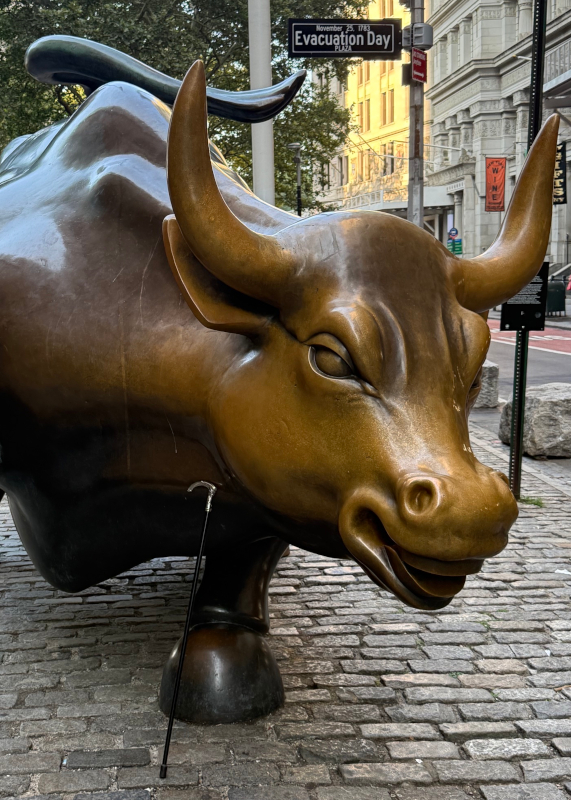
Victor gave a number of us these canes years ago. At least for me it was a reminder anyone can achieve their goals, and it won’t always be an easy path. I took mine down to Wall Street this morning. Thank you, Vic. Will
It is good to take out the canes and hobble down to Wall Street at the close of days when there is a panic. - Victor Niederhoffer
Laurel Kenner:
I found the last cane maker in Manhattan and purchased a number of the most striking ones to send as prizes.
Asindu Drileba:
Until this day, since a few years since I read The Education of a Speculator, I have not found another book remotely close to it. In the finance industry, market analogies are mostly limited to maths & physics. This is why when I read The Education of a Speculator, my mind was genuinely blown by how The Chair would create market references to genetics, music sheets, Dutch philopher Johan Huizinga (Homo Lundens is worshipped in the game design community), checkers and more.
This type of thinking in analogies is what E. O Wilson referred to as "Consilience." So because of this, I would regard The Chair as "The Master of Consilience".
I wrote a short tribute to Vic.
Kiran Kaur:
I was a student of Vic’s. In 2025 he gave me a full weekend at his home, him and Susan both. He walked me through his own book. When I left he put Elmer Kelton’s The Time It Never Rained in my hands and told me The Trees in My Forest by Bernd Heinrich was the other one to read.
I have wondered since whether the pairing was deliberate. A rancher who will not take the drought subsidy and stays on the land, and a biologist counting what is actually happening in three hundred acres of Maine woods. Endurance and counting. He handed it over without a lecture, which I think was the point.
Condolences to Susan, to Aubrey, and to the whole community. Rest in Peace Legend!
Sam Johnson:
A veteran trader pointed me to Vic back in 2011 via speculations website. Encouraged me to think differently about markets and led to a career. Question and test orthodoxy. I wish i could have attended one of his get togethers. He never met me or knew it but he was the second most important person to my trading success.
Yelena Sennett:
Victor certainly did like his hats…
It was a privilege to do podcasts with him. You never knew what fascinating analogy he would come up with to explain the markets. He was always generous with sharing his knowledge, but I believe his greatest gift was an instinct for reading the markets that simply couldn't be quantified.
One of his favorite sayings was, "Never short the market." He certainly lived an extraordinary life, with its share of highs and lows—much like the markets themselves.
Today (August 4th), as the S&P 500 reached another all-time high, it felt like a fitting tribute to his memory.
Richard Barsom:
RIP Victor. Great guy, literally saved my life. Rest in peace Chair.
John Netto:
I remember meeting him for the first time back in the summer of 2011. He graciously invited several from the spec list over to his UWS home. The whole experience fascinated me and his affable personality and welcoming disposition quickly removed any anxiety I had about being in front of a true legend. Thank you to John Floyd for introducing me to the Chair and the list.
Paolo Pezzutti:
I will miss Victor very much. To me, he was a mentor. I received far more from him than I ever gave, and that was part of his greatness. I have applied many of his teachings in both my life and my work.
A brilliant, original and courageous man has left us—courageous even beyond any reasonable limit. He was eclectic, competitive and a great contrarian by nature, but also generous beyond measure. He was a bold, direct and aggressive speculator.
As Nelson used to say: “Go right at them”, Victor always urged me to apply his battle-tested principles to my own trading style.
Newton Linchen:
Victor Niederhoffer was a major inspiration for my development as a market practitioner and had huge impact in the way I view markets and the World.
We are all at a great loss. My respects and sentiment to the family and friends.
Thank you, Chair!
Eric Lindell:
I'm saddened to hear of Victor's passing. I had gotten to know him over the years attending his junto meetings. He was a great guy, and it's a big loss to the investment community and all those whose lives he touched. My deepest sympathies to his family.
Jordan Low:
Victor’s passing is a loss to many. He was so generous with his time and wisdom, and he was a friend to my whole family: he taught my daughter Annabelle tennis, squash, and checkers, and he came to the gala to support my wife Annie when she was honored among the Outstanding 50 Asian Americans in Business. He also taught me the triangle defense in checkers, and drew the line straight to portfolio management: balance risk, reward, and liquidity, and hold the formation at all times. I trade that way to this day. My deepest sympathies to his family.
Rest in peace, Chair. We will remember you fondly.
George Coyle:
Aug
14
RIP Vic Niederhoffer, by Peter C. Earle
August 14, 2026 | 1 Comment
There are those who teach skills, methods, subjects, or even entire professions. And there are people who permanently change the way one thinks. Victor Niederhoffer was, for me, emphatically the latter.
I landed on a trading desk in the mid-1990s with no background in finance or business and a single economics course (which, ironically, I'd hated) under my belt. Shortly thereafter I picked up Victor's newly-released book The Education of a Speculator. It permanently altered the way I thought; not only about markets, but about the nature of inquiry itself. Shortly thereafter I undertook what seemed like a daunting but morally imperative task: reaching out to him through an unsolicited message via Bloomberg. I told him how much I admired his book and how intrigued I was by his methods. To my surprise, he replied - and invited me to his home for a gathering several weeks later. That simple act of generosity began an enduring mentorship and, eventually, a treasured friendship.
Aug
13
Celebration of life, from Duncan Coker
August 13, 2026 | 1 Comment
Hey friends. This has been a hard week and difficult to fully accept. So many things to write about Victor, but I'll pick just one small part to bring some levity and that is his sense of humor. Vic had a wicked sense of humor. It comes across particularly is his coded language and his voice that always carried a 40s Brooklyn accent. Here are a few that tickle me: "pretty kettle of fish", "gentlemen and ladies heal thyself", "haaaaaave" (for half), "fish dinner", "brisket at the petroleum club", "not bad for a poor speculator", "Ha!" (as a trade fills), "Mr. Coke", the tennis balls raining down on the roof, "Let's go for a walk". This last one really hits, I'll forever be taking walks with Victor and listening.
Steve Ellison responds:
The Chair’s invitation in 2004 to “join our group of scholars” changed the trajectory of my life. I treasure the many friendships I have from this List and have numerous anecdotes about Victor, but for the sake of brevity, I will confine myself to two instances from the economically depressed year of 2009.
In May that year, I went to a West Coast mini-Spec Party in honor of Kenny Sogi’s graduation from USC. The event was held at a beach house in Los Angeles County where James Tar was living. At some point, we decided to call the Chair in New York. For some reason, the most suitable phone for a conference call was in Mr. Tar’s car, so 12 of us jammed into the car to talk with the Chair. After we all identified ourselves, Victor asked, “What do you think of the market?”
One person after another in the car outlined his reasons for being bearish. After 5 or 6 people had had their say, maybe Victor was getting tired of the bearishness because he called on me by name. “Steve, you’re bullish, right?” I said that I was and cited a few findings from my counting studies.
In August that year, I went to New York for the smallest Spec Party I ever attended, I think between 20 and 30 people. While we were gathered in Victor’s living room, he asked us whether using stops was good practice. The conversation that followed, with everybody participating, was pure gold, a meal for multiple lifetimes.
Aug
12
Twenty-Seven Years with Victor Niederhoffer
When Vic died Aug. 4, 2026, I was halfway through “The Walking Drum,” a Louis l’Amour book set in the Middle Ages. It’s about a man who repeatedly started from zero, a pioneering trader, a scholar and explorer with vast intellectual curiosity, witty in conversation, a man of respect and great courage, a superior athlete, and a magnet for ladies — whom he always sought to protect.
That was Victor Niederhoffer.
Aug
11
A Polytropic Hero, from Alex Castaldo
August 11, 2026 | Leave a Comment
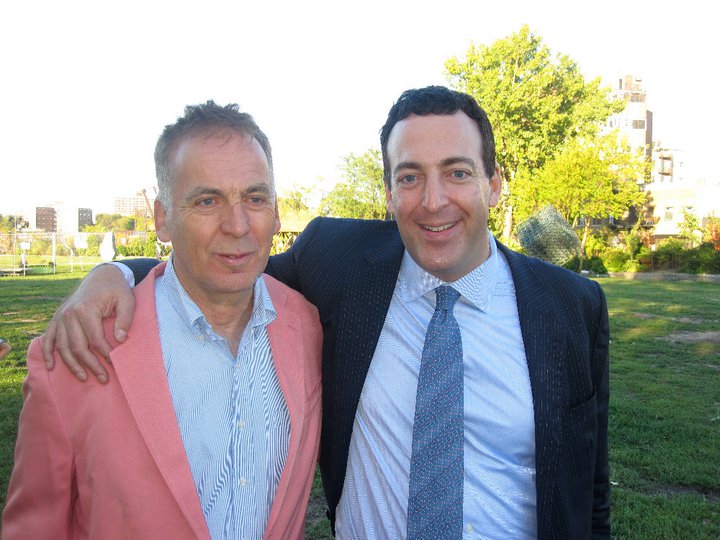
Roy N.'s eulogy focused on the ways in which Vic's life could be said to be polytropic. I did not take very detailed notes, but as best I recall he said that polytropos (πολύτροπος) is a Greek adjective used as an epithet for Ulysses in the introduction to The Odyssey. It is a combination of polys (πολύς) meaning many or much and trópos (τρόπος) meaning a turn, way or direction. The exact meaning of the word is somewhat ambiguous, with modern translators making different choices:
George Chapman (1616): "Many a way wound".
Robert Fagles (1996): A "man of twists and turns". Vic's career certainly had many twists and turn and Roy reminded us of some of them. Some key dates were 1987, 1997, 2007 and others.
Samuel Butler (1900): "Many-sided hero". Famous in sports (tennis first and squash later), business (mergers and acquisitions), finance (trading) and acclaimed writer (The Education of A Speculator) Vic was many sided in his talents and accomplishments.
Emily Wilson (2017): "Complicated". Vic was certainly complicated as a person and in his private life. But "complicated" is also an allusion to "complicare" which in Latin means to "fold [a blanket or a sheet] into multiple layers". So we have the many layers idea again surfacing.
Robert Fitzgerald (1961): "Skilled in all ways of contending". Vic loved competition and was always trying to improve his skills and liked to teach others how to improve theirs. Life as preparation for battle.
E.V. Rieu (1946): "Resourceful man". Vic was certainly resourceful and recovered from many setbacks.
I could go on but you get the idea.
I just found out Polytropic is also a word in Thermodynamics, and I can just imagine Vic, who was always curious to learn new concepts, looking the word up in Wikipedia or a Thermo textbook, figuring out the charts and equations and asking: "what would a Polytropic trading strategy look like?, or What analogies to polytropic gases do we see in in everyday life?". Analogies between unrelated fields was an important thinking tool for Vic. An obscure new word could lead to unexpected insights he believed.
Aug
7
Victor Niederhoffer, 1943-2026, 1964 Intercollegiate Individual Champion
August 7, 2026 | Leave a Comment
Victor Niederhoffer, 1943-2026, 1964 Intercollegiate Individual Champion, by Rob Dinerman
Niederhoffer is the only player, man or woman, to ever capture the Individuals without ever having played or even seen squash prior to entering college. He had, however, as a youngster growing up in Brooklyn excelled at tennis and in a number of the many “wall games” played at the Brighton Beach Baths, a sports complex located near the Niederhoffers’ home that featured more than 20 one-wall handball courts and was therefore known as a mecca for that sport. Although Harvard’s legendary coach Jack Barnaby usually didn’t directly oversee a player’s development until he became a sophomore — leaving the task of coaching freshmen to Harvard’s longtime freshman squash coach Corey Wynn — he made an exception in Niederhoffer’s case, spending at least 45 minutes in the court almost every day with his fast-developing prodigy, the rough edges of whose game and personality Barnaby gradually smoothed over, and whose learning and improvement curves were so steep that Barnaby later remarked that he “never had a boy who learned faster, assimilating everything I threw at him and coming back for more.”
Aug
5
“We lost a giant of modern finance” - Andrew Lo
August 5, 2026 | 4 Comments
From Andrew Lo:
We lost a giant of modern finance today. I feel fortunate to have known @VicNiederhoffer, to have learned from him, and to have been inspired by his example. A finance scholar, trader, world-champion squash player, and endlessly curious intellectual, he was as generous and kind as he was brilliant. He will be deeply missed. RIP
Aug
4
The Best Player ever to play Capitalist Squash
No player who plays squash in the US should go without knowing the name of Victor Niederfoffer who was, in my opinion, the preeminent amateur player ever to play the game in the US.
In fact, let me say that it was Victor Niederhoffer who inspired me to pursue a path of competitive squash.
An abundance of virtues that I admired were represented by Niederhoffer, by the game of hardball squash, and by how he played the game. One aspect of the hardball is the blinding speed of the game which keeps a typical rally relatively short, thereby compelling the player in a match to think about ending a point with outright winners rather than by keeping the ball in play. The game rewards boldness of shot and for a player, in a typical rally, to recognize shot openings very quickly and for a player to immediately put the next shot in that opening, (something that Niederhoffer executed better than anyone else during that era), rather than for a player to exercise restraint and patience by defaulting to keeping the ball in play.
Aug
3
UBS Global Investment Returns Yearbook 2026
August 3, 2026 | Leave a Comment
Global Investment Returns Yearbook 2026
The Global Investment Returns Yearbook, a body of work assembled by Professor Paul Marsh and Dr. Mike Staunton of London Business School, together with Professor Elroy Dimson of Cambridge University, provides an invaluable foundation for understanding the long-term evolution of global financial markets. UBS is proud to continue supporting this authoritative reference, which remains highly relevant for our clients and the broader investment community.
Jul
30
Greedyness, from Nils Poertner
July 30, 2026 | Leave a Comment

Asked a trader friend what he thought would make a good trader and he said, "Greedyness." Was a bit surprised, but on second thought I concur. By being aware of it, it does take out the toxicity a bit as well.
Jeffrey Hirsch writes:
John Bollinger once said, “Greed is simply fear of not having enough.” Here’s the full quote from the Almanac:
Securities pricing is, in every sense a psychological phenomenon that arises from the interaction of human beings with fear. Why not greed and fear as the equation is usually stated? Because greed is simply fear of not having enough.
Nils Poertner adds:
Some traders feel sort of guilty of making money and later self-sabotage themselves (subconsciously). It is all a game at the end.
Zubin Al Genubi comments:
Searching for the last 20% can be dangerous and stressful. The first 20%, 80% of the time is easier, though with lower return but also lower and fewer losses. Toning down the greed helps trading as in the long run as its the losses that lower end wealth, more than the gains that compound over time.
Nils Poertner responds:
That is so true. (There is a chance we are having unprecedented manias in coming yrs (not now), but after the disinflationary impulse is over …the wheels may only come off only when nominal rates are double digits imo.)
Jul
28
Indian Rupees to the US Dollar:
Steve Ellison writes:
Earlier this week I was recounting my tale of being in Turkey in 2003 when the currency notes in circulation were 1 million lira notes and 10 million lira notes. 1 million lira bought a cup of coffee; 10 million lira could buy a book. Both notes had 1 followed by a string of zeroes with no commas or periods; both had Atatürk's picture, and they were very hard to tell apart at a glance. I learned to turn them over and read the Turkish words as the fastest way to distinguish them.
Aside from that minor challenge, this Byzantine history enthusiast had a wonderful visit, and Istanbul is one of the world's great cities.
Bud Conrad adds:
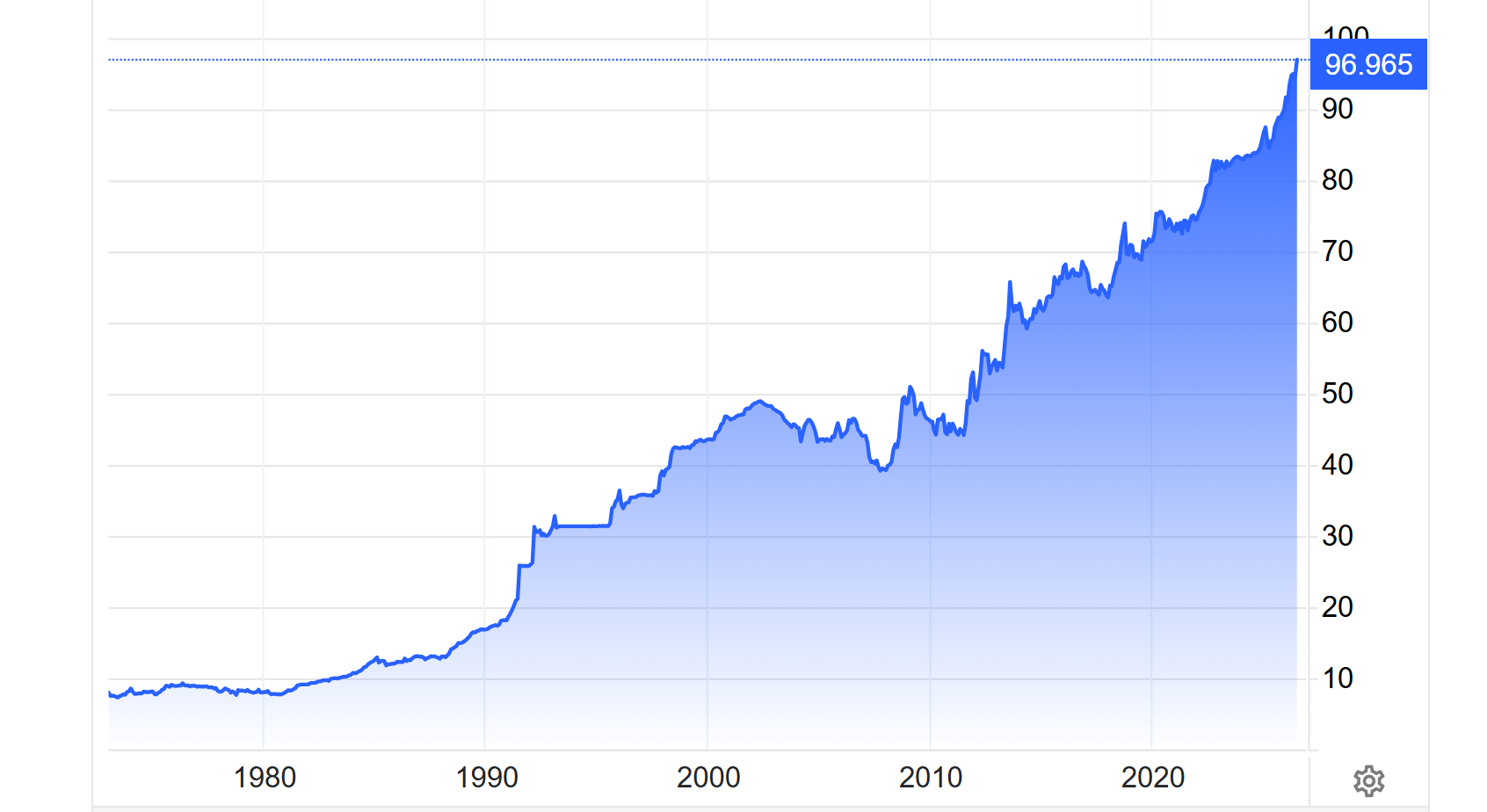
The Indian ruble, at 90 to the dollar, is only half of the story. The dollar ain't what it used to be either. 1% of what it was in 1971 as measured in gold. How about Iran? 1.3 Million to the $.
Zubin Al Genubi recalls:
I remember Argentina a few years back with Lira 20 to the dollar. $10 US bill could buy crab dinner for two with nice Argentinian whitr wine.
Jul
27
World Cup Soccer, from Zubin Al Genubi
July 27, 2026 | Leave a Comment

Had some stars: Messi, the 19 year old Spanish kid, who had amazing skills of deception using multiple varied fakes, head fakes, fake kicks, fake direction changes leaving defenders falling flat on the ground. Even when defenders grabbed, tripped, pushed them they extricated tai chi style and slipped through. Fun to watch.
The market used to be a lot like them before. My theory is now that bots do almost all the volume, the moves are more mechanical, rigid, less jerky, and somewhat more predictable in a mechanical manner. Especially the brokers who don't care about price, the dealers who don't really care about price and more about delta, and I'd say the banks are the worst as they make their money front running their clients. It might be hard to model the model's interactions, but the blatant price action seems easier to follow for a human being - very directional.
Jul
21
The latest from Dr. Earle
July 21, 2026 | Leave a Comment
Welcome to Trillionistan. Don’t Get Comfortable.
Not all trillions — debts, valuations, investments — are created equal. Huge nominal numbers often obscure the institutions and incentives that produced them.
Peter C. Earle
Not long ago, the notion of trillions belonged either to the furthest cosmic reaches of the universe or the submicroscopic world of atoms. These numbers describe galaxies in the observable universe, roughly two trillion, or, at the opposite extreme, the picosecond — one trillionth of a second — is used to measure molecular motion and chemical reactions. Until recently, magnitudes denominated in trillions were almost entirely confined to the theoretical hinterlands of astronomy, physics, and schoolyard exaggeration.
Today, trillion-dollar quantities have become commonplace in economic and financial life. At least 12 American companies boast trillion-dollar market capitalizations, with Apple approaching $5 trillion. BlackRock now manages more than $15 trillion in assets. The largest technology firms, cumulatively, measure their investments in the trillions as they build data centers, semiconductor capacity, and power systems on an unprecedented scale. SpaceX’s 2026 initial public offering valued the company at more than $1.7 trillion, and its subsequent surge briefly pushed Elon Musk’s paper wealth above $1 trillion.
Billionistan opened its gates in 1901, when JP Morgan assembled US Steel into the world’s first billion-dollar corporation. Perhaps it surrendered statehood on January 13, 2016, the day Powerball offered the first billion-dollar lottery jackpot. After ten more, Billionistan moved from a numerical destination to a waypoint. We now inhabit Trillionistan.
Jul
18

example of something in our Western culture when we "over-use", overly rely on numbers to give meaning to something. Clever marketing idea though. A bit like those French Phds at BNP who looked at their credit derivs spreadsheets in summer 2007 and couldn't see what is behind those numbers as reality is more complex. Humour helps for sure.
Robert Parker's 100-point wine rating system
One of the most influential and controversial features of Parker's wine criticism is his 100-point rating system, which he popularized in conjunction with his friend Victor Morgenroth. Parker designed the system to counter what he believed to be confusing or inflated ratings by other wine writers—many of whom he accused of a conflict of interest, as they often had a financial interest in the wines they rated. The scale, now widely imitated in other publications (such as Wine Spectator[23]), ranks wine on a scale from 50 to 100 points based upon the wine's color and appearance, aroma and bouquet, flavor and finish, and overall quality level or potential. Therefore, 51 rather than 100 different ratings are possible.
Zubin Al Genubi writes:
Other wine makers copy the style of wine with high points and the result is the uniform oaky California wine that all tastes the same and that one guy likes. French say Vive la difference with weather, soils allowing subtle differences in vintages, locations. Its like everyone piling into the same trade or trend in markets.
Big Al comments:
There is research on rating scales - confirmed by my own experience back in the day as a consultant - showing that raters rarely use any scale as designed, but wind up using only part of the scale. So, you have to normalize ratings in some way. Wine ratings show this in that an 88 is wine you don't want to buy - has to be 90 or over, with 92 maybe being the magic number.
Grade inflation would be another current example. Harvard:
Faculty decisively approve grading changes
Cap on A grades and shift from GPA to ‘average percentile rank’ set to go into effect fall 2027
Faculty voted by a wide margin to limit the total number of A’s in undergraduate classes, as part of a broader effort to rein in grade inflation and recenter academics at Harvard College — with proponents hailing the adoption as a principled collective effort to restore meaning to grades and address a complex issue in higher education.
Nearly 70 percent of voting faculty approved the grading cap — which would limit A grades to 20 percent of the undergraduates in any course plus an additional four students, with no limit on A-minuses — with a 458 to 201 vote, in weeklong balloting that closed late Tuesday and was tabulated and audited Wednesday. The policy will take effect in the fall of 2027.
Zubin Al Genubi observes wryly:
The Gentleman's C.
Larry R Williams comments:
Too many wine raters now if you are really into it 98 and above is the good stuff.
Nils Poertner reasons:
As long as people don't take it too seriously - it is all good.
Asindu Drileba writes:
One thing I picked up for western people is the obsession with IQ. In the Terman Study of the Gifted, over 1,000 children with high IQs were tracked since the 1920s. They were given recommendation letters to prestigious programs and backtracked through prestigious schools. But none of them ever got a Nobel prize. What is very ironic was that two kids that were "measured" for the program, but rejected from it for having "too low IQs" ended up winning a Nobel prize.
Another ironic twist was when James D Watson, a eugenics proponent ended up having a child that was intellectually "special needs". If he was under a serious eugenics regime like Nazi germany, he & his entire family would likely be euthanized. Watson still insisted after this that he was still pro-eugenics.
American Military contractor's exploited this religious dedication to numbers during the cold war by providing systems analysts complicated equations that were intentionally blowing up their budgets so they could get bigger contracts. This was harder for non-technical people to question (you would be declared stupid for not understanding the complex equations that computed how many planes we need for the cold war)
There are so metrics in finance that I don't understand. One time, I laughed a bit on seeing a video where Mr. Mark Spitznagel angrily screamed at someone, "You can't eat Sharpe ratio!"
Nils Poertner responds:
for speculation, many ppl over-use rational thinking and lack curiosity, flexiblity etc. too much rational thinking often acts as "barrier" for intuition, too. (those 2 French Phds I had in mind back in 2007, I love to make fun of the French Phds as they are not in the room).
Jul
13
Turing test, from Zubin Al Genubi
July 13, 2026 | Leave a Comment
The Turing Test, originally introduced by British mathematician and computer scientist Alan Turing in his 1950 paper "Computing Machinery and Intelligence," is a proposal for evaluating whether a machine can exhibit intelligent behavior indistinguishable from that of a human.
This is more relevant today than ever. Applied to the market some moves appear very machine like. Other moves not so much. A large proportion if trades now are computer generated. Maekt making must all be computer managed. Humans still can game the machines as their rules are fixed.
Peter Ringel writes:
The Turing Test is fuzzy. Useful, but not precise. The underlying question is: Is AI conscious? My answer is: NO! but it is a freakishly good imposter.
It is also domain specific. In my opinion, in the general domain, AI broke the Turing Test in 2024. Humans can't distinguish anymore responses from robots to humans in the general domain. In specific domains it is different. The low to mid level is broken, the mid to high is not. OTOH, recently we had news that open AI proofed some longstanding Math hypothesis (I lack the knowledge to judge). And we all know about Google's AlphaFold. Both domain specific. High End.
Market making was algo based before AI. I indeed, try to game this with my human discretion. (At least in the sort-term part of my trading. It is not relevant for longer TF.) AI definitely facilitates research. This makes markets more efficient and faster efficient. I think we are seeing this currently.
Creativity is not broken. I hope, as of now.
Oliver Joseph writes:
A conversation that I find endlessly fascinating. In my opinion the current technology stack with regards to LLMs and machine learning tools in general is an absolute game changer. The barriers of entry associated with software seem to have been lowered significantly, however to use another tech analogy the "last mile" still remains elusive. By that I mean that the LLM really needs help to get certain complex problems over the finish line. That said, what we are dealing with is essentially a cliche generator. Humans tend to anthropomorphize, and personally I have found myself pondering the meaning of consciousness as I use the latest generation of LLM's ( I don't think we are dealing with consciousness here). Rich Suttons essay "The Bitter Lesson" from 2019 concludes with the idea that we want "AI agents that can discover like we can not which contain what we have discovered" arguing that by using experts to build in their knowledge it makes it harder to even see how the discovering process happens in the first place. He emphasizes a focus on what he calls scaleable general purpose methods primarily search and learning. It is interesting to me as I work with locally run models to see what output the <| think |> control token actually generates. I have one of those old IBM notepads that says think on it, however I must say I am prodded to think myself as I see this machine chugging through the art of thinking clearly with such mechanical precision (now we're in Dobelli of the beast). In conclusion I agree with the above sentiment that creativity is not broken but rather like where T.S. Eliot was wrestling with the concept of historical sense in his art; we now find ourselves with a large portion of human knowledge existing simultaneously in one place frozen in time, embalmed and pacified. It is up to us to be creative and let the tool inform our creative throughput.
On another tangent when I produce and or record music my workflow (and output) is changed by the tools I use. Ableton on a Macbook with VSTs gives me a different feeling and results than using an Atari 1040st and an Akai S950. I get the same feeling as I use LLM's for certain tasks.
Zubin Al Genubi adds:
I find AI helpful but AI doesn't quite get the joke. Kind of like a super-smart nerdy guy.
Nils Poertner comments:
From a spec point of view, there are tremendous opportunities where human creativity is always finding something which LLMs not seeing…as they have built mirrors in a mirror rooms and confusing this room with reality (but reality remains mysterious, indescribable and so on…and fuzzy logic or jain logic is already a slight improvement to our "either-or" logic that is so prevalent in our times).
Peter Ringel responds:
Yes, the tools we use define culture. Music culture, trading culture - binned per generation. AI is a tool (as of now).
If I close my eyes, I still can hear the metronome signal of Cubase through a crappy 1040 sound speaker ( or was it the monitor ?): "meeeep, mup mup mup" for a four to the floor. Cubase and similar tools made it easy to create a typical track structure. Probably long and repetitive. This defined the 90 and 2000 pop music. Before that - with some overlap - Sound-tracker. The UK in the 90 is unthinkable without it. Way more interesting. Then Fruity loops and similar. More questionable structure. Then Ableton. It freed the structure again, the creativity. I don't know, what the kids prefer now.
Nils Poertner responds:
Yes, very good. Real speculators are incredibly good in finding opportunities in mkts (and not just go with the latest fashion and think that's it). For older specs it will be "how to keep and possibly improve health" and for younger ones, I suppose it is how to turn their frustration/ anger into creativity and learn the game.
Oliver Joseph writes:
I love that Peter. Yes, Cubase was and is a fantastic tool precisely because of its constraints.
LLM’s being another cool new tool it is worthwhile to make an attempt to understand its uses and constraints. As a very simple thought experiment I asked three different models de jour to generate a random number between 0 and 500. I ran 500 iterations of the prompt per model. The “think” tokens generated reasoning from the models that stated basically “I’ll just pick a number that sounds random”. The “think” token of course being obscured from the end user. Going through such gesticulations is completely unnecessary other than I think that conceptually it's important to understand that here we ask for an output (the random number) and what we actually get is a number within the bounds of the below graph. Importantly we run the risk of thinking it's what we actually asked for. Surprise! It's not. Everyone on the spec list knows the right tool for the above job is a HRNG or TRNG or who knows what all else; lava lamps and wristwatches.
To my mind it is one of those inexplicably beautiful facts of history that Wall Street was thus named for a wall that separated traders and speculators from livestock. In the car business we have a large vocabulary derived mostly from farming and the cattle business. One thing that we would commonly do is go out and “put hands on” our “stock” go physically touch and look at the car. Statements are a representation of inventory I am supposed to have and obviously they have their use.
In summary as has been the case for the last 6000 years of recorded human history the farmer has asked the farmhand “where is the cow?” and the farmhand sometimes just said “over by the watering hole.” even though he actually had no clue. We equate the representation of the thing and the thing in and of itself at our peril. As speculators we should endeavor to identify the places in our experience where an incorrect representation is believed in more so than the thing in and of itself. I believe it pays to every now and again to hop the liminal.
Jul
8
They are history’s geniuses. But were they any good at investing?, from Asindu Drileba
July 8, 2026 | 1 Comment
Brilliant podcast from Financial Times. Analyses the investment styles of Charles Dawrin, Isaac Newton, Winston Churchill (blew up his GBP 80 million account), the painter J. M. W. Turner doing fixed income arbitrage, J. M Keynes out performing Warren Buffet.
They are history’s geniuses. But were they any good at investing? | The Story of Money Podcast
Does scientific, artistic or political brilliance translate into investing success? It’s a topical question with hedge funds today accused of sucking talent away from the rest of the economy. So, the FT’s Gillian Tett and Robin Wigglesworth sat down with reporter Toby Nangle, who has dug into the archives to assess the investment portfolios of Isaac Newton, Charles Darwin, Winston Churchill, John Maynard Keynes and other widely regarded geniuses of the past. What Toby found may surprise you, as will the historical wildcard he’s unearthed.
Jul
4
The American Revolution Redefined Freedom Itself
When the Continental Congress approved the Declaration of Independence on July 4, 1776, its immediate purpose was practical: to justify severing ties with Great Britain and explain to audiences both foreign and domestic why rebellion had become necessary. Yet the document’s historical importance extended far beyond the thirteen colonies. The American declaration not only created a new nation, but helped establish a new political language: a language rooted in natural rights, popular sovereignty, and the legitimacy of political self-determination. It was a language that would reverberate across continents for centuries.
Jul
4
Holiday Ideas for Americans, from U. S. Humbert
July 4, 2026 | Leave a Comment
A new Cato Institute/Morning Consult survey finds that 46 percent of Americans don't know what Saturday commemorates.
Idea 1: Lead a family event where the Declaration of Independence is read in its entirety.
For the fuller, messier version of the origin story, see "The 'Two Ships' Theory of American History" in the August Atlantic — James Traub's review of historian David Reynolds's Two Ships, on why Americans have never agreed on where their country began.
Full disclosure: the author is a confirmed descendant of both Mayflower passengers and Jamestown settlers — and a relation of Oliver Cromwell besides. If Reynolds is right that America was separated at birth, the divide runs straight through my DNA.
Then read the Mayflower Compact, written 156 years before the Declaration. Notice that the principle Jefferson would make famous — government by "consent of the governed" — is already at work in it: the signers "covenant and combine ourselves together into a civil body politic," binding themselves to laws of their own making.
Idea 2: Look for local mattress sales.
Stefan Jovanovich writes:
Six men who were delegates to Congress on July 1 and 2, 1776 declined to vote for the resolutions that authorized the Declaration of Independence. Four were from Pennsylvania: John Dickinson, Charles Humphreys, Robert Morris and Thomas Willing. John Alsop was from New York and George Read from Delaware. Two of the men would actually sign the Declaration when the document was presented to Congress on August 2nd; Robert Morris, who had abstained, and George Read who had voted no. John Dickinson would leave Philadelphia in July; Charles Humphreys and Thomas Willing would be removed from the Pennsylvania delegation before the document signing date.
Of the four men who said “no” and meant it, Thomas Willing would become the most important; President Washington would nominate him to become the first President of the Bank of the United States. and join the Pennsylvania militia; he would return in 1779. John Alsop would formally resign from Congress on July 16th. The other two delegates from Pennsylvania – Willing and Humphreys – would be removed from their delegation before the Declaration’s formal signing on August 2nd. Robert Morris and George Read would sign the physical declaration when it was presented to Congress.
Thomas Willing would stay in Philadelphia and work with his former business partner Robert Morris to fund the Continental Army. Morris, like the other members of Congress, would skedaddle to York when General William Howe and his British army arrived on September 26, 1777. The Loyalists would celebrate their arrival with parties and celebrations; Willing and his family, who were the richest people in the Philadelphia, would refuse to attend. When Willing was sent the formal oath of allegiance to King George III that Howe’s command was requiring of all prominent residents of the city, Willing refused to sign. Howe let Willing stay because there was at least some hope that Britain and the Americans could end their war. At the end of October, the rumor reached Philadelphia that a motion had been presented to Congress to rescind the vote for independence and it has lost by only one vote. On November 2, 1777 Howe would meet with Willing and his colleague John Brown. (Willing and Brown would be among the founders of the Bank of North America.) At the meeting Howe would express his desire to see a cease fire and peace settlement based on having the status of affairs in the thirteen colonies return to what they had been in 1763 and the Declaration being withdrawn. The Americans agreed to pass on the message. Henry Laurens, President of Congress, would report the proposals to George Washington. In his response, Washington would write: “it has been the unvaried custom of the enemy, from the commencement of the present contest, to try every artifice and device to delude the people. The message sent through John Brown was calculated for this end. I am surprised Thomas Willing should suffer himself to be imposed on by such flimsy measures. He knows that there is a plain, obvious way for General and Lord Howe to communicate … to Congress, without the intervention of a second or third hand. But this would not suit their views.”
A decade and a half later Washington would appoint Willing to be President of the Bank of the United States. When asked why he had voted no on the Declaration of Independence, Willing wrote: :“I voted against this declaration in Congress not only because I thought America at that time unequal to such a conflict as must ensue—having neither arms, ammunition, or military experience—but chiefly because the delegates of Pennsylvania were not then authorized by their instructions from the assembly as the voice of the people at large, to join in such a vote.”
Jul
3
The Cost of Chasing Zero, from V. Humbert
July 3, 2026 | Leave a Comment
The Trump administration is revising the radiation rules for commercial nuclear power. Headlines suggest a safety rollback. The reality is closer to retiring a rule that outlived its purpose. The savings may prove modest; the principle at stake is whether regulation should require spending to address risks too small to measure.
The rule is ALARA — "As Low As Reasonably Achievable." Developed by international radiation-protection bodies in the 1950s and adopted by U.S. regulators in the mid-1970s, it now sits in NRC regulation at 10 CFR 20.1101(b). It requires licensees to push doses as far below the legal limits — 5 rem per year for workers, 100 millirem for the public — as is reasonably achievable.
On paper, ALARA is a cost-benefit test; economics is built into its definition. In practice, it has drifted toward open-ended dose minimization. A U.S. plant's contribution to public exposure is now a fraction of the roughly 300 millirem that Americans receive annually from natural background radiation. Yet designers must keep spending — on shielding, staffing, and procedures — to drive those trivial numbers even lower. I have stood inside the containment building of an operating reactor — Big Rock Point, at full power — and the visit was routine under the plant's radiation protection program.
The fix is underway. A May 2025 executive order directed the NRC to reconsider ALARA; the Energy Department struck it from the directives governing its own facilities in January; and the NRC has begun replacing ALARA requirements for commercial facilities with fixed dose limits. NRC’s final rules are expected in November. New-build developers stand to benefit most, with lighter shielding and construction requirements.
Two cautions for investors. Even the industry's position is layered: the Nuclear Energy Institute has urged the NRC to replace the ALARA requirement with a practical dose threshold, while signaling that operating plants — where ALARA programs have kept worker doses low — would retain those practices voluntarily. Critics also allege procedural shortcuts that invite litigation, so the savings shouldn't be banked yet. Fair points, both. But a requirement to spend without limit against risks below background has run its course.
Jul
2
Best Patrick O’Brian entry point?, Asindu Drileba
July 2, 2026 | Leave a Comment

I need your advice. What is the best entry point for his work?
Paolo Pezzutti responds:
No doubt. Master and Commander.
Big Al adds:
Yes, it's a series, and the first volume is Master & Commander.
A fascinating biography of a man who was some of the inspiration for O'Brian's writing:
Cochrane: Britannia's Sea Wolf
Jun
30
Money and the Meaning of Life, from Humbert P.
June 30, 2026 | Leave a Comment
Money and the Meaning of Life, by Jacob Needleman
Needleman shows how money slowly began to haunt us, from the invention of coins in Biblical times (when money was created to rescue the community good, not for self gain), through its hypnotic appeal in our money-obsessed era. This is a remarkable book that combines myth and psychology, the poetry of the Sufis and the wisdom of King Solomon, along with Jacob Needleman's searching of his own soul and his culture to explain how money can become a unique means of self-knowledge.
Jun
24
World’s First Net-Worth Trillionaire Shows Us How Markets Price the Future, by Dr. Peter Earle
June 24, 2026 | Leave a Comment
World’s First Net-Worth Trillionaire Shows Us How Markets Price the Future
This is where capital structure becomes crucial. Musk’s companies have relied heavily on equity financing rather than debt, for good reason. Debt requires fixed repayment obligations on a schedule, making it more suitable for stable and predictable enterprises. Equity is more adaptable. If projects fail or underperform, shareholders bear the losses. If they succeed, shareholders participate in the upside. For ventures where outcomes range from complete failure to transformative success, equity is generally the more appropriate financing mechanism.
It could be wiser to view SpaceX’s speculative AI and orbital businesses as akin to a call option: investors pay today for exposure to a potentially enormous future payoff. The analogy is apt: equity financing permits firms to fund experiments with asymmetric outcomes, where failure is common but success can be civilization-altering. Investors voluntarily bear the downside in exchange for the possibility of enormous gains.
That distinction matters for the broader economy. Funding long-term, high-risk innovation with equity rather than leverage reduces systemic fragility. It lowers the likelihood that failed projects trigger cascading defaults or financial instability. At the same time, it permits firms to pursue ambitious and uncertain ideas without the burden of rigid repayment schedules. Historically, many major advances in transportation, communications, computing, and energy have emerged from precisely this type of financing environment. The gains extend beyond founders and investors to consumers and workers through better products, lower costs, and entirely new industries.
Jun
22
The Lost World of the Kalahari, from Nils Poertner
June 22, 2026 | Leave a Comment

In The Lost World of the Kalahari, Laurens van der Post writes about living among the Bushmen of the Kalahari Desert and describes how shocked they were that he couldn’t hear the stars.
At first they thought he must be joking or lying. When they realized he really couldn’t hear the stars, they concluded he must be very ill and expressed great sorrow. For the Bushmen knew anyone who can’t hear nature must have the gravest sickness of all.
Intuition? Navigational skills? whatever is meant in the above. Have friends who are using GPS to go their local grocery shop which is 2km away, as if they don't know the way anymore.
Zubin Al Genubi writes:
The National Park service has a category of accidents called death by GPS. People walk off cliffs looking at iphone. A tourist in Hawaii drove into the harbor on a boat ramp until her car sank trying to get to a boat located on the map.
Big Al offers:
With a nice explanation of how GPS works:
Something is jamming GPS over Europe. Here's what we found - Veritasium
Nils Poertner responds:
From the point of those Kalahari Bushman we (modern people) are probably all quite ill anyway. GPS could be seen as metaphor who is guiding us in life anyway (we are kept like electronic doggies who are meant to chase electric rabbits but never meant to get them).
Henry Gifford suggests:
I highly recommend the movie The Gods Must Be Crazy, about some Kalahari Bushmen’s perception of the “civilized” world.
Jun
19
Orange Is the New Green, from Humbert Z.
June 19, 2026 | Leave a Comment
The move from oil to electricity is driven by cost, risk, and security, not idealism—and it is redirecting where capital flows.
The energy transition is sold as a moral cause. It is really a trade. Economics, geopolitics, and risk are the forces that move capital, and the irony is that the biggest accelerants were never meant to decarbonize anything. The invasion of Iraq and the energy shocks of great-power rivalry each drove home the same lesson: no modern economy can afford to depend on a single, contested commodity. That lesson is now redrawing the map of capital flows.
Oil has never been a free market. It is indispensable and structurally constrained. Production is concentrated, capital-intensive, and exposed at every stage—extraction, transport chokepoints, and refining. Its price responds to geopolitics as much as to supply and demand. Call it what it is: a commodity that has never traded freely.
Electrons beat molecules. Electricity is the opposite—adaptable and decentralizing quickly. Regulated, yes, but its inputs keep multiplying: natural gas, nuclear, hydro, wind, solar, and storage, all feeding one grid. That diversity eliminates single points of failure and lets an economy swap one source for another, something oil never allowed. The more a country runs on electrons instead of molecules, the harder it is to hold hostage.
Hydrogen is often touted as the successor to hydrocarbons. For most uses, it is less efficient and far more infrastructure-intensive than electrification. The real fight is not hydrogen versus oil. It is electrons versus molecules.
Read the full post with additional comments.
Jun
17
The best intuition for convexity, from Asindu Drileba
June 17, 2026 | Leave a Comment
A convex function can be thought of as one where the output (in this case prices) accelerates with time. Case study of NVIDIA stock:
1999 - $0.04 (ipo price)
2022 - $14.64 (366x gain, 23 year holding period)
2026 - $211 (5,275x gain, 4 years extra holding period)
Total overview:
27 year holding period
$1 turns to $5,275
14.8% of the holding period (4/27 years) accounts for 93% of the total gains today ((5,275 -366)/5,275)
If you sold NVDA in 2022 you would have missed out on 93% of the gains — even though you held it for 23 years (from the ipo price). What's even crazier is that, if you just held it for only 4 more years (only 14.8% longer) (2022 to 2026), you would have made $5,275 instead of $366 from a $1 investment.
An interesting reason to consider buy and hold or following the drift. I also found it to be a very good illustration of a convex function applied to thinking about market.
William Huggins comments:
that analysis misses out on the notion that someone buying in 2022 would not have achieved (x5275 less x366 = x4909), instead they would achieve closer to (x5275 divided by x366 = x14.4). the vast majority of the gains on nvda were long gone by the time this most recent order of magnitude came around. there is no way anyone buying in now could achieve a similar x10 on nvda in the next 4 years without them becoming, singularly, more than half of US market cap.
Jeff Watson points out:
Unfortunately, hindsight is 20/20.
Asindu Drileba responds:
that analysis misses out on the notion that someone buying in 2022
You are right in your case. Buying in 2022 would only yield about 14x. But as I described, I was referring to only holding for an extra 4 years, from the IPO.
- holding from IPO price to 2022 - 366x
- holding from IPO price to 2026 - 5,275x
The difference of just holding for 4 extra years from IPO price, is what makes the difference. The idea is that the biggest moves might happen towards the end of the holding period. And that by getting out early, you miss out on more than you think.
Stefan Jovanovich offers:
The doctor-daughter has a husband who does tape outs for Nvidia.
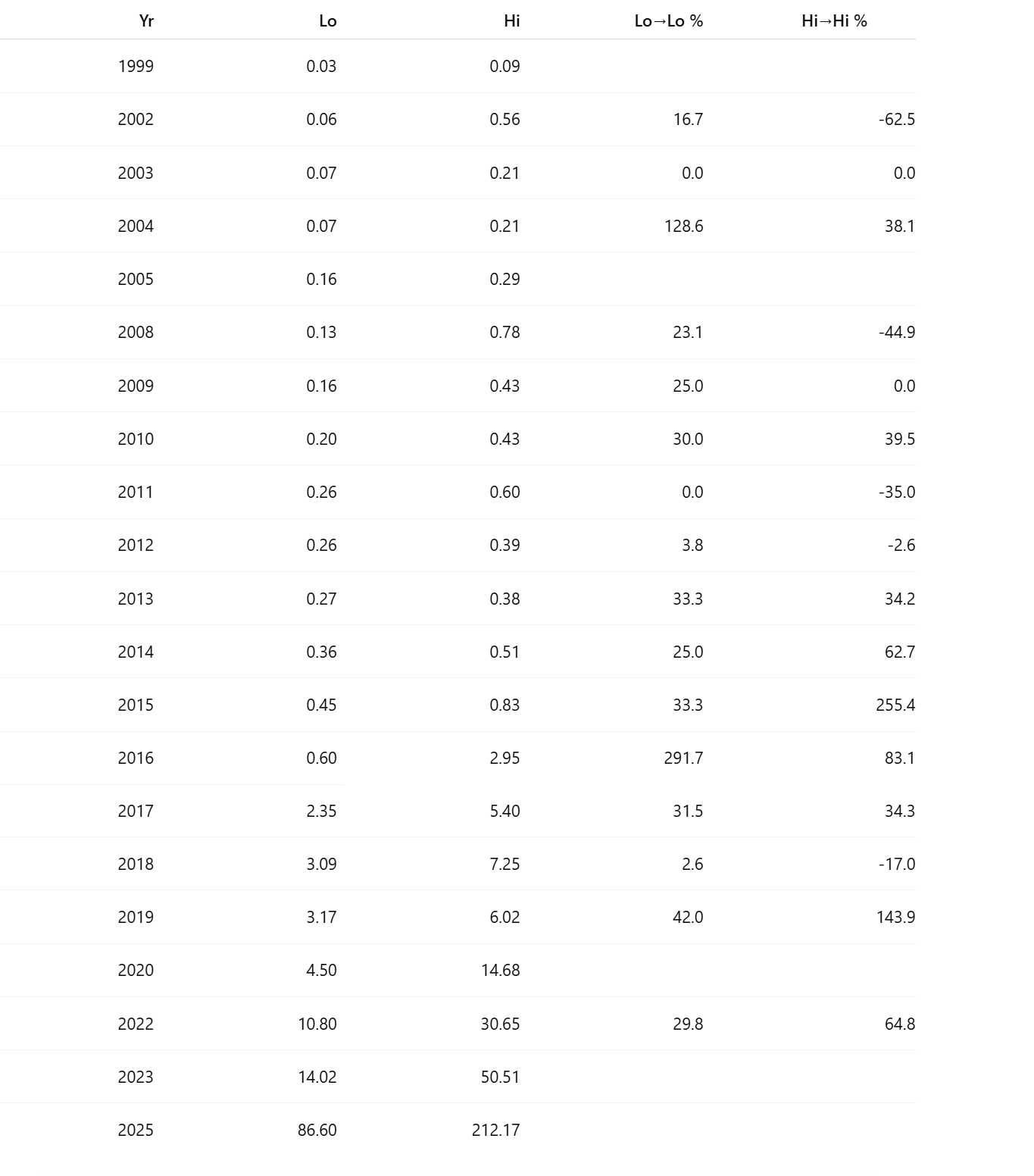
Asindu's narrative is a wonderful story; but it is not the history of how people behaved as owners of NVDA. The SIL aka SEF15 was the oddball in his lab because, unlike the older veterans, he did not immediately convert his incentive shares into cash once they could be sold. The chart [click for full view] is a year-over-year Hi-Lo price history for the stock; it explains why the veterans were not fools, why some of you are smart enough to be able to trade, and why the SIL puts up with me because I told him to keep every share. The years that are omitted are those where stock-splits made the calculations too hard for ChatGPT and me.
Jun
14
Where in the world is Aubrey Niederhoffer?
June 14, 2026 | 1 Comment
A 19-year-old Thiel fellow just raised $7.3 million to build an African ‘super app’

If he hadn’t dropped out, Aubrey Niederhoffer would be nearing the end of his sophomore year at UC Berkeley. Instead, the 19-year-old from the New York area is living in Lagos, where he just launched his food delivery app, Swoop. The 28-person company just booked $7.3 million in seed funding, and the teenager was named to the prestigious Thiel Fellowship.
The Thiel Fellowship, founded by billionaire investor Peter Thiel in 2011, offers young people $250,000 to skip or drop out of college and “build new things.” Notable recipients include Figma CEO and cofounder Dylan Field, Ethereum cocreator Vitalik Buterin, and at least one early employee at Elon Musk’s Department of Government Efficiency.
In an interview, Niederhoffer recounted how he grew interested in Africa while playing the online geography game GeoGuessr as a tween. When he was 15, he started a recruiting company focused on the labor pool in Eswatini, and would visit the southern African country during breaks from school.
Jun
12
Jane Street AI training data center, from Humbert X.
June 12, 2026 | Leave a Comment
Dwarkesh Goes Inside Jane Street's Latest AI Data Center (video)
Twenty years ago, our "cluster" was just 6 Dells stacked on the floor of our office. Today, come tour our new Texas datacenter: 4,032 GPUs, liquid cooled.
Asindu Drileba writes:
Their hiring is surprisingly very meritocratic, if you can solve any of their monthly puzzles, they will unconditionally grant you an interview & likely a job offer.
For the current offer: Jane Street: Puzzles
And an archive of previous puzzles (with solutions).
Oliver Joseph comments:
For those who are computer science oriented their podcast signals and threads is lots of fun I recommend it. In particular they interview Daniel Pontecorvo on their facilities in general. Some of the solutions they have come up are very interesting and reminded me of some solutions we used in the music world. For example they use a raised platform to run air, data and electricity to workstations on casters so they can move workstations often. This is how we would rig up outdoor tours. Racks and amps on casters and modular raised stages were safer and faster to set up.
Of course I always enjoy time in server rooms. While I’ve never had the pleasure of working on one quite like the one you have linked. “Started with six dells on the floor” It’s a great lesson never despise small beginnings.
Jun
10
Can Stock Indexes Afford to Ignore SpaceX?
Another side to the argument deserves more scrutiny than it receives amid enthusiasm for technological innovation and market capitalization milestones. Institutional incentives have changed radically since index inclusion became a major event. And the mechanism by which being a component of a stock index has become important is beyond merely symbolic. The growth of passive investing now triggers billions of dollars in mechanical purchases from index funds and exchange-traded funds benchmarked to major indices. In effect, index decision committees now exercise considerable influence in private capital allocation decisions that were once determined more organically through decentralized management decisions and market processes.
Jun
9
Rule of 16, from Zubin Al Genubi
June 9, 2026 | Leave a Comment
The 1-Day Expected Move calculation is the practical application of the "Rule of 16" described by Euan Sinclair and other volatility traders.
The Rule of 16 is a mathematical heuristic used to convert annualized implied volatility (the number you see on a quote screen, like 16%) into a daily expected move. The rule is derived from the "square root of time" principle in the standard deviation formula. Since there are approximately 252 trading days in a year, and the square root of 252 is roughly 15.87 (which traders round to 16). Divide VIX by 16 and get the percent expected daily move.
Or consider Parkinson absolute volatility, Expected Daily Absolute Range. By scaling the current VIX using the Parkinson volatility framework, calculate the total expected intraday path length - the absolute breadth from the high print to the low print of the session, independent of the previous day's close.
Useful but occasionally very wrong, like Friday. But a midday update of abs vol after Vix jump provided a fairly good bottom number.
Jun
7
Opinion - After the Crude Premium: Pricing the Product Shock, from Humbert Z.
June 7, 2026 | Leave a Comment
The market spent three months pricing the barrel. The next 90 to 180 days will be decided by the products refined from it.
Crude shock is now understood; product shock is not. Since the effective closure of the Strait of Hormuz, attention has shifted to crude oil. Brent peaked at roughly $138 in early April and now trades in the low $100s, with WTI in the high $90s and the Brent–WTI spread near $10–$12 a barrel, wider than its customary $4–$6. That is the visible price. The less visible, more consequential story over the next 90 to 180 days is what happens to the products refined from crude — jet fuel, gasoline, diesel, and fuel oil. Crude can be rerouted; refined products are produced by configured refineries, and refineries sit at the far end of a supply chain measured in weeks, not hours.
“Energy independent” describes volume, not chemistry. The United States produces more crude than it consumes, but the crude it produces is the wrong type for the products it needs. Shale oil recovered by fracking is very light and sweet; it yields LPG, naphtha, gasoline, and some kerosene, but little of the middle distillates — diesel and jet — and almost none of the residual fuel oil that a complex economy runs on. Those heavier products require medium and heavy sour crude: the grades that flow from the Persian Gulf, Canada, and Latin America, and that Gulf Coast refineries were built to process. The Hormuz closure removes medium and sour barrels from the global pool — precisely the barrels whose yield is weighted toward diesel and fuel oil. That puts a premium on the heavy crude the US can still reach — and Canada is the backbone of it: heavy, sour Western Canadian barrels piped straight to US refineries, by far the largest single source of US crude imports. With Venezuela unable to raise output quickly and Mexican volumes in slow decline, Canadian crude and the sour grades released from the Strategic Petroleum Reserve must carry more of the load. So even as crude prices ease from their peak, the product slate can tighten because the marginal barrel lost is the one that produced the scarce products.
Jun
4
Cy Young’s Rules, from Stefan Jovanovich
June 4, 2026 | Leave a Comment
Cy Young's Rules For Pitching Success
1. Pitchers, like poets, are born, not made.
2. Cultivate good habits: Let liquor severely alone, fight shy of cigarettes and be moderate in indulgence of tobacco, coffee and tea. A player should try to get along without any stimulants at all. Water, pure cool water is good enough for any man.
3. A man who is not willing to work from dewy morn until weary eve should not think about becoming a pitcher.
4. Learn to be patient and cool. These traits can be cultivated.
5. Take the slumps that come your way, ride over them and look forward.
6. Until you can put the ball over the pan whenever you choose, you have not acquired the command necessary to make a first-class pitcher. Therefore start to acquire command.
Published in "Baseball Magazine", 1908.
Jun
2
Food prices in UK (or Europe), from Nils Poertner
June 2, 2026 | Leave a Comment
Looking at longer dated charts (eg. Wheat, Oil etc…) and knowing how easily every new government in the UK will yield to public moods makes me think. (There were calls by politicians to cap food prices.) Maybe not immediately relevant, but perhaps later this year or next.
Call for food price caps ‘completely preposterous’, says M&S boss
Stuart Machin argues government should reduce tax and regulatory burden on supermarkets instead
Jun
1
Book reccy, from Zubin Al Genubi
June 1, 2026 | Leave a Comment
Who We Are and How We Got Here: Ancient DNA and the New Science of the Human Past, by David Reich
Highly recommended. Turns ancient history on its head. Absolutely fascinating.

Big Al adds:
He does an interesting quick summary of current paleogenetics:
Your ancestors aren't who you think they are | David Reich
Over the last 15 years, data on ancient DNA has upended the old story of human history. In this full-length interview, geneticist David Reich explains how new findings have challenged the family tree model of ancestry and revealed a past shaped by migration, interbreeding, disappearance, and constant change.
From Neanderthals and Denisovans to the myths of purity that still shape modern identity, Reich shows how the last decade of research has rewritten what we thought we knew about human origins. The result is a much stranger, more dynamic picture of the human story, one that forces us to rethink ancestry, evolution, and the deep history of who we are.
May
30
Ras Laffan repriced LNG’s geopolitical risk premium, and the market structure that existed through 2025 can no longer be assumed.
On March 18 and 19, 2026, Iranian missile and drone strikes on QatarEnergy’s Ras Laffan Industrial City damaged two of fourteen LNG trains and one of two gas-to-liquids facilities. The result is the largest single supply disruption in LNG’s history: roughly 12.8 MTPA — about 17% of Qatari export capacity — sidelined for three to five years. Replacement gas turbines for the refrigeration compressors have lead times of two to four years from three global manufacturers. QatarEnergy declared force majeure to buyers in China, South Korea, Italy, and Belgium; Shell declared force majeure downstream; and Omani trading house OQ did the same for Bangladesh. As of late May, force majeure has been extended through mid-August for some buyers, and the Strait of Hormuz remains largely closed to tanker traffic under a fragile U.S.–Iran ceasefire.
The 2025 trade matrix is the appropriate reference for determining where LNG lands.
The baseline. In 2025, global LNG trade totaled approximately 426 MTPA. Asia accounted for 63.6% (271 MTPA), Europe for 29.3%, the Middle East and Africa for 4.2%, and the Americas for 2.8%. On the supply side, the Atlantic basin produced 41.3% (176 MTPA), the Pacific 35.9% (153), and the Middle East 22.8% (97). The country-level figures behind these shares were concentrated: the United States, Australia, and Qatar each exported between 78 and 85 MT in 2024, while on the import side, China, Japan, and South Korea each imported between 47 and 79 MT. The headline reading was that Asia was the diversified buyer — 56.5% Pacific, 30.3% Middle East, 13.3% Atlantic — Europe was Atlantic-captive (92.8%), and the Pacific basin’s entire output flowed to Asia. That matrix described an integrated market at the macro level; in practice, it was three regional sub-markets stitched together by arbitrage.
Where the shock lands hardest. Asia’s 30.3% share of Middle East supply — long treated as a supply-security buffer — has been revealed to be a concentrated tail risk, yet resilience within Asia is asymmetric. China and South Korea both sit on QatarEnergy’s force majeure list, and their long-term oil-indexed sale-and-purchase agreements (SPAs) do not pay out at $18 JKM. South Korea has no real alternatives; China does and is using them. Europe’s exposure is structurally different: only 9 MTPA flowed from the Middle East in 2025, but Europe’s higher spot share means it absorbs the global price shock regardless of direct exposure. TTF traded around $14.80/MMBtu in late April, roughly 35% above pre-conflict levels; JKM traded in the high $16s to low $18s through May.
Where the buffer is — and isn’t. The Pacific basin has no spare capacity. Its 153 MTPA ran flat-out to Asia in 2025, and LNG Canada’s Kitimat ramp has not yet meaningfully changed that arithmetic. The Atlantic basin — the U.S. Gulf in particular — becomes the swing supplier, but the swing is tighter than headlines suggest. U.S. LNG exports averaged 17.6 bcf/d in February 2026, roughly 3 bcf/d (about 22 MTPA annualized) above year-ago levels as Plaquemines and Corpus Christi III ramped — the first meaningful offset to the Gulf disruption, though existing terminals are now running essentially at nameplate. Henry Hub has remained range-bound, and the stability is structural rather than coincidental. U.S. LNG export prices are indexed to Henry Hub plus liquefaction tolling fees, and the great majority of U.S. liquefaction is already committed under long-term offtake contracts. With no surplus capacity to respond to a higher-priced global market, international arbitrage cannot pull additional U.S. volumes through, and therefore cannot pull Henry Hub higher; the spread accrues instead to the off-takers holding Henry Hub-indexed cargoes that they sell into JKM and TTF markets trading at multiples of their input cost. The new wave of U.S. projects under construction — Plaquemines, Corpus Christi III, Rio Grande, Port Arthur, and Golden Pass — is now pricing into a different world than the one for which their final investment decisions (FIDs) were made.
Where the demand response is taking the strain. The shock has been absorbed less by supply replacement than by buyer behavior, and Asia and Europe are responding very differently. Chinese LNG imports for January through April totaled 18.0 MT, down roughly 10% year-over-year and the lowest since 2019. Chinese buyers are actively re-offering Qatari long-term cargoes into the European spot market (Kemp, LSEG Commodities Forum, May 2026). China can do this because Qatari LNG accounted for only about 15% of total Chinese gas imports in 2024 — pipeline gas from Turkmenistan, Russia, Kazakhstan, Myanmar, and Uzbekistan supplied roughly 53 MTPA, with Australian LNG adding another 26 — and because 47% of Chinese gas demand is industrial, allowing manufacturing-margin demand destruction that Europe’s household-and-power-dominated load cannot easily match. South Korea, with no comparable buffer, is bearing the brunt of the disruption directly. Europe, meanwhile, has paradoxically deferred LNG purchases despite storage at 36.7% on May 18, compared with a 10-year norm of 45–49%. EU LNG send-out in April was essentially flat year-over-year at 131 TWh, well below the technical capacity of 238 TWh. The European bet is on price retracement; if it does not arrive, the summer refill window will be tight.
The Hormuz dimension compounds the kinetic damage. Of the roughly 84 MTPA of Qatar and UAE LNG sent through the Strait of Hormuz in 2024, 12.8 MTPA represents the kinetic loss, expected to take three to five years to recover; the balance is suspended by the chokepoint closure and will return as the Strait reopens. The market is therefore pricing two recoveries on different timelines and writing the security premium against the worst of them. The premium on Middle Eastern LNG will remain higher than the 2025 cost stack assumed, regardless of how quickly the kinetic damage is repaired — buyers signing 20-year SPAs after March 2026 will not include the same indemnity language, and lenders underwriting new Middle Eastern liquefaction will not assume the same return profile.
Russia is the latent alternative — held by politics, not geology. Russia sits on some of the world’s largest unmonetized gas reserves and remains the most consequential variable not yet in the trade matrix. Russian LNG exports totaled 33.5 MT in 2024 — primarily from Yamal LNG on the Arctic peninsula and Sakhalin-2 in the Pacific, with Arctic LNG 2 largely sidelined by Western sanctions on shipping, equipment, and finance. About half of Yamal LNG continues to flow to Europe under pre-existing contracts. Pipeline gas to Europe collapsed from roughly 150 bcm in 2021 to about 25 bcm in 2024, following the 2022 invasion of Ukraine and the January 1, 2025, expiration of the Ukraine transit corridor. Power of Siberia 1 to China reached approximately 31 bcm in 2024, on track for its 38 bcm design capacity, with a contractually agreed expansion to 44 bcm.
The proposed Power of Siberia 2 — a 50 bcm/yr line from Yamal to China via Mongolia — is the single largest piece of latent supply in global gas. Moscow signed a legally binding memorandum with Beijing in September 2025 and had hoped the Iran war would push final commitment at the May 20–21, 2026 Putin–Xi summit. It did not. Talks remain stalled over pricing (China wants gas close to Russia’s domestic rates; Russia wants European-style market indexation), financing terms, and Beijing’s reluctance to deepen single-supplier dependence after Hormuz had demonstrated that risk in reverse. Chinese industry sources estimate construction at eight to ten years even after FID. Russia therefore has the resource base to displace a meaningful share of the post-Ras Laffan market, but its three near-term levers — Arctic LNG 2, Yamal LNG expansion, and Power of Siberia 2 — are all gated by political rather than physical constraints.
The expansion question. Qatar’s North Field East and North Field South projects — together adding roughly 48 MTPA between 2026 and 2030 — remain on the books, with the first NFE train still nominally targeted for Q3 2026, pending infrastructure integrity assessments. Whether that schedule holds is now the central question for global supply growth through 2028. Every quarter of slippage shifts pricing power to U.S. Gulf and Australian producers and improves the marginal economics of projects further out: Mozambique, the GTA project off Senegal–Mauritania, and Alaska LNG if it reaches FID.
Local pressures point in the same direction. Peru is reexamining export priorities as Camisea reserves face roughly two decades at current rates, and Australia is debating reserving east-coast gas for domestic use. The Qatar event accelerates the same logic globally — producing nations will price domestic supply and energy-security considerations more aggressively into export decisions, and importing nations will think more carefully about their exposure to chokepoints.
Repricing the security premium. The 2025 matrix described a market in which geography determined trade flows, contract structure allocated risk, and basin diversification served as a form of supply security. Ras Laffan demonstrated that the same geographic rigidity that defines LNG also concentrates geopolitical risk in specific producers and chokepoints. LNG remains the indispensable mechanism for monetizing stranded gas, and roughly 150 MTPA of liquefaction under construction suggests that demand will continue to absorb it. But it is now priced with a security premium that the 2025 cost stack did not anticipate. Even a sanctions realignment would not relax that premium quickly: LNG export terminals take years to design and build and require billions of dollars of capital, underpinned by long-term offtake contracts that sanctioned producers cannot readily attract. For Atlantic producers, that premium accrues as netback; for Asian importers, as the cost of holding redundancy; for Europe, as the cost of structural exposure to a global spot market whose marginal supplier just sat behind a chokepoint that closed.
Note: Figures are in million tonnes per annum (MTPA). The 2025 trade matrix is the author’s construction. Country-level 2024 reference figures and the demand-side analysis of Chinese imports, European storage, and U.S. export ramp draw heavily on John Kemp’s May 21, 2026, presentation to the LSEG Commodities Forum (Base Research), with underlying data from GIIGNL, Gas Infrastructure Europe, China General Administration of Customs, and the U.S. Energy Information Administration. The Russia section draws on Gazprom export disclosures and contemporaneous reporting on the May 20–21, 2026, Putin–Xi summit. Price data are current as of late May 2026.
May
28
List member Duncan Coker’s music
May 28, 2026 | Leave a Comment

Late bloomer: Boulder singer-songwriter Duncan Coker drops long-awaited debut
Longtime Boulder singer-songwriter Duncan Coker has been honing his craft ever since he picked up his first guitar as a New Jersey teenager four decades ago. It was a Fender Squier, and it opened the door to a love for performing that’s going strong to this day.
After years of exclusively playing live, Coker felt the time was finally right to hit the studio and share his music in another format on his self-titled debut album, released in February.
It wasn’t his first time recording, though. Coker released an acoustic single in 2018, but says his latest material is his most well-rounded. He felt ready to lay it down in the studio, even if the path took longer than anticipated.
“I’m feeling now, in my mid-50s, very creative and prolific — like, I’m writing a lot. It just took me a while. It’s part of your life journey,” he says. “I’m really glad I waited to put out material that I was really proud of. I guess I peaked late in life.”
Duncan Coker Band live:
Duncan Coker Band - Rodeo Girl - LIVE@LUNCH on KRFC RadioVision
Duncan's music site:
May
26
A deck of cards, from Jeff Watson
May 26, 2026 | Leave a Comment

A standard deck of cards contains 52! combinations after riffle shuffling at least 7 times to ensure randomness. Expressed as a number, there are 8.06×10^67 total combinations. To put this in perspective, there are 4.37×10^17 seconds since the big bang. It is estimated there are 5×10^18 grains of sand and 10^50 atoms on earth. There are 10^46 molecules in all of the oceans. The estimated number of stars in the observable universe is 10^23. It’s a certainty that two entire 52 card decks have never ever matched, let alone more than once. They never will. Here’s another way of looking at it, if a billion people shuffled a deck of cards every second since the big bang, it would total 2×10^32 shuffles, which is still 10^22 less than the total. All of that said, there are some elegant propositional bets that can be derived from this material.
Nils Poertner responds:
Yes - incredible numbers. LIfe itself is a miracle (I don't buy into this bing bang thing) - but would not be able to bet against the odds you described here.
Asindu Drileba offers:
Leo Susskind explains that many constants in physics need to be fine tuned for the universe to exist in the way we see it. Some cannot be deviated by as low as 5%. All these constants needed to be fine tuned concurrently. Otherwise, stars would not even form.
Big Al writes:
If you assume that order matters, then when dealing cards for a game of Texas Holdem at a 9-seat table (18 hole cards and 5 community cards), there are 52!/29! possible permutations. That's roughly 9 x 10^36, or 9 x (1 billion)^4. Which means that, though possible, it is highly unlikely that any game (at a fair table) has ever been dealt the same way twice.
May
23
Sentiment, from Steve Ellison
May 23, 2026 | Leave a Comment
Here is my three-year graph of AAII's sentiment survey. I ignore the neutral voters and calculate the bullish percentage as = Bullish / (Bullish + Bearish).
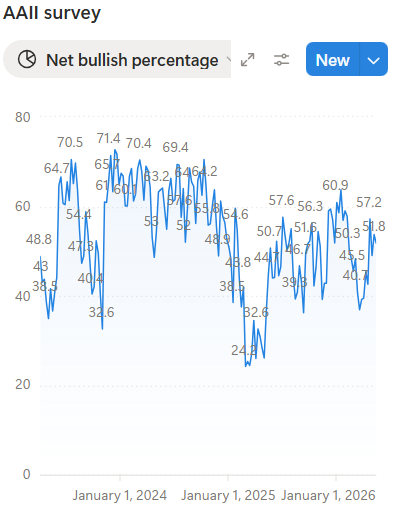
Sentiment as measured by this survey is middle-of-the-road, and has not had any extreme readings since the tariff tantrum in April 2025. The recent high was 63.7% on January 14, 2026, which fell short of a few 70-plus readings in 2023-24.
Jeffrey Hirsch writes:
This is cool Steve. I’ve been looking at trend and shape in addition to level with sentiment indicators as well as some of my seasonals and other analogs. The sentiment turns in Investors intelligence Bullish %-Bearish Percent and the VIX off the March Lows were not from as extreme levels as 2025 and others, but the shape of the sharp trend reversal was there.
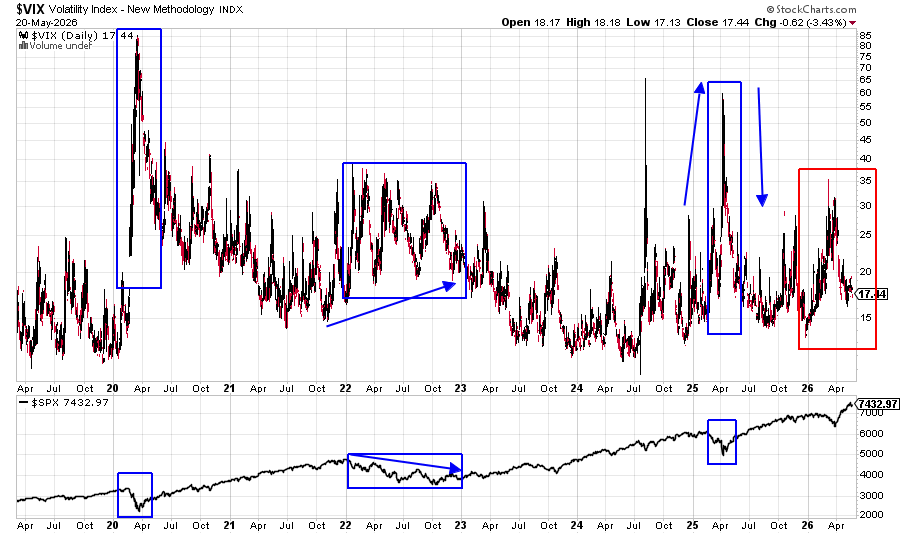
VIX for example only got to about 35 intraday and was in that nervous area of 20-30 where bear markets fester for most of March then it fell below 20 sharply after spiking quickly to 35. Same V in your AAII chart here. So perhaps correction end vs bear or near bear bottom. Also note the trend of higher lows during the 2022 bear market.
May
19
Artificial Intelligence, Real Misallocation
Artificial intelligence may well be the most important technological development of the coming decade-and that is exactly why the current capital surge around it warrants skepticism. History is littered with transformative innovations that were nonetheless disastrously overbuilt and mispriced in their early phases. Austrian Business Cycle Theory was never a children’s story in which every boom ends with clowns, ashes, and worthless machinery; its real claim is subtler and nastier. When the price of time is falsified-when interest rates are pushed below their natural rate-often proxied, however imperfectly, by modern estimates of the neutral rate-entrepreneurs are encouraged to undertake projects that are more roundabout, more capital-intensive, and more time-sensitive than underlying saving and final demand can actually support. The neutral rate is a policy construct; the natural rate is an economic reality. Some of those projects may still embody genuine innovation.
The problem is not that AI must be fake; it is that a very real technological advance can be financed, priced, and physically built in ways that are wildly uneconomic.
May
16
A dream group
May 16, 2026 | Leave a Comment
i dreamed that galton, sherlock holmes, and gilbert and sullivan attend a performance of mikado together.
The Mikado 1966, D'Oyly Carte Opera Company, Gilbert & Sullivan
May
14
Study of Deception, from Sushil Kedia
May 14, 2026 | Leave a Comment

The Chair has emphasized the value of studying and understanding deception endlessly, I believe.
Now, if I wish to focus and devote my energies to be thoroughly studious about it, I urge my requests below are not misunderstood as a lazy desire, but an earnest and keen wish to be methodical about it.
What would the Spec-list citizens recommend as the ideal list of:
a) Movies to watch,
b) Books to read.
One thing that hit me suddenly some weeks ago is that nature devised deception as a tool to economize the struggle for propagation of this world and its entities into the future. Without deception a Tiger would run endlessly, perhaps consuming more calories in capturing its prey, than it would get in eating the prey, as one example.
What are the other utilities the matured, experienced minds on this competent list and other curious minds as me feel that deception provides?
Another layer of study that makes me curious is, when our own mind as defined by Edward De Bono, as a self organizing pattern seeking system is the personal deception machinery that takes us into deviant behaviour from data, stats on the table and rigorous study then how does the autonomous deception inflicted by our mind engage with the deceptions inflicted upon this world by the high and mighty? Are the mighty studying how the hoi pollois is living in self deceiving modes and then playing it?
What more rigorous questions will the list members be happy to throw at someone who is now hungry to study deception, in depth? Please provide your questions too for me to compile into a list of questions to ponder over, gather information and insights on.
William Huggins writes:
it would seem the heart of the matter is one's ability to "hack" the target's heuristics. concealment/distraction plays an important role in this. the obvious benefit of deception being a misallocation (from the allocator's pov) of energy that can be exploited by the deceptive.
Nils Poertner comments:
What traders do in their free time and are already good at is of interest to me. (eg. someone reading crime novels, can find patterns here, another one practises Judo, finds patterns of deception there, and then you can go from there. Work with what you have already)
Big Al offers:
An interesting story with possibly multiple levels of deception:
The Rosenhan experiment or Thud experiment was a disputed study regarding the validity of psychiatric diagnosis. For the experiment, participants submitted themselves for evaluation at various psychiatric institutions and feigned hallucinations in order to be accepted, but acted normally from then onward. Each was diagnosed with a psychiatric disorder and given antipsychotic medication. The study was arranged by psychologist David Rosenhan, a Stanford University professor, and published by the journal Science in 1973 with the title On Being Sane In Insane Places.
Asindu Drileba adds:
When it comes to movies, my favorite movie to do with deception is The Conversation (1974) by Francis Ford Coppola. As for books, on my "yet to read" list I have The Confidence Game by Maria Konnikova. You see, "conman" comes from the phrase "confidence man".
I have studied several scammers like SBF, Madoff, Enron executives. What I have noticed is that deception never looks like "deception" it often looks like opportunity. The "confidence man" entrapped their victims by having "good visuals", dressing well & moving amongst those in high circles.
SBF was branded as a type of prodigy, Madoff was the chairman of Nasdaq, Enron guys where The Smartest Guys In The Room (you should watch this one, just for the fantastic music playlist), Jeffrey Epstein displayed the all patterns. Take away? Beware of bombastic talk, especially one that boosts your confidence in an investment.
Rich Bubb writes:
Not exactly a movie-to-watch, a former co-worker recommended I watch "Lie To Me" series. I'd be interested to see if anyone has trained and AI system to visually detect micro-expressions. The thought is that if somebody/-ies is the 'prey', maybe AI could detect deceptive interactions better than me. I have tried to teach myself to recognize micro-expressions. It's nice to know when I'm being lied to.
Oliver Joseph writes:
I'm a big fan of Joe Navarro's work. "What Every Body is Saying" is classic. There is a certain amount of gamesmanship in deception and its detection which he elegantly describes. Of course there are certain "strong signs" like pupil dilation that are impossible for normal human beings to conceal. Sussing out the meaning and separating the signal from the noise is part of the game, a problem everyone on the spec list is used to dealing with I'm sure. I myself as a former car dealer am quite unfamiliar with deception and its detection and so eagerly await further recommendations.
May
11
ChatGPT moment for robotics?, from Humbert Q.
May 11, 2026 | Leave a Comment
I've Covered Robots for Years. This One Is Different
From sorting chicken nuggets to screwing in lightbulbs, Eka’s robotic claw feels like we're approaching a ChatGPT moment for the physical world.
Dendi Suhubdy offers deep analysis:
I have put some thought into that:
The Perception–Planning Gap: What's Actually Hard About Visual AI in 2026
The thesis I want to defend in this piece is structural: perception in pixels is largely solved at the representation level; perception for action is not, and the gap between the two is the central unsolved problem of visual AI in 2026. Frontier vision-language models can pass medical-board questions and explain radiographs at attending-physician level. Frontier robots, after a decade of foundation-model progress, still cannot reliably load an arbitrary dishwasher. Moravec’s paradox is not a quaint historical observation; it is the daily lived experience of every embodied-AI lab.
Big Al responds:
Thanks for sharing. Much I don't understand, but when I scroll down to the summary, I think I get the general ideas. I hadn't thought about the challenge of having effective testing/evaluation standards.
Asindu Drileba writes:
I thought this was going to be about humanoid robots (like Figure & Optimus). That still have very many problems. Industrial robotics how ever has always been making mind blowing, but quiet progress.
Good case studies are Amazon (robots operating in a warehouse about 10 years ago, its now way better), and Tesla, also 10 years back.
The reason is that the edge cases of these industrial robots are very few and can be comprehensively thought about. I think this robot ChatGPT moment already occurred in industry & manufacturing.
May
10
A tug-of-war within America’s deregulated power markets, from Humbert X.
May 10, 2026 | Leave a Comment
Today, we are witnessing a tug-of-war within America’s deregulated power markets. It's between those advocating for free-market operations and state policymakers intervening in those markets. In the process, consumers of all kinds are paying unnecessarily high prices. Let me explain:
In deregulated power markets, energy producers are theoretically dispatched in economic order based on their production costs, excluding owners' capital costs. The last producer to clear the market sets the market-clearing price. In general, this order begins with producers with the lowest marginal costs—such as wind and solar—and ends with the least efficient assets that use the highest-cost fuel: typically oil, coal, or inefficient natural gas plants.
When markets attract more cost-leading producers, costlier assets are sidelined, and market-clearing prices fall. Even if cost leaders offer intermittent availability, consumers benefit on average because their aggregate energy costs decline.
Data centers consume massive amounts of electricity (and water). The global buildout of thousands of new data centers has increased demand for power generation. As a result, power markets now reward higher-cost producers that rely on expensive fuels. Consequently, market-clearing prices are rising, and consumers are paying more. As clearing prices rise, cost leaders' margins also increase.
A potential solution to higher power prices is to increase the number of cost-leading producers. Even if new cost leaders offer intermittent production, the strategy benefits consumers through lower average clearing prices, though backup sourcing merits consideration. This approach creates winners and losers: owners of costlier production assets lose when average clearing prices fall. Consequently, the costliest market participants oppose the introduction of new cost leaders.
In January 2025, the Trump administration began implementing policies to restrict investments in cost-leading production. The administration rescinded permits for wind projects and, by April 2026, had negotiated about $2 billion in payouts to compensate investors to walk away from permitted and partially completed offshore wind projects. Additionally, since August 2025, the Pentagon has delayed reviews of165 onshore wind projects (30 GW of capacity), citing unspecified national security concerns.
When energy policy restricts cost-leading producers from participating in markets, consumers pay higher energy prices. This dynamic creates competing interests: while owners of costlier generation assets benefit from reduced competition, all electricity consumers—including data center operators—face higher costs.
The solution is straightforward: remove the barriers. Instead of spending $2 billion in taxpayer dollars to prevent investment, use those same funds (or none) to let the market allocate resources based on market forces. If permitted, capital will flow to cost-leading producers in response to the buildout and rising prices.
Bud Conrad writes:
I'll add some less-discussed items: We all know that about 20% less oil is flowing out of the Strait. But the Ukraine war is hidden behind the I run daily policy changes. Both the Russian and Ukraine sides have escalated massively since the beginning of April by doubling their daily barrage of drones and missiles. Specifically, the energy generation systems of both sides are being attacked, and the relatively less noticed is that Russian refineries and ports have been getting hammered. The result is that, while Russia has reserves, its ability to deliver amid already reduced supplies has been damaged. Nobody knows how much, but multiple cities deep into Russia have been attacked with huge clouds of smoke. St. Petersburg ports and some cities 2,000 Km into Russia have been damaged.
It takes up to 2 months to get tankers from the Persian Gulf to customers. So to restart, it will take something like that time, from the Strait opening. Oil production from most Gulf states has been attacked and stopped, and it will take more than months to restart. The US Strategic Petroleum Reserve is adding supply but cannot continue much longer, since it was already depleted, in an attempt to keep prices low to weaken Russia during the Ukraine war. In the tit for tat between Zalen ski and Moscow, Russia asked for a ceasefire on the Memorial Parade March 9 (Tomorrow), which has already been rejected by Ukraine, and Russia has announced plans to attack the center of Kiev with Oreshiks.
The pressure for oil prices to go much higher seems obvious.
May
7
Consumer sentiment, from Steve Ellison
May 7, 2026 | Leave a Comment
The US consumer sentiment surveys have become completely politicized and useless for economic analysis. When Biden was president, respondents who preferred the Republicans said they felt very bad about the economy. After Trump was elected, they felt very optimistic. Respondents who preferred the Democrats did the opposite. And yet bad consumer sentiment as expressed in surveys never turned into action. Consumers did not actually reduce spending.
Larry Williams suggests:
Use this one then:
May
5
The Strategy of Conflict, from Nils Poertner
May 5, 2026 | 1 Comment
The Strategy of Conflict (pdf), by Thomas C. Schelling
At the beginning of the book he says that some ppl just thrive on conflicts - the more the better basically. That is true within corporations as well, everywhere we can see it on world stage.
– THE RETARDED SCIENCE OF INTERNATIONAL STRATEGY
Among diverse theories of conflict—corresponding to the diverse meanings of the word “conflict” — a main dividing line is between those that treat conflict as a pathological state and seek its causes and treatment, and those that take conflict for granted and study the behavior associated with it. Among the latter there is a further division between those that examine the participants in a conflict in all their complexity—with regard to both “rational” and “irrational” behavior, conscious and unconscious, and to motivations as well as to calculations—and those that focus on the more rational, conscious, artful kind of behavior. Crudely speaking, the latter treat conflict as a kind of contest, in which the participants are trying to “win.”
May
4
What Makes a Trading Strategy Work?
In quant trading finding an alpha is not enough.
What is the edge you have that others do not?
A backtest is not the hard part.
The hard part is explaining why the opportunity exists, why others have not competed it away, and why it should continue to exist in the future.
In practice, most real strategy edges come from one or more of these: …
Some good discussion in the comments also. In response to a question about spinoffs:
Tad Haley Spinoffs are one of the best examples of an opportunity that can be visible without being equally tradable.
The edge is often not in spotting the situation. It is in understanding who has to sell, who cannot own it, who can actually fund and hold it, and how long the implementation friction lasts.
That brings in mandate and tolerance, liquidity, balance sheet, and constraints all at once. Information still matters, especially in separating flow-driven weakness from real fundamental weakness, but a lot of the opportunity exists because the natural ownership base is temporarily broken.
Larry Williams responds:
Is it really that complex? You find out what fundamental conditions drive a market. Maybe it's supply, maybe it's good earnings, and take advantage of that impact.
Zubin Al Genubi comments:
Its good to understand market structure in addition to stats. Structure is changing from a few years ago.
Nils Poertner adds:
Excellent, Yes Zubin. Also the trader may change and develop a bit of an ego after yrs of success….that is why trading requires constant shedding of false personality.
Asindu Drileba writes:
I have also come across three recurring reasons why some edges still exist.
Liquidity: So common in the Bitcoin markets, more in smaller cryptos markets. I have heard people with serious AUM complain about how the can't deploy $30m positions. But small specs don't have this problem.
Impatience: Even though some long term strategies like following the drift, indexing, work people are impatient, often demanding salary like consistency from the market like Robert Bacon suggests.
High stress strategies: Some people are patient, though can't handle strategies that are profitable, but have a very high frequency of losses. I have suggested some (buy) options strategies to my friends, but they just can't endure the 70% to 90% losing rates.
Larry Williams writes:
The big edge is to think forward, to see the future before other people do there are fundamental facts to this game, like insider buying. Mister Brush has written so much about. There are advantages, and they're very simple.
Apr
28
How to account on the principle of ever changing cycles?, from Asindu Drileba
April 28, 2026 | Leave a Comment
This principle outlines the idea that markets change their behaviour. For example:
- the 13th business day of the month made money for 5 years ( lost for some days in the year, but overall ended the year profitable)
then the market changes and
- the same 13th business day of the month loses money for 5 years ( won for some days in the year, but overall ended the year at a loss)
If you tested the data set for the last 10 years as a single block, (5 years losing + 5 years winning) the regularity would completely cancel out. The only thing I can think of is testing data sets in chunks of say 1 year, but over 10 years. and avoiding large blocks in general. Any suggestions?
Steve Ellison writes:
I agree with the idea of shortening the lookback period. I remember the Chair suggesting 60 days as a typical lookback period, but obviously you would need a much longer lookback for an event that only occurred once per month.
I would also suggest assessing, if there really is an edge here, why? In this example, which market participants have reasons to sell (buy) on the 11th and 12th days of the month that override price sensitivity, such that others come in to buy (sell) on the 13th day? There is a lot more noise than signal in market price movements, and some of the noise may appear statistically significant if you torture the data long enough, but without an underlying reason, a regularity is unlikely to continue.
Jeffrey Hirsch responds:
The 11th and 12th trading days of the month – what we refer to in the Almanac as the mid-Month spike is driven by automatic payroll deductions bi-monthly or every 2 weeks into 401Ks and other retirement accounts where fund managers are required by law to invest. I discussed this with Steve Eisman on his podcast, The Real Eisman Playbook, recently where he comes in and helps me prove the point. It starts at the 19-minute mark and runs for about 2 minutes.
20:37: mutual funds are only allowed to have a certain amount of cash. So generally, let's say 5%. They're not allowed to have more than 5%. So, if all of a sudden people are putting money in because of their 401k, they got to buy. It's not optional.
Asindu Drileba adds:
I was playing with Google's decision tree Python library called YDF. (it's shockingly easy to use)
I simply used days of the month as features against, up or down days. Mid month dates showed very strong regularities (some up to 60% up days). I never understood why they occurred, until I remembered Mr. Hirsch talking about payrolls hitting brokerage accounts. What's different is that I found these in crypto. But it was harder to trade than I thought.
Larry R Williams writes:
It's been that way for years: the eleventh trading day of the month in stocks is usually a rally day, going way back to the 1980s when I first started trading this.
Apr
27
More on Sun Tzu, from Stefan Jovanovich
April 27, 2026 | Leave a Comment
Since Americans have been messing with the rest of the world ever since 1775 (our first act of rebellion was to invade Quebec), could we begin looking for historical parallels from our own history before we get to the Turning Points view? The first reference to The Art of War in U.S. military literature does not appear until the 1939 article in U.S. Naval Institute Proceedings (“The Constancy of Fundamental Military Considerations”). I realize that it is now one of the fundamental texts that is part of the military coursework, but those of us who were raised in the textbook business have learned to appreciate how little of what people actually do and think about money and power can be traced back to what they read in school. The List may want to consider looking back to the specifics of our country's history in the 1850s for a useful parallel to current events.
Viewed through that lens, President Trump seems to be following very closely Millard Fillmore's Whig plan to divorce the United States from the opinions of the rest of the "civilized" world and have our tariffs answer all questions about the price of the dollar in foreign exchange. By 1851 the United States of America was the world's largest exporter of what were considered to be the world's two most important commodities: gold and cotton fiber. In 1852 you had Admiral Perry setting out for Japan, the French being told to surrender all claims to Hawaii (they had occupied Honolulu in 1849), Taylor's Clayton-Bulwer Treaty being vigorously enforced, and a pro forma apology for the failure of the second Narciso López Filibuster expedition to Cuba was combined with a pointed declaration to both Britain and France by Secretary of State Edward Everett that Cuba was "almost essential" to U.S. safety. Central Europe did engage Americans public attention; Kossuth was invited to come and address Congress. But it was not at all comparable to the Zelensky show under the Biden Administration; the Europeans, and the Austrians in particular, were told that the U.S. had no interest at all - financial or otherwise - in Central European affairs.
There is only one reason this parallel does not fit rather neatly. A decade later the U.S. would be in a Civil War. Fillmore, Pierce and Buchanan all have to be blamed for it by all the people who get paid to look backwards. No doubt the same future textbooks that will look to Sun Tzu for wisdom will be grading Donald J. Trump with the same terrible marks that the first New Yorker President has gotten. But it does help to remember that during Sun Tzu’s traditional lifetime (c. 544–496 BC, late Spring and Autumn period), "the war" he writes about was entirely about the civil war among the vassal states of Zhou. There were no "foreign" wars during this period according to the records of the Zuo Zhuan.
(Correction: Martin Van Buren was the first New Yorker to become President. Millard Fillmore was the second.)
Apr
23
The Art of War by Sun Tzu, from Q. Humbert (Updated)
April 23, 2026 | 1 Comment

Good book to re-read. Are all those crisis meetings are just choreography? In order to "sell" something unpopular (a war) to the managed masses in the West (or whatever system there is in Iran respectively). Humanitarian aid talks often precede wars as well.
Jeffrey Hirsch offers:
Art of the Deal. Seasonality edition
Nils Poertner responds:
Top notch analysis! (I'm wondering though, we in the West value transactions and deal making a lot - whereas in some countries, which are more religious…they may rather die than surrender).
Steve Ellison writes:
I just borrowed The Art of the Deal from the library because the Chair's brother says that the President's thinking process is all laid out in that book, and one ought not to react to his statements at face value because they are negotiating positions.
Jeffrey Hirsch adds:
Ever since Liberation day and the tariff tumble last year have had the President’s truth social posts as the only lock screen alert coming through my phone.

Kiran Kaur comments:
Free markets used to be a natural hand that would correct markets when they were inflated, avoiding catastrophes. But now we have the hand of government that removes the natural corrections that are supposed to occur and take out zombie companies. We have a few actors taking meetings behind closed doors to set the cycles, using regulation as a key mechanism. its nice for us because we are close to the liquidity that sets the rest of the markets.. Have you read Edward Chancellor's The Price of Time?
Asindu Drileba writes:
One opinion I heard recently is that, this conflict is actually doing exactly what "they" want. The constant talk of colonising Canada & previous "take over" of Venezuela is because these are oil rich countries. The conspiracy is as follows:
Shut down the strait.
Make Middle Eastern oil suffer logistics issues (price oil higher?)
Oil from Americas moved ok (priced cheaper?)
Demand for Americas oil increases. Subsequently, demand for USD also increases.
Finally weaken & decapitate BRICS.
Does this make sense? Or is it imaginary 5D chess?
Kiran Kaur responds:
Absolutely the most sane analysis i can imagine. Especially after reading the blueprint of the genius act and the user's guide to global trade. Increasing demand for us debt, oil, and the dollar, while decreasing dependencies on global players are agendas directly mentioned in both of those papers.
Apr
21
Ellen Langer experiment, from Q. Humbert
April 21, 2026 | Leave a Comment
2014 NYT reports about the Professor Ellen Langer experiment on how the mindset affects aging (or can reverse it).
Back in the 1980s, Senior citizens (some of them on crutches) were invited into a hotel with furniture /music reminding them at the time they were young - and they weren't allowed to speak about illnesses or their challenges. And their ailments improved, some started walking more effortlessly / dancing etc. Interesting anomaly (in this case how the mind affects the body and vice versa).
In trading we are looking for anomalies as well (coz there is the juice!!, whereas ordinary folks tend to brush off anomalies as a mistake.)
Apr
20
Podcast series on Trafalgar, from Big Al
April 20, 2026 | Leave a Comment
The Royal Navy is one of the themes of the list, not least because of the Chair's love of the Aubrey-Maturin novels by Patrick O'Brian.
I have posted about a podcast I enjoy, The Rest Is History, and they did a nice three-parter on the Battle of Trafalgar. The newest information for me was the first episode, being the story of how the Royal Navy became the amazing fighting force that it was by 1805.
The episodes:
243. Trafalgar: A World at War
244. Trafalgar: Countdown to Annihilation
Apr
18
How Costly Is Permitting in Housing Development?
Evan Soltas, Jonathan Gruber
February 2026
Permitting costs are widely cited, but little analyzed, as a key burden on housing development in leading U.S. cities. We measure them using an implicit market for “ready-to-issue” permits in Los Angeles, where landowners can prepay permitting costs and sell pre-approved land to developers at a premium. Using a repeat-listing difference-in-differences estimator, we find developers pay 50 percent more ($48 per square foot) for pre-approved land. Comparing similar proposed developments, pre-approval raises the probability of completing construction within four years of site acquisition by 10 percentage points (30 percent). Permitting can explain one third of the gap in Los Angeles between home prices and construction costs.
Apr
17
What made America great, from Larry Williams
April 17, 2026 | Leave a Comment
"While you may make many mistakes," J. P. Morgan's father advised his son,"never be a bear on your country or you will surely go broke."
Apr
16
What can’t happen, from Steve Ellison
April 16, 2026 | Leave a Comment
In 2007 some pairs trades moved 25 standard deviations from their historical norms. If markets were truly random walks, such events would have had miniscule probabilities of ever occurring even had the stock market been in existence since the Big Bang.
As Augustin Lebron said in his excellent book The Laws of Trading, the more market participants assume some event can't happen, the more certain it becomes that the event will happen. Remember when house prices never went down?
William Huggins responds:
that 25 st devs quip just shows you what the spread of their calibration set was, and where the real problem was imo - assuming recent stability was some established fact (one of the problems with exponential weight decay)
Nils Poertner recalls:
Italian friend of mine (big hitter at US bank) had a burn out in 2007, and his wife checked him into a monastery (ora and labora Benedectiner type). Ora is contemplative - it is receiving (not thinking, thinking, thinking) it is what we don't know. Whether you have "AI" or "science models" it is like standing in a room full of mirrors and putting more mirrors into them and thinking one knows the future.
William Huggins writes:
My favourite way out of echo chambering one's self (and to avoid the lure of gurus as this august list taught me forever ago) comes from 17th century Japanese poet Matsuo Basho: "Do not seek to follow in the footsteps of the wise. Seek what they sought". In any competitive domain (markets, chess, etc), you have to learn how to think like a master rather than proverbially copying some smart kid's homework.
An overreliance on historical data instead of trying to imagine what could (quite reasonably) be, is one of the contributing factors that led the 2007/8 crash. In their August 2007 conference call (see pg 21), AIG's Joe Cassano told analysts (regarding their CDS business), "it is hard for us, and without being flippant, to even see a scenario within any realm of reason that would see us losing $1 in any of those transactions".
25 st devs indeed…
Larry R Williams adds:
People talking and over talking their book is a massive clue. Like tom lee this and last year.
Apr
14
Two new trends, from X. Humbert
April 14, 2026 | Leave a Comment
Two new trends will likely emerge from the Iranian caper: renewable energy and nuclear power. Smart money will aggressively pursue renewable energy assets (including derivatives). Sovereigns will likely pursue nuclear power assets if they can afford the price tags.
Humbert A. responds:
An interesting thesis, The Economist had an interesting article in their 3/21/26 edition entitled "Burnout" of most interest in your line of thinking was a graph that showed Daily Wholesale electricity prices in 2026 in euros per MWh for France Italy Germany and Spain. The Economist posited Spain and Frances wholesale prices adjusted to the downside more quickly than Germany or Italy based on investments they had made in renewables and diversifying their sources of electricity. Your thesis seems to follow a general trend of dis-integration we have seen for some years now with supply chains. How far up and down stream can we disintegrate? Also BTW what does NFW mean I am assuming Not for web but I am new here.
Henry Gifford writes:
I have heard a lot about investing in renewable energy, but am not clear on how to do it. For actual real renewables I think of hydroelectric (dams with generators turned by the water) and geothermal (heat from hot springs generating electricity or heating buildings, not electricity powered equipment that cools the groundwater to heat a building, which the federal government treats as a form of renewable energy despite it using electricity) and solar panels and wind turbines.
No new rivers are likely to be discovered, and here in the US dams are being removed at a steady and fairly rapid clip to help the fish, etc. No new hot springs are likely to be discovered, as the best way to find them is to check road maps for places with the words “hot springs” as part of the name.
Solar panels can heat water to heat a building or heat water for showers and faucets, but many of them don’t work, especially here in the US, as the technical skills just don’t exist. In Europe they are sold as part of a boiler system, and come complete with electronics and pipe connections and clear instructions. Many of them work. They are installed by local plumbers and manufactured by giant companies such as Viessman and Buderis, who also sell boilers here in the US, but without the solar components, due to lack of demand and lack of expertise. Outside of the US and Europe these solar systems are virtually unknown in some areas, and super popular in other areas, especially areas where outdoor temperatures do not drop below the freezing temperature of water.
Solar panels that produce electricity are of course popular here in the US. The last time there was a market price for those systems, about 15 years ago, the systems cost $9.00 per summer noon watt of capacity. This is for the whole system, including panels, mounting racks, electronics to convert the DC the panels produce to AC at the correct voltage and phase to connect to the grid, wires, labor, permits, etc. If angled at latitude degrees from horizontal, oriented South, and never shaded, these systems produce, on an annual basis, an amount of electricity equal to about 1,200 times what they produce at noon during the summer. Sure, Arizona gets a lot of sun, but the panels don’t like the high temperature there. Seattle gets less sun, but the panels like the temperature there better. Thus for all the lower 48 states the output is fairly close to the 1,200 noon-hour equivalent. After losses in the wires and the electronics, one watt of capacity produces about 1,000 watt-hours of electricity. That 1,000 watt-hours is called a kilowatt hour by the utility company, and sold for an average of $0.09 at the time the systems sold for $9.00/watt. This makes the simple payback (no allowance for maintenance, change of value of electricity, change of value of money, etc.) the result of dividing $9.00 by $0.09. As this is very politically incorrect division, I will leave that to others. But, the payback is frustratingly long, especially as the panels only last for 20 to 25 years and start degrading the day they are manufactured, and the electronics might only last half that long.
One might wonder; if the payback is so terrible, why are they so popular? Because you are paying for them. And, because you are paying for them, very few are installed facing exactly South, angled at latitude degrees from horizontal, and never shaded, which of course makes the payback much longer than the math above implies. Even a small bit of shading, such as from a telephone wire, lowers the voltage of all the panels in an array, and can damage the panels, although the in-laws won’t notice and you will still pay the same amount.
The crazy long payback is why you don’t see them installed on roofs of warehouses and big box stores, where they can be oriented perfectly, angled perfectly, never shaded, and can offset the purchase of electricity at the much higher commercial rates those utility customers pay.
So, with such a horrible payback, the whole arrangement is as financially sound as a soup kitchen or a homeless shelter. Sure, lots of people bring home lots of money from those operations, but how would one go about investing in the soup kitchen “industry”? Solar electric panels are now heavily subsidized at both the installation end and the manufacturing end, thus any investment depends heavily on the winds of politics, not on any actual value added or created.
For wind turbines, the small ones mounted on buildings and lampposts are mostly for show. The only study I ever saw about how much electricity they produce said the measured amount was 0.2% of the claimed amount, but that study was based on a very few measured measurements.
I suspect very large utility scale wind turbines have a very good payback, but I have no idea how to sort out the claims made. Perhaps someone can invest in the companies that make and install those, but recent politics put a halt to large projects when they were 80% complete, which will probably bankrupt companies in that industry.
I still scratch my head when people talk about investing in renewable energy. If anyone has any ideas, please let us know – I think it certainly is the future in the not-too-distant future.
Zubin Al Genubi writes:
In Hawaii lots of people have solar panels. Electricity is .22 during the day but .64 from 5-9pm. I was going to get a battery and charge it with everyone else's panels and harvest the differential. Seems like battery tech is an idea.
Asindu Drileba comments:
Yes, it seems for seasonal renewable energy like wind, solar etc. The overarching strategy is to invest in battery tech (people with relevant patents & Lithium miners). Since the energy needs to be stored anyways. Maybe the FIT etf can satisfy this?
Some people like Lyn Alden have suggested that people have some Uranium ETFs. However, for stuff like hydro and geo-thermal, maybe a copper futures allocation since everything with a turbine has use for it.
The risk with commodities is that a large repository maybe discovered that will make prices fall. Investing in corporations with relevant patents for battery tech seems safer. But I also think a small commodities allocation (Uranium, Copper, Lithium miners) is worth it.
Humbert A. writes:
Our family looked at making an investment in solar. The project was on the small side right under 100 acres we were operating in a state in the U.S. that at the time had very attractive tax incentives. The most attractive option on the menu was a land lease which when the dust settled we decided it still wasn’t worth it. Our thinking was why convert 100 acres of perfectly good mushroom hunting ground into an unsightly solar array? This of course in addition to the actual math already mentioned.
Our experience however in our other operations, automobile retail our utility provider had a very interesting program we did take advantage of. Without going into needless detail it was a program where we had been paying into with our utility and we were able to make an investment in some approved “green project” solar investment was on the menu and with car lots in our region very attractive. Our is region prone to hail and extreme heat solar panels could shade and protect the inventory and in our case potentially reduce insurance cost in an event (it’s not uncommon to carry separate policies on New and Used vehicles thus having to pay two or even three deductibles in an event) we opted however for upgrading to LED lot lighting.
At least in the U.S. I tend to think successful investment in renewables will be more decentralized. For example the recent success of the Generac gas systems. Households through various utility and tax schemes will make emotional decisions to make their families energy use more diverse and secure at great cost to them and great benefit to the retailer. Essentially solving the problem at the household level Europe is trying to solve at the national level. Behind every blade of grass in America is an alternative energy generator.
Apr
12
The “attention economy”, from D. Humbert
April 12, 2026 | Leave a Comment
Media ("attention economy") marginalizes positive stories of ordinary people building solutions from the ground up. That is why trading + media exposure during the day needs to be balanced in off hours to see that ((helping the neighbour, inviting to parties, gardening, anything that gives us joy). And this will be even more important in coming years (as social moods probably drops a lot…initially felt in Europe / Asia and later in the US. The US is not long convexity it is also short IMO).
Steve Ellison writes:
I have always followed Livermore's admonition to neither seek out nor follow tips, not even those from the brilliant members of this list. On X, I follow a number of accounts that I find add value by providing economic and market insight, but some of my favorite recent follows have been people who talk more about psychology and mindset than about particular markets.
For example, Ben Calusinski has some very interesting ideas. One is that authenticity is the one thing that AI can never replace. Another is that you have access to more information than any human in recorded history, simply by being alive today, so there is no excuse to not succeed. Possibly related to Mr. Humbert's point, Mr. Calusinski envisions a future in which 90% of the population is so dopamine-addicted by their devices that they achieve nothing, but a person who resists the siren call of social media and actually builds something, ideally something that aligns well with their authentic self, can do quite well.
Apr
8
I was thinking of designing a custom Consumer Price Index:
Oil
Copper
Wheat
Sugar
Anything important missing? or something that needs to be removed? My aim was to add something that is actually used everyday by ordinary people around the world.
Larry Williams asks:
Why? There are several very good ones already
https://doi.org/10.26509/frbc-ec-201002, Michael F. Bryan, and Brent H. Meyer
The Sticky Price Consumer Price Index (CPI) is calculated from a subset of goods and services included in the CPI that change price relatively infrequently. Because these goods and services change price relatively infrequently, they are thought to incorporate expectations about future inflation to a greater degree than prices that change on a more frequent basis. One possible explanation for sticky prices could be the costs firms incur when changing price.
Asindu Drileba responds:
Why a custom CPI? I honestly have no reason. It's more of a fishing expedition. The goal is to have a small list (under 10) of commodities and see if it produces some regularities.
It seems there are two kinds of commodities: Those that make people angry when the price goes up (life gets harder) like Oil, Sugar, Wheat. Those that make people happy (or indifferent), when the price goes up. Gold. I was thinking of making a small custom CPI based off 1). Which is why I excluded Gold. I was thinking of adding currencies to 1) like USD/EUR, USD/JPY & USD/CNY. Then maybe see what (this CPI) it may be good for.
Larry Williams contributes:
Add a booze stock.
Ed Kozun writes:
I agree in the past on the booze stock, but it sure seems like trends are changing and a lot of people are walking away from the sauce.
Larry Williams again:
Mary jane stock?
Zubin Al Genubi suggests:
Beer, wine, gas, hamburgers.
Ed Kozun ponders:
You’ve got my thinking about these indexes and what they are useful for and can you strip it down to essentials to think about pain points for “ordinary.”
1. any staple grain
2. residential energy per kWh.
3. cooking fuel(cost of making that grain into a meal)
4. Urban public transport ticket price.
5. Basic medicine. What cost does amoxicillin turn an infection into something that is not financially manageable.
Asindu Drileba continues:
Inflation usually doesn't affect wealthy people. (unless it's at levels of post WWI Germany, Mugabe's Zimbabwe & 1970s Cambodia). Petrol doubling in price may be annoying, but it won't change their behaviour.
As for the "others". Inflation causes 2 things. (these are untested suspicions)
Belt tightening. Spending on priorities first and less on luxuries. Will Live Nation stock be affected? Since less people go for concerts during periods of high inflation?
Will it still be worth it to buy the exact same iPhone as of last year that simply has a different name? Less visits to LVMH brands?
Red queen effects. People spending/borrowing more to stay in the same place. Payment processors collect more (since goods are the same, but transaction volume in $ goes up?)?
More leverage in markets (bigger "Open to High" & "Open to Low" ranges due to vol)? This may be more true in crypto where users are given up to 125x Leverage In some cases.
Apr
5
Thinking Sideways, from Nils Poertner
April 5, 2026 | Leave a Comment
Video: Jennifer Shahade On The Hidden Cost of Thinking Too Far Ahead

Ordered the book written by a 2 times US female Chess player- it is about the dangers in thinking too far ahead (high IQ ppl like to do that and miss out the important turns when situations change…and keep getting too carried away). Good book for our special times IMO.
Thinking Sideways: How to Think Like a Chess Player and Win at Life
In Thinking Sideways, Shahade shows you don't have to be a great chess player to think more like a chess player. From building mind palaces to crafting decision trees, she reveals the most useful strategies from the ancient game that we can use in our daily lives. Drawing on examples from business, sports, and psychology, as well as her own experiences touring the world as a chess and poker player, Shahade transforms our understanding of what success looks like, and how to achieve it for ourselves.
Apr
3
Continued VFR into IMC, from Humbert B.
April 3, 2026 | Leave a Comment

In terms of trading, this makes me think of when rapid changes in market conditions push the trader's P&L into the red, and the trader gets tunnel vision and makes bad decisions.
Analysis of the helicopter crash by experienced pilot:
What REALLY Happened To Kobe Bryant's Helicopter?
The key issue is Continued VFR into IMC:
Continued VFR into IMC is when an aircraft operating under visual flight rules intentionally or unintentionally enters into instrument meteorological conditions. Flying an aircraft without visual reference to the ground can lead to a phenomenon known as spatial disorientation, which can cause the pilot to misperceive the angle, altitude, and speed at which the aircraft is traveling. This is considered a very serious safety hazard in general aviation. According to AOPA's Nall Report, approximately 4% of general aviation accidents are weather related, yet these accidents account for more than 25% of all fatalities.
Measures to reduce continued VFR into IMC accidents include improved preflight decision-making, enhanced weather awareness tools, simulator-based training and recurrent instrument practice for pilots who normally fly under VFR.
Nils Poertner responds:
Spot on. Good to slow down now anyway, walk slowly, speak softly, take good breaks. Have a dog and a cat nearby - they both remind me to not get too serious about things and slow down.
Mar
30
Delmonico’s memories, from Steve Ellison
March 30, 2026 | Leave a Comment

I remember a number of Spec Party dinners in Delmonico's, and I had a very educational conversation with then-81-year-old Yale Hirsch at one of them.
America’s Original Steakhouse Is Expanding - After Nearly 200 Years
When Delmonico’s first opened around the corner from Wall Street in 1837, it coincided with a financial panic, bank failures and the popping of a real-estate bubble. But the steakhouse survived. And in the coming years, it would serve famous customers such as Abraham Lincoln and Mark Twain.
Now, nearly two centuries later, the restaurant that calls itself the first fine-dining spot in the U.S. is poised to open its second outpost in Midtown Manhattan next year.
Jeffrey Hirsch responds:
Thanks for the memory Steve!
Mar
29
Women, men, and change, from Humbert X.
March 29, 2026 | Leave a Comment
Noticed when societies go a bit off kilter, women are much easier to talk to sometimes (Can't believe I ever say this). Or maybe women are less interest to go extreme in the first place (family, home, other values more important). I mean how many lawyers in the city of London make it to the top and are female. Or run hedge funds. Or go for 100km races. Anyway, big changes in societies come when men change - maybe we will see that soon.
Jeffrey Hirsch responds:
Interesting observations. My wife and I actually just watched the Louis Theroux documentary Inside the Manosphere - it’s a fascinating (if often cringey) look at these societal shifts. With two sons (18 and 21), I can see the validity of the motivation behind some of these trends, even if the execution is often extreme or 'trashy.'
I’d highly recommend Scott Galloway’s new book, Notes on Being a Man, as a counter-balance. It covers similar ground but with a focus on being a 'mensch' rather than a hustler. I actually gave copies to my sons this week after I finished it with a note about what fine young men they already are. It’s a great read.
Mar
27
Self-importance in trading, from Nils Poertner
March 27, 2026 | 1 Comment
Self-importance really does weaken humans.
Got a call from 2 (mediocre), young traders. Asked them how they do. They are really in their heads 90pc of their time as their thoughts go in circles (missing out on nuances in markets / changing patterns now.)
Inner dialogue
"How I am doing?"
"Whether am up or down with someone else"
"My career path"
"My degree from this or that famous school" who cares I thought!
"My P/L" or "L"…
etc etc etc
Complete self absorption. Recipe for disaster.
Sushil Kedia responds:
The purpose of all work is to annihilate and subsume the sense of self by focusing as deeply as one can on the task at hand.
Financial Markets have the fastest feedback mechanism and thus any trader is constantly suffering feedback he is right, he is wrong, he is right, he is right, he is wrong, he is wrong, he is wrong.
The speed with which financial markets will make saints out any man is unparalleled as compared to any other work. Those who will realize and learn sooner, will know that no one can hope to be paid at all, forget about getting paid consistently without adding value. To add value one has to be other-centric. When markets are panicking absorb that panic with your cash. When markets are euphoric to the extreme absorb that euphoria by giving away your securities. That's just one example of adding value. When bid-ask has gotten significantly wider than usual, fill up the void. That's just another example of adding value.
All amateurs, with or without articulating to themselves these basic tenets that in no economic activity anyone can get paid without adding value, do grow up.
The whole idea of data reigns supreme amongst all sensorial inputs and that testing matters more than anything is the opposite of self absorbed judgemental behaviour.
Let baptism happen by the fire. No one burns, but just gets baptised.
Mar
26
AI use by firms, from B. Humbert
March 26, 2026 | Leave a Comment
NBER Working Paper Series: Firm Data On AI
We present the first representative international data on firm-level AI use. We survey almost 6000 CFOs, CEOs and executives from stratified firm samples across the US, UK, Germany and Australia. We find four key facts. First, around 70% of firms actively use AI, particularly younger, more productive firms. Second, while over two thirds of top executives regularly use AI, their average use is only 1.5 hours a week, with one quarter reporting no AI use. Third, firms report little impact of AI over the last 3 years, with over 80% of firms reporting no impact on either employment or productivity. Fourth, firms predict sizable impacts over the next 3 years, forecasting AI will boost productivity by 1.4%, increase output by 0.8% and cut employment by 0.7%. We also survey individual employees who predict a 0.5% increase in employment in the next 3 years as a result of AI. This contrast implies a sizable gap in expectations, with senior executives predicting reductions in employment from AI and employees predicting net job creation.
Mar
24
Nobody asked me, but…
March 24, 2026 | Leave a Comment
1) Jay Gould was a hero not a villain.
2) Gilbert and Sullivan: Opera Explained is my favorite nite time listen.
Mar
22
Specs in other disciplines, Nils Poertner
March 22, 2026 | Leave a Comment
The moment specs apply their approach (test ideas, challenge group beliefs, count, be curious etc etc) to other disciplines - eg medicine, botanics, anything really.
One can easily see that one has learned "cliche-thinking" in university/school. And that most normies never leave that cliche thinking. That is fine with me. Gell-Mann effect is real as well. Good to keep it tight and focus on markets though.
Oliver Joseph writes:
To challenge established thinking in any human endeavor whether hard or soft sciences will in my mind invariably produce push back, most of the time. While perhaps a bit hyped right now the K-means algorithm offers in my mind an interesting way to conceptualize group think. In a simplified market context x1= Bull x2= Bear K=2 Bull vs Bear When a local minimum is reached for a cluster often time depending on the data set it makes sense and is workable however there are times where you must reinitialize based on your understanding of the dataset and the results your getting. If we are driving towards a conclusion in a field of endeavor we will reach a local minimum for a variety of reasons. Sometimes what works just works of course conversely sometimes we will converge to a local minimum that does not match our understanding of the dataset. Until we converge we don’t know. Darwin's theory of natural selection represents one such conceptual reinitialization in my mind (with the unfortunate delay in the theories convergence due to many years spent looking at barnacles). There is profound wisdom in the comment by George Soros “buy the lie”. An understanding that the prevailing conclusion is wrong but due to various frictions that exist in the conclusion generator the music will keep playing. Of course until the risks involved in staying with the group's conclusion exceed those of breaking off from convention. The higher the stakes the more pushback from the conventional crowd. Or perhaps Gustave Le Bon:
For it must not be supposed that merely because the justness of an idea has been proved it can be productive of effective action even on cultivated minds. This fact may be quickly appreciated by noting how slight is the influence of the clearest demonstration on the majority of men.
I often ask myself, what barnacles am I staring at?
Mar
19
Requiem for a permabear, from Steve Ellison
March 19, 2026 | Leave a Comment
[Paul Ehrlich's] predictions were not premature but just flat wrong. Not wrong as in they were a little off but wrong as in completely and entirely wrong not even close. However, that is not the part that people are missing.
Ehrlich thinking wormed its way into [so] much thinking and dominates large parts of polite society thinking today. Europe hands out advanced degrees in 'degrowth' and while no one would say it is an advanced degree in Ehrlich's wrongness, his ideas permeate polite society.
It boggles the mind that his ideas which are so universally wrong have such life under a different brand.
William Huggins writes:
It's always useful to understand why a prediction is wrong, rather than simply lambasting anyone with enough guts to take on the humbling task of estimating the outcome of mankind's war against entropy. In this case, Ehrlich, like Malthus, made his predictions on the basis of "the system as we know it, from accumulated data". This made his understanding slow to recognize a new data regime where in both cases, agricultural yields were set to boom as a result of new techs. one of the big contributors to lifting the ceiling on food production between 1960-2010 (+1/3 to +1/2) was the widespread application of chemical fertilizers (from Haber-Bosch, which cratered the cost of nitrogen), while India and much of the rest of Asia began applying Norman Borlaug's seed improvements (plants able to process more fertilizer…). Echoing Malthus' timing right as the British agricultural revolution was hitting its stride, Ehrlich's book came out just as these developments were really kicking into high gear.
The bigger issue appears to be blind spots regarding what "can't happen" (failure of imagination?). Last generation's notion of peak oil was informed by similar thinking but along came improvements in the economics of fracking. While the long-term drop in agricultural commodity prices seems to reinforce the idea that tomorrow is a brighter day, it has been built on processes which are themselves vulnerable to disruption (globalized hydro-carbon trade being the most proximate example) so imo there is also a converse risk in assuming stability.
on that note, is anyone else (long Canada)-(short everyone else) since the attack on Iran? easy macro trade on the stability of oil exports.
Peter Ringel comments:
the problem is, in Europe the base line is Malthusian. always has. Odds are, the inteligencia here has not even heard of Borlaug. And if, then rejected based on the Holy Church of Green. A variation of the idea, that has the world in its grip. Short the continent. Already based on that.
Mar
18
More on intuition, from Denise K. Shull
March 18, 2026 | Leave a Comment
Yes it certainly can be trained – from a note I wrote on intuition a couple of weeks ago:
One of the biggest mental shifts that your work has given me is how I understand intuition. It stopped feeling mystical or vague and became a real internal compass. I really started to see intuition as lived experience, emotional 'data', pattern recognition, and self-awareness integrating in real time. Paradoxically…this has made me calmer rather than more impulsive. I tend to trust myself more, take better risks, and stay aligned with my process more consistently.
- Toby Donovan, CITI, Director, Commodities Trading
His experience exemplifies what the founder of a large hedge fund said on Thursday. “Your brain is picking something up. Are you in touch with that internal conversation?"
Academic researchers also describe the value of intuition. Valerie Reyna, Professor of Human Development and Psychology at Cornell University, the Director of the Human Neuroscience Institute, and the co-director of the Center for Behavioral Economics and Decision Research, directly links intuition to probability, and risk judgment, saying that “intuitive reasoning contributes to performance in hard, fast-paced probability tasks.”
In her fuzzy trace theory, gist-based intuition provides an advanced form of cognition that often outperforms verbatim, analytical processing. She shows how reliance on intuition can grow and yield better decisions than strict adherence to probability calculus, especially when the key is extracting the bottom-line meaning.
Mar
17
The T35 is an index that tracks the largest 35 stocks on the Tel-Aviv Stock exchange. I noticed that the T35 skyrockets during episodes of political aggression. On combing through the actual stocks, it turns out that the largest cap stock (about 10% of the index) is ESLT, a defence contractor.
Gold spikes usually before confirmed acts of political aggression. Oil also has some relationship with that political aggression in the middle east. The T35, mostly ESLT driven also has a relationship with war.
Might some combination of these make a good multivariate predictor?
Spike in Gold predicting a spike in ESLT (T35)?
Spike in ESLT predicting spike Oil?
Big Al writes:
It was often thought that the move of the TASE on Sunday was a predictor for the S&P on at least Monday. However, the TASE stopped Sunday trading in January and shifted from a Sunday-Thursday week to a Monday-Friday week.
Mar
16
Soundness, Trust, and the Real Case Against Fiat Money, by Peter C. Earle
March 16, 2026 | Leave a Comment
Soundness, Trust, and the Real Case Against Fiat Money
Fiat currency may be unsound, poorly managed, or politically abused, but it is not counterfeit by nature, and conflating monetary soundness with legal authenticity undermines any attempt at economic debate. Counterfeiting has a precise meaning: the unauthorized creation of money or financial instruments that falsely purport to be genuine. The defining features are deception and impersonation: a counterfeit bill pretends to be issued by an authority that did not, in fact, issue it. Counterfeiting is a crime under the legal theory that it undermines trust in the monetary system by introducing fraudulent claims that mimic legitimate ones.
Mar
15
Keith Jarrett, from Nils Poertner
March 15, 2026 | 1 Comment
Keith Jarrett – The Köln Concert [Full Album 1975]
Keith Jarrett - quite an unusual artist, music almost from another planet. He believed ppl who like music often listen to it in the car But ppl who understand - don't!
Big Al adds:
Famous story:
TLDR: They got the wrong piano and it had many flaws. Jarrett was exhausted when he arrived and at first refused to play that piano, but the 18-year-old girl who was the organizer convinced him to go ahead. He was forced to improvise within the constraints of the crappy instrument. The recording of the concert went on to become one of the best selling jazz albums of all time and consistently makes "best albums ever" lists.
Adam Grimes writes:
Keith Jarrett is on my top 3 list of living pianists. (Which might be surprising when you find who the others are.)
I've always respected his technique, melodic sense, but more than anything his sense of time is literally impeccable. Also worth noting that he suffered a stroke and the world has lost this voice. A few links off the beaten path. (I'd encourage you to listen to the Blue Note recordings and also of course the famous Köln concert.) But here are two you might not encounter.
I think this will go on record as one of the greatest artistic utterances mankid ever produced. (If posterity cares, that is):
and, melodic sense, and time… wow:
Keith Jarrett - Old Man River (Live from Antibes) - Transcription

Nils Poertner responds:
Terrific, Adam. Whether Musician or Speculator: We got an "Intuitive Mind" which has something vital to say. But it can't come to our "Thinking Mind" as the latter is constantly chatting…this music reminds me / relaxes me.
Oliver Joseph comments:
Keith Jarrett is a great artist and a huge inspiration. A wonderful counterpoint to the above story of the busted baby Bösendorfer at the Köln concert is the album Staircase. Jarrett had gone to record a track at Davout Studio in Paris and really liked the Piano and stuck around and recorded the album with the extra studio time they had. In particular the track Staircase part 3 is just amazing to me. It is a very beautiful and simple piece.
Archives
- September 2026
- August 2026
- July 2026
- June 2026
- May 2026
- April 2026
- March 2026
- February 2026
- January 2026
- December 2025
- November 2025
- October 2025
- September 2025
- August 2025
- July 2025
- June 2025
- May 2025
- April 2025
- March 2025
- February 2025
- January 2025
- December 2024
- November 2024
- October 2024
- September 2024
- August 2024
- July 2024
- June 2024
- May 2024
- April 2024
- March 2024
- February 2024
- January 2024
- December 2023
- November 2023
- October 2023
- September 2023
- August 2023
- July 2023
- June 2023
- May 2023
- April 2023
- March 2023
- February 2023
- January 2023
- December 2022
- November 2022
- October 2022
- September 2022
- August 2022
- July 2022
- June 2022
- May 2022
- April 2022
- March 2022
- February 2022
- January 2022
- December 2021
- November 2021
- October 2021
- September 2021
- August 2021
- July 2021
- June 2021
- May 2021
- April 2021
- March 2021
- February 2021
- January 2021
- December 2020
- November 2020
- October 2020
- September 2020
- August 2020
- July 2020
- June 2020
- May 2020
- April 2020
- March 2020
- February 2020
- January 2020
- December 2019
- November 2019
- October 2019
- September 2019
- August 2019
- July 2019
- June 2019
- May 2019
- April 2019
- March 2019
- February 2019
- January 2019
- December 2018
- November 2018
- October 2018
- September 2018
- August 2018
- July 2018
- June 2018
- May 2018
- April 2018
- March 2018
- February 2018
- January 2018
- December 2017
- November 2017
- October 2017
- September 2017
- August 2017
- July 2017
- June 2017
- May 2017
- April 2017
- March 2017
- February 2017
- January 2017
- December 2016
- November 2016
- October 2016
- September 2016
- August 2016
- July 2016
- June 2016
- May 2016
- April 2016
- March 2016
- February 2016
- January 2016
- December 2015
- November 2015
- October 2015
- September 2015
- August 2015
- July 2015
- June 2015
- May 2015
- April 2015
- March 2015
- February 2015
- January 2015
- December 2014
- November 2014
- October 2014
- September 2014
- August 2014
- July 2014
- June 2014
- May 2014
- April 2014
- March 2014
- February 2014
- January 2014
- December 2013
- November 2013
- October 2013
- September 2013
- August 2013
- July 2013
- June 2013
- May 2013
- April 2013
- March 2013
- February 2013
- January 2013
- December 2012
- November 2012
- October 2012
- September 2012
- August 2012
- July 2012
- June 2012
- May 2012
- April 2012
- March 2012
- February 2012
- January 2012
- December 2011
- November 2011
- October 2011
- September 2011
- August 2011
- July 2011
- June 2011
- May 2011
- April 2011
- March 2011
- February 2011
- January 2011
- December 2010
- November 2010
- October 2010
- September 2010
- August 2010
- July 2010
- June 2010
- May 2010
- April 2010
- March 2010
- February 2010
- January 2010
- December 2009
- November 2009
- October 2009
- September 2009
- August 2009
- July 2009
- June 2009
- May 2009
- April 2009
- March 2009
- February 2009
- January 2009
- December 2008
- November 2008
- October 2008
- September 2008
- August 2008
- July 2008
- June 2008
- May 2008
- April 2008
- March 2008
- February 2008
- January 2008
- December 2007
- November 2007
- October 2007
- September 2007
- August 2007
- July 2007
- June 2007
- May 2007
- April 2007
- March 2007
- February 2007
- January 2007
- December 2006
- November 2006
- October 2006
- September 2006
- August 2006
- Older Archives
Resources & Links
- The Letters Prize
- Vic’s NYC Junto
- Our Reading List
- Laurel Kenner's Glassery
- Masteroftheuniverse Weblog
- Programming in 60 Seconds
- The Objectivist Center
- Foundation for Economic Education
- Tigerchess
- Dick Sears' G.T. Index
- FLOW
- Pre-2007 Victor Niederhoffer Posts
- Pre-2007 Daily Speculations
- Laurel & Vics' Worldly Investor Articles
