Jul
30
Greedyness, from Nils Poertner
July 30, 2026 | Leave a Comment
Asked a trader friend what he thought would make a good trader and he said, "Greedyness." Was a bit surprised, but on second thought I concur. By being aware of it, it does take out the toxicity a bit as well.
Jeffrey Hirsch writes:
John Bollinger once said, “Greed is simply fear of not having enough.” Here’s the full quote from the Almanac:
Securities pricing is, in every sense a psychological phenomenon that arises from the interaction of human beings with fear. Why not greed and fear as the equation is usually stated? Because greed is simply fear of not having enough.
Nils Poertner adds:
Some traders feel sort of guilty of making money and later self-sabotage themselves (subconsciously). It is all a game at the end.
Zubin Al Genubi comments:
Searching for the last 20% can be dangerous and stressful. The first 20%, 80% of the time is easier, though with lower return but also lower and fewer losses. Toning down the greed helps trading as in the long run as its the losses that lower end wealth, more than the gains that compound over time.
Nils Poertner responds:
That is so true. (There is a chance we are having unprecedented manias in coming yrs (not now), but after the disinflationary impulse is over …the wheels may only come off only when nominal rates are double digits imo.)
Jul
28
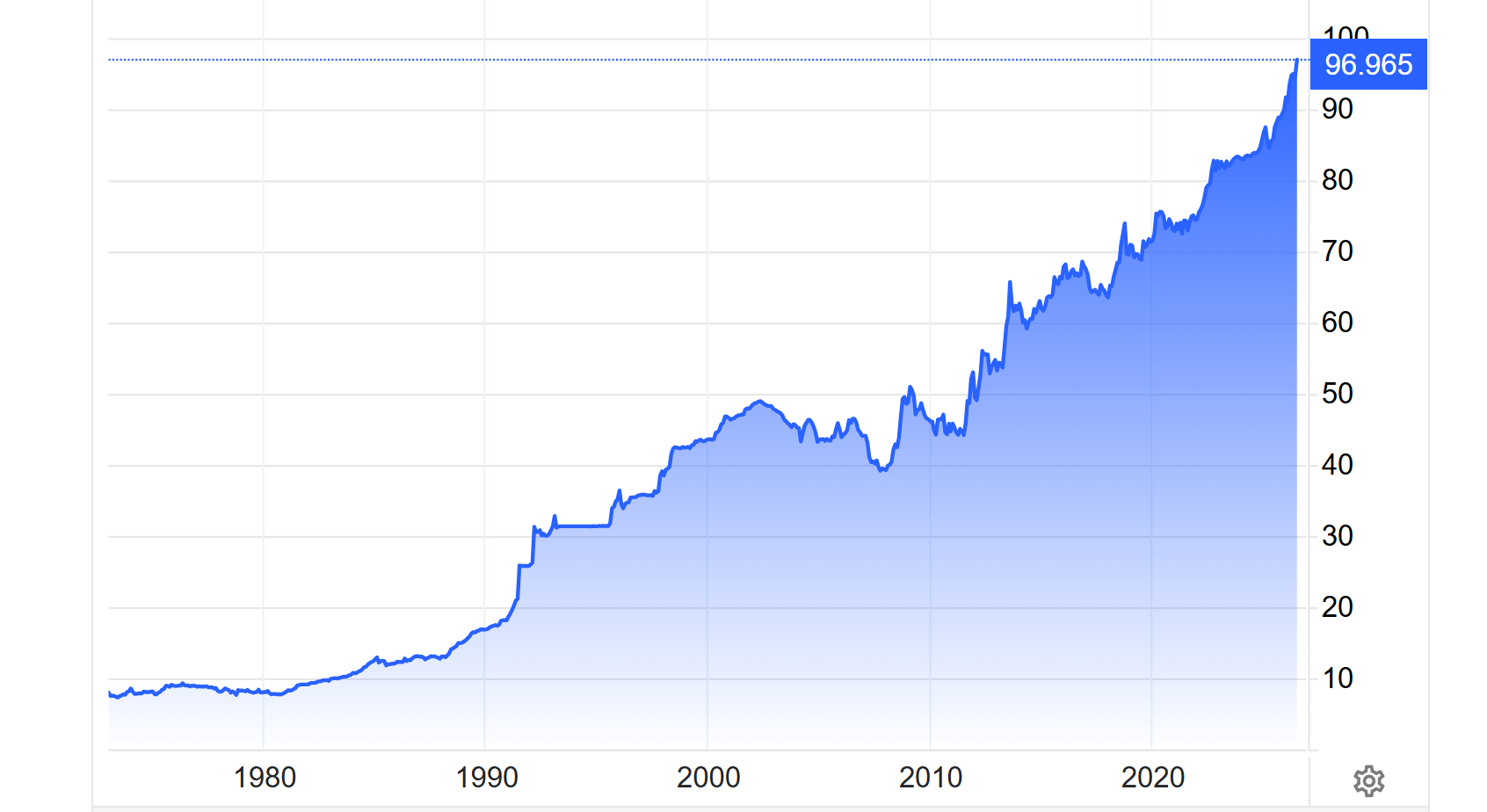
Indian Rupees to the US Dollar:
Steve Ellison writes:
Earlier this week I was recounting my tale of being in Turkey in 2003 when the currency notes in circulation were 1 million lira notes and 10 million lira notes. 1 million lira bought a cup of coffee; 10 million lira could buy a book. Both notes had 1 followed by a string of zeroes with no commas or periods; both had Atatürk's picture, and they were very hard to tell apart at a glance. I learned to turn them over and read the Turkish words as the fastest way to distinguish them.
Aside from that minor challenge, this Byzantine history enthusiast had a wonderful visit, and Istanbul is one of the world's great cities.
Bud Conrad adds:
The Indian ruble, at 90 to the dollar, is only half of the story. The dollar ain't what it used to be either. 1% of what it was in 1971 as measured in gold. How about Iran? 1.3 Million to the $.
Zubin Al Genubi recalls:
I remember Argentina a few years back with Lira 20 to the dollar. $10 US bill could buy crab dinner for two with nice Argentinian whitr wine.
Jul
27
World Cup Soccer, from Zubin Al Genubi
July 27, 2026 | Leave a Comment

Had some stars: Messi, the 19 year old Spanish kid, who had amazing skills of deception using multiple varied fakes, head fakes, fake kicks, fake direction changes leaving defenders falling flat on the ground. Even when defenders grabbed, tripped, pushed them they extricated tai chi style and slipped through. Fun to watch.
The market used to be a lot like them before. My theory is now that bots do almost all the volume, the moves are more mechanical, rigid, less jerky, and somewhat more predictable in a mechanical manner. Especially the brokers who don't care about price, the dealers who don't really care about price and more about delta, and I'd say the banks are the worst as they make their money front running their clients. It might be hard to model the model's interactions, but the blatant price action seems easier to follow for a human being - very directional.
Jul
21
The latest from Dr. Earle
July 21, 2026 | Leave a Comment
Welcome to Trillionistan. Don’t Get Comfortable.
Not all trillions — debts, valuations, investments — are created equal. Huge nominal numbers often obscure the institutions and incentives that produced them.
Peter C. Earle
Not long ago, the notion of trillions belonged either to the furthest cosmic reaches of the universe or the submicroscopic world of atoms. These numbers describe galaxies in the observable universe, roughly two trillion, or, at the opposite extreme, the picosecond — one trillionth of a second — is used to measure molecular motion and chemical reactions. Until recently, magnitudes denominated in trillions were almost entirely confined to the theoretical hinterlands of astronomy, physics, and schoolyard exaggeration.
Today, trillion-dollar quantities have become commonplace in economic and financial life. At least 12 American companies boast trillion-dollar market capitalizations, with Apple approaching $5 trillion. BlackRock now manages more than $15 trillion in assets. The largest technology firms, cumulatively, measure their investments in the trillions as they build data centers, semiconductor capacity, and power systems on an unprecedented scale. SpaceX’s 2026 initial public offering valued the company at more than $1.7 trillion, and its subsequent surge briefly pushed Elon Musk’s paper wealth above $1 trillion.
Billionistan opened its gates in 1901, when JP Morgan assembled US Steel into the world’s first billion-dollar corporation. Perhaps it surrendered statehood on January 13, 2016, the day Powerball offered the first billion-dollar lottery jackpot. After ten more, Billionistan moved from a numerical destination to a waypoint. We now inhabit Trillionistan.
Jul
18

example of something in our Western culture when we "over-use", overly rely on numbers to give meaning to something. Clever marketing idea though. A bit like those French Phds at BNP who looked at their credit derivs spreadsheets in summer 2007 and couldn't see what is behind those numbers as reality is more complex. Humour helps for sure.
Robert Parker's 100-point wine rating system
One of the most influential and controversial features of Parker's wine criticism is his 100-point rating system, which he popularized in conjunction with his friend Victor Morgenroth. Parker designed the system to counter what he believed to be confusing or inflated ratings by other wine writers—many of whom he accused of a conflict of interest, as they often had a financial interest in the wines they rated. The scale, now widely imitated in other publications (such as Wine Spectator[23]), ranks wine on a scale from 50 to 100 points based upon the wine's color and appearance, aroma and bouquet, flavor and finish, and overall quality level or potential. Therefore, 51 rather than 100 different ratings are possible.
Zubin Al Genubi writes:
Other wine makers copy the style of wine with high points and the result is the uniform oaky California wine that all tastes the same and that one guy likes. French say Vive la difference with weather, soils allowing subtle differences in vintages, locations. Its like everyone piling into the same trade or trend in markets.
Big Al comments:
There is research on rating scales - confirmed by my own experience back in the day as a consultant - showing that raters rarely use any scale as designed, but wind up using only part of the scale. So, you have to normalize ratings in some way. Wine ratings show this in that an 88 is wine you don't want to buy - has to be 90 or over, with 92 maybe being the magic number.
Grade inflation would be another current example. Harvard:
Faculty decisively approve grading changes
Cap on A grades and shift from GPA to ‘average percentile rank’ set to go into effect fall 2027
Faculty voted by a wide margin to limit the total number of A’s in undergraduate classes, as part of a broader effort to rein in grade inflation and recenter academics at Harvard College — with proponents hailing the adoption as a principled collective effort to restore meaning to grades and address a complex issue in higher education.
Nearly 70 percent of voting faculty approved the grading cap — which would limit A grades to 20 percent of the undergraduates in any course plus an additional four students, with no limit on A-minuses — with a 458 to 201 vote, in weeklong balloting that closed late Tuesday and was tabulated and audited Wednesday. The policy will take effect in the fall of 2027.
Zubin Al Genubi observes wryly:
The Gentleman's C.
Larry R Williams comments:
Too many wine raters now if you are really into it 98 and above is the good stuff.
Nils Poertner reasons:
As long as people don't take it too seriously - it is all good.
Asindu Drileba writes:
One thing I picked up for western people is the obsession with IQ. In the Terman Study of the Gifted, over 1,000 children with high IQs were tracked since the 1920s. They were given recommendation letters to prestigious programs and backtracked through prestigious schools. But none of them ever got a Nobel prize. What is very ironic was that two kids that were "measured" for the program, but rejected from it for having "too low IQs" ended up winning a Nobel prize.
Another ironic twist was when James D Watson, a eugenics proponent ended up having a child that was intellectually "special needs". If he was under a serious eugenics regime like Nazi germany, he & his entire family would likely be euthanized. Watson still insisted after this that he was still pro-eugenics.
American Military contractor's exploited this religious dedication to numbers during the cold war by providing systems analysts complicated equations that were intentionally blowing up their budgets so they could get bigger contracts. This was harder for non-technical people to question (you would be declared stupid for not understanding the complex equations that computed how many planes we need for the cold war)
There are so metrics in finance that I don't understand. One time, I laughed a bit on seeing a video where Mr. Mark Spitznagel angrily screamed at someone, "You can't eat Sharpe ratio!"
Nils Poertner responds:
for speculation, many ppl over-use rational thinking and lack curiosity, flexiblity etc. too much rational thinking often acts as "barrier" for intuition, too. (those 2 French Phds I had in mind back in 2007, I love to make fun of the French Phds as they are not in the room).
Jul
13
Turing test, from Zubin Al Genubi
July 13, 2026 | Leave a Comment
The Turing Test, originally introduced by British mathematician and computer scientist Alan Turing in his 1950 paper "Computing Machinery and Intelligence," is a proposal for evaluating whether a machine can exhibit intelligent behavior indistinguishable from that of a human.
This is more relevant today than ever. Applied to the market some moves appear very machine like. Other moves not so much. A large proportion if trades now are computer generated. Maekt making must all be computer managed. Humans still can game the machines as their rules are fixed.
Peter Ringel writes:
The Turing Test is fuzzy. Useful, but not precise. The underlying question is: Is AI conscious? My answer is: NO! but it is a freakishly good imposter.
It is also domain specific. In my opinion, in the general domain, AI broke the Turing Test in 2024. Humans can't distinguish anymore responses from robots to humans in the general domain. In specific domains it is different. The low to mid level is broken, the mid to high is not. OTOH, recently we had news that open AI proofed some longstanding Math hypothesis (I lack the knowledge to judge). And we all know about Google's AlphaFold. Both domain specific. High End.
Market making was algo based before AI. I indeed, try to game this with my human discretion. (At least in the sort-term part of my trading. It is not relevant for longer TF.) AI definitely facilitates research. This makes markets more efficient and faster efficient. I think we are seeing this currently.
Creativity is not broken. I hope, as of now.
Oliver Joseph writes:
A conversation that I find endlessly fascinating. In my opinion the current technology stack with regards to LLMs and machine learning tools in general is an absolute game changer. The barriers of entry associated with software seem to have been lowered significantly, however to use another tech analogy the "last mile" still remains elusive. By that I mean that the LLM really needs help to get certain complex problems over the finish line. That said, what we are dealing with is essentially a cliche generator. Humans tend to anthropomorphize, and personally I have found myself pondering the meaning of consciousness as I use the latest generation of LLM's ( I don't think we are dealing with consciousness here). Rich Suttons essay "The Bitter Lesson" from 2019 concludes with the idea that we want "AI agents that can discover like we can not which contain what we have discovered" arguing that by using experts to build in their knowledge it makes it harder to even see how the discovering process happens in the first place. He emphasizes a focus on what he calls scaleable general purpose methods primarily search and learning. It is interesting to me as I work with locally run models to see what output the <| think |> control token actually generates. I have one of those old IBM notepads that says think on it, however I must say I am prodded to think myself as I see this machine chugging through the art of thinking clearly with such mechanical precision (now we're in Dobelli of the beast). In conclusion I agree with the above sentiment that creativity is not broken but rather like where T.S. Eliot was wrestling with the concept of historical sense in his art; we now find ourselves with a large portion of human knowledge existing simultaneously in one place frozen in time, embalmed and pacified. It is up to us to be creative and let the tool inform our creative throughput.
On another tangent when I produce and or record music my workflow (and output) is changed by the tools I use. Ableton on a Macbook with VSTs gives me a different feeling and results than using an Atari 1040st and an Akai S950. I get the same feeling as I use LLM's for certain tasks.
Zubin Al Genubi adds:
I find AI helpful but AI doesn't quite get the joke. Kind of like a super-smart nerdy guy.
Nils Poertner comments:
From a spec point of view, there are tremendous opportunities where human creativity is always finding something which LLMs not seeing…as they have built mirrors in a mirror rooms and confusing this room with reality (but reality remains mysterious, indescribable and so on…and fuzzy logic or jain logic is already a slight improvement to our "either-or" logic that is so prevalent in our times).
Peter Ringel responds:
Yes, the tools we use define culture. Music culture, trading culture - binned per generation. AI is a tool (as of now).
If I close my eyes, I still can hear the metronome signal of Cubase through a crappy 1040 sound speaker ( or was it the monitor ?): "meeeep, mup mup mup" for a four to the floor. Cubase and similar tools made it easy to create a typical track structure. Probably long and repetitive. This defined the 90 and 2000 pop music. Before that - with some overlap - Sound-tracker. The UK in the 90 is unthinkable without it. Way more interesting. Then Fruity loops and similar. More questionable structure. Then Ableton. It freed the structure again, the creativity. I don't know, what the kids prefer now.
Nils Poertner responds:
Yes, very good. Real speculators are incredibly good in finding opportunities in mkts (and not just go with the latest fashion and think that's it). For older specs it will be "how to keep and possibly improve health" and for younger ones, I suppose it is how to turn their frustration/ anger into creativity and learn the game.
Oliver Joseph writes:
I love that Peter. Yes, Cubase was and is a fantastic tool precisely because of its constraints.
LLM’s being another cool new tool it is worthwhile to make an attempt to understand its uses and constraints. As a very simple thought experiment I asked three different models de jour to generate a random number between 0 and 500. I ran 500 iterations of the prompt per model. The “think” tokens generated reasoning from the models that stated basically “I’ll just pick a number that sounds random”. The “think” token of course being obscured from the end user. Going through such gesticulations is completely unnecessary other than I think that conceptually it's important to understand that here we ask for an output (the random number) and what we actually get is a number within the bounds of the below graph. Importantly we run the risk of thinking it's what we actually asked for. Surprise! It's not. Everyone on the spec list knows the right tool for the above job is a HRNG or TRNG or who knows what all else; lava lamps and wristwatches.
To my mind it is one of those inexplicably beautiful facts of history that Wall Street was thus named for a wall that separated traders and speculators from livestock. In the car business we have a large vocabulary derived mostly from farming and the cattle business. One thing that we would commonly do is go out and “put hands on” our “stock” go physically touch and look at the car. Statements are a representation of inventory I am supposed to have and obviously they have their use.
In summary as has been the case for the last 6000 years of recorded human history the farmer has asked the farmhand “where is the cow?” and the farmhand sometimes just said “over by the watering hole.” even though he actually had no clue. We equate the representation of the thing and the thing in and of itself at our peril. As speculators we should endeavor to identify the places in our experience where an incorrect representation is believed in more so than the thing in and of itself. I believe it pays to every now and again to hop the liminal.
Jul
8
They are history’s geniuses. But were they any good at investing?, from Asindu Drileba
July 8, 2026 | 1 Comment
Brilliant podcast from Financial Times. Analyses the investment styles of Charles Dawrin, Isaac Newton, Winston Churchill (blew up his GBP 80 million account), the painter J. M. W. Turner doing fixed income arbitrage, J. M Keynes out performing Warren Buffet.
They are history’s geniuses. But were they any good at investing? | The Story of Money Podcast
Does scientific, artistic or political brilliance translate into investing success? It’s a topical question with hedge funds today accused of sucking talent away from the rest of the economy. So, the FT’s Gillian Tett and Robin Wigglesworth sat down with reporter Toby Nangle, who has dug into the archives to assess the investment portfolios of Isaac Newton, Charles Darwin, Winston Churchill, John Maynard Keynes and other widely regarded geniuses of the past. What Toby found may surprise you, as will the historical wildcard he’s unearthed.
Jul
4
The American Revolution Redefined Freedom Itself
When the Continental Congress approved the Declaration of Independence on July 4, 1776, its immediate purpose was practical: to justify severing ties with Great Britain and explain to audiences both foreign and domestic why rebellion had become necessary. Yet the document’s historical importance extended far beyond the thirteen colonies. The American declaration not only created a new nation, but helped establish a new political language: a language rooted in natural rights, popular sovereignty, and the legitimacy of political self-determination. It was a language that would reverberate across continents for centuries.
Jul
4
Holiday Ideas for Americans, from U. S. Humbert
July 4, 2026 | Leave a Comment
A new Cato Institute/Morning Consult survey finds that 46 percent of Americans don't know what Saturday commemorates.
Idea 1: Lead a family event where the Declaration of Independence is read in its entirety.
For the fuller, messier version of the origin story, see "The 'Two Ships' Theory of American History" in the August Atlantic — James Traub's review of historian David Reynolds's Two Ships, on why Americans have never agreed on where their country began.
Full disclosure: the author is a confirmed descendant of both Mayflower passengers and Jamestown settlers — and a relation of Oliver Cromwell besides. If Reynolds is right that America was separated at birth, the divide runs straight through my DNA.
Then read the Mayflower Compact, written 156 years before the Declaration. Notice that the principle Jefferson would make famous — government by "consent of the governed" — is already at work in it: the signers "covenant and combine ourselves together into a civil body politic," binding themselves to laws of their own making.
Idea 2: Look for local mattress sales.
Stefan Jovanovich writes:
Six men who were delegates to Congress on July 1 and 2, 1776 declined to vote for the resolutions that authorized the Declaration of Independence. Four were from Pennsylvania: John Dickinson, Charles Humphreys, Robert Morris and Thomas Willing. John Alsop was from New York and George Read from Delaware. Two of the men would actually sign the Declaration when the document was presented to Congress on August 2nd; Robert Morris, who had abstained, and George Read who had voted no. John Dickinson would leave Philadelphia in July; Charles Humphreys and Thomas Willing would be removed from the Pennsylvania delegation before the document signing date.
Of the four men who said “no” and meant it, Thomas Willing would become the most important; President Washington would nominate him to become the first President of the Bank of the United States. and join the Pennsylvania militia; he would return in 1779. John Alsop would formally resign from Congress on July 16th. The other two delegates from Pennsylvania – Willing and Humphreys – would be removed from their delegation before the Declaration’s formal signing on August 2nd. Robert Morris and George Read would sign the physical declaration when it was presented to Congress.
Thomas Willing would stay in Philadelphia and work with his former business partner Robert Morris to fund the Continental Army. Morris, like the other members of Congress, would skedaddle to York when General William Howe and his British army arrived on September 26, 1777. The Loyalists would celebrate their arrival with parties and celebrations; Willing and his family, who were the richest people in the Philadelphia, would refuse to attend. When Willing was sent the formal oath of allegiance to King George III that Howe’s command was requiring of all prominent residents of the city, Willing refused to sign. Howe let Willing stay because there was at least some hope that Britain and the Americans could end their war. At the end of October, the rumor reached Philadelphia that a motion had been presented to Congress to rescind the vote for independence and it has lost by only one vote. On November 2, 1777 Howe would meet with Willing and his colleague John Brown. (Willing and Brown would be among the founders of the Bank of North America.) At the meeting Howe would express his desire to see a cease fire and peace settlement based on having the status of affairs in the thirteen colonies return to what they had been in 1763 and the Declaration being withdrawn. The Americans agreed to pass on the message. Henry Laurens, President of Congress, would report the proposals to George Washington. In his response, Washington would write: “it has been the unvaried custom of the enemy, from the commencement of the present contest, to try every artifice and device to delude the people. The message sent through John Brown was calculated for this end. I am surprised Thomas Willing should suffer himself to be imposed on by such flimsy measures. He knows that there is a plain, obvious way for General and Lord Howe to communicate … to Congress, without the intervention of a second or third hand. But this would not suit their views.”
A decade and a half later Washington would appoint Willing to be President of the Bank of the United States. When asked why he had voted no on the Declaration of Independence, Willing wrote: :“I voted against this declaration in Congress not only because I thought America at that time unequal to such a conflict as must ensue—having neither arms, ammunition, or military experience—but chiefly because the delegates of Pennsylvania were not then authorized by their instructions from the assembly as the voice of the people at large, to join in such a vote.”
Jul
3
The Cost of Chasing Zero, from V. Humbert
July 3, 2026 | Leave a Comment
The Trump administration is revising the radiation rules for commercial nuclear power. Headlines suggest a safety rollback. The reality is closer to retiring a rule that outlived its purpose. The savings may prove modest; the principle at stake is whether regulation should require spending to address risks too small to measure.
The rule is ALARA — "As Low As Reasonably Achievable." Developed by international radiation-protection bodies in the 1950s and adopted by U.S. regulators in the mid-1970s, it now sits in NRC regulation at 10 CFR 20.1101(b). It requires licensees to push doses as far below the legal limits — 5 rem per year for workers, 100 millirem for the public — as is reasonably achievable.
On paper, ALARA is a cost-benefit test; economics is built into its definition. In practice, it has drifted toward open-ended dose minimization. A U.S. plant's contribution to public exposure is now a fraction of the roughly 300 millirem that Americans receive annually from natural background radiation. Yet designers must keep spending — on shielding, staffing, and procedures — to drive those trivial numbers even lower. I have stood inside the containment building of an operating reactor — Big Rock Point, at full power — and the visit was routine under the plant's radiation protection program.
The fix is underway. A May 2025 executive order directed the NRC to reconsider ALARA; the Energy Department struck it from the directives governing its own facilities in January; and the NRC has begun replacing ALARA requirements for commercial facilities with fixed dose limits. NRC’s final rules are expected in November. New-build developers stand to benefit most, with lighter shielding and construction requirements.
Two cautions for investors. Even the industry's position is layered: the Nuclear Energy Institute has urged the NRC to replace the ALARA requirement with a practical dose threshold, while signaling that operating plants — where ALARA programs have kept worker doses low — would retain those practices voluntarily. Critics also allege procedural shortcuts that invite litigation, so the savings shouldn't be banked yet. Fair points, both. But a requirement to spend without limit against risks below background has run its course.
Jul
2
Best Patrick O’Brian entry point?, Asindu Drileba
July 2, 2026 | Leave a Comment

I need your advice. What is the best entry point for his work?
Paolo Pezzutti responds:
No doubt. Master and Commander.
Big Al adds:
Yes, it's a series, and the first volume is Master & Commander.
A fascinating biography of a man who was some of the inspiration for O'Brian's writing:
Archives
- September 2026
- August 2026
- July 2026
- June 2026
- May 2026
- April 2026
- March 2026
- February 2026
- January 2026
- December 2025
- November 2025
- October 2025
- September 2025
- August 2025
- July 2025
- June 2025
- May 2025
- April 2025
- March 2025
- February 2025
- January 2025
- December 2024
- November 2024
- October 2024
- September 2024
- August 2024
- July 2024
- June 2024
- May 2024
- April 2024
- March 2024
- February 2024
- January 2024
- December 2023
- November 2023
- October 2023
- September 2023
- August 2023
- July 2023
- June 2023
- May 2023
- April 2023
- March 2023
- February 2023
- January 2023
- December 2022
- November 2022
- October 2022
- September 2022
- August 2022
- July 2022
- June 2022
- May 2022
- April 2022
- March 2022
- February 2022
- January 2022
- December 2021
- November 2021
- October 2021
- September 2021
- August 2021
- July 2021
- June 2021
- May 2021
- April 2021
- March 2021
- February 2021
- January 2021
- December 2020
- November 2020
- October 2020
- September 2020
- August 2020
- July 2020
- June 2020
- May 2020
- April 2020
- March 2020
- February 2020
- January 2020
- December 2019
- November 2019
- October 2019
- September 2019
- August 2019
- July 2019
- June 2019
- May 2019
- April 2019
- March 2019
- February 2019
- January 2019
- December 2018
- November 2018
- October 2018
- September 2018
- August 2018
- July 2018
- June 2018
- May 2018
- April 2018
- March 2018
- February 2018
- January 2018
- December 2017
- November 2017
- October 2017
- September 2017
- August 2017
- July 2017
- June 2017
- May 2017
- April 2017
- March 2017
- February 2017
- January 2017
- December 2016
- November 2016
- October 2016
- September 2016
- August 2016
- July 2016
- June 2016
- May 2016
- April 2016
- March 2016
- February 2016
- January 2016
- December 2015
- November 2015
- October 2015
- September 2015
- August 2015
- July 2015
- June 2015
- May 2015
- April 2015
- March 2015
- February 2015
- January 2015
- December 2014
- November 2014
- October 2014
- September 2014
- August 2014
- July 2014
- June 2014
- May 2014
- April 2014
- March 2014
- February 2014
- January 2014
- December 2013
- November 2013
- October 2013
- September 2013
- August 2013
- July 2013
- June 2013
- May 2013
- April 2013
- March 2013
- February 2013
- January 2013
- December 2012
- November 2012
- October 2012
- September 2012
- August 2012
- July 2012
- June 2012
- May 2012
- April 2012
- March 2012
- February 2012
- January 2012
- December 2011
- November 2011
- October 2011
- September 2011
- August 2011
- July 2011
- June 2011
- May 2011
- April 2011
- March 2011
- February 2011
- January 2011
- December 2010
- November 2010
- October 2010
- September 2010
- August 2010
- July 2010
- June 2010
- May 2010
- April 2010
- March 2010
- February 2010
- January 2010
- December 2009
- November 2009
- October 2009
- September 2009
- August 2009
- July 2009
- June 2009
- May 2009
- April 2009
- March 2009
- February 2009
- January 2009
- December 2008
- November 2008
- October 2008
- September 2008
- August 2008
- July 2008
- June 2008
- May 2008
- April 2008
- March 2008
- February 2008
- January 2008
- December 2007
- November 2007
- October 2007
- September 2007
- August 2007
- July 2007
- June 2007
- May 2007
- April 2007
- March 2007
- February 2007
- January 2007
- December 2006
- November 2006
- October 2006
- September 2006
- August 2006
- Older Archives
Resources & Links
- The Letters Prize
- Pre-2007 Victor Niederhoffer Posts
- Vic’s NYC Junto
- Reading List
- Programming in 60 Seconds
- The Objectivist Center
- Foundation for Economic Education
- Tigerchess
- Dick Sears' G.T. Index
- Pre-2007 Daily Speculations
- Laurel & Vics' Worldly Investor Articles
