Oct
24
Lies, Damned Lies, and Medical Science, shared by Bill Egan
October 24, 2010 | Leave a Comment
Much of what medical researchers conclude in their studies is misleading, exaggerated, or flat-out wrong. So why are doctors– to a striking extent– still drawing upon misinformation in their everyday practice? Dr. John Ioannidis has spent his career challenging his peers by exposing their bad science.
From the article "Lies, Damned Lies, and Medical Science" in the Atlantic.
Craig Mee writes:
Thanks Bill, outstanding read. Everyone should read that including the whole family. It does most reality tv shows and glossy mags out of a job….that's how enjoyable it is. Test and retest, especially the original basic findings seems to be one of the main messages (which dailyspec emphasises often)…and everyone has got their own agenda mixed up in everything all the time.
Replacing quants and traders for reasearchers and physicians in this passage brings some interesting thoughts, and for the passage: "there's simply too much complexity in patient treatment", think individual markets.
"Researchers and physicians often don't understand each other; they speak different languages," he says. Knowing that some of his researchers are spending more than half their time seeing patients makes him feel the team is better positioned to bridge that gap; their experience informs the team's research with firsthand knowledge, and helps the team shape its papers in a way more likely to hit home with physicians. It's not that he envisions doctors making all their decisions based solely on solid evidence—there's simply too much complexity in patient treatment to pin down every situation with a great study. "Doctors need to rely on instinct and judgment to make choices," he says. "But these choices should be as informed as possible by the evidence. And if the evidence isn't good, doctors should know that, too. And so should patients."
Victor Niederhoffer comments:
I have always said that aside from the licensing of Drs. , the insistence on double blind studies needed for approval is one of the greatest reducers of life expectancy, and of course, maintainers of anti competitiveness, and of course, improper use of statistics in the real world aside from our own field.
Oct
22
Close Clustering, from Victor Niederhoffer
October 22, 2010 | Leave a Comment
Interesting clustering of closes in SP last 7 days 6 of the within 2 of 1175.5 .
Jay Pasch comments:
The sine wave immediately comes to mind. as she continues to cloak her direction there was one event registered yesterday on the nasdaq composite, the golden-cross thing, that could provide a directional clue; when nasdaq's 50sma crosses above its 200sma with the index trading in the upper one-third of its 52wk range, the index is up 16-for-16 with an average gain of 3.2% about 11 days after the cross.
Oct
22
Saw Secretariat, from Victor Niederhoffer
October 22, 2010 | 2 Comments
 I saw Secretariat on the recommendation of the list and had a few comments. A Very direct, 4 square film. Plain vanilla.
To try to get good critical reviews, they didn't use the usual device of turning the radio on to anti republican stuff, or selfish sounding things about people who don't believe the purpose of life is suffering, but they signaled their liberal credentials by having the girls doing anti war stuff throughout, and putting down the father for being a establishment type.
The Mrs. Tweedy, the daughter that inherited the farm, was a very poor loser. After winning 6 races in a row, she was ready to fire the trainer and Turcotte, the jockey, after one third place finish. Only when she found out it was an abcess did she let the trainer off the hook. Sort of like the trading manager or customer who gets angry the first losing month.
The race at the Belmont Stakes where Secretariat wins by 30 lengths was amazing in that he reversed his usual form and went out for the lead instead of staying in back. Sort of like the market that likes to go up at the end of day after being down throughout, then changes tempo the next day, and opens unchanged, and then going up and up and up further each hour of the day. To the amazement of the other side. Racing jockeys is a very tough game as Turcotte suffered a spinal injury and now is in a wheelchair because of his driving to win style, and presumaby the resentment of his fellow jockeys.
It's good to see a woman, Mrs. Tweedy, running a business successfully, but her decisions seemed based on emotion rather than horse sense. Someone helped her with the idea of syndication at a high price which was very good. The husband was a jerk and a petty hanger on, as befits a ivy professor living in the shadow of his wife. He was ready to leave her when he thought she might risk some of his stake. Amazing if they stayed married.
Oct
21
A Recent Study, from Victor Niederhoffer
October 21, 2010 | 4 Comments
 A recent study shows that Asians need about 50 points higher on the SAT to get into college than White students and 100 more than Black students. It is well known that Asians have a higher IQ by 5 points than Westerners. This is tested in numerous academic papers. Also, well known is that the more intelligent the CEO, the better the performance of his company or hedge fund. One hypothesizes therefore that the companies whose CEO's are Asian will show superior performance to those headed by your average non-Asian Harvard Business School Graduate, (although if they haven't taken the mandatory ethics course there, they are more likely to be caught in flexionic pursuits that the elite schools are so good at whitewashing). What is the support for all these statements? and: How could they be tested?
One knows that this is the most rancorous subject under the sun, and I have lost many friends when I was foolish enough to discuss this in the past, and point them to the incontrovertible evidence about individual differences from a Galtonesque perspective, but let us please try to keep it civil, and stick to the scientific literature (none of this armchair stuff about this or that study being culturally biased as the more culture free the tests, the greater the differences) and no anecdotes, but predictions and tests and references.
Alex Castaldo adds:
Since the Chair does not give footnotes, it is not easy to find the sources for his information.
I believe the "50 point study" may be the one mentioned by Steve Sailer's blog.
An IQ figure of "6 points higher" is given in the Rushton Jensen review paper.
Russ Sears comments:
I have doubts to the usefulness of CEO's IQ test as over-performance of a companies stock. It is not that CEO's do not need to be smart, it is simply that there are enough smart people around and business is tough enough that those that made it have been culled out and vetted pretty completely. Show me the numbers, I am a skeptic.
Further, while creativity to overcoming obstacles in ones life may suggest carry-over into a CEO's performance. I doubt that overcoming one political rigid standard of race by offsetting another no doubt equally rigid political standard for entry into elite colleges would translate into the creativity needed for a successful business. Rather it signals the willingness to conform for acceptance. You mention Asian, but how many of the Asian's admitted for instance are women, versus men? Any stock study of CEO IQ education and minority must consider that education by minority race in the USA is widely distorted by the politically preferred sex of a student. May I suggest that one takes the list of Jewish Noble winners find how many come from the ivy league schools and compare this percentage to the non-Jews. Yes, the ivy league alumnus have a smaller world than most. But may I suggest those with the creativity to overcome this lack of sheepskin, are those that would out perform.
Here are some reasons why I believe IQ can be a handicap to a CEO…
1. Those great at answering questions that others already have the answers, a test situation, often find it uncomfortable and difficult to switch to asking questions that the answers are not known. The ability to ask questions that others did not is a key to make a difference.
2. Necessity is the mother of invention and desperation is the mother of risks taking. A well paying job, is often the road-block to starting a business. Probable failure is hard to choose when you have almost certain path to mild success. Yet it is the probable failures that succeed that skyrockets company. And vise-a-visa its the probable successful businesses that are blind-sided by innovation.
3. Like Reagan, often the most brilliant performers as a team are those that want to work with the smartest minds, they do not have to be the smartest guy in the room. The successful CEO does not have to ask the right question, he simply has to ask the right person to ask the right question.
4. High IQ people perform best with less stress, they can choke more in stress, does the Peter Principle apply to them under stress?
There are a couple thoughts that come to mind that could be tested.
1. New Research has shown that the brain does develop new cells, These baby brain cells are produced by cardiovascular exercise. Further, test after test suggest that cardio improves your creativity. Do CEO's that exercises out perform? There was a study of CEO gulf handicaps, is there a similar study of say 5k times? Are there other test of creativity, say CEO's that are talented pianist, CEO's that are writers do they out perform? Do CEO rising from the operational side ( engineers, IT etc) outperform those that come from the marketing side?
2. A few years ago it was suggested that many CEO's are dyslexic, Could a twice exceptional CEO (high IQ but learning disability) out or under perform?
There are a couple thoughts that come to mind that could be tested.
Victor Niederhoffer adds:
For those interested in a factual, scientific discussion of environment versus innate influences, rather than armchair speculations so grievously present in our environment, and so dysfunctional to proper thinking about markets if similarly believed or proposed, I would recommend this article and the references cited thereto.
Also note the same kind of commentary there relating to making all individual differences consistent with the idea that has the world in its grip, and the purpose of life being self sacrifice.
Oct
21
A Gravitational Attraction? from Victor Niederhoffer
October 21, 2010 | 2 Comments
 One wonders if by considering the distances and weight of one market from another one would create a gravitational attraction possibly related to square of distance. Would this be even better way to explain recent market moves than twitter? So many markets are up that they pull stocks with it. Every day the crude and the gold and the grains and the metals exert their gravitational attraction on stocks and it's hard for stocks to go down when gravity of everything else is pulling them up?
Ken Drees comments:
Attraction theory may also pull monies from undervalued sectors-like nat gas for example– keeping these sectors starving for investment.
Anatoly Veltman writes:
My take is the former recent relationship has been more a product of U.S. dollar's daily devaluation. Thus the commodity part of it was only a further derivative.
Phil McDonnell writes:
Imagine we are on an island with only two things to trade stocks and gold. Naturally we use sea shells for money. At any given time there is only so much money M. So the total price of stock and gold is proportional to that. In fact we can visualize the possible prices as a circle with radius M and the X and Y axis are the prices of gold and stock respectively. The locus of possible points they can lie on is given by:
M^2 = G^2 + s^2
where I have changed the x and y to g for gold and s for stock.
Since M^2 is a constant at any given time we can just call it c and then we have.
s^2 = c - g^2
showing the relationship. This is all very pretty theory but does it stand up empirically?
The coincident correlation base on daily percent changes between gld and spy for the last 105 days was about 1%, so not much linear going on. but when we look at the relationship between spy^2 and gld^2 we get a 42% correlation consistent with the formula above. When we rewrite the formula for m and not m^2 we get:
m = ( g^2 + s^2 ) ^ .5
which is just the distance formula from high school.
Thought question: What happens when the Fed adds Q to M during QE 2?
Sushil Kedia writes:
The House Money effect works the same way. There is more valuable collateral, there is a larger amount of mental wealth, there is a larger appetite for risk. Akin to the rabbit coming out of an empty hat, money grows in the minds of the market players, when things are moving up.
As one large down move comes in a widely betted asset it gravitationally sucks away the value of the collateral utilized for playing other assets. Like the invisible forces of gravity the various contracts naturally move by in varying proportions broadly in similar directions, mostly together.
I would be inclined to recognize the effect of the varying amount of bets inside different pits and the varying spread of those bets across hands of differing strengths. With that in place any static relationships in assets or contracts is less than likely to be existent for any periods of prediction worthy time horizons. The ever changing cycles are likely originating from this varying nature of the spread of the bets. The vector sum total of all current and past and future bets may indeed by hypothesized as zero. Yet the similar sum at the present moment is not zero. Every changing tick hurts or rewards different sets of people simultaneously.
So, without so much as trying to invoke my limited numeracy skills before the mighty minds, I lay a case, that the pursuit of discovering constant relationships in the markets is the innate desire of men to find a constant while knowing fully well that the meal for a lifetime indeed is the knowledge of ever changing cycles.
Ralph Vince comments:
I lay a case, that the pursuit of discovering constant relationships in the markets is the innate desire of men to find a constant while knowing fully well that the meal for a lifetime indeed is the knowledge of ever changing cycles.
What could be more true than that statement?
We build models of the market– some, with ever-increasing complexity.
Take the stochastic differential equation for price changes in continuous time, where the second term is the Weiner process:
S0 = u S1 dt + dX
Involved math for many of us– but, as a model for how prices change, …it too is pathetically lacking. Our models are not reality, just little peepholes on it's behavior at times.
Sushil Kedia replies:
To add, one early school beginner's physics question:
If gravity works the same way on a feather as well as on a stone, then why does the stone drop sooner to the ground?
Well, the air that provides so much of rest to the feather that it takes longer to come down.
Likewise, the "air" inside the markets that is the varying size of bets of any individual participant as well as the varying size of the total bets present in a market bring by the gravitational pulls to still carry wide and varying variances.
Oct
21
If You’ve Noticed, from Victor Niederhoffer
October 21, 2010 | Leave a Comment
 If you've noticed how quiet I've been, don't be overly concerned (or joyous if you're one of my numerous debunkers, trend followers et al) that I have lost everything again, but my quietude was due to having to write a book review for a publication that one has read two times each for 60 years, (once to count the greatest cult story since Festinger) of Markman's oversized 500 page 200,000 word masterpiece about Jesse Livermore, who married a woman who had five husbands, each of whom committed suicide. The contagion spread to all three Jesse's, the son and grandson who also committed suicide, as well one would expect for someone who paid so much vig to his counterparts. Very interesting crookery that Jesse used to beat the bucket shops, closely related to n and o on market making referred to before. The main thing about Markman's book is that it's as exuberant as the old bond pit at the Chicago Board of Trade. It makes you want to jump out of your skin.
Oct
19
Magic by Numbers, from Chris Tucker
October 19, 2010 | 1 Comment
 Referred to me by the folks at the Museum of Mathematics, there is a great article in NY Times that refers to M. F. M. Osborne's 1962 paper: "Periodic Structure in the Brownian Motion of Stock Prices"
Excerpt from the op-ed article "Magic Numbers" by Daniel Gilbert:
Magic “time numbers” cost a lot, but magic “10 numbers” may cost even more. In 1962, a physicist named M. F. M. Osborne noticed that stock prices tended to cluster around numbers ending in zero and five. Why? Well, on the one hand, most people have five fingers, and on the other hand, most people have five more. It isn’t hard to understand why an animal with 10 fingers would use a base-10 counting system. But according to economic theory, a stock’s price is supposed to be determined by the efficient workings of the free market and not by the phalanges of the people trading it.
And yet, research shows that fingers affect finances. For example, a stock that closed the previous day at $10.01 will perform about as well as a stock that closed at $10.03, but it will significantly outperform a stock that closed at $9.99. If stocks close two pennies apart, then why does it matter which pennies they are? Because for animals that go from thumb to pinkie in four easy steps, 10 is a magic number, and we just can’t help but use it as a magic marker — as a reference point that $10.01 exceeds and $9.99 does not. Retailers have known this for centuries, which is why so many prices end in nine and so few in one.
Gary Rogan adds:
I found this article that says a different numerical bias affects the entire universe under various guises.
Ken Drees asks:
Would it be fair to say that "deliberateness", a concept of action, is required for Benford's law to engage in natural environment. A quake, a wind, a measurable force?
Gary Rogan replies:
I don't think so. I was trying to explain to myself how something so basic yet so powerful can exist and this is the explanation I just came up with (and it's fully consistent with randomness of certain processes).
Imagine yourself shooting projectiles at an infinite log base 10 labeled axis. What are the chance that any number you hit starts with 1 if everything is completely random? My geuss was it's log base 10 of 2, and voila: I just calculated it and it's equal to .301, or the percentage they cite (30.1%). This law must characterize any truly random phenomena where the measurements are distributed over many orders of magnitude. When you don't see this law, this must indicate absence of randomness or a close concentration around some mean.
Jeremy Smith comments:
In the binary number system, all numbers save zero begin with a 1.
Gary Rogan writes:
The probability of the number starting with a 1 is log of 2 base whatever type number system you have other than of course for the binary system. It's just the ratio of the distance between 1 and 2 on the log axis divided by the distance between 1 and the number equal to the base of the system. There may be even a way to express it so that it works for the binary system since log of 2 base 2 is 0, but not right now.
Victor Niederhoffer comments:
Osborne was reporting on a phenomenon he and I studied in a number of papers see "N and O Jasa 1966" for references, and his work was not a Benford thing. it was a specialist thing with all the limit orders concentrated there. It's related to Livermore's breakthrough "the round number" and much else. By the way I consider Osborne the greatest researcher in this field to have ever graced the behavioral finance and efficient markets field. His creativity was unbounded.
Oct
18
A Venerable Technique, from Victor Niederhoffer
October 18, 2010 | 2 Comments
 One of intelligent honest things that Livermore did was to get out of one market by selling a related market, inducing the other traders to think that there was weakness in one market which would carry over to the related market. The art of indirection and letting people use their own intelligence and inferences to come to their own conclusion. for example if he wanted to get out of cotton, he'd sell some coffee. If he wanted to get out of a common, he's sell the preferred or a related company that owned a big chunk of it, like sell Christiana which owned general motors et al. This technique one wonders how often is it used today. When it happens, is it artful indirection or chance? How to quantify and what predictions to be made? Would the robots be smart enough to do this?
Anatoly Veltman writes:
There was a moment in late 80s Energy trading, when legend has it that a great admirer of Livermore who runs a venerable hedge fund near New York was Bearish to the tune of 40,000 lots. If you think it's not much, just remember that Exchange limit for open speculative position in any contract was 6,000. Of course, his positions were in all possible inter-month spreads and across products. So once decision to cover was made, he picked up the phone and asked for the cockiest trader in the Crude pit. "Are you a man or mouse?" Trader thought it was a prank: "Come on Paul, what do you want?" "I'll give an order to sell 1,000 market, and I mean worst. But if I don't see Crude print through even– they're all yours! Do you accept?"
Tim Melvin comments:
Smart enough? Its one of the key concepts the black box guys I have spoken to use every day? I am not a programmer, nor do I play one on TV but it seems to me that a good one could set that up in short order….
Jeff Watson comments:
One technique still used today on a limited basis is to buy or sell a large order in a single batch and see how the market digests it. A trader can glean a lot of information about direction by seeing if his bid or offer is gobbled up or many of the same order comes out of the woodwork. This method worked great when the pits were active, and still works somewhat in the computer age.
Oct
18
Thoughts on Reminiscences of a Stock Operator, from Victor Niederhoffer
October 18, 2010 | 2 Comments
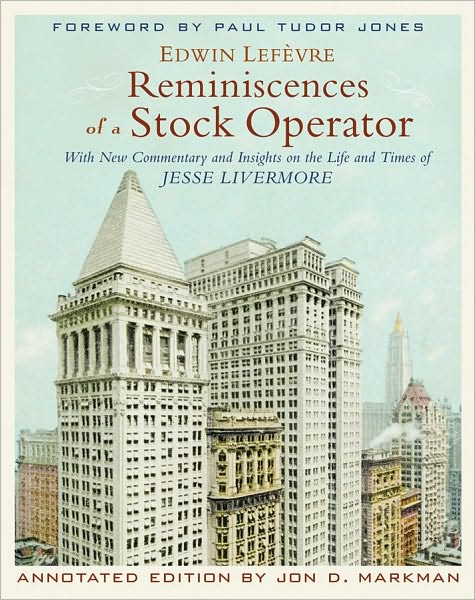 One of the fascinating things in Reminiscences of a Stock Operator is the constant interplay between duplicit and dishonest practices of Livermore himself and the crooks he deals with. It reminds one of the crossroaders book where the two best friends cheat each other with a mechanical mirror and other means in constant games between them. Only when they realize that the stake between them keeps getting smaller do they realize that they're both getting poorer because they have to pay the third crook, the "mechanic" for the use of the mirror. The rake was constant. They both show no compunction about cheating their best friends until they realize they've been viged to death by a third party.
Livermore is constantly appalled that in the nefarious schemes of manipulation and cornering that the holders of worthless securities engage in with him, that his customers have no honor among mutual thieves like the crossroaders. His terms for a manipulation are as follows: suppose the manipulators have 200000 shares of a listed stock at 40. Livermore will take call on all 200000 shares of stock at 40 for 1 year. They will also put up 6 million in cash for him to make a market and engage in his own insider trading with.
I doubt that the two most wealthy fellow travelers themselves and friends of the Oval who engage in such transactions with the triangle of their colleagues in the banking, and legislative branches receive such favorable terms or insider information today, albeit they seem to have more influence on the terms and policies.
In any case, how would you value what Livermore's normal take was for such a manipulation? He receives a call for 1 year on 2000000 shares and that's worth about 10%, so 800000. Then use of 6 million for manipulation for 1 year, enablling him to front run with that stake. How to value that aspect? Let's say 500000.
He engaged in these transactions in the 1920-1929 period. No wonder Livermore was worth 50 million at the height of 1929 before losing it all, and declaring bankruptcy the fourth time, and going bust for at least the twelth time in 1934, before his suicide at the Sherry Netherlands.
it reminds one of the radi0 show tag line "crime does not pay".
Oct
14
Hal Lewis - My Resignation from The American Physical Society, shared by Stefan Jovanovich
October 14, 2010 | Leave a Comment
This is an interesting example of pseudo science in a field different from ours but with the same kind of methodology. Vic
Oct
14
Quantum Mechanics at Work in the Markets, from Victor Niederhoffer
October 14, 2010 | 6 Comments
 "Market sell order at close" is one of those concepts from quantum mechanics where it seems to exist until you use it, but when it doesn't seem to exist, it's actually there. It's a very subtle point, especially during the day.
George Zachar comments:
Call it Schrodinger's Stop.
Rocky Humbert writes:
You must mean Heisenberg.
Forgetting about the slippage, I think a lot of this stuff turns on time frames, slippage, and the underlying economic and trading nuances of different asset classes. I brought this paper up because I find the conclusions appealing and it says it addresses some issues not previously studied. Not because their conclusions are achievable.
Furthermore, if a market participant believes that they have actually achieved "lower risk", they may be inclined to use more leverage, which arguably is much more risky! (Which is why pure VaR trading desks seem to blow up every several years.)
It's just food for thought….and the Big Question for an investor such as myself is: when do I know that I'm wrong????
Oct
14
An Academic Paper on Stop-Losses, from Rocky Humbert
October 14, 2010 | Leave a Comment
Speclist members debate the pros and cons of stop-losses from time-to-time. Don Fishback's blog mentioned this paper, Lei & Li (2009) … which I had not previously read about the use of stop-losses for stock market investors….which may be of interest to people.
Full download is here.
The jist from the abstract:
The results indicate that traditional and trailing stop loss strategies neither reduce nor increase investors' losses relative to the buy-and-hold strategy. These findings are in sharp contrast to the common belief that using stop loss strategies can improve investment returns, and the results are robust whether future returns are independent, autocorrelated, or from momentum samples, and whether we consider transaction costs or use alternative data intervals. These results also confirm our previous finding that trailing stop loss strategies can help investors to reduce investment risk. For instance, we document a risk reduction effect ranging from 28.66% to 47.08% for median and high-volatility stocks and for median and high-past return stocks under the SP strategy, when the trailing stop price is initially set at 5 daily return standard deviations below the purchase price. Collectively these findings suggest that realizing losses sooner by certain stop loss strategies can be of value to investors. This value, however, may come largely from risk reduction rather than return improvement.
Our results show that stop loss strategies do not hurt investors on their investment performance. There is no identifiable efficiency loss on the realized returns or the investment risk under these stop loss strategies. Since these strategies may provide investors with disciplines and the potential to reduce investment risk, our findings suggest a possible explanation for the widespread use of stop loss strategies in practice.
Victor Niederhoffer comments:
One wonders whether the academic paper on stops takes proper account of discountinuities in price, i..e moves that go through stop where you wouldn't be able to get out at the stop. One would need tick data for that. Also, one would state that whatever results one achieves from using stops on paper, are not valid for many reasons including the point that you never know whether a stop price has been triggered until the end of day– (a very subtle point), and less subtle, the stop price has a gravitational impact on prices making it infinitely more likely that it will be elected to ones cost than if it hadn't been elected. Usually the election is such that the price would not be hit if the stop weren't there.
One would point out that continuous tick data would be necessary to do this properly because often the price goes through the stop and then back to a non-stop level even with 1 minute tick data, thereby making all studies using non-continuous every single tick price totally vitiable, and falsely alluring.
One was not critiquing Mr. Humbert's summary (one knows better than to do that even if one had that in mind which one didn't) but merely pointing out a very subtle point that often prices move through the stop in continuous time, but not in time with say 1 minute tick data, and you never know whether a stop has been hit vis a vis the close until the open of the day following when the price achieved is very different from the price at the stop level or market at close level. It's so subtle I cant even explain it properly.
Rocky Humbert replies:
And I agree with The Chair's observation. The problem is reminiscent of being short (too many) options on a stock that is pinned at it's strike price on Friday option-expiry 4pm. One knows that if one hedges, it won't be assigned. And if one doesn't hedge, it will be assigned and will gap Monday morning. Kind of like carrying an umbrella– and it never rains.
George Zachar writes:
If I may, a Schrodinger Stop is one that you place with your broker, as the physicist places the cat in the box.
But, regardless the prices you're quoted, you don't know if the stop was executed or what the fill price was, until after the session has ended….just as one doesn't know if the cat is alive or dead until you open the box.
Oct
14
A Brilliant Article, from Victor Niederhoffer
October 14, 2010 | 3 Comments
This is a brilliant article about a spec hero.
Oct
13
Reminiscences of a Stock Market Operator, by Victor Niederhoffer
October 13, 2010 | 2 Comments
 In one of only useful parts of the original Reminiscences of a Stock Market Operator Livermore describes a con based on his intuitive grasp of something that could have been counted, and is of modern day resonance and suggestiveness. The set up is as follows.
1. Stocks up from the previous weekend's close.
2. A bank announcement– in this case surplus reserves of banks were supposed to decrease.
3. A decrease in surplus reserves, whatever they were, is supposed to be bearish.
4. Stocks that had gone up the most during the week would have "the usual reaction in the last half hour of trading." These of course would be the very stocks that the bucket shop had been most active in.
5. Because Livermore was so good, and the bucket shop took the other side of every one of their customers trades for an eighth, they wouldn't mind if he shorted those stocks since the bucket shop would already be short those stocks and now by taking the opposite side of his position they would be reducing their short. Livermore was so good that he had to hide the fact that indeed he was trading at all.
6.The bucket shop would be happy as there was nothing better than "catching the suckers both ways and nothing so easy with one point margins." After some more conning of the broker pretending that Livermore was just a rural rube hoping to have a few dollars left to lose on the track.
The outcome was stocks went down in the last half hours as Livermore figured. "The traders hammered the stocks in which they figures they would uncover the most stops, and sure enough prices slid just as I figured. I closed out my trades just before the rally in the last 5 minutes on the usual traders covering." There are many parts to this big con that are reminiscent of many things we face today.
What similar situations and predictive inferences might be drawn from this big con with its counting juxtaposition?
Oct
11
Bulls Party, from Victor Niederhoffer
October 11, 2010 | 1 Comment
 With S&P, Crude, Naz, Dow, Euro, Bund, gold, Yen, Dax, Estox, Silver, corn, wheat, soybeans, oats, and hundreds of individual stocks at 1 month highs, it is interesting to reflect how long a bull move can last and how far it can go, when fueled by all the wealth that other bulls have and helped along by expansionary policies by the central banks.
Ken Drees comments:
Since QE is the direct stock and bond market impetus at the moment through indirect likely promises of a recent fed statement and made very pseudo real by the never interviewed but very smart and successful David Tepper on CNBC who basically spelled it out for everyone that the markets are indeed going higher, I say that this rally lasts at least into election day and into the fed meeting where rumor/fact becomes real. All other momo markets are induced as well to grow since the QE feeds them too as collateral liquidity buckets.
As long as I read and hear topaganda I lean bullish.
Gary Rogan writes:
Wow, that was an interesting thought. On Friday I bought something for the first time in 1.5 years, and the first thing ever that wasn't a stock, and that was UNG. I just figured the risks over the next year which is the shortest period of time I intend to hold it are not that high. And for somebody who only buys at 52 week lows the chart looked like the most beautiful thing in the world.
Jeff Sasmor comments:
Just be aware of how UNG has to roll the underlying position once a month. I happen to be in this one too– but it can grind lower and lower on you. And once a month it's gamed when it rolls to the next month. The effect has been discussed to death in many venues. So it's tricky to hold it for a long time if it stays in a range.
Craig Mee adds:
Certainly might drive the speculators out, (or clobber them if they fade it), as runaway markets present less and less opportunities if one isn't in and sitting tight.
Kim Zussman writes:
About the only asset class that hasn't been goosed limit up is real estate. A big up-move in house prices would be very useful, driving LTV down, reducing foreclosures, and re-priming the dual wealth effects of McMansion braggadocio and cash-out refinancing. Not to mention fulfilling the campaign promise of re-establishment of the American Dream.
Oct
8
A Deserved Compliment, from Victor Niederhoffer
October 8, 2010 | Leave a Comment
 One must compliment the checker player who jumps backwards and forwards for his insightful comments about the currencies and the market which in Russian fashion happened faster than a Troika from Minsk to St. Petersburg.
George Parkanyi writes:
It gave me a breather at least today. Unlike all you prescient folk racking up the gold and silver bars, I'm staring down the business end of this juggernaut wondering "OK, why is nobody else over here?". Wait– a voice. Anatoly?
It's quite remarkable how little there is to hang on to on the nose cone of a rocket. So while today's jolt raises the hope of "Ah, finally, a malfunction; we're going home.", the sad Darwinian reality may be that this was only the first booster jettisoning to make way for the next.
Oct
7
A Proverb, from Victor Niederhoffer
October 7, 2010 | Leave a Comment
 The realization is is often faster than the anticipation. Or as they say in chess "the threat is worse than the execution".
William Weaver adds:
And many times less satisfying.
Anatoly Veltman writes:
Yes, I always remembered that one, since my coach mentioned it when I was 6; but I couldn't quite implement till I turned 12– and only then won first title.
David Hillman writes:
Like Fedex next day air. More often than not, when we ship coast to coast and the client says 'email the tracking number', I say 'you'll have the package before you have the tracking number'. Given system limitations, human intervention, variance in 'normal business hours' and time zones, Fedex makes it possible to physically move a package 3000 miles faster than we can get tracking data to the client electronically. One of the more satisfying examples of 'rapid realization'. Any market parallels?
Oct
6
In General, from Victor Niederhoffer
October 6, 2010 | 2 Comments
In general, when one is winning in life, sports, or markets or gold, it is not good to climb the high horse about ones greatness or profits.
Ken Drees writes:
Maybe some people are counting coup and thus only fulfilling their warrior instinct. There may be market implications here in general as one needs to be able to get one's guts into a trade and brush the enemies cheek before putting on the trade.
Oct
4
One of the Greatest Errors, from Victor Niederhoffer
October 4, 2010 | 4 Comments
 One of the greatest errors people make is to think that the level of good or bad economic or earnings news is related to future stock market performance. Always the market is anticipating the future, and the market now has in its sights the election, the coming increases in service rates, and all else.
It is interesting to contemplate a graph of the DJI and its 10% continuous rise in September and relate it to Iowa bets on the outcome of the November election with its steadily decreasing blue line and increasing red line graphed below.
Ken Drees writes:
The idea that the market is a seeing creature, very blind short term but correct and on target 6 months out really has been taken for granted as an old sharp cutting saw. So what is the market seeing now 6 months out? In April when the market was topping–what did that market see for this October. Thereby in March of this year when the market was moving up–it forecasted the best September in 70 years?!
I really don't get this, but actually am programmed to believe that somehow the market sees things that the crowd doesn't. Now we are told that the market sees a republican victory and stoppage of anti-business actions–maybe the start of repeals against major programs, or at least old fashioned gridlock. What is the best way to use the market as a "seeing" tool?
Gary Rogan writes:
Everywhere I turn I read about how the liquidity injections by the Fed are what's really pushing the stock market higher. How would one go about separating the effects of the extra liquidity from the anticipatory ability of the market?
Also, since correlation does not imply causation, could it be that some of the same underlying causes that result in high liquidity also result in the increased republican takeover. For instance:
High Unemployment -> More Liquidity to Spur Employment -> Higher Stock Market
High Unemployment -> Higher Republican Chances
High Unemployment -> Lower State and Federal Revenues -> More Need To Borrow -> More Need for Low Interest Rates -> Higher Liquidity -> Higher Stock Market
…-> More Need To Borrow -> More Dissatisfaction with High Debt -> Higher Republican Chances
… -> More Need To Borrow -> Lower Dollar -> Higher Stock Market in Today's Dollars
High Unemployment -> Higher Mortgage Defaults -> More Government and Fed Intervention to Prevent Defaults -> Higher Dissatisfaction with These Efforts -> Higher Republican Chances
… -> More Need To Borrow -> Higher Concern with the Stability of the System -> Higher Gold Prices -> Higher Stock Market to Maintain Some Parity with Gold
This can go on for a while, but I think the point is clear.
Charles Pennington comments:
It would be alarming that the public apparently trades so poorly, but I've never actually met anyone who was a member of the public, so likely the losses are not significant, and whatever they are, surely they are compensated by all the winnings at poker, for I have not heard of a single soul who loses at that game.
Mr. KrisRock writes:
Has anyone seen "my old friend" Gold…he was supposed to top out like the way "gut feel" counting Russian said it would…unfortunately, Ben Bernanke's actions have made the Russian feel like he's not welcome at the FED…happiness in when you don't fight the FED but unlike the public who are buying GOLD hand over fist, the PROS always know right.
Jeff Watson adds:
Conversely, perhaps it's us "professionals" who are the ones who trade poorly, like I did a week ago last Friday going long the entire grain complex, only to get blasted on Monday and Tuesday. Or, like some of us who play poker, people like me who play six games at a whack on six screens on Pokerstars, losing at 5 of the games. Those losses, plus the vig, the mistakes, and the admitted waste of time and talent are the real crime.
Oct
3
Models of Host-Parasite Coevolution, from Victor Niederhoffer
October 3, 2010 | 1 Comment
 The mutual aggression model.
Host(h) and parasite(p) are taking part in an evolution arms race. The prudent parasite model. Selection in the p is always for characteristics that limit the damage done to the host. A de-escalating arms race (rabbits and myxomitosis in austral) incipient mutualism co-evolution is actively cooperative with both evoluting attributes so as to promote the continued presence of the other. A p that kills its host before it can transmit itself to other hosts doesn't get any genes into the next generation. The costs and benefits of a particular strategy determine the type of interaction that will occur. (From lecture 17 co-evolution and host parasite interactions): "it is important to contemplate an entangled bank clothed with many plants of many kinds, with birds singing on the bushes, with various insects flitting about, and with worms crawling through the damp earth, and to reflect that these elaborately constructed forms, so different from each other, and dependent on each other in so complex a manner, have all been produced by the laws acting upon us." Darwin, 1859. Okay, my query is how do the sponsor, the palindrome, the sage, the flexions–indeed the whole ball of Was– fit into this structure, and what predictivity can be drawn from it?
Gary Rogan writes:
The prediction would be that they will stop the nonsense before they let the economy disintegrate into complete chaos. However, there is a difference between genetic evolution and a single case. The evolution rolls the dice millions of times and the parasites that procreate are tautologically the ones that make it into the nth generation. Each particular parasite doesn't "know" whether it's killing the host. And with the flexionic complex we have just one roll of the dice so the results seem hard predict. They are supposedly sentient beings so that can be substituted for evolution, but what if they all individually have totally incorrect beliefs? What if they really don't care about killing the host? What if some of them are so close to the end of their lives that that's not even a consideration? What if some of them only care about the pinnacle of political power for however long they have as the most important concern? What if they have enough assets outside the system so that they don't have to worry? What if they don't have complete freedom to act anyway?
Overall, I don't believe they are actions can be analyzed as if they will preserve the system when push comes to shove. I can't even answer the question whether Ben Bernanke has any idea about what he is doing, and if so to what degree. I don't know what his ultimate goal is nor whether he can be self-critical to any degree. I hope others are able to make predictions.
Kim Zussman writes:
Another hypothesis is that government actions in the wake of the crisis reflects human nature with respect to pain. It is normal to avoid pain, and if given a choice between extreme pain of short duration and moderate pain which lasts a long time, many would choose the latter - even if "total pain" (something like level of discomfort * time) is greater.
The analogy may extend to the use of multiple drugs to lower immediate pain; it is hard to know how they will interact, and what unintended long term effects may develop, including addiction or death. Inexperienced doctors are sometimes overconfident in their ability to manage disease, but with time learn to carefully observe signs of normal healing, reassure the patient, and let the powerful mechanisms of natural repair work on their own.
Marion Dreyfus writes:
Speaking for someone who has this past fortnight endured pretty sever immediate pain, which has subsided into a moderate constant ache–I would much rather endure the latter, over a longer period, than the former. I trust nature will expunge the dull ache and pain I have now, eventually.
Oct
3
Protecting Yourself and Your Children, from Victor Niederhoffer
October 3, 2010 | 9 Comments
 One of my daughters just got asked by a man to help her carry and buy groceries at a supermarket, and he had a young girl with him in tow or some such. The attempted crime didn't get carried out according to the daughter because "she didn't have enough money or she wanted to go into the grocery store" or some such. I recounted the story of Ted Bundy to her whose Volkswagen that he had lured a hundred college girls he killed into was on display. She asked me what the moral of the story was, and I said, "never trust a man who wants you to go with him to a private place no matter how needy or how much in authority he is." She said "you mean, never trust a policeman or fireman?" (one of the lures that Bundy and many others use and I said something like "yes". I don't think I gave her a good moral for the story. Could you help me say it better?
George Parkanyi writes:
Things aren't always what they seem, and it only takes once to make a fatal mistake. The most successful lurers/killers are the ones that are charming, or blend in with regular jobs/lives, so you can't make assumptions about how a person looks and talks.
Any valid person in authority knows they will run afoul of the law if they insist on being alone with a woman or child (or man)– especially on the strength of that authority. There are usually strict protocols in place (we have them in Scouts– never an adult alone with a child other then their own at any) to prevent potential abuse and also because of the potential liability issues. Call them on it. If someone asks your daughter to go alone with them for any reason– she should by default (politely but firmly) refuse unless someone else can go along as well, preferably another person in authority (a second officer, etc.), or someone she already knows and trusts (say a friend). Though even two or more going off somewhere with a strange person can still be very risky (they could have a weapon or accomplices)– best to avoid any such situation.
Also important to avoid situations/places where there is the risk that if accosted, no one else is around to help.
She should also never volunteer information as to where she lives (especially not take anyone there like the grocery guy), or give out any phone or email numbers. A second wallet with some cash and expired credit cards (with different numbers than the current ones) could also be a useful decoy for getting rid of someone accosting for money (say a drug addict).
Russ Sears writes:
One danger in the solitude of distance running is that you often appear an easy mark for those trolling for trouble. A few rules I follow and tell the kids I've coached are:
1. Run against the traffic. Never approach a car that stops try to stay 10 feet from any door. As others suggest, go the other way running. Pick up the pace. Beware of drivers turning right. Trust your instincts if anything is strange.
2. Do not answer questions. Asking for directions or help find something (kid, dog etc.) do not answer. Generally, there are much better people, people of authority or position to help them. You should not even been approached. Someone approaching a teen for help of any kind should send off alarms. You are much more vulnerable than they are.
3. If they persist–If somebody is near, say a passing car or someone in their yard doing work pretend to know them. Run into places of business. Most kids now always have a cell phone, take it out and dial someone. There is a YouTube video that shows how a cell phone would have ruined the drama of many famous stories: from Romeo and Juliet to Blair Witch Project. Even before it is answered, you can say something like: "some creep is trying to a talk to me." Do not be afraid to escalate into yelling and screaming.
Jeff Rollert writes:
I can vouch for this, when two guys started hitting each other with tire irons, in the cars directly in front of me in stopped traffic this weekend in LA.
There was no where to go, and being in East LA it was not prudent to get out and run off-freeway.
Very scary. Especially when one went back to car to enter the back seat for something.
Though it scared me quite a bit, the ending was funny, as they got back into their cars and proceeded to try and cut each other off…however, after hitting each others cars with the irons, they were clearly afraid of hitting the cars in the process and damaging them. So it looked more like ballet.
Finally, to explain how LA is the NYC of the 1970's…the guy behind me was honking and screaming at me to move the car towards them. (Note, the convertibles top was down).
Nigel Davies writes:
A fascinating read is Meditations on Violence by Rory Miller, a prison guard used to dealing with violent criminals on a daily basis. He reveals that most ofthe preconceptions people have about violent confrontation are just plain wrong.
For example very few people figure on the 'hormone dump' which takes out both reason and any fine motor skills and can cause the victim to freeze. The attacker meanwhile can have everything planned, giving him a huge psychological advantage.
Miller's top recommendations are as follows, in order of preference:
1) Avoid such situations altogether by being careful.
2) At the first sign of trouble RUN.
3) Hide if possible and running is not an option.
4) Only fight as a very last resort and if no reasonable alternative is available.
Oct
1
A Sordid Story, from Victor Niederhoffer
October 1, 2010 | Leave a Comment
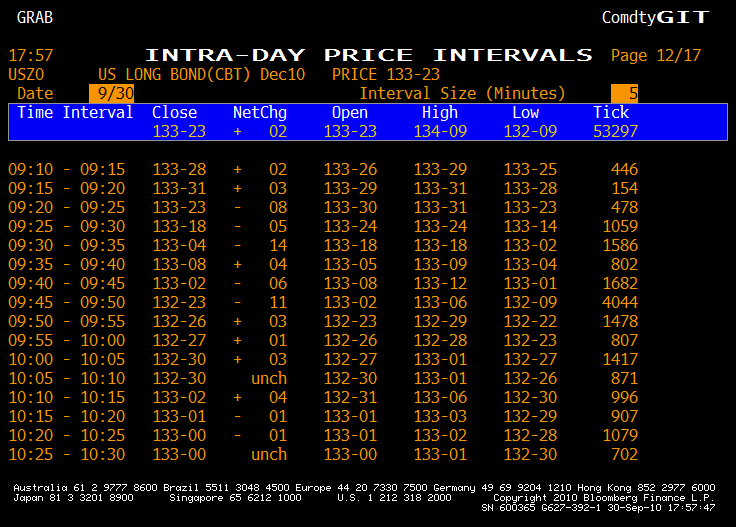
What a sordid story this would make for defendants in a case. Chicago purchasing managers announced at 9:45am, with moves 5 minutes after and 5 minutes before in conjunction telescoping the 2 point decline…
Russ Sears writes:
What most mid-westerners know that can be lost in the hub of the city is in the US– we truly love our rich friends…because most of them give us the best service, work the hardest and are the most talented people we know.
Yesterday, at lunch I gladly gave $10 for just a hamburger and fries to my friend Nic at Penn and 16th. It is the best hamburger you will ever eat. He always has a line out the door. And if anybody ever goes hungry for anything, it is more conversation or not getting enough time to talk to Nic or his interesting help JoVon because they have to head back to the office. Likewise at the OK Runner, I try to go during the week so there may be the chance to talk about the local runners before I pay $20-$30 extra for a pair of shoes. Because they are too busy helping customers during the weekend. We may have complained about our lawyers bill for our 1st will, but it definitely was worth every cent with the advice not to settle with the insurance company too quickly when my wife was in an accident and her concussion 6 months later turned into complications.
And there was no complaint about the bills from the gynecologist when she twice miraculously saved my first born's life by perfect timing, gutsy diagnosis and a prenatal surgery. I even like my insurance agent, and gladly would spend a day fishing with him. And do not get me started on buying used cars from my gear head friend that probably does get a couple hundred extra out of me every time I buy a car. But I have never had a problem with his cars so the security is more than worth it.
What does make us mad is the cheats and scoundrels that become rich. If any politician really wanted to use his position to become popular with the masses, it would be to convict those that believe to big to fail also means to big to prosecute…and run their businesses as ethical parallel opposite of Eliot's "The Untouchables". This is where Main Street hates Wall Street. It is an ethical line that is crossed, not some $ of income line in the sand.
Oct
1
WTF! from Victor Niederhoffer
October 1, 2010 | Leave a Comment
 The web mistress, and entrepreneur behind a line of vegan shoes, tells me that my use of a million question markets and exclamation points for the mindless and senseless reaction to the Chicago purchasing managers, one of 100 cities, one of 100 numbers in each city, seasonally adjusted, senseless fury, signifying nothing, pre-released by flexions to their clients and cronies– is very au courant– the sort of thing that someone in her generation would use. I said what's the abbreviation for that. And she said: WTF! I looked around 3 times a la Jack Barnaby when he stuck his– backside out to show how to hit a side corner, and said I should say WTH! What the hades.
Jeff Watson writes:
When I was a kid, I cursed in a manner that would make a sailor blush. The important lesson I learned from my grandfather was to never curse in front of women, members of the clergy, my elders, or people in positions of authority like cops and judges. Realizing that my son was going to grow up as a beach rat, surrounded with boys, I knew that he would learn to curse by the age of 4 or 5, as those boys seemed to curse in every other word.. My instructions to him were much the same as what my grandfather gave to me with one major addition addition. If he was to curse, he should curse in the most artful, funny, witty, Rabelasian manner that would add humor and substance and turn it into a very funny story. He took the matter to heart and ended up rarely cursing…..but when he does, it would make Oscar Wilde proud. We never censored speech, reading materials, movies, music, porn, or any other forbidden fruits and it seems that my kid grew up relatively well balanced. It seems that the kids who grew up in houses that had such restrictions all gravitated to our house. We forewarned parents of our views, but were still accused of fostering seditious behavior more than once.
T.K Marks writes:
By way of experiment, further advise her that the gospel of Strunk & White notwithstanding, writing is akin to a feudal society wherein character is king, punctuation niceties lowly vassals to such, and this contemporary abbreviation scourge a mere band of grammar gypsies just passing through.
Stefan Jovanovich writes:
Eisenhower rarely cursed; but when he did, he was a master who was more than a match for Patton and other habitual swearmongers. One hopes that he avoids Eisenhower's fate in dealing with academic hierarchies. When Ike wrote on article for the November 1920 issue of the Infantry Journal explaining how tanks had fundamentally changed the nature of warfare, he received a summons from the chief of Infantry, who informed Ike that his ideas were wrong and that henceforth he would keep them to himself or face a court-martial.
Oct
1
The Specialized Tree of Evolution, from Victor Niederhoffer
October 1, 2010 | Leave a Comment
 There appears to be at work one of those ascending branches you see in the tree of evolution where each branch gets more and more specialized, ( without disregarding the species that die out). The current most extended branch is not to generalize about what the fed is doing, but taking the example of today to release the Chicago purchasing managers report to the shadow elite 15 minutes before it takes 1 trillion or so out of the market. I don't find that as innocuous as my learned colleague, especially when I'm so often on the wrong side of those trades.
Rocky Humbert writes:
I'm sorry that you got hurt by the price move. With all due respect, I find it improbable that you're "so often on the wrong side of those trades." Rather, I posit that when you are wrong, you attribute it to others having an unfair advantage, and when you're right, you attribute to your own brilliance. I have a similar tendency, however, I attribute the losses to either bad luck or my own incorrect analysis. And when I'm right, I attribute it to my own brilliance. Ha.
Interestingly, had I told you 15 MINUTES IN ADVANCE that the Chicago Index would come in 5 points above consensus, we probably would have been inclined to short the bond market (which perhaps explains the dip … if there was a leak.) Yet, when the news hit the wire, the market rallied. The people who got hurt were the people who shorted the market on the leak — and covered at a scratch or loss. So the people who shorted knowing inside information… got spanked. And the people who followed the people who shorted knowing inside information … got spanked too.
It would seem that the "invisible hand" gave market participants a spanking today?
Craig Mee writes:
Rocky, its a good point, that you bring up, that profitable outcomes are never guaranteed even with "an edge".
Though it would seem this is where risk management can provide the difference, also trade duration, and whether you have a standard set plan, with each "trade".
Quite possibly, though this ones going to be hard to backtest, but surely there's a few home runners out in amongst the trades.
Interesting Nikkei down 190 last night, ..has been taught here …east to west, and US equities couldn't hold on.
Oct
1
The Shadow Elite, from Victor Niederhoffer
October 1, 2010 | Leave a Comment
 Some interesting flexionic moves in bonds today going down a 1/2 point before release of crucial chicago????? Data!!!!! And then 2 points more after release of that crucial data and then back up.
Gary Rogan comments:
Maybe a little too much leaked information floating through different channels?
Victor Niederhoffer responds:
The article from Mr. Rogan about the shadow elite is most disturbing especially when you realize that it permeates every release where billions of dollars are at stake, and cronies can make millions for their clients and later themselves through these leaks. Albert Jay Nock would be spinning like a teetotum at this recollection of the death of his good friend who took him to the secretary of the interior where he learned about these shadow elite transactions.
Sep
30
Reflections on a Trip to Disney World, from Victor Niederhoffer
September 30, 2010 | Leave a Comment
 One 's first thoughts upon a trip to Walt Disney World with a four year old son (and the 5 and 7 year old daughters of some very good friends) is that the magic and happiness trumps everything with the little boy and the parents settling into the rhythm of creativity, joy, excitement and healthfulness of the experience. The attractions are beautiful and modern, the cast is friendly and helpful, the little girls are all dressed in their princess costumes and the boys are screaming with delight at the thrilling rides, the parks are filled with an up to date diversity of fun and educational events, teenagers are reveling in their favorites shows and games, and the guests are a cross section of the world that makes you jump for joy at the down to earth enjoyment they can take in something this good, and their productivity in being able to afford this delight.
Particularly heartwarming is the effort taken to give the ubiquitous handicapped memories and undoubtedly the happiest times of their life. The parents were also pleased with all the modern efforts to provide healthy foods, with toffuti, hummus, fresh fruits, and sugar-free commestibles available at almost all locations.
I have 7 kids and all of them have been to Disney multiple times. They look back on their vacations there as among the best and most formative experiences of their life. The four year old boy at first was frightened by all the noise and the discordant notes of all the music, and scariness of the rides and the long waits. But after a few days, he settled into the rhythm and he particularly enjoyed the parades, the Jungle Cruise, the moving sidewalk, the movie ride, the circular garden dinner and fountains at Epcot.
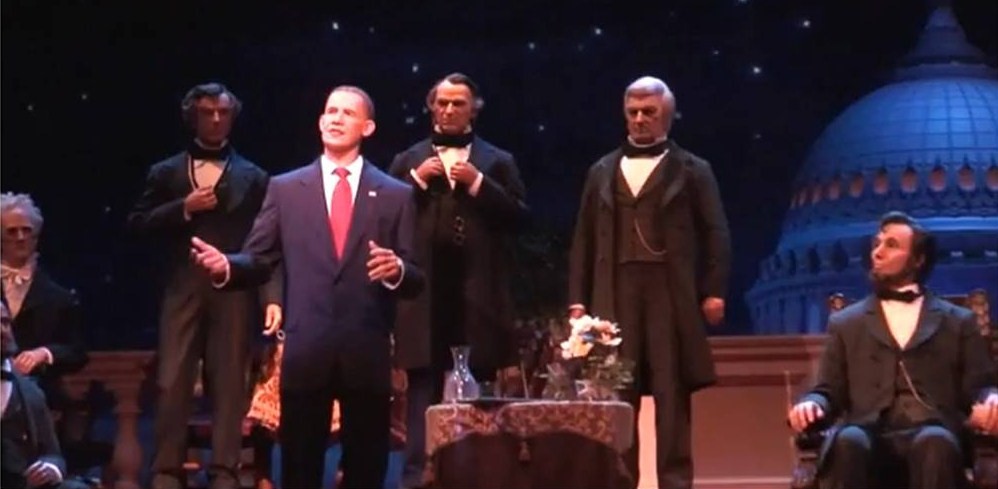
 And yet, I was seething after visiting the Hall of Presidents. The show is narrated by Morgan Freeman, one of the 2 or 3% of the visitors there of his color. The history of the presidents presented would be something you'd expect from Russia in the 1970s with a skip from George Washington to Andrew Jackson and then to the two Roosevelts, with lionization of their efforts to stamp out monopoly, save the country from greedy businessmen, and attempts to take from the rich and powerful and give to the weak permeating and enveloping the whole thing. Particularly loathsome was that the talking was at least 50% devoted to the current president and FDR, the two most agrarian Presidents in history. The collectivist bias of Disney in this show was consistent with the anti business movie that Disney just released about Wall Street, the well known anti business attitude and ego mania of its previous president, and the scary remake of Alice in Wonderland that made the whole show a roller coaster ride of scary escapes rather than the coming of age and creative, thoughtful adventures of a girl trying to cope with the world of the original.
Walt Disney himself, after hatching the idea for Disney World in the 1950s, arranging the financing to buy 40 square miles of swamp land, planning every detail of its infrastructure, managing to buy the land through dummy corporations so that all the land holders were happy to sell out for a song the swamp land they bought in 1912 from the Munger corporation for 5 bucks an acre, never lived to see Disney built. Mrs. Lilian Disney said that he would have been happy to see how it turned out. But how he would turn over in his grave to see the anti business, collectivist bias of the executives who have taken over his idea and made it consistent with the idea that has the world in its grip. (It is interesting to note that Eisner refers to his partnerships with Warren Buffet and Charlie Munger as helping him climb the ladder of success at Disney).
Of course, the Disney parks are a mere 25%, of the total Disney revenue of 40 billion a year, and an even lower 15% of profits. Disney itself is mainly sparked by its 100 million cable television subscribers that accounts for 60% of its profits. When they bought ABC, Eisner admitted in that self deprecating mien of the chronic egomaniac that the top guys didn't even know what ESPN was. But now they do, and the analysts that follow Disney and their capital expenditures of 10 billion here and 5 billion there to develop content make the company a play on the public's addiction to sports. Not to be gainsaid of course is the incredible feat of their movie division to have two billion dollar + revenue producers in one year in Alice in in Wonderland and Toy Story. And they continue to follow their mantra of making all their movies for 1/2 the price of any other company, and then tying it in with every aspect of their operation from parks to gifts to licenses.
Indeed, Disney is the very model of a perfect modern corporation. Its stock at 33 is near its century high of 37. It's up some 3500 % from its offering of 1.3 in 1981. It's near its all time high of 43 from 1997, and its revenues and profits this year are up at least 15% in all areas except theme parks. You have to admire the way this company like Apple has adjusted to modern times, and captured the idea that has the world in its grip, and the things that animate kids of all ages in our current generation.
Tim Melvin adds:
 The best trip I ever took to Disney was in early 2009 with my adult children. They still thrilled at the spectacle but were able to appreciate the effort and industry that goes into the enterprise that is Walt Disney World. Thankfully the hall of Presidents was closed or odds are my Ayn Rand loving daughter would have gotten us all arrested. Disney will always be on my buy-in-a-crash list. My sum of the parts for this stock is right around $38 bucks and when it drifts below $20 in a melt down (this has happened twice in the last decade) it paid off huge on both occasions for those who saw the merits of the mouse at such a level.
Steve Ellison comments:
In the Disney parks, everything is part of the show. I was at Disneyland in 2000 watching Honey I Shrunk the Audience when suddenly the action stopped, and I heard an announcement: "We have had a power outage. Please exit through the doors on the right." I assumed it was part of the show and wondered what would happen next. It was not until the doors opened and people started walking out that I realized there really was a power outage (one of many in California after the failed attempt at partial deregulation of electricity).
Anatoly Veltman writes:
I take my kids via motorhome every Winter and Spring breaks: can't beat this destination weather-wise. I don't deem them mature enough for busy Disney Parks; ever since my first visit in 1980, I always thought of Epcot (and later Studios and Animal Kingdom) as a prime education destination. Smaller kids love watery fun of Grand Floridian, Polynesian, Caribbean, Coronado, Saratoga, Boardwalk, Orleans, Key West, Swan/Dolphin. You can access all these via comp buses, boats, monorail. The only resorts really limited to guests are Beach and Yacht Club. Feel free to quiz me for hints, or read up some more general wisdom at MouseSavers.com.
Vincent Andres adds:
The picture on DailySpec triggers some analogy. The river is fake and the little boat moves only thanks to a especially built Deus ex machina. Our occidental "capitalist" world is also, for long, a true Disneyland. The main Deus ex machina are our debts and all what our master fakers are able to do with our "major" currencies. But if the debt flow slows down, we'll soon have our little businesses/boats slowing down also.
We though we were good car sellers, but was it really this difficult when our customers get /in fine/ there money thru loans or money printers ?
I'm confident our master fakers are doing all there possible for our deus ex machina to continue to work properly, but it seems the Mississipi debt river is now slowly founding more fertile soils to irrigate. (Spain just downgraded by moody's.) Let's hope our second fake motor will not also have problems.Little boats and there passengers begin to stamp.
Sep
29
Cluster Analysis by B. Everitt et al, from Victor Niederhoffer
September 29, 2010 | 1 Comment
 One of the most useful things that humans can do when making decisions about life or market is to form objects into groups. The caveman must have had to decide which animals were dangerous and which foods were edible, and the investor must decide between value stocks and fundamental socks, or between utilities and industrials, the canals versus the railroads, the nifty fifty versus the old favorites, the stocks that old man sage buys versus the ones that the Druck likes to buy after hearing a technology conference, the stocks touted by the wildman, or those in group 1 in value 1 etc., the stocks when bonds are up et al.
Methods for grouping data are given in the Excellent book Cluster Analysis by Brian Everitt, et al of which I have the fourth edition from 2000. It's the very model of a modern book with a list of software to do all the things for free and price enhanced graphs showing all the things that the programs do, and examples from all fields ranging from biology, genetics, pol science, taxonomy, astronomy, psychology, et al.
It's a lot easier to visualize a cluster then to find one. The basic idea is to find objects that are pretty homogeneous within themselves but disparate among the others. That's a lot easier said then done.
First you have to measure the distance between the objects. The usual measures are squared distance, city block distance, generalized Minkowski distance which is the same as the usual geometric distance but scaled to the third or fourth power instead of the second, or Pearson correlations themselves between the values of the variables for just two objects.
Then you have to form the groups. The usual method is to start with the nearest two, then to build up from there. That's called an agglomeration method. Compare this to the divisive methods which starts with the largest group, and then successively removes the ones that are furthest away. One of the thorniest problems is how to handle more than one variable. Methods based on scaling from the extremes then the standardized values are recommended.
A section that shows how to fit the data based on kernel estimates using kernel function for each pair of observations based on a rectangular, triangular or gaussian distribution is particularly helpful. Also interesting is the preliminary methods for discovering groups using one dimensional and two dimensional histograms. A nice section using factor analysis and principal components analysis, and a related method I've never come across in all my years of reading statistics books called projection pursuit is recommended as a way to reduce the number of variables to a manageable and non-correlated set is also given.
Indeed the book is filled with everything you could ever want to know about grouping data, including multidimensional scaling, similarity measures, weighting techniques, standardization procedures, missing value treatments, mixture models.
Everything is there in a fairly accessible form except how all these methods relate to the current worthless non-predictive fad of artificial intelligence relating to neural networks and its extension. Doubtless the current work in the field has shown how these methods converge to the usual clustering methods based on such things as clustering with constraints, or fuzzy clustering.
Much of the work in clustering comes from such institutes as the Rotterdam Institute of Agriculture and the institute of psychiatry at Kings College in London so it's not surprising that no examples are given from our own field, where grouping is so helpful and necessary. How often do we look at a scatter diagram of two variables, and note that there are two modes in the data, or that two regression lines would fit the data much better than one. If only we knew which of the two groups that the various observations belonged to. And if we only knew how to scale such things as currencies and gold to each other in considering the similarities.
Let's take our own humble attempts to group clusters where we put the four comoves and counter moves of bonds and stocks into four colors yellow for stocks up bonds down, blue for stocks down and bonds up, and green for both up, and red for both down. Haven't seen any reds recently until today. And the colors themselves are just one of the many ways of handling binary splits.
Here are some data to practice clustering on from the real world.
date stocks bonds
Sep 28 4.0 0.28
Sep 27 -5.5 1.2
Sep 24 22.8 -1.0
Sep 23 -9.4 0.01
Sep 22 -4.9 0.2
Sep 21 -1.9 1.1
Sep 20 16.0 0.17
The rest of data for the last 9 months is on our site. It's a good exercise to form groups from such data and maybe even to come up with something useful from it.
Sep
29
Why Democracies Fail, from Gary Rogan
September 29, 2010 | 4 Comments
I submit the simple game theory explanation of why democracies fail: the relative perceived importance of a targeted transfer of resources to a small subset of voters is usually much higher than the perceived importance to "everybody" of the average (over the whole taxpayer base) cost of that transfer. So it's only at the very special moments in history like now, when the ship is sinking, that people wake up to the cumulative cost of all those transfers. It also "helps" when the times get so desperate that the targeted transfers go to relatively large groups.
Victor Niederhoffer shares this with Tyler Cowen:
A non-economic analysis by a chip designer.
Tyler Cowen replies:
I fear, however, that it is too late, there is a status quo bias to government expenditure, plus population…
Sep
22
Highway Robberies and Madoff, from Victor Niederhoffer
September 22, 2010 | 1 Comment
 A friend sends me a biblical commentary, "Farewell to Hope", that tells stories from Revelation that show that what Madoff did was wrong. "People had become rich off his returns, and charities had been helped by the goodness of his heart," his attorneys argued. But the rebuttal was that he "merely gave his clients (and charities) money that belonged to someone else".
Kindly tell me what the difference is between what the idea that has the world in its grip is, as embodied in the taking from the currently rich to give to the currently poor, and this idea of Madoff's. Sometimes kids respond to the idea that if a robber comes up to three people and takes one's money that's bad. Now suppose instead of the robber there's a vote of the three people as to who should give the money to the others, and the two vote for the third to give his money away. Isn't that bad also?
George Parkanyi comments:
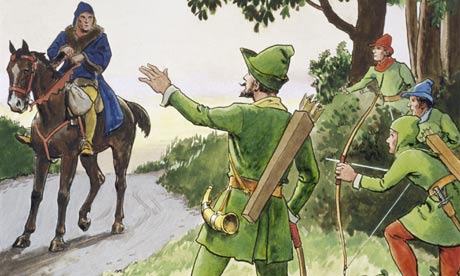
It reminds of the Monty Python sketch of highway robber Dennis Moore, who robs from the rich to give to the poor, until the poor become rich and lazy and the rich poor– then he becomes conflicted and finally ends up simply re-distributing the loot amongst the passengers and then riding away.
Sep
21
The Chronic Bear of Barrons, from Victor Niederhoffer
September 21, 2010 | 7 Comments
 Prechter says to sell rally, one reads. One recalls a chapter one wrote about the man who I facetiously said may have caused more financial harm to more people than anyone. The chronic bear of Barron's. One concluded that he never could close out his bearish calls which had been unanimously, completely negative every seek since he started writing in 1966. (For once this is not hyperbole. I was forced to read every one of his columns before a certain collab would let me say it). Prechter is in a similar situation. How could he say that any time is a good time to buy since most of the time he has been bearish since Dow 500 when he took the six month boat ride which regrettably came back to the US. However one must compliment him on his very propitious bullish call near the lows in 2009. As one said about the chronic bear at Barron's, "how one wishes he had stuck to journalism (subtly recapping what B said about Rossini." "how one wishes he had stuck to comic opera)". "If E did not say to sell the rally, he would be closing out a position at a 5000% loss. May both of them join Livermore in a place reserved for those who have inflicted more financial harm than any one else in history. P.S in saying this, one calls out to Dr. Jov for augmentation as to who from history has caused more financial harm. Napoleon? Lenin? John Law?
Jeff Sasmor adds:
Add the legions of "Financial Consultants" working for the big retail brokerages who advised buy and hold no matter what. Couple that with "averaging in" (there was some spiffy term for it I can't recall) we now have a population of boomers who demographically have most of the wealth but have no feeling of confidence in the stock market and no trust in the available advisers.
Burned badly 2x in 10 years has profound negative implications for aging boomers who are concerned that they have no time to make back the losses and just want steady income. Will they feel good when the bonds they've been advised to buy go down in price? Or feel helpless that they get hosed no matter what they do.
Peter Earle writes:
For the most harm caused in financial history - a topic I cannot, if I tried, avoid weighing in on– I put forth he who informed both the philosophical and argumentative implementaria of agrarian reformers of many stripes most plentifully, in my estimation, over the last nearly two hundred years: Claude Henri de Rouvroy, comte de Saint-Simon. Saint-Simon, an early intellectual who disavowed his wealthy, aristocratic moorings, was an advocate of positivism and, applying that practically, a sort of technocratic central planning which, as history has shown, was far more workable than other philosophies he inspired; specifically, Marxism. A contemporary of Hegel, I consider him the rightful heir to the modern scourges of Communism, Socialism, Fascism, the "Third Way", and central planning as a holistic species.
Sep
21
Prechter Says Sell, from Ken Drees
September 21, 2010 | 1 Comment
 Prechter says sell this rally off of yahoo finance headlines–no need to link, that's probably all you need to know about this move.
But if it is a market bluff, yesterday the market bet before the flop and today you should see the continuation bet on the turn and then a big bet to come on the river. If it's a bluff, then they gotta sell it.
Anatoly Veltman comments:
He's often quoted out of context, just like everyone else– thus everyone's track record may appear roughly same.
Prechter does certain analysis well. Those who understand his writings can benefit by incorporating some of his effort into own analysis. Those few who would actually enter trade on his conclusions– risk not knowing how/why to exit.
Ralph Vince writes:
Entirely true, Anatoly. I may not agree with his prognostications, but he does his work very well. What's more, he is often quoted in overly simplistic terms– such as to be a seller on this rally. I am certain he has a point where he would flip and go long, an alternate count or something. I am also sure he has a downside target– is it Dow 5000 ? Dow 10,500 ? These quotes of his floating around don't really tell you want his strategy is, and that's key. He's a guy who, if/when he is wrong, I have found he has not been wrong by much, often able to adapt to changing market conditions as well as any I have seen.
Larry Williams observes:
Prechter go long? Has he ever? His bearish book riding the wave came out the low the 2002, at the recent market low the clarion call was to sell. Be alert to broken watch correctness.
Dylan Distasio asks:
Hi Vic,
I'm genuinely curious as to why you lump Livermore in with the rest of the financial ne-er-do-wells. I'm not an expert on the man by any stretch of the imagination, but I've read assorted stuff on him, and while he was far from perfect in both trading and life (but then again who is?), I've never seen fit to paint him with that brush based on what I've read. Why do you have such a low opinion of him?
Larry Williams attempts an answer:
Livermore and the Reminiscences are two different stories. The Saturday Evening Post serial that became the book is oh-so well written but it is not just about Livermore it is/was a novel with a fictional character that paralleled Jesse but was also a collage.
In real life once Joe Kennedy took over the SEC, Jesse seems to have never made another penny; in other words he was most likely a runner of stocks not some brilliant trader like Steve Cohen, etc.
Sep
20
My Visit to DC, from Victor Niederhoffer
September 20, 2010 | Leave a Comment
 1. Everywhere one looks there is building going on in Washington DC. No vacancies and for rent signs appear on each block the way they do in every other city. The trains going to and from are full at every hour of the day including the 2 am arrival in New York, and all the restaurants are bustling with activity. Scaffolds and cranes seem to surround all the monuments, executive buildings, and lobbying areas. They said that 25% of all the world's cranes were being used in Dubai 3 years ago, but now they must all have moved to D. C. But this boom can be predicted to last.
2. A tremendous number of restaurants that were marginal in other big cities are moving into D.C. with great alacrity and success. I ate in the magnificent, opulent quarters, built with special private rooms for the three branches of Carmines and Kellari, both New York operations doing a land office business there after just a year, and note that Ducasse after his dubious starts in New York has found a can't miss operation there also.
3. A trip to the American Museum reveals the idea that has the world in its grip in every exhibit. As Dr. Voss says "It was sad to see the outrageous leftist propaganda at the Museum denigrating our country's achievements in every sphere of human endeavor. I recall seeing similar exhibits about the U.S. in Moscow in the 1980s." We visit a childrens play scientific exhibit and of course they have a demonstration to show that by turning a magnet around a coil very quickly you can generate electricity which goes by two paths to an old fashioned light bulb and a newfangled compact fluorescent bulb. The bulbs are set up to show that your energy lights up the fluorescent bulb, but not the incandescent. Fluor. bulb - - generator - - - incan. bulb. No consideration is taken of the cost, light quality, life span, disposal problem or human lives lost due to the mercury manufacturing or disposal process. The idea is to show that the old fashioned bulb takes so much more energy to light. But Dr. Voss and I switch the bulbs between the two forks, and find that when you switch the old fashioned bulb lights up. The idea of using this propaganda on kids would be something you would expect in the agrarian reform countries not here, if the entire museum was not filled with apologies for industry, and paeans to class struggle in every exhibit. A typical exhibit shows a sewing factory with 600 employees in Bridgeport that according to observers along with the telegraph and the steam engine were the key inventions of the century but then goes on to point the guilty finger at the classes of wealthy and poor that were created by the factory and the product. No consideration is given to whether the workers in these factories went to work there voluntarily with the idea that their life would be improving.
4. The ecology of the city is very clearly shown by a visit to the White House. Motorcade after motorcade comes there with 5 limos, an ambulance and a bus as visiting dignitaries from the various districts are escorted for tours. The helicopters are reserved to the President. A feverish level of activity emerges as the visitors from the new executive offices, all with windows that don't open, spills over. Outside a protestor against business has been conducting a 30 year, 24 hour a day vigil. Next to the white house, an office of the Bank of America in a neo classical building bigger than the Hoover Dam stands proudly just across from the Treasury. And in a forlorn gesture of Zacharian token opposition a flag waves from the chamber of commerce: Free Enterprise Creates Jobs.
5. New museums grow like Topsy in every corner not already occupied by the offices of the lobbyists and suppliers. One very reprehensible one is the Newseum which has a big exhibit on the coverage of Katrina as if such coverage and expense did not in some way violate the spirit of the separation of the Press and the branches of government.
6. Over the last two years, the number of employees in the Federal Government has increased by 15% while the private sector growth has been -5%. From the brouhaha of actvitity and building in all areas of DC, one gets the impression that they all are compressed and contracted into this one little town. When one considers the multiplier that each job causes with lobbyists, suppliers, family members, spending on local products, administrative staff necessary to support and create the jobs, it is no wonder. But a reverse multiplier is hidden as all the jobs created are extracted from the spending and savings of non-government employees. The negative multiplier is greater than the positive multiplier so total jobs had decreased . But the output situation is much flummoxed by the kinds of things that the money would have been spent on. Creating new offices, agencies, and energy efficiency a la the American Museum on one hand, and for rent and closing down signs in every other business.
7. As we go to DC, a new agency to protect consumers is created. And the idea that consumers are protected by competition and private information agencies is considered an absurdity just as described by Amity Schlaes in the waning years of the depression when the operatives at the White House walked out of a meeting with Good Housekeeping in disbelief that anyone could be against something so obviously good spirited as regulation of what consumers might buy.
8. The three underlying causes of everything that's wrong with health care are that doctors are not paid directly by consumers, doctors are unable to compete with each other, suppliers are forced to go through the three stage 500 million approval process to get a drug approved, and the insurers are not allowed to compete with each other across state lines. No wonder that Hayek's book has been a number one best seller on Amazon.
9. Shades of Willie Sutton when he wanted to turn himself in to headquarters after Thompson hit the home run. My whole party feels the same way after leaving the American Museum with propaganda in every exhibit similar to the fake lite bulb exhibit ( photographic evidence from Susan forthcoming), and going out to two of the most massive buildings one has ever seen outside of the coliseum in Rome, yes the EPA, and the Unmentionable. " Just take it all right now. ".
10. The Museum of Crime and Punishment, with its vivid memorialization of all the ancient torture devices, and its memorabilia and explanation for our fascination with all the great criminals of the past, and the Museum of Espionage, with its code of rules for the would be spy is a nice lagniappe after visiting the mammoth Smithsonian exhibits which must have 1/100 the number of visitors per square foot and 1/100,000 of the number of visitors per value of the exhibits as the private museums.
11. As one is back to the day and fray of trading, I can't check all the above figures rite now, but I am confident that any numbers adduced that support my point of view above that are inadvertently too favorable are counterbalanced 100 times by things I left out that would have carried my point of view of this reverse horn of plenty much more forcibly.
Kim Zussman shares:
Here is a pertinent article.
Sep
20
DC: Worst of All, from Victor Niederhoffer
September 20, 2010 | 2 Comments
 Worst of all was a trip to the Jefferson Memorial which is riddled with apologies for the ideas behind the Declaration, appeals to the adolescent nature of Jeffersons' longing for the Arcadian days when the Saxons lived harmoniously in the forests with representative government, and the naivete of his ideas that out of of their own bounteousness and munificence, the original Americans came here without any assistance from the English and thus no revolution was required to reclaim what was rightfully theirs and ours from the beginnings.
In a Zacharian your own man thing, Ellis, the chief contemporary biographer of Jefferson, and the only such book for sale in their book shop, joins the Jefferson as racist, slave master, father of the black Illinois Jeffersons from the Hemmings union camp, a view memorialized in all the written material around the exhibit that would make Jefferson small.
And indeed all of Washington today it would seem is designed to show the need for redistribution and the great unworthy gulf between the rich and the poor, and that is why the Great Mall outside the White House is unfit for civilized occupation as it is completely taken over with bums and the homeless —the idea being to show you the great gulf, ( especially when the homeless are not using their cell phones and blue-tooths as they were on my visit).
Charles Pennington comments:
Another approach to Jefferson is that he is an "enigma", as in the liner notes to Ken Burns' documentary:
"Revered as the author of the Declaration of Independence, the most sacred document in American history, yet condemned as a lifelong owner of slaves, Thomas Jefferson remains the enigma that is America."
He wasn't much of an enigma. He wrote and advocated eloquently and at length for the cause of limited government, but that needs to be whitewashed.
J.T Holley adds:
I was walking the streets of Charlottesville some years ago with my children and came across Nock's Jefferson in hardback. Paying only a buck for it and it being in great condition I felt like I had a precious gift in my possession. It proved that and more.
There are to many things to list about Jefferson that I've learned through studying the Enlightenment, hours of History credits, and reading Notes and a couple of biographies, but here are a few:
1) He technically didn't own his slaves. They were purchased through levering mortgages or notes. He couldn't free his slaves if he wanted to.
2) It is amazing how such a public figure made himself such an "anonymous man" in all aspects of his life that he could.
3) Upon the death of his wife he burned all of their shared writings.
4) When addressing his daughters on choice of dresses to wear he said "Wear what all the other girls are wearing, if you want to be different then do so with your thoughts and mind". I'd like to find the source for this paraphrased quote if anyone knows, it's just stuck with me over these years.
Sep
20
More on NBER, from Victor Niederhoffer
September 20, 2010 | 1 Comment
They just announced 1 1/4 years late that the recession ended. Many interesting questions arise. What would happen if you bought and sold a swing system, when they announced recession and when the announced expansion? What are the chances that a random number generator or intelligent robot could do better at calling turns in the economy than the NBER? Many others.
Scott Brooks comments:
The recessions over?!?!!!?
I find that hard to believe. Just a minute….let me turn around and check something….looking….looking….OH MY GOSH!!!! There ARE monkeys flying out of my butt….the recession MUST BE OVER!!!
I work with a lot of insurance related organizations (brokerages, TPA's, insurance companies) and there is nothing happening in the insurance world that indicates the recession is over. Workers insured under workers compensation is down 20%+ off it's high. Workers comp premiums are down. Business insurance premiums are down. There are still more companies that are going out of business than there are start ups. There are still more companies that are contracting than there are companies that are expanding.
At the grassroots level, there is a lot of pain….and the bad stuff outweighs the good.
The recession is not over.
Jeff Sasmor writes:
What they said was that the last one ended June 09. They also said a decline now would count as a new recession. Talk about a lagging indicator!
NBER said "The committee decided that any future downturn of the economy would be a new recession and not a continuation of the recession that began in December 2007. The basis for this decision was the length and strength of the recovery to date.
Pitt T. Maner III writes:
Not only is the recession over but now the technical purists say it is impossible to have a "double-dip" since another downturn would be counted as a separate recession. Let the cheerleading begin…
Stefan Jovanovich shares:
"The Business Cycle Dating Committee was created in 1978, and since then there has been a formal process of announcing the NBER determination of a peak or trough in economic activity. Those announcement dates were: June 3, 1980; July 8, 1981; January 6, 1982; July 8, 1983; April 25, 1991; December 22, 1992; November 26, 2001; July 17, 2003; December 1, 2008; and September 20, 2010."
From NBER FAQ
NBER Cycles
Sep
20
NBER’s Behindhand Announcement, from Victor Niederhoffer
September 20, 2010 | Leave a Comment
And of course, how will the Fed be able to finesse a stimulatory action tomorrow in conjunction with this announcement. And most important, were any Clarkian winners at the bureau who might have been anticipated without any direct contact to take care that they didn't announce it too far away or too unseemingly close to any voting.
Kim Zussman writes:
NBER announcement dates only go back to 1980. For these end of recession announce-dates, here are the SP500 returns for day-of announcement, next day (from close of announcement day), 5D, 10D, and 20D:
Date day of nxt day 5d 10d 20d
07/17/03 -0.012 0.012 0.000 0.009 0.009
07/08/83 -0.003 0.006 -0.017 0.011 -0.032
12/22/92 -0.001 -0.003 -0.003 -0.022 -0.011
07/08/81 0.001 0.008 0.015 -0.009 0.034
avg -0.004 0.006 -0.001 -0.003 0.000
stdev 0.006 0.006 0.013 0.015 0.028
Historically nothing much, but then how do these compare with The Great Recession?
Sep
16
Minimum Execution Quantity, from Victor Niederhoffer
September 16, 2010 | 2 Comments
 I mean, when you're playing against someone using mitigants to generate optimum MEQ to prevent your pinging him, why for crying out loud, what kind of chance do you have. One feels like Willie Sutton when Thompson hit the home run and turning oneself into police headquarters immediately or at least closing out all trades with one clearing house immediately. One has not seen such assured intellectual prowess since the quotes from the Harvard fund managers themselves in Edspec memorialized by Susan.
From "The Education of a Speculator" page 131:"One of the strategies Harvard favors is to buy undervalued securities and sell short comparable overvalued securities with the same industry." "In discussing how such strategies reduce risk, Harvard Management Director Jay Light, a professor at the Business School, states that, if the market falls, "We will get hammered less than, no more than, and almost surely less than we would have been hammered had we just had [our portfolio] in domestic equities.""
Quote from Vince Fulco's 9/15/10 post: "Tusar: It's about the routing strategy, and the order placement strategy. The best techniques and the best mitigants to prevent what you just described from happening are pretty simple blocking and tackling kinds of things. In other words, ***randomize your order size and ***placement of orders, using 'Minimum Execution Quantity,' because I don't want people pinging me for odd lots and then finding out I'm there and stepping in front of my order, etc."
Sep
15
Briefly Speaking, from Victor Niederhoffer
September 15, 2010 | Leave a Comment
 The first time that the discount rate or funds rate is increased, the expected number of subsequent increases is about 12 and during about 2 1/2 years. Thus, one would expect a tremendous decline in the short term bond prices when it occurs. You see bond investors are very wise and rational. And as soon as the first increase occurs, no matter how many "once is enough" demurrals ensue in expiation, they factor in the the subsequent 12 increases. The effect usually spills over to the long end for 1 or two weeks, until the realization that it's deflationary steeps in. One would expect it also to be one of those blue days when both stock and bonds decline wildly, as for once the canard that bad output numbers are good for bonds and bad for stocks is gainsaid.
Such increases in the old days were invariably preceded by declines in the stock market as they were announced during the day, but now the announcements are calibrated so as to make sure that those buying the bonds auctions would not have their sensibilities discommoded by such news after they have committed.
The process of borrowing at the 1/4 % fed funds rate, and buying the long bond at 3.8 % must be likened to the selling of premium. It has to be a very profitable strategy most of the time until the day of disaster comes that wipes one out. When will it occur? When the the idea that selling premium in such fields as fixed income is a losing game is right for the wrong reasons. The premiums that the sellers receive are often very high in relation to the expectation. It's just that the other side that does the buying often is better capitalized, bigger, and thus on the rules committee and the margin committee, and a market maker. on the rare occasions that the piper must be paid, they squeeze the sellers into the point of oblivion. But that doesn't mean that the average buyer of premium is not going to suffer a loss. The participants in the squeeze are limited to the top feeders. One says this in relation to the likely outcome when the long bond buyers get squeezed and does not apply this to anything else for obvious reasons.
Sep
13
An Interesting Consilience, from Victor Niederhoffer
September 13, 2010 | Leave a Comment
These were both 20 day minima.
Rocky Humbert comments:
There is a nugget of wisdom is The Chair's comment worth quantifying:
From 2000-2010, the R-squared of US 10-yr note yields and 10-yr bund yields was 0.59
From 1990-2000, the R-squared of US 10-yr note yields and 10-yr bund yield was 0.33
(both using % change, weekly data from Bloomberg.)
Or, to quote Michael Jackson and Lionel Richie's "We Are The World:" "…We can't go on … pretending day by day … that someone, somewhere will soon make a change.."
Sep
12
Great Article, from Victor Niederhoffer
September 12, 2010 | 5 Comments
 This article on income mobility will put in perspective the malaise affecting our economy. It's the 40 % from each of the lower 2 quintiles who moves to the top 2 quintile that has made us beautiful and created the jobs and responded to the past incentives, and dolorously "prefers not to" create jobs and value now.
Australian Nick White comments:
This is a great country. Being back here the last few weeks just reinforces to me how lucky America is– even if you're in a perceived funk right now. This is the country where anything can get done…that's not the case in any other western nation. You have freedoms that you take for granted every day (even post legislative amendments that may have eroded them more than trivially). You have every type of geography and lifestyle. You have 36 different choices of one brand of orange juice fer crissakes! (which you can drink while watching one of thousands of tv channels).
I don't know much, but I know that if America continues to focus on the the things that got them to here– without trying to reinvent the wheel– you will all be just fine. The only danger I see is increasing reliance on form rather than substance– but this is a malaise of the world in general, not just the US.
Rudolf Hauser writes:
This data on income mobility does not give us a complete picture. Large gains or losses from realized capital gains/losses, special bonuses payments, decisions to take long breaks from work, etc. can all influence results for any one year. One would also expect income from most careers to advance with experience and age. What would be interesting to see but probably very difficult data to obtain would be an average of five years of data say at age 50 with those relative income positions of those households income compared with that in the same period in the lives of their parents. I suspect that there would be a good deal of upward income mobility demonstrated by such an analysis, but it would nonetheless be most interesting to have that evidence.
Russ Sears writes:
Isn't this the premise of the sitcom "The Big Bang Theory"?
A group of nerdy physicists meet their neighbor, a beautiful blond girl waiting tables at the cheesecake shop… but even she is hoping to become an actress.
But you miss the point– from the Will Smiths to the nerds in physics to the marathon runners to the Saints QB, they are all incredibly talented, even the WS geeks, not just the WS geeks.
And as someone seen how letting a small business owners put the money back into a sport can revitalize: it can change how everybody developed talent. In 1992 The US marathon trials were a joke, but these guys changed it.
The world will never know the talents that were not developed for lack of a few dollars, but I have seen first hand how thin the pie can be sliced at the top, and how a few centimeters thicker can change everything.
Jordan Neuman comments:
It is interesting that you mention the varieties of orange juice. I just read The Paradox of Choice which argues that our lives would be better if we did not have so many choices. The varieties of grocery items was the author's starting point.
It would not matter unless such ideas had support in this Administration. The references to health insurance in the book are illustrative. And I found the interview with the author in the afterword absolutely chilling. This professor was sure he and his "expert" friends knew better.
Larry Williams writes:
Living in the US Virgin Islands means giving up many choices in foods, clothes, cars, etc. I have found that a wonderful thing; it causes one to focus on what is really desired (that can be ordered from off island). It makes for a simpler life style and turns ones attention from man made consumables to the ocean, the trade winds, local markets and such.
Sam Marx comments:
I remember one of the escaped English spies then living in Moscow, when asked what he missed most about England, he replied Lea & Perrins Steak Sauce.
Sep
11
Paint Or Get Off, from Victor Niederhoffer
September 11, 2010 | 2 Comments
 It's finally time to paint or get off the ladder. The markets are sending eerie signals that they're out of whack vis a vis the past program of attempts to rob Peter to pay Paul. Witness the US stocks at 1105 a 20 day high in conjunction with bonds at 13000 a 20 day low. Something has to give. Or as Osborne would say, someone's going to get tarred, raw squawking and fully feathered, and something tells me it ain't going to be bonds. Finally the bond vigilantes are doing their job. The 10 and 30 year back to back auctions are about the worst in history. Finally, everyone who bought it didn't make an immediate profit. Indeed a 1 percentage point loss.
Finally, the whirlwind of spending money to weather proof buildings and create naming rites on highways for the program's reinvestment activities is meeting resistance. The idea that the money taken from the ordinary man who would have spent it on productive and useful thing, and given to organized labor and earmarks is meeting some resistance.
This backdrop is playing out against some shocking declines pointed out by Aubrey's rowing mentor in the payroll numbers. How will they be able to hold back the floodgates for two more announced numbers on the employment front?
If the bond vigilantes don't capitulate immediately as has been their wont in the past, one would predict some post employment depression in the stocks.
Alston Mabry writes:
Preseason is over. Regular season begins on Monday. Barring injuries, the first string will start every game and play most of the minutes. Offense will be more innovative, but defense quicker and tougher. The game will be played with more seriousness, more at stake.
Victor Niederhoffer writes:
the expression in mind is "someone's going to eat crow, raw squawking and fully feathered….
Gary Rogan adds:
In an interesting metaphor-to-reality twist this post was the first thing I read after I finished painting and got off the ladder. More substantively, I would like to hear from anyone who has an opinion as to what the bond vigilantes could have seen last week that they didn't see six month ago, a year ago, or a year and a half ago. Has not the course of what actually transpired been obvious since the plans were first announced? Are they finally seeing signs of inflation? Are they collectively playing a game of chicken where nobody moves until they believe everybody else is about to move? If so, will their actions now be quick and violent?
Sep
11
Review of the Romantics, from Anonymous
September 11, 2010 | 2 Comments
 I really enjoyed The Romantics last night. I've never seen a film that laced together so authentically the tensions between desire and duty. The scene between Tom and Laura on the lawn was brilliant– one of my favorites in any movie, and I've never seen one that so accurately reflects some of my own experiences and emotions in such situations.
I really felt this was one of the best movies I've ever seen. Its understatement and subtlety was magic– a film truly aimed at a much higher common denominator. Galt should be very proud. The film resonated with me a great deal, and I would love to send her an email expressing appreciation. Truly a film for a much higher common denominator.
Sep
10
Five Out of Ten Things I Learned from The Romantics, from Victor Niederhoffer
September 10, 2010 | 1 Comment
 1. The difficulty of choosing between marriage partners is similar to that of choosing between a stock that looks great and is one of the best performers and a stock that has weathered many weaknesses in the income and balance sheet, and business model and is in the middle of the performance pack. The price performance of the one is likely to have shown positive continuations — a bullish trend followers dream — and the other is likely to have shown many a positive reversal.
2. Reviewers are more likely to favor a movie based on characters from prison or a mental institution than one that is based on characters that are intelligent, successful, and Ivy League graduates.
3. The difficulties and travails of getting funding to launch a movie is similar to those that every fund manager faces in launching his hedge fund or investment vehicle.
7. The limited budgets of independent films makes the buyer of clothes a key figure as he/she shops for bargains that fit the script.
9. The key to a successful film is not only to have a good script, and director, and talent, and marketing, but to have all the talent promote the film and believe in it after it's in the bag.
Alex Castaldo adds:
The film The Romantics was reviewed by Kyle Smith in The New York Post.
It has a web site www.theromanticsmovie.com like any film nowadays, with pictures and snippets.
It is showing in Los Angeles at The Landmark , 10850 West Pico Blvd, Los Angeles, CA 90064. In New York at Regal Union Square 14 , 850 Broadway, New York NY 10003.
Sep
9
Article on Tennis, from Victor Niederhoffer
September 9, 2010 | 1 Comment
 Here's an interesting article about how tennis is improved by playing on soft surfaces, moving in all directions, and not concentrating on winning at early ages with obvious market implications.
Pitt T. Maner III comments:
One doesn't remember seeing the top Spanish players missing a lot of easy overheads, double-faulting on key points, and letting line decisions get into their heads. They are mentally prepared to grind it out and play with "corazon" and a bullfighter attitude—and an added touch of machismo for those long 5-set matches. The Spaniards look better able to play and adjust to windy conditions too.
From Chair's referenced article:
Jose Higueras, a former Spanish player who is now director of coaching at the US Tennis Association, believes that playing on slower-paced courts has taught the Spanish to become more athletic and make fewer mistakes. "If you grow up on hard courts, missing becomes a lot more normal because the courts are faster and you don't have much chance to get set up," he said. "On clay, the misses are normally not as acceptable."
The current physicality of tennis seems to favor body types that are generally lighter, faster and stronger. These players have become masters of taking away the advantage of bigger opponents possessing more powerful serves and groundstrokes. Federer, for instance, has an unbelievable ability to return balls hit hard at him that would normally break down a player's stroke and cause a weak return.
Federer's fastest, well-placed serves at around 120-125 mph also are extremely effective (he had an 18-2 ace advantage over Soderling last night). The 6' 3'' to 6' 7'' players with the ability of hitting the 130-140 mph serves know they will have to hold serve almost every game against Roger or Rafael Nadal. That adds a lot of pressure, particularly on getting the first serve in.On the physical nature of tennis played with the modern, powerful racquets:
Training guru Mackie Shilstone, who has worked with Serena Williamssince 2008 and has educated many elite athletes, says tennis is among the most taxing activities on muscles, joints and tendons.
"I've seen it all," says Shilstone, whose clients range from boxer Roy Jones Jr., to baseball's San Francisco Giantsand hockey's St. Louis Blues. "It is one of the most grueling sports you will ever encounter."
I think most free, community tennis courts in the S. FLA area are hard because you have to maintain clay courts and that costs money and makes it necessary to charge fees that are somewhat stiff to the average Joe who can more readily find a free football or baseball field or basketball field to play on.
Sep
9
Briefly Speaking, from Victor Niederhoffer
September 9, 2010 | Leave a Comment
Talking about anomalous events, this is the worst set up for a 30 year bond auction, now at 11 est for bids, that one has seen in last 15 years. Possibly, finally, the vigilantes at least up to 1 pm, when announced are objecting to printing of money, free lunches, transfers from the undeserving rich to the deserving poor, et al.
Sep
9
Adult Fairy Tales and the Market, from Craig Mee
September 9, 2010 | Leave a Comment
 No doubt there's plenty of market lessons across the board in this lot. The ten bloodiest bed time stories :
Remember the cosy nights of your childhood tucked up in bed as mummy or daddy read you softly to sleep?Well have a read of this lot and you may discover that the tales you remember fondly are actually pretty gruesome.
From the Little Mermaid's suicide to Geppetto the child hating carpenter in Pinocchio, the shine applied to the Disney adaptation wears off upon closer inspection.Tales of fathers selling daughters, matricide, serial wife killing and cannibalism. Sleep well children…
Kevin DePew writes:
My wife recently brought home a "classic Sesame Street" DVD from NYPL for our two-year-old. The beginning had a stern warning: "For Adults Only. These early 'Sesame Street' episodes are intended for grown-ups, and may not suit the needs of today's preschool child." So we looked it up and found this Virginia Heffernan review from the NYT from 2007:
"The old "Sesame Street" is not for the faint of heart, and certainly not for softies born since 1998, when the chipper "Elmo's World" started. Anyone who considers bull markets normal, extracurricular activities sacrosanct and New York a tidy, governable place — well, the original "Sesame Street" might hurt your feelings."
Well, it's true that bull markets no longer seem normal.
Dylan Distasio writes:
I have a nice illustrated hardback of DER STRUWWELPETER, one of the darkest of the German books of which you speak that I am planning on introducing my daughter to…A free illustrated English version is available online on Project Gutenberg.
Victor Niederhoffer comments:
The literature on why children should read horrible stories is pretty voluminous and convincing. German kids are exposed to particularly horrible stories. I had the pleasure of receiving the original of one that he invented and illustrated for his family from the great MFM Osborne as a token of esteem for Gail, my first wife.
Sep
7
I’ll Buy Him A Ticket, from Victor Niederhoffer
September 7, 2010 | 1 Comment
 Before the match between Gilles Simon and Nadal, where Simon wanted to lose because that way he could see his newborn kid a day earlier, Nadal said something funny. "I'll buy him a ticket if he leaves before the match" (a default win) he said. It reminds me of the many times I've been at the palindrome's house during the end of the summer like today, where all the attendees at his party were long or short something and I was the only one the other way. I always wanted to picket the party or some such so the trillions of birthday boys and neighbors and school comrades there couldn't go to their wires the next day to go against me one more day, especially when romance had been in the air as it always was.
Sep
4
Movie Rental Rules of Thumb, from Dan Grossman
September 4, 2010 | 7 Comments
 Movie rental rules of thumb especially for one whose girlfriend has a more humanitarian, international sensibility:
1. Avoid movies about poor people in f**cked up countries.
2. Avoid movies relating to "the troubles" in Northern Ireland. (This is by and large a subcategory of 1 above, since Ireland much of that time was a f**ked up country.)
3. Most movies would be improved by the addition of scenes involving the machine-gunning of Nazis. (This includes movies like Julie and Julia, Sideways, and A River Runs Through It.)
Can specs offer other rules of thumb?
Disclosure as to where I'm coming from: The movies I'd rate highest over the last couple of years (at least the ones I can remember):
The Queen
History of Violence
No Country For Old Men
Lives of Others
Taking Chance
Victor Niederhoffer comments:
 Explain to girlfriend that if they take from the rich and give to the poor, it's a taking based on singling out one group based on attributes that the majority does not like, and it is very dangerous when extended. Explain that it has to come at some one else's expense. Explain that when a game is played, it's unfair to take the chips from the winners after the game. Explain that if two people vote to take the third 's chips away, it's like a robber coming and taking it away. Explain that once you take it away from one group, after another, there won't be any one else to take it from, ( the Jews thing from the bishop again). Explain that people stop trying after they keep having to have it taken away. Explain that it's not theirs to give. That it's wrong to steal from others, even if there's a vote. Explain that when people approach each other from each according to their ability to each according to needs, they begin to hate each other always being afraid of what the other guy is wanting from you or you can get from him. Explain that there's no difference between taking from the rich and giving to the poor to buy votes and all this, and that this is the idee fixe of the party in power. Explain that buying votes by taking a small amount per capita from one group and giving to another, earmarks and logrolling is the same thing.
George Parkanyi writes:
Generally I agree with the points you make, but you need to define "rich", and how they got that way. If you are rich because of looting, subjugating/brutalizing, running people off their land, government subsidies, inside information/cheating, exploiting misery (in a way that perpetuates/worsens, not improves it), generally racketeering and so on (in business or politics) - no sympathy whatsoever. And if you are rich by benefiting from the commons - the environment, shared infrastructures such as roads/highways etc. then a fair contribution should be put toward the custodianship of that (fair being the same formula for rich or poor). But where someone acquires wealth by imagination, creativity, and effort within on a fairly accessible, level, playing field, then I agree wholeheartedly that forced re-distribution of wealth is wrong. As for inherited wealth, although that may appear to be a free ride, if someone bestows upon you the fruits of their work, ultimately it is their right to spend their wealth that way, so that also should fall under protection from external plunder.
T.K Marks writes:
At the early onset of a relationship, there's always a little dance that takes place. I call it the pas de deux period, the part of the performance wherein the two principals gingerly feel their respective ways around one another.
In one's youthful exuberance this situation invariably takes place against a backdrop of lots of saloons and even more beer.
However as one gets older and lest their elevated liver enzymes leaving them forever dancing with two left feet, they must summon up their inner-Balanchine and modify the mating choreography a bit.
As such, and with respect to film rentals, there is a cinematic litmus test of sorts that affords one a little window into exactly what they're about to get into.
Think of it as a diagnostic dating tool. Kind of like an MRI of the soul.
Simply explain to the lady that you're in the mood for a classic film and since the ultimate choice of the rental should should only fairly be a bilateral decision, how about if you choose the director, and she, the exact film.
She may very well be taken aback by your quick sense of interest in her input and tastes in art.
Then you tell her that the two directors you had in mind were Frank Capra and Ingmar Bergman, a blithe/bleak dichotomy if there ever were one.
If she bites on Bergman, you might as well just have snuck a peak into her medicine cabinet. That thing is probably going to choking with Paxil, Zoloft, or whatever the latest SSRI big pharma is pushing at the moment.
However, if she's reflexively goes for Capra, there's a better than even chance that the serotonin issue is off the table and you may have just walked into a Norman Rockwell painting.
Sep
4
The Employment Report, from Victor Niederhoffer
September 4, 2010 | 3 Comments
As one who believes only numbers important in the employment report is the rate, which was up from 9.5 to 9.6, because the numerator and denominator have the same faulty seasonal adjustments, I was not overly impressed with the report from a economic activity standpoint especially since I believe that the numbers are vetted heavily by the flexions, as witness the prior afternoonionic moves, and rabbi-ed by …
Kim Zussman adds:
Here is graphic of monthly unemployment rate, 1948-8/10 (seasonally adjusted, BLS data).
The '81 recession was worse in absolute terms, but the recent recessions rapid climb from 4.5% to 10% in 2 years is unprecedented in the series. It also appears that the rise to peak unemployment in recessions is generally much more rapid than the fall afterwards.
Sep
4
Good in the Minors, Bad in the Majors, from Victor Niederhoffer
September 4, 2010 | 1 Comment
 An article in the WSJ reports that there are certain players, Ferrer, for example, who do very well in minor tournament events but never get to the quarter finals in a major. The opposite is Serena Williams who never wins a minor but always wins the majors. One wonders how the bulls and bears of the markets are at winning on the big ones. What are the big ones and little ones? The big change days and small change days? The beginnings and ends of weeks? The days of the big announcements like yesterday. Are there hot hands that get used up after winning the majors. Once again the field of sports gives one a thousand useful hypotheses to test.
George Parkanyi writes:
 This particular example may have to do with the ability to handle pressure. Some traders might perform quite well and consistently trading a relatively smaller amount of capital, whereas a few may be able to trade successfully in much greater size because they can stay calm and still function at a high level under the pressure of drawdowns and reversals. So position size would definitely be a big/little differentiator.
In sports, increased media scrutiny probably influences player performance. Another big/little differentiator could be the amount of external influences/distraction that might affect your decision-making. For example in a position trade, while, you're holding, you could be subjected to all sorts of external influences - economic news, personal life, someone's opinion. Let's call it noise. Will a big noise shake you out of your position? Will a series of little noises aggravate you out? Or can you hold/trade through it? Can you effectively differentiate between noise and something materially important?
Steve Ellison writes:
I once read a suggestion that golfers practice coming through under pressure by not allowing themselves to finish practice until they make 25 consecutive three-foot putts. The 24th and 25th putts simulate high-pressure situations as the golfer has to start all over if he misses.
In football, Joe Montana had an incredible knack for winning the big one. This trait was in evidence as early as his sophomore year at Notre Dame, when he came off the bench a few times and led comebacks from multi-touchdown deficits. Montana was probably an average athlete by NFL quarterback standards, certainly not as gifted as Dan Marino or John Elway. Yet, when he met these men in Super Bowls, Montana came away the winner.
As a counterexample, the San Francisco Giants had a pitcher who was notorious for coming apart under pressure. He was good enough to appear in the All-Star game, but gave up a grand slam in the game. I groaned when this pitcher was named as the starter for game 7 of the league championship series, knowing what would happen; sure enough, it did.
Sep
4
The Standardized Tests for 4 Year Olds, from Victor Niederhoffer
September 4, 2010 | 1 Comment
 The process of socialization of school is crystallized in these tests. All the questions on the comprehension thing for 4 year olds are variants of "why is it good to share" "what can we do to keep the environment safe?" "why should we follow rules" "why do we need policemen" "why do we take turns" "why can't children stay at home alone" "why do we need to wear seat belts" "why should we recycle" "why do we say sorry" "Why do we need to wear helmets when riding bicycles" "why do children have to go to school" "why do we raise our hands" "why do we have to wait in lines" "why do we have addresses" "why should we read the news" "why do we have a president."
You might think I'm kidding or superfluous but all these questions are asked on the test. The only thing missing is "why do we all have to pay 100% of our earnings over our life to the …?"
Sep
4
Four Lessons from Druckenmiller, from Rocky Humbert
September 4, 2010 | 1 Comment
 Here is an article about the lessons from Stan Druckenmiller's career. The author identifies four lessons: "Size matters," "Outperformance is possible," "Excellence takes hard work," "The money doesn't matter."
I note that these platitudes are not unique to money management– and could be straight out of a Tom Peter's Motivational Speech. The sad truth is that no matter how much I love, study and practice basketball and purchase AirJordan shoes, I still won't play like Michael Jordan. But it's a nice dream to think otherwise.
Pitt T. Maner III writes:
With practice there are many (even Rocky) who could give MJ a challenge at the free throw line or from the 3-pt line or playing "HORSE". Specialists in narrow aspects of the game. Trick shot artists. The niche players. So by practicing the unpracticed skills one might eke out a small advantage against the pros in the arcane areas where there is not actual physical contact.
It seems though there is a certain lack of diversity these days in basketball compared to era of Earl the Pearl, "Lucas layups", Pete Maravich, underhand freethrows by Rick Barry, Dr. J, Bird, Magic, et al.—more athleticism and muscle now (aka Shaq-types) with more plain vanilla in most cases and less skill/finesse. More of a business and more money on the line and more risk adverse to unusual styles. Defense and team play emphasized where every knows his "role". Even Lebron will have to adjust to team play at Miami and pass more and do other things.
On another note, interesting also that Mr. G is rolling out new mutual funds and a sequel to his "magic formula" book that apparently has many followers and "still beats the market" for now.
Victor Niederhoffer adds:
Knowing of the humility and inabilities of some of the people mentioned here, including myself, and there is certainly no absence of down years and sub par performance in the ones that I know about very well, including the 50% down year, in the year before I met him of one of them, and 7 years of 0 performance after that, I am still amazed that the records can be so good. I attribute most of it to the remaining winner of the coin toss problem. But something else is going on. The one thing that seemed right in the four lessons. They all go to the same schools. They lived next door to each other in the summer and often had dinners together or talked to each other every day. They all were agrarian reformers. And they all hated free markets. Thus with the idea that had the world in its grips. But mainly, they were always on same page with their positions, especially until the end of the year. Not an artifice I believe.
Vince Fulco adds:
And I think it was mentioned (maybe here, too much reading material this week) that Biggs is his father-in-law? Guessing the Pequot-MS cabal loomed large in the mix.
Russ Sears writes:
After 08-09 it should be clear that much of the MBS and other structured securities markets were a Lemon Market. With the manufactures putting all the faulty parts into the same car, One side knew exactly which cars were clunkers.
Further, while perhaps they were totally naive to get so close to the edge, once near, there was plenty of muscle willing to give company after company the final shove over the edge by marked to market in a lemon market. So much so that even those securities with seasoned cash flows and stockpiled protective subordinates tranches became suspect.
Of course if size is a disadvantage and does not matter, why would you buy so much insurance on these securities that you knew the counterparty would never have enough collateral to pay you. Unless of course that was the whole idea.
Sep
4
Ryan Harrison, from Jay Pasch
September 4, 2010 | Leave a Comment
 The Harrison kid looks to have quite the bright future, compact and gritty on the inside…
Victor Niederhoffer comments:
I found his game very stolid and short. Moves very lugubriously. Should be line backer not tennis.
Sep
3
Midlife Surfing, from Pitt T. Maner III
September 3, 2010 | Leave a Comment
 With waves up from the hurricanes, surfers will be out…and they will need to know their abilities well to safely handle bigger waves and strong currents.
A good video and article by Mrs. Edlinger follows about taking up surfing later in life and the associated benefits of and lessons learned from the sport.
My limited personal experience has been exclusively with body surfing and even then you have to evaluate the wave fairly quickly (if it is going to break too fast, too steeply and wipe you out with little water out front to cushion the blow) and feel the pull just before it begins to break and launch, swim, and kick yourself into the proper position/angle and use your hands like fins to control your trajectory. You are always trying to decide whether to go with the first wave of a set or the second one and one tends to become a waveform critic because you want to have a ride that is worth going in on and that makes it worth expending the energy to get back to the break area. On rare days you get big glassy, slow breaking, wonderful waves for body surfers. Its always a bit scary though on the bigger waves when you sometimes get driven downward and finally come up for air only to have a second wave wash over you as you try to grab a quick breath—there is a half second of panic you have to learn to control. Pro surfers obviously train to stay down underwater and work through downward water column pressure for extended time as the movies show.
All in all it is good exercise and you get a lot of twisting, turning and stretching, and tend to sleep quite well that night.
But as Mrs. Edlinger shows even midlifers can learn to get on a board, overcome fears and have fun:
by Susan Edlinger, M.Ed.
"You're never going to catch a wave paddling like that!" a strong male voice bellowed from behind me. He sounded angry, as if my paddling skills were a personal affront to him. "Great," I thought, "I'm already padding as hard as I can!"
My self-appointed surf coach paddled up and reiterated, "You're never going to catch a wave the way you paddle!" and proceeded to do a not-so-funny re-enactment of my paddling style. Watching him, I realized that by now I should be used to this when I'm surfing. As soon as my board hits the water, I become a part of the community, where although you may feel alone, you never are. Surfers, as a group, are a loosely formed coalition of people who share a passion, and that passion binds us, for better or for worse. Chances are, this gentleman felt these connections particularly strong this morning.
Coming back to reality, I mused, "Why is he talking to me", and more importantly, "Why does he seem so mad?" What then ensued was a brief conversation and demonstration of how I should be paddling vs. what I was actually doing.
"You've got to DIG, and FAST, not just paddle." Then as quick as he appeared, my surf coach turned to catch the next wave, with this sweet grumbled parting, "I just want to see you catch some waves."
Relief! He wasn't angry after all. He was just frustrated watching my incompetent paddling attempts (I secretly believe that good surfers are like artists, they become aesthetically offended at the sight of clumsy, unrefined effort.) Nonetheless, I was thankful for his advice. And I must add, it's not as if I am a total "kook". I do catch waves, but in all honesty, my personal ratio of waves caught to effort expended is embarrassingly low.
As the next few waves approached, I practiced my newly learned paddling skills, but no success. Then I heard another voice rising above the waves, "Wait till the wave almost breaks on you!" My new mentor glides over to me, "These waves are slow, take off only when they look like they are going to break on top of your head!" I smiled, nodded and wondered, "Was there anybody in the water who didn't have something to say about my surfing?" I knew what I was doing wrong, but still couldn't master the skills. Knowledge and application were oceans apart.
Finally, I caught a wave, to the whooping and hollering of my surf comrades. I was pleased and as I turned to paddle back out, I saw another surfer heading my direction. As he paddled by, he commented briskly, "It's not about the paddling, it's more about the ANGLE."
"Oh no, what's this"? I thought. Another secret other surfers know that I had to learn. I quickly paddled inside to my newest teacher to hear more of his wisdom. "Your board is like a kid's teeter-totter," He told me in-between taking every ride on the inside, "When you're paddling for the wave, keep you're back arched, then when the wave gets to about your ankles or calves, put your head quickly down on the front of your board and angle downward". To me this sounded vaguely like a surfer version of the political slogan, "It's the economy, stupid." It became "It's the angle, stupid."
For the next hour I practiced. Digging instead of simply paddling, watching my timing, and most of all, angling on my board. Surprise, surprise, I caught waves. I had fun. Strangers cheered.
So, what's the point of my story? Well, as I later contemplated that morning surf, I found myself reflecting on what I had learned, both in terms of surfing skills, and also how it reflected on my life. I was reminded again of the maxim 'how we do one thing, is how we do all things.'
I was behaving the way I typically behave when frustrated by something not working; I try harder. I do the same thing over and over, thinking I'm going to get better results if I just put in more effort. In this case, if only I paddled harder, I'd catch those waves. Wrong.
The definition of insanity, I've heard, is doing the same thing over and over again and expecting different results. If an ounce of something doesn't work, maybe a gallon will? Like so many areas in my life, I needed to learn to paddle smarter, not harder. There was more to catching a wave than how hard I paddled; I had to dig fast, watch my timing, and lastly, pay attention to the physics of board leverage.
I also relearned several other things that morning in the surf. People are essentially good; we want to help each other. There is a joy we all share in watching someone else be successful; watching another surfer catch a great wave. This is called community.
I remembered once more that life can be easier, less strenuous, and more successful when I allow myself to actually listen to what other people are trying to tell me and then simply do what they say!
The road to learning is paved with humility and there are teachers everywhere. I learned that being stubborn about my paddling and trying harder and doing more of the same was not going to result in my catching a wave, only getting more tired. I had to try something different. I needed a community to learn to 'paddle smarter, not harder.'
What about you? Where can you 'paddle smarter, not harder?' What do you need to do differently, and who can teach you?
Susan Edlinger, M.Ed. is a certified Executive and Life Coach, living in Woodland Hills, and practicing her art wherever waves and people meet.
Victor Niederhoffer writes:
One must be aware of being knocked unconscious by body surfing as "Uncle Howie" was recently. It is nice to be able to afford the time and luxury of such activities in the fullness of time also.
Chris Tucker writes:
As Captain Aubrey, "always a hand for the ship", one must always "keep an eye for the waves."
Jeff Watson adds:
Any type of surfing is very addicting and has similarities to heavy drugs. Surfing is our form of crack, and we start getting tweaky when away from the waves or beach for a long time. Most mid-life surfers get hurt a lot, at least the crew of geriatrics that I surf with do. We view the aches, pains, sprains, and broken bones as part of the cost of doing business. In my case, I have had an injury every year for the past ten years that has resulted in some sort of medical treatment or hospitalization. In fact, I'm out of commission right now but my injury is skateboarding related, not surfing, and skateboarding and surfing are closely related in the surfing tribe.
My crew has similar experiences, and our eldest member is 69 years old, I get asked all the time why I still surf. My answer is that I just never quit. On that note, here is a good movie, "Surfing for Life" that describes the lives of many senior citizens that still surf seriously. I gave The Chair a copy and he said that he enjoyed the movie which I found to be one of the most uplifting documentaries of all time.
Interesting that the surfing tribe would be worthy of a study by Mead. Here's a very good MA thesis that an acquaintance wrote back in 1976 describing the surfing tribe of Santa Cruz, CA.
"Uncle" Howie Eisenberg corrects:
You neglected to mention not to bodysurf a wave that has become whitewater as uncle Howie did in winning the worlds stupidest bodysurfer award. I did not become unconscious. After "breaking my fall" with my head snapping my neck back, I emerged from the sea a bloody mess with tingling from my wrists to my shoulders, picked up my sandals, walked to the lifeguards who placed me on a wooden board, was ambulanced to a hospital where 3 CT scans, especially the brain scan showed nothing.
David Hillman writes:
at the chiropractor this a.m for an adjustment…
Doc says, "took my 6 year old son to the waterpark yesterday afternoon for an 'end of summer' day."
"How did it go?" asks I.
"Really well, first we went on Lazy River, a slow meandering stream one paddles down leisurely, then we went for a few runs down the big slides."
"Oh, knowing him, he must have really liked the action down the big slides."
"Yes, he does, so it was really a big surprise when he said 'Dad, let's go back down the Lazy River.' It surprised me because it's usually a little too tame for his liking. But we put the raft back in the Lazy River and we're paddling downstream a little when he says 'DAD! Do you see that lifeguard?' I take a look in the direction he's staring in agape and here's this beautiful blonde college girl lifeguard in one of those form-fitting Speedo suits. Six years old and it's already ingrained in him."
We laughed a bit, and, "Then, on the way home in the car," says Doc, "my son says to me out of the blue, 'Thanks for the best end-of-summer day ever, Dad."
Yes, yes…..always a hand for the ship and an eye for the waves….
Craig Mee adds:
Don't forget the change in tide either. It can get you into trouble if you have not taken into account the change in water depth at the front of a wave when attempting to pull off.
A bit like the markets.
Sep
1
The Market is Infinitely Fascinating, from Victor Niederhoffer
September 1, 2010 | Leave a Comment
 The market is infinitely fascinating and various. Except for my leaves of absence I have traded every day for 32 years about 8000 days in a row straight. But I can't imagine what happened at 3:59pm EST when the market went up 1/2% in a second to NYSE close. The close the last day of the month is always a heroic one. Apparently all the pessimists, usually the useful idiot who thinks that because the politician in charge isn't doing things their way, the market will go down. So they sell and sell and sell and market their positions up. But today it was counterbalanced by the behavioral finance biases with the terrible close of August 30 staring in the face. Zeus took time off from romance to weight the two forces on his balance scale before making his terrible decision as to Hector or Achillles bull or bear but how?

Rocky Humbert writes:
I recall a similarly bizarre closing spike on the day of the exact March 2009 low. The memory is ingrained because I left some MOC buy orders in the stock market (as I was en route to meet The Chair for dinner,) and my mild irritation by those "bad fills" is, in hindsight, laughable.
The primary similarities between then and now is the sub-20% AAII bullish sentiment reading, and the widespread acceptance that the USA is in a state of permanent non-prosperity. The primary difference between then and now is that corporate bond yields are several hundred basis points lower, and the President's approval rating is rock-bottom– with mid-term elections just around the corner.
Kim Zussman writes:
Quote: The primary difference between then and now is that corporate bond yields are several hundred basis points lower, and the President's approval rating is rock-bottom — with mid-term elections just around the corner. EndQuote
Another possible difference is SPX 1-year change:
3/08-3/09 -33%
9/09-9/10 +8%
Rocky Humbert replies:
Kim's entirely correct comment may be an illustration of the cognitive bias known as "Investment Anchoring." See entry on behavioral finance.
Is there any reason to argue that stocks are a better investment only because they've declined 33% over a ONE-year period — versus arguing that they're a better investment because they've decline 31% over a THREE-year period (which they have)?
It's this sort of price anchoring that got people bullish on Intel at 40 (down from 70) in 2000, but bearish on Intel at 18 (up from 12) in 2010. Both statements ignore the intrinsic value of the business — of which a share represents, and eventually reflects.
Ralph Vince comments:
C'mon Rocky!
You know all-too-well it (equities) reflects a big bag of smoke! Just like Real Estate in a Post-Kelo America, there IS no intrinsic value to what pirates control.(Har har har!)
It's the big bags of smoke…..but there are a very small and finite bags of different colored smoke we can put our monopoly play money on (real estate, stocks, fixed income, etc), and that means that most of the bags will always have some of this ocean of monopoly money on them.
Rocky Humbert retorts:
I believe you just gave a working definition of speculation. Which is a distinctly different activity from investment. Both activities provide opportunities for profit (and loss).
If you are (un)willing to sell me the perpetual royalty stream from your books at either 2x or 25x last years' cash flow, I believe that I will have proven my point.
Kim Zussman writes:
This is the technical vs fundamental analysis debate: Are future returns predicted (better or at all) by past price movements, or metrics of the business and economy?
Ex post they are often predictive, but it is hard to show which is worse, ex ante.
Can it be shown that fundamentals best predict a company's earnings stream into perpetuity, and that this prediction is also accurate in long-term stock price forecasting?
Ken Drees writes:
Years ago in econ freshman college my professor used too talk about hot dogs and hot dog buns as complimentary goods. He also noted that hot dogs came in packs of ten and that the smart bun people bagged buns in packs of 8 so you would need two packs of buns–and that the other unused buns would eventually go stale and be tossed, beefing up overall bun sales. If we now have 7 pack hotdogs HN brand (I did notice this recently, due to a common food tactic of smaller quantity at same price (tuna 5oz instead of 6oz) and 99 cent chip bags containing only 2 ounces of chips–years ago a 99cent bag could be shared)–could bun people be far behind with a 6 count bun bag?
Vince Fulco writes:
In many ways, the public investor class has been marginalized. Their companies are:
1) run by a professional mgmt team which often has little incentive structure to pursue known shareholder friendly strategies. Enhancements to pay packages for the C-suite and employees, in the form of options or restricted stock awards, can just be reset in times of company, industry or economic troubles lowering the bar until it can be stepped over. When managers fail, they still walk away with compensation that would make a pro baseball player blush.
2) Represented by a board of directors who are protected mightily by directors and officers insurance, beholden to the mgmt team through cross-board relationships and whose compensation has no bearing on their duties or outcomes.
3) manipulated by savvy specs who can construct structured products to destabilize the nature of the more senior securities in the capitalization structure. Unimpeded by common sense regulations, the (previous) ability to buy many times more CDS than a company had debt outstanding and then attempt to wreck it for the sake of an improved position in bankruptcy court is reprehensible.
Where are the owners' yachts?
Aug
30
Things I Learned at the Spec Party, from Victor Niederhoffer
August 30, 2010 | 1 Comment
 Siskind thinks that resi real estate has bottomed, commercial real estate is very overbuilt because of people working at home, and retail real estate is going to get killed because refinancing wont be available and securitization makes it impossible for any other outcome beside bankruptcy.
E believes that the oil spill will create a boom in wheat. Mr. Pitt and E believe that Iceland is the biggest disruptive geo factor on the horizon.
Mr. Hauser gave me a lesson in how all the big transfers from the rich to the deserving poor is bound to create a reduction in long term growth, as well as the difference between money and credit.
The Ted Rosenthal troupe that performed Sunday is one of best jazz trios in world.
Ken Drees adds:
Remember the howl regarding commercial real estate being the next shoe to drop a year ago? Seems like it's taking longer than first feared.
Apartment REITS doing real well now.
Pitt T. Maner III writes:
My First Spec Party was a super experience. The music at both parties was wonderful and it was privilege to meet and talk to many highly intelligent spec-listers.
It was my first time in NYC too and it was interesting to see how popular dogs are in Manhatten and how people are learning to do new things out in the open. For instance in front of the mirrored side of the Metropolitan Art Museum there was an older lady teaching a young man how to cast and fish with a fly rod on the lawn. Near the south entrance of Central Park a young lady outfitted with boxing gloves was taking a lesson along a footpath from a very strong, athletic male boxing instructor. Along the Hudson there was a location where people were practicing on the trapeze. So the city is a very stimulative environment and a place for lifelong learning.
And somehow you can walk all day and still gain weight eating shish kabobs, pastrami sandwiches, egg cream sodas, gyro sandwiches, Swedish cardamon rolls and coffee, Thai food—how is that possible?
The Museum of Natural History is just a spectacular place to learn about geology, paleontology, early man, minerals and many other things–4 hours over 2 days was just enough to get a taste. What a wonderful place it is for children too to learn about nature.
Again many thanks to our gracious hosts for a fun weekend.
Aug
28
Briefly Speaking, from Victor Niederhoffer
August 28, 2010 | 2 Comments
 The cathartic moves of Wednesday came just in time to create a sense of life at Jackson Hole in conjunction with the horse whispering and hiking so necessary to the research activities that occur there.
Desperate attempts to right imbalances come later in the week during the Summer than the other months because of vacation schedules at the Riviera and time with the others in the Hamptons.
To counterbalance the natural tendency to lethargy during the Summer, the market has moves approx 2% high to low in 19 of the last 20 days so that the public will not refrain any further from contributing to the overhead so necessary to keep the whole thing going in the absence of further subsidies from the centers at Brussels and the Beltway.
The top feeders must of necessity get on the same wavelength during the Summer so that they can get on the same page and possibly counterbalance the natural tendency of markets to homeostasis and this is why the trends in the summer are more pronounced than in other months.
East of Eden by Steinbeck has more insights into behavioral finance than all the studies of the so called men of promiscuous hypotheses, i.e. the behavioral finance gurus at the Universities combined.
The new Lloyd Webber show, Love Never Dies has more good work, more hummable tunes in it, a better plot than Beauty and the Beast of its predecessor than any other of his hits.
All the above assertions must be tested as to their validity to serve as a meal for a life time.
Victor Niederhoffer adds:
One wonders what the best use of horse whispering sessions there might be. Would it be to give instructions to the horses and engines that move the economy? Or would it be to receive unspoken in the native language signals as to the coming releases from the body language of the flexiopurveyors et al? What do you think? I'll award a prize for the best suggestion for the use of these whispers to any parties. Also one notes an amazingly large number of round numbers broken with SP 1050, Dow 10000, yen 85, crude 82, dax 5900 ish, nas 1800 as ever, beans 1000, and many others emerging vividly. What am I missing here?
Easan Katir comments:
Another fascinating idea from the Chair. One recalls past analysis of Mr. Greenspan's briefcase as he walked to the Fed meetings. One thinks the main stumbling block to current and future analysis is lack of data: The viewer only gets brief video clips of the flexiopurveyors. A whisperer needs to observe the body language on his own terms to catch those small unconscious messages. Horse whisperers can't just watch rodeo clips. Maybe there is a way, but this is first reaction.
Rocky Humbert replies:
 It's a cinch to note that the the horse whisperer's goal is to install a "western saddle" with its extra padding for the "fleecing," and its phallic horn. The English have no need for such contrivances for either foxhunts or dressage.
Similarly, the Greenspan briefcase indicator was developed by a group of American Anglophillys who lusted after the most famous briefcase in the world: The Chancellor's "Box"– which dates to the original leather briefcase made for William Gladstone around 1860– and which is carried by the Chancellor of the Exchequer to Parliament for the annual Budget Speech. Unfortunately, the "bulging briefcase indicator's" meaning was lost in translation from English to American– as the proper briefcase is rectangular and sold– and cannot be influenced by the battle of the bulge.
Details on the Chancellor's Briefcase.
Ken Drees comments:
The briefcase indicator was a made up cnbc gag/come-on; also Wayne Angell turned out to be not a talking font of knowledge but in court defended hinself as simply an "entertainer". Now we watch and listen to Bullard this morning–is he an entertainer, a wise font, a broken bell or a front? As Jimmy Rodger's said–get a tip from the company president and lose half your money–get that tip from the chairman of the board and lose it all.
Jim Sogi writes:
Nik 9k
Kim Zussman shares:
Pierre-Olivier Gourinchas*, Hélène Rey**, and Nicolas Govillot***
We update and improve the Gourinchas and Rey (2007a) dataset of the historical evolution of US external assets and liabilities at market value since 1952 to include the recent crisis period. We find strong evidence of a sizeable excess return of gross assets over gross liabilities. The center country of the International Monetary System enjoys an "exorbitant privilege" that significantly weakens its external constraint. In exchange for this "exorbitant privilege" we document that the US provides insurance to the rest of the world, especially in times of global stress. This "exorbitant duty" is the other side of the coin. During the 2007-2009 global financial crisis, payments from the US to the rest of the world amounted to 19 percent of US GDP. We present a stylized model that accounts for these facts.
Andrew Moe comments:
As the cloistered flexions whisper, a steady stream of rumors and leaks drive speculation wildly through the thinned ranks, causing the type of ranges that the former colleagues utilize to generate 100% profitable days for the greater good.
Russ Sears contributes:
How to Listen to Jackson Hole
I currently am in the midst of writing a paper that suggests the regulators are the magicians of the markets. They direct your attention to the left, implies that your really should focus on the right. Time after time the central planners will steer the market to focus on this risk only to let the herd be blind-sided by the risk they are ignoring. There will of course be a rabbit pulled out of the hat at Jackson Hole and nobody would want to miss that. However, everybody is watching what is happening with the Feds and postulating how or even what they will do to make that rabbit pop out of that hat. Of course the assistants are in the know already. The lovely assistances will of course be able to buy all that jewelry and build castle in Vegas that such assistance need, from the crowd's tickets. But do not fool yourself that you can profit from these assistance they will only slowly get fat and growing old.
When the local college big football game is on, it is of course the time for the studious students to go to the library or simply go for a run around the other side of campus; But also it is the worst time to leave your car unlocked by the library or the other side of town. When the focus is on the imaginary, the divertive competitions of a game and fiscal policies of the Feds appear omnipotent. This is of course time to pay attention to what is real, the long term and risk all are currently ignoring.
I could specify hunting grounds and give data to validate this but will not because of the following reasons.
1. These extra-ordinary trades, without my bad ones, would seem like I was bragging.
2. I do not want to alert the competition to their mistakes
3. People do not remember what you told them yesterday, if it proves correct; it was their idea all along. History even becomes much more fuzzy, if you were right, and much clearer if you are proved wrong.
Yes, Virginia there are inefficiencies in the market, suffice to say look at the well spring of the Government's heart to find them.
Ken Drees adds:
I was thinking in a similar vein. All this attention directed to monetary policy as a myopic focus on fixing the economy (and of course the markets) when policy and the structural problems that are slow to change remain intact. The market focus is thus back on the magician and not on the real risk which i would characterize as "outside shock of any kind". When the momentum is slowing and minus a policy change –for example if Obama said that he would keep the tax cuts permanent until 5 quarters of positive sequental gdp would emerge then that would be a market booster since it would allay fears and unknowns, call it the Obama targeted tax extension business relief act". But minus a real policy change, we are back in the soup on Monday morning. We are now at the mercy of outside shocks which could very well tip us into the damned double dip—but shock could be used by pols for blame-so maybe they like that route.
If it wasn't for "x" we would have climbed out of the recession already. The economy is weak and getting worse by all measures–what rabbit will they pull–a good pro business bunny or just another QE painted hare? At election time, it's the economy stupid, will be the song on the voter–time is running out for. Maybe its just too late this time for another trick?
Aug
27
Sad Anniversaries, from Kim Zussman
August 27, 2010 | Leave a Comment
 On August 27, 1918 Christy Mathewson became the only manager in professional baseball history to volunteer for military service. He was 38. He was gassed in a training accident in France and had his lungs ruined. He died on October 7, 1925 at age 45. His only son had an equally tragic life.
"You can learn little from victory. You can learn everything from defeat."
"It was wonderful to watch him pitch when he wasn't pitching against you."
– Connie Mack
Victor Niederhoffer comments:
His book Pitching in a Pinch is one of my favorites of all time, and it was also one of our good friend Larry Ritter's.
Aug
26
Briefly Speaking, from Victor Niederhoffer
August 26, 2010 | Leave a Comment
 In a not entirely pleasing article on Bloomberg, Scott Soshnick deplores that sports teams "are nothing more than profit-seeking companies– don't seem to care about the customer". He goes on to say with rancor that the reason that teams try to win is that "a winning team draws more fans who fork over ungoldy and unjustified sums for stadium drink and food." He deplores parking fees and the sale of accessories and "all the other junk that's hawked at stadiums." Apparently teams like to win because "a winning team makes more national tv appearances… escalating ticket prices". He admires Augusta which charges 2 for a domestic beer and 1.50 for a ham and rye compared to the 5 bucks the Yankees charge for a bottle of water and pizza. He suggests that fans "don't go, don't buy, don't watch."
Of course the main thing wrong with the article is that the author hates the people that he's writing about. He doesn't follow the Rabelaisian idea of rolling around with the audience, making them feel that you are one of them, that you share their likes and weakness and can together look at the human predicament as wonderful in its folly and greatness.
On a more positive note the article from the sports editor or Bloomberg leads one to think of many ideas that might make the stock investor better. The first is that the only way to get customers to buy your product is by giving them what they want. The customer is king and is becoming much more so in these days. That's why Walmart, and Costco and Target are able to prosper with profit margins of 3 to 6 % on the dollar of sales. All their cost savings are passed on to customers. If they charged more, the competition from internet and imports and all the other competitors who provide a more luxurious retail environment at a higher price would put them out of business.
An interesting article attributing the merger of Gillette and Proctor and Gamble to competition by James Surowieki of all people has many poignant points about how the customer is king, the reign of consumer sovereignty has become even more pronounced than the days of Ludwig Von Mises in the 1940s when he first memorialized the idea in Human Action and was followed by Milton Friedman in Capitalism and Freedom.
The studies of consumer satisfaction by consumer reports which list 98% satisifaction on all fronts for almost all major companies they survey show how satisfied the typical customer is. By following these surveys and buying the companies that have the highest consumer satisfaction, e/g Costco, Target and Walmart, I hypothesize an investor would do much better than random. The editor of this site is a typical out of college consumer, and recently bought the 8 companies she was most satisfied with as documented above and made about 5 times as much as the market in the last 5 months in this regard.
The question emerges as to why big businesses, big billionaires such as the founder of the firm that put the article up are so prone to hate the customers. The reason has to be related to the idea that has the world in its grip, that the purpose of life is to do good for others rather than to pursue happiness. This idea is behind the multifarious handout and bail-outs and vote getting that big business must be behind if they are going to participate in those emoluments. Thus, the 40 rich who have signed on with the oracle and the upside down man to give 50% of their wealth away.
The idea of buying companies based on their selling cost as a % of sales, or the number of salesmen they have relative to total employees comes to mind as profit making. Instead of looking at the sales relative to guidance one would suggest a better measure would be the increase in salesmen relative to cost of goods.
All these ideas must be tested. (to be continued). vic
Aug
24
Hobo Story from 1937, shared by Bo Keely
August 24, 2010 | Leave a Comment

The Art of Manliness Brett & Kate McKay
September 10, 2009
Am I the only boy who secretly dreamed of becoming a hobo? Riding the rails, traveling across the country, and carrying everything you own on your back has a romance that appeals to every man's desire to wander.
In a 1937 issue of Esquire magazine, an anonymous writer penned an article called "The Bum Handbook." Unlike most bums, he had chosen his vagabond lifestyle. And he was tired of seeing the sub-par job most other bums were doing. This was during the Great Depression, and many men found themselves homeless, lost, and ignorant of the art of bumliness. The author had being a hobo down to a science and claimed to enjoy 3 meals a day and a comfortable place to sleep each night. While he didn't desire to return to regular society, he knew that most fellow hobos did, and so he offered these tips in hopes they could maintain confidence and a respectable look and thus find their way back to steady work.
Although much has changed since the 1930′s, if you by chance find yourself a hobo during this Great Recession or desire to become a bum by choice, perhaps you can learn some tips from hobos of old. Enjoy these excerpts from the article and this fun peek into the past.
Keep yourself clean. Filthy men can't charm the housewife into giving food, the passerby into relinquishing money, the man of business into giving jobs: the housewife is scared and repelled, the passerby is annoyed and anxious to be away, the business man responds curtly. And there is no need to be unwashed. Every gasoline station and railroad depot has a washroom replete with running water, soap and paper towels; anyone may use these facilities, the bum should wash and shave there. In the handbook for bums the first motto is: A bum should be clean.
Stay away from the cities. City people have submerged their humanity. I think the reason for this is their security from the elements, for the family that is sure of food and shelter becomes easily forgetful of other human beings' needs and thinks vaguely of organized charities…The farm family, on the other hand, knows that deficit of sun or rain may touch more than its comfort, that the house it has built must be a citadel against cold and storms; therefore, their humanity comes more quickly to their mouths and hands. I do not say that city dwellers cannot be "hit" with success, but it is more difficult and only among the poor ones have you a fair chance of receiving hospitality.
Avoid intermediaries. Direct appeal is the best: individual should appeal directly to individual. Once I remember speaking to some soldiers in a town that had only two restaurants. When it was time to eat they insisted on going into one of the restaurants with me and pleading my case with the proprietor. There was much whispering and finally after some minutes the proprietor said, "All right, I'll give him reduced rates." Reduced rates and I didn't have a cent in my pockets! I thanked my well-meaning friends, went into the other restaurant alone, and received a bounteous meal. I am sure that had I spoken to that first man myself, I would have had no trouble obtaining food. Another time, because of the solicitude of some CCC boys, I found myself without a bed at three o'clock in the morning: they had insisted that I sleep at their camp five miles away, and when I had arrived, their superior objected strongly.
Travel by highway and not be rail.Automobiles provide slower travel but the rails have more serious disadvantages, not only the filthy and bumpy riding of the freight cars but also in danger. You may be arrested and locked up for vagrancy, you may be beaten up, you may even encounter that certain railroad detective who stands by the tracks with a rifle and picks off the bums as the cars roll into the freight yard…Another reason for working the highway is that through hitches one learns of jobs to be had. Friendly drivers have informed me that one can earn $1.50 a day and board in a lumber camp, $3.00 a day picking apples, $.06 a barrel picking potatoes (the average worker fills about a hundred barrels a day) et cetera. The field of seasonal labor is tremendous and extends all over the United States. By traveling from state to state one can be employed practically every month of the year, and there is always more demand than supply, the wages are high. Also, people in automobiles sometimes become really interested in you and offer you employment. This does not happen too infrequently. I should say that I average about one offer every three days. I have been a gardener, a waiter, a gravedigger, a fisherman, a lumberman, a farm hand, a clerk, a newspaper reporter, a ghost-writer, a chauffeur, a toy salesman, and garbageman. I never keep these jobs long because I am over-fond of the road, and after a week in one place I long to be on an open truck again, watching houses slip by and the land change.
Speak forthrightly. Do not slink, speak too humbly, or cast your eyes down when you make a request. Address most men as "sir" and speak to them in such a way that they will call you "old man." Women should be talked to lightly, gallantly. There are of course many exceptions to these rules but one learns to recognize them by their faces.
Do not use hyperbole. To say "I haven't eaten in two days" just doesn't convince the average person, or else it scares him. That a man hasn't eaten in two days is a strange thing to most people and they react unfortunately to the information. Merely to say that you haven't eaten breakfast that day is enough to provoke the sympathy of the housewife.
How about other necessaries: tobacco, clothing, beer?Well, people never refuse you when you ask for a cigarette; very often they give you three or five. As far as beer is concerned, any number of people you talk to on the street invite you to a bar, particularly if your tales are interesting. Also, bartenders at closing time are apt to be friendly. Clothes are more difficult to obtain. It is best to enter a small haberdashery and explain that you've just arrived in town and that you're looking for a job-obviously you can't get work when your shirt is so torn, et cetera.
Don't sleep in dubious jails and flophouses.Try to find a farm house before dusk so that you can ask the farmer to let you sleep in his barn. Hay makes a very warm and satisfactory bed, it molds exactly to the body…But if the farmer refuses to let you use his barn for a bedroom, ask him to give you some newspapers. Then go into a pasture, build a fire, wait for it to die out, spread the ashes, cover them lightly with dirt, and you have prepared a bed that will stay warm all night. For covering, use the newspapers and a poncho (you should always carry a poncho with you, they make excellent raincoats, tents, and blankets). Or you can go to a garage, garagemen will often let you sleep in cars; furnacemen will let you sleep next to the furnace, et cetera.
I did not leave home because of an impossible wife or because I could not get employment-I had no wife and I had a well paying job with a millinery house, a job into which I had been recruited because I had never become excited about a future and planned it. But I was not happy in the city and more than others I looked forward to vacations; at those times I would travel constantly trying to absorb as much as possible. I found it increasingly difficult to return after each vacation. Finally, the inevitable happened. I just didn't return, I just kept on going. It really made no difference. I had no dependents and milliners could show bad taste without my aid. Now I am completely happy. All the infinite phases of nature I can observe at leisure, all the different types of country I can live with in their optimums. The spring I spend in the West, the summer in the far North, the fall in New England, the winter in the South. In a few years I shall probably want to go to Europe, and I shall go. And since I have been on the road I have in many ways improved myself: my sensitivities have been sharpened (I even write poetry now, and it's not too bad), my education extended, and my health become superb. I don't know whether I shall ever settle down again, and I don't much care.
Victor Niederhoffer comments:
Some useful intelligence.
Stefan Jovanovich adds:
This time the orneriness comes not from me but from my betters– Dad and father-in-law Buster Turner. They both rode the rails– Dad to get from Denver to San Diego each summer where he worked at the Hotel del Coronado as a bus boy and then (when the management discovered he could speak grammatical English) as a room service waiter and Buster to get home from Oklahoma (where he was studying petroleum geology at the U.) to the family ranch in west of Austin).
They both told me the "the bulls" and the "railroad dicks" were pure inventions left over from the time when the railroads still had brakemen. They said that the cities and towns in California and Texas all had hobo camps located by the rail yards because that was the easiest place to keep the bums off the streets and away from downtown. In an age when vagrancy laws were real, standing by the side of the road anywhere near a town was a formula for getting "vagged". (That was how Robert Mitchum ended up on a chain gang in Georgia when he was, in his words, "still only a stupid kid and as skinny as a ferret.")
Still, the idea of the ferocious "railroad bull" does make for a great movie character and story.
Aug
24
John Kuhn, from David Hillman
August 24, 2010 | Leave a Comment
On a related note, not to diminish from the honoring of any one of our own, but perhaps to add to it, may I remind the list that two weeks ago today, August 9th, was the 3rd anniversary of the passing of our dear friend, John Kuhn.
I had intended to note that anniversary on the date, but for the life of me, could not. It was simply to difficult to write about it on that day. Please excuse the personal anecdote, but I do recall sitting in a hotel room in Milwaukee that day in '07, slumping in my chair, stunned to read Laurel's note advising of JK's death. My wife, who was in the room on a conference call at the time, noted my distress, and mouthed 'what's wrong?' I wrote her a note, simply, 'my friend John Kuhn died.'
JK was different than Bill, as we are all different from one another, but, also very much like him in that he was a man among men. Always that infectious beaming smile and a kind word for those he called friend, JK was a decent and generous spirit. He shared information willingly and contributed to our betterment with his insightful thoughts. John was one of those refreshing individuals who was never divisive nor derisive, who never preached nor engaged in pettiness. Nor did he toss about platitudes or hyperbole. JK was a good listener and very simply spoke when he had a question to ask or something meaningful to say, a quality all of us might strive to achieve.
I'd been thinking a lot about JK during the month of July and figured it must have been the coming anniversary of his passing that had crept into my head, though I couldn't remember the exact date. In a computer crash, that email had been lost from the archives, so I asked our good friend Dr. Lack, whom I suspect would not view this next as a betrayal of confidence, he said "August 9th 2007 Laurel wrote to list John passed", then he added, "I loved that dude."
It can't be said any better or more succinctly than that. Yes, as we loved Bill, so did I love JK, as did many others here who knew him, especially Jeff, his dear friend and business partner. And, yes, JK and Bill will both be missed, but they will not be forgotten.
Thanks for the indulgence in the middle of a trading day.
Victor Niederhoffer adds:
John was a giant like a Rabelaisian Gargantua. Knew everything about life. Loved all sports. Great intellect. Beautiful mind. Appreciated all aspects of life to full. Knew everything about the high and the little. Always ready to experiment and add his creative touch. Had many pleasant visits with him on his trips to perfect his table tennis game. Gave me the pleasure of saying that while he had visited the homes of many centions, had never seen a museum home like one in Weston. But had a compliment of that nature that would leave one beaming for life for everyone.
Aug
22
Briefly Speaking, from Victor Niederhoffer
August 22, 2010 | 1 Comment
As many have commented it is amazing to see the fixed incomes going up up up in conjunction with the stocks going down down down. Indeed the amazingness is such that putting a littling quantification on it on a four week basis with maxima and mimina respectively, one notes that it's only happened like this on 15% of all Fridays the last 4 years. What happens in the future on this amazingly frequent 1 in 7 event? In general the fixed incomes have deferred back to their old normal with about 2 to 1 odds.
One can only guess that the reason for this unusual consilience has something to do with point 32 of a conservative diatribe I received which could have been sent by the other list itself: "when he took a huge spending bill under the guise of stimulus and used it to pay off orgs, unions, and indivdis that got him elected, people said…" Yes. crowding out, and lack of incentives, and demoralization, create a revulsion to invest and hire. Perhaps Keynes would have done better to have noted this then to conclude that expectations of further increases in bonds tend to be self reinforcing et al in creating the lm.
Alston Mabry adds:
And one must consider the whims of the flexionic organizations who can borrow from peter at zero and then lend to paul "risk free" and skim a few hundred basis points for their trouble.
Ken Drees adds:
A hint of Japanese style negative interest rates rear view mirror double play USA helps the reinforcement of trend on a "believable story basis".
Aug
21
Is It a New Hindenburg Omen Sign? from Mehmet Urcu
August 21, 2010 | 1 Comment
1st column: Date of first Hindenburg
Omen Signal
2cnd: # of Signals
In Cluster
3rd: DJIA
Subsequent
% Decline
4th: Time Until
Decline
Bottomed
4/13/2004 (1) 5 5.4% 30 days
6/20/2002 5 15.8% 30 days
23.9% 112 days
6/20/2001 2 25.5% 93 days
3/12/2001 4 11.4% 11 days
9/15/2000 9 12.4% 33 days
7/26/2000 3 9.0% 83 days
1/24/2000 6 34.2% 44 days
6/15/1999 2 6.7% 122 days
12/22/1998 (2) 2 0.2% 1 day
7/21/1998 (3) 1 19.7% 41 days
12/11/1997 11 5.8% 32 days
6/12/1996 3 8.8% 34 days
10/09/1995 6 1.7% 1 day
9/19/1994 7 8.2% 65 days
1/25/1994 14 9.6% 69 days
11/03/1993 3 2.1% 2 days
12/02/1991 9 3.5% 7 days
6/27/1990 17 16.3% 91 days
11/01/1989 36 5.0% 91 days
10/11/1989 2 10.0% 5 days
9/14/1987 5 38.2% 36 days
7/14/1986 9 3.6% 21 days
Looking back at historical data, the probability of a move greater than 5% to the downside after a confirmed Hindenburg Omen was 77%, and usually takes place within the next forty-days.
The probability of a panic sellout was 41% and the probability of a major stock market crash was 24%.
Phil McDonnell comments:
The HO signal is negated when the McClellan advance decline oscillator turns up. It turned up briefly, hence no signal. This is the case even though the MCO has now turned negative again.
The probability of making money when you sell at the high of a given move and buy at the low is 100%. Now would someone kindly tell me when those are going to occur?
Jonathan Bower writes:
I'd like to know when they would occur too!
Phil's assumption is based on the notion that 100% of the position is in place at the high. If one were to follow a strategy (not suggesting that one should for any number of reasons) that added to the position as the market fell (perhaps one was not 100% sure it was the high?) and cover some of the position if a big enough pull back occurred (oops, maybe I'm wrong about this move), then one could get chopped up with sufficient vigor such that covering the entire position on the low would not generate sufficient P/L to cover the losses that occurred from over trading. At least that's one way you could sell the high and buy the low of a move and not win….
Phil McDonnell responds:
Perhaps I was a bit too indirect and subtle. The people who believe in the HO cite 'back testing' that is seriously flawed. Their back testing methodology requires perfect knowledge of the future. In order to duplicate the claimed results one would have to sell at the high and buy back at the low. And yes they are selling 100% at the high and 100% at the low but that is irrelevant to the broader issue of flawed analysis. This is very flawed because you have to know exactly when the high and low will occur (knowledge of the future).
Looking at results this way you need to ask yourself how often large drops occur at random. It turns out that they are a regular feature of markets. Then we ask the question whether these particular results were unlikely to be due to chance. Remember the distribution of highs in a random walk is controlled by the Arc Sine Distribution not the Gaussian. Same for the lows. The Arc Sine is a U shaped distribution which is ALL tails and not much in the middle. For a discussion of Arc Sine see Feller's An Intro to Probability Theory & Applications. Vol 1 deals with binomial random walks and Arc Sines and Vol 2 moves on to Normal random walks.
Aug
21
Quote of the Day, from Victor Niederhoffer
August 21, 2010 | 1 Comment
 "Joe Maloof, who owns a casino said this about athletes: "they always think they can win. The great ones are the worst. It's as if they really think that odds don't apply to them." (relating to Clemens going to jail).
Russ Sears comments:
From what I have seen of steroid use in athletes, the surest sign displayed for all to see, is the change of cockiness at the start of there use. It goes from stubborn determination needed to succeed at those levels, to self assured immortality/indestructibleness. This I believe is why steroid use only gives a athlete a temporary boost if he/she has already reached their peak without them.
This omnipotence includes superior intellect, especially over drug experts and authorities, that borders on the teenager's omniscience over authoritative parents. They have experienced something clearly beyond science or the laws possible grasp.
If libertarian views on drugs use is to gain anything but derision from the masses, it must address these self delusions drugs inflict, Both on an educational campaign on these self delusions. And make clear that while we may have some similar end goals towards freedom. The means to get this freedom would still place a heavy personal burden on these poor delusional souls. But perhaps a more enlightened view of their self assured self destruction, and a more productive repayment program for the heavy social and economic burden their deluded actions places on all of us. I hate to see Clemens go to jail, but he certainly owes us all a big debt for robbing the integrity of the game.
Nick White writes:
I would advise anyone interested in this topic to look at the before and after interviews of almost any professional cyclist convicted of doping offenses…take your pick of nation or language…there are hundreds….all from the sharp-end of the knife, not "also-rans".
I would also present - as exhibit A - the cocksure attitude of one particular, multi TdF winning "hero". I would advocate the reading of affidavits from staff, team-mates and others in forming your judgments.
Right now, I'll pull out this card, and wait for the ensuing vitriol.

My own two cents? The popular attitudes required of professional athletes is akin to being short gamma in a fast market. I would say for any individual involved in an activity where the best outcome that can happen is the keeping of the sold premium, there is going to be an element of delusion just to keep "sane" while the position is on….sports, business, life, politics, personal goals or philosophies.
Russ Sears adds:
If innocence or guilt was really the question, then drug use in sports would accept evidence like any other crime. But it is assumed not just innocent until proven guilty, but that anybody that witnesses the crime or has knowledge of the crime has turned to the other teams, is jealous or simply got bought off…at least this is what the sports leagues/teams would have you to believe. See Nick's post. Now you have a crime that can not be reported, because you are assumed the guilty party more than the drug cheat.
Now if they really wanted to clear drug use out of baseball, they could enact a system like college's uses to keep their players from accepting a dime. If a team's player is caught breaking the rules, now or from the past, the whole team lose major league status for a year, and their players contracts must be honored but the players can choose to be free agent. Likewise for Olympic sports. In track it was well known that the Chinese women had the best runners by times, in the late 90's, but they were cheating and therefore did not get invited to real track meets. But if the track team would have been banned for a Olympics you can beat, the Chinese would have taken care of this before they were banned.
But as it is drug testing is the only way to "prove" guilt, despite its clear drawbacks.
If this type of system, giving punitive punishment to the whole team where the team really wanted to eliminate the users were in place, then your testing would be invaluable.
Aug
20
How Venice Rigged the First Global Financial Collapse, shared by Ken Drees
August 20, 2010 | 3 Comments
 I read an article "How Venice Rigged The First, and Worst, Global Financial Collapse" by Paul Gallagher. Whaddya think?
Bill Rafter summarizes:
Skimming the article one gets the opinion that the author blames most of the 14 Century economic failures on Venetian bankers rather than on the Black Death.
Victor Niederhoffer writes:
We must hear from Stefan on this subject to get the truth, the whole truth and nothing but.
Stefan Jovanovich commentates:
I am feeling damn near invincible this morning having had Susan's corn meal and flour drop bisquits for breakfast (also the 10-year old boy cat's favorites) so I am going to pretend that this opinion offers what Vic requested– "the truth, the whole truth and nothing but the truth". I have read Charles Lane's book , and I do know something about the period because my own faith comes closer to what is now called the Eastern Church than any other Christian sect; and I have always been curious about its fate. As Bill tactfully suggests, perhaps Black Death had something to do with the decline in European population that the essayist blames on those awful Italian bankers. The later Crusades and the mere Hundred Years war (which, together, had relative costs greater than WW II and the Cold War combined) may also have played a part. Blaming the bankers for the decline in food production that began around 1300 also seems more than a bit of a stretch. The farmers themselves thought that the end of the Medieval Warm Period was a more likely cause.
The author is right: there was a credit bubble. But like our most recent ones the bubble rose out of a dramatic reduction in the real prices for the things people lived by (computing for the tech bubble, household and home improvement goods from Asia for the consumer/real estate bubble). The rise of the Italian city-state bankers came from the dramatic declines in the costs of transportation and protein. (Archaeologists are finding that around 1100 Europe relatively suddenly went from eating freshwater fish to cod and other salt-water species.) These changes came from developments in naval technology and an outbreak of relative peace. The Italian bankers couldn't have been able to cheat poor King Edward if they hadn't had the means of getting themselves and their gold to London and back quickly without risk of having the Vikings waylay them.
The bubble continued and then broke because events moved against people and then as now, the bankers kept their mansions but most of them lost the better part of their fortunes.The essay assumes that there was ONE GIANT FINANCIAL VILLAIN without which the rise of benevolent national governments would have continued and everyone would have lived in peace and prosperity. This essayist blames the Venetians; others have blamed (who else?) the Jews. What is indisputable is that the bankers kept better books and minted more honest coin than the governments they lent to. How that allowed them to "control the Mongol Empire" and switch legal tender from gold to silver and back again remains unexplained. But, then, so does the modern notion that the Great Depression and the rise of the Nazis were mostly a function of the New York Fed's misadventures with the money supply.
The costs in blood and treasure of WW I, the influenza epidemic and the Tokyo fire and earthquake and the Mississippi Flood of 1927 were entirely incidental. What made people stretch so far for yield that they were willing to invest in match monopolies in the 1920s is the same cause that brought people to do serial refinances with the Bardi, Peruzzi and Venetian banks. Events had left most of them without the incomes they had come to expect so they borrowed and risked more and hoped to make it back when the weather changed and they won the next war.
Phil McDonnell adds:
I have to side with Bill Rafter on this. Arguably the Bubonic Plague may have begun in Europe when the Mongol Golden Horde laid siege to the nearby Genoan city of Kaffa in 1345. The siege was only broken when the Mongols were too badly stricken with the plague and forced to go home. Within a couple of years one third of Europe had died.
I think Plague and Mongols invaders would have a strong chilling effect on trade. Conversely, a banking panic cannot cause the Plague.
Steve Ellison comments:
One of my pet peeves is the overuse of impenetrable equations in
peer-reviewed finance publications (and I think I'm pretty good at math;
I can still occasionally help my son with his calculus homework). To
cite a recent example, it would not seem to require calculus to explain
that spending on durable goods falls faster in a recession than other
spending.
Russ Sears replies:
Mr. Falkenstein's argument should be applied to all modeling, not just economic modeling. Even in a field with time tested product pricing models as actuarial science, I have found time after time that to truly add value, you must ask "where is the model blind spots?" People drove a convey of trucks through the MBS model's blind spot in pricing and ratings. And if left to their own devices FASB mark to market models would have driven all of us to a great depression. As I said at the time, (see A modest Proposal to the SEC)
They were blind to a liquid assets that can quickly turn illiquid and have huge liquidity premium on a mark to market model.Exploit the loopholes, and if nobody ask if this is simply a blind spot that you are exploiting, you will look great on paper like AIGFP… for awhile…until it become apparent that your resource allocation has a divide by zero error in it.
Modeling and regulatory modeling in particular, have replaced the central planner of the failed communist system.
Aug
20
What I Learned From Investing In HPQ, from Russ Sears
August 20, 2010 | Leave a Comment
 Back in about 1994, my wife and I started investing in individual stocks. We did not have much to invest but if we had a couple hundred from say a race won or a tax refund we would research what to buy. We would go to the local library and look up the latest issue of Value Line, to come up with our top ten prospects. Then we would look at their recent statements compared to its competitors to screen out the candidates. HWP was one of our initial purchases,(before the COMPAQ merger ticker switch to HPQ).
While we made several mistakes on other stocks, HWP initially was a great buy., as were most any tech stock back then. Still HWP bet the QQQ.and IBM for first few years. While we had a good initial screening plan, we made several beginners mistake. We had no exit strategy, except to rely on our broker. Further, once we had about 10 stocks we simply started adding to the over performers buying highs.
Then in July of 1999 thing quickly changed with the announcement of Platt's retirement and Carly Fiorina as the replacing CEO. The market voted their disappointment with their feet. Quickly the over performance turn to underperformance compared to QQQ. Meanwhile IBM had started addressing it problems and was out performing by about 96. And of course in hindsight I would have been much better to sale and switch to IBM in 1996.
But HWP was my second best stock, so I kept buying. Then of course the QQQ dropped in 2000 and 2001. But in 2001, to add injury to insult Fiorina got into a proxy fight with the founders son, a board member over the Compaq merger. I kept voting against the merger, but kept getting packets asking me to change my vote. Once they got enough votes by the big mutual funds they finally merged. This of course did not improve things. Finally, I got the message and sold in 2001.
Carly was out by 2005, by shareholder accounts a failure, compared to the QQQ their peers and by price the stock had lost half its value.
Hurd brought HPQ back to over performing. But with his ouster, the stock still has made up for Carly underperformance, but has given up the long term over performanc (to QQQ) of his and Carlly combined tenure.
The moral of the story, is perhaps Platt, Carly, and Hurd or any other CEO is not worth, the billions that is lost by the market. But the Board is telling the market something. Are these isolated events? These stumbles would seem to be predictive of future mistakes or perhaps predictive of simply poor oversight and contempt for the shareholders?
Further, while mergers, may not subtract value, such as Intel, in and of themselves, but do they signal poor future decisions and similar contempt for the shareholders?
Has there been a study to see if these CEO drops are actually predictive of the incumbent CEO tenure? And has there been a study to see if these bad merger announcements, ones that the sums of the parts are clearly negative, signal future underperformance.
Victor Niederhoffer says:
Russ's post about his "layman's" experiences with HPQ should be on television. It's a perfect and useful story for our times. Everything the fast runner does is pitch perfect in my opinion.
Rocky Humbert replies:
There is abundant academic research which shows that most mergers don't create value, particularly in technology. However, the results are skewed by a handful of large deals — and don't give consideration to whether a company is buying a technology which can be exploited — or whether it's some sort of obtuse synergistic strategy proposed by investment bankers and ratified by megalomaniac CEO's. It doesn't take a genius to realize that if a buyer pays a 30% to 50% premium to the market for an acquisition, it's a difficult hurdle to overcome [unless the target was too cheap before the bid.] Importantly, these studies can't answer the question "what if"– since there are an infinite number of alternate scenarios which might have been even worse than overpaying for another company– especially depending on the timeframe. There's also a Wall Street meme at work here. Back in the days of Cendant, every deal "created" value– even though it was just smoke-and-mirrors.
You ask whether an academic has studied "whether the market's initial reaction is predictive of the long term success of a merger," and I'm sure there are papers on this– and I'm also sure that the papers are useless for investors since the forest gets confused with the trees. Case in point: The market "loved" the AOL/Time-Warner deal. Enough said.
There are a lot of papers about CEO departures. Here's one. It's EXTREMELY rare for a CEO to depart after good stock performance (except for retirement, health, etc.) I generally don't pay attention to CEO's unless I consider them to be lazy, unethical, inconsistent or undeserving of their job.
Lastly, I should disclose that since 1997, I did not invest (as distinct from speculate) in technology stocks. Putting the business/innovation/franchise aspects aside, it's only in the past year that certain technology stocks have finally reached valuations which can generate double-digit returns for investors with a static p/e assumption and 3-5 year time horizon…
James Goldcamp comments:
I took Rocky's post to imply something I also believe to be true. Much of a CEO's (perceived) performance is the result of random factors and timing and in many ways are like the ephemeral economic reports, to which chair often refers, that get revised (just like Neutron Jack, Chainsaw Al, and the ousted CEO's predecessor get revised down years later after being previously uniformly lauded). Also, CEO stories probably cause to much focus on the narrative, rather than the underlying business fundamentals, causing mis-pricing of securities when there is excessive negative or positive headlines regarding the executive (to which Rocky has alluded with a prior post about the departure of HP's CEO and questions of how many B's the CEO is really worth).
I didn't take from Rocky's post that CEO's are overpaid, though I will go as far to say that in my opinion directors of public companies have not (in general) been sufficiently diligent with compensation and insuring an appropriate alignment of interests between shareholder and management, especially with respect to cases where said executives do not have "skin in the game".
Disclosure: I was a buyer of shares in HPQ and INTC this week. (among other things)
Aug
18
Books on my Front Bookshelf, from Victor Niederhoffer
August 18, 2010 | 1 Comment

Being Wrong by Kathryn Schulz [cat]
Horse Trading by Ben Green [cat]
Analyzing Multivariate Data, J. Latvin [cat]
S&P Security Price Index Record [cat]
On Fencing, Nadi [cat]
Conceptual Physics, Hewitt [cat]
The Ticker, volume two [cat]
Short Novels of Jack Schaefer [cat]
Difference Equations, Paul Cull [cat]
State of Humanity, Simon [cat]
Introduction to Biomathematics, Robeva Kirkwood et al. [cat]
Modeling Dynamics, Adler [cat]
Musimathics, Loy [cat]
An Introduction to Regression Graphics, Cook [cat]
The Energy of Nature, Pielou [cat]
Biological Invasions, Williamson [cat]
Epidemic Modeling, Daley [cat]
Science of Swimming, Counsilman [cat]
Fifty Years of Wall Street, Henry Clews [cat]
Court Martial of Mackenzie [cat]
Checklist Manifesto, Gawande [cat]
Fourteen Methods Magazine of Wall Street [cat]
Wall Street Stories, Lefevre [cat]
Makers of Modern Strategy, Paret [cat]
Elements of Forecasting, Diebold [cat]
Statistical Methods in Psychology, Howell [cat]
The New Bill James Historical Baseball Abstract, James [cat]
Stocks and Shares, Withers [cat]
Price Theory, Landsburg [cat]
Price Theory, Friedman [cat]
Discrete Mathematics, Rosen [cat]
Extraordinary Chemistry of Ordinary Things, Snyder [cat]
Conceptual Introduction to Chemistry, Bauer cat
Introduction to Sun and Stars, Green [cat]
Handbook of Linguistics, Aronoff [cat]
To Rule the Waves, Herman [cat]
Rainbows End the Crash of 1929, Klein [cat]
I would like to reread all of these if I had some good light and time and money.
Jim Sogi writes:
Here is my current top shelf.
Wild Snow, by Louis Dawson (Classic ski descents North Am.)
Free Skiing, by Choukas (best encyclopedia on subject)
Glacier Mountaineering, Andy Tyson (best book on subject)
Statistical Models, Freedman
R-Reference Manual, Vol I
Alaska Backcountry Skiing: Valdez & Thompson Pass by Matt Kinney
Aug
17
An End of Term Surprise, from Victor Niederhoffer
August 17, 2010 | 4 Comments
 In an amusing and incisive column that suffers from the recency and non-ever changing cycle bias, Amity Shlaes says that presidents tend to learn at the end of their term that they have to solve the social security problem and that Bill Clinton called up senator Bill Archer to solve the problem and Archer remembered it because "Rush Limbaugh was on the phone and we had to turn it down." Reminds one of how a certain real estate personage remembered that a certain governor came in every Thursday for 25,000 in cash (before he passed away): "He would jog back from his girlfriend's house and he was always so sweaty. Then he'd sit down in my good leather chair and I'd get so upset because he sweated it up so much I'd rush over to him and take the bag and escort him out."
Stefan Jovanovich comments:
The irony of the present situation is that Social Security is only "in trouble" because the Trustees allowed the Congress to prevent the Trust from having actual assets– i.e. Treasury securities that the Trustees could sell on the open market to pay for benefits. If the bonds in Al Gore's famous "lock box" were actually negotiable, Social Security would have a surplus.
The Social Security crisis exists only because the Federal government has literally stolen Social Security contributions and now finds itself needing that same money to pay promised benefits. Social Security is the broadest single program in the American history, and it remains enduringly popular for a simple reason: it allows even "ordinary" people to avoid outright destitution when they get old or disabled.
If its early participants received more money than they would have received under a defined contribution plan, that was intended. Many more recent participants (yours truly, for example) now receive far less from the program than they would be making if they had been allowed to invest their Social Security contributions. That is partly a function of the fraud that the Congresses and Presidents have committed, but it is also in the nature of the system. If some of us could have done much better, many would have done far worse. Those of us who have skills where making money is concerned have other resources; we are not going to suffer because the rate of return on our contributions is less than we could have made for ourselves.
The flaw in all privatization plans is that they presume that everybody is good at investing. They are not. That is one of the reasons why Franklin Roosevelt wanted Social Security program to be established as a defined benefit plan, and it is a very good reason why it should stay that way. What we need to do is follow through on the rest of Roosevelt's plan. He wanted every person to know exactly how many Treasury bonds were in their own Social Security account and how much those bonds were worth.
It is time for the Federal government to make good on the rest of Roosevelt's promise.The only other "reform" we need for Social Security is to expand it to include all employees and self-employed people in the country no matter who their employers are. The present state, local and Federal pension problem exists for one reason only: the people in those pension plans wanted more than Social Security recipients get.
George Orwell once said that the public servants in a rich country are mostly just people who want a special annuity in the name of "the public good". No one has ever explained why public employees are somehow more deserving than other working people. It is time for all those special annuities to be cancelled; everyone who works at a legal job serves the public good, and they should be entitled to equal treatment by the government where public pensions are concerned.
 A Social Security reform that abolished all other public retirement plans would require a sacrifice. It would mean that the specially entitled– members of Congress, for example– would only receive what other people with the same earnings history received. What a shocking idea– that public servants should receive the same Social Security retirement benefits that citizens and other legal residents have earned and nothing more.
If George Orwell were alive today, he would probably add one other comment about "fiscal conservatives". The people who want to call Social Security an "entitlement"– as if it were somehow unearned or excessive– are, at bottom, arguing that in the name of "Social Security reform" the Federal government should be allowed to find a way to default on the broadest promise it has ever made. The cure for having had a government that has lied, cheated and stolen is not to allow further lying, cheating and stealing in the name of fiscal prudence.
P.S. Medicare is a very different matter. The projections are truly scary, but they are like world energy forecasts in 1850 made on the basis of whale oil prices. The current Medicare and Medicaid projections assume that there is no possible way for medicine to be done better, cheaper and faster like everything else that is subject to competition. That goes against all common sense, unless, of course, you assume that Obama care will remain the law of the land. If it does, then American medicine will be the Slumdog Millionaire version of Amtrak.
Here endeth the rant.
Aug
17
Do We Own Our Bodies, from Jeff Watson
August 17, 2010 | Leave a Comment
 I was engaged in a discussion with a statist, collectivist friend of mine about the merits of organ transplant, organ donation, state ownership, and government regulations of our bodies. He was of the belief that the government does not own our bodies, and I disagreed. My main argument was that if we are not allowed to sell our organs for profit, to be transplanted, we don't own them. My hypothesis is that if you really own something, you should be allowed to sell it any time for any reason, like any other personal property. Since there are laws in this country forbidding the sale of organs, especially for profit, we really don't own our bodies.
If we were allowed to legally sell our organs, the supply of available organs would increase, costs would come down and the lives saved would increase. Government regulation of the "organ market" has distorted the market, made for lengthy waiting lists, and increased the costs in regulation and transport.
I made a few other points regarding the illegality of suicide and the taking of drugs being a control by the state over our bodies, but my statist friend didn't buy it. Although he was unable to give a rational response to my hypothesis, he left feeling that he had won the argument. I wonder what type of state would have to exist in which we, not the state, would own our bodies. Does such a state exist in today's world? Do we own our bodies, or do we merely rent them?
Rocky Humbert writes:
If your main argument was that if we are not allowed to sell our organs for profit, we don't own them, it's not clear that the sine qua non which defines "ownership" is the unfettered ability to sell that item for profit, as it ignores ethics and regulation.
For example, the Government imposes regulations on markets (for better or worse). I can own certain ivory and switch blade knives, but I cannot "sell for profit" ivory and switch blades. But as possession is "9/10th of the law," my inability to sell switchblades and ivory does not mean that I don't own my ivory and switchblades.
Another example is that I can own a dog or cat, but it is generally unlawful to starve and torture the pets which I own. Also, I am not permitted to sell a "sick" cow to a slaughterhouse for profit. But there's no question that I own the dog, cat and cow.
And of course, the abortion/murder/etc discussion illustrates the profit question too. A woman may "sell" her eggs or body (as a surrogate mother), but if she is pregnant, the fetus at some point is considered a separate human being, and the discussion goes down a different path– where the mother's rights of ownership conflicts with the fetus' rights of self-ownership… etc.
A final example is conscription and coercion. You can be threatened by a mugger to give up your wallet. But that doesn't mean you didn't "own" the wallet before you handed it over. Likewise, when the Government calls you up to serve in the Army….
Lastly, you use the word "profit" in a strange way. In order to have a profit, one needs to have a cost basis. What is the cost of a kidney for sale? How does he know that he's not selling a kidney at a loss (instead of at a profit)? How does one account for the investment and depreciation?
Obviously, traditional accounting doesn't work too well in this genre.
Nick White comments:
 I remember in law school learning that you can't patent your genes or "own" property in them, but a drug company can patent/ own a derivation of your DNA / biological material if you sign some obscure consent during some procedure that allows your DNA to be used in research. Inevitably they discover some miracle cure for xyz that they then Venter into billions whilst you continue to struggle with a terminal case of athlete's foot or whatever you originally went to be treated for.
The law is a twisted, inconsistent creature and, like any human creation, will be imperfect no matter how we decide it. For more, I would recommend the work of some legal philosophers who wrestle(d) with such things– amongst them Lon Fuller, HLA Hart and, in our day, Richard Posner. Bastiat will be familiar to most here, but he also had much to say on property rights etc etc.
Slight diversion, but best legal columnist and, I believe, one of the very sharpest legal minds in the world today is Lord Pannick, QC who writes for The Times of London…unfortunately, Uncle Rupert now charges to access his stuff, but you can find access to some of his court arguments by following links here and his wiki profile here. In terms of literal "human rights" and state authority over them, Pannick has argued it all.
And, of course, one of the best reasoned arguments for state ownership of anything (though, in the specific it deals with tax) can be found here– "Tax Avoidance in Practice" by David Goldberg, QC. Generous hat-tip to Nozick, John Rawls et al also necessary.
Victor Niederhoffer comments:
Since the purpose of life is to do good for others, according to the
idea that has the world in its grip, a personage of superior
sensibilities far above our own selfish volitions must make that
choice.
David Hillman writes:
 I suppose some might oppose Jeff's hypothesis arguing that freedom to buy/sell one's body parts would lead to wholesale profiteering by individuals, families, persons of influence, predatory brokerages, etc. but, if we should not be free to sell organs/parts privately or on some exchange, why, then, are we encouraged to give blood and why can anyone pop into the local bloodbank three times a week and 'donate' plasma for $20-$30 a visit? I suppose it has something to do with plasma being regenerated, as well as societal mores and fear of things that go bump in the night, of Igor and of the ghoulishness of sectioning the body.
The 'personage of superior sensibilities' seems to dictate that personal profit motive is out, and 'in the name of science' is the threshold of acceptability. But given the present state of the law, as Nick points out, one wonders if the state isn't acting less as an owner of our body parts than it is as an enabler of corporate profiteering from of same….'in the name of science', of course….?
In regard to the question at hand, may I suggest reading The Immortal Life of Henrietta Lacks, Rebecca Skloot, Crown, 2010.
From Skloot's website:
Her name was Henrietta Lacks, but scientists know her as HeLa. She was a poor Southern tobacco farmer who worked the same land as her slave ancestors, yet her cells-taken without her knowledge-became one of the most important tools in medicine. The first "immortal" human cells grown in culture, they are still alive today, though she has been dead for more than sixty years. If you could pile all HeLa cells ever grown onto a scale, they'd weigh more than 50 million metric tons-as much as a hundred Empire State Buildings. HeLa cells were vital for developing the polio vaccine; uncovered secrets of cancer, viruses, and the effects of the atom bomb; helped lead to important advances like in vitro fertilization, cloning, and gene mapping; and have been bought and sold by the billions."Henrietta's family did not learn of her "immortality" until more than twenty years after her death, when scientists investigating HeLa began using her husband and children in research without informed consent. And though the cells had launched a multimillion-dollar industry that sells human biological materials, her family never saw any of the profits. As Rebecca Skloot so brilliantly shows, the story of the Lacks family-past and present-is inextricably connected to the dark history of experimentation on African Americans, the birth of bioethics, and the legal battles over whether we control the stuff we are made of.
If her mother was so important to medicine, why couldn't her children afford health insurance?
free at Google Books.
Ryan Bickley adds:
I am actually reading The Immortal Life of Henrietta Lacks as required reading for my freshman year at Johns Hopkins. I'm about halfway through and second David Hillman's recommendation. It's a very well told story with an engaging plot that reads almost like a novel, except that it's completely true. It gives a good history of how cell research has evolved over the years and all of the problems that scientists and patients have faced over consent, the owning of tissues/cells, and the profits of this research.
Femi Adebajo asks:
Let's look at those climes where there is a thriving underground market in organs then. India comes to mind. How have these forces of demand and supply shaped the market there then? I won't bore you but there were some interesting articles on this subject in the British Medical Journal a few years ago on this subject. I can send you references if you'd like them.
I'll just be as keen to hear your thoughts about what the response should be to those who choose to sell essential organs, in the knowledge that their removal will result in their death.
Aug
16
Thoughts on The Dictionary of Theories, from Victor Niederhoffer
August 16, 2010 | 2 Comments
 In the Dictionary of Theories, which contains an enumeration and 2 par explanation of 5000 different theories, I come across the question of how many theories in different fields have applicability to ours. The question makes one think that there are vast areas for formulating hypotheses and that many simple theories in one field are applicable in others. The almost exact relation between electricity and magnetism, and the many dualities in different fields leads one to search for general theories as well.
One of the most suggestive theories I came across in the dictionary was the Correspondence Theory. It says thats what true of the microscopic level is true of the macroscopic. I wish that were true. I studied the bid asked 50 years ago, and found many regularities. I have made a few augmentations at the microscopic level since then, but one wishes that they held up at the macro level.
One notes that when I found that closing prices tended inordinately to cluster at the round numbers in 1962 operation research, my thesis adviser at the flexionic university said I'd have a hard time getting it through the acceptance mill since it was really not economics. But now I note that almost half the articles in AER are of a market microculture level or expectations relating there to level.
Alston Mabry writes:
Concerning your thesis, this is a good example of how the quantity of new theories and published papers is related to how much work is required and what tools are available. Studying market microstructure is so easy now compared to back in the day.
George Coyle shares:
Here is an academic paper on micromolar theory:
A micromolar approach to behavior theory. Logan, Frank A. Psychological Review, Vol 63(1), Jan 1956, 63-73
Aug
16
The Hindenburg Omen, from Pitt Maner III
August 16, 2010 | Leave a Comment
 The solemn and ominous sounding bear cultists are bringing out the flaming hydrogen ballons. Several mentions today of the Hindenberg Omen– not talked about on this site since an April 18, 2006 mention (at a time when the market found helium and moved up roughly 20% over the next year). Nattering nabobs of negativism…
The traditional definition of a Hindenburg Omen requires that:
The daily number of NYSE new 52 Week Highs and the daily number of new 52 Week Lows must both be greater than 79. (Source) The daily number of NYSE new 52 Week Highs and the daily number of new 52 Week Lows must both be greater than 2.2 percent of total NYSE issues traded that day. The NYSE 10 Week moving average is rising. The McClellan Oscillator is negative on that same day. New 52 Week Highs cannot be more than twice the new 52 Week Lows (however it is fine for new 52 Week Lows to be more than double new 52 Week Highs). This condition is absolutely mandatory.
Paolo Pezzutti comments:
More about it on this chronically bearish site. To me it looks like a nostradamus prediction more than a pattern. Bears are trying to find new ammunitions…and last week was encouraging.
Victor Niederhoffer comments:
I can't tell if everyone is kidding or not about Hindenberg. But in edspec, I show how a run of 25 in one direction is not inconsistent with randomness, and Birinyi turning points and come up with an infinitely better indicator than Hinden.
Marlowe Cassetti replies:
But The Chair should admit that Hindenberg Omen has such a funereal appeal, an air of foreboding. Rather like the Mayan 2012 Prophesies.
Russ Sears comments:
But could you come up with a better marketing name? It has great name recognition and implies that they know something that others do not, but will soon after the fact think it should have been obvious. It would seem the splashier the name of this or that indicator in the media, the more desperate their position and need to bring in the masses to offload their positions. May be profitable if one could quantify such an inverse correlation.
Aug
16
Quality is Better at Distant Locations, from Victor Niederhoffer
August 16, 2010 | 3 Comments

I had the best steak in my life last night in Sandpoint , Idaho. A filet of Wagyu beef, bred locally. - Dan Grossman.
The main surprise in Dan's post now that we know that it was suitably down to earth was that a local product like that should be of such a high quality near to the source. Invariably the best quality is at distant locations like Masa from Japan where the transportation costs make the necessary marginal utility of purchasing the product much higher. One leaves as exercise for reader how this can be applied to meals for lifetime in markets.
Henrik Andersson comments:
Maybe the way some successful investors that are far from the information centers (like Wall Street) are widely regarded legendary analysts (at least outside this site)– like Templeton in the Bahamas, Buffett in Omaha…
Yishen Kuik writes:
 Many tropical fruits produced in Malaysia get sorted by quality grade, the best of which are sent abroad because they can fetch a higher price in higher GDP/capita countries. Locals complain that they only get the imperfect fruit. Probably useful to note that when you buy and eat a beautiful fruit from Whole Foods, it's possible that is because 4 or 5 other people elsewhere are eating fruit from the less beautiful left tail of the distribution.
An extreme example of this was featured in the documentary Darwin's Nightmare, where Nile perch from Lake Victoria were caught by local fishermen, turned into Western supermarket friendly fillets and airflown by Soviet pilots to Western Europe. The remnants of the fish carcass are fried and sold locally.
However, I would assume the best sashimi is likely to be sold locally in Japan. The whole mysticism of a Platonic ideal for fish is taken very seriously over there and the population is wealthy enough to bid to keep the best specimens at home.
The best product goes where it will fetch the highest price it seems.
Victor Niederhoffer emails Tyler Cowen:
What is the economic analysis of this? The thread started with a friend saying he had some great wagyuo beef in Idaho and I said I was surprised that a local high quality product like that was not shipped far away because of transportation costs and diminishing marginal utility et al.
Tyle Cowen replies:
I don't think the Alchian-Allen theorem holds so often for perishable foodstuffs. First there is the spoilage problem.
Second, consumer taste is often more sophisticated near the product's source (maybe people ate it more growing up because of higher absolute quantity). Japanese have better taste in sushi than we do, for instance. That means Japan ends up with the higher quality sushi.
Alston Mabry comments:
But Japan is also by most accounts the most expensive country in the world to live in. If sushi were native to Angola, then Angolans would eat lousy sushi and export the good stuff. Japan, being rich, keeps the good stuff. The good stuff tends to flow from places where prices are low, to places where prices are high.
Jason Thompson adds:
 Concerning what you wrote about how "Japan is also by most accounts the most expensive country in the world to live in."…
Indeed it's close and this fact is critical to recall when one hears the canard about Japanese "deflation" and their lost decades. It's amusing when stooges like Jonathan Laing (Sp?) of Barrons uses Japan to advocate further dollar debasement and expanding the Fed's role to buying SP futures. It goes to show how the fascist kleptocrats have won when such nonsense can be discussed as if based on sound foundation of fact and logic. Japan is a mess because of a
1) a bubble fueled by massive credit creation made possible by funny money
2) the unwillingness to accept the consequences of said bubble popping (As this would mean that many ofthe elites that run the show would go broke/lose power/lose face)
3) terrible demographics combined with terrible social entitlement programs whose math only computes w/rising taxpayer base.
Don't misunderstand me, parrallels exist between Japan and the US, it's just that the kleptocrats don't want you to figure that the connection is their behaviour– that they are the problem.
Aug
13
Coffin Competition, from Don Boudreaux
August 13, 2010 | 1 Comment
 Great to know that even at death, they take your life blood away. Vic
Bury monopolists.
13 August 2010
Editor, USA Today
Dear Editor:
Kudos to Scott Bullock, Jeff Rowes, and their colleagues at the Institute for Justice for defending the right of monks at St. Joseph Abbey in Louisiana to sell caskets– and, hence, for defending the right of people to buy caskets from whomever they please ("In defense of monks and free enterprise," August 13).
I have personal evidence that Louisiana's requirement that all caskets be bought from a licensed funeral director is simply meant to protect funeral directors from competition.
When my mother died in 2008, a friend recommended that we bury her in a casket from St. Joseph Abbey. While making arrangements at the funeral home– but before we mentioned an Abbey casket to the funeral director– my family and I were shown several caskets that the home offered for sale. All were pricey. When we finally mentioned that we were considering a casket from St. Joseph Abbey, the funeral director suddenly remembered that he offered some less expensive caskets. Only then did he show us his more competitively priced models.
Sincerely, Donald J. Boudreaux
Professor of Economics
George Mason University
Aug
12
Bull or Bear, from Victor Niederhoffer
August 12, 2010 | 3 Comments
 Mr. Brooks has regaled us with a litany of bad things about the current state of affairs versus the late 30s. Yes. however, the question is whether this is bullish or bearish? The market does move to levels consistent with the state of affairs so that the anticipated rate of return takes into account the constellation of current events and future cognizables and reasonable unknowables taking account of randomness in the process.
Mr. Brooks responds:
To be more clear, I am bearish. I don't see the market doing well, now, or in the near term. My money is where my mouth is. I'm short Europe, NAZ and long long gold with a large cash position to take advantage of opportunities that will arise.
I work closely with insurance companies, insurance brokers, TPA's, and small businesses. There is universal pessimism amongst these organizations (and these are quality proven businessmen/women). They are NOT hiring. They are hording cash and not spending on capital expenditures. They are fearful that their lines of credit will be cut. They don't like the onerous regulatory environment that metastasizing around them.
I am not a bear, but I am a realist. But I am not a trader like most of this list. I have, historically held positions for well over a year (on average), but that isn't working anymore. Therefore, I search out short term opportunities where I can find them (and they are few and far between), and I am looking at PE opportunities in businesses that produce cash and do well in hard economic times (I wrote about that on this list in the recent past).
I don't care whether the market is up, down or sideways, with either low or high volatility. The bottom line is that I have to make money for me, my family and my clients. If I'm wrong, I'll be a man, fess up to my errors take my lumps and move on…but I'd rather be right!
If you want what I think is a real good indicator for what is really happening in our country economically, look at Workers Compensation insurance. Look at the numbers of employees that are employers are paying for (i.e. that are covered under a corporate WC plan), and look at the total premium dollars being spent on WC. Both are down substantially.
The total # of employees covered by WC are down substantially, and the total WC premiums are down (proportionally) even more.
Look at the money that companies are spending on things like liability insurance. They are cutting their premiums, and cutting their coverage.
There are many things that you can learn from this information.
Now, where to find this data? Well, I get mine from my insurance clients via conversations. I don't know where to find it out in the real world, so I can't supply a link….my anecdotal data will have to suffice. Sorry I can't give more than that.
Rocky Humbert adds:
 Further to the chair's comment and just to shake things up a bit, I will confess that I am bullish on stocks over the next decade, and believe that they will substantially outperform cash and bonds (from these yields ). From these prices, I expect returns in the order of 6ish percent. I also have a ton of cash right now because I want to exploit the volatility of the markets which will probably dwarf that 6% drift.
yet, other than valuation (which got me out of stocks prematurely and into bonds prematurely) in 1997, the single best reason to be bullish is that none of the really smart people on this list can articulate any reason to be bullish.
For example, I owned Intel pre-internet-bubble at a 10-12x p/e … and sold it in the 2nd inning of the bubble, and felt like a fool as it rose to 70+ times earnings. As of this afternoon, Intel is back to 11x earnings and it's a stronger company today than ten years ago and it has a 3.1% dividend yield to boot. With all due respect for my bearish speclisters who see a permanent lack of prosperity (and who may indeed be right), the single most important thing to an investor is the price you pay for an asset. To think that you see things that the rest of the world doesn't see over the next decade is repeating the same mistake that people made in 1999.
I have no clue what the market will do over the next month or six months. But when no one can spin a bullish story, it's important information…. And if you look back to 1958, you'll discover that an entire generation of investors had been turned off the stock market by the great depression and who swore that they'd never buy stocks again…only to miss wonderful opportunities always looking into the abyss for the next shoe to drop. We're all Alan Abelson's now!
Jeff Sasmor writes:
I could buy into Rocky's thoughts but I have the conviction that humans have less and less to do with what's going on; and market makers aint what they used to be.
Indexing, etfs, double etfs, double inverse etfs, commodity & metal etfs have changed the landscape quite a bit in ways I needn't elaborate for this group. For sure, Jeff is in the bearish camp, for the (intermediate) time being. But not really on emotion as on observation. One can't be married to these concepts as we all recall the ever changing cycles.
That said, I agree with Rocky that cash is a good thing to have right now, and wait for some real panic as we wait to see whether the various indices' "death cross" is actually a predictive thing or not.
What will it be this time? China dumping Treasuries? Some new allegedly pandemic disease? Radioactive ash from fires near Chernobyl? Eddorians or some other intergalactic baddies?
There'll be something…
For what it's worth from a lowly daytrader.
Ken Drees comments:
 I am bullish since the dollar is no store of value and stocks at least promise a share in profits. How that anti dollar hedge plays out is a whole other can of worms.
But you must consider equities at some point when they are finally puked up and sworn off by the public if that time does come. The gov will probably force treasury purchases for retirement on the masses during their exodus from risky stocks.
And I like the idea of cash to a degree –relating to that Buffet comment from a while back–in that you have the ability to buy panic.
Jim Sogi writes:
I am of the 60-70's persuasion: 40 % up 40 % down multiple times. That would mess up the most people. We've seen one pump already.
Charles Pennington coments:
I agree with Rocky. Every week I lazily read Barron's, and they'll have an article about some solid growth company at 12 times earnings, paying a big dividend, and holding a lot of cash in the bank. J&J is a good example, but there was even an article about Ebay recently, and the stock valuation sounded like it was Bethlehem Steel. If you step back and look, though, there's never anything special about the stock that Barron's is covering, it's just that the market as a whole is offering all this pretty much everywhere you look. And if these companies can earn money now, when can't they?
Aug
10
10 10 10, from Victor Niederhoffer
August 10, 2010 | 6 Comments
 10 10 10 by Suzie Welch is a fructiferous but deeply flawed book whose purpose is to help people make decisions. The basic idea is to take any decision, pose the decision as a question, gather data, whether in work, romance, or family and look to see what happens 10 minutes, 10 months, and 10 years into the future.
Many anecdotes from friends, students, and personal life are given to illustrate the technique. The author in every case decides to make the decision that leaves one in the best possible light in 10 years. No account is taken of the discounted value of time, the randomness of possible outcomes, and the much greater uncertainty of 10 year predictions, or the completely opposite views that intuition and snap judgments a la the pseudo scientist M.G would lead to opposite decisions.
One read the book with pleasure for the insights it gave into Jack Welch's persona and management style. Here he is after 20 minutes of an interview with Suzie saying,"do you have a guy?". There he is telling her having never met her before that her Dr. boyfriend is too boring. Or that he'll kill the people that liked to pleasure themselves at her shift 20 years ago when she was a boss in the night shift of AP. Everything we learn about Jack is consistent with the persona that emerges from his penchant for having Saturday bull sessions with all his assistants and never understanding why some of them would like to spend it with their family instead of talking about golf, deciding which companies or divisions to sell from the silo, or figuring out how the finance company could once more pull a rabbit out of the hat to maintain the earnings streak, ( even in the face of 9/11 where their 3 major divisions were devastated).
One can't help but think what an intelligent all around personage such as S. Welch, who doesn't play golf could have seen in such a person considering the skepticism that she greets every one else with. Some insights in this direction are provided by the opening example where she laments taking her kids to Hawaii for a lecture and can't understand why the wives of the attendees are not friendly to her. The benefits of the trip to the kids, the memories of seeing their mother in a productive activity, the exposure to Hawaii at an early age are not taken into consideration, but she rues the one or two catty remarks about working mothers that the wives make without in any way seeming to realize it's because she is attractive and productive that they dis her.
The book leads one to apply 10 10 10 to market situations. Where will you be in the near term if you put your position on? Will you be close to a point where you can be run out? But more important, where will you be 1 hour from now? Will your set up change? And will you wish to get out with a frictional cost that will offset any expectation that you had at inception? And most important of all, will you ever be able to exit the position if it goes in your favor. One wishes one had applied such decision making to all his positions in derivatives in his career. And the 10 10 10 approach is very good for such things.
Aug
5
Junta, from Victor Niederhoffer
August 5, 2010 | 3 Comments
The next meeting of the junta is, as always, the first Thursday of the month, August 5th. Tyler Cowen will speak on why we are having a jobless recovery. At the Mechanics Institute at 20 West 44th St between 5th and 6th Avenues. Meeting starts at 7 pm, speaker starts at 8 pm. All are welcome.
« go back — keep looking »Archives
- October 2026
- September 2026
- August 2026
- July 2026
- June 2026
- May 2026
- April 2026
- March 2026
- February 2026
- January 2026
- December 2025
- November 2025
- October 2025
- September 2025
- August 2025
- July 2025
- June 2025
- May 2025
- April 2025
- March 2025
- February 2025
- January 2025
- December 2024
- November 2024
- October 2024
- September 2024
- August 2024
- July 2024
- June 2024
- May 2024
- April 2024
- March 2024
- February 2024
- January 2024
- December 2023
- November 2023
- October 2023
- September 2023
- August 2023
- July 2023
- June 2023
- May 2023
- April 2023
- March 2023
- February 2023
- January 2023
- December 2022
- November 2022
- October 2022
- September 2022
- August 2022
- July 2022
- June 2022
- May 2022
- April 2022
- March 2022
- February 2022
- January 2022
- December 2021
- November 2021
- October 2021
- September 2021
- August 2021
- July 2021
- June 2021
- May 2021
- April 2021
- March 2021
- February 2021
- January 2021
- December 2020
- November 2020
- October 2020
- September 2020
- August 2020
- July 2020
- June 2020
- May 2020
- April 2020
- March 2020
- February 2020
- January 2020
- December 2019
- November 2019
- October 2019
- September 2019
- August 2019
- July 2019
- June 2019
- May 2019
- April 2019
- March 2019
- February 2019
- January 2019
- December 2018
- November 2018
- October 2018
- September 2018
- August 2018
- July 2018
- June 2018
- May 2018
- April 2018
- March 2018
- February 2018
- January 2018
- December 2017
- November 2017
- October 2017
- September 2017
- August 2017
- July 2017
- June 2017
- May 2017
- April 2017
- March 2017
- February 2017
- January 2017
- December 2016
- November 2016
- October 2016
- September 2016
- August 2016
- July 2016
- June 2016
- May 2016
- April 2016
- March 2016
- February 2016
- January 2016
- December 2015
- November 2015
- October 2015
- September 2015
- August 2015
- July 2015
- June 2015
- May 2015
- April 2015
- March 2015
- February 2015
- January 2015
- December 2014
- November 2014
- October 2014
- September 2014
- August 2014
- July 2014
- June 2014
- May 2014
- April 2014
- March 2014
- February 2014
- January 2014
- December 2013
- November 2013
- October 2013
- September 2013
- August 2013
- July 2013
- June 2013
- May 2013
- April 2013
- March 2013
- February 2013
- January 2013
- December 2012
- November 2012
- October 2012
- September 2012
- August 2012
- July 2012
- June 2012
- May 2012
- April 2012
- March 2012
- February 2012
- January 2012
- December 2011
- November 2011
- October 2011
- September 2011
- August 2011
- July 2011
- June 2011
- May 2011
- April 2011
- March 2011
- February 2011
- January 2011
- December 2010
- November 2010
- October 2010
- September 2010
- August 2010
- July 2010
- June 2010
- May 2010
- April 2010
- March 2010
- February 2010
- January 2010
- December 2009
- November 2009
- October 2009
- September 2009
- August 2009
- July 2009
- June 2009
- May 2009
- April 2009
- March 2009
- February 2009
- January 2009
- December 2008
- November 2008
- October 2008
- September 2008
- August 2008
- July 2008
- June 2008
- May 2008
- April 2008
- March 2008
- February 2008
- January 2008
- December 2007
- November 2007
- October 2007
- September 2007
- August 2007
- July 2007
- June 2007
- May 2007
- April 2007
- March 2007
- February 2007
- January 2007
- December 2006
- November 2006
- October 2006
- September 2006
- August 2006
- Older Archives
Resources & Links
- The Letters Prize
- Pre-2007 Victor Niederhoffer Posts
- Vic’s NYC Junto
- Reading List
- Programming in 60 Seconds
- The Objectivist Center
- Foundation for Economic Education
- Tigerchess
- Dick Sears' G.T. Index
- Pre-2007 Daily Speculations
- Laurel & Vics' Worldly Investor Articles
