Jan
14
A History of the Gold Standard, from Stefan Jovanovich
January 14, 2012 | Leave a Comment
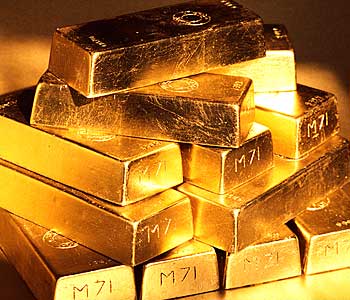 This one is Eddy's fault. She wanted to know about the gold standard.
The authors of the Constitution had two concerns about money - first, they wanted the Federal government to be able to collect taxes to pay veterans' benefits and the cost of future wars; and, second, they wanted no one - the states, private individuals, the Federal government itself - to be able to deal in funny money. They thought they could solve both problems by giving the Federal government a monopoly on legal tender and then requiring Congress to limit the Money used in payment in the United States to Coin - i.e. precious metal. What is fraudulent about our present system is that the Federal government still has its legal tender monopoly but it no longer follows the rules laid out in the Constitution. Instead of using gold coin, the Federal government uses its own bank-created Credit as Money and requires all of us to accept it as the sole legal tender for all debts public and private.
The authors of the Constitution were so suspicious of what Congress might do that they did not even allow it to have a monopoly on Money. They required Congress to allow Foreign Coin to used as equivalents for the United States' own Coin. The authors of the Constitution knew from bitter experience that Congress was capable of being a fraud about money; country had seen the Continental Congress during the Revolution issue IOUs and then require people to take them in payment of the government's own debts. By allowing Foreign Coin to be Money, the authors of the Constitution were assuring that people could refuse to take any funny money that Congress tried to pass off in the future. This is why the Constitution has its specific provisions requiring Congress to "regulate" the Weight and Measure of both U.S. and Foreign Coin. "Regulate" does not mean "make up whatever rules we like" as it does now; it meant "make regular" - i.e. make equal.
Where the authors and the first Congresses made a mistake was in thinking that they could regulate more than 1 kind of precious metal as Money, that they could set by law the ratios of the prices of gold and silver and copper could be fixed, by law. They made this mistake because everyone in the world believed that Money had to have an official Price; it could not be left to the market to decide what Money was worth. (A few oddballs - the Frenchman Cantillon, the Englishman Gresham - knew better. They both observed that Money has to be unitary; otherwise, the smart people will always be swapping the cheaper metals for the more expensive ones.)
Even with this mistake of multi-metalism, the authors of the Constitution succeeded in achieving their aims for U.S. money. Congress was able to be extravagant - to start wars when they did not have the money to pay for them - without permanently destroying the value of the country's savings because no one could be forced to accept anything other than Coin as Money. If Money became short because people and/or the government had used too much credit, the people who had saved Money would find bargains. If people and/or the government became too cautious and hoarded Money, then the rewards for lending and granting Credit would go up. The interchange between Money and Credit would be the fundamental check and balance against future Congresses overreaching their financial authority. Under the Constitution Congress would be free to borrow on Credit like everyone else but it would only be allowed to coin Money or have Coin accepted as legal tender.
What the authors of the Constitution could not imagine is that future Congresses would allow the Federal government to use its own bank-created Credit as Money. That would have seemed to them against all common sense. Everyone in the country had known, from direct experience, that allowing Credit to become Money produced ruin. Savings became worthless, people abandoned work for speculation, and enterprise was destroyed. If the government's Credit was required to be accepted as legal tender, then everyone could go to the government to get their free Money. "Cash" would have no meaning because people could never be required to pay up in Coin. The authors of the Constitution knew that Credit was wonderful stuff. It was easier to use than specie and was flexible; people's ability to promise to pay was not limited by the coins in their pockets. But there had to a limit to how much people could promise and borrow, and that limit was Money; and Money had to be actual stuff that people could demand when they did not want paper, when they doubted that other people's Credit was good. Almost all of the time people would use Credit for trade; they would buy and sell things using Notes because it was the better way to do business. But, in the background of everyone's mind there still had to be the understanding that people could decline further exchange of credit and demand actual payment instead. With Credit there was always going to be the risk that one was getting a devious, suspect instrument of exchange. If people were free, they would trade; and, in trading, they would be certain to deal in all kinds of promises - some of which will be completely ludicrous. These rules would apply equally to the government and to private business. The Constitutional gold standard would not prevent people or Congress itself from committing fraud and folly; but it would assure that they were punished and not rewarded if Money was the stuff that was impossible to counterfeit and impossible to multiply with the stroke of a pen or the turn of a printing press (or, today, the click of a keyboard).
We now live in a very different world of Money and Credit. Foreign Coin is no longer a check and balance on Congress' monopoly authority over legal tender; every government in the world now uses its own IOUs as Money. That leaves only the Constitutional gold standard as a restraint on the government and people's ability to expand Credit without limit. The country has been here before. During and after the Civil War, the Federal government's IOUs - its Greenbacks - were made legal tender, by law. Many people thought this was fine and wanted Congress to keep printing Greenbacks to pay for rebuilding the country after the war. What Ulysses Grant understood was that if Congress kept spending Money as it had during the war, it would turn the country into a nation of monetary alcoholics. The demand for Credit would never be restrained. Almost single-handedly Grant forced the Congress to commit itself to restoring the gold standard, to promising to redeem all paper money in gold Coin. Many people were horrified by the idea; the New York Times (surprise!) predicted that there would be complete panic. Speculators tried to buy up all the country's gold. But, on the actual day when the Federal government resumed the convertibility of all U.S. Bank Notes into gold coin, the world did not rush to the Treasury to swap its paper for specie. The monetary day of judgment failed to appear and was, in fact, a big yawn. The very act of committing the U.S. to restoration of the Gold Standard had sufficiently re-established the credit of the U.S. government that people were content to continue to deal in the credit notes as if they were as good as gold - which they were.
The same result would happen today if Congress adopted a new Specie Act. I know this is a fantasy; but imagine that Congress enacted and the President signed a Specie Act that legisltated that, after January 1, 2013, U.S. Money would be a Liberty Coin of a fixed Weight and Measure of gold and all government Credit Notes - the paper currency called Federal Reserve Notes printed by the U.S. Treasury - would be convertible into Liberty Coin at the value set by the market . The market would instantly value our current Greenbacks at their worth would be in gold. A dollar whose fluctuating value would be fixed by the market's dealings would not, by itself, save the credit of the United States; but it would instantly end the further abuse of that credit by the Congress and the Federal Reserve. That might, by itself, be enough.
A promise to pay can, as the original J. P. Morgan said, only be valued by the character of the borrower. As long as Money itself is solid, people can accept the risks of Credit as the price of its convenience and opportunity for gain. The very argument used against the gold standard - its inflexibility - is true; when one is well established, the price of gold itself becomes monotonously steady. It is the price of Credit that fluctuates. After President Grant's demand for resumption was enacted into law, the infamous Gold Room closed; and stock and bond markets and bank clearings in the United States exploded with a boom that was so real that it produced enough wealth that the country could, for the first time in its history, afford broad "higher" education.
It will not surprise you and it would not have surprised the authors of the Constitution that the first thing the new generation of professors and well-educated (sic) students did was decide that the archaic system of the gold standard had to be improved. The result was the funding of two World Wars and other systematic tortures that the world is still living under in the name of Progress.
Leo Jia comments:
 Thanks Stefan. Here are my thoughts on what you wrote.
From economic point of view, the functions of money are: 1) medium of exchange, 2) unit of account, and 3) store of value.
The biggest problem with fiat money (as we experienced) is its obvious inability to store value. On the other hand, commodity money is hard to transport. Recognizing these, many are inclined to accepting some kind of representative money, such as the gold standard.
It is understandable that people put more trust in things such as gold for a better store of value than in fiat money, simply because they are more real and can't be created from thin-air. This might be very true in simple or primitive economies. But is there any false reasoning here for modern economies? It is true that they can not be as easily created, but this in no way could necessarily lead to a conclusion of their better ability to store value or perform other money functions. My observations are as follows.
1) Any real thing (such as gold) changes value vis-a-vis other real things as economy develops through time. This is determined by the varying needs of human activities. In this sense, a lumber producer for instance may have good reasons not to trust gold to reserve his value of work (as gold could get cheaper while lumber gets dearer during some period of time).
2) The economic developments, following technological advancements or wars for instance, come in steps, which at many times are interruptions to old developments. After each step of development, the values of many thingsare largely re-adjusts. With the automobile invented for instance, the horse wagons lost substantial value. On the other hand, with a large gold mine discovered, gold's value vs. other things dive.
3) In the case of a step-up of the economy (due to an important technology break through, for instance), the requirement for capital jumps up. If the money is based on some real thing (such as gold), the money supply seriously lags in a way to hinder the economy development. Gold's supply has its own course of development. Except for a few large discoveries in history, gold's supply has been largely a gradually growing process, and this contrasts the nature of economic development, which often jumps, particularly in the modern age.
4) In the case of gold being a money base, the real question is why people would always treasure gold. Could the attitude change? From the nature that gold is of little real use, this is very likely somewhere down the road. All it needs is one country's abandoning the gold standard to wreck the whole world's economy. Before that happens, is people's pursuit of gold quite similar to a fool's game, where everyone owning gold is just hoping to sell it to a bigger fool?
In the modern world, when we have various developments in fast gears, we don't really have a money that meets the functions we want. It is very unfortunate. Perhaps the desire to have a store of value in something is generally a fallacy. Sure, the modern finance provides some possibilities for that desire, but modern finance is not for everybody.
Question: is it feasible to form a money based on some financially structured instruments?
Stefan Jovanovich replies:
Leo, Thanks for the reply. I don't think you can support the notion that Money is a primary "medium of exchange" any more; it is, for the limited population of drug dealers and others wanting to hide their wealth from "the law", but the volume of credit transactions so completely dwarfs cash dealings now that I am afraid the standard textbook definition of money has to be retired from our discussions, even if it will always remain the correct answer for an Econ 1 class. The "store of value" notion has always been a canard. The notion of "value" itself is one of those Platonic ideas that it is impossible to abolish, precisely because it is never defined well enough to be tested or disproven. It is part of the equally bizarre idea of Capital - the notion that certain stuff and paper (in our age, digital entries) represent a "store of value". Once you accept the circularity of these terms, you never find the exit door into what people are actually doing. (Yes, yes I know about marginal utility, etc. but all of those wonderful theories can be reduced to something the money changers sitting outside the Temple knew - price is always a matter of quantity and time.)
Having endured the interminable sermons of their era (and decided, like Washington, that God existed outside of church as well as in), the authors of the Constitution were well acquainted with the theological approach to discussions about the economy. But, being practical men of business (even the lawyers among them were traders), they knew enough of the world to know that commerce would always rest on the foundation of credit. When counter-parties began to worry, "the economy" was in trouble, no matter how much gold was in the vault. They also knew that Money - specie - would always be the measure of the fundamental economic fact of life - scarcity. They counted on the fact that Money is always in short supply to be the principal limitation on the size of government itself. As the Founders knew, money is the spoil sport - the stuff that is unalterably real and cannot be talked into existence. Americans used to know this instinctively. There is the classic remark of t he real estate speculator in San Diego in the 1880s who got caught long and telegraphed to his partner back East: "Lost $100,000; still worse, $800 was in cash".
What the Founders and a majority of Americans in the 19th century did not think was that the government could somehow protect people from the vagaries of the market itself. They certainly did not think that gold - i.e. Money - could do that. The claims made for gold by the Paulistas - Don Ron made it again last night in the Republican primary debate in South Carolina - are specious. Gold is not a "store of value" and it has never protected people from the fluctuation of prices. As you noted, gold's exchange value fluctuates dramatically even under a Constitutional gold standard. Gold as Money is no more immune to market variation than Credit; both are subject to the vagaries of trade. What Gold as Money is not subject to are the manipulations of the government as ruled by faction. When George Washington warned against "faction", he was not cautioning people about political parties; he was cautioning them about the ability of people to use the government's monopoly au thority over legal tender to create credit in their particular favor. All gold offers is the assurance to the holder of Money that he/she has only one financial risk - the fluctuations of the market - and that he/she is safe from the cheats of government action in the name of the common good.
P.S. Your history about gold mining needs revision. The great discoveries - California in the 1840s, South Africa and Alaska in the 1890s - did not see "gold's value vs. other things dive"; on the contrary, the gold discoveries led to credit booms that saw general prices rise and specie become inexplicably tight. The Panic of 1907 arose because the London insurance companies were unable to pay their American claims from the San Francisco Fire; gold - within a decade of the greatest discovery in history - became so incredibly short that JP Morgan - for the first time in its history - agreed to join the New York Clearing House so that the banks would stop pulling each other down to ruin by acting like lobsters trying to climb over each other out of a barrel.
P.P.S. The notion of a Monetary base is beyond my capacity to argue with. If you accept the illusion that IOUs are Money, that the entries on the ledgers at the Federal Reserve and the Notes printed by the U.S. Treasury are somehow more "high-powered" than other forms of Credit, then the Ptolemaic system of modern academic economics seems to work fine - until, of course, it doesn't. The modern world has no problems with its system of Credit; its difficulties are with the absurd notion that the Unit of Account can be multiplied at will by central banks in the name of stability.
The questions of money and credit were not intellectual novelties for the founders or their contemporaries. They were - literally - the common coin of civil discourse. Hume's Essays - which were in the library of everyone who attended the Constitutional Convention - raised the issue directly:
"It is very tempting to a minister to employ such an expedient, as enables him to make a great figure during his administration, without overburthening the people with taxes, or exciting any immediate clamours against himself. The practice, therefore, of contracting debt will almost infallibly be abused, in every government. It would scarcely be more imprudent to give a prodigal son a credit in every banker's shop in London, than to impower a statesman to draw bills, in this manner, upon posterity. What then shall we say to the new paradox, that public incumbrances, are, of themselves, advantageous, independent of the necessity of contracting them; and that any state, even though it were not pressed by a foreign enemy, could not possibly have embraced a wiser expedient for promoting commerce and riches, than to create funds, and debts, and taxes, without limitation? Reasonings, such as these, might naturally have passed for trials of wit among rhetoricians, like the panegyrics on folly and a fever, on BUSIRIS and NERO, had we not seen such absurd maxims patronized by great ministers,(Robert Walpole) and by a whole party among us (the Whigs)."
Peter Saint-Andre comments:
 And hence there runs, from the first essays of reflective contemplation of a social phenomena down to our own times, an uninterrupted chain of disquisitions upon the nature and specific qualities of money in its relation to all that constitutes traffic. Philosophers, jurists, and historians, as well as economists, and even naturalists and mathematicians, have dealt with this notable problem, and there is no civilized people that has not furnished its quota to the abundant literature thereon. What is the nature of those little disks or documents, which in themselves seem to serve no useful purpose, and which nevertheless, in contradiction to the rest of experience, pass from one hand to another in exchange for the most useful commodities, nay, for which every one is so eagerly bent on surrendering his wares? Is money an organic member in the world of commodities, or is it an economic anomaly? Are we to refer its commercial currency and its value in trade to the same causes conditioning those of other goods, or are they the distinct product of convention and authority?
From On the Origin of Money by Carl Menger
Stefan Jovanovich writes:
 Menger was the leading figure in the Austrian "Währungs-Enquete-Commission, the Monetary Commission called to deal with the problem of the Austrian currency. (Hayek: "Towards the end of the 'eighties the perennial Austrian currency problem had assumed a form where a drastic final reform seemed to become both possible and necessary. In 1878 and 1879 the fall of the price of silver had first brought the depreciated paper currency back to its silver parity and soon afterwards made it necessary to discontinue the free coinage of silver; since then the Austrian paper money had gradually appreciated in terms of silver and fluctuated in terms of gold. The situation during that period — in many respects one of the most interesting in monetary history — was more and more regarded as unsatisfactory, and as the financial position of Austria seemed for the first time for a long period strong enough to promise a period of stability, the Government was generally expected to take matters in hand. Moreover, the treaty concluded with Hungary in 1887 actually provided that a commission should immediately be appointed to discuss the preparatory measures necessary to make the resumption of specie payments possible. After considerable delay, due to the usual political difficulties between the two parts of the dual monarchy, the commission, or rather commissions, one for Austria and one for Hungary, were appointed and met in March 1892, in Vienna and Budapest respectively.)
According to Hayek, "Menger agreed with practically all the members of the commission that the adoption of the Gold Standard was the only practical course." What the Commission did not do was adopt the approach taken by the Americans a decades earlier. Instead of simply setting the weight and measure for Austrian Coin at an equivalence to the British pound - the reference point for all international transactions, the Commission debated "the practical problems of the exact parity to be chosen and the moment of time to be selected for the transition". That, by itself, did no great harm; but it established the principle - now universal - that the state, not the market, would be the ultimate arbiter of the content of Money. It is foolish of me to expect them to have done otherwise. Even though (or perhaps because) Menger was the author of utility theory, his political economy had an unshakeable belief in "essences", in the notion that political economy could be reduced to laws of motion, just like physics. The result was the Franco-Germanic idea of the "universal bank" - the Creditanstalt that would literally "manage" the economy and do away with the need for those messy people - the brokers and the dealers in stock - and their volatile exchanges.
For Menger there could be no difference between "the disks (and) documents" because all money was a creation of the state's authority. The American idea that you could bring bullion to the Mint and demand that they reduce it to legal tender - for free - was anathema.
Jan
12
The Edifice Indicator Update, from Stefan Jovanovich
January 12, 2012 | 1 Comment
China is building 44% of the 50 skyscrapers to be completed worldwide in the next six years, increasing the number of skyscrapers in Chinese cities by over 50%.
Burj Khalifa, at 2,716 feet, should remain top dog for several years, but the Shanghai Tower, at 2,073 feet, and Wuhan's Greenland Center, at 1,988 feet, will take the world No. 2 and 3 spots in 2014 and 2015.
Leo Jia writes:
Not only the number, but the speed of building is also shocking. This story tells about a 30-story hotel being built in 15 days.
Jan
10
Ticketing, from Stefan Jovanovich
January 10, 2012 | 1 Comment
I am guilty of knowing a little about ticketing — thanks to being married to a theater producer and having been partners with a man still known in certain precincts of west LA as "Mr. Ticket".
What Mr. Kahn says is true: "it used to take 3 days to make a price change within a ticketing system. …(T)eams can now change thousands of prices with a single click."
Dynamic ticket pricing is as much of a change for the sports business as the abolition of fixed exchange rates was for the brokerage business.
Jan
10
Ghost Writers, from a scholar
January 10, 2012 | 1 Comment
 Every modern President has had a ghost writer. Even the failed candidates (Mrs. Clinton, for example) have had some anonymous scribe laboring over his/her collection of press clippings, interview transcripts and other gleanings to produce a suitable memoir. Begin with Profiles in Courage and work forward. This may be unfair to the Bushes; I am certain Mrs. Bush I wrote the one about the dog.
No one becomes President any more without having the goal as a childhood ambition - either their own or their parents or both. Dwight Eisenhower is the last Chief Executive who arrived at the office without having dreamt of hearing Hail to the Chief while sucking his/her thumb.
The primary political skill required for becoming President is that you be able to raise the money; in that, President Obama is one of the masters and has been from an early age. He has played Hollywood (David Geffen, most of all) with a mastery that more than equals Joshua Bell; and he continues to be have the ability to not only generate pledges but also actually collect the checks and not have them bounce.
Obama's "outmaneuvering" of Mrs. Clinton was comparable to every other primary battle; he had more money, and he raised it by being as successful a leader of the trust fund children's crusade anyone in American history.
Blaming Mrs. Palin for McCain's defeat is like blaming Roosevelt for Pearl Harbor; it fits a contemptible narrative (it must be the bitch's fault) that relieves the actual commanders of their responsibility. Until McCain was fatally stupid enough to come to Washington and sit at the end of the table listening to Bush announce Paulson's "plan" (sic), he was leading in every poll; after that moment, he always trailed. At the moment of decision McCain showed himself to have as little moral courage as always; his "maverick" posture was simply vanity. When it mattered, it lacked the guts to stand apart. (The reason McCain was largely blackballed from the club of the Hanoi Hilton survivors is that he refused to accept the NVA offer of early release; his fellow captors wanted him to go back to Washington and tell people in the Pentagon how to win the war; McCain was afraid that he would look bad.)
Walter Mondale and Geraldine Ferraro lost 49 states; if McCain has carried as much of the white vote as Bush II in 2004, he would have been elected.
I think it is time for Vic to revive Admiral Nelson's rules. Otherwise, someone other than me is going to start throwing the rolls. (If they are as hard as the biscuits Harvard once served, someone may actually get hurt.)
Jan
7
Joshua Bell and Put Up Jobs, from Stefan Jovanovich
January 7, 2012 | Leave a Comment

By now you have probably read the Pulitzer prize winning Washington Post article about violinist Joshua Bell performing in the D.C subway.
You have to love the Posties; if they can find a way to diminish and demean their own subscribers, they go for it - because they know that their newspaper can only continue to be the font of wisdom as long as the civil servants believe they have to read it each morning.
Playing Bach in a subway station is like playing baseball indoors; all the skill in the world can't make it anything but a nuisance.
P.S. Bell's virtuosity is unchallengable; his musicianship, like Midori's, so dreadfully earnest that, of course, it gets an A+ from the Wurlitzers of record and requires an audience full of schoolies full of superior appreciation.
Kim Zussman writes:
Aesthetics and taste are subjective and subject to presentation. Examples include statistical inconsistency in rating fine wine and celebrities out of context. When you meet so-called "knock out" actresses in person, more often the surprise is disappointment.
Russ Sears writes:
I am in the middle of reading "Thinking Fast and Slow" by Daniel Kahneman. It tries to describe what psychologist "know" about how intuition (fast thinking) and analysis (slow thinking) work and work together. I will try to give a more complete report once I am finished with it.
However, briefly it mainly describes how thinking creates biases, while at the same time tries to show respect and analyze how amazing "thinking" is.
One of the biases: it is clear most people underestimate the persuasiveness of their surrounding to their effect on their mood, judgment and decision making with even subtle unperceived differences he calls "priming". Such things as a poster with big eyes in the room with a "honor box" for coffee greatly increases the amount put in the box. And a forced smile creates happier people much later.
In the intro- he implied that his main criticism has been the of focusing on the biases rather than the strengths of "thinking", However, so far my main criticism is his over generalizations, and insistence that these studies prove "we" (all of us) are victims of these biases. And so far the book seem to imply that only through analysis (by such studies) can these be recognized and "we" overcome them. Yet, I would suggest that many of the more successful and happy people's "edge" comes from intuitively having perceived many of these biases early on in their lives and having made adjustments to offset them…without perhaps knowing the "science" behind "why".
Such are the people that stopped for the music in the subway station. Even though primed to ignore it. Yet while he insist that "all" are victims of specific biases. Their is perhaps in total evidence that we all accept, the possibility of biases for the power of thinking. But it is natural for life to perceive that they are the superior different one in overcoming these biases. The violinist show many think they would stop and listen, but few actually do.
Even so, the book thinking fast and slow has given me much to think about, and I would recommend it to all.
Dan Grossman writes:
 As a former violinist, I had enjoyed the You Tube video and the seeming fact Bell would play incognito in the subway. But I hadn't realized it was a put-up job by the Washington Post.
It's like all those Kahneman and Tversky experiments everyone is so excited about to show there's no rational man that economics is based on, where students play games with small amounts of money given to them.Contrary to that famous fairness experiment, if the student in the real world were negotiating to divide $1 million dollars of real money and he had the choice of getting 10% ($100,000) or nothing, while the other player got 90%, he would take the $100,000.
Victor Niederhoffer adds:
One would add that when Bell plays, his body movements are very poetic and add immeasurably to the sense of music of the audience. Presumably because this was a set up job similar to what Prof Phil pointed out vis a vis the tag team of beggars and homeless brought in to keep man small, and the chair to his credit first brought to the attention of the list vis a vis The Port Authority in New York, which is always laden with the beggars and homeless to keep man small, a la Ayn Rand's essay on Victor Hugo's The Compafriros, the maimed in Spain raised to show how bad the lot of some people can be relative to the feudal existence of the masses, one can assume that Joshua did not make those body movements and twists and turns that lets the audience know he is really making music, so that it would be more likely that the Wash Post could prove the point that no one would notice. 31 bucks on the other hand seems pretty good considering the lack of charity in workers in the beltway who are living off the fruit of other peoples labor.
Dec
26
Land Rushes, from Stefan Jovanovich
December 26, 2011 | Leave a Comment
Walter P. Fuller bought 40 acres in what is now Pinellas Park, Florida for $45.27 in 1920; less than four years later, he resold it for $40,000. Nine months later, in 1924, the land was resold again for $60,000. The next change of title was in 1933 when the property was sold at auction for $450 - to discharge the county's tax lien. Like Bernard Baruch, Fuller became a millionaire by selling too soon.
Dec
22
10 Things You Can Learn About the Market from Greek and Roman Times and Myths, from Victor Niederhoffer
December 22, 2011 | 2 Comments
 1. There is a critical point in the market, a critical decision that the market gods weigh on a scale like Zeus with his balance scale deciding whether Achilles or Hector will win, that determines the market fate, and it is key and should be the focus of all news stories and market considerations but never is.
2. Never trust anyone but your family and best friend because everyone is disloyal in a pinch. Peleus was left for dead by his father in law after killing his brother in law to become ruler and this led to the Trojan war. Caesar trusted his best friends but they turned on him when an opportunity for power, money, and romance reared its ugly head.
3. Deception is key. The most successful Greek was the Deceiver Odysseus, and he tricked everyone he dealt with as the market tries to trick you with Odyssean power.
4. The goal is always to come home. Odysseus went home, as does the market. The only loyal ones were the wife and son and the best servant. The market retraces and comes home to break even an inordinate number of times.
5. Never mix romance with business or the market. The Trojan was was started by Paris intervening in romance and being swept off his feet by Aphrodite, and Achilles killed tens of thousands and prolonged the war by 10 years when Menelaus stole his mistress.
6. Don't try to walk with the Gods. Peleus married a half God and married her the last time the Gods and mortals mingled at a celebration and it caused him to be the most distressful of men. Trying to emulate Soros or the other greats is the seed of destruction.
7. Okay, give me the rest. And correct and tighten the above. I'm out of my depth but wanted to get the gist across.
Ken Drees comments:
 Like using a mirror against Medusa, one must plan against the adversary and sometimes use their expected attacks to beat them. Like shielding oneself from the siren song, one must be totally prepared, seek council before the journey (the trade) about what dangers are expected.
Also, it seems every entity in mythology had a weak spot. It's probably best to note these weaknesses in your thinking and in your emotions, not how can I beat the market, but how can the market beat me today?
Bill Rafter writes:
The greatest two rules:
(1) nothing to excess and (2) know yourself.
Pete Earle writes:
One lesson from mythology which resonates with me is the oracles/prophets/predictors almost always forecast correctly, but rarely in an obvious or immediately relevant way. The predictions made are usually realized, but not before taking extremely circuitous, and usually counterintuitive ways to reach fulfillment.
In my experience, predictions regarding the direction of equities or commodities inferred from option markets so often prove accurate…but only after traveling in the most wrong, most unanticipated ways.
Alston Mabry responds:
 Pete, I think of that as "shaking the tree", i.e., we're gonna get there, but we're gonna shake out as many weak hands as we can along the way.
Peter Earle replies:
Absolutely. Stop-running and the like as the "gods" way of seeing who's "worthy"; who can withstand the flood, the fire, the sturm und drang.
Jim Lackey writes:
In 2008 I learned from Ryan Carlson– Sisyphus. There is a little useless book Wit and Wisdom from Wallstreet. So many of the quotes are the exact opposite from 3 pages ago… yet for a day they are seemingly sage advice. Worse for the long term. It's all good advice, yet in the mean time we must eat, and in the long term we all end up dust in the wind.
Traders lament when we miss profits. We are miserable when we lose. If we are not careful we are never happy. I have the habit of having to work myself up into a fury to win a race, pass a test or trade. My wife calls it "business mode" everyone else calls it being a jerk. Finally this year I have the ability to take a loss and this week miss a glorious rally and profit… yet at 4:20 PM its over. I am done pushing the boulder back up the hill for the day. I will return at 1:30am or by 7am, all but two business days a year. It can be torture if you do not like to trade, but if you love it…
Here is a quote from my kids music, "This is Our Science" by Astronautalis: "Our work is never done/ We are Sisyphus".
p.s I notice that if I don't like the rap beats I miss quite a bit of new poetry. I hear my teenagers say random lines and say what! That is amazing. Then I hear the song and say no wonder I never heard that line before. Damn drum machines.
Jack Tierney adds:
Recently I've been reading up on complexity, system dynamics, and the unpredictable consequences that occur when tinkering with non-linear systems. The markets seems subject to all and, if I'm even remotely correct in interpreting the literature, there's only one certainty: expecting linear consequences (e.g, provide banks with more liquidity, bringing about an increase in business borrowing, resulting in a resurgent economy) is rarely, if ever, realized.
Instead, the unseen effects on unimagined factors, almost always derails the logic train. A source I've referred to on occasion is "Cassandra's legacy." Appropriately enough, the custodian of that site provides an interesting historical allegory, in the form of Goth Princess/Roman Empress, Galla Placidia, and her part in the demise of the Roman Empire. It's a very lengthy read and, unless history like this interests you, tough going. So, a few highlights:
"Managing any large structure is difficult and we tend to do it badly; a whole empire may be an especially difficult case. To do it well, we would need to use a method what I mentioned before: system dynamics; which is a way to describe systems and the relation of the various elements that compose them.
"…every time that the Romans fought the Barbarians, they could win or lose, but each battle made the Empire a little poorer and a little weaker. The empire was using resources that could not be replaced; non-renewable resources, as we would say today….the solution was not more troops but less troops. It was not more imperial bureaucracy but less imperial bureaucracy, not more taxes but less taxes.
"In the end, the solution was right there and it was simple: it was Middle Ages. Middle ages meant getting rid of the suffocating imperial bureaucracy; it meant transforming the expensive legions into local militias; have people paying taxes locally, in short transforming the centralized empire into a decentralized constellation of small states. Without the terrible expenses of the Imperial court and of the Imperial bureaucracy, these small states had a chance to rebuild their economy and start a new phase of prosperity, as indeed it happened during the Middle Ages.
"What Placidia could do as an Empress was, mainly, to enact laws….It seems that Placidia was acting according to her style; ease the unavoidable, don't fight it….Placidia forbade the coloni, the peasants bound to the land, to enlist in the army. That deprived the army of one of its sources of manpower and we may imagine that it greatly weakened it. Another law enacted by Placidia, allowed the great landowners to tax their subjects themselves. This deprived the Imperial Court of its main source of revenues."
Stefan Jovanovich comments:
As much as King George's scribbler Edmund Gibbon despised Christianity, he had the Middle Ages even more because its bureaucracies were the worst of all — local and mean and stupid.
Professor Bard should revise his history. What he wrote here — "Middle ages meant getting rid of the suffocating imperial bureaucracy; it meant transforming the expensive legions into local militias; have people paying taxes locally, in short transforming the centralized empire into a decentralized constellation of small states. Without the terrible expenses of the Imperial court and of the Imperial bureaucracy, these small states had a chance to rebuild their economy and start a new phase of prosperity, as indeed it happened during the Middle Ages." - is nonsense.
The Roman Empire's tax collections were always "local"; that is why Roman politicians were willing to pay such enormous bribes to be appointed provincial governors. The legions were also "local"; the Empire's expansion came from granting "foreigners" - i.e. the people we would today call Spaniards, French and Syrians - the privileges of citizenship, which meant they were also qualified to serve in the local legions. This was equally true under the Republic; "crossing the Rubicon" would not persist as a bad metaphor if Rome's soldiery had been centralized.
As for economics, whatever the "terrible expenses of the imperial court", they were nothing compared to the ravages of coin clipping. The solidus of the Eastern Empire maintained an unchanged weight and measure for 4+ centuries - a record that is likely never to be broken. (It exceeds the span of sound money for the British Empire and the United States of America put together.) After Princess Placida's day coinage, under the wonderful decentralization of the Middle Ages, effectively disappeared.
"Dearth of provisions, too, increased by degrees, and the scarcity of good money was so great, from its being counterfeited, that, sometimes out of ten or more shillings, hardly a dozen pence would be received. The king himself was reported to have ordered the weight of the penny, as established in King Henry's time, to be reduced, because, having exhausted the vast treasures of his predecessor, he was unable to provide for the expense of so many soldiers. All things, then, became venal in England; and churches and abbeys were no longer secretly, but even publicly exposed to sale." - William of Malmsbury wrote this in 1140 AD - the period that Professor Bard praises so highly for its progress over the degeneracies of the Empire.
Hume deserves the last word on this and most other subjects that interested him.
"Mankind are so much the same, in all times and places, that history informs us of nothing new or strange in this particular. Its chief use is only to discover the constant and universal principles of human nature."
Easan Katir adds:
The Greeks have fooled people since the Bronze Age. Instead of a horse, they now have Trojan bonds.
Steve Ellison comments:
Jack, the Atlantic had an article about why projects that had successful pilots often failed when rolled out to the general population.
Why Pilot Projects Fail– Here are some excerpts:
Promising pilot projects often don't scale … Rolling something out across an existing system is substantially different from even a well run test, and often, it simply doesn't translate.
Sometimes the 'success' of the earlier project was simply a result of random chance …
Sometimes the success was due to what you might call a 'hidden parameter', something that researchers don't realize is affecting their test. Remember the New Coke debacle? …
Sometimes the success was due to the high quality, fully committed staff. …
Sometimes the program becomes unmanageable as it gets larger. You can think about all sorts of technical issues, where architectures that work for a few nodes completely break down when too many connections or users are added. …
Sometimes the results are survivor bias. This is an especially big problem with studying health care, and the poor. Health care, because compliance rates are quite low (by one estimate I heard, something like 3/4 of the blood pressure medication prescribed is not being taken 9 months in) and the poor, because their lives are chaotic and they tend to move around a lot … In the end, you've got a study of unusually compliant and stable people (who may be different in all sorts of ways) and oops! that's not what the general population looks like.
Dec
22
18 Charts, from Dan Grossman
December 22, 2011 | Leave a Comment
 It's striking to me that not one of the 18 charts covering virtually every significant economic topic refers in the slightest to the massive legal and illegal immigration into the US over the last few decades, and how this could have correlated with chart topics such as working-age male unemployment, amount of toil to rent a house served by average school, medical care spending, etc, etc.
Stefan Jovanovich comments:
Thank you, Daniel. he decline in wealth for the "average" American since the collapse of the dot.com boom matches the slow, steady ruin that the 50% of the U.S. population who lived on farms endured after the end of the WW I boom. The migration to the industrial north of the white and black-skinned sharecroppers/small-hold farmers that is now celebrated as the precursor of the civil rights movement was an index of the desperation people felt. If people had really wanted to trade Tennessee for Chicago and Detroit, their children would not be moving back "home" as fast as they have in the past few decades. No one was talking about the depression of the 1920s on the radio any more than they are mentioning it on Twitter now; but it was occurring and continuing to grow in severity.
Dec
16
The Atlanta Hockey Team Indicator, from Stefan Jovanovich
December 16, 2011 | Leave a Comment
 As the serious readers of this site (Blackhawks, Penguins, Flyers– er, even Rangers fans) know, Atlanta had a hockey team named the Thrashers until this May of this year when they became the Winnipeg Jets. This is the second export of Southern ice culture to Canada. In May 1980 the Atlanta Flames became the Calgary Flames.
Admittedly, it is not certain that 2011 will equal 1980 as an opportune time to being accumulating U.S. equities; but the indicator has been flawless in calling tops. The Thrashers were given their franchise rights in 1997 and played their first game on October 2, 1999. The Flames received their franchise in November 1971 and began play in October 1972. What else does one need to know?
Dec
16
Blame the Speculators, from Rocky Humbert
December 16, 2011 | Leave a Comment
 This paper from the New York Fed blaming the real estate crisis partially on the flippers (speculators) is actually a rather sensible paper that makes some obvious and more subtle points. Most interesting is they quantify the extent of speculative purchase activity during the bubble years in some creative ways.
They note:
1. Housing is both a consumption good and an investment/store-of-wealth. During the bubble years, the latter trumped the former and attracted speculative/investment interest. i.e. irrational exuberance.
2. Investment/Speculative buyer motivation can be based on (1) rental income; (2) buy and hold for long periods; (3) buy & flip. #3 grew to be a major factor near the zenith.
3. They demonstrate that 1/3 of ALL home purchases were 2nd buyers during the bubble years, AND, in the worst states (NV, AZ, FL etc), more than half of the purchasers were second home buyers and/or flippers and/or multiple lien holders.
They are quantifying what we already knew — that the seemingly endless demand for homes was coming from investment/speculative buyers. However, unlike during the internet bubble, these speculators walked away (as many had no-money-down) and they handed the keys to the banks…
It would be analagous to having a leveraged trading account with no initial margin….!
Stefan Jovanovich comments:
And, no recourse. If the speculators were clever/dishonest enough to state on the disclosure forms that they were buying the properties as principal residences, here in California and Arizona and the other non-recourse states, their liability was limited to their option payment - er, their down payment (which could be as little as 3%). Here is the list of the non-recourse states:
Alaska (AK)
Arizona (AZ)
California (CA)
Connecticut (CT)
Idaho (ID)
Minnesota (MN)
North Carolina (NC)
North Dakota (ND)
Oregon (OR)
Texas (TX)
Utah (UT)
Washington State (WA)
The rumor is that the AGs have reached a settlement.
The settlement of $25B is not going to make much of a dent in the outstanding mortgage deficiencies that are recourse. Core Logic says that 10.7 million houses (22.1% of all residential properties with a mortgage) were in negative equity at the end of the third quarter of 2011 and an additional 2.4 million properties (5% of all mortgaged residences) had less than 5 percent equity. The negative-equity and near-negative equity mortgages accounted for 27.1 percent of all residential properties with a mortgage nationwide. But there is good news - Core Logic says the 27.1% is down .4% from the total in the 2nd quarter.
Also, the Federal Reserve's calculation of "owner equity as percentage of household real estate" was 38.6% as of Q3 this year; in 2005 it peaked at 60%. Approximately 1 out of 3 homes in the U.S. has no mortgage. I may need Big Al's help (as I did when calculating the current market price of the U.S. Treasury's gold reserve) but my handy calculator suggests that this leaves 40% of homes that are "conventional" - i.e. neither free and clear nor so leveraged that they have negative and near-negative equity. The bad news is that, after you subtract 33% from 38.6%, that means the average cushion for the conventionally-mortgaged homes is 5.6%/40% - 14%. Didn't someone say something about this being a solvency problem and not a liquidity problem?
Final random thinking:
According to the folks at Calculated Risk, there are now 4.1 million seriously delinquent loans (90 day and in-foreclosure). In a "normal" market there a 1 million seriously delinquent home loans. Recently, there was "good news" (sic) about the decline in the numbers of REO properties held by Fannie (in Q3 their REO inventory fell to 122,616 houses, a decline of 10% from the number at the end of Q2). That made it the 4th straight quarter in which Fannie's REO inventory declined. One small problem: this is the same period during which foreclosures ground to a halt because of the litigation over mortgage servicing (robosigning, etc.). While it is likely that some of the seriously delinquent loans will cure as part of the settlement (see below), many more will go into foreclosure; and Fannie's inventories will rise.
Alston Mabry writes:
In Phoenix the RE bubble started in the valley and then moved up into the mountain towns 2-3 hours away, where people have summer homes to escape the heat. It was like a tide of money that rose up the mountainside. In August/September 2006, I was driving around and listening to NPR, when a report came on about the local RE market.
A woman who was a broker in the mountain towns said that business was absolutely booming…oh, except that last week there was nothing…strangest thing…but we're sure it will pick up again next week, after the kids are settled in school, etc etc.
An image popped into my mind: A flipper had an open house, but the only people who showed up were other flippers, and by that time they all knew each other. They looked at each other and said, "Holy sh*t…", and got in their cars and left, wondering how quickly they could unload their properties. It was over. And the tide rolled back down the mountain.
Dec
14
Golden Fetters, from Stefan Jovanovich
December 14, 2011 | Leave a Comment
 The Bundesbank is now in the same position that the Federal Reserve/U.S. Treasury were in the 1920s. As Pater Tenebrarum notes:
The BuBa is making up for the gaping hole left by fleeing depositors and the lack of access to wholesale funding in the euro area periphery's banking systems. It is basically a stealth bailout of the periphery's banks. In principle this does not represent a problem, since most of the deposits have fled to Germany where they are now funding the German commercial banks.
To maintain how the administrative gold standard was in the 1920s, the Federal Reserve/U.S. Treasury (they were as collaborationist then as they are now) had to swallow European paper and sh*t gold. No one in the North Atlantic (except Americans and Canadians) could ask for gold in exchange for the paper issued by the central bank/Treasury, yet the central banks of all the countries were able to continue the fiction that international trade balances were being settled in gold at the pegged price of the administrative standard. No one in the non-German countries in euro-Europe can now ask for and get a commercial loan if they are not a government-sponsored enterprise already in debt, yet the paper currency issued by the Greek central bank remains legal tender in Stuttgart.
According to a study from the BIS:
the scale of the 2008-09 banking crisis, as measured by falls in international short-term indebtedness and total bank deposits, was smaller than that of 1931. However, central bank liquidity provision was larger in 2008-09 than in 1931, when it had been constrained in many countries by the gold standard. Liquidity shortages destroyed the international monetary system in 1931. By contrast, central bank liquidity could be, and was, provided much more freely in the flexible exchange rate environment of 2008-9. The amount of liquidity provided was 5 ½ - 7 ½ times as much as in 1931.
Kyle Bass says the European banks are 3 times as leveraged as those in the U.S. and have not recapitalized even as the U.S. banks have added nearly $1 trillion to their capital. According to S&P, total bank liabilities are €23 trillion for the eurozone and €8 trillion for the UK, Sweden, and Denmark.
What if Lehman/Bear Stearns and FNM/FRE were not the Credit Anstalt but merely the Rentenmark crisis– not 1931 but 1923/4?
And then, Mr. Bass reminds us, there is situation of Japan– something that actually is "different" this time.
p.s. And then there is China– as Mr. Hendry and Professor Mundell predicted.
Dec
8
70th Anniversary of a Day That Will Live in Infamy, from Stefan Jovanovich
December 8, 2011 | Leave a Comment
 I think that President Roosevelt's words resonate ("December 7, 1941, a day that will live in infamy") because the attack was undeclared and unprovoked - like 9/11. That makes the death of the sailors, marines and airmen somehow more poignant than "ordinary" (sic) dying in war. I cannot explain why, but I know that few veterans of WW II or Korea or Viet-Nam or our current Asian wars have asked to be buried with their missing comrades abroad, but almost every remaining survivor of Pearl Harbor seems to want to have their remains put there.
Some people have struggled long and hard to make the case that the United States "backed Japan into a corner" by establishing a trade embargo. What is always conveniently forgotten by the defenders of the Pearl Harbor attack is that the American embargo was put in place because the Japanese refused to end their atrocities against the Chinese. To many people in the United States a trade embargo was the very least that our country could do in support of the Chinese. People do very different kinds of stuff in wars, and what the Japanese Army did in China was as great an atrocity as the Nazi's murder of Jews, Slavs and other civilians.
The Japanese decision to attack the United States (and the German's completely inexplicable decision to declare war on the U.S. a week later) were both based on the same insane xenophobia that persuaded them that it really was OK to rape Nanking and build gas ovens for WW I German veterans whose grandmothers were Jewish - the notion that the mongrel Americans were hopelessly inferior as a matter of race. What is the great irony of the events that followed this day 70 years ago is that wisdom of the American Constitution's XV Amendment was finally put into practice. The hypocrisy of our country's having fought for 4 Freedoms in a segregated armed forces became too much even for a Missouri Democrat to bear.
For further reading, see Executive Order 9981.
The one certainty about wars is that their results will be entirely unexpected.
Dec
5
Old Putin, from Stefan Jovanovich
December 5, 2011 | 1 Comment
 It is ridiculous for Americans to criticize the failures of other countries to adopt democracy as successfully as we have. Before we got started, we had a century of practice under the benign rule of a distant sovereign during what really was an Age of Reason. Even so, we had a ruinous civil war that continued to be fought for the next century over the issue of whether the 15th Amendment should actually be put into practice.
The Asian democracies — the Republic of Korea, Japan and Taiwan — all took half a century to establish genuine two-party democracies; yet somehow the Russians are to scorned because they have not gotten there in 20 years. When the democracy in South Viet-Nam had its stumbling beginnings, the American reaction was much the same - impatient scorn. It led to the first official murder of a foreign head of state.
As more than one person has noted, the result was a devastation of Southeast Asia that rivals anything Stalin accomplished. Had we had the confidence to leave well enough alone, millions of people would not have died; and John Kerry and many others would live in the obscurity that they surely deserve.
One of the less fortunate aspects of allowing the immigrants and their bright children (vide the Brzezinski family) to do all the talking is that the United States becomes the instrument for the settling of scores that have very little to do with American interests and very much to do with having American power used to settle private scores that go back to the old country.
P.S. If we are going to list the atrocities of the Soviet Empire, we should also include what shocked even the hardened veterans of the Wehrmacht - the Red Army's deliberate wasting of its own soldiers. Max Hastings has a wonderful and awful book out that you should read - his history of WW II - Inferno. In his interview on CSPAN you will find his comments on the fact that even in the last year of the war the Nazis were less brutal towards their own soldiers than were the Soviets - who were winning.
Dec
4
Thoughts on the Old World, from Bruno Ombreux
December 4, 2011 | 1 Comment
 I have noticed that Europe has an additional dimension compared to the States.
When you travel the USA, all you see is a 3-dimensionnal landscape. In the Old World, there is a fourth dimension that is the history behind the landscape.
In Europe, when you look at a street, a village or a hill, you do not see only a street, a village or a hill. You see 2000 years of history for this street, this village or this hill. There is always a little ruin nearby.
How can I say this? There is extra depth in the Old World. It makes everything more full and life richer.
Same thing when you are marrying true blue blood. You are not marrying merely one guy or one girl. You are marrying history, a line going back centuries. You are becoming part of that line. I am talking true blue blood. Not recent ones like the fake nobles made by Napoleon and the likes.
Maybe the best way to explain it to American people, is to explain it to the ones who are independently wealthy. So if you are wealthy, have you ever tried explaining to poorer people what it felt like to have enough money not to worry about the future? Did they understand you? Or did they just looked at you as if you were a freak? Same problem with explaining the Old World additional dimension.
Stefan Jovanovich responds:
Dear Bruno,
1. The "Old World" of Europe is not nearly as ancient as the travel brochures like to pretend. The governments of all but the most recently admitted states in the American Federal Union have longer established histories (and older unchanged borders) than any of the nation-states in Europe.
2. The "ruins" in America are there and some of them are almost as old as the catacombs; but they are not on display because what Americans have always sold Europeans is the idea of the United States as this wild, unsettled country. You can find railway posters of the Union Pacific advertising the untamed country of Yosemite to potential German and English tourists when the Ahwahnee was offering 10-course meals. Europeans have always come to the U.S. to see the "new"; that is why they still like California - it always photographs like something just unwrapped for Christmas (the best time to take the picture because the smog is being blown away from the coasts) even though it now has an industrial history as old as the English Midlands was in the 1950s.
3. There is a great deal of blue blood here, but it has one fatal defect - there are no titles to identify the "line going back centuries". There had better not be; it is against our Constitution and, if you are going to claim ancestral superiority based on Plymouth Rock and Valley Forge, you can't at the same time be spending all your time bragging about being descended from European nobility. Those claims of ancient European lineage are the very ones being made by the people whose genealogy is - shall we say - questionable. That was just as true in the 19th century as it is now. The Astors and others who were eager to acquire British class did not have family histories that could trace back to the American Revolution, let alone the founding of the Massachusetts Bay Colony and New Amsterdam. Since there were enough people around like the Roosevelts, they had no choice but to go looking for an Anglo or Franco merger.
4. I can't speak for "poorer people" in the rest of the world, but I can assure Bruno that Americans have no difficulty imagining what it felt like to have enough money not to worry about the future. The turning point in John Kennedy's campaign for the Presidential nomination came in West Virginia. A coal miner asked Kennedy if he had ever had to work for a living. Instead of offering the standard nonsense (Daniel Patrick Moynihan's "I grew up in a poor family", John Edwards' "my Dad was a mill worker" (his father ran the factory), Warren Buffett's "I had a paper route", etc.), Kennedy had the balls to say "No, I never have." The miner's reply was "Good for you." That brought down the house and ended Hubert Humphrey's ridiculous attempt to portray himself as a man of the people.
Most of foreigners' difficulty in understanding America comes from another long-established fact about the United States: the recently-arrived (usually the scholarship children of the immigrants) do almost all the public talking about the country. The oldest tradition in America is to have the A-students lecture the rest of us and tell the world at large about how we are not living up to the traditions of the Republic. (Benjamin Franklin was doing it - and worrying about the Pennsylvania Dutch, er Deutsch when the Penn family was keeping quiet and making certain their land title was secure and paying Franklin to fix it.)
It takes at least one or two more generations for the newly-arrived Americans to discover what Richard Jennings, California blue-blood member of E Clampus Vitas and author of the revised California Corporations Code, once said to our law school class at Berkeley: "Remember someone in this University is going to drop out of school or leave with a "C" average and end up making more money than the rest of us combined." What he did not add was that, while that person might be the child of recent immigrants (see Steve Jobs), the odds were much greater that he would come from a family like that of Mr. Buffett's bridge partner - one old enough that the possibility that great great grandmother may have been one of the "seamstresses" who set up shop above the water table in Seattle can be safely ignored. What I would have added is that it is far more than an even money bet that the same family will be "progressive" enough to be in favor of raising the estate tax. Preventing the newly-arrived from doing what grandfather did to escape the ravages of the tax code is perhaps the most well-established of all the traditions of the better classes of 4-dimensional Americans.
Have a wonderful holiday.
Stefan
Dec
2
Small Business Survival Index for 2011, from Stefan Jovanovich
December 2, 2011 | 2 Comments
Here is something interesting. This is the Small Business Survival Index for 2011
Rank State SBSI Scaled #
1 South Dakota 32.29 100%
2 Nevada 38.53 88%
3 Texas 39.08 87%
4 Wyoming 46.05 74%
5 South Carolina 47.05 72%
6 Alabama 48.77 68%
7 Ohio 49.54 67%
8 Florida 50.08 66%
9 Colorado 51.32 63%
10 Virginia 51.70 63%
11 Washington 52.31 62%
12 Mississippi 52.32 62%
13 North Dakota 53.30 60%
14 Utah 53.37 60%
15 Arizona 54.39 58%
16 Georgia 54.64 57%
17 Missouri 55.38 56%
18 Arkansas 56.16 54%
19 Oklahoma 57.08 52%
20 Indiana 57.75 51%
21 Alaska 58.80 49%
22 Kentucky 58.93 49%
23 Kansas 58.98 49%
24 Wisconsin 59.28 48%
25 Tennessee 59.98 47%
26 Louisiana 60.12 47%
27 Idaho 60.45 46%
28 New Mexico 60.58 46%
29 Michigan 61.48 44%
30 Montana 62.19 43%
31 Delaware 62.79 41%
32 West Virgina 63.49 40%
33 New Hampshire 63.57 40%
34 Oregon 65.18 37%
35 Pennsylvania 65.35 37%
36 Nebraska 66.42 34%
37 North Carolina 66.86 34%
38 Maryland 67.10 33%
39 Hawaii 70.89 26%
40 Illinois 72.08 24%
41 Iowa 72.53 23%
42 Massachusetts 73.98 20%
43 Minnesota 75.31 17%
44 Connecticut 75.59 17%
45 Maine 75.88 16%
46 California 76.36 15%
47 Rhode Island 77.25 14%
48 Vermont 78.29 12%
49 New Jersy 82.63 3%
50 New York 82.79 3%
51 Washington D.C. 84.35 0%
Gary Rogan writes:
At first glance the index seems oddly correlated with the party affiliation of the Governor. And the say they are all the same.
Dec
2
This Day in History, from Stefan Jovanovich
December 2, 2011 | Leave a Comment
 On this day (December 1st) in 1842 on the training brig Somers, Philip Spencer, the son of the Secretary of War in the Tyler administration, was hanged, along with two other shipmates. The men were alleged to have initiated he only recorded attempt at mutiny in the history of the U.S. Navy.
The Somers incident led to the founding of the U.S. Naval Academy and to the most famous literary quarrel in American history up to that time. Washington Irving was a personal friend of the Somers' commander, Alexander Slidell MacKenzie, Sr. When the details of the incident were published in the papers, Irving applauded MacKenzie's decision to hang Spencer and the two other alleged mutineers. James Fennimore Cooper argued that MacKenzie had hanged Spencer solely to gain notariety from being the hangman of a fortunate son of a famous father. The quarrel only ended with MacKenzie's "mysterious" death while out riding in the Sleepy Hollow in Tarrytown, N.Y. where he and Irving lived.
MacKenzie's own son died in Taiwan in 1867 in what was the first of the U.S. Marines' "small wars" abroad.
MacKenzie, Jr.'s uncle was John Slidell, the Senator from Louisiana, who helped President Polk engineer the Mexican War, and managed to persuade the French to loan the Confederacy $15 million in gold against a promise of cotton deliveries - perhaps the most famous fail in the history of international commodity speculation up to that time.
Nov
30
Protect the Bondholders, from Gordon Haave
November 30, 2011 | Leave a Comment
 The last straight-up default was Argentina, and investors still got .35 cents back. There are still some vulture funds out there going for full recovery,
While of course there have been defaults that have gone to zero, the historical recovery is actually much higher than .35 cents.
Anyway, it's important to understand why Argentina paid the .35 cents rather than nothing:
In this modern world, there are all sorts of things that spurned investors can do to harm a country that defaults. So, if you want to maximize the present value of your default, you are not going to pay zero. Rather, you are going to pay enough to that investors choose to take your payout rather than to pursue decades of litigation and other methods of recovery.
So, given the possibility of European bailouts or even sponsored restructurings, Investors at least ought to get the .25 cents back, and most likely much more.
Stefan Jovanovich comments:
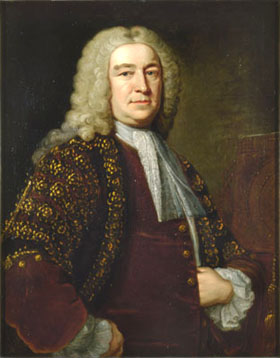
Europe needs Henry Pelham, but there is no chance that she will get him. Pelham is the U.S. Grant among British Prime Ministers. No one among the official keepers of history has a good word for him; yet his Consolidation Act of 1749 was the fulcrum point for the explosion of production and finance that is now laughably described as The Industrial Revolution. Like Grant's Resumption bill the Consolidation Act - which replaced all outstanding government debt - established a permanent benchmark against which all markets could trade - the Consol - i.e. Consolidated Annuity– that had no maturity date.
As part of the Consolidation Act, the Royal Navy was reorganized so that the system of purchasing commissions and supply contracts was opened to examination and audit. Pelham - like Grant - was criticized for allowing a far lesser corruption to continue rather than praised for eliminating a "spoils" system so rotten that it left British merchantmen at the hands of Spanish privateers (perhaps the only time in the history of the Royal Navy when the score was Spain 1, Britain 0).
"A man can accomplish anything he sets his mind to once he decides that he does not care who gets the credit for its accomplishment."
Nov
22
Your Final Status Update, from Scott Brooks
November 22, 2011 | Leave a Comment
 We are creating a world very different from our grandparents. What will your last tweet/post be like?
Stefan Jovanovich replies:
Indeed, it is certainly a world without any training in grammar or usage. First sentence from this professional journalist: "people that". His presumption is fittingly modern. The literal explosion in writing and newspaper publishing that produced and required mail deliveries 5 times a day and fast mail trains that delivered Special Delivery letters and major city newspapers in 3 days to anyplace in America with a railroad depot is ignored completely in favor of a portrait of our grandparents with their snapshot albums and "diaries". Even as Google and others make the archives of what people wrote in the past available for free, the ignorance of what the past grows exponentially among the technocrati.
Nov
17
Sears Quarterly Loss, by Ken Drees
November 17, 2011 | Leave a Comment
 Sears started as a catalog/mail order company and will eventually turn back to its old roots–shed the real estate, close all the stores and sell from the internet only.
Just a thought.
Rocky Humbert comments:
Interesting timing for Ken's post!
Exact 7 years ago today, (11/17/04), Eddie Lampert announced the acquisition of Sears by Kmart. Lampert took control of Kmart during its bankruptcy.
Eddie (a fellow Yalie and GS risk-arbitrage alum) is a very smart guy. His resume includes the improbable feat of having talked his way out of a kidnapping, and some fabulous investments, including Autozone.
Alas, Sears was Eddie's biggest transaction.
And how have Sears shareholders fared? Not so good. The Sears story morphed from a real-estate play (which quadrupled the stock) to cost-cutting to "we're not going to sacrifice profits for revenues" to who cares about sames-stores-sales to the present morass.
Since the merger, the S&P 500 has returned +23.1%. Walmart has returned 24.1%. Sears has returned negative 24%.
Which raises the tasteless counterfactual question: How would have Sears performed if the kidnappers had not been persuaded?
The lesson: always have an exit strategy other than the graveyard.
Stefan Jovanovich comments:
This is Sears' own potted history of its going into store building:
The first Sears retail store opened in Chicago on February 2, 1925 in the Merchandise building. This store included an optical shop and a soda fountain. During the summer of 1928 three more Chicago department stores opened, one on the north side at Lawrence and Winchester, a second on the south side at 79th and Kenwood, and the third at 62nd and Western. In 1929 Sears took over the department store business of Becker-Ryan Company. In 1933 Sears tore down the old Becker-Ryan Company store in Englewood, and built the first windowless department store, inspired by the 1932 Chicago worlds fair. In March of 1932, Sears opened its first downtown department store in Chicago on State Street. Sears located the store in an eight-story building, built in 1893 by Levi Z. Leiter, which for years housed the Stegel-Cooper department store. The original Chicago occupant on this piece of land was William Bross who in 1871 mounted his house on wheels and rolled it down State Street to the corner of Van Buren Street. He kept his house on wheels for several years because of the marshy conditions of the land. The Leiter Building, designed by famous skyscraper architect William LeBaron Jenny, included walls of New England granite.
The store sat on the corner of Van Buren, State and Congress streets and cost over a million dollars to refurbish. A 72-foot long electric Sears sign greeted shoppers at the front entrance. A stunning black and white terrazzo covered the main floor. The State street store was the first Sears store in a downtown shopping district, the sixth store in Chicago, and the 381st store the company built. Opening day for the State Street store took place deep in the Great Depression. Local newspapers reported that 15,000 shoppers visited the new store and several thousand people flooded the store's employment office. Sears did everything it could to help put people to work, employing 750 Chicago workers for four months during the renovation and staffing the new store with over 1,000 people.
Illinois Governor Louis Emmerson in a message to Sears Chairman Lessing Rosenwald stated, "I cannot help but feel that this opening will mean a great deal for your organization as well as for your city." Rosenwald proudly proclaimed that, "We regard the opening of our new store on the world's greatest thoroughfare as one of the high spots of our company's history." Within the store the sale of tombstones, farm tractors, and ready-made milking stalls caught customer's attention. The sporting goods department featured a model-hunting lodge. Other attractions included a candy shop, soda fountain, lunch counters, a shoe repair shop, a pet shop, dentists, chiropodists, a first aid station with a trained nurse, a children's playground, and a department for demonstrating kitchen utensils.
The company's chronology of its adventures in retailing in North Carolina is revealing. It did not build stores outside of the major cities– Charlotte, Durham, Goldsboro, Raleigh, etc, — until the 1980s! Meanwhile, some bright people in the truly small town of Wilkesboro had started their own enterprise, now known as Lowes.
Market Caps today (according to Google Finance):
SHLD - 6.83B LOW - 29.98B
Nov
13
The Bank of Pensacola, from Stefan Jovanovich
November 13, 2011 | Leave a Comment
 In his latest blog post Bruce Krasting says "I have no life". Me, too. Krasting is reading Energy Business Review, Power Generation, Biofuels & Biomass– the trade rag for biomass. I am going through William Amassa Scott's History of the Repudiation of State Debts.
According to Krasting the biomass projects all have these common characteristics:
- They are long life projects with long-term paybacks.
- They (almost) always have a municipal involvement.
- There is (almost) no equity in these projects. They are funded 99% with debt.
- The capital structure has debt maturities out to 15+ years.
-In (almost) all cases vendor financing of major components is a requirement for an equipment sale.
- The cost of debt is THE critical component for a project. Without the availability of cheap long-term money these co-gen facilities never get off of the drawing board.
What the repudiating states had in common was that they chartered state banks whose initial deposits were not specie but bonds from the states themselves. The bonds were secured by investments in infrastructure projects - canals and railroads - and sold largely to foreign investors. (Hope & Co. in Amsterdam was the big wheel in American state bonds.)
An example is the Bank of Pensacola, chartered in 1831 and completely gone by 1841 after having issued bank notes backed by its investment in the Alabama, Florida and Georgia Railroad. The territory of Florida had backed the bank with its full faith and credit - as it had the Union Bank of Florida (chartered 1833, began operations in 1835, suspended specie payments in 1837 but continued to sell bonds in Europe as late as 1839 to cover the interest payments on its already outstanding debt).
By the time Florida became a state (1845) the claims against the failed state banks were literally clogging the Federal courts. The Florida legislature and its newly-elected governor solved the problem very neatly; they repudiated the obligations of the territory as having been unconstitutional.
Nov
10
Mundell Fleming Model, from Stefan Jovanovich
November 10, 2011 | Leave a Comment
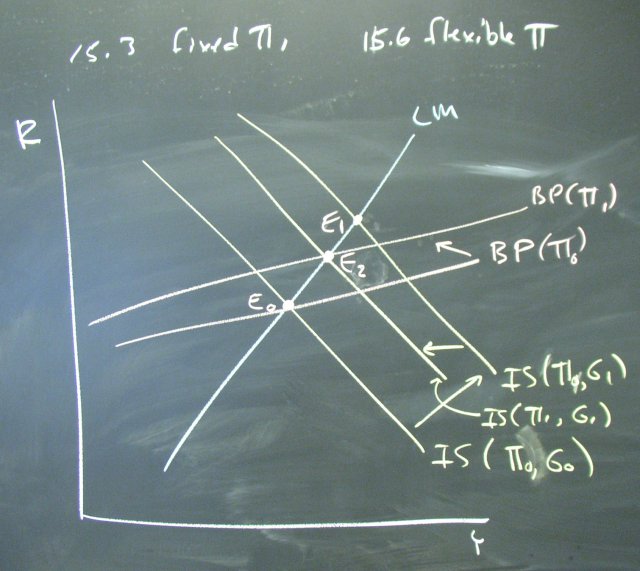 Neither professor says so explicitly but their model leaves countries with a cafeteria plan of choices regarding their political economies:
1. Maintain Fixed exchange rates - what the European economies now have with each other, what the states in the U.S. have, and what the Chinese enforce for their currency vs. the rest of the world
2. Allow Central bank/sovereign Treasury control over banking reserves and the supply of credit/money - what everyone has
3. Allow Capital market transfers between domestic and foreign currencies - what the Chinese don't have officially but are actively doing privately and what some in the U.S. Congress would like to restrict (following the Chinese model to "punish" China)
Countries can safely choose any 2 out of 3, but they cannot have all 3.
The Constitutional gold standard worked because the trading countries that allowed 2. and 3. accepted a fixed rate of exchange for all their currencies into gold. (This is why the authors of the Constitution made such a big deal about the regulating the value thereof of foreign coin.)
Reviving that fixed exchange rate agreement is impossible given the certainty that at least some countries will want to have their central banks/Treasuries manipulate their currencies in the mistaken notion that this will somehow increase wealth for their countries.
That leaves the U.S. with the choice of abandoning either 2. and 3.
Those of us who have now read Professor Timberlake 's book (which puts Schwartz and Friedman utterly to shame) would like to see the U.S. choose option 2. However, if history is any guide, the religion of central banking is far more likely to triumph politically than the quaint notion that people should be free to hold their wealth in the money of their choice. The odds are very poor that anyone will be able to drive a stake through the heart of vampire economics, aka IS-LM.
Oct
31
Marxism Rules, Stefan Jovanovich
October 31, 2011 | 1 Comment
 The current monthly issue of American Dry Cleaner had this comment from a dry cleaning plant owner:
"The advent of valet dry cleaning businesses that rely on local plants to process the work may look like a good thing for a slow plant, but they are only a Trojan horse. Enabling someone to enter the business with little to no upfront capital expense is a death knell. The services enter a market taking business away from the plant operators with the "sale" that they will bring more business to you, but the operator is getting only a fraction of the price, usually half. A route does not cost 50% to operate, but most plant owners are too lazy to start their own route. We as plant owners must stop enabling people to cannibalize our markets. If someone wants to enter the dry cleaning business, make them pay all the costs that you incurred as a plant owner, not just the cost of a van."
The idea that "capital" - i.e. money spent - deserves a rate of return seems to be an inescapable article of faith among us all. Why else would economists still be discussing "the natural rate of interest"?
BTW, If you do a full text search of the English translations of Das Kapital, you will find that the word "distribution" recurs again and again but only with regard to "capital" and "profit" , never once with regard to goods and services. The words "advertise" and "advertisement" are similarly absent. "Advertise" is found once, in a mention of a Dr. Harvey who was selling recipes for weight loss to "the bourgeoisie and aristocracy" in the 1880s; and the word "advertisement" is found once, where Marx compares child wage rates to "the advertisements" that use to appear in American newspapers" for slaves.
Peter Grieve comments:
I often see the Marxist rot in unexpected places. It seems like a very, very bad sign. Once a tumor has metastasized…
Oct
28
A Really Naive Question, by Stefan Jovanovich
October 28, 2011 | Leave a Comment
 How is a 50% Mark Down on the Par/Redemption Value of a Bond NOT a Default?
[Ed.: for background information see for example Greece Default CDS Failure to Trigger ].
Stefan Jovanovich continues:
"You don’t need everyone buying CDS to expect it to pay out, you just need a buyer of last resort who’ll make it pay out. You don’t need tons of short sellers to root out fraud, but you do need to allow short selling so that one or two clever and capitalized short sellers can bet against the frauds. You don’t need all the buyers to think the price is right, just the marginal buyer. Greek CDS “works” only in the limit case, only for a non-bank investor who’s willing to be a jerk and run a certain amount of politico-PR risk. But that doesn’t mean it mostly doesn’t work. It means it entirely works."
From a post by Matt Levine.
At the risk of being the jerk who still doesn't get it, the tape is not the world. The short sellers win because there is, in fact, a fraud - Baldwin-United, Enron, etc. really do not have the money or assets that can produce future profits even though their books say they do. Even without short-selling the fraud would ultimately produce the lovely worthless securities losses that can be deducted against ordinary income. The tape would catch up with the world.
With CDS for sovereign debts it seems that "the world" is what the financial authorities define it to be, not the reality of Greece's solvency. I can understand that people will continue to trade CDS because there is, in fact, a market for them; what I do not understand is why anyone believes "the market" in this case has any reality other than a virtual one.
Gary Rogan comments:
Stefan, there is a real reality that
(a) by itself Greece can't pay off it's debt
(b) there are all kinds of people that want to do something to improve it's ability to pay it off.
In this sense Greece is not Enron and the reality is not virtual. There is this strange technical point of what happens to the CDS's if "everybody" voluntarily accepts a 50% haircut, but even the resolution of this point is real, not virtual, so if you buy both the debt and the CDS's something real will happen if you hold the debt to maturity.
Stefan Jovanovich responds:
There are two problems with this scenario:
(1) everybody will not voluntarily accept the haircut in the CDS market; somebody will want to collect in full from a counter-party because the sovereign debt that is being swapped has done a half-default.
(2) Greece's sovereignty does not guarantee its solvency -someone holding even the new debt to maturity may find themselves receiving less than par. That is the contingency that the hedging instruments were supposed to protect the buyers against.
Gary Rogan writes:
True, but none of this is virtual any more than the currency in circulation is virtual, which is what you seemingly claimed/asked. There is posturing going on, and I'm sure fraud depending on how you look at it, but there is real money involved and those with the best information, and to a lesser degree instincts, are making real money. Can you imagine what a smart European flexion getting the information in real time can do? Sooner or later we are talking about real money.
Stefan Jovanovich writes:
Some of us are old enough to remember the collapse of the commercial paper market around the failure of the Penn-Central. Perhaps the Z-Man and the others who are out there making money while us Social Security recipients are busy typing can answer these really naive questions: how long did it take for the non-financial commercial paper market to revive and did it, in fact, revive? I have no doubt that there is real money involved; there was real money involved in the commercial paper market and then…. it was all gone. Currency is virtual but it has legally-enforceable exchange value.
My naïve question was - and is-what is the legally-enforceable exchange value of a credit default swap if "credit default" never, ever happens. If the insurance company can rewrite the policies, with blessing of the insurance commissioner, the buyers for that insurance may decide to go elsewhere for their risk management. I know there is supposed to be a chair for everyone in the room except the last guy; but the history of markets is that some people stop betting on finding a seat while the music is still playing and "everyone" knows the game will go on forever.
Gary Rogan says:
Does it really matter to anyone not playing if sovereign Credit Default Swaps disappear from the face of the earth? It's an iffy concept in the case of US treasuries anyway. Who will be there to pay if off in the world where the US defaults? It's not like you won't be able to buy earthquake insurance in the East Bay, so put your mind at ease Stefan.
Stefan Jovanovich continues:
I never know when Gary is teasing. Earthquake insurance is no longer offered in California by private insurers because the insurance commissioner allowed homeowners to collect on damages from earth movement - which is a chronic problem in coastal California - even though that risk was specifically excluded from the coverage. As a result you must now buy your insurance from the State of California which, of course, people decline to do - given this sovereign's solvency. As to why it matters, the disappearance of what has been the primary tool for risk hedging may have effects as large as those that came seizing up of the commercial paper market. We owe those once in a generation bargains in 1974 as much to the inability of firms to borrow short-term as we do to Watergate and oil price surge - perhaps more.
Ken Drees comments:
What is the percentage of uninsured homes and businesses in the earthquake probability zones? (guestamate is ok)
I find it ironic that the overdue earthquake area people are living by the dice roll.
Stefan Jovanovich responds:
According to the Insurance Information Network of California, fewer than 12% of the state’s home owners had earthquake insurance last year, and fewer than 10% of businesses had the coverage.
I don't see the irony. Some risks are not worth the cost of insuring. This is one of them.
Russell Sears comments:
Perhaps I too am naive, but I thought this was obvious: If the messenger will not agree with the rues, extend and pretend, then they must be shot. Currency CDS /hedging /insurance contract was sacrificed for the sake of the Euro.
While there may be some value in the litigation options, currency CDS's going forward are a dead market are they not? Just like structured securities, if you cannot trust the contracts for being truthful, (in a practical everyday sense of the word, not legal twist) then they are dead.
Are we willing to live with liquidity of MBS and currencies being at the mercy of those sovereigns that still have some semblance of confidence in them? Can these sovereigns keep these bottomless guarantees "off-balance sheet" without it cracking them? The market seems to be saying for now, "yes".
Oct
28
The Failure of Models That Predict Failure, by Stefan Jovanovich
October 28, 2011 | 3 Comments
"The Failure of Models that Predict Failure: Distance, Incentives and Defaults"
Abstract:
Statistical default models, widely used to assess default risk, are subject to a Lucas critique. We demonstrate this phenomenon using data on securitized subprime mortgages issued in the period 1997–2006. As the level of securitization increases, lenders have an incentive to originate loans that rate high based on characteristics that are reported to investors, even if other unreported variables imply a lower borrower quality. Consistent with this behavior, we find that over time lenders set interest rates only on the basis of variables that are reported to investors, ignoring other credit-relevant information. The change in lender behavior alters the data generating process by transforming the mapping from observables to loan defaults. To illustrate this effect, we show that a statistical default model estimated in a low securitization period breaks down in a high securitization period in a systematic manner: it under predicts defaults among borrowers for whom soft information is more valuable. Regulations that rely on such models to assess default risk may therefore be undermined by the actions of market participants.
Gary Rogan comments:
Were the participants "allowed" to fail, sooner or later none of this would have been an issue. Were there not a government market for subprime loans to begin with this problem may have never developed in the first place. If the government didn't push for banks to make subrime loans this would be much slower to develop, if at all.
The government gave this problem the first push and then enabled, encouraged, and forced it all the way through. And that is how capitalism, red in tooth and claw, failed. Time to do some occupyin' of Wall Street.
Oct
27
Today is the Anniversary of Federalist #1, from Stefan Jovanovich
October 27, 2011 | Leave a Comment
 Publius made his first appearance on this date in 1787 in the New York Post and Daily Advertiser.
But, far more important, it is the anniversary of the opening of August Belmont's IRT in 1904.
The links are to the Library of Congress' QuickTime files for a movie of the ride from 14th Street to 42nd Street (1905).
Oct
26
The World Series and Excuses, by Russell Sears
October 26, 2011 | Leave a Comment
After what I heard on NPR this morning I would say the Cards are doomed. It appears to me that they are looking for a great excuse in case they lose.
NPR was gleefully reporting a good excuse. It turns out the bull pen did not warm-up the pitcher for the guy that hit the double, like the coach called for because, get this, they did not hear what Coach La Russa said on the phone. Great excuse! That was painful to hear.
Here is the story
newsfeed: world-series how-the-st-louis-cardinals-got -all-mixed-up
Why does this matter?
In the heat of a grueling marathon I've learned that once you are searching for an excuse in case you lose, you sure will.
George Parkanyi writes:
To your point, one of the biggest chokes ever was the Ottawa Senators going down to the Toronto Maple Leafs a few years back. They were leading the series 3-2, and the 6th, clinching, game 1-0 late in the third period. Toronto had been completely shut down to that point. Toronto got one penalty, and right after, another. What a glorious opportunity for Ottawa -a 5 on 3 power play! What did they do?
They didn't even go into the Toronto zone, they passed it around and just generally wasted time to eat up the clock. But there was still about 8 minutes left to go in the game. I still remember jumping off the sofa and literally screaming at the television "What the ^*&&*% are you doing, you idiots!!!!" Sure enough, playing not to lose, they gave up a late goal to an energized Toronto, who then won the game in overtime and also won the 7th game after that.
That game is etched in my mind as the poster-child example of why you don't play not to lose when you're in a competitive situation. I remember this when I play soccer, and never play more conservatively when we have only a 1-2 goal lead no matter what stage of the game. My philosophy is keep doing what got you there. That's also why I absolutely HATE late-game prevent defenses in football.
Peter Saint-Andre comments:
The Wikipedia page about baseball points out the following:
"In
clock-limited sports, games often end with a team that holds the lead
killing the clock rather than competing aggressively against the
opposing team. In contrast, baseball has no clock; a team cannot win
without getting the last batter out and rallies are not constrained by
time. At almost any turn in any baseball game, the most advantageous
strategy is some form of aggressive strategy."
Some form of aggressive strategy is always advisable in investing, too. You can never simply run out the clock.
Stefan Jovanovich writes:
And, for racquet sports, even more so; they are the only hand to hand combat sport where you cannot be saved by the bell or blame the loss on the manager or the rookie who tried to steal second. Speaking of extraordinary sporting events, did anyone see what City did to Manchester United? Remarkable. Lazio's loss is Manchester's gain.
http://en.wikipedia.org/wiki/Roberto_Mancini
Scott Brooks comments:
This is not completely true of baseball. In little league, most (all) games have a time limit. So there is a strategy to playing to the clock. The home team always got the last at bat (unless they were ahead) after the cut off point.
So if we were the home team and were ahead and the cut off time is approaching, we would make the inning last as long as we could. We'd have our batters run the count up. We'd have them step out of the batters box between pitches. We'd call time out several times, etc.
All to ensure that the opposing team didn't get another at bat. Sure we'd have gotten another at bat after them if they tied the score or got ahead of us….but why take the chance.
Peter Saint-Andre responds:
So is the lesson that little-league investors think they can run out the clock, but big-league investors know they don't have that option? 
Scott Brooks writes:
Whatever league you're in……..
……Know the rules and use them to your advantage so you can win. I don't
care what the rules are, just make'em clear and let me play/coach/invest.
As Vince Lombardi said, "The object is to win, to beat the other guy"
http://photetpom.wordpress.com/what-it-takes-to-be-no-1/
Oct
25
Eliminate Ballyhoo, by Jeff Watson
October 25, 2011 | 1 Comment
In the quest for the truth and the elimination of ballyhoo, one must get through all the BS to find the kernel of truth. Here is a very important glossary of mathematical mistakes that are commonly seen in the popular culture and often repeated as the absolute truth.
http://members.cox.net/mathmistakes/glossary1.htm
It would be an interesting exercise to see what we can add to the list, either in the popular culture arena, or market lore.
Ralph Vince comments:
How about (cultural ballyhoo) "After all, we're a very litigious society!" (this is usually accompanied by the reminder of some anonymous woman scalded by coffee at McDonalds being awarded an amount so ghastly that poor McDonalds will have to make up that amount against the rest of us somehow!)
I would posit we are not litigious enough. One need only sit in any municipal court or state appellate court for a couple of hours and see the litany of individuals being hauled before the altars of justice by the financial institutions or the paint manufacturers whose lead was ubiquitous, or any other host of entity vs the individual going on. Truly, I almost NEVER see an individual as plaintiff in one of these unless they are going after another individual. The vast majority of what goes on in the courts WE PAY FOR are actions brought by those who do not pay for these courts, against our neighbors.
Yet, our class action rights are eroded under our noses repeatedly and recently. The only ones in favor of so-called "Tort Reform," are the insurance companies. The medical professionals who think they will financially benefit by this are delusional. The delusion is further propagated to the hoi polloi under the even falser notion that the medical community will share these newfon legislated riches amongst us.
Rocky Humbert writes:
After reading this, it's unclear to me whether Ralph is in favor of, or opposed to, tort reform.And, arguably, he's guilty of a bit of cultural ballyhoo here. He writes, "The only ones in favor of so-called "Tort Reform," are the insurance companies."At a macro level, it's not obvious why insurance companies should necessarily support tort reform (or even care about it.) Insurance companies raise premiums to offset the costs of litigation. Their profits (the combined ratio) are the "spread" between premiums earned and the settlements paid.
If the costs of litigation decline, so will premiums — and if there were serious tort reform, it might actually damage insurance companies, since their products would no longer be required!!If there were no tort litigation, insurance companies might go out of business en masse!!! The visible and direct costs of litigation (to which Ralph alludes) are minuscule compared to the invisible costs. The invisible costs include the innovation and investment which are forgone because of the FEAR of litigation; the incalculable dead weight loss; the practice of defensive medicine which wastes resources (and which applies to other industries as well).
"Loser pays litigation costs" combined with allowing third parties to finance and benefit from winning litigation — would be a fine first step towards balancing the scales between plaintiffs and defendants. But to suggest that insurance companies actually want tort reform ignores their raisson d'etre.
Stefan Jovanovich comments:
Ralph omits the largest part of the litigiousness of our society, which I pray will be largely eliminated some day - the criminal justice system. Since misdemeanors rarely go to trial, they will be absent from the municipal court dockets; and state appellate courts are usually not the best venue for criminal appeals (the Feds are usually better) so Ralph may not have had a chance to see how much of the "justice" system is about law and order.
A visit to any Superior Court or Federal District Court would probably change his view; at present, the largest single obstacle to an individual seeking civil damages is that their right to a speedy trial is non-existent.As one defendant put it, "The United States of America versus Alphonse Capone! What kind of odds are those?"
Ralph Vince responds:
Rocky,
I'm not an attorney — and I AM a little over-impassioned about the subject, so don't be surprised by my phreneticism here on this subject, ok? I am utterly opposed to this (altogether speciously misnomered) "Tort Reform," idea!
Where you say ". If the costs of litigation decline, so will premiums," I could NOT disagree more. When the Bankruptcy Act of 2005 was passed (presumably, among other things, so that the costs financial institutions were having to suffer as a consequence of personal bankruptcies not be passed along to the rest of the peons like me) did we see credit card interest rates reduce as as result? Did we see banking fees come down? No, the margin gained by such legislation accrued to the banks.
Profits ONLY flow upwards. Those paying down here do not participate in profits. If we did, those $150 running shoes made in Jingalia would only cost us about ten bucks.
The notion of a frivolous lawsuit is something cast in sand, and something the courts can deal with already via sanctions, etc. Just try to get an attorney to take a patently frivolous lawsuit to court — or see what happens if a non-attorney attempts one pro-se. They will be clobbered by the courts.
In fact, I say to the average Joe F. Blow out there, just try to take his NON-frivolous lawsuit to court. Go see how easy that is. Go see what the typical attorney will require of you up front. He is already, effectively blocked from the system, Bleak-Housed out from the very courts his tax dollars pay for. And again, if you take from people their venue for settling disputes in a civil manner, they are then likely to settle them in an uncivil manner. What is wrong with allowing people the venue of settling their disputes?
Our courts are NOT clogged incidentally. These are not a natural resource of finite size. If we need more courts — set em up. More insane judges. No problem. Homer Simpson is a little sick of sitting at that control panel at the nuclear facility, he can sit on on the bench for us.
Finally, when I speak of profits only flowing upwards, I don't mean it with respect to tort reform alone. The notion is integral to the specious arguments we are subject to every day to try to stifle our abilities of thinking critically for ourselves (I am not referring to you personally here, you seem to do so quite well except when it comes to your interactions with women). We hear repeatedly how free trade brings the cost of goods down (taking away US jobs) or how if we don;t have illegals picking our produce that tomato will cost 5 bucks.
Nonsense. Perhaps there is a scenario, but I cannot think of one wherein Joe F. Blow benefits because the cost to producers is reduced legislatively. To do so but taking Joe's right to settle his disputes — against individuals AND entities — away from him, is the real crime.
Stefan Jovanovich responds:
Neither Ralph nor I is an attorney, but I am guilty of having been one in California for nearly 4 decades. I stopped being one when the State Bar of California decided that it has absolute jurisdiction over any commercial transaction of my companies simply because I was an officer of the court. What that meant in practical terms was that any business partner or even customer could claim I owed them a fiduciary duty as a lawyer even if our dealings were purely commercial. As W.S. Gilbert put it, "here's a pretty mess". Eddy's Mom and I decided that resignation was the better form of valor. It took us nearly 2 years from the Supreme Court's clerks to decide we really meant it; the last letter we have from them is one suggesting that we might want to reconsider because we would be losing all the member benefits - i.e. access to State Bar of California credit cards and life insurance.
The greatest obstacle to "the average Joe F. Blow" is the current system of pleading; it is archaic to a degree that would astonish Lincoln or any other railroad lawyer of the 19th century. David Dudley Field would not be amused, especially since his reforms were adopted in Britain with much greater success than they have been in the United States.
http://en.wikipedia.org/wiki/David_Dudley_Field_II
http://en.wikisource.org/wiki/The_Mikado/Here 's_a_how-de-do
Ralph Vince writes:
Stefan, we evidently live in different universes. I routinely get called to jury duty in Cuyahoga County, Ohio, losing a week every two years. This is a court for monkeys.I have been through that system on the wrong side. Ex-parte rulings, convicted judges, FBI swarming, lower court transcripts LOST going to the appellate courts, corrupt clerk of courts, corrupt sherrif's dept., (all have plead guilty), routine over-charging of defendatns hoping for the routine, gullible jury, etc.
I will tell you what I tell the prosecutor in voie dire. "There's no way in hell you will get me to convict my fellow man of anything. Bring in the DNA evidence, the video, of this child-molesting cop killer. I wont convict anyone here in monkey court."Then….the resultant litany of threats levied upon me. I do my week and I go home. At least where I am here, in this universe, there is NOTHING WHATSOEVER about "Justice."
Oct
21
How Women Can Win on Dates and Markets, by Victor Niederhoffer
October 21, 2011 | Leave a Comment
A good friend of my daughter asked me for advice on the best way of winning a man's heart on a first or second date.
I told her to use the Jennifer Flowers Gambit (the surprise erotic interlude when stopped on a drawbridge) or the Lee Raziwell gambit (listen intently to everything he says and ask about his expansive greatness), or the Leona Helmseley Gambit (pretend that there is another suiter waiting for you that evening so you have to leave at 11 pm as nothing inflames a man more than competition) but I feel that others here are more sapient in this area and others and I would appreciate your insights.
An Anonymous writer comments:
My conclusion is that the number one sign of a good long term relationship with a woman is based on the quality of her relationship with her father.
I am basically engaged to be engaged with a woman, and the emotional commitment on my end happened after a dinner where much of the conversation was her describing her relationship with her dad, and how he helped her with her math and physics homework, and then they would walk to the store for a treat, etc, and just the general way that her face lights up when talking about her dad.
So anyway, that's what worked on me. Perhaps she should try it.
/my 2 cents
Gary Rogan responds:
This sounds like good advice and the father thing is pretty well-known, but I'm just amazed that you have made some conclusions about long-term relationships after having dated women in around ten countries over two years.
Pitt T. Maner III comments:
Well then there are some who base decisions and strategies on a few minutes of observation. The HFT of the dating scene—your most important impression—the first 3 seconds!
José Bonamigo shares:
From Forbes Magazine:
The mating practices of human beings offer a reason for thinking beauty and intelligence might come in the same package. The logic of this covariance was explained to me years ago by a Harvard psychologist who had been reading a history of the Rothschild family. His mischievous but astute observation: The family founders, in 18th-century Frankfurt, were supremely ugly, but several generations later, after successive marriages to supremely beautiful women, the men in the family were indistinguishable from movie stars. The Rothschild effect, as you could call it, is well established in sociology research: Men everywhere want to marry beautiful women, and women everywhere want socially dominant (i.e., intelligent) husbands. When competent men marry pretty women, the couple tends to have children above average in both competence and looks. Covariance is everywhere. At the other end of the scale, too, there is a connection between looks and smarts. According to Erdal Tekin, a research fellow at the National Bureau of Economic Research, low attractiveness ratings predict lower test scores and a greater likelihood of criminal activity.
http://www.forbes.com/forbes/2005/0815/096.html
Best regards from Brazil
JB
Gary Rogan inquires:
After a while this degenerates into just socially dominant and not necessarily intelligent men. This modified effect can be readily seen in the Charles/Diana coupling, at least in the older Prince William. Of course how did Charles come about if the theory is correct?
Stefan Jovanovich comments:
Trusting Forbes magazine on stories of family history is more than a bit like buying a Degas ballerina sculpture from Toby Esterhase's Soho gallery. The notion that the 5 founding brothers were "supremely ugly" is part of the standard viciousness of the portrait of the Jewish banker as Shylock that survives to this day. There is no evidence of any special ugliness in their portraits.
http://en.wikipedia.org/wiki/Salomon_Mayer_von_Rothschild
http://en.wikipedia.org/wiki/Amschel_Mayer_Rothschild
http://en.wikipedia.org/wiki/Nathan_Mayer_Rothschild
http://en.wikipedia.org/wiki/Carl_Mayer_von_Rothschild
http://en.wikipedia.org/wiki/James_Mayer_de_Rothschild
The Rothschilds married money - the Ephrussis, the Guggenheims and the Oppenheims. One suspects that, as in most things, the question of beauty was left to the beholders.
In the 19th century the great minds were certain that criminal behavior could be predicted by examining the bumps on people's heads. It should hardly be surprising that we are back to estimating future viciousness by measuring the asymmetry of human features.
http://en.wikipedia.org/wiki/Phrenology
http://en.wikipedia.org/wiki/Smiley's_People
Jim Wildman comments:
I would say that she can't on the first or second date. Winning someone's heart in a deep, lasting way, takes time. Anyone can fake interest for a while. What about when she is sick? When he is grumpy? When life intrudes on the lovers? Are their hearts still connected?
Granted, I haven't dated anyone for over 3 decades, but I have watched 3 daughters struggle with guys..
Marion Dreyfus questions:
My question:
And some may find this offensive–
Does the ubiquity of pornography, specifically for the ones who purvey it day and night (I understand that equals a LOT of the male population), make falling in love with and making love with real women –including the physical aspects of affection–much more difficult than it used to be before every late-night channel offered a raft of such virtual substitutes for real relationships?
Rocky Humbert comments:
Choices:
(a) Korean BBQ. Nothing excites a man more than watching a lady handle chopsticks amidst an open flame. Alas, times change. Woo Lae Oak has gone out of business. http://nymag.com/listings/restaurant/woo-lae-oak/
(b) Take whatever advice a parent provides, and do exactly the opposite.
(c) Que Sera, Sera
(d) http://www.datingish.com/695368212/how-to-win-your-guys-heart/
Score 1 point for picking the right answer. Deduct 1/4 point for picking the wrong answer.
Bill Rafter writes:
When you are fishing, you need to match the bait to the fish. Striped Bass like clams, but Bluefish and Flounder will eat anything, so you might as well use bunker. Think of it this way: a young lady would wear one kind of dress on a date and a different dress when meeting the young man’s mother.
If a man is 25 or younger he is probably only interested in one thing and he is not looking for lasting qualities. Not that there’s anything wrong with that. The interlude on the drawbridge is something he will never forget. A woman with an interesting job is attractive as long as it does not threaten him.
At some time the man starts to look for additional qualities in a mate. Maybe because of pressure from his parents he starts to think of having a family. Then he starts looking for someone who might be a good wife and mother. A schoolteacher is attractive in this case.
In foods, women are attracted to chocolate whereas men are attracted to cinnamon.
Tim Melvin writes:
I told my daughter in response to a similar question that anything won so easily or quickly likely had little value in the long run. She should be herself at all times and the man who liked and fell for that woman was likely a better match. I taught all the tricks her old man had used over the years to win fair lady specifically so she could avoid them.
Jose Bonamigo responds:
My intention with the Forbes extract was not to present solid evidence, just a likely explanation for couples like Charles and Diana (a common combination), as Gary pointed out.
Looking at the portraits it seemed to me they were "regular" uglies (just kidding)…
For a more scientific approach, at least in the physical part of dating:
http://www.ncbi.nlm.nih.gov/pubmed/17173598
http://www.ncbi.nlm.nih.gov/pubmed/16318594
Oct
19
Comparing Two Mountains (part II) , by Allen Gillespie
October 19, 2011 | 1 Comment
How to quantify similarities between such "mountains" [i.e. price charts] ?
1) Decide trailing periods and criteria to be used - YTD performance > X, last 5 year performance > Y, etc
2) Build universe/database of similar companies for each year
3) Build correlation table to confirm
4) Build composite model
5) Look at forward if-then test
In my experience, the bearish case on high momentum names, frankly any name, is best fundamentally analyzed as a move from Blue Oceans to Red Oceans and along with general market trends. Blue oceans situations tend to be P/E unconstrained, consistent growers, etc http://www.blueoceanstrategy.com/ but once we move into the Porter world of Competitive Strategy then P/E becomes constrained which leads to compression. Generally, there are subtle clues - RIMM announced a move into consumer markets where AAPL played- so the business market was saturated - NFLX CFO left when the stock was below $200 on its way to $300. They started focusing on cost strategies, changing the story from new subscriber adds. I haven't followed GMCR that closely - but is there a competitive threat that is changing the marketplace - are they experiencing a strategy change - that's the key question.
Solar existed on subsidies granted by bankrupt governments, so it has to compete with more economic alternatives. Hence, the president's loan issue.
Stocks have to compete with bonds, so stocks crashed in 1929, 1987, 2000, 2008, etc
EK lost to digital photography.
My worst mistake ever came from Able Labs - a generic drug maker - had 26 NDAs pending, huge margins and a new lab in NJ - problem: small reference to litigation in the SEC filings that later turned out to be because they were getting their margins by diluting the drugs - stock went from new high list to opening down something like 86%, where I sold before watching it go to $0 in 30 days. Subtle clues. They are really important if one is making the bearish case.
in reply to Victor Niederhoffer's comment:
Strange similarity between those two [NFLX and GMCR] to a person who looks at it as
two mountains of different heights with similarly looking crests
relative to the peak.
Query. How would one quantify similarities between such mountains?
And once quantified, what is best way to see the predictive value of
such similarities. I am reminded of the cotton traders most famous
trade. He noted that 1987 looked similar to 1929. then he knew it was
going to have a crash. The drunk man saw the same similarity and started
out long that Monday, and then sold. Between the two of them, they were
enough to trip the portfolio insurance to sell.
Query. How ridiculous can you get without quantifying the two
questions I asked? I say it wasn't that similar to 1929 as compared to
other years. and also that the ones most similar to a given few years of
bearishness, in the past, the less is the relation between past and
present. i.e. no predictive value to start.
Gibbons Burke comments:
There is another model which incorporates a similar gradual buildup with no appreciable change, then catastrophic breakdown, like the straw breaking the camel's back. A simple model is dropping grains of sand onto a surface. A pile builds up. With each grain the pile gets higher and higher, in an orderly fashion and is stable, until the angle of repose gets to a critical point, at which the next grain of sand sets off an avalache. Similar but subtly different. The concept is known as "self-organized criticality", and I suppose it may have some relevance to how bubbles build up and then collapse:
http://en.wikipedia.org/wiki/Self-organized_criticality
Christopher Tucker writes:
See also Slope Stability Analysis Methods:
http://en.wikipedia.org/wiki/Slope_stability#Analysis_methods
A similar criticality phenomenon is Flashover:
(quoting the wiki - http://en.wikipedia.org/wiki/Flashover )
A flashover is the near simultaneous ignition of all combustible material in an enclosed area. When certain materials are heated they undergo thermal decomposition and release flammable gases. Flashover occurs when the majority of surfaces in a space are heated to the autoignition temperature of the flammable gases (see also flash point). Flashover normally occurs at 500 °C (930 °F) or 1,100 °F for ordinary combustibles, and an incident heat flux at floor level of 1.8 Btu/ft²*s (20 kW/m²).[1]
another is Phase Transition: (from http://en.wikipedia.org/wiki/Phase_transition )
A phase transition is the transformation of a thermodynamic system from one phase or state of matter to another.
see also Crystallization: http://en.wikipedia.org/wiki/Crystallization
see also Nucleation http://en.wikipedia.org/wiki/Nucleation
see also Vitrification http://en.wikipedia.org/wiki/Vitrification
Gibbons Burke responds:
I was lucky to be in the right place at the right time to capture a flashover in a fire near my home (in 2006) in New Orleans:
http://web.mac.com/gibbonsb/Site/Blog/Entries/2006/3/13_Portrait_of_a_flashover.html
Stefan Jovanovich comments:
The sad fact is that the firefighter community still has no agreement on how to deal with flashover risk. They have not even settled on the question of whether to use a wide fog or straight stream!!!!!
The best teacher I ever had (an instructor at the Navy's Damage Control School in Philadelphia), said that the Navy were the only firefighters who had figured out how to do something besides spray and pray - i.e. use foam to suffocate fires and inert gases to secure the fuel lines - and even so there was a fatal tendency to believe that all you needed to do was get a big enough bucket. He pointed out to the class that the greatest risk of the Forrestal fire turned out to be the water from the firefighting itself, which almost capsized the ship and washed away the retardant foam.
http://en.wikipedia.org/wiki/1967_USS_Forrestal_fire
Oct
11
The News From China, by Stefan Jovanovich
October 11, 2011 | 1 Comment
Wang Jingbo: “The world revolves around money, and it makes its own rules.”, quoted in Patrick Chovanec's article on Chinese Trusts
Richard Bubb is shocked:
After reading the article linked, I think I smell a bubble regarding this seemingly unregulated financial house of cards. From the article:"The big concern the chain-reaction that could unfold if those developers run out of ready financing and go bust: There are signs the real estate market is already cooling . . . Hungry for cash, some developers are borrowing at 12 percent to 25 percent . . ."" “Medium-sized property developers appear to have borrowed heavily for short-term and bridge loans,” said Il Houng Lee, the IMF’s senior representative in China. “Property developers’ strains could hit trusts.” and,"Any sign of weakness in China’s real estate market could have a chilling effect on trusts and their investors, said Jason Bedford, a manager at KPMG LLP in Beijing. “Imagine that you have a real estate product and suddenly the real estate markets start to plummet,” Bedford said. “What was a liquid product suddenly becomes very illiquid as investors pull out and can’t be replaced." and,“It will cause a significant amount of wealth destruction,” [Michael Werner at Sanford C. Bernstein & Co. in Hong Kong] said. “The party goes on until someone turns on the lights and you can’t roll over these assets. There will be wealth destruction. The question is how much.” Just my 2 cents.
Oct
5
After All These Years in the Military and in Trading, by James Lackey
October 5, 2011 | Leave a Comment
After all these years I just realized what separates the wheat from chaff in leadership. Trading is one thing… in the panic periods most nights are sub 4 hours of sleep and some night none at all. It's no big deal as anyone that is ex military can tell you. However go a few weeks on that and you lose ability. I now get the joke on those who rise above Brigade command or LT Colonel or Top, first sergeant to full bird Colonel or CSGM… they can go the entire war without loss of ability.
Stefan Jovanovich responds:
Schopenhauer wrote that talent was aiming at and hitting a difficult target but genius was hitting the targets no one else had even seen. Nimitz deployed his submarines across a third of the globe to attack Japanese merchant shipping that was considered so secure that convoys were never considered, let alone put into practice. Nelson's "primitive" tactics of heading straight towards the enemy (as opposed to the more sophisticated ones of maneuver, thrust and parry used by the French, Dutch and Danish navies) had the genius of seeing that the pure rage or iron discipline needed to withstand the rain of iron and splinters could only be sustained for tens of minutes, not hours.
Sep
28
The Boeing Wide Body Mid-Size Model Introduction Indicator, from Stefan Jovanovich
September 28, 2011 | Leave a Comment
 Boeing 767 - introduced September 8, 1982 with United Airlines
Boeing 787 - introduced September 27, 2011 with ANA
Compared to the current class of mid-sized airliners, the 787 has:
10 percent lower operating costs
20 percent more fuel efficient
20 percent fewer emissions
30 percent lower airframe maintenance costs
40 percent greater range
60 percent smaller noise footprint
This 50% composite airframe will be a change comparable to the one that occurred with the replacement of steam locomotives by diesel electrics.
John de Regt Writes:
Stefan makes a great point. The 787 is as big a step forward as was the DC-3, which moved airframe construction from wood, canvas, and glue, to aluminum.
Stefan Jovanovich replies:
 Thanks, John. The DC-1 — the first aluminum model — was introduced by Donald Douglas on June 22, 1933.
A Donald Douglas story:
In May 1939, after a year of final testing, Douglas delivered the prototype of the DC-4 to United Airlines. It met some but not all the specifications that the airlines had set for Douglas (the project was jointly funded, in part, by the 5 major US airlines at the time: UAL, EAL, TWA, PAA, and AA. Arthur Raymond (the designer for the DC-1 and DC-3) recalled, “We designed the first DC-4 by committee. Before this, we worked with one airline, like American or TWA. Five airlines were in on the DC-4 design, and everyone wanted something special on their version. The crowning blow came when they all said it had to fit in the DC-3 hangar. This meant we had to put five tails on it. We had to take the control surface area under engine out conditions, and spread it over the five tails (three above and two below) to squeeze it in the DC-3 hangar. That was its downfall. We had a terrible time working out the stability and getting it licensed. When we got it to the point of flying, it had gained so much weight (65,000 pounds) and was so ungainly that Doug junked the whole thing. He knew it was a lemon. Then we redesigned it the way we wanted it, with a single tail, not so heavy, and it was a success. We sold the original DC-4 prototype to Japan and it later crashed with some high ranking military officers aboard into Tokyo Bay. We like to think that helped hasten the conclusion of the war. We then called it the DC-4E for ‘Extinct.’”
Sep
28
Article of the Day, from Stefan Jovanovich
September 28, 2011 | 1 Comment
 Uh oh: "Share Traders More Reckless Than Psychopaths, Study Shows".
Jim Lackey writes:
Wait, is it a trader, a stock broker, or a banker. The article sources all 3 and they are very different men. The differences are the same as butcher, baker, and candlestick maker… yet perhaps there is some irony. Traders are honest as can be about their trades, losses, lucky breaks and fair dealing with their cohorts, but on the other hand we all carry a copy of Rand in the right hand and hit the buy bailout button with the left hand as we know the markets are in the short term set up to bail out the bakers and candlestick makers… ummm, yeah, I realize we are the butchers.
Sep
25
One Has Always Wondered, from Victor Niederhoffer
September 25, 2011 | Leave a Comment
 One has always wondered why the banks according to their regulators are being prohibited from investing in this and that thing, derivatives, mortgages, stocks et al, but never have I seen a mandate that they don't invest in sovereign debt of the solid as a rock countries such as those they invested in as did Rome after the Trojan war. Could it be that instead of being prohibited from such investments, the opposite is true, and that is why whenever a country is about to go bust, the banks are in danger of falling. Could it be that they are that foolish as to always hold the short straw?
Gary Rogan writes:
Based on multiple occurrences of coming close to the short end of the stick but somehow being saved by the US or the IMF it has not been a bad strategy. How many times has it happened in Latin America? The IMF resolved the early 80's crisis and Brady bonds were used in '89. So it wasn't just crazy people who would loan to Latin America that is guaranteed to blow up sooner or later. There was clearly an implicit understanding that French and German banks would be bailed out from their losses to the various PI**GS, and the way everyone behaved towards Iceland and Ireland, this was clearly expected that they would be the slaves to the big brothers, and the banks would be helped to be made whole by the taxpayers of the less-important countries, and when the bigger countries are involved the big brother taxpayers would have to chip in.
To the banks this was the frog in the boiled pot situation, except in stages: you warm the pot up a little bit, and then some savior helps you jump out, so you learn that the pot is safe. Then the frog jumps back in, and the pot is warmed up a little more, and the savior helps again, and so on. But now he can't help, but who cares? The old bank CEO's are enjoying margaritas some place where they used to lend to or even nicer and safer, or are dead, so on the average this was worth is to the banking flexion leaders.
Bill Rafter writes:
Several of the 15th and 16th Century Florentine banks including that of the Medicis had problems with their sovereign loans. Despite problems the banks continued to lend for political/military reasons.
George Parkanyi writes:
Banks are large institutions and, like large institutions at the senior levels, don't pay attention to detail beyond a certain point. (I see that in government a lot for example.) Behind every major transaction is some mid-to-senior manager trying to close a deal, land a big client, or in the aggregate hit some number to make a bonus or whatever. I would think that to win a sovereign account would be a big deal, so of course you would trade or perhaps make a market in a client's debt in that situation. Smart sovereign clients, because of their size, can easily play one bank off against another depending on how hungry and competitive the players are at each. Sure institutions have systems, but ultimately deals are made by people, and the culture in investment banking is typically to do whatever it takes to make the deal, even if it means being "creative" and circumventing part or all of your controls, not digging too deeply in case you find something that might compromise the deal, and/or simply treating widely-accepted assumptions as fact (AAA credit, too big to fail etc…). There are many paths to these untenable outcomes, and they are all rooted in human nature. Nicholas Leeson never set out to bankrupt Barings, he started out by just trying to keep a big client happy.
Gary Rogan adds:
Still, moral hazard is what makes all of this possible (having some implicit savior). You don't see Procter and Gamble negotiating a deal with Walmart or some little dictatorship where they will sell them detergent at what winds up being a big loss, and least not very often. The suppliers who are foolish enough to do that disappear without anyone hearing about them, other than in some CNBC special about Walmart. Socialism in any form will ultimately destroy itself: when people have a right (or the idea that they have a right) to other people's resources, eventually they will consume/destroy enough of them to sink everyone involved.
Stefan Jovanovich writes:
The Bardi and the Peruzzi had two enormous technical advantages. Their staffs had fully mastered the science of double-entry book keeping and taken Pacioli 's discovery (probably lifted from the Byzantines) and improved it to the point that they could easily do present value discounting. This was a very big deal at a time when Italian banks were under the same prohibitions that banks in the Muslim world still operate under - charging interest was a sin. Their skill in double-entry was complimented by their shrewdness in dealing with the intricacies of canon law. The Bardi and Peruzzi were the first to figure out that they could get round the problem of usury by issuing loans at a discount and balancing their books by showing the difference between the cash paid out and the loan amount as a gift from the borrower. In a Christian world gifts were perfectly acceptable and (I love this part) the ability to receive them a proof of worthiness. Most of the discounting was not on loans but on relatively short-term bills of exchange. Many of them were remittances to the Papacy. You can see this in the list of the Bardi branches in 1300 - Barcelona, Seville, Majorca, Paris, Avignon, Nice, Marseilles, London, Bruges, Constantinople, Rhodes, Cyprus and Jerusalem. What is supposed to have killed both banks was, as Bill notes, their difficulty with sovereign debt. But it was only one sovereign - Edward III of England. According to the Peruzzis, Edward borrowed 600,000 gold florins from them and another 900,000 from the Bardi and then, in 1345, told them he would not be able to pay on the agreed upon schedule. The Italians had no choice but to agree to a workout, and they ended up taking much of their eventual repayment in wool rather than specie. The problem for them was that the combination of the Black Death and the exhaustion of the German silver mines had produced a monetary deflation that made the repayments worth far less than the nominal loan amounts. But, it is risky to take even this story at face value. The author of the Wikipedia article on the Hundred Years War (where Edward pissed away all the money) has his doubts. He writes that "the Peruzzis' records show that they never had that much capital to lend Edward III….. Further, at the same time Florence was going through a period of internal disputes and the third largest financial company, the Acciaiuoli , also went bankrupt, and they did not lend any money to Edward. What loans Edward III did default on are likely only to have contributed to the financial problems in Florence, not caused them."
What is not in dispute is that it took another half century for banking in Florence to revive on even a regional scale, and in scale and international reach, the Pazzi and Medici were secondary players compared to their 13th and early 14th century predecessors. The Medici are famous because of their adventures in Italian politics, their family stories and their art patronage; but, in terms of finance, it would be like comparing the current House of Baring with the one active during the Napoleonic Wars.
Sep
25
Once Upon a Time, from Craig Mee
September 25, 2011 | Leave a Comment
Once upon a time there was a western economy that had minimal government and built up its middle class. This middle class then did good things, like work. Then came big government and political correctness and lots of handouts. The big government needed to get employed on big money, so they kept the punters happy, big and small, and kept delivering to those who did no work, but hey, it won votes and indirectly money was reinvested and taxes were payed by those who made a buck out of it.
Then leverage kicked off, and for a dollar you could invest 10 and drive prices through the roof, since then interest rates went down as that bubble popped to create the next leveraged bubble. China then kicked in with cheap labour manufacturing, and you could have 10 pairs of timberlands, and 20 jet skis.
Then as jobs disappeared and governments sensed 2 minute noodles for themselves, they invested the punters own money in a fully soaked consumer's market , and as a result they failed to buy. Banks, because of the tight spreads, failed to lend growth, then went 0 and stayed there for years and years.
I suppose the question is, has any country in history been involved in this sort of leveraged economy and overheated housing market, with an over ripe middle class, and come back and won the day…quickly? Or do we work out what emerging market has the working tenacity and inner strength, to build from here?
Stefan Jovanovich replies:
The short answer is "yes". With the end of the War of 1812 the United States entered into a transportation boom. The Erie Canal was surveyed and completed, and cities erupted like mushrooms along all the major waterways. The shipping cost for a ton of freight from Buffalo to New York City dropped 90% and express passenger service reduced the time of travel from the Great Lakes to the Atlantic from months to 4 days. (Look up James Sogi's posts on this subject from a few years ago for a detailed explanation.) That was the buildup of the first "middle class" in American history - if you define middle class as people who have enough money savings to afford the snobberies of consumption that Veblen hated so much. The boom lasted as long as the one from 1990 to our present troubles. It had its Tech bubble and crash (the Panic of 1819) but that did not end the leveraging up of middle class balance sheets. If you exclude the 2 largest asset classes - land and slaves - from any calculations of national wealth and look only at the money economy (excluding the subsistence farmers who still made up 80% of the population and had literally no money savings), the government was as big or bigger than it is now, when everyone except the homeless, deals not only in cash but also in credit. Trade with China booms, but the balance of payments remained completely in the Chinese favor, even with the British efforts to substitute opium for sliver as a medium of exchange.
Then we have the end, with Jackson, Biddle and the nationwide collapse of the property market, both specie and credit growth go well below zero as the Carolina mint runs out of ore, and, just as Craig describes, and the banking system becomes a mummy. Enterprise continues but the middle class can no longer afford its luxuries, and Mr. Astor is shrewd enough to abandon furs and take out his cane to buy all the dirt in Manhattan that will become brownstones within another generation.
Sep
25
Moneyball, from Lars Van Dort
September 25, 2011 | 1 Comment
 The movie Moneyball is in theatres. This article by a leading sports economist looks back on the impact that Moneyball the book has had since publication in 2004.
It features an application of the point that I've often seen made by the Chair, that once an anomaly gets published it disappears:
We thought there was a decent chance that we could refute the economic claims in Moneyball, in particular that players with high OBP were under-priced in the labor market. Any card-carrying economist knows this is inconsistent with equilibrium in a well-functioning, competitive labor market, and were not baseball teams intensely competitive? But instead, Jahn and I found that high OBP players did come cheap, relative to the contribution of their skill to winning baseball games. Intriguingly however, we found that the "OBP discount" vanished in 2004, the year that Moneyball was published.
It makes one question the decision of the Oakland A's to cooperate with the book. Although it may have been a matter of time for the other teams to catch up anyway, it seems that sometimes vanity can be costly.
Stefan Jovanovich writes:
I live in the SF Bay Area and am a thorough baseball addict. When I should have been attending law classes at Berkeley in the 70s, I was loitering at the Oakland Coliseum watching Dick Williams and Alvin Dark (one of the truly obscure great figures in the history of baseball) manage the A's to their championships.
Moneyball is complete hype. The theories of value - OBP, for example - are sound but hardly original. They are the substance of what Dark and Leo Durocher (another great figure) and Casey Stengel (the greatest of them all) knew from experience and observation. What Billy Beane missed (but none of those managers would have) is that the real "Moneyball" is putting the customers' butts in the seats. While Beane has been practicing his genius, the A's have become a chronically weak franchise (it remains in as poor financial condition as the Seattle Mariners and Kansas City Royals and, until this year, Pittsburgh Pirates). At the same time, across the Bay, the Giants went from being literally bankrupt (they were going to be sold and moved to North Carolina) to becoming the owners of the best stadium in the country (privately financed, no less) and the 5th most valuable franchise. How? They signed Barry Bonds. If Yankee Stadium is the House that Ruth (and then Reggie Jackson) built, AT&T Park is the stadium that Bonds built.
Phil McDonnell writes:
I agree with Stefan that one very rational reason to pay up for a Bonds or Willie Mays was that a home run is a lot more exciting than watching a guy walk. Home runs sell tickets and that is ultimately good business. On the other hand managers restricted to a below average budget can improve performance better by adhering to Moneyball principles.
Another often used strategy of small market teams is to bring along recruits, especially young rookie pitchers. Seattle uses that strategy. They are little more than a farm team for the Yankees. Any time they get a young rookie pitcher that shows any promise he is immediately sold off to a big market team, with the Yankees being the most likely buyer. A big part of their business model is to collect millions from the Yankees for selling off their low priced talent.
Sep
25
Emanuel Derman on Anthropomorphism, from Stefan Jovanovich
September 25, 2011 | 2 Comments
 From the "The Perils of Pragmamorphism":
Anthropomorphism is the attribution of human characteristics to inanimate objects, that is giving inanimate objects the shape of humans. Pragmamorphism is attributing to humans the properties of inanimate things. It is naïve materialism. Newton's Laws for matter, Maxwell's equations for light, Quantum Mechanics and Relativity for electrons - these theories are facts. They describe how the world works. You can discover them, but you can't ask why they are true. As Goethe once wrote, The ultimate goal would be: to grasp that everything in the realm of fact is already theory. Models are different. Models are metaphors or analogies. Calling the brain an electronic computer is a model. Calling a computer an electronic brain is a model too. These are analogies, based on similarity, not identity. Models tell you only what something is more or less like. Theories tell you what something actually is. In economics one can make only models. The Efficient Market Model that has gone so badly awry compares stock prices to smoke diffusing through a room, and models them with the physics of diffusion. But those are flawed analogies, not theory or fact. The similarity of physics and finance lies more in their mathematical language, their syntax rather than their semantics. There is no grand unified theory of everything in finance. The world is not a model. Modern economists' mathematical models are poor metaphors that are obviously and vastly inadequate. (Their)papers read like Euclid, with axioms and theorems; (but) their faux rigor is inversely proportional to their minimal efficacy. No model yet invented can tell you whether anything at all will go up or down tomorrow. The invisible worm at the heart of economics has been its dark secret love of inappropriate scientific elegance and scientism. Markets and prices are generated by human behavior. The greatest conceptual danger in modeling human behavior is idolatry, which is a kind of pragmamorphism, imagining that someone can write down a theory that encapsulates human behavior and relieves you of the difficulty of constant thinking. A model may be entrancing but no matter how hard you try, you will not be able to breathe true life into it. To confuse a limited flawed model with a theory is to embrace a future disaster driven by the belief that humans obey mathematical rules.
What should be added is the fact that human perception is itself dependent on the pattern recognition that only works by analogy. So, for better or worse, we are stuck with our mental models. Where economics goes against commerce itself is that it strives for complexity instead of simplicity. That makes sense if you are determined to never be clear enough in your ideas to risk their being falsified by experiment and experience. But it is a lousy way to run a railroad except, of course, if you choose the mass transit/high speed rail model where perpetual subsidies are guaranteed.
Sep
22
Siemens’ € 500 Million Deposit, from Rocky Humbert
September 22, 2011 | 3 Comments
The FT (via Bloomberg) is reporting that industrial giant Siemens withdrew 500 million Euros from a French bank and put it on deposit with the ECB. The story says that they now have between 4 billion and 6 billion euros on one-week deposit at the ECB. (They were able to do this because they have a "banking license.")
Putting aside the obvious troubling implications, this story raises interesting theoretical questions regarding the conduct of monetary policy, and practical questions regarding the role of commercial banks in a dysfunctional financial system. Macroeconomics final exam question: What is the monetary effect of funds being withdrawn from commercial banks and placed on deposit with a Central Bank, while the same Central Bank simultaneously provides unlimited liquidity to the commercial banks to finance those very withdrawals?
The image of a hamster on a treadmill comes to mind. Here's the link.
Rudolf Hauser replies:
 This is an interesting question. The first question is the impact on the money supply. If Siemens were actually a bank and its deposit at the ECB represented bank funds, they would be excess reserves. The commercial bank would get a corresponding amount of reserves because of an ECB loan. If the commercial bank lends out the money or invests it, it would result in a corresponding increase in deposits held by others. In that case money would be unchanged. But if the commercial bank having raised the funds by selling assets or reducing outstanding loans decides to keep those ECB loans as excess reserves, money as measured would be reduced. But while Siemens may have a banking license, in practice I assume those of liquidity reserves of an industrial company to be used for its own purposes.
The idea behind money measurement is to view balances in the hands of those who might be influenced to make purchases of goods, services or securities with those funds, namely consumers and businesses other than banks. So while the Siemens deposit might not be counted in the traditional M1 type definition, for practical analytical purposes, it probably should be counted. In that case, if the commercial bank does not keep the reserves it gets from the ECB but relends or reinvests them, de facto if not de jure money supply would be increased. In that case the reserves Siemens keeps at the ECB would practically be the same as if it kept those balances unused at a commercial bank.
Whether the commercial bank is better or worse off depends on what it has to pay for its funds- the amount charged by the ECB versus that it effectively paid Siemens for those same funds. Whether the commercial bank is less worthy as a risk depends on its assets not whether the liability is to the ECB or to Siemens. In a way it was greater when it was to Siemens as Siemens could withdraw those funds forcing the bankt to sell assets at distressed prices whereas the ECB has no reason to do that as long as it still guarantees the commercial bank. If the commercial bank liquidated not so great assets to accommodate the withdrawal and keeps the funds from the ECB as excess reserves, it is actually safer than before.
Stefan Jovanovich comments:
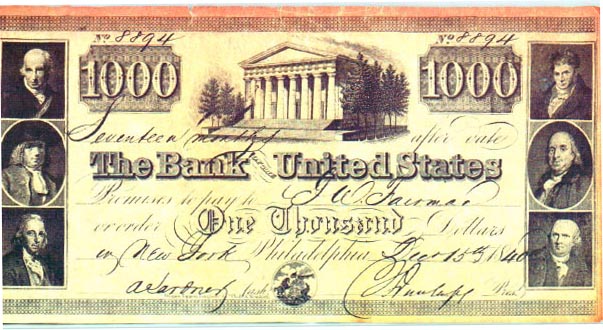 "Out" is the key word. In fact, the First Bank of the United States lent most of its money "in" - to the Treasury - during its early years. By 1796 60% of the bank's loan balances were to the Treasury. The Treasury bailed itself out by selling its 20% interest in the bank to private investors and using the proceeds to pay off some of its debt. By 1802 the bank was entirely in private hands. All the histories of the First Bank discuss how successful it was in acting as a central bank - like the Bank of England - but its actual history was very different. The bank acted mostly as a broker, not a taker of deposits; and its activities never included being a lender of last resort. When William Duer got into trouble in 1792, the bank did nothing to reassure the markets or support Duer; his collapse produced the first numbered "Panic" in U.S. history - the Panic of 1792. Hamilton, as Treasury Secretary, did intervene in the markets but he did it to reassure the European investors in Treasury debt, not to "save" the economy. When Jefferson decided to take Napoleon's offer, the First Bank was in position to "fund" the purchase. Its only involvement was to be the U.S. correspondent for Barings and Hope & Co. who were the actual underwriters.
The mechanics of the deal are representative. In 1803 Francis Barings got the French to agree upon a price of FF80 million (the equivalent of US$15 million). FF20 million (US$3.75 million) would be paid by having the U.S. Treasury assume the French government debts owed to US citizens. The balance - FF60 million (S$11.25 million) - would be paid in U.S. Treasury bonds - the first every issued by the U.S. Federal government. The bonds had a 6% coupon with interest payable half yearly installments in Amsterdam, London or Paris, with an exchange rate of 4 shillings 6 pence (22.5p) to the dollar and were to be redeemed between 1819 and 1822. Barings and Hope & Co. agreed to buy the bonds for FF52 million - a 13.3 per cent discount - with payment to be made in installments of FF6m up front and 23 monthly installments each of FF2m. A year later Napoleon - who was always desperate for money - pressed for immediate payment. The full balance was paid off by Barings and Hope & Co. in April 1804 at the cost of an additional FF1.65m commission. Most of the actual money for the loan was raised by Barings and Hope & Co. in Holland; their contemporaries said that "Francis Barings owned the Dutch market."
It is doubtful that any real comparisons can be made with either the First or the Second Bank of the United States and modern central banks. The ECB and the Fed hold gold as part of their reserves, but, unlike the U.S. Banks, they have no obligation to pay it out. Their paper is legal tender simply because they say it is, not because it is payable in Coin. And that one fact makes all the difference no matter what the speed of modern money.
Sep
20
George Washington Drafted to Defend Tax Hikes, from Stefan Jovanovich
September 20, 2011 | 2 Comments
 Obama invoked George Washington to defend his proposed tax hikes, and the references are to Washington's Farewell Address as President in 1796. The current President and his speech writers tactfully omitted what Washington said in the sentences preceding his insistence that Federal government collect taxes:
As a very important source of strength and security, cherish public credit. One method of preserving it is to use it as sparingly as possible, avoiding occasions of expense by cultivating peace, but remembering also that timely disbursements to prepare for danger frequently prevent much greater disbursements to repel it, avoiding likewise the accumulation of debt, not only by shunning occasions of expense, but by vigorous exertion in time of peace to discharge the debts which unavoidable wars may have occasioned, not ungenerously throwing upon posterity the burden which we ourselves ought to bear.
Sep
17
Briefly Speaking, from Victor Niederhoffer
September 17, 2011 | 3 Comments
 Have you ever noticed how those who have done you the most wrong, or those who loathe you the most, when they come onto hard times will often come back to you asking for assistance. This often happens to me with former colleagues. I can't always differentiate between whether the colleagues are in such bad straights that they will go to their most unlikely and ill wanted savior, or whether they wish to take their worst enemy down with them once more before they finally go under. I believe it is a variant of rats deserting a sinking ship. The British Navy and I believe all navies have a standard order from their captain "every man for himself " when the ship is sinking. And there is doubtless maritime law about when it is legal to put the captain in chains, (albeit this is somewhat a different situation). I believe the idea has many market implications, especially when markets have gone to the nadir like last week, but more important is how to protect your life in such situations I think.
One finds that there are only 25 suicides a year at Niagara Falls these days, and The Golden Gate has much more, but one can't speculate as to whether the sight causes the suicides or whether people with suicide on their mind tend to go there to do the deed. As for market moves, they must cause many more such catastrophes but again whether the person seeks out the opportunity or the opportunity causes the action, or both, it would be hard to unravel and a quantitative study of the types of moves that induce same would be helpful for saving lives and profits.
Russ Herrold writes:
I've had this happen a few times. I think the reason is that the former colleague or friend is sufficiently 'intimate' with the weak spot that their former friend had, and so can 'get past your guard' more easily.
Factor in some perverse pathological character trait, and they may even feel justifies in taking advantage of someone they feel has 'done them wrong' in the past. Indeed, it may be that there was an intent to deceive (conscious, or latent) from the onset of them approaching you, 'the mark'.
The best approach is to probably to buy the lunch, but to keep one's checkbook firmly locked up.
Polonius: (to his son)
Neither a borrower nor a lender be, For loan oft loses both itself and friend, And borrowing dulls the edge of husbandry.
Hamlet Act 1, scene 3, 75.77
and later
Polonius:
This above all: to thine own self be true, And it must follow, as the night the day, Thou canst not then be false to any man. Farewell, my blessing season this in thee!
Laertes: Most humbly do I take my leave, my lord.
Hamlet Act 1, scene 3, 78.82
The thought expressed by Vic is that there should be some heightened sense of gratitude if one is dealing with a moral person and 'offering the hand up' and a hand-out. But Twain echoed the Bard on this topic as well:
If you pick up a starving dog and make him prosperous, he will not bite you. This is the principal difference between a dog and a man.
- Pudd'nhead Wilson
Steve Ellison writes:
 When my children were 5 and 3, we hiked across the Golden Gate Bridge. There had recently been a freak accident in which a small child had somehow fallen through the small gap between the bottom of the railing and the sidewalk to her death. There were plans to replace the railing with one that went all the way down to the sidewalk, but the work had not been done yet, so I was keeping a close eye to make sure the children did not go too close to the railing. While my attention was diverted in this direction, I was almost caught off guard when the 3-year-old climbed on top of the one-foot high barrier between the sidewalk and the speeding traffic.
T.K Marks writes:
I, too, have walked across that bridge on numerous occasions. I'd walk over to Sausalito and take the ferry back. A spectacular stroll. One is still struck mid-span by the ease at which a despondent person could reach their goal. The curiously low railings prompt one to macabre thoughts. Who was the civil engineer involved with this project, Derek Humphry?
Stefan Jovanovich answers:
 The answer is Charles A. Ellis. Joseph B. Strauss did everything he could to claim credit for it (Strauss was to architects and engineers what Douglas MacArthur was to the Army and Navy - even when he was wrong, he was right - just ask him). Ellis reworked Strauss' initial proposal for a cantilevered suspension bridge - which would have been the mating of the Forth bridge with a ropewalk - and produced the design one sees today. Ellis did almost all the actual work - the calculations required for the computation of stresses, the specifications, contracts and proposal forms - singlehandedly, working non-stop for 2 years. After Ellis completed the work but before the final designs were submitted to the Bridge District's Board for its review and final approval, Strauss fired Ellis. There was no mention of Ellis in any report by Strauss, including the final report upon the bridge's completion in 1938. Ellis was the equal of Louis Sullivan, and like Sullivan he spent half his working life in total obscurity, unable to get any further commissions. Moisseiff gets credit for the development of deflection theory; but, as events proved (see "original bridge" section of Tacoma Narrows bridge), Ellis was the person who fully understood the necessary relationship between span length and flexibility. He is literally the father of the modern suspension bridge and the engineering theory behind it.
Bill Rafter comments:
There was a psychology professor that published a study showing that the vast majority of Golden Gate jumpers took the leap on the side facing the city (facing East) rather than the ocean (West) side. The article then attempted to theorize why this might be the case, and he concluded that it was an attempt by the jumper to say goodbye one last time. Nice thought, but it totally ignores the reality that it would be damned hard to jump on the ocean side as that pedestrian walkway is almost always closed.
It must be particularly interesting to be on the bridge when one of the big carriers goes under, as they have to time it with low tide to clear.
Sep
16
For Those Late to the Game, from Craig Mee
September 16, 2011 | Leave a Comment
 The ECB has announced a dollar-based liquidity operation to last through the end of this year so that European banks can access dollar liquidity that they have been shut-out of by the market.
Rocky Humbert writes:
Those of us who follow the US$ money market fund holdings see that the big European banks have gotten shut out of the US$ funding market. While they already had effectively unlimited liquidity from the ECB in Euros, they needed a counterparty to swap those Euros into Dollars. No private counterparty was willing to do this in size, so the Fed and the ECB engaged in this swap. If the collateral that the European banks post to the ECB have declined in value when the swap comes off, the ECB will still have to make the Fed whole — and the only way to do that is to print more Euros, sell them, and buy Dollars. That's not bullish IMHO.
The only people who are stunned are overleveraged idiots whose positions blow up on a move than is less than 1 ATR. My currency view (which may be proven wrong) is predicated on fundamentals AND technicals. The fundamentals haven't changed. And the short-term technicals haven't either. (yet). Like I wrote before, check in with me in a few months.
Gary Rogan writes:
They are trying to fix the whole world by monetary manipulation! We have a much more tightly coupled system, and it's bursting at the seams. You can of course stick with the optimism, and now that it's becoming clear BHO is unlikely to get reelected this may be the right course, but I believe we will get wherever we are going sooner if they somehow resolve the European mess once an for all, whatever current pain is involved instead of being so ingenious about pushing the can down the road.
Stefan Jovanovich writes:
I agree with your diagnosis, Gary. But, the Congress and the President and the elites they usually represent have been doing monetary manipulation and other things to fix the world ever since the Republic was founded. I make no bets on BHO's re-election. Incumbent Presidents have a massive advantage; it takes extraordinary circumstances for them to be voted out of office. Without Ross Perot Bush I would have been re-elected; without the Iran hostage crisis and his attempt to become First School Teacher/Preacher of the nation even Carter would have had a better than even chance. (Look up the polls for September 1980, and you will see how likely it seemed that he would earn a second term.) I place my confidence in Hamilton's Curse/Treasure. Our first Secretary of the Treasury's theory was that the Federal government could succeed if we followed the British model and had a "City" interest that insisted the national Treasury not be raided so frequently that the currency would be trashed. That was true for much of the country's history; our greatest failures as a nation have come when the "City" interest became more interested in working the government (the cotton land boom, for example) than in securing safe returns for the money the Treasury already owed them. We now have a revival of that traditional "City" interest, not on Wall Street but on Main Street. The Baby Boomer present and prospective Social Security recipients represent the largest group of U.S. IOU holders ever assembled. Their interest will supersede all others, and the House of Representatives will vote that interest. How can we geezers lose when everyone agrees that you should not "scare" the seniors by suggesting their claims are anything less than secure?
Sep
11
Versailles on the Yalu, from Stefan Jovanovich
September 11, 2011 | Leave a Comment
I can perform all the economic analysis in the world, and it won’t
convey the sheer apprehension I feel about China’s current situation
anywhere near as well as the following pictures…
The gold-encrusted hallways, marble foyers, and imposing granite
frontage are not from Versailles, or the Vatican, or even Caesar’s
Palace in Las Vegas. They are from the newly completed corporate
headquarters of state-owned Harbin Pharmaceutical, in northeast China.
No word on exactly how much the literally palatial offices cost to
construct, but the mind boggles.
full article here.
Sep
9
Bell Bottom Blues, from Kim Zussman
September 9, 2011 | 1 Comment
This is a plot of log SP500 for the period 2/66-2/82, along with a time-shifted / log adjusted plot of log SP500 from 8/00-present. Both plots were aligned so they originate at what was then a local maximum, and show (not adjusted for dividends or inflation) what happened to stocks in ensuing years.
The first 10 years of these periods are similar as there is no "upward drift". During the recent 11 years stocks made three major highs and two major lows, whereas the similar (net/flat) period 66-77 had 4 major tops and 3 major bottoms. In addition to the recent period's less frequent periods, the peak/valley has been far less than the older interval.
Interesting also to consider other differences not shown on the chart, including results of US military action, inflation levels, bond yields, age of depression-era children, age of post-war baby boomers, evolution of the equity culture, widespread indexation, and globalization of economies and markets.
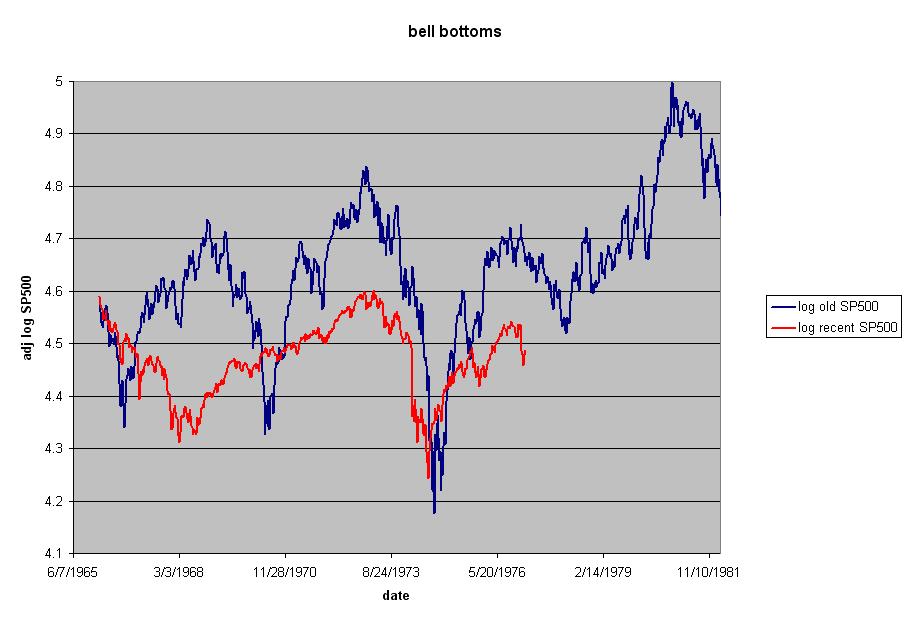
Stefan Jovanovich replies:
Great stuff, Kim. My feeble model compares the present to the late 70s/early 80s. The difference is the world's Bond Markets, which are now the opposite of what they were during that period. Good credits are now as much overbought as they were oversold then. Gold's price is equally high because then people were hedging against cost-push inflation while now they are hedging against deliberate currency depreciation by the central banks. Back then the gold market was disappointed when further cost-push inflation failed to materialize after Reagan and Thatcher made it clear they were not going to give in to the unions. This time the fears of further currency depreciation will be disappointed as the electorates in the U.S., U.K. and Germany decide that they want the central banks to tear up their credit cards and drain the punch bowl. Gold will then have to compete with actual returns for CDs and other conventional savings. But, then, how can stock prices rise? The answer is that the cost of borrowed capital is now a negligible part of the overall expense of currently doing business and irrelevant to consumer demand. The promise of diminished regulatory and steady (i.e. no longer rising) commodity costs will offset the added costs of higher interest rates for businesses 10 or even 100 times over; and - miracle of miracles - there will be an increased consumer demand from the savers - i.e. the people living off the interest rates from CDs. This is, of course, exactly the opposite of the Fed's diagnosis that we need to somehow reduce lending rates further to "prime" the economic pump so the borrowers can go more cheaply in debt; but then, what would you expect from people who walk by Woodrow Wilson's statue every day without gagging.
Sep
9
An Entitlement You Have to Pay For, from Stefan Jovanovich
September 9, 2011 | 2 Comments
 Unemployment compensation, like Social Security, is an "entitlement" (sic) that people actually do pay for. The Unemployment Insurance trust funds have the same problem as Social Security: because benefits have been extended and eligibility widened, the fund collections from taxes have not kept up with the accrued benefits. But, that should hardly be Jonathan's responsibility any more than it should be mine as a Social Security recipient. One can argue whether or not we should have such government-mandated pooled risk and deferred annuity programs; but, as long as we have FICA and FUTA deductions from payrolls and self-employment earnings, Gary's characterization is not true - most of the money is not being taken from "some" "to give to others". That characterization is true, of course, for Pell grants, food stamps, employees of the EPA and most (but not all) of Medicare; but should avoid falling into the crude generalizations that Libertarians retail as part of their continuing quest to remain as irrelevant to American elections as the Prohibition Party.
P.S. One of the many ironies of the tax/benefits laws in the U.S. is that, if you are self-employed, you cannot, with very few exceptions, qualify for unemployment. However, if you create a C corporation and are artful about the ownership structure, you can pay yourself a salary and pay FUTA, have the owners fire you and qualify for unemployment. Under the current laws in California (not counting the President's proposed extension of unemployment benefits) that would be a payout of roughly $45K not otherwise available to us poor capitalists struggling to game the system.
Gary should reload; his objections to the present arrangements will be far more lethal if he points out that the system's perverse favoritisms force even the most independent and personally honest people to spend time figuring out how to play the game so they can get their "fair" (sic) share of money they are legally entitled to.
Sep
4
Conflict History Map Resource, from Stefan Jovanovich
September 4, 2011 | 1 Comment
For military history addicts.
This is — by far — the best general map-timeline resource I have found for military history; and it has the knack of removing the blinders of the daily headlines from one's view of what is going on in the world now and in the past.
Sep
4
Modern Anthropologists Discover Money, from Stefan Jovanovich
September 4, 2011 | 1 Comment
 David Graeber is a brilliant guy; and, if your mind is not completely put off by the Marxist undertone, his book on Debt has some very good history. He also understands money's origins far better than the guys across the hall in the economics department. Money, he writes, exists because the king and his scribes need something to collect in taxes on which they can earn the rewards of seignorage. As Graeber points out, if it were simply a matter of collecting enough grain and gold, then the tax farmers could go on collecting the grain and gold. But, with what our American Constitution calls "Coin", you have a standardized Measure of wealth that the government both produces and collects and produces more and collects more; and, with each transaction, the scribes can collect an interest beyond the value of the metal itself. Graeber's explanation for how this alchemy begins is also sound; money has its origins in war. You can keep peasants working in the field with simple force; but you need to pay soldiers to make certain the sharp ends point away from you.
Where Graeber fails - utterly - is in his understanding of the origins of debt. He makes a great deal of the existence of debt bondage and the fact that peasants could end up losing their chattels to money lenders and out of that creates the equation of debt=slavery. But, as his own investigations should have shown, outright slavery has always been the far larger evil. When Adam Smith wrote that "the property of every man in his own labor is the most sacred and inviolable foundation of all property" he was not talking about the abuses of debtors' prisons.
So, why does Graeber focus on debt at the root of all evil? Because, if you are trying to mount a campaign to abolish debt as the root of all the world's misery, you cannot acknowledge that people have an inclination to deal with one another and will, if allowed, begin swapping credits all on their own. You will not find a single reference to Hayek in any of Graeber's writings that are online (I just did a search and came up empty); after all, if you acknowledge Hayek's wonderful insight - that a system of money that finds its origins with war and absolute authority can evolve over time into one of individual rights to property and open dealings in credit - then how can you rescue the labor theory of value and find capitalism as a vestigial appendix to be lopped off?
You have to believe that "kings, throughout history, …..normally encourage markets, for the simple reason that governments find it inconvenient to levy everything they need (silks, chariot wheels, flamingo tongues, lapis lazuli) directly from their subject population; it's much easier to encourage markets and then buy them. Early markets often followed armies or royal entourages, or formed near palaces or at the fringes of military posts. This actually helps explain the rather puzzling behavior on the part of royal courts: after all, since kings usually controlled the gold and silver mines, what exactly was the point of stamping bits of the stuff with your face on it, dumping it on the civilian population, and then demanding they give it back to you again as taxes? It only makes sense if levying taxes was really a way to force everyone to acquire coins, so as to facilitate the rise of markets, since markets were convenient to have around. Here is Graeber's explanation for how markets developed: "since kings usually controlled the gold and silver mines, what exactly was the point of stamping bits of the stuff with your face on it, dumping it on the civilian population, and then demanding they give it back to you again as taxes? It only makes sense if levying taxes was really a way to force everyone to acquire coins, so as to facilitate the rise of markets, since markets were convenient to have around."
Yeah, right. Merchants were convenient to have around; markets were those pesky things that even the merchants were tempted to believe they and the king could abolish.
Sep
4
And the Union Makes Us Strong, from Stefan Jovanovich
September 4, 2011 | Leave a Comment
 From Steve Huntley of the Chicago Sun-Times:
In another job, with another employer, at another time many years ago, I was a union activist. I edited a union newspaper, recruited new members and promoted the union whenever I could. Then I became its grievance chairman. For 2½ years I spent 95 percent of my union-work time defending the incompetents, the lazy, the malingers and the malcontents. And they got paid the same as my fellow workers who showed up every day and gave their all to the job. What's more, I saw how union rules frustrated management innovations to improve our journalistic product. A few years later I moved on to another journalistic enterprise without a union. I saw merit pay raises given to the hard workers, no salary hikes to those who didn't or couldn't do the job, and eventual dismissal of anyone who couldn't measure up to the demands of the magazine. Thus began my journey from liberal to conservative.
When I asked my Dad how he, like Reagan, went from being a Roosevelt Democrat to a corporate Republican, his answer was much the same as Reagan's. The change came from seeing what unionism actually meant in real terms, from his Uncle who was a shop steward at Dodge Main and spending an entire afternoon sitting in the man's office while he and the other stewards played pinochle and waited for the shift change.
The older I get the more I find myself following John Morley and being "a cautious Whig by temperament, .. a Liberal by training, and … a thorough Radical by observation and experience". All monopolies are evil, but the ones that exist in law - labor unions, criminal sentencings for private conduct - are truly vicious because they can avoid the test of experience and keep playing their idle games while never having themselves to pay the costs.
Sep
2
Quote of the Day, from Stefan Jovanovich
September 2, 2011 | 1 Comment
And, then, we have Mr. Hoover:
I declare I never saw any but technical corners until 1931, when the Farm Board had title to all the visible supply of wheat in the United States. Theirs was an unsuccessful deal of fabulous proportions…. Broadly speaking, the purpose of the Farm Board was to obtain for farmers better prices for their products. In the hope that it might accomplish this, it was intrusted with powers broader than were ever before conferred upon any board or commission of government; and the $ soo,ooo,ooo of which it had unlimited control was more money than ever before in peacetime was put at the disposal of an independent group of Government employes. Now then, what they did with this power and money was to speculate in farm produce. Fix that firmly in your minds; and then realize that all their speculation resulted in failure. Whether they bought wheat, cotton, livestock, dairy products, soy beans, wool, cherries or what not, prices declined.
Aug
29
Estimates of Hurricane Damage, from Stefan Jovanovich
August 29, 2011 | Leave a Comment
 Eqecat’s initial estimate is that the damage from Irene in the state of North Carolina will be between $200 million to $400 million. Past hurricanes had these totals for damages for the Tarheel state(the figures are in constant dollars):
1. Diane (1955) - $17.2 billion
2. Hazel (1954) - $16.5 billion
3. Hugo (1989) - $7 billion to $10 billion
4. Floyd (1999) - $6.7 billion
5. Fran (1996) - $5.8 billion
6. Isabel (2003) - $4 billion
The greatest damage came from Donna (1960) - $29.6 billion.
The Natural Hazards Review published a summary of normalized hurricane damage for the period from 1900-2005 for the entire country.
"The 1970s and 1980s were notable because of the extremely low amounts of damage compared to other decades. The decade 1996–2005 has the second most damage among the past 11 decades, with only the decade 1926–1935 surpassing its costs. Over the 106 years of record, the average annual normalized damage in the continental United States is about $10 billion under both methods. The most damaging single storm is the 1926 Great Miami storm, with $140–157 billion of normalized damage: the most damaging years are 1926 and 2005. Of the total damage, about 85% is accounted for by the intense hurricanes (Saffir-Simpson Categories 3, 4, and 5), yet these have comprised only 24% of the U.S. landfalling tropical cyclones."
A psychologist adds:
Reminiscent of behavior I saw with a falling SPX with VIX nearing 50. The online world is all about attracting visitors to sites ("eyeballs"). It's difficult to do that with nuanced headlines and well-balanced stories. So events tend to be magnified by pundits wanting attention, media needing viewers, etc. A linguistic count of extreme words in headlines and lead paragraphs of stories a la Pennebaker would likely produce some insights…
Aug
29
More Thoughts on the Gold Standard, from Stefan Jovanovich
August 29, 2011 | 3 Comments
Cullen Roche is right when he writes that "a government with a monopoly supply of currency in a floating exchange rate system has no solvency risk unlike a nation such as Greece which exists in a single currency system with what is essentially a foreign central bank. A government with a monopoly supply of currency in a floating exchange rate system is never revenue constrained" - i.e. it can always write a check that the Federal Reserve will clear. The only problem is that such a system literally makes people chattel. They are never in the position where they can save wealth that stands beyond the government's reach. To put it in terms that Washington, Hamilton, Madison, Jackson, Grant and Cleveland would all have agreed, the citizens have the fundamental right to insist on holding their savings as specie. And why should this matter? The answer is one that even the most rabid Keynesian acknowledges: when people can insist that the government exchange its monopoly currency for gold, the price of that currency - what it will buy - remains wonderfully stable. Some things get more costly and others get cheaper; but there is no persistent, steady devaluation similar to what the last century has offered people who have chosen to keep their money in a cookie jar.

There is another reason why a financial system has to have room for people who want to just say no, who, in Anthony Newley's words, want to "stop the world and get off ". If a "monetary system" does not allow the citizens and foreigners both to withhold their money and thereby restrict the government's ability to expand legal tender, the entire information structure of rational expectations itself begins to collapse. Everyone - even Marxists - now pretty much agrees that economic decisions are based on expectations about the future; only the Marxists persist in the fantasy that those expectations can be perfectly realized. If that is so, then where to the mistakes go? Where is the trash can for the part of investment=savings that never pays off? For the economist Wynne Godley this question - and the inability of equilibrium theorists to answer it - called into question the entire notion that prices themselves represented some perfect meeting of supply and demand. The only area where, in fact, supply and demand perfectly met was in the financial part of the economy. Everywhere else both individuals and firms needed what Godley called a "buffer", a saved resource for future income and spending that whose price was itself uncertain. Historically, for individuals the buffer was saved money that did not depend on the government's fiat; for firms it was money, in part, but also something more. For a goods producer the buffer was inventory; for a service firm it is slack labor capacity. That was, in fact, how the system of the production, distribution and sale of goods and services actually worked. In Godley's words, "outside financial markets there is neither need nor place for equilibrium conditions to bring supply into equivalence with demand." But, as [Dailyspec contributor] Tyler McLellan and others have properly reminded us, under a fiat currency system, equilibrium is always and everywhere present. It is literally impossible for firms and individuals to adjust the quantities and terms of trade at will without affecting the quantity of money itself. The result is a world where the needed buffer is nothing but an accounting entry and the banks and other dealers in credit have no actual money reserves. The further consequence is that individuals and firms have no means of calculating what an adequate buffer should be; their only possibility of finding safety is to trade in political influence so that enough of the persistent inflation of the money supply is directed to their pockets.
The ever watchful Charles Pennington adds:
The graph is a bit mis-specified. It is more accurate to plot the price level on a log scale.
This shows that inflation has decreased since the 1970's.
That said, I agree with Stefan's remarks.

Aug
24
Yellin’s Minions Blame The Crummy Future on Me, from Stefan Jovanovich
August 24, 2011 | Leave a Comment
This chart is part of a study by the SF Fed (aka Yellin's minions). The authors calculated the M/O ratio - the ratio of Middle-Aged (40-49 year olds) in the US population to the Old folks (60-69) - and used it to generate the probable P/E ratio for the stock market. As I have written many times, Mea Culpa!
See: "Boomer Retirement: Headwind for US Equity Markets?"

.
.
.
.
.
.
.
.
Aug
24
Depositors and Clearing Houses, from Stefan Jovanovich
August 24, 2011 | 3 Comments
 What is now completely forgotten is that banks used to be on their own. Neither the U.S. Treasury nor the full faith and credit of the Congress nor the Federal Reserve system stood behind them; yet somehow commerce flourished, panics were short, and - wonder of wonders - the paper currency people held was literally as good as gold. The risks of that system were the ones J.P. Morgan explained to Congress in his testimony before the Pujo Committee - one was always dependent on "the character of the borrower". And that character could and would fail, sometimes badly. What distinguishes the period before 1912 from what came afterwards is that the risks of failed character were not socialized. It was not the world we have now where everyone is everyone else's counter-party and savings=investment because that is how the equations work out. Yet it was, very much, a world of Physics and Politics.
The late 19th century financial system operated on Walter Bagehot's principles. It was assumed that, in the event of a crisis, the primary dealers in credit and money would come to the rescue but they would do so according to Morgan's hard rule. Bagehot's famous advice, "Discount freely", would be followed, but it was assumed that bad characters would not receive loans at all because their word was no good. That would be "cruel" (sic) to the depositors who trusted those bad characters, but such cruelty was an essential part of the system. Liars and cheats could not be rewarded, and neither could the fools who trusted them. One of the many things admirable about Ulysses Grant is that, when his son was swindled by a Bernie Madoff of the 19th century, he took the loss as being entirely his own. Neither he nor his family ever suggested that anyone else, besides the fraudulent partner, was to blame. Under such a system "sound" banks were the very ones that seemed most awful; they would only lend to people they knew and would always demand solid security.
This nasty truth seemed horribly undemocratic, as undemocratic (small or large D, take your pick) as the idea that people should have a sufficient down payment and prospects of reasonable income before being given a loan to buy a house. The Federal Reserve Act was promoted by Progressives as a solution to this problem. With the added security of interlinked banks and the implicit guarantee of the Treasury (the Treasury's currency was to become the Federal Reserve's), banks could cease to be so stingy. It is easy in retrospect to create conspiracy theories about "the Fed"; but there is very little justification for that. There was nothing at all radical in the actual language of the Act itself; its terms merely put in place a permanent Clearing House system that would be available at will in times of distress. The Clearing House system had worked during the Panic of 1907, but its very success had alarmed people who feared the Money Trust. Better to put the system in the hands of a quasi-public institution like the Bank of England than to leave it up to the Morgan Bank. (Note: The 1907 Panic had scared people in banking precisely because it had been a "Rich Man's Panic". The country had been fine; indeed, the "country" banks had remained sound. What was troubling was that, after the failure of the Knickerbocker Trust, those country banks had decided that the New York bank's character was less sound than had been supposed.
 So, having the Federal Reserve system serve as a banker's bank, an intermediary between the members, would not by itself be a great change. None of the supporters of the Act - Progressive or otherwise - presumed that the system would abandon the discipline of Bagehot's doctrine - no lending to bad characters. No one in the country supposed that the Act would change the currency - i.e. abandon the Constitutional gold standard. All the Act would do was create a formal authority that would have the "flexibility" to discount freely in times of crisis and thereby prevent people of "good" character from being wrongly slandered by the market. That was, of course, the beginning of a devil's bargain, but only a few cranks anticipated that it would be the beginning of the permanent destruction of the currency.
What those cranks anticipated was that the Fed and the U.S. Treasury would decided that the Constitutional gold standard was not really a standard but only a guideline. That came in 1914, when war broke out in 1914, and the Secretary of the Treasury decided that, in the name of national security, he had the authority to shut down the New York Stock Exchange for 6 months.
That default by the government of the United States is the major part of the devil's bargain that we are still paying for. Shutting down the Exchange not only prevented the European holders of U.S. securities from selling up and asking for their bank drafts to be exchanged by the Treasury for bullion, it also destroyed overnight the private intermediaries for the bulk of world trade. The factors, dealers in commercial paper, and others who acted as the actual risk takers for payments for the greatest part of the volume of imports and exports were shut down. Trade finance ceased to be the dealings of private parties and became, instead, part of the official dealings of national treasuries and their respective central banks. The check and balance provided by those commercial dealers was literally abolished. The European governments whom Woodrow Wilson and the Congress favored - Britain and, to a lesser extent, France - were allowed to write checks for imports of food and war materials that their own pre-war banks would not have cashed. The financial tyranny of the Presidential executive order that Scott and others have so justly complained about did happen, but the author was not a 19th century Illinois Republican but a pair of modern, 20th century Virginia Democrats.
If you have no problem with any of this - and a majority of Americans and all but a few professional economists - do not, then you still have to explain why, in every financial crisis, from 1930 to 1971 to 2008, the Federal Reserve has ended up protecting the interest the banks and the banks' counter-parties and lenders and their mercantilist certainties at the expense of the savers and depositors and holders of the currency. The very hoard of gold acquired by the Treasury and the Fed in WW I was not used to "bail out" (sic) the depositors of the U.S. banks in 1930, 1931 and 1932 even though the system had been sold on the promise that "a systematic revision of banking laws in ways that would provide relief from financial panics, unemployment and business depression, and would protect the public from the domination by what is known as the Money Trust."
In 1930, 1931 and 1932 the depositors lost their money outright; this time their money has been "protected" but its very value has been destroyed in the name of lowering real interest rates. That, of course, ignores the last part of Bagehot's doctrine - the central bank is to lend freely but only at high rates.
Aug
24
Article of the Day, from Jeff Watson
August 24, 2011 | 4 Comments
 I read a very entertaining article in Scientific American yesterday: "Can Math Beat Financial Markets ".
Stefan Jovanovich writes:
Check out the author's home page.
Gary Rogan writes:
Looking at the page brings up the age-old question: can the same techniques that are used in natural science to study the universe that doesn't change from being studied and where the fundamental rules don't change at all be applied to a system where nothing prevents most rules (other than that old "human nature") from being changed at any time? He cut his teeth on never-changing, but how will it play with ever-changing? Somehow fractal coastlines are just not the same as fractal security price charts. Fat tails and non-gaussian distributions are great, but then what? We can evidently estimate the risk of something happening he says. But can we???
Ralph Vince adds:
Yes, when he speaks of their raison d'etre "To quantify risk" I think, "Huh? How? VAR? Just HOW DO they 'Quantify Risk.'
If alluding to using it ("algorithmic trading," in the context of some sort of proce prediction a la quant, I assume he means modelling prices using models based on SDEs. Again, "Huh? How? Does this guy know what he is talking about?")
Quant-dom, traces it's roots to pricing of various securities — warrants, options, spread on futures/forwards, backwardations, and the pricing of the plethora of derivative creatures who climbed out of the ooze of ercent decades. This is NOT predicting markets, or "Quantifying Risk," (the latter, clearly, has utterly failed using their conventional models).
The entire article smacks to me of something dumbed down to the point of being useless and silly
Aug
23
Perhaps Those People Lining Up to Sell Gold Know Something, from Gary Rogan
August 23, 2011 | 5 Comments

People are lining up in Wesport, CT to sell gold coins, according to a report on Seeking Alpha .
Has anyone ever reliably made profits from bubbles? If so, their existence can be prospectively determined, if not there is no clear answer. It's true that there may be people who know a bubble with 100% certainty, but they don't know where they are in the cycle so they are too worried about shorting them. This is pretty morally equivalent to having no idea about the existence of a bubble, although not quite. I'd say if someone can reliably predict that within a "reasonable" time the bubble will deflate below the current level, and are willing to bet on that, they "know" the bubble exists.
Jeff Watson writes:
Look at the 1980s Hunt Brothers silver debacle. Despite the big move in silver, I never knew anyone that made a boatload of money off of that huge move. I heard lots of tales of people getting rich off the silver market, pyramiding $5,000 into millions, but those people were always friends of friends twice removed, and nobody in my clearing firm, none of my buddies ever nailed silver. I suspect those people who got rich off of the silver market are as elusive or mythical as the Yeti. I also suspect that if you were long that silver market with a $5,000 account that you would have stood a better than even chance going bust.
Rocky Humbert comments:
The Hunt Brothers episode was a corner in an overleveraged market. I'd argue that the gold story today is totally different. Importantly, it's not a leverage-fed, euphoric or happy bull market. It's a funereal bull market. Because if gold is right, and it keeps going and going and going (?5,000? ?10,000 ?20,000 +++) all of one's paper assets will be worth what they are printed on, and the Chair will find out exactly what 2008/09 would have looked like without massive central bank liquidity infusions. (And being short stocks won't help either, since there won't be anyone left to pay you back.)
Hey Gary — for someone who thought total financial collapse was the "ONLY" outcome, how can you NOT be massively long gold??? That's not a bubble! Or is it? As I've been writing for two years now, gold's ascent is a confluence of negative real interest rates; undisciplined central bank behavior; a growing loss of confidence in government policies and financial systems; loss of Swiss bank secrecy; an accumulation of economic wealth by individuals in parts of the world without stable property rights and rule of law; etc. The CME can raise margin requirements all they want; but there needs to be a change in the underlying fundamentals (and/or perception of the fundamentals) to end this period. What will that change look like? Shouldn't that be the question on the table ….
Gary asks, "Can anyone reliably make profits from a bubble?" Hmmmm. Warren Buffett keeps a sealed envelope in his desk drawer with the name of his successor. In contrast, I keep a sealed envelope in my desk drawer with the EXACT high price in gold. Neither of us allow any peeking (or peaking.)
Note to Anatoly: You recently wrote that you think gold won't go all the way back down. If you believe that this is a genuine bubble, then you'll have been wrong on the way up. And on the way down. See Jeremy Gratham's extensive work on bubbles — and his observation that they retrace >100% of the parabolic extension.
Stefan Jovanovich says:
The U.S. Treasury had enough gold to be able to promise to redeem the customer balances of every member bank of the Federal Reserve in the United States in 1930; had that step been taken, the U.S. would not have suffered the extraordinary collapse in demand that created the death spiral of world trade
Tyler McClellan asks:
Stefan,
Just for fun, how would you have lowered real interest rates in the US, without dramatically widening the gold points, or say just abandon them all together.
Stefan Jovanovich replies:
Why would I want to administer interest rates at all? The problem with the Federal Reserve system is that its underlying premise is that the government should do so. Nothing can prevent speculation from having a component of folly and ruin — like all of life. The idea that the government — which is itself an interest group of the employees and beneficiaries of government borrowing and spending — can somehow avoid the same folly and ruin in its speculations seems to me to be the funniest of all the lunar illusions. Remove the notion that somehow banking is a special kind of business that requires absolute government guarantee (which, as we have seen, the government cannot afford any more than anyone else) and a great deal of the folly and ruin disappears because the truth — that everyone in commerce works without a net — is transparent. As someone once said, the illusion of safety is the most dangerous of all ideas.
Aug
22
HP: Grow Up, Already, from Vitaliy Katsenelson
August 22, 2011 | Leave a Comment
 Anger and frustration are the two emotions pulsing through my veins as I write this. HP, once the symbol of innovation, is being dismantled by its high-pedigreed board and the CEO of the hour (I truly hope his tenure will be measured in hours, not years). I vividly remember the early 2000s, when Carly Fiorina, then CEO of HP, engineered the HP merger with Compaq. She argued that the merger was a must for HP's future to be bright. Walter Hewlett, the son of one of the founders, was publicly opposed to it, and I remember the drama of the proxy fight, the TV interviews and arguments from both sides, and the finale -– Walter Hewlett lost and the merger went through. But it was not the finale, because nine years and two CEOs later HP has announced that the PC business, the one it so desperately wanted just a decade ago, is too hard a business and that it will look for ways to get rid of it. Almost in the same breath HP announced that it will kill WebOS devices, a business it acquired in April 2010 for $1 billion; and management, possibly missing the irony in those two announcements, went ahead and announced another acquisition, which this time will for sure transform the company.
HP will buy Autonomy, a UK software company, for $10 billion. I understand $10 billion doesn't sound like a lot of money in today's post-trillion-dollar-bailout world, but it is plenty for HP, especially considering what that money bought. There are many ways to illustrate how expensive and meaningless to HP's future this acquisition is: $10 billion is about a fifth of HP's market capitalization, while Autonomous will contribute 0.7% to HP's revenues, and 2.7% to its earnings; and HP paid 10x revenues and about 25 times earnings.
Leo Apotheker, HP's CEO, bragged about Autonomy:
"Autonomy has grown its revenues at a compound annual growth rate of approximately 55% and adjusted operating profit at a rate of approximately 83% over the last 5 years."
Keith Backman, a sell-side analyst from BMO Capital, asked a very pertinent question about Autonomy:
"… metrics that you threw out for Autonomy, particularly on top-line growth, included a lot of acquisitions for Autonomy. What's the organic growth rate that Autonomy has achieved lately?"
Leo did not have an answer, whereupon HP's stock started to drop. HP had reported an OK quarter, expectations were already low (its stock was at about 6x times 2011 estimates, which remain intact), and Dell had already lowered guidance a day before; so no one was surprised when HP lowered its revenue guidance for 2011 by a few percentage points. Management said that since it will pay for Autonomy from cash on the balance sheet, it will not be buying much of its stock in the near future, and then they mentioned that this acquisition will be accretive. Yes, accretive! Nothing to worry about. This transaction is accretive only for illiterates in economics and those short on common sense.
HP is using cash on the balance sheet to pay for this transaction, and thanks to the Federal Reserve this cash yields zero and thus brings zero income. As long as Autonomy's income is greater than zero (I am oversimplifying a little) then it will be accretive (at least on a cash basis). However, this assumes that HP's cost of capital is equal to the return it receives on its cash. Which is not the case, as that would ignore such minor details as the time value of money, inflation, the risk premium (after all, unlike the US government, HP cannot print money and doesn't have nuclear weapons) and, simply, opportunity cost.
Any investment HP makes today should be compared against an opportunity set that includes its own stock, which at 6x times earnings results in about a 16% yield (cost of capital). In fact, if HP used $10 billion to buy its own stock, its earnings per share and dividend would jump by 16%. Autonomy will not be able to match this return, by a long mile.
I don't need to have a great imagination to envision another conference call in August 2015, where a new CEO decides that the software business is too difficult, and HP needs to come back to its roots (maybe going back to making calculators) and will spin off the software business into a new company, take an enormous charge, and then maybe announce an acquisition that the same highly pedigreed board will rubber-stamp.
HP's valuation has not changed that much – the PC business only represents about 16% of operating profit, so even if HP gives it away, earnings power will not decline greatly. HP should still be able to get a decent price for it, as there has got to be a Chinese company out there swimming in US dollars that wants to put them to work before they become worthless. HP's core businesses, will be slightly impacted by the global economic weakness, but the company should maintain its earnings power largely intact. Autonomy reduced HP's value by about $3; but with my lack of confidence in management, I'd not buy HP at a P/E higher than 10, which would bring the stock to the mid to high 40s.
HP's stock sold off not because the company disappointed Wall Street but because Wall Street grew tired of the overpriced "must-have" acquisitions. Wall Street has smartened up and assumed that this acquisition, as with many other "transformative" acquisitions, will do nothing of the sort. And so, today we are faced with a decision: buy, hold, or sell. At 4.6 times earnings HP is not a sell; but considering that the company is still trying to figure out what it wants to be when it grows up, it is hard to add to our holdings of the stock; so unfortunately this company has turned into a hold.
Stefan Jovanovich writes:
There is another perspective. HP, like National Semi and so many of the other "original" Silicon Valley companies, was - at heart - a defense contractor. Its instruments were sold to and used by other defense contractors; and the HP Way was dependent on the steady stream of direct and indirect payments from Washington. The HP Cringely knew began to die when the Berlin Wall came down. What is interesting is that this was the same time when new generation of "tech" companies started up that had no experience with government Purchase Orders and purchasing requirements. The question to be asked is how far has Microsoft gone down the road towards being the next HP, only this time the graphics being generated come not from oscilloscopes but from Power Point, etc. One of the many reasons to admire the MRD ("mad" Russian duo) is that, given a choice between competing with MSFT and AAPL, they chose AAPL, even though "everybody knows" that was the wrong decision. Of course, you want to have governments and corporations with large headcounts as your primary customer base.
Aug
22
Farmland REITs, from Pitt T. Maner III
August 22, 2011 | 6 Comments
 Michael Burry, of "The Big Short" fame, mentioned farmland a while back as an (the only?) investment he saw having value.
It appears now that there are companies that are developing and possibly planning the introduction of the "first" farmland REITs. One could imagine that this might have an appeal to the general public looking for an alternative to gold and other perceived "safe havens". Buying a piece of the farm…
Here is one company that has been mentioned as being interested in introducing farmland REITs. Those with experience in this area can critique if such a thing makes sense or not…or whether watching re-runs of "Green Acres" is a better bet for city slickers.
"Our goal is to develop an agricultural and farmland investment vehicle that provides unique value to our shareholders. We seek to achieve this goal by owning farmland that is leased to independent farmers that mostly produce row crops. We own six farms in California, each of which is leased to farmers producing fruits and vegetables."
Stefan Jovanovich comments:
European syndicates wanting to get into the "beef" boom paid for the land and the Herefords and other stock that were brought in to Kansas to improve the breed of the wild Texas cattle that Mr. Hammond, Swift and Armour were slaughtering to great profit. Somehow, the profits were never realized, even though a number of enterprising cowboys got their start with their own spreads by liberating the "half-breeds" that wandered off the Europeans' land. The author of one study described the experience of the Dutch investors as a "long slow ride to nowhere".
Aug
21
John Law Lives! from Stefan Jovanovich
August 21, 2011 | 1 Comment
Sean Corrigan:
(John Law) also held, like all of his ilk that have succeeded him, that the panacea for a nation groaning under an unsupportable burden of debt and famished for a lack of productive capital was the emission of more and more money. This age old error of confusing the medium of exchange with the object of exchange is one we continue to commit. It's as if a man's thirst can be slaked by giving him a box of drinking straws or his appetite sated by kitting him out with a shopping basket.
Aug
18
Quote of the Day, from Stefan Jovanovich
August 18, 2011 | Leave a Comment
 "The market may be crazy, but that doesn't make you a psychiatrist."
Gary Rogan comments:
I was actually reading Statman's book What Investors Really Want, highlighted in the link, and almost finished it over the weekend. It's slightly less formulaic than the typical "behavioral economics" book, and at times entertaining, but just as useless. Is there really a need for many more examples of "all we really want to do is to rationalize what we have done or feel like doing" ? It's amazing how much contempt for human beings this whole research sub-culture has, at least this one pokes fun at himself at times. But fundamentally it's the same message as always: don't attempt to beat the market because you are destined to fall victim to the emotional zeitgeist.
Aug
15
A Non-Political Political Marker, from Stefan Jovanovich
August 15, 2011 | 2 Comments
Incumbent Presidents voted out of office, either at the general election or by their party's convention (as noted):
John Adams Federalist 1800
John Quincy Adams Democrat-Republican 1828
Martin Van Buren Democrat 1840
John Tyler Whig
1844
(A 2-time loser; the Whigs failed to renominate him,
and his own party lost in the general election)
Millard Fillmore Whig 1852
(Fillmore wanted to run for re-election but his party
denied him the nomination)
Franklin Pierce Democrat 1856 (same as Fillmore)
James Buchanan Democrat 1860
Chester Arthur (?) Republican 1884
(Arthur allowed himself to be nominated at the convention; but he was
severely ill — he died 2 years later — so this really should not count)
Grover Cleveland Democrat 1888
William Taft Republican 1912
Herbert Hoover Republican 1932
George H.W. Bush Republican 1992
You could add these names too:
Harry Truman Democrat 1952
Lyndon Johnson Democrat 1968
Both were eligible to run for re-election but decline to do so because they would have almost certainly have lost.
Aug
14
Article of the Day, from Stefan Jovanovich
August 14, 2011 | 1 Comment
 For the Kelly investors among us, I found this interview with Edward Thorp very interesting.
Ralph Vince writes:
Thank you, Stefan.
Thorp seems to be quite the interesting guy, though I have never met or corresponded with him.
The Kelly Criterion itself was not what Kelly or Shannon thought it was - a fraction (it only appears like a fraction, and equals what is the expected asymptotic growth optimal fraction under certain conditions, ubiquitious in gambling). In trading, this fact is damning.
So even if someone IS attempting to be expected growth optimal, if they are employing the Kelly Criterion, they are NOT employing what they think they are. The solution returned by the Kelly Criterion does NOT equal the expected growth optimal fraction — it is NOT bounded at 1 on the right-hand side (and because it is often < 1, it is often mistaken as a fraction to the great peril of those employing it).
Worse-still is that the formula you can determine the expected growth optimal fraction with gives us the the entire landscape for all values of the fraction (0…1) for all axes. As I pointed out to Duncan on this list a few days ago, this allows one to craft a positioning strategy to satisfy criteria aside from the medieval "expected growth optimal."
In short, in trading, I find there is NEVER any good reason to employ the Kelly Criterion, even when one is seeking to be expected growth optimal.
Aug
4
Thoughts, from Stefan Jovanovich
August 4, 2011 | Leave a Comment
 Louie Gohmert, Connie Mack and Mike Lee are no more heroic for voting what their constituencies want than the City Council of San Francisco is heroic for deciding that orthodox Judaism is the one religion not entitled to the protections of the 1st Amendment (of all the health issues confronting our formerly free city the question of circumcision has somehow become the burning issue). Clearly, the voters of the United States have chosen to have the country follow a course that will allow most of the recipients of government money to keep getting their checks. What else could have been expected? The only question was whether or not even lip service would be paid to the notion of a balanced budget. Until now, under both Republicans and Democrats, Congress has
  worshiped at the altar of the Keynesian religion; as Nixon said, everyone agreed that somehow money printed and circulated in the proper digital form would increase actual wealth.
The present legislation at least questions the God of free money; it does not do much to end the abomination, but it is a beginning - just as the Northwest Ordinance was towards the abolition of slavery. The vice of all government - the taking of property in the name of the law - was not going to magically end in the United States because Rick Santelli had an inspired rant on CNBC and the Democrats once again tried to nationalize health care. Those of us who voted to have lip service paid to the ideas of economic liberty will take what we have gotten and then, as Samuel Gompers advised, ask for much more.
P.S. It always delighted me that Gompers and Andrew Carnegie were buried nearly side by side in Sleepy Hollow cemetery.
Jul
29
A Sporting Observation, from Stefan Jovanovich
July 29, 2011 | Leave a Comment
 As a golfer the Speaker of the House is clearly Lee Trevino. He is the only one of our present leaders who comes from "the people" - i.e. the vast majority whose families had little, if any, capital. Cantor, Pelosi, Reid and Obama all has the rough places in their upbringings made smooth by money and influence. Let's leave aside the question of the substance of the present political debate. What choice do we have when you consider that a 2% across-the-board cut in the current expenditures of the Federal government would be scored by the "non-partisan Congressional Budget Office" as a "Cut of $13 to $14 trillion". It seems to me that Boehner has successfully portrayed himself as someone who is barely hanging onto control of his caucus and that the Democrats will have to take whatever he proposes - even if it leaves the matters of the Debt and the Deficits to come up again next year during the election season.
"I'm going to win so much money this year, my caddie will make the top twenty money winner's list."
Gary Rogan writes:
I don't think it's easy to deduce what Boehner's real goal is. He has been recently accused by serious people in engaging in a charade to not really cut spending but to appear eager to do so. In this line of thought, this charade involves a pretend tug of war between his plan and Reid's. I don't really know whose side he is on or what his game is. If anyone knows, please post. I do think that the participants have differing goals, to some degree, but the overall framing is a complete con.
Vince Fulco writes:
So with this intensifying impasse, how do both groups walk away saving face and claiming victory? I guess only in the political world can one fool themselves that that can be done. Next few days should be rich with opportunities…
Kim Zussman adds:
see: Brinkmanship
Gary Rogan replies:
Clearly the resolution is not predictable in any meaningful sense by those without the maximum access to information, and probably not even by those with it. Even the simplest game of chicken ends in three possible ways, and this game is more like a game where hundreds of participants are racing along multiple highways towards the center of the city, where the center is marked by a huge piece of concrete. If anyone hits the concrete, they all lose. While on the highway, they have to keep moving at roughly the same speed (assuming the distances are similar). They can swerve individually, or keep moving. There are no other choices. The game is complicated by the following:
-In this game, unlike an actual collision nobody dies even when they all lose. So the stakes for each participant are lower.
-Some participants believe that they can actually gain if the "loss" occurs.
-The stakes are also very different for each individual participant and are not fully known to the outside observers.
-Each participant may be communicating with any number of other participants, again not fully observable.
-The participants are forming fluid coalitions not fully observable by the outside observers via multiple communications channels.
-Many of the participants are in constant communication with multiple outside stakeholders who have enormous stakes in the outcome, and variable ability to influence the participants. All participants can hear the "roar of the crowd".
-Some of the participants are engaged in very public communication to the outside world through varying media channels. A large percentage of the participants are engaged in trying to misrepresent the pressures they are feeling and their real estimates of both the chances of the loss occurring and its consequences.
-There are points gained by having the "right" reason for not to swerving. The scoring is done both in real time and many months after the game is over. Observers can materially hurt the participant in a number of ways months after the race.
-There are points for appearing cooperative and there are also point for appearing uncooperative. Different observers have different rules, and they are unclear.
-The observers are under constant barrage by the media trying to shape their opinions about the race.
-Some participants took a pledge to never swerve under any circumstances.
-There are multiple disagreements about the distance to the center.
-"Losing" or "winning" without the right side-agreement will eventually result in the whole city being nuked (again figuratively, because nobody except a few unfortunate observers really dies, but many suffer a great deal of discomfort).
I can go on for a while, but I am not really shedding any light other than illustrating that trying to predict an outcome of something like this is futile. It's much more complicated than the Cuban missile crisis. On a side note, the Cuban missile crisis could have resulted in the nuclear war through a little known sequence of events when the captain of a severely damaged Russian submarine under extreme stress from almost unimaginably horrible environment inside the submarine and being pursued and bombarded by the Americans with training depth charges, and with the submarine secretly equipped with a nuclear-tipped torpedo was ready to order for that torpedo to be launched. He was talked out of it by a single member of the crew. It's the little known things that count.
Jul
24
Some Facts, from Stefan Jovanovich
July 24, 2011 | Leave a Comment
The average costs per launch for the Space Shuttle, according to today's WSJ, were $1.5 billion; the average payload was roughly half the capacity of Delta IV rocket (23,000 kg to LEO).
SpaceX is now offering a lift package on its Falcon 9 for the same size payload at $50-$60 million (3-4% of the average cost of a shuttle launch).
Deflation has also come to the lift insurance market.
Jul
21
This is the current universally accepted monetary model of our earth-centered universe:
1. Aggregate money surpluses from whatever source (whether private savings or government lending to itself) equals aggregate investment — the stuff we use to make more stuff and do more things
2. The amount of aggregate debt has no impact if the government stands ready to lend and guarantee more
3. All investment is equal– a Pell Grant is the same as a bulldozer
Jul
13
Compulsory Schooling, from Stefan Jovanovich
July 13, 2011 | 2 Comments
 Communism inflicted itself on Russia the same way it has inflicted itself on the rest of the world — through compulsory schooling. The exceptionalism of the United States (so far) has to do with the relatively late arrival of a state ministry of education. As Gary and Rocky both know, Vladimir Ilyich Ulyanov was the treasured son of a state schools inspector and school teacher. All of their children were "educated against the ills of their time (violations of human rights, servile psychology, etc.), and instilled a readiness in them to struggle for higher ideals, a free society, and equal rights" (sic); all but one of their children became a revolutionary. The miracle of the world is that there are people who escape from official education; the tragedy of it is that so many people have their minds permanently closed.
Jul
13
 59% of the U.S. Population (roughly 181 million people) receive direct or indirect benefits from the Federal government
46.5 million receive Social Security payments
42.6 million are eligible for Medicare payments of medical expenses
42.4 million are eligible for Medicaid payments of medical expenses
36.1 million receive food stamps
12.4 million receive housing subsidies
Total direct and indirect benefits paid to U.S. Households by the U.S. Treasury were $2.3 trillion in the last fiscal year During that same period taxes collected by the U.S. Treasury were $2.2 trillion
There have been 2 periods in American history when income support and other benefit payments exceeded tax revenues for the Federal government:
a. 1931 to 1936 b. 2008 to the present
Jul
12
Pontifications, from Stefan Jovanovich
July 12, 2011 | 1 Comment
I go away for a week to eat BBQ in North Carolina and look what happens. Tyler, with his very good brain, dives into the political swimming pool that is already more than half empty. Can't we go back to discussions of savings vs. capital and the definition of the gold standard?
Social Security payments go directly to the people who had at least 40 quarters of payroll employment or self-employment tax payments; but it is unfair to call them "transfer payments". The gross payouts are simply the return of the money paid in plus 1% per year. We can debate whether or not this is a munificent reward to geezers in a ZIRP environment; but using the label "entitlement" hardly seems appropriate. People were legally required to pay the taxes into a Trust Fund that Congress dedicated to old age and disability payments; if the Treasury's bondholders are entitled to get their money back, it is not unreasonable for Social Security beneficiaries to expect the same treatment. In a steady state world where the Federal government matched revenues against expenditures and there was no net increase in debt, the returns of and on capital - i.e. Social Security payments, with administrative costs - and interest on the debt (excluding debt held by the government itself) are 25.88% of the 2011 budget.
The actual "transfer payments" - Medicare and Medicaid - are 26.08%. However, to argue, as Tyler does, that these payment represent "net largess" to old people is more than a bit of a stretch. None of the payments go old people except for the doctors who are still practicing. The money goes to hospitals, nursing homes and medical practices and the bureaucracy that regulates them. It is not a lie to say that these payments represent a net benefit to the patients; but the money does not go to them. Just as the defense contractors and bureaucracy and non-combatants swallow 90%+ of the costs of "Defense" even in a time of war, the academic medical service complex are the people who actually get the cash we old folks are supposed to feel guilty about. BTW, the Department of Defense is now in 2nd place in transfer payments in the name of the greater good; it receives 20.13% of the 2011 budget.
The real theater here is in the notion that these extraordinary expenditures have net benefits anywhere near their costs. It is what the public school teacher unions do when they argue that the salaries and bonuses paid to them are an "investment" (sic) in America's future.
Tyler is also wrong about the demographics of American voting. We "old white people" (sic) have shifted our preferences towards the Republicans by a grand total of 4% over the past 2 elections; more than 43% of us are still gullible enough to believe Nancy Pelosi has "saved Medicare". It is only in academia and among black-skinned voters that the "homogeneity" Tyler attributes to "groups" has come true; they vote 90%+ for Democrats.
Sam Marx writes:
As insane as it is, 50% of the potential taxpayers pay no significant income tax.
Stefan Jovanovich replies:
Nor can they. The lower half of all people who earn money in the United States through wages or self-employed work have family net worths of less than $30,000 and a net savings rate of 0%. They are poor even if they think of themselves as "middle class". The nation's tax revenues, excluding employment taxes, come from the upper half because they are the only people who have the cash. If the Left has a massive hypocrisy about the net benefits from government expenditure, the Right has one about the capacity of the losers in our economy to pay up. Conservatives are right to complain that the Earned Income Tax Credit is largely a scam; but they are as blind as any professor to the reality of where the money goes. It goes to the income tax preparers– whose fees can easily net as much as half of the refunds received - or at least they did in the good old days when I had friends in the retail tax farming biz.
Jul
10
Home Run Indicator, from Steve Ellison
July 10, 2011 | Leave a Comment
 Phillies general manager Ruben Amaro is quoted in Sports Illustrated saying, "Baseball has made a U-turn. We've gone back to pitching and defense and speed. You don't see the power numbers of 15, 20 years ago. There's a change in how games are won."
Tom Verducci writes in the same article, "National League teams are averaging the fewest runs per game (4.09) since 1982. American League teams (4.29) haven't scored at a worse clip since 1973, and the league's batting average (.254) is the worst in the 38-year history of the designated hitter."
David Hillman writes:
Well worth a look-see. A thought…..perhaps the home run indicator should have, as should the home run records have, an asterisk for those years.
On a related note, here's a nice piece on a genuine player. The mention of another 3000 hit club member who played his entire career with one team and lived an honorable life is appropriate, and is also, for many of us who were around then to see him play, heartwarmingly nostalgic.
Another thought…..In the spirit of 'asking the right question', it seems I feel differently about the game now than I did in my youth, but I wonder if it's the game that's changed so much, or if, instead, I've done the changing?
Stefan Jovanovich writes:
The "old guys" on the Giants - Aubrey Huff, Pat Burrell, Miguel Tejada - see things this way.
The young pitchers now know how to change speeds without tipping their pitches and they only throw to corners. "The kids maintain the same arm angles, body turns and strides for all the stuff they throw. You can't read them." Madison Bumgarner, who helped the Giants win the Series last year at the age of 21, is representative; he throws everything on the black. When he doesn't, he gets lit up just the way pitchers always have if they can't throw 98+. Against the Twins recently he tied the Major League record for futility by a pitcher at the beginning of a game. "Bumgarner faced 10 batters and retired only pitcher Carl Pavano, becoming the first player in baseball's modern era to allow as many as nine hits while recording fewer than two outs in a 9-2 loss to the Twins at AT&T Park. The Twins' stunning, eight-run first inning went like so: Single, double, single, double, single, double, single, double, strikeout, double." In his next start against Cleveland he went 7 innings, struck out 11 (his career best) and gave up 1 run.
When either the plate umpires or the batters take away the corners, the home runs will come back. They always do. What we will then see is a return of knock-down pitches and fights. We had a preview yesterday in the Baltimore-Red Sox game.
Jul
7
Jeffrey, the Wizard of Gundlach, from Stefan Jovanovich
July 7, 2011 | 1 Comment
Here are one person's notes on a recent talk by Jeffrey the wizard of Gundlach:
Gundlach: As a percentage of GDP, government debt rose from 161% when Reagan took office, to 279% when George W. Bush became president, to 353% when Barack Obama entered the Oval Office. Gundlach said he was "sympathetic" to those who advocated the U.S. should simply "print and pay" its way out of the current predicament and hope inflation would devalue existing debt so that it becomes easier to pay down. But he added there were too many deflationary forces to render such an outcome likely. The jobless recovery has created "a huge generational class" of unemployed people who are likely to make their voices heard at the ballot box. While the current mood in Washington centers on austerity and spending reductions, Gundlach says that could potentially exacerbate the unemployment problem. At that point, "print and pay" might become more palatable than a Depression." Gundlach did not seem fazed by a failure by Congress to approve a new debt ceiling limit in the short term, arguing it would not matter that much if the government was late "with one coupon payment." Another major problem he noted was housing, which he said could fall another 10%.
Jun
28
Jay Cost, from Stefan Jovanovich
June 28, 2011 | 5 Comments
Jay Cost's writings on the statistics of politics (first for Real Clear Politics and now for the Weekly Standard) are the best single commentaries we have the horse races called elections. They are required reading if you want to bet on politics or have any idea which politicians are likely to be the most important members of what Mark Twain called America's only "native criminal class" - i.e. the Federal government.
So, I was thrilled to see that Mr. Cost had written a long piece for the National Review on "The Republican Challenge".
Alas, it seems you can take the man out of political science graduate school but you can't take the political science graduate out of the man. Mr. Cost's narration of the history of the Republican party is not awful, but it repeats the fiction that Karl Rove authored - that the modern Republican Party was established by William McKinley. That is simply not true, and Mr. Cost knows better. After the Civil War the Republicans were as much of a minority party as they were in the 1930s. They had barely half the electorate in the North and less than a third in the South even with extension of the franchise to former slaves. Yet, by 1872, they held a majority of the seats in Congress, even with the readmission of the Confederate States AND the increasing disqualification of black-skinned voters in the South (and elsewhere). The Republicans lost badly after the Panic of 1873; but it took them only 5 years after the greatest Depression of the 19th century to regain control of the House. From then on, the 2 parties were equal. And, when the Democrats had their turn to be the party in power during a financial panic - 1893, they suffered a defeat that kept them permanently in the minority until Champ Clark won the speakership in 1910. The majority McKinley enjoyed was not created by him but inherited, together with the Republican's good fortune to have been out of power when the Panic of 1893 hit.
The "Challenge" for the Republicans is to go much further back - to the party of Grant and Keifer and Reed .
Jun
24
Bundling, from Stefan Jovanovich
June 24, 2011 | Leave a Comment
The literature on bundling seems to focus on the sellers' asymmetrical advantage; but the most common reason for bundling is the customer bias against paying for services as opposed to stuff. Our customers want to believe they are renting THE EQUIPMENT when they are actually renting our ability to unpack, clean, test, bill for physical damage, reprogram, test, pack and ship within minutes and juggle inventory against orders that can be cancelled the day before pick-up. No wonder Marx remains so popular; there seems to be an innate belief that physical objects are important in and of themselves and the inventorying and distribution of them is so unimportant that it should be available for free. Whether one believes in their business models or not, the social networking companies clearly understand this. They know that their users must receive the services without charge. No wonder the poor newspaper publishers were doomed. They actually thought they were selling "the news" when they were really getting paid for the paper and the ink.
Jun
19
 This Wired story I read today "Can we prevent the next bubble?" is s a nice story, but it is a fable. It has been told by Wired and almost every financial moralist since Charles MacKay because the "mania" offers a wonderfully conventional morality tale that ends with the lesson that markets need regulation. The tulips were part of the art mania that helped feed all those painters who ended up on Ernie Kovacs ' cigar wrappers; but the speculations in the flowers and the art that portrayed them were in no way comparable to our recent real estate finance bubble.
Anne Goldgar is a wonderful scholar (i.e. one of those school teachers who give their profession a bad name by actually doing research). Her book, Tulipmania: Money, Honor, and Knowledge in the Dutch Golden Age, University of Chicago Press, 2007, goes over the history of the bubble in painstaking detail (the woman had the audacity to actually read the financial records of the individual transactions, not just look at the secondary sources for a price index). The story she tells is fascinating, but it is not the one that our latest crop of "social scientists" are so desperate to find.
Jun
10
The Edifice Indicator, from Stefan Jovanovich
June 10, 2011 | Leave a Comment
 The Edifice Indicator.
From AFP:
Once-bustling Dubai will open the world's tallest skyscraper on Monday, boasting new limits in design and construction, hopeful of polishing an image tarnished by the debt woes afflicting the Gulf emirate. Emaar, the giant property firm part-owned by the government and which developed the needle-shaped concrete, steel and glass structure, has declined to reveal Burj Dubai's exact height. Apparently wanting to maintain the suspense, the company will say only that the tower exceeds 800 metres (2,640 feet), putting it far higher than Taiwan's Taipei 101 tower (508 metres).
Here is an interesting article about the Tokyo Sky Tree.
Then there is the interesting history of the Jakarta TV Tower.
And check out this video about the design of Apple's proposed headquarters. Perfect Circles AND Underground Parking.
Jun
10
 The greatest Constitutional crisis:
The actual language of the Constitution gives Congress the exclusive power of legislation and its enforcement; the President only has the power to veto legislation and to act as Commander-in-Chief. Until the Civil War/WBTS this was never questioned. Cabinet Secretaries reported to their Congressional committees, not to the President. This tradition continued throughout the war; the President appointed commanders but Congress and the Committee on the Conduct of the War looked over his and Stanton's shoulders every day.
If Scott and Pete and our other Mises-istas want to find the roots of our present clerical tyranny in that period, they should not blame Lincoln but look to my hero, President Grant, who established the precedent that cabinet officers would serve at the pleasure of the President, not the Congress. Grant's reputation for "corruption" stems from this; by establishing an actual Civil Service, he not only pissed off every Congressional chairman by taking away his patronage but also began the investigations that discovered the Congressional cheating. (Once again, no good deed goes unpunished.)
But Grant never presumed that he and his Cabinet members had the authority to write quasi-laws through regulation except for the military under the President's authority as CIC; for all other areas of law the legislative authority remained entirely with Congress. Presidents who wanted to extend their imperial authorities had to find justification for their actions by relating them to war; Wilson's literal nationalization of the U.S. economy was upheld using the justification that Congress had given him that authority by approving a formal declaration of war. Franklin Roosevelt used the same rationalization for nationalizing the country's gold (the Trading with the Enemy Act), but even his administration's efforts at bureaucratic tyranny were hopelessly mild compared to what followed and they were subject to serious judicial review. (Under our current rules for administrative law the cases challenging every New Deal rule-making would not have been struck down by the Supreme Court; they would have been considered "reasonable" exercise of Presidential authority.)
If you want to look for villains, I suggest 2 Democrats (Truman and Johnson) and 1 Republican (Nixon). Their enthusiasm for the Administrative Procedure Act and Code of Federal Regulations (all to be justified in the name of the Cold War) has spawned the Orwellian nightmare that we keep trying to pretend is nothing but a temporary fright.
Jun
6
 While watching the Giants struggle this afternoon to get a single base hit, I amused myself by reviewing the prices of California real estate since I arrived here in 1972. I used the data series for the "median priced single family home". To index the prices I used tuition years– the cost of a full-year (2 semesters or 4 quarters) at a University of California campus.
NOTE: the calculation does not involve living expenses, books and other costs, only the official tuition rates.
Here is the result:
1975 - 34
1980 - 82
1985 - 40
1990 - 50
1995 - 13
2000 - 22
2005 - 24
2011 - 7
The standard family of 4 can now spend less money to buy an average house than it will spend to send the 2 children to a college in the UC system.
« go back — keep looking »
Archives
- June 2026
- May 2026
- April 2026
- March 2026
- February 2026
- January 2026
- December 2025
- November 2025
- October 2025
- September 2025
- August 2025
- July 2025
- June 2025
- May 2025
- April 2025
- March 2025
- February 2025
- January 2025
- December 2024
- November 2024
- October 2024
- September 2024
- August 2024
- July 2024
- June 2024
- May 2024
- April 2024
- March 2024
- February 2024
- January 2024
- December 2023
- November 2023
- October 2023
- September 2023
- August 2023
- July 2023
- June 2023
- May 2023
- April 2023
- March 2023
- February 2023
- January 2023
- December 2022
- November 2022
- October 2022
- September 2022
- August 2022
- July 2022
- June 2022
- May 2022
- April 2022
- March 2022
- February 2022
- January 2022
- December 2021
- November 2021
- October 2021
- September 2021
- August 2021
- July 2021
- June 2021
- May 2021
- April 2021
- March 2021
- February 2021
- January 2021
- December 2020
- November 2020
- October 2020
- September 2020
- August 2020
- July 2020
- June 2020
- May 2020
- April 2020
- March 2020
- February 2020
- January 2020
- December 2019
- November 2019
- October 2019
- September 2019
- August 2019
- July 2019
- June 2019
- May 2019
- April 2019
- March 2019
- February 2019
- January 2019
- December 2018
- November 2018
- October 2018
- September 2018
- August 2018
- July 2018
- June 2018
- May 2018
- April 2018
- March 2018
- February 2018
- January 2018
- December 2017
- November 2017
- October 2017
- September 2017
- August 2017
- July 2017
- June 2017
- May 2017
- April 2017
- March 2017
- February 2017
- January 2017
- December 2016
- November 2016
- October 2016
- September 2016
- August 2016
- July 2016
- June 2016
- May 2016
- April 2016
- March 2016
- February 2016
- January 2016
- December 2015
- November 2015
- October 2015
- September 2015
- August 2015
- July 2015
- June 2015
- May 2015
- April 2015
- March 2015
- February 2015
- January 2015
- December 2014
- November 2014
- October 2014
- September 2014
- August 2014
- July 2014
- June 2014
- May 2014
- April 2014
- March 2014
- February 2014
- January 2014
- December 2013
- November 2013
- October 2013
- September 2013
- August 2013
- July 2013
- June 2013
- May 2013
- April 2013
- March 2013
- February 2013
- January 2013
- December 2012
- November 2012
- October 2012
- September 2012
- August 2012
- July 2012
- June 2012
- May 2012
- April 2012
- March 2012
- February 2012
- January 2012
- December 2011
- November 2011
- October 2011
- September 2011
- August 2011
- July 2011
- June 2011
- May 2011
- April 2011
- March 2011
- February 2011
- January 2011
- December 2010
- November 2010
- October 2010
- September 2010
- August 2010
- July 2010
- June 2010
- May 2010
- April 2010
- March 2010
- February 2010
- January 2010
- December 2009
- November 2009
- October 2009
- September 2009
- August 2009
- July 2009
- June 2009
- May 2009
- April 2009
- March 2009
- February 2009
- January 2009
- December 2008
- November 2008
- October 2008
- September 2008
- August 2008
- July 2008
- June 2008
- May 2008
- April 2008
- March 2008
- February 2008
- January 2008
- December 2007
- November 2007
- October 2007
- September 2007
- August 2007
- July 2007
- June 2007
- May 2007
- April 2007
- March 2007
- February 2007
- January 2007
- December 2006
- November 2006
- October 2006
- September 2006
- August 2006
- Older Archives
Resources & Links
- The Letters Prize
- Pre-2007 Victor Niederhoffer Posts
- Vic’s NYC Junto
- Reading List
- Programming in 60 Seconds
- The Objectivist Center
- Foundation for Economic Education
- Tigerchess
- Dick Sears' G.T. Index
- Pre-2007 Daily Speculations
- Laurel & Vics' Worldly Investor Articles
