Oct
2
Interesting Chart of the Day, from Victor Niederhoffer
October 2, 2011 | Leave a Comment
Interesting chart of the day.
Kim Zussman adds:
Plotting Intrade vs SPY shows congruence over the period (including sell-the-news post Osama). However the daily change is not significantly correlated:
Pearson correlation of chg spy and ch barry = 0.109
P-Value = 0.138
Sep
29
Cartoon Ideas, from Victor Niederhoffer
September 29, 2011 | 2 Comments
 There should be a New Yorker cartoon with the gist sort of like the palindrome's trades selling 1000 contracts at the market and then calling up the reporters and saying, "this market seems like it has a very weak bid" or like Thor drinking from the Jotun's cup of mead and making very little progress in emptying it not knowing that the other end was connected to the Atlantic Ocean.
We used to have a very good cartoon about "why sell my company? Things are going very well". In the background was fire engulfing his plant and thunder and lighting and floods ready to engulf. Anyway, we need something like a old lion like the sage saying, "this market seems to be going down for no reason" and a man like the sage or scrooge rubbing his hand in glee in dollars as he siphons off all the profits and humbly speaks at a fund raiser for his favorite politician.
Russ Sears comments:
 Or a caption with diplomats/politicians saying "at least we had the sense to avoid a trading war." With money being stuffed into various industries hand behind each countries back.
First we are in a trade war of a different kind. The arguments that tariffs leads to a trading war is well known. 1. It leads to displacement. 2 it is a form of tax on the consumer. 3 It delays production moving to those countries that have a real economic advantage. 4. It leads to retaliation and escalation. 5. The friction can grind economic growth to a halt. But what is the flip side of a tariff, a government subsidy. A government subsidy is a double negative equivalent to a tariff. It is a double negative because: 1 it goes for the favored domestic companies. 2 Its a future tax to domestic tax payers rather than an immediate tax to the foreign importer. The solar company’s bankruptcy makes it clear that each of these arguments against tariffs is occurring in subsidies. Further, it shows how much more crippling this war is in an “idea” or technology economy rather than manufacturing economy because it can be started upfront, before the evolutionary process can naturally occur. How far would applying this lesson go towards restoring some sanity and halting the skid-marks to the current crisis many developed governments find themselves?
And second how fast would the local fog clear if this lesson was applied to the flexions Too Big to Fail companies?
Sep
28
I Have a Very Special Session For You, from Victor Niederhoffer
September 28, 2011 | 4 Comments
 I am sitting here thinking about how when there is an attractive massage therapist at a poignant family occasion, she will invariably say to the chief poignancy, "I have a very special session for you so let us make an appointment". Or when you get the other something very especially nice and the other says, "You deserve a great reward for this. I'll be looking forward to seeing you tonight," I can just hear the market mistress saying to one of her guests yesterday: "Well, thanks much for coming today. I am going to dig into my bag of tricks and come up with something very special today. First, I am going to go up, up, and up, for the third day in a row. And then—ha. Just when all the weak shorts who were so steadfast that things were going to the dogs last week have given up—- then I'm going to take it down a fast 2 % and kill everyone sort of like I did last Thursday when I took it down 3% in the last half hour. And the beautiful fun part of it is that I'm going to wait until the last possible minute or two like 3:20 to do it. Abandon all hope, ye who dare to doubt me".
Vince Fulco writes:
I like to call these "something for everyone days". The strength and conviction of the n-day move trend players disappears like flash paper.
Ken Drees adds:
And it did the trick just well enough below 121 SPY downtrend line to beat the profit takers and upturn the new shorters who were waiting to deploy at that level–so the technicians were thrown to the ground as well.
Well done–finishing the day in no man's land, mid range, everyone edgy.
Sep
25
Interesting Points, from Victor Niederhoffer
September 25, 2011 | 2 Comments
Interesting points making the rounds that many asset managers like to keep their ratio of bonds to stocks at a constant percentage. With the 10% increase in bonds and 10% loss in stocks, that could add to a 20 % + increase in stocks assuming bonds unchanged to get back to even. That could put some wind at the back one would think as would the differential between the two rates of return. One would think that the bond interest rate in addition to its other virtues now signals what it thinks the growth of the economy is going to be since inflation generally goes up according to the quantity theory about the same amount as growth. Thus, the fed's signaling of bond yields also forecasted growth.
The declines in the last days of the week brought many unpleasant memories of Oct 19th, 1987, and a relative emailed me to tell me it was reminiscent during the trading fray. One wishes one had paid more attention to that similarity with 1987 and wasn't on such a high horse about the absurdity of similarities dating back 100 years, as well as the cotton trader's knowing that 1987 was going to be the same as 1929 because the monthly moves looked similarly to him.
Such reasoning if widely accepted no matter how absurd can create the seeds of a meme.
Sep
25
The 4 Biggest Declines of Last 25 Years, from Victor Niederhoffer
September 25, 2011 | 1 Comment
While we eschew politics on this list, I must say that the 4 biggest declines of last 25 years all seem to be politically based to me. The one in 1987 caused by Baker talking the dollar down, the one in 2008 caused by bailout, + and - the one a month ago by back and forth about not reducing the deficit.
The one this week to me, caused mainly by seeing the leopard has not changed his spots. The idea of class warfare, the middle class against the upper class is antithetic to prosperity. It creates envy. Reduces revenues. Reduces jobs. And creates a general feeling of "what can the other guy do for me or what does he want from me". There was a delayed reaction to it over the weekend. A big down open that was reversed in part. Then 2 more huge one and free fall. The beaten favorite is relevant.
Sep
25
One Has Always Wondered, from Victor Niederhoffer
September 25, 2011 | Leave a Comment
 One has always wondered why the banks according to their regulators are being prohibited from investing in this and that thing, derivatives, mortgages, stocks et al, but never have I seen a mandate that they don't invest in sovereign debt of the solid as a rock countries such as those they invested in as did Rome after the Trojan war. Could it be that instead of being prohibited from such investments, the opposite is true, and that is why whenever a country is about to go bust, the banks are in danger of falling. Could it be that they are that foolish as to always hold the short straw?
Gary Rogan writes:
Based on multiple occurrences of coming close to the short end of the stick but somehow being saved by the US or the IMF it has not been a bad strategy. How many times has it happened in Latin America? The IMF resolved the early 80's crisis and Brady bonds were used in '89. So it wasn't just crazy people who would loan to Latin America that is guaranteed to blow up sooner or later. There was clearly an implicit understanding that French and German banks would be bailed out from their losses to the various PI**GS, and the way everyone behaved towards Iceland and Ireland, this was clearly expected that they would be the slaves to the big brothers, and the banks would be helped to be made whole by the taxpayers of the less-important countries, and when the bigger countries are involved the big brother taxpayers would have to chip in.
To the banks this was the frog in the boiled pot situation, except in stages: you warm the pot up a little bit, and then some savior helps you jump out, so you learn that the pot is safe. Then the frog jumps back in, and the pot is warmed up a little more, and the savior helps again, and so on. But now he can't help, but who cares? The old bank CEO's are enjoying margaritas some place where they used to lend to or even nicer and safer, or are dead, so on the average this was worth is to the banking flexion leaders.
Bill Rafter writes:
Several of the 15th and 16th Century Florentine banks including that of the Medicis had problems with their sovereign loans. Despite problems the banks continued to lend for political/military reasons.
George Parkanyi writes:
Banks are large institutions and, like large institutions at the senior levels, don't pay attention to detail beyond a certain point. (I see that in government a lot for example.) Behind every major transaction is some mid-to-senior manager trying to close a deal, land a big client, or in the aggregate hit some number to make a bonus or whatever. I would think that to win a sovereign account would be a big deal, so of course you would trade or perhaps make a market in a client's debt in that situation. Smart sovereign clients, because of their size, can easily play one bank off against another depending on how hungry and competitive the players are at each. Sure institutions have systems, but ultimately deals are made by people, and the culture in investment banking is typically to do whatever it takes to make the deal, even if it means being "creative" and circumventing part or all of your controls, not digging too deeply in case you find something that might compromise the deal, and/or simply treating widely-accepted assumptions as fact (AAA credit, too big to fail etc…). There are many paths to these untenable outcomes, and they are all rooted in human nature. Nicholas Leeson never set out to bankrupt Barings, he started out by just trying to keep a big client happy.
Gary Rogan adds:
Still, moral hazard is what makes all of this possible (having some implicit savior). You don't see Procter and Gamble negotiating a deal with Walmart or some little dictatorship where they will sell them detergent at what winds up being a big loss, and least not very often. The suppliers who are foolish enough to do that disappear without anyone hearing about them, other than in some CNBC special about Walmart. Socialism in any form will ultimately destroy itself: when people have a right (or the idea that they have a right) to other people's resources, eventually they will consume/destroy enough of them to sink everyone involved.
Stefan Jovanovich writes:
The Bardi and the Peruzzi had two enormous technical advantages. Their staffs had fully mastered the science of double-entry book keeping and taken Pacioli 's discovery (probably lifted from the Byzantines) and improved it to the point that they could easily do present value discounting. This was a very big deal at a time when Italian banks were under the same prohibitions that banks in the Muslim world still operate under - charging interest was a sin. Their skill in double-entry was complimented by their shrewdness in dealing with the intricacies of canon law. The Bardi and Peruzzi were the first to figure out that they could get round the problem of usury by issuing loans at a discount and balancing their books by showing the difference between the cash paid out and the loan amount as a gift from the borrower. In a Christian world gifts were perfectly acceptable and (I love this part) the ability to receive them a proof of worthiness. Most of the discounting was not on loans but on relatively short-term bills of exchange. Many of them were remittances to the Papacy. You can see this in the list of the Bardi branches in 1300 - Barcelona, Seville, Majorca, Paris, Avignon, Nice, Marseilles, London, Bruges, Constantinople, Rhodes, Cyprus and Jerusalem. What is supposed to have killed both banks was, as Bill notes, their difficulty with sovereign debt. But it was only one sovereign - Edward III of England. According to the Peruzzis, Edward borrowed 600,000 gold florins from them and another 900,000 from the Bardi and then, in 1345, told them he would not be able to pay on the agreed upon schedule. The Italians had no choice but to agree to a workout, and they ended up taking much of their eventual repayment in wool rather than specie. The problem for them was that the combination of the Black Death and the exhaustion of the German silver mines had produced a monetary deflation that made the repayments worth far less than the nominal loan amounts. But, it is risky to take even this story at face value. The author of the Wikipedia article on the Hundred Years War (where Edward pissed away all the money) has his doubts. He writes that "the Peruzzis' records show that they never had that much capital to lend Edward III….. Further, at the same time Florence was going through a period of internal disputes and the third largest financial company, the Acciaiuoli , also went bankrupt, and they did not lend any money to Edward. What loans Edward III did default on are likely only to have contributed to the financial problems in Florence, not caused them."
What is not in dispute is that it took another half century for banking in Florence to revive on even a regional scale, and in scale and international reach, the Pazzi and Medici were secondary players compared to their 13th and early 14th century predecessors. The Medici are famous because of their adventures in Italian politics, their family stories and their art patronage; but, in terms of finance, it would be like comparing the current House of Baring with the one active during the Napoleonic Wars.
Sep
25
The Science of Fear, from Victor Niederhoffer
September 25, 2011 | Leave a Comment
 The Science of Fear By Daniel Gardner is a good book to read to put fears in perspectives. The book is recommended by Tyler Cowen and Paul Slovic who pioneered many of the real life studies in risk assessment that are the foundation of behavioral economics anomalies. Gardner is a liberal who believes that the world is getting better and risks are overly emphasized. His heroes are FDR and JFK and he is an ardent anti Bush who believes that we shouldn't be worried about terrorism because other risks like life style and car driving are infinitely more terrifying. He makes the common point that we have two sides of our brain, the feeling side, and the rational side. The feeling side is based on rules of thumb and tends to make the wrong decisions because they were useful in the stone age, but are no longer helpful today when risks are transmitted by the media and cyberspace to gain readership and sell product. He gives many examples of why we shouldn't worry about vivid events that are recent in our memory and provides a nice summary of the scientific literature that goes way beyond the contrived stuff of Kahneman and Twersky et al that is very helpful for the present day. It is a book I recommend.
Sep
19
The Fed Chief’s Essay, from Victor Niederhoffer
September 19, 2011 | Leave a Comment
 I haven't read the 2003 essay yet, but from scanning it, it seems like it has the part whole fallacy and retrospection in it. Fed funds go down (and short term interest rates go down) in conjunction with stock market big declines and the reverse. Would have to waste my time looking at this self serving hedonistic paper with its Marilyn Monroe syndrome of wishing to show like Doc Greenspan that he is still an academic, even with their half of all financial economists on their payroll in the thousands , but may waste my time doing it some day and giving it a good review.
Gary Rogan comments:
The main discovery in Monetary Policy and The Stock Market is that what they actually regulate is risk aversion. Assuming the discovery is correct, the surprising thing is (well not really, but it should be) that it doesn't give him any pause that he is supposedly playing with the psychological disposition of millions of people like, well, a maestro manipulating an orchestra or an inanimate instrument. His brazen recent behavior can be explained by the same level of concern for manipulating human beings as is usually displayed in behaviorist literature towards rats given electric shocks in the lab.
Victor Niederhoffer decides to review the paper:
 It is amazing to me that in a 10 second scan of the Bernanke paper, I was able to come to correct conclusions except on the Marilyn Monroe factor. This appears to be my main ability aside from hard rackets squash now defunct. I am very good at spotting fallacies and folderol in scientific papers in an instant. I have now read the paper dated 2003 that the current Fed Chair wrote on the effects of monetary policy. I was wrong to characterize it as a Marilyn Monroe syndrome as he was not the Chair at that time, and his research would seem like a legitimate project for a Governor. I would characterize it more as a prince waiting in the wings type of project with its many conclusions very favorable to the then prevailing Chair's views on asset bubbles and exuberance and the role of monetary policy. Sort of like a member of the family proving himself in some difficult task.
However, I was correct in my assessment that the paper suffers from the part whole fallacy. The stock market and interest rates move in the same direction. When the stock market goes down, the interest rates go down. The cause cant be determined as their both co-terminus. However, given that the interest rates are down, one already knows that the stock market is down. Thus, it's a part whole, descriptive type of thing that has no predictive or scientific value.
The second part of the article where they use a regression equation to estimate the parameters of a forecasting model, and then use the forecasting model to determine effects, has so much statistical variability relative to the amount explained as to not be worth even considering. The estimates are changing and variable and doubtless have no statistical significance. But of course, when stocks go down, vol goes up and this could readily be measured by the vix. But again, it's the stock market move that causes the vix move, not the interest rate move. Using Granger type things as to which comes first, and being a market practitioner who sees the interest rate lag over and over again. At the minimum, the idea that the risk premium goes up because of interest rate moves rather than the direct effect of the stock market moves is completely undetermined and ambiguous.
It is good to know that the current chair is so conversant with stock market moves and the effect of changes in announced policy on same. In the good old days, whenever the stock market took a big swoon, as in the French inside trading day move, you could always count on a discount rate reduction or some such. But now, that the rate has been reduced to oblivion, indirect measures that affect expectations for the stock market must be used and it's good to know that the Chair is conversant with all these nexus, but hopefully he will ask his colleagues in the micro markets field to do a little more careful and scientific teasing of the data so that he will not suffer from so many statistical and market fallacies in the future.
Rocky Humbert replies:
Victor,
I agree with you that this isn't a great paper, however, I think your statement "the stock market and interest rates move in the same direction" is rather different from the paper's conclusion. A better summation might be "interest rates and risk premia move in the same direction" (since the authors emphasize that surprise movements in fed funds have inconsequential effects on expected earnings/dividends.") It seems that you are focusing on VIX — whereas the authors are NOT focusing on VIX; they do cite Campbell & Cochrane 1999 et al in observing that during recessions the macroeconomic environment is more volatile. Yet if your point is that the VIX correlates with an increased volatility in macroeconomic indicators, I would be interested in seeing some evidence (tested to your satisfaction) which demonstrates this relationship. I am unaware of such research.
Victor Niederhoffer replies:
The paper is all mixed up with the thing you said and what I tested. All they had to do was look at the change in interest rates after the announcement and then look at the predictive properties of that change on stock market subsequently. They would have found nothing. And if their results through 2003 showed anything it would have been vitiated by the last 8 years.
Victor Niederhoffer reflects further:
But of course the main problem is that the Fed’s action signals things. And when they now signal that they want a lower interest rate, the market mistakenly believes that they know something extra about the economy and it’s going to be weak, and that's bearish for stocks which of course is bearish for interest rates.
Thus the ever changing cycles insures that the effect will be opposite from what the former Governor found.
One doesn't expect someone from the august greens at Nassau to read Bacon on ever changing cycles but someone should apprise him of its gist. It explains why the actions these days are so opposite to what the Fed and their past, present and future colleagues would believe.
But of course the main problem is incentives. Inventives. Yes, that’s much more important than a historical study of what didn't work during the depression. The incentives were ruined there the same way that they are ruined today. At that time, the business people threw up their hands in hopeless resignation that they were going to be strangled by the interventions and regulations and negation of the American way. And now, the incentives are ruined by seeing all the bad investments of the clients and ( okay I want say it ) the ” Banks” being bought by the Fed so that they can replace the loans that would have been assets on their balance sheets by yet more purchases of government bonds.
The public senses the same way they sensed when the sisters played each other that something was wrong. That there is no such thing as a free lunch. That the money that is being used to lend to banks and others around the world has to come from somewhere. That there is going to have to be an evening when the piper must be paid. So they circle the wagons. And the businesses that aren't receiving the direct aid, those that are not in the loop, desperately search for a safe haven by retrenching and canceling their plans to hire. Of course the problem was described by Gogol or was it Max Nordau in the image of the man rowing on the lake knowing that the dusk was near, I think.
Sep
19
Very Hard to Throw a Tennis Game, from Victor Niederhoffer
September 19, 2011 | Leave a Comment
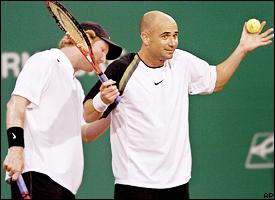 It's very hard to throw a tennis game. And when the two daughters played against each other in Wimbledon everyone who knew the game had a strange feeling that something might be amiss. Agassi describes how hard it is to throw a game, and how he threw a game against Courier so he wouldn't have to lose fairly to Chang. The public can usually see through these things. I believe the self serving ballet between the Pres and the Sage will come back to haunt them as it has the imprimatur, the badges and emblems, as they say, of wrong doing and duplicity.
Anatoly Veltman writes:
Reminded me of a checker game I was ordered to throw in 1976. I was 15 and up and coming. My opponent held the most international titles in history. He was Iser Kuperman, in his 50's and a Soviet flexion in his own time. I was called into the mayor's office, and the Head Sports official showed me 800 roubles ($1000 US), which "was paid" by the flexion. Underage, I was told that the money will be held in trust for me, and ceremoniously placed into a safe. I scratched my head and went into the tournament hall to play the grand-maestro.
After about 4 hours, the crowd of on-lookers thinned out and I made a series of suicidal moves, allowing him an instant win. He missed; and then it dawned on me that I, in fact, will never see the money. So I proceeded with uncharacteristic insightful for me end-game and won on clock at the end of the sixth hour… The resulting wrath pushed my family back a number of years in queue for the new government-sponsored flat!
Reflecting on that game, I would have never bested the maestro, if he were not assured by the officials that I "was in his pocket". Which brings forth a suspicion that it may be easier to throw the game than be on the receiving end!!
Ken Drees writes:
This is interesting to me since the weight of "cheating" must have been on your opponent's mind moreso than yours in that he missed the easy gift. After deducing the double cross you then played unorthodoxly and he blew it on time since it wasn't supposed to be so difficult and that must have had him flummoxed. I believe that inside knowledge or cheating is a burden like a drug that slows you down–you may win a few but you are losing your mental edge piece by piece.
Like a liar has to remember all his lies, and all the wasted effort and inventory management takes away from other worthy actions. The truth needs no such constructs.
The market lately looks like a lie, built up on shaky constructs, hokey relief rallies, and endless promises of further easing support lifts.
Sep
17
Some Commentary on the Psychology of Speculation by Henry Harper, from Victor Niederhoffer
September 17, 2011 | 3 Comments
Theories propounded by market experts are sound but very few people profit by them because when once caught in the maelstrom of stock speculation, the average man becomes more or less mesmerized and at critical moments his conservatism, his resolutions, and his theories all take flight.
One doesn't agree that the theories of market experts are sound. Most of them relate to meals for a day, and selective memories of things that seem reasonable. They don't take account of ever changing cycles, and the fact that whatever worked 3 years ago, which is the average minimal time for a theory to hit a book and become popular, and reported by the services, is very likely to have an opposite effect at the current time.
People become mesmerized by overtrading against their ability to lose. When they lose too much, they get stopped out by their brokers or their partners. Holidays are particular times that people get stopped out of or mesmerized because they don't wish to ruin their holiday, wait for the extra day of risk, or their partners tell them such things as "are you going to ruin another July 4th by watching the market every second of the day, and worrying about paying the bills?". It's happened to me.
The real secrets of stock market success remain locked up in the bosoms of a few who are too busy to write, and too rich to feel the need of writing.
The secrets of stock market success are to have a good foundation, strong at the base with heavy capital supporting it. The banks can have stock market success because they are able to leverage themselves 100 to 1 and borrow at the funds rate, and be bailed out by their current, former, or future colleagues but most don't have that ability. Thus, the market is a series of highs and lows with the weak getting extricated by lack of a proper foundation at each gyration.
One of the worst things is to read about the best great things I did in trading as if the trades were recurring, they wouldn't be written about or if they aren't recurring then probably you should do the opposite the next time. Even if I had a method that worked, I couldn't reveal it because my partners and family would be upset with me. I don't have a method that works, although if so many of my former colleagues didn't borrow my methods of using statistical interrelations of multiple time series varying ever hour of the separate days, I believe that such a method might have had legs. There are doubtless other methods of making money in markets, but one finds that the edge that HFT boys with their better equipment and capital have on individual stocks precludes such methods for short term in individual stocks, and the long term purchase of stocks requires deep insights above and beyond the average that it is unrealistic to expect one person or group to sustain over different market times.
Many of the rich people I know are happy to be interviewed on television as they can talk their book and get people to follow them so they can increase the wave they started by talking to their colleagues and brokers after they put their position on. Also, to show that they are common people, supporters of the masses, in favor of redistribution, so that their natural adversaries at the legislatures and the service will realize he's a fellow traveler. The others who know how to make money are careful never to reveal a thing as information flows so quickly and it just takes a few big funds or traders to turn something profitable into oblivion.
The gyroscopic action of the prices recorded on the ticker tape produces a sort of mental intoxication which foreshortens the vision by involuntary submissiveness to momentary influences. It also produces in some minds an effect similar to that which one feels after standing for a considerable time intently watching water as it flows over Niagara Falls. Dozens of people have committed suicide and been dashed on the rocks below after so watching.
I am not familiar with the research that supports this tendency to suicide but I have experienced similar sensations. And there does appear to be some contagion in suicides. As prices go against one, I believe that the latent self hate of many people for their sins is manifested and they achieved their desire to go broke to atone for their sins. The tendency to suicide when watching a trend is something that would seem to have market implications as new contrarians are drawn in to be thrown into the abyss by going against the flood time after a certain mesmerizing flow. To be continued. Only on p.13 of my notes on book so far.
Sam Marx writes:
I agree with these observations and analysis.
There's one way that still works in getting rich and that is to buy cheap. W.E. Buffett still does it, and so does Trump.
Making a fortune by the statistical approach is much more difficult, however, if you're lucky enough to get in a new game, such as options in the '70's and '80's ,or 21 in the '60's math works fine.
Having been there, done that, I'm not as math oriented in my trading as I was before and I try to buy cheap.
I found Hagstrom's book on Buffett helpful when trying to buy cheap.
However, I have my eye on a relatively new game that I'm studying to see what can be done there statistically.
From a great psychologist Laurel and I serendipitously learned from:
Hi Vic,
Traders in Eurupe are much more focused on the European woes than the US traders. As a result, they've been much more bearish, would it not be for their conviction that a massive monetization of debt will ultimately save the day for bulls.
I absolutely love the notes you've taken. The idea of themes setting themselves over a period of time to be followed by their opposites is such an important one…HFT has seemingly speeded that process.
The Niagara suicide phenomenon is a tricky one. Is it a leap out of mesmerization or a leap out of guilt and atonement? My own observation, fwiw, is that something additional can be at work. Many traders tell me that they would rather lose on a move that they incorrectly anticipate than fail to participate in a move that goes their anticipated way. In other words, the pain of opportunity cost is greater than the pain of actual loss.
From this perspective, the most painful scenario is one in which a river becomes Niagara and one is not riding the current. I've seen traders sell stretched markets to the downside, buy upside breakout after breakout, and refuse to exit trades moving violently against them simply because they could not bear to miss the move they think may happen.
At some point, it does have a quality of Japanese seppuku: out of honor they will stay with their failing positions and fall upon their financial swords. From that perspective, perhaps it is better to die with one's convictions than to have abandoned them and face the shame of missing their fruition.
Your idea of "foreshortened vision" as a result of mesmerization of watching the screen is absolutely true. I tell traders that we inevitably trade the time frame that we watch: it's a natural function of (often flawed) human pattern recognition. Trance states are poorly understood and appreciated, and I suspect much paradoxical trader behavior might be explained by the lapsing of critical, rational consciousness and the hypersuggestibility of the trance state–especially among daytraders. Hence the worthlessness of most psychological intervention with traders: one cannot solve problems while in a different state of consciousness from the ones in which the problems occur.
- A psychologist
Victor Niederhoffer writes:
- P.60, The Psychology of Spec:
It may here be explained that the mental attitude of a "sold out bull" toward a rising market is much the same as that of a bulldog chained in his kennel while a dog fight is going on outside. A speculator may stand by and view with unruffled complacency the most enormous profits of others in securities that he never owned, but if one of his own pet stocks continues to advance after he has sold out. It not only reflects the error of his judgment, but the remorse he suffers, in contemplating the additional sum he might have made dampens all the pleasure of reflecting upon the profit he actually did make. Reluctant to admit such a costly blunder in judgment, determined not to be surpassed by his fellow-traders, and fused with the victor of his recent exploit, when Union Pacific was selling about 215 the "sold out bull" put in an unlimited order to buy five thousand shares. When his broker on the floor of the exchanges began bidding for this amount of stock, the crowd instantly surmised that some big operator was being "squeezed on the short side, and before the purchase was completed the price had jumped to 229.
The sold out bull eventually died on the Bowery without benefit of friends or money to pay for the funeral. "The lodge had to pay for the funeral" and my father might have had to carry him down from his Bowery walk-up to the morgue.
The whole subject of regret theory and contrafactual reasoning is so diffuse that it can explain any phenomenon and predict nothing. On one hand, it explains the tendency to take profits too fast as being a feature of regretting to lose what one has. On the other hand, it explains why people buy too high or sell too low from the standpoint of missing the big move. If such a phenomenon as "sold out bull" exists in real life, then it should lead to excessive moves when markets set a new high after many have sold out at lower prices. It would explain why support and resistance is always broker. Why when an area of great volume of trading at a price occurs, and then the price is exceeded, the bulls become more agitated and buy. I've seen papers that say that regret theory supports the notion that "support and resistance barriers should not be broken. A good study of the psychological literature is contained in this paper.
Sep
17
Briefly Speaking, from Victor Niederhoffer
September 17, 2011 | 3 Comments
 Have you ever noticed how those who have done you the most wrong, or those who loathe you the most, when they come onto hard times will often come back to you asking for assistance. This often happens to me with former colleagues. I can't always differentiate between whether the colleagues are in such bad straights that they will go to their most unlikely and ill wanted savior, or whether they wish to take their worst enemy down with them once more before they finally go under. I believe it is a variant of rats deserting a sinking ship. The British Navy and I believe all navies have a standard order from their captain "every man for himself " when the ship is sinking. And there is doubtless maritime law about when it is legal to put the captain in chains, (albeit this is somewhat a different situation). I believe the idea has many market implications, especially when markets have gone to the nadir like last week, but more important is how to protect your life in such situations I think.
One finds that there are only 25 suicides a year at Niagara Falls these days, and The Golden Gate has much more, but one can't speculate as to whether the sight causes the suicides or whether people with suicide on their mind tend to go there to do the deed. As for market moves, they must cause many more such catastrophes but again whether the person seeks out the opportunity or the opportunity causes the action, or both, it would be hard to unravel and a quantitative study of the types of moves that induce same would be helpful for saving lives and profits.
Russ Herrold writes:
I've had this happen a few times. I think the reason is that the former colleague or friend is sufficiently 'intimate' with the weak spot that their former friend had, and so can 'get past your guard' more easily.
Factor in some perverse pathological character trait, and they may even feel justifies in taking advantage of someone they feel has 'done them wrong' in the past. Indeed, it may be that there was an intent to deceive (conscious, or latent) from the onset of them approaching you, 'the mark'.
The best approach is to probably to buy the lunch, but to keep one's checkbook firmly locked up.
Polonius: (to his son)
Neither a borrower nor a lender be, For loan oft loses both itself and friend, And borrowing dulls the edge of husbandry.
Hamlet Act 1, scene 3, 75.77
and later
Polonius:
This above all: to thine own self be true, And it must follow, as the night the day, Thou canst not then be false to any man. Farewell, my blessing season this in thee!
Laertes: Most humbly do I take my leave, my lord.
Hamlet Act 1, scene 3, 78.82
The thought expressed by Vic is that there should be some heightened sense of gratitude if one is dealing with a moral person and 'offering the hand up' and a hand-out. But Twain echoed the Bard on this topic as well:
If you pick up a starving dog and make him prosperous, he will not bite you. This is the principal difference between a dog and a man.
- Pudd'nhead Wilson
Steve Ellison writes:
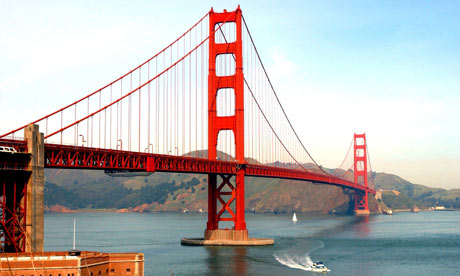 When my children were 5 and 3, we hiked across the Golden Gate Bridge. There had recently been a freak accident in which a small child had somehow fallen through the small gap between the bottom of the railing and the sidewalk to her death. There were plans to replace the railing with one that went all the way down to the sidewalk, but the work had not been done yet, so I was keeping a close eye to make sure the children did not go too close to the railing. While my attention was diverted in this direction, I was almost caught off guard when the 3-year-old climbed on top of the one-foot high barrier between the sidewalk and the speeding traffic.
T.K Marks writes:
I, too, have walked across that bridge on numerous occasions. I'd walk over to Sausalito and take the ferry back. A spectacular stroll. One is still struck mid-span by the ease at which a despondent person could reach their goal. The curiously low railings prompt one to macabre thoughts. Who was the civil engineer involved with this project, Derek Humphry?
Stefan Jovanovich answers:
 The answer is Charles A. Ellis. Joseph B. Strauss did everything he could to claim credit for it (Strauss was to architects and engineers what Douglas MacArthur was to the Army and Navy - even when he was wrong, he was right - just ask him). Ellis reworked Strauss' initial proposal for a cantilevered suspension bridge - which would have been the mating of the Forth bridge with a ropewalk - and produced the design one sees today. Ellis did almost all the actual work - the calculations required for the computation of stresses, the specifications, contracts and proposal forms - singlehandedly, working non-stop for 2 years. After Ellis completed the work but before the final designs were submitted to the Bridge District's Board for its review and final approval, Strauss fired Ellis. There was no mention of Ellis in any report by Strauss, including the final report upon the bridge's completion in 1938. Ellis was the equal of Louis Sullivan, and like Sullivan he spent half his working life in total obscurity, unable to get any further commissions. Moisseiff gets credit for the development of deflection theory; but, as events proved (see "original bridge" section of Tacoma Narrows bridge), Ellis was the person who fully understood the necessary relationship between span length and flexibility. He is literally the father of the modern suspension bridge and the engineering theory behind it.
Bill Rafter comments:
There was a psychology professor that published a study showing that the vast majority of Golden Gate jumpers took the leap on the side facing the city (facing East) rather than the ocean (West) side. The article then attempted to theorize why this might be the case, and he concluded that it was an attempt by the jumper to say goodbye one last time. Nice thought, but it totally ignores the reality that it would be damned hard to jump on the ocean side as that pedestrian walkway is almost always closed.
It must be particularly interesting to be on the bridge when one of the big carriers goes under, as they have to time it with low tide to clear.
Sep
16
Rogue Trader At UBS Loses $2bn, from Victor Niederhoffer
September 16, 2011 | 5 Comments
 Those rogues can't be stamped out when they lose: "Rogue Trader At UBS Loses $2bn " .
Russ Sears writes:
Could these problems with rogue traders at too big to fail institutions be the case of misinterpreting the example of leadership. Like the bribe taking cop's son getting busted for theft or the philandering preacher's boy getting the deacon's daughter pregnant. Corruption without some good protection is unforgivable!
Jim Lackey writes:
It's always a tech guy that can hack around the internal risk controls. It's easy to catch a trader in trouble if the managers actually talk to traders. The kid went on tilt and blew it up. Let me guess long the Dax hoping for a bailout. I always laugh at rogue or unauthorized. That is code for throw the new kid under the bus. Fact is no one was watching him.
When I was the new kid we had this happen. A tech guy wanted to be a trader. They gave him the usual line for trainees of 200 shares and no more than 5 positions. Weeks later he had 100,000 shares short of a Broadcom.com type stock right as the launch in 99.
It was the final nail in coffins at that bucket shop. Lessons learned, but weeks earlier I protested the clearing firm change from S to P. I loved clearing thru S and by then it was G. I was promised much cheaper clearing costs and for a day trader , man was it much cheaper… Of course the get the joke lessons learned was the firm was undercapitalized which is not the big deal. They were not smart. You can tell if traders or risk managers are smart on how they exit bad trades. They were obviously not, so the S risk manager boots the firm.
(edited for color but this is the gist of how it goes down) The street is small… "watch out for those guys". p calls late at night..hey what's up with the 100k short 5 against you… Instead of doing the correct thing and saying oh that is fine its a hedge on options position and we will get that trade cross first thing tomorrow…. they said OM gauche! what that isnt ours! Oh yes it is! Oh My thats a 500k loss no trader has a limit higher than 100k loss in a day.. that is not possible! Oh yes it is and dont worry it will be 1.5 million by the open. (no disaster plan)
By the next AM I have friends calling from other firms asking who is the moron that told everyone that NY guy is caught short 100k lot and he's a 200 share trader.. I said I dunno they didnt call me or Id be long with you on this huge gap up as the broker covers all at the open at the market.
We all pulled out money and quit the next day. A week later the firm was up for sale. No one bought it. A month later they were gone. and if the banks didnt have a line to treasury and feds this is how all of these disasters would go down. It's much like the 19th century system.
Not to say that the bank today with their 2 billion in losses should go. Yet I have 5 stocks on my screen right now that under normal trading conditions would be gone 3 years ago.. and we would all be uh better off.
Now you know who sold the Dax under 5,000, 10% ago. lack
Sep
12
A Lucky Switch, from Victor Niederhoffer
September 12, 2011 | 2 Comments
 No doubt that the loss of Federer to Djokovic is one of the most agonizing that one can suffer. What an incredibly lucky shot Jok hit at 5 -40, 4-5. He had already given up. And was smiling at the fact of the loss. And then he just hit a desperation hail mary with no hope of it going it. Having given up. Then the next point he hit a very weak return that fed had made about 50 out of 55 times on an inside out forehand. And he hit the top of the net cord. The shot was a poor percentage shot. And he could have hit it anywhere outside in and made the point with no worry. Then to add insult to injury he finally got an ace in at 30-40 down the line that if he had just hit two points ago would have won the match. He has to be thinking, "how could I be so stupid".
How many times does this happen to one in the market. You buy them when they're down, and it goes down 3 stand deviations on you. Then you do the same thing the next day, and you take a 3 tick profit and it goes up 10 standard deviation. Beware of the switches. I have to say that Djok is a very poor sport. All that disgusting pelvic moves to get the crowd to stop hating him. The crowd can sense a bad sport the way they did with Connors and used to with Agassi before he tricked them into thinking he had changed his colors. The only salient thing I ever hear Mac say is that when he used to act like an idiot and go crazy it helped him at the beginning of his career but hurt him at the end.
On the other hand, the idea that you have to be quiet and respectful at a tennis match sort of like at a classical concert is loathsome. To have to wait 30 minutes to go in and out of a stadium so as not to upset the sensibilities of the players, to be removed from the stands for whistling. Why is tennis so much more sensitive than a basketball game where one is trying to sink a foul shot.
It's the colonies. There is a tendency to slavery in the humans inherited from the oxen as Galton said. And we love our royalty and the imperial trappings of worshiping the English who are our former rulers. The English way of sportsmanship I have seen enough of and their common law may be very good but their way of noblesse oblige in the sports coming from the time that the Lord was the only one who could play and the feudal serfs played lawn bowling only on Sunday carried over to the tennis circuit has many market implications about the tendency of humans to love slavery and worshipful of the lord. Fortuitously the custom of having the lord handle the romance apparently went out in the 14th century but not in tennis.
Ha. I'm finally writing about something I know about.
Peter Gardiner writes:
 It was agonizing. The hail Mary return was the percentage play for Djok, but Fed had another chance, and his inside out short forehand is his money shot. He has famously missed his forehand on many key points against Nadal too. Federer's inability to close out certain tight matches against certain opponents is the cost of his unflappability under the threat of loss, his Houdini-like escape abilities when up against it. But with his hand at the throat of a tough, fiery opponent, I have seen his grip weaken far too often to give up alcohol. Laver did not have this problem. Neither did Sampras. Neither, perhaps, had the tools, élan, and balletic mastery of Federer, but they would kill you cleanly if given a chance. Conners was the master at this.
As to the manifest presumption of the tennis establishment as to proper conduct, it has struggled against colored clothes, tie-breaks, hawkeye, and other changes like any entrenched monarchy. But it is encouraged in this by the people: they enjoy the theater, and by entering the precious, hushed grounds of the Lords manor, momentarily aping his effete ways, they are thereby allowed the use of the sorcerers stone: they leave behind their natural peasant lives, and draped in theater, are ennobled by the very act of watching a stylized pantomime of medieval battle.
Victor Niederhoffer wrote to friend and tennis pro Pedja to ask his opinion:
What did u think of the final?
Federer has a truly weak backhand with so much wrist it's completely uncontrollable. And I noticed that whenever Nadal or Federer sliced they lost the point against the bludgeon straight shots of the Slovakian.
Pedja replies:
Hi Vic,
The strokes are ugly but he managed to perfect them and the speed of his ball is incredible. I watched his practice in Belgrade a couple of months ago, and the speed that he has with the least amount of effort was stunning. He uses his whole body in every shot. When he is aggressive he is currently playing the best tennis. His fitness is incredible this year.
I am looking forward to Davis Cup, this Friday we are hosting Argentina in the semis here in Belgrade.
Sep
11
Friday’s Move, from Victor Niederhoffer
September 11, 2011 | Leave a Comment
Friday's move brings to mind several things.
The threat is worse than the execution.
Thursday and Friday this week were eerily similar to last week's.
There were 13 visits to new lows so far using 10 minute prices the Euro at a minimum on Thursday presaged the decline.
The European markets are down from 4.5 to 5%. Overnight Israel market which closed 1500 GMT on Thursday, September 15 was down only 1 % and did not presage the decline in US and Europe, but Japan did close near its low of the day and last 10 days. Canes on Friday do not work beyond a certain magnitude of decline in retrospect.
There were several timely announcements during the day at propitious times that acted as ephemeral fingers in the dike.
One can always tell that there has been a big decline in the market in New York by unobtrusive indicators such as quietude and lack of traffic, and of course restaurant traffic at high ends and the movement of high priced wines is much reduced.
It is terrible to see such a decline as it hurts everyone's wealth and it causes all sorts of wealth effects on consumption around the webs that connect us. One was with a flexion on Oct 19th, 1997 and he made the biggest fortune in bonds ever by anyone that day but he was totally dismayed and sorrowful: "I don't like to make money that way". His feelings were emotional as those described by one of our most astute and poignant operatives were and the loss of wealth and love and life are terrible to contemplate.
Anatoly Veltman writes:
Memories awakened: what disturbed me the most that October 27th, 1997 was how the U.S. equity traders haven't positioned for it. The Hang Sang pattern was desperate to extreme, well in advance of the 27th — but S&P was still hanging inexplicably tough until the very day. I was careful not to go over 100% Short on statements, so that not to raise clearing house flags. For the life of me, I couldn't understand why U.S. players were not aggressively shorting. That morning, I doubled my intra-day Short — and Chicago finally caved in. I didn't even get a chance to pare back, as futures locked at second limit-down… And yes, I also felt uneasy in my own way about the speed/dimension of the decline. So after the limit-down re-open next day, I reversed to light Long. The mood improved so quickly, that I never got a chance to add any Longs — there were no offers. A genuine Bull was born literally overnight, out of total adversity.
Sep
5
How to Score in Air Hockey, from Victor Niederhoffer
September 5, 2011 | 5 Comments
 Example 4 in this interactive geometry textbook shows the procedure I used to teach Aubrey where to hit it in air hockey to score. The table is 7 ft by 3 1/2 feet. If he hits it from 2 feet from his end of the table, from the middle, he will have to aim on the right side, 2 1/2 feet away from the current position of the puck on the right side to land it in the pocket. If he hits it from 2 feet from his end of the table but all the way to the left side, i.e. 3 1/2 feet from the right side, then he will have to aim 2 feet from the rite side of the opponents goal, (3 feet from where started from.). x/(5-x) = 3 1/2 /5 where x is the required distance. As seen it's also the way to calculate the height of any object in the distance when you know how far away you are from it and you have a mirror or can visualize angles. I find that 7 years ago I went through a similar exercise with my youngest daughter Kira who recently completed her first year at Columbia Engineering. I find many applications to movements of prices in markets here. What are the best applications you see?
Sep
5
As Beethoven Said, from Victor Niederhoffer
September 5, 2011 | 1 Comment
As Beethoven was told by Countess Razumovski when he thanked her for letting him use her summer mansion for three summers: "Oh maestro, that's the least we could do"… "That's Riiit!" B. answered, vis a vis Dave G's response about the "disgraceful use" in the "Stops" post below.
Sep
4
Cheers to the Market Mistress, from Victor Niederhoffer
September 4, 2011 | 4 Comments
You have to hand it to the market mistress. Friday's decline at open was the worst since march 15 at 21 points and only happened twice in 2010. In the year 2008, it happened 18 times.
Number of declines at open of more than 20 points:
1996-1997 0
1998 3
1999 3
2000 9
2001 5
2002 1
2003 to 2006 0 each year
2007 1
2008 18
2009 6
2010 2
2011 2
12 years 50 occurrences. 4 a year. Chi square about 50. Expectation is number of years -1 the degrees of freedom. Standard error (2 x11) square root. Value is 7 standard errors from expectation. 1 in millions. Probability. Definite evidence of clustering of big down opens. Definite evidence of clustering.
It is interesting to note that there were 38 big up opens of more than 20 during that period, lower but not significantly so than the 50 big down opens. Some evidence that at opens the volatility on the down side is greater.
Aug
31
Briefly Speaking, from Victor Niederhoffer
August 31, 2011 | 2 Comments
1. I hypothesize without testing that the movement on the announcement of the open market minutes (happens to be announced today at 2:00 pm) is opposite from the movement during the comparable period when the open market meeting actually met. Last meeting was Aug 9. Rallied 57 big points 5% from 1500gmt tp 1615. I have not tested this at all. Could be opposite from my hypothesis with equal probability or random.
2. It is common in sports these days to have flashed on the screen such statistics as Nadal has lost only 1 or 57 matches at the open when he won the first set. Or the Yankees are 57 and 2 in won games when they were ahead in the seventh inning. Such statistics are almost as worthless as the January barometer suffering from selection bias, the part whole bias, multiple classification bias, look back bias, differential enhanced probabiities of winning the next inning or set given you are ahead to start et al. But when you see a come back, it is interesting in many respects. Today's moves from up 8 on day with 10 or 20 minutes to go, to down 3 by end of day is a classic in that regard. Just a once in a year event. Hats off to the market mistress for ending our summer in such an usual day, showing us that she still is active and fertile in imagination and ability to take our chips.
Aug
31
Wisdom of John Wooden, from Victor Niederhoffer
August 31, 2011 | 4 Comments
 John Wooden lived 99 2/3 years and is considered by many to be the greatest coach in history. His teams at UCLA won ten of 12 national championships, 88 games in a row, and he was a 3 time all American in college, once sinking 134 foul shots in a row. His players loved him and he developed several systems for success. After reading his book published shortly before what would have been his 100th birthday on October 14, 2010, I figured I could learn much from him.
Here are some of the things I learned. He kept good records. His father gave him a note card with suggestions. He attributes much of his success to his father. His father gave him 7 suggestions to follow and he has tried to live up to it every day of his life. Be true to yourself. Help others. Make each day your masterpiece. Read good books. Make friendship a fine art. Build for a rainy day. Be thankful for blessings each day. I liked better what his father gave him in three rules: Don't whine. Don't complain, don't make excuses.
He loved teaching. And I like the little fellow poem that guided him in his relations with his 3 kids and his students.
A careful man I want to be
A little fellow follows me
I dare not go astray
for fear he'll go the self same way
I cannot once escape his eyes
What he sees me do, he tries.
Like me he says he's going to be.
The little chap who follows me.
He thinks that I am good and fine.
Believes in every word of mine
the base in me he must not see
the little chap who follows me
I must remember as I go
Through summer's sun and winter's snow.
I am building for the years to be
that little chap who follows me.
He was married to his college sweetheart Nellie for 60 years and she came to every game he coached. Apparently he never earned more than 50000 a year, and he often turned down jobs that would have paid him much more because he had given his word and he never wished to tell a lie.
His pyramid of success is famous. It has at the bottom hard work, friendship, loyalty, cooperation, and enthusiasm then goes up to self control alertness action and determination. Then fitness skill term spirit poise confidence personal best.
How would I apply these things to markets? I like the never complaining and never boasting. The hard work, and loyalty and enthusiasm. The attributes of the pyramid of success would seem to be good for any activity.
His humility is a good model for all who wish to achieve success. He didn't have his hand out for money and went beyond the dollar and the clock The fact that he was such a good player must have made him a great coach. Apparently he had every minute of every workout planned. And he insisted on it being a team game rather than a forum for a star. I guess that's a bit easier when you have Alcindor and Walton on your squad.
I would have liked to know more about his day to day life and how that suited him to live to 100 and be loved by so many. Certainly the philosophy of life must and the pyramid of success much have had much to do with it.
He took losing very well, and always felt sorry for the teams that he beat.
I can't find anything that needs much improvement in his life as a model for a teacher, father, or speculator.
Charles Pennington writes:
I thought the Chair disliked cooperative games like soccer and (I presume) basketball. What's the story there?
Fred Crossman writes:
Never did I want to call the first time-out during a game. Never. It was almost a fetish with me because I stressed conditioning to such a degree. I wanted UCLA to come out and run our opponents so hard that they would be forced to call the first time-out just to catch their breath. I wanted them to have to stop the running before we did. At that first time-out, the opponent would know, and we would know they knew, who was in better condition.
He never called a time out at the end of the game either. Sat there with his program rolled up most of the game for he believed UCLA was better prepared mentally, too. His players knew exactly what to do. Confusion and pressure at the end of the game was their ally.
Aug
29
A Symphony, from Victor Niederhoffer
August 29, 2011 | Leave a Comment
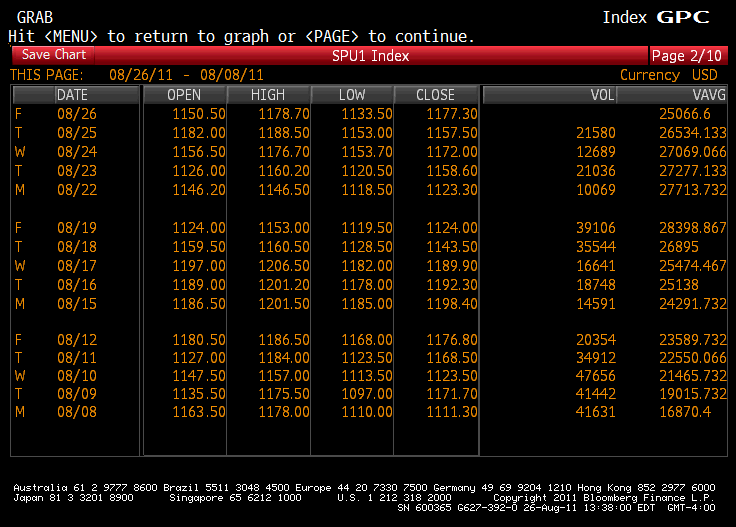
It was good to see in one day the S&P recap the range of the last 13 days so as to have a proper resolution of all the themes of the symphony combined just before the finale.
Aug
29
Trying to Get the S&P Up? from Ken Drees
August 29, 2011 | Leave a Comment
Yesterday, the sage deal was supposed to anchor the financials but they got sold off; today the market found legs from the "tech" sector of all places with money going into the goog and apple.
Will it work or will it reverse off like the bac stuff?
Victor Niederhoffer writes:
One is reminded of the classic reaction to assassinations and crashes. First a terrible decline, and then starting the day after, a rise to on average where the decline started from with much variability.
Gary Rogan writes:
It's pointless to anthropomorphize the market, but still enjoy imagining this reaction: "No QE3? How horrible, we can't have that, off with their stocks! Wait, come again? No QE3? Hm…could it be GOOD? Yeah!!!"
Victor Niederhoffer replies:
A hypothesis was rejected. The market can not go up unless we get qe3. + all the Gavekal boys and other smart analysts who correctly figured he wouldn't dare to challenge the Texan had a minute to cover at 1133 ish but then when they realized that the market is rational and does not respond to cardinal events but to meals for a lifetime, they had to cover in avalanchian fashion. + the threat is always better than the execution. Now, he can hold out the possibility of "maybe" I will. From Annie.
Gary Rogan writes:
And yet the immediate "mainstream" analysis I saw from Reuters was "when parsing the speech the market was disappointed to see no QE3 but when it realized there is no concern for inflation and thus no outright rejection of QE3 it went up on the possibility", which just goes to show for the umpteenth time people see what they want to see in anything even mildly complicated. That's why the same facts lead to different conclusion about say Global Warming depending on one's disposition.
Aug
29
You Have to Hand it to Perry, from Victor Niederhoffer
August 29, 2011 | 1 Comment
Not to say anything that I don't know anything about. But you have to hand it to Perry. He forced Bernanke to not go with an overt QE3. And that has to be very bullish as how many resources can they take from the little man and give to their former, current or future friends, employees, bosses, wives, and relatives.
A Proverbialist writes:
There is no modern era precedent for the Fed facing credible political opposition from within the established governing elite framework. Perry's statement had to be a game-changer for Bernanke and the Fed, as it opened an entire new attack vector on the institution's legitimacy, which is its sole true power base.
For now, I assume the threat is not being evaluated formally, generating a paper trail.
But it's a damn good bet that after the first bourbon-and-branch of the afternoon, Bernanke's inner circle wargames this.
Aug
26
Niche Exclusion, from Victor Niederhoffer
August 26, 2011 | 6 Comments
 It is interesting to see niche exclusion , the tendency for a species most suited to a particular niche or habitat relative to its competitor to monopolize the particular niche, work itself out in the markets. We saw how New York gold crowded out Chicago gold, and how the electronic trading excluded the pit trading for all but options.
For example, only a handful of old lions trade the S&P pit any more and it used to be in its days known as a den of thieves, the abode of at least 500 vipers. Now one sees that happening in the battle between 10 year and 30 year. True, they are different animals in part. And one frequently can go to 5 or 7 points over or below the other. But now the 10 years trades 1 million contracts a day, and the 30 year lucky to do 250000. Given the coterminous correlations between changes of at least 95%, who would wish to trade the 30 year versus the 10? Only old fashioned men who are stout-hearted men.
Are there other examples of competitive exclusion working themselves out that one should be cognizant of so as not to bring up the rear?
Aug
23
Thoughts on The Psychology of Speculation by Henry Howard Hopper, from Victor Niederhoffer
August 23, 2011 | Leave a Comment
 Thoughts on the Psychology of Speculation by Henry Howard Hopper published in 1926 and then reprinted by Fraser Publishing Company.
The book is excellent on many different levels. I like most that it talks about encompassing principles of human nature. Not the trivial made up ones of behavioral economics but broad human tendencies that are crucial to how we make our decisions and go about living our life.
Included among these broad human tendencies is the tendency to go crazy when you see a massive flow in front of you like the many who commit suicide in Niagara falls after seeing the water flow and the many who lose their minds as the market goes up. Also paramount is the incredible ennui that a human feels when something that he formerly owned goes thru the roof in other hands. I also like the many market periods of boom and bust he covers including the fantastic bull market of 1915 in the middle of the war where stocks of many a sage speculator was short skyrocketed by 15 fold or more. "He did not live to see General Motors at 850 on October 25, 1916," as his broker was forced to sell him out well before hand and "he had crossed the bar into the great beyond".
Like my father's experience in the Bowerey where he had to cart the bodies away when they couldn't pay the rent after dying from gambling, "the widow was left almost penniless and he was buried at the expense of the lodge". I like also the colorful vivid language so characteristic of the roaring 20s that makes on wish one was there and feel for the every emotion that he elicits.
I like best the last words he repeats of a short seller who made a fortune in leather goods and then lost it in the market through shorting. "In the past year I've suffered every torment known to the demons of hell. My only grain of comfort is that it's all over now and I have nothing more to lose." From this tragic experience, the author concludes "there is but little comfort or profit to be gained on the short side of a protracted bull market".
I will give many more incisive but pathetic recollections of the failures of speculators in the favorite stocks of the 1920s: General Motors, Studabaker, Union Pacific, Anaconda, Calumete and Hecla, Bethlehem Steel, et al.
A Psychologist writes:
Let's say for argument sake that, a la Atlas, an inventor develops a motor that eliminates the need for gasoline. In a single stroke, energy costs are reduced by 90%, creating massive savings for consumers and industrial producers. There are some who would eagerly buy on the news, anticipating an economic renaissance. There are others who would angrily pronounce this a temporary respite from the world's parlous condition and short the first market bounce. Bullishness and bearishness so often are a function of character, reflecting how people wish to see the world. The disappointment of some bears that the recent earthquake was not more catastrophic is more than a bit eye-opening.
Aug
23
Redistribution, from Victor Niederhoffer
August 23, 2011 | 2 Comments
 I have not seen a model yet that shows how all this redistribution causes weakness in economic activity. Certainly the incentives are hurt. But I think a model similar to what Friedman uses to show how money should grow with 2 or 3 people on a desert island would show how hurtful this is.
Tyler Cowen writes:
Moral hazard escalates.
Keep in mind that since bank failure is deflationary, the Fed can address bank failure by printing up a lot of money without a net inflationary effect. On the inflation front we are simply holding even, more or less.
But we are substituting interest-bearing reserves for M2, or public sector assets for private sector dealings, a very bad long-term trend.
Plus higher moral hazard and now European banks are Too Big To Save and don't have a real central bank behind them.
Did you see that JP Morgan is now forecasting 9.5 unemployment for 2012?
Aug
22
Sunday, from Victor Niederhoffer
August 22, 2011 | 8 Comments
 One would imagine the Sunday open to close in Israel might be predictive of the open in the US on Sunday night, and possibly the open to close of us on Sunday. By Israel open on Sunday, the US has already passed Friday close. And Israel would be catching. Of course the US Open is not a predictive thing since it can't be acted upon, but a descriptive one. The whole subject of the influence of Indian, European, Asian, and mideast markets on the US is an interesting one and calls for much counting, correlation, and finesse.
Anatoly Veltman writes:
I'd be the first one to stress the equities "rolling wave" over the timezones, as well as inter-market influences (as in currency-gold-stocks-bonds-oil, etc). Being said, there are two clear new ingredients that make historical statistics less than meaningful: central meddling and modern algos.
1. What can possibly be the use of percentile correlations and sequences observed over any historical duration, if current market interventions and near-global ZIRP are unprecedented.
2. Modern algos thrive on constant change/adjustments. To paraphrase Jim Simons: what feeds "our" fascination is that our former immersion into discoveries (within pure science) would eventually yield an ever-lasting law or theorem — while (market) discoveries we achieve today will only live a blip of time, and so you have to journey on (almost daily) to your next discovery and implementation.
So in consideration of the above major influences, my current MO would be: do not rely on hard stats. Do rely on your instincts, understanding of the new world financial order and good occasional privileged information — and trade discretionary.
Chris Cooper adds:
I can accept Anatoly's "two clear new ingredients" but reach different conclusions. My conclusions are:
1) Trade at a higher frequency so that you can get enough recent stats to be meaningful.
2) Trade fully automated, not discretionary, so that you don't fool yourself about your alpha. Also, it's the only sensible way to trade at a higher frequency.
"Relying on your instincts and understanding the new world financial order" are important only at the meta-level.
Paolo Pezzutti adds:
I think:
1. Cycles are ever changing. Today it is because of ZIRP, tomorrow it will be because of new rules or products coming on that influence market structure. I don't know if cycles will be shorter or longer. You trade them until they work. Counting still works.
2. Frequency depends very much on commissions. Some regularities at shorter time frames cannot be traded if your commissions are too high. Frequency depends also on technology you have available. Also, one should trade a frequency where you have less competition.
3. New cycles means new patterns to come up and old patterns to die. Keeping track of ongoing patterns is important and also establishing criteria to determine a pattern has stopped working. Early discovery of new patterns is vital for your performance. But how much data and evidence do you need to validate a new pattern? More importantly on the tech side is how you implement the search of new patterns. A continuously running search can scan the data according to certain criteria and propose pattern to be evaluated further.
4. Trading should be fully automated to trade higher frequencies, more markets simultaneously, and decrease stress.
Newton Linchen writes:
Dear Paolo,
You said: "Keeping track of ongoing patterns is important and also establishing criteria to determine a pattern has stopped working."
I once asked this question (how to measure the "death" of a trading strategy) to the List, and the answers were disappointingly vague. ("They work until they don't anymore", and such kind of answers).
To my knowledge, this is a vital question.
Recently, I backtested a strategy a colleague was trading, to discover that in the last 6 years you would lose your entire wealth trading it. But he kept trading it, due to an anchoring with an event when "it worked", plus a kind of empirical testing of only few months.
This means he was caught by the siren song of a series of "lucky strikes" within a larger distribution of years of losses.
This behavioral concept ("anchoring") is quite interesting, and we smile at the poor guy who don't count.
But what concerns me is that we can behave the same way, (although counting), when we face a regime shift (ever-changing cycles) and keep trading the defunct strategy… Until when?
Perhaps a rough answer would be to establish a drawdown metric related to the maximum historical drawdown? (i.e., we trade it until a drawdown x% larger than the greatest historical, and then quit?)
Or maybe the reason to trade a strategy must be quantitative whether the reason not to trade it anymore should be qualitative? (i.e., acknowledgement of the regime shift…)
A final thought would be a strategy based on market microstructure — in the way it is present in ALL regimes.
Any thoughts?
Newton.
Aug
21
If There Ever Was, from Victor Niederhoffer
August 21, 2011 | Leave a Comment
If there ever was a more beautiful play out of the traveling salesman problem that Rocky and I have written about, it was Friday. Using 10 minute prices, I count 24 new lows at the end of a period versus the previous. All reaching a climax when the last gas station was revisited at 1540 gmt at a price 132875 only to go back to 1344 in the last 10 minutes with an astonishing but unmarket like rise in the last 10. "That's not squash my friend Rainer Ratinac used to say".
Aug
18
Losing Sportsmanlike, from Victor Niederhoffer
August 18, 2011 | 3 Comments
 The first sanctioned ALTA tournament I played in at 12, my first round match was against the second seed. I was on court 2 and the number 1 seed was playing on court 1. My opponent was beating me handily. Then he called out to Peter Lebhar on court 1, "Hey, Pete see you in the finals". I got so mad I won the match. Similar thing happened when I played Martie Hogan in the quarter finals of the national paddle ball tournament in 1987. Every time he made a point he'd yell, "Hold him under 10 ". Apparently he had bet that he would hold me under that level with others. He was much younger than me, and I took the liberty of taking the ball and placing it between his eyes before I beat him 21-20 in the third game.
I have always had an aversion to losing and then having an opponent or adverse spectator add fuel to the fire by lording it over me as I was losing or after the game. Sharif Khan had an annoying habit when he was beating me of yelling "Come on, Pakistan" near the end of the third or fourth game. I guess I had a similar guttural reaction when out of the clear blue sky, I got a similar in your face reaction about my losses in Rimm. Bad enough that I lost and humiliated myself and ended my forays into individual stocks. But to then have it placed back in my face and twisted in my gut, — why, it rankled.
I kept statistics on all mergers and acquisitions for 10 years when I was in the business and did note a pronounced tendency for a rash of acquisitions in a field to be a precursor of decline in the field and signals of decline in the acquirer. Certainly it was not true in every case, and it would have been hard to quantify. Certainly the variation as it applies to a single acquisition like google motorola would be many thousands of times greater than any general, amorphous tendencies.
The back and forth betwee three very erudite people about the acquistion, Dylan, Gary and Mr. X. is quite educative. If it takes me eating crow, raw squawking and fully feathered as Osborne said about Morgenstern's foray into spectral analysis applied to stock markets, it is not an inordinate price to pay.
There is no need for anyone to buy drinks, but please in the future, the dailyspec is a considerable undertaking, and it would be nice if one applied the rules of the British Navy at dinner, (we are all on a long journey together and have to get along with each other or else the ship will sink), to the host as well as the others.
Aug
15
12 Things I Learned from My Recent Vacation in Maine, from Victor Niederhoffer
August 15, 2011 | 7 Comments
 It's always good to learn and a vacation is a good time to learn more things. Here are 10 things I learned from my recent vacation in Maine.
1. The refutation of a hypothesis often causes more violent movement than a confirmation. The rejection of the idea that the market needed an extension of the debt limit in order not to fall, caused the great decline.
2. The three greatest declines in recent history came when a clash between the welfare state and the enterprise economy was resolved in the formers favor. The debt extension without teeth, the Tarp in October 2008, and the Baker intervention to get the mark up over the October 19, 1987 weekend are recent examples.
3. The declines in the summer are often more violent than in other months except for October because the interventionists take more time to get their houses in order as they are vacationing in the Hamptons or Riviera, and can get frightened more easily.
4. Negative sequences of 2 or more through big round numbers become avalanches and trigger all sorts of panic selling. A break of a pivot of long standing duration like 1250 can inordinately create a cascade.
5. The ability to not get overextended is the key to success in markets or business. It is pitiable to see all those forced out by margins, or total fear at the bottom because of too little capital.
6. The round number of 1000 is an attractor and the decline was not over until the market breached the 1100 level and fell to the 1000's on Sunday, Aug 14.
7. The book Fur, Fortune and Empire by Eric Dolin is very good reading to show how commerce causes the establishment of countries, the forces of war, and friendship and alliance between trading parties. The founding and survival of America by the Pilgrims and the French and Indian wars as well as many others were caused and fomented in the main by the waxing and waning profitability of the beaver trade and its elusiveness and ingenuity and rarity when hunted into extinction.
8. Big moves around 1 GMT are reversed to an inordinate extent.
9. The declines in the US markets are inordinately preceded and signaled by related declines in the European markets, — the ratio of Germany equities to us fell from 6 to 5.5 before declining below 5. And oil fell below 100, and fixed income had a tremendous rise all before.
10. A ride up US 1 from New Hampshire to Maine is one of the most interesting that a person can take, and there are 100's of attractions that a person can stop at with a family that will enhance a vacation. Particularly attractive to me on a recent trip were the Desert of Maine, the Monkey See Monkey Do, L.L Bean, The Music Box, Owl's Head and Farnsworth museums, and the golf course at the Samoset, who showed the colonists where to find furs, and where Jimmy the starter at 92, who started caddying there in 1932, should be a National Icon.
11. The moves in Europe seem to know that a person can't stay up 48 or 72 hours straight and often do exactly what you thought they'd do the previous day when you are too tired or dissipated to take a position.
12. When taking out small moves from the market works, it will lead to disaster as big moves against dwarf out the profits from the previous and charts and stops and key trading points must be adjusted accordingly.
Aug
15
Briefly Speaking, from Victor Niederhoffer
August 15, 2011 | 2 Comments
 It is "more pleasant to look at a splendid sea-otter skin than to examine half the pictures that are stuck up for exhibition — excepting a beautiful woman and a lovely infant… the sea otter's pelt is the most beautiful natural object in the word". They went for $ 500 a pelt in China in 1820. From Fur, Fortune and Empire by Eric Jay Dolin, a book I'm reading, purchased at L.L Bean in Maine with the Floyd little ones and Aubrey after a trip to the Desert of Maine and the ropes course (Monkey See Monkey Do), and the Farnsworth and the Owl's Head Museum, and lawn bowling, fishing, shuffleboard, swimming in the Vinalhaven quarries et al. Glad to be back and fortunately not much happened in the market while I was away, Ha.
Aug
8
All According to Plan, from Victor Niederhoffer
August 8, 2011 | 11 Comments
 The S&P kindly attributed the ratings decrease to the "republicans who refuse to vote for increased taxes on the rich". How according to plan. How perfect to keep us small. To march forward with the idea that has the world in its grip. What fools they think us mortals. The regrettable thing is that if the common man were to see through it, and understand that the whole purpose of the ratings decrease was to increase taxes and gain more power and perks for the higher authorities, as there is obviously no chance of a default now or in the future as exemplified by the long bond yield of 2.2 %, which encompasses inflation expectations of 2% a year, a return of say 0.5 %, and a minus chance of default, why then the market might not go down on Monday, and the argument that we have to raise taxes and get the Republicans to appoint fellow agrarian reformers to the committee, might fail, and then the whole plan, the whole deal with the friends at the agency, all the posturing and flexionism, would be in vain.
So the stock market on Monday and Tuesday will fall. Let us remember where the index was on Friday 1197, and compare it to where it ends up when the committee issue the report, and point out that after the downgrade the market was up 10% or so to Thanksgiving. That will be a start. But then we'll have to explain that the reason the market went down in the first place was the failure of the Tea Party congress to reign in the business as usual, the fomenting of the idea that has the world in its grip et al.
Aug
5
Giants, from Victor Niederhoffer
August 5, 2011 | 9 Comments
What giants these men of the 1920s were. Harold Thayer Davis, who wrote The Analysis of Economic Time Series , Herbert E. Jones who quantified the distribution of runs in [stock markets and] weather, and [Louis] Besson in The Monthly Weather Review and Cowles himself, who would probably shudder that Shiller holds a chair at his namesake foundation .
Alex Castaldo adds:
The famous 1937 Cowles and Jones paper "Some A Posteriori Probabilities in Stock Market Action" is available online.
The Besson paper "On the Comparison of Meteorological Data with Results of Chance" apparently is not.
Aug
5
Negative Sequences, from Victor Niederhoffer
August 5, 2011 | 2 Comments
It is interesting to contemplate that we have gone through two round numbers of 100 like from above 1300 to below 1300 to below 1200 without a rise above 1300 only 3 times in the last 15 years. On one of those occasions on 11/11/2008 the market dropped from 1196 to 893 to set its negative sequence; i.e, it was at 893 when it set the sequence. Subsequently it jerked around a bit before its inevitable rise. I call these things negative sequences in honor of Alfred Cowles who first studied them in the 1920s. I had the pleasure of corresponding with Cowles in the 1960s and he was very forthright in saying that after corresponding with me, he understood why his fills were always so bad.
Aug
4
Football Bad for Life Expectancy? from Victor Niederhoffer
August 4, 2011 | 1 Comment
 I don't think football is good for life expectancy. I believe it killed my father. It shook up all the muscles as well as the broken nose 17 times (no helmet visas) in those days, and that sent a signal to the body to do him in at 64.
Russ Sears writes:
While there is some merit to what the chair is implying about being hit so many times. The bigger issue for most people is the weight lifting and with it the weight gain. Most high schoolers do not have a clue the bargain they have made by bulking up at that young age. It is very much like a high school kid taking a 30 year mortgage on a McMansion. Yes, some of them will enjoy both the lifting and cardio enough to be able to afford the time commitment it takes to maintain a healthy buff body all their life… but most after bulking up have trained their adult body to be a certain weight. This weight is only healthy if it is muscle weight, but most will not be able to maintain the muscle and revert to fat or left with a life long battle of combating weight gain. Cardio health will kill and debilitate many more before there time.
While I don't have the number handy, I believe the actuarial stats will show this for all levels of football.
Aug
4
Invitation to the Junto, from Victor Niederhoffer
August 4, 2011 | Leave a Comment
Dr. Gary Jason will be talking at the NYC Junto tonite August 4, 2011 at 7 15 pm at the Mechanics Institute 20 West 44 th street, NY NY on " what's wrong and right about education".
Jul
25
 Even amid acknowledgment by US leaders of the need to reassure jittery investors, world markets fell and both fell with the Aug 2 deadline to raise the gov borrowing limit fast approaching. What a joke. We can now see yet another function of the stock market aside from its benchmark for how costly it is to raise funds, and a source of liquidity and enabler of all to participate in the returns from enterprise, and its main function of transferring resources from the people at the bottom of the feeding chain to those at the top while paying for the vast infrastructure needed to provide the above functions.
It's function is to provide a signaling mechanism and excuse for service revenues to be increased and for the geese to be plucked with the least amount of hissing by appeal to the terrible things that would happen if it were left to its own courses and it went down were spending not to be maintained, and service revenues from those who have more than the common man to be putatively increased.
Jack Tierney, President of the Old Speculator's Club, writes:
I'm not sure if we're all looking at the same markets. I just checked out the 12-month performance for all the major averages. All relatively close to their 12-month highs. If these results are due to "jittery investors" then I confidently predict that the DJ average will crack (or come close to cracking - within 200 pts.) its all-time high by the end of '11 if ANY debt ceiling settlement is reached.
Fear-mongering seems to be at an all-time high. Curiously, leaders of the world's major religions are criticized by some who claim their structures are built through fear utilizing the sweat-labor of gullible peasants. Well, this very sane, quantifiable, transparent capitalist structure we call "the market" appears to operate in much the same manner. Yet it is lauded by many of those same individuals.
Jack
P.S.
To put some conviction behind my surmise, I just purchased some DDM at 65.35. Check back with me next January.
Jul
24
Briefly Speaking, from Victor Niederhoffer
July 24, 2011 | 5 Comments
 It has been interesting to see in the course of these negotiations how every dodge and feint from the Zacharian and Remusian play book has been used so frequently. We have seen "Your own man" and "don't throw me in the briar patch" many times, and "you're the one that broke it up" and "You're taking care of your interests much better than I'm taking care of my interests" and "here's a gift to star the negotiations (the golf game)" et al.
I haven't seen commented or named by Zachar however, "I'd like to go through with your deal but my sister in law is opposed to it". By this I mean, that "Rand Paul and the tea party boys will not vote for any deal that has a tax increase" or "Nancy Pelosi and the Women Senators will not agree to any reduction in social security".
What we need is a systematic classification of all these negotiation techniques so we can catalogue them as they come out. At the head of the list is "what will happen in Asia if we don't agree to increase the service rates?" Or "what we need is another 500 point drop before the service rates go up". The stock market plays a role, and I also like "the bond market went down for the first time in 3 weeks amid fears that a deal (a service rate increase) was not reached." Forget about the fact that it's within a point of a yearly high.
The Goddesses of the market look down upon us and have a belly laugh at our foolishness as we sway. That's for sure. But can money be made by seeing through all these snares and delusions?
Well in retrospect, we know that the stock market when it's down much is merely being used as a tool. But how to withstand the 20% drop of oct 2008, as it is used for its evil purposes?
George Zachar writes:
Negotiation tactic taxonomy appears to be a developed field. Check out these articles.
How to beat dirty negotiation tacticts: 10 tips
How to overcome the top ten negotiation tactics
Jim Sogi lists some of his own negotiation tactics:
1. Higher authority. The absent person with authority needed to approve(ie the wife, the husband, the underwriter, the supervisor at the car lot, the rank and file in Congress. Classic negotiation gambit. I'm on your side, and I'm with you on this, but I have to convince etc etc.
2. You're really killing me on this deal. I'm losing my shorts on this. My kids are going to go hungry.
3. I really like you. I want to help you make this deal. You look like a good guy.
4. Ok we have a deal, but there is one last detail I'd like to discuss…
5. A really good one is when you have a deal, but then the negotiations just start . Oh we'll have to change delivery, the supplier just called and there's a strike, oh there's a slight problem with that model, oh the bank just called on the financing and…etc etc
6. First or second round….I'm laying all my cards on the table here, and here is my absolute maximum authority.
7. The nuclear option: if you don't accept this deal the sky will fall down.
8. Make him an offer he can't refuse. The Godfather.
9. Stall stall stall when time is asymmetrical making one party ("O") look really bad.
10. Your mother would be ashamed of you. The voters will be ashamed of you. Your boss will fire you.
11. Listen I just got fired, my cat died, my pick up truck just broke down and my mother died. Can you pleeeeze give me a little slack here?
12. Nibbling. Oh can you throw in gas, free trip, delivery, warranty, extra this that etc etc.
13. Silence.
14. Negotiating against yourself. You'll have to do better than that.
15. The hypothetical. If I was to offer you x, would you consider that a good offer?
16. Bracketing. I'm not going to give you a penny more than x. That's the beginning and bottom of the scale.
17. The red herring. I'll give you x and y for z, but would be willing to give you just x for z-1. (form of bracketing)
18. Reluctant seller. (Brer Rabbit).
19. That offer is an insult, a slap in the face.
20. Keep 'em waiting. Soften them up at bit. Let the salesman sit in the waiting room for about an hour. Let the car buyer sit for about a half hour while the salesman and manger talk about golf.
Jul
24
Amid the Terrible Talk, from Victor Niederhoffer
July 24, 2011 | 2 Comments
Amid the terrible talk about what might happen in Asia overnight, Israel change overnight which is about 95% correlated with S&P change overnight moved to levels at a 10 day high. Thus the posturing of the parties pointing to the terrible fate of the financial markets which are all near 2 month and 5 3 year highs can be seen as part of the Uncle Remus stories about "don't throw me in the briar patch".
Jul
19
“As It Was” by Gardnar Mulloy, from Victor Niederhoffer
July 19, 2011 | 6 Comments
 When a man has lived without illness to 99 years old and is still going strong, having won 122 national tournaments along the way, served as a lawyer for 70 years, visited hundreds of countries, played with every tennis player of the past 100 years from Bill Tilden to Jon McEnroe, won the Wimbledon doubles at 47, started a major animal rescue operation, witnessed murders, had a career in politics, played with all the famous Hollywood actors of 50 years, played with kings, Presidents and Duchesses, there is much to learn from him. I was pleased therefore to pick up Gardnar's autobiography written at the age of 95 and self published but available at the Newport Casino, where he was a thorn in the side of the powers that be there for 70 years. Writing at the age of 95, when many of his enemies have passed away, one benefits from his not holding back as so many auto's do these days for fear or libel or hurt feelings.
The first thing one learns from him is an anecdotal secret of a healthy life. He is a vegetarian, doesn't drink or smoke, has no air conditioning, gets to sleep early, and floats around the court at a single steady. His recipe for life is to enjoy the great pleasures of life — eating, exercise, sex, sleep, and bathing. (He recommends bathing with an olive oil cleaner rather than soap.)
 Of course, as in all things, it's a combination of genes and environment that got him so far. He has two sisters in their 90s, his mother died at 95, he and his father were National father and son champions 3 times. He was a star football player, diver, and boxer at the University of Miami. He practiced on a home spun clay court with his father and was winning tournaments at the age of 13. He was married for 50 happy years to his college sweetheart, a beauty queen and swim champion.
Having played against or seen many of the players that he mentions in action, I was particularly interested in the stories about such low lifes as Bobby Riggs, Frank Shields, Herb Flam, Art Larsen, Ted Schroeder, and John Mac, who he praises as possibly the greatest tennis player but criticizes as a self centered poor sport who tried to kick him off a court at a Wimbledon prep because he was Mac. He has a beautiful, heartbreaking story about Gloria Butler whose father started the Monte Carlo club, but has given away all her possessions because her "master" has told her she should live as a hermit and give all her money away to guess who.
It is also quite educational to hear his take on the things that have changed during the past 80 years of tennis. He points out that just as important as the new materials in the rackets these days for faster and better play is the pressure of the balls. Because of the high pressure, and the change from a rubber center, topspin must be hit to keep the ball in, and this almost mandates the much lamented by all players of the era, extreme western grip. He believes that with modern equipment the old players would have fared quite well against the current crop.
Many other murders and near death incidents occur. For example, he describes how he got his friend Mike McLoughlin out of jail in Cuba as all the other casino owners were being executed. And he describes the suicide of Gladis Helman, the strange death by drowning of Frank Froeling's mother, and the attempted murder of FDR that he witnessed.
 His love for his father shines thru and he describes with heart breaking detail how this 45th degree Mason lost his lumber business in the Hurricane of 1926, and was thwarted in all his entrepreneurial ventures thereafter because of the common problems of the depression. Apparently Mulloy inherited his father's inability to make money, as he seems to live very modestly in a two bedroom house, and he never seems to have 25 bucks extra to his name. I like the fact that of all the tournaments he's won he is proudest and happiest with the 3 father son tournaments he won with his dad.
Amazingly, although he has singles wins over almost every great player of the last 75 years including the two Pancho's, Bill Talbert, Vinnie Richards, Riggs, Welby van Horne, Frank Parker, Godfrey von Cramm, Rosewall, Borotra, Cochet, he is not remembered much as a singles player, but is mainly renowned for his many grand slam doubles and Davis Cup victories. There's a nice youtube video of him playing with Trabert in doubles and he plays a nice fluid, but not overly forceful game, with a medium sized serve, a mediocre overhead, and good backhand volleys as highlights.
He was constantly fighting with the powers that be of the official associations. And with good reason. He describes how James van Allen refused to give food to the tennis players that lost in the Newport tournament, how he was defaulted by the Californian official Jones for complaining about favoritism to the Wasps, and how the officials were only interested in siphoning off all the money in the game for themselves rather than let a player make an honest living from the game.
His example of rich man Avery Brundage who disqualified Jim Thorpe for playing semi pro baseball is typical of what he faced as the tennis association made it impossible for a self respecting player to play the game unless he were independently wealthy or a special favorite of the "sponsors".
In a chapter entitled the pompous dictatorship of the USTA, he describes his experiences with the officials– mainly Holcumbe Ward, Julian Myrich, Robert Jones, and James van Allen. They were constantly on his back whenever there was money to be made by them at his expense. His experience reminded me so much of what I experienced in squash when I decided to turn pro because I couldn't afford to be a gentleman amateur any more. These experiences are sisters and cousins to what we experience so much today where those with access to power, money, and information gracefully slide from the political arena into the banking arena, consulting, private sector, or institutional arena as opportunity and advantage arises.
Gar is a man of respect and as he nears his 100th birthday, still winning the 90 and over's regularly in doubles, one should pause to hope that one could live as happy and productive a life as he doing the thing he loved the most and was so good at.
Jeff Watson writes:
That was the best biography that you have ever reviewed. Mulloy reminds me of my grandfather in so many ways. It would be interesting to list the similarities between productive old centenarians like them, because they all seem to share a common thread. I don't know exactly what the thread is, but it probably includes luck in the genetic lottery, and guys like these seem to have something extra, a joie de vie or something like that. Not like the miserable old 95 year old people that I run into here in Florida on an everyday basis. Mulloy also reminds me of a Mr. Woodykind, who I knew as a kid. Woodykind was an avid tennis player who retired to Pompano Beach and played tennis at the clay municipal courts back in the 60's when I lived there as a kid. He was in his 80's, very healthy, and was a champion who supplemented his retirement by wagers on his matches. He was a great guy who was also very sharp with many stories to tell about the old days. He gave me some advice that I still live by today.
Jul
19
Query of the Day, from Victor Niederhoffer
July 19, 2011 | 2 Comments
Why does the S&P, when in a certain stage, go down when there is good economic news because the interest rates go up when there is good news, and stocks are valued as an infinite stream of discounted earnings so the interest rate is more important because it is compounded recurringly while the effect of output is ephemeral as everyone knows. I believe that the reason that stocks go down on the rating announcements is it impacts the desire of everyone to hold risky things during uncertain times, but the more that the ratings are cut back, the greater the chances that a deal to cut spending will be made and this is good for interest rates.
Rocky Humbert responds:
I'm probably being dense, but I still don't follow your logic. You first sentence doesn't address my point about what's happening in the PIIGS right now — sovereigns are being shut out of the bond market, but blue chip borrowers are conducting business (pretty much) as usual. The rising sovereign interest rate seemingly is becoming less and less relevant to the conduct of business to business lending. In pointing out this 7-sigma phenomenon in a private correspondence with a very knowledgeable spec this morning — that this is a a very different world than we've seen for the past 40 years — the spec replied, "[This is closer to ]the world that JP Morgan inhabited, where sovereign credits were more risky than sound companies and the banks bailed out the Treasuries. I grasp what you mean in the context of not-owning-risky assets when things seem uncertain. However, this is a mindbending paradox. The risk is arising from the riskless asset. So if the riskless asset is becoming more risky, does it follow that the risky assets are proportionally more risky? Because if you sell the risky asset because you're scared of the riskless asset, do you buy the riskless asset even though it's becoming risky even though it's what made you sell the risky asset to begin with??? Off to the gym…
George Parkanyi adds:
Corporations (at least the true going concerns that serve a broad economic need) seem to have the resiliency of cockroaches (e.g. the Japanese and German companies that survived the massive bombing in WWII being case in point). Companies have more flexibility than governments (in general) to adapt to changing economic environments. They can more quickly re-deploy capital and can cut costs more quickly and aggressively.
It has occurred to me that if sovereign debt, massive amounts of which are out there, eventually are widely perceived as crap, there could be a veritable stampede out of it - especially in conjunction with declining currency and/or inflation. So where is that money to go? The first look would probably be commodities - especially precious metals, and the initial panicky inflows will likely drive up prices dramatically. We've seen some of this already, facilitated by the advent and growth of commodity ETFs. By the same token, there are legions of equity ETFs, funds and well-run companies which will be perceived as a safer than sovereign debt because of the survivability advantages of corporations. As commodities soar, equities will start to look like screaming bargains in comparison. Dividend-paying big-caps may very well become the new bonds from an institutional investor's perspective. This transfer of capital from debt to equity could drive stocks much higher as well in a boom similar to what commodities are experiencing. Interest rates may not matter. At high stock prices, companies will be able to raise capital through equity offerings, and dividends may come into vogue as another way to attract that outflow from bonds. As bonds are being sold, they may get to the point where they are so low that governments (that still wish to avoid default) may start buying them back on the cheap to retire them. If you had a trillion in debt that just got marked down to $500B, and you had that money and/or could print some to fund the buy-back, wouldn't you take that opportunity to wipe the $500B off your balance sheet and improve your credit rating?
Now that I think about it, jacking up interest rates to short your own debt (to buy back later) could be one bizarre option the Fed could try at some point. Although you'd likely strengthen your currency doing that and it could backfire … unless … you short the other guy's currency first … and use those profits to buy back your debt. You could probably do this once.
Interesting times indeed. Rocky's PIIGS observations are very well worth thinking about.
Paolo Pezzutti adds:
As a country defaults I do not expect to see all companies go bankrupt. The financial health of a government does not imply that companies cannot make a profit. In a sell off type of environment where asset managers weigh down their portfolio in a troubled country, I agree you can find good bargains. One problem may be the timing. When in 2008 prices plunged I started to buy stocks of very solid companies in Italy. Unfortunately prices continued to the downside some tens of percent. It took more than a year to see prices go back to my level. during a panic also good quality stuff can sink. In Italy there are some of these companies. I look at the utilities sector,luxury, oil. I look also at banks. Most of them are well managed and are mispriced right now. But we'll probably could buy at much lower prices. Imagine what could happen in these troubled countries in case of a slow down of the global economy.
Jul
15
Only the Shadow Knows, from Victor Niederhoffer
July 15, 2011 | 1 Comment
 I never look at the news, but I usually can tell what the news is from the market moves, and I would guess at 7 pm, S&P issued their catch up warning on rating change, and yes, I would guess that those selling at 3:55 pm bringing the market to 1301.5 knew that the S&P would join. But they were temporarily discommed by the Google announcement but then baled out by the 7 pm announcement, and then people thought that the first announcement by Moodies did not make the market open down, so maybe like the last announcement that dropped the market to 1301 this one will not have a staying influence, and then the problem is that the options expiration is tomorrow and the "market makers" usually have positions bearish when the market has been going down and 1300 is a target. How to play it? What evil lies in the hearts of men. Only the Shadow knows.
Ken Drees writes:
Skulduggery indeed. That darn Google is messing up my arrangements. Tessio, the underboss who brokered the meeting with Barzini.
Alston Mabry writes:
This sounds like revolution to me. Bond vigilantes riding through the night, striking fear into the hearts of the king's men.
Kim Zussman adds:
"why Moody's or S&P or Fitch or anyone else's rating on US Government debt should have had, or continue to have, any obvious and/or immediate effect on the S&P500 price"
Perhaps in part a conservation process: a back-and-forth conversion of equity capital to political capital. Markets regained much of 08-09 losses in great measure due to government interventions, creating a debt for the beneficiaries. Payment by the class that owns stocks can take the form of higher taxes or lower asset values, in either case accruing to the creditors.
Jul
15
A Theory of Fixation, from Victor Niederhoffer
July 15, 2011 | 1 Comment
 Of course there is a theory of fixation with the market getting fixated on vivid events, even when they are, as almost all the time, meaningless. So when Germany fixed its Greece problem the market went up 10%. Before that the market went down 10% on problems in Greece as if, as was said here by Rollert, the Greeks are such charlatans that it was foregone that they would accept bribes.
Thus the market is fixated on such things in the us that affected things in Greece and other countries so whenever the Greek type scenario comes up the market drops a quick 1%. That is indisputable. Those of us who follow it minute by minute have seen these 1% moves in a second about twice a week for the past month including the immediate impact of the Moodies announcement and the S&P announcement. Of course, these are wrongful ephemeral moves, due to the little man, with a short term horizon and they are quietly reversed by those with access to unlimited capital who already knew about the news as lackey points out et al.
Not to be one upped, the other rating service weighs in. They know much more apparently than the 10 year bonds market at 2.7% yields, a 9 month low about the risk of default and the likelihood of debt causing insurmountable problems and inflation. Let's all join hands and make sure that the service rates are increased so that the small man can satisfy his feeling of envy and vote accordingly for the party that made those that have more than they do suffer assuming they were not able to shift the burden and that the more they suffer the worse it is for jobs and growth.
Jul
15
A Day in the Life, from Victor Niederhoffer
July 15, 2011 | 1 Comment
 The future president is at this establishment again and it made me focus on the many scams that one is exposed to each day because of intervention. Here are 3 that happened today out of many hundreds we are exposed to.
The nanny wants me to talk to her Dr. An operation has been scheduled. But the Dr. doesn't have time to tell her the studies that show why the operation is required because of…. (probably the minor reimbursement she'll get from co-pay or some such like the terrible plan with a british college name. All Drs hate when you present that Oxbridgian name and it makes them your enemy because to help you, you're going to suck their life blood out of them by making them do something that helps you, but costs them much more in opportunity cost than the Oxbridges pay back). The Dr. says that she can only talk to family members, so I get on and say in Jamaican "Mon, what's the problem here. We have to nooo what the problem is before the procedure in this family," but the Dr. asks me my name and my position and I relent in pretending I am the husband and give her my "This is DOCTOOOOR NIEDERHOFER HERe" but it don't work, and he says he can't talk on phone with anyone but a family member because of government regulations.
Then I go downstairs to jog with the future pres who's a frequent triathalon winner, and there's a grassy knoll about 10 feet in diameter next to an outdoor minuscule bike rack. I explain that when you do these things you get service credits for being a green building and I point to the solar panel facing the North which is a horse from same garage. He says that in his construction business he frequently ran into that kind of thing and it's de rigeur in all buildings these days. I am the only person that uses the grassy knoll in the building because I am the slowest.
Then I go to get my hair cut at a beauty salon that has good prices and fast service. They can't use a scissors because they're not licensed to do so and they can only use an electric razor and can't get the hair off the old man places because they're not licensed for that also.
I ride Aubrey back on a bike and get stopped by the park fuzz. They have more green policeman patrolling the paths than riders. I am not allowed to ride near the river because it's reserved for pedestrians and must ride next to the west side highway which is choked with car exhaust and is bad for a son. Here's one of a thousand regulations prohibiting victimless activities that take away the margin of choice and pursuit of happiness that was so prevalent in the golden days.
The future president likes to say that half the prisons are filled with those engaged in victimless crimes and we have the highest incarceration rate in the world because of that, and what would happen if these 3 million people were put back on the street and could do productive things instead of figuring out how to get cell phones inside of prisons et al.
There are many others cons and margins of doing the right thing taken away but there's a start.
Jul
14
One Guesses, from Victor Niederhoffer
July 14, 2011 | Leave a Comment
 One guesses that the review by the ratings company of the rating on US debt is a shot across bow to force service revenues from the rich to be putatively increased and must have been vetted before hand for that venerable purpose.
Jim Sogi writes:
You can be sure this whole dance is choreographed. When the music stops, some one will be out of a musical chair though.
Jul
13
The New Game, from Victor Niederhoffer
July 13, 2011 | 3 Comments
 Part of the new game seems to be to make each favorable price last for such a small nano-second that it's impossible for a person not a champion video gamer to place an order. Thus the only way to get those favorable prices is with the limit orders. And because of the unlimited capital, ability to borrow at zero, bailout investments, purchase of all non-performing assets at favorable prices from the tarps, ability to pledge non-performing assets at face value, and placement of their physical facilities at the exchanges themselves, and programs and technology and rebates that give them the first crack and priority at any limit price level, you can't compete with the cronies and banks on the limit orders. So it's catch twenty two. Only a Sholem Alechem could appreciate the impossibility of this situation. You can't compete unless you wear official clothes, but if you wear the official clothes, you're a flexion or worse.
Jim Sogi writes:
 Despite all the flexions' advantages, if your order is in queue ahead of theirs at the right price, you should be able get your fill before theirs. I don't see how their advantages, other than money and info, prevent you from placing that order ahead. Even the long string of 50 lot orders 100 lot order shooting like machine guns won't necessarily stop a price move or be at the right time or price. I try to see their size and position as a disadvantage, making them slow movers, dinosaurs, and having specific weaknesses that ought be able to be taken advantage of. This is the the tactic used by the Taliban, the VC, the Insurgents in Iraq, when fighting a more heavily supplied, heavily connected, better financed foe. They used stealth, night raids, hit and run, ambushes, and hide during heavy action periods.
That brings me to the next subject. The record of prices in charts provides a good record and good memory. It appears helpful to set orders in relation to prior price action, as there is both a record, and a memory at those particular prices. That record may not necessarily appear in the raw price data alone as visibly. Every statistics text you have recommended said eyeball the data for interesting relationships. Why not use that record in addition to prospective price expectations which don't give good specifics of price, but more typically of time/yield.
Jul
13
Sholem Aleichem, from Victor Niederhoffer
July 13, 2011 | 4 Comments
 If I were a rich man I would after seeing Sholem Aleichem last nite have gone down to the bourse as he did and bought the stock markets and the Germanys and the Londons the way he did in 1890 after inheriting money from his father in law.
When he wasn't writing about the conflict between the old ways of life of the Jews in the shetl and the market place, beset by the forces of modern commerce and the industrial revolution, he was busy speculating. The Jews in the wave of shetls those days were blamed for every calamity, every assassination, every downturn so he had to speculate when not writing to soothe his heart and take care of his big family.
He started his career as the son of a wealthy merchant and was talented with the books. He got a job as a tutor to the daughter of a most prosperous banker merchant. He was caught in a romantic dalliance with her, and his pay check was left on the desk of an empty house with a sleigh waiting for him outside. After getting a government job, he was able to make enough to elope with her.
He inherited his father in law's fortune. And then went to Odessa to trade on the bourse during the day and write Yiddish stories for newspapers during the evening. He wrote a story a week for 25 years despite bad health.
During the day, he lost everything frequently. First in the stock market, then in venture capital. When he said " I'm talking 10 million rubles if this speculation works out " my partner and I immediately looked at each other and she said " I didn't say anything ". Next in commodities. Finally in real estate , and London and German bonds. He fled after declaring bankruptcy but the mother in law called him back and paid off his debts. She continued living in the house and never spoke to him again.
He tried to make his fortune in America but his plays talked about the old ways of life and the young Jews who attended the plays in those days in 1916 were interested in the new ways. He was unsuccessful . He then tried to make a living by going on lecture tours a la Mark Twain, Dickens, Kipling. He was well received but could not cover his expenses, and died a pauper.
After his death, he became popular again first in Russia, then in Israel and finally in the US. 200000 people attended his funeral in new York.
With Fiddler on the roof,the play and the movie, one of most popular shows ever, his estate became very prosperous again.
 What can we learn from Sholem Aleichem. He would have thought it was a matter of course that the big people, the connected would have the inside information and contacts to make money at the expense of the little people. Some of his best stories, talk about the morals of the business man. I like the one about the business man who insisted on charging his guest for the meals and lodging even after begging him as a favor to miss his train and be the tenth in a minyan .
He is a prime example of the evils of thinking that because you are good at one thing, in his case writing stories and philosophy that you could be good at another. He knew nothing of the fields he speculated in, and pyramided, and was defrauded and was guaranteed to lose everything.
He is also a good example of how envy is an insidious disease that cause you to become a degenerate and die broke almost as much as gambling. He saw the Rothschild's making money, and walking and marrying with the prime ministers, and wanted to have that himself. The only avenue to achieve it was at the bourse where he was victimized by the same forces that keep the little man at bay today.
Jul
13
Pod People, from Victor Niederhoffer
July 13, 2011 | Leave a Comment
 Like a Pod Person out of Invasion of the Body Snatchers, the leader of the pods can always be counted on as a matter of courtesy to never discommode the cronies who buy the auctions before the auction. One remembers often the times they raised the discount rate at 1030 before the announcement and such. Contrary to those terrible innuendos, I don't believe that all the actors have already been snatched. It's just guaranteed to happen.
Jul
13
Paul Romer, from Victor Niederhoffer
July 13, 2011 | Leave a Comment
 I like this quote of Paul Romer's:
"Every generation has underestimated the potential for finding new recipes and ideas. We consistently fail to grasp how many ideas remain to be discovered. Possibillites do not add up. They multiply."
Would have been great to have him at the Tyler Cowen talk.
Tyler Cowen writes:
Over time Romer has come closer to my view. He did read my book and sent me some comments. I don't think he believes in "increasing returns" any more. I actually think Romer (the old Romer) is right about increasing returns, just over a longer time horizon, not over short horizons.
You should try inviting Bryan Caplan (linked is a good article of his) to speak.
Jul
12
Checkers vs Chess, from Victor Niederhoffer
July 12, 2011 | 12 Comments
 In talking with the web mistress about checkers versus chess, I told her I am not convinced at all that the road to Italy is open for Lubo. She said that it's probable that if he's that good at checkers he must be very good at other things. I said that I know a lot of chess players that are very good at chess, but not very good at much else. Then I said I think that checkers has more applicability to life than chess because it's a binary game with up and down forward or back, but chess is a war game with a special board and moves. I believe that the logic of checkers has more applicability and to be good at checkers has more generality. I am not convinced by my argument but many wonderful things can come from simple on and off, high or low, 1 or 0 as computers and circuits show.
Anatoly Veltman writes:
I always tell a story about my adolescence, where I was groomed to become a Soviet Checkers Champion ever since introduction to the game at the age of 5.
Among customized tutorials by special instructors of the KGB fame: lessons on peripheral vision (when moving up from 64-square national game to the 100-square international game) and on how to forget things (when you blank out a totally missed move, to allow complete focus on task currently at hand). And yes, to most professional players that checkerboard was a model of life — very hard to explain to a non-pro.
I think, one of distinctions that the Chair is after has to do with "obligatory jumping" in checkers vs. no such thing in chess. This rule leads to more logic and structure in checkers, while allowing more improvisation and artistry in chess.
Michael Ott writes:
I was recently talking with a friend about the differences in Western vs Asian mindsets. He remarked that it may have something to do with chess vs. Go. In chess, you need to totally dominate the opponent, knocking out many pieces and eventually capturing the king. In Go, you can be behind until the last few pieces are played and still come through to win 34-30. His declaration was that Go players are comfortable with a tight game if they have an exit strategy. They are comfortable with a victory, even though it may be by a small margin. Chess players, on the other hand, tend to go for the kill and the big victory.
There are obvious exceptions, but I thought it was valuable to share.
Don Chu writes:
I wrote this a fair while back, commenting on an old DS post, Chess Gestalt:
Between chess gewalt (violent force) and a sharing of black & white
But GM Davies is of course right about how relative game complexity has everything to do with board size, and less about the relative merits or the fuzzy ‘rhetoric’ (word used in its modern pejorative usage, not the ancient noble art) of hemispheric mindsets.
Jul
11
Like an Evil Demon, from Victor Niederhoffer
July 11, 2011 | 2 Comments
 Like an evil demon the market in the summer has to do much more gyrations and unusual things to keep the natural volume up like it is in 2 million futures a day as it would recede and the infrastructure would go down if it didn't have these things like 2 down opens of 1 1/2 % or so, sort of a record.
Victor Niederhoffer adds:
Today [2011/07/11] the market seems to have visited the low priced service station about 12 times before finding a bargain.
Jul
11
Mobile Phones, from Victor Niederhoffer
July 11, 2011 | 3 Comments
 Mobile phones in prisons are worth 3000 a month. To get one in England a dead pigeon was thrown over the wall, and inside was the phone.
Alan Millhone writes:
Dear Chair.
Ran into a fellow today who spent two years in an Ohio prison. He never
saw one but knew they existed and said they were like Gold to have one.
Your post reminds me "a bird in the hand".
How would we function today without cell phones and texting and internet?
I love the camera feature on my Blackberry Torch. Many business uses.
Two years ago with the camera I sent photos of storm damage to three
buildings to an adjuster in Wisconsin and measurements etc and basically
adjusted over my phone.
Sincerely,
Alan
Jul
8
Nothing Underlines the Absurdity More Than Today, from Victor Niederhoffer
July 8, 2011 | Leave a Comment
 Nothing underlines the absurdity of the announcements more than today. The standard errors or two samples of 245,000 and 345,000 out of a million are of the order of 1/1000 of the number estimated. Normally it would be 1/500 but when you take a sample of 1/2 of the total as the ADM and BLS did, the standard error must be reduced accordingly. "It's an art as much as a science," the BLS said in describing their seasonal adjustment that takes account of the teachers that were out of work, and such seasonal things as semi-pro hockey players who work just 6 months of year.
What a joke. What a travesty. What a display that the numbers are motivated by factors not related to anything real. And that the next number they'll be double careful to give the side of the aisle what they want. Mr. Sogi critiques my flexionic posts very justly but in each of my posts, I try to contain a quantitative meal for a life time.
Jul
8
A Question Emerges, from Victor Niederhoffer
July 8, 2011 | Leave a Comment
 A question emerges as to why the big flexionic institutions are paid off as in Lehman with 29 billion the day before filed for bankruptcy. Okay, the short answer is that no one else will lend to countries like Argentina or Greece so they are given 'preferred creditor status' ahead of everyone as a condition of the loan, and that status does not preclude being paid off the day before bankruptcy or insolvency and that's why those institutions never lose money. But I think this might be only part of the answer as why would all the creditors allow some entity to come in ahead of them and get secured debt first in line when they are holding debt that will be of a more junior status. I believe it's a variant of what my friend and former boss, the Markster likes to say: "its always been this way from the beginning of time. The purpose of markets is to make money for the flexions".
Jul
8
What political and flexionic announcements could have been used to predict the unemployment rate increase? The flexionic moves after the random numbers reported in the previous days, especially last friday's manufacturing increase should also be considered.
Jul
8
“Unexpected” Poor Jobs Report, from Dan Grossman
July 8, 2011 | 1 Comment
 Is it perhaps an indication of the media's solicitude for the current President that every poor economic report is termed "unexpected"?
While poor economic results under the prior President were somehow not so surprising since he was such an incompetent boob?
Kim Zussman adds:
As with many time series this month was similar to the prior month, which was different from the month before.
Victor Niederhoffer adds:
All are part of the regression fallacy.
Ken Drees writes:
So now we wander into "needed and now expected qe3" type thinking and should not the market go up due to this stimulus?
Sam Marx adds:
Three Thoughts on the Reported Unemployment Rate.
1) The Unemployment Rate is probably higher than the government reported.
2) Compared to the Reagan Recovery this Administration's economic plan is a failure
3) With Socialistic Policies you have high employment rates and I don't see much hope for great improvement.
George Zachar writes:
As luck would have it, Bernanke delivers one of his regular reports to Congress next week.
No doubt, this report will put that question high up on the agenda, and he'll be spending the weekend formulating his response.
Jul
6
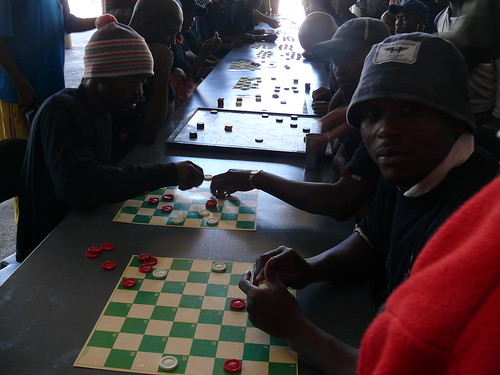 The enclosed picture tells more than a thousand words. It shows Lubabolo N. Kondlo, the second ranked checker player in the world, who resides in Port Elizabeth, one of the poorest provinces in SA playing in a tournament held in a museum honoring him and his club. I believe you know from your stay in Robin Island how much pleasure and skill the game of checkers can bring. One can imagine how hard it must have been for Mr. Lubabolo to become second best in world considering he can't afford a computer, an internet connection, or membership in a club and what an achievement it has been.
There is a world tournament for players of board games called the Mind Games Championships being held in San Remo, Italy, October 19-22, and I believe Mr. Lubabalo is not currently being considered to play. Perhaps you can guess the reason why from the picture. I would think it must be very hard for the above contestants in the tournament to get the money, the persona, the invites, and the social graces to get into the clubs that might qualify them for this tournament. And if they did, I would imagine it might be hard for them to tilt the powers that be to send such a person to the tournament. That's just a guess on my part from my own experience.
I was once the National Champion in Squash in the United States. I couldn't defend my title for the National Tournament held in Chicago because I couldn't get into a club that was a member club of the official association. I couldn't get into the club either because I didn't have enough money or I didn't fit the image that the club members had (in those days there was one Jewish member in all the squash playing clubs in Chicago where I was from. Fortuitously after not playing for 4 years after my exclusion, I won the tournament four more times.)
I wonder if the same situation is happening in part to Luba. I wonder if he can't get into a club because he doesn't have the money or the social attributes. I wonder if he can't get into the tournament because the tournaments require an official club to sponsor. It's what they call Catch 22 in the United States.
One could understand this in the United States 50 years ago. But it is hard to believe that it might still be happening in South Africa today in 2011 after all that has been accomplished, after all the efforts to give the kind of men pictured above an equal chance to excel in all intellectual, social, athletic, and commercial pursuits. It is especially jarring now as the latest World Cup exemplifies, South Africa has become a symbol of inclusion and renewed hope for the continent and beyond.
Perhaps it would be worth looking into this and perhaps the relevant ministers of sports and equal opportunity might see if there is any rectification appropriate for this situation. Surely there are official reasons that might have given rise to a situation like this. I know there were many in my case. I suspect however that these official reasons would seem daunting to many a man playing checkers in pictures such as above.
One might anticipate that one of the official reasons given for such a situation arising is that a qualifying tournament could not be held? Or that an entry fee of several dollars had not been paid? Doubtless there are other official reasons that might be given. These official reasons should certainly be given a fair hearing.
One realizes that despite the millions of checker players around the world, checkers or draughts is still a minor sport. But even a situation like this in a sport can send a signal. I believe it would be very good for South Africa, and the game of checkers if Mr. Lubabolo were given a chance to compete for a spot in the Mind Games.
P.S. As is always the case in such situations, there is a question of money involved. It is likely that I would consider paying Mr. Lubabolo's expenses to this tournament in the hopeful event that he is able to overcome the official barriers to entering that might be placed in his way, and/or he be given a fair chance to compete in such a tournament through any reasonable procedures.
Sincerely,
Victor Niederhoffer
Jul
6
The Friday Move, from Victor Niederhoffer
July 6, 2011 | 1 Comment
The Friday move in stocks and bonds was particularly disruptive it being the 5th rise in a row, a 60 day extreme price and the highest single day rise in a month. One wonders if such disruptive moves have any predictive value. It is relatively easy to test this in a number of ways I believe. One notes for example that the highest point change of the last 30 days has occurred 103 times since 1999 and the average % of rise 3 days later is 52% with a small negative expectation.
Jul
6
Principles of Checkers, from Victor Niederhoffer
July 6, 2011 | Leave a Comment
I have been reading Ginsberg's Principles of Checkers. He states that there are 5 or 6 positions that come up in almost every game. And if you know how to maneuver from these middle game positions you will be among the best. I wonder if there are any comparable positions in markets. 5 of 6 that capture the essence of what's happening say at 11 am that lead to various paths that are taken during the day. The use of similarities comparing various positions of say the major 4 markets to each other changes et al from the close and the week might be a good start. Perhaps discriminant analysis could be used to shed light on the descriptive aspects of the problem. Would make a good PhD thesis.
Jun
30
The Appeal of Cynicism, from Russ Sears
June 30, 2011 | Leave a Comment
 There are several reasons that cynics are on the rise in my opinion.
1. People assume the cynic is the expert. The cynic has an aura of authority.
2. Cynicism is masked as realism.
3. People assume the cynic is a healthy skeptic. On first encounter these two are hard to distinguish.
4. The cynic guards against disappointment.
5. The cynic creates an “us” against “them” world. "We won't be fooled again" by "them".
6. It is easier to find a problem than create a solution or even understand how complex creativity works.
7. It is easy to ignore the positive. Hard to ignore the negative.
8. People assume their bias is only one sided: When they like something too much. People recognize their biases when there is favoritism but justify their biases when there is disdain or prejudice. The cynic reinforces that their biases are the only morally defensible ones.
 9. The cynic has many times when he is proven wrong, but it is often hard to pinpoint the opportunity cost to that cynicism (for ex. the profit he missed by staying out). However, when he is proven right, it is very easy to see how much he has saved.
10. The belief that Type II errors or believing falsely in a person are much more damaging than Type I errors or not giving a good person a chance. Despite the time it takes for a person to prove she is proficient and the moment it takes to lose trust-worthiness.
11. The cynic is elevated as “your own man” by the media and politically. Thus becoming the “go to person” when they want something said or done. This creates all sort of side agreements and quid quo pro understandings. Every TV program needs the phone numbers of a few favorite cynics.
12. Ironically, the person most likely to publicly be called down for their cynical tendencies is the person that is cynical towards the celebrated cynic.
Con-artists understand deeply the appeal of cynicism and use it against their prey.
The cynic is the ultimate champion for the status quo. The cynic can define people by their weaknesses not their strengths. Since everybody has weaknesses, they can dictate who is important by defining who is not important. Old man’s disease is giving in to the appeal of cynicism.
Rocky Humbert writes:
 "A cynic is a man who, when he smells flowers, looks around for a coffin."
H. L. Mencken
In the spirit of not being a cynic, I note today's news story reporting that volunteers in Japan are being asked to grow sunflowers to produce seeds … so even more sunflowers can be grown in areas contaminated by radioactivity from the Fukushima disaster. The proponents say sunflowers can efficiently absorb radioactivity from the soil in a process known as phytoremediation. Here's the news story.
The skeptic (as opposed to cynic) in me thought that this sounds like an example of "green" people confusing Flower Power with nuclear physics. But a little bit of research reveals a bit of "sunny" science for the weekend. There is REAL science here! Sunflowers (and certain other plants) CAN decontaminate radioactive soil faster and cheaper than many other approaches. Chernobyl was a large-scale proof of concept. Here are 2 of academic papers on the subject:"Screening of plant species for comparative uptake abilities of radioactive Co, Rb, Sr and Cs from Soil,"Gouthu et al ; Journal of Radioanalytical & Nuclear Chemistry" and "Uranium Absorption Ability of Sunflower, Veiver and Puple Guinea Grass," Roongtanakiat et al (2010)
SO THE MORAL OF THE STORY IS: "A cynic is a man who, when he smells flowers, looks around for radioactive contamination."
Pitt T. Maner III comments:
The phytoremediation and bioremediation fields have bloomed to aid companies tasked with difficult cleanups. Even earthworms can be useful with certain contaminants (PCBs).
Larger trees also can be used to influence the flow of impacted groundwater so that contaminants do not move offsite—effectively they act as small pumps (think of all the Florida maleleucas used to drain wetlands, now designated as "noxious weeds"). Trees can help with the treatment process through the uptake and concentration of contaminants or the breakdown of contaminants in the bacteriologically-rich portions of the root system .
The economics can be interesting and one can only imagine what they are in the Japanese case and how they affect current land values. Those with an understanding of the actual risks involved and the ability to cost effectively clean properties have in certain instances done well:
"Acquisition, adaptive re-use, and disposal of a brownfield site requires advanced and specialized appraisal analysis techniques. For example, the highest and best use of the brownfield site may be affected by the contamination, both pre- and post-remediation. Additionally, the value should take into account residual stigma and potential for third-party liability. Normal appraisal techniques frequently fail, and appraisers must rely on more advanced techniques, such as contingent valuation, case studies, or statistical analyses.[11] Nonetheless, a University of Delaware study has suggested a 17.5:1 return on dollars invested on brownfield redevelopment.[12]"
Kevin Depew writes:
Why do you believe cynicism is on the rise? In my opinion, the < 35 generation doesn't really understand it or ignores it. I don't have access to it now, but I saw some large scale polling data on Friday that was remarkable in the cross section spreads between < 35 and those over, especially > 65. The gist, based on this polling data, is that if one is > 65, one is likely to find the country going to hell, the economy going to hell, that politicians are evil and stupid and that all bankers and finance people are crooks by a wide, wide margin over younger subset. If interested I'll forward data when I get back in office Monday. I was looking at it in the first place because there is a wide divergence between consumer comfort and confidence data vs market that is outside of 25 year norms and was just curious about the asymmetry in both economy and the polling data.
Victor Niederhoffer writes:
Artie wrote a book on cynicism in the police force that attributed cynicism as a variant of the authoritarian personality. He believed that police became cynical because they saw so much evil that their own persona looked relatively good compared to all the evil, and their cynicism and corruption was a natural outgrowth of the impossibilities of fulfilling all the requirements of an all too demanding job with conflicting goals. I believe we become cynical on the list because we see such ephemeral behavior by the public and funds, and such inside maneuvering by the cronies and flexions. It's hard to maintain a proper chivalrous attitude when confronted by these things day after day.
Jeff Watson adds:
But that cynicism, if allowed to fester, will have profound effects on one's trading. I've seen it happen too many times to people and they end up losing their edge.
Ken Drees writes:
Cynicism towards markets and politicians is healthy, but toward general mankind or society, probably not so well placed since hope and belief in goodness of the total gives one an overall positive tendency towards world view but also a well placed skepticism at certain segments.
The idea of erosion is interesting where the rigors of the job or the constant focus on conflicting outcomes that collide with the overarching worldview wear down the person's belief in good. One thought along these lines that I have is that by the end of one's life you are so distilled down in terms of your true character that its impossible to change. You are either that positive and generally nice old person, or a frown wearing old crank; the thoughtful scientist who never stops learning, or a worn out 24/7 TV watcher.
Russ Sears adds:
I believe it also has to do with the narrow vision we have of public versus personal life of the cynic. We do not see that like a partying narcotic addict, the soul has been sold for a very narrow gain. The personal life is full of turmoil and eventually rots the productivity out of the person. Think about the cynicism required of the steroid user or EPO user for example.
I believe that many companies demise starts when a new "C" position arrives within it- the Chief Cynic. If not confronted as Artie did, often this position is allowed to become an all consuming cultural force.
Vincent Andres adds:
"the cheaper money tends to drive out the dearer"
(the money of lower value drives out the money of higher value)
–Nicolas Oresme
(« la mauvaise monnaie chasse la bonne » )
Jun
29
A Classic, from Victor Niederhoffer
June 29, 2011 | 2 Comments
Some hypotheses regarding the reaction to information? Case very similar to the flexionic move down when the bailout was passed. Since it was known to all flexes, they had to liquidate when they realized that what they positioned for happened? Of course there was the certainty that the new man of change would be elected also? Or was it a case of going up whenever it looked likely that the vote in Greece would be positive, and then when it happened, …as Dooley would say "how will they make it happen? What you think?".
Alex Castaldo writes:
Most were positioned in expectation of a favorable vote: long stocks and short bonds/bunds. For a while it seemed the markets cared about nothing else.
At 6:41 am ET Papadimitriou (from the opposition party) announced that he would vote for. The S&P vaulted past 1300 and the Bunds future fell below 126. The size of the market reaction perhaps incongruent with an announcement from a single politician.
Then the voting started.
At 8:45 Kouroublis voted against, and there was a noticeable sudden decline in stocks and rise in bonds, bunds. This did not last long.
At 8:56 Athanasiadis, who had been expected to vote against, voted in favor, with the opposite (though smaller) effect.
After the 9:04 announcement that the votes are available to guarantee passage, there was a period of hesitancy and then an attempt by the majority to make a dignified exit now that the expected had happened, only to find the exits rather more crowded and disorderly than hoped… The stock investors, especially, experiencing some downdrafts.
Alston Mabry writes:
Given the news about previous governments in Athens cooking the books to get into the €mark in the first place, and then all the reports of tax evasion and government benefit exploitation and so forth, it's easy to be skeptical, and even cynical, and take the view that things like "negotiated agreements" and "midnight parliamentary votes" and "austerity budgets" are things that politicians use as their own currency, and that they keep trying to spend this currency in an alternate imaginary world in which they believe they can hold off hard consequences with soft ideas. (See: "Munich agreement".)
Jun
28
 An Introduction to Difference Equations by Saber Elaydi and Difference Equations by Paul Cull, Mary Flahive et al have me thinking of second order difference equations.
x(t+2) = a + b x(t+1) + c x(t) + u(t) where u ( t ) is a random variable.
The fibonacci equation has b and c = 1 and x (t) = x(t-1 ) + x (t-2) , x(0) = 1 , x( 1) = 2 and the series is 1,2,3,5,8,13,21,… the simple way to solve for the x(t) in such a series is to make it a binomial (x) (x) - x -1 = 0 and then a very beautiful set of roots described in Edspec in a math team problem comes about with a(( 1 + 5 to 1/2)/2)to the 1/2 and a (( 1 -5 to 1/2)/2) to 1/2 term as the multiples to apply in the solution.
Okay, I think the second order difference equations have many applications in many markets. I propose to simulate the best fit for a second order difference equation with say the last 10 sets of 10 observations, and then to predict where it will go. I believe that a simplicity based solution using only the constants 1, 2, and 3 and no higher powers than a square should be found.
I propose that this would be predictive and the divergences from the prediction would be tradable. The exercise violates our rule that the higher the mathematics the less the use in predictions. But it seems to me a useful reflection that is much more relevant than the essays on stochastic difference equations that one sees in the literature such as this and it's a useful diversion from cross road puzzles and pattern recognition I think.
Jun
28
The Thrill of the Long Shot, from Ken Drees
June 28, 2011 | 3 Comments
 As specs we snicker at the lottery player, he is a sucker. We smile when we hear how the crowd is routing for the hometown favorite when we know odds favor the other side. We hopefully carry out the canes when the crowd is tossing down the tickets in disgust, we sniff for value when there is no value there–so says the financial press.
But what is our own attachment to this concept–catching a falling knife, holding a loser, getting involved in some fiasco stock since the market is beginning to bore, riding a coattail that turns into a skid, throwing in "just this once"? Why do we fail to follow our own good sense from time to time?
There must be a thrill or an ego impulse underneath this temptation to turn from the path and into the wind of long odds–"cause we can handle it".
Victor Niederhoffer writes:
Our own attachment should be based on quasi scientific study., not riding a coattail.
Ken Drees writes:
True, but do we fasten our own rickety reasons from study based on the past which has no real reason to work in the future other than past frequency, tendency and relationship, and thus delude ourselves into thinking that our proof more than compensates for the new speculation? And if finding tendency and causality can be negated by the speculative theme of ever-changing cycles, and also trumped by the unknowns –how do we believe this and thus risk capitol?
I think that the chair has outlined many great themes in speculation, almost like laws:
1. Methods must be tested in order to find relationships of validation.
2. The laws of ever changing cycles are present in the market at critical-mass moments.
3. There is a high degree of relationship between markets and natural systems. What can be said of the "unknown"? What is this speculative doomer, the whispy apparition above the pond at days end? What law can be attributed to this unknown force that seemingly has uncanny timing?
Ralph Vince writes:
Ken,
I think it's simpler than that.
-The past gives us a proxy for the distribution of what can happen.
-We can amend that distribution of what can happen based on how we foresee the future diverging from the past
-That very distribution can now be used to determine how aggressive we might want to be withing a given risk (drawdown) constraint.
-If we don't exceed that drawdown constraint, and our distribution is reasonable of the future, the profits accrue.
Gibbons Burke writes:
I wrote this in a previous thread about the difference between speculators and gamblers, and I think it holds true: "Gamblers are willing losers who occasionally win; speculators are willing winners who occasionally lose."
At bottom, and at one time or another, most of us are gamblers. It takes a very disciplined, brilliant, and perhaps unrealistic person to only play games where the odds are in our favor. The reasons many engage in knowingly losing propositions are greater than the stars in the night sky in rural flyover territories. Entertainment and division rank high among them, sociability, peer pressure, guilt about the money they are risking (unconsciously disposing of it), fear of success, self-disgust, compulsive addiction to the stimulus-response loop, adrenalin junkie.
But all these are all proxies for the thing everyone is really seeking, usually unconsciously: a desire to be in union with the godhead, the creator, the divine purpose. As St. Augustine wrote in the opening lines of his autobiographical "Confessions": "You made us for thee, Lord, and our hearts will be restless until we rest in thee."
Phil McDonnell writes:
When I ask people why they do not invest in a guaranteed savings account or short term t-bills they usually respond that they are too boring. And they are, or at least used be because they could not lose. Most traders unconsciously seek to lose because it represents action and excitement. While I think the usual arguments that it takes assumption of risk to increase return have validity, at the sub-conscious level the desire is really no more complex than risk seeking for excitement.
Ralph Vince writes:
I agree — this is what frightens me about individuals who are out investing their own money — no kid needs to relive the station wagon as home for awhile as a consequence of Dad's gambling proclivities.
I'm beginning to think institutions are just the individual lambs in the wolves clothing of trading with other's money.And the reason I say this is because, again, not only can they not articulate their criteria for being involved in this, most criteria involve the ultimate metric of "what is the probability of getting smacked x% in the coming y period(s)."
And I don't see ANY of them operating that way. Rather, their risk metrics are ones that don't really tell them anything, analgesic salves that do not stave off the infection.
Russ Sears writes:
Personally, my record shows that I am more often guilty of trying to catch the falling knife on an individual stock and on an option trade, than I am on an allocation strateging or long term market timing basis. I believe this is because of two reasons, One reason is I am just to gullible for a single stock, and buy the story the more it goes down the more I am convinced it will pop, often averaging down. I believe most businesses as a whole are running honorable businesses, that is they are trying to do what is best for the long term. However, the exceptions happen and there are frauds/crooks and businesses that have agency problems (businesses run for the executives or employees short term interest) The second is that I am often guilty of believing that the studies timing is much more stable than it actually is. It may be that the market is over sold and will bounce back, this results is the crux of my "edge, but the time period is often part of the ever changing cycle.
I have helped this some by giving myself some boundaries or a do not buy or sell if held rules of:
1. If the market believes the board or leadership is not acting in the stockholders interest, based on key decisions they have made.
2. If there are union grievances making the press.
3. If there are rumors of fraud or accounting problems.On options buying time or gamma seems to work better. And in general I have learned to not do as many option trades as I am not as good at them as I think I am.
These rules are simply my adjustments for my own shortcomings.
Jim Sogi writes:
The heuristic at work here is risk aversion where one would rather face a known small risk with bad odds of a big win, rather than a 51% favored odds with a risk of a large loss. It's very hard to overcome the natural tendencies.
Jun
27
One Wonders, from Victor Niederhoffer
June 27, 2011 | 1 Comment
 One wonders if there is a economic explanation for how different sectors perform when the Fed is buying bonds and expanding high powered money at high rates. Would it tend to cause small business to do much worse than big business? Would it cause employment to go down? The mechanism might be something like that which often overides our list. Total disgust and loss of incentives that the big boys are getting a free lunch at the expense of the hidden or unintended costs?
This hypothesis would first have to be tested to see if it exists. Many of us are disgusted that the Fed is buying bonds and bailing out banks with printing of money. It has to come from somewhere? Someone has to be paying? But on the other hand as pointed out by Mr. Rocky, the small caps are performing much better than the large caps? And the banks have shown relative lack of performance lately also.
How could these speculations be narrowed into something testable or put into a better framework?
Stefan Jovanovich writes:
The fresh money comes to Europe:
China will continue to work with other countries with common responsibilities. We should make concerted efforts to strengthen the co-ordination of macroeconomic policies, fight protectionism, improve the international monetary system and tackle climate change and other challenges. We should welcome the fast development of emerging economies, respect different models of development, increase help to least developed countries to enhance their capacity for self-development, and promote strong, sustainable and balanced growth of the global economy.
Last time it was Charles Dawes.
UPDATE:
China pledged to buy Hungarian government bonds and said it will “consistently” support the euro as Europe battles to fight its way out of a sovereign debt crisis. China will buy a “certain amount” of Hungarian government bonds and remains a “long-term investor” in European debt markets, Chinese Premier Wen Jiabao said in Budapest today. This afternoon, Wen travels to the U.K. and then on to Germany on his three-country European tour. “China is a long term investor in Europe’s sovereign debt market,” Wen said in translated comments at a press conference with Hungarian Prime Minister Viktor Orban. “In recent years we have increased by quite a big margin our holdings of government bonds. We will consistently continue to support Europe and the euro.”
Jun
23
Great Migrations, from Victor Niederhoffer
June 23, 2011 | 2 Comments

There are pictures of migrations in the current National Geographic and group think in movies in the NY Times. Part of the idea that has captured the world in current days? Relation to markets? How to predict the stages of migration and big moves in markets and individual stocks?
Vincent Andres writes:
Read this interesting article which may relate:
America, at its best, is a glittering symbol of promise to would-be immigrants. But where do they actually want to live in the United States? Trulia, the real-estate listings site, has come up with the only data set we've seen that actually breaks that question down to the city level. Their infographic, Global Pursuits of the American Dream, was built using incoming real-estate searches on Trulia's website . These were then broken down by country of origin, and the city being searched. Here's what the data looks like for two relatively wealth countries, Germany and Italy.
Steve Ellison writes:
While California was one of the top U.S. destinations for immigrants in the 1990s and 2000s, during the same years many more native citizens moved out than moved in.
Bo Keely writes:
 The most dramatic human migration in modern history is the Central Americans atop Mexican freight trains the length of Mexico to the USA border. The quest is freedom and financial independence, with the dream of staking a new individual life and sending sponsor money to their thousands of Central American villages to get the next person on the freight. Each day about one hundred wade cross the river border between Guatemala and southern Mexico, hop on a daily freight- up to 100 per train recalling the USA Great Depression- and jiggle north to Mexico City where they fan out on RR lines to the Texas, New Mexico, Arizona and California borders. I've ridden with the young men and a handful of women in three years, once getting caught in mid-stream of the Rio Grande river by US border patrol that took some explaining. A breath-taking though small sample of the month long ride is detailed in Nazario's 2003 Pulitzer Enrique's Journey. The journey for Central Americans is a tale of hardship, although this is the first time I've ever been collared by a RR bull who took me home and introduced me to her mother.
Jun
23
Query of the Day, from Victor Niederhoffer
June 23, 2011 | 1 Comment
 What higher purpose is involved in all the news about Greece? How does it help the flexions? And how does it make man small? The answer must lie somewhere related to these last two.
Vince Fulco writes:
1) "Only Govt has the answers…"
2) The powers that be must deliver bad medicine (aka taxes) regardless of one's individual responsibility/frugality/discretion/smarts.
3) Overcomplication hides the truth as long as possible.
4) Suffering should be shared by the masses, prosperity obtained/retained by the sharpies
Jeff Rollert comments:
Actually, I see the flexions losing control. The public has tasted information freedom. They won't give it up easily. If Greece says "No" then their world changes rapidly. In my circle, the banks are "reaching out in the community" with ever greater frequency. Yet, consumers interest in their products is waning, except at the mid/mega cap level and gov't.
Dylan Distasio replies:
Jeff, can you elaborate on what you mean by information freedom, specifically in reference to the Greek situation?
I think some of the flexions have already profited in the first round of the Greek bailout by offloading bad debt to the ECB from the private sector when the ECB agreed to take it. I'm sure the other ones tied up with the IMF have a strong incentive to make the Greeks take their medicine.
I don't see how the Euro will survive this situation long term. It is very unlikely that Greece's economy is going to improve enough to meet these payments especially with a Draconian austerity plan. All this new bailout is doing is delaying what appears to be the inevitable. It might take another year or two for the pain to become insurmountable for the ECB and Germany/France, but they will eventually be forced to stop throwing good money after bad. The Euro is a flawed currency and there was no exit plan built into it. Greece, Spain, Portugal, and Ireland all need to devalue their currencies to one degree or another and are unable to. This situation is untenable.
Things fall apart; the centre cannot hold;
Mere anarchy is loosed upon the world,
The blood-dimmed tide is loosed, and everywhere
The ceremony of innocence is drowned;
The best lack all conviction, while the worst
Are full of passionate intensity.
Ralph Vince writes:
I agree with all except it "it could get real ugly part." Not that I don;t think the possibility exists, but my analysis leads me to believe we are on the brink of gigantic, unprecendented economic growth in America, that we are rounding the turn, given a trough of some sort around 2014-2015, things REALLY take off after that.
And as we saw with China post-Tiananmen, nothing quells the masses like economic growth.
This is an extremely sophisticated society that, in the main, on the level of the individual, produces, despite their governement. In the main, Americans are quite peaceful, self-organizing, self-reliant people when need be. The seeds of pare-to-the-bone efficiency are in place here like nowhere else, the technological advantages now in place and as-yet unfelt — a catalyst need only emerge. The amount of available capital, so desperate now for a return, will be the second great biblical flood.
Talk to the younger crowd, and you see they isotropically have little faith in the future, little appetite for risk. They aren;t going to all be right. We re in the prime years to push all of our chips as individuals out onto the table.
Stefan Jovanovich writes:
I share Ralph's optimism about future returns in what the old men with canes would have called "sound securities". If I had the energy for it and did not still live in California (aka PIGS West), I would be buying and managing as many small businesses as I did 20 and 30 years ago. I don't find the absence of "faith in the future" among young people to be as alarming as Ralph does; I don't remember even thinking about the future when I was 15 and 20 and 25, and the young people I now meet who "have a plan" are basing their projections on what they have learned in school, not their dreams. The others - who are properly cynical about school - understand that their fate is largely at the hands of the marketplace. But they are not scared. Quite the contrary. They seem to be far more comfortable with risk and uncertainty than my generation ever was and still is (we seemed to think we had the divine right to complain and receive whatever medications were available to escape from the pains of actual life.) I think intelligent young people now understand the difference between risk (doing potentially dangerous things that require skill and practice to avoid harm) and the arrogance that comes from ignorance. Extreme sports have never been more popular; but Lack's kids and others are sensible enough to wear helmets voluntarily. The kids are all right.
Jun
23
You Would Think, from Victor Niederhoffer
June 23, 2011 | Leave a Comment
You would think that a very good scientific study could be made of the performance of companies that guide down a quarter and a year. The corresponding quarter the next year would seem to be a comparison that would be very good, and the ephemeral nature of following the herd, and reducing targets when quarter to quarter growth is not steady would seem to give you the wind at your back.
Such a study would have to take account of the well known tendency of CEO's height to fall as their stocks declines. An as is study with measurements before the companies were de-listed or added to the list would have to be made.
Jun
19
A Shocking Concatenation, from Victor Niederhoffer
June 19, 2011 | 5 Comments
As we all know, the market has had two small up days but is down over longer periods starting with 3 days. Yesterday's action was unusual in that it was a big up opening, but down consistently from the opening. I find that such a condition has never occurred before, although it all seems quite reasonable and de rigeur. What other seemingly normal things hardly ever happen, thereby violating the random walk?
I dare say an artful Downian simulation of the last 3 days would show that the actual transpiration of events was quite normal under random numbers, ( the magnitudes of the opens would have to be taken into account), yet it didn't in real life. Does it signify anything except the infinite creativity of the market mistress, who is so likely to find that those louses will go back to their spouses in these terrible days.
Jun
17
Mystical Ideas, from Victor Niederhoffer
June 17, 2011 | 4 Comments
 Recently I have posited that the market to an inordinate degree shows the main attributes in its daily moves of the most vivid sports game that has not been used. I would add to this that during each hour the market is likely to move to the rhythms and dynamics of the most likely classical music being played on a classical music station in home town, for example the former WQXR in New York, in full knowledge that these programs are often selected 2 months in advance, and noting that I was a subscriber to same when I was 12 years old.
I am adding to my list of mystical encampments and predictions that the fortunes of Apple and Lady Gaga will follow a similar arc in the future, and as soon as the Lady loses her luster, or a substantial base of her gay support, Apple will be ready to nose dive.
Do you feel that because of these ideas that I should resign my post as chair of Dailyspec which is designed to deflate ballyhoo, or is this just a symptom of that predilection that old men such as the Sage and the Fake Doc have to maintain their romantic aura?
Henrik Andersson writes:
As an engineer I can be accused of being too focused on science. One of my mystical ideas right now is that I believe the market will turn once these four companies reached the round 4. In Chinese '4' is an unlucky number as it sounds similar to 'death'. That's why for example there are no Nokia product lines that begin with '4'. Marine Harvest will at a salmon price of NOK 28 post an EPS of 0.40 in 2012e. At PE 10x, the stock is going to NOK 4, Maersk profit warning is getting closer whearas i believe 40k will be reached. June also seems to the peak season for ordering new vessels, Husqvarna has been on a straight path from SEK 50 to 40 with the CFO canned and the CEO watching the share price decline from the hospital bed. Nokia is this morning getting very close to EUR 4.00. I just read yesterday they are now making more money on iPhone sales (they are getting royalty) than their own sales. The market needs to 'die' before it can rise again, and these stock will in the process all hit 4.
Jun
17
A Beautiful Website, from Victor Niederhoffer
June 17, 2011 | Leave a Comment
Vincent Andres has a beautiful website in French with a photo of the cover of Atlas Shrugged and subheadings like "Kleptocracie" and "Liberticide".
Vincent Andres writes:
Thank you Victor for the kind word. It's far from DailySpec, but I do what I can being in a very socialist country (which is now threatening the internet.)
I must specify that I'm not alone and I'm greatly helped by marine research expert Michel Olagnon who writes many articles. (Michel works on rogue waves but he is also a very nice and active quant. You may remember him since he won one of your Dailyspec award in Feb 2006 with Jim Sogi.)
Jun
16
Ten Things With Wings, from Victor Niederhoffer
June 16, 2011 | 5 Comments
 I have always loved a good library. And some of my happiest days have been spent wandering the stacks of the Widener Library and Baker Library at Harvard, the University of Chicago Library and the University of California, Berkeley libraries. Indeed it was a visit to Lamont library which contained old volumes of the Monthly Weather Review with the great article on runs in sunny days that started me on my hopeful but sometimes fruitless quest to uncover regularities. I never know what I am going to discover in the stacks, and going through the books on a subject as opposed to looking through an index catalogue opens up new worlds, and horizons and puts me in touch with the greatest things that people have ever thought and written.
 On one of these forays, exactly 50 years ago I discovered the Fitch sheets that contained every transaction on the NYSE and ASE. I discovered evidence of microscopic reversal and macrospopic momentum and systematized it, and I believe this was the first of one of the first microstructure of markets studies.
Subsequently when I was still in the orbit of the palindrome, we would frequently meet a common friend as we entered the tennis courts or a gathering and they would out of a attempt to harmonize with the palindrome, "what are you doing these days. Same old thing?" and before I could say "yes" the palindrome would always say "yes, unfortunately".
I often think he's right and that over the last 50 years, I have not discovered much new. And yet, here are 10 things I have discovered since then that are simple but I believe have wings.
1. There are always interactions between markets but they are always changing. Witness the bond stock relation and our colored chart on the site.
2. After a regularity has been doing well, it tends to do badly and after it does badly, it does well. This is a variant of the principle of every changing cycles.
3. The interrelations are always different on different days of the week, weeks of the month, months of the year, hours of the day and minutes of the hour.
4. The market likes to force the flexions to take actions that will be in the interests of the top feeders and cronies in the market.
5. After pessimism is at a high level it is good to take out the canes.
6. Inactive markets like islands in the Ocean have a completely different microstructure than active markets. and as activity in a market change,the microstructure changes. Never try to make money in an inactive market or as I say, "never play poker with a man named Doc".
7. The markets have strong regularities but they have as much non-random tendency to do the unusual, so no matter how much a regularity appears, one must manage his money properly to take account of the unusual.
8. There is an upward drift to stock markets to compensate for the return that entrepreneurs need on their money. The higher the necessary compensation, the greater the return.
9. Most technical analysis which is based on shibboleths and seasonality is only good if you are going to reverse it and take account of the vagarious prices that emerge when transactions engendered by such pseudo things are filled by the strong.
10. A major purpose of markets is to transfer resources from the weak to the strong, so that the infrastructure can be augments and stabilized, and everything you read or hear about the market is designed by an invisible evil hand to put you on the wrong foot so that you will contribute and lose more than you have any civilized personage has any right to do.
I've got a few others up my sleeve but I'd like to hear your ideas on this.
Craig Mee writes:
 Regarding point # 6, I think, Victor, there may be a medium hand in this, and that markets under modest growth and less speculation may show greater structure relative to their more highly prized counterparts.
No doubt the role of harmony is present in all markets to varied agrees, and the players, although they may variate size from time to time in their chosen poisen, are fairly consistent throughout.
Russ Sears writes:
1. There is a rational often sophisticated explanation for every bubble or to paraphrase Proverbs, "there is a way that seem right unto the market, but the end thereof leads to death."
2. A corollary: to be really sophisticated you must accept some form of willful blindness. Most people will learn to ignore those blind spots. They are blinded by the light. Those that understand where the blind spots are will stuff all the risk into those spots. Then short those blinded.
Ken Drees:
In the stacks of a library one may come upon a book that one would never have thought to look for in the card catalog– like at a garage sale, how you never know what treasure you will find. Same thing with newspapers, when you open them and scan the ads and story headers, you may read something that you would never had googled. Really there is something to be said for this type of information interaction that will be lost for a time…until it becomes the new thing to do.
Jun
16
The Improving State of the World, from Victor Niederhoffer
June 16, 2011 | 2 Comments
 The book The Improving State of the World by Indur Goklany and the follow up references to it show that in every measurable area including
  schooling, life expectancy, nutrition, hours worked, human development, freedom, poverty … there have been steady gains.
The work of Lomborg updates Simon on all measures of environmental quality in the air and water showing vast and continuous improvement.
How small the flexions would keep man so as to be better able to take our chips, and make us so hopeless as they take so much more than Bacon would have us give.
Jun
15
A Scary Prediction, from Kevin Depew
June 15, 2011 | 2 Comments
 I think this essay is worth reading:
"primitive agricultural communities are `dynamic'. They are subject to continuing change in agricultural technology, induced by population pressure…"
And also this article by Grantham: "We're Heading Toward a Disaster of Biblical Proportions".
Victor Niederhoffer asks Alex Castaldo to explain to him what this is all about. Alex Castaldo writes:
The first link is a 108 page essay written in the early 1960s by Ester Boserup , a European agricultural economist I have heard about before but don't really know. At this time many people were concerned that overpopulation was a big problem for the world. In this essay she argues that actually in some cases a surge in population forced people in an area of the world to improve their agricultural technology and make other changes that were beneficial. So (local) population increase was actually a spur to innovation and economic progress.
Jeremy Grantham on the other hand is a contemporary money manager from Boston (born in England) who is always somewhat bearish (except in March 2009 when he briefly and correctly turned bullish). He is very environmentally concerned and always worries that humankind is using too many resources or using them unwisely. Quote: "Grantham [believes] that the world has undergone a permanent "paradigm shift" in which the number of people on planet Earth has finally and permanently outstripped the planet's ability to support us."
So the Boserup thesis and the Grantham thesis contradict each other, and Mr. Depew is quoting Boserup to counter Grantham.
Victor Niederhoffer writes:
Julian Simon would turn in his grave, as would the author of The Improving State of Humanity.
Vincent Andres writes:
If on the other hand, the most valuable resource is the human brain, a larger population is better.
Steve Ellison writes:
I would rephrase, "if on the other hand, the most valuable resource is the human independent brain,"(Because globally, what's the use of 1.000.000.000 similar brains ?).
The ratio in the brain distribution between the tails and the body probably matters. And the bigger the body, the bigger its reinforcement, and maybe (?) the bigger the crushing of independant brains.
… hopefully, this line of reasoning is wrong.
Jun
14
Atlas, from Victor Niederhoffer
June 14, 2011 | 7 Comments
I commissioned a statue of Atlas from Zura Bushurishvili , the artist who made my bull . And here it is.

The subject of Atlas reminds me of a comment I read recently on an article about Bill Gates:
"I think the most admirable thing about Bill Gates is that he doesn't think that his children should inherit his wealth."
-From a comment to a Daily Mail interview of him.

.
.
.
.
.
.
.
.
.
.
.
.
.
.
.
.
.
.
.
.
.
.
.
Jun
12
I like the semantics of the Scholarly Chair's remark "the recovery is frustratingly slow". There's something out of Mario Puzo in it. "I made him an offer he couldn't refuse" or "I don't think we'll be seeing those visitors from Chicago again". A cartoon showing a Thor Like Character with Hammer and Lightning in his belt saying something like, "I don't see why everyone is so slow to tell me what's on their mind" comes to mind or a man with a gun pointed at his wife saying, "Look dear, let's discuss this in a calm manner".
Jun
10
Interesting, from Victor Niederhoffer
June 10, 2011 | Leave a Comment
It is interesting that the move on Monday after the last twenty five 20 day minima on a Friday had a standard deviation of 34 points versus a normal days' standard deviation of 15 during that 5 year period.
What an opportunity there will be for the weak to give chips to the strong.
« go back — keep looking »Archives
- October 2026
- September 2026
- August 2026
- July 2026
- June 2026
- May 2026
- April 2026
- March 2026
- February 2026
- January 2026
- December 2025
- November 2025
- October 2025
- September 2025
- August 2025
- July 2025
- June 2025
- May 2025
- April 2025
- March 2025
- February 2025
- January 2025
- December 2024
- November 2024
- October 2024
- September 2024
- August 2024
- July 2024
- June 2024
- May 2024
- April 2024
- March 2024
- February 2024
- January 2024
- December 2023
- November 2023
- October 2023
- September 2023
- August 2023
- July 2023
- June 2023
- May 2023
- April 2023
- March 2023
- February 2023
- January 2023
- December 2022
- November 2022
- October 2022
- September 2022
- August 2022
- July 2022
- June 2022
- May 2022
- April 2022
- March 2022
- February 2022
- January 2022
- December 2021
- November 2021
- October 2021
- September 2021
- August 2021
- July 2021
- June 2021
- May 2021
- April 2021
- March 2021
- February 2021
- January 2021
- December 2020
- November 2020
- October 2020
- September 2020
- August 2020
- July 2020
- June 2020
- May 2020
- April 2020
- March 2020
- February 2020
- January 2020
- December 2019
- November 2019
- October 2019
- September 2019
- August 2019
- July 2019
- June 2019
- May 2019
- April 2019
- March 2019
- February 2019
- January 2019
- December 2018
- November 2018
- October 2018
- September 2018
- August 2018
- July 2018
- June 2018
- May 2018
- April 2018
- March 2018
- February 2018
- January 2018
- December 2017
- November 2017
- October 2017
- September 2017
- August 2017
- July 2017
- June 2017
- May 2017
- April 2017
- March 2017
- February 2017
- January 2017
- December 2016
- November 2016
- October 2016
- September 2016
- August 2016
- July 2016
- June 2016
- May 2016
- April 2016
- March 2016
- February 2016
- January 2016
- December 2015
- November 2015
- October 2015
- September 2015
- August 2015
- July 2015
- June 2015
- May 2015
- April 2015
- March 2015
- February 2015
- January 2015
- December 2014
- November 2014
- October 2014
- September 2014
- August 2014
- July 2014
- June 2014
- May 2014
- April 2014
- March 2014
- February 2014
- January 2014
- December 2013
- November 2013
- October 2013
- September 2013
- August 2013
- July 2013
- June 2013
- May 2013
- April 2013
- March 2013
- February 2013
- January 2013
- December 2012
- November 2012
- October 2012
- September 2012
- August 2012
- July 2012
- June 2012
- May 2012
- April 2012
- March 2012
- February 2012
- January 2012
- December 2011
- November 2011
- October 2011
- September 2011
- August 2011
- July 2011
- June 2011
- May 2011
- April 2011
- March 2011
- February 2011
- January 2011
- December 2010
- November 2010
- October 2010
- September 2010
- August 2010
- July 2010
- June 2010
- May 2010
- April 2010
- March 2010
- February 2010
- January 2010
- December 2009
- November 2009
- October 2009
- September 2009
- August 2009
- July 2009
- June 2009
- May 2009
- April 2009
- March 2009
- February 2009
- January 2009
- December 2008
- November 2008
- October 2008
- September 2008
- August 2008
- July 2008
- June 2008
- May 2008
- April 2008
- March 2008
- February 2008
- January 2008
- December 2007
- November 2007
- October 2007
- September 2007
- August 2007
- July 2007
- June 2007
- May 2007
- April 2007
- March 2007
- February 2007
- January 2007
- December 2006
- November 2006
- October 2006
- September 2006
- August 2006
- Older Archives
Resources & Links
- The Letters Prize
- Pre-2007 Victor Niederhoffer Posts
- Vic’s NYC Junto
- Reading List
- Programming in 60 Seconds
- The Objectivist Center
- Foundation for Economic Education
- Tigerchess
- Dick Sears' G.T. Index
- Pre-2007 Daily Speculations
- Laurel & Vics' Worldly Investor Articles
