Sep
17
Some Commentary on the Psychology of Speculation by Henry Harper, from Victor Niederhoffer
September 17, 2011 |
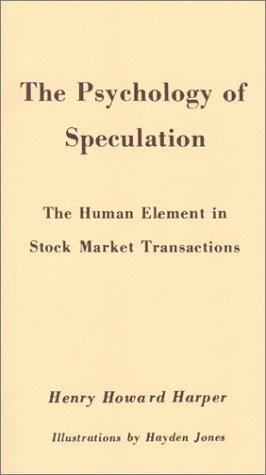
Theories propounded by market experts are sound but very few people profit by them because when once caught in the maelstrom of stock speculation, the average man becomes more or less mesmerized and at critical moments his conservatism, his resolutions, and his theories all take flight.
One doesn't agree that the theories of market experts are sound. Most of them relate to meals for a day, and selective memories of things that seem reasonable. They don't take account of ever changing cycles, and the fact that whatever worked 3 years ago, which is the average minimal time for a theory to hit a book and become popular, and reported by the services, is very likely to have an opposite effect at the current time.
People become mesmerized by overtrading against their ability to lose. When they lose too much, they get stopped out by their brokers or their partners. Holidays are particular times that people get stopped out of or mesmerized because they don't wish to ruin their holiday, wait for the extra day of risk, or their partners tell them such things as "are you going to ruin another July 4th by watching the market every second of the day, and worrying about paying the bills?". It's happened to me.
The real secrets of stock market success remain locked up in the bosoms of a few who are too busy to write, and too rich to feel the need of writing.
The secrets of stock market success are to have a good foundation, strong at the base with heavy capital supporting it. The banks can have stock market success because they are able to leverage themselves 100 to 1 and borrow at the funds rate, and be bailed out by their current, former, or future colleagues but most don't have that ability. Thus, the market is a series of highs and lows with the weak getting extricated by lack of a proper foundation at each gyration.
One of the worst things is to read about the best great things I did in trading as if the trades were recurring, they wouldn't be written about or if they aren't recurring then probably you should do the opposite the next time. Even if I had a method that worked, I couldn't reveal it because my partners and family would be upset with me. I don't have a method that works, although if so many of my former colleagues didn't borrow my methods of using statistical interrelations of multiple time series varying ever hour of the separate days, I believe that such a method might have had legs. There are doubtless other methods of making money in markets, but one finds that the edge that HFT boys with their better equipment and capital have on individual stocks precludes such methods for short term in individual stocks, and the long term purchase of stocks requires deep insights above and beyond the average that it is unrealistic to expect one person or group to sustain over different market times.
Many of the rich people I know are happy to be interviewed on television as they can talk their book and get people to follow them so they can increase the wave they started by talking to their colleagues and brokers after they put their position on. Also, to show that they are common people, supporters of the masses, in favor of redistribution, so that their natural adversaries at the legislatures and the service will realize he's a fellow traveler. The others who know how to make money are careful never to reveal a thing as information flows so quickly and it just takes a few big funds or traders to turn something profitable into oblivion.
The gyroscopic action of the prices recorded on the ticker tape produces a sort of mental intoxication which foreshortens the vision by involuntary submissiveness to momentary influences. It also produces in some minds an effect similar to that which one feels after standing for a considerable time intently watching water as it flows over Niagara Falls. Dozens of people have committed suicide and been dashed on the rocks below after so watching.
I am not familiar with the research that supports this tendency to suicide but I have experienced similar sensations. And there does appear to be some contagion in suicides. As prices go against one, I believe that the latent self hate of many people for their sins is manifested and they achieved their desire to go broke to atone for their sins. The tendency to suicide when watching a trend is something that would seem to have market implications as new contrarians are drawn in to be thrown into the abyss by going against the flood time after a certain mesmerizing flow. To be continued. Only on p.13 of my notes on book so far.
Sam Marx writes:
I agree with these observations and analysis.
There's one way that still works in getting rich and that is to buy cheap. W.E. Buffett still does it, and so does Trump.
Making a fortune by the statistical approach is much more difficult, however, if you're lucky enough to get in a new game, such as options in the '70's and '80's ,or 21 in the '60's math works fine.
Having been there, done that, I'm not as math oriented in my trading as I was before and I try to buy cheap.
I found Hagstrom's book on Buffett helpful when trying to buy cheap.
However, I have my eye on a relatively new game that I'm studying to see what can be done there statistically.
From a great psychologist Laurel and I serendipitously learned from:
Hi Vic,
Traders in Eurupe are much more focused on the European woes than the US traders. As a result, they've been much more bearish, would it not be for their conviction that a massive monetization of debt will ultimately save the day for bulls.
I absolutely love the notes you've taken. The idea of themes setting themselves over a period of time to be followed by their opposites is such an important one…HFT has seemingly speeded that process.
The Niagara suicide phenomenon is a tricky one. Is it a leap out of mesmerization or a leap out of guilt and atonement? My own observation, fwiw, is that something additional can be at work. Many traders tell me that they would rather lose on a move that they incorrectly anticipate than fail to participate in a move that goes their anticipated way. In other words, the pain of opportunity cost is greater than the pain of actual loss.
From this perspective, the most painful scenario is one in which a river becomes Niagara and one is not riding the current. I've seen traders sell stretched markets to the downside, buy upside breakout after breakout, and refuse to exit trades moving violently against them simply because they could not bear to miss the move they think may happen.
At some point, it does have a quality of Japanese seppuku: out of honor they will stay with their failing positions and fall upon their financial swords. From that perspective, perhaps it is better to die with one's convictions than to have abandoned them and face the shame of missing their fruition.
Your idea of "foreshortened vision" as a result of mesmerization of watching the screen is absolutely true. I tell traders that we inevitably trade the time frame that we watch: it's a natural function of (often flawed) human pattern recognition. Trance states are poorly understood and appreciated, and I suspect much paradoxical trader behavior might be explained by the lapsing of critical, rational consciousness and the hypersuggestibility of the trance state–especially among daytraders. Hence the worthlessness of most psychological intervention with traders: one cannot solve problems while in a different state of consciousness from the ones in which the problems occur.
- A psychologist
Victor Niederhoffer writes:
- P.60, The Psychology of Spec:
It may here be explained that the mental attitude of a "sold out bull" toward a rising market is much the same as that of a bulldog chained in his kennel while a dog fight is going on outside. A speculator may stand by and view with unruffled complacency the most enormous profits of others in securities that he never owned, but if one of his own pet stocks continues to advance after he has sold out. It not only reflects the error of his judgment, but the remorse he suffers, in contemplating the additional sum he might have made dampens all the pleasure of reflecting upon the profit he actually did make. Reluctant to admit such a costly blunder in judgment, determined not to be surpassed by his fellow-traders, and fused with the victor of his recent exploit, when Union Pacific was selling about 215 the "sold out bull" put in an unlimited order to buy five thousand shares. When his broker on the floor of the exchanges began bidding for this amount of stock, the crowd instantly surmised that some big operator was being "squeezed on the short side, and before the purchase was completed the price had jumped to 229.
The sold out bull eventually died on the Bowery without benefit of friends or money to pay for the funeral. "The lodge had to pay for the funeral" and my father might have had to carry him down from his Bowery walk-up to the morgue.
The whole subject of regret theory and contrafactual reasoning is so diffuse that it can explain any phenomenon and predict nothing. On one hand, it explains the tendency to take profits too fast as being a feature of regretting to lose what one has. On the other hand, it explains why people buy too high or sell too low from the standpoint of missing the big move. If such a phenomenon as "sold out bull" exists in real life, then it should lead to excessive moves when markets set a new high after many have sold out at lower prices. It would explain why support and resistance is always broker. Why when an area of great volume of trading at a price occurs, and then the price is exceeded, the bulls become more agitated and buy. I've seen papers that say that regret theory supports the notion that "support and resistance barriers should not be broken. A good study of the psychological literature is contained in this paper.
Comments
Archives
- October 2026
- September 2026
- August 2026
- July 2026
- June 2026
- May 2026
- April 2026
- March 2026
- February 2026
- January 2026
- December 2025
- November 2025
- October 2025
- September 2025
- August 2025
- July 2025
- June 2025
- May 2025
- April 2025
- March 2025
- February 2025
- January 2025
- December 2024
- November 2024
- October 2024
- September 2024
- August 2024
- July 2024
- June 2024
- May 2024
- April 2024
- March 2024
- February 2024
- January 2024
- December 2023
- November 2023
- October 2023
- September 2023
- August 2023
- July 2023
- June 2023
- May 2023
- April 2023
- March 2023
- February 2023
- January 2023
- December 2022
- November 2022
- October 2022
- September 2022
- August 2022
- July 2022
- June 2022
- May 2022
- April 2022
- March 2022
- February 2022
- January 2022
- December 2021
- November 2021
- October 2021
- September 2021
- August 2021
- July 2021
- June 2021
- May 2021
- April 2021
- March 2021
- February 2021
- January 2021
- December 2020
- November 2020
- October 2020
- September 2020
- August 2020
- July 2020
- June 2020
- May 2020
- April 2020
- March 2020
- February 2020
- January 2020
- December 2019
- November 2019
- October 2019
- September 2019
- August 2019
- July 2019
- June 2019
- May 2019
- April 2019
- March 2019
- February 2019
- January 2019
- December 2018
- November 2018
- October 2018
- September 2018
- August 2018
- July 2018
- June 2018
- May 2018
- April 2018
- March 2018
- February 2018
- January 2018
- December 2017
- November 2017
- October 2017
- September 2017
- August 2017
- July 2017
- June 2017
- May 2017
- April 2017
- March 2017
- February 2017
- January 2017
- December 2016
- November 2016
- October 2016
- September 2016
- August 2016
- July 2016
- June 2016
- May 2016
- April 2016
- March 2016
- February 2016
- January 2016
- December 2015
- November 2015
- October 2015
- September 2015
- August 2015
- July 2015
- June 2015
- May 2015
- April 2015
- March 2015
- February 2015
- January 2015
- December 2014
- November 2014
- October 2014
- September 2014
- August 2014
- July 2014
- June 2014
- May 2014
- April 2014
- March 2014
- February 2014
- January 2014
- December 2013
- November 2013
- October 2013
- September 2013
- August 2013
- July 2013
- June 2013
- May 2013
- April 2013
- March 2013
- February 2013
- January 2013
- December 2012
- November 2012
- October 2012
- September 2012
- August 2012
- July 2012
- June 2012
- May 2012
- April 2012
- March 2012
- February 2012
- January 2012
- December 2011
- November 2011
- October 2011
- September 2011
- August 2011
- July 2011
- June 2011
- May 2011
- April 2011
- March 2011
- February 2011
- January 2011
- December 2010
- November 2010
- October 2010
- September 2010
- August 2010
- July 2010
- June 2010
- May 2010
- April 2010
- March 2010
- February 2010
- January 2010
- December 2009
- November 2009
- October 2009
- September 2009
- August 2009
- July 2009
- June 2009
- May 2009
- April 2009
- March 2009
- February 2009
- January 2009
- December 2008
- November 2008
- October 2008
- September 2008
- August 2008
- July 2008
- June 2008
- May 2008
- April 2008
- March 2008
- February 2008
- January 2008
- December 2007
- November 2007
- October 2007
- September 2007
- August 2007
- July 2007
- June 2007
- May 2007
- April 2007
- March 2007
- February 2007
- January 2007
- December 2006
- November 2006
- October 2006
- September 2006
- August 2006
- Older Archives
Resources & Links
- The Letters Prize
- Pre-2007 Victor Niederhoffer Posts
- Vic’s NYC Junto
- Reading List
- Programming in 60 Seconds
- The Objectivist Center
- Foundation for Economic Education
- Tigerchess
- Dick Sears' G.T. Index
- Pre-2007 Daily Speculations
- Laurel & Vics' Worldly Investor Articles
