Jul
25
Moves and the mare
July 25, 2023 | Leave a Comment
there are about 50 market-moving announcements a month. 45 of them have no meaning on prices. but the reactions are designed like the 3-zero roulette wheel to create wrong moves and many transactions and vig.
the blistering reactions are submerged by the increase in prob of winning of the old gray mare. i would like to post a picture of me without shirt on beach chair with Ray-Bans, but i need Aubrey to do it. i have 2-digit grandchildren and I would augment the picture by holding hands with some of them.
when a player or team is behind during the late stages of a match, they try increasingly risky and non-percentage shots. but old gray mare keeps increasing and no need to cure cancer and old age.
Jul
22
The mare and capture
July 22, 2023 | Leave a Comment
the gentlemen don't like the old gray mare's resilience but it is bullish:
you have to hand it to the old gray mare and the market. July seems to be what Martie Riesmann would call a key month. it's been up 12 times since 1996 and down 12 times. of the 12 times it was up, 11 of 12 advanced to end of year. approximate rise 150 big S&P points.
on qualitative basis, consider July's move extraordinarily bullish. the old gray mare was subject to the most withering evidence of corruption imaginable. but he maintained his win prob of 33%. reg capture joy from the powers that be is at a max. the three letter agencies, etc.
Let’s Not Forget George Stigler’s Lessons about Regulatory Capture
George Stigler’s theory of economic regulation opened our eyes to the rent-seeking that undermines the public interest. Yet many in positions to influence policy today do not appreciate the beneficial innovation and increased consumer choice that economic deregulation and competition brought.
as evidence of the lackadaisical response to the corruption news, Fox leads off with an article on backlash against NYC congestion pricing.
sign of our times: the old grey lady has not one single article or mention of the revelations and developments of the old grey mare in its Saturday July 26 edition. how bullish can you get?
Jul
17
A Message From My Son
July 17, 2023 | 2 Comments
this is a message from Aubrey about his very exciting business:
As some of you may have heard, I am developing a startup recruitment agency called Amalgam Talent in the country of Swaziland / eSwatini. We have grown far more sophisticated, and we are now employing wide-reaching recruitment strategies to attract the most talented people in Swaziland. We have hired over 20 remotely working employees to US companies now, and we are extremely excited by how well they are performing. I'll be travelling to Swaziland in a few weeks to meet with his business partners and develop the business further.
We currently have some really exciting people available with AI / machine learning and data analytics experience. If any of you quants happen to be hiring, please contact me via my LinkedIn page or leave a note in the comments here on Daily Speculations.
Best regards, and I hope to hear from some of you soon,
Aubrey
Jul
14
Bonds, from Nils Poertner
July 14, 2023 | Leave a Comment
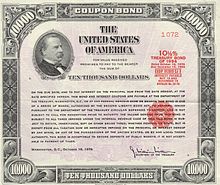
like Sidney Homer used to say- "sooner or later every generation is shocked by the behaviour of interest rates."
Hernan Avella disagrees:
I don't think many people can be shocked, given the data we have from the 80's. Most asset holders are older folks anyways, that have the memories of the Volker era deep in their heads.
Stefan Jovanovich offers:
Edward Chancellor interview
High Interest Rates To “Slay” Zombified Companies | Edward Chancellor & Joseph Wang
Kim Zussman adds:
America’s Retirees Are Investing More Like 30-Year-Olds
At Vanguard, one-fifth of taxable brokerage account investors aged 85 or older have nearly all their money in stocks
William Huggins responds:
i suspect a good part of that boils down to how one's asset portfolio is defined. most studies of brokerage accounts don't account (haha) for the real estate, pension, insurance, or physical assets of those being studied. if most of my income is derived from a secure pension, its (mathematically) a pretty good approximation to drawing the yield from a large investment grade bond portfolio (less the liquidity). owning your home (usual by 85) would similarly constitute a "housing cost equivalent" yield, as would any reliable health benefits being drawn. seen in that way, one's discretionary funds being kept in equities would be quite reasonable.
Zubin Al Genubi reminisces:
Sure would have been nice to own 17% bonds. 5% not too bad though.
Nils Poertner offers:
Big investors rush into bonds after ‘cataclysmic’ year
Capital Group predicts $1tn will flow into debt markets in next few years as investors move to lock in higher yields
Henry Gifford writes:
In the 1970s my father bought some New York City municipal bonds. At the time there were rumors that the city government was going to go broke. I heard my father say “How can the government go broke? When they want money all they have to do is send people bills.”
The city government defaulted on the bonds. It was widely reported in the news as a disaster, with various solutions to the terrible problem proposed. I was only a teenager, but didn’t see a problem with the government not being able to borrow money any more. I still think it would be great. But, most people believed it was a terrible problem, with disaster looming.
My father reacted by buying more of the bonds – “default” meant they mailed his checks one week late. The bonds were triple tax free: no federal income taxes, no NY State income taxes, and no NY City income taxes. The bonds paid 28%. It was the only time in my father’s life that he borrowed money – to buy more of those 28% bonds. I have no idea for how many years he was collecting 28%.
I started buying apartment houses in Manhattan when I was 20. It was normal to pay 12% interest. One time I bought a small building – only four families – with the goal of replacing the 12% seller-financed loan with an 8% bank loan on an owner-occupied property. I moved into the building, fixed it up, but never managed to get a city inspector to come inspect and remove all the violations without inventing some new ones, as I never bribed an inspector. But for a long time I dreamed of refinancing a little bit of my real estate at 8%.
Nils Poertner responds:
tangentially speaking . we would need to have experience from bond traders of the 1970s and 1980s, today is more leverage though and we have more complex system so not sure how much that would really help. collective mind has been in a long mental bear mkts as well. we need nerves of steel in coming yrs and imagination.
Jul
12
ATH and three zeroes
July 12, 2023 | 1 Comment
you keep hitting it to the opponent's weak backhand, but despite the good strategy, the opponent is near match point. the zeal with which the opposition is gloating over the fissures in the opponent is belied by the score.
despite the best efforts of truly knowledgable bettors like mad dog, they can't surmount the 52% hurdle.
Steve Ellison adds:
Most casinos in Vegas have now added triple zero to their roulette wheels, so even more gamblers will lose more than they have a right to. 7.7% house edge??
Vic continues:
in line with the roulette wheels with 3 zeros, on my platform is a prominent command: 'flatten everything'. one is waiting for a command flatten and reverse everything.
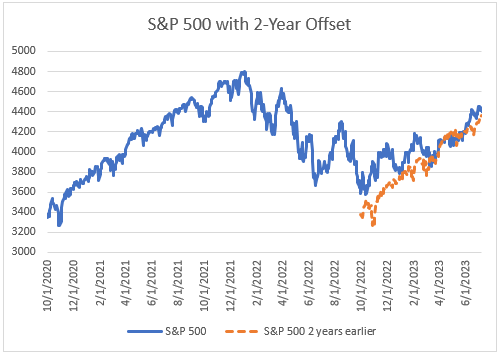
One hasn't heard from the chronic bears lately making fun of me as to when the S&P will make an all-time high. it appears that in Nov 2021, the S&P index was in the 4600-4700 handle and futures were in 4700 handle.
Steve Ellison comments:
The S&P 500 looks very much like it is making a Lobagola along its 2021 price trajectory (orange line). If this pattern continues, the new all time high should arrive by December. I don't know how to test this hypothesis, so for the moment it remains a conjecture.
Vic continues:
thus we are about 5% away form ATH at 4700. if the devoted father increases his prob of winning to old, we should surmount. let all S&P bulls hope for more news of cog decline and hand in till.
Mr. Wonderful's utterances are the perfect example of a distraction display used by so many animals in nature.
at 4500 S&P, we are 5% away from ATH. where are we going? europeans have finally caught up with July, up a few months in a row. S&P should close at ATH. also depends on reg capture.
Jul
9
Markets and books
July 9, 2023 | 1 Comment
a passage in Ed Spec points out that my dad learned to make friends with the referee. he bought Sam Silver some moo goo gai pan. several successful traders indeed apparently the most successful ones are at one with the exchanges.
is is a shibboleth that it pays to bet against the team that was able to squeak out a win or benefited form an error of the other side or won by corruption of some kind. we should realize the same thing applies to politics viz a viz the perfect father - incredible that he leads.
nice drop of S&P of 40 pts on unemployment from 1:30 to close — greatest drop on unemployment ever.
some books read over weekend: The Smiling Country, by Elmer Kelton; Wealth, War, and Wisdom, by Barton Biggs; The Hidden Life of Trees, Peter Wohlleben; Bird Life, by by Frank Michler Chapman and Julie Zickefoose.
and always the first 80 pages of Fifty Years in Wall Street. where are the greats of the 19th century and why did they succumb? the reason that oak trees are crowded out by beech trees, the beech trees shade out the oak trees to cause the oak trees death:
Root competition between beech and oak: A hypothesis
with bonds in the 123 handle lowest in 10 years, agrarians galore should be on guard that further declines don't hurt their man.
Jul
6
The Chair poses a question
July 6, 2023 | Leave a Comment
how has the evolution of regularities in markets made it much harder to beat the 52% accuracy that no sports better can achieve to break even? one way is the ever changing relation between bonds and stocks between years. what else?
Larry Williams writes:
Crude's influence on stocks [has changed over time]
Alex Castaldo offers:
The Great Financial Crisis of 2007 and 2008 revealed a number of regularities that (I believed) would be very profitable in the future, but careful monitoring of them after their discovery proved very disappointing to me. For example, trend following that would have gotten you out of stocks and back in during that decade did not work well in the Covid crisis with a faster decline and faster recovery.
Nils Poertner comments:
a mystery indeed - some folks have lousy accuracies (say sub 25pc) and still do well - since a few things they do on top turn out great, eg, the lousy equity trader who got into ethereum early enough (and out when others got into it).
Kim Zussman adds:
Yield curve inversion from 3 months and 500 points ago:

Hernan Avella comments:
Like sports, the evolution of markets is guided by the fitness of the players. We are not competing against prospective cab drivers trading in the pits anymore. But armies of highly talented people that invest thoughtfully and systematically in every step of the process: Infrastructure, trading business practices, research, execution, recruiting. I have a friend working in one of these highly capable groups. Around 70 people. All markets 24 hours, every single approach possible.
Very few of us from the old days survive. The Chair might be the oldest and longest lasting point and click trader. Such a great competitor!!! Ray Cahnman, founder of Transmarket Group is up there as well.
Vic replies:
the point-and-click survivor owes it all to Lorie and Dimson who taught there is a drift. also one learned not to succumb to conspiracies to margin one out.
Jared Albert writes:
Modern technology, particularly around real time customer segmentation and portfolio correlation, squeezed more value from the 'customer as the product' than before.
Jul
4
Evolution of excellence
July 4, 2023 | 1 Comment
how now the S&P in next periods given a big rise until 30 June? a dipsy doodle with 12 of 14 up next two months, then a decline in September with a fine bull close to end of year.
bribery during 1865-1870. nothing has changed.
the evolution of athletic excellence continues apace. and one can predict that pickle ball will soon advance the way handball did so that all good players have a natural left and hit ambidextrous. i can hit my left as well as my right. what other sports have evolved to excel?
James Sogi replies:
Downwind foil surfing was only invented a few years ago. Now people foil 200 kilometers flying over ocean waves.
Vic continues:
in the 1950's only one handball player Vic Herskowitz had a natural left. now every player hits from both sides with power and natural swing. the same in baseball pitching where 100 mph is de rigueur. what other sports have evolved to greatness?
the monstrous plastic pickle ball makes it much easier than paddle tennis to switch hand with alacrity and effectiveness.
A twitter asks:
Is that good or bad?
Vic replies:
as Sholem Aleichem would say, "it's both good and bad", but regardless we will soon see ambidextrous pickle players winning all tourneys. i would be such if I didn't have stroke.
notice how weak the backhand of best player Ben Johns is:
Ben Johns Backhand Pickleball Highlight
how has the evolution of regularities in markets made it much harder to beat the 52% accuracy that no sports better can achieve to break even? one way is the ever changing relation between bonds and stocks between years. what else?
one sport that has shown no improvement over the years is handball. the players of 100 years ago would beat the present crop with their baby overhand serves 21-5. why?
Athletic performance has been improving steadily for decades - the evolution of sports shows how it keeps getting more difficult to win. how have markets become more difficult?
Jun
27
Games old and new
June 27, 2023 | Leave a Comment

i grew up playing paddle tennis and beat Bobby Riggs in a money match. Paddle tennis is 99% identical to pickleball except that it used a good punctured tennis ball instead of the monstrosity they use in the promoted game of pickleball.
In honor of Alfred Cowles who started the Cowles Commission at Yale and whose articles in Econometrica and the Monthly Weather Review sparked my interest in stock market behavior 60 years ago: after stock market down prev day, expectation 3 days later is 2.5, but after stock market up prev day, expectation 3 days later is 0.7. based on last 7000 obs from 1996.
the grandfather holding the hand of the 4-yr-old as she climbs up the stairs of plane is the kind of thing that most people would be turned off by as it's so obvious.
the old gray mare: Lott-Stossel: Election Betting Odds
Hayek Was Right: The Worst Do Get to the Top
Jun
27
Ergodicity, from Zubin Al Genubi
June 27, 2023 | Leave a Comment
Ergodicity - odds of group equal odds of individual over time. Risk differs in coin toss and Russian Roulette due to absorbing barrier. Adopt strict risk aversion in trading. Survival is key.
Big Al suggests:
Luca Dellanna on Risk, Ruin, and Ergodicity
May 29 2023
Author and consultant Luca Dellanna talks with EconTalk host Russ Roberts about the importance of avoiding ruin when facing risk. Along the way Dellanna makes understandable the arcane concept of ergodicity and shows the importance of avoiding ruin in every day life.
Ergodicity: Definition, Examples, And Implications, As Simple As Possible, by Luca Dellanna
Larry Williams asks:
What the fun of life with modulated risk?
Nils Poertner wonders:
why do so many traders self-sabotage themselves (self-sabotage is perhaps a strong world but from the outside world it looks like that). some deeper religious guilt thing or so? addictions?
H. Humbert responds:
You can get your fun from winning instead of from the risk taking it takes to win.
Larry Williams asks again:
And how do you win without risking???
H. Humbert answers:
You can't. I was reacting to "the fun of life with modulated risk" comment. You can enjoy the risk taking part, the winning part, both, or none. To me, simply enjoying the risk taking part incentivizes the wrong thing, but enjoying winning, the right thing. You could say that simply enjoying taking risks will lead to winning but then every gambling addict would be a winner, so it's not that simple.
Zubin Al Genubi responds:
As a practical matter money management and convex asymmetric payoffs. Recognizing the risk and the extent is a big part of the puzzle. There is a large range from the coin flip to Russian Roulette not quite recognized by static statistics. The time element is important, hence ergodicity.
Larry Williams states:
Risk within reason but still risk - keeps us young!
Jun
24
Capitalism in America
June 24, 2023 | Leave a Comment

Interesting and poignant articles in The Austrian point out that the Fed now owns 2.6. trillion of mortgage securities. it built this up since 2008 and caused distortion in the real estate markets. The fed has a 408 billion mark to market loss on these securities - 10 times the Fed's capital of 42 billion.
The Fed Is Overindebted, Isn’t It?
Wall Street to the Fed: Inflation Is Over. Give Us More Easy Money!
An excellent and inspiring book:
Capitalism in America: A History, by Alan Greenspan and Adrian Woolridge
Chapter 3 of Greenspan's book is inspiring: "In 1914, Americans were able to shave with Gillette, gab on phones, drive a Model T…before that there were more animals that people in cities."
Hany Saad is surprised:
Victor Niederhoffer praising “anything” Greenspan!!!!! Now I know I am in Kansas.
Vic clarifies:
the last part of the book is typical Greenspan propaganda for the progressives.
Jun
19
Apropos of the roll, from Hernan Avella
June 19, 2023 | Leave a Comment
SP futures implied financing rate 5.62%
Sep/Jun spread = 45 points
SP Earnings Yield = 4.85%, -0.95% Real
10Y Yield = 3.72%, 1.55% Real
Interesting to consider that during the previous regime, people were very bullish with the adage of "stocks carry themselves". What do they say now?
Steve Ellison comments:
Speaking as one of those who said, "stocks carry themselves", stocks are not carrying themselves now. The dividend yield on the S&P 500 is about 1.6%, compared with the 3-month Treasury bill yield of 5.2%. It is now a different point in the business cycle as outlined by Philip L. Carret in his 1931 book The Art of Speculation (I have the version republished by Wiley in 1997 with a foreword by the Chair).
Business cycles don't always follow the textbook script, but if I had to guess, the likely next steps are a slow-motion banking crisis (as depositors one by one compare their banks' interest on deposits with the aforementioned Treasury bill yield) and recession.
Mr. Carret appeared on Wall Street Week at age 98 in 1995. At 1:40 in this video:
Louis Rukeyser: What do you do, given your experience, when you think there may be too much froth, when you think there may be a major correction, even a crash? Do you sell all your stocks?
Philip Carret: No, I really don’t do anything … I’ve seen a lot of recessions, and I can live through them, and I can do it again.
Hernan Avella replies:
Thanks Steve. I believe looking at the dividend yield only is folly. You need to add the buybacks (Known as shareholder yield). Currently @ 4.62%.
Steve Ellison responds:
It is worth noting that, based purely on the S&P 500 dividend yield, stocks never carried themselves for 50 years from 1958 to 2008. Nevertheless, the upward drift continued, and there were many bull markets during that time.
I reviewed the Art of Speculation here on December 13, 2007, 49 years into the period of stocks never carrying themselves, noting that it might be difficult to follow the advice to buy when stocks carried themselves. Here is an excerpt:
"Borrowed money is the lifeblood of speculation" (p. 101). Interest rates greatly influence the direction of stock prices. "A bull market undermines itself" (p. 119) as prosperity and increased borrowing for speculation drive up interest rates. One of Mr. Carret's specific methods might be difficult to replicate today. He suggested borrowing money when interest rates were low to buy stocks with higher dividend yields than the interest rate on the borrowed funds. A stock bought in this fashion would "carry itself" and have a high probability of moving higher. With today's much lower dividend yields, such stocks are probably difficult to find today.
Hernan Avella writes:
Some YTD figures [as of 13 June]:
Semiconductors (SMH) +51%
NQ100 + 36%
Commodities -8.98%
Low Vol Sp500 stocks -2.19%
Emerging Bonds, local currency +6.5%
European "Growth" stocks +15%
What happened with the bears in this list?
H. Humbert responds:
What happened? Nothing happened, wrong so far. Old favorites never lead a new bull market, but they are now. Saw an article today, people are cutting back on fries at McDonald's but that doesn't seem to matter. Semis are going gangbusters, but they're not hiring. Anyway, I never sell and buy when I see value regardless of "the market". Bought my first stock of the year two weeks ago.
Humbert H. adds:
Hernan, if you go down the route of buybacks you need to account also for stock issuance, employee options, M&A/deletions from the index, IPOs/additions to the index etc to estimate the net buyback yield. This way it is apples to apples. If you do that you will get a small positive number <1% (you prob want to smooth out considering that buybacks are cyclical).
Tim Melvin comments:
Buybacks and debt reduction play no role in determining of stocks are a carry trade. Cash received versus interest paid.
William Huggins comments:
the free yield on buybacks has been the manipulation of earnings downward prior to announcement of said buyback (and subsequent restoration). its generally done in a small enough amount that its hard to pick up individually (but shows up plainly in large samples). (chair mentioned this back in 2007 i think?)
Jun
18
Tale of two sons
June 18, 2023 | Leave a Comment
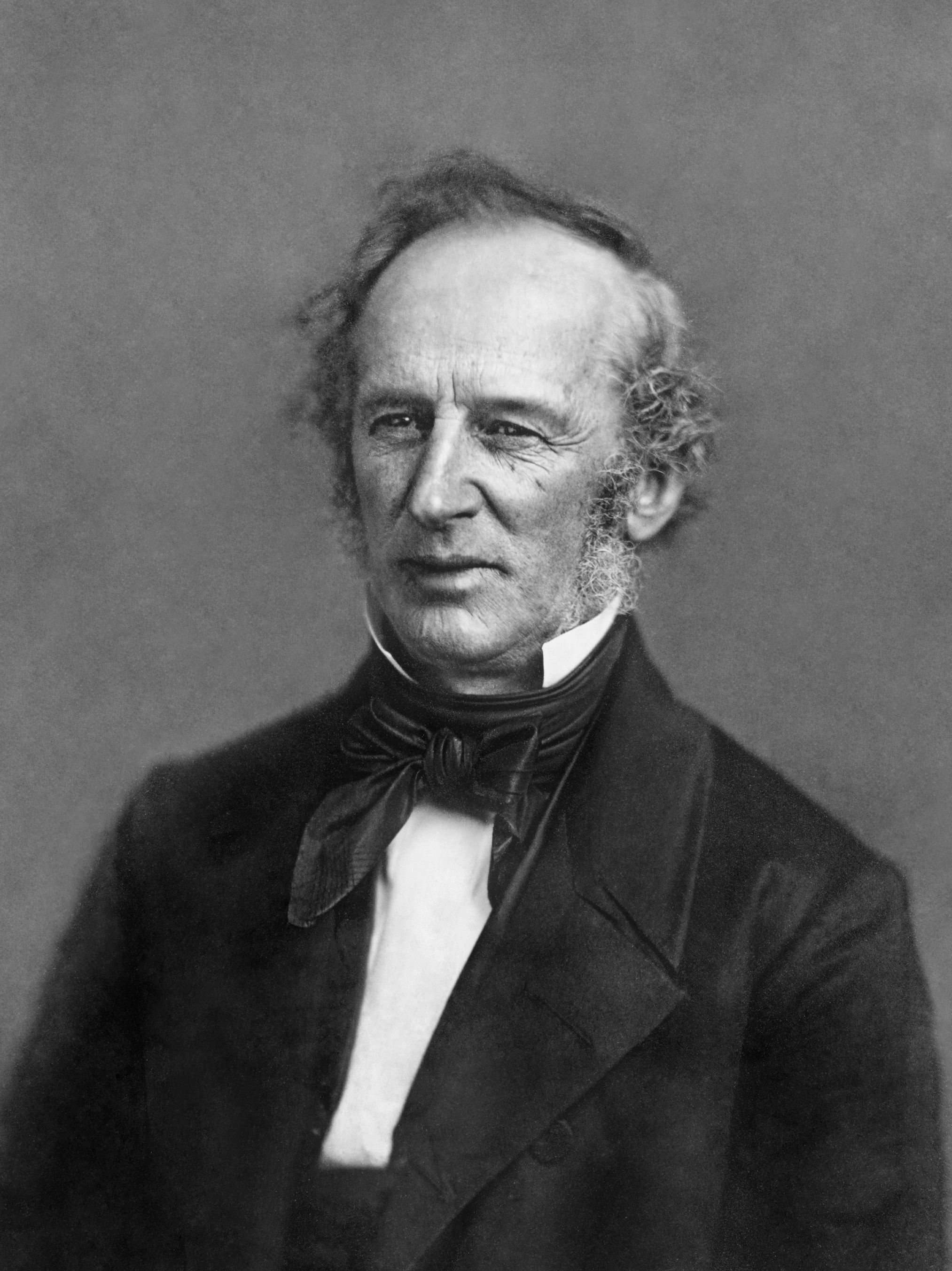
tale of two opposite sons: Cornelius Vanderbilt ("the Commodore") had two sons. one, William, attended to every detail of the business, including signing all checks. the other, Cornelius Jeremiah ("Corneel"), was hooked on faro and borrowed heavily.
the Commodore had an eye for pretty women. when Corneel's prospective father-in-law asked the Commodore about the marriage, he asked, "does she have many silk dresses and expensive jewelry? if she does, Corneel will pawn them when he loses in gambling."
William went on to become the richest man in the world. Corneel was limited to $200 a month which inevitably he lost and borrowed heavily form Horace Greeley to tide him over.
Jun
17
Methods, vig, heroics
June 17, 2023 | Leave a Comment
in my response to critique of my methods I refer to the reason that certain famous investors have succeeded so well. It's due imho to being one with idea that has world in its grip - how this and long life enables compounding to grow apace without concern about service beating you down.
there have been so many nice testimonials to me and my style,- some way over the top that I am becoming convinced that some thing I am close to 7 feet under or at least very close to the Bad One. i am still alive.
much attention has been focused on heightened scrutiny of those who don't believe in agrarianism, but little attention has been focused on the opposite, i.e., the free pass for those who hate enterprise and how this increases compounding exponentially the law of ever increasing vig. in 1940 there used to be 1 minute of advertising for 60 minutes of content. on Yankees game nowadays its 50-50. where else do you find much increased vig. the advertisement for the radio broadcasts for the Yankees are so unpleasant and so frequent that one wishes bad luck to them and can't wait to turn them off. the advertisements themselves all encourage ever-increasing vig thru emphasis on lotteries, parleys and service deals for Kids.
I've Got a Little List (with lyrics) / The Mikado / Gilbert and Sullivan
Lois in on my list and her fellow travelers who don't find anything amiss.
one comes back from dinner and hears a recap of New Deal Economics - increased service rates, replacement of private sector by gov - but it isn't from 1934 but is our most agrarian treasury person.
my passing reference to The Wager: A Tale of Shipwreck, Mutiny and Murder did not do it enuf credit as it tells a story of Anson's heroics and survival every well.
Jun
15
LWV Greenwich Announces the Winners of Its Fourth Annual Student Essay Contest
June 15, 2023 | 1 Comment
LWV Greenwich Announces the Winners of Its Fourth Annual Student Essay Contest
League of Women Voters Greenwich is pleased to announce the winners of its fourth annual Student Essay Contest. The Student Essay Contest is one League initiative that seeks to involve young people in the League’s mission to build an understanding of and participation in the democratic process.
High School, Winner:
Aubrey Niederhoffer, Greenwich High School, Grade 11
Co-Founder and CEO of Amalgam Talent, a eSwatini-based HR agency connecting remote workers in developing countries to global markets. Passionate about international development.
Jun
15
Wagers and squeezes
June 15, 2023 | Leave a Comment

no matter how high they go, most gentlemen don't like stocks. nor do they realize that bonds have to go up to save the banks from marking down their holdings.
10 Qualities of a Modern Gentleman
seems like a good day to review all the reasons that the former president didn't win in 2020. lets start with the big pharma that withheld the announcement that they had an effective vaccine until the day after the election.
Steve Ellison replies:
Marginal voters proverbially vote their pocketbooks, and Mr. Trump had the misfortune to be the incumbent as GDP abruptly contracted by 9%, and unemployment rose to 15% in April 2020.
Vic writes:
yes that's a winner although no evil hand in that. let us not forget the military in their advocacy and demeaning and threats. all the three-letter agencies and the doj. scores of 4-star generals comparing Pres to Mussolini and guaranteeing that they would escort him out of office if he resisted. the professional sports leagues all acting to undermine. Director Wray negating all of Trumps critiques about their bias. another reason for the former golfer to lose was the lineup of all of the Fangs to do whatever they could to do him in.
Gary Boddicker adds:
Constitutionally questionable executive and judicial changes to voting rules in key states, bypassing legislatures and favoring Democrats. “It’s unsafe to vote in person!”
Vic continues:
excellent book for those who like Patrick O'Brian but aren't see salts. none of O'Brian's erudition but author made valiant attempt to research incident.
The Wager: A Tale of Shipwreck, Mutiny and Murder
Also: Shantaram: A Novel
a critique of my methods, lifestyle and answer is elicited on twitter. i don't know when exchange took place - i would guess 15 years ago. I would add to my defense that I was much younger then and also I did not take account of ability of market to squeeze you and margin you out. they and the market inexorably get together by an evil hand to manipulate prices and margins so that you will contribute to the big players so that one day they will do you in and then prices will get back to their norm. one solution is to have good credit. Imagine the palindrome having enuf confidence to withstand the Bank of England and all the banks they control to speculate against the Pound successfully.
Jun
7
Distractions
June 7, 2023 | Leave a Comment
with all the hoopla about the perfect father stumbling - one notes that he can get up from the floor with ease - more important he can create 10 LLCs with beneficiaries of all in family with impunity. the odds of perfect father winning the election now at a max of 38%.
The venerable Sam Eisenstat liked to run overlapping monthly S&P as independent and would predict the next 6 months as momentous with great accuracy.
who is the most corrupt shark now trying to deflect attention by pretending to be anti-woke? perfect example of distraction behavior by spiders.
how much money can one make from Sam while pretending to be vigilant in stopping his predations?
The Folly of Fools is one of the most foolish books i've ever read. the vigilance against deception is very high and no subject is more studied and self restrained.
there are at least 3 big speculators i know who have many daughters with one of them being a bad seed as far as the others are concerned. is this chance? or some hidden regularity?
Jun
1
Steel Box Indicator, from Stefan Jovanovich
June 1, 2023 | Leave a Comment

In the first quarter of 2023, container output contracted by 71% compared to the previous year, with only 306,000 TEUs produced, marking the lowest level since 2010. Drewry estimates that full-year production will not exceed 1.8 million TEUs, the lowest since the recession-hit year of 2009.
Container Production Slumps to Lowest Level in 14 Years, Says Drewry
Henry Gifford writes:
What sort of time lag can be expected between ordering the containers and their actual use? I order cardboard boxes, and they are used to ship goods a few weeks later, I expect a shorter time lag for larger cardboard box users. But I expect it takes time to ramp up steel container production and delivery.
Stefan Jovanovich responds:
Top 10 Shipping Container Manufacturers In USA
Steve Ellison adds:
Maybe the shipping container industry does not have just in time inventory replenishment, or maybe it did, but the policies did not survive the covid pandemic. In a previous career in supply chain management, I needed to be aware of how inventory and decision lags downstream in the supply chain amplified demand fluctuations upstream, on manufacturers for example. This is known as the bullwhip effect.
Pamela Van Giessen comments:
There was an article in the WSJ earlier this year/late last year (the months seem to fly by) that shipping has fallen off a cliff. Part due to less goods needed/wanted, overstock because of covid era over ordering, and backlogs having caught up. Could it be there is an oversupply of containers based on things normalizing and/or a temp decrease while everything catches up?
I have been interested in knowing what the rail freight looks like but haven’t been able to find a source that provides that info (also haven’t looked that hard). Living in a rail town, it was much definitely quieter 6 mos ago than it has been lately. But maybe it’s just more coal out of the Powder River basin for China, India, etc. At least 3 long trains of coal/day. Every time I hear the environmentalists cry about CO2 emissions and how we have to get rid of xyz in the US, I have to laugh at the latest pet peeve (gas stoves & furnaces, increasing energy efficiency in dishwashers, wash machines, etc), it will never make a dent against all that coal being fired up in other parts of the world.
Jeff Watson offers:
Stefan Jovanovich adds:
Container Shipping Industry Faces Unprecedented Slump in Long-Term Rates
The container shipping industry experienced a significant downturn in global long-term freight rates during the month of May, as the contracted cost of shipping containers plummeted by a staggering 27.5%, according to Xeneta’s Shipping Index (XSI®). This marks the ninth consecutive month of rate drops and represents the largest monthly fall ever recorded on the platform.
May
29
in what other areas, apart from financial markets and sports betting, is there vig? and what is really relevant for everyday life? and how to avoid it?
maybe we don't see it that way because of Gell-Mann Amnesia affect.
Hernan Avella responds:
There’s a rich literature on rent-seeking behavior. It’s pervasive, Pharma, Telecom, Agriculture, Natural Resources. Not all lobbying is RS but the majority is.
Vic asks:
is there a universal law of vig where it goes to 2% in all activities like sports betting?
Jeff Watson offers:
I wrote this in 2009 about vig:
The Vig Keeps Grinding Away, from Jeff Watson
Steve Ellison comments:
Games that advertise that they're commission free usually charge the highest vig of all …
Mr. Watson's statement was written well before all the retail brokerages offered commission-free trading, which I contend simply means convoluted execution that costs customers much more than the $7.95 commissions that existed previously. "Where are the customers' yachts?", indeed.
Separately, the way the CME evolved is a good example of the Professor's constructal theory that all systems evolve to increase flow and velocity.
Hernan Avella disagrees:
Your insights on electronic trading seem to lack sufficient grounding. Abundant evidence disputes your hypothesis, highlighting the significance of the percentage extracted rather than the total volume. The evidence is clear that more opaque markets, like credit and emerging debt, are more expensive, for everybody except for a selected group that invests heavily in keeping the status quo. Electronic markets are more transparent, more anonymous, standardized, continuous, centralized, offer multilateral interaction and informationally more efficient.
Zubin Al Genubi responds:
Give the evidence then, if its so abundant, rather than your usual vague negative comments.
H. Humbert comments:
The beauty of long term investing is there's no vig and there are no taxes, other than once or twice in a few years.
The origin of the word is interesting. It's a Yiddish corruption of a Russian (or some other Slavic) word pronounced "vi igrish" or "gain", but it's more like "winning in a game", and the root means "game".
Alex Castaldo adds:
Interesting. The word can be found in online Russian dictionaries.
"vigorish" has a similar pronunciation, though the meaning has changed to be the fee for the game instead of the winnings.
Nils Poertner writes:
we want to battle against vig in all aspects of our lives. almost build a register where there is vig and share it with family and friends.
Henry Gifford comments:
Vig is one of the many things I find it helpful to view with an understanding of the laws of thermodynamics. The laws of thermodynamics describe the movement of heat in the universe, and because all energy is either heat now or becoming heat, they could be called the laws of heat.
The idea of “follow the money” to understand a system or organization or relationship is closely parallel by “follow the heat”, and heat follows clearly defined laws.
In approximate inverse sequence to importance, the fourth law says that if things A and B are at the same temperature, and things B and C are at the same temperature, then things A and C are at the same temperature. This is also called the zeroth law because it is so basic it should have been thought of first. The fourth law reminds me of the unlikelihood of much true arbitrage existing.
The third law says nothing can be cooled to absolute zero, because that would require something colder to absorb the heat, and nothing can be colder than absolute zero.
The first law says energy can neither be created nor destroyed.
The second law, most analogous to vig, says that heat always flows from hot things to cold things, and never flows the other way on its own. This law is the most profound, with many implications.
For example, one implication of the second law is that a car engine cannot convert all the energy in gasoline to mechanical energy - some will leave as heat that is not useful (except for heating the passenger compartment during the winter). Vig. A utility power plant burns fuel and about 31% of the energy in the fuel gets to the customer’s electric meter - 5 or 10% transmission losses (heat escaping from wires is “lost” - see first law), the rest is waste heat at the power plant. Vig. Various devices can reduce the amount lost to heat, but these devices have too high a vig themselves.
Big Al adds:
The first law makes me think of markets (not the Fed or banking) where money is neither created nor destroyed. For example, in the FTX collapse, the media talked about all the money that was "lost". But of course it wasn't lost, it was simply transferred from one group of entities to others.
Hernan Avella critiques:
This line of thought fails empirically when looking at deflationary crises, loss of crypto keys, central bank operations, bad loans, bankruptcy.
Henry Gifford responds:
Loss of crypto keys and central bank operations both follow the first law - printing money leads to inflation (if inflation is defined as a lowering of the value of money), destroying some of the money in circulation by losing keys, or destroying a dollar left in the pocket of clothing getting washed, increases the value of the remaining money.
I have heard the term “deflationary crisis” before, but don’t believe there has ever been a crisis whose root cause is the increase in the value of money.
In the saving and loan crisis of the late 80s, lenders sometimes asked borrowers to make sure they borrowed enough to make the payments for two years, as it was taxpayer money being lent out, and the lenders were collecting enough vig to make it worth going under I s couple of years.
A bankruptcy stops wasteful behavior, and the threat of bankruptcy causes people to take steps to prevent it. But I guess the waste in a government can continue forever, apparently violating the first law, while also proving that a perpetual motion mechanism really can exist, violating both the first and second laws.
Larry Williams comments:
printing money leads to inflation—data does not suggest that to be true
May
29
Bones, books, basketball, and budget negotiations
May 29, 2023 | Leave a Comment

Tony Hawk's body, according to Hampton Sides, looks like barnacles cover his hand. he has broken every bone in his body. He looks with disdain upon anyone worried about a broken arm of some such.
Often the last second of a market session changes the whole complexion. for example at 4:15 et on May 25, the S&P was 4150, near a 20-day low, but then Nvidia was announced. and in two days the S&P changed course rising to a 20-day hi at 4230. query: did the move have anything to do with zero-day expiration options?
books read and highly recommended this weekend: Darwin's Dog: How Darwin's Pets Helped Form a World-Changing Theory of Evolution by Emma Townshend, Trees: A Complete Guide to Their Biology and Structure by Roland Ennos, and Political Geography by Martin Glassner and Chuck Fahrer.
Darwin to Galton in a letter of 1840: "I am studying minute unimportant things while you are dealing with Big things like Rhinoceroses and Hippopotamuses." Darwin relied on a Galton cousin for breading info on cattle and dogs.
Only a small part of a tree's biomass is capable of photosynthesis, but trees are excellent competitors for light. They hold their leaves above all plants and shade them out. How is that relevant to the best performing nasdaq stocks in last 6 months having superior performance by end of year?
did Miami let it's guard down with 1 second to go into going after rebound? instead of high fiving, as is the custom when a crucial shot is made or missed, should Miami have been on its guard and fighting for the rebound until the end?
The ending of the Celtics game reminds one of the many astonishing wins that Tom Wiswell pulled out on the last move frequently a 2-against-3 win for Wiswell.
with by partisan wins like this, McCarthy must have regulatory capture forecasted for 2024 at a max. that's what the big boys want.
Biden says budget deal reached, takes ‘catastrophic default’ off the table
May
23
Speedos, bonds
May 23, 2023 | Leave a Comment

i thought i had played every racket game but Susan showed me a new one she saw when in Croatia with many grandkids: handball in the water with a water ball. apparently you have to wear very tight speedos when you play. Reminds me of Palindrome.
apparently beach ball is more popular than pickle ball. a ridiculous mutant game to me. but it does teach you correct pronation for serves. all players really get the racket way back with terrific torque on serve. problem is no one can return serve.
most gentlemen don't like bonds even after 7 in a row. happened 7 times since 2011. only a speculation - no evidence to support it - but to what extent are the sequence of 20-day lows in bonds designed to help the perfect father get a face saving deal?
an agrarian plies her trade somewhat shamelessly:
Yellen Warns Again That the U.S. Could Default as Soon as June 1
May
22
Excellent books read
May 22, 2023 | Leave a Comment

excellent book read over weekend, highly recommended: Friedrich Hayek: A Biography by Alan Ebenstein, and Freedom's Furies by Timothy Sandefur. the Hayek book introduces my to Edwin Cannan, and Friedrich von Wieser. I learned many things, eg Oskar Morgenstern was part of Mises circle.
Hayek's theory of business cycles very relevant to today, depends upon fed keeping interest rates too low and early stages of production being replaced by consumers.
Finale: Late Conversations with Stephen Sondheim a book that makes you feel ugly after reading it. Sondheim such a bad persona but good on harmony.
Sondheim in a typical gesture cuts off New Yorker interview after 3 months and 48 hrs of interviews because interviewer asks him about Webber.
an agrarian shamelessly boosts the perfect father: JANNET YELLEN SAYS ODDS OF PAYING ALL BILLS BY JUNE 15 `QUITE LOW'
bonds with 7th day down in row refusing to bail those who are stuck with problems so far.
one of Hayek's major points was that gov planning leads inevitably to total restriction of consumer choice. what do we have now saving us - gas stoves, electric cars, air conditioning, tipping - what else?
May
20
Bullish despite
May 20, 2023 | Leave a Comment
the more he's complicit, the better he does, and the better for market. when I won a number of National tournaments in a row, not one fan in gallery was rooting for me. Reminds one of reason that S&P is bullish despite. some excellent ideas about unanimity in favor of the idea that has world in its grip (very favorable for S&P) in Holman Jenkins article in wsj today:
John Durham’s Report and a Presidency in Crisis
anything to help Mr. Perfect (the good one forbid they should violate their institutional preferences):
Fed Officials Face ‘Loathsome’ Playbook for Debt-Ceiling Standoff
one posits that 5 or 8 of the NASDAQ 100 always account for majority of move. that's the way of all distributions especially normal and what they used to call Pareto. and why would it be bad if it's greater than usual?
thing missing is all fellow travelers asking when S&P will hit an all-time high. others who refuse to adjust to change wonder how S&P can go up while the perfect father improves his odds every day. ask the 3-letter agencies, the professional sports leagues, and the consumer bigs.
a personage who has never had an economics course and is a master at sucking up to the current boss talks about the separation principle and the lags in policy. sounds good. now the Brooklyn acolyte must say how important raising the debt ceiling is. a 1-2 punch.
it would be good if someone on the favored side of the aisle were to reduce centralized influence on individuals ability to choose.
a shocking anomaly: the perfect father actually for once loses prob of winning on grounds that laundering thru 19 companies is worse than improprieties with the opposite sex. that's the only explanation for why we are not visited with another 20-day high in S&P.
May
18
Simple modeling, from Zubin Al Genubi
May 18, 2023 | Leave a Comment

What are the most basic market states traders might need to model?
1. Going up
2. Going down
3. Reversing
Ranges, trends are subsets of the 3.
Next step is modeling what simple mechanism causes the 3.
Hernan Avella writes:
There are no “simple mechanisms”. But I would start with the microscopic dynamics of “the turn”. Yesterday [2 May] was a good day to study.
Big Al offers:
An interesting thought experiment is to imagine that you have a chart of a random walk but you still have to trade it. Money management, trade sizing, stops, limits - could you still trade it?
Zubin Al Genubi responds:
Random walk with drift would be the default basic state (S) with random factor u say with sd2. What simple rules might model market activity. Like ants and bees following simple rules but building coordinated complex structures. Adam Smith first mentioned emergence in his invisible hand.
Hernan Avella responds:
Isn't this the basis for most uniform trading that occurs?. While the other big chunk of participants "think" they have a model, "think" they have patterns, but are essentially doing a version of the same?
This reminds me of the infamous Kirilenko paper:
We examine the profitability of a specific class of intermediaries, high frequency
traders (HFTs). Using transaction level data with user identifications, we find that high frequency trading (HFT) is highly profitable: 31 HFTs earn over $29 million in trading profits in one E-mini S&P 500 futures contract during one month. The profits of HFTs are mainly derived from Opportunistic traders, but also from Fundamental (institutional) traders, Small (retail) traders and Non-HFT Market Makers. While HFTs bear some risk, they generate an unusually high average Sharpe ratio of 9.2. These results provide insight into the efficiency of markets at high-frequency time scales and raise the question of why we don’t see more competition among HFTs.
Zubin Al Genubi adds:
Yes HFT guys probably have done it at market maker level. Chair says yes you can trade random walk with drift with buy and hold due to drift. MM and HFT may also have order flow info they buy which may or may not be a different process.
Adam Grimes writes:
Absolutely and of course… that's why the hurdle rate for any test has to be the baseline (unconditional) drift in the sample.
[Re the "thought experiment"] Unless I'm missing something, not profitably (over a large sample size). All these other things are important, but they, at best, keep you at breakeven in a RW environment (i.e., no "signal" or "edge" possible). In real life, a comparable approach keeps you paying the vig with consistency. As for the thought experiment, correct?
Big Al responds:
For me, the thought experiment doesn't have a correct answer but forces me to think more rigorously about issues such as money management, trade sizing, stops, limits.
Andrew Moe writes:
Chair often advised that rather than considering just up/down or above/below a given threshold, one might look at "up big"/"up small"/"down small"/"down big" as classifiers. This is particularly salient in information theoretic calcs (ie, entropy) but interestingly moving to deciles offers little or no improvement.
Zubin Al Genubi adds:
I've been interest in agent based modeling of complex systems using simple rules. A new wrinkle would be adding a random factor following power law distribution in tails which stock data displays.
Jeff Watson responds:
That sounds like a perfect task for ChatGPT.
Gary Phillips adds:
Absent from the previous post on modeling was any mention of time frame. There is greater model risk the shorter the time frame you’re trading in, because price action is more random. Realized volatility, liquidity, gamma, and 0DTE options can and will, shape the trading environment. And, has been demonstrably evident the past 10 weeks, each day has its own ecosystem and market structure. This makes modeling in a short time frame a fool’s errand, and its participants useful liquidity providers.
As one moves to a higher time frame, positioning, money flows and sentiment become most important. Fund flows and positioning, along with cross asset flows, target dated funds, corporate buybacks, seasonal factors, and factor flows take on more meaning.Yet, even if one could ascertain the above factors with certainty, he wouldn’t know if the data was priced into the market or not.
And finally, while there may be a lag or even a disconnect on a long term time frame, macro economic factors, geo-political factors and CB policy, will inevitably exert its influence on the market. But, we don't know if we have experienced the event(s), nor know how traders will react to the event(s), that will finally move the market out of its current trading range.
A pragmatist's model then, is to know the market one’s trading, and to have a well defined process. Then one can make (bias free) observations and accurate, probability-based assumptions.
May
18
Running’s supreme challenge, from Steve Ellison
May 18, 2023 | Leave a Comment
"[Peter] Thompson has previously worked with running brand Hoka to develop carbon-fiber-plated shoes and delivered a workshop on the performance-enhancing effect of “super shoes” and “super spikes” – as they are now ubiquitously known – at the World Athletics Championships in Eugene, Oregon, last year.
The carbon plates, Thompson says, function as “spring-like devices” and give runners more energy return compared to traditional shoe models.
According to data he collated, between 30 and 38 athletes competing in NCAA Division I indoor track races ran sub-four-minute miles each year between 2015 and 2021; that figure has increased about three-fold over the past two years to 90 in 2022 and 97 in 2023, he says."
Larry Williams responds:
I've been running is these [carbon-fiber-plated shoes] for 2 year. not sure about bounce but much easier on your legs = better endurance.
May
13
A fundamental principle
May 13, 2023 | Leave a Comment
The playoff images and all other games illustrate one of the fundamental principles of a successful life: Never put all your eggs in one basket - the mouse with one hole is quickly taken. essential for market success also.
the Knicks relied on Brunson exclusively - the Warriors relied on Curry exclusively with wristy shots with no hope of subsequent action. when the wristy shots failed, they were gone. What other illustrations of this principle do you have?
How is this related to market sense? a million ways. the foremost is never go for a regularity that leaves you with one exit based on a singular event. don't go for short term profits. what else?
May
10
Character(s)
May 10, 2023 | Leave a Comment

most gentlemen don't like stocks.
Most Gentlemen Don't Like Love
How to Succeed in Business Without Really Trying (1967)
the worse the polls, the better the odds - like the market - the worse it looks the better it is.
gas stoves, eternal flame, air conditioning, what else? how has consumer's ability to choose been restricted, and how does this cause inflation? lady follower at the treasury can always be counted on for support of expansion of direction from above.
two biographies of great men: one leaves you sick, A Most Remarkable Fella: Frank Loesser and the Guys and Dolls in His Life: A Portrait by His Daughter; the other Theophilus North by Thornton Wilder.
Loesser was a great composer, of Show tunes, lyrics, and popular songs, but the book doesn't say anything about how he composed the music, the harmony, rhythm, melody, et al. but we learn about his drinking, smoking, womanizing, and chiseling all his players. Mien was similar to Rogers.
Loesser was a great business man - similar in all his personal characteristics to Rogers. Wilder on the other hand was always helping people, didn't drink, and teaches you about Goethe, Shakespeare, Goldsmith, Homer, Bach, and other greats.
one of the problems of a malfeaser is that when your associates know about the bad deeds, you can't say no to them. It is for this reason that the shrewd palindrome who I worked for intimately for 10 years was very careful not to involve or disclose to me any such deeds. Those currently in high office have a similar monkey on their backs.
May
10
Sell in May and go away, from Big Al
May 10, 2023 | Leave a Comment
Lately I have seen a lot of "sell in May" analysis with this being a good example:
Chart of the Day: Sell in May S&P 500
So I looked at all SPY years and calculated the returns for two periods: (1) "summer", end of May to end of October, and (2) "winter", end of October to end of May:
For owning "summer", $100 became $186.
For owning "winter", $100 became $790.
Seems like a clear victory for "sell in May", except for what they always leave out: buy and hold over the whole period turns $100 into $1474.
H. Humbert adds:
It's obviously a much more ridiculous idea if you consider capital gains taxes, which would be short-term if you truly buy and sell for the winter.
Jeffrey Hirsch replies:
Issued my Best Six Months MACD Sell Signal on April 25 for Dow and S&P. Everyone gets so hyper focused on "sell in May", they forget to "buy in October and get themselves sober," as I like to say.
Larry Williams provides perspective:
Never forget: Prior to 1950's best was to buy in may to make some hay….Long gone but once in the data.
Jeffrey Hirsch responds:
Thanks for the Reminder Larry! So true. Here's the chart I use to make that point:

Steve Ellison writes:
For any seasonal pattern, I ask, "Who is the sucker at the table who will buy too high at one time and sell too low at a different time?" And do said suckers have a reason to continue their behavior into the future? The late Mr. E said that a lot of money flows into the stock market at the beginning of a new calendar year as, for example, high-income people who maxed out their 401(k) contributions the previous year can resume.
There was an annual cycle of profitability at the multinational technology company where I worked for 20 years; conveniently, their fiscal year end of October 31 aligned exactly with the Best/Worst 6 months thesis. First quarter, ending in January, was usually strong as it included both the Christmas season and the end-of-year "budget flush" in which corporate managers had to spend any surplus lest their budgets be cut the next year. Second quarter, ending in April, was also usually strong.
Third quarter, ending in July, tended to be a bit weaker as summer started. Fourth quarter, ending in October, was a mixed bag as back-to-school selling season was offset by European businesses mostly shutting down in August. But with commissions and bonuses on the line, the sales force would work 24/7 in the second half of October to close deals and bring in a strong quarter.
Additionally, with third quarter results being reported in mid-August while Wall Street was in the summer doldrums, the company was disproportionately likely to report any major writeoffs or other bad news in the third quarter.
May
7
Shibboleth, pickleball
May 7, 2023 | Leave a Comment

there is a shibboleth among scientists that if an effect is true, the greater the magnitude the more likely it is to hold. nothing can be more detrimental to the market player. the intricacies of deception that the market plays are even more ingenious than those played by spiders and other animals and insects.
some pickleball thoughts: In Brooklyn, especially Brighton Beach from 1930 - 1977, a game almost identical to pickleball was played by thousands including my whole family - it was called paddle tennis and played the same in New Zealand.
the game was very popular in the 1920-1930s and was a mania played in private facilities on the rooftops of big buildings in Manhattan. It was played with a tennis ball sometimes punctured and that bail is still most appropriate and better athletically than the contrived plastic and ugly ball now in use. The game was and is completely athletic with all good players rushing to the net on the serve and return of serve. the one area that the old good players were much better than the current is that they all had topspin backhands or lefts.
Apr
29
a terrible warning form 1956 Road to Serfdom: the bulk of the intellectual community almost automatically favors any expansion of government power so long as advertised as a way to protect individuals form bad corps, relieve poverty. anything goes, "protect the environment, promote equality."
one has been reading Forty Studies that Changed Psychology in conjunction with my visit with several prominent psychologists at Gail's 80th. while the personages don't subscribe to these studies, I am amazed at the the self-serving biases.
studies in the main don't take account of multiple comparisons (they tend to implictly look at many hypotheses and choose one that works). I will review some of these studies but the study on predicting the outcome of marriages with a slope as the key confirmation is terribly indicative.
a good thing to keep at hand when visited with a loss in markets or life:
Why the Giannis Antetokounmpo ‘Failure’ Speech Is a Viral Phenomenon
a little banking-crisis news is what the dr. ordered to set everything up with bonds and stocks at 20 day highs.
how does the next 8 months look given that the bonds and S&P are up during the first 4 months? it has happened only 8 times since 1996: 2010, 2011, 2012, 2013, 2014, 2015, 2016, 2017. strangely that run of 8 years up was the only times they were both up.
during that period the S&P advanced from 10325 to 27028. that 170% run were the golden years. S&P fell once in 2011 by 6%, in 5 of those remaining years, the S&P rose to end of year by 10%, the other two just a small rise. all prices adjusted for drift and contract changes.
How is the S&P during next 8 months given bonds and S&P up first 4 months? predict up 7% in next 8 months. strangely the next two months looks down with the last half of year showing a 8% rise. bad however is refusal of Germany to catch up to US. depends imho on whether perfect father continues to stay ahead in presidential odds. of course with 8 observations all clustered form 2010 to 2018, margin of uncertainty is great.
Apr
27
Liquidity Builder, from Bartley Madden
April 27, 2023 | Leave a Comment
Liquidity Builder - a patent portfolio for a system to trade securities more quickly (larger retail orders) at close to the midpoint of the bid-ask spread while eliminating market makers and payment for order flow.
Five key points. First, the brokerage industry relies on payment for order flow from market-maker firms like Citadel Securities. Investors are told that their trades have achieved “price improvement” when a buy order is executed below the ask price or a sell order is executed above the bid price. This “price improvement” may be as small as one-tenth of a cent. However, how often have you experienced displaying your limit order as the best bid or ask and before the other side can hit your limit a market-maker jumps in front to execute a trade often at one-tenth of a cent better than your displayed limit price?
Second, the Liquidity Builder (LB) platform reflects a different view of the trading world. As the order size increases, the task is to minimize the time to execute the entire order at a price close to the midpoint of the bid-ask spread.
Third, contrary to the conventional practice of time priority for limit orders at the same price, LB provides for size priority. The largest order, at a given limit price, is first in line to be executed regardless of the time when it was placed.
Fourth, The LB platform eliminates market-makers and would be a magnet for larger orders and with increased liquidity, the platform becomes more valuable as the number of participants increases.
Fifth, the LB platform is secured by a patent portfolio with wide reaching claims. Those claims include the implementation of a larger-order-first system plus a variable price limit in which the limit price varies depending upon the number of shares traded.
In summary, the retail investors with larger orders would gain the opportunity to quickly complete their entire order at a price close to the midpoint of the bid-ask spread whereas the institutional investors would achieve a price somewhat better than the midpoint of the bid-ask spread. I have had discussions with exchanges and large brokerage firms and they have told me that the LB would work but it would disrupt payment for order flow and their principle of equal treatment (equally disadvantaged?) for all investors. One strategy may be to start with a trading platform solely for institutional trades; prove the concept works, and then expand. Ideas are greatly appreciated. My website is LearningWhatWorks.
Apr
25
Books, a birthday, and Galton
April 25, 2023 | Leave a Comment

great books read over the weekend during my trip to Austin: Our Town by Thornton Wilder, The Road to Serfdom by F. Hayek, Mathematical Biology: I. An Introduction by JD Murray, Life of Francis Galton vol. 1 by Karl Pearson. reviews of each forthcoming.
But experience is often fallacious in ascribing great effects to trifling circumstances. Many a person has amused himself by throwing bits of stick into a tiny brook and watching their progress; how they are arrested, first by one chance obstacle, then by another; and again, how their onward course is facilitated by a combination of circumstances. He might ascribe much importance to each of these events and think how largely the destiny of the stick has been governed by a series of trifling accidents. Nevertheless all the sticks succeed in passing down the current, and they travel, in the long run, at nearly the same rate. So it is with life, in respect to the several accidents which seem to have had a great effect upon our careers.
- Francis Galton, Journal of the Anthropological Institute, 1875, p. 391.
volume 1 of Pearson's Life of Galton is devoted mainly to the great man's childhood, his ancestry especially on the mother's side, and his relation with his cousin Charles. It is a moving and memorable chapter. How did I come to read it over weekend?
it was my first wife's 80th birthday, and she managed to keep all the books and paintings. While the great personages among her friends passed by at the party hosted by my daughter Katie, I saw vol 1 on her copious book shelves and gave myself a treat by rereading it.
when i presented this painting at a Galton meeting in London, the speaker decried Galton's lack of Mathematical rigor and the tradition was "no feedback from the audience". Subsequently Stigler showed how nonsensical that claim was. It is interesting and telling that at a meeting designed to honor Galton, even his greatest followers were afflicted with shame. it is amazing how good mathematician can be so foolish when venturing out of his own field. the same is true when quants take a gambol on markets. and I would guess the same is true of chat gpt.
the big circular thing in the background is the cyclone imported from the Columbian exhibition of 1899. the cyclone is still packed even though the Dow had declined from 290 in 1929 to 70 today. the construction in the North is the Trapeze designed to give soldiers training.
my comments about sticking to your own last for math people was based on Murray's foray into psychology quantifying likelihood of marriage dissipating based on Gutman's work which is completely overdetermined et al.
David Margulies in his review of Our Town calls it the great American play. "it's all there, the passages of life." there's no scenery and no curtain. If you appreciate the commonplace and the wisdom and greatness of the common man or woman you will love this play. Although I had seen the play a few times, I never appreciated its greatness until I reread it this weekend. It inspires me to write a play based on my experience. "no curtain, that's Arthur Niederhoffer taking his physical test for being a policeman in 1937."
Road to Serfdom of 1942 is all too prescient. "the emphasis shifted from gov administered production activities to indirect regulation of private enterprises and to gov transfer programs." look at a typical day in gov control. no meat in nyc, no private money for everyone else.
"coordination of men's activities through central direction leads to serfdom. also central direction is a road to poverty." intro to Road to Serfdom.
Apr
22
International (viz the USA) diversification, from Big Al
April 22, 2023 | Leave a Comment

Caught a discussion of the benefits/drawbacks of international diversification for US investors, so I had to do at least some basic counting and found that over the last 10 years, using weekly % changes, SPY and VXUS (Vanguard ex-US ETF) have a correlation of +0.85. But SPY provided twice the return (155% vs 74%).
If you want an uncorrelated asset, EEM (MSCI Emerging Markets ETF) had about a zero correlation with SPY or VXUS…but a return of about -10%!
Hernan Avella responds:
This is a rather unsophisticated way to look at the issue of diversification. How about you extend the lookback period, run some simulations, perhaps including a withdrawal rate. Anyways, to some extent I agree with the idea that US investors might be ok with a bit less international diversification vs investors from other countries. 20-30% should be ok. I believe all cap funds for international might not be optimal, I prefer to use cheap multifactor funds. Mother Vanguard is recommending 40+% in foreign.
Starting period is a bit unfair to US equities, but it's the longest overlapping period of the 4 funds. Since Jan 1999, cagr and correlation:
S&P 500 +6.97%
International value (DFIVX) +6.02% cagr .82 corr
Emerging value (DEMSX) 10.52% cagr .75corr
China (MCHFX) 10.79% .53 corr
The framework on a forward basis should be robust/agnostic to globalization - deglobalization, war, currencies crisis. Passive, Cap weighted is a good starting point.
Big Al replies:
Yes, different lookback periods and different funds give you different results. My point is that it's hard to sell people on diversification given the last 10 years.
John Floyd adds:
How do we best consider this on a forward looking basis?
1. What about a reversion given massive US outperformance vs ROW past 10 years plus led by tech mega caps?
2. What about massive reshoring to NA (Canada, Mexico, US) of US and non-US firms given COVID, geopolitics, etc.
3. China had one of the greatest credit booms in history with the speed and size (beyond Japan in 80s, US in 2000s, etc.), that game is over.
H. Humbert writes:
The Sage has Japan in his sights:
Warren Buffett’s trip to Tokyo is seen as a ‘stamp of approval’ for investing in Japan
“For Japanese institutional investors, this really is now the stamp of approval that Japan can deliver superior returns,” Monex Group’s Jesper Koll told CNBC’s Street Signs Asia.
BTW, I had owned exactly one Japanese stock in my life prior to last year, and obscure bra maker, and it hasn't gone anywhere, literally. But in the beginning of last year to me Japan started appearing really attractive, especially for dividend-paying value stocks which is the only kind I buy, so I bought two stocks: TAK, at the beginning of the year which so far has provided a 24% return not including the 4% dividend and KNBWY a year ago which provided an 11% return not including a 3% dividend (both are documented online at the time of purchase). Nothing to write home about but better than the market. If you consider that they are one of the largest pharma companies and beverage companies in the world selling for peanuts, you couldn't find anything of comparable value and safety profile in the US at the time.
Hernan Avella asks:
Mr Humbert, what % of your portfolio did you put in 2 stocks?
H. Humbert replies:
1% for the first one and 0.5% for the second one. Since I own over 200 stocks that's my typical purchase size for something I don't have any particular conviction about. I don't believe in concentrated portfolios since (a) I don't trust my own judgment THAT much (b) I never sell other than in rare cases for tax loss purposes, so this way regardless of what the stock does it never becomes a critical part of my portfolio so I have to trim it and pay taxes.
I also bought four British stocks, so pretty soon you run out of percentage points this way, but way over half of my purchases last year were in foreign stocks. I found much better values abroad, but the European stocks had different reasons to be more attractive than the Japanese ones.
Apr
20
It little profits
April 20, 2023 | Leave a Comment

the greatest imperative for disaster is excessive vig. e.g. trying for a little profit during the day. the other day there were 60 bonds offered at 1 tick above the last, e.g., 129 03 bid 60 offered at 12904. i bought 50 at market and i got filled at 129 05. tell me this is fair.
more important than the unfairness of this all: how in the name of the Bad One can you hope to make profits going for a few ticks in bonds or 1 1/2 in S&P. when I am interviewed, the interviewer is likely to say, "of course the way to go is to make small profits when available." i always say that's a certain disaster. impossible. tell me how it's possible to make money in the zero-day expiry options. I wish to learn.
old faithful reminds me of the venerable and sapient Alan Millhone. I wish I was as wise as he. I don't know what the certain disaster in chess is. But in checkers it's going for a shot. I never played with a good player who succumbed to a shot, i.e., a 4 for 3 or some such.
guaranteed to happen: the chat ai recommends quick scalping as the key to riches.
Apr
18
The Bourgeois Virtues
April 18, 2023 | Leave a Comment
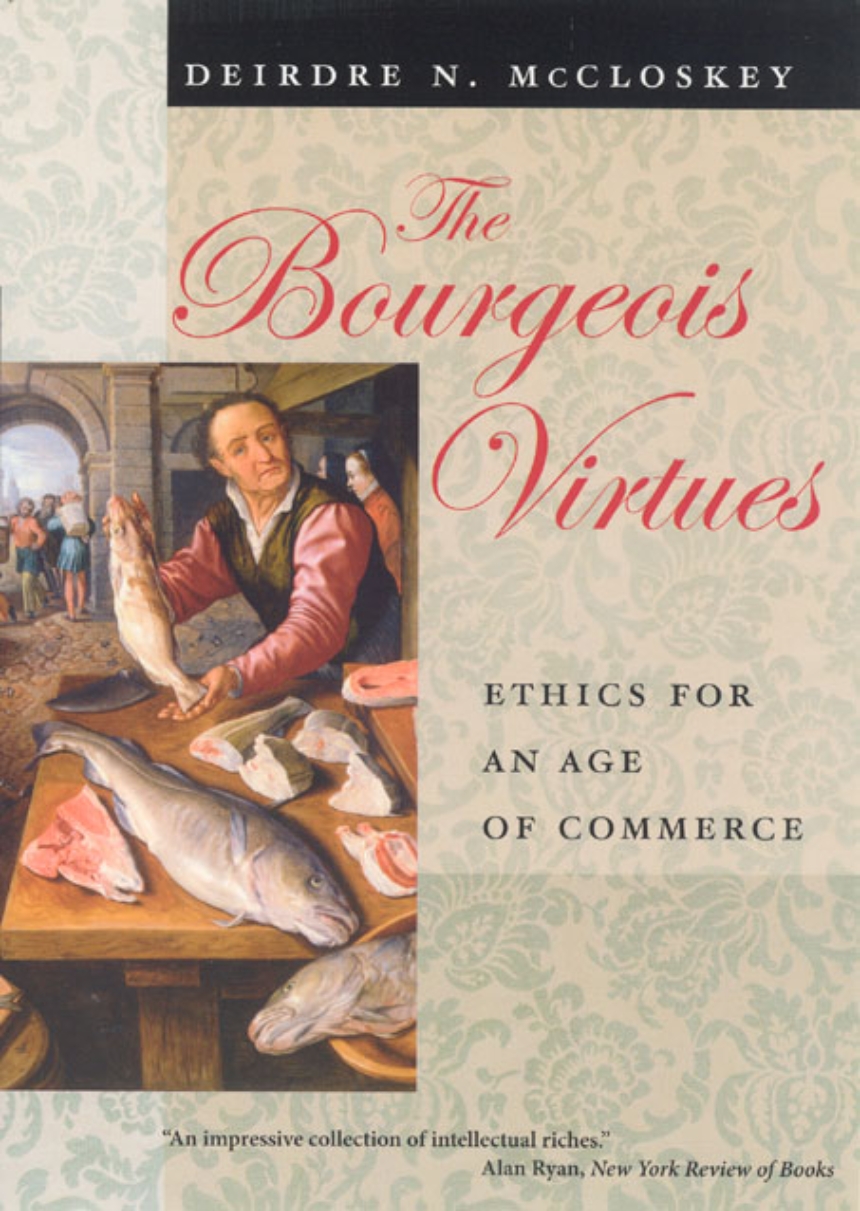
The Bourgeois Virtues: Ethics for an Age of Commerce shows the contributions of entrepreneurs and private property especially originating in the Netherlands.
One can admire, appropriately, the entrepreneurial vigor of heroic figures, an in 1958, for example, the Austrian sociologist and anthropologist Helmut Schoeck did: "We tend to forget that mankind's emergence from stereotyped and stagnating ways of life, on low subsistence has exclusively depended on the emergence of independent and enterprising individuals…who had enough resistance to escape from social controls… imposed in the name and interest of 'the whole society.'"
– Deirdre Nansen McCloskey, Bourgeois Equality
McCloskey makes the point that it is the emphasis and praise of society for entrepreneurs like Jobs and Musk that creates the benefits and material well-being of society.
It is clear that we are in the opposite kind of society now where entrepreneurs are vilified and held up to scorn — as witness that no bio of Baron Coleman. and countless other great benefactors who start businesses are ignored. yet the death of the most minor actress or sports figure is cause for great acclaim and promotion.
nobody asked me, but…Gunsmoke and The Collected Stories of Jack Schaefer cover the same 1860-1880 period, but Schaefer's stories are much more poignant.
Apr
16
Hayek, Barron Coleman
April 16, 2023 | Leave a Comment
nobody asked but…one of best ways to understand today's developments is to reread Hayek's The Road to Serfdom. the 1956 introduction is all too prescient. the zero-day options seem like a magical formula for vig. the ETF's using zero-days strategies must be great shorts.
query: what are the chances for a Barron Coleman day on Monday? a Barron Coleman day is named after one of the most remarkable and gifted men I ever met. He was the founder of two billion-dollar companies and he was a golf champion and musician. he was a great salesman. when you asked him how he was, he liked to answer "everything's up except my widdler." a Barron Coleman day is one where both bonds and S&P are up.
in a grievous omission I cant find a life or legacy of Baron Coleman or references to him for building Hospital Corp of America or Hospital Affiliates. Hopefully some readers will fill in details of this great man. (See Baron Coleman legacy.)
Apr
14
A special BBQ desert, from Sushil Kedia
April 14, 2023 | Leave a Comment
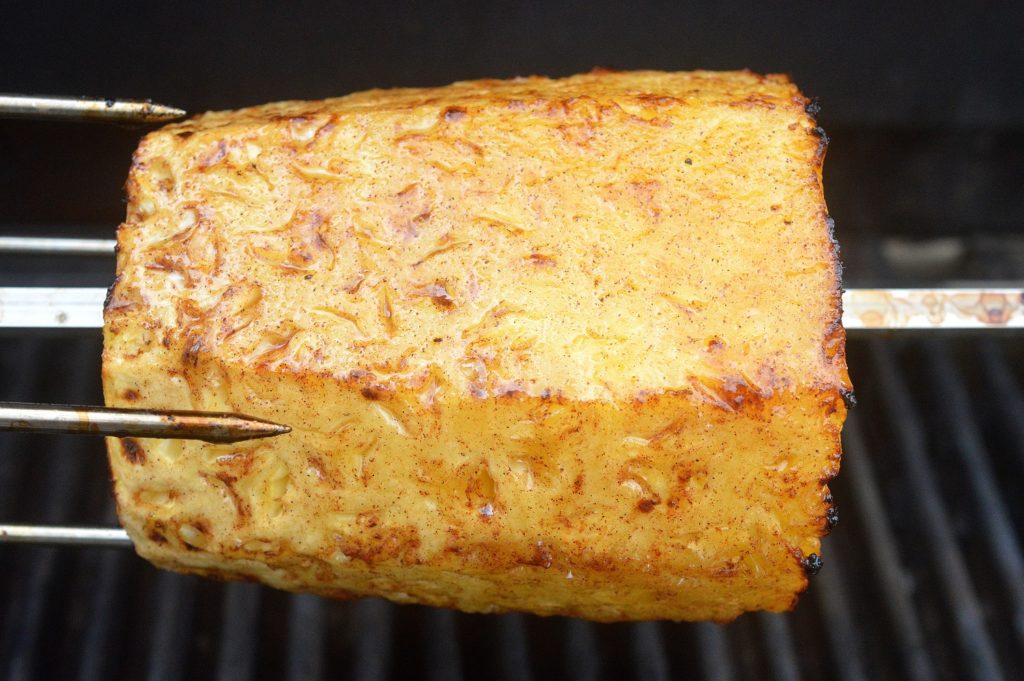
Was in Delhi last week. One of the meetings was with a deep pocket, amongst whose large holdings were some trophies…this one a significant equity in a 5 star chain. The chef was out to flaunt his care for the patron. Of endless twists one stood out taller than the rest, a barbequed pineapple for dessert. Simplest recipe yet mind blowing.
A whole pineapple, uncut, but peeled and all the warts taken out. Insert the skewering rod along the vertical axis. Drip pure honey all over it (don't soak in honey since it's so thick it wont seep on its own into the crevices of the pineapple as air may not rise out of thick honey).
Skewer the honey smeared pineapple on wood fire, rotating it only until ita neither crunchy nor soggy. Chunk out large pieces straight out of the fire vertically ( leaving the central unjuicy axis). Use fork & knife, not just to be clean, but skewered pineapple is "hot".
The smokey(d) honey with the ripe enough pineapple smears a unique aroma. Specs in love of barbecue may find this a good final course.
Apr
14
Timeliness, timelessness
April 14, 2023 | Leave a Comment

in terms of timeliness and forecasting ability, the ppi should be replaced after 70 years of untimely misinformation. much better is an index of futures prices like copper and S&P and grains.
how many times will an announced number cause vig with no meaningful effect on drift?
you would think with 200 economists on the staff, someone would update the 60-year-old studies of Moore and Shiskin of 1967.
everyone should read The Origin of Species and Don Quixote every year or so. it's like a cleansing tonic and leaves one more productive and joyful. the narration of The Time It Never Rained by George Guidall is memorable, i can't praise it enuf. my favorite is the banker.
Apr
12
Cigs & vigs
April 12, 2023 | Leave a Comment

nobody asked me, but…increasing vig: i estimate that on a 2 hour 30 minute radio broadcast half of the time is devoted to commercials. in the 1950's radio shows had 2 minutes of commercials per half hour. Just to max vig the big westerns were supported by Big cigarette. the cigarette commercials of the 1950's were so good that one would have been tempted to start smoking. the filters were white and the packing was tasty and pure. what other examples do you have of vig increasing in markets? public performance in options?
a bastion of vig. 1 billion a quarter: 2/3 interest rates and 1/3 stock futures:
CME Group Inc. Reports Fourth-Quarter and Full-Year 2022 Financial Results
Geraldo Orchestra - I've Got My Eyes On You 1940 Cole Porter Songs From "Broadway Melody of 1940"
if i were asked to name a book i recommend, it would be The Time It Didn't Rain by Elmer Kelton, the biography of Francis Galton. Atlas Shrugged. also Secrets of Professional Turf Betting
A loser's lament on crude:
It's All Right With Me - Ella Fitzgerald
Apr
10
Harpo, the vig, and pickleball
April 10, 2023 | Leave a Comment
Harpo Speaks is a book of very flawed men playing poker and drinking. one good thing is Oscar Levant spelling Prokofiev on his own concerto. Harpo never learned how to play the piano or harp. altogether an ugly group to say nothing about how he treated the idyllic wife. but who knew that the drunkard but very knowledgible Oscar Handler was the higher-paid concert pianist of his era.
Umberto Eco showed that new technology loses value for the masses over time. the tendency for all speculative activities to become maximizers of vig is similar. all become such that 52% is necessary to win and this is out of reach for most.
the loathsome spectacle of McEnroe and Roddick and Agassi playing pickleball like amateurs illustrates the point i was making about Umberto Eco with everything devolving to a max of vig.
the funny thing and indicating of max of vig is that in Brighton Beach and New Zealand we played a game 90% like pickleball with 30 courts in Brighton Beach alone but we played with a tennis ball which is much better for the current game than the plastic monstrosity that they use today.
by the way without patting myself on the back usually i was much better at the age of 11 than all the tennis players at the game. i admire the pro pickleball players who are good on all aspects of the game. Ben Johns is a good player in all aspects who would have been one of the best at Brighton Beach.
you've heard the one about how the amount of below-the-waste romance is 1000 times greater when you are engaged than after you're married. 45 years ago when susan and i got engaged she played racquetball and tennis with me all time. the last 45 years not once but we put up a court on our hard court tennis court and she played yesterday. and I say she could beat Chris Everts after a week or two of practice. i'm very proud of her that she didn't forget.
Bobby Riggs liked to come to Brighton to hustle in paddle tennis and paddle ball and I played him both games when I was 12. he was lucky to get 7 pts in each.
kindly forgive my boasting about the play of 70 years ago. you see now i am immobile after having a stroke and the old times are much sweeter.
Apr
6
Whiling away the night time hours
April 6, 2023 | Leave a Comment
no better way to while away the market night time hours than listening to 100 Great Radio Shows, mainly westerns, detective stories, comedy, and suspense. only 2 minutes of commercials for a 30-minute show. highly recommended.
along with The Story of Mankind, by Hendrik van Loon, and 10 Gunsmoke radio shows this has been my night time listening lately. so much quality here. so educational. so resonant.
Elmer Kelton who won the spur award 7 times and wrote the best western in The Time It Never Rained was forced to make ends meet in his last days by speaking to Elder Hostels. He talks about the plight of Western versus Eastern in Elmer Kelton Tells the Truth: His Best Talks on the West, Cowboys & Writing.
He Created a New Kind of Western
a good bio of a great man. but the one thing I demur is that Kelton, in listing the best Westerns, leaves out Jack Schafer's Monte Walsh, which to me is the second best western of all time.
the third greatest western writer: John Meston. all his scripts for Gunsmoke are masterpieces.
Apr
4
Money and markets
April 4, 2023 | 1 Comment
query: lots of talk about the money supply having a terrific down but I can't find it anywhere. apparently not released weekly anymore. my charts don't go past 2021. query is where do i get current figures? good old Paul Derosa always had the latest by surveying banks.
very quietly S&P is up 9% for the year, and 30 year bonds are up 7%. this is a uniformly bullish scenario for the next 3 months for both markets. this in conjunction with perfect father reaching a hi 0f 32% in odds of winning.
if the great Sam Eisenstat were alive, he'd run regressions to show how bullish it is. all we point to is 86% up back to 2011.
with agrarians at their peak in the 3-letter agencies and the treasury, regulatory capture looks to be at max. what could be more bullish?
Individual Investors Slow Stock Purchases, Leaving Markets Vulnerable
SceneScape: Text-Driven Consistent Scene Generation
what are the elements that make the scene in the market and how can it be quantified and predicted for market behavior?
Apr
3
Suggestions welcome for this new edutainment venture that I'm trying now:
website: house wives trading & investing in Indian stock market
YouTube channel: watanabe
The idea here: 6 selected participants (all-female team) will try to prove to Indian traders and investors that the world is not going to end, and by keeping things simple, average investors and/or traders might at least match the benchmark returns.
The show starts and goes live from 31st mar 2022 at 3pm Indian Standard Time, which is accounting year-end date.
Update:
The Watanabecrew is now raising the bars to day trade (& hopefully beat the vig) 1 crore account (about 125 K USD) from today. Please come watch us during Indian market hours on youtube channel.
Princiya Crasta adds:
I am part of the Watanabe team and the journey and learning is wonderful. I aspire to continue and grow with Kora sir. All the trades are live on Youtube. We go live every trading day 9.15am and 3.15pm IST. Looking forward to see you there.
Mar
28
Morse, bonds, Clews
March 28, 2023 | Leave a Comment

Charles W. Morse was instrumental in two panics. the first came during the civil war. he believed that the worthless greenback would lead to all industrials and railroads going thru the roof. when sec chase sold gold, the boom burst and Morse was execrated. the second Morse was the ice king panic.
there's trouble in market city. it's all because the bond prices are way below the cost for many banks and others. even the perfect father is beginning to suffer. there's one way out. for bonds to go way up. a good speculation.
one has been reading Fifty Years in Wall Street. the book is resonant with me because i could write a book 65 Years in Wall Street. that will have to wait until stocks go to a new high amid ag making fun of me. i can hear him now: "It took 18 months."
but the Clews book is amazing in that all the characters he talks about from the 19th century have their exact counterparts today. i will memorialize these shortly.
it's a little difficult for me because I was asked to write a preface for that book. and the frugal publisher didn't want to spend the $750 to get a copy of the book. they borrowed my book. and returned it unbound. its 700 pages, and in my current state i can't lift it.
Mar
24
Comment letters on: S7-31-22, ‘Order Competition Rule’, S7-32-22, ‘Regulation Best Execution’, from Jared Albert
March 24, 2023 | Leave a Comment
Dear Chairman Gensler, Commissioner Crenshaw, Commissioner Lizarraga, and SEC review staff:
Thank you for the opportunity to comment in support of proposed rule S7-31-22, ‘Order Competition Rule’.
Commissioner Peirce and Commissioner Uyeda:
Although you both said that you looked forward to reading public comments on the proposed rules, and then voted against opening them up for public comment, I hope you will nonetheless read the comments with an open mind and vote to adopt the rules.
I want to start with a quick thought experiment. Imagine if the NYSE specialists had been able to act like wholesalers: If they could have backed away from quotes, picked and chosen which orders to execute, sent orders they didn’t like to other exchanges, bought on plus ticks and sold on minus ticks for their own book, and placed their orders ahead of others’ orders. How long would the investing public put up with that behavior?
I encourage the SEC to ban payment for order flow and unexposed internalized flow outright. The notion that paying for ‘Right or First Trade’ is legitimate is extremely disappointing. It is a discretion that no registered dealer with a fiduciary duty would be allowed. The ability to pay to see the order first, take or decline that order, and then use the aggregate information from seeing so much order flow first to front run that aggregate order flow for one’s own account is outrageous.
Mar
24
Book recommendation, from Zubin Al Genubi
March 24, 2023 | Leave a Comment

Pirate Latitudes, by Michael Crichton. Aubriesque tale of privateers and Spanish Galleons.
As the SPEC list is about books, as well as markets, counting, and barbeque.
William Huggins adds:
single best book on the history of finance that i've come across is William Goetzmann's Money Changes Everything. He's a Yale finance prof with a background in art history and archeology and its shows throughout the book as he looks at the roots of our toolkit (sumerian word for "baby cow" is the same word they used for "interest", etc). a very good description of the 1720 bubble with the hypothesis that the bubble was a reasonable reaction to the shifting expectations around insurance companies and the lines of risk they could cover. he also suggests that Venetian gov debt (1172) snowballed into the creation of western capital markets, which in turn propelled the west ahead of "the rest" (to steal a ferguson quote). three solid chapters on the tools imperial China used to increase its "span of control" over its rugged territory. 10/10.
(I used to use it as the required reading in my history course until I realized too many were balking at its size)
Jeffrey Hirsch responds:
Appreciate the reco Mr. Sogi. Almost done with Pam V’s reco on Keith Richard’s autobiography, Life, which is far out. Here’s one from me, The Immortal Irishman, by Timothy Egan. Irish revolutionary becomes a Civil War general. Adventurous tale across many continents.
Laurel Kenner writes:
I offer Harpo Speaks, the autobiography of Harpo Marx, the silent brother. Plenty of poker, speculation, and spectacular success, including an account of his Soviet tour, to entertain this List well.
Pamela Van Giessen responds:
Harpo Speaks is fantastic. For a meditative introspective read on things out of our control and how the body copes A Match to the Heart, by Gretel Ehrlich.
Big Al suggests:
I will recommend The Biggest Bluff: How I Learned to Pay Attention, Master Myself, and Win, by Maria Konnikova.
First of all, it's just an entertaining, well-written story. But in her study of poker and portrait of one of the best professional players, Eric Seidel, there are many lessons for traders.
Penny Brown writes:
I recently re-read the cult classic, The Moviegoer, by Walker Percy. It has nothing to do with trading but the main character is a stockbroker. Read it for the wonderful prose and the delineation of Southern characters with great dialogue.
Also, re-read A Fan's Notes, Fredrick Exley's memoir of growing up under shadow of his father's football fame in Watertown. It's amazing that this book even got written since Exley makes three trips to mental institutions where he undergoes electro-shock and insulin therapy and was an inveterate alcoholic for his entire life. You can see the influence of Nabokov and Edmund Wilson (among his favorite writers) in his prose style.
And then I read Embrace the Suck - a book I literally found at my feet on the sidewalk - hey, the price was right - and I assumed it had a special message for me. It certainly did. It describes the training undergone to become a Navy SEAL including the infamously horrid "Hell Week" that resulted in the death of one participant. It has lots of lessons for traders as it extols the virtues of discipline, focus, planning and most of all, a willingness to embrace suffering, as a means of moving beyond mediocrity.
One guy's way of shaping up for the ordeal of SEAL training was to run the Badlands Ultramarathon - a little 100 mile race through the desert at temperatures over 110.
Okay, I'm not going to try that - never could have even in my prime. But it got me out of my chair committed to doing a full set of Bikram's yoga postures including the ones I hate because I can't do it - Salabhsana - or hate because it hurts - Supta-Vajrasana. As the author says, "you've got to embrace the suck everyday."
Gary Boddicker adds:
I recently read Mule Trader: Ray Lum’s Tales of Horses, Mules, and Men. I originally picked it up for the regional interest. Ray was based about 60 miles down Hwy 61 from me in Vicksburg, and traded mules and livestock throughout the Mississippi Delta…but, it turns out a few of the Chair’s favorite writers, Dr.Ben Green and Elmer Kelton, were running buddies of Ray and are mentioned and vouch for his character in the book. Many tales of trades, moving the herds as the tractors slowly replaced them from California to the Delta. In one case, he bought 80,000 horses in South Dakota, and arb’d them to where they could be used. The book rambles a bit, as it is essentially an oral history, but many lessons within.
It brought to mind a discussion I had years ago over dinner with an buddy of mine who farms about 20,000 acres in NE Louisiana. “Gary, there is isn’t a real farmer in Louisiana who picks up that government agricultural census and doesn’t mark down that he owns at least one mule. We are damn slow to admit we gave ‘em up.” I haven’t fact checked him, but a betting man says the mule census is Louisiana is overstated.
Gyve Bones responds:
I have two copies of that book… one autographed by the re-publishing editor. It’s a great book.
Mar
22
FOMC day and another record
March 22, 2023 | Leave a Comment
nice deception in bonds: down over 4 pts in last 2 and a half days…yet the entire problem with all the banks was they had bonds way against them down. so naturally the maneuvers for the market and the perfect father is to bull the bonds up.
although the chair without a background in finance is an ignoramus regarding economics, he can sense the agrarians all over the 3-letter agencies, the consumer products companies, and the agrarian at treasury, that they all want bonds up. presumably the 5000 financial economists and the banks which they all talk to before the meeting have emphasized that the perfect father and the fellow travelers want bonds up.
what is useful number 1 advocating? presumably the discussion at 2: 30 will put him in limbo.
as part of the back scratching and incestuous relations, ed used to give stipends to half of all finance profs. presumably they still back scratch each other. my grandfather Martin who spoke 50 languages as a interpreter used a back scratcher to dance with.
there is always a record. the decline form 1530 to 1600 in just one half hour from 4037 to 3969 - a terrible 68 full big points - was the second largest ever. the only exceedance was on 2-6-2018 when the decline was 86 points.
Mar
21
Always a record somewhere
March 21, 2023 | Leave a Comment
the public has no right to lose so much and to be fooled by the bromide that they get a better deal from the high frequency boys at the opening. the reversals at the opening 30 minutes are spectacular unless you are trying to get a good fill.
nobody asked me, but…perhaps the single greatest mistake that specs make is to try to go for short term profits -like the move in the next half hour or worse yet trying to sneak 2 pts of profit. the vig on such trades is at least 20%. much better to try the impossible of beating the 52% on sports bet.
always a record somewhere: gold down second largest ever, down $39 before FOMC. only 12-22-2011 bigger down move of $45.
one is reminded of my 1 day i had a job on Cramer's site. i got fired because i mentioned that Galton had invented the concept of regression. he says there is always a bull market somewhere. I say there's always a record move somewhere.
i place Cramer and Mad Dog in the same box. they both know so much and try so hard to come up with good predictions, they both have the benefit of experts and insiders, they are both less than random.
Mar
19
Stigmergy, from Zubin Al Genubi
March 19, 2023 | Leave a Comment
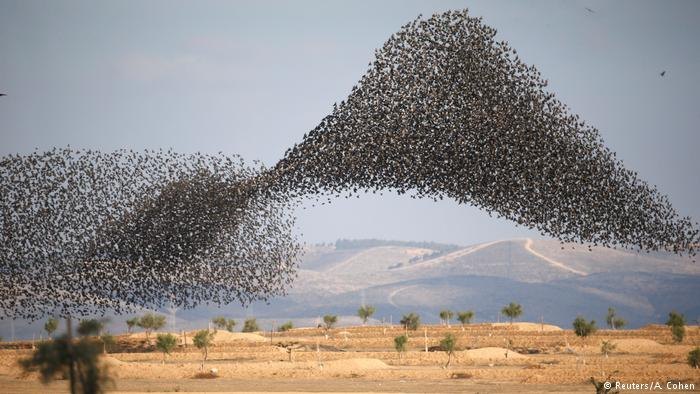
My theory is the market is mostly self organized. One important mechanism is stigmergy - spontaneous, indirect coordination between agents or actions, where the trace left in the environment by an action stimulates the subsequent action. The traces basically is time and sales or on a cruder level charts and trade data.
H. Humbert comments:
My theory is that markets do sometimes self-organize, but at the very basic level they operate in two regimes: normal and "emotional". Of course they are always emotional to some degree, but what I mean is this: they are good at processing distributed data, that is averaging out the noise and extracting information from multiple participants who create noise and add bits and pieces of information. But that is only when the information is widely distributed. When like now key pieces of information come from very few participants in random bursts (as compared to the typical regime) the markets get swept up in emotion generated by each jolt and self-organize around that emotion. Even in normal markets they can abandon reason and self-organize into manias or panics, more into manias when there is prolonged liquidity, but more prone to do so when there is a distributed information glut and participants just generate noise.
Gary Phillips adds:
No doubt that (decentralized) collective behavior is shaped by adaptive evolution. That is, efficiency gains are a result of stigmergy and constructal theory. Perhaps, there is even a coordination between the two.
The recent explosion in 0DTE options volume comes to mind. And, the stigmergic and constuctal theories may explain how the phenomenon evolved. This self organized collective behavior emerged as a perceived improvement on futures as a vehicle for day trading i.e., better liquidity, flexibility, and leverage.
Both stigmergy and constructal theory are self-reinforcing processes. The more something works, the more people it draws, and the more people available to improve it further.
Mar
19
Counting the Final Four, from Big Al
March 19, 2023 | Leave a Comment
Below is an update on some counting I did on the NCAA basketball tournament and the Final Four, originally posted in 2010. The data are the programs that made it to the Final Four from 1979-2022, as well as the results. I divided the schools into ones that had made 1 trip to the FF, 2 trips, 3 trips, and 4 or more trips.
58 programs made 172 trips to the Final Four, 1979-2022
Total FF slots: 172
Total Championships: 43
Schools that made 1 trip to the FF
FF trips: 28 - 16.3% of total trips
Championships: 2
Success rate: 7.1%
2-trip schools
FF trips: 14 - 8.1% of total trips
Championships: 1
Success rate: 7.1%
3-trip schools
FF trips: 21 - 12.2% of total trips
Championships: 3
Success rate: 14.3%
Schools that went 4 or more times
FF trips: 109 - 63.4% of total trips
Championships: 37
Success rate: 33.9%
You can see that programs that consistently get to the FF have a much higher success rate for winning the championship. These "power programs" dominate the "lucky underdogs" who have only gotten to the FF once or twice.
The "modal Final Four" is probably 3 power programs and one lucky underdog, and the underdog's luck has usually run out. The 3 power programs then each have about an equal chance of winning the championship.
Notes for fans: The two 1-trip teams that have won the championship are NC State in 1983, and Baylor in 2021. Of the power programs, the outlier is UConn which has been to the FF 5 times and won 4 championships, for an 80% success rate.
Scott Haley asks:
Pardon my ignorance, but the data considers programs' number of FF trips "prior" to the championship of that year, correct? Not total as of 2022?
Big Al replies:
Not ignorance but a good question! No, this is purely an ex-post analysis, totaling up all FF trips and championship wins. Predictively, it supports betting against first-time FF teams, but maybe a lucky underdog is starting a period of sustained performance that will make them a powerhouse.
Scott Haley adds:
An interesting consideration would be the effect of the head coach often being poached by another team after a lucky run. It almost always happens as the lucky underdogs rarely have the resources and/or gravitas to keep them. Basketball is not my speciality so I am unlikely to be able to properly do the analysis. But it's food for thought.
Mar
17
Not yours to give
March 17, 2023 | Leave a Comment
with agrarian economists in every 3-letter agency and the treasury, it's hard to look to free markets in the near term. but this too will pass as the British Library scholar of the 1840's views go out of style and poverty and envy reign.
A little story: Richard Sandor once introduced me for a lecture about my non-mathematical colleague at UC who garnered a Prize. He told that while he was on the Exchange many savants noticed the vol of distant options was way too high mathematically and market speaking. He ended right before my talk, "Not one of them is still around the Exchange." As the "prefect father" according to Ron Kline would say "true story" and one has nightmares about 30 years later.
the great Robert Merton was in the audience as his son was also honored. I told the story of Davey Crockett refusing to vote for aid to the benefit of a widow of a distinguished naval officer and how he offered to pay out of his pocket. Amazingly I have a letter from the 90-year old Robert Merton asking me for the reference to that story.
not the end of the story. I went up to Richard Sandor at the end of my talk and I said that like Horatio Bunce I realized from Richard's talk that I was a wrong to sell out-of-the-money puts and that I would never do it again because my adversaries controlled the margins et al.
Mar
12
Nobody asked me, but…
March 12, 2023 | Leave a Comment
(1) the bonds had their biggest two-day advance of 4 big pts ever. (2) the problem seems to be that Silicon Valley Bank was offering depositors 2.2% on their deposits. no wonder they all flocked to them.
(3) the most laudatory testimonial for the two silvers come from man who doesn't read books SBF. it was taken down. (4) interesting to see the judicial system bending all the way to accommodate comfort of SBF, the Uncle Remus tale of Brer Rabbit and the briar patch comes to mind.
Mar
8
On the Firing Line (Fifteenth in a series) Breathe, Breathe in the Air
One of the first exercises we do in clinics is called “Learning to Breathe”. Of course, the athletes have quizzical looks on their face and say, “But we’ve been breathing all our life. What do you mean?” After sharing a laugh, we explain. Infants and very young children breathe very naturally with their belly being drawn down and slightly out as the diaphragm is lowered in order to fill the lungs. Sometime in childhood, as the stress and rush of modern life takes its toll; the natural belly breathing is replaced by a breathing technique that uses upper chest expansion to draw air into the lungs.
In natural belly breathing, the lungs fill in roughly three stages. First the lowest part of the lungs begins to fill as the diaphragm is drawn down and the belly is pushed down and slightly out. Then the middle part of the lungs fill as the lower rib cage expands slightly. Finally, the upper part of the lungs is filled as the upper chest expands. In the more typically observed upper chest breathing, only about 30% of the lung capacity is utilized. Belly breathing has significant positive effect on both the body and the mind.
Vinh Tu writes:
Back when I took piano lessons, I remember getting some advice on how to breathe while playing certain passages. Recently while playing some rhythm-based video games, I've noticed that either I hold my breath, or try to time my inhalation or exhalation so as not to disrupt my rhythm. The wrong syncopation between your breath and the beat can throw you off the rhythm.
Laurel Kenner responds:
For a smooth motion, action should come after you start to exhale.
Mar
7
Limitless: The Federal Reserve Takes on a New Age of Crisis, from Zubin Al Genubi
March 7, 2023 | Leave a Comment
Now, when every fool and his mother fruitlessly attempts to interpret what size the brief case means, this book is timely, very well written and highly recommended:
Limitless: The Federal Reserve Takes on a New Age of Crisis
Also, another interesting read, 180 years old, with lessons for the modern reader, Walter Bagehot’s seminal 1873 book, Lombard Street: A Description of the Money Market.
Kora Reddy suggests:
PDF download: Credit Suisse Global Investment Returns Yearbook 2023 Summary Edition
here is a two-line summary (as TAPAS [there are plenty of alternatives]), as opposed to the one-line summary i used to do: figure 50 is interesting "higher the inflation higher the interest rates thus higher the stock market returns." table 15, short rubber spot & long coal is the trade in the commodities.
Mar
6
Term structure 101, from Duncan Coker
March 6, 2023 | Leave a Comment
Futures prices, particularly financial futures like S&P and Bond prices, have a relationship to the cash markets which can be arbitraged. It is a function of cash flows usually interest borrowing costs and dividends, but it depends on being able go short and long the cash/spot markets. My questions is this: seems to not hold in hard assets like crude where there is currently large backwardation. You can buy Dec 24 Crude at a large discount and have been able to do so for some time. Specifically, is it possible to short the spot market for crude? Is there a counterparty that will accept this trade? It seems that for term structures like crude futures, the prices are an actual prediction of supply and demand and not an interest rate arbitrage.
Zubin Al Genubi responds:
With crude, storage (or not to store) is part of the future price. I read there is a lot of Russian crude stored in ships now. I'm not sure how that figures in.
In backwardation (tight market) normally one buys the future waiting for convergence with spot. Selling spot- yes you can, but delivery is an issue.
Big Al ruminates:
Not sure what "shorting the spot price" would even mean, other than Zubin's point where you have to have crude for delivery. Doesn't the concept of shorting a contract inherently involve a future price point? You could have 1-day futures, but then the vig might be far more significant.
If we model it on stocks, then shorting spot crude would involve "borrowing" somebody else's oil and then selling it for delivery. But then you're just back to why futures exist in the first place, aren't you?
But speaking of the term structure of crude, I ran across this:
Forecasting WTI crude oil futures returns: Does the term structure help?
Abstract
Nelson-Siegel (NS) factors extracted from the term structure of WTI oil futures are shown to predict subsequent WTI holding period returns in-sample. This in-sample predictability is not diminished by augmenting with macroeconomic indicators or oil market specific predictors. Allowing the decay factor in the Nelson-Siegel model to vary over time improves in-sample predictions at medium horizon return forecasts. We conduct out-of-sample forecasting exercises on models that use NS factors, such as a simple two factor model that uses a composite leading indicator along with the NS decay factor, and a LASSO model that combines NS factors with macroeconomic indicators and oil market specific predictors. These models significantly reduce forecast errors relative to a no change benchmark across a range of return horizons and futures contract maturities. We also find consistent evidence that models that use the NS factors result in trading strategies with higher Sharpe ratios and better skewness properties than buy and hold strategies and historical mean strategies.
Relatedly, the Nelson-Siegel model.
Mar
5
Excellent books read this weekend
March 5, 2023 | Leave a Comment
excellent books read this weekend: The Big Ratchet: How Humanity Thrives in the Face of Natural Crisis, by Ruth Defries. the numerous incredibly lucky things that make life on earth possible. the three indespensible requirement for life are: (1) a stable climate, (2) a planetary recycling mechanism, and (3) a smorgasbord of diverse species.
these 3 mechanisms would seem to play a role in markets, preventing any hatchet-like move in one commodity like bonds and its influence on stocks as exemplified by March 3, 2023 action with a 2-pt increase in bonds sending all market life thru this.
Beating the Dow, by O'Higgins and Downes, recommending buying the lowest-priced and highest-yield components of the Dow as a superior, infallible investment rule. (no cognition of multiple comparisons or ever-changing cycles.) the rule doesn't seem to work anymore.
i have the 1991 edition but many interesting facts about the stability of the Dow. contrary to popular belief the 1923 components are almost all there thru acquisitions. emphasis on Dow stocks as magnets for investment.
Timothy Sandefur's Freedom's Furies, a well-researched and informative review of the work and lives of Isabel Paterson, Rose Wilder Lane, and Ayn Rand.
Thayers Life of Beethoven, revised by Elliot Forbes. A year-by-year chronicle of verified events in B's life. the great man's music and quirks and obsessions.
Mar
5
The Fed, markets
March 5, 2023 | Leave a Comment
the useful:
El-Erian says the Fed should go back to raising interest rates more aggressively
re completely independent and don't take into consideration such things as market moves or politics: they act like puppets with some inexorable force puling on them to arrest market declines like yesterday with Bostic. methinks the Governors and their spokesman and the agrarians at Treasury protest too much.
an admirable performance for the optimists [3 March]: S&P, gold, crude, at 10-day highs, bonds up on week. sogi has Kona coffee twice in day and Prof stands tall. barron coleman day. grains at low. wheat lowest in 18 months. corn lowest in 5 months. fed can pretend they worry about personal consumption prices, as long as it helps the idea that has world in grip.
That same deception: "The Fed doesn’t care as much about Wall Street as Wall Street thinks, meaning that market-based indexes of financial conditions including stocks and bonds aren’t so important to them." the conventional wisdom they like to spread.
where will the markets go next week? after a 20-day minimum and two big up days in S&P but not a 20-day high again. about a once-in-year event. the stats favor Bonds.
Mar
3
Adrian Bejan will speak for 30 minutes at Night of Ideas on 3 March, from Nils Poertner
March 3, 2023 | Leave a Comment
Night of Ideas
New York
Friday, March 3, 2023 | 4:30pm-12am
The Ukrainian Institute of America, 3rd Floor Library, 2 E 79th St,
New York, NY 10075
Talk
9:30-10:00 pm
Freedom, Beauty, Evolution, Nature
Adrian Bejan
Evolution is the defining phenomenon of nature: change after change, in a direction perceptible as ‘time’. Freedom is everywhere because design change is everywhere: inanimate, animate, and human. Power and movement result from the consumption of foods and fuels. Conversion happens in flow configurations (designs). Manifestations of movement are endless. Society is an earth-size organism, constantly morphing to provide greater access to what flows and lives. Society develops, moves, changes, and produces more when endowed with freedom, free questioning, and self-correcting. Nature is dynamic, free, always evolving: one law of physics (constructal law) covers all aspects of evolution in nature.
Mar
3
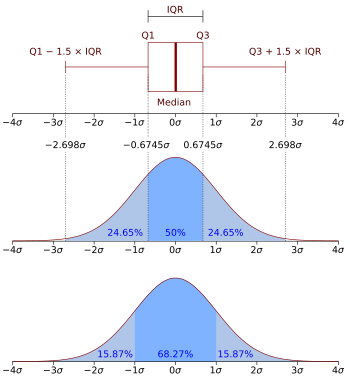
Calibration of Probabilities: The state of the art to 1980
Sponsored by OFFICE OF NAVAL RESEARCH
June 1981
This paper presents a comprehensive review of the research literature on an aspect of probability assessment called "calibration." Calibration measures the validity of probability assessments. Being well-calibrated is critical for optimal decision-making and for the development of decision-aiding techniques.
The first class is calibration for events for which the outcome is discrete…. For such tasks, the following generalizations are justified by the research:
1. Weather forecasters, who typically have had several years of experience in assessing probabilities, are quite well calibrated.
2. Other experiments, using a wide variety of tasks and subjects, show that people are generally quite poorly calibrated. In particular, people act as though they can make much finer distinctions in their degree of uncertainty than is actually the case.
3. Overconfidence is found in most tasks; that is, people tend to overestimate how much they know.
4. The degree of overconfidence untutored assessors show is a function of the difficulty of the task. The more difficult the task, the greater the overconfidence.
5. Training can improve calibration only to a limited extent.
The second class of tasks is calibration for probabilities assigned to uncertain continuous quantities…. For calibration of continuous quantities, the following results summarize the research.
1. A nearly universal bias is found: assessors' probability density functions are too narrow. For example, 20 to 50% of the true values lie outside the .01 and .99 fractiles, instead of the prescribed 2%. This bias reflects overconfidence; the assessors think they know more about the uncertain quantities than they actually do know.
2. Some data from weather forecasters suggests that they are not overconfident in this task. But it is unclear whether this is due to training, experience, special instructions, or the specific uncertain quantities they deal with (e.g., tomorrow's high temperature).
3. A few studies have indicated that, with practice, people can learn to become somewhat better calibrated.
Stefan Jovanovich writes
Grant's great virtue as a warrior was that he had seen the absence of certainty in war everywhere from the front line (having a fellow junior officer lose his head to a Mexican cannonball as the two them walked forward) to the far rear (where half the sick, women and children left behind in crossing the Isthmus die from cholera because the contracted mules do not arrive; Grant saved the others by buying pack animals at the market price and then spending the rest of his tour in California and Oregon arguing with the War par5ment about the waste of funds). Man proposes and God disposes.
Gyve Bones adds:
In preparing for battle I have always found that plans are useless, but planning is indispensable.
[General Dwight D. Eisenhower]
Feb
28
Self organization, from Zubin Al Genubi
February 28, 2023 | 1 Comment

Self-Organization in Biological Systems
The concept of pattern-formation as a result of self-organization is common in such disciplines as chemistry and physics. For instance, in Chapter 1 we discussed the patterns formed by the Belousov-Zhabotinsky reaction, the ripples on a sand dune, and Bénard convection.
The challenge, is to see whether particular instances of adaptive, group-level pattern formation can be explained largely or fully in terms of a small set of relatively simple behavioral rules for members of the group. These rules are often implemented in the form of a mathematical model or simulation.
Interesting definitions found useful for markets:
A Pattern is an arrangement in time or space. It is created internally without external direction. It is created locally by individual element's reaction to nearby changes without larger awareness or control. The complex patterns result from simple local rules. Very market appropriate.
How does self organization occur? Random fluctuations and positive feedback can form patterns or trends. Humans follow rules, I do what you do. Sygmergy, information from work in progress, such as chart patterns, can accelerate creation of patterns.
Self organization in complex systems exhibits emergent properties known as changing cycles such as Bernard cells. Change occurs due to positive and negative feedback, outside influence, information from neighbors, stigmergy. Self organizing systems can be quantified and modeled! They tend to be stable but can exist in chaotic states, chaos meaning without pattern. Alternatives to self organization are: Leaders (powell), blueprint, recipe.
Nils Poertner writes:
probably a good book to read indeed - thanks for sharing.
yeah. in the human created world - we tend to think leaders run the show - and they do- to some extent
but obviously it is left-brainy to think that is all and not a way make money from (e.g ppl looking at the lips of Powell to trade the next tick…..close to insanity - that is). it is more a mass psych kind of game.
Zubin Al Genubi adds:
Schools of fish self organize to avoid predators. The are able to coordinate by the Trafalgar effect where communication with neighbors is fast like Lord Nelsons ships. Traders self organize - bulls v bears. What is their mode of communication? Volume, tape, executions, speed, change, amount of change, order depth, density of trades, resting orders, many others which could be quantified.
Nils Poertner responds:
fish don't get the clue from adjacent fish (alone) - - they "tap" in their common field (morphogenic field) of that special group - see Sheldrake on this note it is "same" time almost. wild animals have this super- power since they think less - thinking (the cousin is worrying) seem to interfere here (actually in theory humans have the same). can*t verify this but Sheldrake says: the idea is that the brain of animals (also humans) is more like a receiver and sender at the same time - sort of like a TV that emits as well memory is not in the brain per se.
Zubin Al Genubi replies:
It's possible to build a simple model for fish schooling based solely on reaction to the neighboring fish. I wonder if trader behavior might be modeled with similar simple parameters. Trader buys when other traders buy. Trader sells when others sell. Negative feed back starts as buying slows. Test parameters.
H. Humbert responds:
Morphogenic fields are contained within the organism and used for cell coordination such as embryonic development, so it's hard to believe that the fish respond to it as a group. As for morphic resonance pioneered by Sheldrake, while I think it's a promising idea that would explain a lot, casually using it to explain simple events without extraordinary proof is like using some random primitive god to explain natural phenomena. If he is right, than we have to discard most of our knowledge about biology, psychology, etc.
It also seems that modeling traders, many of whom are equipped with machine learning devices, and many who like to buy when others sell, as fish relying on a couple of sensory signals seems too simple to predict the future. Seeing clouds and predicting rain kind of works, but it's not a good starting point for weather modeling by an individual in modern times given the state of the art.
Nils Poertner replies:
Yes probably. But then a lot of older cultures knew it all the way already. see Amazon tribes people or study Carlos Castaneda. Sheldrake found some statistical evidence of telepathy in rare occasions. I don't know to what extent that is correct - for my own purpose I am interested in "intuition" which is somehow linked to telepathy eg being a tad earlier in mkts than others etc.
[Re: Sheldrake: below, a review of Sheldrake's A New Science of Life. -Ed.]
A Book for Burning? by John Maddox, Nature, Sept 1981
As things are, however, Sheldrake's book is a splendid illustration of the widespread public misconception of what science is about….Sheldrake's hypothesis is no better than the hypothesis that a person equipped with a water-divining rod is able to detect subterranean water as a consequence of some intervening "field" generated by the presence of water, and his proposals for experimental tests no better than the argument that since water-diviners succeed in making money, there must be something in the theory.
H. Humbert writes:
As I mentioned, using this theory without proof is like using some primitive deity to explain rainstorms and earthquakes. But I wouldn't be as adamant as the reviewer in attacking it. It has puzzled me for a long time that so many people somehow don't recognize that there is something fundamental missing about our understanding of reality, and different aspects of it. Like when people start talking abut AI becoming sentient while we have no clue about what it really means to feel pain or see colors in the human sense from any kind of scientific point of view (vs having some regions of the brain light up). Or what I mentioned about how various instincts/behaviors are inherited by animals. Like can 20,000 or so genes, mostly used to encode the creation of proteins, really transmit to animals what foods to like, how to have sex, how to be afraid of certain predators, how to fly south from Maryland to Brazil over the Gulf of Mexico and predict hurricane seasons fairly well, or a thousand other complex concepts. Or more fundamentally, what enforces various laws of physics over vast regions of space. So strange theories that try to explain the nature of the universe shouldn't be so easily rejected even if they lack in the scientific method orthodoxy.
Nils Poertner comments:
good that people here are skeptical. as always - for traders - believe nothing, verify things for yourself
(and start with things that are relevant and simple) and go from there.
Feb
28
Value Creation Principles, from the Mises Institute
February 28, 2023 | Leave a Comment
Bartley J. Madden: Value Creation Principles
Value for customers is the purpose of all entrepreneurial business. Firms big and small must know, follow, and adhere to the principles of value creation. This is pragmatic not theoretical — the consequence of a failure to do so is that the firm cannot survive.
Bartley J. Madden studied value creating firms as a co-founder of a successful investment research firm and then managing director of Credit Suisse HOLT. He is now an independent researcher and founder of the Madden Center For Value Creation in the College of Business at Florida Atlantic University.
He joins the Economics For Business podcast and shared a summary of a lifetime of research.
Feb
27
The altruist, Beethoven, and the Romans
February 27, 2023 | Leave a Comment

one of remarkable things about effective altruist saga was that while he was the second biggest donor, and promised to give a billion more, and every celebpol was captured, the Palindrome appears to have been uninvolved. he has instinct.
Beethoven was in a furious rage in 1819. his favorite restaurant didn't have his favorite of veal. he ran out cursing and would have been taken for a vagrant again had not Schlesinger rushed back to Vienna and sent him some veal upon which B kissed him and called him his best friend.
that's Ken Roman who plays squash 3 times a week at 92 and is former CEO of Ogilvie where he taught Ogilvie how to write in complete sentences when he became French.
Feb
27
Adjusting continuous data, from Zubin Al Genubi
February 27, 2023 | Leave a Comment
Wouldn't the adjusting up of the prior contract data to the current destroy information about the beneficial effects of inflation on stocks and owning assets?
Leo Jia responds:
I had considered about this and believe the adjusting does destroy some information, but one can go around the problem.
Generally I use one of two schemes to adjust: subtraction, or division, each destroying the info in a different way. Which one to use depends on one's analytical formulas to be used. For instance, if one is concerned about absolute price differences, like close of today minus close of 2 days ago, then one needs to use the subtraction scheme; one the other hand, if relative difference is of concern, like close of today divided by close of 2 days ago, the division scheme should be used. Using it the right ways nullifies the information destruction.
The subtraction scheme can produce an artifact of prices becoming negative, so mostly I concentrate on the division scheme.
Btw, I open-sourced the adjusting routine called Stitcher (in Julia) on GitHub.
Steve Ellison adds:
Much depends on what you are trying to achieve by using adjusted prices. I use them to make sure my calculations of net price changes and n-day highs and lows are accurate in the event such calculations cross a contract roll. When back-testing, I typically do selection using the adjusted prices and then translate the specific occurrences back into the contract that would have been used at the time of entry– then I can compare the net change to the original price, resulting in a more meaningful percentage change.
Feb
27
Statistical hypothesis testing in trading strategy development, from Leo Jia
February 27, 2023 | Leave a Comment
This has long been in my mind, recently put to text and published on my webpage. Happy to have any feedback.
Statistical hypothesis testing in trading strategy development
So What is statistical hypothesis testing? From Wikipedia: “A statistical hypothesis test is a method of statistical inference used to decide whether the data at hand sufficiently support a particular hypothesis.”
Though the exact procedures are still not without debates, the general idea is: if a hypothesis can be confirmed as true or valid, it has to stand out from the random processes that apply to the same matter of the hypothesis.
So, it sounds very logical. For instance, if you want to prove that you have good skills at the football penalty kicks, you do say 100 kicks (without a goalkeeper) and compare your results with those of a thousand idiots. Say you scored 97 and rank the 11th among the thousand idiots, or the top 1.1%, then the committee confirms your skill, or in other words, they confirm that your claim of having good skills at the football penalty kicks as true or valid. That means that since you rank at the top 1.1% they trust that you truly have the skill and you will score similarly in future kicks.
Steve Ellison comments:
I am one of the "idiots", ha ha, who has found patterns that back-tested with a statistically significant edge, only to find they did not work very well when I actually traded them.
Part of the problem is that, with a threshold of p = 0.05, if you evaluate more than 20 hypotheses, you are likely to find some that show significance just by random chance. And this problem is multiplied in any study that involves multiple comparisons.
Furthermore, in an era of widespread machine learning, some institution is likely to find a pattern before you do, and may either arb the edge away or discover at its own expense there really is not an edge. David Aronson, who was on the Spec List for some years, discussed "data mining bias" in his 2007 book Evidence-Based Technical Analysis, when machine learning capabilities were in their infancy compared to today.
Big Al adds:
That appears to be a big problem with all sorts of research. It's easy to imagine a large, diverse group of researchers forming a sort of "meta-researcher" that is data snooping on multiple levels, even though the individual researchers are not aware of it.
As a trader, one must be skeptical and ideally have enough data to split it into a test dataset while reserving an out-of-sample data set for confirmation.
When I'm feeling more optimistic, I think of the market as layers of players, from very large down to minute (e.g., me), and most of the market bulk is the result of the bigger players making macro moves, which creates effects that smaller players can trade off of. The issue now is that, with AI technology, tens or even hundreds of billions of dollars can be deployed to black-box strategies that constantly search for smaller anomalies and patterns. But then the Palindrome's concept of reflexivity kicks in as all those black boxes create effects of their own.
Zubin Al Genubi writes:
I am looking at what factors causes price change and why and how. Model it to understand its function. Test with Monte Carlo. Its gives you a step ahead of price. Volatility clustering is a classic example. This what modern biologists do.
Jeffery Rollert responds:
My mental model is a sphere of sponge, suspended in space, with rain droplets hitting it everywhere all the time. It’s a variation of Al’s idea yet with more dimensions. One additional dimension is the age of the idea. As ideas are older, they are absorbed and move to the center where they have less impact on the balance. Market moves are represented when the sphere’s center of gravity shifts from the geometric center. Sort of plate tectonics but with a lot of plates.
Feb
23
Analysis of Train Derailment in East Palestine, Ohio, from Stefan Jovanovich
February 23, 2023 | Leave a Comment

Starts at Minute 4:00: A Failed Defect Detector and the Train Derailment at East Palestine
The achievement of railroads is that they can carry massive loads thousands of miles with an economic efficiency that no other form of ground transport can come close to matching. To do this they have to violate the first rule of all practical mechanical engineering and have metal scrape against metal without any lubrication. The wheels and rails are steel against steel. If an air brake fails for a wheel, it stops it dead and the wheel becomes a giant flint throwing sparks and then flames. The only solution to this problem is to slow the train to walking speed and move it to a siding. If the train continues at speed (30-40 mph in developed areas), that car will eventually derail. The unanswered question for this incident is why the train crashed in the pattern of an emergency stop by the engine, not the derailment of a single car. That could have been caused by the engineer not having the skill and temperament required to avoid literally slamming on the brakes because "the train is on fire". But, that is pure speculation by those of us sitting safe in the bleachers.
Bud Conrad writes:
Thank you for the explanation in bigger picture context. There seems to be something much more unusual about this particular incident, than just a mechanical failure, of a type that must happen frequently because steel is riding on steel.
Jeffery Rollert comments:
Modern rail cars have systems that brake all cars at once (locomotives included). It’s done by a radio signal or wire, and no longer a pneumatic propagation. I know, because a very good friend designed and built the system decades ago. Cars derail, when the locomotive derails and effectively becomes the brake. So why did the locomotive derail?
I haven’t seen the video, but strongly suspect something in the tracks or a switch was improperly diverted that the locomotive couldn’t handle the redirection at that speed.
Henry Gifford explains:
Steel rolling on steel is a great idea because there is such a small amount of friction. An adult human can allegedly push a fully loaded (200,000 Pounds or more) railroad car along a level track (but not get it started – another story). Rubber covered wheels, in contrast, require much more energy because heat is generated as the rubber flexes (internal friction from molecules rubbing on each other). But, if the railroad train car bearings seize up, steel is sliding on steel – still lower friction than rubber rubbing on a road, thus the locomotive(s) can drag it along until derailment…
Read the full discussion here.
Feb
23
Close price and spreads, from Zubin Al Genubi
February 23, 2023 | Leave a Comment
Why is the close price so much higher than trading at the close? Why is June ES 38 points higher than March ES? That's a really big spread. It must mean something. And to adjust the back data to continuous must remove or affect information.
Justin Klosek responds:
March-June ES spread is due to the difference between the (assumed) dividend rate of the S+P and the risk free rate.
Investor A who owns the portfolio of S&P 500 stocks receives the dividends and the return from the changing stock prices. Investor B who owns the futures and a Treasury bill has (to first order) the same portfolio. He does not receive the stock dividend but instead earns the T-bill rate, which is now higher than the dividend yield. So the futures prices have to adjust to account for this.
If the risk free rate is 4.75% vs a dividend rate of 1.25%, that 3.50% difference is reflected in the futures roll—about 87bp per quarter, or around 38 points, plus/minus.
Kora Reddy adds:
Fisher effect as chair says here:
The Performance of Market Index Futures Contracts
Zubin Al Genubi comments:
Seems it would behoove one to own bonds with the futures to capture the roll. Especially now.
Justin Klosek asks:
Long T-bills plus S&P futures is no different than owning cash stocks…. what drives your “especially now” comment?
Zubin Al Genubi responds:
If FOMC is done at 5 1/4, in 2 increments 3 months apart we are 6 months away from the end of rate increases. Powell's bond "put" so to speak. Yields are high. Seems, like today [22 Feb], the bonds have decoupled from stocks. Why not carry some bonds to support a portfolio of futures? Carry margin is much less with futures than stocks. The overnight market is a big plus of futures over stocks.
Feb
21
Weekend reading
February 21, 2023 | Leave a Comment
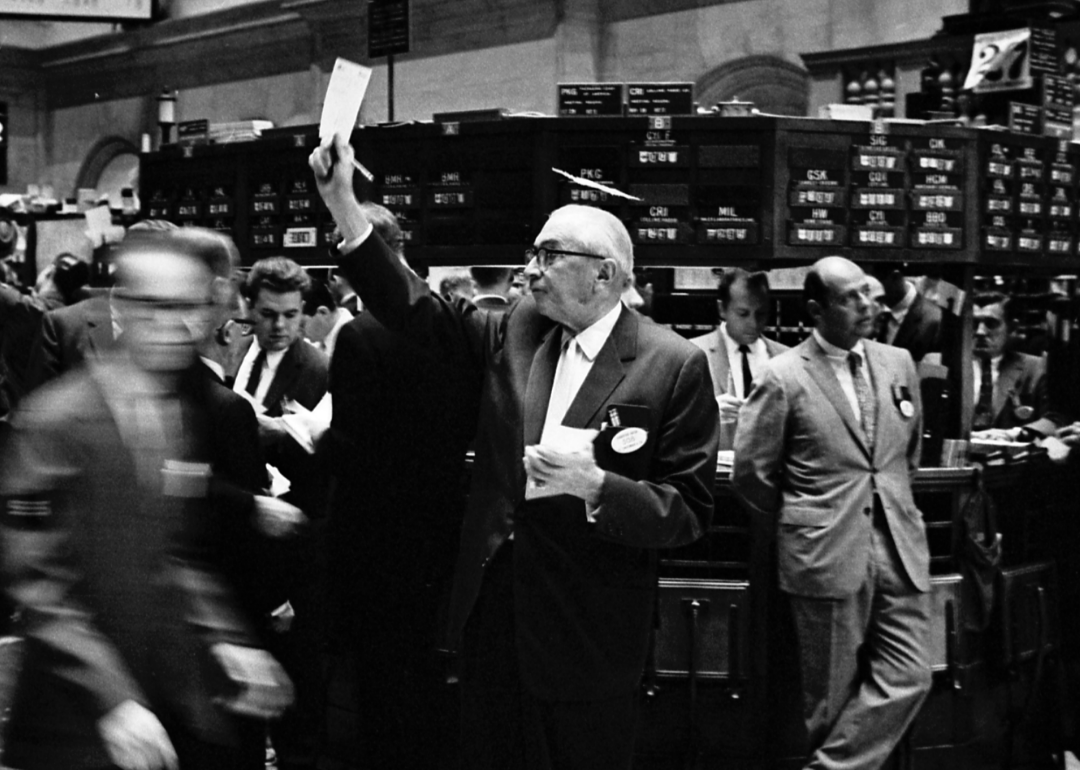
while snoring at the market over the weekend, and remembering that I had to be awakened by my assistant at 915 on Friday feb 17 as I had "watched" the market for 24 hours straight and I can no longer do that without sleep, I read some good books over the weekend.
i was younger then: Someone in a Tree
the best book was Beethoven Unleashed. here is a year by year chronology of Beethoven's development, family life, music, and love life. I know a hundred anecdotes about Beethoven (collab and I were once going to do a play about the great man) and this book thrilled me by teaching 100 more also about his hard study under Hayden, the progress to write string quartets, and the Austrian war's influence on his fortunes. highly recommended. I recommend the audio version which brings forth music to illuminate each part of his life (although their constant playing of the fifth and ninth symphonies is boring and over the top).
the most disappointing book for me was Models of Adaptive Behaviour: An Approach Based on State by Houston and McNamara. It takes a state approach to predicting molecular behavior. all the states could just as well be market states with the change of a few words. an organisms behavior strategy is a rule that specifies how the organism deals with every possible circumstance. a strategy is a rule specifying the dependence of behavior on a state and time.
"the costs and benefit of an action must depend on state." "fitness is a measure that can be used to measure the performance of strategies." "that an action cannot be considered in isolation is an important reason for considering sequences of actions and hence for using dynamic programming." regrettably there is one empirical finding that illuminates the state-based topology into concrete life. Although I can get the gist of most mathematical treatises, the dynamic programming examples and other techniques were beyond me.
I turn to a book that's much more useful to financial readers and mure more up my alley: This is the Road to Stock Market Success by George Seamans.
the Seamans book was first published in 1944, and the dow was about 150 at the end of that year, and Seamans recommended the base method in use of Heads and Shoulders to sell high and buy low. There are so many bad recommendations in the book that it's even worse as a guide book than Reminiscences of a Stock Operator.
From George Seamans (1945):
What is a business barometer? Whether it be Barron's Weekly, the Federal Reserve Bank, the Cleveland Trust Co, the National City Bank, or any other– it is the published facts of supply and demand as expressed in the volume of steel production, number of freight cars loaded, orders for locomotives, amount of payrolls, amount of checks cleared, bank savings, money in circulation, electricity consumed, quantity of lumber cut.
Supply and demand (the time element theory–a time to buy when low, a time to sell when high) is the basis for all forecasting of market movements.
"But who has time to read books?" he replied. Whereupon I told him frankly he wasn't fit to hunt squirrels.
[One notes that SBF prides himself on never reading books. and if he were one of the big shots that constituted the thousands of clients that Seamans had, Seamans mite call him a baboon.]
In the market session of October 19, 1937. Stocks crashed that morning by ten points or more. However by two or three o'clock of that same day many of these identical stocks were up to their previous prices. Was this the play of genuine and natural forces of "supply and demand"?
The safest time to buy is when the market is dull and trading is going on only in small volume with prices on the easy side. If you buy then, exercise patience (comparable to that of the Insiders) and hold on until activity develops at times taking as long as six months or more for the market to generate. Months later you will get 'the' signal that it is time to sell.
In 1914, at the outbreak of hostilities, stock market prices dropped. In September, 1939, prices soared upward the moment a European conflict became a certainty. Developments in industry since the last war in sociology, economics, electronics, machinery, politics and finance were of sufficient importance to warrant entirely different conclusions. In 1918 for instance we sent troops to Siberia to fight Communism. In 1944-45 our presidents drank vodka with Stalin and toasted his great country.
Seamans is adamant that the big-guy subscribers to his service which number thousands should never hesitate to sell short. Thus he joins the boy speculator in sowing the seeds of destruction.
i am very fortunate to have a very sharp wife who has seen many a mistake in my trading over 60 years i have been trading. (she has only seen 45 years.) she sees me reading all these old books and throws up her hands and like Don Quixote's wife she burns them while I rest.
Feb
19
Snoring as a fine art
February 19, 2023 | 1 Comment

Snoring as a Fine Art: see War and Peace, General Kutuzov could have snored with all the bulls on S&P, bonds, gold today.
"Snoring as a fine art": desite the enemy's ardent attempt to scare all bulls to oblvion, S&P, bonds, and gold ended close to unchanged or up. a typical way to force speculators to lose much more than their entitlement.
"Snoring as a fine art": bulls in bonds, S&P, and gold subjected to terrible warfare and mark-to-market loss during lows but all markets ended unchanged or up on day. A typical way for the bigs to make public lose much more than their due. (and snoring remedy)
Feb
14
The little things matter
February 14, 2023 | Leave a Comment
Many markets are near 30-day highs but haven't breached it. crude, bonds, S&P, gold to name a few. is there a forced of destiny that pushes these markets to set significant extremes when they are close but now quite there?
little things matter in super bowl and market:
The Little Things You Do Together
Chief's coach banned players from watching Rihanna halftime show. i.e., it's the little things that make a win, and shades of Rene Lacoste who was quintessentially focused on the next match period. also Ted Williams. also me when I played squash.
let us reiterate our stand that we must continue the fight against inflation, thereby assisting 30-year bonds. (whatever the perfect father wants.)
Lobogola lives:
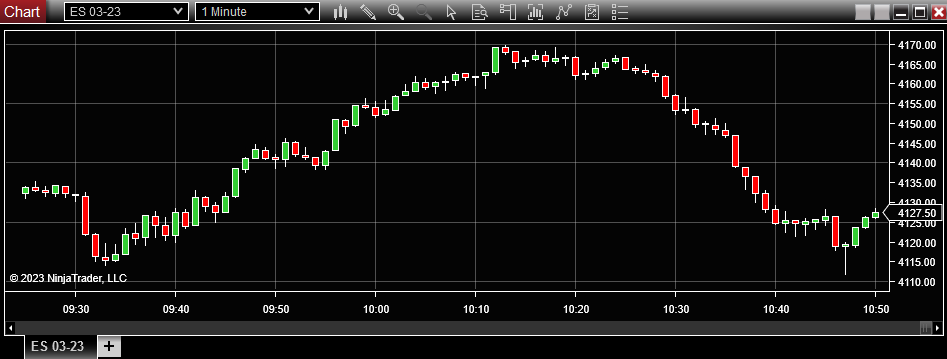
S&P refused to set its required 20-day high (for 8 consecutive days). should make the "usuals" teeter to bear.
Feb
11
Market observations, and Big Bill Tilden
February 11, 2023 | Leave a Comment

is there one general factor, i.e., one market, which impacts all other markets? and does this general factor change within day and between days?
what is reason that the bulk of the consumer products companies - especially Disney, Amex, and Gillette, and the professional sports leagues - are uniformly agrarian? is it in their self interest? or just the training that their top execs get at Harvard and Yale?
a typical article. but i noticed this much earlier. their Hall of Presidents, e.g., has always been a platform against those who admire enterprise.
a nice, archetypal way for the public to lose more than they have any rite to lose. On thur, crude was the least volatile of any commodity or itself. its total range was 50 pts from 77.50 to 78.00. and the moves between half hours was 20 pts. friday crude moved 250 pts from 77.50 to 80.00 from 2:30 TO 4 EST.
invaluable advice from the great Bill Tilden: (1) Keep your eye on the ball. (2) The body must be at right angles to the net and the shoulders parallel to the line of flight of the ball.
(3) The weight must always travel into the stroke that is from back foot to the front foot. (4) the shot must never be hurried or cramped. Match Play and the Spin of the Ball. Bill Tilden was considered the greatest tennis player ever as of 1930.
Some interesting market advice was given in his classic article, Pace and Speed. "Speed and pace are two very different things. Speed is measured by the time required by the flight of the ball thru the air. Pace is the momentum (speed plus weight) with which the ball comes off the ground from its bounce. It is the solidity of the stroke." one should compare this to the velocity of the price change of a market. that's speed. but pace is the volume behind the advance.
Feb
7
Hypotheticals, free associations, and big bets
February 7, 2023 | Leave a Comment

an interesting hypothetical: what would happen if Flor. Gov would announce that he will not run in 2024. i would guess that 45 would take the lead of now leader "the guy". and the chances of R's winning the election would drop from 51% to 45%. most important S&P would soar.
free associations: two usefuls jim chanos and Mohammad el Erian: pockets of absudity, worthless pieces of paper, gross margin higher than tiffany, "the best father I know", "agree with larry", "as you know, i was calling for a 50-basis hike."
estimated bet on super bowl is 7 billion - estimated on world cup is 60 billion. big industry in spotting fixing in it. the estimated volue in e-minis is 400 billion a day. perhaps same in spiders. which field has more chicanery?
Feb
6
All-time highs, bias, books, and Bo Keely
February 6, 2023 | Leave a Comment

one has been wrestling with the question, which many put to me to embarrass me over the weekend, when we will hit an ATH again. it's been a whole year. since 1996 there have been approximately 30 days out of 8000 that have lasted more than a year without. from 1996 this would be extremely bullish for S&P, and crude. but from 2022 very ambiguous. for gold the stats are very encouraging - bullish now at $1878. So I turn to books I have read over weekend for long-term foundation.
Verdi A Biography by Mary Jane Phillips-Matz. one learns about every respect of Verdi's day to day life with not one iota of info about his music. Its particularly good about his Menage a troi with Stolz and Strepponi. How the wife suffered with his brutal behavior. and how it was routine for Verdi to leave 50,000 francs in his wallet in shared hotel room with Solz and how Verdi, one of richest men in Italy when he died in 1901, was very generous throughout his life except for the conductor Miriani who he decimated for bringing Wagner to Italy. Much more harmonious and enjoyable is the Life & Works - Giuseppe Verdi by Siepmann, et al.
Memoirs of a Superfluous Man by Albert Jay Nock. this book which honors Jefferson, Rabelais and Artemus Ward is the perfect antidote for those who are dissatisfied with the present milieu and a preventative for going a gaping with strange Gods whose blandishments go against traditions of their culture and discipline. Much closer to home is The Travels of Marco Polo and how a Venetian merchant was able to learn about and prosper from Asian cultures except the Chinese.
Robustness and Evolvability in Living Systems by Andreas Meyer. distributed robustness and not robustness of parts is the key to stability. a brilliant author's exploration of genetics, biology, and chemistry with much extensions to our field.
much talk about bias especially from the big 2 newspapers. but left out is the incredible ratio of pro "guy' to anti golfer articles and reports of former mayor's site. amazing that they persist in this when one would speculate that 50% of their users are neutral. thus the business site joins the professional sports leagues and the 3 letter agencies et al in agrarian activity.
AllSides - Don't be fooled by media bias and misinformation
the guy pulling out to clear lead in odds of winning which is very long term bullish as more capture and consilience with all the agrarians harmonizes.
Marco Polo was a great inventor but was very calm didn't seek out adventures but was a wayfarer as he brought back to Venice gunpowder, spectacles, paper money and numerous maritime inventions of his own. There is a modern day counterpart. Hobo Keely. that's Hobo Keely who traversed 30 separate countries and left every one better off and met all his responsibilities to his noble bosses while not refraining from prurient activities. For those new to the Hobo i would refer you to Daily Speculations where he has chronicled his travels almost daily for 20 years.
Like Marco and Odysseus who were gone from their homes for 20 years, they were not reconized when they came back. and worse yet, all sorts of moochers were living in their home. Hobo has found home stolen or burned down, be it ever so humble even if it was a pipe.
Feb
4
Query of the day, and notes on the week
February 4, 2023 | Leave a Comment
query of the day: we know that the more trouble it's in, the better the stock market for the future looks. what politician is like that with his odds constantly increasing while the backdrop gets worse and worse?
and the more useful idiots who make the rounds and who have always been bearish and love to predict a devastating fall is ahead, the better it is. the upside down man was correct in saying his partner never had a rite prediction.
as prof does his thing breaking thru unprecedented 5 consecutive Sogi's and constructals, we note gold at an 18-day low down $40 today, and coffee has very quietly dropped 20%. and scarily the European stocks refuse to harmonize up with US stocks. crude touched $74.
Anything You Can Do I Can Do Better
the futures markets refuse to be outshined, in the old days of the pits it was more obvious but i dare say not more prevalent.
How the NFL Cheats: A Five-Part Report
Victor Niederhoffer Presentation
Stout-Hearted Men - South Wales Male Choir (Cor Meibion De Cymru)
from shirtsleeves to shirtsleeves in 30 and 2 days. 2 days gold at 200-day high at 1967. was at low on 6 Jan at 1870. now back to low at 1875 in two days. guaranteed to happen: "let's churn and create liquidation."
The former Ivy prez joins Boy Rasmussen and other chronic bears but this time will not be kicked out for 30 to friend. "Boy Rasmussen" going to Dodge before the others get their first and lower the price. See The Good Old Boys by Elmer Kelton.
Feb
1
S&P in January, and the tall one
February 1, 2023 | Leave a Comment
S&P maintains its record in jan 2023: since 2011 there have been 714 separate 20-day highs, of a total of 3118 trading days, that's 23%. in jan 2023 there were six 20-day highs of total of 22 trading days.
there is much adulatory talk about Paul Volker. how current chair admires him and wishes to follow in his footsteps. Having met the tall one at Larry Ritter's bedside and studied his record, I can say that nothing would be worse.
The tall man was Chair from 1979 to 1987. During his tenure unemployment, fed funds and the inflation rate started at 5%. they each increased gradually over the next 3 to 6 years to 10%. Interest rates on long term bonds reached a high of 18%, and the stock market performed dismally until the fake doc Greenspan took over.
dismal stagflation and misery was bound to happen . Mr Volker hated technology . he didn't use a typewriter , computer or tv or tape recorder. with a view of stamping out production and controlling the economy by reducing potential supply of goods, the misery was guaranteed.
correction: during his first four years the S&P was relatively constant, was approx 100. during the last 4 years the S&P doubled. perhaps the S&P anticipated the opposite approach of Mr. Reagan.
Jan
31
Jensen on Galton
January 31, 2023 | Leave a Comment
GALTON, FRANCIS (1822-1911) If any figure in the history of the behavioral sciences can be characterized as an original genius, it is Sir Francis Galton. He never held an academic appointment, yet he is rightfully claimed to be the founding father of differential psychology, of psychometrics, and of behavioral genetics. His creative efforts presaged almostall of the major theoretical issues under investigation in these fields in the twentieth century. Few scientists have had such wide-ranging andlasting impact.
Also:
Galton’s Legacy to Research on Intelligence
« go back — keep looking »Archives
- October 2026
- September 2026
- August 2026
- July 2026
- June 2026
- May 2026
- April 2026
- March 2026
- February 2026
- January 2026
- December 2025
- November 2025
- October 2025
- September 2025
- August 2025
- July 2025
- June 2025
- May 2025
- April 2025
- March 2025
- February 2025
- January 2025
- December 2024
- November 2024
- October 2024
- September 2024
- August 2024
- July 2024
- June 2024
- May 2024
- April 2024
- March 2024
- February 2024
- January 2024
- December 2023
- November 2023
- October 2023
- September 2023
- August 2023
- July 2023
- June 2023
- May 2023
- April 2023
- March 2023
- February 2023
- January 2023
- December 2022
- November 2022
- October 2022
- September 2022
- August 2022
- July 2022
- June 2022
- May 2022
- April 2022
- March 2022
- February 2022
- January 2022
- December 2021
- November 2021
- October 2021
- September 2021
- August 2021
- July 2021
- June 2021
- May 2021
- April 2021
- March 2021
- February 2021
- January 2021
- December 2020
- November 2020
- October 2020
- September 2020
- August 2020
- July 2020
- June 2020
- May 2020
- April 2020
- March 2020
- February 2020
- January 2020
- December 2019
- November 2019
- October 2019
- September 2019
- August 2019
- July 2019
- June 2019
- May 2019
- April 2019
- March 2019
- February 2019
- January 2019
- December 2018
- November 2018
- October 2018
- September 2018
- August 2018
- July 2018
- June 2018
- May 2018
- April 2018
- March 2018
- February 2018
- January 2018
- December 2017
- November 2017
- October 2017
- September 2017
- August 2017
- July 2017
- June 2017
- May 2017
- April 2017
- March 2017
- February 2017
- January 2017
- December 2016
- November 2016
- October 2016
- September 2016
- August 2016
- July 2016
- June 2016
- May 2016
- April 2016
- March 2016
- February 2016
- January 2016
- December 2015
- November 2015
- October 2015
- September 2015
- August 2015
- July 2015
- June 2015
- May 2015
- April 2015
- March 2015
- February 2015
- January 2015
- December 2014
- November 2014
- October 2014
- September 2014
- August 2014
- July 2014
- June 2014
- May 2014
- April 2014
- March 2014
- February 2014
- January 2014
- December 2013
- November 2013
- October 2013
- September 2013
- August 2013
- July 2013
- June 2013
- May 2013
- April 2013
- March 2013
- February 2013
- January 2013
- December 2012
- November 2012
- October 2012
- September 2012
- August 2012
- July 2012
- June 2012
- May 2012
- April 2012
- March 2012
- February 2012
- January 2012
- December 2011
- November 2011
- October 2011
- September 2011
- August 2011
- July 2011
- June 2011
- May 2011
- April 2011
- March 2011
- February 2011
- January 2011
- December 2010
- November 2010
- October 2010
- September 2010
- August 2010
- July 2010
- June 2010
- May 2010
- April 2010
- March 2010
- February 2010
- January 2010
- December 2009
- November 2009
- October 2009
- September 2009
- August 2009
- July 2009
- June 2009
- May 2009
- April 2009
- March 2009
- February 2009
- January 2009
- December 2008
- November 2008
- October 2008
- September 2008
- August 2008
- July 2008
- June 2008
- May 2008
- April 2008
- March 2008
- February 2008
- January 2008
- December 2007
- November 2007
- October 2007
- September 2007
- August 2007
- July 2007
- June 2007
- May 2007
- April 2007
- March 2007
- February 2007
- January 2007
- December 2006
- November 2006
- October 2006
- September 2006
- August 2006
- Older Archives
Resources & Links
- The Letters Prize
- Pre-2007 Victor Niederhoffer Posts
- Vic’s NYC Junto
- Reading List
- Programming in 60 Seconds
- The Objectivist Center
- Foundation for Economic Education
- Tigerchess
- Dick Sears' G.T. Index
- Pre-2007 Daily Speculations
- Laurel & Vics' Worldly Investor Articles
