Jul
6
William Slim, from Stefan Jovanovich
July 6, 2025 | Leave a Comment

As officers, you will neither eat, nor drink, nor sleep, nor smoke, nor even sit down until you have personally seen that your men have done those things. If you will do this for them, they will follow you to the end of the world. And if you do not, I will break you.
– Field Marshal William Slim, British Army
Bud Conrad is skeptical:
Of course, they all SAY things like that. But they have their own Officers' Quarters, that "Rank has privilege" and fat retirement on the boards of suppliers. Is there a specific application you're trying to comment on with this quote?
Stefan Jovanovich responds:
At age 16 Slim went to work as a clerk for Stewarts & Lloyds, a supplier of metal tubes. (Slim was able to get the job because he had grown up in the business; his father was an ironmonger.) In 1910, at age 19 he enlisted in the University of Birmingham Officer Training Corps. Because he had the money to buy a regular commission, he was given a temporary rank with the Royal Warwickshire Regiment in 1914. He served in Turkey (Gallipoli), Mesopotamia (Iraq) and France, was wounded twice and earned the Military Cross in 1916. In 1919 he was transferred to the Gurkha Rifles of the British Indian Army and served in the Northwest Frontier (Afghanistan). He was able to attend the Camberley Staff College in 1926; despite his inferior social background, he was invited to stay on and become an instructor. He returned to India in the 1930s and became commander of the 2nd Battalion, 7th Gurkha Rifles. After a year at the Imperial Defence College, he was promoted to brigadier and led the 10th Indian Brigade. In 1940 he was promoted to major general to command the 10th Indian Infantry Division, which operated in Iraq, Syria and Iran in 1940-1941. In March 1942 Slim was appointed commander of the Burma Corps. He led them in a 900-mile retreat from Rangoon to India. In May 1942 the Burma Corps was reorganized into XV Corps of the Eastern Army and Slim as appointed lieutenant general. In October 1943 Slim became commander of the Fourteenth Army.
The rest of the story is easy. The 14th (which became known as the Forgotten Army because they were last in the supply chain for everything) would defeat the Japanese 15th Army at Imphal and Kohima in 1944 and reconquer Burma in 1945. The Japanese would suffer 180,000 casualties; the 14th 24,000.
Slim suffered from the effects of malaria throughout his life; his nickname among the troops was "Uncle Bill".
Jul
5
DailySpeculations calendar colors, from Big Al
July 5, 2025 | Leave a Comment
The calendar here at Daily Speculations puts market days into four groups, based on the daily changes in S&P futures and bond futures:
Green = Stocks Up, Bonds Up
Orange = Up, Down
Blue = Down, Up
Red = Down, Down
Using daily data for the S&P and for TLT, from 2 January, 2024, to 28 June, 2025, I determined which color each day is, and then did the count for each color, and what % that color day is of all days:
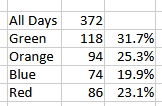
Then I counted what follows each day, i.e., a Green day could be followed by another Green day, or an Orange, or Blue, or Red day. With a random distribution of days, you would expect random following days, i.e., if 40% of days are Green, and 30% are Orange, then you would expect any given day to be followed by a Green day ~40% of the time and an Orange day ~30% of the time. You could then look at deviations, e.g., Blue days followed by Orange days only 25% of the time could be counted as -5%-point deviation.
So I did this kind of counting with the calendar days, with these results, where you see, for example, the number of times a Green day follows a Green day (39), what % of the time this represents (33.1%), and the deviation from expected, measured in % points (1.33%).

• What follows Green days looks random (i.e., the numbers in the deviation column are close to zero percent).
• Orange days are somewhat more likely to be followed by Red days and less likely by another Orange day.
• Blue days look random.
• Red days are more likely to be followed by Orange days.
I keep thinking I should study Markov processes, especially "Hidden". I don't know if this kind of counting is a simple version of a Markov process, and if there is more that could be done.
Jul
4
Dollar’s Decline Meets Rising Dedollarization, from Dr. Peter C. Earle
July 4, 2025 | Leave a Comment
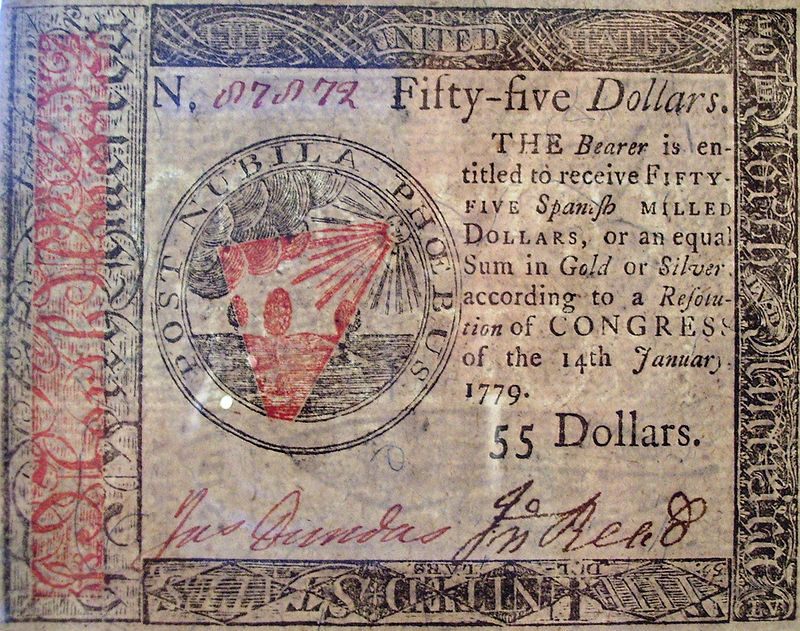
Dollar’s Decline Meets Rising Dedollarization: The Threat Comes from Within
The Bloomberg Dollar Index has fallen nearly 8.5 percent, its steepest drop since the 1980s. Elsewhere, incremental signs point to emerging alternatives.
Peter C. Earle
June 23, 2025
The recent weakness in the US dollar has reignited the debate over the durability of the dollar’s dominance in global finance. Over the first half of the year, the Bloomberg Dollar Index has fallen nearly 8.5 percent, marking one of the sharpest declines since the mid-1980s. Yet while this drawdown has fueled widespread commentary about de-dollarization, it is important to distinguish between dollar weakness — a familiar, cyclical phenomenon — and the far more consequential and complex issue of de-dollarization, which concerns the dollar’s standing as the world’s primary reserve currency and medium of international exchange.
Rich Bubb writes:
A thought I had was that many/all future currency/ies might eventually only be crypto based. How that develops is an interesting (read: slightly frightening, for me) scenario. And I think the exchange rates would be a tough hurdle to deal with. Unless there'd be a worldwide cryptocurrency system. Then there's the point that must be solved, specifically that quantum computers of 'bad actors' might be able to hack/crack cryptos' security. Maybe crypto security protocols could be quantum-based, run by quantum computers?
Another point might be powering those Q-computers (electricity) constantly. Obviously without constant power any computer is a nice pile of parts. Furthermore, any significant programming errors could 'delete' trillions worldwide before any human could intervene.
Jul
3
Sports $$$, from Big Al
July 3, 2025 | Leave a Comment
The news is the Buss family selling the Lakers (and the online discussion whether the Lakers were a better investment over time than, say, the S&P).
I wanted to look at the value of college athletics and found this page:
What the top 75 college sports programs are worth
Then I used Perplexity and elbow (or mouse finger) grease to build this table showing revenue per student, sorted high-to-low. There are many possible errors in this data but it's just for fun and seems intuitively roughly correct.
Below is the top set of rows - click here for the full sheet (all 75 schools) which will appear zoomed out - click on it to zoom in.

Jul
2
Gem from Operations Research, from Asindu Drileba
July 2, 2025 | Leave a Comment

I recently came to the conclusion that a lot of quants come from the field of Operations Research. I noticed a paper of MFM Osbourne was also published in an Operations Research Journal. After a bit of research with in this space I came across an approach called "Metaheuristics."
I think its very relevant to this list. Mr. Jim Sogi once described The Chair's approach to thinking as "Neiderhoffian thought." E. O Wilson called it "Consilience." "Metaheuristics", "Neiderhoffian Thought" and "Consilience" are all related, in that, they champion the idea that we can come across novel solutions via thinking in analogies & metaphors.
There is a table of curated Metaheuristics. It has algorithms inspired by Ants, Buffaloes, Rivers, Art (yes, like paintings), Squirrels, Wasps and Korean TV Shows (Squid Game Optimizer).
The gem I am talking about is a book called Advanced Optimization by Nature-Inspired Algorithms, by Omid Bozorg-Haddad. The book has 15 Algorithms. Notable mentions are:
- League Championship Algorithm (Inspired by sports)
- Shark Smell Optimisation (Inspired by how sharks use their sense of smell to find prey)
- Ant Lion Optimizer (Inspired by how larvae of Antlions entrap prey)
I consider the book well written. Each of the 15 algorithms are described in 4 ways. For example, the Ant Lion Optimiser algorithm:
1) It's done in plain English to give you a verbal understanding of what the algorithm does.
2) It's done in mathematics so you can know how to better understand the algorithm in math notation.
Example of math description of ant-lion algorithm
3) It's described using flow charts.
4) It's described in pseudocode so you can better know how to code the algorithms up.
All the 15 algorithms are described in this way. This was something I appreciated so much.
Jul
1
The A B C of Stock Speculation
By S. A. Nelson
16 Park Place New York
Copyright, 1902.
pp 28-29:
The elder Rothschilds are said to have acted on the principle that it was well to buy a property of known value when others wanted to sell and to sell when others wanted to buy. There is a great deal of sound wisdom in this. The public, as a whole, buys at the wrong time and sells at the wrong time. The reason is that markets are made in part by manipulation and the public buys on manipulated advances and after they are well along. Hence it buys at the time when manipulators wish to sell and sells when manipulators wish to buy.
In some commission offices, there are traders who, as a rule, go against whatever the outside customers of the house are doing. When members of the firm say, "all our customers are getting long of stocks," these traders sell out; but they buy when the firm says, "the customers are all short." There are of course, exceptions to this rule. If there were no exceptions, the keepers of bucket shops would all get rich. When the market has an extraordinary rise, the public makes money, in spite of beginning its purchases at what would ordinarily be the wrong time, and this is when the bucket shops either lose their money or close out in order to keep such money of customers as they have in hand.
All this points to the soundness of the Rothschild principle of buying a property of known value when the public generally is disposed to sell; or of selling it when the general public thinks it a time to buy.
Jun
30
Daily Spec Calendar Transitions
June 30, 2025 | Leave a Comment
sp and bonds 1-day changes similar to Mendel's independent moves to next generation. when an event occurs that throws one of pair of bond or sp off, treat it as a mutation.

The Punnett square is a square diagram that is used to predict the genotypes of a particular cross or breeding experiment. It is named after Reginald C. Punnett, who devised the approach in 1905. The diagram is used by biologists to determine the probability of an offspring having a particular genotype. The Punnett square is a tabular summary of possible combinations of maternal alleles with paternal alleles. These tables can be used to examine the genotypical outcome probabilities of the offspring of a single trait (allele), or when crossing multiple traits from the parents.
Asindu Drileba writes:
Orange (S&P Up, Bonds Down) and Green (S&P Up, Bonds Up)
Orange appeared 4 times. In 3/4 times, Orange transitioned to Green with an average point gain of 35.4 in the SPY.How long will this continue? I noticed the pattern last month, unfortunately I didn't "count" it. Was it around for longer periods of time?
Jun
29
We know that Morris had at least £11,250 sterling in January 1784 when Congress ratified the Treaty of Paris. That was the sum Morris contributed, as lead manager, to a subscription for “a vessel for the China trade”. The Empress of China venture would raise £27,000 – Morris’ £11,250, £6,750 from Daniel Parker, a New York merchant, £4,500 from John Holker, the French consul in Philadelphia, and £4,500 from other individual investors. The partners would buy a 360-ton, 18-gun sloop that had been built in Baltimore in 1783 as a privateer, convert it into a merchantman and load cargo in Philadelphia and New York: 30 tons of ginseng, 2,600 beaver and other furs, Spanish silver dollars, lead, pepper and naval stores (turpentine). The captain would be John Green. Green had served as captain of the Pennsylvania Navy sloop Aetna in 1776; in 1778 he had been captain of the brig Hope which is recorded as having captured £1,000 in prizes under its privateering commission. The Supercargo would be Samuel Shaw. Shaw had enlisted as an Ensign in the 3rd Massachusetts Regiment in 1775 after the Battles of Lexington and Concord. As Lieutenant, the Captain and then Major Shaw would serve under General Henry Knox as an artillery officer, then aide-de-camp and deputy adjutant general.
The Empress of China sailed from New York on February 22, 1784 with a crew of 34 (Green, Shaw, 2nd supercargo Thomas Randall, 2 carpenters, a barrel-maker and “several boys”). It would stop at the Cape Verde Islands for provisions in April, round the Cape of Good Hope, pass through the Sunda Strait (where it narrowly avoided a collision according to Green's logbook), and anchor at Whampoa on August 28, 1784. 1 of the crew would die in Canton of “illness”, and the ship would have £500 of repairs done while in port. Shaw would present a letter from Congress to the Chinese officials, and the Canton merchants would give Captain Green a painted fan with a portrait of the ship (the only image of the Empress of China that survives). Shaw’s September-December 1784 journal would record payments of £1,500 in duties and £500 for an interpreter. He and Randall would sell the ginseng for £6,000 and the furs for £4,000; they would buy 800 chests of tea (£15,000), 20,000 pairs of cotton trousers from Nanjing (£3,000), 64 tons of porcelain (£2,000), and silk fabrics (£1,500). The ship would weigh anchor at Whampoa on December 28 “with a fair wind”. They would sail around the Straits of Malacca, across the Indian Ocean, around the Cape of Good Hope and anchor at St. Helena on March 10 to take on water (£100). The carpenters would spend £50 in materials to repair minor leaks. According to Shaw’s logbook, the ship “Made land at New York, May 11, 1785, to great acclaim.” The cargo would be sold in Boston, New York and Philadelphia. Morris’ papers record a net profit of £6,250. What is puzzling is his calculation that this was only a 25% return on his investment of £11,250. What makes things curiouser and curiouser is that Daniel Parker will write to Morris that the venture has provided him with a “satisfactory return” and then flee to Britain 2 months later, leaving debts of £20,000 and the Empress of China put up for sale, advertised in the New York Packet as “copper-bottomed, scarcely two years old, fit for Indian with small expense.”
In 1785 he would purchase 100,000 acres in western Pennsylvania for £5000 and then sell half his holding in 1787 for the same amount. In 1786 he would invest £3,000 in the privateering schooner Dolphin; the following year the ship would record the sale of £3,000 in goods captured. In 1788 Morris' own balance sheet would show his liquid net assets at £20-30,000.
By 1790 Morris would purchase the Genesee Tract from the State of Massachusetts -1.5 million acres in the Genessee region of New York, paying £22,500. In 1791 he would buy the city block in Philadelphia (Chestnut-Walnut, Seventh-Eighth Streets) for £22,500. That same year Morris would launch the Delaware and Schuylkill Canal Company. Of its total £45,000 capital Morris would contribute £11,250. In 1793 he would sell 1 million acres of the Genesee Tract to the Holland Land Company for £75,000 and buy shares in the Bank of Pennsylvania (£4,500). In 1794 the work would begin on the Chestnut Street mansion, with Pierre Charles L’Enfant being paid £2,000 for design and supervision and £6,138 being spent that year on construction.
1795 would be the year of the very big deal. Morris, James Greenleaf and John Nicholson would form the North American Land Company; each would own 10,000 shares, and the venture would be capitalized at £675,000. It would own 6 million acres. Within 2 years (1797) Greenleaf and Nicholson would be in Prune Street Prison for bankruptcy. Morris would arrive there the following year (1798). Their collective unpaid debts would be in excess of £1,000,000.
Jun
28
Trade negotiations, from Dr. Peter C. Earle
June 28, 2025 | Leave a Comment
Trade Negotiations aren’t Chess, Poker, or Go. They’re Bridge.
Chess is zero-sum and strictly competitive. Trade is collaborative; its foundational principles are voluntary exchange and mutual advantage.
Peter C. Earle, Subiksha Ramakrishnan
May 22, 2025
Trade negotiations are often mischaracterized as adversarial contests akin to warfare or chess. (The latter is increasingly invoked in varying degrees: 3d, 4d, and nth degree). Headlines speak of countries “battling” over tariffs or “outmaneuvering” each other in the global marketplace. But while those analogies may be emotionally satisfying and undergird ideological fervor, they fundamentally misunderstand and distort the nature of trade itself.
Unlike war, trade is not about conquest; it’s about cooperation under constraints. While no analogies are perfect, within the gaming milieu, a better model is to be found in contract bridge, where strategy, communication, and shared outcomes dominate the pursuit of mutual gain.
Jun
27
General semantics, from Nils Poertner
June 27, 2025 | Leave a Comment
Drive Yourself Sane: Using the Uncommon Sense of General Semantics, by Susan Presby Kodish
GS is based on a careful study of human behavior and scientific problem-solving, bridging applied psychology and practical philosophy. Drive Yourself Sane provides time-tested methods for critical and creative thinking and constructive communicating with a variety of problem-solving applications for mental hygiene, personal development, education, business, etc.
.jpg!Large.jpg "Magritte: Ceci n'est pas une pomme")
Easy to read book about Global Semantics. Why relevant? Because we often confuse the image of something with reality. And that is recipe for insanity. eg. Dalio has this "machine" analogy for mkts and the econ. Fair enough. But the econ and markets are much more: Living organism etc (good to use "etc" as it reminds oneself that it is a lot more…) There is a famous picture that shows an "apple" and underneath the painter wrote: "This is not an Apple."
Humbert G. comments:
Image v. Reality. Dialio is the perfect example. What’s with all the gloomy billionaires?
Larry Williams writes:
Dalio sure looks like a loser always bemoaning the world same as Cooperman how did these guys rise so far?? Then I have been accused of not being smart enough to put my feet on the ground if it weren’t for gravity.
Rich Bubb ponders:
I've been thinking that Dalio is using historical events to try to not repeat AVOIDABLE/PREVENTABLE mistakes. Yet the rhyming of those events is intriguing. Especially the given nature of Nature, current hot wars, insane debt levels, growing militarization actions, natural resource over usage/abuse, wealth distribution, Us vs. Them polarizations, etc. Yep, gloomy.
His 'machine' concept of the Markets & Economics is an "approximation of a likely future" (my words). The coincidences of the factors Dalio describes at some pressure point will often start Change Cycles. We've witnessed this in our own short-lived & humble lifetimes.
The problem is that 'history' will not exactly repeat in some-yet-unknown terms but might rhyme in concept. The timeline/s of historical examples Dalio uses for large changes is/are very long. And the salient concepts, e.g., reserve currency, debt irrationality, Dalio's Big Cycle (some spanning decades or longer), "Dynastic Cycles' Stages", etc., are historically documented and presented in "The Changing World Order" (2021). The tables and 'chartwork' are visual reinforcements throughout, yet intriguing patterns do persistently re-occur.
My takeaway is generally that Major Powers' (Markets, Econ, military conflicts, extinction-level weapons/WMD^6, etc.) either don't see the cliff they are eventually going to go over, or those major powers refuse to find solutions to the recurring Root Causes that Dalio writes about.
I'm not finished with his 'Changing World Order' book. From what I have read, Dalio seems to try to codify history into significantly huge cycles, leading to changes in the World's Order. IMO, given the current situation (in our time, i.e., now) it isn't too difficult to extrapolate what's ahead… gloomy indeed. Maybe Dalio is "gloomy" for one or more reason/s.
Jun
26
Increase in yields, from Jeff Watson
June 26, 2025 | Leave a Comment

Adam Grimes comments:
Cool chart. Interesting data. We have some farmers in the family but I would not have expected such a big difference.
Peter Ringel writes:
I think, this productivity boost shows Norman Borlaug‘s Green Revolution. There would be no India or China as we know it . And in the West too. The topic seems close to not being politically correct in our upside-down world.
Michael Ott brings expertise:
The Y axis is Mg/hectare, which is a different way to measure weight per unit area. Technically, a bushel is a unit of volume (8 gallons) that is understood to be equivalent to 56 pounds of corn or 60 pounds of soybeans. Most US farmers measure in bushels per acre, which is a different way to express weight per unit area.
The major increase in corn came from breeding AND fertilization. GMO corn was introduced in 1996 and reached 50% market share around 2001, which is pretty fast adoption for agriculture. Biotech traits certainly help with yield, but more so prevent disasters from insects and weeds, which harm yields.
Big Al finds another chart interesting:

Jun
25
Fate again, but called Destiny
June 25, 2025 | Leave a Comment
Henry Siddons Mowbray was an American artist. He executed various painting commissions for J.P. Morgan, F.W. Vanderbilt, and other clients.
Destiny (1896) - Henry Siddons Mowbray (1858–1928), oil on canvas, Museum of Fine Arts, Boston, MA:

Jun
24
Forces of fate
June 24, 2025 | Leave a Comment
the forces of fate. finally a new all-time high. previous all-time high: 23 January, 2025, S&P 6123.
The Hallé - Verdi: The Force of Destiny Overture
Over the years La forza has acquired a reputation for being cursed, following some unfortunate incidents. In 1960 at the Metropolitan Opera, the noted baritone Leonard Warren collapsed and died during a performance of the opera. The supposed curse reportedly kept Luciano Pavarotti from ever performing the opera, and the tenor Franco Corelli used to follow small rituals during performances to avoid bad luck.
Jun
24
Excellent version of Clews, from Laurel Kenner
June 24, 2025 | Leave a Comment

The Wiley edition of Henry Clews, Fifty Years in Wall Street, has annotations by Jon Markman - the editor for Vic and me when we wrote a biweekly column for MSN Money - and a foreword by the Chair.
Henry Clews was a giant figure in finance at that time, and his firsthand account brings this colorful era to life like never before. He reveals shocking stories of political and economic manipulation and how he helped bring down the mighty Boss Tweed. He writes eloquently about the madness of the markets and how the era's greatest speculators amassed their fortunes. This book provides an expansive view of Wall Street in an era of little regulation, rampant political corruption, and rapid financial change.
Henry Clews was born in England in 1836 and emigrated to the United States in 1850. In 1859, he cofounded what became the second largest marketer of federal bonds during the Civil War. Later, he organized the "Committee of 70," which deposed the corrupt Tweed Ring in New York City, and served as an economic consultant to President Ulysses Grant.
Jun
23
Jarisch–Herxheimer reaction, from Nils Poertner
June 23, 2025 | Leave a Comment
Jarisch-Herxheimer reaction in medicine: A sudden and typically transient reaction (eg fever) that may occur within 24 hours of being administered antibiotics for an infection such as syphilis.
Application in financial markets? eg when a troubled stock sells off briefly after a new strategy or management is announced but the stock recovers after some 24-48 h carnage.
Asindu Drileba writes:
In The Education of a Speculator, Chapter 14, "Music & Counting":
Another frequent work I hear in the market is Haydn's Symphony No. 94 ("The Surprise"). The surprise is a simple fortissimo chord in the second movement, designed "to make the women jump." In a contemporaneous review of the work, a lyrical critic wrote:
The surprise might be likened to the situation of a beautiful Shepherdess who, lulled to sleep by the murmur of a distant Waterfall, starts alarmed by the unexpected firing of a fowling-piece.'
Two examples from currency markets:
1) Asia Currency crisis: When the Asian currency crisis of the 1990s was starting to manifest, IMF provided a loan to "stabilize" the economy. The currencies were stable for some time (the lull to sleep), then dropped by up to 80% in some Asian countries (the jump).
2) The Lebanese pound: The Lebanese pound remained very stable. Close to a flat line for 13 years (the lull to sleep), Then in Jan 2023 it dropped by 90% (the jump).
Equity Markets: "The best predictor that a company will go bankrupt, is stable income" — Nassim Taleb. Unfortunately its hard for me to get data on delisted (bankrupt) stocks so I can't test this. But the logic behind this reasoning is that, to provide stable income, corporations often optimise via unhealthy accumulation of debt, relying on a single supply chain (Apple & China), relying on a few big enterprise customers (Palantir & US Government).
While this optimisation makes it easier to milk profits that make a corporation look "stable" (the lull to sleep), it makes them more prone to catastrophic failure (the jump). A single customer canceling your service, trump tariffs on a single supply chain partner or debt unable to be paid may lead serious issues.
Jun
22
Classic research on volatility
June 22, 2025 | Leave a Comment
Converting 1-Day Volatility to h-Day Volatility: Scaling by sqrt(h) is Worse than You Think
Francis X. Diebold, Atsushi Inoue - University of Pennsylvania
Andrew Hickman, Til Schuermann - Oliver, Wyman and Company
We show that the common practice of converting 1-day volatility estimates to h day estimates by scaling by sqrt(h) is inappropriate and produces overestimates of the variability of long-horizon volatility. We conclude that volatility models are best tailored to tasks: if interest centers on long-horizon volatility, then a long-horizon volatility model should be used. Economic considerations, however, confound even that prescription and point to important directions for future research.
Jun
21
 Anyone who appreciates the scientific study of finance will recognize the name of MFM Osborne as a pioneer, visionary, and creator of our field. He was the first to discover Brownian Motion in Stock Prices, the first to study technical analysis scientifically, the first to note the lognormal nature of prices, the first econophysicist, the creator of automated market making algorithms 50 years before they became common place, the creator of market microstructure, and the discoverer of clustering of prices among other things.
They might also know that he was an eminent physicist whose work on sound and electricity led to his discoveries in finance. Yet despite his renown, he is somewhat of an unsung hero having done his work mainly in the 1960s when our field was in its infancy and many of his contributions have languished in such journals as Econometrics, Operations Research and Journal of the American Statistical Association from that period.
I had the pleasure of knowing him fairly well during the 1960s when he did much of his work in finance. And indeed we collaborated on some papers, we had an extensive correspondence, and he served as one of the original directors of my firm Niederhoffer, Cross and Zeckhauser, Inc., the original name of the current firm of Manchester, Inc. I also had the pleasure of meeting and befriending one of his astronomical colleagues, Harold Weaver at the Univ of Cal, Berkeley, who audited my classes there, and we exchanged many a story about the astounding trajectory of Osborne's scientific career.
During the time I knew Osborne, I was aware that he was the most creative and competent eye in the world of finance, far surpassing in that respect all my teachers at the University of Chicago, of that period, many of whom are widely known, revered, and honored. And I always wondered, where did it all come from, how did a man of such genius arise, and how did his scientific work in physics, astronomy, entomology and oceanography lead to his contributions to finance.
Out of the clear blue sky, I recently found the book "Autobiographical Recollections of M.F Maury Osborne", transcribed by Melita Osborne Carter from a series of cassette recordings in 1987. Attached to the autobiography was a hand written note from MFM Osborne: "You have often asked about the path I took in life. Well here it is. And as you can see my upbringing and path was diametrically different from yours."
It is a pleasure, honor and duty to review this book, as I believe we can all learn from it. And a man of such great accomplishment should receive his due. The book reminds me of what Tom Sawyer would have been like if Tom had trained to be a scientist rather than a detective, and if he had been raised by genteel Southern Scientists rather than a house aunt. It's divided into 34 sections: Early Childhood, Mrs. John's School, Public School, Games and Other Activities, Kites and Model Airplanes, The effects of Personal experience, My House on Westoer Wenue, Summer Camp, Scouts High School, Eoodberry Forest, Mother's Influence, Incidents in Norfolk, University of Virginia Sophomore Year, With Hrdicka in the Aleutions, University of Virginia Other Activities, Mrs. Rose's Farm, American Student Union, Jail– Right and Wrong, University of Cal at Berkley, Lick Observatory, Student of Oppenheimer, Operations of the Naval Research Laboratory, Life in Forest Heights, Non-nrl Research Eddington Studies.
Maury was born on December 1916 and passed away in early 2003 at the age of 86. He has two daughters and two sons. During his life he published 47 scientific papers, received his PhD from the University of Maryland in biology in 1952, served as the Mayor of Forest Heights, and was a gadfly for all the physicists working in the fields of relativity, and all the early believers in the random walk theory.
Like most greats, his life was shaped by a combination of inheritance from eminent predecessors and a fortunate environment that enabled his inherited talents to prosper. He was the proud great grandson of Matthew Fontaine Maury, a famed astronomer, oceanographer and meteorologist who was known as the Pathfinder of the Seas and the Scientist of the Seas "because of his seminal work" The Physical Geography of the Seas, 1855. After great efforts to eradicate slavery in the South, as a proud resident of Virginia, Maury resigned his commission as Superintendent of the US Naval Observatory and joined the confederacy.
He then devoted a good deal of the remainder of his life to the commercial possibilities of discovering and extracting minerals in the South as a way of rebuilding the fortunes of Southerners. MFM Osborne was very proud of his heritage from Matthew Fontaine Maury and followed in many ways in the highways and byways of his grandfather's career.
It was always hilarious to read in the autobiography that despite MFM Osborne's positions in highly classified government research, he always refused to sign any loyalty oaths because he would have had to deny that he was descended from a grandfather who had sworn to overthrow the US government with the outbreak of the civil war.
Here comes the scientist, MFM Osborne. What was his life like? What were the major influences on him? The significant events? How did he reproduce and eat? To get a flavor for his ecology, let's consider several of the typical events described in his autobiography. Osborne never accepted anything without proof. When he found an error in some respected authorities work he liked to say something like, "Someone's going to eat crow, raw squawking and fully feathered, by the time I correct his errors." He applied the same approach to life situations. He noted many people being sent to jail. But why were they sent? The answer would teach him what a society regarded as right and wrong. "No one is surprised if people want for no other reason than to explore mountain tops or caves or jungles. Well, the same is true in society. There are segments of society that one layer does not know anything about or very little about, and you can explore it with the idea of learning about it or improving it." So Osborne decided to spend a few months of his summer vacation from the University of Virginia in jail. He went about it by hoboing across the country until he was picked up by a plain clothes sheriff in Vanceburg, Kentucky. The Jail was a pre-Civil War masonry cell with two rooms with a cage on the outside with masonry walls three feet thick with 30 people inside. What did he conclude from his months in jail? "These people were not bad so much as they were just amoral in just the same way as primitive societies… Looking back I can say it enlightened me as to what constitutes right and wrong. Very much depends on arbitrary standards which change with time." He applied these insights into his study of the Constitution, the Bible, and his scientific pursuits. "It contributed to my understandings of the limitations of truth and falsity — of right and wrong. My experiences in Vanceburg, Kentucky were consonant ultimately with what I learned in many other parts of my life, and in many other circumstances." He applied this learning to question and correct the conclusions of science in many fields, particularly astronomy where he concluded that the errors of measurement were so great that separate investigators were liable to come to completely different conclusions concerning such fundamental questions as the truth of Einstein's hypotheses about the movements of the planets and satellites during eclipses, to the world of finance where he concluded that the students of the random walk were completely on the wrong track because they didn't take account of the influence of the bid asked spread, and the relation between volume and price.
It should be mentioned here that Osborne was a can do person. He was a boy scout and a fix it person. He built model airplanes, boats and kites while in his teens. "If you flew one of these airplanes at night and hung on it a thin wire in which there was a rubber band attached hanging down below the airplane, and the put a match to the rubber band, the rubber band would burn and melt and drop little flaming balls"— The unsympathetic police soon put a stop to that. "I told my children that I had taken a trash can and made a huge catapult out of old inner tubes and shot one of the smallest boys in the neighborhood in the trash can as a space capsule". He liked to hobo and hitchhike across America. He took a year off from school to work on a farm to improve his physical conditioning. He enjoyed pushing a wheelbarrow around, and hauling dirt and using a shovel. Eventually he used these skills to become the main hand on an archeological expedition with Professor Hrdlicka to explore the antiquity of man.
Time and again he used the knowledge he gained of how to get and improve his bearings to get out of life threatening experiences. On one of them however, hauling a car up to the observatory in Mr. Lick while he was studying at Berkeley, he managed to fall off a cliff and spent 1 month prostrate on his back in a hospital which time, he characteristically used to improve his knowledge of tensor calculus.
One of his typical chores there was to rake manure. He used his experiences there to come up with his solution to the problem of why the bee can fly or some insects can travel at 500 miles per hour, or how salmon can swim upstream 500 miles without eating. His conclusion: "Salmon are more efficient than the most efficient rigid body boat that humans can devise because they seek out and gain energy from the varying velocities of water that they navigate." When he performed archeological work, he had no compunction of diving 50 feet under water without deep sea equipment to recover a rake.
Another example of the Osborne way came when he was made mayor of Forest Heights. It was the first city outside of the city limits of Virginia. Anyone who moved tended to allow their dogs to run free. The dogs ran in packs and terrorized all the people of Forest Heights. Osborne concluded the solution was to have a dog day where every stray dog not on a leash that day would be shot. He became world infamous for that solution and received many a threat that he would be killed if he implemented it.
The path and conclusions of many of his scientific discoveries in astronomy, biology, entomology, finance, physics, optics, sound and especially Eddington's theory of relativity are detailed in the autobiography. His schooling at the University of Virginia, Berkeley, and Harvard provides a great window on the process of scientific education and discovery during the first half of the 20th century. His work at the Naval Research Laboratory provides insights into how large research institutions work, and the ins and outs of the bureaucratic process. His experiences with Oppenheimer, Feynman, and other great geniuses of physics and astronomy as well as the hum drum day to day of the kind of instruction provide a great foundation for the way science was carried out in practice rather than theory.
In view of the importance of Osborne's contributions to the world of finance and science, and the intrinsic interest of his autobiographical notes, his daughter Melita Osborne has prepared a biographical document that is available here [MS word .docx file, approx 300 Kb].
Jun
20
AQR looks at trend following, from Y. Humbert
June 20, 2025 | Leave a Comment
A Century of Evidence on Trend-Following Investing
November 1, 2017 - Brian K. Hurst, Yao Hua Ooi, Lasse H. Pedersen
As an investment style, trend following has existed for a very long time. Some 200 years ago, the classical economist David Ricardo’s imperative to “cut short your losses” and “let your profits run on” suggests an attention to trends. Early in the last century, the legendary trader Jesse Livermore stated explicitly that the “big money was not in the individual fluctuations but in…sizing up the entire market and its trend.”
The most basic trend-following strategy is time series momentum — going long markets with recent positive returns and shorting those with recent negative returns. Time series momentum has been profitable on average since 1985 for nearly all equity index futures, fixed income futures, commodity futures and currency forwards (Moskowitz, Ooi and Pedersen (2012)). The strategy explains the strong performance of managed futures funds from the late 1980s, when fund returns and index data first becomes available.
This paper seeks to establish whether the strong performance of trend following is a statistical fluke of the last few decades or a more robust phenomenon that exists over a wide range of economic conditions. Using historical data from a number of sources, we construct a time series momentum strategy back to 1880 and find that the strategy was consistently profitable over the next 110 years.
Jun
19
Robert Morris, financier, from Larry Williams
June 19, 2025 | Leave a Comment
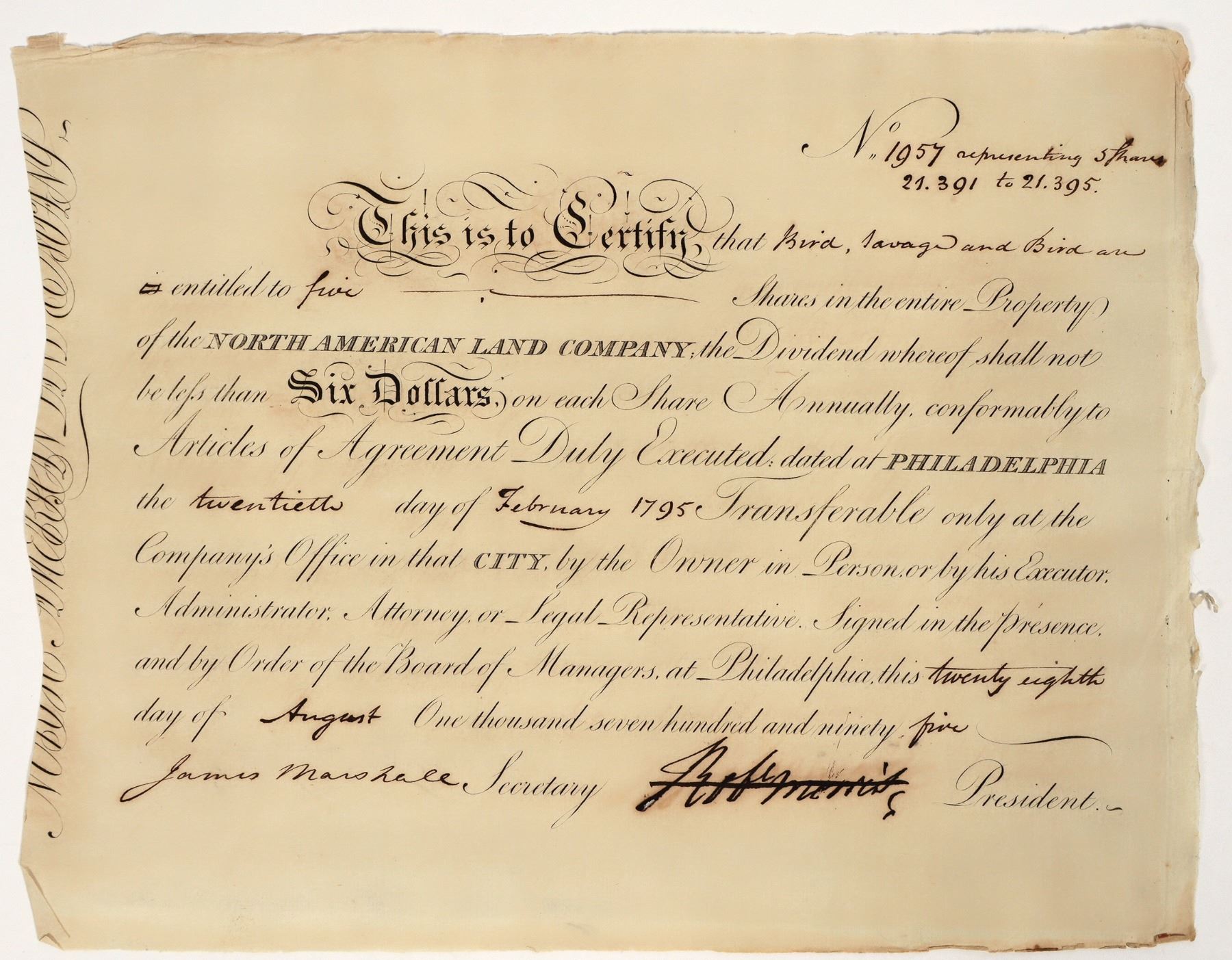
North American Land Co. stock issued to Bird Savage & Bird of London in 1795. Signed by Robert Morris as president and James Marshall as secretary. Morris' signature is pen cancelled. 9.75 x 12" Robert Morris was the financier of the American Revolution, and one of only two Founding Fathers to sign all three key American documents: The Declaration of Independence, the Constitution, and the Articles of Confederation. Morris was the first to use the dollar sign in official documents. The financial Panic of 1796 led to his financial ruin and he was incarcerated for debt in the Prune Street Prison. Date: 1795
Stefan Jovanovich writes:
Morris was the intern/apprentice to Charles Willing (Thomas Willing's father). When Charles died in 1754, Morris became a partner; he became a name partner in Willing, Morris & Co. by 1757. There was no formal registration of businesses in the Province of Philadelphia. "Firms" were known by usage as either individuals or partnerships. We know that the firm existed because its name appears in the Customs records as owners of the brig Nancy and on a bill of exchange for 500 pounds in 1757. The firm "dissolved" in 1783; in March 1784 Thomas Willing wrote a letter to a fellow merchant referring to "our late firm".
By 1781 Morris had left doing any of the daily the business of the firm because of his duties as a public official. On February 20, 1781 Congress appointed Morris Superintendent of Finance; and in September Morris became Agent of Marine - i.e. Secretary of the Navy. On December 31, 1781 Congress chartered the Bank of North America and Thomas Willing was named as its President.
The mixture of finance, merchant business and government was complete. Willing, Morris & Co. supplied muskets, gunpowder and food to the Continental Army. The Bank of America and Willing, Morris & Co. secured $5.4 million in loans ($4 million from France, $1.4 million from the Netherlands) and also made loans directly to Congress. When Congress did an audit in 1783 they found that the discrepancies in the accounting were for money that had flowed to the government, not from it. Willing & Morris had paid $100,000 in Treasury debts.
How Morris went on the become the richest man in the country, owner of "Morris's Folly" and the most famous bankrupt is Part 2 of the story. How Willing (not Alexander Hamilton) became the "founder" of the American system of finance is a whole new volume.
Jun
18
Win rate, from Francesco Sabella
June 18, 2025 | Leave a Comment
What exactly means this quote? I read of it years ago on a book about Medallion Fund but never understood if I got the meaning correctly.
We're right 50.75% of the time…but we're 100 % right 50.75% of the time. You can make billions that way.
- Robert Mercer
Peter Ringel responds:
my guess: trend following systems can have 40% win rate and lower. Yet via expectancy these sys can be very profitable. Medallion though, would do HF stuff, less MoMo.
Michael Chekalin comments:
Mercer refers to the consistency of Medallion. In other words, they are “consistently” profitable in the 50% area, which through proper money management, risk/reward, etc, can be extremely profitable.
Asindu Drileba writes:
I think its a reference to the "law of large numbers." Suppose you noticed the market goes up 51% of the time on Thursday. (for the 100 Thursdays in your sample dataset) This means that you will also loose 49% of the time. If you decide for example to only place bets for the first 20 days, you might have a win rate of 0%. All bets of the first 20 days can fail.
But the model will still be correct since you can make money for the subsequent 51 days and the lose money for the next 29 days — thus playing the market for all the 100 days (20 + 51 + 29). So your win rate will converge to 51/100 which is the same 51% you identified in your sample. You have therefore acquired 100% of the edge. I think that is what he means when he says "we are 100% right 50.75% of the time."
Nils Poertner adds:
Some specs have a 10pc win rate and do really well. Friend of mine was early investor in ETH in size- but all other of his ideas didn't work out. His nick name was "Harbinger of Failure." Kind of like the joke: "I told my friends I want to become a comedian - and they all laughed. And then I became a comedian and no-one laughed anymore." I often think about him now.
Jun
17
Bullish timing
June 17, 2025 | Leave a Comment

max without all time high currently >250 days very bullish. what else in timing is bullish?
"Time schedule are most strict for flowering and fruiting," says Heinrich. "I can make observations and then speculate about these schedules on the assumption that they came into being, and persisted because they uniquely served the tree of each species to reproduce itself better in the particular environment that it grows in." - The Trees in My Forest
Seasonal timing on a cyclical Earth: Towards a theoretical framework for the evolution of phenology
Phenology refers to the seasonal timing patterns commonly exhibited by life on Earth, from blooming flowers to breeding birds to human agriculture. Climate change is altering abiotic seasonality (e.g., longer summers) and in turn, phenological patterns contained within. However, how phenology should evolve is still an unsolved problem. This problem lies at the crux of predicting future phenological changes that will likely have substantial ecosystem consequences, and more fundamentally, of understanding an undeniably global phenomenon. Most studies have associated proximate environmental variables with phenological responses in case-specific ways, making it difficult to contextualize observations within a general evolutionary framework. We outline the complex but universal ways in which seasonal timing maps onto evolutionary fitness. We borrow lessons from life history theory and evolutionary demography that have benefited from a first principles-based theoretical scaffold. Lastly, we identify key questions for theorists and empiricists to help advance our general understanding of phenology.
Jun
16
GridFree AI: Data centers to bypass utilities, from Carder Dimitroff
June 16, 2025 | Leave a Comment
From: Axios Generate (2 June 2025):
The startup GridFree AI, born in "electron economy" incubator Montauk Climate, emerges from stealth today with $5 million led by Giant Ventures.
It's modular, off-grid "power foundry" concept integrates gas power, battery storage, and cooling with computing infrastructure.
It's "systematic, repeatable, and becomes a manufacturing process, not a stick-built process," GridFree AI co-founder and executive chairman Ralph Alexander said.
It converts gas into electricity and cooling with 90% efficiency and ensures more power is used for the actual data center IT and processing units, which means much lower CO2, it said."
The efficiency of the overall solution enables a 50% increase in available power for IT loads," the announcement states.
This is a good idea. It utilizes an older concept called cogeneration, which has been widely employed in municipalities and on private campuses. This structure's capital and operating costs are significantly lower. Owners bypass onerous ISO, transmission, distribution, and utility charges. Their presence has no impact on LMPS (local wholesale power prices). Additionally, owners capture the turbine's waste heat and convert it into cooling, which data centers require.
With minimal barriers to entry, expect more data centers to capitalize on these opportunities, particularly near fuel sources (e.g., Pennsylvania, Louisiana, and Texas).
Jun
15
Gregariousness, glory, and memorable experience
June 15, 2025 | Leave a Comment

gregariousness. in bison, locusts, passenger pigeons. what insights does this have for markets?
listening to now:
The Glory of Their Times: The Story of the Early Days of Baseball Told by the Men Who Played It
one of the most memorable and saddest experiences of my life was visiting with Larry Ritter as he was dying at Roosevelt hospital. i had befriended Larry 10 years ago and found him equally knowledgeable about finance and old time and Negro Baseball. He traveled in a Yankees bus.
while visiting him on his last days a big curmudgeon walked in. we discussed Glory and I mentioned that the spoken words of it was just as good as the book. the curmudgeon said he never listened to radio, tv, computers or anything else. he didn't believe in any of the modern.
I was not surprised when he tried to ruin the US economy shortly thereafter. Paul Volcker was proud to be wrecker. The curmudgeon was a colleague of Larry's at NYU.
Jun
13
Alasdair MacIntyre (1929-2025), from Alex Castaldo
June 13, 2025 | Leave a Comment
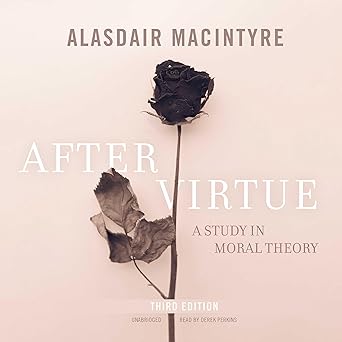
A few weeks ago I read about the death of Alasdair MacIntyre, described in Wikipedia as a Scottish American philosopher. And in some obituaries as "one of the great moral philosophers of the 20th century".
I heard his name here on the SpecList about 10 years ago when someone (sorry, I do not remember who, maybe GB?) recommended his book After Virtue, saying that it described how philosophy has gone wrong in the 20th century and how to correct it.
Intrigued, I bought the book, but like many things on SpecList, it was harder to understand than I expected. I think I read the 1st chapter or so, but I guess my knowledge of Aristotelian philosophy was not adequate and I could not make much progress. So the book sat on my shelf until now. I also did not quite grasp what Aristotle got right that later philosophers missed or what going back to Aristotle's views would mean in practice. The whole idea of reviving an earlier tradition seemed odd to me, I guess.
But still I am glad Daily Speculations made me a better person, at least judging by the books I claim to have (partially) read. Maybe someone else can explain it in terms I would understand.
Jun
12
From the archives: 10 Things I’ve Learned About Markets, from Victor Niederhoffer
June 12, 2025 | Leave a Comment
Posted on April 20, 2011:
1. "There is no such thing as easy money"
2. Events that you think are affected by cardinal announcements like the employment numbers at 8:30 am on Friday are often known to many participants before the announcement
[An example supplied on April 18 by Mr. Rogan: "The Reason For Geithner's Weekend Media Whirlwind Tour: White House Learned About S&P Downgrade On Friday" (zerohedge )]
3. It's bad to try to make money the same way several days in a row
4. Markets that have little liquidity are almost impossible to profit from.
5. When the stock market is way down, policy makers take notice and do what they can to remedy the situation.
6. The market puts infinitely more emphasis on ephemeral announcements that it should.
7. It is good to go against the trend followers after they have become committed.
8. The one constant, is that the less you pay in commissions, and bid asked spread, the more money you'll end up with at end of day. Too often, a trader makes a fortune on the prices showing when he makes a trade, and ends up losing everything in the rake and grind above.
9. It is good to take out the canes and hobble down to wall street at the close of days when there is a panic.
10. A meme about the relation between today's events and those of x years ago is totally random but it is best not to stand in the way of it until it is realized by the majorit of susceptibles
11. All higher forms of math and statistics are useless in uncovering regularities.
Read the full post with additional comments.
Jun
11

One must admire the first guy to introduce Brownian Motion into a theory about speculation.
Louis Bachelier's Theory of Speculation: The Origins of Modern Finance
Asindu Drileba wrires:
If you like that, you may find Louis Bachelier's other book Sketches in Quantitative Finance interesting. It's very accessible as it has no complex math and describes many concepts in probability/statistics in a very straightforward way. In it, he say's for example that despite Martingale strategies looking lucrative, "no one has gotten rich by using this method."
Jun
10
Trees, instinct, octets
June 10, 2025 | Leave a Comment

The Trees in My Forest by Bernd Heinrich is one of the best books about nature that I have ever read. theme of the book is, 'Trees exist as parts of an unfathomably complex web where each species is linked to others in growth, reproduction, sex'.
Each chapter teaches me big things about markets. (1) evolution of small versus big. (2) construction for strength. (3) Tree geometry. (4) time for a tree. (5) sex in a tree. (6) seeds and seedlings. (7) ants and trees.
The Homing Instinct by Bernd Heinrich is a great companion piece. Much detail about Lobagola in many migratory species.
the inexorable fate of round numbers: Octet Rule
Jun
9
Analyzing Employment Trends: Full-Time vs. Part-Time Work, from Bill Rafter
June 9, 2025 | Leave a Comment

Within the Non-Farm Payrolls (NFP) Report, two key employment categories—full-time employment and part-time employment for economic reasons—offer valuable insight into the state of the labor market. By analyzing their respective growth trends and comparing their slopes, we can better understand shifts in employer confidence and economic stability. Historically, economic downturns have occurred when part-time job growth surpasses full-time employment growth, reflecting caution among employers hesitant to commit to permanent positions. Conversely, economic recovery typically begins when full-time employment accelerates faster than part-time hiring, signaling renewed confidence in long-term business prospects.
Full-time employment has been growing steadily for the past six months and increasing consistently for 11 consecutive months. Part-time job growth, though still exceeding full-time growth, has declined over the last two months. This shift suggests a potential turning point in labor market trends. While employers have not fully transitioned to long-term hiring, the upward momentum in full-time job growth indicates gradual economic stabilization.
If this pattern continues, we may see full-time employment overtaking part-time growth, solidifying economic recovery. Monitoring sector-specific hiring trends—such as whether certain industries are driving full-time job gains—can provide additional insight into the strength of this shift. Wage growth and labor force participation are also critical factors to watch.
Jun
8
A trading game, from Humbert Z.
June 8, 2025 | Leave a Comment
Here is the trading game used by the authors of this paper:
When a Crystal Ball Isn’t Enough to Make You Rich, by Victor Haghani and James White, of Elm Partners, September 23, 2024
The authors called the experiment “The Crystal Ball challenge.” They gave 118 young adults trained in finance $50 each and the opportunity to grow that stake by trading in the S&P 500 index and 30-year US Treasury bonds with the information on the front page of the Wall Street Journal (WSJ) one day in advance, but with stock and bond price data blacked out. The game covered 15 days, one day for each year from 2008 to 2022. In sum, the players did not do very well.
To gain further understanding, the authors invited five experienced macro traders - four men, one woman - to play the game, with markedly better results. The group of five consisted of a head of trading at a top-five US bank, a founder of top-ten macro hedge fund, a senior trader at top-ten macro fund, a former senior government bond trader at top-three US primary dealer, and a former senior Jane Street trader. These players all finished with gains. On average, they grew their starting wealth by 130%, with a median gain of 60%. All of the players were selective and highly variable in their trade sizing. These veteran traders predicted the direction of the markets significantly better than the 118 younger, less experienced participants (63% vs 51.5%), but mostly the authors ascribe the dramatically different results to the much more sensible trade sizing displayed by the experienced traders.
I played the game and got this result first (and only) time. The result is largely an accident as I wasn't paying attention to the rules or the sliders and so was taking far more risk than I realized. But maybe there is a lesson there.
Jun
6
On a recent tour
June 6, 2025 | Leave a Comment

books read on recent tour of California, Japan, Thailand, Singapore and Hong Kong with Aubrey and his good friend:
Singapore: A Biography, by Mark Ravinder Frost and Yu-Mei Balasingamchow
The Trees in My Forest, by Bernd Heinrich
The Birth of the Modern: World Society 1815-1830, by Paul Johnson
And for music: La Divina - the Best of Maria Callas Compilation
Also, a great book about 200 years of peace and harmony in Japan, The Fantastic Edo Era, but a completely opposite take by Paul Johnson in The Birth of the Modern.
also one terrible book, Every Man a Speculator, by Steve Fraser. the author hates speculation in all forms and writes 800 pages of selected anecdotes with thousands of footnotes to support his biased and hateful review.
Gavan Tredoux comments:
Paul Johnson is not a careful writer, makes too many factual mistakes, often accepts received wisdom uncritically. He writes well, as a journalist would, but I wouldn't trust anything he produced.
Jun
5
Aubrey and Vic in Thailand last week
June 5, 2025 | 1 Comment
back from a few weeks tour of Asia with many books read and museums visited and zoos and botanical gardens and aquariums, and much abalone from many great restaurants. will provide reviews shortly.

Jun
4
A very healthy day
June 4, 2025 | Leave a Comment
today (Wed, 4 June) a very healthy day for sp.
Jun
4
Big round numbers
June 4, 2025 | Leave a Comment
round # of 6000 approaching, sp now at 5973. the octet rule in chemistry: the concentration of stops at rounds. what else causes inordinate concentration? limit orders tend to be concentrated at round numbers. many compounds lose electrons to reach a stable, nonreactive 8. tests show that when a stock breaks thru a round number, it is bullish.
The Octet Rule: Help, Definition, and Exceptions
The Octet Rule is a general rule that is used to describe chemical bonding and draw Lewis Structures. The rule states that Main Group elements form bonds in a manner that results in each atom having eight valence electrons in the highest energy level (sometimes called outer shell). This results in each atom having the same electronic configuration as a noble gas.
Jun
3
Books again, from Asindu Drileba
June 3, 2025 | Leave a Comment

I can't find any books from the 1700s. Big events like the Mississippi Scheme and the South Sea Bubble happened in that period. But I can't find literature from the 1700s of people describing markets then. Maybe they had PTSD from having their fingers burnt? I heard Newton never wanted anyone to mention "South Sea" around him. (he lost his pile in the investment)
Stefan Jovanovich responds:
Essai sur la Nature du Commerce en Général, by Richard Cantillon (1680s–1734)
During 1719 Cantillon sold Mississippi Company shares in Amsterdam and used the proceeds to buy them in Paris. Mississippi Company shares surged from 500 livres in January 1719 to 10,000 livres by December 1719; during the same period the prices in Amsterdam went from 400 to 7,000. The daily average spread is calculated to have been between 20% and 40%.
Carder Dimitroff suggests:
Empire Incorporated — The Corporations that Built British Colonialism, by Philip J. Stern
The book provides historical perspectives about British markets and corporate financing. It's not an easy read, but it is fascinating.
William Huggins writes:
there is a collection of "things written afterwards" about 1720 called The Great Mirror of Folly but its mostly moralizing tracts than a steely-eyed review of what went down. keep in mind the experience (a bubble in uk-fr-nl, all at the same time) had profound effects on the market for almost a century afterwards with the fr retreating from paper money and the british passing the bubble act which made it waaaay harder for anyone to raise capital. trading stock largely returned to being an insiders game until the 1800s. GMoF was recently published along with a pile of other primary docs by Yale U press:
The Great Mirror of Folly: Finance, Culture, and the Crash of 1720
I like the goetzmann treatment of 1720 from Money Changes Everything personally. He's got a couple of good recorded talks on it too. for those interested in institutional developments around markets and financial institutions in north america, I strongly recommend Kobrak and Martin's "Wall Street to Bay Street."
Steve Ellison offers:
Extraordinary Popular Delusions and the Madness of Crowds was written in 1841 by Charles Mackay. The first three chapters are devoted to the Tulip Mania, the South Sea Bubble, and the Mississippi scheme. The remainder of the book is about non-financial episodes of irrationality, including a chapter about plagues that I re-read closely in March 2020.
Jun
1
A book rec, from Big Al
June 1, 2025 | Leave a Comment

The World for Sale: Money, Power and the Traders Who Barter the Earth’s Resources, by Javier Blas and Jack Farchy
In The World for Sale, two leading journalists lift the lid on one of the least scrutinised corners of the economy: the workings of the billionaire commodity traders who buy, hoard and sell the earth's resources. It is the story of how a handful of swashbuckling businessmen became indispensable cogs in global markets: enabling an enormous expansion in international trade, and connecting resource-rich countries - no matter how corrupt or war-torn - with the world's financial centres.
Interview with the authors:
The Most Powerful People You’ve Never Heard Of
Just beneath the surface of the global economy, there is a hidden layer of dealmakers for whom war, chaos, and sanctions can be a great business opportunity. Javier Blas and Jack Farchy, the authors of The World for Sale, help us shine a light on the shadowy realm of commodity traders.
Michael Ott agrees:
I read The World for Sale about a year ago and wholeheartedly recommended.
Francesco Sabella recommends:
Many interdisciplinary insights and very elegant clarity:
The Order of Time, by Carlo Rovelli
May
31
All higher forms of math and statistics are useless in uncovering regularities, from Asindu Drileba
May 31, 2025 | Leave a Comment
I was browsing the Daily Speculations archive and found this:
10 Things I’ve Learned About Markets, from Victor Niederhoffer
No. 11 is, "All higher forms of math and statistics are useless in uncovering regularities."
Define "higher form". To someone that has just learned basic arithmetic, basic algebra seems "higher form". Does The Chair maybe mean "PhD level" math? Or does he mean that basic "counting" is the only proper way to uncover regularities?
Fazil Ahmed responds:
I think Ralph Vince has explained well, copying from the post:
Certainly in a post-'08 world, quants are out of favor, and for good reason. Most anyone I know who DOES make money in the markets, does so with very simple, robust techniques. Having considered going to quant school, and studied a good deal of it, I finally came to the conclusion that they are simply working with "models." Models of how the world behaves. unlike hard sciences like Physics and such where you can perform a test, come back a year from now, perform it again and get the same results, you don't have this in financial modeling. And I think this is where the quants have fallen short. Models are NOT reality, and they never got down to the bedrock, the reality of what his game is about. Of course it had to fail, and in a large way, at some point. A good rule of thumb is that if I need a computer, if it isn't simple enough to do in my head on the fly in the foxhole after I have been awake for over 100 hours, I can't use it.
Larry Williams comments:
This gets down to there are hard questions: What is the capitol of Montana? Only one answer: Helena.
And soft questions: How many people are in Montana? Varies from hour to hour.
May
30
The problem facing China, from Larry Williams
May 30, 2025 | Leave a Comment
Perplexity says it best:
The U.S. population is projected to keep growing through the end of the century, mainly due to immigration, even as deaths begin to outnumber births after 203325. By 2055, the U.S. is expected to reach 372 million people, with net immigration as the primary driver of growth. In contrast, China faces a rapidly aging population: by 2050, about one-third of its population will be over 65, and the number of elderly will vastly outnumber children, creating an “inverted pyramid” demographic structure. This aging trend is expected to slow China’s growth and strain its social systems, leading some to describe China as “becoming a nursing home” by century’s end. Meanwhile, the U.S., thanks to sustained immigration, will remain younger and larger than it would be from natural increase alone.
Asindu Drileba writes:
Professor Bejan's constructal law guarantee's that China will go bust on a long enough time horizon. I attribute this to China's rigid political system. Like Daenerys Targaryen said, "Those that don't bend, will break." Professor Bejan's TED Talk.
William Huggins responds:
for entirely different reasons, both Daron Acemoglu (econ Nobel 24) and Peter Zeihan are also in the China-bear camp long term - the former due to hitting the limits of "growth under extractive institutions", the latter due largely to demography (even if his tone is alarmist). Dalio's indicators suggest the opposite but all his data comes from a demographic regime of pyramids, not chimneys or inverted pyramids so i'm not sure his forecast will play out.
May
29
The latest from Larry Williams
May 29, 2025 | 1 Comment
Larry Williams on the Fed, Interest Rates & Markets! What’s Next?
Larry Williams breaks down the latest GDP cycles, shares his predictions on the Fed's next move on interest rates, and analyzes TSLA, NVDA, AAPL, and XLP.
May
28
Adapting to the situation, from Big Al
May 28, 2025 | Leave a Comment

Street smarts: how a hawk learned to use traffic signals to hunt more successfully
But what was really interesting, and took me much longer to figure out, was that the hawk always attacked when the car queue was long enough to provide cover all the way to the small tree, and that only happened after someone had pressed the pedestrian crossing button. As soon as the sound signal was activated, the raptor would fly from somewhere into the small tree, wait for the cars to line up, and then strike.
Easan Katir predicts:
Next iteration: the hawk will be pressing the pedestrian crossing button!
Michael Brush quips:
Pavlov’s birds.
Henry Gifford writes:
When I was hiking down The Grand Canyon I sat on a rock at the edge of the trail and took out a sandwich and started to eat. A bird came flying from my left side, toward the sandwich in my right hand. I reacted by pulling the sandwich back, to the right side of my head. Another bird came from behind and grabbed it.
Later I heard the birds’ favorite food is tuna fish, which they steal cans of from hikers. They open the can by grabbing it in their beak and flying above the one of the three cabins at the bottom of the canyon where the park rangers live and dropping it on the roof. The rangers have been trained to comply by opening the can and placing it on a convenient rock.
Pamela Van Giessen responds:
Was it a raven? They are particularly smart birds when it comes to getting food out of visitors to the national parks we have visited.
Asindu Drileba writes:
Crows & ravens would make good scientists. Here for example a video of a crow showing that it understands water displacement in different scenarios.
Bo Keely, from the desert:
Yesterday at the meteor crater in Death Valley two crows perched on the rim. They had grown feather sunglasses and asked for food. I went to the car & they followed and I gave them whole wheat bread. Then I got in & drove a couple miles down the road, pulled over to check directions, and they landed outside the driver's door asking for more bread.
May
27
An interesting read, from Humbert X.
May 27, 2025 | Leave a Comment
Drawdowns and Recoveries: Base Rates for Bottoms and Bounces
Michael J. Mauboussin
Dan Callahan, CFA
Long-term wealth creation for companies is also heavily skewed.
Hendrik Bessembinder, a professor of finance at Arizona State
University, studied the roughly 28,600 public companies that have been
listed in the U.S. from 1926 to 2024. Key to his definition of wealth
creation is that a stock produce returns in excess of one-month
Treasury bills.His data show that just under 60 percent of the sample failed to match
the returns of Treasury bills, destroying $10.1 trillion in value
through December 2024. The other 40 percent or so created $89.5
trillion in value. Just 2 percent of the companies produced 90 percent
of the aggregate wealth creation of $79.4 trillion, and the top 6
(Apple, Microsoft, NVIDIA, Alphabet, Amazon, and ExxonMobil) alone
added $17.1 trillion.Had you been astute enough to buy and hold any of these super wealth
creators you would have suffered meaningful drawdowns. For example,
the lifetime wealth creation of Amazon, a technology company known for
e-commerce and cloud computing, was $2.1 trillion from its initial
public offering in 1997 to year-end 2024. Yet Amazon shares dropped 95
percent from December 1999 to October 2001. The average maximum
drawdown for the stocks of the top 6 companies was 80.3 percent,
similar to the average of the full sample.
Asindu Drileba responds:
This is fairly consistent with the findings of Robert J Frey (former Managing Director of Rentech). He gave a talk titled 180 years of Market Drawdowns. The main point of the talk is that since the 1830s to present, the structure of the market has changed a lot.
- Different political regimes
- Different sets of stocks
- The creation of a central bank (in 1913)
- The advent of electronic trading
- The rise of high frequency trading
- The creation of the SEC (1934)
- Many new regulations
- Different people trading the markets in those 180 years.
But one thing has remained constant in those 180 years: The S&P is in a drawdown 75% of the time. He defines draw downs as a period between the decline from an all time high [where somebody bought] to the point that they break even. So psychologically speaking, 75% of the time, [some] investors in the S&P are in a state of regret. I am thinking that if you can find a way of trading this, the edge will probably last forever.
May
26
Every trade a loser, from Larry Williams
May 26, 2025 | Leave a Comment
I believe every trade I enter will be a loser–that is my most powerful trading belief. That concept keep me on guard and alert. Emotions are strictly Money Management. If/when you are too emotional, it just means your position size is too big for your emotions.
H. Humbert responds:
The attitude will tend to put you in contrarian positions at the best times, the times of maximum fear in the market or towards a stock. What you said is the same as saying "your best purchases are the ones that are the hardest to make." Of course if you recognize that you are a contrarian, at the same time on some level you have faith that the position will work out. It just depends on what level you want to think about it, emotionally. First derivative second derivative stuff.
The point is, with money in the market based on who is, or who is not, playing tennis (times 10,000 investors with their own 10,000 irrational superstitions), there are bound to be mispriced securities somewhere. Our job is to find them. Despite all their spreadsheets, NPVs, TA, back testing and “counting,” investors remain among the most irrational and emotional creatures on the planet. That is a good thing. That has always created mispricing, and opportunities. In essence, trading is about betting against human nature.
Galen Cawley writes:
I would say that thinking in advance that every trade will be a loser does not provide a positive edge so much as it prevents behavioral errors.
1) If you are a completely algorithmic trader, then the question is largely moot.
2) On the discretionary side, focusing on potential losses prevents unforced errors such as overconfidence manifested in the form of both overtrading (size and frequency).
3) Visualizing worst-case outcomes can prevent you from going on tilt during a crisis or during a string of losses.
Asindu Drileba agrees:
I have this attitude too. I assume every position will be a loss. So practically it helps me size my positions modestly. When I am placing a trade. A position is only in two states: a) I am over betting, in which case I may blow up. b) I am under betting, in which case I won't blow up. The only way to make sure that you are on the side of b) is to: 1) over estimate your losses; and then 2) under estimate your wins.
Another reason for assuming that your position is going to be a loosing one is that you are proactive to your trades, not reactive. Reactive means that you improvise when surprised by how things have gone. Of which you may not be in the right head space to make a decision. Proactive means you already assumed the trade was going to loose, so you had a plan ahead of time (when you were clear headed). I, for example know exactly the maximum I can loose on each trade, and it is always an amount that doesn't make me panic. Do I get Annoyed? Disappointed? Yes. But I never panic.
May
25
Atlas Shrugged, from Francesco Sabella
May 25, 2025 | 1 Comment

This morning I finished rereading the classic Atlas Shrugged of Ayn Rand and every time I learn something new; her thought is monumental. I don’t agree with a lot of her ideas and I fully agree with others, but I’ve always found this book to be an impressive catalyst for thought; this is in my opinion her power: the ability in sparking debate.
Rich Bubb comments:
Atlas Shrugged is also available as a 3-part movie. I think the book was better.
Adam Grimes writes:
My opinion on her work has shifted over the years, in a strongly negative direction. Too much of my experience contradicts her metaphysics and epistemology, particularly the rigidity of her rational materialism, and, as someone who treasures the craft of writing, much of her prose lands as clunky and overly didactic. I'm also now unconvinced on the primacy and sufficiency of rational self-interest… but, as you said, perhaps her greatest value is in creating discussion.
Asindu Drileba adds:
Ayn Rand had a reading group called the "Ayn Rand Collective" — Which Alan Greenspan was part of. They [Greenspan, Rand and a "professor"] would meet at Rand's apartment to read every new chapter of her new book. She (Ayn Rand) then fell in love with the professor and they started dating.
After sometime, the "professor" encountered a pretty young student in his own class and he "fell in love with her". The professor told Rand about the affair, but Rand begged the professor to cancel it. The professor then said that he would dump Ayn Rand, and then exclusively date the young pretty student. He said that this was the right thing to do since he was following his "rational self-interest". Ayn Rand got angry, slapped the professor in the face twice and kicked him out of her reading group.
This was a good illustration of cognitive dissonance. Rand thought her readers should practice "rational-self interest" towards everyone else, except her.
Francesco Sabella met a girl:
I was very fascinated to meet a girl times ago who I knew for her philanthropic activities and for her ideas being the exact opposite of Rand; and I was surprised to see her carrying an Ayn Rand book and she told me she didn’t like at all her; it made me think of her ability in creating debates.
Victor Niederhoffer responds:
i would always marry a girl who admired the book. susan introduced me to it and i knew then i had to marry her. it was very good choice.
May
22
Books on markets before 1900, from Asindu Drileba
May 22, 2025 | Leave a Comment
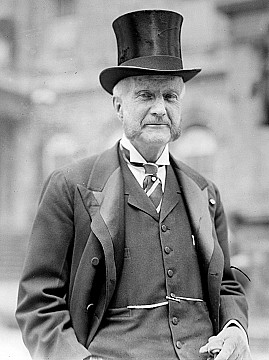
I noticed that I know of very few books on the stock market before 1900. I only know of:
Confusion of Confusions, by Joseph De La Vega (1688)
The Art of Investing, by John F Hume (1888)
Are there any books about the market before 1900 that can help me grow this list?
Big Al replies:
Lombard Street: A Description of the Money Market, by Walter Bagehot
Fifty Years in Wall street, Henry Clews
Francesco Sabella suggests:
The Stock Exchange: A Short Study of Investment and Speculation, by Francis W. Hirst
Stefan Jovanovich offers:
The Stock Exchange from Within, by Van Antwerp, William Clarkson
Martin’s Boston Stock Market, by Joseph Gregory Martin
Wall Street in History, by Martha J. Lamb
May
21
Ty Cobb as a Trader, from Stefan Jovanovich
May 21, 2025 | Leave a Comment
If Cobb saw a pitcher more than 20 times, he was able to hit better than .300 (the batting average that now gets you into the Baseball HOF). The two exceptions was Red Ruffing and Waite Hoyt.

Once Cobb saw what you had, he owned you; but he had to see what you had. This explains the anomaly of his doing badly against the "pitchers" who were not, in fact, pitchers but field players - Clark Griffith and George Sisler.
David Lillienfeld adds:
It depends on the pitcher, too, though. Willie Mays commented once that Sandy Koufax would tip off batters all the time as to what pitch he was going to use. A Koufax curve was as wicked as a Koufax fastball to Mays. He said that trying to hit that pitch, even knowing what pitch Koufax had thrown, was "like eating soup with a fork. You just can't do it."
May
20
Trend following, from Francesco Sabella
May 20, 2025 | Leave a Comment
Which are the flaws of trend following strategies? For me, the markets are homeostatic but not in a strictly way, they are like a thermostat trying to keep a room’s temperature steady. But, sometimes they can spiral into imbalance when people’s actions and beliefs feed off each other.
I’m amazed by how this dynamic of the markets has never been of particular interest in the academic world. It’s years since I don’t put in serious research given my focus on active trading, but unless something changed over this time, The classics wisdom is that markets are (let’s leave the perfectly efficient markets alone) in a perfect world supply demand state, I don’t remember having read of documented positive feedback loops etc, and overshooting and disequilibrium, which are clearly the case. I studied economics and I always found funny how some theories are.
William Huggins writes:
econ is not the right place to learn about markets because the demands of "equilibrium" require us to bend reality into the "preferred" (supposed logical) state. what most EM theorist missed was the friction in markets (adjustment time, imperfect info, etc). but momentum has been documented by financial theorists for decades. you're just digging in the wrong part of the field.
Francesco Sabella responds:
I know momentum has been documented, my point was about my economics classes, where I’ve never read about the topic, but also about how the mainstream academia is built - disequilibrium is not the classic wisdom and not even considered; you’re right that some academics have addressed momentum, but the mainstream economics is still fixated with equilibrium.
William Huggins adds:
econ likes equilibrium because its calculable, and because it approximates a physical science - if only those pesky active agents weren't so concerned about their perception of what matters instead of just obeying economists' assumptions!
in the end, its -hard- to math out the implications of imperfect, changing perceptions among a changing cast of strategically interacting characters when the targets are moving and trading may (or may not) be informed. because of these challenges, most prefer to stick to sanitized general equilibrium models, even if those are basically mathematical masturbation based on definable, stable, continuously differentiable utility functions. people usually find it expedient when modelling to pretend the net impact of all the above microstructure is "random" (its not really random, more like "too complex to model") within some defined distribution, which itself is a fudge but as Bachelier showed in 1900, might not be a bad one (and it helps avoid overfitting your forecast models).
here's are a couple of articles less than 30 years old on dynamic disequilibria (i cited Jegadeesh and Titman years ago so they were top of mind). the first talks about implications for macro, the second for asset pricing:
Towards a Dynamic Disequilibrium Theory with Randomness
May
19
Some interesting research, from Humbert X.
May 19, 2025 | Leave a Comment
Resolving a Paradox: Retail Trades Positively Predict Returns but are Not Profitable
Posted: 18 Feb 2021 Last revised: 22 Mar 2023
Brad M. Barber, University of California, Davis
Terrance Odean, University of California, Berkeley - Haas School of Business
Retail order imbalance positively predicts returns, but on average retail investor trades lose money. Why? Order imbalance tests equally weight stocks, but retail purchases concentrate in attention-grabbing stocks that subsequently underperform. Long-short strategies based on extreme quintiles of retail order imbalance earn dismal annualized returns of -15.3% among stocks with heavy retail trading but earn 6.8% among other stocks. Our results reconcile the literatures on the performance of retail investors, the predictive content of retail order imbalance, and attention-induced trading and returns. Smaller retail trades concentrate more in attention-grabbing stocks and perform worse.
May
18
Strategies, from Francesco Sabella
May 18, 2025 | Leave a Comment
With long-term investors, short-term traders, trend-followers, mean-reversion advocates, and buy-low-sell-high activists all confident their strategy is superior and showing market success, is this evidence that all approaches work together, or does survivorship bias and misplaced confidence masks that no single strategy truly dominates in today’s volatile markets?
I’ve always been fascinated by the fact that there are investors holding forever competing with traders who do the complete exact opposite and usually one says the other person is an idiot and the same is the opposite haha. (The only time I think I’ve heard of someone praising another’s way of working which was totally opposite of his in this business, was the yearly speech of Buffett and Munger claiming Jim Simons and his team were very very smart.)
Steve Ellison responds:
There are different ways to find an edge in the market, so market participants behave differently. A market maker who uses order flow information behaves very differently from a fundamental investor who believes a company has value that is unrecognized, but they may both be very good at what they do. Probably neither person could do the other's job. It's a big reason why I heed Livermore's admonition to neither seek out nor act on tips about the market.
My observation having seen multiple market cycles is that bad news spreads fast and is known quickly, while good news often occurs so diffusely and so quietly that it often doesn't even register as "news". I have as my pinned X post a 54-year chart of the S&P 500 that is annotated with the most prominent bad news for each year. Every one of these events seemed at the time to be a reason for stocks to go down (as did many other things that were only the second or third worst news of the year). I adapted this from a similar chart that Venita Van Caspel published in her 1983 book The Power of Money Dynamics.
May
17
Runs of “up” days in the S&P, from Big Al
May 17, 2025 | Leave a Comment
An analysis of runs of "up" days (i.e., Close-Close change is positive) in the S&P, through 2 May of this year:

And then I asked an AI to model flipping a coin biased in the same way (53.7% heads), and you can see the results here.
Anatoly Veltman comments:
Yes you're putting numbers out - no complaint there. Huge complaint on the premise: why would 9-day "run" into tomorrow bear same fruit as some totally different 9-day "run"?? What's a "run"; why would different-size price increases under all different relevant variables have the same impact on further trajectory - just because you assigned the same "9-day length" value to current "run"??? IMHO this sort of input can't be expected to help much.
Big Al responds:
That's actually the point: when we assign importance to runs of days, we have to be careful because the run distribution in actual data looks like the distribution you get doing a coin-tossing exercise with a market-biased coin. Which doesn't mean that analyzing runs can't produce anything useful, just that there is a high hurdle.
Anatoly Veltman adds:
My point is mostly about DIFFERENTLY-SIZED up-days. Some days could've been up $2, while others $200…Some days might have been not up-days in SP500 index, while up-days in SP500 futures. And dozen other variabilities that would make one "9-day run" be vastly different from other "9-day run" in impact on future expectations. Not that there are many ideal ways of Input, but this sort may just be prohibitively flawed.
May
16
Be careful with AI, from Asindu Drileba
May 16, 2025 | Leave a Comment
The chair recently made a tweet about a Galton book he was reading. I could read the text on the image but had to squint. I later took a copy of the image as asked Grok to extract for me the text so I can read it comfortably. Grok could only extract the text "Natural Inheritance."
After that, it didn't tell me it failed to extract the rest. it just made up its own fictional text that sounded plausible. I quickly learned it was just slop since I had already read some of the actual text in the picture.
My worry is that some people are using these LLM tools for medical records, creating legal documents. The latest AI gimmick is the so called "Agents" that will supposedly be used to file tax returns, book flights and do actual tasks on behalf of humans. My opinion would be to completely cut out all AI tools for critical tools.
Steve Ellison responds:
I am very, very careful about what I enter at an AI prompt, especially when doing proprietary or confidential work, lest my ideas become part of the cloud.
Laurence Glazier comments:
For this sort of thing use NotebookLM. Choose your sources for it, it will give you citation and preview.
May
15
I went to China recently. What I saw and nearly all the people I talked to were not happy about the economic situation there and almost everyone thinks Xi is stupid.
Humbert A. responds:
This has been the status quo since pre-Covid times imo.
David Lillienfeld writes:
Peter Drucker observed that the problem with totalitarian regimes is that with only one person in charge and no one in a position to offer alternatives/challenge that individual, there is no means of identifying and developing managerial talent in a society and the society inherently slows until the person in charge dies and there is a contest/market for new leadership. There will be problems showing in China soon enough–it has a demographic hurdle coming and it shows no signs of having any idea how to deal with it. It has lots of domestic health issues that will likely cost it considerably within the next decade. Maybe Xi will demonstrate Drucker as being wrong, but I doubt it. Barely three decades ago, the concern in the US was that Japan was about to walk all over the US. It didn't. I'm not sure that China is going to do any better.
Asindu Drileba writes:
This is my exact suspicion.
1950s to Soviet collapse — US Vs Russia (Narrative is Russians will take over USA)
1980s to Asia Currency Crisis — USA Vs Japan (Narrative is Japan will take over USA)
Early 2000s to Present — USA Vs China (Narrative is China will take over USA)
Peter Ringel adds:
There is a perverse stickiness to it. I grew up in one of these shit-holes ( not Japan ! ) - East Germany in my case. All the models and all the data point to implosion. And then it takes decades and centuries and more. And finally, when it collapses everyone is surprised, and no one was expecting it.
May
14
Sergio Marchionne, from Francesco Sabella
May 14, 2025 | Leave a Comment
One person who left a profound impact on my life when I was in school was Sergio Marchionne. He was the CEO of Fiat Chrysler Automobiles and CEO of Ferrari. One legacy he left on me as a person and for my work on the financial markets is definitely his philosophy. He had a very particular philosophical thought which I've always found unique for being practical and abstract at the same time, an intellectual and a mechanic, a quality I deeply admired. There is much of his thought that I find highly relevant for understanding the markets:
- Marchionne never followed predictable roads, but always pursued new, creative, bold roads. When he was appointed as CEO of Fiat, basically the most important asset of Italy at that time, he was losing 5 million euros a day; and he got out of that terrible point by taking courageous and strategic moves which were totally unexpected.
- He always stressed about adaptability. I know he was a big fan of Darwin and of course it very much applies to our field. He had a belief that failure to adapt was severely punished and the same if for the markets, where having an open mind and spirit of adaptability cannot be negotiated.
- There is a quote of him which I particularly like as someone who operates in a field which is survival-based, which is "We can never say: things are going well. At most: things are not going badly. We must be paranoid. The journey is extremely difficult. We are survivors, and the honour of survivors is to survive" and it highlights perfectly the financial markets winning mentality to employ.
- Another thing he used to say is that "Leadership is not anarchy. In a large company, the one who leads is alone. 'Collective guilt,' shared responsibility, does not exist. I often feel alone." and that definitely applied to trading.
- “Mediocrity is not worth the trip" is one of these iconic quotes.
-He believed that the market was without morality, without consciousness, and without being able to differentiate between what is right, fair, and what is not, and that none of us could break or alter the operations of the markets.
Sergio Marchionne was an extraordinary man, maybe not a perfect one, but definitely exceptional, brilliant, determined, consistent, with an open mind, humble but strong, decisive, courageous, and a true leader. He thought that "focusing solely on yourself is such a small ambition." Without this quality, it will be hard to stand above mediocrity, unless you find someone who takes the risk for you.
May
13
A call for great new books, from Jeffrey Hirsch
May 13, 2025 | Leave a Comment

I am putting together a list of the Best Investments Books of the Year. I am not seeing many great books on trading, investing, finance, markets, crypto, options, futures, cycles, etc. I would love to hear if you folks know of any great books out in the past 6 months or so or coming soon.
Matthew Gasda is justifiably proud:
Big Al offers:
This is high-level quant stuff - ie, over my head, and despite "Elements" in the title - but a fun stretch:
The Elements of Quantitative Investing (Wiley Finance) 1st Edition, by Giuseppe A. Paleologo
His more basic 2021 book is "Advanced":
Advanced Portfolio Management: A Quant's Guide for Fundamental Investors, by Giuseppe A. Paleologo
Carder Dimitroff suggests:
This book is about historical finance and may not be a direct response to the question.
Empire, Incorporated: The Corporations That Built British Colonialism, by Philip J. Stern
William Huggins responds:
on a similar (historical) note, one of my students just recommended this title to me. looking forward to cracking it later this month:
Ages of American Capitalism: A History of the United States, by Jonathan Levy
Asindu Drileba adds:
If you would regard a speculator/investor as someone who also builds businesses:
Never Enough: From Barista to Billionaire, by Andrew Wilkinson
Andrew is building Tiny. His intention is to build the Berkshire Hathaway of Tech and software. He is inspired by Monish Pabrai (The Dhando Investor). So he is more in the "Value investing" camp not really quantitative.
May
12
Multiple proportions
May 12, 2025 | 1 Comment
does the law of multiple proportions apply to the way markets combine with each other and the general factor which combines with specific factors to make up intelligence?
todays market up exactly 3% and 0.5% and 1% on other days inordinately likely. 75-day hi in sp today at 5850 but not an all time high of 6100 from nov.
Thus we have a two-month max in sp but still 3.5% below nov all time hi of 6100, a relatively common way of coming bak that is short-term neutral but bull for next several months.
May
11
Echoes from the past, from Jeff Watson
May 11, 2025 | Leave a Comment
I have heard every single one of these more than once on the floor. This is the G version; the X version would be very inappropriate for this venue.
You’re long hope and short reality.
He couldn’t trade his way out of a wet paper straddle.
You’re bidding like it’s your wife’s money.
His stops have stops.
He buys the high, sells the low, and thinks he’s range trading.
If brains were dynamite, he couldn’t blow his nose.
He's so underwater, Aquaman just waved.
Tighter than a bull’s ass in fly season.
Your size is what we use for toilet paper.
He’s a momentum trader—in reverse.
He couldn’t fill a corn order, let alone an order ticket.
That guy trades like he’s reading Braille.
He thinks ‘limit down’ means he hit the jackpot.
He trades like he’s got a rearview mirror taped to his glasses.
He’s scalping—his own account.
Nice fade. If I ever need a contrary indicator, I’ll call you.
He went from hero to sandwich in one tick.
I’ve seen better risk management at a toddler’s birthday party.
Market’s moving—better go ask your horoscope.
You trading or just making donations today?
He’s got a 30-lot mouth and a 1-lot account.
That guy’s P&L looks like an EKG flatline.
You're not trading—you're gambling, but slower.
He’s so unlucky, he’d lose money in a rigged market where he’s the rigger.
The guy’s charts look like modern art—ugly, meaningless, and overpriced.
He averages losers like he’s building a position in failure.
Don’t worry, he’ll blow up before lunch.
His fills are like Bigfoot—plenty of stories, no proof.
That trade had more slippage than a greased pig at a county fair.
He went full margin—and full stupid.
Asindu Drileba writes:
I watched the documentary "Floored" that was about the extinction of pit traders due to the advent of computer driven traders. A lot of the traders seemed to have their edge in bullying and intimidation that was both physical and psychological.
I made a pit trading playlist that I binged on, and this seemed consistent even to pit traders in the currency pits of London.
One of the pit traders called the computer "The most vile invention ever made." I think he was just sad that his bullying was no longer an advantage. You can't insult a computer, or use your big body to push it away so you can have the edge, or seduce it with good looks.
Michael Brush responds:
Behind every computer, there is a person.
“The offer is $25.”
“But my computer says $45.”
“So sell it to your computer.”
Pamela Van Giessen adds:
For those interested in a biography of a once famous and beloved pit trader, I recommend Charlie D: The Story of the Legendary Bond Trader by William Falloon.
Francesco Sabella adds:
It's an incredible book! I read it years ago, I even saw a 2 hour video of Charlie D. when i was in high school where he gave a lecture on trading on 1989.
Larry Williams writes:
Charly D was one stand up guy. He loved the Bears and suggested a bet with a young lady trader for a nickel on the weekend's game. She said sure…and won. Monday morning Charley D gave her 5 grand (a nickel in betting parlance). She was astounded, told him she meant 5 cents not 5G's. No way could she risk that or take the money. He left it in her hand and walked away.
I was fortunate, thanks to T Demark, to be part of his Vegas support group - he was just amazing to hang with.
May
8
Fuzzy thinking, from Nils Poertner
May 8, 2025 | Leave a Comment
Bart Kosko came out with the "fuzzy thinking" quite a while ago. Some of his ideas are very relevant today.
Fuzzy Thinking: The New Science of Fuzzy Logic
An authoritative introduction to "fuzzy logic" brings readers up to speed on the "smart" products and computers that will change all of our lives in the future.
Of course, the P/L at the end of the day is either red or green- but life in general is way more greyish and shades. And the over-use of "black-and-white" thinking is also recipe for going insane (and that is easy to spot in some parts of society).
Big Al adds:
An interesting interview with Bart Kosko.
And here is his lecture as part of the Linus Pauling Memorial Lecture Series:
What is Noise? What is Signal?, Dr. Bart Kosko, University of Southern California
Noise is a social nuisance, a cause of deafness and high blood pressure, and an all-around annoyance. But what is noise really? As Kosko simply states, “Noise is a signal that you don’t like.” It occurs at every level of the physical universe, from the big bang to blaring car alarms. Today, noise is considered the curse of the information age, but, in fact, not all noise is bad. Debunking this and many other commonly held beliefs about noise, Kosko gives us a vivid sense of how deeply noise permeates both the world around us and within us.
May
7
One is reminded
May 7, 2025 | Leave a Comment
one is reminded of table tennis against a robot or chess game against deep 6 or later computers but the analysis at the fed that is data dependent as long as it sinks the bad guys. "only monetary policy here and no influence of politics". But there has to be a philosophy.
May
7
Francesco Sabella in Conversation With Victor Niederhoffer: Harvard Educated Hedge Fund Pioneer
Gary Boddicker writes:
Thanks Francesco. Always good to see and learn from Vic. Subscribed and look forward to your future interviews.
Steve Ellison adds:
This is a great interview. The 2 minutes starting at 13:36 about ever-changing cycles is itself a meal for a lifetime. "The world is always changing, and [the] road to success is always a little different, and the techniques that you’re using are always subject to competition. You should try to be alert to change."
I increasingly perceive that the pre-2020 world in which I lived most of my adult life is gone forever. It's a new era, and old techniques in many fields don't work any more.
May
6
Shtetl, Asindu Drileba
May 6, 2025 | Leave a Comment
Shtetl (full documentary) | FRONTLINE
This is a very depressing video about envy and how bad things can become. I think it also adds to previous discussions about madness of crowds (how ordinary people start participating in senseless murder) and illustrates that there is really no limit to how primal humans can become as long as they are given the green light.
Two take aways:
a) Don't hang around envious people.
b) Always make sure you have as little as possible that people can envy you over.
May
5
TSLA Stock, from Francesco Sabella
May 5, 2025 | Leave a Comment
Fundamentally one thing i like of Tesla its the self driving technology, even if proper implementation is probably years ahead, maybe even more. And this extraordinary technology was funded thanks to Tesla high stock price. With the high stock price it strenghtned the fundamentals which fueled funding for innovation creating a virtuous cycle.
Thanks to this Elon could borrow easier and invest more and more… i waited to see if sentiment flipped on its favor again, but it didn't, so the same dynamics that made him so successful in the past will now (not now actually, as its months already) work against him can help deteriorate the fundamentals even faster.
I do not forget about the exceptional ability of american companies into adapting to different economic environments, but i have a lot of confidence on this trade. Plus all the reputational risks of Elon with his political activity and its exposure. Again, Elon's exposure is what helped a lot TSLA growing so big, but now that exposure is working again him unless he recognizes the mistake is doing and change the way he deals with his public image, which he won't.
In Q1 2025, Tesla's net income dropped an incredible 71%, to just 409 mln , compared to the same quarter in the previous year. This dramatic decline signals serious trouble in maintaining profitability, especially when you consider that without 595 mln from selling zero-emissions tax credits, Tesla would have actually posted a loss. This reliance on external credits to stay in the black is a grim indicator of weakness in its core operations. Operating margin is Operating Margin is at 2.1%, which is below industry.
And, in my opinion one of the most bad-looking things is the warranty liabilities, which is out of control. Let’s assume they hit $3.5 billion, up from, say, $2.5 billion in Q1 2024—a 40% jump in one year. Compare that to their $409 million net income in Q1 2025, and you’re looking at a liability that’s 8.5 times their quarterly earnings which will drain cash and destroy profitability.
If this trend holds, which very likely will given the self reinforcing behavior of the stock, tesla will need to raise prices of the car to cover the costs shutting demand even more,cut research and innovation and raise capital.
And most don’t realize how much Tesla’s battery production hinges on cobalt from politically unstable regions and a conflict or export ban could choke their supply chain overnight, spiking costs or halting production. It’s a hidden risk, that can cause serious problems, without adding the macroeconomic current environment which you are probably aware of.
Elon's bold announcements worked very well in the past because it was unexpected, now he lost that power. He has no power to influence his stock if not for a day or two, those especially retails who bought the dip in the past, made a lot of money and will do it again more and more forgetting about Robert Bacon ever changing cycles and the market can only come down when nobody expects it.
Henry Gifford writes:
A few days ago I attended a reunion of my grade school class. Guys I haven't spoken to in decades were commenting on how the rush to all-electric for cars and buildings strikes them as insane.
For seven years I taught about energy efficiency at the graduate level in an architecture college. One assignment was to compare the energy used by a gasoline powered car to an electric car, including the energy required to make the electricity to charge the batteries. No student over those years argued that electric cars saved any energy at all when the energy needed to make the electricity was included. In the later years more students refused to do the assignment, and instead take a D, as the assignment became more politically incorrect as the years went by.
I imagine fewer students would do that assignment these days, but sooner or later those who don't believe electric cars save energy, or reduce burning of fossil fuels, will get even more tired of keeping quiet to avoid being seen as an outcast. Remember, it was a kid who pointed out that the emperor was naked - no adult dared say that. But sooner or later, something along these lines will have a large effect on TSLA stock. Or, there simply won't be enough electricity around, and/or the price will be so high people will not want to buy the electricity and stop buying TSLA cars.
Without the backstory that TSLA is good for the environment, or saving the planet, it wouldn't be much more than a cool looking, inconvenient car that will need a very expensive battery replacement long before a gas engine needs replacement.
Sam Johnson responds:
Electric cars seem the best optimized for full self driving (individual tire motor control, acceleration/deceleration). They will take over in most climates for this reason alone. Everyone will want the tech, even if "less green."
Stefan Jovanovich comments:
The point of Tesla from its inventor's point of view was that it would provide ideal learning curves for (1) advanced fabrication and (2) autonomous machine thinking. If you were going to visit Mars in your lifetime, you had to have a rocket and a planetary construction technology that used (1) and (2). The instinctive mistrust of Elon Musk by short sellers and Democrats has not been misplaced; he is the consummate hustler. Since we (the BW and I) never trade or speculate, we have never once been tempted to go long or short on TSLA.
For us the connection there is an unavoidable connection between TSLA and NVDA; and we have, as a family, been long on NVDA for a dozen years now. We had no choice; our one and only child chose one of its engineers for her true love, and he chose her. We had to study Nvidia as a business because we were financially married to it. What we found is that rare company that can have repeated growth spurts like a child's - where everything financial - revenues, earnings, cash flows - increases 10 times faster than the financial world around it while its "bad" years never see declines any greater than the figures that Wall Street considers normal for a "recession". It did this without ever once getting the permanent subsidy that Musk had to depend on for TSLA.
I agree with HG about TSLA's technology; he is confirming Carroll Shelby's prediction that, in the end, hybrids would be the best engineering solution to the question of how you match electrical motor drives to automobiles.
TSLA as a car brand can disappear, and Musk will not care; he will have acquired the knowledge needed to build rockets at scale. Given his wonderful abilities as a financial hustler - PayPal remains to this day a wonderful invention of something no one needed but everyone bought into, Musk may find a way to get others to buy him out (has anyone ever actually made money in Ford after it went public?).
Update to earlier Idiot advice about common stocks: NVDA and PHM are now Owns, not Buys. TOL is the one company we are still punching on the Buffett bus ticket. We will continue to be married to NVDA financially because its climb to vertical integration is only half-way done. I asked the SIL if there was any comparison between Carnegie's acquiring the coal, iron ore, clay and earth metals that his mills used and Nvidia's "investment" in America. He wisely deferred to offer any opinion since that would be, in the small minds of SEC lawyers, "inside" information. He did offer a general comment: for the world of ICs and their users, the vertical integration is already happening; it is AI.
May
3
Domestication, from Big Al
May 3, 2025 | Leave a Comment

Some in these areas of science (genetics, animal development and behavior) have proposed that humans have essentially domesticated ourselves during the Holocene.
The domesticated silver fox (Vulpes vulpes forma amicus) is a form of the silver fox that has been to some extent domesticated under laboratory conditions. The silver fox is a melanistic form of the wild red fox. Domesticated silver foxes are the result of an experiment designed to demonstrate the power of selective breeding to transform species, as described by Charles Darwin in On the Origin of Species. The experiment at the Institute of Cytology and Genetics in Novosibirsk, Russia, explored whether selection for behaviour rather than morphology may have been the process that had produced dogs from wolves, by recording the changes in foxes when in each generation only the most tame foxes were allowed to breed. Many of the descendant foxes became both tamer and more dog-like in morphology, including displaying mottled- or spotted-coloured fur.
But there has been criticism of the breeding experiment and conclusions.
Asindu Drileba responds:
My definition of "domestication" used to be that of "Animals simply living under the care of other animals". When I watched a PBS Eons video some years back, I learned that Paleontologist's had a very different definition of "domestication". They define it as "the dependence on the care of other living things, to the extent that they cannot no longer live in their natural environment (the wild) anymore."
In the animal context, humans domesticated dogs and stray dogs (dogs with no owner) are riddled with wounds and in general don't do well. They would probably die if left in a forest. Foxes however look good in the wild.
In the human context, a human being with no owner (a government, a parent or an employer) usually does as badly in the manner of the stray dog. This human would perfectly fit the paleontological definition of what would be a "domestic human". The same applies for the ownership class/ruling class. They have used the working classes to domesticate themselves so they too, also can't survive with out them either. An undomesticated human would be people that can survive in an environment urban dwellers can't, the natural environment.
Like how the Khoisan do well in the desert, or tribes in the deep Amazon also do well. If you dumped a random urban dweller in the Amazon rain forest or the Kahalari desert (under same circumstances as the natives) 99% of them would die within weeks.
May
2
Working thorium reactor, from Asindu Drileba
May 2, 2025 | Leave a Comment
:max_bytes(150000):strip_icc()/GettyImages-465426935-edcdf31401e94eb3a3df656656509326.jpg "Thorium")
I wanted to ask Carder's opinion on this article that I came across titled:
China builds world’s first working thorium reactor using declassified US documents
It uses molten salt to carry the fuel and manage heat, while thorium serves as the radioactive fuel source. Experts have long viewed thorium reactors as the next leap in energy innovation. Some scientists estimate that a single thorium-rich mine in Inner Mongolia could theoretically supply China’s energy needs for tens of thousands of years with far less radioactive waste than current uranium-based reactors.
Carder Dimitroff responds:
Thorium is a fuel that is currently used in some commercial reactors. Canadian reactors can accept thorium and other nuclear materials in their CANDU reactors. (Read more: We can use thorium.)
One reason that the US, EU, and other reactors do not use thorium is that their reactors and related supply lines were not designed to accept that type of fuel. In US PWRs and BWRs, the reactor relies on precise fuel physics to achieve optimal performance. Changing the type of fuel would present a tough, if not impossible, outcome in terms of performance, let alone capital and operating costs.
When compared to a plant's production costs, nuclear fuel is surprisingly inexpensive, including the cost of disposal. Most of its energy is wasted. Consequently, there is little motivation to change the nuclear fuel's value chain.
Molten salt reactors are not new. In 1959, the US built the "Sodium Reactor Experiment" in California. Since then, several other countries have improved the design. Today, it is a viable technology, particularly in the Small Module Reactor (SMR) market. One example is TerraPower's Natrium Project (Bill Gates). They are currently testing the liquid sodium fuels for their Small Modular Reactor (SMR) product. (Read more: Terrapower: Natrium)
Apr
29
A goldmine of techniques
April 29, 2025 | Leave a Comment

a goldmine of techniques to use for markets. concentration ratios, capture recapture, signaling, aural detection, etc:
Ecological Methods provides a unique synthesis of the methods and techniques available for the study of populations and ecosystems. Techniques used to obtain both absolute and relative population estimates are described, and approaches to the direct measurement of births, deaths, migration and the construction and interpretation of life tables are reviewed.
Apr
28
11 things I learnt racing that relate to the markets, from Francesco Sabella
April 28, 2025 | 1 Comment

I’ve been a professional racing driver from the age of 3, the first time I’ve been on a karting circuit driving, until 17 doing a formula 4 championship and I placed myself at the 3rd place in the international final race in karting at 15. Here’s what I learnt from that extremely competitive sport that may apply to trading, investing and I’d say to many other aspects of life:
1. You can’t perform well in all the track conditions and different weathers, you may suffer more with the hot weather and perform best with cold, or the opposite , the key is to survive and doing your best when conditions are not ideal, and maximize your performance when the conditions are in your favor.
2. Think astute and strategically, an important part of winning a race was being smart in the way you used your tires. You could only have one set of tires per race, so if you had a very qualification, during the manche (the fight after qualification which will give you a place on the grid of the final race) it was smart to preserve your tires and drive conservative in order to arrive at the final race, maybe even a couple of positions lower of where you could’ve been, but with better tires. In this way you’re going to be performing best at the last race, which is the only one that matters.
3. When I was 12, a retired legendary old man who was the karting principle of Ayrton Senna (he had like 100 t-shirts with still the sweat of ayrton, because senna when he was in Italy racing never changed t-shirt but just threw them away, but he never sold any as memory) called Ernesto, who’s not very well known online but he’s been a crucial person on Senna’s life, was impressed with my driving skills and decided to help me in winning the world championship when I was 12. He told me, as important rule, the importance of being patience. When I was 2nd, to not surpass the 1st guy, stalk him and make him go nervous , always right behind him , until it’s the right time. You’re going to be relaxed, keeping your engine fresh and when it’s the last 2 laps you surpass him. It very well applies to trading and investing I’d say.
4. Do not show your edge and your strong performance. When I was practicing during the weekend race, I’ve never showed when I was performing well. You need to keep the eyes away from you and make your competitors think you’re performing terrible or average. Then you surprise them on Sunday at the race day. It very well applies to fund managers I think.
5. Talent is not enough. You need to be talented, competitive , prepared and very well trained on track; but it’s as much important to be good at selling your talent to the right person, otherwise you won’t go nowhere. My goal was to become a f1 driver , and I’ve seen countless of people and friends getting extremely close , spending a fortune, and then getting nowhere. And then I’ve seen a guy, talented but not as many others, achieving this goal thanks to his ability to network his talent to the right person. In finance it’s the same I believe.
6. Luck. Luck played a very important role in racing , it was the little peace of the puzzle needed to end a perfect race. But after seeing it so many times, I can tell one thing for sure: luck favors the bold, so when you’ve the wind on your back push over your limits, because luck will drift in your favor.
7. Arrogance and humility. The true enemy of a man , I discovered not to be losing but to win and winning too much. That’s where the real strength is seen; not from how you handle losing.
Winning, especially winning streaks, will make you feel arrogant and superior to others, training and practicing less and underestimating your competitors. Always try to stay as much humble as you can because it was humility that made you winning and it’s the lack of humility that will destroy you.
8. Setups. Always change as many setups as you need until your performance improve if they’re bad and you don’t feel adapted to the current circuit conditions, but NEVER change a setup that it’s currently winning. I’ve often see setups working amazing, turning a race into a terrible performance trying to make a great setup a perfect one. When something it’s working, let it work and don’t interfere.
9. Edge. Don’t expect all your competitors to follow the rules, I’ve often seeing racers, maybe multibillionaires ones who could afford to cheat on an international event , doing little cheating maybe to the engine or to the kart itself to gain that very little edge to win a race. As my father used to told me when as young kid, it’s important to be morally on the right side and do what’s right doing the best we can having the best engine as possible at the limits of what’s allowed, but never a single step beyond. It won’t give you an edge today but it will give you an edge tomorrow.
10. Strategy. You need a strategy to perform, but the biggest wins are the ones that come from your intuition where you drive with your heart and soul and let your talent and preparation to the heavy lifting without rationalizing too much. It very well applies to trading, espeicially on volatile times.
11. Keep eyes open, around the paddock I often had my eyes very opened trying to understand what the fastest drivers were doing and which setups they had, not necessarily to copy them but to get a feeling on what’s working; in fact they were often trying to hide crucial parts of the setup, but still every little detail made a difference; in trading I think it’s important to do that.
Apr
28
Most resonant
April 28, 2025 | Leave a Comment
i've always found the 19th century heroes the most resonant. one of the joys of the Tredoux books on Galton is how they all appear: Conan Doyle, Spearman, Cyril Burt, Pearson, Livingston, Bennett, Binet, Gilbert.
Apr
27
Age is just a number, from Jeff Watson
April 27, 2025 | Leave a Comment
88 years old and skating. He started skating at age 70.
Octogenarian skateboarder shreds concrete in Spain's Bilbao
"My bones are special," he chuckles between sips on a post-workout glass of white wine at his favourite bar in Bilbao's working-class neighbourhood of Begoña. "Though I touch wood."
Steve Ellison writes:
In only 2 more years, he will be old enough to have "sufficient experience … to command success" in Wall Street, as Clews put it, and know exactly when to skateboard down to lower Manhattan in a panic.
Apr
26
Book question, from Francesco Sabella
April 26, 2025 | Leave a Comment
Does someone have a great modern macroeconomics book to recommend?
William Huggins responds:
it depends how theory heavy you want it to be. the author i usually recommend is Mankiw but Williamson (intermediate) and Romer (advanced) are good too depending on your needs. for the best "whole picture" i like a CFA publication from 2013 called Economics for Investment Decision Makers, by Piros and Pinto, which gives a great summary of micro, macro, and int'l econ under one roof.
for single-day-beach-reading i bought a casually interested buddy a copy of How Economics Explains the World, by Andrew Leigh, which is a great intro for non-users.
Apr
24
Planck’s principle, from Nils Poertner
April 24, 2025 | Leave a Comment

A new scientific truth does not triumph by convincing its opponents and making them see the light, but rather because its opponents eventually die and a new generation grows up that is familiar with it…
An important scientific innovation rarely makes its way by gradually winning over and converting its opponents: it rarely happens that Saul becomes Paul. What does happen is that its opponents gradually die out, and that the growing generation is familiarized with the ideas from the beginning: another instance of the fact that the future lies with the youth.
— Max Planck, Scientific autobiography, 1950, p. 33, 97
relevance of how new ideas are being adopted in science, markets, everywhere.
Jeff Watson responds:
Science by consensus is not science. Just ask Galileo.
Pamela Van Giessen writes:
John McPhee wrote extensively about this and how the science of geology advanced over a few centuries in Annals of the Former World. Scientific community consensus is pernicious, and it is clear that there is mostly no convincing it.
William Huggins comments:
the foundation of science rests of replicability - anyone with the same data should be able to replicate results (even if they disagree about the mechanism). once replication is established, the difficult questions come from "is this data sufficient and representative?"; "is the data generating process stable or dynamic?"; "did i gather data in support of my hypothesis or to try to disprove it?". the fun stuff.
philosophy of science ensures we ask good questions and have good tools to tackle them with. this is why the Ph in PhD is short for "philosophy."
correction: "same data" is the wrong phrase - "equivalent, out-of-sample" would be a better choice of words.
Asindu Drileba writes:
The problem with the human mind is that it has too many glitches. You can verify data successfully and still be wrong. Here are two examples from Astronomy. First, The Mayans had models that would accurately predict eclipses. So, your data of when eclipses occur would replicate really well with their model. However the model of the solar system the Mayans used, had the Earth at the centre and the Sun revolved around it. The assumptions of the model were completely wrong, but the data (predictions) were accurate.
Second, is Newton's models, that predicted the movement of a comet accurately. Then you often here people say that Einstein proved Newton wrong with Relativity.
I think when it comes to science, explanations are very flimsy. What should matter is if the idea useful or not.
Francesco Sabella responds:
I think it’s a very good exercise to start from the point of view that our mind is bound to make mistakes, have glitches and start to work from that assumption; even if it’s not always true but it can be good as working hypothesis.
Big Al recalls:
Years ago, doing simple quantitative analyses to post to this list, I learned that one of the biggest pitfalls was my own desire to get a nice result.
Apr
23
Modeling the dynamics of life
April 23, 2025 | Leave a Comment

excellent book to study for all biological areas that math will uncover
Modeling the Dynamics of Life: Calculus and Probability for Life Scientists, by Frederick R. Adler
The goal of this book is to each the mathematical ideas that will help us understand various phenomena in life sciences. These are the same ideas that researchers use in their work, as well as in collaborations with colleagues engaged in more empirical activities. They are not specific techniques, such as differentiation or integration by parts, but rather they revolve around building mathematical models.
A mathematical model is that crucial link between a life sciences phenomenon and its description in terms of mathematical objects. We will gain the skills needed to construct a model, make sure it works, and understand what it implies—we will learn how to translate appropriate aspects of a life sciences problem and its assumptions into formulas, equations, and diagrams; how to solve the equations involved; and how to interpret the results in terms of the original problem.
Apr
22
Reading list
April 22, 2025 | Leave a Comment
Victor Davis Hanson Should Stick to the Classics
by Don Boudreaux at Cafe Hayek
Prof. Hanson, for example, presumes that the trade surpluses of various foreign countries are the results of clever cheating by those countries’ governments – cheating that yields unfair benefits to those countries as it damages the U.S. and inflicts on us Americans harmful trade deficits. He’s apparently unaware that countries that run trade surpluses also necessarily run capital-account deficits: global investors prefer, on net, to invest elsewhere than in those countries. In contrast, countries that are especially attractive to global investors run capital-account surpluses – another name for trade (or, more precisely, current-account) deficits.
Jeff Watson is keeping up with the CME dispute:
Here’s an interesting article about the upcoming trial:
Judge clears the way for a titanic trial pitting old-school traders against CME Group
But the plaintiff traders, many of whom formerly worked in the pits and are retired now, allege that CME reneged on a deal preserving members’ rights — including preferred trading floor access and pricing and information advantages — when it closed the physical floors and confined transactions to the Aurora operation. As a result, they say, the value of those memberships (reflected in B shares of CME) has fallen by two-thirds in the past decade even as CME’s A shares (the stock held by ordinary investors) have soared in that period.
Humbert X. writes:
I wonder if the PMs will get a heads up on tariff changes?
Trump Media Launches Separately Managed Accounts
SARASOTA, Fla., April 15, 2025 (GLOBE NEWSWIRE) — Trump Media and Technology Group Corp. (Nasdaq, NYSE Texas: DJT) ("TMTG" or "the Company"), operator of the social media platform Truth Social, the streaming platform Truth+, and the FinTech brand Truth.Fi, along with Yorkville America Equities, an America-First asset management firm, and Index Technologies Group (ITG), an originator and provider of thematic investment solutions, today announced that the three firms have created a strategic partnership and launched a new suite of Truth Social-branded Separately Managed Accounts (“SMAs”). These investment strategies offer investors access to curated, thematic investment strategies rooted in American values and priorities.
The initial lineup of SMA strategies includes:
Faith & Values
Liberty & Security
Energy Independence
Made in America
Apr
20
An interesting article that is making me think its mostly IP theft:
An image of an archeologist adventurer who wears a hat and uses a bullwhip
One of the internet-est things to come out of the most recent update to GPT image generation is the Studio Ghibli-zation of everything - another reminder of how OpenAI (and everyone else) trains on images that are very obviously someone else’s work.
Carder Dimitroff adds:
It's also an energy thief. Some data center owners are trying to get ratepayers to cover infrastructure costs through the state ratemaking process. On top of the capital costs, ratepayers are also expected to pay elevated marginal power costs. It's not just power. It's also natural gas:
This proposed gas plant to power a data center campus is massive
The soaring power needs of data centers continue to raise eyebrows, and nowhere is this more evident than at one Pennsylvania project, where a massive proposed natural gas plant would replace a legacy coal facility.
Pamela Van Giessen responds:
Thanks for sharing this. Every publishing/media legal department should read this, along with all artist guilds. And then they should do their own tests. AI was always theft.
Asindu Drileba offers:
There is a developing case NYT vs OpenAI:
Judge explains order for New York Times in OpenAI copyright case
April 4 (Reuters) - The New York Times made its case, for now, that OpenAI and its most prominent financial backer, Microsoft, were responsible for inducing users to infringe its copyrights, a New York federal judge said in a court opinion on Friday explaining an order from March 26.
Ars Technica did a more comprehensive article about it a year ago.
Apr
19
Regression to the mean
April 19, 2025 | Leave a Comment

Great and sententious discussion of regression by Tredoux in the second volume of his Galton bio (with tremendous applicability to markets):
However the concept of regression to the mean where it has been comprehended at all has led to persistent popular misunderstandings about its nature. Failure to spot regression to the mean recurs so often it seems to be a universal law of human behavior. Examples could be multiplied endlessly. They involve selection of a bad condition to which some intervention is applied after which the condition is observed again. Usually it has improved. Therefore the policy is supposed to work.
Francis Galton's Genius: 1865-1911, page 225
Apr
18
I know The Chair uses linear regression and so do some hedge funds. But what are you people using it for? Predicting earnings? Stock Returns? Stock Prices?
What kind of inputs make sense to insert into a linear regression model? What mistakes do you think people make when using linear regression?
Big Al responds:
A book the Chair has recommended:
Applying Regression and Correlation: A Guide for Students and Researchers
I've used correlation for exploring lots of simple questions like, "Does the move on Monday predict the move on Tuesday?" The basic model is just "does A predict B?"
One mistake often made when looking at time series like stock prices is to use absolute dollar/point changes rather than % changes. Always use % changes.
Apr
17
Options Market Are Prediction Markets, from Asindu Drileba
April 17, 2025 | 1 Comment
An interesting analysis of the options market on April 9th Trump Tariff fiasco. It seems the options market was aware of incoming policies before they were enacted.
$70 Million in 60 Seconds: How Insider Information Helped Someone 28x Their Money
On April 9, 2025, someone risked $2.5 million on SPY call options—and walked away with $70+ million in under an hour. The trade was placed at 1:01 pm. At 1:30 pm, Trump announced tariff pauses. The market exploded upward. These options that cost 85 cents were suddenly worth more than $25.
It wasn’t just the profit. It was the precision. The market moved before the news. The options were bought before the rally. The volume spiked in contracts that almost never see this kind of interest unless something is expected. And the pattern wasn’t visible on previous trading days. This wasn’t a trend. It was a singular event. — $70m in 60 Seconds.
Apr
17
The Theory Of Societal Stupidity, from Jeff Watson
April 17, 2025 | Leave a Comment
Any market parallels?
The Theory Of Societal Stupidity
by Dietrich Bonhoeffer
Dietrich Bonhoeffer (4 February 1906 – 9 April 1945) was a German Lutheran pastor, neo-orthodox theologian and anti-Nazi dissident who was a key founding member of the Confessing Church. His writings on Christianity's role in the secular world have become widely influential; his 1937 book The Cost of Discipleship is described as a modern classic. Apart from his theological writings, Bonhoeffer was known for his staunch resistance to the Nazi dictatorship, including vocal opposition to Nazi euthanasia program and genocidal persecution of Jews.
Stefan Jovanovich asks:
Why do we need a theory?
Steve Ellison adds:
Gustave Le Bon in his 1895 book The Crowd noted that the intellect of any crowd was far lower than that of any of its members. And he considered all political parties to be crowds.
Apr
16
Guaranteed to happen
April 16, 2025 | Leave a Comment
guaranteed to happen: "powell says that they will do what they do regardless of any political pressure." great applauds in the Chicago audience.
« go back — keep looking »Archives
- October 2026
- September 2026
- August 2026
- July 2026
- June 2026
- May 2026
- April 2026
- March 2026
- February 2026
- January 2026
- December 2025
- November 2025
- October 2025
- September 2025
- August 2025
- July 2025
- June 2025
- May 2025
- April 2025
- March 2025
- February 2025
- January 2025
- December 2024
- November 2024
- October 2024
- September 2024
- August 2024
- July 2024
- June 2024
- May 2024
- April 2024
- March 2024
- February 2024
- January 2024
- December 2023
- November 2023
- October 2023
- September 2023
- August 2023
- July 2023
- June 2023
- May 2023
- April 2023
- March 2023
- February 2023
- January 2023
- December 2022
- November 2022
- October 2022
- September 2022
- August 2022
- July 2022
- June 2022
- May 2022
- April 2022
- March 2022
- February 2022
- January 2022
- December 2021
- November 2021
- October 2021
- September 2021
- August 2021
- July 2021
- June 2021
- May 2021
- April 2021
- March 2021
- February 2021
- January 2021
- December 2020
- November 2020
- October 2020
- September 2020
- August 2020
- July 2020
- June 2020
- May 2020
- April 2020
- March 2020
- February 2020
- January 2020
- December 2019
- November 2019
- October 2019
- September 2019
- August 2019
- July 2019
- June 2019
- May 2019
- April 2019
- March 2019
- February 2019
- January 2019
- December 2018
- November 2018
- October 2018
- September 2018
- August 2018
- July 2018
- June 2018
- May 2018
- April 2018
- March 2018
- February 2018
- January 2018
- December 2017
- November 2017
- October 2017
- September 2017
- August 2017
- July 2017
- June 2017
- May 2017
- April 2017
- March 2017
- February 2017
- January 2017
- December 2016
- November 2016
- October 2016
- September 2016
- August 2016
- July 2016
- June 2016
- May 2016
- April 2016
- March 2016
- February 2016
- January 2016
- December 2015
- November 2015
- October 2015
- September 2015
- August 2015
- July 2015
- June 2015
- May 2015
- April 2015
- March 2015
- February 2015
- January 2015
- December 2014
- November 2014
- October 2014
- September 2014
- August 2014
- July 2014
- June 2014
- May 2014
- April 2014
- March 2014
- February 2014
- January 2014
- December 2013
- November 2013
- October 2013
- September 2013
- August 2013
- July 2013
- June 2013
- May 2013
- April 2013
- March 2013
- February 2013
- January 2013
- December 2012
- November 2012
- October 2012
- September 2012
- August 2012
- July 2012
- June 2012
- May 2012
- April 2012
- March 2012
- February 2012
- January 2012
- December 2011
- November 2011
- October 2011
- September 2011
- August 2011
- July 2011
- June 2011
- May 2011
- April 2011
- March 2011
- February 2011
- January 2011
- December 2010
- November 2010
- October 2010
- September 2010
- August 2010
- July 2010
- June 2010
- May 2010
- April 2010
- March 2010
- February 2010
- January 2010
- December 2009
- November 2009
- October 2009
- September 2009
- August 2009
- July 2009
- June 2009
- May 2009
- April 2009
- March 2009
- February 2009
- January 2009
- December 2008
- November 2008
- October 2008
- September 2008
- August 2008
- July 2008
- June 2008
- May 2008
- April 2008
- March 2008
- February 2008
- January 2008
- December 2007
- November 2007
- October 2007
- September 2007
- August 2007
- July 2007
- June 2007
- May 2007
- April 2007
- March 2007
- February 2007
- January 2007
- December 2006
- November 2006
- October 2006
- September 2006
- August 2006
- Older Archives
Resources & Links
- The Letters Prize
- Pre-2007 Victor Niederhoffer Posts
- Vic’s NYC Junto
- Reading List
- Programming in 60 Seconds
- The Objectivist Center
- Foundation for Economic Education
- Tigerchess
- Dick Sears' G.T. Index
- Pre-2007 Daily Speculations
- Laurel & Vics' Worldly Investor Articles
