Oct
5
The Pursuit of Wealth
October 5, 2025 | Leave a Comment

The Pursuit of Wealth by Robert Sobel is a quirky but informative history of wealth creation, introducing such things as the use of ice, and beer, and cattle as drivers of wealth. there is a very good discussion of the start of Merrill Lynch, also the history of IBM.
An epic saga that recounts the turbulent history of money. The Pursuit of Wealth is a fascinating 5,000 year journey through the evolution of money and investing. From risk versus return in Mesopotamia through today's rough-and-tumble, high-stakes stock markets, this behind-the-scenes tale will intrigue both financial historians and history-minded investors alike.
The Ancient World — The Imperial Age of Alexander and Rome — The European Middle Ages: The Birth of a New Economic Age — The Italian Bankers and their Clients — The Atlantic Age — Europe's American Empires — The English Advantage — The American Paths to Wealth — Industrial Wealth — The Mechanization of Agriculture — Infrastructure and Wealth — Emperor Wheat and King Cotton — Gold, Silver, and the Civil War — The Impact of the Transcontinentals — The Arrival of Big Business — The Government-Industrial Complex, 1914-1929 — The Great Bull Market of the 1920s — The Old and the New in Post-World War II America — The Revival of the Securities Markets — Creating Wealth During the Great Inflation — The Democratization of Wealth.
Oct
3
Where am i wrong, from Larry Williams
October 3, 2025 | 2 Comments
Zero sum game: for every $ that wins the same amount will be lost. REALLY? you bought at 7 sold to me at 10 I sell at 20 and the contract goes off the board and delivered at 22 who lost? We lost that we could have made more $$ but where is a net loss?
Steve Ellison comments:
Adverse selection can make us all feel like losers. If I sold at 10, I should have held to 22. Or I should have put on more size. If I bought at 7, and it went to 5, that would have been even worse.
Jeff Watson goes literary:
But Yossarian still didn't understand either how Milo could buy eggs in Malta for seven cents apiece and sell them at a profit in Pianosa for five cents.
[ … ]
Milo chortled proudly. "I don't buy eggs from Malta," he confessed… "I buy them in Sicily at one cent apiece and transfer them to Malta secretly at four and a half cents apiece in order to get the price of eggs up to seven cents when people come to Malta looking for them."
"Then you do make a profit for yourself," Yossarian declared.
"Of course I do. But it all goes to the syndicate. And everybody has a share. Don't you understand? It's exactly what happens with those plum tomatoes I sell to Colonel Cathcart."
"Buy," Yossarian corrected him. "You don't sell plum tomatoes to Colonel Cathcart and Colonel Korn. You buy plum tomatoes from them."
"No, sell," Milo corrected Yossarian. "I distribute my plum tomatoes in markets all over Pianosa under an assumed name so that Colonel Cathcart and Colonel Korn can buy them up from me under their assumed names at four cents apiece and sell them back to me the next day at five cents apiece. They make a profit of one cent apiece, I make a profit of three and a half cents apiece, and everybody comes out ahead."
Oct
2
Academic panic
October 2, 2025 | Leave a Comment
a tragedy from not followinig drift
UChicago Lost Money on Crypto, Then Froze Research When Federal Funding Was Cut
While Stanford responded to the federal funding research freeze by halting administrative hiring and protecting research, the University of Chicago panicked.
Oct
1
Lebanon, from Nils Poertner
October 1, 2025 | Leave a Comment
Lebanese traders from the 1980s tell me how chaotic that decade was - high vol ever day - for yrs. Survival was key! Started reading every bit about it in the last few weeks. (The thing that Stefan is right about is that the self-image we have in West and realtiy - there is a huge gap for sure!! Am not speaking about military though - I meant anything else)
The Lebanese Economic Crisis: How It Happened; the Challenges that Lie Ahead
September 27, 2021
Lebanon is experiencing one of the worst economic collapses in recent history. The currency has lost more than 90 percent of its value; an estimated three in four Lebanese citizens are now below the poverty line, and the country is beset by food, gas, and medical shortages. The power grid can barely maintain electricity for cities, with frequent blackouts occurring. Finally, the country had to default on its debt payment, launching its debt crisis. The debt crisis didn’t come suddenly, but was building up over time due to economic decisions made by previous governments. To understand how this crisis came to be, an examination of Lebanon’s modern history is in order, starting with the civil war in 1975.
Larry Williams writes:
Chaotic? In 1973 Shearson AmEx had me go there to lecture an teach trading - some high flyer commodity mooches had come in and lost lots of $$ for some locals who did not understand margin calls. The high flyers from Chicago were found gutted on a barb wire fence out in the country! The war broke out we could not get out for about a week so hung low then finally bribed our way home.
Nils Poertner responds:
my 2 cents are on Larry and all savvy Lebanese traders going forward. Good idea to live in more rural areas in the US, UK etc to see things unfolding as well. And keeping the internal chatter to a minimum (as always).

Stefan Jovanovich analogizes:
If LW disagrees, he will, I hope, correct this latest folly from the List's history channel wannabe. The reason the Oregon Trail came first was that it was the one safe destination for the missionaries. The Indians of the rain forest coastal Northwest were the tribes with no history of revolt against the Brits, Russians and Americans. The wars on the Plains started when some smart money decided that they could colonize the spaces between Council Bluffs and the Dalles. That analogy comes to mind every time I look at the modern history of the adventures of the Americans in Lebanon.
Larry Williams offers:
My brother on law who is better read than I am an a deeper thinker says this is a good read on the western adventure:
The Undiscovered Country: Triumph, Tragedy, and the Shaping of the American West
Sep
29
Declines from 20-day highs
September 29, 2025 | Leave a Comment
since 01-01-2001 there have been 6341 days where the sp was open — on 1303 of those days, sp closed at 20-day high.
535 of those days witnessed a decline in sp from a 20-day high 5 days ago, a highly bullish event.
Sep
28
Scaling problems in ship design, from Nils Poertner
September 28, 2025 | Leave a Comment
Scale effects and full-scale ship hydrodynamics: A review
Scaling problems in ship design refer to the difficulties of translating performance data from a small-scale model to a full-scale ship, as physical forces like viscosity and wave drag do not scale proportionally with size.
Crypto space here? Trading strategies that work in niche mkts or early on, may not work when they are larger /more mature etc.
Henry Gifford writes:
The problems with water include the size of water droplets – they won’t form larger than a certain size – and Reynolds Number, which has to do with viscosity (mentioned below), and how to calculate it. Basically, a certain flow velocity in a small pipe (or river) will be turbulent, while in a larger pipe it might not.
Movies that use models of ships to show dramatic events with ships always show water droplets that are way, way too large, making it obvious to those who notice that they are looking at a model.
Nils Poertner responds:
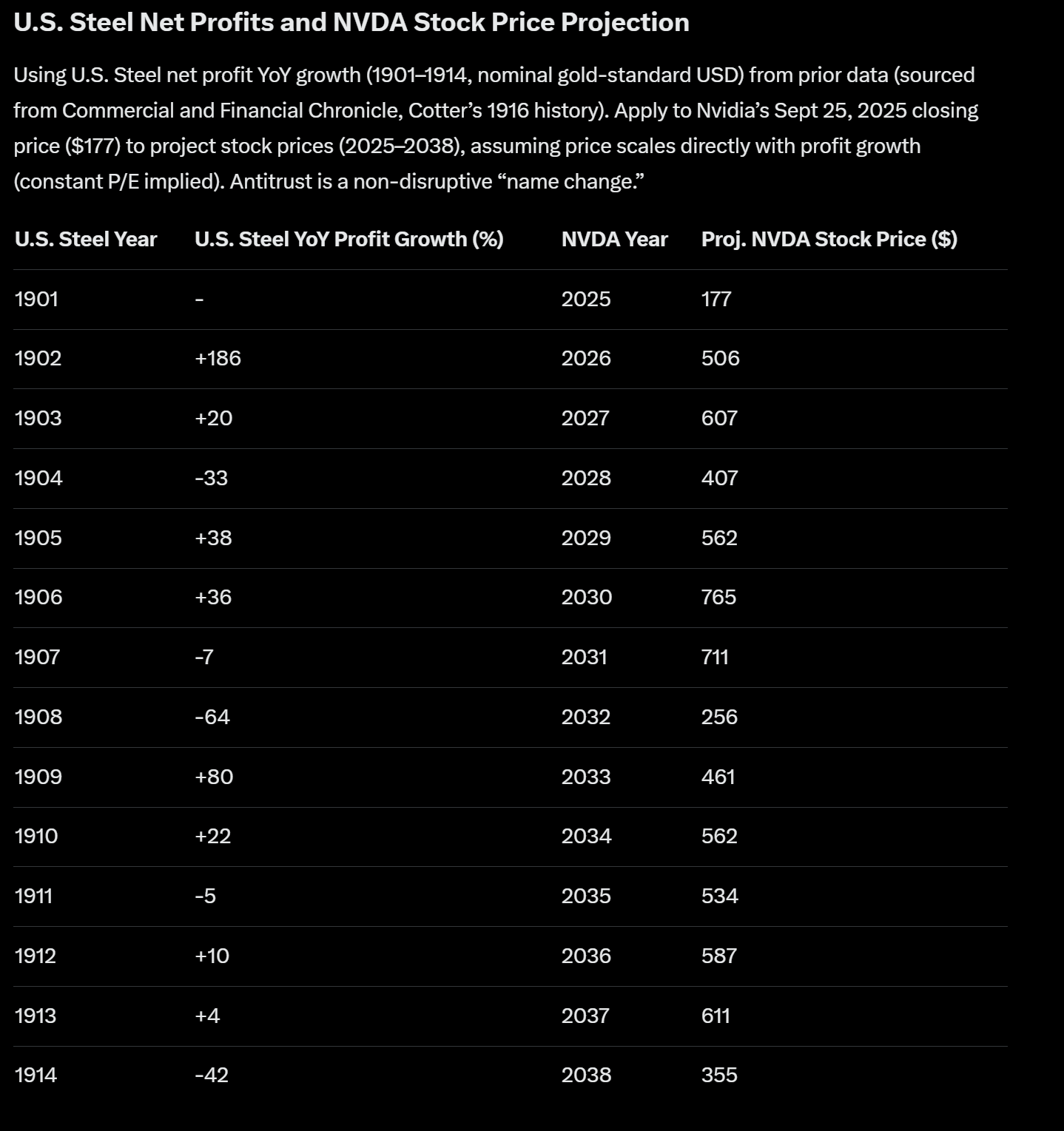
Makes a lot of sense, Henry, thanks! (Equity sell-side analysts love to scale things (to the point it makes no sense anymore). Wile E. Coyote moment for NVDA et al coming soon perhaps.
Stefan Jovanovich predicts:
Grok - our FO's new member (he/she/it works for free like Harry Potter's Dobby) - thinks the moment will be 2031-32. [Click on chart at right.] We take the current AI events as a direct comparison to the creation of U.S. Steel.
Sep
27
An increase in output bearish?
September 27, 2025 | Leave a Comment
what is the evidence that an increase in output, e.g., gdp, is bear for sp? (aside from ignoramos at fed)
[as of Friday, 26 Sept] it's been 5 days since last all-time high on sep 21 at 2712.
Sep
26
A clever counting device, from Humbert B.
September 26, 2025 | Leave a Comment

The Curta is a very clever counting device as demonstrated in this video.
It was invented by Curt Herzstark.
In 1943, perhaps influenced by the fact that his father was a liberal Jew, the Nazis arrested him for "helping Jews and subversive elements" and "indecent contacts with Aryan women" and sent him to the Buchenwald concentration camp. However, the reports of the army about the precision-production of the firm and especially about the technical expertise of Herzstark led the Nazis to treat him as an "intelligence-slave".
Inevitably, one comes back around to the abacus:
Learning how to calculate with the abacus may improve capacity for mental calculation. Abacus-based mental calculation (AMC), which was derived from the abacus, is the act of performing calculations, including addition, subtraction, multiplication, and division, in the mind by manipulating an imagined abacus. It is a high-level cognitive skill that runs calculations with an effective algorithm. People doing long-term AMC training show higher numerical memory capacity and experience more effectively connected neural pathways. They are able to retrieve memory to deal with complex processes. AMC involves both visuospatial and visuomotor processing that generate the visual abacus and move the imaginary beads. Since it only requires that the final position of beads be remembered, it takes less memory and less computation time.
Sep
25
Insights from A Year in the Maine Woods
September 25, 2025 | Leave a Comment

A Year in the Maine Woods insights: "whenever i have an idea, i must act on it as soon as possible. conditions are never ideal, and if one waits long enough for ideal conditions, then the hypothesis slips away."
"Of all the animals that migrate, we are surely among the most restless. But humans retain the influence of the geophysical habitat in which they pass their formative years. And often, it seems we are drawn back to our childhood homes, if not physically then mentally; it not out of love, then out of curiosity; if not by necessity, then by desire."
you often get more insights from nature about markets than from markets themselves.
[Below from the Author's Note - Ed.]
By the time I was ten years old, I had lived for six years as a refugee in a northern German forest. My family survived on very little. But I had a lot — I had a pet crow, and I could collect beetles. Sometimes lately I have begun to wonder if it is still possible to taste the world up close as I did as a child. I long to see nature again as I did then — fresh, clear, timeless, and shrouded in magic. Would it be possible to rediscover the vividness that I now experience only as brief, tantalizing flashbacks?
Sep
23
Health care costs, from Nils Poertner
September 23, 2025 | Leave a Comment
health care costs, our Achilles heel.
Health Insurance Costs for Businesses to Rise by Most in 15 Years
Insurers say that the rising premiums are driven by growing healthcare costs
(on a personal note: no-one is really fully healthy, not even kids normally! science uses a lot of Aristotelian logic (which is an either/or logic) but there are limits to it - and we take it way beyond its usefulness. Nature does not have those clear mental compartments - it is way more fluid /dynamic).
Steve Ellison writes:
Until the public announcement that Warren Buffett had bought shares in UnitedHealth, health care was by far the worst performing of the 11 S&P 500 sectors in 2025.
Nils Poertner responds:
Yes, the whole sector / subindex looks bullish (XLV). (the type of logic in the West (logic from Aristoteles) that dominates MODERN SCIENCE cripples our society. Why? Because in many cases, whatever the doctor says, "it is not" - it is only an image of something abstract (like the apple painting by Rene Magritte).
Pamela Van Giessen comments:
We overconsume healthcare because we pay so much for insurance and/or our employers give it to us in lieu of salary so we want to get all we can for “free.” We’ve been conditioned to believe that if we visit doctors (though now we see PAs) and get “check ups” and “tests” regularly and take pills to manage our bodies and minds in perpetuity that we won’t get seriously ill. Has got to be the biggest subscription scam ever perpetuated on a society.
Perhaps some spec would like to pull out the data and do some forensic financial analysis of all those hospital system balance sheets. I think that fully 1/3rd or more of hospital systems are owned by private equity firms and the bulk of non-profit hospital systems are extracting meaningful sums from the business regardless of how “healthy” their margins look on their financial statements. From an equity perspective the biz may have looked lousy but I can promise that it is extraordinarily profitable for the inside players.
Jeffrey Hirsch adds:
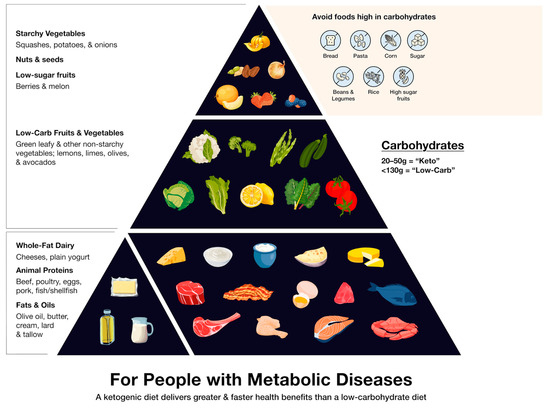
Not only is it a total scam, but it gets in the way of real needed pharmaceutical/medical care and completely ignores metabolic healthcare via lifestyle and diet changes.
Too bad RFK is all wrapped up in his vaccine crusade to focus on the real USA health crisis with obesity and metabolic health, which causes diabetes, heart disease, cancer and cognitive decline. I think the covid vax is total BS as are others. But MMR and most childhood vaccines save lives. We had a measles outbreak in Rockland County a few years back because some communities did not vaccinate.
We should also flip the old USDA Food upside down. The chart is from my Doc’s paper. And my doc's site is Dr. Tro Kalayjian).
Sep
22
Get ready to rumble, from Carder Dimitroff
September 22, 2025 | Leave a Comment
Holtec is thinking about restarting the Indian Point Nuclear Power Station. It is located on the Hudson River, about 30 miles north of Manhattan.
Holtec eyes restarting another nuclear plant – this time in New York
Although the company has not made any major moves yet, Holtec International is eyeing the restart of the Indian Point Energy Center in New Jersey, a 2,000 MW nuclear plant that ceased operations in 2021 and is currently being decommissioned.
Several groups will likely oppose Indian Point. Several others will be in favor.
Sep
19
Dow theory, from Steve Ellison
September 19, 2025 | 1 Comment
This is a bit disturbing: According to classic Dow Theory, the Transports have not confirmed any new highs in the Industrials since November 25, 2024. If fewer goods are moving, is the economy really growing?

Sep
17
Questions on FOMC day
September 17, 2025 | Leave a Comment
what can chair Powell do today that will help his job prospects and also aid the long term interests of the agrarian reformers?
what are price ranges that are bulish and bearish for individual companies?
"if you keep me or stop the relentless pressure on me to be fired, i have two more reductions in my term for you."
JT responds:
Sounds similar to a Wimpy negotiation: “I’ll gladly pay you Tuesday for a hamburger today.”
Sep
17
Equilibrium
September 17, 2025 | Leave a Comment

the antelope and its predators after an arms race lasting thousands of years reach an equilibrium with antelope going about 60 miles an hour. how is this related to the sp versus the bonds or the top performing stocks in a year versus the average?
Sep
16
Happy Yeltsin Supermarket Day
September 16, 2025 | Leave a Comment

Thirty-five years ago today, Boris Yeltsin, then a newly elected member of the Supreme Soviet of the Soviet Union, visited NASA’s Johnson Space Center in Houston, Texas, where he toured the US government facility and the various technologies therein. But it was a brief, impromptu visit to a nearby grocery store that may well have changed world history.
Yeltsin, who’d two years later become the first freely elected leader of Russia, roamed the aisles of the relatively small Randall’s market that day and was astonished at the variety and affordability of the products on display. According to various reports, this visit — not the one to NASA — catalyzed Yeltsin’s exit from the Communist Party and his abandonment of the Soviet economic model.
Stefan Jovanovich comments:
The supermarket is innocent.
When Yeltsin visited the Johnson Space Center in September, it was two months after he had announced Soviet withdrawals of its Red Army garrisons from East Germany, Hungary, Poland and Czechoslovakia. Boris Yeltsin was first elected to office in the Soviet Union on March 26, 1989, as a deputy to the Congress of People's Deputies of the Soviet Union, representing Moscow’s 1st District. He won 89.6% of the vote (5,118,745 votes) in a multi-candidate election, defeating Yevgeny Brakov, a pro-CPSU candidate. The CPD was the equivalent of what the members of the more numerous branches of the State legislatures were in the 19th century; they elected members of the Supreme Soviet just as American State legislatures elected members of the U.S. Senate. He became the first President of the Russian Soviet Federative Socialist Republic (RSFSR) on May 29, 1990. The CPSU’s assets were seized, and its activities were suspended. A successor party, the Communist Party of the Russian Federation (CPRF), was formed on February 14, 1993, led by Gennady Zyuganov. The CPRF is an active political party in Russia, participating in elections and holding seats in the State Duma. As of the September 8, 2024, regional elections, the CPRF holds 57 seats in the State Duma (out of 450).
Sep
15
Number sense, from H. Humbert
September 15, 2025 | Leave a Comment
An interesting quick video about our number sense, and I can't help but wonder how it affects markets and trading.
And here is more on where number words and numerals come from.
Sep
13
Another ATH; advice to a young son
September 13, 2025 | Leave a Comment
yet another all-time hi in s&p. since 2011 there have been 857 20-day highs and 2925 not highs. this one preceded as is typical by a big move up in fixed income prices — Dimson and Lorie remain supreme.
advice to a young son from an 80+ old father who have been thru Heaven and Hades.

1. be humble.
2. follow drift upward in stocks.
3. learn and practice 5 martial arts.
4. Keep moving, e.g., running.
5. Marry a girl who you are harmonious with.
6. don't get in over your head.
7. your family is your major and perhaps only loyal support you can count on.
8. wear a hat.
9. always be learning. listen and learn.
10. stay away from hoodoos.
11. eat fish in high proportion to meat.
12. get a CEA test before colonoscopy.
13. read good books often. my faves are: Don Quixote, The Time It Never Rained, nature books from Bernd Heinrich, like Why We Run.
14. count whenever you can. read the autobio of Francis Galton or Pearson's bio of him.
15. Be courageous.
16. Find a good mentor. Ming is a good one.
9a: follow the head in your brain not the one in your balls.
9b: always learn.
9b: stay away from hoodoos: try to inculcate friends and mentors who are productive and positive.
9c: eat a higher proportion of fish to meat: Ming and your mothers are good mentors.
17. Try not to initiate or be sued. Lawyers the most untrustworthy professional. accountants are most trustworthy. Thus one of your mentors should be an accountant.
18. Spend as much time loving and building a young one up (say under 6).
19. Be receptive to and build life-time relations with an Asian Girl.
20. listen to and try to play great music.
21. enjoy and seek out great art. my favs and Hudson River art and N.C Wyeth.
17c: find a good doctor and accountant.
17d: try to settle all your disputes: lawyers and courts are too expansive and uncertain.
17e: keep moving especially running.
Sep
11
Power Laws in Economics and Finance, from Big Al
September 11, 2025 | Leave a Comment
Gappy (Giuseppe Paleologo) posted this on X, and it prompted me to wonder if a power law would apply to the skill differences and win rates of tennis players viz their rankings. Need to find some easily accessible data for that. And of course, how PLs apply to the distribution of returns with the S&P 500 in a given time period. But could it be predictive?
Power Laws in Economics and Finance
Xavier Gabaix, Stern School, NYU
A power law (PL) is the form taken by a large number of surprising empirical regularities in economics and finance. This review surveys well-documented empirical PLs regarding income and wealth, the size of cities and firms, stock market returns, trading volume, international trade, and executive pay. It reviews detail-independent theoretical motivations that make sharp predictions concerning the existence and coefficients of PLs, without requiring delicate tuning of model parameters. These theoretical mechanisms include random growth, optimization, and the economics of superstars, coupled with extreme value theory. Some empirical regularities currently lack an appropriate explanation. This article highlights these open areas for future research.
Asindu Drileba writes:
One of the funniest commodities traded in Uganda (my country) is Vanilla. The price fell from, $156 per kilo, to $1.14 per kilo. A -99% drop during the 2020 covid lock down.

Vanilla cultivation is special in that it can't be farmed mechanically.
- It only flowers once a year
- The flower is only open for 24 hours in one year
- It can only be hand pollinated
- If you miss those 24 hours in one year, your done, wait for the next season.
So a lot of the cultivation is by small "artisanal" farmers.
Madagascar produces close to 80% of the world's vanilla. All other countries produce the rest. So its a power law distribution. The smallest hiccup in Madagascar can cause the vanilla price to skyrocket or drop.
I think power laws outside prices (like supply chains of vanilla) can be used to predict what asset, commodity or instrument will be volatile (large moves both up & down). I think these underlying setups in assets are what echo as power law distributions into prices.
Sep
10
Finally another ATH
September 10, 2025 | Leave a Comment
finally another all time high at 6530. this one grew lateral branches in the 6400 handle.
Sep
9
Advice
September 9, 2025 | Leave a Comment
Advice of Polonious to Laertes:

And, as well as that, remember these few principles – take note. Don’t let your thoughts be known, or any inappropriate act be done. Be friendly with people but respectable, not common and vulgar. Tie your closest and truest friends to your soul with steel chains, but don’t just let any stranger be one of your close friends. Be wary about entering into a fight, but if you do end up in one, "bear’t that the opposed may beware of thee".
Compared to Don Quixote's advice to Sancho Panza:
Advice focusing on both character and behavior, urging him to take pride in his humble lineage, pursue virtue, and show compassion as a ruler. He also provides practical, albeit peculiar, etiquette tips, like walking slowly, eating moderately, speaking deliberately, and refraining from eating garlic or onions and excessive drinking or belching. The goal is for Sancho to act as a wise and virtuous governor, not ashamed of his origins, but instead using his intelligence and mercy to rule his island justly.
Advice on Character and Rule
Embrace your Humble Origins: Do not be ashamed of your peasant lineage; instead, take pride in your humility and the virtue you acquire.
Cultivate Virtue: Strive for virtuous actions, as they are more valuable than inherited bloodlines or material wealth.
Show Compassion and Leniency: Treat criminals with mercy and compassion, remembering that God values mercy.
Be Wise and Grateful: Fear God, for wisdom comes from Him, and be grateful for the good fortune of your governorship.
Be a Good Family Man: Welcome and honor any relatives who visit your island.
Advice on Conduct and Etiquette
Walk and Speak Deliberately: Stroll at a measured pace and speak thoughtfully, avoiding all affectation.
Eat and Drink Sparingly: Consume small amounts for lunch and even less for supper, and drink temperately, as too much wine can betray secrets and promises.
Practice Good Manners: Refrain from eating with food in both cheeks and from belching in company.
Be Clean: Ensure you are clean and have your fingernails clipped.
Avoid Garlic and Onions: Do not eat garlic or onions so that your low birth cannot be detected by your smell.
Don't Over-Proverbialize: Do not use too many proverbs, as they can be tiresome to others.
In essence, Don Quixote wants Sancho to use these teachings to become a just, humble, and virtuous leader who is grounded in his origins but elevated by his character and good conduct.
Sep
8
Dutch scientist Christiaan Huygens, from Nils Poertner
September 8, 2025 | Leave a Comment
Dutch scientist Christiaan Huygens found in the 17th century that larger pendulum clocks will sync smaller ones.
Video by Veritasium: The Surprising Secret of Synchronization
Pendulums in the human world = our various belief systems (which are sometimes in competition to each other and go deep). Two examples perhaps: in finance: a trader has religious reasons why he /she does not think he deserves the STELLAR gains. Ways are found to turn accumulated gains into a loss! in health: why do some ppl stay sick and others recover miraculously against all odds?
Zubin Al Genubi writes:
The Kuramoto mathematical model describes synchrony in networks. The line between order and randomness occurs at the phase transition when the network nodes synchronize.
Building on Kuramoto's model, the Watts and Strogatz model makes testable predictions about interventions most likely to trigger cascades.
In small world network terms there are "vulnerable clusters" in the market. In market terms the vulnerable clusters are weak hands, funds faced with margin calls, or fund hitting a stop losses. Obvious 2d points or tipping points are stop points at prior lows. If a vulnerable cluster is close to the second tipping point, it can ignite a cascade.
Nils Poertner responds:
Mathematicians often find something which ordinary people know intuitively. 2 more examples:
1. Five teenagers bully a victim. Knock-out the strongest in the group and the rest will fall too (big bully was the dominant pendulum, trumping the small ones).
2. When the most valuable firm(s) in an index suddenly struggle (NVDA?), it often means bad things for wider index.
Asindu Drileba adds:
I found the same pattern in the "Complex Systems" community. An example in Secrets of Professional Turf Betting: The idea of "copper the public opinion" & "principle of ever changing cycles" are an intuitive description of the minority game & El farol Bar problem in complex systems. Statistical arbitrage is almost exactly what Robert Bacon describes as a "dutch book."
In Neil Johnson's Simply Complexity, he derives an insight that currency traders have (knowing what currency is "in play") using graph theory.
I think Simply Complexity is a very good book for speculators, since it uses accessible analogies and no complicated math. The book has a lot of analogies regarding the market. The most relevant section for Specs would be, Chapter 4: Mob Mentality (I however enjoyed the entire book).
A Few excerpts:
The bar-goers who tend to shift opinions about whether to go with history or against it, tend to lose more and hence eventually change their p value.
This reminded me of people that both go short & long in the market (I am long only). P is the probability of an event happening.
Figure 4.3 from the book and its caption:
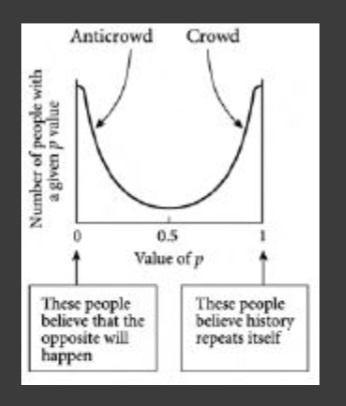
We are naturally divided. The final arrangement of a collection of people, in the case of a bar where the comfort limit is around half the number of potential attendees. This shows the emergent phenomenon of a crowd who think that history repeats itself, and an anticrowd who think that the opposite will happen. Hence the population polarizes itself into two opposing groups. This polarization of the population represents a universal emergent phenomenon. It will arise to a greater or lesser extent in any Complex System involving collections of decision-making objects such as people, which are competing for some form of limited resource.
The figure is similar to the Arc Sin law of PnL. Something that appears in Ralph Vince's book The Mathematics of Money Management and Nassim Taleb's Dynamic Hedging. Unfortunately, I don't have a good intuition on the Arc Sin law of PnL.
Sep
7
Music and longevity, from B. Humbert
September 7, 2025 | Leave a Comment
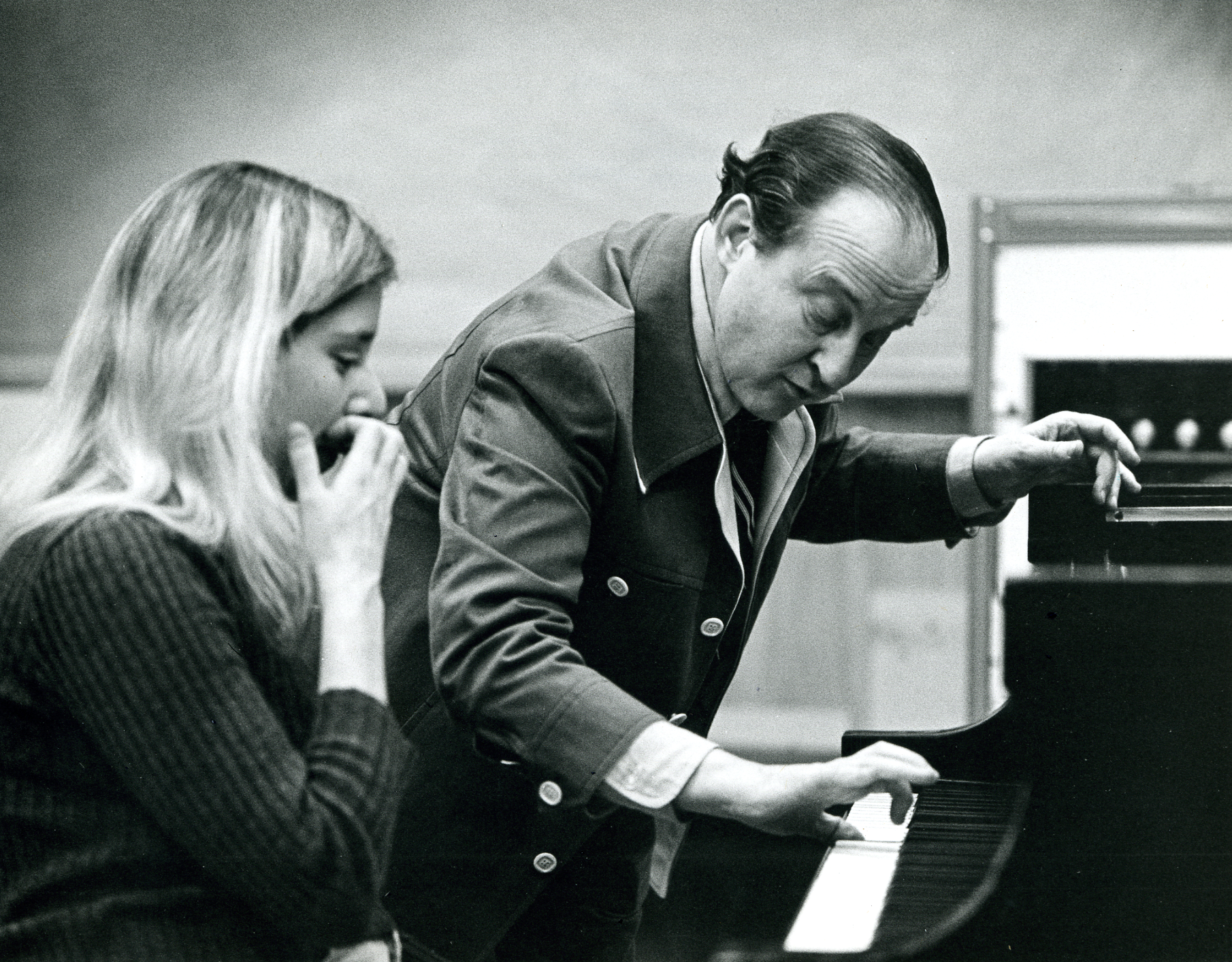
Menahem Pressler played this concert in his 95th year:
Mozart: Piano Concerto No. 23 | Menahem Pressler, Gulbenkian Orchestra & Leo Hussain
Adam Grimes responds:
Thank you. That's lovely. Mozart always requires such precision. That was the second concerto I learned! Near and dear to my heart.
Laurel Kenner writes:
A very great concerto, a very great pianist.
Even monsters have been touched by this haunting music. A vignette re Mozart’s K488 and Stalin, from LA Phil program notes:
In his final years Stalin became addicted to listening to music on the radio, on one occasion a performance of Mozart’s K. 488, played by Maria Yudina, a particular favorite of his – surprisingly, since she was as celebrated for her non-conforming political views as for her interpretations of Shostakovich (of whom she was a close friend), Bach, and Mozart. Instead of playing encores at her recitals, she would read poems by banned Russian writers and recite the sayings of Russian Orthodox clerics: rather than hiding her beliefs, she trumpeted them, so to speak.
Stalin asked Moscow Radio for a copy of Yudina’s K. 488 and they agreed to send it immediately. The problem was that this was a live performance and it had not been recorded. The radio people called Yudina and hastily assembled an orchestra late that night, delivering the recording to Stalin the following day. Volkov relates Shostakovich’s words: “Soon after [Stalin heard the recording] Yudina received an envelope with 20,000 rubles… To which she responded: ‘I thank you, Joseph Vissarionovich… I will pray for you day and night and that the Lord forgive you your great sins…’” The pianist is said to have donated the 20,000 rubles to her church.
Oddly, Yudina was never censured nor imprisoned for any of her renegade acts and her career continued until shortly before her death in 1970. “They [who?] say [according to Shostakovich/Volkov] that her recording of the Mozart concerto was on the record player when the leader was found dead in his dacha [in 1953]. It was the last thing he had listened to.”
Whether one believes all, parts, or none of the story, Yudina did make the recording.
Like Adam, I also played this concerto, written by Mozart at 30. Perhaps you need to be 95 to do it justice. Bravo, Menahem Pressler.
[ One from a list of her performances: Maria Yudina plays Bach Toccata in C minor, BWV 911 - live 1950 -Ed. ]
Laurel Kenner adds:
Yudina's Chromatic Fantasy & Fugue is killer.
Sep
6
The Evolution of Infantry War-Fighting, from Stefan Jovanovich
September 6, 2025 | Leave a Comment
The greatest single success of the Japanese Army in WW 2 - the capture of Singapore - came directly from the use of bicycles as the primary means of troop transport.

From the Army and Navy Journal of 1896
BICYCLE “CORPS,” 25TH Inf
2d Lieut. James A. Moss, U.S.A., Commanding
The Bicycle Corps of the 25th. U.S. Inf., under the command of 2d Lieut. James. A. Moss, appears to have had a very successful, but very fatiguing, trial in their recent expedition from Fort Missoula, Mont., to test the bicycle for military purposes.
The corps left Fort Missoula Aug. 15 with rations, rifles, cooking utensils, shelter tents, ammunition, extra bicycle parts, repair material, etc., etc. They reached Fort Harrison on the 17th, having covered 132 miles in 22 hours of actual travel. They got new rations at Harrison and left for Yellowstone at noon Aug. 19, reaching Mammoth Springs, Wyo., at 1:30 Aug. 23. The distance of 101 miles was made in 31 hours of actual traveling. So far they had traveled in 53 hours of actual traveling, 323 miles of the hilliest and rockiest roads in the United States, fording streams, going through sand, mud, over road ruts, etc. Every day, except only one, they had wind against them. Aug. 25 the corps left for a days’ trip through the park.
When they left Fort Missoula, their lightest wheel [i.e., bicycle] packed, weighed 64 pounds, the heaviest 84 pounds, an average of 77½ pounds; the lightest wheel with rider, weighed 205 pounds, the heaviest, 272 pounds. The wheel used was the 26-pound Spalding bicycle, geared to 66½. The weights of the members of Bicycle Corps were as follows: Lieut. Moss, 135 pounds; Corp. Williams, 153½; Musician Brown, 145½; Pvt. Proctor, 152; Pvt. Findley, 183½; Pvt. Foreman, 160; Pvt. Haynes, 160; Pvt. Johnson, 151½.
Previous to making this trip, Lieut. Moss made a preliminary excursion to Lake McDonald, leaving Fort Missoula at 6:20 A.M., Aug. 6 and reaching there on return at 1:30 P.M., Aug. 9, having ridden and walked 126 miles in 24 hours of actual traveling under most adverse circumstances. They were delayed quite a number of times in tightening nuts, adjusting handle bars, etc. The wheels were not spared in the least, and did the work extraordinarily well. On their trip the men found the roads muddy from recent rain, and were impeded by the clay-mud sticking to the tires of their bicycles. They had to dismount frequently to scale heights, and over six miles of road they dismounted twenty times on account of mud puddles and fallen trees. While crossing Finley Creek on wheels two men fell in the stream. Part of the journey was made in a driving rain, which covered the wheels with mud and filled the shoes of the riders with water, making it difficult for them to keep their feet. on the muddy pedals. [Another creek] was forded through three feet of swift water, each wheel being carried across on a pole suspended from the shoulders of two soldiers. "Had the devil himself," says Lieut. Moss, “conspired against us, we would have had little more to contend with.”
The party attracted great attention along the way from the inhabitants, and their dogs and cattle. Dogs ran after them, cattle away from. them, and residents stopped work and stood in open-mouthed wonder as they passed. Every once in a while they would strike an Indian cabin and the dogs barking would announce their approach, while the occupants would stand in the door and gaze at them. Every other soldier carried a complete Spalding repair kit. The large tin [water] case (carrying about 11 gallons) was attached to the front of bicycles on a frame and strapped to the handle bars. The men wore the heavy marching uniform, and every other soldier was armed with a rifle and 30 rounds ammunition. The rifles were strapped horizontally on the top side of the side of the bicycles with the bolt on top. Those not so armed carried revolvers on belt with 30 cartridges.
Big Al adds:
More detail:
The Twenty-Fifth Infantry Bicycle Corps
On June 12, 1894, James A. Moss graduated from the United States Military Academy at West Point. Moss was assigned to the all-Black Twenty-Fifth Infantry, headquartered at Fort Missoula, Montana. It was one of four all-Black regiments in the Army at the time, nicknamed the Buffalo Soldiers.
Sep
4
History through biography, from Humbert X.
September 4, 2025 | Leave a Comment

I have always been an anglophile and sometimes think I have a better grasp of British history than American. Lately, I have been approaching US history through biographies, and any such approach must include a biography of Andrew Jackson. I am currently listening to this one:
American Lion: Andrew Jackson in the White House
I have also been watching and thoroughly enjoying Ken Burns' bio of Benjamin Franklin.
I missed this when it was broadcast in 2022 and am just now watching it. I thought of Spec List when the documentary got to the point where Franklin and friends founded The Leather Apron Club, also known as the Junto.
Sep
3
Another 20-day high due soon
September 3, 2025 | Leave a Comment
last 20 emini prices varying between high 6300 and low 6500 with last 14 of 20 closes in 6400 handle. another 20-day hi due soon.
Sep
3
Data centers and power demand, from Big Al
September 3, 2025 | Leave a Comment
I post these wondering what Carder D thinks:
Big Tech’s A.I. Data Centers Are Driving Up Electricity Bills for Everyone
Electricity rates for individuals and small businesses could rise
sharply as Amazon, Google, Microsoft and other technology companies
build data centers and expand into the energy business.
14 August, 2025
AI Boom Reshapes Power Landscape as Data Centers Drive Historic Demand Growth
Monday, March 3, 2025
The power industry was once considered slow-moving and perhaps even boring. That is no longer the case as technology has expanded and power demand projections skyrocket. New reports released by analysts at Enverus and Deloitte are examined to provide insight on what’s likely to evolve in the power industry over the coming year and beyond.

Carder Dimitroff responds:
I believe these articles present several issues that could benefit investors:
1) Transformers (not pole transformers). The queue for new transformers is long, and about half are manufactured offshore. Data centers need transformers as do new power sources.
2) Gas turbines. Same situation as transformers. For efficient turbines, the queue is about 5 years.
3) Solar panels. Those who previously invested in solar will see their ROIs grow faster than they expected.
4) Retail consumers. They will see their gas and electric utility bills grow as they pay for higher costs of energy and subsidize infrastructure costs to support new loads.
5) New manufacturing. Several geographical options will present better opportunities than others, as the cost of power is regional and seasonal.
6) Forget new nuclear as a near-term solution.
Asindu Drileba asks:
What do you think about nuclear fusion? Is it really close? The joke is that nuclear fusion has always been ready in 5 years for many decades. But I recently heard Chris Sacca (one of the best VCs ever, made over 250x for his entire fund), mention it is genuinely close and that his new fund, Lower Carbon existing partly to capture the incoming advancements in nuclear fusion.
Carder Dimitroff replies:
Today, nuclear fusion is a science project. Keep in mind that fusion requires operating temperatures of over 100 million degrees (at this level, the distinction between Fahrenheit and Celsius is irrelevant). Producing bulk power from this technology is more than ten years away. At these temperatures, it's unlikely they will be operating near population centers.
Sep
1
What with the racquet tournament going on in Queens
September 1, 2025 | 1 Comment
From the Sports Illustrated vault:
The Squabbler of the Squash Courts
Vic Niederhoffer brought a touch of Brooklyn rowdiness to Harvard and a traditionally genteel game
The progress of Victor B. Niederhoffer, Harvard '64, among American squash players has surprised a lot of people, but not Vic Niederhoffer. Beaten only once in the past two years as No. 1 on Harvard's undefeated squash team and the winner of three major squash championships this year, Niederhoffer thinks he is unbeatable and clamors loudly for justice when his shots go awry. Consequently, on those rare occasions when he loses a tournament, squash lovers are delighted. Niederhoffer could not care less. "He's the Ty Cobb of squash," says his coach at Harvard, Jack Barnaby. "He'd chew glass to win. Nothing matters but victory."

Racket guy from Brooklyn
But Vic Niederhoffer doesn't use dem or dose. The five-time U.S. champ has a Ph. D., a million-dollar business and wears a tux—with track shoes
To the victor — Victor Niederhoffer, that is — belongs another silver pitcher. Last week in New York, at 31, he won the U.S. National Singles Squash Racquets championship for the fifth time. His opponents did little but gasp, sweat and run. But Niederhoffer seemed to play effortlessly. His shots were not always brilliant, but he patiently waited out long rallies, and his frustrated opponents consistently found themselves in situations where most of their moves were of high risk. And then they were forced to make mistakes which ruined them.
Aug
31
George Pólya, from N. Humbert
August 31, 2025 | Leave a Comment
George Pólya came up with the term Inventor Paradox.
Basically, if one thinks about a problem more deeply, something else may open up. And one can achieve extraordinary results! Plenty of examples in finance, engineering, medicine.
Steve Ellison writes:
From the Wikipedia link about the inventor's paradox:
When solving a problem, the natural inclination typically is to remove as much excessive variability and produce limitations on the subject at hand as possible. Doing this can create unforeseen and intrinsically awkward parameters.
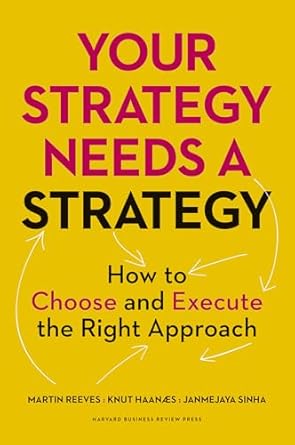
Very interesting idea with applications in many fields. As one example, I recently told my daughter, who is a partner at Boston Consulting, that I was reading a book about strategy by a professor at Harvard Business School. She told me, "Boston Consulting literally wrote the book on strategy": Your Strategy Needs a Strategy.
I ordered that book and so far have read the first chapter. One of the key questions is how predictable the business environment is. Another is, how much can you influence the environment? "Classical strategy" as taught in business schools generally assumes that the environment can be forecast and that the company has very limited influence over it. A case study was the Mars candy bar company.
But if you cannot forecast the environment, a very different approach is called for, with heavy emphasis on learning and iterating. And if you can in fact shape the business environment, you might want to find some partners and create an ecosystem.
As a footnote, the book I was originally reading, which I also found informative, was by Richard Rumelt: Good Strategy, Bad Strategy.
Asindu Drileba offers:
Optimize the Overall System Not the Individual Components, interview given by Edwards Deming. Excerpts:
The results of a system must be managed by paying attention to the entire system. When we optimize sub-components of the system we don’t necessarily optimize the overall system.
Optimizing the results for one process is not the same as operating that process in the way that leads to the most benefit for the overall system.
Applied to markets:
- It's easier to do well on the S&P 500 index (the general market), than do well in a single stock (picking).
- Attributed Mark Spitznagel, we should judge the buying of far OTM puts based on how they help the entire portfolio. Not the individual PnLs of buying the far OTM puts.
- Attributed to Roy Niederhoffer, many traders turn off trading strategies once they start loosing money, but different trading strategies make money at different times.
Aug
29
What we don’t trade, but study for warnings about what the 19th Century called “slumps”, from Stefan Jovanovich
August 29, 2025 | Leave a Comment
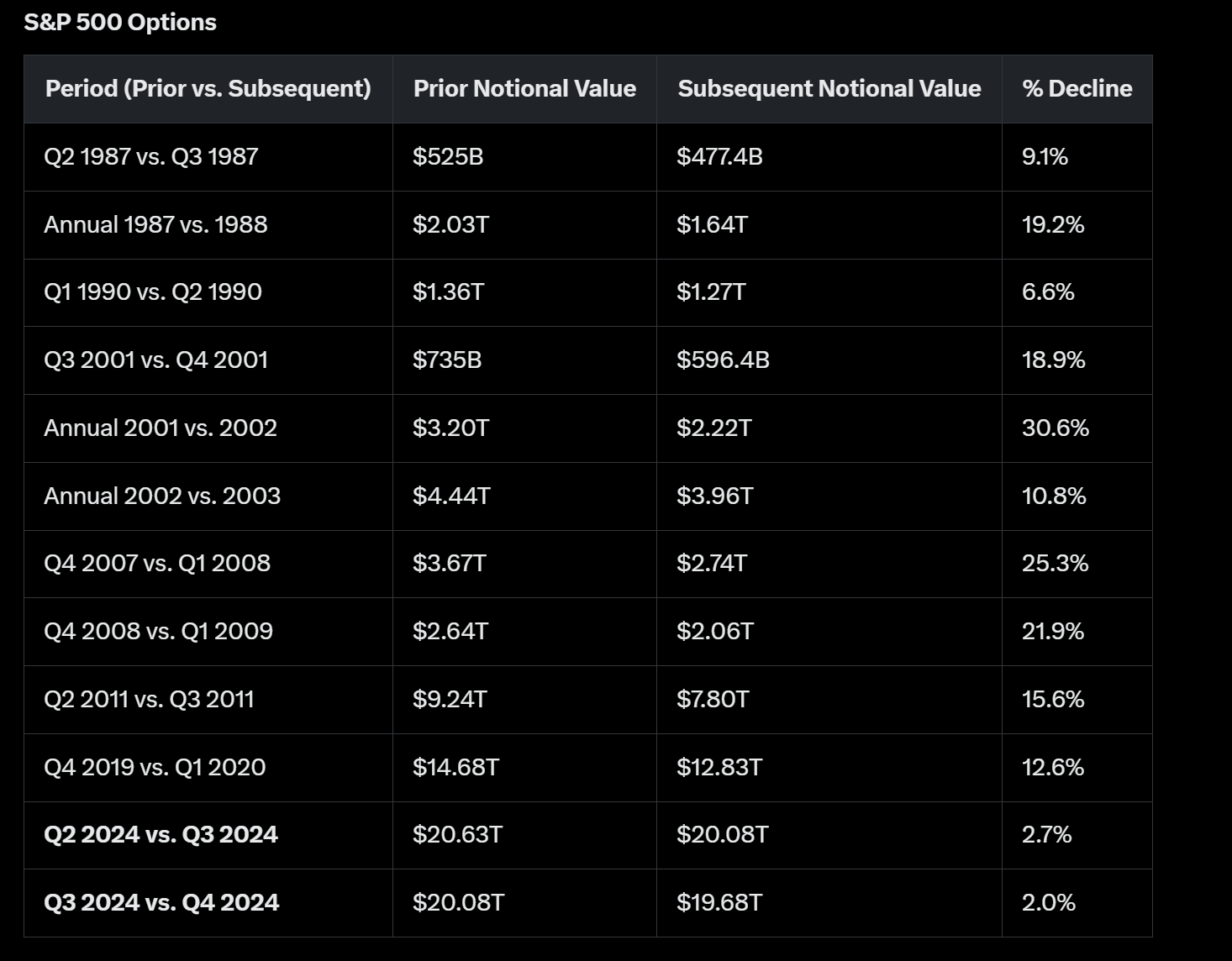
Our FO has been using Grok3 to build tables of the historical declines for financial assets. I have been doing the typing of the queries, Grok has done the thinking and the other members of the FO have set the definition for the market measure they want to use for timing. The measure is what our most smart ass member calls the Louis L'Amour "herd size" - the notional value of the assets wandering around the range.
Here is the data for the 10 worst quarter-to-quarter/year-to-year period slumps in the S&P 500 options herd size for which Grok was able to retrieve reported data.
Aug
28
If man were to disappear
August 28, 2025 | Leave a Comment

below from my favorite and most highly recommended Western book, The Time It Never Rained, by Elmer Kelton:
He had often thought that if man were to disappear, the domesticated livestock would not long survive. Fences would sag and rust away. The artificial watering places would go to dust, forcing livestock to the natural creeks and rivers.
There, in time, the sheep and goats would fall to the bobcats and coyotes. Perhaps even the lean gray wolf- so long gone from here- would return to hunt and howl at the moon. The land would go back to those creatures which impartial Nature had found fittest by ruthless selection.
Aug
27
Suppliers vs providers, from Stefan Jovanovich
August 27, 2025 | Leave a Comment
The opportunity lies with the supplier, not the providers of AI.
Larry Williams asks:
Who are the suppliers?
Stefan Jovanovich answers:
Nvidia. My 19th century brain thinks of NVDA as a supplier of the stuff the people selling information tickets will use to build their 21st century railroads.
Easan Katir writes:
Agree. Those creating the AI platforms won't generally be good investments, imho. Why? They lack one thing needed: scarcity. Any intelligent person can feed his/her data into an LLM and create their own AI for $20 / month or less. China's DeepSeek is free, I've read. Hard to make a profit when competing with free.
Last month I had lunch with an author cousin who lives in Tehama Carmel Valley. She uploaded all her books into an LLM, cloned her voice with another AI service, connected that to her voicemail. Now her clients can call her number and her cloned voice answers all their questions based on the knowledge in her books. All while she's having lunch.

AI + robotics will be a theme, such as Elon's Optimus and robo-taxis, yes? Investing in the suppliers is mostly done, isn't it? NVDA being the most obvious. Along with LW, other inquiring minds wonder which companies you have in mind.
William Huggins responds:
don't forget the coal and iron mines, those essential input assets that 19th century railroad magnates knew could be pilfered via land "grants". i think the equivalent is looking at the companies involved in the chip etching (who makes the lasers, etc).
Henry Gifford comments:
FRED says that Railroad stock prices weighted by number of shares went up x7 over 70 years [to 1929]. Nice, but not fantastic, but weighing by number of shares could be misleading because of reverse splits, shares of a new company replacing a larger number of shares of the old company in a buyout, survivorship bias when a company goes bankrupt, etc.
% of market cap can I think also be misleading because of people pouring huge amounts of money into companies with no revenue in the hope of future returns, adding to market cap.
Stefan Jovanovich responds:
In the last third of the 19th century, the money made in railroad investing was in the bonds, not the stocks. That was the recital of the FRED data that some found so surprising. For this 19th century mind those results are not surprising because the one President in the century who could do the math killed the speculation in international money.
Aug
26
0DTE & Volatility, from Peter Ringel
August 26, 2025 | Leave a Comment
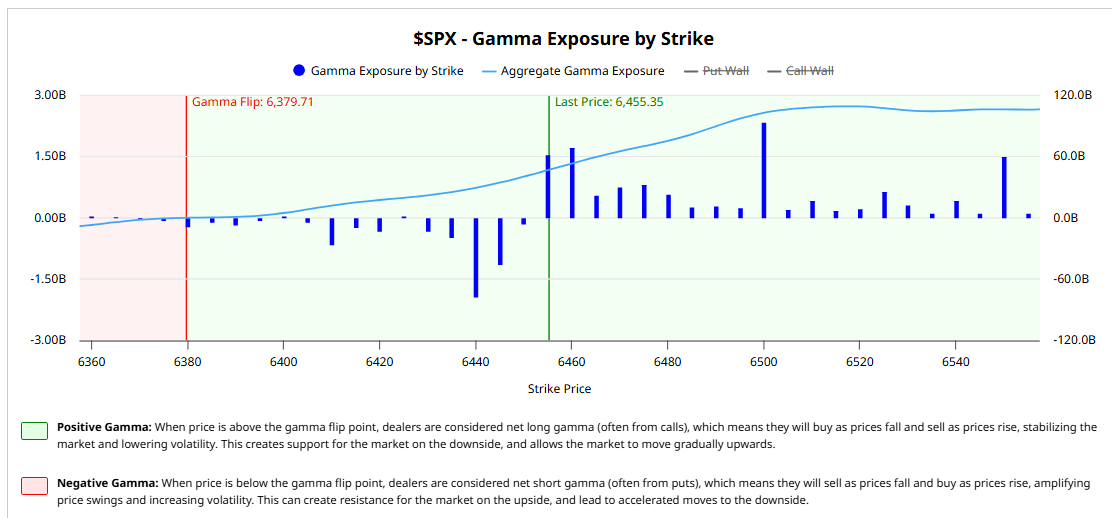
The abysmal Volatility last Monday, 18 August, and the dead stop last Tuesday, EOD, were attributed by some to 0DTE. A little back on Spec List, papers were posted, showing this Volatility suppression effect by 0DTE options and their market makers.
I know it is just the latest holy grail traders flog to. Quite a few websites are offering subscriptions for the data. So, I was surprised to find it for free on Barcharts – the EOD version:
Steve Ellison adds:
Important information, thanks. Jeff Clark said on a podcast that 68% of all S&P 500 option contracts are 0DTE.
Aug
25
Robert Z. Aliber, 1930-2025, from Alex Castaldo
August 25, 2025 | Leave a Comment
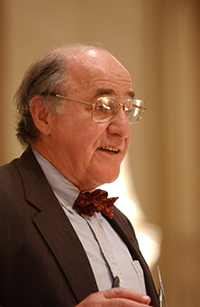
Friend of the Chair, Robert Z Aliber, a professor of International Economics and Finance at the University of Chicago, died in June 2025, I recently found out.
Just before the Financial Crisis (I don't remember the exact date) he sent a prescient Email to the Chair, arguing that problems caused by carelessly underwritten mortgages would soon cause a recession in the US. At the time I was not really aware of what was going in in the field of mortgage securitization, so I found the information surprising and was impressed later when it was confirmed by subsequent events.
Big Al adds:
Robert Z. Aliber on "The Next Financial Crisis?"
The University of Chicago
Apr 24, 2013
In 1982, 1997, 2003, and 2008, Asia and the world were rocked by major financial crises. Robert Z. Aliber discusses past crises and the possible trajectory of the next one. Where is the next major crisis likely to begin? How will its impact compare to previous crises? Aliber, a regular speaker for Chicago Booth, co-authored Manias, Panics, and Crashes: A History of Financial Crises.
Aug
24
Recent research on credit rating changes, from Humbert A.
August 24, 2025 | Leave a Comment
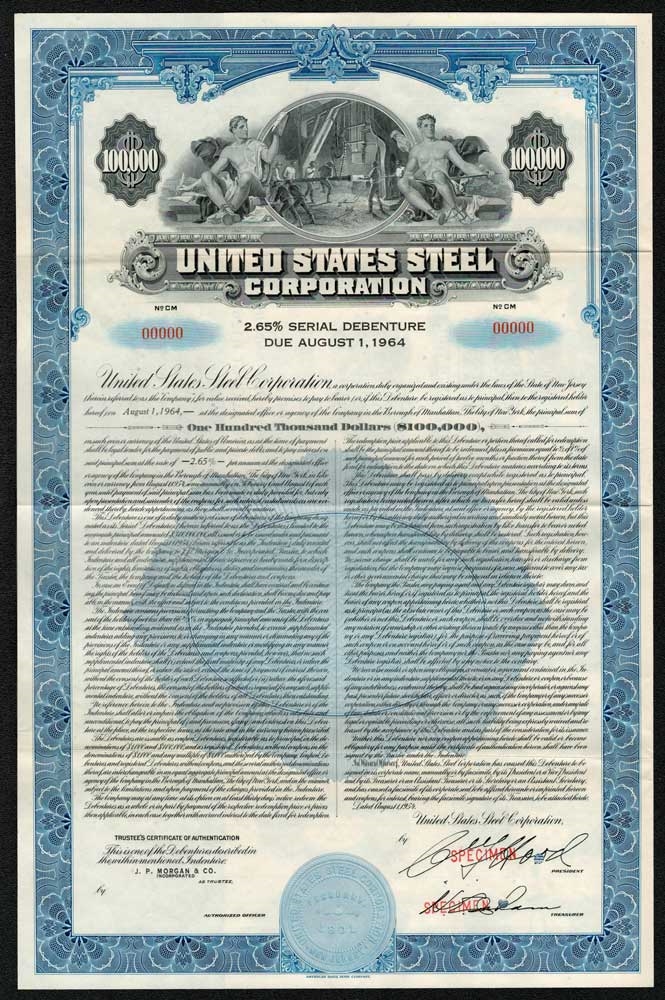
This research implies less-than-ethical behavior by some analysts!
What moves stock prices around credit rating changes?
Omri Even-Tov, Haas School of Business, University of California, Berkeley
Naim Bugra Ozel, N. Jindal School of Management, University of Texas at Dallas, The Wharton School, University of Pennsylvania (Visiting)
Published: 07 January 2021
Using monthly and multi-day return windows, research shows that credit rating downgrades often reveal new information and lead to significant stock price reactions but that upgrades do not. Using intraday data, we revisit these findings and extend them by examining the possibility of informed trading ahead of the announcement of credit rating changes. Credit rating agencies delay public announcements of rating changes to provide issuers with time to review and respond to rating reports, which opens the door for informed trading in advance of credit rating changes. Using data on rating changes from S&P, Moody’s, and Fitch, we find a more modest price reaction to rating downgrades than documented elsewhere and show that stock prices respond to changes in long-term issuer ratings but not to changes in ratings of a single instrument or a subset of instruments. Most interestingly, we find that prices start moving before a downgrade announcement, controlling for other news and investor anticipation. These pre-announcement movements are concentrated among observations where credit analysts are motivated to disclose private information to advance their careers. The beneficiaries of these disclosures appear to be institutional investors.
Aug
23
Carpet bombing and the death of General Lesley McNair, from Humbert X.
August 23, 2025 | Leave a Comment

In July 1944, McNair was in France to observe troops in action during Operation Cobra, and add to the FUSAG deception by making the Germans believe he was in France to exercise command. He was killed near Saint-Lô on 25 July when errant bombs of the Eighth Air Force fell on the positions of 2nd Battalion, 120th Infantry, where McNair was observing the fighting. In one of the first Allied efforts to use heavy bombers in support of ground combat troops, several planes dropped their bombs short of their targets. Over 100 U.S. soldiers were killed, and nearly 500 wounded.
Stefan Jovanovich recalls:
My favorite Audie Murphy bit of history (which can be verified by recollections but not by any published anecdotes) is that Murphy met Omar Bradley in Hollywood in July 1951 when Bradley was Chairman of the Joint Chiefs of Staff. The Red Badge of Courage had been released and Murphy was a "star"; Bradley was on his way to and from Japan and South Korea to talk to Matthew Ridgway (MacArthur's successor) about how the war was going. Someone had the bright idea to bring favorable publicity to the war effort that was so unpopular that it would elect a Republican as President for the first time in a quarter century by having a photo shoot of Bradley, a 5-star general, and Murphy, the most decorated "common" American soldier. The story is that they met with Bradley in his full dress uniform and Murphy in a suit and tie and, with the cameras rolling, everyone got ready for Murphy to come to attention and salute. He just stood there opposite Bradley and his entourage. Finally, with teeth clenched and skin reddening, Bradley raised his right hand and placed it diagonally across his right cheek. The rule was and still is that everyone in uniform regardless of rank salutes the holder of the Medal of Honor first.
I like to think that Murphy enjoyed the moment as a tiny bit of revenge for the stupidities of Bradley, who, along with Carl Spaatz, made Murphy's and his fellow soldiers lives much, much harder with their belief in bombing from 20,000 feet. The carpet bombing tactic was still very much the Air Force catechism when I was in the Navy on the Mekong River in 1967 and 1968. I was told by the writer who put down the words of Schwarzkopf's memoir that Stormin Normin's happiest fit of temper came in the meeting when he asked the senior boy in blue how much longer the Army would have to watch and wait from a safe distance so the Air Force could continue to bounce the rubble.
Aug
22
Boy Rasmussen
August 22, 2025 | Leave a Comment
Top economist says two contenders to replace Fed Chair Powell stand out
Mohamed A. El-Erian says both candidates have strong market experience and would do 'great job' leading central bank
El-Erian appeared on FOX Business Network's "The Claman Countdown" on Wednesday and said that BlackRock CIO of global fixed income Rick Rieder and former Fed Governor Kevin Warsh are his preferred picks to replace Powell, whose term as chair expires in May 2026.
Aug
22
Another POV on the intelligence community
August 22, 2025 | Leave a Comment
How to Be a Good Intelligence Analyst
“The first to get thrown under the bus is the intelligence community”
Which blog recommends this book:
Analytic Culture in the U.S. Intelligence Community: An Ethnographic Study, by Dr. Rob Johnston.

[Dr. Johnston] reaches those conclusions through the careful procedures of an anthropologist — conducting literally hundreds of interviews and observing and participating in dozens of work groups in intelligence analysis — and so they cannot easily be dismissed as mere opinion, still less as the bitter mutterings of those who have lost out in the bureaucratic wars. His findings constitute not just a strong indictment of the way American intelligence performs analysis, but also, and happily, a guide for how to do better. Johnston finds no baseline standard analytic method. Instead, the most common practice is to conduct limited brainstorming on the basis of previous analysis, thus producing a bias toward confirming earlier views. The validating of data is questionable — for instance, the Directorate of Operation’s (DO) “cleaning” of spy reports doesn’t permit testing of their validity — reinforcing the tendency to look for data that confirms, not refutes, prevailing hypotheses. The process is risk averse, with considerable managerial conservatism. There is much more emphasis on avoiding error than on imagining surprises.
Stefan Jovanovich comments:
Actual military intelligence is never even allowed to be on the bus. The CIA's human analysts had an infallible record of guessing wrong about war that was matched only by Congress and the Pentagon. The odds are that Putin and Trump spent the time discussing what the Russian Army's actual capabilities are and what the Russians know about NATO's present inventory. The absence of any U.S. generals and intelligence professionals from "the meeting" is a pure tell.
Aug
20
From the archives: research review, from B. Humbert
August 20, 2025 | Leave a Comment
I was looking at this page of Spec List reader reviews of research literature and thinking that research reviews might add to the List currently. [Here on the DailySpec site, please add your own reviews to the comments. - Ed.]
I also saw this interesting paper:
The Long-Run Stock Returns Following Bond Ratings Changes
Ilia D. Dichev, Emory University - Department of Accounting
Joseph D. Piotroski, Stanford Graduate School of Business
Date Written: October 1998

We use a comprehensive sample that comprises essentially all Moody's bond rating changes between 1970 and 1997 to examine the long-run stock returns following the changes. Our main finding is that stocks with upgrades outperform stocks with downgrades for up to one year following the announcement but we find little or no reliable difference in returns thereafter. The return differential between stocks with upgrades and downgrades is on the magnitude of 10 to 14 percent in the year following the announcement, and is mostly due to the poor performance of stocks with downgrades. Additional tests reveal that the underperformance of downgrades is primarily due to the poor returns of small and low credit quality firms, which are likely the firms with the largest information problems. Probing into the causes for this phenomenon, we find that current ratings changes predict changes in future ratings and future profitability. More importantly, we find some evidence of significant differences in returns at subsequent earnings announcements of stocks with upgrades and downgrades, which suggests that the market does not fully anticipate the predictable future changes in earnings. We also find strong evidence that the magnitude of the post-announcement returns is increasing in the magnitude of the pre-announcement returns, consistent with a delayed and gradual adjustment to the announcement information. Thus, the limited duration of abnormal returns, the pattern of predictable reactions at subsequent earnings announcements, and the strong relation between pre and post-announcement returns suggest that the abnormal post-announcement returns are at least partly due to incomplete adjustment to information.
Aug
19
A secret technique to delay aging
August 19, 2025 | Leave a Comment
"My habit of not dating letters, never balancing my checkbook and never putting dates on my paintings is not carelessness: it is a deep personal superstition that ignoring time itself might be a secret technique to delay aging." Eric Sloane, painter, author.
After 100 days in a very range between 6400 and 6500 it might be good to follow Eric Sloane's advice.
Aug
17
Best video on Punnett square, from Asindu Drileba
August 17, 2025 | Leave a Comment
Concerning the transitions of colour, on the daily spec website. The chair recommended The Punnett square as a research topic. This was the best video I could find. It's amazing how he broke down the essentials in just 6 minutes:
Genotype, Phenotype and Punnet Squares Made EASY!
Big Al offers:
Great vid on Markov, and Markov chains leading to LLMs:
The Strange Math That Predicts (Almost) Anything - Markov Chains
Aug
16
For the wild West thread: Nine Years Among The Indians
August 16, 2025 | Leave a Comment

Nine Years Among The Indians, 1870-1879: The Story Of The Captivity And Life Of A Texan Among The Indians, by Herman Lehmann
One day, in the month of May, 1870, I, with my brother, Willie Lehmann, and my two sisters, Caroline and Gusta, were sent out into the wheat field to scare the birds away. Gusta was just a baby at the time, probably two years old, and was being cared for by Caroline. I was about eleven years old, Willie was past eight years old, and Caroline was just a little girl. We sat down in the field to play, and the first thing we knew we were surrounded by Indians. When we saw their hideously painted faces we were terribly frightened, and some of us pulled for the house. Willie was caught right where he was sitting. Caroline ran toward the house, leaving the baby, and the Indians shot at her several times, and she fell, fainted from fright. The Indians had no time to dally with her, so they passed on thinking she was dead, and they often told me she was killed, and I believed it until I came home several years later.
They chased me for a distance and caught me. I yelled and fought manfully, when the chief, Carnoviste, laid hold upon me, and a real scrap was pulled off right there. The Indian slapped me, choked me, beat me, tore my clothes off, threw away my hat—the last one I had for more than eight years—and I thought he was going to kill me. I locked my fingers in his long black hair, and pulled as hard as I could; I kicked him in the stomach; I bit him with my teeth, and I had almost succeeded in besting him and getting loose when another Indian, Chiwat, came up. Then Carnoviste caught me by the head and the other Indian took hold of my feet and they conveyed me to a rock fence nearby, where they gave me a sling and my face and breast plowed up the rocks and sand on the other side. I was so completely stunned by the jolt that I could not scramble to my feet before the two Indians had cleared the fence and were upon me. They soon had me securely bound upon the back of a bucking bronco, stark naked.
Aug
15
Another Comparison of the 19th with the 21st Century, from Stefan Jovanovich
August 15, 2025 | Leave a Comment
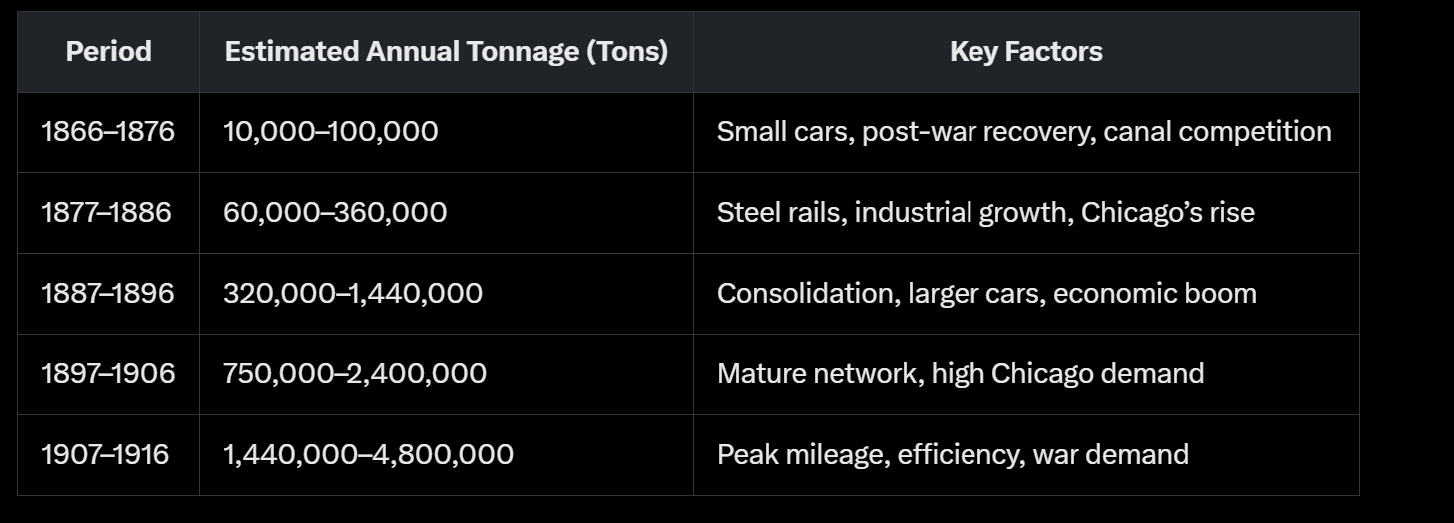
Having tortured you all with the statistics for the stock and bond prices for the railroads, it seems only appropriate to add to the data the calculations of the changes in physical freight itself. The average freight car in 1860 could handle 5-10 tons; by 1890 the figure was 20-30 tons thanks to Mr. Carnegie's rails that replaced iron with steel.
This is Grok's and my best estimates of the annual tonnage between New York and Chicago over the decades between the end of the Civil War and the beginning of U.S. participation in the Great War.
For Russia the primary corridor is between Moscow and the Urals. They have finished building the M12 3-lane dual carriageway (the equivalent for motor freight of the double tracking between NY and Chicago). A trip that took 30 hours now takes 16.
Aug
14
Book rec from Steve Ellison
August 14, 2025 | Leave a Comment

The Laws of Trading: A Trader's Guide to Better Decision-Making for Everyone
This is a book about decision-making through the lens of a professional prop trader. For years, behavioral and cognitive scientists have shown us how human decision-making is flawed and biased. But how do you learn to avoid these problems in day-to-day decisions where you have to react in real-time? What are the important things to think about and to act on?
Aug
12
A deeper look at employment, from Bill Rafter
August 12, 2025 | Leave a Comment
Positive Economic News: Full-Time vs Part-Time Employment Growth
Over the past year the pace of full-time hiring has outstripped that of part-time positions. Both categories are growing, but full-time roles have seen a steeper upward trajectory once we normalize for scale. This signals that employers are increasingly confident in committing to long-term payrolls.
To compare growth on equal footing, we fit simple linear regressions to each series (full-time employment level and part-time employment level) over the same interval. We used monthly seasonally adjusted data from the Bureau of Labor Statistics. For each series, we calculated the slope (employees per month) of the best-fit line. Those slopes became our normalized growth measures, avoiding raw-level distortions.
Empirical Results
Full-Time Employees +2150.00
Part-Time Employees +950.44
The full-time slope of +215 K/month means that on average, net full-time headcount has risen by 215,000 each month. Part-time roles have climbed as well, but at roughly 44 percent of the full-time rate.
A faster acceleration in full-time positions suggests businesses are shifting from flexible or contingent staffing toward more stable, long-term commitments. This pattern often accompanies stronger consumer confidence and investment plans.
Hiring more full-time workers typically entails higher benefits, training, and overhead, so firms generally only follow through when they foresee sustained demand. The fact that part-time growth remains positive underscores broad underlying strength in the labor market.
Consumer spending power will likely rise as more workers move into full-time, benefit-eligible roles. Wage growth pressures may pick up if the pool of available long-term hires tightens further.
Capital expenditure plans may accelerate as firms brace for continued demand and aim to boost productivity.
Aug
11
Disappointing AI
August 11, 2025 | Leave a Comment
AI found rules of Wiswell:
1. Patience precedes power.
2. The middle game is where we live.
3. Sometimes the best move is to wait.
4. Mistakes are not shameful - they're illuminating.
5. You play against yourself, not just your opponent.
6. Simplicity is the highest form elegance.
7. You never stop learning.
Everything considered the AI search came up with a disappointing melange of generic rules that do Tom a great injustice.
J.T. adds:
I plugged it in to check and got a couple of Wiswell proverbs as well. Here are three:
• The winner of a match is not always determined by who is right, but in the end, who is left.
• We can play today’s draws and anticipate tomorrow’s wins, but we shouldn’t forget yesterday’s losses.
• The losing player who says: 'I’ll look it up tomorrow,' very seldom does look it up.
Vic continues:
i have the complete set. Tom would create 20 proverbs a week and then give the boys at ncz a lesson in checkers for 12 years from 1988 to 2000. he would say with a whistwell air, "I wish I had married a girl life Susan. but then I wouldn't have written 22 books."
Aug
9

The Speculator's Edge: A Life in Markets, Mistakes, and Mastery
By Bo Keely with ChatGPT
Chapter One: The Hungarian Gambler and the Boy from Brighton Beach
I was born into odds. Not just long shots or probabilities scribbled in a ledger—but the kind of odds that start at birth and ripple outward through ancestry and ambition. My father, Artie Niederhoffer, was the first speculator I knew. Not on Wall Street—but in the back rooms of Brooklyn where chess games turned into hustles and a nickel bet was sacred currency. His friends called him "The General," and while he never served in uniform, he commanded a battalion of books, bets, and bluffs. He was Hungarian, proud, loud, and certain about everything.
We lived in Brighton Beach, downwind of Coney Island's chaotic joy, but miles away from any kind of financial privilege. Yet my childhood was filled with markets of a different sort. Card games in the basement. Side bets at the chess park. My father's upholstery shop doubling as a clubhouse for thinkers, schemers, and strivers.
It was there, sweeping sawdust off the floor or sitting quietly in the corner listening to men argue over Lasker’s endgame or the Yankees’ spread, that I learned my first truth: everyone speculates. Some do it with stocks. Others with reputations. But every soul is placing a wager, every day.
Download the full bio (.docx file).
Aug
8
Trickery and deception
August 8, 2025 | Leave a Comment

a new way of looking at markets and real life:
In 1953, a top-secret manual teaching agents sleight-of-hand and other deception techniques was written for the CIA by America’s then most famous magician. All copies were believed destroyed by the CIA’s purge of the infamous MKULTRA documents in 1973, and there was no proof of the manual’s existence . . . until a copy was discovered among the CIA’s recently declassified archives.
Big Al responds:
Speaking of the CIA, one is reminded of this manual:
Psychology of Intelligence Analysis, by Richards J. Heuer, Jr.
And something from it (p. 108):
Analysis of competing hypotheses involves seeking evidence to refute hypotheses. The most probable hypothesis is usually the one with the least evidence against it, not the one with the most evidence for it. Conventional analysis generally entails looking for evidence to confirm a favored hypothesis.
Aug
7
Learning From Data, from Asindu Drileba
August 7, 2025 | Leave a Comment

The best data science course I have ever watched. In fact, probably the best data science course ever made is Prof. Yaser Abu-Mostafa's "Learning from Data" at Caltech. I am not exaggerating, and if you think I am, just read the comments section from the first video of the course The Learning Problem — its almost exclusively high praise.
This course is really old, as its from 2012. I watched it probably in 2017 or 2018. But its still very relevant today. Why its relevant today? Most courses focused on describing techniques that were popular then, but later became irrelevant. For example, GANs were replaced by Diffusion Models and core ML Architectures have shifted to Transformers.
Prof. Yaser's course is different because he covers Theory, Techniques and Concepts (most books/courses only describe ML algorithms/Techniques or how to use features in python libraries).
- Theory, refers to mathematical descriptions of ideas like "Is learning feasible" for your problem or dataset?, "Training vs Testing", "The theory of generalization" and the "Bias-Variance trade off".
- Techniques, refers to actual ML algorithms like Neural Networks, SVMs.
- Concepts, describes auxiliary things that are not really Machines Learning but useful to understand well. Like how to interpret/deal with Error & Noise, Sampling of data.
I also recently came across a comment about a book he wrote to accompany the course which made me remember him: Learning From Data.
Aug
6
Biological invasions
August 6, 2025 | Leave a Comment

biological invasions - take the invasion of bitcoin to sp.
Biological Invasions: Theory and Practice, by Nanako Shigesada and Kohkichi Kawasaki.
Using the large amount of data from studies in pest control and epidemiology, it is possible to construct mathematical models that can predict which species will become invaders, which habitats are susceptible to invasion, and the biological impact. This book presents a clear and accessible introduction to the modeling of biological invasions. It demonstrates the latest theories and models, and includes data and examples from various case studies showing how these models can be applied to problems from deadly human diseases to the spread of weeds.
Aug
4
Tech Stress, from Nils Poertner
August 4, 2025 | Leave a Comment

Tech Stress: How Technology is Hijacking Our Lives, Strategies for Coping, and Pragmatic Ergonomics
Valuable book on how to use technology and tech devices in a healthy manner, eg, author talks about the importance of having desk screens high enough, so we don't point our head downward too much (which is unnatural). Most visual "issues" could perhaps be avoided with proper habits. (I suppose in a good high school, pupils ought to be made aware of those things but then the teachers themselves aren't educated here…)
Video: Erik Peper, PhD—TechStress: Reclaim Health and Sanity in a Plugged-In World
Dr. Peper is a professor of Holistic Health Studies at San Francisco State, and is an internationally known expert on biofeedback (applied psychophysiology), holistic health, technostress and stress management.
Aug
3
The Right Moves: My Life in Chess, By Art Bisguier
August 3, 2025 | Leave a Comment
The Right Moves: My Life in Chess
By Art Bisguier (with Bo and Chatty)
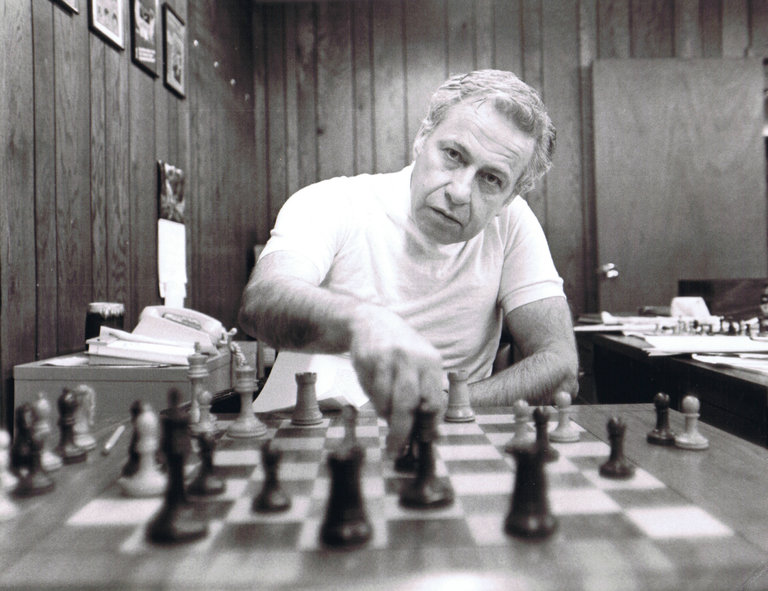
Chapter One: Pawn to King Four – The Bronx Beginnings
I was born on October 8, 1929, in the Bronx, the same month the stock market crashed. Maybe that’s why I always grew up careful with my pawns—early sacrifices never came easy to me. My father, a mathematician by training, worked as an actuary. My mother kept the home steady, and neither of them played chess. But one day, around the age of four or five, I watched my older brother play with a friend on a folding board in the kitchen. I didn’t understand the moves, but I was hooked by the shape of the pieces. The knight looked like it had something to say.
Like a lot of kids in those days, we didn’t have much. The Bronx was tough but tight-knit. You had to earn your place in any group—be it stickball or chess—and respect wasn’t handed out like candy. I didn’t talk much, but when I had something to say, I made sure it was worth hearing. That trait worked well in chess too. No wasted moves. No bragging. Just precision.
Download the full bio (.docx file).
Aug
1
How do you fight the Vig?, from Asindu Drileba
August 1, 2025 | 1 Comment
I interpret the "Vig" as the collective term for:
1) bid-ask spread (difference in prices between buying & selling) due to market makers
2) transaction fees (for limit & market orders) charged by the exchange
3) slippage (an instrument is more expensive the deeper in the order book you go) due to how liquid an asset is.
Possible solutions for each?
1) Can be fought with the exclusive use of limit orders instead of market orders.
"Be patient and you will have the edge", The Chair in, Practical Speculation — The fine art of bargaining for an edge
2) I noticed (at least in crypto markets) that the more volume you trade, the less fees you pay (on a percentage basis)
3) Restrict yourself to deep and very liquid markets.
Also, one technique is to trade as less often as you can (buy & hold). That way you will automatically pay less of all the three sources of Vig. I think this is so important as I often found many "edges", then accounted for the vig and they often became loosing strategies.
Big Al writes:
I would also add "opportunity cost" as part of the "Meta Vig" (MV), i.e., the total costs associated with trying to trade the markets. The MV would also include the negative effects of cortisol on the human body.
Henry Gifford suggests:
I think two good steps are to ask others what the big is, and to try to calculate it yourself. Both exercises will no doubt be educational. A few times over the years I have asked horse bettors what the big is, but none seemed to know. As for calculating yourself, one hopefully will learn how much it varies by, and maybe also gain insight into hidden vig.
Steve Ellison responds:
There is no free lunch with limit orders because of adverse selection. Sooner or later, you will place a limit order on a security that simply moves up and never looks back. It would have been your best trade ever, had you actually been filled. In the opposite scenario, for example when I bought Coca-Cola in 1998, and it was already down 25 percent by the T + 3 settlement date, you will of course be filled.
Studies of retail investing accounts have shown a negative correlation between number of transactions and investment returns. In one study, accounts that had been inactive for 18 months because their owners had died, and their estates had not been settled, outperformed the vast majority of their retail account peers.
Peter Ringel writes:
Generally, the lower you go ( smaller time frame - smaller scope of the trade ) the larger the relative Vig costs. a subclass of opportunity costs is spent time of (daily) preparation. my required prep is nearly the same over many time-frames - but the scope of a trade is way lower for lower time-frames. in cash equities, the resale of your order-flow by your broker to some HF shop can be counted as Vig too. is this a common practice in option markets too? Yes, the Vig greases the fin-industry, but it is mostly unavoidable paying / avoiding the Vig does not lead to success or failure in mkts IMHO.
Vic simplifies:
just trade once a quarterfrom long side
Zubin Al Genubi comments:
The biggest vig is capital gain taxes. The richest people in the world hold their single company stock 10000x and realize no gain. Its very hard to beat a long term hold.
Jul
31
Art Shay: Through the Lens and On the Page
July 31, 2025 | Leave a Comment
Art Shay: Through the Lens and On the Page: The Autobiography of an American Eye
by Art Shay with Bo ‘Grandpa AI’ and ChatGPT
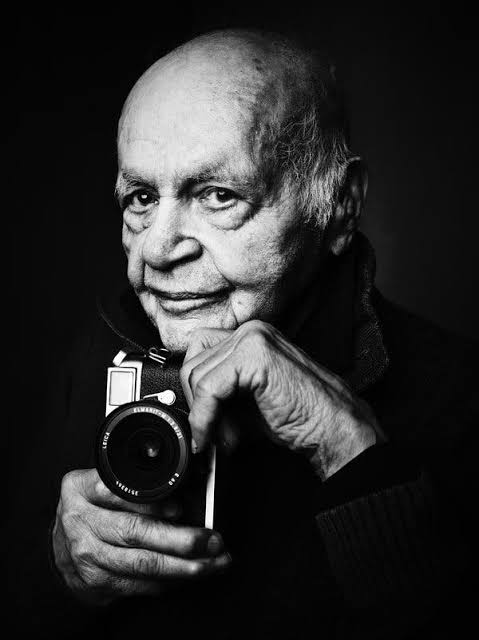
Chapter 1: The Negative That Developed Me
I was born in the Bronx in 1922, the son of Jewish immigrants who wanted me to become a doctor, or a lawyer—anything but a guy with a camera in his hand and his head in the clouds. But it was the darkroom, not the courtroom, that called me. I can still smell the developer and fixer the first time I saw a photo appear like a ghost in the chemical tray. It felt like conjuring, like magic. Hell, maybe it was.
I didn’t start out with a Leica in my pocket. I started out with nothing. Nothing but a war, a nose for stories, and a restless need to see. After flying fifty-something bomber missions in WWII, you get used to looking down at the world. But it was only when I got back on foot, on the streets, that I really started seeing it.
Download the full bio (.docx file).
Jul
30
Keeping up with Dr. Brett
July 30, 2025 | Leave a Comment
The problem with tilt is not an excess of emotion. The problem is a lack of brain fitness: poor cognitive endurance and poor capacity for recovery. This is a game changer for trading psychology.
Jul
29
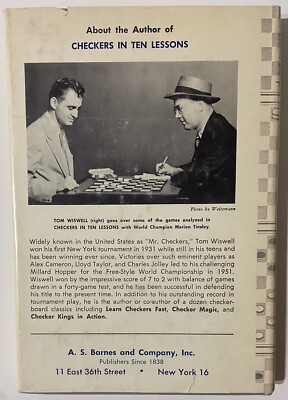
Wiswell’s Way: A Life on the Squares and Between the Lines
By Tom Wiswell (with a little help from Bo Keely and AI)
Chapter One: Brooklyn Beginnings
It all began at the corner of Atlantic and Nostrand, Brooklyn, 1917. A working-class neighborhood, a Jewish family, and a boy who would grow up to be, among other odd things, a world checker champion. Yes—checkers, the game you played at your grandfather’s kitchen table, which I turned into a lifelong study, an art form, and eventually, a philosophy.
I wasn’t born into greatness or madness. Just into a world that still had trolleys clanking down the street and fathers who worked with their hands. Mine owned a small shop and taught me the first lessons of trade, thrift, and tact. My mother taught me patience. The combination, it turned out, is what you need to master any board game—and life itself.
Download the full bio (.docx file)
Jul
28
Tufte fail, from Humbert X.
July 28, 2025 | Leave a Comment
Specs have been posting about copper, and I happened across this act of chartcrime.
Steve Ellison comments:
Wow, I don't think the software I used to generate Sankey charts in a previous career analyzing a petabyte-sized data lake to surface key insights for one of the big 3 personal computer companies would have allowed me to just start a new stream in the middle ("Imports of Refined Copper"). Anyway wouldn't it make more sense to join "Concentrate Net Exports" and "Scrap Net Exports" on the right side of the chart, and then put "Imports of Refined Copper" downstream of that junction?
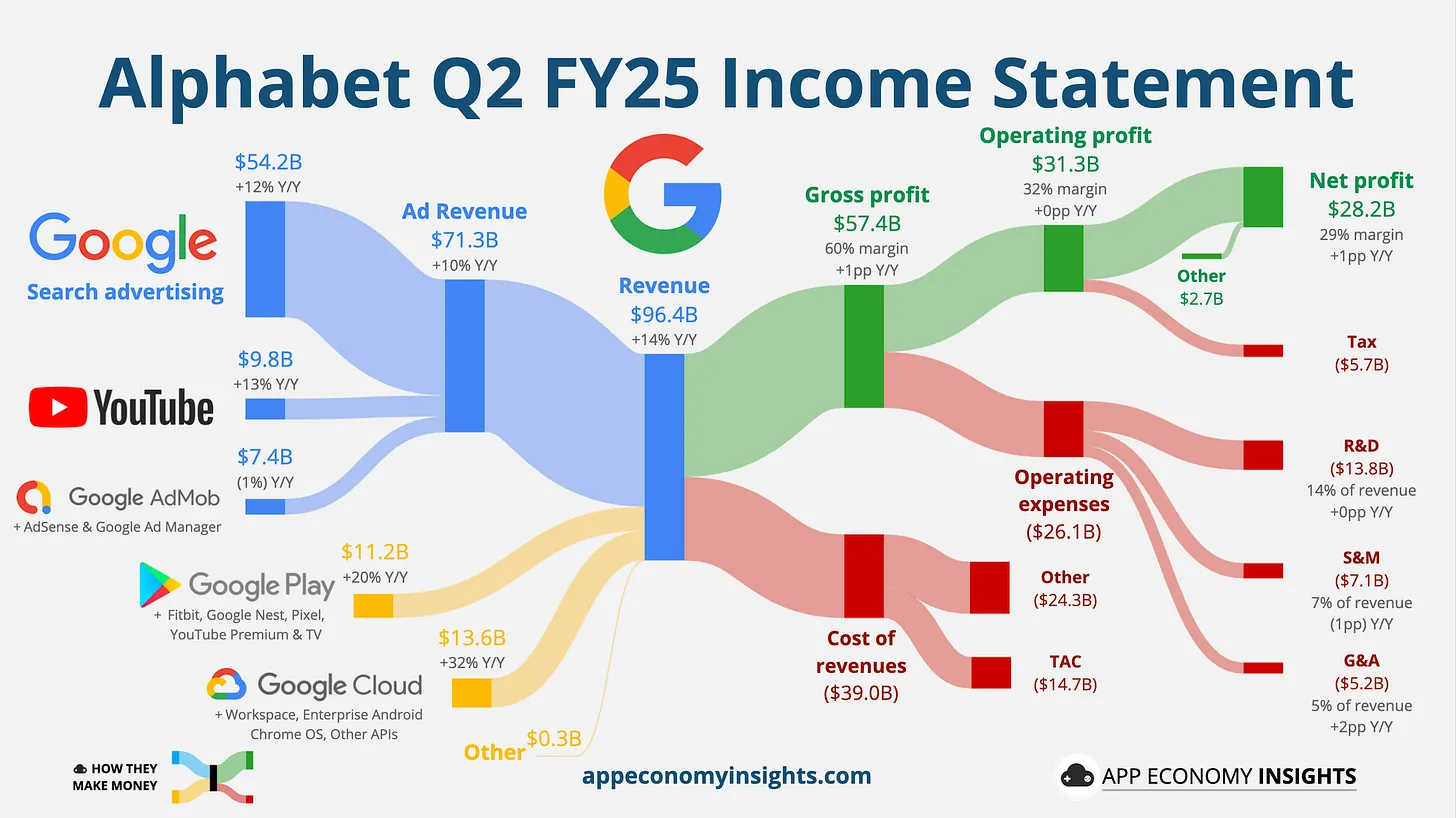
I was using D3 in those days; now that I am much more experienced with Python, maybe I should search for a Sankey charting library in Python.
On the subject of copper, I perceive a macro trend that the US has geopolitical risk because too much domestic mining and basic material production was shut down, partly in order to export environmental impacts to less developed countries. Lithium and steel are in similar situations.
Peter Ringel writes:
"Sankey" that is a nice search term. I had it on my list to research. These guys use it a lot..
One finds several sankey libraries in Python on Github, such as this one.
Jul
27
The finest man of Westport
July 27, 2025 | Leave a Comment
Tommy had the best way of starting a meeting or conversation: "tell me a story - or teach me something." try it sometime on a first date or meeting.
Where Westport meets the world: Tommy Ghianuly
Friday Flashback #131
Posted on March 1, 2019
When Tommy Ghianuly died last month, Westport lost more than a great barber and good friend.We lost a man who loved local history — and made his Compo Shopping Center business a shrine to it.
The walls of Tommy’s barber shop are filled with vintage photos. Most customers see them in the mirror as they get their hair cut. Sometimes, someone glances a bit more closely at one or two.
Each of them has a story. Tommy knew them all.

Video: Compo Barber Shop and Thomas Ghianuly
In 2001, Dr. Phil Woodruff approached me to help work on video project for the Westport Historical Society. One of the project ideas he wanted to explore involved the Compo Barber shop and its owner Tom Ghianuly. Tom had over the years decorated the barber shop with historically significant photos of Westport. Dr. Woodruff wanted me to help him create a video about the barber shop, Tom Ghianuly, and all of the photos on his walls.
Jul
26
Dispersion, from Big Al
July 26, 2025 | Leave a Comment
There is a debate over the effects of passive investing, eg, whether it causes all stocks to be more correlated in their movements, makes markets less efficient, etc. Here's an interesting take:
Index Investing Makes Markets and Economies More Efficient.
I’m going to argue that the trend towards passive management is not only sustainable, but that it actually increases the accuracy of market prices. It does so by preferentially removing lower-skilled investors from the market fray, thus increasing the average skill level of those investors that remain. It also makes economies more efficient, because it reduces the labor and capital input used in the process of price discovery, without appreciably impairing the price signal.
As for the correlation issue, one can still see dispersion. Here are the S&P components sorted by YTD % return as of 23 July (data source), with stocks such as PLTR, NRG and NEM on the right (+) end, and UNH, LULU, ENPH and DECK on the left (-) end:
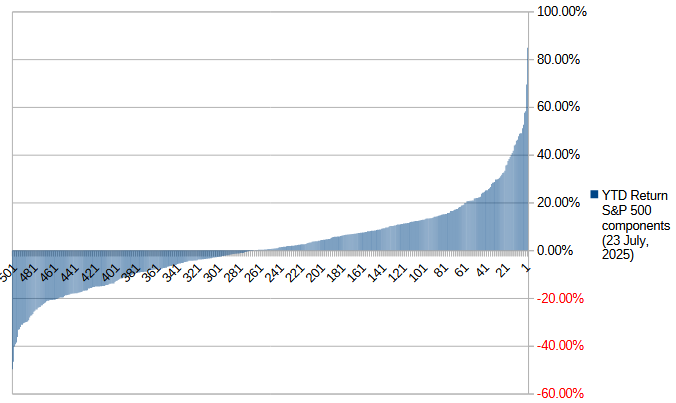
Jul
24
The Penobscot Expedition, from Stefan Jovanovich
July 24, 2025 | Leave a Comment
Today is the 246th anniversary of the foreign war excursion that would result in 2nd worst naval disaster in American history.

On July 24, 1779, the naval expeditionary force commissioned by the Massachusetts General Assembly departed Boothbay, Maine for Castine on the Penobscot peninsula where the British had a 750-man garrison. The expedition had 19 warships, 24 transport ships and more than 1,000 militiamen under the command of Commodore Dudley Saltonstall, Adjutant General Peleg Wadsworth, Brigadier General Solomon Lovell and Lieutenant Colonel Paul Revere.
On August 13th 7 British ships arrived to reinforce the Castine garrison. The response of Commodore Saltonstall was to burn his ships and lose 470 men by death and capture to the British, who were led by Sir George Collier. Collier would lose 13 men.
Saltonstall and Paul Revere later faced court martial because of the fiasco. Saltonstall would lose his commission, but Revere won acquittal.
The Penobscot Expedition would rank #1 in American nautical fiascos until 1941 when the Japanese Navy would visit Pearl Harbor.
Jul
24
A nice example of economy
July 24, 2025 | Leave a Comment

a nice example of economy in the 1800's. a colleague tells him to get out of the rain but finds him a hour later drenched. what's the explanation? he was waiting the one penny bus not the two penny.
George Peabody never quite escaped the marks of his boyhood poverty. He routinely worked 10-hour days, every day of the week, and during one 12-year stretch he never took off three consecutive days. More visibly, he was frugal to the point of absurdity. His partner, Junius Morgan (father of J. Pierpont Morgan, who began his distinguished career in finance at the New York office of George Peabody), once found him standing in a drenching London rain. Morgan realized that Peabody had left the office 20 minutes earlier. Ron Chernow recounts their exchange: “’Mr. Peabody, I thought you were going home,’ the younger man said. ‘Well, I am, Morgan,’ Peabody replied, ‘but there’s only been a twopenny bus come along as yet and I am waiting for a penny one.’” At the time, Peabody had more than £1 million to his name.
Jul
23
Entry or exit opportunity, from Nils Poertner
July 23, 2025 | Leave a Comment

Donald Trump set to open US retirement market to crypto investments
President preparing executive order to allow 401k plans to tap broad pool of alternative assets
Hm. Entry for ordinary folks or a sneak way / exit for established players? Have a got a picture of the angel fish in my office, to remind me of the deceptive nature of markets. Angler fish are those ambush predator fish living in deep sea, that can illuminate poles in front of their jaws….to catch smaller fish.
William Huggins writes:
am reading Gustavus Myers' History of Great American Fortunes (1907) at the moment and just absorbed 300 pages of railroad fraud perpetrated by those who got their hands on the "mcguffin" asset and then sold it off only once they had successfully looted the value. the same sort of economic transfer happens for early crypto adopters - those trillions of market cap are "paper only" until some rubes can be fleeced of their efforts for the worthless securities foisted upon them.
Stefan Jovanovich comments:
I hope this comment will not be read as argument or rebuttal but only as a factual footnote to Myers' work. The 50,000 shares issued by Fiske et. al. were "legal" in the same way that carried interest is "legal". They were allowed by New York State law in 1868.
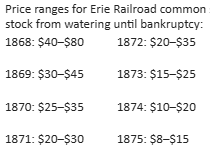
The primary limitation on the issue of new shares of common stock for the Erie was its corporate charter. The board only had authority to issue $30 million in capital stock. Any issues above that amount required amendment of the corporate charter by the legislature and majority shareholder approval. The additional 50K of stock issued, at its par value, did not increase the total capitalization above the $30 million limit.
NY State law in 1868 allowed non-cash consideration. The contracts that the Erie board accepted as payment for the new shares were, in nominal dollars, fully equal to the par value of the shares issued. Shareholders had the right to challenge that claim; they were, as litigant frequently are, disappointed by the rejection of their challenge. The result was a situation that can be politely described as "judicial uncertainty" - i.e. a battle of conflicting injunctions.
Jul
22
Smörgåsbord
July 22, 2025 | Leave a Comment
Big Al offers:
Very nice Veritasium vid on randomness and information:
Asindu Drileba likes a new interview:
I learned about Gappy Paleologo from this list. He has a new interview on a Bloomberg podcast. In it, he talks about:
- Why he suspects Astrophysicists make good quants
- Why AI can't fully take over trader's jobs (in principle)
- What makes a "good quant"
Jeff Watson is following the floor traders last stand:
Old-School Floor Traders Finally Get Their Day in Court Against CME
Trial opens in the Chicago plaintiffs’ long-running lawsuit claiming harm from the launch of electronic markets
The plaintiffs, who estimate that they are owed about $2 billion in damages plus interest, say the company broke its promises to them when it opened a data center for electronic trading that effectively doomed the old trading floors. CME has called the lawsuit baseless.
A spokeswoman for CME declined to comment. The company repeatedly tried to get the suit thrown out, but failed each time.
The lawsuit, filed in 2014, has dragged on so long that one of the original plaintiffs has died. Hundreds of former floor traders could be affected by the outcome. The trial, being held at a county courthouse in downtown Chicago, kicked off Monday with jury selection. It is expected to last several weeks.
Jul
21
CPI Data Quality Declining
July 21, 2025 | Leave a Comment
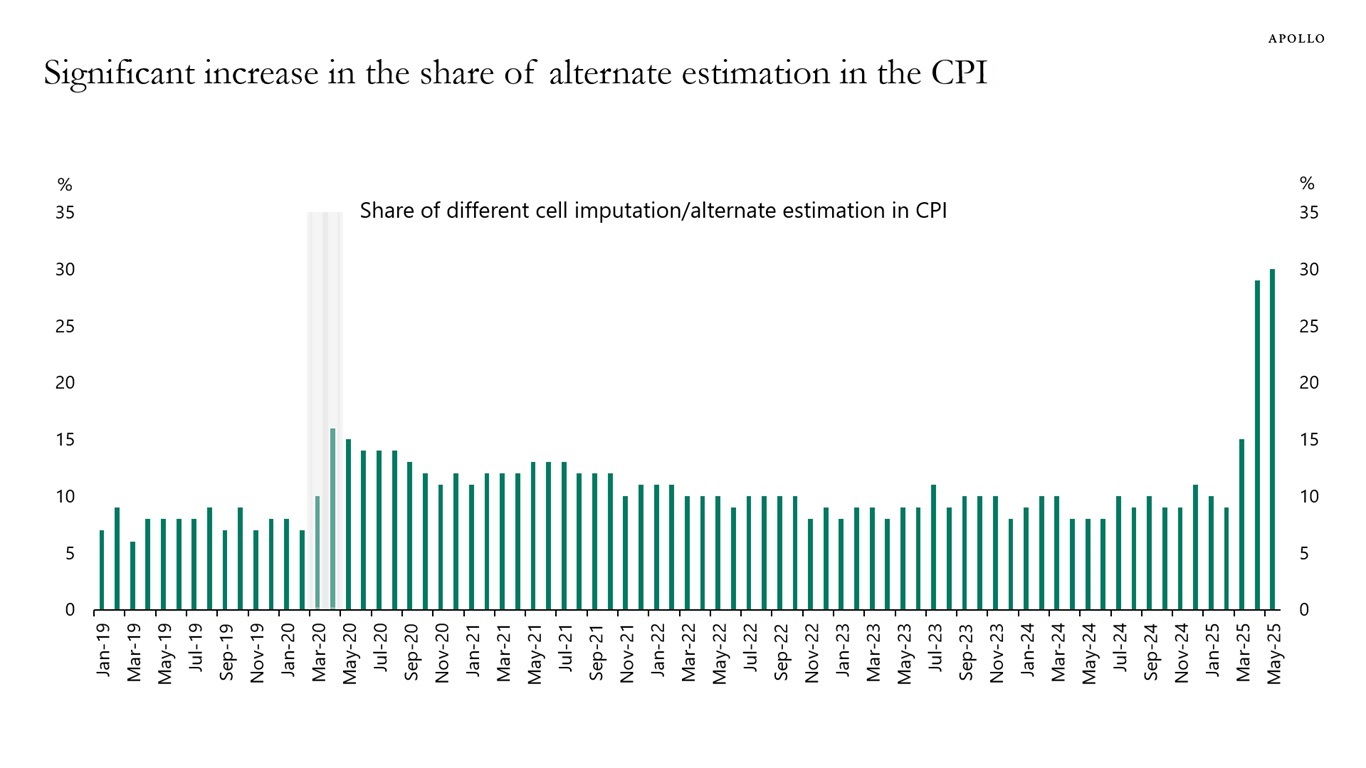
CPI Data Quality Declining
June 20, 2025
Torsten Sløk
Apollo Chief Economist
To calculate CPI inflation, BLS teams collect about 90,000 price quotes every month covering 200 different item categories, and there are several hundred field collectors active across 75 urban areas.
When data is not available, BLS staff typically develop estimates for approximately 10% of the cells in the CPI calculation. However, in May, the share of data in the CPI that is estimated increased to 30%, see chart below.
In other words, almost a third of the prices going into the CPI at the moment are guesses based on other data collections in the CPI.
Bill Rafter writes:
Would anyone in the data business be surprised by this? I’m not.
Peter Ringel wonders:
Doge related?
Big Al offers:
US Labor Department reducing CPI collection sample amid hiring freeze
By Reuters
June 4, 2025
The U.S. Labor Department's economic statistics arm said on Wednesday it was reducing the Consumer Price Index collection sample in areas across the country due to resource constraints, but the move should have "minimal impact" on the overall CPI data.
Jul
19
Big Mac Index, from Jeff Watson
July 19, 2025 | Leave a Comment
For those who study such data, here’s the 2025 Big Mac index.
The Big Mac Index, a real and recognized metric developed by The Economist magazine in 1986, initially served as a light-hearted tool to measure purchasing power parity between countries. Today, it has evolved into a significant indicator of the global economy and currency valuation. This index compares the price of Big Macs in various countries to the price in the United States, offering insights into economic conditions.
Steve Ellison writes:
I love the Big Mac Index. But inquiring minds want to know, what about the eurozone, conspicuously missing from the article? The Big Mac Index judges the euro to be 15.2% overvalued, so this year's runup in EUR/USD appears not to be supported by burger fundamentals.
Jul
18
C & I loans, Large v. Small banks, from Bill Rafter
July 18, 2025 | Leave a Comment
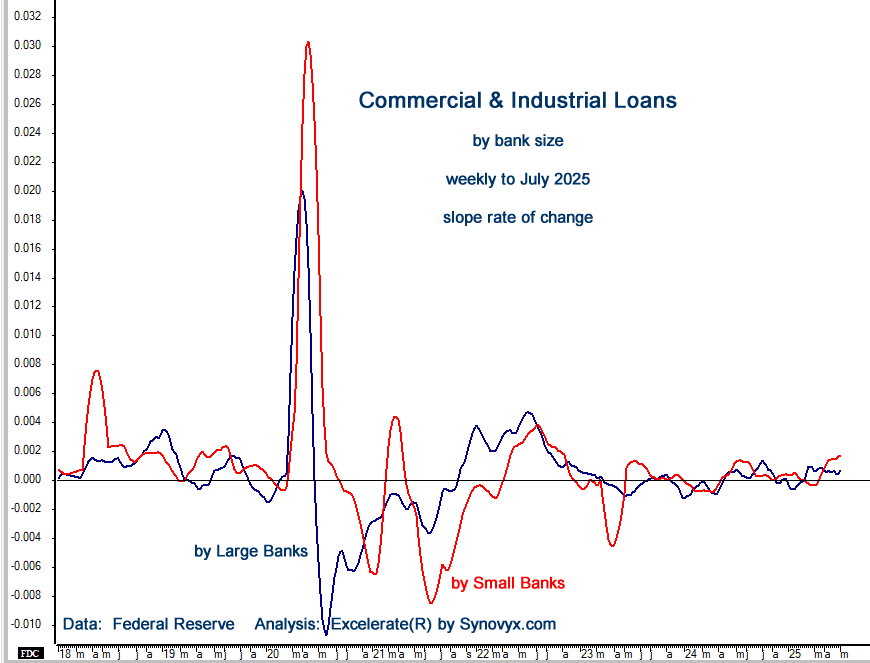
In the July 14 Wall Street Journal, an article argued that smaller banks—by virtue of their loan portfolios—are better positioned than larger banks to gauge the nation’s economic health. Intrigued, I tested that claim using Federal Reserve weekly data on Commercial & Industrial loans for both large and small banks going back to 1984.
As expected, small-bank lending proved more volatile, but it was consistently less “correct” than large-bank lending. Whether measured by simple rates of change or by shifts in their 12-month trends, large banks outperformed small banks in accuracy. This analysis does not include loan-performance metrics (delinquency or charge-off rates broken out by bank size), which — unsurprisingly — tend to peak during or immediately after recessions.
Jul
17
Your Favorite Chicken Sandwich Shows How Markets Iterate, by Dr. Peter C. Earle
July 17, 2025 | Leave a Comment
Your Favorite Chicken Sandwich Shows How Markets Iterate
Critics often scoff at the market economists’ claim that competition fosters relentless innovation. A recent meme points to the ubiquity of chicken sandwiches across major fast food chains as supposed evidence of stagnation in capitalism. If twelve top firms offer a similar product, the argument goes, how innovative can an economic system truly be?
But that line of reasoning badly misrepresents both the nature of competition and the role of iterative improvement in markets. The explosion of chicken sandwich options is not a sign of creative bankruptcy — it’s a case study in product refinement, branding evolution, and consumer-focused differentiation. Far from signaling sameness, the chicken sandwich wars reveal how even within a narrow category, firms continuously jockey to win customer loyalty, and with it, market share.
Jul
16
The Most Useful Thing AI Has Ever Done, by Veritasium
The biggest problems in the world might be solved by tiny molecules unlocked using AI. A huge thank you to John Jumper and Kathryn Tunyasuvunakool at Google Deepmind; and to David Baker and the Institute for Protein Design at the University of Washington for their invaluable expertise and explanations.
Overview: Alphafold
AlphaFold is an artificial intelligence (AI) program developed by DeepMind, a subsidiary of Alphabet, which performs predictions of protein structure. It is designed using deep learning techniques.
DeepMind site: AlphaFold: Accelerating breakthroughs in biology with AI
Jul
15
July, 1798 - John Adams Starts the first Loser War of the United States, from Stefan Jovanovich
July 15, 2025 | Leave a Comment
The rules for American warfare are painfully simple: we win the ones that other people start, and we lose the ones that we start. Today is the formal anniversary of the first loser war by the American Republic. Congress, at the urging of President Adams and his Secretary of the Navy, Benjamin Stoddert, revokes its treaty with France. Because the revocation put the country in a state of war with France but is not a formal declaration by Congress, our history books call it a "Quasi-War". Conventional history does its best to pretend that this was a success. History Today tells us "the Navy gained respect as a powerful force. It grew from a mere six vessels to about 30 commissioned ships. American warships captured more than 80 French vessels during the Quasi-War."
U.S. launches the Quasi-War with France, the first conflict since the Revolution
Total tonnage of ships captured during the Quasi-War
(the figures given are a range because the sizes of the individual ships captured have to be estimated; there are not enough surviving records to know how large each ship was.)
• American ships captured by French Navy: 200,050–400,100 tons
• French ships captured by U.S. Navy: 5,200–10,000 tons

We have better numbers for the the number of ships captured:
• American ships captured by French Navy: roughly 2,000
• French ships captured by U.S. Navy: 85-86
The American records are much more precise because the captures had to be valued; prize money was the incentive pay for the officers and sailors.
Steve Ellison writes:
Paul Johnson, in A History of the American People, wrote that Thomas Jefferson during his two terms as president was endlessly vexed by the depredations of both the British and French navies on American shipping. One wonders why we start any wars if we are guaranteed to lose.
Stefan Jovanovich responds:
The data for the war that the Democrat-Republicans (Jefferson and Madison) wanted and formally declared - the one that started in 1812 and is still looking for a name:
• U.S. Captures: 44,412–63,912 tons (200–250 vessels)
• U.K. Captures: 144,799–424,799 tons (1,406 vessels)
Jul
14
Forest for the trees, from Humbert Y.
July 14, 2025 | Leave a Comment

Selection of videos:
How can we make young forests “old-growthier?”
Forest management is hard to understand
Ecological Forestry: The Agony and the Ecstasy of “Messiness”
Five Things You Can Do to Help Forests — In 5 Minutes
And the book:
How to Love a Forest: The Bittersweet Work of Tending a Changing World
By Ethan Tapper
Proffering a more complex vision, Tapper argues that the actions we must take to protect ecosystems are often counterintuitive, uncomfortable, even heartbreaking. With striking prose, he shows how bittersweet acts—like loving deer and hunting them, loving trees and felling them—can be expressions of compassion. Tapper weaves a new land ethic for the modern world, reminding us that what is simple is rarely true, and what is necessary is rarely easy.
Jul
12
The case for free trade
July 12, 2025 | Leave a Comment

The Case for Free Trade
By Milton Friedman, Rose D. Friedman
Thursday, October 30, 1997
For example, the supporters of tariffs treat it as self evident that the creation of jobs is a desirable end, in and of itself, regardless of what the persons employed do. That is clearly wrong. If all we want are jobs, we can create any number–for example, have people dig holes and then fill them up again or perform other useless tasks. Work is sometimes its own reward. Mostly, however, it is the price we pay to get the things we want. Our real objective is not just jobs but productive jobs–jobs that will mean more goods and services to consume.
How Trade Agreements Have Enhanced the Freedom and Prosperity of Americans
By Daniel Griswold and Clark Packard
The most straightforward and preferable path to trade liberalization for any country is the unilateral reduction of trade barriers without regard for other countries’ trade policies. Unilateral liberalization allows a country to realize the gains from openness—mainly lower prices for consumers, lower-cost inputs for businesses, and a more favorable exchange rate for exporters—without the need for complicated negotiations with other countries. Many nations have followed this route with success, from Great Britain in the mid–19th century to China and India and other emerging economies since the 1980s.
Recommended Readings on Free Trade Versus Protectionism
By Williamson M. Evers
Economists, going back to Adam Smith and David Ricardo, are virtually unanimous that free trade benefits consumers and the overall economy. But there exist special interests who would gain in the short run from protectionist barriers. And there is a large segment of the public that doesn’t understand the arguments for free trade. Not surprisingly, there are politicians who are all too willing to gain votes by catering to protectionist interests.
'Ulysses Grant' comments:
"Free trade" was the English rebuttal to the ungrateful Americans who decided in 1789 that they would pay for the national government with tariffs. The intellectual debate only began in the United States a generation later; but, even then, it was only about how much harm Congress would do to libertarian beliefs in order to pay the bills. "True" freedom would only come much later, with the income tax - which has none of the defects that make tariffs so inherently immoral.

Jul
11
Spectacular reported profits
July 11, 2025 | Leave a Comment
To what extent are all the spectacular reported profits of short term traders due to specialized lower commissions and preferred access to the bid-ask spread, especially but not limited to the openings?
Jul
10
Retail Trading in Options and the Rise of the Big Three Wholesalers, from B. Humbert
July 10, 2025 | Leave a Comment
Retail Trading in Options and the Rise of the Big Three Wholesalers
Svetlana Bryzgalova, Anna Pavlova, Taisiya Sikorskaya (London Business School)
First published: 02 October 2023
We document a rapid increase in retail trading in options in the United States. Facilitated by payment for order flow (PFOF) from wholesalers executing retail orders, retail trading recently reached over 60% of total market volume. Nearly 90% of PFOF comes from three wholesalers. Exploiting new flags in transaction-level data, we isolate wholesaler trades and build a novel measure of retail options trading. Our measure comoves with equity-based retail activity proxies and drops significantly during U.S. brokerage platform outages and trading restrictions. Retail investors prefer cheaper, weekly options with average bid-ask spread of 12.6%, and lose money on average.
We start by documenting the stylized fact that, although only a fraction of investors trade options, most of the PFOF received by retail brokerages comes from options, not equities. For example, in 2021, U.S. brokerages received $2.4 billion in PFOF for options and only $1.3 billion for equities. The lion's share of PFOF for options came from only three wholesalers: Citadel, Susquehanna, and Wolverine.
Jul
9
Free trade is a good thing
July 9, 2025 | Leave a Comment
Terms of Trade and the Gains from Trade | AP Macroeconomics | Khan Academy
The Benefits of Free Trade: Addressing Key Myths
By Donald J. Boudreau and Nita Ghei
The growing rhetoric about imposing tariffs and limiting freedom to trade internationally reflects a resurgence of old arguments that stay alive in large part because the benefits of free international trade are often diffuse and hard to see, while the benefits of shielding specific groups from foreign competition are often immediate and visible. This illusion fuels the common perception that free trade is detrimental to the American economy. It also tips the scales in favor of special interests seeking protection from foreign competition. As a result, the federal government currently imposes thousands of tariffs, quotas, and other barriers to trade.
Jul
8
Two Petawatts for 25 quintillionths of a second at Michigan, from Carder Dimitroff
July 8, 2025 | Leave a Comment
The NSF-funded ZEUS Laser Facility at the University of Michigan produced more than 100 times the global electricity power output (2 petawatts) for a duration of 25 quintillionths of a second.
The US has a new most powerful laser
Hitting 2 petawatts, the NSF-funded ZEUS facility at U-M enables research that could improve medicine, national security, materials science and more.
The ZEUS laser facility at the University of Michigan has roughly doubled the peak power of any other laser in the U.S. with its first official experiment at 2 petawatts (2 quadrillion watts).
Jeff Watson responds:
Those are black hole creation numbers (from chatgpt):

Jul
7
A loitering rogue
July 7, 2025 | Leave a Comment
Lytton Strachey, in Biographical Essays, writes about David Hume:
« go back — keep looking »Not long before he died he amused himself by writing his autobiography — a model of pointed brevity. In one of his last conversations — it was with Adam Smith — he composed an imaginary conversation between himself and Charon, after the manner of Lucian: "Have a little patience, good Charon, I have been endeavouring to open the eyes of the Public. If I live a few years longer, I may have the satisfaction of seeing the downfall of some of the prevailing systems of superstition." But Charon would then lose all temper and decency. "You loitering rogue, that will not happen these many hundred years. Do you fancy I will grant you a lease for so long a term? Get into the boat this instant, you lazy, loitering rogue."
Archives
- October 2026
- September 2026
- August 2026
- July 2026
- June 2026
- May 2026
- April 2026
- March 2026
- February 2026
- January 2026
- December 2025
- November 2025
- October 2025
- September 2025
- August 2025
- July 2025
- June 2025
- May 2025
- April 2025
- March 2025
- February 2025
- January 2025
- December 2024
- November 2024
- October 2024
- September 2024
- August 2024
- July 2024
- June 2024
- May 2024
- April 2024
- March 2024
- February 2024
- January 2024
- December 2023
- November 2023
- October 2023
- September 2023
- August 2023
- July 2023
- June 2023
- May 2023
- April 2023
- March 2023
- February 2023
- January 2023
- December 2022
- November 2022
- October 2022
- September 2022
- August 2022
- July 2022
- June 2022
- May 2022
- April 2022
- March 2022
- February 2022
- January 2022
- December 2021
- November 2021
- October 2021
- September 2021
- August 2021
- July 2021
- June 2021
- May 2021
- April 2021
- March 2021
- February 2021
- January 2021
- December 2020
- November 2020
- October 2020
- September 2020
- August 2020
- July 2020
- June 2020
- May 2020
- April 2020
- March 2020
- February 2020
- January 2020
- December 2019
- November 2019
- October 2019
- September 2019
- August 2019
- July 2019
- June 2019
- May 2019
- April 2019
- March 2019
- February 2019
- January 2019
- December 2018
- November 2018
- October 2018
- September 2018
- August 2018
- July 2018
- June 2018
- May 2018
- April 2018
- March 2018
- February 2018
- January 2018
- December 2017
- November 2017
- October 2017
- September 2017
- August 2017
- July 2017
- June 2017
- May 2017
- April 2017
- March 2017
- February 2017
- January 2017
- December 2016
- November 2016
- October 2016
- September 2016
- August 2016
- July 2016
- June 2016
- May 2016
- April 2016
- March 2016
- February 2016
- January 2016
- December 2015
- November 2015
- October 2015
- September 2015
- August 2015
- July 2015
- June 2015
- May 2015
- April 2015
- March 2015
- February 2015
- January 2015
- December 2014
- November 2014
- October 2014
- September 2014
- August 2014
- July 2014
- June 2014
- May 2014
- April 2014
- March 2014
- February 2014
- January 2014
- December 2013
- November 2013
- October 2013
- September 2013
- August 2013
- July 2013
- June 2013
- May 2013
- April 2013
- March 2013
- February 2013
- January 2013
- December 2012
- November 2012
- October 2012
- September 2012
- August 2012
- July 2012
- June 2012
- May 2012
- April 2012
- March 2012
- February 2012
- January 2012
- December 2011
- November 2011
- October 2011
- September 2011
- August 2011
- July 2011
- June 2011
- May 2011
- April 2011
- March 2011
- February 2011
- January 2011
- December 2010
- November 2010
- October 2010
- September 2010
- August 2010
- July 2010
- June 2010
- May 2010
- April 2010
- March 2010
- February 2010
- January 2010
- December 2009
- November 2009
- October 2009
- September 2009
- August 2009
- July 2009
- June 2009
- May 2009
- April 2009
- March 2009
- February 2009
- January 2009
- December 2008
- November 2008
- October 2008
- September 2008
- August 2008
- July 2008
- June 2008
- May 2008
- April 2008
- March 2008
- February 2008
- January 2008
- December 2007
- November 2007
- October 2007
- September 2007
- August 2007
- July 2007
- June 2007
- May 2007
- April 2007
- March 2007
- February 2007
- January 2007
- December 2006
- November 2006
- October 2006
- September 2006
- August 2006
- Older Archives
Resources & Links
- The Letters Prize
- Pre-2007 Victor Niederhoffer Posts
- Vic’s NYC Junto
- Reading List
- Programming in 60 Seconds
- The Objectivist Center
- Foundation for Economic Education
- Tigerchess
- Dick Sears' G.T. Index
- Pre-2007 Daily Speculations
- Laurel & Vics' Worldly Investor Articles
