Jun
14
‘Certain Hedge Funds,’ from East Sider
June 14, 2007 | Leave a Comment
10:14 *VINIAR SAYS INCENTIVE FEE DROP DUE TO `CERTAIN HEDGE FUNDS'
11:26 *GOLDMAN'S VINIAR SAYS REDEMPTIONS FROM GLOBAL ALPHA `MINIMAL' — Bloomberg
And I thought the dumb guys were buying the toxic stuff at rich levels, not GS and BSC…
Jun
14
A Lesson from Andy Roddick, by Riz Din
June 14, 2007 | Leave a Comment
 Andy Roddick, who won the Stella Artois Championship three years straight (2003 to 2005), has just provided us with an excellent lesson on the importance of balanced, competitive temperament.
He was up again 23 year old Alex Bogdanovic, a British unknown who was playing the better all round game today, constantly hitting the ball up against the tram lines or deep to the base line, and always making it difficult for Roddick to return. In contrast, Roddick was having a really bad day at the office. His game not only lacked any spark but by constantly playing the ball back to Bogdanovic and hardly ever making him stretch, he was almost actively putting his opponent in the driving seat. Where Roddick had the clear edge however, was in his service game. He was firing accurate rockets for serves, ending his service game in minutes, often with love score. He knew that this could be enough to get through the day. Roddick lost the first set after losing a service game, but he didn't crumble under pressure. He wasn't enjoying it one bit and you could see the struggle he was going through, but he continued to fight in a controlled manner, not letting his emotions get the better of him. Roddick won the second set after a tense tie-break, and then went on to break Bogdanovic late in the third set for a victory. Roddick rightly said of the game, 'I was lucky to get out of there today'.
So many times I have watched the likes of Tim Henman and Andy Murrary crumble in the face of adversity, often looking to externalise their problems by blaming poor line calls or other factors as soon as things stop going their way, and it was a real joy to see Andy Roddick deal with his poor game play with maturity. He knew he could win if he persevered (he had the edge where it counted) and that's exactly what he did. It was a joy to watch and a valuable lesson.
Jun
14
Some Thoughts on Forecasting, by Victor Niederhoffer
June 14, 2007 | Leave a Comment
 I often wonder why the public can be repeatedly misled by forecasts that are consistently wrong, and by forecasters that have no raison d'etre. I believe the underlying reason is that we are brought up to be insecure, and we look to others for the sources and solutions to our problems, rather than looking to ourselves.
Such forecasters as the weekly financial columnist, can be consistently wrong, (he has been bearish every week since the Dow was at 800), and yet be among the most revered and respected forecasters of all. For an answer to this, I turned to Harry Browne's book, Why the Best Laid Investment Plans Go Wrong.
I always start with the Humble Pie with Whipped Cream, on p.43, where Browne points out that the archetypal forecaster looks for anything in his forecast that happens to have the vaguest resemblance to the ultimate outcome, and then tells you in subtle ways that "he told you so" or "it was so clear from this or that indicia."
Browne reviews the yearly self-evaluation of an investment adviser, who might be prone to using levels and ranges as his weapon for misdirection:
He almost always seems to have been around 87% right … He usually cites some examples that turned out to be wrong – "I was a bit too optimistic about the high in gold, I said 450 when it was actually 406." You can see that he's being more than open and honest, and he demonstrates that his talent and even his standards tower far above yours and mine … Any man who's wrong 13% of the time, and who's that close when he's wrong must be a genius … When I check, however, I find that his original forecast was "Gold's high will be between 450 and 500," and this was made when gold was already at 406. So he missed the high by 15% and failed to note that gold actually ended the year at 350, down 15% from his forecast.
For many years, I have believed that there is little correlation between the past record of an adviser or manager and his future success. Too often, adviser get good results with small amounts of money, but the market loves to let you make a small amount of money, just to encourage you to then raise a larger investment to lose.
I believe that the period of 2000-2002, where advisers and managers made money by being hedged or net short, was a period that was particularly detrimental to investors, in that it has led so many of them to stay with those who were relatively successful in this period. These managers and advisors have lost their investors so much more money in the subsequent period, when the markets have doubled, than the amounts they made their investors when they initially began investing.
I try to eschew from forecasts on this self improvement, mutual education, deflation of ballyhoo, forum. For one, I know how fallible I am, and second, I am cognizant of the principles of ever changing cycles, (Robert Bacon.) If we did forecast, many very potent readers might mistakenly believe that what we have to forecast is better or worse than average, and in either case it would be detrimental to all concerned. Also, I would find it hard to make a forecast where I didn't have a position, because I trade often … and if I did have a position, my position could be helped along by my communiqué. Furthermore, when I got out of the position, I would be hard pressed to be so fair and honorable that I would let all of my readers extricate themselves before I did, to my disadvantage.
Of course, if I were an innocuous type, and was prone to forecast without having a position, then I would be subject to making absurd calls, without possible economic feedback, and could possibly be wrong as consistently as the weekly financial columnist, or others of his ilk. I would never know how much damage and harm and loss my forecasts might cause to those poor souls who actually placed any reliance on them.
Harry Browne's book is a treasure trove of insights as to how one can watch out for being misled, and I recommend it highly. I also encourage all of you not to rely unduly on forecasts in the future.
As an afterthought, while considering this question, I couldn't help but notice that the Fake Doctor might do well to refrain from making so many forecasts in future. His former economics forecasting company was not well known for its accuracy, and recently he has been involved in an orgy of forecasts on such things as interest rates, the extent of reserves in the earth, and the likelihood of gains in the Chinese markets.
Browne lists several criteria for evaluating the likelihood of a forecaster to stand out from the crowd, such as talent in the field, and expertise. Other caveats, like the self interest they might have in their forecasts, the ability of those who follow them to extricate safely, and the likelihood that their own expertise in areas like geology, or Asian activities, might not be greater than average, should be considered also.
Riz Din writes:
Judging by the content in much of the media, there certainly seems to be an education of insecurity taking place, well beyond the realms of the financial forecaster. Combined with the tendency to focus on the shorter-term and not to cultivate the big, broad outlook, these are good conditions in which the pessimistic forecaster can flourish. I also wonder whether their is an evolutionary component that plays a role in this game, since the average human is a risk-averse individual.
Regarding the Fake Doctor, in March of 2004, he commented on exchange rate forecasting that,
…despite extensive efforts on the part of analysts, to my knowledge, no model projecting directional movements in exchange rates is significantly superior to tossing a coin. I am aware that of the thousands who try, some are quite successful. So are winners of coin-tossing contests.
He is obviously now paid to have a view, but I wonder whether he really believes it.
Sam Humbert comments:
To all the good arguments for abstention from forecasting, I'd like to add: publicly touting one's views leads to psychological lock-in ('getting married to a position'), because changing one's mind and dumping a losing position will result in a loss of face, in addition to the (perhaps less costly and painful) loss of dollars.
Riz Din adds:
Adding to Steve's point, the problem of 'lock-in' of public forecasts may be exacerbated by the fact that much time and money is often spent generating a forecast and thesis. From the sell-side, creating a unified thesis across research departments is no small feat, and new data that are coming days and weeks may be judged less on their own merits than on how they can be interpreted to fit with this thesis, i.e., going about things backwards. I'm guessing the ability to turn on a dime is a valuable advantage to the likes of Soros and other nimble macro players.
On a separate note, I recall when I was working in the prediction business. It would be about a month or so before the start of a new financial year when clients would call asking for various forecasts for the year ahead, sometimes even further out. I'm sure many of these folk knew better, but they did it any way. They had spreadsheets to fill in.
It reminds me of story about the general who told his team of weather forecasters, "I appreciate being informed that your forecasts are no better than random, but please keep sending them on, as the army needs your predictions for planning purposes."
Charles Humbert extends:
There are three classes of money managers:
1) If your edge is unreliable, or modest to nonexistent, then your best approach is maximum publicity. If you're good at promotion this may lead to much greater benefits than you will derive purely from money management.
2) If your edge is positive but not spectacular, you should try to manage OPM. In this case a little bragging is part of the game; but it must be done with discretion. The goal is to be credible thus attracting investors and increasing your earnings in direct proportion.
3) In the rare case where your edge is outstanding, shut up and trade. If at all possible trade only your own money. Resist the temptation to make your brilliance visible to all. Always keep in mind the goal, which is to last as long as possible before the competition catches up.
Trading is a cutthroat business. If you make it easier for your opponents you eventually make it harder for yourself. The only reason for making public forecasts is to feed your ego. But those who deserve it most are the least well-served by such promotion.
Nigel Davies writes:
One of the tactics that can be used for nobbling a tournament leader is to congratulate him on his fine performance and asking what the secret is. The self-consciousness and commitment induced by a reply can take them out of 'the zone' with a bump. Not that I'd use anything like this myself, it's just something to watch out for if one is in the lead.
I think a similar effect can be at work when players write books. Besides making them a target should they publish anything too valuable, there's a certain inflexibility that can be induced by the 'lock-in' affect of going to print.
J T Holley contributes:
There needs to be if not already a study of the "Power of Anonymity".
It is the spirit of the AA program and one that Mr. Bill must have suggested or he saw this same powerful principle in its possession.
Having quit smoking numerous times, I know that I tried I didn't lick it until I remained anonymous about my intentions. The minute you tell people they will ask you when you bump into them, "still cravin'?" "want to smoke?" "how you doin'?" Even with their good intentions the first thing you do is start thinking about smoking and it simply fuels the fire. Maybe this is why you shouldn't share speculation positions as well.
Doing a quick count I can think of very few times where I've gone out and said something in the touting category and come across a winner. Yet being the anonymous I have risen to the occasion and accomplished magnificent goals. Card games and betting are the horrible exception because one must always be vocal with intentions and can never be silent.
If you look at the risk/reward of touting vs. non-touting it seems so unaligned to me. Even if you tout and succeed then you still lose it seems. You are disliked, set up to be the "one" to knock down and most of the time left doubting the outcome or feeling a Nietzschean withdrawal. Does touting burn unwarranted energy and power as well?
The anonymous one walks freely and has the power. Think of sports when something great happens and the comment is "who was that guy?" This years Masters is a good example.
I think anonymity has got to be the most powerful principle next to compounding.
Anthony Tadlock remarks:
It seems that forecasters and others with the most bearish and pessimistic outlooks don't actually own any stocks and generally never have.
Steve Wisdom replies:
I especially like these standard tropes from bear newsletters: "We advise you to liquidate all stocks," and "We advise you to take profits on stocks now,"… Begging the question: ‘What stocks? If I believed your newsletter, I'd have sold all my stocks years ago.’
Jun
14
We’re proud to feature Nemo Lacessit, a Chicago boulevardier and bon vivant. Nemo periodically reviews notable New York, London and Chicago restaurants for the edification of DailySpec readers.
Copperblue, Chicago
580 East Illinois Street
312-527-1200
Sometimes one stumbles on a small gem. Not a big gem, not a brazenly daring gem, nothing to turn the knock the lights out but a small, reserved, tightly bound, exquisitely grown gem. Copperblue is such a gem. Tucked away at the base of Lake Point Tower in Chicago (the only building jutting to the east of Lake Shore Drive) this petit-boite serves up culinary masterpieces without pomp and circumstance.
 The style is a cross of French-Mediterranean (done the right way, which means French, Italian, Spanish, with hints of Arabesque) in well-crafted dishes by two up-and-coming chefs. Chef-owner Michael Tsonton and Chef de cuisine Victor Newgren's 50 seat intimate restaurant present a whimsical balance of presentation, appealing colors and rainbow tastes. The menu is divided into "work" and "play" — the former are humble and down-to-earth while the latter emphasizes whimsicality and fun. I had the seven course chef's tasting menu which started with braised lamb and red lentil brik, goat cheese, and curry vinaigrette, then moved to pan-roasted diver scallops, aromatic "18" carrot soup and organic olive oil. For the next few plates I had viognier-braised farm rabbit, English peas, mushrooms, spring onion, parpardelle in natural "thumper" jus. Sprinkled between these plates were two cheese courses that actually made sense; spread out between the entree so as to suggest and stimulate but not overwhelm.
On my trips to Spain and the south of France I learned that true Mediterranean cuisine loves rice, specially saffron rice as can be found on a paella. Copperblue has a variation on this with their saffron seafood risotto, "paella" lobster, shrimp, baby clams and mussels in a lobster broth. The specialty of the house is their "organic duck two ways" duck leg spice "ras el hanout", roasted duck breast with "Don Cherry" trumpet mushrooms and fresh chick peas.
The wine list is selective and reflects the ambiance of the restaurant. There is the mandatory 2000 Chateau Latour (Haut Brion), 2003 Maison Champy Vosne Romanee Les Beaux (1ere Cru), but better yet some Italian 2004 Bruni Morellino di Scansano, which goes well with everything.
The restaurateurs should really be in bigger space with more commanding presences, but they're having fun, making people happy, and keeping it simple, relaxed, and simply fabulous. This is perfect venue for a relaxed up-scale dinner without all the drama.
Jun
13
Romancing the Stone, from Bo Keely
June 13, 2007 | 2 Comments
 Here are three reasons from Blythe, California to be thankful for where you live.
A month ago I tapped my brake as a semi-truck with double-trailers of gravel from the local mine tailgated me at 55 mph. He waited five minutes to retaliate and ran me off the road in front of the in-session middle school. I took the license number to the police station where there was no one on duty, so I chased down a patrol car and made the report. Today I see that the old speed limit sign of 45 mph is replaced by a brand new one of 55 mph at the scene of the tailgate.
A week ago, I toddled with a probable kidney stone to doctor "A" for x-rays. I was rescheduled as an 'understanding client' for the next day, but there the doctor arrived three hours late from a dentist appointment and asked me to return tomorrow. I did and was startled to get hooked with twelve leads to an EKG. The switch flicked, the paper clattered and the nurse screamed, 'Doctor, it's going all over the place!' Doc yelled, 'I'll take care of it!' and sent me to a doctor B who does radiographs. There the receptionist ordered me to return the following morning, and at that hour I sat in a waiting room jammed with the indigent, handicapped, elderly and likely illegal aliens that dwindled through two showings of Jim Carey's 'Dumb and Dumber' until I sat alone.
The mop lady entered like a caricature to swab around my shoes, and ask, 'Where's the x-rays?' She registered shock and promised to take care of it 'Now', but scowled when I didn't lift my feet. Doctor B announced somewhere, 'I'm going for a coffee', entered and asked who I was. 'This is your kidney stone appointment,' replied the mop lady. He located my appointment slip that had fallen into a crack and escorted me to radiograph. In five minutes he produced, 'The only abdominal x-ray in history with the zipper behind the coccyx!' and seemed not to want to give it up.
I explained that I'd rigged my shorts with rope suspenders and backwards to relieve the pain, grabbed the film and hobbled from him yelling, 'You promised no zipper!'
The waiting room back at doc A's brimmed with sick, angry people as I raised the film like a scepter to cut to the front desk. The receptionist screamed, 'You were supposed to be back yesterday!' I told what had happened. 'The next appointment is in two weeks!', so I spun and fled the shouting crowd, 'Hey, Hey!' out the door not knowing if they cheered for or against me.
I slept well last night as always on a picnic table north of town near the mine and awoke this morning with two honeybees at my jugular and lay there thinking it's time to move. I drove and found an abandoned sofa away from blossoming Ironwoods on a canal as wide and deep as a river. I jumped in to cool off, and now sit in the college library romancing the stone.
The college V.P. a beefy ex-sheriff, claps me on the back as I scan the Internet for 'calculi cures' for recently diagnosing a foreign body in his gangrenous forearm that the local hospital had missed. Now the V.P. pulls from his pocket a tiny framed-behind-glass two-inch palm frond that proved the culprit. The hospital after surgery made him stay for five days alone as the local physicians are boycotting it with their patients for graft and corruption. 'I've told everyone in the college about you,' cries the V.P., 'So expect a rush!'
My getaway car is in the parking lot with one pack ready to hike the Continental Divide Trail and another to bus via Mexico to Central America. But the Internet just shut down. By the time you read this I should be far away from here.
Jun
13
A Fechnerian Day, by Victor Niederhoffer and Tom Downing
June 13, 2007 | 1 Comment
 The S&P index was at exactly 1500 yesterday at 10:00 a.m., with the futures at exactly 1515 at the same time. The total ground covered in the S&P futures yesterday, using two point up and down swings as a measure, had to be one of highest in history. From a 1525 close the previous day to a 1517 open, to 1522 at 9:40, 1513 at 10:30, 1521 at 11:40, 1516 at 1:00 p.m., to 15:26 at 2:00 p.m. (at which time I tried to book tennis court), to 1506 at the close. That is 65 points of movement to make a mistake in — truly disruptive and encouraging Fechnerian decision making.
Today, (Wednesday), the cast bond has moved up from a low of .90 to .9126 at its high, (it was at .9116, as of 10:10 a.m., time of writing), after moving from .9216 to .9016 yesterday, mostly between 2:00 - 5:30 p.m..
The omniscient market of Israel has moved from its low of 1078 to 1094 this morning, up slightly on day, and the VIX has moved from its 14.7 Monday close to 16.7 by yesterday's close, near its high of 17.1, but dropped back to 15.7 today. Many markets seem to be trading about half way between their recent highs and lows.
The move on retail sails in the S&P and the Bonds, down three quarters of a percent and then up one percent from there, was completely disruptive. It reminded me of the play by play of a sumo match, which also takes place in 25 seconds and is the only thing in the world that goes through so many gyrations in that short amount of time.

We calculated Kendall Tau for S&P prices for 5, 10, 15, and 20 day non-overlapping intervals since 1996.
We then compared these empirical estimates to estimates calculated from synthetic price series created using bootstrapped daily changes.
In general, the observed Kendall Taus were higher than you'd expect from the simulated distributions, significant at about a ten percent level.
Method (using the 5-day as an example):
1) First I generated 1000 bootstrapped price series.
2) Split each series into non-overlapping 5-day intervals
3) calculated Kendall Tau for all 1000. now we have a distribution of taus:
The average of Tau was 0.0482, and the standard deviation of Tau was 0.0243
4) Calculate the Tau from the actual observed price series = 0.0778
5) Figure out where 0.0778 falls within the simulated distribution: in this case it turns out that the Empirical Tau (0.0482) was greater than 88.39% of the Taus from the simulated distribution.
Results: Simulated Distribution of Kendall Tau (based on 1,000 simulated price series for each interval):
Interv. 5-day 10-day 15-day 20-day
mean 0.0482 0.0455 0.0446 0.0460
stdev. 0.0243 0.0317 0.0374 0.0418
Empirical Distribution mean 0.0778 0.0900 0.0898 0.1120
%le of Emp. mean in Simulated Dist. %le 0.8839 0.9189 0.8911 0.8541
Jun
13
Fedwatching, from East Sider
June 13, 2007 | Leave a Comment
Geithner Says Bond Volatility May Return to `Normal'
June 13 (Bloomberg) — Federal Reserve Bank of New York President Timothy Geithner said volatility in U.S. Treasuries, at the highest in almost two years, may be returning to "normal."
I laughed when I saw this. Geithner is padding the newswires while he pads his resume. Where will he go? Peterson's Blackstone? Fink's Blackrock alongside Peter Fisher? Maybe Carlyle needs an ex-Fed geek?
A Council of Economic Advisers post in Hillary's administration is conceivable but unlikely. CEA is "below" the Fed in the gray-dotted line organizational chart I have in my head. Recall that Yellen went the other way, from CEA to San Francisco Fed President. More likely would be, say, Goldman, then Treasury Secretary.
My vibe is that he's still a lightweight needing seasoning. He hasn't been tested outside of browbeating the dealers into cleaning up their backlog of swap tickets.
Jun
13
Housing, from Allen Gillespie
June 13, 2007 | Leave a Comment
 In my work, long rates do not matter to housing because everyone financed with short term ARMs. That is the reason others missed the bust whereas I caught the top on TOL's stock split in 2005. The central banks have tightened enough to address the immediate inflation issues, but are trapped by the structural inflation issue. I suspect the Fed will cut as the housing bust forces the issue.
The mistake the market made was to assume that Fed cuts would lead to lower long rates even though long term historical averages suggest 4.50% on overnight and 5.25% on long paper is a reasonable price, and a history of rates going to 6% during times of conflict. Five-year continuous bond futures charts since 2001 look like the Dow from 1998 to 2002. I believe we are on the tail end.
Jun
13
Kids’ Books, from Russell Sears
June 13, 2007 | 1 Comment
 I have been researching on the web how to teach children to dream. What is left out is how to develop a passion for life when dreams fail to develop. I suspect their father's example is the best teacher.
John Floyd writes:
I am looking for recommendations for children’s books. I would like to include the right mix of education, capitalism, logic, reason, imagination, and individuality among other things. A few books and stories that I have found, and the kids enjoy: Jonathan Livingston Seagull, Thidwick the Big Hearted Moose, An Airplane is Born, and The Little Prince.
Scott Brooks adds:
As much as we push education in our home, we've had a dickens of time getting our children to read outside of school. Finally last year, my oldest daughter got into reading the Goose Bumps series. She loves them and needs no prodding to read up on them.
My youngest son somehow got into reading the Star Wars books. He doesn't read them religiously, but will read outside of class if given a little reminder. Interestingly, I bought him a book on bullets at the Quality Deer Management Association national convention in Chattanooga last week and he's been perusing it almost everyday. He's 8 years old and it's way above his level, but he seems fascinated by it. He had his home school teacher read it with him and explain the more difficult parts to him.
For my 12-year-old, we've had to use a different tactic. He doesn't read unless we push him to do it. However, he's really into the markets and learning about investing. So he reads stuff on the net about companies he's thinking of buying and watches and reads investing information.
I guess the key is to immerse your kids in reading and let them find what they like. When I was kid, I'd read one or two Hardy Boys book's a week. I tried to get my kids into them, but to no avail. Keep searching to help your kids find something that they like. There have been a lot of good books recommended here (and I'm saving this thread for future reference for my kids and their home school).
Many of these books are important and are one's that I'll have the kids read as part of their school work assignments (whether they want to or not). But the biggest thing that I've searched for is, how do I instill in them a love for reading a thirst for knowledge? I can't do that by forcing books on them. Sure, I can help them to learn important lessons by requiring that they read certain books. But what I really want to see is them sitting down curled up with a book reading it because they want to. I believe that should be goal!
From Bill Humbert:
One of my children was a reading-avoider. My goal was to get the kid reading and I happened to see the movie League of Their Own in which the Madonna character teaches the non-literate character to read by using trashy novels. I believe the quote was something like, Who cares? She’s reading isn’t she? It’s a scene we always laugh at.
Well, I didn’t use trashy novels, but I did use comic books. We started with the superhero genre and then I gradually slipped in the newer version of the old Classic Comics. For certain works I also acquired Books on Tape, which is more useful than listening to the radio in the car and it gave the child a general understanding of the work.
Since the brain stores different types of input in different locations, this child had an advantage over the children who only had read say Homer’s Odyssey. The child had the pictures from the Classic Comics, the audio from Books on Tape and the printed word itself. After a while the child started to excel in those classes. And only then did the overall desire to read take over. I think it was like a pump that needed to be primed.
Get the child reading. "What" does not matter. If the child finds that useful and desired knowledge comes from reading, eventually that child will take to the books. But you have to prime the pump by starting with something that they want to read, which is not always what we want them to read.
Larry Williams adds:
When I wanted my kids to read a book I was reading I told them they probably should not read it — that it was too adult for them. A cheap trick, I know, but they pick up those books like a brown trout seeing a grasshopper in August.
Nat Stewart writes:
My parents did much to foster my love of reading. In early grade school I would go with my mother to the local library, where I was allowed to pick any books I wanted for that week. I quickly fell in love with the selection of children's books that focused on biographies of America's great heroes. My particular favorites where books on:
1. Thomas Jefferson
2. Thomas Edison
3. George Washington
4. Paul Revere
5. John Paul Jones
6. George Washington
7. Davey Crockett
8. Henry Ford
9. Daniel Boone
10. the Wright brothers
I loved these books! The children's books focus on a narrative of struggle, adventure, and heroism, ingenuity, and are often historically accurate enough to prove very educational. I remember reading them late into the night, hoping no one notice that I had my light on long past the official bed time.
My parents also spent a good deal of time reading to me. My favorites included books about King Author and Nights of the Round Table, "Little House on the Prairie" books, and The Chronicles of Narnia.
Let a kid explore the library and pick favorites. Provide enough options so that reading can become an adventure rather than a chore. Spend some time reading to them over summer vacation.
From Bill Rafter:
 We all remember our trips to the library. However that cannot be replicated today. The libraries simply cannot compete with television and the Internet either with content or "wow" factor. The answer to the problem will be in using the new technology not avoiding it. Television, even the good stuff like National Geographic or Ken Burn's "Civil War", is still second-rate because it's passive. The Internet is active, and thus has more potential as a learning tool.
Games can be very helpful. One that had particularly helped me (both myself and subsequently my children) was Scrabble. After a street game of "boxball" we would dig out the Scrabble board while we cooled down. Those games got very competitive to the extent that several of us kids started doing research on words by randomly reading the dictionary. Scrabble also required you use arithmetic to keep score.
My favorite Scrabble word was "ennui," as it cleaned out your collection of accumulated poor-value tiles. It also led to challenges, which led to another turn and more points. While researching through the dictionary I stumbled upon the word "eunuch", which also had good Scrabble possibilities. Being in 6th grade, I didn't care what it meant, but kept a mental file for future use.
Well somehow I got into a name-calling event in the schoolyard with a girl and called her a eunuch. She had no idea what it meant, but the teacher Sister Mary Hatchetface was in earshot and she most certainly knew. The next thing that happened was that I was in the principal's office (Sister Jane Battleaxe). My father was summoned. He was a Philadelphia policeman, and he happened to be in uniform.
So there I was in the Holy of Holies with the two nuns in their penguin uniforms and Dad in his, trying to learn what trashy literature I was reading. The revelation that it was the dictionary left them with no solution.
Ahhh, the ability to stick it to authority…priceless.
Jun
13
Voices From the Grave, from Kim Zussman
June 13, 2007 | Leave a Comment
It has been 342 trading days since Mr. Ben began chairing the Fed. Has his kingdom been different from his immediate predecessor? SPY daily returns compared Bernanke and Greenspan:
Two-sample T for Ben returns vs. Greenspan:
N Mean StDev SE Mean
Ben ret 342 0.00054 0.0066 0.00036 T=0.1
Grn ret 342 0.00049 0.0065 0.00035
no difference
What about volatility? Here the same data are used to compare variance:
Test for Equal Variances: Ben ret, Grn ret
95% Bonferroni confidence intervals for standard deviations:
N Lower StDev Upper
Ben ret 342 0.0061 0.0066 0.0072
Grn ret 342 0.0060 0.0065 0.0071
F-Test (normal distribution)
Test statistic = 1.03, p-value = 0.760
no difference
The Fed chairs have not exerted differing effects on mean or variance of stock returns, which does not exclude certain efforts for Alan to Pimpco his ride.
Jun
12
Clintonite hackademic Brad DeLong on folks who disagree with the the nanny state:
The neoclassical economics toolkit makes you a smarter, stronger, more powerful, more effective, more reality-based leftie. By contrast, the neoclassical toolkit can be absolute poison for people right on center. It functions like a kind of crack, reducing their arguments to empty slogans: "the market takes care of that"; "acts of capitalism between consenting adults"; "they hired the money, didn't they?"; "it's not the government's, it's theirs." People right-of-center should be exposed to the neoclassical economics toolkit only after posting a $1M bond to cover collateral damage, and only under the supervision of trained professionals.
Jun
12
Puissance of the Palate, from Marion Dreyfus
June 12, 2007 | Leave a Comment
 These photos of representative food per week around the world indicate the puissance of the American palate. See how many of these families chow down on Coke and soft drinks, and how popular relatively useless cereal appears to be. Kellogg's and Coke — our cultural exports — seem to make friends everywhere.
It was also interested to see the Beijing family eats enough sushi to include it as a regular food. They overtly hate the Japanese and love their own cuisine, so seeing Japanese food there was a big clue to a softening of attitudes. For some of the first-worlders, much of their intake seems to be what I call expendable foodstuffs — junk food. ''Correct food choices,'' as the nutritionists are wont to say, are missing in sophistication.
Also, the family sizes varied so drastically and in some photos you cannot tell if it is an extended family or one couple with offspring. The African family clearly had no male; if it had a male adult, would the expenditure have been different? Would the food have been other than what they had? There were no vegetables and fruits there — but of course, their expenditure was under two dollars.
Adi Schnytzer remarks:
What was particularly interesting about the Beijing family was that their expenditure was around double the average worker's income! Do these sushi and junk-food eating Chinese really represent anything?
Marion Dreyfus replies:
From my on the ground experience in the real China (not Beijing or Shanghai), this family is atypical. They spend an outsized amount of their income on food. Also, food in Beijing is outlandishly more costly than in the four cities in which I resided. The average worker in the country makes $80-$90 a month. Prof. Schnytzer is correct that such a tab for food is bizarrely irregular. I wonder if all the families were similarly unrepresentative in terms of their averageness.
Jun
12
June Drops, from Kim Zussman
June 12, 2007 | Leave a Comment
Curious whether June (or any month) in particular has historically hosted big sell-offs, I checked S&P500 index daily returns (1952-present). I found the low close of the last 10 days of each month and compared this to the high close of the 1st 10 days of the same month.
The ratio min/max for each month was then ranked, and the worst 10% of the declines noted. Here they are (69 months): 1st column = month, 2nd = count of months, 3rd = mean min/max drop, standard deviation, and 95% CI:
Individual 95% CIs For Mean Based on Pooled StDev
Mon N Mean StDev
1 6 -0.085 0.013
2 2 -0.086 0.016
3 3 -0.105 0.031
4 4 -0.088 0.022
5 9 -0.094 0.037
6 7 -0.084 0.019
7 6 -0.099 0.047
8 7 -0.112 0.032
9 10 -0.089 0.026
10 8 -0.117 0.082
11 6 -0.088 0.017
12 1 -0.084 *
-0.160 -0.120 -0.080 -0.040
The count of 7 for June was close to mean count for all (5.75), and the mean drop (-8.4%) tied December (the only one in the sample) near the top of "least worst."
Jun
12
Faithful Albion, from George Zachar
June 12, 2007 | Leave a Comment
London Tops as World Commerce Center, MasterCard Says (Bloomberg) June 12 –
London tops a list of 50 cities as the world's commerce center, beating New York, Tokyo and Chicago, a report by MasterCard Inc., the world's second-biggest credit- card company, showed. London surpasses New York in four of six areas in the report covering economic stability, the ease of doing business, volumes of financial flows and attributes as a business center, MasterCard said in a statement today.
When the unwitting question free markets' ability to generate prosperity, I point to the side-by-side real-time economic experiments of North vs. South Korea, pre-takeover Hong Kong, or the Cold War's East and West Berlins.
Now, I will use London.
If "Europe" is so grand and wonderful, why isn't Paris or Brussels or Frankfurt or Milan that continent's economic center of gravity? Why is rainy, gray and gritty London the focus of commerce and wealth, not the putative "City of Light"?
Economic freedom trumps the epicurean charms of Paris. QED.
Laurence Glazier adds:
Gratifying though it is that my home town wins, I will understand the local frenzy better when there is an options exchange to rival those across the Pond. To compensate for this there is a huge spread-bets industry but I have not yet found or figured out how to synthesize time or vertical (or indeed diagonal) spreads with them.
Jun
12
Time Series, a query from Jim Armstrong
June 12, 2007 | 2 Comments
I have started to look into modeling time series. One thing I can't understand is that all the models in the financial literature, such as GARCH and ARIMA, have the random walk as their base assumption. But if markets are assumed to be random from the onset, what good are models? Sure, they can be useful when pricing options and such, but they are useless for making accurate predictions on the time series itself. Am I right?
Philip McDonnell replies:
To an extent the premise of the question is true. Random walks are a pretty good model for markets. The purpose of time series analysis or any other is to detect subtle deviations from randomness. To the extent that the model is unable to detect deviations from randomness then a trader will not be able to profit from it except by luck alone.
The opportunities lie in the deviations from randomness. These can be identified by the model and their strength and statistical significance estimated. Significance testing always starts with the naive null hypothesis that the market is random and cannot be beaten. The burden of proof is upon the data to 'prove' that the null is incorrect and that the market can be beaten.
Jun
12
Bubbles on the Brain, noticed by Gabe Ivan
June 12, 2007 | Leave a Comment
 Marc Andreessen writes of permabears:
The human psyche seems to have a powerful underlying need to predict doom and gloom. I suspect this need was evolved into us way back when. If there is a nonzero chance that a giant man-eating saber-tooth tiger is going to come over the nearest hill and chomp you, then it's in your evolutionary best interest to predict doom and gloom more frequently than it actually happens.
Jun
12
Lessons, from Henrik Andersson
June 12, 2007 | 1 Comment
Nothing has inspired me more in my investing career than Vic and Laurel's books. Between May 3, 2004 and June 1, 2007, I recorded every trade I did and some of the thoughts behind them, and published them in near real time. Some of the things that I have learned from Vic and Laurel and tried to apply to my own trading:
- The media will almost always make you lean the wrong way.
- Don't take market wisdom for granted. Many precepts don't hold up to testing.
- It pays to be an optimist in the stock market.
- The concept of 'trend' is backward-looking.
- Count.
Jun
12
Last Week, from Kim Zussman
June 12, 2007 | Leave a Comment
I lost money last week but I'm still up since starting to trade futures in late January. Ironically, I lost Wednesday and stayed out Thursday until right at the close. My mistake: sold too soon in the AM and shorted prior to the close, thinking ‘no way they hold the weekend.’ I should know better and was mad at myself for selling too soon.
Currently I wonder if last Thursday's big sell-off will act as a mini-2/27 or there is more to come. Lots of worry in the air; that must be good. Seems like PPI/CPI later this week will fuel or douse the fire.
Victor remarks:
Shorting after a big decline is an unforgivable mistake.
Jun
12
New Twist for Donchians? from Nigel Davies
June 12, 2007 | Leave a Comment
In an idle moment I checked the classic Donchian moving average cross (5/20) over the last 3,000 days and gave it the advantage of only trading the long side. Even so the whipsaws were so many that it produced a loss, and that before commissions and slippage.
But it was interesting to see that this system produces a profit when applied to a stock/bond ratio over the same period, on both the long and short side and in both stocks and bonds. It even beats buy and hold, though I didn't include commissions and slippage.
I mention this because the first just gave a short signal after a long run on the long side. But the second has not.
I don't actually think this is a good system or I wouldn't be posting it. But the result seems kind of interesting and may be food for thought.
J T Holley adds:
Having read and heard numerous presentations from well known and lesser known Donch's over the last five years it is always amazing to hear them down-speak equities. and if you look, their "diversified approach" index futures tend to be a smaller allocation. Their answers to questioning tends to be:
"Equities tend not to trend."
"The whipsaws don't justify a bigger allocation."
"This is the last frontier in trend following."
Nigel's study shows why they make those replies, but they still try. I often asked them "why not just take them out of your allocations?" with no good answer. I guess it is some Edisonian effort to persist or maybe Vic's often quoted "lose more than they should."
Once the Donch's deviate from the fixed system and try to screen, filter, and curve-fit a new fixed I have often wondered why in their attempt at scientific discovery don't they realize the "Law of Ever Changing," and abort the 5/20 or any variation or breakout in same fashion for another method?
One is only left with the assumption that they too have been Bodysnatched!
Jun
12
 I had the pleasure of being at a yearly checker tournament this past weekend in Grove City, Pa. Our current world champion, Mr. Alex Moiseyev, was there and he hosted other players who competed. Alex won the tournament by one point over Mr. Bruch, who lost but one game to Alex after 7 rounds of playing other opponents. Last year's American Checker Federation National Tournament was held in Medina, Ohio and the tourney was named in Mr. Bruch's honor.
In 1939 Ed played in the 10th ACA (American Checker Association) National Tournament (later in 1948 the name was changed to the American Checker Federation) which is a 501 (c) 3 non-profit under IRS guidelines for education. Below I quote from Ed’s biography. He has played competitive checkers all his life. His mind is sharp as a razor and he possesses a remarkable memory and has the patience of Job. I feel lucky to know him and have played him on several occasions.
Edward (Ed) Bruch was born on June 12, 1916, in Buffalo , NY and today at age 91, is the only active Grand Master player and one of just two survivors of the 1939 10th. Am. Tournament, the other being Eugene Zuber who, at age 97, is residing in a retirement complex in Northern Ohio. Ed became interested in the game at age 14, by one of his school's coaches, who was a member of the Buffalo Checker Club, where he met Harrah B. Reynolds, a ranking Master, who was instrumental in coaching Ed, and also Jack Dworsky, and Joe Kitka. Playing in Humbolt Park, across from the Buffalo Post Office, where Reynolds was Superintendent of the Postal Division. Practice such as this, over six or seven years, advanced all three to the expert class. And so, Ed Bruch entered his first U.S. National Tournament. Ed won three rounds over O'Melay, Gould, and Zuber, drew one round vs. Gene Winter, and lost to Fuller and Lewis, to finish in a tie for 7th.-8th. with DeBern.
Ed's checker career was interrupted by the advent of WW2, in which he served in an infantry division under Omer Bradley's 1st. Army, with combat in the Normandy Invasion, France and in the Battle of the Bulge in Germany, April 1941 to October 1945. He joined the Buffalo Police Dept. as a street patrolman in a densely populated high crime area, and retired in 1980 with the rank of Lieutenant.
Ed lives with his wife Vickie in a patio community in Buffalo, with his married daughter living nearby. Ed is the oldest active Master player and is rated in the top 10 players on earth. Later this year he will travel to the Plaza Hotel in Vegas to compete in a WCDF (World Checker/Draughts Federation) sanctioned World Qualifier.
Mr. Bruch always records his games and keeps them in a handwritten manuscript for later reference so hopefully the same mistakes won't be repeated again.
Much of what I have written carries over into the market and the market players who are attempting to master the Market Mistress. One must keep their ego in check, show humility, and don't execute a 'move' (checker game or market one) until you are sure and have done all the research.
Jun
11
Between the Scylla of Levels and Charybdis of Changes, by Victor Niederhoffer
June 11, 2007 | Leave a Comment
 One of the most common problems when studying markets is deciding whether to study levels, or the changes themselves. For example, when looking at weekly levels of stock market prices, one knows that the changes between the consecutive closes might not contain all the regularities, yet by analyzing the levels one runs into the problem of serial correlation, with levels near the previous being much more likely than the mean level.
In Data Analysis Tools # 11, which I found helpful in writing this piece, they list four reasons for such serial correlation:
- The market has a trend within the period. In the following case the levels at the beginning are closer together than the levels at the end of the period, which is what makes the serial correlation.
- The market varies seasonally, which has been overlooked. This would apply more to economic announcements, with the always suspect seasonality corrections.
- The market is missing some explanatory variables that are serially correlated, like bonds and the dollar.
- The market includes random noise that is serially correlated or that has persistent effect, (that being the name of the game of course).
The usual method of handling this problem is to take first differences, but this has several technical problems due to the implicit assumption one has to make as to the correlation between the consecutive levels and errors. There are several parametric solutions to this, but as far as practical market work goes, they induce so much data fitting and variability to the analysis. In my opinion they are merely window dressing for academic practitioners, whose purpose is to invent methods that are results impossible to duplicate by the layman, therefore maintaining the academics' ivory towers, useful for consulting and marketing purposes.
A solution that is often used for for problems of this nature is to take the ranks of the levels of changes and apply the normal methods of correlation on the ranks. Whilst going through the book Rank Correlation Methods, I wondered if the use of Tau as a correlation measure might unravel many of the statistical problems in testing for randomness in such a series. I reflected on such, and came across several papers that had taken similar technical approaches, including a Kendall's Tau for Autocorrelation by Ferguson et. al., in the Canadian Journal of Statistics.
The results and procedures of that paper are interesting, but I found it better to continue pursing the subject on my own, as I believe the methodology and approach I take is more direct and relevant to market analysis. Let us start with what Tau is, adopted from Kendall himself.
Suppose a number of boys are ranked according to their ability on mathematics and music:
BOY A B C D E
Math 7 4 3 10 6
Music 5 7 3 10 1
Let us consider boys A and B; B is below A on math, but on music, B is above A — their ranks are in opposite order in this comparison. Now if we look at C, he is below A on math and below A on music, making it in natural order. D is above A in both subjects, so again this in natural order. E is also below A on both, so in natural order. Three of A's relationships were in natural order and one was not.
Let us now focus on boy B. He is in natural order with C, natural order with D and in opposite order with E. That is 2 in natural order in 1 out. Now C is in natural order with D and E. That is two more relationships in natural order. D is in Natural order with E, which is another relationship in natural order — thus of ten possible comparisons, there were eight in natural order, and two not.
Tau would be computed as six out of ten (the number concordant minus the number discordant), and it could have varied from plus one to minus one.
Now let us consider using Tau as a test for trend, where we look at time as one variable and price as the other. Here are prices starting with Friday January 5th and ending with Friday January 12th, this year.
DAY NATURAL LEVEL
Fri, 05, 1 1442.3
Mon, 08 2 1448.5
Tue, 09 3 1446.7
Wed, 10 4 1450.6
Thur, 11 5 1457.6
Fri, 12 6 1467.6
There are fifteen possible comparisons here, and of these fifteen, only one is discordant, (out of natural order) — Tuesday with Wednesday, with Wednesday being down from Tuesday, but coming later in the week. Thus there were 14 in natural order, and tau for the week would be 13/15 = 0.87.
I believe that the absolute value of Tau computed in such a manner for each week, with positive Tao meaning a positive trend and vice versa, is a good measure of the trendiness in the market for the week. Here are Tau calculations for the first few weeks of the year, and then last week, for S&P futures.
Week Ending Tau measure of Trend.
Jan 05 -0.6
Jan 12 0.90
Jan 19 -0.6
Jan 26 -0.2
Feb 02 0.9
Feb 09 0.07
Feb 16 0.7
Feb 23 -0.60
Jun 08 -0.7
The tendencies are apparent even in this cursory analysis, which will doubtless be finalized by the young intern scion, and compared with the random character of the actual price changes in the series, by the artful simulator, Mr. Tom Downing.
Steve Ellison adds:
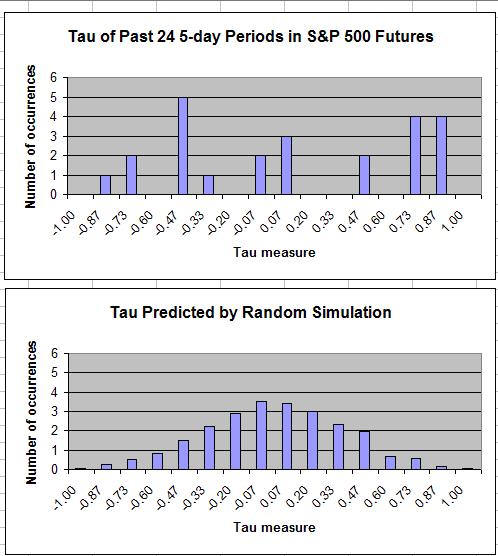
I generated 2400 random sequences of 6 numbers and calculated the tau measures of each sequence. I then calculated the tau measure for each of the past 24 5-day periods in the S&P 500 futures. The distribution of the S&P 500 tau measures appears quite different from the randomly generated distribution.
Jun
11
To Learn or To Win? from Scott Brooks
June 11, 2007 | 3 Comments
 This evening, I watched my ten year old daughter's softball game. She played a very good game and her team won 22 - 16 (yes, that's softball, not football).
As I watched them play I figured out how to easily win the game. All the players had to do was stand there and never swing the bat under any circumstances. You see, the pitchers at this level are simply not able to throw three strikes in seven pitches. They would have walked every one. Of course the league only allows a maximum of seven runs per inning, so we would have had to play defense some of the time.
So, when our team went out to pitch, I would have told them to forego the windmill pitching action and just do a slow underhand lob over the plate for strikes or close enough to force the other team to swing. The other players would have struck out some of the time, but otherwise, the only way to get outs was to get them in the field. Still the other team would have been limited to seven runs in an inning. Therefore, in order to win, all our team would have to do is limit the other team to fewer than seven runs per inning.
Nigel Davies comments:
You don't think they missed out on a great lesson in flexibility and adaptability, rather than going through the motions of what they thought they should be doing? As Sun Tzu stated, "To subdue the enemy without fighting is the acme of skill."
In my experience playing-strength is fostered first and foremost by the pursuit of victory, with mentality and technique improving to meet new challenges. Those who focus on appearance and style usually turn out to be weak posers with no real substance behind their moves, just shadows of what a good player should be.
Rodger Bastien writes:
I am sure this piece was all written tongue in cheek. As a little league coach I am on a personal crusade to de-emphasize winning vs. learning to play baseball in K-6th grade. Granted, you could "win" using the methods you describe but my team "lost" a game last week by taking the exact opposite approach.
After witnessing a couple of innings of a an endless walks I could see a palpable lack of interest amongst all of the players. I instructed my players to go up there hacking and I’ll be darned if we didn’t rattle off 9 straight hits before the ump declared the "6 run maximum per inning" rule with no outs. In the bottom half of the inning our opponents maxed out on runs without taking the bat from their shoulders.
We lost the game but afterwards you would never tell that my guys were the losers from the pie-eating grins on each of their faces. In baseball, as in life, there is much more to be gained by taking your hacks than standing there with the bat on your shoulder.
Jun
10
 I got a lot of positive feedback on last year's posting of rose pictures from the New York Botanic Garden so I'm taking the liberty of posting this year's effort.
Today was the annual Puerto Rico Day parade, which makes doing anything in my neighborhood an enormous hassle due to the crowds. My strategy for the day was to take the kids up to the Bronx via mass transit and be in a quiet wooded place while the East Side was thronged. We lucked out as we caught more roses than usual at peak bloom.
Business anecdote: The Chrysler Imperial was the first rose to be used in marketing.
Jun
10
Will Sex Sell Market Economics? from Greg Rehmke
June 10, 2007 | Leave a Comment
 A common complaint is that investors run in herds, throwing new money at whatever seemed to work yesterday. The huge success of the movie Gladiator led Hollywood studios to fund a series of genre knock-offs.
The unexpected success of Steven Levitt's Freakonomics, a popular introduction to innovative (mostly market-failure) economics, led book publishers hoping for another hit to sign book contracts with many articulate economists. So we have: John Lott's Freedomnomics: Why the Free Market Works and Other Half-Baked Theories Don't; Tyler Cowen's, Discover Your Inner Economist: Use Incentives to Fall in Love, Survive Your Next Meeting, and Motivate Your Dentist; and Steven Landsburg's unfortunately-titled, More Sex is Safer Sex: The Unconventional Wisdom of Economists.
I haven't purchased or read any of these so don't yet know the secrets promised in the titles. I think it is worth noting in regard to the Landsburg's More Sex title, that more sex for an economist is still not very much (with the possible exception of Joseph Schumpeter).
Sex aside, I highly recommend the short article by Landsburg linked at the end of Stefan Jovanovich's post, titled A Brief History of Economic Time. If those who teach history in our high schools and colleges were less ignorant about economics and economic growth, these straight-forward facts about progress over the last century would be less unconventional and less completely unknown to the public.
A more detailed look at economic progress in America can be found in the excellent annual report essays from the Dallas Fed by W. Michael Cox. The 1993 essay "These are the Good Old Days" is a classic.
We will see if sex and weird titles help new economic titles sell. (I wonder if Naked Economics: Undressing the Dismal Science sold better than The Undercover Economist: Why the Rich are Rich, the Poor are Poor–and Why You Can Never Buy a Decent Car?
A recommended alternative is Common Sense Economics: What Everyone Should Know About Economics and Prosperity. And most highly recommended is Paul Heyne's textbook, The Economic Way of Thinking. The new edition is expensive, but the earlier editions are great and cheap.
Jun
10
Movies and Video Games, from Jeff Sasmor
June 10, 2007 | Leave a Comment
 Shrek 3 is a great movie. If you have seen the first two this one is worth it. One of my interests is computer graphics and each one of these movies is more and more impressive. One of the things to watch is hair and clothes. At this point, with massive computer efforts, hair motion (look at Puss-in-Boots and Donkey's hair in particular) is very realistic. Also look at clothes.
Clothes now can realistically drape and move with the character. The first computer graphics that I played with was on the Commodore Pet - not bimapped but nothing much outside military systems in 1978. The creators of Shrek 3 threw in some classic rock music to hook the parents, like Zeppelin's "Immigrant Song," in one scene where Snow White becomes a riparian ninja. I've actually seen it twice in the last three weeks.
Pirates of the Caribbean is worth seeing if you want to know how it all ends (if it did end - I'm not sure). And the effects are really good. But it's way too long at three hours and the plot is a bit disjointed.
 If you have a Nintendo Wii, Super Paper Mario is highly recommended. It is fun and challenging for children and adults alike. You move between a linear two-dimensional world (side-scrolling for hipsters) and a 3-D representation of the same space. Press a button and features of the environment that are hidden in 2-D mode suddenly appear. It's intriguing and addictive as all h-e-double-hockeysticks. I've been playing it every afternoon apres 4 PM. It's actually a role-playing game to some degree.
While many people say that video games are bad for children, I think that properly-chosen games are actually very good for them. Platforming games (where you have to jump around from one place to another) are really good for building hand-eye coordination. Role-playing games are good to help young children learn to read as the interactions between characters largely appear in dialog boxes. I used this to help my younger daughter learn to read. It also helps kids learn to follow a story and the development of characters.
Jun
10
Custer, from Peter Grieve
June 10, 2007 | Leave a Comment
 I've been thinking about guerrilla war as a result of a trip to the Custer battlefield. Everyone knows that guerillas usually shun contact with conventional forces, "evaporate like the mist". I thought this was only good for self preservation.
But now I see the obvious fact that it has an offensive component. If the men of the conventional forces become hungry for contact and their officers come under career-changing pressure actually to fight a battle, they may become less fastidious about the kind of contact they're after. And then they get the kind they want least.
Stefan Jovanovich adds:
The pressure that Custer felt was of his own making. He and his wife believed that a victory against the Sioux would reward him with enough notoriety to make him president. In retrospect that seems like a mad fantasy. But by 1876 the Republican Party had had only three candidates for President - Fremont, Lincoln, and Grant, and two of them had been U.S. Army officers.
Largely because of Mrs. Custer's relentless promotion of her husband's folly into heroism, Custer's subordinate commanders, especially Major Reno, became the fall guys. The truth is that Lt. Colonel Custer (he had been a General of Volunteers during the Civil War) would have been court-martialed if he had survived. The plan for the campaign against the Lakota had been for three columns to attack jointly.
As commander of one of the columns, Custer disobeyed his orders by not waiting for the other 2 columns and then spliting his own command in thirds. He ended up attacking with a force 11% of the planned assault force. Yet, had he shared Teddy Roosevelt's incredible good fortune at Kettle Hill and become a hero of the Indian Wars, Custer might have become President.
From Russell Sears:
This leads to the countable hypothesis that CEOs who marry/partner with someone within the company, soon cause the company to under perform.
Dean Parisian writes:
My father retired from the Bureau of Indian Affairs in Crow Agency, MT in 1985 and as a kid I spent a fair amount of time at the Battlefield there as Crow Agency adjoins the Custer Battlefield monument.
The lesson here is that when you chase returns in markets you aren’t familiar with or chase Indians in country you don’t know very well there is a good chance one can get hurt. Quick and seriously. Stick with what you know and when it looks like you are out-manned, cut your losses and run. Living to fight another day is paramount.
Jun
10
UK Stock Picking, from Nigel Davies
June 10, 2007 | 1 Comment
Does anyone know of a good service/methodology for selecting UK stocks? I only know of the 'OCD' (Outstanding Companies Digest), which despite some apparently good picks has the Sage of Omaha as one of its heroes.
I find this slightly off-putting, leaving me to wonder if Sage is just a marketing ploy or whether they manage to bury their mistakes. I remember Marconi being covered in their previous incarnation as 'The Analyst' (this is a lousy name because of too much competition with search engines), but then it was dropped without trace when the company went bankrupt.
OK, I have a methodology based on reading Clews plus my view that the UK is heading for stagnation (the idea that the gold trader, Chance Brown, was good at his job will shortly be exposed as being nothing more than being in the right place at the right time). But it would be nice to get some science into such decisions.
Jun
10
Cork Removable, from Jim Sogi
June 10, 2007 | 1 Comment
 Say you are in a remote valley with a nice bottle of wine to go with the barbeque but darn, forgot the wine bottle opener, don't forget the Hawaiian wine bottle opening method. Take the wine bottle and wrap the bottom of it with a towel. Go the a tree and smack the bottom of the bottle while wrapped in a towel against the tree about 50 times really hard. (not so hard you break the bottle of course). The raps slowly move the cork out enough to grap it. Try it, it works. Enjoy your wine.
Jun
10
Property and Casualty, from Gordon Haave
June 10, 2007 | Leave a Comment
Investment Manager D.E. Shaw Set to Acquire Specialty Insurer James River
June 11, 2007
Global investment manager D. E. Shaw group has organized a Bermuda-based holding company to acquire James River Group, Inc. a North Carolina-based excess and surplus and workers' compensation insurer, in a transaction with a total equity value of approximately $575 million.
I have been constructive on P&C shares generally. Think about it: You are an insurance company, you have set rates based on the probability of loss times the magnitude of the loss across your insured base. Along comes a big hurricane and you take the big loss.
Unless the calculation of probability of loss times the magnitude of loss increases, your rates should stay the same. Instead, rates along the Gulf Coast have gone through the roof — doubled, tripled, or more.
Were the insurance companies really that far off in their calculations pre-Katrina? Or is there an inefficiency in the market such that they have been able to raise rates due to limited competition in the heavily regulated industry, magnified by state insurance commissions willing to go along with the rising rates due to Gore-inspired panic?
Jun
9
 Why presume that all those billions of people who have gone before us and lived on $400 to $600 a year lacked optimism, enterprise, and faith? What a truly ignorant snobbery. The 18th century politicians and citizens in the United States took it so much for granted that the future would be "better" that they were arguing over who would own "Louisiana" (the land Jefferson purchased) before they had figured out a way to safely get west of Lynchburg. None of them would have asked "are you better off?" because they would have assumed - rightly - that being better off was everyone's goal and the question was how to get there.
They would have been pleased for our prosperity, but they would not have assumed that their ancestors were dolts simply because they had not yet invented the steam engine. They would also have been humble enough to know that fate has a way of erasing certainties, even economic ones, and they would truly have laughed at Mr. Landsburg's notions about sex, in his article, A Brief History of Economic Time. Better was not more; it was sleeping with someone you love who loves you, and no amount of money in the world could buy that.
Steven E. Landsburg responds:
The issue I was addressing was not whether they lacked optimism, enterprise and/or faith, but whether they lacked material prosperity, and whether they lacked any experience of material progress. It is a matter of fact that with very few exceptions, prior to the Industrial Revolution, life above the subsistence level was a rarity, and economic progress was also a rarity. (In the original article, I noted a few important exceptions that were cut by the editor.)
The enthusiasm for Louisiana was a product of the Industrial Revolution. Those "18th century politicians and citizens" cited above were in fact nineteenth century politicians and citizens.
Jun
9
Milk Your Own Cows First, from Steve Leslie
June 9, 2007 | Leave a Comment
 One of the interesting aspects of the great Tiger Woods is that he is an extremely composed person. He always is meticulously groomed and very gracious in public especially during interviews. Arnold Palmer also displayed such characteristics and is one of the great reasons why he is so embraced by tens of millions worldwide even 30 years after he has stopped being a force on the PGA tour.
Tiger also has the character to summon awesome Herculean powers to focus instantaneously on the task at hand. Ben Hogan and Jack Nicklaus had such a skill. This may very well be the reason why they could separate themselves from the field seemingly at will especially during the latter stages of a tournament or at crunch time.
To this end, however, each has been perceived at times to be standoffish and unapproachable. Even Tiger has been criticized for not signing as many autographs as some think he should after a tournament. I feel that this is an unfair assessment by the public looking for flaws in character, perhaps even a dark desire to pin something unsavory upon them. Even more, it could be a futile attempt to search for something to find unlikable or at the very least printable to satiate a fringe group who finds delight in bringing to light that these people are human and flawed after all.
My point is that their fantastic focus is spun to reflect a weakness especially by those who have never won anything of consequence or excelled on their own. And yet why should we really look for any reasons to cast aspersions? Should we not look for the positives to build upon to improve our own lives?
There is an old adage: "Milk your own cows first." I think upon my own cows that I need to milk and find this enough of a challenge. My goal is to be a better milker.
On markets, The Chair makes a statement here that is most interesting: When will someone get up and say that all this hawkish talk about the threat of inflation is the most bullish possible thing for bonds, as it beats down expectations and prevent succumbing to short-term solutions and keeps the lids on any bad policy?
Jun
9
Apologia, from Victor Niederhoffer
June 9, 2007 | Leave a Comment
 Sholem Aleichem has a good short story on Yom Kippur. The gist is that all the meanest merchants, worst cheats, and most deceptive partners go to each other’s houses and beg forgiveness for their sins on this day. I feel like I should do the same to our readers, since I've been so busy trading I've been remiss in updating the site.
Battling the market during last week's avalanche was like playing tennis against Laver, checkers against Wiswell or Tinsley, or chess against Capablanca in chess, or baseball against Honus Wagner, who could play all nine positions perfectly. What days, what cyclopean moves! A thirty-five point range, almost the entire range of the year, in one day on Thursday, and a complete recap of the February 27 decline in three days from Wednesday to Friday.
There was total bad faith in the evil self-interest of the big bond fund player who can make money only by manipulating the public into doing the wrong thing, like an undertaker's praying for plague in order to prosper or the Sage's hyping the 100% certainty of another disaster so he can raise insurance rates.
But amidst it all, what a healthy day it was Friday, with bonds up 1.5 points from low, oil down three percent, the dollar up a few percent, and the trend followers all in on the dollar and the bonds. And even some of them, those with any money left, barreling in on the short side of stocks.
What a healthy day for the Popperian refutation of a hypothesis. stocks can’t go up when bonds are down. How bullish this refutation is for the future! And when will someone get up and say that all this hawkish talk about the threat of inflation is bullish for bonds, as it beats down expectations, prevents succumbing to short term solutions, and keeps the lid on any bad policy actions?
Apologies again for all my inadvertent lapses this week. They were legion.
Alan Weissberger remarks:
I think you have the wrong hypothesis: stocks can’t go up when bonds are down. It should be: bonds can't go down if stocks are down big, because there will be a "flight to quality." Of course, this has been true only for the last five or six years. In the 70s, 80s, and early 90s bonds stayed down when stocks went down.
Jun
9
No Free Lunch, from George Zachar
June 9, 2007 | Leave a Comment
There is a popular saying in Japan that goes: Tada yori takai mono wa nai, meaning 'Nothing is more costly than something that is given free of charge.’ - Michihiro Matsumoto, The Unspoken Way. A US wag repurposed that into, "If you think health care is expensive now, wait until it's free."
Jun
9
An Observation, from Jeff Rollert
June 9, 2007 | Leave a Comment
I wonder if "covering shorts" is a more predominant activity on Fridays than going long. And I wonder what method could test this. We see this today in debt markets for home builders' bonds, covered shorts, but not long buyers.
Bill Rafter adds:
I don't have any proof, just a feeling that you would find Fridays to be mean-reverting, or reversing the Monday to Thursday action. But most of my feelings are wrong, which is why it's important to do the testing.
Craig Mee writes:
Climatic selling at its best late in the week saw the markets rates and equity finally break into a gallop and suck in some big ones after months in a slow well control trot. With so much energy now exerted, it looks like Phar Lap, will now look to please the crowd and not the punters.
Jun
9
Instant Cities and The Rise of China, from Greg Rehmke
June 9, 2007 | 1 Comment
 Is China still a good place to invest? Sure. Maybe the best place in the history of the world. People are the Ultimate Resource, and China has the most with still a low capital-to-people ratio. And now the Chinese, with their high savings rate, have their own capital to invest. The complicated part is finding the right Chinese enterprise to water with outside capital. If I could, I would invest in a single person: "the girl who can get things done." A glimpse of her life shines out from a recent National Geographic article: "China's Instant Cities."
With NG's usual great pictures, the story gives us a landscape and lifescape as if from another planet, a bewildering eye-witness account of China's still-booming economy rippling out to once rural villages. Imagine a country where local government taxing authority is tightly restricted, and the main revenue source is selling land for development projects. People in government, like people everywhere, respond to incentives. Across hundreds (or thousands?) of Chinese cities and villages bureaucrat developers are leveling land as fast as they can summon dynamite and bulldozers.
Petter Hessler's National Geographic story focuses on one factory's instant birth in the Lishui Development Zone. This 21,500 square-foot bra-ring factory is designed before Hessler's eyes on a scrap of paper in a little over an hour. The contractor, scrap of paper in hand, is asked at 3:48 pm if he can have the building quote "this afternoon." Three months later the factory is complete and the main bra ring machinery tested. It doesn't work, but disassembly, tinkering, and reassembly gets things going. Next, handwritten signs advertising for workers are posted: "1. Ages 18-35, middle-school education, 2. Good health, good quality, 3. Attentive to hygiene, willing to eat bitterness and work hard".
The Lishui Development Zone emerged from 5.6 square miles of "rugged farmland" after leveling "108 hills and mountains." Launched in 2002, 30,000 migrant workers were hard at work in 200 factories by 2006. The Lishui Yashun Underdress Fittings Industry Co., Ltd. was just one. The firm quickly hired the 19 workers needed for operations and then took names for replacement workers. The next girl in line however insisted she be hired as well. She argued energetically and creatively with the factory boss's father, who was in charge of hiring. The employee list was then lengthened to 21 (since 20 was deemed an unlucky number), but she was warned "if the boss says 21 is too many, then it'll have to be 19." Hearing this, employee number 20 returned to the desk and: "Five minutes later, her name was squarely in the middle of the sheet." When she finally left, the man shook his head admiringly and said 'That girl knows how to get things done.' "
Later Hessler learned "the girl who could get things done" had used her 17-year-old older sister's ID card, and was herself just 15. She was hard-working, competent, dreamed of running a shoe factory and of building a nice home in her grandparent's village. "When I asked about the grandparents," Hessler writes, "the girl's eyes filled with tears, and then I didn't ask about that anymore."
Various books and movies can give us some sense of what her grandparents' lives were probably like. For all the hardship of poverty in China today, it pales against the deeper poverty and famine experienced by recent generations.
"Hungry Ghosts: Mao's Secret Famine," is filled with first-hand accounts of what happened in villages across China after farms were collectivized and various government industrialization schemes launched. In China, as in Africa and Latin America, enthusiastic government planners taxed and confiscated agricultural goods to fund factories, foundries, and manufacturing. Peasants everywhere were impoverished by these projects, which quickly fell apart. The Chinese people, as the poorest, suffered the most. From 1958-62 whole villages even regions starved to death. At least 30 million starved to death.
Today's Chinese factory sweatshops are no one's idea of ideal. As the traditional pathway from poverty, they are as awful by today's standards as sweatshops were in England in the 1800s and in the U.S. in the early 1900s. Those upset with poverty, inequality, and injustice in China today I don't think appreciate the truly stunning disasters this young woman's parents and grandparents probably lived through in China.
"The Rise of China," William Overholt's excellent 1994 book, gives us a glimpse of pre-sweatshop China. I have long quoted Overholt's book from memory in various talks to students, telling of the over 50,000 Chinese that lived in caves, and the "one-pants families" in villages so poor only one family member could go out at a time. (This level of poverty seems impossible, but I just checked the internet and the book to confirm. Turns out I misremembered the numbers. An online source mentions 800,000 living in caves, and in "The Rise of China," on p. 26, Overholt writes, "Even today [about 1992] about 40 million people live in caves in China's northeast, and the people in 520 of China's 1,903 counties have annual incomes below $35 per person. Such desperate circumstances gave rise to the phenomenon of the one-pants family in many areas of rural China. The one-pants family, so widespread in China it was studied by Chinese sociologists–but never for publication in the west–is a family possession only enough clothing for one member."
This level of poverty is so incomprehensible, that I kept lowering the numbers with each retelling of the story.
So yes, there is poverty and inequality in China today, but compared to what? Capitalism is transforming China even through layers of corruption. In the early years after reforms tens of thousands of overseas Chinese returned to their villages to make small then gradually larger investments (40 million Chinese now live outside China). "The first dozen years of foreign investment," notes Overholt, "attracted $20 billion in foreign investment, including 30,000 individual ventures…" but "In 1992 alone, the government approved an additional 47,000 investment projects." Well, 1992 was 15 years ago and now millions of wealthy and middle-income Chinese are investing their own money in new enterprises.
Big corporations poured money in through Beijing, but the real revolution was first at the village level as farmland privatized by 99-year leases awakened the entrepreneurial spirit in hundreds of millions of farmers. In one year China was transformed from food importer to food exporter. Next, small and decentralized investments were allowed in the early free-enterprise zones in the south and along the coast. From there knowledge, capital, and economic opportunity spread among impoverished hard-working Chinese, where economic freedom was like kerosene poured on a fire (with property rights as the oxygen).
So somewhere in China is "the girl who knows how to get things done." She is working long hours, pushing her productivity higher, and probably bargaining hard to capture a high percentage of the wealth she is creating. And if she can't win higher wages she will walk to the next factory and insist on being hired there.
Many seem to think wages are low in China because so many tens of millions are looking for work. But wages are being driven up by productivity gains and competition for skilled workers between hundreds of thousands of factories. Workers-who-can-get-things-done are both working and watching. They can share insights to raise productivity and wages, or they can jump ship to put their own ideas into action.
Whether mixed-up incentives will lead local Chinese governments to develop too many debt-funded industrial zones is hard to tell. How many Instant Cities are enough? That depends I think on how many in China are still poor and are willing "to eat bitterness and work hard" to put that poverty behind them.
Jun
9
Bond Movement, from Nigel Davies
June 9, 2007 | Leave a Comment
 I found myself really confused by the move in bonds this week, not to mention the apparent expectation of higher interest rates 'globally'.
My novice reading of this is that maybe things aren't so global; the US economy is continuing at a fair clip (low taxes etc) whilst the green, leftist UK looks like it's heading towards stagnation. And we haven't even had our housing slump yet.
Carrying my thoughts a few steps further (way too far probably) then the dollar will strengthen against the pound and Brits should turn to defensive stocks and grade A corporate bonds, if they don't want to buy US stocks that is.
George Zachar writes:
There have been reports of an enormous multi-week liquidation of cash bunds dragging all debt markets lower, which in turn triggered rebalancing of positions embedded in structured notes, which were synthetic short straddle positions.
The economic fundamentals have been bond-bearish IMHO for a long time. This rout, though notionally validating my view, was triggered not by repricing the Fed, but by judo in the hand-to-hand combat of the capital markets.
Jun
8
Rank Correlation Methods, from Victor Niederhoffer
June 8, 2007 | 2 Comments
 Kendall and Gibbons' book, Rank Correlation Methods, is a fascinating read which highlights many possibillities to test systems in markets and life. It suggests tests for variables of interest such as relative performance among days of the week or months of the year, agreement among two time series, and trends in time series and markets.
I found it interesting that if there are m separate rankings of n items, (for example Branch Rickey ranked 20 pitchers on such things as hits divided by times at bats, earned runs divided by the sum of hits, strike outs divided by the sum of at bats, earned runs per nine innings. He did this for pitchers such as Hubbel, Dean, Grove, Alexander, Vance, Leonard, Matheson, Johnson, Gomez, Derringer and Lyons), then the maximum sum of the differences between the total rankings is (m squared ( n cubed - n))/12.
I shall give examples of how this can be used shortly, but can say for now that such a test on weeks before, during, and after a four day week (such as memorial day week) showed complete randomness when tested under these various systems over the last ten years. The research and analysis on this subject is the first contribution of Ken Sogi (son of regular contributor, Jim Sogi) to the firmament of speculators.
Jun
8
Jeff Sasmor on Books of a Certain Weight
June 8, 2007 | Leave a Comment
 I was looking for a book to read the last night on my way to take my daughter to Tae-Kwon-Do and grabbed Practical Speculation. I read the beginning where the talk is of Pod People and memes, and in full deference to the Pod People who have reappeared in the markets and on CNBC, here are some lyrics from Kraftwerk's "The Robots" from their album "The Mix."
This is one of my longterm favorite albums, and great to bop to as you are attempting to synch with the market music. Incidently, PracSpec is great for for hitting yourself on the head — not so heavy (like some Technical Analysis tomes that I have on my bookshelf) that you could hurt yourself, but substantial enough to knock some sense back into your brain. Re-read it today!
"The Robots" by Kraftwerk
We're charging our battery
And now we're full of energy
We are the robots
We are the robots
We are the robots
We are the robotsWe're functioning automatic
And we are dancing mechanic
We are the robots
We are the robots
We are the robots
We are the robotsJa tvoi sluga, (I'm your slave)
ja tvoi Rabotnik (I'm your worker.)we are programmed just to do
anything you want us to
we are the robots
we are the robots
we are the robots
we are the robotswe're functioning automatic
and we are dancing mechanic
we are the robots
we are the robots
we are the robots
we are the robotsJa tvoi sluga, (I'm your slave)
ja tvoi Rabotnik (I'm your worker.)Ja tvoi sluga, (I'm your slave)
ja tvoi Rabotnik (I'm your worker.)[repeat to fade]
We are the robots
Jun
8
Disestablishing Iran, from Stefan Jovanovich
June 8, 2007 | 1 Comment
 Let's move the focus from theology to money. The mullahs in Iran have an economic position similar to the reach and scope of the Catholic Church in pre-Reformation Europe. The various religious communities in Iran own a third of the real estate in the country; the thousands of churches, shrines and monasteries held roughly the same share of land.
Like the Church institutions in medieval Europe the 70,000 mosques, shrines, and religious schools in Iran pay no taxes and have their own armies. The situation in Europe was moderated by the pledge of celibacy of the clergy. Those outside the church could hope to have their children find places in the church much as Americans have, in the past, hoped to have their children become members of the academic and licensed professions (teaching, law, and medicine).
Martin Luther was able to appeal for a reformation because it was widely perceived that the church had failed to keep its part of the bargain that, instead of leaving places open to "outsiders", members of the church were reserving them for their own families and relatives. In Iran, at present, according to James Dunnigan, "the families of clergy have a monopoly on jobs and business decisions within the religious portion of the economy. All those assets are there to serve, first and foremost, the clergy and their families."
One can view the overthrow of the Shah as being the inverse of Henry VIII's disestablishment of the Catholic Church. In 1979 the clergy overturned the government's control and then seized the assets of the wealthy and, of course, the Jews and Baha'i — all in the name of the faith.
Jun
7
Carry On, from John Floyd
June 7, 2007 | Leave a Comment
Emerging market currencies such as the Mexican Peso, Brazilian Real and South African Rand have been under some pressure in recent days, but the G10 Carry Index has barely moved and now seems to have diverged from several markets, including the VIX (shown here with the VIX inverted). Additionally, the central banks of two of the higher yielding currencies in the G10 Carry Index (UK and New Zealand) met today. I imagine this provides some opportunities in the next day or so as markets are likely to realign in one direction or the other.
The below chart shows the carry in orange, vs. the VIX in white.
Jun
7
Limit Orders, from Paolo Pezzutti
June 7, 2007 | Leave a Comment
When conducting system design, you have to decide what type of order your system has to implement. A limit order allows a pre-specified number of shares to transact at a pre-specified price, but it will not cause an immediate and certain execution. On the other hand, the market order is an order to transact a pre-specified number of shares at market price, which will cause an immediate execution, but is subject to price impact.
Limit orders ensure a "discount" when buying a security, although the time-to-fill and the probability to fill are elements which are key to effectively define the effectiveness and profitability of the system. On the other hand, market orders may have an impact on price. Slippage could affect significantly the overall performance of the system, especially when trading a short term system.
Liquidity refers to these different aspects. Based on these differences, liquidity providers or liquidity takers can advantaged in specific market conditions. Assessing the price impact and slippage in case of a market order is easy, especially when trading a limited number of contracts on the e-mini. Much more difficult and challenging is to assess the probability of execution and time-to-fill of a limit order.
I guess that several variables are to be taken into account, such as volatility. How active is the market in terms of transactions/time unit is also to be taken into account. Therefore, traders have to be careful when designing and subsequently testing their systems to accurately quantify the probability of execution of a limit order before jumping to conclusions about the profitability of their system.
Brian Haag comments:
Limit orders sell a price discovery option; market orders buy the same option. The process of valuing said option is the crux of micro structure and algorithmic execution research. Harris' Trading and Exchanges is a good trailhead.
Jun
7
A Memorable Day, by Victor Niederhoffer
June 7, 2007 | 2 Comments
 It is always good to see a little gyration in the markets, and I would like to honor the market mistress as she elicits one grand magic trick after another, keeping most of us perfectly baffled. Yesterday we were set up with three big down opens in a row; down 5.6, 4.8, and 7.0, back to back. How perfectly designed to get everyone leaning the wrong way!
So yesterday opened down seven at 1526.7, and never traded more than two ticks above that ,with a high of 1527.2. This was opposite from Monday, where it opened down 5.6 points, never traded more than one tick below that, and ended up 6.3 points up for the day. Yesterday however went down twelve from the open to close, finishing just one point above the low.
The bonds provided the perfect back drop to yesterday, with the two year bond closing above 5%, (the 30 year was above 5% on Tuesday, for the first time in a blue moon), and the ten year went to 4.98%, refusing to break through the 5% barrier, but keeping everyone guessing.
It was also beautiful to see Germany down some 3% on reaction to an European Central Bank increase in the interest rates, and bearishness from the biggest brokers — The U.S. down 1% was a relative 2% gain on Germany! One brokerage house had a 'full house' sell signal, of which all previous have apparently been visited with 15% declines, however one notes that they use Fake Doctorian logic in working with just three observations, and booms that normally do not run for more than six years. The only difference between this and genuine Fake Doctor work is that I did not notice any inversion of the yield curve stuff in their multiple comparison studies.
The market originally cratered on Monday with Chinese bearishness, but by Wednesday it needed a new twist with China up 3% from Monday's close, and this was provided by one talking Fed Governor after another, all truly concerned about inflation. Also, it was nice to see the backdrop of bearish world news, with Turkey supposedly incurring on Iraq, and Iran purchasing 1000 speedy boats. This used to be the kind of stuff that chronic bears disseminated on the big conservative blogs to help their positions along, and reminds me of the report last year that a terrorist was suspected of being at lodge on the Boston subways.
Also notable is the VIX at 14.87, which is a 65 day high. Like the bond stock relationship, while not predictive in the short term in and of itself, it provides a nice foundation for other predictions.
Finally, the Dow has just completed an epic run. It went from 12,050 to 13,600 without once falling by a hundred, (using 100 point up and down boxes in a point and figure chart). That is what I would call a positive sequence of length sixteen, and is perhaps the greatest continuous up move in history.
Jun
6
Ta, Tha, Da, Dha, Na are the five alphabets in Hindi that according to old wisdom of the market around Dalal Street categorize the five types of winners that markets can produce. Each alphabet stands for a particular type of winner.
- Ta stands for Tarawaniwala – the jobber or the marketmaker. Trading the spread the marketmaker has the lowest vig to face. Needs no further elaboration.
- Tha stands for Thoda – the word thoda means less or frugal. The under-leveraged have a far higher chance of coming out winners in the long run. Survival is not endangerd during adverse incursions.
- Da stands for Dayalu – the word dayalu means the one who can take it easy. Easy on oneself, easy on others and benevolent in general. A worked up scarcity driven mind maketh a poor trader. Scarcity alone is not a sustainable driver of wealth since substitutions can and will occur. Abundance driven value creating minds produce wealth.
- Dha stands for Dhanwaan – the word dhanwaan means the one who has access to riches. A line of cash and /or a line of stock being available is a clear pre-requisite to surviving any sorts of squeezes. This adds up with point 2 above of being less than fully leveraged as well.
- Na – oh that’s a unique word in the markets. Na means no. The one who can say no to account debits and the one who does not pay up will not lose. Wonder if Worldcoms, Enrons, LTCMs are mere accidents on the streets of high-finance?! No, it is at least equally likely that there creators clearly knew that if you can amass so much risk within yourself as to be a black hole in the system, the house will come down to the point of re-calibrating the chips. Well at least the creators of the next such event would know it. By this extension the creators of all such previous events have known it, since ages.
Jun
6
Pitch and Rhythm, from Brett Steenbarger
June 6, 2007 | 4 Comments
 It is interesting that in the recesses of academe there are a few Galtonian souls studying the psychology of music empirically. One thrust pertains to analyzing both speech and music according to pitch perception; how we view music and speech may be quite similar.
One finding, for instance, is that pitch is related to perception of social dominance and submission in both speech and music:
A commentator on the latter article notes that you can accurately predict an animal's size from its pitch.
Do markets have pitch and do they invite psychological responses with messages of submission (come hither) and dominance (threat)? Could we explain behavioral finance phenomena in the same terms as behaviors in the wild, communicated by the pitch of animal sounds?
It's a fascinating literature. Rhythm (shifts in frequency of ticks) might just be a consequence of pitch, as speculators respond to market communications. Perhaps it's no coincidence that rising markets are so inviting; falling markets so threatening.
Todd Tracy writes:
 Emotional stability in musical rhythm goes a long way on the road to complex weaving of interactions. It is best not to get too carried away with the music as it is occurring and to keep an observant eye on possible upcoming change ups in the rhythm, however, not to be so observant as to get cold.
In my capacity as a producer of commercial types of music one of my most important tools is the use of tension and its undoing. I would tend to think that as human beings we would react emotionally to the tension in a universal way, the shiver that runs down your spine when you hear a section of a particular song. Breaking away from the expected syncopation in such a way as to capture the attention of the listener, not as a total distraction but as a way to lead the listener into the enfolding polyrhythm. One cool way to capture attention is to have the band just stop in the middle of the verse, for one beat and then continue on as if you never skipped a beat. You can usually only get away with that one once per song.
A technique I have been using for awhile to further the management of syncopated air-pressure is the use of a "ghost track". Rather like an "invisible hand" simulation in that music is played on top of a prearranged rhythm and then that rhythm is removed from the mix as it were. The ghost track can be a drumbeat, a whole other song or just about any kind of rhythmic audio. Tempo and rhythm modeling can help the music to feel more spontaneous as even the best musicians will tend to play up to and around the beat. After the original beat is removed the music is left precariously dangling on its own. So thereby combining multiple musical performances that dance around a beat that is not there provides a sophisticated allure.
Adding random elements in a sprinkled fashion music production could be like BBQ. Much testing is required. After I finish many performances I will always look around for other drum tracks of the exact same speed (tempo) and slip in and review many beats just to see what I might be missing. The question can become which track is the ghost track and which is actually the track. Many of these questions are left for the final mix in which a systematic top to bottom approach is always the way to go. For instance the kick drum is the first level set so that every vibration is set in relation to that level, the snare might be second followed by the bass and a rhythm guitar or keyboard. Next the lead vocal followed by high hats and solos. Special effects are always last.
There is a direct correlation between understanding rhythmic vibrations in music to market tension. It is the ability to absorb the tension in a cool manner. When a random gyration begins to make sense my emotional response is to trade because I feel that I am in sync with the mind of the mistress. By stepping outside of the song in my mind I can see the vibrational landscape in a more objective fashion.
It is a duality of experience to be able to hear the music in my imagination and then to create those exact imagined vibrations in the same split second. The markets are like songs just begging for solos. The unrealized vibration that we can imagine in the price changes are calling us to jump right in and start soloing, however if the ghost track is removed after you have jumped in you will find yourself quickly hoping for the song to end.
Jimi Hendrix was great in his ability to start playing a different rhythm in the middle of a song and to stick to it even if the drums and bass were doing something different. So too, reading all the market tensions but to not be drawn in by the emotions, so as to coolly carry out the plan. The tricks that a composer will use to get the listeners attention are similar to that of the mistress. How far can Robert Plant stretch that note? How far up can the price go?
Jim Sogi comments:
One thing I've noticed about rhythm is that you've got to feel it in your body. If you are busy counting 1,2,3,4 in your head, you've already missed the beat or it starts to get mechanical sounding and stiff.
Sure it can be quantified, sliced and diced, and put into numbers, but it is only the hours and hours of practice, of feeling and living the music that mean a musician can feel the beat. The rhythm is more than a count, there is an unquantifiable element that allows it to swing, to move in and out of the beat, a fraction before, a fraction after, and pulsing and changing in unpredictable cycles. It is what gives live music its life. It is why a canned computer drummer sounds so dry, so dead and uninspiring.
Hours, days, years watching the markets gives the same feel for the rhythm. This is not to say that quantification and study will not give understanding about the structures, the chords, the main time signatures, but the discretionary element to me is an integral part of the process that numbers alone can not totally replace.
Kim Zussman adds:
It isn't too difficult to follow established rhythms and melodious sequences. What is hard is to recognize changes the first notes of which sound familiar and sweet, but devolve rapidly into deadly arrhythmia.
Normal sinus rhythm > Ischemia > Inverted T-wave > Ventricular tachycardia > Ventricular fibrillation > asystole
 Will Kenney offers:
I agree that you don't have to count simple forms, like blues or AABA stuff, that is so internalized that not much thought is required. However, it's often enough that someone puts some complicated music in front of you and then you'd better be counting. the challenge then is making the music really breathe while having to pay close attention to the page. at the end of the day the slice and dice of it all is very important. it's the command of the tools that allows the most freedom and puts you in the place of getting a groove together.
"Technique is the means by which the heart is allowed to fly freely." - Olivier Messiaen
Jun
6
What Republican Administration?, from George Zachar
June 6, 2007 | 1 Comment
The Federal Trade Commission, in the middle of George W. Bush's second term, is trying to block a $565 million merger between Whole Foods and Wild Oats.
The Federal Trade Commission, in the middle of Bill Clinton's second term, green-lighted the $82 billion merger of Exxon and Mobil.
There's undoubtedly a way to model this, showing in game theory notation how bureaucratic rents are maximized by Stochastic regulation, but this makes my head hurt.
Jun
6
Underestimating the Mobile Market, from George Zachar
June 6, 2007 | 1 Comment
Fun With Statistics, by Michael Jennings
In the early 1980s, American telecommunications company AT&T commissioned management consultancy McKinsey to conduct some research into the newly invented mobile phone. How large was the market for these new devices likely to be? In a report that now makes hilariously funny reading, McKinsey predicted that there would be a world market for about 900,000 of these devices…almost exactly the same number of phones that Britons accidentally dropped in the toilet in 2006…
Jun
6
Trading Efficiency, from Tom Ryan
June 6, 2007 | Leave a Comment
 Last night while swimming laps I was thinking about efficiency of movement through the water. Actually this started last Friday happy hour when I took a pile of people from here to the pub and they happened to have the America's cup on TV. Several of the folks here are part-time sailors and while watching the kiwis fend off Italy through tack after tack a seed of a thought started germinating in my mind.
Efficiency is a critical component of all kinds of systems involving movement. In fluids for example we know that flow can be steady or unsteady, laminar or turbulent, and uniform or non-uniform. The more the fluid flow is steady, laminar, and uniform, the less energy per unit mass it takes to move the fluid. Unlike solids, however, elements of a fluid mass may move at different velocities and be subject to different accelerations. Still, we have three fundamental anchors: the conservation of mass (continuity), the principle of kinetic energy (flow equations), and the principle of momentum (from which the forces exerted by fluids can be established). What I am most concerned with however in this gedanken is efficiency, therefore energy relations. The most basic energy equation for flow in a fluid mass with boundary constraints, say in a channel or a pipe is (Energy at point 1) + (energy added) - (energy lost) - (energy extracted) = (energy at point 2).
In swimming, energy is added via the muscles, energy is lost due to drag, and there can be a slight effect of energy being extracted depending on the movement of water in the pool. For example, in racing at elite levels measurements have shown that the racers who are lagging behind the others can get slowed ever so slightly as they approach the wall if the wave front generated by the lead swimmers hits the wall and is already bouncing back into them. But in any event the main concern here is with drag.
We know based on the Froude relations that drag of a body or vessel through water is a function of the ratio of the length of the body to its width and depth. In general experiments show that the higher the ratio of length to width, the less drag that is exerted, which is why racing hulls tend to be long and narrow.
In swimming the practical example of this is the use of the method of front quadrant swimming, which was popularized in the 1980s and has recently come back into vogue as people examine Ian Thorpe's technique. (At least as a term or methodology.) It's beyond the scope of this post to discuss all of the minor details of FQS (you can Google it) and there is always some controversy when it comes to swimming technique but the main gist is to maximize and maintain the ratio of your body's L/w in the water in order to lessen drag. This is accomplished by swimming mainly on the sides of your body, using rapid but fluid transitions from one hip to the other, with a long body position in the water that is created by keeping one hand out in front at all times (not straight out in front of the surface of the water but in the front quad in front of your head).
I can say from experience that working with FQS can drastically reduce the number of strokes required to cross the pool, in my case by about 15-20% (3,4).
This leads me to contemplate trading efficiency. To me trading efficiency is not the same as volatility of p/l that is really what is captured by Sharpe, but rather is using the least number of contracts to capture a given level of profit. We know that in trading, as in swimming there is considerable drag in commissions, account fees, and the bid/ask spread which has to be overcome.
Also, as with swimming, I have noticed as I get older that it is not so much the losses that annoy me (although they can definitely hurt at times) but rather the periods where I am churning and getting nowhere. As daytraders we have terms we use to describe this annoying feeling, like "not in gear," "last to get the joke," "the broker is my best friend this week," etc, all of which capture that feeling of trading inefficiency.
It also begs the question as to whether trading efficiency as a metric has any predictive value, at least for traders following a systematic approach to positions. Or, conversely, is there a metric that might be developed for the market movements as whole, say over the course of the week, to assess the degree of market efficiency or the degree of market efficiency as it moves between certain goal posts (1500-1520, 1520-1540, etc)?
We have discussed before how the market often has a tendency to turbulent behavior during the course of the week only to finish nearly unchanged on the week and Victor has proposed that this is one way the system maintains itself, by enticing people to do the wrong thing at the wrong time and thereby make a contribution to the upkeep.
Jim Sogi adds:
Here are a few additional considerations: Swimming underwater creates less drag, so there are some rules limiting the time, say one stroke, underwater in swim racing. I have a lot of experience swimming underwater trading and in the ocean when I wipe out surfing, but it seems to be part of the game and is a necessary component that might be factored in to your equations.
I like spending only the optimum time underwater, ideally none, but only a breath or two. A two-wave hold down is serious and approaches drowning. Some time underwater is necessary to pop through waves, but also to build a position, as it's impossible to get a full boat on the bottom tick every time.
The second consideration in water is planning. At a certain speed and with certain hull designs the boat starts to plane up on the surface with a break out from the limitations of the hull length/width speed formula into a new equation. When surfing, the commencement of the plane from paddling through the water is the start of the 'ride'. The length of time in a trade getting to the profit ride part seems very important in efficiency terms.
The longer and faster profit/ride, the less time underwater slogging, the greater efficiency, especially tallied over a large number. Paddling a surfboard through the water, getting onto a plane, and jumping up, while at the same time not missing the wave, takes incredible timing and strength. This is a key to trading as well, to time the opportunity, to have the strength to plow through water, sometimes under water, and get to the plane, and ride the ride, maneuvering through the changing face of the wave. Maneuvering around the sections, under the curl, until the wave ends and before hitting the reef takes skill.
Just like every trade requires such strength and courage to enter with the risk of going underwater, skill to read the changing market turns and getting the maximum distance. These things could be quantified in performance stats, but lost opportunity must also be added in as a variable, and lost opportunity has been the key variable in the recent cycle.
From Vincent Andres:
Here is a humble suggestion. Let each trade be evaluated automatically by your computer according to some criteria (many have been given here). There may well be around 10 criteria. Evaluation may be a note between [-100, +100].
After enough trades, have a look in the criteria space to see if there is some clustering or if the distribution is random or not. Also, this is nothing else than an alike computerized version of Chair's "keep in a notebook" recent advice.
Jun
5
A Review of Freedomnomics, from Victor Niederhoffer
June 5, 2007 | 1 Comment
Pick up almost any popular economics textbook, and you'll find a rash of examples of how ingenious math can illuminate, as well as anecdotal examples of how you the public are getting screwed, and why the free market doesn't work as well as intervention. A typical book, I currently am looking at The Economics of Information by Ian Molho, but any of Krugman's or Stiglitz's texts would do, is replete with topics such as adverse selection, asymetric information, auction manipulation, bargaining problems, bidders colusion, cartels, cheating, coordination problems, contract credibility (boiling in oil, credibility, rationing, game theory), dominance, nash equilibria, pooling, signaling, imperfect information, private information, interested parties, job market screening, non-truth telling, moral hazards, immorality, lying, overbidding, principal agents problems, lemons, reputation effects, risk aversion, ripoff models, search costs, free riding, legal rights to silence, the crossing problem, trading delays, tactical voting, welfare losses, and winners curse.
John Lott has written a book called Freedomnomics that shows that almost all of these market imperfections are figments of the academic professors' imaginations. The free market has an incentive to solve all these problems, there are enormous incentives for businessmen and individuals to behave honestly, and competition is constantly working to give the consumer a better price and quality for his buck.
Furthermore, Lott shows how seeming differences in prices that consumers receive are a proper adjustment of the market to differences in costs and utilities of consumers. Here are some examples:
 Gas prices for self service versus full service gas stations are much lower for economy gas. The reason is that the consumer of economy gas spends more time and buys less. The same applies for wine prices at restaurants. Real estate agents get better prices for their homes than their clients by a few percent — the reason is that they make the improvements that are more likely to raise value. Insurance companies refuse to pay for Lojack, a tracking device that a manufacturer can hide — the reason is that the devices don't reduce costs because the cars are usually stripped before they can be found.
The second chapter of the Freedomnomics gives numerous examples where reputations insure that businessmen and politicians keep their word. The reason reputations work is that there are incentives for purveyors to keep their word — "The potential loss of profits stemming from the loss of a good reputation keeps business honest as long it is concerned with future profits." You might think that politicians won't care about future profits when their terms expire, and this is what economists call the 'last period problem.' Politicians however want to pass their reputation on to their children, and also seek other jobs where their previous honesty is important.
John Lott shows that incentives develop to give the customer a fair deal in almost every environment — "Incentives work to create a complex and fascinating process of markets evolve to solve cheating problems without government intervention." The classic example of this, (exhibit A in every economics book), is of asymmetric market information and the lemon principle in used car buying. A new car loses almost one third of its value the second it is driven from the car lot, based on the lemon principle. The underlying reasoning is that the seller knows more about the car than the buyer, and so the buyer assumes there must be something wrong with it, which is why the seller wants to get rid of it, and so the seller is punished with a lower price.
This story has so much the ring of truth to it and is so in vogue, that it has been good, with a little math team stuff, for a Nobel Prize or two. No one seems to have considered how come companies such as eBay haven't tried to solve this problem, until Lott came along. Lott found that in actuality a few days after a new care is bought, it sells for about 3% less than the blue book price, and some used cars, like their counterparts among aircraft, actually sell at higher prices than when new. Furthermore, extensions of the idea show that the lemon theory doesn't get the price of cars held for a year right either, and that truly they should have lower prices because of usage and obsolescence, not information asymmetry.
Freedomnomics takes about 50 of the commonly accepted ideas about the failure of the market system, and shows that in each case the market has solved the problem or that government intervention has made the problem worse. Lott points out that the value of reputations is paramount for a company, and that the competition to maintain a good reputation solves almost all the areas where a naive economist might think that the consumer gets cheated. The thing that protects the consumer is not the intrinsic honesty of the firm, but the reputation a firm seeks to maintain. The importance of a good brand name, and the asset that it represents can't be overestimated.
The third chapter of Freedomnomics is the weakest, but it covers a thousand examples of government intervention in areas like eminent domain, efforts to counter the free rider problems (such as in pollution), flood insurance, rescue services, and many more. Lott gives many great examples of how private enterprise solve these problems much better than governments can.
One good example is that polar expeditions funded by private sources had many less fatalities and made more discoveries than government funded expeditions during his sample period. However, Lott has a convoluted argument concerning diversified stock holding to explain some of his finding, that looks to be based on flimsy and weak evidence, and selected anecdotes. The same goes for his attempt to show that concealed gun laws are the main deterrent for crime — Dr. Lott lectured on this subject at the Junta, and I found his regression results completely overdetermined, the estimates of the effect very weak, with a high uncertainty, and generally based on too few observations in a few selected states. I am also critical of his argument that woman's suffrage is the cause of much of the increased government that we have experienced during the twentieth century.
It is amazing to see however, that John Lott has encapsulated in a few hundred pages, all the reasons that the free market does work, and repeatedly destroys the arguments of Freakonomics and most of the calls for intervention that we find in empirical studies and common sense economics.
At one point in his book, Lott offers the following summary:
"Countries that stuck with the free market have prospered. The reason is that the free market is based on the pursuit of economic self interest. The market acknowledges that peoples' behavior is largely determined by incentives. Allowing people the freedom to improve their own economic conditions helped to make society wealthier."
Riz Din replies:
I don't believe the free market offers solutions to all of life's ills, but I welcome questioning, inquiring thinking that challenges the orthodox prescription of how things should be run.
Glenn Escovedo remarks:
Readers might enjoy One-Armed Cowboy, a book about E. L. "Slim" Pond, a famous cowboy here in South Texas who happens to be my second cousin.
Sam Humbert corresponds:
As a follow-up, Chair asked me why I didn't worry about lemons when buying cars on eBay (one last year for myself, one this year for the corporate fleet). My off-the-cuff thoughts were: 1) Quality is much better than in years past so the overall incidence of lemons among late-model low-mileage (say, <50,000) cars is now quite low, and 2) The shift to leasing over the years has reduced the incidence of adverse-selection, because many (most?) cars now "automatically" find their way to the for-sale lot after three years, regardless of quality.
Art Cooper replies:
1) Wouldn't quality be closely related to car make and model as well as low mileage, so that one would wish to restrict eBay purchases to models with a reputation for low incidence of problems?
2) If leasing is the cause of a diminished relative incidence of adverse selection, shouldn't one purchase only from vendors who sell leased vehicles (in addition to others), and not from individual vendors who are unlikely to sell vehicles that had been leased?
Jun
5
Economic Laws Still Apply, from J.T. Holley
June 5, 2007 | Leave a Comment
"Aspen, has an enormous sun block called Shadow Mountain, which does cast a chunk of downtown into the shade every day starting well before sunset. And the Castle Creek spreads of folks like Martina Navratilova don't trade at top dollar because they're nestled in cold, dark canyons just south of Aspen." George Zachar
This brings up several good points related to survival, traveling, and maybe speculating.
1) I've always tried to time day hikes, overnighters, and hikes on the Appalachian Trail so that I'm on the sunny side come daylight. My logic was for both warmth and alarm clock. If you stop early on the eastern side then you get this advantage. But it's a judgment call with distance traveling and you compromise earlier in your hike. If you needed the heat for survival then I'd rather awake with warmth. Isn't the coldest part of the night only hours before sunlight?
2) When you are traveling east to west on highways always make sure you travel through big cities and sleep in a motel on the western side. This serves the purpose of not worrying about morning commuting traffic. If you woke up on the eastern side and you'd already be through the city. The sunshine delays that morning commute. If you are traveling west to east then definitely go through the city at night towards eastern side because you'll be double whammied with sunshine delay and morning traffic on the west. My dad the truck driver taught me this one.
3) I'll leave the speculating up to future testing! Is trading a western to eastern traveling path since we read words and data most dominantly from left to right? Does after-hours trading eliminate the need or necessity to stop and shack up on either side of the big city? Would there be a comparable sunshine delay in trading? Big up days (1-3%'ers) bright and sunny versus big down days (1-3%'ers) dark and cloudy? Is traveling at night harder due to less visibility due to lack of liquidity? Or is traveling in the daylight better due to liquidity?
Jun
5
Feeling the Pinch, from East Sider
June 5, 2007 | 1 Comment
I am listening to Atlas Shrugged as an audiobook while I work. It dawned on me that Pinch is using the NY Times the way Francisco D'Anconia used his copper company. Both men inherited great wealth and a pivotal, unique business franchise, and both deliberately destroyed their patrimony to advance overtly destructive social and economic forces.
Jun
5
Index Option Volume and ETFs, from Alston Mabry
June 5, 2007 | Leave a Comment
 An observation, not predictive, but perhaps relevant to the discussion of the put/call ratio:
Take (1) the combined daily volume of the offsetting P#wersh#res 200% ETFs SSO, SDS, QID and QLD, for the period July 06-present [because that's when they were issued], and (2) the combined volume of index puts and calls, as provided by the CBOE, for the same time period, and (3) create 10-day moving averages for each as a way to smooth them out, and (4) calculate daily percentage changes for these series of 10-day MAs, and then (5) run a correlation on those daily percentage change series. The result is a correlation of .95.
So the volume of index puts and calls and the volume of index ETFs are very, very highly correlated. One could argue that this isn't surprising if these ETFs use index puts and calls to accomplish their 200% objectives. I don't know all the nuts and bolts of their operation, but this seems like a logical conclusion: The ETF operators have become dominant players in the index option market. If they aren't the dominant buyers and sellers of index options then one must conclude that some underlying factor is driving the volume in both index options and index ETFs.
If the ETF operators are not the dominant index option traders, then whoever is buying and selling the ETFs is perhaps determining the index put/call ratio. Retail investors?
Could this be one way in which ETFs might be part of the process of constantly changing the game?
Jun
5
Book Expo America 2007, from Marion Dreyfus
June 5, 2007 | Leave a Comment
 At Book Expo America 2007 I sat six inches from the Palindrome and about 14 from James Wolfensohn. Teresa Heinz-Kerry made an impression on me I had not expected, and all three came off as okay, ignoring all the negative and ruinously perverse things the Palindrome is known for. Females rushed up to him after the presentation and gushed at how "wonderful" and "inspiring" he is/was to them.
I noted that he came into the hall virtually unnoticed and then, bemused, watched as Heinz-Kerry was greeted by well-wishers. Wolfensohn was also kissed and hugged by many, but no one greeted the Palindrome or said hello or dared hug him. He mounted the petite podium near me and sat at his name card.
The four panelists spoke of how the business of business is usually profit, but greening can and should play a role in programs especially where feasible. Heinz-Kerry went on about educational initiatives with poor minority children. Wolfensohn spoke of investments for helping the economy of poorer nations to catch up with the wealthier.
Wendy Kopp was the fourth panelist and the moderator was first, C-Span's Brian Lamb. He was mild and effective, pleasant to listen to and possessed of a self-effacing good humor ("Sometimes, in the course of our long time on the air, C-Span is very exciting (pause) and sometimes, it's very… boring!" Laughter all around). Some heavy hitters were present, including the fellow who bankrolled C-Span and kept his hands far off editorial meddling 20 years ago, and some bigfeet from the WSJ and the NYT.
Most surprising were the shocking lack of publicity to this panel and the fact that none of those charged with supplying "information'' to attendees were aware of the panel, although it was arguably the most important (a bigger one in terms of cost and fanfare was Alan Alda's, with Valerie Plame) Paul (the always wrong and not-so-very-smart) Krugman, and hip-hop's Russell Simmons on the dais. But they were flacking books, and the luncheon was the other draw.
The Palindrome's panel had had no food seduction on board. Alda's was a vastly Democrat audience, evidently, judging by the incomprehensible standing-O Plame got for her modest few words. There were, my estimate, 1,000 people at the Alda-emcee'd luncheon. His best remark:
"I have ransacked and rummaged around in my memories and anecdotes to family and friends, and finally figured out the purpose of life. Oh, I see that my time is short… so I will introduce the first speaker…" Groans and laughter.
The luncheon meeting was a uniformly bash-Dubbya event, with Krugman leading the band, Plame not missing an opportunity to castigate, and only Simmons remained Yoda-like in his plea for contemplative rationality and moderation in one's being.
Jun
5
 If you live in the Midwest, or many other regions of the country, you've probably noticed a lot more dead deer on the side of the road recently.
Twice a year deer/vehicle collisions spike. The most DVCs occur during the rut (the breeding season). This, of course, varies in different parts of the country. Check with your state conservation or wild life department when to expect this. In the Midwest, it occurs in November.
Approximately six months after the rut, DVCs spike again. This is the fawning season. Doe family groups, which usually live on a 200 - 500 acre home range, begin to disperse to fawning areas. The doe highest in dominance will take the best fawning ground and run off any other deer from that area. The best fawning ground is chosen based on the doe's order of dominance. Therefore, some does have to disperse from their home ranges to find more desirable fawning areas. Thus the increase in DVCs.
This habit of dispersing or running off of the less dominant does is actually an ingenious system of species preservation in that it spreads the fawns out over a wide area and thus makes it more difficult for predators find a concentration of fawns. Even when a doe gives birth to twins (which is fairly common in areas where the deer are healthy and have lots of nutritious food), the mother will separate her twins, thus decreasing the chances that a predator will find both.
Another great species preservation system is that most does will give birth within a week or two of each other. This is important because it puts a lot of fawns vulnerable to predators on the ground at the same time. This limits the amount of time that a predator can eat fawns as fawns quickly learn to elude them.
Another great defense mechanism that fawns have is that they are without scent when they are born. Therefore, predators cannot detect them by scent. The predator usually has to stumble upon them by accident. The mother deer will actually eat the afterbirth to remove the scent from the area. By the time the fawns develop a detectable odor they have developed coordination and strength to elude some or all predators.
This is also the time of year when people, while walking in the woods or grassy fields, find fawns lying by themselves and make the mistake of thinking that they are abandoned. This is almost certainly not the case! The mother (who has scent) actually leaves the fawn alone most of the time usually only returning so it can nurse.
Therefore, if you find a fawn leave it alone. Do not approach it, or touch it (you will leave your scent on it and believe me, animals will smell it). Feel free to look at it but do so from a distance. And as cute as they are don't stay too long as the mother will not approach if you are present.
But most important, be careful driving, especially in the Midwest, as it is fawning season!
Jun
5
Markets as Scary Movies, from Nigel Davies
June 5, 2007 | Leave a Comment
 The psychology of scary movies might explain some market behaviours. People appear to enjoy this genre of film because they provide excitement without genuine danger. This differentiates them from, say, almost being run over, which isn't enjoyable at all.
Apparently movies are much more scary when the audience can identify with one of the characters. Thus Alien was so scary because Sigourney Weaver's character (Ripley) looked after the cat. On the other hand, Alien Resurrection wasn't scary at all as people couldn't identify with Ripley's character once she had been reborn with alien genetic material herself.
So in markets, the identification is created by having some stocks, and the scary part is provided by reading bearish columnists. So one should probably not be too hard on some of the bears, their job is not prediction, but rather entertainment.
Jun
5
Linearity and Randomness, from Jim Sogi
June 5, 2007 | Leave a Comment
 This weekend we visited Waimanu, one of the most beautiful spots on earth, accessible only by ocean, or a daunting exhausting six-hour 11-mile hike up and down cliffs. The valley is deserted with a river running down the middle surrounded by 2,000-foot cliffs and a gorgeous 2,000-foot waterfall cascading into a clear pond.
We swam out with our gear through the surf at Waipio Valley and met my best friend and his boat outside the surf line and climbed aboard. We set out the fishing lines and trolled for ono. Outside the valley he hooked up a 25-pound ono that was to be the barbecue for the night. We swam in all the supplies to the camp site.
Meanwhile, while we were fishing, his boys ages 11 and 14 gathered coconut husks, ironwood needles for tinder, twigs and small sticks to get the fire started. After we let the wood burn down to a mass of red embers, that is the perfect time to start barbeque. Open flames are no good unless you like blackened fish, and you can't wait too long or the embers will die out.
We did not bring a saw to cut the branches so they stuck out of the fire. When we came back at dark they had a nice fire going. We filleted the fish into chunks and put on salt, pepper, some French herbs and some butter. We used plain soy sauce on the cooked fish. The smoky flavor from the fire was delicious with rice and salad. We even had rocky road ice cream for desert thanks to dry ice in one of the coolers.
It was much more deluxe traveling by powerboat than by Hawaiian canoe. That night the blue moon was bright and full. Sleeping in our Lawson Hammock tents kept us comfortable, dry, off the hard ground. During the May season the trade winds die off, so there were no waves and no wind making beaching through the surf less life threatening. During the perfect blue days we explored some of the other deserted oases like Lapahoehoe Nui, a small shelf below huge cliffs with waterfalls falling on it. We dove in the clear water among fish.
A few thoughts of statistics and the markets during the weekend concerned linearity and randomness. Our course, as typical of any endeavor on the ocean, and with my best friend, is never linear. We never go in a straight line from point A to B, always weaving, back and forth, in and out with the tides, up and down in the water to breath, dive, breath, but always making some progress, surviving and having a great time in the process.
In the Jonathan Raban book, Passage to Juneau, A Sea and its Meaning, he talked about how the European settlers could not understand the Indians on the water. They would never go in a straight line, but would wander about, loiter, talk, fish, go this way and that. They did not understand the under currents, the eddies, the unseen forces carrying the boats in and out, the tides, the surges, the forces of underwater rock formations. This is like the market. It never is linear and rarely takes a straight line. When it does, like the recent bull market, you don't expect it. Always up and down, back and forth, fits and starts, backing, surging, stopping for air.
Another thought came watching the wake of the boat and the surface of the ocean and the clouds in the sky. They constantly vary in random patterns, but taken as a whole system they are very organized with the smaller random variations taken as a coherent surface pattern. Above the small surface patterns are larger groundswells that travel through and then even larger tidal shifts. Beyond that there are larger evolutionary shifts slowly eroding the island away, the slow rise of the sea. These are a perfect metaphor for our markets, and if seen in the proper perspective may aid in the quest to see and make sense of the market.
Jun
4
BBQ, from Clive Burlin
June 4, 2007 | Leave a Comment
 I've shared my other favorite BBQ. That's to make extra creamy coleslaw and put a ton of Old Bay or your favorite crab seasoning to spice it up. Yes! For almost two years, J.T's coleslaw has reigned supreme in this neck of the woods. For those who missed it:
Ingredients
1 head cabbage, grated fine
1/2 cup fine chop dill pickles
2 cups mayonnaise
1 teaspoon sugar
1 small onion, chopped fine
1 teaspoon pepper
Directions: Grate cabbage and let it sit in strainer about 20 minutes. Use paper towel to dry off excess moisture. Transfer cabbage to a bowl. Stir in remaining ingredients and refrigerate about 1 hour before serving. To those that wish to spice it up sprinkle Old Bay Seasoning when finished. You can also sprinkle Old Bay on those ears of corn when buttered up as well as on those Bloody Marys.
Hell, just put Old Bay on everything.
Larry Williams adds:
 Living in Australia has been great, but unable to find real BBQ and stuck in an apartment without Weber grills we were forced to improvise for our culinary survival. Sauces, of course are covered, but what to do if all you have is an oven?
Our tests finally produced an excellent technique to mimic the "real deal". Here it is:
Clean ribs; rub with your choice of rubs or seasonings, at least use salt and pepper, maybe Chili powder, etc.
Place in deep pan, wrap in foil, and pop in a 250-degree oven for 5-6 hours. Pop them out from time to time to lather with sauce. Remove foil for last 30-45 minutes.
The results are as close as you can get the south while not leaving your kitchen or striking a match. Good eating to all.
Jun
4
 When I read Bacon I often get the urge to play the ponies again. I mean it seems so easy after having gone through all the grand ideas in the book. Perhaps it also is because the first time I read Bacon I actually did make a bet based on one of the methods in the book and the horse won, paying 8 to 1! Sadly the next few all were losers and since I have not played. But reading the book usually makes me take home the latest tote sheets for perusal.
After having looked a bit at all the different angles, I always come to the same conclusion: Maybe that up-down horse game on Wall Street isn't so bad after all.
Jun
4
Five More Reasons to be Bearish, from Harry Humbert
June 4, 2007 | 1 Comment
 It is very sad how the public continues to lean the wrong way and lose more than they have any right to. Even the big trendists who only look at charts had no right to miss the upward drift of the past few years.
How naive does one have to be to invest money with the trend followers who managed somehow actually to miss the "trend" and claim to the naïve public that there was no trend to follow?
The doomsayers keep coming back with the most unscientific and naïve reasons to stay bearish. What is more heartbreaking is that all their reasons are in fact quite bullish if they took a little time to study and analyze them.
Some reasons to be bearish are:
- Stock buybacks: With $600 billion in cash, S&P 500 companies are buying back stocks. For the sixth quarter in row share buybacks have exceeded $100 billion. This must be very bearish indeed since it means that these companies are depleted of any expansive ideas. In reality, stock buybacks are very bullish, as Vic and Laurel have shown. It is also an indicator that these companies believe that their shares are undervalued. Companies with buybacks outperformed over the next six months and one-year intervals.
- M&A activities will exceed $1 trillion this year. This is the third year in a row. Almost a quarter of this is done for cash. This must also be very bearish indeed according to the doomsayers. Again, these companies must have nothing better to do with the cash than acquiring other companies. Yes, the doomsayers believe that pumping back liquidity into the market to the tune of $250 billion annually and taking float out of the market is bearish. They believe that mergers are not an indication that these companies perceive the market as good value.
- The equity shrink that is taking place due to all the M&A activities must be very bearish indeed since it will leave the investor with fewer choices. Now that more money will be chasing less, stock supply could indeed be bullish-economics 101.
- Short positions are at all time highs. It is very bearish, as you all know since the short-sellers are the more sophisticated bunch and they are very capable of predicting the market turns. These short-sellers will have to eventually cover their shorts in the face of the ever-rising markets to avoid total bankruptcy, which will add fuel to the fire and is indeed very bullish.
- The most recent bearish reason is the Shanghai stock market that keeps going down. You have to admit that this is very bearish indeed. It will eventually spill over to the US and cause an economic collapse like never before. The laws of substitution dictate that the liquidity fleeing China will be looking for a safe haven in the US markets and can indeed fuel the upward drift even further specially given that the S&P, even with its recent advance under-performing the other world markets, and indeed representing great value at these levels.
As long as the public believes these reasons to be bearish and lets the pundits take their eyes off the actual supply and demand curves, there is no reason to fear that the public will get wise to the facts of speculation and life. This is indeed the most bullish time in history.
Riz Din replies:
The professional pessimists find reasons not to invest when prices are falling (they could go lower yet) and when prices are rising (markets are overvalued and a correction is imminent). By playing to the natural risk-averse mindset of the person on the street, they guarantee an audience. Maybe it is in the public's nature never to get wise.
I have no view on timing market entries and exits at current levels, but in the UK the most bullish time to invest was a few years ago when the FTSE was trading well below 4000 and the newspapers were reporting the death of the stock market. I am thirty years old and expect similar anti-equity sentiment to return at least once in my lifetime.
Alex Forshaw adds:
Well, at least you're seeing reason on China/Shanghai. Much more measured to foreordain a US bull market than a worldwide bull market.
Jun
4
A Terrible Story, by Victor Niederhoffer
June 4, 2007 | Leave a Comment
From Gilbert and Sullivans' Pirates of Penzance:
I’m telling a terrible story,
But it doesn’t diminish my glory;
For they would have taken my daughters
Over the billowy waters,
If I hadn’t, in elegant diction,
Indulged in an innocent fiction;
Which is not in the same category
As telling a regular terrible story. [More]
I never thought that the weekly financial columnist and I would agree on anything, but given that he's been consistently bearish for forty years, I guess it had to happen sometime. My confession will hopefully totally expunge this possibility for the infinite future, and also, hopefully the end of his tenure as the worlds worst forecaster is much more imminent with the potential change in ownership of his magazine.
I'm telling a terrible story,
Of falls in my wealth gory.
For they could have taken my options,
To prices that required morticians,
If I hadn't in hedging perdition,
Indulged in shorting like Princeton.
Which is not in the same category,
As loony shorts against the bookie.
Jun
4
Rhythms of the Market, by Victor Niederhoffer
June 4, 2007 | Leave a Comment
 There has been entirely too little focus on the rhythms of the market, and I believe that a tick is like a note in music — that one should analyze the rhythm of the markets the way we analyze music. The time it takes the market to move from tick to tick corresponds to rhythm, and the time it takes for a level to change corresponds to whole white notes if long, or black notes if short.
The tempo of the market is how many ticks are covered in a given time period, with the time signature being how many ticks there are in each short period, four in a second for example. As for meter, that relates to changes in the levels, and whether they come in twos, threes, or fours, in an interval such as a minute.
One thing to note here is that musicians themselves find time an infinitely complex subject. The book Shaping Time by David Epstein has 600 pages of extensions on this topic. He summarizes:
"Could the Shakespearian intellect induce unanimity about a structural downbeat, a hyper-measure, a right tempo, a shaped phrase, a good performance. Time in music gives of its secrets grudgingly"
Previously I have discussed the rhythm of CNBC reports on which the Wildman, and various fundists and advisers with a special axe to grind, always try to get the public leaning the wrong way. I find the rhythm of bad news in a stock that's ready to go up a magnificent learning experience, reminiscent of the pool operations described in all my 19th Century books, such as Ten Years in Wall Street by Worthington Fowler, or Fifty Years in Wall Street by Henry Clews.
One should look at the time that it takes for prices to move to different levels, and one should look at how the volume of transactions relates to the changes in prices in different periods of the same duration. The whole subject of time taken to come back to various notes (or ticks) and groupings of same, is as infinitely complex a subject in the markets as Epstein documents it is in music. One has to crawl before walking here I think.
What brought all this to mind was the way on a three day week, with the Memorial Day holiday on Monday, the market made its new all time high. I have found the movements of markets around long weekends and those around shortened days, particularly hard to unravel.
I have started by looking at the moves the week before, the week of, and the week after the long weekend, counting from the last market day of each week. I found that during the last one and a half years that the weeks before the holidays were particularly bullish, the week after the holiday, bearish, and the week of the holiday neutral. The confidence intervals are such that the the divergent weeks have about a 90% change of being non-random.
We need far more studies and insights on the rhythms of the market.
Laurence Glazier writes:
This is a very interesting study and a good beginning to sketching out the metaphor. How inevitable a passage in music can feel in retrospect, and yet how hard to design and construct. An accelerando is like an increase in volatility, thus the Mistress Conductor speeds or slows the performance, stretching or compressing the charts, while keeping the note heads intact.
Jun
4
Rebirth, from Nigel Davies
June 4, 2007 | Leave a Comment
A theme which I believe should be of interest to readers is that of rebirth. It happens in many aspects of life. I'd apply it for example to insects that shed their exoskeleton. I've seen this concept described within Judaism as one way of interpreting 'the breaking of vessels'. The movies are replete with examples of this theme, just one memorable example is the opening scene of 'Dances with Wolves'.
I can say for myself that I have been checkmated many times, both on the chessboard and in life, and I know this has happened to people here as well. But what I have learned is that this is not a bad thing as great growth can follow the apparent destruction of all that one holds important. In the subsequent rebirth a better one can replace the failed paradigm.
As with birth, rebirth is a time of great danger, not least because the 'breaking of vessels' can be misinterpreted as the end of someone's usefulness on this earth, and they can take their own lives before the process is complete. Yet rebirth is essential to growth. Someone who has never experienced real despair, in my opinion, has never experienced real growth, whatever the self-help books tell us.
I post this subject only because it is so applicable to markets. The market experienced a death and rebirth around the Feb 27th pivot, and I leave it up to my fellow readers to consider how the paradigm then shifted.
Jun
4
Health Care Fascism, from George Zachar
June 4, 2007 | 1 Comment
From TimesOnline:
SMOKERS are to be asked to give up their habit before they are put on the waiting list for routine operations such as hip replacements and heart surgery.
National Health Service managers say smokers take more time to recover from surgery, blocking beds for longer and costing more to treat.
Jun
4
 There are a couple of more things about Sweden that need to be said:
It did avoid the two world wars (which were great destroyers of human and physical capital for most other developed economies).
From my experiences there, I find that there is a special quality that Swedish people have. They work together as a team tremendously well.
Sweden is now aggressively cutting taxes. It's hard not to be massively bullish on the place!
Andrea Ravano writes:
The first step is to quantify in absolute terms, in lieu of percentage points. That alone gives the investor a rough idea of the magnitude of the tax rate rebate. For instance the nominal GDP in the States is around $13 trillion, while Sweden is running around two percent of the US economy.
Then we might want to add the percentage of savings the Swedes are likely to retain, before dissipating the remaining balance in a well due drinking spree ahead of the sad and depressing Monday. After such a work is completed is too late anyway to invest because the bulls have lifted all available offers and the market seems a bit too expensive even for the most optimistic.
Jun
3
Crime, from Ken Smith
June 3, 2007 | Leave a Comment
 Younger people lack impulse control. Some grow into adults without gaining control of their imagination and impulses. Many young are unable to foresee consequences, visualize the future, understand the possible results, see alternatives.
Too bad, this. Prisons are full of such individuals. We call them criminals because they have been convicted of breaking laws. But the label does not describe their character adequately.
I characterize a great number of this population as irrational. Meaning, they are not bad, bad youngsters but are humans with undeveloped minds, undeveloped emotions, undeveloped control systems. Many are just plain ignorant.
Stefan Jovanovich remarks:
 As a junior officer who was never the Captain's favorite, I drew the short straw for deck watches whenever we were in port in the Philippines, Hong Kong, or Japan. I was also the designated Shore Patrol officer. Later, the Navy decided that twenty months supervising the lawn crew at the base in Key West was the appropriate punishment for someone with my charm, wit and sterling character.
My lawn crews were the kids who had washed out of their training at the Fleet Sonar School. I had them until BuPers decided where to send them next. Once some of the kids learned that they could turn tricks in town for money, drugs, alcohol, and sleepovers, they passed the word on; and they became less than law-abiding citizens.
As the officer in charge of the Lawn Boys, I ended up spending a lot of time at the Monroe County Sheriff's Department and the brig. It was a terrible sad/funny experience. I have thought about those times, but before reading Ken's post had never been able to put what I thought about them into words.
Jun
3
John Lott in NYC, from Susie Paris
June 3, 2007 | Leave a Comment
Author John Lott will be speaking in New York on Thursday, June 14, at a meeting of the New York Young Republican Club. It's at the Soldiers', Sailors', Marines' & Airmen's Club, 283 Lexington Ave (between 36th & 37th streets), 2nd Floor, 7:30 PM to 9:30 PM. Business Casual requested.
Jun
2
Here is an interesting analysis of the Ticker Sense blogger sentiment poll suggesting that switching might do even worse than permabearism. The wiggling mistress seems to be very effective at confounding her suitors.
Jun
2
A $125.00 Investment, from Alan Millhone
June 2, 2007 | Leave a Comment
 My daughter coaches two soccer teams and my eight and 10-year-old grandsons play on her teams. Forest's team got first place and a nice trophy. Solomon's team placed last this season and got a nice medal for their efforts.
This year for the second time I sponsored a team for the American Checker Federation of which I am the president. I always carry ACF business cards and get to talk up the game when questions arise over the ACF Team. My investment of $125.00 buys shirts sporting the ACF logo on the backs for each team and the rest of my sponsorship goes into the soccer club's treasury to keep it running. It is a cheap investment and the return is tremendous on my meager investment.
Jun
2
Sell in May? From Kim Zussman
June 2, 2007 | Leave a Comment
 This May sported a 3.3% gain in the S&P500, the biggest since 2003. Going back to 1987, however, May 2007 is not that unusual:
Date Return
05/1990 0.092
05/1997 0.059
05/2003 0.051
05/1991 0.039
05/1995 0.036
05/1989 0.035
05/2007 0.033
05/2005 0.030
05/1996 0.023
05/1993 0.023
05/1994 0.012
05/2004 0.012
05/2001 0.005
05/1988 0.003
05/1992 0.001
05/2002 -0.009
05/1998 -0.019
05/2000 -0.022
05/1999 -0.025
05/2006 -0.031
Somewhat more unusual was May 2006, having the lowest return of the series. Could it be that fears of repetition of 2/27/07 and 5/06 goosed risk premium enough to produce new record close?
Individual 95% CIs for mean based on pooled standard deviation:
Level N Mean StDev
1 20 0.0122 0.0365
2 20 0.0012 0.0371
3 20 0.0064 0.0377
4 20 0.0139 0.0375
5 20 0.0173 0.0310
6 19 0.0027 0.0324
7 19 0.0066 0.0417
8 19 -0.0110 0.0503
9 19 -0.0052 0.0469
10 19 0.0189 0.0334
11 19 0.0199 0.0425
12 20 0.0225 0.0357
Jun
1
Broker, from James Sogi
June 1, 2007 | Leave a Comment
Systems can be designed to trade end of day or once a day, the best of course being buy and hold, which was hard to beat last year.
There are many niches. The issue is whether it is possible to adapt to the appropriate niche given the trader's current state, and the state of the market, both of which vary from cycle to cycle.
The diversity of the markets is beautiful. It can accommodate many needs and does so from the bank to the hedge fund, the governmental retirement fund, the small saver, the retiree, the active trader, and the buy and holder.
Jun
1
Privacy in the 21st Century, from Nigel Davies
June 1, 2007 | Leave a Comment
 For some time now I've been considering the issue of privacy in the 21st century. We are in a situation in which there is so much information available on people and so much computer power available for its processing that even the apparent anonymity of city life might assume aspects of living in a small Welsh village, or the Soviet Union where something like 30% of the population were KGB informants.
What happens when everyone knows your business? I think it fosters conformity. And Jung pointed out that such situations could also give rise to a temptation to lie.
So how does someone regain their privacy? Well it only seems possible by systematically abandoning modern conventions like credit cards. And then you've got to be careful using cash at airports. That will put you under suspicion of being a drug smuggler or terrorist.
I suspect this is going to be a big issue in the future, part of our brave new world.
Jun
1
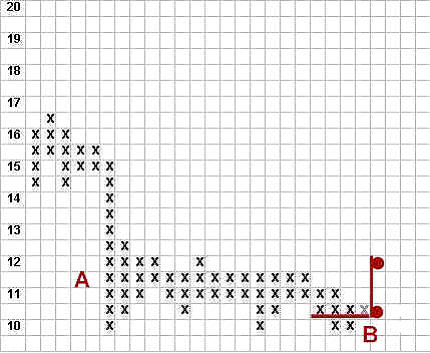 The Chair recently mentioned Point and Figure, and advised that he was reading Tom Dorsey's book on the subject. I'm not sure if that was a recommendation. It won't hurt anyone to read Dorsey. There is another popular author on P&F, whose work I do not recommend.
Others have commented on the plethora of Dorsey followers. I have seen that also, but what has surprised me is that the institutional following of Dorsey is quite large.
There are substantial differences in Point and Figure methodologies that bear noting, particularly to anyone doing statistical/quantitative testing.
Dorsey uses a 3-box reversal. That means that to reverse direction, three boxes are needed, whereas continuing in the same direction requires only one box. That has the quality of making his version of P&F asymmetrical. Before you decide whether or not you like that, consider the following:
If your box reversals are symmetric, then P&F becomes strictly a non-linear filter. The smaller you make the box sizes, the more the P&F filtering of the data will converge to the price. For example, if your box height were the minimum tic, then the P&F filter would be almost identical to the price. (It would be identical unless the market went sideways.) But with the asymmetrical/classic/Dorsey version, reducing the box size changes the chart. But it never converges to the price. You will have to decide if that's the type of filter you want.
Dorsey also has box sizes that adjust to price, but only at certain intervals (like at $20). That creates some problems if the price fluctuates around the appointed level. However, the point is well taken that if the price doubles the box size probably should also, so there should be a better method of adjusting box sizes. John Bollinger had done that by defining Bollinger Boxes as a function of price.
I'm not sure John wants his formula out there, so I won't give it. But it does dynamically adjust box sizes. The values they provide are good ones for most stock prices. The only problem with that formula is that it is poorly defined for values below one.
Now you might question why I am looking at "penny stocks", and the answer is that I am not. But consider that if it makes sense to P&F filter prices, then it might make sense to do that with indicators, oscillators, or whatever. That's where the occasional values below one come into play.
Jun
1
Comparing Apples to Oranges, from Steve Leslie
June 1, 2007 | 2 Comments
I am compelled to share the following article because I noticed today that Apple shares are up nearly 1000% over the last 5 years, while the NASDAQ is approximately 50% of where it was 5 years ago. What is the key to Apple's success over that of the NASDAQ in general? The obvious answer is their Captain, Steve Jobs.
The Secret of Superior Stocks.
The essence of the article originally posted on The Motley Fool website, is consistency of management. In other words, having the right CEO on board to navigate the ship is critical to the success of a company and it's long term performance. ….. The results were astounding. Sixty-six of the best had founders or a CEO who had more than five years of experience at the helm of the company 10 years ago, and who had stayed ever since. An additional 18 had the same CEO at the helm throughout the company's years of incredible performance. Chico's — the second best-performing stock of the past 10 years — is a great example. Chairman Marvin Gralnick founded the company in 1983 and served as CEO until 1993. He returned to lead his company in 1994 when the new CEO resigned. This is a leader who would not let his business down, and the returns for long-time shareholders have been simply mind-blowing…….
Great stocks have great leaders. [Read More at Motley Fool]
Riz Din comments:
Just under 5 years ago I participated in a presentation on why everyone should buy Apple shares (I've uploaded the slides here). At the time, Apple was trading at $14.72 with a conservative liquidation value of $12 cash per share, so the brand and products were valued at next to nothing. This was an extremely rare opportunity — the stock stood up well on value grounds and with the ipod just around the corner, it had the potential to flower into a good growth stock, which is just what happened. I bought a few thousand pounds worth of shares but eventually sold them to invest the money in a small property. A few days later the stock started to rise.
James Lackey mentions:
The remarkable thing to me is that people pay a premium for ease of use, aesthetics and branding. People will flock to Walmart or Costco for the lowest price on a gross of paper products, yet when it comes to electronic devices, some will pay a huge premium for various intangibles. I've used the hand held mp3 players for years, and I've always bought the cheapest system that actually worked, a sandisk. I looked a the device as disposable, as I am certain to break or lose the device in a mud puddle at the BMX track.
Ease of use, branding and the payment of premiums is in the stock market. It's fine to buy the cheapest stocks and treat them as disposable. After all these years, I have no idea why at times we are surprised people pay a premium for aesthetic markets.
Jun
1
Martin Lindkvist on the Swedish Tax Situation
June 1, 2007 | Leave a Comment
 Regarding the Swedish tax situation, it is encouraging that we now have a government that aims to lower taxes. At over 50% of GDP we are highest in the world. I am sure that it will be very beneficial long-term as huge amounts of money currently are held outside the country to avoid taxes, and this outflow will be lessened and money and companies will instead grow here. It will be a triumph for the optimists.
While companies and high net individuals try to lower taxes by either going abroad or at least keeping their capital abroad, ordinary citizens gravitate towards using the underground economy and paying Polish guest workers outside the tax system for help with cleaning, house renovation and such. Even a few ministers in the government did that, and had to leave their posts once discovered. But this excerpt from the earlier mentioned pdf, is too funny by far, showing that even the tax authority tries to avoid the sky high taxes here.
"Even the Swedish tax authority tries to avoid Swedish taxes. As noted by the Wall Street Journal, 'When it comes to paying taxes itself, the Swedish Tax Authority, responsible for collecting some of the highest in the world, would just as soon keep them as low as possible. It's saving a bundle on the production of slick TV spots that encourage Swedes to file online by producing them in the neighboring free-market, low-tax haven of Estonia'. _Spokesman Björn Tharnstrom told us, "We decided to do it in Tallinn because the costs are lower. One of those costs is taxes, of course."
Victor Niederhoffer asks:
Do you see any opportunities for Swedish equities with new tax rates?
Henrik Andersson comments:
It might come as a surprise that despite the highest tax rates in the world, the Swedish stock market is one of the global winners during the past 100 years or so. Of course it has to do with the state of the country 100 years ago not high taxes.
The earnings yield differential for the Swedish equity market is currently 2.0%.
Kim Zussman adds:
Point at figure analysis suggests high correlation between national tax rates and risk-return profiles of the indigenous female. Like Sweden, Russia has exorbitant nominal tax rates commensurate with 100% non-compliance.
Any comments about reduction in US tax rates relating to immigration patterns or legislated anti-social Darwinism are bifurcative.
From Jan-Petter Janssen:
My macroeconomics teacher told an anecdote about the Norwegian tax system (Norway's tax system is very similar to neighboring Sweden's.) An American professor came visiting him while he was building a sauna. The American just couldn't understand why he was making it himself. Did the Norwegian professors really get paid so badly he couldn't afford a carpenter? Well, the answer was both yes and no. No, the wages were quite good. Yes, even quite high wages could not buy much labor. The Norwegian came up with a calculation that stated this problem. After income taxes, VAT and the employer's tax, a gross $4 has to be made in order to leave the carpenter with $1.
However, while the economic policy makes labor-intensive services ridiculously expensive, the stock market is flying high. The economy is excellent in supplying our natural resources to a demanding world. In February 2003 the benchmark was playing with sub 100 levels. This Friday it passed the 500 mark for the first time.
Thomas Bjurlof writes:
I left Sweden some 25 years ago a never returned (except for visits) partly for reasons related to the tax regime and the monolithic political culture. There were other reasons more related to opportunity.
When my father died in 1992 I spent a couple of months in Sweden and I then invested in a number of smaller tech companies. You can imagine the results having timed the bottom of the 1992 crisis and the beginning of the Internet boom (by luck, since in those days I had no idea what a banking crisis was).
The event that tipped my decision to invest was that someone offered gold as payment for some items I sold! I don't know whether this event was representative, but it certainly hinted at a shortage of liquidity in the markets.
I have recently noticed that GaveKal is very upbeat about the Swedish market, so Martin's positive statements about taxation intrigue me. What if tax rates decline say an average of 10%? Is there any research that quantifies the effect of taxation on the market? I understand the direction a change will cause, but what about the quantity?
My question is what reason is there to believe that there will be significant sustainable change to the system this time? Should we start believing in a Thatcherite change emerging in Western Europe? Is there a new "Swedish Model"?
Since there has been a cultural connection between France and Sweden for a long time, might the election of Sarkozy be a first hint of a tipping point?
Martin Lindkvist responds:
Indeed, Thomas hits the nail on the head as we had a "new start" also in 1991 when a right wing government started to lower taxes only to be voted out of power three years later and taxes once again ware raised. And I don't know how good our chances are for a lower tax environment for the long term, although my gut tells me that it's less than a 50% chance (if that sounds pessimistic, it should be said that I still think we have a better chance now then ever, not least because of international development).
The problem you see is that to lower the tax rates, the costs must of course be lowered, and the obvious and most important cost savings can be made in the redistribution area. And then there are always groups that gets their benefits lowered and are an easy target for the socialists in the next election.
In a sense it is a miracle that the right wing won the election at all. Ha ha, they had to rebrand themselves as "the new labor party." This was true because one of the most important changes has been to start to lower taxes on work and at the same time lower unemployment benefits. Thus it should pay to work. They did get that logic across, but it has been harder for them to get across why it is important to take away taxes like the wealth tax and realty tax. And that might be why they would fall way short of winning the election were it be held again today.
It is amazing but the average Swede has no clue how much he or she pay in taxes. If you ask, you might get an answer like 31%, which is the typical tax for a worker up to about SEK25k a month. If you ask one that is paid more, you might get an answer of 55%, which is the highest marginal tax rate. They are both wrong of course since you have to add a lot to get the full picture. Social costs are paid by the employer but they lower the room for paying the worker.
Then you have value added tax on most things bought, and special taxes on things like liquor, gas, cigarettes, etc. Realty tax of course also raises the rent for those that don't actually own their own house. And more. The Swedish taxpayers association estimates the real tax for a low paid worker to be 65% for a person earning SEK 132k (that is less than USD 20k for crying out loud!), and 69% if you are at a "lofty" SEK 397k (and it does not stop there of course but goes much higher the more you earn).
The real irony is that since the person earning more sees more tax being withheld on the paycheck, percentage wise, he is more likely to vote for the right wing than the poor guy not earning much. But the taxation is almost as high on the latter.
It is a shame that Swedish people have been brainwashed to the extent that they don't even understand what monster they have created in the Swedish tax system. And this is where the rubber meets the road. If things are to change for real this time, then people will have to wake up and understand that if they are paying between 65-80% of their real earnings in tax then they are not free. The day they wake up and want to be free we can expect lasting change
Jun
1
Twelve Monkeys: One CDC, from Greg Rehmke
June 1, 2007 | Leave a Comment
 Like most people I prefer my end-of-the-world scenarios in movies rather than the evening news. Like most people, but not all. Today I was on a Global Warming panel at a Seattle prep school. Nearly 300 students attended and we were asked to address what students should do to reduce global warming. What could students do, "now that the science has been settled." I don't agree the science on global warming is settled, but wanted to participate.
One panelist insisted the U.S. should cut greenhouse gas emissions in half, then in half again. He told students how terrible it was that countries like India and China have to stop growing because the U.S. and Western Europe have already filled the world's CO2 quota. Another speaker, Washington State's Meteorologist, told students that air travel creates tremendous GHG emissions, and recommended they stay home and go to movies instead of vacations. He recounted how as a kid he and his friends had a fun one evening just watching trains go by.
At the panel's introduction, our host, a science teacher at the school, apologized for "yet another assembly on global warming" and said he knew they had all covered global warming in their classes. I can't help but wonder how much they have been lectured on how CO2 "pollution" and climate change will wreck much of the planet.
In my few minutes I argued that global warming fears are similar to past environmental fears: overpopulation, world famine, running out of resources, pollution, topsoil erosion, species extinction. These fears turned out not to be world-ending problems, and two billion people in China and India have much more to eat on the road to prosperity, even with their semi-communist and semi-socialist governments. As people's incomes pass $6,000 or so, more is invested in cleaner air and water. Prosperity allows people to take practical steps to clean the world around them, according to their own priorities.
Investment capital flows to nearly every corner of the world, bringing agricultural tools, water purification, cell phones, medicine, books, the Internet, factories, and call-centers. The air is clearing inside millions of homes now linked to electrical and natural gas grids. Sometime recently humanity passed the threshold when less than half the world's women are no long searing their lungs cooking over wood and dung-burning stoves. (Though maybe sometime soon over half of American men will be cooking over outdoor barbecues.)
All this wealth, all this gradually emerging prosperity, is burning hydrocarbons, and sending CO2 into the atmosphere. As President Bush calls for world politicians to somehow deal with GHG emissions, they know, or should know, that CO2 emissions will rise by 70% over the next 15-20 years. And that will be a very good thing for the hundreds of millions breathing cleaner air, drinking cleaner water, and living longer lives.
Still, if I would have said these last points at the assembly, I don't think I would be invited back to the school.
 So I came home and watched an end-of-the-world movie to mark the day's adventure, a movie also inspired by the day's news. If the end were to come for much of the human race, I think it would come as presented in Terry Gilliam's Twelve Monkeys.
The news emerged through the day of the jet-setting, super drug resistant TB patient, who, amazingly enough, has a stepfather working on drug-resistant TB at the Center for Disease Control. In Twelve Monkeys, the man who releases the virus is an environmental wacko, a research scientist who believes man's footprint is wrecking the planet. Since the move was made in 1995, millions more have been taught various kinds of environmental and climate alarmism.
Only a worldwide pandemic would enable humankind to reach the greenhouse gas emission goals set by many environmentalists, politicians, and prep school guest speakers. We have to hope that quite and desperate types at the CDC don't try to take GHG goals into their own hands.
I hope the world doesn't end. But if it does, you heard it here first.
Jun
1
“Nine Full Innings,” from Andrew Moe
June 1, 2007 | Leave a Comment
 The quantitative among us spend incredible time, money, and effort to search out predictive patterns in the markets. We use state of the art equipment to aggregate, analyze, and optimize vast streams of data in an attempt to squeeze out a small edge every day. Compounded over time this edge becomes significant but only if followed as designed. Stops, fear, and greed combine to degrade performance in real time, leaving many vexed by their relative underperformance to the pure patterns.
The Detroit Tigers have "Nine Full Innings" inscribed on their League Championship rings from 2006. Certainly, some would object here, as in blowout games where you have very little chance of winning. Maybe you should rest your stars to avoid injury. But manager Jim Leyland would never let the Tigers quit.
Leyland repeatedly preached the concept of playing hard for nine full innings, and the players took up that mantra, as evidenced not just by their words but also by the team's propensity for late-inning clutch hits, rallies, and comebacks.
We've established what one extra hit a week brings. If you have an edge in the markets, play the full nine.
« go back — keep looking »Archives
- October 2026
- September 2026
- August 2026
- July 2026
- June 2026
- May 2026
- April 2026
- March 2026
- February 2026
- January 2026
- December 2025
- November 2025
- October 2025
- September 2025
- August 2025
- July 2025
- June 2025
- May 2025
- April 2025
- March 2025
- February 2025
- January 2025
- December 2024
- November 2024
- October 2024
- September 2024
- August 2024
- July 2024
- June 2024
- May 2024
- April 2024
- March 2024
- February 2024
- January 2024
- December 2023
- November 2023
- October 2023
- September 2023
- August 2023
- July 2023
- June 2023
- May 2023
- April 2023
- March 2023
- February 2023
- January 2023
- December 2022
- November 2022
- October 2022
- September 2022
- August 2022
- July 2022
- June 2022
- May 2022
- April 2022
- March 2022
- February 2022
- January 2022
- December 2021
- November 2021
- October 2021
- September 2021
- August 2021
- July 2021
- June 2021
- May 2021
- April 2021
- March 2021
- February 2021
- January 2021
- December 2020
- November 2020
- October 2020
- September 2020
- August 2020
- July 2020
- June 2020
- May 2020
- April 2020
- March 2020
- February 2020
- January 2020
- December 2019
- November 2019
- October 2019
- September 2019
- August 2019
- July 2019
- June 2019
- May 2019
- April 2019
- March 2019
- February 2019
- January 2019
- December 2018
- November 2018
- October 2018
- September 2018
- August 2018
- July 2018
- June 2018
- May 2018
- April 2018
- March 2018
- February 2018
- January 2018
- December 2017
- November 2017
- October 2017
- September 2017
- August 2017
- July 2017
- June 2017
- May 2017
- April 2017
- March 2017
- February 2017
- January 2017
- December 2016
- November 2016
- October 2016
- September 2016
- August 2016
- July 2016
- June 2016
- May 2016
- April 2016
- March 2016
- February 2016
- January 2016
- December 2015
- November 2015
- October 2015
- September 2015
- August 2015
- July 2015
- June 2015
- May 2015
- April 2015
- March 2015
- February 2015
- January 2015
- December 2014
- November 2014
- October 2014
- September 2014
- August 2014
- July 2014
- June 2014
- May 2014
- April 2014
- March 2014
- February 2014
- January 2014
- December 2013
- November 2013
- October 2013
- September 2013
- August 2013
- July 2013
- June 2013
- May 2013
- April 2013
- March 2013
- February 2013
- January 2013
- December 2012
- November 2012
- October 2012
- September 2012
- August 2012
- July 2012
- June 2012
- May 2012
- April 2012
- March 2012
- February 2012
- January 2012
- December 2011
- November 2011
- October 2011
- September 2011
- August 2011
- July 2011
- June 2011
- May 2011
- April 2011
- March 2011
- February 2011
- January 2011
- December 2010
- November 2010
- October 2010
- September 2010
- August 2010
- July 2010
- June 2010
- May 2010
- April 2010
- March 2010
- February 2010
- January 2010
- December 2009
- November 2009
- October 2009
- September 2009
- August 2009
- July 2009
- June 2009
- May 2009
- April 2009
- March 2009
- February 2009
- January 2009
- December 2008
- November 2008
- October 2008
- September 2008
- August 2008
- July 2008
- June 2008
- May 2008
- April 2008
- March 2008
- February 2008
- January 2008
- December 2007
- November 2007
- October 2007
- September 2007
- August 2007
- July 2007
- June 2007
- May 2007
- April 2007
- March 2007
- February 2007
- January 2007
- December 2006
- November 2006
- October 2006
- September 2006
- August 2006
- Older Archives
Resources & Links
- The Letters Prize
- Pre-2007 Victor Niederhoffer Posts
- Vic’s NYC Junto
- Reading List
- Programming in 60 Seconds
- The Objectivist Center
- Foundation for Economic Education
- Tigerchess
- Dick Sears' G.T. Index
- Pre-2007 Daily Speculations
- Laurel & Vics' Worldly Investor Articles
