Oct
17
A reader recommends
October 17, 2024 | Leave a Comment

Advanced Portfolio Management: A Quant's Guide for Fundamental Investors, by Giuseppe Paleologo
Advanced Portfolio Management: A Quant’s Guide for Fundamental Investors is for fundamental equity analysts and portfolio managers, present, and future. Whatever stage you are at in your career, you have valuable investment ideas but always need knowledge to turn them into money. This book will introduce you to a framework for portfolio construction and risk management that is grounded in sound theory and tested by successful fundamental portfolio managers. The emphasis is on theory relevant to fundamental portfolio managers that works in practice, enabling you to convert ideas into a strategy portfolio that is both profitable and resilient. Intuition always comes first, and this book helps to lay out simple but effective "rules of thumb" that require little effort to implement and understand. At the same time, the book shows how to implement sophisticated techniques in order to meet the challenges a successful investor faces as his or her strategy grows in size and complexity. Advanced Portfolio Management also contains more advanced material and a quantitative appendix, which benefit quantitative researchers who are members of fundamental teams.
Oct
16
Professor Bejan interview, from Steve Ellison
October 16, 2024 | Leave a Comment
75-minute interview with Professor Bejan on the occasion of his winning the 2024 Association of Mechanical Engineers Medal: The professor discusses, among other things, how his experience playing basketball gave him insights into how systems of flow evolve.
J.A. Jones Distinguished Professor of Mechanical Engineering
Professor Bejan was awarded the Benjamin Franklin Medal 2018 and the Humboldt Research Award 2019. His research covers engineering science and applied physics: thermodynamics, heat transfer, convection, design, and evolution in nature.
He is ranked among the top 0.01% of the most cited and impactful world scientists (and top 10 in Engineering world wide) in the 2019 citations impact database created by Stanford University’s John Ioannidis, in PLoS Biology. He is the author of 30 books and 700 peer-referred articles. His h-index is 111 with 92,000 citations on Google Scholar. He received 18 honorary doctorates from universities in 11 countries.
Oct
15
Jensen’s inequality, from Big Al
October 15, 2024 | Leave a Comment
Nicely-done video on Jensen's inequality.
And some interesting reads:
Jensen’s Inequality As An Intuition Tool
Jensen’s Inequality guides our predictions by forcing us to deliberately consider how the average input maps to the average output. When the function that maps the input to the output is non-linear, Jensen’s Inequality tells us in which direction our predictions will be biased. Stated another way: Jensen’s Inequality informs us when an average occurance is a poor predictor of the average result.
Jensen’s Inequality (2): Unlocking Optimization and Decision-Making Power
Jensen’s inequality is a simple yet powerful concept. In short, it states that for a convex function, the function’s value at the average of some points is less than or equal to the average of the function’s values at those points. At first glance, this may seem rather abstract. But its implications are profound. Jensen’s inequality allows us to derive bounds and build intuition about complex systems.
Oct
14
1924 Immigration Act, from Stefan Jovanovich
October 14, 2024 | Leave a Comment

This year is the 100th anniversary of the Johnson-Reed Immigration Act signed into law in 1924 by President Coolidge. It was a modification of the 1917 Immigration Act which was the first law to establish quotas for entry into the United States.
Before 1917 the only numerical restrictions on entry to the United States was the Chinese Exclusion Act of 1882, which excluded EVERYONE Chinese. Immigration acts had placed restrictions on individuals (1882 - no convicts, indigents, prostitutes, lunatics, idiots; 1903 - no anarchists, epileptics, crazies; 1907 - no infected, mentally or physically handicapped who could not work), but there had been no quotas. The 1917 Immigration Act continued the exclusion of the Chinese but extended it to everyone else in East Asia except the Japanese and the Filipinos. The law also imposed a literacy test for anyone over 16, but the test was for the person's own language, not just English.
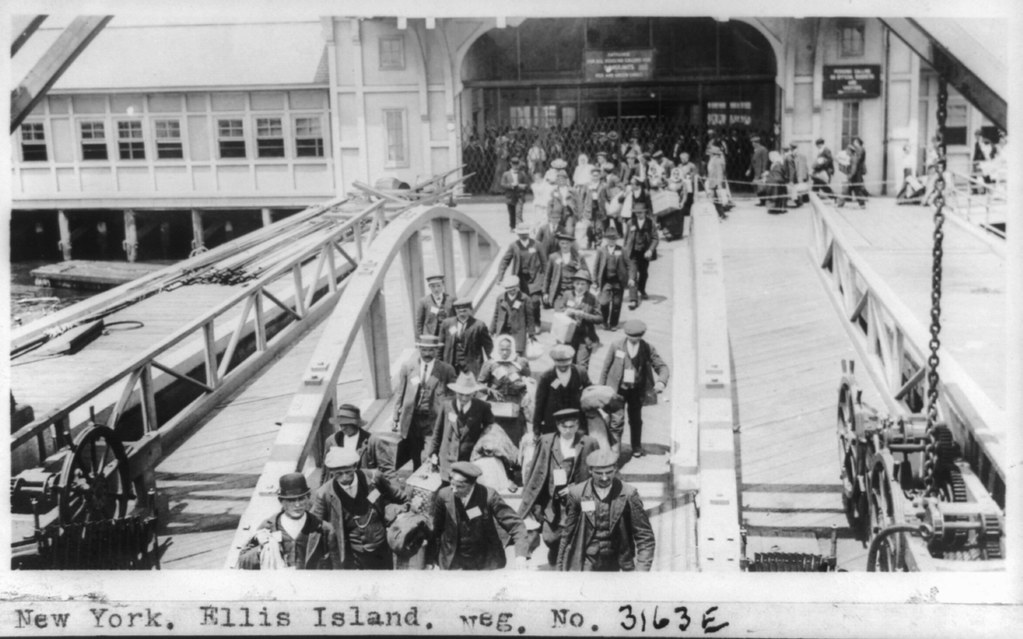
The 1924 Act extended the outright exclusion to the Japanese and can reasonably be identified as the triggering event that allowed Fascists to take control over the government of Japan and spend the next decade and a half convincing the people who had embraced representative democracy, American jazz and baseball that they should choose their own race as the one to come first.
Humbert H. comments:
It’s interesting how some reasons for excluding specific groups from being able to immigrate have changed over time. “Strong economic competitor” has completely disappeared, whereas it was one of two main reasons for excluding the Japanese. There must be some sort of widespread recognition that importing groups that demonstrate great achievement in some economic areas is good for the country even though there is certainly some collateral damage to the established population.
Stefan Jovanovich rejoins:
GR and I have different readings about the exclusion for the Japanese. It was not economic competition; the U.S. had a healthy positive trade balance with Japan between the two world wars. We sent them oil and wheat; they sent us toys and trinkets.
The political pressures for exclusion came from
(1) Teddy Roosevelt's complete hatred of the Japanese AND the Russians (Give a President the Nobel Peace prize and bad things always happen). That made disdain for the Nips into a bedrock belief of all progressive Republicans (Thank you Earl Warren)
(2) The continuing negotiations after the signing of the Washington Naval Treaty of 1922
Humbert H. clarifies:
I didn’t mean economic competition with Japan, but with Japanese immigrants, mainly in California
Asindu Drileba writes:
I heard from somewhere, that before World War 1, passports & visas where not enforced that seriously. You could just show up to any place you wanted to go to without many formal requirements. I just imagine if the world was like that? Anyone can show up anywhere anytime without any legal hurdles?
Noam Chomsky (MIT linguist) says that there are two kinds of globalization.
Globalization 1: Is the free movement of people (labour) around the world with less restrictions.
Globalization 2: Is the free movement of capital & goods (products) with little legal restrictions.
He says that as we we're entering the 21st century, there has been a sharp decrease in Globalization 1 and a sharp increase in Globalization 2. It has been described that Globalization 2 has benefited corporations a lot (some even claim it has benefited the economy as a whole).
Can a country benefit economically (can corporations & markets see gains?) by making immigration as easy as it is to send money around the world? That is, people (labour) moving around with very little restrictions?
Jeff Watson offers:
It would be better this way:
A world of free movement would be $78 trillion richer
Yes, it would be disruptive. But the potential gains are so vast that objectors could be bribed to let it happen.
Humbert H. responds:
Of course anyone with a minimal economic education would realize that free movement of “labor” or entrepreneurs would result in creation of enormous wealth. In the real world though, new immigrants going on the dole has become a feature and not a bug in many wealthy countries. You read anything from England, and that seems like an accepted fact there. The list of various culture-clash and crime issues is long and only irritates people who are for unrestricted immigration. So this not a pure economics problem but more multifaceted. My point was that something, perhaps better knowledge of economics or personal experience, or maybe less dog-eats-dog competition for survival, taught the populace that importing highly capable people usually leads to good outcomes.
Jordan Low adds:
Do you enjoy Bing Cherries? He lost his farm in the act.
Ah Bing was a 19th century horticulturalist and credited as the cultivator and namesake of the popular Bing cherry. Bing migrated to the U.S. around 1855 and worked as foreman in the Lewelling family fruit orchards in Milwaukie, Oregon.
Oct
13
FL insurance markets, from David Lillienfeld
October 13, 2024 | 1 Comment

Milton's travel through Florida had the eye wall intact straight through until it got to the Atlantic. Strong storm. Among the 4 strongest in the history of the Atlantic. One thing is clear though: There's a lot of destruction from this storm.
Hence, I have to wonder if there are going to be any insurers left in the Florida market, and if there are any left, which ones? I'm not sure that those insurers still there will make for good investment, but maybe they'll be able to survive in that market. It just seems unlikely.
Art Cooper responds:
There will certainly be private P&C insurers (in addition to state-created Citizens Property Insurance Company) continuing to do business in FL after Milton, but I strongly suspect they will continue to increase their restrictions on coverage. I understand that many victims of Hurricane Helene who thought they had coverage for its damage are being shocked to find out they either didn't, or did not to the extent to which they'd believed.
Historically, the aftermath of an event causing massive insurance claims is an opportune time to invest in carriers doing a lot of business in the affected area, because marginal carriers cease writing policies, thereby minimizing competition, and the event provides cover for dramatic rate increases. (Buy when there's "blood in the streets".) If you're bullish on the P&C sector, wait till after billions of dollars of claims are made, then try to buy at support levels.
I don't have any numbers on net migration out of FL, but I can attest anecdotally that the pandemic-induced flood into the state has ended. Bear in mind, however, that migration to FL has been characterized by wild swings for the past 100 years, and I'm confident it will continue to be volatile. Weather events such as Helene and Milton, and more importantly the greatly increased cost of homeowner's insurance, will of course be inhibiting factors going forward.
Carder Dimitroff writes:
I understand why some would consider NEE for short positions. I can see why the market might ping them. If the price sinks and the value is right for you, consider buying NEE as others sell.
Why? NEE Florida's assets are regulated. Within the state, they operate on a cost-plus-a-margin basis. They have a good relationship with the state's regulators (the state needs them). Their power plants and wires may be damaged, but the state's ratepayers will likely cover all their losses. There may be a temporary cash flow issue, but even those costs will be covered. For traders, it might take a year for NEE to recover financially.
Oct
13
What Modern Medicine Gets Wrong
October 13, 2024 | 1 Comment
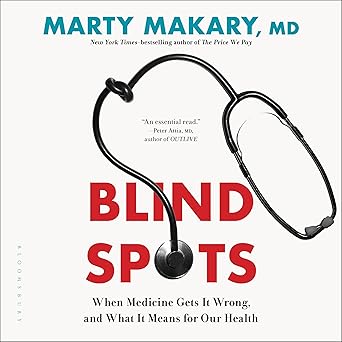
EconTalk podcast: What Modern Medicine Gets Wrong (with Marty Makary)
Johns Hopkins surgeon Dr. Marty Makary talks about his book Blind Spots with EconTalk's Russ Roberts. Makary argues that the medical establishment too often makes unsupported recommendations for treatment while condemning treatments and approaches that can make us healthier. This is a sobering and informative exploration of a number of key findings in medicine that turned out to be wrong and based on insufficient evidence.
Oct
12
The ideal PPI
October 12, 2024 | Leave a Comment
what was the ideal ppi for the BLS to report yesterday? under the circumstances the 0.30 rise in S&P was fairly good. but the gentlemen didn't like it at the close again. yet an all time hi with a weak close. can't be too wrong.
Oct
12
Asking for recommendations, from Steve Ellison
October 12, 2024 | Leave a Comment
Recommendations for an intro to multivariate statistics?
Bill Egan replies:
Here are four excellent multivariate statistics books I have used for many years. I suggest tackling them in this order.
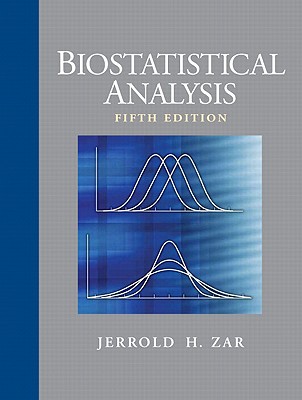
1. Jerrold Zar - Biostatistical Analysis, 5th ed. (this is half univariate and half multivariate)
2. Neter, Kutner, Wasserman, Nachtsheim - Applied Linear Statistical Models, 4th ed (there is now a 5th ed and you can find the pdf by googling)
3. Alvin Rencher - Methods of Multivariate Analysis (there is now a 3rd ed.)
4. Mardia, Kent, Bibby - Multivariate Analysis (there is now a 2nd ed.)
You need to understand linear algebra to do this, e.g., at the level of Strang's Introduction to Linear Algebra, 6th ed. (his lectures are on MIT's opencourse website). Rencher, Neter, and Mardia all use that notation extensively. You also need to understand and be able to do univariate stats at the level of:
• Snedecor and Cochran - Statistical Methods, 8th ed.
• Riffenburgh and Gillen - Statistics in Medicine, 4th ed.
You will really learn multivariate methods only if you code them. Matlab is the best (Matlab Home is cheap), and yes, I coded everything in these books and a lot more work of my own invention in Matlab.
David Lillienfeld adds:
Snedecor and Cochran is the grand old lady of texts. Neter et al is still pretty popular on campuses.
Asindu Drileba asks:
Concerning statistical packages. I often hear some data science communities complain about how there are simply too many bugs & wrong implementations in the Python space. Maybe this is why you are recommending MATLAB? What do think of R or Julia?
Bill Egan responds:
I have used Matlab since 1993 for many things - research, papers, patents, commercial scientific software products. Matlab stands for matrix laboratory. The original data structure was scalar, vector, matrix. If you like to work in matrix/linear algebra notation, or need to, Matlab is the program to use. Other data structures have been added on, such as tables for mixed data types, but like al ladd-ons, this does not always work well. Quality control of the software is great. Very widely used by engineers. Very high level language, so you can see the algorithm without getting lost in the details like you do in C++.
R is not so good for linear algebra because the original data structure is a table for mixed data types. Matrix work is more difficult. Quality control of core R and major packages is good despite R being open source (although it has license restrictions) because it is used by many academic statisticians. I used R for analysis for a couple of years. Fairly high level language. Better for classical stats work where you make a table out of the data and have mixed data types.
Python is completely open source and the people who created and use it most have no knowledge of statistics and that shows. We used it primarily as a scripting/control language inside one of my software products. Available packages do have bugs/errors or are missing methods for stats. We tested them and could not use them; I had my guys code any stats related stuff from scratch. It is not as high level a language as R or Matlab, so you have to do more work. Do not recommend it.
I have no experience with Julia.
Oct
11
The similarities
October 11, 2024 | Leave a Comment

Catastrophe 1914. the similarities between the start of w.w.1. and the current situation before the first attempted assassination are very great.
From the acclaimed military historian, a new history of the outbreak of World War I: the dramatic stretch from the breakdown of diplomacy to the battles - the Marne, Ypres, Tannenberg - that marked the frenzied first year before the war bogged down in the trenches.
In Catastrophe 1914, Max Hastings gives us a conflict different from the familiar one of barbed wire, mud, and futility. He traces the path to war, making clear why Germany and Austria-Hungary were primarily to blame, and describes the gripping first clashes in the West, where the French army marched into action in uniforms of red and blue with flags flying and bands playing. In August, four days after the French suffered 27,000 men dead in a single day, the British fought an extraordinary holding action against oncoming Germans, one of the last of its kind in history. In October, at terrible cost the British held the allied line against massive German assaults in the first battle of Ypres. Hastings also recreates the lesser-known battles on the Eastern Front, brutal struggles in Serbia, East Prussia, and Galicia, where the Germans, Austrians, Russians, and Serbs inflicted three million casualties upon one another by Christmas.
Oct
10
Red state:blue state / In state:out state, from Kim Zussman
October 10, 2024 | Leave a Comment

Discussions on Florida prompted another look at domestic migration (one state to another, from 2020-2023) by presidential vote in the 2020 election. Using Wiki data on net migration and 2020 results*, here is a table of the top and bottom 10 in-migration states, on a per-capita basis, with voting colors**.
6/10 top in-migration states were Red, but only 2/10 top out-migration states were Red. Also of note is the out-migration raw numbers for CA and NY.
* List of U.S. states and territories by net migration
** Red = Trump, Blue = Biden, lighter colors were close to tied.
Oct
9
Programming Collective Intelligence, from Asindu Drileba
October 9, 2024 | Leave a Comment
I feel so lucky to have come across this book. And I think it's so relevant to the market. The book is titled Programming Collective Intelligence and markets can be thought of as a form of collective intelligence. Like some people may suggest, a market can be described as a single brain made up of other brains.
The book is very practical and gives examples on how to make predictions amongst collective entities participating in E-commerce sites, Dating websites, Social Networks, Real Estate and so on. It has no mathematics (that I have seen so far). Everything is written is very clean readable Python code (no use of obscure Python features or keywords).
Here is the book's own description of Chapter 8:
Introduces decision trees as a method not only of making predictions, but also of modeling the way the decisions are made. The first decision tree is built with hypothetical data from server logs and
is used to predict whether or not a user is likely to become a premium subscriber. The other examples use data from real web sites to model real estate prices and "hotness."
And Chapter 11:
Introduces genetic programming, a very sophisticated set of techniques that goes beyond optimization and actually builds algorithms using evolutionary ideas to solve a particular problem. This is demonstrated by a simple game in which the computer is initially a poor player that improves its skill by improving its own code the more the game is played.
Table of contents & book description
Oct
8
Government planning and efficiency, from Big Al
October 8, 2024 | Leave a Comment
Originally, 32 ships were planned, with $9.6 billion research and development costs spread across the class. As costs overran estimates, the number was reduced to 24, then to 7; finally, in July 2008, the Navy requested that Congress stop procuring Zumwalts and revert to building more Arleigh Burke destroyers. Only three Zumwalts were ultimately built. The average costs of construction accordingly increased, to $4.24 billion, well exceeding the per-unit cost of a nuclear-powered Virginia-class submarine ($2.688 billion), and with the program's large development costs now attributable to only three ships, rather than the 32 originally planned, the total program cost per ship jumped. In April 2016 the total program cost was $22.5 billion, $7.5 billion per ship.
Henry Gifford disagrees with the implication:
I am no fan of runaway government spending, and waste, and stealing, but I applaud the decision to stop construction of the Zumwalt ships when it became apparent they were not what the navy wanted. It would have been better for the egos and careers of senior Navy officers to make believe the Zumwalt ships were desirable and keep making them, then quietly retiring.
The "peacetime" military has a huge challenge predicting what weapons will work well in the next war. At the same time, the military needs to maintain some shipbuilding capacity in the US, so that ships can be made in the US in the future. Maintaining shipbuilding capacity requires continuously building navy ships, needed or not needed, as the capacity to build ships in the future is critical. I haven't heard about anyone putting numbers on the value of this capacity.

Before WW2 the US has a robust shipbuilding industry that shifted to building navy ships, and ramped up for increased production. In the years since, that industry has gone away, except for a few pleasure boats and for military craft. One version I heard was that the last time ships were manufactured in the US installing a porthole required work by members of thirteen different unions, a problem presumably not faced in the places where the shipbuilding industry is robust today. With no significant shipbuilding industry in the US now, outside of military ships, the navy needs to keep building ships. (I think navy ships don't have many portholes, which probably avoids on of the challenges formerly faced by the commercial shipbuilding industry in the US).
One version of the Zumwalt story I heard is that much of the Zumwalt superstructure was made of Aluminum, to save weight, especially high up where saving weight increases stability and/or frees up capacity for mounting weapons high up, while the lower parts of the structure and hull were made of steel, and the dissimilar metals reacted with each other (happens quickly in the presence of salt water), resulting in terrible corrosion and structural damage. The Aluminum superstructure idea has been tried on naval ships before, but as Aluminum burns in a fire, it is not without risk to crew and ship in battle.
Another version of the story I heard is that the ship was designed for weapons which never materialized, thus the ships were cancelled. It all sounds logical, but somehow doesn't have the ring of truth that the version above has.
I also note that the Zumwalt ships were significantly larger than the Burke class ships made before and after it, and it seems quite believable (to me) that the navy simply wanted a larger number of smaller ships. Once upon a time the larger a battleship was the larger the guns it could carry and thus it had the firepower to shoot further than opponents, which meant it had the capability to maneuver to where an enemy was within range of its guns, while staying out of range of the enemy's guns. This battle-winning capability was worth the cost of huge ships. Now in the age of missiles and radar, the size of a ship is not nearly as relevant. During WW2 German soldiers reportedly said "one of our panzer tanks is worth ten of those American Sherman tanks, but every time we build one panzer they build eleven Shermans". As tank-on-tank battles were not the main, or main intended use of tanks, eleven OK tanks had many, many advantages over one superior tank. The US Navy might have decided that for similar reasons they are much better off with a larger number of smaller ships than a smaller number of Zumwalt ships. I would be surprised if the actual truth about the decision is ever made public, and more surprised if I was ever convinced that I was convinced the real reason(s) was made public.
The math about per-unit cost when development cost is amortized over the number of units produced is, I think, useful, but implies that development cost for something that never saw production or only went into limited production was somehow wasted.
The US navy now has hard data on the seakeeping ability of a full-scale tumblehome hull ship design, which I think nobody had before the Zumwalt actually went to sea. No, testing a scale model is not a robust test because much in fluid dynamics does not scale (google "Reynolds Number"). And if computer modeling alone was good enough nobody would have wind tunnels. The history of airplane development is full of planes that were built and flown in very small numbers, with the data helping to inform future designs. As the Zumwalt was such a radical design, departing so far from normal shipbuilding experience and formulas (google "metacentric height", "center of buoyancy", and "center of gravity"), it, I think, deserves to be thought of in much the same way as plane designs that saw very limited production and saw testing, and informed future designs in a useful way.
The US navy also has hard data on the radar signature of a tumblehome hull design, which nobody else has unless they pointed their radar sets at a Zumwalt class ship while configured for battle. I somehow doubt the US Navy sailed the Zumwalts close to the coast of Russia unless they added radar reflectors to them to mask their actual wartime radar signatures.
Maybe someone on the list developed and tested a trading strategy and found it lacking, then used the insights gained to test another strategy that turned out to be useful. Was the cost of developing and testing the first strategy wasted? I think not.
Carder Dimitroff writes:
Henry, your comment about aluminum reminded me of nuclear power plant design. For the reasons you state, aluminum is not allowed inside the containment (reactor building). Copper and stainless steel are used in place of aluminum. Outside the containment, aluminum is everywhere. I assume the US Navy requires similar standards for their nuclear submarines and aircraft carriers. Many design features in commercial nuclear plants originate from the nuclear navy.
Oct
7
What some Specs are keeping an eye on
October 7, 2024 | Leave a Comment
From Carder Dimitroff:
Note: 1 GW = about 1 nuclear power plant.
US DOE/EIA: Batteries are a fast-growing secondary electricity source for the grid.
Utility-scale battery energy storage systems have been growing quickly as a source of electric power capacity in the United States in recent years. In the first seven months of 2024, operators added 5 gigawatts (GW) of capacity to the U.S. electric power grid, according to data in our July 2024 electric generator inventory. In 2010, only 4 megawatts (MW) of utility-scale battery energy storage was added in the United States. In July 2024, more than 20.7 GW of battery energy storage capacity was available in the United States.
From Kim Zussman:
Argentina Scrapped Its Rent Controls. Now the Market Is Thriving.
For years, Argentina imposed one of the world’s strictest rent-control laws. It was meant to keep homes such as the stately belle epoque apartments of Buenos Aires affordable, but instead, officials here say, rents soared.
Now, the country’s new president, Javier Milei, has scrapped the rental law, along with most government price controls, in a fiscal experiment that he is conducting to revive South America’s second-biggest economy.
The result: The Argentine capital is undergoing a rental-market boom. Landlords are rushing to put their properties back on the market, with Buenos Aires rental supplies increasing by over 170%. While rents are still up in nominal terms, many renters are getting better deals than ever, with a 40% decline in the real price of rental properties when adjusted for inflation since last October, said Federico González Rouco, an economist at Buenos Aires-based Empiria Consultores.
From Asindu Drileba:
Charles Piller and the team here at Science dropped a big story yesterday morning, and if you haven't read it yet, you should. It's about Eliezer Masliah, who since 2016 has been the head of the Division of Neuroscience in the National Institute on Aging (NIA), and whose scientific publication record over at least the past 25 years shows multiple, widespread, blatant instances of fraud. There it is in about as few words as possible.
It turns out that alot of FDA drug approvals where based on this guy's research (a few listed in the article). I wonder what effect it may have on pharmaceutical businesses based off his research. Imagine spending decades & billions on a drug whose prior research turn's out to be completely forged (photoshopped images). This looks really bad for the Alzheimer's drug focused pharmaceutical industry.
From David Lillienfeld:
This is a comparison of international drug prices. U.S. gross prices are higher than those in comparison countries for all drugs and for brand-name originator drugs but lower for unbranded generic drugs.
Oct
5

Larry Williams comments:
Yield curve is very bullish at this time - it is so misunderstood.
Peter Ringel does some counting:
I found a FED Cut gives some bear pressure on SPY 5, 10 days after. Then it goes into meaningless regarding SPY.

only T+5 , T+10 are probably significant. We just crossed the end of that bearish pressure.
T+1 10000 reshuffled - Observed difference: -0.03, Bootstrap p-value: 0.8573
T+5 10000 reshuffled - Observed difference: -0.96, Bootstrap p-value: 0.0206
T+10 10000 reshuffled - Observed difference: -1.13, Bootstrap p-value: 0.0514
T+20 10000 reshuffled - Observed difference: -0.88, Bootstrap p-value: 0.2829
(a work in progress)
Oct
4
The multiple comparisons problem, from Big Al
October 4, 2024 | Leave a Comment
A paper co-authored by Andrew Gelman who is a high-profile writer on statistics at Columbia:
Why we (usually) don’t have to worry about multiple comparisons*
Andrew Gelman, Jennifer Hill, Masanao Yajima
July 13, 2009
Abstract
Applied researchers often find themselves making statistical inferences in settings that would seem to require multiple comparisons adjustments. We challenge the Type I error paradigm that underlies these corrections. Moreover we posit that the problem of multiple comparisons can disappear entirely when viewed from a hierarchical Bayesian perspective. We propose building multilevel models in the settings where multiple comparisons arise.
Multilevel models perform partial pooling (shifting estimates toward each other), whereas classical procedures typically keep the centers of intervals stationary, adjusting for multiple comparisons by making the intervals wider (or, equivalently, adjusting the p-values corresponding to intervals of fixed width). Thus, multilevel models address the multiple comparisons problem and also yield more efficient estimates, especially in settings with low group-level variation, which is where multiple comparisons are a particular concern.
[ … ]
The Bonferroni correction directly targets the Type 1 error problem, but it does so at the expense of Type 2 error. By changing the p-value needed to reject the null (or equivalently widening the uncertainty intervals) the number of claims of rejected null hypotheses will indeed decrease on average. While this reduces the number of false rejections, it also increases the number of instances that the null is not rejected when in fact it should have been. Thus, the Bonferroni correction can severely reduce our power to detect an important effect.
Here is a widely-read blog Gelman co-authors.
Oct
2
Dissonance and disbelief
October 2, 2024 | Leave a Comment
Cognitive dissonance 2: "i think the former president did a 'hades of a job'", but prob of winning fell from 60% to 45% from 1 day before to 1 day after.
one is reading again don quixote where his household throws away his books on chivalry because they believe it contribute to his supposed madness. along comes this article and headline from charles schwab "how to identify head and shoulders patterns."
my goodness - at this stage in our education 70 years after magee on technical analysis and 120 years after it was first recommended in The Magazine of Wall Street. even sancho would throw up his hands in disbelief.
Oct
2
Maybe G*d plays dice after all, from Kim Zussman
October 2, 2024 | Leave a Comment

Anyone else sick of the idea that gamblers are best at financial markets? Why aren't the champion players the richest in the world? Would you hire a gambler to manage your life savings? Don't gamblers (Livermore, etc) die broke?
Why This Wall Street Firm Wants Its Traders to Play Poker
Young traders who join the trading giant Susquehanna International spend at least 100 hours playing cards during a 10-week training program. When the stock market closes at 4 p.m., they often head straight from the trading floor to a dedicated poker room at the firm’s headquarters in the Philadelphia suburbs.
Jeff Yass, Susquehanna’s co-founder, sometimes joins in, scrutinizing hands new hires play and gauging how effectively they bluff. Thousands of employees, from traders to technologists, participate in the firm’s annual poker tournament. At least three have notched wins at the World Series of Poker in Las Vegas.
Big Al offers:
Peter Ringel writes:
I agree to all the points from the trading side. I know the basics of poker, but not a skilled player. Not even a novice. It makes sense to use the filter "skilled poker player" for manager selection. But how to become a skilled player ? Is it easier to become skilled in poker vs a skilled trader? I suspect it is a similar hard battle.
Asindu Drileba comments:
The problem with "skill level" is that they kind of translate differently. Warren Buffet for example is a Bridge addict. (Bridge is also a game of chance like poker) He (Buffet) is definitely an "above average skill player", but nit amongst the top 20 in the world. In investing however, Buffet may be regarded as part of the top 5.
The same goes for other financiers. Sam Altman (top VC in Silicon Valley), Jason Calcanis (Top VC in Silicon Valley), Charlie Munger were probably above average poker players but their edges were stronger in the finance & investing world — but all these attribute poker to their success.
Big Al writes:
1. Poker is very different from other casino games. There is a lot of skill involved, a lot of math (at the higher levels), a deep understanding of game theory (at the very high levels), and there are many more decisions to be made in poker compared to, say, roulette. Most poker pros probably wouldn't call poker "gambling", though some are degen gamblers when they walk away from the poker table.
2. Poker is a lot like the other casino games in that, for most people, the best decision is not to play. Like in markets, where the best decision for most is not to trade but just buy a diversified portfolio and hold it for a long time.
3. But firms like Susquehanna are not advising "most people" and they're not buying and holding SPY. For them, poker is a good way to assess and develop various skills that are relevant to hacking the market and making big bets. Poker is a great laboratory for testing "risk tolerance".
4. The poker "ecosystem" is a lot like the trading market in that there is a need to keep getting new suckers to enter at the bottom level and convince them they can win.
Oct
1
Book rec, from Carder Dimitroff
October 1, 2024 | Leave a Comment

Empire, Incorporated: The Corporations That Built British Colonialism
Across four centuries, from Ireland to India, the Americas to Africa and Australia, British colonialism was above all the business of corporations. Corporations conceived, promoted, financed, and governed overseas expansion, making claims over territory and peoples while ensuring that British and colonial society were invested, quite literally, in their ventures. Colonial companies were also relentlessly controversial, frequently in debt, and prone to failure. The corporation was well-suited to overseas expansion not because it was an inevitable juggernaut but because, like empire itself, it was an elusive contradiction: public and private; person and society; subordinate and autonomous; centralized and diffuse; immortal and precarious; national and cosmopolitan-a legal fiction with very real power.
Sep
30
Ed Thorp hosts Joseph Granville at UC Irvine (1981), from Big Al
September 30, 2024 | Leave a Comment
Interesting, for the history of market prognostication:
On May 27, 1981, Joseph Granville addressed a standing-room-only audience in the Science Lecture Hall at the University of California, Irvine campus. The event was sponsored by the Graduate School of Management and I served as the Master of Ceremonies.
In the first hour Joseph Granville was supposed to explain his theories to us. The hour proved entertaining with many anecdotes and stories, but the theories were not explained.
Peter Ringel offers:
You guys probably already found his interview on CWT:
EP 109: The man who beat the dealer, and later, beat the market – Edward Thorp
The man gamed Casino Roulette on a mechanical level and was probably targeted by the mafia back then.
Sep
29
Review redux: The Seven Pillars of Statistical Wisdom, from Vic
September 29, 2024 | Leave a Comment
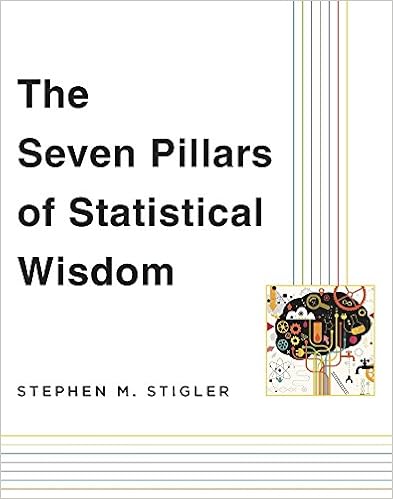
The Seven Pillars of Statistical Wisdom, by Steve Stigler, provides an illuminating and entertaining foundation for statistical activity. The seven pillars are Aggregation, Information, Likelihood, Intercomparison, Regression, [Experiment] Design, and Residuals. Every page of the book contains something fascinating and instructive.
It is at once an adventure story, a history lesson, a textbook on the foundations of statistics, and a tour de force with ingenious extensions of the works of the great in each field in Stigler's own inimitable hand — a persona that reminds one of Stigler's heroes, Galton himself.
The level of the book is such that the layman and the expert will both gain from it. I found every page insightful and it uplifts one to be part of a field with so many ingenious founders, and to know that there are such pillars that hold the edifice up.
I recommend the book highly. It is a masterpiece classic that will live forever.
Sep
28
What is in Brooklyn?, from Asindu Drileba
September 28, 2024 | Leave a Comment

Lana Del Rey — My boyfriends really cool, but he is not as cool as me. Cause I'm a Brooklyn Baby. An interview recently posted here with The Chair — "I attribute your being humble to being from Brooklyn" (interviewer referring to The Chair). Another person I listen to - Such mistakes can only be made by people who have not spent a lot of time in Brooklyn. Brooklyn comes up so many times. What's is there to know about it? Of course I have heard of people talking about other cities.
But people that talk about Brooklyn always say it like there is something they know which others don't know. What is in Brooklyn? What does it do to people?
David Lillienfeld adds:
In the epidemiology world, when one of the organizations meets in Manhattan, inevitably someone will suggest to the younger members to go across the Brooklyn Bridge and experience Brooklyn. There is definitely something about Brooklyn that focuses one's thoughts.

Steve Ellison offers:
The Chair wrote a whole chapter on this topic, the first chapter of Education of a Speculator, titled Brighton Beach Training.
Laurel Kenner suggests:
Survivors go there when they get to America.
Alex Castaldo responds:
Agreed, immigrants from Central and Eastern Europe often arrived in Brooklyn as a first step towards success and acceptance in America.
H. Humbert writes:
There is a hierarchy among the real estate developers of New York. Those who develop real estate (especially large commercial buildings) in the central area (the island of Manhattan, also known as New York County) consider themselves socially above the multimillionaires who develop property in the boroughs of Brooklyn, Queens, Bronx and Staten Island. They refer to Manhattan as simply "the City" and seldom go to the other boroughs (other than to take an airplane at LGA or JFK airports, which are in Queens).
Donald Trump's father was a developer of large number of properties all of which were in Queens and Brooklyn and he considered Manhattan development too financially risky. He was quite wealthy but in view of the above was not considered a "major New York developer", like Roth, Reichmann and other well known names.
His son Donald was very ambitious and wanted to move up in society. Contrary to his father's policy he took a gamble and decided to put up a large building, the Grand Hyatt Hotel on 42d street in Manhattan. The project was completed in 1978 and Donald Trump joined the ranks of major NY real estate developers. (What the other developers thought of his operation is another subject and requires a separate article). Even if he wasn't fully accepted by all, when his daughter married a member of the Kushner family, another prominent Manhattan developer, a few years later, it confirmed that the Trump family had reached the first rank among New York's wealthy families. But Donald Trump, having overcome his Queens handicap and shown that he could do better than his father, was not quite satisfied and he decided to enter national politics.
In summary, there is a slight prejudice against people from Queens and Brooklyn, which sometimes causes people to be even more motivated to succeed and be accepted.
In addition Brooklyn has its own distinct accent, which causes the prejudice to be slightly greater. If you would like to know what a Brooklyn accent sounds like you can listen to any speech by Janet Yellen. When she was in line for a top job in Washington, a previous Treasury secretary (probably hoping to get the job himself) mentioned her accent as a reason she should not be appointed. She got the job anyway. Another success for Brooklyn.
Jeff Watson gets musical:
Steely Dan nailed it.
Sep
27
Hedge funds and the positive idiosyncratic volatility effect, from Big Al
September 27, 2024 | Leave a Comment
I am curious about the claim that hedge fund alpha derives from timing entries and exits in high-vol stocks. There are lots of interesting trailhead links provided, too.
Hedge funds and the positive idiosyncratic volatility effect
Turan G. Bali, McDonough School of Business, Georgetown University
Florian Weigert, Institute of Financial Analysis, University of Neuchatel, Switzerland and Centre for Financial Research, Cologne, Germany
This Version: July 2023
Abstract
While it is established that idiosyncratic volatility is negatively priced in the cross-section of stock returns, the relation between idiosyncratic volatility and hedge fund returns is largely unexplored. We document that hedge funds with high idiosyncratic volatility earn higher future risk-adjusted returns of 6 percent p.a. than hedge funds with low idiosyncratic volatility. The outperformance arises because hedge funds trade high idiosyncratic volatility stocks wisely. They pick high volatility stocks when they are underpriced and short-sell high volatility stocks when they are overpriced. Our results support the notion that hedge funds’ idiosyncratic volatility is a measure of managerial skill.
Sep
26
An informal analysis, and books
September 26, 2024 | Leave a Comment
performing an informal content analysis of fox news 50 articles, the news about vp is overwhelmingly negative. however, she still leads in the odds by at least 5 percentage pts. under circumstances the other side's insistence they won debate is blind. this refusal to accept reality should lead to all sorts of negative results.
meanwhile, in books:
The Walking Drum is an erudite louis lamour adventure about 12th century business.
the book The Merchant in Medieval Europe is one of the most scholarly and complete I have ever read. A summary on the back cover is very apt. the book made me realize that most of my commercial inspirations were merely following the paths set by our predecessors.

some chapters: the merchant in the 13th century, trading companies, commercial correspondence, bookkeeping and commercial correspondence, arithmetic insurance, banking, interest rates, fairs, money supply, information, careers, exchange, brokers.
Power and Profit, an alternate title, is beautiflly illustrated with 200 prints and maps. "an academic classic that can be read purely for pleasure."
a well lived life: Peter Spufford
More:
Money and Its Use in Medieval Europe, by Peter Spufford.
Sep
25
Smörgåsbord
September 25, 2024 | Leave a Comment
Jeff Watson likes info on the softs:
Here’s a copy of a magazine that offers a high level view of all things agricultural:
Carder Dimitroff is watching lithium batteries:
Utility Dive: Lithium battery oversupply, low prices seen through 2028
Despite falling raw material costs and U.S. policy support, North American battery suppliers are delaying or canceling planned capacity investments
Bloomberg: Why Public EV Chargers Almost Never Work as Fast as Promised
Most public machines in the US average about half their maximum speed, a gap that risks hindering further adoption of electric cars.
David Lillienfeld follows pharma:
Immuno-oncology drugs have changed oncology and required rewriting of many sections of medical texts. They have created a revolution. That doesn't mean they are without downsides.
A decade of cancer immunotherapy: Keytruda, Opdivo and the drugs that changed oncology
Medicines that can rev up the immune system against tumors have reshaped expectations of what cancer treatment can accomplish. Their success has hit limits, however.
Sep
23
Methods of trade
September 23, 2024 | Leave a Comment
three highly recommended books:
Power and Profit: The Merchant in Medieval Europe
all show how commerce, fairs and bazaars, and bourses in the 1100-1400 era showed the way for all modern methods of trade.
Sep
22
Choking, from Jeff Watson
September 22, 2024 | Leave a Comment
Ever choke during a big event?
The Brain Really Does Choke Under Pressure
Study links choking under pressure to the brain region that controls movement
Have you ever been in a high-stakes situation in which you needed to perform but completely bombed? You’re not alone. Experiments in monkeys reveal that ‘choking’ under pressure is linked to a drop in activity in the neurons that prepare for movement.
The researchers found that, in jackpot scenarios, the activity of neurons associated with motor preparation decreased. Motor preparation is the brain’s way of making calculations about how to complete a movement — similar to lining up an arrow on a target before unleashing it. The drop in motor preparation meant that the monkey’s brains were underprepared, and so they underperformed. To a certain extent, “you just don't perform better as the reward increases”, Moghaddam says.
Asindu Drileba writes:
This seems related something psychologists call habituation (defined as the diminishing of an innate response to a frequently repeated stimulus). I leaned about it from Daniel Cohen, the first economist I actually enjoyed reading (I recommend the books Prosperity of Vice, Homo Economics). Daniel Cohen mentioned that "habituation" is the reason why in some instances adding financial incentives makes people perform worse at a task.
He gives an example of a Kindergarten School experiment. The school had a problem with parents coming late. So the school said that for every time a parent comes late to pick their child they will be fined a certain amount (lest say $10 every time you come late to pick up your child). The result was that more parents actually came late to pick their kids.
The psychological interpretation might be that parents eventually valued money less than that coming late. So paying a fine made them feel like they have "paid off their sin" that is, the monetary fine erased their guilt.
Daniel Cohen also thinks we are all going to be immortal some day. Here is a nice podcast where he talk about his ideas.
Sep
18
Hikes, cuts, and differentials
September 18, 2024 | Leave a Comment
now 8 percentage differential in favor of vice pres. the more things emerge as favoritism in debate, the greater the differential.
it took 12 days for a 20-day high and months for an all-time high which comes auspiciously for Hayek's road.
average number of consecutive decreases in fed rates after a turning point to a decline is 14.
In light of the progress on inflation and the balance of risks, the Committee decided to lower the target range for the federal funds rate by 1/2 percentage point to 4-3/4 to 5 percent.
Forbes Advisor: Federal Funds Rate History 1990 to 2024
Plenty of other data factor into Fed monetary policy decisions, including gross domestic product (GDP), consumer spending and industrial production, not to mention major events like a financial crisis, a global pandemic or a massive terrorist attack.
To that end, we’ve structured this compendium of fed funds historical data with narratives about the different factors that informed the Fed’s decisions. The central bank may be staffed by officious economists, analysts and business experts, but it’s also highly responsive to the changing political winds.

the swings in S&P futurs in last half hour from up 30 to down 15 and now +20 reminds me of how a loser in a squash game flails around with a big swing and no caution hitting all three walls on each shot. one fine player whose forefather lost the american revolution in the battle of Long Island hit one with all his power at my head when he was behind in a situation like this. i imediately called for the ref to default him, to no avail.
what was the match beween federer and djoko where federer was up match point and served to djok backhand and djok gave up and shot a hail Mary from his back hand and he won the match?
Djokovic's INSANE Comeback Against Federer! | 2011 US Open Semifinal
Sep
18
Even card counting made the house money
September 18, 2024 | Leave a Comment
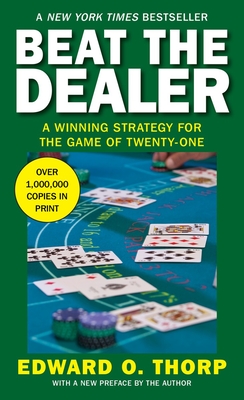
A Perspective on Quantitative Finance: Models for Beating the Market, Ed Thorp © 2003
Quantitative Finance Review
From the first section, on his card-counting research and successful play:
The relevance to finance proved to be considerable. First, it showed that the “gambling market” was, in finance theory language, inefficient (i.e. beatable); if that was so, why not the more complex financial markets? Second, it had a significant worldwide impact on the financial results of casinos. Although it did create a plague of hundreds and eventually thousands of new experts who extracted hundreds of millions from the casinos over the years, it also created a windfall of hundreds of thousands of hopefuls who, although improved, still didn’t play well enough to have an edge. Blackjack and the revenues from it surged.
(See Beat the Dealer for more detail on Thorp's blackjack strategies.)
Sep
16
Cognitive dissonance
September 16, 2024 | Leave a Comment

odds in favor of vp reaches maximum with a 6% lead over former Pres. and former Pres claims he won the debate handily. as Soros liked to say: the more he talked about his honesty, the more closely i counted my silver.
perfect example of cognitive dissonance in our time.
She attracted a group of followers who left jobs, schools, and spouses and who gave away money and possessions to prepare to depart on a flying saucer that, according to Mrs. Keech, would arrive to rescue the true believers. Given the believers’ serious commitment, Festinger wondered how they would react when the prophecy failed. He and his colleagues, posing as believers, infiltrated Mrs. Keech’s group and kept notes on the proceedings surreptitiously.
The believers shunned publicity while they awaited the flying saucer and the flood. But when the prophecy was disconfirmed, almost immediately the previously most-committed group members made calls to newspapers, sought out interviews, and started actively proselytizing.
Festinger was unsurprised by the sudden proselytizing after the prophecy’s disconfirmation; he saw the cult members as enlisting social support for their belief to lessen the pain of its disconfirmation. Their behaviour confirmed predictions from his cognitive dissonance theory, whose premise was that people need to maintain consistency between thoughts, feelings, and behaviours.
a question out of the blue????? "would you have a Republican in your cabinet?" one would like to have the moderators predicting stock prices?
Sep
15
Streaks of down days, from Big Al
September 15, 2024 | Leave a Comment
Vic tweeted that "after 5 down days in a row for S&P, it's very bullish. 5 days later only 2 of ten down with high positive expectation especially with bonds up and last one down."
That provoked a quick counting project. The main issue with this analysis is that everything is overlapping, but nonetheless I think it's an interesting result.

The data is SPY adjusted closes from inception thru 6 Sept. I identified all the down days and the streaks of down days, including 1-day "streaks", up to the longest which were 8-day streaks. So each down day fell into a bin, 1 up to 8. Each down day was put in a bin, whether it was the last day in a streak or not. (This eliminates the look-ahead bias of just considering only the final day of streaks.)
Then I calculated the 5-, 10- and 20-day % moves for every day in the data and compared the results for all the down days with the % moves for all days.
The table shows the results, with the best outcomes - streaks of 3, 4, and 5 days - highlighted.
Sep
14
Politics, rackets, markets
September 14, 2024 | Leave a Comment
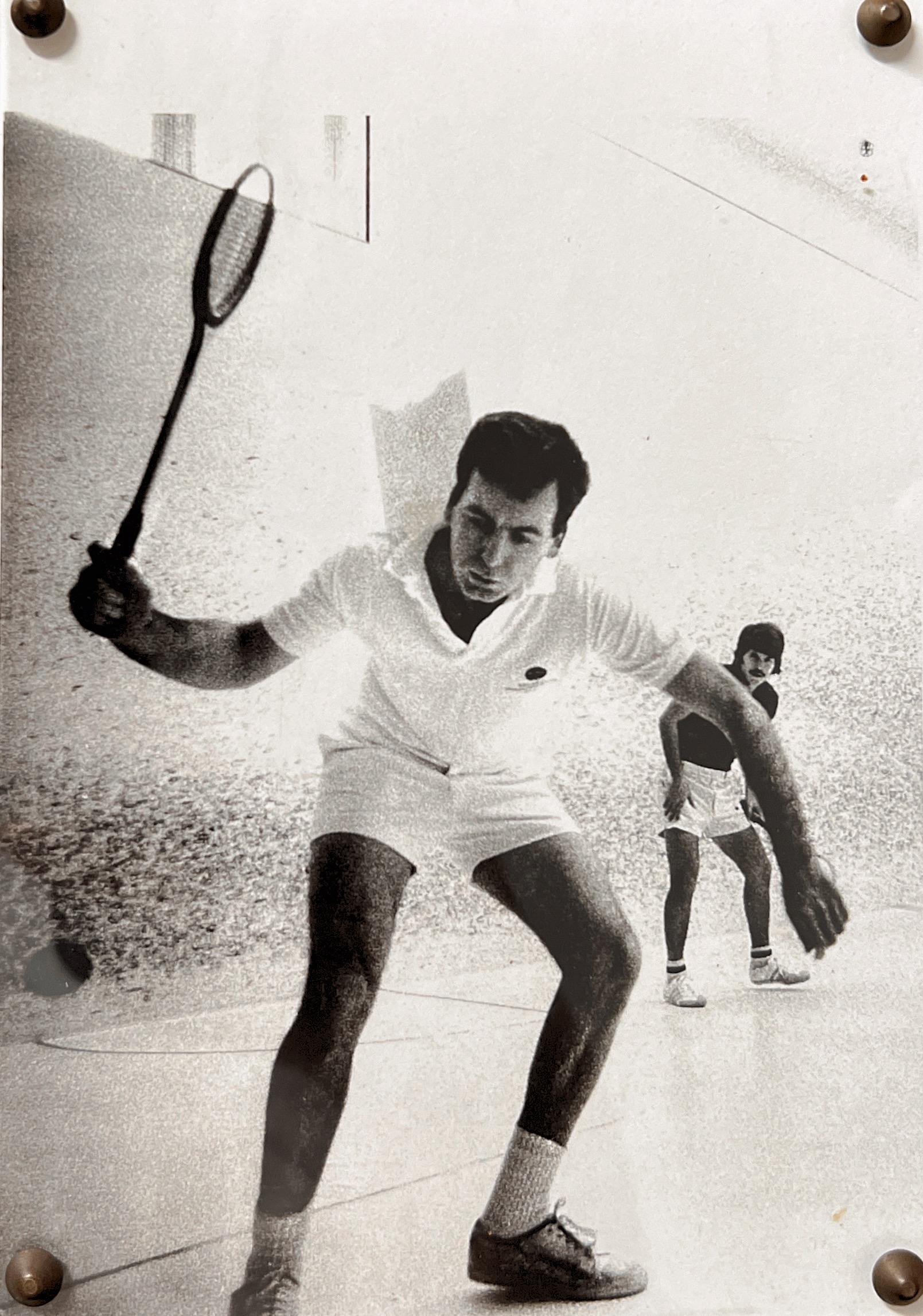
the more he claims he won, the greater the odds against him. reminds me so much of the refereeing against me in the 1970's. of the 5 national singles i won, my opponent in finals didn't reach double digits. that was the only way for me to overcome bias.
Ed. - Racket Guy from Brooklyn, Sports Illustrated, March 03, 1975:
To the victor—Victor Niederhoffer, that is—belongs another silver pitcher. Last week in New York, at 31, he won the U.S. National Singles Squash Racquets championship for the fifth time. His opponents did little but gasp, sweat and run. But Niederhoffer seemed to play effortlessly. His shots were not always brilliant, but he patiently waited out long rallies, and his frustrated opponents consistently found themselves in situations where most of their moves were of high risk. And then they were forced to make mistakes which ruined them.
reminds me of what my father always said when people told him how good he looked as he was suffering from chemo: "thank you, i'll be the healthiest corpse in the graveyard."
the symmetry of it all. last week 5 down days in a row - from 5659 to to 5515. this week 5 days up in a row from 5421 to 5630.
Sep
13
Politics, money
September 13, 2024 | Leave a Comment

the forces of regulatory capture won the debate handily and that is good for the stock market. more emoluments to business. more centralized control, or as Waltz says, "neighborliness".
As money mutates into a new form that demands all kinds of markets, new ways of making financial transactions, and new kinds of business.
From: The History of Money, by Jack Weatherford.
From primitive man's cowrie shells to the electronic cash card, from the markets of Timbuktu to the New York Stock Exchange, The History of Money explores how money and the myriad forms of exchange have affected humanity, and how they will continue to shape all aspects of our lives–economic, political, and personal.
Sep
12
From the archives, still fresh: The Math Behind the Music, reviewed by Vic
September 12, 2024 | Leave a Comment

Book Review by Victor Niederhoffer: The Math Behind the Music (25 Sept, 2006)
The Math Behind the Music (Cambridge University Press, 2006) by Leon Harkleroad, will be of interest to musicians, mathematicians and marketicians. In a form that is accessible to every layman, the author describes the elementary mathematical principles behind sounds, instruments, compositions and visual aspects of scores in just 135 pages with a nice section of references and an included CD that covers examples of music that used math. No background is required as even such simple lower-school concepts as the factorial are developed by counting.
The first chapter is about the connections, history, common abstract patterns, and the composers and compositions that used math. The second chapter is about the physical basis of harmony, pitch and timbre that make up music. Considerable attention is paid to the frequency relations of various harmonies, and it's a good refresher for those who don't remember off the top that a fourth comes from any note by raising its frequency by 4/3, a fifth by raising its frequency by 1/2 and an octave by doubling. Sine curves are introduced to encapsulate the frequency patterns of various notes produced at different pitches by different instruments. Overtones are explained simply as the ratios of higher frequencies that a note produces that don't block out the original frequencies and the relation between harmonies and overtones is shown.
The third chapter discusses instrument tuning systems consistent with all the overtones and frequency relations between the notes of a scale.
The fourth chapter is the most interesting in that it shows how themes and melodies can be varied with simple rules such as opposition, inversion, and transposition. The relation between these simple rules and group theory are examined, and various ways of notating and combining the rules are covered.
The fifth chapter is about bell music, which is merely a variation of permutation and combination theory.
The sixth chapter is about randomization in music, with many of the same methods used to construct music as we use for simple simulations in markets.
The seventh chapter is about an attempt by one student to find the common basis, the patterns of harmony that make up the most popular songs. The eighth chapter is about how scores of music can be developed from visual cues, with rules to go from visual to music.
The ninth and final chapter is about failed efforts to combine music and math, with particular reference to George Birkhoff's efforts to develop a complete theory of aesthetics by developing a scale of beauty based on the simplicity-to-complexity ratio of a composition.
I found myself thinking many times of the relations between music and markets as I read the book. The combinations of opposites and inversions (where the intervals above a note and played the same intervals below, and transpositions (where the same theme is repeated a given number of intervals up) happens every day in the markets. The notation that musicians have developed to grapple with these techniques, including the summary of horizontal and vertical movements in visual sightings that the composer Villa-Lobos used to construct symphonies that depict buildings in a city, seems like a very fruitful field to augment technical analysis of markets.
The book is full of anecdotes and charts and methods that will be right on the top of the page for market practitioners, and will spark many a fruitful extension by those who wish to take the pencil to paper, and systematize what they have been doing in markets or charting with the work of some great composers and mathematicians in this related field.
Laurence Glazier offers:
This sounds a fine book. Abstract shapes indeed can be used for thematic material, in my chess days I considered using the outline of pawn structures like black's in the Dragon Variation. My mentor uses the letters in his friends' names. Music is developed by changing patterns in various - ever-changing! - ways, whether transposition, inversion, speed-changing, and I would add to the list in the book the use of rotation, a technique Chris Sansom and I used in the Fractal Music software. All this (except presumably rotation) applies in trading. The issue is whether it is predictive for traders, and that is akin to trying to predict what a Bach would do, the patterns are especially evident once they have happened.
Asindu Drileba adds:
The work of Dmitri Tymoczko might also be interesting for those that want to understand the relationship between randomness and music.
Sep
10
A statistical read relevant to trader research, from Big Al
September 10, 2024 | Leave a Comment
It's a critique of the relatively famous Kahneman et al study on how meal breaks affected sentencing by judges:
Which also led to more background, because I had not heard of "Cohen's d":
Sep
9
Full-time vs. Part-time Employment, from Bill Rafter
September 9, 2024 | Leave a Comment

Bud Conrad comments:
The US BLS understates inflation, which causes the calculation for Real GDP growth to become overstated. Thus, we have a recession going on, but it is hidden by the BLS's low inflation rate. The rich are doing well as asset prices have risen; the rest have lost ground because the cost of everything has increased more than the labor rates.
Ditto on jobs and employment that suggests there are lots of new jobs every month, but then restates the number downward in succeeding months, which accumulated to 818 K jobs that are overcounted in the year ending March.
The supposed Fed's being "data dependent" is a cop-out from thinking "How to stabilize the dollar", meaning that they claim they will use these corrupt numbers for policy decisions.
Sep
7
An excellent book by someone we know
September 7, 2024 | 1 Comment

Buildings Don't Lie: Better Buildings by Understanding Basic Building Science
Hardcover – January 1, 2017
by Henry Gifford (Author)
A simple, clear, thorough, and complete explanation of basic building science applicable to any building in any climate. Over 1,000 large color drawings and photos, plus fun quizzes. No charts, graphs, or math. Read this book and become your own expert on making buildings comfortable, healthy, safe, durable, and very energy efficient, because you will understand the underlying science of the movement through buildings of heat, air, water, light, sound, fire, and pests, and how these can be controlled. This book also includes sections on designing building enclosures, indoor air quality, choosing heating and cooling systems, and how to ventilate, heat, and cool different types of buildings.
Henry Gifford comments:
Yes, I wrote and published that book, now in its fourth printing. Book is divided up into chapters on basic science, nothing about buildings, followed by that science applied to buildings, to learn the science better and to understand buildings better. Could ruin some of your teenage offspring for some college science classes.
Gyve Bones appreciates:
I am grateful and obliged to Henry for his magnificent book. I have long lamented not having an owner's manual for my house and this would seem to fill that need—not only the owner's manual, but the service manual as well, and along the way lessons in physics, fluid dynamics, thermodynamics, natural philosophy, and practical engineering. Very well illustrated and pains-takingly explained. I am enjoying learning so much I took for granted or was ignorant of in the science and technology of creating and maintaining a comfort-able habitable shelter.
Sep
5
A call for an emphasis on predictive distributions, from Victor Niederhoffer and the Spec Trio
September 5, 2024 | 1 Comment
From Ask the Specs, by Victor Niederhoffer, Laurel Kenner, and Dr. Brett Steenbarger (December, 2003):
May I issue a call for an emphasis on predictive distributions rather than descriptive studies? By predictive, I mean, a study that:
• enumerates all observations of what has happened after a defined market event over a specific period of time;
• weighs whether the results indicate a random phenomenon or a tradable anomaly;
• measures the uncertainty associated with the latter conclusion; and
• predicts the probability that an x-percent move will follow the event being studied.
Based on my experience, the biggest mistake a trader can make is to concentrate on “advanced” methods such as Hurst exponents, regression coefficients, Fourier series, chaos, wavelets, fractals, et al. Unfortunately, all of those sophisticated techniques will get you nothing but a barrel of retrospective nothingness.

The key is to find a measure that can be calculated often and independently and then use it to predict. For example, what happens in the next one, five and 10 days after stocks reach a 20-day low? The philosophic memory and longings and expectations of the market are of great interest, but I have found queries as to whether they trend or reverse in accord with Prechter or Fibonacci or Elliott a distraction to the pursuit of profitable trading.
You could put the 100 smartest academics in the world in a room and let them try to predict the market for 100 years, and unless they were steered on a path to make fruitful predictions with readily ascertainable estimates of uncertainty, constantly adjusting for ever-changing cycles, they would achieve below-random results. The numerous professors I have hosted and supported in my office have not disabused me of this assessment.
Sep
4
Richard Hamming: You & Your Research, from Asindu Drileba
September 4, 2024 | Leave a Comment
Richard Hamming, "You and Your Research", June 6, 1995 (44:02)
The Art of Doing Science and Engineering: Learning to Learn was the capstone course by Dr. Richard W. Hamming (1915-1998) for graduate students at the Naval Postgraduate School (NPS) in Monterey California.
This course is intended to instill a "style of thinking" that will enhance one's ability to function as a problem solver of complex technical issues. With respect, students sometimes called the course "Hamming on Hamming" because he relates many research collaborations, discoveries, inventions and achievements of his own. This collection of stories and carefully distilled insights relates how those discoveries came about. Most importantly, these presentations provide objective analysis about the thought processes and reasoning that took place as Dr. Hamming, his associates and other major thinkers, in computer science and electronics, progressed through the grand challenges of science and engineering in the twentieth century.
Sep
3
Apparently, it’s not just an American thing - Australia, from Carder Dimitroff
September 3, 2024 | Leave a Comment
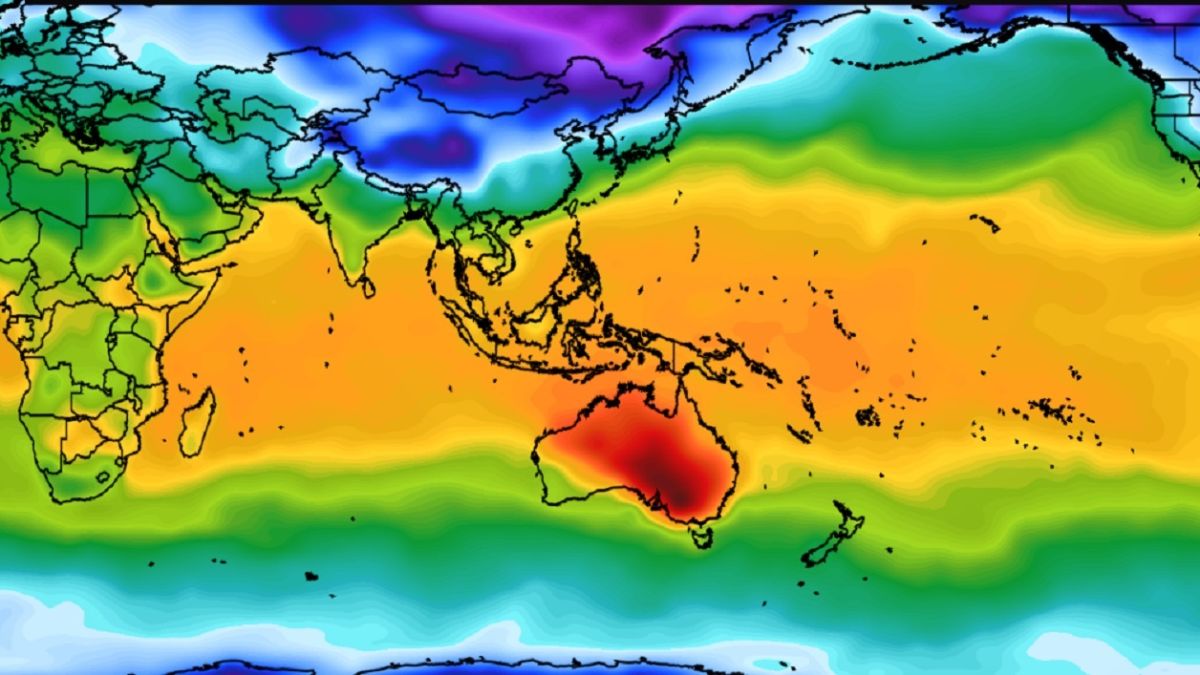
Sydney Morning Herald: Three Months to Back Up the Grid as Risk of Summer Blackouts Ramps Up.
Interesting Engineering: Australia Is Generating Too Much Solar Power (12:25).
IMO, expect:
1. volatile wholesale energy prices, including deeply negative prices,
2. forced load shedding and expanding demand-response programs,
3. sudden awareness that infrastructure is needed,
4. growing reliance on natural gas/ LNG, and
5. growing interest in competitive energy contracts
Sep
2
Counting: Seasonality
September 2, 2024 | 1 Comment
A lesson from the archives: Seasonality and changing cycles, by Victor Niederhoffer and Laurel Kenner, (04/26/2004)
A good part of the anomaly literature is devoted to studies of seasonality. A basic problem with these studies is that merely picking a season to study involves making guesses as to when and where the seasonality is. For example, is it in January or December, on Monday or Friday, in the United States or the Ukraine? (Yes, our Google search turned up a study of anomalies in the Ukraine.) Thus, the very choice of a subject might involve random luck.

Another aspect of seasonality studies that must be considered is whether the effects noted are sufficient to cover transaction costs. A retrospective study showing that you can make 2 cents more on Friday trades than Monday trades in your typical $50 stock would not be sufficient in practice to leave anyone but the broker and the market-maker richer.
Thus, it's essential to temper the conclusions of such studies with out-of-sample testing — in other words, with real trading.
[ … ]
Comment by Philip J. McDonnell, a former student of the Chairman at UC Berkeley: Dr. Niederhoffer points out that there is no a priori reason to believe that any one day of the week is stronger than any other. Thus when Y— collected the data (thank you!), presumably the reason was to find out if any days of the week behaved differently. Only after peeking at the data was it possible to say that Monday was the best and Tuesday the worst.
There are 10 such pairwise comparisons:
Mon with other 4 days 4
Tues with 3 last days 3
Wed with Thu & Fri 2
Thu with Fri 1
Total 10
In other words it is also possible that Tuesday could have been the best day and Monday the worst or any other pairwise comparison by chance alone. So when the one best and the one worst day shown by the data are compared and shown to have say a 5% significance we need to remember that we implicitly ruled out the other nine cases which weren't the best or worst. So we need to take our 5% number and multiply by 10 to get the correct significance of 50%. 50% is exactly consistent with randomness.
The problem is multiple comparisons are often subtle and remain unrecognized. Multiple comparisons are insidious because they dramatically reduce the power of the statistical tests we employ.
[ … ]
[More reading: Multiple comparisons problem]
William Huggins offers:
Bonferonni method suggests raising the confidence level proportional to the number of tested hypotheses. To get 95% confidence despite ten tests, he suggests 99.5 as a threshold. It's a huge problem when testing which variables to include in a regression model.
Asindu Drileba writes:
The right way to do this type of thing is to form a specific hypothesis based on a single comparison and then to test it on the data. It is even possible to use data from a prior period to formulate our hypothesis. We then test our hypothesis on the subsequent period which excludes the period where we formed our hypothesis.
This is an approach used in machine learning. Datasets are always split into "training" and "test" datasets. "Training" datasets are exclusively used to build the components of the model. "Test" datasets are not used to build the model at all. They are excluded when building the model. The model built using the "training" dataset is then asked to make predictions on the "test" dataset. The accuracy on predictions made on the "test" datasets is then used to determine how accurate the model is (so it can be tuned for improvement or thrown away).
I found this particular statement from the full post so insightful because I didn't think of applying this approach to building models using other statistical methods (I thought it was something limited to machine learning).
Sep
1
Executive Hobo: The Extraordinary Life of Bo Keeley
September 1, 2024 | 1 Comment
Executive Hobo: The Extraordinary Life of Bo Keeley
Changing Roads Podcast
Travel back in time with us as we sit down with the legendary adventurer, Bo Keeley. From his humble beginnings, to veterinary school, to his rise in fame in sports, to his break from society, trading a normal life for the hobos life, to traveling the world, to his unconventional home in a shipping container in Slab City, California, Bo's life is a testament to relentless exploration and resilience.
With every twist and turn, Bo imparts invaluable lessons on survival, curiosity, and the unyielding human spirit. This episode is a treasure trove of stories from a life lived on the edge, full of profound moments and unforgettable encounters.
Aug
31
Trader longevity
August 31, 2024 | Leave a Comment
Shigeru Fujimoto, age 88:
Video: Why the Japanese Yen Is So Volatile
Bloomberg Originals
Asahi Shimbun: 88-year-old Kobe day trader talks about his life, investing keys
Fujimoto has lived his life by the philosophy that, "You should take a chance, even at the risk of a failure, when something makes you think, ‘This is it’, whatever your age.”
He began operating mah-jongg parlors after he had a flash of inspiration saying, “This is it.” The parlors prospered, and he sold the business for 65 million yen after it had grown large enough to have three outlets.
He capitalized on his nest egg to become a full-time investor in 1986. He rode the tide of Japan’s asset-inflated economic boom of the late 1980s and increased his assets at the time to 1 billion yen.
The economic “bubble,” however, burst. There was nothing he could do as his assets slid to 200 million yen. He suffered an additional blow from the Great Hanshin Earthquake of 1995, which left the entranceway to his apartment crushed.
He fled the strong tremors with only the clothes on his back and walked barefoot on streets that were littered with glass shards. His heart drifted away from investments as he lived the life of an evacuee in an elementary school building.
A turning point came when Fujimoto became acquainted with the world of online stock trading in 2002. Fujimoto, who was 66 at the time, had never even touched a personal computer, but he was undaunted.
His approach has, of course, sometimes led him to make wrong decisions and suffer failures.
“I have stumbled not just seven, but about 50 times,” Fujimoto said in referring to a Japanese idiom that goes, “stumble seven times but recover eight.”

Aug
30
The warrior’s path, and a favorite song
August 30, 2024 | Leave a Comment

many market lessons The Warrior's Path: Wisdom from Contemporary Martial Arts Masters. concentrate on one move or trade. be humble, et al. start at 5 yrs old. stick to one martial arts. what else?
Karate: The Art of Empty Hand Fighting: The Groundbreaking Work on Karate, by Hidetaka Nishiyama (Author), Richard C. Brown:
The remarkable strength manifested by many individual karate techniques, both offensive and defensive, is not the mysterious, esoteric thing many observers, as well as certain proponents of the art itself, would have you believe. On the contrary, it is the inevitable result of the effective application of certain well-known scientific principles to the movements of the body. Likewise, knowledge of psychological principles, along with constant practice, enable the karate man to find openings and execute the proper techniques at the proper times, no matter how minute the movements of his opponent. At an advanced level, it is even possible for a karate expert to sense the movements of his opponent before they take place.
grandfather Martin's favorite song from the 1930's:
Most Gentlemen Don't Like Love
Aug
29
Speaking of efficient buildings, from Kim Zussman
August 29, 2024 | Leave a Comment
How Big Data Centers Are Slowing the Shift to Clean Energy
In Virginia’s data-center alley, rising power demand means more fossil fuels
An explosion of so-called hyperscale data centers in places such as Northern Virginia has upended plans by electric utilities to cut the use of fossil fuels. In some areas, that means burning coal for longer than planned.
These giant data centers will provide computing power needed for artificial intelligence. They are setting off a four-way battle among electric utilities trying to keep the lights on, tech companies that like to tout their climate credentials, consumers angry at rising electricity prices and regulators overseeing investments in the grid and trying to turn it green.
Ground zero for the fight is Northern Virginia’s “Data Center Alley.” About 70% of global internet traffic passes through the area’s data centers. A spider web of power lines connecting data centers to the grid crisscross neighborhoods and parks. More are coming.
Henry Gifford provides some analysis:
There are about three laws of thermodynamics, the first says that energy cannot be destroyed or created.

I’ve seen photos of data centers that allegedly use huge amounts of electricity. If that is true, all that energy enters the building as electricity and somehow has to leave as heat. I saw one photo of part of a building that looked like it had cooling equipment, but mostly I just see ominous looking buildings – maybe the photos are darkened in photoshop. If the building does not have a huge cooling system, such as a large row of large cooling towers – those machines on the roof that evaporate water, putting off a cloud of visible water droplets – or some other large cooling system - then either they don’t use much energy or the buildings are cooled by politics or magic or etc.
No, they can’t use geothermal cooling systems, those systems that put the heat into the soil under the building, because very soon that soil would heat up, rendering the cooling system inoperable. That works for a single-family house, especially if they take heat back out of the ground to heat the building during the winter, but a large building that dumps heat into the ground all year long? No, it doesn’t work.
Yes, liquid cooling is part of the picture; the liquid takes the heat from the computers, then the liquid gets pumped to something to cool the liquid. Cooling towers are a common way to cool the liquid - this is how office buildings are usually cooled. Geothermal uses the ground as a heat sink to cool the liquid. The heat goes from the computers to the liquid and then to someplace else.
Given the enormous amounts of electricity data centers are typically described as using, the someplace the heat goes cannot be very small - that something must be large.
Aug
28
Phenotypic plasticity and reaction norms
August 28, 2024 | Leave a Comment

often the markets move to a constellation where the expected move is different despite the similarity of the independent variables. Bacon called it ever changing cycles. the silviculturists call it a reaction norm:
A ‘reaction norm’ describes the sensitivity of an organism, or of a set of organisms of the same genotype (e.g., the members of a clone), to some specific environmental variable. It quantifies phenotypic change (or lack of change) in a selected aspect of the phenotype as a function of variation in the environmental factor of interest.
A book of interest on this and other topics:
Geographic Variation in Forest Trees: Genetic Basis and Application of Knowledge in Silviculture

Geographic Variation in Forest Trees is the first book to examine this subject from a world-wide perspective. The author discusses population genetic theory and genetic systems of native North American tree species as they interact with environments in the major climatic regions in the world. He then demonstrates how this knowledge is used to guide seed zoning and seed transfer in silviculture, basing much of his discussion on models developed in Scandinavia and North America. In the final chapter, the author addresses the issue of genetic conservation — a subject of great concern in the face of accelerated forest destruction, industrial pollution, and climatic change. This comprehensive, well-researched book makes a significant contribution to the knowledge of one of our most important renewable natural resources.
More background: Phenotypic plasticity
Aug
27
Another stat book recommendation, from Bill Egan
August 27, 2024 | Leave a Comment
Applied Linear Statistical Models, by J. Neter, M. H. Kutner, C. J. Nachstein, and W. Wasserman, (Times Mirror Higher Education Group, Chicago, 1996), 4th ed.
I have been using and teaching from Neter et al.'s book on regression for 28 years now. Great book. First chapters show you how to do univariate regression via loop/summation indexing on a worked example, then they show you how to do multivariate regression using matrix notation. All the best/hard topics are covered, including multi-collinearity and prediction intervals. You need to understand regression at this level to know when it is working and not working, as well as to code it and interpret outputs from stats programs like JMP. The 2nd half of the book shows you how to do ANOVA in terms of regression.
There is a 5th edition out, and you can download the pdf from various places.
Aug
26
Speaking of regression
August 26, 2024 | Leave a Comment

A Primer on Correlation and Regression, by Victor Niederhoffer
(07-Nov-2006)
Applying Regression and Correlation: A Guide for Students and Researchers, by Jeremy Miles of the RAND Corporation and Mark Shevlin of the University of Ulster, illustrates the proper and pitfall-laden path that leads to the many beautiful and illuminating things that correlation and regression can accomplish. The book is written for psychology students without any training in calculus, and it contains simple examples and extensive commentary on the regression output from standard statistical programs such as SPSS. However, the applications for psychology are almost identical to those that would be used in markets, with such variables as industries substituted for classes and companies for individuals.
And what a wonderful array of applications and extensions this book contains. I found myself augmenting my knowledge or learning something new on almost every page, and I have read many dozens of books on this subject. There are great sections on how to code your data so that you can do categorical regression, categorical covariance, structural equation analysis. There is a very good section on how to go through all the steps of logistic regression with simple examples and calculations to show how the maximum likelihood solution is computed. There is a very fine discussion of the reasons that you should never use stepwise regression and why hierarchical regression is much better. There is a complete chapter on all the computational methods of measuring the individual contributions to the prediction and the influence of each independent variable and each observation in the regression.
One of the main themes of the book that hold everything together is that everything that can be done with the usual analysis of variance techniques can be done with regression, but that regression does so much more. While I had read this before, I had never seen such a clear exposition of how to code the data so that you can actually accomplish the transformation and always come up with the more complete and useful regression solutions to such problems.
Aug
25
Counting and ML, from Paolo Pezzutti
August 25, 2024 | Leave a Comment
What is the role of Machine Learning models and Features selection in this "counting" philosphy? Have all these "new" methodologies overcome and made useless the traditional counting and statistical approach? Or can they coexist, as long as one can find a niche in which to conduct profitable operation?
William Huggins responds:
ML and feature selection run on "traditional statistics", which is basically about comparing empirical data to what randomness around a benchmark should look like. think of them as like hydraulics, which transformed the shovel into the backhoe for large operations but without rendering the "basic version" obsolete.
Big Al links:
In the Google Crash Course in Machine Learning, the first model is Linear Regression.
Aug
24
Counting, cycles, and regime change, from Humbert H.
August 24, 2024 | Leave a Comment
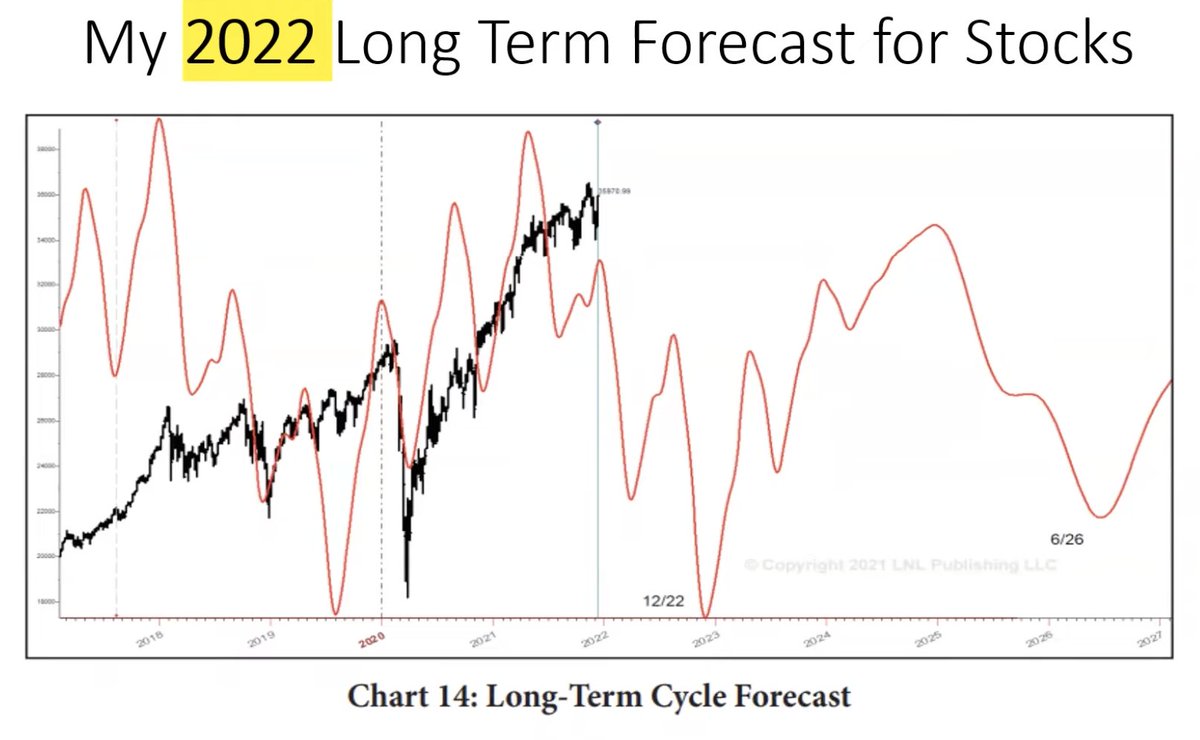
In all these years I could never understand how this [counting] approach can coexist with affirming the reality of the ever-changing cycles. Like how do you know when to trust this counting and when the cycles changed on you?
H. Humbert responds:
My understanding has been that counting is also usually rather simple and apparently (but not) naive statistics. That there's great power in simply comparing counts on a fundamental level. And yes, everything cycles, but cycles have their predictability as well so our data gathering needs to understand this. Am I wrong on this?
Peter Ringel writes:
to have a workflow for out-of-sync systems is a/the king's discipline of trading to me. Monitoring the equity curve in a naive or clever manner is probably always involved. Ever changing cycles / relations is often a function of reflexivity, IMHO. Required minimal sample size is also important here. Because of the drift, one can get away with quite a lot in equities. But laziness it is.
H. Humbert responds:
cycles have their predictability
Seems questionable as it relates to counting.
Peter Ringel replies:
cycles, as in phases/regimes, not as in 7-week cycles. Though the senator showed us many "classic" cycles too.
Larry Williams comments:
Once you count and have the numbers you may find patterns or cycles, etc.
Humbert H. asks:
But we're talking about the "ever-changing" part. How do you know when past information is no longer as predictive as it once was?
Larry Williams responds:
Great question. in my working theory of cycles all data is important for long term. for shorter term 5-10 years… but I am still a student of this stuff.
Aug
24
Meaning of “Counting”, from Asindu Drileba
August 24, 2024 | Leave a Comment

I remember an interview by Vic where he said he did a lot of "counting". Does he mean combinatorics? Or something else. What are some resources where he has talked about this "counting" in more detail?
William Huggins replies:
he literally meant count the data/do the math. at its most basic, statistics is about counting and comparing to the results we would have expected from randomness. too many people form their beliefs because they were told something, or were presented with cherry-picked "supporting" data so the chair's injunction has been to actually check before committing capital.
Zubin Al Genubi adds:
Count the number of: Private Jets, pretty girls, closed businesses, for lease signs, big market drops, increase in vix, number of down days, number of days since last high/low, volume of trades, bids, offers, crashes, all time highs, stocks at new highs/ lows, crosses of round numbers, cigarette butt length, change in price, etc etc.
Test: is number above or below mean/ median? How many standard deviations away from mean? What happened after the time of count?
Penny Brown adds more:
I'll add to the list: the price of thoroughbred horses sold at auction and the length of women's dresses. (long hem below knee is bearish as was style in 70s, short hem in mini skirts is bullish)
Asindu Drileba responds:
Thank you. "Test Everything" is definitely something that keeps coming up whenever I listen to the chair.
Humbert H. asks:
In all these years I could never understand how this approach can coexist with affirming the reality of the ever-changing cycles. Like how do you know when to trust this counting and when the cycles changed on you?
Laurence Glazier offers:
Music is the pleasure the human mind experiences from counting without being aware that it is counting.
- Gottfried Leibniz
Aug
23
Counting is one thing, statistics is another, from Carder Dimitroff
August 23, 2024 | Leave a Comment
Today, the U.S. Energy Information Administration (EIA) is counting how many power plants were added in the first half of 2024 and projecting how many will be added in the last half.
It's all wonderful news. About 20.2 GW (the equivalent of about 18 nuclear power plants) were added. By the end of the year, EIA expects about 62 GW of new capacity. About 95 percent of these additions are intermittent sources (wind, solar, batteries).
Offsetting this new capacity are retirements. Utilities plan to retire 7.6 GW, all of which use coal, natural gas, and petroleum as fuel. They are likely being retired because they are uneconomic and rarely dispatched. Their levelized costs exceed revenues, and investors want to tidy up their books.

Statistics unearth a problem that counting hides. The problem is not on the supply side; it's on the demand side. Specifically, counting 24/7 demand reveals tremendous growth (e.g., baseload). It appears there's a hidden mismatch between supply and demand. While there will be hours on most days when the grid is flooded with cheap power, there will also be hours on other days when there will not be enough supply to serve all loads.
Retail prices will jump. In fact, they already have. PJM is the Regional Transmission Organization (RTO) that manages bulk power markets for the mid-Atlantic region. It's one of the largest of the nation's ten RTOs. In addition to transmission line responsibilities, PJM manages energy and capacity auctions for power plant production.
PJM conducts an auction for capacity each year. Power plant asset owners may enter the auction and offer their prices. Owners are paid a daily rate for each megawatt if their bids clear. Auction results:
2024/2025
$28.92 / MW-day
2025/2026
$269.92 / MW-day
Next year, a 1,000 MW power plant can earn $269,920 daily compared to $28,920 this year. These payments are in addition to any revenues earned from energy auctions.
While these auctions seem arcane to the average consumer, they will feel it in their pocketbooks—and not just in one part of the country—it's everywhere. All these costs will flow to the consumer, who will have only the choice of paying or reducing consumption.
Two options may become quickly viable. One is to build gas turbines as fast as possible. To attract investors, capacity payments have to be attractive. But starting new projects today may be too late.
The other option is "demand-response," where consumers are enticed to reduce demand for a price. Demand response is in place today but has yet to be aggressively implemented. It appears grid operators like PJM (not the government) will be forced to become aggressive and offer lucrative demand-response programs.
Lastly, those who invest in "behind-the-meter" assets like their own renewable energy sources, including geothermal, will avoid some of these accelerating costs. Those who have already invested will likely experience returns higher than expected.
The roots of this problem germinated decades ago. That is its own story for another time.
Kim Zussman wonders:
XLU?
Big Al observes:
XLU up 25% from Feb low.
Jeffrey Hirsch was there before us:
Our recommendation at the outset of XLU/Utes seasonal bullish March-Oct period.
Humbert H. writes:
Nuclear is clearly the real solution as the current generation of nuclear reactors are pretty much (we hope) not vulnerable to meltdowns. But as the situation stands, battery technology is likely to receive an ever-increasing amount of investment, and also reused old EV batteries will be more and more prevalent as storage banks for solar and wind. Intermittent sources = more and more need for battery capacity.
William Huggins offers:
one possible solution to transmission problems is to use rail-bound batteries.
Aug
22
Talks on financial history, from William Huggins
August 22, 2024 | Leave a Comment
A great thanks to Henry for sharing his book Buildings Don't Lie. As a prospective homeowner, I plan to devour it upon arrival.
I don't have a proper book to share but I did author a course on financial history that I teach. To help my students, I recorded all the one-directional talks as short videos. Rather than proceeding chronologically overall, I broke things down into 11 topics (plus an intro) and did those chronologically: payments, debt, banking, central banking, companies, stock markets, derivatives, insurance, trusts and funds, pensions, government finances.
Aug
21
Creative destruction, primordial edition, from Kim Zussman
August 21, 2024 | Leave a Comment
Financial Statement Analysis with Large Language Models
Chicago Booth Research Paper
Fama-Miller Working Paper
54 Pages Posted: 21 May 2024
Alex Kim, Maximilian Muhn, Valeri V. Nikolaev
University of Chicago Booth School of Business
We investigate whether an LLM can successfully perform financial statement analysis in a way similar to a professional human analyst. We provide standardized and anonymous financial statements to GPT4 and instruct the model to analyze them to determine the direction of future earnings. Even without any narrative or industry-specific information, the LLM outperforms financial analysts in its ability to predict earnings changes. The LLM exhibits a relative advantage over human analysts in situations when the analysts tend to struggle. Furthermore, we find that the prediction accuracy of the LLM is on par with the performance of a narrowly trained state-of-the-art ML model. LLM prediction does not stem from its training memory. Instead, we find that the LLM generates useful narrative insights about a company's future performance. Lastly, our trading strategies based on GPT's predictions yield a higher Sharpe ratio and alphas than strategies based on other models. Taken together, our results suggest that LLMs may take a central role in decision-making.
Aug
18
A Spec recalls fondly
August 18, 2024 | Leave a Comment

Back in the day, Chair treated spec-listers to a night of classical music at Lincoln center, then dinner at Picholine. It was an unsurpassed evening, especially in generosity. The last course was a cheese course, and the restaurant's cheese sommelier - Max McCalman - made a short presentation about the wonderful cheeses being served.
This was Mrs and my introduction to fine/delicious cheeses, which we enjoy to this day. Max showed us his book The Cheese Plate, and immediately Chair offered free copies to all the ladies in the room and asked Max to autograph them. The Cheese Plate remains a valued book in our collection.
Here is Max and an aficionado.
Alex Castaldo adds:
Yes, I remember that dinner well! Vic took guests to the best restaurants of New York in the early 2000s (Boulud, Le Bernardin, Picholine, Four Seasons, etc.). Those were great occasions, that I will always remember. Met some knowledgeable people, including Henry Gifford, on some of those occasions. Unfortunately I also remember that I never adequately thanked Victor for his generosity. Which I regret.
Aug
17
Index of stocks nixed from indexes, from Kim Zussman
August 17, 2024 | Leave a Comment
Wall Street’s Trash Contains Buried Treasure
Investors buying index-fund castoffs could have made 74 times their money since 1991
Rebound relationships are best avoided, but maybe not in the stock market.
In a paper that starts out by stating that “no one enjoys getting dumped,” two investing quants reveal some surprising, and potentially lucrative, traits of companies that have really let themselves go. With about half of the money invested in American stocks now sitting in index funds, and many active managers holding portfolios that resemble them — just try beating the market these days without “Magnificent 7” stocks such as Nvidia or Microsoft — index castoffs have a hard time meeting someone new.
That is when investors should pounce, says Rob Arnott, chairman of advisory firm Research Affiliates, with colleague Forrest Henslee. This week they are unveiling a stock index named NIXT that would have earned investors about 74 times their money since 1991 by buying stocks kicked out of indexes.
Big Al links:
The Disappearing Index Effect
Robin Greenwood & Marco Sammon, Harvard Business School
Revised, November 2023
The abnormal return associated with a stock being added to the S&P 500 has fallen from an average of 7.4% in the 1990s to 0.3% over the past decade. This has occurred despite a significant increase in the share of stock market assets linked to the index. A similar pattern has occurred for index deletions, with large negative abnormal returns during the 1990s, but only 0.1% between 2010 and 2020. We investigate the drivers of this surprising phenomenon and discuss implications for market efficiency. Finally, we document a similar decline in the index effect among other families of indices.
Aug
16
Smart guy talks about AI, from Big Al
August 16, 2024 | Leave a Comment
The Potential for AI in Science and Mathematics - Terence Tao
Terry Tao is one of the world's leading mathematicians and winner of many awards including the Fields Medal. He is Professor of Mathematics at the University of California, Los Angeles (UCLA). Following his talk, Terry is in conversation with fellow mathematician Po-Shen Loh.
Po-Shen Loh is an American mathematician specializing in combinatorics. Loh teaches at Carnegie Mellon University, and formerly served as the national coach of the United States' International Mathematical Olympiad team. He is the founder of educational websites Expii and Live, and lead developer of contact-tracing app NOVID.
Aug
14
Observations
August 14, 2024 | Leave a Comment
one listens to the radio broadcast of the yankees game. about 60% of time is devoted to advertisement. about 95% of these ads are dei. why?
amazing jump for regulatory capture of 35 percentage in just 3 weeks.
Aug
13
Diffusion of Innovations
August 13, 2024 | Leave a Comment

diffusion of information has been applied to everything (soon AI ) but not to change in relations of markets. a good book.
Diffusion of Innovations, 5th Edition Paperback – Illustrated, August 16, 2003, by Everett M. Rogers
In this renowned book, Everett M. Rogers, professor and chair of the Department of Communication & Journalism at the University of New Mexico, explains how new ideas spread via communication channels over time. Such innovations are initially perceived as uncertain and even risky. To overcome this uncertainty, most people seek out others like themselves who have already adopted the new idea. Thus the diffusion process consists of a few individuals who first adopt an innovation, then spread the word among their circle of acquaintances—a process which typically takes months or years. But there are exceptions: use of the Internet in the 1990s, for example, may have spread more rapidly than any other innovation in the history of humankind. Furthermore, the Internet is changing the very nature of diffusion by decreasing the importance of physical distance between people. The fifth edition addresses the spread of the Internet, and how it has transformed the way human beings communicate and adopt new ideas.
Aug
12
Texas Data Centers, from Carder Dimitroff
August 12, 2024 | Leave a Comment
This is not going to end well:
59 GW in data center load seeking to connect to Oncor’s system: CEO
Nearly three-fourths of new interconnection requests are coming from data centers, Oncor officials said.
FWIW:
59 GW ˜ 50 nuclear power plants.
80 GW ˜ 65 nuclear power plants.
1 new nuclear plant - about 15 years to build one.
Conclusion:
If these loads connect to the grid as planned, expect sizeable investments in natural gas and combined-cycle gas turbines. Turbines may share the same real estate as data centers and avoid utility costs.
I expect to see development near the Texas Waha hub (Waha prices tend to be lower than Henry Hub), or if not on or near Waha, on a pipeline connected to Waha.
CCGT strategies may work in the short term. However, history suggests they could be financially problematic for turbine owners in the long term.
Humbert H. writes:
Next gen data centers are expected to have about 18% lower in overall energy consumption. Next gen would mean it is likely happening in a couple of years. It doesn't quite move the needle in the percentage sense. But every bit helps. Let me quote what Wayne Gretzky once said, "Focus on where the puck will be at, not where the puck is at."
Aug
11
From the archives: Vic reviews Trees: Their Natural History, by Peter Thomas
August 11, 2024 | Leave a Comment

22-Aug-2006
Almost every page of the book Trees: Their Natural History teaches one new things about the workings and adaptations of trees, and I find these lessons of great value in improving my understanding of the markets.
The chapter on the shape of trees starts with the idea that one of the objectives of a tree is to raise its leaves above a competitor's, so that it can get the greatest possible share of light. It makes its shape based on a compromise between this and its other needs; its ability to pollinate and disperse its seeds, how much trunk it needs to support itself against wind, snow, and moisture, the conditions of the soil, the threat of fire and insect pests. All of the compromises vary with age.
One thing learned is that trees found at a high latitude and altitude are cone shaped with short downward sloping branches, and that the broad crowns of most hardwoods are associated with moist sites, deep shade, or harsh tree line conditions. In Britain there is a moist environment so most of the trees take on spherical shape.
Pines further south develop a flat topped umbrella shape which helps resist drying winds and maximizes convective heat loss by allowing free passage through the canopy.
The tree is an expert in shifting its center of gravity so as to minimize stress on any part of its structure. The principle it uses is to minimize lever arms. This means making the weight that any branch carries away from a fulcrum as small as possible, reducing the possibility of breakage. This principle keeps the horizontal length of a branch as small as possible, always subject to the compromise that the further a branch is extended outwards, often the more light it can get.
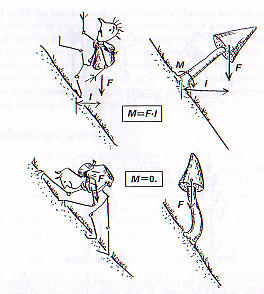
What the tree does is to bend its branches upright, so that the lever arms are not pulling the tree sideway. This applies not only to branches, but to the leaning of trees towards the sun. A beautiful set of diagrams illustrate the similarity of the adaptations that the tree makes to maintain a center of gravity to the adaptations a human makes to maintain their center of gravity. Trees use their terminal buds to build modules that change their shape, while humans use the brain to decide to change our center of gravity, for example when we bend forward whilst we are climbing up a hill.
Sample market hypotheses generated by this way of thinking are: The horizontal moves of markets would seem to be the reversals that they take from a given center of gravity. The more that they reverse to one side from a central point, perhaps a round number, the more likely that structures and activity will grow on the other side to minimize the stress. Eventually, conditions of light (competition) cause the market or a stock to move.
Alternatively, the greater the rate of ascent or descent, the more likely a market or stock is to show movement in a opposite direction to bring its center of gravity to a more stable level.
J.T. Holley responds:
Something that I have dealt with recently is the feeding of dying trees to resuscitate or bring them back to life. 'Spiking' trees with silly fertilizer spikes works well with the smaller trees, but you need bigger guns when you have the limbs leaning downward towards the ground. In parks and high traffic areas this is a huge hazard, the tree will seem to shed the limb to relieve the stress that Vic has mentioned above.
The only thing I learned regarding saving a tree is to take an auger, pipe, or some large metal rod and drive it into the ground. Rotate this until you have a two to three foot deep hole and pull it out. Fill this two thirds full of 10-10-10 and cover the rest with dirt and put your grass back over. These holes must be done around the 'drip zone' coming off the base of the trunk just inside the 'splash zone' from the outermost limbs.
I too believe, and should test, that the markets use these round numbers or spots to relieve their stress. These spots of light and competition allow it to be able to gain strength in times of weakness (sell off) to gain the nutrients to move higher and become stronger than before! Its like testing and finding Trend followers spots where they utilize "reversing stops" with their "fixed system". The Drip Zone is where the fertilizer is planted to pick 'em off and gain the edge.
Aug
10
Grip strength, chair rise-time, one-legged balance predict life expectancy, Kim Zussman
August 10, 2024 | Leave a Comment
Physical capability in mid-life and survival over 13 years of follow-up: British birth cohort study
Grip strength was measured isometrically with an electronic handgrip dynamometer. The dynamometers were calibrated at the start of testing by using a back-loading rig and are accurate, linear, and stable to within 0.5 kg. The retest variability within individual participants for maximal voluntary tests of strength in those unused to such measurements is about 9%. Two values were recorded for each hand and the highest used in analyses. Chair rise time was measured with a stopwatch as the time taken to rise from a sitting to a standing position with straight back and legs and then to sit down again 10 complete times as fast as possible. For high scores to indicate good performance, we calculated chair rise speed by dividing the number of rises (that is, 10) by the time taken to complete 10 rises (in minutes). Standing balance time was measured, using a stopwatch, as the longest time, up to a maximum of 30 seconds, participants could maintain a one-legged stance in a standard position with their eyes closed.
Big Al lists:
I've been doing balance exercises with a stopwatch, but mostly eyes-open. With eyes closed, I've only gotten up to 12 seconds.

Humbert H. comments:
It seems the article deliberately stayed away from remedies. It noted that certain things (most of which I have seen before in similar contexts, so this isn't entirely new) are associated with increased mortality. Exercise is universally recognized as positive, but there wasn't even a hint that doing anything specific about any of the indicators reduces mortality. Causation and what to do about any of these need a lot more research, it seems.
Big Al responds:
Yes. Causation arrow pointing one way: Eyes-closed balance measures some more complex internal state of health that predicts longevity. Flip the arrow: I practice balance exercises to improve my balance and thus reduce the chance of falling which is a major cause of hospitalization and death in older cohorts.
Humbert H. agrees:
Excellent point, that can be generalized as follows: when you don't understand the root cause of the problem, limiting its negative effects is always the right strategy.
James Goldcamp writes:
The eyes closed one leg stand is exceptionally hard.
I used to measure grip strength and own a hand dynameter. I found grip strength could vary/range as much 145 lbs to 177 lbs in the same month based on rest and recovery state.
Since these are all basically a function of power and strength (standing up and rate), and neurological efficiency (grip/ balance) unilateral leg strengthening (e.g. pistols to a chair of suitable height) and carrying objects (walk around room it yard with a dumbbell or kettlebell within ones level of strength) would be the obvious activities. Another challenge as we age is doing any resistance activity for power (vs strength)since the obvious choices carry injury risk (sprinting, box jumping, Olympic lifts, med ball throwing).
However, I believe its less a matter of training to these qualities than these measurements select for people who have maintained power/strength generally (strength trumps muscle for longevity though they obviously overlap).and are thus less susceptible to falls and things like hip fractures that cascade people downwards. It would be interesting to know how much of the longevity is predicated on fall reduction and or recovery after.
Aug
9
To be silent the whole day long, see no newspaper, hear no radio, listen to no gossip, be thoroughly and completely lazy, thoroughly and completely indifferent to the fate of the world is the finest medicine a man can give himself.
- Henry Miller
Nils Poertner responds:
Excellent. Media is like Queen Mab and we are Merlin - and Merlin had to learn to not care too much about Queen Mab…
Aug
8
More on life advice, from James Goldcamp
August 8, 2024 | Leave a Comment

I'd add that, in business and socially, don't "hang around" too long past appropriate. If you get the response you are seeking in a meeting, proposal, or discussion be courteous and respectful and get out of there. This is where Costanza had it right (his practice of leaving a meeting on a high note after a good joke). I found this to be a commercially, socially, and romantically valid concept.
Nils Poertner offers:
some may like the list that Gurdjieff gave to his daughter. (a number of overlaps)
Sushil Rungta writes:
I am quite mortified as I post this message but in the spirit of camaraderie posting it even though, in doing so, I am indulging in a little self promotion (totally unintended). I frequently write to my children sharing my experiences and what life has taught me. A very few of these I also publish on LinkedIn and Medium.com. Providing a link to two of these letters:
Hope you like them and please do excuse me for this immodesty.
Aug
7
To Aubrey on Leaving for College, from Laurel Kenner
August 7, 2024 | Leave a Comment

Essentials
See what you look at. Listen to what you hear. Feel what you feel.
Finding a way to use heart, hand, and mind together leads to joy.
Treat yourself as you would a dear friend.
Don’t lie. Lying tangles up your heart and mind. Lies require more lies, sapping energy.
Much of what is considered normal is wrong or worse.
Turn away from cynicism, intoxication, and callousness.
Read Xenophon’s account of Cyrus to learn about leadership. Read Seneca and Publius to learn how to retain your composure and virtue through Fortune’s ups and downs.
Be trustworthy.
Keep a good reputation.
Don’t talk trash about others behind their backs. That sort of talk has a way of flying like a bird back to the target and can turn people into enemies. Talking trash also makes your companions wonder what you say about them when they’re not around.
Genial curiosity can sometimes defuse bad situations.
Bad behavior is often about them, not you.
Deportment
Good manners reveal strength.
Respecting others as human beings is the essence of good manners. You don’t have to overthink it; good manners are often about little things, such as:
Get to appointments early.
Open doors for people with crutches and watch out for their feet.
Open doors for women and mothers with baby carriages.
If a woman joins you at a table where no seat is empty, give her yours. Pull the seat out for her and help her settle in.
Do not swear. It makes you seem churlish.
Don’t comment on the appearance of others. The exceptions: Tell your wife she looks lovely and tell a friend if his fly is open.
Do not make fun of what another person eats, drinks, or thinks.
Invest in comfortable, well-made clothes. Cheap clothes waste money because they don’t last, and they make people wonder if you will be as careless with them as you are with your own appearance.
Women
As you know, one of your most important roles is to protect women.
Women are vulnerable to falling in love too quickly, because they instinctively want a family. That's true of all women.
Sexually liberated women do not exist. Recognize that women who think they can act like men are prey in a harmful culture. You must protect them.
At Home
Wash sheets and pillowcases weekly.
Light and fresh air are healthy. Keep the windows in your room open if possible.
Follow the one-touch rule: Put things in their places. Put dirty clothes in the hamper. Put dishes in the dishwasher. Throw out papers you don’t need.
An orderly house helps keep life happy and productive.
Gratitude
Gratitude creates happiness. Write down five things you’re grateful for in a notebook every day.
Adulthood
What does it mean to become an adult? In a word: responsibility. Paying rent. Creating and protecting your family. Planning ahead. Making a career. Fulfilling your obligations. Making money. Contributing to freedom, community, earth.
On a higher level, adulthood is the ability to consider two opposing concepts. Adults can deal with ambiguity and subtlety.
Many wise sayings have converses that are equally wise and true. For example, perseverance and endurance are virtues; but the adage “survival is mobility” saved many Jews from the Nazi death camps.
In our modern world, “survival is adaptability” may be more apt. You must become adaptable without losing your soul.
Farewell
With all my love, I send you out into the world, an eagle destined to soar among mountain peaks. Be strong. Don’t forget to call.
-Mom
Vic adds:
beautiful advice - reach out to learn new things and be good to friends. don't be too trusting.
Sushil Rungta writes:
Wonderful lessons. While I loved all, the lessons on respecting others resonate with me the most. How often we behave callously towards others! Sometimes, unintentionally. Here, practicing mindfulness really helps.
Aug
6
List for a well-lived life, from Jeff Watson
August 6, 2024 | Leave a Comment

Since I have become my grandson’s teacher (and playmate), I’ve been compiling advice lists. Wish someone had shared this with me.
1. Don’t call someone more than twice continuously. If they don’t pick up your call, presume they have something important to attend to.
2. Return money that you have borrowed even before the person who loaned it to you remembers or asks for it. It shows your integrity and character. The same goes for umbrellas, pens, and lunch boxes.
3. Never order the expensive dish on the menu when someone is treating you to lunch or dinner.
4. Don’t ask awkward questions like ‘Oh, so you aren’t married yet?’ Or ‘Don’t you have kids?’ Or ‘Why haven't you bought a house?’ Or ‘Why haven't you bought a car?’ For God’s sake, it isn’t your problem.
5. Always open the door for the person coming behind you. It doesn’t matter if it is a guy or a girl, senior or junior. You don’t grow small by treating someone well in public.
6. If you take a taxi with a friend and he/she pays now, try paying next time.
7. Respect different shades of opinions. Remember, what may seem like 6 to you might appear as 9 to someone else. Besides, a second opinion is good for an alternative.
8. Never interrupt people while they are talking. Allow them to pour it out. As they say, hear them all and filter them all.
9. If you tease someone, and they don’t seem to enjoy it, stop it and never do it again. It encourages one to do more and shows how appreciative you are.
10. Say “thank you” when someone is helping you.
11. Praise publicly. Criticize privately.
12. There’s almost never a reason to comment on someone’s weight. Just say, “You look fantastic.” If they want to talk about losing weight, they will.
13. When someone shows you a photo on their phone, don’t swipe left or right. You never know what’s next.
14. If a colleague tells you they have a doctor's appointment, don’t ask what it’s for. Just say, "I hope you’re okay." Don’t put them in the uncomfortable position of having to tell you their personal illness. If they want you to know, they'll do so without your inquisitiveness.
15. Treat the cleaner with the same respect as the CEO. Nobody is impressed by how rudely you treat someone below you, but people will notice if you treat them with respect.
16. If a person is speaking directly to you, staring at your phone is rude.
17. Never give advice until you’re asked.
18. When meeting someone after a long time, unless they want to talk about it, don’t ask them their age or salary.
19. Mind your business unless anything involves you directly - just stay out of it.
20. Remove your sunglasses if you are talking to anyone in the street. It is a sign of respect. Moreover, eye contact is as important as your speech.
21. Never talk about your riches in the midst of the poor. Similarly, don't talk about your children in the midst of the barren.
22. After reading a good message, consider saying, "Thanks for the message."
APPRECIATION remains the easiest way of getting what you don't have.
Aug
5
How bacteria use the Kelly criterion, from Asindu Drileba
August 5, 2024 | Leave a Comment
From Cellular bet-hedging:
Today, we seek to gain some insight into how bacteria bet hedge. We will imagine that we are designing the stress response system for a custom, designer super-bacterium. Our goal is to maximize its survival and proliferation. To help it out, we provide it with an array of sensors, information processing circuits, and responses—exactly the sorts of circuits we have been studying.

A poor little bacterium doesn’t stand a chance of accurately predicting future temperature, salt, toxins, antibiotics, and attacking immune cells all by itself. Instead, it uses a form of biological bet hedging, in which the shared genome of a clonal cell population effectively spreads its bets, in the form of individual cells, across multiple physiological states, each adapted to a different possible future.
It is part of a larger course called Biological Circuit Design. I really don't like reading maths as I don't understand most of it. But fortunately, this course also has Python implementations for a lot of the concepts they outline.
Big Al adds:
You might also call this a good example of portfolio diversification.
The portfolio concept in ecology and evolution
Biological systems have similarities to efficient financial portfolios; the emergent properties of aggregate systems are often less volatile than their components. These portfolio effects derive from statistical averaging across the dynamics of system components, which often correlate weakly or negatively with each other through time and space. The “portfolio” concept when applied to ecological research provides important insights into how ecosystems are organized, how species interact, and how evolutionary strategies develop. It also helps identify appropriate scales for developing robust management and conservation schemes, and offers an approach that does not rely on prescriptive predictions about threats in an uncertain future. Rather, it presents a framework for managing risk from inevitable perturbations, many of which we will not be able to understand or anticipate.
Aug
4

Book Review from Victor Niederhoffer: 'An Illustrated Guide to Theoretical Ecology'
(02 October, 2006)
Every now and then one comes across a book that completely clarifies what every educated person should know about a subject that is essential to understand as we go about the humdrum business of life and trading. Such a book is An Illustrated Guide to Theoretical Ecology, by Ted J. Case. I cannot recommend this book too highly, as it provides a foundation for thinking about competition, mutualism, growth, resource depletion, diffusion, population density, predation, life cycles and space. The book introduces the basic principles behind each of these subjects with simple algebraic equations and illustrative charts that describe various plausible relations. It then follows through with analytic solutions to develop a deep understanding.
Aug
3
European vs American Power Markets, LNG, and Natural Gas, from Carder Dimitroff
August 3, 2024 | Leave a Comment
Europe (decreasing use of natural gas)
It appears Europe needs less natural gas and will import lower volumes of LNG. As a whole, their gas-fired and thermal power plants are experiencing lower capacity factors. Several factors contribute to the decline.

One factor is the French nuclear power plant fleet, which has been experiencing higher capacity factors and lower production costs. Another is the EU's wind, solar, and energy storage assets, which have low production costs. Other factors include the EU's weaker economy and milder winters.
- Gavin Maguire, Reuters, 6 February 2024
- Sarah Brown, Dave Jones, EMBER, 7 February 2024
- Seb Kennedy, EnergyFlux.News, 1 August 2024
- European Network of Transmission System Operators for Electricity (ENTSO-E)
United States (increasing use of natural gas)
U.S. power plant operators generated 6.9 million MWh of electricity from natural gas on a daily basis in the lower 48 states on July 9, 2024, the U.S. Energy Energy Information Administration (EIA) said, which is “probably” the most in history, and definitely the most since at least January 1, 2019, when the EIA began to collect hourly data about natural gas generation.
The spike in natural gas-fired generation on July 9 was because of both high temperatures across most of the country and a steep drop in wind generation. According to the National Weather Service, most of the U.S. experienced temperatures well above average on July 9, 2024., with particularly high temperatures on the West Coast and East Coast.
- Sean Wolfe, Power Engineering, 25 July 2024
With July heatwaves, US ‘probably’ saw highest natural gas generation in history, EIA says
Differences
Several factors may explain why the United States is consuming more natural gas than Europe. One factor is price. Wholesale natural gas prices in the United States are much lower than in Europe.
Air conditioning is an important factor. Air conditioning is widespread in the United States but not so much in Europe. Air conditioners consume large amounts of electric power, and they are the key asset targeted by utility demand-response programs.
A related factor is that the United States has two energy-consuming peaks (summer and winter), while Europe's major peak is in the winter. With lower bulk pricing for natural gas, bulk power prices are also low, and incentives to conserve energy are muted.
Finally, the United States economy is outperforming Europe.
There's India:
- John Kemp (Reuters), India electricity generation - Selected indicators, 31 July 2024
Aug
2
Incentives
August 2, 2024 | Leave a Comment
the CEA test has a positive predictivity of 80% for colon cancer. most studies show it doesn't have a cost effectiveness. How accurate is a CEA blood test?
Doctors don't use the CEA test to make a first-time diagnosis of cancer. This test isn't an accurate way to screen for it because many other diseases can cause the levels of this protein to rise. And some people with cancer don't have high CEA levels.
but but but… the studies don't take account of the incentives and the next steps taken / it has positive predictivity of 80%. who wouldn't take the next step after a positive (CEA above 3.5)? I am not an MD. none of my kids and good friends who are MD's recommend it.
Aug
1
AI wins silver, from Kim Zussman
August 1, 2024 | Leave a Comment

Google DeepMind’s new AI systems can now solve complex math problems
AlphaProof and AlphaGeometry 2 are steps toward building systems that can reason, which could unlock exciting new capabilities.
Google DeepMind says it has trained two specialized AI systems to solve complex math problems involving advanced reasoning. The systems—called AlphaProof and AlphaGeometry 2—worked together to successfully solve four out of six problems from this year’s International Mathematical Olympiad (IMO), a prestigious competition for high school students. They won the equivalent of a silver medal.
To test the systems’ capabilities, Google DeepMind researchers tasked them with solving the six problems given to humans competing in this year’s IMO and proving that the answers were correct. AlphaProof solved two algebra problems and one number theory problem, one of which was the competition’s hardest. AlphaGeometry 2 successfully solved a geometry question, but two questions on combinatorics (an area of math focused on counting and arranging objects) were left unsolved.
Download the 2024 International Mathematical Olympiad problems
Jul
31
A comparison
July 31, 2024 | Leave a Comment
Deep Enough, a beautiful heroic book about the same subject as a hateful book, Angle of Repose. one won the Pulitzer Prize, the other is hardly known but highly recommended by me.
Jul
30
Intermittent fasting and your noodle, from Kim Zussman
July 30, 2024 | 1 Comment
Two Diets Linked to Improved Cognition, Slowed Brain Aging
An intermittent fasting (IF) diet and a standard healthy living (HL) diet focused on healthy foods both lead to weight loss, reduced insulin resistance (IR), and slowed brain aging in older overweight adults with IR, new research showed. However, neither diet has an effect on Alzheimer's disease (AD) biomarkers.
Although investigators found both diets were beneficial, some outcomes were more robust with the IF diet.
Larry Williams adds:
A “dry” fast loses weight more than wet fast.
Big Al writes:
Sergei's AI says:
The main difference between dry fasting and wet fasting, also known as water fasting, is whether you consume liquids:
Dry fasting: Restricts both food and liquids, including water, broth, and tea. It can be done as part of intermittent fasting, which cycles between eating and fasting. For example, you might restrict food for 16 hours and eat during an 8-hour window. Wet fasting: Allows you to drink water, and sometimes certain teas.
Dry fasting can be dangerous, especially for long periods of time. Some potential side effects include: Dehydration, Nutrient deficiencies, Urinary problems, Kidney issues, Heat injury, and Swollen or ruptured cells.
Jul
29
Federer…on trading?
July 29, 2024 | Leave a Comment
In the 1,526 singles matches I played in my career, I won almost 80% of those matches. What percentage of the POINTS do you think I won in those matches? Only 54%.
When you’re playing a point, it is the most important thing in the world. But when it’s behind you, it’s behind you. This mindset is really crucial, because it frees you to fully commit to the next point… and the next one after that… with intensity, clarity and focus.
The truth is, whatever game you play in life… sometimes you’re going to lose. A point, a match, a season, a job… it’s a roller coaster, with many ups and downs.
[ H/t to Ritholtz ]
Jul
28
Inflection points, from Zubin Al Genubi
July 28, 2024 | Leave a Comment

Inflection points at prior highs and lows seem pretty obvious recently especially in lowered liquidity. The market makers seem to thin and spread their markets for protection resulting in bigger directional moves. The vol gives a small trader good opportunity as the big boys dump large orders creating large auto trade moves like escalators.
Anatoly Veltman wants more information:
every word I read on three lines of text appears totally (?) random. It would be extremely impressive, if you ventured to explain at least ONE of these, and how this could be used as edge. P.S. Bonus would be to know the approximate date (?) of "lowered liquidity"
William Huggins responds:
It's not random, it's about microstructure. MMs spread their risk as they usually get caught out by information driven moves while they supply liquidity. When they spread their capital to diversify, or withdraw from choppy markets, the price impact of trading rises (Kyle's lambda).
Steve Ellison comments:
My takeaway from Zubin's post is that there are edges to be found in studying market microstructure and looking for clues in price action of what some of the key players are doing. A specific example I have found is, if you bin trading days by number of days before or after options expiration, options expiration day has had the worst total return in the S&P 500 of any day of the month in the past 6 years or so. Apparently the need for a large number of market players to adjust and re-establish hedges can create imbalances in supply and demand of various assets.
I could form a hypothesis about liquidity that a sustained price move in one direction, as happened a couple of times to the downside in the S&P 500 since July 17, is toxic for market makers and forces them to widen their spreads lest they be saddled with unwanted inventory. I'll leave it as an exercise for the reader to test this hypothesis.
Jul
27

Here's a performance of a one-movement sonata for flute and piano I wrote a few years ago.
Traditionally, sonatas were three or four movements. My goal here was to respect that structure, but to do so in a highly compressed format. The piece is built around a recurring pattern (an ostinato) that the flute first "discovers" before it lands in the bass of the piano. The middle section begins with a nod to a more primitive, primal flute. Again, a pattern is discovered that is worked and reworked in counterpoint between the instruments. This little sonata is a pretty solid reflection of my musical aesthetic: I'm striving for a whole that makes sense, but also exploring some extremes.
What I think might be interesting to the group is that some elements of this piece were generated from financial market data. (Think of a GARCH-type process.) Aspects of volatility were allowed to dictate some elements of harmonic density and texture in the piece. I bent this to my overall musical concept as opposed to leaving it bare. (I don't find much engaging in process-driven compositions… they are far more interesting to write and maybe to talk about then to hear, in most cases.)
Sushil Rungta appreciates:
Very much enjoyed it. It was marvelous. Thanks for sharing.
Peter Ringel responds:
Beautiful. TY Adam.
some elements of this piece were generated from financial market data. (Think of a GARCH-type process.)
This seems brilliant. I have no doubt that volatility is deeply human. Sadly, my ear is too poorly trained to understand your translation of this into composition.
Somewhat related: I use order-flow audible sounds during my day-trading. Like the old guys used floor noise. There is a non-regular rhythm to it. For me it is so ingrained now, I feel naked without it. It also helps with not needing to stare at the screen all the time. The Mkt- music will alert me if necessary.
[ Lagniappe: Sonata, pl. sonate; from Latin and Italian: sonare [archaic Italian; replaced in the modern language by suonare], "to sound"), in music, literally means a piece played as opposed to a cantata (Latin and Italian cantare, "to sing"), a piece sung. -Ed ]
« go back — keep looking »Archives
- October 2026
- September 2026
- August 2026
- July 2026
- June 2026
- May 2026
- April 2026
- March 2026
- February 2026
- January 2026
- December 2025
- November 2025
- October 2025
- September 2025
- August 2025
- July 2025
- June 2025
- May 2025
- April 2025
- March 2025
- February 2025
- January 2025
- December 2024
- November 2024
- October 2024
- September 2024
- August 2024
- July 2024
- June 2024
- May 2024
- April 2024
- March 2024
- February 2024
- January 2024
- December 2023
- November 2023
- October 2023
- September 2023
- August 2023
- July 2023
- June 2023
- May 2023
- April 2023
- March 2023
- February 2023
- January 2023
- December 2022
- November 2022
- October 2022
- September 2022
- August 2022
- July 2022
- June 2022
- May 2022
- April 2022
- March 2022
- February 2022
- January 2022
- December 2021
- November 2021
- October 2021
- September 2021
- August 2021
- July 2021
- June 2021
- May 2021
- April 2021
- March 2021
- February 2021
- January 2021
- December 2020
- November 2020
- October 2020
- September 2020
- August 2020
- July 2020
- June 2020
- May 2020
- April 2020
- March 2020
- February 2020
- January 2020
- December 2019
- November 2019
- October 2019
- September 2019
- August 2019
- July 2019
- June 2019
- May 2019
- April 2019
- March 2019
- February 2019
- January 2019
- December 2018
- November 2018
- October 2018
- September 2018
- August 2018
- July 2018
- June 2018
- May 2018
- April 2018
- March 2018
- February 2018
- January 2018
- December 2017
- November 2017
- October 2017
- September 2017
- August 2017
- July 2017
- June 2017
- May 2017
- April 2017
- March 2017
- February 2017
- January 2017
- December 2016
- November 2016
- October 2016
- September 2016
- August 2016
- July 2016
- June 2016
- May 2016
- April 2016
- March 2016
- February 2016
- January 2016
- December 2015
- November 2015
- October 2015
- September 2015
- August 2015
- July 2015
- June 2015
- May 2015
- April 2015
- March 2015
- February 2015
- January 2015
- December 2014
- November 2014
- October 2014
- September 2014
- August 2014
- July 2014
- June 2014
- May 2014
- April 2014
- March 2014
- February 2014
- January 2014
- December 2013
- November 2013
- October 2013
- September 2013
- August 2013
- July 2013
- June 2013
- May 2013
- April 2013
- March 2013
- February 2013
- January 2013
- December 2012
- November 2012
- October 2012
- September 2012
- August 2012
- July 2012
- June 2012
- May 2012
- April 2012
- March 2012
- February 2012
- January 2012
- December 2011
- November 2011
- October 2011
- September 2011
- August 2011
- July 2011
- June 2011
- May 2011
- April 2011
- March 2011
- February 2011
- January 2011
- December 2010
- November 2010
- October 2010
- September 2010
- August 2010
- July 2010
- June 2010
- May 2010
- April 2010
- March 2010
- February 2010
- January 2010
- December 2009
- November 2009
- October 2009
- September 2009
- August 2009
- July 2009
- June 2009
- May 2009
- April 2009
- March 2009
- February 2009
- January 2009
- December 2008
- November 2008
- October 2008
- September 2008
- August 2008
- July 2008
- June 2008
- May 2008
- April 2008
- March 2008
- February 2008
- January 2008
- December 2007
- November 2007
- October 2007
- September 2007
- August 2007
- July 2007
- June 2007
- May 2007
- April 2007
- March 2007
- February 2007
- January 2007
- December 2006
- November 2006
- October 2006
- September 2006
- August 2006
- Older Archives
Resources & Links
- The Letters Prize
- Pre-2007 Victor Niederhoffer Posts
- Vic’s NYC Junto
- Reading List
- Programming in 60 Seconds
- The Objectivist Center
- Foundation for Economic Education
- Tigerchess
- Dick Sears' G.T. Index
- Pre-2007 Daily Speculations
- Laurel & Vics' Worldly Investor Articles
