Apr
5
 Does not the cascading avalanche of negative publicity about the wrongness of the sage's mojo prove my point that "if you put a beggar on horseback he will gallop"? What is the classical story behind that?
Pitt T. Maner III responds:
The expression is said to be Irish in origin but its first appearance in literature as quoted by Chair appears to be in "The Anatomy of Melancholy" by Robert Burton. (Part 2 Section 3 Member 2). The Latin quote from Tully or Cicero that Burton quotes below means "Nothing is more annoying than a low man raised to high position".
"A beggers brat will be commonly more scornful, imperious, insulting, insolent, then another man of his rank: nothing so intolerable as a fortunate fool, as c Tully found long since out of his experience. Asperius nihil est humili, cum surgit in altum: set a begger on horseback, and he will ride a gallop, a gallop, &c. ……………… he forgets what he was, domineers, &c and many such other symptomes he hath, by which you may know him from a true gentleman."
(page 20).
The classical reference might be to Bellerophon and Pegasus:
Bellerophon felt that because of his victory over the Chimera he deserved to fly to Mount Olympus, the realm of the gods. However, this presumption angered Zeus and he sent a gad-fly to sting the horse causing Bellerophon to fall all the way back to Earth. Pegasus completed the flight to Olympus where Zeus used him as a pack horse for his thunderbolts.[21] On the Plain of Aleion ("Wandering"), Bellerophon, who had fallen into a thorn bush, lived out his life in misery as a blinded cripple, grieving and shunning the haunts of men.
Apr
5
Kids Books on Entrepreneurship, from Chris Tucker
April 5, 2011 | 3 Comments
 I know that there have been posts not long ago on great books for kids regarding business. My seven year old son has been showing a keen interest in the idea of business and particularly in entrepreneurship. I was wondering if readers of this site might share the names of books or other resources that might assist me in fostering this in his development. The kid wants to make money!
Mark Schuetz writes:
Hate to bring up a touchy subject, but I think it would be fun for kids to read about Buffett starting out. Definitely an interesting story about how he went from a paper route, to repairing pinball machines, to buying and renting a house, and so on, and SAVED money the whole time instead of spending it. It doesn't even have to be Buffett– maybe a kid could relate more to reading about famous businesspeople/investors when they were young and how they developed even at a very young age. It could inspire kids to think about more current ideas for themselves (very few will be interested in repairing pinball machines).
An editor writes:
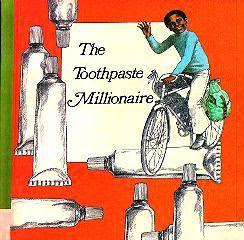
When I was a kid I really enjoyed the book The Toothpaste Millionaire about a 6th grader who starts a business selling toothpaste and becomes very successful.
Victor Niederhoffer recommends:
Self Help by Samuel Smiles, The Incredible Bread Machine, The Little Red Hen, Letters from a Self Made Merchant to his Son, by Lorimer.
John Floyd adds:
Toothpaste Millionaire
The Girl Who Owned a City.
Gibbons Burke adds:
This is an oldie but a goodie: The Richest Man in Babylon by George S. Clason. Many meals for a lifetime in this book.
Another good one for personal development skills helpful in business is Og Mandino's The Greatest Salesman in the World.
Apr
5
Hero of the Day, from Victor Niederhoffer
April 5, 2011 | 1 Comment
 Burton Fulsom in his book The Myth of the Robber Barrons shows that many of the great industrialists of the 19th century, the ones that didn't get government help like Harriman and Fulton, but the independent productive geniuses like James Hill, Cornelius Vaderbilt, The Mellons (My friend Dan Grossman wrote a great review of the recent Mellon bio), and the Scrantons and the Rockefellers were great men who opened up new vistas of consumer benefit and weath.
It totally disproves the myth that has the world in its grip, and things like the Palindrome who calls them crook capitalists. We know who the crook capiatalists are today, and they're not the men like Steve Jobs, and many others.
Who else would you nominate as the opposite of the cronies? Let us come up with some good ones in honor of Rocky's Humbert's request for us to honor the creation of value.
Alston Mabry writes:
Deng Xiaoping and John Doerr.
Also here is something interesting from the original foreword to The Robber Barons, by Matthew Josephson, first published in 1934:
When the group of men who form the subject of this history arrived upon the scene, the United States was a mercantile-agrarian democracy. When they departed or retired from active life, it was something else: a unified industrial society, the effective economic, control of which was lodged in the hands of a hierarchy. In short, these men more or less knowingly played the leading rôles in an age of industrial revolution. Even their quarrels, intrigues and misadventures (too often treated as merely diverting or picturesque) are part of the mechanism of our history. Under their hands the renovation of our economic life proceeded relentlessly: large-scale production replaced the scattered, decentralized mode of production; industrial enterprises became more concentrated, more "efficient" technically, and essentially "coöperative," where they had been purely individualistic and lamentably wasteful. But all this revolutionizing effort is branded with the motive of private gain on the part of the new captains of industry. To organize and exploit the resources of a nation upon a gigantic scale, to regiment its farmers and workers into harmonious corps of producers, and to do this only in the name of an uncontrolled appetite for private profit — here surely is the great inherent contradiction whence so much disaster, outrage and misery has flowed.
…and from the Foreword to the 1962 edition:
In the crisis years of the 1930s economic intervention by the Federal Government was employed on an unprecedented scale, not only in the interests of human welfare, but also to regulate and control the masters of capital who, by their excesses and bad leadership, had helped to bring about the debacle of 1929-1933. At that period a critical literature also arose (of which the present work may perhaps be taken as an example), providing background material to the men of the New Deal.
Of late years, however, a group of academic historians have constituted themselves what may be called a revisionist school, which reacts against the critical spirit of the 1930s. They reject the idea that our nineteenth-century barons-of-the-bags may have been inspired by the same motives animating the ancient barons-of-the-crags—who, by force of arms, instead of corporate combinations, monopolized strategic valley roads or mountain passes through which commerce flowed. To the revisionists of our history our old-time moneylords "were not robber barons but architects of material progress," and, in some wise, "saviors" of our country. They have proposed rewriting parts of America's history so that the image of the old-school capitalists should be retouched and restored, like rare pieces of antique furniture. This business of rewriting our history — perhaps in conformity to current fashions in intellectual reaction — has unpleasant connotations to my mind, recalling the propaganda schemes used in authoritarian societies and the "truth factories" in George Orwell's anti-utopian novel 1984.
Sam Marx writes:
Every time I'm in NYC going up the ramp at Park Ave So. I see the statue of Cornelius Vanderbilt and I'm reminded of how he created a shortcut to California by way of Panama.
After the California '49 discovery of gold, increasing the migration there, he cleared that thin strip of land in Panama, placed boats on the Pacific side and transported passengers by boat from NYC to Panama, horse and wagon to the Pacific and then by boat to California, thereby saving the long and dangerous trip across country or around South America. No robber baron in that endeavor.
Pitt T. Maner III writes:
How about Ray Kroc? McDonalds in the news for hiring 50,000 new employees this month.
Kroc created a new kind of fast food with McDonald's, implementing Henry Ford's assembly line idea into his restaurants. He also utilized standardization, a business tactic that he used to make sure that every Big Mac would taste the same whether a person is in New York or Tokyo. Kroc also revolutionized the art of franchising, where he set strict rules on how the food was to be made. These strict rules also were applied to customer service standards with such mandates that moneys be refunded to clients whose orders were not correct or to customers who had to wait for more than 5 minutes for their food. However, Kroc let the franchisees decide their best approach to marketing the products. For example, Willard Scott created the internationally recognized figure known as Ronald McDonald to improve sales of hamburgers in the Washington, D.C. area. Kroc established various foundations for alcoholics, and also started the Ronald McDonald House foundation.
Jeff Sasmor writes:
A later Vanderbilt created one of the first concrete roads in the nation, the Vanderbilt Motor Parkway . Some remnants remain, my wife and I used to bike on a part of it that I believe still remains between Cunningham Park and Creedmore hospital in Queens NYC.
Allegedly the VMP was the first road designed for autos only.
A much later Vanderbilt, a great^n granddaughter, used to work for me and my partners in the early 1990s, but got fired because the wife of one of my partners got jealous of her good looks.
Jeff Watson writes:
 Jay Gould was my favorite robber-baron, although he was deeply flawed, and a vile and disgusting cheat. One could say that Gould had an inner drive and a pronounced sense of pluck. Getting his speculative stake from the ashes of the Panic of 1857, he astounded the financial world with his decades of manipulations. His railroad corners were amazing. His attempt to corner the gold market resulting in Black Friday was something out of a novel, His bribery to influence legislation was legendary. His chicanery with using forged stock certificates set the bar for all other cheats and swindlers. He controlled Western Union. His corners in the Chicago commodities markets were equal to those of Armour, Cutten, and Gates.. As bad as he was, he still managed to combine a bunch of railroads together and creating value by achieving a better operating scale. I have problems with the way he treated the help, but at that time, laborers were very shabbily treated. Finally, when Gould died, he had an estate of $75 million dollars, so he must have done something right.
Apr
5
Let’s Face It, from Victor Niederhoffer
April 5, 2011 | 1 Comment
Let's face it: the beggars that can make the greatest return per unit of input are pretty woman. I believe I am not alone in always giving double to such a one. The wife of a winner of a prestigious economic award, friendly to the former Harvard president, would probably qualify as a prime examplar here, but strangely no pictures of her appear on the internet.
Apr
5
This Thursday, April 7, junta at 7 pm at The Mechanics Institute (30 W. 44th street) will feature Greg Rehmke talking about the road to prosperity. Greg has been instrumental in student debate uplifting for 20 years, and is one of the most uplifting and most original speakers we have had at the junta. We are looking forward to a lively augmentation, and all are invited.
Apr
5
An Important Ratio, from Victor Niederhoffer
April 5, 2011 | Leave a Comment
There have been extreme 10 day highs in SP on 106 occasions since 2010 and 39 10 day lows. Would this ratio not be a good concomitant of whether a bull or bear market exists (assuming for a moment that such a thing exists)?
Apr
5
They Gave Me a Drubbing, from Victor Niederhoffer
April 5, 2011 | Leave a Comment
They gave me a drubbing on my shorting of DAX and long SP in two previous trading days. But still without evidence that it is good, with the ratio at a 20 day high against me, I refuse to surrender. Regrettably like most things uncovered, the trade looked great in sample. But as soon as I found it, I've been tracking it for a year now actually calculating the ratio myself by hand, a feat helped by my ability to do mental math with 4 figure squares now, which I'll be performing at Rand's wedding, and the out of sample results, show nothing at all. Indeed a positive serial correlation. There is nothing so sad as a theory confronted with the facts.
Apr
4
 If someone could relate the 10 most important ways to be a successful beggar and somehow rate the big CEO's on how they fare on this, perhaps it would be a good way to pick investments these days. Certainly the basketball player, and the [deleted pending resolution of offer and counteroffer] would be high up there, and the heads of the certain institution from areas that are renowned for their ability to compromise would have many lessons to teach, and juicy stocks ripe for investment. The head of a metals company renowned for its low cost elevators in my day was a butler and this would seem to be very ideal training in the absence of a school for beggars in this country. How to generalize?
Gary Rogan writes:
They can't really beg and retain any illusion of authority. They have to prostitute themselves to the regime while plausibly (somewhat) appearing highly enthusiastic and supportive.
Some of the skills:
-Be able to speak with passion and conviction about complete nonsense, generally in the collectivist/green future and similar areas.
-Be able to deny obvious truth with passion and conviction in public, such as the real motivation for any help from the government.
-Regularly show up in Davos.
-Express a great deal of concern for various oppressed constituencies, at home and abroad and describe at length how the company/CEO are helping them.
-Be excited about creating jobs, especially "good" jobs, "skilled" jobs, "green" jobs. Talk at length about how the US needs to be a country that "builds things".
-Be able to motivate a large number of employees by any means necessary to contribute the government political candidate.
-Invest heavily in a number of "relationships" in DC to create wide-spread support for bailing out the company.
-If the company is a conglomerate that owns any media properties turn those properties into the echo chamber for the regime.
-Infrequently offer mild criticism of the regime while emphasizing the silver lining.
-Get involved as advisers to the various regime commissions.
-Hire former regime members.
Steve Ellison writes:
Maiming: In one country I visited, there were many beggars, who served an important role in their religion by giving the faithful opportunities to do good deeds. Many of the beggars had been purposely maimed by their handlers in order to attract more alms.
Spinning a yarn: When I first worked in the big city as a young man, I was stunned by how many panhandlers there were. Locals informed me that the Republican president was to blame. I saw the same panhandlers day after day, but every once in a while somebody would approach me with a sad story. One woman rode the subway telling everyone she needed to get to a hospital for a medical procedure but needed money to get there. I occasionally would be approached by someone claiming to be a stranded traveler who needed money to get home.
Performing unwanted services to create a sense of obligation: The last time I went to the Los Angeles airport, I was approached as I walked out of the terminal by a woman who asked if I needed help finding anything. I said I just needed to find the shuttle bus for rental cars. She pointed out where it was (it was right in front of me, and I would have found it myself within five seconds) and then asked for money. Squeegie men and charities that send preprinted address labels are in this category, too.
Feigning virtue: I know people who have offered jobs to people holding signs saying, "Will work for food". None of the sign holders have ever shown up to work.
John Tierney writes:
10 attributes which get the alms seeker off to a good start:
1. stresses that the company is concentrating on "giving back to the community"
2. actively involved in and/or seeking out green initiatives.
3. putting increased emphasis on organic growth, but always has an eye-out for M&A opportunities
4. working hand-in-hand with government agencies/NGOs to address hunger/AIDS/climate change
5. supports and serves on advisory boards of outfits like Breast Cancer Awareness, Habitat for Humanity, Thurgood Marshall Scholarship program, anti-vivisection league, and Sierra Club
6. never misses annual meetings at Davos & Jackson Hole; always has time for interview with CNBC and others; dresses casually, but not ostentatiously for same, addresses interviewer by first name…refers to this year's meeting as "one of the most exciting" ever
7. rarely indulges in short-term predictions, instead devotes most of his time to long term initiatives (which he'd like to discuss, but, at this time, is premature); sees things improving slowly but surely
8. believes the Fed did the right thing - might have made a few small errors but, generally, moved decisively at a critical time. Country will bounce back, always has.
9. bailouts, QE1 & QE2, though regrettable, were necessary for the preservation of the financial system.
10. insists the public will realize a "healthy return" on bailout funds
Vince Fulco writes:
Not to be forgotten, the institutions that pound their chests with pride in their ad campaigns using misinformation as JPM has been doing recently re: the X number of mortgages (400M as I recall) the company has modified in 2010. "In order to do our part and assist ordinary consumers get back on their feet…" is the approximate spirit of the ad. Needless to say, for better or worse, in early consultation with these companies, the administration & Treasury planned for a 4-5X number of alterations.
Gary Rogan adds:
Basically, the main requirement for being a CEO today is excelling at credible hypocrisy.
Russ Sears contributes:
Here are a half dozen more.
1. Beg for federal money for your customers. This should allow your prices to double what they put in. Plus the room for undetected fraud goes up. (See higher education and Medicare, medicaid and first time buyers tax credits). This way you get the best of both worlds, customers thanking you for making it affordable and tax payers footing the bills.
2. Give away your product to third world countries with tax breaks so that the Feds will extend the favor by lengthening your patent protection in US. Again gratitude for sticking it too us.
3. Have the government make it illegal not to be insured, and then make sure your product must be paid for by insurance. (car, health, PMI etc) Again with the government involved raising the easy of defrauding insurance companies.
4. If you are captured by the unions, make the government give only union shops a chance.
5. Use your size to get tax breaks as incentives, use your popularity to have the citizens build your stadiums.
6. Make sure that court system understands that with all the lawyers you hire, you are the ones keeping the judges in a job. Bringing regulatory capture to a new level, too big to prosecute.
World traveler B.K. writes:
I've seen countless mutilated beggars in India, enough to make you want to cry coins to them. However, the practical advice is not to give: "In India thousands of children are being mutilated annually. The joints of their bones get injected with bleach. Infection is the result and amputation follows. Eyes are stuck out as well. …"
However, the greatest beggar I ever saw was an armless man in the NYC subway with a sign around his neck, 'Please give to buy drum set.'
George Parkanyi writes:
That may well be, but I look at it this way– who am I to judge? I once gave a leg-less homeless man a ten-dollar bill. Well he just absolutely lit up into a beautiful smile, looked me straight in the eye and said "God bless you!". That blessing hit me like a sonic boom. I felt it physically, and walked away feeling like I received much more out of that exchange than he did. Make of that what you will, but it had a huge impact on my outlook on life, and how we relate to each other.
Marion Dreyfus writes:
I saw the same mutilations and deliberate crippling in Nepal. Hundreds of kids tottered after Westerners, begging and making mewling sounds. If once you gave you were encircled and could not advance another step until each and every child had gotten coins from one.
Art Cooper writes:
One of my favorite Sherlock Holmes stories is "The Man With the Twisted Lip," an exceptionally successful London street beggar, who gave his benefactors psychic value for their alms.
Pitt T. Maner III writes:
Here is an article on organized phony beggars. Those who donate must be able to differentiate the individuals worthy of a helping hand:
"Certain persons posing as social leaders have been running the racket of beggary. We are busy in gathering necessary evidence to initiate criminal action against them," Ramalingappa said.
He claimed that at few places the "beggary business" was going on a "commission basis"
and whenever the officials conducted raids, the beggars escaped from the clutches of law and also alerted others over mobile phones.
"Whenever the beggars in disguise are arrested, lawyers rush to get them released," Ramalingappa said. Most of these rackets thrive in and around well known pilgrim centres and religious places where people generously offer to beggars. He said an awareness programme will be launched to impress upon people that beggary should not be encouraged.
Stating that no proper rehabilitation of "genuine beggars" has taken place anywhere in the State, Ramalingappa said a comprehensive survey on the conditions of beggars will be taken up soon. There are 914 beggars including 168 women in rehabilitation centres all over the State. Steps were being taken to set these centres in order.
Apr
4
 The main attribute for a successful CEO these days is to be a good beggar. The good beggar has to pretend that without the alms, he would be totally helpless. Also that he previously did very good work.
The big CEO's who clustered around the treasury and were able to beg trillions from the fed and the treasury to ward off bankruptcy in those days were masters at this. The training in beggary was not limited to the US CEO's who brought up the terrible calamity of the Reserve fund breaking the buck (with the potential unrealized loss of 100 million the holders of their 5 billion). But the Europeans were even bigger borrowers than the US banks and companies. The ability to pledge about a trillion of worthless assets to the Fed to get loans when they were on the ropes is something that will have repercussion undreamed of and unintended for many generations. Mainly it reduces incentives, and makes you want to throw in the towel.
The training for CEO's these days should be a course in how to beg. I'm told you have to pretend to be productive, willing to work, and well dressed. Presumably having been previously employed by the alms giver or having a job for him or his family in the future is also helpful (the palindrome always told me that whenever he went to Washington the first thing that the operatives wanted to know was whether their son made a good impression when he applied for a job). A reading of Bertold Brecht and listening to Kurt Weil in the Three Penny Opera would be recommended. A trip to India with a required visit to the museum of Thuggery, to study their methods would also be in order.
Wouldn't this be better than the required courses at the HBS that now displace so much more fruitful learning in how to beg that the most successful CEO's should take.
How could this all be quantified, and what profit making opportunities are suggested by this?
T. Humbert writes:
The above echoes some parallels about how the revenue model of the Church operates. In such, the pastor acts a "collector" of sorts, though his methodology of addressing (read: creating) accounts receivable is a little more subtle than that of the traditional practitioners of that old-world craft.
Rather than the overhand rights and nastily-swung bats of the rough-and-tumble boys, the most effective of the Roman collar guys eloquently whack one senseless if otherwise unscathed with the moral imperative thing to best ensure compliance with donation terms.
And always when others are around so as maximize peer pressure leverage of a most compelling nature.
P.S. I'm on an Amtrak tonight slowly rolling from NY to San Francisco. I don't mind flying at all, but I love trains. How it costs 3x more than a jet ride that could get one there in a tiny fraction of the time I have no idea….Oh, that's right, the government runs the trains…Silly me.
Tim Hesselsweet writes:
Different tax rates for different companies/industries and the nature of the provision/loophole that influenced it.
Subsidies for agriculture
Energy subsidies: see this link for 1995 article
Tax write-offs that support tech
Financial bailouts (overt payments + benefits to front-running fixed income in tarp etc.) + is there a cost of capital advantage to being to big to fail in public markets
I doubt there's much regulation of consumer related business, but there is for financial, energy, defense, health care. Quant measure would be federal agencies overseeing industry, the more oversight the more big cap favored over small cap.
Knowledge of legislation and tax treatment best. Tax rate is one proxy for legislative advantage but that doesn't account for subsidy or other measures that create unequal playing field.
Apr
4
Flexionic Rankings, from Victor Niederhoffer
April 4, 2011 | Leave a Comment
 We need a systematic ranking of companies by the flexionism of their CEO's and then we can quantify and look at future performance which of course in the past is highly correlated positively, but with our baedecker maybe the situation will change.
Gary Rogan writes:
Flexionism is a two-edged sword. As much as it helps companies, it also hurts some in a similar way that "low-income" welfare eventually ruins its recipients. I've never researched this statistically, but I concluded for myself early into the current flexionic golden age that sheer size matters more than before. A company has to have critical size to be able to protect itself against the government by fighting back, bribing, or pure flexionic behavior, and in a less significant way amortize the cost of compliance with regulations over a larger productive base. In the good old days size helped too by making the company stronger in many ways, but also hurt by making it a target and also reducing it's ability to react to change. All these things remain, but the necessity to deal with the aggressive, totalitarian-lite government is shifting the balance, in my opinion, towards very large companies.
Russ Sears writes:
When your worth is built on your political contribution, you can quickly be thrown under the bus when the winds change directions. Size brings more internal enemies and jealous and greater chance of collapse from within.
Gary Rogan replies:
True. My point really was that size is less fleeting than flexionism when the winds suddenly change. From this perspective I prefer Pepsi to GE: both are large and quite flexionic, but Pepsi will not collapse when the government turns away from wind turbines and financial bailouts.
I strongly agree that a large multinational has a lot of advantages these days, being able to escape the reach of the US government and not as exposed to its collectivist policies are more important than ever. Those who use flexionism as a defense strategy are preferable to those who are actually living the flexionic life at the core of their business. He who lives by flexionism will eventually die by it, but simply saying the right things in the right places is likely to be less traumatic long term, when things change, they'll start saying something else.
Apr
4
The Village Idiot, from Victor Niederhoffer
April 4, 2011 | 1 Comment
 One is reminded of Victor Hugo's The Man Who Laughed where people in Spain, one believes in the 13th century, (albeit Cervantes didn't write about it) were purposely deformed and trained as deformed so that the rest of the population would not succumb to envy of the flexions or in general be unhappy with their relative lot. Perhaps Mr. Jov will set the record straight.
Art Cooper writes:
Here is a link to the Monty Python skit in which John Cleese plays an Oxford-educated village idiot. When a villager walks by, Cleese acts like a mentally-defective clown. When no one else is around, Cleese speaks to the camera in a highly educated tone, explaining the importance & usefulness of the traditional village idiot to the mental well-being of other villagers.
Bo Keely writes:
One must study the village idiot to discover just what cards he holds. Every town has its hunchback, dwarf, ostensible retard or combination who is the resident savant. Here in Toba, Sumatra it is a cerebral-palsied man sitting next to me doing the town accounts on the computer. In your post 'Grassroots Jungle Economy' the village idiot poisoned the town like Sweeney Todd with coconut sweets from his sewage fed coconut tree. In 'Village Idiot' the hunchback in the key Surfactio, Mexico RR junction is the secret liason to a daily dozens of illegal Central Americans riding the Mexican freights to milk the USA economy. Anyone pushed by a physical or mental deformity from out under the Bell Curve is to be seriously reckoned with.
Apr
2
The Million Dollar Story, from Victor Niederhoffer
April 2, 2011 | 2 Comments
 The musical and movie Billy Elliot is the perfect musical for our age. In terms of its guaranteed to make a million nature. Here are the main characteristics.
It shows Margaret Thatcher and conservatives to be mean spirited and stupid. It portrays business in a very bad light, as all the coal companies seem to be interested in is profits and exploiting the workers. Despite the plight of the workers, the coal company tries to displace attention by claiming it's a clean energy company. It portrays gender equality and cross dressing in a highly favorable light. It has kids in the first scene and last scene dancing and singing. The music and dance flows naturally out of the activity because the story is about a kid who wants to be a dancer. It has raucous loud music by Elton John that is part and parcel of the generation that wears ear phones all day to listen to rock music on their phones or computers. It shows the workers to be kind hearted souls, who would sacrifice anything to do a good turn, like giving up their meals to send Billy to the royal ballet tryouts. It is anti police, showing them beating up the strikers for no reason. It is pro union showing that the picket lines are a defense against extreme cruelty and child labor, not an attempt to prevent other non-union workers from working there. It has a million spinoffs in the form of merchandise and promotions for sale that buzz from the 100% good reviews can tap into.
No wonders that aside from Jersey Boys this has to be the most successful show on Broadway of recent years.
Apr
1
What a Personage, from Victor Niederhoffer
April 1, 2011 | 2 Comments
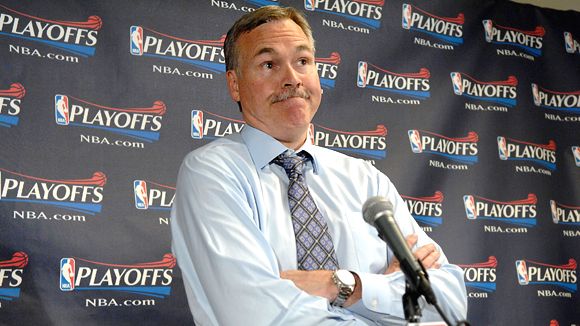 Amazing arrogance in D'Antoni: "I have no problem with Stud and Antony looking for each other as long as they don't overdo it." My goodness, what a personage.
T.K Marks writes:
In a pre-game tv interview D'Antoni did something that the certain star player(s) could very easily take as a gratuitous and not-so-subtle slight. Pointedly claimed that the Knicks' recent bouts of ineffectiveness originate from a lack of "intensity" in the lockerroom, whose custodian of such is presumably part of the job description of one or both of the two guys getting paid $20m/per, and not his own on-court strategies and schemas. That would seem to invite antagonism between himself and certain parties. Found it unduly undiplomatic.
Must say though Uncle Howie is rather perspicacious in these NBA matters. He's been touting the potential of the Nets' nucleus all along. As I had not seen the Nets perform at all yet this season couldn't get over the stellar talent of their big kid, Lopez, and that newly acquired point guard, Deron Williams. That team would appear to be a few players away from being a very formidable outfit.
Mar
31
Cobweb Economics, from Victor Niederhoffer
March 31, 2011 | 4 Comments
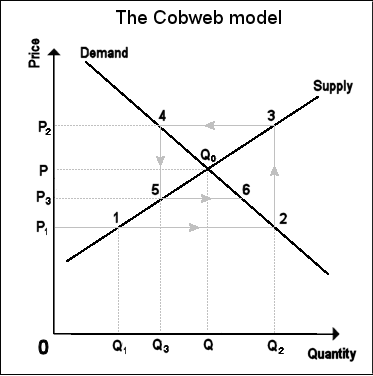 There's an interesting exercise in cobweb economics setting up in grains.
The idea being that farmers plant for next year based on this year's crop. And when this years price is high, they increase the supply for next year. Thereby lowering the price for the next year. Then they plant less. Prices move in cobweb.
Lorie wrote his PHd thesis on this. Wanted most of all to be a cattle rancher. May corn this year at 6.93 a bushel limit up but December 2012 corn at 5.77.
I took a speculation in honor of Lorie and Watson in the cobweb yesterday and today.
Gary Rogan writes:
Palindrome is taking charge: George Soros making a move to control food and grain production:
Financier and progressive activist George Soros is formulating a move to control food and grain production by purchasing grain elevators in late March in several parts of the United States through his Soros Managment Fund's backed Gavilon Grain . With purchases made in March, Gavilon Grain will become the third largest grain company behind Cargill, and Archer-Daniels Midland.
With strong ties to the Obama administration, Soros now has both the economic, and political clout to begin consolidation of purchasing and shipping domestic agriculture around the world.
U.S. grain firm Gavilon Grain said on Thursday it will buy Union Elevator and Warehouse's 16 grain elevators in the Pacific Northwest , the company's second big purchase of U.S. grain facilities in the last six months.The purchase of 16 elevators at 12 locations in eastern Washington will expand Gavilon's grain capacity by 8.4 mbu.
"The addition of Union Elevator's grain facilities and origination capabilities position us well to support the growing Pacific Northwest export wheat market and serve the Columbian Basin feed grain market," Greg Konsor, VP and GM of Gavilon Grain, said in a statement. The PNW is the No. 1 wheat export terminal in the United States. - Reuters
When food brokers consolidate into just a few large companies controlling the majority of a market, then prices can be set not by supply and demand, but by corporate decisions and manipulation of supply. If the price for food is too low in the United States, then grain can be shipped to other markets for sale, causing then an artifical supply problem in the country that produced the grain itself.With George Soros's making this move in backing Gavilon Grain's purchases to control food and grain distribution in the United States, and becoming the third largest grain company in the country, it will lead to the same results that we see in the energy markets as oil is controlled by a small group of corporations, and the price can be dictated by an artificial control over its supply.
Jeff Watson comments:
Gavilon Grain is just the latest resurrection of Peavey Grain. I expect them to have a big presence in the grain markets as they are true "Grain People." Still, being third place IN THE US behind C@rgill might as well be 50th place. I would not expect the Palindrome to make a dent in C@agill's action, as C@rgill is as politically well connected as anyone. The grain companies were always small in number, and historically were known as the "Big 5." The Big Five were, until the 80's, C@rgill, Continental, Louis Dreyfus, Bunge, and Andre with those companies controlling 75%+ of the world's grain trade and food supply. The big companies still control 75-90% of the grains and food supply, not caring what the prices are as long as they make the deal and don't lose market share. Until recently, most large grain companies were private, family owned corporations. The aforementioned five companies are still private, and huge, but companies like ADM, Ralston Purina, Conti-Commodies, General Mills, Pillsbury, Ralston-Purina, etc are all part of or are public corporations. Despite the small number of grain companies, the profit margins are microscopic, the business is cutthroat, and there is healthy competition between companies, without meaningful quid pro quo's between them. One overlooked aspect of the grain elevators and warehouses is that they are a license to print money if run correctly , which is a reason the big grain companies prefer to remain private, obscure, and below the radar. If C@rgill was a public corporation, it would easily rank in the top ten of the Fortune 500 companies and this is the scale of most of the really big grain companies operations.
Mar
31
A First, from Ken Drees
March 31, 2011 | 1 Comment
 I never saw a resigned CEO on fin tv before doing some "splainen"– Sokol. Nice of them to invite him on.
Victor Niederhoffer writes:
What was his explanation for those who don't have the luxury of a tv? Did it seem to be favorable to the sage by indirection? Or seem to indicate that it's the kind of thing that the sage wouldn't do (any more)?
Ken Drees writes:
It was pro buff– and you would have like the analogy used by the talking heads– buff wouldn't have anyone on his staff that wasn't playing directly in the field of play, a tennis analogy that he doesn't tolerate behavior in the organization that is even close to the line but in play. So the dealings by Sokol in lub stock were technically ok, but really not up to full standards of mount st buffet and really it had nothing to do with him "resigning" anyway.
So why all the chatter about the stock dealings if it didn't matter? Sokol wants to be a mini buff now career wise. Thank goodness he didn't resign to spend more time with his kids. The whole thing is odd.
Mar
30
 One played a game of checkers with someone likely to be a front runner for president in a few months, and we discussed the importance of Tom Wiswell's proverb "moves that disturb your position the least disturb your opponent the most". In checkers, I think it means not to break up your foundation, not to have too many infiltrator single men far removed from the bulk of your pieces. Not to have too many holes in your position. Not to have too many of your forces divided by big spaces. Maintain your dike which is a solid row of checkers on a diagonal of at least 4 or better 5 or 6. In general, make sure you have near neighbors for all pieces. I got to thinking how this applies to markets. It seems very applicable. Don't put all your chips at one price. Do things on a scale down or up. Don't move into other markets with big positions when you have the bulk in one position. Keep your positions at approx the same size. Don't throw all your chips in at a certain time, but gradualize into positions. Don't get out at close or in at open. Maintain a constant capital stream. Be humble.
What else would you say? How would it apply to life? Don't move into new investments unrelated to what you do without much reflection and gradualization. No staccato in your movements into your second childhood? What else?
Anatoly Veltman writes:
To add: a grandmaster can't use the same sole opening pattern all the time. High level competition will adopt– and they will no longer be disadvantaged. So while it's important to stick with your successful patterns– see if those patterns can be validated for situations arising out of a different opening sequence.
Nigel Davies writes:
I agree with Anatoly. Actually I've often given up opening systems at the height of their success; waiting crocs plus loss of vigilance etc.
Jordan Neuman writes:
There is a similar thought in baseball strategy. In a situation where one's move will lead to countermoves, it is sometimes best to do the opposite of what your opponent wishes you to do given his perception of his own countermove options.
This is all under the general category of putting yourself in someone else's shoes. I find it very easy to see where others have messed up their or their children's lives. I would say my "win percentage" is much higher in those cases, prospectively, than in my own life. Perhaps the Wiswell proverb describes depersonalizing decisions as a way to make them less emotionally difficult.
Henry Gifford comments:
Regarding the above about ruining the lives of one's children, my uncle used to say he ruined the life of his son, who was a heroin addict.
Looking at what he said from the other side, if what my uncle said was completely true, then parents have the power to stop their children from doing drugs or partaking in other ruinous activities, something many parents are frustrated to know is not true.
This perspective can ease the pain in some situations in life, and maybe in trading losses also.
Allen Gillespie writes:
On the violin to play fast one must leave fingers down for the return.
Mar
30
Proverb of the Day, from Victor Niederhoffer
March 30, 2011 | Leave a Comment
 One of Tom's favorite proverbs on the "moves that disturb" point was "take care of the draws and the wins will take care of themselves." I like the Greek proverb "little strokes fell great oaks" and of course Sondheim in his hateful way takes that song in Company and makes it "it's the little things you do together… that make marriage a joy," as he shows two couples fighting like cats and dogs.
It would be interesting to see if Nigel agrees that "moves that disturb chess positions the least" are best. I believe Art Bisguier told me to try not to break the tension of a position, and I've also been told that once you give away which side of the board you're likely to castle from, the handwriting is on the wall.
Ken Drees comments:
Sultan Khan an Indian native master player from the 1930s used to wait very long to castle and sometimes not at all since castling was not a legal move option in India where he was schooled in chess. It seems like everychanging strategy and recycling (switches) always is necessary to stay competitive, and fresh. Playing against the unorthodox– like the basketball team full court press (Mr. Watson's recent post), or the uncastled king that seems content in the center with a closed position game illustrates the need to be able to counter the strange or unusual opponent. Get a "book" player out of his book and then your fundamentals will hopefully give you an edge. The emotions that occur when faced with the unorthodox style are one more element that the aggressor has in his favor and one more item that the level headed player must tamp down and counter internally.
As for building and constructing ever more powerful latently strong positions–Nimzovich comes to mind as a chess stylist who always made incrementally stronger and stronger tactical moves. This tension naturally releases at some point in the game and then the gameboard takes on fresh vistas of open lines and changed landscapes. Seeing the new and powerful layouts well ahead of your opponent is key to the entire buildup process.
Mar
29
Greenspan and Government Activism, from Paolo Pezzutti
March 29, 2011 | Leave a Comment
 We have discussed the role of government in the economy and during crisis many times on this site. Greenspan writes about this topic with the paper "Activism" that I recently read. He writes:
The current government activism is hampering what should be a broadbased robust economic recovery, driven in significant part by the positive wealth effect of a buoyant U.S. and global stock market.
Equity values, in my experience, have been an underappreciated force driving market economies. Only in recent years has their impact been recognized in terms of 'wealth effects'. This is one form of stimulus that does not require increased debt to fund it. I suspect that equity prices, whether they go up or down from here, will be a major component, along with the degree of activist government, in shaping the U.S. and world economy in the years immediately ahead."
Considerations about the wealth effect are in my view interesting, but well known to those who tried (and managed) to steer a recovery from the crisis.
The wealth effect has supported the economy so far. How much compared to the "stimulus" is hard to say however. "Manipulation" of markets in order to favor a continued move to the upside concerted by strong hands was (and is) in the interest of many forces who have a prominent role.
Victor Niederhoffer writes:
The wealth effect was very big in the 1960s and before, and Latane had good papers on it. Everyone at the Fed has believed in it for 70 years, to the exclusion of looking at interest rates themselves. And Bernanke often times his qualitative announcements with market lows or highs. A good way to trade.
Phil McDonnell writes:
Most of the so called wealth effect is really artificially induced by the QE programs. If the price of your stock rises but the value of the dollars the stock will fetch falls then are you really wealthier? How rich do the folks in Zimbabwe feel?
Jeff Watson writes:
One only has to look at the Weimar to see how the business class in Rhodesia feel. In 1913, the German stock market was at 126. Fourteen years later, the German stock market was at 26,890,000. At the index peak, the value of the Daimler company was only worth 327 of its cars. Interest rates were 900% and the exchange rate went from 4-5 marks per dollar in 1913 to 4+trillion marks per dollar in 1923.
Ian Brakspear writes in:
My portfolio in 1994 was worth aprox ZIM$10 million in 2005 worth ZIM $ 44 billion.
Victor Niederhoffer comments:
What they did to the farmers makes one cry. Brakspear is the guy that posted the funniest spec post ever. He ordered 2 beers for lunch. It was 10 million Zimbabwe. Then by the time he finished lunch, he ordered two more. The price had risen to 15 million Zimbabwe.
Kim Zussman asks:
So does inflation illusion work? What does it feel like to be a billionaire?
Ian Brakspear comments:
I have in my wallet 2 fifty billion dollar notes, a one hundred billion dollar note and one ten trillion dollar note-worthless.
Today the main currency in the streets of Zimbabwe is the US$– how all these US$ notes got here is anyone guess.
They are cleaned regularly in washing machines to prevent the spread of diseases– and hung out to dry on washing lines– always with someone on guard.
Mar
28
 "It is common to think of individuals to use genes to make more individual, but from the gene's eye view of evolution, its the other way around. Genes use individuals to make more genes. The chicken is the egg's way of making more eggs". p. 114 The Seventy Great Mysteries of the Natural World edited by Michael Benton.
Yes, and its the digits of the prices way of replicating itself to make individual market players create more of those digits. (I wrote about this before here).
The digit 0 plays a big part in the replication game, and it makes individuals sacrifice themselves to create more 0's.
One notes for example that the double digit 00 in 1300 on the sp has been broaches from below on a closing basis from Feb 03 on three times and gone from above to below on three times.
Similarly for the triple digit 000 in 12000 on the DJI. The DAX crossed the triple digit 7000 on Jan 3rd from below, went above below then above then below on Jan 07, then crossed to 7097 on Jan 13 but stayed above 7000 until March 14, then fell to 6436 on March 16, a decline of 10% for the year, and now for the first time on March 25 hit a high of 7006 but failed to close above 6981, a fact which must cause great disennu to the triple 0's in 7000 and they must be inducing much political change in Germany as we speak to achieve that level.
Similar analysis relates to the Nikkei at 10000 which crossed below 10000 on March 11 briefly, but closed at 100075 and then on the following two days declined 20% captures by the triple 000 at 8000 as its low was 7790, a decline of 25% from its mid December levels of 10300.
A similar analysis could be made with the grains especially corn which has shown a similar affinity to 700 as the Dow to 12000 and the SP to 1300.
Instead of taking closing prices for granted we should ask how the digits themselves influence our actions so that we can make them reappear over and over again.
Kim Zussman writes:
A simpler version of this is the opposite of the usual "the market did Y today because of X": We say X because it did Y and we need why.
The evidence is that for many similar X there are many dissimilar Y.
Price is selfish because its impact demands explanation.
Gay Rogan comments:
I'm having trouble understanding any of this. Genes are selfish in the following sense: if genes don't propagate, they disappear, so the only genes that are here today are proven propagators. How can prices or digits permanently disappear? And why would 0's propagate more than other digits? How do these explanations provide more clarity than simply saying people's brains are attracted to numerical markers, and in the absence of other alternatives they chose round numbers?
Steve Ellison comments:
One possible line of reasoning is that people are more likely to put limit orders at round numbers. People often put stops near round numbers, too, but the research I have seen suggests stops are more likely to cluster on the opposite side of a round number from the current price. Here, then, is a hypothesis: if the last two digits of the S&P 500 closing price are above 90 or below 10 (i.e., near a 00 round), the change the next day is likely to be in the opposite direction as today; if the last two digits are above 10 and below 90 (i.e., away from the 00 round), the change the next day is likely to be in the same direction as today.
Checking the last 1584 trading days of the futures,
Near 00 round:
N: 366
reversal next day: 194
unchanged next day: 3
continuation next day: 169
% continuations excl unch: 46.6%
Away from 00 round:
N: 1200
reversal next day: 592
unchanged next day: 15
continuation next day: 593
% continuations excl unch: 50.0%
The percentage of reversals was higher near rounds, but the difference was not significant.
What was significant was the number of closes near the rounds. One would expect a close within 10 points of a round about 20% of the time, but 23% of actual closes were within 10 points of a round, p=0.0006.
Victor Niederhoffer writes:
Here is an interesting paper on round numbers for individual stocks. It doesn't look at expectations, but does look at bid
asked.
Russ Sears writes:
I believe that this paper could be expanded measure this effect on high volume versus low volume stocks. Therefore its stated cost may not be as large as expected on all stocks. My guess, needing testing is the small stocks have this more frequently than the large stocks, that are often computer traded.
Mar
25
Reminds Me of the Boy Wonder, from Victor Niederhoffer
March 25, 2011 | Leave a Comment
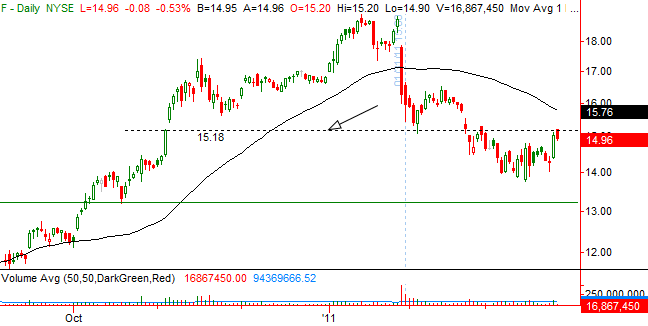
 The moves in Ford where it breaks through a round number and then opens at the high, and goes straight down reminds me of the incorrigible boy wonder who loved to buy a stock like Anaconda when it wend above 200 for first time, and then to scale into it on a pyramiding basis as it went up.
The boy wonder must have enjoyed much pleasure from the follies Bergeres girls on his payroll during those moments before he was led into bankruptcy again with such activity.
Jay Pasch writes:
And what better place to open it than right on the 15.18 gap…
Mar
24
One Raises the Razor Blade, from Victor Niederhoffer
March 24, 2011 | 2 Comments
One raises the razor blade and puts some lather on the face and checks the prices at 7am and notes many markets near local extremes including stocks, fixed income, oil and the beard is still there, as well as the shaving cream.
Mar
24
Briefly Speaking, from Victor Niederhoffer
March 24, 2011 | 2 Comments
 I used to love to play an opponent who couldn't win because he was trying to do something that would definitely lose. Like setting his feet leaning towards the left and hitting to right, or hitting me a drop shot when I was always fast enough to return it regardless of where it went. The Knicks are like that. They can't possibly win regardless of what they do, or how good the players are, because their system is bad. The 7 seconds shoot doesn't work. It's not percentage play.
Fortunately some others seem to realize it now and the coach says "with all the problems I have, I am not going to comment on others problems". Hopefully he realizes it's his problem not the players.
It reminds one of my friend Joe Yuhas, the Christmas tree guy, who tapped out on a silver trade, from the long side below $ 4 and I said, "you shouldn't have been so big" and he said "but I keep thinking what would have happened if I had been short. I could have made as much as I lost" and I said, "but Joe, it didn't matter whichever way you went, you would have lost either way".
Many systems that people use for markets are like that. And those who day trade and give an implicit vig of a few 100% a year, are in similar positions in the main. They play against people whose costs are 1/10 of theirs, capital 1000 times as great, (and they can borrow from a fairy godmother at 0 % also ), and who have much better equipment and speed. And if all those advantages fail, they can force one out at the close, only to move back to where the profit would have been realized at the next open. And yet, the game must continue.
There is hope if D'Antoni trades places with the fake doc as I asked the sullen Patrick Ewing to do who would consign the Knicks to eternal crossings of the river Styx if he were to get back. There is hope for day traders if they go stay overnight.
Jay Pasch writes:
Words of wisdom on the treachery of daytrade margin as the rope seller is glad to offer plenty of product with which to fashion one's own noose…
Kim Zussman comments:
Don't think it's all the broker's fault. Blame EMH. E.g, if all the rational, logical, comfortable, patternistic things are bid every tick, the only things left are irrational, illogical, uncomfortable, and non-patterned. The only people who thrive like that are successful traders and schizophrenics.
Mar
22
Parasites, Edges, and Trading Success, from Craig Mee
March 22, 2011 | Leave a Comment
 You think you don't have an edge in the market, well, if you don't have this you may just have one…… Toxoplasmosis:
Around 15 to 20 per cent of Americans are infected with the parasite, according to a study by the U.S. Centres for Disease Control and Infection (CDC).
The study suggests that male carriers have shorter attention spans, a greater likelihood of breaking rules and taking risks, and are more independent, anti-social, suspicious, jealous and morose. The behaviors observed, if caused by the parasite, are likely due to infection and low-grade encephalitis, which is marked by the presence of cysts in the human brain, which may produce or induce production of a neurotransmitter, possibly dopamine, therefore acting similarly to dopamine re-uptake inhibitor type antidepressants and stimulants.
Femi Adebajo:
There we go again so many conditional verbs and clauses… suggests….likelihood….if….likely due to….may produce..or induce the production of…possibly dopamine… a flimsy theory built on a speculative (not in a trading sense) foundation.
Victor Niederhoffer explains:
Okay. The mice make themselves sexy so they be eaten by cats. Then the cats spread the mice around through the sewerage system. The breakout occurs and the trend followers jump in (one can now say this with much greater impunity than the last year), and then the trend followers and pivot boys and breakout boys spread their genes, I mean money, around to the locals and the homeostasis boys when they get out. In former days the locals played a role in the detritovore works.
Anon writes:
[I hate ladies with too many cats.] The scented candle, mystical music, flavored coffee crowd always that has the de rigeur loofah brush hanging somewhere in the shower. It's all part of the Bed, Bath, and Beyond archetype.
Russ Sears replies:
Considering the alternative Bed, Bath and Beyond is to be praised. Besides John Adam's compassionate pining over his alcoholic son, another major difference between David McCullough's book [John Adams ] versus the mini series movie version was his relationship with Ben Franklin. It was not the moral filth of Franklin's mistress that Adams wrote his wife about that he could not stand, it was the literal smell and filth of the pets of this mistress. This filth was hard for Adam's to get past.
Comparing the movie version to the books is a good lesson in the necessary pandering to the liberal stereotyping needed in a movie this days. Let the historical facts be damned.
Mar
22
Always Remember, from Victor Niederhoffer
March 22, 2011 | 1 Comment
 One must always remember Slansky's admonition which is that you have to take account of whether you're a winner or loser, and what your average rate of win is relative to the distribution of losses. If you're a good player, never accept a bet with a small edge if it might subject you too close to gambler's ruin, or getting stopped out of you position even if you have an edge. Many a good player doesn't call bets in one's favor if it has too high a variability relative to his bank roll. Many a t-grade should not be taken when the variables like an announcement put the normal tit and tat into jeopardy. I hate to force a weaker player, (assuming I might ever have that luxury again) into making a good shot. Board players are the same way. They can sometimes create a crisis, a tension where if the weaker player makes the rite move, he might pull out a draw or victory. Much better to grind the poor sinner or market into oblivion.
Anatoly Veltman comments:
This is very right about chess and checkers. Grandmasters often lose sight of this good advice: forcing a weaker opponent into a series of the only possible moves on his part - will not necessarily lead to your definite win; but it will certainly prevent your opponent from making a poor move of his own!
Mar
22
Lesson for a Day About How to Lose from the Knicks, from Victor Niederhoffer
March 22, 2011 | 2 Comments
 The Knicks inevitable loss to Boston even though they were leading by double digits in the fourth quarter, and their being ground into certain oblivion by a team with a better system has many lessons. Sometimes when you're playing a sport and the other guy gets ahead of you but does it with much non-percentage play or luck, one believes that one will be able to win by just playing more fundamental play and running a little harder and defending a little harder and one isn't too worried about the opponent being ahead. Especially if you know that on an average play you're better than the opponent, and the opponent can only make a point by luck. Such is the situation whenever a team plays the Knicks. They know that they can surmount any reasonable deficit in the fourth quarter as Boston knew.
Same thing in a market that hovers a little below unchanged near end of day when it's ready to move to lead.
p.s. the talk from the estimable Carmelo, like a robot: "we got to play the system. We have to play the system. Everyone in league knows that D'Antoni system if great for offense and that we have to stick with it. Just take your shots within it" reminds one of the song from Damn Yankees: "you got to play the game". You got to play the game. Of course, Melo is being loyal which is good. But even he couldn't believe that they should play with that terrible system so demoralizing to all the players who have to work to get in position only to see a freak luck shot by a Toney Davis or the celebratedly departed still Gallo for a three tossed up to the basket. One is reminded of Grandpa Martins' letter to Coach Ryan: "when you have an All American like Artie in the game who has made every catch and every tackle… why give the ball to anyone else. no hard feelins either way."
Mar
22
The Accrual Anomaly, from Victor Niederhoffer
March 22, 2011 | Leave a Comment
One wonders whether such past anomalies found as the "the accrual anomaly" based on large accruals in non-cash assets, like inventory and receiveables, which are manipulatable, that flow into earnings are overstating the persistent ability to profit, such as this, are still profitable. A quote in Malkiel–, "I have never seen a back test that I didn't love, but devil take the hindmost when you try to use it" comes to mind, but such studies that look at the balance sheets seem less likely to have been exploited.
Paul Hendry comments:
The basic thrust of the paper is that individual equity investors with limited attention are fixated on accounting profitability while neglecting cashflow profitability. The primary cause of mispricing is the net operating assets anomaly or "balance sheet bloat".
Reading over this 50 page study which is highly technical but has a few interesting points:
-They do not believe that mutual funds who identify the mispricing take out all the arbitrage opportunity.
-Most equities with high accruals on the books are typically small size, low price, low liquidity but high systematic risk. Traits not appealing to funds.
-High institutional ownership reduces accrual mispricing.
-Growth orientated mutual funds outperform benchmarks.
-Funds that concentrate of fewer industries perform better after adjusting for risks and styles.
-In general, mutual funds underperform the market by 0.6% to 1%. Transactions costs are significant.
If you accepted their findings then a mutual fund investor should go into an aggressive growth fund, that goes both long and short, low transaction costs, specializing in one or few industries. To capture the mispricing would take consistent analysis that a fund has the resources to do..
Mar
22
A Book Review I did for Barrons, from Victor Niederhoffer
March 22, 2011 | 2 Comments
 History Lessons for Investors
A Thrice-Told Tale, All in One Book
Reminiscences of a Stock Operator, Annotated Edition
by Edwin Lefevre and
Jon D. Markman,
With a Foreword
By Paul Tudor Jones
Wiley
423 pages
$34.95
Reviewed by Victor Niederhoffer
Imagine that master novelist and chess aficionado Vladimir Nabokov wrote a fictional memoir by Capablanca—the 1920s world champion who never made a mistake on the board—and that Bobby Fisher then published an updated and annotated version, incorporating all of the important developments of modern chess strategy, along with a foreword by Anatoly Karpov. A similar multilayered feast on investment is now available, with minor differences. Edwin Lefevre's Reminiscences of a Stock Market Operator is a novel told in the first person by a character inspired by legendary trader Jesse Livermore. This classic is now graced with extensive annotations by investment advisor Jon Markman, and includes a foreword by hedge-fund manager Paul Tudor Jones.
The result is big and beautiful, cutting across two centuries of booms and busts and market and economic history, with a myriad of vintage historical photos and instructive historical charts throughout.
One of Lefevre's favorite adages is that there's nothing new on Wall Street. The similarity between the financial panic of 2008 and the 1907 panic recounted in the book is a prime example.
The numerous squeezes, manipulations, insider trading, government hauling in of scapegoats and frauds settled for pennies on the dollar that Lefevre and Markman recount are horses that are found as well in the modern stable.
The book can be divided into three parts: 1. The bucket-shop era from 1890-1910, when Livermore was able to make easy money by taking advantage of the bid-asked spread on inactive stocks with leverage of 100 to one. 2. His days as a stock trader on the New York Stock Exchange from 1910-1920, when he went bust over and over again, despite his abilities and insights, because he used too much leverage. 3. His career as a stock manipulator in the 1920s, where the fees he charged were 25% of the market value of the manipulated stock.
But there is a fourth part of the story, which happened after Lefevre wrote Reminiscences of a Stock Operator. Markman fills in the details. Livermore went bankrupt for at least the fourth time in 1934. His excess liabilities of $2 million included promised payments to the dancer Lucille Ballantine for keeping him "cheered and amused," and a liability for breach of promise to a former secretary.
Despite having amassed a fortune of $100 million by 1929, Livermore was back where he started at 16. He did not seem to learn from his mistakes. The excessive spending that put him in the hole over and over again was part of a much bigger mistake that he repeated throughout his career. He traded with so much leverage and generated so many commissions and gave away so much slippage in his bid-asked spreads that even a small move against him, one almost certain to occur in a season, would be enough to create ruin and worse. After losing his fortune or going bust at least six times, Livermore committed suicide in 1940 at the age of 63 at the Sherry Netherland Hotel in Manhattan.
The original book is replete with sensible suggestions for making money. The problem is that many are untested and contradictory. It took a man of sagacity and respect—a trader and shrewd, prize-winning journalist like Jon Markman, to separate the wheat from the chaff.
The appendix contains 100 main tenets of the Livermore method, which are just as profitable for today's traders as they were for Livermore–provided they are tested and used without improper leverage and transactions costs.
This book will live forever.
Mar
21
Briefly Speaking, from Victor Niederhoffer
March 21, 2011 | Leave a Comment
 1. The return of Gallo to the Denver Lineup, and his previous absence must be the reason that they were winning before and can be expected to lose now. Such a new beginning should be used in markets to determine the distributions after a new event like the first up opening in x days or the first red or green in the colored co-movement chart that Doc updates on daily spec.
2. I have always eschewed the development of systematic methods based on anomalies for making an extra buck in individual stocks for a different reason than Richard Roll who finds that they never do half as well in real life as they do on paper. My reason is that by the time you consider the extra 2 or 3 percentage points you can make from them at the best, your customers if you have any couldn't cover the cost of their fees and be left with anything good. And if you don't have customers like me, then the return you could possibly make from them would never be sufficient to cover your expenses.
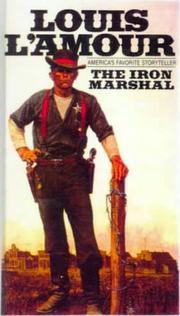
3. Louis L' Amour in The Iron Marshall has written a great Horatio Alger story that has almost as much accurate stuff about New York City in the 1850s in it and great Titanic Thompson con man stuff in it, as does his usual Western fare, always written with a topographical map at his side. However, I repeat that his constant emphasis on boxing technique as the deciding factor in who gets ahead and his inability to flesh out the endearing personal nobility of relations between friends the way O' Brian or Schaeffer can makes much of his work very shallow.
4. The overreactions in the market last week show how waiting without trading for the time when you normally would have been squeezed out, but then going in big is a viable strategy. The main problem with this is what would have happened to you if you did this the day in October 2008 the market anticipated the inevitability of the community organizer's election and dropped 20% in two days.
5. It is always amazing to me to read the GaveKal analysis of the influence of world events on stock prices. They invariably come to the same conclusions as me, almost always in favor of the long term drift, and almost always taking a contrarian approach to investing. They have a good essay on why they are bullish on Japan now. Based on such things as that their market is underweighted and undervalued relative to other markets, and their own history, it is likely that easing will occur, and that the nuclear crisis was much more contained than fearful reports made it out to be. I have never seen a GaveKal analysis that I didn't agree with except for one of their favorite hobby horses about how the inexorable and unbeatable new type of virtual company arising a la Carefour that can make an infinite rate of return et al.
T.K Marks comments:
The fade Gallo system of basketball handicapping reminds me somewhat of a client that we used to have when I first started out on the floor. There was this direct line phone to a brokerage concern that would ring all day long with order entries. Nothing particularly noteworthy of having with having a busy client, but it was the type of orders that piqued my novice interest.
You see, every order that was entered was a cross: Buy and sell equal amounts at the same price, whether above or below the market, or at the market. As I obviously found the net result of all these transactions to be unduly homeostatic in terms of P&L, after about a week of observing this curious phenomenon I finally mustered up the temerity to ask a grizzled sort twice my age what was the purpose of this.
He just looked at me blankly for a moment before succinctly advising, "Don't worry about it."
So about two weeks later, and after I had passed his vetting process I guess, he out-of-the-blue explained what all those crosses from particular brokerage house's crosses were about.
Their experience being that the equity of most retail accounts having short half-lives, their thinking was to take the other side of every one of their customers' orders.
It was my first exposure to any sort of trading system. And although it was as regimented and rigidly fixed as could be, those characteristics had nothing to do with mathematical calculations and everything to do with human nature.
As far as they were concerned, when it came to silver futures traded in a retail account, everybody was Gallo until proven otherwise. In the long-run I'm not sure what the karma consequences of presuming that everybody is a hoodoo waiting to happen, but the people from that brokerage house were obviously no strangers to some of the darker corners of psychology.
Mar
21
A Gilbertian Googlewhack, from Victor Niederhoffer
March 21, 2011 | Leave a Comment
One is reminded of scenes from Iolanthe "proudly let the drums roll/ we are peers of highest station/ pillars of the English nation/ ta ran ta ran ta ra" from memory as the markets after two fantastic drum rolls of upness at the opening repeat it for the third time in a row as of 11 pm, thereby creating a Gilbertian googlewhack.
Mar
21
The Boy Wonder, from Victor Niederhoffer
March 21, 2011 | 5 Comments
 One should never use the habits of the Boy Wonder as a source for emulation except in the field of romance and good times before the inevitable last days. Certainly everything he did in speculation was wrong except for his ability to cheat the bucket shops by betting on reversals arising from the concentration of limits at the bid and the asked.
Ken Drees comments:
I don't know if you are judging him too harshly or not, but I read somewhere that he suffered from clinical depression and at that time was not a known ailment– maybe this led to his "trade–all the time" mentality and other outlets for passions. Beating the bucket shops who cheated the public at their own game seems counting card like to me– which led those cheats to get a bigger and bigger shoe– to keep the metaphor extended.
And maybe I am too harsh on the schooling aspect– but less chit chat, what do you think about the market talk is better for me as I try to extract longer term trend trades and stay with them. As an example, the Middle East shakeup in my mind means one thing, trade wise, and that's higher oil price. I try to minimize the back and forth headlines as much as possible. In that vein, Livermore's isolated trading office was set up to keep outside influence away. I think there is something good to take from that.
Victor Niederhoffer replies:
One would think that he suffered more from excessive inebriation and the aftermath of womanizing too much than clinical depression. The depression was likely caused by his extravagant and unsustainable life style and vig paying.
Mar
21
A Rather Shocking Study, from Victor Niederhoffer
March 21, 2011 | 1 Comment
 A rather shocking study which shows that investors in mutual funds receive a much worse return than the actual return shown by the mutual fund through putting most of their investment in before the mutual fund goes down and least of their investments when mutual funds before the mutual fund goes up. The actual underperformance seems to be of the order of 3 percentage points of return a year, i.e, 6% versus 9%, with sector funds and specialty funds and growth funds showing much greater underperfomance. This must be a pretty good indicator of when to go against a particular sector.
Steve Ellison writes:
I read Mr. Swedroe's book Rational Investing in Irrational Times. This is very interesting data, but it undermines his main message, that the market is efficient and even professional managers can't beat it, so you should diversify and keep costs low by buying index funds. If mutual funds favored by the public underperform by a wide margin, something else must be overperforming. One might be able to beat the market by simply avoiding the hot funds and their favored stocks, like Bacon's technique of betting on all the other horses besides the overpriced favorite.
Mick St. Amour writes:
A great contrarian indicator. The retail investor is often guilty of chasing returns and as you can see this is a performance killer.
Larry Williams writes:
Aha, mutual funds are for the masses, while the elite managers of money: Cohen, PTJ, Dalio– are the winners for their clients.
But hold on a moment here. Lots of professional managers have beat the market for many, many years. It can be done, and it is being done. But not all can do it. Just like not all teams will be in the final four, and while luck is part of the game, in the end skill carries the day.
Mar
20
Query of the Day, from Victor Niederhoffer
March 20, 2011 | Leave a Comment
What would the return on buying one share of every internet related company have been for various beginning and end periods? One is not sure it was a bust, especially taking account of the returns of venture capital companies that invested during that period. One Ebay or Facebook or Groupon could cover many a 0% return.
Mar
18
Amazing Moves, from Victor Niederhoffer
March 18, 2011 | Leave a Comment
 The amazing moves this week are consistent with my 50 year old studies as to what happens following cardinal panics like airline crashes, and presidential assassinations. A terrible move down, and then by the end of the week, right where it was before. It happened to i s p and the grains and oil and the dollar yen. What else? How to generalize?
Jon Longtin responds:
"…how to generalize?"
One thought would be to do a simple curve fit on an instrument of your choice after each event in history. Since the events themselves are unique and relatively short in duration (earthquake, assassination, terrorist bombing, etc.) and also very well defined in time, the trigger point (or time t=0) is well known almost immediately after the event happens.
In general a cusp-like response is observed (very rapid decline, followed by a well-defined apex, and then a rapid ascent (although probably not as sharp as the descent) to some threshold pre-event point (say 80%).
The underlying argument would be that people's mass reaction to any catastrophic event is similar (panic, confusion, and uncertainty followed by the gradual realization that the world is not ending, and things work back to normal). Since the underlying behavior is the same, it's not unreasonable to expect that the financial instrument's response should similarly be the same across different events. One could then try to form a single curve by appropriate scaling (so-called self-similar behavior). Then, when a new situation presents itself (hate to sound so detached when speaking of disasters), one could chart the instrument's history against the curve, and as soon as enough points were collected, match/scale it to the master curve and make an estimate as to the turn-around point and recovery and go from there.
One could further classify events into separate categories, e.g., natural disasters, political events, financial events, etc., and prepare appropriate curves for each, since the nature of the event will be similarly well defined and knowable very soon after it happens.
The engineering analog is somewhat along the following lines: a standard technique to test a system is to apply an impulse response and see how the system responds. Examples include tapping an automobile frame with a hammer and measuring how the structure responses in time, or using a gunshot to measure the acoustics in a large hall. In these measurements, the initial driver (the hammer hit or gunshot) happens so quickly that it has come and gone before the system has had a chance to even begin to respond. As a consequence the resulting measurement is only the response of the system and is not contaminated by the initial response.
In contrast, drivers that that are longer in time have a more complicated interaction with the structure, because the structure will start to respond to the first part of the driver, but the system is still being driven. The analog would be grabbing onto the car frame with your hands and shaking it repeatedly for a few minutes to get it to vibrate: the car frame will begin to response as soon as you start shaking it, but then as you continue to shake it, that further alters the response, which affects the response, etc. etc. = much more complicated to analyze and predict.
In financial terms, disasters are often very short in duration (seconds and minutes), and subsequently they behave like an impulse response, with the system being society. In contrast, an event such as the wave of unrest in the middle east is a much longer time-frame event (weeks and months): the event and the response become highly coupled, making their analysis more complicated.
Anatoly Veltman writes:
Not sure if it's a separate topic, but there are sometimes dangers when you generalize. For example, the level of EUR currency (and its perceived trend) is significantly higher today than at this sample's outset. To what degree did this influence most commodities' comeback?
Another layer that could be added to this sample's analysis: what to make of the relatively lagging instruments? Sugar, Platinum and Palladium haven't made up their losses…
The President of the Old Speculator's Club, John Tierney, responds:
How does one make generalizations from the recent events outlined by the Chair? I have no doubt that his 50-year study shows similar market reactions. However, I'm reluctant to adopt any new theories or adjust my current investment outlook due to these studies. The current environment, and one that has existed at least since the Fed initiated QE1, is the involvement of government agencies.
I and others have suggested this surreptitious presence in the past. We have been (rightly) put in our place because we failed to fulfill the Chair's mandate: "stats on the table" (something, by the way, which Rocky was very, very good at).
In the current situation and that which has existed for several years now, we KNOW that our government (and others) have been manipulating the "invisible hand." We may not be aware of the extent of the presence, or where it is being applied, but that it exists is an established (and self-confessed) fact.
With that in mind, I'm left to "guess" whether the current scenario is an accurate re-enactment of past events, or whether it has been manipulated to seem so. For years we on the List have been leery of the efficacy of any government interference in the markets. With that in mind, it's difficult to make a legitimate extrapolation from past events - the new, big, player makes any surmise questionable.
My reluctance to revise my pre-existing view of the market's course is only enhanced by the numerous television experts who are outlining a "bounce-back" scenario based on past bounce-backs. It may well occur but will it endure or will it vanish with the exit of the interference? I'm currently betting (and that IS the right word) against it.
William Weaver shares:
Check out this interesting abstract:
Behavioral economic studies reveal that negative sentiment driven by bad mood and anxiety affects investment decisions and may hence affect asset pricing. In this study we examine the effect of aviation disasters on stock prices. We find evidence of a significant negative event effect with a market average loss of more than $60 billion per aviation disaster, whereas the estimated actual loss is no more than $1 billion. In two days a price reversal occurs. We find the effect to be greater in small and riskier stocks and in firms belonging to less stable industries. This event effect is also accompanied by an increase in the perceived risk: implied volatility increases after aviation disasters without an increase in actual volatility.
Found via the Empirical Finance blog
Mar
18
GoogleWhacks, from Victor Niederhoffer
March 18, 2011 | 1 Comment
 There is something called a googlewhack, something where two words have never been used in conjunction on the same page. There should be a similar thing for markets "a whackpatt?" when a event that's only happened once before in last 15 years occurs. There should be a restriction to only two or at most 3 independent variables or some similar rule of simplicity. Today is a good whack. Was up 10 yesterday, and now same 10 with a few finesses.
Mar
17
Flexionism of the Day, from Victor Niederhoffer
March 17, 2011 | 1 Comment
 So is the consensus now among us non flexions that the radiation danger is merely exaggerated 100 fold so that technology in the US will be set back 30 years, and government intervention will be lubricated for the next 4 years to deal with the crisis which seems so much worse to the US than the Japanese and IAEA? This is not meant to diminish the magnitude of the tragedy in Japan, but merely to wonder if we believe that the subsequent dangers have been much exaggerated for flexionic profit?
Anatoly Veltman writes:
Yes, of course. One thing to be sure about is that T.Boone Pickens' funds will start getting ahead, as Natural Gas projects (like gradual highway infrastructure to facilitate filling-up vehicles, especially trucks and such) should finally be given light-of-day.
Bill Rafter comments:
"Never let a crisis go to waste."
Jay Pasch writes:
Buy the clashing of bearish cymbals, and sell the euphoric opposite…
Kim Zussman ironizes:
Buy the clashing of bearish cymbals, and sell the euphoric opposite in flat/choppy markets. If markets ain't flat or choppy, don't buy and sell 'em.
Steve Ellison writes:
No doubt it was my poor judgment, but from the perspective of operating a specialty line in panics, the moments of panic in the past week in the S&P 500 seemed too brief and ephemeral to go all in. The changes since the earthquake were:
3/11 +11.7
3/14 -10.7
3/15 -15.2
3/16 -21.4
3/17 +14.9
There were three moderately large down days in a row, but for perspective, the S&P 500 futures are still up 1.5% year to date. Only for the briefest of moments did they trade below the 1247.9 year-end close of 2010.
Mar
16
More Natural Disasters Likely? from Victor Niederhoffer
March 16, 2011 | Leave a Comment
 What is the geophysics of thinking that more natural disasters are more likely now that the earth quake has occurred?
Kim Zussman shares:
Read this article.
Rudolf Hauser writes:
Another factor to consider is the shifting of the magnetic poles. This is reportedly associated with violent swings in weather and more earthquakes and volcanic explosions. Apparently there has been a marked acceleration in the rate of shifting in the past few years. Some question whether this might be the cause of recent weather extremes and geological activity. Since such shifts occur only every half million years or so we obviously have little idea of how they progress. If this is a real reason for concern it is an issue far more immediate and important that the global warming fears.
Pitt T. Maner III writes:
There have been suggestions of a connection with renewed (regional?) vulcanism.
The last eruption of Mt. Fuji , for instance, occurred 49 days after the previous largest earthquake in Japanese history.
Another Japanese volcano has resumed activity but cause/effect from the March 11 quake may be tenuous.
The volcano, Shinmoedake, is famous for standing in as the villain's secret rocket base in the 1967 James Bond film, "You Only Live Twice".
Bill Rafter comments:
Earthquakes and volcanism are simply different manifestations of the goings on of plate tectonics.
Read this article from New Sceintist: "The megaquake connection: Are huge earthquakes linked?".
Mar
16
Market Gyrations Caused Me to Miss Knicks Game, from Victor Niederhoffer
March 16, 2011 | Leave a Comment
 The market was gyrating so much last night in a negative direction that I didn't even have time to see how badly the Knicks got killed while I was out. And the regression bias has never had a better examplar than the Knicks. Luck + skill determines every outcome. The luck is random. Whenever the Knicks have a good win, the luck factor was highly favorable. And then the next time out they lose by 47.
J.T Holley writes:
It's very much the same as my beloved Va Tech Hokies in all their sporting events. The listing of the samples for the regression bias can be used with football and basketball which makes it all the more interesting when I gather data.
The ultimate highlight that sticks out in the sampling of being a fan is 11-0 regular Season with Andre Davis on the cover of Sports Illustrated with the caption "Do They Belong?", meaning to me that luck got them there. Lost in the NCAA Championship to Fla. State in a 46-29 nail biting game that is still talked about as one of the greatest losses, great loss yeah right? That loss was 1/4/00, the S&P 500 top ticked within days of the loss.most recently to add was the NCAA committee somehow having watched the Hokies fight and claw with 7 players to beat Duke at home while ranked #3 only to follow up to losses to Boston College and Clemson in final two regular season games. Be casted in typical fashion as a bubble team. Go into the ACC Tourney win, then beat Fla. State on a tenth of a second made shot that was canceled after regulation. They must've said luck, thus snubbed from the NCAA Tourney for the 4th straight time after a couple years back being the only 10 game ACC winner not make the Tourney. S&P 500 is at hand in gyration.
It's sad and the life of a Hokie, but the regression bias to the S&P is there as well.
I have often wondered now as a grown man looking back at this game against Florida State (yes the Seminoles again) and the luck + skill that it required didn't curse or hoodoo Virginia Tech in some way?
I dare not even pull data from 1980 to see what the S&P did days after. It's like I know it somehow wouldn't even effect the averages in the regression bias if it was positive anyways.
Alston Mabry writes:
The Hokies got stiffed again. This year, though, I think they may be standing in the "stiffed" line behind Colorado. Not only did Colorado (overall 21-13, 8-8 conf) go 6-3 in their last 9 games, including a win over now-4-seed Texas, but in that stretch they won their first round game in the Big 12 tourney against Iowa State, then in the next round beat Kansas State for the third time this season, and finally went up against Kansas, a team that along with Ohio State forms the most common prediction for the NCAA final game…and Colorado scores 83 points against Kansas in a tough loss. But Colorado doesn't deserve any place at all in the NCAAs? They can score NBA-level points in a tournament game against one of the consensus two best teams in the country…but they don't deserve a slot in the NCAA tournament. If that makes sense, explain to me why Villanova isn't headed for the NIT.
Once one examines these situations at Va Tech and Colorado, as well as other seeding and bubble-team choices, one can't help but think that perhaps the committee is screwing this whole thing up on purpose so they can say, "You're right! We messed up! The only solution is to expand to 96 teams!"
J.T Holley replies:
Very simple. The NCAA Committee is made up of only TWO people that have played basketball or coached basketball.
The answer to Villanova is that they are in the Big East. The Big East gets a bias and free pass. They have the most Teams in 11 being selected for the Tournament. No other Conference constantly gets more at large bids, yes I'm aware they have the biggest conference with 16 Teams. There are what 37 at large bids. 11/37= a tad bit biased under 30%.
My conspiracy theory is the following: The Big East is such a lackluster Football Conference in the past decade that the NCAA overcompensates for them in basketball due to their humiliating play on the gridiron and the fact that the BCS favors the SEC.
Note that Alabama an SEC team was 12-4 and won their side of the conference in basketball in the SEC and got snubbed as well by the NCAA Committee?
Worth noting is the eventual winners and why the bias now? Who was the last Big East Team to win the NCAA Tourney? '04 UConn then prior it was '03 Syracuse. That is over 7 years ago? In the meantime either the ACC or SEC has won 5 of the last 6 Titles?
Also worth noting is that the NCAA now owns and operates that other Tournament "NIT". They own the NIT and have its Final Four and Championship held at the Madison Square Garden in Big East territory? Too funny.
I'm not some anti-monopoly guy, but hey the NCAA just needs to come clean and say we do profit and that's the way its going to be fella's.
I like Bobby Knights words "Let's just expand the Tourney to 128 Teams and everybody shut up", but then the NIT wouldn't be a money maker would it?
Mar
16
Briefly Speaking, from Victor Niederhoffer
March 16, 2011 | 7 Comments
 1. One would think that the universal brotherhood of central flexions would work to create a positive ambiance at the open market meeting today, with helpful comments from any flexions with big positions in Asia vis a vis electricity et al.
What is the evidence that rebalancing asset allocations between bonds and stocks on a monthly, quarterly, or yearly basis leads to non-random results?
Does dollar cost averaging lead to better outcomes than random buying?
2. It is an interesting sidelight that with all that's going on, the greatest turmoil and tragedy in at least 3 years, the market dropped a quick 1/2% before the ridiculously unimportant NABH housing market index for fear that ???? It would be down or something. What fools these mortals be. And what better demonstration of the ephemeral nature of the public.
Anatoly Veltman writes:
It reminds me of an old hilarious caricature, illustrating a TV anchor going: "The markets world-wide plunged over 90% of their value on astronomers' confirmation that history's largest asteroid is on inevitable collision course with Earth. They have rebounded sharply midday on rumors that the Federal Reserve may lower the Discount Rate".
Sam Marx writes:
Thank goodness for the ephemeral nature of the public.
Mar
12
Briefly Speaking, from Victor Niederhoffer
March 12, 2011 | 3 Comments
 1. Today was a classic in that the frustration aggression hypothesis of stock market movements was totally satisfied. The lead S&P had been above 1300 continuously since January 31 and had not set a new 20 day low since august 26 , 2010. It had set a within day low four times below 1300 in the previous two weeks but each time closed above. The Nikkei had been above 10000 since Nov 30, 2010. Thus the evil invisible hand of the market had not been satisfied. There were stimuluses that should have led to massive selling so the strong could capture profits from the weak but an inappropriate displaced response had occurred in Skinnerian terms. There was frustration that a proper response had been blocked. An aggressive displaced action in Dollard - Millerian terms, was required. It all happened at Midnight when the Nikkei broke 10000 for a minute and the stock market broke 1300 going down to 1278 thereby luring a whole medley of weak holders and fixed system people into doing the wrong thing. Okay, finally a appropriate response happened with all the breaks. Alternatively a climax occurred, and once it did everything was de rigeur again and the market promptly was ready to go it's merry driftingly way up.
2. Could there ever have been a day when a content analysis of the news would have been more negative with floods, earthquakes, tsunamis, war, and bad economic numbers galore. All we needed to put it at all time most negative was news that the president was holding firm on trading off an increase in the service rates in exchange for a reduced budget deficit. It shows the idiocy of the programs that monitor the news to get that ever so difficult trading edge.
Ken Drees writes:
Very beautiful summary. And notwithstanding the monster earthquake (which doomers prayed homage to since the 80s as the secret to knock the Nikkei to its knees– 25 years too late and still it didn't work) and on the eve of Friday trading, this seems to be masterful piece of frustrating market action.
Mar
11
Briefly Speaking, from Victor Niederhoffer
March 11, 2011 | Leave a Comment
 1. One hopes that the moral of Galton's story is not forgotten by the contumele back and forth [about who first told it]. The moral is that each person makes a difference, no matter how small the contribution might be. Therefore, everyone should do the right thing. I use this story often when I hold the junta and I ask for volunteers to tell a Franklinian thing. Usually no one raises a hand. Then I tell the story and often we will have every person in the room contributing good stuff. Now it's got to the point when I asked "what books have you read or what members can we help" and the hands are sparse, I say " in that case I'll have to tell the story of the chief rabbi of Dresden." Immediately all the hands go up and the mike is passed around. This is often enhanced by Susan who starts shaking her head, "no, don't". As I am not a very good story teller and tend to be a bit lugubrious. Galton had much better luck with it, and immediately elicited 20 or 25 scientists on the dais who saw pictures of numbers in their head when they quantified.
2. It will be interesting to see if the well known effect memorialized
in EdSpec where grain prices go up following great earthquakes holds for
this one.
Ken Drees writes:
I thought volcanic activity inspires grains that way not earthquakes– although it seems this thread has morphed chaotic.
The volcano II in Iceland that is due soon will be much more inclined to induce grain crop prices that way.
Victor Niederhoffer agrees:
Agreed. But I thought they might have the same effect.
Jeff Watson comments:
The main way earthquakes affect grain prices is that they can impede the country movement of grain. Speculators often underestimate the importance of the correlation between transport (ease of, availability, and cost), and price in the grains.
Mar
10
Briefly Speaking, from Victor Niederhoffer
March 10, 2011 | 2 Comments
 There's something about the Miller Lite commercial that shows a kid saying "I don't care" whether he gets a Miller Lite or any other brand, with the female bar tender looking at him with disdain and saying, get rid of those European bikini briefs you are wearing, or get rid of the bronzer or sun tan equipment he's using, that is truly indicative of the collectivist psyche. It's anti trade because it's a disguised mercantilist rant that we're hurting the trade deficit by buying European, and it feeds upon envy of those who have money. It comes right out of Gene Schwartz's book Breakthrough Advertising by hitting on emotions that (in this case) are brought out by the crony capitalism et al.
Mar
10
Briefly Speaking, from Victor Niederhoffer
March 10, 2011 | Leave a Comment
Nice flexionic move at close of yesterday where it went down 1/2 % in 15 minutes from 4:00 pm to 4:15 pm Eastern Std Time. With the flexions' decision of the downgrade of Spain being announced 9 hours later at 1 am Eastern. s.t.. Similar moves in European stock markets. The move from 4:00pm to 4:15 pm being one of 3 largest in last year and a half.
Mar
10
Rundown from the Horsehair Mat, from Bo Keely
March 10, 2011 | Leave a Comment
 It was the night before Christmas when I stepped down into the Idaho basement and beheld a horsehair mat measuring six-by-eight 10-year-old strides that changed my life.
The next morning the real gift came when dad took off a bowtie and younger brother Tom opened a big box of boxing gloves. We descended the stairs, and had at it. Thrice weekly for an hour, the bouts alternated among boxing, wrestling and judo for years.
Parents should wonder what martial art to place their youngster in, that will alter his thinking, movement and life choices. Having dabbled in most of the sports from the horsehair mat to asphalt alley, here's a quick rundown.
Boxing: The attack and defence is with the fists. The hands are wrapped and gloved, and head put in a helmet to prevent injuries. I've done enough boxing to say it's a great sport from a distance. I gave it up at the YMCA after getting so pummelled and pooped that there seemed no need to raise the elbows above the supper table for a day. It's a great sport for those who stick with it, teaches importantly getting hit is no big deal, and will get you by nicely in most street scrapes.
Judo: The name means gentle way, and was my forte for ten years. The opponent's center of gravity and momentum are utilized to throw him around like a rag doll, without injury to anyone. It is superior because of 'hands-on' training, quick gains, aerobic and anaerobic condition, and is the best progress to balance and tumbling. There is no better way to learn to read a person's body language in every situation.
Wrestling: This is the most superior martial art that I had a love/hate relationship for many years. I practiced so hard, adored the move and counter chains, and half the time ended up flat on my back in front of jeering fans and my sad parents. Nonetheless, if you don't know what to do after school, go to the wrestling room and get an epiphany for life.
Karate: The term means empty handed, and is a practical self-defense appended by a philosophical touch. Strikes with the hand or foot stop just short of contact. It involves tedious repetitions that, in college threw my elbow and knee joints out of whack from jerking to a stop. There are more efficient ways to exercise or learn combat.
Ballet: Is too a martial art, especially for an uncoordinated person.
Brazilian Jiu-Jitsu: This is a self-defense system and martial art that emphasizes taking an opponent to the ground and applying submission holds such as joint-locks and chokeholds. The premise is that most of the advantage of a larger, stronger foe comes from superior reach and more powerful strikes, that are negated on the ground. My practicing friends call it 'tackle-and-choke', and there's something refreshing and potent about simplicity where there are so many choices.
Kickboxing: A popular blend of karate and boxing, especially in Thailand where after public contests I've been invited, as the only Caucasian spectator in the crowd, to dojos to train with the athletes. I trained little, watched a lot, and surmised (as in other contact sports) it's good to learn to take blows, plus it builds character and very strong legs. However, it's inferior as a defense to all the other contact arts.
Full contact Karate: To me, this is the only Karate. I took a year of contact-less in college and the big problem is that after a few months of pulling thousands of kicks and punches short of target, or striking a defenseless sawdust bag, one suddenly finds himself in a rough place with a false glow of confidence. There's a split-instant hesitation before striking as the muscle memory kicks in to actually hit a person… and by then it's too late. But Full Contact is a true self-defence with protective pads and helmets during practice for safety.
Ultimate Fighting: It's an American martial arts' fest where fighters from different disciplines fight to submission or knockout. I've known a few ultimate fighters, usually type A personalities in gorilla bodies, who admit it's a bloody, real test. The best are former collegiate and Olympic champion wrestlers.
Kung Fu: The term means a skill or ability to do something, hence is aggressive. Also referred to as Wushu, a modern name for Chinese martial arts, I once lived with a practitioner/owner of a dojo who was also a telepath, according to publicity (not mine), and he challenged Sugar Ray Leonard in the boxing ring blindfolded using just his feet. It never happened, but he did get on 'That's Incredible.' Sharp kicks and blows are applied to pressure points on the body, and once I wrestled the housemate who in the first three seconds touched each of about two dozen pressure points, and I gasped.
Thai Chi: Throughout Asia, one sees seniors practicing katas in front yards and parks, content and oblivious to passers-by, dogs and traffic. For this reason, it seems a good meditative activity, develops body awareness and sequential thinking, but is too static to be considered a martial defense or aerobic activity. There are faster-motion forms, but the martial aspect requires years of training.
Aikido: The self-defense resembles a harmonious dance on the mat or street, until suddenly a lock is applied to neutralize or control the opponent. There are chains of beautiful applications of leverage across joints, and circular movements within a contained mat area that teach discipline and respect. I've watched practice sessions, and had an elbow and knee bent to testify the efficacy. At the highest level, the defender hurts no one, only leads the red-faced attacker away by a bent finger or ear. This is the first horsehair sport I would encourage my child to undertake.
The above list (from about 50 martial arts practiced around the globe) includes the most popular and ones with which I have some familiarity.
The benefits of martial arts cannot be underestimated. They include:
General fitness and coordination.
Decision making, including cross-over training for chess, bridge and many jobs.
Focus.
A discipline to greet new challenges by forming a strategy, and to adjust or stick with it to a goal.
Confidence in mastering new situations.
A mindset to find a correct frame of thinking to greet novel scenarios.
The grasp of chained sequences in thought and movement.
Respect for an instructor, and others.
Testing and learning one’s limits, hence humbleness.
Boost in general self-esteem as other life challenges, physical and mental, are met cheerfully.
A habit of accomplishment from training with many little steps and progressions.
Increased productivity in school or business
The confidence to strike out to new grounds, and travel.
Inner peace.
Meet worthy people.
Burn off a kid’s energy with a better night’s sleep for everyone.
T.K Marks writes:
Bo Keely's thoughts and experiences are an enthralling memoir waiting to happen. At once picaresque in its tone and regimented in its discipline, his stories exude the charming rogue paradigm. He's an original.
P.S. Met up with Omid last night for dinner and he told me that come this summer he's considering "riding the rails" again with Dr. Keely. I could see handy-with-a-camera O getting some video grist out of something like that. The wild thing being that none of it would be staged.
P.S.S. Where did you find Bo Keely?
Victor Niederhoffer writes:
We met at a racquetball tournament.
Mar
9
Briefly Speaking, from Victor Niederhoffer
March 9, 2011 | 2 Comments
 Once more, like clockwork each month, the Treasury comes to the table to sell 3 yr, 10 yr and 30 year bonds and on half of the last 6, they have received a terrible beating and warning from the vigilantes.
The 10 year bond is surprisingly close to the 30 year bond in price given the talk about raising short term rates in Europe, and the always concerted actions of the central banks.
The outcome in the Mideast will be harmonized by International and National authorities not entirely in the corner of Israel, and this would appear to be the main reason that oil rears its head above 100 and that the sagacious market is down some 6% at 1270 from its 1340 levels 1 month ago.
The grains have retraced almost their entire loss of the previous month and are near their highs.
A reading of Classical Economics by Thomas Sowell at the recommendation of Gene E from Barron's reveals that the classical economists felt that all government interventions in their day had the main purpose and effect of benefiting their friends and cronies thereby leaving the common folk with great detriment relative to where they would have been without the interventions in favor of a favorite group of big industrialists and financiers. Adam Smith cut rite to the bottom line when considering the mercantilist policies and fallacies of his day and ours " Trade is good because it increases the total output so there is more to divide between the two countries ".
I have given up reading the National Enquirer because it has stopped publishing rags to riches stories and its advertising is no longer at the cutting edge and have moved to the Globe and Cosmopolitan and New York Post as the only hard copy newspapers I buy. I liked the Globe's coverage of the fury at the Oval because they were not invited to the Royal wedding because of the returned Churchill and Camilla's jealousy and I like Cosmopolitan because they cover many ways of short term deceit to gain fulfillment with their obvious implications for luring market people into doing the wrong thing for short term gain, and I like the New York Post because they can be counted on to be ahead of the pack in memorializing the shortcomings of the Knicks. The book On Fencing by Nadi is one of my favorite books and is always worth rereading along with Bacon, Green, and Heyne.
Mar
2
Great Start, from Victor Niederhoffer
March 2, 2011 | Leave a Comment
What a way for the new seasonatarian fund to start, thereby giving its holders a nice 3% deficit if they did start already, and how guaranteed it was to happen, and how consistent this is with rational expectations.
Jim Lorie and Milton Friedman (there is no such thing as a free lunch) will rest peacefully from above tonight.
Phil McDonnell writes:
Here is a link to a Ziemba paper which updates the research on seasonality. There are a few choice comments regarding the Almanaterians in the intro and F@m@ & Fr3nch on pg. 4.
Mar
1
Toria has suggested that to modernize our blog, we do video. Okay, I'd like to get all our contributors a wider but still dignified exposure, and we've been flat with about a million hits a month. So I said yes. I think one of first things we should do is have a reading of the "The Lady From Sorrento" on our site. I'd like to have a beautiful woman who can read well play the part of "the Lady" and a well tempered guy play the part of "the admiral". I'll provide the admiral's uniform a la Captain Aubrey. I need volunteers. I want to do it this week.
Mar
1
The Golden Scales of Zeus, from Victor Niederhoffer
March 1, 2011 | 1 Comment
 As a man in a dream who fails to lay hands upon another whom he is pursuing- the one cannot escape nor the other overtake even- so neither could Achilles come up with Hector, nor Hector break away from Achilles; nevertheless he might even yet have escaped death had not the time come when Apollo, who thus far had sustained his strength and nerved his running, was now no longer to stay by him. Achilles made signs to the Achaean host, and shook his head to show that no man was to aim a dart at Hector, lest another might win the glory of having hit him and he might himself come in second.
Then, at last, as they were nearing the fountains for the fourth time, the father of all balanced his golden scales and placed a doom in each of them, one for Achilles and the other for Hector. As he held the scales by the middle, the doom of Hector fell down deep into the house of Hades- and then Phoebus Apollo left him.
–From Book 22 of Homer's Iliad, translation Samuel Butler
The scales have tipped against the seasonatarians thereby allaying the massacre they administered in the month of January.
Russ Sears writes:
One is reminded of March of 03 when fate was sealed and the hunt was on for a different dictator.
Victor Niederhoffer writes:
One is reminded of Secretary Baker's battle while talking about his meeting with Tariq Aziz, in January 09, 1991.
The dooms were placed on the scale and the terrible word was uttered "Regrettably…. " A 5% decline, big for those days ensued in the next minute.
Alston Mabry writes:
In college we read the Lattimore's Illiad and the Fitzgerald's Odyssey. It was a great combination.
Russ Sears adds:
Given that it looks like the US military will stay out of this, and the Secretary appears to have only a small part on the world stage, I am hard pressed to identify what the trigger may be. The timing and scale is always a mystery. However, not knowing the actors in this drama, it will certainly take people like me by surprise.
Mar
1
 Please let me augment my message about the March 3rd meeting of the Junta.
A weary traveler stopped his horse in a storm at the Potamac in 1804 on his way to Washington. The ferry was not operating. And a man of respect had stopped him asking for a ride. "Hop on," he said. The two of them managed to cross the raging Potamac.
"Who are you?" the grateful traveler said. "I am Thomas Jefferson" going to my inauguration.
Okay. David Friedman, the incomparable son, wrote me an email saying he unexpectedly is going to be in New York on Thursday, March 3, and he'd like to speak at the junta. Now, knowing that Gary is a man like Thomas Jefferson, and they would both be thankful to learn from each other, I immediately said, "by all means, we generally are booked up a year in advance, and Gary is already scheduled and quite a draw. But I'm sure he'd be happy to share the stage with you."
David wrote back, "It would be an honor for me to share the podium with him."
Haven't told Gary yet, but sure his answer would be like Jefferson's.
P.S. Junto now has a Meetup group with current information on it. Feel free to join the group or pass on to friends.
Mar
1
Briefly Speaking, from Victor Niederhoffer
March 1, 2011 | 2 Comments
Today it will be another fight between the almatarians and the reversalists. Last month, it was a massacre in favor of the former.
Andrea Ravano writes:
Doomsters on the run advising on "how fearful this market is". Surely, they will be right sooner or later, unless of course they have some leverage in their positions.
Victor Niederhoffer writes:
I am on the run.
Steve Ellison writes:
As I noted when I studied the almanac effect a month ago, the almanac has only worked well in 3 of the past 6 years, and it had a good year in 2010. I have a hunch the introduction of the Barclay almanac fund may be a turning point.
Mar
1
 The Morningstar stats are:
years: 1945-2010 (count: 66)
mean S&P return: +9.08%
mean S&P return, 3rd year of prez cycle: +17.15%
Setting up a simulation that, for each run, randomly resorts the set of actual annual S&P returns among the actual years and then recalculates the mean return for the set of "3rd year of prez cycle" years:
simulation resorts: 1000
mean return of all simulated "3rd year of prez cycle" sets: +9.07%
SD of the set of means from 1000 resorts: 3.78%
z of actual "3rd year of prez cycle" mean (+17.15%) versus simulated set: +2.14
Victor Niederhoffer writes:
Wouldn't that have to be adjusted by by a factor of slightly less than 3 or 6 to take account of the fact that each year might be the best or worst, and another factor of 5 or so to take account of different markets like fixed income or grains, and another factor taking into account when they started the years from, thus reducing the 1 in 100 to say 8 in 9 in favor of finding a difference as big as this.
Feb
25
Briefly Speaking, from Victor Niederhoffer
February 25, 2011 | 3 Comments
 1. Who Wrote On Gains in Productivity
One has been asked to guess the author of a stirring article on the gains in productivity, of goods not moved by physical means, using computers and software. Here is my response.
One must remember that that the putative author, the fake doc, in almost everything he does was a master of dissimilitude. His PhD thesis was a fake, as Larry Ritter confided to me on his death bed. (It was a series of Townsend Greenspan essays.) And his work at the Townsend firm, relying heavily on blast furnace usage, and pig iron deliveries, freight loadings, and newsprint lineage, (apparently only believed by the Sage), left him with no customers when he took the job at the Fed. Thus, one would aver with 99% prob that the document that Doc Zussman proffered was written by a ghost. Content analysis, a la Mosteller and Wallace, could probably prove that.
2. Flexionism of the Day
One has also been asked to opine on whether the economy would have stopped running, and the markets would have gone into oblivion, with no one being paid if the interventions and bailouts had not occurred. Here is my take.
A respected member of the list has averred that we'd all be out of business if a former brokerage, now a bank, he was nicknamed at by the chief flexion hadn't been bailed out or aided by the government. He states that if these two banks "had met the same fate as L, a public broker many of us use too, by the way. So you'd be broke." I have another hypothesis. To me, the entire market decline in October 2008, the 20% thing, was an effort by flexions to vigilante the market down so they could get more capital from the bailouts, loans, purchase of non-performing assets, 16 trillion buffer from the Fed et al, thereby facilitating a transfer of resources from the general common man to their pockets, cronies, and friends. Such a transfer and vigilante selling a la the bond vigilantes, would not necessarily be a conspiracy, and one would be sure that the former brokerages now banks key executives and their cronies in the gov, sincerely felt that transferring the resources to them was in everybody's interests. I would tend to feel the same way if I had an opportunity to get more capital to increase my future wealth and cushion and increase my bonuses and reduce chances of distress for my family. Hopefully, I would not mount the high horse about how like Sancho Panza in Don Quixote: "I was only thinking of you."
3. Recent Markets
The all seeing eye would have a field day if it were to write a baedecker of what happened in the market the previous week. Moves in every commodity have been of the order of 5%, sometimes in a day. What an opportunity for the strong to take the chips of the weak in markets like stocks, bonds, oil, grains, copper et al. The connecting links with oil moving inversely to stocks, and the dollar, and commodities, and directly with bonds proves that there is a web of markets. The problem is that the web is always changing. Completely the opposite of how it connected a few years ago. One notes that stocks have still not set a 20 day low in 7 months and that they visited on us, the first 3 consecutive declines in a row in 6 months, rite before a violent overnight move back to the old levels. Round numbers were broken galore, and the European flexions were ahead of us as usual.
Feb
23
On Gallo, The Briar Patch, and Revision of Belief, from Victor Niederhoffer
February 23, 2011 | 2 Comments
 There's something about the recent Knicks trade that I believe has important market implications. As is well known to anyone who watches basketball, one of the most ineffective players in th game is Gallo. He plays the game the way our grandfathers did, completely immobile, taking half of his shots from downtown, never getting a rebound, and demoralizing all of his teammmates with fast shots that are rebounded by the other side for quick baskets, taking all the force out of any attempts to play good position basketball from this teammates. While he's in the game, the Knicks can always be counted on to lose, driven into oblivion by the force of fudamental basketball from the other side. Reminds me of a doubles game in tennis where there is a weak stroke on the other side, and you know you can win by just concentrating on the weak persons' stroke in a pinch. (might I remind you here that the signer was never below 1 in 4 years of college tennis doubles at a reasonable school, thereby countering in part the well known and admitted fact that his knowledge of basketball is well below average of his colleagues here).
Okay, naturally during the trade talks, there was much hemming and hawing by the Knicks. "You can have anyone in trade for Melo, but whatever you do, you can't have Gallo. He has so many intangibles, like his smile's and struts to the crowd after he hits one of his three's and he's only 22 and getting better every game et al). Just like Brer Rabbit when he was captured by Mr. Fox and Mr. Bear, and he said "whatever you do, don't throw me in the briar patch).
Naturally, the one thing that the management and the teammates wanted the most was to be thrown in the briar patch, and have Gallo taken in the trade. Once the Knicks achieved that acceptance by the other team, they were free to make the trade because instead of giving away something of value, they were giving away something of terrible negative worth).
 The market is the same way. Often one reaches a situation, where there is one terrible thing happening, one backdrop that everyone is afraid of, that is keeping it down. For example, it can't go up while interest rates keep going up. Or it can't go up while there is tension in the Mideast, or while oil is up, or in the case of a panic drop while a big counterpart has not yet gone under, like long term, or the Leeson when everyone knew he was long the Nikkei, or the british petroleum underwriting after Oct 19th, 1987 crash. The examples are endless.
The situation may best be seen in Popperian terms. Given that the prevailing view is that the market can't go up while situation "A" is happening, the hypothesis is incapable of changing. There is no revision of belief possible. Everyone says like Brer Rabbit and Gallo, the market can't go up while interest raters are high et al. If interest rates fall for a day or two, i.e the market goes up while NOT "A" is happening the belief still is out there. Nothing has changed the basics. The next day it's back to the old game of highly negative the first opportunity the fear can be flamed.
The only thing that can make the market turn on its tail, get the weather gauge back, is if the market goes up when interest rates go up and are high et al. So the one thing the market needs is exactly what it fears, a dose of high interest rates et al, a failure of the british petroleum underwriting concession, the failure of long term, the capitulation of barings et al, before it can go up big.
Like the gallo trade, the one thing that the market needs when it is in fear is a day that it can go against the fear, have the fear realized with no undue consequences and then a reversal of fortune can happen. This is why panics, and escalations in world tension are invariably so likely to create a big change in what had been the big direction of move in the moving averages the previous period.
We should thank Gallo for allowing the Knicks to win again, and showing us why this recent escalation in oil prices is so bullish, and when the next time the market goes up on increasing oil, the market will be as free to win as the Knicks are now, even though they gave away the Gallo into the briar patch et al.
Of couse, this theory must be tested. And it's a variant of the only thing that the Palindrome got right in his 100 books (but that's another story).
Feb
22
Con Games, from Victor Niederhoffer
February 22, 2011 | 2 Comments
 The more one studies the markets, the more one is convinced that the hallmarks of a con are very useful in unraveling the possibility of making a profit. In this regard, I found the article "Con Ed" which features the insights of Todd Robbins, where he talks about spotters, the 3 h's of cons: hide, hype, and hate, and the direct relation between misery and the extent of cons to be helpful. I find that prices often have the hallmarks of con when they break through a barrier, showing you that it has overcome a difficult hurdle, and thereby gaining trust and confidence. Also, the spotter, the person that makes you confident by showing you his trust in the deal. So many CEO's, analysts, and newspeople play that role.
The article features the common adage that you can't cheat an honest man, or the related it's always the greed of the mark to get into something with an unfair advantage as a important precondition. How much evilness lied in most of the victims of the Catskill, Palm beach, Riviera, Long Island con who all must have thought that they could front run the market making operation downstairs. The importance of giving the mark excessive praise, which in most cases would be a short term profit, and is related to the principle of ever changing cycles would be another one.
The whole subject of flexionicism as a variant of the big con needs to be studied and quantified.
Sam Marx writes:
The missing data for such a study are the successful con games that are never discovered.
There are probably a load of Ponzi schemes still operating.
In fact a Ponzi scheme, with luck and some skill, could turn out to be a big winner for both the manager and "investors", especially in a bear market.
In a successful classic con game, at the backend, there is what is known as the "blowoff" where the victim has lost a bundle, doesn't realize he's been conned, and actually is convinced he has to keep quiet about it or he'll wind up in jail.
Henry Gifford writes:
My favorite book on cons is The Gentle Grafter, a collection of O'Henry's short stories on the topic.
Many entertaining scenes of con artists arguing over whose specialty is more moral and noble, and the entertaining justifications they come up with, meanwhile constantly conning each other.
George Parkanyi finally asks:
What is a flexion anyway? I see the term used here liberally, and it seems to have nothing to do with the dictionary definition (which has to do with bending limbs). And is "flexionic" even a word?
Gary Rogan elucidates:
This is Victor's explanation:
From the book The Shadow Elite by Wedel, Ganini. Former fed officials. Former high treasury officials with private access to the sqaush courts and executive dining room. Presidents of colleges, former and current, who worked at high positions in the treasury and fed staffers privy to the daily conference calls at which all upcoming releases are discussed high executives on Wall Street, who are consulted about the economy for their feedback by the treasury and the fed. Big owners of newpapers from Nebraska who dine on coke and dairy cream. Counterparts and their operaitve from other central banks that our treasury and fed discuss the upcoming policies and release with on a need to know basis so they will not be surprised and will know how to act and put things in perspective for their flexionic pursuits a home. Operatives within the agencies that prepare the numbers and especially those who make final adjustments on them.
Rocky Humbert writes:
I agree that unquestionably, and right under everyone's noses here, absent the savoir vivre of Madoff, that there are many Ponzi schemes still operating. One good whoosh will shake them out here (I am aware of one which I am certain of, massive in size, and I can only laugh that this one is still out there prowling in the deep).
Unlike Madoff, these other funds are not primarily comprised of Jewish investors (in truth, Madoff did have some Arab soverign wealth fund money too, but the majority of it was from the Jewish community) so when these monsters explode I would look for an entirely different reaction this time.
We were speaking of cons on a previous thread in a related list. I predict after this next manager explodes, the investing world (not necc "the public," we're not talking about hoi polloi here) will wake up and realize that if the manager has access to the money– it might be a con. Managers do NOT need access to the funds.
Sam Marx adds:
I believe that it was in Barton Biggs' book Hedgehogging that Biggs described a club of money managers, large investors, etc. that he belonged to that would share financial information unknown to the public. But if anyone related information that was to the divulger's advantage and detriment to the divulgee (new word?) the divulger was blackballed.
Would this be considered part of the "Shadow Elite"?
Feb
21
Nearly a Month of Consistent Gains Wiped Out, from Victor Niederhoffer
February 21, 2011 | Leave a Comment
And thus, most of this month of consistent gains wiped out in an hour in Europe with Mr. Round of 3000 standing solid as a stone wall attracting with irresistible force.

Feb
19
Dinners With Friends, from Victor Niederhoffer
February 19, 2011 | 4 Comments
I had a nice dinner with Dimson and he told me that the long term real rate of return for almost everything he's studied outside of stocks is 2.8 % including art, housing, and stamps. He points out that bond prices seem to show much more momentum than stock prices, and doesn't believe there's a drift in bond prices. I always learn something from him.
The previous day I had dinner with Martin L. Leibowitz of "inside the yield book " with Homer, and he pointed out that in many cases it's better not to show earnings at all than to show earnings because if you show them, you might get a p/e attached to it. He's a great fan of musicals and we saw The Festival of Song together. I have much to learn and I enjoy making new friends.
Also learned a lot from a visit with TK Marks who told me about how the locals could cushion enforcement actions, the importance of being on the settlement committee, and who is on it, and how a 25 million loss on a barrier option against a former brokerage now a bank was handed and handled and the fine related thereto derived. I have much to listen and learn about.
Rocky Humbert comments:
These ultra-long term real return results are fairly consistent with the published research on the subject and there are good explanations for why collectible prices (and housing) track demographics and population growth over long periods of time.
However, these results are a bit misleading because they do not take into account (1) transaction costs; (2) tax policy; (3) personal utility/consumption value; (4) generational investor preference.
Any honest collector will acknowledge that round-trip transaction costs of between 10% and 20% should be expected. Hence it can take 5 to 10 years just to recoup the vig (in real terms.) This represents the auction house premium, dealer/broker commissions and other fees and expenses. One should also add annual insurance costs of between 0.25% and 1.0%. Mitigating this is the fact that the collector/owner hopefully gets some intangible utility/pleasure from gazing at the asset — and this value is unquantifiable. So, I'd argue that the ultra-long-term real return is actually much greater than the measured return that Dimson cites (because of the utility value of ownership.)
One must also consider present and future tax policy. I submit that some portion of the gold price ascent over the past decade is attributable to more aggressive global tax enforcement and the loss of Switzerland as an anonymous safe haven for cash. Similarly, some portion of the decline in real estate prices must be attributed to a generally rising real estate tax burden. The use of technology for tax authorities to monitor/intercept cash transactions has never been greater, yet the ability of tax authorities to monitor the transfer of gold and collectibles is no different today than 100 years ago. This bodes well for assets that can be invisibly transferred.
What's most striking about all of this research is the generational mean reverting nature of returns. It seems to take about a generation for investor preference to reach peaks and troughs — the current inflation debate is a good example of this. Hence, anyone who bought gold in 1981 has a lot in common with the guy who bought a Miami condo in 2006. And anyone who is buying big pharma stocks today has a lot in common with the guy who was buying small cap value stocks in the 1990's. It seems to take 10 to 20 years for the fundamentals and investor preference to shift. While Keynes noted, "In the long term, we're all dead," there are important lessons here for what we SHOULD be buying (big pharma/nikkei) and what we should NOT be buying (Green Mountain Coffee, Netflix, 30 year bonds) for our children's UGMA accounts.
Stefan Jovanovich writes:
R-Man
Such common sense advice will earn you the rewards of (pick one or more): (1) scorn, (2) disdain, and (3) outright rejection. As you might have guessed, that makes me eager to join your club . JNJ, SNY and MRK are my favorites. I think a combination of big pharma and small biotechs/instrument companies together makes sense. GILD, RTIX, ANGO are the other end of my barbell. To double the bet, I am also invested in MDT, PMC and GILD - which fit neither category. Those 9 companies are nearly half of the ones that are on my current "Top 20". Here are the others:
ISH
EXC
ETR
PPL
GLT
CHL
GFA
CME
WDC
STRL
The 20th pick is Cash– which remains, by far, my largest investment– as a cowardly lion proxy for being short commodities and bonds.
All the best.
S-Man.
T.K Marks writes:
Rocky's mention of collectibles as an asset class brings to mind an informative Tom Wolfe book that I read many years ago, The Painted Word.
Inside which he skewers not only the monopoly of modern art theory, an oligarchy of opinion makers comprised of a handful of collectors, dealers, critics, curators,and auction house operatives, but the pricing paradigm of works as well.
Wolfe's criticisms were contemptuously tossed aside as rank philistinism by established interests, however much they had to lose. Be that as it may, he raised some interesting if provocative questions about the commoditization of aesthetics and the art world's version of the settlement committee.
It works like this: An emerging or posthumously appreciated artist's works are quietly acquired on the relative cheap. After which, a web of vested interests pull off the art world's version of the time-honored pit trading version of banging the close. That is, waiting till the last possible moment in a trading session and then faux-frantically bidding for everything in site. Provided, of course, one has the fiduciary wherewithal to do so.
One might reflexively think that such an ad hoc distortion would revert back to the mean in ensuing days. But homeostasis doesn't necessarily always happen as a matter of course with physical commodities, as ersatz drift can be plausibly manufactured over time. Including relationships in cross-market terms. So why should the works of an artist that are somehow treated by the seeming cognoscenti as fungible a good as exchange-grade soybeans or silver be any different?
Or for that matter, how is the work another artist thought to be from a similar school not affected in cross-market terms?
Wolfe's thinking would have it that in both cases of abstract art and silver futures there's a lot of leverage involved. With metals one lays out margin. But in art, one may buy a work at auction way beyond estimates from one of the big houses. They just banged the close.
Rather loudly actually, and by doing so drove up the value of their quietly accumulated inventory.
They also did it on margin. Say one supposedly lays $50m for a work previously thought not to fetch nearly as much. It would be wrong to assume that a check was written by the acquiring party in that exact amount, as the auction-established value of the work is now used as collateral to secure the purchasing loan.
So something with no underlying intrinsic value other than the artful arbitrariness of a few is deemed as good as the full faith and credit of the U.S. Treasury.
At its worst, it's a not-so-opaque way of creating value out of whole cloth. No less a curious way of legally shifting large piles of money from one entrenched interest to another.
One is reminded that long before Tom Wolfe considered these very same questions, Norman Rockwell did so as well. It may be the definitive portrait of irony, the cover of a Saturday Evening Post from back in 1962.
First brought to my thankful attention from Prof. Pennington some years ago under the auspices of this colloquy, it leaves one thinking: Does the nattily attired gentleman see Pollockian splashes of brilliance, does he see a related investment opportunity, or is he merely the picture of high-brow posturing?
There are some situations in life that one can know enough about to realize that it's probably impossible to know the rest of and this is probably one of them.
Feb
15
Casual Observation of Yield Curve, from Charles Pennington
February 15, 2011 | Leave a Comment
The slope of the yield curve between say 0 and 2 years has soared since October, the 2-year yield going from ~0.35 to ~0.85 with short term rates still zeroish.
Seems like that's discounting an awful lot of hikes by the fed over the next year or two.
This is bait to see if Rocky will tell me what it means.
Victor Niederhoffer responds:
Before the erudite polymath sets us straight, I can tell you that it means the expected average of the funds rate for the next 2 year is 1.70%
Rocky Humbert takes the bait:
Last April, the 2 year note reached 1.11 (0.85% last). So, we're still about 30 basis points below last April– which incidentally was a great time to short stocks and buy bonds… One obviously wonders whether we'd be 30 - 50 basis points higher right now but for the QE2 ??
Vic is correct, but there's a nuance because the mean is different from the path. The last six Fed Funds futures from June 2012 to Jan 2013 predict fed funds at between 1.00% and 1.83%; and the front of the Fed Funds strip Feb11 to Feb Sep 11 all have Fed funds between unchanged So the "steepness" is mostly in the back contracts. That is, Mr. Market believes that the fed will not move until late 2011 or early 2012 at the earliest. And then it will tighten 200 basis points fairly quickly. I think the market is consistent with Pimco's most recent stated view…
It's really hard for me to get excited about a 2 year note at 0.84% when the CPI is running at more than double that. And, the MIT Billion Price Project is predicting an accelerating CPI over the next few months.
Feb
15
Production, Distribution and Finance, from Victor Niederhoffer
February 15, 2011 | Leave a Comment

Can the truly enormous rise in the use of derivatives, complicated options, and highly structured financial instruments really have made a [corresponding] contribution to economic efficiency? - A Former Central Banker.
It's hard for most people, especially senile ones above 6' 6'' to understand that distribution of product is as important to well being as production. The Russians always had bad weather. The ability of people to invest in the stock market through ETF's and index funds, and to hedge through options would easily be just as important as a move from cassettes to head phones.
Rocky Humbert writes:
This is a great topic, and I'm not qualified to express an opinion. But that never stopped me before.
It's not immediately obvious to me why ETF's should necessarily cause higher (and lasting) economic growth than say, "old-fashioned" index funds. Except in an academic paper, of course. What economic growth comes from the ability to trade a basket of stocks continuously…as opposed to say, at the close only? Is there any empirical evidence (except theoretical) that the growth rate of the economy has improved since the introduction of ETF's? I wonder whether it's even possible to study such a thing? Certainly, much of the growth from housing that was attributable to the mortgage "innovations" was not lasting, but was instead a zero/negative sum game. But does that prove anything?
I accept that when one reduces the costs of moving capital to productive places, that savings should find its way into more productive activities. And theoretically, the ability to hedge should improve productivity too. And liquidity should reduce hurdle rates TO A POINT. But at what point are there diminishing marginal returns — and does the transfer of risk from party A to party B *always* result in economic growth and a better standard of living (especially when taking the government's interventions into account).
Remember, finance is not an ends to itself. Rather, it's simply a vehicle for getting capital to places where it's needed.
Feb
13
An Interesting Regularity, from Victor Niederhoffer
February 13, 2011 | 6 Comments
"Sonderling won only 5 points off Tsgona's service in the decisive third set, but four came in one game for the final break of the match." Thus Sonderling won winning only 5 of 20 points on Tsonga's serve. The market was down 15 of 20 intervals but ended up in the period.
Feb
12
Briefly Speaking, from Victor Niederhoffer
February 12, 2011 | Leave a Comment
 Finally Mike D'Antoni is getting a good pantsing from the media for not winning. But no one seems to feel towards him the way we all feel to a person using a fixed system, e.g. a trend following system, or a moving average system, or a swing system, with stops that's bound to fail.
His system is the problem, not the players or their heart. When the whole idea is to run down the court and shoot the first 3 balls you can, you dishearten the whole team. The shots are random. The rebounds go to the other side. The idea of fighting to get in position goes out the window as there's no time for any real play, and the other player is going to get the ball. I still say it started with Patrick Ewing who played the same game from the 80s that Carl Braun and Sweet Water Clifton did in the 1950s as opposed to the inside game that wins for all the other good teams where they take high percentage shots.
The Knicks are great for showing you how to lose in the market. They should be watched. The coach's excuses are the same as the system players are when he loses. "We didn't play smart," he said last time. "The fans should stop cheering for Melo." It's exactly like, "the market never acted that way before," or "the announcement of the Mubarak quitting made the stocks go up". I have a copy of Alibi Ike and Horseshoes by Ring Lardner at my side, but it was a lot funnier than when the coaches actually had a plan that could build a win rather than this sardonic, know it all who demoralizes his players the same way a trading manager would if he followed a Hendry system.
Feb
11
The Tree Octopus, from John Tierney
February 11, 2011 | 4 Comments
 Kids Believe Literally Anything They Read Online:
Anyone can publish anything on the Internet. Despite that, children aren't taught how to evaluate the reliability of information they read there. As demonstrated by a recent study, this is true to a shocking extent, and there may be dire implications for the future of today's young people….Donald Leu, professor of education at the University of Connecticut, selected 53 of the best readers from seventh grade classes in low-income school districts in South Carolina and Connecticut.
The page in question was devoted to an animal called the Pacific Northwest Tree Octopus. Yes, a tree octopus – an aquatic animal that allegedly lives in trees.87.5 percent of the seventh-grade subjects judged the Web page to be "reliable." More than half went so far as to call it "very reliable."
Victor Niederhoffer writes:
The octopus is very smart and could climb a tree if food were there, and it could get back to water in due time. One at the British Museum did that after opening its locked cage each night. That is one reason I am very abstemious in my eating of octopus.
Mark Schuetz adds:
It is a little disappointing that the article singles out the younger generation and web pages (Title: "Kids Believe Literally Anything They Read Online") instead of consumers in general and any form of media. As hinted in the subject, one wonders how many adults who worry about kids' "Critical Evaluation Skills" while browsing the internet would at the same time find a TV news segment about the tree octopus fascinating. Compare how sources are more often cited in Felix Salmon's blog than on CNBC– not to mention the comparison of number of factual inaccuracies (and subsequent public corrections) when comparing the two.
Similarly, compare reading one of the Economist blogs paired with browsing the much-hated Wikipedia ("Anyone can write anything! Horrible!") to gain a perspective about world events to watching Fox News.
Perhaps instead of shaking their heads in shame about 7th graders and targeting the internet, the article's author should consider how people of all ages watch segments on television or read their local paper, or really consume any type of media.
Feb
9
Briefly Speaking, from Victor Niederhoffer
February 9, 2011 | 6 Comments
 The divergence between 30 year rates at 4.78 % and the relevant EP ratio or the easier to track 30 year at 117 and stocks at 1220, which has moved 15 % in favor or stocks versus bonds continues to show a somewhat tainted euphoria and or divergence in the normal allocations between bonds and stocks, I think.
I was away in Chicago the last three days, and Steve Stigler is writing a book about the five main ideas of statistics. He points out that Galton is involved in only two of them: comparison using internal variability and regression. [The other three ideas are: Combining observations, the square root of N rule, testing and likelihood of an experiment]. Galton was recently ranked as sixth most referenced scientist of the last 100 years in scientific papers, with Darwin and Bertrand Russell ranked 2 and 1 respectively.
Feb
5
Proof, from Victor Niederhoffer
February 5, 2011 | Leave a Comment
 Proof that the market's purpose is to take from the weak and give to the strong (in part): the SPU having their lowest day of vol ever with a 2 point range, but so many opportunities to lose in other markets like fixed income with nice 1% usual range (so far), and of course wheat with 4% moves, and up limit to add pain to the weak.
Feb
3
Kids at Your Side, from Larry Williams
February 3, 2011 | 3 Comments
 Trading is hard with small kids around. I remember when I was trading copper. I'm long, and my actress daughter gets a bloody nose (of course she dramatizes it, she's a born actress). I forget the trade in copper, stop the bleeding….and….go back to see a 45,000 loss in copper. It would have been cheaper to med-evac her to the hospital.
Victor Niederhoffer reminisces:
Twenty five years ago I lost half my wealth between the first and second games of a racquetball game with Reuben Gonzales.
Craig Mee writes:
Shocking…It reminds me of a local interest rate trader, heavily
short, who went for a "quick" haircut, next door to the exchange in
Sydney…. BOOM. Reserve bank unexpected rate move …house wiped out.
An anonymous contributor writes:
They [ed.: i.e. the French] had then learned how easy it is to issue it; how
difficult it is to check its over issue; how seductively it leads to the
absorption of the means of the workingmen and men of small fortunes;
how heavily it falls on all those living on fixed incomes, salaries or
wages; how securely it creates on the ruins of the prosperity of all men
of meager means a class of debauched speculators, the most injurious
class that a nation can harbor,—more injurious, indeed, than
professional criminals whom the law recognizes and can throttle; how it
stimulates overproduction at first and leaves every industry flaccid
afterward; how it breaks down thrift and develops political and social
immorality. All this France had been thoroughly taught by experience.Everything was enormously inflated in price except the wages of labor.
As manufacturers had closed, wages had fallen, until all that kept them
up seemed to be the fact that so many laborers were drafted off into the
army. From this state of things came grievous wrong and gross fraud.
*- Andrew Dickson White, “Fiat Money Inflation in France”, How it Came, What it Brought and How it Ended*
Feb
3
Almatarians rejoice over January Effect, from Steve Ellison
February 3, 2011 | Leave a Comment
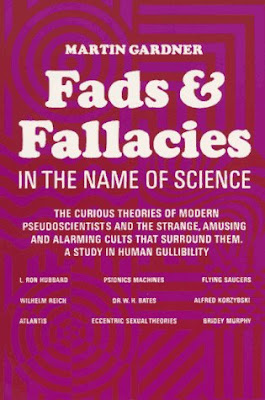 Editorial comments: I wonder how many up Januarys have been followed by "a new or continuing bear market, a 10% correction or a flat year"–the probability of one of those events occurring in any year seems high. Note that those events are cited to partially excuse the wrong forecasts of 2009 and 2010. I assume the accuracy ratios are calculated using the usual wrong method of comparing the change in January to the change in the whole year, including January.
As January Goes, so Goes the Year, Jeffrey A, Hirsch, Editor
Devised by Stock Trader's Almanac founder Yale Hirsch in 1972, the January Barometer predicts that stock market performance during the month of January sets the direction for the entire year. In fact, every down January for the S&P 500 since 1950 has been followed by a new or continuing bear market, a 10% correction or a flat year.
Despite major errors the last two years, this indicator still boasts an 88.5% accuracy ratio. Even including the seven flat-year errors, where the S&P closed the year in the opposite direction of January, but was up or down less than 5% for the year, the JB still delivers a
77.0% accuracy ratio.We don't know of many indicators with such a strong track record Of the last three down Januarys: 2008 was followed by a continuing bear market and a down year; 2009 was also followed by a continuing bear and an 18.1% S&P decline from January to the March low, but an up year; and 2010 was followed by a 16% correction from April to July and an up year.
Last week's uprising in Egypt shuttered economic activity in that country, jolted worldwide stock markets and heightened Mideast tensions. But despite the rumor of 1 million protesters gathering tomorrow in Egypt, calm has returned to Wall Street on the last trading day of January, registering the first positive January for the S&P 500 in three years.
Prior to the Egyptian civil unrest, on the wave of $600 billion in additional quantitative easing, the rally gathered momentum in December that has carried over into January. Both our Santa Claus Rally and First Five Days Early Warning System delivered solid gains. Despite Friday's selloff on the news of clashes in Egypt the losses were not catastrophic and the market has held on to January's gains.
Even without the trouble on the Suez Canal a market correction was brewing. Unless the situation spirals out of control in Egypt and other Mideast hotspots, the often typical late-January/February break will give way to a continuation of the rally we projected in our 2011 Annual Forecast last month to Dow 13,000-14,000 in the first half of
2011. We expect any break to be about 5% and bounce off the 50-day moving averages of about 1,245 on the S&P, 2,640 on NASDAQ and 11500 for the Dow. Our forecast remains on track and after some pause in February we expect the market to flirt with the 2007 highs before succumbing to another seasonal soft patch in the May-October period.(31-Jan-11)
Victor Niederhoffer writes:
One can always make a fortune by speculating based on patterns that worked 11 to 20 years ago as opposed to the last 10 years. See hallmarks of pseudo science in edspec, and Martin Gardner's Fads and Fallacies in the Name of Science.
Feb
1
Turning Points, from Larry Williams
February 1, 2011 | Leave a Comment
I don't think one becomes good at trading until we have been beaten so much that we no longer fear the beast…once you learn how to take any shot the market give you, success comes so much easier.
Jay Pasch replies:
There is wisdom in this post; it also emphasizes the importance of having enough skin in the game to experience its sensitivities especially when it comes to turning points– turning points start to hurt, they frustrate you, they wear you down, they rub you raw to a point where you think you can't take it anymore, to a point where you question your methods, why you trade for a living, to a point of throwing in the towel– it is then that the trader needs his perseverance the most and to stay awake.
Victor Niederhoffer asks:
What are the turning points and how can they be predicted? That's a good way of
trading I think. A turning point and run are pretty much the same with
proper definitions as a start.
Jim Sogi writes:
There are enough niches and styles in markets that a person can find one in which his own weaknesses create the least problems.
Rocky Humbert writes:
Craig wrote about Cyclone Yasi a few days ago. This is a monster storm, and may hit Queensland sugar (and other ag) production. It will be a couple of days before the markets "digest" the results.
Spot sugar is already in tight supply. If the Queensland crop is damaged, it could push up out-month sugar prices, and this might even feed into higher corn prices (i.e. corn syrup). Conversely, the ag markets are already extremely "hot," and we've not seen a bearish headline for ages.
Earlier this morning, the chair asked a most relevant question: "what are turning points and how can they be predicted?" The chair has also previously written that "reversals are more lucrative than trends." Over the past 12 months, sugar is up 65%, coffee is up 76%, cotton is up 125%. If reversals are indeed more lucrative than trends, I'd love to figure out when I should reverse these positions, since I keep wasting money on my hedges. Sadly, the only turning points that I ever see are with 20:20 hindsight.
Vince Fulco writes:
There seems to be a prevailing reasoning in the trading world that "reversals" or "turning points" are something which must be predicted– while trading "trends" is something which is not predicted, but merely, reacted to. The latter, not requiring "prediction."
I think that prevailing reasoning is false. Being a trend follower still requires one to predict in the sense that he is predicting the trend will continue. Both approaches require prediction. (Similarly, a non-directional approach, a market-neutral approach, say, writing butterflies, is, by the same reasoning, requiring prediction in that one is predicting the market will stay sideways, or at least not go into a protracted trend).
So my question to the site is this: Is it possible therefore to trade and not predict?
Gibbons Burke comments:
Method one: Book your profits in your mind, don't treat it as "house money" and decide right now, for each market, how much of your money you are willing to give back to the markets. Draw your line in the sand and let the market take you out at that point. If it takes you out and then goes back to make new highs, consider maybe getting back in.
Method two, which I prefer: take half of your positions off the table, cash in the chips and reward your self for being right. Let the rest ride with a stop set at the point determined by method one. If you keep being right, and start feeling like you want to reward yourself for being right again, take half off again. Keep raising your stop on the remaining positions to lock in your profits, and let the market take you out when it feels like doing so. And given the magnitude of the trends, the likelihood is that when it decides to take you out, it will keep going in lobogola fashion.
I've had this very argument with a well known trend follower/leader on his Facebook page a couple of times. He keeps insisting that trend followers are superior to the other species of traders because they don't make predictions. But my contention is that trend followers are simply deluding themselves if they think they aren't making predictions.
They are predicting that when they get a trend following signal that the market will continue in their direction by a magnitude that is more than twice the size of the risk they are taking on. They predict that this will happen maybe 20% of the time, and that when they catch those big moves they will make up for all the psyche-destroying losses of which they predict their method will keep small.
It is a different sort of prediction, but it is nonetheless a prediction.
Feb
1
Tropical Cyclone Yasi, from Craig Mee
February 1, 2011 | Leave a Comment
 For anyone interested in big natural events, check out this article: "Yasi could become category five monster ".
At the moment it's eerily calm… very, very strange. I woke up this morning and there were no birds flying around, no sounds, absolutely nothing. It's like the wildlife knows there's something going on.
CAIRNS resident Carl Butcher is taking a stand against the might of oncoming Cyclone Yasi– he has vowed to keep tweeting through the terror of the storm.
Butcher, whose Twitter handle @cycloneupdate is fast gathering followers worldwide…
Victor Niederhoffer writes:
There are many books by Henty, favorite author of Getty, that describe how frontiersmen could tell what was happening 30 miles away, especially massacres by Indians, by the bird and insect cover in their own settlements. There are numerous market implications of this. I'd be appreciative of other references to the wisdom of birds, and how the layman can improve his profitability based on observing birds.
Ken Drees writes:
Here's a great article about bird behavior prior to the Longbeach earthquake in 1933.
Feb
1
Attention Almatarians, from Victor Niederhoffer
February 1, 2011 | Leave a Comment
Almatarians of the world. Prepare to be befuddled like the rest of us.
Vince Fulco writes:
As Chair would often say, usually when he was closing a winning trade, "Haa!!" Reminds me of Omar Sharif shouting the same in Lawrence of Arabia when he was protesting blasphemy and falsehoods.
Victor Niederhoffer writes:
On those all too rare occasions when one had a winning trade, one would hope that I was not exuberant enough to say "Ha" or anything like that but would maintain my dourness– except in the case where a flexion lost.
Rocky Humbert writes:
Here's another broken almatarian trade:
The "theory" from Mark Hulbert:
CHAPEL HILL, N.C. (MarketWatch)
— Attention, investors in small-cap stocks: January is your month to shine. In fact, small-cap strength is so concentrated in the first month of the year that you might as well not bother favoring the sector during the rest of the year. That, at least, is the inescapable conclusion to emerge from my analysis of the relative performance of large and small-cap stocks over the last eight decades. I based my analysis on the database maintained by finance professors Eugene Fama of the University of Chicago and Ken French of Dartmouth. Click here to see the database yourself.
The "fact" Russell 2000 Small Cap Index YTD: -0.36% S&P 500 Index YTD: +2.1%
The "meal" interested readers of this site can investigate whether a reverse January Small Cap Effect is predictive of whether the small caps will outperform/underperform for the rest of the year.
(Disclosure: I am currently long the S&P500 and short the Russell2000 as a hedged structural position — but my position may change at any time.)
Jan
31
A Meal For a Life Time, from Victor Niederhoffer
January 31, 2011 | 1 Comment
During my 50 years trading stocks and commodities, I have seen many panics related to world events . On average, the panic has been dissipated quickly and after the big down day, and perhaps a further terrible blow to force the trader's partners to force them out for safety's sake, (not one known to me, however who always says reduce by half), I have seen grand opportunities to haul out the canes. I have lost so many fortunes by being afraid of such things as Russia's entry into Poland and Hungary (a foregone conclusion), and wars in the Mideast. However, on the other hand, when a panic occurs because a speculator is weak, and there is an opportunity to squeeze, or there is more to sell to buy from the weak speculator, then invariably the market will continue until the speculator is wiped out. Thus, the market moves to create busts and booms, but only to take away the chips of those who can be bluffed out to fold.
Jan
31
Some Good Books, from Victor Niederhoffer
January 31, 2011 | 1 Comment
 Here are some good books I am reading when Aubrey is playing with someone else: The Mind of Bill James by Scott Gray has great stuff about James' methods including many based on regressions, the law of competitive balance, the non-existence of most shibboleths (clutch hitting doesn't work nor do streaks), the prevalence of miracles in compressed markets (leagues), leave a good young stock (player) alone, forget about stealing bases (if you want to win you have to go against the grind), similarity scores are predictive, pareto distribution of talent etc., stay away from the best performers (free agents) et al,
Stigma by Erving Goffman. How we relate to those whose relations stigmatize them, and don't buy them when we should.
The War at Troy by Lindsay Clarke. Finally tells you why the other women, and Peleus and the well meaning Nestor created the war and many other useful facts about the walls and the hypotenuse.
Honus Wagner by Dennis and Jeanne DeValeria. The greatest ball player, and how his business developed, and his touch for the common man and all the postiions he played, the importance of family inheritance et al.
Mortal Games by Fred Waitzkin. Everything about the killer instinct of Garry Kasparov, and how he won his matches even while being distracted with politics and showboating, and the peculiar relation that the writer, his son Josh had with Garry (while standing on his head or otherwise).
The History of Banks by Richard Hildreth, 1837. How free markets worked in the old days, and the attempts at flexonopoly by the banks after the before and after the first banks.
The Seventy Great Mysteries of the Natural World by Michael Benton. It clears up all the mysteries of evolution, and gives the best scientific explanations for such things as selfish genes, why we're big, who rules, why species die, how plants and animals relate.
Roundup by Ring Lardner. The best short stories including "Alibi Ike" which every one who hires or deals with a trader should know.
Secrets of Mental Math by Arthur Benjamin and Michael Shermer. Tells you how to do squares and cubes up to 10000 with a variety of methods, but the close together method is by far the best, and I can only go up to 1000 so far, but it keeps you from old mans' disease when not playing checkers.
Bayesian Models for Categorical Data by Peter Congdon. how to choose models and count outcomes. A highly technical book that requires a pencil and paper and does nothing for those without total background in categories, simulations, and bayesian methods to start. But it's an interesting reference.
American Business Since 1920 by Thomas McCraw. A beautiful discussion of what made p and g great, (the white shirts, the soap operas, the two person partnership, the combination of mass advertising and mass development of purchasers.) Written from a liberal perspective by someone who actually likes business but is a Harvard professor, and the anti-business and fund raising that is part and parcel of that nook of the woods often leaves the reader wishing it was not so biased, but written by a real scholar.
Jeff Watson adds a book:
 Although I have a well known prejudice towards the Rolling Stones as my favorite rock band of all time,
I've been reading Keith Richards autobiography Life. Since reading this book, I have a newfound admiration of his music ability, his composition skills, and his ability to improvise with different tunings of the guitar, eliminating a string making a six string a five string guitar etc. His knowledge of technique and music composition has put him in the category of the best trained from Berkee and Juilliard, His desire to emulate the best of the Chicago Blues, the Mississippi blues, the Nashville Country and the Bakersfield Country made him a much better guitarist, plus he became a very accomplished piano player along the way.
His associations with the people of that period, prefering the black musicians as, to quote Richards, they put the roll in "Rock and Roll." Richards knew and worked with everyone in that era from the Everley Brothers, John Lennon, Jimi Hendrix, to classical composers, to Johnny Cash and Chet Atkins. His love/hate (mostly love) relationship with Mick Jagger allowed for the creation of some of the most enduring songs of the rock and roll era. He was a musical theorist who improvised and created many things that are still in use today. His hooks are legendary.
One thing of particular note was that he stressed firstnlearning to play with an acoustic guitar with cat gut strings, mastering that, moving on to an acoustic with steel strings, before going electric, all the while reading and writing music. His claim was that progression would make one a better player. An interesting fact was that the small musician fraternity would gladly share techniques and short cuts without any expectations other than a quid pro quo. He preferred associating with black musicians over white musicians as he thought they were more original and daring and played with more emotion and soul. Richards is a deeply flawed individual, with many personal flaws such as womanizing, drug usage, legal problems, addiction etc. However, he has since gotten relatively clean, still plays better than most people 45 years younger than him, and has the constitution of a bull. His guitar technique is flawless, and he even had to develop techniques to make up for when the late Brian Jones flaked out and he had to add extra picking techniques as the Stones was a two guitar band.
Comparing the Beatles and Stones is like comparing apples and oranges as the Beatles were mainly a pop group, and the Stones were a rock/blues band. A lthough they did write many remarkable songs, the Stones started as a cover band, but they ended up writing music on par with the best of Lennon and McCartney, and while the Beatles career took a nosedive in 1970, the Stones were just hitting their stride with songs like "Sympathy for the Devil,"." Gimme Shelter,"" Honky Tonk Woman," You Can't always get what you want" and many others too numerous to list here. I manage to see most of of their concerts, and have since 1964, and one thing you can say is that they still have their chops and sound as good as in 1964, even better as one doesn't have to contend with adolescent girls screaming. On another note, they are coming out with an album of entirely new material later on in 2011. Richard's most poignant observation was that "I play not for the money or the adoration of the crowds, but I play for myself."
Tyler Cowen writes in:
I also like Bill Simmons on the NBA…
Alston Mabry writes:
Exploring the Keef meme lead to this little jewel What Would Keith Richards Do?
Jan
31
Partnerships and Triumvirates, from Victor Niederhoffer
January 31, 2011 | Leave a Comment
 In a nice article about the failure of Hewlett Packard's directors, written from a liberal perspective as are 99% of the stories from b (which caused me to cancel all my subscriptions there, thereby saving much contemplated expense, but probably disrupting the rhythm), he refers to duos that have been successful: Jobs Wozniak, Filo Yang, Page Brin, Hewlett Packard. I know of a number of 2 person partnerships that are successful, but have always felt that 3 person partnerships are very unstable and unhealthy, as was mine when I started with NCZ. I have always felt that the reason is that it's too easy for any two to form a coalition against the third. Have others here found the 3 person triangles very dysfunctional, and is there an economic reason aside from the all too prevalent attempts to better themselves at the expense of another that lies within the human heart? What are the market implications of such?
Bill Egan writes:
My experience is also that two person partnerships work much better, and adding three or more people leads to a mess.
I believe there are three reasons for this. For two people:
1. You have time to try to understand the other person's viewpoint.
2. Combinatorics are in your favor. With two people, there are only four
possible positions to discuss.
3. No politics because no one can get an ally.
With three or more people:
1. You have less time to try to understand the other peoples' viewpoints, which creates more opportunity for misunderstanding and miscommunication.
2. Combinatorics are not in your favor. With two people, there are four possible positions. With three people, there are eight possible positions on any given issue.
3. Politics can get ugly because person one can get an ally (person two) against person three, etc.
Ken Drees writes:
Treasure of the Sierra Madre comes to mind.
Trader Craft writes:
In gravitational physics, two body systems are orderly and predictable. Once you get to three bodies, the system becomes chaotic.
Stefan Jovanovich writes:
The Founders' direct experience with bicameral and unicameral legislatures led them to oppose both Franklin and Hamilton's preference for a single body. What the Founders did not anticipate was that the Federal judiciary would become a co-equal 3rd branch. IMNSHO, the instabilities of our system have their source in that unexpected development. For some of us, James Marshall is anything but a hero.
Jan
25
Fantastic Wisdom, from Victor Niederhoffer
January 25, 2011 | 5 Comments
The more I learn and the more I experience the vicissitudes of life, (and the more aware of my ignorance I become), I think more and more that the wisdom of musicals, especially those of Hammerstein and Ira Gershwin, is especially poignant and sagacious.
Whenever I give advice, I find myself going back to things that I learned from my favorite musicals. I recently told a damsel in distress (one of my card's imperatives besides creating value, destroying ballyhoo, and fomenting revolutions) to listen to "September Song" by Kurt Weil and "Diamonds are a Girl's Best Friend".
I have to expand this thread to market wisdom but don't have the knack that the collab or my brother has in this regard. I believe because the musical word is so much slower than reading, and the scenes have to be so focused and riveting, and they have to appeal to the common American thread that the successful musicals are forced to get to the common nitty gritty that keeps one's feet on ground.
Alex Castaldo writes:
To be in Chair's trading room in August with the temperature 97 F and the musical Carousel playing for the 100th time is indeed a learning experience.
George Coyle writes:
 Well put, Doc. I had to walk outside into the cold for a second just reading that.
I wasn't a big fan of musicals until I heard them all several hundred times last summer, then they kinda stuck. I find the interesting thing to be that human psychology never seems to change as the messages inherent in the various musicals of the 40s-70s are the same things you hear today adjusted for the times.
The market takeaways to me are:
1. Patterns exist in musicals and markets, find them and potentially reap the benefits
2. Human psychology hasn't changed as evidenced by many of the themes in musicals still being applicable today. In as much as collective human psychology governs markets, markets probably haven't changed much either.
3. Sometimes a 3 minutes song can outdo a thousand page novel at describing some phenomenon…at times keeping it simple beats a lengthy analysis.
Ralph Di Fiore writes:
 I totally agree with you Victor. My all time favorite musical is the Fantasticks having watched it in Manhattan. Several of the songs from the Fantasticks have wisdom in them that would have saved immeasurable grief in the lives of some families I know (not my own thankfully) had they heeded the wisdom of this musical. One song from the Fantasticks screams out at me when I think of an older gentleman who botched up his family life and has an estranged son but this individual loves spending time in his garden. The closing line from the song Plant a Radish:
So
Plant a cabbage.
Get a cabbage.
Not a sauerkraut!
That’s why I love vegetables.
You know what you’re about!
Life is merry
If it’s very
Vegetarian.
A man who plants a garden
Is a very happy man!
A vegitari-
Very merry
Vegetarian!
Another family had a daughter that brought home a young man and asked her pa what he thought. He hated him so guess who got married… Here is the line from the song entitled Never Say No. Again from the Fantasticks:
Your daughter brings a young man in,
Says ‘Do you like him, Pa?’
Just say that he’s a fool and then:
You’ve got a son-in-law!
You’ve got a son-in-law!
Keep up the great posts, Victor.
Jan
25
Briefly Speaking, from Victor Niederhoffer
January 25, 2011 | Leave a Comment
 My friend Rocky's view about calmness being continuous is consistent with the gestalt theory of least observable differences of Fechner and Redel. The frog jumps (has it been tested) when placed in boiling water but stays if it's gradually heated. One imagines one could go to jail for testing. (Certainly wouldn't make it to our web site since our editor is a vegan). Anyway, Redel always said that when they want to keep you in they go down gradually, but the big declines are the end of the decline. All must be tested for each market under different conditions. Nice declines in crude recently. 7 in row and natural gas.
John Humbert writes:
I think it is important to ask a few questions about this move in Gold:
Is it driven by changes in inflation expectations, the ability of CB's to reign in liquidity, etc ? For example, gold spiked right after the ECB meeting, then after Trichet comments it turned lower.
There are a lot of other "consensus" views out there, and what might this portend for them if driven by the above factors or others? For example, equities, industrial commodities, currencies?
One need not look far to some of the short Euro long anything else trades over the past few weeks to see some consensus unwind.
Jan
25
My Delphic Prediction, from Victor Niederhoffer
January 25, 2011 | 3 Comments
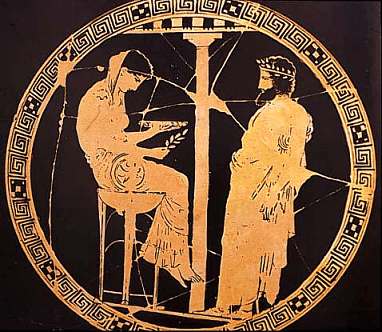 Today I made a Delphic prediction when asked: "should be opportunities on port and starboard. But best not to talk to me unless in response to a query or order while I'm on quarterdeck with enemy in site".
This is the kind of thing that kept Delphi in business for a few thousand years. Completely unfalsifiable. Also, it keeps the range bound boys in business, and the wave and Gann boys in business also, as well as the media when they say something resembling a forecast that isn't a quote from someone with a position.
It also occurs to me that this is the kind of prediction that confirms in your enemy's mind that one is a horse's ass and in your friends minds, they thank you profusely for your wisdom.
Jeff Watson writes:
It occurs to me one could make an excellent living as a financial reporter, financial guru, predictor, prognosticator by learning how to "Cold Read". Applying these methods should impress the general public with one's financial acumen, prescience, and ability to make money. Truly masterful technique allows one to blame the public for their failure when things don't turn out as described.
The best cold readers don't say anything of meaning, and just allow the victim to internalize and believe what they already thought. Cold reading is usually done by fortune tellers, mentalists, con men, and other charlatans seeking to remove money from the wallets of their victims. Here's a good twelve step method on how to learn cold reading. With a little modification of these techniques and an audience, you'll be on your way to richness, and everyone will think you are a genius…..
Remember Chaunce the Gardner, Jerzy Kosinski's creation in Being There, had the highest levels of society fooled and he wasn't even a cold reader… he was just an example that demonstrated that "People will believe whatever they want to believe as long it is an affirmation of their belief system.
Jan
24
Safety Songs, by Victor Niederhoffer
January 24, 2011 | Leave a Comment
The safety songs written by Irving Caesar one believes are beautiful and save a lot of lives. "A boy stood on a railroad track it isn't the place to play I'd like to tell you the rest of the story but it's too sad to say. Let the ball roll."
Jan
24
Hypothesis, by Victor Niederhoffer
January 24, 2011 | Leave a Comment
I hypothesize that one reason for the well documented dry spell of every new york sports team is that it takes a coach of much rodomontade and swagger to land and keep a job in new york, witness the Knicks and jets, and they generate let downs and revulsion in their teams on the rare occasions they win, or more to the point their teams can be ground into oblivion in close games.
George R. Zachar comments:
The Knicks and Rangers reap monopoly rents in the largest US market regardless of merit. Their owner's indifference to quality is legendary among fans.
The Yankees and Mets both spend top dollar for talent, but one organization is competent, and the other isn't.
« go back — keep looking »Archives
- October 2026
- September 2026
- August 2026
- July 2026
- June 2026
- May 2026
- April 2026
- March 2026
- February 2026
- January 2026
- December 2025
- November 2025
- October 2025
- September 2025
- August 2025
- July 2025
- June 2025
- May 2025
- April 2025
- March 2025
- February 2025
- January 2025
- December 2024
- November 2024
- October 2024
- September 2024
- August 2024
- July 2024
- June 2024
- May 2024
- April 2024
- March 2024
- February 2024
- January 2024
- December 2023
- November 2023
- October 2023
- September 2023
- August 2023
- July 2023
- June 2023
- May 2023
- April 2023
- March 2023
- February 2023
- January 2023
- December 2022
- November 2022
- October 2022
- September 2022
- August 2022
- July 2022
- June 2022
- May 2022
- April 2022
- March 2022
- February 2022
- January 2022
- December 2021
- November 2021
- October 2021
- September 2021
- August 2021
- July 2021
- June 2021
- May 2021
- April 2021
- March 2021
- February 2021
- January 2021
- December 2020
- November 2020
- October 2020
- September 2020
- August 2020
- July 2020
- June 2020
- May 2020
- April 2020
- March 2020
- February 2020
- January 2020
- December 2019
- November 2019
- October 2019
- September 2019
- August 2019
- July 2019
- June 2019
- May 2019
- April 2019
- March 2019
- February 2019
- January 2019
- December 2018
- November 2018
- October 2018
- September 2018
- August 2018
- July 2018
- June 2018
- May 2018
- April 2018
- March 2018
- February 2018
- January 2018
- December 2017
- November 2017
- October 2017
- September 2017
- August 2017
- July 2017
- June 2017
- May 2017
- April 2017
- March 2017
- February 2017
- January 2017
- December 2016
- November 2016
- October 2016
- September 2016
- August 2016
- July 2016
- June 2016
- May 2016
- April 2016
- March 2016
- February 2016
- January 2016
- December 2015
- November 2015
- October 2015
- September 2015
- August 2015
- July 2015
- June 2015
- May 2015
- April 2015
- March 2015
- February 2015
- January 2015
- December 2014
- November 2014
- October 2014
- September 2014
- August 2014
- July 2014
- June 2014
- May 2014
- April 2014
- March 2014
- February 2014
- January 2014
- December 2013
- November 2013
- October 2013
- September 2013
- August 2013
- July 2013
- June 2013
- May 2013
- April 2013
- March 2013
- February 2013
- January 2013
- December 2012
- November 2012
- October 2012
- September 2012
- August 2012
- July 2012
- June 2012
- May 2012
- April 2012
- March 2012
- February 2012
- January 2012
- December 2011
- November 2011
- October 2011
- September 2011
- August 2011
- July 2011
- June 2011
- May 2011
- April 2011
- March 2011
- February 2011
- January 2011
- December 2010
- November 2010
- October 2010
- September 2010
- August 2010
- July 2010
- June 2010
- May 2010
- April 2010
- March 2010
- February 2010
- January 2010
- December 2009
- November 2009
- October 2009
- September 2009
- August 2009
- July 2009
- June 2009
- May 2009
- April 2009
- March 2009
- February 2009
- January 2009
- December 2008
- November 2008
- October 2008
- September 2008
- August 2008
- July 2008
- June 2008
- May 2008
- April 2008
- March 2008
- February 2008
- January 2008
- December 2007
- November 2007
- October 2007
- September 2007
- August 2007
- July 2007
- June 2007
- May 2007
- April 2007
- March 2007
- February 2007
- January 2007
- December 2006
- November 2006
- October 2006
- September 2006
- August 2006
- Older Archives
Resources & Links
- The Letters Prize
- Pre-2007 Victor Niederhoffer Posts
- Vic’s NYC Junto
- Reading List
- Programming in 60 Seconds
- The Objectivist Center
- Foundation for Economic Education
- Tigerchess
- Dick Sears' G.T. Index
- Pre-2007 Daily Speculations
- Laurel & Vics' Worldly Investor Articles
