Nov
15
One Noted, from Victor Niederhoffer
November 15, 2012 | Leave a Comment
One noted a big increase in claims today on Thursday, conveniently not one week, but
two weeks after the election.
"Keep it gradual or else Suzy will let Jack out of the widows walk again".
Nov
13
Greece News of a Similar Color, from Victor Niederhoffer
November 13, 2012 | 1 Comment
Like most things the market is worried about, like decreases in economic activity or the inevitable coming decrease in consumer sentiment which follows the stock market like the sage the feigned humility, I wonder if all the Greece news is of a similar color. Would it be good or bad for the market if Greece were more or less austere and the EC, IMF, and other central banks were to buy their bonds at this or that price at the expense of others? The hypothesis that stocks can't go up unless the Greek crisis is settled with buying bonds and austerity is in the meme. When it is broken with a rise, infirmed, a new paradigm of rises related to the fed model will be available. Or at least I think this is a reasonable way of looking at future.
Nov
8
A Circuit Describing Price Action in Markets, from Victor Niederhoffer
November 8, 2012 | 1 Comment
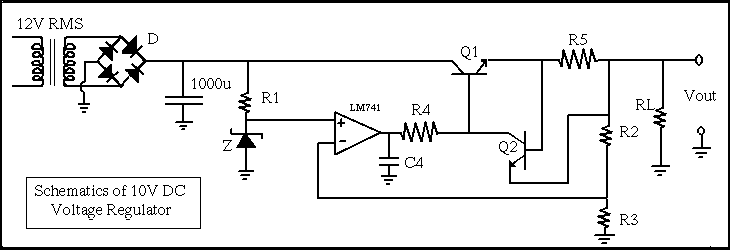 One has found that there is an electronics circuit that almost always retrospectively provides a great description of price action in markets. I wonder if there is an electronics circuit that compresses the voltage output keeping it in a range, sort of like the finger in the dike, but then after the compression is over on the negative side, e.g after the negative feedback is taken away, the voltage doesn't immediately lead to tremendous negative voltage. I seem to remember such a circuit with op amps.
Jon Longtin writes:
There are a variety of electronic circuits that perform such a role, depending on the application. One common application is a voltage regulator, which provides a (nearly) constant voltage, regardless of the load applied to it. The circuit monitors the actual voltage currently being provided and compares to a pre-set reference value. The difference between the actual and desired (setpoint) values is called the error, and is used to adjust the current provided to the circuit to bring the voltage back to the setpoint value. For example if the load increases (more electricity demand) the load voltage will drop and the voltage regulator will provide more current to bring the voltage back up. Same goes for a decrease in load.
There are some limitations and compromises in such a circuit. First is there is a finite amount of current that the power supply/voltage regulator can be provided, and if the error signal requests more than this amount, the output will not be maintained. Also of importance is the time response: a circuit with a very fast time response will respond more quickly to fluctuations in the load, but can also result in so-called parasitic oscillations, in which the output oscillates after a fast change in load is made. By contrast a longer time response provides a slower response to a variation, but tends to damp oscillations. This same behavior, of course, is seen in countless financial indicators, and is part of the art in deciding, e.g., how many prior data points to include in a signal.
A somewhat more complex version of the above, and perhaps more closely aligned with the behavior of a market signal, is an audio "compressor/limiter". This is a device that constantly monitors the volume (magnitude or voltage) of an audio signal and makes adjustments as needed. A limiter is the simpler of the two and simply sets a threshold above which a loud signal will be attenuated. The attenuation is not (usually) a brick-wall however; rather a signal that exceeds the threshold value is gently attenuated to preserve fidelity without overloading the audio or amplifier circuitry. A compressor is a more complicated animal and provides both attenuation for loud signals AND amplification for quieter ones. In essence a HI/LO range or window is established on the unit, and signals exceeding the HI limit are attenuated, while signals below the LO limit are amplified. This resulting output then (generally) falls within the HI/LO range. This is used extensively (too much!) in commercial music. Humans naturally pay attention to louder sounds (ever notice how the volume universally jumps when commercials come on TV? They are trying to grab your attention with the louder volume). Pop music attempts to achieve the same by using aggressive compression to provide the loudest average volume for program material without exceeding the maximum values set by broadcast stations or audio equipment. The result, however is that the music sounds "squished" and doesn't "breath" because the dynamic range of the content has been reduced considerably. With such devices there are a variety of adjustments to determine the thresholds, time before taking action (the attack time) and how gradually or strongly to attenuate (amplify) signals that exceed the envelop range.
Here' s a fairly decent article that describes this in more detail.
Incidentally both of the above are examples of a large branch of engineering called Controls Engineering. The idea, as Vic stated, is to monitor the output by using feedback and make adjustments accordingly. There are countless different algorithms and approaches, as well as very sophisticated mathematical models (people build careers on this) to best do the job. Like most complex things, there is no single approach that works best for every problem, but rather involves a balance of performance, cost, and reliability.
I highly suspect such algorithms have already found their way into many trading strategies, one way or another.
If interested, I can suggest some references for further reading (though I am not a Controls person myself).
Bill Rafter writes:
Think of your voltage regulator as a mean-reversion device. If a lot of this is being done, then your trading strategy must morph into simply following the mean.
In light of recent changes in the investment climate we suggest that one should tighten up controls in which one is long a given market. Perhaps that might also or alternatively mean (a la Ralph) tightening the size of the positions. The result will be taking less risk and incurring less return, but taking additional risk would seemingly not be rewarded in the current milieu.
Jim Sogi writes:
Dr. Longtin's description of compressors and limiters was
fascinating. A compressor on my guitar signal chain prolongs the
sustain on a signal in addition to smoothing out the volume spikes and has less fade as the signal weakens. With added volume, one gets a
nice controlled feedback.
Sometimes in the markets one sees a sustained range with the spikes being attenuated reminiscent of a nice guitar sustain.
On a different note, one curious thing is that people cannot discern differences in absolute volume. It's very hard to hear the differences
in volume between two signals unless they are placed side by side.
Nov
8
Along Comes a Series of Scholarly Studies, from Victor Niederhoffer
November 8, 2012 | Leave a Comment
 Along comes a series of scholarly studies in The New York Times: "Get What You Pay for? Not Always". They report on studies that through 2008 show that S&P companies that spent more on politicking performed worse than those that spent less. They also point out that the flexionic firm with 3 chief executives at Treasury or Governor spent unwisely this time as they moved from the party that can never lose again to the other side. They point to a study from 1981 to 2004 that showed that companies that contributed to political action groups grew slower than those that did not. Furthermore it didn't matter if they picked the winner or loser. And then the proverbial Harvard professor Coates is quoted that the jump in spending led to a deterioration in market performance. Anecdotal examples are given pointing out that banks are big political contributors but they performed badly. Jamie Dimon says, "he's hardly a democrat any more". And finally they show how AT&T tried to get their merger with T Mobile approved with letters from 76 democrats and 56 million in contributions over the preceding years, and yet it wasn't approved and they paid a 5 billion break up fee.
Well, all these studies are of the kind "your own man". Political contributions are necessary these days as the % of workers and their suppliers and G expenditures as a % of GNP goes up. Also, one would posit that the companies that made the greatest contributions were most in need of it, and would have done much worse had they not greased the wheels of G. Also, one would hypothesize that the relation has changed since 2008 as the idea that has the world in its grip has become more prevalent.
Indeed, some good questions arise. With the increased need of having the forces of the weather gauge at your back with government aiding and abetting you, one would think that the companies that give the most to politics are those that have the most government business. And they would seem to be the ones that the best chances of prospering in this environment. So one would hypothesize that a proper study of political spending controlling for whether it was necessary because your company was in the radar, would be very a propos these days and would show a conclusion that is opposite from the picture that summarizes the article with Jamie Dimon shaking the Presidents hand who "was once one of the Presidents favorites" but is no longer the fair haired boy despite their enormous political contributions.
Jim Sogi writes:
The question whether payola for government contracts or regulatory
largess is or is not beneficial to the specific company making the payola, or to the economy in general is related to the broken window
syndrome. Government spending, especially with Sandy, is repairing
broken windows. There is no real benefit to productivity overall, thus no real benefit to the companies seeking this type of work or
largess. This might help explain Chair's hypothesis.
Nov
8
If the Market, from Victor Niederhoffer
November 8, 2012 | 1 Comment
If the market were to go down 200 points right after the election, some liberal analysis 4 years later would say that the market does better during democratic presidentials. They'd start it at the end of November or at the end of December or the beginning of the term depending on what works best, and how much the decline on the news of the election was and then they'd have something like Washington Native American indicator and it could be used as propaganda to keep man small.
Nov
8
My Analysis, from Victor Niederhoffer
November 8, 2012 | 2 Comments
My analysis of every announcement until end of year will be in the context of a conman who just stole tremendous money from a mark. And he's on the train with the mark. And he doesn't wish to look too exuberant or spend the money. E.g. the report of claims today. They didn't want to increase it too much, because then the mark would have known they had the finger on the dike for all announcements before the election, i.e. there will be no saluting of the Russian Flag until the inaugural ball where certain groups are known to be very poor at maintaining balance in the presence of non-sweet grapes.
Nov
6
One Has to Believe, from Victor Niederhoffer
November 6, 2012 | 5 Comments
 One has to believe that the realization that we will be living with the idea that has the world in its grip from the executive office for another 4 years will become accepted today with the exit polls and that a certain revulsion will take place. Yet stocks are still very low relative to the fed model for all time frames so that the revulsion should not be catastrophic.
Rocky Humbert writes:
As I have previously demonstrated with regard to the monthly job reports, EVEN IF one can predict the data, it is impossible to consistently predict the terminal market reaction with any statistical significance at a given/terminal moment in time. And making predictions that X price will be hit (when X isn't statistically significantly far away) is an empty statement. Hence I submit that The Chair should acknowledge that his comment below is an illustration of a statement that cannot be wrong. At any given moment in time, there is a high probability of some revulsion. 365 days per year. And the definition of "catastrophic" is a function of leverage, not price. And that stocks are low relative to the fed model is an empty statement unless he believes that bond prices cannot go down. Lastly, the Average True Range of the S&P is currently about 15.5 points. So any statement that predicts a move of up to 15.5 spu points is most likely to true. I'd say that one needs a move of more than 31 spu points to be "revulsion."
But for proof and in the Franklinian spirit — I will send a unique prize of dubious monetary value to any Spec who can predict BOTH the winner of the presidential election AND the closing SPX price for tomorrow (Wednesday) within 3 SPX points. All submissions should be mailed to the speclist.
HOWEVER, I will make a final prediction. IF Romney wins. And IF Wednesdays close is more than 16 points below today's close, then there will be a very substantial decline between now and year end. How substantial? Enough for the Chair to call "catastrophic."
Nov
4
8 Things We Can Learn About Trading from Caesar, from Victor Niederhoffer
November 4, 2012 | 1 Comment
 I have recently read several biographies of Caesar including Caesar by Colleen McCullough. I found this brief review on Wikipedia illuminating. While I am not very knowledgeable about military strategy or Roman History, I saw many examples of Caesar's genius that were applicable to trading. I thought it might be helpful to list 10 things that helped him rise to the top and win battles that extended Roman territory to the Rhine and English Channel, and conquered 3 million of enemies, killed or captured more than a million of them, and brought back vast wealth to Rome.
1. High Frequency Execution.
He used high frequency weapons. The soldier's weapons were much shorter and lighter than the enemies. His used the Javelin and a short sword called the Gladus. The enemies used two foot spears. The Romans got to wound the enemy much faster and were able to fight much longer and fresher because they carried lighter weapons.
2. The Roman Logistics.
Legionaires had much better logistics than their enemy. Caesar always paid greater attention to food and living arrangements than his enemy. His men were healthier and stronger for battle and were able to escape quicker when defeat was imminent. The importance of a proper foundation for trading is emphasized. Make sure you have proper equipment, capital, and infrastructure before you start trading.
3. Alliances.
He was a master of making alliances, no matter the virtues of his allies. He formed an alliance with Pompei when it was in his interest, married his daughter to him, established peace with hostile Germanic tribes to defeat the Helvetias and the Gauls.
4. Training in the trenches.
He fought as a common soldier from the age of 20. He lived with the soldiers, ate their food, and battled with them. He was captured by pirates and was able to talk his way out of capture with a ransom and then caught the pirate ship and executed them. He had down to earth habits in his food and living. A trader who wants to succeed can't rise to the top withouot trading himslef, and developing economical habits.
5. Engineering.
Caesar loved nothing more than a complicated engineering problem. When he coudn't pursue the Germans by land he built a bridge over the Rhine. He left enough space on the other side so that he couldn't be captured again. He was able to move his army over the Alps in two days to defeat Pompei in Spain. He was trained as a scientist before becoming a soldier and applied the disparate disciplines of engineering, medicine, and architecture to better prepare for battle. The best training for a trader comes from fields other than finance,— physics, ecology, biology, music.
6. Celerity.
He moved his Legionnaires faster than his enemies. They frequently marched 60 miles in a day. He made decisions quickly and brought his legionnaires into the fray quickly when it was time to rout the enemy.
7. Speculation.
Time and time again he gambled and took bold strokes. If you are going to be a speculator you have to speculate you can't grind like Pompei, a much more experienced commander, did.
8. Incentives.
The legionnaires and he were entitled to a % of captured lands, jewelry and slaves. Each hand had a share of the spoils and this made them fight harder. At the end of their stay in the legionnaires they were promised land for retirement and many remains of their homes and belongings show that they lived relatively as well then as retired military today.
Alston Mabry notes:
Twenty or 25 miles a day would be a substantial march, especially carrying all the gear they had.
In broad terms, the key to Roman battlefield success was their tactic of fighting in very close formations, even with overlapping shields. Essentially, they had more "swords per yard" at the front of a unit. This was very effective against enemies who fought in loose mobs, like the Gauls.
As for Caesar, an interesting topic of study is the battle of Alesia.
Phil McDonnell writes:
When I attended high school in NJ I had the pleasure of reading some of Caesar's writings in Latin. In particular I was struck by how he opened his account of the Gallic Wars. the opening three sentences were:
Veni. Vidi. Vici.
They translate as: I came. I saw. I conquered.
In many ways it is the height of confidence, even arrogance. Undoubtedly his confidence was one of his greatest aspects but it also lead to his hubris. One imagines that he was truly shocked when they assassinated him in the Senate chambers.
Nov
2
In the Parks Near Chinatown, from Victor Niederhoffer
November 2, 2012 | 1 Comment

 In the parks near Chinatown you can see tables devoted to Go. The players are generally 80 to 95 years old although since all Chinese above 80 look similar, some centenarians might be there. Standing on all sides of the table are dozens of spectators who lean forward in tense poses waiting in perilous animation for the move of the masters.
One is reminded of this as everyone waits for the important number announcement moves like employment. Of course the numbers are distributed on a "need to know basis" to the president, and presumably to be fair to the challenger, and of course to the "central" and presumably their colleagues across the world say in Negara so that their crucial operations in the exchange market might not be disrupted (where is my challenger friend who has a bedroom here when I could interpret his body language). And one can imagine the give and take before the release from the circular office. "No that's too low, we got a lot of flack last time. Suzy might have let Jack out of the attic again. How about a little rise. But keep it below the round".
The centenarians perched precariously smile inwardly.
Nov
2
It’s Now Clear, from a former rackets player
November 2, 2012 | 1 Comment
 It's now clear to me that everything Rogan said recently is right. There is a force, probably without memorialization wishing to keep the world state going. That force will do everything it can to keep the market up before the election. Shortly after or in conjunction with the wish fulfillment of the incumbent win, a revulsion will occur.
Please help me with the timeline. It starts with the Roberts decision to allow medicare. Then the German decision to allow redistribution from Germany to Europe, then the GE 4 the cooling of Arab Spring protests so as not to embarrass their fellow traveler in the "circular" office, then the 7.8 % from a temporary head who lunches as agrarian party bashes with her kid.
Let us hope that the adversary does very well in cardinal events such as debates and polls in the interim so that massive European and central bank activities unlimited to support the stock market can be implemented in the remaining few weeks.
Alex Castaldo writes:
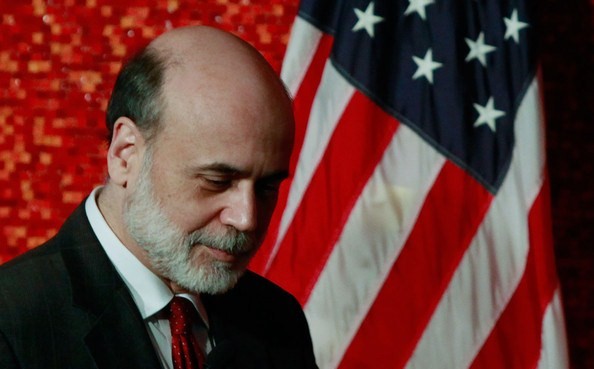
The next logical step would be a Nobel prize for Bernanke or one of his ilk.
Nov
1
The Question Arises, from Victor Niederhoffer
November 1, 2012 | 2 Comments
The question arises, "who can you trust as you get along in life" and "how can you teach your kids or your wife to take care of their financial lives when you are gone" and "how many spouses and family have been victimized when the person that controls considerable wealth is seduced by a much younger and more sexual personage with the intention of relieving him and the family of their wealth"?
an anonymous commenter writes in:
 My friend recommended The Sociopath Next Door a few days ago. Here is a great quote:
"Maybe you are someone who craves money and power, and though you have no vestige of conscience, you do have a magnificent IQ. You have the driving nature and the intellectual capacity to pursue tremendous wealth and influence, and you are in no way moved by the nagging voice of conscience that prevents other people from doing everything and anything they have to do to succeed. You choose business, politics, the law, banking, or international development, or any of a broad array of other power professions, and you pursue your career with a cold passion that tolerates none of the usual moral or legal incumbrances. When it is expedient, you doctor the accounting and shred the evidence, you stab your employees and your clients (or your constituency) in the back, marry for money, tell lethal premeditated lies to people who trust you, attempt to ruin colleagues who are powerful or eloquent, and simply steamroll over groups who are dependent and voiceless. And all of this you do with the exquisite freedom that results from having no conscience whatsoever. You become unimaginably, unassailably, and maybe even globally successful. Why not? With your big brain, and no conscience to rein in your schemes, you can do anything at all."
Ken's book suggests 1 in 25 have the personality type. Sociopath's seem to be an overweight in the business sphere. And Sociopath's organizations echo their personality traits. Thus identifying them would seem to be essential. Unfortunately, there's the chicken and egg issue: by the time you have foreknowledge, it's often too late.
The only ready indicators I've felt: a general feeling that somethings not quite right when you meet them; something about the eyes that is a bit vacant (but as distinct from meeting an introvert).
But I do not claim any success in this measure.
I think the Rockefeller approach of cheating your own sons perhaps has sense. Similarly, I think you need to meet some truly ruthless people to get a sense of them. You might seemingly want to protect children from these sorts of experiences, but perhaps it ultimately costs more later? Unfortunately, ruthless people are not always in ready supply until you are on the battlefield, so to speak.
Jeff Watson writes:
The sociopaths in the S&P pit in the late 80's were legendary. Any
time I would get a trade down, even my own firm's broker stole from me.
He was busted for it in 1989.
Kim Zussman writes:
We trust friends and family based on incomplete information, or empirically based on a sample of trials from which we conclude trust or not. This is true because we can never get into minds of others to understand their true motives and intentions (and even if we could, their motives may be indecipherable as they are invisible to themselves).
Thus it is logical, when presented with unexpected criminal evidence, to question the original basis of friendship or kinship.
Put another way, when should countervailing evidence out-weigh personal connection?
Nov
1
50 Billion to Repair the NY Subway System, from Victor Niederhoffer
November 1, 2012 | 1 Comment
 I see an estimate of 50 billion to repair the NY subway system. "Many of the suppliers of equipment have been out of business for 50 years". All equipment damaged by salt water basically must be replaced. The loss of wealth from the flooding and the 3 million homes without power must represent enormous opportunity cost to the economy. At least 50 billion above and beyond the subway. The total goods that an economy produces represents the amount available to be divided up and would seem to be a good measure to total utility. These total goods are 100 billion less than they would have been. They say that one of the causes of the 1907 October crash was the San Francisco earthquake of April 1906. Big destructions in other floods and tsunamis would seem to have lagged negative impacts also. Total reductions in wealth like this have to be big negatives for the long term despite the tendency of calamitous events to have a negative impact the first day and bounce back by end of week.
Ken Drees writes:
I like the reference to San Fran in scope and lag. Let's say it costs 200 billion to repair–it will be the only QE that cannot be afforded. A sad reality.
Oct
28
A Modern Financial Story, from Victor Niederhoffer
October 28, 2012 | 7 Comments
 I sat next to a famous 97 year old singer yesterday at a Halloween party. She had sung with Danny Kaye, Red Skelton, Frank Loesser, Lucille Ball, Frank Sinatra and many others in her illustrious career. At the age of 30 she married a gynecologist and had 60 years of a beautiful happy marriage. A year before he died he was encouraged by friends at the club to invest with a dynamic investor who was guaranteed to take their money and give them a 10 fold return within 2 years. He was a famous new jersey ponzoist a la Madoff and she lost her entire wealth of 500,000 with him. Her husband went to the dentist to have a tooth pulled and woke up with a tooth ache that night. She took him to a hospital where he was told to take or get off Cumodin. The doctor kindly told her to go home for the night and an hour later they called her to tell her the beloved husband was dead. She lives in a rent controlled apartment and can't afford the rent after 50 years. It's worth 2 million but she can't get the landlord to buy her out of her lease. She said she'll marry someone much younger unless he does, but the prospective husband wants to put her away into assisted living so it doesn't work. She had a beautiful voice, was completely upbeat, and quite a bit more up to date and mobile than I. "I remember everything" she said and she did. I touched her for good luck as I do all centenarians.
Oct
26
Popular Phrases, from Victor Niederhoffer
October 26, 2012 | 8 Comments
What are the popular phrases used in our business. Things like "risk on" and "challenging" and "restructuring". It always amazes me how book value of a company can decrease while its operating earnings go up.
Gary Rogan writes:
"Risk-adjusted returns" and "risk tolerance", which seem highly presumptive.
Vince Fulco writes:
"A rising tide lifts all boats"
"the fed/bernanke put will protect you"
"Fools dance but the greater fool is the one on the sidelines watching them dance…"
"Esp. If they are earning ZIRP"
Pitt T. Maner III writes:
There are two phrases that seem to be in more frequent use lately:
1. "jumping the shark" which has an interesting origin from the "Happy Days" TV show in 1977:
'In its initial usage, it referred to the point in a television program's history when the program had outlived its freshness and viewers had begun to feel that the show's writers were out of new ideas, often after great effort was made to revive interest in the show by the writers, producers, or network.
The usage of "jump the shark" has subsequently broadened beyond television, indicating the moment in its evolution when a brand, design, or creative effort moves beyond the essential qualities that initially defined its success, beyond relevance or recovery.'
and
2. "thrown under the bus" which evidently was first used by sportswriters around the 1990's.
"It's unclear where the phrase came from, but there's no doubting it's having a heyday. There are bus-throw references in the late '90s, mostly in professional sports. (Players who don't get their contracts renewed are often said to get you know what under you know where.) The phrase turns up in politics in 1999, according to a database search, with its maiden voyage courtesy of a press secretary for a candidate for mayor of Philadelphia."
Perhaps in some ways the revived usage of these (and many other) turns of phrase are indicators of overall public sentiment.
Ed writes in:
fiscal cliff, confusing alpha with beta, risk management, proprietary formula, diversify, flight to quality, short japan, market bubble, gold bug, tin foil hat theory, perma-bear, bullish, bearish, front run the fed, market master, trading guru, market cycle, ETF portfolio, bond maven, high frequency trading, flash crash, smart money, front run, market anomaly, wave theory, cash is king, cash is trash, quantitative easing, QE, money printing, wealth effect, hard money, we are bankrupt, offshoring, the 1%, responsible for 5% of NYSE/CME/CBOE volume, carried interest, deep value, momentum trade
Oct
24
The All Seeing Eye, from Victor Niederhoffer
October 24, 2012 | 1 Comment
The All Seeing Eye mounted above could see revulsion among flexions in Germany, Spain, the IMF, the EC, the central banks, and the mid-east that the probabilities are evening, and the market is crashing. What a terrible way to lubricate the cogs of the world state. Even before the Fed must do its thing today, one predicts a helping hand from the fellow brothers in Europe.
Oct
22
Chokeholds, from Victor Niederhoffer
October 22, 2012 | Leave a Comment
 I can't begin to express my disapproval of letting a son go round putting people in choke holds, and kidding them about their lives. I can't begin to think of a worse thing to do to people, and worse training for a kid. All fathers should put a violent stop to such activities at the first signs of it. I have had people put choke holds on me, and the feeling of helplessness and having death in the hands of a joker is one of the most terrible feelings that one can have. It can lead to all sorts of dire consequences and thank the good one that my friend who mentioned something about this to me is still healthy after their encounters and amusing contretemps in it.
Ralph Vince writes:
I agree that no one (of any age) should go around doing that, and a fortiori, young people must be taught to make sure not to let people come up behind them, to track them in their head, and to have a sense of the whereabouts in the plane surrounding them of all who are about. It's too easy to become preoccupied in thought (or conversation) and lose sense of where the pieces are on the chessboard.
That being said, I think having enemies expedites education. I can only speak for myself, but I live in the middle ages, and wouldn't think of leaving home without a cup and two discrete weapons. A gentle man should look like a gentleman, and above all, never, ever let anyone come up behind them for any reason. Similarly, one should be very careful when coming up behind someone else, to speak to them and them know.
Kim Zussman writes:
Funny no one looked up the actual risks to "choking out".
However this fits with the ubiquitous meme on dailyspec, "we as parents who have lived longer (but aren't necessarily successful / self actualized / or understand fully what we are doing here) will instruct you".
Or, that you should study certain music, sports, chess, religion, etc, in order to have a better life (fit in, reproduce, instruct, etc).
This was apparent this afternoon observing various bird species. The local crows call to each other in a way they all accept. Most likely the calls are reassuring: "we are crows and we got it right!". Also there is a lot of Mexican sage growing here, which attracts legions of hummingbirds. They twit twit continuously, zipping about, arguing over this or that mate but at the same time saying "we are hummingbirds and WE got it right".
New to our neighborhood is the black-hooded parakeet - a non-native parrot released into the wild but living and reproducing happily here. They fly in a tight noisy cluster - from one neighbor's Mexican palm to another's pine. Somehow these two trees are go-to places for the parrots, as they squawk and argue about tabloidesque mating rights.
What does this have to do with Reese Witherspoon putting her Ojai house on the market ?
This:
"Libbey Ranch provides a serene setting to be with her family, and looms large in her approach to parenting. "It reminds me of growing up in Tennessee, where we spent all day outside," she says. "I wanted my children to have that experience, to get muddy and hang out with the animals."
Indeed, Witherspoon has turned Libbey Ranch into a menagerie. A Friesian horse and a chestnut pony share the paddock. There are donkeys, goats, pigs, chickens, and four whimsically named dogs: Hope, Nashville, Coco Chanel, and Hank Williams. Neff fashioned animal silhouettes that are perched on wooden fences around the property. "
An iconic actress teaching that the fond remembrances of her childhood should be impressed on her own children for their own good. But now married to a man who is not these children's father, and expecting his. Evidently the ranch has to go.
But Ojai is not just about Hollywood. In fact other mothers duked it out there Friday on one of my mountain biking trails:
"A 50-year-old woman was walking her three dogs Friday on a road just north of the Ojai city limits and adjacent to Los Padres National Forest when she apparently surprised a California black bear and a cub. The bear, described as cinnamon brown in color, was estimated to weigh 250 pounds and was with a cub that appeared to weigh about 50 pounds, the department said.
The bears ran across the road ahead of the woman, but then the larger one came back to her and scratched her wrist, leaving a 1- to 2-inch wound that was not life-threatening, officials said. The attacking bear began to leave, and the woman turned her back it. But the animal returned and charged the woman, knocking her down an embankment. In addition to the earlier wound, the woman received at least several 6-inch abrasions that appeared to be from a claw, the department said."
Oct
22
Quotes of the Day from The Living Sword, from Victor Niederhoffer
October 22, 2012 | 2 Comments
Often we would remain absolutely still for several seconds even when out of distance. These were the most tiring periods for our brains were then undergoing that exhausting battle of wits which immediately preceded each phrase d'armes. The physical strain was truly severe. A fencer is irrevocably doomed the moment the lively flame in his eyes shows signs of diminishing in intensity. At times our eyes would not even blink for comparatively long periods for blinking at the wrong time, within striking distance meant giving the opponent the advantage. The slightest misjudgment in distance, or the smallest useless blade motion meant almost certain suicide for the one who erred.
—
I based my fencing upon the offensive defense of the counterattack and contretemps, as well as upon the third and fourth intention. Indeed the second intention was seldom successful against a champion like my brother.
from The Living Sword about his training bouts with Nado.
Oct
22
Full Review of The Living Sword by Aldo Nadi, from Victor Niederhoffer
October 22, 2012 | Leave a Comment
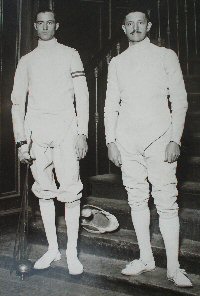 The Living Sword by Aldo Nadi is an autobiography of perhaps the greatest fencer of the century. His brother was Nedo Nadi. They were sons of a famous fencing teacher of the 19th century and fenced pretty much from birth winning their first adult tournaments at 11. The fencers at the school used to like to beat the kids in matches when they were teens and induce the father to give them a bout in return for their kidding. They won many Olympic golds in 1922 and then both turned professional.
The book describes the career of Aldo Nadi who spent his first 35 years in Europe and then left for America right before the second world war. After turning professional, he engaged in a series of Galas, like our heavy weight boxing matches, with anyone who would fence against him. He was so good that eventually no one would match up against him. His style was different from others, he did all his parries from central position. In the offensive movements he deliberately avoided each of his opponents weaknesses trying to score, instead in the lines best protected against and through their favorite most effective parries. Furthermore, he insisted on launching his attacks as far from the targets as feasible. He was 6' 2'' and weighed 130 pounds and was quick as a cat and always sick.
The book starts off with a real duel that he engaged in with a writer who questioned his courage, and ends with his proposal for a duel with guns with the president of the Italian Fencing Federation who didn't accord him as much respect as possible. And it is interesting to read about the formal nature of the duels of the 19th century and how different they are from real fencing matches. "You are not at ease, particularly when you see a couple of doctors in white shirts silently laying out a hideous assortment of surgical instruments upon a little table. They may be for me in a few seconds".
 Nadis favorite activities were seduction, gambling and battles. He didn't train, drank heavily and was always sick. My father always said that such activities would inevitably lead a man to die broke and a degenerate. I was interested to see if that would hold true in Nadis case and indeed it did. He hated Los Angeles where American fencers and Hollywood did not care to put in the training and respect that fencing demanded. He went back to Monte Carlo at 60 to try to win a stake again, lost all his money, and had to come back to LA to teach again at a meager rate with the tail between his legs. His first marriage was strictly for money and his second "was a blunder". A niece wrote: "his mortal remains that I would have wished to accompany in the cemetery of Livorno beside his parents by his desire were cremated and his ashes dispersed from an airplane over the ocean. Italy, he rejected and generous America was not his country. He chose the wind for his tomb and I weep in anguish". His last sentence was "you have to know that I was a much better fencer than my brother and the only reason he tied me in our exhibition was that he begged me not to trounce him."
The book covers all of his ideas about what is good and bad in America and Europe during the major part of the 20th century. He hated doctors, railways, air conditioning, American education, and American women whom he felt were very cold compared to the hundreds of European women he seduced. He was a fan of Bertrand Russell and H.L Mencken and has many views on life that are similar to them. I found the book fascinating and well worth reading to find out how a person of tremendous natural ability and great training could mount to the summit of his field conquering the obstacles of a great activity that is not a great part of popular culture.
Oct
18
One is Reading The Living Sword, from Victor Niederhoffer
October 18, 2012 | 3 Comments
 One is reading The Living Sword by Aldo Nadi, perhaps the greatest Italian fencer. His life consists of gambling, romance and seduction unlimited, and drinking without training.
After beating everyone in Europe in match games, like our boxing matches, he moves to the United States where he finds "no interest in fencing whatsoever". He loathes his brother who was the previous Europe's best, and has nothing good to say for his competitors.
I have not read the last 100 pages yet, but I am waiting to see if my father's adage that all gamblers die broke and degenerates holds true.
Oct
15
Whatever Banker Wants, Banker Gets, from Victor Niederhoffer
October 15, 2012 | 3 Comments
 "Whatever Lol–a wants, Lol–a gets" from Damn Yankees should be lyricized relative to the central banks, flexions, around the world sitting on the razor's edge watching every earnings report, every dip in the stock market ready to provide massive unlimited balance sheet buying whenever it looks like their unseen boss will not get what it wants.
George Parkanyi obliges:
Victor, the song is already tailor-made … just needed a few minor
tweaks. Now if you can get someone to sing it I'll be impressed.
WHATEVER BANKER WANTS
Whatever banker wants
Banker gets
And little printer, banker wants you
Make up your mind to have no regrets
Recline yourself, resign yourself – cause you don’t have to be through ;)
I always get what I aim for
And your … skills … is what I came for
Whatever banker wants
Banker gets
So let the presses roll
Don’t you know you can’t lose?
You’re an exception to the rules
I'm irresistible, you fool, give in!…give in!…give in!
Hello, Ben
It’s me
We bet so high
All thanks to you
Aaah-haaaaaa
Poo poo pa doop
Peek-a-boo
Yoo-hoo
I always get what I aim for
And you heart'n soul is what I came for
… banker wants
… banker gets
… We’ll always win
I'm irresistible, you fool,
Give in…Give in…Give in.
Oct
13
An Interesting Run, from Victor Niederhoffer
October 13, 2012 | 1 Comment
That was an interesting run of 6 consecutive open to close down in the S&P. 9 of the last 11 have been down. It happened 15 times in the last 17 years. Neutral to bearish the next day. But the 6 in row happened 29 times. That is inordinately low. What consternation there must be among flexions and related world institutions.
Oct
11
One Wonders, from Victor Niederhoffer
October 11, 2012 | 6 Comments
 One wonders what that interesting personage would say about our inability to defend the Libyan compound and the amazing staged efforts of the militants to overcome 4 or 5 lines of our defense including the charted airline from Tripoli.
Chris Tucker writes:
Upon boarding the shuttle at LaGuardia bound for DCA yesterday I heard a very distinct, deep, German accent coming from the first row of seats, which could only be coming from one person. I looked down and saw Henry Kissinger chatting with his neighbor. For some reason I had forgotten that he was still living and was a bit taken aback. He looked quite old but in good spirits.
Vince Fulco writes:
I am into the early chapters of Lone Survivor, a book written by a Seal Team member re: his early 2000s experiences in Afghanistan. I had no idea how hamstrung the boots on the ground were by rules of engagement (ROE) made thousands and thousands of miles away from the battle. He attributes these unrealistic rules to the direct loss of 3 of his squadmates. It parallels the stories of cruise missile operators with OBL in their sights. Regrettably they were unable to fire unless they received approval from then POTUS Clinton who was more worried about his own selfish pleasure with Ms. Lewinsky.
Oct
10
Post Traumatic Stress in the Market, from Victor Niederhoffer
October 10, 2012 | 4 Comments
 If post traumatic stress is so common to those who have seen their comrades killed (it used to be called battle fatigue in sociology courses), then it must exist in the market, as it represents a very prevalent human condition that should manifest itself in measurable areas rather than self pitying ones related to disability insurance et al.
One is reminded of what all of us who survived the Oct 19th, 1987 crash and many others engendered by people like the inside traders among the French banks et al, and the New Jersey Governor who didn't know that they were using customer funds. All such activities led to 4 % or more daily declines and of course 25% for the Baker crash of 87.
In any case I quantified a daily PTS event as a 3 % move up from the low of a day when the low was 3% or more below yesterday's close. I find reasonable evidence of suicidal tendencies in the market the next day to the extent of about -2/3 % with a 1/3 chance of it not happening.
Oct
10
Sandusky Professes Innocence, from Victor Niederhoffer
October 10, 2012 | Leave a Comment
 I have wondered and hoped that he might be innocent from day 1 because I have seen hundreds of horse play things between kids and athletes when I was in my squash career and head of the association. I have not read the trial transcript however, but can only guess what the incentives to create damaging allegations are for the "victims".
URGENT: Sandusky Professes Innocence, Vows to Fight
2012-10-09 11:47:41.661 GMT
By MARK SCOLFORO Bellefonte, Pa. (AP)
Jerry Sandusky says he's innocent and vows to keep fighting in a recorded statement broadcast by a student-run radio station at Penn State. The statement was aired Monday, a day before the former assistant football coach was scheduled to be sentenced on 45 counts of child sexual abuse. One of his lawyers says he would stake his life on the legitimacy of the statement. In it, Sandusky says that in his heart, he knows he didn't do what he calls "these alleged disgusting acts." He says he's the victim of Penn State, investigators, civil attorneys, the media and others. Mike Fliegelman, student general manager of Penn State Com Radio, says the statement was recorded at the county jail in Bellefonte. Defense attorney Karl Rominger initially said he wasn't aware of the recording. Early Tuesday he confirmed to The Associated Press that it was authentic.
Craig Mee writes:
Perhaps you are being "gaslighted".
Like 50s murderess, Barbara Graham whose last words ("good people are always so sure they're right") set off a firestorm of doubt in the public's mind about her guilt and inspired the film Gaslight with Ingrid Bergman, we now have our sociopath molester throwing in doubt at the last opportunity before his sentencing with all the urgency and fervor that happens when sociopaths are caught at their own game.
I recommend you read The Sociopath Next Door by Barbara Strout. There is some value in knowing the mindset of these types of people, supposedly 4% of the population. Sociopaths are people without the burden or restraint of a conscience. And the book dovetails into your other post about battle fatigue, where the conscience of the soldier is being forced into repression and then when his buddy is killed a straw breaks and either he lashes out at the enemy in a heroic or dangerous act or he points his emotion inwardly and commits suicidal types of behavior. I agree, financial markets are similar to war sometimes.
Oct
9
Talk About a Negative Feedback Loop, from Victor Niederhoffer
October 9, 2012 | 1 Comment
Talk about a negative feedback loop. Merkel talks today to Greece. She has to say something positive about the sacrifices the Greeks are making, which is bullish, but then has to demand more austerity to stay in power, which is bearish, but she can't demand too much austerity because all the Europe needs the incumbent as he will give the most money to Europe to stabilize the situation. It's a tri amp with the output going back to the negative input and then the positive.
Oct
8
Review: Starboard at Midnight By Helen Behr Sanford, from Victor Niederhoffer
October 8, 2012 | Leave a Comment
 Starboard at Midnight By Helen Behr Sanford.
If only heroes like Frank Merriweather, the legendary hero of Ainsle Young's novels about a superman from Yale who routinely ran onto the football field of the Harvard game and scored the winning touchdown with 5 seconds left before saving the most beautiful girl in the East from mayhem at the expense of bandits and then devoting his life to providing Ivy education for orphans, existed today. Indeed, the heroic idea is so incongruous these days that no review of this most popular book of the 20th century even exists. However, a real life Frank Merriweather in the form of Karl Behr actually existed, and Helen Behr Sanford has written what for me was one of the most fascinating books I have ever read.
Briefly, Karl was about the best tennis player in the world during the early 20th century. He has wins over Wilding, Larned, Williams, Barrret, Gore, Brookes and Clothier. He was ranked in the top 3 in the US and was good enough to give Comet McLouglin many a 5 set match. He was superb at all track and field events, routinely jumped 6 feet standing high jumps, and was a superb hockey player. His best sport was baseball, but he wasn't good enough to make the Yale team. His brother Max was the second best golfer in the country and Frank and Max played almost even. While at the obligatory Swiss finishing school La Chatalaine, before the obligatory stay at St. Lawrence, he performed risky mountain climbs and won all the tennis tournaments. He seems to have been a genius who not only aced all his classes at Yale, but was able to knock off Columbia Law school in one year. His mechanical abilities were unrivaled and he was able to work every machine in his father's abrasive plant. He was a highly successful business man, and lawyer, innovative enough to prospect all the silver and gold mines in Mexico, versatile enough to get full payment for all his clients in contract disputes, and of course able to solve all the problems of the father's abrasive business so that it yielded steady dividends for the family. He's the type of hero who if an airplane were to crash, he would save the crew and baby. And if he was on the Titanic during it's maiden voyage with a surprise ring for his fiancee Helen Newson, he would be on the Starboard side, and be one of the only men saved on the life boat. When picked up by the Carpathia, he would organize activities to save the survivors.
 All of the above happened. He proposed to Helen Newson on Titanic, and interrupted his squash game on Titanic to make sure that Helen, who he had just proposed to with his Grandmother's ring, was not discommoded. He climbed one deck above to see Captain Smith and Ismay demanding that the first class passenger Helen Newson get into Lifeboat number 7. Mrs. Newson asked routinely if she could take her whole party in with her and First Officer Pittman routinely answered "Yes". At that time, no one felt that Titanic would go down. Regrettably he suffered from Post Traumatic Shock Treatment after he was saved. And he suffered a breakdown 2 years later. His tennis career was interrupted and he gave up his position at the law firm and father's company to become a middle level broker at Dillon Read. He was the kind of hero who could never accept that he was saved by change when so many others heroically died with the musicians as they played on while the boat sank.
 The book was particularly entertaining to me because I had a reasonable familiarity with all the events. I have read all the old tennis books describing the English great like the Renshaws, Dohertys, and the Larneds, that overlapped with the greats of today through their play against Tilden and McLouglin. I played in many of the same tournaments as Behr and my career in racket ball was similar to his. I visited numerous abrasives factories in my day as a broker and walk past his ancestral home in Brooklyn Heights often when visiting my daughters, many of whom live within a block or two of their 82 Pierpont Street street address. The Behr family summered at Squam Lake in New Hampshire, and I visited Jack Barnaby there where he was tennis coach and must have passed the Behr's many times.
And yes, I suffer on occasion from having escaped from disaster relatively intact when many others did not escape at all. The Palindrome always said to me "you have to prove you can do it again. That's suicidal.". I didn't believe him then and refuse to do so now, but the anxiety and thoughts of guilt still emerge. But most of all, I knew a man like Karl Behr and Frank Merriweather who could do anything superbly, was present at each of the thousands of lessons his 3 kids took, and never spent an evening away from his loving wife Elaine. And was the perfect man that everyone loved. It's my father Arthur Niederhoffer. I would recommend Starboard at Midnight to anyone wishing to read about life as it should be. Helen Behr Sanford, the granddaughter, who found the 168 page manuscript that Karl had written when he knew he was a goner from heart disease and cancer on which the book is based has done a great job in bringing back the life of a real hero.
Oct
5
10 Things I Learned From Gary Hoover, from Victor Niederhoffer
October 5, 2012 | 4 Comments
 On October 4th at the Junta, Gary Hoover, Entrepreneur and Explorer, Learner and Teacher, gave an excellent talk.
Let it be said at the outset that Gary is a many of great respect. Jim Lorie, the Mendeleev of our field, my thesis adviser told me on his death bed that Gary was one of the most admirable entrepreneurs and students he ever met, and that the money he made from investing with Gary was some of the happiest money he ever made, and the Santa Fe opera and University of Chicago were just two of the beneficiaries. I have always felt that I should be supportive to a friend such as this and was happy to provide a forum. Here are 10 things I learned from him.
1. He keeps Rhodia pocket notebooks with ideas for starting business. So far he has more than 200 pocket notebooks filled up and 225 new business ideas that he thinks interesting. Richard Branson has more than 2,000 such pocket notebooks filled up.
2. He has 65,000 books in his home museum, a renovated school in Texas,and he consults them all the time for ideas. His favorite business books are those by Peter Drucker and Hidden Champions by Norman Wolff. He's in 24-7 email contact with all his former students.
3. Gary lists 8 essentials for being a successful entrepreneur. Be curious. Study History. Study Geography. Be clear. Be consistent. Above all else, serve others. Be unique. Be passionate. A good guide for those in any business or pursuit of excellence.
4. He believes the greatest 3 businessmen were Albert Sloane who went door to door to make sure all his dealers were making profits, Alexander Johnston Cassatt who built Penn station when the Penn Railroad was the biggest company in the world comprising 10% of the NYSE in market value, and John D. Rockefeller who brought the price of oil down by 90% and enabled Americans to be able to afford to read.
5. The archetypical business, the start of almost all others is a person cooking for another for mutual benefit and profit. The restaurant business now has a total volume higher than home meals. He believe the food service industry is the most exemplary business and the banking business the worst.
6. When he goes to a trade show, he can tell the dynamism of the industry by looking at whether they have swim suited models pointing to a product or interactive displays.
7. You can learn something from any person you meet, and he tries to do so by engaging in conversations. He often gets business ideas by listening to what others are saying at restaurants.
8. He considers himself most fortunate in his riches in that he has started thousands on the way to entrepreneurialism.
9. He believe the greatest areas for increases in wealth and opportunities to start successful businesses are in Medelin, Columbia which is one of 42 countries he has visited to talk about entrepreneuralism and Mexico.
10. He points out that reputations lag the facts by about 10 years. People still remember the drug lords of Medelin but they have been dead for 20 years, and it's now one of safest cities in world.
Oct
5
Your Thoughts, Mr. Krisrock, from Victor Niederhoffer
October 5, 2012 | Leave a Comment
It would be interesting to see what Mr. Krisrock says about the numbers. He's been predicting this for at least a year, and let us all in on what was in store for this October at the last spec party.
Tyler McClellan writes:
"Western scholars have found many reasons to think that the measurement of Russian national income is too important a task to leave to Russian statisticians."
Oct
2
The Fed, from Victor Niederhoffer
October 2, 2012 | 3 Comments
 The Fed gave a vigorous defense of their policies today. One wonders if there is anything that would ever convince them that their policies were and are wrong. For example, if the more they QE it, the worse the economy gets, and the more intractable the employment situation gets. There is something terribly wrong with certain banks laying off 30,000 operatives while at the same time receiving hundreds of billions of emollients in form of investment, loans, purchase of assets, flexionic information, favored deals, guarantees, bailouts, favored nation treatment in regulation and the Good One knows what else, and maintaining and building their 2,500 man trading rooms and CIO's. One mechanism that would cause all such transfers of resources to these favored flexionic institutions to create discommodiation in everyone else, would be the loss of incentives that creates in those not favored. But it goes much deeper than that.
Gary Rogan writes:
I call this "the Krugman Principle": when a government intervention fails it's always because it wasn't big enough, never because the idea was wrong.
To quote from a Credence Clearwater Revival song (although a little outside of its intended topic): "And when you ask them, "How much should we give?" Ooh, they only answer More! more! more!"
anonymous writes:
When it comes to social "insurance" there is a point of diminishing returns. The argument for insurance goes, if you buy insurance, you will be able to take more risk elsewhere. And likewise with social insurance, if you don't have to worry about starving in your old age, you don't have to save as much, and can invest the savings in riskier endeavors such as starting a business and you can spend and consume more in your youth. However, if the benefits are too generous, threatening either collapse of the whole social insurance system or massive unknown changes, then the reverse is true.
Likewise the same is true for the government backstopping every corporation that is to big to fail.
It is my contention that the public has become aware that the current course is unsustainable both for the flexions and social security.
Hence the saving rate and lower consumption will continue (slower speed of money). But these are the very things that will enable the fed to say at least "we have done no harm" from a short sighted view.
Oct
1
Common Errors That Cost a Fortune, from Victor Niederhoffer
October 1, 2012 | Leave a Comment
 What are the common errors, the improprieties, the lack of attention to proper mores, the p's and q of trading that cause so much havoc and could be rectified with a proper formal approach? Here are a few that cost one fortunes over time.
1. Placing a limit order in and then leaving the screen and not canceling the limit when you wouldn't want it to be filled later or some news might come out and get you elected when the real prices is a fortune worse for you
2. Not getting up or being in front of screen at the time when you're supposed to trade.
3. Taking a phone call from an agitating personage, be it romantic or the service or whatever that gets you so discombobulated that you go on tilt.
4. Talking to people during the trading day when you need to watch the ticks to put your order in.
5. Not having in front of you what the market did on the corresponding day of the week or month or hour so that you're trading for a repeat of some hopeful exuberant event which never happens twice when you want it to happen.
6. Any thoughts or actual romance during the trading day. It will make you too enervated or too ready to pull the trigger depending on what the outcome was.
7. Leaving for lunch during the day or having a heavy lunch.
8. Kibbitsing from people in the office who have noticed something that should be brought to your attention.
9. Any procedures that violate the rules of the British Navy where only a 6 inch plank separated you from disaster like in our field.
10. Trying to get even when you have a loss by increasing your size and risk.
11. Not having adequate capital to meet any margin calls that mite occur during the day, thereby allowing your broker to close out your position at a stop while he takes the opposite side. What others do you come up with?
Jeff Watson writes:
I don't know if it is an error or a character flaw, but freezing will create mayhem with your bottom line.
Alston Mabry comments:
"Do Individual Investors Learn from Their Mistakes?"
Steffen Meyer, Goethe University Frankfurt– Department of Finance Maximilian Koestner, Goethe University Frankfurt - Department of Finance Andreas Hackethal, Goethe University Frankfurt - Department of Finance
August 2, 2012
Abstract:
Based on recent empirical evidence which suggests that as investors gain experience, their investment performance improves, we hypothesize that the specific mechanism through which experience translates to better investment returns is closely related to learning from investment mistakes. To test our hypotheses, we use an administrative dataset which covers the trading history of 19,487 individual investors. Our results show that underdiversification and the disposition effect do not decline as investors gain experience. However, we find that experience correlates with less portfolio turnover, suggesting that investors learn from overconfidence. We conclude that compared to other investment mistakes, it is relatively easy for individuals to identify and avoid costs related to excessive trading activity. When correlating experience with portfolio returns, we find that as investors gain experience, their portfolio returns improve. A comparison of returns before and after accounting for transaction costs reveals that this effect is indeed related to learning from overconfidence.
Kim Zussman writes:
Trading a market, vehicle, or timescale that is a poor fit for your personality, temperament, and utility, exacerbated by self-deceptive difficulties in determining this.
George Coyle writes:
Speculation by definition requires some amount of loss otherwise the game is fixed. However, I believe loss can be broken down into avoidable loss and unavoidable loss. Unavoidable loss is, well, unavoidable. But in my personal experience (and based on pretty much all speculative loss I have seen or read about) all avoidable speculative loss is traced back to some core elements/violations: not being disciplined (many interpretations), getting emotional and all of the associated errors and mistakes that brings, sizing positions too big so that regardless of odds you eventually have to reach ruin, not being consistent in your approach (the switches), not managing your risk adequately either via position sizing or stop losses, finally you have to be patient for the right pitch whatever that may be for you.
Jason Ruspini writes:
A similar distraction comes from making public market calls.
Jim Sogi writes:
The Sumo wrestlers' trainers in Japan are conscientious about avoiding mental strife in their fighters since it affects their performance. Sometimes when other life issues intrude, like getting up on the wrong side of the bed, it is better to refrain from entering a large position. You're off balance. How many times have I thought to myself, "I wished I had just stayed in bed this morning"?
William Weaver writes:
Mistakes I'm working on:
-execution error
-having too much size too early — the first entry is usually the worst
-not being able to add size when appropriate — need to add to winners; understanding when to retrade and why — why did the trade fail, was it me or the trade?
-not taking every trade
-need to adjust orders when stale
-not touching orders when not stale
-not getting excited about trades
-not holding until appropriate exits, especially winners — disposition
-not accepting the risk. Must accept the risk.
When we fear, we fail. But we cannot be courageous without risking overconfidence because it leads to recklessness (at least I cannot). So how to not fear and not be courageous at the same time? One of the best traders I know is indifferent to any trade, yet he is excited by his job. He also has (and shoots for) only 40% winners but simultaneously is profitable on a daily basis (and expects to be). These were contraditions to me 8 months ago, now they are just fuzzy in my mind and I understand them but cannot explain them.
Sep
27
Gentleman, Please, from Victor Niederhoffer
September 27, 2012 | 4 Comments
 This site is devoted to the scientific method… expectations, the real world, actual decisions that people make under uncertainty. Any individual taking an economics course learns that consumer choice takes into consideration a myriad of expectations about the future subject to constraints and substitutions and alternatives. Please go back to the economics texts to see why prediction markets are much more accurate than polls. The prediction market is 75% for the incumbent. That's an all time high. Gentleman, does it have to go to 99% before you see that people actually making bets with their money is a much better predictor of outcomes than a poll? A good article assessing accuracy of expectations and margins of error for predictions versus polls is by Berg. Please. No more self supporting ideas about how close the polls are.
Stefan Jovanovich writes:
Ouch. Since all my ideas are self-supporting, I can only confess to absolute guilt. I also have to agree that money is and should be the litmus test. Intrade is not about money, however. The current "market" for Obama is 1 share offered at $7.51 and 104 shares asked at $7.46. Their comment stream, on the other hand, is unending; it dwarfs even the Huffington Post in frequency. Polls matter precisely because they are about money. They are the only device the campaigns (including the supposedly independent issue ones) can use to decide where to spend their advertising dollars and where to schedule the candidate appearances. Professor Berg's assertions about Intrade's markets are 10 years old; they also go back to the golden age when those markets themselves were so obscure that they were, indeed, pure. They are anything but that now, even if they remain shallower than the Platte River in September. I suggest that we all look at these questions the way the advertisers and producers look at audience ratings in television and radio; the overnights matter but P&G, Colgate and the car companies all want to see the internals so they can decide where to put down their next bets. What everyone knows is that trusting the raw numbers during sweeps week is not the best way to decide how to spend the hundred million dollars required to launch a new household cleaning product.
Jeff Watson writes:
If polling offers more predictability than incentive markets, then perhaps one should look at the paper traders for guidance in the markets.
Rocky Humbert writes:
Unless someone changed the law when I was not looking, it is unlawful for a US Citizen to bet on Intrade. When I tried to open an Intrade account several years ago, this fact was made very clear to me by the Intrade people. (And I didn't open an account.)
Hence you either have the US Election being predicted/decided by non-voters. Or you have the US Election being predicted/decided by Americans who flaunt the law.
I report. You decide.
Jason Ruspini adds:
Liquidity used to come in during US hours and looking at just the past two days for the Obama contract, that still seems to be the case. The federal law that might be most relevant for listers is the Commodity Exchange Act. With Cantor movie futures and Nadex, the CFTC signalled jurisdiction over prediction markets, which would make Intrade an illegal commodity exchange. I guess they are busy with other things…
I have a theory that the hassle of wiring money in clips of less than $10k coupled with the margin system (you post $6 to buy a 60% contract but $4 to sell it) means that not only are the markets thin, but prices tend to be closer to 50% than they otherwise would, beyond the usual longshot issue near extremes.
EDT Hour Volume
0 111
1 36
2 193
3 60
4 198
5 283
6 148
7 22
8 297
9 537
10 270
11 3334
12 6621
13 1883
14 3079
15 2819
16 262
17 8171
18 1961
19 6897
20 101
21 346
22 536
23 400
Sep
27
Suppose We Wanted to Know, from Victor Niederhoffer
September 27, 2012 | Leave a Comment
 Suppose we wanted to know the likely price of cotton in 3 months. Would it be better to look at the decisions of thousands of people like Jeff who at the margin are constantly adjusting the price to the myriad uncertainties and paths, or to take a poll of farmers about it. A terrible error in this line is the idea that we're in grave trouble from the overhanding interest rate increase from the federal deficit. Should we poll all the conservatives on this point or take account of the predictions of people like Zachar and DeRosa as embodied in the market. Which is more accurate. It is interesting that Berg suggests using a random walk model to determine uncertainty attached to such noble forecasts.
Richard Owen writes:
The voter prediction markets are probably a reasonably clean example of superiority as they relate to a specific timebound events in which nobody has an interest other than to calculate as to the most likely contract conclusion; nobody is assessed professionally on the outcome; bettors are not levered and unlevered; people do not have to recycle capital forcibly into prediction markets; etc.
Other markets probably have much more complexity and thus greater potential for becoming disjointed.
Can a PAC or similar vehicle not raise money to douse the prediction market spreads?
But to answer the primary question, money where is rapidly adjusting mouth is probably a good litmus test.
Sep
27
Quote of the Day, from Jeff Watson
September 27, 2012 | 3 Comments
 Whatever you think of Agassi, there are several market lessons here, and Agassi must have either read the Chair's books or have been taking lessons.
"Quit going for the knockout, he says. Stop swinging for the fences. All you have to be is solid. Singles, doubles, move the chains forward. Stop thinking about yourself, and your own game, and remember that the guy on the other side of the net has weaknesses. Attack his weaknesses. You don't have to be the best in the world every time you go out there. You just have to be better than one guy. Instead of you succeeding, make him fail. Better yet, let him fail. It's all about odds and percentages. You're from Vegas, you should have an appreciation of odds and percentages. The house always wins, right? Why? Because the odds are stacked in the house's favor. So? Be the house! Get the odds in your favor."
-Agassi, from Open: An Autobiography
Victor Niederhoffer writes:
As usual Agassi has it all wrong–something that can be predicted from an ingrate from a family like his. The only one that can go for singles, that can grind is the house. The player should never grind.
Jim Sogi writes:
Lions and hyenas use a similar strategy when they kill a buffalo or wildebeast. They group up and wound it. They don't go in for the kill. They let it bleed a while, weaken, then tear it up and eat it. Why risk injury when waiting works.
George Parkanyi writes:
What kind of a market lesson is that? "We'll let you stew on your margin call for a while– THEN we'll come and throw you out of your house." ; )
Sep
24
The Wish for a Strong Father Figure, from Victor Niederhoffer
September 24, 2012 | 2 Comments
 The wish for a strong father figure seems to be eternal in markets. Sometimes it was The Fake Doc, other times The Scholarly Chair, or a president or chairman. Like the rookie who starts the season off with a 400 batting average, you have to hand it to Draghi. He seems to have captured the fatherly longings. Whenever the market goes down, the cry of "Where's Draghi" can almost be heard across the lands.
Stefan Jovanovich adds:
It helps the rookie father figure if everyone agrees not to throw any curve balls:
"Despite the surge in federal borrowing in recent years, net interest outlays are projected to hold steady at 1.4 percent of GDP through 2015, primarily because interest rates are expected to remain near historic lows for the next few years. Interest rates are anticipated to rise noticeably thereafter, causing net interest outlays to increase to 2.3 percent of GDP by 2020".
Sep
23
To What Extent, from Victor Niederhoffer
September 23, 2012 | 4 Comments
To what extent will the expansion of the Fed's balance sheet, the QE3 and presumably more when this one doesn't work cascade around and lift other markets. Will the markets that have gone up the most so far like the grains and metals go up more than those markets that are relatively stagnant? How could this be profited from?
Rocky Humbert writes:
As one of the early believers in the market-moving potential of QE1, I suspect that my response to this inquiry may be surprising to some: I think that the idea that this qe3 and more will cascade and lift markets from here is presumptuous — and quite likely wrong. I posit with only a slight bit of quantitative evidence that we are approaching the point of diminishing marginal returns for QE. This is primarily because the move from 0 to 1Trillion was an infinite growth in the Fed's balance sheet. But the move from 3Trillion to 3.5Trillion is only a 16% increase. In other words, the Fed would need to engage in exponentially increasing amounts of QE to achieve the same effects. Additionally, the institutional memory of the market has now accepted the Chair's perception as conventional wisdom, so I think the half-life of QE effects are much shorter than previously. Lastly, I note that corn peaked on August 21st (the Fed largely telegraphed QE3 and announced it on September 13) and it has declined 11% since then. Oil peaked (so far) on 9/14 (the day after the fed announcement) and has declined about 8% since then. The Chair and I disagree on the underlying proposition. Hence, all is right with the world.
Sep
21
?!@_**#!, from Victor Niederhoffer
September 21, 2012 | 5 Comments
 One finds it very dysfunctional to lose my temper on all occasions, but especially when trading or with the children. It could even lead to tilt. So forgive me if I don't mount the high horse in my disapproval of talk about Fibonacci and Elliott wave and Gann waves on the spec list as our raison d'etre is almost as antithetical to such things as it is to politics, religion, and honeys (may they never meet).
Scott Brooks writes:
Losing one's temper is among the worst decisions you can make. Emotions supplant logic and all is lost.
I coach my oldest son's high school age baseball team. On that team we have a few hotheads. Those kids are the bane of my existence. They cause us more problems and are the source of 99.99% of the drama on the team.
Their inability to control their emotions only makes the situation worse. And even when I am able to calm them down, get them to reasonably understand that getting emotional was a bad choice, they still get emotional the next time something doesn't go their way.
They boys that have the most trouble when it comes to controlling themselves will likely, IMHO, have a very difficult life.
anonymous writes:
This recent book by John Coates, "The Hour Between Dog and Wolf" is certainly relevant to the topic of controlling one's emotions, though I disagree with some of the author's conclusions. He documents how our biological changes under conditions of risk and uncertainty impact our processing of information, often for the worst. His conclusion that markets would be less volatile if we populate the trading world with more females and older men strikes me as simplistic…some of the greater episodes of tilt that I've noticed have come from members of the fairer sex and those long past their biological primes!
Jeff Watson writes:
Jim Lackey writes:
A lack of emotion in sports or trading can be very dangerous due to lack of focus. If there was certainty, there wouldn't be an emotion. The most uncertain outcome and the greatest risk is quite often the best opportunity. The fight or flight emotions should not be ignored.
We will make mistakes following our emotions and that experience will teach us when to ignore the fear response. The best trades or moves on the race track are when we are fearful, yet we attack. The best saves are when we begin an attack with confidence, slip, then quickly withdraw. Learning by making mistakes in real time is the only way to gain the experience to overcome.
Deception is a funny thing as it's difficult to call someone on it, unless they are a friend. If you're wrong and call someone out, you make enemies. Which is part of the reason deceptions work on the inexperienced.
At the race track there is always someone mad as Hades. On the track he is as cool and smooth as can be. There is always some one sick, wounded or coming off an injury. On the track he is as strong as an ox. Every year a new pro says after the races, "I thought they were going to fist fight! or Wow! That was an amazing performance for a guy that was sick or coming off injury". The old pros burst out laughing, "ride your own race, kid".
Sep
20
i got 104 points in scrabble, from Aubrey Niederhoffer
September 20, 2012 | 3 Comments
 i almost beat your record points in scrabble with 104 points with disquiet. i scored bingo points and triple word score and double letter score on my u. love, aubrey
Uncle Roy replies:
WHOA!! Good work! I can't wait to play with you sometime. Here are some helpful tips:
Make sure to think about having even numbers of vowels and consonants in your rack after you play your word - so on your next rack you won't have all vowels or all consonants.
Leaving double letters in your rack for next turn is usually bad, except E which is only a little bad.
Try to score at least 60 points with each blank you get.
Learn all the 2 letter words (there aren't that many") and play words parallel to each other for extra points.
On your first move, if you don't score 18-20 (including the double word), pass and draw new tiles to try to get a bingo if you think you're close.
QI and ZA are very useful… and don't forget trying to use X on a triple in two directions which scores 52 at a minimum.
Think about what you "leave" in your rack for next move. If these letters are "good" letters like ETAION SHRDLU (the most common letters in English words), you're likely to draw some more of them, and then be able to make a bingo.
Unless you have two S's,don't use an S unless it is an above average score (for you) - usually average is about 20 so try to make S really count.
Good players get an average of 1.5 bingos per game. You should be getting at least an average of 1 for now… and 1.25 when you learn some more words as you get older.
At the end of the game, think whether the other player has a Q, Z or X. If they do, don't get let them play them by making ZA or QI or QAT.
Here is a list of two and three letter words which is worth learning.
I love you! See you very soon!!!!
Love Uncle Roy
AA AB AD AE AG AH AI AL AM AN AR AS AT AW AX AY BA BE BI BO BY DE DO ED EF EH EL EM EN ER ES ET EX FA GO HA HE HI HM HO ID IF IN IS IT JO KA LA LI LO MA ME MI MM MO MU MY NA NE NO NU OD OE OF OH OM ON OP OR OS OW OX OY PA PE PI RE SH SI SO TA TI TO UH UM UN UP US UT WE WO XI XU YA YE YO
——————————————————————————-
AAH AAL AAS ABA ABO ABS ABY ACE ACT ADD ADO ADS ADZ AFF AFT AGA AGE AGO AHA AID AIL AIM AIN AIR AIS AIT ALA ALB ALE ALL ALP ALS ALT AMA AMI AMP AMU ANA AND ANE ANI ANT ANY APE APT ARB ARC ARE ARF ARK ARM ARS ART ASH ASK ASP ASS ATE ATT AUK AVA AVE AVO AWA AWE AWL AWN AXE AYE AYS AZO
BAA BAD BAG BAH BAL BAM BAN BAP BAR BAS BAT BAY BED BEE BEG BEL BEN BET BEY BIB BID BIG BIN BIO BIS BIT BIZ BOA BOB BOD BOG BOO BOP BOS BOT BOW BOX BOY BRA BRO BRR BUB BUD BUG BUM BUN BUR BUS BUT BUY BYE BYS
CAB CAD CAM CAN CAP CAR CAT CAW CAY CEE CEL CEP CHI CIS COB COD COG COL CON COO COP COR COS COT COW COX COY COZ CRY CUB CUD CUE CUM CUP CUR CUT CWM
DAB DAD DAG DAH DAK DAL DAM DAP DAW DAY DEB DEE DEL DEN DEV DEW DEX DEY DIB DID DIE DIG DIM DIN DIP DIS DIT DOC DOE DOG DOL DOM DON DOR DOS DOT DOW DRY DUB DUD DUE DUG DUI DUN DUO DUP DYE
EAR EAT EAU EBB ECU EDH EEL EFF EFS EFT EGG EGO EKE ELD ELF ELK ELL ELM ELS EME EMF EMS EMU END ENG ENS EON ERA ERE ERG ERN ERR ERS ESS ETA ETH EVE EWE EYE
FAD FAG FAN FAR FAS FAT FAX FAY FED FEE FEH FEM FEN FER FET FEU FEW FEY FEZ FIB FID FIE FIG FIL FIN FIR FIT FIX FIZ FLU FLY FOB FOE FOG FOH FON FOP FOR FOU FOX FOY FRO FRY FUB FUD FUG FUN FUR
GAB GAD GAE GAG GAL GAM GAN GAP GAR GAS GAT GAY GED GEE GEL GEM GEN GET GEY GHI GIB GID GIE GIG GIN GIP GIT GNU GOA GOB GOD GOO GOR GOT GOX GOY GUL GUM GUN GUT GUV GUY GYM GYP
HAD HAE HAG HAH HAJ HAM HAO HAP HAS HAT HAW HAY HEH HEM HEN HEP HER HES HET HEW HEX HEY HIC HID HIE HIM HIN HIP HIS HIT HMM HOB HOD HOE HOG HON HOP HOT HOW HOY HUB HUE HUG HUH HUM HUN HUP HUT HYP
ICE ICH ICK ICY IDS IFF IFS ILK ILL IMP INK INN INS ION IRE IRK ISM ITS IVY
JAB JAG JAM JAR JAW JAY JEE JET JEU JEW JIB JIG JIN JOB JOE JOG JOT JOW JOY JUG JUN JUS JUT
KAB KAE KAF KAS KAT KAY KEA KEF KEG KEN KEP KEX KEY KHI KID KIF KIN KIP KIR KIT KOA KOB KOI KOP KOR KOS KUE
LAB LAC LAD LAG LAM LAP LAR LAS LAT LAV LAW LAX LAY LEA LED LEE LEG LEI LEK LET LEU LEV LEX LEY LEZ LIB LID LIE LIN LIP LIS LIT LOB LOG LOO LOP LOT LOW LOX LUG LUM LUV LUX LYE
MAC MAD MAE MAG MAN MAP MAR MAS MAT MAW MAX MAY MED MEL MEM MEN MET MEW MHO MIB MID MIG MIL MIM MIR MIS MIX MOA MOB MOC MOD MOG MOL MOM MON MOO MOP MOR MOS MOT MOW MUD MUG MUM MUN MUS MUT
NAB NAE NAG NAH NAM NAN NAP NAW NAY NEB NEE NET NEW NIB NIL NIM NIP NIT NIX NOB NOD NOG NOH NOM NOO NOR NOS NOT NOW NTH NUB NUN NUS NUT
OAF OAK OAR OAT OBE OBI OCA ODD ODE ODS OES OFF OFT OHM OHO OHS OIL OKA OKE OLD OLE OMS ONE ONS OOH OOT OPE OPS OPT ORA ORB ORC ORE ORS ORT OSE OUD OUR OUT OVA OWE OWL OWN OXO OXY
Sep
19
Some Thoughts About the Art of Learning By Josh Waitzkin, from Victor Niederhoffer
September 19, 2012 | 9 Comments
 Some thoughts about The Art of Learning by Josh Waitzkin.
1. The mother is a horse whisperer and horse trainer and the father is a world class fisherman and adventure writer. Much of his talent is genetic rather than environmental.
2. The book has a touch of Agassi's in it. He complains about everything and never lost a match that he should have won. However, it must be hard to play against the Russians when they are kicking you under the table with karate chops and talking to their trainer in Russian.
3. It is unusual to see someone very good at a mental game and also at a physical game. Usually one crowds out the other. And Tom Wiswell said he never saw a champion checker player from the old schoool that had a happy marriage as study of checkers crowds out the ability to be a good family man. I can still see him sighing when he came in every week saying, "Victor, the thing I regret the most in my life is that I never married a girl like ……, but then again if I had I wouldn't have written 30 books."
4. Josh seems to have had a very hectic romantic life. He apparently gave up his home life to follow a girl to Slovenia and then spent day after day fighting with her before going on the next tournament.
 5. There is no mention of the economics of what Josh did throughout the book, and this is one of the gravest defects. Who in the world could spend 3 years without any pay doing Martial Arts tournaments every other week around the world and training every day. He seems to have taken lessons from almost every great chess trainer also, and spent all his waking time studying variations. Who can afford to go to a 2 week tournament with 12 players of the top 1000 in some resort where you are lucky to get expenses if you don't win, which it seems he never did. He travels all over thee world to get lessons and keeps the lessons and training up for years on end with videos of his every practice session. Where does the money come from? And how could someone not completly sponsored or billionaire heir do this?
6. He seems to be a sore loser. Despite all the hoopla, training, talent, and practice he was never able to make grandmaster. He has no acknowledgment of his lack or the skill of the others that overtook him. And a very bad winner also. The book is replete with stories of his heroics in the various national championships he won and never a word for the losses and gaps. There is a video of him fighting a Garcia which shows I believe him getting totally outclassed the way a world champion never should be, but I may be wrong as I don't understand enough about push hands to be sure.
6a. There is interminable detail about how "tiger" played in various push hands "worlds" and I read every word with bated breath but think that most people would find it extremely boring and specialized.
7. I should know something about this subject because I was world class in several racket sports, and could have been a good checker player if I had put in the 10000 hours and 10 years that they say is required. I have a few wins from Tom among our games.
 8. Josh recommends an intuitive approach to learning. He believe you have to go beyond the numbers, develop intuition, play a mental game of deception and heightened awareness when crisis occurs. I had a completely opposite approach. I developed a good game, and it was good enough that I didn't have to go into mysticism. I think most would do well to improve the fundamentals and foundation of their game rather than trying to go into another zone.
9. The book is a great travelogue. He takes you to the Amazon, and to Florida and Taipei and I believe Alaska (I don't have the book in front of me) and I am impressed with his ability in fishing.
10. There is much about performance psychology in the book and he starts by saying don't worry about winning but concentrate on getting better. That part seems right but everything else seems highly specialized and not applicable to anyone but him.
11. I like the part in the book where he compares fishing in the ocean where you are always a wave away from death with his chess and martial arts career where he was always a throw or a move away from elimination. It's quite applicable to market people and I wish I had heard more about the fishing than then push hands.
12. It's amazing how much cheating he ran into. The Taipei people were always cheating the Americans and stacking the deck against them as did the Russians. I guess that's like our field and when I played, everyone wanted my opponent to win and the referees often stole matches from me when they could by calling double bounces against me.
Sep
18
A Drop of Four Dollars, from Victor Niederhoffer
September 18, 2012 | Leave a Comment
It will be interesting to see if this 4% drop in a second comes in any other market.
Jeff Watson writes:
You are so right, you can be sailing along smoothly then this happens… [40 second video]. Markets are the same way. [Reuters: Theories behind Monday's shock ].
Sep
17
Never Accept a Free Lunch, from Victor Niederhoffer
September 17, 2012 | 6 Comments
 I would suggest from long experience and no contraries at all, when someone offers you a free lunch don't take it. When someone offer you a ride to the pent house, get off at the first floor. Never accept anything that's too good to be true, and that would require the firm or you to break the law or break the bank if they offered it to many other people. And above all, never do anything wrong yourself, as that's the first step to losing everything. When you are in Apache or Aborigine territory beware of an ambush. When you aren't in likely ambush territory, be double beware.
T.K Marks adds:
The silver pit corollary: Never buy anything offered beneath the bid.
Especially a solid bid.
This took about 1 day's experience to figure out. If's it's 6 bid around the ring and some guy nonetheless starts 'energetically' offering 200 at 4, it doesn't mean he's a numbskull and those contracts are a bargain, it more than likely means he's "strategically" short and has 500 to sell at 2 stop.
An anonymous commenter writes in:
 Such good advice. And nowhere do I find it more relevant than with people who make gifts of their trade recommendations. When portfolio managers have a view they truly believe is great, they are apt to keep it for themselves. No one wants to get other large players in the position only to have them front run one's exit. But if portfolio managers lack genuine conviction, they will try to bolster their confidence by attracting others to their side, sharing their recommendations widely. Often, these recommendations are made in a defensive tone that brooks no dissent, with scant evidence, as in, "Only a fool would be long, with money printing such as this." The purpose is not discussion–or enriching the accounts of others. Rather, it's a desperate search for confirmation–and a worthwhile tell at the market's poker table.
One bear recently provided such a perspective based upon the disastrous policies of central banks and the parlous circumstances of the Middle East. I responded by showing how stocks have behaved when more than 80% of shares within the S&P 500 Index were trading above their 5, 10, 20, 50, 100, and 200-day moving averages. Returns over the subsequent month have been quite bullish, as breadth and momentum have tended to persist. It was as if I had insulted the manager's mother: a huffy response tantamount to "this time is different" delivered in a condescending manner was the reward for my attempt at discussion. That was quite a few S&P points ago. The bear is now generously sharing a variation of his prior offering, in the form of a "bursting bubbles" thesis…more free lunches offering scant nutrition.
Sep
14
One Has Always Believed, from Victor Niederhoffer
September 14, 2012 | Leave a Comment
 One has always believed that the web of interrelations between markets changes enough so that what happened more than 20 years ago, does not have the same impact that it has today. Or as ecologists put it, "there's always a web, but it's always changing". Thus, I don't keep data around more than 20 or 50 years ago except in books like the investors statistical lab from 1961 (one always has to cajole the little woman into not throwing away the 1961 edition which in just 800 pages or so contained the daily hi lo and clo of every NYSE stock), or S&P security price index record or Dow Jones historical price data or the 150 big books on hourly prices on 30 markets one has been keeping since 1960. (Frank Cross had a very neat handwriting and there were only 5 or 10 markets we inputed into the book.) However, I'm happy to say, there was at least a 17 year record for worst move ever after an auction of the 30 year. It's down as one speaks a good 1 and a third big points. The previous record was 9/10 of a point decline.
As mentioned, this is not the way the game is played. The flexions and dealers that buy the long bond at the auction every 45 days are accustomed to an immediate profit in at least the same ratio as the current intrade odds on the incumbent to win of 2 to 1 ). Thus the adage "this isn't cricket" must be echoing down the marbled corridors of many a flexionic hallway today and there will not be as much merriment as usual for the fixed income crowd at their weekend summer windup revels.
Sep
14
Today’s Base of Operations, from Victor Niederhoffer
September 14, 2012 | 1 Comment
Today's base of operations brings to mind Josh Waitzkin's book The Art of Learning which espouses "the study of numbers to leave numbers". It's never happened like this before. And stocks and bonds are in moves free of the past. Needless to say, I am intensely displeased with Waitzkin's book and the moves. However, one must credit Waitzkin who is a world champion in chess and martial arts, and a world class fisheman and free diver, and apparently a lover of literature as well. With great accomplishment even if his insights rankle.
George Coyle writes:
I am reading the book now. I found the chess section to be rather interesting. Definitely elements were applicable to trading. I found it especially interesting that he spent so much time studying chess and variations. He no doubt had a natural inclination but mounds of study accompanied that innate ability. But ultimately when he ventured away from his style (at the advice of his then teachers) he didn't do so well. This reminds me of books and such that say a trading/investing style needs to suit a person's personality or it won't work…Richard Dennis said in his interviews he could publish the turtle models and people wouldn't follow it. Waitzkin's style in chess was to create so much chaos the other player would get confused and frustrated and he enjoyed the chaos, he thrived on this and used it to get to the end game (his area of focus) where most other players focused on the opening.
His discussion of deception and other tactics the Russian players used that he sometimes noticed (being kicked under the table) and other times didn't notice (tapping a piece against the table to break concentration) was also interesting.
The Tai Chi section thus far has not been as interesting. The one thing that stuck out to me is he mentioned an ability through tai chi and breathing to slow his heart rate (I assume there is more of this further in the book). I think this could be very useful in controlling emotions when trading. I was surprised there was not more quantification in the book.
Sep
13
An Unfortunate Situation, from Victor Niederhoffer
September 13, 2012 | 1 Comment
One of the rules of the game is that any entities buying the auctions like today especially foreign governments and govt dealers and fellow travelers must make a profit on their purchases so as not to be discommoded. Thus, if there's any bad news for fixed income it must be elicited before the bids at 1100 am for the auction. But today, there's a horrible miscalculation. The Fed must have concluded that the purchase of mortgages would be good for fixed income. But now bonds are down almost 2 percentage points from the 1100 price that the fellow travelers bid at. And they actually have a loss. This is not the way the game is played, I hear them saying. Or as the English would say, "that's not cricket".
Sep
13
Deception, from Victor Niederhoffer
September 13, 2012 | 1 Comment
I've been thinking about the importance of deception in markets and turned to music for inspiration as well as wasps and nature. Here's a nice article on deceptive cadences. I wonder how this relates to the approach to attractors in markets, including rounds and all time highs or lows et al?
Sep
12
The Crooks and Their Robots, from Victor Niederhoffer
September 12, 2012 | 4 Comments
 The machine readable crooks and their robots must have seen the German announcement and the headline must have said "limitation" and they bought a google of bonds and sold a google of stocks at the market at 4:09 AM. Then apparently the gist of the story about accepting the ESM plan in full must have been read by the robots. And they sold a google of bonds and bought a google of stocks— this before any human had the announcement. Sometimes a crook tries to steal something and gets damaged with the good they tried to steal. I guess some second level mind games are played this way. Certainly second and third intentions in fencing as discussed by Nadi in his classic book "On Fencing" and the con where a confederate tells the mark on a train that he can read the other players cards and that he'll tell him about the marked cards so they can bet big and split the winnings. And then the confederate tells him the wrong card and the mark loses everything and he has no recourse because he was cheating by hoping that he could cheat the opponent– that comes to mind also. Happens a lot in stealing signals in sports also.
To make a long story short, the robots tried to steal from those who play by the rules as they usually do, with their access to a speed of light faster than the others– and instead of stealing from a certain personage who has a very good rule never to admit to making a profit under any circumstances, they did not relieve that personage of their usual allotment of chips. Quite the contrary. The "normal" where they prosper at slow moving personages like the one mentioned will doubtless soon occur on a much magnified scale.
I should add that in the old days if something like this happened, many hours later, the price would be changed. A broker would say "I was offering them below" so that price at 14823 must be taken down." Thus, on announcements there was no way for the public to profit from a wrong way spike. But these days, they have automated price records and it is harder to claim that except in rare cases where a non-scholarly flexion is involved.
Sep
12
Going over Eurozone events with Mr. Coker, from Victor Niederhoffer
September 12, 2012 | 1 Comment
Mr. Coker points out that Draghi is Italian and very colorful and he is a real PhD like our chair (and unlike both their predecessors), and his words have great strength. I point out that the jobs of almost everyone in Brussels and the Eurotower depend on keeping the EC intact at any cost. It is not surprising in that context that with their ability to tap every country, every international aid organization, that they have won the battle.
David Lilienfeld writes:
In the absence of political unification, is there any way for the EU to survive as anything other than a trading association? The euro isn't viable in its current form, the political structure requires unanimous agreements (at least that's my understanding from the euro follies), and the folks in Brussels seem wonderfully detached from reality. BTW Brussels has already succeeded in destroying medical research in the EU with its "benign" Clinical Trial Directive.
Sep
9
A Rather Volatile Bond, from Victor Niederhoffer
September 9, 2012 | 2 Comments
A rather volatile bond futures market. At least 4 points of movements at $1000 a point a contract but ending up unchanged. With margin at 3700 a contract.

Sep
9
Spiders and the Market, from Victor Niederhoffer
September 9, 2012 | 3 Comments
 Inspired by the market if touched order and the trapdoor spider, I have been studying spiders with a view to the lessons they can teach. The following has been helpful to me. Spiders on Wikipedia. I find that the spider has many methods of capturing prey and avoiding predators. Some use speed, some use the web. Almost all the orders that are used in the market seem to have counterparts in the spider's arsenal. The limit order to me is the normal one we see when the prey gets caught in the web and can't get out.
The spider is particularly adept at signaling other predators like birds not to mess with it by attaching pieces to its web. Many use deception. They are often captured by wasps and other insects that pretend to be prey. They have a very clever path they follow to get to their prey without destroying it.
I am interested in what you might think we can learn from spiders.
Gary Rogan writes:
I have always found the web weaving spiders to be more fascinating. The ratio of the created object complexity to creator complexity for the web has got to be close
Pitt T. Maner III writes:
 In the South we learn about the secretive, brown recluse spider and its reputation at an early age. Even though it does not use a web to catch prey it's a fascinating creature too. According to the second article below the spiders are developing generations more quickly this summer due to the extreme heat.
"In nature, brown recluse spiders live outdoors under rocks, logs, woodpiles and debris. The spider is also well adapted to living indoors with humans. They are resilient enough to withstand winters in unheated basements and stifling summer temperatures in attics, persisting many months without food or water. The brown recluse hunts at night seeking insect prey, either alive or dead. It does not employ a web to capture food — webs strung along walls, ceilings, outdoor vegetation, and in other exposed areas are nearly always associated with other types of spiders."
One man in Omaha has witnessed the infestation of brown recluse spiders first hand. Dylan Baumann has so far counted 40 brown recluse spiders within his home, "in the entryway, the bedroom, under the fridge." Despite living with such dangerous roommates, Baumann has yet to be bitten."They are called recluse for a reason – they can fall far back in the walls once you use poison and I'm told they can go for up to nine months without eating," Baumann said, adding he has called his landlord "about five times."
Jeff Watson writes:
 In my part of the South and on my coast, we are constantly on guard for the Huntsman spider. They have a painful bite and are toxic but human hospitalization is rare… A recluse bite is much more damaging. Huntsman don't build a web, but catch prey using speed and ambush. The huntsman has legs resembling a crab, and is fast, extremely fast. Huntsmans also grow up to be bigger than the size of your hand, legs and body. They eat palmetto bugs, larger insects, small lizards, small frogs and toads. The mothers carry the children in an egg sack, which contain a few hundred babies. It is very disquieting to find one on the wall above your bed (and have it escape), which happens every once in awhile.
Sep
7
Things I’ve Learned in the Last Day, from Victor Niederhoffer
September 7, 2012 | 4 Comments
 The fact checkers are more biased than the Elliot wave people and have more degrees of freedom to claim it wasn't true.
50 million people are on food stamps. How in the world, considering groups like this that have to vote to take money from others to pay for their stuff, and considering the number of people that work for governments in one form or another and their spouses and suppliers… how in the world can those who favor limited government ever hope to win?
It's amazing that it's only 59% for dems to win now on Intrade a six month high.
It's good to keep a pocket notebook, and people like Mark Twain and Beethoven and Franklin did so with great success.
The ocean and the lake is a very dangerous place, and life and death are only a wave or faulty piece of equipment away. The immemorial customs of the British Navy were designed to minimize loss of life in such situations and are good to apply to market business.
There is an unstoppable momentum of public bullishness when everything the public owns and is bullish about is going up and through the roof.
The people at good music schools have to be able to take a big piece and sing it in do re me form from memory front and back in order to graduate from an ear training course.
It is infinitely easier to get a job when you have a scientific or programming training than when you have a literary training.
The round numbers are attractors for the grains as well as the stocks but you probably make more money by buying the breakthroughs than reversing the breakthroughs except when the back and forth has started.
It is always bad to fight what the politicians and big banks want to happen especially before elections.
 The sports on tv are hypnotic and the worst sport to watch is tennis because watching it is like playing a video game because of the two dimensional nature of the screen and the fast pace of the serves relative to ability to return.
The book History of the World Through 100 Objects (in the British Museum) by Neil MacGregor is very good to introduce interest in art to kids especially if they like gold and baseball and chess like Aubrey.
My mother introduced the custom of reading a page from a good book at every dinner, and the kids object to it when you do it, but they remember it for the rest of their lives and come back to reading those books themselves later. I just read the chapter on Monte fighting a bear to my kids and it was so riveting they didn't complain that much or try to walk away. Anything by Jack Schaeffer is timeless and completely scientific and appropriate to the time and place he writes about and I reiterate that Monte Walsh is one of the three best novels about business ever written.
Sep
4
The Last Cavalier, from Victor Niederhoffer
September 4, 2012 | Leave a Comment
 I have read and sent The Last Cavalier to a few friends. Regrettably, the book is marred by an unbelievable character, Hector, a count, who can do anything from chugging champagne to killing sharks, snakes, fencing tigers, and brigands. It has some great historical vignettes of the spendthrift but well-loved Josephine, and the rather generous and energetic character of Napoleon. It contains much naval maneuvering from a corsair surcout that is completely unbelievable and out of context. There is a nice section about the mystery and ability and tactics of the royalist rebel George.
The hero kills Nelson and this inexcusable act is counterbalanced by Dumas by the best part of the book, an excellent historical disquisition on the battle of Trafalgar and the rise and appeal of lady Hamilton
The book is long and discursive. The kind you keep reading hoping that it will leave you with something lasting about its time and place. But to get to those few spots you have to wade through an unending 800 pages of filler, and out of context vivid events, and martial arts. The relations with his two sisters are particularly bleak and unbelievable. A terrible thing for a young person to read.
It reminds me of a Larry McMurty novel about the west, or a James Michener novel about a country or state, which is taken from history books summed up by summer interns. Obviously the author was paid by the word, and two thirds of it including the entire story of the count was a dead weight cost to me.
To compare this book to a Patrick O'Brian Novel, except for The Road to Samarrah, which it is like in many respects, except 10 times as long and three times as boring is like comparing Cervantes to Jackie Collins.
I am sorry that I sent this book to my friends or recommended it without reading it first as the ratio of input to output here is much too high.
The best part of the book aside from the spendthrift ways of Josephine was the professor's long introduction where he describes the hard work he put in to discover this lost novel. One wishes his discovery had not been made.
Sep
2
Governments and Markets, from Victor Niederhoffer
September 2, 2012 | Leave a Comment
 One of the great regularities that I have observed from a long and not uneventful career in trading is that whatever governments want, the governments get. If they want stock prices to rise before an election, or oil prices to decrease or commodity prices to decrease they get it. They have so many trillions to work with, so many entities that can be called on to increase the perks and power of the governmental entities. There's the EU, the IMF, the central banks, the what have you. It always amazed me that the palindrome was able to overcome the Old Lady on the pound. All HM Government had to do was tell the private banks to charge 200% interest to the palindrome on the leverage. In those days, presumably the private banks were more independent, but now their very survival, profitability, and existence is dependent on the good will of the governments with the direct investments, the bailouts, the purchase of bad assets, the cost of borrowing reserves, the fines, the regulations that permit their existence unless they agree to further the "Idea". The whole thing must be quantified. And a subset of governmental market reactions must be found that are susceptible to predictions based on specific times, and events. (I think).
Art Cooper comments:
I agree that that is correct, what governments want, governments get, but that's merely the first stage. The second stage is that those groups/powers which have the greatest influence on government get what THEY want from government in those matters which are most important to them — that's who government serves. If Traveler's Insurance wants the repeal of Glass-Steagall so that, post-merger, they can continue all operations in a new Citigroup, then Glass-Steagall will be repealed. Special-purpose legislation seems the primary purpose of contemporary government.
T.K Marks writes:
I've often pondered what you said about the palindrome myself. My only conclusion was that he had to know that his position interests were favorably aligned with enough sovereign interests to pull it off. Or else Greenspan and his monetary brethren the world over would be very wary of the precedence of one private concern successfully staring down a central bank to the point of capitulation. And then basically reveling in the adulation.
Gary Rogan writes:
And that's an example of "knowing what's going on in the world" and making money from it. He seemingly makes these highly complex "let's reason it out" calculations and bets on them. Not long ago Victor related a story about Palindrome wanting him to bet on something using his reasoning and Victor retorting that he had to do what his numbers were telling him, or something like that.
The few times I listened to him drone on about globalization or how Europe will or will not solve its problems he sounded half-insane, but it evidently still works for him. Of course he now has a lot of influence, so there are self-fulfilling prophecies possibly at work.
Sep
2
A Propos of Recent Discussions of News and Price, from Victor Niederhoffer
September 2, 2012 | Leave a Comment
A propos of recent discussions, one can usually tell the gist of the news by the reaction in markets. For example, from Israel open to close [example chart below], one hypothesizes that a Fed official said something bad, and Spain is dickering concerning austerity. Usually during the day there are spikes in prices and one can usually guess what the news is from these spikes. Regrettably I have never been able to quantify whether these spikes, like 1/2% in one minute tend to reverse or continue. It would seem to depend on when it happens, and the evolutionary shift that what the inventor of the "finnigan" (the tendency for a mistake on the screen to turn out in actuality worse in real life), cited as a natural outgrowth of machine readable news .

Sep
2
Murray, from Victor Niederhoffer
September 2, 2012 | 2 Comments
 More important than insider trading, I saw a game or two of Murray's match. It's a revelation. He's improved so much from Wimbledon. He fights for every stroke, moves in at the slightest opportunity, has good mobility, and serves aces at will. It's still loathsome and boring to watch the game as it's all serve on the flushing surface, even more so than Wimbledon. One is also reminded of all the bad sports that I've seen play there and win like Agassi, Mac, and Connors. I watched my first big tennis at Forest Hills in 1950 and it was very beautiful to see Hoad and Laver play an all court game, and to me the game has deteriorated steadily since. But I wouldn't be surprised to see Murray win the thing and I take back all the terrible things I've said about him.
Aug
30
One Has Noticed, from Victor Niederhoffer
August 30, 2012 | Leave a Comment
One has noticed anecdotally that the % of leaked announcements tends to be increasing. Many of the announcements are relayed to the media about 1/2 hour before the release, like the beige book and the employment numbers. The reason is that these media write a story about the number almost simultaneously with the announcement. Many of the stories are 500 to 1000 words and contain interviews with several people talking about the bullishness or bearishness, related to the numbers.
It's sort of like when the government calls up Upside Down, or Sage, or the Greek 4 trillion investment office for guidance on what they're thinking and what should be done. I've always said that the acquisitions get leaked because all that's necessary is a shrug of a shoulders at a squash game between an acquisitions team member and the Chinese wall separated speculator or arbitrageur.
The documented number of cases where sophisticated signaling and front running went on for years emanating from the legal offices of the targets or acquirers shows how rampant it is. One wonders if we've become more jaded, more skeptical, more attuned to this as we see the attitude towards the importance of a level playing field constantly being batter away as we become a society of equality of outcomes rather than a society based on the equality of opportunity,or as Gaynor used to say a society based on the rule of law rather than men.
How could this be quantified? And is the social trend I allude to a necessary consequence of egalitarianism and class warfare rampant today?
Rocky Humbert writes:
DOL among other data providers have allowed reporters early access to the numbers for years (to write their stories). The data & stories were embargoed until the official release time. It used to be that they (literally) had the phones in the press room turned off. That approach doesn't work too well in the age of 3G.
I'm always amused when the Chair bemoans the "unfairness" of it all, simultaneously arguing for the abolishing all sanctions for insider trading. Assuming that there is more leaking (which I have no factual basis to believe or disbelieve), it should make the markets more efficient….
Victor Niederhoffer writes:
Rocky has a good point. But ever since I wrote my article Insider Trading with Lorie in Jrl of Law and Economics, 50 years ago [Ed.: actually 44 years ago], I have never agreed with professor Manne that insider trading is harmless. It takes money away from one group and gives to another. It's a dead weight cost. As for the reporting thing, I think that the leaks are a lot more prevalent now and perhaps it's because of better ability to send info over the channels before the release. The reporters shouldn't get the stories in advance in my view because they're leaking them much better. That's my hypothesis. It's nice to have rocky back to disagree with me on all my hypotheses.
Aug
27
How to Start Trading, from Lars Gutt
August 27, 2012 | 13 Comments
 Dear Mr Niederhoffer,
I really like your website dailyspeculations. There are a lot of fascinating and interesting articles that lead to new ideas and inspiration.
I read in the "About V.N & L.K" section that you trained some very successful traders and hedge fund managers. I am a student of business administration in Germany and want to work as a trader in the future.
It would be interesting to know how the training of your traders was structured and what were the most important things you focused on during the training? If you were now in my age (25 to 30 years), how would you start and where would you try to get the sufficient education for this business?
I hope that you can help me with your insights.
I wish you all the best and hope you will continue to share your insights on the markets.
Kindest regards,
Lars Gutt
Victor Niederhoffer writes:
This is a good question. Does anyone have a good answer besides reading a good statistics book like [the old] Snedecor, Horse Trading by Ben Green, Bacon's Professional Turf Betting, and starting a hypothetical trading account, and doing some hypotheses testing from a field they know something about?
Jeff Watson writes:
A big question is why you would want to trade. Trading is a pretty thankless job, very tough, and maybe you only see the media presentation, or you want to tell people at a cocktail party, "I'm a trader," but I'd like to see a why.
Having a good mentor, someone that you can apprentice to, is the most important thing in learning how to trade. A good instructor is much more important than Ivy League Degrees, how to manuals, internet chat rooms, books, systems, gurus, the financial media, and all the other mind numbing stuff out there.
My mentor when I first started was an 85 year old guy who was first trained by Art Cutten. He learned well from old man Cutten, and taught me how to keep out of trouble. The main lesson to learn in trading, more than anything else, is how to keep out of trouble. Manage to keep out of trouble, keep your own counsel, and the mistress might give you a second or third date.
George Coyle writes:
Series 3 study guide is a great (relatively brief) overview of the commodity futures industry. It touches on styles of trading as well as goes through lots of the unexciting but important details (order types, etc.). (Outline of material covered in exam [pdf]). (Online version of Study Guide by Investopedia).
From there the Market Wizard books are good to look at the different styles to see which sounds the best to you.
If quant focused I would say read something on how casino games work (odds and such–Richard Epstein's Theory of Gambling and Statistical Logic book is good) and think of how that might be applied to markets with the trader acting as the casino. Focus on keeping it simple, think of what is practical and possible when working with data.
Read your books of course. Read interviews with William Eckhardt. Larry Williams' recent book (LT Secrets for ST Trading) does a good job of outlining how quant works specifically, as does Charles Wright's Trading as a Business. Livermore's How to Trade in Stocks is a good one too (less popular than Reminiscences but more of a "how to" manual).
Deitel and Deitel C++ How to Program is the best C++ manual out there in my opinion. I dodged it for years but it is crucial and so useful. www.thenewboston.com is a great website to watch youtube vids on various languages to get your feet wet (but Deitel is necessary if you really want to learn the specifics).
And just start trading. The best teacher is experience. Even if equipped with all the great logic from above it seems real experience is necessary to actually follow the rules.
Craig Mee writes:
Understand valuation. Get a handle on all things that move a market price. Maybe have an 8 week internship of your own making with 8 different dealers. Corn farmer, art dealer, financial dealer, car dealer, importer, etc, and understand that whatever you're trading, you potentially should be able to move in theory from one to the other seamlessly. You are a valuer first and foremost, and if you value it wrong, you will also see how most of these choose to cut their positions. This might help to keep in the forefront of your mind what your mission actually is.
George Parkanyi writes:
Well if you can get past the fact that he finally went bust and blew his brains out, I found Reminiscences of a Stock Operator, about Jesse Livermore, to be quite useful. The most notable things I remember are (1) "making the most money when he was sitting, not trading" – meaning a position needs time to make really big money, and (2) to Jeff's point about staying out of trouble – averaging UP a position once its already showing a profit, and never averaging down a losing position. (The latter is especially important when trading with leverage.)
Ultimately, it still comes down to a style you are comfortable with – keeping the staying out of trouble part in mind; however you do that. And this may or may not involve the things mentioned above.
David Lilienfeld writes:
Go through some psychology texts–learn to understand human behavior and get to know one's own temperament. Understanding on an intellectual level doesn't help much if one's temperament is suited to trading. I have an old friend from high school who was on the Solomon trading in the mid-to-late 1980s. He hated it, often spent the weekends sweating his positions, etc. He moved on to be a buy side analyst, became the portfolio manager for a number of funds that succeeded pretty well under his direction and prospered. He had no trouble sleeping as a portfolio manager, and as I said, his funds did very well. A college roommate became a sell side analyst and was bored as could be doing his job. He did OK with it, but not great. He changed employers (at one point he thought about leaving the industry if he wasn't hired by someone to do something other be an analyst), started in its training program and found himself on the trading floor. He enjoyed it immensely and retired last year (I'm still not sure if he "retired" or was retired by his employer; looking at his homes, it's not as though he's wanting for much, so maybe he really did retire–but it's also not been a topic open to discussion, at least not with me). My guess is that just about everyone on this list has friends with similar stories. The bottom line: You have to know your temperament. You can learn the math, but if you don't have the fortitude, the math doesn't much matter.
The psychology part is understanding what people are about. Understanding gambling is about the mathematics of risk. Important stuff to be sure. But people matter too, and understanding what they are all about is also important.
Those are my recommendations. Lucking into a good mentor helps, but observing for a while is also one of the best teachers.
Aug
27
A True American Hero Has Passed, from Marlowe Cassetti
August 27, 2012 | 2 Comments
 The news of Neil Armstrong's death hit me hard. He played an important part of my life and it was like losing a close friend, although I wasn't a close friend but rather an associate.
As a teenager I read about Neil's Korean War flying mishap in Popular Mechanics. Somehow I remembered his name probably because I was a fan of the radio serial, Jack Armstrong, the All American Boy.
I was an engineer at NASA in Houston when the second group of astronauts was announced and I learned that Neil was selected. I was selected to teach the group about flight mechanics with emphasis on launching into orbit. Neil had a great grasp of the subject. All the astronauts were active duty military and Neil was the sole exception. He was a civilian NACA/NASA test pilot who was famous, within aeronautical circles, for piloting the X-15 rocket powered research vehicle.
Neil and I crossed paths at various times within the context of mission planning for the Gemini and Apollo programs. I was pleased that he was selected to fly on the first lunar landing mission. I believe he was the best choice out of the very talented and capable group. My faith in his ability was validated with his successful mission performance.
Looking back, I see how the manned space program changed the trajectory of my life in a good and wonderful way. Goodbye Neil Armstrong, you are someone I admired and respected.
Victor Niederhoffer comments:
Inspired by Mr. Cassetti's post, I have a Neil Armstrong letter I wold like to share.
Dear David, Sep 12, 1986
"I am saddened to hear of your illness. Your father told me you are interested in the mission of Apollo 11. Apollo 2 was of course the high point of my life. When the rocket lifted off the launch pad I must confess that I was not sure I'd have the distinction of being the first man to step foot upon the moon. In every flight there's the possibility of risking one's life. As you may have studied, I had a close call aboard Gemini 1 when the craft started to roll violently. It could have ended in disaster. But Dave Scott and I lived to tell about it. The good Lord had something to do… being on the moon was somewhat like standing on the high desert of new Mexico on the night of the full moon, only it was much brighter. Looking back on the video tapes of it, earthlings didn't quite get the breathtaking spectacular of it, on their tv sets. The moon's surface was very powdery with fine granules that made beautiful footprints. And since there's no wind on the moon, my footprint will last much longer that I will. Maneuvering around on the moon was tricky at first. While the gravitational pull is only a sixth of the earth's, it was a bit of a trick keeping balance. It was a skill we mastered quickly. David, you asked me if there was any funny moment on the moon. The one thing that stands out is the fact that with all the engineering and calculations that the lem would sink more than it did into the moon's surface. The last rung of the ladder was about three feet off the ground. I remember wondering if this first historic step was going to be a big flop before the whole world. Later, I recall how ironic now that big first step was then accompanied by, "that's one small step for men, one giant leap for mankind. It's been over 17 years since Apollo 2 and while the details of it are vivid in my mind, it's still quite hard for this Ohio boy to believe he actually made the trip. Through a telescope, I can pick out the spot on mars transquilliitatis where the eagle landed. I'm still very awestruck in retrospect. The excitement of actually being there was overshadowed to a great degree by the the overwhelming tasks that were required of Buzz and I. I wish you well, David. You are a very brave little boy. I will keep your well being in my thoughts and prayers, keep up your studies and I'm sure you'll get to visit the moon someday.
Sincerely yours,
Neil Armstrong
Easan Katir adds:
Neil Armstrong should rightfully be remembered as a world hero, along with—far beyond actually— Christopher Columbus and Ferdinand Magellan.
Leo Jia replies:
Wasn't the greatness of Columbus due to the fact that he had a vision and then acted upon it which led him to realize that vision? The land he discovered is a treasure to mankind which later nurtured a great country and wonderful people. I am not sure if he would still have obtained the prestige if the land were a totally uninhabitable piece of waste, or if the land were still unreachable by people by a long shot.
Aug
24
Penumbra, from Victor Niederhoffer
August 24, 2012 | 3 Comments
 Considering the astonishingly large number of experts and hobbyists we have on astronomy here, may I appeal to you to educate me and possibly some others… One of my favorite proverbs, one that I made up is "the round number is never a penumbra". It always gets broken like today (albeit many other numbras one could say the same thing about)… but … but assuming it is true with appropriate sliding, is the astronomical reference correct? Or if not, how should it be modified? Thank you.
Anatoly Veltman questions:
Why astronomy, and only astronomy?
Aug
24
A Common Mistake, from Victor Niederhoffer
August 24, 2012 | 3 Comments
 A common mistake that stock people do I think is to pay attention to the increase in sales numbers. What does this have to do with future profits? I would think there is zero correlation given the earnings change since sales are so easy to manipulate by such things as discounts, pre-orders, and incentives for early buying, and reducing inventory et al. How did this ridiculous emphasis on the sales increase become as or more important than earnings relative to expectations in affecting stocks after the earnings report? I recently met with a pairs trading outfit and gave them 100 reasons I don't think it works, but it was from the seat of my pants. The main reason was of course that it goes against the drift. It hedges against the 10,000 fold return.
Gary Rogan writes:
If sales increase while profits are decreasing, that's a bad sign. However when profits increase while sales are decreasing, this may be very good, but it can't go on too long. Sales trends gained influence as a counterbalance to profit growth being fudged. When you have profits, sales, and cash flows all increasing in unison and indebtedness not increasing, that's as good as it gets.
Jeff Watson comments:
Profits increasing while sales are decreasing are usually a sign of increased productivity, better inventory management, better management of labor, and better management of capital. Although Gary says this scenario can't go on too long, it really can go on forever.
Gary Rogan replies:
Well clearly it's mathematically possible to decrease sales by .1% per year and increase profits by .1% per year close to forever so "too long" was perhaps a bit harsh, but at some point in the real world gross margins become so high as to make further advances impossible due to competition or substitution. My statement was prompted by not being able to recall a real scenario of sustained profit growth and sales decline resulting in a good outcome having looked at hundreds of income statements, but I've never made a study out of it nor have I looked at multi-year trends. When customers are buying less of your stuff year in and year out that usually means they are not excited about your stuff, because they don't like it but perhaps in this case because the price is too high for them to use more of it. When customers get into the habit of using less of your stuff, that's hard to fight.
Jeff Watson adds:
The Chair is 100% correct. Going back to Sears as an example…their aggressive pricing will only squeeze their retail operation out of business(if continued long enough), as prices this low are unsustainable in the long run. If a store has a 30 percent increase in sales after implementing a big sale, but it's gross profit goes from 22% to 6% or less, is that a good business plan? Even though Sears is not increasing labor to handle the increase in sales, the model is still badly flawed. I understand that one of the most important things in retail is buying right, but I suspect that most of the things Sears is selling is a loss leader. Maybe they are subscribing to the old cliche, "We might be losing a little money on each sale, so we'll make up for that with the increase in volume."
Russ Sears writes:
Coming from the world of insurance, when things sell unexpectedly well the actuaries double check their pricing. The agents and the market will quickly spot when you are selling $1 or risk coverage for 99 cents. When I started, before rate books were online, a printing error cut-off the $1 handle of 70 year old women term life insurance rate per $1,000 (this was highest age we sold term to). The month after the book went out we had more 70 yr. old women apply for insurance than we had in the past several years combined.
In other words sales increases often indicate increase in claims volatility. Sales increases make me wonder if management really knows what they are doing. One wonders if this rule holds for the retail and stocks in general.
Carder Dimitroff adds:
I may be naive, but in some sectors I believe the top line could be critical for long term investments. I'm thinking of regulated and capital intensive companies like electric utilities, gas utilities, water utilities, pipeline companies, transmission line companies and MLPs. In a different way, I'm also thinking of non-regulated utilities, such as independent power producers, refineries and REITs.
In all these cases, if the top line falls, the bottom line is plagued by fixed costs, such as interest, ad volerem taxes, depreciation and amortization.
The second derivative of revenues in such cases is capacity factor. Low revenues suggest low capacity factors. Low capacity factors suggest troubled assets and long-term challenges. The assets could be partially stranded by market conditions.
An example is marginally efficient coal plants. With low market prices for natural gas, many coal plants find themselves out of merit and not dispatched (zero earnings for producing energy). When natural gas prices return, marginal coal plants are again deep in the merit order and they are dispatched frequently or continuously.
Julian Rowberry writes:
An internet marketing equivalent of over valuing sales figures is over valuing social media subscribers. Twitter followers, facebook likes, page views, ad clicks etc are all very easily manipulated.
Leo Jia adds:
Here is my two cents regarding growth vs non-growth.
The present value of a business without growth is much lower than that of a similar sized growing business. So one obvious question to any business owner is whether he would like to receive more money or not if the business is to be sold today. The answer is obvious. But one may counter: since he is making good profits on the business, why would he sell it today? Well, isn't that the beauty of modern finance produced through Wall Street? To sell it today, the entrepreneur can collect today all his future earnings projected based on the best periods of his business performance, and with that reward, he can move on with his life, rather than be tied up by the business which may turn sourer later and cause him to suffer.
Why would Wall Street care more about growing businesses? Those people who bought out the entrepreneur have an even higher reward outlook than his and would seek higher profit on the investment.
Art Cooper writes:
An example of this currently in the news is Hormel Foods, described in the article "Spam Sales Boost Hormel's Profit" on p B4 of today's WSJ.
The article notes that Hormel's Q3 earnings rose 13%, led by strong growth in products such as Spam and Mexican salsas, continuing a trend of higher YoY earnings. "Even so, rising commodity costs and shoppers' resistance to higher prices are pressuring its profit margins, which could affect its results in future quarters."
HRL's price has been roughly flat for a year.
Aug
23
Reading the Minutes, from Victor Niederhoffer
August 23, 2012 | Leave a Comment
Considering that the 8/1 open market meeting issued a very disappointing statement about the prospects for easing, and the market went down about 2 % from the announcement to other next day, you would think that there could have been a more balanced release that stated how many members were waiting in the wings to be accommodative at the sign of the first easing. Let us hope that the sensibilities of any flexions were not discommoded by this decoy as much as the public.
Steve Ellison writes:
It seems most of the investing public was driven out by the 2000-2002 dot com crash, and the survivors were decimated in 2008. In this respect, the upside down man's pronouncements seem like piling on. I know he wants people to buy bonds instead of stocks, but he has already triumphed completely in this regard. How could anybody reviewing the past 12 years not conclude that "gentlemen prefer bonds"?
Aug
20
A Long Excursion, from Victor Niederhoffer
August 20, 2012 | 1 Comment
 The SPU futures have gone exactly 26 trading days since 7/12/2012, the last time that they registered a 1 % decline over the preceding 2 days. Such events have occurred relatively infrequently over the last 13 years, indeed just 5 times, with neither bearish nor bullish overtones.
Of course, during that time period the 30 year bonds have gone down about 7 full points, while the SPU futures have gone up 35 points. Multiplying the bonds by 10, that's a 8 percentage point increase in the ratio of stocks to bonds. That reminds the old times of 1987 where the divergence must have hit 50 percentage points. One notes however that of the 35 most similar divergences during the past 12 years, the expectation 10 days out for SPUs was zero. Similarly, zero expectations exist based on this for the bonds with standard deviations of approximately 2 % for both entities over the next 10 days.
Aug
20
Come to Think of It, from Victor Niederhoffer
August 20, 2012 | Leave a Comment
 Come to think of it, Mr. Owen's analogy of the killer whales coordinating a great wave to wash a seal to its death was exactly like the desperate bond action of Friday and so many other markets in their final throes in one direction.
Russ Sears writes:
Much ink (or bytes) have been spilled on the checkered past of Bill Gross's market timing on stocks. But one wonders how much these timed stock market jabs are a pilot fish/diversion for the perceived shark attack on bonds. I have not seen a good counting effort on either.
Aug
16
Study This Chart, from Victor Niederhoffer
August 16, 2012 | Leave a Comment
All students of the market should study this chart. Of today's movements in bonds. A classic. After two previous terrible declines to minimorums. Hats off. Very well done, Ms. Market.

Craig Mee adds:
I see the attempted rebound, and quite fast subsequent clean out of these early longs… should I be also considering something else?
Vic replies:
Much ground covered. Many attempts to create consternation and capitulation.
An anonymous commenter adds:
If you scroll down to "wildlife in action" and watch this video, is this the same phenomenon?
Aug
14
The Set Piece, from Victor Niederhoffer
August 14, 2012 | 1 Comment

"The set piece" is an elaborate and memorable interlude in a film or book, e.g. a duel, an escape, a death which is visually striking and somewhat apart from the main story. I like the set piece in Post Captain where Aubrey is dressed up as a bear to evade the French or the train scene in Atlas Shrugged where the workers come to make the ride safe or best of all the scene in Reverse of the Medal where Aubrey is sentenced to the stocks and all his shipmates line the street to prevent him from getting pelted. I understand there is a nice set piece in The Dark Knight where the plane is hijacked at the opening but I missed it amidst the 3 hours of heroism and villainy. What are your favorite set pieces? The set pieces in Count of Monte Cristo are frequently used as great ones.
It's somewhat similar to the Pitching in the Pinch of Christy Mathewson where the crowd is on its feet and the pitcher bears down and it's sudden death at a count of 3 and 2 with the bases loaded. Okay, the market has set pieces. It's a conflict between bear and bulls often with wide gyrations that yes, stand out on a chart, and perhaps have great volatility and volume. Perhaps a change from limit up to limit down like used to happen in silver in a second or the announcement that catches everyone the wrong way and leads to the running of stops, even both sides.
It could be the battle royale that leads to a turning point. What is your favorite set piece in the market and how can it be quantified. And yes, are there any predictive aspects to it?
T.K Marks writes:
"Perhaps a change from limit up to limit down like used to happen in silver in a second"
Once upon a time I was a fledgling silver clerk during just such an occurrence. Was buried 'neath an avalanche of order tickets, limit up bids in the same pile as limit down offers. They met in the middle and both buyers and sellers thought it was Christmas. They soon made me a trader because I somehow kept my cool that day.
I think that fortune oftentimes smiles on those that find calm in chaos.
Aug
12
An Unusual Consilience, from Victor Niederhoffer
August 12, 2012 | Leave a Comment
An unusual consilience of 6 consecutive 20 days maxs in S&P futures has occurred in the last days.
It is interesting to put some stats on table for frequencies of how often such events have occurred in last 17 years.
Number of consecutive 20 day extremes
min max
1 204 313
2 95 165
3 37 88
4 17 50
5 9 17
6 5 9
7 0 4
8 0 2
9 1
10 1
11 0
In case my formatting didn't come across on your screens, the number of consecutive 20 day minima starting from 1 and going to 8 was 203, 95, 37, 17, 9, 5, 0 , 0
The number of consecutive 20 day maxima starting from 1 and going to 11 was 313,165, 88, 50, 17, 9, 4, 2, 1, 1, 0.
It is interesting to note the falloffs in consecutive maxs from 4 to 5 and the fall offs in consecutive minima from 2 to 3.
Steve Ellison writes:
If markets were efficient, one would expect a 50% probability that a run of n consecutive highs/lows would become a run of n+1. In this dataset, of 1017 runs of n, 500 (49.2%) became runs of n+1. That doesn't seem far off 50%, but p=.31 by the binomial distribution.
There was an upward bias to the S&P 500 in the past 17 years, so not surprisingly the results are more extreme when split into highs and lows. Only 163 of 367 runs of n consecutive lows became runs of n+1, an apparent p of .02, if one neglects to detrend the data. 337 of 650 runs of n consecutive highs became runs of n+1.
Aug
9
Amateurism in the Market, from Victor Niederhoffer
August 9, 2012 | 3 Comments
It would be interesting to opine on the extent of amateurism in other markets. We have quite a few experts on particular markets here.
Gary Rogan writes:
It would also be interesting to hear opinions on the strengths/weaknesses associated with professionals vs. amateurs. There are two well-known supposed professional (that is, institutional professionals) weaknesses, which are, 1, professionals get graded every quarter, so it's dangerous for them to execute strategies that have high drawdown probabilities, and 2, professionals get graded against their peers, so it's better to lose with everybody else than to take a chance on a generally winning strategy that once in a while loses when all the peers are winning.
Aug
8
It Is Interesting, from Victor Niederhoffer
August 8, 2012 | 2 Comments
It is interesting to see that before the 10 year auction results are announced at 1300 EDT, there is hardly any volume whatsoever on the bid or asked in 30 year bonds. I saw bids of a total of 30 bonds and offers of a total of30 bonds before the results announced 3 ticks on either side. Normally the bonds trade 350000 futures contracts a day and there are bids and offers of 1000 each within the 3 point range. What this means is that the market at least for fixed income is almost entirely professional. There are no amateurs who leave their bids and offers in to be taken when the market makes a move of an average of 16 ticks on the auction. Hats off.
Aug
8
Talk About Putting Statistics on the Table, from Victor Niederhoffer
August 8, 2012 | Leave a Comment
 Talk about putting statistics on the table. New York once had 25% of the Fortune 500 headquarters in the city. Now it has 3. They've lost countless jobs and become totally dependent on the financial industry, a total risky bet bound to lose because they chased all the big corporations out with their high service rates and union rates. Steve Kagan, the chief economist for the Pataki administration authored those studies, and has followed it up. What a tragedy. Please …. check your premises.
Anatoly Veltman writes:
I've noticed even trading firms moving to FL. One of new factors: trading is performed by servers co-located at the exchanges; there is no longer any need to keep traders and researchers near the exchanges.
Leo Jia writes:
Since the mid 90s, people have been imagining the impacts of high-speed networks on business and people's lives. It was argued that some day it wouldn't matter if one was located in New York or the remote Vermont (or the remote China in my own case). That day seemed to have mostly come to pass. For trading, particularly. People may argue that for high speed trading, one (or at least his servers) has to be located at the exchange. But even that is no longer a good choice. As the following article explains, "the most advantageous position to be in, if you're trying to wring a profit from tiny discrepancies in price between two distant trading centers, is at an intermediate point between them" - not at the exchanges.
Aug
2
Knight Capital, from Victor Niederhoffer
August 2, 2012 | 2 Comments
 Why is Knight Capital down so much in price, down 1/3 to 6.95?
Rocky Humbert replies:
I was traveling for the past two days and missed this Nite saga.
BUT:
1. For all you folks who love to 'diss the HFT folks (because they have a license to mint money), here is a company that managed to lose $440 million (see this morning's press release) in about 15 minutes. That's 2.6 YEARS of pre-tax income in the blink of an eye. What the not-so-great hft folks are realizing is that the business has become crowded and seems now to resemble the old brokerage business: One leveraged client going belly-up can put you out of business. (Here, one software bug can put you out of business. And at least with a deadbeat customer, you can beat them up in the alley, so to speak.)
2. One is appreciative of the Chair's humility in using the phrase "famous last word." On a quantitative note, I wonder whether severe gap down moves IN INDIVIDUAL STOCKS have any predictive ability — for either continuation or a bounce (in a multi-day/multi-week timeframe.) Over the years, I've stopped buying falling knives of this sort as I concluded that the person hitting my bid probably knew more than me. But I've never tested this carefully, nor would I know how to test without introducing biases. (The S&P Index is very different of course…)
Aug
2
My Goodness, from Victor Niederhoffer
August 2, 2012 | Leave a Comment
My Goodness, the market is up a reasonable amount overnight, very much unchanged from Wednesday close, and there were many very positive things in the fed statement. "They will be monitoring the situation closely", which usually means an interim intervention. Remember, "the threat is worse than the execution". The statement of the Fed had many threats that they would intervene to buy assets with the slightest provocation. There was nothing bearish about what the Fed did, and only 10% expected the Fed to do something different. All this talk about throwing O to the wolves is non-market talk, like me talking about the chip industry when I know nothing about it. "The wish is father to the thought".
Gary Rogan writes:
How can we judge by the market reaction whether the Fed did "all they could"? Of course in any rational universe the lack of immediate drastic action will be judged positively, especially with a slight delay, because just about any QE3 at this point is likely to be counterproductive. It also not THAT fantastic to suppose, and that has been done recently several times, that any conclusions about anti-O intentions will themselves be interpreted positively by the market.
When just yesterday Geithner was urging the Congress, not in so many words but clearly implied, to go on some sort of a wild spending spree to take advantage of the low borrowing costs, while paying lip service to long term solutions, would it not be reasonable to suppose that he would want the fed to undertake some major mortgage purchasing program? When Schumer asked for and DeMint warned against more quantitative easing two weeks ago, would it be hard to guess which one of them would be more satisfied with the Fed's immediate action or lack thereof?
If there is some fantastic jobs report announced on Friday and 300K jobs are created than it will be clear that that was the rationale. The actual ADP trend was down, so I'm not sure how today we can say with certainty that the Fed was being absolutely as helpful to the regime as it could be.
Aug
1
The Market if Touched, from Victor Niederhoffer
August 1, 2012 | Leave a Comment
 The market if touched would seem to be an exact replica of the spider's attacking when the thread is tripped. The brokers have a variant of that called a "ghost order" that is not on the books anywhere but is triggered whenever a bid or offer hits the price electronically that maintains the privacy of the spider's plan.
Gibbons Burke writes:
In the days of the dinosaur, when physical pit trading reigned supreme, the would-be spiders with resting M.I.T. orders could be gauged by the size of the deck of order tickets held in big-fish client's brokers hands. The hunting raids mounted by locals called "gunning for the stops" often caused the would-be predators to become prey.
This game is now being played by the new locals (co-locals?) - the HFT bots at the speed of light.
Speaking of the speed of light, and a different order of M.I.T., some smart fellows there have created a camera which is so fast (a trillion frames per second) it can take a movie of a packet of photons - a laser light bullet a millimeter in length - traveling through a soft drink bottle:
Here is a nice TED talk from Ramesh Raskar on "imaging at a trillion frames per second".
Victor Niederhoffer writes:
One believes that a buy market if touched order rests below the current price. And a sell market if touched order rests above the current price but the spirit of taking advantage of the weak is the same.
Jeff Watson writes:
Furthermore, MIT orders, buy stops, sell stops, GTC orders, etc if held at the exchange or their servers become part of the market and are served to the inside players as delectable morsels to snack on.
William Weaver writes:
Even orders that are held on a broker server can be seen by others within that brokerage… I was exploring Bberg the other day and found a function that allowed me to see what other orders rested within the firm. I've been keeping orders personal server, or CPU side for a while, but after that discovery I've become even more paranoid (not that I am a big enough player to get attention, but sometimes it seems like it is statistically improbable for prices to all but reach my take profit only to reverse and get almost to negative where I exit flat).
Anatoly Veltman writes:
Just to remind us, today's slippage on filled orders is only one tick, or even half-tick. It is the slippage on unabled limit orders that's a real killer. In the previous discussion of how HST effects long-term investors, who are "forced" to wait in queue for execution…yes, the sheer volume of short-term predatory activity, which occupies certain time on exchange server, and could go awry - could spill into a more illogical (random) near-term direction. Long-term is a series of short-terms to a degree - and all this short-term activity may be adding to randomness. This is liable to confuse the heck out of longer-term thinker and leave him entirely outside of the trade: we hear more and more how this or that traditional indicator has become a victim of fake-outs.
Aug
1
Let Us Understand, from Victor Niederhoffer
August 1, 2012 | 1 Comment
 Let us understand that in addition to being one of the worlds greatest liberal poseurs on a par with the sage and other sanctimonious scoundrels, the bond king likes to stand on his head for an hour a day before the yoga.
Jason Ruspini writes:
His inequality angle aside, I still feel that the main psychological "national enquirer" message that flows through such pieces is not that man is small next to the state but rather that the state, pensions & entitlements are likely essentially bankrupt, and that arguments citing robust past growth under high tax rates aren't admissible. Note that "left" econ bloggers like DeLong , Yglesias on Slate and Justin Wolfers and Blodget all began promulgating rebuttals to Gross almost immediately. They certainly did not perceive this output as friendly to their fiscal views. They did not seem to read it as "the state should make up for this shortfall", "fund the state instead of business" etc, but rather seemed threatened by it.
Aug
1
Article of the Day, from Victor Niederhoffer
August 1, 2012 | Leave a Comment
 "Geithner Urges U.S. Congress, Europe to Spur Economic Growth"
A shot across the bow before the Wednesday announcement?
Garrett Baldwin writes:
I'm out at Indiana this week for my Purdue residency, and the first thing that I heard out of the trade econ professor's mouth is KEYNES, KEYNES, KEYNES justification…
Time to break out the spoons and start digging. We'll eventually make it to China so we can pay them back.
I am attempting to justify a question on this. How do you print or borrow the size of a stimulus you want… at trillions… and expect our economic and political system to somehow get the targeted stimulus that they proclaim possible? There will be buy-offs, write-offs, handshakes, and so one… And by the time we get down to it, the very areas they want to stimulate that have any economic merit will be 3 percent of the money spent. I'd rather just go with the helicopter plan.
Jul
31
A Party Honoring Jack Barnaby, from Victor Niederhoffer
July 31, 2012 | 2 Comments

A party for Jack Barnaby was held on July 28th, commemorating his 70 years as a coach at Harvard where he was the Johnny Wooden of squash.
He liked to teach his students about the stock market and music and introduced many of us including me to Beethoven, Gilbert and Sullivan and Bach oratorios. His mantra for stocks was buy and hold good companies in the oil producing and insurance field. His holdings date from his father, a mathematician who was a consultant for the insurance industry. He held many 10-baggers.
Since he passed away, in Feb 2002, one notes that the insurance companies have been relatively constant to down 20% depending on the index you use. The energies companies have doubled with Exxon a favorite of his moving from 30 to 90. He felt that everything that Exxon did was first class, and that they were very scientific and efficient despite their size, a legacy from Rockefeller.
He taught Jay Nelson, then an also ran and me, who had never played from scratch. A picture was taken by Dean Bauer one of his tennis and squash hands of Jay and me and we discussed all the weaknesses we each had in our game at the party with great sadness. Between us, however, we have about 50 national championships, and the picture is enclosed in honor of Jack.
Jul
31
Sentiment, from Victor Niederhoffer
July 31, 2012 | 2 Comments
 Are there any events these days that make people inordinately happy or sad. Perhaps these would influence the market? An event like an earthquake or a mass tragedy in a theater would seem to qualify. Perhaps there are classes of events that effect particular groups like flexions that cause them to be happy or sad that have a measurable effect also, like intervention by the EC, or the Fed. What do you think? Is it worth quantifying?
Rocky Humbert comments:
Yes, there are such events. Flying a Boeing 767 into a tall office building is one such example.
Scott Brooks writes:
Not sure this is an event, but…..the realization that massive fraud is occurring. For instance:
The Accounting debacle (i.e. Arthur Anderson, Enron, Worldcom, Global Crossing, etc.) of 2001.
The Mortgage Fraud Debacle of 2008.
Jordan Neuman writes:
The 2003 rally began with the freeing of Elizabeth Smart. Certainly the market was sold out, but I thought a collective sense of gratefulness served as a catalyst. But file this one under the difficulty of setting up the study.
Craig Mee writes:
Potentially state dinners and the like, when the flexions are busy cleaning their shoes and are getting ready for another free meal. Maybe that's why silly season (late Nov through December) appears to do ok. Plenty of back slapping, industry awards and the like. Also maybe Oscars week (or award month) is a winning combo for listed movie stocks.
Jim Sogi adds:
Here's a couple of ideas. Use facial recognition software to detect a "smile" tune in all the security camera in the world, process for correlation. It's a bit big brother-ish, but there are cameras all over in cities now around the world.
How about using beer sales? Old Chinese proverb: If you want to be happy for two hours, drink wine; if you want to be happy for two years fall in love. If you want to be happy forever, take up gardening.
Track marriages.
Track gardening sales, or farming yields. It's said one of the few real producers of wealth is farming. Good weather=good farm yield=good production=happy markets.
Jul
29
It is Interesting, from Victor Niederhoffer
July 29, 2012 | 2 Comments
It was interesting to see that long term fixed income was down the most in 16 years as of gmt 1430 on Friday from the previous day's close. The move up in stocks from Tues at gmt 1430 to Friday's close was also the highest in 16 years. What a change in the guard this 10 percentage pointer represents. And how typical of summer markets. One takes the hat off to the Europeans and any fellow travelers who were able to orchestrate such a move for their sheer ability to gain such a mechanical advantage with such seeming small strides and words.
William Weaver writes:
It was fun to watch many dividend ETFs/ETNs (especially internationals) on Friday spike to large premiums over NAV. It was frustrating to find few locates. Larger players were so anxious to lock in higher interest rates in any way possible that they were willing to pay up almost 2% on some issues for fear that waiting for creation on close might lose them points in the underlying.
« go back — keep looking »
Archives
- October 2026
- September 2026
- August 2026
- July 2026
- June 2026
- May 2026
- April 2026
- March 2026
- February 2026
- January 2026
- December 2025
- November 2025
- October 2025
- September 2025
- August 2025
- July 2025
- June 2025
- May 2025
- April 2025
- March 2025
- February 2025
- January 2025
- December 2024
- November 2024
- October 2024
- September 2024
- August 2024
- July 2024
- June 2024
- May 2024
- April 2024
- March 2024
- February 2024
- January 2024
- December 2023
- November 2023
- October 2023
- September 2023
- August 2023
- July 2023
- June 2023
- May 2023
- April 2023
- March 2023
- February 2023
- January 2023
- December 2022
- November 2022
- October 2022
- September 2022
- August 2022
- July 2022
- June 2022
- May 2022
- April 2022
- March 2022
- February 2022
- January 2022
- December 2021
- November 2021
- October 2021
- September 2021
- August 2021
- July 2021
- June 2021
- May 2021
- April 2021
- March 2021
- February 2021
- January 2021
- December 2020
- November 2020
- October 2020
- September 2020
- August 2020
- July 2020
- June 2020
- May 2020
- April 2020
- March 2020
- February 2020
- January 2020
- December 2019
- November 2019
- October 2019
- September 2019
- August 2019
- July 2019
- June 2019
- May 2019
- April 2019
- March 2019
- February 2019
- January 2019
- December 2018
- November 2018
- October 2018
- September 2018
- August 2018
- July 2018
- June 2018
- May 2018
- April 2018
- March 2018
- February 2018
- January 2018
- December 2017
- November 2017
- October 2017
- September 2017
- August 2017
- July 2017
- June 2017
- May 2017
- April 2017
- March 2017
- February 2017
- January 2017
- December 2016
- November 2016
- October 2016
- September 2016
- August 2016
- July 2016
- June 2016
- May 2016
- April 2016
- March 2016
- February 2016
- January 2016
- December 2015
- November 2015
- October 2015
- September 2015
- August 2015
- July 2015
- June 2015
- May 2015
- April 2015
- March 2015
- February 2015
- January 2015
- December 2014
- November 2014
- October 2014
- September 2014
- August 2014
- July 2014
- June 2014
- May 2014
- April 2014
- March 2014
- February 2014
- January 2014
- December 2013
- November 2013
- October 2013
- September 2013
- August 2013
- July 2013
- June 2013
- May 2013
- April 2013
- March 2013
- February 2013
- January 2013
- December 2012
- November 2012
- October 2012
- September 2012
- August 2012
- July 2012
- June 2012
- May 2012
- April 2012
- March 2012
- February 2012
- January 2012
- December 2011
- November 2011
- October 2011
- September 2011
- August 2011
- July 2011
- June 2011
- May 2011
- April 2011
- March 2011
- February 2011
- January 2011
- December 2010
- November 2010
- October 2010
- September 2010
- August 2010
- July 2010
- June 2010
- May 2010
- April 2010
- March 2010
- February 2010
- January 2010
- December 2009
- November 2009
- October 2009
- September 2009
- August 2009
- July 2009
- June 2009
- May 2009
- April 2009
- March 2009
- February 2009
- January 2009
- December 2008
- November 2008
- October 2008
- September 2008
- August 2008
- July 2008
- June 2008
- May 2008
- April 2008
- March 2008
- February 2008
- January 2008
- December 2007
- November 2007
- October 2007
- September 2007
- August 2007
- July 2007
- June 2007
- May 2007
- April 2007
- March 2007
- February 2007
- January 2007
- December 2006
- November 2006
- October 2006
- September 2006
- August 2006
- Older Archives
Resources & Links
- The Letters Prize
- Pre-2007 Victor Niederhoffer Posts
- Vic’s NYC Junto
- Reading List
- Programming in 60 Seconds
- The Objectivist Center
- Foundation for Economic Education
- Tigerchess
- Dick Sears' G.T. Index
- Pre-2007 Daily Speculations
- Laurel & Vics' Worldly Investor Articles
