Oct
30
Asking the right question, from Q. Humbert
October 30, 2026 | Leave a Comment
Asking where is a Variant Perception (in the Michael Steinhardt sense) is one way to focus the (young) spec and structure his /her thoughts a bit. It is being discussed on the list before and takes some time to get into.
What young specs often face is a myriad of ideas and opinions, but they never develop a deeper insight and tacit knowledge for themselves.
P.S. am looking into ultra-long dated European bonds (French 30yr) as possible Variant Perception, but I might be wrong and haven't finished it , and don't copy me.
William Huggins writes:
as a variant of this, I had students in my stats class start with a basic HBS stats case and then had them dissect the author's approach to reach the same point as you have "is this even a smart question to ask?" they were presented with multiple hypothesis tests and asked to comment on the alignment of the test with the primary research question. then i had thm "steelman" the best alternative proposal they could, and ultimately recommend a better procedure for getting closer to the truth (the case was, like investing, whether skill or luck is the dominant factor in fantasy cricket lol - both matter but its much harder to tease out which is "dominant" than to simply demonstrate that skill matters). this type of "explore the alternates" approach leads to better analysts than those simply seeking out (supposedly) confirming evidence.
this is one of the most useful resources i give to stats students who need to learn how decisions actually get made "outside the lab" with wickedly imperfect information and time constraints on making consequential decisions:
A Tradecraft Primer: Structured Analytic Techniques for Improving Intelligence Analysis
Oct
28
Video by the Senator: “Is a Year-End Stock Market Rally Coming?”, from Steve Ellison
October 28, 2026 | Leave a Comment
Is a Year-End Stock Market Rally Coming?
Oct
27
Corporations and Interest, from David Lilienfeld
October 27, 2026 | Leave a Comment
In reading about the relationship between England and the Netherlands in the development of joint stock companies, as Russell Shorto describes in Amsterdam and also in The Island at the Center of the World, not unlike the relationship between Rome and Greece, respectively, I have to wonder if the idea of the modern corporation developed out of concerns about interest. In the medieval Church, those charging interest were considered for a considerable period to have transgressed against the prohibition of usury, which would damn their souls to hell. A corporation had no soul to so damn. Further, a corporation did not have a limitation on its existence, so collection of debt was more straightforward and would survive the death of a specific individual.
There were corporations before such concerns may have been front and center, granted, and the Lombard banks developed before the Dutch started using joint stock companies as a corporate structure. Still, the need for large amounts of capital was relatively constrained until the joint stock company form appeared. After all, the Fuggers lent quite a lot to sovereigns in medieval times, and they took ownership of mines and other assets in consequence of the loans. Still, the consequences of charging interest, particularly the charge of usury, were non-trivial. I have to imagine this might have been a concern.
Steve Ellison writes:
Just as importantly, a specific individual could survive the death of a corporation without being ruined, thanks to the innovation of limited liability. The excellent book How the West Grew Rich by Nathan Rosenberg and L.E. Birdzell, Jr. has a whole chapter about corporations and the evolution over centuries of corporate forms and laws.
A number of Roman Catholic doctrines were anti-capitalist, including the requirement to charge a "just price", with the Church implicitly being the arbiter. Fortunately for merchants and traders, the Reformation established more of a free market in religion, including the idea that serving G-d by working diligently was as worthy as being a priest, hence the idea of the "Protestant work ethic".
Stefan Jovanovich responds:
Interest was not "illegal" under Catholic doctrine; it simply had to be given the proper name. Islam made similar allowances for discounting promises to pay against present payment. Limited liability under canon law was precisely what you were buying in making an offering that received a written acknowledgement of indulgence.
Peter Penha offers:
Lending to the Borrower from Hell: Debt, Taxes, and Default in the Age of Philip II
(70% off it appears from Princeton)
An excellent Library of Mistakes episode on the book exists as well - appears a much sturdier financial system with two types of government debt one held locally and whose rates can adjust to compensate for the occasional workout of large loans at the capital markets level - much better than our clown show.
On the subject of books and the LoM - Russell Napier has posted on his LinkedIn for a call to support republishing out of print / forgotten titles looking for commitments by Nov 2nd.
Oct
25
Causation is not correlation, from Larry Williams
October 25, 2026 | 1 Comment
Of course, we always say correlation is not causation, but it goes the other way around as well. Let me explain. Years ago, when I lived in Monterey and Carmel, California, a friend of mine sold radio advertising for a country-western station. Monterey and Carmel, even back then, were upscale areas. My friend had a lock on all of the car dealers' radio advertising. I asked him why. He explained it.
When I would go give them my pitch on advertising on my station, they'd say, "Our people don't listen to country western music." He would say, "Well, go out in your car lot, look at all those cars that have been turned in (the trade-in cars, the used ones), and see where the car dials are set. Then you know what radio stations you should advertise on."
The owner would go out and check, and sure enough, almost all the dials had been set at or close to his country western station. My friend never touched the cars, didn't do anything with them. The owners bought advertising time from him.
What he had noticed, however… and this is interesting… is that when the cars were cleaned (remember, back then we didn't have punch buttons and screens to set radio stations, we had dials…) after the cars were detailed, people that were detailing them would usually spin the left dial to the left. That's where his radio station was, 550 or 600, something like that, so it was always close, simply because of the way the car was detailed.
So there was causation. Dials were set there for a reason, but there was no correlation to what people were really listening to.
And of course, we all know somebody who never went to classes in college and got straight A's. There's supposed to be a correlation with going to classes, taking notes, participating, sitting in the front row, etc., to grades. True for some people, but causation does not always mean correlation.
Adam Grimes writes:
This is a good illustration of the measurement problem–sometimes we're measuring something that is not connected to the causal mechanism we think it is. I think this is a great example of correlation not showing causation–dials turned to stations (observed) not caused by people listening to stations! The thing they were measuring was a poor proxy for what they thought they were measuring.
Nils Poertner adds:
Medicine suffers from this dilemma as well. eg, eyesight has a lot to do with habits (not just genetics or age), but if we buy into the idea of genetics /age (only), it is true for us. either way we are right.
Stefan Jovanovich writes:
The Family Office follows the LW rule. We have given up believing we know where the spectrum of time and events shifts from correlation to causation and back again. We don't think we have any idea about the connections between price and "value" in common stocks. We know, from observation and study, that the traders with skill do have the ability to make money at the casino; and, at the same time, we are absolutely certain that Eugene Fama is right - the discount mechanism that produces bids and asks has no special bubble territories.
We don't have anyone who can trade. So, our algorithm chooses companies based on their histories of success and assumes that their success as investments will depend on the fates and the probability that they will do better at surviving the random walk than the other ones we could have bought.
The algorithm says we should own NVDA common stock and the ADRs of two banks in Argentina.
Full disclosure: The FO has 4 adults who "manage" the money: an Eagle Scout EE PhD whom Nvidia pays to "research" the taping out of semiconductor circuitry, two lawyers - one of whom went to class, and a doctor who sells her time doing EMGs.
Humbert Q. offers:
There’s a wonderfully folksy aphorism in the car business that feels relevant here. “Half of every advertising dollar you spend is wasted, the problem is you don’t know which half”.
Stefan Jovanovich provides some history:
The wisecrack OJ notes was first recorded in an interview with Wanamaker, the department store magnate. He is quoted as saying to the reporter that he knew that half the money he spent on full page ads in the Bulletin was an utter waste of money. But he could never figure out whether it was the ads or the things he put in them that were the source of the loss.
Oct
22
A Statistic the Chair Would Have Counted, from Stefan Jovanovich
October 22, 2026 | Leave a Comment
From Buster Posey's year-end discussion of pitching:
In 2008 there were ~100 pitches thrown over 98 MPH. This year that number was ~11,500.
James Goldcamp writes:
Last spring my son's high school baseball team had 4 pitchers that hit 91 or higher in game and one threw 97 and another 95. (this is not theoretical they have the highly robust trackman system installed at their field getting all pitch speeds and exit velos). The velocity spike is real at all levels.
My kids mid 80s fastball would have been respectable in 70s/80s professional leagues, but alas unless you are a nasty lefty with great stuff or have some tantalizing physical attributes that can be developed, is a D3 / juco profile these days (and generally not worth pursuing unless the d3 is MIT or some other elite school).
Big Al comments:
I wonder about the injury rate.
Stefan Jovanovich responds:
The SF Giants had 4 young pitchers ending the season needing ACL surgery.
Oct
21
ATHs, from Zubin Al Genubi
October 21, 2026 | Leave a Comment
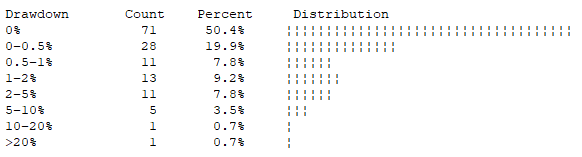
Many all-time highs back to back, lots with only a .5% drop. Since 2010. I'm
sure longer history will change distribution.
Alex Castaldo writes:
Most longer series are a combination of Cowles and S&P 500 indexes. These indexes are available separately on FRED:
Often these 2 indexes are spliced together to give a longer view (I havent checked that the tradingview numbers sent to the list match the FRED sources however), and the S&P 500 can be considered an extension of Cowles maintained by S&P corporation to continue Alfred Cowles work going forward:
Alfred Cowles: The Origins of the S&P 500 Index
Oct
18
When the Planners Fail, We Must Be Ready, by Peter C. Earle
October 18, 2026 | Leave a Comment
When the Planners Fail, We Must Be Ready
The political left and right disagree about who should benefit from government action and which industries or cultural aims must be prioritized. But they share a deeper, darker premise: that the resources of a nation should be directed toward goals chosen by political leaders. In both camps, individual choice and voluntary exchange are discarded in favor of economic coordination by central planners.
Oct
15
Dalio, from Nils Poertner
October 15, 2026 | Leave a Comment
Are Dalio's books worth to read? Am too much of a s/t trader myself, but I have a hunch one wants to brush up on his ideas of deflation /cycles. ECB, BOE might be cutting before FED as well (so it may seem very strange from a pure US perspective alone to think deflation is coming).
William Huggins replies:
have read "how countries go broke" and "the changing world order" - i find his style to be very expositional with little effort at decoding the mechanisms that underlay the patterns he's identified. there is little effort to falsify and a lot more curve fitting than i am comfortable with. that said, he does capture some important insights for people who believe it will be different "this time" and i think his signposts for trouble ahead are likely to manifest. without getting political, it would seem the current admin is accelerating the timeline. i have yet to play around with his ai-self but am generally concerned that all instances of civilizational debt cycles occurred in the context of a population pyramid, not a chimney (let alone inverted pyramid). its not clear what the implications of that will be economically but if anything IS different this time, imo its the demographic profile and it doesn't bode well for "grow past the problem" (as seen in china where the npl-eating amcs have grown aum more than x100 in the past 25 years)
Nils Poertner responds:
Thanks, quite informative William. One of my (older) bond trader friends used to say to me, "You got to think things through - sit in a room by yourself, for 1hour quietly, and figure things out as much as you can. Don't check the internet, don't consult others, just try to visualize the most likely outcome."

Asindu Drileba writes:
Ray Dalio's official YouTube channel has good videos where it breaks down the core concepts of his books. I find the writing style of his books about too "corporate" or in your language Nils, "not very master & commander". But like any book, there is a lot you can learn from him.
However, there is a book about Ray Dalio titled "The Fund" by Rob Copeland. It's so beautifully written & can be considered as a deep dive into Ray Dalio's personal character or the unfiltered depiction on how he actually perceives the world.
Larry Williams comments:
He has been so bearish for so long…is the bottom line as I see it.
Edward Kozun writes:
Agreed on the bearish too long…a stopped clock is eventually right. I really believe his track record benefited from the extreme of high interest rates of 82 that went down until 2022, not from his cycle calls. Absolutely hasn’t performed well since. Has an ETF ALLW that is doing a good job of underperforming. He’s got a great PR team now.
Nils Poertner wonders:
What if he's right though? (Fun fact that I learned about him. He had punched his boss IN THE FACE in a bar when he was younger. Quite a character)
Humbert X. offers:
I’ve read all of his books. I really enjoyed “Principles”. He went from working in his bedroom to becoming a Billionaire and it’s an incredible story. I also recommend the interview with Jack Schwager in “Hedge Fund Market Wizards” for a quick review. He’s very intellectually generous and I have learned a lot from him. I consider him a mentor in some sense. His analysis of cycles goes way back (He cites Leviticus 25 in one of his recent books). I personally have gotten the most out of his approach to thinking. For me it is of great value to know not just what a man thinks but how he thinks. Actually twice thus far Mr Poertner you have suggested that we write every thing down. I would love to hear suggestions from the list on how others keep their trade journals. I know well the Wiswell adage “keep your manual and your manual will keep you”. I have a system but it is unsatisfactory (the largest room in the world is room for improvement). I’m also curious if others are of the opinion that after a certain amount of experience there is a diminishing return in keeping a journal. It’s an interesting problem what you read or saw and when and how you actually synthesized an idea.
Oct
13
Writing it down, from Nils Poertner
October 13, 2026 | 1 Comment
Young, more inexperienced specs would benefit from writing down all the observations, patterns, even subjective things they picked up and compare in the future (1wk, 1mo, etc), not just today but in particular this month. Instead of reading research paper no 3241.
William Huggins writes:
i recall a quarter century ago doc Steenbarger had done some private work for high figure chicago traders on their biases that he could only discuss with the list in the most general sense (ie, this not my work, just shouting back so its value is not lost to time). one of his "summary takeaways" for us that stuck, that i teach in my own classes on investments, is to write down -why- you think something is a good trade for the purpose of auditing your own thinking when it fails. if i recall correctly, the analogy he used was that of a professional sports team watching their own lost games to understand how to contain failure rather than seeking out the (supposed) source of success. the behavioral nugget on that one being the desire to fit our success to a heroic narrative often makes failure analysis more objective and hence productive. if you aim to improve, write down the reasons for your trades and then ruthlessly analyze failures in the aftermath.
Nils Poertner responds:
Wholeheartedly agree William! Victor always suggested to pass on "meals for life" and that would be one of them.
Asindu Drileba adds:
One of my favorite quotes is:
A good decision is still a good decision even if it turns out bad
& a bad decision is still a bad decision even if it turns out good.
A few months back I watched the Michael Jordan movie, Air (2023). A similar quote from the movie I liked:
Just because you're losing, does not mean you placed the wrong bet. - Sonny Vaccaro
Gary Boddicker offers:
Brings to mind the key concept from David Sklansky's classic, The Theory of Poker:
Any time you make a bet with the best of it, where the odds are in your favor, you have earned something whether you actually win or lose the bet. By the same token, when you make a bet with the worst of it, where the odds are not in your favor, you have lost something, whether you actually win or lose the bet.
Oct
12
Walmart automation status, from Pamela Van Giessen
October 12, 2026 | Leave a Comment
For those who don’t read the WSJ, this article about Walmart’s automation status is interesting in terms of how long it takes to automate and the savings trade offs (bigger energy bills vs labor costs which may not be reduced though productivity may increase).
For Walmart, Replacing Humans With Robots Is a Multibillion-Dollar Struggle
Oct
11
Days of the week 2026, from Zubin Al Genubi
October 11, 2026 | Leave a Comment
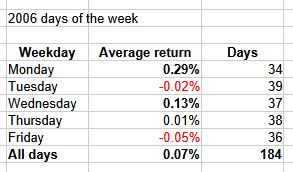
Consistent with randomness.
Adam Grimes writes:
I agree that it looks consistent with sampling error. Did you run a permutation test? Would prefer that to assumptions of distributions.
"Hey Claude, I would like to write a Python program to take a time series of daily net changes to the S&P 500 and run a simulation in which the daily returns are randomly grouped into 5 bins. Calculate the average and standard deviation of each bin, and repeat the simulation 1000 times."
Steve Ellison offers:
Hey Claude, I would like to write a Python program to take a time series of daily net changes to the S&P 500 and run a simulation in which the daily returns are randomly grouped into 5 bins. Calculate the average and standard deviation of each bin, and repeat the simulation 1000 times.
Output: I believe the last item is the test for significance. Unless the difference between the best day and the worst day is at least 0.50%, the null hypothesis is not refuted.
Data: 188 daily changes
Overall mean = 0.000646 std = 0.008266
Simulations: 1,000 Bins: 5
Bins ranked by mean within each simulation:
avg mean 5th pct 95th pct avg std
Lowest -0.000888 -0.002053 0.000051 0.008245
#2 -0.000011 -0.000864 0.000659 0.008176
#3 0.000660 0.000013 0.001289 0.008179
#4 0.001320 0.000667 0.002063 0.008185
Highest 0.002149 0.001251 0.003346 0.008230
Spread (highest bin mean - lowest bin mean):
average = 0.003037 5th–95th pct = [ 0.001343, 0.005003]
Peter Ringel comments:
Significance - Schmicnificance. Nobody likes Lasagna Mondays, eh? (roll out the pillories)
I did the counting again for 2025,2026 on NDX & NQ EoD data and found: exactly the same lack of significance, as you guys. On intraday I found significance, but also found a bug in my script for the test from how the baseline slices are constructed. EoD and intraday should be nearly the same. None of this is vibe-coded.
The problem is, I already had a relation with Mondays before I did the counting. I shouldn’t even start talking about Thursdays. And I am thinking to start a relation with Wednesday. I really expect to find at least something weak in the stats. I tried to push it a little, e.g. via only looking at up-days. Still nothing.
This isn't over. Mondays are great (for now)
Jeffrey Hirsch writes:
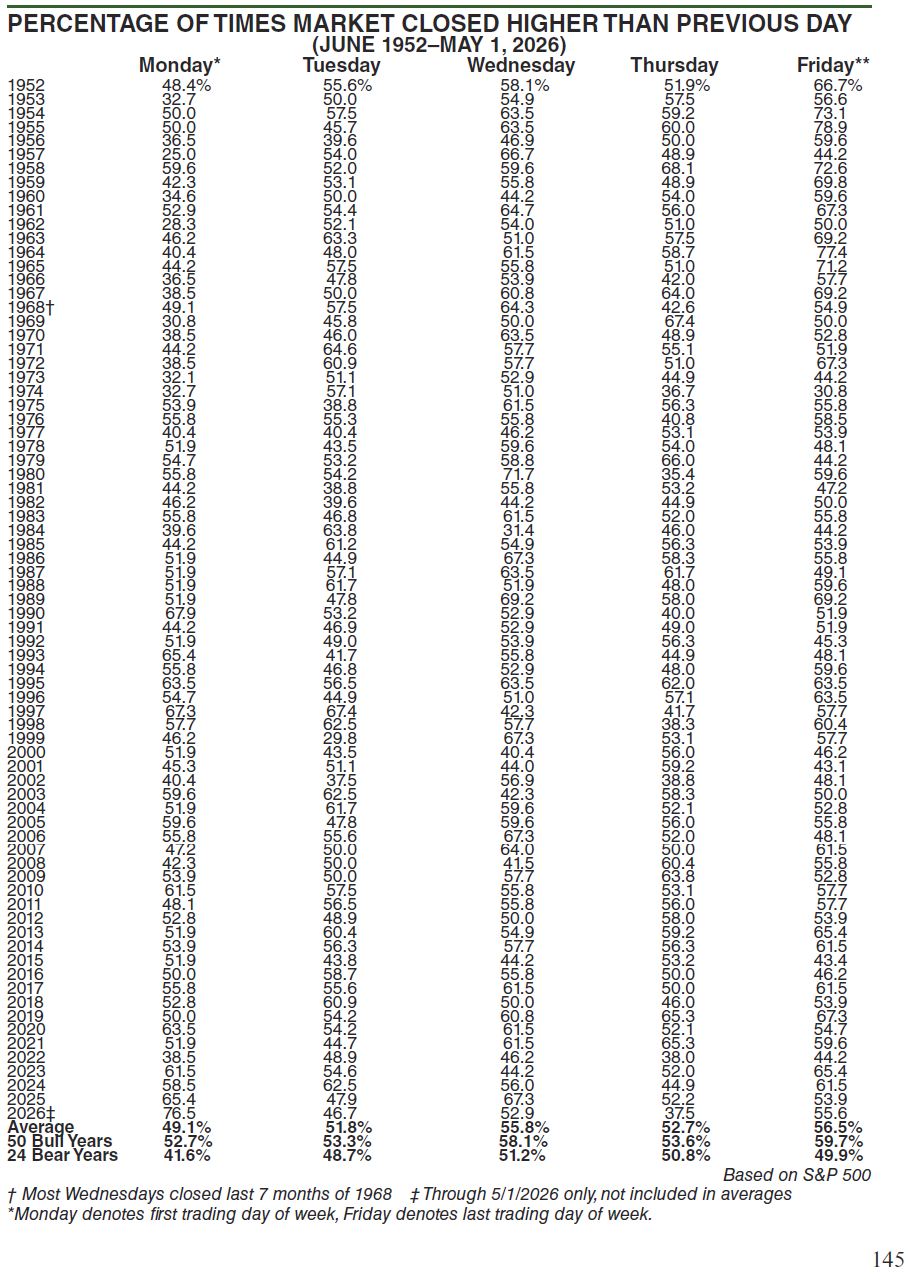
Here’s my latest daily on the S&P from page 145 of the 2027 Almanac (click on table for full view). There’s more on pages 143-146 and other data and stats in the data bank section pages 122-183. We also run studies through our internal LLM. 2026 through 10/2 is below. (*Monday is first trading day of the week except when Monday is a holiday. Friday is last trading day of the week except when Friday is a holiday.)
S&P DAILY PERFORMANCE EACH YEAR SINCE 1952
To determine if market trend alters performance of different days of the week, we separated 24 bear years—1953, ’56, ’57, ’60, ’62, ’66, ’69, ’70, ’73, ’74, ’77, ’78, ’81, ’84, ’87, ’90, ’94, 2000, ’01, ’02, ’08, ’11, ’15, ’22, and ’24 from 50 bull market years. While Tuesdays and Thursdays did not vary much between bull and bear years, Mondays and Fridays were sharply affected. There was a swing of 11.1 percentage points in Monday’s and 9.8 in Friday’s performance.
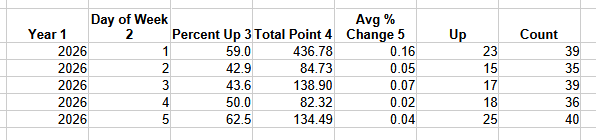
For 2026 we get:
Adam Grimes writes:
I have a set of tools that I developed over many years that start with an event study and move potentially interesting ideas through a simulated trading platform, with options for out-of-sample and forward testing. (None of this originally vibe coded, and the methodology a blend of academic + practical).
I fed it the discussion on weekdays, which was a pretty easy question. I've always been suspicious of seasonal influences because I rarely see them rise above noise, but thought this was worth considering. Attached is a fairly comprehensive result. (I would be especially wary of methodologies that categorize days in retrospect. For example, categorizing a day as "in a bull or bear year" based on a year-end lookback introduces fatal bias.) Results in the pdf:
Larry Williams responds:
Great work but change the exit strategy to make it tradeable. A make the hold a little longer.
Adam Grimes wonders:
Maybe I'm missing something here, but the test shows no edge beyond the market's natural drift (which any weekday entry gets). Won't a longer hold just capture more of that drift? The historical hold that worked was Monday's close to Friday, which was about +0.18% per week over the average day 1953-1977, dropping to +0.02 since 1980.
I would think the key question here is historical stability. Some holds will show an edge over some period of time, but the real question is whether those persist into following periods. Happy to look at this any way you'd find helpful. I can easily run every entry day against every exit day (and even into following weeks if you want longer holds). But I'm reading these results as a conclusive evidence that the old Monday effect is gone since about 1980 and that no weekday stands out from chance. Any random day entry and exit will probably show a profit (due to the drift), but the question I'm judging against is whether any chosen hold makes money above that random hold.
Oct
7
Victor Niederhoffer – The Market Speculator
October 7, 2026 | Leave a Comment
Speaking to Legends: #9 Victor Niederhoffer – The Market Speculator
July 01, 2020
Victor Niederhoffer is one of the most famous investors and a true pioneer. After rubbing shoulders with a few of the future Nobel Laureates at the University of Chicago, he started a trading firm and made $20 million from the starting capital of $50k within 6 months. In the 90s, he was the right hand man of George Soros and with a 34% rate of return over 20 years, in 1996, he was recognised as the world’s best trader. However, next year he was on the wrong side of the trade and lost all of the capital. In this episode, we discuss the emergence of quant investing, how he started trading for Soros, what are some of the lessons he learnt while being an active market participant for 60 years straight and why he think that Jesse Livermore was a horrible trader.
Oct
6
Markets as buffers, Zubin Al Genubi
October 6, 2026 | Leave a Comment
A quote from myself from the 2007 Spec Party on Vic's Central Park Rose Garden talk which I remember vividly. "Chairman espoused his theory of the markets as the mechanism that mediates between government and the the populace…that causes not only the obvious capital allocation but buffers the power of government to protect the needs of the populace through price and capital demands. It is a novel theory which I have never heard discussed anywhere else. The market itself is the mechanism that effects large scale social and political change through changes in incentives, attitudes and demand, and is more than merely shuffling money. Understanding the markets as a social and political driver can lead to long term trading strategies and keep the trader on the right course."
As Bonds hit multidecade lows, I ask (rhetorically) who is more powerful, the market or the government? What does it portend?
James Gavrity writes:
That question raises more questions than it answers. I could answer with a long macro analysis, but the answer to these two sub-questions will give us the answer to the original.
I ask myself: which one is more fearful of the other? And which one tries to exert control and influence over the other? The one that's more fearful and tries to exert the most control is typically the least powerful.
James Carville famously hung a sign in the Little Rock campaign war room during the 1992 election that read: "The economy, stupid."
Who tries to control the price of fuel and eggs? Who takes credit for a booming market? In my view, the market is the most powerful force, whether you live in a democracy or not. Quoting James Carville, "The economy, stupid"—this is what has the power to change governments of all types.
Jeff Watson is unambivalent:
Markets are bigger than governments, hands down.
Larry Williams comments:
Great point. When everyone is a millionaire thanks to the stock market Bernie Sanders pitch falls on deaf ears—just one example of this theory.
William Huggins writes:
while its clear that markets are quite powerful, its important to remember that the sorts of markets we are talking about (capital markets) can only really thrive when there are enforcement mechanisms and dispute resolution - both of which are often supplied by the "force monopolists" of the state. this pattern extends into the bronze age (see: Assur)
imo, states and markets have a symbiotic relationship. either could exist in isolation but would be much poorer and weaker than they are today. in that context, i'm inclined to consider whether one of the two symbiants might try to "devour" the other for its own survival - it would certainly spell the end of a beautiful marriage.
James Gavrity responds:
IMO. As a trader and businessman, I am no expert here; this is just my perspective from where I sit. The market is the boss in that relationship. The Market is the King Maker And Wealth Creator.
The government is the tail attempting to wag the dog, The theory at hand the way I see it doesn't view the market as a quote board; it's the ultimate check on the politicians. The government pushes fiat and mandates, but the market reflects what people are actually doing with their money. When D.C. overspends, overregulates, or debases the dollar, the market acts as a shock absorber. It reprices risk and pulls the leash on the government before ideological policies can completely wipe out the public's economic foundation.
Price discovery doesn't lie. If they print money to fund a political agenda without creating real value, the market violently reprices hard assets and demands a premium to hold Treasuries. It’s not just shuffling cash around; it’s capital voting against political arrogance. It forces a behavioral shift by making it too expensive for the government to keep running its game, which ultimately protects the public from total ruin.
To your question: the market wins, hands down. Central banks can manipulate and suppress rates like the QE we've dealt with for over a decade but that's just building a dam. The market is the water. The government might write the rules, give away free stuff and tax our Income, but the market enforces the economic physics. Eventually, the dam breaks and gravity takes over.
With the long bond hitting multi-decade lows, the market is effectively ripping up the sovereign blank check. If you look at this through the macro cycles, it points to a few massive structural shifts:
The Bond Vigilantes Are Back: The market is stepping in to enforce the fiscal discipline the politicians refuse to legislate. As debt service eats the national budget alive, the government is going to be backed into a corner—austerity, higher taxes, or financial repression—regardless of who is in office. The market is forcing their hand.
Flight to Hard Assets: The era of zero-interest-rate easy money is dead. The mechanism is actively rotating capital out of paper promises and fiat debt, and moving it into commodities, precious metals, and real production. It’s a classic defensive posture against debasement.
Social and Political Friction: Cheap debt has numbed the public to government incompetence for a long time. Turn off that spigot, and the real cost of these policies hits home. When the public actually feels that economic pain, it drives massive shifts in societal attitudes and intense political turnover.
When you watch the tape through this lens, it means looking past the daily noise and short-term setups to see the tectonic plates shifting. When the bond market moves like this, it’s not just another trade. Understanding the market as a social and political driver keeps us on the right side of the trend long-term.
Carder Dimitroff offers:
I generally agree that markets, rather than governments, can be kingmakers. But not all markets are equally independent of the state. Sovereigns establish and enforce the legal order within which markets function, and they control access to territory, airspace, waters, natural resources, strategic infrastructure, and military procurement. Some markets would scarcely exist without that framework; others operate only by license and under close state supervision. When a government judges that national security or another core interest is at stake, firms in those markets must adapt, exit, or risk losing access to the market itself. In that sense, the king may not choose every winner—but it can still decide who remains in the game.
James Gavrity again:
Agreed my thoughts were focused on the 10,000-foot view. Yes they can pick a choose winners and losers. When a government judges that national security or another core interest is at stake, firms in those markets must adapt, exit, or risk losing access to the market itself. In that sense, the government may not choose every winner—but it can still decide who remains in the game. Like Intel and others, from the bigger, broader picture, there is a sequence of order to this. The hubris of the state always brings it to a Marie Antoinette moment: "Let them eat cake." Ultimately, the markets will bring the government and those consensus elites exactly that fate, regardless of how many kings they make along the way. That quote was not her actual words. "Let them eat cake." was a political myth popularized to fit a narrative. Historically her actual last words were an apology to her executioner after accidentally stepping on his foot on the scaffold: "Pardon me, sir. I did not do it on purpose." When the steak and lobster are gone, a new king will be crowned.
Oct
3
Trend days, from Zubin Al Genubi
October 3, 2026 | Leave a Comment
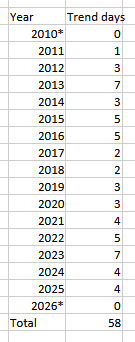
Remember trend days? Recently trade has been, I wouldn't say choppy, but with a lot of reversals. The legs are better than trend days in the past, point wise at least. Which led me to study trend days over the years. See how they cluster, and there have been none this year, at least how I defined them. Interesting to say the least. What does it mean? Algos? …that's my theory.
Adam Grimes asks:
What definition are you using?
Zubin Al Genubi answers:
Pick one, any one will do. The moral of the story is the same. Hint: These were up days only.
Adam Grimes responds:
I think the definition matters quite a bit. I would typically work with a definition like:
- opens near the low, closes near the high
- range > X * ATR(20) (starting with values of something like 3 for X)
Key concept is a larger-than-average day with open and close at opposite ends of the day. The reason I asked is I count far more than you do so I wondered if you were looking at "truly exceptional" days. I'll take a look at distribution by year later today.
I don't see any value in thinking in points, either. Saying the legs are longer point-wise when the price level is so much higher doesn't say anything at all, right?
I don't replicate your numbers at all. These are using open and close in the bottom/top X of the range. One table for day's range > 1.5 * ATR, the second for > 2 * ATR. I can't imagine the usefulness of extremely restrictive criteria for trend days, which is why I asked how you were defining them. At any rate, ES futures do not bear out your claim. What am I missing?
[Click to view tables.]
Bullish days: high-low range > 1.5 * ATR(20) table.
Bullish days: high-low range > 2 * ATR(20) table.
And why only look at bullish days? The thesis collapses further when we consider both directions (which I would argue we should do).
Bearish days: high-low range > 1.5 * ATR(20) table
Bearish days: high-low range > 2 * ATR(20) table
Is my math off? (Seriously asking, working with a relatively new and somewhat unvetted system here.) Or what am I missing?
Zubin Al Genubi writes:
Adam, My definition was pretty tight so your math is not off, my def is not too good. I subsequently did down days, which were larger than up days, and fewer of them. I am trying to find conditions that precede trend days. The only thing I am seeing is other trend days, like those 3 big up days 2 months ago ( which my system did not catch) Still playing with it as well.
Adam Grimes offers:
Interesting timing. I'm redoing some old work on the same subject:
A new look at measuring trend days
Catching the wave: ideas for finding trend days
Finding trend days in index futures
Ralph Vince offers:
Isn't it vital as well that the open be nearly the same as the low or the high!
Zubin Al Genubi responds:
There are a lot of interesting ways to define it, and I like your percent of new bar highs one. The range constriction break out is a good precursor. I've found there's not that many trend days so it doesn't seem like something to count on. I have a few more definitions I will be looking at: range efficiency |C-O|/(H-L), Kaufman efficiency ratio: |C-O|/\sum|\Delta C|, Choppiness-type ratio: total path divided by daily range, e.g. \sum|\Delta C|/(H-L). I just used retracement for the post.
I found an average of 28 trading days between trend days, but with wide dispersion over the years. Some years more, some less. That's what led me to the study, my observation of few trend days, lots of Z days this year, with long too straight un-choppy, overly efficient legs, caused by (in my theory) by bots.
Looking at your low vol triggers (for example NR5,NR7) over that last 5 years, I'm finding it persists to the next day. Not what I would have expected. Also, I found 0 instances of 3-consecutive-decreasing inside days (Russian Doll set up) over the last 10yrs!
Adam Grimes writes:
Yes, that no longer surprises me (failure of low vol triggers). Technical analysis literature and marketing has a lot to say about compression as a trigger. I don't think it's any kind of trigger. What's the best predictor of tomorrow's volatility? In models, the answer is today's volatility, by a wide margin. (Consider ARCH and GARCH models.) So low vol tends to lead to further low vol. (Also the observation one of our list members misses when he's concerned about low VIX = impending market crash.)
But if and when you DO get a move out of low vol it tends to be more directional and probably leads to a higher probability of trend days. One issue with all of this work is that good trend days are sparse enough you can't really generate reliable stats.
Zubin Al Genubi observes:
There were only 7 bottom tick/top tick day in the last 15 years and no perfect down days. So the definition needs to be wider. I used 10/90.
Adam Grimes responds:
Yes it has to be something like this. There's also a trend day subset where one part of the day might be a powerful and large trend and the other a range or a trend in the opposite direction. Intraday data can obviously untangle this, but one of the limitations of using daily data is that these types of days will be missed in the count.
Oct
1
Peter C. Earle on AI regulation
October 1, 2026 | Leave a Comment
There is something strikingly familiar about the sudden enthusiasm of leading artificial intelligence companies for government oversight. The technology may be revolutionary, but the political economy surrounding it is not.
For more than a century, a pattern has recurred: an industry emerges with vigorous competition and rapid innovation. Successful firms establish advantages in capital, expertise, distribution, or market share, and then…some of those incumbents subsequently discover the virtues of regulation.
AI and the ‘Dangers of Electric Lighting’
Thomas Edison warned that alternating current was an unacceptable threat.
Letting Big AI Write the Rules
It seems inevitable that the artificial intelligence frontrunners will get the regulation they desire. That being essentially a fait accompli - unfortunately - the next important question is who will actually write and enforce the rules.
David Lilienfeld comments:
Speculation, but rates have been moving up. Hence, raising capital is more expensive. If they stir up enough concern about safety and everyone has to slow down, they can slow down on their spend and hope to raise money when rates are lower and capital costs less. Seems pretty rational to me.
Back in the 1900-1910 period, the embryonic pharmaceutical industry had to deal with a bunch of epidemics of tetanus and the like because of a lack of care in handling the products. The public stopped buying the products and the industry screamed for some government intervention to regulate the industry with the hope the public would regain its trust. It didn't happen overnight, but eventually, the public did regain that trust and there's been regulation of the industry ever since. Companies like people often act rationally. Sometimes they don't, but often they do.
Archives
- November 2026
- October 2026
- September 2026
- August 2026
- July 2026
- June 2026
- May 2026
- April 2026
- March 2026
- February 2026
- January 2026
- December 2025
- November 2025
- October 2025
- September 2025
- August 2025
- July 2025
- June 2025
- May 2025
- April 2025
- March 2025
- February 2025
- January 2025
- December 2024
- November 2024
- October 2024
- September 2024
- August 2024
- July 2024
- June 2024
- May 2024
- April 2024
- March 2024
- February 2024
- January 2024
- December 2023
- November 2023
- October 2023
- September 2023
- August 2023
- July 2023
- June 2023
- May 2023
- April 2023
- March 2023
- February 2023
- January 2023
- December 2022
- November 2022
- October 2022
- September 2022
- August 2022
- July 2022
- June 2022
- May 2022
- April 2022
- March 2022
- February 2022
- January 2022
- December 2021
- November 2021
- October 2021
- September 2021
- August 2021
- July 2021
- June 2021
- May 2021
- April 2021
- March 2021
- February 2021
- January 2021
- December 2020
- November 2020
- October 2020
- September 2020
- August 2020
- July 2020
- June 2020
- May 2020
- April 2020
- March 2020
- February 2020
- January 2020
- December 2019
- November 2019
- October 2019
- September 2019
- August 2019
- July 2019
- June 2019
- May 2019
- April 2019
- March 2019
- February 2019
- January 2019
- December 2018
- November 2018
- October 2018
- September 2018
- August 2018
- July 2018
- June 2018
- May 2018
- April 2018
- March 2018
- February 2018
- January 2018
- December 2017
- November 2017
- October 2017
- September 2017
- August 2017
- July 2017
- June 2017
- May 2017
- April 2017
- March 2017
- February 2017
- January 2017
- December 2016
- November 2016
- October 2016
- September 2016
- August 2016
- July 2016
- June 2016
- May 2016
- April 2016
- March 2016
- February 2016
- January 2016
- December 2015
- November 2015
- October 2015
- September 2015
- August 2015
- July 2015
- June 2015
- May 2015
- April 2015
- March 2015
- February 2015
- January 2015
- December 2014
- November 2014
- October 2014
- September 2014
- August 2014
- July 2014
- June 2014
- May 2014
- April 2014
- March 2014
- February 2014
- January 2014
- December 2013
- November 2013
- October 2013
- September 2013
- August 2013
- July 2013
- June 2013
- May 2013
- April 2013
- March 2013
- February 2013
- January 2013
- December 2012
- November 2012
- October 2012
- September 2012
- August 2012
- July 2012
- June 2012
- May 2012
- April 2012
- March 2012
- February 2012
- January 2012
- December 2011
- November 2011
- October 2011
- September 2011
- August 2011
- July 2011
- June 2011
- May 2011
- April 2011
- March 2011
- February 2011
- January 2011
- December 2010
- November 2010
- October 2010
- September 2010
- August 2010
- July 2010
- June 2010
- May 2010
- April 2010
- March 2010
- February 2010
- January 2010
- December 2009
- November 2009
- October 2009
- September 2009
- August 2009
- July 2009
- June 2009
- May 2009
- April 2009
- March 2009
- February 2009
- January 2009
- December 2008
- November 2008
- October 2008
- September 2008
- August 2008
- July 2008
- June 2008
- May 2008
- April 2008
- March 2008
- February 2008
- January 2008
- December 2007
- November 2007
- October 2007
- September 2007
- August 2007
- July 2007
- June 2007
- May 2007
- April 2007
- March 2007
- February 2007
- January 2007
- December 2006
- November 2006
- October 2006
- September 2006
- August 2006
- Older Archives
Resources & Links
- The Letters Prize
- Pre-2007 Victor Niederhoffer Posts
- Vic’s NYC Junto
- Reading List
- Programming in 60 Seconds
- The Objectivist Center
- Foundation for Economic Education
- Tigerchess
- Dick Sears' G.T. Index
- Pre-2007 Daily Speculations
- Laurel & Vics' Worldly Investor Articles
