Sep
30
End-of-quarter analysis, from Kora Reddy
September 30, 2026 | Leave a Comment
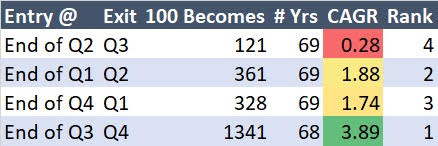
Entry @ the last trading session of Q3 and liquidate before the New Year's Eve (HNYE), backtest study covers SPX from 1958 onward and excludes dividends.
Click to view detailed results.
Sep
27
Spec Party memories from August 14, 2007, from Jim Sogi
September 27, 2026 | Leave a Comment
This year's spec party had a different feel than other years, a more mature, more focused, a more comfortable, intimate feel. We had spec's from all around the world, India, Ireland, Scandinavia, Zurich, France, Italy, London, Hawaii, California, Nevada, Tennessee, Georgia, Delaware making it a truly remarkable international diverse experience. The depth of knowledge, expertise, and perspective is simply mind boggling. Though there were fewer, the group was more intense, more hardcore quantitatively philosophically naturalistic in the Niederhoffer tradition.
We spoke of survival of volatility, diversity, adversity, ecologies, as we strolled from jungle environment to desert environments at the Haught Conservatory Greenhouse at the New York Botanical gardens bringing to mind the radical and swift regime changes and the necessary adaptations in nature and the markets.
We rode out to Shea Stadium to see the Mets play Florida. Baseball always has so many parallels to the market. The long periods of hard effort with no scores. The long innings of playing from behind, the maximum effort required while in a losing position. The rapid reversals as the Mets lost the game to a home run in the bottom of the 8th. All lessons valuable to the specs who braved adverse windy wet conditions which were somewhat of an anomaly in an otherwise sunny warm, summery beautiful New York summer.
We went back in time to the 60-'s and 70's in a nostalgic trip out to quaint Coney Island, near to where the Chair grew up and the stories from Ed Spec. We swam in the ocean, discussed waves, rode the Ferris wheel and had a wonderful day in the sun. I had a very nice discussions about India with Sushil Kedia, and a lengthy discussion about chess, strategy, and markets with the Grandmaster on the way back.
The Dinner at Delmonico's is the highlight of the weekend with the greatest collection of spec's celebrating with Chair and Laurel in the tradition of the giants of speculation from the history of Wall Street. I can imagine that years in the future they will talk of how Niederhoffer threw lavish parties and took over the whole restaurant for his friends as one of the legends of Wall street. The food was delicious and the tap dancing and Hula from the traveling Von Sogi's of Hawaii added to the fun of the evening. Among the likes of Wren-Hardin, Egan, Cooper, Grossman, Moe, Hewson, Katir, Floyd were fascinating discussions about cutting edge microstructural theories, fundamental considerations in currencies, statistical chemistry and the drug industry and the creation of unintended toxins. The evening was just starting leading to the Melvin pub crawl to the regular midtown Irish bar where many a very tall trading tale was retold with flourish and where Melvin was characteristically seen in the arms of 3 beautiful blondes at once (pics and proof to follow). Goldcamp was heard to have had a REALLY good time.
The weekend ended up with a serious and quite profound and relevant discussion of current market conditions at the Rose Garden in Central Park under beautiful blue skies and cool weather, with racoons scurrying about in the lush green arbors as the Chairman espoused his theory of the markets as the mechanism that mediates between government and the the populace, and the need of the financial machine ecology to support its overhead and extract the maximum amount from the weak and that causes not only the obvious capital allocation but buffers the power of government to protect the needs of the populace through price and capital demands. It is a novel theory which I have never heard discussed anywhere else. The market itself is the mechanism that effects large scale social and political change through changes in incentives, attitudes and demand, and is more than merely shuffling money. Understanding the markets as a social and political driver can lead to long term trading strategies and keep the trader on the right course.
New York, the greatest city in the world, was vibrant, alive, clean, young, safe, friendly. New York has a noticeably disproportionate number of young people, and slim attractive young women dressed up nicely compared to other areas of the world and country, something that Galton himself was known to count. Even Dr. Zussman noticed this anomaly. At many clubs and bars large groups of attractive women attended, and late at night there were more women out and about than men. The taxi drivers, restauranteurs, hoteliers, and people about town, subway riders, citizens, restaurant goers, theatre goers, were all courteous, friendly, intent and focused on discharging their social obligations and expectations. I saw no antisocial behavior, no arguments, no outbursts of anger, almost no vagrancy or homelessness. The subways were clean, very clean, well lit, and not overcrowded. Even the traffic had less horn blowing and cussing. To me, who grew up in the bad era of the 70's in the city, a real low point when the city was on the verge of bankruptcy, crime, vagrancy were rampant, it was a remarkable and enjoyable weekend in a magic kingdom. It was more special because many of the regular specs have become friends, I've been to their homes, and they to mine, the depth of our discussions and insights have grown over the years.
For all this wonderful and life changing experience and lessons in life and markets available in no other forum in the world, and the creation of this unique, international, eclectic, esoteric, erudite group called the Spec List, we have the true genius, generosity and broad thinking of Chair and Laurel and Steve Wisdom whose effort, huge expense and time in the midst of tumultuous markets to thank. I extend my heartfelt thanks and love to both the Chair and Laurel for a truly wonderful weekend I will cherish my whole life as a highlight.
Sep
26
1873, from David Lilienfeld
September 26, 2026 | Leave a Comment

There are four major depressions in the history of the United States, identified for our purposes by the years in which they started: 1837, 1873, 1930, and 2007. Each in sequence has been deemed "The Great Depression." Then another one hits and the Great Depression doesn't seem so great anymore by comparison and the new depression takes on the moniker. Growing up in the 1960s and 1970s, the shadow of the Great Depression of the 1930s was omnipresent in discussions of economics, politics, and investing. How much that depression related to the 1929 crash remains a subject of some debate. There was quite a crash in 1987 and the economy did fine. The depression of 1837 is thought related to an over-issuance of bonds to support the construction of canals in the US. Others have noted that the absence of a central bank may have been contributory. Regardless, it's safe to say that the depression of 1837 is one of the least known economic events for most Americans.
That brings us to our current topic, the depression of 1873. A volume about it by Liaquat Ahamed appeared this past June. The author may be familiar to listers as the author of Lords of Finance. There are several aspects worth noting about this particular inquiry. First, it's popular at the moment. My local library system has 8 copies and there were some 47 holds on it. Will it remain as such remains to be seen. Second, on the cover, there is reference to the Rothschilds. It's not unusual to see the Rothschilds pop up in something talking about mid-19th century finance. Still, it's the first time I've seen it pop up in this context. Maybe that's testimony to the lack of publications about 1873. I recall being taught that the depression of 1873 was all about the civil war overhang in the US, overexpansion of US railroads, and the collapse of Jay Cooke and Co. Not much mention of the Rothschilds. Ahamed talks about what type of a depression 1873 brought in its wake. In central Europe, the impact on bourses was considerable, with Vienna's stock exchange dropping by 40%. In the US, the economic hit was smaller. I'm really just getting into the book, so I'll have to see (and report back) where Ahamed goes with the story line. So far, it reads quite comfortably and may make for a nice beach read during the coming end of August/early September holiday period. At a little over 300 pages, it's not a long read. It may just be worth your while giving it a go. Maybe even from your library if you can get a hold of a copy.
Sep
25
Night returns, from Zubin Al Genubi
September 25, 2026 | Leave a Comment
The Disappearing Overnight Drift, Federal Reserve Bank of New York (Liberty Street Economics, July 1, 2026
Overnight returns used to be quite regular the last 10 years but the edge has faded. Used to be .02% mean, but this year .003%. More changing cycles.
In a 2021 Liberty Street Economics post, we documented the “overnight drift”—a large, persistent return to holding U.S. equity futures in the narrow window between 2:00 and 3:00 a.m. Eastern time, when European equity markets open. Five additional years of data later, that pattern appears to have faded: the 2:00–3:00 window that previously generated roughly 3.7 percent per annum has averaged close to zero since 2021. In this post, we revisit the overnight drift in light of the post-publication sample and use our inventory-risk framework to ask which of three observable channels—the dispersion of closing order imbalances, the level of return variance, or the risk-bearing capacity of liquidity providers—accounts for the change.
Sep
24
Motto to trade by, from Zubin Al Genubi
September 24, 2026 | 1 Comment
Limit your losses, and gains and growth will take care of itself.
Asindu Drileba wonders:
Strategies for limiting losses?
1. Position sizing
2. OTM options
3. A friend of mine holds long VIX positions
Questions?
- What other strategies exist?
- What is best? 1, 2 or 3?
Zubin Al Genubi responds:
Those are all good strategies. Another way is to lower your expectation return targets in time or returns which in turn lowers loss expectations. In a competitive scenario this may or may not be acceptable but if you have enough, why take on more risk.
Larry Williams offers:
Once you set your stop loss, don't move it. Ever. Never.
Sep
22
Jobs analysis, from Bill Rafter
September 22, 2026 | Leave a Comment
Full-time employment has begun growing faster than part-time employment, reversing the multi-year pattern where part-time roles were rising faster. This shift is meaningful because:
• Full-time workers represent long-term payroll commitments (benefits, fixed hours, training).
• Part-time workers represent flexibility — employers rely on them when uncertain.
The long-term historical pattern is well documented:
• During recessions (early 1990s, early 2000s, 2008), full-time employment fell while part-time rose.
• During recoveries, full-time employment consistently outpaced part-time as employers regained confidence.
• The most recent recession (2020) was unusual — full-time employment actually peaked early due to pandemic-specific dynamics, but the broader pattern still held: expansions favor full-time growth.
This makes the current crossover — full-time growth exceeding part-time — a historically bullish signal.
Looking across decades of data:
• Full-time employment tends to lead GDP growth by 3–9 months.
• Part-time employment tends to lead downturns, rising when employers hesitate to commit.
• Crossovers where full-time growth overtakes part-time growth are rare and typically mark the beginning of multi-quarter expansions.
The long-term BEA and CPS data show that full-time employment has grown steadily over time, but the rate of growth relative to part-time is what carries cyclical meaning.
To confirm that this is the start of a strong expansion rather than a brief anomaly, track:
• Average weekly hours — rising hours amplify the signal.
• Wage growth for full-time workers — should begin accelerating.
• Payroll tax receipts —my preferred metric; should continue rising.
• Labor force participation — expansions pull more workers in.
• Sectoral composition — full-time gains in professional services, healthcare, logistics, and construction
Sep
20
Stock/Bond ratio, from Zubin Al Genubi
September 20, 2026 | Leave a Comment
I am re reading Practical Speculation and it's a gold mine that I didn't understand when I first read it 20 years ago. Vic and Laurel wrote in Prac Spec that some times are not good to buy stocks. "An increase in the stock-bond ratio (the number of 30-year Treasury bonds it requires to “buy” the level of the current S&P 500 futures contract)."
Stock/Bond Ratios
2026 3.6
2025 2.4
2024 2.3
2023 1.8
Cagdas Tuna asks:
Is this calculation futures contract price divided by each one or contract size also included?
Peter Ringel responds:
I think, It does not matter. Ratios have scale invariance ( was that the term ? ). The shape will be the same.
Zubin Al Genubi clarifies:
ES 50×7709 = $385,450
ZB 1000×107 = $107,000
Cagdas Tuna writes:
Thanks for confirming the calculation. I respect the findings however the concentration in S&P (not to mention Nasdaq) has changed in the last years. While any fixed income instrument weighs the same US indexes weighting have shifted a lot.
Steve Ellison writes:
I have tracked this ratio ever since reading Practical Speculation 20+ years ago. One thing I quickly found is that the stock market has drift, but the bond market does not, so comparing ratios from different eras is not very meaningful. To assess whether the ratio was high or low, I graphed it with a 50-day moving average and Bollinger bands.
For the ratio calculation, I pulled the 10-year bond yield from Yahoo Finance and used the bond pricing formula to calculate the net present value of a 10-year bond given the current yield. I then calculated the ratio of the S&P 500 index price to the bond value.
As of yesterday's close, this ratio was below its 50-day average, but well within the Bollinger bands. I start paying attention when the ratio falls below the lower Bollinger band.
Sep
18
Constructal Flow, from Jim Sogi
September 18, 2026 | Leave a Comment
My friend Vic often mentioned Adrian Bejan's idea of the Constructal Law. Constructal flow is central a unifying principle of nature systems that results in the maximum efficiency on the transfer of energy.
Vic said the most important thing is, "What is the right question to ask?" Revisiting Bejan's books led me to ask, do back currents facilitate forward flow? Initially one would think not. I foil surf, and foils (one assumes) are designed to go fast. But, there is more to it.
Back currents—often called eddies or counter-currents—frequently facilitate forward or downstream progress in nature, engineering, and navigation. Rather than just working against the primary flow, these reverse-moving loops conserve energy, create circulatory balance, and allow travelers or aquatic organisms to move efficiently.
In biology, drag is any resistance from the fluid that slows motion, and in water it can come from body shape, rough surfaces, and body parts sticking out at odd angles. Smooth skin, compact fins, and a narrow profile all help reduce that resistance.
It is not just about being fast. A fish that saves energy on every stroke can spend more energy on feeding, escaping predators, migrating, or reproducing. That tradeoff matters a lot in biology, because form affects function. Even small shape changes can affect how efficiently an animal moves through its environment.
In foil surfing there is more than speed. One must launch off the water surface at low speed, be able to turn, to glide; all tradeoffs to speed, but absolutely necessary.
What is the purpose of backflow in the markets? As a natural system, the markets should create the maximum efficient transfer of capital to production of the best product and ideas.
There is some math for some of these issues.
Oliver Joseph responds:
Very interesting perspective. Large rivers have a hydrodynamic phenomenon called boils. These are caused by water moving at different speeds due to friction. Friction from the banks of the river, the bends and potentially deep under the water's surface a submerged tree or rock. In situations where the energy can’t go anywhere else but up you get a river boil. I have paddled a fair amount in the Mississippi watershed and boils are an awesome force to behold. You have to know how to navigate them (hit them hard with all you have dead on or a parallel approach). In an ideal laboratory setting you can create what’s called laminar flow but rivers are far from the lab. It's difficult to understand turbulent flow without first having an understanding of laminar flow (The complexities involved make many things for all intents and purposes unknowable). Mr A. Grimes has a wonderful exercise in his book where he urges his readers to create a predictable price data flow to test how your tools will react under controlled situations.
Sep
17
Niederhofferisms, from Asindu Drileba
September 17, 2026 | Leave a Comment
Beautiful article:
RIP Vic Niederhoffer, by Peter C. Earle
Unfortunately for me, I don't have a comprehensive understanding of all the Niederhofferisms. I understand hoodoos, flexions, LoBagolas, constructal numbers (not so much though I'm familiar with Professor Adrian Bejan's work).
Could someone help elaborate these two?
"agrarians" & "constructal numbers"
Andrew Aiken responds:
agrarians = believers in egalitarianism, "the idea that has the world in its grip", and leveling
constructal numbers = significant numbers in the price pattern of a series, a generalization of support and resistance. They reveal a structure in price action.
Alex Castaldo expands:
"Agrarians" or "Agrarian Reformers" was a sarcastic term used by Vic to refer to Mao Zedong and his followers, and by extension to others who are Communist. In a wider sense it also could refer to American leftists who due to a lack of common sense refused to believe that Mao was a true Communist in the 1940's and 50's. They believed instead that Mao was an "agrarian reformer" who was trying to improve Chinese agriculture by making various "reforms" in the countryside, rather than a brutal collectivization of agriculture in the Soviet style.
I don't know whether Edgar Snow used the term "agrarian reformer" in his famous book Red Star Over China (1937) or not, but he is an example of the kind of naive America supporter of Mao that Vic had in mind. It is not a term that you hear much nowadays.
Sep
14
President of the Mess, from Paul O’Leary
September 14, 2026 | Leave a Comment
From Grok:
In Royal Navy (and closely related Commonwealth naval) formal mess dinner customs, the President of the Mess maintains order and may discipline diners for misbehaviour or rule breaches. Options typically include a warning, a fine (usually drinks, often port, paid after toasts), or ordering the person to leave. Removal is reserved for serious breaches, explicitly exemplified as gross rudeness; lighter infractions are often handled with wit, apologies, or fines so the offender can “exonerate” themselves.
The President (often the Executive Officer in a ship’s wardroom context, with the Captain as guest or honorary member) enforces them; the Vice-President may fine/warn the President.
Archives
- October 2026
- September 2026
- August 2026
- July 2026
- June 2026
- May 2026
- April 2026
- March 2026
- February 2026
- January 2026
- December 2025
- November 2025
- October 2025
- September 2025
- August 2025
- July 2025
- June 2025
- May 2025
- April 2025
- March 2025
- February 2025
- January 2025
- December 2024
- November 2024
- October 2024
- September 2024
- August 2024
- July 2024
- June 2024
- May 2024
- April 2024
- March 2024
- February 2024
- January 2024
- December 2023
- November 2023
- October 2023
- September 2023
- August 2023
- July 2023
- June 2023
- May 2023
- April 2023
- March 2023
- February 2023
- January 2023
- December 2022
- November 2022
- October 2022
- September 2022
- August 2022
- July 2022
- June 2022
- May 2022
- April 2022
- March 2022
- February 2022
- January 2022
- December 2021
- November 2021
- October 2021
- September 2021
- August 2021
- July 2021
- June 2021
- May 2021
- April 2021
- March 2021
- February 2021
- January 2021
- December 2020
- November 2020
- October 2020
- September 2020
- August 2020
- July 2020
- June 2020
- May 2020
- April 2020
- March 2020
- February 2020
- January 2020
- December 2019
- November 2019
- October 2019
- September 2019
- August 2019
- July 2019
- June 2019
- May 2019
- April 2019
- March 2019
- February 2019
- January 2019
- December 2018
- November 2018
- October 2018
- September 2018
- August 2018
- July 2018
- June 2018
- May 2018
- April 2018
- March 2018
- February 2018
- January 2018
- December 2017
- November 2017
- October 2017
- September 2017
- August 2017
- July 2017
- June 2017
- May 2017
- April 2017
- March 2017
- February 2017
- January 2017
- December 2016
- November 2016
- October 2016
- September 2016
- August 2016
- July 2016
- June 2016
- May 2016
- April 2016
- March 2016
- February 2016
- January 2016
- December 2015
- November 2015
- October 2015
- September 2015
- August 2015
- July 2015
- June 2015
- May 2015
- April 2015
- March 2015
- February 2015
- January 2015
- December 2014
- November 2014
- October 2014
- September 2014
- August 2014
- July 2014
- June 2014
- May 2014
- April 2014
- March 2014
- February 2014
- January 2014
- December 2013
- November 2013
- October 2013
- September 2013
- August 2013
- July 2013
- June 2013
- May 2013
- April 2013
- March 2013
- February 2013
- January 2013
- December 2012
- November 2012
- October 2012
- September 2012
- August 2012
- July 2012
- June 2012
- May 2012
- April 2012
- March 2012
- February 2012
- January 2012
- December 2011
- November 2011
- October 2011
- September 2011
- August 2011
- July 2011
- June 2011
- May 2011
- April 2011
- March 2011
- February 2011
- January 2011
- December 2010
- November 2010
- October 2010
- September 2010
- August 2010
- July 2010
- June 2010
- May 2010
- April 2010
- March 2010
- February 2010
- January 2010
- December 2009
- November 2009
- October 2009
- September 2009
- August 2009
- July 2009
- June 2009
- May 2009
- April 2009
- March 2009
- February 2009
- January 2009
- December 2008
- November 2008
- October 2008
- September 2008
- August 2008
- July 2008
- June 2008
- May 2008
- April 2008
- March 2008
- February 2008
- January 2008
- December 2007
- November 2007
- October 2007
- September 2007
- August 2007
- July 2007
- June 2007
- May 2007
- April 2007
- March 2007
- February 2007
- January 2007
- December 2006
- November 2006
- October 2006
- September 2006
- August 2006
- Older Archives
Resources & Links
- The Letters Prize
- Pre-2007 Victor Niederhoffer Posts
- Vic’s NYC Junto
- Reading List
- Programming in 60 Seconds
- The Objectivist Center
- Foundation for Economic Education
- Tigerchess
- Dick Sears' G.T. Index
- Pre-2007 Daily Speculations
- Laurel & Vics' Worldly Investor Articles
