Jan
20
Price gouging
January 20, 2025 | Leave a Comment
price gouging - This week’s news affirms earlier reports from all of human history that price controls discourage producers, reduce supply and impose shortages that cause consumer suffering (wsj).
In Praise of Price Gouging
When demand far outstrips supply, unfettered prices are just what we need.
We should praise price gouging, not ban it. Yes, we should pass a new federal price gouging law—one that nullifies the many state laws prohibiting it.
The Problem with Price Gouging Laws
Is optimal pricing during an emergency unethical?

Many people feel price gouging is morally wrong. The remarks of newspaper columnists and state legislators provide ready evidence on this topic. Survey research by Daniel Kahneman, Jack Knetsch, and Richard Thaler, published in the American Economic Review, further establishes this point: most respondents found price increases during difficult times to be unfair, except in cases in which retailers were only passing along cost increases.
More recent research suggests that these unfairness judgments are driven primarily by emotional responses to the price increases. Careful examination of the ethics of price gouging raises questions for these emotion-driven judgments. The ethical case for limiting price gouging is weaker than it may appear.
Jan
19
Some guy built a complete AI-driven hedge fund, from Asindu Drileba
January 19, 2025 | Leave a Comment
Here is the original thread.
All of the agents show their reasoning so you can see how they work.
1 • Market Data Agent: gathers market data like stock prices, fundamentals, etc.
2 • Quant Agent: calculates signals like MACD, RSI, Bollinger Bands, etc.
3 • Fundamentals Agent: analyzes profitability, growth, financial health, and valuation.
4 • Sentiment Agent: looks at insider trades to determine insider sentiment.
5 • Risk Manager: determines risk metrics like volatility, drawdown, and more.
6 • Portfolio Manager: makes final trading decisions and generates orders.
Here is the GitHub repository.
Why would this work or be good at? Why would it not work? I don't think it will work since the same model will be used my many if successful and the gains will be cancelled out.
Larry Williams comments:
Ultimate curve fit - wait a year to know.
Hernan Avella writes:
This is absolutely the way to go, but there’s a bit more to what we get to call “Agent”. Also his quant module is looking at dumb shit.
Julian Rowberry responds:
horses had a good track record before cars. AI is making key opinion leaders redundant too.
Jan
17
Cold outside (and in)
January 17, 2025 | 1 Comment
In Galton's autobiography of 1909 he discussed a time in his Rutland London address when he felt it necessary to wear 15 articles of clothing to keep himself warm as there was no heat in his house. two of his prized monkeys died in that cold.
I had a similar experience in Conn on Thur Jan 16; the temperature dropped to 5 Fahrenheit and I had no heat nor a wife as she was in London. I froze all over. In a similar event in Chicago 65 years ago my pet Macaque died from the cold.
Jan
17
Look into the light, from Humbert Z.
January 17, 2025 | Leave a Comment
Why Scientists Are Linking More Diseases to Light at Night

Glaring headlights, illuminated buildings, blazing billboards, and streetlights fill our urban skies with a glow that even affects rural residents. Inside, since the invention of the light bulb, we’ve kept our homes bright at night. Now, we’ve also added blue light-emitting devices — smartphones, television screens, tablets — which have been linked to sleep problems. But outdoor light may matter for our health, too. “Every photon counts,” Hanifin said.
For one 2024 study, researchers used satellite data to measure light pollution at residential addresses of over 13,000 people. They found that those who lived in places with the brightest skies at night had a 31% higher risk of high blood pressure. Another study out of Hong Kong showed a 29% higher risk of death from coronary heart disease. And yet another found a 17% higher risk of cerebrovascular disease, such as strokes or brain aneurysms.
Nils Poertner comments:
Sleeping in a fully light-blacked-out room is indeed relaxing for the optic nerve and the brain.
That is why expensive hotels have proper curtains and cheap ones often don't. We can't change society but we can make individual adjustments (or at least at home).
Jan
16
Bear hopes, and a good book
January 16, 2025 | Leave a Comment

the hope of the bears was that jan 31 close would be LOWER than dec 31 close of 5935 so they could tout the Jan barometer showing bear and they could attribute it to their feminine champion not being there to raise service rates.
a good book by a good man:
My Years with General Motors, by Alfred P. Sloan, Jr.
My Years with General Motors became an instant best seller when it was first published in 1963. It has since been used as a manual for managers, offering personal glimpses into the practice of the "discipline of management" by the man who perfected it. This is the story no other businessman could tell - a distillation of half a century of intimate leadership experience with a giant industry and an inside look at dramatic events and creative business management.
but how the divisions survived with all those reports and restrictions one doesn't know. perhaps this is why they needed a bailout in 2008.
Jan
15
Maybe relevant to the issue of stops, from Humbert Q.
January 15, 2025 | Leave a Comment

How to Gamble If You Must: Inequalities for Stochastic Processes
This classic of advanced statistics is geared toward graduate-level readers and uses the concepts of gambling to develop important ideas in probability theory…. Following an introductory chapter, the book formulates the gambler's problem and discusses gambling strategies. Succeeding chapters explore the properties associated with casinos and certain measures of subfairness. Concluding chapters relate the scope of the gambler's problems to more general mathematical ideas, including dynamic programming, Bayesian statistics, and stochastic processes.
And a more recent paper:
How to Gamble If You Must
Kyle Siegrist, Department of Mathematical Sciences, University of Alabama - Huntsville
In red and black, a player bets, at even stakes, on a sequence of independent games with success probability p, until she either reaches a fixed goal or is ruined. In this article we explore two strategies: timid play in which the gambler makes the minimum bet on each game, and bold play in which she bets, on each game, her entire fortune or the amount needed to reach the target (whichever is smaller). We study the success probability (the probability of reaching the target) and the expected number of games played, as functions of the initial fortune. The mathematical analysis of bold play leads to some exotic and beautiful results and unexpected connections with dynamical systems. Our exposition (and the title of the article) are based on the classic book Inequalities for Stochastic Processes; How to Gamble if You Must, by Lester E. Dubbins and Leonard J. Savage.
Jeff Watson comments:
Only play cards with suckers, and never try to fill an inside straight. Never sit in a poker game with a guy named Doc. Never lay the points, stay away from sports betting altogether, never be the bank in a casino baccarat style game. Stay away from slots, casino pit games, you will get ground down by the vig.
There are only two bets I can afford in a casino. One is betting the pass/no pass line in craps, the vig on the pass is 1.414% and 1.36% on the no pass. Plus you can get bets behind the line. The other is the banker bet in baccarat where the house has a 1.06% edge. Even with the commission, it’s a good bet. Still, no matter what, play the game long enough and the vig will kill you.
The banker bet can be real good. Playing for an entire session as banker can cause one the embarrassment of losing everything then having the game boss ask very politely, “How do you plan to settle the commission?”
Jan
14
A job that might vanish
January 14, 2025 | Leave a Comment
"i see you referenced technical analyst as a job that might vanish in the next 50 years. How could you say that when Stanley Druckenmiller sold out his longs in Oct 1987 because the months of 1987 were similar to 1929?" and Bill Gross has been bear since 1950 Dow 800.
don quixote part 1, chapter 47: "it is you who are crazy not me for failing to see the value of moving averages and fibonacci series and head and shoulder patterns. even andy lo has found them significant as long as you don't consider the last 10 or 20 prices."
"have you not read Technical Analysis by John Magee? it you had the pleasure of seeing his 20 or so wize old men with slide rules and protractors following the trends and moving averages as I did in 1964 you wouldn't dare to question its staying power."
Mite I suggest that Dr. Magee's former headquarters in springfield mass 1 block away from Pembroke College be named as a National Monument and that he and his band of Brothers be placed in the t.a. Hall of Fame with the full honors that were accorded to Joe Granville.
Jan
13
Assessing causes
January 13, 2025 | Leave a Comment
an excellent study explaining moves of over 2.5% in all markets attributing the moves to monetary factors:
What Triggers Stock Market Jumps?
Scott R. Baker, Nicholas Bloom, Steven J. Davis and Marco Sammond, 9 December 2024
We examine next-day newspaper accounts of large daily jumps in 19 national stock markets to assess their proximate cause, clarity as to cause, and geographic source. Our sample of over 8,000 jumps, reaching back to 1900 for the United States, yields several novel findings. First, news about monetary policy and government spending triggers twice as many upward jumps as downward ones and a highly disproportionate share of all upward jumps. Second, upward jumps due to monetary policy and government spending are much more frequent after a stock market crash. In this sense, the “Fed put” emerged decades before the 1990s, extends to other central banks, and characterizes fiscal policy as well. Third, greater perceived clarity about the reason for a jump foreshadows lower market volatility. Clarity trends up over the past century and is unusually high for jumps triggered by monetary policy. Fourth, leading newspapers attribute 38 percent of jumps in their own national stock markets to US economic and policy developments. The US role in this regard dwarfs that of Europe and China.
daily moves of 2.5% in the HBS study but explanations of reasons for moves are retrospective and can't be objective. its a "monetary" reason rather than ineluctable random reason following a major decline.
one was looking for research on the fate of markets. one believes that underneath the upward drift of 10000 % per 125 years there is a fate factor that brings markets to fates like 100000 in bitcoin and 50000 in dji, 7000 in sp.
Jan
12
Recollections of a Cowpuncher
January 12, 2025 | Leave a Comment
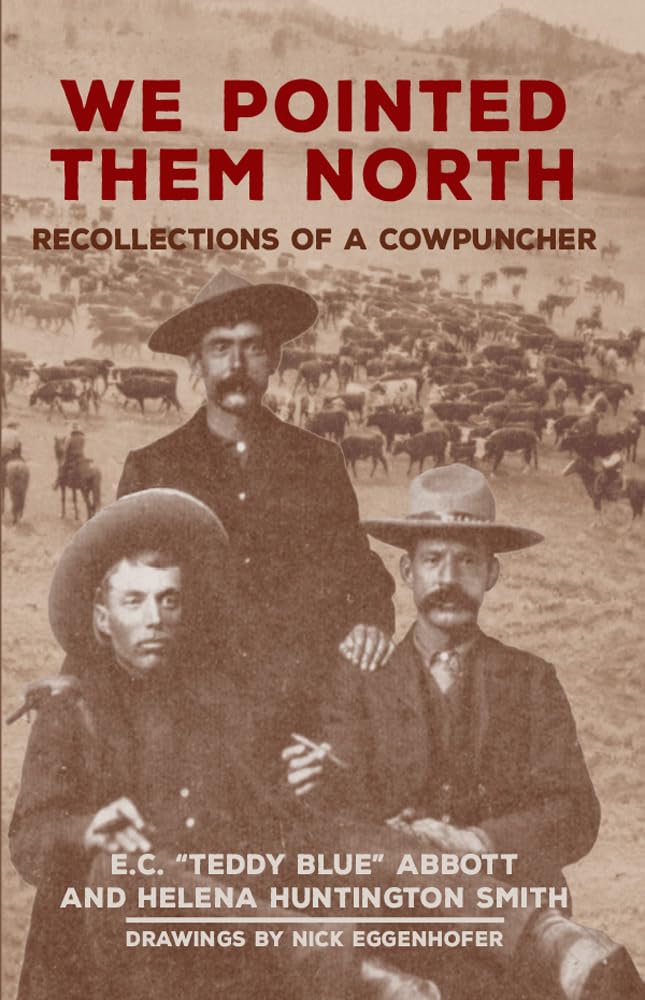
Perhaps the basis for Lonesome Dove:
We Pointed Them North: Recollections of a Cowpuncher
Edward Charles "Teddy Blue" Abbott was born in England in 1860. He came to the United States in 1871, with his parents, settling around Lincoln, Nebraska. Teddy Blue is hailed as one of the greatest of the cowboys who brought herds of Longhorns north from Texas. His charming looks and rebel ways have forever etched him into Montana history.
Gyve Bones offers:
If a storm came along and the cattle started running — you'd hear that low, rumbling noise along the ground and the men on herd wouldn't need to come in and tell you, you'd know — then you'd jump for your horse and get out there in the lead, trying to head them and get them into a mill before they scattered to hell-and-gone [The cowboys would attempt to make the cattle run in an ever-tightening circle until they could no longer move.] It was riding at a dead run in the dark, with cut banks and prairie dog holes all around you in a shallow grave…
One night it come up an awful storm. It took all four of us to hold the cattle and we didn't hold them, and when morning come there was one man missing. We went back to look for him, and we found him among the prairie dog holes, beside his horse. The horse's ribs was scraped bare of hide, and all the rest of the horse and man was mashed into the ground as flat as a pancake. The only thing you could recognize was the handle of his six-shooter. We tried to think the lightning hit him, and that was what we wrote his folks in Henrietta, Texas, but we couldn't really believe it ourselves. I'm afraid it wasn't the lightning. I'm afraid his horse stepped into one of them holes and they both went down before the stampede.
The awful part of it was that we had milled them cattle over him all night, not knowing he was there. That was what we couldn't get out of our minds. And after that, orders were given to sing when you were running with a stampede so the others would know where you were as long as they heard you singing, and if they didn't hear you they would figure something happened. After awhile, this grew to be a custom on the range, but you know, this was still a new business in the seventies and we was learning all the time.
- Teddy Blue Abbott, We Pointed Them North, Recollections of an Old Cowpuncher, 1939
Jan
11
Dimson, Staunton & Marsh: Global Investment Returns, 2024
January 11, 2025 | Leave a Comment
UBS Global Investment Returns Yearbook 2024, Summary Edition
The online version contains the entire Chapter 10 from the full book:
Corporate bonds and the credit premium
Corporate bonds are a major asset class with an outstanding value of some USD 44 trillion, almost half that of the value of global equities. The return to a higher interest rate environment has led many investors to re-consider their merits. This new chapter is thus timely in presenting long run evidence on corporate bonds since the 1860s from both the US and UK. Even very high-quality corporate bonds have offered a significant credit risk premium. The premium from high-yield (or junk) bonds is appreciably higher. Yield spreads of corporate over government bonds incorporate this premium but are not a measure of the expected premium because they also encapsulate expected default losses. This chapter reports on default and recovery rates over the long haul and reviews the determinants of yield spreads and default rates. Finally, it examines whether factors can help boost corporate bond returns and provide positive premia.
Charles Sorkin wonders:
The $44T estimate of the market value of corporate bonds sounds suspect. (To me, at least). I see that UBS cites some SIFMA data to produce a donut chart of US outstanding debt, but one wonders if they are including all manner of dubious Chinese securities that are effectively beyond the scope of most developed market investors.
Jan
10
Energy, from Carder Dimitroff
January 10, 2025 | Leave a Comment
I believe 2024 will be remembered as the year of great awakening. First, the so-called "hydrogen economy," pushed by several administrations and countries, is struggling. Plug Power, Ballard Power, Bloom Energy, and Hyyvia have all experienced losses and related financial challenges. Wood Mackenzie warns that green hydrogen projects are near collapse, with several projects likely to be canceled or deferred (how does it make economic sense to consume electricity to make hydrogen, compress it, move it, store it, and then consume it to make electricity?).
Second, Big Tech is colonizing local power grids at a scale and speed few anticipated. Policymakers are slowly realizing that demand is eclipsing supplies, and at the current rate that demand grows, supplies will quickly be exhausted.
Third, there are unrealistic expectations that the industry can respond in time to avert troubles by increasing supply. Many assume that energy supplies are commodities and can respond to market forces. With new baseload power projects taking at least five years and an average of ten years to initiate and complete, the only realistic option is to manage demand. This conclusion presents significant implications for Big Tech and local consumers.
Like biotech, the electric and gas industries will face an uncertain future in 2025. In the United States, states and Regional Transmission Operators have ultimate control, with the federal government's role limited to providing economic incentives. Consequently, the nation will likely witness various responses depending on local interests.
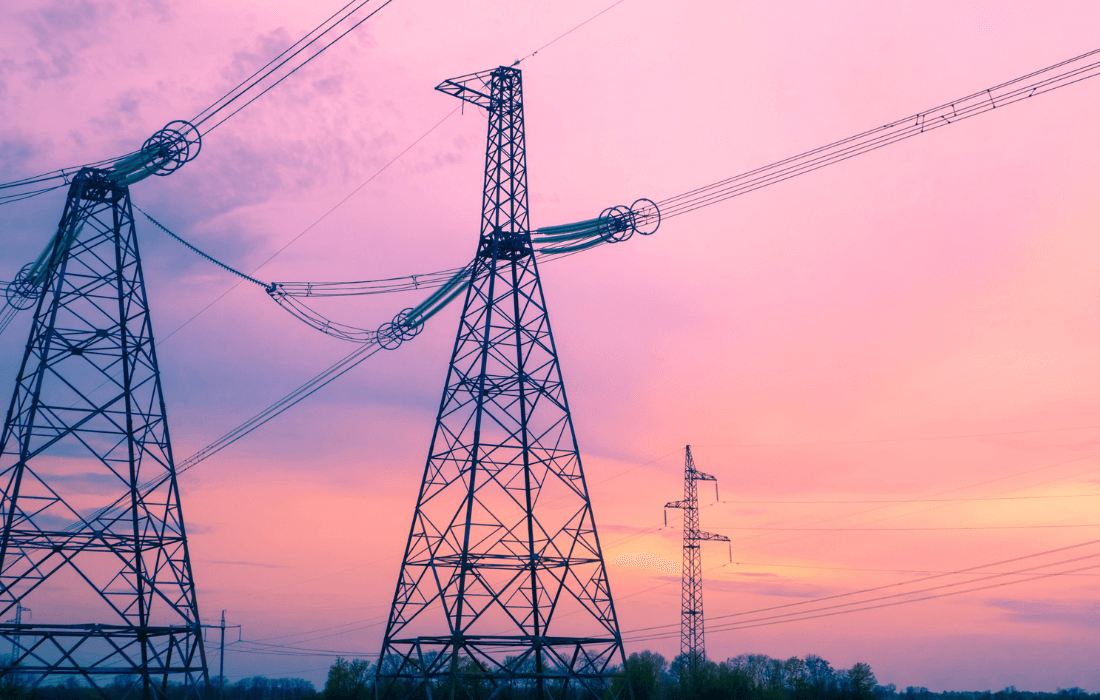
In any case, Big Tech's demand for power may be severely checked. If investors see unlimited growth in AI and related technologies, they may want to consider the challenges.
The alternative is less pleasant. If Big Tech successfully colonizes the nation's grids to the needed levels, the price of electricity and gas for other industries, commercial properties, and residential consumers will jump, resulting in more inflation.
Either way, the current situation is not sustainable. Solutions will be implemented in 2025 and beyond, but new nuclear power and transmission lines will not be among them for several years.
Remember that there are always winners and losers in energy; there's rarely an easy win-win opportunity. Higher prices produce substantial margins for those previously invested. For cost leaders, supply-demand mismatches present a happy outcome at the bottom line. Even marginal assets, like old nuclear and coal, could become more attractive. However, pipeline capacity issues could create growing challenges for natural gas assets.
The consumer is at risk. Self-generation is attractive to upper-income consumers. Avoiding the purchase of any watt-hours at any time of the day could produce significant savings.
Stefan Jovanovich writes:
The appeal of the income tax was that it promised a tiered system of pricing - i.e. the rich would pay more. There could be an Americans First progressive movement in this century that demanded the same system of pricing for electricity, health care and other services that have become rights. The "average" Americans could pay one rate; the corporations and wealthy users could pay a higher one.
A question for CD. Assuming that politics produces an Americans First tiered system for utility and other pricing where the "average" Americans are guaranteed priority over the large volume consumers, what would the effects be for the utilities? Don't current rate structures give large users a unit discount because they provide so much more demand?
Carder Dimitroff responds:
Remember, a utility's primary mission is/should be to rent its wires or pipes. Every wire and pipe used by utilities in the United States is economically regulated to ensure its owners earn a margin above its levelized costs. Theoretically, utilities' gross margins for wires and pipes are guaranteed no matter how individual tariff books are constructed.
In states where utilities have not deregulated their power plants, utility commissioners may create sophisticated tariffs where utility returns consider the combination of wires, power plants, commodities, and services. If a utility upsets its state commissioners, it could see margins thinned. This frequently happened with nuclear utilities when they delivered new power plants late and over budget. But the penalty is temporary; their full returns were restored later.
Tariffs are [intentionally] complicated. Large power users are frequently offered a break on their energy costs. However, they pay more for services that are not charged to residential consumers. Historically, one hefty example has been the utilities' demand charges, which large consumers hate. Another is for power factor charges, which require large customers to actively manage how they consume energy. In addition, many states require large power users to pay the utility for their capital costs to place transformers on customers' properties and to compensate utilities for stringing high-voltage power cables to those transformers. However, every state is different, and utilities within states negotiate different tariffs.
Big Al adds:
AI Needs So Much Power, It’s Making Yours Worse
AI data centers are multiplying across the US and sucking up huge amounts of power. New evidence shows they may also be distorting the normal flow of electricity for millions of Americans, threatening billions in damage to home appliances and power equipment. 75% of highly-distorted power readings across the country are within 50 miles of significant data center activity.
Jan
9
The Money Masters, from Asindu Drileba
January 9, 2025 | Leave a Comment
The Money Masters by Bill Still
Documentary about the creation and history of the modern central banking system. I learned so much from it. So many interesting reading recommendations, historical insights. It's my exact kind of documentary. Very long (3 hrs +), almost no cliché information & made before the year 2000. It checked all my boxes.
Jan
8
From the Archives: Winning Ugly
January 8, 2025 | Leave a Comment

Winning Ugly, reviewed by Vic
After my recent writings on such things as social insects, evolution, cladification, hydraulics, technology, roulette, marketing, herding, communication theory, herding, piracy, military strategy and opera, I felt it was high time to return to the one thing that I really know about — the lessons from racquet sports. Thus, it was a pleasure to come across the 1993 book on the mental game of tennis, Winning Ugly by Brad Gilbert and Steve Jamison. We all have much to learn from any book by a player who beat Conners and was confronted by him in the locker room afterward in his jockstrap shouting, "You shouldn't be on the same court with me!" and whose victory over McEnroe prompted McEnroe vow to quit the game forever at the age of 27 (and actually do so for six months) or who beat Boris Becker while Becker cursed in German about the humidity and the low-flying planes.
Indeed, the subject of the lessons from games is one of the most valuable for all specinvestors because games are developed to teach us through childhood play the universal things that will help us become competent in our life. To keep it simple, here are 11 useful lessons that I learned from Winning Ugly:
1. Keep the eye on the ball. Gilbert recommends forgetting about the player and following the ball on the serve. I tried it and found that it gives you a split second of extra starting time that is key to proper positioning. I would suggest that this is analogous to watching the open rather than the call. So often , we wait for that great or terrible opening call to be realized, or that terrible reaction to the number that you know should ensue, and miss the trade entirely.
2. Bring proper equipment to the game. Gilbert has a list that for openers includes water, eight rackets (including two with lower and higher tension), energy food, Ibuprofin, Flex-All, chemical ice, towels, sweatbands, extra grips, shoelaces, Band-Aids, cap with visor, dry shirts, socks and sneakers, and pen and notebook. What do you bring as a trader to the opening of the game? Might I suggest that if Gilbert will go all out to win $5,000 in a match, your own efforts to prepare for the trading session might be just as careful? Be prepared with everything you conceivably might need — make up your own list — but strangely, many of the same items that Gilbert mentions might be useful. I would add such things as studies, financial numbers, position sheets, previous games against your trading opponent, a plan for the day, a limit as to how many and where you will trade, alternate communication links, a backup personage for when you leave the room, a phone intercept, music and food.
3. Keep a notebook handy at all times to record your thoughts about your opponent. Gilbert does this during the game, and I would suggest that this would be an excellent thing for specs to do — but your good ideas will come to you at all times. Carrying a notepad has the further advantage of convincing those you have contact with that you are a man of respect.
4. First points are key. Gilbert says that among top players, the person who takes the lead first wins 85% of the time. He believes that an early lead gets the adversary to play defensive and overly pressing tennis. I believe that in trading when you start out with a profit you become much stronger during the rest of the match as you can withstand a greater loss, and the adversary has to extend himself much greater with his mini-booms and busts to squeeze you out.
5. Practice hard before you play. Gilbert has a most unsportsmanlike workout he likes to go through which I deplore, involving getting your opponent to hit it to you first at the net, then hit you lobs and cross-courts and serves so that by the time you play the game you're thoroughly warmed up. I like the idea of preparing everything in advance, even to the extent of entering your orders before the session starts so that you won't, in the heat of the moment, miss the big ones. Certainly you should go over all conceivable contingencies before the game starts.
6. Some points are much more important than others. Gilbert believes that these are the advantage points and the points that lead up to them. My friend Martie Riesman, the champion table tennis player, believes the same thing, and so did Christy Mathewson in Pitching in the Pinch. To me, every point is key, but who am I to argue? Certainly there are key times in the market, I would include the first 20 minutes, the intervals before 11 a.m., and the opening relative to the call as key points here. Also what the market does at the beginning of a period versus the end.
7. Recognize your opportunity. Analyze what's involved, then capitalize on it. That's the Gilbert formula that he applies before, during and after the match. I guess this would be similar to what I consider the key to the spec world: Ask the right questions and then test. But the recognition part, trying to keep an open mind as to when, what and where the questions come from, would augment my guidelines, and it's something that I'll try to improve upon.
8. Be your own doubles partner. Partners in a good doubles team talk to each other about 90 times during a match. Do remind yourself to do the right thing, to prepare for your opponent's strengths, to move to the right position, to give the key points your all during the trading day.
9. Play to your opponent's strengths and weakness. This is key to Gilbert's success. And he has guidelines for playing against the retriever, the player with speed, the attack to your backhand, the good server, the excellent return of serves, the serve volley player, the weak server, the lefty and the heater (the player who makes the point last less than 3 seconds the way they do at Wimbledon). Think of who is on the other side of your trades — is it a dealer or a market maker, a chronic, a charlatrendist? — and act accordingly. Have a plan for dealing with each.
10. Learn from the experts. Gilbert has a chapter on what he learned from Agassiz (hit them on the rise), Lendl (vary the pace), Connors (go for the opponent's weaknesses and return serve properly) Becker (go for the lead and be aggressive). There are many books about how the experts trade. I would think that most of the material in such books is promotional or misinformation, but occasionally in an interview or by analyzing their objective actions, say in the positions of trader's reports, you can glean some information that is not out of date or designed to mislead.
11. Be tournament-tough. Here's a potpourri of catchwords from Gilbert: desire, dedication diligence, mental management, get the early edge, play smart, don't let the other player upset you, have a plan for every aspect of your tennis, mental preparation, stretching warm up, the start of your match, don't rush. All these things are key to success.
Gilbert is to be complimented on a masterful book. Everyone who's seen Gilbert play has the same reaction: "How the Hades did this man win? He hits like a caveman!" I can think of no type of player better to learn from. Anyone who reads Winning Ugly and applies the lessons to his own games and pursuits will find many beautiful outcomes arising from this ugliness.
Jan
7
Tips
January 7, 2025 | Leave a Comment
the sage says don't follow tips, and the palindrome cautioned me not to follow his tips, especially when they were on tv. yet the most successful investor I knew in my 65 year foray into investments followed every one of them very successfully.
i have two tips I received at a recent lunch with a very successful and knowledgeable biotech investor - Crispr and Biomarin - both are down about 1/3 last 12 months.

the worst experience i had on tips came when I was writing for MSN with Miss Kenner. the tip was to buy a company that was a consolidator. their last consolidation involved a garbage disposal company. i posted this in my column. the next day the stock opened -15%.
it turned out the tipster took the occasion to unload his holding of the stock the next day. He had recently recovered from a year in Jail with his only complaints being they didn't serve kosher food. he sensed how easy it was to sucker me.
i used to trade 2000 gold contacts with impunity. the position reached a critical stage in 1981 in the midst of the Polish crisis. fortunately I had as a partner at that time a Prof at Harvard who was very close to the dean who had been an ambassador to Hungary.
My partner transmitted to me that Russia had to combat this insurrection. I sold out my long position based on this tip. the next day Russia didn't go in and gold went up 10%. as this happened some 50 years ago, some of facts may be off but the gist is true.
bring bak to mind the old horse racing tip joke of 78 years ago. it ends with not following a tipster's suggestion that turned out rite 3 times in row. finally he asks me for pop corn and I bring him bak cracker jacks. "you know I cant digest cracker jacks. i have false teeth."
"i thought i should fade you this time"
Jan
6
AI-Powered (Finance) Scholarship, from Humbert X.
January 6, 2025 | Leave a Comment
AI-Powered (Finance) Scholarship
Robert Novy-Marx, Simon Business School, University of Rochester; National Bureau of Economic Research (NBER)
Mihail Velikov, Pennsylvania State University - Smeal College of Business; Pennsylvania State University
Date Written: December 16, 2024
This paper describes a process for automatically generating academic finance papers using large language models (LLMs). It demonstrates the process' efficacy by producing hundreds of complete papers on stock return predictability, a topic particularly well-suited for our illustration. We first mine over 30,000 potential stock return predictor signals from accounting data, and apply the Novy-Marx and Velikov (2024) "Assaying Anomalies" protocol to generate standardized "template reports" for 96 signals that pass the protocol's rigorous criteria. Each report details a signal's performance predicting stock returns using a wide array of tests and benchmarks it to more than 200 other known anomalies. Finally, we use state-of-the-art LLMs to generate three distinct complete versions of academic papers for each signal. The different versions include creative names for the signals, contain custom introductions providing different theoretical justifications for the observed predictability patterns, and incorporate citations to existing (and, on occasion, imagined) literature supporting their respective claims. This experiment illustrates AI's potential for enhancing financial research efficiency, but also serves as a cautionary tale, illustrating how it can be abused to industrialize HARKing (Hypothesizing After Results are Known).
X. Humbert comments:
Jan
5
Two investors
January 5, 2025 | 2 Comments
A very wise investor and an old washed up man

Jan
4
The Influence of Sea Power Upon History
January 4, 2025 | Leave a Comment
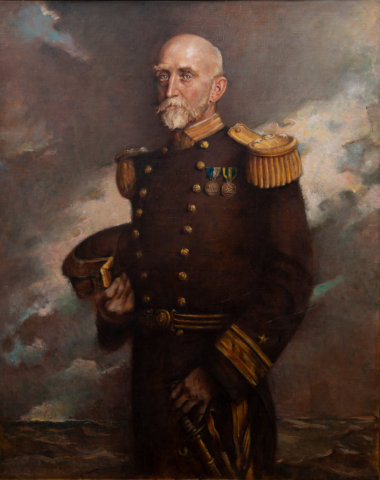
Alfred Thayer Mahan: “The Influence of Sea Power Upon History” as Strategy, Grand Strategy, and Polemic, by Thomas Jamison
No book has had greater effect on the composition of and justification for industrial navies than Alfred Thayer Mahan’s 1890 The Influence of Sea Power Upon History, 1660-1783. Indeed, it is likely true that no other piece of “applied history” has been as successful (for better or for worse) in the making and shaping of U.S. national security policy; George F. Kennan’s 1947 “X Article” comes to mind as a comparable example. Written during a period of U.S. naval reform and expansion, Mahan’s research is at once a parochial argument about the need to revitalize U.S. “sea power,” and a broader account of the relationships between the ocean, trade, and national strength. Many critics have read Influence as transparent propaganda for a domestic audience or a set of dated prescriptions about naval strategy. True, the book is both of those things, but Mahan’s account of Atlantic imperial rivalries is also more valuably an “estimate of the effect of sea power upon the course of history and the prosperity of nations.” That form of comparative and nomological history makes Influence a strategic classic of enduring relevance.
This essay leverages Mahan’s personal correspondence, archival sources, and an extensive body of commentary to explore the content, creation, and reception of Influence. In doing so it encourages readers to consider the text through three lenses: polemic, naval strategy, and grand strategy. Like a piece of stained glass held up to the light, the Mahanian concept of “sea power” is many things at once, depending on one’s perspective. In a narrow sense, Influence is a specific argument—a polemic—aimed at fin de siècle “navalists” about the necessity of expanding the United States Navy (USN). As an analysis of purely naval strategy, it is also a thesis emphasizing concentrated battle fleet engagements as a means of achieving command of the sea. Most importantly, however, it is an outline of a grand strategy bound up in a national turn toward the maritime world.
Jan
3
Five-year US load growth forecast, from Carder Dimitroff
January 3, 2025 | Leave a Comment
1 GW = about 1 nuclear power plant
Five-year US load growth forecast [for power] surges to 128 GW
U.S. electricity demand is forecast to increase 15.8% by 2029, according to a new report from Grid Strategies. Six regions of the country are driving the growth
The report's load growth estimates are based on annual planning reports submitted to the Federal Energy Regulatory Commission by electric balancing authorities and updated with additional data from utilities and planning regions.

Consider this question from another list member: What would happen to the grid if Silicon Valley companies found technologies a decade hence that would provide similar server services with less electric power?
Answer 1a: The utility could face stranded assets, including underutilized power plants, transmission lines, substations, and distribution systems. Remember that most utility investments are 30-year-plus assets, are leveraged, and have their levelized costs, plus margin, firmly embedded in utility bills.
Answer 1b: How would investors hedge their position if they considered building a $1 billion gas turbine in states that deregulated their power plants?
David Lillienfeld responds:
Basically, you're going to see a mismatch between where demand from data centers are and where there's generating capacity. You can build demand a lot faster than you can build supply though, and if you get efficiency on the demand end, you have overpriced supply relative to the ability of the region to pay for the power generated. At some point, someone's going broke.
But here's the curious question–how much economic activity can be attributed to a server building? It's like a parking lot for data–nothing more than that. And if there isn't that much taxable revenues that it's generating, what's the appeal to governments–the risk for the electorate of holding the bag at the end of the day is non-trivial it would seem. So what's the appeal?
Henry Gifford writes:
In other industries power saving strategies are known but not adopted yet, but could be at any time without much warning.
Take cars for example. I heard that in about three years the whole car industry in Europe is going to switch from the now-standard twelve volt electrical system (actually about fifteen volts) to seventy-six volts. One advantage of voltage about five times higher is that electric motors can be about one-fifth the size they are now. This includes the starter motor used to start the engine, the motors used to raise and lower the windows, the heating/cooling system’s fan motor, the engine’s cooling fan motor, the alternator (which is basically a motor wired to work in reverse), and others. As motors are made in large part from Copper and rare earth magnets, smaller motors can save a lot of money. Another advantage is that the wires, usually made from Copper, can be about one-fifth the cross sectional area. Another advantage is that some things typically driven directly off the engine by rubber belts, such as the air conditioning system’s refrigerant compressor and the power steering pump can instead be driven by a small electric motor that can be located anyplace the designer chooses, instead of now having to be located in line with a belt wrapped around part of the engine. Shrinking all these things would make the car lighter, saving fuel. Voltages higher than seventy-six would of course extend these advantages in an ever-diminishing way, but be more capable of going through a person’s skin, thus seventy-six is thought to be the best choice.
The problem is, I heard the three year prediction about twenty years ago, and a few times after that, but not more recently than about ten years ago. So maybe it won’t happen anytime soon, or ever, but the technology and advantages are well known and waiting to be used.
Similar changes could gradually or suddenly drop the power used by data centers.
Jan
2
Water Into Wine, from Laurel Kenner
January 2, 2025 | Leave a Comment
Maybe Jesus, in his hidden character as humorist and Zen master, was telling us to savor what’s really good for us.
Read Laurel's full post.
Jan
1
A musical New Year’s card, from Laurel Kenner
January 1, 2025 | Leave a Comment
Laurel’s musical New Year’s card
Laurel Kenner performs 1st movement of Mozart Sonata in F major, KV 332.
Dec
31
Lions in winter
December 31, 2024 | Leave a Comment
in a discussion of U.S. strength in Scribner's jan 1900 they point to not only the cost of Europe's 4 million soldiers but the loss of productive activity from these young men. How many in the 3 letter agencies are contributing to our loss in productivity and current expenditure?

a resonant character from the past: In "East of Eden," the father figure who is considered to have a "fake" persona is Cyrus Trask; he presents a facade of a strong, military hero but is revealed to have exaggerated his war record and suffered a debilitating hit.
Cyrus is the Papa Bear. He's a one-legged ex-soldier who takes his brief military career very seriously. He destines his favorite son, Adam, for the army—whether Adam wants it or not—and lets his other son Charles tend to the farm or whatever. All of the nation's military higher-ups take Cyrus very seriously, and Adam is just about the only one who sees through his dear old dad for what he really is: a fraud. It eventually comes out that Cyrus probably did something shady because when he dies he has way more money than he should have.
from 2010 to 2025 there have been 12 years with sp up more than 10% - the next year was up in 11 years up about an average of 20%.
Biden is an 82-year-old lion in winter who fills his public and private meetings with war stories from a long career and reminders of his achievements. He seeks to burnish his legacy, infusing even the most rudimentary of White House events with a retrospective look at his career.
Dec
29
Chance, luck, and ignorance: how to put our uncertainty into numbers
December 29, 2024 | Leave a Comment

Chance, luck, and ignorance: how to put our uncertainty into numbers - David Spiegelhalter, Oxford Mathematics
We all have to live with uncertainty. We attribute good and bad events as ‘due to chance’, label people as ‘lucky’, and (sometimes) admit our ignorance. In this Oxford Mathematics Public Lecture David shows how to use the theory of probability to take apart all these ideas, and demonstrate how you can put numbers on your ignorance, and then measure how good those numbers are.
Coffee cup he got from MI5 showing verbal-numerical scale they use.
Also: The Art of Statistics
William Huggins offers:
i like to give this guide to my students for whom English is a 2nd/3rd (sometimes 4th+ language).
Kim Zussman is unimpressed:
David Spiegelhalter was Cambridge University's first Winton Professor of the Public Understanding of Risk.
Translation: He is the most qualified of the vast array of those who don't know WTF they are talking about, but are knighted to tell us.
Peter Grieve responds:
I heard a story a decade ago about one of the big decision theorists, I think it was a Harvard professor. He was offered a position somewhere else, and was agonizing about whether to accept it. A colleague suggested he use his decision theory, and he said "Come on! This is serious!" I've no idea about the veracity of the story, or who was involved.
Alex Castaldo clarifies:
You are talking about Howard Raiffa. The story was told by another professor, although apparently Raiffa later denied that he had said it.
Dec
27
Slab City photos, from Larry Williams
December 27, 2024 | 1 Comment

50 Photos of The Last Free Place in America
Hidden in Southern California’s desert is a small squatter’s paradise affectionately known as “The Last Free Place in America”.
More on Slab City
Slab City, also called The Slabs, is an unincorporated, off-the-grid alternative lifestyle community consisting largely of snowbirds in the Salton Trough area of the Sonoran Desert, in Imperial County, California. It took its name from concrete slabs that remained after the World War II Marine Corps Camp Dunlap training camp was torn down. Slab City is known for attracting people who want to live outside mainstream society.
Dec
26
Cons
December 26, 2024 | Leave a Comment
i have fallen victim to more scams than anyone. let me describe some of them. the typical one was a big con that a bookseller from Pennsylvania pulled on me. first part was to have all my good books removed because of "mold" etc.
a part of the book seller bib con was to have another independent autograph and bookseller assure me that the best thing for me was to remove all my books and send them to Penn. unknown to me was that he was receiving a fee from the supposedly independent but sickly Penn.
There were many other strands in this big con which particularly hurt me since books was a a sin qua non of my parents. I have not gone into my library since I fell into the con. I hope one of my siblings doesn't fall victim to another big con.
Dec
23
Tariffs on Canadian goods, from David Lillienfeld
December 23, 2024 | 1 Comment

So now we're going to get an interesting experiment in what happens when you impose tariffs on your neighbor. To wit:
1. The DEW Line? Probably going to be history very quickly
2. The Keystone Pipeline? The first pipeline to nowhere (why would Canada bother?)
3. Drug interdiction? I doubt the Canadians are interesting in dealing with drug gangs, but they will also have little reason to look kindly on us.
4. NATO? It's a goner already.
I'm not sure that we gain all that much in this tit for tat, but it will be interesting to see what's conjured up.
Carder Dimitroff responds:
It's more than oil from the Keystone Pipeline. As the name suggests, TC Energy (formerly TransCanada) is a Canadian company that exports significant amounts of oil and natural gas to the United States and US natural gas to Canada.
The Keystone Pipelines and the oil they transport are assets owned by Canadian companies rather than US companies. New tariffs on Canadian oil and natural gas traversing TC Energy's pipelines could increase wholesale energy prices within the US. Of course, higher prices help domestic producers.
The US produces more oil and natural gas than it consumes and is a net exporter of natural gas, oil, and byproducts. However, exports could decline if US wholesale feedstock prices increase relative to global markets.
Dec
22
Alfred Cowles
December 22, 2024 | Leave a Comment
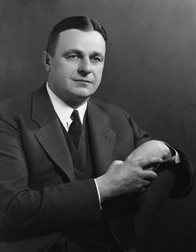
A stock market person who is always sensible, with a memorable reference to Harold Davis:
Dutch biochemist Charles H. Boissevain…advised him that multiple-correlation analysis could be applied to economic research and recommended that he speak to Harold T. Davis, a mathematician at Indiana University who spent his summers in Colorado Springs and a member of the fledgling Econometric Society. Cowles called Davis to ask if it was possible to compute a correlation coefficient in a problem involving 24 variables. Davis suggested that the calculations could be performed by Hollerith punch card machines, developed by a company that would later become International Business Machines (IBM). Cowles acquired a Hollerith computer and worked with Davis on the problem. When it turned out that the machines were ill-suited to the task, Cowles decided to perform a series of linear regressions to test the hypothesis that market analysts using current estimation techniques could not outperform random guessing.
Can Stock Market Forecasters Forecast?, By Alfred Cowles 3rd, December, 1932
This paper presents results of analyses of the forecasting efforts of 45 professional agencies which have attempted, either to select specific common stocks which should prove superior in investment merit to the general run of equities, or to predict the future movements of the stock market itself. The paper falls into two main parts. The first deals with the attempts of two groups, 20 fire insurance companies and 16 financial services, to foretell which specific securities would prove most profitable. The second part deals with the efforts of 25 financial publications to foretell the future course of the stock market. Various statistical tests of these results are given.
Harold Thayer Davis, a forgotten great and his time series book was the first to calculate the distribution of runs of all lengths.
Dec
21
Deviations from Real Earnings Yields, from Hernan Avella
December 21, 2024 | Leave a Comment
An Investigation into the Causes of Stock Market Return Deviations from Real Earnings Yields
Posted: 6 Dec 2024
Austin Murphy, Oakland University - School of Business Administration
Zeina N. Alsalman, Oakland University
Ioannis Souropanis, Loughborough University
This research demonstrates that the simple difference between the current earnings yield on the S&P500 and the long-term real TIPS yield has significant forecasting power for excess returns on that stock market index over both short-term and long-term investment horizons. For all time frames, deviations from that theoretical identity for the equity premium are positively related to current economic slack in the economy. Over annual horizons, those excess stock return deviations are negatively (positively) associated with recent inflation rates (money growth). Inflation is found to be positively (negatively) related to monetary policy restrictiveness (long-term real profit growth) in the future.
Vic asks:
is this bull or bear?
Dec
20
On your last leg, from Kim Zussman
December 20, 2024 | Leave a Comment
How Old Are You? Stand on One Leg and I'll Tell You
I’m always interested in ways to quantify how my body is aging, independent of how many birthdays I have passed. And, according to a new study, there’s actually a really easy way to do this: Just stand on one leg.
Pamela Van Giessen writes:
I slipped on black ice a few years ago and broke my wrist. It was awful and I exclaimed that I would do everything possible to avoid that happening again. I have never had great balance to begin with. I started doing lots of planks. Minor improvement. This year I started running and walking backwards for ~10 mins/day (and I increased the planks to 4 mins). I have been doing this at least 5 days/week since January. I also do about 3 mins/day (7 days/week) sideways leg lifts (one leg at a time and then alternating) with my eyes closed.

HUGE improvement. On recent hikes I was able to rock hop over creeks without my usual falling on my rear and walked several round tree trunks over creeks (like a balance beam) successfully. Two yrs ago I would have had to scootch over those tree trunks on my butt.
Falls are one of the leading causes of mortality as we age because when people fall and hurt themselves it takes longer to recover and they get really nervous about it happening again so they become more sedentary. Peter Attia spends a lot of time discussing this in his book and podcast.
Larry Williams offers:
I had this in my February letter:
We are all aware of how dangerous falls can be for older people. I did not realize it was this dangerous; “The mortality rate for falls increases dramatically with age in both sexes and in all racial and ethnic groups, with falls accounting for 70 percent of accidental deaths in persons 75 years of age and older.” Am Fam Physician.
Most say older people fall because they lose their balance, surely that is part of it. But, there’s another part you can start working on now that costs nothing.
When you start to lose your balance, your body immediately corrects it with how you are standing. Weak ankles, as I see it, are the problem. I first realized this when training for the Sr Olympics. Faster sprinters have stronger ankles. Weak ankles mean you can’t “catch yourself” as you start to fall. To strengthen your ankles, walk barefoot. Walk on your toes, then walk on your heels (careful) to build up these muscles and protect you from falling. Lots of YouTube videos on this as well. Strong people fall less. Muscle loss and ankle strength will keep you upright.
A good exercise is to rock back on your heels, may want to hold on to something, to develop balance and strength
Andrew Moe adds:
Walking backwards uphill, dragging a big weight sled backwards and doing squats on an incline board are all favorites of the Knees Over Toes guy. He's an innovator who believes in building strength from the ground up. Also combines strength and flexibility. Worked for me and is now part of my regular exercise.
Dec
19
The service rate
December 19, 2024 | Leave a Comment
two heroes of speculation and investment are both receiving cheers all over. but left out is the one common factor they have. a better relation with service as well as better commission and margin structure.
how can someone paying 3.5 a round trip compete with someone who pays zero - and if you buy a company that was paying dividends and then you stop on grounds that your secretary pays a greater %.
what was average service rate over previous 15 years for these fossils? (one still living)
Dec
18
Vanished occupations
December 18, 2024 | 1 Comment
some occupations that have vanished in the last 150 years (eric sloanes america): stagecoach driving, chimney sweeping, town crying, aviation barnstormer, ice cutters, snow rollers, drovers, keel boatmen, grindstone man, sandwich men, etc. When will technical analysts vanish?
An informative guide to the vanishing landscape of America's forefathers includes brilliant photography of the barns, covered bridges, road signs, country inns, and steepled churches that they left behind.
Dec
17
Not conforming to the herd, from Asindu Drileba
December 17, 2024 | 1 Comment
In a few books I have noticed a pattern of the author insinuating people not to conform to the herd. Here are some examples:
"My resistance to conformity has been the bedrock of my speculative persona." — Education of a Speculator, The Chair
"Copper the public opinion" — Secrets of Professional Turf Betting, Robert Bacon
"The most contrarian thing of all is not to oppose the crowd but to think for yourself." — Zero To One, Peter Thiel
"Whoso would be a man must be a nonconformist. " — Self Reliance, Ralph Emerson
"If you suggest a doubt as to the morality of these institutions, it is boldly said that “You are a dangerous innovator, a utopian, a theorist, a subversive; you would shatter the foundation upon which society rests.” " — The Law, Frederic Bastiat
Are there any other books you know of that advise their readers not to be conformists?
Vinh Tu adds:
A connected concept is the minority game.
Humbert H. writes:
In markets, simply being contrarian is a recipe for losing money because "the herd" is often correct and markets are almost always efficient. Unlike the El Farol Bar problem, to be successfully contrarian one has to have insight into either something fundamental "the herd" doesn't see or anticipate a change in direction for whatever reason while having a correct insight into the timing. Game theory in its basic form doesn't seem to be very useful.
Asindu Drileba responds:
Yes, the minority game (El Farol Bar Problem) is just a toy model. So it may seem to be detached from reality at times. There is an ecological model that zoologists have come up with. I don't know it's exact name but it is described as follows.
Environment 1: If you're a buffalo and feed on the same grass plains with 1,000 other buffalos (herd members). The quality of grass you will feed on will be lower, since your competing with 1,000 herd members. Fortunately the odds of being eaten by a predator are lower. If a lion/cheetah attacks, your individual odds of being eaten are 1/1000.
Environment 2: If you're a "contrarian" buffalo, i.e move alone without your 1,000 friends. The quality of grass your eating will be higher since you don't need to share with anyone. But the odds that you are eaten, on the condition that the predator is successful are 100% i.e 1 in 1, cause you're the only target and possible victim.
So to the prey: The contrarian buffalo should figure out a way to not be eaten if it is to enjoy higher quality grass. To the predator: Education of a Speculator, describes retail people like me (the public) as the primary food for superior predators. Remember the more buffalos that join a herd the bigger it becomes and the higher the probability of a predator catching a meal.
Hernan Avella offers:
Conformity in Large Language Models
The conformity effect describes the tendency of individuals to align their responses with the majority….In this paper, we adapt psychological experiments to examine the extent of conformity in state-of-the-art LLMs. Our findings reveal that all models tested exhibit varying levels of conformity toward the majority, regardless of their initial choice or correctness, across different knowledge domains.
Humbert H. comments:
There are a couple of reasons why I like my own version of buy-and-hold, but really buy-and-hold in general: whatever happens you're not food for any predators in the market. You can be a victim of financial shenanigans, but when diversified that's not a big problem. The other is the drift. Same reason I never became a physicist: I always found physics really easy, and was always good from my high schools in the USSR and the US where I was the physics teachers' "pet" to college. But early on I figured out that to really make it in physics you needed to be a genius, and I was not, so there was not point in going that way. I don't feel I can beat the predators in the market because the top ones are both smarter and have more resources, so I don't even want to try. I admire those on the list who are trying, but to quote Dirty Harry "a man's got to know his limitations". I do have a couple of strengths for my version of buy-and-hold: I like to buy falling knives, which very few people like, so that's contrarian, and I can lose (or gain) value without any emotions other than "this is fun to watch".
Dec
16
Relevant quotes
December 16, 2024 | Leave a Comment

Some relevant Sherlock Holmes quotes, included at the beginning of each chapter of the brilliant statistics textbook Statistical Inference (Second Edition) by Casella and Berger:
"How do all these unusuals strike you, Watson?"
"Their cumulative effect is quite considerable, and yet each of them is quite possible in itself.""I confess that I have been blind as a mole, but it is better to learn wisdom late than never at all."
"You can, for example, never foretell what any one man will do, but you can say with precision what an average number will be up to. Individuals vary, but percentages remain constant. So says the statistician."
"We want something more than mere theory and preaching."
"I’m afraid that I rather give myself away when I explain. Results without causes are much more impressive."
"We are suffering from a plethora or surmise, conjecture, and hypothesis. The difficulty is to detach the framework of fact - of absolute undeniable fact - from the embellishments of theorists and reporters."
Dec
15
LNG: different perspectives, from Carder Dimitroff
December 15, 2024 | Leave a Comment
Whither the weather: predicting weather patterns helps predict LNG demand and prices.
Asia and Europe in a contest to attract LNG cargoes:
US LNG exports to Europe surge in November on higher prices
U.S. LNG exports to Europe surged in November as the world's largest producer of the superchilled gas sent more cargoes to the continent and fewer to Asia and Latin America, according to preliminary data from financial firm LSEG. European natural gas prices climbed in November to their highest levels in two years on fears remaining Russian pipeline supplies to Europe will be halted or face further curtailment.

LNG tankers divert to Europe from Asia after Russia halts supplies to Austria's OMV
LNG traders divert cargoes from Europe to Asia as eastern demand strengthens
Meanwhile:
U.S. inventories enter the winter with the most natural gas since 2016
Rising LNG terminal costs to make new US projects less competitive
FYI, U.S. LNG producers must buy natural gas at market prices. Many competitors pay only lifting costs.
Dec
14
Father and son
December 14, 2024 | 1 Comment

a 63-yr differential between us. My father always said he would be the happiest man in the world when I could beat him at almost all things. I feel the same about Aubrey. (Until my stroke I could beat him at most racket sports.)
Dec
13
Crazy without provocation
December 13, 2024 | Leave a Comment
A Quixotic President, by Daniel Tenreiro
Wed, January 13, 2021
“The thing is to turn crazy without any provocation,” Quixote tells his sidekick, Sancho Panza, when asked what compelled him to give up his quiet countryside existence and playact knight errantry in the mountains of Spain. A rich bachelor wasting away on his vineyard in La Mancha, the protagonist of Miguel de Cervantes’s novel grows frustrated with the smallness of life. He yearns instead for the toil, anxiety, and arms of the chivalric romances he spends his days reading. Unable to make his dream a reality, Quixote opts to pretend: He mounts a ragged horse, costumes himself in a rusted breastplate, and sets off in search of eternal fame.
when you see a person registered for one party proclaiming views completely opposite - is it a case of false deception or the stockholm syndrome or sinking into the swamp or…
Dec
12
Positively aging, from Kim Zussman
December 12, 2024 | Leave a Comment
Want to Live a Long and Fulfilling Life? Change How You Think About Getting Old
Research consistently shows our attitudes and beliefs influence our health and longevity.
Data is mounting, much of it from research by Yale epidemiologist Becca Levy, about the impact our attitudes and beliefs have on our health and longevity. Levy’s interest in the connection began in the 1990s, when she traveled to Japan to try to understand why the Japanese had the longest lifespan in the world. She was familiar with explanations that attributed this longevity to diet—Japanese people consume less meat, dairy products, sugar and potatoes than other wealthy countries. But what stood out to her was how the culture respected and celebrated older people.
“It struck me as very different to what I had observed in the U.S.,” she told me. “So I began to wonder if these positive age beliefs could contribute to the longer lifespan in Japan.”
Nils Poertner writes:
Psychology plays a huge role here - eg. excessive nostalgia means one does not appreciate the moment - in my view it is also linked to far-sightedness (went farsighted at the age of 15! which is rare and then recovered). there is somewhat a placebo in life - and the joke is on us really.
Big Al comments:
There are maybe complicated issues around causality, e.g., do people with a positive attitude live longer and better, or do people with underlying factors that promote health and longevity tend to have a positive attitude? But I will stipulate that we might as well try it. Which leads to the issue of people feeling like they have failed if they *don't* have a positive attitude. Perhaps as a way of avoiding this pitfall, we could be given information on how to *practice* a positive attitude. Then, over time and with practice, we might see a benefit.
Dec
10
The principle of least effort
December 10, 2024 | Leave a Comment

Grandfather Martin liked to encap stock market moves as an example of theory of least effort. Elmer Kelton applies the theory to the explosion of oil in a mine.
Any explosion will follow the path of least resistance. We want its main force to go out to the sides of the hele, to break up the formation. We don’t want it wasted, comin back up the open casing like a blast from a shotgun barrel. So we tamp a yard or so of pea gravel on top of the charge.
-Honor at Daybreak, by Elmer Kelton
I sat besides a stream of water in complete tranquility wondering about life, its purpose, “who am I?” and such esoteric thoughts. Abruptly, my left brain kicked in and started wondering about well, more left-brain things, like how water finds its own level and how it flows along the path of least resistance. That took me back to my college days when I first learnt about the path of least resistance in the context of electrons flowing through a wire creating electricity. This concept stayed close to my heart as I naively related it to my own disposition of doing things that took the least effort. Later on in life I figured that this Principle of Least Effort (POLE) is actually prevalent in all of nature.
much more work should be done on applying this principle to the stock market in the last 100 years after Granpa passed.
what examples of markets displaying theory of least effort ($1000 reward for best example).
[More on the math/physics side: Action Principles]
Dec
9
This is what recovery looks like, from Bill Rafter
December 9, 2024 | Leave a Comment
Payroll Tax Receipts growth:

More charts (click for full view):
Payroll Tax Receipts growth with a leading indicator
Employment: full-time vs part-time
Dec
8
Doom, bonds, and Elmer Kelton
December 8, 2024 | Leave a Comment
Is This Wildly Overvalued Stock Market Doomed? Yes, but Maybe Not Yet -WSJ
the wsj foregoes the Dow theory, and the drift, and the seasonals, and the tendncy for the best to continue to do the best.

another great from Elmer Kelton with a million similarities of the path of mining for oil to markets:
very quietly the 30-year bond future price has hit a 32-day high. this has been insanely bullish for the S&P. in the last year for example S&P 40 days later is up 154 big points (up 80% to 100% of time) true for all back intervals thru 2001. no wonder wsj is bear.
Dec
5
Sex and the City and the Times
December 5, 2024 | Leave a Comment
I listened to Sex and the City over the weekend and the NY Times Sunday edition was like another version of it. here was a man who kept dozens of ratings of sex in city types on past dates and rated them 1 to 10 on how far they'd go more recently. He's a vac denier who ran for Pres in 2024.
continuing the coincidence of sex and city and nytimes there is big article about the Financial District Hip Mystery Tower and the cool x sex and city types who are leasing space there at 1/10 the going rate. somehow my chapter in Edspec on sex and the market is very relevant.
Dec
3
Roughing It
December 3, 2024 | Leave a Comment

for the past week ive been reading Roughing It and Following the Equator. It is amazing how much Mark Twain knew and how amusing it is. I particularly liked his analysis of the German Language, the Mormon migration and the booms and busts in the silver mines.
[Below, a market story from Roughing It. - Ed.]
A youth of nineteen, who was a telegraph operator in Virginia on a salary of a hundred dollars a month, and who, when he could not make out German names in the list of San Francisco steamer arrivals, used to ingeniously select and supply substitutes for them out of an old Berlin city directory, made himself rich by watching the mining telegrams that passed through his hands and buying and selling stocks accordingly, through a friend in San Francisco. Once when a private dispatch was sent from Virginia announcing a rich strike in a prominent mine and advising that the matter be kept secret till a large amount of the stock could be secured, he bought forty "feet" of the stock at twenty dollars a foot, and afterward sold half of it at eight hundred dollars a foot and the rest at double that figure. Within three months he was worth $150,000, and had resigned his telegraphic position.
[ And Twain analyzes The Awful German Language, from A Tramp Abroad. ]
Dec
2
Stop-loss orders: browsing the research, from Humbert X.
December 2, 2024 | Leave a Comment
(1) When Do Stop-Loss Rules Stop Losses?
EFA 2007 Ljubljana Meetings Paper
51 Pages Posted: 5 Mar 2007
Kathryn Kaminski, Massachusetts Institute of Technology (MIT)
Andrew W. Lo, Massachusetts Institute of Technology (MIT) - Laboratory
for Financial Engineering
Date Written: January 3, 2007
In this paper, we develop a simple framework for measuring the impact of stop-loss rules on the expected return and volatility of an arbitrary portfolio strategy, and derive conditions under which stop-loss rules add or subtract value to that portfolio strategy. We show that under the Random Walk Hypothesis, simple 0/1 stop-loss rules always decrease a strategy's expected return, but in the presence of momentum, stop-loss rules can add value. To illustrate the practical relevance of our framework, we provide an empirical analysis of a stop-loss policy applied to a buy-and-hold strategy in U.S. equities, where the stop-loss asset is U.S. long-term government bonds. Using monthly returns data from January 1950 to December 2004, we find that certain stop-loss rules add 50 to 100 basis points per month to the buy-and-hold portfolio during stop-out periods. By computing performance measures for several price processes, including a new regime-switching model that implies periodic Flights-to-quality, we provide a possible explanation for our empirical results and connections to the behavioral finance literature.
(2) Stop-Loss Orders And Price Cascades In Currency Markets
C. L. Osler, New York Fed, June 2002
In this paper, I provide evidence that currency stop-loss orders contribute to rapid, self-reinforcing price movements, which I call "price cascades." Stop-loss orders…generate positive-feedback trading. Theoretical research on the 1987 stock market crash suggests that such trading can cause price discontinuities, which would manifest themselves as price cascades. My analysis of high-frequency exchange rates offers three main results that provide empirical support for the hypothesis that stop-loss orders contribute to price cascades: (1) Exchange rate trends are unusually rapid when rates reach exchange rate levels at which stop-loss orders have been documented to cluster. (2) The response to stop-loss orders is larger than the response to take-profit orders, which generate negative-feedback trading and are therefore unlikely to contribute to price cascades. (3) The response to stop-loss orders lasts longer than the response to take-profit orders. Most results are statistically significant for hours, although not for days. Together, these results indicate that stop-loss orders propagate trends and are sometimes triggered in waves, contributing to price cascades. Stop-loss propagated price cascades may help explain the well-known “fat tails” of the distribution of exchange-rate returns, or equivalently the high frequency of large exchange-rate moves. The paper also provides evidence that exchange rates respond to non-informative order flow.
Dec
1
Seasonals, and a deep-thinking man
December 1, 2024 | Leave a Comment

what can one say about the seasonals for December? the seasonals are bullish when the prev 6 months are up and bearish when then prev 6 months are down. recently a rise in the last day of November has been bullish.
a book by a stubborn and deep thinking man - highly recommended:
A Personal Odyssey, by Thomas Sowell.
Nov
30
Productivity and AI, from David Lillienfeld
November 30, 2024 | 1 Comment
When do we start seeing the effects of AI show up in national economic data? If you had invested $5K in a laptop and a word processing program, you could replace a secretary at multiples of the cost. When the web came in, there was Amazon squeezing out the costs of the middlemen.
But I don't see the savings for AI. I see lots of talk, some free programs, but in terms of real productivity, not so much. I'm also told that it's early days and I'm asking for too much in posing such a question, but I think we're now getting far enough into AI that it's not an unreasonable matter to bring up.
One thing that's clear is that AI isn't going to generate employment the way the last tech push did. But if it's going to really change the world as its advocates suggest that it will, those productivity gains should be apparent by now.
M. Humbert writes:
However AI productivity gains are measured, it’ll have to account for the productivity loss due to its high energy consumption. For the Austrian economics fans here. I’ve found Copilot to be a helpful time saving tool, so others probably do as well, so time savings definitely are occurring from AI use today.
Laurence Glazier responds:
Using it all the time, huge experiential benefit. Chatting to GPT every morning while reading Thoreau. Instant context. The other big breakthrough is spatial computing. All in the service of art.
Asindu Drileba comments:
From my experience, co-pilot and other LLMs, have not solved anything that could not already be done via ordinary Googling. Looking up solutions to code issues on stack overflow is no different from LLMs. And stack overflow is still better for some tasks (fringe computer languages like APL for example). LLMs are impressive, but are mostly just gimmicks. The only thing it has actually saved me time on is generating copyrighter material and filler text.
Jeffrey Hirsch adds:
Just had that discussion today about ordinary google still being even better than LLM Ais in finding info. Had some fun with AI editing and embellishing copy.
Asindu Drileba adds:
I suspect that the bad SWE job market is due to high interest rates, no AI. The SWE job market is enriched mostly by VC money. And VC money dried up when LPs withdraw to earn risk free money in treasuries instead of betting on start-ups whose success is on probability. I expect it to recover if interest rates come down to previous levels.
I think the LLM narrative was just something that tech executives parroted to show they had an LLM strategy. It's, Like how in 2018/2017 every executive had a "Blockchain" strategy. A lot of businesses assumed that LLMs would replace simple customer support jobs but they just saw their tickets pile up. Even the $2B valued, Peter Thiel financed, code assistant that would make you money on Up work as you sleep turned out to be a blatant scam.
Steve Ellison writes:
I don't have an answer for Dr. Lilienfeld's question about when AI effects will show up in productivity statistics. But I do hear anecdotally through my professional networks that AI projects are adding real value.
At the same time, Asindu is correct that the bad job market for techies, myself included, is more a consequence of rising interest rates–and I would add overhiring during the pandemic–than positions being replaced by AI. As Phyl Terry put it, "But this company [that announced layoffs] wants to go public so the better story is 'we are smart leaders using AI to become more efficient and profitable' vs 'we were idiots during the pandemic and have to lay off some people because we messed up.'"
Gyve Bones writes:
I find that the AI's ability to interpret my request and put together a coherent synthesis of several sources to be very helpful. Grok is nice because it provides a set of links to sources relevant to the prompt, and to related ??-posts and threads.
Laurence Glazier asks:
I usually have audio conversations with GPT rather than the older typed-in input/output. I just subscribed to X Premium to get access to Grok. Any good links for learning good usage? How nice Musk names it from the Heinlein novel.
Gyve Bones responds:
Check out the sample prompts Grok supplies on the [ / ] section in ??. The news analysis prompts for trending items is pretty cool.
Bill Rafter writes:
My business partner and I are in the process of marketing a new software application. Although we are rather literate, we have been running all of our marketing materials through Copilot, and we are amazed at the improvements Copilot makes to our text. It results not only in improved communication, but is a real time-saver. We even asked it to write a business plan, and it came back with a better one than our original.
Peter Penha offers:
I have not (yet) been on Grok but have found that the prompts do not differ very much across LLMs:
A Primer on Prompting Techniques, June 2024.
Prompt engineering is an increasingly important skill set needed to converse effectively with large language models (LLMs), such as ChatGPT. Prompts are instructions given to an LLM to enforce rules, automate processes, and ensure specific qualities (and quantities) of generated output. Prompts are also a form of programming that can customize the outputs and interactions with an LLM. This paper describes a catalog of prompt engineering techniques presented in pattern form that have been applied to solve common problems when conversing with LLMs. Prompt patterns are a knowledge transfer method analogous to software patterns since they provide reusable solutions to common problems faced in a particular context, i.e., output generation and interaction when working with LLMs. This paper provides the following contributions to research on prompt engineering that apply LLMs to automate software development tasks. First, it provides a framework for documenting patterns for structuring prompts to solve a range of problems so that they can be adapted to different domains. Second, it presents a catalog of patterns that have been applied successfully to improve the outputs of LLM conversations. Third, it explains how prompts can be built from multiple patterns and illustrates prompt patterns that benefit from combination with other prompt patterns.
This is earlier/shorter February 2023 paper - I am also a fan/follower of Prof. Jules White’s classes on Coursera why I flag the shorter/earlier paper as well.

Separate on the subject of AI - Eric Schmidt has a new book Genesis with Dr. Kissinger as a co-author (his last work before his passing) but Schmidt did a Prof G Pod Conversation released Nov 21st - in the podcast Schmidt goes over the threat from LLMs that are unleashed and noted that China in his view has open sourced an LLM equal to Llama 3 and that China instead of a being three years behind the USA on LLMs is a year behind. That China comment can be found here at 26:30.
Finally if anyone wants a great book I have read, on the history of the race to AGI going back to 2009: the Parmy Olsen book Supremacy on the histories of Sam Altman and Demis Hassabis is a wonderful read. Also breaks the world down between the AI accelerationists and the AI armaggedonists.
Big Al adds:
I do use Bard to learn or refresh my memory with R. For example, I am trying to use the "tidyverse" set of packages, and Bard is very useful when asked to write code for some task specifically using, say, tidyquant. The code almost never works first time cut & paste, but I can see how things are done differently and figure out what needs fixing. And I get answers to simpler problems faster than on Stack Exchange which is better for more complicated issues.
Laurence Glazier comments:
It's an inverted Turing test situation. The things that AI can't do help identify our humanity, our birthright.
Nov
25
From the archives: How To Become a Professional Con Artist
November 25, 2024 | Leave a Comment

Book Review: How To Become a Professional Con Artist
3/25/2005
Dennis Marlock opens his "How To" book with a testimonial:
As a law professor, I have read countless books, articles, and dissertations on fraud and deception. This, however, is the first time I have elected to endorse any author's work. The book is indeed an academic gem worthy of inclusion in university curriculums throughout the nation.
The beautiful thing about the professor's testimonial and the related, "I first bought the book hoping to discover why a cop would tell people how to commit fraud. Having read the book, I must now ask why he didn't write it sooner" is that they were both short cons written by the author.
The book lacks the scholarship, timelessness, humor and general principles of David Maurer's classic The Big Con, which I would recommend as one of the seven best books for market practitioners right after Ben Green's Horse Trading. Nevertheless, it is replete with cons and techniques we are exposed to in our day-to-day work in the market. The most relevant topic is chapter 4, "Tools of the Trade," which lists such essentials as "How to Talk Without Saying Anything." An example of this would be market talk such as "1040 is a key level." Yes, if it turns at that level and goes up it was key, and if it hits that level and goes below, why that proves that it didn't hold. A variant of this is the "the market is good as long as stays in the 1025-1075 range."
An important sub-technique is to "use abstract and otherwise equivocal and meaningless rhetoric." I have already written about this, and California Phil's precis of the earthquake "professor" is a classic here. But the market confidence man in general does always frame his thoughts in ways that cannot be disproved or refuted.
One loves the discussions of power laws in this context, as there's no way to differentiate a normal distribution from a power law with any degree of confidence for any samples involving 750 observations or less, and by then the situation has changed so much that one can always rely on Oct 19, 1987.
One must always appear confident as a confidence man and "I am completely confident that you will be totally satisfied with this necklace" is a phrase that the confidence man uses often. This is even more effective when you receive this assurance from a friend of the confidence man. I recently read an interview about a large man who has lost billions of dollars for his investors in publicly reported funds, yet the interviewer refers to the millions he has made the 30% a year internal rates of return, and the nine-figure amount that his followers made applying the techniques that the large man proudly boasts he took the lions share of , and the amazing returns he himself is making at the very present time, despite the difficulties he apparently has in making money for customers.
One of my favorite passages in "How to Become a Professional Con Artist" is the depiction of the big businessman as the ideal mark. "They're cows waiting to be milked," Marlock writes. "They are in abundance, they don't complain when being milked, they provide useful products, and they are used and abused by almost everyone. They are abused daily by employees, lawyers, stockholders, customers, suppliers, lenders, accountants, partners, tax collectors, and competitors. except for the stiff competition, bus schemes are the easiest, safest, and most profitable.
Nov
24
Stops, from Hernan Avella
November 24, 2024 | Leave a Comment
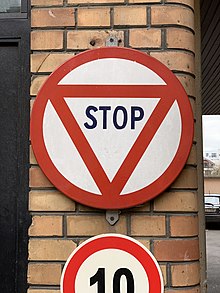
Contrary to what has often been repeated on this esteemed list over the years, the art and process of trading is fundamentally the art and process of setting the right stops. Simpletons may claim that adding stops to a system (trading ES) reduces profitability, but that's only because the system itself is flawed, with laziness baked into its design. Setting the right stop is an integral process—it involves gauging current and expected volatility, weighing potential paths, and accounting for the bias.
Steve Ellison writes:
One of my best experiences with this list was that at the sparsely attended Spec Party in summer 2009, the 20 or so of us who were there had a very spirited discussion in Victor's living room about whether it was advisable to use stops or not. Many excellent points were made both pro and con.
Speaking for myself, I usually don't enter stop orders because they become part of the market, but I have mental stops. On the rare occasions when I actually have a profit, I am determined to not let it turn into a loss. And if a trade goes against me (by a nontrivial amount), that's new information that apparently my original analysis missed; in that case I am determined not to let a small loss turn into a big loss.
To put it another way, I entered a trade because I thought I had an edge, but the market moved in the wrong direction. Maybe something bigger is going on than, say, my analysis of the last 10 post-options-expiration weeks.
Big Al offers:
Stop Orders in Select Futures Markets
Nicholas Fett and Lihong McPhail
Office of the Chief Economist
Commodity Futures Trading Commission
August 29, 2017
This paper analyzes trade and order book audit trail data to provide a detailed summary of the use of stop orders in select futures markets; specifically E-mini S&P 500 Futures, Ten Year Treasury Note Futures, and WTI Crude Oil Futures. Recent flash rallies and the ever increasing speed of futures markets have called into question the appropriateness of traditional stop order strategies. By utilizing metrics related to both placement of and execution of stop orders, we show that stop orders are being used in these futures contracts with varying frequency and the strategy of stop order placement varies greatly by participant. As expected, trades involving stop orders are found to be highly correlated with intraday price volatility. Existence of stop orders is generally unknown to market participants as stop orders are not visible in the orderbook but must be triggered by a trade in the market at the corresponding price. More importantly, our analysis indicates that many traders are not only using stop orders for hedging purposes but also using them for latency reduction strategies. We provide a background on the usage and depth associated with stop orders in selected futures markets.
Larry Williams responds:
THANKS FOR THE POST. This should dispel the notion "they are going after my stops."
Asindu Drileba writes:
I don't actually use stops at all. My position size is my stop. I only bet a maximum of 3% of my bankroll. I really only get out of the market when I am liquidated. I sleep knowing that if I am to loose, my maximum loss is capped at 3%. I don't even respond to margin call emails. I often want to capture the moves between the daily open and the close. So what happens in between is something I usually ignore.
Nov
23
Deems Taylor
November 23, 2024 | Leave a Comment

this satirical bit brings to mind a Deems Taylor story. He came in for the second piece of concert that was complete programmatic movement. Deems thought the first piece was being performed. and all the allusions were wrong. Mark Twain in Roughing it writes of many mistakes like this.
father of the great libertarian scholar and editor Joan Taylor.
Deems Taylor: A Biography, by James A. Pegolotti.
Composer, critic, author, and radio personality, (Joseph) Deems Taylor (1885-1966) was one of the most influential figures in American culture from the 1920s through the 1940s. A self-taught composer, the New York City native wrote such pieces as the orchestral suite Through the Looking Glass and the acclaimed operas The King's Henchman and Peter Ibbetson, the first commissions ever offered by the Metropolitan Opera. Taylor's operatic works were among the most popular and widely performed of his day, yet he achieved greatest fame and recognition as the golden-voiced intermission commentator for the New York Philharmonic radio broadcasts and as the on-screen host of Walt Disney's classic film Fantasia. With his witty, clever, charming, and informative but unpatronizing manner, he almost single-handedly introduced classical music to millions of Americans across the nation.
Nov
22
The wisdom, wit, and saltiness - with market implications - of Don Quixote
November 22, 2024 | Leave a Comment
_David_-_Don_Quixote_and_Sancho_Panza_illustration_of_book_by_Miguel_de_Cervantes_Histoir_-_(MeisterDrucke-1474017).jpg "Don Quixote and Sancho Panza")
All affectation is bad.
Something is better than nothing.
Between friends sharp eyes.
He who leans against a good tree finds good shelter.
The ass laden with gold mounts lightly up the hill.
Well-gotten wealth is lost, but with the ill-gotten the master is lost too.
The wheel of fortune turns quicker than a mill-wheel.
That which costs us little, is valued at even less.
Where one door is shut, another opens.
He who seeks danger perishes in it.
There are no birds in last year's nest.
A sparrow in the hand is better than a vulture on the wing.
Many littles make a Much.
Patience, and shuffle the cards!
All is not gold that glitters.
He who does not intend to pay is not troubled in making his bargain.
He who buys and lies, feels it in his purse.
One misfortune calls another.
Who goes ill, ends ill.
To draw one's beard out of the mire.
Where you least expect it up starts the hare.
The reputation of the master reveals that of the servant.
The ball is drawn up by the thread.
A single swallow does not make a summer.
The dry throat can neither grunt nor sing.
Fortune favors the brave.
What hath been, hath been.
Where duennas intervene, nothing good can come of it.
Make a bridge of silver for a flying enemy.
Upon a good foundation a good building may be raised, and the best foundation in the world is money.
Diligence is the mother of good fortune.
You cannot catch trout with dry breeches.
Here come the Bulls for certain!
Time is the discoverer of all things.
With life many things are remedied.
Nov
21
Poker player’s brain, from Jeff Watson
November 21, 2024 | Leave a Comment
The Incredible Brain of a Poker Player
A true social phenomenon, poker is not just a game of chance and money. From a scientific perspective, we can think of it as a sporting discipline, requiring numerous biological and mental resources. Winning, losing, thinking, bluffing, resisting stress…each of these events results in specific brain activity. By combining testimonials from some of the best players in the world with insights from scientific experts and unique experiences, this documentary will allow each of us to understand the internal processes that govern our risk-taking, and each of our decisions.
Nov
20
Howard Hammer
November 20, 2024 | Leave a Comment

Vic and Howie Hammer being inducted into paddlable hall of fame. Howie at 88 the founder.
Howard Hammer – PFA Paddleball Legend of the Game Profile
Howard Hammer is the first inductee into the PFA Hall of Fame, and rightfully so. He was not only one of the greatest players the game has ever seen, but he also contributed more to the game than anyone I know. No one else is more associated with paddleball than Howie. Therefore, the title “Mr. Paddleball” is really appropriate.
Video: Paddleball Shots: Fundamentals, by Howard Hammer
Book: Paddleball: how to play the game, by Howard Hammer, 1979.
Nov
18
The wisdom of Sancho
November 18, 2024 | Leave a Comment

while Don quixote is voted the best novel of all time, and its humour and anecdotes are considered sui generis, not many have commented on the wisdom of this book as great as its wit. I have found the proverbs contained within - all very short, salty and sententious - the perfect companion to the book itself. the companion by Ulick Ralph Burke, Sancho Panza's Proverbs, is the perfect partner to the duo and is a work of masterly scholarship. In addition to the saltiness of all proverbs, there is an underlying Spanish diffidence and pregnancy to all the proverbs that enhances the novel.
Nov
17
New study by Dimson, et. al.
November 17, 2024 | Leave a Comment
the authors of this study should receive a Nobel Prize. the study is magnificent and the conclusions are useful and surprising. I would add that the studies do not take into account the theory of ever changing cycles. current conditions differ from the 19th century.
Long-run Asset Returns
Annual Review of Financial Economics, volume 16, issue 1,
2024[10.1146/annurev-financial-082123-105515]
David Chambers, University of Cambridge - Judge Business School; CEPR
Elroy Dimson, University of Cambridge - Judge Business School; European Corporate Governance Institute (ECGI)
Antti Ilmanen, AQR Capital Management
Paul Rintamäki, Aalto University
Date Written: October 10, 2024
The literature on long-run asset returns has continued to grow steadily, particularly since the start of the new millennium. We survey this expanding body of evidence on historical return premia across the major asset classes-stocks, bonds, and real assets-over the very long run. In addition, we discuss the benefits and pitfalls of these long-run data sets and make suggestions on best practice in compiling and using such data. We report the magnitude of these risk premia over the current and previous two centuries, and we compare estimates from alternative data compilers. We conclude by proposing some promising directions for future research.
Nov
16
Favorite piano
November 16, 2024 | Leave a Comment

my favorite piano work at my favorite venue by my favorite non-family woman who I've known for 50 years:
Pianist Rorianne Schrade plays Eduard Schütt's Paraphrase of J. Strauss Tales from the Vienna Woods
Rorianne Schrade YouTube channel
Rorianne's website.
Nov
15
A case for BTC
November 15, 2024 | Leave a Comment
a very resonant and helpful piece highly recommended:
Get Rich While Saving the World! Baby Tristan's Case for Bitcoin
one wouldn't be surprised if Tristan's middle name was Victor.
Nov
14
Crypto and the money supply, from Bill Rafter
November 14, 2024 | Leave a Comment
Should the market cap of crypto currencies be included in money supply for macroeconomic purposes?
William Huggins replies:
I'd you cant use it to pay taxes it doesn't count (just another asset, like a stamp).
Kim Zussman asks:
Why not? They add because if you pay taxes with fiat you can buy merch with crypto.
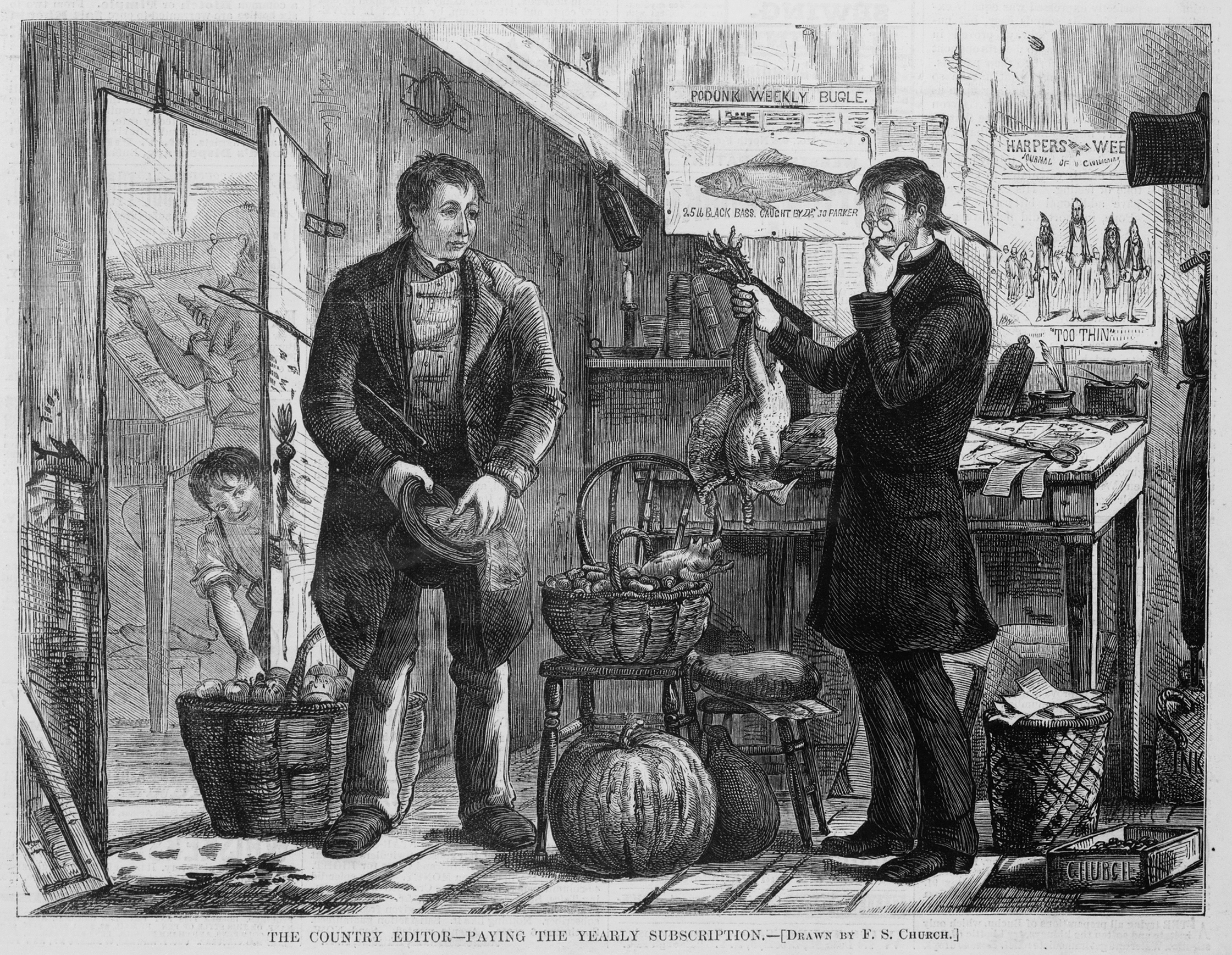
William Huggins responds:
you can barter wine or chocolate for a ton of things online too but we don't count those either. if money is "anything taken as payment" then we have to get very serious about "degrees of moneyness" (hence m0,m1,etc). in that spectrum, its pretty clear that the only things on the list are legal tender so unless you live in the land of bukele, it doesn't count (also, whose money supply does crypto count as exactly?)
Peter Penha:
I will volunteer that there is no moneyness to crypto as it was determined a 100% haircut asset by the DTC.
I think this leaves Blackrock and other crypto ETF managers in the interesting position that they cannot include crypto ETFs in one of their asset allocation funds or a target date fund, etc - inclusion would pollute.
Crypto in the USA appears to be a walled garden - the only contagion I can see to the financial world would be to holders of Micro Strategy Convertible Debt.
Stefan Jovanovich writes:
The question you all are raising here has a history - how far can "the law" go to monetize promises to pay? Originally, the answer was not one step. The Constitution says that legal tender can only be Coin. Article I, Section 8.
The lawyers have been working around that limitation ever since. Their greatest difficulty has been getting around the literalist non-lawyer Presidents who keep following the actual instructions the People established by vote as "the law".
Success came with the Aldrich-Vreeland Act which authorized banks with Federal charters to form "currency associations". Those were given authority to issue emergency currency could be backed by securities other than U.S. bonds, including commercial paper, state and local bonds, and other miscellaneous securities.
Section 18 of the Act: "The Secretary of the Treasury may, in his discretion, extend from time to time the benefits of this Act to all qualified State banks and trust companies, which have joined the Federal reserve system, or which may contract to join within fifteen days after the passage of this Act: Provided, That such State banks and trust companies shall be subject to the same regulations and restrictions as are national banks under this Act: And provided further, That the circulating notes issued under this Act shall be lawful money and a legal tender in payment of all debts, public and private, within the United States."
Everything since 1908 has been a variation on that theme - "lawful money" can be whatever Congress says it is.
Bill Rafter comments:
I started this question because I am working on a slight variation of digitally quantifying inflation. With the loose definition of inflation being “too much money chasing too few goods”, then the “money” part should include all that can conceivably buy the “goods”. Since one can increasingly buy a whole lot of stuff with crypto, then crypto deserves inclusion. If one were to fast-forward to a time of massive currency instability (this is just a thought experiment), having included the cryptocurrency might have facilitated greater forecasting.
Stefan Jovanovich adds:
For me the paradox of Bitcoin is that it has been a spectacularly successful asset - like a share of Berkshire Hathaway stock bought in the days before Buffett even went public - but it has never been a money. If I had Bill's brain and cleverness, I would try to include in the calculations the sum of personal and corporate credit that the lenders cannot easily pull away from the table (the potential moneyness supply) and the amount of credit actually used; and then seek the correlations to the fluctuations in that spread. In the days before central banking, speculators watched the net supply of commercial paper as such an indicator.
Nov
12
Sporting anecdotes
November 12, 2024 | Leave a Comment

Sporting Anecdotes (1923) shows us what the state of sports was like in England in 1800's. much betting on walking races, boxing, horse racing. and here is the greatest fives player of all time: john cavanaugh, much fighting of badgers, etc; great match of walking 1000 miles in 1000 hours; gouging match in america; fidelity of a dog; curious wager - walking against eating; throwing cricket ball 100 miles to deliver a post and win a bet; wisdom of Pliny who lived 100+ years.
Nov
10
The Old Right was a principled band of intellectuals and activists, many of them libertarians, who fought the “industrial regimentation” of the New Deal, and were the first to note that, in America, statism and corporatism are inseparable.
Despite some current claims, however, these writers ardently defended capitalism, including big business and corporations, celebrated the profit motive, and took a strict laissez-faire attitude towards international trade. They loathed tariffs, and saw protectionism as a species of socialist planning.
Humbert H. writes:
Current restrictionist trade theories in the conservative movement, therefore, are not those of the Old Right. Their intellectual legacy is more likely British mercantilism.
The British did pretty well under mercantilism. I have always supported free (meaning from both sides) trade with equally situated countries, like US and Canada, but I love restrictionism and tariffs imposed on countries like China. It's crazy, in my opinion, to have "free trade" with a country that can and routinely does restrict imports, has slave labor, no "social safety net", steals intellectual property in a variety of ways, and can chose to focus on any trade area to bankrupt it's counterparts in a "free" country. The ability to produce a variety of goods is fundamental to the strength of the country. In wars, pandemics, and trade wars the other country starts having domestic capabilities is crucial. When this debate was first discussed in France, restricting the imports of oranges from Spain and Portugal into France was used as an example of what not to do, and that's a poor example compared to importing steel and semiconductors.
Larry Williams comments:
Hamilton's use of tariffs made America great.
Stefan Jovanovich writes:
Hamilton made his living as a private attorney in New York representing the marine insurance companies whose policies required shippers to be "woke" - i.e. perfect observers of their policies' neutrality warranties.
Pamela Van Giessen adds:
Silent Cal Coolidge the Vermonter was also good with tariffs and preferred them to income taxes.
Along with Secretary of the Treasury Andrew Mellon, Coolidge won the passage of three major tax cuts. Using powers delegated to him by the 1922 Fordney–McCumber Tariff, Coolidge kept tariff rates high in order to protect American manufacturing profits and high wages. He blocked passage of the McNary–Haugen Farm Relief Bill, which would have involved the federal government in the persistent farm crisis by raising prices paid to farmers for five crops. The strong economy combined with restrained government spending produced consistent government surpluses, and total federal debt shrank by one quarter during Coolidge's presidency.
Michael Brush responds:
Smoot-Hawley worsened the Great Depression.
Humbert H. cautions:
That's not really a fact, it's a debatable point. There's a range of opinions there from "it caused it" to "it did nothing to worsen it". It's one of those things like "what caused the fall of Rome" that can't be decisively proven.
Stefan Jovanovich offers:
Effective date of Smoot-Hawley Tariff: June 17, 1930
Tariff collections:
Fiscal Year 1931: $378,354,005.05
Fiscal Year 1932: $327,754,969.45
Fiscal Year 1933: $250,750,251.27
Total tax collections by Treasury:
Fiscal Year 1931: $2,118,092,899.01
Fiscal Year 1932: $2,118,092,899.01
Fiscal Year 1933: $2,576,530,202.00
Pamela Van Giessen writes:
Amity Shlaes goes into detail about how the depression was extended (or recovery didn’t come) in The Forgotten Man. She attributes the worsening of the depression, especially in the late ‘30s, to a combination of government interventions that included the Smoot-Hawley tariff, government (and union) demands to keep wages high, banking regulation, over-regulation, and FDR’s new deal, among other government interventions. In short, there doesn’t seem to be just one cause though it seems reasonable to blame each of the interventions.
Art Cooper adds:
I also found Murray Rothbard's America's Great Depression to have worthwhile insights.
Nov
7
Gouging, controls, and heroism
November 7, 2024 | Leave a Comment
Price Controls: Still A Bad Idea, by David R. Henderson.
When University of Chicago economist Harold Demsetz gave a talk in the winter of 1970 at the University of Winnipeg, where I was an undergrad, he used an analogy that many critics of price controls still use. Demsetz told his audience that using price controls to reduce inflation is like responding to cold weather in Winnipeg by breaking the thermometer. His point was that just as thermometers respond to temperature, prices are an indicator of underlying economic phenomena, namely supply and demand. Breaking a thermometer doesn’t cause the temperature to rise; controlling prices doesn’t cause inflation to fall.
The Edict of Diocletian: A Case Study in Price Controls and Inflation, by Murray N. Rothbard.
Citizens of the old Roman Empire distrusted paper currency and refused to accept anything but gold or silver coin as money. So the rulers found themselves barred from inflating the money supply by the unobtrusive method of printing additional currency.
But the Roman emperors soon discovered an ingenious device. They proceeded to call in the coins of the realm, ostensibly for repairs. Then, by various means, such as filing off small parts of the coins, or introducing cheaper alloys, they reduced the silver content of the money without changing its original face value. This devaluation enabled them to add many more silver coins to the Roman money supply. The practice was started by Nero, and accelerated by his successors. By Diocletian’s time, the denarius (standard silver coin) had been reduced to one-tenth of its former value.
The Speculator As Hero, by Victor Niederhoffer.
Some speculators are discoverers like Christopher Columbus, creators like Henry Ford, or inventors like Thomas Edison. Their job is easy to place on a high plane. My role in the grander order is indirect, relatively invisible and unplanned. The only discoveries I make are the routes that prices will travel. Like hundreds of thousands of other traders, I try to predict the prices of common goods a day or two in the future. If I think the price of an item will go up, I buy today and sell later. If I think that the price is going down, I’ll sell at today’s higher price. The miracle is that in taking care of ourselves, we speculators somehow ensure that producers all over the world will provide the right quantity and quality of goods at the proper time, without undue waste, and that this meshes with what people want and the money they have available.
Nov
6
From the research archives: Predictive and Statistical Properties of Insider Trading
November 6, 2024 | Leave a Comment
Predictive and Statistical Properties of Insider Trading
Author(s): James H. Lorie and Victor Niederhoffer
Source: Journal of Law and Economics, Vol. 11, No. 1, (Apr., 1968), pp. 35-53
Published by: The University of Chicago Press
The subject has been studied before in many ways, but none of the preceding studies has been definitive and the additional methods of analysis seemed promising. Opinions are somewhat polarized. Academic studies have found virtually no evidence of profitable exploitation by insiders of their special knowledge and no value to outsiders in data on trading by insiders. Others believe that insiders often make extraordinary profits and that knowledge of their trading is valuable. Both the SEC and investors should be interested in which opinion is correct. The methods and coverage of this study differ from those of earlier work, as do our conclusions. We show that proper and prompt analysis of data on insider trading can be profitable, although almost all earlier academic work has reached the contrary conclusion.
Nov
4
Poker again - for those times when you need something to study, from Humbert X.
November 4, 2024 | Leave a Comment
Poker Theory and Analytics
MIT OpenCourseWare
Topics:
Basic Strategy
Analysis Techniques and Applications
Preflop Analysis
Tournament Play
Poker Economics
Game Theory
Decision Making
Article about the instructor (for the 2015 class)
Nov
2
And the law won
November 2, 2024 | Leave a Comment

From Big Al:
The more any quantitative social indicator is used for social decision-making, the more subject it will be to corruption pressures and the more apt it will be to distort and corrupt the social processes it is intended to monitor.
Variation:
When a measure becomes a target, it ceases to be a good measure.
Nils Poertner writes:
if one could find a way to increase the odds of Sod's law happening to oneself (trading or otherwise, outside trading). one could find a way to be less exposed to that law. don't have an exact formula here it is just a question.
This book The Improbability Principle: Why Coincidences, Miracles, and Rare Events Happen Every Day, by David Hand, did flip a lever in my brain many yrs back. in this book he described that we have an inadequate idea of probabilities and nature is far more dynamic than we think and that perhaps our own actions and belief systems play a much larger role…(btw, am not saying fate never plays a role)
Rich Bubb writes:
Having witnessed (pre-retirement in 2020) multiple project, engineering & quality failures related to Murphy and/or SOD variants, the engineering & technicians [and often-times myself] that had to deal with the 'Magic Wand' mgmt insane dreams-up are/is best avoided by 'stepping away from the problem, asap'. In some areas, this 'stepping-away' is also known as the "Do NOTHING Rule". Corollary: "Ain't My Job Rule."
Or, knowing that everything rarely goes according to plan (Unknown Unknowns), & expect something-to-hit-the-proverbial-fan. One method I used (more often than I should admit), is a Reverse Fishbone/Ishikawa Diagram. The method has the "Result" of anything going wrong replacing the assumed desired effect , aka the 'Fish-head', then working backwards trying to determine Man, Method, Environment, Measurement, Machine, etc., possible snafu's, & mitigate or pre-fix problems.
Sometimes the Reverse Fishbone is done after the problem is revealed. And the $$$ Cost of mitigation are sometimes 'argued-away' by the cost-benefit folks controlling the situation's budget. This is one reason many engineers fear &/or loathe accountants (but not out loud).
Asindu Drileba adds:
Sods law seems related to a set of precepts used in computer science called the Fallacies of distributed computing.
When building a trading system assume that;
- The market's returns will arrive at the worst possible sequence.
- Your orders will not get filled exactly the way you want.
- Transaction fees are going to eat all your gains
- Your broker is going to scam you (a là FTX)
- You trading system might go offline for arbitrary reasons
- Regulations might change against your favour. (up tick rule, no shorting stocks)
Building a trading system based on such pessimistic assumptions will actually result it a system that will go through alot of muck and still be reliable.
Nov
1
The beauty of prices
November 1, 2024 | Leave a Comment
From Prices, by Warren and Pearson (1933):
Prices are the major criterion by which the producer can know what society wants. The only way the farmer can tell whether to produce cabbages or wheat is on the basis of price. The only way that his son can determine whether society wants him to be a farmer or a coal miner or doctor is on the basis of price. The woman with the market basket, the retailer who must sell to live, the farmer who must have fence wire to keep his cattle in, the steel producer who must sell in order to operate his mill — all combine to make prices. The algebraic sum of all the millions of transactions between all the buyers and sellers of the world makes prices. The system does not always work perfectly, but no committee could guide the millions of producers to meet human needs so well as prices guide them — provided the medium of exchange functions properly. When it functions badly, the people turn to dictators and social control.
Only through prices can consumption be wisely guided. We would all like porterhouse steak and Packard cars, but these require so much human effort to produce that it is not possible to produce enough for all. Hens do not lay many eggs in winter. Consumers would like them in winter as well as or better than in summer. By raising prices in winter, the supply is made to last.
Oct
31
US National Debt possible consequences & hedges, from Asindu Drileba
October 31, 2024 | Leave a Comment
There is a lot of talk about how precarious US Debt situation is. Two questions:
1. What possible disaster may come out of this? I am thinking Zimbabwe type hyper inflation. What other kind of disaster can happen?
2. What can retail level people do to protect themselves from this? Buy Swiss Francs? Gold & Silver? Bitcoin? What?
Larry Williams responds:
Gloom and doomers here is the chart to look at:

Bud Conrad writes:
Gold 1 year is up 24%. Silver 1 year is up 50%. The circumstances today are still very bad for the dollar. (Which is what is actually declining.)
The BRICS+ are meeting in Russia tomorrow Putin, Xi, Modi, Iran, Saudi Arabia (observer only), UAE etc.) to continue de-dollarization with non-dollar-denominated trade through non-SWIFT transactions for international Central Bank settlement. NO body is talking about this, being focused on how much the candidates will print up to bribe us for votes. The $1.1 T for interest on the $35 T of official Government Debt could rise, as the 10 year Treasury rate hit 4.2% while the Fed CUT short-term rate. Including unfunded liabilities for Social Security and Medicare would say the debt obligations are more like $200 T.
This is 10 year Treasury. Red pointer is when Fed Cut short term rate:

There is no way around avoiding the money printing required. Inflation and price rises are inevitable, as foreigners divest their $8 T of Treasury holdings, to avoid US asserting sanctions or seizing assets like the $300B of Russia holdings. They want out of US Hegemony fast, because of 14 rounds of sanctions on Russia.
Oct
30
For Those of Us Who Are Chronically Late to the Party, from Stefan Jovanovich
October 30, 2024 | Leave a Comment
Larry Williams interview with Jason Shapiro:
Masterclass with Larry Williams: COT, Market Cycles & Trading Secrets Revealed
Join Jason Shapiro, a renowned contrarian trader, as he unravels the complexities of the COT Report with legendary trader Larry Williams in this must-watch deep dive. Discover the market insights and trading strategy secrets that have led to their success, as they discuss everything from the impact of macroeconomics on trading decisions to the nuances of technical and sentiment analysis.
Oct
28
A few favorite people
October 28, 2024 | Leave a Comment
a daughter and a wife

Two of the favorite people of my long life - Robert Schrade and Susan N

Oct
27
For the life-advice thread: Letter to a newborn son
October 27, 2024 | Leave a Comment
Vic to Aubrey, 2006:
The occasion of a birth is always a good time to take stock of the important things in life that a father would like to share. In your case, it's even more important, because at 62, I am the oldest father that the big Pennsylvania hospital that you were born in had ever discharged, and I am going to have to compress much of my hopes and knowledge and love for you into a few short years. Here are some of the main lessons for you that I hope to set in motion so clearly and firmly by my own example and also with practical direct applications for you while I'm alive that it will become second nature to you, and these guidelines will be useful merely for a review, but it's too late to lock the stable after the horse has been stolen, so here goes.
You were named after two characters, Jack Aubrey, a very worthy character Patrick O'Brian and C.S. Forester wrote about in their series of books about the adventures of the greatest British naval captain in history, who traveled the world with great skill and overcame great danger to make the world safe for freedom; and Charles Darwin, the greatest biologist, who after a trip around the world discovered the nature of life and change. While both showed extraordinary abilities, mental and physical strength, study, science, and character — friendship, loyalty, persistence — in their quests for success, the heroic quality of Jack Aubrey is what inspired your first name.
Oct
26
Insights from Elmer Kelton
October 26, 2024 | Leave a Comment

some insights of Elmer Kelton about markets. (1) When you sell something at an auction, auctioneer will always tell you that you should have been here yesterday at the market was great then but it crashed. today. (2) if futures are up "there's no relation of cash to futures".
S&P had gone 9 days without a 20 day high. explanation is surge in odds. now at a high.
my favorite Elmer Kelton besides The Time It Never Rained:
Here are four of this famous author's speeches, recorded live. Known for his award-winning fiction, Elmer Kelton is highly sought after as a keynote speaker. His vast knowledge of, and passion for, the subjects he uses as backdrops for his novels is evident in these finely-crafted, humorous talks.
Oct
25
Any system gets gamed, from H. Humbert
October 25, 2024 | Leave a Comment
Sports Betting Apps Are Even More Toxic Than You Thought
Pro bettors have taken to disguising themselves as gambling addicts so sportsbooks keep the free money flowing.
Among the main challenges for a pro bettor is finding places that will take your money. If you show signs of being good, or even just highly methodical, most sportsbooks will drastically limit how much you can wager. But there are ways around this. Sharps, as pros are known, often employ surrogates to place bets on their behalf in exchange for a share of the winnings. Or they “prime” their accounts by making wagers that a casual bettor, or square, typically would.
“If I open an account in New York, maybe for a few weeks I just bet the Yankees right before the game begins,” says Rufus Peabody, a pro bettor and co-host of the Bet the Process podcast. If this trick works, the book sees these normie, hometown bets as a sign that it’s safe to raise his limits. That gives Peabody a bigger purse to work with when he switches to making bets he thinks will pay out—and that the book will likely recognize as coming from a skilled player. The idea is to win as much as you can before the house catches on.
Pro bettors have recently added a wrinkle to their priming routines: They’re acting like gambling addicts. Isaac Rose-Berman recently described the practice in his How Gambling Works newsletter:
“One pro bettor I know set up a bot which logs in to his accounts every day between 2 and 4 a.m., to make it seem like he can’t get through the night without checking his bets. Another withdraws money and then reverses those withdrawals so it looks like he can’t resist gambling.”

Oct
24
Spec variety pack
October 24, 2024 | Leave a Comment
Hernan Avella provides a quick book review:
The Biggest Bluff is a decent book, light enough to enjoy in audiobook format. The book follows a simple narrative, weaving decision theory and cognitive biases into the context of the author’s journey learning poker while being mentored by one of the best ever. There are many useful nuggets for the discretionary trader throughout. In today’s markets, where speed and computational power are abundant—much like the solver and GTO approach in poker—the wisdom of the great Eric Seidel can be distilled as follows:
• Focus and pay attention
• Emphasize the decision-making process, iterate, and improve upon it—don’t obsess over results.
• Don’t complain about bad beats; take randomness stoically.
• There’s always something to learn, and always be humble.
David Lillienfeld on GLP-1s and Alzheimer's:
It's rare that one can say much that's definitive about Alzheimer's–other than that we don't know much. However, it seems there's some reason for hope coming from the GLP-1:
Ozempic predecessor suggests potential for GLP-1 drugs in Alzheimer’s in early trial
A small clinical trial suggests that drugs like Ozempic could potentially be used not just for diabetes and weight loss but to protect the brain, slowing the rate at which people with Alzheimer’s disease lose their ability to think clearly, remember things and perform daily activities. The results need to be borne out in larger trials, which are already underway, before the medicines could receive approval for the disease.

Kim Zussman on happiness, money, and "olfactory enrichment":
The Price of Happiness
What is the shape of the relationship between money and happiness, and what are its implications?
People typically think about money in raw units such as dollars. Yet research on money and happiness typically examines the association between happiness and the logarithm of income, or Log(income). This logarithmic association between income and happiness is frequently either overlooked or misunderstood. To help address this, the present report examines this association and makes five key points….
Conclusion: Minimal olfactory enrichment administered at night produces improvements in both cognitive and neural functioning. Thus, olfactory enrichment may provide an effective and low-effort pathway to improved brain health.
Oct
23
Early Voting, from Laurel Kenner
October 23, 2024 | 1 Comment
I am against early voting and other unbounded residuals from Covid. Election day should be a civic event where people actually show up.
Nevertheless, I voted early because it’s now part of the political game. Forecasts based on the ratio of early-voting party members make headlines.
Full post: Nobody Asked Me, But…
Oct
22
I made a fake AI podcast about The Chair, from Asindu Drileba
October 22, 2024 | Leave a Comment
There is this new tool from Google called Notebook LM. It converts text into an audio of podcast format, two people conversing about the topic (a man & a woman). It's so good, I would say it's impossible for me to differentiate between a fake Notebook LM podcast and a real one. The AI's call him a "Renaissance Finance Man" and honestly speaking, I really enjoyed the fake podcast.
It's just 10 minutes long, if you want to listen to it, here it is. (You need to be signed into Gmail or a Google account to listen.)
Laurence Glazier responds:
Extraordinary. Will take a look at this. We need to be circumspect about everything we thought was real. Certainly any photos or new articles we see in the media.
Gyve Bones asks:
Very well done. What sources did you supply the LM?
Asindu Drileba explains:
The text was simply the About page of Daily Speculations. That's all I used. But I suspect it also added content else where from the internet and they mention stuff that isn't present in the about page.
Oct
21
Nuclear: Back to the Future, from Carder Dimitroff
October 21, 2024 | Leave a Comment
The media is buzzing about nuclear power as the silver bullet. Two commercial nuclear power plants are in the process of coming out of retirement.

The odds of the two retired nuclear plants successfully navigating their way out of retirement are high. The Michigan unit (Palisades) won a $1.52 billion federal loan guarantee, $300 million from the state, [significant] tax benefits, and bipartisan support from state lawmakers. In addition, Palisades has already signed long-term Power Purchase Agreements for the full power output with rural electric co-ops Wolverine Power Cooperative and Hoosier Energy, which serve rural communities in Michigan, Illinois, and Indiana. DOE will also provide $1.3 billion in funding to two Michigan area power cooperatives to boost power purchases from the Palisades plant.
The Pennsylvania unit (Three Mile Island) is about two years behind Palisades. Their 20-year offtake agreement is with Microsoft. They may decline federal loan guarantees but take advantage of aggressive tax advantages (federal loans have feisty terms).
Both plants will require extensive and high-paying workforces. They will generate significant state and local property taxes and create economic multipliers for local, state, and regional areas.
While each plant may appear old, its components are relatively new. Over the years, each plant has undergone preventive maintenance that required replacing components and maintaining federal safety standards. While each plant is relatively small (under 900 MW), they can safely run for an additional 20 years with routine maintenance.
The validity of the proposed restart schedules is a question. I wonder if they can access new fuel in time because of a rigid queue to support the nation's nuclear fleet. I also question whether there is enough time to overcome the hurdles of the federal regulator (NRC). These are external activities that developers can manage but cannot control.
The natural question is about other nuclear plants. Specifically, how many more retired nuclear plants can be restarted? The answer is that it depends. It depends on how far a plant has been decommissioned, who owns the title, the degree to which the state supports continued operations, whether government incentives can overcome costs, and how desperate consumers are for power.
David Lillienfeld comments:
I find it hard to believe that the community around TMI is going to accept a restart all that easily.
Carder Dimitroff replies:
Thank you. This is an important point. TMI has two nuclear power plants (two reactors and two generators). Only one unit was involved in the TMI incident. Until it retired in late 2019, the other had operated reliably for 40 years after the incident. It retired for financial reasons, and local property taxes jumped when it did.
Not all, but most communities hosting nuclear power plants appreciated the employment, economic, and tax benefits the facility provided. When plants approached retirement age, community leaders sought opportunities to extend or replace the facility.
With one operating unit, TMI was the biggest employer in the county, with nearly 700 high-paying workers. Local businesses depended on the plant for their economic success. In addition, schools and other government departments enjoyed robust budgets while average homeowners' property taxes remained relatively low.
For these reasons, most communities would likely support continued operations. As always, some will want to see the asset permanently decommissioned. While there are no public safety issues that differ from those of any other nuclear plant, those most concerned about TMI would have moved years ago.
David Lillienfeld responds:
There was a documentary about TMI made in the last decade (I think). There were a lot of local residents who registered anger that the reactors had been built there in the first place. I'm not so confident that they would have moved by now. That said, your comments about the economics make a strong case for moving forward with a restart. I guess the big winners are Microsoft shareholders.
Oct
20
Nuclear restart: Murphy strikes, from Carder Dimitroff
October 20, 2024 | Leave a Comment

Whenever there's a home project, it usually requires three visits to the hardware store. Murphy's Law prevails as "anything that can go wrong will go wrong." The same is true in the nuclear world. But in this case, Murphy was an optimist:
Corrosion exceeds estimates at Michigan nuclear plant US wants to restart.
Steam generators are radiators. They transfer heat from inside the reactor building to outside the building without mixing fluids that move the heat. They have a simple job but rely on complex metallurgy. It's common practice to replace steam generators from time to time. So, this news is not a surprise, but it will delay the expected restart and increase costs.
In general, nuclear power plants come in two flavors. One uses steam generators that isolate the reactor's primary loop from the turbine's secondary loop. The other has only one loop directly connecting the reactor to the turbine without steam generators.
The first is a Pressurized Water Reactor (PWR) manufactured mainly by Westinghouse and its technology partners (France, China, and Korea). The second is a Boiling Water Reactor (BWR) manufactured by General Electric and its technology partners.
Both Michigan and Pennsylvania restarts rely on PWR technology.
Oct
19
Basic counting, applied to the healthcare system, from Big Al
October 19, 2024 | Leave a Comment
In 1973, when John Wennberg published his first journal article on unwarranted variations in the delivery of healthcare, he was largely ignored. But over the past 40 years, Wennberg—the founder of the Dartmouth Atlas Project and the Peggy Y. Thomson Professor Emeritus in the Evaluative Clinical Sciences at Geisel—has helped to change the way physicians and patients approach medical decision making and shaped efforts to reform the nation's health-care system.
Over the course of two days at Dartmouth, Jack and his colleagues laid out the content of their work—leaving me to sort out its revolutionary implications. Elliott Fisher, David Goodman, and H. Gilbert Welch, all physicians, showed me data suggesting that in regions of the country and at individual hospitals that delivered the most medical services—as measured by days in the hospital, tests, procedures, and visits from multiple specialists—patients did not, on average, live longer. It also did not appear that regions whose patients were the sickest on average—and therefore potentially most in need of more treatment—were the ones where the most care was delivered. Jack and the others went on to show me that many patients were unwittingly getting elective surgeries (including cardiac bypass, mastectomy, and prostate surgery) that could cause side effects that patients did not know about or fully understand, raising the question of whether they would have wanted the surgeries had the pros and cons been explained to them in a way they could grasp.
Tracking Medicine: A Researcher's Quest to Understand Health Care, by John E. Wennberg.
Kim Zussman adds:

There are financial incentives to do procedures (both for drs and hospitals), creating moral hazard. I.e., it is more likely for an interventional cardiologist to recommend an angiogram than it is for a non-interventional to do so. Note the income difference in the table. Click on the image for full view or go to the article:
Cardiology salaries on the rise, how does yours compare?
According to Modern Healthcare’s 2017-2018 By the Numbers report, most physician specialties have seen an increase in average salary since 2015-2016. Interventional and non-invasive cardiology are no exception.
Oct
18
The Price series, and a nice day in the park
October 18, 2024 | Leave a Comment

Prices, by Warren and Pearson (1933), has first exegesis as to why prices are the key to orderly satisfactions of producers and consumers. a beautiful book with many tables of prices from 1786 to 1933.
World prices and the building industry
Index numbers of prices of 40 basic commodities for 14 countries in currency and in gold, and material on the building industry. (The Price series)
how service cuts supposedly increase interest rates. LIZ Truss compare this to quantity of money theory - anything to increase 3 letter siblings.
« go back — keep looking »Archives
- October 2026
- September 2026
- August 2026
- July 2026
- June 2026
- May 2026
- April 2026
- March 2026
- February 2026
- January 2026
- December 2025
- November 2025
- October 2025
- September 2025
- August 2025
- July 2025
- June 2025
- May 2025
- April 2025
- March 2025
- February 2025
- January 2025
- December 2024
- November 2024
- October 2024
- September 2024
- August 2024
- July 2024
- June 2024
- May 2024
- April 2024
- March 2024
- February 2024
- January 2024
- December 2023
- November 2023
- October 2023
- September 2023
- August 2023
- July 2023
- June 2023
- May 2023
- April 2023
- March 2023
- February 2023
- January 2023
- December 2022
- November 2022
- October 2022
- September 2022
- August 2022
- July 2022
- June 2022
- May 2022
- April 2022
- March 2022
- February 2022
- January 2022
- December 2021
- November 2021
- October 2021
- September 2021
- August 2021
- July 2021
- June 2021
- May 2021
- April 2021
- March 2021
- February 2021
- January 2021
- December 2020
- November 2020
- October 2020
- September 2020
- August 2020
- July 2020
- June 2020
- May 2020
- April 2020
- March 2020
- February 2020
- January 2020
- December 2019
- November 2019
- October 2019
- September 2019
- August 2019
- July 2019
- June 2019
- May 2019
- April 2019
- March 2019
- February 2019
- January 2019
- December 2018
- November 2018
- October 2018
- September 2018
- August 2018
- July 2018
- June 2018
- May 2018
- April 2018
- March 2018
- February 2018
- January 2018
- December 2017
- November 2017
- October 2017
- September 2017
- August 2017
- July 2017
- June 2017
- May 2017
- April 2017
- March 2017
- February 2017
- January 2017
- December 2016
- November 2016
- October 2016
- September 2016
- August 2016
- July 2016
- June 2016
- May 2016
- April 2016
- March 2016
- February 2016
- January 2016
- December 2015
- November 2015
- October 2015
- September 2015
- August 2015
- July 2015
- June 2015
- May 2015
- April 2015
- March 2015
- February 2015
- January 2015
- December 2014
- November 2014
- October 2014
- September 2014
- August 2014
- July 2014
- June 2014
- May 2014
- April 2014
- March 2014
- February 2014
- January 2014
- December 2013
- November 2013
- October 2013
- September 2013
- August 2013
- July 2013
- June 2013
- May 2013
- April 2013
- March 2013
- February 2013
- January 2013
- December 2012
- November 2012
- October 2012
- September 2012
- August 2012
- July 2012
- June 2012
- May 2012
- April 2012
- March 2012
- February 2012
- January 2012
- December 2011
- November 2011
- October 2011
- September 2011
- August 2011
- July 2011
- June 2011
- May 2011
- April 2011
- March 2011
- February 2011
- January 2011
- December 2010
- November 2010
- October 2010
- September 2010
- August 2010
- July 2010
- June 2010
- May 2010
- April 2010
- March 2010
- February 2010
- January 2010
- December 2009
- November 2009
- October 2009
- September 2009
- August 2009
- July 2009
- June 2009
- May 2009
- April 2009
- March 2009
- February 2009
- January 2009
- December 2008
- November 2008
- October 2008
- September 2008
- August 2008
- July 2008
- June 2008
- May 2008
- April 2008
- March 2008
- February 2008
- January 2008
- December 2007
- November 2007
- October 2007
- September 2007
- August 2007
- July 2007
- June 2007
- May 2007
- April 2007
- March 2007
- February 2007
- January 2007
- December 2006
- November 2006
- October 2006
- September 2006
- August 2006
- Older Archives
Resources & Links
- The Letters Prize
- Pre-2007 Victor Niederhoffer Posts
- Vic’s NYC Junto
- Reading List
- Programming in 60 Seconds
- The Objectivist Center
- Foundation for Economic Education
- Tigerchess
- Dick Sears' G.T. Index
- Pre-2007 Daily Speculations
- Laurel & Vics' Worldly Investor Articles
