May
6
 Would you attribute the decline to knowledge that the man who doesn't like to spike the ball is 100% likely to become boss and increase the service rates for fairness, or the positions of the chief terrorist are being liquidated, or the spillover declines in metals and commodities and oil and oats down 5% is affecting stocks, or my favorite disillusionment, that the father figure above all next to the scholarly former Princeton chair has shown his spots, and they are black, and new info will be disclosed by the temporarily disgraced and discarded right hand man, and that this creates the loss of a father figure et al.
Gary Rogan writes:
100% is way too high. Both predecessors had over 90% popularity at their respective warrior moments of glory but it didn't last at one for the first one, and only barely for the second one.
He is resorting to deliberate confusion about releasing the photos just to prolong this for a few more days. He has done a lot of damage to the meme that his not of this place, but only temporarily. In just a couple of weeks he will face a renewed assault. He'll be winning on the gas price then and talking that up, but there is nothing he can do about unemployment: there is a feedback mechanism in place, the higher his chances are the higher unemployment will go.
Victor Niederhoffer writes:
Exactly the latter point you make. But what does intrade say now?
Gary Rogan writes:
Well, even that is only at 60.9, but I have not found its predictive power meaningful so far in advance. Two days in advance it's really good because people with access to some hard data or are doing the cheating are moving the numbers, but now it's just as susceptible to the temporarily enthusiasm as an average man on the street.
Jim Sogi writes:
The Princeton pundit did say the spike in commodities was going to be short lived a few days back. Remember also the advice to buy stocks the day before the low. It may be worthwhile not to discount them at their word on these things because they have a lot at stake and are willing to do anything to stay in power.
May
6
The Value of Doing Nothing, from George Parkanyi
May 6, 2011 | 2 Comments
 A while back, someone asked about the value of doing nothing. I had two positions on going into this morning - short S&P, and short natural gas. Had I not turned on a computer today, I would have made enough money to forgive many a sin of the first quarter. As it is, I ended the day breaking even when I had started out being significantly short two markets that gapped in my favour and then later basically went over a cliff. I won't go into the gory details of what and why I traded - nor share my feelings - but I'm pretty convinced that I'm going to have to hire a guy with a gun who, after I've set up the trade and the risk management, under contractual obligation is required to say to me "Sir, step away from the keyboard, or I'm going to have to shoot you in the head."
I would say there is value in doing nothing.
Speaking of doing nothing, the hockey game is on and the couch beckons.
Alston Mabry comments:
One sympathizes. It brings to mind this proverb.
Kim Zussman writes:
Randomly speaking, the market might have just as easily shot up and you could have avoided regret.
Gordon Haave writes:
Whenever I am in a business meeting and someone has come to it with some pressing need we have to react to right away, I always ask "what if we do nothing?". Everyone is always stunned.. they haven't even considered not doing anything. After asking that usually the consensus become to, in fact, do nothing.
Alston Mabry writes:
I would say that the over-arching issue is that the Market Mistress can torment her lovers in many, many ways. And experience would lead one to believe that tormenting her lovers is, in fact, her main obsession.
George Parkanyi replies:
Oh sure, Kim, you're right about that. But I had my risk management in place. Stops. But the point is, I had my idea right, and the method of executing basically set up to exploit the anticipated scenario. That would have played out very well, since there was nothing more that I needed to do at that point. Then I started changing stuff …
I don't mind being wrong, because that always happens in the markets, and you plan for it. What really gets me angry at myself is when I'm right and then I get in my own way. What other people do, I can't control, but what I do I SHOULD be able to control. Not being able to maintain self-discipline is a character flaw that has to be actively managed, and today it got the best of me. Doesn't always, but today it did. (Tomorrow may not be so good either, because before the close I went long a little silver.)
Jim Sogi writes:
Well, the next best thing to doing nothing is doing just a little to see what happens. If you're wrong, not such a big deal, but a small sample gives a good sign. Like Commodore when the guy gives him a hot tip in Reminiscences of a Speculator. See how it gets swallowed up.
Jeff Watson writes:
Jim mentioned probably the best thing I ever learned in my speculation game which is still going since 1973. "See how it gets swallowed up." Second best lesson I ever learned, but it only works with big orders and can tell so much about the markets, where they are, where they're going, who want's what, etc. Many things can be said with words, but until the order is put to the market, one can't say anything. The order getting digested is where the rubber hits the road and contains so much information(even in these electronic days), almost 10,000 pages per order if one is willing to keep an open mind and analyze it. The Commodore's system still works well in the grains, more than any other market I've seen and has been responsible for much of my limited success.
Vince Fulco writes:
The multi-day swing boys and the deep pockets are the big winners in GC1 so far tonight. Late afternoon, the contract came in like a ton of bricks as ES tumbled, with modest movement in equities after hours, zoom goes Gold as if the latter part of the day didn't even matter. The solid long moves all seem to be held "in reserve" till the day traders are flat.
Jim Sogi responds:
I know its so minuscule, but the market knows when I put in my and my order makes it harder for Globex to move to the price and for a fill. I try to stealth even my limit orders keeping them mental until the price is where I want, ambush like. It puts me near the end of the queue, but at least its the right queue at the right price tick. Less chance of the hunter becoming the hunted, less exposure.
Apr
22
Gaps, from Jim Sogi
April 22, 2011 | Leave a Comment
It's interesting to see the big gaps, active overnight sessions, and sleepy daytime session in SP. Seems overseas traders are starting to wag the dog.
Sushil Kedia writes:
The Senator taught me a trick when he was in Mumbai almost five years ago to treat the overnight gaps as the cost the public is paying and the intraday range as the action of the pros.
Overseas or local, the battle is fought in that same pit. Senator's attitude to gaps left a few meals for a lifetime.
Apr
21
Wolfram Products, from Jeff Watson
April 21, 2011 | 2 Comments
 Wolfram has added a new toy to their magnificent engine. They added age pyramids to their distribution data, which should be fun to play around with. Pretty soon, they will have many other pyramids that a curious person can play around with and tweak. It is of my opinion that every speculator should be well versed in using the Wolfram products.
Jim Sogi writes:
Very interesting to see difference in distributions for Japan/US vs China. China is young. Japan is old, bulging in 60+ band. US middle aged.
Laurence Glazier writes:
What is the value of Wolfram Alpha for us. I've been meaning to try it out for possible trading benefits. I would love to be able to ask it for the 100 most trending stocks.
So I just did, and while it has not obliged me, the same question posited to Google has provided some likely looking links. Has anyone found a summary of useful adaptations by traders for this tool?
Apr
20
10 Things I’ve Learned About Markets, from Victor Niederhoffer
April 20, 2011 | 1 Comment
 1. "There is no such thing as easy money"
2. Events that you think are affected by cardinal announcements like the employment numbers at 8:30 am on Friday are often known to many participants before the announcement
[An example supplied on April 18 by Mr. Rogan: "The Reason For Geithner's Weekend Media Whirlwind Tour: White House Learned About S&P Downgrade On Friday" (zerohedge )]
3. It's bad to try to make money the same way several days in a row
4. Markets that have little liquidity are almost impossible to profit from.
5. When the stock market is way down, policy makers take notice and do what they can to remedy the situation.
6. The market puts infinitely more emphasis on ephemeral announcements that it should.
7. It is good to go against the trend followers after they have become committed.
8. The one constant, is that the less you pay in commissions, and bid asked spread, the more money you'll end up with at end of day. Too often, a trader makes a fortune on the prices showing when he makes a trade, and ends up losing everything in the rake and grind above.
9. It is good to take out the canes and hobble down to wall street at the close of days when there is a panic.
10. A meme about the relation between today's events and those of x years ago is totally random but it is best not to stand in the way of it until it is realized by the majorit of susceptibles
11. All higher forms of math and statistics are useless in uncovering regularities.
Mark Schuetz comments:
A point about # 2: This one might be fun to try to rigorously measure and test, looking at price movements in the time leading up to and including certain announcements (knowing this type of thing has been shown by list members before, but usually it's more descriptive instead of measured). Is it possible to show which types of announcements are more often known by participants beforehand as opposed to other types? Also, if certain participants are informed ahead of time, how far ahead of time do they know and in which way will they "front-run" the announcement (there can sometimes be many different ways to make a position on one economic statistic) ?
Victor Niederhoffer replies:
Certain participants know it and they react to it, and you can figure out which announcements are go with and go against——-but but but. The pre and the post regularities are always changing vis a vis the flexions and cronies and their nephews.
Ralph Vince writes:
What a great post. Thanks Vic. I certainly must second points 1 and 11, the bookends….and they have me thinking…
1. There is no such thing as easy money
This is so true, in the markets, in everything. Those who happen upon money where it DID come to them easily, it seems, as a witness, have had it very fleetingly. In my own case, although I am supremely confident in the profitabliity of what I am doing, in practically any market, in virtually any "regime," doesn't mean it's easy. It works like clockwork and is incredibly painful and distressing. It would be so much easier to simply sell buckets of blood."
11. All higher forms of math and statistics are useless in uncovering regularities.
Certainly in a post-'08 world, quants are out of favor, and for good reason. Most anyone I know who DOES make money in the markets, does so with very simple, robust techniques. Having considered going to quant school, and studied a good deal of it, I finally came to the conclusion that they are simply working with "models." Models of how the world behaves. unlike hard sciences like Physics and such where you can perform a test, come back a year from now, perform it again and get the same results, you don't have this in financial modeling. And I think this is where the quants have fallen short. Models are NOT reality, and they never got down to the bedrock, the reality of what his game is about. Of course it had to fail, and in a large way, at some point. A good rule of thumb is that if I need a computer, if it isn't simple enough to do in my head on the fly in the foxhole after I have been awake for over 100 hours, I can't use it.
Jim Lackey writes:
About point # 10: It takes no time at all for the information to spread. Yet how many times have we acted, lost a bit, recovered, then seemingly too much market time expires, and we close out a position. We say "awe everyone knows that it's priced in." The meme is then repeated for the 57th time and on a low pressure day, month, or year and then, kaboom!
Of course, I can think of the few times where we missed a huge score, being short YHOO in 2000 or selling some short in 2008. Yet there are hundreds of low magnitude fantastic long only ideas that we forget about. I look back 6 months later and say wow look at that beautiful rise, what happened? It went up very small, day after day, and only buy and hold would have worked.
Alston Mabry adds:
 12. One should not make one's analysis more precise than one's actual trading could ever possibly be.
13. If the rational mind has not determined the parameters of a trade, then upon execution, the lizard brain will decide.
14. Never go on vacation with open trading positions.
Or, zooming in:
<click> home
<click><click> to lunch
<click><click><click> to the bathroom
Paolo Pezzutti writes:
One could test how the stock market reacts to good (very good, wonderful) or bad (very bad, terrible)(a sort of matrix) news when the news is released and after some time. It might help build a strength indicator. Amazing how the earthquake in Japan and the unrest in Middle East, admittedly extremely bad news, were absorbed by the strong trending markets without any problem (so far). In other times, stock markets might have crashed confronting with the same news.
Alston Mabry comments:
Amazing how the earthquake in Japan and the unrest in Middle East, admittedly extremely bad news, were absorbed by the strong trending markets without any problem (so far). In other times, stock markets might have crashed confronting with the same news.
Chris Tucker adds:
Stick to your guns, but realize when you are wrong. Easier said than done. Good ideas can lead to conviction, but only experience can strengthen ones resolve. Forget the last trade, look to the next. Try, try, try to learn from your mistakes, but also from your wins.
Anton Johnson writes:
15. When correlations among many typically disparate markets become high, one should reassess leverage and seek novel opportunity.
Jeff Rollert writes:

17. Sell side liquidity is an inverse function of cell signal strength and micros0ft patch frequency, especially at lunch time.
Rocky Humbert writes:
The First Law of Rocky – In every "macro market" (indices, bonds, commodities), all prices WILL be seen at least twice. The only unknowns are: (1) how long it takes and (2) how far prices go, before the price is re-visited. This Law is true 99.999999999% of the time.
The Second Law of Rocky – Rocky always keeps his calculator precision set to two decimal places. Any trade that requires more precision than the hundreth decimal place, is a trade that Rocky leaves for smarter participants
Jeff Sasmor writes:
About Jeff R's # 16:
16a. Never go to the doctor when you have a profitable position as it will reach its maximum profit and reverse exactly at the time that you enter the doctor's office.
Happened to me yesterday…
Ralph Vince comments:
With regards to the First Law of Rocky…."Unless it is a new high, that price has already been seen before."
Victor Niederhoffer adds:
Beware of using hard stops as it's bad enough that the floor can always know your physical hard stops.
Jay Pasch comments:
No wonder over-leveraged daytraders always lose as they are required to deposit a hard stop with their leverage, along with their hard earned money…
Ralph Vince adds:
Despite numerous posts on this thread, it has not been opened up beyond Vic's original 11…
T.K Marks writes:
Aristotle felt the same way about drama, posited that it could be comprehensively reduced to 6 elements. And any additional analysis would by definition be but variations on those original half-dozen themes:
"…tragedy consists of six component parts, which are listed here in order from most important to least important: plot, character, thought, diction, melody, and spectacle…"
Jim Sogi writes:
Always be aware of and consider current market conditions and how they might affect or even negate your prior analysis.
Even the the weather forecast says sunny, if the clouds look dark and the wind is blowing, stay home or dress warm.
James Goldcamp writes:
One good anecdotal rule I've found that works for investing is that the market that causes you the most psychological pain, revulsion, and visceral response from prior bad investments, or overall perception, is probably currently the best opportunity since others may also have a similar overly pessimistic view (or over assign risk premium). This seems to be especially true for post calamity emerging markets, high yield bonds, and fallen growth stocks (tech). If for no other reason, this is why I think stocks like Citi and the West Virginian's company are good buys now (and perhaps government motors and Russian stocks).
Ralph Vince comments:
 Thinking on this a great deal the past 24 hours, I think I would add one more, which is to me the most important of them all perhaps, or at least tied with #1 and #11. And that is that most people have no business being here. They don't know why they are here, and, if pressed, can only give a sloppy, struggling answer. "I'm here to make money." "I'm here to improve my risk-adjust return," or some other nonsense.
They are here for action– whether they know it or not, whether they acknowledge it or not. The market is a magnet for gamblers, a magnet for those who compulsively seek out the very action she puts out. People are here because they want to feel they have one-up on the masses, the system, or that they are not as inadequate as they suspect. The very proof of that is their utter inability to instantly articulate their criteria in specific terms. Absent that– they're in a bad place.
They're looking for girls in the wrong dark alley.
It makes no difference how well-capitalized the individual is. The world is full of guys with $10,000 accounts who will lose it all and then some, and full of guys with very fat checkbooks who will lose all of it equally as quickly, in similar fashion.
They still think it is about what you buy, when you buy it and when you get out, facets that have nothing to do with what is going on here (which is specifically why mathematics, simple or higher-order, fails in this endeavor; people are applying to aspects they mistakenly think this thing is about.)
If you examine institutions, they may be equally as clueless as to what this thing is about, but they have one big up on the individuals– they have a specific, well-defined criteria in most cases about what they are in this for, what they are willing to do to achieve something very specific.
Most individuals– of all gradations of wealth– can't, and that's the red flag that they here for all the wrong reasons.
Jeff Rollert adds:
Amen. If it doesn't hurt a little, you're wrong.
Apr
19
I Do It In Reverse, from Jim Sogi
April 19, 2011 | 2 Comments
 I do it in reverse. I watch the market. If it moves, like yesterday or the earthquake, then I look to see what happened.
Except announcements which are scheduled ahead of time. The market usually seems to be wrong about the news.
News is just a reflection of the tenor of the popular mass and as a result is behind the curve. Markets reflect the same but is ahead of the news as it looks to the future.
The myth that the media likes to perpetuate is that the news predicts or causes the market.
Apr
18
Top Ten Reasons Not to Trade– and Why You Should Do It Anyway, from Jan-Petter Janssen
April 18, 2011 | 1 Comment
 #1 Trading creates no greater good
- like when you buy grain futures, the price skyrockets, and you make a killing! A poor farmer plants more seeds as a consequence, third world children get affordable bread, hmm, did I say you make a living?
#2 Trading makes you selfish
- and that's why filthy rich old speculators turn to philanthropy.
#3 Staring at screens all day is not healthy
- which is true, and why slow lunch hours are perfect for physical exercise.
#4 Staring at screens all day is not good for your social skills
- which is why traders are out having fun when the market is closed. (Don't "normal" people spend evenings in front of the TV?)
#5 The market is a casino
- where scrupulous gamblers make it easier (and more important) for sane traders to make a living.
#6 Changing cycles make it hard to make consistent money
- and that's why I take months off traveling the world.
#7 Watching the market is sometimes like watching paint dry
- which is true, and why you should use slow hours to study arts and sciences (while some make #5 come true).
#8 Most traders lose money
- which makes it even more rewarding for successful ones.
#9 You won't make it without talent
- just like a talent is needed to become a piano, chess, or basketball professional. A zillion different market niches should make it possible to succeed for a variety of personality types though.
#10 Traders do not deserve all that money
- if spent on booze and babes. Do good and create exponentially more "greater good"! (ref #1)
Jim Sogi counters:
Good Reasons to Trade
1. Trading provide capital and liquidity for production of good.
2. Trading is an honorable profession.
3. Trading give time to exercise, ski, surf when markets close and you always get weekends off.
4. The gains have favorable tax treatment.
5. The competitive environment is tremendously rewarding.
6. The analysis is deep, wide ranging, complex and also very rewarding. It covers history, math, statistics, current events, politics, economics. No other field is as broad or deep for study.
7. Trading has economies of scale built in to the structure.
8. Immediate and easy credit is available.
9. The Spec List.
10. You can trade from home, be it Hawaii, Alaska, CA, NY, Bahamas, Singapore.
11. There are world wide markets, and many niches to fit many styles and temperments.
Apr
8
Life Designed to Kill, from Jim Sogi
April 8, 2011 | 1 Comment
 A good friend told me, "The longer you live, the closer you are to dying." I got a good laugh from that one.
Ken Drees adds:
or, "Life, its designed to kill you".
Victor Niederhoffer comments:
There is great deep truth in this as applied to markets. Although like the micro organism the body likes to let into the body, a slow death is programmed so that the maximum of chips can be obtained from you, and other poor fool humans will maintain hope so that they can sustain the similar microorganisms that will appropriately sap away the life of other market players. Thus, what started out as a joke has all too much applicability. The purpose of the Market. Ha, it's to take away the chips from the weak, so that the flexions and other top feeders can prosper. That's a terrible but beautiful thought, I think.
Mar
31
10 Things We Can Learn From Japan, from Anatoly Veltman
March 31, 2011 | 7 Comments
I didn't make this up, I read it on Facebook and it is pretty interesting:
10 things we can learn from Japan
1. THE CALM Not a single visual of chest-beating or wild grief. Sorrow itself has been elevated.
2. THE DIGNITY Disciplined queues for water and groceries. Not a rough word or a crude gesture.
3. THE ABILITY The incredible architects, for instance. Buildings swayed but didn't fall
4. THE GRACE People bought only what they needed for the present, so everybody could get something.
5. THE ORDER No looting in shops. No honking and no overtaking on the roads. Just understanding.
6. THE SACRIFICE Fifty workers stayed back to pump sea water in the N-reactors. How will they ever be repaid?
7. THE TENDERNESS Restaurants cut prices. An unguarded ATM is left alone. The strong cared for the weak.
8. THE TRAINING The old and the children, everyone knew exactly what to do. And they did just that.
9. THE MEDIA They showed magnificent restraint in the bulletins. No silly reporters. Only calm reportage.
10. THE CONSCIENCE When the power went off in a store, people put things back on the shelves and left quietly.
Jim Sogi adds:
This is the face they want the world to see. What isn't shown is the massive corruption underylying the nuclear plants and electrical system. Much is hidden in the Japanese culture, like an iceberg. You're only meant to see the nice surface. Its a show. Don't be deceived.
Gary Rogan comments:
Is it really deception though? The restaurants didn't cut prices to protect massive corruption in the nuclear plants and the grieving relatives didn't hold back tears to protect the image of the country. The people are orderly, reserved, and polite to each other in public. Are they angels? No.
Mar
11
Tsunami, from Jim Sogi
March 11, 2011 | Leave a Comment
 Tsunami sirens are wailing in Hawaii.
They are evacuating the coast.
It's just after 11 pm.
Markets in turmoil in afterhours trading.
It's interesting how Twitter and Blogs are carrying better info than either news, radio, or Civil Defense or Government. This is a very interesting article about it.
Mar
10
Nervous Market, from Jim Sogi
March 10, 2011 | Leave a Comment
The market seemed nervous yesterday. It had a lot of travel with some good pumps. Fewer bids and offers on CME. Market was down a bit last night. The contract roll is a bit unnerving with the backwardation. On the macro front, gas is really expensive here, $4.19 and its eating into disposable income.
Feb
24
Blockbuster, from Jim Sogi
February 24, 2011 | 3 Comments
 Their initial business model passed Blockbuster by and they did not meet the change. They couldn't. They are in bankruptcy. They are closing down stores.
I haven't been there for years after a "late charge".
Netflix passed them by with mailers, and now with streaming. Who would drive to a seamy dirty store to rent old movies? It's a good example of obsolescence.
In any case, back to the fray to personally hold up the entire market.
Feb
1
Turning Points, from Larry Williams
February 1, 2011 | Leave a Comment
I don't think one becomes good at trading until we have been beaten so much that we no longer fear the beast…once you learn how to take any shot the market give you, success comes so much easier.
Jay Pasch replies:
There is wisdom in this post; it also emphasizes the importance of having enough skin in the game to experience its sensitivities especially when it comes to turning points– turning points start to hurt, they frustrate you, they wear you down, they rub you raw to a point where you think you can't take it anymore, to a point where you question your methods, why you trade for a living, to a point of throwing in the towel– it is then that the trader needs his perseverance the most and to stay awake.
Victor Niederhoffer asks:
What are the turning points and how can they be predicted? That's a good way of
trading I think. A turning point and run are pretty much the same with
proper definitions as a start.
Jim Sogi writes:
There are enough niches and styles in markets that a person can find one in which his own weaknesses create the least problems.
Rocky Humbert writes:
Craig wrote about Cyclone Yasi a few days ago. This is a monster storm, and may hit Queensland sugar (and other ag) production. It will be a couple of days before the markets "digest" the results.
Spot sugar is already in tight supply. If the Queensland crop is damaged, it could push up out-month sugar prices, and this might even feed into higher corn prices (i.e. corn syrup). Conversely, the ag markets are already extremely "hot," and we've not seen a bearish headline for ages.
Earlier this morning, the chair asked a most relevant question: "what are turning points and how can they be predicted?" The chair has also previously written that "reversals are more lucrative than trends." Over the past 12 months, sugar is up 65%, coffee is up 76%, cotton is up 125%. If reversals are indeed more lucrative than trends, I'd love to figure out when I should reverse these positions, since I keep wasting money on my hedges. Sadly, the only turning points that I ever see are with 20:20 hindsight.
Vince Fulco writes:
There seems to be a prevailing reasoning in the trading world that "reversals" or "turning points" are something which must be predicted– while trading "trends" is something which is not predicted, but merely, reacted to. The latter, not requiring "prediction."
I think that prevailing reasoning is false. Being a trend follower still requires one to predict in the sense that he is predicting the trend will continue. Both approaches require prediction. (Similarly, a non-directional approach, a market-neutral approach, say, writing butterflies, is, by the same reasoning, requiring prediction in that one is predicting the market will stay sideways, or at least not go into a protracted trend).
So my question to the site is this: Is it possible therefore to trade and not predict?
Gibbons Burke comments:
Method one: Book your profits in your mind, don't treat it as "house money" and decide right now, for each market, how much of your money you are willing to give back to the markets. Draw your line in the sand and let the market take you out at that point. If it takes you out and then goes back to make new highs, consider maybe getting back in.
Method two, which I prefer: take half of your positions off the table, cash in the chips and reward your self for being right. Let the rest ride with a stop set at the point determined by method one. If you keep being right, and start feeling like you want to reward yourself for being right again, take half off again. Keep raising your stop on the remaining positions to lock in your profits, and let the market take you out when it feels like doing so. And given the magnitude of the trends, the likelihood is that when it decides to take you out, it will keep going in lobogola fashion.
I've had this very argument with a well known trend follower/leader on his Facebook page a couple of times. He keeps insisting that trend followers are superior to the other species of traders because they don't make predictions. But my contention is that trend followers are simply deluding themselves if they think they aren't making predictions.
They are predicting that when they get a trend following signal that the market will continue in their direction by a magnitude that is more than twice the size of the risk they are taking on. They predict that this will happen maybe 20% of the time, and that when they catch those big moves they will make up for all the psyche-destroying losses of which they predict their method will keep small.
It is a different sort of prediction, but it is nonetheless a prediction.
Jan
31
Decline Effect, from Jim Sogi
January 31, 2011 | Leave a Comment
 In a fascinating article in the New Yorker Magazine, Lehrer describes the inability to replicate significant scientific studies due to a decay in the significance of the underlying data. It might be caused by the publication effect, the bias toward finding significant results or hypothesis creep, or reversion to the mean. More insidiously he asks whether the scientific method is eroding or some underlying phenomenon is at work.
In market studies significant results tail off with time, and prior significant regularities do not guaranty similar results going forward. The changing cycles affect results. Is the data moving away from normality and are distributions changing or is there some other phenomenon causing this decay of the data previously found to have significance?
In an infinite series of randomly generated characters or events, our entire history, the works of Shakespeare, and the entire laws of physics will appear almost by definition, only at some point to erode to randomness. This is not logically consistent with the scientific method. In a series of a trillion to the trillionth power of 0's and 1, there will appear several sequences of all 1's a million long. Dr. Phil regularly reminds us that of 20 studies, 1 will appear significant purely at random and not signify some important regularity. Are one of these effects at work ? Is this the same problem Lehrer describes or something else?
Stefan Jovanovich writes:
In keeping with my obligation to continue to contest for the title of the site's most irritating contributor, I took the trouble to read the entire New Yorker piece. The "scientific" discoveries that were found to have become invalidated were these:
1. Anti-psychotics, specifically anti-depressants
2. verbal overshadowing
3. extrasensory perception
4. symmetry and sexual selection
Each of these phenomena is one where the measurements are determined soley by the observer's personal judgments; even in the question of symmetry the ruler takes second place to the a conclusive decision by the experimenter.
The article's conclusion gives away the real problem: "Even the law of gravity hasn't always been perfect at predicting real-world phenomena. (In one test, physicists measuring gravity by means of deep boreholes in the Nevada desert found a two-and-a-half-per-cent discrepancy between the theoretical predictions and the actual data.) Despite these findings, second-generation antipsychotics are still widely prescribed."
Our present "scientific" world is one where a bedrock axiom of physics is considered equal in substance to the continuing prescription popularity of a class of drugs that zombifies otherwise troublesome people.
As Thomas Szasz– a professional pain-in-the-ass who puts this amateur to shame, has already pointed out, mental illnesses such as depression have no clinical markers that can be verified objectively as medical conditions. "Verbal overshadowing", "ESP" and "symmetry" are also equally free of any quantitative standards that can be replicated consistently. My, how much progress we all have made since education in America became successfully socialized.
Gary Rogan writes:
It's interesting that Global Warming was never mentioned. It was the first thing I thought of when I read "Many scientific theories continue to be considered true even after failing numerous experimental tests", let alone documented massive pro-supporting-evidence discrimination in the selection of results. One shudders to think about what all of this means in the context of government-driven statistical findings where various labor statistics are a running joke, inflation measurement is a "science" in how to find the lowest inflation, and "saved or created" jobs are a statistic that can't possibly make any sense with the best data gathering, but especially when jobs in non-existing congressional districts, etc. are included.
Jan
21
SGX, by James Sogi
January 21, 2011 | Leave a Comment
Heard that Singapore Exchange will get rid of its infernal lunch hour break.
Michael Cohn comments:
As someone who very much enjoyed my old 11-1 TSE break later revised during my tenure to 1.5 hours I regret the lost of civility. Started work at 7am. Exercised during the break. Would work perhaps to 7-7:30pm and home at 8 fully exercised and sated with the work experience.
Jeff Watson writes:
In the old days, I might have said that I would enjoy what basically is two opens and closes in a day, especially from a floor perspective. That being said, I'm sure that Mr' Sogi is relieved as there's not the opportunities today that were present in the opens and closes 20 years ago.
Jan
17
T-Bond Bearitude, from Nigel Davies
January 17, 2011 | 1 Comment
 A question from a novice:
Noting the general bearishness on t-bonds I'm wondering why someone would want to participate in a game in which both the bonds and the currency are controlled by the dealer (can't US inc print the money it needs to support the prices, as and when it needs to to keep China inc and Russia inc happy)?
I've played in a lot of tournaments where even the strict rules of chess can be severely bent to favour home grown players, isn't this one a whole lot worse?
Jim Sogi writes:
Well, at least it moves up and down a bit, unlike equities.
Jan
13
Thought of the Day, from Dan Grossman
January 13, 2011 | 1 Comment
I haven't read the book, her WSJ article, or followed this at all. But are the Asian-American children's academic and music results a fair statistical test of their mothers' methods? How many Asian-American youngsters are there in the NFL or the NBA? That is, maybe their success in academics and music relates to some other than their maternal environment.
Jim Sogi writes:
Yao Ming
Ralph Vince writes:
If I were to believe the argument, then I would have to believe that black mothers raise their kids to be great defensive corners, and miserable placekickers (The socio-economic argument, that sports like football draw the poorer kids and hence the duskier kids by some reasoning, just knocked out of the ballpark).
Football is a sport where you see the minor physical differences under great magnification. That's not to say someone cannot be of primarily Asian descent and not be a great defensive corner (or placekicker). But the empirical data certainly seems to speak to an awful lot.
I refuse to disregard empirical data. (Just as I may believe in the notion of fiscal conservativism, but can clearly see empirical correlation between GDP growth and government deficit spending– even that clown Krugman [no defensive corner he], like a broken watch, right on occasion).
Dan Grossman responds:
But genes play a big role in whether you can demand that your child get an A in advanced calculus or make first seat in the violin section of the orchestra. With that in mind, let's contemplate the genes being fed into those Chua children who are doing so well.
Maternal grandfather: EE and computer sciences professor at Berkeley, known as the father of nonlinear circuit theory and cellular neural networks.
Mother: able to get into Harvard (a much better indicator of her IQ than the magna cum laude in economics that she got there); Executive Editor of the Law Review at Harvard Law School.
Father: Summa cum laude from Princeton and magna cum laude from Harvard Law School, now a chaired professor at Yale Law School.
Guess what. Amy Chua has really smart kids. They would be really smart if she had put them up for adoption at birth with the squishiest postmodern parents. They would not have turned out exactly the same under their softer tutelage, but they would probably be getting into Harvard and Princeton as well. Similarly, if Amy Chua had adopted two children at birth who turned out to have measured childhood IQs at the 20th percentile, she would have struggled to get them through high school, no matter how fiercely she battled for them.
Accepting both truths—parenting does matter, but genes constrain possibilities—seems peculiarly hard for some parents and almost every policy maker to accept.
Jan
8
Three Point Stability, from Jim Sogi
January 8, 2011 | 2 Comments
A chair needs three points to be stable. A hiker benefits from a stick for a third stability point. In life there should be a good balance of family, work, friends. Univariate analysis and even bivariate analysis lacks this stability and is subject to failure, changing cycles unless n is rather high. I suggest that a third element adds stability. Single condition filters, or double conditions may suffer the same weakness. The problems of curve fitting plagues 3 condition filters but if a third conditions remains broad, perhaps it adds protection and stability to the return.
Jan
5
Book Recommendation, from Jim Sogi
January 5, 2011 | 1 Comment
I highly recommend Roughing It by Mark Twain. A thoroughly enjoyable read, especially on, say, a camping trip. Twain has a great talent to form a twist of a phrase, and a great way of describing people in events that makes one laugh out loud.
Jan
3
A Good Karma Day, from Jim Sogi
January 3, 2011 | 2 Comments
 The first big swell of the season hit yesterday. The waves were 15 feet or so with a few 20 footers rolling through, and had power in them. I had one of those flawless sessions with no wipeouts, and the sets focused right where I was sitting allowing me to catch the wave with ease when those right near could not. I felt strong. At the end of one wave I saw a boy with no board floating in the impact zone with wide eyes. Though he wasn't drowning, he was on the edge and out of breath, so I asked him if he needed help and let him rest on my board to catch his breath. I paddled him out of the waves and helped him find his boogie board with had drifted off 1/3 mile in the rip current. No one else helped him and he would have drowned. I remember when a person did the same for me on the biggest day of the century when I was near drowning myself. Later, after paddling half a mile across the bay back to the beach, I noticed two heads floating in the rip current. As I got closer I saw they were two tourists with sunglasses and they were struggling against the current and being sucked out out to sea and big breakers and were going backwards. The husband could barely keep up himself, and the wife could not. I saw their predicament and paddled over to help. I towed the lady against a strong current and it took me quite a while. One of them would have drowned. They can't see the rip current that flows rapidly along the shore, and once in it, they can't get back to the beach. I felt good that day saving three people. It was a good karma day.
George Parkanyi writes:
Congratulations Jim. That's an amazing and commendable success. Some people don't have the opportunity to save a life through a whole lifetime, and you saved 3 in one day. I was involved in a water rescue situation many years ago under different circumstances, and though I was successful as well, I was struck by the fact that out of maybe 30 bystanders, no-one else thought to act– they just watched. I've often wondered about the psychology of that. Perhaps when there are too many people, everyone assumes that someone else has or will take action, and the individual imperative is suppressed. If each of those people were alone with no-one else around in the same situation, how many more would act? I think a larger proportion (because of the heightened sense of urgency when it's one on one, and there's no-one else to take charge).
Dec
26
Billion Price Project at MIT now available, from Rocky Humbert
December 26, 2010 | 1 Comment
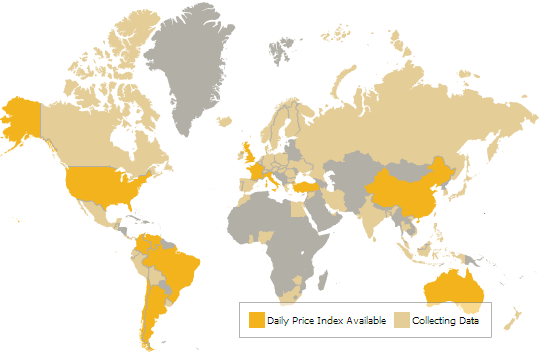 The long-heralded MIT Billion Price Project , which monitors the daily price-changes on 5 million items is now available. This is a valuable data for TIPS and other traders, and a step forward in the dissemination/analysis of market-based data….independent of the Labor Department.
Worth a visit.
Jim Sogi writes:
The data is surely helpful, but the the graphic on the site using colors and a separate legend is nearly impossible to decipher, especially for the colorblind. They would learn much from Tufte.
Rocky Humbert adds:
I'm sure if you make a sufficiently generous donation to MIT, they will send you a copy in whatever color you'd like.
Your comment is reminiscent of when I was a first-year associate at GS (in Fischer Black's group), and delivered one of the first option-pricing models to the new oil trading desk. The app ran on an IBM 3270 terminal (hooked to a System /370). The trader said, "This is really nice. But can you do it in yellow?" [IBM 3270 terminals were monochrome and informally known as "green screen terminals."
Epilogue: That trader didn't last very long at GS.Personally, I find the following text from the MIT website more interesting than the color: " As part of the BPP we are not only constructing average price indexes – such as those you can see in the web page – but also construct tracking indexes with the purpose of predicting macroeconomic variables. We are working on predicting the CPI seasonally-adjusted announcements, the PCE, and even the GDP. These tracking indexes use the information from daily price changes to improve standard models that predict the macroeconomic performance of the US economy.
We started in the most obvious place – trying to forecast what the BLS will announce in terms of monthly inflation. Although the BLS publishes the inflation of November in mid December, today is the last day of the month so we already have a measure of the inflation rate of the retailers in our data. So, here we go… Our prediction is that the BLS will announce November's inflation rate (headline, seasonally-adjusted) of 25 basis points. Our models produce estimates between 21 and 27 depending on how the different prices are aggregated. Well, we now have to wait 15 days to see how close we are… that long? yes… that long.
An important point: this estimate is different from the inflation you can compute in the average of online prices (the indexes we are showing on this page). They are related but not identical. We are not going to release the tracking indexes yet. We are at the stage in which we are mostly testing and researching the best way to do the prediction.Epilogue: The CPI actually came in at 0.12% … so there's a divergence that will either resolve or cause MIT to tweak their methodology….
Dec
23
Briefly Speaking, from Victor Niederhoffer
December 23, 2010 | Leave a Comment
 1. I am reading the deeply flawed book Bounce by Matthew Syed who believes that the quantity and quality of practice is key to determining greatness. Also reading another book from the same garage of hatred of the subject he writes about– The Company Town by Hardy Green and also Titanic Thompson: The Man Who Bet On Everything by Kevin Cook, about a man that should be hated but is quite interesting.
2. They say that when there is a big traffic accident in an area and it's cleared, there is still a traffic jam there the next day, I think because people are slow to observe past effects. And one is reminded of that at the opens of all the markets. In the pit days, there used to be tremendous volatility and big moves like in the first 5 minutes. But now there is no pit trading in most markets, but there's still the same volatility that occurs, like in bonds today at 820.
3. One notes that after 13 or more 10 day changes up, the expectation the
next day is -1/10 of a % and after 13 or more 10 day changes down the
expectation for the next day is -1/10 of a % however there are 244
occasions when the 10 day SP is down 13 or more times in Rowand 398
occasions when the 10 DYA SP is up 13 or more times in row. Thus,
declining 10 day moves less harmonious than up 10 day moves a meal for a
day not here but possibly for life time.
Thomas Miller shares:
Trafficwaves is an awesome website by an electrical engineer about what causes "invisible traffic jams" with lots of illustrations.
Chris Tucker writes:
I've heard this referred to in an astrophysics class as a Density Wave, it is one of several theories brought up to account for the formation of the distinct arms in spiral galaxies. The teacher used this specific example of highway traffic to explain it.
Jim Sogi adds:
When particles interact due to input of energy they move at different speeds. The faster ones overtake the slower ones. A buildup occurs at the slow point. Everyone has seen this in traffic. This is how big waves are created in the ocean. The interaction of energy pushing forward, and forces of resistance due to bunching, due to structural resistance (in the ocean its the bottom) in markets due to vig etc., and the secondary forces created by interaction of the various maxima and minima gets complex. It seems the areas of maxima and minima are easy to focus on and they provide distinct boundaries, maximum energy, and minimal densities.
T.K Marks comments:
Apropos of the peculiarities of traffic mishaps otherwise involving cars, just moments ago I had sent sent a similar response to your thoughts contained below only to be have it unceremoniously bounced back to your humble correspondent.
So here we go again.
Back in the day when pit trading held sway, the lion's share of the action took place on the open. Afterwards, the tempo was akin to the pace of watching grass grow. The occasional rock'n'roll news developing days notwithstanding.
So after I would take care of my market opening responsibilities and see that there was not unduly pressing on my book, I would delegate responsibilities to my second-in-command and repair upstairs to the the gym on the 8th floor gym of the WTC for a palliative steam and sauna.
The equilibrium benefits of such generally worked wonders because the close made the open look like the most genteel of tea parties,. It was the closet I'v been to Nam. Every day was a Tet Offensive.
Dec
11
The Art of Survival, from Jim Sogi
December 11, 2010 | Leave a Comment
 98.6 Degrees: The Art of Keeping your Ass Alive , Cody Lundin is the best survival book.
The key to survival is to manage fear, keep warm and hydrated.
The key to survival is mental. Survival at its basic requires maintaining core temperatures and hydration. Fear has grave physiological effects on circulation, metabolic processes, judgment, and attitude. Fear can kill. Failure of judgment due to fear, panic, anxiety, causes bad errors of judgment that lead to death. Fear destroys fine motor coordination. Many outdoor deaths are due to simple hypothermia. Food is not the problem as most can live for days without food. Most survival scenarios last only three days. Water and core temperature are key. Physiologically loss of 2% of weight in water reduces judgment by 25%. Basic preparation requires adequate clothing and water, not just for the day hike, but for unexpected adverse weather and duration. Lundin discusses the physiological aspects to prove his points. Preparation should be basic, clothes, water, fire.
Applying survival lessons to markets is worthwhile as trading is a performance endeavor. The physiological aspects must be considered in addition to the statistical, the macro and qualitative. Sleep, fear, mental aspects and even hydration are key. 3/4 of you are chronically dehydrated. Dehydration is often confused with hunger and fatigue.
The second excellent book is First Aid, A Pocket Guide by Christopher Van Tilberg. It is a basic rundown of back country first aid procedures in a checklist form of the major injuries and treatments.
Rocky Humbert writes:
Try trading without electricity, telephone, and even Windows/XP/Linux!
The "modern" "self-reliant" speculator is as dependent upon the Lineman climbing the telephone pole as he is to the Chinese factory worker who assembled the replacement step-down transformer which failed due to the weather; as he is to the FedEx driver who spent the night delivering the replacement part.
Our complex and specialized society is dependent upon the countless people who all get up each morning and do their jobs creating a sum that is greater than the parts.
A modern speculator cannot function without water anymore than he can function without the vast and dynamic human and capital infrastructure that is modern society.
As the saying goes, "for want of a horseshoe nail, the kingdom was lost."
Dec
3
Avalanches and Markets, from Jim Sogi
December 3, 2010 | Leave a Comment
 I've been really stoked on backcountry skiing this year. The danger is avalanches.
A tester digs snowpits to analyze the snow pack to find weak layers that might cause avalanches. The procedure is to dig a pit in the snow to the ground on the hill one intends to ski. This year there is already 12 feet fallen and 6 feet on the ground in the Sierra's. The tester pokes the snow with the fist, or fingers, and runs a card through it to feel for the densities, the layers, the crusts, and the loose snow looking for weaknesses. Then several columns are isolated with a snowsaw. The snow is tapped on top 30 times with increasing force from the wrist, elbow then shoulder. The tester looks to see if the snow columns shears off at any level in the snowpack. The number tap at which the snow shears is the first metric of the Compression Test giving a CT number. The depth of the various layers and at which the shears occurs is quantified. The fourth metric is the force with which the snow shears. Crumbly snow is Q3, but a clean shear that slides off easily with a few taps is Q1 and present clear avalanche danger. There is also an extended column test to test if the cracks propagate easily leading to widespread avalanche failures. The tester also reviews the weather patterns that created the snowpack and the subsequent temperatures and humidity and how it affects the snow pack. The quality of the various layers is qualified. Some problem snow is qualified as sugar, hoar frost, rime, windslab.
Curiously, this is similar to quantitative back testing and the market analyst has things to learn from the avalanche testers. By measuring the the actual condition of the recent snow pack as to both compression and energy, better predictions can be made. The mistake of quantitative testing is to use numbers over numerous years where the conditions may have been different. Use of the actual conditions in the current market "snowpack" would have good predictive properties for avalanches such as this morning's jobs number. An example of this is the trader's saw that gaps fill. Gaps are like a weak layer in the snow pack, and tend to back fill or even avalanche down. The thing about markets is that they can avalanche up as well as we saw earlier this week. It might be good practice to quantify or qualify the various market levels, the market conditions in which they occurred, the way in which subsequent event affected prior events and their "healing", the strength or weakness of various market levels, the length of time from various events, the theoretical or historical properties of the market, All in all, its fertile ground for testing ideas. At the least we should come up with some colorful names for market conditions in addition to gaps, consolidation, based on quantifiable conditions as opposed to chart patterns.
Nov
21
More to Learn about the Hindenberg Omen, from Steve Ellison
November 21, 2010 | Leave a Comment
It has been three months since the confirmation of the Hindenburg Omen, and the S&P 500 is up 12% since then.
Larry Williams writes:
True on H Omen sell but….there was what I call a H Omen buy on 8/27 and 8/30. I am writing a paper about this.
Jim Sogi writes:
Steve's point is why I believe that quantitative price analysis must be augmented with game theory such as Chair's infrastructural and and natural observations, but also with Mr. E's macro observation and political gamesmanship. This helps with the cycle analysis.
Nov
20
Trends, Reversals, Cycles, from Jim Sogi
November 20, 2010 | 1 Comment
 Many assume the continuation of trends beyond their turning points. Such thinking is evident in the news. The opposite view is the statistical lack of trends and the assumption of reversion to the mean. However trends exist in a random or due to macro effect such as government (mis)policy or herding, none of which can be ignored except to one's detriment. The pure quantification of price makes discernment of the change of cycles hard to see except in retrospect, thus other forward and current input seem worthy to consider. There are tells to macro effects if they can be discerned. The random trends also may have their characteristics. Philosophers like to define their terms, and traders also need to define their time frames to clearly state the issues. This seems to be a common point of misunderstanding in debates on these issues.
Steve Ellison writes:
As long as governments feel the need to intervene whenever their economies are considered bad, there will be business cycles that result in multi-year trends in earnings and prices.
In a much shorter time frame, order flows can cause intraday trends. If a mutual fund has a quota to buy a certain number of shares before the close, the fund's buying may push the price up. When there was floor trading in cotton, the locals loved to push prices to levels where stop orders were clustered. Every once in a while, the price would rise or fall by several percentage points within minutes as waves of stop orders were triggered.
In academic theory and simulations, trends occur when markets are mispriced, as informed traders use market orders to buy undervalued assets or sell overvalued assets (see, this chart, for example).
Finally, as Mr. Sogi notes, some trends may be random. Professor Aronson suggests flipping a coin 300 times and charting the cumulative difference of heads and tails to get an idea of what a random walk can look like. My first attempt resulted in the attached chart, which appears to have clear trends even though the underlying process was random.
Nov
17
Sage Gratitude: Thank You, Uncle Sam, shared by Jim Sogi
November 17, 2010 | Leave a Comment
 More grist for the Chair:
Buffett Thanks Uncle Sam for Helping Economy
The Associated Press By JOSH FUNK AP Business Writer OMAHA, Neb. November 17, 2010 (AP)
Billionaire Warren Buffett wants people to know he thinks the U.S. government performed well during the economic meltdown of 2008.
So the chairman and CEO of Berkshire Hathaway Inc. wrote a thank-you note to "Uncle Sam" that the New York Times published Wednesday on its op-ed page.
Buffett used the opinion piece to reiterate his view that the government should be praised for its efforts to stabilize the economy with massive bailouts and stimulus spending.
Nov
7
Good Beverages, from Victor Niederhoffer
November 7, 2010 | 5 Comments
 The leading historian says that he'll buy me a $ 8 cup of coffee under certain considerations. And I don't know much about coffee. But I've had occasion to have coffee at Stumptown Coffee, an Oregon firm with branches in New York now, and it's far and away the best coffee i've ever had. Next in line is the coffee at Kaffe that Mr. Florida surfer has recommended. The web mistress is a vegan, and I don't pay her that much to do all the editing and picturing so she usually doesn't put our stuff on barbecue up unless I get her mother on the case, which isn't that effective since she doesn't believe in coercion. Let us expand our mandate from bar b que to good beverages like coffee and tea.
Vince Fulco comments:
I wouldn't say THE top tier but for solid, day-in, day-out coffee, a NYC mail order institution which we order from is portorico. It's been around for over 100 years and we especially like their couple times a year sale with numerous versions of beans $5.99-7.99/lb, a veritable bargain when retail goes for similar prices for 10 ounces. They also have a weekly sale of one kind or another.
Jeff Sasmor writes:
For NJ suburbanites, the local roasting of primo beans and a nice college town quasi-hipster atmosphere is provided by Small World Coffee in Princeton. In spite of a Starbucks opening around the corner, Small World has actually grown larger.
David Hillman writes:
Stumptown is among best ever drunk here, too. We have a pound or two shipped in regularly. They ship the same day they roast and deliver in about 2-3 days, so coffee is very fresh. Currently in the cabinet is Indonesia Sulawsi Toarco and the African's are exceptional this year. An admirable direct trade business model worthy of support.
 Also, when in Portland, breakfast at Mother's. They serve Stumptown varieties in a french press at the table. That and the wild salmon hash is more than worth the long weekend a.m. waits.
Boom Bros. in Milwaukee is also happily recommended. Excellent roastmaster, their Velvet Hammer is the 'every morning' coffee at Cafe DGH.
Another favorite is this coffee from the D.R. Very cheap, very good. Best drunk in a cafe on the beach in Sosua. Maybe there's a Caribbean store of some sort in NYC?, but if not, there's always Bonanza:
"…..Always the most fresh production guaranteed! Manufacturer send my orders 3 times a week…..Thanks for looking!!!"
Chris Cooper writes:
Coincidentally, I have recently embarked on a quest to brew (consistently) the best cup of coffee. I have started roasting my own beans, and now it is evolving to importing my own green beans. Next month on the container arrives 300 kg of single-origin green beans from Indonesia from five farms. We call them Bali Kintamani, Java Jampit, Aceh Gayo, Sumatra Lintong, and Torajah Kalosi. I guess this may become more than just a hobby.
 While Mr. Surfer and family visited not so long ago, we served some Kopi Luwak, famous due to the journey of the fresh beans through the digestive tract of a civet. It turns out that there are various grades of Kopi Luwak, and since that time I've found a verifiably authentic version, which is rarer because often the growers will mix in other beans. I may try to import that as well, but it's very, very expensive, and I can probably only get 10 kg per year. The taste is really different, much earthier.
Larry Williams comments:
My cup runneth over with coffee from these guys, but thanks for the tips. I will begin my journey again for greatest java.
By the way, Overstock.com seems to have the best deals on espresso machine.
T.K Marks writes:
All this talk of coffee has gotten me nostalgic for one of my life's more squandered opportunities.
There was this little coffee spot on the Upper West Side, just a stone's throw from Lincoln Center, called Cafe Mozart. I used to spend much time there.
I would get a pot of coffee. Once even this thick Turkish stuff that perhaps made one look of Left Bank sensibilities, but tasted like tar. Would while away the hours there with reading, backgammon, or chess. It was a peaceful place.
So one night I'm sitting alone at my table reading when walks in and approaches, a woman.
A woman with a very fetching smile.
Bob?…she asked hesitatingly, as one would when meeting a blind date.
I stood up politely, smiled at her for a few seconds, and, No, was all I said.
Till this day I regret not lying through my teeth.
Had nothing to lose.
Jeff Watson writes:
 Many of my friends are coffee experts but I am sadly lacking in that department. One thing I do know is how to make is one of the better pots of coffee on the planet. The following recipe will even make even the most mediocre coffee taste good, and good coffee taste……delicious.
1. Wash an egg then break it into the bottom of an old fashioned metal campfire coffee pot, beating the egg slightly, leaving egg, shells and all in bottom of the pot..
2. Add a cup of very cold water to the pot, covering the egg and then add a pinch of salt.
3. Pour in a whole cup of course ground coffee to the water and egg mixture, and stir it up.
4. Pour enough boiling water over the coffee, egg, mixture to almost fill the pot up, and stir until mixed.
5. Cover the pot and plug the spout with a dish towel.
6. Put the coffee pot over a fire, heat it up to a gentle boil, back off, then let it simmer for a couple of minutes.
7. Take the pot off of the fire, let the coffee settle for a couple of minutes then add a cup of very cold water to precipitate the coffee grounds/egg mixture. Let the coffee settle for another minute, then serve.
My grandfather was taught to make coffee this way from some real cowboys when he went to the Arizona Territory for a trip sometime before 1910. He taught me how to make coffee when I was around 7 or 8, and put me in charge of the coffee every time there was a family picnic or outing. The secret to wonderful coffee is the egg, the pinch of salt, and good water. Coffee prepared in this manner evokes many good memories, and the good smell alone will attract any friends or neighbors in the near vicinity. Once in a great while, I will make this coffee on the stove and it's almost as good as on a campfire.
I have often wondered what a Kona coffee would taste like if prepared in this manner.
J.T Holley writes:
 I'm not a professional roaster or barista, but the keys that I learned in the 8-9 years that I mentored to roast, grind, and brew coffee are the following:
1) The time between roast and grind needs to be minimal (oils of the roast and storage important)
2) Method of brewing important to your individual tastes (percolate, press, or electric drip)
3) Water is 99% of a cup of coffee! Good tasting waters need to be used and free of chlorines, flourides, and impurities
4) Filtration choice and cleanliness of the brewer of choice imperative for consistent cups of good flavor
5) Once pot is brewed then stirring the pot and stirring the cup is important regardless of cream and sugar for consistency of coffee.
That's the basics!
All good shops should know this regardless if its a private house, private shop, franchise or friend.
Kim Zussman queries:
How can coffee gourmets taste fluoride but not civet excrement?
Jim Sogi writes:
Chris's special Java java was distinctive and earthy. A treat especially in the palatial surroundings.
The key to brewing good coffee from whatever origin, is:
1. Be sure the parchment is sun dried, not machine dried. It has a much mellower smooth flavor.
2. Roast your own coffee. My favorite roast is 462 degrees, 11 minutes give or take based on humidity and ambient. Roast until the oil just starts to show, but is not oily. The oily roast is more for show. Roast only what you can use in 3 days.
3. Grind your own fresh roast. This is the most important of all. Don't try to freeze coffee beans.
When brewing in filter, only pour a little, not boiling, water through at a time.
Oh yes, Kona Coffee is without doubt the best in the world.
Nov
2
Midrange Close Cycle, from Jim Sogi
November 2, 2010 | 2 Comments
Interesting stem comparison of recent midrange closes as positions from
lowest tenth (0) to middle tenth (5) to highest tenth (10) of high and
low range. With the last 9 years or so.
Distribution of last 2000 closes:
0 |115
1 |104
2 | 84
3 | 85
4 | 76
5 | 78
6 | 100
7 | 128
8 | 188
9 | 213
Last 20
0 | 4
2 | 048
4 | 059266
6 | 00064
8 | 11580
Oct
29
Speed Trading, from Victor Niederhoffer
October 29, 2010 | Leave a Comment
How would the speed up stuff (see below) work in trading?
Trading while standing up?
Trading with a gun rather than a mouse?
Taking a fast 4 ticks? (guaranteed to lose money unless you have the infrastructure of a flexion)
Trading 3 markets in succession???
Larry Williams adds:
Going from yesteryear's 200 day moving average to a shorter one? Trading instant spreads?
Jim Sogi writes:
It's a whole new skill set, both different motor and mental with a learning curve. Years of practice with certain tools cannot be discounted. Like switching from squash to tennis to ping pong. Or longboard to shortboard.
Ralph Vince writes:
Great questions. Based on my own, limited, life experience, I would add that there is an element of a certain mental "groove," to all of this, necessary to success, not altogether very different than that of an athlete on the top of his game (we have discussed this at length in this forum– some great discussions on it I think) or when you are thinking a problem through– a very difficult, elusive one, threatening to drip off the edge of your consciousness…….and I'm not so sure that is even timeframe-specific, so long as you find your groove.
When I put on a trade, I KNOW I'm going to make money on it, I'm not worried about it one jot. You get into certain habits, which are a function of your cadence, and "settling in' to that, whereas I think it IS timeframe-specific, seems to be timeframe specific to the individual and how he trades.
I very much believe that the kind of "hurry up" trading you are describing here may fit certain individuals and may sabotage others. Even if on a purely mechanical basis. What comes to mind for me on this is trying to play simple, basic strategy blackjack at a table with a fast cadence– I can't handle it, and am certain to fumble it.
Ken Dreees writes:
It would be interesting to create a dynamic trading skills test in which you had mutliple positions open in multiple markets and were then given simulated info in a real time sense that caused market disruptions. You would be graded under criteria such as:
1. exiting safety
2. capital protection
3. Finding and exploiting panic etc.
Like a trading version of star fleet's test.
Jeff Watson adds:
Here's an interesting site with info on CBOT full seat prices from 1898-2004. There's a handy little excel download in the site with the high/low of CBOT seat prices on a yearly basis. 1942 was the year to go long the CBOT.
Russ Sears comments:
My opinion is that building up the endurance to concentrate for long periods of time is not like riding a bike. If you've been away from it a while train yourself back into it.
Taking scheduled stress relief breaks should be required to be on your best defensively, especially in volatile markets.
Oct
28
New Highs, from Jim Sogi
October 28, 2010 | Leave a Comment
For well over a month no more than 2 days have passed before another new monthly high is reached. How long can these record sessions continue, I wonder.
Oct
28
SUP, from Jim Sogi
October 28, 2010 | Leave a Comment
 Stand up paddle boarding didn't exist 10 years ago, but now it is a fast growing sport. It is not intuitive to stand up on a surfboard and paddle it with a paddle, and there is a short learning curve. Contrary to my initial impression that it was a fad that would soon die out, the sport has exploded. SUP can be done not only in surf, but in flat water, lakes, rivers (a guy went down the Colorado!) and the open ocean. You could do it Central Park or the Hudson River. (It won't fit in an elevator or subway tho. They are 11 feet long, 30 inches wide and 4 inches thick.) It doesn't take the strength required of surfing because the paddle leverages the power, and the board is huge and is stable and floats so many women who lack arm strength can do it, as can children, and older out of shape guys. In fact the big growth is in flat water paddling. There are even expedition SUP boards that can carry gear. Guys paddle interisland Hawaii, and from England to France.
The larger board and long paddle gives leverage. It makes is harder to turn around, and forcing one to commit to a swell sooner, and requiring one to be well committed when the swell arrives. It take longer to turn your position around, but one can ride not only smaller waves, but larger ones as well. Some friends that make them went to Florida to surf Hurricane Igor and got 15' waves a mile long on 12 foot boards.
Its a great way to get outside and get some exercise even when the waves are small.
My twist is going to be try a small kite and let it pull me on the board, rather than struggle with the small kite boards.
Oct
12
Are Utility Stocks Better Than 5-Year TIPS? from Rocky Humbert
October 12, 2010 | Leave a Comment
It's generally accepted that large electric utility stocks are interest rate sensitive. They also have earnings growth based on a regulator-sanctioned "acceptable return on capital." The stocks are considered cheap when they are trading near book value (not now), and also when their yields are relatively high versus treasuries and bonds (yes now). There's some economic sensitivity to electric demand of course– but the stocks are still very low beta.
I posit that at their current relative prices, a basket of quality utility stocks should outperform TIPS… with similar risk and reward. The reason is not that utility stocks are particularly cheap, but rather because many TIPS have trivial and/or negative real yields. In a rising inflation environment, utilities should be able to get regulator approval to raise prices [to maintain their statutory ROE]– and in the current status quo environment, the stock yields will exceed the TIP yield.
At this moment, the 5yr Treasury has a 1.1% nominal yield, the 5 year TIP has a -0.50 real yield, and the UTY has a 4.34% nominal yield.
What am I missing here? Other than regulatory risks, in what environment will the UTY significantly underperform a 5-year TIP held to maturity?
Mr Krisrock comments:
In his book on theory, Ray Dalio of Bridgewater theorized that "stress testing" an investment theme by asking other unsuspecting traders their views, in effect is a surreptitious poll, as we note here in this textbook case of pedestrian "street begging".
Rocky Humbert responds:
Perhaps Mr. Krisrock will be so kind as to put a penny in this beggar's cup with an insight using all of his over-sized frontal lobe (and not just the amygdala).
I thank the speclisters who kindly pointed out (offlist):
1) During the 1930's depression, utility stocks held their dividends… And people who paid their bills saw higher rates to compensate for the people who did not pay their bills.
2) The TIPS will return par at maturity — there is no similar guarantee for utility stocks.
3) Because TIPS are currently trading at a premium to par, outright deflation can be injurious to their returns.
4) Utilities are taxed as corporations — and are also subject to the risks of cap&trade etc. However, the state rate-setting boards may/may-not compensate for the increased costs of cap&trade with rate hikes.
The daily and weekly statistical correlations between utes and tips are quite poor. But as the attached chart shows, they do seem to move in the same directions.Perhaps foolishly, I'm least worried about technological innovation– because the primary motivation for investing in a regulated utility is that they set rates based on a statutory ROE….
Jeff Watson writes:
Wireless electrical power transfer has been around since Leyden, Franklin, van de Graaf, and Tesla, just to name a few. Radio waves are a wireless electrical transmission system….just ask me, as a ham radio operator I have gotten many very nasty RF burns when my system wasn't properly grounded, or I stood directly in front of a beam antenna when someone keyed up the transmitter putting 2KW through the antenna. Further back was the study of charged amber by the ancient Greeks and the ability to turn static electrical potential into kinetic energy. The thermoelectric effect has reputedly been described since the middle ages. Now, the newest commercial application of wireless electrical transfer is with those new cellphone and iPod chargers where you just lay them on the pad and it magically charges the batteries with no electrical circuit. One might expect for more practical applications as time goes by and the market demands the convenience.
Mr. Krisrock adds:
In India, for example, there are many rural areas without electricity or the likelihood of same. Some years ago we partnered with Reliance and built cell towers with solar panels that allowed locals to plug in their mobile phones into the cell towers to recharge them. Until we did this they had to send them back to the cell phone company to recharge them…clearly some pennies for the beggars cup….
Tyler Mclellan comments:
You're missing this. The future nominal rates are the sum of the short rates (at least to some point on the yield curve). If you finance the position at overnight money (which many marginal buyers do), you cannot lose money if the sum of the short rates is less than the yield. I repeat, no matter what happens to inflation etc…you cannot lose money so long as the short rates one finances at are less than the yield. Through one more iteration, TIPS work the same way.
So i suspect the answer to your question has to do with the nature of "return".
David Hillman adds:
Once we could not imagine a wheel nor a printing press nor telescopes nor electricity, nor steamships, nor the camera, nor the radio, nor the automobile, nor the incandescent light, nor telephones, nor submarines, nor television, nor computers, nor endoscopic surgery, nor nanotechnology.
The 4 ounce, 4.75"x2.5"x0.5" device clipped to my belt is a GPS, a voice recorder, an 8MP camera, a calendar, an alarm clock/stopwatch, a music/video/tv player, a language translator, a dictionary, an encyclopedia, a library, an internet browser, it allows remotely operating a computer half-way across the globe, it connects to gmail, to WiFi, it recognizes touch commands and voice commands, it will both convert the spoken word to text and vice versa, and oh, yes…..it's a telephone, too. The cost of entry is $99 + $55/mo. Such a device was not imaginable as recently as 20 years ago.
A world without a power grid depends upon a collective will to have it, vision, investment, R&D, innovation, efficient production, practicality, affordability, and profitability.There are many individuals moving "off the grid" now, some adopting current [no pun intended] technology, wind, solar, water, other renewable, that allows same, others eschewing that technology in favor of more basic passive and mechanical means, horsepower and elbow grease.
But while basic technology exists, instead of pursuing advancement in earnest, we persist in taking the easy, short-sighted, petroleum-based way out, screwing ourselves in the process.Still, given the history of technological advancement, one might suggest somewhat optimistically that, someday, we will will it and the question is less "could there be?" than it is "when?" Until then, we'll just plod along from crisis to crisis as we humans are wont to do. Plus ca change…..
Jeremy Smith comments:
You wrote, "It's generally accepted that large electric utility stocks are interest rate sensitive. They also have earnings growth bas…"
"Generally accepted" is statistically incorrect, at least since 1994, which is a long time. Correlation to bond prices is actually negative. Utility dividends also increase. They can estimate 3-4% increase for an index of these, more for the better companies. Of course the longer you hold a higer yielding stock with dividend growth, the more hopeless fixed income is by comparison, especially with regard to income generated. As income rises it forces higher the value of the instrument producing the income, all other things being equal.
Phil McDonnell comments:
I do not think that it is generally accepted that utilities are negatively correlated with bonds but that appears to be the case. I picked idu for utils, tlt for 20+ treasuries and shy 1 yr treasury. For last 105 days of daily net changes we have the following co-terminal correlations:
idu tlt idu
tlt -59
shy - 54 74
Perhaps the utility– interest rate connection is more complicated than upon first reflection. 1. They are heavy borrowers for their capital equipment financing so one would think they are hurt by higher rates. 2. Their are regulated, so when their regulators are convinced that rates have risen they will often give them rate relief which means higher rates are eventually mitigate. 3. The stocks sell in competition for investment dollars with other income producing assets such as bonds etc. So they must be priced to yield competitive returns.
Steve Ellison writes:
Could it be that there is little interest rate sensitivity when rates are very low? Or that the correlation was arbed away when everybody knew about it? Last year, I noted a similar regime change in the correlation of stock prices and interest rates.
Tyler McLellan writes:
Look, stocks and bonds have been Correlated negatively in price terms since 1999/2000, I would bet that utilities have been correlated enough to the market as a whole that they've been at least partially along for the ride.
One reason to suspect this? Maybe if equity price are set my marginal preferences of equity investors if tech stock a goes down and that makes people want to sell some ute b to buy more, it might not matter that bonds are twenty bps lower, especially when the bond buyers don't care about either.
Rocky Humbert writes:
I played with the data a bit more, and it looks like the Tyler and Steve's observations account for most of the the regime change. The Ute's stock market beta/correlation dwarf their bond market beta/correlation (notwithstanding the low stock mkt beta of Utes.) Since stocks versus bonds have gone their separate ways over the past 12 years– the ute's regime change riddle is mostly solved.
There is one last data point worthy of mention: more than 65% of the UTE's total return is due to their dividends…and the attached chart graphically illustrates investor preference for utility dividends versus bond market dividends. This chart highlights the fact that the mean dividend yield for utes is 69% of the bond yield … and we are currently 3 sigma cheap…on a yield comparison basis. But that's true of many stocks…
My intuition remains that Ute's will probably outperform 5-year TIPS from these relative prices, but it appears that this intuition is a restatement of my bias that stocks overall should outperform bonds from these relative prices. If Ute's get whacked because of a hike in dividend tax rates, this may provide an attractive entry point for Ute's on their own absolute-return merits.
I'd like to thank everyone for contributing their thoughts (especially when they disagree with my thesis). It's a pleasure and privilege to interact with a group of such intelligent, independent-thinking people.
Jim Sogi comments:
Undistributed power using local generation, solar, wind, battery, water will be what undermines the monopoly just as cell phone undermined the phone land grid.
Stefan Jovanovich replies:
I think it is an exaggeration to argue that the cell phone has "undermined" the phone land grid. The "land" grid is, in fact, the backbone that now connects all the cell towers; if wireless were truly able to handle the data rates, the towers would be off the grid. They are not; and the "wholesale" wireless technology– microwave– has been the greatest single casualty so far during this wireless revolution.
Oct
5
The Heavy Hand of War, from Jim Sogi
October 5, 2010 | Leave a Comment
It's interesting trading in bonds and yen where you have large governments saying what they want the outcome to be. Even though it does not follow the script, there is a heavy hand over the market. When the policies start to collide, it appears to be a form of warfare.
Oct
1
Review of The Big Short, from Jim Sogi
October 1, 2010 | Leave a Comment
 I really enjoyed reading The Big Short by Michael Lewis. The book was about Burry and Eisen and a couple other hedgies who identified the problems with the subprime CDO bonds and found the worst of them and bought insurance on them from Bear and AIG to short them. Its a classic and well told story of the hubris of Wall Street and the big banks, the incompetence of the rating agencies. Its a classic story of massive misunderstanding and deception. It amazing how so many can be deceived by the Emperor's clothes. Goldman was really able to fool the rating agencies by gaming their models and assumptions to get AAA ratings. It really exposes the dangers of using prior history to predict future risk and the assumptions you put into models. Volker said in a recent speech that the statistical curves used to analyze the market are rubbish because the market is human and prone to panic. He says not even the fat tails describe what happens in euphoria and panic. The great part of the book was about the mispricing on the risk and odds. Pricing insurance at 100:1 when the risk was less than 10:1, and later almost certain shows some big problems in relying on assumptions built into models. I've seen people become so attached to their models it blinds them. The funny question Eisen's guys always asked was, "How are you going to f**k us on this deal." They were always asking what are we missing? The scary part was they bought much of their insurance from Bear, who went down and couldn't pay. This was where you short and Armageddon hits. Who is left to pay?
My sense is that there is another bubble building now and its going to blow badly sometime in the future. My sense is that the markets are more of a game theory situation than a normal curve. The motivations and what others understand or don't seem critical even in shorter term trading. The trading info shows where they are putting their money on the block. Normal distributions are necessary to understand where others are heading, but to me there is more to the game.
Sep
13
Napoleon’s Buttons, from Jim Sogi
September 13, 2010 | 1 Comment
 Napoleon's Buttons: How 17 Molecules Changed History by Penny LeCouteur, Jay Burreson is a fascinating book. Isoeugenol is a single molecule that fits with certain human receptors. This molecule from the nutmeg gave rise to the Age of Discovery, discovery of the new world, the East India Trading Company and the development of stocks. Glucose drove the slave trade, and built capital that gave rise to the industrial revolution. The difference between molecules is often a small difference in the bonds or the location of the hydrogen bond to carbon atom and can have huge practical differences. The title derives from the property of tin to dissolve in the cold resulting in Napoleon's army falling to pieces when their tin buttons dissolved in the Russian winter. They could not fight when they needed both hands to hold their clothes on in the cold. The lines of that conflict remain today between East and West.
Of particular note to speculators was the discussion about the diagramming notation of chemical compounds. The diagrams contain many layers of information that are informative and aid analysis and understanding about the structure of the molecules. Chair asked why there is no table of elements for the market. The key to this would be a notation system for market patterns similar to a chemical notation which not only conveys information about the relationships of prices to each other as in your typical chart, but also the nature of the underlying structures and their composition. My soon to be Phd. daughter advises me that there are stereo notations that go beyond the 3 or 4 dimensions in standard notation. The fact that right hand, or left hand iterations of molecule react differently is a concept useful to speculators following this idea. For example, up markets differ markedly from down markets displaying a 'handedness" Standard chart notation like "W" or "M" lack this information and thus lack the tools for proper understanding and analysis. The visualization of information as Tufte demonstrated has benefits to analysis beyond charts, and formulas. Seeing the location of turns, tops, bottoms and the way those were created helps in quantification and testing. The nature of the bonds (I don't mean debt instruments, but refer to intermarket and intramarket relationships) in market relationships make a big difference in future price action. A visual notation of this could reveal important but previously hidden relationships. Many Nobel prizes in chemistry were awarded for discovery of some of these important relationships.
Stefan Jovanovich elaborates:
Napoleon's army did not freeze to death; they starved. So did many of the Russians and Prussians who fought against them. The French buttons may have failed; but no one with half a brain was using clothing as a shield against the cold in that campaign. They wrapped themselves– and their horses - in blankets (the officers used furs). As for "the lines of that conflict remain(ing) today between East and West", James has a point, but it is not the "lesson" he draws from this campaign. The old lines are being erased: the Germans seem on the verge of reaching a fundamental alliance with the Russians similar to the one that existed between Prussia and Russia in 1812. Napoleon's great error was to be foolish enough to insult the Austrians so badly that they decided - for once - to ignore their standing hostility towards the Prussians. The line of conflict between East and West that Europe lived with for the past hundred years came not from the divisions present in Napoleon's invasion of Russia but from their abandonment: Bismarck's stupid successors overthrew his sensible Prussian foreign policy of alliance with Russia (the Balkans are not worth the life of one grenadier) and chose to take the Austro-Hungarian and Turkish side of the argument. As for all other inferences about how molecules changed history, I offer no opinion.
Jim Sogi adds:
Another interesting factoid is that the Dutch and English fought bitterly over the spice island Banda where nutmeg was grown. It was valuable at the time. To settle the dispute, the Dutch signed over a small useless island known as New Amsterdam. The English renamed it New York. The Native American tribes called it Manhattan, "the place where we all got drunk". Still appropriate after many years. The spice turned out not to prevent the plague, and the monopoly was later broken when starts were smuggled out to be grown elsewhere. Banda is relatively abandoned except for rare tourists.
Marion Dreyfus comments:
Ha…!
I have been to Banda Island, where the king ("King," he said he was) offered me his throne if i married him–he gave me nutmeg! I brought it back to the States and of course it was confiscated as suspect importation, despite my protests that "the king of Banda gave me this as a earnest of his love!" and gave me other things, too. His wife had died some time earlier, I add. There are many lovely parrots there, but the dancing girls and the twittering photogenic fowl do not make up for lack of A/C, I am afraid. His home was spectacular, marble floors and walls, thatch covering more modern materials under the thatch; long, graceful rooms, not many rugs, but solid furnishings with luxe sewn into their DNA, and power-connotative. But I was not partial to the heat nor his particular nonmetrosexual demeanor. He gave me other gifts I cherish that were not taken from me by the immigration men. But small-island life as a way of life is not alluring to the overeducated big City female, I think it safe to say.
More's the pity!
Would my life have been far more glam and amazing? I would surely have saved a great deal of minutes and hours from huge gusts of email I would not have gotten, but one is forced to wonder what he could have given me that I don't have more of, and better of, right here in costly midtown Manhattan, with or without air conditioning. Gratitude for one's life, especially when arrayed against a might-have-been.
Sep
4
Article on Information Theory, shared by Steve Ellison
September 4, 2010 | 1 Comment
Here is a very interesting article I found on Information Theory:
Excerpts:
The noisier the channel, the more extra information must be added to make error correction possible. And the more extra information is included, the slower the transmission will be. [Claude] Shannon showed how to calculate the smallest number of extra bits that could guarantee minimal error–and, thus, the highest rate at which error-free data transmission is possible. But he couldn't say what a practical coding scheme might look like.
Researchers spent 45 years searching for one. Finally, in 1993, a pair of French engineers announced a set of codes–"turbo codes"–that achieved data rates close to Shannon's theoretical limit. The initial reaction was incredulity, but subsequent investigation validated the researchers' claims. It also turned up an even more startling fact: codes every bit as good as turbo codes, which even relied on the same type of mathematical trick, had been introduced more than 30 years earlier, in the MIT doctoral dissertation of Robert Gallager, SM '57, ScD '60. After decades of neglect, Gallager's codes have finally found practical application. They are used in the transmission of satellite TV and wireless data, and chips dedicated to decoding them can be found in commercial cell phones.
—-
The codes that Gallager presented in his 1960 doctoral thesis (http://www.rle.mit.edu/rgallager/documents/ldpc.pdf) were an attempt to preserve some of the randomness of Shannon's hypothetical system without sacrificing decoding efficiency. Like many earlier codes, Gallager's used so-called parity bits, which indicate whether some other group of bits have even or odd sums. But earlier codes generated the parity bits in a systematic fashion: the first parity bit might indicate whether the sum of message bits one through three was even; the next parity bit might do the same for message bits two through four, the third for bits three through five, and so on. In Gallager's codes, by contrast, the correlation between parity bits and message bits was random: the first parity bit might describe, say, the sum of message bits 4, 27, and 83; the next might do the same for message bits 19, 42, and 65.
Gallager was able to demonstrate mathematically that for long messages, his "pseudo-random" codes were capacity-approaching. "Except that we knew other things that were capacity-approaching also," he says. "It was never a question of which codes were good. It was always a question of what kinds of decoding algorithms you could devise."
That was where Gallager made his breakthrough. His codes used iterative decoding, meaning that the decoder would pass through the data several times, making increasingly refined guesses about the identity of each bit. If, for example, the parity bits described triplets of bits, then reliable information about any two bits might convey information about a third. Gallager's iterative-decoding algorithm is the one most commonly used today, not only to decode his own codes but, frequently, to decode turbo codes as well. It has also found application in the type of statistical reasoning used in many artificial-intelligence systems.
"Iterative techniques involve making a first guess of what a received bit might be and giving it a weight according to how reliable it is," says [David] Forney. "Then maybe you get more information about it because it's involved in parity checks with other bits, and so that gives you an improved estimate of its reliability." Ultimately, Forney says, the guesses should converge toward a consistent interpretation of all the bits in the message.
Jim Sogi writes:
I think that is why many market price moves come in threes as an error correction devise. Like the recent triple bottom.
Jon Longtin writes:
Very interesting articles on the history of encoding schemes.
One interesting thing to note is that if you take even a simple information stream and encode it with any of the numerous algorithms available, the encoded version of the information is typically unintelligible to use as humans in any way, shape, or form.
‘hotdog’ for example, might encode to ‘b$7FQ1!0PrUfR%gPeTr:$d’
These encoding algorithms work by rearranging the bits of the original word, looking for patterns, and applying mathematical operators on the bit stream.
Many of the financial indicators and short-term predicative tools that abound today are based on some combination of the prior price history, but often in a relatively simplistic way. For example, although the weightings may change for various averages, their time sequence, i.e. the order in which they are recorded and analyzed is the same: a sequence of several prices over some period is analyzed in the same order in which it was created.
Perhaps, however, there is some form of intrinsic encoding that is going in the final price history of an instrument. For example, it could be reasoned that news and information does not propagate at a uniform rate, or that different decision makers will wait a different amount of time before reacting to a price change or news. The result might be that the final price history that actually results, and that everyone sees and acts upon, is encoded somehow based on simpler, more predictable events, but the encoding obfuscates those trends in the final price history.
Maybe it is no coincidence that Jim Simons of Renaissance Technologies did code breaking for the NSA early on in his career.
Unfortunately reverse-engineering good hashing codes, particularly those designed to obfuscate, such as security and encryption algorithms are notoriously difficult to crack. (The encrypted password file on Unix machines was, for many years, freely visible to all users on the machine because it would simply have taken too long to crack for machines of the time.) On the other hand, the cracking algorithms often require little knowledge of the original encoding scheme, instead simply taking a brute force approach. Thus if there were such an underlying encoding happening with financial instruments—and the encoding might be unique for each instrument—then perhaps there is some sliver of hope that it might be unearthed, given time, a powerful machine, and some clever sleuths.
For all I know this has been explored ad nauseum both academically and practically, but it does get one wondering …
Sep
2
The Timing of Price Controversy, from Jim Sogi
September 2, 2010 | Leave a Comment
 In addition to the relationship of price change, the time of price controversy is worthy of study. In battle, an opponent can keep up the fight as long as his endurance, his resources, or supplies last. A human has a limited endurance. After 4 or 5 days of intense involvement in the market I know I'm pretty beat. Even machines seems to get stuck in the time loops and have difficult changing gears as fast as humans. Though the machines don't tire, they lack dynamism. The Fib guys do time measurements. I don't know if there's much there, but the length of ranges or trends seem important. This may be a by product of symmetry or some more basic functions. The study of basic functions would be more profitable than study of by products so that's an open question. There are basic structural time limitations imposed by the exchanges. There are basic diurnal cycles in global times. These too are worthy of study. This is different than seasonals, or just more compressed.
Criag Mee writes:
Also Jim, it may involve the simple dynamics of the main partipants of the country of origin. Do they have siestas? Are they up for long days…or do they hot foot it off to the kitchen at the first smell of a brew?
Aug
31
The Game, from Jim Sogi
August 31, 2010 | Leave a Comment
 This whole news release game is silly. The market is gun shy ahead of announcements and the book drops to nothing guaranteeing a crazy move. The reaction seems always to be behind the form. The info is stale and old. The news producers of course want attention to sell copy.
The consensus game is silly, asking a bunch of economists who can't really seem to get much of anything right or agree on much to give a guestimate of data that is adjusted, manipulated, dated, gathered in questionable means… When the actual number is above or below the guess, oh my! Then what does that really mean?
Each participant in these games has a utility, each has a relative ability to achieve or execute, and each has relative urgency and importance. These are some of the criteria used to evaluate the relative utilities. The real trick is to define the issues in such a manner that the weighting of utilities is predictive. This adds to statistical analysis of past data in that it incorporate the forward looking functions of the markets and its participants. One set of Asian traders from one part of the world trading night shifts where a small order can move the market 1/2 a percent. You have the Europeans taking over early morning with different motivations. You have Bernanke, the flexions, the white shoes, the machines, the slipper crew each with varying abilities to move the market, varying urgencies and connection to our markets, and varying self interests. Weighing these has info in a scientific manner. It was scientific enough for a Nobel prize.
Jim Lackey writes:
It has always been this way for as long as I can remember… Now when it's a stock, no one seems to mind if options say + or (10%) and after the newzi comes out earnings or otherwise the stock rallied 9%…and no one seems to miss the 1/2% moves pre/post 10am numbers as vs fed moved they were nothing and vs 2008 2-3% moves it's easy to game.
All you must do is want to own it. Sell puts in a stock cool you own it 10% lower. I buy 955am cool I buy my 2nd lot 1/2% lower 1002 am. If I didn't want to won it in the first place madd lack buys his 2nd lot trying to trade out of a loss. Let me tell you how stupid this is. but also feels so dumb with a cut and run after a 1/2% 5 minute loser.
My wife shouldnt have married a gambler…but mr Vic gave us the get the joke of all of this. A mouse with one hole is quickly taken. Figured the 1st we'd have an out even if we had to buy 1000 at the close.
Aug
28
Briefly Speaking, from Victor Niederhoffer
August 28, 2010 | 2 Comments
 The cathartic moves of Wednesday came just in time to create a sense of life at Jackson Hole in conjunction with the horse whispering and hiking so necessary to the research activities that occur there.
Desperate attempts to right imbalances come later in the week during the Summer than the other months because of vacation schedules at the Riviera and time with the others in the Hamptons.
To counterbalance the natural tendency to lethargy during the Summer, the market has moves approx 2% high to low in 19 of the last 20 days so that the public will not refrain any further from contributing to the overhead so necessary to keep the whole thing going in the absence of further subsidies from the centers at Brussels and the Beltway.
The top feeders must of necessity get on the same wavelength during the Summer so that they can get on the same page and possibly counterbalance the natural tendency of markets to homeostasis and this is why the trends in the summer are more pronounced than in other months.
East of Eden by Steinbeck has more insights into behavioral finance than all the studies of the so called men of promiscuous hypotheses, i.e. the behavioral finance gurus at the Universities combined.
The new Lloyd Webber show, Love Never Dies has more good work, more hummable tunes in it, a better plot than Beauty and the Beast of its predecessor than any other of his hits.
All the above assertions must be tested as to their validity to serve as a meal for a life time.
Victor Niederhoffer adds:
One wonders what the best use of horse whispering sessions there might be. Would it be to give instructions to the horses and engines that move the economy? Or would it be to receive unspoken in the native language signals as to the coming releases from the body language of the flexiopurveyors et al? What do you think? I'll award a prize for the best suggestion for the use of these whispers to any parties. Also one notes an amazingly large number of round numbers broken with SP 1050, Dow 10000, yen 85, crude 82, dax 5900 ish, nas 1800 as ever, beans 1000, and many others emerging vividly. What am I missing here?
Easan Katir comments:
Another fascinating idea from the Chair. One recalls past analysis of Mr. Greenspan's briefcase as he walked to the Fed meetings. One thinks the main stumbling block to current and future analysis is lack of data: The viewer only gets brief video clips of the flexiopurveyors. A whisperer needs to observe the body language on his own terms to catch those small unconscious messages. Horse whisperers can't just watch rodeo clips. Maybe there is a way, but this is first reaction.
Rocky Humbert replies:
 It's a cinch to note that the the horse whisperer's goal is to install a "western saddle" with its extra padding for the "fleecing," and its phallic horn. The English have no need for such contrivances for either foxhunts or dressage.
Similarly, the Greenspan briefcase indicator was developed by a group of American Anglophillys who lusted after the most famous briefcase in the world: The Chancellor's "Box"– which dates to the original leather briefcase made for William Gladstone around 1860– and which is carried by the Chancellor of the Exchequer to Parliament for the annual Budget Speech. Unfortunately, the "bulging briefcase indicator's" meaning was lost in translation from English to American– as the proper briefcase is rectangular and sold– and cannot be influenced by the battle of the bulge.
Details on the Chancellor's Briefcase.
Ken Drees comments:
The briefcase indicator was a made up cnbc gag/come-on; also Wayne Angell turned out to be not a talking font of knowledge but in court defended hinself as simply an "entertainer". Now we watch and listen to Bullard this morning–is he an entertainer, a wise font, a broken bell or a front? As Jimmy Rodger's said–get a tip from the company president and lose half your money–get that tip from the chairman of the board and lose it all.
Jim Sogi writes:
Nik 9k
Kim Zussman shares:
Pierre-Olivier Gourinchas*, Hélène Rey**, and Nicolas Govillot***
We update and improve the Gourinchas and Rey (2007a) dataset of the historical evolution of US external assets and liabilities at market value since 1952 to include the recent crisis period. We find strong evidence of a sizeable excess return of gross assets over gross liabilities. The center country of the International Monetary System enjoys an "exorbitant privilege" that significantly weakens its external constraint. In exchange for this "exorbitant privilege" we document that the US provides insurance to the rest of the world, especially in times of global stress. This "exorbitant duty" is the other side of the coin. During the 2007-2009 global financial crisis, payments from the US to the rest of the world amounted to 19 percent of US GDP. We present a stylized model that accounts for these facts.
Andrew Moe comments:
As the cloistered flexions whisper, a steady stream of rumors and leaks drive speculation wildly through the thinned ranks, causing the type of ranges that the former colleagues utilize to generate 100% profitable days for the greater good.
Russ Sears contributes:
How to Listen to Jackson Hole
I currently am in the midst of writing a paper that suggests the regulators are the magicians of the markets. They direct your attention to the left, implies that your really should focus on the right. Time after time the central planners will steer the market to focus on this risk only to let the herd be blind-sided by the risk they are ignoring. There will of course be a rabbit pulled out of the hat at Jackson Hole and nobody would want to miss that. However, everybody is watching what is happening with the Feds and postulating how or even what they will do to make that rabbit pop out of that hat. Of course the assistants are in the know already. The lovely assistances will of course be able to buy all that jewelry and build castle in Vegas that such assistance need, from the crowd's tickets. But do not fool yourself that you can profit from these assistance they will only slowly get fat and growing old.
When the local college big football game is on, it is of course the time for the studious students to go to the library or simply go for a run around the other side of campus; But also it is the worst time to leave your car unlocked by the library or the other side of town. When the focus is on the imaginary, the divertive competitions of a game and fiscal policies of the Feds appear omnipotent. This is of course time to pay attention to what is real, the long term and risk all are currently ignoring.
I could specify hunting grounds and give data to validate this but will not because of the following reasons.
1. These extra-ordinary trades, without my bad ones, would seem like I was bragging.
2. I do not want to alert the competition to their mistakes
3. People do not remember what you told them yesterday, if it proves correct; it was their idea all along. History even becomes much more fuzzy, if you were right, and much clearer if you are proved wrong.
Yes, Virginia there are inefficiencies in the market, suffice to say look at the well spring of the Government's heart to find them.
Ken Drees adds:
I was thinking in a similar vein. All this attention directed to monetary policy as a myopic focus on fixing the economy (and of course the markets) when policy and the structural problems that are slow to change remain intact. The market focus is thus back on the magician and not on the real risk which i would characterize as "outside shock of any kind". When the momentum is slowing and minus a policy change –for example if Obama said that he would keep the tax cuts permanent until 5 quarters of positive sequental gdp would emerge then that would be a market booster since it would allay fears and unknowns, call it the Obama targeted tax extension business relief act". But minus a real policy change, we are back in the soup on Monday morning. We are now at the mercy of outside shocks which could very well tip us into the damned double dip—but shock could be used by pols for blame-so maybe they like that route.
If it wasn't for "x" we would have climbed out of the recession already. The economy is weak and getting worse by all measures–what rabbit will they pull–a good pro business bunny or just another QE painted hare? At election time, it's the economy stupid, will be the song on the voter–time is running out for. Maybe its just too late this time for another trick?
Aug
20
My Philosophy on TV, from Jim Sogi
August 20, 2010 | 3 Comments
 Just get rid of the TV cable all together. TV is evil and rots the minds of children. It glorifies evil, immorality, bad attitude, consumption. I have not had TV for 35 years. Its absence has allowed time for the family, for exercise, for reading.
Throw it out.
Nigel Davies comments:
I'm not convinced that banning either computer games or television is the only way. There are lessons to be learned from television shows just as there are interesting computer games.
My son currently chooses not to watch television, earlier he had a period in which he watched a favourite show at every opportunity. He also plays a computer game called 'Hotel Giant' in which you build hotels and increase profits if you find out what the customers want.
He knows he's free to play shoot 'em up games if that's what he wants, but for some reason he's just not interested. OK, it's probably clear to him that I think this stuff is garbage so it doesn't come with parental approval. But he knows it's not banned either, and maybe that reduces the attraction.
Jeff Sasmor comments:
We have 7 TVs in our house. Once over 14 I let the kiddies watch whatever they want.
My kids have had their own internet connected computers since they were 6 years old. I don't block anything.We have a PS1 PS2 PS3 Dreamcast Wii Gamecube NES.
Only 1 rule: No TV until homework is done.
Both have A- averages in HS. The older one is in college and is running a 3.8 in freshman year at Barnard, which is not an easy school. Neither is a libertine nor a drug user nor an underage drinker. Unfortunately I was never able to get them interested in Python programming.
Funny thing– with all that availability they don't watch that much TV. Younger one draws all the time (illustrator) and the older one writes all the time (fantasy fiction).
One good thing– they have me in the house every single day (well maybe they don't think that's all that good…).
I think parental encouragement and involvement in a non-shaming fashion is more effective for positive child development than anything else one can do. It worked for my family. I don't believe in any restrictions aside from those necessary for safety reasons.
Aug
4
Mean Reversion and Fat Tails, from Rocky Humbert
August 4, 2010 | 1 Comment
 In several recent essays, Pimco's El-Erian et al claim that reversion-to-the-mean investing will be less compelling in the months/years ahead. Even if one accepts that the US economy will experience slower growth, less leverage, and more regulation, his arguments may be tantamount to endorsing primitive trend-following and saying "this time and every time is different."
He writes; "…, investing based on "mean reversion" will be less compelling. Even though flatter distributions with fatter tails have means, the constituency for mean reversion investing will shrink as those means will be much less often realized in practice. A world where the realized return rarely equals the expected valuation creates a bigger demand for liquid, default-free assets; it also lowers the demand for more volatile asset classes such as equities.
He continues: "… frequent "risk on/risk off" fluctuations in investors' sentiment are here to stay. Investors, based on 25 years of rules of thumb that "worked" during the great moderation, thought they knew more about the distribution of risk than they in fact did. This led to overconfidence during the bubble. The crisis reminded investors that these rules of thumb are less useful, if not dangerous.
He continues: "….With declining confidence in a reliable set of investing rules, markets have become more susceptible to overreactions to daily news and are, therefore, more volatile. Just think of the number of triple-digit days in the Dow. Moreover, because of the complex and broader involvement, real and perceived, of governments in the economy, separating policy signal from noise, and execution vs. intent, has become as important as – but harder than – forecasting the macro data. Third, tail hedging will become more important. An understandable consequence of the crisis is less trust in diversification as the sole mitigator for portfolio risk. We are already seeing increased investor interest in tail hedging, though the phenomenon is still limited to a small set of investors."
My reactions:
1. If the markets experience risk-on/risk-off gyrations, that is the very essence of mean-reversion. (i.e. one should be greedy when others are fearful.) If the constituency for such trades are smaller, it should mean that the surviving participants realize out-sized returns on smaller position sizes. (Exactly the opposite of his conclusion.)
2. If he believes that the systemic tails are larger, "hedging" the tails simply moves the risk from one market participant to another market participant. Absent a directional speculation, if the hedges are correctly priced, there should be no incremental return achieved from hedging which cannot be achieved by sensible asset allocation/position sizing. We've known for years that S&P puts are systematically overpriced relative to calls. Is he claiming that this is no longer the case?
3. Once it's conventional wisdom that we are in a world of everyday fat tails, asset valuations should embed this risk premium, and the phenomenon should self correct. Otherwise, using a slow, primitive trend-following methodology which captures ever bigger fat-tails should produce out-sized returns.
I would be most interested in other's thoughts on his three quotes and my observations. It seems to me that some of his thoughts are contradictory. While the Pimco folks are obviously self-interested, it should be possible to analyze these concepts while ignoring their bias.
Jim Lackey writes:
Mean revert as in 2004 to 07 being levered 14-1 as in no downs greater than 10%… Umm no… so again it's the definition of what "is" is… or forget leverage as that's a function of predictions and max draw downs etc…
How about the fact that we are seeing streaks that have never happened or only happened in 2002, 1933, '34 or all the time in the 19th century. It's been going on since the first shot across the bow Feb 2007. But that's just short term trading… are you talking investing? Then he's dead wrong as the current meme is long term returns are Zero and all I see and hear is "range this adjust for inflation that's a loss" or as usual in any business for a time all rates go to zero…and the get the joke is…that's why so many are tarpitudes and Flexions they need govie contracts rules and regs to profit. So sad.
P.S. I asked the machine tool trader at BMX last night if it's the same trading with Koreans all good vs trading with GE. He said yes but GE is even worse now that it is the government. I said oh come on, you talking bailouts or what. He said no it's like trying to get paper work and all approved to do a trade with the government. Reminded me of in the Army attempting a "lateral transfer" as my tank had an extra M-60 we could use an extra M240 same machine gun one right one left hand feed. It took us forever to get the supply SGT to get the paper work and I found a guy in the Infantry unit that wanted the trade at the mess hall. It took months. But years later the govie got smart and it's all M240's now a days. ha.
Jim Sogi comments:
Mean reversion is too broad a term. The time needs to be specified. The market has multiple time frames and it may be mean reverting in one while trending in another. It is one thing to do mean reversion at 1 hour, and a different trade all together to hold for 4 years in the same vehicle. It is necessary to define the time frame in which there is a claim of reversion or trending, or as Kim notes, positive or negative correlation.
Aug
3
Flies Operate in a Different Time Zone, from Jim Sogi
August 3, 2010 | Leave a Comment
 Did you see the scene in Karate Kid where he gets the fly with a chopstick? Have you ever tried to swat a fly? Flies are in a lower time dimension than we are. We probably look like the sun moving across the sky to them.
Some of the lower time frames and tick trading by computer is a similar phenomenon. They are operating in a different time zone, and humans are not fast enough to see or concentrate. Chris posted an analysis of the level that the exchanges are gaming each other. But they still operate under fixed rules of the system, and the lines, and are programmed by programmers with psychology. Because of the fixed rules they cannot be effectively adaptive immediately. The big May crash was an example. Perhaps they are reading current conditions quickly, but there should be certain conditions outside their realm of observation or adaptation, like the flies.
Ken Drees adds:
What about dragonflies which have 30000 eye facets–the highest number on a species I think? You can never catch them really, and they seem totally above the market or pond, should I say.
Aug
3
May 6, by James Sogi
August 3, 2010 | Leave a Comment
May 6 was the big swoosh with the bid jammers jumping the inside market and gaming the system closing right around 1122. Undoubtedly a number of stops and margins were triggered and the move cleared out a lot of the book. What effect would that have on the second try at this level, if any? Or would the recent action be the legacy of the move and its effect is over? If the book was cleared, there would be more volatility for a given volume of trades and we've seen higher volatility recently.
Jul
30
Flies and Markets, from Jim Sogi
July 30, 2010 | Leave a Comment
 Did you see the scene in Karate Kid where he gets the fly with a chopstick? Have you ever tried to swat a fly? Not easy. Flies operate at a smaller time scale than we do. We probably look like the sun moving across the sky to them. But you can still swat them. First some fly psychology such as Big Stinky where they love to party, but its a one way ticket. Or Jolt racket that zaps them. But you still need psychology for the Jolt by waving your hand on one side, then coming up on the other side as they try to escape and you can Jolt them.
Some of the smaller time frames and tick trading by computer illustrate a similar phenomenon. They are operating in a different time zone, and humans are not fast enough to see or concentrate. Chris sent me an analysis of the level that the exchanges are gaming each other. But they still operate under fixed rules of the system, and the lines, and are programmed by programmers with psychology. Because of the fixed rules they cannot be effectively adaptive immediately. The big May crash was an example. Perhaps they are reading current conditions quickly, but there may well be certain conditions outside their realm of observation or adaptation, like the flies.
The advantage the slow and complex organism has over the fast and simple one is a greater range of survivable conditions.
Jul
22
Trends, Patterns, and Random Samples, from James Sogi
July 22, 2010 | 2 Comments
1. Intraday momentum and breakouts on lower time frames have returned. They were more common before 10 years ago, but then died out for years. Breakout patterns were common and short term trend pullbacks were touted by the TA crowd at the turn of the century. Now, if I was a bot programmer looking for the current action, I would look again at these old patterns. The converse way of looking at it at a higher time would be a wide range.
2. The counter argument is that random price with drift, even under normal sample will produce many apparent trends, but are non predictable. However, a normal random sample with drift will produce more trend like structures. Here the simple rule moves to formation of complex structures. Wolfram in A New Kind of Science, posited that simple iterative rules will produce complex structures who underlying rule cannot be determined. Further, that such simple rules will result in symmetrical structures such as leaves, hands, bodies, symmetrical along one axis. Sample a distribution with fatter tails, add drift, and more structures should appear. The search for significant regularities using normal assumptions might be augmented with a search for basic simple rules whose application will reveal repetitive structures as a basic function. A random sample with drift is an example of a simple iterative rule that creates complex patterns with symmetry.
3. A long enough random series will produce a million identical digits in a row. An infinite random series will produce our entire history of natural existence and physical law. If existence is in fact random, the search for patterns would be nothing more than astrology.
Jul
21
Book Reccomendation, from Jim Sogi
July 21, 2010 | Leave a Comment
 Beyond the Mountain by Steve House is about committed alpine style climbing of difficult mountains. He is willing to die to accomplish his goals. His goal is not just to climb the mountain but to do it in speed and style. The pain, both physical and mental, he endures is comparable to the struggle of the speculator and the will power and control to accomplish the lofty heights. He describes his struggle, his sacrifice, the failures. The accomplishments are self explanatory, but the commitment needed cuts deep. What sacrifices and failures are the price of success? We all have this difficult choice to make and the stakes are our lives.
Many of his failures actually allowed his survival. There is a point to turn back, and in a confused state the decision is difficult.
This is one of the best and deepest of recent books I have read.
Craig Mee comments:
Thanks James.
It is interesting, that particularly in the younger days, tunnel vision creeps in, and the longer and deeper that this continues for, usually due to failure, the more personal risk you're willing to sacrifice, and the deeper the tunnel.
As daylight emerges, you start to realise there is very little need to hold your breath and throw the dice with the huge downside you allowed for in the darkest days.
Jun
25
Knots, by James Sogi
June 25, 2010 | Leave a Comment
A few years back, Dr. Niederhoffer studied knots and how the science of knots might apply to the market.
Here is a link http://allaboutknots.blogspot.com/2006/01/selecting-strong-hitch-for.html discussing knots for new types of rope called spectra that are stronger than steel per weight, but slippery on the surface. A small line can hold tons.
This brings to mind the current market slippage over the last week, stair stepping down, and the gap underneath. What kind of knot formation will "hold" the market. The article discusses the criteria for a good knot: secure, stable, and strong. The double bend with a double wrap around the post or carabiner is considered an attribute that lessens the angle, thus increases strength,, stability and security. Together with a double bend, will finish.
When committing capital, one wants these attributes in the market so it will hold. The last bottom a few weeks back had the massive double bend, all in the space of a few hours. Quite wild. A sharp reversal in rope tends to lack strength. Same in the market. I think some sort of double bend and a double wrap after or lower angles is an idea worth testing.
Jun
10
Type 1 and Type 2 Errors, from Victor Niederhoffer
June 10, 2010 | 4 Comments
Errors in statistics are usefully classified as type 1 and type 2. A type 1 is a false positive or undue credulity and a type 2 error is a false negative or false skepticism. The greater you try to reduce the level of error in one the greater the likelihood of error in the other.
Don't reject reject
no effect hypothesis true correct type 1 error
no effect hypothesis false type 2 error correct
A useful way of considering the decision making is above. Consider for example the no effect hypothesis that a pill is not healthy. if it's not healthy and you say it's healthy you make a type 1. If it's healthy and you don't say it is healthy you make a type 2.
A certain agency that regulates drugs is famous for only considering the type 1 errors, making sure with endless and ruinous double blinds that type 1 errors are minimized to the excessive making of type 2 errors and keeping off magic bullets that would extend life span and health enormously.
There are many areas where these trade-offs between errors occur. For example in spam filters. You can reject good things, that's type 1. You can accept bad things– that's type 2.
Our own field often has trade-offs like this. The hypothesis that a system or set point for a trade is random is a good null hypothesis. If you accept the system, you're just incurring churning for a worthless randomness. If you don't accept the system, and it's good, why then you've lost some good money.
The decision to expand your business or trading is another area that crops up frequently. If you expand it you might get in over the head. If you dont expand it, you might miss the gold. The movement into a new field, or the engagement of an employee or employer is another frequent trade off of type 1 and type 2, gullible reaching versus excessive caution that frequently arises.
The usual way to trade off between the two types of errors is to consider the cost of both errors, and to balance your decisions based on the relative costs. Considerations relative to randomness, and variability must also be considered. Also, the myriad psychological biases that lead us to place too much reliance on avoiding the two types of errors that the cognitives have contrived with their silly experiments on college students et al.
What other trade-offs of type 1 versus type 2 do you see that mite be of use to market people or others and what better way to consider gullibility versus skepticism do you see?
Alan Millhone writes:
This weekend I will travel to Grove City, Pa for a yearly Checker Tournament. While playing I will have choices to make. Sometimes there's only one way to move. Often times there's more than one way to move or jump. Checker players and Market players need to evaluate all moves or trades before executing. In Checkers if you touch a piece you have to move that piece– often with disastrous results. If you trade on line you need to consider your trade carefully before hitting "send". Tom said, "Move in haste— repent in leisure".
Victor Niederhoffer adds:
 The trade-off in errors in games like checkers and chess would be someone offers you a seeming advantage. Your null hypothesis is that it's not worth accepting. If you take the gambit or seeming opportunity when it's really no good you're making a type 1 error.
In checkers I've found that no opportunity that looks good, no opportunity to set a trap for example, is worthwhile against a good player, as good players never make mistakes. You were too gullible. If you don't take the opportunity when it would have been good, you're making a type 2 error. You were too skeptical. I find that in checkers the type 1 errors are much more costly than the type 2 errors, but in chess I don't know enough to say. But among the good players, I think they often are too cautious or too skeptical if they wish to win a world championships. They are too likely to go for the draws. In general, I would say if you want to be the best you have to be ready to make the type 2 errors to a greater extent. But then you always risk going belly up.
The situations are not without personal applicability to myself. It's easier in squash. I played an errorless game. Never made a type 1 error of going for broke with very risky shots. Well, it wasn't that bad. i went for about 5 years without losing a game in a match or so. But it wasn't good enough to beat the infernal Sharif Khan as much as I should. I should have played a much more errorful game, being willing to accept the risky shots and confrontations and hitting it on the rise and changing my infernal errorless slice backhand to a top spin so I could belt the ball through the Khans the way the Cubans who played Jai Lai could. In other words, I didn't make as many type 2 errors as I should have.
Anatoly Veltman comments:
I remember grandpa coaching me at 5 or so: "always believe a man." If it turns out to be a lie, you'll find ways to extricate. But if you distrusted without good reason to begin with, you risk losing a friend– and that's an ultimate loss.
Jim Sogi adds:
Why do smart people make either type 1 or 2 mistakes? Presumably, and by definition, it is not because of stupidity, so some heuristic must be at play. In type 1, the fear and result is that you look and feel stupid. In type 2, there is less risk of looking and feeling stupid, but you end up being frustrated by the loss of opportunity. The joke around here is "which is worse" –you present a bad and a ridiculously bad alternative. Weighing the cost benefit is faulty because of proven heuristics are lopsided towards avoidance rather than gain. Add in marginal utility considerations and the difficulty is even harder.
Bill Egan comments:
I will add a twist to the type 1 error problem. I have seen certain extremely intelligent people simply be unable to conceive they might be wrong. This is a problem that gradually gets worse. They have been right 99% of the time because they are so smart, and as time passes, they make bigger and bigger bets because, 'hey, I've been right.' This isn't quite hubris or arrogance because they really are that good. Finally the odds catch up with them.
Roger Longman writes:
 Vic,
Vic,
Love this.
So seems to me the real challenge is figuring the cost of a type 1 or 2 decision.
In the case of the FDA, the costs of a type 2 error are dramatically higher than the cost of a type 1. Those costs aren't financial, or not primarily financial. There's the substantial humiliation cost, for example, of approving a drug that turns out to have some important side-effect (or a side-effect more important to a group of influential people than its benefit to a group of less influential people) and being dragged in front of a congressional committee (Charles Grassley of Iowa has been the grandmaster of this, but he's got plenty of competition). There's the bureaucratic cost of being passed over for a more visible job, or an interesting review opportunity, if your name is associated with a controversial decision.
All of which is to say: of course the FDA errs more on type 2's. And the growing pharmacopeia (much of which is generic and therefore low- cost) only encourages this bias towards type 2 errors, particularly in regard to follow-on drugs (i.e., new molecular entities in the same class as approved drugs). If — the FDA figures, albeit not publicly
– by instinct, as it were — there is already a good drug that helps a majority of people why take the chance that a second drug in the same class will provide more incremental benefit than incremental risk, which — as I note above — comes with disproportionate institutional costs?
There's also an inherent problem with drug development divorced from serious comparative effectiveness (the current system of purchasing drugs, based as much on rebates retained by payers as medical and economic value provided to patients and employers, actually discourages the kind of comparisons common in most sectors of the consumer economy).
Victor Niederhoffer comments:
Longman was editor of Windhover Information Ventures Biomed and is very knowledgeable about the FDA. I wish he had been at Prof Tabarrok 's talk at junta where the positive case for the FDA going out of business was limned with statistics and current studies on deaths caused by lack of approval.
Jun
10
Thoughts on Beijing, from Jim Sogi
June 10, 2010 | 5 Comments
 Beijing is a wonderfully surprising modern city defying expectations. The people seem less stressed, happier, more in tune with each other, and better socialized than in US cities. Prices are amazing. Breakfast for 5 $2.50; Lunch $3 for 5 people, dinner with drinks for five $17. Fancy dinner in fanciest part of town, $100 for five with drinks. Beer $2 at fancy restaurant. Rice liquor at Wu-Mart is under a dollar for a liter of 120 proof tasty liquor. Beer is good German style lager and 50 cents. Juice at street convenience stores in 20 oz bottles is 80 cents.
The Metro is beautiful, clean , fast, modern and the fare is a quarter US and same for the electric modern buses and trolleys. The highways are big, fast, and there are no pot holes. There a very few European and almost no American tourists. 99.8% of tourists are Chinese. Cars are new Mercedes, BMW, Honda, Toyota, Hyundai. I sense less anger and less friction between people even in crowded cities. There are no bums, no litter, no antisocial behaviors. No one has tatoos. There is no "attitude" even among the young. People are less self conscious compared to say LA. The Chinese are spending on infrastructure and frankly are surpassing the US. The airport was huge, clean, and modern. The US cities are really falling behind China. Contrary to expectation, the police and government presence is almost non existent. There are many attractive well dressed women about in the city. There are many bicycles in separate bike lanes on the boulevards. I really like China. Look out for Chinese business to grow.
There are 57 cultural minority groups in China. In western regions China has absorbed many different cultures as different as cowboys and Indians. There are numerous languages and enough difference in dialects in China such that people between provinces cannot understand each other. The cultural gap between older and younger generations is complete. In Beijing they are dancing and singing Tibetan hip hop.
Craig Mee writes:
Even after 6 months living in Bali full time and its surrounding countries, having spent my life in Australia and the UK, I still especially when driving am always waiting for the "rage". It just doesn't come. I've seen potential fatal near misses and quickly looked at the expressions of those involved, and it never ceases to amaze me…. NOTHING! It's astounding. All's cool. Whether it's religion, social framework, or combination of many things, why everyone holds it together I'm not sure, but it's a pleasant change.
Jim Sogi replies:
Craig's note on Bali is true for China. After much discussion, I believe it is an intrinsic sense of cooperative society resulting in less friction. Driving is life and death, and even when passing on blind curves the other drivers all back down and let the guy pass or cut in, no rage. Horns blare constantly, but not in anger. This is instinctual behavior at this speed. In the US, it would be fisticuffs or profanity at the least. And there would be no backing down to let the other guy in. It is not just the fear of being noticed by the authorities, though that is a big factor. The Eastern society is more cooperative. Western/European/Judeo/Christian ethos is more confrontational and adversarial. Whether it is based on perceived self rights or not, the net result across society is profound and very very different.
Apr
6
Thought of the Day, from Henrik Andersson
April 6, 2010 | 1 Comment
It seems like
1) naive people think the market will go higher as the momentum is that way
2) the smart people think the market will go lower because the VIX is at a low level, and they want to look smart being contrarian. They also know that you always sound smarter if you are bearish, being too afraid of being thought to be naive, and only Buffett is allowed to be bullish
3) the super smart think the market is going higher since the IPO market hasn't taken off, M&A hasn't taken off, and there are still people who have missed the rally, i.e., money on the sidelines. They also would rather talk about the rho than the vega.
Category 3 often overthinks the market, in my opinion, and some of the worst stock pickers are found in that category.
Phil McDonnell writes:
Mr. Andersson's point about rho's being important is noteworthy. The normalization of the yield curve will be the biggest macro event over the next 12 months. It is not a question of if, but when. Selling options when that happens could be hazardous to your wealth because increasing rho will cause them to rise.
Jim Sogi comments:
It seems from the depth there is some big money bidding up here. Brokers? There was also big money bidding the '07 highs as well, so not sure if that means much, but the size sure is squashing the market. No one is hitting the market, all limits, at big numbers.
Mar
31
Navigating the Backcountry of the Market, from Jim Sogi
March 31, 2010 | 1 Comment
 The back country trekker uses a chart, a compass, and GPS to find out where he is going and where he is. It seems simple, but it is not. Especially when visibility on the ground is limited by foliage, terrain or weather, it is difficult to know where you are or where you are going. Without tools, it is easy to get lost very quickly. Planning before the trip is paramount to determine elevations, bearings, and way points. Once on route, the back country traveler makes constant reference to the direction of travel, the altitude, the next way point, and the prior known locations, and distance to the goal.
It is easy to get lost in the forest or mountain even when standing or walking. It is easy to lose the trail or path, if there is one. It is impossible to walk in a straight line because of the terrain, foliage, and because mentally, the mind and the body play tricks during travel. A compass bearing will give the direction of travel, and a GPS will give fixes and distance, but will not give a context without reference to the larger chart of the area which has distant reference points.
Inherent in non motorized travel is the exhaustion factor of the trekker where hydration, supplies, energy, and injuries must be monitored. The trip unfolds into the unknown despite prior route planning. Hypothetical planned directions and routes give way to conditions on the ground as they play out such as weather conditions, changed terrain and ice, snow conditions, rocks, floods, fallen trees, slides, avalanches, exhaustion, wind, animals.
The applications to trading are easy to see, but difficult to apply even though the stakes are much lower. It's good to have a goal and a plan to get there. It's good to chart out the location, the route ahead of time, as well as contingencies. It's good to make regular references to navigation devices and charts. It's good to be flexible as well. It's good to monitor health, exhaustion factors. There are many decision heuristics that come into play that tend to lead even the best guides and experienced travelers astray. We've discussed some of these before here on the site in survival situations.
Pitt Maner writes:
Orienteering is a sport that might have useful "cross-training" effects for market participants. I have never tried orienteering, but one of my fondest college memories was walking for 8 hours across part of Teller Co., Colorado doing a mapping exercise using aerial photographs and a compass to field identify Cripple Creek vs. Pikes Peak granite. It does not appear like Hawaii has an organized orienteering club associated with the national group—so maybe an opportunity there for an enterprising fellow. Here is a useful manual on the sport.
Orienteering is also called the "thinking sport", because navigating through open country challenges the mind as well as the body. While running, the athletes consult the map and use a compass to decide in split seconds which route is best to get from one control point to the next.
Feb
11
Surf Forecasting, James Sogi
February 11, 2010 | Leave a Comment
| SWL HGT | DMNT DIR | DMNT PD | H 1/3 | H 1/10 | HGT TEND | PROB | WIND SPD | WIND DIR | SPD TEND | ||
| 1PM 02/10 | 11 | WNW | 18 | 24 | 32 | SAME | 07/10/10 | NE | UP |
Source .
20-30 foot waves for today in Hawaii! Yesterday there were some good 15 footers. Time to break out the big wave gun.
Different board sizes are like different leverage size for bigger volatile conditions.
Feb
11
Winter Past Time, by Ken Drees
February 11, 2010 | Leave a Comment
Once or twice each winter–during the boredom days, I bring up a puzzle from the basement game/storage locker. This season's is Claude Monet's "The Red Kerchief: Portrait of Mrs. Monet". I forgot where or when we got it. It was still in a wrapper with an art history store price tag. What great fun/interaction! I poured it out during a snowstorm day–enlarging the dining table with a few leaves. 500 pieces. And each piece seems to bring gladness. Time spent at the puzzle goes superfast. Kids walk past and then circle back and sit down to "work it"; wife loves to relax after dinner with the 'puz'. We are now 2/3rds done–each piece is a little victory–the shades of colors are illuminated by a task lamp on the table–"Monet can really blend"is what is heard by the casual commenter. I forget the market when I work the puzzle –thats a good thing sometimes, yes its a good thing indeed. I feel refreshed afterward—like a part of my mind has just been worked out.
James Sogi comments:
Speaking of winter pastimes, I recently tried a relatively new sport calledalpine touring. In Europe and Scandinavia they have done randonee andnordic touring for years, but recent advances in equipment have developedinto a whole new sport. The skis are semi wide skis. The special bindingsallow the heel to rise so a regular walking stride can be used while walkingover snow. Skins are attached to the skis to allow walking up steepmountains on skis on the surface of the snow. New advanced boots allowflexing cuffs that allow walking and climbing easily, but also lock down forcontroled skiing downhill through deep powder on steep couloirs at highspeed. This allows access to back country mountainous terrain in midwinter to enjoyfresh air, pristine uncrowded mountain landscapes. Alpine touring givesaccess to undeveloped terrain such as the Rockies, Alaska, Nepal, theHimalayas, Antarctica, Greenland. There are some amazing trips possible. The climb up is pleasant though hard work. The exertion puts the heart rateand breath right up against the cardio vascular wall and is a great workoutand a great endorphine high. The calories burn rate is close to 900calories per hour. The biggest thrill is the descent through deep power onsteep hills. Avalanches are a constant threat and can injure or kill. Three people werekilled last week in the Wasatch. The snow just healed two days ago fromprior storms when the snow crystals layers anneal. This healing processseems similar in many ways to current market consolidation.
Newton P. Linchen comments:
"I forget the market when I work the puzzle –thats a good thing sometimes, yes its a good thing indeed. I feel refreshed afterward—like a part of my mind has just been worked out."That's even most true about surfing. Your mind becomes "empty".Surfing, and many other sports/hobbies can put you into a meditative state - the one focused only in the task at hand - and that's indeed a relief for our minds.
Feb
8
Market Consilience, by James Sogi
February 8, 2010 | 1 Comment
Sometimes my whole quote board is red. Every single market is down, sometime big like last week. It's not always a good idea to go against it. Sometimes everything is green. It must mean something when everything correlates.
Feb
7
Surf Forecasting, from Jeff Watson
February 7, 2010 | 2 Comments
Wind Direction (WDIR): WNW ( 290 deg true )
Wind Speed (WSPD): 27.2 kts
Wind Gust (GST): 33.0 kts
Wave Height (WVHT): 9.8 ft
Dominant Wave Period (DPD): 8 sec
Average Period (APD): 6.1 sec
Mean Wave Direction (MWD): W ( 271 deg true )
Atmospheric Pressure (PRES): 29.79 in
Pressure Tendency (PTDY): +0.04 in ( Rising )
Air Temperature (ATMP): 61.2 °F
Water Temperature (WTMP): 65.8 °F
The NOAA has a series of buoys off the coasts that measures the aforementioned parameters. The data is updated every three hours on the web, and gives the amateur surf forecaster another arrow in his quiver. With experience and observation, one can look at the measurements and other data and have an accurate idea of current surf conditions at the local surf spot. The most important measures from the table are wave height, wave period, and wave direction. The measurements on the buoy indicates, for my location, a short period wind swell, and the direction indicates that the south side of jetties and piers will give the cleanest surf, although the north side will produce bigger surf. Due to the short period, the waves won't be as powerful as a longer period swell. The chart shows the pressure to be rising, so one can expect a day that won't be marred by rains, but the wind at the buoy suggests that conditions might be windy at the surf spot. The data from one buoy is a great tool, allowing for one to make decent guesses, but the predictability is just a ball park estimate. There are several buoys in my area of interest, and the study of the data from each allows for an extrapolation that will offer a decent forecast, good for the next 24-48 hours. With the swell direction and period, it is possible to construct vector models, mine is proprietary. If one has a good weather model with a wind rose (Accuweather and NWS is the best), and the ability to measure the length of the fetch, the forecasts can be accurate for a longer period of time. It is very important to know the effects of the local bathymetry, and how it will affect the swell. Every surf spot is different, and every spot reacts differently to the input (swell size, direction, and period).
Since waves are caused by wind blowing over water, the longer distance a steady wind blows over water, the better for waves. In practicality, better waves will be formed with a 15 MPH wind speed over 1000 miles that 45 MPH winds over a 20 mile length. Weather conditions are important, as they offer a level of prediction, eg: whenever cold fronts come through, we will get waves (Axiom#1 for Florida surfers). Knowing and studying the tide charts will allow you to pinpoint the time of the day the surf will be better. The surf is always better at low tide in Florida (Axiom#2). Winter waves are bigger than summer waves with the exception of hurricane waves (Axiom#3).
There are a few professional forecasters that do a good job on a world wide basis. Sean Collins over at Surfline.com has the best forecasting tool, the LOLA. LOLA is a proprietary tool that Mr. Collins uses to generate a swell rose prediction that has uncanny accuracy on a world wide basis. He gets rough estimates at first, and I assume that he compares the forecast results with the real results to tweak the system with a fudge factor for local conditions.
Many other people use different indicators to predict surf. I know a few inlanders that use a giant American flag as their indicator. If the flag is flapping in a certain direction and how it flies gives them personal, accurate indicators of wave height. Others use clouds as their indicators, and can get uncanny results. The flag and cloud indicators tend to miss a lot of swells, many which can only be predicted and discovered by the buoys.
There are many similarities with surf forecasting and market forecasting. Different market participants use different indicators, just like the surf forecasters. Grain traders use seasonal effects in their study of the grain markets, and surf forecasters have many seasonal effects to help or hinder their efforts. There are less inputs for surf forecasting than the markets, with the market inputs changing all the time. While market forecasters have to deal with the law of ever changing cycles, that's not much of a worry to surf forecasters, as our cycles are very seasonal and predictable.
With all of the technology, communications, surf cams, etc., surfers are able to get a five day forecast for swell in Hawaii(or anywhere on the globe for that matter), and plan a trip from the East Coast without much fear of getting skunked. Whether this is good or bad is up to the individual. I remember when I was in college, driving 20 hours to the coast, only to find the waves flat, no surf at all.
Jim Sogi adds:
Let me add some factors. Local wind is a big factor. Chop on a 20 foot wave cant be fatal on dropping in. It has to be glassy. In Hawaii the tide is very important, as it is in Bali and G-Land as well as the reef sticks out. The quality of the swell is harder to define, but swells of higher period from further away tend to be cleaner, and have more power. Another odd factor is the crowd factor. Perfect waves with too many guys out are not as fun as not perfect waves with few guys out. Recently there have been so many absolutely perfect swells, clean, big, no wind, perfect conditions and 4 guys in the water, clear air, mountains in view, blue sky. Just perfect. Its been the best year in the last 15 years because of El Nino . El Nino has big market impacts on weather, on economies, and psyche's. How is another question.
In markets the crowd factor is important. I note that at panic bottoms, or during big big moves like recently, the crowd really thins out. It's good to watch crowd action and reaction in waves and in markets. I notice this in the waves as well. In 20 foot surf, only a handful of guys are out with the equipment, knowledge. It's a good time to be there.
Jan
11
An El Nino Year, from Jim Sogi
January 11, 2010 | 1 Comment
El Nino's conditions prevail with giant surf all winter — up to 50+ foot waves. It is also very very dry with little to no rain for weeks. These are common conditions in an El Nino year.
Jan
11
Lee Secures the Perimeter by Perfecting His Jump Shot, from Victor Niederhoffer
January 11, 2010 | 1 Comment
 Here is an interesting story showing once again that in sports, the use of statistics is better than our own, albeit no analysis of variability, or subsequent paths.
Scott Brooks writes:
Lee is from a little town in MO, called Poplar Bluff. So being from MO, I have followed his career with a slightly more interest than usual.
I've always admired rebounding specialists. Without rebounding specialists, you don't have as many "Sport Center Top 10 Plays" spots for the likes of Kobe or LeBron.
But Lee lacks scoring ability in his aresenal. It is my opinion that the one thing he should work is the most devastating and nearly impossible to stop shot in the game of basketball:
The Fade Away Jumper.
I can not begin to describe how much a game changes when you have someone on the floor that can hit the fade away jumper…..and for clarity, I'm talking about having your back to the basket, driving said butt into the defender and then stepping away from the defender (while still away from the basket), planting your outside foot (the foot towards the top of the key) pivoting towards the baseline (less defenders down there) and shotting a high arching shot.
The only way to stop it is double team the man……….and that certainly opens up possibilities all over the court….especially when you consider the guy performing this shot should be a "working man" (a grinder…and non-razzle dazzle/non-star player).
Karl Malone built his career around that shot (yes, I know of the "Stockton to Malone pick and roll).
Michael Jordan extended his career by several years by developing one.
Kevin McHale, Larry Bird, and many others mastered that shot.
A "working man" (which is what Lee is…..which is what most any rebounding specialist is), can punch his own ticket to the "Hall of Fame" by simply developing that shot.
It ain't pretty. It won't make the highlight reel or the nightly Sport Center Top 10 Plays, but it is devastating simply because it is unstoppable.
George Parkanyi adds:
Michael Lewis's book "Moneyball" being case in point. Oakland A's manager did very well by finding (good) new players based on their college stats vs the anecdotal information baseball scouts were typically using observing college and even high school athletes. A number of the New York Yankee's current big stars are names that came through the A's this way. (I remember them from the book.)
Baseball I would think has more predictability than trading because there is not a great likelihood that a pitcher can substantially improve his "best-game" ability from one game to the next - there are limits on physical and mental ability, and more likely the variability will be to the downside (having a bad game). So a hitter that historically hits x% against this pitcher is statistically likely to have similar success in any given game. The pitcher's recent consistency might be the main variable the opposing manager would look for. Markets have many more macro and micro influences that could suddenly dramatically change the odds of any given current expectation that is based on historical data.
In trading, it's probably as important however to record all your trades and the outcomes, as are at-bats in baseball. If you have a current situation that is similar to something you did in the past, what did you do then, and what was the outcome? For example, did you bail on your system because you didn't "like" the looks of a particular signal - and then ended up outsmarting yourself by leaving a pile of money on the table? That could be a useful reminder to stick to your plan now.
Jim Sogi comments:
During football season there was a bit of work on whether it is more profitable to kick a field goal or run for the extra point. It's always a question when to take profits. I know there are expectations, but is there a way to improve on them? Is the higher percentage play with smaller return going to pan out better over time? How does the psychological affect the above?
Jan
8
Dealing With Sleep Deprivation, from Larry Williams
January 8, 2010 | Leave a Comment
 Trading hours upset the circadian rhythms of millions of people and we need to learn the side affects of sleep deprivation and how to deal with them.
Jim Sogi agrees:
When you don't sleep enough you get grumpy, uncoordinated, depressed, groggy. It's bad news.
Nigel Davies comments:
If trading does that to someone and he can't find a way around it — smaller position size, some kind of healthy stress relief — he should quit. It just isn't worth it.
Phil McDonnell explains:
A considerable amount of research has been performed into our nightly dream cycles. The typical cycle lasts about 90 minutes. So in six hours of sleep we get four completed cycles. In 7.5 hours we get fvie cycles, in nine hours we get get six. Note that eight hours does not give us an even number of cycles.
The importance of a full cycle was established a long time ago. When sleep researchers monitored test subjects and woke them at their deepest part of the dream cycle they were shown to be mentally impaired on simple cognitive tests. Awakened subjects could remember their dreams.
Subjects awakened after a full cycle performed much better on the same tests. The full cycle subjects could not remember their dreams.
Ideally sleep should be an even multiple of 90 minutes and one should awaken with no memory of the last dream. A corollary to this is that if one is awakened after, say, six hours and cannot remember a dream then it my be wise to get up. This is especially true if one feels refreshed and cannot stay in bed for another full hour and a half.
Dr. McDonnell is the author of Optimal Portfolio Modeling, Wiley, 2008
Jan
6
Wonderful Things About The Market, from Jim Sogi
January 6, 2010 | 1 Comment
 1. The clearinghouse makes sure there is money to clear the trade. As soon as the trade is done, bingo, the money is in the account. You don't have to go collect the rent check before the deadbeats spend it on drugs or hire a lawyer to dun the deadbeats. You don't have to go to the bank, wait in line, deposit the cash. You don't have wait til payday to get repaid.
2. It seems there is a sucker born every minute, and they line up to give up their nickels. And it can be done day after day. In a small town, you make too many sharp deals and the locals won't deal with you anymore. Seems the same old tricks can be used again and again in the market, at least for a while till they figure it out.
3. There is anonymity. When you make a total fool of yourself, lose a bundle, the boys don't laugh at you, snicker behind your back when you come back to the table. You can come back, and try again, hiding your shame. (see 2 above).
4. You get instant credit to buy or sell without filling out a thousand forms and waiting weeks, calling the banker a dozen times, obtaining appraisals, only to get rejected.
Nov
19
Legs, by James Sogi
November 19, 2009 | Leave a Comment
Last three legs up: 60, 70, 80.
Oct
27
The Minimax Theorem, from James Sogi
October 27, 2009 | Leave a Comment
 Under Von Neuman's Minimax theorem, a randomized mixed strategy in a two party zero sum game with two equilibrium points will improve the odds over using the preferred of the two strategies. The prime example is the soccer penalty kick. Examining the game matrix, kicking to the left to the kickers preferred side returns 38%, kicking to the right (the non preferred side) yields 72%, but a randomized 60/40 mix of the two will yield a 79% success rate. The rational reason is that it is harder for the opponent to discover the strategy. The optimum weights can be solved algebraically. Markets can be modeled as two party/ bull/bear zero sum game. The parties presumably know each other's strategies. Would it not behoove one to use some sort of randomized method to avoid having your own strategy used against you? Is this a reason to use a trailing stop for example?
Oct
23
TA Patterns, from James Sogi
October 23, 2009 | 2 Comments
 Now that statistical quant is being denigrated on the Street, I am seeing these old TA John Magee patterns that haven't worked for years appearing. Like broadening top. Anyone else?
One of the weaknesses of statistics is the problem of changing cycles, and the appearance of hidden or unknown variables in a data series. Though it is prospective looking, it still uses historical data. The other issue is the role of randomness where very very long runs can appear, even in random series.
Bruno Ombreux defends statistics:
I don't think statistics are weak, but the present environment is unique. For decades, we enjoyed a relatively stable environment and a capitalistic system. This has changed. All bets are off.
The problem is that the type of environment we are in, for instance consumer deleveraging while the Fed is money printing, has not happened very often. There are some similar situations in the 1950s, and some in the 1930s. That's not a lot. Therefore we can't even condition on the environment, because we don't have enough data for such environment.
I had come to rely on statistics. For the past few months, nothing has been working for me. I am not having a good year. Actually, this is my worst year since 1999 (compared to the index) and since 2002 (in absolute terms).
Oct
13
New [Lack of] Direction for Dell?, from Alston Mabry
October 13, 2009 | 2 Comments
CEO Michael Dell said his Round Rock-based company is “rapidly developing” merger expertise and plans to make more deals similar to the $3.9 billion acquisition of Perot Systems — MSN Money news report
When I read this I was bothered by the phrase "rapidly developing merger expertise." Like somebody is trying to convince somebody else that "we have a new expertise," or essentially, a new business we are entering. The "merger" business. Which is harder to run on negative capital than the making-PCs business.
Victor Niederhoffer notes:
Dell discussing company acquisition strategy, pulling out all stops. When that's your big suit, you're in trouble. No shots left.
James Sogi writes from Hawaii:
Dell bought a hotel in Maui at the top of the market and it is bankrupt now. "[R]apidly developing expertise" or fooled by randomness?
Oct
12
Stock Trading and Game Theory, from James Sogi
October 12, 2009 | 3 Comments
In the Prisoner's Dilemma two persons are caught by police. They are interrogated separately. If they both remain silent, both get light sentences. If one rats on the other, he gets off, the other gets life. If they both rat, they both get heavy sentences. Game theory predicts in a quantitative manner they will both rat on each other. The markets present a similar situation.
Model the market with negative drift and two people. If both buy and hold, they retain some money but due to negative drift, it is eroded. If one sells before the other, the market will go down, he wins, the other loses. If both sell, both lose even more money. Though there are added variables, a differential equation from game theory can be used to quantify the process. According to Overcast and Tullock a repeated prisoner's dilemma game can be converted into a differential game by assuming that the players, instead of making decisions individually for each repetition of the prisoner's dilemma game, make decisions on the ratio of cooperative and noncooperative games that they wish to play over the next few moves, and that the actual plays are then determined using this ratio and a randomizing procedure.
Oct
9
Question of the Day, from Victor Niederhoffer
October 9, 2009 | 8 Comments
 Everyone who has thought about it knows that behavioral biases of Kahneman and Tversky et. al. are completely contrived and not really biases at all but rules of thumb people have developed to help them take the path of least resistance or save time or expense or make a buck fast. But what are some real weaknesses or tendencies that people have that affect their behavior that could be useful to know?
I am thinking for example about what they say about men — that 3/4 of the way through a lecture, 80% of the men are thinking about romance etc.
I find the tendency of partner discord around Valentines Day a real effect, or the tendency of people to get angry before they've eaten ([(this is due for example to the influence of parasites such as p. gondi on people who have cats — it affects only 25% of the population, although everyone I know gets afflicted by this tendency, also including the much reduced personages at this office, as I noticed at noon today)]).
Also, the tendency to be joyful at having one's losses turn to break-even, or worse yet, the tendency when a loss turns into a small profit, to be so joyful that one can't take a reasonable profit, or much better the tendency, all too rare, to be complacent when one has a good profit and it turns into a fair profit.
The tendency also, for time to pass so quickly when one is involved in a flow activity (all too rare) and for it to drag on endlessly when one is — well, I will not complete that.
What are the real psych weaknesses of behavior that people have that should be quantified, rather than the ones that win you a Nobel Prize for being p. c. and that you can run on college students for a buck?
Alston Mabry says:
There is what I like to refer to as the "one-way street" bias: Whatever I do that disadvantages someone else is perfectly justified given the circumstances; but when some else's actions disadvantage me, it is an outrage.
The most obvious use in public discourse is to determine who is long and who is short on any given issue.
James Sogi reports:
I am reading one of the most fascinating books ever on game theory. The underlying idea is that people all act in their self interest, such that it can, and has been quantified. Game theory offers a good alternative model to the statistical model and avoids the problems inherent in statistical analysis of jumps and changing cycles. It is called the The Predictioneer's Game: Using the Logic of Brazen Self-Interest to See and Shape the Future, by Bruce De Mesquita. The main thing is to identify the true issues, not necessarily what people say they are.
Nick White avers:
The instant thing that comes to mind — perhaps my own bias — is taking risk around bonus seasons; or, more specifically, the months prior when the books are being tallied for the year. Be hard to isolate the signal from the noise, but easy to test?
I am likely to be far more cautious taking a needless big swing at something when the year has been good and I know the final reckoning is just 'round the corner.
Also — reminiscent of the Gambler's Ruin discussion in EdSpec — might one not find that particularly bad years for the market exhibit increased risk taking and greater daily ranges as those who are behind the curve swing for the fences while the edge is against them, to have one last desperate shot at the title?
On a micro level, I have found that those expecting a child or entering into a serious new life commitment (marriage, mortgage, new moonlighting venture, death of a relative) definitely change their attitudes toward risk. There may be some seasonality present in those events that could be tested vs the market?
Oct
6
Some Recent Books of Note, from Jim Sogi
October 6, 2009 | 1 Comment
Moneyball, by Michael Lewis, is about the Oakland A's statistical approach to management . Though this author is not to everyone's linking around these parts, I found the book to have many good ideas and new approaches to data and the underlying statistics. It is an entertaining read, though I just read in the newspapers that the Oakland A's just had the longest losing streak in history so here is another example of randomness overcoming the data history or a changing cycle where all the other teams started using the same methods. There are many market ideas here.
Microtrends: The Small Forces Behind Tomorrow's Big Changes, by Mark Penn, is a book like Megatrends of a few decades ago about statistics from census and surveys about social and political trends. For example, there are more single women than men, 57-43, due to the gay male population.
The Heart of the World, by Ian Baker, is the documentary of a spiritual and arduous physical journey to the Tsangpo Gorge, Tibet, the deepest gorge in the world, and unmapped until recently. Wonderful book for those familiar and interested in Tibetan religion.
Eye Movement Desensitization and Reprocessing (EMDR): Basic Principles, Protocols, and Procedures, 2nd Edition, by Francine Shapiro is an interesting psychological/physical approach to treating PTSD. It's aimed at the professional psychologist, but accessible to the lay reader.
A Colossal Failure of Common Sense: The Inside Story of the Collapse of Lehman Brothers, by Larry McDonald and Patrick Robinson, is a fast read by a bond trader at Lehman about the collapse and apparent errors by the leadership.
The Lost City of Z: A Tale of Deadly Obsession in the Amazon, by David Grann, is a fun read about the search in the Amazon for Eldorado, the lost city of gold, and the many who became lost in the jungles and their travails.
Jul
12
The Drunkard’s Walk, reviewed by Jim Sogi
July 12, 2009 | 1 Comment
 The Drunkard's Walk: How Randomness Rules Our Lives by Caltech professor Leonard Mlodinow was an enjoyable read, in the vein of many popular randomness books. Thanks to Dr. Zussman for the tip. Mlodinow discusses the history of statistics, LaPlace, Galton, Einstein, Bernoulli, Tversky and their ideas. There were no technical formulas and it is aimed at a popular audience, but did a good job of describing the heuristics and biases everyone is subject to. The idea that markets can be predicted runs straight counter to his ideas. The issue with the numbers is the cycles, and the existence of the larger cycles than what ever one is measuring.

His closing and a good message is that we can control one parameter, how many times we get up to bat. JK Rowling was rejected numerous times before getting published. Even the Beatles were turned down eight times. Thomas Watson Sr. from IBM says to increase the chances of success, increase the number of failures. While most would rather skew their returns to the right, its important to keep at the fray everyday. Like Croeseus, success is not a day, a week or a month, but only a lifetime.
Jun
18
A Letter To My Daughters, from The Captain
June 18, 2009 | 4 Comments
Dear Victor,
After reading your nice letter to your son, I have decided to give it a try and let my girls know what I feel. It is an interesting exercise that allows you for a moment to stop running your frenetic daily routines and think of longer term aims and values.
Dear Carla and Livia,
I write this letter when you have just turned seven. It is a great age for kids. You ask so many varied and challenging questions. You come up with surprising ideas and your creativity is beyond imagination. You are full of potential. You can achieve whatever you want in life provided that you have the talent, the right tools and that you will be willing to work hard. There are no free meals. As you grow up, options will progressively decrease and your life will follow a narrower and narrower path defined partly by pure chance and partially by your will and determination. It is true that it is the unexpected that counts the most, but I would like to focus on what is in your power to exploit and realize your potential and talent to the maximum extent. There is a lot you can do about it and I will try to help you in your endeavours as much as I can.
RANDOMNESS (try to make it work for you) My father was a great person. He was a hard worker with sound family values, incredible integrity and sense of responsibility. He transmitted these characteristics to me and my brother. He had also a clear understanding of risk. He walked his life slowly and solidly step by step rather than running and jumping. Eventually he did well, but not as much as he could have done. The way I have based my life is similar, however, I have identified an important lesson (although I have not fully implemented it): live your life so as to develop the preconditions for opportunities to arise.
You can achieve a lot as human beings. You have natural talents and gifts. In addition to them, while you grow up you are surrounded and supported by the environment friends, the place you live, school, hobbies, sports, travels and so forth). Opportunities occur randomly. If the environment is favorable there is a great chance that these opportunities will be favorable. If you do not find yourselves in such an environment: change, be flexible and adaptable. Be demanding. If you do well in this regard, randomness will work on your side.
MY PAST — YOUR FUTURE As a father, I wish I were able to give you the best of myself. I will tell about my childhood dreams and what has become of them now. Many dreams were like waves breaking on rocks, they have vanished into thin air. Even very recently. Some of them are still alive and I struggle with them. I will tell you about my mistakes and what you can learn from them. I will discuss with you what I see right for your future, but I will always let you be free to make your choices. I often go back to my past and run mentally different scenarios, "what if…what if". I am wrong when I try to find responsibilities for choices made and events occurred. Look ahead. Look at the future. Don't waste too much time and energy looking back. You do not know what remorse and regret mean. The later you learn these words the better.
DREAMS You have incredible dreams. The bedtime stories we invent make us laugh and dream of a world where anything is possible. Your favorite story is about the princess with the pink dress, her brave knight and their fights against the wicked queen and her magic spells. Continue to have dreams in your life. Last week C. told me: "Gatto, the princess is sad and I would like to give her a present. It is a magic ring. With that she can transform into anything she wants, get whatever she likes and go wherever she likes". L. added: "I will give her a magic wand to help children". The princess is not real unfortunately although sometimes you ask me where she lives. As Randy Pausch wrote in the Last Lecture, it is not about how to achieve your dreams it is about how to lead your life: searching and experimenting with the mind of a child. Adults often make things more difficult than they are.
OPPORTUNITIES TODAY — VISION TOMORROW Your mindset has to be ready to see and exploit opportunities, and always be willing to explore them. Don't be afraid to make mistakes: be ready to accept failure, as a natural component of your life. If you do this, you will live a happy life. Ayn Rand wrote: "Throughout the centuries there were men who took first steps down new roads armed with nothing but their own vision". When you look at the clouds, their shape looks like crocodiles and bears to you; when you look at the mountains you see monsters and lions; find connections between things and situations that others cannot see. Make sure you have a vision. Follow new roads. Build a map for your life: the vision is your destination and opportunities are the crossroads.
LOVE I am impressed by the love you are able to give me. When I do something wrong to you, you forgive me after a minute; your love is unconditional. When you open your eyes and see me in the morning, the first thing you do is smile. Then you say: "I love you, Dad" and then I am happy all day. I wish to try and answer your questions. C. wrote me a note before going to bed: "Gatto, I will love you forever. When I am dead, I will still love you". You understand more about life than we think. Last night you asked me: "Dad, can we go online and see who invented God?" As you grow up, I expect these questions to be more and more difficult. This requires preparation, commitment, love.
On the investments side, yesterday I challenged you: "If you had some money, what would you do with it?" L. answered:"I would save it and put it in a bank". C replied:"But that is boring, I'd rather spend it!". You are showing pretty different attitudes and I enjoy it.
Dad
James Sogi recommends a completely different approach:
I am a firm believer in behaviorist child raising. Much of this touchy-feely stuff is nice, but mumbo. Many well wishing, warm feeling parents have spoiled their kids and resulted in mixed up individuals. Though the parents feel right, their actions are completely and totally wrong. The correct way is to reward good behavior, and to describe to the child what is expected exactly in quantitative terms. Breach of that expectation should not result in withholding of love or the threat of that, but a mere withholding of some minor privilege. The child needs a clear message. Many parents pay attention to the child when he is bad, saying no no no, but inadvertently reinforce that bad behavior at other times. This creates tension and uncertainty in the child as he receives a mixed message. For counters and quantitative scientists, child rearing should be approached similarly. Of course love must be unconditional, but training the child is a separate matter. The result is a happier, more focused and fulfilled child.
Michele Pezzutti says:
I am also a father of two, a 10 and a 7 year old, and I think it is right to try to transmit our values to our kids, if we believe in such values. To integrity and sense of responsibility, I would also like to add respect for others.
In raising my children I am always unsure on how to do it. I think that the most natural way is to use the same model that we have been raised with and that we have absorbed through our family. But is that method the best one? The natural answer would be 'yes' as it is part of us (here I am assuming we all had a happy childhood and I apologise in advance if I am hurting someone's feelings here).
But there could be a better method instead, and we must look for it. We need to be very honest with ourselves, as finding a better method sounds a bit like blaming our own family. But we do not have to be scared, it is not a blame, if we know that our parents were moved by the best intentions, as we are with our kids.
This part of the letter is very nice, as it transmits a very positive message. "As a father, I wish I were able to give you the best of myself … I will tell you about my mistakes and what you can learn from them. I will discuss with you what I see right for your future, but I will always let you be free to make your choices. I often go back to my past and run mentally different scenarios, "what if?,what if?". I am wrong when I try to find responsibilities for choices made and events occurred. Look ahead. Look at the future. Don't waste too much time and energy looking back. You do not know what remorse and regret mean. The later you learn these words the better."
To make my kids look ahead and not fall in the 'regret and what-if' trap, this is how I would like to be with them. I would like to be able to accept their mistakes, especially when they are so young. I would like to be able to praise them for every little achievement. I would like to be able not to scold them for every little thing.
They will grow up confident in themselves. They will bring inside them positive feelings and leave negative thoughts behind. They will remeber words of praise and not of blame. They will not feel the need to look back. And they will look ahead, to exploit the opportunities they will have, random or not.
I hope I will be able to stick to these rules, not to fall in the 'regret and what-if' trap in ten years from now… At least not with my kids. I do it too much with stock investing already and I have enough of it!
Jun
7
Baseball and Markets Part II
June 7, 2009 | 1 Comment
Russell Sears says:
My knowledge of baseball is shallow. I played only two years in a little league as a kid. I was on a small town team in Glencoe, OK my 5th and 6th grade years. The only years I was still able to compete and start in three sports teams (Basketball Baseball and Track). I played second base, led the team with walks and on base percentage, steals and fewest errors for an infielder. So, much of my knowledge is rudimentary. However, as a dedicated athlete and coach in distance running, I recognize many of the lessons carry over from most sports to investing/trading and a investor/trader's life.
Here is my list with some explanation to at least one way it relates to an investor/trader if it was not obvious.
1. To get an edge, rely on statistics, not folklore or gut response (See Michael Lewis's Moneyball).
2. To make a solid hit you must shift your weight at the right time. Good traders move their weight in and out of the trade.
3. Plan on shifting your weight in the direction you want the ball to go before the pitch/market or you end-up chasing the pitch/market fouling to the left. Or on offense you take action. Plan where you are headed. Risks analysis can help determine where you want to play, is there more opportunity in being too early or more risks. Or will the opportunity still be there if you are a little late.
4. Don’t expect the opponent to give you the same hit twice. Don’t chase returns. Expect the markets to react to your success.
5. Changes of pitcher occur everyday and a team that was easily beaten one day is completely different the next. Don’t expect every day to be the same easy win or tough loss, despite yesterday’s scorecard.
6. Your placement in the outfield will determine your ability to cover the most area. Remember it is easier to run forward / be more aggressive than it is to back-up. On defense you react, position yourself accordingly. It often is easier to get into a trade than out of one, (think real estate). Allow yourself more time to get into a trade than selling out of one. It easy to find a willing seller as even in a hot market the net buyers are often flipping trades. But it can quickly turn into a dead market. And conversely a short trader can be hard to move quick enough, though right in the general direction.
7. Pay attention to the strike zone before your turn to bat. Different umps will shift it and the pitcher will know where the corners and edges are. They will also know where the ump is being conservative or liberal. Keep track of the rule changes around the edges. See current FASB rules for example.
8. Patience and opportunity cost move inversely as the count moves against you. The best learn to deal with this pressure. (See Ted Williams)
9. As the runner moves around the bases the positions placement and responsibilities shift with him. Know the economic cycle where the opportunities pop-up and disappear. Know where you are most vulnerable.
10. Backing up other teammates limits losses associated with many errors. Double check trades before execution.
11. Keep the ball in front of you. Have limits to losses. Don’t get too far behind on a trade.
12. Keep your eyes on the ball. Don’t ignore a trade.
13. A student of the game knows when and where an error is likely to occur. Learn from past mistakes, others' as well as your own.
14. Standing firm while a fast ball is coming at you is not instinctive. But a inside slider is even scarier. Instincts need to be channeled properly. Risk premium or the opportunity in risks is often not instinctive.
15. Identifying the pitch's path is hardest part to hitting. Identifying shifts in the market is often hardest part of trading.
16. Quick simple planned communication keeps teammates from running into each other when the balls in play. Same communication helps firms govern their traders.
17. Everybody loves the game when the sky is blue, but the season is won in all weather. Everybody wants to be an “investor” in the good times, but many of the best lessons, the ones that can make investor’s career, occur in the hard times.
18. The concession prices are a lesson in supply and demand. Demand often trumps relative value. Bubbles and panics often occur by demand ramp-ups and then collapse. Because there is no clear 7th inning stretch for a trader or posted game schedule. Be very careful how many hot dogs you place on the grill even though demands high and how much inventory you will carry despite the labor day fire sale of hot dogs.
19. Fan loyalty proves that being number 1 is not necessary for success. Hubris of striving to be the “best” can poison many a career, stock or management team.
20. Minor league games can be fun for the whole family. Small investments are great for teaching kids the principles of investing.
21. Next time at the ballpark count the generational divergent groups (eg Father/Son) ;sharing with the next generation of fans keeps the excitement in the game. Sharing with an older generation keeps the relationship fresh.
22. There are many crazy fans and media experts out there that think they know every move a team and player should make. Many simply wish they could play. Ignore the Monday morning quarterbacks advice. Most of the media and the advice people feel compelled to give those succeeding is worthless or down right dangerous. (See the “magazine cover” effect for a bear market.)
23. But accept the critic’s concern as a compliment. For many this is the only compliment they can give. Contrarian thinking or buying when others are selling too much and selling when others are buying too much is the basis of trading, expect to swim against the tide sometimes. These critics think anecdotal evidence in hindsight proves they know more than you, but trust a good record keeping/scoring system more than the backdated critic.
24. Joining the club: That knowledge, experience or friends inside the clubhouse may get you a job. That intelligence may get you a well paying one. But that a unique talent is highly scouted and is priceless. This carries over in most careers, perhaps one reason why athletes often make good investment professionals.
25. If you are up to bat, it doesn’t matter what position you came from.
26. Those that get the most players on base often win. Home runs are nice but singles are the game changers.
27. A walk gets you on base same as a close single without the risks. This is stressed in the lower leagues. A good eye for business opportunities can beat the market. In main stream, the number of “rich” entrepreneurs out ranks the rich traders.
28. Run hard for first base no matter how easy an out it appears you hit into. Errors happen, only those still trying get to turn the error into opportunity.
29. Individuals pursuing their own individual success can work as a cooperative team. Form your team so that everybody wins.
30. Occasionally, the manager must step in to tell a batter to take one for the team: Bunt, to advance the runner on base. Team players know that long term success outweigh short term personal gains. Pick teammates that know how to bunt.
31. Don’t let the opponent know what your signals are. Hide your limits and stop losses until you pull the trigger.
32. The pitcher and catchers signals are sacred information. Don’t deal with firms that let others know your trades or allow front running of any form.
33. Scouting like due diligence should dig for the observed facts, not simply rely on their reputation. See Madoff or any of the other sellers of bogus reputations.
34. Know the difference between playing to win and looking to next season. The new talent brought up is out to prove themselves. Don’t underestimate their hunger. The big established and the small hungry players have their niche.
35. People tend to be afraid of cultures they don’t know, race has little to do with an individual’s success. (See Jackie Robinson). Global funds can diversify your portfolio.
36. However, cultures that support the game have the most individuals hitting the big times. While globalization can be good, not every country has the same culture to support capitalism. (See the freedom index and long term returns).
37. The pitcher has to have the most control of any of the players. They should be the most organized and controlled. Traders need the most governance and control.
38. The fastball pitcher needs the most rest, lest the fewest innings with shortest careers. Save your emotional energy for when it is needed.
39. Injuries and life happens. Being willing to take yourself out of the game a few days can prevent a season or career ending blow-up. Listen to the advice of a good sports doctor/risks manager on this one.
40. The clean-up pitcher may not get the glory of the win, but can save many a game, and often prolong his career with his knowledge. The support crews are critical.
41. Don’t make enemies with the umps. Don’t make enemies with the regulators no matter how unfair the rule.
42. Respect the home team’s advantage. Investing in local companies you know well can be profitable. Likewise commodity markets often have their natural experts .
43. Don’t call attention to yourself off the field. Too much conspicuous consumption makes you a target.
44. Listen to your mentors, the coaches, the voices of experience, follow the successful.
45. Give respect to those that played before you and the other players.
46. Win or loss, shake hands after the game. The opponent is only “the opponent” on the field. Off the field he is most likely a kindred spirit.
47. Sometimes the best competition is the friendly competition of a teamate. As irons sharpens iron, friendship sharpen individuals
48. Pride and self-respect can motive and drive you through difficult and seemingly impossible situations. (see Lou Gehrig)
49. Tragic situations can be turned into triumph. The unfair harsh blows in life can make you bitter or better.
50. Hubris and narcissism may fool others into respecting you, but will be your downfall.
51. Steroids, banned substances: there will be those that cheat and seemingly get away with it. But often lost in the broadcast are the majority of the players that did not cheat and still achieved greatness. There will always be cheaters, but the generalization against the whole is not to be believed. Don’t tolerate this attitude with your investment advisors.
52. Those cheating rob baseball for their own gain and develop a love/hate relationship to it. Those investors that have love/hate relationship with capitalism and the markets are not to be trusted.
53. Those prone to criticism think the road to success is lined with cheats. But often the temptation to cheat is greatest in the declining years after they tasted glory. Don’t let yourself succumb to the thinking that to stay in the game you too must cheat. Often the answer is to accept a less visible role at least for awhile. See excuses from fraudsters of why they started hiding losses .
54. Character is not necessary to have talent. But character often determines how far and how long the talent will last.
55. Until the last out is counted, there is always hope for a turn-around. But the manager should play the game to a realistic assessment of the situation.
56. Playing not to lose, can cause your collapse and give the opponent that hoped for turn-around. (See Met’s Red Sox World Series). The bigger risk is often playing too conservative, as if you already have won.
57. What you deliver to the team matters, not who your parents are which school you came from or who is rooting for you. True in trading and sports
58. Those from the humblest background are often the hungriest.
59. Hunger with expert guidance produces the stars time after time. Those with the true hunger will choose substance over style every time. Many small programs would do better to spend the money to improve their coaching than to improve their facilities. Facilities are to impress the visitors, not those with a true hunger.
60. Coaching programs that produce one great talent from scratch to the big leagues may be a random lighting strike. But coaching more than one great talent is validation the coach’s program towers above others in attracting that talent and ones coaching abilities. Look for mentors by those they have mentored. See Vic’s former traders successes.
61. Coaches can make a tremendous difference in a kid’s life, but the kid has to want the change. Those that really want it seek out the best coach/mentors.
62. Kids with pushy parents usually make terrible teammates. Don’t hire kids with pushy parents for your firm.
63. Pushy parents make the worst coaches. Avoid investing in nepotism, be it a private company, or an investment advisor. (see 3rd generation inherited company’s failure and major loss rates).
64. Maintaining a routine when you are in a slump can help.
65. But using that routine as an excuse to avoid necessary changes will bring you to ruin.
66. Besides strength training, a flexibility routine can help prevent slowly losing your edge to tightness and expand your range of motion. Repetition can limit some opposing muscles range of mortion. But to maximize that skill or other skills you often need to maximize the range. Recognize and prepare for a wide range of markets: a range bound market, versus bear or bull, versus momentum or decelerating markets
68. Batting practice is essential for most positions. As is throwing the ball and game of catch. Exercise specificity implies cross training takes more effort than training specific to your sport, position and motions. Markets trade differently learn to trade one market at a time.
69. Even though you may be the hero, and put in the hard work, you did not do it alone. The big leaguer honor their parents, and family.
70. Injuries and doubt will occur. Know when to ask for the help and support of others.
71. Be generous to those that supported you during your recover periods.
72. Losses happen. Take your share of the responsibility and learn from it.
73. There are core talents; you must inherently have to succeed. And there are skills that you can develop. Pick your field of play that matches your core talents. Dedicate your time to practicing to sharpen the skills and strengthening the core talents. There are many roles in investments pick one that suits your temperament and core strengths… not necessarily the most glamorous.
74. While there may always be another day and another game. Yet, the players themselves come and go…don’t squander the opportunity given you as a player. Opportunity cost is hidden to many investor, and financial employees .
75. Develop a love of the game. As these love turn into a love of life, you have succeeded no matter the outcome of the game.
76. Women have dramatically ruined many a man's career.
77. But many a woman have quietly supported motivated and made a man, by sacrificially believing in him before others.
78. However, the boisterous courage given by alcohol and other substances have also dramatically killed many a career.
79. Family and true friends have given many a kid the edge needed in the lean obscure years. Support your family’s efforts in capitalism.
80. True friend are those that will tell you what they think you need to hear, not just jump on the bandwagon of the rising star.
81. Practice and play hard. But allow yourself to rest and recover.
82. While beating the odds to make it to the majors does not necessarily make you an interesting, nice person. Yet, the unique qualities that lead to success often do.
83. Kid’s dreams are the foundation of the game. If you love the game nurture the dreams in every kid.
84. Learn from a kid’s dreams: how to give your best, despite the odds of being the best.
85. Learn from a kid’s dreams: Don’t be afraid to test your limits. But be realistic where the limits are.
86. Don’t let dreams of grandeur turn into delusion of grandeur.
87. Though almost all are as poor as mice for years and few ever realize their dream, almost all would not trade chasing their dreams for anything. Few regret chasing their dreams when they are young without obligations.
88. Many little leagues are coach and sponsored by those that chased their dreams. Most never came close to the big leagues. Give back to the community when you “make it”.
89. A good coach doesn’t let kids buy into the cheering fans propaganda. Out side the game they need the most practice of anytime. So inside the game they are the most prepared, and then will remind them of this during the game. Work hard, but have faith in yourself.
90. Most players have 5 minutes of playing time in 2 to 3 hours of down time. Even the pitcher has days off between games. Road trips and hours of repetition in practice. Learning Alertness in the midst of boredom, is lesson most traders can relate to.
91. At a certain point you look around and everybody is trying extremely hard, everybody is knowledgeable of the game. At first you learn trying harder won’t get you there. Next you learn working smarter won’t either. Finally you learn to exploit your particular niche. If you are going to make it in an extremely competitive field your niche strength will have to take you there.
92. But as a parent, coach or mentor, the kid has to come to this conclusion on their own. Because first they must learn to love the game, to give their all. Next they must learn to love themselves to learn to take care of their bodies and finally, they must learn to adapt to love life.
93. Most kids will not make it into the big leagues or even minor level. But most with a good coach and a decent attitude will grow from the experience. Many adults continue to play for the fun and exercise. Trading and making your own investment decisions have their own similar rewards of autonomy.
94. Learn where and when to accept criticism. Measure yourself against valid criteria, to learn what to improve.
95. While there are only 9 basic positions. The infinite stories that emerge from the many teams the various talents each have a rich life behind them.
96. Hustle in and out between innings. Starting with the right attitude makes work better.
97. Don’t hit into a double play. Don’t take the other side of a market after losing on one side for the day.
98. Intentional spiking, beaning the batter etc. may not be provable, but will get you kicked out of the game just the same. You cannot legislate morality. Still, everyone knows when you are being a jerk. Avoid those that think they deserve to be a jerk. 98. Pick a bat that is appropriate for your size. As a kid, you need to be honest with yourself on what the biggest size is that doesn’t slow you down. Don’t trade with too big a percentage or too much money, if it is causing you to slow your thinking and ability to execute.
99. If you are making the same mistake over and over ask a coach to help.
100[!]. The truly hungry players wanting most to improve, keep a diary of their
training and failures and accomplishments.
Finally, while not intentional on my part this repeat what Wooden already said. But it deserves repeating. Wooden’s “Pyramid of Success”
James Sogi writes:
The catcher and pitcher work with each other. The catcher has a different and better view of the batter and what he is doing and can feel the batters positions, mood and tactics. The catcher often signals to the pitcher a strategic call. The pitcher's aim is to the catcher's mitt which the batter cannot see. There is an interesting dynamic between the pitcher and catcher and batter. The ump stands in back and is a fourth level variable.
Baseball in general has an odd dynamic of one batter, and up to three, but typically fewer than three, runners against nine fielders. Seems the odds are stacked against at the get go but the advantage is systemically designed to switch back and forth from defense to offense. Again we see the switch coming after three outs, three bases, three strikes, three fielders, nine innings. Why threes?
Steve Leslie sends his lessons:
As they begin the regular season, the goal of every baseball team is to reach the playoffs. How a team reaches the playoffs reveals a relationship between baseball and markets. Maybe more lessons than one!
Within the current structure of Major League baseball, there are two leagues: The American League and the National League. Inside each League, there are three divisions: The East, the Central, and the West. Four teams from each League reach the playoffs, including the winner of each division, plus the team with the best record from the remaining teams. A review of the 2008 season reveals some interesting facts that may be illuminating with regards to markets.
Looking first at the American League, the winners of each division were the Tampa Bay Rays in the East, the Chicago White Sox in the Central, and the Los Angeles Angels in the West. The Boston Red Sox qualified by virtue of the wild card.
The Angels had the best record in the American League, winning 100 games, achieving a .617 winning percentage. Of the playoff teams, the White Sox had the worst winning percentage, at .546, and qualified only by defeating the Minnesota Twins 1-0 in a one game playoff at the end of the season. Think about this: What dept the Twins from gaining a spot in the playoffs, after playing 162 games, was one single game, lost by one single run.
In the National League, the Philadelphia Phillies won the East division with 92 wins, thus overcoming division rivals the New York Mets, who wilted in the last two weeks of the season. The Central was captured by the Chicago Cubs with 97 wins. The West was represented by the Los Angeles Dodgers, who won but 84 games and finished just two games ahead of the Arizona Diamondbacks. The wild card team, with 90 wins, was the Milwaukee Brewers. The Dodgers, thus, finished barely above .500, yet made the playoffs, despite having just the 8th best record in the National League alone!
So, what lessons can be gleaned from these facts about the 2008 big league season? The first thing that stands out to me is that the difference between success and failure–as defined by the parameter of making the playoffs–can be razor thin. The difference can come down to one game, even a single run. A long regular season consists of 162 games, and every game–even every run, perhaps every individual play–carries a high level of significance. Baseball is a six month day-in and day-out grind, just to make it to the playoffs. Toss in Spring training plus playoffs and it is extended to eight months. If you're not playing a game, then you're travelling. If you're not travelling, then you're working out. It's a brutally tough road, requiring great commitment and substantial sacrifice.
The next point I see is that you can still make the playoffs despite being an average team. The Dodgers made it despite winning 13 less games than the Cubs. In other words, sometimes the path to success involves surviving a tough year, confident that good things can happen.
My third point is evidenced by the Mets. They were generally considered the front-runner in the NL East, but could not finish with any strength, so they missed the playoffs, letting down their avid fans. Front runners, as you see, sometimes get run over.
Fourth, the Cleveland Indians were expected by many to go to the World Series by virtue of their strong pitching, particularly C.C. Sabathia and Cliff Lee. After a dismal start to the season, Cleveland dealt Sabathia to the Milwaukee Brewers. In baseball and in markets, that which seems obvious to many may prove to be incorrect in the end.
Point five comes from the New York Yankees. The Yankee machine, with the largest payroll in baseball, a stable of minor league players, and one of the best run organizations in professional sports, still disappointed, and missed the playoffs. Likewise, there are great companies and great stocks, and they are not necessarily the same at the same time.
Finally, and probably most interesting, is that virtually nobody picked the Tampa Bay Rays to win the American League East or even make the playoffs, let alone progress to the World Series. The Rays had a long and storied history of being a terribly run franchise. Pre-season prognosticators place them behind perennial contenders the Yankees and Red Sox. Still, the Rays went all the way to the Series. Though they lost to the Phillies, this shows that there are always dark horses. A team can get hot and pull everything together for one magical season–or even for a particularly poignant part of that season–provided everyone gets on the same page and dedicates themselves to the same goal. Furthermore, it exemplifies the dictum that even experts sometimes miss the ugly duckling that will become the elegant swan, and that beaten down undiscovered stocks and markets can suddenly become big winners!
May
9
It’s Funny, from Jim Sogi
May 9, 2009 | 3 Comments
 The news pundits are flummoxed by the up market despite their dribble of bad news. They loved to say market down on "bad news" with the knowing nod that their news caused the market to go down. But now they look silly saying market way up day after day on our continuing dreary bad news dribble. Like the End Of Worldists, they can deny reality and say, "Oh, it's because the news is less bad, that it's going up." Doubtful.
Something else is at work.
However even the quants are having a tough go of it, even as data turn bearish, the market goes up, and keeps going up.
James Lackey writes:
I haven't seen a real number on the table here there or anywhere in so long I feel like a kid at a bucket shop buying on bad news because, "It goes up on bad news" but what are you gonna do. No one alive has seen what happened last year. We went from "it's like 1933" to 1973, now 2003 and we are "never pulling back again" "generational lows"… in the blogs in the only number I can find lately these things usually last just over 40 trading days… which is a good biblical number, after the 666 lows… and similar around the campfire handed down through the generation lessons. Question: what stocks are up the most? "Who cares? It's the junk and everything is up" Autos..? Are you kidding ? Well, the autos left standing of course.
Oh the love for Fiat and Ferrari, they are cool dudes. However Chrysler, Opel what else are they trying to take over for free? I love them, but I dunno who in the world is going to lend money to them to run their business. Perhaps the UAW can sign up some laid off Wall Street bankers or a venture capital man. ha.
May
3
 On February 1st, Cassandra picks up the Wall Street Journal outside her door and discovers that it is the paper for March 1st, one month in the future. She does not know what to do with it, and no one believes her story, so she simply saves the paper. The next day, February 2nd, the paper dated March 2nd appears. This continues unabated. Come March 1st Cassandra checks the actual stock prices and sure enough they all match the prices in her originally-delivered paper. Likewise with all of the subsequent newspapers.
Soon Cassandra puts a PC to use and starts ranking stocks on their average 1-month growth rates based on this perfect knowledge. She then partitions her available capital into 21 tranches and each day purchases in equal values the 200 stocks of the Russell 3000 expected (actually "guaranteed") to do the best over the next 21 market days (1 calendar month). This partitioning eliminates any start-date bias. The returns she achieves are the best possible for a buy-and-hold strategy over that time frame. After all, it is the result of perfect look-ahead bias. Returns for this, the control group from 2001 through 2008, are a not-surprising 25.53 times her capital per year.
John B says, if you give a trader any system, no matter how good, in half an hour he will have modified it in an attempt to improve it. This is true even when perfect foresight is present, and Cassandra succumbs to her curiosity. You see, Cassandra is uncomfortable with the decision to buy-and-ignore. And she is correct to be uncomfortable. She has this constant stream of excellent information, albeit for later periods. It has to be worth something, according to information theory. And Cassandra's intuition is legendary.
Cassandra alters her trading in that she will now only hold her positions for 15 days instead of 21 days. She does this without knowing in advance what the prices will be 15 days after her purchases. When Cassie sells the portfolio on day 15, she will then purchase another 200 stocks based on their next 21-day forecast. Now of course, she is investing with sub-perfect knowledge, because she does not know the price of those stocks on day 15. She is using knowledge farther in the future to trade for a date shorter in the future. Intuitively it would seem unlikely that she could tinker her way to a better return than the perfect portfolio. But she can, and does so repeatedly. Strategy A beats Strategy B, where Strategy A consists of more-frequent forecasting and trading with sub-perfect knowledge, and Strategy B consists of less-frequent activity with perfect knowledge. The 15-day recast produces 39.52 times her capital per annum, about half-again better than the control.
Encouraged by the success of active investment management over a seemingly-unbeatable investment, Cassandra shortens up even more. She still forecasts 21 days ahead on the basis of the newspapers, but she only holds 10 days, or half the forecast period. This produces a whopping 138.53 times her capital per year. Recasting every 5 days produces 56.62 times her capital annually, less than 10 days, but greater than 15 days or the control period of 21 days.
Additionally, these experiences were not limited to monthly forecasting. Trying to further game the system, Cassandra subscribed to Investor's Business Daily, which arrived always a calendar quarter ahead. Her control group 63-day (quarterly) returns were 5 times capital each year. But reducing the holding period to 2 months increased it to 12 times, and reducing it to one month produced returns of 10 times. From 5 days out to the forecasted time in both the monthly and quarterly scenarios, the improvements were universal. Furthermore, extending the holding periods beyond the forecast period was universally worse. This is also true for different rate of return ranking processes. That is, it works identically whether one uses exact rates of change or regression rates of change.
Why?
There are two possible explanations for the increased profitability. The least obvious factor would be portfolio rebalancing of an entire portfolio every time new positions are taken. Indeed, rebalancing tremendously adds profitability and the more frequent the better. However in this study rebalancing was excluded for any unchanged holdings. In this study new positions would have had an equal value allocation, and existing positions were left alone to grow or decline in value, unchanged in size until liquidated. Thus with rebalancing absent, there can only be one explanation - that more frequent forecasting is more profitable, even better than some forms of perfect knowledge.
What About Risk?
Increasing profits without consideration of risk is foolhardy. It is worth noting as an aside that perfect knowledge does not always produce profits in every period. This is a long-only strategy in which Cassandra is purchasing the top-200 ranked stocks. There are some periods when virtually all stocks decline, or at least when the average return of the top-200 is negative. Thus we must consider the dark side of investing.
One of the distinct advantages of more frequent analysis and forecasting is that losses get cut earlier, providing damage control. Given the inclusion of risk into the equation, shortened time horizons become exceedingly obvious in the role of risk reduction. Recasting our 21-day forecast every 15 days produced an annual return of 39 times one's money, but at the risk of a 30 percent decline in capital. At 10 days the returns were 138 times, but with a 47 percent drawdown. At 5 days, the returns were 56 times, but the maximum drawdown was only 14 percent. Thus 5 days had a reward-to-risk ratio of 391, compared to 292 for 10 days and 127 for 15 days. The monotone progression makes the point. And it is confirmed in the quarterly data as well; the risk-adjusted rewards are improved by ever shorter forecasting periods.
What Are the Practical Applications?
Here we see a situation in which our investor has perfect future knowledge and yet she is absolutely advantaged by re-evaluating her decisions with increasing frequency. This is essentially a conflict of two mutually-exclusive ideas. On the one hand, perfect knowledge has to win, and indeed it will over that exact period. However it is also intuitive that more-frequent information would be beneficial, if one is willing to shorten the trading period. And here we have evidence of the latter's success over a perfectly-chosen portfolio. If active management can improve a portfolio chosen with perfect foresight, surely logic dictates its value on a sub-perfect portfolio. That would have to be proven, but any of those results would be dependent upon a particular investment or trading program. The beauty of this particular study is that it is program-independent. The clear lesson from this is that any financial advisor who tells you to buy an investment and ignore interim news or market action is repeating some time-honored advice that is clearly and profoundly wrong. The buy-and-ignore strategy only works if you or the advice provider is unable or unwilling to devote more time to your investment analysis. Clearly lack of perpetual investment diligence applies to many investors and advice providers, but the costs of that ignorance or intransigence are generally dismissed.
The purpose here is not to suggest a specific trading frequency, but only to suggest that the trading frequency should be a shorter number of days than the forecasting horizon. Over time there will certainly be sweet spots, and one should not assume those to be constant. Some traders will argue that they trade without making any forecasts. However, every trading decision is at least an implied forecast.
Technicians of course practice their craft with increasing analysis frequency, and they should gain comfort with these results. But some technicians also look at less frequent data, and this work should provoke caution in that regard.
Some fundamental analysts would argue that it is not possible to increase the frequency of analysis. Assuming the fundamental variable of Earnings (released quarterly), that would be true. However the Price/Earnings ratio is available daily, albeit based partly on a quarterly number. Greenblatt ("The Little Book That Beats the Market") uses only two ratios as inputs: Return on Capital and Earnings Yield, and produces daily recommendations. Likewise Haugen ("The Inefficient Stock Market") uses approximately 70 inputs (several of which are technical) very frequently despite the fact of some of their precursor variables are only available quarterly.
Furthermore, the rationale for frequent use of fundamental information is abetted by the blurring of the definitions as to what constitutes technical versus fundamental information. Something we have learned as a result of the recent market declines is that at least one of the major credit rating agencies (S & P) reevaluates its company ratings partly on the basis of a company's stock price performance. A big drop in the stock price might earn that company a downgraded rating. Thus daily priced-based activities (a technical factor) become part of the fundamentals of that stock.
What Prompted This Research?
With so many things to be studied, why spend time on such a seemingly esoteric idea? Well, it's not so esoteric. In our research we had attempted to look at longer time horizons, as we wanted to hold our positions longer. The investment community has sold its customers on the concept that more frequent analysis/increased trading must be bad for the investor. The government effectively limits more frequent trading for IRA accounts, although it is allowed for qualified pension plans. Consequently we started crippling our research to make it equal to "industry practice". Every time we did that we experienced declining results. That of course suggested that targeting separate time frames for forecasting and trading could be advantageous to any trading program.
Research Notes
To eliminate survivor bias our list of the Russell 3000 stocks from 2001 through 2008 consists of about 4200 stocks, the difference being those deceased, merged or otherwise eliminated. The constituents were obtained directly from Russell.
Dr. Rafter is President of Mathematical Investment Decisions, a quantitative research consultancy
Jim Sogi comments:
Absolutely fascinating. The reduction of risk seems to be a main factor as the rate of variance goes down faster than the decline in profits. Is there a sweet spot for maximum risk/reward, or would it go down to the vig as the timeframe shortens? An exercise for the reader?
Charles Pennington comments:
I know it's problematic to use the word "obvious" in mathematics, but isn't this obvious? The un-updated predictions are partly about the past, not the future, and to that extent they don't help you as much as the updated predictions would.
Bill Rafter responds:
 Lots of things are obvious and still ignored. And sometimes seasoned professional traders do the exact opposite of what is obvious.
We learned quite a lot from that research and altered our trading process –with definite benefits. Specifically what we did was to have different time periods for our forecasts and trading, and that was not obvious to us at first.
Dr. Rafter is President of Mathematical Investment Decisions, a quantitative research consultancy
George Parkanyi writes:
I did a lot of research on re-balancing fixed names packaged into groups of six, trading on the relative price movement against each other over fixed time intervals. I settled on 4 months as "pretty good". The other major variable you need to consider besides the time frame is the volatility. The wider and faster the swings, the more you can compact your re-balancing time frame. The challenge is try to catch as many smaller interim fluctuations as possible but not to sell your winners too soon or to average down on your losers too soon when the stocks are in big moves.
In my research I ran a large batch of tests keeping the time frame constant but varying the volatility range of the randomly seeded stock simulator I developed. I ran a whole bunch of tests using my simple re-allocation algorithm at different volatility bands within which I allowed my "stocks" to fluctuate. These tests generated an average annual compounding increment over buy-and-hold, that, as you might expect, increased with volatility.
What was encouraging, is that the outperformance generated by the simulated data used in the periodic reallocations matched testing I did on real stock data. Theory was confirmed by reality. You can seriously beat indexing (over the long run) with this type of active re-allocation methodology. The trick is to re-allocate individual securities (index components) against each other, not whole asset classes or indices, which are already smoothed out and much less volatile because they are, by definition, averages.
I've published the re-balancing methodology on my blog if anyone's interested — it's not a long read, and easy to digest, but too long for an email or single blog post. The links to the 3 segments are the first three in the blogroll column under the My Portfolio heading.
Apr
23
Time Series Analysis, by James Sogi
April 23, 2009 | 4 Comments
 Time Series Analysis with Applications in R, by Jonathan D. Cryer and Kung-Sik Chan, was advertised to have the R code for its examples, but didn't. It has a few snippets for a few charts and an Introduction to R in the appendix. Kind of a rip off. I don't especially recommend it for those looking for some R code. There are the infuriating questions at the end of the chapter. I know you are supposed to work them out understand the material but I want a reference book. I'm not in college any more. I want the answers. It's more suited for entry-level college statistics.
There was an interesting chapter on trends in which they distinguish between stochastic and deterministic trends. Stochastic trends such as a random walk, have apparent "trends" merely as an artifact of the strong positive correlation between the series values at nearby time points and the increasing variance in the process as time goes by. This answers my question of why the time series charts line up. They distinguish deterministic trends, for example, the upward trend in temperature as summer approaches. There is a reason, a model for the trend, the tilt of the earth towards the sun causing higher temperatures.
Vince Fulco comments:
I've become partial to The R Book by Michael Crawley. A solid intermediate text with a walkthrough of various practical stats concepts. Best in electronic format at 950 pages.
James Sogi writes:
Quick study of Spus shows historical variance increases in the afternoons which is in line with Cryes theory of appearance of trends in random walk and autocorrelation of near time series points in stochastic trend and increase in variance. This ties together with the thread on apparent trends in spu series. Interesting how there's always a fresh way of looking at the same old stuff.
On a different subject, Soros says in his update to his recent book Reflections on the Crash of 2008 that it is wrong to model equities on the same basis as natural models like we often do here, like Lotka-Volterra etc, as human reflexivity and self perception leads to bigger trends, panics, booms, etc than natural phenomenon which is not self aware. He's not sure how to model reflexivity and is afraid of locking in a model to a fixed algo.
A counter example in nature would be study of stampedes, lemmings, migrations, panics, temperature spikes clusters, hurricanes and extreme events, earthquakes, and other outlier type natural behavior or other discontinuous or extreme type data. We'll have the 2008-9 data in our series going forward, so the model might adjust itself, and if not the model, the data will be there. Question is will means revert. For self protection we must err on side of different lower kurtosis plus fatter tails described more as Pearson Type Vii or Student t or Cauchy type distribution. Got a bit of negative skew in there now too.
-9 | 96
-8 |
-7 | 0
-6 | 833
-5 | 74433
-4 | 98753300
-3 | 98443210
-2 | 998877666553322200
-1 | 99877777766655555444432222222111111000
-0 | 97777765432111110
0 | 0011122222334444455556666666667777888999
1 | 0001112233336667889999
2 | 012233446677
3 | 01112233344447
4 | 011139
5 | 4468
6 |
7 |
8 |
9 |
10 | 4
11 |
12 | 6
Like the expert distinguished prof, the Palindrome experienced systemic breakdown as a young man in Hungary. This must be a life changing experience. For everyone who lived through 2008 it also will be a life changing experience, though not on the same scale as Budapest 1943 or in Lebanon, or the Balkans, Malay, China, Russia, Africa.
Apr
23
Lost Decade, by James Sogi
April 23, 2009 | 6 Comments
The last two real estate cycles took a decade each to play out. This one should not be much different. The last banking S/L crisis took a decade to shake out. This one is worse. In the 70's it took a decade for people to look at stocks again. I fear the same will happen this time. Wall Street itself has been gutted and the investment banks gone, the jobs are gone, many of the funds are gone. The stimulus will not necessarily trigger hyper inflation of consumer prices as some believe will happen as predicted by the expectations numbers. This is not to say there will not be many opportunities, because in each of the instances fortunes were built. The tactics and strategies will need to change. They have already in the equity market. I don't know them, but understand that the debt markets are very different, and are changing rapidly still. A big picture is necessary even for short term traders to avoid trouble.
Apr
22
Survival, Attention, and Doing Nothing, by James Sogi
April 22, 2009 | Leave a Comment
One of hardest things to do is nothing. To rest. It goes against everything. The urge to do something can result in disaster. Especially the urge to catch up say when price passes you by or you miss a fill.
Victor Niederhoffer writes:
In reading Deep Survival ( which one has eschewed for many reasons), one comes across the chapter on panics. The conflict between trying to achieve a goal, of food shelter and a mate, (always there) , and being lost causes great discombobulation. Great foolish activities leads to people refusing to survive when it was so close. One finds the same conflict between lost and goal in markets. For example, one has a target. You put your limit in. The algorithm boys move in front of you. The price moves away. You are lost. You have a goal. There is a tendency to panic, to die when it would have been so easy to go down the previous path, or use your tools. A terribly poignant and applicable sensation.
Chris Cooper responds:
Those lessons about paying attention are reiterated in depth in a book I recently finished, "Traffic: Why We Drive the Way We Do" . It is full of counter-intuitive evidence regarding driving and safety. Especially noted is that seemingly unsafe situations can be safe simply because people pay attention.
Dan Grossman replies:
I agree with Chris, Traffic is a great book. Both for understanding driving/road safety and for other aspects of life.
Book was the only advice in my life that changed the way I drive. For example, now realizing statistically how dangerous changing lanes is (what a high percentage of accidents are caused by it), I change lanes far less frequently.
Also makes one appreciate how less safe red light cameras (now common in NYC) are: More accidents caused by stopping short at red lights to avoid camera tickets, than by finishing scooting through.
Alan Millhone writes:
Hello Mr. Sogi. I had an old friend that told me , " if you miss one deal there is usually another around the corner somewhere ". Regards, Alan
Legacy Daily comments:
So true… I don't know which is a bigger regret: the buyer's/seller's remorse or the regret of chasing a price to get a fill then seeing the market go back to the original order level. The price frequency distribution helps (not always) against my wrong instincts so the new routine is to remember the eye exercise program in those moments. 
1. Blink ten times by closing the eyes as if falling asleep (very slowly). This help re-wet the eyes.
2. Look away from the computer and gaze at a distant object outside or down the hallway. Looking far away relaxes the focusing muscles inside the eye to reduce fatigue.
3. Look far away at an object for 10-15 seconds, then gaze at something up close for 10-15 seconds. Then look back at the distant object repeating the cycle 10 times.
4. Take a break, stand up, move about and stretch the arms, legs, back, neck and shoulders.
Kevin Eilian writes:
Wisewellian - that which effects your move the least effects your opponents the most (courtesy of chair).
« go back — keep looking »Archives
- October 2026
- September 2026
- August 2026
- July 2026
- June 2026
- May 2026
- April 2026
- March 2026
- February 2026
- January 2026
- December 2025
- November 2025
- October 2025
- September 2025
- August 2025
- July 2025
- June 2025
- May 2025
- April 2025
- March 2025
- February 2025
- January 2025
- December 2024
- November 2024
- October 2024
- September 2024
- August 2024
- July 2024
- June 2024
- May 2024
- April 2024
- March 2024
- February 2024
- January 2024
- December 2023
- November 2023
- October 2023
- September 2023
- August 2023
- July 2023
- June 2023
- May 2023
- April 2023
- March 2023
- February 2023
- January 2023
- December 2022
- November 2022
- October 2022
- September 2022
- August 2022
- July 2022
- June 2022
- May 2022
- April 2022
- March 2022
- February 2022
- January 2022
- December 2021
- November 2021
- October 2021
- September 2021
- August 2021
- July 2021
- June 2021
- May 2021
- April 2021
- March 2021
- February 2021
- January 2021
- December 2020
- November 2020
- October 2020
- September 2020
- August 2020
- July 2020
- June 2020
- May 2020
- April 2020
- March 2020
- February 2020
- January 2020
- December 2019
- November 2019
- October 2019
- September 2019
- August 2019
- July 2019
- June 2019
- May 2019
- April 2019
- March 2019
- February 2019
- January 2019
- December 2018
- November 2018
- October 2018
- September 2018
- August 2018
- July 2018
- June 2018
- May 2018
- April 2018
- March 2018
- February 2018
- January 2018
- December 2017
- November 2017
- October 2017
- September 2017
- August 2017
- July 2017
- June 2017
- May 2017
- April 2017
- March 2017
- February 2017
- January 2017
- December 2016
- November 2016
- October 2016
- September 2016
- August 2016
- July 2016
- June 2016
- May 2016
- April 2016
- March 2016
- February 2016
- January 2016
- December 2015
- November 2015
- October 2015
- September 2015
- August 2015
- July 2015
- June 2015
- May 2015
- April 2015
- March 2015
- February 2015
- January 2015
- December 2014
- November 2014
- October 2014
- September 2014
- August 2014
- July 2014
- June 2014
- May 2014
- April 2014
- March 2014
- February 2014
- January 2014
- December 2013
- November 2013
- October 2013
- September 2013
- August 2013
- July 2013
- June 2013
- May 2013
- April 2013
- March 2013
- February 2013
- January 2013
- December 2012
- November 2012
- October 2012
- September 2012
- August 2012
- July 2012
- June 2012
- May 2012
- April 2012
- March 2012
- February 2012
- January 2012
- December 2011
- November 2011
- October 2011
- September 2011
- August 2011
- July 2011
- June 2011
- May 2011
- April 2011
- March 2011
- February 2011
- January 2011
- December 2010
- November 2010
- October 2010
- September 2010
- August 2010
- July 2010
- June 2010
- May 2010
- April 2010
- March 2010
- February 2010
- January 2010
- December 2009
- November 2009
- October 2009
- September 2009
- August 2009
- July 2009
- June 2009
- May 2009
- April 2009
- March 2009
- February 2009
- January 2009
- December 2008
- November 2008
- October 2008
- September 2008
- August 2008
- July 2008
- June 2008
- May 2008
- April 2008
- March 2008
- February 2008
- January 2008
- December 2007
- November 2007
- October 2007
- September 2007
- August 2007
- July 2007
- June 2007
- May 2007
- April 2007
- March 2007
- February 2007
- January 2007
- December 2006
- November 2006
- October 2006
- September 2006
- August 2006
- Older Archives
Resources & Links
- The Letters Prize
- Pre-2007 Victor Niederhoffer Posts
- Vic’s NYC Junto
- Reading List
- Programming in 60 Seconds
- The Objectivist Center
- Foundation for Economic Education
- Tigerchess
- Dick Sears' G.T. Index
- Pre-2007 Daily Speculations
- Laurel & Vics' Worldly Investor Articles
