Jan
16
10 Men, from Femi Adebajo
January 16, 2011 | 1 Comment
This was forwarded to me by a banker friend.
For the figure lovers…………
Suppose that every day, ten men go out for beer and the bill for all ten comes to $100. If they paid their bill the way we pay our taxes, it would go something like this:
The first four men (the poorest) would pay nothing.
The fifth would pay $1.
The sixth would pay $3.
The seventh would pay $7.
The eighth would pay $12.
The ninth would pay $18.
The tenth man (the richest) would pay $59.
So, that ' s what they decided to do.The ten men drank in the bar every day and seemed quite happy with the arrangement, until one day, the owner threw them a curve. "Since you are all such good customers," he said, "I ' m going to reduce the cost of your daily beer by $20." Drinks for the ten now cost just $80. The group still wanted to pay their bill the way we pay our taxes so the first four men were unaffected. They would still drink for free. But what about the other six men– the paying customers? How could they divide the $20 windfall so that everyone would get his fair share? They realized that $20 divided by six is $3.33. But if they subtracted that from everybody ' s share, then the fifth man and the sixth man would each end up being paid to drink his beer. So, the bar owner suggested that it would be fair to reduce each man ' s bill by roughly the same amount, and he proceeded to work out the amounts each should pay.
And so:
The fifth man, like the first four, now paid nothing (100% savings).
The sixth now paid $2 instead of $3 (33%savings).
The seventh now pay $5 instead of $7 (28%savings).
The eighth now paid $9 instead of $12 (25% savings).
The ninth now paid $14 instead of $18 (22% savings).
The tenth now paid $49 instead of $59 (16% savings).Each of the six was better off than before. ! And the first four continued to drink for free. But once outside the restaurant, the men began to compare their savings. "I only got a dollar out of the $20,"declared the sixth man. He pointed to the tenth man," but he got $10!" "Yeah, that ' s right," exclaimed the fifth man. "I only saved a dollar, too. It ' s unfair that he got ten times more than I!" "That ' s true!!" shouted the seventh man. "Why should he get $10 back when I got only two? The wealthy get all the breaks!" "Wait a minute," yelled the first four men in unison. "We didn't get anything at all. The system exploits the poor!"
The nine men surrounded the tenth and beat him up. The next night the tenth man didn't show up for drinks, so the nine sat down and had beers without him. But when it came time to pay the bill, they discovered something important. They didn't have enough money between all of them for even half of the bill! And that, ladies and gentlemen, journalists and college professors, is how our tax system works. The people who pay the highest taxes get the most benefit from a tax reduction. Tax them too much, attack them for being wealthy, and they just may not show up anymore. In fact, they might start drinking overseas where the atmosphere is somewhat friendlier.
David R. Kamerschen, Ph.D. Professor of Economics
University of Georgia
For those who understand, no explanation is needed. For those who do not understand, no explanation is possible (this is the comment by the professor).
Jan
16
Kappa Beta Phi, from Victor Niederhoffer
January 16, 2011 | 1 Comment
 One believes that the invisible clubs, the riding in cars together of competitors, the lunches at the gilded offices at the Federal Reserve banks, the squash games, the parties that the partners of the flexions themselves go to together, the telephone calls et al, are the main lines of communication. A point I would make is that trillions have been taken out of the total pot, or the energy totality (in ecological terms), and that these trillions would have been disseminated to what Amiity Schlaes calls "the forgotten man".
I would also point out that such badges and emblems of self dealing, (call it a conspiracy or an informal network, or a kinship thing), have been endemic to wall street from its inception (in a price fixing deal to keep commissions up under the buttonwood tree).
Such insider, wrongful, and dysfunctinoal activity, needs a very capable, speptical, and dedicated personage, a Patrick or Patricia O Brian or Serpico or Puzo to record, memorialize, expose and eliminate.
Wall Street's Secret Society Inducts Members With Lehman Video
By Max Abelson Jan. 15 (Bloomberg)
– A bald man in a tuxedo walked into Manhattan's St. Regis Hotel, muttered to a uniformed attendant and was ushered to an elevator. A woman in a fur hat the size of a lampshade followed, then a man in a topcoat, who licked his lips as he walked under a ceiling painted with naked cherubs.
Kappa Beta Phi, the banking fraternity founded before the 1929 stock-market crash that counts Wall Street's most senior executives and regulators among its past members, held its annual induction dinner behind closed doors at the landmark New York hotel on Jan. 13. This year's names included Josh Harris, senior managing director at Apollo Global Management LLC, the buyout firm led by Leon Black, according to two attendees, who spoke on the condition of anonymity because the society's activities are secret. Harris, 46, was No. 655 on Forbes Magazine's billionaires list last year.
read full article here.
T.K Marks writes:
When word of Wall St.'s pervasive machinations first began to bubble up during the (selective) bailout bonanza, somebody I know likened the expected fallout to the public relations Chernobyl that the Catholic Church continues to face in the wake of the predatory priests scandal. The thinking being that people will not soon forget being duped on a systematic scale. The Church is still reeling from that situation, as the litigation liabilities would bear out.
The difference in the two situations however is that in the eyes of some Wall St. would appear to have an unseemly symbiotic relationship with the government entities that are in theory supposed to ferret out high-level duplicity. They're the guys with the Geiger counters and if they say the situation is not inherently radioactive, who has the wherewithal to challenge them?
Jan
16
Paean to the Big Apple Big-Inch Flurry, from Marion Dreyfus
January 16, 2011 | Leave a Comment
Yellow grubby
The first day
of a snowfall
in NYC is
mag-magical
The second day
of a snowfall
in NYC is
tech-sledgical
The third day
of a snowfall
in NYC is
yekk-tragical
Jan
15
An Evil Hand, from Victor Niederhoffer
January 15, 2011 | 1 Comment
This story reminds one of the many times a trader has a position that he is helpless to defend, and is certain to be buffeted by superior line of force from an enemy deploying its resources to the traders certain ruination. The Knicks are completely random. They are always grindable into the dust. It's only a question of how hard, or how marshalled the opponent is. The random nature of the Knicks down town helter skelter play is reminiscent of what the trend followers always call a counter trend rally. While there is no such thing, ultimately a weak trader will go under as the flexions gather together and by an evil hand, visible or invisible, ultimately must prevail, as I did in all my squash games against a player without a big back swing, or one who hit too many short shots like a certain former employee of mine, who married a very worth assistant, and was actually a great player, regardless of that fatal weakness. v
Jan
15
Martin Luther King Day–Then and Now, from Victor Niederhoffer
January 15, 2011 | Leave a Comment
It is interesting to speculate on the difference between Martin Luther King Day, 2008 when the French flexions sold their position at SP 1200, a seemingly low level, marking the market down 7% in the process and the current situation with the market just 10 below 1300. It's very Lobagola like, Gann like, symmetric, and harmonious in a sense. How many flexions have taken money out of the pot during this time, and how much of this has come at the expense of the non-flexions?
Jan
14
Sports Announcers, from Victor Niederhoffer
January 14, 2011 | 1 Comment
 Is the quality of the announcing teams for sports broadcasts unusually high because aside from those who are readers of westerns, the sports listener is the most demanding of accuracy in the world? I like the Yankees baseball announcers, and the Knicks television announcers very much. They seem to be very sagacious, infinitely more so than the average market analyst or CNN reporter.
Dan Grossman writes:
The quality mentioned by Vic also applies to commentary.
Over breakfast I usually switch back and forth between CNBC and Mike & Mike in the morning. The quality, no-nonsense content and science of the latter far exceed any financial commentary that may be offered on the former.
Russ Sears writes:
I had always thought it was because of the large number of former elite athletes that they have to compete with to get a spot. They love the sport either they are doing this in sports retirement or were great in college but not the right size for the big leagues. These elites raise the bar for all candidates.
The elite athlete, transforming himself into an elite second life, is proof that the elite often can transform themselves to what is valued. Rather than just the "luck" of being born in a system that values "X" as the non-hunting gather Sage would have you believe.
I believe you see this somewhat better at the college level where local announcers are often great local college player. But have not thought up a test of this hypothesis on "quality".
Jan
14
Chinese Style of Parenting, from Ralph Di Fiore
January 14, 2011 | 2 Comments
I am the principal of a high school in which 95% of the students are
from China. Almost of them regret the Chinese style of parenting so
highly praised in the WSJ article and book. The Chinese school system
has produced many frustrated young people, and more and more Chinese
parents are sending their students to North America to obtain their high
school diploma and University education.
Charles Chen points out:
The Chinese school system and Chinese style of parenting, they are not equivalent.
Jan
14
Book Recommendations, from Victor Niederhoffer
January 14, 2011 | Leave a Comment
 If you are looking for a good book, try The Shadow Elite by Janine Wedel. She coined and documented the flexions of all stripes. Also very good is The Short Stories of Jack Schaefer, and Mathematics Unlimited, 2001 and Beyond by Engquist, Schmid et al
John Tierney writes:
OK, if you are looking for non-fiction try The Invisible Hook: The Hidden Economics of Pirates
Kim Zussman recommends:
"This Time is Different" by Reinhart and Rogoff
(Spoiler hint: the common ploy of sovereign debt default via confiscation and hyperinflation appears not to apply to U$)
Scott Brooks writes:
We've talked about it on the list before and I I found it very good: Amity Shlaes "The Forgotten Man"
Easan Katir writes:
To the Last Penny is an excellent but little-known Edwin Lefevre work, which, thanks to Google books, one can read online.
Bud Conrad writes:
How about my book, which explains how the economy works from the view of an engineer looking at the total system. It also gives investment recommendations in the second half. It is titled Profiting from the World's Economic Crisis and published by John Wiley. Amazon has reviews and some sample pages. It is number one in one category on interest rates.
Craig Mee adds:
I recommend the Book on Games of Chance. A few of you may be no doubt already connected with it. Here is an interesting excerpt about it:
Cardano was an illegitimate child whose mother had tried to abort him. His father was a mathematically gifted lawyer and friend of Leonardo da Vinci. Cardano studied medicine at the University of Pavia, but his eccentricity and low birth earned him few friends. Eventually, he became the first to describe typhoid fever, a not inconsiderable achievement in itself, but today, he is best known for his love affair with algebra. He published the solutions to the cubic and quartic equations in his 1545 book Ars Magna, but Cardano was notoriously short of money, and had to keep himself solvent by gambling and playing chess. His book Liber de ludo aleae ("*Book on Games of Chance*") written in 1526, but not published until 1663, contains the first systematic treatment of probability, as well as a section on cheating methods. I told you he was bad.
Vince Fulco adds:
A little late to this thread but "Panic" by Andrew Redleaf and Richard Vigilante is proving to be a good read. Redleaf is a convert arb manager out in my neck of the woods who runs Whitebox Advisors. He is in print in his Dec 2006 letter stating, "Here is a flat out prediction for the New Year. Sometime in the next 12-18 months there is going to be a panic in credit markets. Spreads which now hover at an extremely tight 300 bps or so, will gap to more than 1,000. To put it another way, prices of HY securities will drop by something like 20 percent with some weak paper plunging even deeper"
A few powerful paragraphs from the first chapter:
The ideology of modern finance tears capitalism in two, then abandons the half beyond the ken of bureaucrats and the professors. Capitalism demands free markets because it needs free minds. Modern investment theory says efficient markets can moot the minds entirely. The entrepreneur cherishes freedom including the freedom to fail. The bureaucrat of capital dreams of a world in which failure is impossible. Confronted with demons of uncertainty, the entrepreneur wrestles with them till dawn. The bureaucrat of capital crafts idols of ignorance and worships in the dark.
Prevailing in Washington as on Wall St. were the most vile and self-destructive assumptions of anti-capitalists everywhere who imagined they could wield capital while abandoning the principles that created it; that systems could substitute for the moral standards they once embodied; or that men who lost trillions of dollars of other people's money might somehow recover it if only the govt gave them trillions more. Crony capitalists on the right and socialists on the left united as always behind their most fundamental belief, that wealth is to be captured by power and pull rather than created in the minds of men.
Jan
14
To My Credit, from Easan Katir
January 14, 2011 | Leave a Comment
Once upon a time a Chicago acquaintance called. He was raising money for his new company, which was going to manufacture aluminum shipping pallets, and replace all those grungy wooden ones upon which goods are shipped. I reviewed the pro forma, assessed the risk, pointed out that unit cost would be an insurmountable hurdle as with so many new inventions, and said no.
A month or so later he called again, saying he had raised all the money except for one last tranche, and would I please reconsider, that i was such a good friend, and he had always admired my singing voice. When I said no, his voice got thick, he said I was his only hope, that couldn't i just lend it to him for a short time. He was actually crying and pleading. I said i had no interest in being part of the venture, but since he put it that way, I would loan him the money secured by his house. Amid wailing, and protests that his wife would divorce him, he finally agreed. He signed the paperwork, and i wired the funds.
Years of drama-filled annual reports went by. He listed me as an investor in the company, which died a torturous, lingering death, after a second round of capitalization.
More years went by, and I had written it off and forgotten about it.
Lo and behold, one day a set of papers arrived for my signature. The fellow called, and sounding much like a weasel, explained he just needed a quick signature to 'clean up some past documents', which of course he needed asap. After a day, I recalled what the deal had been: I guessed he was now refinancing his house, as this happened back when hapless bankers and reckless householders were still dancing jigs together.
I said I would be happy to sign upon his repayment of the loan. Oh, the shrieking! The sound of his gnashing teeth! He tried to argue I was merely a shareholder, and had taken the risk, and as the stars had in retrospect been badly misaligned, and the venture was kaput, it was only fair i suffered the same fate as his other good friends. I reminded him of the real deal, and proposed that if he paid up withing three days, I would forgive the interest. His other needs must have been pressing, because he sent me a payoff check.
When my son was very young and i was teaching him new words, i taught him this one:
kol - at - er - al …. and had him repeat it over and over and explain the meaning.
Craig Mee adds:
A friend recently told me that a friend of his, quite well-off, borrowed a sizeable "mates" loan… and unfortunately x months later, and after asking for it, had not payed it back. He then mentioned he spoke to an old mentor. His words were "when you make the decision to give a friend money, never ask for it back, and if it reappears then you have had a win". Very interesting, and I find good advice.
Jan
14
Lactose Intolerance, from Dan Grossman
January 14, 2011 | Leave a Comment
 Lactose Intolerance is a compelling example of recent evolution. Belies the common belief that evolution takes hundreds of thousands of years, and that human evolution under civilization (rather than the wild) has slowed down.
Lactose intolerance is NOT a defect or disease. The default condition of humans (and others) is lactose intolerance. There is no reason why humans, certainly not adult humans, should be able to easily digest the maternal milk of another species.
Humans as they began in Africa were lactose intolerant. Humans migrated from Africa to the Middle East, Africa and Asia. As humans in the Middle East and then Europe domesticated the cow and the goat, it became a tremendous evolutionary advantage to be able to digest the milk (and cheese) of such species. When a mutant gene for lactose tolerance arose there, it spread incredibly fast because it allowed for far greater nutrition and survival, especially in high diary farming Western European countries. I believe something like 99% of the native population of Denmark is lactose tolerant.
In Asia, diary cows and goats were not highly developed. While a separate (from the European one) lactose tolerance mutant gene also came about in Asia, its spread was much more limited. Thus a majority of Asians share lactose intolerance with Africans. For the same reason. It was the original, default condition of humans, and the mutation did not spread as rapidly and fully as it did in Western Europe.
Jan
14
Book Recommendation, from Dan Grossman
January 14, 2011 | 1 Comment
I highly recommend The Master Switch by Tim Wu. It's a new book, by an Internet entreprenuer turned Columbia law professor, on the last hundred years of communications and communications policy. An exciting read and certainly the most engrossing book by a law professor I ever read.
Jan
14
Parenting for personal development, from Nigel Davies
January 14, 2011 | Leave a Comment
On the subject of parenting, one aspect that has forcibly struck me (very forcibly in fact!) is the opportunity for personal development. I've found that my time management and organisational skills have improved hugely since becoming a father, not to mention patience. One specific aspect may be particularly interesting from a speculative/chess point of view, the need to constantly improvise new plans and adjust my 'fatherhood game' according to constantly changing situations. I don't think it works to go in with an overly dogmatic and detailed plan, instead I've found it better to improvise within the overall mission statement of fostering junior's development.
This is certainly highly analogous to chess in which multiple adjustments are vital. And I wonder if this is also the experience of speculator parents.
David Hillman writes:
This is certainly true in traditional business and strategic planning. Basically, one creates a mission and vision, sticks a stake in the ground out on the planning horizon, develops goals and objectives, creates action items to achieve them, and proceeds. Then, at specific points or at random, one reviews and analyses data, i.e., produces feedback, measures progress against benchmarks, uses that info to re-evalute one's plan, then adjusts accordingly.
From the onset, we know the initial plan is pretty much smoke and mirrors, a wish list, as it were, as none of us knows exactly what the future holds or if the plan will be successful as written. In fact, if we're smart, we expect it won't be. It's essentially a road map, and as we know, Rand McNally doesn't illustrate every pothole in the pavement or provide up-to-the-minute traffic and weather reports in its road atlases. We only know about those things when we buckle up and hit the road, then we adapt our route and driving as necessary. If we do this successfully, we reach our destination, but it may be by a different route or in a different time frame.
Much as I've never seen a kid that came an instruction manual, I've never seen a kid that came with a proforma [if they did, perhaps people would be more cautious in considering parenthood], but I'm kinda thinking that, like applying geophysical models to finance, the basic strategic planning framework is pretty much transferrable across enterprises and that would include parenting.
Jan
13
50 Cent, from Bill Egan
January 13, 2011 | Leave a Comment
 This is a funny rag on 50 Cent: "50 Cent's Investment Library"
But once done laughing, you might enjoy the excellent book by Robert Greene with 50 Cent's name on it, The 50th Law.
Here is a quote from the book:
"The greatest fear people have is that of being themselves. They want to be 50 Cent or someone else. They do what everyone else does even if it doesn't fit where and who they are. But you get nowhere that way; your energy is weak and no one pays attention to you. You're running away from the one thing that you own - what makes you different. I lost that fear, and once I felt the power that I had by showing the world I didn't care about being like other people, I could never go back."
- 50 Cent
J.T Holley writes:
I get the joke, but he actually chose the name as a metaphor– "Change". He took it upon himself to make something of himself other than what he was accustomed to seeing in Queens.
I think the Wall Streeters who bash him are just a little bit on the "sour grapes" side. He moved from Queens to Farmington. Those MBA's probably don't like that and neither do all the other critics who reside elsewhere. Ironically, the Farmington mansion was owned by Mike Tyson whose former bodyguard put 9 shots into .50 cents body. Just a theory, but I think the house was purchased as a personal mark of his own overcoming.
His success as an entrepreneur is something that isn't appreciated and should be looked at in my opinion quantitatively by his checking account and its sustainability thus far. He is an entrepreneur. Took the effort and time to do such. Get's paid for his services. He has his critics and they don't like it. Go figure.
I like when he was working on the movie and soundtrack to "Get Rich or Die Tryin'" he was asked when he found time to sleep. He was either working on the film or the soundtrack and people took notice. His response, to paraphrase, was "Sleep is for people that are broke, I don't sleep. I have a small window to make my dreams reality".
Also when shown or quoted 50 almost never seems like a braggart. He appears humbled and utilizes his time to profit.
Jan
13
AAPL to 1000/sh, from Ken Drees
January 13, 2011 | 1 Comment
The first paragraph of this article "Could Apple Hit 1000" reminded me of a spec post recently using the XOM measure:
" OK, I give up. Apple $1,000?
Eighteen months ago I questioned whether Apple stock could keep up its amazing momentum: "Over the past five years the stock has gained an average of 56% a year, an extraordinary achievement," I wrote. "For the shares to rise at a similar rate from here would take it to $1.25 trillion by 2014. Even to grow at a more modest 20% a year would take it to $333 billion-more valuable than Exxon Mobil (NYSE: XOM - News) today
Jan
13
Quote of the Day, from Marion Dreyfus
January 13, 2011 | Leave a Comment
Midlife crisis. Age. The heart gets more interesting than structure. I've got kids, I've got a wife, we're stuck with each other for a while. And suddenly there's an understanding that this is what life is — it's actually the mess, it's the mud, it's the tangle. It's not the clean, hygienic … fireworks. It's the little invisible novels that get written between two people every day of their lives. It's the subtle power shifts. It's the love, it's the less-noble sentiments that make every single day either good or bad or not so good or wonderful or moving through all these things at the speed of West Cork weather. This is interesting stuff. Why go out there in search of extraterrestrial life when it's already here?
–David Mitchell
Jan
13
Evaluating Op-Eds, from David Hillman
January 13, 2011 | Leave a Comment
 My friend Kim sent me this article "Climate of Hate" by Paul Krugman. It got me thinking. Why is it every 'news' outlet seeks out the opinion and commentary of the then current media darling on each and every topic, regardless of that darling's expertise and/or knowledge thereof?
One should be perfectly happy to include Krugman's thoughts on 'the economy' in the body of economic literature one reviews/studies, whether one is aligned with his thinking on same or not. He has exhibited his expertise in the discipline and, at the very least, he provides a legitimate counterpoint.But, when exactly did Krugman become a learned sociologist, psychologist, political scientist, etc? Not that he's not entitled to personal opinion. Certainly, he is, as much as are the rest of us. But why should any of us find his opinion on a topic in which he has produced no body of scholarly or practical work any more credible or influential than that of anyone else? If we do, shame on us for being influenced.
Why is Sean Penn asked for his thoughts on Cuban relations? It's pretty clear he has demonstrated his stellar acting abilities. But, does activism and meeting with dictators for a couple of hours here and there constitute expertise? Is there no one with greater insight into these matters?
Why are/were Sornette's and Mandelbrot's thoughts on finance sought out? Is there no financier more credible? [Ok, this is an attempt at levity. Everyone knows that after Stephen Hawking, these guys are/were the smartest guys on the planet and everything they say/said about anything should be taken as gospel.]
It's a given that many are quite broad and reasonably deep in a number of subjects. But those who are generally have a record of clear accomplishments in, not just an abiding interest in, more than one discipline. Elizabeth Brown Pryor, Ken Dryden and Wayne Rogers [whose thoughts might very well have helped prevent what led to the recent recession, if only Congress had heeded his 1991 testimony urging it not to repeal Glass-Steagall] are a few that come to mind.
The point is, as much as we ought take great care in who we nominate and elect to public office, we ought also take great care in evaluating opinion pieces, and we ought always consider the source. Not that an accomplished individual cannot have a reasonable thought regarding a discipline or event outside of one's area of expertise. They can, just as much as they are entitled to express them and to be published. But, one might think that authority should be earned, not bestowed, and that credibility requires a greater standard than fleeting popularity with the media or general public.
I, myself, have no idea what motivated this gunman to shoot innocent people in Tucson. We may never know. But, if we do, it likely will be Mr. Loughner himself, not Mr. Krugman, nor Glenn Beck, who tells us what that was.
Jan
13
The American Dream in Asia, from George Coyle
January 13, 2011 | Leave a Comment
From the front lines as a soon to graduate grad student in the market for employment in the finance sector, the US can't hold a candle to China/Asia in terms of jobs and opportunity. The US has effectively become a place where a "trade" wins out over a degree. There are very specific skills and requirements to get in the door these days in America. Quants want C++ programmers and data scrubbers, fundamentalists want financial statement analyzers and channel checkers, macros want Econ PhDs who chaired a University Econ program or spent half a life with the IMF/Worldbank/Fed (I guess this one isn't so much a "trade"), sales teams want cold callers and entertainers who also understand the business. Once one enters one of these "silos" good luck moving to another unless you possess a multitude of different degrees, skills, and designations (Compu Sci, Econ, Stats, Math, Finance, MBA, Engineering, Hard Science PhD, 2 yrs Inv Banking, CFA, C++, MatLab, VB, CMT, etc.). And not many opportunities exist which don't fit into one of these categories.
The Asian markets on the other hand are so illiquid on a relative basis and so many rules apply that they generally want smart people who can figure out cross country nuances and a trader serves almost as an international lawyer figuring where to trade, how to trade, and how to settle (while learning a lot of markets and likely seeing vast opportunities). On top of this, the Asian trading desks are expanding headcount at a much higher rate. One desk, which will remain unnamed to protect the innocent, is hiring over 10 new people in their group alone in the next two years. I have not heard of a single US desk with a similar hiring plan. If anything I hear of jobs being cut in the USA and openings result from people leaving (one out, one in). Moreover, these jobs in Asia are very diverse. A person on a desk in Asia will get to deal with virtually all product types (equities, credit, FX, commodities, IPOs, etc.) and a ton of different countries. In the US it tends to be segmented by type further siloing (not sure this is a word) the silos (i.e. fundamental equity or macro FX). From what I am told the majority of job takers in Asia wind up with their choice of options (buyside/sellside, US/abroad, credit/macro/equity, etc.) after 9 to 12 months or they get promoted internally. If you pick up some Mandarin or Cantonese along the way, forget it you will be an eagle with razor talons competing for prey in a world where everyone else can't fly and is blind. A year in America in a silo within a silo will probably mean a relatively small bonus and the chance to keep climbing the ladder in your specific subsilo. So choose your silo wisely, to the extent you have a choice, as your first decision may be your last.
The American dream seems to now be manifesting itself in Asia. It is unfortunate that in order to have the best available options down the road in finance one will likely have to leave friends and family and venture to Asia. Unless said person chooses to be a "trade" professional or gets very lucky.
Yishen Kuik writes:
For decades, investment banking in Asia ex-Japan used to be a hire and fire business because of a very lumpy deal flow. China, and it's large growing capitalistic economy is a fundamental game changer.
However, the need to speak Mandarin fluently will become essential. There are few people at the top today who have the relationships, the experience and the language skills, hence the opening for Americans and Europeans to occupy the top spots. All junior people however, have the language skills, and in time they will acquire the experience and relationships. Within 8 years, all the associates working on Chinese deals today will be Managing Directors, and they will have the entire package.
40 years ago it was possible for a Frenchman to be the pre-eminent American investment banker. Today that notion is highly unlikely. Affinity is where the edge is.
Cantonese is not the language of business and has little value in the financial world even in Hong Kong. The people of Hong Kong, whose manufacturing was hollowed out by China long before Americans heard of the word outsourcing, are now undergoing the additional indignity of being culturally and linguistically hollowed out.
Jan
13
GaveKal’s Emerging Market Presentation, from Paolo Pezzutti
January 13, 2011 | Leave a Comment
 This presentation of GaveKal's, which is about emerging markets, eventually derives conclusions exclusively from the analysis (very interesting) of China. It gives the perception (on purpose?) that China=Asia. It does not take into account specific local realities, but it may be correct because a bubble bursting in China would have effects all over Asia. Structural forces at work in China would influence the whole region (or better continent).
These forces are pushing toward higher interests rates and currency valuations in Asia. Agricultural prices should also go up because of an expected increase in imports. Eventually, it poses to investors (for the next decade at least) the dilemma of Growth (emerging countries) vs Value (developed countries) on a global scale. The answer is: go for emerging countries. There may be difficult times ahead globally and also regionally (a bubble in Asia?), but that is in the long term where money is made. Being long emerging markets and short developed countries could be an option. Especially Europe appears pretty weak with PIIGS chronically below average growth level and paying higher interest on their debt. How long can they manage? This could be the plan of financial forces (seen as evil, aka speculators) (with a lot of politics involved).
Jan
13
Thought of the Day, from Dan Grossman
January 13, 2011 | 1 Comment
I haven't read the book, her WSJ article, or followed this at all. But are the Asian-American children's academic and music results a fair statistical test of their mothers' methods? How many Asian-American youngsters are there in the NFL or the NBA? That is, maybe their success in academics and music relates to some other than their maternal environment.
Jim Sogi writes:
Yao Ming
Ralph Vince writes:
If I were to believe the argument, then I would have to believe that black mothers raise their kids to be great defensive corners, and miserable placekickers (The socio-economic argument, that sports like football draw the poorer kids and hence the duskier kids by some reasoning, just knocked out of the ballpark).
Football is a sport where you see the minor physical differences under great magnification. That's not to say someone cannot be of primarily Asian descent and not be a great defensive corner (or placekicker). But the empirical data certainly seems to speak to an awful lot.
I refuse to disregard empirical data. (Just as I may believe in the notion of fiscal conservativism, but can clearly see empirical correlation between GDP growth and government deficit spending– even that clown Krugman [no defensive corner he], like a broken watch, right on occasion).
Dan Grossman responds:
But genes play a big role in whether you can demand that your child get an A in advanced calculus or make first seat in the violin section of the orchestra. With that in mind, let's contemplate the genes being fed into those Chua children who are doing so well.
Maternal grandfather: EE and computer sciences professor at Berkeley, known as the father of nonlinear circuit theory and cellular neural networks.
Mother: able to get into Harvard (a much better indicator of her IQ than the magna cum laude in economics that she got there); Executive Editor of the Law Review at Harvard Law School.
Father: Summa cum laude from Princeton and magna cum laude from Harvard Law School, now a chaired professor at Yale Law School.
Guess what. Amy Chua has really smart kids. They would be really smart if she had put them up for adoption at birth with the squishiest postmodern parents. They would not have turned out exactly the same under their softer tutelage, but they would probably be getting into Harvard and Princeton as well. Similarly, if Amy Chua had adopted two children at birth who turned out to have measured childhood IQs at the 20th percentile, she would have struggled to get them through high school, no matter how fiercely she battled for them.
Accepting both truths—parenting does matter, but genes constrain possibilities—seems peculiarly hard for some parents and almost every policy maker to accept.
Jan
13
Chinese Chess, from Don Chu
January 13, 2011 | Leave a Comment
 A young Chinese girl reaps the reward of her hard work to become the new women's world chess champion, putting in the work and eating plenty of 'bitterness' along the way:
China Rises, and Checkmates from the NYT:
Ms. Hou is an astonishing phenomenon: at 16, she is the new women's world chess champion, the youngest person, male or female, ever to win a world championship. … Cynics sometimes suggest that China's rise as a world power is largely a matter of government manipulation of currency rates and trade rules, and there's no doubt that there's plenty of rigging or cheating going on in every sphere. But China has also done an extraordinarily good job of investing in its people and in spreading opportunity across the country. Moreover, perhaps as a legacy of Confucianism, its citizens have shown a passion for education and self-improvement — along with remarkable capacity for discipline and hard work, what the Chinese call "chi ku," or "eating bitterness." Ms. Hou dined on plenty of bitterness in working her way up to champion. She grew up in the boondocks, in a county town in Jiangsu Province, and her parents did not play chess. But they lavished attention on her and spoiled her, as parents of only children ("little emperors") routinely do in China.
She won by beating another lady compatriot in the final.
It does seem that Asian women are, relatively speaking, outdoing Asian men in the world of chess: see the article, "At Title Event, Asian Women Pursue World Domination"
(The only excuse East Asian men have here is that they are still pretty much preoccupied with Go/Weiqi; which is seeing quite a revival in interest in the last decade, mainly in the strong challenge faced by the erstwhile dominant Go/Weiqi/Baduk powerhouses Japan and South Korea, from a resurgence in strong young Chinese players.) But the young Ms. Hou's current FIDE ratings, does not even get her in the top 100. She has some ways to go yet…
Jan
13
The Cavs, from Ken Drees
January 13, 2011 | 1 Comment
Thoughts about the coach of the Cav's, Byron Scott. This guy is a loser. Cavs lose to Lakers 112 to 57. The Cavs are done, and so is Scott after this season. He is shepherding them into last place for the lottery–the Cavs are unwatchable.
Jan
13
Why Chinese Mothers Are Superior, shared by George Coyle
January 13, 2011 | Leave a Comment
 I don't have kids, but this article on "Why Chinese Mothers Are Superior" seems to relate to some of what has gone around before about raising kids and Asian children generally being ahead of the curve vs their Western counterparts.
Nigel Davies comments:
The Chinese authoress, Ching-ning Chu, described this tradition as '5,000 years of child abuse.
Steve Ellison writes:
Since the reaction to this article so far seems 100% negative, I will put in a good word for it. My (Korean immigrant) wife and I had a similar parenting philosophy, although not as extreme. Most American parents demand far too little of their children. I appreciate the author making the point that parents have a right to demand high standards and achievement.
My son attends a school for highly gifted students. Even among this population, some parents complain there is too much homework. By contrast, we hosted an exchange student from Korea in our home. This student while in Korea had gone to school as required from 8:00 am to 3:00 pm every day and then attended another school until 11:00 pm every night to get ahead in academics. This regimen is typical for children of families of means in Korea.
The author of the Journal article came to the US not from the People's Republic or a Chinese-majority jurisdiction, but from the Philippines, where there is a small Chinese minority that is far wealthier than the general population and is hated for it. The author's aunt was murdered by a mob during ethnic violence. The approach outlined in the article was probably necessary to survive in the Philippines.
Nigel Davies writes:
I see your point Steve, but to me the whole thing looked like an ill-tempered rant because the lady concerned attracted disapproval at the party she went to.
As a chess teacher I've taught youngsters from many different cultures. The ones I turn down flat are the pushy ones who have decided their kid will be a champion. The reason I refuse is simple - I've seen these kids burn themselves out as they try to perform well enough to be loved. On the other hand there are kids that genuinely developing excellence with full parental encouragement and support.
These two approaches may seem very similar but they're most definitely not; one comes with conditional love. And I think that it may be more valid to try and correlate the article's recommended approach with the kind of political regime that exists in China; brutality fosters brutes.
Laurel Kenner writes:
I am reading Battle Hymn of the Tiger Mother, the book excerpted in the WSJ article for which Mr. Coyle kindly posted a link. Aubrey is taking Mandarin from a disciplinarian Chinese native, and I said I'd be interested in her opinion. Her reaction to the article: She was furious. She had grown up under just such a mother, and it wasn't a happy memory. Her mother would say, "I would rather have given birth to a piece of roast pork than you" to shame her, and the recollection still stung, years later. We may admire the Chinese kids for their "A" report cards, but they in turn envy the American ability to think "out of the box," innovate and found big enterprises.
I like Ms. Chua's style, and the book certainly is thought-provoking. I agree that the best way to self-esteem is to master a skill.
However, the short biography she provides in the book provides an unwitting clue as to the drawbacks of the Chinese approach. At Harvard, she was unable to ask questions in class, as her instinct was to simply take notes on everything the professor said. When it came time for a job interview for a Yale professorship, she found herself tongue-tied and wasn't hired. (She did get the job seven years later, after writing a cutting-edge book on how ethnic conflicts doom democratic majority rule in the Third World.)
Charles Pennington writes:
This is a fascinating and valuable book, which I've halfway completed. It is a defense of her unfashionable parenting philosophy, and she is not afraid to describe how it works in real life, complete with many anecdotes that make herself look bad. I think adults end up appreciating the special efforts that their parents made to impart on them a special skill. Maybe by now even Andre Agassi can appreciate his father's unrelenting efforts to turn him into a great tennis player.
I value the book because it gives me a realistic picture of the trying times that my wife and I can expect when we harness and over-ride our children's impulses and push them in a better direction.
The article has generated thousands of written comments, many of them harshly negative, even vicious. Ms. Chua gets some extra points in my book for boldness and bravery.
Russ Sears writes:
Beyond talent, it take a combination of the three c's of developing and spotting genius are commitment, confidence and creativity. The trick is that non of these can be crammed down a child but nurtured and grown. Further, children will react differently to anyone method so the instructor/coach must tailor the methods to the child. Last, but also perhaps most importantly, each discipline, talent or endeavor each requires a different combination of these c's and a highly expert opinion of how when and where to apply them, in order to obtain greatness.
For example a high bar, can create drive in one kid, perfectionism in another and burnout (as Nigel suggest) and pattern of quitting in others. As the Chinese example shows simply demanding commitment leaves even the obedient fearful lacking in confidence and reliant on the instructor to guide them stifling creativity. Teaching a child to love a sport, hence commitment is a necessary groundwork, and a parent/ coaches first job, but not sufficient. The idea that you can out work everyone is a fatal flaw to many scholars athletes and business men. The greats are all highly committed and their love and understanding will always out perform those that simply are counting on toughness and commitment.
Confidence, however, is only in moderation or it become hubris. It too must be developed and work. Testosterone can give a nature edge. Steroid abuse on the other hand may give a physical edge, but also tends to develop overconfidence superman syndrome. This is why I believe most of the athletes that get caught started taking them after they already developed some level of greatness. However, if you are to thrive in times of great stress rather than choke you must have confidence. Enough confidence that you do not over think the process or the exam, but enough practice, talent and knowledge than your instincts are spot on. The opposite of confidence is of course anxiety or unnecessary fear. 1 in 8 American suffer from an anxiety disorders. This therefore would be a good place to start in understanding how behavioral psychology effects investors.
Creativity by itself generally need disciple of commitment and confidence to be applied right. When to make the exception to the rule? When to trust yourself rather than the authorities? What is the right question to ask? Answer these creative questions correctly and you are on your way to greatness. Creativity however, often is either completely ignored in recognizing genius. Or it is often thought to be the only thing that matters. Both views kill the budding geniuses.
Jeff Watson writes:
Reading all of this parental preparation makes me feel like I dropped the ball as a parent as I did very little except to minimize hangups, teach my son right from wrong and allow him to be the happiest kid I know with a million friends and several beautiful girlfriends.. His mother was instrumental in making him into a scholar and she didn't have to work at it very hard at guiding his inquisitive nature as there was genetically coded DNA ensuring his "Knack" for the classics. There was an expectation that he would always learn, do well, think critically, and we were not done with force, coercion,punishment, or any other psychological devices. I was there to teach him to be a man, to do sports, surfing, skimming, and skating, shooting, archery, golfing,, bandage his knees and elbows and tape up knees and shoulders. I was also his biggest cheerleader, proofreader, outline fixer, and science teacher, who also taught him to cook and bake like a chef and prepare BBQ like a Black Southerner from Memphis.. My son might not have Mandarin under his belt, but he has Latin, Greek, Spanish, French, Italian pretty well down, both conversational and written. The jury is still out as his grad school is looming and we don't know what will be his choice. I offered him a year off after school just to hang out and surf before he either resumes his career or schooling. I wish someone had given me a year long surf break at his age as I think I would have done better in all my business because I wouldn't have been uptight for a couple of years. Of course, the theories of Galton correspond with my family and the previous generations , and I expect them to continue into the future. Hopefully, the children of the list members can also improve their progeny by marrying well, creating the right circumstances, and not pushing the kids into overload as there's a delicate balance. Just being members of the list is indicative that your kids won't be hanging out in pool halls, OTB, Illegal Pokers and numbers games, and that's a very brilliant head start that 70% of the fellow New Yorker kids can't get.
Yishen Kuik writes:
Perhaps one notion that might be useful is the "casualty" rate.
When we say such-and-such a profession is a "rock star" business, we usually mean that the number of winners in that industry are few, most of the rest are struggling, and the winners take a massively disproportionate amount of the prizes in that industry. The "casualty" rate is very high. Being a musician or an artist is a rock star business, being a doctor is not.
In Singapore, parents push their kids and will go to great lengths to sacrifice for their education. In general, we are a law abiding, conscientious, well educated and pragmatic people. However we are not known for thinking big, taking risks or innovation. And while most Singaporeans are close to their extended families, dining with them once a week, it is unusual that parents enjoy close friendships with their children. The relationship is largely characterized by respect and filial piety.
Because of this system of strong family networks, strong interest in pushing children and demanding academics, not many Singaporeans fall through the cracks
- we are a low casualty rate society. Not very good at producing rock stars, but quite good at not producing bums. This is great for kids who need the discipline and guidance and would otherwise grow up to be bums, but one could argue limits the potential of those who could have been great.
This has worked well for our small country - a stable system and a non-striking, non-unionized, trouble free and educated labour force has proven to be a winning formula as a service providing small nation that supports business between larger nations. But clearly this is not a formula for a large industrialized country, which needs to depend on the innovation of the few to create sufficient large scale value. Perhaps a system that sacrifices the many in order to locate and promote the elite few is the natural solution for an innovation driven large economy? I do not know what the answer is.
Nonetheless, Singapore is a very young country and has only been wealthy since 1980. I would expect attitudes between parents and kids to shift in the next generation.
Alston Mabry comments:
Very nicely articulated, Yishen.
An interesting thread overall.
I heard the author of the book in question speak briefly on NKR today and heard that the subtitle of the book is:
This is a story about a mother, two daughters, and two dogs. This was
*supposed* to be a story of how Chinese parents are better at raising kids than Western ones. But instead, it's about a bitter clash of cultures, a fleeting taste of glory, and how I was humbled by a thirteen-year-old.
Jeff Watson adds:
I don't know, all these people drag out scientific ways to raise kids to be smart, to be champions. They push the kids pretty hard , aiming for Harvard, Yale, etc and one might expect some blow-back from that harsh regimen.. Fact is that parenting isn't an exact science and if you raise a responsible, happy, free from baggage, healthy, well spoken kid, you have 80% of the battle won.(I don't know what studies show but would suspect that well adjusted, happy kids probably do better in college than their non-adjusted peers) The schools previously mentioned like a story for admissions, and not the same story and school path and activities to get there that the great washed multitudes present them. So many in this world are competing through their children and I suspect that the outcome in this type of contest will not bode well for either child or parent especially if the child doesn't get into the first couple of choices..
Sometimes, a kid just needs to take an afternoon off, lie on his back and look up at the clouds and just imagine. Does a world of good in so many ways. If a kid is meant for an IVY school, he will get into an IVY school as there's always more than one way to skin a cat.
Jim Sogi opines:
Many modern children are horribly spoiled. It doesn't do them any good in the future. Their parent's are afraid of harming their delicate psyche's and end up with spoiled monsters that no one likes. You don't have to lay weird trips on them either, mostly that has to do with withholding love, or disapproval both of which create their own sick repercussions. A simple well defined set of expectations and rewards and time out or denial of reward is enough. Love must be unconditional. I see parents doing the absolutely wrong thing all the time, rewarding bad behavior and ignoring the good.
David Hillman writes:
I don't have children either, but I'm not certain having children is a prerequisite for recognizing common sense and good parenting. Is it that difficult to distinguish the difference between yelling at a child who's about to put his/her hand to a hot stove and yelling at a child skipping up the aisle at Walmart harming no one, i.e., just being a child? Or, what about a swat on the backside when a kid is being particularly rowdy and inattentive to commands to stop versus a backhand across the face to "put the fear of God in him/her"?
It was my great fortune to be born to parents who loved unconditionally and nurtured, yet they employed measured discipline and never spoiled. They told us "you can be anything you want to be and do anything you want to do if you apply yourself". The sky was the limit and we believed them. The only thing they absolutely insisted upon other than a "yes, ma'am" and a "no, sir", was that we were going to college come hell or high water, but what we did with our lives beyond that was our choice and they provided appropriate guidance. They led by example, not by threat of punishment and in the end produced a couple of reasonably well-balanced and self-satisfied [term used rather than 'successful' as the definition may vary from one to another] offspring.
Still, to this day, they occasionally lament their parental failings ["in retrospect, we should have…", "if we had it to do over again,……"]. While I, too, recognize some of their missteps privately, I tell them no instruction manual pops out of the womb with a kid, they were great parents, did the best anyone could, which was better than most, and I believe that to be true.
This discussion of parenting methods brings to mind a couple of items from long ago that provide contrast.
One, the clarinet lessons of my youth. Sister Mary Rasputin, a wizened, 4' tall 80 pounder taught me to play using the 'threat of physical abuse and eternal damnation' method. Her metronome was a 15" wooden ruler slapped rhythmically in the palm of her hand. She 'coaxed' exercises and pieces from my ebony Schmoeller & Mueller Bb licorice stick with red-faced, narrow-eyed, bared-tooth, shrill, 100db, spittle-laden complaints, insults, beratings, accusations and threats. Instead of motivating, however, I found intimidation worked quite the opposite with me. No matter how prepared, I dreaded the weekly 'lessons', hated the practice assignments and fell out of love with the clarinet. Eighth grade graduation, still a few years off, couldn't come soon enough. Yet, as it came and went, this instruction appeared fruitful as I wound up with 1st place medals from statewide competitions and was seated 2nd chair in the high school orchestra. But, I learned by intimidation and rote, didn't learn much about music theory until decades later, played mechanically, not with passion, and can't help but think I'd have been better off sitting in my room studying my Rubank Elementary Method and mimicking my Acker Bilk records.
Fast forward to interaction between two former mutual acquaintances. One was a very assertive sort who grew up in a middle-class family with a 'tough love' father, the other grew up in a somewhat disadvantaged but reasonably loving family. The former had had some business success, but even his own brother once told me "He's a great guy to be around, but I'd never do business with him." The latter had not made his mark at that point. He was ambitious, but more or less muddled through life looking for the 'big hit'. The former had material goods and proudly showed them off. The latter judged his own self-worth by comparing what luxuries he didn't have with what others had. The former often publically berated and ridiculed the latter in an effort to motivate him. The latter did not respond well. All the berating did was help him feel worse about himself than he did and perform poorly.
For one who is not a parent, it is still comforting and often poignant, and it gives me hope for future generations, when I see parents stopping in the grocery to quietly instruct a child on proper etiquette or behavior rather than employing a 'terrible swift sword' approach to discipline. And, I will frequently approach that parent and complement him/her on the obvious parenting skill. The reaction is always positive. I can't help but think that kid is going to be of more use to society than will one who's had good behavior pounded into them.
Yes, fear can be a strong motivator. We all know that and there are plenty of clear examples of success and heroics motivated by fear. In my own case, tho', I went to college and have done well because of it, but I haven't played my clarinet in years. A persistent nurturing and explanations of 'why' seems to have won out over terror in the long term. That was what worked for me, not a good skull cracking.
The point is there are many methods of parenting and of motivating and of instructing. I've had some parents say to me, "Sometimes you just have to say 'Because I'm the mom!', and I suppose that is so. I suppose also some kids need a 2×4 upside the head to get their attention. But not all methods work for all people. The trick seems to be knowing one's child or student [or employee or patient or spouse or recruit or client or you name it] and trying to recognize and employ the method or combination of methods that will be most fruitful. Not the easiest task and the stakes are often extremely high, especially in the case of child-rearing.
I always thought I'd have been a good parent. Maybe, maybe not. It didn't work out that way. I was either too selfish or not courageous enough to pull the trigger. But, I've compensated by becoming every kid's favorite uncle. And, since I've learned through observation the best kids are like the best dogs and like friends with boats…..you get to enjoy them, but they go home with someone else who has to maintain them, being the favorite uncle works for me.
Yet, I have great respect for those of you who have chosen to repopulate this planet with your 2.1 kids and thank those of you who take the time to know your kids and raise them well and give them the tools they need to help them grow into decent human beings. 'Cause what they become, how they behave, and what they do, will in some way impact me and all of us in some way, and that kinda makes them my kids, too.
George Zachar writes:
No amount of common sense, good intentions, or book research, prepares one for parenting.
Jim Sogi comments:
David's advice to patiently explain in detail the expected behavior is the proper method of parenting. The common wrong method is to say, "No, don't do that." It gives the child no clue as to the proper behavior. Set expectations in writing. For example: Wash dishes once per week, or no allowance. This is clear, since the consequence is obvious. The wrong way is to say, "You're lazy and no good, and I will withhold my love if you don't help around the house more." It is too vague, and the repercussions are not commensurate with the behavior. Yet it is the common tactic I see over and over.
Jan
12
Briefly Speaking, from Victor Niederhoffer
January 12, 2011 | 2 Comments
I found something useful and unbiased for the first time in a B news story. When the Fed comes into the market asking for offers on QE2 that their 3 30 yrs old traders are buying an average of 5 billion of day on, at 10:15 in the morning, the dealers all play musical notes on their computers, FED. How appropriate that this would be the first three notes of three blind mice.
Jan
12
Penny Stock Touts, from Ken Drees
January 12, 2011 | Leave a Comment
I just got two (I rarely get these anymore) penny stock touts. Both came in the mail today and were large multi page mailers.
ALME– the stock has gone up almost triple since December. The chart looks like it's saying step right up into this perfect buy spot.
The other HHWW looks like a heartbeat on a monitor– ready to do it again and then flatline. Anyone play against touts? i never mess with them.
Jan
12
The Encyclopedia of Exploration, from Dylan Distasio
January 12, 2011 | Leave a Comment
 For those with more than a passing interest in the history of exploration, I would highly recommend checking out Howgego's four volume magnum opus the Encyclopedia of Exploration. For those unaquainted with him, he's a retired physics teacher who has spent the past 15+ years researching the history of travel and exploration. While no encyclopedia can be perfect, the amount of quality work put in by one man amazes. In the age of wikipedia, this collection demonstrates why there will always be a place for meticulous research.
The collection is broken down into 4 volumes:
Part 1 covers up until 1800.
Part 2 covers 1800 to 1850.
Part 3 covers 1850 to 1940 (Oceans, Islands and Polar regions)
Part 4 covers 1850 to 1940 (Continental exploration)
The sheer scope is improbably hard to imagine, and the writing is very well done for an encylopedia. There are also tons of citations.
For those who just want to dip their toes into the waters, Howgego also has a very nice condensed volume called The Book of Exploration which highlights 150+ of his favorite explorers and includes maps, etc.
More info from the publisher can be found here.
Jan
12
Recognizing Genius, from Victor Niederhoffer
January 12, 2011 | 2 Comments
 Would you agree with me that at least one area where genius is always recognized is sports. I can see one stroke usually from a player and tell if he's superb or bad. Certainly one stroke and a movement. Math and science geniuses also easy to spot. One would think that each of us, who usually know one field very well, could tell the genius in that field. I imagine Lack can tell a good driver from a minute or Messrs Sogi and Watson a good surfer? Agree?
Jim Lackey writes:
I'd say it's the economy of motion. Genius pro vs. the weekend warrior– it's easy to spot. Yet it's not about being smooth or looking good, it's about maintaining track speed.
This old NYT article describes and has some good reporting on how hard at times it is to predict. I say there is no doubt about it… train the way you would race…perfect practice, and forget cross training:
Personal Best Running Efficiency: It's Good, but How Do You Get It?
"Still, there are a few tricks for novices, said Dr. Daniels. Most runners, he said, naturally fall into their most economical stride. But some bound along or, at the other extreme, take too many little steps. After studying hundreds of runners, Dr. Daniels discovered that taking 180 steps a minute made the most of energy expended.Dr. Coyle finds that the most economical cyclists have an abundance of a particular type of muscle fiber, so-called slow twitch. It is not known whether other types of muscle can convert to slow twitch with training. But, he said, it may be that after years of training, nerves are directed to allow more leg muscles to participate in pedaling. The result might be greater riding economy.
"You might wind up changing the way your neuromuscular system is wired," Dr. Coyle said. "It is a controversial area, but it makes sense."
George Coyle writes:
But how do we define genius? Is Lebron James a genius or a physical anomaly? Michael Phelps was supposedly born with joints which are very useful in swimming but does probable Darwinism make him a genius? Online dictionaries say genius is, "extraordinary intellect and talent". I would venture to guess many liberal arts "geniuses" could not easily figure a 15pct tip on a 125 bill and many a math/science pro can barely hold a social conversation. Some studies ascribe genius to practice but this is probably mainly useful for those a mile deep but an inch wide. What about those a mile wide but and inch deep? A universal definition is probably impossible, and in this instance measuring genius would require success to be recognized. Some Mensa members are homeless! I feel natural ability might be a better designation.
Steve Ellison comments:
I agree with the Chair that genius is recognized in sports. People's approach to sports is very results-oriented and commonsensical, in contrast to other fields that are heavily politicized. I often draw analogies to sports in debates about how school systems should handle gifted students.
Nobody would ever have suggested that Lebron James play in a league with math team geeks so that he could help the geeks get better at basketball at the expense of his own development. Yet an analogous strategy is standard practice in US schools because, after all, the gifted students will do just fine, anyway.
Pete Earle writes:
I would agree that genius can be recognized in the athletic franchise, but I believe that a realistic assessment of genius in boxing takes a long period of time and perhaps only becomes evident in retrospect. One certainly cannot tell from watching one punch, one round, or a single match whether a given fighter has truly superlative skills and qualities. Indeed, a term used often in describing both "Buster" Douglas and Hasim Rahman among others, is their ability to demonstrate "flashes of brilliance". This quality is exciting and raises the prospects for a given match to lend credibility to the description of boxing as the "theatre of the unexpected"…but it's not 'genius.'
In my experience, it takes a career - at the very least, a long stretch of fights against opponents of varying opposing talents and fortes - to assess the ultimate skill of a fighter. Boxers (usually, but not always) change their style of fighting and/or fight plan with each opponent, but also make changes with accumulated ring experience and to adjust to the phenomenon of aging; for that reason, and counterintuitively, one rarely finds pugilistic excellence in perfect records or knock-out preponderance among victories.
Philosophical issue: In boxing, a large part of ones' record depends upon savvy making of business decisions (e.g., Mayweather's refusal to put his place in history at risk - with a 41-0 record at present - by taking on Manny Pacquiao) which may include ducking some fighters and taking on overrated ones. Should we extend "genius", in the realm of sports, to the crafting of contexts/choosing of opponents itself, where applies?
Stefan Jovanovich writes:
Racquet sports remain a complete mystery to us Jovanovichs. The one time Eddy and I went to a tennis court when she was a young child she tried to swat the ball DOWN as if she had a lacrosse stick and was trying to scoop it. We decided to move on to the sports where your hands and feet touch the ball. In baseball talent is not so quickly and obviously apparent. Mike Piazza, who will probably hold the record for home runs by a catcher almost as long as Cy Young holds the one for wins by a pitcher (BTW, he was passed over by the 1st year elections to the baseball HOF), became a professional baseball player only because Tommy Lasorda was a family relative. Piazza was the 1,390th player picked in the 1988 draft; all of the scouting reports agreed that the kid didn't have a ghost of a chance.
Charles Pennington writes:
I remind the Chair of his thoughts from 2007 :
"The first three games of the first set, which Federer won, were fatal for Nadal, as was his inferior stroke production, and how this tired him out in the end. I predict that Nadal will drop out of the top ten within the next two years as his athleticism regresses with old age."
I also argued in September 2009 that Nadal would have a short shelf life on the basis of his extreme western grip.
It's not surprising that I could get it so wrong, but it should serve as a caution that the Chair, who could win most of his matches blindfolded, could miss the mark.
Phil McDonnell writes:
All propositions must be tested. My personal experience with testing was in baseball. Having been a college player I had seen many play at a high level. When it came time for tryouts each kid was given 5 grounders with throw back, 5 flies with throw back and 5 pitches to hit. That was all the coaches were allowed to see. Each of 4 years I was somehow able to draft the top or second best team in the league of 10 teams. The odds of that , at random would be something like 1 in 625.
Each year the team rosters were pretty independent because there was a strong tendency for other coaches to draft my top picks from the previous year. Of the roughly 48 players I coached 5 were subsequently drafted by the Majors for a total of over $5 million in bonus money. I suspect that is non random so I would argue the Chair's hypothesis is confirmed.
Stefan Jovanovich comments:
The great Dr. Phil keeps omitting the key statistic. How many of the bonus babies made it to the majors? Hell, in the age of bonus mania I was offered a signing bonus for a minor league contract because I had the good luck in prep school to catch a guy who could have made it to the show if he hadn't blown out his arm. I was a smart catcher but I was a 0 for 5 tool player who had as much chance of playing major league baseball as Rocky the Flying Squirrel.
Sam Marx comments:
Some thoughts on genius.
Thinking "outside the box", may be the result of one type of genius
but what if someone "thinks inside the box", perhaps by substantially
extending further that which is already known or combining 2 disciplines
to obtain a new discipline or to obtain substantial improvements in
existing disciplines. Isn't that a form of genius?
Compare Cole Porter and Irving Berlin, whom I consider genius
lyricists. Berlin used the simplest words, phrases and situations, ("All
Alone by the Telephone"). He "stayed within the box ", Porter used
rarely used words (fine fin and haddy) and varied original situations
("Did YOU Ever", In this Clan you're the forgotten man). Or how about
those lyricists who can write rhyming the last 2 words of each line.
In sports, what about Bobby Riggs, who stayed back and played a
conventional defensive game vs. a more original aggressive player like Jack Kramer?
T.K Marks comments:
Vic, I thought that given the racquet sports hypothesis you had suggested that it might be somewhat different for something like chess, for the possible reasons I mention below. So in pursuit of that I wrote Nigel and was informed that no, it's not. His last line was found particularly informative as it provided a window onto how a chess player on his level saw things.
Nigel, given Victor's hypothesis outlined above, in your many observations of chess players over the years have you ever witnessed a single move by somebody and were suddenly made to think by it that person thinks on a much more elevated plane than would be expected?…Or could be expected?…Just a truly eye-opening move that left you thinking, what in the world was that.
The reason that I ask is that in sports the person that makes the spectacular shot or play can not necessarily explain it afterwards as their body is basically in control at the time when they did it. But the rationale behind a spectacular chess move can be explained, so there would be something to learn from it.
He replied:
Well, we tend to explain things more in retrospect. For me it's more or less the same as Victor suggests– I know very quickly whether someone is any good and their moves don't come as a great surprise. In fact I often don't need to see their moves, just the position they've reached..
Jan
12
Unrecognized Genius, from Michael Ott
January 12, 2011 | 1 Comment
 This is one of my all time favorite news stories.
Relatedly, a friend of mine was at a karaoke bar in CA and a dirty blonde white guy was hogging the stage. He was terrible and people started booing. Then he sang a few Tom Petty songs and the crowd turned around. That's because it was Tom Petty.
This is another example , with Jewel, but staged.
Jim Sogi comments:
The question is not, "Do people recognize genius" here. What is being tested is "Do people, know, care about classical music?" Lets say they posted some brilliant computer code. Surely no one would recognize the genius therein. Let's say Bob Dylan stood with his guitar outside Alice Tully theatre. Most theater goers might ignore him and the screeching music, assuming they did not recognize his face.
Jan
12
Asia, from Victor Niederhoffer
January 12, 2011 | Leave a Comment
As always everyone is afraid to put a Galtonian take on the findings about Asia. It tends to break down the idea that has the world in its grip. That a proper intervention and social structure can create human achievement and happiness, a key aspect of interventionism.
Rocky Humbert responds:
Many of the generalities in that article reflect the values, lifestyles and aspirations that Europeans (particularly emigre Russians, Germans & Jews) held, and brought to the USA in the early 20th century…perhaps including the Chair's ancestors. If one looks at the demographics of the valedictorians and concertmasters of Stuyvesant High School/Bronx Science/City College over the last century, one will see a procession from WASP to Jew to Asian.
There's nothing fearful or shameful about this. It reflects the greatness and opportunity of America.
One also notes that the prominence of Workmen's Circle and Eastern European Concertmasters correlates (when Jascha Heifetz was a recording star.) Not many Asians at the top-of-the-pop-charts, eh?
Jan
12
Truly a Gilded Age, from Vince Fulco
January 12, 2011 | Leave a Comment
 While we often focus on the up front and center challenges in the global economy and our own businesses, it is worth marveling at the immense power and tools one has to work with. That is assuming one can can study and keep up on the constant evolution of theory and technologies. While there are so many ways to skin a cat these days, this is the product offering from just a SINGLE company. One can only imagine what the DaVinci's or Einstein's or Edison's "stretch" projects, real or imagined, could have resulted in with these tools at their fingertips.
Amazon Mechanical Turk: Register at the Amazon Mechanical Turk
Requester web site to use the Amazon Mechanical Turk web service
Amazon CloudFront
Amazon Elastic Compute Cloud
Amazon Elastic MapReduce
Amazon DevPay
Amazon Flexible Payments Service
Amazon Fulfillment Web Service
AWS Import/Export
Amazon Relational Database Service
Amazon Simple Storage Service
Amazon SimpleDB
Amazon Simple Notification Service
Amazon Simple Queue Service
Amazon Virtual Private Cloud
Jan
12
Barber Shop Trading, from Pitt T. Maner III
January 12, 2011 | 1 Comment
 There is a current TV ad where a barber shop customer asks his barber to wait a second while he finishes a trade on his smart phone. The barber complies and says he hopes the customer's trade is successful and that the customer will give him an extra tip.
Yesterday at a local barber shop my barber stopped to take a call from his broker. The conversation revolved around a stock price (in the $9 range), recent volume, and how stocks are like women.
While barbers have been known to become wealthy, one wonders if it is a healthy sign for them to trade while cutting your hair or whether it portends a forthcoming market "hair cut".
Jan
12
Side-Channel Attack, from Gary Rogan
January 12, 2011 | Leave a Comment
Side-channel attack on high-frequency trading networks could net a hacker millions of dollars in seconds– and leave everyone else much poorer.
Paolo Pezzutti writes:
Looking for "technical" inefficiencies rather than "market" inefficiencies may be probably easier. However, both have the same characteristic: they are ever changing.
Jan
12
Contraction Expansion and Black Swans, from Craig Mee
January 12, 2011 | 1 Comment
With markets, so is life, with life, so are markets.
Brisbane Australia's third largest city on standby for flooding with dams about to break at close to 200% capacity "after a dramatic reversal of dry conditions":
Recent heavy rainfall across eastern Australia has caused a dramatic reversal of dry conditions across Queensland, New South Wales and parts of Victoria and South Australia. Significantly, the Murray Darling Basin has recorded its wettest year on record, ending a sequence of below average rainfall years extending back to 2001. Spring rainfall during 2010 across much of the east was also the highest on record and December was also very wet.
With the dead and missing in its wake, the worst flood in 100 years is building towards Brisbane as Australia's third-biggest city holds its breath and hopes a dam 80 kilometres to its west can keep back enough water to avoid a disaster of biblical proportion.
Read more here.
Jan
12
Samurai Rebellion, from Jim Sogi
January 12, 2011 | Leave a Comment
 Samurai Rebellion is one of the best Japanese samurai moves. Toshiro Mifune stars as Sasahara, a mid rank guard officer. The scene is beautifully set and filmed in 1725 Tokugawa feudal era. The feudal lord orders one of the young maids to "serve" as his mistress ruining her pending engagement. Later the lord dumps her and orders his vassal, one of the guard's son, to marry her though she has the lord's son. Though reluctant, the Sasahara family takes her, and soon they have a child of their own, fall in love, and are happy. Then the lord's other son dies, and orders the wife back to the castle without regard at all for the feelings of the new couple, their child, or the family. It is intolerable morally, emotionally, politically. Sasahara has had all he can take and the result is well expected. Blood flows. The acting is powerful and touching, though it must be difficult for Japanese who do not overtly show emotion, and the seething feeling shows through the stifled masks. This is much different than other sometimes cartoonish samurai acting. They had no rights of liberty, life, property. There's a great tension the negotiations when the chamberlain asks Sasahara to ask to return the son's wife, rather than have the lord order it, so appearances are preserved.
The theme of the trampling of the rights, the feelings, the property of the lower ranks is so resonant with Chair's current themes of the flagrant abuses of power by the flexions and their brethren in command and other top feeders while they maintain appearances so properly.
Jan
12
The Best Surfer, from Jeff Watson
January 12, 2011 | Leave a Comment
 Mark Foo was a real poseur and publicity hound. Bradshaw is much better and he started very late to the game at 21 or so. I saw Foo surf in California and was not impressed. Kelly Slater was much better. In fact, I know local kids here who are better than Foo. But then again I believe that the best surfers are the ones who surf the biggest waves. Many big wave surfers catch the wave, make the drop, do a bottom turn, cut a line, and ride before kicking out…… and that's all they do. It's harder to excel on small, crappy waves which is the reason that Florida produces the best surfers on the planet and we have a higher proportion of top pros than anywhere else sans Hawaii. It's much easier for a small wave surfer to adjust to big waves than vice versa…..not to say that big waves can't and won't kick your butt. Back in 1984, I almost died in Tavarua, Fiji from the effects from getting bounced off a shallow reef in conditions that were much too big for me. For me, I prefer waves in the 6-10' range, long period swell, clean, and hollow. I have nothing to prove by catching big waves, as all I want to do is have fun. The best surfer is the one who has the most fun.
Jan
12
Griswold on Jobs, from Don Boudreaux
January 12, 2011 | Leave a Comment
 Responding to a gentleman on on my e-mail list.
11 January 2011
Mr. Lloyd Y ________
Dear Mr. Y________:
Thanks for your e-mail, and for its gracious tone.
You write: "OK, the US gets other jobs when manufacturing jobs go overseas. A majority of these other jobs, however, are in the service sector which pays less than manufacturing. We cannot keep this up."
First, manufacturing jobs are 'lost' not only to imports from overseas but also to mechanization.
Second and more to your point, the service-sector jobs that have replaced manufacturing jobs do NOT typically pay less than manufacturing. Using data from the U.S. Bureau of Labor Statistics, Dan Griswold calculated - as he reports on page 38 of his superb 2009 book Mad About Trade - that "For every one job lost in manufacturing since 1991, our economy has created five in better-paying service sectors, three in less well-paying sectors, and one in government. That pattern was not just a phenomenon of the 1990s. During the Bush years of 2001-2008, two-thirds of the net new jobs were also created in sectors that paid more than manufacturing."*
I don't know how old you are, Mr. Y______, or if you have children. But if you do have children, do you ever tell them that you want them to grow up to work in a factory? Do THEY ever express such a yearning to you? My guess is that you want your children to become doctors or lawyers or architects or research scientists, and that they, too, have such aspirations - that is, aspirations to work, not in manufacturing jobs, but in service-sector jobs.
I do not disparage manufacturing jobs; my father was a pipefitter in shipyard and I'm damn proud of who he was. But he would have thought me daffy had I aspired to follow in his difficult and relatively low-paid footsteps.
Sincerely,
Donald J. Boudreaux
Professor of Economics
George Mason University
Fairfax, VA 22030
* Daniel Griswold, Mad About Trade (Washington, DC: Cato Institute, 2009).
Jan
11
Is there a limit to AAPL rise? from Paolo Pezzutti
January 11, 2011 | 5 Comments
 Apple stocks more than tripled in just 2 years. Useless to say that I missed this move and that I did not triple my capital during the same period investing somewhere else. I am contrarian by nature, however I was "forced" by some type of compulsion to buy the IPhone4 (not the stocks unfortunately). I followed the herd. Now that I regret it (poor strength of network signal and a battery that lasts for half day at best…) I also understand how strong the AAPL trend is. They sell expensive products that sometimes do not meet expectations but that people are ready to buy at prices which are higher than products of competitors. What a money machine. Difficult, however, to keep the momentum…Time to short AAPL?
Marlowe Cassetti writes:
I will repeat my reply to the Chair's post of July 29th titled Mystical Ideas. I quote myself:
The chair has touched on a point of interest that has bothered me. I don't know about Lady Gaga, but Apple's climb towards the top of market valuation appears to be inline with the phenomenon of a bubble. Yes, I understand that we cannot declare a bubble until it bursts, but let's look at the facts: There are some 47 stock analysts that cover AAPL, all but two have either a buy or a strong buy recommendation. It is the darling of the market. Its market cap is approaching $ ¼ trillion and at the rate it is moving it is on its way to challenge Exxon Mobile Corp. XOM produces stuff that the world needs, AAPL doesn't produce stuff that the world needs just what they like to have, until something else strikes their fancy. It reminds me in the 1980's when people couldn't buy enough Wang stock. You hadn't arrived if your office didn't sport a Wang word processor. The bubble will burst when the last fool buys in at a nose bleed price.
Back to today, for Christmas I bought myself an iPod touch … my first Apple product ever. It cost only $58.00 plus some expiring frequent flier points. I was looking for a MP3 player and I got much more that a music player. I'm very impressed with its versatility and elegance. But at $300 retail it is certainly pricey. about what I paid for a very capable netbook for my wife.
Perusing a chart of AAPL it has relentless upward momentum. You cannot step in front of a freight train and short it.
William Weaver writes:
Marlowe touches on an interesting point regarding AAPL v XOM; more specifically, how AAPL, as a consumer discretionary stock, has approached the market cap of a consumer staple, which supplies a needed good versus a wanted good. For the past 6 months I have been working on scraping purchasing data from thousands of domestic websites as a way to gauge consumer spending; at some point I am looking to sell this as research, but so far trading it has been very successful.
What I've found is that it is very easy to measure discretionary purchases and very hard to measure staple purchases as most of the latter are done offline. That said, the spending data of only discretionary purchases has a .44 correlation coefficient to the following one-month return in the S&P 500 using 69 non-overlapping months. To me this says that discretionary spending drives market returns, which begs the question, is the market ever really in-line with needed value, the value of what one needs to survive, not what one wants? Would a bubble then be any return over the risk free rate assuming the risk free rate is not in a bubble itself?
With that notion, one should never short a discretionary stock like AAPL, as the market is driven by such companies. (just for fun) Remember in 2007-8 when the Washington DC metro banned Crocs because they were dangerous on escalators? We all asked "with what shoe laces" and then a day later it was found that the head of the DC metro had held a large short position for many months as the stock climbed? It doesn't pay off; the risk is much greater than the reward. At best, one could buy OTM put leaps.
Jan
11
EURUSD and Dow, from Paolo Pezzutti
January 11, 2011 | Leave a Comment
Over the past 5 years the Dow and the EURUSD have amazingly printed the same performance that you can see in the chart (about 6.5%). Until the end of 2007, a weak dollar was getting along with a rising stock market. From 2008 to Mar 2009 EURUSD outperformed stocks. When the Dow low was printed in 2009 things changed and then last year they moved in opposite directions (+10% the Dow and -10% the EURUSD). Different forces moved them during the various periods but coincidentally (?) and accidentally (?) they ended up at the same point. What to expect now?
Jan
9
Briefly Speaking, from Victor Niederhoffer
January 9, 2011 | 3 Comments
 1. Those who have read "how I formed my views on politics" by A. J Nock wil be amazed that there is a resonance in what he wrote that boggles. He started at the Wigwam where, the day before elections, the voters couldn't never get through Marching through Georgia because they were too far gone from bribes of commestibles and drink. He then went to Washington with CJ, " he will never see his likes again". In the middle of the halls of congress, he saw a hundred congressman and senators, slapping their hands in worshipful attention as a drunken, florid man did a hoedown, spinning around like a teetotum or dervish. CJ told him that the spinner held the most important job in Washington, the only job that anyone wanted. He was secretary of interior and gave away all the lands. Nock tried to get away from the spinner, but couldn't as he saw a remnantful man
My goodness, 100 years later, the secretary of the interior is having lunch with all the flexerages almost every day before the 6 week meetings where they announce their sales and purchases. The chair of the interior is constantly talking to the heads of the flexerages and their advisers every day by phone before the sales. The former board members of the interior are having lunch in the executive dining room with all their former colleagues who now vote on the sales every day before they go back to their jobs as 8 figure a year consultants on what their former colleagues are planning to do. The chair of the interior is the nephew of the former chair of the interior, and the two prior chairs of the interior were formerly the heads of the flexerages. On another front, one has had the occasion to be very good friends with the heads of several Exchanges. It used to be a den of wolves and a bottle of vipers there with each one attempting to get his head to the top to strike you. But they told me that on occasion they had to remove a member or two from privileges, either because he was so blatant in kiting orders from the public, and doing bad things to them, or because he was such a bad trader that he was about to go bankrupt. Two of those people mentioned have become chairs of the Interior or the predecessors to the Princeton Chair.
That subsequent Chair is a master of announcing his sales on the mornings of big purchases by his best friends in the flexerages. In a jury trial, if a defendant were to say that he spoke 100 times with his co-defendant who pleaded guilty to the crime, he would be immediately convicted by the jury because they would believe he was guilty also. Yet all the chairs of the supposedly public spirited entities mentioned above are best friends, former heads, and constantly talking to their former employees and colleagues. "Would you ever do anything to help your friends at the expense of the public, they might be asked" and they would say with a straight face, that they's taken trillions and will continue to take trillions to bail out and help out by purchasing lands from their former employees. Nock would laugh. Patrick O' Brian would write a novel Reverse of the Medal about it.
Amazingly, the small businesses, the millions of them that are not headed by the flexerages cronies are not hiring. Indeed their key people are not looking for work any more. But the flexerages and the departments related to the Interior are still hiring at the 100,000 a month level. Tell me that Nock would not be smiling and wishing that CJ could see it all. And that Nordeau would not see a sinking ship to be.
2. The first week of the year is through. Here are some moves:
Market End of year Current
S&P 1258 1271
Bond 30 yr 122 1/8 121.0
Bond 10 yr 120 1/2 120 2/3
Crude 91 88
Gold 1421 1370
value of dlr 0 . 81 0. 83
per 100 Yen
value of Euro $1.33 $1.29
DAX 6927 6928
Eurostox 2794 2807
Silver 31 28.6
Corn 6.29 5.95
Wheat 7.94 7.74
Soybeans 14.03 13.65
Will someone forecast to what extent they believe that these moves in
the first week will be reversed by the end of the year? To what extent
have moves like these in the first week of other years waxed or waned?
Steve Ellison writes:
During the 28 full years of S&P 500 futures trading from 1983 to 2010, the futures declined over the first five trading days of the year 11 times. Subsequent to these declines, the futures were up from the close on day 5 to the end of the year 8 times.
After the 17 advances during the first five trading days of the year, the futures were up from the close on day 5 to the end of the year 12 times.
A regression of the results in the first five trading days with the results the rest of the year shows an insignificant positive correlation with R square 0.015, t=0.62, and N=28.
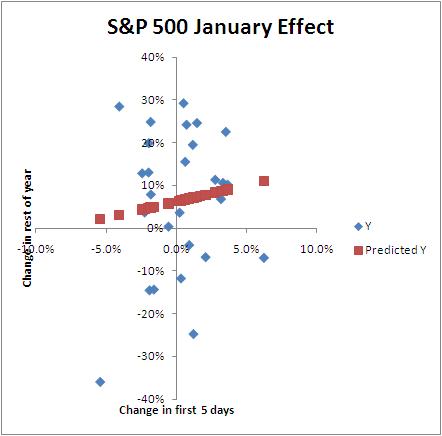
Sam Marx writes:
Bunching the years together and treating all of them equally, and drawing conclusions is I believe incorrect.
For example, I believe where the year is in the Presidential cycle has been shown to have an effect on that year's performance.
Better statistical results perhaps could be drawn by grouping the years based where it was in the Presidential cycle and then doing the analysis.
Jan
9
“Outreach to the Business Community”, from Dan Grossman
January 9, 2011 | 1 Comment
 It's amazing how Obama continues to misunderstand what a businessman is (and how the media happily carries the ball forward for the misunderstnding).
Far from a businessman, Bill Daley's most important characteristic is that he's the son and brother of long-time Chicago mayors cum heads of Democratic political machines. He was paid $5 million dollars a year by JPM not because he is a wonderful business executive and strategist, but to head their lobbying effort. He's a political fixer, an influence peddler, and no self-respecting businessman would be pleased with his appointment.
Jan
9
Just Breaking Bread, from Victor Niederhoffer
January 9, 2011 | Leave a Comment
Can someone tell me why it was not guaranteed to happen that the pro business friendly, appointed by Obama, would be lobbyist for the biggest bank as the former flexerage whose chairs, or nephews of chairs headed the dept of the interior for most of last 12 years is now in disrepute. Thank goodness he is the brother and son of former Mayors of Chicago.
Vince Fulco comments:
The president of the Federal Re serve Bank of New York doesn't know when to keep his mouth shut.
The entire Fed regularly observes what it calls a "blackout period" starting one week before Federal Open Market Committee meetings and lasts until the Friday after those meetings.
Jan
9
Volume and open Interest, from Sushil Kedia
January 9, 2011 | 2 Comments
Volume, to me from the back-benches of the Market Microstructure class, is a struggle for the discovery of price. Increase in struggle is a reduction in the polarity of the prevailing meme.
Open Interest, to me from the similar back-benches of the Market Microstructure class, is variation in the participation of the struggle of price discovery. This could be number of trading strategies at work, number of trading minds at work. To this simpleton mind larger open interest implies increasing complexity of bets and reduced open interest means increasing simplicity of bets for a straighter payoff.
So, reduction in open interest if coming more from larger specs than smaller ones would imply the struggle for price discovery is shifting within the minnows and if the small specs are reducing the open interest it means the bigger boys are struggling harder against each other.
The first scenario would likely lead to a change in meme (a.k.a. a change in trend) and the second scenario would likely mean a large jump in prices due to the smaller fish being reduced in numbers in the food chain.
Experts on COT Analysis, your stab please?
Kurt Specht writes:
My guess, and it's purely a guess, is that large companies are getting spooked by the recent run up and are more aggressively hedging through their intermediaries to protect against additional upside during the year. I'm speaking of large manufacturing companies that would see escalation in their production costs and could have their bottom lines impacted negatively for this year if they don't lock in their energy costs now.
Jan
8
Three Point Stability, from Jim Sogi
January 8, 2011 | 2 Comments
A chair needs three points to be stable. A hiker benefits from a stick for a third stability point. In life there should be a good balance of family, work, friends. Univariate analysis and even bivariate analysis lacks this stability and is subject to failure, changing cycles unless n is rather high. I suggest that a third element adds stability. Single condition filters, or double conditions may suffer the same weakness. The problems of curve fitting plagues 3 condition filters but if a third conditions remains broad, perhaps it adds protection and stability to the return.
Jan
8
“Your Own Man” Stab in the Back Redux, from George Zachar
January 8, 2011 | Leave a Comment
Mr. Greenspan said the risk of a bond-market crisis is so great that he favors raising taxes immediately.
Jan
8
A Faux Largesse Indicator, from T.K Marks
January 8, 2011 | 2 Comments
 I recall reading in Victor's Education of a Speculator many years ago that one of his more delightful methodologies was some sort of South American cigarette butt index. Wherein, how close a discarded butt thrown in the street was smoked down to the filter was a function of the general health of an economy. The thinking obviously being that the more tobacco left unenjoyed, the more the feeling that there was plenty more where that came from. I presume that the spirited Bo Keely was his man in the field on that one.
This was back in '96 or '97 and having been previously unfamiliar with anything he had written, amusedly thought to myself, OK, this guy is going to drive the professorial drones in the academic industrial complex nuts with this type of stuff.
Ever since that initial exposure to the notion of coming up with one's own metrics for gauging the state of things I've tried to hone an eye for such.
Toward that end, one of the things that I have long noticed is that little cup of pennies that one invariably sees on the counter right next to the cash register. Oftentimes taped to it is a sign saying, "Take a penny, leave a penny", along with a drawing of one of those smiley face things.
The blight of the smiley face cliche always kills me, but I invariably just block it out and instead reflexively think of a lyric from "Ripple", a quite beautiful Grateful Dead song: "Reach out your hand if your cup be empty, If your cup is full, may it be again."
Fine enough sentiment. That said though, I noticed a few years back that amidst the red of these cups' pennies some silver suddenly began to pop up: nickels.
I'm hardly paleolithic of years but I do recall that there was a time not eons ago when one could buy a (tabloid) newspaper for but a nickel, and now they're giving the things away. Smiled one of those little, private, personal perspective smiles the time I saw my first nickel in one of those cups. It was like quantitative easing for the proletariat rather than the princely. A year or so later beheld my first free dime. Thought to myself, OK, logic is going to hold the line on this bonanza right there: At a dime.
Then just moments ago that key resistance level was breached. I'm sitting here in a Dunkin' Donuts as I type this and up in the cash register's penny cup I just spotted atop the smattering of lowly red coins, 3 quarters, looking no less out of place than a robin's speckled blue eggs would have.
The irony being that it wasn't too long ago that the simple black coffee that I'm partial to — none of that cinnamon-topped frappachino stuff — would be a far cry from the $2.49 they just took me for, with refills at full-freight.
Now they purport to give away unrequested quarters by way of karma introduction and get the customer on the back-end, the bloated cost of the actual product.
A mildly insidious business model. Seen much worse.
But should I see at any point soon dollar bills begin to appear in those ubiquitous penny cups I will know for sure that we are in a full-blown Weimar scenario, the intent of the would-be benefactor and price of the cup of coffee notwithstanding.
Ken Drees writes:
This says something to me about the public consciousness of inflation. I mentioned not too long ago the vibe of people talking to me (strangers) at the gas pumps complaining about prices. This seems to be a cohesion type behavior where people use the topic as a bridge to conversation–like a soldiers right to complain about food quality. It's better than talking about the weather.
But as a youth of 12 years as a passenger/helper in a delivery van, the young teenagers/ early 20 year old drivers in the late 70s complained non stop about gas prices and inflation– everyone was talking about it. It was the talk of every bar, every station, and every food stop.
I got the point one day when this guy lit a dollar on fire with his lighter, used the dollar to light his cigarette, and then let the burning buck suck out of the window into the winter wind– he looked at me with a stone cold face and said that the dollar wasn't going to be worth sh*t in the near future. I got the point and started thinking about money.
We are not even close to that point again. 4$ gasoline will start it up.
Easan Katir writes:
Often I carry a pre-64 silver quarter and attempt to purchase something with its melt value, around $5. So far, no takers. When someone finally accepts, I will consider that a tipping point for the fate of the US dollar.
Jan
8
I Have Always Said, from Victor Niederhoffer
January 8, 2011 | Leave a Comment
I have often said that instead of looking at sales by industry sector, we should look at the % of the business a company does that is with or from the government, and that should be the first cutoff you choose in selecting above average future performance. Leontief was right, but for the wrong reasons.
Jan
8
Hubris or Just Big Marketing: Arena and Stadium Sponsors, from Ken Drees
January 8, 2011 | Leave a Comment
List of NBA arena names/sponsors
NFL stadium sponsors/names here
:
1.. FedExFeild
2.. Giant Stadium
3.. Cowboys Stadium
4.. Arrow Head Stadium
5.. INVESCO Field at Mile High
6.. Land Shark Stadium
7.. Ralph Wilson Stadium
8.. Bank of America Stadium
9.. Cleveland Browns Stadium
10.. Lambeau Stadium
11.. Louisiana Stadium
12.. Qualcomm Stadium
13.. Georgia Stadium
14.. Reliant Stadium
15.. M&T Stadium
16.. Candle Stick Park
17.. LP Field
18.. Gillette Stadium
19.. Lincoln Financial Field
20.. Jacksonville Municipal Stadium
21.. Qwest Field
22.. Edward Jones Dome
23.. Raymond James Stadium
24.. Paul Brown Stadium
25.. Heinz Field
26.. Ford Feild
27.. Hubert H. Humphrey Metrodome
28.. University of Phoenix Stadium
29.. Oakland-Alamdea Country Stadium
30.. Lucas oil Stadium
31.. Soldier Field
32.. There are only 31 stadiums. The Giants and Jets share Giants Stadium
Jan
8
Meaningful comment on CNBC, from Gary Rogan
January 8, 2011 | Leave a Comment
An anchor just made a great comment about Bernanke's testimony. Talking about him possibly saving the states and municipalities from the municipal debt collapse, she casually opined, "He said he doesn't have the authority and that means he is not going to do it". Isn't this the essence of how he operates? Whatever he says his authority is, it is.
Jan
8
Tower Building, from Pitt T. Maner III
January 8, 2011 | Leave a Comment
Of possible interest:
1) Here is a paper that tries to do a correlation:
One explanation for the documented patterns is that tower building is indicative of overoptimism. Widespread over-optimism could lead not only to tower-building but also to overvalued stock markets. The rational asset pricing explanation is that in periods of low risk aversion, financing of large-scale projects such as record-breaking towers is easier, and expected returns are lower. It is generally difficult to disentangle rational and irrational explanations for patterns in long-run returns. In the paper, I provide indirect evidence which favors the overvaluation view. Given its weakness, it should not be over-interpreted. In any case, the results suggest that a few episodes can have a significant impact on the long-run returns earned by investors. They also show that non-financial information like tower-building may help investors to identify periods of low future expected returns.
2) Casti uses it in the first chapter of his book. It looks like he associates the building start with the top.
Rocky Humbert writes:
This paper has a useful lesson for Donald Trump:
Instead of building a 4 million sq. foot skyscraper, he should build
TWENTY 200,000 sq. ft. low-rise buildings. Evidently, the authors
believe this will signal a robust, continuing economic expansion, and ensure a rising stock market!!!
Cognitive Bias, anyone?
Jan
7
Bonding with Stocks Update, from Kim Zussman
January 7, 2011 | Leave a Comment
Attached is ratio SPY/TLT (weekly, 2002-present). The current 1.4 is highest since late 2008, but lower than any time during the four year bull market of 7/03-8/08. The trend of consensus lately seems to be stocks up and bonds down, which is supported by prospects of growing economy, no deflation, and the housing market remaining other people's problem.
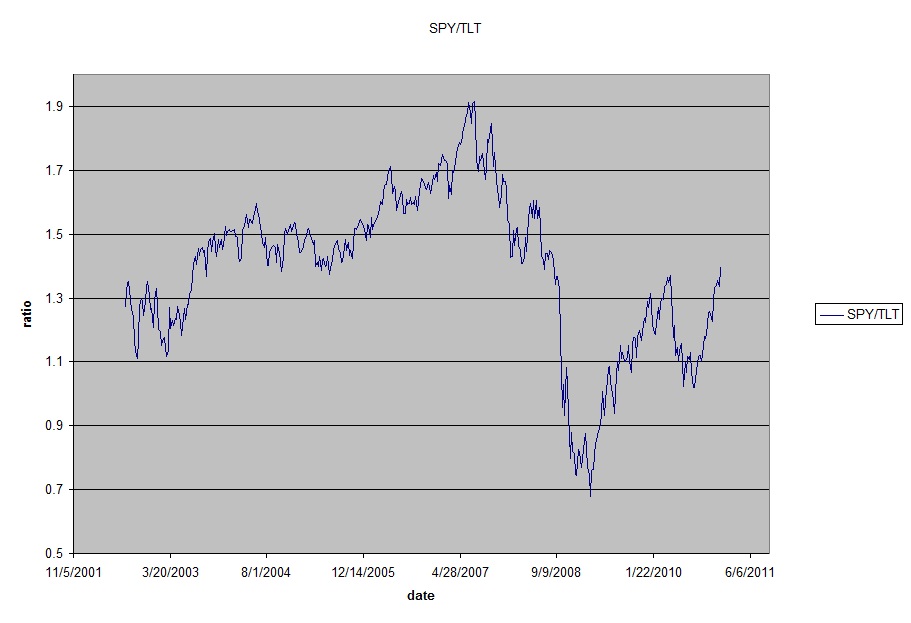
Jan
7
Microfinanciers or Micro-Chupacabras, shared by Pitt T. Maner III
January 7, 2011 | 1 Comment
 Tough times for Microfinance. Daniel Ortega et al. and the "Movimiento No Pago":
Microcredit is losing its halo in many developing countries:
Microcredit was once extolled by world leaders like Bill Clinton and Tony Blair as a powerful tool that could help eliminate poverty, through loans as small as $50 to cowherds, basket weavers and other poor people for starting or expanding businesses. But now microloans have sparked political hostility in Bangladesh, India, Nicaragua and other developing countries.
In December, the prime minister of Bangladesh, Sheikh Hasina Wazed, who had championed microloans alongside Clinton at talks in Washington in 1997, turned her back on them. She said microlenders were "sucking blood from the poor in the name of poverty alleviation," and she ordered an investigation into Grameen Bank, which had pioneered microcredit and along with its founder was awarded the Nobel Peace Prize in 2006.
Here in India, until recently home to the world's fastest-growing microcredit businesses, lending has slowed sharply since the state with the most microloans adopted a strict law restricting lending. In Nicaragua, Pakistan and Bolivia, activists and politicians have urged borrowers not to repay their loans.'
"Even as the results for borrowers have been mixed, some lenders have minted profits that might make Wall Street bankers envious. For instance, investors in India's largest microcredit firm, SKS Microfinance, sold shares last year for as much as 95 times what they paid for them a few years earlier.
And things are not going too well for Muhammad Yunus, Nobel Peace Prize winner and microfinance pioneer:
….Finally, a court has ordered Yunus to appear on Jan. 18 to face charges of defamation, apparently for saying in 2007 that politicians pursue only money. He could be arrested and tossed in prison for that. And given the timing, it sure looks as if this is an orchestrated campaign to take him out, and seize the bank for the government. If this is a concerted campaign, then presumably it could happen only with the approval of Prime Minister Sheikh Hasina. And she does seem to have changed her pitch: a former supporter of microfinance, she recently denounced it as "sucking blood from the poor in the name of poverty alleviation."
Jan
7
Geithner Issues Apocalyptic Warning, shared by Gary Rogan
January 7, 2011 | Leave a Comment
Geithner issues apocalyptic warning:
Defaulting would lead to 'significant' taxes and the loss of 'millions of jobs,' Tim Geither warns Congress. AP Photo Close
Tim Geithner has message for the 112th Congress: The sky really is falling.President Obama's blunt Treasury secretary has dispatched a doomsday missive to congressional leaders, detailing the very bad things that will happen to the country – a default and global economic cataclysm – if the GOP fails to increase the debt limit to $14.29 trillion this spring.
Geithner, responding to a request by Senate Majority Leader Harry Reid (D-Nev.), outlined a handful of painful short-term stopgaps to increase the "headroom" needed to fund day-to-day operations and fulfill the country's fiscal obligations, including such "exceptional actions" as suspending shares of state and local Treasury securities and suspending investment in several important funds, including the federal retirement system.
If the debt ceiling isn't increased by the end of May, Geithner predicted a "catastrophic" U.S. default that would sink the global economy.
"Never in our history has Congress failed to increase the debt limit necessary," Geithner wrote, in an appeal to some Republicans who say they won't vote for the increase unless it's linked to Draconian cuts in social programs.
"Default would effectively impose a significant and long-lasting tax on all Americans … and lead to the loss of millions of jobs," he said.
Still, several Geithner aides told reporters Thursday morning that his warning, while chilling, was nothing new: Treasury secretaries have been issuing them for years.
"This is absolutely standard practice," said one official, who said Geithner will intensify his direct lobbying appeals to individual Congressional holdouts – although the administration isn't ready to link the ceiling vote to specific spending concessions.
"This is a periodic matter that kicks up a lot of dust and dirt. … It will get done in the end," predicted the official, who deemed failure to pass the measure "unthinkable."
However, there is growing anxiety, especially among House and Senate liberals, that the administration will soon switch from chicken-little mode to just plain chicken, and agree to a broad range of cuts to core programs for the poor and unemployed.
"They Republicans are putting us in a vise," Rep. Elijah Cummings (D-Md.) told POLITICO late last month.
Jan
7
How to Survive the Fiscal Apocalypse, from Gary Rogan
January 7, 2011 | Leave a Comment
Whether the bubble will really explode or not, and whether it will do it in two months or five years doesn't seem to be completely knowable, it's kind of like the physics of explosions of superheated/supercooled matter, little things can make dramatic differences to the outcomes. I'm somewhat more positive now with the political dynamics changed, but I get contradictory signals every day and it will take some time for me to settle to a more stable mode of thinking.
For reasons I'd rather not get into, I have not really done much to "collapse-proof" my portfolio. I would not own government debt of any kind, but I never had it anyway because of my aversion to all types of debt instruments. I don't even want to talk about precious metals as there are those who are eminently more qualified here (and of course on every other subject as well, but particularly that one).
I've been trying to understand the link between the collapse of government debt and printing-induced inflation on the one hand and equities on the other, and it seems like equities are likely to be better than many other things, so for a short time I bought more but the kind that in my estimation is less tied to discretionary consumer demand. I have seriously considered emigration (one more time) as the rest of the strategies aren't likely to deal successfully with the Mad Max-type outcomes, but haven't found it practical. For those who are in a different "pay grade" than me and can afford to deal with all the logistics, including the tax consequences, I would seriously recommend opening accounts in multiple countries that have relatively low debt. Commodities outside of precious metals at this point seem too uncertain, given the already elevated levels and the risks to the ultimate consumer demand collapse. With moderate to moderately high inflation they should do well, but there are too many other scenarios for my taste.
Jan
7
Website of the Day, from Lars van Dort
January 7, 2011 | Leave a Comment
The website Yadayadayadaecon explains economic concepts such as imperfect information, moral hazard, incentives, signaling, opportunity costs etc. by using short Seinfeld clips.
Jan
7
A Different Take on Deception, from Alston Mabry
January 7, 2011 | Leave a Comment
The jewelry business—like many other businesses, especially those that depend on selling—lends itself to lies. It's hard to make money selling used Rolexes as what they are, but if you clean one up and make it look new, suddenly there's a little profit in the deal. Grading diamonds is a subjective business, and the better a diamond looks to you when you're grading it, the more money it's worth—as long as you can convince your customer that it's the grade you're selling it as. Here's an easy, effective way to do that: First lie to yourself about what grade the diamond is; then you can sincerely tell your customer "the truth" about what it's worth.
As I would tell my salespeople: If you want to be an expert deceiver, master the art of self-deception. People will believe you when they see that you yourself are deeply convinced. It sounds difficult to do, but in fact it's easy—we are already experts at lying to ourselves. We believe just what we want to believe. And the customer will help in this process, because she or he wants the diamond—where else can I get such a good deal on such a high-quality stone?—to be of a certain size and quality. At the same time, he or she does not want to pay the price that the actual diamond, were it what you claimed it to be, would cost. The transaction is a collaboration of lies and self-deceptions.
from: The Lie Guy
Chronicle of Higher Education
Jeff Watson writes:
Back in the mid 80s, I was a co-owner of a small emerald mine in Colombia. The stones were plentiful, but the quality was mediocre, very dull. My on site partner used to gather all the emeralds, clean them up, wrap them in gauze, soak them in mineral oil, then put the whole gauze wrapped package over a 100 watt light bulb for a few weeks to "treat" the emerald with heat. After being treated, the emerald was not of higher quality but did look nicer, good shine, better colors to the eye. The emeralds also acted differently under fluorescent and UV light, We would wholesale the stones to buyers who came onsite, and we never dealt with the jewelery trade. The buyers all knew the stones were treated, and didn't care as they were mainly concerned with size and color and weight. I brought a treated stone back to the states and had a local jeweler look at it proclaiming it to be the best stone he ever saw. I showed him the equal stone but untreated and he couldn't believe the difference.
Deception really does work in the gem trade with everything from obvious phony stones, to treated stones, to cut stones made to look bigger, and a whole other bag of tricks. One lesson I learned is that 90% of the emeralds sold in the USA have been "treated" in one way or another, with only the untreated high end stones going to Winston, Tiffany, Stern, etc..
Bill Rafter recommends:
Recommendation: Influence of Fear on Salesmen by Frank Budd. Excellent book from the 1970s, written for salesmen in the life insurance industry. One of his points is that only a fraud can sell something he does not believe in, and that eventually that fraud will be unsuccessful. Obviously he never knew Bernie M. who was both a fraud and successful.
Jan
7
Supernatural Trader Explanation? from Kim Zussman
January 7, 2011 | Leave a Comment
 Statistically significant ESP in a refereed journal.
Vince Fulco writes:
Not exactly ESP, but I've been re-reading Kasparov's How Life Imitates Chess in the New Year.
On Intuition (p. 176):
This example is not intended to encourage you to blindly follow your gut instinct, or to rely indiscriminately on simple first impressions. As we've seen over and over again, diligent study and the gathering of knowledge about what came before in chess is essential to becoming a successful competitor. What I want to illustrate is the power of concentration and instinct. The biggest mistake I see among people who want to excel in chess–and in business and in life in general–is not trusting these instincts enough. Too often they rely on having all the information, which then force them to a conclusion. This effective reduces them to the role of a microprocessor and guarantees that their intuition will remain dormant.
Nigel Davies comments:
Kasparov was even one of the more intense and 'concrete' of champions. More relaxed players trust their intuition far more.
Jan
7
Amusing quotes referenced by the FT, shared by Vince Fulco
January 7, 2011 | Leave a Comment
A timely reminder of Stamp's Law, that "what you must never forget is that every one of these figures comes in the first instance from the village watchman, who just puts down what he damn well pleases."
A well known quote from Stamp (often referred to as Stamp's Law) is:
"The government are very keen on amassing statistics. They collect them, add them, raise them to the nth power, take the cube root and prepare wonderful diagrams. But you must never forget that every one of these figures comes in the first instance from the chowky dar (village watchman in India), who just puts down what he damn pleases." (Stamp recounting a story from Harold Cox who quotes an anonymous English judge).
Another quote often attributed to Stamp is:
"Banking was conceived in iniquity and was born in sin. The bankers own the earth. Take it away from them, but leave them the power to create money, and with the flick of the pen they will create enough deposits to buy it back again. However, take away from them the power to create money and all the great fortunes like mine will disappear and they ought to disappear, for this would be a happier and better world to live in. But, if you wish to remain the slaves of bankers and pay the cost of your own slavery, let them continue to create money."
(Said to be from an informal talk at the University of Texas in the 1920s, but as yet unverified.)
From the FT
Jan
7
The Founders Were Not Free Traders, from Stefan Jovanovich
January 7, 2011 | Leave a Comment
No one in the 18th century was a "free" trader. Even after the Treaty of Paris the British continued to insist that all exports from the new United States to Britain had to be carried in British ships. The Spanish and French had similar restrictions. (It was those same restraints on trade with the world that sparked Simon Bolivar's revolt.) The United States and the Dutch were the only commercial countries that had "open" trade laws, that permitted ships from any nation to land goods on their shores and carry them away without restriction other than the payment of an ad valorem duty. Tariffs were NOT "the nation's primary source of revenue for 150 years since its founding". They were the Federal government's primary source but only if you exclude sales of Federal lands. (Jackson's fight with the Second Bank of the United States really boiled down to an argument over how much those land sales would be paid for in IOUs; Jackson wanted specie only.)
The nation's primary source of government revenue, as a whole, was from property taxes and excises - i.e. sin taxes. As for the founders' reasoning on the question of "cheap imports", that was the least of their fears. The only debate among the founders was over how fast trade could be re-established after the ruins of the Revolutionary War. The Southerners were furious at the New Englanders for not paying off the debts owed to the American Tories (most of them New Yorkers) because that was the Brits' sticking point; the restrictions on American exports to Britain - which came almost exlusively from the Carolinas and Georgia - would not be lifted until the American loyalists debts and their claims on their confiscated properties were paid.
The New Englanders, on the other hand, were angry because the peace made by the Southerners (John Jay, being the most important of the Commissioners) had left their fishing rights to the Grand Banks unprotected. All the Americans were upset because the Brits maintained their forts on the Ohio and the Great Lakes and their alliances with the Indians, and that made it impossible for people to safely settle the Ohio country, even when they had treaty titles to the land. That especially upset Washington and Jefferson and everyone else because titles to the "Western" lands were the principal speculation of the Founders as a whole. The notion that the Founders understood that we Americans "had the technology, labor force and one of the largest consumer markets" is pure hip-hop-hooey. In terms of trade volumes, Jamaica and Cuba alone were the equal of Canada and the United States in 1790. Except for ship-building, the U.S. had zero technology; the first things enterprising American technologists did were to steal British patents and import German "mechanics".
The most likely "truth" - i.e. successful political lie - that will emerge from this trade depression is the notion that mercantilism really works. It will appeal to conservatives and liberals alike who want to "protect American jobs". That is much, much easier than doing what Washington did, which is to establish the U.S. dollar as a currency backed by specie and not subject to political manipulation and to create our domestic credit markets. That was the purpose of Hamilton's tariff, not protectionism.
Jan
6
Champagne as Market Indicator, from Bruno Ombreux
January 6, 2011 | 1 Comment
 This is an occasion to repost my 2006 wine study:
I looked at the following time series:
- Champagne and Sparkling wines, a French CPI component from INSEE.
- 11° red wine, another French CPI component from INSEE.
- CAC40 index
In addition, I defined a "Feelgood index", which is the difference between champagne and red wine log-returns. The rationale is that when people are feeling good, they drink champagne rather than your average Joe's supermarket 11° red wine.
The CAC40 choice could be discussed. France is accounting for only 25% of champagne sales, the rest being exported. However, due to the correlations between world stock indices, this choice is not critical.
Data is monthly from 1998 to 2005 included.
The conclusion is that there is no correlation between champagne, red wine, feelgood and the CAC40 returns, either contemporaneous or lagged one month. Wine is a proper vehicle for diversification.
A second study, with different prices, those from the Association of Champagne Dealers, looking at yearly returns from 1990, also concludes that there is no correlation. Since there are only 16 yearly data points, the 95% confidence interval is huge:
-0.54 < correlation < +0.50 Then this second study can be ignored. However, it doesn't contradict the first one.
Champagne returned 22% over the period and 11° red wine 31%. These are poor returns, far below the stock market, even before storage costs. However, annualised volatilty of returns is very low: 1.3% for champagne et 1.9% for red wine.
Nota Bene:
1) This is not a study about returns from investing in top wines like Margaux or Haut Brion. This is a study of run-of-the-mill champagnes and red wines, who shouldn't commend any age, scarcity or snob-appeal premium.
2) It is neither a study about generating alpha from wine-picking. We are only looking at broad wine indices from INSEE.
——————-
Results for contemporaneous series
(lagged series give similar results)
*CAC40 vs Champagne*
Residuals:
Min 1Q Median 3Q Max
-0.0107351 -0.0021576 -0.0002676 0.0019569 0.0105993
Coefficients:
Estimate Std. Error t value Pr(>|t|)
(Intercept) 0.0020951 0.0003879 5.402 5.05e-07 ***
cac 0.0010887 0.0064082 0.170 0.865
—
Signif. codes: 0 '***' 0.001 '**' 0.01 '*' 0.05 '.' 0.1 ' ' 1
Residual standard error: 0.003771 on 93 degrees of freedom
Multiple R-Squared: 0.0003103, Adjusted R-squared: -0.01044
F-statistic: 0.02886 on 1 and 93 DF, p-value: 0.8655
*CAC40 vs red*
Min 1Q Median 3Q Max
-0.025410 -0.001498 -0.001408 -0.001034 0.014695
Coefficients:
Estimate Std. Error t value Pr(>|t|)
(Intercept) 0.0014074 0.0005554 2.534 0.0129 *
cac 0.0022486 0.0091757 0.245 0.8069
—
Signif. codes: 0 '***' 0.001 '**' 0.01 '*' 0.05 '.' 0.1 ' ' 1
Residual standard error: 0.0054 on 93 degrees of freedom
Multiple R-Squared: 0.0006454, Adjusted R-squared: -0.0101
F-statistic: 0.06006 on 1 and 93 DF, p-value: 0.807
*CAC40 vs Feelgood Index*
Residuals:
Min 1Q Median 3Q Max
-0.0141041 -0.0032415 0.0001090 0.0033706 0.0277683
Coefficients:
Estimate Std. Error t value Pr(>|t|)
(Intercept) 0.0006878 0.0006367 1.08 0.283
cac -0.0011599 0.0105198 -0.11 0.912
Residual standard error: 0.006191 on 93 degrees of freedom
Multiple R-Squared: 0.0001307, Adjusted R-squared: -0.01062
F-statistic: 0.01216 on 1 and 93 DF, p-value: 0.9124
Jan
6
It’s The Switches, from Martin Lindkvist
January 6, 2011 | 2 Comments
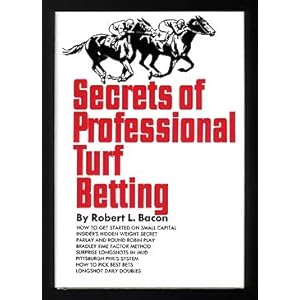 by Martin Lindquist with the assistance of Vic
This is a chapter from Bacon with some changes to better describe the switches the trader may find him/her self in:
"Some amateur traders carry inconsistency to such a degree that they demand consistency from the market, while at the same time being utterly inconsistent in their methods of trading. It's not the markets that beat these traders - it's the switches!
Trading is simple. Everything about the game is logical and common sense and elementary. You don't need a whole staff of Phd's. All the figuring and the mathematics and the mechanics of trading can be understood by a child in junior-high school. But the game is decked out in an endless number of minor contradictions and open switches and deadfall traps, in order to lure the average trader into doing everything wrong.
If the average trader kept out of all these switches and traps, then the powers-that-be would have to make the markets far more complicated in order to insure the fact that the majority of traders continue to lose and thus continue to furnish money to keep up the market.
The amateurs who trade so carelessly and who fall into all the wrong switches, do not stop to consider the percentages of their rightful losses. When an amateur goes to the market and loses nine days or months in a row and loses all his capital, he has lost many times what the percentage calls for. He has no right to lose so much. It's almost as if he did it on purpose!
Look at the percentages. For example, suppose the stock market goes up an average of 5% per year. If so, a blind play on January 1st, or February 6th, or any mechanically designated day and holding for a year, will give 5% per year, over a period of time.
The amateur trader makes every possible wrong move and gets caught in every wrong switch. Thus the careless trader loses from 33% to 100% of total trading capital over a period of time, instead of earning from 5% and more per year on the money put in the market.
The amateur goes long only to have the stock turn south. He goes short and the stock stands still. He goes short a straddle only to have the stock start swinging violently and then sink down. Then when he switches back to short the stock runs up ten percent.
This situation gives a rough idea of why some system promoters claim - and rightly - that for the average trader, ANY system is better than no system at all! At least the system, no matter how bad it is, keeps him out of the switches.
But, of course, we are not studying here to play any senseless systems or methods. We want to play the smartest angles and plans of the "insiders" and the professionals. And it should be clear to straight thinking readers that what the professionals win is the difference between the amateurs actual losses of from 33% to 100% of betting capital and what the markets move up over time, minus commissions.
The professionals, including the hedge fund managers who make good from putting a stake available to other peoples trading, can win no more than this margin. The market gives its 5% first (for example) and then the balance of what the amateurs lose is cut up among the professionals. Once a student of trading learns to view the whole picture of trading operations as a picture of percentages, all these facts of life become clear.
As noted, it's the switches and not the markets that beat the amateur trader. A whole volume of books could not record all the possible switches that the amateurs can get themselves into. But here are a few that the professionals take good care to avoid:
First there is the switch of position: The professional trades long, only, because there is the least unfavourable percentage against a long position due to long term positive market drift. He never goes short; that keeps him out of the amateur's position switches.
Besides sticking to long positions only, the professional always makes trades of even amounts. He isn't like the amateur who lets greed or fear change the size of his trades. The beginner plunges on a trend that suddenly turns, then puts on a light trade on a contrarian situation that does turn around. He keeps switching amounts and positions so that he never has a worthwhile trade on when the market goes his way. He is always one day behind the direction of a stock and several days behind the rythm of the market.
The professional trader gauges his capital so that he has a planned series of trades of even amounts. If he is a big winner at the end of one month and feels that the next month will be good, he plans for a series of slightly larger trades for the entire next month. If he is not too pleased about the outlook for the next month, he plans on using a smaller scale of even trades for the whole month.
The amateur never does anything right when it comes to the handling of trading capital. He trades heavily when he has just gotten his bonus or the fund he's managing gets new inflow, which if it is in spring is the poorest time of the year for the amateur's corny method of picking the trending favourites. Then in the summer he trades heavily again on the type of contrarian setups that he should have traded in the spring, but summer is usually more serially correlated, so he loses.
In late summer the trader feels the pinch in the bankroll department. He trades lightly. By early fall he has used up most of his trading capital, so he can only make one trade. It is a stab on pyramiding a three week move that loses when the Fed chief blocks the move and the market crashes in the end of the third week when the first two weeks were up. Then when winter comes he has no money with which to trade, even if a terrific setup for a trade presents itself.
One of the worst (and most common) switches of all is to change methods of trade selection without giving the first method a fair chance to win. That is one of the switches that the professionals avoid by doing a statistical workout of their methods before actual trading, so that they know just what to expect. Amateurs switch from one method, one news story, one hunch, one angle, one stock, or one type of market to another, without reason.
The first wrong switch breeds a fear of wrong switches, which automatically puts the trader into an endless chain of unfortunate decisions. For example, the amateur starts trading bearishly based on some reports of terrorists threaths or the negative outlook for the dollar. But he changes to long positions based on the good earnings reports, just before the market tumbles in a fine losing streak. He is afraid, at first, of getting caught in another switch, so he dares not jump right back to shorts based on that Roach is coming out with a gloomy view. He sticks to the fact that consumer sentiment continues to rise. But the markets continue to go down while all his news stories are bullish. Finally he can't stand it any more, so he goes back to short because the President is losing trust among the voters or because some species somewhere caught a virus. Yes, he goes back, just in time to run into the long overdue streak of up days.
But there is now use kidding: The professionals keep out of switches by waiting for the sound trades with a positive expectancy. They don't take bad trades at any end of the trading week. They don't take bad trades - period!
Everybody knows that there is no better sport or entertainment than taking family or list members to the market for a day's fun. Everybody eats and drinks from the meals for a lifetime and laughs and hollers. Everybody in the party makes crazy statements as basis for trades, such as "It's like 87 again", "May is down a lot just like in 2000, better sell it all" or "It's inverted, the market always goes down when it's inverted", or "Everybody's long, is there a psychological disjoint", and then shrieks "I was right all along" as the market breaks down the last 15 day stretch. That's some fun! But it's fun only. It's NOT professional play.
The Professionals always remember that it's not the markets that beats the trader– it's the switches.
Jan
6
She Moves In Mysterious Ways, from Jay Pasch
January 6, 2011 | Leave a Comment
She is beginning to work her usual beautiful machinations of range expansion now that she has lulled traders to sleep with her narrow-range behavior since early December; she hypnotizes traders into a myopic view on their 1-minute charts when they should be looking at the weeklies, which they will switch to after the fact, after the margin call. Widen your perspective, traders…
Jan
6
Define Bubble, from Mark Schuetz
January 6, 2011 | Leave a Comment
 What is a bubble?
I generally think of a bubble as when the majority of agents in a particular market are buying something simply because they think someone else will buy it from them at a higher price shortly after, instead of buying something because they think it has fundamental value as an investment, consumption value, or because of a macroeconomic change.
To be sure, every market has speculators, one can debate all day about the difference between "speculators" and "investors," and this definition surely is not robust. But I believe when the majority of actors in one market are buying for the same reason (that they believe someone else will pay more) instead of just a fraction buying for that reason, it is indicative of a bubble.
Jeff Waston adds:
Isn't a bubble knowable only in retrospect ?
Russ Sears writes:
No, If Greenspan can spot one in his irrational exuberance speech, then investors should be able to. But this example shows that, while spottable, it can be hard to make them profitable..the easy kill is only in hindsight. Paulson's and like on MBS show the sophistication required and perhaps the size an inside track needed to make such a killing.
Jan
6
Warren Buffet Tap Dances To Work, shared by Gary Rogan
January 6, 2011 | 1 Comment
Warren Buffet Tap Dances To Work:
For those who think tap-dancing isn't hip, remember that Buffett is so cool he hangs w/ Jay Z
To show just how excited he is to stave off retirement until "the bus hits," (David Sokol's words, not ours) in an interview about his potential successors, Warren Buffett told Bethaney McClean that he "tap dances to work."And just when he couldn't get any cuter, he explains why he loves it so much once he's there like this. From Vanity Fair: "I'm getting to paint my own painting," he tells McLean, "and if I'm using red, no one is saying, 'Why don't you use a little more blue?' It's enormous fun. I get applause. I like it when people cheer for my painting." Aw! No wonder he was birthed from a Grandpa whose name is Earnest Buffett. Buffett also has some inspirational words for those worried about China surpassing the U.S. He told Vanity Fair: "We had four million people here in 1790." "We're not more intelligent than people in China, which then had 290 million people, or Europe, which had 50 million. We didn't work harder, we didn't have a better climate, and we didn't have better resources. But we definitely had a system that unleashes potential. "This system works. Since then, we've been through at least 15 recessions, a civil war, a Great Depression…. All of these things happen. But this country has optimized human potential, and it's not over yet. It's like what's written on the tomb of Sir Christopher Wren: If you seek his monument, look around you." As far as potential successors go, because Buffett needs two to fill the two positions he currently fills, here's who's in the running for the CEO position, according to an upcoming Vanity Fair article which is teased here:
* Sokol, a fellow Nebraskan, "is the top pick of most Buffett-watchers."
* Sokol's number two, Greg Abel, is another name that is often mentioned.
* Ajit Jain, a Buffett lieutenant "with whom Buffett talks almost every day."
* Matthew Rose, who runs Burlington Northern, a Berkshire Hathaway-owned company. And for CIO:
* Li Liu (although when asked to join Berkshire months ago, he stayed where he was)
* Todd Combs, who recently joined Berkshire Hathaway from the small CT-based hedge fund Castle Point and is running a significant portion of the assets
Read the rest of the article here.
Jan
5
Rules, from Jim Wildman
January 5, 2011 | 1 Comment
 I recently made a potentially serious mistake. I updated a web site and left it in a world writable state (i.e, anyone in the world could change it). Fortunately, a good friend noticed and fixed it temporarily while I scurried back to my computer to implement a permanent solution. Naturally one of the things on the web site is a page (by me) discussing the importance of a security mindset.
Mistakes are only useful if you learn from them, so I wrote up my thoughts on the subject. In summation, I set up rules, then broke some of them. Fortunately I had multiple layers of defense (stop loss rules) which made recovery easy.
In the bigger picture of my life, I see that most of the recent (last 5 years) decisions that I now consider mistakes are of the same sort. I had a rule or principle in place, then ignored it. At my age (50+) I'm not really getting surprised by much anymore; when I make a mistake, it's because I ignore what I know and charge ahead.
For example.. I REALLY wanted xyz, so I bought it despite the price, condition, etc, then did not like it, did not use it, broke it, etc. I was REALLY in a big hurry…broke something, ignored the rules, etc I was NOT going to ask for help/go back to the store again
So what strategies are there for stop loss rules, or layers of defense in life? How do you implement them without turning into a cold, heartless SOB? How do you identify reactionary rules (I'll NEVER do that again) that are not sustainable?
Time for some beginning of the year introspection. Here's what I wrote about this on my blog:
As I note in the overview, one of the things I want to focus on is security by design. Nice thought.
I switched from my hand crafted php scripts to Dokuwiki for the web site. Shortly after I pushed the web site out to the world, a good friend called me to say that the entire site was world writeable. Ooops… He was kind enough to flip it to read only while I scurried back home to fix it.
Obviously this was not a good outcome. I've spent parts of the last few days analyzing where I went wrong. How or why did I violate my principles?
- I forgot the rules. In the rush to get things done, I forgot to stop and think before I pushed send. The tyranny of the urgent got the best of me.
- I was complacent in my thinking. In the back of my mind, I knew Russ was watching things (or more correctly that his monitoring systems were). He is a very experienced admin and I trust his infrastructure.
- I did not think carefully enough about my actions. Sort of a variation of point #1, but I did not stop to think about what I was doing and the effects it might have.In the end, even if Russ had not caught it, there was little chance of damage (other than egg on my face for a defaced web site). I've designed the site with defense in depth in mind.
- By design, the site is read only. It is the target node of the push. I never edit the site directly and never move information from the site back into the development environment. The content of the site is in a Subversion repo on another machine.
- I can easily repush the site from my secure repo
- The host that the web site runs on is not trusted by any other machine. There are no keys or logins on it that can be used on another machine that I control.
- OS level security in the form of SELinux is enabled.
- Logs are monitored
- The entire environment (OS and all) is snapshotted regularlySo the web site is in at least 3 sandboxes, each a little larger, each with their own monitoring system and recovery system or methodology.
Lessons to learn
- Think
- Use check lists to guide your thinking, especially when doing something new or different
- Have experienced people check your work
- Belt, suspenders, boots, raincoat, umbrella. Many layers work together to cover the gaps of each other
- Not only think before you act, but think about how to recover from a mistake ahead of time.All in all, the best kind of mistake: small, relatively private, easily recoverable but widely applicable.
Nigel Davies writes:
One of the great problems with creating a lot of rules is that it simply gives you more to think about and these are usually not central to the activity itself. I believe that the only answer is to reach such a high level of mastery in a field that one feels an innate sense of revulsion when doing the wrong thing.
Easan Katir comments:
One important word for this topic: checklists. The more items from a list that can be computerized, automated, the better, the routine things, leaving one's mental capital for the important trading decisions .As you know, many working with high risk activities use checklists: pilots, some surgeons, etc..
Jan
5
Review of Casino Jack, from Marion Dreyfus
January 5, 2011 | Leave a Comment
 CASINO JACK
Directed by George Hickenlooper
The second-banana movie that doesn't quite know "jack".
Cast: Kevin Spacey, Ruth Marshall, Graham Greene, Hannah Endicott-Douglas, Barry Pepper, John Robinson, Jason Weinberg, Spencer Garrett, Yok Come Ho, Anna Hardwick.
Some months ago, in May of 2010, I wrote a review of the austere but satisfying Alex Gibney directed documentary, CASINO JACK AND THE UNITED STATES OF MONEY, about the corrupt, over avid lobbyist Jack Abramoff. Given that Spacey is a tough actor, often given to overpowering the very characters he is tasked to represent. And personally, I have a slight grievance against him for his rude response to me when I tried interviewing him some years ago. Aside from my approach, though, Spacey is notoriously private, and refuses to reveal much or anything at all about his personal life (though speculation often devolves on unflattering presumptions). His visceral portrayal of power-monger Abramoff does not offset or mitigate the superior information and convincing power of the docu, however. Most upsetting was the feeling that Spacey was fundamentally miscast as the "Orthodox" Jew Abramoff, since for anyone in the know, Spacey or the script had him implausibly married to a Gentile, worshipping at peculiar and untenable times of the night, obviously flouting Orthodoxy, behaving hypocritically when it suited his needs despite religious strictures, and in general behaving disreputably more after the fashion of bad-boy Spacey's notions than Abramoff's actual misdemeanors.
The film is roughly, as we all know, how a hotshot DC insider uber-lobbyist and his oleaginous protégé (Barry Pepper) go down hard as their ever-more-stratospheric schemes to peddle influence for Indian tribes and their money-raking competing casinos eventually wend to Washington wickedness of various sorts, corruption, even murder. Tom DeLay, now apparently a dancer, figures prominently, as do the panoply of senators who did not have exactly Purell-sanitized hands in the dealings.
Irresistible as a ripped-from-the-headlines tale, as an also-ran, it loses much steam to make for the killer film it aims to be. Hollywood has been guilty of this re-make fever to an absurd degree of late, remaking films a scant year or so after they come from the UK or South American or India or even Japanese and elsewhere in the Pacific rim: Stieg Larsson's triptych of corrupt publishing in Swedish life films were just released, were wildly popular worldwide last year, and are already being remade and released as American versions. Copycat me-too-ism, anyone?
Director Hickenlooper misses the boat in making this so-called biopic repellent on levels that the docu did not. One left immediately to disinfect oneself after the credits rolled: The whole film had a sleaze about it, even granting Spacey and his cast's gleeful and energetic portrayals. Even the Native Americans portrayed are clearly not from the right tribes, as we recognize too many of the players as bit characters from too many other cowboy-and-Indian lensers, TV, or trial films of yore. There is the strong whiff of overall inauthenticity about the story, and the constant eddying between the viewer's recall of the factual documentary and this macho'ed-up tsk-tsk of a film–so soon on the Alex Gibney original's heels, a bad release-decision point–makes for an unpleasant experience.
The planning for the film clearly began in the heyday of the current administration, late in 2008/early 2009. But we are in a different time now. We are not all delighted with finger pointing at the presumed misdeeds of prior administrations' miscreants, and the subject matter appears not to be as riveting as it might have seemed two years ago. Another SOCIAL NETWORK or even WALL STREET 2: MONEY NEVER SLEEPS, it ain't, much as the protagonist huffs and puffs, vents and re-invents the time-dishonored career of influence peddling.
Jan
5
Book Recommendation, from Jim Sogi
January 5, 2011 | 1 Comment
I highly recommend Roughing It by Mark Twain. A thoroughly enjoyable read, especially on, say, a camping trip. Twain has a great talent to form a twist of a phrase, and a great way of describing people in events that makes one laugh out loud.
Jan
5
Thoughts of the Day, from John Humbert
January 5, 2011 | Leave a Comment
The Chinese are increasingly buying Euro debt and will soon abandon the Dollar, which they no longer trust. A Reader.
I would defer to those who know much more about this topic than me but I wanted to make the following points:
The Chinese have a vested interest in keeping the US Dollar and bond markets afloat.
The US is still, while it will surely change in the future, the world's reserve currency.
The Chinese, so far, have bought relatively small amounts of peripheral debt.
Even if the Europeans were to restructure/default on their debt it would be only a short term solution as the deficits are structural, not cyclical.
Since July Spanish 10 year spreads have gone from approximately 140bps over German Bunds to 240bps over bunds. 5yr CDS has gone from 180bp to 350bp.
Jan
4
Junto, from Victor Niederhoffer
January 4, 2011 | 1 Comment
The next meeting of the NYC Junto will be held on Thursday, January 6th at The Mechanics Institute at 20 W. 44th St at 7 pm, with Prof. Jerome Huyler speaking on "a country in crisis. What's to be done."
All are welcome.
Jan
4
The Yale Professor, from Rocky Humbert
January 4, 2011 | 2 Comments
 Without debating the merits of the Yale Professor, the Harvard Professor, or my favorite professor (who teaches at the School of Hard Knox), one asks:
If one purchases a portfolio of 30 year investment grade bonds with a yield of 12% (call this Portfolio A), and one purchases the same portfolio of investment grade 30 year bonds with a yield of 2% (call this Portfolio B) … and one holds both portfolios for a few years… then are there any circumstances (other than Weimar-like inflation) in which 2% yield portfolio will provide a nominal return greater than the 12% yield portfolio? (Or in Shiller speak, p/e matters.)
Isn't the essence of Professor Shiller's point? And if one drank from this essence, one would have been increasingly bearish during the late 1990's, and increasingly bullish during the late 2008's. And increasingly less bullish right now.
What am I missing?
Victor Niederhoffer replies:
The main missing points are three.
1. The Yale professor does not use predicted earnings. So his p/e are past yields, not expected yields.
2. The p/e he uses are 10 year averages which have even less to do with the expected future yield as they are on average 5 years out of date.
3. The earnings yield is not discounted by the rate of interest.
4. The discount rate that should apply to an earnings yield, has everything to do with future growth and the appropriate rate of discount.
5. The Yale professor has been bearish since 1980 when it was dow 800 or so. His published books based on the volatility of dividends and how much less this volatility is than stock prices, thereby refuting to him the random walk are comparable horses from that same hateful of human productivity garage in New Haven.
To say nothing about the common habit of non investing p/e people like the Yale Professor and many others of throwing out all negative earnings because they don't know how to compute an e/p rather than a p/e. As well as retrospective survival data problems also exist.
One would be very skeptical of Prof Shiller's data if one were considering using it, as when confronted with the 0 ish square of p/e versus subsequent returns by the signer, and the necessity of using 10 year p/e versus 10 year returns or some such, and the signer pointed out to him that the positive 10 year correlation between the previous 9 years and the current would imply a negative correlation between last and next, and that it was very anomalous to think that something two years ago would affect something 1 year in future more than the last year, and in an opposite direction, he at first suggested that with stochastic calculus sometimes a 10 year average did better than a 1 year, and finally he gainsaid that he really hadn't studied this that much. Many errors in calculating p/e from the old days, when earnings were reported 2 months after the end of year, and part whole effects, and working type statistical wrongness from using retrospective averages rather than contemporaneous levels, as well as data problems with using earnings when they weren't reported at all in the early days, which gave the entire spurious correlation to his data to start with also exist, among other gaps, hoping one's negative position about the economy along, and always bearish sentiments along, (as could be expected from a Yale professor) further mar and mask and make meaningless and useless the results among serious other problems.
Jan
4
IPO Performance, from Victor Niederhoffer
January 4, 2011 | 1 Comment
A study from Birinyi shows that IPO's made 20% last year, and it supports my point that all these IPO's in hard times must show an expected a priori return of 40% a year compounded for 5 years to get made these days, and all risky assets must be priced off of this benchmark. I claim that in 2008 for an IPO to be made, the underwriters would have had to tell the company people, that their investors need an a priori return of 80% a year, and IPO's would have been priced accordingly.
Kim Zussman shares:
Check out the latest update to the famous academic study of IPOs by Prof. Jay Riiter of the University of Florida. [34 page PDF].
Rocky Humbert replies:
Thanks Kim, perfect…. actually a bit more dramatic than my foggy memory recalled.
See Page 24: Average 3 year buy&hold over 28 year history returns show -19.8% market-adjusted returns; and -7.1% style-adjusted returns. Additionally, Figure 5 (page 33) shows that the average first day returns in 2008-2010 were in line with previous (non-bubble) years.
Perhaps Vic can take a few minutes respite from skewering the Yale professor to elaborate on his comment in light of these numbers… ?
There is an excellent bloomberg function called IPO <go> which allows one to analyze historical IPO performance by region, industry, time frame etc. A quick look shows results suggestive that (in general) buying every IPO at the first public trade price and holding for five years will, (over time) under perform the S&P500. (SEC rules bar Hedge Fund managers from participating in IPO'S until they start trading publicly.)
Bloomberg subscribers can run their own numbers and adjust for the many variables.This is consistent with some studies I recall (?kim?) that shorting EVERY IPO and hedging with futures is a winning strategy.
Mr. Albert writes:
For me it's first pass kind of thing.
I know from experience that I under perform the dart throwing monkeys on a stock picking basis. And although I can classify stocks in kind of a factor model way, and say this is growth, this is value and if I had done this then this, in practice, I cannot tell when to switch regimes etc.
I have no a priori way of screening IPO's to test if they go up or down and if I shorted them when the underwriters can lend etc and so I wonder about all of them first, then I may try to 'curve fit'.
But then again, I'm not very successful and perhaps this is an illustration of why that is.
Gary Rogan adds:
From my experience, if you restrict yourself to the few ones that have a significant operating history and "good" (cheap in the value sense) financials, and low debt, you will invariably make money. Could take days, could take a couple of years. Many of these are mispriced spinoffs, that seem rare these days but used to be more abundant.
The only one I bought last year, about a month ago, was "BODY', after it has been trading for a few weeks. It wasn't obviously mispriced, but it had a very high sales growth rate for a reasonably priced retailer. It was a scary ride, since it started falling as soon as I bought it, but in strange twist I managed to set an all-time low for it with my last limit buy and then it went up. I sold it way too soon only to watch it soar, but at least I came out ahead. In years past, after I got over tech IPOs in 2000 that pretty much all lost money, I bought maybe 30 of them on the open market over a seven year period and held EVERY SINGLE ONE to the point where it was higher than the price paid. You just have to have patience and a strong stomach, and be extremely selective.
Rocky Humbert retorts:
Mr. Rogan starts out with a promising value-oriented approach; but then veers off the rails– touting in the worst possible way– that one will "invariably make money."
Whether Mr. Rogan is demonstrating patience or several simultaneous foibles of behavioral finance (prospect theory; loss aversion; status quo bias; gambler's fallacy; money illusion; cognitive framing; mental accounting; price anchoring) is something only his hairdresser knows for sure.
What I know for sure is that IPO's, as a group, underperform the market; and if Mr. Rogan is gifted-enough to buck these odds (and outperform the index) and find gems, he is a gifted stock picker.
Such people really do exist– however, it's really annoying to meet them at cocktail parties– where they invariably say things like "EVERY SINGLE ONE" of their stock picks made money.
Perhaps even more annoying is, while they proclaim their genius and long term investment confidence, they write things like:
" A complete worldwide economic collapse has become unavoidable. There is no way out, there are no realistic scenarios that avoid this outcome. The sooner there is a consensus that playing with shifting debt around is not going to solve the problem, the less dramatic this collapse will be. There may not always be an England" [January 23, 2009. S&P level = 831.95].
One must conclude that Mr. Rogan doesn't like the English IPO market. Hmmm.
Jan
4
Rare Earth Rockets, from Pitt Maner III
January 4, 2011 | Leave a Comment
 Rare Earth minerals are in the news day after day and share prices are rocketing. When will gravity take hold?
I don't know but it seems like there are a lot of variables to consider and things might look quite different a year from now– particularly if true substitutes are found and new, mined sources start to or are anticipated to enter the marketplace. Rhodium is a fairly costly metal so it will be interesting to see if the following discovery has commercial applications and if it will lead to other "artificial rare earth metals".
It also will be interesting to see how China plays out its hand :
China's decreasing rate of rare earth exports is forcing the world to scramble for alternative sources. Now the Japanese have artificially produced a palladium-like metal, commonly used for catalytic converters.
The world–and particularly the Japanese–may be in a frenzy over China's newly announced 35% cut in rare earth exports, those used to produce many high-tech devices, in the first half of this year. But a Japanese scientist has found one answer: Create the metals artificially.
Professor Hiroshi Kitagawa of Kyoto University has announced that he and his team of researchers have artificially produced a metal similar to palladium, a material commonly used in catalytic converters. In his lab, Kitagawa used a heating method to produce ultramicroscopic metal particles, ultimately mixing the usually resistant rhodium and silver to create the palladium-like metal.
Jan
4
The Little Spec, from Vince Fulco
January 4, 2011 | Leave a Comment
If only the little spec could realize his gains up front and losses over quarters and years like the big boys:
"Jan. 3, 2011, 4:16 p.m. EST For B. of A., mortgage 'put backs' aren't over More losses seen from Fannie, private insurers and investors…"
Jan
4
Generational Predictability and Cyclicity, from Pitt T. Maner III
January 4, 2011 | 1 Comment
 I wonder if generational attitudes are indeed predictable or whether the social scientists are just picking and choosing data to make it fit their theories.
Several of my family members were impacted by the the sights seen as youngsters during the Depression and sometimes they became excessively stingy (penny-wise, pound foolish) with their money decades later. One of the funny stories was one of saving 2 cents by not buying a bottle opener (church key) in the early 1960s, instead opening the Coke bottles in advance, then leaving the opened bottles on the floor of the Oldsmobile, and then watching them spill out later at the first major bump in the road. It seemed like a good idea at the time.
Strauss and Howe, perhaps flawed but interesting. Will austerity and thriftiness become ever increasingly in vogue and create deflationary pressures? Is there any value in this type of analysis? If people were rocks I would say yes.
* Arthurian Generation (1433-1460)
* Humanist Generation (1461-1482)
* Reformation Generation (1483-1511)
* Reprisal Generation (1512-1540)
* Elizabethan Generation (1541-1565)
* Parliamentary Generation (1566-1587)
* Puritan generation (1588-1617)
* Cavalier Generation (1618-1647)
* Glorious Generation (1648-1673)
* Enlightenment Generation (1674-1700)
* Awakening Generation (1701-1723)
* Liberty generation (1724-1741)
* Republican generation (1742-1766)
* Compromise Generation (1767-1791)
* Transcendental Generation (1792-1821)
* Gilded Generation (1822-1842)
* Progressive generation (1843-1859)
* Missionary Genration (1860-1882)
* Lost Generation (1883–1900)
* G.I. Generation (1901–1924)
* Silent Generation (1925–1942)
* (Baby) Boom Generation (1943–1960)
* 13th Generation (Gen X) (1961–1981)
* Millennial Generation (Gen Y) (1982–2004)
* Homeland Generation (Gen Z) (2005-?)
Jan
3
How America Messed Up Its Kids and What We Can Do to Fix Them, from Mark Goulston
January 3, 2011 | 2 Comments
Hello Vic,
Happy New Year.
My blog, "How America Messed Up Its Kids and What We Can Do to Fix Them" was the 5th most viewed blog of all blogs from the Huff Post for two days last week and has had over 120,000 views. Thought you and the readers of your site might find it interesting.
All the best,
Mark
Jan
3
Who Is Bluffing, from Sushil Kedia
January 3, 2011 | Leave a Comment
 A card game I played a lot in my school days we called "who is bluffing?". It was based on the bids each of the four players would make on the total points they were going to score and where the Queen of Spades, a full thirteen points, would be. The winner would be the one making the least points.
On an uncommon day such as today when equities, most of the commodities, and the Dollar are all up together, one can't help but reminisce about the simpler days of "Who is bluffing?".
Headlines like these make one ask "who is bluffing?"
J.T Holley asks:
I haven't done this one in awhile but historically thinkin' about the asset classes stocks, bonds, commodities, real estate, and art/collectibles, I would be inclined to say that off the cuff (countin' faux pax) that the two classes that start with S and C are correlated more than the ones that start with B, R, and A.
Dare I mention that Mr. Total Return has been on record that Ibbotson's SSBI and Triumph of the Optimists are two coffee table books he has out in his home. Wonder what he thinks of this and game of Spades?
Remembering the SBBI text that Morningstar own's now, Somehow magically everyone forgets that in one of the most highest inflationary times in the last 50 years equities did quite well to keep up and crank out above historical returns.
The above is obviously a broad, non-tested statement utilizing memory from texts read. please take and do your own countin' before making your bets or how many tricks you can take.
I just pulled a rudimentary spreadsheet that had the following from Jan' 70 to Dec '05 that I did, wow six years ago? Both returns are CAGR.
S&P 500 GS Commodity
Avg - 11.13 12.45
STD - 17.06 21.35
Tons of stuff to poke holes in these numbers 1) Fiat currency infancy with dollar 2) trendfollowers early dream come true in '70's 3) weighting of GSCI 4) only 7 NBER recessions in that period Dec '69 - Nov '70 was a short one to begin the study 5) historically it includes peak inflation apex points of '75 and '80 6) many many more things that I don't know and am ignorant of.
Speaking of strategy in Spades, I'd much rather be holdin' the Queen on the deal than to have it amongst the other three at the table. Especially if I have at least 3 more Spades in my hand and only two other cards of another suit.
Sushil, I've played Spades, thousands of hands (Navy game onboard ships), and also Hearts. Isn't Spades the objective to get the lowest points to be the winner, but Hearts the one where you bet tricks or hands taken being 13 total a la "Boston"? It seems to me the game you mentioned "who is bluffing" is a joint venture of both combined? I'd like to know the game as I'm a card playing fanatic and love to learn new games?
Jan
3
A Good Karma Day, from Jim Sogi
January 3, 2011 | 2 Comments
 The first big swell of the season hit yesterday. The waves were 15 feet or so with a few 20 footers rolling through, and had power in them. I had one of those flawless sessions with no wipeouts, and the sets focused right where I was sitting allowing me to catch the wave with ease when those right near could not. I felt strong. At the end of one wave I saw a boy with no board floating in the impact zone with wide eyes. Though he wasn't drowning, he was on the edge and out of breath, so I asked him if he needed help and let him rest on my board to catch his breath. I paddled him out of the waves and helped him find his boogie board with had drifted off 1/3 mile in the rip current. No one else helped him and he would have drowned. I remember when a person did the same for me on the biggest day of the century when I was near drowning myself. Later, after paddling half a mile across the bay back to the beach, I noticed two heads floating in the rip current. As I got closer I saw they were two tourists with sunglasses and they were struggling against the current and being sucked out out to sea and big breakers and were going backwards. The husband could barely keep up himself, and the wife could not. I saw their predicament and paddled over to help. I towed the lady against a strong current and it took me quite a while. One of them would have drowned. They can't see the rip current that flows rapidly along the shore, and once in it, they can't get back to the beach. I felt good that day saving three people. It was a good karma day.
George Parkanyi writes:
Congratulations Jim. That's an amazing and commendable success. Some people don't have the opportunity to save a life through a whole lifetime, and you saved 3 in one day. I was involved in a water rescue situation many years ago under different circumstances, and though I was successful as well, I was struck by the fact that out of maybe 30 bystanders, no-one else thought to act– they just watched. I've often wondered about the psychology of that. Perhaps when there are too many people, everyone assumes that someone else has or will take action, and the individual imperative is suppressed. If each of those people were alone with no-one else around in the same situation, how many more would act? I think a larger proportion (because of the heightened sense of urgency when it's one on one, and there's no-one else to take charge).
« go back — keep looking »Archives
- October 2026
- September 2026
- August 2026
- July 2026
- June 2026
- May 2026
- April 2026
- March 2026
- February 2026
- January 2026
- December 2025
- November 2025
- October 2025
- September 2025
- August 2025
- July 2025
- June 2025
- May 2025
- April 2025
- March 2025
- February 2025
- January 2025
- December 2024
- November 2024
- October 2024
- September 2024
- August 2024
- July 2024
- June 2024
- May 2024
- April 2024
- March 2024
- February 2024
- January 2024
- December 2023
- November 2023
- October 2023
- September 2023
- August 2023
- July 2023
- June 2023
- May 2023
- April 2023
- March 2023
- February 2023
- January 2023
- December 2022
- November 2022
- October 2022
- September 2022
- August 2022
- July 2022
- June 2022
- May 2022
- April 2022
- March 2022
- February 2022
- January 2022
- December 2021
- November 2021
- October 2021
- September 2021
- August 2021
- July 2021
- June 2021
- May 2021
- April 2021
- March 2021
- February 2021
- January 2021
- December 2020
- November 2020
- October 2020
- September 2020
- August 2020
- July 2020
- June 2020
- May 2020
- April 2020
- March 2020
- February 2020
- January 2020
- December 2019
- November 2019
- October 2019
- September 2019
- August 2019
- July 2019
- June 2019
- May 2019
- April 2019
- March 2019
- February 2019
- January 2019
- December 2018
- November 2018
- October 2018
- September 2018
- August 2018
- July 2018
- June 2018
- May 2018
- April 2018
- March 2018
- February 2018
- January 2018
- December 2017
- November 2017
- October 2017
- September 2017
- August 2017
- July 2017
- June 2017
- May 2017
- April 2017
- March 2017
- February 2017
- January 2017
- December 2016
- November 2016
- October 2016
- September 2016
- August 2016
- July 2016
- June 2016
- May 2016
- April 2016
- March 2016
- February 2016
- January 2016
- December 2015
- November 2015
- October 2015
- September 2015
- August 2015
- July 2015
- June 2015
- May 2015
- April 2015
- March 2015
- February 2015
- January 2015
- December 2014
- November 2014
- October 2014
- September 2014
- August 2014
- July 2014
- June 2014
- May 2014
- April 2014
- March 2014
- February 2014
- January 2014
- December 2013
- November 2013
- October 2013
- September 2013
- August 2013
- July 2013
- June 2013
- May 2013
- April 2013
- March 2013
- February 2013
- January 2013
- December 2012
- November 2012
- October 2012
- September 2012
- August 2012
- July 2012
- June 2012
- May 2012
- April 2012
- March 2012
- February 2012
- January 2012
- December 2011
- November 2011
- October 2011
- September 2011
- August 2011
- July 2011
- June 2011
- May 2011
- April 2011
- March 2011
- February 2011
- January 2011
- December 2010
- November 2010
- October 2010
- September 2010
- August 2010
- July 2010
- June 2010
- May 2010
- April 2010
- March 2010
- February 2010
- January 2010
- December 2009
- November 2009
- October 2009
- September 2009
- August 2009
- July 2009
- June 2009
- May 2009
- April 2009
- March 2009
- February 2009
- January 2009
- December 2008
- November 2008
- October 2008
- September 2008
- August 2008
- July 2008
- June 2008
- May 2008
- April 2008
- March 2008
- February 2008
- January 2008
- December 2007
- November 2007
- October 2007
- September 2007
- August 2007
- July 2007
- June 2007
- May 2007
- April 2007
- March 2007
- February 2007
- January 2007
- December 2006
- November 2006
- October 2006
- September 2006
- August 2006
- Older Archives
Resources & Links
- The Letters Prize
- Pre-2007 Victor Niederhoffer Posts
- Vic’s NYC Junto
- Reading List
- Programming in 60 Seconds
- The Objectivist Center
- Foundation for Economic Education
- Tigerchess
- Dick Sears' G.T. Index
- Pre-2007 Daily Speculations
- Laurel & Vics' Worldly Investor Articles
