Jul
13
Posture and Thought, from James Sogi
July 13, 2008 | 2 Comments
 The concept of a stance is critical to all aspects of life, as pointed out by Nigel Davies and Jeff Watson. Your stance is more than just a physical posture, or manner of walking and approaching the physical world as it reflects the inner self and affects your interaction. You can see it in others and can tell much about them from their stance, the way they carry and comport themselves. A strong stance enables strong feelings, and practicing strong stance encourages a strong inner self. In fighting a balanced stance is preferred in neutral situations over a strong stance. A balanced stance is evenly balanced between advance and retreat, attack and defensive movement.
In trading stance is of utmost importance. At multi year lows and on the bull moves it is very important to maintain a strong stance. In the Red Queen trade down, a balanced stance is required despite the fast pace. At highs, a defensive stance should be used.
Jul
3
Atul Gawande: Better, reviewed by Jim Sogi
July 3, 2008 | 2 Comments
 Better: A Surgeon's Notes on Performance by Atul Gawande is another great Riz recommendation about performance in the medical profession, but which applies to all professions. Gawande asks of a profession that seems to eschew empirical performance criteria, what does it take to be good where failure is so easy, so effortless. Like trading, medicine involves risk and responsibility. There are three elements for success: Diligence,morality, and ingenuity. The first and third are especially important for traders. Diligence seems easy, but it is central to performance and fiendishly hard. Even the simplest things for a trader like sitting and doing nothing becomes almost impossible at times. Doing the right thing trading day in and day out while the devils try to derail your plans takes Herculean effort which few can muster everyday, every hour. The balance also seems that an overly structured diligence might stifle ingenuity.
What is diligence for traders? It could be simple mechanical things like back up computers, feed, power. It could be simple sleep. It could be checking the data, the data entry, and the studies. Checking the announcement calendar to see what time market moving announcement might mar the tape like this morning's 20 point lobogola. The list goes on and I ask for supplement from others.
Jul
1
Lava, from James Sogi
July 1, 2008 | 3 Comments
 This weekend we went to the southern part of the island where the lava is flowing into the sea. We launched the boat through moderate breakers and headed south to where the lava was flowing. The lava poured into the sea creating a huge cloud of steam a thousand feet tall that billowed up in mushroom formations sending off small tornadoes from the heat. The ocean was literally boiling and the heat from the lava spread out hundreds of feet or more. Explosions of molten lava send red glowing cascades of molten lava through the air. The strangest thing were football size chunks of lava floating in the ocean. One of the guys had welding gloves and picked up the floating lava chunk, broke it open revealing red hot molten lava inside the chunk! It was crazy and beyond belief. Its not at all what you would think could occur, floating lava. Go figure. But there it was. There are things in nature that defy belief. Almost like today's market. Mind boggling.

Jun
29
Predictably Irrational, reviewed by James Sogi
June 29, 2008 | 3 Comments
 Predictably Irrational, by Ariely, (hat-tip to Riz Din for cite!) was a great read and has provided some deep insights into personal trading and many common everyday situations in the days after reading the book. It also provides a good basis for testable hypotheses of a quantitative nature in trading.
Behavioral economics is popular and most traders are familiar with Kahneman and Tversky's works. Some of the ideas were discussed in the Black Swan directly or indirectly. The idea is that people are not rational agents as posited by traditional economics, but rather are influenced by unexpected and rather random cues in their environment and lead them to make decisions which are not rational, and which the author asserts are predictable. We see this in other traders (but not us, of course) everyday. It is this element of predictability which he does not go into in detail and which give some ideas to the trader using quantitative methods to predict the path of prices and provide a laboratory of data. The author has documents many interest anecdotes with experiments conducted on subjects that seem to support his ideas. Presumably, but not documented, the underlying statistics of the experimental data lent support to his hypotheses.
Some of the random cues that influence people's decisions are:
- Relativity, where experiments show that choices tend to be made between relative values rather than absolute values. One example is where people tend to choose the middle of three choices, when on an absolute basis, the cheapest might have been the best value. We see this in the circumnocution of market prices. This effect is seen in dating where a girl with an ugly friend looks much better than she might standing alone. This might be seen in the comparison of two companies in the same sector.
- Anchoring is the tendency of agents to choose a price close to a price randomly presented to them earlier which has not rational connection with absolute value. Again we see this in market action with the tendency to revert to the opening prices.
- The issue of the illusion ownership which makes the agent tend to place an excessive premium on things he owns or is bidding on, even to his detriment. This makes it harder for people to get out of trades. This also might suck a trader in deeper than he wants to be having entered into an undesirable trade when it might just be better to wait.
- The ownership effect makes people tend to cling to trying to keep options open, even when its more advantageous to close the door and choose one alternative.
These effects occur every day in personal lives, and in the markets. The traders trick is to find those irrational behaviors that cause losses to other traders and exploit their predictability.
The observer effect might be seen in the market in the tendency of prices to revert to or near a prior observed price such as open or prior close.
Jun
22
The Red Queen Trade, from Jim Sogi
June 22, 2008 | 2 Comments
`Now! Now!' cried the Queen. `Faster! Faster!' And they went so fast that at last they seemed to skim through the air, hardly touching the ground with their feet, till suddenly, just as Alice was getting quite exhausted, they stopped, and she found herself sitting on the ground, breathless and giddy. The Queen propped her up against a tree, and said kindly, `You may rest a little now.' Alice looked round her in great surprise. `Why, I do believe we've been under this tree the whole time! Everything's just as it was!' `Of course it is,' said the Queen, `what would you have it?' `Well, in our country,' said Alice, still panting a little, `you'd generally get to somewhere else — if you ran very fast for a long time, as we've been doing.' `A slow sort of country!' said the Queen. `Now, here, you see, it takes all the running you can do, to keep in the same place. If you want to get somewhere else, you must run at least twice as fast as that!'
From Lewis Carroll's Through the Looking Glass
Jun
18
Ocean Drift, from Jim Sogi
June 18, 2008 | 3 Comments
 We had a dinner on the boat tonight at sea, drifting with the wind and current. I positioned the boat so it would generally drift back towards the harbor, but as we drifted I thought how similar it felt to have a position with the intent of holding. The position drifts, sways, goes up and down with the winds, currents and waves without any action. This quite a contrast to the deliberate positioning and surfing the waves in the ocean and the market which takes concentration and accuracy. The boat drifted sideways. We sat and enjoyed a nice dinner at sunset with no one else around. The ocean is a different place. No one owns it. No one can stake out an area. Its all fluid and in motion.
Jun
15
Expected Utility Maximization, from Martin Lindkvist
June 15, 2008 | 9 Comments
 I found myself lying awake in my bed last night thinking about the Nobel Prize Winner. No! Not like that….but about what he said in Stockholm last week. Expected Utility Optimization. What he said is that the goal of asset allocation should be optimizing the expected utility for the actual investor in question, and that the mean variance model should just be looked upon as a special case. And of course he is right. I mean, by the way he sets it up, he is right by definition. But….I am thinking how it would play out in the real world. In my fantasy, a consultant would sit down with an investor, asking questions to find out his preferences. Of course this is already happening in a general sense but here it would end in a very specific investor utility function). Then the asset allocation would be done based on the utility function.
I am thinking that what will be overlayed on the usual return/risk models, are constraints (e.g cutting off tail risk, smoothing out fluctuations and what have you) and while the model presumably maximises return given a risk level and those added constraints; if we add constraints there must be risk premia transferred to someone else? By definition, since the investor specified his utility function (and given that the formulas and models held up and he got "what he wanted") he is better off than before, but so must someone else be?
I am not sure this new allocation model will start a revolution in the way asset allocation is done. I think however that finding situations where other investors are up against constraints, could help open up possibilities and profits. In the micro realm, many traders prefer to cut off the risk of gaps against them, by not holding overnight. This might open up possibilities for traders well capitalised and with good stomach, to do just that (this must be tested). Other suggestions are welcome.
Adi Schnytzer critiques:
 It never ceases to amaze me that people who know markets and work in them don't realise that we don't know the probability that anything will happen tomorrow unless we are in a fair casino. So the idea that anyone can maximize expected utility is nonesense since you don't know the probabilities. I am currently working on developing a risk index as a follow-up to such an index developed recently by Aumann. He cutely argues that even though we don't often know the probabilities to assign to events, it's important that, in principle at least, we have an index. Well, I've been looking for real life examples of his index (and my follow-up) in stock and derivative markets, and simply cannot find one. As a top bookie once said to me: "If I only knew the winning probabilities of the horses, I wouldn't need to know winners; I'd be making a fortune anyway." Spot on.
Jim Sogi adds:
Martin talked about "…cutting off tail risk".
The thesis that outliers shape the future is intriguing, but also that the risk cannot be eliminated. The idea that one can cut left tail risk is an illusion that in itself creates a greater risk. As Phil says, it also cuts right tail return.
Jeff Watson concurs:
Risk can be quantified, assumed, bought, sold, transferred, created, subordinated, reassigned, split, delayed, diluted, fragmented, hedged against, and layed off……. Risk can respond to some methods, but it is still risk, and is near impossible to eliminate.
Speaking of planning in general, Stefan Jovanovich adds:
I have quoted this before, but it seems worth repeating, if only to add a mite to Adi's wisdom. Planning in business is all very well, but the trouble is that your plan's assumptions always turn out to be works of fiction. As John Wannamaker said, "I know half the money I spend on advertising is wasted. If someone would tell me which half, I would very much appreciate it."
Vince Fulco concurs:
This quote has always seemed appropriate…
Moltke's famous statement that "No campaign plan survives first contact with the enemy" is a classic reflection of Clausewitz's insistence on the roles of chance, friction, "fog," and uncertainty in war. The idea that actual war includes "friction" which deranges, to a greater or lesser degree, all prior arrangements, has become common currency in other fields as well (e.g., business strategy, sports). [Wikipedia].
Russ Humbert warns:
One of the hardest things to get people to see is that most people/businesses have a long term utility function but operate as if all risk is short term volatility. For example, I work for a company that has a niche market and is privately held. The owner wants to pass this business on to his great-grand kids so each will be as well off as he is now. He has only teen kids now. This niche has very little volatility of earnings and good ROEs. But this just encourages piling on the same long term risk, to minimize the short term risk. That is: grow the core business, not diversify. We already have the leading player in this niche. Barriers of entry: a learning curve, requires some marketing nimbleness, and need for stable size and reputation. However, long term this has no good ending. Best case we double our market share and flatline growth. But many worse cases. Bigger, deeper pocket competitor or many, learns our niche attracted by the ROE and stable vol. We are regulated out of the market. Products slowly go obsolete, replaced by Government safety net. We lose our reputation, etc. See this in spades throughout the fallen out of favor or failed businesses, due to subprime mess. Low vol high ROE business, until…. For the speculator this would be like choosing a strategy that 95% time gives "Alpha" in a beta model based on quarterly results of recent history. But all the "alpha" is hidden because, 5% time it causes you to go broke or close to it. It just hasn't happen yet, or recently. Basically volatility as a risk measure can hide long term complacency defeating most utility functions.
Going back to the military aspect Bill Egan adds:
An interesting aspect of the fog of war is the common mistake of not reevaluating the plan often. A major cause of this error is that people confuse perseverence towards a goal (a good thing) with sticking to the particular plan they are using at the moment to achieve that goal. Criticism of the plan and proposing actual changes to deal with new information or uncertainty are considered as defeatism or disloyalty and the operationally fluid are smacked down. The no longer relevant plan is then ridden on to failure to a loud chorus of "yes, sir! yes, sir! three bags full, sir!" A pleasant sight if it is your opponent doing this but awful if it is your leadership. I have fond memories of serving as a company commander under a battalion commander who always asked us to tell him if he wasn't making sense and meant it. Good man.
Phil McDonnell enlightens:
 There are many deep questions in Mr. Lindkvist's ruminations on Expected Utility Optimization.
My first comment would be that there are at least two distinct classes of utility function. The first class might be what can be called the Ad Hoc Class. This would include the questionnaire method of approximating one's utility function.
Other methods might be classified as normative, as in what one should ideally want to use for a utility function. As a well known example we have the Sharpe Ratio. This is based upon the normative idea that one should maximize expected return but with a quadratic penalty for increased volatility which is treated as a surrogate for risk.
The idea of using a square root function as a weighting for betting returns actually goes back several centuries to Cramer, a mathematician. His friend and frequent correspondent Daniel Bernoulli countered with the idea of a logarithmic weighting function, which is also what I espouse with extensions. Bernoulli's ideas were not translated into English until the 1950s and thus were lost to Western thinking until very recently.
Dr. McDonnell is the author of Optimal Portfolio Modeling, Wiley, 2008
Jun
15
Kaizen, from Jim Sogi
June 15, 2008 | 1 Comment
 Kaizen is a Japanese concept which means continuous incremental improvement. This is a process in contrast to and in disproof of the idea that outliers alone form history. It is the tortoise and hare issue. Incremental and thus compounded gains allowed Toyota to become the largest car maker in the world. This kind of steady gains over time arguably has been responsible for more and greater changes than the discontinuities. In markets it is the idea that it is hard to beat a buy and hold over the centuries. The slow advance of human records over years is another example of incremental improvement. For traders a steady improvements in skills, new and changing techniques to adapt to ever changing market cycles and a steady return is a good alternative to a boom bust methodology.
The larger brokers such as Lehman use up to 25-35x leverage. Banks are leveraged up to 20x with less than 5% capital. The common historical variance in any particular market should lead to some big swings in equity. The real estate market would similarly be leveraged at least 5-10x or more with a 10-20% down. This level is like the "Mexican option". The levels seem to be coming down now. This is affecting market action.
Scott Brooks dissents:
 Outliers may not "form" history, but they do lead it. The outliers in history are the ones that led the way to new and innovative change. Whether you look at outliers like Alexander the Great, Hitler, Churchill, Washington, Charlemagne, or Ford, Rockefeller, Edison, Morgan, or Shakespeare, Van Gogh, Picasso, Beethoven, The Beatles. It's the great ones that lead the direction or show the way. Society as a whole makes a decision, in the form of many individual decisions, to follow the lead of those that are paving the way.
There is no question that society as a whole benefits and moves forward in a buy and hold methodology. But the great ones lead the way and change the course of mankind….whether on purpose, or by accident.
Are the moves of these great leaders a mere function of chance? Yes and no. Greatness is predictable, it's just not known where it will come from or the impact it will have. Just as one can't predict the outcome of a horse race of a coin flip with 100% accuracy, we do know that the coin will land with some result, and that some horse will win the race. These horses are the one's that shape history and direction, just as the great (or infamous) leader have over time….which has lead to the incremental progress of the human race. But the fact that some men have greatness is less a function of chance and more a function of an ongoing decision process. They each, literally, decide to be/do something and work towards that goal. There is no chance in a pursuit of greatness or a goal. There is no greatness in a winning a lottery, only chance. Achievement of greatness is not about the result achieved, it's about the process one followed to achieve that greatness.
I believe the same is true from trading. We all can make progress if we're willing to work towards that goal and learn from our past experiences and build on those experiences as well as the experiences of others that we learn from. Greatness comes from process we learn over time and in the falsification of beliefs that we hold to move towards a higher truth.
Average and ordinary people don't want to believe in something new. They want to continue to believe that the earth is flat or the that universe revolves around the sun. It takes a great man to falsify those beliefs, and move the whole of mankind in the direction of greater enlightenment.
Riz Din concludes:
The interplay of outliers and incremental change over the long course of history seems like a very natural process, although sometimes I pray for the outlier to arrive quickly and disrupt the state of affairs because incremental change has led to bloatware, bloated institutions, etc. that are riddled with inefficiencies. When the incremental path is followed, things get embedded in such a way that there is no way of overhauling the system and it takes a competitor to do what is necessary and start over from scratch.
Here is an interesting Economist article from my archives on the topic, it is from the excellent, Millenium edition (Dec, 1999), and discusses living standards over the past thousand years in the context outliers leading the way, incremental change, and our benefiting of compound return of growth/living standards.
Take a look at the chart.
In our life-times we see steady year on year growth and improvements in conditions and view this as normal. However, the author of the article notes, "material prosperity has risen more in the past 250 years than in the previous 10,000. And so conditioned to growth have people become that most westerners now expect their standard of living to improve automatically year by year; if it does not, something is wrong. This taking for granted what would once have seemed miraculous is the measure of the change."
Jim Sogi tries to get the last word in:
The Economist article Riz cites falls for the recency effect, that recent events are more important. Not so. The invention of language, the wheel, fire, tools, iron, writing, and printing presses probably surpass recent inventions in creating better prosperity advances and change.
Jun
8
On the Inka Trail, from Jim Sogi
June 8, 2008 | Leave a Comment
The Inka Trail travels 47 km though the high Andes, on the edge of steep cliffs thousands of feet straight down, surrounded by majestic glacier covered peaks, rising over 4 thousand meters through steep passes, and Indiana Jones like hanging bridges over deep chasms with rushing rivers and though paths carved though solid granite stone with steps chipped out of the mountain itself, through high tropical jungles, with ancient ruins along the way, along side gurgling mountain rivers with ancient aqueducts crossing a regular intervals, culminating at the Sun Gate overlooking Machu Picchu. The trek is not for the the timid or weak, but did provide time for thought about many things including ideas about the market, up ward drift,natural philosophy, and life. Here are a few thoughts.
Big Tree Trade.
The trail is surrounded by a rich profusion of plants, reptiles, lichen, fungus, epiphites, orchids, mosses, bromeliads, trees, insects, birds, and rich geological features. All compete in the thin Andean high altitude for sun that peaks between the steep valleys and crags on rocky scratchy soil. A few large trees take a foothold on the steep steep mountain sides and protrude up through the jungle thicket. A profusion of life clings to the tree, all wrapping around the tree, the birds nesting, creating a whole ecosystem on the tree.
As the market follows nature a groundbreaking protruding company, such as Google that gains a foothold, protrudes through the thicket and dominates its space. To it clings a profusion of companies supported by the groundbreaking space, the new technology, allowing access to new markets, new opportunities. companies such as wine racks, face book, others that cling to the use of the new technology, and similar that will grow up big, fast on the back bone of the big tree. I have not tested this but welcome some ideas for small companies that might grow on the back of Google's spine.
Walking Palm and Agave tree trade
Another nature oriented trade was inspired by the Walking Palm and Agave tree which appear in the deep amazonian jungle and the high Andean high jungle. The principle of propagation is similar but the pattern may be different. The walking palm has many long roots that stick up about 1/3 the way up its tall thin trunk in to the soft wet mossy ground of the jungle. As the top of the tree leans one way or the other to seek light seeping through the high canopy the roots on the far side let go, and the new roots grow out to support in the direction of the tipping trunk allowing the tree to walk towards the light. Some quantification of the speed of this action,, the proportions, and movements and angles might give some ideas about the natural progression of price growth in the market as it seeks new light, new energy, new money in it progression an growth.
The Agave propagates from a short dense sharply pointed bush and the when its energy has built, it sends a long tall shoot up 3 or more ( need to count this) times the height of the bush. The shoot is covered with seed pods that tip the long tall shoot over and as the shoot tips over, the packs of multiple seed pods land some distance away from the parent bush and propagate new the plants and new shoots in time. My impression of the current market is like the Agave tree. It tipped over Friday today, but in due time, the new seeds should propagate and send up new growth Quantification might include measurement of the height of the stalk to the bush, the number and weight of the seeds, and the propagation rate to discern how such a similar phenomenon might manifest itself, if at all, in the markets with any regularity that way that nature seems to manifest such regularities.
Upward Drift
Many pleasant hours strolling with the family in the lush high jungle forest on a precipitous narrow trail overhanging on the side of thousand foot cliffs chipped out of solid rock by ancient hands leading to fantastic science fiction like looking ruins set atop high abutments above precipitous peaks, viewing vertiginous valleys and glacier capped peaks, waterfalls, fountains and streams gave time to think and consider the applicability of the upward drift to individual trades, individual traders, civilizations, species and evolution. Certainly there is upward drift in evolution and in civilizations. The question is how can the trader profit from this? The Inkas' had a large and glorious civilization, but not so great that it is now reduced to a mere set of rubble tourists see and the shadow of an empire lives off. The Spanish helped the fall, but the Spanish had their fall shortly thereafter. The British had their upward rise, but now have a shadow of their former glory and empire. Evolution of species drives upward betterment, but evolution itself is the story of extinction. Companies rise, but few of the Dow are the same as they were, or the Nifty Fifty. How is a trader to beat buy and hold with leverage? Study of the outliers, dips, crashes and valleys, extinction is a key. On the plane ride home, The Expert's tome on the subject will provide much more food for thought on the effect of, the reason for crashes, and outliers, and the various asymmetries in the analysis which will be covered in a subsequent post.
The Pace on the Trail
The Inka Trail rises and fall over many thousands of vertical meters over mountain passes on its journey to Machu Picchu. It eventually ends up lower than its start. The climbs are grueling cardio climbs that push the climber to the limit of sustainable heart and lung function. Each climber has an individual pace. The best advice is to follow your own individual pace. Too fast, and the climber starts to huff and puff, and pant and soon must stop losing progress. Fast runners, BMX'ers, and fighters know this. Too slow for some reason causes exhaustion or frustration as well. A group of English tourists walked too briskly, then starting to pant, had to stop too often to rest and catch their breath. For this trekker a very slow but steady pace allowed an equal or better overall progress. Some groups felt the need to walk together, but the varying capacities of the individual members created tension, and progress overall slower than splitting into individual paces with set rendezvous points. It can feel really ridiculous to step, take two breaths and step, but arriving at the end of the trail feeling strong and whole is the ultimate reward for the tortoise.
Each trader has a pace at which he performs most comfortably, which should be considered and which will allow the best overall performance. It is the heart of the tortoise and hare parable. The life of an investor and trader should be long, a lifetime properly. There should be consideration of pace in the traders vocabulary. The idea is not completely captured in risk tolerance or return and encompasses a longer term view of the journey.
more later…
May
29
Amazon Jungle Rain Forest - Peru, from Jim Sogi
May 29, 2008 | 3 Comments
 Not more than a dozen years ago it took weeks to get to the deep upper Amazon jungle. There used to be terrorists here. Now in two days by plane, bus and motor canoe we reached the upper Tambopata research station in the headwaters of the Amazon rain forest. We saw six species of monkeys, macaws, poisonous spiders 6 inches across that can jump a meter, snakes, frogs. tapir tracks, vultures, hawks, otters and more. The guide wrestled a small Caiman and brought it into the canoe.
The jungle has the greatest biodiversity with thousands of species each occupying a specific niche. The only direct conflicts we saw were between two spiders, and two monkeys fighting over the same niche. The forest had three main levels, first at the ground to 15 meters, 15-35 m and the canopy above 35 m.
Some market ideas from the learning experience involve the separation of the levels and the specialization within each level of the forest. The occupants and action at the bottom of the forest are much different than those in the middle or top. As in markets different techniques are needed at tops, middles, and bottoms. It is hard for one species of trader to hope to avoid death at all the levels. It is very hard to start on the bottom of a market and survive to the top.
Extreme specialization is the rule in the jungle. There is no reason that same type of specialization would not be required in the market jungle.
However in many ways, current markets lack real diversity. The correlation among markets has been a result of this lack of diversity. Too many in the same niche or trade. The lack of diversity causes inability to absorb market shocks.
In the jungle, when a large 800 years old kapok tree falls, a huge gap is created. Many species rush in to fill the gap, but due to the rush, the vegetation is weak. Similar action may occur in market gaps when a shock hits. The initial occupiers of the gap are weak holders.
More reports later from Cuzco, Peru, in the Andes…
On May 30, Jim Sogi added:
 Navigating the jungle: The jungle canopy is 35 or more meters high and cuts out most of the light. The jungle floor is dense and dark filled with creepy crawlers. It would be easy to get lost and survival would be hard. We wondered what tactics could be used if lost in the jungle. The only way out is to find the river. Overland travel is impossible.
We learned that the macaws travel at dawn to the clay licks which are located on the riverbanks. The macaws are large, brightly colored and make noise. At dawn one could look to see the direction of their travel to determine the location of the lick. Kennerhoffer grads might recognize the trade navigation information in the dawn trade direction as a navigation tool for the days trade.
in the jungles there are small streams that caiman like to use. One might use the flow direction to determine the direction of the larger river and follow that. The obvious trade parallel is to follow the flow of the orders of the bid or ask
The tapir makes vague paths through the undergrowth through habitual use. There are meals for life in following well worn trading price paths as well as they tend to be habitually used. in the market jungle.
I would welcome other trades ideas arising out of such navigation ideas. We've discussed open ocean non instrument navigation some years ago. Its a jungle out there and every advantage is needed.
Nigel Davies reports:
Coincidentally, the Independent newspaper featured the following story today on a tribe that has only recently been discovered. I can't help but think that it is they who possess the real secrets of Amazonian survival.
BTW, a thought keeps coming to mind since my investigation of the game of Go. This tends to have pockets of recognisable patterns scattered across the board's landscape with chess, by comparison, being much more 'homogenous'. Perhaps the key to the jungle lies is analogous to Go, with intuition being required to recognise these more disparate patterns.
Pitt T Maner III reminisces:
 The difficulties encountered of one of the early billionaires (and richest man in the world), Daniel K. Ludwig, when he attempted an ambitious development project in the Amazon come to mind. He failed to anticipate problems associated with the fragile, thin, Amazonian jungle topsoil– and how the jungle's existence involves a continual recycling of organic materials from the canopies mentioned. It made for a strong cautionary business tale back in the late 70s and early 80s. Beware the "Amazon factor".
"A touch of hubris without humus" you might say…. Mr. Ludwig was, however, by many accounts a very charitable fellow— and his intentions may have been good. Perhaps the story relates (as suggested in the articles below) to taking on too big a project in advanced age… at some point you need to enjoy your wealth and partially retire. Eschew eccentricity, listen to others, give up a bit of control. Then again maybe some people make it to old age because they thrive on these type of struggles.
The "before" story:
Ludwig is a restless recluse at 80 and, some employees suggest, is seeking to build a pyramid to himself, a monument to his ten-year quest to tame a stretch of jungle almost the size of Connecticut and make it productive. Says an associate, Luis Antonio Oliveira: "Mr. Ludwig is nearing the end of his life, and he is more interested in undertaking something of great socioeconomic significance than in earning quick profits." Still, Ludwig is betting that a worldwide paper shortage is coming by 1985 and will make his gamble pay off.
"After" stories:
Problems also begun to increase due to so-called Amazon Factor - the combined effects of soil, insects, humidity and tropical disease. Workers contracted malaria. Insects devoured the harvest and supplies. Then Brazilian government officials began to criticize Ludwig's methods and the extent of his land ownership. They also questioned the project's exemption from taxes, not to mention his methods - he had fired twenty-nine directors during the thirteen years of the project and preferred to decide everything essential by himself.
Ludwig threw money and manpower at problems thrown up by the jungle. But in many cases he made costly mistakes. In attempting to start his lumber and paper business, for example, he had to clear the land to plant new trees. Several Caterpillar "jungle crushers," giant bulldozers costing $250,000 each, were brought in to do the job, but the machines proved inappropriate because they damaged the unexpectedly delicate Amazon topsoil.
I believe Forbes Magazine wrote a good article, about 30 years ago, on Ludwig's venture that may still be available with a bit more digging.
May
13
The Gray Man, from Victor Niederhoffer
May 13, 2008 | 4 Comments
The legend is that before big hurricanes and natural devastation in the Carolinas, a gray man appears . What is the gray man that appears before big devastations in the markets? I propose that yields in bonds going up a plethora is one such gray man, a throwback to the bond vigilantes, and there are stock vigilantes and gold vigilantes. The whole subject calls for quantification as I return from the Carolinas.
James Lackey replies:
When my dad first moved to Fla in 1987, we thought the silliest thing in the world was riding out a Hurricane. Why not just load up the van and head to Atlanta? That is what we did at first. But after 12 years, 12 false alarms and a few close calls you think you can ride out the storm. Then in 2004 Hurricane Charlie taught us a lesson. We both laughed after the fact describing our attempt to ease our fear, "I don't think the heavy stuff will come down for quite a while". Caddy shack conversation. Boy did I feel like a moron, trading until the last minute when my internet and power failed, risking the lives of my babies. The storm was predicted to hit 300 miles N, it took an abrupt right hander over Sanibel and wiped out Punta Gorda.
To get the joke of the Gray man ask yourself, do we try to avoid panics and disasters as traders or to profit from them? My view is that after a few years in the markets we become far too brave.
Sam Humbert asides:
I wonder if the Palindrome's perfervid media tour in support of his new book is an attempt (old/young lion?) to push aside the Derivatives Expert's claim to the "I foresaw 2007" meme-space. Note how the Pal stresses that his analysis goes back to the Reagan years, i.e., pre-Expert.
Jim Sogi reports:
The current 20 day average S&P500 futures range is 17 points. Over the last 14 years, periods when the average range was above 15 fell in or before retrospective bear markets, and below 15 within bull markets, using overlapping periods, and have like intermediate outlooks. The higher volatility periods, above 15, lasted nearly 1000 days at a time, and the low vol regimes, under 15, a bit longer and compose nearly half the time series. If this data sample and regime and cycle repeats forward, the current higher volatility regime is perhaps not over and does not bode particularly bullish over the next month.
Russ Humbert contributes:
It may be the gray man that causes people to flee in Carolina, but it is "the golden parachutist" in banking which sent my feet scampering.
May
8
Tendril Movements, from Victor Niederhoffer
May 8, 2008 | 6 Comments
 I am exploring the concept of circumnutation and tendril movements as a model of universal spiral movement in all parts of the plant world and markets, and found an article that is a good jumping-off point. I would be interested in readers' ideas on the horizontal and vertical aspects to which markets cling and go around in clockwise and counterclockwise direction.
James Sogi replies:
After a tendril winds up high and breaks and falls on its own weight more than some percentage of its height, it might take a day or so of random waving around before it finds some support towards the end of the day and can try climbing back up.
One thing these tendrils that fall down to the ground in Hawaii do is if they touch the ground is they start to send out roots and morph into a new plant. A gardener can to take that new start and grow some new plants and reap some fruit. After January's big fall, the markets fallen tendril was able to grow some roots and some fruit into the spring.
Asparagus roots grow foliage, gather energy, and produce edible shoots, but after some production, run out of energy and need to recharge. Seems to be a common natural cycle.
Phil McDonnell adds:
 We grow a vegetable garden with many diverse varieties. I am always amazed at the strategies different plants seem to use to survive. In particular the legumes seem to particularly favor circumnutation and tendrils. Most peas and beans are grown on some sort of support like a pole or trellis. For the really tall pole beans that grow to six feet I have learned to use their natural circumnutation to advantage.
One form of this is the tendency of the tendrils to wrap themselves around some convenient support. But there is another form of circumnutation this gardener has learned to use to advantage. It is well known that many plants turn themselves toward the sun: heliotropism. Clearly this is an adaptation to maximize their light gathering ability but it also allows them to compete with neighboring plants and potentially block them out. One aspect of this is that the stems bend toward the sun in the morning and tend to track it as the day proceeds finally bending to the west at night. Curiously at night the stem proceeds to bend back through what is nearly a full circle so as to face the rising sun in the morning. One can use this type of circumnutation to train the plant to wrap itself around a pole. Each day another wind on the pole will be added.
The smaller bush varieties of legumes tend to rely more on their tendrils. Effectively when they are planted densely the tendrils connect to the other plants and form a complex structure of multiple stems with cross connected supports from the tendrils. Together the complex is stronger than the individual parts.
When the market is in an uptrend it seems to spiral around its basic trend channel. Clearly this resembles the helix like structure of circumnutation. One is struck by the similarity to other similar patterns. For example in a fluid flow in a cylinder there is a natural tendency to spiral inside the fluid channel. This behavior is predicted by the differential equations which describe this process. In a similar analog the Earth Moon system causes the Moon to describe a helical structure as the system orbits the Sun. One wonders if there is a common model which underlies all of these processes.
Scott Brooks expands on this theme:
This applies to what we do on my farm as well. Every year, I plant food plots for the deer, turkey and other wild game. In our warm season plots, I want a variety of plants to grow that complement and "assist" each other. For instance, I like to mix together creeping soybeans, cow peas, lablab and other creeping growth plants that create tons (literally tons) of forage on their own per acre. But if I sow into the mix a moderate amount of corn, milo, sudan grass, or other such "stalky" plants, it greatly increases the amount creeping forage that grows!
These stalks greatly increase the ability of the creeping plants to circumnutate around the stalks. If you put enough of the stalk type plants in the mix and they are close enough, you can actually see where the vines jump from stalk to stalk creating bridges. Other plants then "hitch hike" across these bridges, growing the diameter and strength of the bridge. Vines then grow up from the ground into these bridges.
After a rain storm, especially one with wind, some of these tendrils will break away from the bridges or stalks and fall to the ground. Fear not, for other plants will use those fallen tendrils to climb to the sun. One tendrils misfortune is 10 other tendrils opportunity!
As weeds move in, the weak tendrils are killed off. But the strong ones push ever higher to fight for ever elusive sun light. This growth has an interesting effect on the ecosystem. The new growth is tender and succulent with a lignin content (lignin is the woody/stalky back bone inside plants that is not easily digestible). These tendrils are tasty morsels for the local wildlife.
Deer especially like to move in and eat these succulent tendrils. Conversely, deer also love to eat new growth on the weeds that the tendrils are competing with (actually weeds are one of the main food sources for deer). Deer also the thick cover that the tendrils, weeds and stalk plants provide. Being genetically programmed to conserve energy, deer will eat their fill and likely just bed down in the thick mess.
This bedding down and walking around thru the food plot causes the weeds to get smashed down and the tendrils to be broken and driven to the ground. This allows new tendrils to hitch hike up the old broken tendrils and allows the the tendrils that weren't broken to grow even more.
As the summer progress, the ligin content increases in the plants as they near the end of their lives. This is when they really start to bear seeds. Many of these seeds fall to the ground to lay dormant until the conditions are right for them to bloom. Some of these seeds are eaten by birds. Many times these seeds pass thru the digestive tracts of these birds still intact to be "deposited" elsewhere, laying dormant until the time is right for them to make an attempt to grow.
Then, just when the creeping plants are nearing the end of their useful life, the stalk plants begin to bear fruit. The "seeds" of these plants are full of life giving energy in the form of carbohydrates. The corn or milo seed or the seed at the top of sudan grass (which looks like a really tall version of milo…..fyi: sudan grass is also referred to as grain sorghum) is available for the wildlife during the hardest part of the winter when other main food sources are no longer available. Throughout the spring, summer and fall, the deer have built up their fat reserves by eating a lot of food high in protein, but to survive through the winter, they need lots of energy, especially to build up their depleted reserves from the fall rutting/breeding season.
As you can clearly see, the tendrils and their tendency to circumnuate around the stalk plants play a very important role in the overall synergy of the ecosystem.
As I've watched my food plots grow, it's hard not to notice the connections between them and the markets and economy. I see staunch stalky plants and they remind me of the big blue chip companies. They provide the back bone upon which the economy is built. But they are now more important than the smaller companies which account for the majority of the economy employment. These smaller companies grow around and circumnuate around the stalks of the big companies.
Recessions and market corrections come in and damage or destroy some of those companies and push them downward. But their misfortune or stumble is the gain of 10 other companies as they come in snatch up the lost employees, assets, infrastructure or ideas.
The strong companies grow in the midst of this dangerous highly competitive environment. Some are beaten by weeds. Weeds especially become a problem once a plot has established itself and is successful. Bad businessmen, dishonest businessmen, and less competent businessmen spring up on this fertile ground and environment, trying to hitch hike on the backs of the stalks and gain prominence/market share on the bridges that were created by the honest smaller companies.
But ultimately, these smaller creeping companies and larger stalky companies really only serve one purpose: To feed the consumer. Like the deer, consumers move in do business with (eat) the products of the small and larger companies, including the weeds. When a consumer finds a comfortable food plot they usually bed down there (i.e. use their products regularly and become a frequent shopper of the company).
But ultimately, things change. As companies grow, they become more rigid and less flexible in their ability to adapt changing environmental conditions. Their lignin content (rigidity) becomes such that they are no longer growing.
However, in business and the markets there really is no season stagnation. Sure, sectors and whole asset classes may lay dormant for a decade or more, but something somewhere is always flourishing and growing.
Out there, at all times, there is no "winter" in the markets and economy. Sure, we can have periods of time like 1968 - 1982 or 1929 - 1950 which sure seemed like winter in the markets and economy. But the reality is that somewhere, at all times, there is a tendril forming and growing. It is circumnutating it's way up some stalk of some established company or idea. But it doesn't even have to have a blue chip company to grow around! That's the beauty of capitalism!
Apr
30
Capt. Aubrey and Deception, from Jim Sogi
April 30, 2008 | Leave a Comment
 In Vic's recently cited Nutmeg of Consolation, my favorite so far, Aubrey has his ship dressed as a sloppy merchantman, and he and the deckhands are in costume as merchantmen in a level 1 deception as they try to trick Cornelie a French Ship to allow them to get close enough at anchor to blast them by surprise. They ruse is pierced, and a chase ensues in a level 2 deception. Aubrey is trying to lure the French Ship out in to the Straight where he can turn up wind on him and blast him at close quarters with his powerful but short range guns. Aubrey sails slow enough to make the French captain want to chase him, and has to pretend he can't sail faster, without being obvious that he is sailing slower than he can in order to convince the French captain to not give up, and to give chase. Aubrey rigs a decoy for the French ship to follow at night as he plans to set up an ambush. They lob cannon shots at each other during the lengthy "chase". Rather than the plan coming to fruition, a lucky shot holes the French ship which takes on so much water that it founders, all hands exhausted from pumping. Victory by different means.
Apr
28
Phases of the Moon, from Victor Niederhoffer
April 28, 2008 | Leave a Comment
 In considering the phases of the moon I found the following two passages partially illuminating:
"Considering the moon as a circular disk, the ratio of the area illuminated by direct sunlight to its total area is the fraction of the moon's surface illuminated; multipled by 100 it is the percentage illuminated. At New Moon the percent illuminated is 0; at First and Last Quarters it is 50%; and at Full Moon it is 100%." Source
"When a sphere is illuminated on one hemisphere and viewed from a different angle, the portion of the illuminated area that is visible will have a two dimensional shape defined by the intersection of an ellipse and circle where the major axis of the ellipse coincides with a diameter of the circle; if the half ellipse is convex with respect to the half circle then the shape will be gibbous, bulging outwards, whereas if the half ellipse is concave with respect to the half circle then the shape will be a crescent." Source
The explanations made me start thinking of the angle of incidence and the angle of reflection, and the % of the time that a market is above zero and below zero, and other concepts engendered by the phases of the moon.
I wonder what other ideas about markets are generated by considerations such as the above. Also, a layman's proof of the ellipse/circle statement might be helpful to speculation.
Jim Sogi writes:
Speaking of moon effects, there is one of Vic and Laurel's classic penumbras forming off the 1400 round in S&P off this recent high.
Also, the other image I got is the kids playing jump rope with a kid at each end spinning the line around. There is a definite drift to the spin in one direction, but one can play the spin until tapping out or whatever they call it. Its definitely tradeable though may or may not show on radar of a fixed wavelength. The game is different at the bottoms than at the tops for sure. Do kids play this game anymore?
Andrew Moe adds:
Reminds me of earnings season. First Alcoa, then a handful of others. The first sliver of the waxing moon. As the days pass, the number of companies reporting earnings steadily increases until a full globe of information illuminates the markets. Hunting/gathering levels peak just as the flow of earnings begins to dissipate. Next comes the struggle for survival on diminishing resources as the moon wanes into oblivion. Only the strong will survive the dark days until the cycle begins anew.
Phil McDonnell enlightens:
The side of the Moon facing the Sun always looks like a circle from the perspective of an observer on the Sun. The simplest way to understand how the shape of the visible lighted portion of the Moon changes is to view the circle of light as a rotating circle. It is well known in mathematics that a circle rotating on a North South axis will appear as an ellipse in general. It will only be a true circle when viewed full on.
From the perspective of a viewer on Earth the circle of light on the Moon is rotating once every 29.5 days. So from the Earth perspective the line between day and night on the Moon will generally be visible as an ellipse because it represents the edge of our rotating circle of light. However the lighted edge of the Moon is still circular at all times so the edge of the lighted portion will always be described by a circle. Thus the combination of one edge bounded by a true circle and the day-night line of demarcation by an ellipse will always be true.
To understand the convex concave claim we need only consider the ellipse formed by our North South rotating circle. When the Moon is exactly half full corresponds to when the circle is rotated by 90 degrees and faces us edge on. At this time the ellipse appears to collapse to a straight line because the circle is edge on. This is what happens at first quarter and last quarter Moons. During the Gibbous phase the ellipse will appear convex from Earth because what we are seeing is the convex portion of the lighted ellipse. Similarly during the crescent phase (either waxing or waining) the visible ellipse will be the concave portion of the lighted circle.
Apr
24
Crevasses, Chutes and Avalanches, from Jim Sogi
April 24, 2008 | Leave a Comment
Valdez Alaska is at the edge of the civilized world with literally millions of square miles of wilderness several hundred feet from your doorstep. The size is beyond comprehension. Each ridge and valley and glacier in the close by mountains can each contain Manhattan and there are scores of peaks and glaciers in each area, and thousands of peaks stretch off in the distance. As for Global warming, two days running had record cold temperatures for April and the glaciers are the size of the Hudson river stretching off into the distance. The amount of knowledge the heli guides must learn at a minimum to survive is huge, but attempting to understand the millions of changing variables out in the mountains is beyond human ability. Traders often consider the market to be complex, and having many random variables, but even then, the horizon is limited to mostly fixed rules, and a relatively closed system. The open system of rapidly changing and huge variations in weather, snow, wind, at various aspects,locations, altitudes, is huge. The risk is death. Yet many young or adventurous crave the adrenaline rush of flying around the steep craggy peaks and standing at the top of a precipitous chute through cliffs in deep and variable snow conditions. It is like an addictive drug. The risk of death is real, and the skill level required is very high. Mental attitude, physical condition, and skill in riding the conditions are prerequisites.
The roar of avalanches regularly interrupt the absolute silence of the clear and still mountain air. The helicopter lands at the top of steep craggy peak, with less than a 4 foot area or less at the top to get out and huddle atop with the equipment. On each side there is a 3,000 foot drop, straight down, with cliffs on both sides. The guide tests the snow to try determine is stability and tendency to avalanche and determines the safest line through the cliffs to the glacier below. The hill is so steep that when standing next to it that you can touch it with your hand. Skiing down through the powder sets off "slough" which slides down the hill in increasing cascades and must be avoided. Huge crevasses big enough to swallow a helicopter are covered by unknown snow bridges and must be avoided. The debris from avalanches with the consistency of concrete must be avoided. Safely maneuvering to the bottom is a thrill up there with winning a big trade on high leverage.

Valez is a sleepy little town with one grocery, a few hotels and restaurants, and a handful of rental cars. People are friendly and don't seem to have much work in the winter. Things are cheap compared to Hawaii. People there are salt of the earth. Many Europeans were there with the strong Euro. I met Swiss and Germans who were friendlier than usual. The Serbs were there.
The study of snow is a complete science in itself. The natives are said to have 26 names for snow, but in fact there are hundreds of various snow conditions and combinations. Traders would be well advised for their survival to take similar notes and identify the conditions such as Vic has proposed in the table of elements. The guides have notebooks and check the temperatures of then snow at various depths. The take photos of the surfaces. They compare notes. The names of the snow they make up are "chalk", "sugar", "powder", "chowder". How about naming some of our market conditions? Today's early market was mushy with slough offs. Recent market action reminds me of the snow conditions. The snow falls and can set up. The prior condition and temperature of the surface affects its ability to adhere. So prior market conditions affect today's market action. If the conditions are unstable, the snow can build up tension, and then suddenly release in an avalanche. It seems that we have experiences such a phenomenon in the markets. April 23 for example in the after market small avalanche. This reflects the craggy peak from yesterday and the last few days causing an unstable underlayer and steep aspects making is hard for the new money coming in to have a stable base to adhere. On the other hand, a solid base, as in O'Neill type terms, might give a good surface for an ascent. There are crevasses in the market action that can by avoided by identifying conditions where they might occur. One can examine prior market action and determine how it might affect today's or tomorrows market conditions just as the guides test the snow to predict how today's run might go. For example some big steep runs in markets might presage more similar. Or a day of flat action might predict more, but after several days of flat mush at high altitude might increase risk of avalanches. It's a fun exercise.
Apr
16
Hi Tech Fishing, from Jim Sogi
April 16, 2008 | 3 Comments
My best friend's boat, Hanai O'Kalama, is a tough hi powered hi tech fishing vessel rigged for surf/fish exploration in rough water. Its equipped with the best GPS,fish finders, and auto steering and the best fishing gear. We left port in the evening looking for Opelu, a small sardine like fish. Oddly, the porpoise have learned that the sound of the fish finder sonar means free meals, so we have to turn off the sonar to avoid the smart adaptation to hi tech by the porpoise.
Heading up north in the complete blackness was only possible with the GPS with a strange glow running through the pitch black sea like a space ship. The mind can play tricks making you want to turn into the shore, where sure disaster awaits. Instead the navigator must stick to the instruments, and plot the course on the GPS. Several hours later, early in the morning we arrived at a remote anchorage surrounded by rocks and reefs with a narrow pass and head in the blackness following previously set way points on the computer charts and arrive within feet of the perfect spot. This was not possible even 10 years ago. The point is that one must rely on the proper tools and computer data and way points to navigate safely in dangerous waters. It is not enough to rely on the senses or the intuition even after years of navigation in those situations. It is beyond the human ability to navigate in such conditions without the hi tech aids. One has to avoid the quirks of the mind that would lead one astray. Such lessons are good in today's markets as well.
Nor is it enough to rely completely on the hi tech aids. My neighbor in his 55 foot boat had his GPS and autopilot on coming back from Maui at night, and either fell asleep or the GPS was wrong and he ran the boat up on the reef and ended up in the water luckily only losing his lifelong boat. On Hanai O'Kalama, the GPS is not connected to the auto pilot for that very reason. It lulls one into false security or overconfidence. It is better to stay at the helm and keep an eye out for those things that the machine cannot see or know, Like the whales jumping out of the water and stuff floating around in the water.
Apr
16
Surprise Symphony, from Jim Sogi
April 16, 2008 | 2 Comments
Hayden would have laughed. That after hours Intel pop was like a surprise symphony after everyone was lulled to sleep by recent slow markets. To follow Vic's metaphor, its like the country dancer, letting his gal out for a quick spin after the song is over. There is also the floor clearing function with a violent spin, it clears the floor of other dancers making room for more movement on the next song. Maybe the market is getting like the clubs, its getting to the point where the song never really stops but just keeps morphing in a steady stream of never ending music into the late after hours as various foreign players step on to the dance floor till dawn.
Apr
8
Runs in Sports, From Jim Sogi
April 8, 2008 | 12 Comments
 I heard a spot on NPR yesterday about a statistics study of major league baseball that concluded that all the runs and records in major league baseball were consistent with randomness. I find that hard to believe, and that brings up the general feeling that many of statistics' conclusions are hard to believe. But there they are. A random generated time sequence has many apparent trends when looking at a chart. The tests of market statistics seem hard to believe, but are verifiable within its model. This phenomenon highlight the problem of purely subjective trading and the place of feelings in trading. Vic and Laurel's book talks about runs and hot streaks. Many of the conclusions arrived at scientifically are counterintuitive at first. It's like the greatest pain entry point of a trade is often the best entry.
Victor Niederhoffer remarks:
Jim is talking about the randomnes of basketball, and how the runs and streaks are consistent with randomness. They're consistent the same way the market is consistent. If you don't take account of the lead at the time or the changing significance as other markets move and time passes within the day and week, and you're an ignoramous, then yes, things are completely random.
Apr
7
Record Sessions, from Jim Sogi
April 7, 2008 | Leave a Comment
 Nison's Japanese Candlestick book talks about record sessions creating new highs higher than the day before's. They have significance in some situations. I've noticed the similarity with athletic competition records where new records just surpass the prior records by a hair. Like today we made a new high, but then fell back. We've had a series of new highs. I heard a college basketball team saying that after expending a lot of energy to win, they wouldn't do much hard practice while waiting for the next championship game. There seems to be a sense of let down or relaxing once the new high is achieved, the pressure gets released, or, as the press always says, profit taking.
Tom Marks adds:
One spectacular exception: Bob Beamon's astounding long jump at the 1968 Olympics. Records are broken, but rarely pulverized like this, as the numbers bear out. From Wikipedia:
Sports journalist Dick Schaap wrote a book about the leap, called The Perfect Jump. Prior to Beamon's jump, the world record had been broken thirteen times since 1901, with an average increase of 6 cm (2½ in) and the largest increase being 15 cm (6 in). Beamon's gold medal mark bettered the existing record by 55 cm (21¾ in.) as he became the first person to reach both 28 and 29 feet….The defending Olympic champion, Lynn Davies of Great Britain, told Beamon, "You have destroyed this event", and in track and field jargon, a new adjective - Beamonesque - came into use to describe spectacular feats. Beamon landed his jump near the far end of the sand pit in which jumpers land. The optical device which had been installed to measure jump distances was not designed to measure a jump of such length. This forced the officials to measure the jump manually which added to the jump's aura.
Mar
30
 With moves in the first hour of trading on several occasions reaching half the yearly average move in prices, limit moves in the agricultural commodities happening almost one in two days, and volatility in stocks recently showing that a 2% daily change is average, the fifth biggest brokerage saved by just a hair from going under, and Fed infusions to preclude a market meltdown a la 1907 and 1929, it's apparent that the market is no longer for old men.
I've developed a few indicators of this. One being the 90 second, two point move down in Bunds on Friday ("in den Keller gerauscht"), down five points at the time for the week, shifting the decks for $6 billion in value from those with the stops, and the 14 days of 1% or more moves that we've been running each month in stocks, the daily moves in soybeans of limit up or down 10 of the last 20 days, the half-hour declines of 15 points in S&P at the end of the trading day and the frequent air pockets in all markets with 25% of margin moves in 30 minutes.

James Lackey recounts:
For the past month, for all the big up and down opens the total sum of only about 10 points. The problem isn't the open, its the the open to lunch. One day this month the S&P had a glorious comeback to close the day up 48 after a down 15 pointer, but that was a tough 28 point up open pullback to buy. An up open-12:00 had another big up day of 53, sell that big up open of 23 and you missed out. Often the down moves closed down for the day and the ups, up.
If you didn't catch the open or jump on an up open for the open-12:00 you missed many a move. Worse, buy a down open after down days and you get pinned to the mat. That is nothing new for March. How about a double dipsy doodle failure? Friday was miserable.
Janice Dorn writes in:
These movements may be related more to psychological state than to age. Those in their sixth and seventh decades know best when to be in and when to stay away. It looks like there are a lot of novice traders, likely of every age, suffering from manic-depression, who are unable to hold positions for more than 10-30 minutes, and whose moods vascillate from sheer depression to euphoria in fairly rapid sequence. I don't know how to test this other than the types of mail I get every day from traders. They want "in on the action" in the "hot commodities" and don't have a clue what they are doing.
I got mail from someone the other day who had never traded real money and has to go to the back room of a store owned by his cousin to watch the markets since he does not have high speed connection at home. He told me that "some big firm" in the east wanted to hire him immediately and give him $2 million to trade. This was based on his paper trades that showed that he could make 0.4% a day scalping.
I think that we may also may be dealing with increasing emotionality and overconfidence among traders, for a number of different reasons, including instantaneous worldwide communication. Add to this the relentless and shameless promotion by futures and commodity trading services and firms, and one has a recipe for at least part of what often seems to be an incomprehensible, violent and volatile mess.
Usually when someone says "I've never seen anything like this before," it means he is losing. In the past months, it is becoming clear, in a number of commodity markets, that we really have never seen anything like this before.
Nigel Davies proposes a remedy:
Perhaps the more mature speculator should head for Mauritius where the stock exchange is open from 9am to 12.30pm. This leaves plenty of time for hot tea before the open and it finishes in time for lunch. And then one can have a nice game of checkers in the afternoon.
Alston Mabry comments:
 The scene that gets shown over and over is where the hit man goes into the gas station and tells the old man to call the flip of the coin. The hit man explains how the coin has been traveling all these years to come here at this moment for this decision. The old man, bewildered, asks, what am I gonna win or lose? Everything.
Which strikes me as an interesting metaphor for what many investors have experienced in the last year or so. That coin is all the things you didn't know about, that were coming your way: the mortgage derivatives, the borrowed money, the margin calls, the collapse in home prices, the volatility, the troubles at Bear. One day a guy walks in the door and says, "Call it."
Gregory van Kipnis adds:
My take on this provocative film is along similar lines, but without the comfort of an apparent opportunity for a decision. For me the "hit man" is pure evil that may come your way and give you the sense you have some control (chose heads or tails), or that the outcome is probabilistic (50/50), when in fact the outcome is predestined, it is all fate made to look like a game. Notice the line, which comes close to the end, when he appears in the wife's bedroom. When asked why he was there he says you were doomed when your husband didn't accept my offer to trade the money for your life. I got him, I got the money and now I getting you. Then he adds, 'this is all I can do for you.' He gives her the appearance of control with the offer of a coin flip. She refuses. The rest is left to your imagination.
James Sogi opines:
 Truth is, we have seen this before, the consecutive afternoon drops — right at the bottoms of July and August during 2002, before some big rises. Too few to be robust, but as precedent. But it seems the micro action is slowing down. Like Friday, quite odd. 2-3k on the bid and at the ask. I think the sides are starting to equilibrate. Ranges and gaps are dropping.
In the surf lineup, I'm the oldest guy out except for Makalwaena Bob at 72. I see lots of teens and 20s out. Fewer in their 30s and 40s. None after that. They're strong and careless about danger. They talk about silly kid things. I've seen many of them drop out of the surf lineup: weight, beer, kids, job, drugs, lack of interest, injury, arrests. Its good to still be out there after all these years. It's a different perspective. Its hard to stay in shape and strong and flexible. The speed is down. I try to be in the right spot at the right time. Wait for the nice sets. Avoid getting caught inside. I keep an eye on the horizon, the weather, the buoys, the tides, satellites and can be there when the waves and conditions are right. I like having nice equipment to fit the conditions. I see many parallels in the markets and trading.
Mr. Albert reports:
Here are a few recent qualitative observations from an equity day trader:
1) The speed of price changes is way up and the 'noise cloud' around price is much expanded.
2) The change is volatility from one day to the next is dramatic.
3) Stocks often trade very hard in one direction and then stay there without much of a reaction.
4) My 10 mbps line is compressed to ~1.5 mbps and pinging Yahoo times out for three iterations at the open.
Mar
29
Chicken and Egg, from Jim Sogi
March 29, 2008 | 1 Comment
 It's Spring and Easter and the free range chickens are all laying eggs in our yard. They lay their eggs right in the garden next to the garden gate. Each day I take the eggs, but leave one or two. You see, the chickens can't count. They don't realize their eggs are gone, but they have this uneasy feeling that something may not be quite right. So they lay more eggs. Each day we get fresh eggs to eat.
This shows the importance of counting. Even simple counts give one an advantage in the markets and avoids having to lay eggs every day to feed the counters. It avoids that odd feeling of unease that something is not right in the markets.
Chickens also lack courage and judgment. These are valuable attributes for a trader. From whence do these attributes arise? From heredity? From knowledge? From experience? From preparation? Simple counting is a good start. But it alone is not enough. One has to look around at the weather, at people, at the earth and look inwards as well.
Mar
27
Tax Day, from James Sogi
March 27, 2008 | 1 Comment
 Many had some good returns last year and will be paying the piper on tax day. Many of those same have not had such good returns this year and will be digging deep to pay those taxes from last year. Vic and Laurel have commented in the past on the consequences to the market in general around tax day. I wonder how such stats stack up on a down first quarter after an up year.
Alan Millhone replies:
I had pondered that point. Traders needing cash on tax day might dip into their securities accounts for dollars they need to pay Uncle Sam. Might be a good time to carefully watch the market for some good buys. My late father used to take any deduction that might fall into the gray area. His thought was, take the deduction, and if questioned, pay the money/penalty. That way you had the use of that money to make more with.
Mar
21
The Complete Turtle Trader, reviewed by Sam Humbert
March 21, 2008 | 2 Comments
 The Complete Turtle Trader: The Legend, the Lessons, the Results: Michael W. Covel, Collins, 2007
Mr Covel needs no introduction to DailySpec readers — he's remarked at length about Chair on his site, and vice versa. A few asides: GM Davies (!) is quoted at length on pg 99 [with attribution to DailySpec]… On pg 102 there's a discussion of quasi-Turtle Lucy Wyatt, who years later found her way to Chair's trading room, and shared some colorful stories about the proclivities of the trend-following greats… The Turtle trading "philosophy" and rules are discussed at length [as they are on the web also]; hint: buy twenty-day highs…
A smattering of highlights (with minor elisions), to give the flavor:
p 17/ Dennis told Willis, "If you're buying wheat and it's strong and the beans are two lower and the wheat is five higher, why don't you sell the soybeans instead of selling the wheat you bought?" It was a very sophisticated insight. In fact, buying "strength" and selling "weakness" short still befuddles investors.
p 18/ Dennis's attributing his height and weight as the reason he was successful is not the full story. There was more to becoming a millionaire by 25 than being "six foot something" and three hundred pounds plus. Even with excess weight, his peers described him as having cat-quick reflexes on the trading floor.
p 27/ Dennis knew the Turtles were "dumb stumps" and that the only reason they bought into everything was because he had made $200m. If he said "On Monday, you will buy the S&P when it's up exactly 35 ticks no matter what," all the Turtles would have gone over a cliff to follow orders. One Turtle said that when a guy has made $200m and he says "You can walk on water," people are going to say "Okay, I can walk on water."
p 45/ To those who saw them up close, Dennis had the capacity to make an observation in an instant that would take someone else weeks of painstaking math to figure out. Even Eckhardt marveled at Dennis's knack to intuitively see "it."
p 48/ One Turtle gushed in awe that Dennis still had the "balls" to execute that trade "when they were dumb, deaf and broke": "They were going the wrong way and for Dennis to just totally cover and totally reverse was amazing."
p 102/ All one Turtle could remember about Lucy Wyatt was that she was always doing her nails. Mike Cavalo said that Wyatt had been Eckhardt's girlfriend.
p 102/ Everyone knew Mondale was Dennis's guy. Dennis started going around the table asking everyone who he was voting for. One by one they all said "Mondale." They were his guests, and he was one of the richest guys around. However, when it was Gordon's turn he said "Gary Hart." Gordon knew he had just upset the trading king of Chicago.
 p 126/ Keefer, who thought Dennis deserved a Nobel Prize for his real-world work in harnessing volatility in his trading models, lamented the allocations aspect of the program: "You've got somebody that's got an awesome trading system and he's following really rigidly good protocols about trend trading, and then he just literally blows it up on asset allocation."
p 129/ It was over. Dennis sent a fax telling the Turtles that the program had been scuttled. Dennis, who was managing money for clients, too, had two public funds with Michael Milken's Drexel Burnham Lambert. They closed down with big losses.
p 130/ Dennis himself simply declared he was retiring. He announced he would move full time into political causes. He wanted to take the wind out of what he thought were efforts to make "liberal" a dirty word.
p 131/ Lawsuits soon followed as former clients in the Drexel funds argued that Dennis had deviated from his own rules. Eventually, US District Judge Milton Pollack agreed to a settlement in which nearly 6,000 investors shared $2.5m and got half of Dennis's trading profits over the next three years. Under the settlement, Dennis and his firms did not admit any wrongdoing.
p 133/ In the book "Market Wizards," author Jack Schwager softened the blow to Dennis's tough times by entitling his chapter "A Legend Retires." Schwager's Dennis chapter became a cult classic.
p 150/ Dennis staged another remarkable comeback. It would take him through most of the 1990s. Many investors were gun-shy about another Dennis comeback. In an effort to allay client fears, he assured everyone that his infamous discretion, his inability to not personally interfere with his own rules, had been eliminated. He said the computer was his new friend.
p 151/ In some ways, Dennis was a technophobe in the middle of the Internet revolution. He always said he could not program.
p 151/ Within a few years, Dennis was out of the game again. On September 29, 2000, Dennis Trading Group ceased trading and liquidated customer accounts. Burt Kozloff, an investor in Dennis's current fund, laid out the painful truth: "Dennis Trading Group was -50% down in June."
p 152/ While it was no solace for Richard Dennis, the moment when clients pulled funds from him in the fall of 2000 was a bottom for trend-following traders. Dennis's clients had panicked at the bottom and paid dearly.
Michael Covel clarifies:
Dean Parisian recounts:
 I was a salesman at Drexel Burnham Lambert in the 1980s and had clients in those RJD funds. The prospectuses put together for the RJD partnerships are to this day, the absolute finest, nicest, best-crafted marketing pieces produced. If ever there was a glossy, colorful marketing brochure this was it! One thing I will take with me to my grave stands out. In one of the calls that Richard Dennis gave to the Drexel brokers as to why his funds were being hammered and shuttered, he said, "the markets were behaving irrationally." Memory tells me they were designed to liquidate at a 50% drawdown and it wasn't more than a few weeks later that the markets he traded the funds in had reversed and skyrocketed upward. Only the lawyers made out big but it was the most equitable general partner / limited partner arrangement we had ever seen. Just another reminder to any brokers pitching partnerships to never forget the old saying, "on day one of a partnership the generals have all the experience and limiteds have all the money, on day two the generals have all the money and the limiteds are left with the experience."
Jim Sogi offers:
 The Complete Turtle Trader by Michael W.Covel is an interesting tale of volatility in the trading and careers of Richard Dennis and his Turtle traders in the thin style of popular financial journalism. Vic and Laurel, Covel and the Turtle traders have had disagreements over the issue of trend following, however, I believe that there is more to the Turtle and Eckhart/Dennis systems than Covel discloses. He seems to have oversimplified the Turtle systems down to the two simple trendfollowing systems S1 and S2, systems that have been disclosed and sold years ago.
I discount those two specific breakout systems — they have not worked in the recent past on equity indices. See Linda Raschke's Turtle Soup pattern. Whether they worked in the mid 1980s I have not tested. Covel's failure to note the systems' failure in equity indices in the recent past and the implication that these systems might still be effective is very unfortunate for poor readers who might be mislead to lose more than they have any right to as a result.
There are more similarities between the Eckhardt/Dennis systems and Vic and Laurel's ideas than many who follow this dispute seem to understand. The similarities of Richard's and Vic's careers are more notable than their differences. Both came from modest backgrounds. Both undertook to give back to the community and to other traders. Both saw huge successes and notable drawdowns. I am struck by the launch to success enjoyed by those mentored by both Richard and Vic.
Richard Dennis used the scientific method, using empirical data and tests of hypothesis with computer models to create trading systems. Reading between the lines, it is apparent that the remaining successful Turtles use other systems and appropriate testing to create trades. Covel misses the significance of this most important point. The Turtles' money management alone might have proven a key element. Unless a system is profitable, money management merely postpones the eventual ruin. However the statistical analysis of money management is a necessary part of proper trading as our friend Dr. McDonnell shows in his excellent book.
Steve Leslie writes:
This encompasses so many things that have been discussed on this site for the years that I have been visiting it. My top ten list of what I learned from Mike Covel's book:
10) Those who are willing can be taught almost anything.
9) Great people want to help others achieve great success.
8) Success in business requires tremendous concentration. Outside distractions must be avoided.
7) Sometimes it is best to leave politics to politicians.
6) Everyone fails at some point in his life. The true winners rebuild after their failures.
5) To put on a trade when everything is going against you requires character and commitment.
4) Rules are rules. Stick to them.
3) Adapt with the times. Be willing to be malleable.
2) Always leave yourself outs. Never commit everything to one position or to one person.
And the number one lesson:
1) The market is bigger, stronger and badder than you. Always respect it for the beast it is.
Mar
19
Hysteresis, from Jim Sogi
March 19, 2008 | Leave a Comment
 With today's big reversal off yesterday's big run, it looks like an expanding range, the worst of all possible worlds for most, especially the TA guys. I regret throwing out my Edwards and Magee as there was some work on expanding ranges, diamonds and the like which might be good to look at. It is hysteresis with everyone piling in on either the bid or ask each day. It's the situation with the thermostat either full on or full off with the temperature starting to swing wildly. All the other commodities are starting to slosh in the tub as well. The problem is we have monkeys at the controls, and the readings are being printed by monkeys as well making things difficult. It's like the red/black ball problem with the monkeys changing the balls in the tub, making it hard to compute stats with that kind of shenanigans going on. Looking back it seems so obvious but hard while it's happening to make the judgment and to predict when we are out in the fat tails of the distributions. Keeping it real simple seems to be the way to go. Gold is down hard, (just as I was about to try sell my hoard of course) along with what others have pointed out as reversals as well. With the MZM rocketing up its like driving a 400 HP hot rod out there in the market. The Bataille de la Ronde will be interesting tomorrow.
Mar
19
Outrage, from James Bitumen
March 19, 2008 | 1 Comment
 One thing is for certain regarding the collapse of BSC: restricted stock and options compensation, which likely went from an aggregate net worth of a several hundreds of millions of dollars to the ripe and round figure of zero. The decay of this wealth is what no one is talking about and what will have substantial ramifications over the medium-longer term.
On a much more important note: we have arrived at the point of the free market lifecycle where profiteering might still remain private, yet losses are now becoming socialized. Also scary are the recent changes made by our Treasury regarding the rules and limits of credit/mortgage market dealing by participants. "You can only profit so much." Or, "this is no longer a free market."
Jim Sogi replies:
Decay of wealth? In fact over the past five years net wealth has gone up approx 48%. This despite the drop in the real estate market which constitutes a much smaller share of net wealth than equities. Also consider that the bulk of spending and wealth is concentrated in the top quintiles where income and wealth have gone up at an even faster pace. So the press and meme about decay of wealth is a red herring designed to part you with your money and transfer it to the top.
Mar
18
Herding, from Jim Sogi
March 18, 2008 | 2 Comments
The recent order flow and price action seems so lopsided from day to day with up volume or down volume totally dominating on one side or the other recently.
This is an example of herding. Today NYSE up volume is 121m and down vol is 76k. Look at the stem chart of the closes and notice how they bunch at the hi/lo of the day. Chair and Larry studied this before. This is additional evidence of the trending hypothesis mentioned before. This seems to be related in some unknown and as yet unstudied way to predict the big gaps.
The decimal point is 1 digit(s) to the left of the |

Random action would create more equal boxes.
Mar
18
Hope I Don’t Do Something Stupid, from Jim Sogi
March 18, 2008 | 4 Comments
 The current financial "crisis" is somewhat surprising given that less than five months ago the market was at all-time highs. The only other times the market was down in a five month period 10% or 20% was toward the end of the big bear market of 2002. It is interesting to note how the pattern occurrence has shifted to the period more at the end of the 2002 bear market rather than the peak period of 2000 where many of the patterns had been showing up. It is not statistically significant by any means, but a good example of what I discussed under the idea of precedent or case-based reasoning. Overlapping occurrences show that 100 days out there is a good probability of a significant rise in the market after a five-month 20% drop.
Sometimes when I go out and around in public I look at people and think to myself, "Gee, they look kind of stupid." They probably think that about me too. Dr Goulston and Dr Dorn would rightly advise that compassion is better. They are right. But when I see what goes on in the market sometime I think to myself, "Gee, that is kind of a stupid thing to be doing." Like a 27 point gap down. These are opportunities that seem to occur with more frequency than one might think, given all the sharp operators out there. Sometimes its just a matter of sitting around waiting for such an opportunity. I do stupid things in the market too and berate myself over the stupidity, "What was I thinking." In the context of the evolutionary fray this is acceptable and expected as out in the wild. Tomorrow there surely will be some silly things going by both the Fed and the market. Hope I don't do something stupid.
Nigel Davies adds:
There are helping professions (psychologist, doctor, clergyman) and predatory ones (chessplayer, trader, lawyer). Those with predatory professions shouldn't feel bad about seeing the worst and trying to exploit it. It's just part of our job in the rich tapestry of life.
Stephan Jovanovich replies:
GM Davies is too modest. The predations of the professionally helping can be the worst of all precisely because, far too often within the confines of their safe authority, there is no second opinion. Like the school teacher the professional helper almost always has the last and final word. Traders, chessplayers and lawyers have to battle it out. Without their examples of contest, we would have no idea of liberty.
Mar
15
The Panic of ‘07, from Duncan Coker
March 15, 2008 | 11 Comments
 I am sure JP would be proud to see his legacy coming in to restore confidence — though I doubt the all-night meeting was as dramatic as lining up the Trusts in his library and passing around the subscription pad until it was full, back in '07. I am checking the wire for any gold shipments from London, maybe Tuesday. And the Curb rates still below triple digits last time I looked, so that's a help. Commodity corner still holding up fine, and I've seen no lines at the Knickerbocker. All in all an unchanged week.
James Sogi adds:
The mob should be satisfied with the sacrifice of the Governor and a major brokerage. Just as after Charles Barney went down, they had to stop the carnage somewhere. The Panic of 1907 by Robert F. Bruner and Sean D. Carr is a good recount. See especially page 133 on what happened Monday morning after the brokerage credit crisis was relieved.
Stefan Jovanovich replies:
"The mob"? The Governor was such a pathetic amateur as a criminal that he managed to trigger the most basic surveillance mechanism in the Federal banking system by repeatedly splitting cash transactions to keep them under the $10,000 limit so that they do not require reporting. If he'd had had the gumption to walk into the bank and ask for $50,000 all at once and filled out the form and put the cash in a safe deposit box, no one would have been the wiser.
Mar
13
If We Are Up It Must Be Thursday, from James Sogi
March 13, 2008 | 2 Comments
With gold $1000, crude $111, wheat $12, EU 1.55, I wonder if Ben's free heli money is doing more harm than good. I'm all up for some free money, especially if part of it falls my way, but it seems like administering amphetamines to the sick. They perk up but their health is worse.
I really get a laugh out of the financial news. "Market down! Things looking bad!" A few hours later after a 3% up move, "Markets up!" They are sooo behind the curve it's funny.
Kim Zussman notices:
The last two Fridays were down, and in 2008 they have been bearish. Here's c-c in SPY:

Before the open is CPI, which despite $110 oil will miraculously print no inflation — and we get another Tuesday.
Mar
5
The US Has a Big “Sale” Sign, from Paolo Pezzutti
March 5, 2008 | 4 Comments
 When I moved from Italy to the US last year I asked for advice about the opportunity to buy a house during my three-year tour in this beautiful country. Most of the responses were against buying and I am glad that I followed this advice. At the time, the exchange rate between Euro and US dollar was 1.28 vs the current 1.52 (almost a 19% difference). There was a house for sale in the neighborhood for 450K$. After one year, the house is still for sale, but this time at 380K$. Moreover, you have to subtract the 19% due to the more favorable exchange rate. For the equivalent of a small two-bedroom apartment in the suburbs of Rome, you can now buy a four-bedroom house here and still have 350K$ cash. This situation is not related only to the housing market, but the economy in general. The difference in price between goods and assets in the US and Europe during the past year has become impressive. Whenever I happen to fly to Europe I have some relative or friend asking me to buy and bring a new computer, telephone, videogame, golf club, article of clothing, etc. The same is true for the price of cars. But of course importing a car from the US is not so easy! The same applies to the stock market. For Europeans and for others the US has a big sale sign on the country! Sooner or later these imbalances will be resolved and markets will start working in this direction as investors will find opportunities in this new situation.
Jim Sogi adds:
Same in Hawaii, the Europeans are snapping up land like crazy. What a good deal, they say. I remember the Japanese doing the same 20 years ago. What a good deal, they said. Many of them bailed out in flames from their excesses.
Stefan Jovanovich remarks:
This is not the first time. One of the least appreciated of President Grant's many virtues was his insistence that the U.S. capital markets become completely open to foreign investment. That was his primary reason for reestablishing the gold standard for the dollar after the Civil War. During the same period J.P. Morgan & Son established its reputation as our country's preeminent investment bank by urging its European customers to exchange their francs and pounds for dollars after the Panic of 1873. When those investments proved to be stunning successes, Morgan's word became literally as good as gold as far as the bankers in Paris and London were concerned. What is truly sad is that, this time, it is the wise visitors like Paolo, not Americans themselves, who see the historic opportunity.
Bruno Ombreux adds:
Because of dollar depreciation, visitors have the purchasing power. Even if American see the buying opportunity, they don't have the purchasing power. Also it seems they are in debt, which makes it difficult to add more debt to take advantage of purchasing opportunities.
I see the purchasing opportunities also. I think I'll buy assets in the States in a couple years. It is cheap. And in the long-term, the USA will be better off than Europe.The US has a better demographic pyramid. It has a lower population density. It has the best universities in the world. Taxes are confiscatory but less than in most European countries.
It is cheaper than Europe and has a better and brighter future. This is a buy.And you are right, this is a historic opportunity. I am trying to micro-manage to time the purchase by waiting a couple years, but maybe I am too greedy.
Stefan Jovanovich replies:
American non-financial corporations certainly have the ability. They have become self-funding, even for capital expansions. They have less dependence on debt markets and banks than they have had in a generation. But their managements seem to be taking their inspiration from Sewell Avery instead of Sam Walton in terms of their confidence about the country's future prospects.
Bruno Ombreux explains:
The US and Europe have different perceptions of history. In the US, the traumatic experience was the Great Depression. In Europe, it was the Weimar hyperinflation which led to the rise of Hitler which led to the horror of WW2. The purpose of the EU is to avoid another WW2. That was the founding principle of its predecessor the EEC. The purpose of the ECB is to avoid another Weimar. European are ready to take it on the chin and suffer a lot to avoid any repeat of Weimar or WW2. In the 1990s the French experienced two recessions for the sake of Europe. First they absorbed part of the cost of German reunification through imported deflation. Then they cut spending to meet the Maastricht treaty obligations, while due to low growth they should have run an expansionary fiscal policy. They'll do it again. The German will do it too. Everybody will do it. The rest is posturing in the context of negotiations between goverments, as well as trying to influence the ECB. The ECB is not like the Fed. The ECB has only one mandate. It is price stability. It is very precise: CPI right below 2%. The Fed has two mandates, price stability and economic growth. I never understood why, because there is a macroenomic theorem that you need to have as many policy tools as economic targets. If you you want to control inflation for instance, you need only one tool, that is either monetary or fiscal policy. If you you want to control inflation and growth, you need two tools, that is monetary and fiscal policy. That is the case if the Fed and the government are coordinating actions as they seem to be doing. But then it means the Fed is not independent. You can't control inflation and growth and the currency. Something has to give. The job of the ECB is much easier.
Paolo Pezzutti extends:
The risk in investing in US assets is not related to the value of the assets in US dollars. For example, buying the depressed and daily hit by bad news financials in the long term is something that will work out to be profitable. The financial system is the engine of the US economy. It simply cannot fail and eventually will recover from its excesses. The question mark lies with the exchange rate between euro and US dollar, which could really impact overall performance as it has done in the past years. However, we are at a point of excessive difference in the purchasing power. For example, if you check on Amazon for book prices or on other sites for electronics, such as iPods or Nintendo, you will notice that they sell an item for 100 Euro on one of the Atlantic and for 100$ in the US, which is quite impressive.
Kim Zussman replies:
What happened to no-arbitrage theory? A 40 year old student converts his Euros to dollars, buys iPods in the US, and sells them for Euros back home. Same with real estate. Sells his Amsterdam flat, converts to dollars, and buys a beach house in Venice, California. True, ganja is only legal in CA by prescription — but a 50 Euro visit to Dr Pheelgut fixes that.
Mar
4
Carl Sagan: Dragons of Eden, reviewed by Jim Sogi
March 4, 2008 | 1 Comment
In Dragons of Eden: Speculations on the Evolution of Human Intelligence, Carl Sagan discusses the evolution and structure of the human neural system as being split into the right and left halves of the brain, and the R complex, the limbic system and neocortex. The right half does patterns, the left half does math and language. The neocortex is the thinking brain, the R complex is the reptilian id, the limbic system creates emotions. Many of these functions are in conflict with each other. I wonder how these different functions operate in trading and can only presume that their different functions create many of the dissonances experienced during trading. The right brain sees patterns, but the left brain doesn't like the average gain. The neocortex says stay in the trade, but the limbic system has the trader all upset and blood pressure high, then the R complex fight or flight reflex causes an early exit. I like to keep my order screen on my lower right. The charts on the left, and the quotes on the right. Seems to fit the neural set up better.
Mar
3
Trendfollowing, from Jim Sogi
March 3, 2008 | Leave a Comment
Jurists look for precedent or similarities in factual situations. Traders might use the same type of analysis rather than purely statistical numbers by looking at the context of the situations in which similar facts took place. Yesterday was the fifth consecutive gap down, today the sixth, and the third or fourth straight down day. This combo only occurred before in the bear market of 2000-20002. A year back I noticed that the facts seemed to fit the 2000 high volatility period. With this acceleration down and other recent days, I'm seeing patterns that happened in the big bear market of 2002. Last few days saw breaks to the downside from consolidation areas. I don't recall seeing this action for last few years either. Granted last week we had breaks to the upside. The number of this type of occurrences are too few to be robust in any manner statistically, but for context it is interesting to consider. Is trendfollowing in the equities going to make a come back?
A few weeks back I read C*vel's trend following book and wrote an as-yet-unposted critical review, but have reconsidered. I was critical of C*vel's uncritical use of only two simplistic examples of trendfollowing systems. I was critical of trendfollowing in general and of C*vel's insinuation that beginner traders might use it to make money. Trendfollowing must have had its cycles before, like maybe 20 years ago. It hasn't worked so well in the last 10 years or so. But I wonder if these cycles are coming back. How long has it been since you took a break out/down entry? We haven't seen a 20 day high or low for a while now, but it will be interesting which way it will go. Failure or trend? I kind of doubt trendfollowing (in equities anyway) will return in a big way, but its good to pose the question.
Kim Zussman notes:
The S&P close today was near the point last Friday before the 23 point Ambac skyrocket. Shortly thereafter a question was raised about over-anticipation and symmetry between up and down over-reactions.
This week's answer looks to have taken five trading days, with several surges on bad news thrown in to test the gut. I noted one headline: Wall Street dives on Ambac rescue doubts.
Gut, gut, That magical organ
The more you trade
The more a sore one
Vincent Andres notes:
Jim wrote that "jurists look for precedent or similarities in factual situations." As an algorithm, this way of reasoning is sometimes called "case-based reasoning," and has multiple applications.
Feb
21
Fear of Stagflation, from Sushil Kedia
February 21, 2008 | Leave a Comment
Why should a bull be afraid of Stagflation? Somebody bullish on life is someone who is a producer of a net overplus. Being bullish on the markets is a matter of finding the markets that are representing economies producing overpluses.
On one hand markets have been shaking off on fears of an extended form of reflation called recession and yet on another the all knowledgeable squakboxes say markets are afraid of stagflation! Something does not add up if negative is negative and positive too is also negative. This is the tell of the times that everything appears negative and thus the near future is likely to witness the dawn of a new cycle. Why cant a new cycle take over before the imagined troughs of the ongoing cycle are seen?
Inflation in pure and simple commonsense terms is a redistribution of income and or wealth. Those with a net positive wealth / income stand to gain and those with a net negative income and / or wealth lose when inflation persists. However when inflation goes down those with an overplus stop gaining and those with a deficit accelerate their losses. So, the trick is that manageable inflation is what is the vehicle of all progress in the organised economic world.
Today when Hang Seng sold off after a large upgap opening the moment it was announced that Hong Kong banks are not following lock-in-step with the US Fed one sat down wondering if efforts to contain a redistribution of income will not accentuate the redistribution of wealth. Like energy cannot be destroyed but only transformed it is likely that inflation of consumables being contained will transform into a higher inflation of assets. Maintain the rising interest rate differential and prepare to face a wall of cash gushing in. As the wall hits the larger packets of liquidity are grabbed first by hands that have an overplus and thus can afford to invest and speculate. Inflation morphses into expanding the asset pricing, thus.
So if stagflation is similarly in commonsense terms (by the way the word economics originates from Oikon Nomics — The study of household preferences — which cannot be confined to ivory towers and thinktanks alone) an apparent redistribution of wealth it is the perfect background for speculation to be a good business of several others. Then you have the squakboxes labelling that there is a fear of stagflation and we know fear is the aphrodisiac on which bulls will persist further, despite the recent flounder. It suits a speculation even if all / most economies are going to be running on treadmills and be actually reaching nowhere except where they are since it is far better than the talk of death and disease in economies that is near given in most minds now.
At the risk of repetition, I would like to bring to the table the striking mirror image that is what the Capitalistic Communists are doing in China today of what the Communist Capitalists in Russia did in the last century. The Party in Russia kept on selling the commodities down holding the value of its own money higher while the Party in China is driving the commodities higher holding the value of its own money lower. If what Russia did was dangerous it is easy to see that what China is doing is certainly more dangerous. Every accounting Shenanigan in the universe has had fiddled with managing the Income Statement with the Balance Sheet or vice versa.
America, to a neutral observer with a dispassionate view of what you are doing, you are doing fine. Facing the reality and not fiddling. By this count alone, ain't it clear that the Chinese decision makers find the American money more useful than their own, in the longer run?
Fear and greed are the extremes of the emotional pendulum and when observers see the extremes while the pendulum is just in equilibrium (if there is another commonsense meaning of stagflation it perhaps is the solitary variant of inflation with highest relative equilibrium) it is that zen moment which builds the business of speculation further. What has been correcting at a systemic level globally is the underpricing of risk. Risk getting dearer cannot necessarily imply that opportunities will get scarcer. Recent few years' correlation may be an aberration in the larger cycles of progress. If risk and returns are not to be seen as coexsting together on the same Mobius Strip of perceptions then the fortunes that were created by the forefathers at times of war, turbulence, mass immigrations, disease and famine cannot be explained. Don't worry Wall Street you are doing fine too, since stagflation is going to be round soon, speculators will do well. Risk itself is the opportunity, always and very much today.
Jim Sogi adds:
"Most economies are going to be running on treadmills and be actually reaching nowhere"
Like SP this week and last, a treadmill with 30 point range. Reminiscent of the 70's stagflation scenario and its market 40% range. This scenario is a good middle ground between the bear's crash scenario and the bull's ever higher call. I guess you could call it the Rancher scenario: works the range between the bulls and bears.
Feb
15
Reflecting on the Reverend Doctor Holiday Weekend, from Jim Sogi
February 15, 2008 | 3 Comments
 On that dark weekend in the 1320 area Kerviel's trades started to unwind and drove the market down in some thin weekend markets. After the 50 Billion sale was done, the market recovered, and thus was an example of what Harris calls trade volatility. The idea is that the 1320 area was the so called fundamental support and the outside influence drove it temporarily down. The last test of that area confirmed that hypothesis at 1320.25. The question going forward is whether the same holds true.
As to your theory about the casinos giving out statistics to lead gamblers the wrong way, when disclosing the statistics, the gambit is that having the true information leads the gamblers to a wrong conclusion falsely believing the odds are tilting in their favor or that the table is not fair, when in fact the table is fair and the odds are not tilted in the gambler's favor. The markets can do the converse gambit and that theory is worth considering which might work as follows: Statistics are cited or historically develop to show how fair the system is, how normal the distribution is, when behind the scenes dark secrets such as Kerviel's evils, government announcements known only to the few before the market announcements and other overweight influences skew the scales of distribution and justice. This is one of the mechanisms causing outliers that come with greater frequency and theory would predict. Physic's evil genie in the gas chamber. That being said, that prior weekend's posts from the public bragging about their short profits were very telling, as are many reports of mass liquidations from the market lows on main street. As Bacon said, "always copper the public's bets."
Steve Leslie writes:
 I have long since given up on trading options, futures and commodities. I just cannot find an edge in these markets that is profitable in the long run. It is akin, albeit on a much smaller level, to Vic and Laurel's disclosing that they do not trade the bond markets anymore. I understand my limitations. I also have given up on looking for significant or absolute lows or highs. Instead I look for the "tweens." This is the area after a stock has broken out of a long base and has begun an advance. Or I look for an exit after a stock has outperformed for a period of time and appears "tired." This works for me and I am content to play in this world. Sometimes I leave plenty on the table for the next guy and that is OK. Revisiting gaming and markets, I am not sure the comparisons that can be drawn. I think most gamblers understand the rules of games are fair, and "cheating" by manipulating a wheel or not using all 52 cards does not happen. Furthermore they know the inherent statistics are against the player's winning in the long run,and they apply to all who partake without passion or prejudice. I am not so sure that in trading markets or investing in equities that they are as fair or equitable. Certainly insider information, manipulation of information and trading occurs constantly. Some in this arena have a decided advantage, and the speculator should always be cognizant of such. In the long run, these abuses tend to be smoothed out. However it is the short run that can kill you if you are not careful.
Feb
12
Buy & Hold, Long Term Returns and All That, from Kim Zussman
February 12, 2008 | 4 Comments
 In checking historical US stock returns, the probability of loss declines as the holding period increases. Twenty years is commonly touted as safe, but there have only been 4 such (non-overlapping) periods since the Depression so it's hard to feel secure.
(There is also the problem of whether this came by "luck": e.g., look what happened to German and Japanese markets when they lost WWII)
There were four non-overlapping 238 month (2 short of 20 years) periods in DJIA monthly returns 1928-2008. The compounded return of these (w/o div) shows only one which was down (with ending dates):
Date 20Y cpfactor
2/1/2008 5.994
4/4/1988 2.264
6/3/1968 4.941
8/2/1948 0.721
(Dividends formerly a bigger part of total return, so exclusion under-estimates final compounded return)
Randomly re-ordering the same empirical monthly returns into 100 simulated 80 year series, I calculated compounded 238 month returns and checked for up and down periods. Of the 400 simulated 238 month periods, 47/400 were declines (12%). This is about half as often as actually occurred, suggesting that the negative market momentum around the Depression may not have occurred as result of random ordering of monthly returns.
Kevin Bryant counters:
In the grand span of economic history, 100 years of stock market data is barely a drop in the bucket. This is why I derive little comfort from this kind of analysis particularly during the current period which is quickly proving to be well outside normative experience.
Kim Zussman replies:
Just because long-term stock returns are positive, it doesn't mean they continue into the future, but begs the question whether there are better indicators than history. And a related but very different question is the feasibility of deploying insights/leverage to beat buy-and-hold without increased risk of ruin.
That 3 out of 4 twenty year periods in stocks since 1928 were up should make young people with 401K's feel better, but seems dangerously irrelevant for day traders using leverage.
Riz Din adds:
'In checking historical US stock returns, the probability of loss declines as the holding period increases.' - Kim
My favourite chart to illustrate this important point is Figure 76 in Chapter 7 of the Barclay's Equity-Gilt Study. Limited observations, international examples, and changing times provide good reason to be cautious, but it is all to easy to get lost in the month-to-month or year-to-year volatility and lose track of the extent to which downside risk (negative real returns) have rapidly disappeared over time. Indeed, when looking at the UK data (1899-2005) the study finds that 'For holding periods of five years or longer, the incidence of losses greater than 5% or 10% is the same for equities and gilts.'
Over the long haul, the real returns to UK assets have been 5.3% for equities, 1.1% for gilts and 1.0% for cash. For the US since 1925, the numbers are 7.1%, 2.3% and 0.7% respectively.
To quote Christopher Walken in Wedding Crashers: "We have no way of knowing what lays ahead for us in the future. All we can do is use the information at hand to make the best decision possible."
Phil McDonnell writes:
There can be no guarantee that history will repeat.
Those words, in one form or another, are found in virtually every prospectus ever offered by the financial industry. The main reason is that they are true. There really is no guarantee. But to the speculator the real question is how should one bet?
The converse of the history repeats proposition is that it does not repeat. Should one bet on something that has never happened before? Clearly betting on something which has happened frequently in the past is the better choice than something which has not happened. The best of all worlds is to combine a frequentist approach based on counting, tempered with a modicum of judgment and reason based on any changes in the contemporaneous financial landscape.
J.T. Holley comments:
I couldn't agree more, the art w/ the science. I've often thought in reference to Monsieur Le Cygne Noir why one would bet with such conviction on Sisyphus not to roll the rock up the hill, but furthermore that the rock wouldn't come right back down for ole' Sis to push it back up again? It wouldn't take me too long watchin' that rock n roll to place a bet, I'd be there taken the scrapes from those that thought otherwise as well, but not denying them their fair attempt.
Jim Sogi concludes:
The proper questions to ask are: How are things changing, and how does the trading strategy need to evolve to adapt. A dogmatic approach will not lead to good analysis and will lead to mistakes. Things are changing from the 2003-06 regime.
1. Volatility is up.
2. Global influences are greater
3. Governmental influences are increasing.
4. The industry is consolidating and shifting to electronic.
Time series sample selection in data becomes more important since last year. The idea of regimes being helpful in cycle analysis.
Jan
25
Market Moves, from Jim Sogi
January 25, 2008 | 6 Comments
 I remember the 1960s through the 1970s (Chart). There were 50% price swings. Though I cannot test it, I hypothesize the recent 20 year sample won't be predictive in that 1960s out sample. In the 1970s and early 1980s apparently simple trend following strategies worked, but in the last several years such tactics have not worked. Successful trend followers became extinct. But today we are seeing 20% trend moves which might be defined as multiple 100 point moves without an equal bounce. Bollinger wondered whether old things might have their comeback. I do too. To quantify this, we have had a 200 points down with no 100 point bounce. In 2001-2002 there were several 300 point down moves without a bounce.
In 2000 and 2001 mechanical day trading tactics worked. Strategies such as trailing stops, breakout/down buy/sell stops, buy prior x bar high breakouts, pyramiding etc. These have not worked well the last five years. Also note that ranges, gaps, absolute volatility are all non-significant for 15 years data. Today entries and exits almost had to have been at market to get in or out in time. There were no retracements on the runs up or or down runs. Today's 68 point bounce was the biggest up move open to close since 1994.
Referring back to our discussion of stop/no stop/leverage tactics, the no-stop method does not work well in a trending situation and one trend, whether random or not can hurt a no-stop leveraged account. Larry Williams is right on this. No stops may have been right before, but things have changed, again.
 The non-significance of current moves indicates climatic changes. Only adaptability will prevent extinction. In evolution theory, fixed or slow moving characteristics or non-adapters were wiped out when climates or conditions changed rapidly. Even the mighty dinosaurs disappeared after ruling the earth for hundreds of millions of years. The question is, are the data becoming stale? Hurricanes build when energy is released. All this stimulus is going to keep these storms going strong. What about a 50% trading range like the 1960s-1980s? There were weird government maneuvers going on then too, price controls, the dollar off the gold standard, Vietnam, Savings and Loans, inflation pre-Volcker, assassination of presidents, impeachment, war, race riots. All very weird. I remember getting out of investments in October 2001 after some stiff losses thinking, things are changing. Glad I did. It saved me.
Paolo Pezzutti adds:
The market will come back eventually.
What is amazing is how quickly you can give back your hard gained money. Especially, what happens to small traders is that even if you do recognize situations like this one as buying opportunities you are under capitalized to enter the market. You are caught by surprise, when you consider selling it is too late, your gains have already gone, you decide to hold because it will go back up, but you are unable to profit from the "On Sale!" prices. You cannot participate in the party and you get only the crumbs. End of story.
When trading short-term you do not have these problems, you are in and out often, but the small trader, part time trader is not consistent, does not have time, has high commissions, may have a not-perfectly-tuned strategy and the results most of the times are at best underperforming.
In all these years, I have learned that when volatility is above a certain level, I have to stay out. One loss can be so big as to eat all the profits I made in two months. Normally volatility does not increase so abruptly that you cannot tell that the environment has changed.
Jan
16
Today’s Market Action, from Jim Sogi
January 16, 2008 | 3 Comments
Many current anecdotes are being heard on main street now of people bailing in panic, pessimism and fear, liquidating accounts to cash. Today's ( 1/16 ) flushing action reflects near August flush out prices. 16% down from highs is close to 20% bear when complete flush out is done. Typical of bottoming psychology. Yesterday's NYSE down volume exceeded 1.6M. Old Codgers starting to be seen hobbling about. Mumbly peg anyone?
"She was practiced at the arts of deception. I could tell by her blood stained hands"
From The Rolling Stones, You Can't Always Get What You Want.
East Sider adds:
The headlines will read "weak Tan Book ", … but:
"Reports suggest that labor markets remained relatively tight overall, and especially for skilled workers…
BOSTON: "Manufacturers continue to adjust their U.S. headcounts only minimally. Average wage and salary increases are expected to remain in the range of 3 percent to 4 percent, but some firms employing mainly high-end technical workers are planning somewhat higher pay raises in 2008 than in 2007….
NY: "Manufacturers continue to adjust their U.S. headcounts only minimally. Average wage and salary increases are expected to remain in the range of 3 percent to 4 percent, but some firms employing mainly high-end technical workers are planning somewhat higher pay raises in 2008 than in 2007….
RICHMOND: "Fifth District temporary employment agents continued to report generally strong demand for workers in recent weeks. Contacts in Raleigh, N.C., and Richmond, Va., told us that labor markets in those areas remained firm, driving demand for temporary workers, while an agent in Hagerstown, Md., said demand had waned a bit since our last report. Warehouse, customer service, sales, and general computer skills were among the most highly sought over the past six weeks….
ATLANTA: "The demand for workers in some sectors continued to be quite strong through the end of the year. Steady demand was reported for workers in the healthcare, insurance, and energy sectors, while engineers, particularly in petrochemical fields, were in high demand. Hospitality workers were said to be hard to find in areas experiencing strong tourism activity. Housing-related industries continued to trim payrolls….
CHICAGO: "contacts cited union wage increases in the construction industry as a factor boosting building costs for new homes and a staffing firm reported that their clients were willing to accept higher prices in exchange for greater flexibility in the duration of employment contracts….
MINN: "Labor markets were stable with continued tightness in some areas. Bank directors noted a strong challenge finding qualified labor for skilled and unskilled jobs…
KC: "The number of hiring announcements significantly outpaced layoff announcements…
——
These are admittedly cherry-picked quotes, but they show the inflation tripwire buried lightly in the sand of "world to end, film at 11" headlines that are driving our masters in Washington to cobble together a turn of the ratchet clothed as "stimulus".
Jan
10
Briefly Speaking, from Victor Niederhoffer
January 10, 2008 | 5 Comments
 A few shocking anomalist notes in honor of yet another virtuoso performance:
Once again the Nikkei predicted it, going up 0.3% after the US market declined 1.5%, its first such rise in seven days.
Tremendous negativism with the S&P index up 19 to 1409 but the futures up a mere 14.6 at 1411.6 for a 2.6 basis, about 1/3 of a percent prediction to down side.
The Dow went down to 12502 intradaym a nice 1000 since christmas and a continuous 1250 from 12/10 when it closed 13727. Same corresponding stuff for S&P, a run of eight open to close without a rise in S&P futures comes to an end with a measly up 13.
VIX finally goes above 25 on January 8 and gives a bullish signal sort of consistent with what the Spec Duo said in Daily Spec that it's bullish when above 25. Of course one had to wait five years, but during that time, continuous buying of futures would have lost money.
Bonds at a nice 1 1/2 year high at 119 making the total wealth of those who borrow trillions constant with the 10% decline in stocks offset by a 10% rise in bonds.
The terrible moves in last hour and the move to 1375 in the index and 1385 in futures, enough to wipe out gains of last 1 1/4 or 1 1/2 years .
Countrywide around 5 acting like other stocks in possible final stages below 5, with the market swinging from its signals as if it was the only stock even though it represents a 1/10 of 1% or so part of pie.
Ample opportunity for those who issued bearish recommendations to cover their shorts and reestablish positions in bellwethers like Intel and City. And so many other things; feel free to add some.
James Sogi adds:
A 32 point up handle to match the 39 point down afternoon handle of prior day.
Duncan Coker writes:
I hypothesize many fixed systems took a beating this first month of the year; mine certainly did. Perhaps another good reason not to use them. Improvisation comes to mind. Even after the two up days, we have had the worst start of the the year in last decade. How things can change, was it the employment number and a 35 point decline, or New Years' resolutions never to buy stocks again. Ranges of 34, 31, 45, 21, 25, 25 recently giving ample room for market to sweep all the chips off the table. Or the market saying it needs 2% wiggle room to decide where it want to reprice itself. It certainly makes for interesting trading.
Jan
5
Downdrafts & Bounces, from Jim Sogi
January 5, 2008 | Leave a Comment
A back of the envelope count of the last handful of downdrafts and bounces. The New Year drop was about 92 points.

James Lackey adds:
Triple jumps are the most dangerous, "decision makers" in dirt bike racing. Triple bottoms in trading?. The theme/meme from the home builders was "2007 was going to stink." Only good thing I can say about trading so far in 2008 is "we have all year" and it's much better to come back in racing then to crash on the last lap.
Jan
1
Goedel’s Proof, from Russell Sears
January 1, 2008 | Leave a Comment
 It seems to me that Goedel's "Incompleteness Theorem" proves the limits of reason, and science. That in a system complex enough to do arithmetic, that there either exist:
1 True properties that are not provable,
2. or the system is inconsistent.
If you understand his motives and what he thought his incompleteness theory proves: Platonists were right. Not the Sophist: "Man is the measure of all things", not the rigid scientist/empiricist. Nor the Mystic.
It is said that some of Goedel's decent into madness stemmed from him not understand how others could mis-understand the implications of his proof and what was so clear to him.
Few even understand what the proof, proves, let alone the implications, and fewer still the proof.
Goedel was every bit as much the genius as Einstein according to his good friend Einstein.
Jim Sogi responds:
From my read of Luck, Logic & Whies Lies by Jörg Bewersdorff, rather than the limits of reason, Goedel marked the end of a period in the history of math and the beginning of what I might describe as the probabilistic age. Many of the advances in physics and our own market science rests on probabilistic mathematics and this is the new frontier in the same way that the mathematic fiction of a limit allowed Newton to initiate modern science. To me it is a peculiar type of math with variables representing shifting penumbras, but is what gives an advantage over those relying on linear or fixed systems.
Jason Schroeder exclaims:
Don't drag Goedel into this!
Your Bayesian Vagabond cautions over exuberance concerning Mr. G proves limits.
Moving to probabilities does not remove the problem. Probabilities are deductions taken under uncertainty. Otherwise probabilities, including the famous 0 and 1, are mental fixations aiding the proving/deducing process. Incompleteness holds that that abstract process cannot prove everything. Some things require a different tactic or strategy.
More symbols (limits and penumbras and strings of numerals) do not create more possibilities to defeat incompleteness. We all gotta work for our dinner intellectually. Take the risks and change the rules.
Mr. G proves Hilbert championed a dead-end. The scientific air at the time was using phrase "final solution" voiced by Hilbert and his groupies. The German politicians were just being savvy by bringing the notion to the people. Showing the axiomatization, or encoding, or formalistic pretensions that the averagely clever think they automate mapping out a solutions before taking to the field.
"It should anyway be observed that Gödel's theorem is not the anti-scientist panacea… science is primarily seeking questions" not proving correctness before trying (that is called self-righteousness in another tradition).
Remember Popper's love of falsifiability ignores Goedel's work because it is not falsifiable! Goedel refutes Hilbert and Popper.
More from Girard, a mathematical logician:
It is out of question to enter into the technical arcana of Gödel's theorem, this for several reasons :
(1) This result, indeed very easy, can be perceived, like the late paintings of Claude Monet, but from a certain distance. A close look only reveals fastidious details that one perhaps does not want to know.
(2) There is no need either, since this theorem is a scientific cul-de-sac : in fact it exposes a way without exit. Since it is without exit, nothing to seek there, and it is of no use to be expert in Gödel's theorem.
…never forget Turing's contribution to computer science, a ontribution which mainly rests on a second reading of Gödel's theorem ; the fixed point of programs is nothing more than the celebrated algorithmic undecidability of the halting problem: no program is able to decide whether a program will eventually stop, and no way to pass around this prohibition. This is a simplified version of the incompleteness theorem … loses very little …
Russ Sears concludes:
Not having read "Luck, Logic & Whites Lies", but left to judge by your brief decription.
Much has been written about Goedel's proof and its implications from those that don't really understand it. Or if they do they only give the part of the story they want you to hear. This is part of the frustration Goedel had.
To quote an expert on Goedel, Rebecca Goldstein, "…the second incompleteness theorem doesn't say that the consistency of a formal system of arithmetic is unprovable by any means whatsoever. It simply says a formal system that contains arithmetic can't prove the consistency of itself. After all, the natural numbers constitute a model of the formal system of arithmetic and if a system has a model then it is consistent…In other words, when the formal system of arithmetic is endowed with the usual meaning, involving the natural numbers and their properties, the axioms and all that follow from them are true and therefore consistent. This sort of argument for consistency, however, goes outside the formal system, making an appeal to the existence of the natural numbers as a model"
The goal was "to expunge all reference to intuitions-was most particularly directed toward our intuitions of infinity: not surprisingly, finite creatures that we are, it is these intuitions that have prove themselves, from the very beginning , to be the most problematic." … "This can only be done by going outside the formal system and making an appeal to intuitions that can't themselves be formalized."
In other words, my own this time. Goedel ideas no doubt did help herald in what you call "the probabilistic age". He did so by making scientist question even the subtlest assumptions in their methods and models. But I would suggest that Heisenberg principle had much more of an effect in causing a "probabilistic age" than Goedel, if for no other reason than it came first.
The implications to reasons are that a pure Spock is not possible…that intuition must be a part of the process and hence the value of standing like a tree, running 70 miles a week in cold of December. Or, as Einstein and Goedel both did, going for long walks often together can give increase your scientific output, by giving you a chance to put it in perspective.
While this clearly has implication for a speculator, I would suggest that the bigger implication is that finite creatures that we are we should always remain humble and be open to the idea that we even as "counters" are heading down a wrong path. We do not always have an edge, despite what the numbers say. Not that "counting", reason, or science is wrong… rather we are using it wrong, that we missed something in our model. The limit to science and reason is us.
Dec
31
Parenting, a query from Nigel Davies
December 31, 2007 | 2 Comments
 Noticing that my son (age 5) was not particularly assertive (e.g. if another kid took a toy he was playing with, he just cried) I decided to embark on argument training. The problem is that in this attempt at rounding I seem to have been rather too successful, and now he argues about everything. And that includes some chess positions, even though he can't play. He's also started memorialising examples of his being assertive in "folk tales," which need to be repeated several times a day. For example there was the time a 2 year old tried to take his plane in Pizza Hut…
I'm starting to wonder if the best someone can really do is to try to improve himself whilst just spending time with his kids, with no particular goal in mind?
Jim Sogi suggests:
One, no matter what, always let the child know that you love him, even when he fails or is bad.
Second, especially ages 2-8, be consistent with rewards and punishments. Don't spoil the child, but guide him with firm rules. He will be happier for it in the long run. I see so many parents unwittingly training their children to be spoiled brats, and they both end up miserable. After that, its almost too late. Manners and etiquette should be a part of the program.
See Living with Children by Gerald Patterson for specifics.
Kim Zussman remarks:
How to raise happy, well rounded kids? That's easy: stay married.
Mom and dad need to transcend herd psycoidology insisting that happiness-entitlement derives from the continuous hunt for new itches to scratch. If this doesn't resonate, go to church. Then, when your kids grow up happier and well adjusted, mom and dad will be happy as well.
At a Bar Mitzvah yesterday, the rabbi and new man discussed at length the reluctant leadership of Moses on his way to Exodus, as well as themes of peace, forgiveness, avoiding war, etc. Ironically 80% of the audience had been divorced, and the audience included numerous young people with various parent/step-parent complexes. So much for Ashkenazi IQ.
Russ Humbert writes:
 Watching a dog raising pups, you will see that the adults are pacifist during the first weeks. The pups can cause all manner of pain and annoyance, and both the male and female dog will take it all without any aggression. Then, once they are old enough to understand, comes the discipline. They are taught to understand hierarchy of the pack. They are also taught to become top dog you must fight. This shows us several things about ourselves that many modern parents ignore.
In a society that is becoming less and less hierarchical in nature and more team oriented, less discipline is needed, but more proper peer pressure. And, governmental attempts to ban corporal punishment by parents is doomed to failure. Like prohibition, the war on drugs, and sexual abstinence. When you go against the brain's natural response, the police lose. Anyone who has been close to the foster care system in this nation, knows first hand how dismal this failure is likely to be all at the expense of the most innocent, the child.
I would suggest that in raising a child one must consider his innate strengths and weaknesses in deciding how much of team player/hierarchical structure he needs. But also one must consider that most parents simple follow the "team" approach because it is popular.
In other words, teach a child to stick up for himself, but draw the line when he disrespects you.
Scott Brooks follows up:
Unless there is something biologically wrong with a child, there is no reason for that child to become depressed and miserable if he is raised to be happy and find joy in life. Becoming "genius-like" I believe is far more about nurturing than biology. Sure, biology helps, but the right environment is far more important. A good environment can make a kid, whereas a bad environment can break him, even if has the grey matter necessary to become a genius. Training your children how to think is the key. Not just how to think about intellectual endeavours, but how to think about philosophical and emotional endeavours.
Being happy is a choice. Having a good attitude is a choice. Being smart is a choice. I was beaten down in school because they thought I wasn't very smart. They wanted to put me in special school, but my mom wouldn't let them. But I was always raised with a belief system that my life was my choice. When I went away to college, I decided to make a fresh start, since no one knew me. I played the role of the smart guy and — surprise — I was smart and got good grades. I credit all that to my upbringing: being taught to be happy, find joy, to look on the bright side and always believe that good things would happen. I "got smart" as a result of that.
Jeff Sasmor recounts:
I let my kids (girls, 14 & 16) mostly do what they want as long as they keep up good grades. When they don't I hire tutors. As a result one has an A average and the other B+ with no nagging from me. About the only exception is that I never let them fall behind in math. They have had unfettered and unmonitored Internet access since they were each about 5 or 6.
I let them explore what they want to do and I don't push them in any direction; rather, I think it's more appropriate to encourage them in what they appear to be interested in. One has become a really quite good writer. The other has self-taught herself to become a good artist and is starting a band with some friends.
They should explore while they are able; most adults do not have that luxury once they have to pay rent. They do have friends whose lives are scripted to strict schedules of sport and other activities. I don't understand this sort of parental behaviour, but then I don't understand many things that involve people's minds.
Dec
31
Futures Volatility on the Hour, from Kim Zussman
December 31, 2007 | Leave a Comment
Just as many traders could be attracted to trading at round numbers, so might they be inclined to open or close trades at or near the clock-hour mark. It seems possible that increased trading on the hour could effect volatility. As a check on this, looked at range in the 10 minutes centered on each clock hour (ES 1/07-12/07), and compared with the 10 minutes prior (which was not on the hour).
Range in this case defined as [max(high)] - [min(low)] within the period +/- 5 minutes of the hour for continuous futures prices. Used paired t-test to compare the peri-hour range to the range of 10 min prior (adjusting for local market volatility by comparing to adjacent range, tests whether difference is not zero). This test showed no difference between on the hour and pre-hour range:
 An additional test comparing variance of hour range and pre hour range showed no difference:
 OK, that was boring. However it was interesting to compare mean range (around the hour) for the different hours of the day-session. The mean range was significantly higher at 10:00 NY time, and lower at 12:00 and 13:00, than the global mean range.
Jim Sogi adds:
Financial Markets Tick by Tick, edited by Pierre Lequeux, has some studies of this nature on various markets which are in the same vein. Mornings and closes have the highest volumes and volatility, with midday being lower on both measures.
Dec
30
Standing Like a Tree, from Nigel Davies
December 30, 2007 | 4 Comments
 Recently I started to crystalise some, let's say, 'intuitions,' into more conscious thoughts. The bridge between the two was to read quite a few books on Chinese martial arts and the concept of 'Chi' as a kind of life force. Despite a widespread belief in the existance of 'Chi' there is no evidence that such a thing exists. There is, however, some evidence for the health benefits of 'Chi generating exercises'.
To cut a long story short I decided to try it for myself and found classes for Zhan Zhuang. Frankly I was sceptical, as there was no scientific reason for doing so and no means of testing the outcome on my personal sample of one. The only means of judging would be my own senses.
My attendance at these classes naturally caused great hilarity when I told some hard-headed colleages about it. At this point I laid it on thick by explaining that ideally I should stand with my fellow trees in the park and absorb sunlight. Of course I was testing them, sensing their reaction as I built my hypothesis.
What is this hypothesis? Simply stated I suggest that the nature of a scientific education can actually lead to bad thinking, especially if it is pursued to the detriment of non-scientific activities. This is not so much the fault of science as the difficulty humans have in properly applying its methods. The search for a testable hypothesis causes the frustrations that lead to data-mining and failure to falsify hypotheses.
So where do the trees come in? Well, what I've noticed (and I know this is completely untested) since starting Zhan Zhuang is a much greater self-awareness, more energy and a reduction in tension. My chess experience suggests that such effects lead to better thinking, which in turn implies they'd probably lead to better science. The irony here is that many scientists just couldn't bring themselves to do stand like a tree because of the cynicism engendered by their methodology.
Some thoughts:
1) It's better to hire traders who like fresh air.
2) Science has nothing to say on the matter of various ancient practices which 'enhance the senses,' and this is why even really smart guys like Daniel Dennett manage to completely miss the point.
3) If you ever see a tree that tries to stand like a human, get the heck out of there.
Jim Sogi adds:
Studies of the brains of monks who have meditated for 20+ years show structural changes. Practice of breathing, meditation and other techniques manifest in physical changes, changes in alpha brain waves, change in heart and breathe rates. Practice of Kung Fu and other physical martial arts have beneficial health effects, and application to trading as well.
Nigel Davies clarifies:
There are two types of learning involved here. One is learning by 'reason', the other is subconscious 'body learning' of the type involved in Zhan Zhuong. The latter develops things like 'awareness.' My hypothesis is that those who rely on learning by reason alone (and this is the main focus of Daily Spec) are prone to a multitude of errors because they have not developed their 'senses' (or rather other parts of their brain that are not directly associated with reason). I have met such people both on the chessboard and in the trading world, and invariably they talk a good game but are unable to function well within it.
'Descarte's Error' is relevant to this way of thinking, with some brain-damaged individuals discussed therein performing well on 'tests' but failing hopelessly when they were let out onto the street. Substituting 'brain undeveloped' for 'brain damaged' and I suggest that we have a similar effect. Not of course the same level of disaster, but certainly an inability to function at the highest levels of difficult professions.
Marion Dreyfus extends:
The reports of changes recorded in the minds/cerebra of monks are numerous. I wonder if the same can be said of absence of sex? What the monks do is active: They actively calm their minds, and actively bring themselves in concert with their fellow chanters. They breathe synchronously and deeply. They sit in relaxed alignment. These are active conditions.
Is a mere absence of sex in any way equivalent? Not having sex is not a discrete action or series of actions deliberately undertaken. In fact one would argue that a person not enjoying this life-function practice is always on the qui vive to find sex and ameliorate the absence condition. One is always tippy-toeing to locate a prime subject of supply, as it were. But not finding it is not really like co-aligning breathing, balanced postures, deep meditation or efforts at releasing of tensions and earthly concerns. Contrarily, I believe that people who have not had sex for a while still ideate and fantasize and focus on Getting It much of their waking hours, so it is the inverse of monkish contemplation.
Thus I doubt that the two are parallel at all. I therefore doubt that sexlessness alters the brain over time. Except for men. (Who become crazed and completely nuts.) (Or so they would have us distaff siders believe.)
Dec
29
Nervous Markets, from Jeff Watson
December 29, 2007 | 2 Comments
 Back in my apprentice days in the wheat pit, a wizened old guy took me under his wing. Since he had been trading successfully since the late 1930s, I was all ears. One of the anecdotal statements he made to me was that "Nervous markets always close lower." I've remembered that sage bit of wisdom for all of these years, and have followed that advice with reasonable success. Lately, I've been wondering if there was a way to quantify that statement, or if anyone in this group can lead me in the right direction. I'd like to see what the numbers and percentages of nervous markets really are.
One might ask, "What is a nervous market?" The only answer is that I can't define a nervous market, but that I know one when I see it.
Bill Rafter replies:
There has been some work done relating volatility to subsequent price behavior. Volatility (depending on how it is defined) may agree with your description of nervousness. Generally the premise is that volatility is bearish, which would be in agreement with what the wizened old guy told you.
There are many definitions of volatility. My suggestion is to look at measures other than 1-day rates of change. Earlier this year I asked around for other measures of volatility, and got approximately 20 variations. Additionally, there are “handmaidens” of volatility, such as institutional holdings.
Jim Sogi adds:
Vic and Laurel recently hypothesized that afternoons closer to the low of the day in S&P could be thought of as you say "nervous." I've also been playing around with NYSE declining volume. Today 857k. Fairly nervous. Over 1m down before the end of the day is very nervous.
Phil McDonnell remarks:
"Volatility is bearish" requires considerable qualification. In my ruminations the results have generally shown that rising volatility is bearish on a contemporaneous basis and over the short run. However high levels of volatility can be quite bullish. It is important to define what volatility we are talking about.
Victor Niederhoffer investigates:
 Most definitions of nervousness refer to trembling, quivering, and agitation. I thought I would look at some qualitites of markets that seem to be of that nature. I started with markets that were up at the open, down at 11 am, up at 1pm and down at 3 pm. I found 17 cases since 1999 in the S&P futures, and nine of them went down from 3 pm to the close, with an expected move of three points. Such moves occur about twice a year. I found that a similar gyration, but down at 2 pm rather than 3 pm, which happened eight times since 1999, to be visited with four up from 2 pm as of the close and four down. I found eight cases of the first pattern in bonds, and the next day was 50-50 up with an expectation of four ticks up. In general, I would say that there is not much evidence that a quivering market with numerous crossovers to the down side is bearish. In another study, I found 22 cases since 1999 where the market was up at open, down at 10 am, up at 11 am, and down at noon. Eight of these occured in 2007. Thus, the market appears to be gyrating more frequently in a way most people would get nervous about if it were their limbs or sinews. Seven of the 12 cases showed a rise from noon to the close. Thus, nervous stock markets, defined in this way, did not show any non-random predictive tendencies, although the jury is out as to whether the market shows an inordinate tendency to tremble between hours.
Vincent Andres adds:
One classical way to proceed would be to have someone provide : 100 examples of nervous/non-nervous/"don't know", status markets. (Maybe more than those three classes). Each example being the price series and the graph. Of course, it's possible to ask several people to do the classification.
Some counting would probably teach things, hopefully reveal possible clusters in the appropriate measure space. Well used, tools like neural nets (many NNs are nothing else than stat learners) may be of use here. However, there is a preprocessing to be done on the price series before feeding the counter … and this will often be the clue. (Some ideas have been provided in this thread).
It is however quite a painful job, and requires a rigorous methodology. And even if classification succeeds, it's only a piece of the job. As P.McDonnell said, nervous => bearish is not a 100% sure implication. And markets are dynamic, not well-defined, etc.
Dec
28
Private Jet Indicator: Soft Landing for 2008? from Jim Sogi
December 28, 2007 | 3 Comments
 Kona, Hawaii used to be a quiet Hawaiian fishing village, but now is the second home and playground of the rich and famous, including Paul Allen, Michael Dell, Charles Schwab, Bill Gates, Neil Young, Earl Bakken of Medtroncs and many others. Each year around this time of year they flock here in private jets. My hypothesis is that these captains of industry have a good feel for the pulse of the economy and even they, despite their wealth, tend to be very cost conscious with their jet use when business turns soft. Last year had record numbers of jets, and this year seems to match last with over 65 jets counted and more coming in every hour. The base operator estimates about the same as last year with New Year's weekend starting tonight. What is the conclusion of the Private Jet Indicator? This coming year 2008 should still be a good year similar to 2007 with new highs, but not without turbulence, and certainly not the beginning of the big crash or recession that many predict. I predict and hope for a "soft landing" for the market, the economy and our friends in their private jets.
Pitt T. Maner adds:
Given that jet fuel is 30% higher than last year, this indicator may foreshadow a feather-like landing. Let's hope so.
Dec
19
Walrasian Auctions, from Jim Sogi
December 19, 2007 | Leave a Comment
 A Walrasian Auction is a market model in which a price is called and the participants decide if they are net sellers or net buyers. The price is adjusted until the net intended buying and selling are equal. Then the trades are made. It is a market clearing mechanism. The old Paris Bourse worked like this. Gold is set like this in London. What I propose is to approach the market from a reverse Walrasian viewpoint. In our markets, prices are theoretically continuous. At each price level, net selling and buying change and differ. This is one way price is changed. If one had a net long position which would be adjusted at various price levels, one could count or infer the net selling and buying, and take a contrarian position. The contrarian premise is that the selling panics are wrong and when net selling occurs, be a net buyer and vice versa. This strategy targets area of disequilibrium and walks hand in hand with cane investing. When there is disequilibrium, price moves large amounts as well.
Stefan Jovanovich adds:
If you own an operating business, you are always a net seller in the marketplace of the goods and/or services your company offers. One of the attractions of hedging for non-financial businesses is that it seems to offer the promise of allowing the business to take the other side of the trade. The problem is that, in almost all cases, you the business person are going from a position of at least reasonable knowledge to one where you are more than likely the sucker at the table. The panic right now among California small business people is that we can't even find a game to sit in on. This spring I wrote about how much confidence the local electricians and plumbers I know had about the remodeling market. Those same guys now are so discouraged that, even though they have plenty of time on their hands, they are not working on their own houses. They don't see any profit in spending any money on their own properties, and they wonder what will happen to them if homeowners generally come to the same conclusion.
Steve Ellison suggests:
 Trying to apply some of what I learned from the Senator's writings, I might look for Walrasian logic in the Commitments of Traders data. The commercials are buyers and sellers of last resort. If open interest increases while price moves primarily in one direction, the order flow is one-sided. If most speculators are rushing to buy, soon the only sellers left will be commercials. As commercials' hedges increase, the marginal utility of additional hedging decreases, and the commercials require better pricing to hedge more, much like dealers and market makers who have more inventory than they want.
As an example, consider the natural gas market. On October 30, the open interest was 742,551 contracts. Commercials were net long 21,792 contracts. The January contract price was 8.354. In the most recent report, as of December 11, the open interest was 829,008, and the January contract price was 7.085. Commercials were net long 74,850 contracts.
Comparing the two reports, open interest increased 86,457. One can infer from the commercials' increase in net longs of 53,058 that the majority of new contracts were initiated by speculators wanting to go short, with commercials taking the other side, as price decreased by 15%.
Dec
19
1450, from James Sogi
December 19, 2007 | 3 Comments
 A few months ago I counted how many times S&P crossed 1450. Yesterday adds two more. A few years ago I studied whether gaps tend to get filled as trader's lore has it. Not much there then. The large gaps in this regime are different than the typical small gaps of the past and today was a better example of trader's lore as the 11/28 gap got filled. It had been there nagging for weeks. Tests last year of round numbers were also inconclusive, and it's problematic defining the test. From my point of view, however, these two phenomena combined today in an elephant stampede in and out, effectively shaking out the last remaining shreds of hope of the prior night, and when the last hope was gone, allowing a huge rally back to the starting point. Typical of the market to scare the living daylights so violently only to end up near the start. I read recently that the NYSE specialists' job is to provide some sort of continuity in price and avoid huge gaps. With the Japanese, then the Germans, tag-teaming the US at night, and the ECB's jamming the thermostat full tilt, the bathtub is sloshing over. The recent average gap is over 10 points, as opposed to a normal mean of four. In the Logic of Failure, one of the side effects of this kind of out of control hysteresis creates is cynicism. In a contrarian way, that might be good. To give an example of this last point, "Contrarian" brings up 1.6 million Google hits. "Trend following" brings up over 6.6 million.
Anatoly Veltman remarks:
Talking contrarian: everyone believes the seasonal patterns favor a December rally, a January rally, or both. I was bullish and eager to exploit this tendency myself — until my trend indicators turned down 12/11. That includes SP, DJ, NQ, Russell, DJT; even Goldman Sachs (GS) and gold stocks (but not gold itself) fell into my down-trend designation last week. Only oil and utility stocks remained in up-trends; plus a few individual issues, like AAPL, MO, MCD. I'd venture and say, that the next crossing of 1450 to the down has a lot of potential to not retrace.
Dec
16
On the Juice, from Dan Grossman
December 16, 2007 | 5 Comments
 Given the remarkable performance of older players like Clemens and Pettitt, has anyone pointed out that perhaps one of the main thrusts of investigation should be whether there would be a beneficial effect for all of us in using moderate replacement quantities of substances like steroids and HGH that decline significantly with age?
I for one would like to know more and would appreciate article citations, book recommendations, and information on physicians specializing in the field.
Chris Cooper replies:
Such beneficial effects are apparent to anybody with an open mind. Nevertheless, the idea that a performance-enhancing drug might actually make you healthier is the kind of message that is not acceptable to the mainstream. Aging is not "normal", it is a disease, and should be attacked like any other disease, with an eye to minimizing the deleterious effects.
What you are referring to is often called hormone replacement therapy (HRT). The approach is to use drugs and nutrients to bring the body's hormonal balance back to what it was when you were a young man. Is it surprising that if you achieve this, you actually feel much more like a young man? Why does our culture consider this to be undesirable? My goal is not simply to be healthy as it is commonly defined, but to strive for optimal health, a very different concept.
A good book to start with was written by my doctor Philip Lee Miller, called Life Extension Revolution: The New Science of Growing Older without Aging. Dr. Miller is in the SF Bay area. Also I've heard good things about the Kronos Centre in Phoenix.
Janice Dorn writes:
One of the contributors to my just-released book is a world-renowned authority on optimal health. I took nine years of my life, and traveled 1.5 million miles outside of the United States to every country in the world (some many times) in search of life extension and radical wellness methods. Needless to say, it was an incredible journey, and it continues to this day.
Caveat Emptor. There are many charlatans out there, and we are in largely-uncharted waters. It is a passion for me, and I believe that the goal in this area of life is to delay, avoid and eventually reverse death.
Jim Sogi suggests:
 Perhaps a better way is hard effort. I still get out and surf 20 foot waves last week and take time to surf at least four times a week and train when there is no surf. No pill will keep you in shape without effort. Just the thought of a pill is enough to kill the will to motivate effort required to maintain and build strength, flexibility and stamina. It's like technical analysis, it offers an easy way without the work, and will lead to more harm than good. I see many men really going downhill. They don't stay active. Laird Hamilton says, "Keep Moving!" That is the best way to stay fit. I compete with the young guys everyday in a competitive lineup in the water for waves. I can't outperform them, but have other strengths which give advantage. It's hard work. It takes hours everyday to stay moderately fit, and more to build strength. That's the problem, most don't and won't take the time and effort to maintain and build strength and gradually lose it. Strength from a pill won't help without the agility, flexibility and stamina that are the other components of fitness. Don't worry about the pill, just get out and spend the hours everyday to stay fit.
Chris Cooper responds:
 Yes, a better way is hard effort. I have gotten more benefit from the sports that I train for than I have from the drugs that I take. The drugs are an incremental benefit, though, and I am certain that I am better off with them than without them. And you may find, as I do, that instead of being de-motivating, they actually increase one's desire to participate.As an example, suppose you are taking testosterone. If you are not exercising, it will do little to build muscle. You still get the other benefits, such as general feeling of wellbeing, increased libido, increased optimism. It enables you to build muscle faster, because that only happens if you put in the effort. It's not magic, you still have to do the work — but testosterone also makes it possible for older men to train as hard as they did when they were younger, because your body will recover more like it used to.
Larry Williams opines:
The flap about HGH in baseball is pure propaganda, based on my personal extensive testing of it. I concluded it was expensive and of little, if any help, in waging the war against old man age — a view that is now also backed up by science.
Ken Smith responds:
Studies are studies and not reports from individuals. I am an individual. The studies cited older people. I am an older people. My individual report differs from the studies as reported.
I can tell you resistence exercise will promote better body tissue and that the same exercise will tear tendons, ligiments, induce on-going pain. There came a time when the benefits diminished and the pain increased.
I am reminded of a story told by an author about his last visit with his grandmother. She was quite old, in her 90s As they conversed during her feeble days, on one of those days, her last it turned out, she asked him for a small glass of wine, told him there was a time for everything, sipped the wine, closed her eyes and passed on to the next dimension.
Russ Humbert remarks:
I would not be so quick to rule it out Growth Hormone for enhancement. The Chinese women seemed to have had much success with using it for distance running in the mid 90s. Several of the women were running times better than the men. However, they also ran extreme high mileage and were practically starved while setting several women's world records before their coaches where caught transporting drugs through customs before an international competition. Several of the stars went insane under such a regiment.
Charles Pennington enquires:
 I'm open-minded about this, and I went as far as to buy the book written by Chris's physician, who seems like a reasonable guy. But the Life Extension directory of doctors isn't re-assuring. There is just one doctor listed in Manhattan, Dr. Majid Ali, whose website is Fatigue.net. Featured there are "Hydrogen Peroxide Baths and Foot Soaks" "The Oxygen View of Pain Management," "Bowel Detox," "Water Therapy," and "Dr. Ali's Castor-cise."
I also checked for a practitioner nearby in Connecticut. Doctor Warren Levin, in Wilton CT, is at Medical-Library.net. The general garishness of the site, the endless list of specialties — "Magnetic Field Therapy," "Juice Fasting Therapy," "Auriculotherapy" — and even the Ron Paul promotion (Ron Paul == more permissive environment for quacktitioners [which is fine]) all leave me skeptical.
I wonder if Chris's physician could recommend someone in Manhattan who has a more rigorous, scientific approach than these guys.
Chris Cooper replies:
Perhaps these links will be more productive:
American Academy of Anti-Aging Medicine
The American College for Advancement in Medicine
Steve Leslie extends:
 I think back to the 1960s when the medical profession and the tobacco industry discounted the evidentiary link between lung cancer and smoking as anecdotal. And for 40 years after that the tobacco industry still fights in courts as to smoking and COPD, lung disease, heart disease and emphysema — long after they have paid billions of dollars to settle various class action lawsuits and agreements with attorneys generals throughout the country and have watched 450,000 American citizens die every year from smoking related illnesses.
I watched my father wither away and die as a result of a lifetime of smoking cigarettes.
Now some want to debate that the beneficial effects of steriods and HGH in adults outweigh the anecdotal risk. And I think of those in professional wrestling such as Chris Benoitk who committed multiple murders of his family and then suicide, professional footballers such as Lyle Alzado, dead from brain cancer, professional baseball players such as Ken Caminiti, dead and an avowed steroid abuser, high school boys by the tens of thousands who experiment and take steroids and commit ‘roid rage and suicide, and the untold thousands of recreational users who develop enlarged hearts and forms of cancer such as prostate cancer while juicing just to get bigger muscles.
Chris Cooper clarifies:
 There is no medically documented connection between suicide and anabolic steroids. The medical data also say, "Supraphysiological doses of testosterone, when administered to normal men in a controlled setting, do not increase angry behavior." 'Roid rage is a convenient media myth. Steroids may very well cause changes in feelings, but that is far from causing major behavioral changes like those suggested above.
Take Chris Benoit as an example. When doctors examined his brain they found that it resembled the brain of an 85 year-old Alzheimer's patient. It had suffered so much trauma and had so much dead tissue that normal function was not a possibility — while dangerous personality, behavior, and temperament changes were more than probable. During his time as a professional wrestler with the WWE, Benoit had subjected his body to head trauma hundreds of times, most notably with his signature "Flying Head Butt" as well as dozens of other highly flashy (and dangerous) moves.
Steroids are being unjustly demonized, just as marijuana was in Reefer Madness, followed by equivalent media behaviour regarding LSD, Ecstasy, and many other drugs. Certainly steroids have their downside, and just as with recreational drugs, should certainly not be used by minors. But perspective is not allowed in times like these, where fear is inflamed to further the objectives of those who will benefit.
Steve Leslie continues:
 I dispute Mr. Cooper’s assertion that the is no medical documentation connecting steroids and suicide or rage. That is ridiculous. At a Senate Caucus hearing Don Hooten testified that his son Taylor, while in high school, began using and abusing steroids and committed suicide.
Mr. Cooper furthermore claims that Chris Benoit murdered his family and then committed suicide because of years of suffering numerous concussions and possible dementia. Did he personally perform an autopsy on Mr. Benoit? Has he examined the autopsy report? Where does he draw his conclusions from? In short, what specific research does he quote? Furthermore, what are Mr. Cooper's qualifications in forensic pathology and/or psychiatry?
Mr. Cooper further argues that it is some sort of a myth, steroid usage and its association with massive mood swings and subsequent rage. He then compares steroids to marijuana and says that it is being demonized by an uninformed public. Not to stop there he equates such unfair demonizations with LSD and ecstacy and “other drugs.”
He diminishes the risks to an absurd level and I am severely shocked and alarmed.
Chris Cooper responds:
Don Hooten runs the Taylor Hooten Foundation, established after his son committed suicide. Now Mr. Hooten runs around the country telling everybody that it was because of steroids, when there is no evidence pointing to that. According to Steriod.com,
There had been no active anabolic steroids in Taylor's body for two months prior to his suicide (according to a report on the THF website) At 17, when he killed himself, his hormone levels had likely returned to completely normal, and only metabolites of nandrolone (not active compound) were still detectable.
And no, I didn't personally perform the autopsy. But here is a quote from the doctors who did, via SportsLegacy.org,
SLI's tests showed that Chris Benoit's brain had large amounts of abnormal Tau protein in the form of Neurofibrillary Tangles (NFTs) and Neuropil Threads (NTs). Multiple NFTs and NTs were distributed in all regions of the brain including the neocortex, the limbic cortex, subcortical ganglia and brainstem ganglia, and were accompanied by loss of brain cells, a condition for which no other neuropathological evidence for any chronic or acute disorder could be found.
Gordon Haave adds:
 It is silly to say that one can't quote the work of someone else. That is, one can't comment on an autopsy unless one performed it himself. If we took such an approach all of the time, there would be nothing to write about.
Furthermore, in the interest of scientific inquiry, providing anecdotal stories to a statement about a lack of research does not prove anything. I have no dog in this fight, but I admire people who challenge orthodoxy.
Dec
16
The Market Game, from James Sogi
December 16, 2007 | Leave a Comment
Victor Niederhoffer reviewed Luck, Logic & Whies Lies by Bewersdorf which discussed computational methods for optimal and pure strategies for various games based on simplified models. In the even/odd marble guessing game the optimal defense by the simpleton against the smart player to foil the advantage is to use a random choice. This is the basis of using a behaviorally optimal "mixed" strategy to foil the opposition who is guessing your strategy by alternating between two advantageous strategies.
The market could be modeled as a zero sum game with imperfect information. The goal is to find the pure strategies or behaviourly optimal strategies against opposing strategies than the ones already being used and by how much could the winning expectation be increased? The market modeled can be further simplified as a two person game in which one bids, one offers. The initial choice is whether to bid and offer. If the market goes up, bidder wins, if it goes down, bidder loses. If the market was random it would be a coin toss, but due to drift the odds favor the upside. This pure strategy conclusion is not trivial.
However there is more to the game. To profit one must exit. The next decision is when to exit. Analyzing the buy side of the decision tree to model the situation, buyer wins by selling before his opponent with a profit. If he waits too long or for too much, and seller sells before he sells, and price goes down, he loses. The balance is between time and profit. To find the optimal strategy Bewersdorff models an analogous poker betting situation on a decision tree. The optimal strategy requires some sort of mixed strategy for optimal results. He speaks of a realization plan using a sequential form of analysis. A way to solve this involved a linear optimization method developed to solve military procurement. The linear optimization was applied to the decision on what quantities of various products should be produced to maximize profit realization given a choice of resources. The limits of the resources and the limits of capacity or given by a series of inequality formula and are solved by looking at the largest profit distribution. This analysis might be applied to a trade by looking at the profit potential and probability of various time/profit target lags and solving for the optimal. Or it might be applied to leverage calculations. It is solved with the Simplex Algorithm. The method would be to choose two strategies say x period or y period, or x percent or y percent. But therein lies the rub. I have not tested these simplex solving tools.
Larry Williams replies:
Simplex ain't gonna work…
"Simplex is quite good for solving static, linear (and thus rather well-defined) problems."
… markets are not well defined. I suspect hold on to winners with trailing stops and ditch losers is much more elegant.
Dec
15
BBQ Suggestion, from James Sogi
December 15, 2007 | Leave a Comment
Here is a small offering for BBQ. Make your own sodas. Make simple syrup using 2x water, 1x sugar, boil till clear and cool. Take a variety of natural juices, mango, pineapple, lemon, lime, passionfruit, cherry, cranberry, and mix with club soda and simple syrup to taste. You can also add your favorite alcohol.
Dec
14
Intraday Path Length, from Kim Zussman
December 14, 2007 | 1 Comment
 The usual way to quantify intraday range is some comparison of high to low. But this misses another dimension - the length of the path traveled by price, which is related to speed of the market (since o-c time is constant, for the entire session market speed = path length). For example there could be two days, between 930-415 ET (405 min), both with H-L = 20pt (ES). One goes steadily from low at open to high at close, a path length of 20 pt and rate 20pt/405m = 0.05pt/min. The other is a wild day, with a 20 pt gain followed by a 20 pt loss (net unchanged). The wild day path length is (simplifying) 40 pt, which is a rate of [20 + 20]/405 = 0.1pt/min.
Considering just the constant open-close daily period, market speed = path length (a potentially potent area of study is the reaction to market speed in short time intervals, but I will leave that for later). Exact path length would require summing tick data for each day, but for a reasonable estimate here I use 5 minute closing prices and estimate path length as sum { abs(5min moves) } for each day from 930-415. Here are the largest o-c path lengths since 1/07, along with the o-c return (ES points):
date sum_abs oc
08/16/07 233.25 24.75
08/10/07 212.50 5
11/08/07 185.25 -7.75
08/01/07 185.25 12.25
11/20/07 176.50 9.5
07/26/07 175.75 -20.75
08/09/07 173.25 -20.75
11/02/07 161.50 -2.5
07/27/07 154.50 -31.5
08/17/07 151.00 -7
10/24/07 150.25 2.75
11/09/07 148.75 -3.25
08/15/07 148.25 -15.25
12/12/07 146.00 -22
Notice the big move yesterday is only 14th longest path length YTD. Since that path length is a form of volatility, I compared o-c return with contemporaneous path length and found the usual negative correlation:
Regression Analysis: oc versus sum abs
The regression equation is
oc = 4.49 - 0.0648 sum abs
Predictor Coef SE Coef T P
Constant 4.490 1.636 2.74 0.007
sum abs -0.0648 0.019 -3.27 0.001
S = 11.7078 R-Sq = 4.3% R-Sq(adj) = 3.9%
Gibbons Burke asks:
Do you consider in this calculation the distance from the previous day's close to the current period's open? If not, then a gap day's net price path sum won't include the overnight move in the path.
Larry Williams adds:
It is not just the range and such but which side is moving the market on that path. It is clear to me the gap from last night's close to today's opening is public activity, the path from today's open to the close much more professional activity; that's the key to the numbers as I see it.
Jim Sogi remarks:
I agree with Larry, but for different reasons. Rather than just pro/public, the night session is related to the global situation and large gaps seem to be a whole new area recently developing. Yet another new different unseen cycle.
Paolo Pezzutti suggests:
There are at least two dimensions in play: one is speed, which is somehow associated with concepts such as range and volatility. Another is related to directionality. According to different combinations of these two dimensions you could build a matrix of market behavior. The areas would be:
1. volatile; directional
2. non-volatile; non-directional
3. volatile; non-directional
4. non volatile; directional
The problem is related to indicators to be used to efficiently define these areas. How you identify the borders/lines of contact between areas? This classification can be useful when trying to identify the proper tools and techniques to use in each area. What kind of indicator could one use to take into account speed? What can we use to identify directionality?
Steve Ellison responds:
In his book "Trading and Exchanges", Larry Harris identifies two types of volatility. Fundamental volatility results from changes in fundamentals. Transitory volatility results from excesses of uninformed traders who move prices away from fundamental values. Price moves caused by transitory volatility are likely to reverse as informed traders take advantage of bargain prices to buy or rich prices to sell. Price moves caused by fundamental volatility are much less likely to reverse.
A hazard for a contrarian trader is falsely assuming volatility is transitory when it is in fact fundamental. Dealers and market makers protect themselves from this risk by widening spreads when the order book is one-sided.
I propose a 2×2 matrix of the actual type of volatility and the market's perception of the type of volatility:
.                     How most market participants
.                     perceive volatility
.                     Fundamental          Transitory
Actual
type of
volatility:
.                     Price quickly        Price trends
Fundamental           establishes a        as disbelievers
.                     new equilibrium      change their
.                                          minds one by
.                                          one
.
.                     Market reverses      Price quickly
Transitory            dramatically         reverts to
.                                          previous levels
For years, the trading literature was very heavily slanted toward trend following as the road to riches, which biased many traders toward assuming any volatility was fundamental. However, with much money having been yanked from trend following funds this year, the upper right quadrant is occurring with more frequency.
Dec
13
Bathtub Indicator, from James Sogi
December 13, 2007 | 2 Comments
 As the splashes in a bathtub subside after jumping in, as a pendulum slowly comes to a standstill, and as a vibrating spring slowly stops, due to friction, the market after a big splash slowly spins to narrowing ranges. We see it in the cycles in so called common triangles, flags and pennants. Friction or other dampening mechanisms act on price swings. These phenomena are well measured in physics and led to powerful understanding of the nature and a similar measurement ought to be productive and predictive in the markets. Today's lowered range of 15 points is about the long term average. As Vic and Laurel noted, the last few days were above the 99th percentile. What is the mechanism and the measurement of such change?
Marco Loureiro writes:
The lookback period plays an important role when forecasting market volatility. In addition, the lookback period size often affects the convergence of different volatility models. Interested readers can refer to Stephen Figlewski's overview paper Forecasting Volatility as a good source of insightful information.
Lawrence Schulman adds:
Ultimately you need to decide the lookback period you want to examine. I did check the 600 day moving average for the true range for the S&P 500 and it was 14.5, so Mr. Sogi is right on, today's range is very close to a longer term moving average. Vic and Laurel did something a little bit different. Instead of taking a moving average, he added the extreme down/up movements in the S&P 500 that occurred in the last hour and a half of trading to the opening of the next day. There's more than one way to measure schizophrenia in the market.
Doug Kass offers:
 Daily Speculations is forever lost in the glory of numbers and esoteria — and absent simple logic.
The current credit crisis emanated from the unprecedented growth in debt over the last two decades, which was accompanied by the cessation of lending/borrowing judgment.
Historically low interest rates (brought to us by the prior Fed Chairman) encouraged the quest for yield, and normal due diligence was abandoned. The outgrowth is a world awash in an unwieldy and unregulated derivative market that managed to bypass traditional banking regulation. It is a setting in which patchwork mortgage proposals and/or creative Fed initiatives will not likely remedy in short order.
The markets are beginning to accept the notion that the financial workout will take time and, in all likelihood, can only be relieved by the natural forces of an extended recession. Corporate profit, business spending and personal consumption forecasts are going to be revised down -— by consequential amounts.
It is only at that point of time that stocks will become cheap again.
The truth shall make you free.
Dec
4
Symmetry, from Victor Niederhoffer
December 4, 2007 | 1 Comment

The symmetry of the S&P today, with the open and close at the bottom, two ascents from the mid-bottom to a round number of 1470 from 10am to 11am, and 2pm to 3:30pm, a rally from a midpoint to a high of 1472, and then closing in the last half hour, as happens so often, right at the bottom within a gnat's eyelash of the open, was quite remarkable, all within a very tame 10 point high to low range, same as yesterday, in contrast to the 30 point ranges of last week. Also remarkable was the previous run of four consecutive down Mondays followed by big up Tuesdays, in the best Frank Crossian tradition, with this Monday, the fifth big down in a row, followed by a miserable Tuesday.
Remarkable also was how the traditional pilot fish Israel and the new Israel-substitute pilot fish, Japan, had the move today in their sights.But how would you quantify all this, especially the symmetry. Is geology, architecture, chemistry, or biology the correct template? I'd be interested in readers' thoughts.
Anatoly Veltman remarks:
Symmetry: if you put up one month's hourly gold bar chart, you'll likely fall off your chair! I have been profitably trading every single wave for a month including today's, relying a lot on its symmetry. The thin (or gapping) areas tend to be repeated on the way back: those are low-volume price areas. The congestion areas also tend to repeat: those are price-volume areas. Alas, this exercise remains part of my discretionary trading — to try and quantify this, you'd probably need Jim Simons's resources!
Pitt Maner III adds:
From a geologist's perspective perhaps the best way to analyze the symmetry on display is to rotate the graph 90 degrees and pretend that it is a well (electric) log. The negative gray or dark space above the S&P line thus becomes transformed into layers of rocks. One might then interpret (if viewed as a caliper log) the market open as a "harder sandstone unit" which was followed by softer shales until another hard sandstone unit was drilled through at around 1130 AM. A bit of cyclicity on display.
In nature cyclical packages of deposited rock types that create these well log responses are sometimes related to world-wide sea level changes (e.g. coal cyclothems). It is the job of the stratigrapher to try and correlate different units on a local and global scale–somewhat analagous perhaps to trying to correlate responses in different world markets, although on entirely different timescales.
Of course knowing where you are in a geologic sequence, a depositional environment, etc. is critical to finding oil. Pattern recognition, mental visualization, imagination and interpretive experience would be useful attributes to have for finding "black gold-Texas tea".
It seems then that there would be very advanced signal processing techniques and data crunching software packages in use in the petroleum industry that might have applications useful to the financial community. The two most recognized companies in this field are Schlumberger and Halliburton. Images/examples from the Schlumberger website illustrate some of the advanced technologies in use.
Jim Sogi extends:
From the oceanographic point of view, in Hawaii this winter we hadn't had big waves for weeks, which is unusual for this time of year, but the last few days the waves have been over 15-20 feet. They start coming in waves of storm weather systems 3 or 4 days apart generated off ocean in Northern Japan. This is similar to market waves of volatility, and lulls between which seem to have a 3 or 4 day pattern to them. On a smaller scale, the waves themselves come in sets, with lulls in between. This pattern is a result of random groupings of waves overlapping from differing storms but that form a pattern of wave sets alternating big waves with lulls. December 4 was a lull in the market. November 28 was a big set wave. Last month was a big storm. The alternation in between seems to be quite sudden. Last night's Japan markets seemed to presage this morning's rise much as the storms there create our waves in Hawaii.

This post was started on December 4, and the open of December 5 shows a remarkable gap up in a rapid return to volatility after a lull.
The idea is that a regular but simple system, such as wave generation, cellular automata, and markets generate random patterns in systems, much in the same way as storms of Japan generate waves. The wave propagates at varying speeds and sizes due to normal variation then overlap and combine so as to form clusters of volatility and calmness as a regular result of the process in a pattern. This happens in markets just as in the ocean. Big Al mentioned that increased volatility creates higher correlation even in purely random sequences. The clustering phenomenon might be similar. There are a number of mathematical wave models and algorithms used by oceanographers.
Newton's studied astronomical phenomenon in Principia such as the length of time for various orbits and time to return in addition to distance. The cycle of times in waves clusters in markets is critical, as is the measure of distance.
Kim Zussman presents his findings:
Continuous SP futures 1/31/07-12/04/07 were partitioned into 15 min return segments for each "day" session (630-1315 PST). The first return was for 630-645, next 645-700…..1315. This produced 27 15 min return segments; 13 before 1000 and 13 after. Then the returns were sorted to align the equivalent first half-day segments with their mirror-images for the second half day (the first 15min aligned with the last 15 min, etc). The time segment alignments were:
645 1315
700 1300
715 1245
730 1230
745 1215
800 1200
815 1145
830 1130
845 1115
900 1100
915 1045
930 1030
945 1015
Then the two mirror-return series were checked for correlation. The idea is that symmetrical days would have high correlation between the first half day and the mirror image of the second half (picture a graph of the day creased vertically at mid-day, and folded back on itself). For 2007, the mirror-correlation ranged from -0.71 to +0.60 (mean -0.007).
It is possible that categorizing days as to mirror-correlation symmetry, and further specifying o-c up/dn, and concave up/dn could have predictive value. Here are the 10 most mirror-correlated days:
date Mirr corr
02/22/07 0.60
03/29/07 0.60
04/25/07 0.60
07/05/07 0.55
10/04/07 0.55
11/19/07 0.54
11/08/07 0.53
02/20/07 0.53
07/23/07 0.48
08/13/07 0.47
Nov
30
The Wind has Changed, from Jim Sogi
November 30, 2007 | Leave a Comment
 Like Mary Poppins, when the wind changes direction the weather changes. When beating into the wind on a sailboat, it's rough, choppy and you get wet. When the wind changes and you sail with the wind, it is smooth. When the current flows against the wind it is rough and choppy. It just feels different. We have a tradewind in Hawaii. It's a steady strong wind from the northeast. The ships used it to sail in the old days.
The last few months have been against the prevailing tradewind, Vic and Laurel's 1.5 million percent per century drift. It kicks up chop. Now, it feels like we're sailing with the wind.
There are quantitative differences in the new bull market than the last two month's bear market.
1. No new lows, and barely any pullbacks.
2. Fewer reversals.
3. Lower ranges.
4. Of course, more up days in a row.
5. Lower volatility, both implied and absolute.
6, New daily highs. Today is the third in a row.
The list goes on and augmentation is solicted and appreciated. Besides, it feels different. Tactics and strategy have to change as well.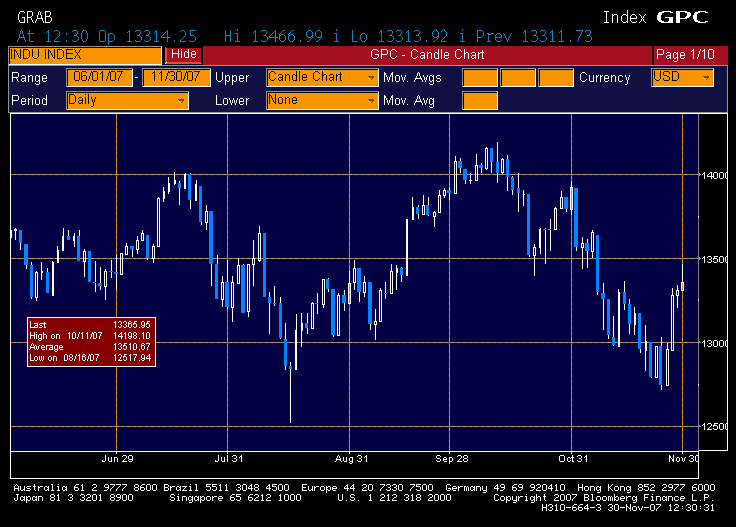
Nov
29
Santa Claus is Coming, from Jim Sogi
November 29, 2007 | 2 Comments
Do you think the 12 percent drop in the market over the last couple of months is enough? The Santa Claus rally is coming to town, I believe. The statistics back me up since normally after these kinds of drops the market tends to be up the next month an average of 46 points 78% of the time. That would be a nice Christmas present and that is what I am asking Santa to bring me for Christmas.
Nov
27
Cold Reading and the Markets, from Jim Sogi
November 27, 2007 | 1 Comment
![Cold Reading [book]](http://www.ianrowland.com/Images/Graphics/Misc/BookCovers/FFCRBk4FullCover.jpg "Cold Reading") In Practical Speculation, Vic and Laurel identified a number of ways of making deceptive non-verifiable predictions, and described techniques for marketing stock prediction abilities and systems. I came across a good supplement to such methods by Ian Rowland in "Full Facts Book of Cold Reading" (2nd edition, 2001). What is "cold reading"? These are techniques used by magicians and palm readers to deceive their victims, much as many market participants are deceived by the same techniques into believing the practitioner has a method to predict the market. I will try to give some market examples applicable to the current situation from top news sources such as Yahoo Financial, CNN and my own repertoire.
In Practical Speculation, Vic and Laurel identified a number of ways of making deceptive non-verifiable predictions, and described techniques for marketing stock prediction abilities and systems. I came across a good supplement to such methods by Ian Rowland in "Full Facts Book of Cold Reading" (2nd edition, 2001). What is "cold reading"? These are techniques used by magicians and palm readers to deceive their victims, much as many market participants are deceived by the same techniques into believing the practitioner has a method to predict the market. I will try to give some market examples applicable to the current situation from top news sources such as Yahoo Financial, CNN and my own repertoire.
1. Rainbow Ruse- Have one trait and, at times, the opposite. "The bad news out of the financial sector will continue to flow, and on the days that it does, the market will take a hit", said Chris Johnson, chief investment officer at Johnson Research. "But select stocks will outperform the rest of the market", he said, "particularly in technology".
"Robert Loest, portfolio manager at Integrity Funds, said that a late December rally could depend on what the Fed does on Dec. 11." CNN
2. Barnum Statements- General statements that fit most people (combine w/ forking). "I think we're going to have a tremendous amount of volatility and basically stay in a trading range until we get information on first-quarter earnings," said Dan Genter, president at RNC Genter Capital Management." Yahoo
3. Fuzzy Fact- General broad statement likely to be right. "An end of the year run is not necessarily off the table," said Art Hogan, chief market analyst at Jefferies & Co. He said that Wall Street still needs to work its way through a lot on the financial side. Yet, the broad selloff of recent weeks may have primed stocks for a bigger bounce back, particularly in the areas of the market that are unaffected by the credit market mess. "But there's no question of volatility," he said. "It's going to be very bumpy through the end of the year." Yahoo
4. Good Chance Guess- ("I see a blue car" or "a house with number 2 in address") I see the number 1450 in your near future. Me
5. Lucky Guess- Make 2, 3 parts. If hit, then wow; if miss, they'll forget. 1400 is going to be a support area, unless it breaks through. Otherwise, so we are likely to see some resistance at the 1450 area and if broken a run at 1500 again and then possibly new highs.
6. Push Statements- State something wrong and keep pushing it! The subprime scare is pushing stocks down and may spill over into the general economy causing recession and global slowdown.
7. Russian Doll- Statement with many possible layers of meaning; keep working till get hit. Market participants were concerned about Wall Street sold off sharply Monday as concerns about a weakening credit market wiped out investors' enthusiasm about strong retails sales over the holiday weekend. For a brief period today, there was a twinge of optimism that the stock market would be able to score back-to-back gains. Reports of stronger than expected retail traffic over the Thanksgiving holiday contributed to that view. However, it wasn't long before concerns about the financial sector (-4.1%) took hold again and knocked the market down to size. Briefing.com
8. Peter Pan/Pollyanna- Tell them what they want to hear. "After years of living happily beyond their means, Americans are finally facing financial reality. A persistent rise in energy prices will mean bigger heating bills this winter and heftier tabs at the gas pump. Job growth is slowing and wage gains have been anemic. House prices are sliding, diminishing the value of the asset that's the biggest factor in Americans' personal wealth. Even the stock market, which has been resilient for so long in the face of eroding consumer sentiment, has begun pulling back amid signs of deep distress in the financial sector." Fortune
9. Certain Predictions- No time frame. The market is very likely to make new all time highs despite the recent sell offs.
10. Likely Predictions Unlikely Predictions- The abandoned baby pattern seen earlier in November was similar to the pattern that preceded the big August sell offs.
Self-fulfilling- "You will make a new start" The market may see new lows before turning higher and cause uncertainty among traders creating risk.
Vague Prediction. "The market is now looking toward 2008 and a slowdown, and I find it hard to believe that we can have a year-end rally," Mendelsohn added.
But hey, there are some reasons why Wall Street might see a typically upbeat December and an end of the year "Santa Claus" rally. (From Cnn Money) (predict both sides, always right if market up or down)
Unverifiable- The pull back to resistance level provided support for the overnight rally. The Asian traders encouraged by strength in the yen decided to bid up the SP in the night market. Me.
Larry Williams adds:
 The biggest part of cold reading is called 'pumping': asking questions that give a clue to the correct answer; it is very effective in allowing someone to think you knew.
Most cold readers rely on a 11 psychological traits from a study done at the University of Michigan, traits we all share, that can be made into specific statements. The cold reader will use the first three on client A, the next three on client B , etc. so they don't hear the same thing.
Here are a few…
There is someone from your past you wish you could talk with again
There are issue with one of your parents (pump comes next, usually boys are with dads) I see a parent with long hair… they reply yes ,my mother (you agree and look very wise) or if they shake their head and the reply is, 'your mother was not the one it was your father.'
my favorite:
growing up there were s-xually awkward times and you still have unsettled areas here.
Word games can be very impressive in the right mouths.
Craig Mee replies:
Thanks Larry… I remember watching a show on this topic many years ago, which opened my insights into these people… and the following day I was an extra on a Gatorade commercial , which went on for hours, at some point I found myself, next to a very attractive young lady, analyzing what could it be that made her sit here at 2am in the morning for some spare cash… (For me no doubt it was to bolster trading capital!)… so I surmised that she must be there for a specific purpose, ie need the extra cash for something special, I then thought OK, lets go with a wedding, and she either needs a new pair of shoes or a new dress. Well at that point I turned to her and said, "who is getting married and what colour are the shoes you are buying!?"… well I struck gold, and she was beside herself… Certainly a great way to start a conversation with the opposite sex as well!
Nov
21
A Gamer’s Market, from Jim Sogi
November 21, 2007 | 1 Comment
![Pac-Man [1980]](http://keepdsmile.com/stuff/pacman/pacman.jpg "Pac-Man [1980]") I am building a new max gaming PC for trading. The Nvidia 680i SLI motherboard has an interesting technology that allows the board to prioritize the bit stream to allow your trading application to have priority for data and execution of commands over other programs such as your charting program or data feed. On days such as Monday when the market moved so fast the execution platform started jumping over a point and windows of execution were short and fast, it became what I'd call a "gamers" market. The data feed and the execution platform are competing for bandwidth and CPU time. R is sucking up some bandwidth as well. Time seemed to be compressed with one weeks worth of moves in a day, a days worth of moves in an hour. It looked like the fast paced online games my son used to play when he was younger. Not that 10 milliseconds will make a big difference in the fat finger, but when you do press the button, you don't want your order lagging. This is a big issue as demonstrated in the online gaming arena where the lags and latencies are displayed, and a slow machine/data has a noticeable lag in pulling the trigger and shooting the opponent and is virtually not competitive. This is so similar to trading that I can't imagine that the lag/latency and computer execution issues are not overlooked. Reminds me of the two guys and the tiger. First guy puts on running shoes. Second guy says, "You can't out run the tiger." Second guy says, "I don't have to, I just have to out run you!"
I am building a new max gaming PC for trading. The Nvidia 680i SLI motherboard has an interesting technology that allows the board to prioritize the bit stream to allow your trading application to have priority for data and execution of commands over other programs such as your charting program or data feed. On days such as Monday when the market moved so fast the execution platform started jumping over a point and windows of execution were short and fast, it became what I'd call a "gamers" market. The data feed and the execution platform are competing for bandwidth and CPU time. R is sucking up some bandwidth as well. Time seemed to be compressed with one weeks worth of moves in a day, a days worth of moves in an hour. It looked like the fast paced online games my son used to play when he was younger. Not that 10 milliseconds will make a big difference in the fat finger, but when you do press the button, you don't want your order lagging. This is a big issue as demonstrated in the online gaming arena where the lags and latencies are displayed, and a slow machine/data has a noticeable lag in pulling the trigger and shooting the opponent and is virtually not competitive. This is so similar to trading that I can't imagine that the lag/latency and computer execution issues are not overlooked. Reminds me of the two guys and the tiger. First guy puts on running shoes. Second guy says, "You can't out run the tiger." Second guy says, "I don't have to, I just have to out run you!"
Nov
16
Siege Mentality, from Jim Sogi
November 16, 2007 | Leave a Comment
 Talk about siege mentality. The market in the recent past has crossed 1450 on 30 days, which seems to be more than random. Tests last time we considered this crossing issue were somewhat problematic. Even on a number of other days when it didn't cross, it acted as a barrier within a quarter point. Even back in 2000 by rough count the market crossed 1450 38 times. Reminds me a little of the criminal trial in which the accused is asked, "how many times have you been convicted?" Answer: "six times, and this time will make seven." With the big up day and the gap up it sure looked like the Schwartz was with us and justified a day off after weeks of 24 hour days, so I went fishing. Though we caught fish, the waves were so big they were washing over the boat! Appropriate, for on return to the screen it seems the storm rages on.
Nov
16
Thursdays, from Victor Niederhoffer
November 16, 2007 | 1 Comment
 Thursdays are always the most exciting days, with the most dodges and feints, and I must take my hat off to the market for a truly impressive reprise of many Thursdays where there was a huge rally after a huge decline, with the reverse this time, to say nothing of going with the corresponding day of last week, four times in a row, as well as the further divergence between the earnings yield and bond yield, and so many other completely irregular activities.
Jay Pasch recalls:
It was a Thursday that marked the August lows with a heroic reversal day (08/16/2007); it was a Thursday (10/11/2007) that the Dow hit its 2001-2004 base breakout measurement of 14200 and it's been a downhill slog ever since…
Jim Sogi adds:
Speaking of Thursdays, next week is Thanksgiving. Marty Zwieg did a study in his old book Winning on Wall Street , counting how often the Friday after Thanksgiving goes up for stocks, with a high percentage of up days when everyone is feeling good. Vic and Laurel expanded the idea that this holiday effect is typical. However one thing recently is that they've been jumping the gun to get ahead of the pack.
Nov
13
Enumeration of Large Up Moves, from Alex Castaldo
November 13, 2007 | 2 Comments
Here are the largest upward point moves in the S&P (cash) index from 1999 up to (and not including) November 13, 2007.
Largest one day point moves since 1999

(up to and not including 11/13/2007)
Rnk       Date Px Last     Chg

1   03/16/2000 1458.47   66.33

2   01/03/2001 1347.56   64.29

3   12/05/2000 1376.54   51.57

4   04/05/2001 1151.44   48.19

5   04/25/2000 1477.44   47.58

6   10/19/2000 1388.76   46.63

7   04/18/2001 1238.16   46.35

8   07/29/2002  898.96   46.12

9   10/28/1999 1342.44   45.73

10  07/24/2002  843.42   45.72

11  04/17/2000 1401.44   44.88

12  05/30/2000 1422.45   44.43

13  10/13/2000 1374.17   44.39

14  09/18/2007 1519.78   43.13

15  04/18/2000 1441.61   40.17

16  10/15/2002  881.27   39.83

17  11/13/2007  1478.6   39.42

18  05/08/2002 1088.85   39.36

19  09/03/1999 1357.24   38.13

20  01/07/2000 1441.47   38.02
Today's rise of 41.87 would be the 15th entry.
Jim Sogi adds:
All of them are from the 1999-2002 period or from 2007. There are none from the low volatility years 2003, 2004, 2005, 2006. The list of big down moves is similar.
Nov
13
Practice, from Victor Niederhoffer
November 13, 2007 | Leave a Comment
 The importance of practice in music can't be overstated. There are hardly any musicians of great competence who took up their study after the teens, and most have been practicing intensively since the age of seven. The problem is that most people hate practice, stop at an early stage, and waste their time when they do this. Michelle Siteman in her magnificent book, "The Pleasure and Perils of Raising Young Musicians " has a chapter "Practice Makes Perfect " in which she gives 10 techniques for improving the quality and quantity of such practice.I have received completely positive feedback from musicians who have read this book that the techniques she suggests are ingenious and useful. I believe the have universal value, and I will try to apply the lessons from Ms. Siteman's chapter to improve the practice of trading with a few of my own practice techniques from racket sports thrown in. This is a subject that has received much too little attention as practice makes more perfect in every field including our own, And this would apply to any trader despite his natural proclivities and abilities. It is common to think that a quality for greatness in a field is to love to practice it. But Vladimir Horowitz, Glen Gould and many other musicians, including Beethoven, hated practice when they were young, but they were able to conquer their aversion, usually with the aid of a firm parent who applied some of these techniques. Presumably the head of a trading team should insist on practice regardless of the qualms or machismo of some of those whose recent track record is good, or believe they were to the manor born. Emulate Pablo Casals and Yehudi Menuhin, who practiced eight hours a day, every day of their lives.
It's not enough to say: practice trading. Most people don't know how to do it. And most are bored while practicing so there has to be something that makes it interesting. Musicians handle this by mixing in some easy beautiful pieces with the scales, finger exercises and and arpeggios.
1. Group activity. One universal technique for making practice more interesting is to make it part of a group activity. Somehow those who play instruments in orchestras stick with their instruments to a much greater extent than piano, and this is why many impartial observers suggest that orchestral instruments are better for a child to play than piano, because they stick with it. Practice sessions for traders should be in groups.
2. Money rewards. And what follows from this is that monetary rewards are a great motivator for musicians to practice. Some parents make their kids pay part of their lessons with their allowance money. This has a very salubrious impact on the efficacy of practice. Group trading practice should have monetary rewards. It's amazing how many of us will stoop down to pick up a $5 bill.
3. Record keeping. Record keeping is an important part of a good practice session. A systematic account of what has been learned and what the goals are is always helpful as a foundation. It's also helpful to be able to review the mistakes and winning forays that went into a successful trade.
4. Parental presence. All musicians find it boring to practice alone. Having a parent around to observe reduces boredom. If it's important enough for the parent to insist the child do it, then it's also important enough for a parent to take an interest. The same would apply to a trading manager, who all too often leaves the trading practice to the subordinates without taking an interest in it.
5. Proper logistics. Practice should be at a certain time, and a certain place and there should be good lighting. That way there's no chance that a session can be missed because of a conflict in schedule that arose because the child or trader didnt know that it was scheduled for that day and time. A proper environment without sibling or other traders squawking that they are hungry also improves results.
6. Consistency. Practice every day is essential. The markets are always changing, and after a day or two all the skills begin to detiorate. I once practiced squash every day, 365 days a year, for 10 years. A trader should practice trading each day, or if a hiatus ensues, should practice steadily for a number of days before entering into the fray.
7. Read books about the techniques that other great musicians used to improve their techniques. What worked for them probably would put you on a path that has at least been tested. Eschew the techniques of traders that were not successful, for example the boy trader.
I would be interested in ideas readers have on improving the training and practice of traders.
Larry Williams adds:
I have always thought mastery is a largely the function of repetition.
Obviously you have to repeat the right things. Today's great home run hitters all have instant access in the dugout to videos of their last time at bat to review and repeat the right techniques and stop the wrong. Many scoff at paper trading — sure, it is not as emotional, but still provides valuable lessons.
Chris Ledoux won the world bareback riding championship with very few rides in actual rodeos. He was so banged up he practised on a bucking machine (also wrote a good song about it) to prevent further injury and shocked all the bettors who had never heard of him as he accomplished his gold belt-buckle dreams.
Jim Sogi suggests:
 My Karate teacher said, "What is the best practice and training for fighting? Fighting. You can run all day, you can do 1000 sit ups, 1000 push ups, 1000 sprints, and 1000 punches. But the best practice is fighting with an opponent. "My father once said, " The only difference between a small case and a large case is the number of zeros behind the 1."
You can read 1000 books about trading, study data for hours, but the best practice for trading is trading. Even if you do small size, which is best for practice, it keeps your wits sharp and emotions tough and keeps you in the game.
Keep a place set aside for only trading, always ready to go, 24 hours a day without having to clean up, scoot others away. Same with music practice. Have a set aside place or room for music with all the instruments just ready to walk in and pick up and play, even for 10 minutes before dinner. Pretty soon it becomes a habit.
Allen Gillespie takes it further:
Scales and etudes and pieces played with different bowings, speed, rhythm, etc. Breaking down a passage into shorter component parts. For example, if there is a long passage of quickly played 16th notes, first practice with separate bows for each note, then two on a bow, then three, etc. then change the rhythms from just 16ths notes, then just play the key notes from the scale so the ear hears where the passage is headed as many of the notes are fillers, understand and anticipate the pattern. Learn to play by ear. Finally, Always Play/Practice Musically (i.e. even when practicing the notes do not forget to include the crescendos, etc.)
For the trader,
1) Imagine as many scenarios as possible.
2) The distance between lows or highs or between lows and highs might give an indication as to the key
3) Some notes/days are more important than others
4) Trade smaller during times of practice
5) Test different combinations of variables - first separately then two, etc.
6) Despite all the practice, sometimes the best performances are not straight from the page
7) Finally, trading is an emotional game, so play with passion and remember there is always a low note and a high note and many notes in between.
Sam Marx reminisces:
Practice is important and in my sport in high school I practiced quite a bit but always felt that I had a limit because of physical limitations. I was 6 ft. tall but my hands were below average for my size. I couldn't get a good grip on a football or palm a basketball.
Once I was seated at a dinner table next to Bart Starr, former Green Bay QB. That man had huge hands. I have no doubt that enabled him to better control the football and made him a star. Another time I was in close proximity to Gil Hodges and I noticed that he also had huge hands. I believe he was a first baseman. I could just picture him with an oversize glove catching balls or scooping up grounders that would be missed by the average infielder.
A friend of mine was an excellent boxer. His arms were extremely long, also, his head was smaller than it should be for his size. He could just move around his opponent and jab him silly while keeping his head tucked behind his shoulders. Standing up with his arms dangling on his side I thought he looked like a chimpanzee. He had no desire to become a professional boxer but I've seen professionals in the ring with those characteristics. Kid Gavilan comes to mind.
On the options trading floor I noticed that some traders could hear trades from across the pit. Their hearing was acute.
Practice is important, but don't dismiss physical and mental ability, especially abilities in the 3 plus sigma range.
Don't tell your kid that he can accomplish anything if he practices enough. Offer this advice only when justified. Tell him he can greatly improve with practice but don't offer false hope of attaining the impossible. It can be frustrating if you're not in the 3 plus sigma range in the field you're practicing in.
Nigel Davies recalls:
David Bronstein once advised me to prepare for tournaments by studying chess at the exact times the games were scheduled. And I understand that Vladimir Kramnik took this concept one stage further by solving endgame studies (particularly demanding work) during the last hour of such studies. The last hour of a playing session is known to be the most critical, with most games being won or lost at this time. And it does seem that he got the better of Veselin Topalov at this point in the games.
Easan Katir mentions:
I spent one recent Saturday evening at the Hat and Hare Pub in the basement of the Magic Castle, with two accomplished card men, Aaron Fisher and Tony Picasso, discussing their art. Aaron instructed, "to improve, perform at any opportunity, for anyone." The club was full. He said, "C'mon, let's find you some people." So he rounded up a spontaneous audience comprised of three giggly young things, and gave this amateur the opportunity to perform modestly baffling illusions.
Live performing, live trading. No solo practice or paper trading like it. Mind sharp. Managing audience expectations, unexpected reactions and distractions. The joy of good execution. The thrill of conquest. The glow of accomplishment.
Much theoretical study, counting and practicing correctly precedes such moments. For trading I suppose the advice "perform at any opportunity" could be ambiguous enough to become a way to diminish one's capital, unless one adheres to tested guidelines for what constitutes an 'opportunity'. It works for me to transfer these skills to trading.
Evan McKeown writes:
 Practice is such an important topic. I have always believed that if you do what you love, and love what you do, then success will eventually come your way. Success itself means different things to different people.
I am a 5.0 tennis player, and love playing tennis. No matter how much I played, or practiced, I never was able to reach a level much higher. Notwithstanding my dedication or love for the game, I have enjoyed other success by meeting wonderful people that share my enthusiasm and we enjoy our weekly matches. John McEnroe once said he hated to practice, so, instead, he played in doubles tournaments. John had one of the best net games in tennis which is unusual today thanks to his devotion to being a doubles player as a substitute for practice.
I am a trader. Once again, I love what I do. Trading is not a job, it is a way of life, my passion. I trade every day, and practice every day. Practice for me, comes in many different forms. Just as in tennis, there is on the court, and off the court practice time. Off the court (or ticker screen) I stimulate my mind with financial literature. The best book I ever read, and the only book I ever read for a second time, is "The Education of a Speculator." This work of art should be required reading for any college finance class. Long before this book made me any money, it first saved me thousands. Years ago, when a perfect storm of events had collapsed my portfolio and nearly had me on the verge of ruin, I sent an email to Vic and Laurel for some word of encouragement after the market had crashed through a 200 day moving average, financial condition in the market that is not unlike the one we see today.
To my amazement, Vic and Laurel wrote me back with a few simple words that inspired confidence. Not so much advice, as it was knowledge on how to handle adversity. I not only made back the 50% that my portfolio had declined, I ended the year with a 27% gain. That email changed my life forever. Instead of placing a sell order and taking a loss of half my assets, I took the pearls of wisdom and made the most of the opportunity.
Thank you Vic and Laurel, for sharing your knowledge and experience of the markets, for being an inspiration for common everyday traders such as myself, and for taking a few moments and write such an inspiring email that changed my life forever!
Pitt Maner III says:
Many years ago I went for 3 days of tennis lessons at Nick Bollettieri's in Brandenton, Florida. An evaluation was done of each player's ability and then we were separated into groups and sent out to practice for about 5 hours each day (with a lunch break at mid-day to watch films of Agassi playing). Thank God it was not in the dead of summer, but at 80 or so degrees it was still quite brutal for moderately trained weekend warriors.
One of my teachers was a former Rhodesian paratrooper named Ian who picked up very quickly on my poor footwork (even for a 3.5 or 4.0 player) and tendency to "float" or not properly set my right foot when hitting a backhand. The school also emphasized the need to follow through on strokes and to keep hitting the ball deep and allowing for sufficient height of trajectory over the net. In other words give yourself a margin of error and don't try to hit winners all the time from the baseline–play it a bit safe and wear your opponent down.
The tendency of beginning tennis players love to hit winners even at the expense of hitting several poor shots and losing games was discussed. Players were taught to recognize the importance of swing points (ie. 40-30 or deuce or 30 all) and to be more aggressive at 40-0 or 40-15. At the pro level students were shown film of Agassi running Lendl and not finishing off points right away if Andre could get Lendl to "lunge" one more time and thus exert more energy. Tennis warfare by attrition.
Tennis at the highest levels was indeed a different game then what I imagined or had gathered from watching Borg and Conners on TV or reading about in Tennis magazine.
On the adjacent court one could watch the 10 year old Anna Kournikova practice with her coaches under the vigilant eyes of her Russian mother. The tennis school had a quite rigorous schedule for the kids–lots of running in the morning, tutoring–school, weightlifting, and hours and hours of hitting tennis balls. At the time Anna said she loved to play tennis and did not mind the practice. We watched as she played practice games in the afternoon against boys her age or slightly older.
At the end of 3 days my toenails were breaking off from my swollen feet (note to file–never come to a tennis camp with new tennis shoes!) I had experienced my first and only time with tachycardia after running side to side "suicides" on the court. My game had been broken down and I was now playing like a sorry 3.0 player and not able to incorporate or integrate all the intensive things that had been taught. There was a German banker who said he worked 60-70 hours a week at home and came to the camp for "relaxation"–masochism at its finest!
But the lessons were learned and not forgotten and months later my tennis game improved and my appreciation for the game greatly expanded.
Steve Scoles makes another point:
An important requirement of successful practice is getting proper feedback in a timely manner — touching a hot stove teaches you pretty quickly not to do it again. Markets, because of their probabilistic nature, are really horrible at given this kind of feedback. In investing and risk management, the short-term outcomes are often unrelated to the quality of your decisions and it may even take years to be proven "right" or "wrong". I don't think this is a new idea to the world of trading, but I have always found playing poker to be a good way of practicing dealing with the probabilistic nature of markets.
Poker has several similarities with investing with some key ones being:
- imperfect information
- probabilistic outcomes
- emotional involvement is in play as money is on the line and your failures and successes can be monitored & commented on by the other players.
The advantage of poker over the markets is that the decision-outcome relationship is usually more analytically simple to learn from and thus the feedback loop is a lot better than what you get from the markets.
Three things that I have found poker helps you develop that can be carried over to the markets are:
1) to learn and internalize how gains and losses are really probabilistic outcomes rather than successes or failures;
2) to improve your ability to evaluate decisions on a basis other than the outcome;
3) to improve your ability to maintain emotional stability through the various ups and downs.
Jim Sogi makes his second remark:
In Japan the Sumo wrestlers live a strict regimen of diet and training. They avoid emotional upset that might affect their appetite. This is like trading. It has to be approached as a competitive sport. Physical training, proper sleep, good food, avoiding drugs and alcohol are necessary during the trading week to be in top shape when in the fray. If something upsets me or I fall out of training, the trading can be affected.
Alan Millhone follows up:
I will speculate that the Sumo's do not watch much TV nor hear any negative news while in training ? Mental discipline in Sumo, trading, board games,etc. is critical. When I attend any Checker tournament I get my rest, eat properly, no TV when on the road. Mr. Sogi is correct that being upset is a big deterrent to functioning properly in any endeavor. Staying focused is Job # 1 and critical to proper performance. The avoidance of drugs and alcohol holds true in any event we pursue.
Nov
12
Vista 64? a query from Jim Sogi
November 12, 2007 | 5 Comments
 I'm getting an Intel Core Q6666 and 2Gig RAM. Should I get Vista Ultimate 64bit version? Or just the 32bit Business version? This is for heavy number crunching and trading.
Tony Corso explains:
Unless you have a 64bit application [or you're writing you own code with a 64bit compiler] a 64bit OS won't buy you much of anything. And 64bit Vista has far fewer hardware drivers than the 32bit version. In fact, if you are using purchased software, you might find it runs faster under XP-Pro than under Vista.
As to the processor, there is a relatively cheap 2.6GHZ Quad Core Intel chip [about $275 on NewEgg; the 2.8GHz 'extreme' Intel Quad Core is more than twice as expensive]. Get one of those, and get 4Gig of RAM [make sure your motherboard can see it].
Multiple cores won't do much for you if the software isn't designed to use 'em. At the OS level, Vista automatically assigns my Firefox browser and Excel spreadsheet to different cores, and at the application level Excel2007 'auto-magically' multithreads cell recalculations across multiple cores.
And when considering motherboards, the more recent Intel motherboards have hardware RAID controllers built in [data spread amongst Redundant Array of Inexpensive Drives so if any one drive fails your machine doesn't care and your data are safe].
You might want to consider chaining four drives to that controller so that you won't be gnashing your teeth when you get the inevitable middle of the trading day hard drive hiccup.
Matthew Chlapowski adds:
I was investigating the same problem just a few days ago. To answer your question, 64bit Windows Vista is unlikely to offer you any performance improvement with just 2Gig of RAM. You would have to invest in hardware with at least twice that much RAM, if not four times, to see any improvement. Eventually systems will come with that much memory, but there is little software out there that takes advantage of the added power of such a setup, and few motherboards support it. I would just stick with the Business 32bit version right now, and maybe think about upgrading in a couple of years. That is, unless you are willing to pay top dollar for a system that supports at least 8Gig of RAM , and for the software designed to use it.
Definitely do get an Intel quad-core processor like the Q6600 for number crunching. I've seen benchmarks on those processors and they absolutely smoke anything else available. Benchmarks with Fritz 10 Chess (one of the most intensive number crunching applications on the market) showed Intel quad core processors completing calculations at nearly twice the speed of any other processor you can buy. Don't even think about getting anything else.
Naturally, newer and better things are always in the pipeline, but you have to pull the trigger and buy sometime!
Nov
10
Return of the Day Traders, from Jim Sogi
November 10, 2007 | 2 Comments
 Like the Jedi, the Day Traders have returned. Having all but become extinct in the low vol OIF [Operation Iraqi Freedom] bull market, the surviving Day Traders now enjoy multiple 2% intraday swings, 1% gaps and 2% per hour moves. Its like the good old days at the turn of the twentieth century when even beginner traders could follow intraday momentum and make bank. There's a definite shift in the market ecosystem favoring the fast movers. You really haven't heard much day trader talk at cocktail parties either. No one really seems to want to talk stocks anymore. That's a good sign.
The theory of evolution and theories of geological and climactic change seem to model slow moving change. But the reality is that evolution and climactic changes occur much more rapidly and with more abruptness than might seem due to the correlation effect in complex systems. When many inter-related nodes, previously uncorrelated, become correlated, whether due to stress or merely, as Alston Mabry pointed out, due to increased variance, there can be a massive and rapid shift in the system which would not be expected under a linear model. Evolution sees large regimes of mass extinction. Climate changes, ice ages, occur much more rapidly than thought.
The same might be true in financial markets. The assumption of continuity of prices itself is breaking down with the large regular gaps. The increased variance increases correlation, as pointed out in the discussions of currencies, equities, bonds, and global economics in an as yet to be quantified manner. Prior data histories provide limited guidance with numbers crossing into new territories. Rather than seeing separate exchanges and markets in different countries might the new paradigm be one big global interrelated market? What new relationships might be uncovered there? So much data, so little time.
James Lackey writes:
Before daytraders come here and start telling us that all we need to do is buy the Nazz limit-down or wait for 2pm every day to buy, let me remind you we had this bashing in 2001. I was disassembled in 9 months. It took meeting Vic and Laurel over a year later to get me profitable. For this I am grateful.
I would like to point out that there are daytraders reading this site. There are guys who have profited all these years. These men are one in a million. To have the temperament, the financial backing and years of not profiting to learn how to trade this way is too much for the others to learn. Two nights this week I was up at 1am and traded all day..
Ken Smith adds:
During the daytrading mania, reporters from the television show 60 Minutes interviewed daytraders, and to show contrast and to demonstrate how little guys get smoked, interviewed the head trader at a major firm, I think it was Goldman. The head trader sat down at his screen saying "If you stay at your screen you will lose" and promptly put in a large order to buy on a stock headed down. Immediately ten thousand daytraders had to cover their shorts. He then sold his inventory as daytraders climbed aboard. The next trade he made jerked thousands of daytraders around to sell what they had just bought.The Big Players can place a billion dollar order, a 5-billion dollar order. Daytraders were playing around with their parents' mortgage money — and lost it.
Guys like Lackey used to make 200 trades a day, taking quarter points, even less. That's a lot of work and one mistake wipes out the profits from 200 wins — sometimes. Trader has to begin life all over.
Traders with a niche, Vic and Laurel for instance, are not trading by the minute, I suspect. On the other hand, traders can mix up their activity according to the analyisis of 24 symbols on their screen. I really can't say much on this — nothing worked for me for very long, in the short term bull ring.
Bo Keely worked in the Vic and Laurel trading room off and on, whenever they could get him out of the closet he lived in under the stairs at the mansion. Keely told me once, "Money is made slowly, lost fast."
Kim Zussman recently pointed out a similar strategy. Bought on August 16 and held — didn't say when he made his exit, but I have confidence it was a profitable one. Buy and hold, that's the ticket. The secret of that trade is not the buying, it is how long to hold. Not to buy and hold forever, but to hold, like you hold an amorous relationship until it wears thin.
Nov
9
A Million Deceptions, from Victor Niederhoffer
November 9, 2007 | 6 Comments
You have to admire the extraordinary duplicity of the market mistress on all days. Take today, Thursday, November 8th, for example. Last Thursday was down 40 so this one started out by going down 40 as of 2 pm. Yesterday was down 20 in afternoon, then today up 20 in afternoon. S&P always follows Dax — except this time: S&P futures down six but Dax up 70. The Naz down 3.5% while S&P unchanged. S&P itself unchanged but S&P futures down six. The open Wednesday down 20 but today's up five. The Dow hit the 13000s but ended at 13266. Bonds and Bunds the opposite of the previous day. Google which never goes down below the round number, down $40 on the day. Everything was like Thursday August 16, the day before the Fed change of direction, except that one after going up its 40, closed up 10 on day, whereas this one after going up its 40 ended down on day. Many other levels of deception also for those who observe - e.g. what happened at 2:59 EST to turn the market by 3% a in half hour?
Jim Sogi adds:
The recent moves are hard to understand as well since they are going off the charts so to speak in terms of magnitude of the moves with few recent historical precedents.
It is also interesting how the foreign markets seem to be rambling into ours late at night. It is a small world after all.
Nov
7
Growing Gaps, from Jim Sogi
November 7, 2007 | 2 Comments
Gaps are growing in this new high vol regime we are in now. Today's 17 point gap down, and 16 points a few days ago are a good measurement of fear and a sign that things are getting wacky with dollar dropping to mid round, crude headed for big round. I don't know what it means but the numbers are eyepopping. I'm sure the day traders love it.
Mean down/up gap last x days

Days 200     100    60   40     5
Dn  -3.7   -4.86  -5.7   -7   -10.5
Up   3.8    4.80   5.7    7.1   7.5
The recent median .75 is less than the mean .26 as reflected in the stem plot displaying the negative skew as a symptom of fear.
-24 | 8
-22 |
-20 |
-18 |
-16 | 763
-14 | 300
-12 | 8
-10 | 72
-8 | 222287620
-6 | 9521096432220
-4 | 7655333218765433
-2 | 9887752277654321
-0 | 888776655544333210009988875555532221

000 | 000011111111111111111112222222222222333333333333334444
000 | 55555555666666667777777778888889
001 | 00000001224
001 | 58
002 |
002 |
003 | 4
The decimal point is at the | for down gaps. The decimal point is 1 digit(s) to the right of the | for up gaps
Nov
6
Surf Adventure, from Jim Sogi
November 6, 2007 | 1 Comment
This weekend we ventured up north into the wilderness for surf and fish. We have been watching the weather, waves, and wind for over two months waiting for the right conditions when the winds are not blasting at 35 knots and when there are no huge northwest swells to close out the entire coast.
I've been surfing and fishing with my best friend for twenty-five years. We hunt big waves and big game fish. He put together the ultimate hardcore surf adventure boat, a Radon with a turbo diesel, Hawaiian cab, with shade, surfboard rack on the back, loaded with an all-out fishing arsenal. It can handle conditions that many other vessels cannot handle, and much better than the 62 foot Hatteras we took up there last year. The Alinuihaha Channel is where world explorer and navigator Captain James Cook came to grief, getting dismasted in the rough conditions. Up north there are no roads, no cell phone coverage, no other boats. There the huge rollers and winds squeeze between the islands, creating a ruckus.

As predicted, the wind was glassy and light, and there was a moderate swell running at about eight feet. We fished on the way to our secret surf spot, and there was plenty of action with birds feeding and pointing out the where the bait was, and where the bigger predators fed. We arrived just before high tide which is the prime time for fishing as the bait and fish rise to the surface to feed as the tide comes up. We went to where the birds gathered on the water where they are feeding on smaller bait and got a number of strikes. After losing one fish that was jumping out of the water in a long fight we hooked up a big one that fought for 40 minutes. Finally just before landing it we saw something even bigger following it, and then it just skimmed in. A big shark had bitten off the last four feet of the fish, leaving only about two feet behind the head. The ono must have been over 50 pounds. It goes to show that we are not at the top of the food chain out there. We were glad to pay the taxes to the tax man in the grey suit because soon we were going to go in the water to surf, and its better that they are fed first and not hungry.
At the surf spot, initially the waves looked small, but were slowly rising from a different direction so it is often deceiving. The rides kept going and going traveling for hundreds of yards along a cliff into the beach. There was the fragrance of flowers from plants growing on the 1000 foot cliff that rose straight out of the water. The waterfall sprayed the inside part of the break near the beach. The mountains and cliffs faded away into the mists and clouds like a lost continent in a fantasy land.
After surfing for hours, we headed back at high speed, surfing down the face of the large swells in the boat. Just as it was getting dark, we dropped off the boys and they jumped overboard into the rough water and paddled in on their boards through the rocks to the end of the road to catch a ride home. They are tough kids. We decided to stay out overnight since we had only landed half a fish. We stayed in a nearby bay and had the fish we caught for dinner on board.
We arrived back out near Kamehameha's Heiau (temple) before dawn. Soon we were skimming the increasing northerly swells right along side the birds searching for fish. After a couple hours we hooked up and landed a 50+ pound mahi-mahi. It is a truly beautiful fish that flashes many iridescent colors as it is fighting in the water and jumps up in the air. It's a delicious fish especially when cooked in the mayonnaise/panko recipe previously posted. We headed back after a great weekend trip. No life and death this time, except for the fish.
All around perfect timing for the wind, the swell and fish. As with markets, it's good to have the patience, the data on the conditions at various locations, and the knowledge and equipment to wait for the right time to enter. The ability to handle the conditions allow the rewards for the few that can handle those conditions. There are so many elements in nature out there that are out of your control and a large element of randomness in fishing and surfing. It is important to find the most favorable conditions to engage.
Today a very unusual south swell from an out-of-season southern cyclone is kicking up 10 foot plus waves here. Normally by November the swells come from the northern storms in Russia and Alaska. Things seem out of kilter in nature and the markets. We seem to have entered a new regime here after the last few years of low vol. Today's vol was startling with a 16. Just like the good old days.
Nov
2
Indirect Strategy, from Jim Sogi
November 2, 2007 | 1 Comment
 Liddell Hart, in his book Strategy (mentioned by Vic previously) maintains that many good military strategies are indirect. Commanders did not want to risk high casualties in a face to face direct confrontation with a massive force. Indirect methods include harrying attacks along a stretched flank, hit and run, quick parrying thrusts, probing actions, attacks on the supply routes, feint and pullback, and utilizing the terrain to the smaller force's advantage. The feint and pullback was a favorite of the Mongols who led the cumbersome slow-moving Teutonic knights as the Mongols pulled back, leading the pursuing knights into a deadly cul de sac, surrounding and then attacking their rear and flank. These methods led to division of the army into smaller units over time. In this manner the psychological turning of the enemy can be accomplished rather than through its annihilation at less cost.
In Friday's market a direct confrontation with armies of Goldman and the weakened armies of the the other biggies lobbing the 1000 lot bombs might risk high casualties. As an analogy to a military campaign, a trading campaign might use indirect methods to lessen its risk. Attacking the rear would be engaging after the larger force has turned. Utilizing terrain might utilize the area of the 1500th meridian as a defending terrain. Parrying thrusts would allow a small unit to make quick hits and then pull back without risking a full engagement that might wipe the smaller unit out.
 Another danger a large fast moving army faces is stretching its supply line and exposing a flank making it vulnerable to flanking moves. Today we see some big 2% point moves stretching the opposing lines as they directly attack the 1500th meridian line. Beyond that they seemed to be weakened and extended and pulled back rapidly.
Another problem an invading army faces is supply. It cannot stay and besiege for long for its psychological momentum fades as does its ability to live off the surrounding countryside. It appears that the invaders are having trouble psychologically besieging the 1500 line and have pulled back quite rapidly after stretching its supply lines quite badly. Their numerical advantage is quite low today and is diminishing.
These factors favor the high tech fast moving smaller guerrilla force who can operate day and night in all conditions. Looking at the numbers in depth below 3000 only a few elite troops are engaging today in high tech battle. The fog of war applies to trading.
Oct
30
Abandoned Baby, from Jim Sogi
October 30, 2007 | Leave a Comment
Abandoned Baby: A rare reversal pattern characterized by a gap followed by a Doji, which is then followed by another gap in the opposite direction. The shadows on the Doji must completely gap below or above the shadows of the first and third day.
A tested bearish candlestick pattern, Abandoned Baby , completed today, close to what was described by Steve Nison in his Candlestick Course book. Recall the last occurrence preceded the big July market drop. Prior historical occurrences tended to be bearish over next day or so. Hard to tell with the FOMC tomorrow though. We'll see what happens. My son pointed this one out to me.
Oct
21
Oversold, from Paolo Pezzutti
October 21, 2007 | Leave a Comment
Suppose you bought any Friday where the stochastic indicator was oversold at the close. What is the percentage of winning trades, placing a sell limit order of c+x points for Monday? I checked in the past 10 years all the situations. If the order is not filled, you exit at Monday's close.
3 points 96%
5 points 86%
7 points 80%
9 points 70%
11 points 65%
15 points 63%
Larry Williams explains:
the problem is such an approach has massive equity drawdowns and small average profits per trade. The losses, when they come, are much bigger than the gains. Accuracy alone does not make for a good system or trader. Risk/reward trumps accuracy every time. Eventually large losses devour strings of wining trades.
To evaluate such an approach, look at the equity curve; not just the numbers.
Jim Sogi adds:
The equity curve Larry talks about is a thing of beauty. We all know what happened after 1987 as well. The survivors prospered. If you want to argue sample, only time will tell. History unfolds in mysterious ways and you can never know the future. If you always look at 1987, you'll never trade. One way to avoid annihilation in addition to money management is to stay nimble in addition to having deep pockets. Wall Street has deeper pockets than you.
Phil McDonnell writes:
 As an augmentation, the following discussion of the features of a normally distribued random walk with absorbing upside barriers should prove helpful. Naturally as traders this simply means using the theoretical distribution with an upside profit target.
Using a profit target will:
1. Double the probability of being at or above that target at the end of a fixed period of time.
2. Have no impact on your expected gain or loss.
3. Reduce your variance and standard deviation
4. Result in larger losses than gains
This result derives from the fact that the normal distribution is symmetric and self-similar. Thus it obeys a property called the Reflection Principle. Each price path has an equal and opposite mirror image. Each price point reached has a distribution of points past it and an equal and opposite distribution of points which were 'reflected back'. Elementery proofs for the analogous case of stops, using nothing more than high school algebra, are given in my book Optimal Portfolio Modeling.
It should be emphasized that this is the theoretical model. To the extent that one can find empirical evidence that the market does not conform to this, there may be something tradeable. But just because you can manipulate your distribution to double the probability of a winning trade does not mean that the average winnings will be any better My Motto: You need an edge — never let your money leave home without it.
Oct
17
Complex Systems, from James Sogi
October 17, 2007 | 2 Comments
A recent trip to Los Angeles provided a virtual laboratory for the complex mechanisms of crowds and groups and game theory with many lessons for the market researcher.
Part 1 ( of 4)
The congestion on the freeways in Southern California is a prime example of a congested complex system. When crowds of cars enter the freeway's limited space, the traffic slows and creeps forward, and sometimes almost stops. Unlike the freeways, the markets have no red lights on the on ramps to regulate new participants crowding into the order queues at new market highs. The number of orders is very high with billions of dollars on each side, so the price has no ability to move, and the price effect is a grinding creep, just like a congested freeway. Since the public and big buyers are there to buy the new highs and the great conditions reported by the news, the only way to get filled will be to take the offers. One can bid all day on a trend day and not get a fill. Micro structural theory says with 1 offer and bid, a market order will move the price up, and that is what we see in aggregation. A slow creeping up, up, up at market highs, often displaying trends up with little or no volatility and no pullbacks. No one can cut through the large orders to move the market. This condition appears at market highs, and is the opposite of the bottoms where there is little congestion and the price moves up and down, creating volatility. At tops. bears flash huge offers to try scare off the bull, but its really a slow speed stampede and nothing stops the grinding upward except for a change in sentiment which usually is quite close at these points.
Part 2 (of 4)
At the USC Trojans game this weekend one of the rules in football is that if your team makes 10 yards, they get another 4 downs, which gives your team another chance, and provides momentum. This rule is at the heart of the strategy for the game. In the markets a similar rule applies. The question is to figure out what the rule is as it changes from time to time without warning and no one tells you until after the fact how many points are needed for a first down. Say the market moves up or down big in a short play, like say the Fed move up last month or the 20 point down afternoon last week, or this afternoon's recovery for that matter. A big advance gives the players another 4 downs (4 days?) to try make some more new ground and generate some momentum. Like the Trojans this weekend, the last three years have not been very successful on capitalizing or getting their first downs, but there is some talk among the old hands that old things that haven't worked for years may see their cycle in the sun again. The line of scrimmage is often yesterday's close, but can be other yard lines as well, prior highs, prior swings, yesterday's hi/low. Today we close near the line of scrimmage. As in football as in the snap, every play in the market seems to begin with a short retreat back into your own territory. Unless one fumbles, or screws up and gets downed behind the line of scrimmage, the idea is to make forward progress. 10 yards, 10 points seems like a good rule for a first down in normal circumstances. This afternoon recovery qualifies our team for a first down.
At the USC Trojans game over 200,000 people there all were wearing Trojan Crimson colors, hats, shirts, jackets, painted bodies, painted faces. I mean all of them. It was kind of scary. I asked a friend if someone told them to wear those colors. No, there is no rule or any rule requiring this attire. It was a remarkable example of herding behavior of crowds. We saw the stampede action today in the market as well. Stampede up gap, stampede down, stampede back, close to place of start, like buffalo. fish and elephants. Many lessons can be learned about crowds, herds, and stampedes to be used in market operations.
Part 3 ( of 4)
The Getty museum was one of the most impressive art museums anywhere in the world, not necessarily because of its collection, but the presentation, the architecture, the location. The third level of the West Wing overlooking LA is the a truely memorable and impressive view not to be missed on a clear day. In the collection is a set of medieval illuminated music manuscripts. The old style notation is not the fixed note per note that we use now, but rather a notation showing the relative moves, up or down of the notes. This provided a reminder to musicians who knew all the tunes already anyway. This might provide a good market notation system to catalog the various ups and downs that make up the regular tunes the markets seems to play. Just as history does not repeat itself, it rhymes, the market does not repeat it self, but it does harmonize, engage in contrapuntal variations on well known themes. The rhythms often stay the same and are more limited than the melodies. The rhythm of markets can be as important as the melodies. Oddly European music has no true rhythm nor is it notated in standard notation even today. There is only a cryptic mention of "march", "shuffle" or "lively beat", "andante" or some unquantified mumbo. The time signature gives only a vague hint of the rhythm. A good musician knows all the rhythms and changes. A trader should also, but unlike common TA patterns, there is no language or model for market rhythms. At Disneyland riding the train, there was a Morse code being tapped out. Even Alan Greenspan learned the Morse Code as a kid for fun. That is a good example of coding various simple rhythms with specific patterns to meaning. The same type of code ought and could be used in the market classification.
Part 4 (of 4)
An interesting lesson from LA is their peculiar measure of distance. When you ask them, "How far is the coliseum ?" They invariably answer, "About … minutes away", a measure of time not distance. At dinner, an astute market expert asked, what other x axes are possible other than linear time? A suggestion might be to use percentage or point change, rather than linear time. An obvious measure is ticks or other micro structural market time. The important measure of a trade really is the return not how long the trade lasts. 1% is a great trade in a day, but not for a year. The Y axis becomes fixed and linear and time is unstated. This is the opposite of linear time chart in which return is unstated. Interesting relationships might be uncovered. For example exponential moves in linear time become linear in ticks or return.
Related to time to destination is speed. Unlike time, speed is variable. Everyone in LA drives 80-90 mph plus. Driving at 60-70, everyone is passing you by. I am used to driving about 25. If the speed increases, say to 100 or 120 plus, you get places twice as fast, but the risk of crashing increases. Skill matters, but what about the other idiots on the road, or road and weather hazards, or the tunnel up ahead with a blind curve hiding the tractor trailer around the bend, and the three tractor trailers right behind you, defects in the roads, and other drivers that limit speed. It happened while I was there: a 15 trailer pile up in a tunnel.
That brings up the issue; is there a speed limit in the market for safe driving? Drive at high gear and make great returns, but what is the best speed, ie annual return, one can drive year after year without any accidents, and still get to the destination. The optimal speed should be able to be calculated. One experienced practitioner and theorist thought that 20% is a consistent speed to keep up year after year. That sound right to me. Much faster and accidents become more likely. How can this be quantified? Optimal f and Seattle Phil's formulas claim to measure this, but Moe's point that it is necessary to look at a full history and see the systemic risks as a measure too. The normal distribution assumes safe roads and that people obey the law. There are systemic risks and risks from other market participants tendency to herd, stampede and panic, or to drive too fast or drink,take stimulants, drive too long which lead to big pile ups. Or the Fed to raise the speed limit to 100 mph. Of course driving to slow is no good either.
The time in market is relevant as well. Sharpe measures, risk/drawdown measures, Sortino and the like measure these. Measures of speed and risk must change over time rather than be fixed. That is probably the real challenge. A fixed limit which results from looking at the entire history will either hold one back, or contribute to excessive risk depending on the market. Alex's comments Friday are an example of this problem. One will never trade if tomorrow is going to be Black Monday. Just as one changes speed for the road conditions, how does one quantify changing speed in the markets. How do you know there are hidden curves ahead, road hazards and if tomorrow is Black Monday? One suggestion is looking for anomalies like 9/18 and C-C-C start to appear. Chris suggested a few others. When the market creeps up in low and up 8-11 new highs or more in a row is a good bet that vol is about to sky rocket as everyone else is cranking up leverage with borrowed funds. I think the 1980-90's were different though. Other times leverage is forced on you when market Road Warrior is chasing you down and you have to jump to high gear in order to escape. Other times it is good to hit the pedal to the metal in high gear, then immediately back off. This is very hard to do, but a model would help. What is that model? Please help.
Oct
10
Victor Niederhoffer on The Shape of Life
October 10, 2007 | Leave a Comment
 Recent study of the work of Rudolf A. Raff, including his book The Shape of Life, inspired by the supposition of Galton that there are only a small number of forms that are consistent with life based on biological and physical limitations, has led me to consider the specific fixed forms that a species and a market can take. Many of the fixed forms at the basis of the phyla seem to start with a pipe: a mouth, a gut, and an excretory organ. I find that many times the market displays such pipes. Another line of inquiry are the architectural forms that the market displays. Today, the market action in S&P looks like a cathedral. The study of the shape of life raises many fascinating questions as does the architecture of the market. How they be classified and predicted, is a good starting point.
James Sogi augments:
Both Weyl and Wolfram consider the basic forms of bilateral symmetry as being intrinsic to natural processes in art and nature. (See Wolfram's artificial leaves). Weyl attributes symmetry to even deeper metaphysical processes. The market's basic bilateral process of bid and ask with two opposing forces of buying and selling tends toward the creation of bilaterally symmetrical forms. This lends itself to many predictive applications and the formation of generally negative correlations within lower time frames. The general rule seems to be negative correlation with bouts of correlation breaking out for limited durations. What is not so regular is the durations of said regimes. Study of endings and durations are more robust than study of new beginnings. In other words it is hard to recognize the new regime when it begins, but one can tell when an existing cycle is long in the tooth. On the counting point, Weyl studied the alternating symmetrical patterns prevalent in ancient art friezes. With a typical pattern coming in 3's or other odd or prime numbers, the bilateral symmetry of the market would tend towards an alternating pattern as well. This has predictive application.
Bruno Ombreux adds:
 Bilateral symmetry is prevalent in nature and the markets (for instance Lobagola, as Vic and Laurel coined it). But it is not the only form of symmetry. Sea urchins display pentagonal symmetry. Could one find higher forms of symmetry in the markets too?
One obvious market is the oil market. There is a fundamental source of of triangular symmetry in the interplay of heating oil, gasoline and crude oil, tradeable in various crack spreads. Going up one further level, oil arb relationships, geographical, time-based and qualitative, are creating a web of multilateral symmetries that are there for the taking.
Changing subjects but keeping with the symmetry theme, I am wondering about the Magic T theory, which is mentioned on pg. 72 of Vic and Laurel's book. Marty Schwartz was a successful S&P trader. He allegedly was a big fan of this so-called theory, though he didn't invent it. The name Magic T is ridiculous, evoking the worst of technical analysis. But it is some kind of Lobagola/mean-reversion theory. There could be something in it. Yet it is not easy to test.
Russ Sears ponders a related question:
A question I have asked myself, but have never studied in life forms is "why is it that the hierarchical ancestral classification of families of animals done many years ago (Linnaeus, etc.) was proven uncannily correct by modern genetics DNA research?"
The basic classification system was based on the outstanding/noticeable physical differences in life forms. This was well before the complex understanding of the chemistry of life existed.
Obviously, the divergence from normal of the life form filled a niche and created a branch. But why would the visually noticeable difference matter, as much if not more than the hidden chemical differences. Especially when the hidden differences are often the more fundamental or theoretically obvious difference of successful adaptation.
I suspect that once the more fundamental difference occurs, the visually obvious adaptations and physical evolution occur quickly.
A clear case of death to the unfit would be lack of immunity to disease for example. For a converse example the difference between herbivores and carnivores. Fundamentally is a difference in stomach chemistry, not a outward appearance. However, a well known adaption is that herbivores have eyes on their sides to see more of everything, whereas carnivores have eyes in front to see specific targets.
In other words once the subtle difference occurred did the physical difference form rather quickly. Or did large physical obvious differences come first and the subtle difference taking more time follow.
For a speculator, I propose a analogy for carnivore/herbivores eyes. The optimist seeing a vast sea of potential food, must be alert for the sudden unexpected attack. The starving pessimist must focus on the targeted prey. However, both should understand how the other view differs from theirs. The optimist to learn how to shake the predators when he is in their sight. The pessimist, should understand that the optimist has a more rounded view, to see where the opportunity truly is when it appears to come from out of nowhere.
Phil McDonnell adds:
The two key driving forces of evolution are survival and reproduction. Sometimes these are characterized by the phrases:
1. Survival of the fittest
2. Survival of the s-xiest.
In order for an animal to reproduce it must first identify a mate. For most animals the primary identification sense is eyesight. This is not to exclude other senses. Certainly hearing comes into play in the form of mating calls and territorial calls. Smell, touch and even complex courtship behaviors are all used to identify and woo potential mates. So to answer the question why is there such a strong correlation between the outward appearance of a species and its DNA we need only to realize that to reproduce the animals must first recognize each other!
Oct
3
“Guns, Sails and Empires,” reviewed by James Sogi
October 3, 2007 | 1 Comment
 Despite its grand sounding name, Guns, Sails and Empires: Technological Innovation and European Expansion, 1400-1700 by Carlo M. Cipolla, was a rather pedestrian recitation of the development, manufacture, size and weight of iron and bronze guns over the period. The stories about the huge guns the Turks made, with 24' barrels, that could be fired only once every few hours was interesting. The sparse comments on sail, compared to the much better book, Arthur Herman's To Rule the Waves, were notable in that Cipolla attributes England's rise to the harnessing of Nature's power in the sail rather than relying on manpower, and the ships' providing a floating platform for the big heavy guns which were otherwise unwieldy and mostly unusable on land. These two technological advances allowed the British to control the coasts wherever they wished. The Venetians, the Chinese, and other powers relied on human power, which lacked the leverage the British harnessed in the face of Nature. The idea of breaking away from human work and using Nature's power to leverage is what I found fascinating. The greatest feature of the capital markets today is they are the purest form of leveraging human intellect for productive gain. There is no other occupation that produces more benefit or greater reward for the amount of physical labor than speculating or investng in the capital markets. This is not to say it is without work, but in terms of physcial labor, it is barely lifting a finger — the blood, the sweat and the tears notwithstanding.
Vincent Andres adds:
 Another important (and marvelous) technological advance is described in Longitude: The True Story of a Lone Genius Who Solved the Greatest Scientific Problem of his Time, by Dava Sobel. From Amazon's book description:
Anyone alive in the eighteeth century would have known that "the logitude problem" was the thorniest scientific dilemma of the day — and had been for centuries. Lacking the ability to measure their longitude, sailors throughout the great ages of exploration had been literally lost at sea as soon as they lost sight of land. Thousands of lives, and the increasing fortunes of nations, hung on a resolution.
The scientific establishment of Europe — from Galileo to Sir Issac Newton — had mapped the heavens in both hemispheres in its certain pursuit of a celestial answer. In stark contrast, one man, John Harrison, dared to imagine a mechanical solution — a clock that would keep percise time at sea, something no clock had ever been able to do on land. Longitude is a dramatic human story of an epic scientific quest and Harrison's forty-year obsession with building his perfect timekeeper, known today as the chronometer. Full of heroism and chicanery, it is also a fascinating brief history of astronomy, navigation, and clockmaking, and opens a new window on our world.
Oct
3
“The Logic of Failure,” reviewed by James Sogi
October 3, 2007 | 2 Comments
 In The Logic of Failure Dietrich Doerner offers a process-oriented approach to complex problem solving. There are no simple solutions; we must be aware of what can go wrong with human thinking. Avoid possible pitfalls like the king who offered the reward of doubling the grains on the chess board, or the engineers who designed the Chernobyl-type RBMK reactors, in order that we might be spared bankruptcy or a meltdown.
Steve Ellison adds:
One of my favorite examples from this book is a study done in Sweden of how a fire chief might optimally deploy 12 brigades to fight forest fires. The best approach depends on circumstances, such as the number of fires, the wind, the amount of water available, the present location of brigades, etc.
Quoting Dörner:
A fire chief thus encounters situations in which one strategy is called for and others in which just the opposite is called for. … Experiment participants who try to use general, deconditionalized measures in a system like this will fail in the long run. A rule such as "Brigades should at all times be widely distributed over the district" is too general to be useful, and measures based on it will be wrong much of the time. The rules for action that apply here have to be more of the type "If A and B and C and D are the case, then X. But if A and B and C and E are the case, then Y. And if A and F and C and D and E, then Z." (p. 97)
It is a very good illustration of why fixed systems do not work.
Oct
3
Does Size Matter? from James Sogi
October 3, 2007 | 1 Comment
 Nelson Freeburg, editor of Formula Research, did some studies on asset allocation and sector models with S&P and Russell moving average crossovers that looked promising. He does some limited testing of the ideas, but unfortunately makes the error of curve-fitting to make the maximum return going forward. We know that doesn't work. He fails to test the results statistically. For these reasons I do not recommend the newsletter. He does consider maximum drawdowns and time to recovery. Too bad I didn't save my issues, as there are some thoughtful ideas to test, submitted by various money managers, including some of the more illustrious Daily Spec contributors.
Kim Zussman investigates:
The quarter ending 9/30/07 SP500 return was about +1.5% and RUT (Russel 2000 small cap) was about -3%. Usually they dance together, but this time Mrs. Small and Mr. Big pirouetted across the floor, away from each other.
Looking at index quarterly returns 3/88-9/07, what happens in the next quarter if SP500 up and RUT down?
One-Sample T: sp_1, rut_1
Test of mu = 0 vs not = 0
Variable N Mean StDev SE Mean 95% CI T P
sp_1 8 0.04919 0.08826 0.03120 (-0.02459, 0.12297) 1.58 0.159
rut_1 8 0.03954 0.11686 0.04131 (-0.05815, 0.13724) 0.96 0.370
Both up insignificantly, SP500>RUT
What about the opposite, RUT up and SP500 down? Next quarter ret:
One-Sample T: sp_2, rut_2
Test of mu = 0 vs not = 0
Variable N Mean StDev SE Mean 95% CI T P
sp_2 4 -0.04714 0.07524 0.03762 (-0.16687, 0.07258) -1.25 0.299
rut_2 4 -0.03733 0.08112 0.04056 (-0.16641, 0.09175) -0.92 0.425
Again insignificant, but this time both down, and again SP500 is the leader.
Kind of a bullish dance?
Sep
24
All Things Must Pass, from James Sogi
September 24, 2007 | 1 Comment
 Philosophers know all things must pass. It is the key to understanding life and the universe. How long conditions last is also a good question. How long do we live? How long are economic expansions? How long are recessions? How long does a range persist? How long do uptrends last? How long do high volatility events last? How long do low volatility regimes last? It is an answer to the question of changing cycles approached from the endings rather than trying to identify the beginning which is difficult. Survival statistics based on an exponential distribution are helpful but not accurate. Hand counting seems best. Knowing when something is about to end is a very valuable piece of information. Classifying market conditions by their half-life would be a good study in itself as a scientific approach and would surely be a meal for a lifetime. It would be periodic table of the elements of the market.
The current range lasted for three days, a typical length for a range. There are some bears flashing some big size on the offer here at the bottom of the range, but then they back off.
« go back — keep looking »Archives
- March 2026
- February 2026
- January 2026
- December 2025
- November 2025
- October 2025
- September 2025
- August 2025
- July 2025
- June 2025
- May 2025
- April 2025
- March 2025
- February 2025
- January 2025
- December 2024
- November 2024
- October 2024
- September 2024
- August 2024
- July 2024
- June 2024
- May 2024
- April 2024
- March 2024
- February 2024
- January 2024
- December 2023
- November 2023
- October 2023
- September 2023
- August 2023
- July 2023
- June 2023
- May 2023
- April 2023
- March 2023
- February 2023
- January 2023
- December 2022
- November 2022
- October 2022
- September 2022
- August 2022
- July 2022
- June 2022
- May 2022
- April 2022
- March 2022
- February 2022
- January 2022
- December 2021
- November 2021
- October 2021
- September 2021
- August 2021
- July 2021
- June 2021
- May 2021
- April 2021
- March 2021
- February 2021
- January 2021
- December 2020
- November 2020
- October 2020
- September 2020
- August 2020
- July 2020
- June 2020
- May 2020
- April 2020
- March 2020
- February 2020
- January 2020
- December 2019
- November 2019
- October 2019
- September 2019
- August 2019
- July 2019
- June 2019
- May 2019
- April 2019
- March 2019
- February 2019
- January 2019
- December 2018
- November 2018
- October 2018
- September 2018
- August 2018
- July 2018
- June 2018
- May 2018
- April 2018
- March 2018
- February 2018
- January 2018
- December 2017
- November 2017
- October 2017
- September 2017
- August 2017
- July 2017
- June 2017
- May 2017
- April 2017
- March 2017
- February 2017
- January 2017
- December 2016
- November 2016
- October 2016
- September 2016
- August 2016
- July 2016
- June 2016
- May 2016
- April 2016
- March 2016
- February 2016
- January 2016
- December 2015
- November 2015
- October 2015
- September 2015
- August 2015
- July 2015
- June 2015
- May 2015
- April 2015
- March 2015
- February 2015
- January 2015
- December 2014
- November 2014
- October 2014
- September 2014
- August 2014
- July 2014
- June 2014
- May 2014
- April 2014
- March 2014
- February 2014
- January 2014
- December 2013
- November 2013
- October 2013
- September 2013
- August 2013
- July 2013
- June 2013
- May 2013
- April 2013
- March 2013
- February 2013
- January 2013
- December 2012
- November 2012
- October 2012
- September 2012
- August 2012
- July 2012
- June 2012
- May 2012
- April 2012
- March 2012
- February 2012
- January 2012
- December 2011
- November 2011
- October 2011
- September 2011
- August 2011
- July 2011
- June 2011
- May 2011
- April 2011
- March 2011
- February 2011
- January 2011
- December 2010
- November 2010
- October 2010
- September 2010
- August 2010
- July 2010
- June 2010
- May 2010
- April 2010
- March 2010
- February 2010
- January 2010
- December 2009
- November 2009
- October 2009
- September 2009
- August 2009
- July 2009
- June 2009
- May 2009
- April 2009
- March 2009
- February 2009
- January 2009
- December 2008
- November 2008
- October 2008
- September 2008
- August 2008
- July 2008
- June 2008
- May 2008
- April 2008
- March 2008
- February 2008
- January 2008
- December 2007
- November 2007
- October 2007
- September 2007
- August 2007
- July 2007
- June 2007
- May 2007
- April 2007
- March 2007
- February 2007
- January 2007
- December 2006
- November 2006
- October 2006
- September 2006
- August 2006
- Older Archives
Resources & Links
- The Letters Prize
- Pre-2007 Victor Niederhoffer Posts
- Vic’s NYC Junto
- Reading List
- Programming in 60 Seconds
- The Objectivist Center
- Foundation for Economic Education
- Tigerchess
- Dick Sears' G.T. Index
- Pre-2007 Daily Speculations
- Laurel & Vics' Worldly Investor Articles
