Oct
27
A sense of triumph, from Nils Poertner
October 27, 2022 | Leave a Comment
really a sign for things to go other direction sometimes. eg, the moment Tchernobyl engineering team got awarded prize - 1 year before the disaster. your typical trader eventually buying his dream house or so and bragging about it to friends etc etc. maybe USD bulls brag now? or 30yr bond bears?
bragging is far more subtle than one imagines. most academics brag (via the number of articles they write), even in social groups they do (look how clever I am since I can do this or that or have this insight.)
sly traders don't brag as they prob have been alone in the trenches so many times, WW1 like trenches…its is cold there and dark and lonely  so they kind of know.
Steve Ellison suggests:
There was a whole chapter about hubris, including statistics on underperformance of shares in companies that bought stadium naming rights, in Practical Speculation.
Stefan Jovanovich corrects the history:
The comparison of sly traders' adventures with WW 1 trenches has its own touch of hubris; it is also bad military history. The trenches were not "dark"; by 1915 both sides on the Western front had them electrified. They were not "lonely". That was the cause of the greatest slaughter.
Based on their experience in colonial wars, the general staffs assumed that packing men into dense line formations was the solution to holding ground. (Holding and retaking ground were the primary tactical objective for the Allies because they had already surrenders to much territory in Belgium and France. As much as the movies, then and now, want to picture the slaughter as a matter of men running upright across open ground and being mowed down by machine guns, that was the smaller part of the killing. 3 out of every 4 deaths and wounds on Western front were caused by artillery barrages against trench lines and rear assembly areas where troops were massed to rotate up to and back from the forward trenches.
Oct
11
Greg Steinmetz - Biography of Jay Gould, from Stefan Jovanovich
October 11, 2022 | Leave a Comment
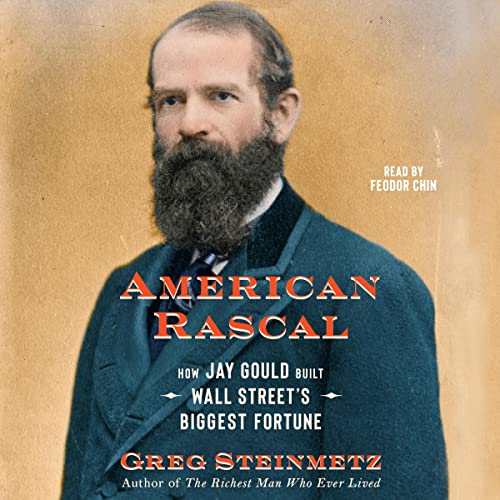
Learning From the Most Ruthless Robber Baron (Jay Gould) | Greg Steinmetz
American Rascal: How Jay Gould Built Wall Street's Biggest Fortune
Kim Zussman comments:
Likely worthwhile but I was stopped out at 2:59 "Buffett was a model of integrity"
Stefan Jovanovich replies:
Agreed. One of the many things the List has done is teach me the limits of my own understanding. I find the Oregano offensive because he has an outright pimp for a partner; in a decade of active practice in LA during the GO-GO years of the 70s and 80s, Munger's firm was - by far - the worst combination of self-righteousness and chickenshit deviousness that we and every lawyer we knew encountered. But, Buffett's artful dodging as a taxpayer has never bothered me. Thx to KZ for reminding me that all cheating really is equal in the eyes of God.
Jeff Watson writes:
I liked this biography better.
Oct
5
Speaking of chess…and cheating, from Stefan Jovanovich
October 5, 2022 | Leave a Comment
Larry Johnson writes:
What Do You Make of Russia’s Strategy in Ukraine?
Russia is now sacrificing pawns in the form of strategically useless territory, while Ukraine is rushing forward to seize symbolic territory without having the necessary reserves in terms of trained soldiers and equipment to sustain the attack and defeat Russia. Russia, meanwhile, is moving its Knights, Rooks and Bishops into position for checkmate. The question remains – what is Putin’s gambit?
One likely answer: Putin follows the path Metternich would have taken if the British had not had their Navy.
Mahan missed the part about how Napoleon lost. In a world of anti-ship missiles, the Americans cannot hope to do what Britain did after 1815 and use sea power alone to rule world trade. The Continental system failed because Russian would not go along. Now, to succeed, a Russian continental energy system only needs to have Poland and Ukraine neutered by having Americans remove all military assistance. Those countries will continue to hate and despise Russians the way John McCain did; but they will have no more ability to do anything to change the pieces on the board in central Europe than American Cold Warriors had between the Korean War and the fall of the Berlin Wall.
Putin can, in the name of peace, build new improved pipelines to follow the route that Russia took against the Ottomans. Russian oil and gas - and Iranian as well - can go around the Black Sea coast and through Moldavia to Hungary and Austria where Germany and Italy can accept deliveries.
Oct
1
Consumer confidence, from Zubin Al Genubi
October 1, 2022 | Leave a Comment
Sentiments of individual investors about the stock market improve with consumer confidence about the economy, as if individuals were unaware that stock prices are a leading indicator of the economy.
Consumer Confidence and Stock Returns
Consumer confidence index (CCI)
Larry Williams comments:
Consumer confidence—MOST BEARISH EVER

Bud Conrad replies:
Thank you Larry. This 37-minute video presents about 50 charts showing everything already in collapse.
Stanley Druckenmiller said in his 25 year career investing he has never seen anything as negative as he sees now (Interview with head of Palantir)
Zubin Al Genubi writes:
The counter rallies sure can be violent in a bear market and it is easy getting buy orders filled. Interesting night [27 Sept]. Definitely foreign influence.
Stefan Jovanovich suggests:
Zubin Al Genubi adds:
Someone did a quick study a while ago where most gains were in night session. Seems like that lately that bears sleep at night. No scary overnight crashes and trading halts.
Larry Williams is optimistic:
Perma bears! We are in a bull market.
Stefan Jovanovich agrees:
++++++
Sep
16
Talking with strangers, from John Floyd
September 16, 2022 | Leave a Comment

Talking with strangers is surprisingly informative
"anybody knows more about something than you do"
Significance
Conversation can be a useful source of learning about practically any topic. Information exchanged through conversation is central to culture and society, as talking with others communicates norms, creates shared understanding, conveys morality, shares knowledge, provides different perspectives, and more. Yet we find that people systematically undervalue what they might learn in conversation, anticipating that they will learn less than they actually do. This miscalibration stems from the inherent uncertainty of conversations, where it can be difficult to even conceive of what one might learn before one learns it. Holding miss-calibrated expectations about the information value of conversation may discourage people from engaging in them more often, creating a potentially misplaced barrier to learning more from others.
Zubin Al Genubi agrees:
I've noticed people don't listen well. They often like to talk. Its good to listen and encourage others to talk and they think you are a great conversationalist. As Yogi Berra said, Listen and its amazing what you can learn. I have some good ideas but no one listens to me.
William Huggins adds:
2018's Nobel in econ went out (in part) for the endogenous growth theory, which posits that a good part of economic growth that isn't "more people" or "more kit" comes from the positive externality associated with education. Romer basically says that once someone learns how to do something better, we gain by having them tell us about it. people uncomfortable with updating their beliefs might avoid conversation and lose out as a result (value of keeping an open mind?)
Nils Poertner writes:
deep down it is probably that we are so excited about our own ideas (whether adequate or not) - that we often over-sell it to ppl in our own social circle. mea culpa. whereas with strangers it is often more a light touch - or an encounter that lasts a few minutes only and this lightness creates a magic…and a sparkle and that is all that is needed sometimes.
Gary Phillips expands:
I've always been a gregarious person, not because I am socially needy, but because I often find conversations with strangers to be an edifying experience. Quite instinctively I gravitate to the following people:
1) smarter / better educated individuals - if you're going to converse with someone, you might as well learn something. I love talking with my friend David, who is a Lubavitch rabbi. His knowledge of the Talmud is extraordinary, and its analogs to trading are remarkable.
2) older people - experience has given them a rational perspective on life and insights that are invaluable. My favorite encounter was with Lou Lesser, a L.A. real estate developer who was 93 when I picked him up in Beverly Hills and drove him to Laguna Beach. He regaled me with stories about his life, including personal experiences with Marilyn Monroe, John Kennedy, and Mickey Cohen. It was a ride I'll never forget.
3) tourists in the U.S. - talking with a 2 young ladies from Kyrgyzstan I met at a local bar in Chicago. Extremely intelligent and well educated, they were extremely critical of the lack of education and sophistication of the average American. They were completely shocked by Americans' lack of knowledge and ignorance of what lies outside of America. I was the only American they had met, who had heard of their country. Nevertheless, while they were very cynical, they were also beautiful, charming, and thoroughly engaging.
4) people from diverse and varied walks of life- if you are seeking a diverse experience with people of varying levels of social status, there's no place better than the joint. My 30 days spent incarcerated in the Montgomery County Correctional facility was not necessarily entertaining, but it was certainly educational. There's not much street cred to be earned jacking an O.G., so I was afforded a level of respect, and was able to engage and befriend various inmates, from incredibly disparate backgrounds and lifestyles.
5) people you meet while travelling- my favorite aspect about traveling is the ability to meet a wide variety of people. I have a tendency to let my guard down while traveling, and open up even more than usual. recent trips to Japan, Mexico, and Crete were made all the more enjoyable because of the people my wife and I interreacted with and met.
Kim Zussman responds:
Typically internationals - especially Europeans - look down on Americans in this way. As if the prize is not what you own but what (or who) you know (especially in France).
Funny thing is that in most countries outside the US wealth-generation efforts are futile because of huge governments and massive corruption. At least if smart people aren't allowed to become rich at least they can become educated, cultured, and erudite. Their educated-but-poor status is a consolation prize, and when they are here there is envy.
In the USSR the only wealthy people were in government or military - which is the same now with the addition of para-governmental oligarchs. You can be talented and work like the devil but if you're not connected you have to settle for Dostoyevsky and Dugin.
The problem with America is that, for the most part - less so in recent years - the main limit on your personal success is yourself. This is not very compassionate (elevation of failure), and is the fuel of socialism. We are ugly Americans for not expending formative decades on poetry, languages, and philosophy - but allowing people to compete in a quasi-free economy.
Pamela Van Giessen writes:
There are interesting people wherever you look for them. Especially in this day and age, no one place has a monopoly on interesting and clever.
Larry Williams agrees:
And they don’t have a clue where our state and cities are. Snobs for the most part Europe is not superior to much of anything other that Italian wine and food. It’s a worn out old lady that was beautiful in its day.
William Huggins asks:
Any Americans here happen to read Gustavus Myers America Strikes Back (1935)? He had a pretty savage takedown of European elitists that's heavy on economic history and well referenced. Much of the sentiment here echoes his charges.
Stefan Jovanovich notes:
Disdain for Americans at home and abroad is the oldest of all cultural traditions. It has survived the death of beaver hats, bustles and whist and shows no signs of decline. I think the scorn for Americans here in their own country has its root in bewilderment - how can all these fat stupid slobs have made their language and money the world standards for communication and exchange? Beats me.
Boris Simonder suggests:
A test would be to survey domestic population on domestic locations of cities/states. Who would do better since you mention location of cities/states? Jay Leno has some clips from his Walk of fame episodes.
High quality cars Larry, at least fossil, although EVs and H2 is up-coming and leading. Telecom networks, Beer, furniture design, clothing designs, Handbags/Cases, Trucks, Industrial/Electrical Machinery/Equipment, Pharma, Mineral fuels, Plastics, Optical/technical medical apparatus, Iron/Steel, Organic chemicals, Insulated wire/cables, Optical readers, Centrifuges, Electrical converters, Auto parts to name a few high value exports. EU accounts for approx 30% of total global export value. Just a tad more than Italian wine and food.
That old lady still has some of the most beautiful ones. Go visit Norway again.
Larry Williams responds:
I'll take the food! You can have the handbags and such.
Aug
10
The Count, from Duncan Coker
August 10, 2022 | Leave a Comment
Rereading the Count of Monte Cristo with my highs schooler, I am struck by the fact the all the virtuous characters are failures at business (ship owner, tailor, inn owner), while all the evil ones are great financial successes (currency speculators, war profiteers, state bankers). Of course the Count rectifies this. His fortune comes by way of a cardinal in Italy, a secrete cave and 14 years in prison. Perhaps the author's ( Alexandre Dumas) message is that every great fortune has a dark past. Maybe that was true in his day, but ones hopes that is not the case today.
Kim Zussman comments:
Socialism is as old as the bell curve.
Gyve Bones writes:
I'm reading this book too, and have found it really interesting. I picked it up because I'd seen two different film adaptations of the story, one starring James Caviezel, who a year later would portray Jesus Christ in Mel Gibson's "The Passion", and an earlier one from the 1970s. The two were so different in many details that I wanted to see the real story in the book. Both movies were good, each in their own way.
Like Les Miserables, by Victor Hugo, the Dumas story is about French society dealing with the ripple effects of the French Revolution. Both have heroes who are sort of New Christ figures. Both characters are unjustly imprisoned. In the case of Danton, the "Count", it was a case of a corrupt prosecutor during a time much like now, where Napoleon is in exile, and his alleged supporters still in France are being hunted down and imprisoned. It reminds me a lot of this nation, which has sent a former president into exile on an island off the coast of Florida, and there is an official inquisition into his affairs which is imposing punitive political prison sentences on his political supporters, and making it a crime to speak with the former president on the phone, in order to thwart any attempt to organize a campaign to return to office.
There's a point where the Count uses and extols the virtues of hashish which you might want to be prepared to discuss with your teenager.
Project Gutenberg has a very nice illustrated edition of the book available, which is helpful in imagining the scenes described.
I had trouble with the size of the illustrated ePub version for my iOS Books app on my iPad. It's 76 megabytes with the images included and it would crash the app. So as an alternative workaround, I downloaded the image free ePub into the Books app, and keep a web page open on the index of the images, which are named according to the page numbers in the book, and I view them as needed as I'm reading along.
Stefan Jovanovich responds:
Dumas pere was anything but a socialist. He was an aristocrat who was beyond snobbery and sentimentality. Good people regularly get screwed by thieves, frauds and liars; but then, so do the thieves, frauds and liars by each other. That is the "moral" of the novel. The Count succeeds in his quest for revenge by turning the bad guys against one another. He is a truly great figure, and the wiki page does him proper justice.
Dumas was neither a monarchist nor a Bonapartist. He was a republican and a Freemason. The novel makes that very clear; and it got Dumas in real trouble when a second Bonaparte became Fuhrer. Dumas had to flee France for Brussels, which also helped him escape his creditors. Read the wiki page; it is a beautiful exposition of an extraordinary life.
Full disclosure: One of the Stefan's weird (academics don't even want to discuss it) speculations about Ulysses Grant is that he was reading Dumas' novels when he was at West Point when he was supposed to be studying "tactics". Grant did not have a full duplex brain when it came to language and music; he taught himself to read German and French, but he found it impossible to speak or understand the languages when spoken. He loved music, but could not play it or read it as anything but notation (i.e. he could not translate the symbols on the page to sounds in his head). Hence, his joking about himself that he only knew two songs - one was Yankee Doodle Dandy and the other was not. The biographers all assume that because Grant had no verbal fluency, he had not read Jomini. He had; he also knew it was complete crap, but why say so except to start an argument? (Grant definitely did not have the legal mind or temperament).
Gyve Bones counters:
Straw men are easy to knock over. I did not assert Dumas was either a monarchist or a Bonapartist. In the same way, Hugo, son of a mother of the ancien regime and a father who was a Revolutionary, he was a melding of the two, and the novel sort of becomes a Hegelian dialectic about the synthesis which emerges from the thesis (the old order) in conflict with the anti-thesis (the Revolution). Jean Valjean is his synthesis, the New Man, a man of Christian virtues without Christ and the sacraments of the Church He founded.
Steve Ellison adds:
Dumas lived a high life and was chronically in debt despite having a number of bestsellers. I still remember one sentence from the book, "He was denounced as a Bonapartist …" It made me think that the first totalitarian society was Revolutionary France, but I hesitate to make such a sweeping pronunciation in the presence of Mr. Jovanovich. In any case, current efforts to make modern denunciations similarly career-ending are a grave threat to liberty.
Stefan Jovanovich agrees:
Great comment, SE. The French revolution - as an event - has a scale and complexity that can only be matched by the global war that began in Spain in 1936 and China in 1937 and ended in Korea in 1954. What Dumas was describing was its net effect: everyone in France had become so kind of spy and snitch. So, yes, it was the first totalitarian society; but you need to give the Citizen Emperor the same credit that Stalin and Hitler deserve for so thoroughly organizing the tyranny.
Bill Rafter offers:
Pardon me for coming in late to this discussion, but there is a mistake: The tailor was Caderousse, one of the three co-conspirators against young Dantes. That failed tailor then became the owner of the Inn at Beauclaire, who then murdered the jeweler. The Inn itself failed because its location was bypassed by a newly constructed canal. That leaves Mr. Morrel, who failed because he was in a highly speculative business (the hedge fund of its time) and was not diversified. However his successors in the business, Emmanuel and Julie were certainly righteous and successful. They retired to a nice home in Paris.
Stefan Jovanovich writes:
Not mine. Dumas was very much someone who believed that an honorable life was the only one worth living, whatever its financial costs or rewards.
Henry Gifford writes:
When I was growing up in a part of New York City that was populated by about half Christians and half Jewish people, almost none of the Christian adults owned a business – they had jobs. The one Christian adult that I knew owned a business did not attend religious services. All the Jewish adults owned businesses except a few that were involved in organized crime (professional level: state senator, state assembly, etc.).
When I was a child attending a Christian school, they made us sing a song that included the words “oh lord, do until me as you would do unto the least of my brothers”. I didn’t sing it, even though I was required to, as I saw it as a request for the all the worst things that happened to other people to all happen to me. As a child I thought this included blindness, loss of multiple limbs, leprosy, locusts (even though I wasn’t sure what those were) etc.
I have never had a mentor in my life. The closest I came were adults who advised me to “make sure you learn a trade so you will have something to fall back on”, who I made sure to steer clear of after I nodded and smiled and made good my escape. When I was 16 I asked my father what he thought I should do when I grew up. He suggested I go on welfare. I never asked again, or brought up the topic of what I was doing with myself, etc. When I was about ten years into writing a book, I showed the almost-finished version to my parents, figuring they should see it while they were still alive. The only comment they had was a harsh criticism of the grammar on one page, which they insisted I correct. The “incorrect” grammar was part of an insightful and charming passage written by Benjamin Franklin in the 1700s.
A few years ago I was walking past a Jewish community center near where I live in Manhattan. On the bulletin board outside I saw a schedule of upcoming lectures. One was titled “The Five Risks Every Entrepreneur Should Take”. I picture a member of the community that sponsored that lecture stumbling in business a little while being surrounded by people who are supportive, and who applaud the person for trying, and then for getting up and going at it again. I doubt any member of that community would ask the person who stumbled if she or he had made sure to first learn a trade to fall back on, or demand that children sing a song like the one I and my classmates were required to sing.
I still manage to do OK financially. Among other endeavors I own or am part owner of property in nine US states, soon to be ten, all worth much more than I paid (including the properties I am contracted to buy on Monday). And I have never “paid my dues” by spending years doing something I hate, or by gaining all the easily available advantages of being dishonest. But the Christian kids I grew up with? I can’t think of one who owns a business, and I can only think of two who likely have enough investments to carry them for long if they didn’t keep working at their job. And I can’t think of any who seem to enjoy or gain much satisfaction from that which they spend their day doing.
As for the emotional toll religion has taken on people over the centuries, suffice to say that someone once summarized the difference between the emotional state of veterans of the US military during WW2 vs. those who were veterans of the Vietnam War as the emotional state of Vietnam War veterans being the embodiment of the result of one generation of young men being lied to by their father’s generation. Likewise, young people being lied to about what economic decisions they ought to make, meanwhile a different reality is there for the seeing, also has its cost.
When growing up I spent time in Jewish households when I could, as the people there seemed to me to have an upbeat and healthier attitude, compared to the funeral home ambience I sensed in most Christian households. But, of course, most people growing up in the US do not have that opportunity, and fewer take the opportunity if available. Most are simply beaten down by the forces of religious insanity and stay down for life. Just today I was waiting for a train and a person nearby was shouting into her phone on speaker, describing in an upbeat tone her life that struck me as horrible, while she periodically mentioned that “god is good.” Not to her, I think, but I didn’t argue with her.
Bo Keely responds:
henry, this is interesting from our comparative angles. I’ll bet the few kids like u and I would say the same thing. as a child, I also rejected the ‘do unto others…’ because it included negative things.
i also had no mentor throughout life. when I eventually took a teacher test that required answering, ‘describe your first mentor’ I wrote about an admitted imagined mentor.
likewise, when I was sixteen, my mother asked, ‘what do you want to do in life,’ on receiving a selective service notice. It had never donned on me, so I replied, ‘be a veterinarian’ since that was my summer job. that’s how I became a vet.
and, i also have never ‘paid my dues’ to society figuring i never owed any. The only real money I ever made was in rental housing in Lansing, MI with a strategy of buy cheap complexes, fix them up, and rent to tenants receiving monthly checks directly deposited into my account. i still do well financially with 25 published books that sell, on average, one each per month. my financial secret of life is to have negligible expenses. I have gained satisfaction from each of dozens of jobs too, and never lived hand-to-mouth. it’s long-term gratification.
I have reacted to the lies of my father’s generation by retreating from Babylon into an anarchic desert town. each is an independent citizen who thinks god is a stinking mess in the sky, and one should learn in youth to take care of himself.
Kim Zussman adds a coda:
After the revolution apartments and land was confiscated and living arrangements made equitably* by central committees.
Los Angeles voters to decide if hotels will be forced to house the homeless despite safety concerns
*government jobs, military, connections, etc.
Jul
14
Fourier Transform, from Alston Mabry
July 14, 2022 | Leave a Comment
This guy does great vids:
But what is the Fourier Transform? A visual introduction.
Stefan Jovanovich appreciates:
Wonderful. Thank you.
Zubin Al applies:
And what do you do with it?
Fast Fourier Transform in Predicting Financial Securities Prices
Turns all the conflicting signals into a nice oscillator.
Jun
8
New CBOE floor, from Jeff Watson
June 8, 2022 | Leave a Comment

Sneak peek: The new CBOE open outcry trading floor opening in June
A reader asks:
What % of the floor space is the SPX pit?
Jeff Watson replies:
No clue. The CME is moving what’s left of their trading floor back to the old South Room, where the CBOT bond pit was 40 years ago before the new floor opened in 1982.
[A related link. -Ed.]
FLOORED The Complete Documentary Film
A world that's more riot than profession, the trading floors of Chicago are a place where gambling your family's mortgage is all in a day's work. FLOORED offers a unique window to this lesser-known world of finance. Traders may not have degrees, but they've got guts, and penchant for excess. But like many aspects of our economy, technology is changing their business, and these eccentric pit denizens aren't the type to take kindly to new tricks. Computerized trading may take the emotion out of the job, but it may also take these old-timers out- they are dinosaurs in a young man's game. FLOORED is a gripping, honest look behind the curtain of the trading floor that few have ever seen.
Jeff Watson adds:
A new trading floor in 2022 and I’m stoked.
Stefan Jovanovich offers some history:
Chicago Stock Exchange Trading Room: Reconstruction at the Art Institute of Chicago
Jun
5
High School Mile Record, from Stefan Jovanovich
June 5, 2022 | Leave a Comment
It Actually Happened… || Gary Martin Breaks LEGENDARY Record Of Jim Ryun
Larry Williams clarifies:
He’s really not faster than Ryan—look at the cinder track Ryun ran on vs the new, and much faster one, where the new record was set.
Stefan Jovanovich allows:
LW knows track.
Larry Williams adds:
If I could only run fast. Dyrol Burleson, college roommate—first American to break 4 minutes in the USA—ran, as a college senior, against Ryan, beat him, but told the reporters he was not the story, Ryan was. What he did on those old track and old shoes was amazing.
Speaking of shoes, the new carbon plate ones (Nike Alphafly) are a real game changer - more records to be shattered. Thet are so much easier on your legs.
Jun
1
Something Deeply Hidden, from Zubin Al Genubi
June 1, 2022 | Leave a Comment
Something Deeply Hidden, by Sean Carroll has changed my understanding of reality more than any book I've ever read. Its the latest explanation of Quantum Fields and wave theory for laymen. For probabilistic thinkers like Spec Listers, it should be readily accessible as probability is the basis of quantum field theory.
The whole world is one quantum wave which evolves according to Schrödinger's formula solves the probability of a reality is the square of the energy wave. Relativities distinctions between matter/energy are gone. Time and space are emergent phenomena of the quantum wave not real things.
Its mind blowing stuff and so different than everything I learned my whole entire life. Highly recommended.
Also interesting are Erwin Schrödinger's lectures, What is Life, describing life, dna, evolution, sentience and consciousness from a quantum physics perspective.
Stefan Jovanovich links to an alternate view:
Q&A: Gerard ’t Hooft on the future of quantum mechanics
The laws of quantum mechanics seem to tell us that there is a fundamental random component to the universe. But Gerard ’t Hooft, who received the Nobel Prize in 1999 for his work on gauge theories in particle physics, is not convinced that physicists have to abandon determinism.
In his new book, The Cellular Automaton Interpretation of Quantum Mechanics (Springer, 2016), ’t Hooft suggests that we may simply be lacking the data that would turn quantum probability distributions into specific predictions.
Nils Poertner adds:
Trading in the Zone, by Mark Douglas, touches on this as well. nice chapter on "Belief vs Truth" in context of possibilities and probabilities. good to be surrounded by folks who stimulate oneself in that direction, too, friends, colleagues, this group here, etc.
May
26
Atomic Annie, from Stefan Jovanovich
May 26, 2022 | Leave a Comment
‘Atomic Annie’ Was the World’s First and Only Nuclear Gun
Twenty were made, but only one fired a nuclear shot.
Apr
13
Skills transfer, from Big Al
April 13, 2022 | Leave a Comment
Carlsen has a great poker face:
World Number One Magnus Carlsen Stuns Everyone With His Poker Skills
Every time you watch the world chess champion, Magnus Carlsen, he never fails to amaze. It’s like he is the best in everything he touches. His brilliant skills are not just limited to the world of chess. But the Norwegian Grand Master can easily adapt to other games as well. While Carlsen’s stats in the Fantasy Premier League can give you chills, his poker skills are even better.
WATCH: Magnus Carlsen, Best Chess Player In History, Turns Pocket Aces Into A Bluff
A reader writes:
i have noticed that ambitious chess players, by and large, seem to be pretty straightforward type guys….not saying they never lie - they are humans but it made me think about certain disciplines in life requiring a sense of honesty to improve - also honesty for oneself - cuz the game itself is not about gaming others but by using memory, logic etc. and lying itself puts extra mental strain on the brain, and they need to concentrate for hours and hours. whereas say ppl who manage OPM…well, a lot are good in marketing etc. no prob with that, just saying.
Zubin Al Genubi adds:
The joke about lying in our family comes from when our kids were little.
We asked,"Who did this?"
Big sis says,"Kenny did it."
Little Kenny says,"Kitty did it!"
J.T. asks:
So poker is the antithesis of chess?
Big Al responds:
From what I've read, von Neumann didn't consider chess to really be a "game" because of complete information. On the other hand, he loved poker because of incomplete information and the possibility of bluffing. He felt poker was, therefore, a true "game".
Andy Aiken comments:
Sprague-Grundy Theorem states that all impartial games are equivalent to Nim. Since a chess game starts impartially, and there is a process of removing pieces (and therefore at each turn, a chess game has a nim-state equivalent), it is a game in the classic sense. But the randomness of play is due to human error, not chance.
The current chess programs can beat international grandmasters and eventually they'll be insurmountable by humans. The final stage of programs playing one another (if anyone cases to watch such games) will probably consist of elaborate opening traps and gambits, with volatile position scores until midgame, at which point the winner will be obvious.
Poker has a large element of chance that can be increased without any change to game rules (adding decks to the shuffle, table bet limits, etc). And there's the additional issue of money/bankroll management that adds further uncertainty. In contrast to poker, in which everyone plays for money, I only know one person who plays chess for money, and he's a 2600+ rated player.
J.T. writes:
Don’t forget the use of bluffing in poker whereas chess doesn’t have such.
Stefan Jovanovich disagrees:
"Bluffing" is the essence of chess - and warfare. Both players see the board - as opposing armies see each other's deployments. What each player cannot see is where their opponent intends to attack and where they plan to defend and how much those plans will change as the game continues.
The biggest part of the blitzkrieg lie is that the French and British did not see the Germans coming through the Ardennes. They did; they did not think it was going to be the main axis of attack. And, until the Germans had the good fortune to have their opponents recover a copy of their tasking orders from a general staff officer, the plans did not have the Ardennes being the center of focus.
I am, as in most things, barely mediocre at chess; but I am unembarrassed by my lifelong habit of asking dumb and then dumber questions. The one person I know who is capable and who studies the game like a real-life Philip Marlowe tells me that deception is the key and the great challenge is not to fall victim to your own certainties about what is going to happen next on the battlefield.
Big Al responds:
You've using a very soft/fuzzy definition of information and bluffing. In game theory, chess is a game of *complete information*, i.e., all the information about the game is visible on the board to both players at any given time. Poker is a game of *incomplete information*, e.g., in Texas Holdem you don't know what your opponents hole cards are and you don't know what cards will be dealt on the flop, turn, and river. Also, in poker you can truly "bluff", i.e., pretend, through betting, that you have cards you don't have. In chess you can't pretend to have more pieces than you do or that they are in positions on the board other than the ones they actually occupy.
War is definitely a "game" of incomplete information.
Stefan Jovanovich contends:
No. Militaries know what each other side has - in terms of resources - and unlike poker the game is continuous. There are no hands, bets and then the winner takes all; and then new hands are dealt. I can understand how JHH and others see Ukraine as winning; judging each day's events as a single operation or poker hand shows a picture of success for Ukraine. Yet here we are in a war that continues with no end in sight even as Ukraine gets more advice based on the presumption that Russians cannot think more than one move ahead.
Apr
7
Washington Inoculates an Army, from Big Al
April 7, 2022 | Leave a Comment
Washington Inoculates an Army
The Continental Army Battles an Invisible Foe
Stefan Jovanovich comments:
Washington was always a better strategist than tactician. Even though he lost more battles than he won he had command of the larger picture. In this case he scored a seemingly impossible victory against an invisible enemy.
First sentence: meaningless. Washington was never Commander-in-Chief in the way Lincoln and Roosevelt were. Congress and the French (and later Spanish) allies determined the "strategy" based entirely on their territorial ambitions. You kick the British out of Boston so they and their soldiers have to go to Halifax and then you decide the best of all possible strategic choices is to try to capture Quebec City when the smallpox has already weakened your army?
Second sentence: equally meaningless. The "larger picture" was always the one in the Caribbean, Mediterranean, and the Indian Ocean, not the Atlantic colonies.
Third sentence: The only proof that they did are the Army's own records of the soldiers who reported being sick. The number of those infected with smallpox fall off dramatically in the last two years of the war (1778-1779), but the evidence that attributes this to successful inoculation rather than the accrual of natural immunity is a single case study. The Army surgeons conducted a clinical trial during the winter in Morristown (which was far worse than Valley Forge) when 6 out of 6 soldiers who were vaccinated did not die from the disease versus 5 out of 6 for those who were not vaccinated. See Smallpox in Washington's Army: Strategic Implications of the Disease During the American Revolutionary War.
Mar
20
Jevon’s paradox, from Big Al
March 20, 2022 | Leave a Comment
How does Jevon's paradox play into the current situation with commodities?
Oil demand holds up in Norway, despite record electric car sales
In September, electric cars reached a record 77.5% share of new car sales in Norway. Yet, surprisingly, oil demand is higher than ten years ago when the first zero-emission cars were sold in the country. (UBS Editorial Team, 08 Dec 2021)
Zubin Al Genubi laments:
It's like my garage storage and my budget, demand grows to meet supply. Also despite efficiency the same energy created is used.
Big Al adds:
The road-congestion version:
The Fundamental Law of Road Congestion: Evidence from US Cities
Gilles Duranton and Matthew A. Turner
AMERICAN ECONOMIC REVIEW
VOL. 101, NO. 6, OCTOBER 2011
Abstract
We investigate the effect of lane kilometers of roads on vehicle-kilometers traveled (VKT) in US cities. VKT increases proportionately to roadway lane kilometers for interstate highways and probably slightly less rapidly for other types of roads. The sources for this extra VKT are increases in driving by current residents, increases in commercial traffic, and migration. Increasing lane kilometers for one type of road diverts little traffic from other types of road. We find no evidence that the provision of public transportation affects VKT. We conclude that increased provision of roads or public transit is unlikely to relieve congestion.
See also induced demand.
Stefan Jovanovich comments:
There is no marginal cost of entry into the "system" of free roads. The only way that public transit can begin to compete with highways is for their cost of entry - i.e. the fares - to also be zero. I had one great professor at what was otherwise a mediocre school - what Harvard then called Architectural Sciences - who taught this. I can still remember his lectures and one in particular - when he explained how he had been unable to convince the Indonesian government that the solution to their particular traffic problem was to fix the phone system. It was so unreliable that even in what was still a poor country the streets in Jakarta would be jammed by merchants and others getting in their cars so they could talk to one another in person.
See also bid-rent theory.
Big Al adds:
You'd think that policy would be a natural, especially for "progressive" regimes, given that public transport fares must skew towards a tax on the bottom deciles.
Feb
3
Musical intuition, from Nils Poertner
February 3, 2022 | Leave a Comment
From Einstein On Creative Thinking: Music and the Intuitive Art of Scientific Imagination:
In other interviews, he (Albert Einstein) attributed his scientific insight and intuition mainly to music. "If I were not a physicist," he once said, "I would probably be a musician. I often think in music. I live my daydreams in music. I see my life in terms of music…. I get most joy in life out of music" (Calaprice, 2000, 155). His son, Hans, amplified what Einstein meant by recounting that "[w]henever he felt that he had come to the end of the road or into a difficult situation in his work, he would take refuge in music, and that would usually resolve all his difficulties."
btw, today [3 Feb] is the birthday of Felix Mendelssohn Bartholdy.
Stefan Jovanovich writes:
I don't really think; the few insights I have come from early training in copy editing and a certain skill for moving 3D objects around in space so they fit better (in the good old days this was called warehousing). For that kind of mind mulling, Haydn's Piano Trios have become the essential daily brain food for over a year now.
Nils Poertner replies:
perhaps there is a type of music, or composer, or melody, that resonates with a certain person for a while - almost like good medicine? a little goes a long way though.
Adam Grimes comments:
Speaking personally, I can't listen to complex music and do any other task. My attention is too easily diverted to the music and I spend too much time focusing on the music, which is an obvious reflection of how my brain has been trained. (I do think there are some fundamental differences in the way musicians perceive music compared to "everyone else", and different types of musicians also perceive differently, based on my experience.)
I do, however, like a wide range of musics, and I find bluegrass and old-school country are especially conducive to writing and programming. (Again, a very personal perspective.)
I do think musical training teaches people to hold and to manipulate patterns in a special way. There's also a lot to be said for the work ethic and focus of a musician. (When I was younger, I spent 6+ hours in front of my instrument, day after day. That requires a degree of focus and attention to detail that most people don't encounter very often.) But I'm still a little skeptical about wide-ranging benefits… maybe they are there, but expertise can be frustratingly domain-specific. I suspect there might be something in the pattern recognition and manipulation aspects that's meaningful, though.
Stefan Jovanovich responds:
For one thing, AG, you all actually hear the music. I can recognize the differences between the F-Minor (#26) and the E-Flat Minor (#31) because I have heard the pieces often enough to distinguish one combination of noises from the other; but that is all. I do not perceive the music.
Zubin Al Genubi adds:
After training and practice you can hear in your mind the perfect pitch of a note out of thin air and tell if a note is not in tune. Its another thing to train your voice to hit that perfect pitch.
Adam Grimes writes:
The skill of "perfect pitch" (absolute pitch), which is the ability to name notes out of thin air, is actually not trainable, despite a lot of work and effort. It appears to be a skill that probably all babies have, just as babies have the ability to hear all phonemes in all human languages. At some point, early on, the brain changes and unused (unheard) phonemes become relatively inaccessible (which is why, for instance, native French speakers struggle with the English "th" (and there are many other examples), and this appears to be the window that closes on developing perfect pitch. If musical training begins at a young age, this skill of absolute pitch may continue into adulthood.
It's also interesting that there's a range of pitches that will be accepted as "A", just as there are a range of mouth sounds that will be perceived as a specific phoneme. (in other words, not all speakers will produce the same sounds in a language exactly the same, and the same speaker might produce sounds slightly differently in different words, but the brain adjusts by categorizing.) I don't have absolute pitch myself (though I do have a few absolute "notes" that I can recognize or pull from memory), but in working with people who do, I've noticed they don't have quite the precision of a tuning fork. What they do have is a radically different perception of music than the rest of us, though the rest of us aren't as handicapped as we would be inclined to think.
There's a lot of very interesting work done and being done on perception. David Huron has written a few books that are both precise and accessible–always a nice combination of attributes!
Though perfect pitch can't be trained, what CAN be trained is the ability to judge relative pitches and to hear multiple notes played with precision. As you say, training the voice is another skill. I'm a very poor singer, but producing pitches with the voice is a critical part of internalizing pitch (and music, in general) for instrumentalists.
Big Al adds:
I think one of the most important lessons in music, especially for young people, is that you can begin studying something you know nothing about and, through practice, master it. Many people do not learn this and schools don't overtly teach it.
Jan
31
Composition project, from Adam Grimes
January 31, 2022 | Leave a Comment
Given the recent music discussions on the list, I thought I would share a few things. First, I spent much of last year (as a pianist) digging into Bach. Over the past few months, I've been playing a lot of Chopin, and reading contemporary accounts of his teaching and playing–always trying to understand this music more like the composer himself might have.
I recently recorded this famous Nocturne. It's not a difficult piece by any means, but is a gorgeous aria for piano. (There's a little bit of sparkle at the end that often captures amateur performances off guard!) My performance of this piece isn't flawless, but I hope you enjoy it!
This piece also has some famous tie-ins with yesterday's Holocaust Remembrance Day which you can read about in the wiki.
Also, I'll be doing 100 days of composition, and sharing some of the progress daily. This is primarily a tool for myself to create some accountability, as I've been inexcusably lazy on the creative front over the past year. I invite you to follow along here. I'll update that post and probably share some snippets of work as I produce them. I've never done a project like this publicly, so I don't quite know what to expect–it may be a complete flop, but let's see what happens.
Vic replies:
very good and relevant post thank you
James Lackey responds:
Yea man awesome. So what’s the musical that beats describes this week? We had more dipsy than doodle weak close big up open ground hog days. My deal if trading I’d be so exhausted I’d be flat by lunch and not look at those screens again til Sunday night. I can only imagine how costly that was to Mr Vic and my bank balances years ago.
Stefan Jovanovich offers:
Sviatoslav Richter - Chopin - Etudes
Adam Grimes responds:
I absolutely love Richter's playing. His Bach was one of the biggest reasons I became a musician…as a kid, I was transfixed by some of his Bach recordings.
Jan
24
The Government Gets into the Business of Monopoly Auctions
January 24, 2022 | Leave a Comment
Stefan Jovanovich offers:
The mania for sudden fortunes made in cotton, raging in a vast population of Jews and Yankees scattered throughout this whole country, and in this town almost exceeding the numbers of the regular residents, has to an alarming extent corrupted and demoralized the army. Every colonel, captain, or quartermaster is in secret partnership with some operator in cotton; every soldier dreams of adding a bale of cotton to his monthly pay. I had no conception of the extent of this evil until I came and saw for myself. Besides, the resources of the rebels are inordinately increased from this source. Plenty of cotton is brought in from beyond our lines, especially by the agency of Jewish traders, who pay for it ostensibly in Treasury notes, but really in gold. What I would propose is that no private purchaser of cotton shall be allowed in any part of the occupied region. Let quartermasters buy the article at a fixed price, say twenty or twenty-five cents per pound, and forward it by army transportation to proper centers, say Helena, Memphis, or Cincinnati, to be sold at public auction on Government account. Let the sales take place on regular fixed days, so that all parties desirous of buying can be sure when to be present.
- Charles Dana's recommendation to the Secretary of War, 1863
Jeff Watson responds:
Sounds like sour grapes from Mr Dana, almost like he was having problems with his hidden cotton partner and since he didn’t find easy money, nobody else should either.
Stefan Jovanovich replies:
Score by WS. But, according to his memoir, Dana was no more secretive about his partnership with Conkling than anyone else in D.C. He asked Halleck for letters of introduction to the generals not named Grant. He omitted Grant because he already had the reputation of being incorruptible.
How the Story Ends:
On March 31, 1863, Mr. Lincoln issued a proclamation declaring unlawful all commercial intercourse with the States in insurrection, except when carried on according to the regulations prescribed by the Secretary of the Treasury. These regulations Mr. Chase prepared at once. At the same time that Mr. Lincoln issued his proclamation, Mr. Stanton issued an order forbidding officers and all members of the army to have anything to do with the trade.
Or does not end:
Diary of Gideon Welles: Saturday, May 21, 1864
Last night I was at a party at Mr. Chase's, or his daughter Mrs. Sprague’s, and late in the evening he spoke to me of the great abuses in cotton speculations. It was a new and singular theme for him, and I said it could not be otherwise than demoralizing. He said, “Yes, your whole fleet out West is infected; Porter devotes his attention to getting cotton and has a boat to himself, with a piano and his pipe, on these cotton raids.” I replied this could not be so. The naval men could capture and retain nothing, which the courts do not adjudge to be (a) good prize. We were interrupted at this point. I conclude the Committee on Commerce have notified Chase that they disapprove of his “Trade Regulations,” and this outburst on the Navy is to turn off attention from his officials. But we shall see.
Lieutenant-Commander S. L. Phelps has been with me this evening and given me many interesting details concerning the Red River expedition and the incompetency of General Banks. Among other matters he relates some facts in regard to cotton speculations by persons connected with General Banks — some of his staff — that are exceedingly discreditable. Among others whom he specially mentions is one Clark from Auburn, New York, who appears to be managing director of the cotton operations.
Dec
28
Contrarian view, from Nils Poertner
December 28, 2021 | Leave a Comment
America is not what it used to be, it’s people are easily manipulated and weak. They do everything the government says without a 2nd thought. It’s sad.
from a chap on Twitter - his name is irrelevant. too many ppl go on about that easy to be bullish about many things in particular in the US of A in my humble view.
Stefan Jovanovich comments:
If that statement were made about any other country of any size from Denmark to China, it would not be taken seriously. What literally unites "informed" and "educated" people worldwide is the hope and belief that this country full of fat people who don't learn foreign languages and do not surrender to the metric system can somehow be brought to heal. What they cannot accept is the fact that the country is so large and various and so maddeningly Democratic that "policy" only gets decided for good after, as Van Buren said, Americans have taken the time to have "sober second thoughts". So, after nearly two years of stupidity, we are to the point where the rules for Covid will, as Biden just said, have to be made by the states. Just in time to disappoint all those "responsible" conservatives there is a majority who want to joinThe Anti-Federalist Society.
Nils Poertner adds:
each country, continent, etc faces its own unique challenges now - eg Germany (and the rest of EU - also UK) sitting on the tracks and the train is coming in form of an energy crisis, among others. and one can say to ppl 3 times that the train is coming but better to walk away or profit from it. i don't live in the US. am sure you guys will manage - defeatism was never an American thing anyway.
James Lackey responds:
Hubbert Peak was 1957 and my dad god rest his soul made fun of that til the end of his times. There will never be an energy crisis. It goes against physics. Like jobs and government they can not be created nor destroyed just the way we pay or play is different.
What we fail to realize as American men is the women and children adapt quickly like a finger tap snap! They bitch moan complain and then say ok cool let’s do it differently
Just don’t ask first lol.
What’s remarkable about consulting for me is this general quote: "Everyone wants to know why why why!" I say yes sir so what? I get a death stare then quote von Steuben then shake my head Yes! As I state good enough for General Washington should be ok cool with us.
Nils Poertner replies:
Adapting to a new econ landscape, creating new jobs, finding new mkts, trading etc… and so on - is one thing and Americans are indeed quite good at this. that said…if you step back for a moment and look at the status of human beings around you with some compassion and benevolence - from the heart level - and at what level they are /we are - or society in general - then you surely see or sense that there is a lot of upside potential to say the least….
Dec
21
Faith in the process, from Nils Poertner
December 21, 2021 | Leave a Comment
Most farmers plant a seed but don't constantly check every 5 minutes whether the seed has grown. They can live with some basic uncertainty called faith in the process. (may be changing now with new farming methods…)
Compare that with modern human behaviour of constantly checking a phone or a stock price or social media - that is not natural behaviour - it is normal though.
If enough behave unnaturally, perhaps we adversely effect the outcome? Too much attention then..? Am wondering whether constantly looking at a topic, or talking about something may adversely affect the outcome, e.g., way too many ppl talk about some strange health issue that started early in 2020.
Stefan Jovanovich comments
Farmers do, in fact, check their field crops regularly using GPS, moisture monitors and cross-checks against the prices of corn, beans and natural gas (used for drying). We humans with our opposable thumbs are permanently addicted to the use of tools. That is the one consistent behavior that has identified our species since we became one. Why? For the same reason sea otters play with rocks and then use them to break abalone shells - making things is fun and profitable.
Nils Poertner responds:
yes, I know modern farmers using more high-tech equipment to survey and manage their crops etc - not all bad - there must be some happy medium though? too much control or trying hard is a sign of deep rooted anxiety and lack of trusting the process. we may see that playing out in many ways now in politics etc.
James Lackey writes:
My brother created a work game. He hired our X bmx team kids that are now young men. He turned work into a game. The pay rate is a days labor. There is no time kept. Play all we want and there is 9 innings. Rain outs only happen in a hurricane. We play a full game. The slaughter rule is if we are up by 10 in the bottom of the 6th we pack up for tomorrow. 70% of the games are slaughtered. He never changes the rules of the game.
Nov
20
The Speculator: 3 lessons from ace investor George Soros, by Laurel Kenner and Victor Niederhoffer
November 20, 2021 | Leave a Comment
The Speculator: 3 lessons from ace investor George Soros
Kim Zussman comments:
I don't think there is such a thing as an unconditional friend. Everyone wants something - what is friendship if you get nothing out of it?
The same with 'unconditional love'. I had a conditional friend who was a feminist, and she said that her cat loved her unconditionally. I told her to do this experiment: Every day when you come home, find the cat and kick it (obviously just a thought experiment because never be cruel to any animal). After a month tell me about your cat's unconditional love for you.
Stefan Jovanovich adds:
Friendship and love are exchanges, contracts of shared interest and sentiment. Those of us who have endured bad partnerships and been sustained by good ones know that the people who sink the ship are those who are incapable of sharing good sense because they want people to promise to sacrifice "everything" in the name of the perfect union.
Nov
5
The Book of Proposition Bets, by Owen O’Shea
November 5, 2021 | Leave a Comment
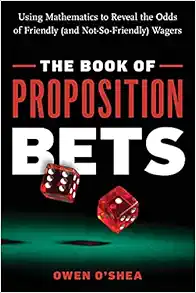
Jeff Watson writes:
Proposition bets have been around since the beginning of time. They capture the greed of the victim and put money in the pocket of the prop hustler. Proposition bets rely on the greed of the victim combined with the ignorance of the real probability of what they are betting on. Most good proposition bets are of the sort that will give the victim at least a small chance of winning, the bets that allow the victim no chance to win aren't really bets, but swindles. Although I'm not a fan of swindles, there are some very elegant swindles out there. The book only mentions a couple of them.
Owen O'Shea has presented 50 different proposition bets, mostly in the card, dice, or numbers categories. The real beauty of his short book is that the author kindly explains the math behind each of the prop bets in easy to follow detail. The math is very friendly to those math challenged individuals who might read the book.. The description of each wager and the subsequent true odds of the outcomes allows the reader to "see" what's under the hood for each bet.
The bets described in the book could be easily modified for different situations. For example, he describes the birthday problem wager, but also describes a wager that is a kissing cousin to the birthday problem. I could think of 15 different scenarios that one could apply the same principles of the birthday problem.. All of the other wagers mentioned the book could be expanded upon in this manner.
O'Shea's book is brand new, July 2021, and I highly recommend it. It is an easy read, which is surprising, considering the level of explanation for each bet. This book should be included on the shelf of every library of those interested in gambling, probabilities, math, cards, dice….and for those with a touch of larceny in their hearts. For the beginning proposition hustler, this book could be a bible.
When I was a young man about to go out into the world, my father says to me a very valuable thing. He says to me like this… "Son," the old guy says, "I am sorry that I am not able to bank roll you to a very large start, but not having any potatoes which to give you, I am now going to stake you to some very valuable advice. One of these days in your travels, a guy is going to come to you and show you a nice, brand new deck of cards on which (Sky snaps fingers) the seal has not yet been broken. This man is going to offer to bet you that he can make the jack of spades jump out of that deck and squirt cider in your ear. Now son, you do not take this bet, for as sure as you stand there, you are going to wind up with an earful of cider."
- Sky Masterson "Guys and Dolls"
Stefan Jovanovich adds:
The prop bet was whether Mindy's (actually, Lindy's) sold more strudel or cheesecake.
Vic comments:
all prop bets on S&P from short side are losers. in sports betting you can win if 52% against the line. is that better or worse than markets? how can you beat the 52%?
Henry Gifford writes:
After hearing about the book on the list, I bought a copy. Thanks for the tip. I particularly looked forward to having the examples explained.
I started reading the introduction, which starts with an explanation of the Monty Hall paradox.
Now let’s get something straight – the problem described in the book is described as being a description of the game that was played on TV. All such explanations I have ever heard also say they describe the game that was played on TV.
A hustler offers a mark the option of choosing which one of three doors (cards in the book) is a winner, with the mark betting $10 for a chance to win $10 for choosing the winning door. The three choices are designated A, B, and C.
In the example given, the mark chooses A, then the hustler reveals that C is a losing option, then the hustler gives the mark the option of switching to choice B. The book then explains the mark’s situation as follows:
Here’s the thing. If you do not switch, your choice of picking the [winner] is 1/3, so think of the other unturned card as the “winning card” with probability of 2/3. Therefore, if you switch 2/3 of the time, you switch to the [closed winning door]. Consequently, by switching you double your chances from 1/3 to 2/3 of picking the [winner].
Suppose a con artist is offering this bet to various marks at various locations. At a bet of say, $10 a round, where the mark wins, they win $10. About 1/3 of the time the mark will choose the wrong card. If the mark decides not to switch from their original choice, they lose. This will occur about 1/3 of the time. But the hustler wins about 2/3 of the time and therefore for every $10 the mark wins, the hustler wins $20. Therefore, the con artist is winning this bet 2/3 of the time and in so doing, is making a tidy profit.
Then the book names a famous mathematician who was fooled by this bet, then changes the subject.
I don’t see any explanation of the paradox, and a lot of other things are not explained in any way I can understand.
For example, if switching improves the odds from 1/3 to 2/3, why would switching 2/3 of the time improve the odds to only 2/3? And what is the assumption of the mark switching 2/3 of the time based on?
And “If the mark decides not to switch from their original choice, they lose.” Huh? They lose all the time by not switching? But the previous sentence says the mark wins 1/3 of the time if not switching.
Another gem is “About 1/3 of the time the mark will choose the wrong card.” Really? I thought that with one choice out of three cards the mark will choose the wrong card 2/3 of the time.
And, at the core of the issue, the claim that switching improves the odds to 2/3 is not explained.
Of course the greatest paradox is that the book is about proposition bets that appear to be better bets than they really are, meanwhile the bet described says the mark is betting $10 to win $10 on a choice of one out of three options – a bet which does not appear to me to be a winning bet, as the hustler has a 2/3 chance of winning. Then, after the “paradox” is allegedly explained, the book explains that the hustler enjoys odds of winning of 2/3 because of the paradox. So, the hustler’s odds of winning improve from 2/3 to 2/3. Just how much did the hustler gain by improving his odds of winning from 2/3 to 2/3? This is another thing I don’t understand, and don’t see any explanation of.
This leaves me with zero faith in the accuracy of anything else in the book, and zero faith that anything else in the book will be adequately described. Or, at least, explained in a way I can understand it. My copy is in my garbage can, but I can retrieve it and mail it to any list member who asks for it.
Oct
19
Cochrane: Britannia’s Last Sea-King, from Alston Mabry
October 19, 2021 | Leave a Comment
Cochrane: Britannia's Last Sea-King
by Donald Thomas
1978, The Viking Press
The book begins with the story of the Cochrane family. The subject's father was the 9th Earl of Dundonald and in the 1780s he tried to salvage the family's fortunes with innovation:
As a young man, the Earl had spent a short while in the navy. During this period, he had noticed the ravages of worms on the bottoms of ships, where they ate into the structure of the hull. The replacement of so much rotten timber was a considerable drain on the resources of the Admiralty. A few ships were "hobnailed", the bottoms covered with large-headed iron nails, but this was far too expensive a method to be undertaken often. The 9th Earl, pondering this problem, thought of the coal on the Culross estate….He had undertaken some simple experiments of his own with coal, in a kiln. When it was "reduced" to coke, a thick black substance was given off, known as coal tar. But might not the coal tar be refined in such a way that it could be used to coat the hulls of ships?
[ The Earl pays for a test where one side of a buoy was painted with coal tar and the other left as is. ]
Yes, the test had been a complete success, protecting the side of the buoy against the worm while the other side had rotted. No, the Admiralty was not interested in the invention.
The Earl was dumbfounded by this reply….Still with young Lord Cochrane in tow, he began to visit shipbuilders, to see if there was some special technical problem involved in using coal tar, some minor defect which he might be able to overcome. He received his answer at last from a shipbuilder in Limehouse.
"My lord," said the man, "we live by repairing ships as well as by building them, and the worm is our best friend. Rather than use your preparation, I would cover ships' bottoms with honey to attract worms."
Similar objections, wrote Lord Cochrane, were "everywhere encountered" among the shipbuilders. "Neither they, nor any artisans in wood, would patronise a plan to render their work durable." As for the Admiralty and the Navy Board, it was common knowledge that many of the clerks in the King's dockyards also acted as agents for the private contractors. They were hardly likely to recommend to the Board a substance which would lead to a recession among those on whose behalf they acted and whose profits they shared.
Epilogue to the story:
The financial catastrophe which had overtaken the Earl in no way diminished his enthusiasm for scientific investigation. While he and his creditors were in prolonged negotiation for the disposal of Culross, he produced his largest and most important publication, A Treatise Showing the Intimate Connection that Subsists between Agriculture and Chemistry. But once again, he was in advance of his time. What was dismissed as eccentricity in the Earl of Dundonald was to be hailed as the genius of discovery in Sir Humphrey Davy. Indeed, the most bitter irony of all was still far in the future, when the Earl was an old and dying man, struggling to support his ailing mistress and her child in Parisian squalor, to which he had been driven by the most remorseless of his creditors. From the miseries of this exile, where drink had become his last consolation, the old man heard that the Lordships of the Admiralty had conceived an interesting new idea. In 1822, they had asked a committee of the Royal Society, under the chairmanship of Sir Humphrey Davy, to investigate the possibility that coal tar might be an effective and cheap preservative for ships' bottoms. The committee reported favorably and the Lordships congratulated themselves on their acumen. Not only was their suggestion vindicated but the cantankerous Scottish earl who had taken out a patent in the 1780s had neither heart nor money to renew it in 1806. The Admiralty, by biding its time, got the process for nothing.
An overview of the 10th Earl's life.
Henry Gifford asks:
Why didn’t fishing boats, freighters, ferries, etc. adopt this technology?
Stefan Jovanovich responds:
Because it was foul stuff to work with compared to pine tar and Davy was promoting the uses of coal over which Britain had the same near monopoly that North Carolina had over turpentine and pine tar. Britain became coal mad as they discovered that British midlands anthracite had superior qualities for ship's boilers over everyone else's stuff. (When Admiral Dewey's squadron won the Battle of Manila Bay, they were fueled by British colliers from Hong Kong.)
Peter Grieve writes:
It looks like shipworm could have an impact on the city we love:
These Tiny Wood-Eating Creatures Want To Sink Brooklyn Bridge Park
Aug
24
Wondering why the FTSE has lagged, from James Lackey
August 24, 2021 | Leave a Comment

One of the things that make me a poor manager but perhaps a leader mindset is to me pointing out problems with out a proper solution seems, well, silly.
At the trading desk here in Weston with Mr Vic, the one thing that caught my eye quickly was the FTSE and it's low prices. I have no clue so google landed the link below. any ideas?
Has the FTSE 100 really performed as badly this century as it appears?
Nils Poertner muses:
good spot - many other indices are rich (and firms, too, eg. Apple)?
long FTSE is probably the next big thing for Cathy Woods - am mentioning her name since she gets a lot of bad press in Europe but her calls have been quite good in last few yrs.
Paul O'Leary is skeptical:
FTSE an unlikely place for Cathie Wood to find the hyper growth she looks for.
A reader offers a critique:
The author shoots himself in the foot when he says if you bought all the companies in FTSE 100 in 2001 this is what you would have got…the constituents have changed. I skimmed the rest because it was clear the author didn't really know what was going on.
James Lackey clarifies:
Thank you paul, my apologies to all. My better question is what is wrong with English stocks or is that a bad question, i.e., nothing is wrong? I've lost so much money buying laggards and value, specs forgive me.
Big Al theorizes:
Here's a theory: The Digital Revolution has been one of the greatest expansions of human activity/productivity/wealth in history and it has been centered in the US, as have the stocks of the companies surviving the competition for doing the revolutionizing. The winners have been added to indices, and the losers dropped. This equity/index mechanism has far outperformed all others.
James Lackey responds:
Big, that is what I needed! I was lost (did not get the joke) and as usual was the last to know.
Stefan Jovanovich provides an historical perspective:
Big Al nails it, once again. The British invention of industrial production achieved the same startling results; within a third of a century, the center of the world's low-cost production of fabrics shifted from the hand-looms of India to the "infernal machinery" of the Midlands.
Aug
13
Boyd: The Fighter Pilot Who Changed The Art of War
August 13, 2021 | Leave a Comment
 Christopher Tucker recommends:
Boyd: The Fighter Pilot Who Changed The Art of War, by Robert Coram
John Boyd, or "Forty Second Boyd", had a standing bet against any and all comers at the Air Force Fighter Weapons School at Nellis AFB in the fifties that, beginning from a position of disadvantage, he could out maneuver and defeat any opposing pilot in air combat in less than forty seconds. He was never beaten.
Boyd knew in his gut that he had stumbled upon a very deep principle of combat and it took him years to finally articulate it, one of the results of which is the OODA loop. (Which is much more complicated in practice than simply Observe Orient Decide and Act.)
His theories led to a complete rewrite of the curriculum at the Marine Corps Amphibious Warfare School and the development of the Marine Corps Maneuver Warfare tactics.
He was also the originator of the energy- maneuverability theory which revolutionized combat aircraft design and the way pilots think about controlling their aircraft.
Great book, not particularly well written, but tons of practical ideas.
Stefan Jovanovich points out:
A recent paper on Boyd's OODA Loop
Abstract: The concepts of the late US Air Force Colonel John R. Boyd have influenced military thought in profound ways, from the design of modern fighter aircraft to the tactics used by the US Marine Corps in both Gulf Wars. This paper describes the best known aspect of his strategic thought, the OODA “loop,” and how practitioners in war and business can use the loop to implement a framework that has proven successful since the time of Sun Tzu.
A reader adds:
The article briefly mentions Japanese samurai defense concepts. The part of Musashi Miyamoto's Rin Go No Sho I like for trading is the part about attacking while running away.
It seems as contrarians, a lot of the time you are running away, but attacking at the same time. In a combat situation, the pursuer's mind is set on attack and his attitude is forward, then has a hard time adjusting when the escapee turns suddenly and attacks, creating confusion and hesitation.
Aug
13
Gladwell’s “Bomber Mafia”, from Stefan Jovanovich
August 13, 2021 | Leave a Comment
Oh dear, oh dear. Gladwell's book is bad military history and even worse moralizing. The Norden bombsight, etc. were the Army's attempt to do even better than the Navy's Bureau of Ordnance. For more than half of WW 2 the U.S. Navy had torpedoes that not only didn't explode but were a positive danger to our own submarines. See:
The "precision bombing" of the US Army Air Force consisted of having the bombers fly a straight course and a constant speed and altitude over the target. The Germans - being clever people - quickly figured out that they did not have to aim at the bombers; they could simply aim at the airspace that the bombers were going to fly into. The result was that the U.S. Army Air Force bomber crews were the only Allied warriors whose casualty rates matched those of the German's U-boat crews. The odds of survival were 1 out of 10 if you served 2 years or longer.
There are a dozen more howlers from the 30 pages of Gladwell's book before I gave up on it - this Amazon reviewer was strong-minded enough to keep reading all the way to the end.
May
8
Jack Cook writes:
Now I know why Mr. Softy owns so much farm land…
New research from Princeton University and Bloomberg confirms that renewables require 300 - 400 times more land than natural gas and nuclear plants
https://michaelshellenberger.substack.com/p/finally-they-admit-renewables-are
KK Law writes
The answer is yes and no. It could be somewhat offset if homeowners would let solar cells be installed on their roof tops. Also, the calculation is likely based on legacy solar cell technologies with low optical to electric efficiency. I am not against renewables but I will read anything with a grain of salt.
Henry Gifford writes:
The vast majority of house roofs are not well suited to solar because they are not at the optimal angle (latitude angle from horizontal), not at the optimal azimuth (South), and shaded. This does not stop anyone from installing them on roofs of homes.
A more suitable location is roofs of large stores and warehouses, where there is no shade, and they can be oriented optimally, and where a large need for electricity is located immediately below.
Another benefit of locating them on commercial buildings is that they offset purchase of electricity at higher (commercial) prices.
As warehouse roofs are generally not utilized for anything else, the panels arguably occupy zero space, which the study authors presumably thought of.
The reason so many panels are installed on house is politics - taxpayers paying for someone’s social statement. In New York City the subsidies have advanced the industry to where they are routinely installed flat or vertical, in the shade, or facing North (Columbus Ave & 100st, for example). I have never met anyone who likes solar panels enough to pay for them with their own money.
Whenever I see wind turbines the land under them is being used for farming or grazing or etc. Saying they use a lot of land is like saying planes use up all the land they fly over.
Henry Gifford
Stefan Jovanovich writes
HG's comments are, as always, wonderfully exact. Our new roof that will go up this week will not have solar panels because no one in NC is willing to pay us for the waste of money; in California they were happy to.
Apr
10
Anniversary of Surrender
April 10, 2021 | Leave a Comment
Apr
8
Government Deprivation
April 8, 2021 | Leave a Comment
Patrick Boyle writes:
The article states: "The offer from Washington reflects Biden’s broader goal of ending what officials have described as a race-to-the-bottom on global taxation that has deprived governments of revenue needed to fund basic services and investments."
I was surprised to see that governments are suffering this deprivation and wondered what percentage of GDP is collected by various governments worldwide. It would appear that the US Government collects 27.1% of GDP as taxes while spending 38.1% of GDP. Singapore seems to get by with 14.1% of GDP in taxes.
Here is the full list on wikipedia:https://en.wikipedia.org/wiki/List_of_countries_by_tax_revenue_to_GDP_ratio
Stefan Jovanovich writes
As a economic denominator GDP has always troubled me since it pretends that there is an absolute equivalence between the Department of Education's paying for further studies of whole word instruction and parents' struggles to show their children that understanding the American language depends on recognizing the sounds of syllables and using the alphabet to write and read the notations of those sounds.
In this particular example, the fiction of GDP is even worse: what the Federal Government spends on the 21st century's answer to phrenology counts as output because it is paid for in dollars. What the parents do gets no accounting at all.
Assessing American public spending right now is tricky because this is the first time in our history as a nation that we have done what William James wanted and found a moral equivalence of war without the spending on arms and destruction. There have been no net deaths in Trump's war against Covid; measured against the mortality rates for an average flu year, the casualty rate has been negative. Instead of incurring debt to build ships, planes and other military assets that will be pure waste, that, unlike the capital equipment used in the "private" sector will have no residual value other than as scrap, this Federal war has spent it's money on direct transfers to people's bank accounts, raises for hospital employees, and what has been effectively a continuation of the Census' part-time employment for official counting.
There has been no wartime inflation because the largest part of the "spending" has been no spending at all but simply a non-recourse loan from the government to taxpayers that they have chosen to save.
This really is different this time.
Patrick Boyle writes:
I frequently see an argument from the left where any tax reduction is described as a government giveaway to the rich. It is based on the idea that 100% of income belongs to the government and if you get to keep any at all is a gift.
It is one thing when a government increases taxes for their own benefit, but I don't think I can think of another example of a government encouraging other nations to tax its companies. In fact trade wars are often fought over issues like this. It is hard to view such a push from the new administration as anything other than a hatred of wealth generation.
Stefan Jovanovich writes
Mar
31
Query
March 31, 2021 | Leave a Comment
Victor Niederhoffer writes:
To what extent were major discoveries in pharmacy like Fleming on penicillin profit making actives.
Henry Gifford writes
Fleming I heard wanted the world to enjoy and benefit from his discovery, thus he didn't patent it, thus nobody spent the money to get it tested and approved, thus it was another 10+ years until it was widely available. I don't know who footed the bill for his lab or his salary.
Much work on diseases has been done by various military organizations, as "casualties" (solders becoming unavailable to fight) in-theater are caused more by disease than enemy action in many wars. I hear the US Army reportedly cured yellow fever and maybe other things.
Stefan Jovanovich writes:
I think the discovery itself is often not profit motivated. Flemming: "One sometimes finds, what one is not looking for." I suppose one then needs to create an environment whereby one can not look for what one is looking for. Variously, pharma companies have tried it, given up on it, outsourced, and required it, depending upon their shareholders patience for R&D. Perhaps SPACs are the perfect vehicle as they are blind capital? There is an argument that RNA based medicine is going to be more targeted and solution oriented and therefore might fit the capitalist mould better.
Today PFE announced its vaccine is 100% effective on 12-15 year olds and should be distributed amongst that population. Is the justification for vaccinating that group that it will reduce transmission and therefore protect the old? Wouldn't it be better to deploy any injection to vulnerable groups? 12m kids is 15% of 70m seniors. Amid a pandemic, what historical parallel is there for a vaccine being given to one subpopulation (for whom the disease has minimal effect) in order to protect another (the old)? And what about the fact that giving acquired immunity to the young might reduce their innate immune response if there is an evolved variant of the virus (or is this not a possibility)?
Mar
31
Starting with Industrial Revolution Say 1759
March 31, 2021 | Leave a Comment
Victor Niederhoffer writes:
How many of the great inventions were made for profit rather than government sponsored or the common good.
Peter writes:
If war is government sponsored great inventions (in some cases for profit as well) - I believe you will cover most of the great advances in medicine, aerospace, computers, etc…add the Cold War space race and most of the items in my kitchen can be added to the invention list.
Stefan Jovanovich writes:
The grand achievement of the American integrated freight system - now the world's logistical model - was almost entirely a product of the mass stupidity we call the Civil War.
James Lackey writes:
Mr Stephan,
You've got to admit that pure speculation in rail paper traded in NYC was important.
Victor Niederhoffer writes:
lets do some more justice to the influence of profits making on invention. I've only listed the ones where great industries were formed and there were patent fights. Newcomen– steam engine, John kay– flying shuttle, Hargreaves– spinning jenny, James watt steam engine, Cartwright –power loom, Whitney– cotton gin and interchangeable parts, Trevithick road steam locomotive, Stephenson–railways. Isambard Kingdom Brunel - revolvers, colt, brunel steam ship, singer, home sewing machine, Bessemer steel processing, more telegraph, Edison lightbulb Benz internal combustion engine.
Mar
15
The Other Digital Asset Markets
March 15, 2021 | Leave a Comment
“In a ZIRP/NIRP world, every asset feels like a [principal only] PO, and there are scant [interest only] IO assets,” notes our old pal Nom de Plumber, a senior risk manager with a penchant for suing federal agencies. “So, assets generally behave in a digital manner, ping-ponging between 0:00 (extension and default) and 100:00 (prepayment), as you illustrate via accounting treatment. And market volatility and illiquidity go in tandem. Thank you.”
Feb
5
For Our Naval List Members and Others
February 5, 2021 | Leave a Comment
Stefan Jovanovich writes:
Drachinifel has just released a video essay with the charming and accurate title: "The Royal Canadian Navy - Sinking You, But Politely"
https://www.youtube.com/watch?v=aa0ahtwzTI8
Leo Jia writes:
Strange also to me that the list stays in absolute silence for a few days once in a while lately.
Jan
30
Call A Sweep the Other Way.
January 30, 2021 | Leave a Comment
“Then one year Unitas got hurt and Gary Cuozzo got hurt and (halfback) Tom Matte became our quarterback. Tom had taken only a few snaps since college but still had to run our offense.
“So he gets in the huddle and says, ‘Raymond, what do you have?’ Raymond thought for a moment and said, ‘Call a sweep the other way.’ ”
Jan
22
Inverted Curves
January 22, 2021 | Leave a Comment
Duncan Coker writes:
Amid all the melee of the last year it is easy to forget the yield curve inversion that occurred in May of 2019 presaging a recession in 2020. This indicator is 4/4 on calling recessions within 12 months including 2020, 2008, 2001 and 1991. Of course a lot of things can and do happen 12 months before a recession including pandemics, lock downs, credit crisis', bubbles, real estate and oil shocks. Bankers hate inverted curves because it makes renting money more difficult. Academics who pine for equilibrium also are chagrined by inverted curves. Soon we will have an academic at Treasury and a banker at the Fed and I doubt we will see an inverted curve again for a long while.
Stefan Jovanovich writes:
CD's use of "renting money" to describe banking is, for this 19th century mind, a wonderful highlighting of the fundamental discontinuity between my favorite century and the present one. People in the 19th century actually did rent money; loans were made in issues of actual currency - bank notes and coin. That helps explain the seeming paradox of permanently inverted interest rates curves - where call loan rates would always be higher than the yields on 30 and 50 year private and U.S. Treasury debt. Now that all debt payments are credit extensions (even payday lenders are "paid back" not in cash but in paper), are there any transactions that still have the moneyness that can be subject to panic?
That seems to me to be at the heart of CD's comment.
Jan
18
Delayed vs Instant Gratification
January 18, 2021 | Leave a Comment
Jeffrey Watson writes:
I wonder if specs as children would eat the marshmallow now or wait the 15 minutes and get another one?
https://www.youtube.com/watch?v=N_jakAtI0Zo
Stefan Jovanovich writes:
The fraud in social science is that its practitioners almost always end up being Platonists. Instead of doing what Darwin and others did - collecting data in massive quantities and then using mathematics to find the probabilities, they define an idea - delayed gratification - and then work at finding the evidence that proves that the idea exists. The law - the worst of all modern social sciences - does this automatically. If you repeated the marshmallow experiment a hundred times, you would get the beginnings of understanding. You might discover that the issue with the child who does not wait on the first trial is trust of strangers, that, after seeing that waiting does get you a second one, he is happy to wait as long as required. If you change the reward structure so it is competitive - the one who waits longer gets 2, you would see yet another result. The length of the finches' beaks is a statistical response to reality, not a measure of any particular bird's desire for instant or delayed gratification.
To answer Watsurf's question, for marshmallows I could wait forever - hate the things and always have. For black licorice, I would have stolen the other kids before he had a chance to think.
Anna K writes:
Stefan, very good points about all the issues with the test, but do you really think that “delayed vs instant gratification” doesn’t exist or doesn’t matter?
Stefan Jovanovich writes:
To give AK's questions a binary answer, No and No. Delayed gratification is another categorical description that pretends human beings have innate behavioral qualities that can be quantitied, will be stable over time, and have predictive value. But, the only measure that more than a century of experimental data has shown to have a correlation with future behavior is the one that makes no effort to dissect people's minds but takes them completely as a whole - IQ. And that, of course, is the very measure that has become illegal because it can foretell what individuals can and will do.
Penny Brown writes:
Towards that end, De Blasio has decided to end testing to determine which students receive a place in schools for the gifted and talented.
No one is allowed to be superior in his world. He has foster the dumbing down of education because having superior achievers is not equal.
Henceforth admission to the schools for gifted students will just be determined by a lottery.
Jan
12
Electioral Accounting
January 12, 2021 | Leave a Comment
Victor Niederhoffer writes:
How many things can you think of that were not cricket in the recent election https://thenewdaily.com.au/sport/cricket/2018/03/28/underarm-bowling-incident/
Stefan Jovanovich writes:
In terms of electoral accounting, this was a particularly nasty
election; but it was hardly exceptional. Compared to what happened in
New York in 1884, the cheating by the Democrats in Pennsylvania in 2020
barely rises above the level of "if you ain't cheating, you ain't competing" which has been the standard ever since the qualifications for
voting stopped including property ownership (the 1820s).
Victor Niederhoffer writes:
Herb London used to say that 1/2 million votes were always relieved in NYC election for governors. its was a hard takes for him 50% of the
electorate worked for noon- service paying orgs like the un or the city
and state govs. Add in the 500000 votes and he was behind 60% of
votes before the Staten Island politician could eviscerate hims
further. but what i was referring to was the " not cricket :" like the
delay in the big pharma announcement and the stimulus bill and the Dr.
cattle propaganda and the suppression of news about the son.
Stefan Jovanovich writes:
Yes. There is nothing in that 19th century election - even the
propaganda against Blaine for being "anti-Catholic" - that comes close
to what we have lived through in the age of democracy not dying in
darkness.
Dec
28
The Beauty of French Thinking
December 28, 2020 | Leave a Comment
Stefan Jovanovich writes:
Somewhere in digital maw is an earlier email of mine to the List with a copy of the wonderful cartoon that appeared recently in France. It has the 3 wise men visiting Joseph, Mary, and the baby Jesus and the animals in the manger. Each wise man is carrying a syringe. The caption reads (apologies for my hopelessly bad non-existent French): "We'll try it first on the donkey and then see what happens." The expression on the donkey's face is priceless.
As a perfect antidote to the varieties of idiocy out there, I recommend Brigitte Engerer's extraordinary performance of Chopin's Nocturnes. She was perfection and someone who knew herself.
"I need the transparency of the French piano — and, more important, the rationality of French philosophy. But I needed some of the Russian craziness in my playing. I still do."
https://en.wikipedia.org/wiki/Brigitte_Engerer
Adam Grimes writes:
I've always loved her interpretation of the Nocturnes. If memory serves, she had a very impressive recording of the Mussorgsky Pictures, too.
If you want to explore some more esoteric Chopin, see if you can find the Mazurkas as recorded by Andrzej Wasowski. If you know these pieces, you'll find his ideas challenging, to put it kindly… but there's a very good chance he's on the right track. (Basically, the beats tend to be unequal, leaning toward the uneven meters we find later in Bartok and others… it certainly makes sense that a Polish folk dance might have had (should probably read "very likely did have") some of the same characteristics that we associate with Romanian and Bulgarian folk music.)
I'm not sure if you can find his recordings on YouTube, but it's worth tracking down a CD if you have to.
Dec
18
Freemasons and Liberty
December 18, 2020 | Leave a Comment
Dec
14
Historical Humanitarian lagniappe
December 14, 2020 | Leave a Comment
Big Al writes:
In April 1945, Gollancz addressed the issue of German collective guilt in a pamphlet, What Buchenwald Really Means that explained that all Germans were not guilty. He maintained that hundreds of thousands of gentiles had been persecuted by the Nazis and many more had been terrorized into silence. Equally, UK citizens who had done nothing to save the Jews despite living in a democracy, were not free of guilt. This marked a shift of Gollancz's attention towards the people of Germany. In September 1945, he started an organisation Save Europe Now (SEN) to campaign for the support of Germans,[17] and over the next four years he wrote another eight pamphlets and books addressing the issue and visited the country several times.
Gollancz's campaign for the humane treatment of German civilians involved efforts to persuade the British government to end the ban on sending provisions to Germany and ask that it pursue a policy of reconciliation, as well as organising an airlift to provide Germany and other war-torn European countries with provisions and books. He wrote regular critical articles for, and letters to, British newspapers, and after a visit to the British Zone of Occupation in October and November 1946, he published these along with shocking close-up photos of malnourished children he took there in In Darkest Germany [18] in January 1947.
On the expulsion of Germans after World War II he said: "So far as the conscience of humanity should ever again become sensitive, will this expulsion be an undying disgrace for all those who remember it, who caused it or who put up with it. The Germans have been driven out, but not simply with an imperfection of excessive consideration, but with the highest imaginable degree of brutality." In his book, Our Threatened Values (London, 1946), Gollancz described the conditions Sudeten German prisoners faced in a Czech concentration camp: "They live crammed together in shacks without consideration for gender and age … They ranged in age from 4 to 80. Everyone looked emaciated … the most shocking sights were the babies … nearby stood another mother with a shrivelled bundle of skin and bones in her arms … Two old women lay as if dead on two cots. Only upon closer inspection, did one discover that they were still lightly breathing. They were, like those babies, nearly dead from hunger …" When Field Marshal Montgomery wanted to allot each German citizen a guaranteed diet of only 1,000 calories a day and justified this by referring to the fact that the prisoners of the Bergen-Belsen concentration camp had received only 800, Gollancz wrote about starvation in Germany, pointing out that many prisoners never even received 1,000 calories. "There is really only one method of re-educating people," explained Gollancz, "namely the example that one lives oneself."
Stefan Jovanovich writes:
The folly of revenge is its unshakeable belief that time's arrow can somehow be reversed, that wrong can be undone by doing it to "them".
Dec
10
2020 Election - Supreme Court
December 10, 2020 | Leave a Comment
Big Al writes:
Texas has standing. Article III, Section 2: In all Cases affecting Ambassadors, other public Ministers and Consuls, and those in which a State shall be Party, the supreme Court shall have original Jurisdiction.
They have standing in terms of jurisdiction, but I think it's a question whether they can show the *state of Texas* was harmed. The Republican party in Texas may not like it, but that's different. I don't know and you may be right - I'm just saying.
Stefan Jovanovich writes:
They could deny the Pennsylvania case as they just have because their jurisdiction is discretionary. Here it is original. That is my only point. In order to reject the "case" as "moot", they have to accept it. The extraordinary part of this lawfare has been the refusal of every trial court to hear any evidence at all; they have all ducked. What makes it difficult for the Supremos to follow the same tactic is (1) original jurisdiction and (2) it is a pure appellate case. All the "evidence" is documentary - i.e. the rulings of the governors, Secretaries of States, Board of Election officials - and it is already on the record. No injunctions or writs of mandamus required. No witnesses or depositions needed. The risk for the Dems is the one that has always been there: the Supremos disqualify the Electors for those states and leave it up to the House to pick the next President. That also allows them to duck in much the same way they did in Bush v. Gore.
Michael Cook writes:
And in effect thus overturn the election result.
Does anyone seriously think Roberts will have a piece of that?…
Dec
8
BOJ Becomes Biggest Japan Stock Owner With $434 Billion Hoard
December 8, 2020 | Leave a Comment
Peter Pinkhaven writes:
I am 20 years now removed from Fixed Income but I read the effect of BOJ buying has led to days where there have been no trades in the benchmark JGB. Also for 30 years as the “smart“ crowd bet against the JGB due to debt to GDP climbing to 100 then 200pct & zero rates in return - shorting JGBs became known as the Widowmaker.
I thought the expected endgame in Japan was for the BOJ to swap the equity holdings in the Topix for the JGBs the State/Postal Pension Fund owns.
As we look at the Japanification of all OECD economies - Russell Napier has a fascinating view where Russell has flipped from being a perpetual deflationist to saying the OECD will be at 4pct inflation in 12 months time - not because of QE but because of the guaranteeing of loans which injects real non recourse cash into the economies and grows bank reserves (risk free lending to the banks)
https://ttmygh.podbean.com/e/teg_0005/
Stefan Jovanovich writes:
"Given that it is expected to take more time to achieve the price stability target, due in part to the impact of COVID-19, I think it will become even more important for monetary easing measures to be sustainable and flexible. Given that monetary easing is expected to be further prolonged due in part to the impact of COVID-19, the Bank should look for additional ways to enhance the sustainability and flexibility of the policy measures so that it will not face difficulty in conducting ETF and J REIT purchases when an appropriate lowering of risk premia of asset prices is absolutely necessary." (Speech to local leaders in Fukushima, via webcast, 3 December)
Sitting in the bleachers along with all the cardboard pictures of people, even I have noticed that concession sales are down. You can't buy a beer because there is nobody around to sell you one. If the national Treasury buys the stock of the food service company that has the concession, will that raise the price of the beer I can't buy?
Oct
26
Tony Bobulinski Held Presser Claiming Joe Biden Knew About Hunter’s Business Deals
October 26, 2020 | Leave a Comment
K. K. Law writes:
Tony Bobulinski held presser claiming Joe Biden knew about Hunter's business deals
https://www.youtube.com/watch?v=aiiSq7toqlQ
Penny Brown writes:
Why didn't this come out sooner? Wouldn't it have been more effective to drop the bombshell before so many votes were turned in?
Or was it purposively held back to last minute so there were be no time to refute?
Stefan Jovanovich writes:
The answer is that the smart Republicans in AZ, FL, PA and elsewhere learned from 2018. They know that you have to let the Democrats vote first so that they can't figure out how many "extra" votes they will need to find on Election Day to overtake the Republicans' "lead". When the Republicans are behind, there is no way for the Democrats to make that calculation. Remember, kids, that successful voter fraud is a two-step trade: first, you need the Registrations, then you need the ballots. Even in Philadelphia you can't these days vote more people than you already have on the voter rolls. (Oh, for the good old days.)
Oct
23
Think There Might Be a Pattern Here
October 23, 2020 | Leave a Comment
2016: Clinton+6.0
2012: Romney+1.2
Oct
9
What Happened in 2018
October 9, 2020 | Leave a Comment
Big Al writes:
https://fivethirtyeight.com/features/money-and-elections-a-complicated-love-story/ Money is certainly strongly associated with political success. But, “I think where you have to change your thinking is that money causes winning,” said Richard Lau, professor of political science at Rutgers. “I think it’s more that winning attracts money.”
Stefan Jovanovich writes:
Did I miss the memo? Has there been an edict that particular facts are to be subsumed into coy academic attempts at irony?
There is one professor book that created the standard for electoral analysis and predictions: *The American Voter* by Angus Campbell, Philip Converse, Warren Miller, and Donald Stokes. They produced a detailed analysis of the 1952 and 1956 Presidential elections using what is still a wonderfully subtle methodology. Michael S. Lewis-Beck, Helmut Norpoth, William G. Jacoby and Herbert F. Weisberg took that work, applied the extraordinary advances in computing and computation since 1958 and revisited that work. *The American Voter Revisited* does the 2000 and 2004 elections. 1952 and 1956 elections. Professor Lau thinks he has invented a superior methodology; his proof is hat his model correctly predicted how 3 out of 4 voters in a mock election made the same choice that they would have made "under conditions of perfect information". Meanwhile, Professor Norpoth continues to stick his neck out and make a prediction every 4 years based on his primary turnout model. (For those who don't know it, he picks Trump.)
You can do better, Big Al.
Duncan Coker writes:
Since you brought up the 1952 and 1956 for those who don't remember Adlai Stephenson was the Democratic candidate against Eisenhower. It marked the start of televised and advertised campaigns. It also launched the start of a company called Simulmatics. They were the first to apply data and simulation to campaigns and politics, granted they were using punch card tech. Parsing data into groups like "white non-college educated, rural voter" or "women suburbanites" they were the first to use. Kennedy hired them in earnest to help him get elected. They did not predict elections so much as the issues that might turn elections and which side was best. For Kennedy they recommended expanding civil right issues, not hiding from being Catholic and more debates. They were not wrong but perhaps Kennedy would have done all thee things anyway. Today take the same process, but multiply the computing
speed by 1 million x. All in a very good book called If Then by Jill Lepore.
Oct
7
A Polling Anniversary
October 7, 2020 | Leave a Comment
ABC Clinton +12
CBS Clinton + 11
AP Clinton +13
Monmouth Clinton +12
Atlantic Clinton +12
USA Today Clinton +10
CNBC Clinton +10
Oct
1
Fact of the Week
October 1, 2020 | Leave a Comment
George Zachar writes:
The Manhattan Project guys were all (Jewish) immigrants too. Richard Feynman was a native New Yorker, who grew up in the Rockaways.
Stefan Jovanovich writes:
Apologies for not including Feynman; my explanation is that he was a "junior" scientist. The complete list of scientists and engineers who worked on the thing runs into the thousands.
Dendi Suhubdy writes:
I’m worried that the Chinese government would win this artificial intelligence cold war to be honest. There are a lot of people who just devote their lives in China to annotate labels and also to code deep learning code in C++.
In Montreal there are probably 400 of us max. And I haven’t seen a precision guided missile using deep learning and simuated reinforcement learning whatsoever. You can simulate multiple times in a simulator that a missile can hit a target, given enough time and computational resources. You then transfer the learning e.g weights from that to the real missile and calibrate.
That would help the missile be guided by literally only a 180 wide angle camera even if it looses GPS capabilities.
The US isn’t innovating rapid enough. Never seen that in a SBIR announcement.
Sep
28
Final Prediction
September 28, 2020 | Leave a Comment
Stefan Jovanovich writes:
On election day Trump will be behind in every battleground state by a margin of at least 4 points. The public polling numbers will look even worse than they did in 2016. The current raw poll data - ignore RCP et. al. - shows Trump with a 40% chance of winning - which is what he had at this time in 2016.
I am betting against those odds and predicting that Trump will win, based on two assumptions about "events":
(1) on Saturday he will choose Barbara Lagoa as his nominee and the Democrats will do a Kavanaugh melt-down that lock down Florida and gain Trump 2-4 points in Nevada, Arizona, New Mexico and Colorado. It may even save Cory Gardner. If he chooses Amy (Opus Dei) Barrett, he loses.
(2) the 3rd quarter GDP and economic numbers will be a blow-out that will ease the minds of the people who still resent Trump for allowing himself to be conned into betraying the people who earn a living outside of the corporate, government and non-profit moat - the land that I now think of as Oregano world..
Daniel grossman writes:
Thanks Stefan.
I agree, Trump will win. Although the Dems will put a tremendous final effort into PA and the Midwest swing states, so it will be touch and go.
Lagoa is the smart political choice. Harder to attack a Wise Latina.
Zubin Al Genubi writes:
Stefan, Now that he chose Barrett do you and all you other Trump supporters on this list think he will lose? And do you continue to think this is bearish?
Sep
28
One Reason I Voted for Trump
September 28, 2020 | Leave a Comment
Sidney academia did.
Sep
14
Armed Rebellion
September 14, 2020 | Leave a Comment
Russ Herrold writes:
Our professor and others have had a point when they said the
> purpose of the 2nd Amendment was to support militias.* cough * ehh? If there was a point it would be anti-historical
The federal and state gov'ts did not need an enabling amendment to do something which they could (and did) already do as a matter of simple statutory law (anticipating 14th amdt
incorporation)) The purpose of the Amendments (thought unnecessary, by and large, by Madison) was to _fence off_ from first the Fed'l,and later through incorporation, the states, certain actions,explicitly, for which underlying power were not explicitly granted anyway Simple farmers did not really trust an approach of statutory construction, of 'expresio unius, exclusios alterius', in Latin-ifying the concept. The simple farmers said: When you mean something, sate it directly, rather than relying on lawyer's word games US v. Miller's Progressive mindset at the US Supreme Court was clearly 'bad law' from the onset, but 'stare decisis' is tough to overcome. It took Heller v. DC, and MacDonald v. Chicago to chip at that bad foundation
What they left out was the fact that owning a firearm was as much of a natural right as speech and property ownership. The purpose of the 2nd Amendment was to remind Congress that, since militias were voluntary, men would have to be self-trained. This may be some modernist attribution of purpose, but again, this is anti-historical.The idea of Americans as individually spontaneously rebellious in the name of liberty is historical blinking. Genuine rebellion in the U.S. has always been a matter of organized use of long guns and artillery barrels, not random murderous gestures with handguns.
Not sure that it was not tried, albeit ineffectively. The Whiskey Rebellion showed the futility of opposing set positions as an approach; the murder of veterans during the 'Thirty's Bonus March and encampment made it clear that set positions were a disaster. The weaker or 'civilian' side are left with 4GW Readily reloadible handguns are a relatively recent innovation, really only coming into their in the post-Black Power, cartridge based era (Yes, yes, I understand that the .45 Long Colt started life as a B. P. cartridge, and was really stabilized in the M. 1911 with modern protellants)
The blood in the streets that the Rothschilds saw are an indicator will only have come to the U.S. when Antifa or its opponents start using volley fire, ummm no, no 'volley fire' in the future. Rather: 4GW tactics,really starting in the run-out of of Lexington and Concord,and continuing development thereafter on an ongoing basis.
see: With Fire and Sword: The Battle of Bunker Hill and the Beginning of the American Revolution Nelson, James L., Thomas Dunne Books Combine that with the emergence and development of formal sniper doctrine … see the Finns almost mechanical approach, and and the more dispairite reply of the Soviets in WW II …showed that MOUT operations on an opponent who is able to 'melt away' into a surrounding population Followup reading as to what US Civil War II may well look.like:
. The Dirty War, Martin Dillon — the IRA vs the brits
. Fry The Brain: The Art of Urban Sniping and its Role in Modern Guerrilla Warfare (n/a Book 1), John West — from an analytic point of view of the sniper … from the TX Bell Tower shooter, a startling and 'eyes wide open're-examination of the LBJ assassination, and on to current Middle East theatre ** recommended **
. Red Sniper on the Eastern Front: The Memoirs of Joseph Pilyushin, by Joseph Pilyushin (biographical notes)
. Sniper on the Eastern Front: The Memoirs of Sepp Allerberger,Knights Cross, by Albrecht Wacker (and from the German side — mnore formal, less effective)
. Jack Hinson's One-Man War, A Civil War Sniper McKenney, Tom, Brand (US Civil war …. somewhat light-weight)
. Marine Sniper: 93 Confirmed Kills, by Charles Henderson (Carlos Hathcock, Viet Nam era)
Stefan Jovanovich writes:
I never quarrel with RPH but a few clarifications. The essay was about what the people at the time called "The War of the Rebellion" - what is now known as the Civil War, not the War of the Revolution. That remains the only time U. S. Government authority has been successfully challenged, even temporarily, by people taking up arms. Volley fire was the standard tactic of both Southern and Northern armies throughout the Civil War because the limitations of muskets remained what they always were. The awfulness of what happened to Pickett's men was caused by its use by the Union defenders who used the tactic first with cannon and then with canister and long guns at 300 yards. Even in ambush the Revolutionary Army regulars were taught to use concentrated fire which was the French doctrine that Washington knew firsthand from its having been used so effectively in the annihilation of Braddock's army.
The performance of the militia in the Revolutionary War was so notoriously bad that it was used as a tactic by the Americans, who would place the militia as the first line with the instructions that they could fire one volley and then skedaddle through the ranks of the regular army behind them. This worked to perfection at Guilford Courthouse where the Brits ran and charged on horseback into a murderous concentration of fire because they thought they had broken the Americans and did not need to pause and fire their own volley.
The Second Amendment was adopted at the end of 1791 as a sop to the wounded pride of the state militias that had proven once again to be useless.
https://ohiohistorycentral.org/w/Harmar%27s_Defeat
The U.S. would keep its regular army of volunteers AND the militias would be allowed to pretend that they were still the backbone of the American fighting spirit; and the obvious fact of life - people would keep and bear their own arms - would continue as before.
Sep
10
Anything to Avoid Real Work
September 10, 2020 | Leave a Comment
Sep
3
Mostly F’s
September 3, 2020 | Leave a Comment
Thanks for the comments and ideas on REITs. I bought a basket of 10 today
under the premise that stocks down by 50% with good free cashflow, with the
ability to borrow far below lease yields, should come back. Areas like
healthcare, storage and re-purposing seem sustainable. Amusingly the discount
broker I have been using for decades added a new rating system using classroom
grades - which I did not know about until after the purchases. Of ten buys I
made, they graded me almost entirely with F's with a few C's.
Sep
3
Experts Never Fail
September 3, 2020 | Leave a Comment
Dr. Zacek writes:
The population density in Sweden is 25 per Km2 (64 people per mi2).
New York has the highest population density of any major city in the United States, with over 27,000 people per square mile.Just saying.
Stefan Jovanovich writes:
That is why they need absolute authority.
Peter Grieve writes:
Stockholm was doing fairly well, last time I heard. Also just sayin'.
Aug
28
End of Days
August 28, 2020 | Leave a Comment
Hill/HarrisX +9 (+1)
Econ/YouGov +9 (-1)
Rasmussen +1 (-3)
Yahoo/YouGov +11 (0)
CNBC/Change +8 (+2)
Morning Consult +10 (+2)
CBS/YouGov +10 (0)
Aug
24
American Odds
August 24, 2020 | Leave a Comment
Alex Castaldo writes:
On this web site https://www.oddsshark.com/politics/2020-usa-presidential-odds-futures the American Odds for Biden to win are quoted as -135 and for Trump +115
For those not familiar with America Odds here is how you convert AO to a probability
if AO < 0:
prob = |AO| / ( |AO| + 100)
else
prob = 100 / (AO + 100)
So the probability for Biden is 135/235 = 0.574
and for Trump 100/215 = 0.465
Richard Owen writes:
What is the origin of the AO format? It was deemed more accessible to punters to speak in terms of $100 units? Is the negative sign subconsciously in front of the favourite to dissuade people from betting the favourite? Old school bookrunners tended to be overweight the favourite winning, but now tend to be hedged?
Stefan Jovanovich writes:
I hate to disagree with Jeff about anything regarding gambling, but he is ignoring what he knows about hedging. The amount of money actually bet online on American politics is - at most - a tiny fraction of what is wagered on sports. The success of DraftKings alone confirms this.
https://sportsbook.draftkings.com/help/sports-betting/where-is-sports-betting-legal
The line on Predict-It and other politics wagering sites can be moved with a bet that will have zero effect on any of the dozen parlays that are offered for the next Liverpool match. Since the actual wagering does not need to be balanced by the bookies, they can set whatever line will attract the most attention and give them the most publicity and general traffic. Political odds are used the way Sam Walton used the stacks of peanut brittle when he started with his J. C. Penney stores. He put them on the sidewalk or just inside the entrance and the people walking/driving down Main Street have to take a look.
Biden and his odds are the peanut brittle. Odds favoring Trump would have the opposite emotional effect.
Aug
20
ExecutedToday.com
August 20, 2020 | Leave a Comment
ExecutedToday.com |
|
2015: Khaled al-Asaad, Palmyra archaeologist Posted: 20 Aug 2020 05:23 AM PDT Syrian archaeologist Khaled al-Asaad was beheaded by the Islamic State on this date in 2015 for refusing them the ancient artifacts of his native Palmyra. Eighty-three years old — Palmyra was still a French colony at the time of this birth — Al-Asaad was involved in excavations around that city throughout his adult life. He became the custodian of the archaeological site in 1963 and held the post for 40 years. When the Salafist militant army rolled up on his oasis city that spring.* he helped to evacuate the town’s museum and Daesh put him to torture to extract the whereabouts of the priceless cultural treasures he’d concealed from them. He made himself a hero to Syria and antiquarians alike by denying his captors any satisfaction save his death — which was accomplished by a public beheading. At least one other scholar, Qassem Abdullah Yehya, the Deputy Director of DGAM Laboratories, was also killed by ISIS/ISIL for protecting the dig site.
|
Aug
18
Who loves ya Kamila
August 18, 2020 | Leave a Comment
Michael Brush writes:
So the market got wind of this early and sold off near the close ahead of the announcement?
Futures down post announcement.
Adam Friedman writes:
Futures are actually up a little— I think market was nervous it was going to be Susan Rice.Kamala has friends on wall st
Stefan Jovanovich writes:
The reason I don't trade is that I never, ever understand how "Wall Street" thinks when it comes to political events. How could the choice of Ms. Harris be anything but a disaster for the Biden campaign? Trump now has no worries about producing videos that criticize Joe Biden; his campaign can just run the clips from the campaign of Harris accusing Biden of being a racist, sexist…Then they can pull the videos of her being "touch on crime" in California with punitive sentencing for black people. She comes from a state that the Democrats cannot possibly lose; at least Kaine won Virginia for Clinton. In the polls that his campaign took before the primary contest with Mrs. Clinton, Barack formerly known as Barry discovered that one of his serious weaknesses was among African-Americans, many of whom questioned whether or not he was truly "black". What the campaign discovered was that those questions all went away as soon as voters were presented with images of his wife and children. Someone who was considered a possible liability for the campaign became the essential partner; that is part of the explanation for how Michelle Obama became "the most admired woman in the world''. Kamala Harris may be thought of as a "black" candidate by white people; there is going to be considerable doubt about whether black people will apply that label to a woman who is the child of a "mixed" marriage and is married to a "white" man who has adult white children from a previous marriage.
Let's have a vote from the trading floor; who takes the over on Michelle Obama's being willing to risk her untouchable popularity by publicly embracing Kamala Harris and doing campaign commercials?
Michael Brush writes:
If anything about the current political environment makes sense, you probably have mental issues
Stefan Jovanovich writes:
So, MB, is that a vote for the over?
Aug
17
Pew Research Poll
August 17, 2020 | Leave a Comment
This is, in so many ways, an extraordinary Presidential race. I have gone through every past election and tried to find an analog, and I cannot. The 1832, 1864, 1972 races were all re-election campaigns by incumbents who were broadly hated, but none had the opponent's primary attraction in August being that he was not the President. 1864 comes closest with people wondering what McClellan had to offer besides not being Lincoln.
Aug
14
Sanitizers and Masks
August 14, 2020 | Leave a Comment
Stefan Jovanovich writes:
Although mechanistic studies support the potential effect of hand hygiene or face masks, evidence from 14 randomized controlled trials of these measures did not support a substantial effect on transmission of laboratory-confirmed influenza. We similarly found limited evidence on the effectiveness of improved hygiene and environmental cleaning. We identified several major knowledge gaps requiring further research, most fundamentally an improved characterization of the modes of person-to-person transmission.
https://wwwnc.cdc.gov/eid/article/26/5/19-0994_article
Jeffrey Hirsch writes:
Wow! So then what was responsible for flattening the curves or slowing the spread? Nothing? Time?
Stefan Jovanovich writes:
JH: The answers that the mask and shield-wearing medico who earns here daily bread by examining and diagnosing people at non-social distances offers are these: (1) no one knows exactly how viral infections "spread", (2) no one knows how or why they grow and then decline among populations, (3) people with poor health suffer more than people with good health, but, as with lung cancer and heart disease (to take the 2 most common examples), some people escape the likely consequences of their bad profiles and others who should be fine sicken and die, (4) exchanging the air and scrubbing it with filters AND requiring both patients and medical personnel, including office workers, offers the best odds of reducing general risks of infection because it increases the oxygen levels and reduces the "carbon" levels and that, in almost all situations, helps us human air-handling machines. But the masks need to be changed almost as frequently as surgical gloves to be effective; wearing the same mask for hours at a stretch has zero likelihood of restricting any kind of airborne infection and is guaranteed to have the same kinds of adverse consequences that people get from not changing their water filters within the time limits of their functional capacities.
What she and her Dad think was and is monumentally stupid is to have shut down and continued to reduce access to doctors and medical treatment in the name of keeping emergency rooms free. That is what we have decided to call General Staff thinking of the first order - the same kind that discouraged the development of automatic weapons for soldiers on the grounds that they would "waste" the ammunition.
Henry Gifford writes:
Part 4, about “exchanging” the air and scrubbing it with filters and increasing Oxygen levels and decreasing “Carbon” levels sounds flawed to me.
Most modern commercial buildings in North America, including office buildings and hospitals, typically have systems that gather air from many rooms and put it into a common tube (“duct”) from where it goes through a filter and then a fan and then something to heat or cool the air, and maybe mix in a small % of outdoor air, then return it to all the rooms the air was removed from. Described another way, any airborne viruses in one room will be distributed to all the rooms served by that system, with a small % sent outdoors. Just how many people get sick this way is something that is politically incorrect to discuss or research in the buildings or building design industries, as these systems are the most expensive and profitable to design and install.
Even the fanciest filters have only a small chance of trapping something as small as a virus. People’s respiratory systems expel viruses coated with some water and other materials, in droplets of widely varying sizes, some of which fancier filters can catch, many of which even the best filters will unlikely catch. And retrofitting the fancy filters requires greatly increasing the size of the fan and the motor and the wires that supply electricity to the fan, which almost never happens. A normal air filter is there mainly to keep the equipment free from clogging by relatively large dust particles.
As for adding Oxygen and removing “Carbon,” (Carbon Dioxide exhaled by people), normal leaks in a building provide sufficient Oxygen replacement and Carbon Dioxide removal. Actual ventilation is beneficial for other reasons, but is not necessary for adding Oxygen or (generally) removing Carbon Dioxide. Submarines in WW2 had zero ventilation when submerged, yet running out of Oxygen was never a problem – poisoning with Carbon Dioxide was a problem long before Oxygen deprivation. Absorbent chemicals were used to absorb Carbon Dioxide. Some research in modern buildings has advocated higher ventilation rates as a result of supposedly finding correlation between higher Carbon Dioxide levels (>1,000 PPM) and lower worker performance, but I haven’t heard any talk about adverse health implications at Carbon Dioxide levels found in buildings.
Systems do exist that provide 100% outdoor air to buildings of any type and size, but these systems use very little energy and save space and are quieter, but are inexpensive and simple to design and install and maintain, thus they are not very popular. Even with all the talk about ventilation now, nobody seems to distinguish between “exchanging” used air or new outdoor air – not even a part of the conversation so far.
Aug
13
NGO Vote
August 13, 2020 | Leave a Comment
Jul
19
A Fearful Asymmetry
July 19, 2020 | Leave a Comment
Hernan Avella writes:
A Fearful Asymmetry: Covid-19 and America’s Information Deficit with China
David Moser
July 11, 2020
Volume 18 | Issue 14 | Number 5
Article ID 5422
Abstract: There is a longstanding and fundamental asymmetry in level of mutual understanding between the US and China. Chinese citizens are avid consumers of American media and cultural products, whereas most Americans are woefully unfamiliar with even the basics of Chinese history and culture. This asymmetry has resulted in a situation where the US is in danger of misinterpreting or misunderstanding Chinese motivations in bilateral relations, particularly in times of crisis. This paper recounts how the Covid-19 epidemic of 2020 exacerbated existing tensions between the US and China, and how these escalations in state-to-state conflict were ilarge part due to America’s information deficit with the PRC.
Link:
https://apjjf.org/2020/14/Moser.html?fbclid=IwAR2ZrN3-aHQojMrqtUSjHKlIonwdO8rsTlUSympmQrxMtLipatqC2WTm1OE
Jeffery Rollert writes:
The article reminded me of old Cold War articles. Clear local perspective, and cold lanuguage discussing hot topics. I found the premise to be thoughtful and well explained, but it seemed clouded by reaching to far from it.
K. K. Law writes:
The author completely missed a very major point and that is likely the result of him also only having very superficial understanding of China and CCP. The author fails to account for the key role of CCP's propaganda machine which controls what the Chinese can read and see and also controls what kind of information and mid-information is allowed to be sent to the West. The CCP has perfected its machine to control the minds and behaviors of Chinese inside the country since 1945.
Stefan Jovanovich replies:
1948 would be a better date. Until the KMT outlawed ownership of gold and imposed price controls - which ruined all remaining exchange value for the currency, the Maoist insurgency had no guarantee of winning. As usual, the "conservatives" in American politics picked the wrong villain. The communists in the State Department had little effect on the outcome; the sensible bipartisan financial experts are the people who "lost" China.
Jul
9
Message in a Bottle
July 9, 2020 | Leave a Comment
The one (ex)lawyer I trust and I have to deal with the last survivor among our parents. That will require driving through Kentucky in a car with North Carolina license plates and all that entails. It will be a while before anything further in inflicted on you all. Until later.
A Dooley Wilson remember this for you political junkies: Michael Dukakis led George H. W. Bush by 17 points in late July 1988. Bush I won by 8 percent with over 400 electoral votes.
Jun
22
An Attractive Woman, from Victor Niederhoffer
June 22, 2020 | 1 Comment
An attractive woman feints and asks Grant who rescued her to lure Grant into a compromising position. Where have we seen that.
Jeff Watson writes:
Or when Clews described an attempt to get President Grant out of the way so Jay Gould et al could corner the gold market without Grant selling government gold. It didn't work.
Stefan Jovanovich adds:
Grant's first financial act as President in 1869 was to sign the Public Credit Act of 1869. His first choice for Treasurer had been Alexander Stewart, but Senator Sumner had blocked his nomination and offered his fellow abolitionist, George Boutwell, instead. Grant never wasted time fighting a losing battle so he accepted Boutwell. From the start Grant knew Boutwell would be too much of a financial Puritan. Boutwell accepted the Public Credit Act and shared Grant's understanding that the Congress and the United States Treasury had to return to the Constitutional pledge that the only U.S. money was gold and (for lesser denominations) silver coin. Grant was unshakeable in his determination that the Federal government would never again default on paying its obligations in international money. His own calculation was that the Treasury's deliberate default in the first year of the civil war had increased the total cost, through inflation and increased borrowing, by least a third.
What Grant could not get Boutwell to accept was the simple fact that the country was never going to return to its pre-war balance sheet. The abolitionist dream that the national debt could be largely wiped out if not totally eliminated through confiscation of Southern property was, in Grant's mind, illegal (the Confederate soldiers had been pardoned), immoral (the Constitution did not give Congress the authority to take people's property without compensation) and just plan stupid (it would destroy America's credit and property market for a generation). Boutwell and Sumner should accept the fact that the country now had a debt that would never be paid off. Hamilton's wish had finally been granted. The national debt would be there, in size, forever; and it would be the safe asset that speculators and investors, including foreign holders of dollars, would hold while they waited. In 1869 the interest alone on the Federal debt was TWICE the entire Federal budget in 1861: $130,694,000 vs. $66,547,000. In that period the debt itself has grown from $90,582,000 to $2,545,111,000. The debt could be reduced over time; but it would never again be calculated in millions as opposed to billions.
Black Friday is a big deal in the history books because Garfield and Congress had extensive hearings and the story of "the corner" fit everyone's favorite narrative: politicians were corrupt, the market was manipulated, Grant was a fool, etc. The numbers tell a different story. Jay Gould's bet, at its highest, was $60 million. For the 3 fiscal years since 1866 when the debt peaked at $2,755,764, the average net redemption of debt by the U.S. Treasury was $70 million annually - roughly $6 million a month. Through August 1869 Boutwell had bought in $50 million - the pace of regular redemption. The idea that bribing Grant to withhold $4 million in redemption in September was somehow the key to the corner is laughable. The key to the corner was the belief that Boutwell, Grant's sister's husband and others in the Grant administration could be bought. Boutwell could, in fact, be bought - by his fellow Massachusetts citizen, the King of Shovels, Oakes Ames. (Ames is a fascinating figure who deserves attention.) Of course, the real story - the one that we will not know - is what were the positions and trades of the serious players on Wall Street during that week. The story Crews and others tell is the one Henry Adams wrote up in 1870; it is still the fundamental narrative that will become "history". That is, to my mind, the biggest laugh of all.
May
10
I Would be Right There with Ralph, from Larry Williams
May 10, 2020 | 1 Comment
I would be right there with Ralph…
The economic numbers are horrible, beyond belief. I'd rather look at Freddy Kruger than Look at them.
My guess/bet is what matters is what flipped the numbers and can they be flipped back?
This is all about the virus. It caused the numbers, it can change the numbers. So, I don't focus on the numbers. My focus is on history pf virus growth and decline…that is my weak spot….if I misread that I will be wrong.
I don't know of a single economic number that forecasts the end of a recession before it is over. Not a one. I do know that stocks have ALWAYS put in their lows and rallied a certain % before the recession is over. In short, stocks are the best harbinger of the end of the recession
On top of that I got my Panic Bottom buys signal as on Cramer, YouTube etc.
This time is like all times…I still wake up at night.. worried, wondering how wrong I can be with a big position on. I know I have had more disappointing trades than Jenny Craig customers.
The answer to me, if it is to all fall out of bed, is in the performance of the daily advance decline line. That is my main focus….
Happy trails to all
PS I have the perfect hedge here, long myself and an investor in RV fund so, "what me worry?"
Stefan Jovanovich writes:
It might help to see this episode in American history as the analog to 1941/2. The GDP and employment numbers don't show the comparison because the figures for WE 2 make the assumption that all those pieces of utterly useless machinery and all those wages paid to war plant workers and the 13 million in the armed forces were somehow productive in the sense of adding to people's accumulations of personal wealth. They were not, except for the cash savings from the wages. The post-war boom came from the fact that Americans needed to rebuild their personal physical assets. No one had bought a new car or appliance or even a set of tires in 4 years. Given the marginal tax rates and price increases hidden by price controls and rationing, the Fed's interest rates were equal to and at times lower than they are now. As for job dislocations, what faces our society is on a lesser scale than what happened during mobilization and immobilization. What this historical comparison says about future common stock prices I have no idea, but the premise that this period is unprecedented deserves to be set aside.
Apr
19
Another Anniversary in History of American Public Violence, from Stefan Jovanovich
April 19, 2020 | Leave a Comment
Another anniversary in history of American public violence: April 19th, Baltimore Riot of 1861
Mar
19
Another 5%, from Stefan Jovanovich
March 19, 2020 | Leave a Comment
On the first tranche we were down 28.71% before the market opened this morning. We chose the companies using the test we used to apply to buying private businesses: (1) the enterprise has no debt other than receivables/inventory bank loans, (2) it pays a dividend to its investors (in our evaluation the yield is completely but the fact of a payouts is valuable as a measure of management/owners' acceptance that shareholders are entitled to at least a small share of the tax advantages - something the Oregano never has had the grace to acknowledge), (3) the solvency ratios - Z-score, dividend/$, debt/$, current and quick ratios - guarantee 6 months' survival with no income, (4) the M-score says they keep straight books. We add the Fama fact of life - companies with smaller market caps do better over time, if they are solvent enough to survive, because they are swallowed up by the bigger fish. After today's additional buying too soon, our total loss was reduced to 25%; and we are down to our last 90% in cash. As a bond equivalent, the portfolio is now paying 3.61% on market, 2.71% on cost.
Mar
15
Interesting, from Victor Niederhoffer
March 15, 2020 | 3 Comments
Interesting to watch the limit offer size of epm at 255550 now at 6800… when it starts reducing?
Stefan Jovanovich writes:
Based on the current futures, our family office should be have a YTD loss of 1.6% when markets open tomorrow.. On the equities - all small caps - that we bought with our first 5% bet of our capital, we will be down a third. So, of course, the logical thing to do is bet another 5%. These speculations are all public companies that might as well be privately owned. None of them is over $5B in market cap; and several are less than $100M. If they had any size, they might be considered "value" companies; the worst of them has a Z-Score higher than 3.30 and a Quick Ratio of 2. At the open tomorrow the portfolio's yield will probably be over 3% (it is 2.86% right now). None of those financial ratios will stand up to the collapse of the but I the current Mellon episode; but they are an indication that the businesses can survive and have enough cash that, if they are smart enough to cut their dividends by as much as half, they can begin looking around for assets to buy. That is what our private company is doing. On the same day we bought our first 5% batch of public common stocks, we suspended all distributions in our private company. If you work there, you continue to be paid; if you are a "capitalist", your income has gone to zero, just like the interest rates on "safe" Hamiltonian IOUs. We presume that, if our income is going to be nil either way, our capital is better wasted on companies that make and do things (none has anything to do with finance). Next week we will begin making calls to competitors to see who wants to liquidate part of their inventory. We know we will be buying too soon because we have never ever made a profit on any investment with a duration of less than several years; and we always lose money before we make any. But, precisely because we can't do what LW and so many of you all do, we have to apply with the careful monotony of the floor man whose job is to playing the nickel slot machine by the main aisle - the one that is set to pay 3 points above even. (Do they still have those? It has been 22 years since I saw the inside of a casino). In the next month or two we will feed in another batch of coins. By 1931 we should be fully-invested.
Mar
15
COVID-19’s Ideal Path, from Stefan Jovanovich
March 15, 2020 | Leave a Comment
Since, from the virus' point of view, the purpose of infection is to find a host who will get sick and not die, that would be COVID-19's ideal path. would be to do what the "common flu" does. But, its effects may be much worse precisely because of its interaction with the effects of the already known "common flu" viral competitors.
Dylan Distasio writes:
A small bone to pick…the virus has no point of view. While infecting as many hosts as possible without killing them BEFORE maximum contagion occurs is the optimal way for viral genes to spread, there is not an immediate evolutionary pressure to do so with new strains or entirely new pathogens especially those with a high degree of mutability. Early bubonic plague and smallpox in the Americas death rates are good examples. Until resistance spreads throughout the target population over multiple generations, virulence can be quite severe despite it not being optimal from the "virus' point of view."
I think that we are incredibly lucky that there is heavy negative skew in the fatality rate distribution curve and that the blended rate is so low.
Stefan Jovanovich writes:
Great point, DD. I checked with the MD and she said my mistake was to believe that the virus is going for longevity when, as you note, its survival chances are just as good by going for market share.
Mar
10
Swine Flu, from Stefan Jovanovich
March 10, 2020 | Leave a Comment
The 2009 flu infected between 1 and 2 out of every 10 people - .7 to 1.4 billion out of a global population of slightly less than 7 billion. This was more people than the number infected by the Spanish flu. The difference was in the fatality rate. Wikipedia's article says there were between 150K and 575K deaths. Our family know-it-alls who actually studied science and have degrees and get paid for their opinions think the current pandemic has the same transmission rate as the Swine flu, which was much faster than either SARS or Ebola.
They think the fatality figures for the U.S. will be much worse than those in Asia because the government will not be able to compel testing. The data from S. Korea looks good precisely because everyone is being tested. Here the examinations will and should focus on the vulnerable elderly. The range of fatality estimates for the swine flu is nearly 2 times what the estimated infection numbers were. That is because the correlation between deaths and the particular flu were subject to the same variations in the thoroughness of testing. 150,000 to 575,000 people died - a "rate" between .01 and .04 of 1%.
Mar
8
What Evidence, from Victor Niederhoffer
March 8, 2020 | 1 Comment
Allen Gillespie comments on this post from Feb 7th:
Having covered the gaming sector and written posthumously on the death of DARPA's Policy Analysis Market - I could not let this post pass without a more detailed consideration, for a few reasons: First, market structure matters in the predictive accuracy of a market. I also think the death of these projects has resulted in a mentality of more data, is better, so we are going to suck it all in regardless of personal liberties even if we cannot accurately analyze it. I personally think a better study of cross correlation analysis would lead to better and more timely insights without the violations to personal privacy we now experience - that is what I proposed to DARPA but they didn't seem interested.. After this latest Corona Virus - our biology will now be collected as well and full tracking will probably be mandatory. Gotta love Big Brother you know. In addition, certain projects have been pushed into private enterprises then the data repurchased data to get around restrictive laws.
1. Spot markets reflect a market's current discounting of future cashflow for stocks, however, a futures market would reflect the spot market at that future point in time. As a result, they both have predicative abilities but they are focused on different periods of time. This is why many do not understand how to use yield curve data, for example, because it reflects varies leads and lags. Spot data, because it is a discounting mechanism, also reflects futures events - anyone have an idea of the best sector in the 2016 election year or the 2008 election year - what about 200? I will give you a hint, what is good for government is bad for business and what is good for West Virginia may not fly in California both identified, and the low in defense spending dates back a few years. This year, China, biology, guns, HSA, student loan, and work and staying at home related names seem to be the themes - just be aware of the weather cycles. Informational warfare is a different game - as there are lots of potential cross-currents and beneficiaries this year - its the Strike You Know - how do you clear a street of protesters? Who says rates should be zero and we should not have sent manufacturing overseas? Who went on strike? What was the policy on Iran's nuclear program and what was the Stuxnet virus? What is the lab safety record in China? Does containing an outbreak lead to more money and nationalization of the healthcare systems? Many competing vested interests here.
2. Political markets are unique given that markets are designed to balance money to the real odds, but in political markets - every man can independently influence the final outcome through actions outside the market. In short, political markets are more likely to be imbalanced by the Palindrome's reflexive function - as a bettor is not only a bettor but potentially a participant with a single vote - different rule set than the markets. Therefore, the number of bets on a side may be more predictive than the money on a side provided each market participate can vote. This was the problem with the PAM and why after 9/11 certain rules were created - if one has inside knowledge - well then certain activities become self-financing. The insurance claims on the World Trade Center are an interesting financial case.
Victor Niederhoffer writes:
What evidence is there that future markets predict actual future events better than spot prices. This will be relevant now that polls give dems almost an even chance while betting markets are highly in favor of Rep. One expects a deluge of articles from newspapers showing that polls in recent years are just as good as betting markets.
Stefan Jovanovich writes:
The betting markets that are serious because they accept sized wagers–those of the bookies in Britain–are options. That is why you can get a quote on a bet that is clearly going to expire out-of-the-money.
If you use linear polling, the spot and futures prices converge nicely the nearer you get to an election.
"Linear polling" is what I call regular sampling over time of an unchanged initial sample–what the LA Times and the private Trump polls did in 2016. The USC Dornsife poll is my current favorite, and they are–not a surprise!–predicting Trump's re-election.
Peter Ringel writes:
Whatever threatens the old information monopoly will be attacked.
Feb
20
Differential Nonresponse and Trump’s Odds, from Stefan Jovanovich
February 20, 2020 | Leave a Comment
This is the term of art pollsters use to explain why their numbers on political partisanship start to drift away from the "mainstream". Gallup is offering it as an explanation for the fact that their surveys find "the percentage of Americans identifying as Republicans (32% in the past two surveys, up from 28% in the prior two surveys), along with a decline in the percentage identifying as independents (41%, down from 43%) and Democrats (27%, down from 28%)." Should this 1 in 7 increase in the number of self-declared Trump loyalists be enough to defeat "Mike's" money and Senator Sanders' loyal following? The London bookies seem to think so. https://www.us-bookies.com/election/ I think they are looking at the other data Gallup offers for free. Here is the link to their longitudinal survey of Presidential approval going back to Harry Truman. https://news.gallup.com/interactives/185273/r.aspx Incumbent Presidents lose, resign from office or have their party lose badly in the next contest when their approval rate falls below 30. Truman, Nixon, Carter, Bush 1 and Bush 2 all pegged that mark. Trump's rating has fallen as low as 36, but it is now at 49%. In his first term Reagan's rating hit a low of 37% but by early 1984 he was the same place Trump is now.
Feb
18
She’s Been Reading Stefan’s Posts, from Alston Mabry
February 18, 2020 | Leave a Comment
An Unsettling New Theory: There Is No Swing Voter
Rachel Bitecofer's radical new theory predicted the midterms spot-on. So who's going to win 2020?
Bitecofer's theory, when you boil it down, is that modern American elections are rarely shaped by voters changing their minds, but rather by shifts in who decides to vote in the first place. To her critics, she's an extreme apostle of the old saw that "turnout explains everything," taking a long victory lap after getting lucky one time. She sees things slightly differently: That the last few elections show that American politics really has changed, and other experts have been slow to process what it means.
Stefan Jovanovich writes:
Only half of them. Bitecofer has no respect for the notion that people's partisan loyalties shift because of their changed views of their interests. She thinks there is a permanent division between leftist Geulphs and tightest Ghibbelines, and elections are entirely a function of which side sends more soldiers to the battlefield. She is convinced that the Children's Climate Crusade will triumph because they will show up to protest Trump's love of carbon. She could be right. But the evidence is against her. The Democrats won the House in 2018 because the power of incumbency was nil, and the Democrat candidates were the new faces. They lost in the Senate for the same reason. Even the new Democrat faces were old ones in terms of media exposure. Candidates do matter. So do interests. I am increasingly confident the Trump Republicans will run the table because the Trump brand is now JFK liberalism with debt doesn't matter Galbraith economics. There is nothing in Trump's labor policy that George Meany could object to, and the "fiscal conservatives" are all gone. It is guns and butter, preserve Social Security and Medicare and bring the troops home. Against that you have what - abortion rights and gun control and debt forgiveness for graduate students? Really?
anonymous writes:
Oh, but it's much more than abortion rights and gun control and debt forgiveness for graduate students! Bernie promises to double union membership in his first term, switch to 100% renewable energy, impose national rent control, guarantee everyone a job, provide free high-speed internet for all, give prisoners the right to vote, rebuild Puerto Rico, turn the post office into a bank, and so much more.
Feb
2
Article of the Day, from Stefan Jovanovich
February 2, 2020 | 1 Comment
Greg Van Kipnis writes:
And, that story is what lay behind the censored Sen. Rand Paul question. If the question had been made public in the Senate chamber it might have resulted in wider press attention of how the Ukraingate trap was manufactured and how a small group has been working for years to find something they could ensnare the Trump administration with. To me the real big question is the scenario laid out in the article is true and will there ever be an investigation of it?
Jan
14
Rasmussen Numbers; PredictIt; the Bookies, from Stefan Jovanovich
January 14, 2020 | Leave a Comment
Their sampling of 1,000 Likely Voters taken a week ago shows a slight edge to the Big Orange. 46% think the President will be re-elected; 33% think he will lose to the Democrat and 12% think he will be convicted by the Senate. 9% are unsure. The sample weights a Democrat preponderance 38% to 32% Republican with the remaining 30% as independent. PredictIt shows the same: 52 cents for the Republican candidate to win; 51 cents for the Democrat.
The London Bookies have a very different view.
From Oddschecker:
Donald Trump -110
Joe Biden +500
Bernie Sanders +750
Pete Buttigieg +2000
Elizabeth Warren +2000
Michael Bloomberg +2000
Hillary Clinton +5000
Andrew Yang +5000
Jan
9
The Perdicaris Affair, from Stefan Jovanovich
January 9, 2020 | Leave a Comment
 Teddy Roosevelt did not win re-election in 1904 because he was a Rough Rider in the Spanish-American War. That war's political popularity had faded as the details of the Americans' actual fighting emerged. The woefulness of the Army's weapons and its rifle, in particular, had become a technical scandal. The Krag-Jorgensen's weak cartridge and stupid locking system had been an outright embarrassment compared to the Spaniard's 1893 Mauser rifle, with its higher muzzle velocity, greater accuracy, and ability to be modified for clip-loading.
What won it for Roosevelt was John Hay's rabble-rousing cable to the American consul-general in Tangier, Morocco: "We want Perdicaris alive or Raisuli dead. We desire least possible complications with Morocco or other Powers." Joe Cannon, the Speaker of the House, read the first sentence of the cable to the Republican National Convention, which was grudgingly accepting Roosevelt as its nominee. The convention went wild and "fighting Teddy" became the image for the campaign. The facts of the matter were, as always, rather different than what appeared in "the news".
Jan
8
December 1899, from Stefan Jovanovich
January 8, 2020 | Leave a Comment
Stefan Jovanovich writes:
Dec. 18, 1899
-11.99
1893, 1896, 1890, 1884, 1907, 1819 and 1873. Yet, at the time, the WSJ described the first two weeks of trading in December 1899 as "the most disastrous stock decline in the history of the New York Stock Exchange."
Russ Herrold writes:
The last pre 'Roaring Twenties' cited, 1907 would have been the bank panic quelled by J P Morgan. The quote offered from him was: The markets, they will vary.
Well, of course. This 1899 sour mood arose from heavy casualties in battles against Islamist rebels in the Philippines
"The combination of the M1911 pistol and the .45 ACP round were designed in reaction to U.S. experiences against the Moro tribesmen, fanatical (and sometimes drugged) Moslem insurgents in the southern Philippines in a 14-year rebellion immediately following the ten-week Spanish-American War."
'The .45 autoloading pistol was designed in 1904 by one of our most prolific firearms geniuses, the brilliant John Moses Browning, to be used in his newly designed Colt semi-automatic pistol.' Its predecessor, used in the 1899 rebellion, was a .38 cal, (revolver) chambered in 'Long Colt', a round originally designed during the transition from black powder to 'smokeless' nitrocellulose propellants
At the time, no general deployment pistol stopped a charging Moro like the .45 ACP. Bayonets and rifles also helped, but there had not yet been the cutover from earlier black powder designs to the Mauser inspired 1903 Springfield (which Springfield required an early engineering recall of 100 pct of fielded units, to case harden the receiver to tolerate the much greater pressure of the .30-06 cartridge)
– Russ herrold
« go back — keep looking »Archives
- October 2026
- September 2026
- August 2026
- July 2026
- June 2026
- May 2026
- April 2026
- March 2026
- February 2026
- January 2026
- December 2025
- November 2025
- October 2025
- September 2025
- August 2025
- July 2025
- June 2025
- May 2025
- April 2025
- March 2025
- February 2025
- January 2025
- December 2024
- November 2024
- October 2024
- September 2024
- August 2024
- July 2024
- June 2024
- May 2024
- April 2024
- March 2024
- February 2024
- January 2024
- December 2023
- November 2023
- October 2023
- September 2023
- August 2023
- July 2023
- June 2023
- May 2023
- April 2023
- March 2023
- February 2023
- January 2023
- December 2022
- November 2022
- October 2022
- September 2022
- August 2022
- July 2022
- June 2022
- May 2022
- April 2022
- March 2022
- February 2022
- January 2022
- December 2021
- November 2021
- October 2021
- September 2021
- August 2021
- July 2021
- June 2021
- May 2021
- April 2021
- March 2021
- February 2021
- January 2021
- December 2020
- November 2020
- October 2020
- September 2020
- August 2020
- July 2020
- June 2020
- May 2020
- April 2020
- March 2020
- February 2020
- January 2020
- December 2019
- November 2019
- October 2019
- September 2019
- August 2019
- July 2019
- June 2019
- May 2019
- April 2019
- March 2019
- February 2019
- January 2019
- December 2018
- November 2018
- October 2018
- September 2018
- August 2018
- July 2018
- June 2018
- May 2018
- April 2018
- March 2018
- February 2018
- January 2018
- December 2017
- November 2017
- October 2017
- September 2017
- August 2017
- July 2017
- June 2017
- May 2017
- April 2017
- March 2017
- February 2017
- January 2017
- December 2016
- November 2016
- October 2016
- September 2016
- August 2016
- July 2016
- June 2016
- May 2016
- April 2016
- March 2016
- February 2016
- January 2016
- December 2015
- November 2015
- October 2015
- September 2015
- August 2015
- July 2015
- June 2015
- May 2015
- April 2015
- March 2015
- February 2015
- January 2015
- December 2014
- November 2014
- October 2014
- September 2014
- August 2014
- July 2014
- June 2014
- May 2014
- April 2014
- March 2014
- February 2014
- January 2014
- December 2013
- November 2013
- October 2013
- September 2013
- August 2013
- July 2013
- June 2013
- May 2013
- April 2013
- March 2013
- February 2013
- January 2013
- December 2012
- November 2012
- October 2012
- September 2012
- August 2012
- July 2012
- June 2012
- May 2012
- April 2012
- March 2012
- February 2012
- January 2012
- December 2011
- November 2011
- October 2011
- September 2011
- August 2011
- July 2011
- June 2011
- May 2011
- April 2011
- March 2011
- February 2011
- January 2011
- December 2010
- November 2010
- October 2010
- September 2010
- August 2010
- July 2010
- June 2010
- May 2010
- April 2010
- March 2010
- February 2010
- January 2010
- December 2009
- November 2009
- October 2009
- September 2009
- August 2009
- July 2009
- June 2009
- May 2009
- April 2009
- March 2009
- February 2009
- January 2009
- December 2008
- November 2008
- October 2008
- September 2008
- August 2008
- July 2008
- June 2008
- May 2008
- April 2008
- March 2008
- February 2008
- January 2008
- December 2007
- November 2007
- October 2007
- September 2007
- August 2007
- July 2007
- June 2007
- May 2007
- April 2007
- March 2007
- February 2007
- January 2007
- December 2006
- November 2006
- October 2006
- September 2006
- August 2006
- Older Archives
Resources & Links
- The Letters Prize
- Pre-2007 Victor Niederhoffer Posts
- Vic’s NYC Junto
- Reading List
- Programming in 60 Seconds
- The Objectivist Center
- Foundation for Economic Education
- Tigerchess
- Dick Sears' G.T. Index
- Pre-2007 Daily Speculations
- Laurel & Vics' Worldly Investor Articles
