Jan
24
Very Superstitious! from Gary Phillips
January 24, 2012 | 1 Comment
 When I traded on the floor, superstition gave rise to very ritualistic behavior among traders. A bad day suffered, meant that certain abstract actions and physical items would be avoided if perceived to have caused bad luck. Conversely, if a trader had a good day, he would look to repeat the events that led up to his good fortune.
Not enough time to shave, and then a profitable day? Good chance, you were now growing a beard! Often times, boxers failed to be discarded in the laundry hamper in a timely manner, and most assuredly, ties were never changed after a good day in the pit. Pens were saved and reused, along with the repetition of parking spot, route to the building, and ingress into the pit; as long as your propitious streak persisted.
This perverse protocol even extended to the members bathroom. Inside this veritable sanctuary, every member had their lucky stall, having mentally claimed “squatters rights” after spending time there prior to a particularly profitable day. Conversely, losing stalls were avoided like a trip to OIA.
What are your trading superstitions or idiosyncratic behaviors?
Scott Brooks shares:
Anyone who thinks shaving or not shaving has never watched hockey playoffs…..a bunch of unshaven guys wearing one of two different uniforms, all skating around. One wins, one losses, and both have itchy scratchy beards that played no role in their success.
However, routines, based on logic and reason, can have a huge impact on outcome.
I have routines for hunting that I've used for years that I know work. From the time I get up to the time I am situated in my tree stand, I follow a routine. A routine that minimizes scent and the chances that deer will know I've moved into the area are followed religiously.
Reading my reports, news articles checking the spec list and communicating with other traders are all a part of the routine that I follow every day.
But the most important thing that I do when it comes to trading is this: If I have an up day, I don't change underwear, shower or brush my teeth as long as the winning streak continues, because I don't want the good luck to rub off…..but yeah, I know that's pretty obvious as I'm sure everyone else does the same thing…..right?
Jeff Watson writes:
I remember knowing a very nasty wheat trader who was very superstitious and wore the same unwashed blue trading jacket for about 4 years straight. The thing was so dirty it stood up on it's own and smelled like a combination of sweat, nicotine, and BO. Although he ascribed many powers to the jacket, he was very careless with it and would leave it hanging on a coat hook after market hours. One night after the close, after about 5 hours at our local watering hole, a couple of us partners in crime went back to our clearing firm's office, in a prankster-ish mood and sufficiently lit, and hid his jacket at the back of a closet. The next morning, before the open he came in and couldn't find the jacket and went absolutely nuts. He was inconsolable, irrational, and out of control….and this was before the open. After the open, he went on tilt, made a hundred mistakes, and ended up losing a ton of money, all in one day.
The trading jacket, like any other talisman, had no power. What had the power was his faulty belief system and his delusions that he could not make money without the jacket. He was one of the most rational people I ever met and he thought a jacket had supernatural powers. He gave the jacket powers because of a couple of untested, unscientific, irrational, anecdotal observations.
Back to the story…..He lost money all week long and I felt very bad and ended up coming in early on Friday morning and put his jacket back up on the hook. He was very happy and thought his jacket would turn things around. Needless to say, he continued on his losing streak, bidding instead of offering, buying the spread instead of selling it, and making a million other costly mistakes. The jacket made no difference and it took him a couple of months and a few weeks off to right his head. Although it was a cruel joke, it wasn't the jacket that was keeping him from making mistakes and he ended up realizing that talismans are what they are….talismans.
Gary Rogan writes:
These were cool stories, thanks for sharing Jeff!
Jan
22
A Solar Event, from Jeff Watson
January 22, 2012 | Leave a Comment
A big M3 solar flare was ejected from the sun and is expected to hit the earth today at 22:00 Zulu. It is also expected to hit Mars. There is a possibility of a strong solar storm with excellent aurora viewings in the northern and southern regions. Radio propagation should also be crazy at this time.
Jan
4
12 Things That Happy People Do, from Jeff Watson
January 4, 2012 | Leave a Comment
 Here's a good article listing 12 things that happy people do differently than everybody else. I don't agree with everything on the list and I would add a few anecdotal things points. I wonder if the we could compile a complete list of things happy people do differently. I'll bet there's more than 12 things, probably closer to 100.
Russ Sears writes:
Perhaps top on my list of New Years resolutions this year is to learn to enjoy effort both intellectually and physically. I believe this will perfect several of the items on the list… including 1. Take care of your body (and mind). Practice "Flow" 2. Savor Life's Joys (by practicing "Living") 3. Setting goals 4. Develop coping skills.
All these are achieved mainly by loving the challenges of effort. But perhaps more importantly, this will help you maximize the resources you are given.
This is the key to feeling good about yourself and overcoming the fears that turn into opportunities.
I would add to the list: "Learn to guard and value money for the freedom and potential opportunities it can bring to your and your families life".
Jan
2
Here's a great article called "guitar tricks for a middle aged dog" describing a 38 year old's successful attempt to learn how to play the guitar. Many lessons in this article can be carried over to trading and other areas of life.
Dec
15
Top 5 Regrets in Life, from Jeff Watson
December 15, 2011 | 2 Comments
 Have you seen this article about the top 5 regrets of the dying? It is a must read.
Gary Rogan writes:
I really liked all of them, except based on everything that I know I disagree with the statement that "happiness is a choice". Irrational fears are not a choice, depression is not a choice, and neither is happiness.
Gibbons Burke writes:
Well, happiness is dependent on one's attitude, and in many cases, you can choose, control or direct your attitude.
My theory is unhappiness and depression happen when reality does not live up to one's expectations of what life is "supposed" to be like. I think the key to happiness is letting go of those expectations. That action at least is within an individuals purview and control. There is an old Zen maxim: If you are not happy in the here and now, you never will be.
Russ Sears adds:
I think most irrational fears and depression stem from the unintended consequences of one's choices or often, the lack of decisions, such as little or no exercise. However, I believe many of these choices are made when we are children, and we do not fully understand the consequences. Many of these bad choices may be taught often though example by adults or sometimes it is just one's unproductive coping methods that are simply not countered with productive coping methods by the adults in their lives. I think some people are more prone to fall into these ruts, but most of these ruts are dug none the less.
Jim Sogi writes:
The regrets are perhaps easily said on the deathbed but implementing these choices in life is very difficult. Many can not afford the luxury of such choices. When there is no financial security hard work is a necessity. Such regrets are not much different than daydreams such as, oh I wish I could live in Hawaii and surf everyday. The fact of the matter is that the grass always seems greener on the other side. Speak to the lifestyle guys in their old age. Will they say I wish I worked harder and had a career and made more meaning of life than being a ski bum or surf bum?
Gary Rogan responds:
What you say is true about the effects of exercise. But that's just one of many factors that are biochemical in nature. Pre-natal environment, genetics, and related chemical balances and imbalances are highly important in the subjective perception of the level of happiness. There are proteins in your brain that effect how the levels of happiness-inducing hormones and neurotransmitters are regulated and there is nothing you can do about it without a major medical intervention. Certainly some choices that people make affect their eventual subjective perceptions through the resultant stresses and satisfying achievements in their lives, so the choice part of it can clearly be argued. My main point was that by the time the person is an adult, their disposition is as good as inherited. They can vary the levels of subjective perception of happiness around that level through their actions, but they are still stuck with the range, mostly through no fault or choice of their own.
Since a few literally quotations on the subject have been posted, let me end with the quote from William Blake that was used before the chapter on the biological basis of personality I recently read:
Every Night & every Morn
Some to Misery are Born.
Every Morn & every Night
Some are Born to sweet Delight.
Ken Drees writes in:
I believe that you must put effort towards a goal and that exercise in itself begets a reward that bends toward happiness. It's the journey, not the end result. You must cultivate to grow. A perfectly plowed field left untended grows weeds–the pull is down if nothing is done.
Russ Sears adds:
 It has been my experience with helping others put exercise into their lives that few teens and young adults have reached such a narrow range that they cannot achieve happiness in their lives. This would include people that have been abused and people that have a natural dispensation to anxiety. Their "range" increases often well beyond what we are currently capable of achieving with "major medical intervention". As we age however our capacity to exercise decreases. While the effects of exercise can still be remarkable; they too are limited by the accelerated decay due to unhappiness within an older body's capacity. Allowing time for our bodies is an art. Art that can bring the delights of youth back to the old and a understanding of the content happiness of a disciplined life to the young.
Peter Saint-Andre replies:
Horsefeathers.
Yes, hard work is often a necessity. But hard work does not prevent one from pursuing other priorities in parallel (writing, music, athletics, investing, whatever you're interested in). Very few people in America have absolutely no leisure time — in fact they have a lot more leisure time than our forebears, but they waste it on television and Facebook and other worthless activities.
Between working 100 hours a week (which few do) and being a ski bum (which few also do) there lies the vast majority of people. Too many of them have ample opportunity to bring forth some of the songs inside them, but instead they fritter their time away and thus end up leading lives of quiet desperation.
It does not need to be so.
Dan Grossman adds:
Jim Sogi has a good point. The deathbed regret that one didn't spend more time with one's family is frequently an unrealistic cliche, similar to fired high level executives expressing the same sentimental goal.
The fact is that being good at family life is a talent not everyone has. And family life can be difficult, messy and not easy to make progress with. Which is perhaps one of the reasons more women these days prefer to have jobs rather than deal all day with family.
Being honest or at least more realistic on their deathbeds, some people should perhaps be saying "I wish I had spent more time building my company."
Rocky Humbert comments:
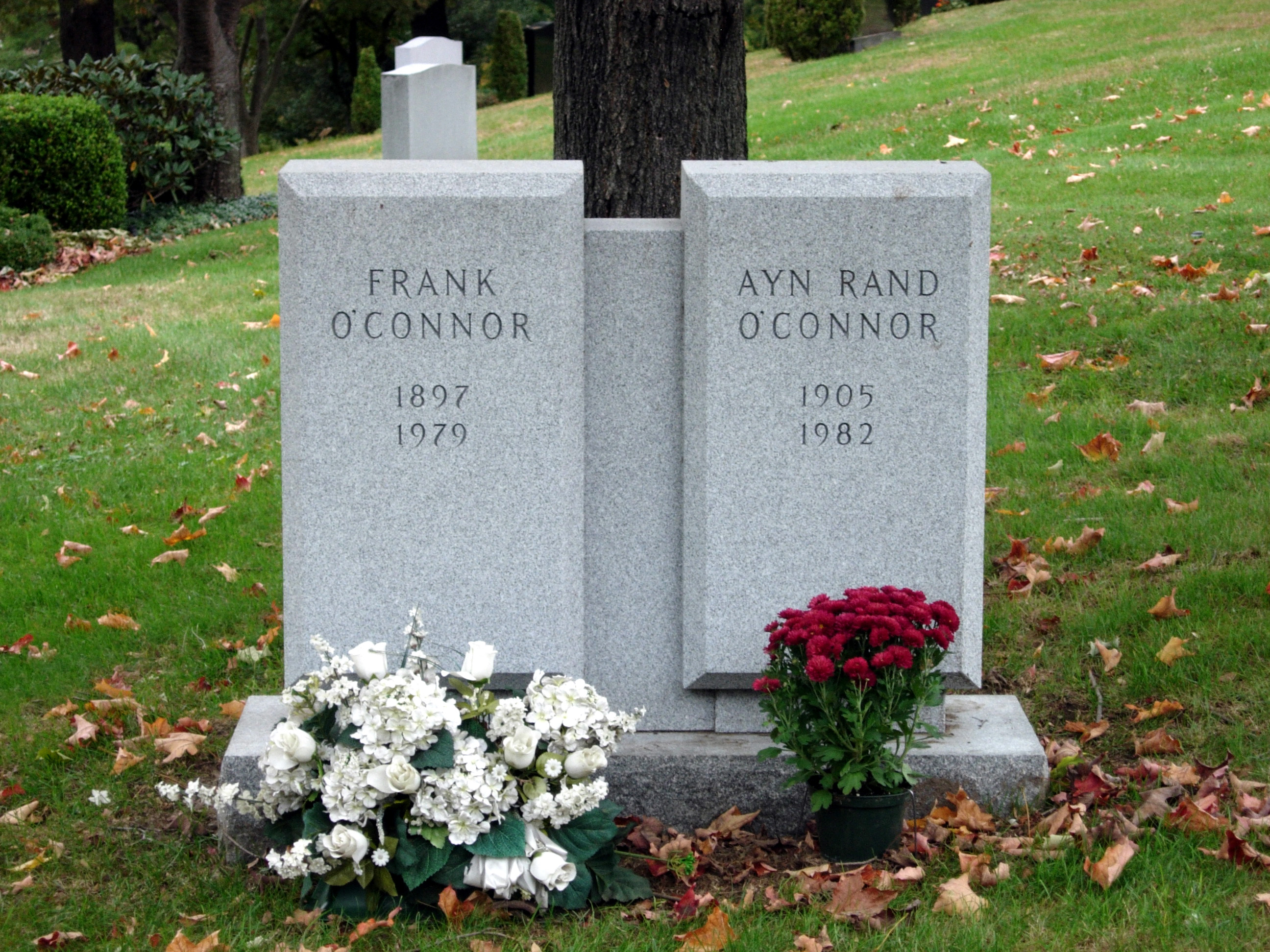 I feel compelled to note that this discussion about deathbed regrets has been largely ego-centric (from the viewpoint of the bed's occupant) — rather than the perspective of those surrounding the deathbed. I've walked through many a cemetery, (including the storied Kensico Cemetery) and note the preponderance of epitaphs that read: "Loving Husband,"; "Devoted Father," ; "Devoted Mother," and the absence of any tombstones that read: "King of Banking" or "Money Talks: But Not From the Grave."
Notably, Ayn Rand's tombstone in Kensico is devoid of any comments — bearing just her year of birth and death. (She is, however, buried next to her husband.)
In discussing this with my daughter (who recently acquired her driver's license/learning permit), I shared with her the ONLY memory of my high school driver's ed class. (The lesson was taught in the style of an epitaph.):
"Here lies the body of Otis Day.
He died defending his right of way.
He was right; dead right; as he drove along.
But now he's just as dead, as if he'd been wrong."
Kim Zussman writes:
Is an approach of future regret-minimization equivalent to risk-aversion?
Workaholic dads have something to show for their life efforts that Mr. Moms don't, and vice-versa.
If so, perhaps the only free epithet is to diversify devotions — at the expense of reduced expectation of making a big mark on the world or your family.
Dec
11
The Wavejet, from Jeff Watson
December 11, 2011 | Leave a Comment
 There's a big change coming in surfing during the spring of 2012. The Wavejet propulsion system is coming to your local surf break. This system is a pretty slick propulsion unit that can either be retrofitted into boards, or integrated into new boards. It uses state of the art electronics, has remarkable engineering, and is quite durable. The Wavejet purportedly will give 8-10 knots of speed paddling in calm waters for 40 minutes. The hardest part of surfing is the paddling, and the paddling can take it's toll. Eliminate the tough paddle, and one could have a more pleasurable time surfing, spending more time trying to catch waves, perfecting their riding skills while not too tired out. The downside of the system is that surfers will lose some of the exercise benefits a vigorous go out brings, surfers will get out of shape, surfers might try to surf in conditions that are above their skill level, and finally, this will allow non-surfing kooks to attempt (clog up) to surf breaks that are way beyond their non-existent skill levels. The Wavejet could be a development like the boogie board, which introduced wave riding to the masses. This could be good or bad depending on your perspective. Frankly, I think it will be a good thing as it will introduce the joys and stoke of riding a wave to the masses. The rest of my surfing buddies don't agree with me, but that's beside the point. Here's the Wavejet in action .
Dec
11
Flight Transcripts, from Jeff Watson
December 11, 2011 | Leave a Comment
 Here's the long awaited black box transcript of what happened during the crash of Air France Flight 447. So many kinds of errors, combined with irrational thinking, false data, no data, and misconceptions caused this plane to splash. The parallels of the last few minutes of this flight are very similar to the thoughts and actions of that moment when a trader is digging his own grave. This transcript is worthy of much detailed analysis and discussion. I'm sure that the analysis of the transcript can better help speculators upgrade their worse case scenario plan.
Chris Tucker, air traffic controller at JFK, responds:
 I have recently discussed this incident with a USAirways check captain. There are several problems– the first appears to be poor or insufficient training– partial panel operations are a part of the core instrument flight training curriculum– this is basic stuff. Figuring out which instrument or instruments that are unreliable is not that difficult. The other instruments combined can give a clear picture of the aircrafts situation. See a nice lesson plan in partial panel operations here.
The second and most glaring problem to me is the disconnect between the two control sticks. Airbus uses a side mounted joy stick instead of a forward mounted control column with yoke. In most aircraft, the other pilot is always aware of the position of the control column because as the other pilot makes adjustments– his own column moves in synch– he can see it. So if the pilot in the left seat is pulling back on the yoke, the right seat pilot is aware of it and if this is the absolute wrong thing to do (as was the case here) he can bring his expertise to bear and help fix the problem. But that is not the case with the Airbus, and in this situation the pilot not flying was completely unaware that the pilot flying was holding the stick back.
The way this system is designed, in my opinion, is insane. The pilot not flying has little idea what the flying pilot is doing unless the flying pilot informs him– which should be mandatory in a situation like this.
It occurs to me that the even though all of the information necessary to fly the aircraft safely was right in front of them, that these two pilots became scared, very scared and stopped thinking properly. This is a big problem and it can only be addressed through training. Any pilot can tell you that when the aircraft stalls the immediate response is always to lower the nose and add power. Always. This is a part of training that should be done so thoroughly that it is imprinted on the student permanently.
So why did Bonin persist in holding back the stick? I find it difficult to believe that a pilot in a heavy, long haul international aircraft is so unfamiliar with his planes systems as to not understand the difference between operating in "normal law" - where the onboard computers will not allow the aircraft to stall– and "alternate law" where the computers will allow this. This is critical knowledge and I doubt their training regimen permits them to forget it– even if operation in "alternate law" has never occurred in the past. But something prevented them from believing that the aircraft was stalled– regardless of the blaring and continuous stall warnings.
I cannot say why this pilot behaved as he did, but I can say something that I say to all my trainees on the radar. "The best possible thing to do with the time available to you is to think". From this one premise you can elicit behaviors that will promote it. I like to wait until the trainee is very, very busy and say "stop talking– just stop for a few seconds and look at the situation and think about it. You have plenty of time to do what you need to do." It is my understanding that when you are talking you are not thinking– so we try to reduce the number of clearances, try to combine instructions, keep the chatter on the frequency down. Stopping and trying to think about the situation, even in the midst of chaos, is the best thing you can do to fix it. Why this didn't happen on that flight deck is beyond me.
Dec
8
Folly of Prediction, from Jeff Watson
December 8, 2011 | Leave a Comment
Levitt and Dubner (of Freakonomics fame) have a new podcast up titled the "Folly of Prediction." Very flawed, but definitely an hour of entertainment value for the specs.
Nov
13
World’s Smallest Car, from Jeff Watson
November 13, 2011 | 4 Comments
Here are the specs for the world's smallest electric car, recently developed by researchers at the University of Twente in the Netherlands.
Size: 1 molecule long Range 6 billionths of a meter Operating temp: -266C Seating: 0
Frankly, you have to see this to believe it.
Nov
9
McRib vs. 7/11 Barbeque Sandwich Showdown, from Jeff Watson
November 9, 2011 | 1 Comment
 Here in Florida, and in many other areas of the country, McDonalds sandwich, the McRib is back on the menu for a limited engagement. I wrote earlier on Daily Speculations in 2009 about how much I enjoyed this tasty morsel of mystery pork. Since the McRib is back, I felt the need to stop by and get one or twenty.
A little back story here. On my way to McDonalds, I needed to fill up my car and went over to 7/11 where the gas is the cheapest in town. While going inside and getting a coke, I noticed that 7/11 has their own version of a BBQ sandwich in their deli section (who knew that 7/11 had a deli section). Their BBQ sandwich is wrapped in plastic, has a sell by date, and needs to be microwaved. My first thought…."This would be perfect for a McRib, 7/11 "Barbeque Rib Sandwich" showdown. They're really cheap and I paid $2.19 and walked out with a 7/11 "Barbeque Rib Sandwich." I went straight over to MickeyD's and bought a McRib and some fries.Took both sandwiches home and put the 7/11 version in the microwave as instructed. When it was warm, I took the McRib and 7/11 sandwich out of their packaging and put them side by side to compare.
The McRib was still warm and had a nice looking bun with a 1/4 inch of mystery meat poking out the side of the bun with some of the tangy sauce dripping down the side. The 7/11 version had an anemic looking bun, stale and soggy, and one could not tell what was inside. I opened the McRib and saw the mystery meat, BBQ sauce, onions, and pickles, and it looked pretty good. Opening the 7/11 version, I noticed that there was some nasty type of ketchup like sauce that was misapplied and all on one side of the meat leaving the other side completely without sauce. The 7/11 version had no onions or pickles. There was, on that side without sauce, some half congealed grease stuck to the bun which really looked yummy. The meat itself, looked kind of gray and reminded me of what cadaver meat looks like, and I thought that it would look good in a Wes Craven movie. I decided to try the 7/11 BBQ sandwich first. I took a bite of the stale 7/11 bun and was immediately repulsed by the meat which tasted kind of like ALPO(and I know what ALPO tastes like due to a prop bet I made in my youth.)
The meat/bun/sauce,congealed grease combination from 7/11 sandwich was so horrible that I could only take two bites, and was not only reminded of ALPO, but had the disturbing thought that this is what cadaver meat probably tastes like.It gave new meaning to the definition…rancid.. I washed my mouth out with a Coke and bit into the McRib. The tang of the BBQ sauce, the onion and pickle made their mystery meat very palatable. The McRib bun was fresh, and I ended up eating the whole thing. I found the McRib to be pretty good and the onion/pickle garnish topped it off. There was no comparison, the McRib beat out the 7/11 Cadaver…I mean "BBQ Rib sandwich," by a million miles. This was the most lopsided food showdown in the history of the world. Granted, one will find a better BBQ sandwich at just about every real BBQ place on the planet, but in a pinch, the McRib manages to satisfy one's BBQ Jones.
Oct
31
Close to Developing Artificial Life, from Jeff Watson
October 31, 2011 | Leave a Comment
Scientists have come closer to creating artificial life and it's only a matter of time before they do.
What are the moral/market implications here?
Oct
28
Feds to End Ag Reports, from Jeff Watson
October 28, 2011 | 3 Comments
The USDA, in a cost cutting move, is cutting some agricultural reports, 14 of them to be exact. None of the reports are major commodities, but they include honey and sheep. Personally, I applaud this move and hope that the USDA gets completely out of the reporting business and leaves matters entirely to the private sector.
Critics complain that there will be less information to go around with the ending of the reports. I humbly suggest that the end result will be more accurate data available because the private sector has an incentive to make the data as accurate as possible.
Feds tighten belt by cutting agriculture reports
Oct
28
Race Car Drivers are Athletes, Jeff Watson
October 28, 2011 | 1 Comment

Hats off to Mr. Lack.
Vince Fulco comments:
I have always thought race car drivers professionalism and grit have been terribly under appreciated. Growing up I was partial to the European racing scene (formal courses and rally events). To think one has to stay constantly focused at great speed while riding in an extremely noisy environment (no insulation) and sometimes arm's length from the engine and transmission belting out tremendous amounts of heat (wearing nomex fire retardant suits/underwear) while constantly strategizing makes trading seem downright easy in comparison.
I remember a story about Porsche's Derek Bell (as I recall) who was in the final laps of the 24 Hours of Lemans when his transmission started to fail losing grip with its gears. On his last visit to the pits, someone got the crazy idea to pour a can of Coke into the transmission tunnel giving it just enough stickiness to make it through the race. Not sure if their version of urban legend but amusing nonetheless.
Oct
25
Eliminate Ballyhoo, by Jeff Watson
October 25, 2011 | 1 Comment
In the quest for the truth and the elimination of ballyhoo, one must get through all the BS to find the kernel of truth. Here is a very important glossary of mathematical mistakes that are commonly seen in the popular culture and often repeated as the absolute truth.
http://members.cox.net/mathmistakes/glossary1.htm
It would be an interesting exercise to see what we can add to the list, either in the popular culture arena, or market lore.
Ralph Vince comments:
How about (cultural ballyhoo) "After all, we're a very litigious society!" (this is usually accompanied by the reminder of some anonymous woman scalded by coffee at McDonalds being awarded an amount so ghastly that poor McDonalds will have to make up that amount against the rest of us somehow!)
I would posit we are not litigious enough. One need only sit in any municipal court or state appellate court for a couple of hours and see the litany of individuals being hauled before the altars of justice by the financial institutions or the paint manufacturers whose lead was ubiquitous, or any other host of entity vs the individual going on. Truly, I almost NEVER see an individual as plaintiff in one of these unless they are going after another individual. The vast majority of what goes on in the courts WE PAY FOR are actions brought by those who do not pay for these courts, against our neighbors.
Yet, our class action rights are eroded under our noses repeatedly and recently. The only ones in favor of so-called "Tort Reform," are the insurance companies. The medical professionals who think they will financially benefit by this are delusional. The delusion is further propagated to the hoi polloi under the even falser notion that the medical community will share these newfon legislated riches amongst us.
Rocky Humbert writes:
After reading this, it's unclear to me whether Ralph is in favor of, or opposed to, tort reform.And, arguably, he's guilty of a bit of cultural ballyhoo here. He writes, "The only ones in favor of so-called "Tort Reform," are the insurance companies."At a macro level, it's not obvious why insurance companies should necessarily support tort reform (or even care about it.) Insurance companies raise premiums to offset the costs of litigation. Their profits (the combined ratio) are the "spread" between premiums earned and the settlements paid.
If the costs of litigation decline, so will premiums — and if there were serious tort reform, it might actually damage insurance companies, since their products would no longer be required!!If there were no tort litigation, insurance companies might go out of business en masse!!! The visible and direct costs of litigation (to which Ralph alludes) are minuscule compared to the invisible costs. The invisible costs include the innovation and investment which are forgone because of the FEAR of litigation; the incalculable dead weight loss; the practice of defensive medicine which wastes resources (and which applies to other industries as well).
"Loser pays litigation costs" combined with allowing third parties to finance and benefit from winning litigation — would be a fine first step towards balancing the scales between plaintiffs and defendants. But to suggest that insurance companies actually want tort reform ignores their raisson d'etre.
Stefan Jovanovich comments:
Ralph omits the largest part of the litigiousness of our society, which I pray will be largely eliminated some day - the criminal justice system. Since misdemeanors rarely go to trial, they will be absent from the municipal court dockets; and state appellate courts are usually not the best venue for criminal appeals (the Feds are usually better) so Ralph may not have had a chance to see how much of the "justice" system is about law and order.
A visit to any Superior Court or Federal District Court would probably change his view; at present, the largest single obstacle to an individual seeking civil damages is that their right to a speedy trial is non-existent.As one defendant put it, "The United States of America versus Alphonse Capone! What kind of odds are those?"
Ralph Vince responds:
Rocky,
I'm not an attorney — and I AM a little over-impassioned about the subject, so don't be surprised by my phreneticism here on this subject, ok? I am utterly opposed to this (altogether speciously misnomered) "Tort Reform," idea!
Where you say ". If the costs of litigation decline, so will premiums," I could NOT disagree more. When the Bankruptcy Act of 2005 was passed (presumably, among other things, so that the costs financial institutions were having to suffer as a consequence of personal bankruptcies not be passed along to the rest of the peons like me) did we see credit card interest rates reduce as as result? Did we see banking fees come down? No, the margin gained by such legislation accrued to the banks.
Profits ONLY flow upwards. Those paying down here do not participate in profits. If we did, those $150 running shoes made in Jingalia would only cost us about ten bucks.
The notion of a frivolous lawsuit is something cast in sand, and something the courts can deal with already via sanctions, etc. Just try to get an attorney to take a patently frivolous lawsuit to court — or see what happens if a non-attorney attempts one pro-se. They will be clobbered by the courts.
In fact, I say to the average Joe F. Blow out there, just try to take his NON-frivolous lawsuit to court. Go see how easy that is. Go see what the typical attorney will require of you up front. He is already, effectively blocked from the system, Bleak-Housed out from the very courts his tax dollars pay for. And again, if you take from people their venue for settling disputes in a civil manner, they are then likely to settle them in an uncivil manner. What is wrong with allowing people the venue of settling their disputes?
Our courts are NOT clogged incidentally. These are not a natural resource of finite size. If we need more courts — set em up. More insane judges. No problem. Homer Simpson is a little sick of sitting at that control panel at the nuclear facility, he can sit on on the bench for us.
Finally, when I speak of profits only flowing upwards, I don't mean it with respect to tort reform alone. The notion is integral to the specious arguments we are subject to every day to try to stifle our abilities of thinking critically for ourselves (I am not referring to you personally here, you seem to do so quite well except when it comes to your interactions with women). We hear repeatedly how free trade brings the cost of goods down (taking away US jobs) or how if we don;t have illegals picking our produce that tomato will cost 5 bucks.
Nonsense. Perhaps there is a scenario, but I cannot think of one wherein Joe F. Blow benefits because the cost to producers is reduced legislatively. To do so but taking Joe's right to settle his disputes — against individuals AND entities — away from him, is the real crime.
Stefan Jovanovich responds:
Neither Ralph nor I is an attorney, but I am guilty of having been one in California for nearly 4 decades. I stopped being one when the State Bar of California decided that it has absolute jurisdiction over any commercial transaction of my companies simply because I was an officer of the court. What that meant in practical terms was that any business partner or even customer could claim I owed them a fiduciary duty as a lawyer even if our dealings were purely commercial. As W.S. Gilbert put it, "here's a pretty mess". Eddy's Mom and I decided that resignation was the better form of valor. It took us nearly 2 years from the Supreme Court's clerks to decide we really meant it; the last letter we have from them is one suggesting that we might want to reconsider because we would be losing all the member benefits - i.e. access to State Bar of California credit cards and life insurance.
The greatest obstacle to "the average Joe F. Blow" is the current system of pleading; it is archaic to a degree that would astonish Lincoln or any other railroad lawyer of the 19th century. David Dudley Field would not be amused, especially since his reforms were adopted in Britain with much greater success than they have been in the United States.
http://en.wikipedia.org/wiki/David_Dudley_Field_II
http://en.wikisource.org/wiki/The_Mikado/Here 's_a_how-de-do
Ralph Vince writes:
Stefan, we evidently live in different universes. I routinely get called to jury duty in Cuyahoga County, Ohio, losing a week every two years. This is a court for monkeys.I have been through that system on the wrong side. Ex-parte rulings, convicted judges, FBI swarming, lower court transcripts LOST going to the appellate courts, corrupt clerk of courts, corrupt sherrif's dept., (all have plead guilty), routine over-charging of defendatns hoping for the routine, gullible jury, etc.
I will tell you what I tell the prosecutor in voie dire. "There's no way in hell you will get me to convict my fellow man of anything. Bring in the DNA evidence, the video, of this child-molesting cop killer. I wont convict anyone here in monkey court."Then….the resultant litany of threats levied upon me. I do my week and I go home. At least where I am here, in this universe, there is NOTHING WHATSOEVER about "Justice."
Oct
11
Apollo and Dionysus, by Jeff Watson
October 11, 2011 | 17 Comments
 In 1969, two contrasting events occurred almost simultaneously, the Woodstock Music Festival, and the Apollo 11 flight and landing on the moon. Ayn Rand gave a magnificent lecture titled Apollo and Dionysus comparing the two events and discussing the news coverage, the politics of both. Although this is an audio lecture that is quite long, it is well worth listening to the entire 69 minutes. Ms. Rand compares the majestic intellectual triumph of Apollo 11 with the "Mindless Mud-wallowing" of the Woodstock festival, the rational Apollo 11 vs the irrational Woodstock festival. She discussed the irrational mean spirited media analysis of Apollo 11 vs their irrational elevation to the heroic of the hippies at Woodstock. Her brilliant lecture gives one pause, and puts in perspective the protests going on in Downtown Manhattan and elsewhere.
Oct
2
Rush Hall of Fame Snub, from Jeff Watson
October 2, 2011 | Leave a Comment
 Another snub from the Rock and Roll Hall of Fame for my favorite freedom loving Canadian rock band, Rush. The Beastie Boys, Guns n' Roses, and disco singer, Donna Summer are nominated this time around, but not Rush.
Ike and Tina Turner, The Rascals, Abba, Gene Pitney, and Madonna are already members which suggests that the Hall of Fame's standards are not too high. Only the Hall of Famers the Beatles, Stones and Aerosmith have had more consecutive gold or platinum albums, with Rush nipping at their heels, turning in a whopping 24 consecutive big selling albums. However, one might suspect that politics might be involved, as Neil Peart is an Objectivist.
Here's one of their signature songs, "Tom Sawyer".
A modern-day warrior
Mean mean stride,
Today's Tom Sawyer
Mean mean pride.
Though his mind is not for rent,
Don't put him down as arrogant.
His reserve, a quiet defense,
Riding out the day's events.
The river
And what you say about his company
Is what you say about society.
Catch the mist, catch the myth
Catch the mystery, catch the drift.
Sep
28
Baltic Dry Index, from Jeff Watson
September 28, 2011 | Leave a Comment
Has anyone noticed the Baltic Dry Index as of late? Although well off its highs, it's come up well off its bottom on Feb 4 of 1043 and is at 1928 today. Has anyone done any statistical work on the BDI or found any correlations that might be interesting?
Lars Van Dort writes:
I didn't, but I once referred to an article on dailyspec of someone who did (this was after the Baltic Dry Index caught the attention by falling 34 days in a row).
The link to the article mentioned there is now broken, but I got it back using the Internet Archive. Perhaps you will find it useful. Of course, it never replaces doing one's own work.
Baltic Dry Index as a Reliable Forward Indicator? Nonsense.
05/18/2009 by Research Reloaded
In finance, be cautious of anyone who uses historical correlation to back up their argument. In shipping, just flat out run from them. Shipping's notorious Baltic Dry Index, which is an index of spot rates for shipping dry bulk commodities such as coal and iron ore around the world, achieved death defying heights and then, well, death-causing lows, in the course of 2008, falling 90% from its peak, and attracted a lot of attention in the process both on the way up and down. The BDI meme is still alive, especially given a recent rally, and we have quite a few people claiming it as a quality indicator, or even the best indicator (sheesh) for the direction of stock markets or the world economy. Unfortunately, a lot of smart people misunderstand what the BDI represents.
Full article linked above.
Sep
28
The HFT Boys Have Won…For Now, from Jeff Watson
September 28, 2011 | 1 Comment
If HFTs [High Frequency Traders] are making the big bucks in those markets, then we should be jumping on the bandwagon and taking advantage of that non-level playing field. Anything for an edge, and we all quest for the elusive edge, the overlay, and the HFT boys have won this round….for now. I admire those who can use technology to beat the market with better data, better systems, better and faster execution etc. This is just a culmination of the quest for a distinct edge first publicly demonstrated by N.M.Rothschild when he used courier pigeons to relay news faster than the competition.
Sep
28
For Corn Traders, from Jeff Watson
September 28, 2011 | 4 Comments
Here's a little tool to give you real time results on how the corn crop is coming in. Very useful.
Sep
17
Depression and Trading, from Jeff Watson
September 17, 2011 | 1 Comment
There is an interesting article on depression in Scientific American. If this article is true, and depressed people are better at certain types of thinking (ruminating), could this could be harnessed to better one's trading? Personal experience says yes, but I'm curious about everyone else.
Sep
12
The Next Bull Market, from Jeff Watson
September 12, 2011 | Leave a Comment
 I suspect that this video is a preview of something that will be the next great bull market, a bull market that will dwarf the dot com market, a bull market that will be representative of a society changing technology right out of a science fiction novel. This new technology will redefine, reinvigorate, and recreate the industrial revolution.
Ralph Vince writes:
This technology has been around a long time for prototying componentry. There is a particular file format (comprised of a tringualr mesh of 3 d vertices) which many CAD formats readily convert to OR can be converted into.
I think where the rubber meets the road on this is the ability, ultimately, to do away with the machining of parts, particularly out-of-service parts. Try getting parts to very old cars for instance. With a CAD drawing of such a part, the physical part — or, the physical components to the assembly of the part, could readily be recreated. I did a ton of work with this kind of stuff — what the video doesn't go into is that the drawing itself can have engineering rules embedded within it. It;s more fantastic really than the video shows!
Dylan Distasio writes:
I agree that this one will eventually be a game changer. Although what I'm about to link to is more of a hobbyist unit, it is still impressive in its abilities, especially for the price. I've seen demos of these firsthand, and they're pretty cool for a home user:
Shapeways is also doing some pretty cool stuff with this in the commercial space, and offers a lot of different materials.
Sep
9
Separating the Wheat from the Chaff in Technical Analysis, from Steve Ellison
September 9, 2011 | 2 Comments

The scientific method has two parts. There is theory, which requires knowledge and intuition to posit a cause and effect, and there is testing, collecting data to determine whether the observations refute the theory. If I understand your point correctly, empiricism is necessary but not sufficient. There should be a theory that is not entirely based on the observed data. As an imaginary example, “The S&P 500 is likely to decline on Friday afternoon because day traders are biased to the long side and want to be out of the market before the weekend” is better than “The S&P 500 was down on 19 of the past 30 Friday afternoons”.
Ralph Vince responds:
Steve, yes, but the premise, the cause, needs to be proven. “The S&P 500 is likely to decline on Friday afternoon because day traders are biased to the long side and want to be out of the market before the weekend” needs to be proven as causal, not merely posited as a possible cause.
Frankie Chui writes:
Yes, I always end up asking myself “why does it not work anymore after it has worked for so long?” when the moment I trade it the system stops working. It has also happened to me quite often where I backtest a strategy, everything seems ok, trade it for 2-3weeks and that’s the end of that system. Therefore, I am now experimenting with optimizing parameters in systems more frequently, perhaps once every two weeks on a rolling basis. Optimize two weeks of data, trade it for a week, optimize the past 2 weeks again, trade it for another week. Of course the 2 week/1 week time frame may not be the best (I just randomly chose it), but has anyone ever done anything with this kind if approach? I’m curious to see if this will work for day trading. I am new in mechanical trading, but I’m very curious to know if optimizing data fast enough will allow a trading system to work better and longer (for day trading).
Jeff Watson writes:
Frankie, you’re running up against Bacon’s ever changing cycles, which tend to render systems obsolete.
Phil McDonnell adds:
There is an insidious danger when you use optimization. The optimizer will fit the system to the data too well. It will never perform as well out of sample as in sample. It becomes especially important to use tests of statistical significance when you do optimizations.
The optimizer can actually create a multiple comparison problem in some cases. For example if you tested, looking for seasonality and wanted to find which month was the best to buy it would create a multiple comparison bias and any test for significance would have to have a much higher threshold than if you just tested September.
One way to judge a system and evaluate whether it will continue to work is to plot out the equity curve. If your testing assumes an equal sized investment each time then the system can be plotted on an ordinary arithmetic scale. If you compound it should be plotted on a log scale. Either way the most desirable system would be a system that looks like a smooth line going monotonically up to the right as time passes. If it starts to roll over then it may be a system about to fail.
Paolo Pezzutti writes:
The system should be quite robust. It should work pretty well with a sufficiently wide range of values of parameters. There should also be few parameters avoiding curve fitting.
Sep
9
Supernova, from Jeff Watson
September 9, 2011 | Leave a Comment
 For all those Stargazers out there, there's a magnificent supernova in the "Pinwheel Galaxy" M101 (Ursa Major), and it's only 23 million light years away.
.
.
.
.
It's expected to peak out at a 10 magnitude and should be easily visible from a 4' telescope.
Sep
4
More Taxes More Problems, from Jeff Watson
September 4, 2011 | 11 Comments
More taxes aren't really a solution for anything. Should China should be punished because of our inability to compete? A good philosophical question to ponder….Is it a bad thing for a neighbor like China or India to get rich, or will it only benefit us down the road? From a personal note, I think that the world is better off with as many rich countries as possible…..more customers for us to sell things to and more choices for us as customers to buy.
Sep
4
Waffle House Index for Disasters, from Jeff Watson
September 4, 2011 | 2 Comments
 As a resident of the South, I particularly love that old Southern institution, the Waffle House. While every business might close during a hurricane, Waffle House has a great plan for keeping their restaurants open, and they manage to do a great job keeping their doors open, even with windows boarded up. The FEMA director can tell how bad a disaster is by looking at how much of the menu at a Waffle House is available. He's created a sort of Waffle House natural disaster index index.
The test of the index is:
If a Waffle House store is open and offering a full menu, the index is green. If it is open but serving from a limited menu, it’s yellow. When the location has been forced to close, the index is red. Because Waffle House is well-prepared for disasters… it’s rare for the index to hit red. Incidentally, the the different state legislatures are legislating Waffle Houses out of business. My local Waffle House manager told me that business is way down at the locations nationwide because of the laws banning smoking inside the stores. Smoking bans do have unintended consequences, just ask any bar owner. Since many Waffle House customers are smokers, they are making other plans to eat.
Aug
24
Article of the Day, from Jeff Watson
August 24, 2011 | 4 Comments
 I read a very entertaining article in Scientific American yesterday: "Can Math Beat Financial Markets ".
Stefan Jovanovich writes:
Check out the author's home page.
Gary Rogan writes:
Looking at the page brings up the age-old question: can the same techniques that are used in natural science to study the universe that doesn't change from being studied and where the fundamental rules don't change at all be applied to a system where nothing prevents most rules (other than that old "human nature") from being changed at any time? He cut his teeth on never-changing, but how will it play with ever-changing? Somehow fractal coastlines are just not the same as fractal security price charts. Fat tails and non-gaussian distributions are great, but then what? We can evidently estimate the risk of something happening he says. But can we???
Ralph Vince adds:
Yes, when he speaks of their raison d'etre "To quantify risk" I think, "Huh? How? VAR? Just HOW DO they 'Quantify Risk.'
If alluding to using it ("algorithmic trading," in the context of some sort of proce prediction a la quant, I assume he means modelling prices using models based on SDEs. Again, "Huh? How? Does this guy know what he is talking about?")
Quant-dom, traces it's roots to pricing of various securities — warrants, options, spread on futures/forwards, backwardations, and the pricing of the plethora of derivative creatures who climbed out of the ooze of ercent decades. This is NOT predicting markets, or "Quantifying Risk," (the latter, clearly, has utterly failed using their conventional models).
The entire article smacks to me of something dumbed down to the point of being useless and silly
Aug
23
Perhaps Those People Lining Up to Sell Gold Know Something, from Gary Rogan
August 23, 2011 | 5 Comments

People are lining up in Wesport, CT to sell gold coins, according to a report on Seeking Alpha .
Has anyone ever reliably made profits from bubbles? If so, their existence can be prospectively determined, if not there is no clear answer. It's true that there may be people who know a bubble with 100% certainty, but they don't know where they are in the cycle so they are too worried about shorting them. This is pretty morally equivalent to having no idea about the existence of a bubble, although not quite. I'd say if someone can reliably predict that within a "reasonable" time the bubble will deflate below the current level, and are willing to bet on that, they "know" the bubble exists.
Jeff Watson writes:
Look at the 1980s Hunt Brothers silver debacle. Despite the big move in silver, I never knew anyone that made a boatload of money off of that huge move. I heard lots of tales of people getting rich off the silver market, pyramiding $5,000 into millions, but those people were always friends of friends twice removed, and nobody in my clearing firm, none of my buddies ever nailed silver. I suspect those people who got rich off of the silver market are as elusive or mythical as the Yeti. I also suspect that if you were long that silver market with a $5,000 account that you would have stood a better than even chance going bust.
Rocky Humbert comments:
The Hunt Brothers episode was a corner in an overleveraged market. I'd argue that the gold story today is totally different. Importantly, it's not a leverage-fed, euphoric or happy bull market. It's a funereal bull market. Because if gold is right, and it keeps going and going and going (?5,000? ?10,000 ?20,000 +++) all of one's paper assets will be worth what they are printed on, and the Chair will find out exactly what 2008/09 would have looked like without massive central bank liquidity infusions. (And being short stocks won't help either, since there won't be anyone left to pay you back.)
Hey Gary — for someone who thought total financial collapse was the "ONLY" outcome, how can you NOT be massively long gold??? That's not a bubble! Or is it? As I've been writing for two years now, gold's ascent is a confluence of negative real interest rates; undisciplined central bank behavior; a growing loss of confidence in government policies and financial systems; loss of Swiss bank secrecy; an accumulation of economic wealth by individuals in parts of the world without stable property rights and rule of law; etc. The CME can raise margin requirements all they want; but there needs to be a change in the underlying fundamentals (and/or perception of the fundamentals) to end this period. What will that change look like? Shouldn't that be the question on the table ….
Gary asks, "Can anyone reliably make profits from a bubble?" Hmmmm. Warren Buffett keeps a sealed envelope in his desk drawer with the name of his successor. In contrast, I keep a sealed envelope in my desk drawer with the EXACT high price in gold. Neither of us allow any peeking (or peaking.)
Note to Anatoly: You recently wrote that you think gold won't go all the way back down. If you believe that this is a genuine bubble, then you'll have been wrong on the way up. And on the way down. See Jeremy Gratham's extensive work on bubbles — and his observation that they retrace >100% of the parabolic extension.
Stefan Jovanovich says:
The U.S. Treasury had enough gold to be able to promise to redeem the customer balances of every member bank of the Federal Reserve in the United States in 1930; had that step been taken, the U.S. would not have suffered the extraordinary collapse in demand that created the death spiral of world trade
Tyler McClellan asks:
Stefan,
Just for fun, how would you have lowered real interest rates in the US, without dramatically widening the gold points, or say just abandon them all together.
Stefan Jovanovich replies:
Why would I want to administer interest rates at all? The problem with the Federal Reserve system is that its underlying premise is that the government should do so. Nothing can prevent speculation from having a component of folly and ruin — like all of life. The idea that the government — which is itself an interest group of the employees and beneficiaries of government borrowing and spending — can somehow avoid the same folly and ruin in its speculations seems to me to be the funniest of all the lunar illusions. Remove the notion that somehow banking is a special kind of business that requires absolute government guarantee (which, as we have seen, the government cannot afford any more than anyone else) and a great deal of the folly and ruin disappears because the truth — that everyone in commerce works without a net — is transparent. As someone once said, the illusion of safety is the most dangerous of all ideas.
Aug
21
Sage Advice From a 105 Year Old Banker, from Jeff Watson
August 21, 2011 | 1 Comment
 Here's a great article about the current record holder for the title of oldest banker in the US. It is a very fascinating story, with a few small snacks for a lifetime. The whole moral of any type of story like this is that it pays to listen to what old timers have to say, and it also pays to examine their lives and to model the parts that make them successful, not just in business but in life. As a young kid thrown into the pits, I sought out and asked for advice from the grizzled old guys who started trading as early as the late 1920s - early 1930s (there were still a few of them around). I also learned to ignore the advice of real old clerks, etc. (There was a reason they were old clerks). It was and is my contention that if someone is a speculator for 40+ years, no matter what, he's a success if he's still in the game. They had seen it all and done it all, and I will say that taking some of advice is the difference between a 2 year speculation career and a 40 year career. Rich or poor, or in between, a 40 year veteran is going to have a superb defensive game, and a strong defense is more important to longevity than a great offense (in my opinion).
Aug
15
The Oracle Opens His Mouth Again, from Jeff Watson
August 15, 2011 | 10 Comments
Here's a laughable op-ed piece from the Oracle of Omaha with the title, "Stop Coddling the Super Rich." In the essay, he tries to perpetrate and extend, to quote the Chair, "The idea that has the world in its grip." Buffett wishes to immediately raise tax rates on those making more than a million a year. He says that super rich wouldn't mind if they "were told that they had to pay more taxes…particularly when so many of their fellow citizens are suffering."
The hidden motive in this op-ed is that he wishes to create conditions that will bring more customers to his business. Like General Electric lobbying the government to ban 100 watt incandescent light bulbs in order to sell the new ones with the higher margins, the Oracle is lobbying everyone in order to benefit his book. And his folksy, aw-shucks demeanor, his phoney populist theme, is winning over a lot of people. The Oracle is constantly quoted and cited by the statists as an example of someone who is rich and feels that we could be doing more for the government .
Aug
8
A Shot Across the Bow, from Jeff Watson
August 8, 2011 | Leave a Comment
As the Chair so properly puts it, the S&P downgrade is a shot across the bow. In their own words (see S&P: "US Credit Rating Lowered" ).
Jul
29
The Science of Sprinting, from John Floyd
July 29, 2011 | 1 Comment
 This is an interesting study on what makes a winning sprinter. I wonder if there are applications and lessons to trading? For example in the use of leverage and sizing as applies to the amount of force used? The volatility of markets in relation to leg speed? The size of the fund and alacrity that may be required in various markets do to sizing and visibility and physical characteristics of a sprinter?
Jeff Watson writes:
This reminds me of a thread on DailySpec last year about the golf swing problem that nobody could really give a correct answer to. The observers of the runner were correct in their methodology in measuring the underlying influences of a quick sprint. Separating and isolating all forces (seeing what forces are really influencing and in play) and solving them independently is the first lesson that they teach you in any physics 201 class.
Jul
25
Looming Vs Receding, from Ken Drees
July 25, 2011 | 2 Comments
 When I read this article I instantly thought about price and if it was going against me (looming) in a trade or if it was going in a profitable direction (receding). Time passage does seem different under the two conditions and thus my mindset and behavior must be different.
In fact, some investigators have suggested that the amount of energy spent during thinking and experiencing defines the subjective experience of duration. In other words, the more energy it takes to process a stimulus the longer it appears as a subjective experience of time. Something moving toward you has more relevance than the same stimulus moving away from you: You may need to prepare somehow; time seems to move more slowly.
Jeff Watson writes:
One of the best things in surfing is when the wave is breaking hollow and you can get inside and surf completely covered up by the wave in all directions except in front of you. This is called, among other things, "Getting Tubed," and although it's a very short experience, it's one of the most exhilarating things in surfing.
Surfing legend, philosopher, and master, Gerry Lopez , one of the best tube riders of all time, once observed that "Time expands inside the tube." He's right, as the typical time spent riding inside the tube is a couple of seconds, but to the rider it feels much, much longer. Here's a short video that captures 1/100th of what it's like inside the tube of decent waves.
There are other, holistic benefits to one's health gained by regularly riding tubes, but the benefits cannot well be described on paper as they are of a more metaphysical nature.
Jul
21
The First Great Global Warming Debate, from Jeff Watson
July 21, 2011 | 1 Comment
This is an excellent, but flawed article in Smithsonian.com discussing the first great Global Warming debate, which was between Thomas Jefferson and Noah Webster.
Jul
19
“As It Was” by Gardnar Mulloy, from Victor Niederhoffer
July 19, 2011 | 6 Comments
 When a man has lived without illness to 99 years old and is still going strong, having won 122 national tournaments along the way, served as a lawyer for 70 years, visited hundreds of countries, played with every tennis player of the past 100 years from Bill Tilden to Jon McEnroe, won the Wimbledon doubles at 47, started a major animal rescue operation, witnessed murders, had a career in politics, played with all the famous Hollywood actors of 50 years, played with kings, Presidents and Duchesses, there is much to learn from him. I was pleased therefore to pick up Gardnar's autobiography written at the age of 95 and self published but available at the Newport Casino, where he was a thorn in the side of the powers that be there for 70 years. Writing at the age of 95, when many of his enemies have passed away, one benefits from his not holding back as so many auto's do these days for fear or libel or hurt feelings.
The first thing one learns from him is an anecdotal secret of a healthy life. He is a vegetarian, doesn't drink or smoke, has no air conditioning, gets to sleep early, and floats around the court at a single steady. His recipe for life is to enjoy the great pleasures of life — eating, exercise, sex, sleep, and bathing. (He recommends bathing with an olive oil cleaner rather than soap.)
 Of course, as in all things, it's a combination of genes and environment that got him so far. He has two sisters in their 90s, his mother died at 95, he and his father were National father and son champions 3 times. He was a star football player, diver, and boxer at the University of Miami. He practiced on a home spun clay court with his father and was winning tournaments at the age of 13. He was married for 50 happy years to his college sweetheart, a beauty queen and swim champion.
Having played against or seen many of the players that he mentions in action, I was particularly interested in the stories about such low lifes as Bobby Riggs, Frank Shields, Herb Flam, Art Larsen, Ted Schroeder, and John Mac, who he praises as possibly the greatest tennis player but criticizes as a self centered poor sport who tried to kick him off a court at a Wimbledon prep because he was Mac. He has a beautiful, heartbreaking story about Gloria Butler whose father started the Monte Carlo club, but has given away all her possessions because her "master" has told her she should live as a hermit and give all her money away to guess who.
It is also quite educational to hear his take on the things that have changed during the past 80 years of tennis. He points out that just as important as the new materials in the rackets these days for faster and better play is the pressure of the balls. Because of the high pressure, and the change from a rubber center, topspin must be hit to keep the ball in, and this almost mandates the much lamented by all players of the era, extreme western grip. He believes that with modern equipment the old players would have fared quite well against the current crop.
Many other murders and near death incidents occur. For example, he describes how he got his friend Mike McLoughlin out of jail in Cuba as all the other casino owners were being executed. And he describes the suicide of Gladis Helman, the strange death by drowning of Frank Froeling's mother, and the attempted murder of FDR that he witnessed.
 His love for his father shines thru and he describes with heart breaking detail how this 45th degree Mason lost his lumber business in the Hurricane of 1926, and was thwarted in all his entrepreneurial ventures thereafter because of the common problems of the depression. Apparently Mulloy inherited his father's inability to make money, as he seems to live very modestly in a two bedroom house, and he never seems to have 25 bucks extra to his name. I like the fact that of all the tournaments he's won he is proudest and happiest with the 3 father son tournaments he won with his dad.
Amazingly, although he has singles wins over almost every great player of the last 75 years including the two Pancho's, Bill Talbert, Vinnie Richards, Riggs, Welby van Horne, Frank Parker, Godfrey von Cramm, Rosewall, Borotra, Cochet, he is not remembered much as a singles player, but is mainly renowned for his many grand slam doubles and Davis Cup victories. There's a nice youtube video of him playing with Trabert in doubles and he plays a nice fluid, but not overly forceful game, with a medium sized serve, a mediocre overhead, and good backhand volleys as highlights.
He was constantly fighting with the powers that be of the official associations. And with good reason. He describes how James van Allen refused to give food to the tennis players that lost in the Newport tournament, how he was defaulted by the Californian official Jones for complaining about favoritism to the Wasps, and how the officials were only interested in siphoning off all the money in the game for themselves rather than let a player make an honest living from the game.
His example of rich man Avery Brundage who disqualified Jim Thorpe for playing semi pro baseball is typical of what he faced as the tennis association made it impossible for a self respecting player to play the game unless he were independently wealthy or a special favorite of the "sponsors".
In a chapter entitled the pompous dictatorship of the USTA, he describes his experiences with the officials– mainly Holcumbe Ward, Julian Myrich, Robert Jones, and James van Allen. They were constantly on his back whenever there was money to be made by them at his expense. His experience reminded me so much of what I experienced in squash when I decided to turn pro because I couldn't afford to be a gentleman amateur any more. These experiences are sisters and cousins to what we experience so much today where those with access to power, money, and information gracefully slide from the political arena into the banking arena, consulting, private sector, or institutional arena as opportunity and advantage arises.
Gar is a man of respect and as he nears his 100th birthday, still winning the 90 and over's regularly in doubles, one should pause to hope that one could live as happy and productive a life as he doing the thing he loved the most and was so good at.
Jeff Watson writes:
That was the best biography that you have ever reviewed. Mulloy reminds me of my grandfather in so many ways. It would be interesting to list the similarities between productive old centenarians like them, because they all seem to share a common thread. I don't know exactly what the thread is, but it probably includes luck in the genetic lottery, and guys like these seem to have something extra, a joie de vie or something like that. Not like the miserable old 95 year old people that I run into here in Florida on an everyday basis. Mulloy also reminds me of a Mr. Woodykind, who I knew as a kid. Woodykind was an avid tennis player who retired to Pompano Beach and played tennis at the clay municipal courts back in the 60's when I lived there as a kid. He was in his 80's, very healthy, and was a champion who supplemented his retirement by wagers on his matches. He was a great guy who was also very sharp with many stories to tell about the old days. He gave me some advice that I still live by today.
Jul
18
The Science of Winning, from Jeff Watson
July 18, 2011 | 5 Comments
This is a great article in Newsweek, of all places, on the science behind winning.
Jun
30
The Appeal of Cynicism, from Russ Sears
June 30, 2011 | Leave a Comment
 There are several reasons that cynics are on the rise in my opinion.
1. People assume the cynic is the expert. The cynic has an aura of authority.
2. Cynicism is masked as realism.
3. People assume the cynic is a healthy skeptic. On first encounter these two are hard to distinguish.
4. The cynic guards against disappointment.
5. The cynic creates an “us” against “them” world. "We won't be fooled again" by "them".
6. It is easier to find a problem than create a solution or even understand how complex creativity works.
7. It is easy to ignore the positive. Hard to ignore the negative.
8. People assume their bias is only one sided: When they like something too much. People recognize their biases when there is favoritism but justify their biases when there is disdain or prejudice. The cynic reinforces that their biases are the only morally defensible ones.
 9. The cynic has many times when he is proven wrong, but it is often hard to pinpoint the opportunity cost to that cynicism (for ex. the profit he missed by staying out). However, when he is proven right, it is very easy to see how much he has saved.
10. The belief that Type II errors or believing falsely in a person are much more damaging than Type I errors or not giving a good person a chance. Despite the time it takes for a person to prove she is proficient and the moment it takes to lose trust-worthiness.
11. The cynic is elevated as “your own man” by the media and politically. Thus becoming the “go to person” when they want something said or done. This creates all sort of side agreements and quid quo pro understandings. Every TV program needs the phone numbers of a few favorite cynics.
12. Ironically, the person most likely to publicly be called down for their cynical tendencies is the person that is cynical towards the celebrated cynic.
Con-artists understand deeply the appeal of cynicism and use it against their prey.
The cynic is the ultimate champion for the status quo. The cynic can define people by their weaknesses not their strengths. Since everybody has weaknesses, they can dictate who is important by defining who is not important. Old man’s disease is giving in to the appeal of cynicism.
Rocky Humbert writes:
 "A cynic is a man who, when he smells flowers, looks around for a coffin."
H. L. Mencken
In the spirit of not being a cynic, I note today's news story reporting that volunteers in Japan are being asked to grow sunflowers to produce seeds … so even more sunflowers can be grown in areas contaminated by radioactivity from the Fukushima disaster. The proponents say sunflowers can efficiently absorb radioactivity from the soil in a process known as phytoremediation. Here's the news story.
The skeptic (as opposed to cynic) in me thought that this sounds like an example of "green" people confusing Flower Power with nuclear physics. But a little bit of research reveals a bit of "sunny" science for the weekend. There is REAL science here! Sunflowers (and certain other plants) CAN decontaminate radioactive soil faster and cheaper than many other approaches. Chernobyl was a large-scale proof of concept. Here are 2 of academic papers on the subject:"Screening of plant species for comparative uptake abilities of radioactive Co, Rb, Sr and Cs from Soil,"Gouthu et al ; Journal of Radioanalytical & Nuclear Chemistry" and "Uranium Absorption Ability of Sunflower, Veiver and Puple Guinea Grass," Roongtanakiat et al (2010)
SO THE MORAL OF THE STORY IS: "A cynic is a man who, when he smells flowers, looks around for radioactive contamination."
Pitt T. Maner III comments:
The phytoremediation and bioremediation fields have bloomed to aid companies tasked with difficult cleanups. Even earthworms can be useful with certain contaminants (PCBs).
Larger trees also can be used to influence the flow of impacted groundwater so that contaminants do not move offsite—effectively they act as small pumps (think of all the Florida maleleucas used to drain wetlands, now designated as "noxious weeds"). Trees can help with the treatment process through the uptake and concentration of contaminants or the breakdown of contaminants in the bacteriologically-rich portions of the root system .
The economics can be interesting and one can only imagine what they are in the Japanese case and how they affect current land values. Those with an understanding of the actual risks involved and the ability to cost effectively clean properties have in certain instances done well:
"Acquisition, adaptive re-use, and disposal of a brownfield site requires advanced and specialized appraisal analysis techniques. For example, the highest and best use of the brownfield site may be affected by the contamination, both pre- and post-remediation. Additionally, the value should take into account residual stigma and potential for third-party liability. Normal appraisal techniques frequently fail, and appraisers must rely on more advanced techniques, such as contingent valuation, case studies, or statistical analyses.[11] Nonetheless, a University of Delaware study has suggested a 17.5:1 return on dollars invested on brownfield redevelopment.[12]"
Kevin Depew writes:
Why do you believe cynicism is on the rise? In my opinion, the < 35 generation doesn't really understand it or ignores it. I don't have access to it now, but I saw some large scale polling data on Friday that was remarkable in the cross section spreads between < 35 and those over, especially > 65. The gist, based on this polling data, is that if one is > 65, one is likely to find the country going to hell, the economy going to hell, that politicians are evil and stupid and that all bankers and finance people are crooks by a wide, wide margin over younger subset. If interested I'll forward data when I get back in office Monday. I was looking at it in the first place because there is a wide divergence between consumer comfort and confidence data vs market that is outside of 25 year norms and was just curious about the asymmetry in both economy and the polling data.
Victor Niederhoffer writes:
Artie wrote a book on cynicism in the police force that attributed cynicism as a variant of the authoritarian personality. He believed that police became cynical because they saw so much evil that their own persona looked relatively good compared to all the evil, and their cynicism and corruption was a natural outgrowth of the impossibilities of fulfilling all the requirements of an all too demanding job with conflicting goals. I believe we become cynical on the list because we see such ephemeral behavior by the public and funds, and such inside maneuvering by the cronies and flexions. It's hard to maintain a proper chivalrous attitude when confronted by these things day after day.
Jeff Watson adds:
But that cynicism, if allowed to fester, will have profound effects on one's trading. I've seen it happen too many times to people and they end up losing their edge.
Ken Drees writes:
Cynicism towards markets and politicians is healthy, but toward general mankind or society, probably not so well placed since hope and belief in goodness of the total gives one an overall positive tendency towards world view but also a well placed skepticism at certain segments.
The idea of erosion is interesting where the rigors of the job or the constant focus on conflicting outcomes that collide with the overarching worldview wear down the person's belief in good. One thought along these lines that I have is that by the end of one's life you are so distilled down in terms of your true character that its impossible to change. You are either that positive and generally nice old person, or a frown wearing old crank; the thoughtful scientist who never stops learning, or a worn out 24/7 TV watcher.
Russ Sears adds:
I believe it also has to do with the narrow vision we have of public versus personal life of the cynic. We do not see that like a partying narcotic addict, the soul has been sold for a very narrow gain. The personal life is full of turmoil and eventually rots the productivity out of the person. Think about the cynicism required of the steroid user or EPO user for example.
I believe that many companies demise starts when a new "C" position arrives within it- the Chief Cynic. If not confronted as Artie did, often this position is allowed to become an all consuming cultural force.
Vincent Andres adds:
"the cheaper money tends to drive out the dearer"
(the money of lower value drives out the money of higher value)
–Nicolas Oresme
(« la mauvaise monnaie chasse la bonne » )
Jun
27
Basic Science with a Couple of Sticks, from Jeff Watson
June 27, 2011 | 2 Comments
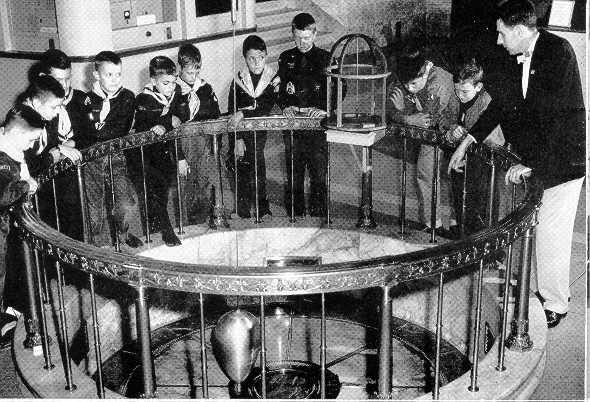 Long before laboratories had HPLC, GC-Mass Specs, spectrophotometry, computers, even chemicals and glassware for that matter, there were still inquisitive people who wanted to learn and study about the earth and the universe around us.
The first laboratories equipment probably consisted of a couple of straight sticks, after which they added a rock, and a string. A timepiece would have been nice, but since timepieces weren't invented yet, they probably needed the stick to tell time. The first scientists pounded a stick into the ground and noticed a few things.
First, they probably tracked the stick's shadow from when the sun rose until the sun set. The scientists noticed that the shadow was longest when the sun rose and set, and the shadow was shortest when the sun was at the highest point of the day, They also noticed that when the shadow was shortest, that was the exact middle of the period of daylight and they were able to determine the local noon(midway between sunset and sunrise). The first scientists had inadvertently created the first timepiece, the sundial, from a simple stick.
This sundial was also the first compass as at the exact moment of local noon, the shadow pointed either due north or due south depending which side of the equator they were on. They also noticed that in the northern hemisphere that the shadow revolved around the base of the stick in a what is called a "clockwise" pattern.
Since it's safe to assume that those early scientists had plenty of time on their hands (no worries about publish or perish or tenure), it's not a stretch to think that that they made observations of the stick for a very long time. First, they would have noticed a big pattern of shadows in a 365 day repeating period. Had they observed the stick for any 365 day period in a row, and recorded what they saw, they would have noticed that the sun doesn't rise on the exact same spot on the horizon. They would have also recorded the fact that on two days a year, the shadow at sunset points exactly opposite the shadow at sunrise. When this happens, the sun rises due east and sets due west and the daylight lasts as long as the night. These two days were found out to be the spring and fall equinoxes. Any and all other days, the sun sets somewhere else on the horizon, not due east or west.
The scientists also noticed that while the sun was rising and setting on different points of the horizon, it's trajectory was also changing. They recorded the two days of the 365 where the shadow at noon where the shadow was either the longest or shortest. The day the noon shadow was the longest, it was the winter solstice, and when it was the shortest, it was the summer solstice. It's amazing that with a simple stick, those first scientists were able to record the four points on the compass, and were also able to identify the four days of the year that mark the change of seasons.
Those scientists weren't finished with the stick, they had more observations. At night, they lined up their stick with a familiar star in the sky. Using their hourglass, they would have noticed that the star took 23 hours, 56 minutes, for the star to align it with the stick from the previous alignment. From this they would be able to deduce the length of a day and determine that it was uniform throughout the year.
The scientists weren't finished with the single stick, as the scientists that recorded the tip of the shadow of the high noon noticed that the shadow fell to a different spot each day and over the course of 365 days, those marks traced a figure 8. The figure 8 happens because the Earth tilts on its axis by 23.5 degrees from the plane of the solar system. The tilt gives rise to the seasons and the apparent wide ranging path of the sun across the skies.
The figure 8 is the result of the sun migrating back and forth across the celestial equator during the year. Due to many other things, the earth's orbit is not a perfect circle and according to Kepler's Planetary laws, the orbital speed must vary, increasing as we move toward the sun and decreasing as we move away. Because the Earth's rotation is constant, but the orbital speed isn't, high noon does not always correlate with "Clock noon." The variance can be as much as 16 minutes early or late depending on the time of year. Interestingly, the clock noon equals high noon only four days a year, Dec 25, April 15, June 14, and Sep 2.
But I digress, the first scientists had much more on their plate, and they had science to do. Those scientists probably sent their assistants due south way beyond the horizon (more than 6 degrees would be ideal) with a stick the same length. At a predetermined time (high noon?), on the same day in the future, they measured the length of the shadow, and were able to use those lengths to calculate the Earth's circumference using simple geometry.
 From the circumference, they could determine the radius, diameter, volume and much more. From this, one could have probably made a few more simple measurements and arrived at a mass of the earth. Eratosthenes of Cyrene measured the length of the two shadows with a partner in 222BC and got an answer that was within 15% of the true circumference. As an aside, the word geometry is derived from the ancient Greek word, "Earth measurement."
The first scientists were also able to pound a stick into the ground at an angle other than vertical, attach a string and a rock to the end, creating a pendulum. If they counted the number of times the rock swings in 60 seconds, they deduced that the mass of the rock and the width of the arc had very little to do with the number of swings. The only thing that matters is the length of the string and what planet you are on. Using very simple equations, one can, from a pendulum,. determine the acceleration of gravity on the Earth. If you went to the moon, you would find the pendulum moving much more slowly and you could calculate that the gravity is 1/6 of that of Earth.
 There's more experimentation that could be done. If one got a large stick, or tree around 33 Meters long and tied a long string to it with a very heavy stone at the end and set this pendulum in motion, the bob would swing for hours on end. If the early scientists tracked the direction of the pendulum swings, they would have noticed the plane of the swing rotates. Ideally, if one set up the pendulum at either of the Earth's poles, the swing would make one full rotation every 23 hours, 56 minutes, but the rotation would go slower as you went towards the equator where the pendulum's plane would not move at all. This not only proved that the Earth rotates, but using a little trig, and a timer, one could determine one's latitude. For what it's worth, Focault, the French Physicist did this in 1851, which was one of the last truly elegant experiments. That big pendulum was named after him and they can be found in almost every science museum in the world.
It's very interesting that from a couple of sticks, a string, and a rock, one can determine the four points of the compass, the four days of the year that mark the change of seasons, the exact length of the day, the circumference of the Earth, it's diameter, radius, volume, your own latitude, and the acceleration due to gravity.
A modern common complaint is that a lack of tools keeps us from doing proper science, and that is a very intellectually lazy complaint. The basic axioms of science were proven, long ago with a stick, a string, and a rock. In fact, the first computer was invented in 150 BC in Greece and was called the Astrolabe. I wonder if traders approached their study of the markets using the same ingenuity and out of the box thinking as Eratosthenes of Cyrene, Focault, Euclid, or Newton, what differences in understanding would be? For what it was worth, Newton was an investor who lost the equivalent of $2.75 million in the market, and this author will let the reader draw their own conclusions.
Pitt T. Maner III adds:
The use of sticks and stones to produce metal must have been a wondrous experiment. 35,000 BC by the Khormusans is an early date for the advance, and the power of a simple magnetized needle to give direction.
The story is that when Einstein was a young boy he was fascinated by a compass:
When he was 5 years old and sick in bed, Hermann Einstein brought Albert a device that did stir his intellect. It was the first time he had seen a magnetic compass. He lay there shaking and twisting the odd contraption, certain he could fool it into pointing off in a new direction. But try as he might, the compass needle would always find its way back to pointing in the direction of magnetic north. "A wonder," he thought. The invisible force that guided the compass needle was evidence to Albert that there was more to our world that meets the eye. There was "something behind things, something deeply hidden."
So began Albert Einstein's journey down a road of exploration that he would follow the rest of his life. "I have no special gift," he would say, "I am only passionately curious."'
Jun
23
Free Research Papers and Books, from Jeff Watson
June 23, 2011 | 1 Comment
The National Academies Press, the publication arm of the Academy of Science is now offering pdf versions of all their books for free. There are over 4000 free books available covering subjects from A to Z (Agriculture through Zoology). While one can pay $29.99-$99.99 for hard copies of the books, the pdf's are easier and free of charge…..OK they're not free as the government, or whoever, is paying for them.
I recommend checking out this mostly grant driven, federally funded, politically correct assortment of papers and books. There might be some real kernels after sifting through the chaff.
Jun
21
The Observer Effect, from Jeff Watson
June 21, 2011 | 6 Comments
 I was reading about the famous double slit experiment and then thinking about the Heisenberg uncertainty principle, the math, and the observer effect. I wonder what types(if any) of market implications could be attributed to the observer effect.
Ken Drees writes:
Interesting. I was contemplating this more than a few weeks ago too, but let it drop. It made me think of Schrodinger's Cat:
Schrödinger's cat is a thought experiment, usually described as a paradox, that Austrian physicist Erwin Schrödinger devised in 1935. It illustrates what he saw as the problem of the Copenhagen interpretation of quantum mechanics applied to everyday objects. The thought experiment presents a cat that might be alive or dead, depending on an earlier random event. In the course of developing this experiment, he coined the term Verschränkung (entanglement).
I was considering how a trade is alive and real only when one puts it on or opens the box and everything else is meaningless– the counting, the theory, the expected outcome– all meaningless unless you commit and then make it real and apart of consciousness, reality, an entity.
Michael Cohn adds:
 Schrodinger's kitten's also interesting as a thought experiment across space and time. What I recently learned about the uncertainty principle was that there is a different way to think about it. I always thought about it in terms of how the observer may be creating the uncertainty in measuring both mass and acceleration with the instruments. What I now understand is because of quantum uncertainty these particles actually don't really know exactly where they precisely are at a given point in time beyond a prob distribution so if they don't know where they are I certainly can't help them as much as I would likes to be able to do so…
Jim Sogi comments:
2 closing related issues:
There's the insidious cursor and key watcher viruses.
Another related aspect is the inadvisable practice of putting your cursor over the execute button onscreen and having it execute without having touched the mouse, or accidentally touching the mouse or keyboard at the wrong time triggering the trade. Been there, done that.
There is also the issue of order field depth, which is a form of "disclosed" watching, and other order related manipulation issues perhaps posing, perhaps honest bid, perhaps flow bashing or bandwidth hogging, flashing. Lack surely can speak to many of these techniques he sees in individual stocks.
Russ Sears adds:
 If risk is defined as what is not known in the future that if it happens would hurt you, than imagination of what could happen causes you to avoid and prevent that perception.
Done to extremes this creates new risks from the over abundance of care and lack of focus on any other risks even to the point of altering the minds ability to cope. Think interest rate duration management and the creation of the tranches in the securitization process and modeling of those securities. Done in mass this creates bubbles, hysteria, or pop-stars. ( I believe this is the "Lady Gaga" "Apple" link. It is not mysticism but the creation of popular mystic.)
Much of psychology is the study of how unrealistic risk perception creates a difficult life and alters their reality for the fearful and anxious. Why should the markets be immune?
Ken Drees comments:
Lady Gaga is to Apple as Amy Winehouse is to Rimm.
Jun
20
Comets, from Jeff Watson
June 20, 2011 | 2 Comments
Here is a great page that has a list of visible comets on a month by month basis, good through the next few years. There are some pretty nice comets in the sky right now and a good 4.5" Newtonian will suffice to get an excellent view of all of the comets listed. Not all comets are listed, and many comets are out there, ready to be discovered.
Jun
19
More on Sunspots, from Jeff Watson
June 19, 2011 | 1 Comment
 There's a plethora of articles recently published that discuss the possibility of the sunspot cycle going into hibernation for awhile and a new Maunder Minimum (Period of decreased solar activity lasting ~70 years or more that caused a "Little Ice Age") taking place. There are articles here, here, and here that discuss a new solar minimum. Already this possibility is being politicized by the global warming crowd and articles are saying this, this, and outright falsehoods in this article.
There are many comments based on opinion and no science, like this one swirling around that said, "A new Maunder-type solar activity minimum cannot offset the global warming caused by human greenhouse gas emissions," wrote authors Georg Feulner and Stefan Rahmstorf, noting that forecasts by the Intergovernmental Panel on Climate Change forecast a maximum 4.5 degree Celsius rise by this century's end compared to the latter half of the 20th century. On that last partisan note, I expect that if there was a new solar minimum, the sun would have a solar flux of 11% of it's peak value and 50% of it's average minimum value. During that period, sunspot count could approach zero and average solar output could drop by 0.9-1.3%, going way below the solar constant. A solar minimum could be a big deal with a huge planetary climate disruption. Thinking ahead by looking to the past, one notes that Oats, barley, beets, other cold weather crops and "Ancient grains" all had an increased planting range during the last Maunder Minimum. Other crops like wheat, rice, and tropical crops had a shrinking planting range.
Jim Sogi comments:
This just shows how facts can be picked to substantiate any thesis. The verity, relevance, reliability, conflict of interest in any particular fact or its origin may affect its reliability and thus the strength of whatever conclusion is being drawn. These factors can also be used to spin facts to support spurious conclusions. Irrelevant facts often determine outcomes of decisions based on their emotive content or recency. These are well known heuristics. I know this probably better than anyone on this list. We see scientific studies by drug and food companies misused to promote their products. We see facts misused by the propagandists of the power elite to distort the truth. Thus the use of facts is not the only road to truth. The use of reflection, thought in the absence of fact can be useful and productive.
Vincent Andres writes:
Thus, as long as the IPCC satisfies its true clients, it can– like its clients– completely ignore the critics. They are valueless, unimportant and powerless. That is what it has learned-– the classic "mind over matter" trick. It doesn't mind and we don't matter. That is the way modern government works, and the IPCC is part of it– as this brazen example shows.
Jun
16
The International Space Station, from Jeff Watson
June 16, 2011 | Leave a Comment
 Here is a great, but long (20 minute) video taken aboard the ISS. You get to see the station up close and Col. Doug Wheelock, commander of the station, gives a pretty good tour. Note the difference between the section of the ISS made by the USA and the section made by the Russians. What was of interest to me was the ham radio segment and seeing him work hams from all over the USA on 2 Meters while passing over the states at 17,500 mph.. Wheelock has a Technician class amateur radio license (KF5BOC), is pretty patient and was on the radio every day giving hams from around the world a chance to talk to the ISS. I managed to work him a dozen times or so while he was in orbit. Since he came back down, the ISS has largely been silent on the amateur frequencies despite the fact that there's two other astronauts with Technician Licenses up there.
Jun
15
Norman Borlaug, from Jeff Watson
June 15, 2011 | Leave a Comment
 Along with Einstein, Galton, et al, one should elevate plant pathologist and geneticist, Norman Borlaug to a high pedestal. Borlaug died in 2009, but during his long life he created dwarf varieties of wheat that were disease and drought resistant, along with increased yields. He sent those varieties of wheat to third world countries allowing them to help feed themselves and reduce imports. From 1968 until 2009, India's population doubled but it's wheat production tripled, much can be credited to Borlaug.
For his great works, Borlaug won the trifecta of honors, Nobel Prize, Congressional Gold Medal, and Presidential Medal of Freedom. He is credited with his varieties of wheat saving over a billion people from starvation. He proved that there could be a Double Wheat Season, and created hearty varieties of wheat that would be able to grow in any area without needing a fine tuning.
Borlaug created the Borlaug Hypothesis that stated, "Increasing the productivity of agriculture on the best farmland can help control de control forestation by reducing the demand for new farmland." Borlaug invented the real "Green Revolution," not the Green Revolution so popularized and taught by the statists, Socialists, and others as a means to the population.
Borlaug's "Green Revolution, " was meant for people to be empowered, to give them methods to feed themselves and prosper, to be able to pursue that most noble of rights, "The right to pursue happiness." The fact that Borlaug was right is evidenced by the environmental groups and the central planners that opposed his methods and wished to maintain the status quo..
Jun
14
Great Poster, from Jeff Watson
June 14, 2011 | 6 Comments
Here's a great Communist illustration from 1911 beating up on Capitalism. It's so beautiful that we should find a way to use it in the DailySpec. Of course it's wrong, but still beautiful in that pre-1917 Soviet influenced style that has artistic merit.
Jun
13
Grain Markets in Medieval England, from Jeff Watson
June 13, 2011 | 2 Comments
 Gregory Clark wrote an excellent paper analyzing the grain markets in medieval England. Many things can be learned about the efficiencies of this market, and the lack thereof. I was surprised to learn that in the 14th century it was illegal to buy wheat in one market and hold it over to sell in another for a higher price. I was not surprised to learn that the Crown had laws on the books that enabled them to purchase wheat at below market prices. Clark's paper gives one a very good insight into the sophistication of the markets and is a great read for those interested in history.
Jun
3
Pete Earle wrote a very good article over at Mises.org.
The Aksumite civilization began coalescing approximately 400 years before the birth of Christ, with the aggregation of a number of tribes and clans in present-day Ethiopia.
Personally, I feel my heart swell knowing that I have friends as smart as Pete and the rest of the contributors to Dailyspeculations for that matter.
Jun
2
 If one does not hear from me in the next day, it is likely that you can find me at Trinity Church worshiping and walking unsteadily to the east.
T.K Marks writes:
One hopes that you mean in a bargain hunting fashion rather than a spectral one.
P.S. I don't know if you caught the basketball game last game but Dallas' offensive stupor made the one-dimensional Knicks look like the Harlem Globetrotters in terms of panache and creativity. Looked like they were playing rugby.
Victor Niederhoffer adds:
I'll either be at Trinity Church or Westminster Abbey.
Jeff Watson writes:
Better than the Tower of London.
T.K Marks writes:
Meanwhile, across the Channel, the French had a Revolutionary tradition of dispatching of one with a relatively humane suddenness, rather than the death-by-a-thousand-cuts peculiar to modern trading.
May
31
Out of the Mouths of Flexions, from Jeff Watson
May 31, 2011 | 1 Comment
 I found a delightful paper from the World Bank that shows that it's freedom that is the biggest determinant of a good economic outcome.
Of course the uplifting effects that freedom and voluntary exchange bring to the table is very obvious to many, but to hear it from the flexion's mouths is something very unusual.
May
28
 An Australian student intern has possibly solved one of the riddles that have baffled astronomers and astrophysicists for decades. The scientists have been of the belief that approximately half of the mass of the universe cannot be detected, yet there is much evidence that it is there. The intern found the mass, which has been overlooked in the filaments of galaxies (Filaments appear to look like shoelaces through high resolution telescopes like the Hubble.)
Anyway, some claim that she solved the "Missing Mass Problem." If she has indeed stumbled across the solution to this problem, this is big.
May
26
A Flexionic Case, from Jeff Watson
May 26, 2011 | Leave a Comment
Here's an interesting paper. A recently released study in the Journal of Business and Politics showed that the investments of the members in the House of Representatives outperformed the average by 55 basis points per month or 6% annually. The Democratic sub-sample of lawmakers beat the market by 73 basis points per month, or 9 percent annually, versus 18 basis points per month, or 2 percent annually, for the Republican sample.
May
25
Query of the Day, from Victor Niederhoffer
May 25, 2011 | 6 Comments
 What % of NBA games these days are won by the team that puts in the first point, and can this be generalized to markets?
Jeff Watson writes:
My grandfather used to tell me that a fist fight among boys was usually won by the kid who got in (not threw) the first punch. As an aside, I wonder if markets are susceptible to rhetorical sucker punches?
Russ Sears writes:
In distance racing it is the opposite. You do not want to be out front at the start. This is especially true at High School races and at the big road races. Too much adrenalin spent at the beginning will waste it. The amount of aggression used at the start, may vary from sport to sport. But might I suggest that one on one sports or team against teams are different than sports like running or poker and trading where it is not just about beating the guy closest too you. You don't want to crush your opponent but use them or propel you to the front.
 On the other hand you must be watching for signs they can hold the pace. Exhaustion can be contagious if the pacer slows, all follow. Plus you must have confidence in your plan and stick to it. Do you beat all with a kick or do you win with a blistering last mile?
Having thousands chasing you can be a rush, but it is also very draining to wear the target on your back. You take the wind hardest without any wind blocks and you are also wasting mental energy setting the pace.
What I think all the comments below suggest is there are really 2 questions you need to ask yourself…How aggressive do you want to be at the start? And the second one is how intimidating should you be?
As Scott implies below, thugs will nip at you until they know you are or are not armed. But to answer these 2 questions in most civilized matter, you have to know yourself; be confident in your capabilities and and equally realistic about your limitations.
In racing, poker and trading, patience is the key. Be aggressive when you truly have the edge. Believe in yourself enough to wait for that edge.
What may be more fruitful questions are: what are the signs that the opponent has started too fast? And what are the signs that they are exhausted?
A Mr. T.C responds:
I spent years running, and I choose to disagree a bit. I don't know what type of resume is required, but I did manage two state championships and posted a 4:12 mile time in college.
Going out first doesn't always mean having to go out fast. Runners settle in as soon as someone takes the lead, whether it be track or cross country. If you can use just a quick burst at the beginning to get the lead, you can then set the pace you need in order to win. If it buries others, then great, but if you not, then you know what you have in terms of a kick when it comes to the finish because you set the pace.
Losing stinks, but there is nothing worse than losing and still having something left in the tank. That can happen if you let someone else set the pace, and you can't outkick them. Why? Because they set a pace knowing they could still have a strong finish. Yes, there are rabbits, but they are pretty easy to ferret out. They sprint out too far, too far, plus in any race you should have a pretty good idea of who your competition is not just who are the participants are. The wind is a factor, but only when the wind is actually a factor. Giving yourself some distance gives those behind you no benefit. They will hit the same wind. The idea of having to chase someone down can be tiring, and mentally it can crush you if you catch them, then they pull away.
The real key is any race with hills. A leader can really stretch a lead on the hills. It is where races are won and lost. I can tell you from experience, you do not want to be chasing on a hill nor do you want someone else to set your pace on a hill. If you have the discipline then being in front means you do not have to catch anyone else, and you merely only have to run the race. The same race you've trained for day in and day out. The same race you've run in your head so many times.
When I was good (and believe me when I say I am not good anymore), there was a span of 12 races that I did not lose (it was the 800m for those that care). In that time, I did not even trail a single lap. My first loss came when I altered strategy and ran with the pack. Through a combination of injury and mental roadblocks, I didn't win again after that…until the 4:12 road mile in which I never trailed. It is rarely about adrenalin. It is about preparation, planning, and running your race. And no, for some, it isn't from the front, but for others, they become almost unbeatable if you give them even an inch.
Russ Sears responds:
 Yes, there definitely are times to be the front runner. If you are better than everyone in the field and know it, taking the lead, pushing the pace is the way to go. Winning 8 races in a row shows that you had out grown your competition which does happen in high school and college. But as you imply, if a rabbit sprints to the lead let them go. The goal is not to win the first 100 meter, but the race.
A 4:12 mile would never have happened without preparation, planning and running your race, but also a personal record also never happens without digging deeper and find something extra within yourself at the end. As a 2:58 1200 meter runner, but only a 4:05 miler; I did not have a kick. So I understand that often you do not want to leave it down to the last 100 meter and you beat them when you can. But having to lead from start to finish sets yourself up for mental roadblocks in tough races.
Finally, I must disagree somewhat about the hills. If you are clearly better than your competition then the hills may further show this. But if your competition is equal or slightly better than you, extra resistance of the hills prevent you from putting too much distance between you.
On my hill workouts, I would practice relaxing at the punishing pace up a hill. In a race I would let my equal push trying to get away but near the top when the heart rates are at the highest, I take the lead. After the peak I then tried to stretch the lead on the level or down hill parts.
As a high school coach, kids would often think that we did hill work so we could beat the competition on the hills. So they would try to demolish the competition on the hills. But I would tell them it was to withstand the hills, and learn to relax while still giving the most effort, so that you can beat them when they are hurting the most. It is like buying the dips or taking out the cane.
Sam Marx writes:
4:05 is very impressive.
The greatest mile race I ever saw was Roger Bannister defeating John Landy at the Empire Games in the early 50s. For those of you unfamiliar with these names, etc., Bannister, of England, was the first one to run the mile in under 4 minutes, a major athletic feat at the time. John Landy, an Australian, broke Bannister's record shortly thereafter.
The two greatest milers in the world, both of English background, by a strange quirk of scheduling would then shortly meet thereafter and compete at the Empire Games.
In their race, Landy had the lead on the 4th lap going around the turn and looked over his left shoulder for Bannister. As Landy was looking, Bannister darted past him on the right took the lead for the last 100 yds and won.
It was the first time two men ran the mile in the same race in under 4 minutes or the first time anyone ran the mile in under 4 minutes and lost.
Maybe the film clip is on the net. An exciting race to watch and historic.
Russ Sears adds:
The distance runners are posting some incredible times. Granted the Boston marathon was wind aided point to point course, but simply amazing.
Thimes remained flat and perhaps a bit slower from 1985-1994 then times started dropping again.
Some of it is in the new training methods, some is due to the coaching available to most that show a promise, some is due to more ways to make a living while still coming up the ranks, and some may be due to the drugs available, but I suspect many of the best are clean, and those that aren't add motivation.
Jay Pasch writes:
Jeff, quite the interesting post as my father coached the same thing, and being small in stature, that it's not the size of the dog in the fight but the fight in the dog, and to work in tight, inside, where you have the advantage.
Scott Brooks writes:
Having grown up in a "rough" neighborhood and in light of the fact that I've been stabbed 3 times, I have always found that the best course of action was to avoid the fight at almost any cost.
I learned early on in life that there are "guys" out there who don't see the world the way 99% of the people do. They don't feel pain or fear like like 99% of the world. They are capable of a level of brutality and violence that is, quite simply, mind boggling. The way they fight and the things they are willing to do to their opponent in a fight is truly scary. They win fights because they are willing to go to a level of violence that 99% of the people in the world are not willing to escalate too.
My brother and three of uncles were "those guys". I witnessed them do things in fights that was truly stunning. My uncles grew up in one of the worst toughest neighborhoods in St. Louis. They were, hands down, the toughest guys in that neighborhood….no one was a close second to them. Two of these uncles were only a 2 - 5 years older than me.
 I remember one time when I was around 12 years old, I was over at my grandmothers house visiting. I was playing down the street from her house when these 4 guys came up to me and started to "accost" me. They surrounded me, started shoving me around and telling me to give them my money, and that they were going to beat the $#!% out of me. Basically, I think they picked on me because they didn't recognize me (they left the rest of the guys I was playing with alone….all of whom were from the neighborhood). One of the thugs asked me what I was doing in their neighborhood and I told them I was visiting my grandma. They kept picking on me. I was really scared and my mind was racing as they were starting "the process" of beating me up. It was then that a possible way out of this situation occurred to me. I asked the guys if they knew my uncles. They, of course, didn't care about knowing my uncles. So I said, you don't know my uncles, Mark and Kerry?
The next moment became frozen in time. You could have heard a pin drop. They immediately stopped shoving me around and all they stood perfectly still, first staring at me with a shocked look on their face, then their eyes began to dart from side to side looking at each other with the same stunned look on their face.
They immediately began to back peddle. They became my best friends and let me know that they were just joking around and were just messing with me. They said they were good friends with Mark and Kerry and that there was no reason to tell either of them. The "fear" in their eyes and their body language was as visible as lava pouring out of an erupting volcano. The mere mention of the names "Mark and Kerry" was like flipping on a light switch in a dark room. These guys who were just getting ready to steal my money and beat me up, who quickly became my friends, were now really anxious to leave the area as quickly as possible.
What happened next was really interesting.
When I saw my uncle Mark later in the day, I told him what had happened. He asked me to describe the guys who tried to mug me. Mark knew exactly who the guys were. Mark told me to stay at the house and he left. He returned some time later with bloody knuckles. He said he took care of the problem and that no one in the neighborhood would ever bother me again.
He was right. I was never bothered again. I saw those guys a few times after that. They not only never bothered me, they were semi-pleasant, while at the same time trying to get away from me as quickly as possible.
Between the level of violence that my uncles, my brother were capable of administering, I have decided that avoiding a fight is always the best policy….why take a chance on running into someone like my brother or uncles.
And anyway, even if you get into a fight and whip the other guys butt, if lands one good punch, you'll be laying in bed for the next week saying to yourself, "yeah, I won that fight, but man oh man, does my broken nose really hurt".
Call me a wuss if you want, but know this: I've been in more fights than most and had my butt WHUPPED by numerous people……and I never enjoyed any of them. I'll take "avoid" over fight any day of the week.
Sam Marx writes:
I grew up in the Weequahic section of Newark NJ, in the '40's (popularized in Phillip Roth's books).
We didn't fight we sued.
Steve Ellison writes:
I find it nearly impossible to literally score the first point in the market because of the bid-ask spread. If I hit the ask, chances are the next transaction will hit the bid. If I have a limit order to buy, it will not be filled unless the price is going lower. The best I can hope for is the analogy Mr. Sogi once made to a football play: the quarterback always has to retreat a few steps from the line of scrimmage to start the play. Similarly, the strategy on a hockey face-off is to draw the puck back to the defensemen so they can establish puck control and start a play.
Vince Fulco writes:
I often dream of being in the inner circle particularly under the scenarios of a nice outsized move off the O/N lows before the cash session. Then cash opens, declines all of 1/2 pt quickly, stops on a dime then zooms higher doubling the overall move.
Steve Ellison writes:
There are interesting parallels to the three choices for commerce posited by William J. Bernstein in his book A Splendid Exchange: trade, raid, or protect.
May
25
A Hairy Rule of Thumb, from Victor Niederhoffer
May 25, 2011 | Leave a Comment

 There is a hairy rule of thumb that sleeping in the buff is healthier for you than not. It relates I believe to the actual tested idea that sleeping with open windows is much healthier and gives much less respiratory disease than sleeping with closed windows as Asian women are all too prone to do, especially those living in air conditioned countries like Singapore. And it should be tested whether their respiratory diseases are much more common than they should be to their decreased longevity. We should ask Keeley what his tests on this show, or Louis L' Amour's study of wildlife.
As for its relation to markets, one comes back to the idea of playing canasta against 5 men named Doc. Impossible to win when markets are inactive as flexions must take their overhead out. Thus one must deal with the Asians, and the hotter the country, the greater the dishonesty I believe.
Jeff Watson writes:
Florida's a pretty hot place and I refuse to do business with any brokers or money people in this state because of the general lack of honesty. Something about the sun, surf, and sand that attracts people of questionable character.
Kim Zussman writes:
Corruption looks to be (inversely) related to latitude, with the obvious glaring exception of The Motherland.
Gary Rogan writes:
Speaking of hot dishonest Asian countries, I coincidentally just came across this story about the black market in Indonesia in RIM playbooks and other things.
John Floyd writes:
There is a somewhat new science that recommends "compression clothing" and I have been experimenting with it for both sleeping and exercise. I have found some merit to use.
In terms of fresh air as I recall the studies I have read indicate the high levels of air pollutants that accumulate inside a building, within in air ducts, etc. I always sleep with windows open regardless of the temperature outside and also use a hospital grade air purifier.
In Japanese there is a saying "Renma" meaning always polishing and improving. I think we can look at air circulation and blood circulation in the same way. Same is true for trading and the more we foment new ideas and ways to improve hopefully the better we become and avoid staleness.
Having lived in the Caribbean for several years and experienced months of absence from the heat while in New England winters I can tell you the adjust to the heat without air conditioning does take at least a day. But I found within a day I was fully adjusted. I think it becomes more difficult if you switch back and forth from A/C to non A/C in a hot climate. Again the trading link here may be one of consistency and allowing for adjustment processes that may be bring one out of their comfort zone.
In terms of the various prevalence of crime, corruption, work ethic, etc. across regions that I think is for one to do some research and analysis that would include Charles Murray's findings, geopolitical history, and personal experiences to reach their own conclusions.
Of course one would need to draw upon a sufficient sample size to determine for example whether those in Korea, Japan, Hong Kong or the Caribbean, etc. have a certain characteristics.
May
17
Who Holds National Debt, from Jeff Watson
May 17, 2011 | Leave a Comment
While reading PoliticalCalculations I ran into a good pie chart of just who exactly holds the national debt as of Sep 30, 2010.

(for details click above linked article)
.
.
.
.
.
George Parkanyi writes:
A nice way to fund all the pensions (including military) and social security is boatloads of low interest bearing, depreciating IOU’s that are on an ass-wipe trajectory…
You know, it was just about the time that the senate in Rome thanked the veterans who managed to cut their way out of the Cannae slaughter by exiling them to Sicily, that the Roman army started looking to its generals to take care of them. The republic became, well, inconvenient, when these generals started becoming emperors. Just sayin’ …
Stefan Jovanovich corrects:
There were no "veterans" at Cannae; the Roman armies were still largely citizen-militias modeled on the Greek (not the later Macedonian) phalanx. The analogy with current U.S. military pensions is a complete anachronism; the Roman Army did not start paying pensions until the latter part of the 2nd century C.E. I know Hans Delbruck makes the argument that the military reforms after Cannae (appointing a commander-in-chief rather than continuing to alternate command between the pro-consuls) somehow led to the decline of the republican form of government; but that is not supported by the facts. After all, Scipio Africanus declined to accept appointment as perpetual consul; he and his professional army, unlike later "popular" ones, did not march on Rome. The idea that the Roman army started "looking to its generals to take care of them" after Cannae is also a considerable stretch. Citizen soldiers had expected to be paid money from the spoils of conquest since the first days of the Republic. Citizenship was valuable because it allowed you to join the militia and get part of the loot; that was the reason that you find no discussions of conscription in the history of the Republic or even the later Empire, when enlistment allowed you to become a citizen and receive your part of the spoils (as it still does today in the American military.) Soldiers had always expected to be rewarded by Senate and its pro-consols; war was business for Roman citizens just as it was for the French who flocked to join the Revolutionary army and the sailors of Nelson's Navy. The decline of the Republic came from the Senate's persistent refusal to extend the franchise of citizenship to those outside Italy; having gained an Empire, the Roman elites wanted to deny the vote to anyone not from a founding family. That left an opportunity for Cinna, Sulla and Caesar to claim "citizen's justice" for the disenfranchised. One of the nastier aspects of the sentimentality of Adams and Jefferson for the Roman Republic is that they both feared the example of the Empire in extending the rewards of citizenship to the great unwashed.
George Parkanyi writes:
That’ll teach me to mention anything historical with Stefan around. That’s it, I’m cancelling my subscription to Discovery Channel …
It was a crude analogy, more about pissing off your own military through neglect/disrespect and the eventual consequences than the details of how they were/are compensated.
Stefan Jovanovich writes:
 Please take comparison to the professional Roman army to heart, George. We are at the point where the Romans were after Cannae, not in the declining days of the late Empire. The American military is not going to be cheated out its pensions precisely because the franchise has been extended and "entitlements" for soldiers, sailors, marines and air folk are now more politically sacred than they have been at any time in the country's history, except for the Union Army pensions after the Civil War. There is also very little real discontent among the current serving military; reenlistment rates are now so high that the Navy is having to pay bonuses to get people to leave the service early!!!!
P.S. One of the legacies of the earlier time when military pensions were sacrosanct is this:
IMNSHO it has the most beautiful workmanship of any building in Washington D.C. It was designed by Montgomery Cunningham Meigs , the engineer for the Capitol Dome, and the Quartermaster of the Union armies and the Southern Unionist who despised Lee so much that he single-handedly turned the Lee-Custis home into Arlington National Cemetery.
Here is an interesting article about the reach of the Roman professional army.
I've been donig some more thinking on this subject.
 For the United States, Korea and Viet-Nam were Cannae; they may have been necessary wars against unavoidable enemies, but they were fought as the Romans initially fought against Carthage - with the extravagant waste that always accompanies the structure of a "citizen" army. The lesson the Romans learned and I would think Americans have learned is "never again". When cannon fodder is cheap, both democracies and dictatorships will allow their generals to use attrition as a strategy. Whatever its faults, that has hardly been the U.S. military strategy over the past 2 decades; the investment in battlefield medicine alone dwarfs everything done in the previous dozen wars. Wars are never worth the cost, but some are less wholly stupid than others.
The wars of the last 2 decades have left the country with no conscription, a capable professional military, and a sense of caution about further military adventures but no fear of conflict. Our known and likely enemies - Russia, China, Iran, the believers in permanent Jihad - have severely limited capabilities; yet the necessary continuing expenses of the military, including R&D and veterans pension and health care costs, are likely to be 5-6% of GDP, at most - half what they were in the 50s and 60s when everything was so wonderful.
By comparison, the Israelis have spent and will have to continue to spend 8% or more of GDP merely to preserve a strategic situation that is a hundred times more perilous than our own. If we are to look for the spending of "deep-bench assets", the search will have to begin with Johnson and Nixon and their domestic wars against poverty and the Federal subsidies to health and education spending. Those have consumed the bulk of the country's assets, not the spending on munitions and professional soldiers.
Check this out:
Fiscal U.S. Military
Year spending as
percent of GDP
1940 1.7
1941 5.6
1942 17.8
1943 37.0
1944 37.8
1945 37.5
1946 19.2
1947 5.5
1948 3.5
1949 4.8
1950 5.0
1951 7.4
1952 13.2
1953 14.2
1954 13.1
1955 10.8
1956 10.0
1957 10.1
1958 10.2
1959 10.0
1960 9.3
1961 9.4
1962 9.2
1963 8.9
1964 8.5
1965 7.4
1966 7.7
1967 8.8
1968 9.4
1969 8.7
1970 8.1
1971 7.3
1972 6.7
1973 5.8
1974 5.5
1975 5.5
1976 5.2
1977 4.9
1978 4.7
1979 4.6
1980 4.9
1981 5.1
1982 5.7
1983 6.1
1984 5.9
1985 6.1
1986 6.2
1987 6.1
1988 5.8
1989 5.6
1990 5.2
1991 4.6
1992 4.8
1993 4.4
1994 4.0
1995 3.7
1996 3.5
1997 3.3
1998 3.1
1999 3.0
2000 3.0
2001 3.0
2002 3.4
2003 3.7
2004 3.9
2005 4.0
2006 4.0
2007 4.0
2008 4.3
2009 4.7
May
14
Ag Cash Price Trends, from Jeff Watson
May 14, 2011 | 3 Comments
 Here is an invaluable chart listing the average cash price of the commodity received by the producers, and it's broken down into different areas. While it already tells us much of what we know, it is a very good illustration of the very broad based price increase over the past year and a half. While most people look solely at the futures prices, it is equally as important to study what the farmer gets paid, for without a firm knowledge of the trends of the cash prices, one is missing half of the equation.
May
14
More Sunspot Ideas, from Jeff Watson
May 14, 2011 | Leave a Comment
 Here's an amazing little animated graph showing all the predictions of sunspot activity in real time. Note how the the projections keep getting smaller and smaller.
A good article to point you in the right direction concerning sunspots and solar radiation is here.
Correlating wheat prices with sunspot numbers is not new, Herschel did it in 1801-1805 when he took the wheat price data from Adam Smith's "Wealth of Nations," and plotted it against the number of sunspots.
Here's an excellent paper describing the price of wool and wheat in early England. The charts are an invaluable source of data and are priceless.
Much work needs to be done on correlating the number of sunspots and or solar flux vs grain prices and the predictability of grain prices vs sunspots should be examined. Also, the lead times should be exhaustively studied.
Personally, I think that the sunspot numbers provide the mother-lode of a meal for a lifetime.
Victor Niederhoffer writes:
This work must be supplemented by the related work of Harol Thayer Davis in the economic analysis of time series circa 1926 on the same subject and the follow up work of the Cowles Commission in their early days.
May
10
 Just got an earful about Comex manipulators. Care to put a few holes through it?
Really? It's always a conspiracy when the market moves against you? I really have no explicit knowledge one way or the other about silver but people sure do like conspiracy theories– in government, in finance, etc. Plenty of this sort of "journalism" in the blogger financial press– it draws in the eyeballs.It always seems that people like to rationalize that it's someone else's fault where losing money is concerned since no one wants to face the shame of admitting a mistake. I have this theory that people like to use financial advisors so that they can blame someone else when their investments lose money: "That damn stockbroker sold me that loser, honey; it's not my fault".
Jeff Watson comments:
Having been on a margin committee (among many other exchange committees) before, my experience is that the margin will always be set in a way that will protect the exchange clearing house, the membership of the exchange, and to a lesser extent, the trade, end users, or what have you. Plus, the membership usually has an inkling that margin rates will be changed, no real surprises there.
Alston Mabry writes:
I love the author's analysis: in hindsight we shouldn't have gone long when we did. We should have gone long at the bottom and also a lot bigger.
And the conspiracy is:
1) Either using control over the exchange committee system to induce sudden hikes in performance bond requirements, or opportunistically using such hikes….
2) Using analysts to make extensive commentary to the mass media to the effect that the "silver bubble has burst" in the hope of inducing fear in the marketplace….
3) Using trading "bots" to transiently create thousands and, sometimes, tens of thousands of intra-day short positions….
4) Closing most intra-day positions into the mass of involuntary liquidations.
my favorite bit is "or opportunistically using such hikes".
Interesting profile, by the way:
Avery B. Goodman has been a licensed attorney for 26 years, and has concentrated in securities law related cases. He holds a B.A. in history from Emory University, and a Juris Doctorate from the University of California at Los Angeles Law School. He is a member of the roster of neutral arbitrators of the National Futures Association (NFA) and the Financial Industry Regulatory Authority (FINRA). He has also been an independent investor for many years. Snapshot Description: Independent / boutique research firm analyst. Trading frequency: Infrequent
May
9
The Death of a Giant, shared by Jeff Watson
May 9, 2011 | 1 Comment
The world lost a good one.
May
6
Article of the Day, from Jeff Watson
May 6, 2011 | Leave a Comment
I thought this was a great article explaining the decline of thoroughbred racing in the USA.
May
6
The Value of Doing Nothing, from George Parkanyi
May 6, 2011 | 2 Comments
 A while back, someone asked about the value of doing nothing. I had two positions on going into this morning - short S&P, and short natural gas. Had I not turned on a computer today, I would have made enough money to forgive many a sin of the first quarter. As it is, I ended the day breaking even when I had started out being significantly short two markets that gapped in my favour and then later basically went over a cliff. I won't go into the gory details of what and why I traded - nor share my feelings - but I'm pretty convinced that I'm going to have to hire a guy with a gun who, after I've set up the trade and the risk management, under contractual obligation is required to say to me "Sir, step away from the keyboard, or I'm going to have to shoot you in the head."
I would say there is value in doing nothing.
Speaking of doing nothing, the hockey game is on and the couch beckons.
Alston Mabry comments:
One sympathizes. It brings to mind this proverb.
Kim Zussman writes:
Randomly speaking, the market might have just as easily shot up and you could have avoided regret.
Gordon Haave writes:
Whenever I am in a business meeting and someone has come to it with some pressing need we have to react to right away, I always ask "what if we do nothing?". Everyone is always stunned.. they haven't even considered not doing anything. After asking that usually the consensus become to, in fact, do nothing.
Alston Mabry writes:
I would say that the over-arching issue is that the Market Mistress can torment her lovers in many, many ways. And experience would lead one to believe that tormenting her lovers is, in fact, her main obsession.
George Parkanyi replies:
Oh sure, Kim, you're right about that. But I had my risk management in place. Stops. But the point is, I had my idea right, and the method of executing basically set up to exploit the anticipated scenario. That would have played out very well, since there was nothing more that I needed to do at that point. Then I started changing stuff …
I don't mind being wrong, because that always happens in the markets, and you plan for it. What really gets me angry at myself is when I'm right and then I get in my own way. What other people do, I can't control, but what I do I SHOULD be able to control. Not being able to maintain self-discipline is a character flaw that has to be actively managed, and today it got the best of me. Doesn't always, but today it did. (Tomorrow may not be so good either, because before the close I went long a little silver.)
Jim Sogi writes:
Well, the next best thing to doing nothing is doing just a little to see what happens. If you're wrong, not such a big deal, but a small sample gives a good sign. Like Commodore when the guy gives him a hot tip in Reminiscences of a Speculator. See how it gets swallowed up.
Jeff Watson writes:
Jim mentioned probably the best thing I ever learned in my speculation game which is still going since 1973. "See how it gets swallowed up." Second best lesson I ever learned, but it only works with big orders and can tell so much about the markets, where they are, where they're going, who want's what, etc. Many things can be said with words, but until the order is put to the market, one can't say anything. The order getting digested is where the rubber hits the road and contains so much information(even in these electronic days), almost 10,000 pages per order if one is willing to keep an open mind and analyze it. The Commodore's system still works well in the grains, more than any other market I've seen and has been responsible for much of my limited success.
Vince Fulco writes:
The multi-day swing boys and the deep pockets are the big winners in GC1 so far tonight. Late afternoon, the contract came in like a ton of bricks as ES tumbled, with modest movement in equities after hours, zoom goes Gold as if the latter part of the day didn't even matter. The solid long moves all seem to be held "in reserve" till the day traders are flat.
Jim Sogi responds:
I know its so minuscule, but the market knows when I put in my and my order makes it harder for Globex to move to the price and for a fill. I try to stealth even my limit orders keeping them mental until the price is where I want, ambush like. It puts me near the end of the queue, but at least its the right queue at the right price tick. Less chance of the hunter becoming the hunted, less exposure.
May
4
For All You Stargazers Out There, from Jeff Watson
May 4, 2011 | 2 Comments
 The early mornings are going to provide a huge astronomical bounty for the next couple of weeks. Lined up along the ecliptic, early mornings Mercury, Venus, Mars, and Jupiter are visible to the naked eye and Uranus and Neptune are visible with a telescope . Only Saturn is missing from the mix. Here's an easy to use sky map of the planetary alignment.
Apr
24
A Note, from Jeff Watson
April 24, 2011 | Leave a Comment
 I was entered in my club's golf championship, a tournament I enter every year, usually placing in the lower middle. Despite everything health wise, etc, I ended up finding my groove, shot the third best game of my life and came in 9th place overall. I even had an eagle. The weak part of my game, the long game, was on fire and my drives were dead on. I was very happy with 9th place and only wish they had a seniors division for over 50.
Hope all is well with you and yours.
Best,
Jeff
Apr
21
Wolfram Products, from Jeff Watson
April 21, 2011 | 2 Comments
 Wolfram has added a new toy to their magnificent engine. They added age pyramids to their distribution data, which should be fun to play around with. Pretty soon, they will have many other pyramids that a curious person can play around with and tweak. It is of my opinion that every speculator should be well versed in using the Wolfram products.
Jim Sogi writes:
Very interesting to see difference in distributions for Japan/US vs China. China is young. Japan is old, bulging in 60+ band. US middle aged.
Laurence Glazier writes:
What is the value of Wolfram Alpha for us. I've been meaning to try it out for possible trading benefits. I would love to be able to ask it for the 100 most trending stocks.
So I just did, and while it has not obliged me, the same question posited to Google has provided some likely looking links. Has anyone found a summary of useful adaptations by traders for this tool?
Apr
15
Band Rush Influenced by Rand, from Jeff Watson
April 15, 2011 | 2 Comments
Heads up on a new book coming out on May 1 about the band Rush, and their philosophy. Many will know the band Rush for their great talent and lyrics that are heavily influenced by Ayn Rand.
Apr
14
The City That Outsourced Everything, from Jeff Watson
April 14, 2011 | 11 Comments
Here's a good video about a town in Georgia that has outsourced all city functions except fire and police. The city is run more efficiently, they've avoided the pension traps, and are able to capitalize on the efficiency of the private sector by utilizing the tax money more efficiently. The mayor states that they are able to get things done through the private sector for 25 million dollars what it would have cost the government 50 million dollars. This city is a anarcho-capitalist's dream and offers some proof that anarcho-capitalism is not a crazy, unworkable philosophy.
Apr
12
Question, from Gary Rogan
April 12, 2011 | Leave a Comment
 Is the current market price of any commodity predictive of any future price in a way that can be reliably exploited?
Jeff Watson writes:
Goldman Sachs thinks so with some of their long only funds. Also, whenever a brand new commodity contract is introduced (something like the old High Fructose Corn Syrup contract), the price within the first 10 minutes of trading can offer great predictive value. Also, many floor traders know when a contract is trading they can reliably predict when the inside market is going from….say .75 bid to .75 sellers, which is a very reliable exploitation….but of course one will have to pony up the money for a lease on a seat to trade that inside market.
Apr
10
Evil and Benevolence, from Victor Niederhoffer
April 10, 2011 | 4 Comments
 The talk recently about evil men, the Titanic Thompsons, the Barnies, the Madoff's, the flexions et al…. the …., has led me to consider that it might be interesting to consider what is an evil and benevolent market. As a start, consider that when a market creates a bust, and then goes back to where it was, many weak players loses everything at the expense of the strong, and had they held out for just a little longer, they would have been whole. How would you gain footing on such a quest, and what predictive, and insightful ideas might derive from such a quest?
Sam Marx adds:
What I find interesting and somewhat overlooked is that getting into a stock after a crash and near the bottom can result in profits of 200%, 300%, 700%, or more and that trivializes the attempt at 18% returns which seems to be today's holy grail as attained by Harvard, Yale, etc.
The formula seems to be get out of a bull market when it becomes fully priced, even if it has more to run as Jos. Kennedy Sr. did in 1928, a year before the crash, and then bargain hunt (vulture invest) strong undervalued companies or in Kennedy Sr.'s case NYC real estate.
Timing and valuation are the keystones. But who are the good timers?
Steve Ellison writes:
Robert Drach, a commentator who has appeared on Nightly Business Report, has said that the stock market is an evil mechanism that transfers wealth from individuals to wealthy institutions during panics.
Jeff Watson writes:
But the fact that the public rushes in means nothing to me. Without any judgment on my part, it does not matter to me if the public makes money in the game, it only matters if "I" make money in the game. The professional spectator has no interest in whether the public will make money, or if society will benefit from his speculations, he has a personal interest in that he will make money. Society will benefit from that man's speculations by increased supplies, better availability of product, and all the other good things that result from speculation. The public is just betting that there will be a greater fool to come along in the future to ensure that the public makes a profit. (see Greater Fool Theory). Those evil hands earlier described are just running up the market and ensuring their profit now. Really, the difference is just in the time frame, "Will I make my profit now by running up the market and catching the public, or will I buy the market now and hope that a greater fool will come in and bail me out at a later date." Gaming the market, running the market, goosing bids, camouflaging positions, and fading offers, protecting bids, protecting positions…….none of this is evil or larcenous unless there is dishonesty or fraud involved. The market is just a huge game with many different smaller games being played simultaneously. The public is playing one game, the small spec is playing another, the spreader has his game going, while the broker dealer might be playing an entirely different game. Sometimes, the players don't even know which game is being played, and they are the ones that have no business being in the game. But unless dishonesty, fraud, or cheating is involved, none of the game is evil.
Stefan Jovanovich writes:
 Our esteemed surfer could have been a railroad man.
After William H. Vanderbilt, president of the New York Central Railroad, arrived in in his private railroad car in the yards of the Michigan Central Railroad in Chicago on Sunday October 8, 1882, a freelance reporter, Clarence Dresser, entered the private car and asked to speak to Vanderbilt. (In his memoir, Melville E. Stone, who had been the head of the Associated Press, described Dresser as "one of the offensively aggressive types—one of those wrens who make prey where eagles dare not tread. Always importunate and usually impudent.") Vanderbilt's interview with Dresser began by Vanderbilt's saying that he was in the middle of eating dinner but, if Dresser would wait until he had finished, he would give him a minute. According to Stone, the interview continued as follows:
"But it is late," Dresser said, "and I will not reach the office in time. The public—"
"The public be damned," Vanderbilt burst out. "You get out of here!"
John Steele Gordon says that Dresser tried to sell the story to the Chicago Daily News, where Stone was then editor. When the night editor refused to print the story, Dresser went to the Chicago Tribune, who ran the story the next morning. It was reprinted throughout the country and became the scandal of the year; and to this day, the only quotation for which Vanderbilt is remembered in Bartlett's. Here is the version of the interview Dresser sold to the Tribune:
"Does your limited express [between New York and Chicago] pay?"
"No, not a bit of it. We only run it because we are forced to do so by the action of the Pennsylvania Road. It doesn't pay expenses. We would abandon it if it was not for our competitor keeping its train on."
"But don't you run it for the public benefit?"
"The public be damned. What does the public care for the railroads except to get as much out of them for as small a consideration as possible. I don't take any stock in this silly nonsense about working for anybody's good, but our own because we are not. When we make a move we do it because it is our interest to do so, not because we expect to do somebody else some good. Of course we like to do everything possible for the benefit of humanity in general, but when we do we first see that we are benefiting ourselves. Railroads are not run on sentiment, but on business principles and to pay, and I don't mean to be egotistic when I say that the roads which I have had anything to do with have generally paid pretty well."
Vanderbilt's nephew, Samuel Barton, was traveling with his uncle that day. His version of the interview, as told to William A. Croffut, who published a biography of Vanderbilt in 1886, went like this:
"Why are you going to stop this fast mail-train?"
"Because it doesn't pay. I can't run a train as far as this permanently at a loss."
"But the public find it very convenient and useful. You ought to accommodate them."
"The public? How do you know they find it useful? How do you know, or how can I know, that they want it? If they want it, why don't they patronize it and make it pay? That's the only test I have of whether a thing is wanted—does it pay? If it doesn't pay, I suppose it isn't wanted."
"Mr. Vanderbilt, are you working for the public or for your stockholders?"
"The public be damned! I am working for my stockholders! If the public want the train, why don't they support it?"
in his article for American Heritage magazine (September/October 1989) John Steele Gordon notes that Vanderbilt had said things that matched much of what was printed in each of the versions of the Dresser interview. When Vanderbilt gave testimony to a committee of the New York State Assembly in the 1860s, he gave the following testimony:
"I have always served the public to the best of my ability. Why? Because, like every other man, it is my interest to do so, and to put them to as little inconvenience as possible. I don't think there is a man in the world who would go further to serve the public than I."
"My system of railroading is … to take care of it just as careful as I would of my own household affairs, handle it just as though it was all mine; … and take good care of its income; that is my aim, you know, and give that to the stockholders."
Vanderbilt, controlled the largest railroad company in the world. He never took a salary as president of three railroads; he paid himself solely out of the dividends on his shareholdings. By the time of his death he was, by his own calculation, the richest man in the world and, as he told a friend, "I would not cross the street to make another million." Harper's Weekly estimated that Vanderbilt's fortune exceeded the total value of all assessed property in Nebraska, Colorado, Nevada, and Oregon combined. In his own calculations Vanderbilt did concede that the Duke of Westminster might have a slightly larger fortune ($200,000,000 vs. his $194,000,000); but Vanderbilt thought his was the greater actual wealth because the Duke's landholdings paid less than 2 percent while his own portfolio of government bonds and railroad securities paid 6 percent, Vanderbilt's investment income was roughly a million dollars a month at a time when a middle class salary was $80-90 a month. When he suddenly died in 1885, the report of his death was the only story on the front page of The New York Times.
Apr
10
Randomness, from Jeff Watson
April 10, 2011 | 10 Comments
 I've been thinking a lot about randomness lately. Trying to define randomness, I presume that it can only be defined negatively, as in the absence of any discernible or systematic patterns. I believe that complete randomness can only be disproved and not proven; but a test will only detect a single pattern or a group of related patterns. I would appreciate any thoughts on randomness in a philosophical vein as there might be a few meals lying right under our noses.
Gary Rogan writes:
Just some random thoughts on the subject. Randomness signifies the lack of an informational connection between the process that generates one even and any other event. There are two kinds of connections: the specific knowledge of one process knowing what the other one is doing, and the inherent construction similarity between the processes. Imagine that you need to pick 100 random events. You could pick 100 individuals, put them in separate rooms and let them pick a number each. They will satisfy the lack of the first type of connection, but not the second. Their picks will not be truly random because human beings of any kind have enough similarities to not satisfy the second, yet their picks will be more random than if they were together as a group. So the trick is to find processes that have not connection to each other and no preferences to generate any particular number within the rules of what's acceptable.
George Parkanyi adds:
Randomness seems to be overlaid on some kind of order – a basic framework within which seemingly unconnected events then play out to set up our environment and our experiences. Kind of like a board game - a basic set of rules with additional random elements, say dice, shuffled cards and individual decisions that ensure that no two games will ever be played exactly the same way. The game overall works toward a predictable outcome (someone winning), but the means of getting there will never be the same for any two plays.
Mark Schuetz writes:
Apologies if Rumsfeld's quote has become hackneyed, but I think it describes one facet of randomness well.
"There are known knowns; there are things we know we know. We also know there are known unknowns; that is to say we know there are some things we do not know. But there are also unknown unknowns – the ones we don't know we don't know."
Some always think of randomness as "known unknowns": everything was determined by some underlying process or fits some probability distribution. Depending on one's definition of randomness, perhaps there are more "unknown unknowns" than meets the eye: a truly random event or series of events might not determined by some underlying logical process and a descriptive probability distribution might not exist or might be impossible to know.
Russ Sears adds:
Randomness is a major topic in Abstract Algebra, and studying it almost became my career after grad school. Not sure if I can do it justice now, as I have been away from the subject for so long. However, in sequence of numbers (most events/things can be numbered), if there is no way to discern step t+delta from t even by narrowing its probability down then by most definitions it is random. For practical matters to "create" something that is random it is really a matter of hiding the pattern so that these probability distributions can not be discovered. You do this by the size of the numbers involved. In other words it is deterministic (it really can be discerned by cause and events ) but the numbers involved make it impossible to do so either because the measurement of the determining factors are impossible to categorized with enough accuracy to determine (think lottery ball drawings or weather/chaos) or because the "code" is varied and on such a large scale that only those with the "key" can decipher it.
Apr
7
Flashback to the Future, from Jeff Watson
April 7, 2011 | 1 Comment
The BBC did a report on Dec 9th, 1969 on the computerization of the banking business. The report addressed all the modernization, reductions of workforce, the new technology, and the convenience of new automated banking systems. They realized that many clerical positions in the bank would be eliminated, but they also mentioned that many thousands of people would be needed to make computers, service them, etc. Although their future in 1969 seemed rather far fetched, today's reality has greatly exceeded that report.
Apr
5
Hero of the Day, from Victor Niederhoffer
April 5, 2011 | 1 Comment
 Burton Fulsom in his book The Myth of the Robber Barrons shows that many of the great industrialists of the 19th century, the ones that didn't get government help like Harriman and Fulton, but the independent productive geniuses like James Hill, Cornelius Vaderbilt, The Mellons (My friend Dan Grossman wrote a great review of the recent Mellon bio), and the Scrantons and the Rockefellers were great men who opened up new vistas of consumer benefit and weath.
It totally disproves the myth that has the world in its grip, and things like the Palindrome who calls them crook capitalists. We know who the crook capiatalists are today, and they're not the men like Steve Jobs, and many others.
Who else would you nominate as the opposite of the cronies? Let us come up with some good ones in honor of Rocky's Humbert's request for us to honor the creation of value.
Alston Mabry writes:
Deng Xiaoping and John Doerr.
Also here is something interesting from the original foreword to The Robber Barons, by Matthew Josephson, first published in 1934:
When the group of men who form the subject of this history arrived upon the scene, the United States was a mercantile-agrarian democracy. When they departed or retired from active life, it was something else: a unified industrial society, the effective economic, control of which was lodged in the hands of a hierarchy. In short, these men more or less knowingly played the leading rôles in an age of industrial revolution. Even their quarrels, intrigues and misadventures (too often treated as merely diverting or picturesque) are part of the mechanism of our history. Under their hands the renovation of our economic life proceeded relentlessly: large-scale production replaced the scattered, decentralized mode of production; industrial enterprises became more concentrated, more "efficient" technically, and essentially "coöperative," where they had been purely individualistic and lamentably wasteful. But all this revolutionizing effort is branded with the motive of private gain on the part of the new captains of industry. To organize and exploit the resources of a nation upon a gigantic scale, to regiment its farmers and workers into harmonious corps of producers, and to do this only in the name of an uncontrolled appetite for private profit — here surely is the great inherent contradiction whence so much disaster, outrage and misery has flowed.
…and from the Foreword to the 1962 edition:
In the crisis years of the 1930s economic intervention by the Federal Government was employed on an unprecedented scale, not only in the interests of human welfare, but also to regulate and control the masters of capital who, by their excesses and bad leadership, had helped to bring about the debacle of 1929-1933. At that period a critical literature also arose (of which the present work may perhaps be taken as an example), providing background material to the men of the New Deal.
Of late years, however, a group of academic historians have constituted themselves what may be called a revisionist school, which reacts against the critical spirit of the 1930s. They reject the idea that our nineteenth-century barons-of-the-bags may have been inspired by the same motives animating the ancient barons-of-the-crags—who, by force of arms, instead of corporate combinations, monopolized strategic valley roads or mountain passes through which commerce flowed. To the revisionists of our history our old-time moneylords "were not robber barons but architects of material progress," and, in some wise, "saviors" of our country. They have proposed rewriting parts of America's history so that the image of the old-school capitalists should be retouched and restored, like rare pieces of antique furniture. This business of rewriting our history — perhaps in conformity to current fashions in intellectual reaction — has unpleasant connotations to my mind, recalling the propaganda schemes used in authoritarian societies and the "truth factories" in George Orwell's anti-utopian novel 1984.
Sam Marx writes:
Every time I'm in NYC going up the ramp at Park Ave So. I see the statue of Cornelius Vanderbilt and I'm reminded of how he created a shortcut to California by way of Panama.
After the California '49 discovery of gold, increasing the migration there, he cleared that thin strip of land in Panama, placed boats on the Pacific side and transported passengers by boat from NYC to Panama, horse and wagon to the Pacific and then by boat to California, thereby saving the long and dangerous trip across country or around South America. No robber baron in that endeavor.
Pitt T. Maner III writes:
How about Ray Kroc? McDonalds in the news for hiring 50,000 new employees this month.
Kroc created a new kind of fast food with McDonald's, implementing Henry Ford's assembly line idea into his restaurants. He also utilized standardization, a business tactic that he used to make sure that every Big Mac would taste the same whether a person is in New York or Tokyo. Kroc also revolutionized the art of franchising, where he set strict rules on how the food was to be made. These strict rules also were applied to customer service standards with such mandates that moneys be refunded to clients whose orders were not correct or to customers who had to wait for more than 5 minutes for their food. However, Kroc let the franchisees decide their best approach to marketing the products. For example, Willard Scott created the internationally recognized figure known as Ronald McDonald to improve sales of hamburgers in the Washington, D.C. area. Kroc established various foundations for alcoholics, and also started the Ronald McDonald House foundation.
Jeff Sasmor writes:
A later Vanderbilt created one of the first concrete roads in the nation, the Vanderbilt Motor Parkway . Some remnants remain, my wife and I used to bike on a part of it that I believe still remains between Cunningham Park and Creedmore hospital in Queens NYC.
Allegedly the VMP was the first road designed for autos only.
A much later Vanderbilt, a great^n granddaughter, used to work for me and my partners in the early 1990s, but got fired because the wife of one of my partners got jealous of her good looks.
Jeff Watson writes:
 Jay Gould was my favorite robber-baron, although he was deeply flawed, and a vile and disgusting cheat. One could say that Gould had an inner drive and a pronounced sense of pluck. Getting his speculative stake from the ashes of the Panic of 1857, he astounded the financial world with his decades of manipulations. His railroad corners were amazing. His attempt to corner the gold market resulting in Black Friday was something out of a novel, His bribery to influence legislation was legendary. His chicanery with using forged stock certificates set the bar for all other cheats and swindlers. He controlled Western Union. His corners in the Chicago commodities markets were equal to those of Armour, Cutten, and Gates.. As bad as he was, he still managed to combine a bunch of railroads together and creating value by achieving a better operating scale. I have problems with the way he treated the help, but at that time, laborers were very shabbily treated. Finally, when Gould died, he had an estate of $75 million dollars, so he must have done something right.
Apr
5
Talk by Ben Goldacre, from Jeff Watson
April 5, 2011 | Leave a Comment
Here's a magnificent 18 minute talk from Ben Goldacre who's taking on bad science, dispelling ballyhoo.
Apr
5
A Historic Event, from Jeff Watson
April 5, 2011 | Leave a Comment
 We might witness something very historical in a few days. There is a good possibility the nearby month of corn will trade at a higher price than the nearby month of wheat.
Rocky Humbert writes:
Perhaps the futures market is awakening to the fact that a box of Corn Chex cereal is already more expensive than a box of Wheat Chex cereal.
More seriously, during the summer of 1996, the price of Chicago front corn exceeded the price of Chicago front wheat. This also briefly occurred in late 1983/1984 as well as June 1977 and June 1969. In 1969 and 1977, this unusual occurence foretold an important bottom in the grain markets. In 1983/84 and 1996, it foretold a top in corn.
So while it's unusual to see Chicago Corn over Chicago Wheat, it's not unprecedented. Also, as Jeff will attest Minneapolis & Kansas hard wheat is at a large premium to Chicago wheat and corn would need to rise another 25% to close in on that spread.
Mar
31
Cobweb Economics, from Victor Niederhoffer
March 31, 2011 | 4 Comments
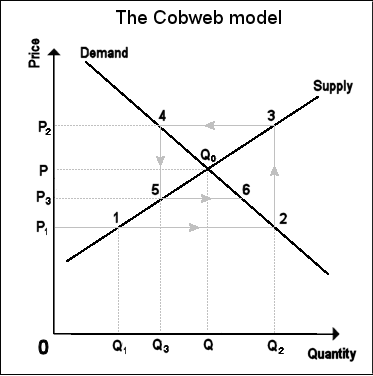 There's an interesting exercise in cobweb economics setting up in grains.
The idea being that farmers plant for next year based on this year's crop. And when this years price is high, they increase the supply for next year. Thereby lowering the price for the next year. Then they plant less. Prices move in cobweb.
Lorie wrote his PHd thesis on this. Wanted most of all to be a cattle rancher. May corn this year at 6.93 a bushel limit up but December 2012 corn at 5.77.
I took a speculation in honor of Lorie and Watson in the cobweb yesterday and today.
Gary Rogan writes:
Palindrome is taking charge: George Soros making a move to control food and grain production:
Financier and progressive activist George Soros is formulating a move to control food and grain production by purchasing grain elevators in late March in several parts of the United States through his Soros Managment Fund's backed Gavilon Grain . With purchases made in March, Gavilon Grain will become the third largest grain company behind Cargill, and Archer-Daniels Midland.
With strong ties to the Obama administration, Soros now has both the economic, and political clout to begin consolidation of purchasing and shipping domestic agriculture around the world.
U.S. grain firm Gavilon Grain said on Thursday it will buy Union Elevator and Warehouse's 16 grain elevators in the Pacific Northwest , the company's second big purchase of U.S. grain facilities in the last six months.The purchase of 16 elevators at 12 locations in eastern Washington will expand Gavilon's grain capacity by 8.4 mbu.
"The addition of Union Elevator's grain facilities and origination capabilities position us well to support the growing Pacific Northwest export wheat market and serve the Columbian Basin feed grain market," Greg Konsor, VP and GM of Gavilon Grain, said in a statement. The PNW is the No. 1 wheat export terminal in the United States. - Reuters
When food brokers consolidate into just a few large companies controlling the majority of a market, then prices can be set not by supply and demand, but by corporate decisions and manipulation of supply. If the price for food is too low in the United States, then grain can be shipped to other markets for sale, causing then an artifical supply problem in the country that produced the grain itself.With George Soros's making this move in backing Gavilon Grain's purchases to control food and grain distribution in the United States, and becoming the third largest grain company in the country, it will lead to the same results that we see in the energy markets as oil is controlled by a small group of corporations, and the price can be dictated by an artificial control over its supply.
Jeff Watson comments:
Gavilon Grain is just the latest resurrection of Peavey Grain. I expect them to have a big presence in the grain markets as they are true "Grain People." Still, being third place IN THE US behind C@rgill might as well be 50th place. I would not expect the Palindrome to make a dent in C@agill's action, as C@rgill is as politically well connected as anyone. The grain companies were always small in number, and historically were known as the "Big 5." The Big Five were, until the 80's, C@rgill, Continental, Louis Dreyfus, Bunge, and Andre with those companies controlling 75%+ of the world's grain trade and food supply. The big companies still control 75-90% of the grains and food supply, not caring what the prices are as long as they make the deal and don't lose market share. Until recently, most large grain companies were private, family owned corporations. The aforementioned five companies are still private, and huge, but companies like ADM, Ralston Purina, Conti-Commodies, General Mills, Pillsbury, Ralston-Purina, etc are all part of or are public corporations. Despite the small number of grain companies, the profit margins are microscopic, the business is cutthroat, and there is healthy competition between companies, without meaningful quid pro quo's between them. One overlooked aspect of the grain elevators and warehouses is that they are a license to print money if run correctly , which is a reason the big grain companies prefer to remain private, obscure, and below the radar. If C@rgill was a public corporation, it would easily rank in the top ten of the Fortune 500 companies and this is the scale of most of the really big grain companies operations.
Mar
30
Quotes of the Day, from Jeff Watson
March 30, 2011 | 2 Comments
Throughout history, poverty is the normal condition of man. Advances which permit this norm to be exceeded—here and there, now and then—are the work of an extremely small minority, frequently despised, often condemned, and almost always opposed by all right-thinking people. Whenever this tiny minority is kept from creating, or (as sometimes happens) is driven out of a society, the people then slip back into abject poverty.
–Robert Heinlein
Mar
29
Greenspan and Government Activism, from Paolo Pezzutti
March 29, 2011 | Leave a Comment
 We have discussed the role of government in the economy and during crisis many times on this site. Greenspan writes about this topic with the paper "Activism" that I recently read. He writes:
The current government activism is hampering what should be a broadbased robust economic recovery, driven in significant part by the positive wealth effect of a buoyant U.S. and global stock market.
Equity values, in my experience, have been an underappreciated force driving market economies. Only in recent years has their impact been recognized in terms of 'wealth effects'. This is one form of stimulus that does not require increased debt to fund it. I suspect that equity prices, whether they go up or down from here, will be a major component, along with the degree of activist government, in shaping the U.S. and world economy in the years immediately ahead."
Considerations about the wealth effect are in my view interesting, but well known to those who tried (and managed) to steer a recovery from the crisis.
The wealth effect has supported the economy so far. How much compared to the "stimulus" is hard to say however. "Manipulation" of markets in order to favor a continued move to the upside concerted by strong hands was (and is) in the interest of many forces who have a prominent role.
Victor Niederhoffer writes:
The wealth effect was very big in the 1960s and before, and Latane had good papers on it. Everyone at the Fed has believed in it for 70 years, to the exclusion of looking at interest rates themselves. And Bernanke often times his qualitative announcements with market lows or highs. A good way to trade.
Phil McDonnell writes:
Most of the so called wealth effect is really artificially induced by the QE programs. If the price of your stock rises but the value of the dollars the stock will fetch falls then are you really wealthier? How rich do the folks in Zimbabwe feel?
Jeff Watson writes:
One only has to look at the Weimar to see how the business class in Rhodesia feel. In 1913, the German stock market was at 126. Fourteen years later, the German stock market was at 26,890,000. At the index peak, the value of the Daimler company was only worth 327 of its cars. Interest rates were 900% and the exchange rate went from 4-5 marks per dollar in 1913 to 4+trillion marks per dollar in 1923.
Ian Brakspear writes in:
My portfolio in 1994 was worth aprox ZIM$10 million in 2005 worth ZIM $ 44 billion.
Victor Niederhoffer comments:
What they did to the farmers makes one cry. Brakspear is the guy that posted the funniest spec post ever. He ordered 2 beers for lunch. It was 10 million Zimbabwe. Then by the time he finished lunch, he ordered two more. The price had risen to 15 million Zimbabwe.
Kim Zussman asks:
So does inflation illusion work? What does it feel like to be a billionaire?
Ian Brakspear comments:
I have in my wallet 2 fifty billion dollar notes, a one hundred billion dollar note and one ten trillion dollar note-worthless.
Today the main currency in the streets of Zimbabwe is the US$– how all these US$ notes got here is anyone guess.
They are cleaned regularly in washing machines to prevent the spread of diseases– and hung out to dry on washing lines– always with someone on guard.
Mar
28
Five People Screwed by History, from Jeff Watson
March 28, 2011 | 1 Comment
Here is a humorous article that demonstrates the way history is written is not necessarily the way things really unfolded, or even includes the correct people. Written history is not accurate, and the old saying, "History is written by the winners," is self evident. Because of agendas, PC, and other forces, many historical figures were overlooked in order to make the history more glamorous, or whatever. Needless to say, this quick read is funny and will open your eyes. Unfortunately, all of these people cast aside were the losers, along with the succeeding generations who get an inaccurate portrayal.
« go back — keep looking »Archives
- October 2026
- September 2026
- August 2026
- July 2026
- June 2026
- May 2026
- April 2026
- March 2026
- February 2026
- January 2026
- December 2025
- November 2025
- October 2025
- September 2025
- August 2025
- July 2025
- June 2025
- May 2025
- April 2025
- March 2025
- February 2025
- January 2025
- December 2024
- November 2024
- October 2024
- September 2024
- August 2024
- July 2024
- June 2024
- May 2024
- April 2024
- March 2024
- February 2024
- January 2024
- December 2023
- November 2023
- October 2023
- September 2023
- August 2023
- July 2023
- June 2023
- May 2023
- April 2023
- March 2023
- February 2023
- January 2023
- December 2022
- November 2022
- October 2022
- September 2022
- August 2022
- July 2022
- June 2022
- May 2022
- April 2022
- March 2022
- February 2022
- January 2022
- December 2021
- November 2021
- October 2021
- September 2021
- August 2021
- July 2021
- June 2021
- May 2021
- April 2021
- March 2021
- February 2021
- January 2021
- December 2020
- November 2020
- October 2020
- September 2020
- August 2020
- July 2020
- June 2020
- May 2020
- April 2020
- March 2020
- February 2020
- January 2020
- December 2019
- November 2019
- October 2019
- September 2019
- August 2019
- July 2019
- June 2019
- May 2019
- April 2019
- March 2019
- February 2019
- January 2019
- December 2018
- November 2018
- October 2018
- September 2018
- August 2018
- July 2018
- June 2018
- May 2018
- April 2018
- March 2018
- February 2018
- January 2018
- December 2017
- November 2017
- October 2017
- September 2017
- August 2017
- July 2017
- June 2017
- May 2017
- April 2017
- March 2017
- February 2017
- January 2017
- December 2016
- November 2016
- October 2016
- September 2016
- August 2016
- July 2016
- June 2016
- May 2016
- April 2016
- March 2016
- February 2016
- January 2016
- December 2015
- November 2015
- October 2015
- September 2015
- August 2015
- July 2015
- June 2015
- May 2015
- April 2015
- March 2015
- February 2015
- January 2015
- December 2014
- November 2014
- October 2014
- September 2014
- August 2014
- July 2014
- June 2014
- May 2014
- April 2014
- March 2014
- February 2014
- January 2014
- December 2013
- November 2013
- October 2013
- September 2013
- August 2013
- July 2013
- June 2013
- May 2013
- April 2013
- March 2013
- February 2013
- January 2013
- December 2012
- November 2012
- October 2012
- September 2012
- August 2012
- July 2012
- June 2012
- May 2012
- April 2012
- March 2012
- February 2012
- January 2012
- December 2011
- November 2011
- October 2011
- September 2011
- August 2011
- July 2011
- June 2011
- May 2011
- April 2011
- March 2011
- February 2011
- January 2011
- December 2010
- November 2010
- October 2010
- September 2010
- August 2010
- July 2010
- June 2010
- May 2010
- April 2010
- March 2010
- February 2010
- January 2010
- December 2009
- November 2009
- October 2009
- September 2009
- August 2009
- July 2009
- June 2009
- May 2009
- April 2009
- March 2009
- February 2009
- January 2009
- December 2008
- November 2008
- October 2008
- September 2008
- August 2008
- July 2008
- June 2008
- May 2008
- April 2008
- March 2008
- February 2008
- January 2008
- December 2007
- November 2007
- October 2007
- September 2007
- August 2007
- July 2007
- June 2007
- May 2007
- April 2007
- March 2007
- February 2007
- January 2007
- December 2006
- November 2006
- October 2006
- September 2006
- August 2006
- Older Archives
Resources & Links
- The Letters Prize
- Pre-2007 Victor Niederhoffer Posts
- Vic’s NYC Junto
- Reading List
- Programming in 60 Seconds
- The Objectivist Center
- Foundation for Economic Education
- Tigerchess
- Dick Sears' G.T. Index
- Pre-2007 Daily Speculations
- Laurel & Vics' Worldly Investor Articles
