Jun
27
Basic Science with a Couple of Sticks, from Jeff Watson
June 27, 2011 |
 Long before laboratories had HPLC, GC-Mass Specs, spectrophotometry, computers, even chemicals and glassware for that matter, there were still inquisitive people who wanted to learn and study about the earth and the universe around us.
The first laboratories equipment probably consisted of a couple of straight sticks, after which they added a rock, and a string. A timepiece would have been nice, but since timepieces weren't invented yet, they probably needed the stick to tell time. The first scientists pounded a stick into the ground and noticed a few things.
First, they probably tracked the stick's shadow from when the sun rose until the sun set. The scientists noticed that the shadow was longest when the sun rose and set, and the shadow was shortest when the sun was at the highest point of the day, They also noticed that when the shadow was shortest, that was the exact middle of the period of daylight and they were able to determine the local noon(midway between sunset and sunrise). The first scientists had inadvertently created the first timepiece, the sundial, from a simple stick.
This sundial was also the first compass as at the exact moment of local noon, the shadow pointed either due north or due south depending which side of the equator they were on. They also noticed that in the northern hemisphere that the shadow revolved around the base of the stick in a what is called a "clockwise" pattern.
Since it's safe to assume that those early scientists had plenty of time on their hands (no worries about publish or perish or tenure), it's not a stretch to think that that they made observations of the stick for a very long time. First, they would have noticed a big pattern of shadows in a 365 day repeating period. Had they observed the stick for any 365 day period in a row, and recorded what they saw, they would have noticed that the sun doesn't rise on the exact same spot on the horizon. They would have also recorded the fact that on two days a year, the shadow at sunset points exactly opposite the shadow at sunrise. When this happens, the sun rises due east and sets due west and the daylight lasts as long as the night. These two days were found out to be the spring and fall equinoxes. Any and all other days, the sun sets somewhere else on the horizon, not due east or west.
The scientists also noticed that while the sun was rising and setting on different points of the horizon, it's trajectory was also changing. They recorded the two days of the 365 where the shadow at noon where the shadow was either the longest or shortest. The day the noon shadow was the longest, it was the winter solstice, and when it was the shortest, it was the summer solstice. It's amazing that with a simple stick, those first scientists were able to record the four points on the compass, and were also able to identify the four days of the year that mark the change of seasons.
Those scientists weren't finished with the stick, they had more observations. At night, they lined up their stick with a familiar star in the sky. Using their hourglass, they would have noticed that the star took 23 hours, 56 minutes, for the star to align it with the stick from the previous alignment. From this they would be able to deduce the length of a day and determine that it was uniform throughout the year.
The scientists weren't finished with the single stick, as the scientists that recorded the tip of the shadow of the high noon noticed that the shadow fell to a different spot each day and over the course of 365 days, those marks traced a figure 8. The figure 8 happens because the Earth tilts on its axis by 23.5 degrees from the plane of the solar system. The tilt gives rise to the seasons and the apparent wide ranging path of the sun across the skies.
The figure 8 is the result of the sun migrating back and forth across the celestial equator during the year. Due to many other things, the earth's orbit is not a perfect circle and according to Kepler's Planetary laws, the orbital speed must vary, increasing as we move toward the sun and decreasing as we move away. Because the Earth's rotation is constant, but the orbital speed isn't, high noon does not always correlate with "Clock noon." The variance can be as much as 16 minutes early or late depending on the time of year. Interestingly, the clock noon equals high noon only four days a year, Dec 25, April 15, June 14, and Sep 2.
But I digress, the first scientists had much more on their plate, and they had science to do. Those scientists probably sent their assistants due south way beyond the horizon (more than 6 degrees would be ideal) with a stick the same length. At a predetermined time (high noon?), on the same day in the future, they measured the length of the shadow, and were able to use those lengths to calculate the Earth's circumference using simple geometry.
 From the circumference, they could determine the radius, diameter, volume and much more. From this, one could have probably made a few more simple measurements and arrived at a mass of the earth. Eratosthenes of Cyrene measured the length of the two shadows with a partner in 222BC and got an answer that was within 15% of the true circumference. As an aside, the word geometry is derived from the ancient Greek word, "Earth measurement."
The first scientists were also able to pound a stick into the ground at an angle other than vertical, attach a string and a rock to the end, creating a pendulum. If they counted the number of times the rock swings in 60 seconds, they deduced that the mass of the rock and the width of the arc had very little to do with the number of swings. The only thing that matters is the length of the string and what planet you are on. Using very simple equations, one can, from a pendulum,. determine the acceleration of gravity on the Earth. If you went to the moon, you would find the pendulum moving much more slowly and you could calculate that the gravity is 1/6 of that of Earth.
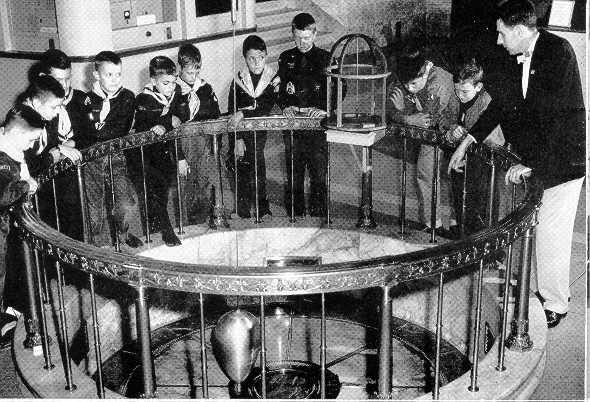
 There's more experimentation that could be done. If one got a large stick, or tree around 33 Meters long and tied a long string to it with a very heavy stone at the end and set this pendulum in motion, the bob would swing for hours on end. If the early scientists tracked the direction of the pendulum swings, they would have noticed the plane of the swing rotates. Ideally, if one set up the pendulum at either of the Earth's poles, the swing would make one full rotation every 23 hours, 56 minutes, but the rotation would go slower as you went towards the equator where the pendulum's plane would not move at all. This not only proved that the Earth rotates, but using a little trig, and a timer, one could determine one's latitude. For what it's worth, Focault, the French Physicist did this in 1851, which was one of the last truly elegant experiments. That big pendulum was named after him and they can be found in almost every science museum in the world.
It's very interesting that from a couple of sticks, a string, and a rock, one can determine the four points of the compass, the four days of the year that mark the change of seasons, the exact length of the day, the circumference of the Earth, it's diameter, radius, volume, your own latitude, and the acceleration due to gravity.
A modern common complaint is that a lack of tools keeps us from doing proper science, and that is a very intellectually lazy complaint. The basic axioms of science were proven, long ago with a stick, a string, and a rock. In fact, the first computer was invented in 150 BC in Greece and was called the Astrolabe. I wonder if traders approached their study of the markets using the same ingenuity and out of the box thinking as Eratosthenes of Cyrene, Focault, Euclid, or Newton, what differences in understanding would be? For what it was worth, Newton was an investor who lost the equivalent of $2.75 million in the market, and this author will let the reader draw their own conclusions.
Pitt T. Maner III adds:
The use of sticks and stones to produce metal must have been a wondrous experiment. 35,000 BC by the Khormusans is an early date for the advance, and the power of a simple magnetized needle to give direction.
The story is that when Einstein was a young boy he was fascinated by a compass:
When he was 5 years old and sick in bed, Hermann Einstein brought Albert a device that did stir his intellect. It was the first time he had seen a magnetic compass. He lay there shaking and twisting the odd contraption, certain he could fool it into pointing off in a new direction. But try as he might, the compass needle would always find its way back to pointing in the direction of magnetic north. "A wonder," he thought. The invisible force that guided the compass needle was evidence to Albert that there was more to our world that meets the eye. There was "something behind things, something deeply hidden."
So began Albert Einstein's journey down a road of exploration that he would follow the rest of his life. "I have no special gift," he would say, "I am only passionately curious."'
Comments
Archives
- October 2026
- September 2026
- August 2026
- July 2026
- June 2026
- May 2026
- April 2026
- March 2026
- February 2026
- January 2026
- December 2025
- November 2025
- October 2025
- September 2025
- August 2025
- July 2025
- June 2025
- May 2025
- April 2025
- March 2025
- February 2025
- January 2025
- December 2024
- November 2024
- October 2024
- September 2024
- August 2024
- July 2024
- June 2024
- May 2024
- April 2024
- March 2024
- February 2024
- January 2024
- December 2023
- November 2023
- October 2023
- September 2023
- August 2023
- July 2023
- June 2023
- May 2023
- April 2023
- March 2023
- February 2023
- January 2023
- December 2022
- November 2022
- October 2022
- September 2022
- August 2022
- July 2022
- June 2022
- May 2022
- April 2022
- March 2022
- February 2022
- January 2022
- December 2021
- November 2021
- October 2021
- September 2021
- August 2021
- July 2021
- June 2021
- May 2021
- April 2021
- March 2021
- February 2021
- January 2021
- December 2020
- November 2020
- October 2020
- September 2020
- August 2020
- July 2020
- June 2020
- May 2020
- April 2020
- March 2020
- February 2020
- January 2020
- December 2019
- November 2019
- October 2019
- September 2019
- August 2019
- July 2019
- June 2019
- May 2019
- April 2019
- March 2019
- February 2019
- January 2019
- December 2018
- November 2018
- October 2018
- September 2018
- August 2018
- July 2018
- June 2018
- May 2018
- April 2018
- March 2018
- February 2018
- January 2018
- December 2017
- November 2017
- October 2017
- September 2017
- August 2017
- July 2017
- June 2017
- May 2017
- April 2017
- March 2017
- February 2017
- January 2017
- December 2016
- November 2016
- October 2016
- September 2016
- August 2016
- July 2016
- June 2016
- May 2016
- April 2016
- March 2016
- February 2016
- January 2016
- December 2015
- November 2015
- October 2015
- September 2015
- August 2015
- July 2015
- June 2015
- May 2015
- April 2015
- March 2015
- February 2015
- January 2015
- December 2014
- November 2014
- October 2014
- September 2014
- August 2014
- July 2014
- June 2014
- May 2014
- April 2014
- March 2014
- February 2014
- January 2014
- December 2013
- November 2013
- October 2013
- September 2013
- August 2013
- July 2013
- June 2013
- May 2013
- April 2013
- March 2013
- February 2013
- January 2013
- December 2012
- November 2012
- October 2012
- September 2012
- August 2012
- July 2012
- June 2012
- May 2012
- April 2012
- March 2012
- February 2012
- January 2012
- December 2011
- November 2011
- October 2011
- September 2011
- August 2011
- July 2011
- June 2011
- May 2011
- April 2011
- March 2011
- February 2011
- January 2011
- December 2010
- November 2010
- October 2010
- September 2010
- August 2010
- July 2010
- June 2010
- May 2010
- April 2010
- March 2010
- February 2010
- January 2010
- December 2009
- November 2009
- October 2009
- September 2009
- August 2009
- July 2009
- June 2009
- May 2009
- April 2009
- March 2009
- February 2009
- January 2009
- December 2008
- November 2008
- October 2008
- September 2008
- August 2008
- July 2008
- June 2008
- May 2008
- April 2008
- March 2008
- February 2008
- January 2008
- December 2007
- November 2007
- October 2007
- September 2007
- August 2007
- July 2007
- June 2007
- May 2007
- April 2007
- March 2007
- February 2007
- January 2007
- December 2006
- November 2006
- October 2006
- September 2006
- August 2006
- Older Archives
Resources & Links
- The Letters Prize
- Pre-2007 Victor Niederhoffer Posts
- Vic’s NYC Junto
- Reading List
- Programming in 60 Seconds
- The Objectivist Center
- Foundation for Economic Education
- Tigerchess
- Dick Sears' G.T. Index
- Pre-2007 Daily Speculations
- Laurel & Vics' Worldly Investor Articles
