Dec
18
Vanished occupations
December 18, 2024 | 1 Comment
some occupations that have vanished in the last 150 years (eric sloanes america): stagecoach driving, chimney sweeping, town crying, aviation barnstormer, ice cutters, snow rollers, drovers, keel boatmen, grindstone man, sandwich men, etc. When will technical analysts vanish?
An informative guide to the vanishing landscape of America's forefathers includes brilliant photography of the barns, covered bridges, road signs, country inns, and steepled churches that they left behind.
Dec
16
Relevant quotes
December 16, 2024 | Leave a Comment

Some relevant Sherlock Holmes quotes, included at the beginning of each chapter of the brilliant statistics textbook Statistical Inference (Second Edition) by Casella and Berger:
"How do all these unusuals strike you, Watson?"
"Their cumulative effect is quite considerable, and yet each of them is quite possible in itself.""I confess that I have been blind as a mole, but it is better to learn wisdom late than never at all."
"You can, for example, never foretell what any one man will do, but you can say with precision what an average number will be up to. Individuals vary, but percentages remain constant. So says the statistician."
"We want something more than mere theory and preaching."
"I’m afraid that I rather give myself away when I explain. Results without causes are much more impressive."
"We are suffering from a plethora or surmise, conjecture, and hypothesis. The difficulty is to detach the framework of fact - of absolute undeniable fact - from the embellishments of theorists and reporters."
Dec
14
Father and son
December 14, 2024 | 1 Comment

a 63-yr differential between us. My father always said he would be the happiest man in the world when I could beat him at almost all things. I feel the same about Aubrey. (Until my stroke I could beat him at most racket sports.)
Dec
13
Crazy without provocation
December 13, 2024 | Leave a Comment
A Quixotic President, by Daniel Tenreiro
Wed, January 13, 2021
“The thing is to turn crazy without any provocation,” Quixote tells his sidekick, Sancho Panza, when asked what compelled him to give up his quiet countryside existence and playact knight errantry in the mountains of Spain. A rich bachelor wasting away on his vineyard in La Mancha, the protagonist of Miguel de Cervantes’s novel grows frustrated with the smallness of life. He yearns instead for the toil, anxiety, and arms of the chivalric romances he spends his days reading. Unable to make his dream a reality, Quixote opts to pretend: He mounts a ragged horse, costumes himself in a rusted breastplate, and sets off in search of eternal fame.
when you see a person registered for one party proclaiming views completely opposite - is it a case of false deception or the stockholm syndrome or sinking into the swamp or…
Dec
10
The principle of least effort
December 10, 2024 | Leave a Comment

Grandfather Martin liked to encap stock market moves as an example of theory of least effort. Elmer Kelton applies the theory to the explosion of oil in a mine.
Any explosion will follow the path of least resistance. We want its main force to go out to the sides of the hele, to break up the formation. We don’t want it wasted, comin back up the open casing like a blast from a shotgun barrel. So we tamp a yard or so of pea gravel on top of the charge.
-Honor at Daybreak, by Elmer Kelton
I sat besides a stream of water in complete tranquility wondering about life, its purpose, “who am I?” and such esoteric thoughts. Abruptly, my left brain kicked in and started wondering about well, more left-brain things, like how water finds its own level and how it flows along the path of least resistance. That took me back to my college days when I first learnt about the path of least resistance in the context of electrons flowing through a wire creating electricity. This concept stayed close to my heart as I naively related it to my own disposition of doing things that took the least effort. Later on in life I figured that this Principle of Least Effort (POLE) is actually prevalent in all of nature.
much more work should be done on applying this principle to the stock market in the last 100 years after Granpa passed.
what examples of markets displaying theory of least effort ($1000 reward for best example).
[More on the math/physics side: Action Principles]
Dec
8
Doom, bonds, and Elmer Kelton
December 8, 2024 | Leave a Comment
Is This Wildly Overvalued Stock Market Doomed? Yes, but Maybe Not Yet -WSJ
the wsj foregoes the Dow theory, and the drift, and the seasonals, and the tendncy for the best to continue to do the best.

another great from Elmer Kelton with a million similarities of the path of mining for oil to markets:
very quietly the 30-year bond future price has hit a 32-day high. this has been insanely bullish for the S&P. in the last year for example S&P 40 days later is up 154 big points (up 80% to 100% of time) true for all back intervals thru 2001. no wonder wsj is bear.
Dec
5
Sex and the City and the Times
December 5, 2024 | Leave a Comment
I listened to Sex and the City over the weekend and the NY Times Sunday edition was like another version of it. here was a man who kept dozens of ratings of sex in city types on past dates and rated them 1 to 10 on how far they'd go more recently. He's a vac denier who ran for Pres in 2024.
continuing the coincidence of sex and city and nytimes there is big article about the Financial District Hip Mystery Tower and the cool x sex and city types who are leasing space there at 1/10 the going rate. somehow my chapter in Edspec on sex and the market is very relevant.
Dec
3
Roughing It
December 3, 2024 | Leave a Comment

for the past week ive been reading Roughing It and Following the Equator. It is amazing how much Mark Twain knew and how amusing it is. I particularly liked his analysis of the German Language, the Mormon migration and the booms and busts in the silver mines.
[Below, a market story from Roughing It. - Ed.]
A youth of nineteen, who was a telegraph operator in Virginia on a salary of a hundred dollars a month, and who, when he could not make out German names in the list of San Francisco steamer arrivals, used to ingeniously select and supply substitutes for them out of an old Berlin city directory, made himself rich by watching the mining telegrams that passed through his hands and buying and selling stocks accordingly, through a friend in San Francisco. Once when a private dispatch was sent from Virginia announcing a rich strike in a prominent mine and advising that the matter be kept secret till a large amount of the stock could be secured, he bought forty "feet" of the stock at twenty dollars a foot, and afterward sold half of it at eight hundred dollars a foot and the rest at double that figure. Within three months he was worth $150,000, and had resigned his telegraphic position.
[ And Twain analyzes The Awful German Language, from A Tramp Abroad. ]
Dec
1
Seasonals, and a deep-thinking man
December 1, 2024 | Leave a Comment

what can one say about the seasonals for December? the seasonals are bullish when the prev 6 months are up and bearish when then prev 6 months are down. recently a rise in the last day of November has been bullish.
a book by a stubborn and deep thinking man - highly recommended:
A Personal Odyssey, by Thomas Sowell.
Nov
25
From the archives: How To Become a Professional Con Artist
November 25, 2024 | Leave a Comment

Book Review: How To Become a Professional Con Artist
3/25/2005
Dennis Marlock opens his "How To" book with a testimonial:
As a law professor, I have read countless books, articles, and dissertations on fraud and deception. This, however, is the first time I have elected to endorse any author's work. The book is indeed an academic gem worthy of inclusion in university curriculums throughout the nation.
The beautiful thing about the professor's testimonial and the related, "I first bought the book hoping to discover why a cop would tell people how to commit fraud. Having read the book, I must now ask why he didn't write it sooner" is that they were both short cons written by the author.
The book lacks the scholarship, timelessness, humor and general principles of David Maurer's classic The Big Con, which I would recommend as one of the seven best books for market practitioners right after Ben Green's Horse Trading. Nevertheless, it is replete with cons and techniques we are exposed to in our day-to-day work in the market. The most relevant topic is chapter 4, "Tools of the Trade," which lists such essentials as "How to Talk Without Saying Anything." An example of this would be market talk such as "1040 is a key level." Yes, if it turns at that level and goes up it was key, and if it hits that level and goes below, why that proves that it didn't hold. A variant of this is the "the market is good as long as stays in the 1025-1075 range."
An important sub-technique is to "use abstract and otherwise equivocal and meaningless rhetoric." I have already written about this, and California Phil's precis of the earthquake "professor" is a classic here. But the market confidence man in general does always frame his thoughts in ways that cannot be disproved or refuted.
One loves the discussions of power laws in this context, as there's no way to differentiate a normal distribution from a power law with any degree of confidence for any samples involving 750 observations or less, and by then the situation has changed so much that one can always rely on Oct 19, 1987.
One must always appear confident as a confidence man and "I am completely confident that you will be totally satisfied with this necklace" is a phrase that the confidence man uses often. This is even more effective when you receive this assurance from a friend of the confidence man. I recently read an interview about a large man who has lost billions of dollars for his investors in publicly reported funds, yet the interviewer refers to the millions he has made the 30% a year internal rates of return, and the nine-figure amount that his followers made applying the techniques that the large man proudly boasts he took the lions share of , and the amazing returns he himself is making at the very present time, despite the difficulties he apparently has in making money for customers.
One of my favorite passages in "How to Become a Professional Con Artist" is the depiction of the big businessman as the ideal mark. "They're cows waiting to be milked," Marlock writes. "They are in abundance, they don't complain when being milked, they provide useful products, and they are used and abused by almost everyone. They are abused daily by employees, lawyers, stockholders, customers, suppliers, lenders, accountants, partners, tax collectors, and competitors. except for the stiff competition, bus schemes are the easiest, safest, and most profitable.
Nov
23
Deems Taylor
November 23, 2024 | Leave a Comment

this satirical bit brings to mind a Deems Taylor story. He came in for the second piece of concert that was complete programmatic movement. Deems thought the first piece was being performed. and all the allusions were wrong. Mark Twain in Roughing it writes of many mistakes like this.
father of the great libertarian scholar and editor Joan Taylor.
Deems Taylor: A Biography, by James A. Pegolotti.
Composer, critic, author, and radio personality, (Joseph) Deems Taylor (1885-1966) was one of the most influential figures in American culture from the 1920s through the 1940s. A self-taught composer, the New York City native wrote such pieces as the orchestral suite Through the Looking Glass and the acclaimed operas The King's Henchman and Peter Ibbetson, the first commissions ever offered by the Metropolitan Opera. Taylor's operatic works were among the most popular and widely performed of his day, yet he achieved greatest fame and recognition as the golden-voiced intermission commentator for the New York Philharmonic radio broadcasts and as the on-screen host of Walt Disney's classic film Fantasia. With his witty, clever, charming, and informative but unpatronizing manner, he almost single-handedly introduced classical music to millions of Americans across the nation.
Nov
22
The wisdom, wit, and saltiness - with market implications - of Don Quixote
November 22, 2024 | Leave a Comment
_David_-_Don_Quixote_and_Sancho_Panza_illustration_of_book_by_Miguel_de_Cervantes_Histoir_-_(MeisterDrucke-1474017).jpg "Don Quixote and Sancho Panza")
All affectation is bad.
Something is better than nothing.
Between friends sharp eyes.
He who leans against a good tree finds good shelter.
The ass laden with gold mounts lightly up the hill.
Well-gotten wealth is lost, but with the ill-gotten the master is lost too.
The wheel of fortune turns quicker than a mill-wheel.
That which costs us little, is valued at even less.
Where one door is shut, another opens.
He who seeks danger perishes in it.
There are no birds in last year's nest.
A sparrow in the hand is better than a vulture on the wing.
Many littles make a Much.
Patience, and shuffle the cards!
All is not gold that glitters.
He who does not intend to pay is not troubled in making his bargain.
He who buys and lies, feels it in his purse.
One misfortune calls another.
Who goes ill, ends ill.
To draw one's beard out of the mire.
Where you least expect it up starts the hare.
The reputation of the master reveals that of the servant.
The ball is drawn up by the thread.
A single swallow does not make a summer.
The dry throat can neither grunt nor sing.
Fortune favors the brave.
What hath been, hath been.
Where duennas intervene, nothing good can come of it.
Make a bridge of silver for a flying enemy.
Upon a good foundation a good building may be raised, and the best foundation in the world is money.
Diligence is the mother of good fortune.
You cannot catch trout with dry breeches.
Here come the Bulls for certain!
Time is the discoverer of all things.
With life many things are remedied.
Nov
20
Howard Hammer
November 20, 2024 | Leave a Comment

Vic and Howie Hammer being inducted into paddlable hall of fame. Howie at 88 the founder.
Howard Hammer – PFA Paddleball Legend of the Game Profile
Howard Hammer is the first inductee into the PFA Hall of Fame, and rightfully so. He was not only one of the greatest players the game has ever seen, but he also contributed more to the game than anyone I know. No one else is more associated with paddleball than Howie. Therefore, the title “Mr. Paddleball” is really appropriate.
Video: Paddleball Shots: Fundamentals, by Howard Hammer
Book: Paddleball: how to play the game, by Howard Hammer, 1979.
Nov
18
The wisdom of Sancho
November 18, 2024 | Leave a Comment

while Don quixote is voted the best novel of all time, and its humour and anecdotes are considered sui generis, not many have commented on the wisdom of this book as great as its wit. I have found the proverbs contained within - all very short, salty and sententious - the perfect companion to the book itself. the companion by Ulick Ralph Burke, Sancho Panza's Proverbs, is the perfect partner to the duo and is a work of masterly scholarship. In addition to the saltiness of all proverbs, there is an underlying Spanish diffidence and pregnancy to all the proverbs that enhances the novel.
Nov
16
Favorite piano
November 16, 2024 | Leave a Comment

my favorite piano work at my favorite venue by my favorite non-family woman who I've known for 50 years:
Pianist Rorianne Schrade plays Eduard Schütt's Paraphrase of J. Strauss Tales from the Vienna Woods
Rorianne Schrade YouTube channel
Rorianne's website.
Nov
15
A case for BTC
November 15, 2024 | Leave a Comment
a very resonant and helpful piece highly recommended:
Get Rich While Saving the World! Baby Tristan's Case for Bitcoin
one wouldn't be surprised if Tristan's middle name was Victor.
Nov
12
Sporting anecdotes
November 12, 2024 | Leave a Comment

Sporting Anecdotes (1923) shows us what the state of sports was like in England in 1800's. much betting on walking races, boxing, horse racing. and here is the greatest fives player of all time: john cavanaugh, much fighting of badgers, etc; great match of walking 1000 miles in 1000 hours; gouging match in america; fidelity of a dog; curious wager - walking against eating; throwing cricket ball 100 miles to deliver a post and win a bet; wisdom of Pliny who lived 100+ years.
Nov
7
Gouging, controls, and heroism
November 7, 2024 | Leave a Comment
Price Controls: Still A Bad Idea, by David R. Henderson.
When University of Chicago economist Harold Demsetz gave a talk in the winter of 1970 at the University of Winnipeg, where I was an undergrad, he used an analogy that many critics of price controls still use. Demsetz told his audience that using price controls to reduce inflation is like responding to cold weather in Winnipeg by breaking the thermometer. His point was that just as thermometers respond to temperature, prices are an indicator of underlying economic phenomena, namely supply and demand. Breaking a thermometer doesn’t cause the temperature to rise; controlling prices doesn’t cause inflation to fall.
The Edict of Diocletian: A Case Study in Price Controls and Inflation, by Murray N. Rothbard.
Citizens of the old Roman Empire distrusted paper currency and refused to accept anything but gold or silver coin as money. So the rulers found themselves barred from inflating the money supply by the unobtrusive method of printing additional currency.
But the Roman emperors soon discovered an ingenious device. They proceeded to call in the coins of the realm, ostensibly for repairs. Then, by various means, such as filing off small parts of the coins, or introducing cheaper alloys, they reduced the silver content of the money without changing its original face value. This devaluation enabled them to add many more silver coins to the Roman money supply. The practice was started by Nero, and accelerated by his successors. By Diocletian’s time, the denarius (standard silver coin) had been reduced to one-tenth of its former value.
The Speculator As Hero, by Victor Niederhoffer.
Some speculators are discoverers like Christopher Columbus, creators like Henry Ford, or inventors like Thomas Edison. Their job is easy to place on a high plane. My role in the grander order is indirect, relatively invisible and unplanned. The only discoveries I make are the routes that prices will travel. Like hundreds of thousands of other traders, I try to predict the prices of common goods a day or two in the future. If I think the price of an item will go up, I buy today and sell later. If I think that the price is going down, I’ll sell at today’s higher price. The miracle is that in taking care of ourselves, we speculators somehow ensure that producers all over the world will provide the right quantity and quality of goods at the proper time, without undue waste, and that this meshes with what people want and the money they have available.
Nov
6
From the research archives: Predictive and Statistical Properties of Insider Trading
November 6, 2024 | Leave a Comment
Predictive and Statistical Properties of Insider Trading
Author(s): James H. Lorie and Victor Niederhoffer
Source: Journal of Law and Economics, Vol. 11, No. 1, (Apr., 1968), pp. 35-53
Published by: The University of Chicago Press
The subject has been studied before in many ways, but none of the preceding studies has been definitive and the additional methods of analysis seemed promising. Opinions are somewhat polarized. Academic studies have found virtually no evidence of profitable exploitation by insiders of their special knowledge and no value to outsiders in data on trading by insiders. Others believe that insiders often make extraordinary profits and that knowledge of their trading is valuable. Both the SEC and investors should be interested in which opinion is correct. The methods and coverage of this study differ from those of earlier work, as do our conclusions. We show that proper and prompt analysis of data on insider trading can be profitable, although almost all earlier academic work has reached the contrary conclusion.
Nov
1
The beauty of prices
November 1, 2024 | Leave a Comment
From Prices, by Warren and Pearson (1933):
Prices are the major criterion by which the producer can know what society wants. The only way the farmer can tell whether to produce cabbages or wheat is on the basis of price. The only way that his son can determine whether society wants him to be a farmer or a coal miner or doctor is on the basis of price. The woman with the market basket, the retailer who must sell to live, the farmer who must have fence wire to keep his cattle in, the steel producer who must sell in order to operate his mill — all combine to make prices. The algebraic sum of all the millions of transactions between all the buyers and sellers of the world makes prices. The system does not always work perfectly, but no committee could guide the millions of producers to meet human needs so well as prices guide them — provided the medium of exchange functions properly. When it functions badly, the people turn to dictators and social control.
Only through prices can consumption be wisely guided. We would all like porterhouse steak and Packard cars, but these require so much human effort to produce that it is not possible to produce enough for all. Hens do not lay many eggs in winter. Consumers would like them in winter as well as or better than in summer. By raising prices in winter, the supply is made to last.
Oct
28
A few favorite people
October 28, 2024 | Leave a Comment
a daughter and a wife

Two of the favorite people of my long life - Robert Schrade and Susan N

Oct
27
For the life-advice thread: Letter to a newborn son
October 27, 2024 | Leave a Comment
Vic to Aubrey, 2006:
The occasion of a birth is always a good time to take stock of the important things in life that a father would like to share. In your case, it's even more important, because at 62, I am the oldest father that the big Pennsylvania hospital that you were born in had ever discharged, and I am going to have to compress much of my hopes and knowledge and love for you into a few short years. Here are some of the main lessons for you that I hope to set in motion so clearly and firmly by my own example and also with practical direct applications for you while I'm alive that it will become second nature to you, and these guidelines will be useful merely for a review, but it's too late to lock the stable after the horse has been stolen, so here goes.
You were named after two characters, Jack Aubrey, a very worthy character Patrick O'Brian and C.S. Forester wrote about in their series of books about the adventures of the greatest British naval captain in history, who traveled the world with great skill and overcame great danger to make the world safe for freedom; and Charles Darwin, the greatest biologist, who after a trip around the world discovered the nature of life and change. While both showed extraordinary abilities, mental and physical strength, study, science, and character — friendship, loyalty, persistence — in their quests for success, the heroic quality of Jack Aubrey is what inspired your first name.
Oct
26
Insights from Elmer Kelton
October 26, 2024 | Leave a Comment

some insights of Elmer Kelton about markets. (1) When you sell something at an auction, auctioneer will always tell you that you should have been here yesterday at the market was great then but it crashed. today. (2) if futures are up "there's no relation of cash to futures".
S&P had gone 9 days without a 20 day high. explanation is surge in odds. now at a high.
my favorite Elmer Kelton besides The Time It Never Rained:
Here are four of this famous author's speeches, recorded live. Known for his award-winning fiction, Elmer Kelton is highly sought after as a keynote speaker. His vast knowledge of, and passion for, the subjects he uses as backdrops for his novels is evident in these finely-crafted, humorous talks.
Oct
18
The Price series, and a nice day in the park
October 18, 2024 | Leave a Comment

Prices, by Warren and Pearson (1933), has first exegesis as to why prices are the key to orderly satisfactions of producers and consumers. a beautiful book with many tables of prices from 1786 to 1933.
World prices and the building industry
Index numbers of prices of 40 basic commodities for 14 countries in currency and in gold, and material on the building industry. (The Price series)
how service cuts supposedly increase interest rates. LIZ Truss compare this to quantity of money theory - anything to increase 3 letter siblings.
Oct
12
The ideal PPI
October 12, 2024 | Leave a Comment
what was the ideal ppi for the BLS to report yesterday? under the circumstances the 0.30 rise in S&P was fairly good. but the gentlemen didn't like it at the close again. yet an all time hi with a weak close. can't be too wrong.
Oct
11
The similarities
October 11, 2024 | Leave a Comment

Catastrophe 1914. the similarities between the start of w.w.1. and the current situation before the first attempted assassination are very great.
From the acclaimed military historian, a new history of the outbreak of World War I: the dramatic stretch from the breakdown of diplomacy to the battles - the Marne, Ypres, Tannenberg - that marked the frenzied first year before the war bogged down in the trenches.
In Catastrophe 1914, Max Hastings gives us a conflict different from the familiar one of barbed wire, mud, and futility. He traces the path to war, making clear why Germany and Austria-Hungary were primarily to blame, and describes the gripping first clashes in the West, where the French army marched into action in uniforms of red and blue with flags flying and bands playing. In August, four days after the French suffered 27,000 men dead in a single day, the British fought an extraordinary holding action against oncoming Germans, one of the last of its kind in history. In October, at terrible cost the British held the allied line against massive German assaults in the first battle of Ypres. Hastings also recreates the lesser-known battles on the Eastern Front, brutal struggles in Serbia, East Prussia, and Galicia, where the Germans, Austrians, Russians, and Serbs inflicted three million casualties upon one another by Christmas.
Oct
2
Dissonance and disbelief
October 2, 2024 | Leave a Comment
Cognitive dissonance 2: "i think the former president did a 'hades of a job'", but prob of winning fell from 60% to 45% from 1 day before to 1 day after.
one is reading again don quixote where his household throws away his books on chivalry because they believe it contribute to his supposed madness. along comes this article and headline from charles schwab "how to identify head and shoulders patterns."
my goodness - at this stage in our education 70 years after magee on technical analysis and 120 years after it was first recommended in The Magazine of Wall Street. even sancho would throw up his hands in disbelief.
Sep
29
Review redux: The Seven Pillars of Statistical Wisdom, from Vic
September 29, 2024 | Leave a Comment
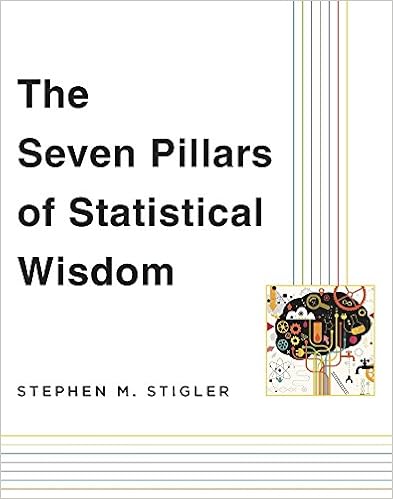
The Seven Pillars of Statistical Wisdom, by Steve Stigler, provides an illuminating and entertaining foundation for statistical activity. The seven pillars are Aggregation, Information, Likelihood, Intercomparison, Regression, [Experiment] Design, and Residuals. Every page of the book contains something fascinating and instructive.
It is at once an adventure story, a history lesson, a textbook on the foundations of statistics, and a tour de force with ingenious extensions of the works of the great in each field in Stigler's own inimitable hand — a persona that reminds one of Stigler's heroes, Galton himself.
The level of the book is such that the layman and the expert will both gain from it. I found every page insightful and it uplifts one to be part of a field with so many ingenious founders, and to know that there are such pillars that hold the edifice up.
I recommend the book highly. It is a masterpiece classic that will live forever.
Sep
26
An informal analysis, and books
September 26, 2024 | Leave a Comment
performing an informal content analysis of fox news 50 articles, the news about vp is overwhelmingly negative. however, she still leads in the odds by at least 5 percentage pts. under circumstances the other side's insistence they won debate is blind. this refusal to accept reality should lead to all sorts of negative results.
meanwhile, in books:
The Walking Drum is an erudite louis lamour adventure about 12th century business.
the book The Merchant in Medieval Europe is one of the most scholarly and complete I have ever read. A summary on the back cover is very apt. the book made me realize that most of my commercial inspirations were merely following the paths set by our predecessors.

some chapters: the merchant in the 13th century, trading companies, commercial correspondence, bookkeeping and commercial correspondence, arithmetic insurance, banking, interest rates, fairs, money supply, information, careers, exchange, brokers.
Power and Profit, an alternate title, is beautiflly illustrated with 200 prints and maps. "an academic classic that can be read purely for pleasure."
a well lived life: Peter Spufford
More:
Money and Its Use in Medieval Europe, by Peter Spufford.
Sep
23
Methods of trade
September 23, 2024 | Leave a Comment
three highly recommended books:
Power and Profit: The Merchant in Medieval Europe
all show how commerce, fairs and bazaars, and bourses in the 1100-1400 era showed the way for all modern methods of trade.
Sep
18
Hikes, cuts, and differentials
September 18, 2024 | Leave a Comment
now 8 percentage differential in favor of vice pres. the more things emerge as favoritism in debate, the greater the differential.
it took 12 days for a 20-day high and months for an all-time high which comes auspiciously for Hayek's road.
average number of consecutive decreases in fed rates after a turning point to a decline is 14.
In light of the progress on inflation and the balance of risks, the Committee decided to lower the target range for the federal funds rate by 1/2 percentage point to 4-3/4 to 5 percent.
Forbes Advisor: Federal Funds Rate History 1990 to 2024
Plenty of other data factor into Fed monetary policy decisions, including gross domestic product (GDP), consumer spending and industrial production, not to mention major events like a financial crisis, a global pandemic or a massive terrorist attack.
To that end, we’ve structured this compendium of fed funds historical data with narratives about the different factors that informed the Fed’s decisions. The central bank may be staffed by officious economists, analysts and business experts, but it’s also highly responsive to the changing political winds.

the swings in S&P futurs in last half hour from up 30 to down 15 and now +20 reminds me of how a loser in a squash game flails around with a big swing and no caution hitting all three walls on each shot. one fine player whose forefather lost the american revolution in the battle of Long Island hit one with all his power at my head when he was behind in a situation like this. i imediately called for the ref to default him, to no avail.
what was the match beween federer and djoko where federer was up match point and served to djok backhand and djok gave up and shot a hail Mary from his back hand and he won the match?
Djokovic's INSANE Comeback Against Federer! | 2011 US Open Semifinal
Sep
16
Cognitive dissonance
September 16, 2024 | Leave a Comment
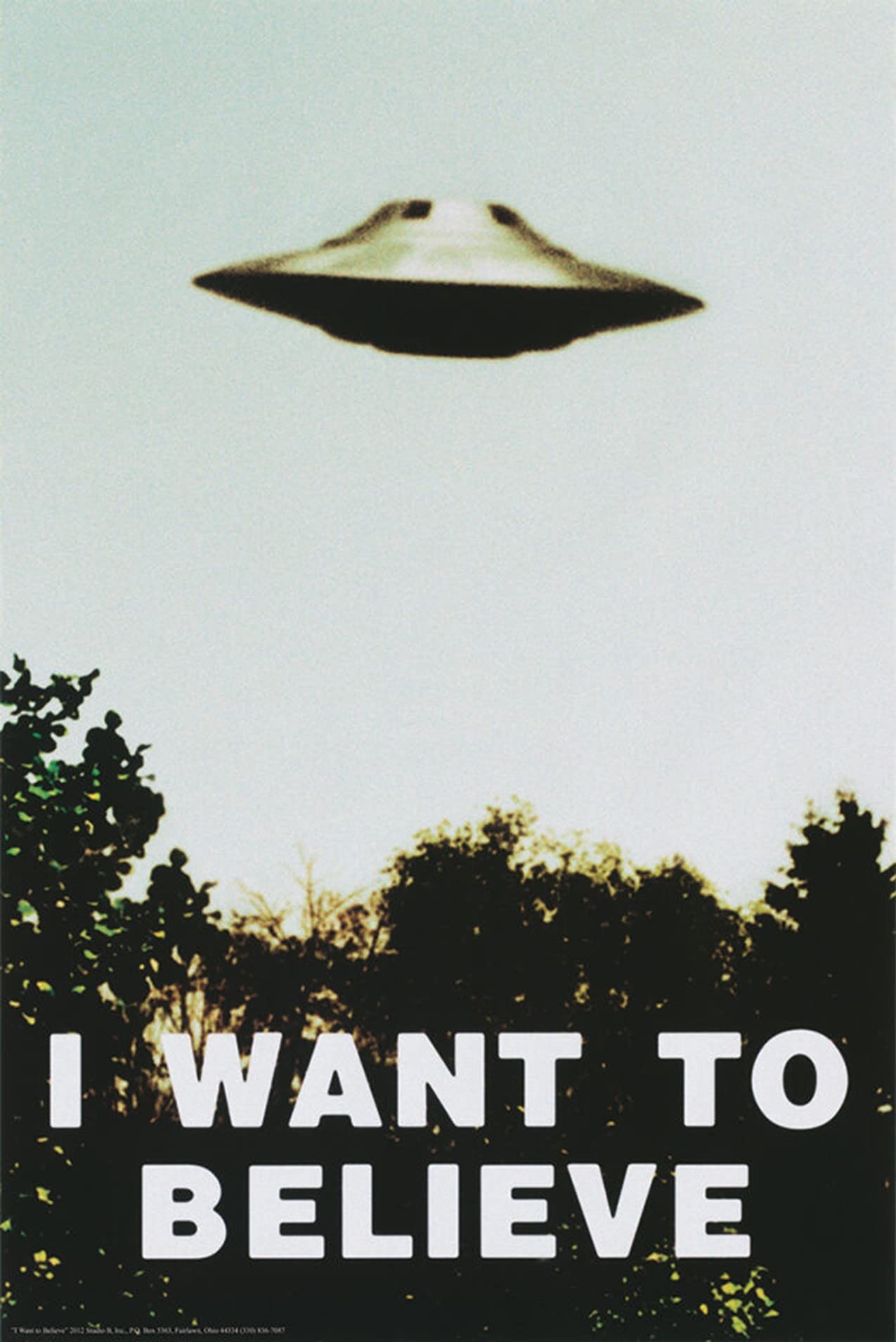
odds in favor of vp reaches maximum with a 6% lead over former Pres. and former Pres claims he won the debate handily. as Soros liked to say: the more he talked about his honesty, the more closely i counted my silver.
perfect example of cognitive dissonance in our time.
She attracted a group of followers who left jobs, schools, and spouses and who gave away money and possessions to prepare to depart on a flying saucer that, according to Mrs. Keech, would arrive to rescue the true believers. Given the believers’ serious commitment, Festinger wondered how they would react when the prophecy failed. He and his colleagues, posing as believers, infiltrated Mrs. Keech’s group and kept notes on the proceedings surreptitiously.
The believers shunned publicity while they awaited the flying saucer and the flood. But when the prophecy was disconfirmed, almost immediately the previously most-committed group members made calls to newspapers, sought out interviews, and started actively proselytizing.
Festinger was unsurprised by the sudden proselytizing after the prophecy’s disconfirmation; he saw the cult members as enlisting social support for their belief to lessen the pain of its disconfirmation. Their behaviour confirmed predictions from his cognitive dissonance theory, whose premise was that people need to maintain consistency between thoughts, feelings, and behaviours.
a question out of the blue????? "would you have a Republican in your cabinet?" one would like to have the moderators predicting stock prices?
Sep
15
Streaks of down days, from Big Al
September 15, 2024 | Leave a Comment
Vic tweeted that "after 5 down days in a row for S&P, it's very bullish. 5 days later only 2 of ten down with high positive expectation especially with bonds up and last one down."
That provoked a quick counting project. The main issue with this analysis is that everything is overlapping, but nonetheless I think it's an interesting result.

The data is SPY adjusted closes from inception thru 6 Sept. I identified all the down days and the streaks of down days, including 1-day "streaks", up to the longest which were 8-day streaks. So each down day fell into a bin, 1 up to 8. Each down day was put in a bin, whether it was the last day in a streak or not. (This eliminates the look-ahead bias of just considering only the final day of streaks.)
Then I calculated the 5-, 10- and 20-day % moves for every day in the data and compared the results for all the down days with the % moves for all days.
The table shows the results, with the best outcomes - streaks of 3, 4, and 5 days - highlighted.
Sep
14
Politics, rackets, markets
September 14, 2024 | Leave a Comment
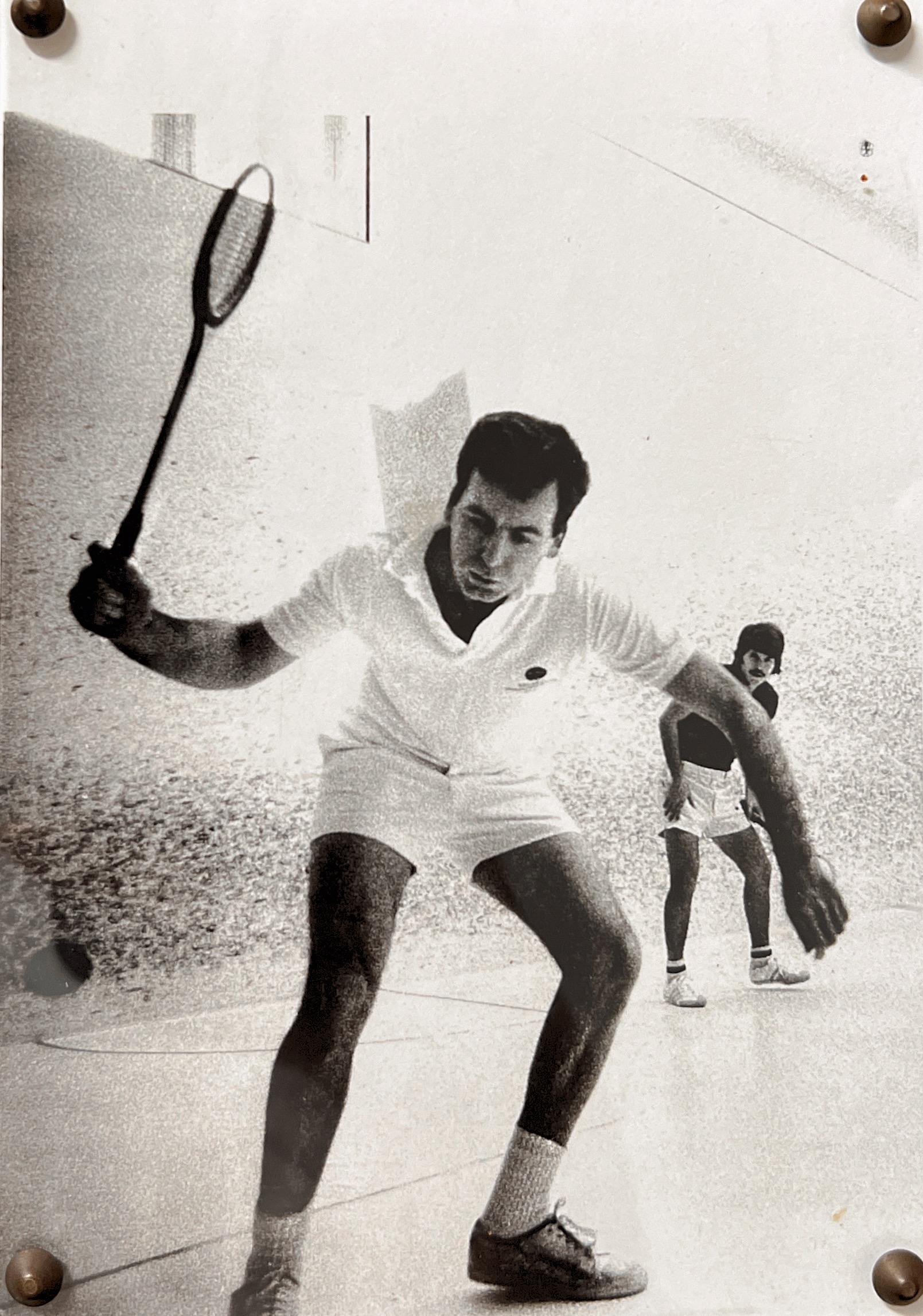
the more he claims he won, the greater the odds against him. reminds me so much of the refereeing against me in the 1970's. of the 5 national singles i won, my opponent in finals didn't reach double digits. that was the only way for me to overcome bias.
Ed. - Racket Guy from Brooklyn, Sports Illustrated, March 03, 1975:
To the victor—Victor Niederhoffer, that is—belongs another silver pitcher. Last week in New York, at 31, he won the U.S. National Singles Squash Racquets championship for the fifth time. His opponents did little but gasp, sweat and run. But Niederhoffer seemed to play effortlessly. His shots were not always brilliant, but he patiently waited out long rallies, and his frustrated opponents consistently found themselves in situations where most of their moves were of high risk. And then they were forced to make mistakes which ruined them.
reminds me of what my father always said when people told him how good he looked as he was suffering from chemo: "thank you, i'll be the healthiest corpse in the graveyard."
the symmetry of it all. last week 5 down days in a row - from 5659 to to 5515. this week 5 days up in a row from 5421 to 5630.
Sep
13
Politics, money
September 13, 2024 | Leave a Comment

the forces of regulatory capture won the debate handily and that is good for the stock market. more emoluments to business. more centralized control, or as Waltz says, "neighborliness".
As money mutates into a new form that demands all kinds of markets, new ways of making financial transactions, and new kinds of business.
From: The History of Money, by Jack Weatherford.
From primitive man's cowrie shells to the electronic cash card, from the markets of Timbuktu to the New York Stock Exchange, The History of Money explores how money and the myriad forms of exchange have affected humanity, and how they will continue to shape all aspects of our lives–economic, political, and personal.
Sep
12
From the archives, still fresh: The Math Behind the Music, reviewed by Vic
September 12, 2024 | Leave a Comment

Book Review by Victor Niederhoffer: The Math Behind the Music (25 Sept, 2006)
The Math Behind the Music (Cambridge University Press, 2006) by Leon Harkleroad, will be of interest to musicians, mathematicians and marketicians. In a form that is accessible to every layman, the author describes the elementary mathematical principles behind sounds, instruments, compositions and visual aspects of scores in just 135 pages with a nice section of references and an included CD that covers examples of music that used math. No background is required as even such simple lower-school concepts as the factorial are developed by counting.
The first chapter is about the connections, history, common abstract patterns, and the composers and compositions that used math. The second chapter is about the physical basis of harmony, pitch and timbre that make up music. Considerable attention is paid to the frequency relations of various harmonies, and it's a good refresher for those who don't remember off the top that a fourth comes from any note by raising its frequency by 4/3, a fifth by raising its frequency by 1/2 and an octave by doubling. Sine curves are introduced to encapsulate the frequency patterns of various notes produced at different pitches by different instruments. Overtones are explained simply as the ratios of higher frequencies that a note produces that don't block out the original frequencies and the relation between harmonies and overtones is shown.
The third chapter discusses instrument tuning systems consistent with all the overtones and frequency relations between the notes of a scale.
The fourth chapter is the most interesting in that it shows how themes and melodies can be varied with simple rules such as opposition, inversion, and transposition. The relation between these simple rules and group theory are examined, and various ways of notating and combining the rules are covered.
The fifth chapter is about bell music, which is merely a variation of permutation and combination theory.
The sixth chapter is about randomization in music, with many of the same methods used to construct music as we use for simple simulations in markets.
The seventh chapter is about an attempt by one student to find the common basis, the patterns of harmony that make up the most popular songs. The eighth chapter is about how scores of music can be developed from visual cues, with rules to go from visual to music.
The ninth and final chapter is about failed efforts to combine music and math, with particular reference to George Birkhoff's efforts to develop a complete theory of aesthetics by developing a scale of beauty based on the simplicity-to-complexity ratio of a composition.
I found myself thinking many times of the relations between music and markets as I read the book. The combinations of opposites and inversions (where the intervals above a note and played the same intervals below, and transpositions (where the same theme is repeated a given number of intervals up) happens every day in the markets. The notation that musicians have developed to grapple with these techniques, including the summary of horizontal and vertical movements in visual sightings that the composer Villa-Lobos used to construct symphonies that depict buildings in a city, seems like a very fruitful field to augment technical analysis of markets.
The book is full of anecdotes and charts and methods that will be right on the top of the page for market practitioners, and will spark many a fruitful extension by those who wish to take the pencil to paper, and systematize what they have been doing in markets or charting with the work of some great composers and mathematicians in this related field.
Laurence Glazier offers:
This sounds a fine book. Abstract shapes indeed can be used for thematic material, in my chess days I considered using the outline of pawn structures like black's in the Dragon Variation. My mentor uses the letters in his friends' names. Music is developed by changing patterns in various - ever-changing! - ways, whether transposition, inversion, speed-changing, and I would add to the list in the book the use of rotation, a technique Chris Sansom and I used in the Fractal Music software. All this (except presumably rotation) applies in trading. The issue is whether it is predictive for traders, and that is akin to trying to predict what a Bach would do, the patterns are especially evident once they have happened.
Asindu Drileba adds:
The work of Dmitri Tymoczko might also be interesting for those that want to understand the relationship between randomness and music.
Sep
5
A call for an emphasis on predictive distributions, from Victor Niederhoffer and the Spec Trio
September 5, 2024 | 1 Comment
From Ask the Specs, by Victor Niederhoffer, Laurel Kenner, and Dr. Brett Steenbarger (December, 2003):
May I issue a call for an emphasis on predictive distributions rather than descriptive studies? By predictive, I mean, a study that:
• enumerates all observations of what has happened after a defined market event over a specific period of time;
• weighs whether the results indicate a random phenomenon or a tradable anomaly;
• measures the uncertainty associated with the latter conclusion; and
• predicts the probability that an x-percent move will follow the event being studied.
Based on my experience, the biggest mistake a trader can make is to concentrate on “advanced” methods such as Hurst exponents, regression coefficients, Fourier series, chaos, wavelets, fractals, et al. Unfortunately, all of those sophisticated techniques will get you nothing but a barrel of retrospective nothingness.

The key is to find a measure that can be calculated often and independently and then use it to predict. For example, what happens in the next one, five and 10 days after stocks reach a 20-day low? The philosophic memory and longings and expectations of the market are of great interest, but I have found queries as to whether they trend or reverse in accord with Prechter or Fibonacci or Elliott a distraction to the pursuit of profitable trading.
You could put the 100 smartest academics in the world in a room and let them try to predict the market for 100 years, and unless they were steered on a path to make fruitful predictions with readily ascertainable estimates of uncertainty, constantly adjusting for ever-changing cycles, they would achieve below-random results. The numerous professors I have hosted and supported in my office have not disabused me of this assessment.
Sep
2
Counting: Seasonality
September 2, 2024 | 1 Comment
A lesson from the archives: Seasonality and changing cycles, by Victor Niederhoffer and Laurel Kenner, (04/26/2004)
A good part of the anomaly literature is devoted to studies of seasonality. A basic problem with these studies is that merely picking a season to study involves making guesses as to when and where the seasonality is. For example, is it in January or December, on Monday or Friday, in the United States or the Ukraine? (Yes, our Google search turned up a study of anomalies in the Ukraine.) Thus, the very choice of a subject might involve random luck.
Another aspect of seasonality studies that must be considered is whether the effects noted are sufficient to cover transaction costs. A retrospective study showing that you can make 2 cents more on Friday trades than Monday trades in your typical $50 stock would not be sufficient in practice to leave anyone but the broker and the market-maker richer.
Thus, it's essential to temper the conclusions of such studies with out-of-sample testing — in other words, with real trading.
[ … ]
Comment by Philip J. McDonnell, a former student of the Chairman at UC Berkeley: Dr. Niederhoffer points out that there is no a priori reason to believe that any one day of the week is stronger than any other. Thus when Y— collected the data (thank you!), presumably the reason was to find out if any days of the week behaved differently. Only after peeking at the data was it possible to say that Monday was the best and Tuesday the worst.
There are 10 such pairwise comparisons:
Mon with other 4 days 4
Tues with 3 last days 3
Wed with Thu & Fri 2
Thu with Fri 1
Total 10
In other words it is also possible that Tuesday could have been the best day and Monday the worst or any other pairwise comparison by chance alone. So when the one best and the one worst day shown by the data are compared and shown to have say a 5% significance we need to remember that we implicitly ruled out the other nine cases which weren't the best or worst. So we need to take our 5% number and multiply by 10 to get the correct significance of 50%. 50% is exactly consistent with randomness.
The problem is multiple comparisons are often subtle and remain unrecognized. Multiple comparisons are insidious because they dramatically reduce the power of the statistical tests we employ.
[ … ]
[More reading: Multiple comparisons problem]
William Huggins offers:
Bonferonni method suggests raising the confidence level proportional to the number of tested hypotheses. To get 95% confidence despite ten tests, he suggests 99.5 as a threshold. It's a huge problem when testing which variables to include in a regression model.
Asindu Drileba writes:
The right way to do this type of thing is to form a specific hypothesis based on a single comparison and then to test it on the data. It is even possible to use data from a prior period to formulate our hypothesis. We then test our hypothesis on the subsequent period which excludes the period where we formed our hypothesis.
This is an approach used in machine learning. Datasets are always split into "training" and "test" datasets. "Training" datasets are exclusively used to build the components of the model. "Test" datasets are not used to build the model at all. They are excluded when building the model. The model built using the "training" dataset is then asked to make predictions on the "test" dataset. The accuracy on predictions made on the "test" datasets is then used to determine how accurate the model is (so it can be tuned for improvement or thrown away).
I found this particular statement from the full post so insightful because I didn't think of applying this approach to building models using other statistical methods (I thought it was something limited to machine learning).
Aug
30
The warrior’s path, and a favorite song
August 30, 2024 | Leave a Comment

many market lessons The Warrior's Path: Wisdom from Contemporary Martial Arts Masters. concentrate on one move or trade. be humble, et al. start at 5 yrs old. stick to one martial arts. what else?
Karate: The Art of Empty Hand Fighting: The Groundbreaking Work on Karate, by Hidetaka Nishiyama (Author), Richard C. Brown:
The remarkable strength manifested by many individual karate techniques, both offensive and defensive, is not the mysterious, esoteric thing many observers, as well as certain proponents of the art itself, would have you believe. On the contrary, it is the inevitable result of the effective application of certain well-known scientific principles to the movements of the body. Likewise, knowledge of psychological principles, along with constant practice, enable the karate man to find openings and execute the proper techniques at the proper times, no matter how minute the movements of his opponent. At an advanced level, it is even possible for a karate expert to sense the movements of his opponent before they take place.
grandfather Martin's favorite song from the 1930's:
Most Gentlemen Don't Like Love
Aug
28
Phenotypic plasticity and reaction norms
August 28, 2024 | Leave a Comment

often the markets move to a constellation where the expected move is different despite the similarity of the independent variables. Bacon called it ever changing cycles. the silviculturists call it a reaction norm:
A ‘reaction norm’ describes the sensitivity of an organism, or of a set of organisms of the same genotype (e.g., the members of a clone), to some specific environmental variable. It quantifies phenotypic change (or lack of change) in a selected aspect of the phenotype as a function of variation in the environmental factor of interest.
A book of interest on this and other topics:
Geographic Variation in Forest Trees: Genetic Basis and Application of Knowledge in Silviculture

Geographic Variation in Forest Trees is the first book to examine this subject from a world-wide perspective. The author discusses population genetic theory and genetic systems of native North American tree species as they interact with environments in the major climatic regions in the world. He then demonstrates how this knowledge is used to guide seed zoning and seed transfer in silviculture, basing much of his discussion on models developed in Scandinavia and North America. In the final chapter, the author addresses the issue of genetic conservation — a subject of great concern in the face of accelerated forest destruction, industrial pollution, and climatic change. This comprehensive, well-researched book makes a significant contribution to the knowledge of one of our most important renewable natural resources.
More background: Phenotypic plasticity
Aug
26
Speaking of regression
August 26, 2024 | Leave a Comment

A Primer on Correlation and Regression, by Victor Niederhoffer
(07-Nov-2006)
Applying Regression and Correlation: A Guide for Students and Researchers, by Jeremy Miles of the RAND Corporation and Mark Shevlin of the University of Ulster, illustrates the proper and pitfall-laden path that leads to the many beautiful and illuminating things that correlation and regression can accomplish. The book is written for psychology students without any training in calculus, and it contains simple examples and extensive commentary on the regression output from standard statistical programs such as SPSS. However, the applications for psychology are almost identical to those that would be used in markets, with such variables as industries substituted for classes and companies for individuals.
And what a wonderful array of applications and extensions this book contains. I found myself augmenting my knowledge or learning something new on almost every page, and I have read many dozens of books on this subject. There are great sections on how to code your data so that you can do categorical regression, categorical covariance, structural equation analysis. There is a very good section on how to go through all the steps of logistic regression with simple examples and calculations to show how the maximum likelihood solution is computed. There is a very fine discussion of the reasons that you should never use stepwise regression and why hierarchical regression is much better. There is a complete chapter on all the computational methods of measuring the individual contributions to the prediction and the influence of each independent variable and each observation in the regression.
One of the main themes of the book that hold everything together is that everything that can be done with the usual analysis of variance techniques can be done with regression, but that regression does so much more. While I had read this before, I had never seen such a clear exposition of how to code the data so that you can actually accomplish the transformation and always come up with the more complete and useful regression solutions to such problems.
Aug
13
Diffusion of Innovations
August 13, 2024 | Leave a Comment

diffusion of information has been applied to everything (soon AI ) but not to change in relations of markets. a good book.
Diffusion of Innovations, 5th Edition Paperback – Illustrated, August 16, 2003, by Everett M. Rogers
In this renowned book, Everett M. Rogers, professor and chair of the Department of Communication & Journalism at the University of New Mexico, explains how new ideas spread via communication channels over time. Such innovations are initially perceived as uncertain and even risky. To overcome this uncertainty, most people seek out others like themselves who have already adopted the new idea. Thus the diffusion process consists of a few individuals who first adopt an innovation, then spread the word among their circle of acquaintances—a process which typically takes months or years. But there are exceptions: use of the Internet in the 1990s, for example, may have spread more rapidly than any other innovation in the history of humankind. Furthermore, the Internet is changing the very nature of diffusion by decreasing the importance of physical distance between people. The fifth edition addresses the spread of the Internet, and how it has transformed the way human beings communicate and adopt new ideas.
Aug
11
From the archives: Vic reviews Trees: Their Natural History, by Peter Thomas
August 11, 2024 | Leave a Comment

22-Aug-2006
Almost every page of the book Trees: Their Natural History teaches one new things about the workings and adaptations of trees, and I find these lessons of great value in improving my understanding of the markets.
The chapter on the shape of trees starts with the idea that one of the objectives of a tree is to raise its leaves above a competitor's, so that it can get the greatest possible share of light. It makes its shape based on a compromise between this and its other needs; its ability to pollinate and disperse its seeds, how much trunk it needs to support itself against wind, snow, and moisture, the conditions of the soil, the threat of fire and insect pests. All of the compromises vary with age.
One thing learned is that trees found at a high latitude and altitude are cone shaped with short downward sloping branches, and that the broad crowns of most hardwoods are associated with moist sites, deep shade, or harsh tree line conditions. In Britain there is a moist environment so most of the trees take on spherical shape.
Pines further south develop a flat topped umbrella shape which helps resist drying winds and maximizes convective heat loss by allowing free passage through the canopy.
The tree is an expert in shifting its center of gravity so as to minimize stress on any part of its structure. The principle it uses is to minimize lever arms. This means making the weight that any branch carries away from a fulcrum as small as possible, reducing the possibility of breakage. This principle keeps the horizontal length of a branch as small as possible, always subject to the compromise that the further a branch is extended outwards, often the more light it can get.
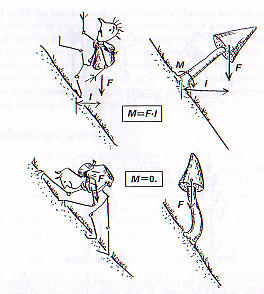
What the tree does is to bend its branches upright, so that the lever arms are not pulling the tree sideway. This applies not only to branches, but to the leaning of trees towards the sun. A beautiful set of diagrams illustrate the similarity of the adaptations that the tree makes to maintain a center of gravity to the adaptations a human makes to maintain their center of gravity. Trees use their terminal buds to build modules that change their shape, while humans use the brain to decide to change our center of gravity, for example when we bend forward whilst we are climbing up a hill.
Sample market hypotheses generated by this way of thinking are: The horizontal moves of markets would seem to be the reversals that they take from a given center of gravity. The more that they reverse to one side from a central point, perhaps a round number, the more likely that structures and activity will grow on the other side to minimize the stress. Eventually, conditions of light (competition) cause the market or a stock to move.
Alternatively, the greater the rate of ascent or descent, the more likely a market or stock is to show movement in a opposite direction to bring its center of gravity to a more stable level.
J.T. Holley responds:
Something that I have dealt with recently is the feeding of dying trees to resuscitate or bring them back to life. 'Spiking' trees with silly fertilizer spikes works well with the smaller trees, but you need bigger guns when you have the limbs leaning downward towards the ground. In parks and high traffic areas this is a huge hazard, the tree will seem to shed the limb to relieve the stress that Vic has mentioned above.
The only thing I learned regarding saving a tree is to take an auger, pipe, or some large metal rod and drive it into the ground. Rotate this until you have a two to three foot deep hole and pull it out. Fill this two thirds full of 10-10-10 and cover the rest with dirt and put your grass back over. These holes must be done around the 'drip zone' coming off the base of the trunk just inside the 'splash zone' from the outermost limbs.
I too believe, and should test, that the markets use these round numbers or spots to relieve their stress. These spots of light and competition allow it to be able to gain strength in times of weakness (sell off) to gain the nutrients to move higher and become stronger than before! Its like testing and finding Trend followers spots where they utilize "reversing stops" with their "fixed system". The Drip Zone is where the fertilizer is planted to pick 'em off and gain the edge.
Aug
7
To Aubrey on Leaving for College, from Laurel Kenner
August 7, 2024 | Leave a Comment

Essentials
See what you look at. Listen to what you hear. Feel what you feel.
Finding a way to use heart, hand, and mind together leads to joy.
Treat yourself as you would a dear friend.
Don’t lie. Lying tangles up your heart and mind. Lies require more lies, sapping energy.
Much of what is considered normal is wrong or worse.
Turn away from cynicism, intoxication, and callousness.
Read Xenophon’s account of Cyrus to learn about leadership. Read Seneca and Publius to learn how to retain your composure and virtue through Fortune’s ups and downs.
Be trustworthy.
Keep a good reputation.
Don’t talk trash about others behind their backs. That sort of talk has a way of flying like a bird back to the target and can turn people into enemies. Talking trash also makes your companions wonder what you say about them when they’re not around.
Genial curiosity can sometimes defuse bad situations.
Bad behavior is often about them, not you.
Deportment
Good manners reveal strength.
Respecting others as human beings is the essence of good manners. You don’t have to overthink it; good manners are often about little things, such as:
Get to appointments early.
Open doors for people with crutches and watch out for their feet.
Open doors for women and mothers with baby carriages.
If a woman joins you at a table where no seat is empty, give her yours. Pull the seat out for her and help her settle in.
Do not swear. It makes you seem churlish.
Don’t comment on the appearance of others. The exceptions: Tell your wife she looks lovely and tell a friend if his fly is open.
Do not make fun of what another person eats, drinks, or thinks.
Invest in comfortable, well-made clothes. Cheap clothes waste money because they don’t last, and they make people wonder if you will be as careless with them as you are with your own appearance.
Women
As you know, one of your most important roles is to protect women.
Women are vulnerable to falling in love too quickly, because they instinctively want a family. That's true of all women.
Sexually liberated women do not exist. Recognize that women who think they can act like men are prey in a harmful culture. You must protect them.
At Home
Wash sheets and pillowcases weekly.
Light and fresh air are healthy. Keep the windows in your room open if possible.
Follow the one-touch rule: Put things in their places. Put dirty clothes in the hamper. Put dishes in the dishwasher. Throw out papers you don’t need.
An orderly house helps keep life happy and productive.
Gratitude
Gratitude creates happiness. Write down five things you’re grateful for in a notebook every day.
Adulthood
What does it mean to become an adult? In a word: responsibility. Paying rent. Creating and protecting your family. Planning ahead. Making a career. Fulfilling your obligations. Making money. Contributing to freedom, community, earth.
On a higher level, adulthood is the ability to consider two opposing concepts. Adults can deal with ambiguity and subtlety.
Many wise sayings have converses that are equally wise and true. For example, perseverance and endurance are virtues; but the adage “survival is mobility” saved many Jews from the Nazi death camps.
In our modern world, “survival is adaptability” may be more apt. You must become adaptable without losing your soul.
Farewell
With all my love, I send you out into the world, an eagle destined to soar among mountain peaks. Be strong. Don’t forget to call.
-Mom
Vic adds:
beautiful advice - reach out to learn new things and be good to friends. don't be too trusting.
Sushil Rungta writes:
Wonderful lessons. While I loved all, the lessons on respecting others resonate with me the most. How often we behave callously towards others! Sometimes, unintentionally. Here, practicing mindfulness really helps.
Aug
4
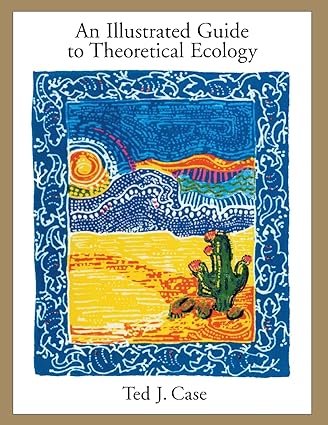
Book Review from Victor Niederhoffer: 'An Illustrated Guide to Theoretical Ecology'
(02 October, 2006)
Every now and then one comes across a book that completely clarifies what every educated person should know about a subject that is essential to understand as we go about the humdrum business of life and trading. Such a book is An Illustrated Guide to Theoretical Ecology, by Ted J. Case. I cannot recommend this book too highly, as it provides a foundation for thinking about competition, mutualism, growth, resource depletion, diffusion, population density, predation, life cycles and space. The book introduces the basic principles behind each of these subjects with simple algebraic equations and illustrative charts that describe various plausible relations. It then follows through with analytic solutions to develop a deep understanding.
Aug
2
Incentives
August 2, 2024 | Leave a Comment
the CEA test has a positive predictivity of 80% for colon cancer. most studies show it doesn't have a cost effectiveness. How accurate is a CEA blood test?
Doctors don't use the CEA test to make a first-time diagnosis of cancer. This test isn't an accurate way to screen for it because many other diseases can cause the levels of this protein to rise. And some people with cancer don't have high CEA levels.
but but but… the studies don't take account of the incentives and the next steps taken / it has positive predictivity of 80%. who wouldn't take the next step after a positive (CEA above 3.5)? I am not an MD. none of my kids and good friends who are MD's recommend it.
Jul
31
A comparison
July 31, 2024 | Leave a Comment
Deep Enough, a beautiful heroic book about the same subject as a hateful book, Angle of Repose. one won the Pulitzer Prize, the other is hardly known but highly recommended by me.
Jul
19
The golden ratio
July 19, 2024 | Leave a Comment

golden ratio of 1.65 appears in thousands of settings over thousands of years.
The Golden Ratio: The Divine Beauty of Mathematics, by Gary B. Meisner (Author) and Rafael Araujo (Artist)
The Golden Ratio examines the presence of this divine number in art and architecture throughout history, as well as its ubiquity among plants, animals, and even the cosmos. This gorgeous book—with layflat dimensions that closely approximate the golden ratio—features clear, enlightening, and entertaining commentary alongside stunning full-color illustrations by Venezuelan artist and architect Rafael Araujo.

A trader writes:
I have used the golden ratio trying to predict where the technical people find Fibonacci support and resistance levels in both cash and futures and applying them to grain spreads and basis capture. This was in conjunction with other tools being used and tested. I completely abandoned the method after finding other, more successful ways that work better than random.
William Huggins offers an historical lagniappe:
Leonardo of Pisa may be best known for his "sequence" but in his lifetime, it was his work as a tutor to the rich business class of late-Medieval Italy that paid the bills. His mathematical treatise Liber Abaci (1202), which was only "recently" translated into English, is broken into chapters including basic operations but he quickly jumps into the calculation of profits from business voyages and even introduces the notion of the time value of money.
Jul
14
Randomness, with a bit of song
July 14, 2024 | Leave a Comment

I would love to ask Dr. David Hand to answer the question of randomness of the negative correlation between Yankees winning and S&P performance. i believe the negative correlation is a real expression of the nature of the commercial background and spirit of the Yankees. all commercials e.g. are dei.
i thought it mite be an easy example of a random coincidence that would be grist for Dr. Hand's mill. i admire his work enormously. sent one of his, Statistics: A Very Short Introduction, to Berkeley son. The book has no numbers or maths in it and my Aubrey just received yet another 5 on his grads even though he never took a stats class.
[And now for the song…] completely fictional made up by Sondheim. example of how great composers with evil in hearts and do great things like Debussy and Wagner:
Someone in a Tree - Stereo - Pacific Overtures - Original Broadway Cast
Jul
10
Correlations, miracles, and rare events
July 10, 2024 | Leave a Comment

the negative corr between the Yankees winning and the S&P during last 25 days is about -0.80. can you come up with an explanation?
Yankees record in last 25 games
The Improbability Principle: Why Coincidences, Miracles, and Rare Events Happen Every Day
In The Improbability Principle, the renowned statistician David J. Hand argues that extraordinarily rare events are anything but. In fact, they're commonplace. Not only that, we should all expect to experience a miracle roughly once every month. But Hand is no believer in superstitions, prophecies, or the paranormal. His definition of "miracle" is thoroughly rational. No mystical or supernatural explanation is necessary to understand why someone is lucky enough to win the lottery twice, or is destined to be hit by lightning three times and still survive. All we need, Hand argues, is a firm grounding in a powerful set of laws: the laws of inevitability, of truly large numbers, of selection, of the probability lever, and of near enough. Together, these constitute Hand's groundbreaking Improbability Principle.
Jul
9
Amazing Weston Lifetime Collection of a Gentleman
July 9, 2024 | Leave a Comment
Amazing Weston Lifetime Collection of a Gentleman
Sale begins to close:
Wednesday, July 10th 2024 at 8:05 pm est
Jul
2
What markets teach
July 2, 2024 | Leave a Comment

a book recommended as the best book on economics ever is Reinventing the Bazaar, by John McMillan. you learn about flower markets, camel markets, pharma markets, bazaar markets in Morocco. and what it takes for them to work. i found the book fascinating albeit takes middle road.
Dasgupta, very erudite and sharp economist, recommends the McMillan book as essential for every current and would be economist. it tried to be eclectic as to free markets and need for government control. it's good to keep the enemy close as Godfather says.
Economics: A Very Short Introduction, by Partha Dasgupta.
Wes McCain is one of the most successful and erudite economists I have met in my 65 years career in Wall street. He recommends the Godfather as the most important and useful book for traders. I just watch the three Godfather Movies and they are excellent and highly recommended.
one of lessons that I wish my colleagues followed: "Fredo, don't ever take sides against the family again." so important in business and military, and markets especially.
every one says the opening line "i believe in america" is one of greatest opening lines ever. imagine the contumely that would be directed at it today.
Jun
30
Grandeur, and a very, very good wife
June 30, 2024 | Leave a Comment
There is grandeur in this view of life, with its several powers, having been originally breathed into a few forms or into one; and that, whilst this planet has gone cycling on according to the fixed law of gravity, from so simple a beginning endless forms most beautiful and most wonderful have been, and are being, evolved.
- Charles Darwin, The Origin of Species
there is grandeur in the inexorable rise in the S&P, documented by Dimson and Lorie.
i am forced to move and my paintings don't have much auction value so i would gladly reveal my methods for 50 million + and throw in a very valuable wife to the bargain.
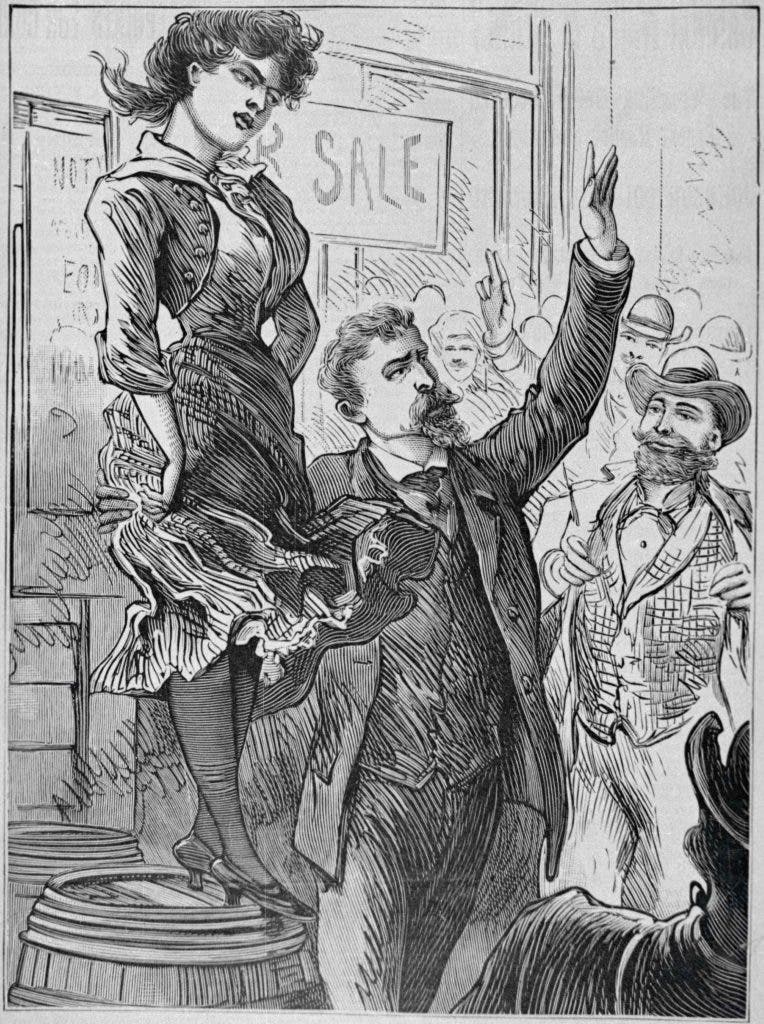
English Men Once Sold Their Wives Instead of Getting Divorced
Between the 17th and 19th centuries, wife-selling was a weird custom with a practical purpose.
she's a very good one. Tom Wiswell said his one regret in life was that he didn't marry a girl like Susan and since then many visitors have said same. The problem is that she is necessary to take care of me so I believe she could sell me for more than I could get for her. I told her at dinner that I was looking at ways of making money by selling some of our trees. She looked at me and said immediately that she wasn't going to send me the picture of her I asked for.
Jun
20
Odds, books, and Wilde in America
June 20, 2024 | Leave a Comment
with odds differential of 20 percentage points a max, how can we expect a change in the numbers announced? i would predict an increase in ppi and cpi.
a sensational phantasmagorical book building up from birth-death processes to the evolutionary theory of markets:
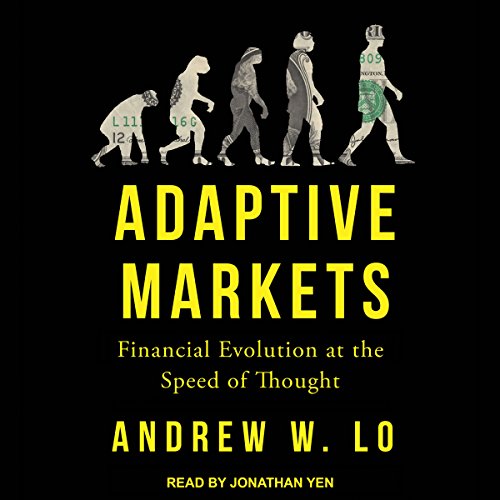
Adaptive Markets: Financial Evolution at the Speed of Thought, by Andrew Lo
Drawing on psychology, evolutionary biology, neuroscience, artificial intelligence, and other fields, Adaptive Markets shows that the theory of market efficiency isn't wrong but merely incomplete. When markets are unstable, investors react instinctively, creating inefficiencies for others to exploit. Lo's new paradigm explains how financial evolution shapes behavior and markets at the speed of thought - a fact revealed by swings between stability and crisis, profit and loss, and innovation and regulation.
given the latitude and longitude of a market, at a time, what do rotational symmetries enable you to predict?
The Force of Symmetry, by Vincent Icke
The Force of Symmetry gives an elementary introduction to the spectacular interplay among the three great themes of contemporary physics: quantum behavior, relativity, and symmetry. In clear, nontechnical language, it explores many fascinating aspects of modern physics, discussing the nature and interaction of force and matter. All these themes are drawn together toward the end of the book to describe the most successful physics theory in history, the "standard model" of subatomic particles. The book is suitable for undergraduate students in physics and mathematics.
D'Oyly Carte arranged for Oscar Wilde to tour U.S. to build up audience for Patience.
Oscar Wilde In America, The Definitive Resource Of Oscar Wilde's Visits To America
These pages document for the first time a detailed, comprehensive, and accurate record of all the dates, venues, and subjects of Oscar Wilde’s 1882 lecture tour of North America. Wilde conducted some 141 lectures over 11 months of 1882 and each has its own page beginning with the first lecture in New York City.
Jun
18
Back to school
June 18, 2024 | Leave a Comment
Aubrey one day before Berkeley. My kids all asked if I would be moving as Beethoven did when Karl left for school.
i cried when he didn't get into Harvard. he tried so hard and did so much. how could someone with 1600, a benevolent business in Eswatini, and 20 straight 5's on AP not get in? i guess his squash was not world caliber, and dei.
he only ran a 4.5 mile. his compatriots said if he knocked 30 seconds off he 'd have a chance. the best i ran was a 7.5 minute mile.
Jun
16
Brighton Beach knishes
June 16, 2024 | Leave a Comment

I grew up in Brighton Beach Brooklyn. By far the greatest Knishes of all time. The long gone Mrs Stahls.
Mrs. Stahl’s delicious Brighton Beach knishes
Yonah Schimmel gets credit for inventing the humble knish in 1910 at his still-thriving knishery on East Houston Street.
But knish fiends all over New York still lament the loss of Mrs. Stahl’s Knishes, a dingy place tucked under the elevated train at Brighton Beach Avenue.
The shop served up hand-made cushions of potato, kasha, and cabbage inside flaky baked dough. They were truly legendary.
A recipe: Old Fashioned Potato Knishes
Jun
12
Capgras delusion
June 12, 2024 | Leave a Comment
when a sizable part of speculators refuses to acknowledge the work of dimson et al and lorie and fisher et al in showing the 1000 fold increase in stocks over the last 100 years, we may attribute it to capgras delusion of imposters within.
Capgras delusion or Capgras syndrome is a psychiatric disorder in which a person holds a delusion that a friend, spouse, parent, another close family member, or pet has been replaced by an identical impostor. It is named after Joseph Capgras (1873–1950), the French psychiatrist who first described the disorder.
odds differential is now max of 17 percentage pts against regulatory capture. need a reduction.
Jun
12
Opposites
June 12, 2024 | Leave a Comment

Gilbert and Sullivan by Hesketh Pearson: sullivan was an inveterate gambler and inventor. personality was opposite to gilbert who was most litigious playwright in history.
From page 195:
Sullivan was at Monte Carlo when this letter arrived. He had recently been staying with the Prince and Princess of Wales at Sandringham, had then accompanied the Prince to the Continent, and was now enjoying princely festivities on the Riviera. His regular visits to the tables were reported in the papers, and he was extremely annoyed when certain English journals commented on his heavy gambling. What with dining among lords and counting his losses, he was in no mood to discuss grand opera with Gilbert. But he wrote again, recapitulating his main objections to Gilbertian comic opera: he was tired of it; his work was too good for it; he did not want to spend the rest of his life in clothing the same old types with music, e.g. "the middle-aged woman with fading charms"; he disliked the inhuman and impossible plots; in fact, the whole business had become distasteful to him.
Hesketh Pearson:
Hesketh Pearson published his first full-length biography, Doctor Darwin, when he was 43. By the time of his death thirty-four years later he had written another eighteen biographies, three travel books (all with Hugh Kingsmill), three books of reminiscences (one written with Malcolm Muggeridge), four collections of brief lives, a collection of short stories and essays, and a book on the craft of biographical writing, as well as numerous articles and talks. In England he was the most popular and successful biographer of his time.
From: Harry Ransom Center at the University of Texas
Jun
10
Stock/Bond ratio, from Hernan Avella
June 10, 2024 | Leave a Comment
I use a slightly modified version, I think is apt to use a rolling vol adjustment. Using VFINX (stocks) Long, VUSTX (long bonds) short. The stock bond ratio is higher than it was in 2000. the chart will show whatever you want; however, if you make the assumption that stocks and bonds have similar RISK ADJUSTED returns, mean reversion should be expected….at some point, but I don't think there's an actionable point here other than stay diversified. Here's a visual:

Stefan Jovanovich writes:
In the 40 years between the return of the dollar to the Constitutional standard (i.e. all paper issued by the Treasury had to be redeemable in coin) and the creation of a central bank that guaranteed that call money would always be available, the returns on the stock and bond markets had similar risk adjusted returns. For investors it was a choice whether to buy the common stocks of railroads with their wonderful but variable dividends or the secured bonds of the same companies.
A reversion to the mean could be a return to a period when cash, bonds and stocks all competed with one another in a connected equilibrium. That world saw creations of extraordinary fortunes; but against the one successful oil trust one had to measure the losses of all the enterprises that were unable to compete with Rockefeller's price-cutting for kerosene. What if AI means that sourcing for semiconductors only needs a few large relentlessly successful companies?
Vic asks:
how about no roll, no averaging on the bonds stock ratio?
Jun
7
More classic research
June 7, 2024 | Leave a Comment
Market Making and Reversal on the Stock Exchange
Victor Niederhoffer, University of Chicago, and M. F. M. Osborne, Washington, D. C.
Source: Journal of the American Statistical Association, Vol. 61, No. 316, (Dec., 1966), pp. 897-916
The accurate record of stock market ticker prices displays striking properties of dependence. We find for example that after a decline of 1/8 of a point between transactions, an advance on the next transaction is three times as likely as a decline. Further examinations disclose that after two price changes in the same direction, the odds in favor of a continuation in that direction are almost twice as great as after two changes in opposite directions.
Jun
5
M. F. M. Osborne
June 5, 2024 | Leave a Comment
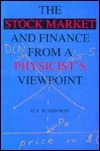
M. F. M. Osborne. works on farm for free. uses his strength to go on anthropological dig. purposely spends 1 month in jail. graduate degree at Lick Obs. in Berkeley. becomes student of Oppenheimer who was smartest man at School. takes job at US Naval Research in sound division. writes scenes from life of the greatest contributor to random walk behavior.
while carrying his bio around, I fell down 7 stairs on my head onto concrete and all pages mixed up.
Brownian Motion in the Stock Market, M. F. M. Osborne.
It is the purpose of this paper to show that the logarithms of common stock prices can be regarded as an ensemble of decisions in a statistical steady state and that this ensemble of logarithms of prices, each varying with the time, has a close analogy with the ensemble of coordinates of a large number of molecules. We wish to show that the methods of statistical mechanics, normally applied to the latter problem , may also be applied to the former.
May
31
Kings of the Court
May 31, 2024 | Leave a Comment

Kings of the Court: The Story of Lawn Tennis by E. C. Potter, Jr. - the good old days in 1879, the third Wimbledon victory, Hartley got to the finals on Saturday. he had not arranged for anyone to replace him in pulpit. he rushed off the court, took a one-hour trip to Yorkshire, arrived at W. just in time to change his flannels, averted default and won W. those were the days of the identical twin Renshaws and Dohertys. many still rank the Dos in top 5 of all time from 1903. Pim in between the two sets of twins could pull of a let cord whenever he wanted. But he only won W twice because he only cared about perfecting his stoke.
May
24
Slow to adapt, from Big Al
May 24, 2024 | Leave a Comment
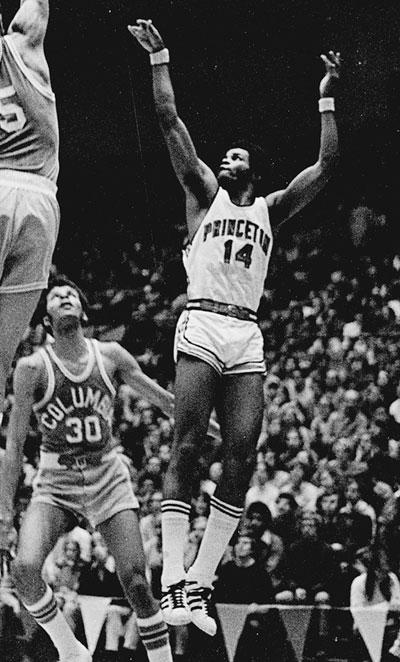
It's been 44 years since the introduction of the 3-point line in the NBA. To me, it's a curious case of slow adaptation. Of course, you have new generations of players growing up shooting the 3, but surely players in the early 80s were capable of learning and practicing. The low number of 3s seems like a failure of analysis, failure to understand the impact on points-per-possession, which wasn't much of a moneyball concept yet.
Also, early on it was pretty much just guards who shot the 3 well, with the big exception of Larry Bird. But now, lots of players 6-10 or taller shoot 3s with considerable accuracy. To me, this is more an issue of assumptions, that big men couldn't shoot from long. And then some big men put in more practice and showed they could do it, opening up the possibilities.
Interesting how there are thresholds people believe can't be crossed…until somebody crosses them…and then lots of people are running sub-4-minute miles.
The 3-Point Revolution, by Stephen Shea:
A gimmick? A publicity stunt? That’s what many thought of the 3-point line when the NBA adopted it for the 1979-80 season. Back in 1979, Washington Bullets coach Dick Motta commented, “The three-point field goal will definitely make things interesting.” He meant interesting in the sense that a game that would have been over might now be sent to overtime by a desperation heave. Neither Coach Motta nor anyone else foresaw an NBA game played like it is today.
Five years after its inception, NBA teams were only averaging 2.4 three-point attempts (3PA) per game. This past season, James Harden alone averaged ten. Teams averaged 29.
[ More data on 3-point shooting. ]
Larry Williams comments:
Good point!! …like the 4 minute mile…and we can only beat the averages by a few points…
Vic wonders:
what adjustments have markets been slow to adapt to in last 5 years?
Big Al adds:
An interesting sidebar from 2017:
The Basketball Team That Never Takes a Bad Shot
The NBA’s most efficient offenses seek out layups and threes. A high school in Minnesota takes the idea to the extreme.
By Ben Cohen
PINE CITY, Minn.—Jake Rademacher made a mid-range jumper in a recent high-school basketball game. But as soon as the ball left his hands, even before it banked in, Rademacher knew it was a bad shot. And his team doesn’t take bad shots.
Pine City High School seeks out only the most valuable shots in basketball: from underneath the rim or beyond the 3-point line. They play as if they’re allergic to all the space in between.
May
23
The Whole Story
May 23, 2024 | Leave a Comment
The Whole Story by John Mackey - a story of how an entrepreneur learned about the bourgeois virtues and thanks to his father and his supportive partners, wives, and in spite of the venture capitalists, went from rags to riches.
Whole Foods Market's cofounder and CEO for forty-four years, John Mackey offers an intimate and provocative account of the rise of this iconic company and the personal and spiritual journey that inspired its remarkable impact.
The Whole Story invites listeners on the adventure of building Whole Foods Market: the colorful cast of idealists and foodies who formed the company's DNA, the many breakthroughs and missteps, the camaraderie and the conflict, and the narrowly avoided disasters. Mackey takes us inside some of the most consequential decisions he had to make and honestly shares his regrets looking back.
May
21
Last Train to Paradise
May 21, 2024 | Leave a Comment
an excellent bio of the gilded age and a man who loved adventure and created the Florida East railroad and overcame numerous engineering and weather challenges. highly recommended.
The paths of the great American robber barons were paved with riches, and though ordinary citizens paid for them, they also profited. Les Standiford, author of the John Deal thrillers, tells how the man who turned Florida's swamps into the playgrounds of the rich performed the almost superhuman feat of building a railroad from the mainland to Key West at the turn of the century. An extraordinary man and partner of John D. Rockefeller in the Standard Oil Company, Flagler had the vision to build railroads to link this backward territory with the rest of America. Last Train to Paradise shows how he masterminded the nearly impossible engineering feat of spanning more than 100 miles of ocean and islands to reach the southernmost tip of the Eastern seaboard.
May
9
Teller of tales
May 9, 2024 | Leave a Comment
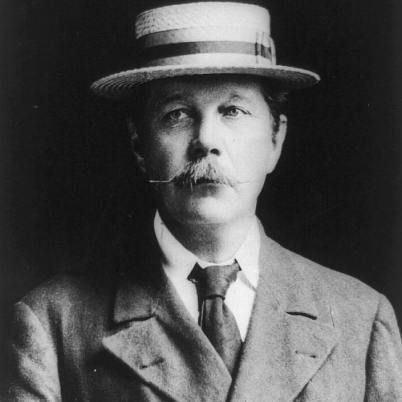
an excellent bio of a multitalented writer, thinker, and sportsman. a very chivalrous man. the story of Doyle going to a performance of Patience is resonant.
Teller of Tales: The Life of Arthur Conan Doyle
This compelling biography examines the extraordinary life and strange contrasts of Sir Arthur Conan Doyle, the struggling provincial doctor who became the most popular storyteller of his age when he created Sherlock Holmes. From his youthful exploits aboard a whaling ship to his often stormy friendships with such figures as Harry Houdini and George Bernard Shaw, Conan Doyle lived a life as gripping as any of his adventures. Exhaustively researched and elegantly written, Teller of Tales sets aside many myths and misconceptions to present a vivid portrait of the man behind the legend of Baker Street, with a particular emphasis on the Psychic Crusade that dominated his final years, the work that Conan Doyle himself felt to be "the most important thing in the world".
Apr
29
Follow-up to bourgeois virtues
April 29, 2024 | Leave a Comment

Jimmy Buffett and the Bourgeois Virtues
Jimmy Buffett was known for his “tropical rock,” whose music and lyrics borrowed liberally from rock, country, calypso, and island life. He sang with Frank Sinatra and Alan Jackson, and covered Old Hank. But he was also a lifelong entrepreneur – and erstwhile journalist – much like the great French economist Frédéric Bastiat. AIER is the home of the Bastiat Society, “a global network of individuals committed to advancing free trade, individual freedom, and limited government.” AIER is also the home of the Sound Money Project, something Jimmy knew about: “Now I got quarters in my loafers, tryin’ to fight inflation/When it only used to take a cent.”
Jimmy’s unflagging entrepreneurship embodies the “bourgeois virtues,” about which my AIER colleague and friend Art Carden has written with his mentor Deirdre McCloskey. Art is a Senior Fellow at AIER and Dr. McCloskey is a contributor. I don’t know if either is a fan of Jimmy Buffett.
Apr
28
A good antidote
April 28, 2024 | Leave a Comment
Carnegie Hero Fund Commission
Jameson Lobb, New York, NY
Jameson Lobb helped save a man from drowning, New York, New York, October 4, 2021. As a middle-aged man floated motionless in the East River between two piers at a popular waterfront overlook, a bystander on the pier nearest the man called for help. Alerted on the opposite pier was Lobb, 24, banking analyst, who was exercising with his friend. Lobb climbed over a railing and, fully clothed, jumped into the cold river and swam toward the submerging man’s location. Lobb submerged, grasped him, and resurfaced as the friend swam to them and positioned the man, who appeared to be unconscious, face up on the friend’s chest. Lobb held the man’s legs, and they swam, towing the man at least 100 feet back to the wooden, barnacle-covered fender of the far pier, where they had entered the water. While the friend held the man to the fender about 8 feet below the pier’s deck, Lobb climbed onto a beam, and they used a rope and life ring lowered by others to secure the man as he became responsive. With help from Lobb and the friend, bystanders then lifted the man onto the pier. Arriving first-responders tended to the man, who was taken to a hospital. Lobb, who suffered cuts on his arms, climbed back onto the pier and went to a hospital for precautionary treatment.
Apr
21
Very bullish
April 21, 2024 | Leave a Comment
very bullish when S&P is down 7 days in a row - only occurred 5 times since 1996, expectation in 2 days is +39 big. 6 20-day minimums in a row, happened 7 times since 1996, expectation in 4 days 100% up, mean gain 45 big.
Hernan Avella agrees:
I imagine the 2 or 3 fellow specs that still trade a significant size in this list are already loaded up with enough spu, because one expects fireworks next week.
From the department of non predictive studies: Choose your favorite trend indicator, or better yet, create an ensemble of trend indicators. Choose a measure of persistence of extreme readings (intensity and duration). Look back in history what happens after your signal gets triggered, look at different time frames.
I get 12 signals since 1980: 1985, 1987, 1991, 1994, 2001, 2007, 2008, 2009, 2011 and 2022.
Good luck next week.
Larry Williams comments:
We have only seen 6 down days in a row here in S&P 500 and not that in the Dow.
Big Al suggests:
Regarding the Dow vs S&P divergence, a relevant comparison below. INTC is the only shared component.

Apr
21
Good book, good food, good company
April 21, 2024 | Leave a Comment

great book that i'm reading as I am taking Aubrey around to visit colleges that accepted him:
The Bourgeois Virtues: Ethics for an Age of Commerce, by Deirdre Nansen McCloskey.
For a century and a half, the artists and intellectuals of Europe have scorned the bourgeoisie. And for a millennium and a half, the philosophers and theologians of Europe have scorned the marketplace. The bourgeois life, capitalism, Mencken’s “booboisie” and David Brooks’s “bobos”—all have been, and still are, framed as being responsible for everything from financial to moral poverty, world wars, and spiritual desuetude. Countering these centuries of assumptions and unexamined thinking is Deirdre McCloskey’s The Bourgeois Virtues, a magnum opus that offers a radical view: capitalism is good for us.
McCloskey’s sweeping, charming, and even humorous survey of ethical thought and economic realities—from Plato to Barbara Ehrenreich—overturns every assumption we have about being bourgeois. Can you be virtuous and bourgeois? Do markets improve ethics? Has capitalism made us better as well as richer? Yes, yes, and yes, argues McCloskey, who takes on centuries of capitalism’s critics with her erudition and sheer scope of knowledge. Applying a new tradition of “virtue ethics” to our lives in modern economies, she affirms American capitalism without ignoring its faults and celebrates the bourgeois lives we actually live, without supposing that they must be lives without ethical foundations.
visit to Sam's in Berkeley coming after 60 years:
Sam's Grill and Seafood Restaurant
Serving Mesquite-grilled Fresh Fish and Classic
San Francisco Dishes from the Gold Rush to today!
To Our Friends and Patrons,
We are happy to present to you an Old-Fashioned Eating House with Old Fashioned Waiter Service and Private Booths together with a professionally equipped kitchen for better and faster service. We want to continue to serve you as we have done over the past 75 years and keep our reputation as one of the GOOD EATING PLACES of “Old San Francisco.” We are proud of it and hope you will be, too.
Thank You! (taken from Sam’s menu from 1946)
An update: nothing has changed much at Sam's in 160 and 60 years - the petrale is still the best sole (better than Dover), the bread is the same excellent sourdough, and on a wed. evening it was packed (the lavatories were messy).
Apr
10
Gould, Fisk, and Black Friday
April 10, 2024 | Leave a Comment

From Wall Street and the Wilds, by A. W. Dimock, pages 178-180:
Gold business improved and my balance was growing when the Fisk and Gould gang entered the gold market. Fortunately I had not the capital to enter the lists with them and besides I was afraid. Their methods lacked sense and represented brute force only and the corner they were running was foredoomed to destruction, but their immediate power was uncanny. For they not only had money, but they controlled a bank which would have certified their checks in payment for all the gold on earth and they so controlled the courts that they could have filled their pockets with blank injunctions and mandamuses or even the profane form of the latter suggested by Fisk himself.
The price of gold had been run up to a point where it was impossible to hold it and ruin was in sight. Fisk's best suggestion to force mercantile and other shorts to cover was to advertise names and amounts in the morning journals with the warning that the price would be at once put to two hundred unless all the shorts covered. There was sense enough in the gang to suppress that manifesto of folly, for Gould had a scheme of sheer diabolism brooding in his more subtle mind.
[ … ]
That the corner was broken was clear to me and that a crash was coming seemed certain, so I sold and I sold and I sold.
[ … ]
Though I had made many a fine turn as the market reeled back and forth that day and my books at its close showed cash assets that would put financial trouble behind me for all time, yet a deadly fear held me in its grip. For my chief sales had been to the Gould broker, Speyers, and the Gould purpose to repudiate these purchases was now apparent. The intent to repudiate all purchases and enforce all sales, was confirmed by the course of the swindlers on the following day. The robbery had been deliberate and the FiskGould brokers who had been deputed to sell received instructions to make no sales to Speyers but to sell to others without regard to what Speyers was bidding.
From The Wizard of Wall Street and His Wealth, by Trumbull White:
Fisk, in his dark back office across the street, with his coat off, swaggered up and down, ‘a big cane in his hand,’ and called himself the Napoleon of Wall street. He really believed that he directed the movement, and while the street outside imagined that he and Gould were one family, and that his purchases were made for the clique, Gould was silently flinging away his gold at any price he could get for it.
Whether Fisk really expected to carry out his contract, and force the bears to settle or not, is doubtful, but the evidence seems to show that he was in earnest and felt sure of success. His orders were unlimited. ‘Put it up to 150,’ was one which he sent to the gold-room. Gold rose to 150. At length the bid was made—‘160 for any part of five millions,’—‘162 for five millions.’ No answer was made and the offer was repeated—‘162 for any part of five millions.’ A voice replied, ‘Sold one million at 62,’ The bubble suddenly burst, and within fifteen minutes, amid an excitement without parallel even in the wildest excitements of the war, the clique workers were literally swept away and left struggling by themselves, bidding still 160 for gold in millions which no one would any longer take their word for, while the premium sank rapidly to 135. A moment later the telegraph brought the government order from Washington to sell, and the result was no longer possible to dispute. Mr. Fisk had gone too127 far, while Mr. Gould had secretly weakened the ground under his feet.
[ … ]
Every person involved in the affair seemed to have lost money, and dozens of brokers were swept from the street. But Mr. Jay Gould and Mr. James Fisk, Jr., continued to reign over Erie, and no one can say that their power or their credit was sensibly diminished by a shock which, for the time, prostrated all the interests of the country.
For an overview: Black Friday (1869)
some items about Jay Gould. he was expert surveyor, writer, accountant, lawyer, metal tinkerer, and unblemished family man. passed away with 100 million dollar estate in 1892. had a grandson who was US squash champ, whose trophy i have.
Apr
9
Ideas for markets from Bill James
April 9, 2024 | Leave a Comment

some consilient ideas for markets from The Mind of Bill James, by Scott Gray:
(1) the strikeout rate is directly indicative of the longevity of a career. (2) the best managers are easy going. (3) minor-league performance is predictive of major league performance. (4) circular results: when something happens to offense, it also will happen to defense.
(5) having a runner on first base is bad - it's negative. (6) stealing is a negative. teams leading in steals do worse. (7) batting order doesn't matter. (8) a team playing in a hitter's park will have stronger pitchers.
similarity of scores are predictive: (9) the ratio between a team's wins and losses will be the same as the square of runs scored / runs allowed. (10) devise theories to explain how things are connected to one another.
Mar
30

From The Mind of Bill JamesThe Mind of Bill James by Scott Gray, which I've been reading:
All things in baseball tend to return to their previous form. A team whose record improves one year will tend to decline the following year, and vice versa. In 1980, for example, only five of the twenty-six teams moved in the same direction in which they moved in 1979. It also applies to individual players. Bill found a way to express not merely the statistical principle of regression to the mean, but also what he called the 70/50 rule. Seventy percent of teams that decline in one year will improve the next; 70 percent of teams that improve will decline; and in all cases the amount of rise or fall is about 50 percent, so that a team twenty games over .500 one year would be ten games over .500 the next. (The percentages are much different for very big or very small improvements and declines.) “These were not things that I had expected to find,” Bill wrote. “Weaned on the notion of ‘momentum’ since childhood, I had expected a team which won eighty-three games one year and eighty-seven the next to continue to improve, to move on to ninety; instead, they consistently relapsed. Half-expecting to find that the rich grow richer and the poor grow poorer, I found instead that the rich and the poor converged on a common target at an alarming rate of speed.
It also applies to individual players. Bill found a way to express not merely the statistical principle of regression to the mean, but also what he called the 70/50 rule. Seventy percent of teams that decline in one year will improve the next; 70 percent of teams that improve will decline; and in all cases the amount of rise or fall is about 50.
Steve Ellison writes:
From my experience, I think the S&P 500 is less mean reverting in 1- to 2-week timeframes now than it was in the mid-2010s. On the other hand, the presidential election cycle pattern has been spot on since the beginning of bearish midterm election year 2022.
Eric Lindell comments:
These data pertain to relative performance — eg, a team's record relative to other teams. For absolute gauges — like how much I weigh on a diet, there's no such reversion to mean.
Kim Zussman responds:
Funny stuff! For asset managers everything is relative. For their customers (without yachts), it is absolutely absolute.
Where Are the Customers' Yachts?: or A Good Hard Look at Wall Street
Humbert H. agrees:
And that’s why people should not entrust their assets to asset managers, unless these people suffer from some sort of emotional instability and can’t handle losses without some stranger pretending to care.
Mar
26
Timeless advice
March 26, 2024 | Leave a Comment
timeless advice from Frank Crampton, one of the most successfull self-made men of the early 20th century:
I should take jobs that would teach me something, and never one I thought I wouldn't like. Most important was not to stay on a job too long, three months was about right but never longer than four…
Deep Enough: A Working Stiff in the Western Mine Camps
Mar
21
Deep Enough
March 21, 2024 | 1 Comment

Deep Enough: A Working Stiff in the Western Mine Camps is a book and biography of a great man, highly instructive - the expression refers to when a miner had sunk his drilling to a non-economical point and by extension mean "let it go" or "i dont care."
great book about riches to rags and riches again, telling all about the western mining business in early 1900's with many instructive parts about history, life, and business. highly recommend especially for those seeking true Horatio Alger stories.
[Frank Crampton was also co-inventor of a "trigonometric calculating instrument", shown on this page (scroll down) from the National Museum of American History at the Smithsonian.]
Peter Buol was a good man that grubstaked many a successful hard-rock miner - made a killing in Borax with Crampton.
« go back — keep looking »Archives
- October 2026
- September 2026
- August 2026
- July 2026
- June 2026
- May 2026
- April 2026
- March 2026
- February 2026
- January 2026
- December 2025
- November 2025
- October 2025
- September 2025
- August 2025
- July 2025
- June 2025
- May 2025
- April 2025
- March 2025
- February 2025
- January 2025
- December 2024
- November 2024
- October 2024
- September 2024
- August 2024
- July 2024
- June 2024
- May 2024
- April 2024
- March 2024
- February 2024
- January 2024
- December 2023
- November 2023
- October 2023
- September 2023
- August 2023
- July 2023
- June 2023
- May 2023
- April 2023
- March 2023
- February 2023
- January 2023
- December 2022
- November 2022
- October 2022
- September 2022
- August 2022
- July 2022
- June 2022
- May 2022
- April 2022
- March 2022
- February 2022
- January 2022
- December 2021
- November 2021
- October 2021
- September 2021
- August 2021
- July 2021
- June 2021
- May 2021
- April 2021
- March 2021
- February 2021
- January 2021
- December 2020
- November 2020
- October 2020
- September 2020
- August 2020
- July 2020
- June 2020
- May 2020
- April 2020
- March 2020
- February 2020
- January 2020
- December 2019
- November 2019
- October 2019
- September 2019
- August 2019
- July 2019
- June 2019
- May 2019
- April 2019
- March 2019
- February 2019
- January 2019
- December 2018
- November 2018
- October 2018
- September 2018
- August 2018
- July 2018
- June 2018
- May 2018
- April 2018
- March 2018
- February 2018
- January 2018
- December 2017
- November 2017
- October 2017
- September 2017
- August 2017
- July 2017
- June 2017
- May 2017
- April 2017
- March 2017
- February 2017
- January 2017
- December 2016
- November 2016
- October 2016
- September 2016
- August 2016
- July 2016
- June 2016
- May 2016
- April 2016
- March 2016
- February 2016
- January 2016
- December 2015
- November 2015
- October 2015
- September 2015
- August 2015
- July 2015
- June 2015
- May 2015
- April 2015
- March 2015
- February 2015
- January 2015
- December 2014
- November 2014
- October 2014
- September 2014
- August 2014
- July 2014
- June 2014
- May 2014
- April 2014
- March 2014
- February 2014
- January 2014
- December 2013
- November 2013
- October 2013
- September 2013
- August 2013
- July 2013
- June 2013
- May 2013
- April 2013
- March 2013
- February 2013
- January 2013
- December 2012
- November 2012
- October 2012
- September 2012
- August 2012
- July 2012
- June 2012
- May 2012
- April 2012
- March 2012
- February 2012
- January 2012
- December 2011
- November 2011
- October 2011
- September 2011
- August 2011
- July 2011
- June 2011
- May 2011
- April 2011
- March 2011
- February 2011
- January 2011
- December 2010
- November 2010
- October 2010
- September 2010
- August 2010
- July 2010
- June 2010
- May 2010
- April 2010
- March 2010
- February 2010
- January 2010
- December 2009
- November 2009
- October 2009
- September 2009
- August 2009
- July 2009
- June 2009
- May 2009
- April 2009
- March 2009
- February 2009
- January 2009
- December 2008
- November 2008
- October 2008
- September 2008
- August 2008
- July 2008
- June 2008
- May 2008
- April 2008
- March 2008
- February 2008
- January 2008
- December 2007
- November 2007
- October 2007
- September 2007
- August 2007
- July 2007
- June 2007
- May 2007
- April 2007
- March 2007
- February 2007
- January 2007
- December 2006
- November 2006
- October 2006
- September 2006
- August 2006
- Older Archives
Resources & Links
- The Letters Prize
- Pre-2007 Victor Niederhoffer Posts
- Vic’s NYC Junto
- Reading List
- Programming in 60 Seconds
- The Objectivist Center
- Foundation for Economic Education
- Tigerchess
- Dick Sears' G.T. Index
- Pre-2007 Daily Speculations
- Laurel & Vics' Worldly Investor Articles
