Nov
14
Inquiring Minds Wish to Know, from Victor Niederhoffer
November 14, 2010 | Leave a Comment
Tremendous run of red and green colors in the bond stock interrelations foretelling a return to days when increased output was considered good for both bonds and stocks, and decreased output was considered bad for both bonds and stocks. What does this foretell for the future? Is it bullish or bearish for both? And why did it happen? Inquiring and hopeful of profit minds wish to know.
Nov
13
Childrens Money Book Recommendations, from Ken Drees
November 13, 2010 | 2 Comments
 Do you all have any suggestions for childrens money books? Any ideas for a ten year old? I read The Richest Man in Babylon when I was 22– if that gives you any idea on the lack of money/market books in my young life.
Alan Millhone writes:
The money books I had when ten were by Whitnam, and there were slots for collecting dates of Lincoln pennies and buffalo nickels and mercury dimes etc.
Dylan Distasio responds:
Hi Alan,
Thanks for bringing back some wonderful childhood memories for me. My father passed on coin collecting as a hobby to my brothers and myself when we were children. I haven't been very active with it as an adult, but I used to love sorting through change bags from the bank in search of silver coinage or old pennies to fill my Whitman coin folders. I grew up in the 80s when you still had a chance to come across some silver ones (granted they were not in very good condition). I also have some old Morgan heads and other assorted issues. One of my favorite coins as a child was the "steel" penny from 1943.
More recently, I've collected proof sets of the state quarters series, although not for hopes of financial gains, I just love the look of a proof struck coin and find the state quarters interesting.
Nov
13
CLIENT 9: The Rise and Fall of Eliot Spitzer, reviewed by Marion Dreyfus
November 13, 2010 | Leave a Comment
 With Client 9, director Alex Gibney explores the shadowy corners of a seemingly familiar story.
There is a striking shot of a snow leopard toward the end of this remarkable documentary. The leopard, taken in the middle of a snowy scene midwinter in NYC or some vast landed zoo, stalks the forest or tree line. He is elegant, feral, dangerous … yet beautiful. There is a clear parallel in the Spitzer shown in this rare documentary that gives viewers close-up and personal access to so many pooh-bahs and mastodons of the financial world. Client 9 tells the story of a sensational trial with unprecedented access to prosecutors, defense attorneys, Market panjandrums, Fed types, usually inaccessible moguls, victims and, from behind bars, Mr. Spitzer, himself.
Some viewers were annoyed at having to sit through this well-photographed, well-paced, well-written doc, because they knew it to be Step One in the rehabilitation of the Man That Was Eliot Spitzer.
Since the film wrapped, he has inaugurated a (now failing) talk show on CNN, and he will be speaking around town in the near future (18 November, Fordham, for one).
The fascinating aspect of this 'kiss'-and-tell are the female distaffers of his escort service who speak on camera—some using surrogate actresses to mouth their speeches!—as Spitzer seems for all the world like a thinner, smarter, faster-talking Al Gore sitting at his ease, discussing the vagaries of Lehman or BoA mishandlings, arrests and such. Nerveless and shameless. There is only one point in the entire length of the piece where Spitzer's eyes dart to the side in a well-understood feint of embarrassment and guilt. But it lasts an eye-blink.
I see this as of a piece, in a sense, with THE SOCIAL CONTRACT, about the formation of FaceBook, and WALL STREET 2: MONEY NEVER SLEEPS. They form a triumvirate of fast-thinking, chicanery-ridden, entrepreneurial and high-energy brain friction that motivates and energizes so much of the picture we 'admire' so often about the canyons of Wall Street.
One looks at the title and wonders if it is prologue or prophecy. This was a man who had inexhaustible jet propulsion, almost. It remains to be seen if he can propel himself back into the graces of society again.
One kind of hopes he will, because he has the appeal of a cunningly patterned and talented snake. Always interesting to see how and where such mesmerizing creatures go, no?
Nov
12
The Stock Market as a Beauty Contest, from Kim Zussman
November 12, 2010 | Leave a Comment
 "The stock market is the type of beauty contest [apparently common in England at the time] in which you choose the girl that most others will find most beautiful, not the girl you find most beautiful." –Keynes
Not sure about Maynard's proclivities, but those afflicted with affinity for the opposite sex may find such judgements most difficult.
Rudolf Hauser writes:
This points to a key difference between long-term investing using fundamental analysis and trading. In essence the trader/speculator skill's lies in seeing how others will view events and makes his bets accordingly. This is the case even if someone with an intermediate term horizon relies on fundamentals in their analysis. In contrast the long-term investor (horizon measured in next few years) implicitly trusts not in his or her ability to anticipate how others will react but assumes superior knowledge in anticipating the future fundamentals of a company will enfold and considers if the security is likely to provide a superior return over that longer horizon given how the market usually perceives such a future state on the assumption that the usual influences on a stock short-term will at some point reflect the future values perceived by such an investor. To the extent that the market is driven by the former, opportunities can occur. For example, in a market downturn long-term opportunities may arise but the market could continue falling because of a near-term focus of most market participants. Accumulating a position over time would allow one to avoid buying the possibility of buying at even better future prices while avoiding the possibility of not taking advantage of current prices entirely should the market have reached bottom. Naturally a long-term investor has to be prepared to hold (avoid leveraging) his or her position and for periods of low or negative returns. Naturally that same fundamental investor will improve his or her performance to the extent that he or she can predict how traders will react and impact near to intermediate term price movements to time their own transactions.
Nov
12
Cisco and the Government, from Paolo Pezzutti
November 12, 2010 | Leave a Comment

 "Disappointing sales and profit forecasts from Cisco Systems Inc. show cutbacks in government spending that pose risks for companies that rely on the sector for growth." "State government orders fell 48 percent in the last quarter"
It is interesting to see how the times of the dot.com bubble are behind us. Now that the precipitous pace of growth is over they have to rely on increasingly indebted governments to keep their business going…Who is John Galt?
Gary Rogan writes:
If you superimpose the growth in the US GDP vs. growth in public debt since a little after 2000 you will realize that the entire US economy has been relying on the increasingly indebted government to keep the GDP growing, and that process went into hyperdrive since 2008. The entire growth for the last decade has been just a glorified game of check kiting.
Rocky Humbert responds:
GDP 3/31/01 = 10.3 Trillion
GDP 9/30/10 = 14.73 Trillion
US total Public Debt Outstanding 3/31/01: 2.10 Trillion
US total Public Debt Outstanding 9/30/10: 4.65 Trillion
Nominal GDP growth = 4.43 Trillion (43%)
Nominal US total public debt growth = 2.55 (121%)
Unless Mr. Rogan has become a Keynesian, one would have expected him to argue that had the US total public debt growth (and government spending in general) been smaller, the Nominal GDP growth would actually have been larger. It's peculiar that he's arguing the opposite.
Gary Rogan responds:
Rocky, take a look at the chart at the top of this article (a few months ago, but still) and you will realize that there is more than one definition of "US public debt" and some come closer than others to matching my statement.
I did not argue one way or another about what would happen had the overall government borrowing not been so large. I will argue, or rather state, now that in order for the free market forces to act to restart the non-subsidized GDP growth we would have had to experience a rather severe, non-government-corrected recession to clean out all the malinvestment of the last 15+ years. I will also state that not only had there not been any Keynesian multiplier on the government spending in a "greater than 1" sense for a while, but lately that multiplier has collapsed to a rather small fracton. Nevertheless, even now if you borrow and spend you will raise the GDP by more than if you don't borrow and spend. Nothing particularly Keynesian there.
Nov
12
Notes from Jakarta, from Jan-Peter Janssen
November 12, 2010 | Leave a Comment
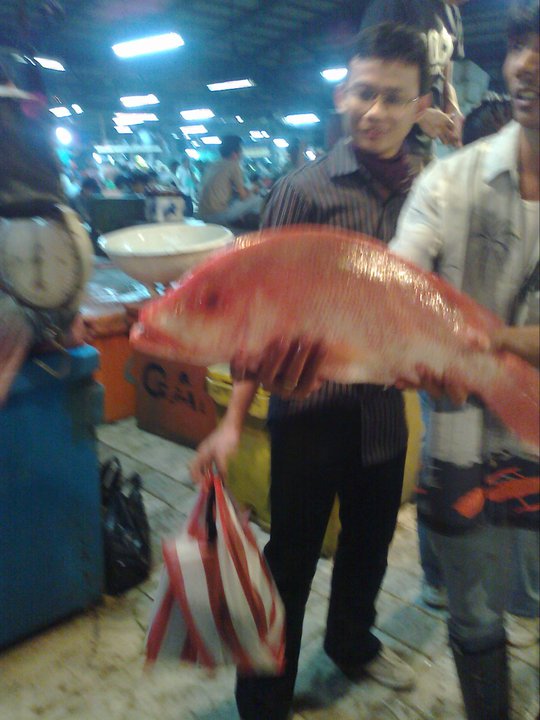
Notes from Jakarta:
#1. Fresh is better. Alive is the best. Asians know. Buy newly caught fish directly from a fisherman . Super markets are no no. Poultry shall be bought alive. Meat shall come from a wild animal. Learn to hunt or get to know a hunter.
#2. Let chefs do the cooking. Unless you're willing to slaughter chickens yourself, that is.
#3. Don't BBQ with charcoal. Indonesians use pieces of dried coconuts. Tastes much better. If you don't have ample supplies of coconuts, experiment with various kinds of wood.
#4. Do as the locals. Indonesians don't sit at the table. They sit ON it . Local traditions add flavor to the BBQ experience.
Nov
12
Dominant Social Themes, shared by Gary Rogan
November 12, 2010 | 2 Comments
 Dominant Social Theme from thedailybell.com
A dominant social theme is a belief system (usually concerning a purported social or natural problem) launched by the monetary elite that grows into an archetype or meme, usually after much repetition. The problem may be centered on people themselves (overpopulation) or caused by people (global warming). Dominant social themes often are launched from the centers of the power elite's global architecture, including the United Nations, World Bank, World Trade Organization and World Health Organization, where the related problems are declared to be such. The themes are then rebroadcast by the mainstream media. The hallmarks of a problem that drives a dominant social theme are:
• The problem is presented as one that can be solved only by those in authority.
• The prescribed solution requires action by, and greater authority for, social and political institutions that are distant from the societies they pretend to benefit.
• Reminders of the problem persist no matter how much evidence appears that the problem is fictitious, trivial or irremediable.
• The problem may co-exist in the public's mind with other purported problems with which it is inconsistent.
The United Nations is an example of an authority-based solution to a problem proposed by a dominant social theme. The problem is international conflict, including war. The solution is for national governments to be made subject to a worldwide authority.
The European Union is the United Nations writ small. The problem is isolated national markets and a lack of economic cooperation. The solution is for the national governments of Europe to be made subject to a European authority. Other examples of problems that support dominant social themes are: Bird flu. Even though it is rarely communicable from human to human, the disease is promoted as an extraordinary problem by emphasizing the high rate of mortality among the few people infected. This encourages the militarization of health care, supports planning for a "state of emergency" in Western countries and makes quarantining entire populations acceptable to the public. It also enriches Big Pharma and its shareholders by creating demand for vaccines and other drugs.
Swine flu. This disease is the thematic complement of bird flu. Even though the mortality rate is unremarkable by the standard of seasonal flu, the disease is promoted as an extraordinary problem by emphasizing the ease with which it is communicated from human to human. This encourages the militarization of health care, supports planning for a "state of emergency" in Western countries and makes quarantining entire populations acceptable to the public. It also enriches Big Pharma and its shareholders by creating demand for vaccines and other drugs.
Peak oil: Belief that oil supplies are on the verge of exhaustion justifies rising oil prices, for the benefit of producers, and provides a rationale for energy-efficiency regulations (to the benefit of certain manufacturers) and for subsidies for companies involved with "alternative energy" (biodiesel, solar, wind power and others). It also supports the promotion of public companies associated with energy alternatives.
Central banking: The idea that depressions are caused by free markets and by constraints on the supply of money imposed by a redeemable currency support the necessity of giving unlimited discretionary power to central banks that preside over fiat currencies. The manipulation of the fiat currencies can generate enormous wealth for favored parties.
The creation and exploitation of dominant social themes has been aided by the growth of modern, centralized mass media. The Internet, which decentralizes the power for mass communication, threatens the ability to invent and control dominant social themes.
Nov
11
Leave It to the Stock Exchange’s Second Biggest Faker, from Victor Niederhoffer
November 11, 2010 | 7 Comments
Leave it to the stock exchanges second biggest faker to send the market tanking on a shortfall and dissimilitude. It's the confrontation with reality that occurs whenever he speaks that makes one realize "how could I have been such a fool to believe in him when I knew all the time he was like that." Such revisions of hopeful feelings are common in the market and life and seem to cause what used to be called agonizing reappraisals. Other personages that cause this when they are shown to be without substance or window dressing their positions on could be predicted to be the Sage or …
Nov
11
In Flanders Field, from Jim Lackey
November 11, 2010 | Leave a Comment
.jpg) In Flanders Field
In Flanders Field
by John McCrae
In Flanders Fields the poppies blow,
Between the crosses, row on row,
That mark our place; and in the sky,
The larks, still bravely singing, fly,
Scarce heard amid the guns below.
We are the dead.
Short days ago,
We lived, felt dawn, saw sunset glow,
Loved and were loved and now we lie,
In Flanders Fields.
Take up our quarrel with the foe
To you, from failing hands, we throw,
The torch, be yours to hold it high.
If ye break faith with us, who die,
We shall not sleep, though poppies grow,
In Flanders Fields.
Check out this site about the VFW Buddy Poppy Program in honor of Veterans Day. Give a few bucks, and hang it off your rear view mirror.
By the way, another Moe, Richard (who served in the House), is the author of the best unit history from the Civil War. It is about the First Minnesota.
Nov
11
Gary Johnson in the News, from Victor Niederhoffer
November 11, 2010 | 2 Comments
Follow up from a friend of Aubrey who climbed Mr. Everest with a broken leg, and vetoed more bills than all other Governors combined when in office:
"Forget Palin, here's Gary Johnson"
from CNN.
Nov
11
Oil Prices, from Stefan Jovanovich
November 11, 2010 | Leave a Comment
 Is there any validity to this type of analysis?
Price of Sperm Oil (in gold dollars) - Eaton, "Petroleum"
1831 $0.30
1843 $0.63
1854 $1.92
1866 $1.28
The explanation of the price drop in 1866:
"This posed (and contrived) photograph was taken by John A. Mather in the Pennsylvania oilfields, probably in 1866. It was the year of a bust, a phenomenon that visits the industry from time to time. The price of crude dipped too low for profits in 1866 and forced some operators to sell or even abandon their equipment."
Rocky Humbert writes:
At the risk of eliciting hate mail from my libertarian friends, I make two observations where the government can actually help things along:
1) Short and Long-tail externalities. Markets are ill-suited to efficiently allocating the costs of mass torts such as pollution (and man-made climate change — should it ever actually pass muster beyond any reasonable doubt). I submit that correctly applied, Pigovian Taxes improve societal outcomes, and challenge Libertarians to argue otherwise.
2) Dissemination of truthful versus fraudulent information. It's difficult to imagine that anyone still believes that smoking is not unhealthy. It was in 1963 when the original surgeon general's report reported the links between smoking, cancer and heart disease. For forty years, the tobacco industry labored feverishly to prove otherwise, and their attempts at some points came periliously close to fraud and perjury. One can reasonably argue that it should not be the government's role to interfere with a fully-informed smoker's choice, but it's a much different argument to say that the smoker should be misinformed. The incremental value from cigarette packs displaying pictures of dirty lungs and dying children is questionable — which demonstrates the saying "too much of a good thing isn't a good thing"
Which brings me to the restaurant menus in NY which must now display calorie counts…. During a recent visit to Ben & Jerry's, I winced when I read that the awesome fully-loaded Brownie Sundae had 1800 calories, and this information certainly contributed to my decision to get the small mint chip cup instead. The cost to Ben&Jerry of proving this information (other than in lost sales) is small, and my "informed decision" was probably healthier — yet, this additional knowledge certainly reduced my enjoyment of the ice cream experience. I recently read that Obamacare mandates that vending machines display calorie counts (for owners of 20+ machines), and the vending machine owners are (perhaps rightly) upset about the costs of complying with these new regulations. Once again, "too much of a good thing isn't a good thing."
Gary Rogan writes:
The government can do a lot of good. There are many well-meaning people in government, and since it expends enormous resources it produces a lot of good. You got close to the crux of the matter towards the end: WHO should decide if the cost or the action or in fact the action itself (in resources and restrictions on freedom) is worth it? Can they reliably make the right choice? What happens when they make the wrong choice with all the firepower that stands behind them?
Nov
11
What a Speculator Is, from George Parkanyi
November 11, 2010 | 1 Comment
 What has being liberal, libertarian, vegetarian or whatever got to do with being a good speculator? In my mind a speculator needs to explore and understand how the world is, rather than how he wishes it to be. If the world if full of bleeding-heart blood-sucking socialists, then figure out how to speculate successfully under those conditions. Or if it's full of profit-at-all costs exploitive blood-sucking capitalists, figure out how to speculate through that. Who cares (as a speculator) if paper currency is going to become an environmental problem. Should one be buying gold? And/or timberlands? Speculation is little more than a game really. You're dealt a hand– figure out how to put it to best use. Influence the game if you can. If someone else isn't playing by the rules– adapt. Be creative, resourceful.
Everyone should of course nurture and grow a life philosophy and be able to freely pursue it (although I personally don't agree with anyone trying to impose theirs on others, including parents). This of course can influence why and how you speculate, but I think its the individual's application of intellect and effort rather than the philosophy itself that determines the success.
Just my two cents. No– four cents. Is it four yet? (Where the hell is gold trading now? … Haha. )
Kim Zussman writes:
It is the rare person who can bet and profit from the opposite of their own belief system. Imagine going against your own G-d, your people, your family, your children– because intellectually you believe they will lose and you will pay any price to be on the profitable side of the bet.
Faustian abitrage
Nov
10
One Admires, from Victor Niederhoffer
November 10, 2010 | 2 Comments
 One admires the insouciance, the shiftiness, the redeployment, the false signaling, the appearance of propriety, (what is the right expression?) with which the Fed announces their schedule of securities eligible for their quantitative easing at 2:00 pm. this afternoon. They wish the "flexibility " to buy the highest yielding securities from the bank so that they can "give the public" the best return. What a snare and delusion, a displacement, a false marking et al, to displace attention from fact that they are buying a trillion dollars of securities by force from the clients that own them, adding to the demand schedule by 100% or so with every security always fairly much the same shift from each other so that buying one raises the price of all others to their clients non animadversion.
Nov
10
Symmetry, from Jim Sogi
November 10, 2010 | Leave a Comment
Very symmetrical shaping in ES over last couple weeks. Symmetry seems to be one of the underlying principals of the universe, to put it most broadly. Eastern philosophy calls it yin and yang.
Nov
10
Thought of the Day, from Jeff Watson
November 10, 2010 | 2 Comments
In this article I recently read, "Oil Will Run Dry 90 Years Before Substitutes Roll Out, Study Predicts", Dr. Niemeier says, "We need stronger policy impetus to push the development of these alternative replacement technologies along." Spoken like a true statist who depends on government largesse and central planning.
In the real world, what we need is for there to be an incentive, as described by a real price, and the free market will find a solution to the oil depletion, in short order.
Nov
10
The Power of Double Check, from Ken Drees
November 10, 2010 | Leave a Comment
 This morning's lesson with my son involved a mate on the move problem with double check being the application.
The power of ++ is that it removes two of three methods of check deflection from the king's choices– interpose and capture and forces the king to move. Aron Nimzowitsch wrote that, "Even the laziest king flees wildly in the face of a double check." And I kept the lesson up as we waited for the bus adding on that the ++ always involves a discovered check (a surprise) and that it even gives the checking player a "tempo" in that the opponent is forced to flee and not make a truly organic move and now this lesson has percolated into thinking about markets.
Now in silver was the raise of requirements of margin the discovered check, and the piece that moved out to create that discovery was the price of silver itself? This example maybe doesn't work so well as a double check, but simply a discovered check. Or a certain stock was moving very aggressively higher and then a surprise downgrade premarket occurred. Was the potential downgrade that was aiming all along at the stock price hidden and then revealed at a critical time
For a double check scenario–maybe hike of margin requirements and a new contract amount limit rule being imposed at the same time would be more appropriate. Causing extreme contract liquidation (a move by the king only).
Double check in markets is interesting and in my opinion is associated with a negative ( a check) to the rising item. A surprise inclusion of a stock into an index combined with a stock split may be an upside example of double check. One more facet of double check is that the piece you move or even the piece giving the discovered check can be left enprise or at risk for the move, giving the ability to extend the piece's power and range –a springboard of sorts. A suspension of consequence for a short time.
Nov
10
A Useful Thought For Today, from Rocky Humbert
November 10, 2010 | Leave a Comment
The Waverly Advisors morning note commented on yesterday's precious metals markets. Their observation is relevant to all markets at all times:
"In practical "trader's terms", it boils down to this: These markets are certainly overextended by any measure, and, as such, are vulnerable to corrections. Because of the potential for new feedback loops, these corrections may be larger, sharper, and more irrational than most market participants expect. In short, expect the unexpected and do not be caught off guard. Though yesterday's action could set off a larger pullback, we see nothing to challenge the integrity of the higher timeframe trend, and weakness in these markets is to be bought until further notice."
Mental note to self: Make sure that I am on the distribution list for the "further notice."
Anton Johnson writes:
Consider further notice given: See CME silver margin increase.
Victor Niederhoffer comments:
Further notice with bonds going through 30 year auction. Will they be able to pull rabbit out of the hat, especially considering recent failures. My goodness, the clients might have a loss.Let us hope that any announcements of a negative nature will be released before the auction so as not to upset the sensibilities as usual.
Anatoly Veltman asks:
1. I never looked up Waverly– are they good?
2. Silver hit $29.34 Tuesday. It is back over $28 this minute. Please don't lose sight of history. November two years ago: $9. Watch out this week (comes from a fool with $1m in margin money leveraged 30:1 on the day Silver dropped from $11.25 to $7.50; and traded even lower next day!)
Nov
9
The Flexis and the Vigis, from Victor Niederhoffer
November 9, 2010 | 1 Comment
No sooner said that increase in inflation expectations might change the schedule of flexionic payments, then bonds go to a 3 month low. The vigilantes finally do their thing.

Vince Fulco writes:
Especially on a day when the former Harvard head said the Fed "needs to do much more".
Ken Drees comments:
Back to back red days per dailyspec calendar– recently rare.
Nov
9
Briefly Speaking, from Victor Niederhoffer
November 9, 2010 | Leave a Comment
 I recently played with Aubrey at the new Stuyvesant park on West Street. It illustrates many things that made America great and are appropriate to think about relative to the well known abundance that giving each settler his own plot gave to the pilgrims enabling them to have a Thanksgiving. Everything is better now. Think back to the catalogs you used to order from 10 years ago, and see if there's anything you would buy. Not only in electronics, but in toys , gifts, cosmetics. The park has products from Kompani and Berliner– that are infinitely safer and more playful than the old parks. The ropes of the jungle gym protect the kids from falling and doubtless save hundreds of lives a year. The artificial soft turn prevents thousands of deaths a year from concrete and asphalt accidents. All the equipment turns and jumps with unbreakable springs. The plastic that Kompani uses is infinitely safer and more playful than the splintering and depreciating wood that our kids grew up on. How many things are infinitely better now than they were 20 years ago.
What causes this? Incentives, competition, specialization and trade. I must improve on this thought for my annual thanksgiving message based on the incentives that Governor Bradford provided.
Russ Sears writes:
While one would hope that there is truth in this post, I believe the closer you look the more you see this is the incentive of government in charge of most parks and hover parents, not a free market. Parks often are most concerned with preventing lawsuits, rather than the entertainment or the education or even the holistic physical well being of the kids. Gone are the Basketball goals, the volleyball nets, and the score of competitive sports played on baseball field that encourage kids to casually compete, testing who is best. Even a kid Aubrey's age understands when helmets are good and when they are for show and support of over protective parents.
It is outside the parks system. To find the free market and true innovation you must go to the mountain climber, the bicyclist, the hikers, the campers, and even running specialty stores. There kids are thought to take educated risks and how to swing the odds greatly in your favor, to have a great time and live life fully in true freedom. These store are amazing places with gear that would stun a Rip Van Winkle awakened from a 20 year nap.
Rocky Humbert writes:
 Each year, emergency departments treat more than 200,000 children for playground-related injuries.
And from 1990 to 2000, 147 children aged 14 and under died from playground-related injuries. 56% died from strangulation and 20% died from falls. This may not seem like a troubling statistic, unless it's your kid that hit the ground at terminal velocity.
I submit that the Plaintiff's Bar is the "unsung hero" in playground safety evolution.
Russ Sears adds:
How many of increasingly obese, depressed, apathetic and unambitious youth and young adults are there through lost opportunity cost? Like the FDA, let us never forget "safety" has a hidden cost. In fact it could be argued that the bubble in safe AAA bonds was the fuel that allowed the housing bubble to start, grow and explode.
Jeff Watson writes:
 You're right that most things have improved in science kits and electronics. However, chemistry sets have gotten worse, although they are much safer. My old Gilbert set from when I was a kid had a much wider range of experiments and greater variety of chemicals than any set today due to the legalities and regulations. Although I love the new electronics kits, the old Allied Electronic "Knight Kit 200" was the best electronic kit I ever played with because it was a breadboard and even had a solar cell. I tried my hand at designing simple circuits with this kit and always had a propensity to blow out .01uF ceramic discs due to my adventure.
Victor Niederhoffer replies:
 I disagree with you. The Kosmos Chem 3000 is infinitely better as are the snap tech kits much better than allied or radio shack. You must come and see the new science curricula that Kosmos provides.
Jeff Watson elaborates:
The nice thing about the old Allied 200 in one kit was that it was a breadboard kit and used 110VAC with a multi tapped transformer. The breadboard came with plenty of extra connectors and I could add all the extra resistors, capacitors, transistors, coils, chokes, diodes, tubes, etc, that I could scrounge from old TV sets etc. The new kits just don't allow that flexibility, at least from what I've seen online etc. I still have that old kit and taught John the rudiments of basic circuitry when he was a kid. That kit is so old, I had to change out all the electrolytics and put in a new transformer as components change values with age. In my case, all the science and electronic kits I had ended up getting heavily customized by me, and they never resembled the original after a few days.
Victor Niederhoffer writes:
Yes. But that's infinitely more difficult and harder to learn and attach the springs than the snap-ons, which come with all those components and educational sets keyed to actual curricula.
Jeff Watson counters:
I know that the springs are harder, but they worked for me. When I was a kid, I never followed a curriculum, but by 5th grade, I was looking at schematics in Popular Electronics and building workable models on my Knight Kit breadboard. I made many improvements to their schematics and sent them to the magazine and I was published and rewarded with a free subscription. My tweaks weren't much, but for a 11 year old kid, they were pretty cool and left me with a sense of accomplishment. I never did much digital as it wasn't around then, but when I was a freshman in college, I remember studying "Digital Electronics for Scientists" by Malmstadt. Good book that is dated but still useful today.
Nov
9
Junque, from Kim Zussman
November 9, 2010 | Leave a Comment
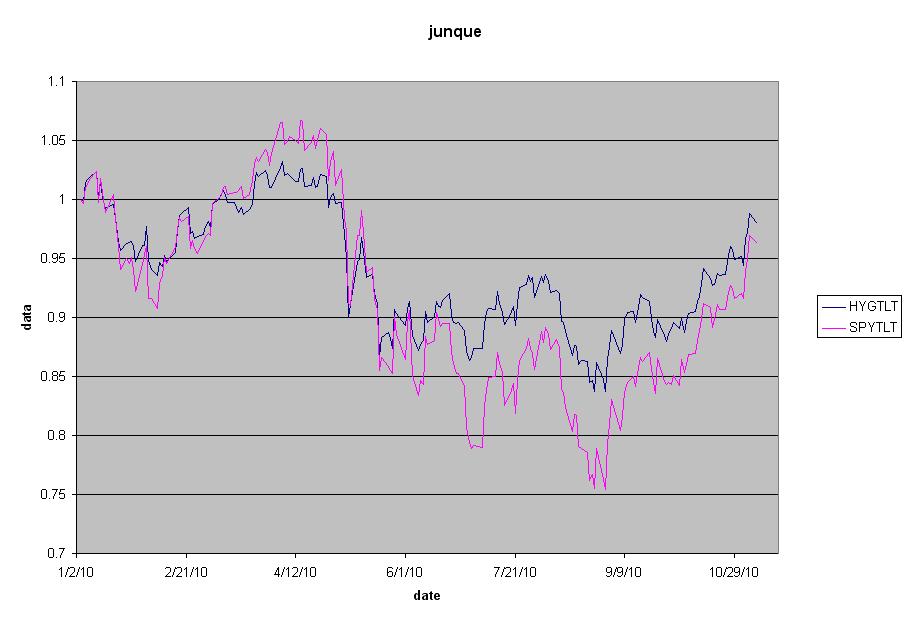
The attached chart plots two ratios from Jan 2010 to present: high-yield bond etf (HYG) / long-treasury bonds (TLT), and SP500 (SPY) / TLT.
From a "risk free" (free at last!) rate of return standpoint, neither junk nor stocks have gained YTD. Both dipped prior to Ben(ding) Over, with stocks showing more risk free volatility (higher high and lower low) than junk.
Nov
9
Commodity Curiosity, from Rocky Humbert
November 9, 2010 | Leave a Comment
 The "greatest" stock market bull run began in 1982, and in the subsequent five years, the Dow Jones increased by roughly 2.7x. The bull was interrupted by the October 1987 crash (36%), and it took almost exactly two years for the Dow Jones to reclaim its previous record high. The prologue from 1989 to 2000 needs no recounting.
The current commodity bull run began in 2003, and in the subsequent five years, the CCI Index (Continuous Commodity Index) increased by an eerily similar 2.7x. This rally was interrupted by the commodity crash of 2008 (42%), and it's taken a eerily similar two years for the CCI to reclaim its previous record high. The prologue of the current commodity bull market has not yet been written.
Lest you accuse me of sounding like Jimmy Rogers, please note that I do not speak with a Southern Drawl (nor do I wear bowties.) I do, however, note that EVERY modern easing cycle has been coincident with some asset prices achieving prices where one rubs one's eyes and exclaims, "Darn– why didn't I own more of THAT stuff!!
"The story doesn't change. Only the Bloomberg quote symbol.
Nov
9
A Market Stew, from Ken Drees
November 9, 2010 | 1 Comment
1. –qe2 now bad, good, needed, loathed, ok, in a box, maybe not have to do it after all if inflation shows up. qe3 qnd qe4?
2. –china raising rates again, no like qe2, no like Japan, rare earth tough luck, don't tell us about our currency float.
3. –commodities going up and up and up–and oil is lagging, silver was rigged all along (who knew), copper hot, cocoa yummy, and yellow cake.
4. –gold keeps on keeping on and all that broken jewelry already melted for cash.
5. –Bam on the run (is he coming back?) —tax hikes coming, health care costs a coming, no cola to wash down high prices. Bam parties on!
6. –nat gas flickering–Rocky's indicator?
7. –jobs, no jobs, unemployment stuck, 99 weeks over with repubs in, states unhappy, state govs cutting jobs, local gov cutting jobs.
8. –iran, israel—where did that go? Oil back almost to 90.
9. –europe rebails coming? — bailouts ok here but usa qe2 is bad example.
10.–dollar breathing heavy. dollar this - dollar that, everyone (brazil too) talking about dollar. the dollar is linked into every trade on the face of the planet (cnbc).
11.–inflation is low under 2% and Ben wants above 2% shadow stats says inflation already 6% can we handle a fed 2%+ number?
12.–qe2 is a blunt tool and that causes bubbles in other asset classes–stone knives and bearskins—how can we work with these tools?
13.–housing is wrecked. rico coming, can't foreclose, can't sell, can't redo mbs now, fannie needs more money.
14.–"Structural" used as modifier for (unemployment, pipeline inflation, housing problems, lack of gdp growth, dollar woes)
15.–Bonds—do they matter, like deficits? Poor ranting Santelli– get over it Rick.
16.–Stocks are being targeted by the fed for pumping. We all know that this means we are good to go. SPY up 9 out of last 10 weeks.
17.–GM — gotta float the big gov boat. Its simply a question of perfect pricing.
18.–Holidays are coming, year end coming but no one is selling. The market buried the hindenburg indicator!
19.–G20—so what.
20.–Hillary, what is she doing? What about Bam's cabinet —more change coming?
21.–3-5 banks closed every weekend–so what, who cares, old news.
22.–lot of cash still on the sidelines. where is it going—everywhere!
23.–holding cash is stupid says Cramer–a bonehead move.
24.–its a GLOBAL thing now –we are all in this thing, a simmering market stew.
25.–Lets look towards 1st quarter earnings–there is nothing else to think about.
Nov
9
Gold/Silver Bulls, from Anatoly Veltman
November 9, 2010 | 3 Comments

 Gold/silver bulls are getting sloppy again, now at $1410/ $27.73. Silver has been the catalyst for this entire two-month leg up, crowning a whopping $10 move during this time frame. At the start of this Tuesday's session, however, the Bulls ought to be cautious. Just like with that $3.50 Dec NatGas print early in Oct.25 session - the daily charts are going parabolic!
I would be heeding the following alarming factors, as Gold and Silver futures sit at record highs tonight:
1. USD has been firming in last couple of sessions - but Gold and Silver still rallied to records. Bulls will argue that this a positive divergence, pointing to "independent strength". I suspect that this, in fact, may be pointing to forced short-covering; and thus, less of the forced short-covering remains to be executed!
2. Platinum and Copper did not follow Gold, Silver and Palladium's move to new highs Friday and Monday. I would note muted response in Crude and grains as well. The only other commodities that continued parabolic were the leading stars of the period: Cotton and Sugar. Again, another sign of forced short-covering well in progress.
3. Significant news of QE2 and elections are done with, and precious metals have just tacked on more gains.
4. Chartists know that, following a lengthy run, a commodity that continues parabolic at week's start risks a powerful intra-week reversal. Those types of "outside reversals" on the Weekly are much more potent, in my observation, than the ones on Daily. When Gold futures chart-painted that "shocking" intra-day reversal from $1366 to $1326 on October 7, that made me temporary Bullish. I shall not be Bullish if something like "outside reversal" will be painted on Weekly chart.
5. Another chart complication will be caused by semi-holiday week, with Veterans Day shutting the Treasury markets on Nov.11, and taking bank and Fed personnel out of the office.
Rocky Humbert writes:
I would be heeding the following factors:
1) The record high in silver was approximately $41.5/oz on January 21, 1980. That's approximately 49% higher than the current price. Anatoly's statement (regarding silver) is wrong.
2) That gold just made a record high is not predictive but it does prove a simple fact. EVERY gold long is sitting on a profit. And every gold short is sitting on a loss. That's not a recipe for bullish capitulation.
Anatoly is continuing to demonstrate a FleckenAbelGrantian personality disorder. Eventually, he'll be right. But eventually is a long time.
In contrast, I just stay long gold and roll up my puts every $50 or so. I wish I could say that I'm smart, but I'm not. The objective of speculation is making and preserving profits. Not sounding erudite. See this post.
Anatoly Veltman responds:
Rocky's comment is educational. Rocky advocates buy-and-hold (on way up)/sell-and-hold (on-way-down) vs. market timing. Excellent subject for separate thread, and I'm sure such thread will attract wide participation.
To return to this week's Gold/Silver situation, I'm attempting to be ready for this particular charting set-up: outside reversal on Weekly chart. Due to Nov.11 semi-holiday, such weekly bar may be painted this week OR it may take a combination of this week's and next week's bars. Monitoring many liquid markets over the past 24 years, I found such pattern to often mark longer-term reversals- and thus worthy of being prepared.
Why anticipate (rather than follow), and how?
1. A Gold/Silver bull wants to hold Long exposure. Following rapid price jump, his dilemma may be similar to bear's: how to stay with his biased position. One definition of up-trend - higher highs AND higher lows - will be threatened by trading below $1315 or below $1160, depending on trader's intensity. Both marks are too far below, when trading $1410-1425. Thus bull's dilemma is very real: historical cost should never be used in analysis of a liquid trading instrument– you're basically marked-to-market every single $1 move, if not every 10 cent tick. Is this a good plan to hold Long at $1410-1425, if a drop below $1315 will cause you to sell out and possibly reverse to Short? Or even lower, below $1160?
2. One shouldn't ALWAYS try to anticipate every outside price path. Hints are essential to go on ALERT. Fri and Mon Gold/Silver/Palladium jump against stronger USD gave a hint of "forced" short-covering in progress in those particular metals, while other remained calm. Stubborn Cotton and Sugar rocket, while other commodities do little– is another sign of "forced" short-covering. The more short-covering is done, the less remains to be done.
3. I confess that lately my analysis lacks previous complexity, as I just observe/comment and have no vested interest. To duly gage possible trade exhaustion, one-dimensional PRICE charting is not enough. One absolutely must employ second dimension of daily OPEN INTEREST change, and ideally third dimension of changes in Open Interest MAKE-UP (i.e. Commitment of Traders). My current guesses are much less scientific than I'd like– they are just a heads-up.
Nov
9
Paper Cups as an Economic Indicator? from Alan Millhone
November 9, 2010 | Leave a Comment
 Hello Everyone:
Today I stopped at Third Street Deli. I have dined there for many years. I always have their iced tea. Up until today they gave you a sturdy plastic cup with their name and logo on each cup with bright green lettering. Today they have begun using a mediocre generic paper cup. I asked if out of the others? Was informed it was a 'cut back' .
Regards:
Alan
Victor Niederhoffer comments:
I think the paper cup may be much healthier. This reminds me of the purveyor of paper cups for Dannon yogurt that owned the old dixie cup plant that I was trying to sell. They told me they had a lock to grow exactly as Dannon did because Dannon needed their cups. I asked, "what about all the colorful plastic cups the other yogurts are beginning to use?" "No way," they said, "yogurt can't be sold in plastic cups because it doesn't taste as good or ferment as well."
Shortly thereafter the company was 1/5 its former 15 mm size. A strange follow up came when I read Roger Kahn's book about running a minor league team. Roger accroding to Larry Ritter was an egomaniac who fancied himself a great baseball player and tried to place it prominently in every book. But Roger found a backer for his minor league team. It was the same owner who assured me nothing could go wrong with the dixie cup. They fought like cats and dogs, and the book makes a hilarious reading as the two of them tried to impose their will on a down trodden minor league team with all the problems of selling ice cream and peanuts and programs to cover the salaries. Paper cups look pretty good in my book.
Nov
8
Day Trading, from Larry Williams
November 8, 2010 | 4 Comments
 Trend is the basis of profits; no trend, no profits.
Trend is a function of time. 3-5 hours does not allow for trend moves of any real magnitude; day traders play with a stacked deck. The dream of daytrading is in fact a nightmare for most everyone. It can be done, but not for massive profits.
Nick White writes:
There is an excellent discussion of the dynamics of this point in the gentleman from Amioun's first book.
I quote / summarize / paraphrase at length:
Take a regular dentist. A priori, we know he is an excellent investor and has an expected annual return of 15% over t-bills with a vol of 10%. Dentist builds a trading room in his attic, deciding to spend every day watching the market and drink cappuccino. He buys a bloomberg and lots of expensive PC's to automate his trading etc etc. His 15% return with 10% vol per yr translates to a 93% probability of success in a given year. But seen at a narrow time scale, this translates into a mere 50.02% probability of success over any given second. OVER THE VERY NARROW TIME INCREMENT, THE OBSERVATION WILL REVEAL CLOSE TO NOTHING,. Yet the dentist's heart will not tell him that. Being emotional, he feels a pang with every loss, as it shows red on his screen.At the end of each day, the dentist is knackered and emotionally drained Minute by minute examination shows that each day (given 8hrs / day) he will have 241 pleasurable minutes against 239 unpleasant ones. These amount to 60,688 and 60721 per year. Given that an unpleasurable minute is worse in reverse pleasure than the pleasurable minute is in pleasure terms, then the dentist incurs a large defecit when EXAMINING HIS PERFORMANCE AT HIGH FREQUENCY. In contradistinction, imagine the situation where the dentist examines his portfolio only upon receiving the monthly account from the brokerage house….67% of the months will be positive, he gets only four negative pangs of pain per year, and eight uplifting ones. THe efffect is magnified at the annual level where, for the next 19/20 years, he will have a pleasant experience looking at his annual statements.
Scale Probability
1yr 93%
1 qtr 77%
1 mth 67%
1 day 54%
1 hr
51.30%
1 minute
50.17%
1 second
50.02%
The net net of all this is as follows:
If we look at the ratio of noise to non-noise then you get the following. Over one year we gets .7 parts noise for every part of performance. Over one month we get 2.32 parts noise per part of performance Over one hour, 30 parts noise for every part performance Over one second. 1796 parts noise per part of performance. Therefore:
Over short time increments, one observes the variability of the portfolio, not the returns…you just see variance and little else. This is emotionally difficult to parse…even though at any moment you see a combination of both variance and return, your brain can't tell the difference. This explains the burn-out rate amongst people who constantly expose themselves to randomness (especially given greater effect of negative experiences than positive experiences).
Kim Zussman writes:
The analysis is flawed:
1. A regular dentist should not day trade because of opportunity cost and squandering what he paid for his profession's barrier to entry
2. One can only know their returns ex post. If you could know them ex ante there would be no psychological issues - fear comes from uncertainty.
3. Irregular dentists are another story
Rocky Humbert writes:
Kim writes: "If you could know them ex ante there would be no psychological issues– fear comes from uncertainty."
This is not correct.
Fear is a pre-wired response in most people, and can have little to do with the rational analysis of a situation or uncertainty.
Example 1: While waiting to mount an extreme amusement park ride (roller coaster etc), the symptoms of fear (sweating, elevated pulse, etc.) are a genuine physiological response regardless of the fact that the odds of injury on the ride are miniscule.
Example 2: If you are engrossed while watching a horror movie, your limbic system kicks in … just as if you were being chased by the Blair Witch.
Example 3: Phobias are real, and irrational. A person who is afraid of flying is not interested in the fact that his plane will almost certainly not crash. Yet, people are not afraid of driving to work — even though the odds of dying during a commute are much higher than on a cross-country flight.
The emotional fear/greed response to P&L mark-to-market are real– and I believe genetically pre-disposed. They are analogous to phobias and obsessive-compulsive disorders. Hence, I believe Nick's post about timeframes is extraordinarly profound and accurate.
Nov
8
An Interesting Chart, from Victor Niederhoffer
November 8, 2010 | 2 Comments
There's an interesting chart illustrating Livermore's point that when a market goes above a round number (1000) it is bullish. Gold approaching 1400, - round numbers at 1200 were temp turning point but runs through other 100s show no tendency to reversal. A whole study has to be done with as is data on individual stocks.
Alan Millhone writes:
All I know is reg gasoline over three now and killing the average citizen. Gold will push two the way things are faltering.
Ken Drees writes:
I am not hearing the gas price complaint yet as it seems that many are very conditioned in the high 2's and even the low 3's may seem not worth complaining about.
I think a round "4" handle on the gas price will start up the wailing and gnashing of teeth this time around.
Sam Marx prophesies:
$4 gasoline will occur at or before the 2012 election.
Nov
8
Bambi Syndrome, from T.K Marks
November 8, 2010 | Leave a Comment
 I finished reading a fine book last evening, and one of its closing philosophical points made me think of an old friend, Doug. It involved hunting, and his explanation one time to me that uninformed opponents of such appear to be burdened with some sort of Bambi Syndrome. Also known as BS, in the jargon of clinicians.
That is, the overwhelming majority of these opponents would have no problem with consuming mass-produced animals, but are seemingly appalled when somebody else more humanely cuts out the middleman, and cramped cages and pens.
That is a more than fair observation as there would seem to be an obvious paradox at work here. And probably one with parallels to other endeavors as well, which is why it is always prudent not to be reflexively judgmental about things about which we may not readily understand.
The person in the book echoing Doug's point was Eric Clapton, of all souls, in his autobiography.
An intense volume, it's Clapton tale of long redemption, going from a $2000 a day heroin habit, to a two-bottle a day liquor problem that he eventually found even more debilitating, as hard as that might be to imagine.
But rather than gloss over his troubled past, he vivisects it for all to see, with some of the scenes he gets into absolutely brutal to behold. It's amazing this guy is alive and sane, no less as wonderfully alive and lucid as he clearly appears to be.
It would seem obvious why Doug, a wildlife biologist and lifelong Vermont outdoorsman, wouldn't be burdened by Bambi Syndrome. But when reading Clapton's account of his life, it was interesting to note how the tortured artist came to his epiphany.
It seems that when he finally emerged from the thick woods of his various addictions, he found himself with much time on his hands, so he walked into the real woods.
With a bang.
pp. 294-295:
The tour of America took me through the autumn, and then on my return to England, I delved into a new hobby that was to equal fishing as an obsession in the years to come. My friend Phillip Walford, who is the river keeper on the stretch of the river Test that I fish, had always said that I should take up game shooting, if only for the logical reason that the shooting season starts when fishing season ends…I am a deep-end person, and in just a short time I was ordering braces of fine English guns and driving all over the country to shoot on different estates, gradually improving my skill and having the time of my life.
Clapton continues:
Ethically it was never a problem for me, and it is the same with fishing. My family and I eat what I catch and shoot. It is fresh and healthy and we love it. I am a hunter; it is in my genes, and I am quite comfortable with that. I also support a lot of other countryside pursuits, quite simply because I believe they are an important part of our culture and heritage, and need protecting, usually from people, or movements of people, who have little understanding of the delicate economic balance of countryside communities and have watched too many Disney movies.
Bambi Syndrome further explained.
Nov
8
Letter to the Editor, from Don Boudreaux
November 8, 2010 | 1 Comment
 6 November 2010
Editor, The New York Times
620 Eighth Avenue
New York, NY 10018
To the Editor:
You report that President Obama's export promoting trip to Asia is partly an attempt to "ease tensions with America's chief executives many of whom spent the recent campaign accusing the White House of being anti-business."
There are two ways for a government to be 'pro-business.' The first way is to avoid interfering in capitalist acts among consenting adults - that is, to keep taxes low, regulations few, and subsidies non-existent. This 'pro-business' stance promotes widespread prosperity because in reality it isn't so much pro-business as it is pro-consumer. When this way is pursued, businesses are rewarded for pleasing consumers, and ONLY for pleasing consumers.
The second, and very different, way for government to be pro-business is to bestow favors and privileges on politically connected firms. Such favors, such as tariffs and export subsidies, invariably oblige consumers to pay more - either directly in the form of higher prices, or indirectly in the form of higher taxes - for goods and services. This way of being pro-business reduces the nation's prosperity by relieving businesses of the need to satisfy consumers. When this second way is pursued, businesses are rewarded for pleasing politicians. Competition for consumers' dollars is replaced by competition for political favors.
The fact that more than 200 American business executives are in India with the President is cause to fear that any pro-business policies he might adopt will be of the second, impoverishing sort.
Sincerely,
Donald J. Boudreaux Professor of Economics George Mason UniversityNov
8
Review of Photograph 51, from Marion Dreyfus
November 8, 2010 | Leave a Comment
 How many plays can you recall, offhand, that have at their center the subject of science? Michael Frayn’s “Copenhagen” is one, Stoppard’s “Arcadia” is another, and, um…
Exactly.
Anna Ziegler has taken advantage of the sensible idea that science is exciting, dramatic, and largely (alas) unknown in its atomistic dailiness and canine-cyclical rivalries. The Ensemble Studio Theatre offers monetary prizes for “compelling and credible” dramas involving science and technology, and if “Photograph 51” is any indication, they have a strikingly winning formula.
It is London, 1953, and separate teams of scientists are madly, often secretly, researching the “secret of life,” the strands of being we easily toss about as DNA and RNA. At the time, a British Jewish female scientist, Rosalind Franklin (amazingly convincing Kristen Bush) in concert with her by-our-standards primitive cameras, microscopes and developmental instruments and her self-possession, works doggedly and without assistance from her male cohorts to perfect an image of the helical pattern that reveals the building structure of life. Researcher Franklin used x-ray diffraction photography to minutely examine what people then called ‘the secret of life.’
Franklin’s work is of course derided and laughed at by her lab colleagues, some of whom cannot fathom that they admire her while envying her ferocious dedication. Her materials, especially her exacting crystallographic imagery, are secretly studied and handed around, as she persists with her driven examination of everything she theorizes and tries to resolve. A team of snarky researchers in a Cambridge lab removed from Franklin’s make errors and misjudgments galore, but recognize the Eureka moment weeks earlier than does Rosalind, and hasten to create the model that has made their names synonymous with the double helix. Watson & Crick, anyone?
What, however, kept Dr. Rosalind Franklin from the scientific halls of fame and glory that rightly belonged to her?
A play about the cruelties of being a female in the male-dominated world of science (which female scientist is ever married? Which ever had a child?), about the cut-throat worlds of science and succeeding. And the cost of not realizing that no matter what industry you squirrel or feint into, competition is the substrate name of the game.
The acting is uniformly superb, with a cast of (to me) unknowns. The set design, lighting, scene changes and especially the direction are first-rate. Even the diction for the majoritarian Brits, and the several American lab assistants and newly minted doctors, are pitch-perfect. Only one nitpick: One of the fellows, the American Crick, mispronounces data, as most people usually do, even today. It seems unacceptable for a scientist to do so, however. His coarseness in many matters linguistic and cultural, however, was of a piece, and contributed to the overall texture and viability of this remarkable piece of writing, which requires intense familiarity with the science of biology and genetics as well as dramaturgic niceties.
The packed SRO audience was held rapt from start to finish.
OK, so it’s science—does that mean it is dusty sere and stat-filled? Not the least. There is profound drama and emotion, taut expectation and riveting suspense. Of the past 5 or 6 dramas experienced in the past fortnight, this is far and away the very best. In fact I think it the best show I have seen this year—on or Off Broadway. Though it is a bit of a shlep to get to, the price is gentler than most shows today, and the recompense in enjoyment and full-throated literate comic, tragic and all the in-between elements are there for the inhaling.
Twist this helix as you might: A superb piece of science; a superb piece of theatre.
At the Ensemble Studio Theatre – 549 West 52nd Street, NYC Until 27 November
(For more info on this fascinating stuff: Try The New Yorker article “Photo Finish” or the PBS documentary “Secret of Photo 51?)
Nov
8
Thought of the Day, from Jim Sogi
November 8, 2010 | 2 Comments
 There are some great opportunities for day trading. Recent months have had some good opportunities. It goes in cycles though. Some days are no good and it's just as well to go surfing instead. There are many edges available.
People have different niches. Some systems may not make as much money, but then again some make more, and more consistently than swing trading.
Nov
7
The Search for Good Indian Food, from Pitt T. Maner III
November 7, 2010 | Leave a Comment
 Many enjoy looking the search for good Indian restaurants in unexpected places across the country. A fine vindaloo and a pint of your favorite Samuel Smith's ale are hard to beat.
Here is one economist's list for whipping up a quick start Indian dish:
Buy whole spices, not ground. Get:
Cinnamon stick (not the Mexican kind) Cumin Coriander Cloves Cardamom, preferably both green and black Black peppercorns Red chilis, or red chili powder Wet ginger paste (go to an Indian grocer's), or fresh ginger, never ever ever powdered ginger Garam masala, here a good powder from an Indian mart is OK though better to make it fresh Turmeric, powder will do
For bases, draw upon:
1. Sauteed and pureed yellow onions
2. Plain yogurt, some will wish to add heavy cream as a thickener
3. Coconut milkNow start your dish. Create the chosen base. Ghee (clarified butter) can be added to #1 or #2 for yummy richness but I usually don't for health reasons. Don't mix #2 and #3.
Then take your preferred mix of spices. Fry the hard ones for two to three minutes over medium heat (3.5 on an electric stove) and puree them. Cinnamon stick should be left whole in the sauce to leach out its flavor. Never are more than three cloves needed and they can be left whole too.
Cardamoms can be inserted whole and then removed, especially if large ones are smashed open a bit with a blunt edge. Otherwise experiment with preferred combinations.
In a separate pan, quickly cook your preferred meat over high heat, just enough to make it a bit translucent or pink. Insert the partially cooked stuff into the liquid base and turn to low heat until the dish is ready.
Vegetables can be substituted for meat.
You can introduce mace and mustard seeds, or tomato can be a base in sauces.
You now have a combinatorial knowledge of many many Indian recipes and you need not memorize anything.
By the way, if you must buy powdered curry, Golden Bell is by far the best. It is packed with bay leaves and stays potent for months. You can sautee some chopped yellow onions, toss in ground lamb, douse it in Golden Bell, cook over low heat until dry, and when on the plate, over rice, coat it in plain yogurt.
Nov
7
The Kelly Criterion, from Ralph Vince
November 7, 2010 | Leave a Comment
 As far as I have ever been able to ascertain, Larry Williams was the first to attempt to apply the Kelly Criterion to outright position trading, and the first to openly discuss it. His pursuit in this regard not only was my initial immersion to the ideas, but he funded those attempts. Whatever I've uncovered along the way is a product of that — Larry's unquenchable curiosity, fearlessness regarding risk, and willingness to fund pursuits others would never touch.
A couple of points further in the post worth mentioning here because I think the other interested members deserve to have light shed on some misconceptions, some of which are a little dangerous to ascribe to, but are widely held.
"One "plays" forever, or practically forever."
But no one does and no one can, and it is this very notion of there being a finite "horizon," that changes not only the calculation of a growth optimal fraction, but every other metric related to it, giving rise to an entirely new discipline in and of itself.
"If one is somewhat risk averse, one can establish a half Kelly criterion, essentially betting half one's full Kelly bet. This results in a lower probability of one's bankroll halving."
But why "half?" Why this arbitrary number? (Or any other arbitrary dilution for that matter?) Remember, we're dealing with a function that has an optimal point, implying a curve, and it is the nature of this curve that is important to us. Being at different points on the curve has vastly different implications to us. Further, the various and important watershed points almost all are a function of that "horizon" mentioned earlier, i.e. the points migrate about this curve as a function of that horizon. Advocates of a "Half Kelly," or other arbitrary point along this chronomorphic curve (with respect to the horizon and events transpired) are seemingly unaware of the implications of their arbitrarily-chosen points.
"The criterion is to maximize the expected value of the logarithm of one's bankroll."
Yes, that is the Kelly Criterion which, in trading, does NOT result in the growth optimal fraction but a far more aggressive (and dangerous, without growth-commensurate benefit) number. No one seems to understand this.. The number returned in determining the value that satisfies the Kelly Criterion can be converted into a growth optimal number (which I call the optimal fraction. or optimal f) but in and of itself, the value that satisfies the Kelly Criterion is NOT the growth optimal fraction in trading. Incidentally, the so-called Kelly Formulas (put forth by Thorp I believe, and market applications attempted by Larry Williams in the mid-1980s) do NOT satisfy the Kelly Criterion in trading applications, but DO in gambling ones (that is, in trading applications they will not yield the same results as the value which satisfies the Kelly Criterion. The Kelly Formulas do, for dual-outcome situations, return the growth optimal fraction). For more on this I can only refer those interested to the most recent Journal of the International Federation of Technical Analysts 11 (available at admin at ifta dot org) or the 2-day course on Risk-Opportunity Analysis I am having in Tampa Nov 13 & 14 see http://ralphvince.com)
"The biggest issue of application is that one makes many assumptions about statistical distributions, correlations, returns, etc. that are all wrong."
I agree. In a strange, ironic twist to my modest participation to this story, it was (again, but some decades later) Larry Williams (rather recent) insistence of a way to apply what I know of growth maximization in a robust way. As a result of the pollenization of these ideas by Larry, I can state unequivocally that there are clear, simple, mathematical solutions to these impediments — in short, if someone wishes to apply a growth optimal approach to their future trading, these impediments ARE readily surmountable. But be certain your criterion is growth optimality, and be sure you really want to get into the cage and fight the gorilla. Most just want to sit and watch Dancing with the Stars.
Nick White comments:
Dancing with the stars….brilliant and well said.
We're all fortunate beneficiaries of Mr. Vince's investigations into the intricacies of these issues.
Phil McDonnell writes:
Kelly originally wrote his paper based on race track examples with binary outcome. You won or lost with assumed probabilities and you knew the wager size and payoff. So strictly speaking his formula only applies to wagers with two outcomes. Even a blackjack hand has at least five possible outcomes (win, lose, blackjack, double down, split) and not just two so strictly speaking Kelly's formula does not apply. Some people have erroneously tried to modify the binary Kelly formula by using average win size and average loss size to compute. All such formulas are dead wrong. The reason is that, in general, the average log does not equal the log of the average.
As Larry Williams pointed out most people do not feel comfortable using the optimum log approach even if the math is done correctly. I believe there is a simple reason for this. Most people do not have a simple logarithmic utility function. Rather they seek to maximize ln( ln w), where w is wealth. This is an iterated log function and results in a much more conservative ride. I talk about this distinction toward the end of my book. Ralph Vince also has written extensively on this subject using his term optimal f.
There is another issue with simply maximizing returns and that is it may not really take into account risk in a proper manner. It is true that the log function weights the largest loss the most in a non-linear manner and reduces the weights of gains so that the largest gains are weighted sub-linearly. But that may still not be enough to satisfy one's real risk aversion. That is part of my argument for the iterated log form but it may be that an explicit metric such as standard deviation is still needed.
Larry Williams writes:
Optimal or Maximum Wealth (possible gain) only comes with Maximum Risk; therein lies the problem. Not loosing…risk…is more important than gain in the art of speculation business.
Chris Cooper writes:
More important, as far as my practical experience goes, is that one's estimate of the edge is always subject to uncertainty. The reasons have been discussed on this list before, but certainly include changing regimes, limited history for the models, curve fitting, flexionic machinations, scaling nonlinearity, etc. I relied on the Kelly formula extensively in the mid-'70s when gambling, and uncertainty in your edge was no less important then. The problem arises because overestimating your edge is so destructive to your terminal wealth.
It might be interesting academically to consider an approach, such as Bayesian, where your estimate of the edge is not stationary, but in fact must decrease when you hit a losing streak.
James Arveson writes:
I am a newbie on this site, but I can assure y'all that any finite amounts of outcomes can easily be handled by maximizing the expected value of the logarithm of one's fortune. I have also executed these theoretical outcomes for many years in AC and LV in BJ, and yes, in Bethlehem, PA in Texas Hold 'Em. See Mathematics of Poker for a better exposition of these issues than I could ever present.
Remember that each bet is a single bet, and one can bet forever. Leo Breiman has actually proved that (in the most general cases) that this approach DOMINATES all other strategies.
Now, IMHO, this approach is irrelevant to the market. NO ONE can get all the statistical assumptions correct-statistical distribution, EV, correlation, return, s.d., etc.
Have fun until we get to the next level. Same goes for Markowitz. Check out www.styleadvisor.com. I have no piece of their puzzle but wish I did (I might be able to get a write-off ski trip to Lake Tahoe where they are located).
Actualizing all of this crap may be the next Nobel Prize in Econ, but it will probably not help schlepers make money in the markets.
Ralph Vince replies:
James,
Pursuing awards is for schlepers like Krugman or other academic dweebs –it's an award voted upon by dweebs for dweebs, and its pursuit bridles and constrains the mind (as *any* political pursuit will. Usually, the truth lies with things that - people off). To-wit, the lack of challenge to the notion that Kelly presents on p925 in the conclusion of his now-famous paper wherein he asserts that geometric growth is maximized by the gambler betting a fraction such that "at every bet he maximizes the the expected value of the logarithm of his capital."
This is accepted by the gambling community, and, by extension (falsely, mistakenly) accepted by the trading community. HOWEVER, a critical analysis of this notion reveals that it does NOT result in the growth optimal fraction, but rather in a multiplier of one's account to risk (the two are different indeed, the latter being less than or equal to the former, resulting often in over-wagering). In fact, the multiplier on one's stake equals the optimal fraction to risk only in certain, specific instances which manifest in gambling, but are rare still in trading (e.g. only on long positions, etc.). I would gladly go into this in depth put I cannot publicly do so as the paper on this has been publish in a current issue of a journal, and I have agreed to refer those interested to the article instead. The upshot is, that the Kelly Criterion, as specified above, is not what Kelly and others thought it was except in the special case I just mentioned — it is NOT the growth-optimal fraction, but something different, equal to the growth-optimal fraction only in the special case — a case that manifests in gambling with ubiquity, and oddly, in trading very rarely.
Again, the gambling community has accepted it for reasons mentioned –because it does give you the same answer for the optimal fraction to bet as the formulations for the optimal fraction in the gambling situations. But just because it gives you he same answer as the optimal fraction in special situations does not mean it is the formulation for the optimal fraction –it isn't.
Secondly, even the "optimal fraction"it is never optimal. Suppose you are playing a game with a 50% probability and odds of 2 to 1. Your optimal fraction is .25 (if you were to play forever). However, after the first pay, the phone rings, it;s your wife, and she informs you of an emergency and you have to bolt the game (with your winnings from the one play, make you a popular guy). If you knoew beforehand you were going to only play for 1 play, you should have bet 100% of your stake to maximize your gain. If the call came after two plays in this game, you should have bet .5.
Tomorrow, you come back to this game — and you bet .25, reconciling yourself that yesterday you bet .25. (so….the game possesses memory?)
Wait, it gets worse in trading, where we see that each individual bet is, in fact, NOT a bet. Let's say you trade only XYZ stock, and you put on 300 shares. Let's say you have a stop below your buy price but it;s a different level for each of 100 shares, so you have three stops below the proce for 100 shares each at different levels. Now, let's say onyl the closest stop, for 100 shares, gets hit, resulting in a loss on 100 of the three hundred shares. Weeks later, you sell out 100 shares at a profit, and, a few weeks after that, another 100 shares at a price higher than that.
But these are NOT three separate trades. This is ONE trade, one wager for the purposes of growth-optimal calculations. And the reason is because you are ONLY trading XYZ — there has been NO recalculation of positions to put on until the entire thing has been closed out. IF, on the other hand, you were having other trades throughout the course of your aggregate position in XYZ, then you WOULD consider each of these a separate trade.
Trading is not the same as gambling. There are similarities, but don't make the assumption that because you risk something and gain something that it is the same. There are things which are proxies for truth, that asymptotically appear to be truth, but they are only proxies (such as the Kelly Criterion) as well as the widely-held (in the gambling community, and hence the trading one as well) but incorrect notion that a wager should be assessed based on it's asymptotic mathematical expectation. This too is a mere proxy and an incorrect one that can, in extreme cases, lead one to accept bad wagers and reject favorable ones.
Again, critical thinking has been absent and trumped by the acceptance of industry catechism.
Finally, you speak of SD's and EV (mean-variance is dead incidentally, as dead as dead can be everywhere BUT academia) correlations, and Chris mentions the (valid) problems of assessing the edge in the future and the problem of non-stiationarity.
The solution to growth optimality in the markets, lies in NOT accepting the Kelly Criterion, but instead accepting what IS the growth optimal fraction– because that then reveals (in the simplest of ways!) how to address the problem of non-stationarity in the future and it doesn't require any of these parameters, or even a computer, it's really THAT simple if you want to attempt growth optimality in the future.
Phil McDonnell comments:
Ralph raises a lot of interesting philosophical questions. On some points I disagree, so let me elaborate. For the purposes of this piece I will assume one is entirely risk averse and seeks only to maximize expected wealth on a compounded growth basis.
First he raises the point that there is no guarantee that a game or investment opportunity will continue. Certainly a true statement. However it is also true that there will be a succession of such opportunities available in one's lifetime. Thus some rational basis for choosing bet size each time should include consideration of expected logs of the outcomes.
Philosophically I disagree with Ralph's analysis of bet it all on the last bet. His math is correct, in that it will maximize the expected dollar outcome. But there will always be other bets, so one's lifetime objective should still be to maximize the expected log not simply the arithmetic expected value. I believe Kahneman and Tversky made the same error in their Nobel winning papers.
I have an alternate take on Ralph's argument that it is hard to define a trade because you can put on 300 shares and exit 3 times at different prices, unknowable in advance. Rather than look on each trade as the basic metric one should look on the portfolio as the metric and a basic unit of time as the portfolio re balancing decision point. For example if you invested .25 of your wealth in a trade that doubled you know have .50 of your 1.25 wealth in the trade. That is too much if you want to maintain the .25 ratio so you need to sell .1875 to get back to your optimal ratio. But the simplest way to look at it is to look at the investment portfolio in each time period, be it a day, week or whatever.
One of the reasons the mean covariance model is in disfavor is that it seems to fail when everything hits the fan. In fact the model is incomplete in the sense that EV and COV are stochastic variables and vary over time. (I am implicitly including VAR here.) You need to explicitly include the correlations somehow in order to take into account how an entire portfolio will vary together. Using the formulas for optimal bet size on a trade level will always lead to serious over trading if there are multiple trades put on at the same time except in the case of a negative correlation between the trades. So it is misleading to calculate an optimal trade size for one system or one trade without consideration of any others that might be on at the same time. At best it is a dangerous upper bound for any single trade size. But it will almost always be an estimate too high. Optimization of expected log of wealth can only be done at the portfolio level.
Ralph Vince responds:
Philip,
I am not raising ANY "philosophical questions." Just because people may have to think about them doesn't make them philosophical questions as opposed to facts:
1. The value that satisfies the Kelly Criterion is NOT the (growth) optimal fraction of ones stake to risk (although, in special circumstances which we find ubiquitously in gambling and not in trading, it is an equivalent value to the value that IS the optimal fraction). And the pervasive mistake by those attempting growth maximization in the marketplace of using the Kelly Criterion result puts then OVER exposed, to their unwitting peril. They are NOT growth optimal. In fact, the value that satisfies the Kelly Criterion NEVER returns the growth optimal fraction. This was a mistake on the part of Kelly and Shannon. The very fact that it is still accepted by others is testimony to the absence of critical thinking in this matter.
2. Further, what IS the growth optimal fraction is a function of the horizon of the game — and all games have a horizon, including the game of evolution on earth. Further, all metrics, including the analysis of drawdowns (including VAR where a horizon of 1 is implicit), even the analysis of whether a wager should be accepted or not, are a function of horizon. Disregarding the horizon leads us to incorrect conclusions at every turn in risk-opportunity analysis. In fact, it is the necessary introduction of "horizon" that gives rise to this entire burgeoning discipline.
3. Once we accept points 1 and 2 above, the obvious solution to solving for the non-stationarity of the distribution of outcomes we are dealing with becomes obvious. Growth-maximization, unlike attempts at it in the past, now CAN be performed with informed assessments of what the best growth optimal fraction value to use in the future will be.
Nov
7
Briefly Speaking, from Victor Niederhoffer
November 7, 2010 | 2 Comments
 1. Geitner said that it would be tragic to let the wealthy not pay taxes above 250,000 , thereby losing credibility forever with the sapient who know that: one, all LLC and subs will be affected; two, 1/4 of all below 250,000 will be above in the next 5 years; three, incentives are ruined by fear of having all their income serviced away; and four, it's picking on one group to take their property and give it to another, (a variant of graduated income tax (as Dicey said) is why businesses don't hire, and why Germany finally found "no one left" as the Bishop said.)
2. The path that SP took from 1300 to 666 is now almost totally Lobagola-d with the sequences and reversals, and run down through the hundreds are now being replicated almost exactly on the way up.
3. One met with Gary Johnson who will be a front runner for president when he likely wins New Hampshire and Iowa according to politico, and he and Aubrey had a good chat about Gary climbing Mt. Everest with a broken leg, and then afterwards he said, "Aubrey is a genius like my daughter who graduated valedictorian at University of Colorado with 250,000 students. Gary is a tea party favorite but I had to intervene with the rules of the British Navy to stop a fight between conservatives and libertarians over Iraq engended by our convert. Jack Aubrey to the rescue again.
Nov
7
Good Beverages, from Victor Niederhoffer
November 7, 2010 | 5 Comments
 The leading historian says that he'll buy me a $ 8 cup of coffee under certain considerations. And I don't know much about coffee. But I've had occasion to have coffee at Stumptown Coffee, an Oregon firm with branches in New York now, and it's far and away the best coffee i've ever had. Next in line is the coffee at Kaffe that Mr. Florida surfer has recommended. The web mistress is a vegan, and I don't pay her that much to do all the editing and picturing so she usually doesn't put our stuff on barbecue up unless I get her mother on the case, which isn't that effective since she doesn't believe in coercion. Let us expand our mandate from bar b que to good beverages like coffee and tea.
Vince Fulco comments:
I wouldn't say THE top tier but for solid, day-in, day-out coffee, a NYC mail order institution which we order from is portorico. It's been around for over 100 years and we especially like their couple times a year sale with numerous versions of beans $5.99-7.99/lb, a veritable bargain when retail goes for similar prices for 10 ounces. They also have a weekly sale of one kind or another.
Jeff Sasmor writes:
For NJ suburbanites, the local roasting of primo beans and a nice college town quasi-hipster atmosphere is provided by Small World Coffee in Princeton. In spite of a Starbucks opening around the corner, Small World has actually grown larger.
David Hillman writes:
Stumptown is among best ever drunk here, too. We have a pound or two shipped in regularly. They ship the same day they roast and deliver in about 2-3 days, so coffee is very fresh. Currently in the cabinet is Indonesia Sulawsi Toarco and the African's are exceptional this year. An admirable direct trade business model worthy of support.
 Also, when in Portland, breakfast at Mother's. They serve Stumptown varieties in a french press at the table. That and the wild salmon hash is more than worth the long weekend a.m. waits.
Boom Bros. in Milwaukee is also happily recommended. Excellent roastmaster, their Velvet Hammer is the 'every morning' coffee at Cafe DGH.
Another favorite is this coffee from the D.R. Very cheap, very good. Best drunk in a cafe on the beach in Sosua. Maybe there's a Caribbean store of some sort in NYC?, but if not, there's always Bonanza:
"…..Always the most fresh production guaranteed! Manufacturer send my orders 3 times a week…..Thanks for looking!!!"
Chris Cooper writes:
Coincidentally, I have recently embarked on a quest to brew (consistently) the best cup of coffee. I have started roasting my own beans, and now it is evolving to importing my own green beans. Next month on the container arrives 300 kg of single-origin green beans from Indonesia from five farms. We call them Bali Kintamani, Java Jampit, Aceh Gayo, Sumatra Lintong, and Torajah Kalosi. I guess this may become more than just a hobby.
 While Mr. Surfer and family visited not so long ago, we served some Kopi Luwak, famous due to the journey of the fresh beans through the digestive tract of a civet. It turns out that there are various grades of Kopi Luwak, and since that time I've found a verifiably authentic version, which is rarer because often the growers will mix in other beans. I may try to import that as well, but it's very, very expensive, and I can probably only get 10 kg per year. The taste is really different, much earthier.
Larry Williams comments:
My cup runneth over with coffee from these guys, but thanks for the tips. I will begin my journey again for greatest java.
By the way, Overstock.com seems to have the best deals on espresso machine.
T.K Marks writes:
All this talk of coffee has gotten me nostalgic for one of my life's more squandered opportunities.
There was this little coffee spot on the Upper West Side, just a stone's throw from Lincoln Center, called Cafe Mozart. I used to spend much time there.
I would get a pot of coffee. Once even this thick Turkish stuff that perhaps made one look of Left Bank sensibilities, but tasted like tar. Would while away the hours there with reading, backgammon, or chess. It was a peaceful place.
So one night I'm sitting alone at my table reading when walks in and approaches, a woman.
A woman with a very fetching smile.
Bob?…she asked hesitatingly, as one would when meeting a blind date.
I stood up politely, smiled at her for a few seconds, and, No, was all I said.
Till this day I regret not lying through my teeth.
Had nothing to lose.
Jeff Watson writes:
 Many of my friends are coffee experts but I am sadly lacking in that department. One thing I do know is how to make is one of the better pots of coffee on the planet. The following recipe will even make even the most mediocre coffee taste good, and good coffee taste……delicious.
1. Wash an egg then break it into the bottom of an old fashioned metal campfire coffee pot, beating the egg slightly, leaving egg, shells and all in bottom of the pot..
2. Add a cup of very cold water to the pot, covering the egg and then add a pinch of salt.
3. Pour in a whole cup of course ground coffee to the water and egg mixture, and stir it up.
4. Pour enough boiling water over the coffee, egg, mixture to almost fill the pot up, and stir until mixed.
5. Cover the pot and plug the spout with a dish towel.
6. Put the coffee pot over a fire, heat it up to a gentle boil, back off, then let it simmer for a couple of minutes.
7. Take the pot off of the fire, let the coffee settle for a couple of minutes then add a cup of very cold water to precipitate the coffee grounds/egg mixture. Let the coffee settle for another minute, then serve.
My grandfather was taught to make coffee this way from some real cowboys when he went to the Arizona Territory for a trip sometime before 1910. He taught me how to make coffee when I was around 7 or 8, and put me in charge of the coffee every time there was a family picnic or outing. The secret to wonderful coffee is the egg, the pinch of salt, and good water. Coffee prepared in this manner evokes many good memories, and the good smell alone will attract any friends or neighbors in the near vicinity. Once in a great while, I will make this coffee on the stove and it's almost as good as on a campfire.
I have often wondered what a Kona coffee would taste like if prepared in this manner.
J.T Holley writes:
 I'm not a professional roaster or barista, but the keys that I learned in the 8-9 years that I mentored to roast, grind, and brew coffee are the following:
1) The time between roast and grind needs to be minimal (oils of the roast and storage important)
2) Method of brewing important to your individual tastes (percolate, press, or electric drip)
3) Water is 99% of a cup of coffee! Good tasting waters need to be used and free of chlorines, flourides, and impurities
4) Filtration choice and cleanliness of the brewer of choice imperative for consistent cups of good flavor
5) Once pot is brewed then stirring the pot and stirring the cup is important regardless of cream and sugar for consistency of coffee.
That's the basics!
All good shops should know this regardless if its a private house, private shop, franchise or friend.
Kim Zussman queries:
How can coffee gourmets taste fluoride but not civet excrement?
Jim Sogi writes:
Chris's special Java java was distinctive and earthy. A treat especially in the palatial surroundings.
The key to brewing good coffee from whatever origin, is:
1. Be sure the parchment is sun dried, not machine dried. It has a much mellower smooth flavor.
2. Roast your own coffee. My favorite roast is 462 degrees, 11 minutes give or take based on humidity and ambient. Roast until the oil just starts to show, but is not oily. The oily roast is more for show. Roast only what you can use in 3 days.
3. Grind your own fresh roast. This is the most important of all. Don't try to freeze coffee beans.
When brewing in filter, only pour a little, not boiling, water through at a time.
Oh yes, Kona Coffee is without doubt the best in the world.
Nov
5
Is it Odd That the SPX is Holding Up So Well, from William Weaver
November 5, 2010 | Leave a Comment
Attached: graphic with SPX in the upper pane and the number of observations in the past month (21 days) where the SPX beat the Nasdaq and the Dow, divided by 21.
The divergence today is very interesting. Graphic as of November 4, 2010. If today continues this will be the first time we've had nine winning closes in one month since the beginning of the year and prior to that since DEC06.
Not something I would trade; just think is interesting.

Nov
5
Chart of JPY looks set-up for BOJ intervention, from Anatoly Veltman
November 5, 2010 | Leave a Comment
There would be implication for many other contracts as well (for example bonds and metals), if such were to occur early next week.
Rocky Humbert writes:
Without expressing any opinion on this, I'd point out that there is a Japanese stock ETF which hedges out the Yen/$ exposure. So if you believe that the BOJ will take steps that pushes up the Nikkei AND the Yen will decline against the Dollar too, then buying some DXJ is a good vehicle for expressing this view.
(There are lots of other ways to express this dual view, but this is the simplest way for ETF traders.)
Jack Tierney writes:
YCS [pro shares ultra short yen] would be a more aggressive way to play the imagined scenario….
Gary Rogan writes:
This doesn't have much to do with hedging the exposure or this particular ETF, but I have not seen a discussion of the following anywhere so I'll pose this as a question. If you look at the composition of Nikkei-225 you see that a large percentage of it is in these groups:
Foods, Textiles and Apparel, Pulp & Paper, Chemicals, Oil & Coal Products, Rubber Products, Glass & Ceramics, Steel Products, Nonferrous metals, Machinery, Electric Machinery, Shipbuilding, Automotive, Precision Instruments, and Other Manufacturing.
It seems like my favorite Central Banker has successfully unleashed a worldwide raw materials inflation cycle, measured in whatever currency you chose. Given that Japan imports so much of its raw materials and so do many of the countries where it now chooses to do some of its manufacturing, how can what's about to happen, even if the final demand somehow rises, be good for Japan?
Nov
5
Bernanke, from Gary Rogan
November 5, 2010 | 6 Comments
 How long will it be before the idea that you can entrust one man, especially a man who is difficult to remove, with the ability to do just about anything with the entire money supply, is accepted as obviously crazy?
Probably not long if what the man is doing is obviously crazy.
Nov
4
Highest Since Day of the Flexions, from Victor Niederhoffer
November 4, 2010 | Leave a Comment
 Stock market highest since day of the flexions.
Ken Drees writes:
Coupled with a tone of "don't fight it", "go with it" and "long term hate it but short term love it", and you have a very potent potion.
Victor Niederhoffer adds:
Very good for owners of Fed in that all bonds they have would be bought.
Rocky Humbert writes:
One notes that the Fed's rhetoric turned bearish (and they hiked the discount rate and some thought the fed cycle had turned) when the bank stocks were at their cycle highs back in March/April. one wonders whether the tell will again be the bank stocks (XLF)? Shouldn't the Fed's P&L look similar to the generic banks' p&L? Or has the banking system been zombified by Dodd-Frank, and the only profitable lender left standing will be the Fed?
Nov
4
New York Junto, from Victor Niederhoffer
November 4, 2010 | 2 Comments
Amity Schlaes will be speaking on the Forgotten Man of Today and Yesterday at the next meeting of the Junto at the Mechanics Institute, at 20 West 44 th street, in New York on Thursday, November 4, at 7:45 pm. All interested market people and individualists are invited.
Nov
4
Will This Slow the Fed Down, from Gary Rogan
November 4, 2010 | Leave a Comment
 So this is kind of interesting. Today's announcement combined with the previously scheduled POMOs will actually monetize the entire deficit for the year, in fact zerohedge claims that the Treasury will have to issue more than necessary for just the deficit to satisfy the Fed's appetite.
So the question is: will any of this actually slow the Fed down and not let it monetize the deficit?
Stefan Jovanovich writes:
The last serious confrontation between the Federal Reserve and the Federal government was during the Korean War.
I don't know enough of the real history; my guess is that the banks, having just lived through the inflation of the late 40s, wanted the Fed to be free to do what it is doing now: assuring that the yield spread between the short and long end of the curve were large enough to assure that the banks made money on their bond portfolios. No one seems to question that the Treasury, which was faced with an unfriendly and newly-elected Republican Congress and a Democrat President who wanted to ramp up military spending for both Korea and the Cold War, wanted to keep funding costs as low as possible and was pressuring the Fed to QE the long end of the curve where most of the new borrowing was being done.
This time the pressure is from the Republican Congress and its hard money constituents who are worried about the rates of return on savings deposits and the deterioration of the exchange value of the dollar. It seems to me that the simple answer to Gary's question is YES. The Republicans in the House have no fears of "shutting the government down" by refusing to raise the debt limit; their supporters want a large part of the government shut down. The probability is that there will be a meeting with Fed, the White House (Timmy!!!!) and the Republican Barons that will result in a new Accord that says that the Treasury can continue to sell new bonds, bills and notes only if the Federal Reserve promises not to buy them.
Nov
4
Great Article, from Russ Sears
November 4, 2010 | Leave a Comment
 Here is a story about a marathon cheater who was my contemporary.
Eddy stole money from my training partner and coach, Steve Wilson. I finished second to Eddy at Twin Cities in 2001. Then in 2002, Eddy effectively ended my career at Twin Cities as I choose it for my Master's (over 40) debut. Eddy ran 2:12. He took us out so fast the first 10k (30 min and change) I died and I ran a 2:42. With a time like that I never got invited to another big marathon, and could not string together the confidence and strength to train consistently thereafter to tag a much better one. My friend had trained with Eddy some in Florida, and I had meet Eddy at some races. He was a fun guy to hang around after the race. But even before the doping, his quirks hinted he had some demons.
Nov
4
The FOMC Announcement, from Charles Pennington
November 4, 2010 | Leave a Comment
 The FOMC announcement did nothing to moderate the extremes in yield curve steepness that Rocky was talking about. Here are the moves from 2pm to 3:30pm (EST) in some bond futures:
put
FV (five year) +8/32
TY (10-year) -3/32
US (30-year) -2 24/32
UB (ultra) -4 19/32
Very roughly speaking, TY should move roughly twice as much as FV, and US roughly twice as much as TY, but obviously that's not what happened.
I think the FOMC gets a little thrill out of being able to say "I like the five-year today" for no reason and then push a button and blast it upward. Buckley's first 100 names from the Boston phone-book would do a better job, and a true market would do even better than that.
Nov
2
Where Will We Get Our Financial News Now? from Phil McDonnell
November 2, 2010 | 3 Comments
 The National Enquirer to file for bankruptcy.
Nov
2
A Ping Pong Meme, from Victor Niederhoffer
November 2, 2010 | Leave a Comment
 It would be funny if the meme of shouting "dho" after every shot in ping pong had spread to all the players. I think it has. It's sort of like the mania that often grips speculators when they ride on a bandwagon before landing in the pillories.
T.K Marks comments:
Vic,
Your recent ruminations on ping pong have gotten me to sighing that so much of Wall St. is a "racquet" sport as well.
Just with a little more anglicized spelling.
The commission guys and the boilerplate lawyers down there never have a losing day.
All while never taking a chance.
Now that's a tidy little racket.
Nov
2
One Wonders, from Victor Niederhoffer
November 2, 2010 | 1 Comment
 One wonders how the new compulsory health plans, and increase in government jobs, and suppliers, and the old entitlement programs, and union shovel jobs, and pro labor laws, and those on social security, and those needing housing relief, and the increase in flexions, and moneys available for distribution to those who profit from stimulus funds, as well as the almost 100% in favor of increased government in those of color and scholarship, to say nothing of those who believe in choice, and the partners of all these, and perhaps their relatives, (never bring an action against a policeman because everyone on the jury has a relative who is a policeman and you'll end up paying for 1/8 of a heart attack you caused the policeman by bringing the action) —– how could all these groups ever total less than 50 ? And to the extent that evil pundits see these trends, how could the analysis of a Mr. Cost with all his microscopic bottoms up projections compare to those who have the idea that has the world in its grip like Kevin Phillips, and Texeira et al, in their sights. Perhaps Mr. Jovanovich will enlighten me and correct my ignorance, first brought to mind when Herb London said that 45% of the voters in New York state in 1988 were government employees, or entitlees, or welfare recipients et al.
Stefan Jovanovich responds:
The answer to Vic's question about how the Republicans can possibly find a majority in a world of special privilegs is the one that Lincoln, Grant, Garfield and Coolidge offered - which has always been a winner: (1) The people have earned the entitlement to be treated equally and to receive the rewards for which they have paid and those which Christian charity demands that we pay - Military Pensions, Social Security, Medicare, Unemployment, Aid to the Deaf, Dumb and Blind. (2) No one is entitled to favoritism based on race, religion, national origin or economic interest. (3) The government may not issue currency beyond its capacity to redeem the certificates in gold. That Constitutional Republicanism is the political ideology that enabled a rag-tag collection of Free Soil Whigs and No Nothings to produce the only successful start-up in the history of American political parties. Whenever it is offered, it wins; whenever Republicans abandon that platform - Hoover, Nixon, Bush I and II - their party loses, as Dick Cheney would say, "big time". It is more than feasible for the Republicans to revive their archaic majority by promising to "save" (sic) Military Pensions, Social Security, Medicare, Unemployment, Aid to the Deaf, Dumb and Blind and Just Saying No to everybody else.
I can't quarrel with what Herb London said about New York State in 1988; he could say the same thing now about California. The Democrat majorities in the Empire State and its western Annex are now unassailable even by RINOs. But, in the decades to come, those 2 eminent states are likely to endure the same political fate that our first and finest commonwealth suffered. At this country's founding Virginia was the most populous and influential of the states; before the Civil War half of the Presidents in office were from Virginia and had been born there. After 1860 there has been only 1 Virginia President - the awful Wilson. New York and California are not nearly as important in national politics as they think they are, and they are likely to be even less so in the future. It took the Republicans nearly a century before they won back to back Presidential elections in Virginia; and it may well take them that long before they ever again win back to back Presidential elections in Van Buren and Nixon's places of birth. But, the likelihood is that such a future will mean for California and New York school teacher pensions what it meant for Confederate pensions: the states will be free to pay them but they will get no help from the national Treasury. The premise of Vic's question is that the people wanting checks from the government -both earned and unearned - are an irresistible majority with the fantasy solidarity of the Union makes us strong. The actual evidence from American labor history is that the first thing that happens after the politically-enabled checkbook is taken away is that the cops/nurses/firemen/teachers/civil servants begin rioting among themselves over who will get the remaining spoils. The suggestion that CALPERS itself fund this year's pension contributions by lending California the money is an indication of the likelihood that this will all turn into a circular fiscal firing squad.
A legal footnote: No one here in California ever brings a suit against the cops here in California except for publicity; the legal immunities based on sovereign authority are overwhelming. The individual cops get sued - like the recent BART policeman who was convicted of manslaughter after he used what he thought was his taser but what was, in fact, his service weapon. But even those are show trials; the cop is usually broke from having to pay his criminal defense fees because the union knows better than to spend its money on such a loser.
And now let us hear from Russ Hodges– like so many of the greatest New Yorkers an immigrant from the unwashed Biblical gun-toting hinterland–
The Giants Win the Pennant!– and MORE!!!!
Nov
2
Quick Hand Study, from Kim Zussman
November 2, 2010 | Leave a Comment
If you compare SP500 monthly returns for Novembers (1950-09) for mid-term election years ("1") or non-mid term election years ("0"), election Novembers were higher but not significantly so:
Two-sample T for ret
mid
terms N Mean StDev SE Mean
0 45 0.0117 0.0452 0.0067
1 15 0.0284 0.0418 0.011 T=1.32
However factoring in years with Democrat executive and congress, years with zero FED rate, years after housing bubble, and years with QE(X) on tap, N goes down significantly.
Nov
2
Midrange Close Cycle, from Jim Sogi
November 2, 2010 | 2 Comments
Interesting stem comparison of recent midrange closes as positions from
lowest tenth (0) to middle tenth (5) to highest tenth (10) of high and
low range. With the last 9 years or so.
Distribution of last 2000 closes:
0 |115
1 |104
2 | 84
3 | 85
4 | 76
5 | 78
6 | 100
7 | 128
8 | 188
9 | 213
Last 20
0 | 4
2 | 048
4 | 059266
6 | 00064
8 | 11580
Nov
1
Not So Rare Rare Earth, from Rocky Humbert
November 1, 2010 | 1 Comment
 The not-so-rare rare earth story story is a great example of a not-so-rare viral meme that will disappear faster than the unrealized profits in the market caps of the companies that are being bid up on the story. It's got all of the ingredients for a viral meme: "frightening" shortage, embargo, Chinese conspiracy, Wall Street promoters, "critical" for windmills and jet engines, etc.
If one wants to productively obsess about "shortages"– a much more serious danger is that the earth's viable HELIUM supply is being exhausted quickly. Although most people think helium is the life of the party (balloon), it's widely required by industry, science, and medicine. Because it is only about 5 parts per million in air, the only economically viable source of HE sits underground in salt domes in the boring Great Plains. No embargoes, Chinese conspiracy, Wall Street promoters here. But probably a much greater long-term problem that won't make the front page of the NY Times.
One can sensibly conclude that a "bubble" in Helium producers would make vastly more sense than the lead balloon which Rare Earth companies will prove to be.
Here's a Scientific American Story from June 2010. Google "helium shortage" for lots more information…
Nov
1
Super Seven Days, shared by Ken Drees
November 1, 2010 | 3 Comments

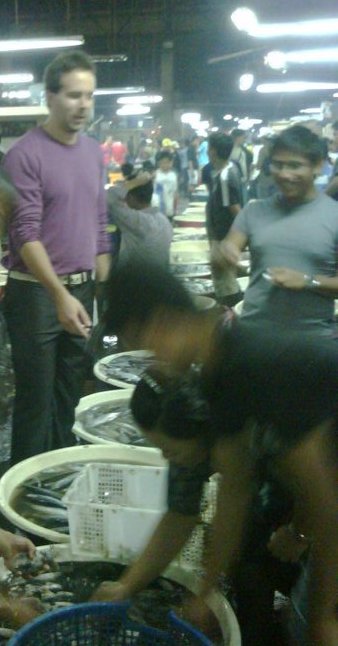

Thackray's 2011 Investor's Guide refers to the effect as "Super Seven Days": The last four days of the month and the first three days of the following month typically yield higher returns than other periods during the month. Reasons for strength are month end "window dressing" by institutional investors and new monthly fund inflows into pensions and mutual funds that subsequently are invested into equity markets.
The month-end trade phenomenon is notable around Halloween. Gains are not related to sales of candy and spooky costumes.
Kim Zussman responds:
Checked this with SPY (2000-2010) by comparing returns of super seven days to the seven days just before (paired t-test):
Paired T for super - presuper
N Mean StDev SE Mean
super 129 0.006008 0.031161 0.002744 T=2.43
presuper 129 -0.003947 0.030088 0.002649
Difference 129 0.009955 0.046565 0.004100
Definitely worked in the whole period. However dividing data into 2005-10 and 2000-05 shows the effect was mainly from the older period and recently faded out:
Paired T for 2005-2010 - 2005-2010pre
N Mean StDev SE Mean
2005-2010 63 0.006552 0.034890 0.004396 T=1.4
2005-2010pre 63 -0.002733 0.032691 0.004119
Difference 63 0.009285 0.051677 0.006511
Paired T for 2000-2005 - 2000-2005pre
N Mean StDev SE Mean
2000-2005 66 0.005489 0.027395 0.003372 T=2.1
2000-2005pre 66 -0.005104 0.027578 0.003395
Difference 66 0.010594 0.041495 0.005108
Nov
1
Some Good Ping Pong Videos, from Pitt. T. Maner III
November 1, 2010 | Leave a Comment
 Here is a video of Wang Hao, current Table Tennis World Champ, in action with his "penhold" grip.
Around the 2:20 and 3:30 marks on the following clip there are good
points played but not exactly, one presumes, a probing "dialogue" like
the old masters.
And here are some more ping pong links for fun and comparison:
Hardbat play for comparison
Mr. Riesmann apologizes for the "inacessabillty of tickets" to his match
Practicing against the robot while getting ready to "beat the hell" out of a 20-yr old!
I had not seen the old days before. It's nice to learn a little bit about hardbat play and Mr. Riesman. He's quite a fun character. His playing is much more like true table tennis. Long rallies, lots of cuts and spins, tactics, mental games, history…neat film noir lighting…jazz cool.
It's too bad about the intro of sponge and short rally smash play… strange now to think of the spongiform game in retrospect as the diplomatic foray with China for Nixon/Kissinger. A metaphor for shaking hands with vinyl medical gloves on. Add the solvents and glue for antiseptic…now the ads on TV for China "owning" us in the future…
Nov
1
Currency Wars, from Gary Rogan
November 1, 2010 | 6 Comments
This article, "Currency Wars: Debase, Default Deny!" seems somewhat confused: are they cleverly trying to take over the world assets by creating infinite credit or are they kicking the can down the road because they are completely confused and also have no political will to fix the problems? Of course it kinda, sorta implies that there are two "they": the shadowy financiers of the currency wars and the idiot "public servants" who enable them, but it's not entirely clear that they are not connected or in fact one and the same. I love a good conspiracy theory but when they are written in a completely paranoid style they wind up sounding like paranoia.
I find that the most likely theory is simply this: the government spends until it can spend no more because even one extra day of spending pays off more cronies. They are finally about to pay a political price, but old habits die hard. The Fed for whatever reason feels that they have to enable managing the resulting debt. They are doing it mainly via two mechanisms: keeping the interest rate around zero and devaluing the future dollars needed to repay it. Both are in turn accomplished by buying debt of every conceivable kind with newly printed dollars. They have successfully dealt with the post-WWII debt by inflating the dollar and so it seems likely that they are trying to do in again but on a more massive scale. I don't believe they believe in any of the inflation targeting rhetoric or even competitive devaluation, they are simply feigning concern about deflation because Bernanke is credible given his history of publicly worrying about it.
They have already destabilized the trust in the dollar enough to unleash hellatious commodity inflation. This is about to squeeze most manufacturers in the world and pretty soon most consumers. In their own mind they have no choice, the debts must be paid or the country goes bust. Robbing whoever they can is considered perfectly acceptable for the greater good. The root of all of this is the crazy spending, these guys are just following orders.
« go back —Archives
- October 2026
- September 2026
- August 2026
- July 2026
- June 2026
- May 2026
- April 2026
- March 2026
- February 2026
- January 2026
- December 2025
- November 2025
- October 2025
- September 2025
- August 2025
- July 2025
- June 2025
- May 2025
- April 2025
- March 2025
- February 2025
- January 2025
- December 2024
- November 2024
- October 2024
- September 2024
- August 2024
- July 2024
- June 2024
- May 2024
- April 2024
- March 2024
- February 2024
- January 2024
- December 2023
- November 2023
- October 2023
- September 2023
- August 2023
- July 2023
- June 2023
- May 2023
- April 2023
- March 2023
- February 2023
- January 2023
- December 2022
- November 2022
- October 2022
- September 2022
- August 2022
- July 2022
- June 2022
- May 2022
- April 2022
- March 2022
- February 2022
- January 2022
- December 2021
- November 2021
- October 2021
- September 2021
- August 2021
- July 2021
- June 2021
- May 2021
- April 2021
- March 2021
- February 2021
- January 2021
- December 2020
- November 2020
- October 2020
- September 2020
- August 2020
- July 2020
- June 2020
- May 2020
- April 2020
- March 2020
- February 2020
- January 2020
- December 2019
- November 2019
- October 2019
- September 2019
- August 2019
- July 2019
- June 2019
- May 2019
- April 2019
- March 2019
- February 2019
- January 2019
- December 2018
- November 2018
- October 2018
- September 2018
- August 2018
- July 2018
- June 2018
- May 2018
- April 2018
- March 2018
- February 2018
- January 2018
- December 2017
- November 2017
- October 2017
- September 2017
- August 2017
- July 2017
- June 2017
- May 2017
- April 2017
- March 2017
- February 2017
- January 2017
- December 2016
- November 2016
- October 2016
- September 2016
- August 2016
- July 2016
- June 2016
- May 2016
- April 2016
- March 2016
- February 2016
- January 2016
- December 2015
- November 2015
- October 2015
- September 2015
- August 2015
- July 2015
- June 2015
- May 2015
- April 2015
- March 2015
- February 2015
- January 2015
- December 2014
- November 2014
- October 2014
- September 2014
- August 2014
- July 2014
- June 2014
- May 2014
- April 2014
- March 2014
- February 2014
- January 2014
- December 2013
- November 2013
- October 2013
- September 2013
- August 2013
- July 2013
- June 2013
- May 2013
- April 2013
- March 2013
- February 2013
- January 2013
- December 2012
- November 2012
- October 2012
- September 2012
- August 2012
- July 2012
- June 2012
- May 2012
- April 2012
- March 2012
- February 2012
- January 2012
- December 2011
- November 2011
- October 2011
- September 2011
- August 2011
- July 2011
- June 2011
- May 2011
- April 2011
- March 2011
- February 2011
- January 2011
- December 2010
- November 2010
- October 2010
- September 2010
- August 2010
- July 2010
- June 2010
- May 2010
- April 2010
- March 2010
- February 2010
- January 2010
- December 2009
- November 2009
- October 2009
- September 2009
- August 2009
- July 2009
- June 2009
- May 2009
- April 2009
- March 2009
- February 2009
- January 2009
- December 2008
- November 2008
- October 2008
- September 2008
- August 2008
- July 2008
- June 2008
- May 2008
- April 2008
- March 2008
- February 2008
- January 2008
- December 2007
- November 2007
- October 2007
- September 2007
- August 2007
- July 2007
- June 2007
- May 2007
- April 2007
- March 2007
- February 2007
- January 2007
- December 2006
- November 2006
- October 2006
- September 2006
- August 2006
- Older Archives
Resources & Links
- The Letters Prize
- Pre-2007 Victor Niederhoffer Posts
- Vic’s NYC Junto
- Reading List
- Programming in 60 Seconds
- The Objectivist Center
- Foundation for Economic Education
- Tigerchess
- Dick Sears' G.T. Index
- Pre-2007 Daily Speculations
- Laurel & Vics' Worldly Investor Articles
