Jul
29
Mystical Ideas, from Victor Niederhoffer
July 29, 2010 | 4 Comments
 Recently I have posited that the market to an inordinate degree shows the main attributes in its daily moves of the most vivid sports game that has not been used. I would add to this that during each hour the market is likely to move to the rhythms and dynamics of the most likely classical music being played on a classical music station in home town, for example the former WQXR in New York, in full knowledge that these programs are often selected 2 months in advance, and noting that I was a subscriber to same when I was 12 years old.
I am adding to my list of mystical encampments and predictions that the fortunes of Apple and Lady Gaga will follow a similar arc in the future, and as soon as the Lady loses her luster, or a substantial base of her gay support, Apple will be ready to nose dive.
Do you feel that because of these ideas that I should resign my post as chair of Daily Spec which is designed to deflate bally hoo, or is this just a symptom of that predilection that old men such as the sage and the fake doc have to maintain their romantic aura?
Ken Drees writes:
Lebron James' Cavs win over the bulls to end that series correlates to the spy top (04/27/10). That was the zenith of his career in Cleveland. They were then going into Boston on a full tank of expectations. The last game (as a cav) in that series marked a secondary top 08/13/10–then the melodrama begins. His great choice to go to Miami did not mark the low but was the midpoint of the latest rally—he is losing his market moving mojo–his ability to focus the market energy . So now he has lost his core fan support like lady gaga at some point will lose her core fan base. No, I don't think the Chair is that off-kilter.
Popular culture icons somehow bleed into market consciousness.
Vince Fulco writes:
I've long thought that the culture has moved into a greater phase of bally hoo, perhaps a derivative of the Romans' 'Bread & Circuses'. We are now just starting to realize or are being forced to understand that flat incomes, poorly funded retirements and insufficient skills in the aggregate set against historically outsized obligations are a recipe for disaster. Fighting falsehoods would seem to be a necessity of survival and good investing for the long haul. Moreover, one has great opportunities to choose from post deflation.
Jim Lackey shares:
Actually no. AAPL has talent and is'nt just a fad or a show. Not sayin' that the Lady doesn't have talent, but if and when I see her write and produce tunes for others and sing Jazz, then she will be an AAPL. But no! No I did buy AAPl in 2003 when Mr. Eyerman stood right here on list and said buy it now. Jobs is back, and Itunes is brilliant. It's been a ten bagger since, which is what got me to tell the father in law naaa na na no this Xmas as he was on visit to Music City and toyed with his new Iphone all week. He's a MD and a tech freak and he said, "you know what, I don't need a PC or internet at home anymore with this"
It's not CSCO when it was on the way to a trillion dollar market cap in year 2,000. It's post crash now. Also it's no shorted up fad stock, but yes it's a fashion device an ipod in all 3 colors for different outfits. If I had to guess its a DELL circa late 90's. It never crashed and burned until much later in the tech wreck. It just stopped going up and in these markets AAPL must trade 299.75 but not 300. ha.
Craig Mee writes:
Just like Seinfeld had the bravery to sell the high and knock back the 10Mil for a tenth season, (one of a tiny minority who do) maybe the gagas and apples should too. To keep up the product development and create new bizarreness no doubt gets harder and harder with everyone hot on your tail. Im sure income changes, say for Seinfeld, from shows to marketing, but he has been smart enough to cut and run, and keep the value. A lesson for us all.
Marlowe Cassetti writes:
The chair has touched on a point of interest that has bothered me. I don’t know about Lady Gaga, but Apple’s climb towards the top of market valuation appears to be inline with the phenomenon of a bubble. Yes, I understand that we cannot declare a bubble until it bursts, but let’s look at the facts:
There are some 47 stock analysts that cover AAPL, all but two have either a buy or a strong buy recommendation. It is the darling of the market. Its market cap is approaching $ ¼ trillion and at the rate it is moving it is on its way to challenge Exxon Mobile Corp. XOM produces stuff that the world needs, AAPL doesn’t produce stuff that the world needs just what they like to have, until something else strikes their fancy.
It reminds me in the 1980's when people couldn't buy enough Wang stock. You hadn't arrived if your office didn't sport a Wang word processor. The bubble will burst when the last fool buys in at a nose bleed price.
Thomas Miller writes:
 Sometimes one's instincts or gut feelings can't be counted or explained but you feel its true. Probably based on years of different observations made subconsciously. A trader may feel strongly a market is about to break without being able to explain exactly why, because subconsciously they have seen patterns many times before. Considering the source, I wouldn't immediately dismiss this as ballyhoo. Instead of resigning, further testing is called for.
Steve Ellison comments:
Mr. Aronson noted in his book that it is no fun being a skeptic and that the scientific method leaves deep human yearnings unfulfilled. Facts are often tedious and dull, but stories are captivating, which is why people who have bought into a narrative continue believing it even when presented with strong counterfactuals. "Story stocks" have always been prominent in bull markets.
Marion Dreyfus writes:
A new study reveals that people are at their angriest on Thursdays. Thus, perhaps deals might better be made on Friday, when people are delightfully anticipating the weekend, or Monday, when they are somnolently reviewing the events of their past free-time indulgences.
interesting … We have been doing product development on a tool to gather data, and do reduction for self-introspection to find and permit prediction of cyclic true 'more productive' highs, and 'down in the dumps' lows.
Jim Wildman comments:
I've been thinking a lot about rhythms. I've noticed on the treadmill at the Y that people tend to fall into step with each other. Being on treadmills, this is easier since you can be running at different speeds, but the same step count. It creates an interesting effect when the treadmills are on a suspended 2nd story as it was at the last gym. I've wondered how many people it would take to collapse the floor.
This study seems to indicate that there are (at least tendencies towards) rhythms in 'group' emotions. What other rhythms are there and how do they affect me? How do they affect the markets?
Vincent Andres adds:
Here is a good paper on this topic of frequency coupling
Some more infor:
Steven Strogatz's publications
TED video (look at the part on fireflies, near the 10th minute on metronomes (1st historical notice by Huygens), near the 13th minute and the bridge (not Tacoma … but not very far !)… in fact the whole video examples are interesting).
Easan Katir writes:
In a year when Paul the Octopus correctly picked 7 consecutive wins, well-documented to the world, when the underwater plume in the Gulf of Mexican Oil matched the plume of gritty ash from Eyjafjallajokull, and the rig explosion coincided with the April market top, who can say anymore what is mystical and what isn't. Lead on, Chair! Lead on!
Craig Mee writes:
Looks like Schumacher should of stayed off the track, as HIS value, now may be plummeting: "For all his greatness, he never knows when to give up. He is a shadow of his former self," added hugely experienced former driver David Coulthard" Ouch!
Jul
23
The Colony, by Pitt T. Maner III
July 23, 2010 | Leave a Comment
Hard to believe that it has been almost 30 years since "The Road Warrior" movie (Mad Max 2), a classic of the dystopian genre and coinciding with DJIA 800 ranges. The show The Colony, starting next Tuesday the 27th, on the Discovery Channel has a bit of that Mad Max/Andromeda Strain post-apocalyptic feel.
I just hope the poor geology professor with no practical skills makes a good showing and can at least find some water–coming from Arizona State. She probably knows a bit of geohydrology. Did not see Season One, but this looks entertaining:
What would you do in the wake of a global catastrophe? Even if you survived it, could you survive the aftermath?
Season Two of THE COLONY introduces viewers to a new group of volunteers with differing backgrounds, skills and personalities, to bear witness to how these colonists will survive and rebuild in a world without electricity, running water, government or outside communication. Over the course of 10 episodes, the colonists - who include a construction foreman, teacher, carpenter and auto mechanic - must work to utilize and strengthen their exploration, technology and survival skills in ways they've never had to before.
Ralph Vince comments:
This, culturally, is AMAZING to me. A few weeks back I had an extended discussion with a group of very bright guys all in their early 20s — a candid discussion about their perceptions. A few very revealing things:
1. They are all very upbeat, economically, on a personal level. They feel they are smart and educated and will do fine even though they expect things to dissolve, they believe their formal education is their life preserver.
2. They all hate the boomers and consider them the "entitlements" generation — they regard the ones who were mostly their parents, the ones they refer to as "The greatest generation" as deserving of entitlements, but the boomers NOT entitled. Very interesting — I couldn't get to the logic of this other than we, the boomers, "screwed everything up, did nothing as a generation, and have a grotesque (to them) sense of entitlement to us".
3. They all, universally, expect things to decay, eventually, one way or another, into this MadMax anarchist future. When I would press them on this one, with things such as "Well you were saturated with these types of images growing up of the future, can't you foresee a less dark one, a more optimistic one?" They all universally agreed that "There is no other way the future can work out." Fascinating. Absolutely fascinating. With housing now more affordable than it ever was to any of the boomers — with borrowing at interest rate levels never before seen (and long rates banging around 4% !!!) and a protracted, decade-long-already contraction, the thought of a major up move over the next 15-20 years was something they could not possibly conceive of.
Vince Fulco writes:
Would note the release of the movie "Book of Eli" on DVD recently follows this post apocalyptic meme. Also has a fairly strong underlying theme of Pogo's "we've seen the enemy and he is us."
Pitt T. Maner III responds:
When will the post-Boomers give up on the end of "The Road " ideas and swing towards the "On the Road " themes again? Cyclicity.
James Lackey comments:
One posits (as Mr. Vic did with movies and baseball) stock returns or better said premiums ratios are higher during futuristic movie and tv times.. see 60's twilight zone and late 90's everything was deep space futuristic.. then post crash it was all cop shows and today perhaps its true on the mad max which came in when the rust belt was dying post 70's Opec deals.
One does not say that its different this time. In my day Generation X was deemed stupid, spoiled and lazy.. It was a cultural and economic shift and we didn't know what to do, but the second we figured it out everyone I know ""just did it" hence the Nike slogan "just do it".
It's good to see the young beat up the old on the net, but quite respectful in person. I have a great deal of respect for my Son's buddies and all the BMX kids we train. Their only problem is over specialization and the quote above shows that in their belief their credentials will be their savior.
I do not agree they despise the boomers… I'd rather think we like to think or say that as Gen X ers for a revenge trade.. No Gen X er believed for a minute SSI [Social Security] would work out so for the Gen YZ kids to even think about it at all is a big joke..Ive never heard about it once…matter of fact if any Old BMX racers bring up the 3 sins of talking about Work Marriage or Politics at the track the kids ride off… the older adult pros age 18-24 say it flat out and crack me up "I can't handle this drama, I am gonna go talk to the girls" These kids today are "awesome".
Ken Drees comments:
TV has recently been and still now is based on these themes "biggest loser" "bachelor" "dancing with the stars" "angry biker building show" "rock star real life" "idol" "top model" "fashion designer contest show" '"hell's kitchen" "next iron chef" "tattoo shop people" "dangerous fishing boat" "man in the wild" etc—a lot of contests, makeup, high energy, tears, people being eliminated, emotive overkill, action with real life injuries. All of this started with "survivor"–which is pretty much over–except they have a Spanish version of it on the Latin channel that I just flipped over yesterday so that trend must be in the last hurrah phase.
But these themes are lottery like–taking a chance to make it to the top–be the one who can outlast the competition and the make it all the way. So maybe that consciousness seeps into markets–can we survive another day, the odds are against us but I feel the magic. A big cross section of age groups are relating to these shows—I personally got hooked on Hell's Kitchen–something about the angry language that I try to keep under control and watching that blond haired man just let his anger spew at those inept cooks. Then you get into the finalists and start rooting for a favorite —like horse racing.
Survival in a post 401k smashed world, surviving unemployment, etc.
Kim Zussman comments:
1. They are all very upbeat, economically, on a personal level. They feel they are smart and educated and will do fine even though they expect things to dissolve, they believe their formal education is their life preserver.
2. They all hate the boomers and consider them the "entitlements" generation — they regard the ones who were mostly their parents, the ones they refer to as "The greatest generation" as deserving of entitlements, but the boomers NOT entitles. Very interesting — I couldn;t get to the logic of this other than we, the boomers, "screwed everything up, did nothing as a generation, and have a grotesque (to them) sense of entitlement to us.
Ralph please send our apologies for screwing things up for them. Ask them not to see "Avenue q", because exactly as Mr.s Rogers and Henson told them - and it is statistically remarkable - they really are all gifted, special, and specially equipped to make this a better world.
Sorry too about our house that you've been eyeing; its 20% upside down because of those college loans, and the one for your first car. At least there won't be any estate tax on it. And remember to hang that Ivy diploma proudly in the latrine - you never know when it might come in handy.
If you decide to get more education - forget about cloud quantum computing gene sequences. Go get your CPA, with emphasis on forensic accounting, and take some classes on retrieval of deleted emails, cash-tracing, and banking in the Bahamas. Also get certified to sell the plastics of the future - insurance.
Big shame about that 401 account. We were, as always, worried about you when they went below 700 and we sold everything. The good news is we got back in at 1200, so please work hard so your earnings propel it to the 12,000 you deserve.
About that screw-up: We were taught something like 2008-2009 was more unlikely than an asteroid collision. However now that the problem has been corrected, you have nothing to fear. Please tell your boss to deduct the maximum for your retirement account, auto-deposited in one of the index ETF's on the first of each month. Add to it on the taxable side too. More is better - buy as much as you can while you're young. Find a good ETF that will go up. If it don't go up, don't buy it.
Sorry about our health. We've been doing cardio for decades, so we're not going to MI like Opa or stroke like Oma. And we floss every day, so there won't be any need for chemo. But we did think to get long-term care insurance, and though you're mad hope you will pick nice nurses for us, and bring a case of Ensure now and then.
Alan Brice Corwin writes:
I've also recently had discussions with a large group of twenty-somethings, but I came away with a different impression. This may be a sampling or a context problem. They may have been less candid towards my generation because they were looking for money for their projects
The main difference in my encounter is that most of these people had boomers for parents. While most of our parents were in their early twenties when we (boomers) were born, their parents were often in their thirties and forties when they were born. There were a few with younger parents, but not very many. (We refer to our parents as the greatest generation because they beat the Nazis and the depression, but who are they referring to and why?)
In fact, I noticed a lot of sympathy for their boomer parents. Several of them noted that their parents had worked hard all of their lives and had expected to retire soon, but are now looking at having to work into their seventies or eighties. There was a general feeling that they would not allow this to happen to them. They would take care of their retirement needs while they were still young.
The main resentment that I encountered was that I was able to get my education for free. They don't think social security will be there for them, but they were young enough so that wasn't really a concern. The idea that someone could go to college for ten years and have money in the bank at the end of it was simply mind-boggling to them. People with full scholarships all the way through told me they had forty grand in debt after school.
I also detected less regard for their formal education among the group I talked to The pretty much all had college degrees, but they regarded their life preserver as their skills at seeing what was needed and building something to meet that need. Several told me that their college education was only good for getting a crappy job for a big corporation, and they had no interest in that.
One point of similarity I noticed is the sense of impending decay. One young man told me that he thought we would see a thousand bridges fail in the US in the next ten years, and that no one would step forward to maintain them. He said he saw no inkling of the common sense of purpose that must have existed when the roads were built. He further pointed out that the infrastructure needs were far greater today because there are now so many more people, but China and Dubai seem to be the only places where they are actively working to build a modern infrastructure. He said we have a 1900 model railroad system and a 1950 highway system (I didn't point out that the interstate highways weren't built until the late fifties and early sixties).
There was a sense that they would never have the life their grandparents had. This same young man said that his grandfather went to work for a company right out of college, worked for them for thirty five years without a layoff, and had been retired and playing golf on a generous pension for thirty years. His grandfather had bought his house for less than ten thousand dollars, and three years ago he could have sold the lot the house was on for nearly a million dollars (not any more).
Another thing I noticed was that almost everyone they idolized in business was a boomer. As you might expect with a group that was more iPhone app developers than anything else, Steve Jobs was far and away the person most admired. Eric Schmidt of Google was another favorite, but ranking way behind Jobs.
Marlowe Cassetti writes:
Wouldn't it be great if they were to make a new reality program based upon the Turtle Traders experiment. All the intrigues of students from diverse backgrounds competing. Ah, the high drama. I bet some of us Specs might be so inclined to view a few episodes. Am I right?
Lars van Dort comments:
Actually the BBC had a program called 'Million Dollar Traders' last year:
"Eight ordinary people are given a million dollars, a fortnight of intensive training and two months to run their own hedge fund. Can they make a killing?
The experiment reveals the inner workings of a City trading floor. The money is supplied by hedge fund manager Lex van Dam: he wants to see if ordinary people can beat the professionals, and he expects a return on his investment too. Yet no-one foresees the financial crisis that lies ahead.
The traders were selected in spring 2008, before the US credit crisis gathered pace. The successful candidates were chosen, trained and dispatched to their specially created trading room in the heart of the Square Mile. Among them are an environmentalist, a soldier, a boxing promoter, an entrepreneur, a retired IT consultant, a vet, a student and a shopkeeper.
The eight novice city traders struggle to ride the storm as stock markets around the world go haywire. Some of them take big risks, and others lose their nerve in spectacular fashion."
Episode 1:
http://vids.myspace.com/index.cfm?fuseaction=vids.individual&videoid=56317671
Episode 2:
http://vids.myspace.com/index.cfm?fuseaction=vids.individual&videoid=56321444
Episode 3:
http://vids.myspace.com/index.cfm?fuseaction=vids.individual&videoid=56337345
I quite enjoyed it.
Jul
15
Stocks and No Limit Poker, from Jim Lackey
July 15, 2010 | 2 Comments
 Stocks are much like no limit these days… you have one or two 10 minute bars to decide to go all in risk all or fold.
Vince Fulco writes:
Phenomenal observation. It's a function of fake liquidity. You've got to pick your spots wider and expect the reactions to be more severe in both directions. I read somewhere the other day the theory that folks are pricing in too much tail risk. Is this what happens when an economy is built on sand?
Jeff Watson writes:
Interesting comparison of stocks with no limit poker. While the risk of ruin approaches 100% in NL poker, I wonder what the risk of ruin would be in the stock market, especially with short term trading. I suspect that it would be higher than one would expect, with the vig, mistakes, and just being wrong factored in.
Jim Lackey writes:
No…anyone is capable of "not taking risk" and to see people brag about not losing is hilarious. No profits either, at least none to brag about vs. some indexing. To make real money you have to take real risk. Period. End of story.
Rocky Humbert comments:
How return is related to risk is a subject worthy of extended discussion, and I don't have the time to launch that thread right now.
However, I want to note that Fama has backed away from his early work that pioneered the model that the two must go hand-in-hand.
I for one do not accept the proposition that one must take large risks to have large returns and this distinction is a key difference between gamblng and investing.
This is a fascinating subject… I hope others will contribute. I have a plane to catch.
Jeff Sasmor comments:
"To make real money you have to take real risk period end of story." Yes!
Isn't the ultimate metric whether or not you make money? If you are good at scalping the E-mini SP on a 5 min chart and make money doing that then IMO it trumps the issues of risk and vig. Personally and IMO, and I know that most here will disagree (except maybe Jim) scalping has the lowest risk albeit with more vig (vig is pretty cheap these days at $4/round trip for the Emini SP and since one Emini SP ~= 500 SPY it's much less vig than the ETF). I don't even factor commissions into my thinking anymore.
But longer time frames are more comfortable for most people - and yes the vig is proportionally less but one downside among many is that you're much more susceptible to your own emotions about getting out of a losing trade (or a winning one) - and that's an additional term in the vig equation.
With computers (Skynet) running the show these days you can get your "head handed to you" no matter what time frame you're using. They seem to love chaos and high volatility, sort of like the Shadows in the old TV show Babylon 5; or for real sci-fi nuts - the eddorians from the Lensman space opera series. Or for others: think of computerized Sith.
Jun
28
To Remind Oneself Of All the Blessings, by Vince Fulco
June 28, 2010 | 1 Comment
Spend some time with an oncologist.
Wrapping up a flyfishing trip to Canada with a radiologist (Dad), an oncologist and a cardio-thoracic surgeon, had a couple of snippets to add to the ongoing list thread re: medical issues. Dad fresh from the annual AMA meeting– " medical community is in need of 25M specialists today growing to 250M by 2015. It will obviously not be met."
From the oncologist, "small private practices will cease to exist in the next few years due to the ongoing grind from unrealistic medicare, medicaid and insurance co. reimbursements. In all likelihood, within a decade most Docs will be hospital employees unable to cope with the budgetary pressures from all sides. Mayo clinic in AZ dropped medicaid recently and that was a big, big deal given the organization's philosophies."
And in the tech will save the day dept, from the surgeon, " Now having great success replacing heart valves using minimally invasive catheter and stent procedures to fix the valve in place." Imagine the entire valve apparatus (one of many) replaced in one fell swoop. Separately, estimates his patient population could be cut by 30 percent or more through better diet, cholesterol management, smoking cessation and regular exercise. Is very enthused and excited for the promise stem cells seem to hold.
On a final note, all commenters were deeply suspicious of and in the revulsion stage when it came to equities as an asset class. I estimate they were 2 to 10 years from retirement but no one thought it was an option given investment returns unless forced to do so for physical reasons.
Jun
7
Madoff in the News
June 7, 2010 | 3 Comments
 An evil man in the news. "No one really believes they turned daddy in without a heads up that they were alreading coming for him, right?"
Vince Fulco comments:
Since this story broke, I have been shocked to find out how many 'average joes' in my childhood community of upstate NY have been devastated by this mad man. Cases in point are a reasonably successful but otherwise unremarkable family doctor who was forced to return back to work full-time at 70 and separately a mid level real estate exec who's dealing with severe clinical depression after his couple of million $ in life savings; generated through scrimping and saving, were completely wiped out. The tentacles of evil reached so far that it does seem to give credence to the 6 degrees of separation theory. It could have been avoidable if following some of the earliest and simplest of universal truths:
1. Don't put all your eggs in one basket
2. If it is too good to be true, it probably is and
3. Trust but verify (often) among numerous others.
Anatoly Veltman comments:
A few aspects don't get enough attention:
1. Majority of those who lost participated of own lure/belief that they were in on special advantage/inside
2. That's one explanation of why many clients don't want to acknowledge that they were; another is that some took out more than put in.
3. Beyond profitable withdrawals, tens of billions more will never be accounted for– kept by investigating insiders.
4. The "reverse Robin Hood" of taking from many to give to few is thriving well past-Madoff: within the entire latest bubble and almost all government actions of present
Jun
7
Question About BP, from Steve Ellison
June 7, 2010 | 2 Comments
 An analyst on CNBC yesterday was saying BP is cheap, and the dividend is secure. His interviewers (are they supposed to have an agenda of their own? Or is this just asking the tough questions?) kept hammering on their idea that it will be politically unacceptable for BP to pay dividends to its shareholders, a line of questioning that drew uncomprehending stares from the analyst.
George Parkanyi comments:
Yeah that makes sense… take a whopping out-sized risk on BP with its huge potential future liabilities, in a world economy and market possibly on the brink, where P&G can lose 35% of its value in 10 minutes, for a dividend. Where do I sign up?
Rocky Humbert comments:
 Here are some questions that one might consider before investing in BP. (No such analysis is required for a skilled trader who claims to be able to systematically buy low and sell high without regard to "fundamentals.")
1. Remediation costs and liability are related to a spill size both by physics, practice and statute. The Exxon Valdez had a defined amount of crude. How much crude will spill from the Deepwater Horizon?
2. What is the law regarding punitive damage penalties if gross negligence can be proven? Is it like a RICO case (4x)? Is it capped by statute? Or can it be unlimited (like an old Joe Jamail lawsuit)?
3. What is the law regarding punitive penalties if there is criminal liability? What is the worst case penalty? If the Goverment files an criminal indictment, what effect(s) will have on their business?
4. What effect will the overhang of litigation have on the cost of BP's financing of their regular business? If there is a risk of a $50+ Billion punitive penalty, what will the credit rating agencies do? And if BP's cost of financing increases by 100-300 basis points, what effect does that have on their exploration budget?
5. If they capped the well today, can one assess the risks of #2, #3, and #4 with certainty?
6. What is the risk/cost of a boycott of their service stations? Did Exxon experience a boycott? And if so, what impact did it have on their downstream operations?
7. What is the tail (in years) of the litigation? Will they be required to post a performance bond? And if so, what assets will they sell to meet the performance bond? More generally, is there a risk that they will have to sell assets to meet other liabilities? Or, can they almost certainty meet the expenses out of current cash flow?
8. How is BP's stock faring versus other companies with exposure (Anadarko, Cameron, etc.)? Will these companies present a unified defense? Or will they be pointing fingers at each other — further concentrating the litigation risk?
9. How has BP's stock performed versus other major oil companies? For example, if BP is down 35%, but Chevron,Exxon,Conoco are also down 15%, which of these companies represents the best relative value, given the facts and probabilities?
10. If I am leaving for a five-year vacation, would I be comfortable purchasing BP at the current price, and not looking at it until I return? Is there any price where I would buy a non-trivial amount of BP and not look at it for five years?
Vince Fulco writes:
 While I am no apologist for BP's seemingly high risk and perhaps incompetent procedures in the Gulf, I am also wondering about the proportionality of the public reaction (to the stock that is, not the beach pollution) vs. the total cost of the disaster. The company's mkt cap is down $70B since the explosion and is currently $115B for a company with $230B-ish in historical assets ($90B estimated in the US) and relatively low non-current debt levels. Moreover the company has a stand alone re-insurance company with $3.5B in assets. They may also have some additional cover which I am disregarding for now. As Ken has stated, halting the dividend brings $7-10B more to pay claims which I assume will have a somewhat long tail, say 3-5 years. And just because Chuck Schumer believes the payout should be halted, doesn't mean he knows anything about corporate finance strategies or management's responsibilities to its owners. More evidence of the worrying 'they came for…' behavior.
Given the rarity of the event, arguably the next comparable disaster naturally might be the Exxon Valdez (other smaller events could be chosen too). The best numbers I could find were a cost of roughly $5-7B stretched out over 20+ years. For argument sake, let's say the cost to BP is 10x as much or $50B; that would be roughly 1.6-1.8x mean operating income of the last 4 years.
I am not considering BPT in the conversation because it is a different animal and Rocky has addressed it well. Lastly, since our current admin seems to be in the business of picking winners and losers, are they ready to and can they kill a formerly $1/4T asset company 40% held by pensioners and retirement funds of our closest ally? It is also notable that LA's governor is already publicly complaining about the effect on jobs if a drilling ban is instituted for any length of time. Double edged sword indeed.
Disclaimer: This is absolutely not a recommendation for anyone but I am long right at these levels and would appreciate reasoned arguments against.
Rocky Humbert adds:
 One more thought on BP as I work through their financials: The company generated free cash flow of about $7 Billion last year and paid $10.5 Billion dividends.
Their next dividend will be announced on about July 27th with an ex-date of 8/4/10. Looking at the pricing of at-the-money options, it appears that the market has priced in a cut of their dividend by 50% (from .84/share to about .44/share).
Any spec-lister who has a variant perception on their dividend policy (either holding it at its current level, or reducing it more than 50%), can execute an direction-neutral options "conversion" to express this view.
In my humble opinion, a 50% cut in the dividend seems entirely reasonable to satisfy all of the different constituencies. And, in assessing the future behavior of the stock, one needs to consider that Mr. Market has already discounted this news.
Before you invest in BPT, I suggest you get an objective estimate of the reserve tail in the Prudoe Bay field. I studied this several years ago and there is a NAV based on the dwindling reserves and foward curve in the crude market at various discount rates.
The field should start tailing off in 2011 or 2012 and the stock will be worthless certainly by 2020 so you need to value not only the current and future crude price but also the decline rate. I'd also suggest that you look at their financing and change of control provisions as well as cross default issues. Lastly, I owned BPT when it was at a substantial discount to its NAV at a large discount rate (versus crude futures), but could not short it when it went to a large premium because the shares could not be borrowed.
Jun
6
Time Horizons, Cycles, Digging, from Chris Tucker
June 6, 2010 | Leave a Comment
Recently I have been discussing lengthening my time horizons with my mentor and was tickled to find this post by GM Davies while perusing other blogs by people who post to Daily Spec. I am definitely one who is seduced by instant gratification and it is difficult for me to sit on a position for any length of time unless my indicators are emphatic about it. One evening after pondering over the theory of ever changing cycles and this post from Mr. Sogi, I found myself looking at all sorts of time intervals in charts to find the structures/setups that I prefer to trade. Lo and behold I have found that many times when a setup I like to trade is not evident in my usual time frames, if I dig a bit and look at odd frames such as one or four minute bar charts instead of two or three, or, say, 34 tick charts instead of 50, 25 or 10, then indications that were invisible in the "normal" or default charts tend to jump out at me. The same thing happens when I look at larger time frames.
One of the beautiful things about the charting tools I use is that they are flexible in this regard and allow me to be creative. Tracking down the cycle that is currently in play is a lot of work but has proven profitable. Kudos to Mr. Sogi and GM Davies for getting me thinking. Kudos to Chair for providing outlet for this incredibly diverse effusion of ideas, and for many other things not least of which is being a tremendous inspiration.
Jun
3
Patrick O’Brian Reccomendations, from Vince Fulco
June 3, 2010 | Leave a Comment
 If one were to begin the series of Patrick O' Brian books, should they be read in the order in which they were written? I'm finding good prices for some of the later books and looking to get through 1 or 2 while I am out of the country for a few weeks without internet access and distractions.
Gibbons Burke comments:
Yes, the series should be read in order, though some recommend that some readers may find that the second book of the series is a better introduction to the canon because there are more scenes on land.
I found it tremendously helpful reading the novels the first time through to have a dictionary and a pocket atlas readily available. Dean King's "A Sea of Words" is a most helpful companion to the series, as are his book of maps detailing the voyages in the novels, "Harbors & High Seas".
Google maps would be an even better resource these days. An iPad with the novels loaded into the Kindle app (they're not yet available in iBookstore), or audiobooks in the iPod app, combined with the Maps app, and the built-in dictionary would be a great way to circumnavigate the canon. Capt. Aubrey, who was ever interested in the latest go-fast sailing tech, might even approve, though it is likely O'Brian would express contempt.
Chris Tucker writes:
When Victor first introduced me to the books I mentioned that I had a bone to pick with him about them and that is that I was staying up until all hours of the night reading and I wasn't getting enough sleep. He wisely recommended that I try books on CD and listen to them while driving or whenever I had time to do so and so I forgave him for depriving me of sleep. I took advantage of the local library to get ahold of the recordings because they are a bit pricey.
If using a library, I find that tapes are actually better than CDs because if there is bad patch on a tape you may miss a few words or perhaps still here them but with derogated quality, but with a CD you may miss an entire track or two. Also important to note if listening to this series on CD or tape, Chair highly recommends, and I emphatically second, that you listen to the series as read by Patrick Tull, who manages to add to the already incredible drama that O'Brian evokes. Books read by Tull are available at RecordedBooks.com here.
May
26
Thought of the Day, from Vince Fulco
May 26, 2010 | Leave a Comment
The persistent strength all day long yesterday in GS with the classic 'eod' repeat rumor swirling of the SEC settlement firming up bids takes the cake! How to join the inner sanctum?!
May
19
I found this fascinating: A Visual Guide to Cognitive Biases.
May
18
A Theoretical Query, from Victor Niederhoffer
May 18, 2010 | 2 Comments
 One may inquire in answer to Rocky's quiz to what pockets do the big v shaped moves big down and big up in a half hour accrue. One would not think that it would accrue to those who are leveraged more than 2 to 1 or 3 to 1, as not only must they meet initial margin but must meet maintenance margin before they are liquidated at the lows would not the ability to borrow from a big lender at low rates help the top feeders and flexions in such a regime? Just a theoretical query.
George Parkanyi asks:
Why not? You could target multiple stocks, some of which are just decoys to mask the main attack, work it from multiple accounts, have your "one cent" bids at the ready, and then bring the hammer down with a concentrated attack at exactly the place where most traders would place stop-losses. Enough kindling to spark a sudden flash fire. You slam the market down to the low bids placed that have been placed according to some pre-calculated algorithms that make it look random (which you've probably modeled already on a Cray). You cover with a huge profit. Others step in, it's all over, and you slink away. You would need to have detailed knowledge of how off-exchange platforms work (e.g. no stock-specific circuit-breakers). Some smart traders and top-notch trading platform programmers, with the appropriate financial backing, could pull this off. Come to think of it, it could have been a heist.
The main flaw I see with this though is that someone this smart would also have anticipated the attention that the anomalous trades would attract. In the end, some were actually busted. Could the manoeuvre then have been a decoy/catalyst for something else? Perhaps a huge, leveraged currency position, or one in some other correlated market like oil? If I were an sleuthing man, I would look there. Because of globalization and the interconnectedness of global markets, a foreign power could even set up something like this. Who might want to unload a pile of US Treasury paper, oh for example?
This would make a good movie.
Vince Fulco writes:
Last Thursday was eye-opening on so many fronts…
1) Technology has superceded our humanity– The exchanges and regulators proved themselves completely unprepared and uncoordinated for a growing cascade of one sided activity. What is so infuriating is that there has been a public warning by infrastructure experts and traders about the growing potential for systematic dislocations for a few years and as usual specs have been told, "all is well". Moreover there is evidence of a wholesale and I would say engineered withdrawal of bid side activity. Planes don't just fall out of the sky en masse.
2) Assume at all times that your systems will fail with questionable potential to regain access. I believe IB did the best that it could but I never saw the software behave in this manner after years of observing mkt stress pts. My DOM halted for 1-2 minutes twice with re-newed (displays of) activity 10 pts down each time and then a complete shutdown when SPUs were in the mid 60s-80s. The software came back up after a quick re-login however. Would be interested in behavior of others systems.
3) What we knew on de jure basis; that the exchanges will always do what is best for them, became de facto. Formal decisions as to what to cancel and what level to cancel (60%) were arbitrary, not subject to any outside scrutiny and not challenge-able. I was particularly bemused by the CME's almost immediate claim that their systems worked properly & there would be no trade cancellations even though the activity in cash instruments underlying them still needed to be examined more carefully and in limited circumstances were ultimately canceled. The House wins always in the end.
4) Amazed at the resiliency of human nature– while I am not surprised to see to this week's pop subsequent to ECB/EU/IMF activities, until trading activity fragmentation can be addressed more comprehensively, why are folks so confident that it won't happen again? And soon?
5) Trading is war– Any complacency can have fatal effects. One must always cast a wide net as there were suggestions and pre-cursors in other mkts, as much as 30-60 minutes prior, that would have kept one's exposure down if not non-existent. Always more to keep tabs on, more to learn and more to think about. And that's when fighting the last war.
Rocky Humbert responds:
As students of mathematical logic know, it is impossible to DISPROVE a conspiracy theory — because the absence of evidence is not a proof of anything. Hence I submit that the primary usefulness of speculative post-mortems should be introspection and self-improvement … (i.e. And what does this plunge foretell about the future? And what can be learned from the experience?)
On the first question, I recall a post by the Chair (some years ago), where he noted that when there's a horrible adverse price move in an open position — and the price then recovers, he anecdotally observes that one should exit — as the recovery was a golf "mulligan." We'll shortly find out whether the rally of the past few days is a mulligan.
Also on the first question, I was surprised to observe that yesterday's retail investor sentiment showed only a modest increase in bearish sentiment. Prior to the plunge the bull/bear/neutral ratios were 39/28/32 and yesterday (after the plunge and recovery) the bull/bear ratio was 36/36/26. So retail was evidently not spooked too badly … (I use this statistic as a qualitative contrary indicator.)
For me, the experience of last Thursday reinforces the value of always having dry powder to exploit panic (even if the prices are revisited), as the risk/reward of fading a market that declines 10% in ten days is vastly differently from the risk/reward of fading a market that declines 10% in ten minutes.
I would be most interested in hearing from others what lessons they learned…
Sushil Kedia comments:
If it is hugely profitable to build such a conspiracy, then with all the technology and all the geeks why do such events happen only so rarely?
Has the frequency of such conspiracy explained moves been rising?
The learning that I obtain from such an event, drawing on the Chair's older post of such being the golf mulligan and a recent one wherein he said that such moves clear out the short term longs and the spike back clears out the short term shorts too. So, the markets when turning from day to day battle shift gears for month to month and quarter to quarter battle move sizes, actually then such moves are like a "benign devil". The same way angina pains do trouble but are nature's blessing calling for a more thorough heart check up and recuperative measures to be brought in, moves as these reduce the number of people who would have suffered much deeper damage over a longer course of time in the particular markets.
Can't agree more with anything than Rocky's thought on having some dry power, always.This specific situation of electronic markets (that appear to be so high-tech and hence an illusion of having progressed) disintegrating for moments brings to mind the signature line of Mr. Bollinger: When you progress far enough, you arrive at the beginning!Man must work, to even have a hope to be paid. Any modifications to any degrees in the tools of work will not lead any man (computers too!) to a point where without work and just by stealing anyone can hope to be paid, consistently. Change the system to whatever, men will work even though sometimes thieves will be able to steal. Men may still not get paid upon work and it may not mean that it was someone's steal, since spills happen and will happen.
Victor Niederhoffer comments:
Well said. As Zachar points out and this was originally brought to my attention by someone deeply in my debt, who actually beat me the last time we played tennis, it's a millstein. If the shoe fits, wear it.
May
10
Insurance Week, from Kim Zussman
May 10, 2010 | Leave a Comment
VIX closed at 40.9 Friday- doubling in 4 days to a 1-year high - after closing at a 1-year low less than a month ago on Apr 12.
Also interesting that despite relative calm Friday compared to the day before, Friday's VIX close was higher than Thursday's high (Yahoo data):
Date Open High Low Close
5/7/2010 32.8 42.2 31.7 41.0
5/6/2010 25.9 40.7 24.4 32.8
5/5/2010 26.0 27.2 23.8 24.9
5/4/2010 22.5 25.7 22.5 23.8
5/3/2010 22.4 22.4 19.6 20.2
Vince Fulco writes:
I've been thinking for some time, which solidified watching Thursday's action, that there could be parallels to mkt instability and earthquake prediction. Something along the Arias Intensity measure could be created with index members acting as observation stations. I'm doubtful the existing vol indices do the job:
The Arias Intensity (IA) is a measure of the strength of a ground motion.[1] It determines the intensity of shaking by measuring the acceleration of transient seismic waves. It has been found to be a fairly reliable parameter to describe earthquake shaking necessary to trigger landslides.[2] It was proposed by Chilean engineer Arturo Arias in 1970…
Barking up the wrong tree or some theoretical underpinnings?
Thanks…
May
7
Since according to the regulators nothing adverse happened from a systems perspective [on May 6, 2010], are we to bake into our models the potential for a 50+ point swoon at any time and in vastly more compressed windows than ever seen before? The risk/return scenarios turn completely lopsided.
Riz Din asks:
I'm not familiar with the details of trading systems that may have been behind the move, but if they are just as happy buying as selling, can we then assume that there is an equal chance of a similarly mammoth sized swing to the upside?
William Weaver writes:
I doubt we could ever see the same type of vol to the upside simply because we're dealing with much more than computers, we're dealing with humans. Prospect Theory states that an investor who realizes a gain and a loss of equal magnitude will value the loss as much as twice that of the equivalent gain. This can be graphed by plotting the one day changes in the SPX on the x-axis (gains function) and the inverted one day changes of the VIX on the y-axis (value function). After calculating a least squares regression on both the positive days and the negative days (individually; two regressions) it is apparent that the slope of the losses is steeper than that of the gains.
We would need the entire world to be stuck short to see that kind of vol. But it would be fun to trade– of course I say that with a caveat; yesterday was a hell of a lot of fun to trade… after the fact. During it was survival even if you were raking it in!
Apr
28
Put a Beggar, from Victor Niederhoffer
April 28, 2010 | 1 Comment
Vis a vis the recent downgrade of Spain, the proverb of the day is "put a former unfreeman on a horse, and he will gallop."
Vince Fulco writes:
Reminds me of a story I heard recently whereby lawyers are working with clients to obtain rock bottom reappraisals in exchange for 75% of the first year's property tax savings.
Apr
18
The Bookie, from Jeff Watson
April 18, 2010 | Leave a Comment
 Spending a little time in the "Sports Brokerage" industry in my youth, I learned to appreciate the services the bookie provides. He acts like a clearing firm, inserting himself between the trades. He acts like a market maker, pushing the line this way and that in order to keep the order flow even and balanced, yet at a level where it will see maximum trading. He assumes market risk between trades, and has to hold one side before he gets an order on the other side, or has to lay it off. He ensures that you will get paid and assumes the risk that he won't get paid on every bet. A bookie will sometimes provide credit, much like a brokerage firm will. For the amount of vig you pay a bookie, the whole transaction is risk reducing and value adding to you. His reputation depends on an image of fairness and not welshing and it is much safer getting large action down with a bookie than with an acquaintance. With an established bookie, you know you'll get paid on Tuesday or pay on Tuesday depending on the time of year and schedule you establish for the P&C.
Vince Fulco writes:
Said bookie could neither take up a forced collection in the neighborhood to then re-establish his operations nor make intentionally lame or kill a horse he was taking action on without repercussions. Perhaps we're just seeing the pendulum begin its swing hard in the opposite direction.
Apr
13
Speaking of Fishing, from James Lackey
April 13, 2010 | Leave a Comment
 Would one of you big fish please buy, sell, or short the markets please? The movement, the ranges are too small. The joke around here is day trader's can't even find a way to lose money much less make. No way can the bookies and mistress allow this to continue. Or maybe they can… I hear in 1994 the markets were too slow to trade. That was before my time, so I have never seen this before. Kinda like 2008. Never saw that before either. Ha.
Vince Fulco adds:
Thought it was a hoot earlier in the week when Interactive Brokers lowered FUTS commissions unilaterally for us small, aspirational specs. When was the last time brokers obliquely sent the message 'please trade'? Just a matter of time till we get a relative vol shock; the ecosystem as laid out in EdSpec requires it.
Apr
8
P&C Insurance Companies, from Bill Rafter
April 8, 2010 | Leave a Comment
Suddenly my "buy" list has a large number of companies which have never graced the list before. They are property and casualty insurers. Although they have sufficient capitalization, their volumes are too small for me to get involved. Does anyone know why they would be in favor?
Dan Grossman writes:
 Volumes too small for you to get involved… You must be quite a heavy hitter, trading millions of shares.
I don't know what you mean by in favor, but because the insurance companies held mostly bonds, including mortgage bonds no one knew the value of, they were beaten down to very low levels, below book value, PE multiples of four or five. Now bond valuations are normalizing, and I guess the insurance stocks are returning to reasonable levels.
Scott Brooks writes:
I deal a bit in the insurance world and I have to say that this baffles me. Insurance brokerage firms that I deal with are hurting big time. Premiums are down as small businesses (which insurance brokerage firms have as clients) continue to layoff, not hire, and generally decrease payroll.
Maybe their revenues are down, but their margins are looking better, but I find that hard to believe since every P&C guy I know is busting his butt to bring on as many new clients as possible and bidding as low as possible to "buy" the business. The problem is that their competitors are doing the same to them.
Vince Fulco comments:
A few I follow remain at a healthy discount to book value (WTM, CNA) and I've been wondering when the rising tide would lift these ships– since other industries are being given the benefit of the doubt that conditions are normalizing — and when would some of them get credit for adequate portfolio management and improving pricing and underwriting activity. Loosely speaking, a properly running P&C company can trade from .9-1.3x book and when the punch bowl really overflows, multiples of 1.5-1.8x are possible. Still plenty of room vs. normalized valuations. Why it has taken the crowd until now to really start bidding them up, I remain puzzled particularly vs. underlying corporate performance. It would seem the investors wanted to wait the half life of the bond portfolios to ensure no more problems as most run short duration portfolios.
Secondarily, there had been concerns within the industry about six months back that the Obama administration would go after the Bermuda-domiciled ones doing biz in the US for a bigger tax bite. That seems to have fallen by the wayside for now. Talking my book as I've owned WTM off and on for the last seven years.
Ken Drees adds:
The big question is since these insurance companies were screwed by their debt holdings, took writeoffs and have muddled through — some with Tarp but most P&C did not get Tarp — where do these companies park their cash now? They used to make money in the derivative leverage through the bond kingdom — outside of normal operational gains through underwriting. What is the risk of their holdings now? I don't see many stock buy backs from these guys and I don't see dividend rates that have gone up — both factors here would show that companies would rather pay out earnings or reinvest in themselves. Will they be able to ring the registers as normal through the bond markets?
Kim Zussman replies:
At a recent lecture by a business law attorney, the take-away message was "everyone needs business practices liability insurance." He went through a litany of litigations; violations of overtime laws, rest-breaks, bonuses not being factored into overtime calculations, performance reviews, extensive paper-trailing, s_xual harassment (including a married doctor who had relations with a woman six times before hiring her, then continuing to pursue her on the job).
In an environment of increasing regulation/litigation, empowerment of little old ladies in lieu of rich guys, and increasing taxes, the deductible expense of increasing insurance coverage could make sense — even though lining pockets of bureaucrats and their legal co-conspirators.
Phil McDonnell asks:
Vince, I have a question. For CNA the ratio of receivables to revenue is about 100%, for wtm it is about 75% (by eye). That would correspond to 12 and 9 months worth of receivables they are owed by their customers. Are their customers really the slowest payers in the world or am I missing something?
Dr. McDonnell is the author of Optimal Portfolio Modeling, Wiley, 2008
Vince Fulco responds:
Not sure where you are looking but the largest receivables on the balance sheet from the last few years relates to business they've reinsured with others. WTM management is generally more risk averse than their peers and is inclined to cede segments of their business to better define their upside/downside. These arrangements have truing up terms, conditions and times which make the receivables ratio more lumpy than an ordinary industrial concern. The mix of biz between them and CNA is probably another factor.
If you are speaking specifically to 'insurance and reinsurance premiums receivable', they've been 21-22ish% of revenues for the last few years. I have no specific answer for that but it doesn't seem out of line if we think of the balance sheet as a point in time.
Apr
4
The Bull Move, from Victor Niederhoffer
April 4, 2010 | Leave a Comment
 The bull move by many measures is the greatest in history. Birinyi looks for big 10% turning points in markets and found that by some measures this one is the greatest in history going up 1/5 of a % a day versus 1/6 % a day in the 10 others of comparable rise to this. And we're right in the midst of another such surge with exactly 20 days of consecutive 4% or more moves, an event that's only occured 6 times in last 15 years, with previous dates 5/28/1997, 4/06/1998, 11/24/1998, 4/12/2000, 5/15/2001, and 1/27/2004.
One notes also that we haven't had a a month minimum since Feb 8th, 2010. Since Feb 8, 2010, the median S&P 500 stocks is up 13%, and the top 10 are each up more than 40%. An opposite scenario is working itself out in the world of fixed income. How can we make sense of what is happening?
To what should we turn in conjunction with the bearish feedbak that counting gives. I have been considering the fields of economics, martial arts or romance. What fields would you suggest?
Vince Fulco comments:
The thought of a pendulum with too much transitory force being applied to one side comes to mind.
Russ Sears writes:
In my opinion to understand the crisis and the resulting recovery, you must understand that most of the crash stemmed from "model risks". People had bought these wonderfully complex AAA structured products that suddenly you had to be able to model the expected losses. In the past this was considered only a remote possibility with no need to model. Once it became clear that much of this "structure" was mush, it was equally clear that these things really could not be modeled well. A slight change of the breeze from the butterfly caused wild swings in the heavens.
Models with even a slight downward trend in the housing markets quickly turned into a death spiral in housing. AAA suddenly were worth pennies. And those that bought them were those least able to absorb the losses or downgrades, further cascading the price due to illiquidity.
One must wonder if this recent reversal similarly has the "all clear" signal being given, and people are coming out of their bunkers to see some rays of sun. In other words which came first for the pendulum, the crash or the recovery?
Ken Drees writes:
Some recent puffy white contrary clouds that have passed my eyes:
advertising aimed at gold straddles
advertising oil calls and bull spreads
themes of money market money needing to go to stock market to earn advertising mailers about apple type clone micro caps–a ground floor opportunity advertising for homeowners to lock in natural gas now–don't wait for summer since rates NG rates can't go lower best 12 months in recent stock market history and the recovery isn't even rolling yet at full steam.
Bond bears are simply frothy–they can't wait to feed! The fed is in a box and its locked and its under water.
Lots of interesting hooks in the water in many markets. I am not surprised since trends have been running themselves quite far without pause, and thats the action that creates the hooks–the unarguable facts of self reinforcing trend. Voila!
Kim Zussman suggests we look at the big picture:
The attached plots log [base 10] (SP500 close) every March from 1871-2010, using data from Prof. Shiller's website.

In the context of history, the recent decline and bounce don't really stand out. However stock returns of the recent decade are noticeably different than the prior two, and rather resemble the pre-WWII period.
Next, Kim Zussman looks through a magnifying glass:
Using Shiller's SP500 monthly data, here is comparison of mean monthly returns by decade 1900-2000
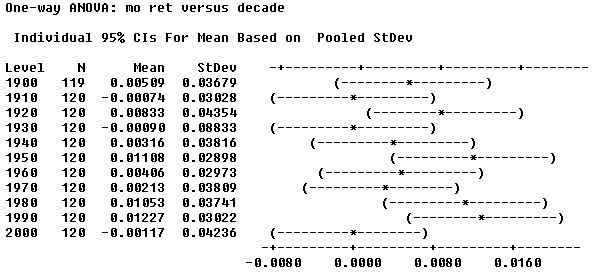
Note that the 2000 decade was one of only 3 (1910, 1930) with negative mean monthly returns. The two prior decades, 1980's and 1990's, both had the largest mean monthly return since the 1950's, and the 50's, 80's, and 90's - the top 3 - all occurred in the last half of the century.
I also plotted log(sp500) within each decade. Drift is noticeable in some of the decades, and noticeably absent in others.
Mar
31
Commodity Tail-Wind, from Jeff Rollert
March 31, 2010 | Leave a Comment
 My work indicates that most of the drop in commodity inputs, including PET and other plastics, has run its course on improving company margins. Now revenue gains have to increase greater than cost inputs, and I am finding little discussion on this. I would appreciate thoughts from readers of the site.
Vince Fulco comments:
A few of my fundamentally driven long-short buddies concur. As I recall during the 1989-1993 and 2001-2003 periods, the pauses in the move to Dow 36K came from the periodic realization that while margin recovery was the easy/quick part (slash and burn everything in sight), it was the top line growth that remained halting & lumpy and required the real heavy lifting.
Mar
8
Lessons From Amazon’s Success, from Vince Fulco
March 8, 2010 | Leave a Comment
Here is a great post on the assertTrue() blog on lessons from Amazon's success.
Dec
26
Lady Gaga: 10 Things We Can Learn, from Victor Niederhoffer
December 26, 2009 | Leave a Comment
 The great ascent of Lady Gaga from an also-ran performer in the Lower East Side techno-rock clubs a few years ago to number one selling recording artist in five countries, four million albums sold, and 20 million singles, rivals nothing so much as the ascent of Killmanjaro in 5½ hours or Apple's 4000% rise from 5 to 210 and the fourth largest market cap company in four years. Here are some of the things we can learn from her about how to be successful in the markets.
1. The Lady has a core of admirers she can always count on: the gay community. "I've got so many gay fans and they're loyal to me. They'll always stand by me and I"ll always stand by them." Apple's loyal fans are those that started out with them making music on their first computers and the minority group that liked the Apple operating system over and above the mainstream Microsoft one.
2. The prouct must be packaged and designed with great care and verve. Gaga has a special team, the Haus of Gaga, that designs all her clothes and stage performances. "When I'm writing music I'm thinking about what I'm going to wear on stage." Apple's packaging, its vivid colors, its compactness, directness, ease of use is crucial to its success.
3. You have to be technical to be a success. Gaga was playing by ear at the age of four, planning to go to Juilliard at 13. She writes her own music and her voice was good enough to attract Akon to sign her. The companies that have had the highest returns are people by engineers and computer scientistis with technical degrees.
4. You need a vision to be successful. Gaga didn't try to be the world's #1 singer or its most profitable. But she had a vision to combine glam rock with simple melodies. The best performing companies, Apple or Cisco or Whole Foods, have a product that makes life better for their customers, and they aim to be the best at it, and stick to their knitting.
5. She gets great reviews from the critics and this filters to the masses. All the best-performing companies reach out to the idea that has the world in its grip. They are all huge supporters of the current administration and reach out to unisex and redisbrituive policies so that the critics who share their persuasion will be sure to nominate them for awards. The most popular song of Gaga makes fun of rich kids that want material goods. When will she be invited to the Oval?
6. She has a simple product and a simple name. It's four letters and two syllables. And she combines simple movements, simple melodies, and simple rock rhythms in her songs. The price to weight ratio of Apple products is comparable to her own.
7. She stands on the shoulders of giants. She has borrowed from all the most popular idols that preceded her including Michael Jackson, Madonna, Blondie, and Andy Warhol. To be successful you need the base of fans that your predeceessors have accummulated.
8. She is shocking and exuberant in the things she does. The bubbles that she wore in Rolling Stone remind me of the glass houses Apple sells their products in, and her performances on stage are reminiscent of the conventions where Apple unleashes its products.
9. She has a completely integrated operation, writing her own songs, dancing them, designing her own clothes, and distributing them through a company she owns. The control of product from start to finish a la Apple's designed marketing and then retailing their own products is crucial nowadays to the most successful companies.
10. She is always ready to seek the limelight. She strives to have the best product, is proud of it, and will stop at nothing to popularize her brand. If it requires appearing nude, why that's just more publicity that her critics and core fans will love.
Kim Zussman comments:
This wonderful analysis also convincingly articulates the ugly, banal, cynical, pandering con of capitalism in general and investing in particular. Presumably the patina of beauty derives from the knowledge that it is facade.
Add to AAPL's list recruitment of the left, which targets Wintel for viruses but leaves MacAlone - encouraging climate coolers to take the path of least resistance.
Relatedly, Madam Gaga also evidences survivor-bias: How many thousands of performers try different angles but don't make it, then with the benefit of hindsight we ascribe causality to the at least partly accidental qualities of the successful?
Vince Fulco adds:
 I would venture Lady Gag Gag's actions, as I like to call her, is bleeding into other artists' styles. Forced to watch Shakira's latest DVD by my significant other yesterday, it was obvious she's leaning much more risque in movements, outfits and dance routines. She certainly doesn't need to given her voice, lyrics and natural beauty. Beyonce seems to be doing the same. Although I catch these performers infrequently, who passes up an undulating set of hips that the wife gives free pass on viewing?
Dec
14
The Blind Side, from Victor Niederhoffer
December 14, 2009 | Leave a Comment

The Blind Side is one of those movies that makes life worth living forever. What other such movies, plays, music, literature would you put in that category?
Vince Fulco replies:
Movies:
The Road to Perdition– everyone who participated in it was at the top of their game from writers, actors (primary & secondary), producer, director, cinematographer, musical director. It made for a polished period piece with tons of emotionally charged moments and an unexpected ending.
Boondock Saints– obscure, independent type movie; very novel story telling seen both by the vantage point of the perpetrators (Irish Mob in South Boston) as well as the talented detective trying to unravel a recent flair-up in gang on gang activities (Willem Dafoe). A great example of the grey areas in life; i.e. if you are using extreme violence against a rival gang to protect one's innocent neighborhood residents, are you a saint or sinner?
Gandhi– A masterpiece in so many ways, no more needs to be said.
Laurence of Arabia– ditto.
I am a sucker for underdog movies where the lead character rises from his own self involvement and selfishness to sacrifice everything for the greater good. Not 'Laurence'–obviously his striving for personal greatness led to its own extraordinary achievements but as I get older, the accomplishment of creating these complex, grand movie projects is inspiring in its own right.
Books:
 Shogun by James Clavell
Anna Karenina
Two monumental undertakings by the authors which fully develop their characters and keep the reader engrossed from cover to cover. As for the latter, although it has been years, as I recall, the ability to interweave multiple complete stories and have them entertaining and believable was sheer genius.
music:
Anything by Yo-Yo Ma and separately Tan Dun.
Nick White responds:
 Martha Argerich's rendition of the first movement of Rachmaninov's 3rd Piano Concerto with the Radio Symphonie Orchester Berlin and Riccardo Chailly conducting.
Her magisterial expression of the full range of human emotion in this performance is, in my opinion, unparalleled in any other work.
Thomas Miller adds:
Miracle on 34th Street and It's a Wonderful Life. Both made shortly after end of WWll. Still immensely popular 60 + years later.
Jeff Watson writes:
"Surfing for Life", is one of those special movies that makes one want to live forever. That's the movie that deals with all the old people who still surf well into their 80's.
James Lackey writes:
Cinderella Man (2005) …. Crowe as Jim Braddock is a good one. Invincible 2006 Wahlberg plays Based on the story of Vince Papale, a 30-year-old bartender from South Philadelphia who overcame long odds to play for the NFL's Philadelphia Eagles in 1976..
Ironic, I watched It's A Wonderful Life with my kids last night. What cracked me up is my quest to please my wife.I remember 10 years ago when my boy was 4, I said "you're a bad boy" she said No no no what he did was bad, he is not bad. Ever since I have been working on my syntax to get the exact same point across with out damaging my own kids for life. ha.
Yet in It's A wonderful life the mom calls her sons idiots. It cracked me up as she was kidding sit down and eat you two idiots. The druggist smacked little George Baily around for being lazy. Baily tells the biggest backer and connected man in the county off countless times..turns down a 10x salary increase because he knew it wasn't best to sell his beliefs for money, but all the while hating his town his nickel and dime business where he cant profit much by helping others. He complained all along..which was hilarious "trapped"
Man on Porch: Why don't you kiss her instead of talking her to death? George Bailey: You want me to kiss her, huh? Man on Porch: Ah, youth is wasted on the wrong people.
George Bailey: Merry Christmas, Mr. Potter! Mr. Potter: And Happy New Year, In Jail! They're At Your House Right Now!
George Bailey: [yelling at Uncle Billy] Where's that money, you silly stupid old fool? Where's that money? Do you realize what this means? It means bankruptcy and scandal and prison. That's what it means. One of us is going to jail - well, it's not gonna be me.
Mary: I feel like a bootlegger's wife!
Stefan Jovanovich writes:
 It's A Wonderful Life is certainly popular now, but it was a bust at the box office when it was released in 1946. Its flop effectively ended Capra's career. The actors - Jimmy Stewart, Donna Read - went on to further success; but the plot reminded people of the bank runs of the pre-War era (hardly a happy memory) and they stayed away in droves. The Best Years of Our Lives was the hit that year; it was (among other things) about a banker who returned to work from the war and decided to lend a farmer money, not about depositors clamoring for their money back from an over-extended S&L.
Nick Procyk adds:
I would second Cinderella Man and Invincible.
March of the Penguins is a true-life movie about a group of emperor penguins that survive the harsh polar winter, breed, search for food — all captured in amazing photography.
Eight Below is another heartwarming movie based on a true story about a guide and his eight sled dogs. The guide is driven to reunite with his canine friends after they were stranded in Antartica during the brutal winter. It's a wonderful story about friendship, courage, and faith.
Riz Din writes:
 The Rocky films, all of 'em. I guess they just caught me at the right time. The first is the best, and Balboa doesn't even win the final bout. His victory is of another sort. The rest of the series works on several levels. You have both the quality of the Rocky films and Stallone's actual career ebbing and flowing with the ups and downs of Rocky's character. The score is everyone's 'go to' music when they want to get pumped up and motivated, the dialogue is wonderful, the characters memorable, and there are many lessons that can be drawn from the storyline, both good and bad.
From the first film:
Rocky: I been comin' here for six years, and for six years ya been stickin' it to me, an' I wanna know how come!
Mickey: Ya don't wanna know!
Rocky: I wanna know how come!
Mickey: Ya wanna know?
Rocky: I WANNA KNOW HOW!
Mickey: OK, I'm gonna tell ya! You had the talent to become a good
fighter, but instead of that, you become a legbreaker to some cheap, second rate loanshark!
Rocky: It's a living.
Mickey: IT'S A WASTE OF LIFE!
John Lamberg writes:
Life worth living forever? Well, none of the following make that cut, but my favorites are:
Hans Christian Andersen's works. (The Little Match Girl is perhaps the saddest story I ever read, and it stuck with me since childhood. We'll see if Gregory Maguire's "Matchless", a re-imagination of the story compares.)
Holst, The Planets
Bodysnatchers (original)
Forbidden Planet (not for the acting or script, but for Dr. Morbius' secret)
Vincent Andres adds:
The Last Kings of Thule - Jean Malaurie, about ordinary heroes
Many of Giono's books, eg Regain - J. Giono (in french onl)
Many of Pierre Magnan books
Dava Sobel's Longitude
Order Out of Chaos by I. Prigogine
L'imprévu by I. Ekeland (in french only)
Des rythmes au chaos by P. Bergé, Y. Pomeau, M. Dubois-Gance, 1994.
For pointing an interesting trail, Deep Simplicity: Bringing Order to Chaos and Complexity by John Gribbin.
The Foundations of Ethology by K. Lorenz
Studies in Animal and Human Behavior by- K. Lorenz
The First Three Minutes: A Modern View Of The Origin Of The Universe by Steven Weinberg
Mon oncle d'Amérique by A. Resnais (in French only)
Dec
11
Whither Japan? from Dan Grossman
December 11, 2009 | 4 Comments
 I used to do a lot of business in Japan and I think very highly of Japanese businessmen (unfortunately they rarely include women at high levels). They have an industrious, highly intelligent population, are very interested in business, and a good base as the second largest economy in the world.
It is a great mystery to me why they (and their stock market) have not done better in recent years and I have never seen any good explanation of it. Okay, they had a bubble that burst, government policies that were not great, and they have an aging population. But so what? They had plenty of opportunity to recover on their own in spite of whatever the government has been doing. (BTW their government policies could not be any worse than our current ones, so if government policies are the test, we're in big trouble.)
Has anyone seen or can anyone give a decent explanation of why Japan has lagged?
Ken Drees writes:
1. LDP party out of power after 55 years.
2. Exports and profits slumping via USA trade like others Asian exporters.
3. Big(gest) holder of USD denominated debt.
4. Aging populaton (nothing new), but 81 billion spending package just announced, more internal stimulus to follow?
5. Need to diversify their surplus holdings like others (China, Brazil, Russia, et. al.)?
6. New party administration playing a little differently with USA — recent Obama trip no real results, prior to that some grumblings about USA debt, etc.
7. Japan equities — bottoms in 1998, 2003, 2009 — skewed symetric reverse head & shoulders – or just bumping along the bottom?
8. Will need to strengthen export markets everywhere and keep USA markets open and profitable. Japan's growth lies with its neighbors if USA doesn't fix itself.
9. Yen carry trade over, yen rising — conflicts with strategic direction that exports and export profits need to be robust.
10. Zugszwang-lite Japan — any small move doesn't change game for the better. Are there any good moves available?
How will the new party lead? If they cannot rope in the yen to improve exports can they stimulate spending via QE and weaken yen at same time? Or is this approach too slow and meandering? There seems no real strong moves available unless global imbalances happen first and allow Japan countermove possibilties. Japan seems still to be unable to escape via its own power.
Is Japan getting tired of being tired?
Charles Pennington adds:
 A broad-brush explanation is that the Nikkei got way out of line with other world markets and has spent the past 20 years returning to normalcy.
The Japanese price to earnings ratio was "well over 100" in the late 80s, and now it's 33 (reported by today's Financial Times), still higher than the US at 22. Earnings for the S&P are up about 2-3 times over their level in 1989, and perhaps the Nikkei's are as well, but if the P/E fell from, say, 200 down to more normal value of 33, a value much more in-line with other world markets, well, that explains a lot.
The Chair will rightly point out that this is retrospective, descriptive, and not predictive, that Japan's interest rates are (or at least were) lower, that the accounting may be different. Also, Mr. Grossman doubtless already knows all these figures, so he is looking for a better explanation, which I don't have.
Kim Zussman adds:
Country-stock could be like "best company" studies, showing admired firms under-performing the rest. Presumably established/successful companies/economies have less upside than currently dire situations. And more downside?
Vince Fulco replies:
To the list I would add traditional factors such as:
1. Shareholders — very far down the societal list of all stakeholders in the corporate world. The stock market is generally considered more for gambling (no jokes Dr. Z!)
2. Much heavier reliance on debt financing (too much) due to roots in maibatsu/keiretsu structure whereby a conglomerate's banking branch handles all the financing needs
3. No Carl Icahn or Guy Wyser Pratte influence to shake up entrenched mgmts and unlock under-utilized assets. The quote is 'the nail which sticks up gets pounded down'. A few have tried over the years but are usually labeled degenerates or cowboys and run out of town one way or another.
4. Years of very low ROI, white elephant projects by the government, to keep happy important constituents of the LDP (the old group in power) such as construction and the mob — i.e. the bridge to an island with 50 people on it, which we almost got in Alaska a few years back.
5. Legacy obligations which haven't been addressed but simply kicked down the road as we've emulated so well in the last 12 months.
Ken Drees responds:
 Vince, Kevin, Kim and Charles have all provided excellent observations as to Japan's inbred entrenched-ness, inabilities to move, and relative over valuations. Also, the idea that is was the once high flyer status albatross, so all these past behaviors are in the rear view mirror, yet they continue to taint the view of Japan as an old has-been power country. But change agents may now be inside this yesterday/today paradigm. So far Palindrome's reflexive reinforcement of trend is still in force. The malaise continues. Will some new change agent surface? Will the reflexive reinforcement finally be breached.
The early elements for a change exist. To bet on a new bullish Japan is a long shot. But how much money can be made betting the field? Tax policy can be repealed, monopoly/hands in hands can be abolished, small investors can be made more ownership level. All the levers to lift the old dead stump and turn it over are at the ready. Or is this a dead end due to lack of will? Is Japan a stunted growth, never ever to leave off-broadway? If a global imbalance rises up, will Japan change tack and ride out on a new wind? I am watching Japan, if only since they since they are shackled to the USD. Maybe the impetus for change is at hand. This new administration in Japan — what do they owe the US?
Stefan Jovanovich replies:
The Japanese are certainly not hidebound where their Navy is concerned. They are the dominant sea power in their part of the world. From the folks at StrategyPage.com:
"Japan is currently the second largest naval power in the Pacific (after the United States), with a total of 32 destroyers, nine guided-missile destroyers, and nine frigates. The older Tachikaze-class guided-missile destroyers are being replaced by the new Atago-class destroyers. Japan also has 16 modern diesel-electric submarines. The Chinese navy is larger in terms of ships. They have 25 destroyers and 45 frigates. However, of these 25 destroyers, 16 are the much older (than Japanese equivalent) Luda class. Most of the frigates are the obsolete Jianghu class ships. China has 60 diesel-electric submarines, but most of them are elderly Romeo and Ming class boats. China's Han class SSNs (nuclear attack subs) are old and noisy. In terms of modern vessels, China is not only outnumbered, but the Japanese ships spend more time at sea and the crews are better trained. The Chinese are also at a disadvantage when it comes to naval air power. Most of China's naval fighters are old. They have a growing number of modern J-11s (a copy of the Russian Su-27) and the Su-30MKK. Japan is almost at parity in terms of numbers (187 F-15J/DJs and 140 F-2s to 400 Chinese J-11/Su-30MKKs). Japan has better trained pilots, although China is trying to close that gap as well."
Yishen Kuik adds:
 The attention to detail and sense of duty of their workforce is amazing, and the public infrastructure in Tokyo is of a very high quality — certainly better than Boston, DC, New York or the Bay Area. Tokyo is much bigger than all these four areas. It makes New York seem small.
It's not entirely clear to me why their equity markets haven't done better, but the "obvious" explanations of long term multiple contraction and shrinking internal aggregate demand seem to be correct.
I believe GDP per capita in Japan has been rising all along at the same pace as in the US since 1989, so it isn't as if quality of living in Japan has been frozen at 1989 levels. From what I can tell walking around the streets, they still enjoy a comparable standard of living to anywhere in the OECD, and have an unemployment rate (whatever that means in Japan) of 5.0%
Henrik Andersson replies:
Some investors are expressing great fear about the debt given the large amount maturing in the coming 12 months that is held by citizens, as Yishen writes, and given it has "no foreign demand, no domestic savings, structurally declining tax receipts and savings due to demographics, etc." Any views on this?
The top line numbers for the country are stagnant, but the per capita numbers don't look so bad. Japan might have a ton of public debt, but most of it is yen denominated and some 3/4 of it is held domestically by its own citizens.
Dan Grossman writes:
 Two thoughts perhaps follow from the helpful comments of Prof. Pennington and Mr. Kuik:
1. Based on the two-decade decline in average Japanese stock PEs from 200 to 33, why shouldn't average US stock PEs decline further from the current 22 if government policies following bursting of the bubble are equally ineffective in the US as they have been in Japan?
2. If since 1990 the U.S had avoided illegal and legal immigration anywhere near the extent to which Japan has, the US unemployment rate would probably also be 5%.
Vitaliy Katsenelson adds:
Please look at slide 14. Japanese valuations at the of 1989 were incredibly high, add to that a lengthy deleveraging process on the corporate side and leveraging (debt to GDP has tripled) on the government side and you also have anemic economic growth.
Vince Fulco writes:
Here is fascinating article in the WSJ re: a foreigner helping a small japanese village manage the downside of the demographic slowdown. One wonders how much more pervasive this sclerotic 'no change' attitude really is…
Charles Pennington adds:
There's a nice column by Lisa W. Hess in the Dec. 28 Forbes about investing in Japan.
She claims that small cap companies are even more undervalued than large cap, and recommends buying the Topix rather than the Nikkei.
Nov
22
Deception, from Victor Niederhoffer
November 22, 2009 | Leave a Comment
 The best books on deception are the best books about the market. The best book about the market according to Martin Shubik is Ben Green's Horse Trading. I would add that there is a good section on deception in EdSpec. And I would point out that a systematic categorization of deception is essential and this is available in the ecology literature following J.R. Krebs's citations on deception in various species, especially monkeys.
Adam Robinson says:
Of course, as I've eulogized no end, The Farming Game by Bryan Jones also has much to say on deception in the buying and selling of livestock, and does so with wit and insight.
Alston Mabry recommends:
I like A Treasury of Deception: Liars, Misleaders, Hoodwinkers, and the Extraordinary True Stories of History's Greatest Hoaxes, Fakes and Frauds by Michael Farquhar.
Russ Herrold re: The Farming Game:
I purchased The Farming Game on your recommendation and enjoyed it. It was a bit dated as to price examples (they look like a series from the mid 1960s to the mid 1970s), but the underlying principles remain sound. The book starts a bit slowly, setting up some stereotype character sketches, and then strings them together a bit, a bit later in the book.
Kim Zussman writes:
Here is my Deception reading list:
Stocks for the Long Run, Siegel
Irrational Exuberance, Shiller
A Random Walk Down Wall St., Malkiel (efficient markets)
Beating the Street, Lynch (inefficient markets)
Trade Like a Hedge Fund: 20 Successful Uncorrelated Strategies & Techniques to Winning Profits, Altucher
The Intelligent Investor, Benjamin Graham (value)
Common Stocks and Uncommon Profits and Other Writings, Fisher (growth)
Futures: Fundamental Analysis, Schwager
Technical Analysis of the Financial Markets: A Comprehensive Guide to Trading Methods and Applications, Murphy
Contrarian Investment Strategies - The Next Generation, Dreyman
Trend Following: How Great Traders Make Millions in Up or Down Markets, Covel
Momentum Stock Selection: Using The Momentum Method For Maximum Profits, Bernstein
(eigenvector = deception)
Vince Fulco adds:
To Dr. Zussman's excellent list, I would add another one very much off the radar screen. In Hostile Territory by Gerald Westerby is purported to be written by a former Mossad agent and profiles his adventures in Africa, the ME and Europe. I consider it of the best books written on the manipulation of human perceptions, mental flaws and frailties. I try to read it once a year to condition myself to avoid the traps. It is right up there with Cialdini, but the dynamic and life threatening challenges faced by the author are much more entertaining while providing extraordinary lessons on the subtleties of behavior.
I found the walk through on structuring a diversified [here: agri-]business very approachable, and anticipate lending it out to give context for further discussions to some I work with and mentor.
Jeff Watson comments:
 The best book I ever read on deception was called The Game by Neil Strauss. This book is the holy grail for pickup artists, but the lessons easily translate into all areas of life from sports to trading to games. It was very entertaining and well written, znd Strauss gives point by point instructions on how to manipulate, deceive, obfuscate, hypnotize, and control your opponent or object of desire. Strauss takes time to delve into the science of how to pick up women, and believes in rigorous testing and the book surprisingly isn't as misogynistic as one would expect.
Bruno Ombreux writes:
One absolute classic is Arthur Schopenhauer's The Art of Controversy. It also goes by a different title: "The Art of Being Right". Here is a Wikipedia article with the full list of stratagems. And it is available for free at Gutenberg.
Kim Zussman writes:
The most respected investment books of the 20th century all have eigenproblem of hidden utility. Even when authors are intellectually honest, it's hard to understand how they could escape distortion induced by rewards.
Some are selling their strategy (read my book but invest with me), talking their book (I'm deep into growth or value, so please buy these), pandering the academy (status as published professor), making a career of teaching how to trade, increasing status, creating a legacy, etc. This is similar to the more general, "how many friends do you have who don't profit from you?"
Bruno Ombreux responds:
I haven't read all the books in Dr. Zussman's list, but among those I've read, I think two are not deceptions:
A Random Walk Down Wall St., Malkiel (efficient markets)
Most investors would be better off reading this book and stopping there. Also:
The Intelligent Investor, Benjamin Graham (value)
I haven't finished this book because after the first two chapters I realized it was just a watered down version of the first edition of Security Analysis, from the same author + Dodd.
Security Analysis is an excellent book that makes excellent points for the era it was written in. Their technique of looking into detail at companies accounts is similar to detective work, which itself is an application of the scientific method. In my opinion, this kind of financial analysis is a valid way to proceed.
Nigel Davies comments:
The nature of deception may be much deeper than many authors make out. I would say that the origin of all deception is in fact self-deception and that the supposed 'deceiver' is doing nothing more than moving into the vacant space within our understanding.
George Parkanyi writes:
 There is a saying. "Fool me once, shame on you. Fool me twice, shame on me." To me it's just a given that traders, particularly those trading in size, use techniques to mask their intentions. And sure, those that have knowledge of them, run stops. That's just one of many influences that make financial instruments wiggle on a day-to-day basis, and you would not only have to sort out what is "deceptive" behaviour vs stupid vs herd behaviour, but whether the deception was or was not in your favour. Unless you have a large network of people you can call on the inside that can give you information that helps you take the temperature of a given market, I don't see the point of trying to personify this market move or that market move as "deception", especially in a big liquid market that is essentially a non-linear system subject to multiple influences. If there's a pattern that you detect and can exploit then so be it. But does it matter if it is "deception" vs. sentiment or just a big whale moving through?
Don't get me wrong. Reading about deception is certainly interesting. As a Scout leader, Arthur Baden-Powell's role in the Battle of Mafeking during the Boer War is an excellent example. In fact, BP's entire early career was based on deception. But I personally don't see the value in getting overly concerned about deception in the markets, though I understand that others do.
I think if you have a general sense of the day-to-day character of a market that you have researched and trade regularly, and do some research to try to anticipate macro influences on that market that might cause it to trend, the rest can be handled with money management.
Stefan Jovanovich replies:
Baden Powell's energy as a commander was probably the decisive factor in having the deception succeed:
From British Battles:
Baden-Powell conducted the defence of the town with great energy and resource, leading the Boers to believe there was a larger garrison than was the case. In November 1899 Baden-Powell launched a series of raids on the Boers lines that caused him some casualties but made the Boers wary of the garrison.
Initially the Mafeking garrison had no artillery. Baden-Powell improvised various items to look like real guns and trains, while engineers manufactured a gun, known as the "Wolf", from a length of steel pipe. The Boers used the 2 two inch guns they had captured from Dr Jamieson to bombard the town. Dud shells fired from these guns were reworked and discharged at the Boer lines from the Wolf. An officer found an old muzzle loading naval gun serving as a gate post. This gun was christened "Lord Nelson" and drafted into service. Dynamite grenades were manufactured and thrown at the Boer lines and a small railway line was built across the town.
In sharp contrast to the indolent Ladysmith garrison, Baden-Powell kept his men constantly on the move, raiding the Boer lines and keeping the besiegers on their toes.
Scott Brooks adds:
Atlas Shrugged not only speaks of deception, but the deceivers are open about their deception. The deceivers/looters are like gangsters who are in complete control in kick sand in the faces of the producers, daring them to say A is A and damning them if they do, all the while fooling the masses with their A is B pablum. The parallels to our world today are stunning.
Oct
30
Travel Observations from Bologna, from Vince Fulco
October 30, 2009 | Leave a Comment
 Just back from a one-week trip to Bologna, a Northern Italian town know for its academia, hospitality, Etruscan ruins and extraordinary gastronomic offerings. We visited the same city three years ago as it is known for its non-touristy, 'the real deal' atmosphere. Consumer prices are startling. The buzz of the city feels the same, call it La Dolce Vita with a measured forward pace. Definitely no signs of the dire Spanish malaise nor the forecasted tough times expressed by the new German Finance Minister creeping in yet. However, even netting out the obvious €/USD changes and the 20% VAT on most products, the good life is becoming costly.
We ate at a number of places including white tablecloth restaurants, Mom & Pop Trattorias and the periodic hole in the wall frequented by the natives. From high end to low end, the food was extraordinary and not to be experienced anywhere else. As for the cost, a decent bottle of local Lambrusco or San Giovese wine will set you back 30-45€ while a modest plate of pasta as a first course is 12-18€ and a second course of protein is 22-30€. A plate of sweets will set you back 6-12€. Everything on the menu is 2-8€ up from when we visited last. Ya better start digesting before you do the inevitable conversion.
Due to an infernal scheduling change at British Airways, we were forced to switch from Heathrow to Gatwick for the legs of the trip and both of our drivers concurred with the nutty price levels on the continent. As they said, "So long as you're being paid in Euros, fine. Frankly we don't buy anything here in England either…When we need something we take vacation in the US and stock up."
Fortunately the handbag gods were looking the other direction when my wife entered a few luxe establishments but the boot gods got their mitts on her and we came home with a few new acquisitions. Still wondering why something as durable as a boot needs to be replaced every year?!?
Sep
15
Sell New Highs?, from Paolo Pezzutti
September 15, 2009 | 13 Comments
What is the meaning of this long, long leg, low volatility but directional, with many up consecutive days? Maybe we have to see it as a sign of decreased strength to move to the upside. Maybe it is just a market where bears are still fearful to step in. The down gap of Monday was another lost opportunity for a correction. When will it come, what event will trigger it?
Steve Ellison laughs:
The correction will begin five minutes after you decide you can't stand it any more and buy at market…
George Parkanyi urges caution:
Well, if we muddle into the next earnings reporting quarter in October, the bar was so low last year that we'll probably see more "surprises" to the up-side. I'm not sure you want to be short that. I'm not sure I want to be short that.
Vince Fulco reports:
Sitting at a fancy bar/restaurant I rarely frequent here in the Midwest, have had the chance to listen to ancillary conversations at other tables. Helps to have been on a trading desk with two phones to ears while talking to a third person besides. All the talk is about the dreck stocks– AIG, FNM, BSX, et al. I feel like I am back in 1998 when the 'concept' stocks went gangbusters while liquidity remained too loose. I hate concept stocks like the plague but you know you are getting old(er) when the cycles keep repeating.
Aug
18
The Hurt Locker, reviewed by Vince Fulco
August 18, 2009 | Leave a Comment
 'Hurt Locker' is a slang phrase often used in the military for 'a metaphorical place you go when you are painfully unsuccessful in a competitive event.' It is also the title of a new movie by director Kathryn Bigelow. For those who see similarities between intelligent, fast-paced decision making in leveraged trading and those made in the fog of war, this film will entertain. It depicts the day-to-day lives of specialists in an elite bomb disposal unit of the US Army tasked to Iraq in the mid 2000s. Particularly enjoyable is the interplay among members of the unit who carry themselves in a rational, cautionary, procedural way and a new leader who comes across as totally 'unhinged' but is actually one of the most talented in the field. It is also easy to empathize with the head of the unit as he's found the only thing he wants to do in life no matter what the risks or cost. I won't spoil the plot by drawing analogies to trading but you'll be surprised to find 2+ hours have passed when the lights come up. I highly recommend it and mention it due to its limited rollout.
The Hurt Locker, reviewed by Christopher Goodwin
May
11
Market Memory, from Duncan Coker
May 11, 2009 | 3 Comments
 Efficient market proponents argue the market has no memory, that every day is independent of the previous, like each roll of the roulette ball. I believe the market does have a memory based on the cumulative memory all the current market participants. My memory seems to focus on all my losing trades which I can recall with intense detail. The '87 crash is probably in the market's memory since many now trading lived through that first-hand. Maybe the 1970s bear market is part of its memory, but I doubt the '29 crash or the 1930s or 1907 panics are in its memory. The last six months will be remembered by the market for a long time. This will add some risk premium for those who like to trade from the long side.
I have always like this quote from William Faulkner: “Memory believes before knowing remembers. Believes longer than recollects, longer than knowing even wonders.”
Like a lot of Faulkner, the meaning shifts every time you read it. It takes us a long time to understand our past.
Vince Fulco writes:
It is tough to imagine the older worker ants represented by the baby boomers gravitating back to equity markets after being burned so badly twice in a decade. Particularly since in this downleg, perceptions have grown that contractual obligations have weakened so dramatically. Thinking about the creditworthiness of long term disability and life insurers specifically. Perhaps some of the 'fool me once, shame on you…' mentality will creep in too.
May
3
A Nice Touch, from Victor Niederhoffer
May 3, 2009 | 12 Comments
 One always expects the Japanese to be very honest. It is well known that if you lose your wallet loaded with cash in Japan it will be returned to you a year later intact, and that the only place as safe as Japan is Arthur Avenue in the Bronx. The idea of even looking at a dinner tab to check its correctness is certainly inappropriate since 95% of the customers are Stuyvesant and Julliard blood brothers. So I was stunned when eating at Masa the other night where the price had recently been reduced from $500 to $400 to find the following item printed on the check as it was handed to me, and had to look at it closely since I am over 40 and don't wear glasses. "There is a service charge of 20% added to the check. But it is not a gratuity. It covers the administrative and operating expenses of the restaurant and is not shared with employees." What a way to end a beautiful dinner. Presumably other restaurants and other businesses have operating expenses also? And presumably when one is told there will be a 20% service charge, one would expect it to be a gratuity? There are all sorts of new ways for companies to survive the recession. Restaurants in New York are taking to adding a surcharge onto the bill if you wish or eat bread or drink water. But most businesspeople know that making a customer feel that he's been gipped is not a long run way to success. On the contrary, the customer should always feel he's getting more than his money's worth. I would be interested in other special shortsighted recession-beating forays that our specs have been exposed to.
Steve Ellison writes:
 Airlines seem to go the extra mile to make customers feel gipped. On a recent trip, U.S. Airways charged me $25 to check one bag. As I was checking in for a redeye from L.A. to Boston, United Airlines offered to upgrade me to a seat with a few more inches of legroom for $25. When planning this trip I used a search engine that showed both the airlines' stated prices and the real prices after adding on surcharges and fees. In some cases the real price was nearly double the stated price.
Craig Mee comments:
Another twist on this is completely the opposite: 'pay what you think it's worth.'
The example I link to is in kiwi land, but I've heard exactly the same happening in London, and with the manager staying most of the time there in front, while their people look after them. If I ran the restaurant, I'd just make sure that the tables were as far away from the exit as possible, so anyone who tossed you five pence had the walk of shame to deal with it (i.e the opportunity for waiting staff to throw them that knowing look of "thanks for nothing").
Vince Fulco writes:
 Most recently while shopping for multi-monitor video cards from numerous manufacturers, critical cables for the interfaces were not included. They easily added 30% to the overall cost, and I assume the resulting markup is many times greater vs. if everything were included with the device itself.
There seems to be a not too subtle attempt at teaser prices even in more traditional venues. Southwest Airlines is a great example. New to Minneapolis, they're heavily advertising their summer fares to Chicago for $49 among other attractive deals. Not surprisingly, any 'deal' requires traveling at the worst possible times and multiple interim stops; sometimes as many as three or four. Not a way to start a relationship with newer customers and a disconnect from their message of being clear about the total prices vs. the other guys.
Another current example is a regional furniture company advertising all products at 77 cents on the dollar. What marketing psych service advertised the switch from the old N% off sale? It doesn't resonate well.
Marion Dreyfus adds:
 Take advantage of the numerous specials in travel now, especially pre-summer. TravelZoo offers a raft of deals that are good, though you are warned about taxes that can make a huge difference in the stated to real price. Also note that some fail to include key variables that change the price. Departure days can be irregular, inconvenient or uncomfortable, double occupancy at a hotel may be expected. You may be expected to rent a car.
Apr
23
Time Series Analysis, by James Sogi
April 23, 2009 | 4 Comments
 Time Series Analysis with Applications in R, by Jonathan D. Cryer and Kung-Sik Chan, was advertised to have the R code for its examples, but didn't. It has a few snippets for a few charts and an Introduction to R in the appendix. Kind of a rip off. I don't especially recommend it for those looking for some R code. There are the infuriating questions at the end of the chapter. I know you are supposed to work them out understand the material but I want a reference book. I'm not in college any more. I want the answers. It's more suited for entry-level college statistics.
There was an interesting chapter on trends in which they distinguish between stochastic and deterministic trends. Stochastic trends such as a random walk, have apparent "trends" merely as an artifact of the strong positive correlation between the series values at nearby time points and the increasing variance in the process as time goes by. This answers my question of why the time series charts line up. They distinguish deterministic trends, for example, the upward trend in temperature as summer approaches. There is a reason, a model for the trend, the tilt of the earth towards the sun causing higher temperatures.
Vince Fulco comments:
I've become partial to The R Book by Michael Crawley. A solid intermediate text with a walkthrough of various practical stats concepts. Best in electronic format at 950 pages.
James Sogi writes:
Quick study of Spus shows historical variance increases in the afternoons which is in line with Cryes theory of appearance of trends in random walk and autocorrelation of near time series points in stochastic trend and increase in variance. This ties together with the thread on apparent trends in spu series. Interesting how there's always a fresh way of looking at the same old stuff.
On a different subject, Soros says in his update to his recent book Reflections on the Crash of 2008 that it is wrong to model equities on the same basis as natural models like we often do here, like Lotka-Volterra etc, as human reflexivity and self perception leads to bigger trends, panics, booms, etc than natural phenomenon which is not self aware. He's not sure how to model reflexivity and is afraid of locking in a model to a fixed algo.
A counter example in nature would be study of stampedes, lemmings, migrations, panics, temperature spikes clusters, hurricanes and extreme events, earthquakes, and other outlier type natural behavior or other discontinuous or extreme type data. We'll have the 2008-9 data in our series going forward, so the model might adjust itself, and if not the model, the data will be there. Question is will means revert. For self protection we must err on side of different lower kurtosis plus fatter tails described more as Pearson Type Vii or Student t or Cauchy type distribution. Got a bit of negative skew in there now too.
-9 | 96
-8 |
-7 | 0
-6 | 833
-5 | 74433
-4 | 98753300
-3 | 98443210
-2 | 998877666553322200
-1 | 99877777766655555444432222222111111000
-0 | 97777765432111110
0 | 0011122222334444455556666666667777888999
1 | 0001112233336667889999
2 | 012233446677
3 | 01112233344447
4 | 011139
5 | 4468
6 |
7 |
8 |
9 |
10 | 4
11 |
12 | 6
Like the expert distinguished prof, the Palindrome experienced systemic breakdown as a young man in Hungary. This must be a life changing experience. For everyone who lived through 2008 it also will be a life changing experience, though not on the same scale as Budapest 1943 or in Lebanon, or the Balkans, Malay, China, Russia, Africa.
Apr
21
Citi’s Financial Results, by Vince Fulco
April 21, 2009 | Leave a Comment
We surely are in the twilight zone when capital constrained firms such as Citi can generate fictitious profits from their own debt's going down, among other favorable and highly questionable 'adjustments'. But isn't this part of the US system's ongoing accounting legerdemain? Social Security obligations growing? Ignore them. Cost of Iraq war? Keep it out of the annual budget process. And on the consumer side, incomes stagnant for years? Come up with new mortgage product allowing Joe Sixpack (or Winecooler) making 60K to afford a house' worth' 400K. Or crank up the credit card lending and hope that more stringent bankruptcy laws keep them toeing the line of self-imposed economic slavery. To paraphrase an old line, this is no way to run a debtor nation increasingly at the mercy of foreign investors.
Vitality N. Katsenelson concurred:
If you thought banks like Citigroup made money in the first quarter, think again. Its business just deteriorated and its bonds declined so much, but ironically that was one of the biggest moneymakers for Citi. They were able to record a decline in the value of their bonds as a source of revenues, which was almost double their reported profits. The lesson is: if you screw up, screw up big, drive your bond prices into the ground and voila', your profitability increases. Seriously, that is what happened to Citi last quarter.
Jan
30
Strange Headlines, from Vince Fulco
January 30, 2009 | Leave a Comment
 There is headline after headline about the commodity houses, like Koch Trading et al. getting long the underlying (talk at the time was low 50s) and having the deep pockets to carry six months or longer.
It strikes me as a bit strange since how often is the media ahead of the big trading wins? Maybe it is as simple as that this time around.
Kim Zussman writes:
Lots of moves obvious in hindsight are just too painful/risky to hold. One recalls certain home-builder shorts ca 2004-2005, which rose substantially before ultimately doing what was expected (of course after the positions were closed).
One definition of successful active investing is funding your conviction, and holding on through destructive price action until you are either rich or ruined. Survivor bias of war heroes, etc.
Jan
4
Modeling With Data, from Vince Fulco
January 4, 2009 | Leave a Comment
 Author's site with free book.
Modeling with Data fully explains how to execute computationally intensive analyses on very large data sets, showing readers how to determine the best methods for solving a variety of different problems, how to create and debug statistical models, and how to run an analysis and evaluate the results.
Ben Klemens introduces a set of open and unlimited tools, and uses them to demonstrate data management, analysis, and simulation techniques essential for dealing with large data sets and computationally intensive procedures. He then demonstrates how to easily apply these tools to the many threads of statistical technique, including classical, Bayesian, maximum likelihood, and Monte Carlo methods. Klemens's accessible survey describes these models in a unified and nontraditional manner, providing alternative ways of looking at statistical concepts that often befuddle students. The book includes nearly one hundred sample programs of all kinds. Links to these programs will be available on this page at a later date.
Modeling with Data will interest anyone looking for a comprehensive guide to these powerful statistical tools, including researchers and graduate students in the social sciences, biology, engineering, economics, and applied mathematics.
Ben Klemens is a senior statistician at the National Institute of Mental Health. He is also a guest scholar at the Center on Social and Economic Dynamics at the Brookings Institution.
Nov
1
Not to be Missed Article, from Vince Fulco
November 1, 2008 | Leave a Comment
 A not to be missed Haaretz news article detailing the letters of a Yiddish author and his experiences in the boom/bust periods of the Eastern Europe stock exchanges (ca 1890).
Riz Din responds:
Excellent stuff, Vince. This is a sad story of deluded ambition and greed, but it is smashingly told and packed to the brim with moments of hilarity, and at least this one is a fiction! Menakhem's wife is a truly wonderful creation. Her exchanges with Menakhem are packed with wit, scolding comments, and pleas for her husband to see good sense and come home. Alas, Menakhem's only concern is with the chase for riches.
You know things are going to end badly when Menakhem writes:
"….the word from Petersburg is, buy Transports for all you're worth! The whole world is holding them: Jews, housewives, doctors, teachers, servants, tradesmen - who doesn't have Transports? When two Jews meet, the first question is: 'How are Transports today?' Walk into a restaurant and the owner's wife asks: 'What's the latest on Transports?' Go buy a box of matches and the grocer has to know if Transports are up or down. In a word, there's money to be made here. Everyone is investing, growing, getting rich, and so am I."
A few lines from his wife:
"Shares, shmares! I'd rather own a rotten egg. No one ever made money by counting on his fingers."
"I wasn't raised in a home where we bought and sold air and God keep me from doing it now. From air you catch cold, my mother says. Who ever heard of a grown man playing in a market?"
A quick Google search for this legendary character brings up a few more pages of equally entertaining writing from the fictional Menakhem-Mendl, his wife still by his side. Here, Menakhem has quit trading and is looking to take up writing as a profession. Menakhem starts off writing a letter to an editor telling his story, of 'how I played the market in Odessa and Yehupetz, and how I sold my soul for fool's gold, Londons and stocks & bonds and every horse I could bet on, and how I went from rags to riches and back again, seventy-seven times a millionaire and seventy-eight a beggar.' His wife keeps calling him home and she is once more on the right side of the trade, for Menakhem's venture ends in tears and he soon writes, "I'm flat broke and in debt to my landlady.Not only have I run up a large food bill, I owe her for paper and ink."
Great entertaining reading for the weekend. The pdf of these letters is here. The pdf is wrongly presented in portrait instead of landscape so you may have to download it and then flip the view in your pdf reader.
Oct
25
Multi-Graphics Card Setup in Debian, from Vince Fulco
October 25, 2008 | Leave a Comment
Having just wrestled over the weekend with a multi-monitor, multi-graphics card setup in Debian, found a comment posted today on OneUnified to be useful. hope it saves some folks a few hours.
Oct
23
Differentials, from Vince Fulco
October 23, 2008 | Leave a Comment
Institutional investors now have a decade of no return. With some detailed credit work they can get 15-20%+ annualized from more senior securities and meet long term liabilities. Why subject oneself to the vol of equities when all your peers are moving to liability management policies and many are way behind the curve? The word on the street is hedgefund managers ( those still in existence) are blowing out their equity teams under the banner, "debt is the place to be for the next decade." Granted equities are undervalued by many historical measure but can stay so for a lengthy amount of time and the recent moves can be lethal if not careful.
Victor Niederhoffer asks:
Given that it would be possible to make 10% on senior debt, what would the required return on equities be at this level? That's my point about VIX and the required a priori rate of return.
Tim Melvin replies:
I would humbly suggest two times the level of senior debt rates.
Phil McDonnell ventures:
One reasonable and quantifiable approach might be to assume the market demands comparable Sharpe ratios from various asset classes. Consequently the ratio of the observed or estimated standard deviations of stocks to bonds may be the same as the ratio of the required expected returns.
Dr. McDonnell is the author of Optimal Portfolio Modeling, Wiley, 2008
Oct
23
Observations, from Victor Niederhoffer
October 23, 2008 | 6 Comments
 I always find Mr. Caravaggio's writings very thoughtful and insightful. However, I don't agree that it was a bubble. Prices were and will be completely justified. What was wrong was that the financial companies were leveraged to debt of 30 times their net worth. When the value of their assets which to a first approximation equaled their debt declined by 3%, their net worth was wiped out. The problem was that they made their money by making 1% more than their debt for a long time, and when the negative news had its day on home prices, it was enough to temporarily mark their assets down by 10 to 20 percent or so, without regard to subsequent return. What a former colleague insightfully would call "selling premium." Ouch. Okay, the banks erred. That doesn't mean that they will err again or that cycles will repeat or that the economy will not be resilient. Regions come back much stronger after natural disasters. Things have been worse. The banks were given say 100 billion of money from the rest of us to recoup their bad debt. They're happy. The process of recovery will occur. Proper money management and adherence to economic principles is called for now. The difference between the returns on equities and debt and the required rate of return a priori which is equal to the actual realized return on average, and the average non-understatement of earnings estimates is paramount. Let the bygones be bygones.
Vince Fulco adds:
Institutional investors now have a decade of no return. With some detailed credit work they can get 15-20%+ annualized from more senior securities and meet long term liabilities. Why subject oneself to the vol of equities when all your peers are moving to liability management policies and many are way behind the curve? The word on the street is hedgefund managers (those still in existence) are blowing out their equity teams under the banner, "debt is the place to be for the next decade." Granted equities are undervalued by many historical measure but can stay so for a lengthy amount of time and the recent moves can be lethal if not careful.
Riz Din replies:
Lack of returns is a problem for this generation but when I hear of the 'death of equities' I can't help but to think of past messages such as 'death of inflation' and 'death of cheap oil' and how they turned out.
Rocky Humbert remarks:
I'm watching for an inflection point on the number of Google hits for "Nouriel Roubini" as an important signal for a persistent rally in all risk assets.
Oct
7
Question for the Fixed Income Experts, from Vince Fulco
October 7, 2008 | Leave a Comment
I was wondering if 'the markets' are being held hostage by potential adverse results of the ISDA auctions for CDS settles of FNM, FRE, LEH and WAMU? See FT article.
The GSEs were completed yesterday but LEH on Friday, WAMU later in the month.
Aug
20
The Tao of Poker, reviewed by Vince Fulco
August 20, 2008 | 5 Comments
 A colleague recently mentioned The Tao of Poker by Larry Phillips. What an excellent find and addition to one's inner game library. Some of it reminds me of the wisdom Vic and Laurel have imparted over the years.
The author documents 285 rules for playing. The first couple are right up there with trading truisms-
1) Don't dig yourself into a hole when you first sit down.
2) If you think you are beat, get out.
3) Start with premium hands. When you get them, bet them. If the hand starts to deteriorate, get away from the hand.
4) If you don't think your hand is good enough, it probably isn't.
5) If you do make a mistake, correct it as soon as you can.
6) It's important that a player starts seeing "staying too long on marginal hands" as where the money goes.
7) The money you don't lose from staying too long in a hand and the money another player does lose from doing this is often the profit you go home with.
8) The hand you really want to spend your money on may be right around the corner.
I was also touched by the dedication which is one of the most heartfelt and genuine ones I've read in years. And of course strikes at the core of the trading experience.
""To Mandius…This book is dedicated to my grandson, Mandius, and the poker players of the future. As a friend once observed: They'll be a lot like we were– and they'll go through all the same things. They'll gather around the same green felt tables, suffer the same bad beats, and experience the same agonies of seeing an opponent hit a two-outer. They'll know the feeling of being down to their last dollar as the light comes up in the dawn, as well as the exhilaration of dragging in a mountain of chips on days when the angels hover around them. They'll experience high drama and low drama, hear great stories, experience laughter, and free food.
They'll meet people they otherwise would not have met–great people from every walk of life–some of the best people, it will turn out, they will probably ever know in life. If, as James Earl Jones once said, ' Children are a message we send to a time and place we will never see,' then these are our ambassadors to a poker future yet unseen. Accept this note of well-wishes from those who went before you– a message from the past.
Jul
20
Briefly Speaking, from Victor Niederhoffer
July 20, 2008 | 16 Comments
I often say you can't appreciate one market without taking into consideration the backdrop of impacts and effects of other markets. No better illustration of that than last week's action. Here are some indicia:
 Thus, Tel Aviv 25 broke 1000 and VIX broke 30, both for the first times since Mar 16, a nice four month anniversary.
Oil had its greatest one week drop in history, down $16 from from $145 to $129. Its previous record decline was $9.60 in the week ending Nov 30, 2007.
The S&P had its first up week of the previous seven, after spending the longest time in the last 25 years without a reasonable X day maximum.
Bunds, down 1.27 points on Friday 7/18, had their second greatest decline in history, exceeded only in Dec 2001. Corn dropped 20%, and most other grains and metals fell at least 10% on the week.
In short, there was a complete changing of the guard, and fulfillment of long frustrated dreams across the board. What other highlights did I miss?
Vince Fulco looks at the foreign policy scene:
Speaking qualitatively, if we change the term "frustrated dreams" to "frustrated pursuits", the extreme hardening of Iranian and Western positions the last few weeks with the then bolt from the blue US actions to meet in Geneva over the weekend and establish some base level of diplomatic representation within the country constitute a promising, albeit fragile reversal of trend.
Paul Marino adds:
Much as Vic and Laurel believe Fed members and the like have access to the information three days or so before reports are released, someone, somewhere knew the US would sit down at the table with Iran, albeit briefly and deadlocked. Oil knew of this well ahead of time.
Jul
17
Damn Yankees, from Victor Niederhoffer
July 17, 2008 | 4 Comments
 In Damn Yankees the hero leads the hapless Washington Senators out of their losing streak by trading his soul to become the much need long ball hitter they need. If I were to play that role with my friends on this site, and all those who read the column, I would remind them that when things look really, really bad, that is the time to buy. I would remind them of the Rothschilds' advice, both the founders and John, that the time to buy is when things look hopeless and there's blood on the street. Such a situation occurred this week, with oil looking as if it would never go down, and the Fannie-Freddy duo looking like imminent bankrupts. Everything fell in place, with all major indexes including Tel Aviv, falling below round numbers, and truly disruptive moves following the Bernanke testimony, to 1201 on the S&P, both within the day and the next morning in England, to say nothing of a 2% drop in one hour from 3:00 to the close on Tuesday night. You have to hand it to that diabolical evil hand, the weak could not even bear to look any more, let alone hold or add to their positions. We've gone pretty much the longest in history without a reasonable multi-day maximum or a couple of up days in a row. How much more of a silver platter do you need, and how many Lolas must you resist to come back to the Lorie, Dimson, triumphal kind of view?
Alan Millhone concurs:
 Yesterday was something to behold, and for all Americans to build upon, with oil dropping $10 and the DJIA up almost 300, its best rise in three months.
There is still some more dust to settle, for instance IndyMac, but all will shake out in due time and we will get back to business in the US.
The late great GM of Checkers Tom Wiswell once told me he liked to eliminate the negative and accentuate the positive. His admonition holds true in all facets of our lives.
Vince Fulco wryly notes:
Perhaps this is what is needed to maintain the overnight lows earlier in the week:
Pakistani Investors Stone Karachi Exchange as Stocks Plunge : The Karachi Stock Exchange 100 Index fell for a 15th day, the longest losing streak in at least 18 years, prompting hundreds of investors to walk out of the trading hall, throw stones at the building and shout slogans against regulators.
But how do you stone a distributed set of server farms and fiber optic communication links?
Sam Marx remains cautious:
Martin Zweig concluded from his studies that bear markets quite often end with a violent move upside. We had a good move yesterday but, in my opinion, it needs more of a move on the upside in the next day or two to be considered violent. Four things came together this week to cause this 276 point upmove: the SEC made shorting financial stocks more difficult, the Dow was slightly below 11,000, Sen. Obama's campaign took a number of hits, because of changes in some of his positions, with much of the criticism coming from his closest followers (the New Yorker cover did not help either) and President Bush took a stronger stand in favor of offshore drilling. A short squeeze will occur if this rally continues.

On the subject of the Yankees, the last All-Star Game was played in the 85 year old Yankee Stadium yesterday. The stadium will be torn down this year and last week Tab Hunter, the star of Damn Yankees, was 77. Time moves on.
Jun
21
During the past week the public has been hit by bad news about the economy and the geopolitical situation. I could not find a single positive event in the news. Even potentially good things have been presented from the negative side. Some examples: 1) The Saudis announced an increase in oil production; 2) US considers starting to exploit their resources more fully (apart from environmental considerations); 3) China increased the price of gasoline. Eventually they were presented as bad news: 1) The Saudis have declared this many times and moreover we really do not know how much oil they have left in their reserves. 2) Oil from Alaska could contribute very little to reduce US import dependence. I even heard that 3) in China this measure could increase demand; and in any case Chinese consumer behavior takes a long time to adapt to new situations. On the other hand other, potentially more negative, news had an impact on oil prices. Israelis a month ago exercised to bomb Iran facilities. The problems in Nigeria could disrupt extraction. Alternative energies are still a long way ahead. Then we are hit by news about the credit crisis, mortgages, frauds, a plunging housing market, growing deficits. Skyrocketing inflation is putting at risk emerging markets growth. Food prices and climate change are going to bring instability and famine in many areas of the world. The free trade era may be nearing an end amid food and growth concerns.
The stock market is going to retest last January lows. Earnings forecasts are negative. Recession is behind the corner. Consumer sentiment is at its lows. Terrorism is a threat and the situation in Afghanistan can only get worse and at best it will take a decade to be solved. Similar comments for the operations in Iraq. I find all this quite discomforting. In this climate, it is impossible for the public to build their own map of opportunities and risks if news is so unbalanced to the negative side.
Sometimes I really wonder if it is possible for someone or a group of people/interests to design and implement these information campaigns. Military info ops are nothing compared to what we see on TV and read on newspaper and the internet these days!
I have seen more than one recession in my life. It is always the same pattern.
On the other hand, I remember during the dot.com bubble, every company announcement was the demonstration that a new era had begun. Every bad news was interpreted as uninfluential in the powerful flow of innovation and creativity of the internet revolution. Of course it was not like this.
Now we confront our decision making process with the oil bubble, the weak dollar, the unsold inventory of houses, inflation and so on. I do not want to be positive at all costs. The long process of growth started after WWII brought improvements in many parts of the world. I understand that new elements could arise at a certain point to undermine what for us is now given for granted: a continuous seamless improvement of our conditions. But I really do not think this is the case now.
Between the lines we need to able and read the key drivers for continued growth and development in the next years. "They" are simply making it difficult for the public to see them and make sound investment decisions.
Vince Fulco reviews the events of Friday:
The bears could not have scripted a better one for quad witching if they had hired Hollywood writers for the purpose. It all revolved around six negative words in the headlines, though the reality was more nuanced:
1) DOWNGRADE- of the monolines the prior night which has been discussed ad nauseam by fixed income and equity analysts alike for months (whoops 5 notches). What happened to efficient markets and discounting of information?
2) WAR- Israeli war games over 3 weeks old, in plain view of most neighboring countries. Comes on the heels two weeks ago of politically motivated utterances by a minister re: war's inevitability which caused selloff and recovery in numerous instruments.
3) PRE-RELEASE- Newswire "reports" unsubstantiated rumours that Mother MER will pre-release. This is after days of repeated number trims and caution by early/late street analysts to the bulge brackets' plight.
4) CREDIT WATCH NEGATIVE- Rating agencies NOW waking up to the reality of >$4 gas and fleets that are inefficient and unsound. Not to mention finance arms run amuck.
5) QUAD WITCH- Primary TV program reporting OT1H "look out for increased vol today" and OTOH "the day isn't as important as years past due to traders spacing out their portfolio changes".
6) OFFERINGS- After weeks of endless capital raises among the big boys, the regionals start to hit the accelerator shortly after being "outed" or "goaded" by GS and (in repeated attempts) by Fed and Treasury.
Tailor made IMHO and a sight to behold given SPUs were only down 4-5 points at 5:00 am. Although it involved numerous random events, sure has a deus ex machina feel to it.
James Lackey writes:
1. Keep in mind it is an election year. 91 saw similar doom and gloom. After the fact Clinton inherited a booming economy and could raise taxes.
2. Dem Sweet is a lock. Taxes are going up without a vote. Best way to have taxes lowered on the rich would be a wicked recession.
3. Global warming green meme is a rise in taxes, a whole new regime of taxes and carbon credits. The quick way around this is to Jam up all energy prices as high as they can get them. No politician can raise energy taxes when even electricity bills go limit up.
The counter argument is now being formed. At the barber shop this am Newsweek or one of the rags had "Global warming is a Hoax". Yet on Fox News on the TV next to the news rack they had Dow at 3 month lows, Energy at highs, stagflation. Ill be looking for a new barber shop without the TV.
May
14
When To Quit, from James Bitumen
May 14, 2008 | 3 Comments
Justine Henin, one of the top five or six most complete tennis players of all time — male or female — decided to retire today while still ranked as the number one female player in the world. Though she has won only seven grand slam titles in her career, I believe her game had no weaknesses whatsoever, thus putting her in elite company with Steffi Graf, Pete Sampras, Martina Navratilova, Chris Evert and Roger Federer. Her retirement comes at a time when she still could have competed at the highest level in grand slams. How many she could have won is an unknown, but at least three or four in my opinion.
She was tired. It was as simple as that. There is much more in life than tennis according to her press conference today.
With respect to the market, I suspect we all will ultimately face the day when we decide to stop competing, and most of us will do it at different times and for different reasons - burnouts, setbacks, age, success, or death. As for me, I have quit the trade a few times for a few of these reasons, and also was almost out of the game for the last of these. But, I continue to trade on.
Henin chose the high road, one marked with tremendous success. I hope my end, and all of yours, will be similar.
Vince Fulco adds:
Speaking of "When to Quit," picked up Professor Randy Pausch's book "The Last Lecture" while on vacation last week. He was a computer science professor at Carnegie Mellon who surprised his class by giving a lecture on realizing one's childhood dreams. All those in attendance realized it would be his last public presentation due to his advancing and inoperable pancreatic cancer at age 47. While written in a breezy "Tuesdays with Morrie" style, his heart-wrenching and impactful life stories with a moral attached to each are poignant reminders of our finite time on this planet and the need to strip away the superfluous and focus acutely on one's chosen task at hand. Of course, while not forgetting the importance of cultivating strong families, relationships with work colleagues and friends.
The lecture is available online.
A great summer read written by a genuine straight arrow.
Nigel Davies responds:
There may be a difference between quitting and moving on. Quitting, at least in my book, means a total discontinuation of a particular activity with a huge loss on the time/money invested. 'Moving on' is different, you keep the accumulated 'wealth' (skills, lessons, experience, money) and subtly redirect it within the context of your life.
Perhaps we should always try to move on rather than quit, just change the balance rather than go in with major surgery. I think this applies to all walks of life; professions, sports, games and relationships. And it may be better for trading too, readjusting positions within shades of grey rather than opting for black or white.
This line of reasoning also makes me wonder if we should always look for things in life that will have ongoing value rather than face the expense of multiple 'quits'. This may be a useful guide in everything we do, and I only wish I'd thought of it earlier.
May
13
Stock market indices have the same problem that chain calculations of the cost of living have, but the difficulty of assaying what is added, left in and taken out should not deter us from accepting the common sense observation that wealth increases in open and competitive societies. It does so even though governments are always clipping the coins we use each day. The positive drift of the market seems to me the inescapable consequence of the increase in savings that comes from people having the liberty to trade. Part of that liberty is the ability to pick up and move to another jurisdiction where the local authorities are lying and cheating less. That freedom to light out for the territory with one's money has been the genius of our Federal political system. Every time wiser heads decide that open capital markets for money are a bad thing (Nixon, Ford and Carter's successive attempts at exchange controls being the most recent example) the drift stops being positive. If one needed proof that otherwise very smart people can refuse to learn this central lesson of American history, I offer Paul Volcker's recent proposal that the solution to the world's banking problems is to have a single currency. Fortunately, Americans and others throughout the world still have the ability to let Gresham's law work. When the competition among sovereign monies is eliminated, there will soon be no real drift at all no matter what index we use.
Laurence Glazier notes:
At an options seminar I attended last week, it was pointed out that there is an artificial aspect to the upward drift, as when indexes are rebalanced, dogs are dropped and stars added. The implication was that in fact there is no directional drift, as the ever growing index does not remain the same index. I don't believe it, but I had never considered this point before…
Phil McDonnell responds:
In some sense this kind of study has already been done. There is a fairly popular strategy that tries to predict when a stock will join the S&P 500 index and which ones will be dropped. For the most part it is a mechanical exercise based on market cap. Just before stocks join they tend to rise. Before they are dropped they tend to fall. But as an afterthought the dropped stocks rebound after being dropped. In other words this effect does not account for the drift because it tends to cancel out.
Another way to look at it is from the Dimson, Marsh & Staunton study of all major countries and all listed stocks for the last 100 years or so. This study did not look at existing indices where a pre-joining bump might be in effect. Rather it compiled its own comprehensive index of all stocks.
For another perspective consider the cap weighted vs. equal weighted indices. Over the last 3 years the Wilshire 5000 cap weighted has underperformed the Wilshire 500 equal weighted by about 15%.
Vince Fulco adds:
As for the quant desks on the Street, traditionally they start pumping out research as early as Feb-March trying to game the upcoming Russell rebalances in June.
Apr
12
Bottlenecks? from Vince Fulco
April 12, 2008 | 2 Comments
Assuming one's net speeds are up to snuff, where would the IT pros look next for bottlenecks? Running IB, R, Excel, with a decent sized data import and IE with about 20 tabs open on an AMD 64 bit 2.4Ghz single core with 3 GB running XP_64 and two monitors on a 500Mhz+ video card feels increasingly sluggish. Would like to move completely to Linux 100% of the time as my quad core with 4GB never has any processor/memory response hiccups but a few apps are just better on XP (unfortunately); e.g. can not make the jump to Open Office.
Vincent Andres replies:
1/ Any browser with 20 tabs open is something really heavy (this may well be the main bottleneck). And some "tabs" are very heavy.
2/ Depending on what you do with your IB screen(s), it may also be heavy because of the Internet data refresh.
3/ Data import
As for the dual screen, but I would be surprised if it's 100% managed by the video card.
We probably have all more or less similar tasks. My choice has been to split my main tasks onto several computers. So the computer on which I do my main work (where I'm sitting the most): Open Office + R for little studies + Firefox + email + etc. It's separated from other computers used for the other tasks.
Keep in mind that, although the processor speed is always the highlighted number, our jobs go through a long chain (HDD, RAM, etc.), and all pieces are not always accordingly fast. And also that the more opened tasks, the more interrupts to the processor.
Bruno Ombreux adds:
I found that the biggest bottleneck on my machine was the ZoneAlarm firewall and antivirus suite.
I got rid of this horrible piece of bloated junk. It has been replaced by a hardware firewall and an antivirus that is light on ressources yet efficient: Avira.
A DSL router acts as an impregnable firewall, is very cheap and doesn't use any computer ressources since it is sitting outside. If one absolutely wants a software firewall, Comodo is much better than ZoneAlarm. It is free and light.
Another thing to get rid of is Windows auto-update. This can slow the machine.
Jeff Rollert remarks:
I have found putting all communication (e-mail/IM programs, browsing) on a single machine makes crashes far less likely and speeds things quite a bit. I also use Outlook 2007 (a pig) and Firefox (with so many tabs open I can't count them).
I will also keep Firefox windows open by subject, with tabs like chapters. Doesn't help speed, but it does help organize thoughts.
Feb
11
Luck, from Jeff Watson
February 11, 2008 | Leave a Comment
 All my life, I've heard the familiar refrain on how "So and so is such a lucky person, they always win." I've been to the track and seen guys sweep the whole card of trifectas, much to the chagrin of the losers who attribute this feat to that elusive concept called luck. I've seen people throw away all of their money in pursuit of the long shot, afterwards labeling themselves as "Having a streak of bad luck." The concept of luck always intrigued me, and caused me many sleepless nights in grad school trying to prove, or disprove luck's existence. After a few months of thought, I eventually came up with a very elegant proof that denied the existence of luck. Ever since that moment, equipped with a new mind set, I have viewed all events as random occurrences that are subject to the laws of probability. This idea served me very well over the past few decades, and allowed me to eliminate one more emotional distraction regarding my management of risk in trading, at the track, or at the poker table. I simply denied the existence of luck for the past 30 years and chalked up all occurrences to probability.
About a week ago, my lovely wife, who's assimilated a lot of knowledge about trading through osmosis, came out with a startling statement regarding luck. We were discussing her illness when she blurted out, "You know, luck is a zero sum game." She made that profound statement at a time when I was vulnerable, and it got my mind spinning. I started to revisit a few thoughts about luck, and the meaning of luck. For simplicity's sake, I decided to define luck as a positive outcome to an event, random or otherwise, and bad luck as the opposite. I saw that my wife had a good point, provided that luck exists in the first place. She went on discussing that rain might cause good luck for the farmer while at the same time cause bad luck for the concert promoter who's outdoor concert was rained out. She gave about 10 more like examples of good luck/bad luck, and they all ended up having a zero sum, canceling each other out. However, I brought up the concept where one might have good luck, and the opposing party did not have bad luck, or merely had a case of lesser good luck. I mentioned a poker table where there was one big winner, four smaller winners, and one loser. I revisited the rain being good for the farmer, but too much rain might be bad. My lovely wife brilliantly speculated that there might be a big clearing house somewhere in the universe that dealt with luck, transferring the luck to the clearing house and doling the good and bad to random parties. A cosmic Karmic clearing house, so to speak. The clearing house analogy got to me, as I didn't even know that she knew what the function of an exchange clearing house was. All of this philosophical discussion finally got to her, tired her out, and she finally had to get some needed rest. Meanwhile, I was left with something very insightful to ponder, that zero sum concept of luck. In my usual attempt at avoidance and to remain dispassionate, I got back to my sugar position. Someday, I better find that old journal and revisit that proof.
Kim Zussman cautions:
We attempt to apply Statistics to markets because we see an analogy between markets and gambling. You bet when the deck is rich; count the cards and you will know.
But what if the dealer of the markets:
1. Shuffles under the table or may not shuffle - you cannot know (without inside info)
2. Might be using more than one deck
3. Sometimes uses a deck which favors your opponents
4. Usually favors you but occasionally ruins you
5. Knows that you need the action and abuses this knowledge
6. Knows that you will exploit your knowledge of him to others, especially the weak, ignorant, and women
Henry Gifford writes:
Simple proof that luck doesn't exist: You can't measure it.
J.T. Holley adds:
The key to quantifying luck is (to paraphrase Thomas Jefferson) "the harder I work, the luckier I get".
If I was going to quantify luck this is where I would start going forward.
Those that have windfall luck from pure chance without doing anything usually lose the benefit within a short time it seems to me. Those on the other hand that receive a windfall from hard/smart work usually compound it from that point.
Vince Fulco agrees:
In his latest book, GM Gary Kasparov harps on this point.
"One interesting, and humbling thing I've noticed while analyzing my own games for publication is how poor some of the ideas I prepared really were…Only a fraction of these ideas every saw the light of day, either because my opponent didn't fall into my trap or because I found a better variation to play. Now I see that in many cases that was not a bad thing….This kind of preparation served me well in a way I never quite appreciated while I was working on it with such determination. These periods of intense preparation were rewarded with good results–even when I didn't end up utilizing the fruits of my labors. There was an almost mystical correlation between work and achievement, with no direct tie between them.
There is also a practical benefit to "wasted" effort. Work leads to knowledge, and knowledge is never wasted…"
Adam Robinson adds:
This sentiment echoes that of another strategist, General Eisenhower: "In preparing for battle I have found that plans are useless, but planning is indispensable."
Perhaps Kasparov romanticizes, however, in the "mystical" lack of correlation between his preparation and his later results. Surely having immersed himself in a position or a variation for some hard thinking, even though over the board he played "something different," he subconconsciously gained insights that facilitated his over-the-board analysis.
Writers experience this phenomenon all the time. You write something, read it over, and then scrap it and write something "completely different" that you realize now was what you meant to say all along. But you couldn't have gotten to that insight without first going down the "blind alley." I once scrapped an entire book manuscript and rewrote it from scratch for the same reason.
Alan Millhone relates it to checkers and stocks:
The late Checker World Champion, Tom Wiswell, once told me to always make your best move in a game and never assume your opponent will make anything but their best move each time it is their turn. Play for superior position in your game. Luck comes to those who are well prepared.
Being prepared in the Market would be no exception. In Checkers I study past games of top players, keep a hand written manuscript , have a large Checker library for reference. Luck is when preparation meets opportunity.
In the Market one has to know your stock in every detail to make effective trades (like good moves in a Checker game).
The late and great Vince Lombardi said it best, " Luck is the residue of preparation ".
Sam Marx makes a distinction:
I will have to admit that my two most profitable moves in my lifetime were in investments and they were because of luck, also they were relatively cheap and I held them for a long time.
My success in trading, however, was not luck but based almost entirely on probabilities.
Investments vs. Trading. Perhaps luck plays a greater part with investments than trading and we should make that distinction.
Jan
25
Market Moves II, from Vince Fulco
January 25, 2008 | 1 Comment
Speaking of rarities, one of the issues I have been grappling with as the market decline continued is that this period reminds me of a combo of the 1989-1990 junk bond debacle and the Oct 2002 US accounting "crisis"; current conditions are worse than in the former case and better than in the latter. Mix them together and what do you have? I continue to search for the answer daily.
On the one hand, as the bond insurers are impacted by downgrades and fears of possible bankruptcy, billions and billions of previously AAA rated securities (thanks to bond insurance) now have to stand on their own merits. Who is to say what the average rating of many of these instruments is, BBB, BB? By default (no pun intended), the removal of insurance or ratings causes forced liquidations by parties which can only hold the highest rated paper. Given all the structured product created in say the last 3-5 years, where is the home for all this paper? It was one thing when the S and L's of old held Milken's junk and had to sell it without regard to price: there were adequately capitalized parties which could absorb the inventory with the proper markdowns. Will the newly downgraded structured products overwhelm even the vulture funds and opportunistic hedge funds' ability to buy? And are we seeing equities decline because the competition for return is swinging to the newly created fixed income opportunities with better implied ROR? I'm told plain vanilla junk is now trading around +1100 from +400 to +600 in the last few years; historically wide by most accounts but not at max spread to previous distress periods.
What reminds me of the accounting crisis period is the disgorging of US equities in buckets as we've witnessed the last few weeks; very little discernment of company by company fundamentals. I can remember at my old fund, in the height of the accounting debacle, seeing Kroger (KR) among many, many others, drift down from 23 to 15 in a matter of days and within 1 day trade "in the hole" to 10.75 briefly. Within 8 hours the stock was back to 14.50 and proceeded to drift back up to the low 20s within a few months. I mention this as an example because as I recall this was a single A issuer with NO accounting issues whatsoever, recession proof and a steady income stream trading at 5 to 7x EBITDA depending on where you marked it. I can look back and point to example after example of similar situations in that period. I'm sure many others can mention a laundry list of current stocks which should not be impacted by bond market turmoil other than that the equity risk premium is increasing "because it is". Aside from the realization that US and global GDP are slowing rapidly, these are some of the other ingredients for this manic depressive market.
I remain optimistic especially after the severe markdown we've had but the unique qualities of this period do give me pause. Would welcome any comments.
Jan
23
The Bulls and the Bears, from Craig Mee
January 23, 2008 | 5 Comments
I get the feeling on days like we have seen recently, that it is a total battle between the bulls and the bears, ie who is going to win on the day, with this being signified by being on the positive side of unchanged or the negative side at the close. Coming back from a strong deficit will not be seen as win for the bulls unless they make it over the line- and vice versa. The acceleration of the market into unchanged and away from unchanged throughout the sessions is brutal on the turn.
Vince Fulco ponders:
One wonders what the approximate level of blended Treasury rate is that is low enough to bring out the asset re(allocators). I don't think pension funds can meet long term liabilities with a 3.45% ten year!
Jan
17
CSI Price Data, a query from Vince Fulco
January 17, 2008 | Leave a Comment
Would anyone have observations re CSI's Unfair Advantage data service? Cleanliness of observations, etc. I am finding the IB <–> IbPy interface to be too trouble prone at this time for my needs.
James Goldcamp replies:
I've used it for end of day data and its breadth of coverage (nearly all world futures markets) and flexibility in building continuous data series is very good (rolls X days before expiry, or volume/OI shifts, etc). In the times I've compared the daily change (since I usually "back adjust" comparing price levels is not meaningful) for major contracts it's been accurate, though that's far from a comprehensive study on accuracy. Option data for futures though is a little spotty for OTM strikes (or at least was in the past).
Nov
18
Black Friday Musings, from Vince Fulco
November 18, 2007 | 1 Comment
 One of the memes developing this year is that Black Friday is being de-emphasized at the margin. WalMart et. al. have started their promotional activities 1-3 weeks early, trying to capture the estimated reduced spend this season. Separately the Street usually gets their hands on very good customer count data from independent (industry specialist) research houses which triangulate physical counts, aggregate credit card data and check-cashing activity among other metrics. Hit up your friendly retailing analyst from one of the big shops for a better vantage point.
Jeff Sasmor adds:
The day after Thanksgiving is always interesting - there are sometimes spectacular pump/dumps in the stock market as the oodles of folks with their Ameritrade and E*TRADE accounts have nothing better to do that day than to lose money till 1 PM E.S.T.
There are also the sales, both in physical and virtual space. I don't go near any mall that day. You usually can't even get a parking space. How full will the parking lots be this year, with all the media talk of belt-tightening and consumer reticence to buy? With modern-day inventory systems, we will know the results over the weekend.
Kim Zussman presents his Thanksgiving analysis:
In recent years, the 30 days before Thanksgiving have been quite bullish (SPY 93-06):
One-Sample T: pr 30D
Test of mu = 0 vs not = 0
Variable N Mean StDev SE Mean 95% CI T P
pr 30D 14 0.04775 0.05824 0.01556 (0.01412, 0.08138) 3.07 0.009
However barring an explosive rally in the next 3 days, this year is not (assuming Weds closes about current levels); the pre-Thanksgiving 30D is about -6%. Which could make the pre-holiday period of 2007 the worst of of the prior 13 years:
Date pr 30D
11/24/2006 0.043
11/25/2005 0.081
11/26/2004 0.065
11/28/2003 0.013
11/29/2002 0.089
11/23/2001 0.053
11/24/2000 -0.032
11/26/1999 0.107
11/27/1998 0.179
11/28/1997 -0.013
11/29/1996 0.072
11/24/1995 0.036
11/25/1994 -0.031
11/26/1993 0.005
Oct
5
Python Magazine, from Vince Fulco
October 5, 2007 | Leave a Comment
A new Python mag out — first issue is free.
Sep
11
Subprimes, noticed by Vince Fulco
September 11, 2007 | 1 Comment
A good piece on subprimes, from a Riskmetrics researcher: A Subprimer on Risk, by Christopher C. Finger, August 2007.
Sep
7
For Budding Python Programmers, from Vince Fulco
September 7, 2007 | Leave a Comment
 I continue to be pleasantly surprised by the book Python Scripting for Computational Science. Just yesterday I was contemplating the more efficient storage of higher frequency data and rather than turn to a Web search, went right to the book. Over 10 pages with four different methods. Also shows the flexibility and depth of the language. Chock-full of procedures and a more-than-cursory review of most topics one would be interested in.
Also, the Python for Bioinformatics blog is quite helpful, as the author is loosely translating a Perl book with the same subject. Slicing, dicing, filtering and commingling of data are all addressed.
May
2
Asking the Right Questions, by Victor Niederhoffer
May 2, 2007 | 2 Comments
 I was recently asked how we could make Daily Speculations a better prediction market, and Mr. Andres the questioner, pointed out that we tend to be bullish. As I have said many times, we base this on the 10,000-fold returns that have been experienced over the last century so this is not without strong foundation.
This question started me thinking about the importance of asking the right questions, and I had the following hasty thoughts which may have a little value:
I think I know how I could make the site much worse and in the process make it a much better prediction market — by asking the wrong questions. That is the most important part of proper speculation. The other way I could make the group worse is to encourage ideas that have a bearish bias.
I could encourage the dissemination of useless information — the kind that every one else reads. Also, I could feature the predictions of people whos views are completely random or have a negative correlation with the future, (everything they say seems so reasonable and it would make us all lean in their tending to be wrong direction).
Another way would be for me to encourage those who have positions to unload their views on us with the view that they could encourage us to go their way and add to the ability of them to get out better . This would really be bad because it would increase friction.
I'll have to think of some other ways to make this site a much better prediction market by making it much worse than it is, and I'd appreciate any ideas.
Vince Fulco adds:
Vic's comments remind me of a quote I read early in my career that has kept me in good stead. As I recall, the book Money Masters by John Train has an interview with the investor extraordinaire Larry Tisch. In it, he discusses the shortsightedness of the average investor and observes that "no one thinks of straw boaters in wintertime …" I've taken that phrase to heart as a constant reminder to be cognizant of the issues du jour, but it is the rare one that has not already been absorbed into market prices.
Vincent Andres writes:
Here are some clarifications to avoid misunderstanding due to my imprecise vocabulary (and for which I apologize):
- I wasn't asking how we could make Daily Speculations a better prediction market. Rather, "Could Daily Speculations make a good prediction market?" "Make" was too literal a translation from French. My meaning was "be" or "constitute," and absolutely not "become." I did not at all mean "how to make", precisely because of all the reasons mentioned by the Chair. There are zillions financial forums over the Internet which would be very good candidates. It is unnecessary to touch one of the very rare intelligence-based ones.
- I have always been, I am now, and will always be an optimist. It's the least one can do to thank life. So, when I speak about "noticeable bull/optimistic bias," it's in no way a critique, since I share this bias.
- Even if a bias is a good one, a bias remains a bias. I did just notice that Daily Speculations, being biased, is probably not a good random sample.
How do you say "comme à la prunelle de ses yeux" in English?
Jan
6
Ten Commandments of Econometrics…, by Vince Fulco
January 6, 2007 | Leave a Comment
I came across a refreshing and breezy piece which discussed the basic pitfalls of hypothesis creation and statistics. This seems highly applicable to the Spec world as well. Read Sinning in the Basement: What are the Rules? The Ten Commandments of Applied Econometrics
Dec
18
Vince Fulco Reviews Conformity & Conflict: Readings In Cultural Anthropology
December 18, 2006 | Leave a Comment
Two excerpts from the book have some parallels to the trading business; namely, ‘Using Anthropology’ (Chapter 36) and ‘the Saphir-Whorf Hypothesis’ (chapter 6)
Using Anthropology by David W. McCurdy — McCurdy explains that anthropology is not just an obscure academic pursuit but one which can be applied to everyday life. While the established research methodologies are very similar to the quantitative scientific method, in this qualitative field there is a heightened emphasis on designing good methods for observation. By its nature, a significant amount of observation must come before hypothesis creation. As a practical example the book illustrates, this works especially well in the corporate arena as a company is made up of numerous divisions with micro-cultures embedded in each one. Clashes between these micro-cultures come about because of fundamental and ongoing mis-communication of each group’s needs, goals and shared aspirations.
The author reviews a case study of a new manager assigned to a poorly performing educational products publishing division of a major corporation. The manager has some undergraduate training in anthropology and decides to take a different tack from previous appointees to the position. Past managers imposed new, unrealistic rules or used various measures of punishment/incentive to exact better performance. In all instances, employees did not rise to their potential since the root causes of the problems went un-addressed. The new manager decided to use her grace period; the time period in which a manager is expected to learn the ropes of the new position, to thoroughly study the various micro-cultures and their ongoing problems. This brings up a good approach to effective problem solving. As opposed to the manager as all knowing authority figure, the mature, mindful manager has the capacity to say “I do not know…but I will work to find out…” A CEO in the text explains further, “… my competitive edge comes completely out of anthropology … The world is so unknown … and preconceptions can kill you …” As the manager in the story completed her period of observation, she came to find that extremely simple problems were seen as intractable when, in fact, the source of these problems was less difficult to pin down than believed. In a specific situation, the warehouse staff was overwhelmed managing and segregating large book orders into smaller amounts for shipment to educational centers. The educational center staff despised having to perform menial labor managing the final movement of large boxes of books since their training (and career aspirations) were as expert educational products specialists. By observing the interplay between these cultures and the points of contention without pre-meditated answers, the new manager was able to remap the work flow process and add multiple minor fixes (such as packaging the books into more manageable sets) which in total solved the larger cause of the unit’s underperformance. Additionally, company performance, job satisfaction, and morale all improved when each party was an active participant in the problem solving effort and allowed to grow to their full potential through the new process.
I would posit that the cross-cultural observation style used in anthropology should be a lifetime pursuit of the market practitioner. As the famous Yogi Berra saying goes, “You can learn an awful lot just by observing”. Regardless of where one decides to ply his trade in the markets, understanding the structure, incentives and vantage point (read group opinions) of other micro-cultures is part and parcel of having a fuller view of one’s own segment of the markets. A short list of micro-cultures to study would encompass the big investment banks and their respective divisions (banking, retail, institutional, research, proprietary desks), the hedge funds, the private equity firms, the day trader type shops, the mutual fund complex, the commercial hedgers in the commodities business and the corporations whose securities are issued and traded. Secondary sub-cultures of study could incorporate merchandisers of all kinds of product including hardware, software, systems, seminars, conferences, etc. There is an ongoing interlinked behavior among all of these parties, either loosely or strongly bound, and each plays their part in the greater sphere of finance even if the language spoken is made up of many different dialects. This concept is directly related to Chair’s work on the financial ecosystem. It is, of course, patently dangerous and loss leading not to consider the motivations of all the parties named above specifically since the goals of each can be so dis-similar to one’s own. Understanding these micro-cultures leads one to better understand and solve one’s own problems relating to the opposing sub-cultures vs. an attempt to drive better cohesion and communication through all of them which neither possible nor practical.
The Sapir-Whorf Hypothesis: Worlds Shaped by Words — The SW Hypothesis was developed by a self-taught linguist, Benjamin Lee Whorf and his academic colleague, Yale Professor Edward Sapir in the 1930s. Its underlying premise is that words are not simply descriptive of reality but can in turn also shape reality. As a 1940 essay explains further:
… the background linguistic system (in other words, the grammar) of each language is not merely a reproducing instrument for voicing ideas but is rather the shaper of ideas … we dissect nature along lines laid down by our native language …
As an example, Whorf studied the Hopi Indians and came to find that they have a completely different concept of time driven by their language. While the Indo-European centric languages use the concept of past, present, future- this is considered by the Hopi as disconnected from reality as human beings can only experience the present. The Hopis defined time in two concepts: the objective, that is things that exist currently and the subjective, things that can come into being because of present conditions and actions. As the author states, “each thing that is becoming has its own rhythm…growing or declining or changing…according to its inner nature…” If there is a past to speak of in their culture, it is simply the preparations necessary to get to the present. This is to be expected from an agrarian based society where the word for crops means “the prepared”.
How many ways is the market explained? And how often are we are describing what has occurred vs. what could occur and in what time frame? What comes to mind is the public’s hankering for the media’s explanation of the prior week’s or prior month’s market activity and then once satisfied that what has occurred is know, they invest in the areas which have been fully exploited. Also how often are we subjected to market synopsis in the media which are conditional in nature vs. that driven by what has come (been prepared) before? More importantly, rather than simply a broad brush commentary on past events, what are we setting ourselves up for given current “preparations”?
More of the SW hypothesis relates to the expansive or limiting nature of language. For example, the Hanunoo people of the Philippines have different names for ninety two varieties of rice. How simple an item and yet there are so many ways to describe it? Are the nuanced descriptors helpful to the cause of understanding or do they result in obfuscation in the English language? The SW hypothesis, which remains controversial and still debated, would lean on the side of more descriptive terms being a key to our understanding the world around us better. However, this is where I believe too strong an effort to describe the markets in an overly complex manner leads away from clarity.
Surely, the highly paid Wall St. “wizards” and “industry seers” like to use as much impenetrable or hard to pin down language as possible. Buysiders do it too. Sophisticated language steeped with a lot of focus on minutia is often used to confuse or at least silence those who might be too inquisitive into the true nature of a perceived market expert’s thoughts or analysis. Or it is used to add gravitas to one’s words which are simply an opinion anyway, maybe one which is worse than the listeners’. These market professionals are well paid to articulate that they know where the markets are headed even when in their heart-of-hearts they have no clue at specific moments. Even some of the typical simple phrases such as “It is a stock picker’s market” or “the market is overbought/oversold” or “the market climbs a wall of worry” provide nothing tangible to either hold up as a hypothesis to be supported or refuted nor a statement with any real meaning. Do these phrases shape our reality, provide a reference point for where we’ve come or provide any additional insights into how prepared the market is for its next movement? Simpler descriptions with robust methods backing up one’s opinion seems better.
Dec
14
Briefly Speaking, from Victor Niederhoffer
December 14, 2006 | Leave a Comment
Esteem. What are the reasons that business people act as they do? One reason is the desire for profits. The second most studied reason is the sanction and guide of regulation and the law. A third reason, which is not considered enough, is the desire for esteem and the avoidance of disesteem. This topic is covered very well in The Economics of Esteem by Geoffrey Brennan and Philip Pettit. They consider how esteem is allocated and how it can be improved in the economy. Chapters include why we want esteem, the demand and supply of esteem, the economics of equilibrium of esteem, publicity, the intangible hand, and voluntary associations. It's mainly a diagrammatic and psychological framework within which the principles and non-mathematical tools of economics are applied. It should have great application to the endeavor of finding good companies and good managers.
VIX. With VIX at 9.7, its lowest level in 12 years, the jury is out. Will the new year, or the new expirations to be traded, lead to a change in regime? Usually decision-makers are not apt to change horses near the holiday season, especially in view of the bonuses gravitating down to the middle classes.
Torts. It's hard to do anything these days without thinking that fear of litigation is a driver of the customs and procedures. In hospitals, people in critical care are subjected to an endless barrage of red tape while in shock so that doctors can protect themselves from subsequent claims, including giving X-rays while life hangs by a thread. And of course autopsies are a thing of the past because they often are not paid for, and because of what they might reveal.
Happiness. The happiness that people forego to protect themselves from liability is often not accounted for in the cost benefit-analysis of third party payment schemes. For example, in squash, certainly the rule that one must wear goggles causes more accidents than it saves. And people can't remember the time when you could actually enjoy a game of squash and see the whole court. And many people have not taken the game up because of the wearing of goggles. Of course, the invisible hand explanation for such rules is the fees associations get from the manufacturers. More importantly, many have had their happiness quotient decreased. The same is true of car seat laws for babies. How much wasted time, how many cancelled trips? There are hundreds of other examples.
Antipodes. I spoke at Yale yesterday, a week after Professor Taleb had been there. And we have both adopted George Zachar's device of "your own man says it's so" to discuss the merits of what the other does, even though it is more than 99% likely that on any given trade in the pit we are on opposite sides.
Anthropology. The customs of various trading pits, and the movement from simple to complex rules, a subject anthropologists study, would also be good for speculators to consider. I am reading the Encyclopedia of Anthropological Theory and find in every chapter insights into the way people perform tasks in different cultures and times, and the way that markets work. The anthropology of markets should be studied in detail and not just in terms of the customs and norms that develop on the floor and how they affect the public.
George Zachar replies:
 One of the peculiarities of the big dealer shops I frequented was their intensely tribal nature. The sales/trader types loathed the slick investment bankers, who in turn treated "the floor" with contempt. The bond guys thought the stock guys were idiots, and the stock guys thought the bond guys were dweebs. The salesmen thought the traders were calculating lying thieves, and the traders thought the salesmen were glib lying thieves.
Many of the failures I observed at these firms could be traced directly to these tensions, and management's inability to get all the horses to pull the twin carts of customer satisfaction and firm profitability.
I've always assumed the key to 85 Broad Street's stupendous success lay in creating and sustaining a culture/management/incentive structure that solved the tribalism problem.
Vance Falco adds:
I'll reinforce George's observations. In the late 1990s I ran a research desk on the trading floor of a small boutique investment bank. Our primary responsibility was to very quickly make assessments about news flow regarding the companies under the firm's coverage, synergize that with the industry analysts' existing research stance and get the perspective out to block traders and the institutional salesforce. It was very amusing to see the quickly shifting manner in which we were treated. When queried about the meaning of something, we were treated (generally) respectfully. The moment we weren't on stage providing the value added insight (we hoped), we slid back to being treated as simply consumers of others' potential compensation upside and our part in the larger process was lost. To the traders, we weren't rough and tumble enough. To the salesforce, we knew the research well but weren't glam enough to put out the firm's sales call. Second class citizens from every angle.
Yishen Kuik comments:
I just wanted to add that I've long shared the same observations.
My experience is that some institutions can be very balkanized and surprisingly ineffective at coordinating efforts. Additionally, not especially well organized to move talent within the organization, allowing it to find its best fit.
Having said that, the Grand Sichuan Bank does seem to have created a good structure/culture to deal with these issues.
Vincent Andres contributes:
This reminds me of a very very good book called The Naked Ape by Desmond Morris.
Considering we're just apes with costumes has often helped me to put things into perspective. I believe it's also useful to understand crowd behavior, because most new types of behavior emerge at common denominator points, and thus many such behaviors are of a very primitive sort.
Andrew Godwin extends:
Having played squash for over 25 years, I give the thumbs up to Victor's analysis of goggles. Rather than point out profitable liability management portfolio ideas to the public, shouldn't you instead go long the athletic cup manufacturers? The sport authorities don't make you wear those yet. The loss of family jewels in a squash match would count much more significant than injury to goggle-protected portions to males without children. Indeed, parents and grandparents would support such an initiative. Only current spouses or kids in divorce situations would object. The descriptive terminology of "family jewels" makes the point to savvy marketers. Self-evident points need expression in your form, apparently.
Sep
25
Amaranth Watch — Paul Kedrosky carries an interesting Peter Bernstein quote, from Vince Fulco
September 25, 2006 | Leave a Comment
Peter Bernstein on Amaranth: Better to be Wrong Than Too Right
Peter "Against the Gods" Bernstein has delivered the choicest quote so far on the Amaranth hedge fund meltdown:
"What happened to that hedge fund shows that when you're really right, you always overstay the position and that's when you get murdered. It's better not to be right so much."
It's a lovely quote, and so spot-on. Diane Vaughan called it "normalization of deviance" in her classic book on the sociology of risk, but the gist is the same: Humans who are rewarded too often for taking ill-understood risks (or at least are not penalized) normalize the risk, and then take on even more risk. One day, of course, the whole edifice almost inevitably comes crashing down, sometimes literally, as in the case of the low-temperature launch of the space shuttle Challenger, which is Vaughan's subject. [read more]
Sep
13
A Number of Friends, by Victor Niederhoffer
September 13, 2006 | Leave a Comment

I have been trying to gain insight into the economics and sociology of the number of friends one has. Some concepts that are relevant are the substitution of family ties for friendship, the reduced time that we have for friends when we have children, the opportunity cost of having a friend when you have other high value uses for your time, the amount of investment that you place in a friend and what the rate of return on that investment is (and how to measure it). Mobility is often reduced by the amount of friends one has, but life-span is increased and apparently friendship is a more important determinant of happiness than money. Here is a simple mathematical study on friendship and its rewards, based on having 150 friends.
I believe that many of the same factors that determine the number of friends you have determine the number of markets or stocks that you own, and the loyalty that you place on them. Perhaps the methods of studying friendship and the concepts that help us determine our choices could be of use when determining what to buy or sell, and where.
We all could be better friends in one way or another, and I plan to reach out to a few people and become a better friend today. Perhaps this will make me happier and more profitable in my investments also?
Rod Fitzsimmons Frey adds:
There are those who are skilled at being a friend. The adolescent view of a good friend is that he is a good listener, concerned for you, sympathetic, etc. That also describes a Labrador Retriever. I think Optimism is the defining quality of somebody who is good at friendship.
He pays you a visit because he is optimistic you want to see him. He buys a small gift for you when he spots it because he is optimistic you will like it. He telephones after a year because he is optimistic the news will be good. Conversations are about the present and future and not past faded glories. Making new friends is the ultimate vote of confidence in the future.
Not quantitative, unfortunately, but relevant to market activities.
C. Kin comments:
Friendship is in some ways an early form of credit … the accumulation of "favors" receivable. I seem to recall from Sidney Homer's History of Interest Rates that kings would make overtures of friendship with other neighboring kings. Gestures of goodwill, tributes, etc., would require reciprocity with a slightly higher value in the future. Failure to reciprocate (a default) would be met with derision, anger, distrust, a disruption of commerce, and all of the other unpleasant things that occur when royalty gets slighted.
Vince Fulco mentions:
While I am a strong believer in the more altruistic reasons for developing friendship vs. the commercial ones laid out here, Charles' historical mention scratches at some great work by Robert Cialdini, a psych professor, regarding reciprocity. It is a generally inherent trait, some call it a mental flaw, of all humans. A flaw because as Cialdini's studies point out; upon receiving something of only nominal value from a friend or acquaintance, we have a tendency to respond in kind with a return favor or gift many times the value.
This phenomena and many other excellent examples are found in his book Influence: The Psychology of Persuasion which I highly recommend for the reference library.
Jeff Rollert adds:
I differ with the implied symmetry of value. Last weekend I traded $20 and an old stereo for a very nice mountain bike for my son at a place where we normally donate stuff. They had a lot of bikes which were not selling. The receiving area needed a new stereo. I clearly won in my mind, they in theirs, yet on market value a third conclusion may have been reached.
Steve Leslie says:
One thing that I always admired about Winston Churchill was he would invite friends and associates for long dinners at his estate house. His suppers were legendary as some of the great politicians, diplomats and thinkers of his era were invited to discuss the events of the day. And these suppers would last long into the wee hours of the morning. I can only imagine the discussions and as I recall, Churchill continued these especially through World War II. Now if Churchill could find the time to have over a group for supper while the fate of the free world hung in the balance what does that say for us.
Speaking personally, there is no greater enjoyment for me than to be invited to someone's home for dinner. There is just something wonderful about being liked so much that another would want you in their most cherished and private part of their world. It is as if they are saying to me "We are welcoming you to be a part of our inner circle of trusted friends."
Kashi Vishwanath mentions:
Your book and website indicate that you (and your colleagues) are willing to look at alternate explanations than the conventional party line. Here is one on Winston Churchill for your consideration and debate.
Conventional thinking has put Churchill on a pedestal. Witness the recent comment in your thread on friends. Ditto the innumerable books and hagiographies on him. Etc.
All that for someone that sought to continue colonial exploitation, ridiculed and disparaged MK "Mahatma" Gandhi, abused the native population of the Middle East and Africa in his time there and sought to maintain that going into the future, supported slavery, and so on. To call him a "leader of the free world" raises weaknesses in one's own critical and independent thinking. Free for what and for whom? and at what cost?
Jan Petter-Janssen continues on the topic:
As a student on a foreign continent the first weeks are really exciting. Since most students know no one or very few when they arrive, making friends is really easy. Everyone is in a kind of friendship vacuum. After a while the number of friends declines a bit since one cannot find enough time for everyone. This is like in micro economy where a monopolist sets marginal revenue equal marginal cost.
Adapting economic thinking and finding how to increase the social revenue and reduce the time cost of a friend may be a good idea (with the risk of such an idea being regarded cynical - which would imply your friends reducing their revenue of having you as a friend).
Another aspect with friends is to balance socializing with working. You work in order to buy goods and services, so you could say that the marginal benefit of interaction and transaction should be equal? I can definitely see myself in such a dilemma because trading stocks gives me the benefit of competition, achieving goals, and studying the mystery of the marketplace, but little social benefit. However, the balance is found by cutting out TV and video games, so then I have enough time for socializing too.
« go back —Archives
- October 2026
- September 2026
- August 2026
- July 2026
- June 2026
- May 2026
- April 2026
- March 2026
- February 2026
- January 2026
- December 2025
- November 2025
- October 2025
- September 2025
- August 2025
- July 2025
- June 2025
- May 2025
- April 2025
- March 2025
- February 2025
- January 2025
- December 2024
- November 2024
- October 2024
- September 2024
- August 2024
- July 2024
- June 2024
- May 2024
- April 2024
- March 2024
- February 2024
- January 2024
- December 2023
- November 2023
- October 2023
- September 2023
- August 2023
- July 2023
- June 2023
- May 2023
- April 2023
- March 2023
- February 2023
- January 2023
- December 2022
- November 2022
- October 2022
- September 2022
- August 2022
- July 2022
- June 2022
- May 2022
- April 2022
- March 2022
- February 2022
- January 2022
- December 2021
- November 2021
- October 2021
- September 2021
- August 2021
- July 2021
- June 2021
- May 2021
- April 2021
- March 2021
- February 2021
- January 2021
- December 2020
- November 2020
- October 2020
- September 2020
- August 2020
- July 2020
- June 2020
- May 2020
- April 2020
- March 2020
- February 2020
- January 2020
- December 2019
- November 2019
- October 2019
- September 2019
- August 2019
- July 2019
- June 2019
- May 2019
- April 2019
- March 2019
- February 2019
- January 2019
- December 2018
- November 2018
- October 2018
- September 2018
- August 2018
- July 2018
- June 2018
- May 2018
- April 2018
- March 2018
- February 2018
- January 2018
- December 2017
- November 2017
- October 2017
- September 2017
- August 2017
- July 2017
- June 2017
- May 2017
- April 2017
- March 2017
- February 2017
- January 2017
- December 2016
- November 2016
- October 2016
- September 2016
- August 2016
- July 2016
- June 2016
- May 2016
- April 2016
- March 2016
- February 2016
- January 2016
- December 2015
- November 2015
- October 2015
- September 2015
- August 2015
- July 2015
- June 2015
- May 2015
- April 2015
- March 2015
- February 2015
- January 2015
- December 2014
- November 2014
- October 2014
- September 2014
- August 2014
- July 2014
- June 2014
- May 2014
- April 2014
- March 2014
- February 2014
- January 2014
- December 2013
- November 2013
- October 2013
- September 2013
- August 2013
- July 2013
- June 2013
- May 2013
- April 2013
- March 2013
- February 2013
- January 2013
- December 2012
- November 2012
- October 2012
- September 2012
- August 2012
- July 2012
- June 2012
- May 2012
- April 2012
- March 2012
- February 2012
- January 2012
- December 2011
- November 2011
- October 2011
- September 2011
- August 2011
- July 2011
- June 2011
- May 2011
- April 2011
- March 2011
- February 2011
- January 2011
- December 2010
- November 2010
- October 2010
- September 2010
- August 2010
- July 2010
- June 2010
- May 2010
- April 2010
- March 2010
- February 2010
- January 2010
- December 2009
- November 2009
- October 2009
- September 2009
- August 2009
- July 2009
- June 2009
- May 2009
- April 2009
- March 2009
- February 2009
- January 2009
- December 2008
- November 2008
- October 2008
- September 2008
- August 2008
- July 2008
- June 2008
- May 2008
- April 2008
- March 2008
- February 2008
- January 2008
- December 2007
- November 2007
- October 2007
- September 2007
- August 2007
- July 2007
- June 2007
- May 2007
- April 2007
- March 2007
- February 2007
- January 2007
- December 2006
- November 2006
- October 2006
- September 2006
- August 2006
- Older Archives
Resources & Links
- The Letters Prize
- Pre-2007 Victor Niederhoffer Posts
- Vic’s NYC Junto
- Reading List
- Programming in 60 Seconds
- The Objectivist Center
- Foundation for Economic Education
- Tigerchess
- Dick Sears' G.T. Index
- Pre-2007 Daily Speculations
- Laurel & Vics' Worldly Investor Articles
