Nov
10
Regime Change? from Alston Mabry
November 10, 2007 | 1 Comment
In the spirit of regime changes, and the moving of the form away from the public, I looked at the rolling 12-week correlations between the weekly % changes of the Nikkei and the JPY:USD rate . Even with the short subsample length (12 weeks), and the noted fluctuations in the rolling correlations ("…and the tiny stimulations of the dark manipulations…"), I still look at the chart and see a change since August 2006!
Nov
10
Marine Corps Museum, from Roger Arnold
November 10, 2007 | 1 Comment
The recently-opened Marine Corps Museum is impressive, especially for leathernecks. It's just off route 95 outside of Marine Corps Base Quantico, about 25 miles outside DC. And there's an old-fashioned tavern brewpub right in the museum!
Tun Tavern: Also located on the Second Deck, Tun Tavern is a recreation of the 18th century public tavern in Philadelphia, PA in which, according to legend, the first Colonial Marines were recruited in 1775 by Captain Samuel Nicholas. Open 11:00 to 5:00 p.m., Tun Tavern seats up to 30 and offers a full lunch menu and alcoholic beverage service.
Scott Brooks adds:
Marine Corps History: On November 10, 1775, the Continental Congress passed a resolution stating that "two battalions of Marines be raised" for service as landing forces with the fleet. This established the Continental Marines and marked the birth of the United States Marine Corps.
It's the 232rd birthday of the USMC!
I am grateful to the Marines and all those who fought for the freedoms that I enjoy today. Thought I have never been in the military nor had to fight in a war (which I consider one of the greatest blessings of my life), I honor those that have. To my friends who served and fought, I say thank you!
Nov
10
American Hegemony? from Stefan Jovanovich
November 10, 2007 | 1 Comment
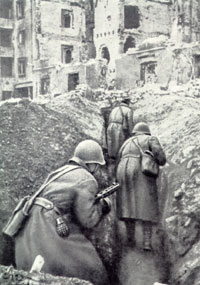
.jpg) The presumed post WW-II American hegemony (the one that revisionist academic historians use as the central fact in their argument that we should all bear collective guilt for Hiroshima and Dresden) lasted about 10 minutes. By 1946 the communists and royalist/nationalists were fighting a civil war in Greece. That war did not end until 1949, and the most optimistic estimate is that it cost 50,000 lives (out of a population of 7.5 million). The communists were eventually defeated but only at the cost of massive American aid. By then, a similar struggle between communists and nationalists had begun on the Korean Peninsula; a year later, with the Russian-supported invasion by a mechanized army of what would become "North" Korea, the United States would be at war (again!). By September 1950 the defeated American and South Korean forces were in the Pusan perimeter (10% of the land mass of Korean perimeter) and were considering evacuation. Still worse, the relative competitiveness of American steel manufacturing was already being undercut by unfairly cheap competition from Europe and American farmers were clamoring for price supports and export subsidies.
The presumed post WW-II American hegemony (the one that revisionist academic historians use as the central fact in their argument that we should all bear collective guilt for Hiroshima and Dresden) lasted about 10 minutes. By 1946 the communists and royalist/nationalists were fighting a civil war in Greece. That war did not end until 1949, and the most optimistic estimate is that it cost 50,000 lives (out of a population of 7.5 million). The communists were eventually defeated but only at the cost of massive American aid. By then, a similar struggle between communists and nationalists had begun on the Korean Peninsula; a year later, with the Russian-supported invasion by a mechanized army of what would become "North" Korea, the United States would be at war (again!). By September 1950 the defeated American and South Korean forces were in the Pusan perimeter (10% of the land mass of Korean perimeter) and were considering evacuation. Still worse, the relative competitiveness of American steel manufacturing was already being undercut by unfairly cheap competition from Europe and American farmers were clamoring for price supports and export subsidies.
The permanent decline of the United States of America seems to be that rarest of all things — an historical constant.
Nov
10
Thirty Years of Apple in one JPG, from Gregory van Kipnis
November 10, 2007 | 1 Comment
In the Apple Evolution JPG, I count 22 items I've owned, of which only four have been disposed of. I notice they did not show their printers and screens. That would add four to my count.
Nov
10
Market Cycles, from Rick Foust
November 10, 2007 | Leave a Comment
 I have been refining a model of stock market emotional cycles for several years . The key phases of the model, from the long perspective:
Bottom, Relief, Distrust, Courage, Anxiety, Confidence, Hubris, Complacency, Top, Shock, Denial, Recognition, Anger, Depression, Prayer, Acceptance Bottom, Repeat.
I believe we are currently in the anxiety phase. Although fear plays a role, combined with other sentiments, in each of the phases, it is dominant in the anxiety phase. As a result, this phase is sometimes a breakpoint.
If market participants are willing and able to cross through the anxiety phase, confidence builds and the uptrend continues. If it cannot be crossed, the uptrend aborts, returning “safer levels,” shorting the cycle.
The anxiety phase is analogous to a child's losing sight of its mother, or a sailor's losing sight of land. Beyond here, there be dragons.
I refer to the series of phases prior to the anxiety phase as the recovery period, and the series of phases after the anxiety phase as the heroic period, Throughout the cycle, fear of being left out and fear of being wrong are powerful motivating factors.
The most consistent sentiment indicator is the early morning National Public Radio broadcast.
As an aside, mild fear is a more effective motivator than strong fear. If the feared outcome is too horrible, it cannot be accepted, and is either rationalized away or blocked out completely. This is sometimes discussed in advertising books.
Kim Zussman extends:
There is the same sequence in dating:
Recognition, Anxiety, Courage, Acceptance, Top, Bottom, Shock, Repeat Bottom, Relief, Confidence, Hubris, Complacency, Distrust, Denial, Anger, Depression, Prayer.
Nov
10
Vegetable Oil, from Bruno Ombreux
November 10, 2007 | Leave a Comment
You can buy a car with a diesel engine and use vegetable oil . I heard some people are able to run a car on a 15% diesel / 85% vegetable oil mix. It is great if you live in the countryside. You can grow your own untaxed fuel.
George Zachar notices:
State makes big fuss over local couple's vegetable oil car fuel
Decatur resident Dave Wetzel may be in hot cooking oil with the Illinois Department of Revenue, who claim he needs to pay $244 in back taxes for the gallons of vegetable oil he has been running his Volkswagon car on for the past 5 years.
Wetzel uses recycled vegetable oil, which he picks up weekly from an organization that uses it for frying food at its dining facility.
"They told me I am required to have a license and am obligated to pay a motor fuel tax," David Wetzel recalled. "Mr. May also told me the tax would be retroactive."
Michael Ott explains:
If you do make your own biodiesel from free used vegetable oil, the cost per gallon for materials is around $.60. if you pay someone minimum wage to do all the work, the cost is about $5 per gallon. Therefore if you enjoy the work and do it as a hobby, it's a good deal. It's not a money saver.
Some in the biofuels industry are against road taxes on their fuel, but I think they're necessary because infrastructure is already underfunded. Plus, once we're making a large share of the fuel in the country, it would be noticeable.
Nov
10
Return of the Day Traders, from Jim Sogi
November 10, 2007 | 2 Comments
 Like the Jedi, the Day Traders have returned. Having all but become extinct in the low vol OIF [Operation Iraqi Freedom] bull market, the surviving Day Traders now enjoy multiple 2% intraday swings, 1% gaps and 2% per hour moves. Its like the good old days at the turn of the twentieth century when even beginner traders could follow intraday momentum and make bank. There's a definite shift in the market ecosystem favoring the fast movers. You really haven't heard much day trader talk at cocktail parties either. No one really seems to want to talk stocks anymore. That's a good sign.
The theory of evolution and theories of geological and climactic change seem to model slow moving change. But the reality is that evolution and climactic changes occur much more rapidly and with more abruptness than might seem due to the correlation effect in complex systems. When many inter-related nodes, previously uncorrelated, become correlated, whether due to stress or merely, as Alston Mabry pointed out, due to increased variance, there can be a massive and rapid shift in the system which would not be expected under a linear model. Evolution sees large regimes of mass extinction. Climate changes, ice ages, occur much more rapidly than thought.
The same might be true in financial markets. The assumption of continuity of prices itself is breaking down with the large regular gaps. The increased variance increases correlation, as pointed out in the discussions of currencies, equities, bonds, and global economics in an as yet to be quantified manner. Prior data histories provide limited guidance with numbers crossing into new territories. Rather than seeing separate exchanges and markets in different countries might the new paradigm be one big global interrelated market? What new relationships might be uncovered there? So much data, so little time.
James Lackey writes:
Before daytraders come here and start telling us that all we need to do is buy the Nazz limit-down or wait for 2pm every day to buy, let me remind you we had this bashing in 2001. I was disassembled in 9 months. It took meeting Vic and Laurel over a year later to get me profitable. For this I am grateful.
I would like to point out that there are daytraders reading this site. There are guys who have profited all these years. These men are one in a million. To have the temperament, the financial backing and years of not profiting to learn how to trade this way is too much for the others to learn. Two nights this week I was up at 1am and traded all day..
Ken Smith adds:
During the daytrading mania, reporters from the television show 60 Minutes interviewed daytraders, and to show contrast and to demonstrate how little guys get smoked, interviewed the head trader at a major firm, I think it was Goldman. The head trader sat down at his screen saying "If you stay at your screen you will lose" and promptly put in a large order to buy on a stock headed down. Immediately ten thousand daytraders had to cover their shorts. He then sold his inventory as daytraders climbed aboard. The next trade he made jerked thousands of daytraders around to sell what they had just bought.The Big Players can place a billion dollar order, a 5-billion dollar order. Daytraders were playing around with their parents' mortgage money — and lost it.
Guys like Lackey used to make 200 trades a day, taking quarter points, even less. That's a lot of work and one mistake wipes out the profits from 200 wins — sometimes. Trader has to begin life all over.
Traders with a niche, Vic and Laurel for instance, are not trading by the minute, I suspect. On the other hand, traders can mix up their activity according to the analyisis of 24 symbols on their screen. I really can't say much on this — nothing worked for me for very long, in the short term bull ring.
Bo Keely worked in the Vic and Laurel trading room off and on, whenever they could get him out of the closet he lived in under the stairs at the mansion. Keely told me once, "Money is made slowly, lost fast."
Kim Zussman recently pointed out a similar strategy. Bought on August 16 and held — didn't say when he made his exit, but I have confidence it was a profitable one. Buy and hold, that's the ticket. The secret of that trade is not the buying, it is how long to hold. Not to buy and hold forever, but to hold, like you hold an amorous relationship until it wears thin.
Nov
10
OiNK RIP, from Jay Humbert
November 10, 2007 | Leave a Comment
OiNK was the best torrent site for music, bar none. Anything that couldn't be found on the other sites (Mininova, Pirate Bay, Demonoid), could almost always be found on OiNK. Plus the standards at OiNK for quality were top-notch — nothing under 192 allowed, no mixes, no reposting. The staff was ultra-strict regarding ratios — it took me a month of focused work to get my ratio right and secure a "power user" account.
Nov
10
Bias, a query from Bill Rafter
November 10, 2007 | 1 Comment
Let's say that I work really hard and come up with a long-only trading system of largecap stocks that over the last 10 years had a compound annual rate of return of 20% with a maximum drawdown of 15%. The first thing everyone says is my universe was biased — survivor bias or look-ahead bias. I know there is some bias because I test my universe and find the universe I used had a 14% return with a 25% drawdown. So although there is some bias, I still beat the universe. But I am also happy because I know the S&P500 and Russell 3000 each had a 10% rate of return and a 45% drawdown. But the bias charge still nags me. I go back to the computer and come up with a short side to complement my long-only version. So my new system is long-short. Using the same stock universe over the same period, my long-short combined program produces a 10% return with a 3% drawdown. By going to a long-short program, did I eliminate the previously existing bias?
Phil McDonnell replies:
You cannot tell if the bias has been eliminated. Let me give a simple example. The S&P and most indexes are cap weighted. Effectively this means there is a lower bound a company must reach to be included in the S&P. Assume the sample is the current constituents of the index. Then in an historical study the sample includes knowledge of the future because it includes stocks which were added and excludes stacks that were deleted.In the bottom portion of the biggest 500 stocks there is a group of companies which grew their way into the elite index. These stocks probably outperformed. Over the last few years an equal number of stocks dropped out to make way for the new ones. These grew backwards and presumably underperformed.
In this example one would expect bias to arise if the data are filtered on market cap, sales or earnings growth and stock price growth (relative strength). When those factors are implicitly included with future knowledge that the stock will cross the threshold of index inclusion it can lead to a strong bias. For example, relative strength is related to market cap by a simple multiplication by the number of shares.
The only way to really determine what the bias might be is to identify the stocks which were added or deleted from the index but would have met the filtering criteria. Only then can we truly know the bias. But if you are going to do that you might as well simply start with the original stock list which existed at the time and do the study right.
Rob Steele remarks:
If you were data snooping you'd probably see better performance. Survivorship bias is certainly an issue; if you can, expand your universe to include everything that would ever have come into it over the test period. The big issue, however, is the "I work really hard and come up with …" part. How do you know you aren't data mining? The harder you look the more likely you are to find spurious correlations that aren't predictive. You can never be totally positive you've found something real but you can guard against chimeras to some extent. One way is to not look too hard. That is, limit free parameters and the size of your search space. Another is rolling backtests where you repeated introduce previously unseen data. Aronson's Evidence Based Technical Analysis is good on this.
Gregory van Kipnis replies:
What bias? There was still residual information despite survivor/peek-ahead, or are you saying Dr. Rafter did not use a hold-out sample either? Information decays, but if it doesn't decay too quickly you can exploit it. If (big if) there was bias, then going short part of the remaining universe adds to the bias. It doesn't subtract. Systems that learn from the past are not ipso facto completely biased.
A little bias is not such a bad thing (I stay away from all growling dogs for that reason even though most won't bite me). Learning from the past is great. Adding common sense and questioning if anything is different from the past is what creates an edge. I seek that.
Nov
9
A Million Deceptions, from Victor Niederhoffer
November 9, 2007 | 6 Comments
 You have to admire the extraordinary duplicity of the market mistress on all days. Take today, Thursday, November 8th, for example. Last Thursday was down 40 so this one started out by going down 40 as of 2 pm. Yesterday was down 20 in afternoon, then today up 20 in afternoon. S&P always follows Dax — except this time: S&P futures down six but Dax up 70. The Naz down 3.5% while S&P unchanged. S&P itself unchanged but S&P futures down six. The open Wednesday down 20 but today's up five. The Dow hit the 13000s but ended at 13266. Bonds and Bunds the opposite of the previous day. Google which never goes down below the round number, down $40 on the day. Everything was like Thursday August 16, the day before the Fed change of direction, except that one after going up its 40, closed up 10 on day, whereas this one after going up its 40 ended down on day. Many other levels of deception also for those who observe - e.g. what happened at 2:59 EST to turn the market by 3% a in half hour?
Jim Sogi adds:
The recent moves are hard to understand as well since they are going off the charts so to speak in terms of magnitude of the moves with few recent historical precedents.
It is also interesting how the foreign markets seem to be rambling into ours late at night. It is a small world after all.
Nov
9
Fired, from James Lackey
November 9, 2007 | Leave a Comment
HSBC Ends Sales of Mortgage-Backed Securities in U.S.
Nov. 8 (Bloomberg) — HSBC Holdings Plc, the biggest U.K. bank, said it stopped sales and trading of mortgage-backed securities in the U.S. after the collapse of the subprime market forced it to close down two origination units.
About 120 securities jobs will be cut globally, including 20 in the U.K., London-based spokesman Pierre Goad said in an interview today.
“I've been working since I've been 13 years old and it's the first job from which I've ever been fired,'' said Russell Middleton, 46, a trader of guaranteed mortgage bonds dismissed today…
Dear Russell: I got fired from my job at 13 because I wouldn't work a Sunday and went racing. I was fired at 15 for going skiing. The only job where I didn't get fired or in trouble was in the Army for fear of a stockade. Since then I've been fired a few times, even by my wife in our first year of marriage. That is why I am a trader, yet never a traitor. Don't worry Russell, there are plenty of sales jobs out there. Traders really never get "fired" — just not paid.
Nov
9
Capitalism in Schools, from Bo Keely
November 9, 2007 | 1 Comment
In the dark heart of education there is a glow. Blythe, Ca. high school may have the highest rate of flunkers in the nation, so it makes sense that a novel approach could spark life into the monster that employs me as a substitute.
The bad news is that our school is under acute intervention by California with dreary testing, whip-cracking coaches, a morass of protocol, 20% new faculty, and 'suits' popping into my rooms to check the lessons on the blackboard.
'The students are happy as larks to flunk,' says the history teacher. 'My first period class cheered themselves silly when I told them 75% were getting F's,' claims the science teacher. Yesterday the Spanish teacher resigned because 95% of his class had F's. After having subbed all 900 students in nearly every room since school opened in September '07, I estimate that 50% of them will fail and don't care.
Besides hiring the new teachers, California handpicked an ex-career army sergeant with two tours of Vietnam as the ramrod whom the staff calls 'the invisible principal' for his policy of fierce orders from behind a closed door. I had heard but never saw him until two weeks into the term. On that day in English at last bell the kids filed out shrieking, 'To the river to drink!' There was a BANG and the room slowly filled with smoke. Advancing slowly from the door, the grey cloud headed at me kitty-corner at the teacher's desk. I squinted for the source counting 'one alligator, two alligator' until the cloud was at my nose, and then looked left at the window and right at the phone. Like the sinking ship's captain - surely they will answer the distress call- I picked up the phone and dialed the office emergency number. After eight rings, I hung up still holding my breath and redialed as fire alarms began to wail. A chalky dust settled on my head and clothes as I held my breath_ hoping. The door burst open and a thick figure hung in the frame like a gorilla- the invisible principal!
He raced in to open the windows, and as the smoke escaped I exhaled holding the receiver, 'No one answered!' He cut me short with, 'I had to clear the campus.' We discovered that a student had discharged the fire extinguisher.
My school adventures have heightened since that day as the student body backslides in performance and behavior. I walk cold into nearly every class jammed with defiant students who refuse to work and instead talk, toss trash, or sleep all day. The administration response is paramilitary to some success, but I doubt that our kids will surpass their worst statewide STAR scores, and so last year's remodeled doors will shut. This is a desert oasis from which, at worst scenario, the student body will be bussed 150 miles to the nearest school in Indio, Ca.
But today a spark that provides a theory to revolutionize the nation's schools that suffer as mine does occurred in the agriculture classroom squeezed between the ROTC building and an alfalfa pasture. At day's end, I wrote the Sub's Report to the absent teacher. 'Your six classes are the best I've ever subbed. 120 students entered over the day, sat quietly, took out their texts, pencils and papers, and without direction or cheating did the assignment. More work got done in these six periods than in the rest of the school all day. I am stunned, perplexed, and congratulations.'
The Ag teacher was absent because he is driving 1300 miles to pick up 30 sheep, 30 goats, 30 cows and don't forget the pigs. In three days he returns with them to their new student governors to meet, raise and sell for slaughter. A few will escape the death bullet to become high priced pets. I also discovered from a student aide minutes after last bell that the accounting per entrepreneur breaks down as follows.
Each student invests $200 in his animal, and may secure a loan from a local caring bank. This includes the price of the two month old animal, plus shots, and insurance should it die before the county fair. Then there is a further investment of $300 for five month's feed, and the daily care of watering, feeding, walking and grooming. The average selling price at the live auction is $1000 per animal for a cool return of $500 per pupil, plus a good class grade if the daily text work is completed. 'The best pig at the L.A. county fair brings $3/lb, but the worst pig at our county fair brings $5/lb.,' the aide explained adding, 'This community gets behind working students.'
They will work for grades and for pay in all classes. The students are capitalists!
Nov
9
Free Trade, from Stefan Jovanovich
November 9, 2007 | Leave a Comment
 "Free trade" seems to me one of those unfortunate phrases (like "tax cuts can pay for themselves") that misrepresents and undercuts what is a wonderful idea. Small trading entrepots like the Dutch Republic in the 17th and 18th centuries and Singapore today have practiced "free" trade; but larger countries have always had customs and excise. If there really had been a magic moment of "free" trade in the 19th century, families of smugglers would not have been there to save Butler's hero in The Way of All Flesh. What did occur in the United Kingdom after the defeat of Napoleon was the successful opposition to the Corn Laws by Cobbett, the Irish liberals and the merchants of London and manufacturers of Sheffield. Cobbett and the Irish liberals wanted cheaper grain for the poor to buy; the merchants and manufacturers wanted the sovereigns that Britons paid for grain to be recycled into iron and creamware exports. That political alliance resulted in the abolition of tariffs that had been so high that they had worked as quotas on grain and other imports. Trade was made much "freer", but it was never "free."
Within a few decades of the abolition of the Corn Laws, the London merchants found themselves increasingly interested in the finance that could be done under a rule of Imperial preference. The prospects for lending money to Britain's colonies seemed even more attractive than issuing trade bills on exports to North and South America. Added to this was the reaction to America's explosive military growth during the Civil War (at its end the Union Army and Navy were each the largest forces of their kind in the world). Both Britain and its erstwhile enemies and allies — France, Prussia, the Hapsburgs, and Russia — found themselves eager to adopt the uses of steel and steam that American military railroads and ironclads had pioneered.
Ironically, the United States was the one country that took a different path. To the amazement of the rest of the world, the United States did not take its Army north to Canada and/or south to Mexico and the Caribbean but instead disbanded its forces. President Grant hoped that Santa Domingo could be peacefully annexed, but incorporating even more free blacks into the Union was too much even for a nominally Republican Congress to accept. What he was able to establish was a political consensus that accepted tariffs but not quotas or protectionism. The customs excise could not be exclusionary; it would simply be the tax by which the Federal government would pay for itself. The success of this "freer" trade revolution can be seen in Grover Cleveland's clever campaign slogan — Tariffs for Revenue Only. The Republicans, Cleveland argued, were failing to live up to Grant's promise; they were using the tariff as a means of rewarding their favorite constituents. It worked. To this day Cleveland is the only President to win reelection on his second try.
John Floyd relates:
This morning my five year old, after reading the various labels and boxes from a recently assembled telescope, asked "Why does everything say "Made in China?". The question led to several explanations that provided lessons on free market economics, internationalization, and geography, amongst other topics. For one it is in the self interest of countries to engage in free trade, and the rule of law, as the most efficient and cost effective means of production is most likely to be utilized. The benefits can then be passed along to consumers in the form of product diversity, quality, and cost. Furthermore, if protectionism, tariffs and other forms of artificial support were lifted we all would be better off. The impact of trade protectionism and higher taxes following the '29 crash were greatly responsible for turning the crash into a depression. My answer also led to a discussion of the development of the port areas that receive many of these goods such as Long Beach, LA, NY/NJ, and Charleston in the U.S. and Singapore, Hong Kong, and Rotterdam outside the U.S. It is also interesting to note that the vast majority of global trade is still transported over water. The reception of materials has been centralized a bit more into large container ports in the latter half of the 20th century as opposed to going to a more widespread geography of ports as in the 19th century. As a kid I can remember many goods produced having the label "Made in Japan" or "Made in Hong Kong" as those economies have evolved into the service sector we have seen China replace them as the producer of many of these goods. I wonder who is going to replace China in the coming decades in "Made in …".
Nov
7
Growing Gaps, from Jim Sogi
November 7, 2007 | 2 Comments
Gaps are growing in this new high vol regime we are in now. Today's 17 point gap down, and 16 points a few days ago are a good measurement of fear and a sign that things are getting wacky with dollar dropping to mid round, crude headed for big round. I don't know what it means but the numbers are eyepopping. I'm sure the day traders love it.
Mean down/up gap last x days

Days 200     100    60   40     5
Dn  -3.7   -4.86  -5.7   -7   -10.5
Up   3.8    4.80   5.7    7.1   7.5
The recent median .75 is less than the mean .26 as reflected in the stem plot displaying the negative skew as a symptom of fear.
-24 | 8
-22 |
-20 |
-18 |
-16 | 763
-14 | 300
-12 | 8
-10 | 72
-8 | 222287620
-6 | 9521096432220
-4 | 7655333218765433
-2 | 9887752277654321
-0 | 888776655544333210009988875555532221

000 | 000011111111111111111112222222222222333333333333334444
000 | 55555555666666667777777778888889
001 | 00000001224
001 | 58
002 |
002 |
003 | 4
The decimal point is at the | for down gaps. The decimal point is 1 digit(s) to the right of the | for up gaps
Nov
7
At the Garage, from James Lackey
November 7, 2007 | 1 Comment
 I send the wife to the mechanic's shop. She is interested in people's lives. People love to feel important. If a mechanic has kids, we are in for cost on the parts and labor. If the guy is interested in the stock market we get a flat rate as she drops, "My husband loves cars. He had a race car, but he never has the time to come to the shops any more because of work."
The last three good mechanics I found, actually the wife found and they later became our good friends. Turns out the dad of my six year old's classmate is a national champ drag racer. I didn't get the chance to meet him until a birthday party. By then he already knew our life story.
Point is, never go into a mechanic's shop and act like you know what you're talking about or talk price price price. More often than not I talk to the mechanics and say, "Hey, while you have that apart shouldn't we change this or that part too? Of course they say "Yea, I would, but all anyone cares about is how much this is going to cost today."
Alan Millhone adds:
As a builder/remodeler do I drive to a prospective client's home to give an estimate in a custom newer pick-up or an older truck? If they see me in a new truck will they think I am very successful (never knowing my truck payment book is 12 inches high!) or will they feel I am charging too much, to be able to drive such a nice truck? Or do I drive a truck that looks like it has been well used on many job? I do have a nice Rolex I bought years ago, but prefer my Timex wrist watch, so I wear the Timex for all estimates and most of the time anyway. Perception is 100% of most things in life.
Nov
6
Surf Adventure, from Jim Sogi
November 6, 2007 | 1 Comment
 This weekend we ventured up north into the wilderness for surf and fish. We have been watching the weather, waves, and wind for over two months waiting for the right conditions when the winds are not blasting at 35 knots and when there are no huge northwest swells to close out the entire coast.
I've been surfing and fishing with my best friend for twenty-five years. We hunt big waves and big game fish. He put together the ultimate hardcore surf adventure boat, a Radon with a turbo diesel, Hawaiian cab, with shade, surfboard rack on the back, loaded with an all-out fishing arsenal. It can handle conditions that many other vessels cannot handle, and much better than the 62 foot Hatteras we took up there last year. The Alinuihaha Channel is where world explorer and navigator Captain James Cook came to grief, getting dismasted in the rough conditions. Up north there are no roads, no cell phone coverage, no other boats. There the huge rollers and winds squeeze between the islands, creating a ruckus.

As predicted, the wind was glassy and light, and there was a moderate swell running at about eight feet. We fished on the way to our secret surf spot, and there was plenty of action with birds feeding and pointing out the where the bait was, and where the bigger predators fed. We arrived just before high tide which is the prime time for fishing as the bait and fish rise to the surface to feed as the tide comes up. We went to where the birds gathered on the water where they are feeding on smaller bait and got a number of strikes. After losing one fish that was jumping out of the water in a long fight we hooked up a big one that fought for 40 minutes. Finally just before landing it we saw something even bigger following it, and then it just skimmed in. A big shark had bitten off the last four feet of the fish, leaving only about two feet behind the head. The ono must have been over 50 pounds. It goes to show that we are not at the top of the food chain out there. We were glad to pay the taxes to the tax man in the grey suit because soon we were going to go in the water to surf, and its better that they are fed first and not hungry.
At the surf spot, initially the waves looked small, but were slowly rising from a different direction so it is often deceiving. The rides kept going and going traveling for hundreds of yards along a cliff into the beach. There was the fragrance of flowers from plants growing on the 1000 foot cliff that rose straight out of the water. The waterfall sprayed the inside part of the break near the beach. The mountains and cliffs faded away into the mists and clouds like a lost continent in a fantasy land.
After surfing for hours, we headed back at high speed, surfing down the face of the large swells in the boat. Just as it was getting dark, we dropped off the boys and they jumped overboard into the rough water and paddled in on their boards through the rocks to the end of the road to catch a ride home. They are tough kids. We decided to stay out overnight since we had only landed half a fish. We stayed in a nearby bay and had the fish we caught for dinner on board.
We arrived back out near Kamehameha's Heiau (temple) before dawn. Soon we were skimming the increasing northerly swells right along side the birds searching for fish. After a couple hours we hooked up and landed a 50+ pound mahi-mahi. It is a truly beautiful fish that flashes many iridescent colors as it is fighting in the water and jumps up in the air. It's a delicious fish especially when cooked in the mayonnaise/panko recipe previously posted. We headed back after a great weekend trip. No life and death this time, except for the fish.
All around perfect timing for the wind, the swell and fish. As with markets, it's good to have the patience, the data on the conditions at various locations, and the knowledge and equipment to wait for the right time to enter. The ability to handle the conditions allow the rewards for the few that can handle those conditions. There are so many elements in nature out there that are out of your control and a large element of randomness in fishing and surfing. It is important to find the most favorable conditions to engage.
Today a very unusual south swell from an out-of-season southern cyclone is kicking up 10 foot plus waves here. Normally by November the swells come from the northern storms in Russia and Alaska. Things seem out of kilter in nature and the markets. We seem to have entered a new regime here after the last few years of low vol. Today's vol was startling with a 16. Just like the good old days.
Nov
6
Ketchup Bottle, from Alan Millhone
November 6, 2007 | Leave a Comment
 Right now in my area of Ohio it is tough to find a qualified renter — one who has his deposit and first month's rent in hand. I have one renter I am currently evicting who has not been there for two weeks, but will hang onto the unit and not pay anything till I go to court and take possession of the unit from him. Looking through his window I can see his belongings scattered all around the bedroom and can see through the kitchen and note a ketchup bottle on the counter that is upside down. This fellow will not return my calls and left me no choice but to file for eviction. The ketchup bottle, to me, indicates he is broke. Owning rental property is an entirely different education in the economy and is not for everyone.
Scott Brooks adds:
 I used to own a piece of rental property and I hated it. First of all, I am not a handy guy. My wife has a toolbox and will not allow me to touch it under any circumstances. All the other men in my family are extremely adept at handy work, but somehow I managed to have a mutated "handy gene."
What bothered me about renters was that they were often late with payments and always had some lame excuse as to why. When I would go by the house to pick up the late rent, there were always lots of beer cans in the trash, beer and liquor bottles in the fridge and cartons of cigarettes on the counter (the lease prohibited smoking in the house).
These people could afford alcohol and cigarettes, but couldn't afford their rent payment. When I would ask them about this, it was like talking to a wall. It seemed that they were completely incapable of understanding the simple concept of financial prioritization and that shelter was far more important that cigarettes.
But in retrospect, maybe they did understand the concept. They probably knew that they had the ultimate "enabler" in a government that protected their rights far and above my rights, and the same government would shelter them from the consequences of their poor decisions.
I sold the house at a profit and have not gotten back into the rental property game.
Alan Millhone updates:
The ketchup bottle has not moved and is still inverted! However, one new twist I noticed this afternoon in this renter's door: a court notice has been placed there by a process server sometime today! My late father used to quip, "When they get the court notice they don't have to move right away, but they know that someone will be breathing down their neck soon." Court day for his eviction is 11/30/07 at 2pm. Stay tuned!
Nov
6
More on Volatility and Correlation, from Alston Mabry
November 6, 2007 | Leave a Comment
 I wonder how to accurately count, measure, market fear as a basis for building theories…. Which brings us all the way back around to volatility and correlation and a little bootstrapping/Monte Carlo.
In order to show how correlation increases with variance, Boyer, Gibson and Loretan (Pitfalls in Tests for Changes in Correlation , FRB, 1997) use randomly-generated data first, and then extend their results to real data, that data being the Yen/USD and DM/USD rates from 1991-1998. (Not sure why they chose this data set, but choosing two series that are ratios with the same denominator should give the series a correlation of about +0.5, as Pearson first conjectured.)
BGL look at "months" (20-trading-day samples) to show that higher-volatility months in the real data also have higher correlation. Key differences between real data and random data (which differences BGL do not explore) are that (1) higher-volatility months tend strongly to be down months (there's the fear for you), and (2) real data shows extremes of subsample standard deviation greater than that of randomly-generated data or re-sorted real data (volatility clustering - all the elephants spook at once).
(1) Example: S&P, 1950-2007. BGL calculate what they call "k", which is simply the ratio of the sample variance (in this case, each 20-tday period) to the population variance. Breaking the S&P into 20-tday periods and sorting by k, produces the follows stats for the quartiles (mean k of the quartile / mean % change of quartile / z of mean % change):
mean k / mean % / z
2.05 -0.61% -4.35
0.99 +0.70% +0.05
0.66 +0.88% +0.66
0.38 +1.78% +3.65
So, high-variance months are substantially negative compared to low-variance months. Here's the same analysis done with the Yen/USD series for
1980-2007:
mean k / mean % / z
2.06 -1.15% -3.00
0.94 -0.01% +0.38
0.61 +0.07% +0.61
0.35 +0.54% +2.01
(2) Below is R code for reading in a series of log% changes, calculating the sd's of all subsamples of a set length, e.g., 20 days, and then getting the max and min sd's for that set of subsamples. This shows the high and low values of volatility for this subsample length for this series. Then the series is randomly re-sorted 999 times, and each time the x-day-length subsample sd's are measured again. In the end it displays what percentile the actual max and min sd's fall at, relative to the max and min sd's of the randomly resorted series.
In all cases I've run, with various series, the max sd of the actual series is greater than all max sd's of all random runs, and the min sd's of the actual is usually at about the 99.6 percentile or higher. For example, for the 1991-1998 Yen/USD series, the actual max sd for 20-day periods was at the 100th percentile, and the min sd was at the 99.9 percentile.
________________
# determines the sd of all possible subsamples
# of a given length and also does random
# re-sorting to estmate distribution of possible
# max and min sd's
# read in the data, without column header
# for generic use:
s1 <- read.table("https://dailyspeculations.com/Data.txt", header=FALSE)
# variables needed:
# the sub-sample length (20 days)
ss1 <- 20
# number of sim runs:
# 999 so we can add the actual for 1000
numruns = 999
# other variables: L <- length(s1$V1) L1 <- L-ss1 cL1 <- length(L1) cL2 <- length(L1) maxsd <- length(numruns+1) minsd <- length(numruns+1)
# the outer loop gets the sd's of all
# subsamples of length(ss1)
for (i in 1:L1){ cL1[i] <- sd(s1$V1[i:(i+ss1)])
}
# the inner loop does the random re-sorts
# and gets the sd's of all subsamples of
# length(ss1)
for (j in 1:numruns)
{
randvec <- rnorm(length(s1$V1)) s2 <- data.frame(rand=randvec,pct=s1$V1) s3 <- s2[ order(s2$rand,s2$pct),]
for (k in 1:L1){ cL2[k] <- sd(s3$pct[k:(k+ss1)])
}
# collects the max and min sd's from each
# random run
maxsd[j] <- cL2[which.max(cL2)] minsd[j] <- cL2[which.min(cL2)]
}
# add the actual max and min sd maxsd[1000] <- cL1[which.max(cL1)] minsd[1000] <- cL1[which.min(cL1)]
# calculate and display the percentile
# of the actual max and min sd relative to
# the random runs
maxpos <- maxsd[maxsd > cL1[which.max(cL1)]] minpos <- minsd[minsd < cL1[which.min(cL1)]]
(1000-length(maxpos))/10
(1000-length(minpos))/10
Nov
6
“Qui Bono?” from Stefan Jovanovich
November 6, 2007 | Leave a Comment
 When Hamilton and Madison and Jay wrote the Federalist papers, the legalities of regulation for the entire country of three million souls had fewer words than the municipal code now has for my yupurban town of 20,000. What that means, in practical terms, is that almost everyone here ends up being a part-time lawyer. Here is a specific example: under our municipal code native oaks are a protected species if they are on "developed" land, and the homeowner needs a permit from the city to cut one down. If, on the other hand, the tree is on "undeveloped" land, it can be chopped down without getting a piece of paper from the city hall if a "certified arborist" confirms that the tree is diseased or dying. Needless to say, the periodic outbreaks of Sudden Oak Death represent a marvelous opportunity for certifications and redefinitions of what is developed and undeveloped dirt. Further restrictions on what limited liability entities can and cannot do will, of course, help feed lawyers, accountants and their children so they cannot be considered completely "bad" things. But few, if any, of the authors of our Federal Constitution thought that the law could do very much to insulate anyone from the losses that are part of commerce. They expected people to deal with the ups and downs of markets by exercising their wits and employing their common law rights of contract. The most important illusion of current law makers is the notion that "the law" has positive meaning for individual citizens, that its actions represent anything other than a man-made tornado that can threaten their lives, without reason or warning. That should not be surprising given how little real time our legislators spend in a bail bond office or the halls, chambers and rooms of a less than prestigious local courthouse. What is still, to me, at least a bit puzzling is how easy it is for the advocates of further regulation to avoid being asked "Qui Bono?"
Nov
5
Statistics Reading for Speculators, from Martin Lindqvist
November 5, 2007 | 1 Comment

The book "Principles of Applied Statistics" by Fleming and Nellis (ICBP, 2001), is a good book for the beginner, or for someone who has had an introductory undergraduate course in statistics and wants to review the key concepts again.
For a beginner learning statistics on their own with little mathematics background, I would think that it makes sense to first read "Statistics without tears" by Roundtree (Allyn and Bacon, 2003) , followed by Fleming and Nellis, before tackling a text like Vic and Laurel's favorite Snedecors' "Statistical Methods" (Iowa State U. Press, 1989). Fleming and Nellis goes deeper than Roundtree, introducing more of the mathematics behind the concepts, while being still mostly concerned about the practical illustration of the techniques. It also has worked examples using Minitab and Excel. Since many start their statistical analysis in the latter program, this may be of help to some specs just starting out to do statistical tests.
The Fleming and Nellis book is well organised, divided in six parts with each part starting out with a schematic overview of the content and structure of each chapter and how each topic relates to other topics. Every chapter starts by going through what the student should know after having gone through the chapter. The chapter ends with the aforementioned worked examples.
In all, a good introduction to key concepts in statistics.
Nov
5
Glass-Steagall Revisited, from Ken Smith
November 5, 2007 | Leave a Comment
 History says deregulation created instability. Glass-Steagall was implemented to correct market excesses in speculation with gimmicks. In recent times this Act was rescinded. We will have to live with the consequences.
Phil McDonnell counters:
Rarely is increased regulation good for the economy or the markets. Ordinarily we would be tempted to ask if our friend Ken has any source or statistics to put on the table to support the statement that deregulation causes instability. The converse of that proposition is that more regulation decreases stability.
The two Glass-Steagall acts were passed in the first half of 1932. So that year is the focal point. Here are the weekly standard deviations for the Dow industrials for 1931 and 1932.
year std
1931 5.6%
1932 7.1%
It looks to me as though the Dow volatility increased during passage of the bills and immediately thereafter. Certainly 1931 enjoyed lower volatility.
Charles Pennington replies:
I'm anti-regulation, in general, but I'm surprised Dr. McDonnell would put these stats up to make the case that regulation increases market volatility. Isn't it plausible that Glass-Steagall was passed in response to the higher market volatility, rather than the other way around, that the market volatility resulted from Glass-Steagall?
Anyway, here are root-mean-square monthly moves for 1931, 1932, and 1933:
1930 8.1
1931 14.1
1932 16.8
1933 14.1
1934 4.8
Ken would surely say that after volatility soared from 8.1 to 16.8 from 1930-32, the benevolent government officials took action, and their efforts resulted in the steep decline in volatility from 16.8 to 4.8 that occurred from 1932-34.
Nov
4
Fear as a Motivator, from Victor Niederhoffer
November 4, 2007 | 6 Comments
 A talk at the November 1 Junto by Robert Higgs on the importance of fear elicits many thoughts of relevance to markets. Higgs is best knows for his theory of the ratchet effect of crises on government activities. He shows in Crisis and Leviathan that during times of crisis, government powers are increased and that these powers are never reduced.
He started his talk by saying that he wished he had realized many years ago that fear is the foundation for all such increases and that fears are manufactured according to normal production curves subject to the laws of diminishing marginal productivity and depreciation.
He views fear as the key emotion. And believes that fears are invented to create an opportunity for the Leviathan to expand . He groups fears into categories: fear from government itself, fear of real dangers from which government protects us, and spurious fears which are invented so that power can be increased. Planks in his theory deal with the origin of governments in conquest, the alliance between church and state, the tactics of stationary bandits who exert power from a fixed position, the creation of an ideology of fear, the economics of fear, the growth of fear during wartime. He ends with the hope that we can conquer our fears and thus go about our normal humdrum activities in a more productive way.
 I was quite critical of his theories believing for example that many other motivations of human behavior are more important than fear, including the five levels of Maslow's motivations, starting with physiological, safety, love, esteem, and self actualization. Of these hierarchical levels, only the safety level could in any sense be related in part to fear. I felt that much of the support for his theory was based on anecdotal and isolated events such as King Canute's assassination for collecting high taxes. I also questioned whether there was any predictive value in his classification, whether his theories could ever be refuted, the absence of cost benefit calculations in his condemnation of any and all government actions, including its function of providing for internal and external defense, and how it could be differentiated from other theories of power and behavior. I also disagreed with his wholesale condemnation of the use of fear including his condemnation of the United States entering the First and Second World War, after what he decries as false propaganda concerning the evil intentions of our enemies.
 Higgs' current book Neither Liberty Nor Safety details many of these theories. And needless to say, he believes that the acts that followed 9-11 served mainly to legitimize a wish list of bureaucratic interventions that had been sitting on desks for 15 years, but never were able to see the ligth of day until crisis hit. He believes they did not increase our safety but took away our liberties, and never will vanish even when the need for extra patriotism recedes.
And yet, I found many parallels to the market's fears. There are 1.5 million conjunctions of fear and stock market on the search engines and many of them relate to maintaining the stock market citizen in a state of subjugation, and contribution to the upkeep even greater than that described by Higgs in his many anecdotes, and revision of his crisis and leviathan theory.
I would be interested in your ideas on the influence of fear on markets, the most recent being the fears of recession, the fear of no further rate cuts, the fear of the subprime crisis spreading, the fear of brokerage house bankruptcies and financial liquidations, the decline of the dollar, the spread of epidemics, the comparison to the crises of 1987 and 1998, the increase in volatility and what that portends, the declining earnings growth, et al., the role in fanning fear by former officials recently retired, as well as those who have long predicted Dow 5000 et al.
High on this list would be the typology of fears that have existed each year since the beginning of stock markets, and how this has engendered the 1 million % a century growth which Mr. Ellison has kindly updated here before.
Alston Mabry adds:
 In The Happiness Hypothesis, author John Haidt uses an interesting image our human brain which has developed over vast amounts of time to handle so many tasks: he likens the mind to a rider on an elephant. The rider is our conscious, rational, aware mind - our neocortex. The elephant is everything else and is trained to be pessimistic, defensive, status-conscious, and many other things that might contribute to survival and success, but not necessarily be conducive to happiness. The rider can see farther and is smarter than the elephant, but the elephant often decides where both will go. Haidt then argues that many ancient traditions understand this dichotomy and know that the brain must be disciplined and trained for happiness.
In trading, I find there is a basic division: analysis versus execution. Analysis can seem so sure and easy, when the market is closed and one is simply crunching numbers - the elephant is asleep, as it were, and the rider is alone with his thoughts. But as soon as the market is popping, and one must put real money on the table - as soon as there is *risk* - the elephant awakens. The mind actually changes, perceives and processes the same data differently from the night before.
Perhaps the discipline of the ancients is the answer. Would Lao Tzu, or Bodhidharma, or the Desert Fathers have been successful in the pits?
Phil McDonnell writes:
 An alternative approach to Maslow's Hierarchy might be to consider the hormonal make-up of human beings. The two powerful hormones adrenaline and nor-adrenaline control our fight or flight response to potentially dangerous situations.
However they are much more than that. They directly or indirectly influence our heart rate, breathing, blood pressure, serum glucose levels and even our memory. They are a significant factor in motivating us to action. For example researchers have found that after receiving adrenaline human test subjects were more likely to take action in contrived circumstances which potentially involved even physical violence. Humans cannot easily distinguish between true emotions and those induced by adrenaline.
Other research has shown that rats will develop stronger memories when adrenalin is administered. There appears to be a simple physiological basis for this in the neurons. In particular rats that lacked the particular receptor did not develop the stronger memories in the presence of adrenaline. The important point is that memories which are formed or reinforced in the presence of higher adrenaline levels are much stronger that those which are not.
Charles Darwin was the first to study the evolution of emotions in: The Expression of the Emotions in Man and Animals with Photographic and other Illustrations (J. Murray, London, 1872).
Emotions originally developed as a way of avoiding dangerous situations as well as signaling to others the state of a particular individual. For example when an individual is in an emotional state such as extreme anger others may be warned away and learn to avoid confrontation. But when the irrationality of anger is not present others may attempt to reason with the individual. In effect the perception of an emotional state signals to others how an individual might respond in a given situation.
As traders we can turn this knowledge around. Large movements in the markets can induce an emotional reaction in other traders. In particular these movements induce an adrenaline response associated with the fight or flight syndrome. In turn the adrenaline reinforces the memory of the particular gyration in the market. So the memory is stronger and has more immediacy and in a sense more recency. So when a similar event happens again the memory is stronger, generates more adrenaline and is reinforced again.
Each time the effect of the adrenaline is to predispose the trader to action. Traders are more likely to act and act irrationally. Trading volume tends to increase. In effect the market begins to control the emotional actions of traders causing them to think with the more primitive portions of their mind. In the logic of the primitive mind losing money is equated to loss of food and ultimately loss of life. Every drop in the market is met by selling at the worst possible time. Market rises are greeted with herd like buying after the rise has occurred. It is all an emotional dance orchestrated by our own chemistry. orchestrated by our own chemistry.
Micheal Cook remarks:
 It is commonplace to say that two principal drivers of the market are fear and greed. I agree that there are many other higher level motivators, such as Maslow's hierarchy of needs, but the market exhibits crowd behavior, and the crowd is the lowest common denominator of human emotions. The "masses" don't seem to have a hierarchy of needs.
In the context of the market there seem to be two basic fears: fear of loss, and fear of missing out. This latter fear is a form of greed, so maybe fear and greed are two sides of the same coin, the yin and yang of markets.
I heard a talk recently in which it was said that the market is driven by the irrational emotions of fear and greed, and that rationality consisted in finding the right balance. I found that amusing and ironic, the idea that rationality was finding the optimal mixture of two irrational emotions.
I also find that people seem to spend a lot of time worrying about things that in no way impact any current decision they might make. Things like "will there be a recession," "will the subprime crisis spread?" This strikes me as an expression of free floating anxiety, a channel, a displacement, a sublimation…
Russ Sears augments:
Perhaps the widest and the true foundation to build on is not "fear" but "pride". Pride that is turned into "us vs them".
Granted that this "patriotism" is often used to create fears to expand powers. When used with fear this can be the most evil and complete expansion.
However, pride or "we are smarter than them" also creates a very stable base to expand love/family to create a counterfeit charitable hand.
That is: the Maslow hierarchy is built upside down to expand government.
Self actualization: what separates "We" from "Them" is "we" are the only ones with a true "need to know" the truth. We here is defined broad, to include all but "them"
Esteem: "We are smart enough to rule everybody's life". "We" here is defined narrowly as those of "us" that are in the government. Everybody else should follow the yellow brick road to see the wizard.
Love/family: "It takes a village" government will replace the dysfunctional family, which is all of "them"
Finally, the expansion into safety: government will protect "us" from "them".
From this view fear is the roof, or exterior, not the foundation. The expansion of government occurs with each level, not simply fear.
This can of course can be seen as a clear pattern in doomsdayist prophecies. "We" are the only ones smart enough to seek the truth, at all cost. Tomorrow is bleak without "us" to warn you and turn bad on its head and into good.
It is a good exercise for the reader to read many of the recent credit crunch articles with this view, as current propaganda. This of course can be expanded beyond the markets and political readings, even into such areas as religion and popular pseudo science such as Dawkins for instance.
Tom Ryan enumerates:
The influence of fear:
1. The reliance on social proof rather than logic (looking to the herd for confirmation)
2. The tendency to extrapolate past events out into the future
3. The tendency to respond to contrasts more than absolutes
4. The tendency to non-linear weighting of probability (Kahneman & Tversky)
6. Emotional reaction to loss tends to exceed that of gain (Prospect Theory)
7. The tendency towards being consistent in one's behavior despite the financial pain in order to avoid the mental pain (fear of regret)
8. Overreaction to scarcity (scarcity programming - as one who has gone bust before I have this in full measure)
9. Strategic conventionality ("no one ever got fired for buying IBM")
Larry Williams contributes:
Fear is the greatest enemy of long term investors as it kicks them off track, off their game plan… that, coupled with short term 'gain-greed' seems to be why there are few truly long term investors.
Where does the fear come from?
Deep within our hearts and minds I postulate there is a fear mechanism—for our survival—but those fires are fanned, now, twenty four hours a day by media. Media= Negativity (fear)= Subscribers/Viewers.
Solution? Best I've heard comes from John Prine, "Blow up your TV, eat a lot of peaches, ya gotta find Jesus on your own"
Nov
3
Kid Delicious, from Alston Mabry
November 3, 2007 | Leave a Comment

I heard a great NPR story this morning on Kid Delicious , pool hustler. Real name is Danny Basavich, and he's a young guy who says he's made a half million from hustling. He comments on how one must make mistakes very deliberately in order to pull the suckers in and get more money on the game. Though weighing in at 310 pounds, he describes himself as an "athlete" and says he once played pool for 65 hours straight. Interestingly, he states that the internet and cell phones have killed the hustling gig - you can't make twenty grand in Dallas and then hop in a car, head for another town and start over again.
There's a new book about the Kid, based on a 2005 Sports Illustrated article, and supposedly, Jack Black is slated to play the lead in the movie version.
Nov
2
Indirect Strategy, from Jim Sogi
November 2, 2007 | 1 Comment
 Liddell Hart, in his book Strategy (mentioned by Vic previously) maintains that many good military strategies are indirect. Commanders did not want to risk high casualties in a face to face direct confrontation with a massive force. Indirect methods include harrying attacks along a stretched flank, hit and run, quick parrying thrusts, probing actions, attacks on the supply routes, feint and pullback, and utilizing the terrain to the smaller force's advantage. The feint and pullback was a favorite of the Mongols who led the cumbersome slow-moving Teutonic knights as the Mongols pulled back, leading the pursuing knights into a deadly cul de sac, surrounding and then attacking their rear and flank. These methods led to division of the army into smaller units over time. In this manner the psychological turning of the enemy can be accomplished rather than through its annihilation at less cost.
In Friday's market a direct confrontation with armies of Goldman and the weakened armies of the the other biggies lobbing the 1000 lot bombs might risk high casualties. As an analogy to a military campaign, a trading campaign might use indirect methods to lessen its risk. Attacking the rear would be engaging after the larger force has turned. Utilizing terrain might utilize the area of the 1500th meridian as a defending terrain. Parrying thrusts would allow a small unit to make quick hits and then pull back without risking a full engagement that might wipe the smaller unit out.
 Another danger a large fast moving army faces is stretching its supply line and exposing a flank making it vulnerable to flanking moves. Today we see some big 2% point moves stretching the opposing lines as they directly attack the 1500th meridian line. Beyond that they seemed to be weakened and extended and pulled back rapidly.
Another problem an invading army faces is supply. It cannot stay and besiege for long for its psychological momentum fades as does its ability to live off the surrounding countryside. It appears that the invaders are having trouble psychologically besieging the 1500 line and have pulled back quite rapidly after stretching its supply lines quite badly. Their numerical advantage is quite low today and is diminishing.
These factors favor the high tech fast moving smaller guerrilla force who can operate day and night in all conditions. Looking at the numbers in depth below 3000 only a few elite troops are engaging today in high tech battle. The fog of war applies to trading.
Nov
2
Interesting Character: Cardano, from Martin Lindqvist
November 2, 2007 | 2 Comments
 Gerolamo Cardano 1501-1576
From Wikipedia ………"Cardano was notoriously short of money and kept himself solvent by being an accomplished gambler and chess player. His book about games of chance, Liber de ludo aleae, written in the 1560s but published only in 1663 after his death, contains the first systematic treatment of probability, as well as a section on effectivecheating methods.
Cardano invented several mechanical devices including the combination lock, the gimbal consisting of three concentric rings allowing a supported compass or gyroscope to rotate freely, and the Cardan shaft with universal joints, which allows the transmission of rotary motion at various angles and is used in vehicles to this day. He made several contributions to hydrodynamics and held that perpetual motion is impossible, except in celestial bodies. He published two encyclopedias of natural science which contain a wide variety of inventions, facts, and occult superstitions. He also introduced the Cardan grille, a cryptographic tool, in 1550.


Significantly, in the history of deaf education, he was one of the first to state that deaf people could learn without learning how to speak first…….
……He died… …on the day he had (supposedly) astrologically predicted earlier; some suspect he may have committed suicide."
Nov
1
A Good Harvest Day, from Gary Humbert
November 1, 2007 | Leave a Comment
Today was a good harvest day in my backyard. I have about 20 pounds of sweet potatoes for Thanksgiving and Christmas, and I filled two five gallons buckets with tobacco leaves for my year's supply of chew. This is all coming off a poor summer. I harvested maybe five green peppers the whole year, and my canteloupes and cucumbers all came to nothing. This was my first summer in this house, and I have found that every yard has different characteristics for bugs, drainage, etc. that makes the first year difficult.
David Higgs adds:
True for yard to yard. But potatoes are easy anywhere as long as the soil isn't concrete. And I concur, this summer was the pits — couldn't get okra to grow, the cucumbers were bitter, the tomates got the black spot and my peppers were small. But I will tip my hat to you on your tobacco harvest. Growing that stuff really takes a green tumb! Never would of thought you were a chewer — ever hear of lip cancer?
Nov
1
“I Am Not a Number — I Am a Free Man!” Updated, from James Wisdom
November 1, 2007 | Leave a Comment
 About three years ago a group of friends and I were out at the local Bowling Palace for some strikes and drinks. Upon entering the bar, the bouncer grabbed my driver's license and swiped it through a card-reader before returning it to me and allowing entry. Three weeks later, I started recieving junk-mail from the Bowling Palace.
Fast-forward to a year later. Again with a group of friends, entering a local restaurant for drinks and dining. Inside, a pimply kid is taking IDs and swiping them through a similar reader that is generating paper receipts. Below his chair is a pile of dozens of receipts. I pick one up and observe it contains, among other things, the name and driver's license number of the person being scanned. When my turn comes to be scanned, I refuse. The kid says everyone gets scanned, even my 36-year-old self (my friends say I don't look a day over 40). I refuse again, as do several others in my party. I allow him to carefully examine my ID but not to scan it. He calls the manager.
I tell the manager I won't be scanned because of the 1) lack of security for my personal information (reciepts everywhere) and 2) I don't consent to be entered into their database. Manager says that the information isn't being recorded, the scanner is only for verification. I ask her how she can prove that. Manager says the information won't be used and I won't get mail. I continue to protest, she verifies my ID manually and allows entry.
I follow this with a series of emails to the manager of the restaurant. He tells me the state mandates the scanner and he has no choice in the matter. I say, fine, I'll take it up with them and ask him to provide me with the appropriate contact information. He does not provide this information. Research with the state is futile (typical bureaucracy). I observe that no other local restaurants or bars utilize these scanners.
Fast-forward again to this weekend. Attending a popular restaurant festival in the same town, we connect via cell with a number of friends and agree to meet in the festival's beer garden. As you surely expect by now, entry was barred by bouncers (of the same restaurant), wielding ID scanners attached to PDA's. I refuse to have my ID scanned and am told that "everyone gets scanned." I ask him why. I'm clearly of age and am willing to have my ID examined by a nearby police officer. He refuses, reiterating that "everyone gets scanned".
Since my party is inside, I ask the officer if I can enter temporarily to get my wife. He agrees. Once inside, I schnooker the bracelet guy to get an entry bracelet and stay inside. Everyone did not get scanned (nor did another in my party who followed my lead).
Are we as a society now comfortable providing identification for electronic entry into a database that contains, at a minumum, name, address, and driver's license numbers,for a transaction as simple as entry into a dining establishment? Are we willing to unwittingly "opt-in" to vendors' marketing when compelled to do so under the presumption of verifying our age? Considering the cost of identity theft ($56.6b in 2006), is the officers' reaction justified or naive?
 Is this simply the beginning of the completion of the marketing circle where RFID tracks what you do, when you do it, how and with whom, and the messages that you receive all along the way? Have you "been scanned" and how was it positioned to you by staff — and was your visit followed by marketing materials? Or am I just paranoid? Should I be setting up an appointment for a tin-foil hat fitting?
I imagine a world where I have complete control of how my identity is used, and I am appropriately compensated for its use. I am fine with letting marketers track my behavior, tastes and preferences, but I want to be compensated for it. I would happily be the "boy in the bubble" and have every purchase, TV show, radio program, mp3, shopping trip, restaurant selection, web site visit, download, whatever, tracked. But, I know there's value to this and I want control. Crazy or forward-thinking?
James Wisdom updates:
Thanks for all the comments on this post. After seeing the numerous suggestions to "use a strong magnet to erase the stripe" I did some looking online regarding this idea. The consensus is that "common household magnets are not usually powerful enough" to wipe the (black) high coercivity stripe found on my ID (and most licenses and credit cards today). Some sources (and commenters) say the most reliable way to wipe the "HiCo" strip is by mechanically damaging the strip itself. So, it appears I have an experiment on my hands — to discover:
1. If a strong magnet bought online will wipe the strip, and if not,
2. What mechanical means could to be employed to do so.
But let me say that I find this technique of addressing the practice of unnecessarily swiping of identification to be marginal. While it succeeds in the purpose of withholding my information, it fails in letting the vendor understand that there are good reasons why this practice shouldn't be happening in the first place. Regardless of the results of this experiment, I will continue to object vociferously whenever I encounter this practice, and I appreciate your doing the same.
Thus, follow me now as I seek out a card-reader and strong magnet. It turns out that card-readers can be had for about $50 on eBay. I also discovered a number of intriguing "portable" card readers for sale. One might wonder what sort of vendor would need a portable card reader that stores its password-protected information for later retrieval? That's because the main purpose of these devices is for thieves to swipe your card and collect the data in the process of a regular business transaction. EG waitress swipes card at her restaurant reader for dinner, then swipes the card through her own card reader for later enjoyment — a practice known as "skimming."
For magnets, I purchased several "high energy Rare Earth Neodymium" magnets from Amazing Magnets (which I had seen recommended on Instructables and elsewhere).
Once I receive my goodies a new update will be posted with my findings.
As a side-note, along the way I came across an Instructables article describing how to decode the barcode on your driver's license. Out of curiosity I did so and was pleased to see that the barcode of my driver's license only contains the same information as is found on the front of the license (not my SSN). it's a fun activity for paranoids and requires only a scanner, a photo editing program, and a computer. The program in the article didn't work for mine but if you look in the comments another is linked that did the trick.
Dave Smith writes:
Scanning of IDs has been around for some time now. When I left the industry a few years back, DL scanners were just coming of age. Regardless of whether there is a mag stripe , the scanner will attempt to scan all the text, using OCR technology, as well as your picture. An ID scanner will be loaded with a template from each state that will funnel the information into the proper database fields. These scanners are huge time savers when issuing college IDs. If you've ever stood in line waiting to get a school ID (15+ years ago) you know what I mean. At first, the industry didn't get much resistance and people thought the technology was pretty neat.
Nowadays I'd never let my ID knowingly be scanned, although there is some legitimacy to getting your ID scanned at a bar or drinking establishment though. Bar owners today face a certain amount of liability if they serve alcohol to a minor, or a drunk patron. Say the minor gets drunk, leaves and takes out a telephone pole on the way to the next bar. He claims he showed ID and the bar served him alcohol. The bar can now go back and check their scans and validate the claim. Usually, even if somehow the ID fooled the scanner, the bar owner wouldn't be held accountable. Or if the minor or patron was at Bar A, got smashed, left and got pulled over and told the police he was at Bar B or C. The owners of B and C check their scans and find no records. Bar owners B and C are cleared. Some bars have only an age verification scanner that will record the scan, storing only the DL number, then flash a green or red light indicating a valid ID.
RFID is still too expensive for the masses but technology does exist that requires only that the card be on your person. IDs are scanned by just walking through a scanner, as at WalMart. More and more, though, because people feel violated by the ID scans, bar owners are installing high quality video surveillance systems. A picture is worth 1000 words!
« go back —Archives
- October 2026
- September 2026
- August 2026
- July 2026
- June 2026
- May 2026
- April 2026
- March 2026
- February 2026
- January 2026
- December 2025
- November 2025
- October 2025
- September 2025
- August 2025
- July 2025
- June 2025
- May 2025
- April 2025
- March 2025
- February 2025
- January 2025
- December 2024
- November 2024
- October 2024
- September 2024
- August 2024
- July 2024
- June 2024
- May 2024
- April 2024
- March 2024
- February 2024
- January 2024
- December 2023
- November 2023
- October 2023
- September 2023
- August 2023
- July 2023
- June 2023
- May 2023
- April 2023
- March 2023
- February 2023
- January 2023
- December 2022
- November 2022
- October 2022
- September 2022
- August 2022
- July 2022
- June 2022
- May 2022
- April 2022
- March 2022
- February 2022
- January 2022
- December 2021
- November 2021
- October 2021
- September 2021
- August 2021
- July 2021
- June 2021
- May 2021
- April 2021
- March 2021
- February 2021
- January 2021
- December 2020
- November 2020
- October 2020
- September 2020
- August 2020
- July 2020
- June 2020
- May 2020
- April 2020
- March 2020
- February 2020
- January 2020
- December 2019
- November 2019
- October 2019
- September 2019
- August 2019
- July 2019
- June 2019
- May 2019
- April 2019
- March 2019
- February 2019
- January 2019
- December 2018
- November 2018
- October 2018
- September 2018
- August 2018
- July 2018
- June 2018
- May 2018
- April 2018
- March 2018
- February 2018
- January 2018
- December 2017
- November 2017
- October 2017
- September 2017
- August 2017
- July 2017
- June 2017
- May 2017
- April 2017
- March 2017
- February 2017
- January 2017
- December 2016
- November 2016
- October 2016
- September 2016
- August 2016
- July 2016
- June 2016
- May 2016
- April 2016
- March 2016
- February 2016
- January 2016
- December 2015
- November 2015
- October 2015
- September 2015
- August 2015
- July 2015
- June 2015
- May 2015
- April 2015
- March 2015
- February 2015
- January 2015
- December 2014
- November 2014
- October 2014
- September 2014
- August 2014
- July 2014
- June 2014
- May 2014
- April 2014
- March 2014
- February 2014
- January 2014
- December 2013
- November 2013
- October 2013
- September 2013
- August 2013
- July 2013
- June 2013
- May 2013
- April 2013
- March 2013
- February 2013
- January 2013
- December 2012
- November 2012
- October 2012
- September 2012
- August 2012
- July 2012
- June 2012
- May 2012
- April 2012
- March 2012
- February 2012
- January 2012
- December 2011
- November 2011
- October 2011
- September 2011
- August 2011
- July 2011
- June 2011
- May 2011
- April 2011
- March 2011
- February 2011
- January 2011
- December 2010
- November 2010
- October 2010
- September 2010
- August 2010
- July 2010
- June 2010
- May 2010
- April 2010
- March 2010
- February 2010
- January 2010
- December 2009
- November 2009
- October 2009
- September 2009
- August 2009
- July 2009
- June 2009
- May 2009
- April 2009
- March 2009
- February 2009
- January 2009
- December 2008
- November 2008
- October 2008
- September 2008
- August 2008
- July 2008
- June 2008
- May 2008
- April 2008
- March 2008
- February 2008
- January 2008
- December 2007
- November 2007
- October 2007
- September 2007
- August 2007
- July 2007
- June 2007
- May 2007
- April 2007
- March 2007
- February 2007
- January 2007
- December 2006
- November 2006
- October 2006
- September 2006
- August 2006
- Older Archives
Resources & Links
- The Letters Prize
- Pre-2007 Victor Niederhoffer Posts
- Vic’s NYC Junto
- Reading List
- Programming in 60 Seconds
- The Objectivist Center
- Foundation for Economic Education
- Tigerchess
- Dick Sears' G.T. Index
- Pre-2007 Daily Speculations
- Laurel & Vics' Worldly Investor Articles
