Mar
24
Housing Anecdotes, from George Zachar
March 24, 2007 | Leave a Comment
 The press pity-party on housing is taking the form of a steady drip-drip-drip of tear jerking anecdotes. These stories fit the press consultants' mantra of emotionally engaging readers, while at the same time providing a steady stream of material for agrarian reformist pundits, legislators, and regulators.
The New York Times provides, as it so often does, a classic of the genre:
In the last two years more than 600 houses in Euclid [Ohio] have gone through foreclosure or started the process, many of them the homes of elderly people who refinanced with low two-year teaser rates, then saw their payments grow by 50 percent or more.
Playing the elderly exploitation card is always a winning meme for the agrarians. That said, I do feel that anyone who pushed clearly inappropriate obligations on folks who neither needed nor comprehended the contracts should be spending some quality time face-down in the day room at Leavenworth.
I pulled up the demographic and economic footprint of the town chosen by the Times for their implicit lesson in the evils of capitalism. It's a part of the Cleveland metro area, north and east along the lakefront. The link above features slightly dated histograms of income and property values there. Hint: It ain't New Canaan, CT.
My point? The folks whose purchasing power seems most at risk are precisely the folks who didn't have much purchasing power to start with. While, again, this is a tragedy at the micro level, it really doesn't strike me, green eye shades and all, as something that is likely to crater the overall economy.
Modest folks on fixed incomes who thought they were going to turn their homes into cash cows will now have to live yet more modestly than their starting point.
Another way to think of this: Folks playing this mortgage game were engaging in amateur financial engineering, with scant ability to model the downside. It's like granny watching a few cablecasts of Texas Hold'em and then taking her life savings to a table in Vegas.
Mar
23
Inflation Premium Grinding Wider, from George Zachar
March 23, 2007 | Leave a Comment
Here is a link to a graph of the spread between generic treasury five-year nominal yields, and generic treasury five-year inflation protected note yields.
This gap is typically referred to as the "break even yield" or the "market's forecast for inflation" over the next five years.
It seems counterintuitive that amid the subprime fiasco and the (not entirely meritless) forecasts of economic deterioration, one would see market-based inflation premia expand.
It's something to contemplate as I pack for spring break (with the kids) in the Rockies.
Mar
23
Rhythms in Markets, by Laurel Kenner
March 23, 2007 | Leave a Comment
 The market's repertoire of rhythms extends past human grasp. Sometimes it seems to make no sense at all, at least to me.
Sometimes, things seem to become clear. Just as in Afro-Cuban music, a strong voice - the "mother drum" in bata - dominates the counter rhythms of the smaller drums, sometimes the Fed's announcements dominate the backdrop of lesser voices — Chinese monetary authorities, fixed-systems followers, and what have you.
Earnings season has a peculiar rhythm. But it's ever-changing, based on which companies are strongest at the time.
One quality the market shares with music, good music, anyway, is "always the surprise." Bach, Mozart, Beethoven were all masters of deception and expert at weaving rhythms across bars. Beethoven's sforzandi, unexpected sharp accents, and sudden pianissimos, will be appreciated by all traders.
Back in the '90s, when I was the editor for the stock coverage, a humorous bond reporter at Bloomberg had a saying when stocks had yet another amazing jump: "Stocks ONLY GO UP," he would say, rolling his eyes knowingly, meaning just the opposite. No good musician plays loud all the time.
Victor writes:
I am thinking of ways to quantify the rhythms of markets. Instead of looking at what others do, critiquing it, and then augmenting, I thought I'd just take a crack at thinking of it my own way.
Music rhythms would seem to be a good starting point. The rhythms that kids are taught are those they can step or clap or slap to. They can be fast or slow to start with. And I would look to see if the number of moves in a minute is fast or slow and how this changes. The slapping would involve moves from separate markets occurring in the same time period. When we step, the first step is the accented one and that's a good way to look at moves within a period. Is it the first step that's always the biggest, and what happens when the second or third step in a period is the biggest?
I would look next at the rhythms of big moves. They obviously are reversing now, with some big Tuesdays: February 27, -58; March 8, +22; March 13, -28; and March 20, +8. Naturally this kind of stuff isn't predictive in general or else it would come out in the standard time series programs. But on occasion, it comes back and forth to an inordinate degree and the question becomes how to find it.
Animals often migrate at the same time of year to the same places even when transported geographically. One wonders if the migrations of markets after big moves have a fixed place in the price firmament that they go back to. Or is it just in time, like the conventional seasonal stuff that one can expect from the migration? Last year, prices went way down in May and migrated back the last part of the year. This year the migration started in February. The month ended with the three old bags ("a woman her age would never show her posterior to a camera") acting in concert with the rhythmic release of the perennially bearish message from the Sage.
The rhythms of political announcements always seem to follow a circular path. They start with a loose cannon doing something that hits into something else. Then others join the act. One typical sequence involves worry about inflation, based of course on a preview of an upcoming release, then the release of the number, then the big bond fund guy saying he's bearish, then the perma-bears finding other inflationary things, then the opportunistic movement in certain nations that benefit from this or that energy price, and finally the rhythm ending with the release of the next number, or the quieting influence of an open market meeting.
Hoaglin has some great diagrams of rhythms in the body. And the body has different rhythms that it responds to as molecules bounce into each other and create disturbances throughout other more complex molecules, thus upsetting the usual homeostatic methods. One market makes a big move, perhaps silver, and it spills over into others in a rhythmic sequence, perhaps an up in energy, and then a decline in stocks. It's not over until the initiating market has its move back down as was the actual case with the recent bloodbath and recovery, which seemed to have the elements of rhythm of all the ones I mentioned.
Of course, the rhythms have to be combined with the melodies. The speed of the moves has to be counted with the steps between those moves, sometimes big and sometimes small. And I like the way they quantify melodies in the Joy of Music and in the statistical studies of music intervals that have so much resonance with markets.
A more humdrum approach to rhythms, which I take, is to look at the rhythms of patterns. How often do the 3-day moves with their eight possible directions: —, –+, -+-, -++, +++, ++-, +-+, + — repeat? Is it a first order Markov process vis-a-vis these eight patterns, and what is the correlation between the closeness of each of the last three moves to these three patterns, and future moves? I recently ran some rhythm stuff with open, open to close, and open, and found some ministerial randomness with t's all below one, but enough evidence of non-randomness to get me thinking about rhythms on the whole.
I know enough about rhythms to know that they feel like the basic rhythms come from within the body, like the beating of the heart, and they can model it with rhythms based on the mathematics of African rhythms. Whatever quantifications they are making in bringing African rhymes and Latin rhythms into the heart beat problem would seem to be a natural for extension into the market.
I am fortunate to know someone with perfect rhythm and she is the coeditor of this column and I am going to ask her how she would try to trade in the market if she knew nothing else but markets. Perhaps other musicians with perfect rhythm might have similar expert opinions as to where market moves would be going based on their knowledge and oneness with rhythms in markets. Certainly these experts would be more prone to give good calls than the eminent people who have passed the tests of the mystical societies of America that are licensed to forecast the market.
The market's open now, and I haven't read any of the dozens of books I have on rhythms lately, but after I do and study it on the Net, perhaps I'll have some other ideas. For sure, my colleagues will be able to augment my preliminary fast ideas on this and guide others and me in proper directions.
George Zachar comments:
Perhaps other musicians with perfect rhythm might have similar expert opinions as to where market moves would be going based on their knowledge and oneness with rhythms in markets. Certainly these experts would be more prone to give good calls…
An interesting way to test this would be to submit representations of various tradeables in various time increments to musical prodigies who are naive about markets. I am thinking particularly of junior and senior high school students, who could have sufficient musical training and experience, without having been exposed to what passes for financial and economic wisdom in the popular press.
Ken Smith writes:
In harmony with Victor's piece on music, rhythm, I attempted to write a melody with three notes. I am having difficulty conveying this little ditty because the note symbols for music are not available in email text messages.
I've tried before to get symbols to end up as they were written when they appear after I've sent them. Somewhere in the Internet circle symbols sent in email get warped, become hijra. Meanings are thus distorted.
So maybe someone can help here. The musical symbols for this simple melody would be symbols for the Dollar, Mark, and Yen, just three notes.
Create a melody using these notes - they are real notes, after all. Then choreograph a dance for the melody. Add lyrics. Create permutations and program computers to trade dollar, mark, yen - according to the melody.
"A salient feature of markets is temptation." (Syncreticus)
Todd Tracy writes:
Everyday I am inspired by the list and become more humble. In the business of music I had done well being rather sure of myself. That confidence came about from having practiced hours daily for 20 years. And even then I had much to learn. Afro-Cuban percussion was one of those things I knew nothing about until the day that my roommate brought home four percussionists. I didn't know at the time that they would be living and practicing in my living room for two years. And yes, they had many percussionist friends. The neighbors didn't seem to mind. They played all day, ten drummers strong, and then went on to their gigs at night.
One guy, Jacques, studied African rhythms. His guru was Babinga. Another guy, Blake, studied Cuban fusion. His guru was Giovanni Hidalgo. Davey was into Indian drums, Egyptian bells, and all sorts of experimental world music. Josh was a well-rounded guy who did it all. Their friends were mostly jazz funk kit players.
At any rate, I was doing 80 hours a week at the record company but on occasion they would let me sit in with them during rehearsals. When it came to the Congolese and Senegalese rhythms I had to learn to play the pattern given to me and not concentrate on the patterns the other guys were playing. The African stuff doesn't resolve like western music. Each part is simple; the complexity comes from the layering. Euro rhythms resolve every measure. Four beats to a measure at tempos ranging from 60-130 beats per minute. The African stuff would resolve many measures out, like ten equivalent western measures. It felt as though it was random until, with incredible anticipation, the resolution was at hand.
The Latin stuff was different in that the Cubans, Haitians, and Puerto Ricans had fused the African rhythms with western melodies. The most important part to the rhythm was the clave (wooden sticks that ring out when struck). The clave would be a simplified version of the rhythm. Then came the congas. They would play a rhythm called a Tumbao. Again, you had to concentrate on your part but synchronicity was achieved and resolved after just a couple of measures.
I was completely humbled by all that I did not know. But soon, through repetition, I found I had a whole new arsenal. These guys would play until their hands bled every day as they developed the incredible muscle memory needed to counter western rhythmic intuition.
Now the straight up rap beats are simple in that they are looped (kind of like rock music). But it is the anticipation of that resolution that concerns us with the market rhythms. In hip-hop the kick is on the one and the three; the snare is on the Two and the Four. The snares are played late to increase the anticipation. This lateness is the most important part, in fact, so important that rap artists actually consider the two and the four as the one and the three.
All of the rhythms resolve. There are problems in programming the beats in that there is a finite number of places to put each beat within a measure (460 ticks per beat) and the velocity of each beat is set at a value 1-127. We can, however, increase the resolution by doubling the BPM and by fine-tuning these anticipations and resolutions. I am studying the Quantlet Booklets so that I could one day break down the market rhythms as is being shown to me by the list members through the graciousness of Victor and Laurel's benevolence.
As far as what I think the S&P index will do from a musician's perspective is resolving to 1450 after channeling a bit more.
Laurence Glazier writes:
It is very tempting to apply my knowledge of music in selecting trades, though I like to follow grounded mathematical principles at this stage. I would note that much of what we consider the theory of music was derived by the posthumous analysis of the works of the one and only JS Bach (the Moses of music?), which like much technical analysis is seductive but not necessarily predictive. I work on the principle that part of this analysis represents laws of musical reality empirically testable, but not in the normal way. As Leschetitsky said, "Where words end, music begins."
Of the technical analysts of music, Schenker is particularly interesting, while those who have enjoyed "The Glen Miller Story" may have observed the appearance of another significant analyst, Schillinger.
Having said that, I believe the analogies with market rhythms, while not necessarily predictive, would be very valuable as part of a real-time virtual reality program reflecting the current state of play in the markets, and pose the question whether users of such a system would do better if they were more musical.
Victor Niederhoffer adds:
There is something rhythmic in the moves of bonds and stocks together, over and above the comparative rates of return that the Duo and Dodger have quantified. And it's like the monkey rope that Melville describes, where when one goes down and the other has to follow. But there is much thrashing around as the turbulence from the whales temporarily overrides the inextricable bond.
And in that context the bonds, after setting a 19-day low at 11,202, are still up 2/3 of a point or about 1/2% on the year. And the stocks, after setting a 19-day high at 1445, are up about 1/2% on the year. Regardless of that it's what I used to call an ugly day and the rhythm is very bad for both when a big decline in one occurs in conjunction with a big rise in the other. Something has to give, and as Berlioz would say in reviewing Beethoven, you know it's going to return.
George Criparocos writes:
The two days preceding the big note (02.27, the resonant, memorable one) had the bonds making a rhythmic intro analogous to what is expected when the largest instrument of all, the bass, announces a change in melody.
Since then, the contrabass, cellos, and violas (10s, 5s, 2s) are keeping the resonance, while the bass returns. The clarinet (Yen) is hanging around its 200MA set like a rope, refusing to let go of the anticipation and the piano (stocks) are all over the pentagram, in 1/16th intervals: four days low, four days high, four days flat, four days high.
The rhythm seems to be analogous to a symphony, lets say in F major. The allegro is in progress and I anticipate that the andante should follow in a molto mosso way.
James Sogi adds:
Todd's analysis of African rhythms resolving over eight or 12 bars or multiples rather than the simplistic four beat 16 bar square "rock" structure is right on the beat.
One of the most basic rhythms popular in the blues is called the shuffle. It is a short-long, short-long, short-long, similar to the heartbeat or train on the track, da-dum, da-dum, da-dum. This basic rhythm underlies many more complex patterns.
Applied to the market after a small beat, there the long bar, the "shuffle." The count often does not capture the rhythm, just as European musical notation does not carry information relative to rhythm. That is an odd omission. A shuffle might be notated as straight quarter notes, but played as doted quarter and eighth note sequence and designated as a shuffle, all the musicians know right away what it means.
The rhythm can get behind the pocket, giving a laid back feeling, like the end of last week. Or the rhythm can get ahead of the beat, like disco, like last month's drop.
The middle of the pocket of the beat is the march's oom-pah, oom-pah, even beats. The rhythms will swing from behind the "pocket" and give the music different feels. This is very difficult to quantify because the interaction of the multiple players is complex and the "feel" is a subtle thing to capture. Musicians know this.
To capture this in the market is a difficult matter. The main difficulty is the time structure. A structure stretched out over weeks is difficult to feel for human rhythmic sense as our rhythm is based on the heart and walking, and resides in the feet and heart and head motions. So it's hard to feel the market rhythm without condensing the time and looking at the numbers or speeding it up on a replay as an interesting exercise.
Russ Sears writes:
To Be With Me
by Russ Sears
Chic chic ca dee!
The Bluebird on our clothes line sings to me.
Come home, come home,
To be, to be,
to be with me.
Kar Reeee! Kar Reeee!
The Bluejay mocks the hawk in perfect key
Go! Clear! Go! Clear!
Not free, not free,
No meal is free!
Tit tit ra lee!
The glorious Lark boost for all to see
Stay back, Stay back,
Match me, match me
You cant match me.
From Vincent Andres:
I am thinking of ways to "quantify" the rhythms of markets.
I didn't test it yet (will probably do so sooner or later) but the already known track of Hurst/Hölder/ exponents seem to me to be a possibly good piece of measurement.
Another possible tool could be wavelets.
Also, I recently came across a paper melting wavelets + Hölder curves : L'analyse par ondelettes, in Science, Vol.119 Sept. 1987. Yves Meyer, S. Jaffard, Olivier Rioul. The paper is in French. Very certainly progress have been made since this paper was published.
Mar
23
New York Note, from George Zachar
March 23, 2007 | Leave a Comment
…many Upper West Side residents who will soon be escaping to the beach say they feel overlooked by Hampton Jitney, which stops only on the Upper East Side and will expand its service to Brooklyn this summer.
Read the article here.
Mar
22
In one of Patrick O'Brian's typically hilarious touches, in HMS Surprise, Maturin is on a rock collecting boobies with Nichols, before he is eaten by sharks due to despondency over his wife's infidelities and the typhoon. He tells Nichols about an Urdu English phrase book he is reading. "I believe it must have been compiled by a disappointed man." Here are some phrases:
My horse has been eaten by a tiger/leopard/bear.
All my money has been stolen.
I wish to speak to the collector.
The collector is dead sir.
I have been beaten by evil men.
I wish to hire a palanquin. There are no palanquins in this town sir.
Yet salacious too
Woman, wilt thou lie with me?
I immediately thought, what would a comparable phrase book be like for a trader entering the speculative arena? Perhaps it would include the following examples:
I have no money left. I lost everything when my stops were elected right before it turned.
The margin clerk is off duty sir, so it is not possible to delay getting your money.
The locals have given me a beating in the market.
I wish to enter a market order to sell. — There are no market orders possible sir. It's limit down.
There is 5000 bid ahead of you.
You are filled at your price, and I'm afraid it has continued down.
Yes, it went through your limit, but we're going to get them to take that price down.
Goldman against you on the offer 10000 to go.
It traded at that price, sir but there was a fat finger error and they're canceling all the trades at your price and below.
The Fed just acted and I'm afraid the market is very much against you.
I suggest you use stops next time on your orders, sir and that way your losses will be limited.
It did trade at that price, but your order was canceled at 5:30 due to computer bookkeeping.
Price hit a pivot point and immediately gapped 2% against you.
A domino effect was triggered and it went against you.
Sorry, that fill was for your brother not you.
They revised the previous months number against you, and I guess that 's considered more important now.
I'm afraid you were in over your head.
Your order was rejected by the compliance department.
You can't take money from your account until you get back to initial.
It was too late to cancel sir.
I am open to other appropriate items for such a phrase book.
Allen Gillespie adds:
We listened to the tape and it went against you.
Craig Mee writes:
Only in trading the Mib (Italian index futures) "yes sir, it opened higher than your sell level, but due to the mathematics of the opening print, nothing done"
I haven't quite worked that one out.
George Zachar adds:
It's a fast market. Nothing done.
Markets went subject just before your order. Nothing done.
That printed on globex. Your order went to the pit. Nothing done.
We don't show that expiry on our system.
That account is closeouts only.
Fed funds options? The local is in the toilet.
There is no market in that spread, sir.
Mar
21
Water Tells, from George Zachar
March 21, 2007 | 1 Comment
 I attended a drug abuse awareness/prevention meeting at my 6th grade son's school tonight. After the formal presentation, I introduced myself to the professional counselor, commended her for the comprehensiveness of her drug list, and asked what surprises the contemporary scene held for a parent who grew up in a setting where recreational drugs were common.
She described the "teen clubs" where designer pills are common.
"You'll know a club has pills for sale if they charge a lot for water. The club owners are too smart to sell the drugs, but they know the kids who take the pills get really thirsty. If they charge a lot for water, you don't want your kids to go there."
I marveled at how something as innocent as the price of water could hold such useful information.
Mar
21
Monetary Oneupsmanship, from George Zachar
March 21, 2007 | Leave a Comment
Here is an amusing headline, showing how central bankers measure one another:
Trichet: Price Expectations Better Anchored In Euro-13 Than US
Mar
20
Another Book List, from George Zachar
March 20, 2007 | Leave a Comment
Here is a list of books I wish I had read before my first year of graduate school.
Microeconomics:
1. David Friedman, Price Theory, and it's free online here!
2. Milton Friedman, Price Theory, A Provisional Text
3. Herschleifer and Herschleifer, Price Theory and Applications
4. Alchian and Allen, University Economics, Elements of Inquiry
5. Armen Alchian, Exchange and Production: Competition, Coordination and Control
Macroeconomics:
1. Snowden and Vane, Modern Macroeconomics, Its Origins, Development and Current State . The older edition, A Modern Guide to Macroeconomics will do just as well as the enw edition
2. Paul Romer, Advanced Macroeconomics
Math and Metrics:
1. Schaum's, Outline Introduction to Mathematical Economics
2. Schaum's, Outline Introduction to Statistics and Econometrics.
3. Ramu Ramanathan, Introductory Econometrics with Applications
4. Wooldridge Jeffrey, Introductory Econometrics: A Modern Approach
Mar
20
Inflation-proof Postage, from George Zachar
March 20, 2007 | 1 Comment
The first forever stamps will sell for 41 cents apiece. They won't have a price printed on them and they will remain valid for sending a letter despite any future rate increases.
While a forever stamp will always be valid for mailing a letter, that doesn't mean the price won't go up. If rates were to increase to 45 cents, for example, that's what a forever stamp would sell for. But stamps already purchased at a lower rate could still be used without extra postage.
What of a government-issued paper currency that won't lose purchasing power? Is the assumption that the denomination is so low that use as an inflation hedge is impractical? One or two postage hikes down the road, will bulk quantities of these trade relative to then-current postage? I see an economics masters project.
Mar
20
Back-Of-The-Envelope Mortgage Fallout, from George Zachar
March 20, 2007 | 2 Comments
A Swiss bank's research says Alt-A and Subprime adjustable mortgages account for 13.8% of outstanding first lien mortgages. Let's say a third of those were issued most recently, populating the oft-cited cratering indices. That would be around 4.55% of outstandings.
Now, let's say a quarter of those are in trouble. That would be 1.14% of outstandings. Finally, let's say the underlying value of the paper is only 60 cents on the dollar, for a 40% haircut. Forty percent of 1.14% is 0.46%, a loss of 46 bp of outstandings.
Away from the human tragedies of folks losing their houses, etc., it is very hard for me to come up with a scenario where a market-wide loss of less than half a percent foreshadows material macro fallout.
Bear in mind the securities losses will be concentrated in funky first-to-die paper, much of which is held overseas. And the unfortunate folks losing their homes weren't among the economy's biggest spenders.
Bud Conrad writes:
I like your method of looking at the situation. I come up with a worse number starting with the Alt A added into the sub prime as likely candidates for failure added in. Another view has Alt A about 18% of new issues in 2006 for $350B according to inside MBS & ABS. Subprime was 25% of new lending in 2005 and was said to be $600B.
Combining these gets closer to 40% or say a third of the loans for a guess. I leave one reduction step out entirely, the number of such loans just recently, as they might all have some risk.
I give a higher recovery rate of 75% so 25% loss. Now apply the 25% in trouble, and I get 30% X 25% X 25% = 1.9%
2% loss on all mortgages would be much worse in the sector that I suggested was 30%, more like 6% to them. So I can concoct a problematic, if not catastrophic scenario on this back of a napkin.
Charles Sorkin adds:
I'm not sure the focusing on the dollars lost directly through bad loans is the proper approach for predicting the impact on the economy going forward. After all, with prices of lower-rated residential mortgage backed securities now well below par, much of that money has already been lost, and with the GSEs playing a diminished role these days, much of that money has been lost by private entities.
Tighter lending standards will reduce the amount of consumer spending that was derived from cash-out refinances. Homeowners that do not default on their ARMs will still have less discretionary income to support purchases of big-ticket items (cars, appliances, retail electronic gizmos, etc.). Consumer psychology is generally such that negative headlines can easily convince the marginal buyer to put off homebuying for a couple of quarters. So on and so forth.
Will it be enough to generate a recession? Futures markets are now implying 2-3 rate cuts in 2007, so perhaps we are at a key rate-setting juncture Fed-wise. Keep in mind that if a rate-cut is implemented with the expressed hope that it will support adjustable-rate mortgage debt, it is important to keep in mind that many loans reset only annually.
Mar
20
Rhetorical Convergence, from George Zachar
March 20, 2007 | Leave a Comment
Following up on the inflation expectations threads, today we have ECB Governing Council member Klaus Liebscher on the wire:
“The credibility of the Eurosystem’s monetary policy and the euro area’s sustainable fiscal policy framework will improve our resilience to shocks…”
“By solidly anchoring medium- to longer-term inflation expectations in the euro area at levels consistent with price stability, monetary policy can make an ongoing contribution towards fostering sustainable economic growth and job creation in the euro area…”
As Bernanke adopted the ECB’s wording of “vigilance”, so it seems the burghers of Frankfurt have taken up the “anchoring expectations” banner.
Victor Niederhoffer adds:
As a courtesy, presumably all Central Banks are converged, always maintaining the Chinese Wall with all their people.
Mar
18
 A thoughtful Spec asked me off-list:
How do the wise heads at the Fed know the difference between a 'good' price increase - an appropriate market response to increased demand and/or decreased supply - and a bad one, i.e., one that is a sign of 'inflation?'
The answer in polite Fed circles would be something like:
We know that energy prices are very volatile, so we're confident we can ignore shocks whose demand origins are transient, like weather. The same goes for supply shocks to food production.
Energy shocks driven by real supply disruptions like war are likely to be longer-lived and thus more prone to feed through into folks' plans and price structures. But, by watching non-energy price data, we can learn if this is just a move in relative prices or if it is feeding through to a general rise in all prices.
The former we don't care about. The latter would be a cause for concern and trigger the process of starting to plan for a credit tightening. Perhaps the most important non-energy price we watch in this regard is wages, hence our obsession with public expectations and perceptions of inflation.
The answer for Specs is:
The Fed's rhetoric and symbolism foreshadow its actions, and must be monitored to assess their forecasting bias, and hence the likely trajectory of short-term US interest rates.
The answer for cynics is:
Obviously this is all a scam. Mushrooming economic complexity plus globalization plus the spread of arbitrary government diktats, all atop a fluctuating sea of fiat currencies, make a useful calculation of purchasing power as fanciful as Ponce de León's quest for the fountain of youth.
Public media organs continue to portray the Fed as clever and well-meaning, routinely reminding us that Constitution Ave. guided the economy through the calamities of Black Monday, LTCM, 9/11, etc.
If public faith in the currency (inflation expectations) is managed well, the game can continue. The Fed, Argus-like, does monitor every conceivable indicator to see if stability is threatened.
The good inflation/bad inflation line is simply one rhetorical tool that allows the Fed wiggle room in its pronouncements as it figures out what to do and say to keep things under control.
From Alston Mabry:
From the St Louis Fed:
Monetary Policy, Judgment and Near-Rational Exuberance, by James Bullard, George W. Evans, and Seppo Honkapohja.
We study how the use of judgment or "add-factors" in macroeconomic forecasting may disturb the set of equilibrium outcomes when agents learn using recursive methods. We examine the possibility of a new phenomenon, which we call exuberance equilibria, in the New Keynesian monetary policy framework. Inclusion of judgment in forecasts can lead to self-fulfilling fluctuations in a subset of the determinacy region. We study how policymakers can minimize the risk of exuberance equilibria.
And the companion paper: A Model of Near-Rational Exuberance
We wish to think of the news or add-factor that modifies the forecast as a qualitative, unique, commonly understood economy-wide variable. An example of a judgmental adjustment is suggested by Reifschneider, et al. (1997), when they discuss the "financial headwinds" that were thought to be inhibiting U.S. economic growth in the early to mid-1990s. As they discuss, the headwinds add-factor was used to adjust forecasts over a period of many quarters. Federal Reserve Chairman Alan Greenspan communicated it to the public prominently in speeches. It was thus widely understood throughout the economy and was highly serially correlated. This is the type of variable we have in mind, although by no means would we wish to restrict attention to this particular example. Other examples might include the Y2K millennium bug, or the 9/11 terrorist attacks in the U.S., as well as a host of more minor events thought to influence economic performance. We think add-factoring is occurring continuously.
Mar
15
Managing Directors? from Justin Klosek
March 15, 2007 | 1 Comment
 Brothel Discounts 'Matinee s-x' for Pensioners
Mar 14, 2007 11:57 AM Reuters News Agency
BERLIN — A brothel in Germany hopes to capitalise on the growing number of pensioners interested in "matinee" s-x by offering them a 50 percent discount during the afternoon hours.
The "Pascha" in the western city of Cologne has introduced reduced rates for s-x sessions for clients aged 66 and above — provided they can prove they are old enough.
"All clients need to do is show us some proof of age," said a spokesman for the brothel's managing director Armin Lobscheid. "A 'normal session' costs 50 euros with us — and we're now paying 50 percent of that for these older guests."
"Life begins at 66!" it says in an advert for its "senior citizens afternoon" next to a picture of a motorcycle rider.
Brothels have Managing Directors? Wow, I bet those MDs at Morgan Stanley feel super-special now.
Gordon Haave replies:
And I'd bet the "talent" are all vice-presidents.
Roger Arnold queries:
How does this get accounted for in GDP? Is it a deflationary indicator or indicative of an increase in productivity? Are there any hedonic adjusters that need to be accounted for? Looks like free market animal spirits are beginning to reawaken in Europe!
George Zachar responds:
Simplistically, I'd say it would show up as a decline in productivity, as seniors will simply shift their s-x purchases to the earlier time slot, with the establishments earning only half their prior revenue per session. GDP would similarly take a hit, and assuming quality remains constant, this would show up as a price decline.
So look for Trichet, at his next press conference, to be asked about stag-de-flation.
Marion Dreyfus explains:
George's explanation is a wrong take entirely. The early bird special is income that would be extra, since these are men who would not be coming in at all, short of lowered price per assignation. These are men who are thus providing income in the slow early afternoon hours when nothing much else is happening. Since the wear and tear on the females is supposedly less (I don't know from experience what the difference is in men from 20s, 30s, to 70s, etc.) than from the younger males that give them a harsher workout, maybe the lower price is fair, since they are not working as hard for the money.
Thus it seems like a win-win, actually. Management is selling product in normally slow hours, and the clientele will be doubly pleased at low-priced but professional action and can get a workout without having to be especially nice to their wives. Or if single, they can feel manly again, despite not being able to date perhaps, at their age or with a paucity of date-objects around. And likely as not, some of the men will use the opportunity to simply talk, as a surrogate for therapy, and bloviate on topics they can't share comfortably with their wives or friends without censorious responses.
I think the whole thing a fit subject for a PhD, actually, when one considers all the ramifications.
Adi Schnytzer adds:
I agree entirely. This is very definitely a topic for a PhD in sexual economics, a field I will be delighted to pioneer if anyone wants me as a supervisor and who isn't scared of fieldwork. Marion's gritty microanalysis makes a lot of sense and an econometric analysis of the wear and tear caused by different age males on working females is long overdue.
Mar
15
Tic Data, from George Zachar
March 15, 2007 | Leave a Comment
Overseas accounts, net, added almost $100 billion in US paper in January; so much for the flight from the dollar, eh?
The bulk of the add was by "private" buyers. But I assume clever CBs mask their trading in a way that makes the official/private distinction meaningless.
Mar
13
Modern “Tax Farming,” noticed by George Zachar
March 13, 2007 | Leave a Comment
EU Loophole Allows City 'Farmers' to Reap Millions in Subsidy Harvest, by Anthony Browne, Chief Political Correspondent
Auctioneers and brokers who used to sell cattle and farm-land are now focusing their attention on selling the rights to receive European taxpayers' money –known as entitlement trading — in what one described as a "ferocious" market with the rights to subsidies "flying off the shelf".
Demand is outstripping supply by five to one, because the profits from investing in subsidies are up to ten times higher than putting the money in a bank. After making a one-off payment, the investor is entitled to receive from the taxpayer every year a cheque that typically amounts to a third of the original investment.
Mar
12
Here is a nice update on central banking's somewhat obscure inner dialogue by Gov. Kroszner, the Chicago academic:
…[E]xpectations are important in the inflation process…the improved conduct of monetary policy, by influencing the formation of expectations in a favorable manner, may account for many of the changes in inflation dynamics that we observe."
Or, as a very wealthy Wall Streeter once told me, it's all marketing, marketing, marketing.
…shifts in the way a central bank conducts monetary policy imply changes in the way the public forms its expectations…
Is public perception of inflation the new gold standard?
And noting the reduced efficacy of the Phillips curve, he cites,
a reduction in the correlation between inflation and unemployment….
Finally, Kroszner says even the vaunted Taylor rule (targeting output gaps) isn't reliable, proposing a Greenspanian eclectic approach that, by no small coincidence, leaves the Fed with maximum latitude and scant benchmark accountability.
In today's economy, it is very difficult to know whether any given change in output or employment will have inflationary consequences. One lesson that is fair to draw, however, is that resource utilization generally does not tell us much about the future course of inflation over the next year or two. Rather, the near-term inflation outlook is more likely to be dominated by cost factors, such as productivity growth and the price of raw materials, than by the tightness of labor and product markets. Furthermore, the weak relationship between inflation and the unemployment rate means that it is probably more difficult than ever to gauge the economy's productive potential–and hence estimate so-called output gaps–especially in real time. In light of these uncertainties, prudent policymakers should take an eclectic approach and base their policy decisions on both a wide variety of indicators and views about how the economy may work and avoid a narrow focus on economic slack.
Meet the new boss. Same as the old boss.
Mar
9
Sweet Economic Spot Continues, from George Zachar
March 9, 2007 | Leave a Comment
Feb. Jan.
2007 2007
Rate (3 decimals) 4.493% 4.587%
Avg. hourly earnings 0.400% 0.200%
Avg. weekly hours 33.7 33.8
Total private 58 131
MOM% change 0.40% 0.20%
Mar
6
“Ship Ashore,” by Victor Niederhoffer
March 6, 2007 | 2 Comments
 The cry "ship ashore," a call for action for wreckers to save the hands and cargo of a foundered boat, has traditionally galvanized coastal communities into action. Fortuitously, my recent vacation to Key West, the richest city in the US during the mid 1800s and whose economy was built in the main on the profits of the wreckers, coincided with a foundering in the market. Thus, it became appropriate, perhaps even imperative, during this visit for me to visit all the wrecking buildings and museums in the area, and see what lessons could be drawn.
To put this in perspective, a good way to start is to consider 5% declines in the market in 5-day periods, events that are current as the market declined from 1454 on 2/23 to 1372 on 3/5, a decline of 5.6%. Such events have been followed by an average move of 2.5% from the close of the event to the close 10 days later with a 75% chance of a rise, and a standard deviation of about 5%, with a t unadjusted for overlap of 3 during the period. Thus there are profits to be made, a la cane trading during such periods. This is the case despite low confidence since there were only 21 independent events during the period. And the last such decline occurred January 27, 2003.
The economics of the wrecking business were good in Key West from 1820-1900 because the Gulf area around the Keys was littered with uncharted coral reefs, currents that were among the most treacherous in the world, and lighthouses were not available. Moreover, shipping was very active as this was the major port of entry for European, South American, and Caribbean ships exporting to the US, often via the Mississippi and the Great Lakes.
It is documented that the wrecking business was so profitable during this period in Key West that along with New Orleans it was the wealthiest city per capita in US.
One of the key aspects of the wrecking business was the specialized equipment that the wreckers used to ply their trade. The most visible were the watchtowers that extended 200 feet high above the roofs of the wreckers' places of business. The watchtowers were equipped with lights and telescopes and railings to prevent being blown off. The search for the wrecks was supplemented with ships that sailed among the reefs waiting for the wrecks to occur and to provide an early warning. A signaling system between rival ships developed so that no wrecks could be missed. As might be imagined, there was considerable folklore that the wreckers themselves induced the wrecks by false lighting and even direct damages to ships in peril.
The ability to spot a wreck is crucial in the market. The attempt to spot one is determined by many technical tools, such as moving averages and breakouts. Regrettably, many of them are prone to false signals. And those who make their living by waiting and hoping for them often find the pickings very slow. Many players make their entire living by waiting for wrecks and then plundering them. Unlike the wrecking ships of the day, that were required to save the passengers on board first, the legend is that those in the wrecking business in markets today are more interested in the plunder than saving the passengers. Indeed, in the days before 1820 when American Indians served as wreckers, the custom was to take the boat-hands as slaves. Instances of this were much more common in markets in the old days. When foundering occurred the wrecked party might been asked to work as a night clerk, watchman, or sports coach for the plundering party in exchange for his liberty. However, the wreckers of Key West were kept in line by reasonable checks and balances including a good admiralty court in the area. Similar authorities seem to provide a reasonable balance today.
The specialized equipment of the wreckers consisted of ships with shallow drafts and large holds. They were able to maneuver flexibly and quickly near the wrecks, and to store the plunder once they were able to get it. The market wreckers of today use split-second communication devices to get to the wrecks quickly, and Dow Jones reports. For example, they are now coding their messages so that the content can be analyzed electronically before the message can be read, to take account of all the fast moving participants that follow critical announcements. The holds of the wreckers are large because financial resources are necessary to inventory and hold all the baggage of the wreckers. And often it takes considerable time to auction off the proceeds of the wrecks.
Other specialized equipment that the wreckers carried were heavy anchors, heavy ropes, and large fenders to secure their boats to the wreck and to stay in the area. Such equipment would correspond to the infrastructure that big firms have today to deal with the wrecks. This includes teams of lawyers, lines of credit with banks for such special opportunities, and ample capital structures to absorb the goods in an emergency.
Key to the wrecking business was getting there first. The captain that did so was entitled to orchestrate the wrecking process. This involved setting the shares for all the other boats that were required to help in the process. Divers were critical to the process, too, and in the Allertown wreck they report that the divers who could hold their breath 6 minutes were paid $500 a day versus the $1 a day for those who hauled the proceeds.
This aspect of the business brings back one of my favorite anecdotes from my employees on the floor. One, Mike Desaulniers, who is as fast as lightning, said that during a crisis when prices flew every which-way and spreads were enormous, he was often knocked down, and outrun in the pits by much older and more ruthless participants. Another of my employees, one with a very dear place in my heart, found herself blocked out from participating in crisis situations by a circle of men about 3 times her weight and 25% taller. I am also reminded of Wilt Chamberlain's report that he must have had heard 40,000 people claim to have seen him score 100 points (March 2, 1962, as a Philadelphia Warrior against the New York Knicks) when official attendance for that game was listed at 4,124. I have met hundreds who have told me that they made their entire fortune during the October 1987 or 1997 blowups at the expense of the Palindrome or of others to whom I have been or are close.
One of the key questions I had was what induces a man to risk his life to become a wrecker? The danger is great, as their trade is plied during periods when others have met disaster, the weather conditions are bad, the ships they are plundering are in danger of toppling or burning. It's a 24/7 job and there is immense competition from others sharing a life or death mentality. The answer is incentives. The wreckers received about 25 to 40% of the profits from the goods, the owners got about 25%, and insurance companies another 30%. With about 200 wrecks a year in the 1850s, it was enough to risk life and limb. Almost all the fine houses in Key West, including the Hemingway House, the Washington House, and the Audubon house, and the Taft Museum were built from the profits and, indeed, the wood and pegs of the wrecks.
Studies of the economics of individual companies that are near bankruptcy indicate a persistent tendency for them to underperform. As memorialized in an excellent paper, "A Wrecker's Theory Of Financial Distress," the key finding is that the stocks of distressed companies vastly underperform those of financially healthy firms, because the wreckers and inside controlling interests siphon off much of the profits.
Alas the wrecking business ended in the early 1900s. Indeed, Key West itself went into bankruptcy during the 1930s. The demise was caused by modern technology and light houses and railroads. A business that only receives its revenues sporadically, like buying during panics, is often not as good in the long run as one based on the steady drift of commerce.
I would suggest that whatever the profits available from the business of wrecking during market panics, they are inferior to the buy and hold.
Steve Ellison writes:
One 19th-century Key West preacher reputedly used his elevated pulpit to advantage in spotting wrecks. If he noticed a wreck during the sermon, he would call for the closing hymn and lead the congregation in a processional exit. Once outside, he would dash to the wreck ahead of all the others who were still filing out the doors.
J. T. Holley recalls:
 One of the deceptions Blackbeard would employ on the Coast of North Carolina was causing ship wrecks by raiding the lighthouse and turning the bright light off, then having men on horseback comb the beaches at night or in storms with large lanterns in hand. From afar this would be the direction that the ships would sail — right into the hands of Blackbeard and his men.
Those moving averages and fixed systems are Blackbeard's men! Wreckers that plunder and pillage.
Ken Smith adds:
The movie The Shipping News tells the story of a house once occupied by a family that made their living (killing) by moving fires that were beacons for ships sailing along the coast, some set to enter a nearby harbor. Moving the beacons set the ships on a course to ground on rocks. The family went out like pirates to slay the sailors and steal the cargo.
Great movie starring Kevin Spacey and Judi Dench. The story takes place in Nova Scotia. Bitter, howling winds, icy storms. How could they live there!?
George Zachar replies:
 Nova Scotia is physically spectacular, and well-situated for shipping and fishing. Halifax was a major seaport for all of North America in the heyday of sail.
Also, given how apparently widespread the practice of false beacons was, why didn't captains adopt other navigation strategies?
Stefan Jovanovich adds:
Until the widening of the St. Lawrence, Halifax was the principal seaport for Eastern Canada. It is the site of the greatest man-made disaster (other than a battle) in the history of North America — one for which the people of the city still hold an annual memorial.
Mar
5
On Private Equity’s Economics, from George Zachar
March 5, 2007 | Leave a Comment

The Economics of Private Equity Funds, by Andrew Metrick Ayako Yasuda, University of Pennsylvania, The Wharton School, Department of Finance. February 22, 2007. Noticed by George Zachar.
The overwhelming majority of funds, including all 151 BO [buy-out] funds, use 20 percent as their carry level. Among the 98 VC funds, one fund has a carry level of 17.5 percent, three funds have 25 percent, and one fund has a carry level of 30 percent. The exact origin of the 20 percent focal point is unknown, but previous authors have pointed to Venetian merchants in the middle ages, speculative sea voyages in the age of exploration, and even the book of Genesis as the source.
Mar
2
Sarkozy Win a Watershed for France? from Roger Arnold
March 2, 2007 | 1 Comment
 Sarkozy appears on track to win the French elections in April. This is something I have been tracking for the past three years, since Sarkozy distanced himself from Chirac and started vocally turning away from the traditional European socialist model of political economy and towards free markets etc.
Could the French electorate finally be willing to push back against socialism? Will they finally begin to sell off state-controlled companies? Is there concern for Airbus's continued state support in Europe? Is this an indicator of a broader trend in Europe?
The questions and potential ramifications of a Sarkozy win in France are staggering and endless.
George Zachar responds:
Sarkozy has made lots of recent statements that leave him firmly in the "democratic socialist" part of the political spectrum. He's not overtly hard-left like Royal, but his election would hardly be a mandate for what Americans would term free markets.
Roger Arnold replies:
Relative to US standards you're right. But he's also running for office and needs consensus. The fact that he is even in the running, let alone in the lead, is an indication of a change in sentiment in France by the electorate with respect to the trajectory their current policies have them on.
The fact that his lead is increasing is an indication of his migration to the middle as the election approaches.
Bruno Ombreux writes:
I am watching this by necessity since I am in France. Sarkozy has not won yet. I think it will be a very close call.
The guy has courage. He is running his campaign on the theme the "party is over, time to get back to work." Problem is that the French people have had their minds washed by the leftist media and school system since 1968. So a big part of the electorate might not be prepared to give up socialism.
And Sarkozy, like all French politicians, remains a statist. I support him, however, because he is the less worse choice. And if he is elected and can get the country back to work, even a bit, that would be great.
The biggest change could be seen abroad, not domestically — in foreign policy, since Sarkozy is pro-USA and pro-Israel.
Mar
2
Mortgage Doomsterism Budget, from George Zachar
March 2, 2007 | 1 Comment
NEW YORK, March 2 (UPI) — Foreclosures among high-risk U.S. mortgages could create the worst mortgage crisis since the 1980s, a published report said Friday.
Rising foreclosures and defaults have pushed more than 20 lending companies into bankruptcy, The Christian Science Monitor says. Some housing specialists worry the mortgage industry will respond by raising its lending standards so high that would-be homeowners with less-than-perfect credit will be frozen out, extending the current U.S. housing slump.
"It's the most serious threat to the economy," Mark Zandi of Moody's Economy.com says. "It has the potential to set the housing market back another big notch since there could be a whole class of people who can't get credit."
"Subprime" mortgages, for people who do not qualify for the conventional mortgages, now account for 18 percent to 24 percent of all mortgages, up from 5 percent in 1995, Wall Street analysts estimate.
Back when I was doing college radio news, each shift would leave a roster of stories and angles to be worked on by the next group of reporters to come in. That sheet was called a budget.
UPI helpfully ran this story a few moments ago, so the Sunday chat show wranglers and business section chin-tuggers can line up their interviews and get the talking points straight.
Key words to use frequently: mortgage, crisis, foreclosure, bankruptcy, credit, slump, threat.
Mar
2
A Trend-Following ETF, noticed by George Zachar
March 2, 2007 | Leave a Comment
The PowerShares DWA Technical Leaders Portfolio (AMEX: PDP) tracks a 100-stock index from Dorsey, Wright Associates that uses a trend-following system in an attempt to beat the market.
Mar
1
There is No Substitute, from Scott Brooks
March 1, 2007 | Leave a Comment
 When I was a kid, there was a fancy car lot on the corner of the street where I grew up. It was an odd place to put it. Mainly used cars, but fancy nonetheless. Why anyone would put that car lot in the neighborhood I grew up in, I'll never know — but they are still there to this day! I used to ride my bike past that lot and dream of owning a fancy sports car, someday.
Even though my parents were always supportive of me, they did think I was crazy. There was no way I was going to be able to afford a car that cost three times what we made in a year — as much as our house.
When I was in college, I fell in love with Porsches and filled my apartment with Porsche posters. Remember the one with the lady on the hood of the red Porsche 944 facing forward with her legs pointing back toward the side view mirrors, her head raised facing the camera? I dreamed every day of owning a bevy of Porsches — it was one of the driving factors (no pun intended) that kept me working hard to achieve my goals. My mother threw away the posters after I graduated — disapproved of the lady on the hood of the red 944. Hey, I wasn't always a prudish dad, I was a teenager at one time — and had a full head of hair too!
I've yet to buy a Porsche. I've since become enamored with ozone-destroying, fossil fuel guzzling, CO2 emitting SUVs, and my wife would frown on a Porsche purchase, but someday…
George Zachar writes:
I occasionally come under pressure to consider trading up from my 1995 Mercedes wagon (I think E class), but as I rarely drive, I see no reason to do so.
Pointing out, "Oh, that's a cute one!" when a Cayenne goes past, is one tactic.
Comparing the top three Cayenne models, I am hard-pressed to understand their near 100% price spread. Must be a Giffen Good.
Jeff Sasmor suggests:
Get a BMW X5. You can assuage your carbonguilt as they are LEV or ULEV vehicles, depending on the engine. Or, if you don't feel guilty, you can feel lighter in the wallet when you have to fill it with premium gasoline.
I'm on my second X5. It blows away most of the Cayennes except the Turbo (0-60 in 5.9 sec.) and isn't fugly. The Cayenne is a rebadged VW Toureg — not even a bespoke car! That said, I wouldn't mind a Carerra Turbo…
Mark Goulston adds:
Ah! Porsche, the way s-x used to be… I have a '99 Carrera and, no, s-x was never this good.
Feb
27
Employment Notes, from George Zachar
February 27, 2007 | 1 Comment
According to ADP data, all of the last two years' US job growth has come from businesses with fewer than 500 employees.
A useful stock screen? A comment on relative regulatory burden? A factor in outsourcing/ offshoring/ trade?
From Stefan Jovanovich:
In California, the regulatory burden begins with five employees. Once you get to 25, your reporting, regulatory and liability burdens as an employer in this state are the same as General Electric's. Status outsourcing - reducing the number of direct employees and using outside contractors instead (which are invariably privately-owned corporations with only a few hundred employees at most) - is probably a bigger factor now than overseas outsourcing.
Most of the publicly-held companies that do business in California now have explicit policies to reduce their overall employee head counts in the state. I suspect that quality improvement from the use of digital technology is also a factor - as Jim Lackey pointed out yesterday about cars. If your business uses computers and digitally controlled machinery and your people are smart, you can now produce more and better with fewer bodies.
In the dot.com boom even the large-cap Bay Area tech companies were hiring anyone who could pretend towards geekhood. Now they are limiting themselves to people who have computer science degrees and have (gasp!) actual work experience. The military services are going through the same transformation (part of the evil Rumsfeld's legacy). They are reducing overall numbers even as they increase the number of boots they can actually put on the ground.
Feb
26
New York Times Endorses Hillary? from George Zachar
February 26, 2007 | Leave a Comment
 How else to explain this unprecedented swipe at a money-machine for the Democrats?
The Media Equation — Someone Give Geffen a Day Job, by David Carr.
There is a danger that if the coming election becomes David Geffen's full-time hobby, his precision ruthlessness will distort the public process.
The NY Times, with its long history of covering for dictators and ridiculing freedom, pouts about "ruthlessness" threatening to "distort the public process."
Damn. My irony meter just shorted out.
Feb
26
Buying a New Car, from Ken Smith
February 26, 2007 | 4 Comments
 Yesterday I sat with a Honda salesman, agreed to price for an Accord, pulled out my checkbook to pay in full. The salesman shoved papers at me to fill out. These asked personal questions that in my view had nothing to do with the sale.
You got a car. I got cash. That's all there is to it as far as I'm concerned. No. Must to complete the papers and sit with the finance officer.
What kind of business is that? Should be like buying a sack of onions, go to the cashier and pay, walk out with onions. I walked out. Still looking for a car dealer to take my offer.
James Lackey writes:
 Yes, back to the good old days when we waited three days for a check to clear, then marched ourselves down to DMV to register the car before we drove it.
Oh, and how could that pesky finance man try to sell us something after securing a loan for 4% under the Fed Funds rate? Do not take the Japanese rate of 0.9% — best deal Honda offers is 3.9% for 60 months.
Never pay a 2% premium on a Honda for a full factory 100,000-mile warranty. Let's all just complain that our four-year-old car with 70,000 miles on it broke down and cars are much too complex to work on nowadays. Worse, we can just trade in and buy new cars every 2.5 years once they reach 36,000 miles.
New Honda tech that is wonderful unless it breaks:
1. A Drive-by-Wire throttle system helps to smooth the power delivery. And the Maintenance Minder system monitors how you drive and reminds you when it's time for service. VTEC adjusts valve timing and lift to increase low-end torque as well as high-rpm power. In the 2.4-liter engine, i-VTEC adds Variable Timing Control, boosting power and economy.
2. The Accord automatic transmissions use Honda's Grade Logic Control system. This system differs from other computer controlled shift programming because it can detect vehicle driving situations and then set appropriate shift points for the car. This avoids gear-hunting on uphills and descents, and downshifts for added engine braking.
3. Vehicle Stability Assist with Traction Control is a sophisticated safety device that aids the driver in retaining control of the vehicle if wheel slippage is detected. When the driver is cornering or must make a sudden maneuver, the system can sense over steer and under steer and can brake individual wheels and/or reduce power to restore the driver's intended course.
4. Power sliding doors — my favorite on the minivans!
And this is the simplest of mass-produced cars. You should read the Lexus tech specs. Unreal. Awesome. New cars and the deals are amazing. If anything, they are "too good" to the consumer — as far as stocks and profits go.
George Zachar adds:
Lack's hosanna prompted me to ping the CPI database to see how these advances showed through to the reported price data. Thanks to hedonic adjustment and price compression, the government's CPI series for "new vehicles" shows prices are unchanged since September 1994. For geeks, the series is CUUR0000SETA01.
Roger Arnold adds:
 My 1999 Nissan Maxima GLE with all the options had a sticker of $32,000. The new loaded Maxima has a lower sticker. In real terms, without hedonic adjustments, that's 30% lower. With hedonics I don't know what it would be, but as James pointed out, it has to be a lot.
Nissan said they would give me $10,000 for my 1999 with 94,000 miles and get me into a comparable new car for an extra $20,000. Is that a good deal? My 1999 is perfectly fine and in near-new condition.
Feb
26
Death of the Phillips Curve Foretold, from George Zachar
February 26, 2007 | 2 Comments
 Today's Wall Street Journal front-pager on how the Fed now purports to think about tradeoffs between inflation and unemployment is a must read for folks who play in debt, seeking to divine how the children on Constitution Avenue want us to think.
Executive summary: The Phillips Curve is dead. Employment is no longer the Fed's jumping off point for rate-setting decision-making. It's been replaced by (bear with me) the Fed's perception of the public's perception of the Fed's credibility in ensuring core inflation reverts to about a 2% zone.
I am still mulling the implications of this, but suffice to say this mushy standard marks a new "high" in the migration of monetary theory, from the now archaic phrase "gold standard."
Feb
21
Book Note: Vampire Economy, from George Zachar
February 21, 2007 | Leave a Comment
 Via the Mises blog:
"The Vampire Economy, by Guenter Reimann (1939), is a rare and wonderful thing. It is a detailed account of how the Nazis crushed the private sector and hamstrung the economy with vast regulations, violations of property rights, inflation, price controls, and taxes."
The book is a 12Mb pdf, with 366 pages. It is one of the most powerful volumes I have ever read. Long tracts of it read like the middle chapters of Atlas Shrugged.
Excerpts as follows:
The capitalist under fascism has to be not merely a law-abiding citizen, he must be servile to the representatives of the State. He must not insist on "rights" and must not behave as if his private property rights were still sacred. He should be grateful to the Fuehrer that he still has private property. [Page 20]
Private speculation has not disappeared, but it operates almost entirely outside of the official Stock Exchange. The greater part of the sales and purchases of stocks and bonds is executed at quotations which depend on individual arrangements and which often differ greatly from the official quotations on the Stock Exchange.
State Commissar Martini of the Berlin Stock Exchange complained that instructions for control of the sales of securities "turned out to be ineffectual in practice."
The office for the listing of new securities, he said, is of no use if "an increasing number of the most respectable companies fail to have their securities listed because they fear the inconvenience of a far-reaching disclosure of their situation, and want to save the cost of listing on the Stock Exchange. . . . Disadvantages of not having an official listing are so slight that they are disregarded. . . . There are innumerable independent brokers for transactions in unlisted securities . . . satisfied with market reports, the publication of which is not yet forbidden. The securities business has therefore largely circumvented the Stock Exchange Law and follows its own easier course. Even companies of high standing are willing to sell their securities in the free market without official listing on the Exchange. The embargo on new issues has favored this development. There is still a third kind of securities business, the so called telephone business conducted over the telephone. It avoids all control. The volume of business done by telephone sometimes exceeds all other securities transactions." [Page 179]
The bureaucracy of the Nazi State is a special phenomenon. It is like a huge and growing incubus living off the body politic and becoming more parasitic as it increases in size and numbers… [Page 292]
The middle item above startled me. Someone doing historical research on Sarbanes-Oxley precedents couldn't draw a more damning parallel.
Feb
9
Depletable Commodities, by Larry Williams
February 9, 2007 | 6 Comments
 Perhaps another myth:
As prices go higher, new materials are used to substitute: fiber optics; plastic for cars rather than iron and steel; etc.
Global warming (if it exists, which I doubt) seems mostly bearish for most agrarian items. This is because it will mean longer growing seasons and production in areas now too cold, hence larger supply.
Reply from George Zachar:
This should be countable. Has planted acreage spread north? Are grain shipments up on Canada's railways? Is the mix of crops changing in ways consistent with warmer climes at higher latitudes?
Two of my "you're a moron" global warming refutations are the facts that Greenland was under the plow, not ice, 1000 years ago, and there were vineyards north of London several centuries ago.
From Steve Leslie:
For those of you who are interested in global warming and the debate surrounding it, I recommend you read Michael Creighton's State of Fear.
It has plenty of suspense and intrigue as well as discussion of the merits of the scientific studies of global warming. It is very much a scientific novel.
From Henry Gifford:
My understanding is that it is written by a fine writer who is not a scientist, and I'm not aware of any debate among scientists about what is causing global warming.
I have a copy of the Irish physisict John Tyndall's paper to The Royal Society wherin he identified CO2 as a greenhouse gas, which I understand was where the debate ended, over 150 years ago.
Stefan Jonanovich writes:
No one questions the increase in CO2 emissions as the result of human activity. What many scientists have questioned is, (1) whether CO2 is a significant contributor to the "greenhouse" mechanism as opposed to, for example, water vapor condensation triggered by increased gamma radiation, and (2) whether the recent observations of warming in some (but not all) parts of the globe have other and possibly more significant causes such as increased solar radiation.
These are reasonable questions. What is irrational is the extent to which discussion is being actively repressed even in the scientific community in the name of unanimity. What is shameful is that this global "emergency" has taken precedence over trivial matters like clean water for the million or so children who die every year of diarrhea, and cooking fuels other than wood fires for the millions of women whose lung functions are destroyed.
Feb
9
Alibi Tim, by George Zachar
February 9, 2007 | Leave a Comment
 An atypically gooey NY Times puff piece on NY Fed Pres. Tim Geithner includes this anecdote worthy of L'Amour:
"He looks like he's distracted and not listening, and then he'll say, 'Well, I don't know much about this' and then he starts talking and five paragraphs later you realize there is a logical string that connects all of it. And then you realize this kid who doesn't know anything just outdid everyone."
It's fair to assume this morning's wet kiss on paper is purposeful, and that the newly anointed fair-haired boy will be going places.
Feb
7
Impotent Hawks, by George Zachar
February 7, 2007 | Leave a Comment
Philadelphia Fed President Charles Plosser lays out the case for further funds rate hikes, even enlisting ECB chief Trichet's favored signal word "vigilant."
But Plosser doesn't vote this year. Neither does the other hawk, Richmond's Lacker.
Feb
6
Quotable Quotes, by George Zachar
February 6, 2007 | Leave a Comment
Long, droning BBG article on the continued orgy in credit default swapland had these two wonderful quotes:
"As long as the money pours in, I see no reason for spreads to widen again.''
and
"It's like a free lunch. You're immune to default.''
Feb
6
George Zachar Contributes to the Department of Free Enterprise
February 6, 2007 | Leave a Comment
Just as every failure of Soviet communism was ascribed to anything BUT central planning…
Just as every bad Soviet harvest was blamed on weather…
Just as every evil to befall the Soviet people was blamed on foreign plots…
Just as markets were always cast as exploitive when they arose spontaneously to right the wrongs of the planners…
So this morning's New York Times whitewashes Mugabe's single-handed destruction of Zimbabwe by not once mentioning his power-mad authoritarianism and race-based lust for theft.
A front-page story that completely omits the central truth of its subject? Journalism historians would have to dig out Pravda's archive of the Brezhnev years for parallels.
This is important not because it's fun and easy to mock the once-august New York Times. It is important because, counterintuitively in the age of the web, there are powerful elements afoot that still believe they can get away with egregiously misrepresenting reality on a global scale.
Caveat reader.
Feb
5
Update: “What Would the Fed Model Do?” Found by George R. Zachar
February 5, 2007 | Leave a Comment
Victor Niederhoffer and crew at Daily Speculations recently updated an outlook for the S&P 500 index via Fed model analysis (based on a regression fit for 1980-2006), forecasting a 17.3% gain for 2007. This analysis is somewhat similar to our blog entry of 1/8/07, which uses historical data from our Real Earnings Yield Model and Reversion-to-Value Model to generate a comparable forecast. Stimulated by their update, we refresh our alternate perspective on Fed model dynamics.
To calculate valuation benchmarks, we use daily historical yields over the period 1990-2006 for the following: the 10-year Treasury note (T-note); the 3-month Treasury bill (T-bill); and the S&P 500 (using operating earnings yield - E/P - as calculated for our REY Model). To generate an outlook, we use the current Standard and Poor's operating earnings projection for 2007.
Feb
4
Rare Green PR Misstep, by George Zachar
February 4, 2007 | Leave a Comment
The press campaign promoting the latest global warming hoax was timed poorly. The depths of the Northern Hemisphere winter plus the American football championship build-up make a poor setting for pretending that human action is more powerful than solar oscillation.
I suspect the timing was driven by a desire to capitalize on anticipated post-Davos momentum and the start of the U.S. legislative session.
Feb
3
Headline Writing Morphs to Appease Google, by George Zachar
February 3, 2007 | Leave a Comment
This is relevant to earlier threads discussing how info mongers will increasingly game their meme streams to influence algorithm-based search/analytics.
News organizations that generate revenue from advertising are keenly aware of the problem and are using coding techniques and training journalists to rewrite the print headlines, thinking about what the story is about and being as clear as possible. The science behind it is called SEO, or search engine optimization, and it has spawned a whole industry of companies dedicated to helping Web sites get noticed by Google's search engine. [Read more here]
Feb
2
Stocks and Jobs, sent by George R. Zachar
February 2, 2007 | Leave a Comment
… stock market dispersion appears to provide a good explanation for the movement of the labor market in the past few years. [Read more here]
Jan
25
A Deception Taxonomy Notation, by George R. Zachar
January 25, 2007 | Leave a Comment
In the spirit of the Chair's effort to develop a taxonomy of market deception, I would like to offer a nuance.
Today's U.S. debt markets have sold off, despite weakish data, on vague reports of "a consultant" publishing a note claiming there's a risk that next week's FOMC statement will take note of economic strength.
Without cluttering up the list denoting just how silly/obvious this is, I suggest any rigorous categorization of market deception include "degree of ambiguity" as a parameter.
Jan
23
Joseph Stiglitz Is a Liar, by George R. Zachar
January 23, 2007 | Leave a Comment
It's not everyday you see a Nobel prize winner outright lie to the press, but Joe Stiglitz did just that today.
From a Bloomberg story that crossed the wire this morning:
Lower oil prices mean less inflation pressure, but that doesn't seem to be going on, said Stiglitz of Columbia. The dollar has been subjected to a great amount of exchange-rate volatility, and it's not a good store of value anymore.
We can safely assume the Nobel Laureate and Chairman of Bill Clinton's Council of Economic Advisors *knows* that dollar volatility has been in a steady decline for many months, as is obvious from the attached gif, which shows 26 and 52 week volatility of DXY, the dollar index.
In ecology, we study deception and camouflage. What better disguise is there for someone whose clear purpose is to undermine confidence in the American economy than a highly-credentialed academic?
And in rhetoric, we learn that the classic definition of "demagogue" is someone who knowingly tells lies to people he believes to be fools.
Perhaps during the confirmation hearings at the start of the next Clinton administration, someone will point this out if Dr. Stiglitz's name is submitted.

Jan
23
For Doom Connoisseurs, from George R. Zachar
January 23, 2007 | Leave a Comment
From Impact Phase of the Global Systemic Crisis: Six Aspects of America’s « Very Great Depression »:
According to the LEAP/E2020 team, the year 2007 will witness the sliding of the US into the « Very Great Depression », i.e., the rare historical conjunction of a severe economic depression, a strategic collapse and a major political and social internal crisis, at the center of the phase of impact of the global systemic crisis. Housing crisis, financial crisis, economic crisis, trade war, military escalation and political crisis are the six aspects described in GEAB N°11, along the following lines:
1- Negative personal saving rates and declining home prices on a national scale: Two major US economic indicators hit lowest level since the 1930 crisis
2- « Roller coaster » US interest rates in 2007: Up in spring and down in fall
3- The US financial sector has already entered bankruptcy: Today Ownit, Mortgage USA Lenders … tomorrow Ameriquest, Wells Fargo, HSBC Finances?
4- Middle East: To conceal its failure in Iraq, the Bush administration is preparing a Shiite-Sunni intra-Muslim war, while Israel gets ready to launch tactical nuclear weapons on Iran’s nuclear program
5- China and Russia’s move to drive the US out of central Asia and to accelerate the dollar fall
6- Emerging markets, mortgage risk: In 2007, risk is back on financial markets … and it will be a heavy bill after many careless years
Victor Niederhoffer comments:
The boy wonder had to bail out the NYSE and all its luminaries in 1907 from bankruptcy, even going to the extent of ending his bacchanalia on his yacht in Europe to cover his shorts at the urgent request of the bereft blue bloods at the exchange who had previously shunned him on New Street. I believe the decline in 1907 was an order of 70% or so on NYSE from the peak. Since that time, there have been a number of big declines in '07 years including 1987. The Education of a Speculator had a simulation showing that the declines in '07 years were inconsistent with randomness. Of course as mentioned many times, something that is statistically significant has nothing to do with its predictivity. I noted that three of the last four '07 years have been up, and I wouldn't put an iota of weight on such numerology although I would hope that others might be bearish because of such spurious seasonality.
Jan
22
Offbeat Way of Looking at Inflation, by George R. Zachar
January 22, 2007 | Leave a Comment
Here is a Chicago Fed chart of the historic value of US coins as a percentage of their face value.

Full article here.
Jan
21
On Those Executive Options Grants, from George Zachar
January 21, 2007 | Leave a Comment
A Coupe Option settles periodically and resets the strike at the worst of (a) the then spot level, and (b) the original strike set in period one. [Read more here]
Jan
20
Book Notes, by George Zachar
January 20, 2007 | 1 Comment
GaveKal's Our Brave New World, pace the Chair's critique, is not intended to be a highly detailed image/roadmap of macro issues. I thought of it as the economic equivalent of cubist art.
From Wikipedia:
Analytic Cubists "analyzed" natural forms and reduced the forms into basic geometric parts on the two-dimensional picture plane. Color was almost non-existent (except for grey, blue and ocher) (monochromatic), instead they focused on forms like the cylinder, sphere and the cone to represent the natural world. [Read more here]
The GaveKalers usefully caricatured recent economic trends, displaying them in a thought-provoking manner, albeit one not directly translatable into specific, testable trading strategies.
Frequently Asked Questions in Quantitative Finance by Paul Wilmott is perhaps the most accessible (downright fun) reads I've seen in the field. Folks intimidated by the topic but determined to edge up the learning curve will find reasonably down-to-earth definitions and applications of basic tools like Black-Scholes, various risk metrics, distributions, etc. It is decidedly not for experienced practitioners, but instead for folks who want to stop scratching their heads when confronted with phrases like "gamma surface" or Sortino ratio.
Jan
17
Yellen, Again, by George R. Zachar
January 17, 2007 | Leave a Comment
The much-discussed Yellen speech is a standard-issue overview of Fed dogma … everything from the Phillips Curve to the Taylor Rule … soft landings and glide paths … even pretending the forward energy curve is a market forecast! It's actually a nice overview of "issues" related to what's wrong with the various measures of the economy, and it’s worth reading for those insights, if one is not already constantly immersed therein.
Read cynically, it is a checklist of readymade excuses for potential errors the Fed might make.
Jan
17
Tan Ink Blots, by George Zachar
January 17, 2007 | Leave a Comment
The Tan Book today is like a shrink's ink blot test, where an ambiguous image is used to tease out the mindset of a patient.
A dour bond market is focused on this:
District reports generally described labor market conditions as tightening and cited examples of some businesses having difficulty finding qualified workers. [Read more here]
and not on this:
Overall prices increased moderately. Prices for energy and a number of materials have eased, and competition has kept prices for final goods in check. Atlanta, Chicago, Minneapolis and Kansas City described price pressures as easing or moderating.
We'll shortly see rigorous text analysis of the report, with faux-precise discussion of how bullish or bearish the report is on the economy.
In reality, both the markets and the Fed are looking at the same patterns in the data, and tomorrow's Bernanke testimony before the new Democratic Congress will provide far more information than today's Tan Book.
Jan
14
Liquidity in the Cross-Section of Stocks, by Avraham Kamara, Xiaoxia Lou, Ronnie Sadka, sent in by George Zachar
January 14, 2007 | Leave a Comment
… the cross-sectional variation of liquidity commonality has increased over the period 1963-2005. In particular, the sensitivity of large-cap firms' liquidity to market liquidity has increased, while that of small-cap firms has declined. This increased polarization of systematic liquidity can be explained by patterns in institutional ownership over the sample period. The analysis also indicates that the ability to diversify aggregate liquidity shocks by holding large-cap stocks has declined. The evidence, therefore, suggests that the fragility of the U.S. equity market to unanticipated liquidity events has increased over the past few decades. [Read more here]
Jan
12
Giffen Goods, by George Zachar
January 12, 2007 | Leave a Comment
Given the multiple parameters by which stocks are valued, I would posit that price should not be the only measure used to count Giffen equities. Earnings growth rates, various price/X ratios and relative strength metrics could be studied for Giffen characteristics.
Of course, many commodities were Giffen goods until a few weeks ago, as were "commodity currencies."
There are also Giffen bonds. Look at how tight credit spreads are.
Jan
8
Pseudo Events, by Victor Niederhoffer
January 8, 2007 | Leave a Comment
Daniel Boorstin's 1961 book The Image described the illusions, contrivances, simulations, and unreality — what he calls pseudo events — in news, travel, heroic ideas, books, celebrity worship, desire for prestige, advertising, business practises, etc.. He shows how one pseudo event can lead to another, and can become a self-fulfilling prophecy in which more falsity must follow. He attributes the growth of pseudo events to a chain started by the graphics revolution, which began with faster newspaper printing and telegraphs in the early 1800's. Boorstin characterises a pseudo event as one that is not spontaneous, and is planned primarily for the purpose of being communicated and replicated. It is ambiguously relative to reality, and designed to become self fulfilling. The news leak and the press interview are often prime recurring examples of pseudo events. He distinguishes pseudo events from propaganda by pointing out that the former is ambiguous whilst the latter is an appealing falsehood.
One finds that many pseudo events occur in the market, such as all the events that are leaked by actors in the fray, with a view to eliciting behavior that will help them in their jobs, happiness and wealth. The best example of this would be leaks by the various powerful boards and agencies related to the markets which support their favored news reporters and former or prospective brokerages. Other examples could be a leak of earnings or sales numbers to a reporter, the expansive modality that a high official takes when trying to show importance to a reporter of the opposite sex, the interview of a fund-manager or some great like the Palindrome or the Sage to describe his feelings concerning the dollar, gold, the market, or the likelihood of a crisis. Also the appearance at an investors conference of some elite system seller, the article written by an academic describing various anomalies he has discovered in a major retrospective file, the speech at an industry conference by the promoter of one technology or the other, the report of a hedge fund manager that he sees a 30% chance of a disaster to rival 1929, the theoretical mathematico-econometric arguments boiled down for the public of this or that academic showing that the solution to our problems would be less inequality, the prohibitions against cut throat competition or freedom of entry in all its forms so that no economic agent will be induced to offer anything but a Cadillac product, the protection of the public from using a product that is unsafe without regard to the benefits, the rules of thumb concerning following the trend, the buy and sell recommendations provided by star financial news people. The list of pseudo events in the markets is greater than the list that Boorstin elicits in our cultural life! I propose that a classification scheme for market events be developed in terms of their pseudo or actual occurrence, and that this should take into account whether each event has a definite time of occurrence and magnitude, as well as the information value of any ambiguous messages making up or relating to its content. I would be interested in other ideas as to how to navigate the minefield of pseudo-ness we are exposed to, with a view to precluding the public from losing so much more than they have to, as well as going about life as puppets beset by false strings.
George Zachar comments:
When I taught a course called "The Politics of Communication" in a remote town in upstate New York, that book and the concept of "pseudo events" were literally at the top my syllabus.
It is a crucial concept, and must be central to anyone's use of any information that is subject to prior filtration.
The types of infomercials enumerated by the chair should be transparent to market professionals. The dangerous ones are those that appear to be untainted, leaving specs with their mental guards down.
One useful test is to google the board members of any research outfit one is unfamiliar with. Within seconds, the agendas and motives become clear.
To pick an obvious example from today, I poked around the background of a Yale professor whose anti-inequality schtick is the meme-du-jour. In about a minute I traced him to a think tank chock-a-block with Clintonites.
George Zachar further adds:
Following up on the chair's discussion of pseudo events and the need to categorize them, I would like to suggest a related game.
This link goes to a program that generates bingo cards using buzz-phrases related to Apple media events.
Why not have Doomster Bingo(tm)? Each card needs 24 phrases or concepts, and the first player getting five in a row wins.
Now, what should go in the boxes on the cards?
Overbought
Overextended
Frothy
Buffet
Prechter
Soros
Barrons
Options Scandal
Executive Compensation
Consumer debt
Savings rate
The dollar
Inverted yield curve
Housing prices
Schiller
Peak oil
Carbon tax
Over-leveraged
…no doubt there are dozens of other better, candidate phrases.
Perhaps we can have a party game where one reads a random Abelson column aloud as folks check their cards…
Professor Charles Pennington offers:
This is just a start, but I predict that at least six will be found in next week's Abelson column.
frothy
"Those who don't remember history …"
bubble (extra points for "South Sea")
tulip mania
dead cat bounce
inflation
stagflation
deflation
rising dollar
falling dollar
overheated economy
recession
1929
March 2000
"predicted 1987 crash"
stock tips from shoe-shine boys
"sentiment well off the lows"
hubris
"the smart money"
"This time it's different." (this is used in an ironic sense to mean "this time it's not different; it's going down just like in 1929.")
a double negative, as in "One might not be uninclined to take profits."
"October is a bad month to buy stocks … others are November, December, January …"
"more concerned about return of capital than return on capital"
"Rule Number 1: Don't Lose Money; Rule Number 2: Don't Forget Rule Number 1"
margin of safety
Keep some powder dry.
Look out below.
"an esteemed economist/stockpicker/broker/proprietor at X, but we won't hold that against him"
Jan
7
Pravda on the Potomac, by George Zachar
January 7, 2007 | Leave a Comment
This morning's Washington Post fronts an amazing article (In Mexico, 'People Do Really Want to Stay') that manages to discuss the internal Mexican economy without giving the U.S. any positive credit for acting as a customer, a labor outlet, and a source of inbound capital.
I was truly reminded of the translations of Pravda I read in college, where reality was twisted beyond recognition to fit the needs of the Kremlin.
They mopped floors in Fresno, poured concrete in Tempe and tended other people's children in Galveston, measuring their lives in dollars.
Up north, even though they pay more, you're not necessarily living as well
Mexican farms will compete directly with an American agribusiness nurtured by subsidies on the corn that feeds the birds.
What's going to happen? People are going to get fired. People are going to go north.
If the U.S. starts selling things extra cheap outside the U.S., then it won't just be small farmers and individuals who will be leaving. It will be people like me.
Reading between the lines of this dreck, it looks like an article planted by Mexican lobbyists who are attacking U.S. agricultural subsidies, with the angle that they can recruit the anti-immigration folks to their side.
Of course, when the relevant bills are being marked up, we'll see a copy about the struggling American small farmer who can only stand up to cheap foreign competition with the help of subsidies.
…and the news business barons remain puzzled at their ever-shrinking mindshare.
Jan
6
Labor is Self-Arbitrary, by George Zachar
January 6, 2007 | Leave a Comment
Once upon a time, Elmer Jacinto was his nation's most promising young doctor. But doctors in the Philippines are not well paid, and so he boarded a plane to America.
He did this to make more money, and to become … a nurse.
Jan
4
A Classic of its Kind, from George Zachar
January 4, 2007 | Leave a Comment
We’ve all seen the “1929 Dow vs. X” chart, where a doomster force-matches part of the 80 year old classic chart pattern to a contemporary time series, with the implicit forecast that a crash is imminent.
Here is such a chart, this time aligning the 2000 Nasdaq top with the Philly home builders index.

The source is a foreign-owned, Fairfield County, CT., dealer.
It is interesting how this template keeps resurfacing.
Dec
26
Welcome to Sizzle Inc., by Jonathan Lang. Sent in by George Zachar
December 26, 2006 | Leave a Comment
…the much-ballyhooed U.S. current-account deficit is largely a product of antiquated statistical measures that mainly miss the favorable impact of surging U.S. corporate cash flow and profitability. Likewise, no housing bust impends, according to GaveKal, a respected strategic adviser to some of the globe’s largest financial concerns, including some of Wall Street’s largest mutual funds. In fact, third-quarter federal data indicate, the consumer has never been more flush on a net-worth basis, with stock gains more than offsetting the flattening of homeowners’ equity.
Nor is Wall Street poised on a precipice. Stocks actually are cheap by many measures, says GaveKal. And shares of a certain type of nimble and tech-minded U.S. multinational could rise the most in coming years.
GaveKal asserts that the global economy is on the cusp of a decades-long deflationary boom that will lift America and much of the emerging world to unprecedented prosperity. In a book entitled Our Brave New World, the research outfit even invites derision by asserting that, these days, “things are indeed different.”
The optimism arises from a clutch of profound economic changes that GaveKal’s founders, Frenchman Charles Gave, his Hong Kong-based son, Louis-Vincent, and British financial writer Anatole Kaletsky (the firm’s name is a contraction of the principals’ last names) argue have been largely ignored by most commentators. GaveKal’s central aperçu revolves around a business model that has evolved in advanced nations, such as the U.S., Sweden and Great Britain. They call it the “platform company.”
These corporations concentrate on high-value-adding functions in which knowledge and technology are paramount. The platform company farms out to low-cost manufacturers at home and, increasingly, abroad low-return, volatile portions of its operations, including manufacturing. In essence, they are focused as much on the sizzle as the old multinationals were on the steak. “Instead of producing everywhere to sell products around the world, the platform company harnesses endemic global overcapacity and cheap information transmission to produce almost nothing directly, but sell everywhere,” Charles Gave says in an interview at his loft apartment in Manhattan’s trendy Soho district … [read more here]
Dec
18
Claques and Markets, by Victor Niederhoffer
December 18, 2006 | Leave a Comment
I have been thinking of claques, the group who were hired to go to operas and other theatrical events since time immemorial, and were paid to laugh, cry, and clap. We see them often in the markets, and almost every fixed system, no matter how bad or how out of date, has its group of paid supporters who proclaim how good the results they’ve had from using it are. One finds them amongst groups of noble traders exchanging propaganda on how this book, that system, this personage is a great boon to mankind, and the competitors are the worlds worst.
 One sees this behavior in the orchestrated upgrades of brokerage houses, that invariably come after the market has hit a bottom, with their star analyst recommending an increase of 5 percentage points in the stock allocation, and the last remaining weak long position (all too often myself) being extricated from his holdings. One sees it in the news about heavy selling and how the technicals look bad, that often follows the big boys having established a short position in the market. One sees it when this or that eminence goes on television to discuss how he sees imminent Armageddon in the markets unless the agrarians get elected — or how inflation is sure to explode in the next 10 years. One sees it in the threatened actions against anyone who reports that this or that trader has lost billions for his former customers and fund holders. One sees it in the second handers, down and out former stars who disseminate the idea that the market cannot go up to their followers and conservative news men, while the Fed Chairman is establishing his credibility. This is then memorialize with the sending out of a dozen wise men and governors a week to emphasize their vigilance towards and hatred of any inflationary outcropping. One sees it in the interviews of the leading bears that always follows a day when the market drops more than 150 Dow points, and of course in individual stocks — the fund managers who establish a big position in a stock and then modestly allow the media to know that they have been buying it after it goes up more than 5% in a day because of a rising earnings optimism.
My queries are; what are the general principles of claque formation? And what are the economics of the industry, the demand and supply curve of claques, and the relation of the equilibrium points in quantity of claques to increases in uncertainty, past rises or declines, the level of GNP, and the attractiveness of other related occupations like propagandist et al.?
George Zachar adds:
Poking around claque-land, I came upon this crimes of persuasion site, which features a lengthy list of scams.
John De Palma mentions:
A few excerpts that you might enjoy from the 4th chapter (”Social Proof”) in Robert Cialdini’s Influence: The Psychology of Persuasion
Cialindi on claquing:
… the heavy-handed exploitation of the principle of social proof can be traced through the history of one of our most venerable art forms: grand opera. This is the phenomenon called claquing, said to have been begun in 1820 by a pair of Paris opera-house habitués named Sauton and Porcher. These men were more than opera goers, though. They were businessmen whose product was applause …
Cialdini introduces this discussion:
Experiments have found that the use of canned merriment causes an audience to laugh longer and more often when humorous material is presented and to rate the material as funnier. In addition, some evidence indicates that canned laughter is more effective for poor jokes … To discover why canned laughter is so effective, we first need to understand the nature of yet another potent weapon of influence: the principle of social proof. It states that one means we use to determine what is correct is to find out what other people think is correct … In the case of canned laughter, the problem comes when we begin responding to social proof in such a mindless and reflexive fashion that we can be fooled by partial or fake evidence … Our tendency to assume that an action is more correct if others are doing it is exploited in a variety of settings. Bartenders often ’salt’ their tip jars with a few dollar bills at the beginning of the evening to give the impression that tipping with folding money is proper barroom behavior …
And as you did in Chapter 4 of “Practical Speculation,” Cialdini writes on the Keech cult:
Mrs. Keech, though, was the center of attention and activity. Earlier in the year she had begun to receive messages from spiritual beings … The transmissions from the Guardians, always the subjects of of much discussion and interpretation among the group, gained new significance when they began to foretell a great impending disaster- a flood that would begin in the Western Hemisphere and eventually engulf the world … The crucial event occurred sometime during ‘the night of the flood’,’ when it became increasingly clear that the prophecy would not be fulfilled. Oddly, it was not their prior certainty that drove the members to propagate the faith; it was an encroaching sense of uncertainty … So massive was the commitment to their beliefs that no other truth was tolerable. Yet that set of beliefs had just taken a merciless pounding from physical reality: No saucer had landed, no spacemen had knocked, no flood had come, nothing had happened as prophesied. Since the only acceptable form of truth had been undercut by physical proof, there was but one way out of the corner for the group. They had to establish another type or proof for the validity of their beliefs: social proof.
Dec
14
Jim Sogi on Fed Retail and Options Strikes
December 14, 2006 | Leave a Comment
Speaking of ephemeral matters, the Fed obviously knew before their statement what the retail figures would say, and thus maintained their neutral stance in the face of a wall of negativity. The Fed announcement was a non event, so when the retail numbers came out, again pre-market, the boys gapped them up 6 points. Why some random manipulated inaccurate guesstimated revisionist government numbers should affect the true state of the economy and the market predictions by half a percent does not make sense.” The equity market agreed.
Secondly, commenting on how strikes operate as round attractors, would not structural pressures of the various strike holders competing try to drive the price to the middle strike — say the current 1425 in the case of the ES option — and create a range on either side. The 1430’s would be bearish, the 1420’s, 1425’s would be spit bullish and bearish, and divided, and drive the price to the middle where we’ve been swinging around for a week now. Study of options as cycles change to augment the arsenal and battery seems worthwhile, and it is a deep subject, so we may need to draw on the expertise here.
George Zachar comments:
Index futures/options are a special case because their sub-components themselves have options. The round/attractor/pin dynamic is most likely to show itself in “solids” like individual stocks around non-quarterly expiries, and commodities, (un-tested). There are epic stories in bonds and currencies about “wars” at strikes at expiry.
Tim Humbert offers:
One of these epic stories is recalled here, in the Bill Lipschutz Market Wizards interview, reproduced on his website. It starts with the line, “Were there any other trades that were particularly unusual for one reason or another?”
Dec
14
Briefly Speaking, from Victor Niederhoffer
December 14, 2006 | Leave a Comment
Esteem. What are the reasons that business people act as they do? One reason is the desire for profits. The second most studied reason is the sanction and guide of regulation and the law. A third reason, which is not considered enough, is the desire for esteem and the avoidance of disesteem. This topic is covered very well in The Economics of Esteem by Geoffrey Brennan and Philip Pettit. They consider how esteem is allocated and how it can be improved in the economy. Chapters include why we want esteem, the demand and supply of esteem, the economics of equilibrium of esteem, publicity, the intangible hand, and voluntary associations. It's mainly a diagrammatic and psychological framework within which the principles and non-mathematical tools of economics are applied. It should have great application to the endeavor of finding good companies and good managers.
VIX. With VIX at 9.7, its lowest level in 12 years, the jury is out. Will the new year, or the new expirations to be traded, lead to a change in regime? Usually decision-makers are not apt to change horses near the holiday season, especially in view of the bonuses gravitating down to the middle classes.
Torts. It's hard to do anything these days without thinking that fear of litigation is a driver of the customs and procedures. In hospitals, people in critical care are subjected to an endless barrage of red tape while in shock so that doctors can protect themselves from subsequent claims, including giving X-rays while life hangs by a thread. And of course autopsies are a thing of the past because they often are not paid for, and because of what they might reveal.
Happiness. The happiness that people forego to protect themselves from liability is often not accounted for in the cost benefit-analysis of third party payment schemes. For example, in squash, certainly the rule that one must wear goggles causes more accidents than it saves. And people can't remember the time when you could actually enjoy a game of squash and see the whole court. And many people have not taken the game up because of the wearing of goggles. Of course, the invisible hand explanation for such rules is the fees associations get from the manufacturers. More importantly, many have had their happiness quotient decreased. The same is true of car seat laws for babies. How much wasted time, how many cancelled trips? There are hundreds of other examples.
Antipodes. I spoke at Yale yesterday, a week after Professor Taleb had been there. And we have both adopted George Zachar's device of "your own man says it's so" to discuss the merits of what the other does, even though it is more than 99% likely that on any given trade in the pit we are on opposite sides.
Anthropology. The customs of various trading pits, and the movement from simple to complex rules, a subject anthropologists study, would also be good for speculators to consider. I am reading the Encyclopedia of Anthropological Theory and find in every chapter insights into the way people perform tasks in different cultures and times, and the way that markets work. The anthropology of markets should be studied in detail and not just in terms of the customs and norms that develop on the floor and how they affect the public.
George Zachar replies:
 One of the peculiarities of the big dealer shops I frequented was their intensely tribal nature. The sales/trader types loathed the slick investment bankers, who in turn treated "the floor" with contempt. The bond guys thought the stock guys were idiots, and the stock guys thought the bond guys were dweebs. The salesmen thought the traders were calculating lying thieves, and the traders thought the salesmen were glib lying thieves.
Many of the failures I observed at these firms could be traced directly to these tensions, and management's inability to get all the horses to pull the twin carts of customer satisfaction and firm profitability.
I've always assumed the key to 85 Broad Street's stupendous success lay in creating and sustaining a culture/management/incentive structure that solved the tribalism problem.
Vance Falco adds:
I'll reinforce George's observations. In the late 1990s I ran a research desk on the trading floor of a small boutique investment bank. Our primary responsibility was to very quickly make assessments about news flow regarding the companies under the firm's coverage, synergize that with the industry analysts' existing research stance and get the perspective out to block traders and the institutional salesforce. It was very amusing to see the quickly shifting manner in which we were treated. When queried about the meaning of something, we were treated (generally) respectfully. The moment we weren't on stage providing the value added insight (we hoped), we slid back to being treated as simply consumers of others' potential compensation upside and our part in the larger process was lost. To the traders, we weren't rough and tumble enough. To the salesforce, we knew the research well but weren't glam enough to put out the firm's sales call. Second class citizens from every angle.
Yishen Kuik comments:
I just wanted to add that I've long shared the same observations.
My experience is that some institutions can be very balkanized and surprisingly ineffective at coordinating efforts. Additionally, not especially well organized to move talent within the organization, allowing it to find its best fit.
Having said that, the Grand Sichuan Bank does seem to have created a good structure/culture to deal with these issues.
Vincent Andres contributes:
This reminds me of a very very good book called The Naked Ape by Desmond Morris.
Considering we're just apes with costumes has often helped me to put things into perspective. I believe it's also useful to understand crowd behavior, because most new types of behavior emerge at common denominator points, and thus many such behaviors are of a very primitive sort.
Andrew Godwin extends:
Having played squash for over 25 years, I give the thumbs up to Victor's analysis of goggles. Rather than point out profitable liability management portfolio ideas to the public, shouldn't you instead go long the athletic cup manufacturers? The sport authorities don't make you wear those yet. The loss of family jewels in a squash match would count much more significant than injury to goggle-protected portions to males without children. Indeed, parents and grandparents would support such an initiative. Only current spouses or kids in divorce situations would object. The descriptive terminology of "family jewels" makes the point to savvy marketers. Self-evident points need expression in your form, apparently.
Dec
13
Making The Onion Superfluous, noticed by George Zachar
December 13, 2006 | Leave a Comment
The Decadent Whims of the World’s Wackiest Despots
In Spain they have Pamplona’s running of the bulls; in Swaziland they have the Reed Dance. Instead of nervous townsfolk running through the streets pursued by temperamental bovines, 50,000 nervous, bare-breasted virgins frolic in a stadium before their hot-blooded King Mswati III.
Dec
11
Textbook Outcome for Liberal Economics, from George Zachar
December 11, 2006 | Leave a Comment
The following article from the Boston Globe reads like a checklist of logical real world outcomes you’d expect from the implementation of textbook liberal nostrums … minimum wage laws, strict environmental controls, government control over K-12 education …
Bay State’s labor force diminishing Low-skilled men hard hit, study reports — By Michael Levenson, Globe Staff | December 10, 2006
Massachusetts’ workforce is shrinking at an alarming rate, as thousands of low-skilled men drop out of the labor force because they cannot find jobs or are too discouraged to keep looking, according to a new report.
The report, released today by the Massachusetts Institute for a New Commonwealth, warns that as the state expands rapidly in high-tech and life sciences industries, a significant segment of its population is being left behind.
Between 2003 and 2005, Massachusetts was the only state to lose workers for three consecutive years, according to the report. During that period, the nation’s workforce grew 3.1 percent, while the state’s declined by 1.7 percent.
Early indications suggest that 2006 might be Massachusetts’ fourth straight year of decline. The last time the state experienced such a prolonged drop was during World War II, when men were called to fight.
The study blames the workforce decline in part on the widely discussed exodus of college-educated young people who are leaving the state because they cannot afford housing here. But it highlighted a less explored trend: Health, retail, and service jobs, which are traditionally filled by women, are growing, while factory and manual labor jobs are disappearing, leaving lower-skilled men with few options.
Dec
11
Only A Counter Would Notice, from Russ Sears
December 11, 2006 | Leave a Comment
Only a counter would notice that when people are defending the real estate market they use “median” prices and when they are bashing the markets they use “average” prices of homes sold. The difference of course is the highest outliers get heavier in the average than the median.
Which makes me wonder, is this really the demise of the “flipper”. Sure the guy that bought the beach front mansion to flip is in a world of hurt. But the guys buying the fixer-upper to flip, well they don’t need to sell the place, simply rent it.
Traditionally hasn’t this been the real estate speculators market? The place he fixes up hoping to flip to make a quick kill, but if not, to rent out. Didn’t he most likely get a sweet deal locking in interest rates? Now that the Prof. says buying is out of range for the first timers, won’t they be forced to rent and pay higher rent?
Could it be that many of the highest end markets are artificially highly priced due to regulations? Regulations that are set up to exclude those driving the demand… the immigrants. And will it mean that housing demand really goes down, or simply that it shifts?
All this makes me wonder if the bottom quartile going up? And what the top 10% in the various markets look like? Also in the doomsday articles, the focus always seems to be on the poor fool that bought too much house.
All this implies of course that if the upper half is feeling the pain, how much more pain must the poor guy that actually has to get his hand dirty to make a living feel … surely he didn’t think through every $ of that purchase as the guy smart enough to have money to spare.
May I suggest that the typical high net worth investor is giving the down-turn too much weight simply because it is happening to him and his friends rather than to the lower half buyers.
George Zachar adds:
This is a deep point at a rhetorical level, with parallels in many aspects of markets and politics. There is a stable framework of deception that persists in public arenas despite the transparency of the falsehoods.
The weekly Barrons doomster, the populist pols who un-employ the working stiff via regulation, etc. etc. are part of this. Rigid willful stubborn stupidity resists counting, and thus frustrates.
Dec
8
George Zachar on Underestimating the Power of Incentives
December 8, 2006 | Leave a Comment
Dec. 8 (Bloomberg) — Scott Davies, a principal in Harrington Park, New Jersey, slept on the roof of his school after students there read 10,000 books, the Hackensack Record reported.
Davies promised to spend a night on the roof if children at the school for grades kindergarten through 8, read 10,000 books, the newspaper reported. Davies told the Record he had expected the children to meet the challenge in warmer weather.
Sam Humbert comments:
 Life imitates art. This idea — wacky stunts by the Principal if the students achieve a goal — was probably inspired by Dan Gutman's popular Weird School series of chapter-books.
Principal Klutz was hanging upside down from the school flagpole! He kissed a pig on the lips! He painted his bald head orange! And now he wants to bungee-jump off the roof of the school, dressed like Santa Claus!
Dec
7
Limit Order Placement as an Utility Maximization Problem — an Academic Paper, sent in by George Zachar
December 7, 2006 | Leave a Comment
… empirically observed power law distribution of limit order prices. In the framework of the model, the most likely proximate cause of this power law is a power law heterogeneity of traders’ investment time horizons.
Dec
6
Putin’s Price, from George Zachar
December 6, 2006 | Leave a Comment
Russia named its price yesterday for providing help in the investigation into the death by poisoning of Alexander Litvinenko. It demanded that Britain hand over the enemies of President Putin who have been given asylum in London. [Read More]
Dec
5
George Zachar on Birdsong Adaptations
December 5, 2006 | Leave a Comment
Faced with the din of a booming metropolis, urban birds sing shorter and faster songs than their rural counterparts, according to a new study. These city dwellers even adjust the pitch of their voices to make sure they’re heard above the ruckus. Read more here …
Dec
4
A Fund Cloning thought, from George Zachar
December 4, 2006 | Leave a Comment
One of the zillion articles about the Goldman hedge fund clone initiative quotes a whiteshoe as saying such a venture “may be a perfect match for institutional investors that don’t like the fact that it takes six months to put money in and to take it out again.”
If such sticky assets suddenly become less viscous, could this have an impact on volatility going forward?
Dec
4
The Business of Business, A Quote Sent in by George Zachar
December 4, 2006 | Leave a Comment
…Bill Watkins, the mercurial, salty-mouthed Texan who runs the $15 billion hard-drive king Seagate Technology…was candid about his company’s ultimate mission: “Let’s face it, we’re not changing the world. We’re building a product that helps people buy more crap - and watch porn. [Read More]
Dec
1
Gaming Earnings and Repurchases, an Academic Paper noticed by George Zachar
December 1, 2006 | Leave a Comment
Earnings Management and Firm Performance Following Open-Market Repurchases
…post-repurchase long-term abnormal returns and the reported improvement in operating performance documented in prior studies, are driven, at least partly, by pre-repurchase downward earnings management, rather than genuine growth in profitability. The average firm reports significantly negative abnormal accruals prior to open-market repurchases. The extent of the downward earnings management increases with the percentage of the company that managers repurchase, and CEO ownership.
This was in my ‘to read’ pile, and I do not recall where I first saw it.
Dec
1
George Zachar contributes to the Fixed Income Department
December 1, 2006 | Leave a Comment
A twenty year inversion is what the forward swap curve is ‘predicting’ according to the humble gif. below. Starting 10 years from now, the forward swap curve becomes increasingly inverted, with 30 year rates below 2 year rates.
Of course, this relationship is an arbitrage artifact partially explained by the thin trading conditions in long-dated 30 year swapland. Nonetheless, folks who mechanistically claim “market prices” to be forecasts should be asked to explain what this means. A certain cohort whose offices face the Mall in Washington comes to mind.
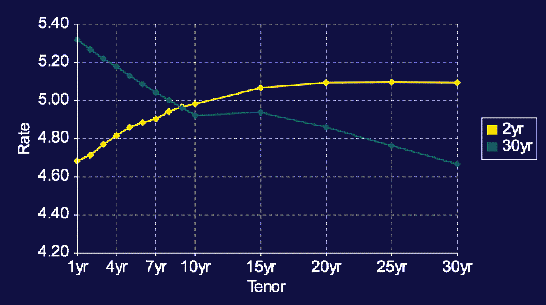
Nov
28
(Anecdotal) Updated Macro Information, from Dr. William Rafter
November 28, 2006 | Leave a Comment
I find that at this time there is no evidence from the Monetary Base numbers suggesting a change in policy. Additionally there is no change in the job growth numbers as evidenced by the payroll tax receipts.


George Zachar adds:
This morning William Poole observed that the MZM and M2 monetary aggregates “are chugging along at pretty steady rates.” Year over year, he noted, MZM is up 4.3%, while M2 is up 4.9%.
Although they have accelerated in more recent months, Poole said those money supply growth rates “are pretty close to the growth rate we’ve got for nominal GDP” and are “consistent with the growth that’s being forecast for next year.”
Since real GDP growth is expected to be “a little below 3%,” he said, “if you take a 2% inflation target that adds up to 4 1/2% to 5%, which is really very close to where money growth is right now.” So he said, “money growth is not telling you that monetary policy is tight or easy, just in line with GDP growth.
Bill replies:
If you think of the Monetary Base as a window on Fed policy, then the data makes the case that there has been no change in policy. Since the beginning of 2005 that policy has been moving from accommodative to restrictive. Thus there is no deviation from a restrictive policy, which at this time is very restrictive (more below).
George Zachar’s comment was more insightful. George pointed out how the Fed’s statements on M2 and MZM growth were contradicted by my data. The boys at the Fed think that they are walking the narrow line between restrictive and accommodative. The data suggests otherwise.
At this time the Monetary Base is in excess of 4 percent below the long-term mathematical fit of that data. This is more restrictive than in 1998. Perhaps our “planners” wanted to be more restrictive in 1998, but had to back off because of (a) Asian contagion, (b), Russian bond default and (c) Long Term Capital Management. In any case, the current data shows the present to be more restrictive, and there is no anxious moment to force a change. The period of 1990-92 had the most restrictive policy. Remember that as the period of “It’s the economy, stupid”.
Monetary Base is an interesting number, consisting of currency and deposits at Federal Reserve Banks. Breaking the Base down into those two components does not give you as complete a picture as the two together. For example, look at the two spikes: the earlier one was the Y2K spike caused by excess currency (the ATMs were all going to fail). The later spike (9-11) was caused by the Fed goosing the bank reserves. Only if you look at the Base data do you see both spikes.
I’m looking forward to Diebold next week.
Nov
28
Bernanke: Profits or Prices?, from George Zachar
November 28, 2006 | Leave a Comment
There was a nice overview of Bernanke’s current thinking on the economy in today’s speech. There were No bombshells, with both the rhetoric and the conclusions between the 40 yard lines of recent Fedspeak and Centralbankese.
One passage struck me as being modestly noteworthy:
What implications does the pickup in labor costs have for price inflation? One possible outcome is that increases in labor costs will largely be absorbed by a narrowing of firms’ profit margins and not be passed on to consumers in the form of higher prices. The fact that the average markup of prices over unit labor costs is currently high by historical standards suggests some scope for this outcome to occur. If higher labor costs are mostly absorbed by firms and not passed on, then workers will see the gains in their nominal compensation per hour of work translated into greater real compensation per hour; in the process, workers would capture a greater share of the fruits of the high rate of productivity growth seen in recent years. The more worrisome possibility is that tight product markets might allow firms to pass all or part of their higher labor costs through to prices, adding to inflation pressures. The data on costs, margins, and prices in coming months may shed some light on which of these two scenarios is likely to be the better description of events.
Bernanke echoes his predecessor in calling attention to the rise in profit margins, and implying it is business’ slicing of the wage/profit pie that is central to inflation pressures. This plays perfectly in the rhetorical framework of the labor union-backed Democrats who will be holding the gavels on Capitol Hill.
Nov
28
The Joy of Soft Landings, from George Zachar
November 28, 2006 | Leave a Comment
| Quarter/Quarter Activity Annual Returns | 3rd Quarter 2006 | 2nd Quarter 2006 |
| GDP | 2.2% | 2.6% |
| Goods | 3.7% | 3.6% |
| Services | 3.0% | 2.4% |
| Quarter/Quarter Annualized Prices | ||
| Market based PCE | 2.2% | 4.2% |
| PCE Price Index | 2.4% | 4.0% |
| Market PCE Core | 1.9% | 2.7% |
| PCE Core Prices | 2.2% | 2.7% |
| Year/Year | ||
| Market based PCE | 2.6% | 3.2% |
| PCE Price Index | 2.8% | 3.3% |
| Market PCE Core | 2.0% | 1.9% |
| PCE Core Prices | 2.4% | 2.2% |
Note: This moderate and modest report will no doubt be seen on Constitution Ave. as validating both the Fed’s pause and the markets’ dampened vol readings.
Nov
24
Web Surveys and Elections, from George Zachar
November 24, 2006 | Leave a Comment
The elections held in The Netherlands on Wednesday have shaken the country. Almost 10 million votes were cast, and statistics show that a full half of those who voted used a popular web-based voter guide. This guide is operated by the independent institute for the public and politics. Advice is given to the visitor upon answering a number of multiple choice questions on some common political topics. Statistically, a number of people ended up scoring in support of populist parties both on the far left and far right. No bias was reported to exist in the test itself. However, these parties have ended up with an unforeseen amount of power as a result of the election. The voter participation was high, and the web-based advisories may have motivated people with little interest in politics to cast a vote anyway. Can politics be simplified to a ten minute test?
The above thread discusses the impact of a neutral opinion test on the recent Dutch election. The test, English version here, took me less than 5 minutes to take. It is interesting to contemplate the impact this sort of thing might have going forward.
Nov
22
Dollar Signs, by George Zachar
November 22, 2006 | Leave a Comment
I was eyeballing a Daily Mail article on the Paul McCartney divorce, and came upon this passage:
I remember him saying that all she thought about was money and that she had asked for £80million. He said something like, ‘She is going to take me for £80million, because we now know it’s for £80million. All she thinks about is dollars’. He even drew dollar signs to emphasise it.
What struck me was how a UK subject would talk about money and specific amounts denominated in pounds sterling, but when it came to symbolize the wealth, he spoke of dollars, even drawing $ signs.
Something to contemplate amid the unending litany of dollar doom stories.
Nov
22
Trust, by George Zachar
November 22, 2006 | Leave a Comment
Freakonmics author/blogger Steven D. Levitt asked his readers to name the “most trusted” person in America. (He didn’t know that was Walter Cronkite’s nickname.) The results, from among 150 replies:
Warren Buffett 8 Bill Gates 7 Jon Stewart 7 Oprah Winfrey 6 Alan Greenspan 4 Billy Graham 4 Colin Powell 4 Bill Clinton 4 Tom Hanks 3 Dr. Phil 3 Paul Harvey 3 Mister Rogers 3 George Bush 3 Homer Simpson 3
The only positive thing I can say about this list is that it is led by two notional capitalists.
Nov
14
Herding Explanation, by George Zachar
November 14, 2006 | Leave a Comment
A simple explanation of herding can be found in this week’s Economist, with obvious parallels to the stock market.
Nov
10
Fedwatching, from George Zachar
November 10, 2006 | Leave a Comment
Fed chair Bernanke’s speech, “Monetary Aggregates and Monetary Policy at the Federal Reserve: A Historical Perspective” is simply a litany of failures by the central bank to understand its own core product: money.
Kudos to Bernanke for his clear-eyed ability to acknowledge failure… but would you take your car to a mechanic who said that despite decades of study, he still didn’t understand engines?
Nov
10
Carly Haiku, a Continuing Series, by George Zachar
November 10, 2006 | Leave a Comment
Fiorina’s Winding Road Points to an Uncertain Future
Monday, November 13, 2006; Page D02
Carly Fiorina knows what it’s like to be an outsider. The law school dropout started her career as a secretary in a male- dominated business world. She was initially rejected by the University of Maryland’s business school, was once referred to as the “token bimbo” at her job selling telephone service for AT&T, and later became the chief executive of Hewlett-Packard.
Medievalist Carly,
Georgetown part-timer,
tries "pity me" tack.
"Unemployable"?
She works the lecture circuit.
Oh, she's lonely too.« go back — keep looking »
Archives
- October 2026
- September 2026
- August 2026
- July 2026
- June 2026
- May 2026
- April 2026
- March 2026
- February 2026
- January 2026
- December 2025
- November 2025
- October 2025
- September 2025
- August 2025
- July 2025
- June 2025
- May 2025
- April 2025
- March 2025
- February 2025
- January 2025
- December 2024
- November 2024
- October 2024
- September 2024
- August 2024
- July 2024
- June 2024
- May 2024
- April 2024
- March 2024
- February 2024
- January 2024
- December 2023
- November 2023
- October 2023
- September 2023
- August 2023
- July 2023
- June 2023
- May 2023
- April 2023
- March 2023
- February 2023
- January 2023
- December 2022
- November 2022
- October 2022
- September 2022
- August 2022
- July 2022
- June 2022
- May 2022
- April 2022
- March 2022
- February 2022
- January 2022
- December 2021
- November 2021
- October 2021
- September 2021
- August 2021
- July 2021
- June 2021
- May 2021
- April 2021
- March 2021
- February 2021
- January 2021
- December 2020
- November 2020
- October 2020
- September 2020
- August 2020
- July 2020
- June 2020
- May 2020
- April 2020
- March 2020
- February 2020
- January 2020
- December 2019
- November 2019
- October 2019
- September 2019
- August 2019
- July 2019
- June 2019
- May 2019
- April 2019
- March 2019
- February 2019
- January 2019
- December 2018
- November 2018
- October 2018
- September 2018
- August 2018
- July 2018
- June 2018
- May 2018
- April 2018
- March 2018
- February 2018
- January 2018
- December 2017
- November 2017
- October 2017
- September 2017
- August 2017
- July 2017
- June 2017
- May 2017
- April 2017
- March 2017
- February 2017
- January 2017
- December 2016
- November 2016
- October 2016
- September 2016
- August 2016
- July 2016
- June 2016
- May 2016
- April 2016
- March 2016
- February 2016
- January 2016
- December 2015
- November 2015
- October 2015
- September 2015
- August 2015
- July 2015
- June 2015
- May 2015
- April 2015
- March 2015
- February 2015
- January 2015
- December 2014
- November 2014
- October 2014
- September 2014
- August 2014
- July 2014
- June 2014
- May 2014
- April 2014
- March 2014
- February 2014
- January 2014
- December 2013
- November 2013
- October 2013
- September 2013
- August 2013
- July 2013
- June 2013
- May 2013
- April 2013
- March 2013
- February 2013
- January 2013
- December 2012
- November 2012
- October 2012
- September 2012
- August 2012
- July 2012
- June 2012
- May 2012
- April 2012
- March 2012
- February 2012
- January 2012
- December 2011
- November 2011
- October 2011
- September 2011
- August 2011
- July 2011
- June 2011
- May 2011
- April 2011
- March 2011
- February 2011
- January 2011
- December 2010
- November 2010
- October 2010
- September 2010
- August 2010
- July 2010
- June 2010
- May 2010
- April 2010
- March 2010
- February 2010
- January 2010
- December 2009
- November 2009
- October 2009
- September 2009
- August 2009
- July 2009
- June 2009
- May 2009
- April 2009
- March 2009
- February 2009
- January 2009
- December 2008
- November 2008
- October 2008
- September 2008
- August 2008
- July 2008
- June 2008
- May 2008
- April 2008
- March 2008
- February 2008
- January 2008
- December 2007
- November 2007
- October 2007
- September 2007
- August 2007
- July 2007
- June 2007
- May 2007
- April 2007
- March 2007
- February 2007
- January 2007
- December 2006
- November 2006
- October 2006
- September 2006
- August 2006
- Older Archives
Resources & Links
- The Letters Prize
- Pre-2007 Victor Niederhoffer Posts
- Vic’s NYC Junto
- Reading List
- Programming in 60 Seconds
- The Objectivist Center
- Foundation for Economic Education
- Tigerchess
- Dick Sears' G.T. Index
- Pre-2007 Daily Speculations
- Laurel & Vics' Worldly Investor Articles
