Sep
24
An Explanation of Everything, from Micheal Ott
September 24, 2007 | 1 Comment
 As an explanation of everything, I liked How We Got Here by Andy Kessler, available free online. It covers the invention of nearly everything from the steam engine to the Internet and touches on issues dealing with patents and banking systems along the way. It's his best work and well worth reading. He inserts levity and explains things very well. I also liked Running Money and Wall Street Meat by the same author, but found his latest, The End of Medicine, worthless.
George Zachar writes:
Hans-Hermann Hoppe explains pretty much everything in his 33 page essay Banking, Nation States and International Politics, tying together gold, fiat currency, banking, the State, the evolution of the Euro….
Sep
23
Property Statistics Observation, from George Zachar
September 23, 2007 | Leave a Comment
A property statistics observation, prompted by this item:
Buy Houses in Detroit for $1500, Monthly Pmt. = $7
More than 15% of the homes for sale in Detroit, or almost 1 out every 7 homes for sale, is priced at $20,000 or less.
How much of the statistical weakness in house prices is related to utter freefalls in dead-end places like Detroit, Cleveland, Buffalo, etc., pulling down the averages?
Average income in Manhattan is a truly meaningless stat, as both seven figure compensation and welfare checks are common here.
What about "average" house prices, lumping together entire neighborhoods that are bidless along with suburban stretches just "giving back" the last couple years of appreciation?
Is this a meaningful distortion?
Tom Larsen remarks:
 I look at houses on line from time to time in Flint, MI. I look at my old neighborhood, and the houses are still going for the price my Dad sold his for in the 70s. The main difference is the factories are gone and the people are poor. Oh, and there weren't any drive-bys when I was growing up. You got beaten up, but no shootings. A house two blocks from where I grew up is listed for $25,000 on Zillow. At least it's not a dump. Maybe someone could make money buying these places. I'd live there (though my wife wouldn't), except I moved to San Francisco many years ago, and let's just say Flint is short on the amenities I enjoy here. Michigan has always been my "put" — if we run out of money, we will have to go back there.
Sep
22
Babes In Arms, from George Zachar
September 22, 2007 | Leave a Comment
Sept. 21 (Bloomberg) — Calyon's global head of credit markets left the investment bank after it said an unauthorized proprietary trade cost the firm 250 million euros ($347 million). Loic Fery, 33, who oversaw credit markets from London, left the bank this week…
Call me old fashioned, but I would have expected the "global head of credit markets" at a major bank to have seen at least one credit cycle before attaining command of the balance sheet.
Sep
20
A Steenbarger Haiku, from George Zachar
September 20, 2007 | Leave a Comment
The wise Doctor Brett
Goes hip-hop in naming his
value grid: Style Cube.
Sep
20
Manhattan Commercial Real Estate Sales, sent in by George Zachar
September 20, 2007 | Leave a Comment
The following is an extract from NewYorkBusiness.com:
Credit crunch aside, commercial real estate sales in Manhattan have already surpassed last year's record total, according to a report released Wednesday by Cushman & Wakefield Inc.
The real estate company estimates that in the first eight months of the year, sales transactions that either closed or are under contract totaled more than $40 billion. In all of 2006, transactions amounted to $34.7 billion.
The first half of the year was the strongest six-month period ever reported for commercial sales, with transactions reaching $34.1 billion, up from $18.58 billion in the corresponding period in 2006.
Cushman notes that the credit crunch has led to more stringent underwriting, more expensive lending terms and an increase in the amount of equity required for purchase. It says that eventually the market turmoil could lead to fewer property sales, fewer bidders and ultimately lower prices for buildings. However, for now, the company says property values have remained strong.
At mid-year, Cushman pegged the class-A vacancy rate at 5.4%, the lowest since 2001. The average asking rent was $69.58 per square foot, a record high and up 38% from the corresponding period in 2006. [Read more]
Sep
19
What Inflation? from Pippa Malmgren
September 19, 2007 | Leave a Comment
Here is the key inflation issue: the Fed know core CPI is flat or falling and that the price of everything a person actually needs to live is rising rapidly (food, energy, healthcare, education, insurance, etc.). Plus, they believe the disinflationary effects of emerging markets has diminished which is evident from the fact that Indian firms are not outsourcing to Mexico where wages are cheaper (as one example). So, there is now an important (but quiet) debate in the FOMC and among the staff about whether more attention ought to be paid to headline inflation as well as core.
Plus, digging a bit deeper, they fear that real interest rates may already be negative if you adjust your numbers using headline instead of core. Or, even worse, you could think about using the inflation numbers that arise from the old methodology before they stripped everything out of it. That calculation (see John Williams' work on Shadow Statistics) shows inflation running at 8-10%.
So, there is much more worry than the market realizes about cutting rates now and essentially pulling the ripcord that unleashes an inflation which will be hard to deal with later (a la Greenspan's comments over the last few days).
George Zachar adds:
It is comforting to know that, under the surface, there are folks in the monetary clerisy that "get it" vis a vis honest-to-G-d inflation.
Unfortunately, the Fed's calculus is complicated by political and systemic risk factors. The left controls the political and media agendas, creating a fierce headwind against discipline.
And there's something about bank runs (albeit in the UK) that's apt to focus a central banker's attention on immediate problems, leaving longer-tailed inflation concerns for another day.
Greenspan publicized the notion that the Fed would try to make its mistakes in ways that could be remedied — that is, if they were going to screw up, they would do so in a way that left them policy tools to address the problem.
In the case of deflation, they deliberately stayed too easy too long, to make sure they didn't have "a Japan problem", assuming they could always jack rates up to mitigate subsequent inflation.
I fear/suspect that a similar calculation is being make now: Is it better to extinguish the systemic risk fire now with a big ease, and then later have to tighten even more? Or to make a half-effort now on the liquidity side, hope that's adequate, and promise to ease more if required?
Aug
9
A Kennedy/Shoeshine Boy Moment? from George Zachar
August 9, 2007 | Leave a Comment
 The long-time produce clerk at the locals' supermarket here in Aspen was chatting up a customer this morning.
"Do you watch the stock market? It's been going down down down. Yes it jumps every now and then, but still, it's going down.
"Then I heard on the radio that a lot of people are going to start walking away from their mortgages….just walking away from their houses….Do you think that can happen here?"
The customer was probably a local real estate broker, because he paused and gave a very detailed description of how the different sub-markets in this area would behave under different mortgage market scenarios.
"Okay, okay," the clerk continued. "So you think I should still go ahead and buy that house?"
At that point I couldn't find anything else nearby to pretend to examine, so I moved on.
A Kennedy/shoeshine boy moment?
Aug
3
Web Impact on Media in One Sentence, from George Zachar
August 3, 2007 | Leave a Comment
Slashdot.org is giving its readers highly granular control over its feed. I was struck by the elegance of this:
Play with the color slider to find the level you enjoy reading most at.
My daughter, 8, will likely never have to memorize the fixed formats of pre-printed periodicals to home in on regular features of interest. As a former newspaper layout geek, it's interesting to see generations of habit suddenly rendered moot.
Stefan Jovanovich extends:
When I left New York 35 years ago the New York Times had the presumption that it was like the medieval church or the compulsory public school, that the common folk had to accept what was preached at them whether or not it was of any use or interest to them. Apparently, that presumption endures even with the changes that have occurred in the world of information.
There are 14,000 radio stations broadcasting today, twice the number that existed in 1970. This does not include satellite radio, which in the six years since its launch has acquired 13 million subscribers nationwide. Eighty-six percent of American households subscribe to cable or satellite TV, receiving an average of 102 channels; many receive two, three, four, and even five times that number. As of 2005 there were 18,267 separate magazines with regular publication schedules; in 1993 there were 14,302. The Internet Systems Consortium says that in 1982 there were 235 Internet host computers that allowed people to post content on the web; in 2006 the count was 400 million. Technorati counts more than 63 million blogs on the net. They believe 175,000 new ones are created every day.
Welcome to debate whether the Sulzbergers and the Times's staff are more or less honest than Roger Ailes, Rupert Murdoch, and Fox News; but that is truly an academic question. What is incontrovertible is that Mr. Murdoch's team has been amazingly more successful in gathering a paying audience. They have, in a matter of years, gained more viewers and readers than the Times acquired in the half century after the Herald Tribune stopped publication.
Gutenberg's movable type made writings that had been accessible to thousands available to millions. It did not guarantee that anything written would be honest, but it did mean that the judges in the competition for the truth would be all who took the trouble to learn to read, not just those lucky people who had been anointed by official learning.
Jul
29
The following is from the article, Point Shaving in the NBA: An Economic Analysis of the NBA’s Point Spread Betting Market.
The setting of the point spread is inducing games to end up on one side more often than the other, due to the betting market's non-linear payout structure altering incentives.
Jul
27
Counting Doomsterism, from George Zachar
July 27, 2007 | 2 Comments
The Nth time I saw Marc Faber's name cross the tape, I was inspired to run his name on blogpulse.com, to see how his mentions correlate with market action.
The graph speaks for itself.
Tim Humbert adds:
I used to follow his material while it was free, but lost track. And yes, it was quite bearish.
Someone mentioned his name a few weeks ago, and I decided to compare his fund's performance to the market's from 1998, when it's first listed on Bloomberg. He seems to have done well; though if you look from the trough in stocks in 02/03 he has underperformed.
Faber SPX
2006 188.90 146.28
2005 170.26 128.75
2004 169.39 125.00
2003 157.05 114.69
2002 147.85 90.75
2001 147.94 118.31
2000 137.99 136.06
1999 120.57 151.41
1998 106.36 126.67
Vance Humbert adds:
Try using the unyielding David Tice, whom Bloomberg quotes today as saying "this could be the big one," and a somewhat similar pattern emerges.
Jul
24
Ex-Newark Mayor Pleads Not Guilty to Corruption
By KAREEM FAHIM
Published: July 24, 2007NEWARK, July 23 — At his arraignment in federal court Monday, former Mayor
Sharpe James pleaded not guilty to corruption charges.
After scanning this morning's New York Times offering on Newark's ex-mayor, I had a flashback to a lecture by a (literally) communist professor I had in college.
He said visiting Soviet officials marveled at how in our putative decentralized, capitalist, pluralist, free press, the material was so uniform across media and across the nation.
They always asked "How do you do it?"
Well, given that yet again the former "newspaper of record" pointedly failed to mention the political affiliation of an accused politician, I can only assume one thing:
The Times's internal word processing software automatically deletes the word "democrat" by default, if the word "corruption" is elsewhere in the same block of text. Certainly no meatware system could be so consistent.
Sam Kumar remarks:
This inference drawn from one instance is probably false. The tenor of the post is that of a joke, but a propaganda message is clearly being sent here.
George Zachar adds:
This morning's front-page NY Times piece on the misuse of state police for political purposes in Albany, fails to mention the party ID of the suspects or their masters. This is noteworthy in light of East Sider's observation.
Press-as-partisan has a long history in the US. What's different with this cycle is the false-flag pretense of objectivity.
Jul
23
Potter's realm? Wall Street.
Hubris, stealth, misdirection.
It's always a dame.
Jul
20
I Like Ike, from Stefan Jovanovich
July 20, 2007 | 1 Comment
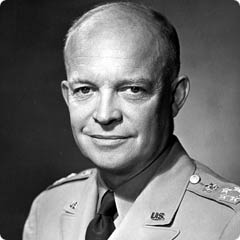 It is almost impossible for most of us living now to imagine a world in which Sam Walton's motto — Save and Do Better — was the majority view of politicians, but that was the general opinion. Kennedy, like FDR, campaigned on a platform that accused his Republican Presidential predecessor of being extravagant (partly true in Hoover's case; laughable in Eisenhower's). What changed things forever was the wholesale acceptance of Keynesian economics at MIT, Harvard and even Chicago. That gave respectability, nay, wisdom to the inclination of politicians in both parties (Johnson nationally, Rockefeller in New York State) to indulge once again in the fantasy that it was OK to for governments to borrow more and more money as long as they spent it as quickly as possible. One reason for the continuing Anglophile disdain for the French is that they were the first to say that the United States was no longer serious about gold and the dollar being equally scarce monetary commodities. Of course, they were right; and we have yet to forgive them for being so treacherously truthful. That abandonment of all fiscal common sense is what took us off to the races in 1964 and 1965; some would argue that we have been running ever since. Eisenhower, like Grant, receives far too little credit for his monetary frugality. Belief that the Treasury would only spend a small part of what American earned is what established the "soundness" of the dollar and allowed the U.S. economy to enjoy its greatest period of real growth since the 1870s and 1880s.
George Zachar replies:
Insufficient cynicism.
Eisenhower is damned as a do-nothing, caretaker president, whose popular references now are largely comprised of golfing photos and sneering references to his VP.
The only presidents getting "credit" in the history departments and newspaper clippings are those who manfully strove to expand the government's footprint.
Jul
19
Climate and War in China, noticed by George Zachar
July 19, 2007 | Leave a Comment
Nature.com Published online: 13 July 2007
China had more wars in cold weather
Reduced agricultural productivity seems to trigger armed conflict.Between 1000 and 1911, there were 899 wars in eastern China, where most of the country's food is grown. Zhang's team classified each decade as a time of either very high (more than 30 wars), high (15-30 wars), or low (less than 15 wars) conflict.
Over the same period, climate data for the Northern Hemisphere show six major cycles of warm and cold phases. Crop and livestock production dropped significantly during the cold phases.
All four decades of very high conflict, and most periods of high conflict, coincided with cold phases, they found.
Jul
17
Teenagers, from Steve Leslie
July 17, 2007 | Leave a Comment
 There is a new scientific study reported on a recent ABC newscast that suggests that excessive discussion of problems by teenage girls does more harm than good. One particular malady that can manifest itself is low self esteem and depression. When one realizes that women tend to talk approximately three times more than men, one soon realizes that there is a lot of discussion of problems that teenage girls are focusing on.
Personally speaking, when I visit my sister in Jacksonville I notice that my niece spends an inordinate amount of time on her my space account or even with various I.M. services such as A.O.L. instant messenger. It soon becomes obvious that girls have a lot to talk about and use up a lot of time to do their talking either verbally or virtually. The question becomes who do they end up talking to and ultimately what is it that they are talking about.
This got me to thinking that raising a child in today's world is light years from when I raised my first over 15 years ago. The challenges are great and the risks are far greater to youth than they were a decade and a half ago. The advance of technology and the proliferation of the internet and websites, chat rooms and other sites can become a great challenge to the youth of today not to become seduced by this and in fact in some cases to become a victim of the predators who lurk in a dark netherworld ready to attack the unsuspecting and the vulnerable. Shouldn't we as parents be more aware of this and prepare and protect our children from harmful and dangerous solicitations.
Also, another thought that comes to mind is what do we as parents do to help our child through this veritable minefield of new and shifting challenges that they face. Are we doing as much as we can or as much as we should and when and where do we do our work to prepare our children for an extremely complex and everchanging world. Where will they receive proper advice and develop true values if they do not receive it in the home.
How much actual quality time does the parent of today spend with their children as opposed to the parent of 30 or even 10 years ago. Where are the opportunities to form the bonds that arise from social interaction with a child. If a child has questions or issues that they face if they can not find it in their parents where will they turn. Once again, from the cheap seats, look at what is available to the teen of today and even the parent of today.
Computers and unrestricted use of the internet Video games, dvd's and rental programs such as Netflix and Blockbuster, hundreds and hundreds of cable channels, cd's with graphic lyrics, movies on demand, music on demand, Ipod's, Iphones, cell phones, text messaging, mega movie theaters with 16 and 24 movies, the list continues …
James Lackey comments:
It has never been easier to be a parent. Kids today are the best and brightest due to specialization. Besides riding a bicycle on the street, I believe it's generally safer today than when I was a kid. All the new technology makes it so easy for kids to learn and parents to monitor their progress and safety.
It’s never been harder to be a petty criminal. I can’t imagine even getting away with even a fist fight now a days. There are security cameras, and cell phones with 911 and picture cams, everywhere.
Not to mention the illnesses, like flu or pneumonia, that killed kids even 30 years ago. A hundred years ago many kids died before they were teens. How about the ability for kids to take extreme risks on the fields of play? There is much less worry about debilitating injuries from sports. I have had several fractures from racing that took me out for three to six months, that 30 years ago would have affected me for life. Today kids have outpatient procedures and are back in six weeks. Not to mention all the knee injuries that 20 years ago ended careers, ACl type injuries today are fixable.
Finally, there have been times over the last 100 years where segments of society were not certain about, diet, exercise, training and drugs. Just 30-40 years ago too many people smoked, ate too much bad food, didn't exercise, and so called 'experimented' with drugs and alcohol.
It is without a doubt that a higher than usual percentage of people that experiment with any drugs, destroy their lives. If you eat too much you will eventually be sick and unhappy. If you smoke, you are now a social outcast, and there is a very high chance you will be very sick in 20-50 years.
It must have been much tougher to be a parent in and after the depression. Your kid could get sick and die. Your kid could, not knowing any better, find an opium den, get sick and die. Kids could get sick and die from a shortage of food. During WW2 a huge percentage of young kids were forced into war with a high risk of death.
Yet usually, in the agrarian society of 100-200 years ago, they simply worked our kids to death.
George Zachar adds:
Parenting seems daunting now because of all the choices we have to make. It's no longer one neighborhood school, one community newspaper, the local church, three TV channels, etc.
The range of educational/recreational/informational choices means parents have to process a lot more material to exercise their role. This is on top of a stressful work life for most.
Raising kids in the same town I grew up in, I can't say the risks are appreciably higher. Sex 'n drugs 'n rock 'n roll were ubiquitous when I was teen too.
I am in Lack's camp. The upsides are vastly greater now than for prior generations.
John de Regt writes:
There are new opportunities and new risks, and some of the old risks are less. While the threats of wars and sports/play injuries may be fewer, the traps of drugs, video games/Internet, sexual predators, AIDS, and drunken drivers justifiably keep us up at night.
Parenting is a lifelong activity, in any era, and we as parents always need to be aware of possible threats and risks to our kids.
Alex Forshaw suggests:
The "big bad culture that's out to eat our children" idea is silly and exaggerated. Sheltered kids will have a marginally higher "survival" (i.e. reaching all the socioeconomic checkpoints their parents set out for them) rate until they get into a good college, at which point they will go nuts. If they don't go nuts.
Humans are a lot more adaptive than our feel-sorry-for-everything culture gives them credit for, and social mechanisms (feeling copiously sorry for someone who is down, granting all kinds of exceptions to people who are depressed, etc.) are responsible for as much harm as real dangers from the wider world.
Given the human memory's selection bias of preserving good memories and killing bad ones, better awareness of current problems (which are biased towards negativity) gives older generations absurdly rose-tinted hindsight.
J.T. Holley adds:
I'll second Alex's points. Having eight, six and four year olds I can assure you that I spend more time with my children than my parents ever dreamed of — and I mean quality time.
Now to think that there is the "mean cruel world" out there that wants to tear into, tear apart, corrupt, and diminish the lives of our children is just plain foolish. It's protectionism on a family level.
Kids today have lead-paint-free cribs, childproof lids, moms who don't smoke and drink during pregnancy, bike helmets and bottled water. Are they really worse off than we were? Can you think of one technological advance that doesn't make you and your children better?
And why do people think that there is a greater percentage of pervs, pedophiles, sex offenders or others who prey on children than back in the 50s - 80s? The population has grown, but the distribution of them in society is the same, and our police forces have better technology to combat them.
As far as schooling, the level of public education is not as bad as everyone makes it out to be, although there are isolated problems in specific geographic areas. Plus, to pay $35,000 to have my child learn to finger paint seems a little foolish.
Mark Goulston offers:
In my article Potential is a Terrible Thing to Waste I make the connection between coaching and parenting.
Russell Sears writes:
In one sense child rearing is much more demanding today. Freedom, and how to use it responsibly, is almost always demanding. Many parents find it easiest simply to let the media, in all its many forms, be the parent. But this leads to absent parent syndrome.
Peer pressure is on the parent. Most children fantasize no parental authority. Indeed, authors of "Nanny Diaries" said they never saw the father of kids in their care. It’s not just the poor ghetto parent who use TV for babysitting. Parents go to tragic lengths not be parents, just to top their friends as "free spirits". Absentee parent put children at risk for drug dealers and pedophiles.
I limit my children’s access to TV, movies, and Internet. My kids go to public school; nobody would call them sheltered. Why? Because they have spent time with a five-year-old who was given narcotics by his parents, and other children raised in abusive homes.
Sheltered kids only see a romanticized version of life, not the consequences of mistakes.
Jul
16
Young Adults Are Giving Newspapers Scant Notice
Most teenagers and adults 30 and younger are not following the news closely at all…
The end of the Cold War triggered an erosion in news following by the US public. With nearly a generation of ingrained disinterest, reacquisition of the habit seems unlikely. Add in the explosion of decentralized information sources now available on the web, and I am driven to wonder how folks from Rove to Ickes will be able to plant and propagate the memes necessary to steer public opinion for political purposes.
Throttling the outlets where govt can dictate terms (the "Fairness Doctrine"), using legislation to target enemies (as the Swimmer did with Murdoch's Boston Herald), etc., won't work in a world of Drudges.
A descent into Putinesque bloodshed, mercifully, represents an unlikely trajectory.
I think I'll make time to learn what the media was like before the Civil War, when anyone with a press and an idea had free rein to saturate street corners with their ideas.
Stefan Jovanovich writes:
In 1840 Cincinnati was the largest source of publications west of the Alleghenies, and the third largest in the country after Philadelphia and Boston. Imagine: launch parties for the latest John Updike screed down by the hog rendering yards on the Ohio.
Jul
15
Gaming the Subway Seats, from Hany Saad
July 15, 2007 | 3 Comments
 I take the subway to work daily. While not the most prestigious means of transportation, it is definitely in my case the most practical, economical, and time saving. I happen to live three subway stops from the beginning of the line.
By the time I catch the subway, it is usually full with no seats available. Sometimes, I am in dire need for a seat to get a little nap, especially if I am caught trading overnight. An hour nap can do wonders in my case.
Out of this need I become more creative about finding this precious vacant seat. Knowing that the previous two subway stops to my own have only two sets of stairs closer to the front end of the train, I started walking all the way to the opposite end in hope that most people will go for the closer compartments. This is in fact the case except oddly enough that the farthest compartment is always packed.
My reasoning in this case is that most people play the same game I do hoping for the precious nap and seat. However, three cars away from the far end seems to be day after day the optimum solution to this game. Now that I choose the optimum car successfully, sometimes I still am not lucky enough to get a seat unless one of the passengers gets off the train.
I start analyzing the passengers’ profiles trying to figure out which ones are likely to get off the train first to sit in his or her place. This is not an easy task but some knowledge of the city and behavior can do the trick. For instance, I stay away from all people over 30 in business suits as chances are that they are headed to my same destination. Once this category is eliminated, I try to eliminate all university students by guesstimating their ages simply because four out of five universities are located downtown (at the end of the line) so the odds are clearly not in my favor there either. I try to spot two age groups. High school students and under since parents most likely prefer to send their kids to nearby schools so it is unlikely that this group will travel all the way downtown for schools. Also, the elderly group is most likely not traveling far either. This whole process usually takes few seconds since I usually get lucky enough to get a seat before we reach the next stop.
This process is very similar to gaming the mistress although I admit it's never this straight forward with her. Incentive, incentive and incentive. I play the market for monetary profits and only profits. I don't care what philosophical reasoning a speculator would give you a la George Soros; the bottom line is that it is all about the monetary reward. It is all about the nap in the case of my subway trip.
I always try to figure the line of least resistance in speculation, the car with the fewest passengers. This is usually the road least followed by the public. In search for prosperity, I have to copper the public play at all times (by going to the opposite end in the case of the subway), but sometimes the simple contrary play is not good enough to win the game. A little tweaking is often needed. In the subway example I had to go to the third car from the opposite end and not the last since some smart passengers figured out the "simple" contrary play by going straight to the last car.
Timing is also a very critical factor and can make all the difference between a win and a loss. In the case of the subway one has to process some information and position oneself accordingly in a few seconds before reaching the following stop. Flexibility is also a key to successful speculation as no fixed system will beat the market forever. In the subway example, my game plan is different on the way back home since a different crowd is taking the subway at that time.
Ever-changing cycles also plays a great role in this game. The last car was full as the public got wiser and I am sure the third will be one day and a new game plan and system will have to be developed.
Knowing who you are playing against is critical to any speculative game as is the case of the passengers' profiles of this subway. An extensive knowledge of the markets you participate in is essential to your success as is a knowledge of the different subway stops and what they represent to different passengers.
I will end this post here as I reached my subway stop and have to vacate my seat for the next player.
Sam Humbert comments:
In my Manhattan years, I'd often give up my seat to a person of gender or age. For me, the psychic pain of sitting whilst a pregnant woman or pensioner is standing outweighs the benefit of sitting down. Often I'd get the fish-eye from my fellow New Yorkers — they were silently thinking "he must be mentally ill." I'd sometimes make eye contact and explain "I'm not originally from New York," and this would calm them.
Craig Mee adds:
Watching commuters pile into the tubes in London, there is sheer brawn! Doors open at the station and boom, some people are fixed on the destination, i.e., empty seats and God help anyone getting in there road. Funnily enough this is usually concentrated to a certain gender. Some people like to try and muscle markets around too!
Chad Humbert adds:
 1. Watch for mothers with small children. Sometimes a child will scurry, and the mother will have to leave her seat to retrieve him. Voila! Open seat!
2. The elderly are often slow. I've found I can often simply beat them to the open seat by walking somewhat faster. If I'm careful, I can make it appear that I passed them inadvertently. "Oh, were you going to sit here? I'm sorry! Do I need to move?" Most of them want to be polite, and they insist that I keep the seat. Copper the elderly.
3. I've found that the handicapped seating rules are rarely enforced, and when they are, it's just a small fine. I pay that fine many times over with the extra trading profits I generate from feeling refreshed after a nice nap.
Yishen Kuik offers:
Mr Saad's comment on how the farthest caboose is not the optimal choice because of gamesmanship, but rather some not so inconvenient caboose reminds me of a well known behavioral finance game.
Ask 100 people in the audience to pick a number between zero and 100. The winner is the one whose number is closest to two thirds of the average.
Eggheads will zero in on zero, but that answer merely demonstrates deductive abilities without canniness.
People with a more limited appreciation of convergent series might pick 33 instead, based on the assumption that the average will be 50. People able to think one more step ahead might pick eleven. People able to think one more step in the convergence series might pick nine, and so on.
The real challenge of the game is to guess the distribution of this gradient of deductive powers among the audience and weight one's answer accordingly.
e.g. If you think half the people in the room will guess 33 and the other half are extremely bright but guileless and will guess zero, you should guess eleven.
So perhaps if the challenge is given in a lecture room at MIT, guess one (zero is pointless because of the likely pot split). If the challenge is given to the general public, guess between ten and fifteen.
Philip Tetlock, whom I'm reading currently, reports that the most common winning answer is thirteen.
Barry Gitarts contributes:
 Here are a few of my subway gaming experiences as they relate to the market.
Gain an edge by counting - I use the grip mats markers to note where the train doors open when the train stops, so next time I will be standing there well in advance of the train arriving. This prevents others from being the first in the door. This takes several observations, because the train never stops in exactly the same spot, but it’s remarkable how close to the doors you can be. Standing on different parts of the platform to observe which cars are the emptiest helps in figuring out which car you would want to focus on.
Work harder then the next guy and be prepared in advance - Even if you are the first in at your door, there will be others coming into the same car through other doors, competing for the same seats as you, this is why you must start looking for empty seats through the windows as the train is still pulling in so you know exactly which seat you need to go for, instead of walking in, looking around and then going for a seat. Those two seconds are the difference between sitting and standing.
Know the relationships between markets - I find that sometimes, especially during rush hour, it makes sense to take a different train one stop away from your destination so one can catch the transfer one stop before the mob boards.
Capitalize on the public fears long after the threat is gone - Unlike Mr. Saad, in my case the last two cars are the emptiest, because the train I take starts in a more unfriendly part of the city where people wouldn't want to be caught sleeping in the last car, so when the train gets to midtown, every car is packed like sardines except the last two which are near empty.
George Zachar strategizes:
As someone who sits most of the day in front of screens, my subway priority is not getting a seat but minimizing total transit time. I have a mental map of where the stairs are at my destination, and maneuver to get closest to the doors that will open nearest to my exit route.
Market lesson? Different players have different goals. Absolute or relative return? Style box restriction? etc.
John Floyd adds:
 I spent one of my school day summers as a messenger in Manhattan. To increase efficiency I learned the exact subways, waiting positions on platforms for door openings, and the correct cars to place me near an exit that would easiest to get me to my destination. I did this for as many of the routes I traveled as possible.
The numbers of possible routes in terms of subways, exits, etc. are myriad. The proper choice allowed me to be the first off the car and up the stairs, oftentimes placing me right inside the building I needed to reach. This was an added benefit as I avoided the often hot, humid, and crowded streets. I would estimate that this on average increased my efficiency by 20-30% at least. Conversely when I rode my motorcycle across the country I looked at the map once in the morning to get a general idea on the direction I wanted to head and roads I might want to take and then just drove. My efficiency of time probably dropped by 50% but my efficiency of pleasure went up by equal.
When traveling now I try to use the time to read, listen to books on tape, or use the time as a period of thoughtful reflection. I do this mostly because I find it most productive for me given I do not find the sleep comfortable or useful to me in modes of transport. I can understand others find it as a useful battery charger that allows them to be productive later.
So I would extend the logic and say that while the goals –profits, learning, etc., may be the same, the path and methods to getting there may be very different. I think another important point is that one needs to decide and focus on what works best for them, as it may not be the same as what works best for others.
James Sogi comments:
 We don't have subways here in Hawaii, but I try to find the best time to find uncrowded waves for surfing. The best bet is to take my boat to spots such as the nearby national park that has nice waves, but only with a long walk and even longer paddle which weeds most out. The boat takes me to the front row spot and a short paddle, with refreshments waiting.
The other method is to go right after lunch, but before school is out and before workers get out. That seems to be the old guys’ slot, and usually only one or two old guys like me are left still surfing.
The other odd thing, is that even if its crowded, many in water can't see where and when the wave will form and break. If you calmly paddle to the spot where the wave will form as you see it coming over the horizon before anyone else realizes where or when it will come, you will be right at the right spot as it breaks without paddling and catch the perfect wave with a single stroke without effort at the perfect spot while all the crowd is scrambling around trying to catch the wave in the wrong spot.
This of course takes about 40 years water experience and have obvious market application as well. Study of the bottom, which many in water don't bother looking at, triangulation of shore navigation aids, like palm tree lined up with volcano peak and far point, and timing of the waves and sets all help find the ideal entry point. I guess it’s like standing at the right spot on the subway platform.
Another method if the waves are small, or really big, is to use a big board. All the kids ride short boards and only have one board, so if the waves are mushy they can't catch rides, or if the waves are big, they can't catch rides, and with 12 different boards for each micro category of waves it’s easier to catch the nice ones. So really good equipment helps.
Another method is to exercise and train even when the waves suck, so when the waves come, you are in great shape and can charge while the kooks are gasping for breath. Of course pros like Shane Dorian exercise all day long lifting weights, and after surfing five hours, swim around Tavarua Island twice. Geeze.
There are a million ways to beat the crowd. The last one is move a million miles away. The market still reaches here in about 89 milliseconds.
Victor Niederhoffer extends:
These posts on how to get a good subway seat are a fine pyrotechnic display of native ingenuity. Presumably many of our readers, in their days as poor shavers, also had to apply these techniques to finding parking spaces, especially if they lived in urban areas and didn't want to pay $50 a day for a garage. What I'd like to ask, however, is how these ingenious delectations could be applied to getting a seat in the market. When someone is forced to get out at an unfavorable price, how do you know it's coming, like on the subway, and how can you take his place at a very favorable position to you? One hint is to study Michael Covel and his gurus.
Allen Gillespie replies:
In my experience, a sign of an open seat in the markets frequently presents itself when everyone sells a stock from news on a single company. A recent example is the retail selloff following SHLD's news — only to have WMT, HD, and retails sales numbers lead the market higher a few days later.
Questions I always try to ask myself in those situations:
1) Is the news company-specific or general?
2) Is the bad news the result of good play by a competitor?
3) Did the valuation make the news appear more important than it really is?
4) Which companies have future catalysts?
Hany Saad contributes:
A fund manager using a trading system that has been losing for more than three consecutive reporting periods is usually a good bet, especially if the majority of fund managers trading the system fall into the switch trap by moving to a different system (usually a very thorough read of the fund prospectus is necessary in this case). They usually give up on the first system at the exact wrong time when it is on the verge of a big win, falling into what Rob Bacon warned against in his wise words "beware of the switches", leaving a seat wide open for the wise observant player.
The same reason I wager that trend following will make a killing next year with the only reservation being that it should be on the long side.
Barry Gitarts adds:
I have tried to predict who would get up on the train, but such efforts have usually been futile. Instead I stand ready, knowing that anyone could be the next person to get up and I'll be ready to run for the seat. Of course this works better standing in the part of the car where there are fewer people, since there will be less competition for that seat when someone does get up.
In the market, this is like predicting the next big selloff. I can't predict when it will come, but I can be sure I have sufficient reserves for when the opportunity presents itself. As in the subway, this may work better where it is less crowded, and in stocks/markets with less media/analyst coverage.
Jul
15
Harry Potter, from George Zachar
July 15, 2007 | Leave a Comment
 Both of America's agenda-setting broadsheets — The Washington Post and The New York Times — have seen fit to allege the Harry Potter publishing phenomenon represents a failure to stem the decline in book reading:
Washington Post –
Shouldn't we just enjoy the $4 billion party? Millions of adults and children are reading! We keep hearing that "Harry Potter" is the gateway drug that's luring a reluctant populace back into bookstores and libraries. Even teenage boys — Wii-addicted, MySpace -enslaved boys! — are reading again, and if that's not magic, what is?
Unfortunately, the evidence doesn't encourage much optimism.
New York Times –
The truth about Harry Potter and reading is not quite so straightforward a success story. Indeed, as the series draws to a much-lamented close, federal statistics show that the percentage of youngsters who read for fun continues to drop significantly as children get older, at almost exactly the same rate as before Harry Potter came along.
I've read each of the six extant books no fewer than four times (once for myself, once aloud to each of my two kids, and once with my daughter as a learn-to-read exercise). There's simply no disputing the quality of the story-telling.
Similarly, there's no disputing the sheer magnitude of the global Potter publishing enterprise, which has earned its creator (who started out scratching longhand paragraphs in a Scottish coffeehouse) a billion dollars in barely a decade.
Given the undeniable success of the Harry Potter franchise, why then do the old lions of American letters wish to pooh-pooh its laurels?
I'd like to say it is cultural prejudice. The good-guy kids are, by and large, clean living independent thinkers who respect worthy grown-ups, love their families, distrust their government, and act ethically to preserve a society they value. Good and evil are clear.
Why, the economy of the wizard world is even based on gold! But I suspect the sneering .doc drafters aren't that high minded.
The success of Potter, like that of the squeaky-clean American Girl franchise, is a rebuke of the tawdry, PC moral relativism that's become the stock-in-trade of most US scribes, who now see their entire moral universe shunted to the back shelves and remainder bins of book stores around the world.
I expect to be sad when I finish the seventh Harry Potter book next week, but I'm sure jealous authors around the world can't wait for summer to end.
Stefan Jovanovich writes:
The Times used to be something you read because, like C-SPAN now, there were actual facts mixed in with the officially-sanctioned drivel. Gay Talese would actually go over to 10th Avenue or up to the Bronx and write about what he saw, and Homer Bigart would do the same. You could also read the shipping news.
Now, the Times is little more than a parody of itself — all the news that fits our ideology we (sometimes) print. I have not worked in publishing in 35 years, but I do keep in touch with my brother, who just retired from Pearson, and other now-aging Baby Boomers who know there was a Cerf named Bennett.
For what little it is worth, what we think is that young people do not read for the same reason that they always "did not read": as George points out, almost everything written for them is so infernally preachy that it's a wonder anyone reads it at all. Our Dad thought comic books were the secret explanation for the boom in standardized test scores in the early 1960s — the last time there was a measurable increase in literacy among school age children. "All of you kids were doing McGuffy drills each night under the covers trying to find out what happened to the Fantastic Four."
Jul
9
Deliberate Confusion, from George Zachar
July 9, 2007 | Leave a Comment
An astronomy podcast I'm listening to claims any issue in that field can be deliberately confused by asking one of two questions: How does X respond to a magnetic field, and how does X look in three dimensions?
There's no shortage of parallel obfuscatory inquiries in speculation. But what about the dollar? What about copper? What will the Democrats do to tax rates when they take the White House? What about that candlestick formation?
Jul
5
Ratlas Shrugged, from George Zachar
July 5, 2007 | Leave a Comment
 I was astonished to view a Disney movie with an individualist moral compass: the animated foodie flick Ratatouille.
Avoiding spoilers, here's a short list of relevant themes from the movie, which I heartily recommend to any and all kids/families:
1) The daring entrepreneur is key.
2) Passive acceptance of existing realities is for lazy losers.
3) Involuntary altruism is anathema.
4) Focused hard work is central to success.
5) Creation is vastly more important than commentary.
6) Great value can be added by conscious, creative recombination of existing elements.
7) Family/clan is important, but subordinate to the individual.
8) Property rights are inviolate.
9) Need does not justify theft.
There are even a couple of business-related truisms:
1) The customer's needs/opinions are paramount.
2) Cultivate/exploit core competence.
3) Avoid brand dilution.
4) Judge employees by ability, not pedigree.
Jul
2
Technical Obsolescence, from Victor Niederhoffer
July 2, 2007 | 6 Comments
 I've found in my 45 years of business experience, as a rule, starting with Tyco's toy racecars (by far the fastest) was that the company with the superior speed or design or popular fancy was always overtaken by a competitor who came up with a comparable or better product. As a complete layman, I wonder how long it will be before someone comes out with a better phone than Apple, and whether this makes the profits form the iPhone ephemeral. Please excuse my ignorance in this field.
George Zachar comments:
Technology acceptance is heavily influenced by network effects and compatibility issues that make the diffusion of digital products take a different trajectory from their non-digital predecessors.
John Floyd adds:
"Leapfrogging" is a real danger. It is also evident in the way Japan evolved in car manufacturing in the 1960s and 1970s. I can remember driving in my uncle's "nouveau Datsun" as a five-year-old and hearing him tell me about the benefits in terms of cost, fuel efficiency, luxury, etc.
From a stock performance perspective I would imagine tests exist and can be done to look at stock performance post introduction of a new product for a variety of markets and products, Apple obviously included. What seems likely difficult to quantify is the "wow" factor: the market's potential to extrapolate huge multiples going forward based on various forms of growth, as happened in cases like the Internet stocks.
Henrik Andersson writes:
It seems like Apple is holding on to their market share for portable music players even though it might not have a superior technology. I can envision the same happening for the phone, which I think would be very suitable for WiMax in the US rather than 3G.
James Lackey writes:
There are so many elegant angles to the iPhone. When you look at the products vs. cycles, prices and innovation, many examples of car production vs. tech can be used. Examples include the furious competition, lower prices, and leaps of innovation.
The iPhone may be a leap of innovation. Of course others will adapt and prices will fall. What is uncertain is how much innovation and cost will trickle down to the sedan market of cell phones. Perhaps that equation, how the mass market accepts it and is willing to pay for the new bells and whistles, will set the pricing and production of future iPhones. Will the iPhone be a sporty two-seater high performance vehicle or just another used sedan at 50% off current retail in five years?
Barry Gitarts writes:
I think your questions apply to the smart phones which have been on the market for years from companies like RIMM or PALM and the iPhone is the answer.
To paraphrase Steve Jobs, people are used to thinking that something is wrong with them, when the real problem is the phone they are using. But Apple is not an iPod or iPhone story, it is a Steve Jobs story. Just look at how Apple did when Jobs was at the helm and then when he left and then when he came back. Is there any doubt he is the man responsible for the value creation reflected in Apple stock?
When I watch Jobs talk about his products, his passion and dedication reminds me of Howard Hughes and Airliners as portrayed in The Aviator. While there is no doubt that new technology will come out that will give the old technology a run for its money, how does one know the new technology will not be developed by those who developed the old one?
J.P. Highland writes:
It won't be about someone producing a better phone, but someone being capable of delivering a cooler phone. The IPod might not be the best mp3 player in the market, but there's something irrational about it. People love it and will keep buying unless the meme fades. But so far people are in love with Apple and the success of the IPod has permeated to the iPhone and the PowerBooks are doing well.
Jun
29
Counting Deficits, from George Zachar
June 29, 2007 | Leave a Comment
 What's more surprising, that the US deficit/GDP ratio is the best of this lot, or that Italy looks good next to Japan?
Roger Arnold adds:
If I recall properly, Japans sovereign debt to GDP is larger than any country has ever been able sustain without a collapse of their currency. The highest debt to GDP that a country has been able to work out of was the US post WW2 at about 140%.
It's interesting that every year or so, as we discuss here, the yen repatriation and associated carry trade unwinding is supposed to kill the dollar.
Buffet / Rogers et al jump on board and the media frenzy lasts about a week or so. None of them ever mention the dire situation Japan is in, which is compounded by their aging demographic and lack of an appropriate immigration policy to change it. And I think their personal savings rate has fallen to 8%, the lowest in Asia. Western Europe is in a similar-situation although their savings rates are still roughly-14%.
How does the dollar collapse in that environment? Where would the capital go? Why would the capital go? What benefit may be achieved by either area taking their savings home from the US?
Rhetorical questions.
Stefan Jovanovich writes:
The War of the Spanish Succession - the first European World War - left Britain, France, Austria, Spain, Netherlands, Sweden, and Russia with debts that, compared to their governments' actual cash incomes, were far greater than those owed by Japan, the United States or any of the countries of Europe. At the height of the crisis, in 1719, the costs of debt service alone for the British crown were 60% of the government's income. Yet, somehow, the Brits, alone among all the other European nations, successfully refinanced their debt and began their journey towards Empire.
You can read an introduction to the story of their financial triumph, which paid for Marlborough, Nelson, and Wellington's victories.
From Alex Forshaw:
Inflation was very high after WW2 ended, correct? So the real value of America's debt would have been significantly reduced. Considering that inflation was a widespread phenomenon among recovering economies, America's currency did not suffer a relative collapse, but Americans holding government debt were screwed.
In this case, Japan's currency seems destined for a relative collapse. I believe that debt service costs the Japanese government about one-third of its income.
In the British instance, didn't a group of private bankers step forward and essentially assume lots of the crown's obligations, because it faced bankruptcy after the Glorious Revolution? (As I understand it, that was when the Bank of England was founded.)
Charles Sorkin writes:
US Inflation fell precipitously immediately after the war. There was another spike in the late 50s, but there were also two periods of deflation in the immediate decade (or so) into the post-war period. For the most part, inflation was rather benign, by today's standards, until the late 1960s.
Alex Forshaw writes:
Hmm, I simply can't reconcile US debt/GDP falling from about 135% at the end of WWII to, what, 20% by 1960? How could economic growth have been that high? Yeah, taxes were high (top marginal rate was about 91% and top effective rate approx. 57%) and Eisenhower was extremely frugal, but Korea would have ratcheted up the national debt again. So I have a hard time getting those figures to add up without brief but intense bursts of inflation at some point in the 1945-60 time frame.
Charles Sorkin writes:
US Inflation fell precipitously immediately after the war. There was another spike in the late 50s, but there were also two periods of deflation in the immediate decade (or so) into the post-war period. For the most part, inflation was rather benign, by today's standards, until the late 1960s.
Stefan Jovanovich comments:
I think Charles takes the point. There was also a brief spurt of energy price inflation with the start of the Korean War, but that was entirely the product of the Truman Administration's imposition of Jimmy Carter controls. When those were repealed (with the Republican's taking control of Congress), the gas lines disappeared and Exxon was offering to put a tiger in your tank and give you free dishware with every fill-up. The consensus forecast of most expert opinion in 1945 was that the country would experience a deflationary collapse. Sewell Avery, the Chairman of Montgomery Ward, decided to hold cash. The radicals at Sears (!) chose to expand. If Mr. Avery and others holding bonds were "screwed", as Alex puts it, it was not by any precipitous decline in the value of the dollar but by having failed to participate in what John Brooks described as Seven Fat Years.
As for the bankruptcy of the Glorious Revolution, that was entirely a function of the unwillingness of Parliament to pay the King's bills, not any crushing burden of debt. The Duke of Marlborough (hero of the War of Spanish Succession) started his career as a young go-fer to the Stuart crown; he - and most of the other smart money - changed sides when the Dutch indicated a willingness to make a white knight takeover bid.
"Bankruptcy" was the cover story; the real issue was the unwillingness of the city merchants to accept even a hint of the restoration of full civil rights to the Catholics. And so, for another hundred plus years, no one who wanted to hear the mass in Latin could attend Oxford or Cambridge. That did not, of course, prevent Marlborough's forces from being the allies of the Austrians (still among Europe's most fervent Catholics) against the comparatively agnostic French.
Alex Forshaw writes:
Hmm, I simply can't reconcile US debt/GDP falling from about 135% at the end of WWII to, what, 20% by 1960? How could economic growth have been that high? Yeah, taxes were high (top marginal rate was about 91% and top effective rate approx. 57%) and Eisenhower was extremely frugal, but Korea would have ratcheted up the national debt again. So I have a hard time getting those figures to add up without brief but intense bursts of inflation at some point in the 1945-60 time frame.
Jun
26
Hedgefund/Broker Symbiosis, from George Zachar
June 26, 2007 | Leave a Comment
The hedgefund-broker symbiosis co-dependence is obvious, but it is still interesting to see graphically.
Jun
25
Aristotle Onassis Quotes, noticed by George Zachar
June 25, 2007 | Leave a Comment
After a certain point, money is meaningless. It ceases to be the goal. The game is what counts.
I have no friends and no enemies — only competitors.
If women didn't exist, all the money in the world would have no meaning.
It is during our darkest moments that we must focus to see the light.
The secret of business is to know something that nobody else knows.
To succeed in business it is necessary to make others see things as you see them.
We must free ourselves of the hope that the sea will ever rest. We must learn to sail in high winds.
Jun
25
Bears Starve as Poachers Pillage Russia's Wealth of Salmon
"We catch so many fish that the different salmon species no longer return. Once we've exhausted one species we move on to the next," Alexander said, offering me a spoonful of orange salmon caviar and a cup of tea.
Observers believe more than 100,000 tonnes of salmon a year are illegally fished. They are mostly taken for their caviar, which sells for 1,000 roubles (£20) a kilo. The fish are thrown away.
"In 1992 we caught 35,000 tonnes of king crab. Last year it was 3,400 tonnes. We need to stop fishing crab now if the species is to survive," Mr Vorobyev said.
In the Bering Sea, on the east coast near the foggy town of Petropavlovsk-Kamchatsky, illegal Japanese trawlers have cleaned out the pollack.
Kamchatka has about 12,000 salmon-eating bears — the largest population in Eurasia. But they too are in trouble. In April and May American hunters using helicopters and snowmobiles shot 300 bears - a perfectly legal pursuit costing $10,000 (£5,000) per dead bear. Illegal hunting accounted for another 600.
Jun
23
 There is a proposal before congress (H.R. 2755) to abolish the Board of Governors of the Federal Reserve System and the Federal Reserve.
Jeff Sasmor adds:
This is the second time, it seems. The first time was in 2003.
Scott Brooks remarks:
I'm starting to become a Ron Paul fan. But I'm worried about what I've referred to as the Russia effect, meaning that Russia melted down into chaos after they went straight from socialism to capitalism resulting in anything but a capitalist society.
As much as I want to abolish the IRS and 99.99% off all government agencies, what thoughts are there on us melting down into chaos if that were to occur, i.e., abolishing the fed?
Stefan Jovanovich writes:
"Russia melted down into chaos after they went straight from socialism to capitalism" is not a very good description of what happened after the U.S.S.R. formally dissolved.
Runaway drunkenness, near demographic suicide by abortion, absenteeism rates that made Lordstown look like a Toyota factory, extortion so much a part of ordinary life that someone's not demanding a bribe was cause for paranoia, had all been part of Russia life even before the defeatism and self-doubt that came after Afghanistan. Scott's post assumes that Soviet governmental authority had some moral force in 1988. It had none.
None of us can predict the future, but I would argue that the odds for Russia's future are as good as those were for what used to be known as West Germany in the 1950s. Then there were no local German politicians who could pass muster as anti-Nazis, and the new republic's democracy was a very brittle artifact. If Russia's current leadership seems tainted by associations with the old tyranny, that situation is little different from what was happening under Adenauer.
Ironically, Scott is far more likely to see Ron Paul's monetary regime created in Russia than in the U.S. I leave it to those who really know about currencies to correct my usual amateur errors, but it seems to me that the ruble is the one world currency that can currently be seen as being entirely backed by a gold/petroleum standard.
Alex Forshaw writes:
Hmmm…with regards to Russia, the so-called "free/ democratic institutions" that "evolved" were anything but. It's one thing to have measured, organic evolution of a free press and robust markets as the US did. But in Russia, the robber baron tycoons immediately built up media machines to massage their public images.
Putin destroyed Russian "free media" because it was Boris Berezovsky's tool, and Berezovsky probably achieved greater control of the Russian economy than the Politburo did (with lots of help from Chechen gangsters, car bombs for his competitors, Russian government force, and other ridiculously coercive methods).
Stefan Jovanovich adds:
The admiration that the official American press (Time, WP, NYT - the usual suspects) showed for the "free/democratic institutions" that Professor Sachs helped "create" (sic) has its historical match in the obtusely wrong-headed enthusiasm that the Jeffersonian press showed for the progressive insanities of the French Revolution.
Scott Brooks responds:
Both Stefan and Alex are doing a better job of making the point I was trying to make. These countries were run by demagogues, despots, and gangsters who simply changed their styles, but ultimately remained in charge. They changed from being in charge in the form of a government to being in charge in the form of being the most powerful gangster. The gangsters, of course, whether under the guise of a legitimate government or as just plain gangsters, were able to manipulate powerless people because the gangsters had made them dependent on them.
In the US we don't have gangsters in charge per se, but we do have a system where a large group of people like welfare recipients (no offense intended) who are dependent on the government. So I ask if a country can go from a "dependent system" to one of independence overnight? If not, then how does one move away from that system?
Alex Forshaw replies:
If by "welfare recipients" you mean agribusiness, the tort bar (and to a lesser extent other unnecessary functionaries which use "the law" as an excuse to siphon money from businessmen who would otherwise have no need for them) then you're getting somewhere
Just in personal experience, I'm 21, I trade about 150k total in political futures (snobbier people would call it "gambling," I laugh at the pseudo-distinction). To get even the most rudimentary legal structure (a "pooling of interest") to facilitate moving the money offshore, (because it's simply stupid and/or prohibitively expensive to risk regulatory harassment over high-risk, novel securities trading in the United States, without the economy of scale of a tens of millions of dollars of a capital pool), I had to utilize the services of two accountants and a securities lawyer.
Fortunately I had friends of the family to do it for me, but what about someone who isn't as privileged as I am? Legal overcomplexity is an incredibly high fixed cost/ barrier to entry in this country.
And I don't even have day to day interactions with other people, unlike the Korean immigrants in DC who got sued for $100 million because they refused to give a lawyercrat a $1000 new suit, or the cerebral palsy doctor ruined by John Edwards.
Stefan Jovanovich writes:
I will let Alex speak for himself, but that is not the point I was making, Scott. No ordinary Russian thinks that the changes over the past 20 years have been merely a change of styles by "demagogues, despots and gangsters".
For one thing, there is now actual freedom of conscience. (Yes, I know the Russians are giving their own national faith preference and have been less than open to proselytizing by Westerners; but that is a world of difference from the situation that had Jews, Seventh Day Adventists, and devout Orthodox regularly jailed simply for what they believed.) It is also now possible for people to have savings that are not controlled by the government and private land ownership.
These are real changes for the better that have affected millions of people, and they are occurring. But at the same time the conditions of actual life continue to be dreadful. As for the question of dependency, that seems to me a near universal. I have never known a libertarian who actually turned down the offer of a good government job. As the first Mayor Daley once said, "Everyone wants a little honest graft."
No society has ever reached that peak of pure individualism that Ms. Rand dreamed about, but we can hope for a world with enough contending interests to limit the amount of loot that any one group can haul away.
Gordon Haave remarks:
Russia went chaotic, yes. But most of Eastern Europe did not. Why? The rule of law. Besides, there is no reason why abolishing the Fed would create a chaotic situation.
George Zachar writes:
Russia went from a closed-economy kleptocracy to an open-economy kleptocracy. The commanding heights of Russian industry never saw capitalism. The looting, aggregation, and export of its wealth are well-chronicled. Using the word "capitalism" in the context of Russia is to deliberately smear the term as gangsterism.
Peter Earle comments:
The Federal Reserve, when set up, was ostensibly created to maintain a stable value for the dollar. Looking at the 90%+ drop in the value of the dollar since the creation of the Fed, I'd say there's reason to doubt their somewhat self-serving perspective. A look at Panama, where there is only nominally a central bank, may be instructive as well.
Stefan Jovanovich continues:
When Queen Elizabeth I came to visit the United States after WW II, my grandfather, who was born in Old Serbia, wrote about the news to my dad, who was born in the coal camp near Ludlow, Colorado that has now physically disappeared. In his letter Tata wrote to his American-born son that "your queen" is coming for a visit. What he meant was that Americans, regardless of their origins, end up having an Anglo-centric view of the world - at least as far as Eastern Europe is concerned.
The Hungarians, who were fervent Nazis and are more completely thorough anti-Semites than anyone to the east, got a better press in London and New York in 1946 than our allies, those awful Russians. They still do. The economic successes in Eastern Europe - Croatia, Slovenia, Poland, Hungary and the Baltic states - have far more to do with their proximity to Germany, Austria, and Scandinavia than with any special qualities of jurisprudence in "eastern" Europe.
For their citizens and for the average Rumanian, Serb, Bulgar, and Ukrainian, the rule of law is no better than it is for the average Russian. What is better for all of them is that now the police are merely corrupt; they are no longer true Marxist believers dedicated to liquidating all class enemies.
Gordon Haave adds:
Russia went chaotic, yes. But most of Eastern Europe did not. Why? The rule of law.
J T Holley asks:
Can't we simply start with the IRS first as a warm-up?
Gabriel Ivan writes:
Having spent the first 20+ years of my life in Eastern Europe (Romania) and being exposed to the first 13 years of transition from communism to capitalism, I can second Scott's comment about the melting into chaos in all Eastern Europe, not just Russia. The looting was mind-blowing and cannot be explained if you didn't live it.
With rampant inflation, no social net whatsoever for maybe 80% of the population and opaque legislation, I'm surprised things didn't get more explosive in all these years. I personally witnessed two national distribution companies with strong brand names and infrastructure vanishing in two weeks due to central bank's policies on the exchange rates. And this was '99 - '00 after 10 years of "free market economy".
Unfortunately, fundamentals haven't improved much despite the real estate boom and commodity prices run-up masking an economic growth that is not healthy. High profile businessmen - bank presidents - still get shot in daylight in Bulgaria, (the country is a member of EU for six months now… what a joke) due to their affiliation to organized crime (there is no other way to run a business). Imagine Sandy Weill getting whacked in a drive-by shooting to understand the strength of their banking system.
I expect the majority of "emerging markets" money managers to be separated from their wealth in the foreseeable future due to their lack of due diligence and reliance on official statistics.
Jun
21
Rent Seekers Man the Barricades, from George Zachar
June 21, 2007 | Leave a Comment
June 21 (Bloomberg) — Two U.S. lawmakers asked the Securities and Exchange Commission to delay Blackstone Group LP's initial public offering until Congress holds hearings….
I wonder if Blackstone CEO Schwartzman regrets all the time he's put into beltway schmoozing, being chair of the Kennedy Center, and all that.
Jun
20
Charting US Real Estate by Locale, from George Zachar
June 20, 2007 | Leave a Comment
 A Look At U.S. Home Price Performance in 20 Markets charts the historical year-over-year monthly percent change in the actual home-price figures for the 20 cities that S&P/Case Shiller tracks.
Sam Humbert writes:
The key phrase is "severity of the declines in home price appreciation" — not "declines in home prices." By that logic, if home prices are unchanged year-to-year, it's a "severe decline."
Reminds me of Washington budgeting — all discussions of "cutting" the federal budget revolve around declining second, third, and fourth derivatives of dollars/time, not reducing the actual dollars.
George Zachar replies:
Yes, in fact, there's a tutorial being conducted by the press on how to selectively report and present data to drive down economic confidence. So far polling data indicate it's working.
Roger Arnold counters:
A rose by any other name…
Most markets are now showing negative price appreciation. No matter how you count it that is a price reduction even before adjusting for inflation. Bottom line is that in both nominal and real terms home prices are falling, late pays/defaults/foreclosures are rising, underwriting guidelines are tightening, and availability of credit as a result is decreasing.
All indicators are that pro-cyclical real estate and credit contraction is accelerating. The question is whether or not it has reached a stage of self-reinforcing, i.e., tipped over the fulcrum.
To date the trend has been slow, steady, and transparent, much more so than I was counting on at this point. However, the events unfolding in the subprime space today may very well be the precursors to and immediate catalyst for MBS ratings downgrades to sub investment grade.
There has been enormous pressure placed on the ratings agencies to act more concurrent with market conditions. It is debatable as to whether or not that is their function but Allied Capital, a large buyer of the lowest grade subprime tranches, liquidated their portfolio in such months before that market began its sudden consolidation earlier this year.
A good argument has been made that the rating agencies should have seen what was coming regardless of what the capital markets were doing. With the movements today, those rating agencies now have their own potential legal liability issues to contend with should they not act soon.
Jun
14
Note to a Bloomberg Columnist, from Sam Humbert
June 14, 2007 | Leave a Comment
I see your colleagues are trying out a new verb this morning –"quicken"
BN 8:30 *TREASURIES DROP AS PRODUCER PRICES QUICKEN
It has a nice Elizabethan feel to it, as if the newswire were running in 1580 — "Horseshoe prices quicken in early London trading."
Nigel Davies remarks:
Nothing could have prepared them for…the quickening.
George Zachar extends:
 Headline composition is the only widely used form of constrained writing I'm aware of. You specifically write to space, not word count, syllables, etc.
In the days of hot type you had to remember arcane counts corresponding to the width of each character, both upper and lower case. The mark of a great headwriter was the ability to hit the exact length needed, with something catchy and relevant.
Writing headlines on deadline at newspapers trained me to cycle through my mental thesaurus efficiently. This makes composing ordinary prose a relatively easy task.
Headline writing as a vocabulary drill for kids? I may try this at home.
Jun
12
Faithful Albion, from George Zachar
June 12, 2007 | Leave a Comment
London Tops as World Commerce Center, MasterCard Says (Bloomberg) June 12 –
London tops a list of 50 cities as the world's commerce center, beating New York, Tokyo and Chicago, a report by MasterCard Inc., the world's second-biggest credit- card company, showed. London surpasses New York in four of six areas in the report covering economic stability, the ease of doing business, volumes of financial flows and attributes as a business center, MasterCard said in a statement today.
When the unwitting question free markets' ability to generate prosperity, I point to the side-by-side real-time economic experiments of North vs. South Korea, pre-takeover Hong Kong, or the Cold War's East and West Berlins.
Now, I will use London.
If "Europe" is so grand and wonderful, why isn't Paris or Brussels or Frankfurt or Milan that continent's economic center of gravity? Why is rainy, gray and gritty London the focus of commerce and wealth, not the putative "City of Light"?
Economic freedom trumps the epicurean charms of Paris. QED.
Laurence Glazier adds:
Gratifying though it is that my home town wins, I will understand the local frenzy better when there is an options exchange to rival those across the Pond. To compensate for this there is a huge spread-bets industry but I have not yet found or figured out how to synthesize time or vertical (or indeed diagonal) spreads with them.
Jun
10
 I got a lot of positive feedback on last year's posting of rose pictures from the New York Botanic Garden so I'm taking the liberty of posting this year's effort.
Today was the annual Puerto Rico Day parade, which makes doing anything in my neighborhood an enormous hassle due to the crowds. My strategy for the day was to take the kids up to the Bronx via mass transit and be in a quiet wooded place while the East Side was thronged. We lucked out as we caught more roses than usual at peak bloom.
Business anecdote: The Chrysler Imperial was the first rose to be used in marketing.
Jun
9
No Free Lunch, from George Zachar
June 9, 2007 | Leave a Comment
There is a popular saying in Japan that goes: Tada yori takai mono wa nai, meaning 'Nothing is more costly than something that is given free of charge.’ - Michihiro Matsumoto, The Unspoken Way. A US wag repurposed that into, "If you think health care is expensive now, wait until it's free."
Jun
9
Bond Movement, from Nigel Davies
June 9, 2007 | Leave a Comment
 I found myself really confused by the move in bonds this week, not to mention the apparent expectation of higher interest rates 'globally'.
My novice reading of this is that maybe things aren't so global; the US economy is continuing at a fair clip (low taxes etc) whilst the green, leftist UK looks like it's heading towards stagnation. And we haven't even had our housing slump yet.
Carrying my thoughts a few steps further (way too far probably) then the dollar will strengthen against the pound and Brits should turn to defensive stocks and grade A corporate bonds, if they don't want to buy US stocks that is.
George Zachar writes:
There have been reports of an enormous multi-week liquidation of cash bunds dragging all debt markets lower, which in turn triggered rebalancing of positions embedded in structured notes, which were synthetic short straddle positions.
The economic fundamentals have been bond-bearish IMHO for a long time. This rout, though notionally validating my view, was triggered not by repricing the Fed, but by judo in the hand-to-hand combat of the capital markets.
Jun
6
What Republican Administration?, from George Zachar
June 6, 2007 | 1 Comment
The Federal Trade Commission, in the middle of George W. Bush's second term, is trying to block a $565 million merger between Whole Foods and Wild Oats.
The Federal Trade Commission, in the middle of Bill Clinton's second term, green-lighted the $82 billion merger of Exxon and Mobil.
There's undoubtedly a way to model this, showing in game theory notation how bureaucratic rents are maximized by Stochastic regulation, but this makes my head hurt.
Jun
6
Underestimating the Mobile Market, from George Zachar
June 6, 2007 | 1 Comment
Fun With Statistics, by Michael Jennings
In the early 1980s, American telecommunications company AT&T commissioned management consultancy McKinsey to conduct some research into the newly invented mobile phone. How large was the market for these new devices likely to be? In a report that now makes hilariously funny reading, McKinsey predicted that there would be a world market for about 900,000 of these devices…almost exactly the same number of phones that Britons accidentally dropped in the toilet in 2006…
Jun
4
Health Care Fascism, from George Zachar
June 4, 2007 | 1 Comment
From TimesOnline:
SMOKERS are to be asked to give up their habit before they are put on the waiting list for routine operations such as hip replacements and heart surgery.
National Health Service managers say smokers take more time to recover from surgery, blocking beds for longer and costing more to treat.
May
29
The USA is by far the top global destination for economic migrants and political refugees. The notion that we're hated is absurd and countably false. That foreign elites with hands on bureaucratic and media levers hate the USA, for easily understood reasons of envy and competitive fear, is equally obvious.
USA elites who wish to subsume American power into a global cauldron of "expert" rule, simply exaggerate the nonsense spewed by their overseas sympaticos.
David Wren-Hardin responds:
In some ways I agree with the critics, though not to a great degree. But if everyone in the world is against us, why did France just elect a president who ran on a platform of increased cooperation with America?
Shui Kage replies:
I am not aware of any French military cooperation with the US in Iraq. If the new French president has decided to do so, then I cannot understand why the French elected such an insane president.
Marion Dreyfus remarks:
The US is envied and lusted for. Big Bro is so powerful it dwarfs the modest claims of the littler countries. And France's new president is not "insane" because he professes more support for a country that has in the past done a great deal for the people of his modest state.
Chirac was a nasty bit of work, and we are deserving of a man whose raison d'etre is not hatred of the US for no particular reason other than to regain the Sun King reputation France lost so very long ago and has been striving to recapture foolishly and with an ugly complexion.
Stefan Jovanovich adds:
I don't think that we Americans should spend much time being unhappy about the world press's not liking us. We are the only country that has the military capability to destroy every major city on the planet. That is hardly the kind of power that makes people want to say nice things about you. China has been bent on expanding its "sphere of influence" for quite a while. Notably, its East Asian neighbors are pushing back. Taiwan, South Korea and Japan are all undergoing major military expansions in their naval and air capabilities. On balance, the Chinese, even with their expansion, have less relative clout in the region than they did five years ago. Then, political reunification seemed a distinct possibility for Taiwan, given the presumption of China's military dominance. One does not need to like the Russians to concede that, from their point of view, enlarging NATO and establishing military bases in Central Asia could be seen as threats to their diminishing territories. But there is little the Russian Federation can do except bluster. The decline in the capabilities of the great conscript People's militaries of the Marxist world (first China, then Vietnam, then Russia) is the most important change in the past third of a century. Then, the U.S. had trouble invading the island of Grenada, and the Soviets could, simply by hinting at their strategic capabilities, force the IDF to let the Egyptians walk away from the east bank of the canal. Now, both the Chinese and the Russians have extreme difficulties in attracting even half-bright people into their militaries. They know that conscription does not work, but they have no ready alternative to it. They both have the money, but they are not willing to spend it. Both the Russians and the Chinese think their foreign currency reserves are more potent weapons than an all-volunteer military.
May
25
 Fed Governor Fred Mishkin laid out part of the intellectual framework for the Fed’s economic uber view.
Because it is so difficult to reliably estimate potential output using either the aggregate or the growth-accounting approach, it should come as no surprise that we at the Federal Reserve use a lot of judgment in constructing our estimates of potential output. In particular, we see judgment as playing three important roles in our procedures. First, it enables us to take account of the effects of structural changes in the economy that cannot be modeled directly. Second, it allows us to deal with model misspecifications that cannot be corrected. Third, we can use judgment to correct for measurement errors or inconsistencies in economic data. For example, we judgmentally adjust model-based estimates of the NAIRU to account for movements in the unemployment rate unrelated to changes in labor market slack. Of these, the most important has been the shift in the demographic composition of the labor force, driven largely by the entrance and subsequent maturation of the baby-boom generation. But economists have pointed to a number of other factors that would influence the NAIRU as well.
If I may translate, I believe that boils down to “we wing it”. And he candidly shatters a Greenspan myth:
…after employment recovered [in the mid 90s], it became clear that the unusual behavior of employment during that period was explained better as a temporary reluctance by firms to hire than as a step-up in the rate of trend productivity growth.
A standard element of Greenspan hagiography is his epiphany on technological productivity explaining unexpected employment patterns.
Good policymaking requires that we acknowledge what we are unsure about…
Kudos to the candid Fed governor.
May
22
What Rate Back-up? From George Zachar
May 22, 2007 | Leave a Comment
So far this month, 10-year treasuries have increased in yield by 20 basis points. Nonetheless, the spread between that benchmark nominal coupon and like-maturity inflation-protected TIPS narrowed nine basis points.
Are rates rising as inflation fears decline? Now that is a conundrum.
May
22
Foregoing the goal of finding the 'best' model, we propose an exploratory, model-free approach in trying to understand this difficult type of data [financial returns]. In particular, we propose to transform the problem into a more manageable setting such as the setting of linearity.
May
22
The main usefulness of the Fed model is to identify risks in the bond market. Specifically when stock yields are low but the Fed model gives a "buy signal" anyway, it is evidence that bond yields are unusually depressed. That signal is typically followed by poor bond market performance (with no reliable implication for stocks). [More from Hussman]
Victor Niederhoffer adds:
In one sense, it is good to see such information disseminated , in that it's so wrong. Still, it is unfortunate to see because the public might believe such a conclusion and lose so much more than they should.
Jeff Sasmor adds:
If you look at this Hussman performance chart you'll see it doesn't show great performance. Reading his commentaries from time to time he reminds me of the permabear in Barron's weekly column.
May
19
On Emotions and Thinking, from Nigel Davies
May 19, 2007 | 1 Comment
 The point of having 'will to win' is not to intimidate the opponent but rather heighten one's own motivation, awareness, speed of thought (pattern synthesis) and be able to withstand the pain. I don't think someone can do this well when they're a cold fish. You've got to be 'on fire' to achieve these higher levels of brain function. This is very clear to the fraternity of chess Grandmasters, who tend to discover all sorts of errors in their homework when they're actually sitting at the board in combat.
What enables people to achieve such levels of concentration will vary from person to person; Korchnoi found it was good to hate his opponents. For Fischer I believe it was some kind of sadistic impulse ('I like to crush the other guy's ego').
Not everyone accepts the idea of day trading being a cold intellectual exercise, and quite rightly in my view. Maybe long-term traders and investors can afford to be more aloof. But for good day traders (and chess players) I believe 'aloofness' will be much more the exception than the rule. This is certainly the case amongst people from both fields that I know. The whole brain is needed for tough challenges like day trading, not some lobotomized part of it.
Adam Robinson writes:
I couldn't agree more with Nigel's point.
That heightened emotions can enhance one's cognitive awareness and "power" is well known. As organisms, we are Darwinian beneficiaries whose higher functioning is galvanized by the presence of danger, when adrenaline kicks off a cascade of cognitive and physiological responses.
Moreover, the pure absence of emotion in thinking, as in the complete detachment epitomized by Spock in the original Star Trek series, is demonstrated to be a mistaken ideal by Damasio in his book "Descartes Error" (highly recommended). But. . .
- Although a mammal's (trader's) neural and synaptic functioning are accelerated by adrenaline, the field of cognitive awareness is narrowed, leading to potential errors. (In the presence of a potential danger, a mammal focuses on the perceived threat, to the practical exclusion of everything else.)
- Emotions may better serve a trader in the discovery of a trading system than in its application. Is it not a goal to trade by a system?
- It is well-documented in the history of science that, while heightened emotions are necessary in the "incubation" stage of scientific discovery, that the actual discoveries come when one is relaxed, usually out of the blue (the famous BBB phenomenon is bed, bath, bus — the last being an alliterative proxy for walking or travel).
- In my former field, in which I dedicated several decades to pondering optimal brain functioning, I have yet to work out the extent to which intelligence tests measure intelligence versus measure "the will to win" (i.e., solve a problem or answer a question).
From Henry Carstens:
Hmmm….
Trading Firm 1 is filled with discretionary traders. They have back-tested their ideas and have a defined edge which they trade each day with discretion. Traders do additional research on nights and weekends.
Trading Firm 2 is filled with discretionary traders and mechanical systems derived from each trader. Each trader's ideas have been back-tested and their edges defined. Firm 2 uses each trader's mechanical edge as a baseline to monitor their performance, to forecast the performance of the firm, and to create realistic risk and capital allocation controls. When a trader goes on vacation, has a new idea to test, or retires, that trader's mechanical system is substituted for the trader so the firm suffers no downtime.
Trading Firm 3 is filled with computers and researchers. Each researcher builds out all the viable trades in a time frame, mechanizes the rules, and moves onto a new time frame in the same or a new market. Incoming researchers are handed existing systems to maintain and improve before getting their own timeframes to build out. Each system has built in monitoring code that alerts the risk department when it has moved outside normal parameters.
Then,
Which trading firm has the least overall risk?
Which trading firm is most likely to evolve with the markets?
Which trading firm is least subject to ever-changing cycles?
What is the growth curve likely to look like for each of these firms?
Nigel Davies adds:
In my mid 20s I learned some methods for systematically relaxing during a chess game because my 'nerves' were often getting the better of me and leading to errors during the later stages of a game. This became more or less automatic over time.
Whilst trading I find that a similar 'controlled intensity' works best, though usually at lower levels than in chess, depending on the state of the market. I think that in both fields the focus may well be on 'perceived threats', but I think that one can learn what to look for via research or experience.
It may be just me but I find any attempt to conduct research whilst trading to be an exercise in futility, not to mention very distracting. It is much better to do it beforehand and have an armory of trading patterns ready prepared.
Research during a chess game would of course be illegal, but I think the effect would be the same - no benefit and plenty of distraction. I even found the Blumenfeld rule (writing down the move before playing it) to be very distracting, though now I've been saved from the temptation because they've made that illegal too (relying on 'notes' apparently).
So this paragraph kind of tallies with my own experience. But my take on it is that adrenaline levels can be controlled by the combat veteran and that any narrowing of cognitive awareness isn't a problem as long as someone has the most important things 'hard wired' via training.
George Zachar writes:
Did Einstein have the will to win? Feynman? What about Mises and Hayek? Palindrome? Chair?
My barstool analysis is that humans have too many personality facets, too many parameters of success, and too many life tracks to allow for broad, empirical rules in this sphere.
Looking in the mirror, I see aspects of my life where I am a complete failure and aspects where I have succeeded beyond my wildest dreams, having marshaled the same intellect and will throughout.
From Stefan Jovanovich:
Ian Deary's book Intelligence is the best thing I have read on a subject. Deary's position is that (1) yes, there are measurable qualities in human beings that relate to the brain's ability to calculate, (2) the word "intelligence" is the shorthand description people have decided to use to describe this trait (hence I.Q. tests), and (3) as a measure of human capacity I.Q. tests alone are relatively feeble because living is far more complex than calculation.
I continue to trust my Dad's opinion about this. He was shrewd enough to foresee that standardized testing (MCAT, SAT, etc.) and test cramming (Princeton Review, etc.) would be growth businesses well before any other American or European publisher did. He was also someone who understood the limitations of what he did to make money. He thought there were two problems with intelligence testing. The first was that everyone who fell below the 95th percentile - and their parents - ended up hating the test. The second problem was that neither schools nor teachers nor publishers were honest about telling the students and teachers the truth about how limited standardized tests were.
His solution to both problems was to expand testing so that it measured the entire range of human capabilities - spatial orientation, dexterity, honesty (yes, honesty), mechanical aptitude, and all the other skills and abilities for which actual quantitative testing had been developed. That would confirm what people intuitively knew - that straight A students did not automatically rule the world; and allow schooling to be of value to all students.
It would identify each student's strengths and weaknesses so that - ideally - the student, his or her parents, and teachers, could all work towards diminishing the weaknesses and improving on the strengths. Dad believed that everyone could learn to do better. It was not just a matter of faith. He knew that, even in the area of I.Q. testing, repeated drill and practice worked. Students could improve their scores by almost an entire standard deviation simply by taking an I.Q. test every 3 months instead of only once or twice in their entire schooling. Drill and practice worked. The reason it fell out of disfavor was simple; it was hard work for both the teachers and the students.
Nigel Davies adds:
I'm sure discretionary traders would do badly. But a key factor here is the state of the human material the firms start out with, and even the ancient Hagakure notes falling standards in manhood:
"… [W]hen one comes to speak of kaishaku, it has become and age of men who are prudent and clever at making excuses. Forty or fifty years ago, when such things as matanuki were mainly considered manly, a man wouldn't show an unscarred thigh to his fellows, so he would pierce it himself.
"All of man's work is a bloody business. That fact, today, is considered foolish, affairs are finished cleverly with words alone, and jobs that require effort are avoided. I would like young men to have some understanding of this."
May
18
Pseudo Math Talk, from Victor Niederhoffer
May 18, 2007 | 5 Comments
 One of the giveaways of imposters is their use of highly technical terms, as if they are on a loftier plane of understanding higher math than you and I. For instance, the Fake Doctor said today "at the moment, I still say as I said before, by algebraic implications, the odds are 2 to 1 we won't have a recession," referring to some probabilities from Fed researchers about the odds of a business slowdown, when the yield curve is inverted or when the expansion has run X quarters or more.
There are so many problems with such "algebraic" implications, starting with changing cycles, retrospection, multiple comparisons, the part-whole fallacy, and the general impossibility of predicting from retrospective small numbers of observations. But it brings up the general subject of key semantic indicators of poseurs and imposters. What key words do CEOs, advisers, et al, use when attempting to appear rigorous and profound and smart? Words that should act as a leading indicator of staying away and avoiding such poseurs? To start off, I would propose lognormal and neural networks as two other key semantic posings.
Martin Lindkvist adds:
Greenspan has been all over the media today, but I saw the headline yesterday evening, so perhaps some people got frightened and used it as a reason to sell. He now says there is "a 2 to 1 chance that the US avoids a recession." But he said something like "a 1 in 3 risk of a recession" in February. Is he trying to be funny? Or maybe he just wants to avoid being called a pessimist? Why is it that he always is in the headlines talking about recession as soon as the market goes down? Does he miss the limelight?
Victor Niederhoffer remarks:
Yes. I believe he suffers from the old lion displaced from the pride syndrome that so many other old men suffer from. It is limned in grotesque detail in the indie movie, Little Miss Sunshine.
George Zachar adds:
Another old lion scandalized by youth:
May 16 (Bloomberg) — Nothing in John Whitehead's 37-year career at Goldman Sachs Group Inc. prepared him for the excesses of today's Wall Street. "I'm appalled at the salaries," the retired co-chairman of the securities industry's most profitable firm said in an interview this week. At Goldman, which paid Chairman and Chief Executive Officer Lloyd Blankfein $54 million last year, compensation levels are "shocking,'' Whitehead said. "They're the leaders in this outrageous increase.''
From Gordon Haave:
I have always thought the #1 way to spot a fraud would be based on the percentage of falsifiable statements per total words spoken/written. The issue you raise, i.e., speaking on a plane above others, would count to total words but not towards falsifiable statements. The general point of such statements is "until you have my level of education on this subject, you are unqualified to falsify my statements". Of course, one can't attain that level of education, because part of the education would be agreeing with them.
An example in the world of trading would be a discussion of Elliot wave theory. The Elliot wave folks defend themselves by taking it deeper and deeper into the theory to a level that you can't attain without spending years studying it. If you study it with an open mind, you will quit studying it after a few weeks. If you push on, you will have a heavy bias towards believing it in order to justify the amount of time you put in.
This is also very prevalent in academia. The most useless of all professors tend to just make up entire new words, and speak in the most complicated of matters solely to keep you from pointing out that the emperor has no clothes.
Now, you ask how to quantify and test? I have given a shot at quantifying, but you can't test. That is the whole point. They prevent you from testing because the statements are always non-falsifiable.
From Sushil Kedia:
Regarding the Chair's posting, focusing back upon CEOs and their ilk operating or claiming to operate at a higher plane:
1. Descriptive handles: for example when on CN*C market analysts / advisors start describing market as a tough animal, as G_d etc., etc., and not answering to the point, that is, where do they think the analysis is going.
2. Deflective handles: words like in spite of, despite, even after, in the face of a hostile, or for example a Chairman's report / comment in corporate annual reports saying that despite competitive challenges your company has done well.
3. Picking the Fly: secondary variables of valuation like market share, cost management, planning. An example is,"We have chosen to push for a continued growth in market share and are certain that in the long run this would continue to accrue value to our shareholders." [Oh I thought returns in excess of the cost of funds created value, unless you believe in today's age and times you would one day become a monopoly while continuing to feed the expansion of your ego.]
4. Shifting in Time: that brings to mind another key handle called, "In the long run". Would a bad trade qualify to become a good investment? Oh, often it would if you are in the presence of an advisor. In the long run, none of them have died.
John Floyd writes:
This may get off the track of the question's intent but I think there are a number of facets of this to explore that are of use in vetting imposters, as well as helping to find profitable trading opportunities. There is choice of words, clothes, cars, etc. that all give clues.
Beyond the actual word choices and phrases, I think one should look at the number of times certain words are used and word choices changed. The currency markets, for example, have had a fixation on Trichet of the ECB's use of the words "strong vigilance". Another example would be the number of times certain words such as "slower" are used in U.S. Fed comments. The degrees to which these words are expected and unexpected by markets as well as the shifts in language often expose opportunities. Yesterday for example the fact that the market had become calloused to "strong vigilance" yielded no reaction and the Euro actually weakened in part on the comments.
Steven Pinker has done some interesting work on linguistics and cognition. I have also heard that both Mark Frank and Paul Ekman have done some worthwhile work on non-verbal communication. Marc Salem, while some of his work is clearly of the "fun" and non-scientific variety, is entertaining and I would recommend his live shows when he is in town.
Vic replies:
I had in mind terms such as "Pareto distribution" and "infinite variance" and "closed-form solutions" or attempts to absorb prestige from academic institutions like Stanford, Caltech, MIT, or Princeton, through their "luster" and "close encounters" thereto, a la the magician who can bend keys and spoons at will.
From Easan Katir:
There was a certain bond trader in London who was horrible at trading, but could talk such a good story he was able to move from one high-paying desk to another. He was head of trading for a Japanese Bank, last I checked. Anyway, his favorite word to throw into a conversation was "hypersclericity". I don't know how to test prospectively, but retrospectively, when the secret account where he hid his losses came to light, it was game over.
Vincent Andres writes:
As a programmer working with algorithms, I must say that I'm a bit distressed seeing algorithms often blamed as faulty rather than the users. Every morning I use my razor. Yet in the hand of a baby, a razor would clearly be horrible. Should I throw my razor away?
It's exactly the same thing with algorithms, though this is not to say that there aren't bad algorithms. Hundreds are invented every day (mainly rococo useless constructions). But generally those algorithms don't reach the news.
Jason Ruspini remarks:
For many people, even "bootstrapping methods" is buzzwording. It does come back to the user/context. "Correlation" can be a buzzword, and often is. Count the unnecessary syllables. On Friday's 8pm show a CEO cited a "one hundred basis point" improvement in margins.
Vic comments again:
Part of the pseudo-math is using a terms when one does not know the first thing about what it means. The idea that the frequency distribution of some aspect of market prices or paths more closely fits a normal distribution than a log-normal distribution, and that this explains long tails/isn't properly priced, is so complicated that it would take the most competent of practicing statisticians to unravel it.
When the person who has never had a statistics course uses it, and pretends that he has the same understanding as great 'mathletes' such as the mediaval liberal fund, or the Harvard opera fundist, or the math arbitragers from Columbia use it — why that's transference and flimflammery squared.
It amazes me that it is so easy to fool so many with these high sounding words. The other aspect of course, is that those who know math and use the words properly often lack the wisdom to consider why such exact and precise and computationally intensive methods are completely useless except as a marketing tool, due to such things as the law of simplicity, the principle of ever changing cycles, and multiple comparisons.
May
16
Fifteen Minutes a Day, from Steve Leslie
May 16, 2007 | 4 Comments
 The average child spends 34 hours watching television a week.
A recent poll indicated that over 90 percent of the population of the United States never reads a newspaper. Fewer read more than one book a year.
There are 1440 minutes in a day. If one spends 15 minutes reading, one can read a 300 page book in a month.
Question: What is the difference between someone who can't read and someone who won't?
Answer: Nothing!
Alan Millhone asks:
 I had not heard these terrible statistics before. The United Negro College Fund coined the slogan "a mind is a terrible thing to waste." Children today sit endlessly in front of the boob tube, which serves as a babysitter for many parents. Thirty-four hours per week is staggering.
Recently my daughter took her cable TV back to "basic" and has no Internet for her two young sons. Solomon makes all A's and Forest is a B student. She is conscious of the time they spend on video games and TV, and she makes sure they are involved in school and after-school sports (currently soccer). They also have to do their homework as soon as they are home from school.
Pizza Hut and Tim Hortons in our area have a book program once a month for students, where they read and have their reading certified by a parent. My daughter says Pizza Hut is under fire for this because they are, in a way, encouraging bad eating habits for children. I suppose Tim Hortons will come under the axe next for selling donuts!
I am lucky that my parents encouraged me to read and I enjoy learning new words to this day. I wonder what can be done to change the terrible trend amongst our nation's youth?
Tom Ryan replies:
I really hate to be the park ranger, but is there really a study that actually has data about kids and 34 hours of TV a week, and what poll was it that indicates less than 10% read one book a year? Can we get back to numbers on the table?
Conversations on how "things are going to heck these days" only bring us all down and serve no purpose, not to mention that I don't believe in the premise in the first place. I, for one, am very encouraged by what I see going on with young kids these days.
George Zachar offers:
When technology permitted advertisers to study viewership with greater detail than the old Nielsen diaries, they discovered that having a TV on counted as watching, whether there was anyone in front of the box or not. Cooking, chatting, copulating, sleeping all counted as viewing, as long as the tube was clicked on.
Stefan Jovanovich adds:
The periodic release of alarming statistics about the decline and fall of literacy in America is one of our country's most enduring traditions. It usually coincides with the discovery by publishers that they are losing market share to another medium. Forty-five years ago the new scandalous fact of America's illiteracy (prompted by the rise of color television) was that Americans were now spending more on pet food than on books. When I told my father the book publisher of this alarming fact, his comment was that it confirmed the obvious: dogs and cats eat more than they read. I think that (yet again) the apocalypse may be a bit farther off than the New York Times fears.
Jim Sogi writes:
As our esteemed resident philosopher states, "happiness is the end that alone meets all the requirements for the ultimate end of human action." The distinction between wants and needs makes it harder to make a concrete rule for action. For example the desire for honor is not something that is needed, but is a worthy aspiration. The more concrete way to frame the dichotomy is to put it terms of "stuff". If the goal is to get a lot of stuff, the wants never end. If the goal is to get rid of stuff, and end up with a wooden bowl and a robe, there is a finite goal. Once the stuff is gone, only the needs are left and true happiness is possible.
Regarding television: it is evil and promotes the acquisition of stuff, thus fostering unhappiness. Those who seek happiness in stuff are never happy, for there is always more. Eliminating television will improve life. The least benefit is the added 14 hours per week available for self-improvement; the greatest is the freedom from incessant exhortations to feed a desire for more stuff. For children, it avoids the frenetic programming of the brain into 3-second sound bites, which can destroy the ability to concentrate and focus.
May
16
Aubrey-esque, from George Zachar
May 16, 2007 | Leave a Comment
 I found the following on a blog called Samizdata, and it reminded me of Captain Jack Aubrey, of the O'Brian Aubrey/Martin series:
A few years after Trafalgar - in which he did not take part - Thomas Cochrane, who was not a popular man with his jealous and pompous Admiralty governors, led a fire ship raid on the west coast of France.
Although the raid was a general success, several ships that could and should have been destroyed were left intact because the admiral in overall charge of the operation, Lord Gambier, was overcautious, arguably to the point of cowardice. Cochrane later made harsh comments about Gambier and the whole affair ended up in a very unpleasant court martial.
Cochrane's public career went into freefall; he was framed in a fraud case and sent to jail. He had a political career as a radical MP; and later, in an astonishing revival of his naval career, Cochrane went south to help form the Chilean navy, and played a full part in the overthrow of the old Spanish empire. He lived to a ripe and contented old age.
Victor Niederhoffer adds:
All the exploits of Lord Cochrane are beautifully told in a little-known book, which would have been one of Getty's favorites. It is With Cochrane the Dauntless, the Exploits of Lord Cochrane in South American Waters. This book should be read to all kids, perhaps every evening.
May
15
Foreigners Move Down Credit Curve, from George Zachar
May 15, 2007 | 1 Comment
TIC data show international counter-parties are adding to their holdings of US corporate debt and equities at a faster pace year-to-year than they're accumulating treasury obligations. Last month's net purchase number was revised up $43 billion, although the month-to-month data are very noisy.
May
11
Forex Vol, from George Zachar
May 11, 2007 | Leave a Comment
New low today in currency option implieds… via JayPeeEmm's index:
F 5/11 6.14
T 5/10 6.22
W 5/ 9 6.26
T 5/ 8 6.25
M 5/ 7 6.27
F 5/ 4 6.27
T 5/ 3 6.38
W 5/ 2 6.42
T 5/ 1 6.51
M 4/30 6.48
F 4/27 6.41
T 4/26 6.51
W 4/25 6.56
T 4/24 6.52
M 4/23 6.52
May
9
Detroit PMI… Up! from George Zachar
May 9, 2007 | Leave a Comment
Just noticed that Detroit PMI came out today… Bad news for doomsters from an unexpected venue.
4/07 56.30
3/07 54.20
2/07 44.40
1/07 43.20
12/06 47.40
11/06 51.30
10/06 46.20
9/06 44.70
May
9
 Rather than watch the paint dry on my screens, I am going to burn some calories at the gym, and return to watch the post-FOMC spasm. I'm sharing this seemingly pointless anecdote as a roundabout segue into my Fed meeting thoughts.
Like countless other bond geeks, I went over the last meeting's statement with a highlighter and pencil, ticking off the key Talmudic phrases.
I can see no reason they can't reissue identical wording this time around. Naturally, any change will be hyper-scrutinized, and there's always the possibility they'll be panicked/stampeded by the overwhelming doomsterism in the media.
But we get two more rounds of inflation data, and another jobs print, before the end-of-June two-day Fed confab, plus another round of data before the July Bernanke testimony on Capitol Hill.
Today, there's certainly no reason for them to do or say anything other than "adjustments will depend on the evolution of the outlook for both inflation and economic growth, as implied by incoming information."
John Floyd adds:
Of the economic data released in the last month, eight indicators have been below consensus expectations, eight have been above expectations, and the rest have been on expectations. Financial market indicators such as stocks, the dollar, and spreads have been stimulating.
Since the last meeting on March 21, March 08 Eurodollars have moved from a 4.600 yield to 4.915 yield (this is just price change, doesn't include curve roll-down). Some subtle shifts in the growth and inflation tradeoff, but given the differences in Greenspan's and Bernanke's approaches, I would concur the probability of any changes seems low.
James Tar remarks:
Early in the tenure of the current Fed Chair, I was critical of his public discussion of inflation, interest rates, the dollar and the economy. And we all know of his gaffe with CNBC's poster girl.
Over the course of the last 12 months, I have become an adoring fan. Not once has he made a mistake in discussions and forecasts regarding the overall progress of the economy. He has not been wrong. Not once.
What we should all pay attention to in today's statement is the Fed's forecast for a continuation and recycling of strength in economic activity in the later part of this year. If GDP progress is going to continue, corporate profits can only go much further beyond present market expectations.
May
8
Foreclosure Filings Take Double-Digit Drop in April
Foreclosures filings dropped significantly across the country last month. Just under 100,000 pre-foreclosures and notices of pending foreclosure auctions were filed nationwide in April, down 14.3 percent from the almost 115,700 filings in the previous month, according to the latest numbers from ForeclosureS.com, a California-based real estate investment advisory firm and publisher of foreclosure and property information.
Another nearly 40,000 properties were taken back by lenders-known as REO or bank-owned real estate filings-in April, also down 14 percent from March numbers.
Charles Kin replies:
An article in American Banker indicated some large lenders, particularly Washington Mutual, are taking steps to allow some problem borrowers to refinance into traditional fixed-rate loans, and are open to negotiating a 1-2 month payment holiday, depending on the equity situation of the borrower.
Note that Freddie Mac (which is now sporting a larger balance sheet than Fannie Mae ) has indicated increased capacity to purchase loans at the lower end of the FICO/LTV spectrum.
May
7
Changing Cycles, from George Zachar
May 7, 2007 | Leave a Comment
 In the current cycle, the derivatives boom, the ascent of London as a capital base, and China/Petro-sovereigns as enormous players have weakened the Fed's ability to understand, let alone influence, events.
I happen to believe that derivatives' stabilizing influence (via risk distribution) is a good thing. Self-interest is likely, in the short term, to make China and other sovereigns play nice.
But the days of Pax Federalis are fading into history, and we are headed into new seas that will offer a different mix of opportunities and risks.
Jeff Sasmor asks:
So at some time in the future will we no longer wait with bated breath for the Fed's interest rate decisions, or its Minutes releases?
Will the markets eventually discount the Fed's effect, at least to some degree? That sounds like the consequence of the idea behind George's essay.
George Zachar replies:
The Fed's influence, at the moment, is waning.
Perhaps the ECB will supplant them as the global marginal rate setter. Perhaps China will start treating the capital markets the way Putin is now treating Estonia. Perhaps the Fed will grow a pair and re-seize the initiative. Perhaps gold will re-take its former place at the center of the monetary universe.
I don't pretend to know where this cycle will lead, but I am keeping my eyes and my mind open.
May
6
Green Tea Note, from George Zachar
May 6, 2007 | 1 Comment
 Green tea is good for you, but only if drunk in moderation. While the polyphenols in green tea are credited with preventing heart disease and cancer, it seems they can cause liver and kidney damage if consumed in very large quantities, a review of studies into the toxicity of polyphenols has shown.
"People shouldn't be too alarmed by this, but those taking supplements may experience problems," says lead author Chung Yang of Rutgers, the State University of New Jersey.
He stresses that up to 10 small cups of green tea a day is fine. Problems are likely in people who take supplements, which can contain up to 50 times as much polyphenol as a single cup of tea.
May
2
 First, "recession" stories seem to exhibit normal business cycle characteristics; the number of stories rises during periods of slow growth and recession and remains low during periods of economic expansion.
Second, recession stories seem to peak toward the end of the recession, or shortly after, and then fall sharply, which suggests that this indicator might be useful in helping identify troughs, though perhaps less so for peaks.
Third, although the two newspaper counts show a high degree of correlation (0.86), the number of recession stories that appear in the New York Times is usually larger than the number that appear in the Wall Street Journal.
This was particularly evident in the 1973-75 and the 1990-91 recessions. Finally, despite a noticeable jump in the number of "recession stories" in the Wall Street Journal in March 2007, both series remain at levels consistent with economic expansion.
May
1
Survival, from a Friend of Daily Spec
May 1, 2007 | 1 Comment
 If there's one overriding principle of successful market navigation, it is that survival is the most important thing of all. The market will always be there, and if you have an edge, there will be a chance to rise to your rightful place in the firmament — if you survive.
Because survival is so important, I am always on the lookout for survival lessons from other fields. One of the reasons I always read Bo Keeley's writings is that he has had at least 81 near-death experiences, and by dint of proper planning and response, survived them all.
One of the best things about the Patrick O'Brian series is that in each of his critical battles, the hero, Jack Aubrey, goes through innumerable steps to survive and minimize the deaths of his crew, often changing tactics midstream, so that what would have led to certain death instead led to a long, beloved life.
I have 100 books on survival, at least one of which is on my desk at all times. I have books on survival at sea, survival in the mountains, survival on the battlefield. The problem is that others know infinitely more about the principles of survival in such fields than I do. However, I recently had some direct experiences related to survival that gave me confidence that I might have something to add in the continuing search for lessons.
For almost three months, I have been visited off and on by a racking cough and runny nose. The symptoms were the same as the flu. I have always been very resilient to colds and flu, and I expected each day that the symptoms would disappear and that I would go on my merry way. But on Sunday, April 22nd, after a game of tennis and family activities, I suddenly found that I could not walk without agonizing chest pain. I was about to have dinner at a restaurant with a trusted companion and before the first course arrived I asked her to pay the check so we could leave. She said she would call paramedics and I told her not to. I begged her to listen to me and do nothing. I stepped outside for some air, and within 30 seconds, two fire trucks and an ambulance had screeched to a stop on Park Avenue. Despite my efforts to elude them, they wrestled me in and administered tests. I rejected their advice to come with them to the nearest emergency room, and signed a release form stating that I knew I might lose my life in the next minute.
I went home and slept. In the morning, I could not muster the energy to walk 10 yards to my trading screens to see where things were opening. Those concerned called an assortment of relatives to persuade me of the error of my ways, and there was much talk about possible heart problems — which I refuted with elegant logical and philosophical proofs and reminders that I had played sport every day for the last 50 years. Furthermore, I refused to be transported by ambulance to the indignities and travails of an E.R.
But one thing led to another, and a triumvirate of magnificently determined women tricked and manipulated me into an E.R., where a battery of tests quickly revealed that I had pneumonia and that one of my lungs had stopped working. My brother who was working behind and in the trenches the whole time, subsequently sent an article indicating that my particular condition was associated with at least a 25% mortality risk within the next 30 days, and I submitted, albeit not without further complaints, to the ministrations of doctors.
Here is what I learned about survival from my experience:
1) The worst person to make a decision when survival is at issue is the person whose life is in danger. He may be concerned about discommoding others — or the Grim Reaper may have dulled his senses. If I had not been hurried into treatment against my wishes … I won't finish that sentence.
All market traders should have a designated person to take over decision-making in their positions when survival is in question.
2) For three months, I had been subjected to extremely non-random changes in my health. This had to be a 1-in-1,000 shot. When my symptoms didn't respond to the usual remedies, I should have seen a doctor.
When a market starts reacting in a completely non-random fashion, especially when it's against you, you should throw away the databases and get down to fundamental principles. Any persistent rise such as what we've been witnessing in the stock market for the past month, or the non-random episodes that happen so frequently in the commodities and foreign exchange markets — anything that refuses to give you even one chance of a dignified exit — should be treated with the most serious consideration, as survival may be involved.
3) I was admitted as a cardiac patient. If I had gone to a cardiologist's office or a dignified heart center, I am certain that I could have talked my way out. Instead, I was put into a hellacious, poorly ventilated, noisy, crowded emergency room where I received 20 tests in an hour or two and quickly learned that the problem was my lung, not my heart.
The lesson for market people is that during a survival episode, simple routine tests or systems of the kind that brought you into the trade are no longer sufficient. What is required is a wide-ranging approach that may have nothing to do with the original system.
4) A friend of mine told me 20 years ago that the only way to get good medical attention these days is to be on the board of directors of a hospital. I don't believe that the statistics on survival for poor and rich bear this humorous platitude out, but I do think that the only way to convalesce in quiet, or to die with dignity, is to be a friend of a key board member.
Because I have some important friends, I was whisked from the E.R. into a fancy section of the hospital where it was possible to breathe and to accommodate all my well-wishers and caregivers (although I was pegged mistakenly as a diabetic and the TV monitor was programmed to show me Diabetic Channel only). Somehow the name "Soros" kept being wafted about. The powers that be may have believed that my potential contributions to mankind would be of a Palindrome-like magnitude. It was rather amusing since Soros, I believe, would have been very pleased to have me shuffle off the mortal coil at any time during the last 10 years. But such is the power of reputation.
5) One of the items listed in the Patient's Bill of Rights posted in every hospital is that you won't be discharged from the hospital until an advocate for you has pleaded your case. Apparently, the tangled web of the third-party payment system so frequently impairs the profitability of some patients that these appeals have been made a basic right.
It would be great if they had a similar system in place in the market. Cases like Amaranth Advisers and Long-Term Capital Management make clear that it is not entirely likely that you will be accorded the dignity of such checks and balances before you are discharged from your positions. At least you should understand this in advance and try to set down the terms of timing, execution and procedures by which such discharge would be made.
Another key aspect of the Patient's Bill of Rights is the protection of privacy. Apparently somewhere along the way somebody in charge realized that patients are human beings and they like to be accorded the respect in their persons that they try to maintain in their homes.
Any market trades that are not kept private are an invitation to the ruination of your financial health. The levels of your stops are too tempting to those on the other side; the wolf point at which you must pull the cord, once disclosed, may almost certainly be expected to become a target.
6) Most deaths occur between 2 a.m. and 5 a.m. My nurses tell me that this time is known as "the wolf hours." While many people think night nursing is a breeze, somehow everything seems to happen in those three hours. I dreamed every night that the Grim Reaper was standing by my bedside trying to entice me down into Hades, and I woke with a start each time and asked my night nurse to minister to me.
The key times to worry about your demise in a market position are approximately those same hours - the closing hours in Asia and the opening hours in Europe, the time when the final tumultuous gyrations of the e-minis seek to send you and your positions to Davy Jones' locker.
A Friend continues:

How to steer between the Scylla of wreckage and the Charybdis of certain death:
For many years, I have harbored the goal of making a citizen's arrest. People do things wrong so often, especially violating rights to life liberty and property. I felt, as Jay Gaynor said, it was every citizen's duty to take the law into his own hand and act as a policeman would in arresting the malefactors. He won the mayorship of New York on this platform.
I made that citizen's arrest, ending up paying one-eighth the cost of the policeman's heart attack, lost every decision, paid the other side's legal fees, and was out a big ace before that one was over.
I've also wanted to experience the heroic feeling of liberty in Beethoven's Fidelio prisoner chorus upon seeing the first light of day after being in prison darkness for years. I wanted to combine this with the escape that Churchill made from the Boers by walking out of the Transvaal prison in top hat and coat in complete nonchalance and then descending into the rails.
I was more successful in this pursuit today as I dressed in my normal clothing, got out my tennis racket, and strolled out of the confined prison I was in, with windows that didn't open for seven days straight, and a feeling of fetidness waiting in the wings to engulf me at every stage. All the while the doctors tried to track down someone who would take responsibility for discharging me, even though I refused their last three X-rays and blood tests. I was much more successful in this second pursuit and I made my escape to the Central Park air at 1 pm yesterday.
At taking that first breath of fresh air, I felt utter happiness, the feeling of life's rekindling itself. It was exactly the counterpart of Beethoven's prisoner's song.
I feel the same exhilaration after exiting a losing position that I feel after coming into the fresh air. I believe they are both life-enhancing acts, and should be taken much more often and earlier. However, this must be contrasted with the terrible wrongness of the morphine drip, the one thing they were sure was working,
After making my escape, I voluntarily came back to the prison, feeling like Willie Sutton, who found it so difficult on the outside because of the kinds of people he met inside and knowing that a posse of concerned parties who had done much good would be discommoded by his absence. I didn't want the extra X-rays and blood tests for a simple reason. The change in my health that might have come from any intervention resulting from the tests had an expected value of zero, whereas the costs of the pain and discomfort of the tests was quite tangible. It was impossible for me to explain the concept of the value of information to the doctors who so earnestly wanted more and more facts to base their further treatments on. Ultimately, there was an impasse and I was discharged properly and walked out a free man.
Dean Parisian writes:
Sometimes women just know best. Don't fight the tape and don't' fight the E.R. help. Fighting can seriously affect one's livelihood. Ah, hope and wishful thinking can be a wonderful thing. They can make things happen!
Vincent Andres adds:
Yes, survival is the first point. The rest will always be there.
Resting is very important for a durable recovery. Time to fully recuperate is not lost time. I hope you'll find the time for that. Hear the wise women!
A prescription suggestion: Two weeks of cool trout or salmon fly-fishing in Ireland. Remember The Quiet Man. The place where they made the movie is really lovely.
Jim Sogi extends:
It is good to consider one's death every day. Nothing else is more certain statistically. Would you be happy with your life if you died today? It is not morbidity; it is a celebration of what is important in life. Were you 10 times happier when your bank account grew to 10 times what it was? Were you happier to be hugged by a child? Hearing recently of a close friend's near death from appendicitis, skiing the life and death gnarly in Alaska, feeling my own mortality face to face, seeing my aging parents, makes the important choices in life loom large. Health has to be the first priority, then family. That is where the greatest wealth is, not in the bank.
David Humbert remarks:
You have learned the awful truth that hospitals are dangerous places, and to be avoided unless absolutely necessary. As a general rule, your constitutional well-being is a reasonable proxy for how you are recovering from a medical event. In other words, if you are feeling well, you are probably improving internally. Expect weariness, remember that your body's immediate response to injury of any type (surgery, infection, etc.) is to cannibalize skeletal muscle in order to obtain the protein building blocks necessary to repair tissue. This leads to an obligatory weakness that can only be overcome when the body shifts from its catabolic (breakdown) stage to its anabolic (building) stage. That occurs at a variable time but probably sometime 10-14 days after the original insult.
Kevin Humbert adds:
“All market traders should have a designated person to take over decision-making in their positions when survival is in question.”
There is a designated person who often takes over when survival is in question, the Margin Clerk. Heed the warning!
George Zachar comments:
In New York State, you cannot be discharged over your own objection, without the hospital jumping through onerous legal hoops.
After my father had his gall bladder removed, NYU tried to discharge him 48 hours later. He was in his late 70s, weak, and obviously needed longer to recoup. Nonetheless, the staff hectored him to sign the release, and it wasn't until I said "you will literally have to carry him out over my body, and I'm not bluffing" that they relented.
Once they saw he was going into a different insurance category as a result of my statement, the staff demeanor flipped from bean counting to healing, and all went well.
May
1
Turtles All The Way Down, from George Zachar
May 1, 2007 | Leave a Comment
Debt Managers Flock to `CDO Squareds' Backed by Subprime Loans 2007-05-01 13:40 (New York)
May 1 (Bloomberg) — A flurry of so-called collateralized debt obligations backed by other CDOs may be created soon to lure investors…
Apr
30
Propaganda, by Victor Niederhoffer
April 30, 2007 | Leave a Comment
 I see a drum beat of propaganda about inflation and bonds. This is in conjunction with the need for eternal vigilance against the derivatives. The central banks have such a great foundation and deployment for survival and they must always be vehement in their hatred of the rich and productive. The opportunity to make money by fanning inflation fears and derivatives fears, as well as Iraq, reminds me so much of last April. All I will need is to see is the mavens of the chronic pessimists emerge again on Drudge to know that yet one more abortive squall is hoped for, similar to last year.
But the market, it would seem, never gives it to you twice. The impossibility of getting out of a short this last month with dignity is much more to the point. What does this last desperate attempt to override the 6% differential in favor of equities over stock afford as to opportunity for those who have a grand view?
George Zachar replies:
It is quite consistent to believe that inflation is a problem, that debt is mispriced relative to the erosion of money's purchasing power, and to be constructive on stocks.
You correctly point out the earnings/yield differential between the two asset classes. I would add in the contraction of equity supply due to buy-backs and buy-outs, making for a shrinking universe of stocks relative to swelling money supply.
I am of the non-quantifiable opinion that the willful propaganda here is on the side of the "what inflation?" crowd, trying to wrong-foot folks into sticking with fixed income when stocks are the place to be.
Apr
27
Street Cred., from George Zachar
April 27, 2007 | Leave a Comment
Bernanke has inflation credibility, just not the kind he wants.
One British bank says you can sell a zero-strike floor on US y/y inflation, and buy low yield LIBOR floors at flat or for a small credit. Why do this? "If inflation becomes too low, Fed cuts rates aggressively and increases value of LIBOR floor while raising inflation."
Firmly anchored expectations, with real money on the table.
Apr
26
A Lobagola, from David Lamb
April 26, 2007 | Leave a Comment
This price movement of June bond futures on the morning of Apr. 23 taught me a lesson.
From 7:52 AM to 8:55 AM (slightly over an hour) the market went from 111-10 to 111-01. During this period it traded 19,459 contracts. There were no announcements during this time frame.
Then from 8:56 AM to 9:57 AM the market completely reversed its direction and went from 111-10 to 111-01, exactly where it began two hours previously. The additional contracts traded in that time frame: 20,469. Almost the exact amount as on the way down.
Why would market participants all of a sudden change sentiment, when there were no announcements? What makes participant bias change so abruptly without news?
Robert Ray replies:
A nine tick Lobagola? Take that same move from the perspective of someone that wasn't watching every tick and it would appear that not much at all went on as the price was the same two hours later. There is a meal here in how one perceives things.
Edward Talisse remarks:
This behavior happens all the time, not only in US but in Bunds and JGBs. It's the hedging of new issue deal flow. As corporate bonds are priced, dealers (read: swap desks) trade the order flow but usually end up flat. It has nothing to do with availability of new information.
George Zachar adds:
Deal flow is information, and gaming the hedges and their lifting is a major part of the debt market's micro-process.
Phil McDonnell explains:
A price quote is for a completed transaction. It is always between a buyer and a seller. So the number of buyers always equals the number of sellers — no exceptions. Only the price adjusts. So logically the number of long contracts equals the number of shorts always, all futures markets — no exceptions.
You can infer something about the initiator of the trade. He is often a market order coming from off floor. The market order will cross on the floor (or in a computer) with the current bid or ask. So a down tick usually means an off floor trade crossed with the bid. An uptick often indicates an off floor market order crossed with the current best ask. This is only the commonest case and must be tempered with the realization that limit orders will appear as bid/ask quotes as well and may be confused with market maker activity. Also you cannot know if open interest is increased or decreased by a single trade, but you can track it on a net basis over longer time periods.
Victor told the tale of the elephants always returning by the same path in his book EdSpec. It was a story originally told by Lobagola. The story holds true for markets as well. Markets tend to retrace the same ground — often many times.
Is there statistical evidence for this? One need look no farther than Doc Castaldo's recent post on the Pythagorean scale and markets. His data showed that markets exhibit small changes far too often for it to be chance. This is the salient feature of speculative markets. It happens all the time. Huge amounts of money are made and lost on the very numerous small change days.
Consider the idealized model of a market with a single market maker. He quotes 100 to 101. Someone sells to him at 100. So he drops his quote to 99 to 100. The very act of dropping the quote inspires more selling. He drops his bids to 98, 97, 96 then 95 in succession as more sales come in. His average cost is about 97.50. Now at 95 a funny thing happens. He hits somebody's threshold of pain, whose stop is executed at 95, and our market maker winds up too long. Now he holds the price firm or even raises it.
On the perception of firming or even rising prices speculators start to nibble. Our market maker now slowly raises prices back up to where they were before. Only this time he is supplying at the ask price. So he makes his spread which he tries to maintain at one point. By the end of the day the quote returns to where it was before. Our market maker has sold his inventory at an average of 98.50. The market has done a Lobagola down then up. The news reports the market was unchanged today and everyone yawns. But our intrepid market maker made his spread going down and then back up. He can afford to eat at Delmonico's yet another night.
Sam Marx adds:
As a former market maker on the floor, I can say that this description is a good approximation of what happens. That's why the distribution of prices is higher at the middle than the normal distribution. The market maker is more confident within the existing range.
Also, when there is an large influx of sell orders, the market maker steps aside, buying smaller quantities, a minimum number of lots at each lower price to perform his function, and lets the price really drop. When buy orders start coming in, or when the sell orders stop, he starts buying. That's why the price distribution is lower than the theoretical normal distribution a short distance from the middle of the curve. A leptokurtic distribution.
J.T. Holley extends:
I'm looking at long bonds today. The UK 50 year yields 4.1% and the French Euro 50 year around 4.0% Does this mean that the US long bond is going to 4%? Has anyone with a scientific bent studied/counted the ratios/differences of these instruments' yields?
Faisal Essa responds:
The UK and EUR long bonds are said to trade at those levels because of the local pension and insurance company law changes that have forced pension funds to match their long duration liabilities with long duration, high quality bonds. This has led to reduction in allocation to equities and a shortage of long bond supply relative to demand. To make matters worse, restrictions on currency exposure and derivatives overlays force the funds to stay in their own market rather than buying other countries' long bonds. This legal framework is quite unfortunate for Dimsonian pensioners.
This situation (along with changes in US pension fund law) does have some influence on US long bonds and long TIPS.
Charles Sorkin suggests:
If the media decide to exploit the notion that the American homeowner needs to be bailed out, bonds could fly. An interesting hedge (although extremely difficult to model and get the ratio correct) would be a short bond position hedged with long support-class POs. Difficult for the small investor to find, but some pieces have been floating around lately in the upper $30s to upper $40s on long paper. Such securities could return your principal within two years on a bond rally of 100-200 bps.
Apr
25
Ping Pong Data, from George Zachar
April 25, 2007 | Leave a Comment
Mar. Feb.
2007 2007
======================================
NEW ORDERS 3.4% 2.4%
Ex-transportation 1.5% -0.4%<<<
Ex-defense 4.5% 2.6%
————————————–
Capital goods 8.2% 8.8%
Non-defense 11.7% 9.8%
ex-aircraft 4.7% -2.3%<<<
Apr
22
The Volatility Surface, from George Zachar
April 22, 2007 | Leave a Comment
I finally read Gatheral's book, The Volatility Surface, and I would recommend it to professionals who deal with complex/esoteric options structures. He derives, explains, and sets-in-context some pretty arcane stuff, with lots and lots of equations "showing the work". It's not for newbies or folks put off by the math.
The book's bright tone, no doubt due to his excellent editor, isn't marred by the Expert's oleaginous preface.
David Wren-Hardin adds:
I agree with George's review, but I wouldn't say that the book is only for people dealing with complex/esoteric options. It describes the state-of-the-art for how equity/index options are being described now by most groups. If you trade more than simple strategies such as buy-writes or spreads where you have only one or two position per product, the ideas are something you need to know.
Reading rigorous books and papers is a great way to find my mathematical blind spots, although I also have the luxury of being able to wander over to our quants and ask, "What the heck does this mean?!"
Apr
17
Not Even a Tenth, from George R. Zachar
April 17, 2007 | Leave a Comment
Core CPI unrounded was +0.061: not even a full tenth of a percent. I didn't see anything weird in the data.
The print came in below the range forecast by the economics derivatives auction. The housing prints, though stronger and expected, were not strong in any real world sense. A quick eyeballing of the unadjusted single-family data shows these levels to be the weakest for March in a decade.
So, the econ bears will breath easier until the next data.
James Tar adds:
Wow, what a great CPI number. To me, it conjures all sorts of fantastic emotions about letting free markets be exactly that, free.
Markets eventually know better when they have gone too far. And by letting them do the work for us, they make necessary adjustments so that normalcy and the rising tides of capitalism can restore order and growth for the long-term benefit of humanity.
Apr
16
An Amazing Consilience, by Victor Niederhoffer
April 16, 2007 | 1 Comment
 The Collaborator and I recently had dinner with Louis Gave, one of the three principals of GaveKal, and found ourselves in agreement about almost everything in the world of markets, even though we had reached our conclusions by completely different means. The amazing thing was to find Louis talking about the weaknesses of such things as the Shiller predictive work on returns based upon 10 year averages, the importance of the February 27th decline as the key to a bullish future, the differential between bond yields and earnings price ratios as an upward driver, and the coming under performance in commodity prices.
After we left the meeting, Louis and I crossed emails, with me telling him that the Collab. and I agreed that the smartest thing that kids could do was wait for a big decline in the market and then buy a distant futures contract, or spider, and roll and hold forever. Louis wrote that he planned to buy some long term calls on the Hang Seng next time there was a big decline and invest the billions of ultimate profits in land for the kids.
I wish to say up front that it is embarrassing in a sense to trumpet the agreement of someone widely respected like Louis, who runs a big and important business that has put clients with many hundreds of billions under management with the weather gauge, and myself who is a poster boy for how to take undue risks. And yet, because I like to fan that image I thought I'd take a crack at memorializing some of the things that I know something about, on which our consilience was based. I immediately point out however, that there is no reason to believe that anything I say about macroeconomic policy or Asian markets or the dollar has any positive or predictive information content, and I am truly embarrassed to find myself in agreement with Louis based on my views on those specific matters (as opposed to the one or two things I do know about) since as far as I can tell Louis and his team have done about as much good as the weekly financial columnist has done harm.
Gavekal produced an ad hoc comment dated April 4th named 'Why we remain bullish', in which Louis points to five trends as the cornerstone of his belief. In a previous back and forth on this site with Louis he kindly offered limited availability to our readers for his reports, but I will summarize this particular one here. The backdrop is that he finds that the wisest people he knows agree that they should all have been more bullish during the last 5 years, but now they are worried that prices are too high. He believes however that the trends in the world economy are better than ever now because of globalization, emerging markets finally emerging, a financial revolution becoming established, and montetary policy is now on the right track. As for gloablization he has some nice quantitative work showing that volatility of output in the US has decreased markedly in the past 25 years,and as a consequence corporate profit margins have gone from the lower left to the top right of the chart. He elicits a host of factors ranging from increased trade with Asia, to the movement towards a knowledge based economy.
While I am not knowledgeable enough to appreciate fully the implications of his platform company model, or monetary base adjusted for volatility, we found ourselves toasting each other on the idea that rational expectations is such that there is no reason to believe that bankers and consumers always do the wrong thing. Quite the contrary, they are behaving very rationally considering the enormous increase in wealth that has been generated from increases in asset prices like bonds, stocks, and real estate.Louis has an infinite amount of what seem to me insightful ideas about how interest payments and corporate taxes are much less, and therefore profits have much more mojo in the future. However, as he puts it "most importantly our economy has evolved to a knowledge based economy where one only needs ideas and good people, and from these the returns can be enormous."
Next they cover the emergence of emerging markets with many beautiful charts about industry, agriculture, education, investments, expressways, and productivity in China. For obvious reasons I am not competent to comment on the predictive accuracy of such charts.
Next, the financial revolution. He has a startling chart showing that mortgages as a % of real estate values are very low all over the world except in the U.S. and the Netherlands, and he points out that if the trends to increased mortgage in various countries continues, unfathomable spending and better deployment of assets will be released. It is in the area of the financial revolution that Louis comes up with the shocking statement that the February 27th decline is a key to his bullishness. He believes that when huge declines like this are quickly reversed it shows the resilience of the financial system. My contribution to this is the tested assertion that after startling declines, anything that looks like it has the slightest similarity to the preconditions of the past decline is a high expectation relative to risk buy.
I believe that in one day, the February 27th decline duplicated the whole pusillanimity of the spring of 2006, the summer of 2002, and yes, the aftermath of October 19th, 1987 after which all big Friday declines led to to so much more gain on the subsequent Monday than the decline of the terrible day itself.
Louis has a nice table of the kinds of things that chronic bears have predicted during the last five years, and shows that they have happened and the market has withstood them with aplomb. I would point out what we have shown in our bear corner often that what has happened negatively in the past 10 years, has happened in the previous 100, in each of the years, and that conditions are not any more negative now than during the Dimson 10,000 fold return century.
Amazingly Louis had come to his conclusions about the resilience of returns and the case for long term bullishness without reading the Dimson work, which probably is a plus since the great triumvirate in my opinion suffers from a certain belief system all too common in France as opposed to the entrepreneurial ethos in Siliconia.
Another plank in the Louis case for bullishness is that we are going to have lower inflation in the future. He has many simple facts and tables about the trade balance and the hypotenuse of, to me a G and S, nature that support his point. I always find it amazing that with all the brain power devoted to fixed income anyone could believe that they could come up with a better forecast of where inflation could be than the long term bond rate, which gives a 3% or so expected real return and at 4.7 % is consistent with 2% a year inflation.
A final trend that follows from this in the Gavekal analysis is that because bond yields are so much lower than earnings yield, that all sorts of liquidity will come in to buy stocks from such sorts as private equity funds, and pension funds. Our own work on the differential which is posted in our quantification of the Fed model with actual prospective forecasts of e/p as the basis, shows that during times like these when the forecasted earnings yield (without regard to its accuracy) is a few % over the bond yield, the expected rate of return on stocks is some 20% a year, with an incredibly high accuracy. Amazingly again, Louis had come to the same conclusion based on qualitative analysis of such things as the actual level of savings in the US ("Why do we have all the big mutual funds, the Fidelities, the Alliance capitals, and the Vanguards in the US if the US isn't saving").
I cannot begin to do justice to the Gavekal case for bullishness except to say that I would consider his book "The End is not nigh" one of the 6 most important and helpful books for the investor to own, and that in the course of a rather encompassing career of over 50 years on Wall Street, and in the groves of academia, I have not come across any individual, (except for my friend from Mount Lucas), with sounder insights into the forces that shape investment returns.
Allen Gillespie adds:
Long bonds are not the only markets with implicit inflation forecast. The currency markets clearly have a relative inflation expectation as do the gold market. I would posit that gold, which has risen $140 since helicopter Ben became chair (that would be up at a 13% annual rate), or the dollar index which has fallen at a 7% rate, are telling us something about long term inflation expectations that are in opposition to long bonds.
This is not to say that higher inflation rates are clearly bearish, or that bonds are necessarily wrong, but to point out that the long bond's 2% expectation, which is consistent with the Fed's expectation, may be standing in opposition to other forecasts which may prove more accurate. In fact gold at $680 up from $20.67 in 1900 computes to a 3.3% compounded inflation rate. At the peak in 1980, gold implied a compounded rate closer to 5%. Gold has been rising at a 13% rate since the new chair, and I do not believe this should be ignored. I posit that a new high in gold would complicate the Fed's calculations.
In addition, momentum screens currently are being dominated by inflationary and recessionary sectors, and arbs (which tend to rise during market stress, because of their fixed income, like return profiles).
George Zachar remarks:
The Dallas Fed agrees with the Specs and GaveKal,
As knowledge spreads in our globalizing economy, it unleashes powerful forces that redefine fundamental economic relationships.
In one industry after another, lower transportation and communication costs have knit together far-flung companies and workers, expanding local markets into worldwide ones.
A more integrated global economy generates new competition, identified since the days of Adam Smith as a key to delivering more output at lower prices.
Larger markets bolster incentives for innovation, the wellspring of economic progress. They open new possibilities for specialization, which channels factors of production to their most efficient uses.
Globalization boosts foreign investment by freeing scarce capital to seek its highest return anywhere in the world. Companies can find and manage a broader range of inputs, the raw materials for more efficient production methods.
Where fixed costs are high and marginal costs low, globalization extends economies of scale to output levels beyond the scope of national markets. The connection of competitors and capital from all parts of the world reduces entry barriers in high fixed-cost industries, eroding the monopoly power that keeps prices high.
Knowledge and technology spread more readily, loosening the restraints that shackle progress. Production becomes more efficient…
From Russell Sears:
This may be blasphemous for the gold bugs, but:
Gold is a physical commodity, which historically has implied wealth. When my maternal forefathers fled Russia, invading northern Finland, with as much gold as they could carry, it was due to inflation expectations of currency. Now when gold is hoarded, it is more likely due to the bling factor, not that US currency can't be trusted due to the inflation expectations.
In fact I would argue the opposite. The last 25 years have trained most to think the feds will always be pushing inflation down on the whole. But this causes pockets of inflation and deflation to spring up. Gold, like most items purchased to advertise your wealth, is experiencing high inflation, as the pool of wealth has spread. Gold is still a hedge for the wealthiest against inflation expectations, but not the economy as a whole.
Rather than a sign of coming Armageddon, it's a sign of spreading capitalism.
Nigel Davies adds:
One minor point after a mere six weeks cogitation, is that it seems like quite a contradiction to believe that consumers act rationally here but that the public always acts wrong where stock purchases and sales are concerned. Especially when one considers that stock buyers are likely to be relatively sophisticated individuals compared to the man on the street with a credit card.
I suggest that they will act more or less like sheep in both cases. Perhaps the difference with stocks is that someone may try to deliberately mislead them rather than participate in the shared risk of them overspending.
Apr
16
Fisher the Unfalsifiable, from George Zachar
April 16, 2007 | Leave a Comment
April 16 (Bloomberg) — Federal Reserve Bank of Dallas President Richard Fisher commented on the yield curve in the question-and-answer period following a speech to the Equipment Leasing and Finance Association's Financial Institutions Conference today in Irving, Texas.
A flat yield curve, with little difference between short-term and long-term yields, is "a vote of confidence in central banks around the world. Part of it is a vote of confidence. They (investors) know we will not throw caution to the wind. I don't view it as a harbinger of a recession. This is a vote of confidence in central bankers."
Alternatively, a flat yield curve? That would show inflation expectations to be well anchored deep into the future.
A positive yield curve? That would show investors are bullish on the economy, thanks in part to their faith in central banks.
Apr
11
There’s No Good Economic News, from George Zachar
April 11, 2007 | Leave a Comment
If you recall that after Friday's blowout payrolls report, on a light news day, CNN buried the info far down its page, noting that interest rates had risen.
What's leading CNN.com at 11:15am est today?
"Citigroup announced today it is cutting 17,000 jobs in the company's first restructuring in 10 years, eliminating about 5.2 percent of its work force…"
Apr
4
Hockey, from Rod Fitzsimmons Frey
April 4, 2007 | 2 Comments
 A while ago I left my full-time employment to start a software business. I'm only a month in, but already I've got some bruises to match the bags under my eyes.
The Chair and some of his colleagues have their racquets to help relieve stress; some others play golf or go biking. I play hockey. I was driving home after a particularly character-building game thinking about why I had enjoyed it so much even though we got thrashed. My conclusion was that it is impossible for an entrepreneurial spirit to not enjoy hockey. I give you:
The Top Five Reasons Entrepreneurs Like Hockey
5. There are piles of ways to be a successful hockey player. You can be small, fast and agile; you can be strong and determined; you can be good with your hands; you can have a powerful slapshot; you can be deceptive; you can have the world's best balance. You don't need them all. Likewise the entrepreneur does not need to satisfy some master checklist of qualities. She can find a way to leverage her strengths to succeed.
4. Hitting is allowed, and encouraged. The game is real: if you allow your attention to wander you will be knocked off the puck. No reality distortion field protects you from that harsh fact. What rules exist are there to prevent serious injury, not give you a glass bubble to wander around in. Coming from school or an internal corporate project to an entrepreneurial endeavor feels like shifting from a ballet class to an NHL rink.
3. Speed and agility are key. Not everyone on the ice knows where the puck is all the time, but you better believe at least two of your opponents do. Always. And they are skating for it as fast as they can. If you cannot beat them you will lose. If you do beat them to the puck, you will have between 1 and 3 seconds before your opponent is there trying to take it away from you. You therefore have an average of 2 seconds to move the puck someplace where he cannot remove it from you, and dance out of his way so that he cannot remove you from the puck instead.
2. Hockey is played by the players. The game happens so fast, and there is so much information flowing on the ice, that there is no way a coach can even begin to puppeteer his team. The coach's role is to prepare the team during practice and maybe pull players if they're not up to snuff, but if a coach calls a timeout it's really just to let his squad rest. They have to play the game, all of it. Books and mentors and investors and seminars and support groups can help prepare the entrepreneur, but once the game starts, their help is over.
And the number one reason hockey is the King of Entrepreneurial Games:
1. Hockey is a game of time and space. Good hockey players are like chess players at warp speed. They see the rink as it is now, and they visualize it as it will be in five seconds. They see the spaces and they know how they will be filled. When a player is in the right spot to receive a bounce and go in on a breakaway, they were not lucky: they saw the pass, they saw the bounce and its angle, and they moved to get there — before the pass happened. They're wrong a lot. But when they're right, it's magnificent.
Steve Leslie adds:
I can think of several other fascinating things about hockey.
I. On the surface, hockey appears to be chaos, five skaters trying to advance a black object and flying all over the ice with the ultimate objective of shooting the object (puck) into a net with a stick guarded by some warrior-like creature who is protecting his turf.
There are line changes when players are being substituted for other players all the while the puck is in play and sometimes traveling at speeds of 100mph. These line changes can occur ever 2 minutes or so.
There are well-defined rules such as icing, off-sides and two-line passes, all to control the flow of the game.
There are penalties assessed against a player for rules-of engagement errors such as cross-checking, interference, high-sticking, roughing. This forces a team to skate short-handed and thus utilize a host of strategies to combat an offensive onslaught by their opponents.
Conversely there are power-plays when a team has a one-man and sometimes a two-man advantage. Here they have a huge advantage for a minimum of 2 minutes, which in hockey terms is a very long time. They then resort to strategies such as power plays designed to take advantage of their personnel advantage and to score.
In order to score and potentially win a match, each player must work within the concept and framework of the team. It is virtually impossible to score without all the players working in concert both offensively and defensively.
All in all this leads to hockey being a very cerebral game and quite appealing to those who can think very quickly and creatively.
II. Hockey is performed on a very magical and special stage. It requires a rink that must be carefully built and the ice meticulously maintained. Plus rinks tend to be spread out geographically, thus preparation time and travel is involved.
III. Hockey is a very expensive sport and thus can be considered elitist. Not only is ice time expensive but also the equipment required to play is quite broad and very costly. Skates are made out of leather and titanium and can cost $500 or more. A player also needs a helmet, shoulder pads, chest guard, hip pads, uniform, gloves and a stick. A complete hockey outfit can easily run into the thousands.
IV. Hockey requires special skills. Some of which are quite unnatural. Not only must players be able to balance himself or herself, to skate forwards and backwards, they must also handle a puck and face collisions. They must be in extremely good shape muscularly and cardiovascularly. They have to be able to shift gears quickly going from a glide to a mad dash and then stop on a dime. A fit player may lose 10 lbs or more during a hockey match.
V. There seems to be anecdotal evidence that the skills required to play hockey translate very well to other sports particularly golf. Some who have made the transition to golf from hockey have been Wayne Gretzky, Pierre Larouche, Dan Quinn and Mario Lemieux who have played with distinction on the celebrity golf tour.
It then becomes obvious why an entrepreneur would appreciate such a wonderful sport as hockey and find it a marvelous outlet to enjoy and revel in.
George Zachar writes:
I played goalie. The goalies are the only players on the ice for the full 60 minutes. The goalie must keep track of who is on the ice for both teams at all times. He must know not only the strengths and weakness of them all individually, but must know how the lines match-up against one another.
He must constantly maximize the area he presents between the puck and the net while simultaneously calculating how the opposition will move the puck to create an opening. He must be utterly indifferent to pain, reflexively placing his limbs in the path of a frozen, rock-hard rubber disk traveling upwards of 100 mph.
Finally, the goalie knows that he is the one instantly faulted when the opposition scores. It's hard to think of a better metaphor for trading.
Steve Ellison adds:
I liked playing hockey because skating is so much faster than running. While in San Jose a few months ago, I attended a Sharks game. It was interesting to watch Joe Thornton, last year's NHL scoring leader. Mr. Thornton likes to set up in the offensive zone either behind the goal or along the boards halfway between the blue line and goal line and look for a teammate to pass to. Both of these locations are on the edges of defensive players' coverage zones, allowing Mr. Thornton an extra second or two before somebody is trying to take the puck away from him. Wayne Gretzky also liked to set up plays from behind the goal. Similarly, entrepreneurs can establish niches in areas not well covered by the big companies.
Apr
3
Power Law Study, from George Zachar
April 3, 2007 | 1 Comment
 A new theory shows how wealth, in different forms, can stick to some but not to others. The findings have implications ranging from the design of the Internet to economics.
Real-world data — whether distributions of wealth, size of earthquakes or number of connections on a computer network — often follow power-law distributions rather than the familiar bell-shaped curve. In a power-law distribution, large events are reasonably common compared to smaller events.
Networks often show power laws. They can be caused by the "rich get richer" effect, also known as "preferential attachment," where nodes gain new connections in proportion to how many they already have. That means some nodes end up with many more connections than others. The phenomenon is well known, but had been assumed to be just a fundamental property of networks.
They could make tradeoffs between the network distance between nodes and the number of connections between them. By tweaking the conditions, they could make preferential attachment — a power-law distribution of the number of connections — stronger or weaker.
These tradeoffs in networks are an underlying principle behind preferential attachment, D'Souza said. The general framework could be extended to all kinds of different networks, in biology, engineering, computer science or social sciences.
From Vincent Andres:
All those people are more or less working on the same theme recently brought to our attention by Rich Bubb (March 5, 2007). This topic resonated strongly with some of my own previous work, so I did a little survey. Here are some links on those topics.
- Laboratoire de Physique Théorique et Modeles Statistiques
- Where Are the Exemplars?
- Review Pour La Science
Among many interesting papers, there is a nice one from M. Mezard and another nice one from JP Bouchaud.
I would be surprised if such algorithms had no application in markets.
Apr
2
Nintendo Stock Trading Game, from George Zachar
April 2, 2007 | Leave a Comment
 Nintendo DS teaches you all about Stock trading. The game starts with a protagonist explaining the basics of money markets, after which you start trading and building a portfolio. Obviously, the goal of the game is to accumulate max profits. There is also a v/s mode where you can play against a friend with the aim of earning profit while causing maximum damage to your foe.
Mar
31
The Onion…or Absolute Return Magazine? From Sam Humbert
March 31, 2007 | Leave a Comment
Boyz II Men to hedge funds
Dennis Ross, composer and producer of the 1980s multi-platinum R&B group Boyz II Men, is understood to be readying a long/short equity fund for launch this summer. PBGB Fund is expected to begin trading with $20 million and to focus on US technology and biotech stocks. Ross has worked with the likes of Michael Jackson and Usher…
George Zachar conjectures:
Par Bonds Got Bling
Paid Boyz Get Booty
Portable Beta? Got Blunts!
Mike Ott adds:
Plan: Buy Google, Baby!
Please Buy, Going Broke
Post Bond, Got Busted
Mar
29
Truth and Time Constraints, from George Zachar
March 29, 2007 | Leave a Comment
 As is now the norm for America's social democrats, Nobel laureate Joseph E. Stiglitz bashes the US in overseas venues. In Thursday's Shanghai Daily, the Clintonite unleashed a lengthy barrage of falsehoods and partial truths in the course of a sloppy wet kiss to celebrate Europe's 50th birthday. The full piece reads like a John Kerry campaign speech before the Young Socialists of Berkeley.
An [American] economy that, year after year, leaves most of its citizens worse off is not a success.
Nowhere in the world do neighbors live together more peacefully, and people move more freely and with greater security, than in Europe…
…only Europe can speak with credibility on the subject of universal human rights.
Mar
28
Tenths, from George Zachar
March 28, 2007 | 1 Comment
 I just noticed that on CNBC they have a countdown to Bernanke's testimony incremented in tenths of a second.
Is this a new feature or have I just been unaware?
Scott Brooks remarks:
In a game situation, especially in basketball, tenths of seconds make a huge difference.
When I was playing we had clocks that measured only full seconds. When we had an inbounds pass with one second on the clock the question was always, "Do we have a long second or a short second?"
The difference between 1.5 seconds and 0.5 seconds was huge. It meant the difference between a rushed shot (almost having to push the ball toward the basket as soon as it hit your hand) and being able to make a quick deceptive move (maybe a fake step left, the fadeaway jumper to the right).
Unfortunately, in the markets, you can't stop the clock.
Mike Ott adds:
The clock in NCAA tournament games measures seconds. After it drops below one minute, the clock measures tenths of seconds. There is no difference, but time seems to go by faster because you have numbers spinning away faster than you can read them. It certainly works to increase my excitement, even in a relatively boring game.
Mar
27
 Yesterday the Financial Times showcased Harvard ex-President Larry Summers calling for easy money as the cure for what ails us. Today it has Harvard Prof. Dani Rodrik telling us that markets are at risk from insufficient political meddling. "We cannot leave national governments powerless," he warns.
Aggressive regulation and easy money - I guess the antonym for "Austrian Economics" would be "Harvard Economics."
Mar
27
A Quote, from George Zachar
March 27, 2007 | Leave a Comment
What follows is from a Mightily Loquacious economist, amid calls for bond rallies and Fed easings:
"Our proprietary measure of 'cyclically sensitive' inflation - what the central bank can actually influence - is running around a 1% annual rate."
Markets should therefore:
1) Rejoice because inflation has been vanquished.
2) Tremble because clearly the Fed has lost control over things if there's such a spread between experienced inflation and "what the central bank can actually influence."
3) Seek out this seer to learn the details of this "proprietary measure."
4) Announce the closing of this quarter's competition for Chutzpah Economist, and award the coveted lead bagel.
Mar
27
More on the Signs of Subprime, from Stefan Jonanovich
March 27, 2007 | 1 Comment
 My partner and I recently listed the names of every entrepreneur we had worked with in three decades of doing business in California and then tried to decide whether or not any had provided income documentation for a business, auto, or home loan with "stated income" that varied significantly from what we knew their actual income was. The answer was that less than a quarter of our law clients and business associates had been "completely honest" when it came to filling out lenders' paperwork. That may be a damning commentary on our choice of associates, but there is an alternate explanation.
Credit scoring and credit documentation, at least as we have directly experienced it here in California, is based on the assumption that people work for government, the educational-industrial complex (by far the State's largest employer group), or a large corporation. Failures such as losing a job, having a business go under, or surrendering assets in a divorce can be excused, but only if one has reformed, i.e., worked for at least five years as a W-2 employee for a bureaucracy or company that cannot possibly go out of business. Having substantial assets but no current income, the common fate of entrepreneurs, is not seen not as the natural result of making one's living from deals. On the contrary, it is taken as a clear sign of having a questionable character.
People who work for themselves repeatedly go through these inquisitions. Being nothing if not resourceful, they soon learn how to "pass" as upstanding citizens. They form corporations that can "verify" their own personal incomes as employees. They learn how to provide copies of tax returns that "restated" their income appropriately. We do not know but strongly suspect that the decision of the Sandlers and CFC and WM (each of which we bought last week) to offer "no income verification" loans in California was a sensible response to the fact that income verification had become a bigger genre of show business than either CSI spinoffs or reality shows.
It has been a number of years since we have been involved with a start-up, and the entrepreneurs on our list and we are now all respectably successful. A few people we know have done time - one for drug dealing, another for securities fraud, but none has defaulted on their mortgages. We know nothing about the credit market other than the little we have gleaned from George Zachar's considerable wisdom. But the recent "discovery" of dishonesty on the part of sub-prime borrowers and their mortgage brokers seems to have at least some echoes of Claude Raines' expression of "shock" at discovering that there was gambling going on at Rick's.
Roger Arnold adds:
I concur with the assessment concerning the sensible response to an irrational marketplace by World, WAMU, and the other original members of the 11th district of federal home loan bank system (before most of them were bought by WAMU) to offer no income verification loans to self employed borrowers in California and then spreading that same offer throughout the US. They exploited a massive irrationality in the system.
Previously, it was incredibly difficult for these people to get loans. For some bizarre reason the banking system always looked at them with suspicion and underwrote their loans to much more strenuous standards than wage earners with far less assets. So, underwriting to two of the three c's of credit, character, and collateral, and negating the necessity to prove the 3rd c, capacity, with tax returns, and financial statements, was brilliant. But, then to extend that offer to wage earners in an attempt to maintain their own growth rates was imprudent, especially for World and the Sandlers.
If it had stayed that way it probably would have been OK too; but it didn't. The Sandlers and WAMU began to cannibalize their own track records. They began to monetize their good will and trade on their historical track record of prudence in underwriting by gaming the system they created. As they increasingly went out on the risk curve by offering no income verification loans to increasingly dubious borrowers they simply increased the margins on their loans to make up for it.
And then countrywide, in conjunction with the MBS, packagers created similar loan products and sold the idea and the bonds to investors using the historical track record of performance established by World and WAMU. The problem is that that track record was based on borrowers that are no longer reflective of the profiles of the borrowers that the track record was based on.
From 1990 to 2000 or so, World was ranked by Fortune and Forbes magazines as the best financial firm in the US. In the last five years or so, they gamed that reputation and WAMU and Countrywide did too by extension. Their balance sheets ballooned along with their earnings and last year the Sandlers cashed out at the top by selling World to Wachovia for 25 billion dollars.
But now, the traditional clientele World had, the high-end self-employed borrower, has left them because World abandoned them by raising rates to what are today close to subprime. Today, world savings is where borrowers needing no income verification loans go to get loans they can't get from WAMU or Countrywide. And if they fail to get a loan at World the next step is subprime.
That's a long way down from the prudent underwriting that the Sandlers grew World with. Just as GM had to put one billion into rescap don't be surprised if before too long Wachovia is asking the Sandlers for some money back, too.
George Zachar writes:
Everything I know about "liar loans" and the real-life history of no docs I learned on this list from Roger Arnold.
.jpg)
There's a huge discontinuity in knowledge between the ground troops originating loans, and the Air Force strategic forces playing with highly abstract tranched securities. At the latter level, it's all (pseudo?) quantified risk profiles and lots of comparative history on the trajectories of various securities under "Monte Carlo-ed" simulations.
The securities geeks don't believe they need to know, let alone care, about such origination details as W2s, FICO scores, etc. Once the tranches emerge from the sausage machine, it's just a matter of getting the AAA pieces to favored accounts, seducing options kids to assume convexity, and finding the dummies to take the dreck. The marketing material will map out how (supposedly) each slice "should" behave along various rate and default paths. Then it's old fashioned caveat emptor.
As I understand it the fatalities thus far have been among folks holding the hot potato raw products before they could pass through the Street's cuisinart.
Yes, the down-credit tranches and related derivatives have widened out, but nothing like parallel historic events. And the rest of the capital structure has hung in so well that even the cynical pros are scratching their heads.
There's an interesting pattern to how sophisticated folks are reading all this. Those close to the ground, watching the paperwork and hearing the horror stories, understandably fret about an economic disaster. Folks who pass their days in front of screens watching the relationships between securities, see a speed bump. Politicians and lawyers see the next three years of legislation and litigation.
A Rashomon economy.
Mar
26
Easy Money is the Answer, from George Zachar
March 26, 2007 | Leave a Comment
Towards the end of a verbose survey of contemporary doomology in today's Financial Times, Larry Summers offers his policy nostrum.
If, as may prove the case, the dominant economic concern becomes a shortage of demand, it is incumbent on the Fed to provide stimulus so as to maintain conditions for growth and financial stability.
Daniel Grossman adds:
The recent spate of Larry Summers' economic/market pronouncements is probably an attempt to burnish his image as a prestigious consultant to hedge funds and financial firms. Moreover, it might be to signal his interest in leaving the Harvard that denigrated him in favor of a leading cabinet post in a future Democrat administration.
It appears one can talk one's personal availability book as effectively as one's investment book.
Mar
25
Dr Mishkin, Meet O’Brien, from George Zachar
March 25, 2007 | Leave a Comment
 It's hard not to be impressed by Fed Gov. Fred Mishkin's Friday night speech. He comes across as a humble, clear, knowledgeable technocrat with a sense of history, and a command of arcane monetary matters. But reading his text in the context of where we are on the timeline of monetary mysticism is a chilling experience.
First, in keeping with this cycle's fashion, he put the public's inflation expectations front and center as an analytic deus ex machina:
"What is particularly attractive about highlighting a better anchoring of inflation expectations as probably the primary factor driving the changes in inflation dynamics is that this one explanation covers so many of the stylized facts–an application of Occam's razor. Indeed, I have always become more confident in a theory if it can explain a number of very different facts. This is why I am so attracted to the view that inflation expectations are a key driving factor in the inflation process…"
Then, he reintroduces the comic book analysis of commodity forward prices:
"…from the mid-1980s through the first years of this decade, energy price movements were smaller and more transitory. We see this in futures markets, in which oil prices in far-dated futures contracts moved much less than spot prices over this period, suggesting that people expected a quick reversal in any rise in oil prices. Such transitory shocks to energy price would presumably have a smaller effect on inflation than the more-persistent oil price shocks of the 1970s and early 1980s…."
Since we can dismiss the notion that Dr. Mishkin is unaware of the no arbitrage rule, we are left to puzzle over what seems like a willful misreading of these tealeaves. There's a reaffirmation of rhetorical oneness with the ECB:
"…we remain vigilant about developments in the economy that could lead to persistent departures of inflation from levels that are consistent with price stability…"
And here is some Winston Smith material.
"Although solidly anchored inflation expectations are indeed highly desirable, they could pose a bit of a problem for monetary policy if they were at a level somewhat above or below the rate preferred by policymakers. Under such circumstances, the central bank would likely be interested in shifting the public's expectations in a more favorable direction. Whether such adjustment would be easy or difficult is, unfortunately, quite uncertain because we do not understand the expectations-formation process very well…"
So, the Fed likes well-anchored public inflation expectations. Really. But they have to be the right expectations, Goldilocks expectations, not "above or below the rate preferred" by the Fed. You see, the public, well, they just might not know what inflation is:
"…long-term inflation expectations from the Reuters/Michigan survey have been running much higher for a number of years, at around 3 percent. However, this figure seems overstated in light of the persistent bias found in the short-term inflation expectations reported by this survey. Correcting for the bias, these survey results are probably more in line with PCE inflation closer to 2 percent.
"…expectations from the companion one-year-ahead expectations have come in about 75 basis points higher than actual PCE inflation since 1990, suggesting that there may be a systematic bias in the responses to the Reuters/Michigan survey…"
Who'd have guessed the public would intuitively grok positive yield curves, risk premia, and the potential for perfidy on Constitution Ave.? Not the Fed! The public's rational expectation for the annual decline in their currency's purchasing power is defined away as a "systematic bias" subject to "correcting."
Naturally, this calls to mind the scene from 1984 where the thought policeman O'Brien holds four fingers up before Winston Smith, demanding that Smith say there are five fingers aloft. That didn't turn out too well for Smith.
Back to our monetary dystopia, Mishkin clearly signals the markets that he expects core-core inflation to fade toward 2% once the energy price spike finishes working its way through the economy:
"I think that we can be reasonably optimistic that core PCE inflation will gradually drift down from its latest twelve-month reading of 2-1/4 percent. This process may take a while in light of the recent rebound in prices for gasoline and other petroleum products. These price increases have boosted the cost of producing many non-energy goods and services, and as firms gradually pass on these higher costs to their customers, monthly readings on the change in core prices are likely to be higher than they otherwise would be. Once this process is completed, however, we might expect consumer price inflation to move into better alignment with long-run expectations and thus settle in around 2 percent…."
Finally, we learn that the FOMC's iteration of Minitru is very sensitive to where public perceptions rest relative to the Fed's favorite measures, and perhaps more subtly, just how much inertia the Fed sees in those perceptions:
"Looking to the medium term, I am less optimistic about the prospects for core PCE inflation to move much below 2 percent in the absence of a determined effort by monetary policy. For the most part, this assessment–which I should stress is subject to considerable uncertainty–flows from my view that long-term expectations appear to be well anchored at a level not very far below the current rate of inflation. If so, a substantial further decline in inflation would require a shift in expectations, and such a shift could be difficult and time consuming to bring about…"
Yes, the suits on Constitution Avenue run a cost/benefit analysis on the efficacy of manipulating the public's understanding of its own money.
It's not Orwell, but Nora Ephron who best sums it up: "No matter how cynical I get, I just can't keep up."
« go back — keep looking »
Archives
- October 2026
- September 2026
- August 2026
- July 2026
- June 2026
- May 2026
- April 2026
- March 2026
- February 2026
- January 2026
- December 2025
- November 2025
- October 2025
- September 2025
- August 2025
- July 2025
- June 2025
- May 2025
- April 2025
- March 2025
- February 2025
- January 2025
- December 2024
- November 2024
- October 2024
- September 2024
- August 2024
- July 2024
- June 2024
- May 2024
- April 2024
- March 2024
- February 2024
- January 2024
- December 2023
- November 2023
- October 2023
- September 2023
- August 2023
- July 2023
- June 2023
- May 2023
- April 2023
- March 2023
- February 2023
- January 2023
- December 2022
- November 2022
- October 2022
- September 2022
- August 2022
- July 2022
- June 2022
- May 2022
- April 2022
- March 2022
- February 2022
- January 2022
- December 2021
- November 2021
- October 2021
- September 2021
- August 2021
- July 2021
- June 2021
- May 2021
- April 2021
- March 2021
- February 2021
- January 2021
- December 2020
- November 2020
- October 2020
- September 2020
- August 2020
- July 2020
- June 2020
- May 2020
- April 2020
- March 2020
- February 2020
- January 2020
- December 2019
- November 2019
- October 2019
- September 2019
- August 2019
- July 2019
- June 2019
- May 2019
- April 2019
- March 2019
- February 2019
- January 2019
- December 2018
- November 2018
- October 2018
- September 2018
- August 2018
- July 2018
- June 2018
- May 2018
- April 2018
- March 2018
- February 2018
- January 2018
- December 2017
- November 2017
- October 2017
- September 2017
- August 2017
- July 2017
- June 2017
- May 2017
- April 2017
- March 2017
- February 2017
- January 2017
- December 2016
- November 2016
- October 2016
- September 2016
- August 2016
- July 2016
- June 2016
- May 2016
- April 2016
- March 2016
- February 2016
- January 2016
- December 2015
- November 2015
- October 2015
- September 2015
- August 2015
- July 2015
- June 2015
- May 2015
- April 2015
- March 2015
- February 2015
- January 2015
- December 2014
- November 2014
- October 2014
- September 2014
- August 2014
- July 2014
- June 2014
- May 2014
- April 2014
- March 2014
- February 2014
- January 2014
- December 2013
- November 2013
- October 2013
- September 2013
- August 2013
- July 2013
- June 2013
- May 2013
- April 2013
- March 2013
- February 2013
- January 2013
- December 2012
- November 2012
- October 2012
- September 2012
- August 2012
- July 2012
- June 2012
- May 2012
- April 2012
- March 2012
- February 2012
- January 2012
- December 2011
- November 2011
- October 2011
- September 2011
- August 2011
- July 2011
- June 2011
- May 2011
- April 2011
- March 2011
- February 2011
- January 2011
- December 2010
- November 2010
- October 2010
- September 2010
- August 2010
- July 2010
- June 2010
- May 2010
- April 2010
- March 2010
- February 2010
- January 2010
- December 2009
- November 2009
- October 2009
- September 2009
- August 2009
- July 2009
- June 2009
- May 2009
- April 2009
- March 2009
- February 2009
- January 2009
- December 2008
- November 2008
- October 2008
- September 2008
- August 2008
- July 2008
- June 2008
- May 2008
- April 2008
- March 2008
- February 2008
- January 2008
- December 2007
- November 2007
- October 2007
- September 2007
- August 2007
- July 2007
- June 2007
- May 2007
- April 2007
- March 2007
- February 2007
- January 2007
- December 2006
- November 2006
- October 2006
- September 2006
- August 2006
- Older Archives
Resources & Links
- The Letters Prize
- Pre-2007 Victor Niederhoffer Posts
- Vic’s NYC Junto
- Reading List
- Programming in 60 Seconds
- The Objectivist Center
- Foundation for Economic Education
- Tigerchess
- Dick Sears' G.T. Index
- Pre-2007 Daily Speculations
- Laurel & Vics' Worldly Investor Articles
