Oct
24
Oil Premium and the ME, from David Lillienfeld
October 24, 2013 | Leave a Comment
There's lots of chatter about the decline in oil resulting from perceived risks of war in the Middle East. That's strange, since the risks haven't been higher in a while. Consider: Turkey did a pretty good job of betraying the Mossad by revealing 10 agents in Iran. How many of those agents were involved in monitoring Iran's nuclear weapons program I do not know, but I doubt that their absence provides the Israelis with any sense that Iran is far away from being able to build a nuclear weapon.
As a result of the above event, the US responded by canceling drone shipment to Turkey. Since Turkey was trying to reposition itself as a ME power and away from the EU (which it assessed as a losing proposition a few years back), it's not clear what the impact of this action may be, though it certainly doesn't increase US influence.
The US cut off aid to the Egyptian military, losing leverage. The Israelis are concerned because they saw that aid as the guarantee on the peace treaty with Egypt. Israel is also concerned about the return of the Muslim Brotherhood to the Egyptian government, with its connections with Hamas and complicity in support of the Gazan tunnels into Egypt. Of equal concern is the re-emergence of Russia in Egyptian affairs, with Putin moving to sell arms and provide financial relief to Cairo.
Saudi Arabia just turned down election to the Security Council as a protest against inaction in Syria and against IranThe Iranian PR offensive continues with absolutely no suggestion of any real behavior change by the regime.
Bibi is again talking about Israel's right to defend itself and that Israel will not tolerate anything short of the shutdown of the Iranian nuclear weapons program, including Iran's ability to enrich uranium (which Iran has declared to be off the table). I've seen no suggestion that concern among the Israeli electorate about Iran's intentions has lessened.
Syria has attempted on three different occasions in the past month to move chemical weapons to Hezbollah in Lebanon, even as the Lebanese re-evaluate their tolerance of the group in Lebanon.
Syria continues to decay, the Iranians continue to prop up the Syrian economy (or what's left of it), and refugees continue to enter Turkey and Jordan. Russian influence in Syria has increased in the wake of the negotiated quasi-destruction of some portion of Syria's chemical weapons store (the part that's visible and easily monitored). Iraq deteriorates as political support for the government continues to drop.
US credibility in the area is greatly diminished as a result of multiple international and domestic missteps. None of these occurrences should be a surprise. But in light of them, why is the "war premium" going down? If anything, instability in the Middle East, especially in the Gulf, has increased.
Ed Stewart writes:
You said: "None of these occurrences should be a surprise. But in light of them, why is the "war premium" going down? If anything, instability in the Middle East, especially in the Gulf, has increased."
It might be the difference between kinetic vs. potential energy. A specific crisis (kinetic) creates focal point for risk premiums. Some of the regional potential energy has been talked about for so long (business as usual) it is less relevant until movement occurs which signifies it is activated and being released.
As to if the "chatter" is correct or not, I have not, I have no clue.
Oct
22
Fundamentals and Technicals, from David Lillienfeld
October 22, 2013 | Leave a Comment
 There's lots of talk, understandably, on this list about trading patterns and technicals. All well and good. But I'm a fundamentals kind of guy (back in the 1970s, I was a fundamentalist, I guess, but that word has a different meaning altogether these days). And, as Rocky can attest based on numerous emails, technicals remain something I'm still figuring out. So it was with interest that this choice article appeared yesterday in the NYTimes about the making of Fiddler on the Roof.
Many may suggest that the show was a success because it was such a compelling story–and it was/is, particularly for the 1960s, with its celebration of the centrality of the family in the journey of life. I don't mean to get off into the high grass on that topic. Rather, there's a comment in the story about when Zero Mostel went through a doorway and touched the mezzuzah, the piece of parchment on the doorpost ("You shall write them on the doorposts of your house and on your gates", Deut 6:9).
Some have suggested that the mezzuzah represents the painting of the doorways by the Israelites during the last of the 10 plagues, but it's not inferential. Robbins, who had little interest in Judaism and detested any suggestion that his parents were immigrants, changed his name to minimize his connection with a Jewish heritage. On the other hand, having been raised in an observant household, Mostel could not conceive of Tevye, the lead character of the show, going through the door without touching the mezzuzah. (Not noted in the article is Robbins' previous collaboration with Mostel in A Funny Thing Happened on the Way to the Forum.) Robbins, the director stood his ground, and Mostel deferred. The next time Mostel went through the door, he crossed himself, and touching the mezzuzah went back into the show.
The point of this story, on the Dailyspec, is its demonstration of two different views of the world. Robbins, in the here and now, could have cared less about the historical roots of Tevye and the rest of the plot. All that mattered to him was what just happened, more or less. Authenticity? Robbins wasn't bothered–it didn't affect the pattern, it wasn't therefore of interest. He was a technician, basically. If there was a pattern that might be present, he wanted to find it and use it to advantage. His choreography reflects that approach.
 In contrast, Mostel had essentially lived Tevye's life, not so much in Europe as from an observance perspective. His approach to Tevye wasn't based on the here-and-now of Robbins, but rather on the fundamentals of Tevye's character.
This isn't to say that fundamentalists and technicians need be at loggerheads, just that they are complementary views of the world, not merely different methods of addressing a given situation, and not limited to the activities usually of concern to list readers.
I thought I'd share that synthesis with the list–it provides some insights into what we do and why we do it, not merely how we do it–in life.
All of which is preamble to my question of the day: Does anyone have more than a passing familiarity with 3D printing? Please contact me off list if you do. I'm looking into the area for an investment for my grandchildren's college funds. Yes, there's a bubble now, but there won't always be.
Stefan Jovanovich writes:
"Mostel had essentially lived Tevye's life from an observance perspective."
Err, no. Zero had no fear of the Czar or the Cossacks; on the contrary, he expected to be the one wearing the uniform. (He was a member of R.O.T.C. when he was at CCNY.) Tevye was a successful dairyman; Mostel's family were such poor farmers that they fled Connecticut for the Lower East Side, and thereafter his father worked in an office as a chemist. Mostel was, like practically everyone who worked for PWAP, a communist; it is impossible to imagine Tevye being a communist or having any more success with the Leninists than any other "rich" (sic) peasants did — assuming he survived the war.
David Lillienfeld responds:
I'll go by what my grandfather and aunt, both of whom lived in the Settlement, and offer that Tevye was hardly a successful milkman–at least by community standards. The butcher was a major, wealthy member of the community, not so the diary man. There's Tevye's comment somewhere in Fiddler about having 5 daughters. That meant 5 dowries, and for a milkman to so provide as one of the lower folks on the economic totem pole was a challenge.
As for Mostel, the fact remains he was raised in an observant household. Whether he aligned with socialists, communists, Paulsenites, or whatever, isn't relevant to the discussion at hand. Both my parents were raised in observant households–my maternal grandfather was one of the founders of the Ner Israel Yeshiva back in the early 1930s and my mother used to regale my siblings and me with stories of the students who would room in my grandfather's house during the 1930s. Both of my parents were pretty liberal, my mother slightly less so than my father. That didn't impact on either's understanding of orthodox observance. One of my earliest memories of my father these days is his arguing with the Ner Israel Rosh Yeshiva (head of the yeshiva) about how one performs a bris, a circumcision. I don't remember the specifics any more, except that there was one point where my father started to curse at the Rosh Yeshiva in Yiddish, and you could tell from the RY's face that that was the last thing he was expecting. Years later, when the RY's wife was diagnosed with breast cancer, my father was the physician he consulted on what an optimal treatment might be. I guess whatever my father said during that argument didn't impact that aversely on my father.
In any case, neither Tevye's nor Mostel's political beliefs are relevant. Unless you're suggesting that Mostel was making a political statement by kissing the mezzuzah?
Oct
18
The San Diego Housing Market, from David Lillienfeld
October 18, 2013 | 1 Comment
 Out here in SoCal land, specifically San Diego, life has been good. 70 degrees every day, no rain, usually no clouds, etc. But all is not as it appears: the housing market is weakening.
For those not aware, in San Diego, the military is a major employer. By some estimates, directly or indirectly, between 20 and 30 percent of the economy of San Diego is based on federal spending. The home base for the USN Pacific Fleet is in San Diego. Also Miramar (think Top Gun), Camp Pendleton, among others (and there are others).
While the softness in the housing market out here isn't solely due to the sequester, even local economists of the conservative persuasion acknowledge that the sequester is having an impact locally. The assertions from some that the effects of the sequester are minor do not seem to ring true, at least not out here. I expect that while there are housing markets that will be less affected by the sequester than San Diego's, there will be an affect.
Staying away for the moment from housing-related stocks seems a prudent course of action.
a commenter adds:
Second best city in the world behind Sydney.
Oct
17
Regeneron, from David Lillienfeld
October 17, 2013 | Leave a Comment
 Those who follow the biotech world may have seen that Regeneron reported some fantastic results on its lipid-lowering drug. Much more efficacy than statins. Safety data was not reported but it seems safe to say that suggestions of hepatotoxicity that first appeared with the early statins and seem to be a fixture in use of statins for the first 6 months is a segment of the population, were not present; FDA wouldn't have hesitated to intervene if there had been such suggestion, since in FDA's eyes there are already "safe" lipid-lowering drugs on the market.
The same is true for rhabdomyolysis–essentially break down of muscle (some thing the muscle soreness often associated with statin use may be a pre-rhabdomyolysis state, but the data are anything but clear on that). It was rhabdomyolysis that was the reason Bayer's Baychol was withdrawn from the market.
There are some caveats:
1. There has long been the observation that if cholesterol levels are brought below 90-100, there is little gain in mortality (some studies suggest there may even be an increase) and that cancer risk in particular goes up. Of course, recovering from a heart attack has a higher probability than doing so from cancer. Unfortunately, I can't tell you which sites–I just don't remember.
2. There are some established drugs in the lipid-lowering space. Lipitor and Crestor come to mind. The former is generic, and it is probably finally making it onto many P&T committee lists. The latter is still patent protected and, not surprisingly, costs a bit more than the former. That's not to say that Crestor is more efficacious than Lipitor. In a given patient, one may prove to be less efficacious or better tolerated than the other. YMMV.
3. The thing that made the statin market what it is today was a series of studies by Bristol-Myers Squibb and Merck showing that use of statins was associated with lower mortality–quite a bit in fact. Since the effect of Pravachol from BMS in mortality reduction was greater than might be expected if only lipid-lowering were the explanation, there has been a persistent question over what exactly it is that statins are doing besides lowering lipids. There are suggestions that they reduce chronic inflammation (considered part of the pathophysiological process underlying atherosclerosis), reduce risk of osteoporosis (very controversial), reduce risk of gingivitis and periodontitis (Dr. Zussman is better positioned to opine on that one than I am), and some suggestions of reduced risk of Alzheimer's disease, among others. Will Regeneron's drug do any of these? We don't know. Will it even lower mortality? Again, we don't know. Such studies take some time to complete, and I'm not sure if they've even been started. There's also the comparative effectiveness matter. How much this drug will cost for each QALY (quality-adjusted life years) gained isn't yet know, and whether the drug is seen to be as good a value as the statins were when they first came to market isn't known. However, make no mistake, all of these factors will enter into the calculus of how successful, if at all, Regeneron's drug might be.
4. As one who has taken Lipitor for 13 years (horrible family history of heart disease–I keep my total cholesterol below a 100 and LDL below 75), I'm not particularly interested in switching drugs, never mind drug classes. There are many patients taking statins who, I think it's probable, think likewise. That most statins are now well off patent (and cheap generics) is another reason to stay with something of known efficacy in a particular patient. That presents a problem for Regeneron: How to convince physicians to put new patients on its drug and to convert those on statins to switch. The former may be straightforward, though the issue will be one of how much more growth can there/will there be in the lipid-lowering market. I'm agnostic-to-skeptical that there's a whole group of patients needing another lipid-lowering drug. That's not to say there aren't some, though. On the other hand, obtaining health insurance coverage may be problematic, as I'm sure that Regeneron will price the drug in the "near and dear" category (to use industry parlance), meaning high. Very high. I doubt that Regeneron will follow the Pfizer strategy of pricing the drug 10% below the leading statins (or in this case, perhaps, Crestor) for two years to gain some traction in the market, but I could be wrong. One thing to consider is that biotechs are not used to pricing competitively. Usually, they are the long entity in a market space, and they will price accordingly. As for switching patients off of statins, I guess if there are those not getting enough of a reduction, perhaps with LDLs over 140-150, there's a chance of a switch being made. There aren't that many of such people, though. All of this means that Regeneron will have some work cut out on the marketing end to get newly diagnosed hyperlipidemics onto its drug, as well as getting insurance reimbursement.
The long and short of it is the Regeneron's drug may be a game-changer in heart disease–but we just don't know enough as yet about it. The data released yesterday seem compelling, yet they are only in terms of reduction in lipid levels. Fine, except we know from the statins that something may be needed to get much benefit from a lipid-lowering drug.
For those of you liking growth stocks or story stocks, this is a company with a nice story to follow, perhaps to take a position in. For value investors (read: Mr. Melvin), enjoy using the drug (if it gets to market) but don't even thing about looking at this stock. It won't be a "value" one for a decade or two at least.
The President of the Old Speculator's Club writes:
I wonder if any studies have been done on the increased cancer risk. A little while ago, a scientist did a study and claimed that a cancer cure could save something like $5 trillion a year. However, tagged on to the end of the study was a one sentence disclaimer to the effect that the suggested savings did not take into account that while a cancer cure could well cut down on costs, survivors might find that their longer life brought on equally (or more) expensive disabilities - like diabetes or, more likely various dementias. I've been in two post-operative cardiac exercise programs - both for several years. In that time, quite a few individuals come through - most stay for the minimum period; others, like myself continue on. One thing we long-timers watched for was the continued health of those who stayed and, if possible, those who left. The nurses at one hospital were especially diligent in keeping in touch with members of both groups. Over the years (18 to be exact), as one would expect, there have been numerous deaths. However, very, very few were due to cardiac problems - more often, cancer was the cause. So, here's the question: is the propensity for cancer among cardiac survivors an inevitable result of their survival, or can (and should) their deaths be attributed to statins. I know the latter is a popular one, but hell's bells, lawyers couldn't make a dime if it proved out that longevity was the real cause.
Kim Zussman writes:
Life should be more expensive than death because it is more valuable, especially to survivors. The problem is that the disease lottery is zero sum: you will die of something. As medical / nutrition science advances, death rate due to some diseases has plummeted - and survivors go on to die of something else.
Hand (and voter) wringers over increasing medical expenses should start by blaming antibiotics:
"Historical Diseases Death Rates" (see first table)
The progress made with infectious and cardiovascular disease has been faster than cancer treatment (and cheaper). So don't smoke, eat fish, hit the gym, wash your hands, and prepare for the final fight with unregulated cell division.
Oct
11
Who is Wagging Whom? from Gary Rogan
October 11, 2013 | Leave a Comment
Since Bamster has apparently figured out that de-linking the CR and the debt increase isn't in his interest, isn't it clear that political strategy is now the dog and the market is the tail? If the market is so smart, why can't it see more than a day ahead, and why does it swing wildly based on words, leaks, conjectures?
Rocky Humbert writes:
When this whole thing started, I wrote: "This slow motion train wreck will probably continue (and stock guys will keep denying it) until CNBC puts the 1 month Tbill on the side of their price montage. Once that happens, you'll know it's safe to go back into the water. (I'm only half kidding)."
Remarkably, that happened late on Wednesday and the WSJ dutifully carried a large news story about the breakdown in money markets after the close Wednesday and in the print edition of Thursday. The current Obama administration is pretty light on people who understand the systemic importance of the money markets and what would have happened if the panic continued to accelerate.
I suspect that they (and perhaps you) got an impromptu lecture from the NY Fed Open Market Desk and understand this better now. (Or perhaps you consider the timing of the stop-gap, face-saving 6 week extension headline to be total coincidence???) The plumbing of our entire economy is the money markets. Not the stock market. Not the bond market. The money markets. It's the dog. And everything else is the tail. 2008/2009 demonstrated this powerfully. If you've ever been in an argument with your wife and both noticed a serious plumbing leak in the midst of your argument, you stop arguing and call the plumber. It took a spike in yields of roughly 5,000% to get the politicians back to the table. The dog wagged the tail.
Gary Rogan replies:
I appreciate this line of thinking, it's very instructive. But help me out with one thing: my model of how Obama operates is that he would LOVE to crash the economy if he could blame it on the Republicans. While I can see how the Republicans would be forced to negotiate, is there any real pressure on Obama, Fed lectures or not? Perhaps than this is a recipe for the total Republican surrender, since they are the only side with the market pressure on them, but still: is Obama in any sense motivated to solve the market problem as opposed to find a way to assign the blame to the opposition?
David Lillienfeld writes:
So you subscribe to the thesis that the GOP crashed the economy in 2007 to blame it on Barney Frank and get Dodd-Frank repealed?
Gary Rogan replies:
No, this is a random thought that has never occurred to me. The GOP would never crash the economy on purpose because they are not Marxist revolutionaries and because they are largely beholden to a lot of business owners and operators. It would also be hard to believe that as a party they would want to hand the victory to the Democratic Presidential candidate in the following year, so this is an absurd suggestion.
Obama has clearly demonstrated that he personally only cares about the following things: (a) income transfer to the "unfortunate" (b) gay rights (c) Muslim rights (d) black rights (e) triumphing over any opposition regardless of any collateral damage" You can see that he has a tin ear for what's important in the "flyover country" by his handling of the "death benefit". Getting him to act normally is like trying to explain human behavior to a creature from some Alien movie: they can certainly pretend most of the time, but once in a while the algorithms fail and a few humans bite the dust.
David Lillienfeld retorts:
Sorry, but you'd have to go back to the DNC's decision in 1972 to have George McGovern give his acceptance speech at 3 AM (at least I think it was 3 AM–I was pretty sleepy at the time) rolling all the way forward to McGovern's declaration of "1000%" support for his Vice Presidential candidate a few days before the latter withdrew to find anything rivaling the political stupidity and naivite evidenced in the GOP's actions in the past couple of months. As for the biggest absurdity in the present situation is the GOP's apparent suicide wish. I had thought after the last election, there was some desire in the GOP to come to terms with its growing political isolation, that it understood that the American electorate was not amused at the sight of an 82 year old man lecturing an empty chair on a stage. Apparently I was wrong. I also find your premise that business owners and the like are beholden to the GOP. That's starting to change, though I don't think that means they will be any more interested in aligning with the Democrats than they are right now. The effect of the shutdown and even moreso the debt ceiling doings on business has hardly been a positive one.
Not everyone in the Democratic Party is a Marxist and not everyone working in the White House is a Marxist (the idea of Chuck Hagel as a Marxist is humorous, though, I grant you, and ditto for Jack Lew). Not everyone who voted for Obama is a Marxist. And there are those who voted for him while not supportive of everything he says or does if only because of the choices they were confronted with. Just because someone disagrees with you doesn't make them a Marxist, either.
I lived through the "America: Love it or leave it" period in the late 1960s and 1970s, and I'd like to think that we're past that as a society.
Stefan Jovanovich clarifies:
David is too good a scientist not to know that public opinion polls have become suspect precisely because so much of the actual electorate chooses not to answer the phone or answer the questionnaires. In fact, for more and more people answering Gallup's questions is considered to be the equivalent of voting - i.e. I answered the poll questions so I don't need to get an absentee ballot. Some of us made this mistake in predicting the last Presidential election; David seems determined to repeat our error by taking the "public's voice" for being equivalent to the electorate's.
As for the description of the Democrat Party, I am afraid my answer is "yes, they are all Marxists". To say that, I have to rely on my own peculiar definition of Marxism; but I think it is an accurate precis of what Marx, Engels and Lenin all thought. In their world a person always and everywhere believed that labor had a value independent of (and almost always superior to) its market price? Since the late 1950s, when I first started following politics, I have never met a Democrat, left, center or right, who did not agree with that assertion. It is hardly an odd opinion; for most of my life it has been shared by not only all Democrats but also a majority of Republicans. Both parties have shared the fantasy that there are two "sectors" in an aggregation called the economy and that the prices for the "public" sector and those for the "private" can be directly compared to one another. That is why, even now, a majority of the Congress supports labor unions, Davis Bacon, non-judicial regulation and all the other forms of soft and hard government-enforced monopoly.
All this upsets Gary - understandably. It would upset me if I were not a hopeless optimist. The idea of actual liberty - of people being absolutely free to paint their houses whatever colors they liked, swap fluids with whatever consenting adults they chose, eat, drink and smoke things that are "bad" for them, believe in Joseph Smith's golden plates, heavenly virgins, Darwin's universe, whatever - has always been a truly radical idea. That it has never yet been the majority opinion is no reason to believe that it will not someday become the "common sense" of humanity. The dedicated Communists who were my grandfather's friends - the ones who actually went to Spain to fight Franco and the Nationalists - had, in their own way, the same stubborn faith. They thought Stalin was a monster, but that not shake their belief that someday the dictatorship of the proletariat would not longer be necessary and we would all be free. Grandfather agreed. He just thought we could skip all that petty and monstrous bossing around of other people and get straight to the Don't Tread on Me that had been his reason for coming here in the first place.
Sep
30
The Last Game, from David Lillienfeld
September 30, 2013 | Leave a Comment
 Today marks the close of the regular baseball season. For those of us old enough to remember, one might have expected the World Series to begin on Tuesday, possibly a night game, but more likely a day one. Now with the post-season trifectas, it's amazing the October classic isn't played in November.
Pardon the curmudgeonliness, but the Os finished 85-77. The season closed on a high point, and Jim Johnson continued in his quest to rival Don "Two Packs" Stanhouse for how close one can come to blowing a save without actually doing so while garnering his 50th save. Chris Davis finished the year leading the league (AL) in RBIs and HRs–he made it over 50, only the second Oriole in history to eclipse Frank Robinson's epic 1966 Triple Crown season with 49. Despite that, and despite Adam Jones' 3rd place in the AL RBI standings, the Os generally didn't produce what they needed to in order to get to that October/November classic. Pitching was weak. Actually, weak would have been an improvement. There was one starter on the staff with any consistency, and lots of games the bullpen blew. Still, given the prediction that last year was a fluke and the Os would return to the AL East cellar, there is some satisfaction to be had in the omnipresent cry at the end of the season, "Wait 'til next year!" I'm also betting that Buck keeps his job. And after two decades of baseball folly, to have two winning seasons in a row, well, it just puts the season into perspective.
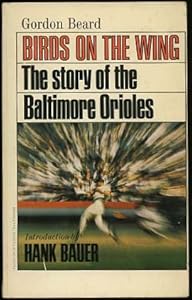
As Tim Melvin has observed, it's now time to become re-aquainted with the Kindle. Personally, I'm looking around for a copy of "Birds on the Wing"; it's pre-Kindle, but since it's a physical book, neither of my kids will have touched it, so it will be exactly where I put it a couple of years ago (pre-Buck). If you grew up in Baltimore during the 1960s/early 70s, I'm sure you know of the book. That and Freedom's Forge should get me to Halloween. Then the countdown to spring training can begin anew.
There was an interesting piece in today's NYTimes about what ails baseball. I found myself in disagreement with the analysis–at least part of it. But I want to give the matter some more thought, and I'll get back to fellow dailyspecs with some comments in the next couple of weeks. After all, there's a cold winter to be navigated yet, and 4 months of quiet before hope springs eternal again and the cry goes out, "Play ball!"
Steve Ellison writes:
In PracSpec, the Chair and Collab postulated that baseball was a mirror of American culture. Eras when baseball emphasized fundamentals and hard work, such as the present, tended to be followed by favorable economic periods. It was the long-ball eras that heralded trouble ahead for the economy and stock market.
Stefan Jovanovich writes:
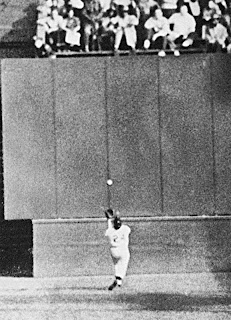 Yesterday was the anniversary of Willie Mays' catch and throw in Game 1 of the 1954 World Series. Since I played hookie from school every day the Giants were in town during the summers of 1952, 1953, 1954 and the spring of 1955. (The NY Public Schools in Harlem and the Bronx were so stuffed with boomed babies that no one missed me.) As a life-long Giants fan I have no more nostalgia for the Polo Grounds than for Candlestick. As Joe Torre (born in Brooklyn but smart enough to be a Giants fan) said, "I never hated the Yankees; I just wanted our Giants to be as good a franchise as they were.)
From the beginning the Yankees were smart enough to build a stadium that rewarded their left-handed dead pull hitters. (Ruth didn't build the stadium; Rupert built it for him.) With the Polo Grounds it was the exact opposite. The stadium absolutely killed the teams that I grew up with. They had a wealth of talent; but their best players were - like so many of the great Southern ball players of that era (Aaron, Matthews) - brought up in the Ty Cobb school. They were gap hitters with power. But, instead of getting County Stadium (where Mays hit his 4 home runs and Aaron and Mathews had the careers made), my Giants got the impossibly deep alleys of the Polo Grounds - the places where Monte Irvin's and Willie Mays' homers regularly went to become outs in Richie Ashburn's glove. The only genuine sluggers the Giants ever had in all the years at the Polo Grounds were the baby Ruthies - Mel Ott and Johnny Mize - dead-pull left-hand hitters who were late on the ball if it went anywhere left of right field. (Mize thought he had died and gone to heaven when he was traded to the Yankees late in his career. The right field fence in the Polo Grounds was 15 feet high; in Yankee Stadium it was 3 feet.)
As dreadful as Candlestick was, it was not that bad; Willie Mays and McCovey could reach the right center fence without having to take steroids. But, with the wind blowing in from the north (which it still does almost all the time), only Dave Kingman had the strength to regularly hit it out to left field. To his credit Peter Macgowan had the sense to remember the Polo Grounds and Candlestick and build the former and now again AT&T Park with a short right field so that his Babe Ruth (Mr. Bonds) could find the seats. It was the making of the franchise, which sold out - again - this year even though the team only tied for third in a weak division on the final day of the season - also yesterday.
P.S. Go Cleveland, Go Pirates!
Aug
19
Leaves and the Market, from Victor Niederhoffer
August 19, 2013 | Leave a Comment
 On a visit to the Botanical Gardens today, I found myself thinking about the purpose of leaves in trees as a way of improving my knowledge of markets. I picked up some oak leaves and tulip tree leaves and saw many veins in them. The veins seem to provide more paths to exchange nutrients and perform photosynthesis. The leaves are very light, so they maximize their surface area relative to volume, thus giving them more opportunity for photosynthesis, and probably preventing an excess of loss of water through evaporation. But in handling the leaves, I was amazed at their toughness, like a abalone. In researching the subject, I learned that toughness of leaves, i.e. the amount of cellulose in them, is now considered the main way that leaves survive. It also reduces their palatability to predators.
What can we learn from leaves about markets. Perhaps a wider range at a price below increases their resistance to death? Perhaps a stronger book of limit orders (in contrast to Mamis's dictum that the larger the buy limits the worse the price?).
What can we learn from the roots of trees? I wish all my people would learn to have strong roots rather than deferring to the latest fashion or predictive hour? In general the trees change with the seasons? Can we learn from trees about ever changing cycles? The summer has been very different from the previous spring and winter this year. It always seems to be. Strong moves in one market, i.e. the bonds have overwhelmed the rest. And of course my favorites, the theory of uniform distribution, — why do trees together reach the same height,and my favorite of favorites, the theory of least effort which relates in part to how branches curve to have the same forces on them at all levels of the branch. But I know nothing about trees compared to the rest of you. What can we learn? How can it help us?
David Lillienfeld writes:
Let's play with this idea a bit further. We know that photosynthesis occurs in response to the presence of sunlight, and varies in response to such presence. The process takes place in specialized organelles. Might the organelles be like market makers? Without them, the leaf dies, ie, they are vital for providing the liquidity (energy) the system needs to survives. They need an external energy source to function, and in the absence of that energy, the supporting system (the leaf) dies. Though I'm not certain of the fact, I would expect that in the presence of sunlight, chloroplast number increases, much as market makers increase in the face of liquidity.
The analogy works to a degree, but I'm not sure where it might take us.
Alan Millhone writes:
I am not a stock forrester but can relate how the leaf veins branch out into many openings found in British Draughts Player.
The lines of play that go in many directions and studied and learned well gives you solid footing and deep roots of knowledge for a strong game at the board.
I can see where stock research in a methodical way can benefit the trader.
Aug
19
Backbone, from David Lillienfeld
August 19, 2013 | Leave a Comment
 In this society, the notion of someone having any backbone is quaint. It is also wonderfully discordant with the realities of the society. Expediency has become our byword. Vision and courage are in short supply. Let's face it, few will take a risk unless it's with someone else's money.
And our government is the best at using OPM's to mitigate risk…..well, the risk of their political cronies.
Jeff Watson writes:
The aforementioned men can be found on the few trading floors that are left, in back offices trading their own accounts. Ayn rand summarized it best when she said:
"The symbol of all relationships among [rational] men, the moral symbol of respect for human beings, is the trader. We, who live by values, not by loot, are traders, both in matter and in spirit. A trader is a man who earns what he gets and does not give or take the undeserved. A trader does not ask to be paid for his failures, nor does he ask to be loved for his flaws. A trader does not squander his body as fodder or his soul as alms. Just as he does not give his work except in trade for material values, so he does not give the values of his spirit—his love, his friendship, his esteem—except in payment and in trade for human virtues, in payment for his own selfish pleasure, which he receives from men he can respect. The mystic parasites who have, throughout the ages, reviled the traders and held them in contempt, while honoring the beggars and the looters, have known the secret motive of their sneers: a trader is the entity they dread—a man of justice."
Jul
25
Teamwork, from David Lillienfeld
July 25, 2013 | Leave a Comment
Back in the 1980s, when the concern was with Japan, Inc, the fad sweeping the US was teamwork. Japan, it was said, was in its ascendancy because of teamwork, and the US needed to focus more on teams if it wants to compete with Japan. So the US focused on teamwork. Guess what. When you focus on teamwork, the individual's approach to his/her own work takes on a different hue. Ketchum is just picking up on that.
Jul
24
The Muni Market, from David Lillienfeld
July 24, 2013 | Leave a Comment
 In talking with several DailySpec listers the last week about Detroit, I was told that the bankruptcy filing to be (or then a fait accompli) had already been priced into the general muni market and there likely wouldn't be much reaction to the event itself. Now there's a suggestion that state law may have some role to play.
Question to those in the muni market–what's the likely impact on the muni market if pension benefits are considered out of bounds for the bankruptcy court and the payment to creditors is reduced even further. Will the muni market exact a premium for future muni issuances from Michigan alone? For all munis? Or is this a non-issue?
Part of my curiosity is that I expect a lot of infrastructure spending to be supported by muni bonds. If there's a premium for the Detroit mess, that's less funding available for the IS work itself.
Jul
24
Apple, from David Lillienfeld
July 24, 2013 | Leave a Comment
 I heard something on NPR this morning (from the CEO of Mashable) which got me thinking about Apple. Consider: Back in the early 1980s, Apple was flying high–it occupied the high margin section of the emerging PC industry and it was making lots of money. Its CEO Steve Jobs was seen as a major entrepreneur. However, by the mid 1980s, Apple had lost its way, as it maintained its margins even as it lost market share. Jobs had been jettisoned in favor of someone with no computer industry marketing experience. Apple maintained many of Jobs' hires as Apple saw its market share shrivel. The high flyer then was a software company whose offerings ran on a host of hardware platforms–Microsoft. Everyone could use Windows and everyone could use Office. Now, fast forward a generation: Apple is again flying high, determined to hold its profit margin even as it loses market share. But there's a new kid on the block offering a mobile operating system used with different hardware platforms: Android. And Jobs is no longer running Apple. And Apple is again run by someone lacking computer industry (or consumer electronics) marketing experience.
Looking at this picture, I have to wonder if it isn't deja vu all over again. Now, I know that Apple has gazillions of cash that it can use to buy companies, but I'm looking at which of its acquisitions has been that helpful to its bottom line. Not much help that I can see. Kind of like Cisco during and soon after the dot-com boom and bust. Lots of money, not much to show for it. Its products are looking dated (and some products, like AppleTV, haven't appeared at all), several products have been introduced though they no longer elicit the oohs and ahs that characterized the products commanding the profit margins associated with Apple. Its execution on the software side has been little short of awful (the cloud in particular is something Apple doesn't get), and it no longer commands the attention of young engineers in the manner that it once did. And while it's PE is low, there's nothing to suggest that earnings will stay healthy, particularly if profit margins give way.
Is history repeating itself?
Gary Rogan writes:
Apple is followed by zillions of super-smart people who track every available piece of information, many in real time. It also has a lot of moving parts and a lot of very smart people working for them. I doubt it's feasible to make money by out-thinking them all without some identifiable edge.
anonymous writes:
Didn't they say the same thing about Japan in the mid 80's?
Gary Rogan responds:
Did Japan have a P/E of 10 and down almost 50% from its recent peak? There doesn't seem to be either irrational exuberance or irrational despair about AAPL but there is frenetic interest. It's latest numbers resulted in some pretty healthy volume after hours and a reasonable jump. Who knew how much it would jump and in which directions? Someone probably did, but it wasn't on the basis that Apple doesn't get the cloud. The point is, if there was ever an efficient market this is it. Not always, not for all time, but for here and now.
Jeff Watson writes:
Isn't every stock that's not on the Pink Sheets followed by a bunch of super smart people who get tons of info in real time? Do you think the market makers have a pretty good estimate of the value of the stock? Don't insiders in their particular companies know if their stock is too cheap or too expensive? Just because AAPL is a cultist type of phenomena, please don't ascribe mystical powers to the stock. It's going to do what it's going to do, without any regard for the super smart people who follow and trade it. In fact, personal experience tells me that the super smart people are going to feel the most pain.
Gary Rogan retorts:
I don't ascribe any mystical powers to it at all. It's a stock constantly in the spotlight. In my experience, there are "sleepy" stocks and there are highly followed stocks, in the sense of constant attention being paid to them everywhere. The market seems less efficient in the stocks that are not in the news all the time. If you have a long time horizon, and the highly followed stocks is showing signs of a mania, it may be a good short candidate, and the opposite if there is widespread despair, but it's hard to know. Of course it will do what it will do, I never claimed otherwise, but ruminating that their CEO, who at some point was in charge of worldwide sales, doesn't get marketing or the company doesn't get the cloud, or that Jobs is dead, or that there is this new kid on the block called Android would get you about as much as edge as me claiming that the world population is growing and needs more wheat and therefore going long wheat.
David Lillienfeld weighs in:
Let's deal with these one at a time, and keep the emotion out of it.
First, Tim Cook was EVP for Sales and Operations, but insofar as he's never held a marketing position in his career (certainly not as long as he's been at Apple), this position seems as much organizational as anything else. His marketing value-add seems to be pretty small, if not nil. Fact. Cook's role has been manufacturing, and he executed pretty well. But that's quite a ways away from marketing, I think you'll agree. There isn't any report suggested that Cook has ever had any involvement in marketing other than this title, and one must note that at the time Cook was placed into the position, Jobs was handling marketing himself. Fact.
Right now, Android is doing to iOS exactly what Windows did to Mac OS in the 1980s. Fact. Apple kept a closed system and IBM/Microsoft an open one. Guess what. The open system won. When the Mac came out, one of the things seen in its favor at the time was that, much as happened with the Apple 2, there was software around to run on it. Same thing today–except it's now in the form of the App Store. Again, fact. We're now seeing the same thing happen in mobile. Google may not be able to monetize Android, but that's probably a matter that will be dealt with once someone figures out how to monetize mobile. (That's opinion, but one I think is supported by facts.) Do you deny that Android has taken market share from Apple, that it's more widely used than iOS, or that iOS doesn't seem to have much place in the low margin East Asia market? Moreover, Apple focused on maintaining margins rather than going after market share–both during the 1980s and also during the recent period. Fact. Earlier, that turned out not to be the way to success. Fact.
As for Apple being followed, that's irrelevant. Apple was heavily followed in the first half of the 1980s. I remember it well. By the latter half of the 1980s, it was no longer followed because it was in the process of becoming irrelevant in the face of Windows. By 1997, the company was on the verge of bankruptcy with 90 days of payroll in the bank. Fact. That's hardly the setting for a followed enterprise. Successful companies are followed. When success disappears, so does the following.
Lastly, if you think Apple gets the cloud, then I suggest you review how Apple's efforts in that space have fared compared with its competitors. I know of few who would opine in favor of Apple's efforts, even the cultists. Let's not forget that fantastic roll out of Apple Maps. Fact. Enough said.
I also noted that Apple has lots of money to work with, but then again, back in the early 1980s, it did too. (It's worth remembering Microsoft was similarly fortuitous–and well followed–and I don't know that it has a similar following today as it did in years past.)
That a generation has grown up since Apple's last appearance in similar circumstances of adulation also suggests that the younger minions may have forgotten that Apple's earlier escapade didn't result in hegemony–far from it. Fact.
As for Jobs, the reality is that since Jobs died, Apple hasn't functioned anything close to what it did when he was around–and he was active until about a month prior to his death. Fact. He may have picked the management team to succeed him, but much as happened back in the 1980s, without Jobs, that team didn't perform well. The contrast with, say, Alfred P. Sloan or Andrew Carnegie, or John D. Rockefeller, or David Hewitt or Adolph Ochs, or Robert Noyce or … I could go on, but the one thing that separates this group of CEOs is that when they stepped down as CEO, it took at least two generations of managers after before the company hit much of a bump. That's the mark of a great CEO–in addition to what happened to the company on the CEO's watch. Jobs didn't do so well with it in the 1980s, and it appears he didn't do so now.
If you don't like the facts, that's fine. Don't like them. But those are the facts. I'll leave the other elements of your comments for some other time.
But let's stick to the facts.
anonymous writes:
Let's cut to the chase. Tell me the long term growth rate of AAPL's earnings and I'll tell you (+/- 10-20%) what the stock is worth today. The bloomberg consensus growth rate is 19%, so the stock is worth about 1090/share.
If you cut it to 10%, the stock is worth 512/share.If you use a 5% long term growth rate, the stock is wroth 340/share.
The primary reason that 19% is wrong is that AAPL is simply too big to grow at that rate — or it would suck all of the oxygen out of room. At 442, it's priced for about a 8.25% growth rate. Not crazy, but 8% is still a lot of growth for such a big company. But their buyback can provide a lot of help in achieving EPS growth. BUT — the chart looks good!
Jul
1
Egypt, from David Lillienfeld
July 1, 2013 | Leave a Comment
 The military's ultimatum to Morsi seems destined to set off the powder keg now known as Egypt. At first, I thought this strange, since Morsi was threatening to go to war with Ethiopia. That's means going through Sudan and South Sudan (two countries not world renowned for their ability to co-operate with one another). But if the military, with its hands deep in the economic cookie jar, feels it's losing money with Morsi in office, it would likely move to oust him.
Egypt sent heavy armor to the Sinai-Gaza border and since I doubt that the tank crews are going to sunbathe in the summer sun, I'm concerned about their presence. Add in that Morsi has essentially destroyed the summer tourism season (or what little of it there was) with his appointment of a strict Islamist as governor of Luxor, and one senses that Egypt is in a pretty unstable state.
Did I mention that the country has only 4-5 months of foreign reserves available to purchase food and just about every other commodity needed (of which there are a lot)? Maybe that situation is forcing the military's hand.
Jun
24
Letter from San Diego, from David Lillienfeld
June 24, 2013 | 1 Comment
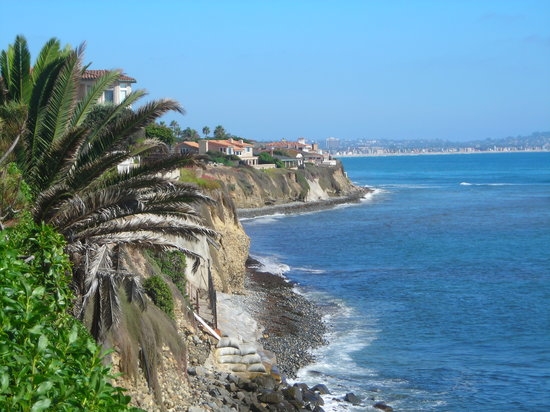 I moved to San Diego with my family for a new job about 3 years ago. While San Diego is nice (the weather can't be beat–even in comparison with Hawaii's), it's not San Francisco. Having renovated our house on the peninsula south of SF (we're in the northern part of Silicon Valley) to suit our needs and tastes only accentuates what we miss about the being by the Bay. I guess we're NorCal, not SoCal people.
The one thing no one in my family misses in the Northeast winters (I keep telling them that they had it good compared to the hearty souls in Minneapolis, where I took my residency training.) There are lots of things upended in moving 500 miles, things that one may not consider particularly significant. Examples include finding a new physician, finding a new racquetball partner, figuring out if there's any place to find a good bagel (Izzy's in Palo Alto wasn't quite at the old H&H level, but it was close)–we're still working on this one, and so on.
Something that one might dismiss as one of those myriad things one needs to feel "settled" in an area is a barber. In San Diego, barbers run from $5 (I can't recommend at least two–I thought the shears likely had some Hep B and/or C) all the way up to V's which charges $25 for basically the same haircut, albeit in a place with wood paneling (I guess the wood paneling adds somehow to one's appearance, but I remain unsure as to how).
I found a barber who charges $8 for a pretty good cut. The shop is down near the navy base, and her husband is, not surprisingly, a sailor, now deployed someplace in the Pacific/Indian Oceans. My guess is that she's in her mid-20s, no children. She and her husband have decided against starting a family as yet. Between his deployments and her constantly working at the barber shop, they didn't think having children made sense for themselves just yet.
I went for a haircut yesterday. She wasn't as jovial as she usually has been. For the past 3 months, as the sequester has taken hold, she's observed a fall-off in business. It's been noticeable. She said that she and her husband had already begun cutting back on expenditures, expecting there to be some impact of the sequester on her (and their) income. They've already eliminated any vacations and some clothing purchases for the foreseeable future. She volunteered that some of her friends (with at least one spouse in the military) are using food stamps. She also mentioned that her brother-in-law is an aviator out of Miramar and his flying times are being reduced, supposedly by the sequester. Regina commented that her immediate worry is with their apartment. Their lease is up at the end of August (I think that's what she said), and the landlord told her yesterday that their rent will be going up to cover additional interest costs since borrowing costs are going up.
In northern San Diego County, away from the navy base (south of downtown), one might have expected less of an impact of the sequester. However, there has been something felt by some of the businesses–probably because of Camp Pendleton, which occupies a spit of land between San Diego and Orange County. Asking some of the merchants at the outlet mall in Carlsbad about business, there's some suggestion of softness, but there's been layoffs in the mall, at least not yet. What happens next though, is a (to use Yul Brenner's phrase) a "puzzlement."
The local biotech industry is slowing making its way back from the premature death sustained when Biogen Idec closed its local campus. Health in general, though, seems to be in growth mode. So is mobile engineering. And there's some suggestions of an improvement in the local tourism trade, with the opening of non-stop service to Tokyo. (The inaugural flight was greeted by about 200 cheering individuals positioned just off the edge of the runway. They clapped when they saw the plane overhead as it was landing.)
Most are aware of the weakness of the economy–the employment growth numbers remove the little doubt about that condition. Though we are used to looking at number, there are people behind those numbers. As an epidemiologist during the early and mid-1980s, it was possible to become numb to the statistics behind the AIDS epidemic. The numbers were unlike anything seen in the US for many years. Each of the persons represented by those numbers was someone's son or daughter; someone's husband, boyfriend, girlfriend, wife; someone's brother or sister; and so on.
It's easy to forget about the people when looking at the data. Data don't have faces. They don't have arms and legs. And most of the time, they don't have voices. That shouldn't remove the reality that there are people behind those numbers. At the same time, one must remember that there are still real ills present in our economy, that dealing with them will require dealing with real pain and that, since we are a globalized economy, the effects of what ever actions we take are likely to have impact far from our shores (I'm thinking of something more than the butterfly effect). How we go about doing it, with what level of rancor and disdain (which seem omnipresent in DC these days, which isn't surprising I guess given the absence of political leadership by just about anyone), will say provide its own Rorschach Test result about what the US is all about, how we want to be perceived, and what values do we hold dear and which are just "so much fluff.
As Regina was telling me about her family's situation, I wondered when do we, as a nation, begin to have an economy growing sufficiently that Regina and her husband feel they can start a family, that they can take a vacation (even if only to Palm Springs overnight), that we unite rather split apart, and that not merely allows civil discourse about our society and what we want it to look like and function but rather encourages it. At its core, it's about how we interact with one another as people, how much we value someone else as an individual and not a statistic in a table or a model. Perhaps it's a matter of giving the country more time to address its ills. I'm not so sure that time will make that much difference by itself.
I think with all of the activities in our daily lives, we are quick to stereotype–almost like zombies–someone based on an utterance or two. It's faster that way. It's also the lazy approach. It takes effort to get to know someone, to see them as more than a statistic on a page or in a table. Let's hope that we, as a country, get past zombie mode and move the country forward. For all of our ills (and there are many of them), the US remains as the sole superpower on the face of the Earth. Let's not squander the opportunities to fashion our world and realize all of its potential. Until then, however, I think I'm going to think about letting my hair grow longer.
Jun
14
A Father’s Day Tribute, from David Lillienfeld
June 14, 2013 | Leave a Comment
 My home office adjoins my daughter's room. Her last day of high school (and therefore public school) was today, and now that she's finished it, she's home finally clearing out her room of the school year's detritus. It's amazing how much "stuff" she managed to keep in her bedroom. Walking by that room's door brings to mind the scene in A Night at the Opera of the ship's storage locker holding something like 10-15 people. Tomorrow, she will join her class at graduation; at some time, she and some of her peers will be saluted for academic achievement. I'm told that that's the top 5% of the class. Given the nature of the high school, that's a better result than my wife and I had expected. Her high school is rigorous–almost to a fault. During spring break, some of her friends now freshmen at MIT and Cal Tech came by for some pizza. The frosh from both schools kept commenting on how much they were enjoying college. It was easier, for some courses much easier, than high school. Both my wife and I were shocked, but perhaps these kids aren't aberrant in their assessments.
That my daughter, our youngest child, will be graduating within 24 hours brought to mind my graduation. For my daughter, the biggest graduation in her life thus far will be the one tomorrow; for me, it was 29 years ago when I graduated from medical school. It's not that it was the last graduation I would share with my father, though it was–or even the last time I would see him, though it was that as well. It's not that I thrived in medical school. Hardly, having bombed in biochemistry (I think it's psychological moreso than the material, but that's for another thread) and having a simply awful experience with one medical resident (I nearly dropped out of school in my third year–almost unheard of; on hearing of my interest, the Dean inquired as to what was my reason, and when I explained, she promptly called in that year's class of 2nd year residents in medicine and read them the riot act about abusing the 3rd year medical students. My classmates were aware of the situation, and when the abuses stopped-at least for my rotation–many thanked me, though I told them it wasn't altruistic on my part, it was survival), I saw my graduation from medical school as a triumph. It's not the degree of which I am most proud–that would be my MSEngineering, and it's not the one I worked hardest for–that would be my MBA in marketing, nor even the degree which most of my peers associate me with–that would my MPH in epidemiology. It is, however, the degree with which I most identify, the one most enmeshed in my identity.
There are parts of medical school I would dearly love to forget–but I can't, though I have no doubt that I am a better physician for having lived through them. Telling the mother of a 3 month old kicking and screaming with a 103 degree fever a few hours later that her son had died, being told of the attempted suicide of a pregnant 15 year old girl I had attended to at clinic three days before and diagnosed her pregnancy (she wanted an abortion and was terrified of what her parents–both alcoholic drug users (they were also "practicing" Catholics–at least that's what they said–who later informed me they wouldn't have consented to an abortion for their "slutty daughter"–might do to her if she asked for their permission), digging elbows deep into someone perforated bowels at 3 AM and dealing with seeming endless human waste–yes it's life saving, but that doesn't mitigate the stench and it doesn't stop the waves of nausea or the multiple re-gownings and re-glovings, the 17 year old who decided to take on a tree while riding his snowmobile during a blizzard–the tree won and he sustained multiple organ failure, including a closed head wound that left him in a vegetative state even as he recovered from a severed liver that a decade earlier would have rendered the head injury meaningless as he would have died of the hepatic damage, my first patient during my medical rotation–Mr. B–who had classic hypothyroidism–the confirmatory lab test had to be sent to the VA central lab in Ohio instead of the local lab and the results weren't due back until Monday; unfortunately, Mr. B developed a pneumonia, becoming septic, and dying on the Sunday before, and the too many meetings of the Baltimore Knife and Gun Club on Friday and, especially, Saturday nights. As bad as telling the mom about her dead baby (threw up afterwards, and my attending, cued in by my resident, had the good grace to sit down and talk with me about it; I asked her how she managed to deal with such things, and she responded that you don't, and that if you did, it was time to leave medicine. That may seem a bit harsh, I realize, but I've come to understand what she meant.
 In medical school, during the first year intro to clinical diagnosis, there's much effort expended on trying to get med students to empathize with patients, though not sympathizing with them. I began to understand the idea much better after talking with my attending what was meant by the empathic physician that we strive to be, that our patients need if we are to be effective in helping them maintain or improve their health.
Among the "ghosts" in my memory is the 20 year old man who presented at surgery clinic with his partner. He came from a religious family out west and had come to Baltimore when he was 16 to get as far away from his family as after he came out to his parents, they told him he would burn in hell, that he should forget that he was a member of their family, that his brother and sister were to be told he had died and that they should forget him, and requested that, as they kicked him out of the house without so much as a change of clothing, he change his name so no one would associate him with their family. He had met his partner while homeless on the street, and the two bonded. He managed to put his life together enough to gain admission one of the local colleges on full scholarship as his partner became got a job on a construction crew digging ditches (also a story for a different thread). He presented to surgery clinic with groin swellings. It was the fall of 1983, the AIDS epidemic was in full swing with every sign indicating that it was a infectious disease. (At that time, I doubt that the 2/3s of gay men resident in San Francisco in 1981 realized that they would die from HIV infection.) Understandably, he and his partner were terrified about these swellings. We biopsied them–it's the only time I've quadruple-gloved. He had a lymphoma, and in short order, developed pneumocystis carinii. Long story short, he had AIDS. I wasn't on the medical team treating him but I kept up with what was happening to him in hospital and I managed to stop in and talk with him a few times. He was a bright guy, witty too. He was thinking of becoming an engineer–he enjoyed math and dreamt of using that knowledge to change the world. He was dead within 6 months. I don't know what happened to his partner.
Those experiences contrast with some of the other ones, perhaps less emotionally challenging, perhaps not, such as my first appendectomy (not holding the retractors but doing the surgery; what should have been 30 minutes under anesthesia for the patient became 60 minutes for me–not unusual, I'm told), trying not to cut too deeply, hoping to pick up the peritoneum, all of 4 cells in thickness, sweat pouring out of my brow (and being attended to by a fortunately doting circulating nurse) even as the temperature in the OR stayed a steady 63 degrees. The patient came through the procedure OK. For many medical students, their surgery rotation, while grueling, is also the most fun one. One gets to see the pathology present, instead of surmising it the way an internist would. At the same time, one comes to appreciate that being a surgeon takes a certain personality–not just bravado or ego but also perspective on the role of a physician in the treatment of a patient. A surgeon is cutting on a patient to help the patient therapeutically. She cuts on living flesh seemingly on a daily basis. Granted, it's with anesthesia, but even so, it is a concept which in the abstract may not seem challenging, or even when one's encounters with the surgeon are infrequent. Seeing surgery daily, though, is different, whether it's the surgeon, the surgical nurses, or the anesthesiologist. I think the former two have the most challenge. It's one thing to nick someone's skin for a biopsy, it's another to open a chest to transplant a lung. There's the old joke about the surgical resident at the poker game tossing $20 into the pot with an ace-high hand, while the medical resident hems and haws about whether to raise a nickel with a full house. It fits better than most might appreciate.
Graduating from medical school meant a change not merely in life but in me as a person, in my identity. I don't know that that was true for all of my classmates, at least not that they were willing to say come reunion time. It was for me.
As my daughter graduates, so will my wife and I. Empty-nester syndrome may hit, hopefully not. My daughter will move on to the next phase of her life, to begin adulthood. Both my wife and I wish that she comes through her college experience as enriched as she has her high school one.
In 24 hours, her world will change in ways she won't appreciate for years to come. Perhaps her mother's and father's will do so too?
May
26
Memorial Day, from David Lillienfeld
May 26, 2013 | 1 Comment
 By tradition, in the United States, Memorial Day has come to mean the start of summer. Swimming pools open, schoolchildren begin to think of school being out (and the interminable playing of Alice Cooper to drive home the point), and for some (like my daughter), it's prom season, graduation and for others, a walk down the aisle and up to the alter. On Sunday, the Indy 500 will take place. There are all manner of other activities associated with this weekend.
But none of these activities relate to Memorial Day itself (except insofar as we can undertake these activities). As I look out my window and watch the cars coming out of Camp Pendleton onto i-5, it is hard not to be reminded about the meaning of this holiday, designated to remember those who "gave the last full measure of devotion" to ensure that we could continue to enjoy the freedoms provided by this nation. When I lived in the SF Bay area, we would go over to the national cemetery in San Bruno for the memorial service. Though there are national cemeteries in the San Diego area, we finally found one with such a service, and we will go there on Monday.
My grandfather used to tell my father that while, as an immigrant, he could not appreciate the liberties afforded by the United States as much as my father (born in the US) did, he could understand them better than my father could. He told my father that as someone who did not grow up enjoying those liberties, they were not inculcated into the engrams of his mind as they would be with my father's. Though I'm sure there may be those on this list who will take me to task for placing the issue in such terms, it nonetheless captures for me and my family the spirit of Memorial Day, not merely remembering the fallen, but also what they fell for. It matters.
As we have since my wife and I married back in 1989, we will play "Find the cost of freedom" on Monday evening. When our kids were born, they didn't understand why we put this song on the hifi (and then the CD player, and finally, iTunes). As they grew, they have come to understand the reasons. I can only hope that they impart that understanding to their children. I also hope that while many head off to the beaches or the backyards for BBQs and the like, they take a moment to remember. It matters.
Have a happy, safe, meaningful holiday–I am sure everyone will take a moment on Monday to remember.
May
21
For Baseball Buffs, from Scott Brooks
May 21, 2013 | Leave a Comment
David, you are obviously much more knowledgeable about the game of baseball than I, so I'd like to ask your opinion on Gibson and Koufax.
How do you think they would have fared in today's modern game and how would they have been used by their teams?
David Lilienfeld writes:
Thank you, but I doubt the premise of your question is true. Gibson and Koufax would likely still anchor their respective teams, but neither would likely get more than 25, maybe 26 starts, tops. I doubt that their arms would have been as strong–they wouldn't have developed to be, they would also throw only 100-110 pitches/game (sorry, having seen the great Orioles pitching staff of the late 1960s/early 1970s, I'm a big believer in strong arms that throw complete games). Their control would continue to have been outstanding. The thing about both Gibson and Koufax is that they pitched enough innings and in enough games that when they got tired and they knew the bullpen staff was pitched out arm sore, they would suck it up and make a go of it. They would change their set-ups, mix-up pitches more and so on. But a pitcher can only be that mature if given the opportunity to play–and that's something verboten today. So while both of these folks would have excelled, I doubt they would have been the dominant forces that they were in their day.
Take a look at their records, or throw in Jim Palmer and Denny McLain too, if you want. They routinely pitched more than 270 innings–good seasons and bad. It wasn't until Koufax started throwing more than 220 or so innings that he came into his own. Heck, even in his last season, when his elbow had been so threaded by arthritis that he needed to soak it in ice for 2 hours after each game, he threw 27 complete games. I guess you could say that his career would have lasted longer if he hadn't pitched as much as he did–except that that's how he found his groove.
It's not as though this was something that characterized only the greats of the day. Jim Kaat started 42 games one season–and he played for more than two decades. Never mind that he won 280 games and was never elected to the HoF. Take a look at Steve Carlton. These guys were good, sure, but I think that, like Koufax, part of their greatness was that they were worked hard.
I'm sure there are those on this list who will say everything's fine with how pitching staffs are managed today, that I'm a dinosaur for taking such a risk with someone's arm to let them pitch so many innings, start so many games–that that experiences really isn't necessary for pitching excellence, never mind greatness along the likes of Koufax and Gibson. Much as I think the days of someone as competitive as Frank Robinson are passed, so too are the days of the dominant pitcher. Consider Jim Lonborg, who pitched more than 270 innings in his CYA year (1967). During the World Series, he pitched game 7 on two days rest. Two days! Would any manager even think of doing that today? I doubt. it. I could hear the players union rep going to court about it violating some contract clause. His wife might complain that he's being asked to do the impossible–3 days rest is pushing it as it is. Nope, the days of the strong pitcher are done.
Koufax and Gibson: we likely won't see their likes again anytime soon. Probably not in my lifetime, at least. And I doubt that if they came up today, they wouldn't be nearly as dominant, good as they might be. They would never be given the chance in the first place. It's almost five decades since Koufax retired, and people still talk about the devastating Koufax curve. The same is true of Gibson and his fastball. You need someone with the insights of a Branch Rickey to go back to the four man rotation that produced a Koufax, a Gibson. Do you see a Branch Rickey around? Me neither.
All of which may not be surprising. 100 pitches isn't very many, after all.
(Sorry for the long-winded answer, but pitch counts are a tender topic for me. I don't like coddled arms–just a sign of a pussy-wussy approach to managing the bull pen.)
Stefan Jovanovich comments:
Koufax and Gibson would most certainly be stars no but so would Bob Feller and Christy Mathewson (Tom Glavine as a right-hander). What has changed in baseball is that starters can't start at 80% and then work up to full capacity the way they did in the good old days. Matt Cain's innings pitched have matched the old timers but what he and other top-line starters have painfully discovered is that they now have to pitch the first and second innings with intensity. The technology revolution has allowed all hitters to diagnose their own swings and pitchers deliveries the way only a genius like Ted Williams once could do with only his own eyes. Felipe Alou sat down with his son Moises when the Giants got their first screen analyzer; his comment was "I never understood my own swing". The pitch count is stupid because it is a hopelessly crude metric. 75 pitches at Coors is a solid performance; at AT&T the same effort should produce 95-100. But no one now can go as long as pitchers once did; hitters aided by video study won't let them.
http://en.wikipedia.org/wiki/Felipe_Alou
David Lilienfeld replies:
Respectfully, Cain doesn't have the innings pitched numbers of past cohorts. And I disagree on the "new" need for intensity. You don't pitch an ERA of 1.1 without that same intensity, and while analysis of one's swing is helpful, pitch selection is moreso. You could have an optimal swing, you still couldn't hit a Koufax curve. Palmer's slider wasn't quite so devastating, but if he was on his game, it didn't much matter how good a hitter you were, you weren't going to hit the ball.
The thinking these days seems to be that with all the money being paid to pitchers, no one wants to risk an injured arm from over use (!). Hence the five man rotation.
Maybe we're just going to have to agree to disagree.
May
15
MOOCS, from David Lillienfeld
May 15, 2013 | Leave a Comment
 As the cost of a college education soars and the middle class finds itself struggling with paying for public university tuition, MOOCs (Massive Open Online Courses) offer one possible way to lower the costs of a college degree. Lots of promise–and the potential for disrupting the American college, a bastion of the middle ages for the past two centuries–is meeting with lots of resistance, particularly from those with the most to lose from them.
Stefan Jovanovich writes:
If David includes the Reformation and its Counter within the Middle Ages, then he is right. As Rocky can remind us, until very recently the avowed purpose of Yale was still for man to find God, preferably of the Congregationalist version. The land-grant schools were to be trade schools as Governor Perry's alma mater still is — as a proud "Ag" school. The modern university owes its corrupt origins entirely to WW II and the G.I. bill — as do our healthcare pricing and payment systems. If schools were truly medieval, it would be a good thing. Teachers were paid directly by the customers — the students; and there were no required prerequisite courses. You find echoes of that system as late as the mid-1950s when "name" professors still competed with one another to teach the introductory survey courses; without those butts in the seats the esteemed scholar had little chance of being the next big hit on the textbook circuit.
May
5
10 Year Bund, from David Lillienfeld
May 5, 2013 | Leave a Comment
Has anyone noticed the rally in the 10 year Bund? I thought that it perhaps had finished, but that's not the case. The yields just keep dropping.
Anatoly Veltman writes:
David, if you missed that story: major Central Banks vouched they'll never raise rates again. So you can't be short any core sovereign bond today.
My take, however, is that following 32-year-long advance in US bond prices — it's just as important to be ready for the reversal day. Once you think we are getting a reversal day, just imagine how many years you'll be following this position down!
Jeff Watson writes:
What if bonds don't reverse for a long time? That could happen you know….Logic does not always work. How long are you willing to wait, 10 years? The Fed has stacked the deck and the new deck is a 6 deck blackjack shoe, marked cards. and the deck is very rich, a counter's delight, and there is a run of AK,A10,AQ, all paying the new, reduced odds of 6:5 for blackjack that many games are offering. Unfortunately, when they reshuffle, we get the 2's and 6's while the dealer shows an ace, and the key element to keep the sagacious away is the dealer gets to go last after we all bust out. How do you beat that game? People tend to over think things, and assume that because A=B and B=C, then A=C. We know that the best trading opportunities sometimes lie when A does not equal C for whatever reason. Sometimes I tell people that intellectualize too much to take a page from Charles Bukowski, who in an alcohol fueled rant said "Don't try," but I changed that to "Don't think." I'd like to know how much money has been lost by "Thinking."
Anatoly Veltman adds:
First there is a Long trade, but I'll let someone else formulate it. I'm really no good in playing the momentum of a 32y old trend. Then, there will be a short trade.
One way to formulate the future Short trade: what's better a. to enter Short at some relatively high point OR b. to enter when the future down-trend "is" in earnest.
I'm reminded of Gold nearing $1900 in 2011, with Rocky (who's been Long since probably $1000 lower) proclaiming: what's the use out-thinking the trend just because she may be "overbought". There are no signs of a bubble, just stay the course. When the top is finally confirmed and the down-trend develops, you'll have years of riding a Short…
So in case of Gold, Rocky finally declared in 2012 that "something has changed in Gold" as it was rapidly correcting toward $1525 for the second time - and he didn't want to be Long of it any more. In 2013, Rocky was anticipating the break of $1600, and announced his now Short bias.
Back to Bonds: there are way more signs of a bubble!! So lets see if Rocky will pick a., b. or a future way of Shorting I haven't thought of.
a commenter adds:
There are those self promoters who picked the real estate bubble (Shiller et al), the guys who predicted 2008 etc. What you don't hear is their predictions that went south as that would diminish the brand of the promoters. Even a broken clock is right twice a day. And really, how does one really know, and how does one predict with certainty there is a bubble? And if it really is a bubble, who cares as long as you can sell at a high price on the way down. Isn't commentary regarding the morals of whatever kind government action a waste of time? The government does whatever, you go with the flow and relax. Fighting headwinds, fighting the Fed, wasting time on worrying about why things happen, making decisions on emotion and false logic…..these little things are what make the account balance bleed, and drive one insane.
May
2
Beware of the Novice, from Jeff Watson
May 2, 2013 | Leave a Comment
 Novices can be the scariest opponents a solid poker player can face, especially in a one on one situation. Novices make bad bets all the time, bets no rational player would ever make. Bets like drawing to an inside straight, which gives him a miserable 4 outs, but happens. Since you are playing an irrational player, someone who might have more "gamble," and less knowledge, you need to change your game. If he is really loose, a good player will play tight and vice versa.
In poker, not all weak players are novices. Some are lifetime degenerates that are like ATM machines. I think novices can be extra dangerous because of the belief that beginners can do very well (some would call it luck). I drew a pat queen high straight flush on my very first commodity trade (soybeans) almost 40 years ago as a 16 year old kid, and things like this happen. Most of the poker games I used to play in were full of very tough players, opposing forces, so to speak. I've traded against some pretty solid players in the pit. In both poker and trading, one needs to play around, and not against the tough player, and go after the weak (which is not necessarily the novice). Does the least irrational player come out ahead in the long run? In poker or trading, that is worthy of further study. Then again, I have found on many occasions, the most rational thing to do is act irrational, or at least make your opponents think you are acting irrationally. In any case, the key lesson is to play a very strong defense at all times and keep one's guard up.
David Lillienfeld writes:
The same thing is true in chess. When something moves out of a rational context, it is challenging indeed. When I played tournament chess (a lifetime USCF member) a while back, I used to go for the upset prize–it meant winning one game instead of the best of 5, and the prize was not quite that for the tournament overall, but it also involved less work. My opponent usually had a much higher rating than I did, and often didn't pay much attention to the board because, obviously, I wasn't close to his measure and he could focus on other things during our match. Sometimes, in the early middle game, I used to start using inane sequences of moves that would absorb lots of my opponent's time (we played on a clock) as he tried to figure out what I was doing. This would absorb a lot of his time. I would then sacrifice a piece or two, which made no sense, but it again absorbed time on his end figuring out what the madman he was playing against had in mind. About half the time, his clock would expire and I would win what was basically a lost position. It's not the best strategy for trying to win a tournament, but for the upset prize, it worked a lot of the time.
Anatoly Veltman comments:
You may laugh, but at the level of Soviet and International grandmasters, directly the opposite was sometimes practiced by a few leading players who were best of the best in lightning chess (blitz). If they didn't like what they had on the board, they would purposely allow their clock to run down to only like 50 seconds remaining. What they gambled on was that the opponent, who already had a very good game on the board, might instead focus on their clock…
Apr
25
Enron as a Positive Force, from Carder Dimitroff
April 25, 2013 | 2 Comments
 It is true Enron's management was engaged in a series of bad decisions. It is also true Enron offered major contributions to the energy industry. Their biggest contribution was to introduce power markets to the electric utility industry.
Because of Enron, control of the nation's transmission lines was wrestled away from utility engineers and put into the hands of traders and bankers. Physical transactions were replaced with financial transactions. Free options to use assets were monetized and priced in open markets.
One example is firm transmission rights (FTRs). Before Enron, owners gave away rights to use transmission lines to a trusted few. Now, FTRs are auctioned in open markets, where users bid for the right to use utility assets.
Because of Enron, Regional Transmission Organizations (RTO's) gained significance. RTOs are what many believe is the "nation's grid." The truth is North America has many unconnected grids, ten of which are open markets in the form of RTOs (most of the nation's population centers are located in one of those RTOs). Every day, RTOs conduct a series of open auctions for energy. They also conduct other auctions for capacity, FTRs and related products and services.
Enron helped transform a highly regulated government-controlled industry into a loosely regulated market-based industry. Enron went bankrupt before the transformation was complete. Initially, only the Northeastern states and California jumped into market-based power. Later Midwestern states, Texas and some Southwestern states joined in. But to this day, many Southern states shun power markets, preferring instead a government-controlled regulatory scheme.
It is true that Enron tried to corner the very market they created. It is also true that the financial techniques they introduced were new in the energy industry, they were borrowed from Wall Street, they were transformative, they were sometimes unfair and most were legal at the time.
Today, RTO's operate under Federal Energy Regulatory Commission rules. Those rules include valuable lessons learned from Enron and other actors. They continue to evolve.
On balance, Enron was a positive force for free markets. They were also a negative force for fair markets.
Russ Sears writes:
 Enron is a good example of what can happen when a company/species goes from a survival of the first strategy into a survival of the fittest as their niche draws competition and does not survive the process. Normally, growth and high profit margins are a sign of strength, but the temptation as the niche gets crowded is to eat the young to support the current generation of leaders so they can grow and have the high profits they were brought up to believe was their birthright. A similar thing happened in the mortgage backed markets.
These are the times that test collaboration and integrity. It is easy to be honest in passing out the pot when it keeps growing fast and furious. I believe Apple may be a case where it survives through a good collaborative environment within. Time will tell. Given Jobs' reputation of being a dictator and his temper, would this have been the case if he was still running things once continued growth became limited?
David Lillienfeld comments:
The issue with Jobs isn't what he would have done. It's whether the management team he left leads the company to continued prosperity. It isn't yet clear that they are so doing, but I'll give them another year to show one way or another.
Managements have two responsibilities–place the right people in their jobs and to provide for an orderly succession that allows the company to continue and hopefully better its lot. (Bettering its lot means ultimately bettering the lot of its shareholders.)
The book on Jobs as CEO isn't yet concluded. Many suggest that he was the greatest CEO of all time. I'm not ready to subscribe to that notion–not until his successors provide some demonstration that the company is not adversely impacted by his departure–no man being indispensable (that great Churchill comment about the cemeteries of Europe being filled with supposedly indispensable men). From my limited perspective, I think the title of the greatest CEO remains a tie between Alfred P. Sloan and John D. Rockefeller. One can argue about what they did, but its hard to argue with the results–both during their tenure and afterwards. J. P. Morgan, too. I suppose one could put George Washington in that league too, but I'll defer to others on this list who can speak to that idea–pro or con–better than I can.
Jobs was an SOB, but the man performed. So was Bob "get rid of the olives" Crandall. And Henry Frick. They all performed, they were all considered magnificent CEOs. The latter two hardly qualify as among the greatest CEOs, and the book is still out on the former.
Apr
17
Okay, from Victor Niederhoffer
April 17, 2013 | Leave a Comment
 Okay, the 142 bank pres and public relations people have the minutes already to be released to public in 10 minutes. Bonds are up and stocks are down. Germany is getting killed. Which way will the release to the non-flexions affect bonds stocks and gold. I've been buying gold whenever it drops as I believe that the bank deposit confiscation has to be bullish for gold as are the trend followers short.
Anatoly Veltman writes:
Rocky is patient at $1390, getting ready to pull trigger on test of $1320.
Victor Niederhoffer writes:
Rocky a lot more astute than me perhaps because he has a bit of the idea that has the world in its grip in him from his days at the 'Bank' and his love of trend following. One passed their headquarters near the scene of the crime yesterday evening and it was replete with canine k9 4 footed operatives.
anonymous writes:
One can imagine the scene:
Fed: Honey, I would love to be with you but we have to lay low a few days after the press got pictures of us together.
Banker responds: If that is the case, you and the D. C. boys have fun by yourselves. Give me the checkbook and I will go home to L.A. to shop. Call me when you decide you need the markets to go up again.
Rocky Humbert writes:
For the record: I am flat gold. If Cyprus (or any other country) could cure their ills simply by selling gold, there would be no ills. My recollection is that the Korean housewives were selling their gold wedding bands to support the Won … during the 1997 financial crisis over there. Korean bonds were yielding 15% at the time. And I bought a few as an investment. That worked out ok. I am not buying the bonds of Cyprus, Greece or those other places. The wealth of a nation is in its land, its laws, and its work ethic. Everything else is a speculation.
Gary Rogan writes:
"The wealth of a nation is in its land, its laws, and its work ethic."
Brilliant! I would add "respect for its just laws" to the list. May those who want to reward millions of those who broke the laws of this country by giving them the very object of their law-breaking and by making them a part of this nation give this some thought.
George Parkanyi writes:
This is not scientific, but my feeling on gold is that given government interventions (manipulation is such a strong word) in markets these days, they can't exactly let that turn into a complete rout either. Fear is fear. Gold was supposed to be the haven of last resort. If people see that collapsing then there is the sense that there's nowhere to hide. The panic could transfer to other markets. It's not behaving as it "should" under the circumstances, which further calls into question in people's minds what the hell IS going on? And what is this action discounting - massive deflation? Governments sure want that idea to spread. This is one of the reasons I'm still holding fast to the core position - though I've taken stop-outs on portions. Not large enough portions to avoid a big hit. But it is what it is. The gold stocks are really getting creamed as well. Solid producers trading like penny stocks. Unless deflation IS ultimately our lot, I'm smelling blood in the streets (some of which is mine) and screaming bargains.
I think the odds are good for a sharp reversal rally. If things go really bad in other markets, that's where they'll be looking to cash out rather really pounded down precious metals. And gold is an international commodity - still highly valued in many cultures. This crowded-trade unwinding behaviour I think could reverse very quickly, very soon.
A commenter adds:
Was the fall in Gold the result of some bigger thing that I am unaware of, and did someone smell a canary that has been dead for a few months and was the first to find out triggering the selling?
David Lilienfeld writes:
Let's take a look at what's known:
1. Europe was weak going into 2013, but the dimensions of that weakness are becoming evident. The collapse of auto sales in the EU, the episode with the Cypriot banks (which I still don't understand why the Cypriot government didn't say, "Fine, Germany, we're leaving the euro, we have all these euros in our banks, our new exchange rate is X, and now you have a big mess on your hands, much as we do on ours; don't like that? Fund us!), the coming episode with Slovenia, followed by Spain, Italy (if it can figure out who is the government) and France. Then there's the farce previously known as DC. There's the leader of North Korea trying to demonstrate that there is testosterone flowing throughout his veins. The dimensions of many of these has become evident recently. The degree to which China is slowing down and the degree to which the US housing "recovery" might slow down have also started to clarify recently. I won't get into the potential for a repeat of a SARS-like outbreak in East Asia.
I don't think the canary's been dead for a few months as much as it had a massive stroke, followed by resuscitation from cardiac arrest a few times (OK, OK, it was many times), and it's now brain dead and being maintained by artificial life support, ie, it's dead but it doesn't know it. Or the canary's been dead for much longer than a few months.
There's a lot of bad stuff that's gone on the last few months, and the extent to which the market in the US is near its all-time highs is a wonderful gauge of nothing so much as the power of denial. How there could be as much complacency as there's been (a topic of recent interest on this list) is something I don't understand.
Craig Mee writes:
If you haven't noticed, the first stop for gold was the width of the consolidation. I bring you information on laying of track to take into account expansion and contraction. We must work out what size volatility or influences allows for temperature rises and falls.
EXPANSION AND CONTRACTION.
1611. In laying track, provision must be made for expansion and contraction of the rails, due to changes of temperature. As the temperature rises the rail lengthens, and unless sufficient space is left between the ends of the rails to allow for the expansion, the ends of the rails abut one against another with such force as to cause the rails to kink or buckle, marring the appearance of the track and rendering it unsafe for trains, especially those running at high speeds. If, on the other hand, too much space is left between the rails, the contraction or shortening of the rails due to severe cold may do equally great harm by shearing off the bolts from the splice bars, leaving the joints loose and unprotected. The coefficient of expansion, i.e., the amount of the change in the length of an iron bar due to an increase or decrease of 1 degree F. is taken at .00000686 per degree per unit of length.
Apr
17
 We may be through with the first generation of social media start-ups. The issues go a bit beyond just Facebook, though it too has problems. Twitter's doing OK, but I'd hardly call it en fuego, and unless one thinks of teens as being lagging indicators of social media developments, I think we may be in for a lull of a year or two as the second generation gets going. Come 2015, we should be able to sort things out. But as for this round, unless someone develops some new business models that include more transparency on monitization, this round may be done. If Twitter does come public, it may be the 2013 version of StrataCom. I have it on pretty good authority from within Cisco that while many in the company don't see it as quite at the level of the TW acquisition of AOL, they would like to forget about it as it ranks up there as on the list of horrible 10 figure purchases. Did Cisco even integrate the technology into its product line? I don't think so.
We've had some discussion about FB in the past on this list, but I don't think we've talked much about this round of new social media companies.
Apr
4
New Flu, from David Lillienfeld
April 4, 2013 | Leave a Comment
 An emerging "flu" may be spreading in East Asia. There have only been 4 deaths so far, so how important could this really be? I have two friends, one is in a think tank dealing with bio-terror threats and the other is at one of the federal agencies. The former canceled her vacation travel 3 weeks hence and the latter did the same, though his is coming up next week. The latter was particularly noteworthy as his wife is pregnant (3 mos) and they had decided (after 4 miscarriages) that they wouldn't travel after she was in her second trimester. Stay tuned. Hopefully, the situation settles quickly.
Apr
2
Rain, from David Lilienfeld
April 2, 2013 | Leave a Comment
 As was discussed pretty well on this site last summer, the US corn crop last year was hardly bountiful, courtesy of a drought. In Texas, the drought resulted in the base of many lakes being visible as sheets of dried/drying mud, with piers off in the sky above. I assume that the rattlesnakes didn't fare too well either, but as a severe herptophobe, I won't get into that.
It appears that the drought is here to stay for a spell. At some point, even the CPI will record the resulting increase in grain prices.
Russ Sears writes:
While reading about a drought is interesting from a historical perspective, it is a sure way to trade yourself into the poor house. If yesterday's weather is not already built into the grain markets; then the thousands of farmers who experience it and for years have bet the families bread, do not know what they are doing and should pack up and move to town and find work in auto repair, factory work or construction where they can still work with their hands but predicting the future is not part of the job. The joke on the farm is that these articles always start popping up when the local sail boat lake is once again in business and the next 4 days call for 3 inches of rain… as it is here in OK.
Mar
29
Jewish Like Me, from David Lillienfeld
March 29, 2013 | Leave a Comment
 Some may remember a book appearing in 1961 titled, Black Like Me, describing the experience of a white journalist passing as a black man in the Southern US during the middle of the civil rights movement.
It seems there is a Jewish counterpart of this book , set in present day Denmark, but instead of passing for someone black, it's someone Jewish.
The conclusion of the article, while perhaps not startling (that anti-semitism in on the increase), is sad.
Plus ca change, plus c'est la meme chose.
Unfortunately, with economic stress increasing in Europe, I expect anti-semitism to do the same.
.
Mar
27
Some Good Definitions, from Victor Niederhoffer
March 27, 2013 | Leave a Comment

Lives there not one spec here
whose profits have caused all hope to disappear
who's meager talents and frailty
would not qualify him for disability
Here are some good definitions on the 54 million American with disability.
David Lilienfeld writes:
That's an ADL-based definition, and includes persons with Alzheimers, Parkinsons, and several other conditions–including osteoarthritis, which is prevalent among those of us over 50.
Scott Brooks writes:
Still, that's 17.25% of the population. That's 1 in 5.8 people on disability. That number should give even an ardent liberal like David pause.
We have over 15% of American's on food stamps (of which many are both on disability and food stamps).
We have 40 million on SS.
How many taking Section 8 housing? How many others "entitlements" are we paying out?
TBTF bailouts.
How many government programs can even an ardent liberal find in the budget and say, "the government shouldn't be doing that"? I'll bet there's more than a few.
Let's start a contest and all throw $100 into a pot. The winner is the person who correctly identifies the "straw that broke the camels back".
Stefan Jovanovich writes:
David's liberalism is to be treasured. Liberals have been the people who — throughout American history — got the rest of us to admit that the country had a problem. The difficulty is with their command and control solutions — public education, for example. Penitentiaries (thx friends), planning for land use, minimum wage and child labor laws, drug laws — the list of foolish solutions is endless. (I am not saying these are David's). The "welfare" problem is real — there are tens of millions of adults who are too slow sick or stupid to be profitably employed. That is the problem; what we constitutionalists have to do is find a solution. Offering up the market is a good way to begin the diagnosis but by itself it is the same kind of malpractice that had doctors blaming ulcers on their patients behaviors.
Russ Sears writes:
Rather than disability a better definition would be unrecoverability. What spec still here has not had their dreams shattered more than once and has not, after some soul searching, found the strength to get up and learn from it.
Frankly, hope is fickle, fleeting, but it only appears to be extinguished. After a few hard runs in the woods and a few days time, hope has always reappeared and shown a path to turning the pain into greater future strength. Not that the path shown is ever easy or sure, but it has always reappeared, sometimes 360 degrees from the path I thought was the way previously.
Running has taught me that training is mastering recovery.
Jeff Watson writes:
And right away, getting back up on the horse after he's bucked you and cracked a couple of ribs is very important. Or, when you are surfing in huge waves, wipe out, break your board, and suffer a three wave hold down and nearly die, grab another board and paddle right back out….who knows you might get the ride of your life.
Mar
27
Book Review: Trading Bases, from Ken Drees
March 27, 2013 | Leave a Comment
 Review of Trading Bases, a story of Wall Street, Gambling, and Baseball by Joe Peta
A timely book here just ahead of opening day, http://tradingbases.squarespace.com/. Peta relates a lifelong love of baseball and statistics, his experiences as an equity desk trader for Lehman Bros. (15 years) and his subsequent battle back from a horrifying injury sustained by being run over in the streets of NY by an ambulance –as if his Lehman experience wasn't enough to endure. He suffered a "Theisman grotesque" leg break that left him depressed and basically rehabbing alone in his NY apartment with wife and family living on the west coast.
His passion for trading snuffed by not being able to work, hopped up on pain meds, and trapped in the apartment leads to him to watching more sports than ever before. A baseball lover at heart and a statistical junkie, Peta finds a reason to wake up in the mornings. He decides to try his hand at making a statistical model that would identify edges for baseball team wins and losses that would provide him with a betting edge over the Vegas Line.
Peta eventually creates a hedge fund that bets baseball games that returns 41% in 2011 with similar daily volatility as the S&P 500. The book outlines Joe's views on gambling. Baseball is his preferred niche since the juice/spread is the smallest in comparison to other sports, the ability to use statistics to get an edge is available, and the natural alignment between the better and the team– rooting for your team to win versus the convolution of winning and beating a point spread.
Joe explains his model with care, logic, and facts–backing up his assertions with anecdotes, experiences and back testing in terms of the body of baseball evidence from the historical stat stockpile. He builds on the pioneer work of Sabermetrics, Bill James, and Nate Silver. In general his system uses time tested relationships of team win/loss records, runs allowed/runs scored, starting pitching assumptions, WAR/PECOTA analysis, and more. He relates his journey on a monthly basis showing his results, the breakdowns of what went right and what went wrong, his acceptance of a "lumpy" higher return than a smooth more accepted rate of return by clinging to the belief that reversion to the mean will occur–eventually. He uses a concept called "cluster luck" to identify "lucky or unlucky" pockets in team's prior records that should be ignored and removed from overall estimates. This is a key to his being able to form an opinion against the betting line of under or over valuation. His model then picks matchups that should be bet on and he uses a very systematic approach to determining the amount of the fund to bet on any one game–essentially using fund manager skill sets.
One notable opinion of his describes his fondness for "skill sets displayed" versus the recording of errors (mistakes committed and sometimes unfairly attributed). He uses SIERA (skill-interactive ERA) for pitcher evaluation and special modeling for playoffs and interleague games. He also walks the reader through his decision making process for when to tweak the model or when to stand pat—. Over tweaking will result in removing the natural capture of mean reversion. Joe has a friendly writing style and comes across as genuine, interesting and likeable.
I think any spec would like this quick reading book–you will learn something here about baseball stats and baseball betting theory; you may well enjoy the woven storyline of his trading career experiences as these snippets and stories move betwixt his model outlining. It is written for an above average mind, but its not too heavy to put someone off who doesn't deal with wall street or modeling on a daily basis. I read ever page, every micro-print footnote, and every end note.
Ken Drees adds:
I could not find a section or passage by memory or a reference from the index to overall management influence on single game outcomes or win expectations. One chapter deals with playing from behind and how "small ball" played to cut a two run lead to a one run game is a bad practice–playing not to lose instead of playing to win–giving away your upside to get a better feeling that you are "doing something"–almost like a job justification strategy–manufacturing a run, playing to tie instead of win. Peta backs this up with data –pages 204-206. Obviously management is taken into account when overall seasonal expectations are determined. But the managers don't play on the field so they are not highly considered in Peta's analysis. I would think possibly it may come up as a side data point in the playoffs –having more of a weighting than regular season. It may be that widely popular managers may in fact swell a line up for a team and thus give you a better opportunity to make money against–like the NY Yankees as Peta points out are a marquee club who usually get premium priced in certain situations regardless of true odds.
Interestingly –he bets both national and American league games–turns down activity during interleague play since data is less deep for those occasions and also scales back during the playoffs.
In the chapter, "Focusing on the Wrong Data", Peta parts company with "a total lack of regard for management/soft skills mentality" that some of the sabermetric followers employ. He cites a player's manager, Ron Washington of the Rangers who is loved by his players and who makes a critical decision in game 3 of the world series tied one game a piece. He Gives veteran Torrealba –a 2011 95 game starter at catcher, a "deserved" start over the much better performing player at that time during the season, Mike Napoli. He juggled the line-up and in Peta's opinion weakened his team in two ways in order to give one player a "deserved" start over giving the other 24 players there best chance for a world series game 3 victory and series lead.
So maybe Peta does give some weightings in his model –maybe when playoffs and world series are in the prime-time spotlight managers can be exploited by bettors for their traits–both good and bad.
Victor Niederhoffer writes:
I agree with the excellence of Trading Bases. The author is very brilliant, and very likable. And his discussion of what went wrong at Lehman is the best as well as his college essay on the central funding department, which almost got him fired, and his well deserved hatred of the boxing head at that firm, who gave him a one sentence interview before hiring him.
He assumes you know a reasonable amount about baseball trivia and it's helpful if you read the annual issues of the baseball prospects and are familiar with the pythagorean theorem of Bill James. The author was a star trader of tech stocks at several firms before being hit by a ambulance and turning to his first love after being fired by the Japanese and carried out in his wheel chair. A great book. I second what Mr. Drees said about it.
Mar
27
And the Hits Just Keep On Rolling, from David Lillienfeld
March 27, 2013 | 2 Comments
 It looks like Slovenia may be the next EMU member up for financial guacamole. Those indicating that the recent troubles of the financial problems in Cyprus, where a euro is worth exactly what the IMF decrees it to be worth and no more and no less, but not necessarily the same as a euro anywhere else in the EMU, were the same who said that the crisis in Greece was limited to Greece, and then that the crisis in Spain was different from Greece so there was no cause for concern. Then it became the crisis in Italy is not the same as that in Spain, which wasn't the same as that in Greece, and therefore there is no need for concern. I'll leave the upcoming problems in France alone for the moment, as it appears that Slovenia is next. (My apologies if this sounds like a financial version of Chad Gadya, but as the saying goes, "If the shoe fits…")
At some point, it's going to hit someone in the IMF/EMU/ECB Troika that it would be a lot less expensive to arrange for an orderly withdrawal of these countries from the EMU than trying to preserve the euro in its current form. I say this as someone for whom foreign exchange isn't a strong suit. It just seems self-evident to me. What am I missing here?
Victor Niederhoffer writes:
What you are missing is that the troika joined by the present writer's country is not interested in profits. Consult the theory of public choice in the micro-economics book I gave you. The people in Brussels…. my the food is good, the women are Marilyn Monroe when they don't wear pants, and the titles of commissioner, governor, and such and the perks and the employees, and the beholden consultants and suppliers, why life is good with their trillions in the hip to maintain the boat at an even keel.
Mar
22
250 Years, from David Lillienfeld
March 22, 2013 | 1 Comment
 Wasn't there a round of prognostications 35 years ago that America was already in major decline and within 50 years would no longer be an economic superpower–Japan would displace the US as it merrily purchased every US asset in sight and ran roughshod over the US auto industry. I recall the reports of how great Japanese steel mills were–"they keep those mills so clean you can eat off of the floor." Then we had Carter's "American malaise" speech. America was supposed to be–or shortly be–done. Then the 1980s happened. With apologies to Mark Twain, reports of the decline of the US are greatly exaggerated.
Stefan, you know this history better than I do. Thoughts?
ART CASHIN: "If America Is Anything Like History's Great Civilizations, Then This Is The Beginning Of The End"
Stefan Jovanovich replies:
The Art Cashin piece reminded me of Macpherson. The 18th century in Anglo-American culture was, like our present time, a great age for fraud.
As David wisely notes, predictions of the Decline and Fall of the West are usually very timely indicators for putting all of one's chips on Equities. Carter made his speech in 1980; Spengler's masterwork of petulance was published in English in late 1919, with the second volume appearing in 1922.
Mar
20
How Sports Make You Better at Business, from Jim Sogi
March 20, 2013 | 1 Comment
 Many top level executives and successful traders and entrepreneurs have sports backgrounds and continue to be active in sports. Sports provide good training and experience for a young (and old) person by:
1. Providing a competitive but safe atmosphere;
2. Allowing the ability to absorb losses and move on;
3. Teaching sportsmanship;
4. Providing health benefits;
5. Honing the competitive instinct, or killer instinct, in a non
lethal environment;
6. Giving incentive to give 100 per cent plus;
7. Providing the opportunity to learn how to learn under the guidance
of a coach or teacher;
8. Creating the foundation for a training regimen and discipline.
9. Teaching team dynamics and working together as a team in team sports;
10. Making life long friends and connections.
11. Providing a conducive social setting outside of business during
which business and personal matters can be discussed in an informal setting.
I'm sure there are many other benefits.
David Lilienfeld writes:
There's also 12. Developing an implementing a strategy which may not
work and making the needed changes in it to attain success. It's a
variant of "You're going to be wrong.
Steve Ellison writes:
Sports are generally objective. The final score stands regardless of excuses or rationalizations.
I have noticed that many athletes become successful salesmen, which might explain why many are CEOs. I was called on by a former Kansas City Chief selling software. Before 2001, EMC had a reputation for seeking out athletes for its sales force, particularly those who had grown up non-affluent, because they were determined, persistent, and never satisfied.
Mar
18
Apple Store Suddenly Empty, from David Lilienfeld
March 18, 2013 | Leave a Comment
 Today, I stopped by the local Apple Store to buy an Apple TV–it allows my wife (who is hearing impaired) to see captions on streamed movies. When I walked into the store, it was difficult to notice how empty it was. This was on a Saturday afternoon, no rain, moderate temperature, and over half the store was empty (the last time I was there–a few months ago–you could barely get into the store). Over half of the sales folks in their blue shirts were standing around talking with one another. It wasn't as though there was anyone waiting to speak with them, or even anyone being asked if someone could help them–there were those sales folks going around the store, as well, and they were looking for things to do too–no one had questions for them or needed help. I was stunned. In the three years we have been using this Apple Store and this was the first time I've had this experience. I don't know that what I observed today isn't just an aberration. That said, are others on this site observing the same at their local stores?
Ralph Vince comments:
Dave,
I think it's more than just Apple. I live by a popular vacation beach in FL. Access to the beach (free) is jammed, mobbed. Go out to a restaurant, they are empty. However, go to one that is running some kind of promotion and they are jammed. The roads are jammed, but people seem extremely price sensitive.
On the one hand, things have the feel of a boom, and on the other, of a bust. Very peculiar. I think Apple, however, from the looks of their stock, and evidently their stores, is certainly feeling the bust side disproportionately.
Thomas Miller writes:
The Woodfield Mall in Schaumburg Illinois outside Chicago was extremely crowded today well into the evening. Temperature was mid 30's a little cold for this date. All the restaurants were very crowded particularly big chains like Cheesecake factory with huge waits.The Apple store in the mall was fairly crowded but less so than at other times I've been there particularly with the amount of people that were in the mall. I didn't see a lot of people buying anything while I was there. I also observed that very few people in the mall had shopping bags and the ones that did were fairly small. Also, I can't remember a time when I've heard so many different languages being spoken and seen so many kids there. The kids play area was absolutely packed and must've been teeming with bacteria and viruses. I started getting flashbacks of the mouse's house in Orlando. Felt like I was at some kind of United Nations mall. Maybe all the Aryans were out starting their St. Paddy's day libations early. Not very scientific, just unusual.
Ralph Vince adds:
I notice a huge regional differences — though this has persisted throughout this protracted period, only now, become even more polarizing.
I think it's vulnerable, the only drivers of wealth here are those tied to very specific fields and/or government (and some workers in those sectors have been cut back severely, military in particular) and the stock market. Here's where the implications arise for us.
NO ONE has cashed out. Everyone crying about their investments and their pensions in 09, has their moment to find redemption now. Have they? Every major pension fund has a large allocation to equities now. Everyone feels safe. Teh fed will keep pumping — but they have such short memories, it was the very sound and fury of the igniting pump in Oct 87 that turned it around. If (when) this goes — when everyone tries to get out within the same span of two or three hours, who will save it and how?
Mar
13
The Housing Market in San Fran, from David Lillienfeld
March 13, 2013 | 1 Comment
 I spoke with a dear friend in the SF Bay area. He's a real estate agent on the peninsula south of San Francisco. He indicated that the housing market there is so hot, it's hotter than it was in 2006-7, and rivals that of 1998-9, when houses on the peninsula and in Silicon Valley were sold within hours of listing. This seems to me to be unsustainable, except he said there's lots of demand from Chinese immigrants paying in cash, as well as other Asian immigrants putting down 60-70 percent of the purchase price and financing the rest. I don't think this will have a pleasant ending.
Leo Jia writes:
It looks the Chinese buying will continue for sometime. They are crazy about housing. The decades or centuries of housing shortage must have altered their genes. And now when some have some money, they will chase at any price what they feel missing mentally. America (particularly the west coast, traditionally with more Chinese) clearly is a top choice for many.
Mar
4
Chinese Eugenics Article, from Tim Melvin
March 4, 2013 | 2 Comments
 Sorry for the link but I found this article fascinating and worthy of the share…
"What Should We Be Worried About"
Chinese Eugenics
China has been running the world's largest and most successful eugenics program for more than thirty years, driving China's ever-faster rise as the global superpower. I worry that this poses some existential threat to Western civilization. Yet the most likely result is that America and Europe linger around a few hundred more years as also-rans on the world-historical stage, nursing our anti-hereditarian political correctness to the bitter end.
…
David Lilienfeld comments:
Four thoughts on reading this piece:
1. Every time someone tries to selectively breed a population, you get lots of unexpected diseases showing up. Sometimes, those diseases affect only a small segment of the target population. Other times, a larger segment. I doubt that this effort will be any different in result–and it may result in a higher rate than the Chinese are prepared to accept. Imagine, for example, that the process results in 5% of the target population having an accelerated version of dementia, perhaps starting in the early teens–before these individuals have much ability to use their IQs to advantage (contributing to the society). The costs of care will challenge China in ways it hadn't anticipated, particularly given the population implosion already in place. Moreover, one doesn't know if these alleles code for a protein, serve a regulatory function, or both. Taking the alleles out of the genome could, potentially, interrupt their ability to function in the manner expected. So I don't think it's necessarily "game over".
2. Malcolm Gladwell noted in Outliers the value given in East Asian societies to patience, something lacking profoundly in Western societies these days. However, if one starts to breed a specific genome, do those individuals have the same willingness for patience? I don't think that we know that this advantage in East Asia is simply cultural. There's also the need for innovation. East Asian societies do well in innovations in quantitative areas, but translating that strength to the consumer/business arena hasn't been so straightforward. Until there's a demonstration of consistent innovation from those societies, this will be a question mark. Now, how long before such innovation becomes visible? I have no clue. Perhaps this activity is already present and I've just missed it (in which case I'm sure those on this list won't hesitate to provide some education of the fact).
3. There's a related issue: the social dimension. What sort of society results from such breeding? I'm reminded of the Foundation trilogy–the First Foundation engages in all manner of production advances–lots of innovation, etc. There's rumored to be a Second Foundation, but it's not really clear what that entity is all about, or even if it exists. (Spoiler alert): It's the Second Foundation, with its sociological orientation that comes into play and addresses the sociological and related problems resulting from the First Foundation's success. (The trilogy makes for short reading, and it's some of Asimov's best science fiction.)
4. The sociological dimension isn't a minor one in China. Chinese sociology isn't one of the country's strengths, and I think that's part of the reason Chinese epidemiology is weak. Even if this area becomes a focus of development by the Chinese government, it seems unlikely to change for at least one generation, more likely two or three. The nature of sociology works against efforts to speed up capacity and capability in it. I suppose one could let any social changes occur and deal with them piecemeal (as we have with our drug problem–locking up 2-3% of the population), but I don't know that that would be acceptable in such a new society. I'm speculating, though.
Just some initial thoughts. It is provocative, I agree.
Russ Sears writes:
The reason eugenics does not work on humans is simple. They are using the wrong evolutionary strategy for our species. We are not a survival of the fittest species. We are a "Survival of the First" species. We have dominated a vast new land called abstract thought. Further, we are a species of super cooperators when the cooperation is through mutual respect and trade-offs we exponentially increase each others wealth. Putting this together we, have captured vast new resources of wealth.
If you want a superior more competitive people you do not measure by the conformist standard of the "greatest" in XY or Z. Even if X, Y, and Z are abstract thoughts, it is not NEW abstract thought, it is standardized testable conformist abstract thought. You measure in how much risk they willing to take, how much they want to be the "first", how they want to try new things, how they look at failure not as a step back, but one less step to the right path and how much they value Liberty and unsupervised willingness to risk failure for the chance at great success. You give yourself a group of people willing to risk losing everything for a fresh new start, because they believe working together, they have what it takes to create a new world for themselves. You breed those entrepreneurs with those who love entrepreneurs. Then you have people that create new wealth, because they did not do what they were told. They had a dream and saw a vast new land in being the first in this new niche area. Once the path to this vast new wealth are clear, then many people will willingly follow. If you want to live where leaders believe they earned their authority by superior skills, NOT correct risk taking, then you will find a world where the leaders are those best at tearing everyone down, do not value diverse thinking from their expertise and taking from those that took correct risk to create the wealth.
Mar
3
Legacy of the Bolivarian, from Pitt T. Maner III
March 3, 2013 | Leave a Comment
 "
"Chávez's sustained electoral success is remarkable because he managed to achieve it despite a dismal economic and social performance. Since 1999, the year he took over the presidency, Venezuela has had the lowest average GDP per capita growth rate and the highest inflation of any Latin American country except Haiti. It has also seen a fivefold increase in assassinations to arguably the highest murder rate in the world. In spite of having the largest oil reserves in the planet, he managed to reduce Venezuela's share of OPEC oil output from 4.8% to around 3%. He also managed to stimulate the largest out-migration of Venezuelans in memory.
David Lillienfeld writes:
Your operating assumption is that the election was an honest one. I don't think one can assume that.
Pitt T. Maner III comments:
I think the writer of the article, Ricardo Hausmann, an economics professor at Harvard (Director of the Center for International Development there and also a former Venezuelan Minister of Planning) makes it fairly clear that Chavez held on to power dishonestly using a mixture of 4 techniques. The techniques have a certain familiar sound and have been used by others in the region. A touch of Machiavelli. With cronyism on a massive scale using enormous petroleum revenues and additional borrowing.
One wonders how successful the post-Chavez transition will be and what impacts it will have on oil and regional affairs.
At any rate, Hausmann writes in the article of Chavez's methods:
"First, undermine checks and balances. You can use it to eliminate any separation between party and state, so as to make government social programs a privilege of the loyal, not a right of all deserving citizens. Create a very large civilian army of political activists that are handsomely compensated by the state for their party work. Limit individual rights, expand controls on everything, including prices and access to foreign currency, and give yourself the power to nationalize any business you choose. That way, people will not want to get on your bad side. "Judicialize" politics by using the courts to put your enemies in jail or threaten them with prosecution. Make it really costly for people to oppose you. Let your collaborators steal generously, and make sure that they know you know about it. That way, they will never dare to betray you.
Second, dominate the airwaves. Limit the airing of critical views with carrots, such as government spending on ads, or by threats of fines, jail or expropriation. Act on these threats with some regularity to refresh people's memory. Leave some room to your adversaries but make sure you achieve a 30-to-1 balance of airtime. That way you can create your own narrative and prevent them from creating theirs.
Third, in choosing your narrative, be creative. Don't be limited by truth, reality or common sense. If your country does not have an external enemy, invent one. Whenever you fail, blame a conspiracy. Given your control of the airwaves, by the time people find out there is no truth to your old lies, you will have created 20 new ones.
Fourth, dehumanize your adversaries. Don't debate them or grant them any form of moral recognition. Never extend the phrase "my fellow citizens" to include those that don't vote for you. Borrow a page from the 1930s and adopt a worldview in which institutional formalities only lead to gridlock, to the benefit of the enemy. Ask for complete delegation of power from the "people" to their "dear leader" so that he can crush the enemy. Dispense with other complicated formalities. "
Feb
19
Article of the Day: Do We Live Inside a Mathematical Equation, shared by Stefan Jovanovich
February 19, 2013 | 4 Comments

Do We Live Inside a Mathematical Equation?
BOSTON—From the arc of a baseball to the orbits of the planets, mathematical patterns are everywhere. But according to physicist Max Tegmark of the Massachusetts Institute of Technology in Cambridge, it's not enough to say that math governs our universe. Rather, he believes that reality itself is a mathematical structure. What the heck does that mean? We caught up with Tegmark after his presentation at yesterday's symposium "Is Beauty Truth?" at the annual meeting of AAAS (which publishes ScienceNOW).
Gary Rogan writes:
I have long believed that the most puzzling thing about the universe is that fundamental mathematical laws and constants seem to hold reliably over vast stretches of the universe. Until we understand how a photon "knows" that it needs to travels through vacuum at exactly the same speed everywhere in the universe, or why any two objects anywhere attract each other gravitationally with exactly the same exponent attached to the distance between them and exactly the same constant attached to that equation, and any number of such things, we are just observing the symptoms of something on a deeper and deeper level without understanding how the whole thing is constructed. Sooner or later this has to come down to some fantastic explanation, like a single basic particle "painting" the universe on its own timescale, or every fundamental particle simultaneously communicating with every other fundamental particle to maintain consistency, or the universe being constructed on some level via a very small number of types of discreet building blocks that are completely invariant.
David Lillienfeld writes:
That's the one issue I have with the Big Bang–where did all that energy come from?
Gary Rogan writes:
Well, that's just one issue of several with the Big Bang, like
-What caused it to occur?
-What was there before it?
-How did all the physical constants settle on particular values (regardless of consistency)?
The Big Bang is just another descriptive theory of the form "the universe behaves according to these laws", but provides no explanation for the "why?" on the fundamental mathematical level. And no, religion doesn't help. The "global computer simulation" theory is highly attractive: constant laws and constants across time and space and a definitive beginning out of nothing with a lot of energy are just so easy to explain!
Gibbons Burke adds:
Further, why are all the physical constants so precisely dialed in that if any one of the 30 or so parameters which define the immutable characteristics of the universe so tightly dependent that a variation in any one of those parameters, to one part in a million, would make life, or indeed the universe, impossible?
Feb
19
Israel Turkey Relations and Natural Gas, from David Lilienfeld
February 19, 2013 | Leave a Comment
 It seems Turkey and Israel are patching up their recent spat with some arms deals. At one time, Turkey and Israel were close–so much so that when the recent earthquake hit, Israel was the first country to extend aid, something which was approvingly noted in Turkey's newspapers. However, since 2010, when the Israel Navy stopped an effort backed by a Turkish foundation to break the Gaza quarantine, relations between the two nations have been tense. (Relations were already somewhat troubled, but it was only after the incidence that ambassadors were withdrawn.)
Why do I bring this to attention, particularly to this site about markets? Natural gas, and possibly oil. For anyone investing in the energy arena, with the exception perhaps of electric power, the Eastern Mediterranean is–or should be–of interest. When Turkey and Israel were on the outs, Israel approached Cypress seeking a deal on who had rights to what part of the offshore natural gas fields and constructing a pipeline through Cypress to Europe.
Turkey wasn't pleased with this development, since it claimed the northern part of the fields for itself (Lebanon has also staked a claim, but no one seems to be paying much attention to it). Things got sufficiently tense last year that when an exploration rig left Israel for further explorations in these fields (in the hope of find oil and not just natural gas) last year, Turkey dispatched two ships from its navy to "patrol" the northern fields it had claimed. What the ships would have done had the rig gone into those northern fields is unclear.
At the same time, Turkey has played a key role in helping Iran work around the economic sanctions imposed by the West as a means of stopping Iran's effort to build a nuclear bomb. Hence, the surprise of Israeli weapons sales to Turkey (particularly given the concerns about the weapons going to potential terrorists), not to mention Turkish efforts to secure Israeli natural gas.
These natural gas fields are estimated to be large–not yet at the level of the Qatari ones, but the estimates have been increasing with each new exploration well drilled. Noble Energy has a big interest in these fields, and so does one of the majors (I think it may be Chevron, but I'm blocking on which one in specific).
Feb
18
Land in Detroit, from David Lilienfeld
February 18, 2013 | 4 Comments
Does anyone know anything about housing values in Detroit? Of particular interest are empty lots.
Victor Niederhoffer writes:
30 bucks will get you a good abandoned big home without the copper. Reason has a very good video on the bargains among the abandoned and its causes from excessive service rates and unionization. Chicago is the next Detroit I'm told.
David Lilienfeld writes:
I ask because a good friend of mine, a little older, is an ophthalmologist who bought four adjacent lots off of Woodward (?) near the center of town. The cost was practically nothing. Two of the lots are empty, the other two have abandoned homes (he compared them to Ridgely's Delight (in Baltimore) in the 1960s–that area of the city was in pretty poor shape at that time. The lots themselves are "big". Marty's thinking of when he can turn his practice over to his son and retire. (I can't picture Marty retired. The man runs on adrenaline and his great rapport with his patients. He would have gone into cardiology, but he thought ophthalmologists were paid more and didn't have to work as hard–leaving him time for his woodworking and a bunch of other hobbies.) He hopes to build a "large" house on the property sometime in the next 5-10 years as a summer home. I think he's crazy, but given his investing record, which is pretty good, I have to wonder if he's just really early, nuts, or onto something. Hence, my question.
GM and Ford do seem to be on the rebound, though. What's on the rebound in Chicago, except for gun sales?
Ralph Vince writes:
I imagine it is much like Cleveland, where you can buy property for the back taxes owed. Young people not taking advantage of this are silly.
The mineral rights under most of these places, eventually, exceeds the cost
Feb
11
This History of Racketball and Markets, from Victor Niederhoffer
February 11, 2013 | Leave a Comment
 While most of you don't play racketball, I believe the hobo's history of racketball on site was very educational for those with kids who wish to play it or anyone who plays any racket sport. The torque and the backswings on the backhand and the bends in the pictures are most enlightening. One notes that there have been 4 champions who ruled the racketball world for about 5 years each, winning almost every tournament. I noted the same thing in squash, and tennis isn't too far away in that area also.
One wonders if a similar phenomenon relates to markets. e.g. is there one stock that can outclass all the others in performance for a certain number of years, like Hogan, Swan, and Kane. Eventually those champions receded due to age, competition, or injury. Is there a predictable turning point?
Alston Mabry writes:
Obviously, AAPL is the current version of this. And looking at AAPL, one sees an example of a company that stumbles as it fails to effectively deploy the very capital it accumulates due to its success.
A commenter writes:
This is the measure of how good a CEO Jobs was. He may have been a great innovator and manager, but he may not have been that strong of a CEO. A good CEO assures succession, and it isn't clear that Jobs was successful in this regard. The same was true of RCA and David Sarnoff, By comparison, Alfred P. Sloan accomplished this task for GM, Adolph Ochs for the NY Times, Hershey with Hershey Foods, and the Mars family with the Mars candy business. That hasn't been the case with Apple, at least not yet. Any guesses on how long the Board waits until Cook is replaced?
David Lillienfeld writes:
There will always be outliers.
There are also companies at the other tail with managements performing more for "enjoyment" (like me athletically–I suck at racketball but I very much enjoy playing it and when I've had access to a court, done so for 3+ hours a week). Are there stocks in which management is in it for fun rather than shareholder value "enhancement"? Sure. It isn't hard to identify underperforming companies.
As for a predictable turning point, there should to be tells in each industry, but that doesn't address your question about one sentinel stock. I don't think there is a sentinel today the way GM was in the 1950s and 1960s. (Some might argue that Johns-Manville was a better sentinel. Either way, there was a single stock.) You've got a globalized market and no one company occupies a dominant position in a sentinel industry (such as autos in the 1950s and 1960s). Of course, implicit in this uninformed comment is that a connection exists between stock performance and corporate performance.
Or have I misunderstood your question?
Alston Mabry writes:
Just to do a little bit of counting, here are the 48 non-financial US-based cos with cash of $5B or more, with LT investments added in. The amounts are in billions of dollars, and the list is sorted by the Total column.
total cash: 729.4
total LT inv: 337.7
cash + LTinv: 1067.1
Ticker/TotalCash/LTinv/Total
AAPL 39.8 97.3 137.1
MSFT 68.1 9.8 77.9
GOOG 48.1 1.5 49.6
CSCO 45.0 3.7 48.7
CVX 21.6 26.5 48.1
GM 31.9 14.4 46.3
WLP 20.6 22.1 42.7
PFE 23.0 13.4 36.4
ORCL 33.7 0.0 33.7
QCOM 13.3 15.1 28.4
KO 18.1 10.2 28.2
IBM 11.1 15.8 26.9
F 24.1 2.7 26.8
AMGN 24.1 0.0 24.1
MRK 18.1 5.6 23.7
INTC 18.2 4.4 22.6
HPQ 11.3 10.6 21.9
JNJ 19.8 0.0 19.8
BA 13.6 5.2 18.8
CMCSA 10.3 6.0 16.3
DELL 11.3 4.3 15.5
UNH 11.4 2.6 14.1
NWSA 7.8 5.2 13.0
EBAY 9.4 3.0 12.5
LLY 6.9 5.2 12.1
ABT 11.5 0.4 11.9
AMZN 11.4 0.0 11.4
EMC 6.2 5.1 11.3
HUM 9.3 1.0 10.3
FB 9.6 0.0 9.6
UPS 9.0 0.3 9.3
WMT 8.6 0.0 8.6
SLB 6.3 1.7 8.0
DVN 7.5 0.0 7.5
S 6.3 1.1 7.5
PEP 5.7 1.6 7.3
UAL 6.7 0.0 6.7
HON 5.3 1.3 6.5
DISH 6.4 0.1 6.5
RIG 6.0 0.0 6.0
ACN 5.7 0.0 5.7
NTAP 5.6 0.0 5.6
DE 5.0 0.2 5.2
Richard Owen adds:
This is a brilliant list with many lessons.
- 80/20 rule: $2tr of surplus cash is bandied about as the figure for US corporations. Here are 50 covering over half of that sum.
- The 1% have an internal dissonance. Here is their accumulated share of National Product, all stored up and failed to be reinvested. The 1% neither wish to reinvest their cash, to reduce their share of Product, nor to have GDP decline, nor to run deficits. This is in aggregate impossible.
- By giving you will receive. By being cowardly, you will realise your fear. Tim Cook is hoarding his cash out of fear. Nobody has EVER put that kind of cash to work successfully. Not even Warren Buffett could do it on his best day. If Apple attempts to do so, they will end up hanging themselves. David Einhorn is so on the point with his analysis. And for once an activist is helping make management's jobs more secure, not less. They just need to listen. Take some options, recap the stock, make yourself heroes. Don't think you can use that cash to buy another magic wand. You will end up buying a pup. The most recent example of what might happen to Tim Cook if he doesn't see the light is the CEO of Man Group. They totally feared that AHL would stop working. They grasped at their cash looking for any credible diversification. They bought GLG at totally the wrong multiple. And then it all fell apart. All totally well intended, all well thought through. But if they had just recapped the stock - "coulda been heroes". Get out of your own way.
Steve Ellison writes:
A couple of theories:
The crossover point from innovator to mature company occurs when revenue from continuing product lines becomes large enough that it dwarfs revenue that could realistically be expected from starting up a new product line in a new niche, was the theory in the innovation class I took in business school. Let's say that a company might develop a completely new line of business. If it were successful, it would be doing very well to get to $1 billion per year of sales of the new line within 5 years. If the company already had $20 billion per year in revenue, management would probably devote more attention to nurturing and further developing the cash cows that bring in the $20 billion than to a risky venture that might, if all goes well, add 5% to existing revenue. One might test this proposition by setting an arbitrary sales per year threshold and checking stock price movements of companies after they move past this level.
Adoption of new technologies follows an S curve pattern, driven by a small number of early adopters followed by more cautious but herdlike technology managers at large businesses, was the theory advanced by Geoffrey Moore in Crossing the Chasm. One might test this theory by looking for companies whose sales growth decelerated to less than 20% of the maximum growth rate of the past 5 years.
Feb
8
At the Junto, from Victor Niederhoffer
February 8, 2013 | 1 Comment
 On Thursday, February 6th, at the Junto, Ivan Eland delivered a talk about the misplaced fears about oil shortages and how it has led to bad economic and political positions and interventions. He talked about 11 myths taken from his book "no war for oil".
1. no viable market exists for oil
2. Big oil colludes with OPEC to stick consumers with high prices.
3. Global oil production has peaked and the world is running out of oil
4. Oil is a special product of great strategic importance.
5. A strategic petroleum reserve is needed in case of emergency.
6. The us should become independent of oil, foreign oil or overseas energy
7. Oil price spikes cause economic catastrophes.
8. Us policy is to maintain the flow of oil at the lowest possible price.
9. Possession of oil means economic and political power.
10. The US must defend autocratic Saudi Arabia because of oil
11. Dependence of Europe on Russian energy is a threat to us security.
The gist of the argument was that high prices lead to increased supply and substitution of cheaper fuels and more drilling activity. And that oil producers were often the beneficiary of us policies which were designed to help them rather than the consumer. I believed that the talk was sadly needy of some scholars who knew something about oil that could have presented counter arguments or facts to the debunking of the myths that Eland presented. It was the kind of talk that needed some energy experts in the audience to present the opposite case if there was any. And I felt that the arguments made would not have persuaded anyone, except the vast majority that believed in the myths already. I wonder if any of the people knowledgeable about energy on this site could comment on the veracity and verisimilitude of these myths.
David Lillienfeld writes:
Was any reference made to the West African oil fields or the Eastern Med fields (they may be as big as the Qatari natural gas fields) or even the new North Sea fields? (I won't get into the Brazilian or Mexican oil activities (Pemex is supposedly shedding some of the featherbedded/political spoils jobs it has), though they may be significant in the future.) Few analyses seem to factor these sources into the discussion, and while there are lots of geopolitical issues in play (Israel-Turkey-Cypress is but one potential flashpoint), the economic ones haven't been pushed to the side (witness some of the political stability emerging in West Africa (relatively speaking, of course)).
I don't know the book, but from these 11 points, it sounds remarkably US-centric. I gather no mention was made that the agreement between FDR and the Saudis was as much about the US-UK rivalry as it was about access to oil (which the US didn't need at that point–and didn't think it would need for some time to come. If I recall correctly, much if not most of the Allied effort in WW2 ran off of US oil. (One of Churchill's major accomplishments as First Lord of the Admiralty was moving the HRH Navy off of coal. The result was faster, more maneuverable ships able to stay at sea longer. But to do that change, the British needed a secure source of oil, which it had in the Persian Gulf. That's one of the reasons that Britain's 1970 decision to withdraw its troops from bases in Kuwait was significant.)
Stefan Jovanovich writes:
In 1904 - 7 and a half years before Churchill was appointed First Lord of the Admiralty - the Journal of the American Society of Naval Engineers was publishing the Report of the Liquid Fuel Board of the U.S. Navy. (You can find the Journal as an eBook in Google Books - search Journal of the American Society of Naval Engineers, Inc, Volume 16.) The conversion from coal to oil was already taken for granted. What people were struggling with were the very real technical challenges that had to be met in dealing with a liquid fuel that burned much hotter than coal - the shapes of the boilers themselves, the design and metallurgy of the boiler tubes, the advantages and problems of the super-heated steam that oil could produce, etc. What the same volume of the Naval Engineers journal also has a is a brief note detailing how many problems the British were having in their fleet exercises with the conversion and how many of those problems could be attributed to the inferiority of their metallurgical skills. The business about Churchill would be a bad joke if it were not representative of how much "history" has now become the endless copying of self-promoting gossip and rewritten press releases from the newspapers of the period. (It does, however, remind one of why it was around this time that Mencken decided he had had enough with newspapers and looked for somewhere else to write the truth.) .
This is not a rip on David. It is, however, another of Stefan's rants about the corruption of historical scholarship in modern academia. When a profession becomes nothing but an endless retelling of secondary sources, it develops the idiocy that medicine had when it was only practiced by reference to what Aristotle and Galen wrote. Churchill's taking and receiving credit for converting the British Navy from coal to oil is absolute nonsense. It is nonsense that is dutifully repeated in all the current discussions on the topic of oil, and it is a pure example of the peer-reviewed lie.
David Lilienfeld responds:
Since the Royal Navy didn't function off of its subs and destroyers, I don't think one could use the use of oil in those ships as a proxy for the navy overall.
The problems the British were having with their metallurgy around 1920 (+/- 5 years or so) had impact beyond the Royal Navy. Wasn't there the suggestion that the brittleness of the rivets in the Titanic's hull when the Titanic struck the iceberg rather than a long gash in the hull that was responsible for its sinking?
Stefan Jovanovich replies:
No Navy in the world had finished abandoning coal for oil before WW I because they had not worked out the problems. What I questioned was the assertion that Churchill or Fisher, for that matter, had somehow shaken the Admiralty out of its lethargy; that is part of the Churchill myth, and it is complete and utter crap.
The British submarines were not oil-fired; they ran on what the Brits called petrol (our name for it would be diesel). It was the same technology in basic design now used on every modern railroad locomotive -diesel to electricity to motive power.
It was not beyond the metallurgical skills of Harland and Wolff to have used different rivets. The alternatives were well-understood by them and by the Board of Trade. Tim Foecke's analysis is that "the builders used stronger steel rivets where they expected the greatest stress and weaker iron rivets for the stern and the bow, where they thought there would be less pressure, he said. But it was the ship's bow that struck the iceberg."
The questions about the rivets have nothing at all to do with the metallurgical problems everyone faced with the conversion from coal to oil.
Pitt T. Maner III writes:
Taking on one of the myths.
On #3. Global oil production has peaked and the world is running out of oil
1) from (a nice overview report) the BP Energy Outlook 2030 (January 2013)
"The world has ample proved reserves of oil and natural gas to meet expected future demand growth. At the end of 2011, global proved reserves of oil were sufficient to meet 54 years of current (2011) production; for natural gas that figure is 64 years."
2) The USGS has a good page on the latest publications related to ever changing assessments.
3) A slide presentation with interesting graphs showing how predictions were made and have varied over time. Basic idea:
"The conventional (or static) approach to exploration is rapidly changing to the dynamic (petroleum system) approach, and this transformation is the most profound shift in the petroleum business in a century. "
Henry Gifford writes:
I do know a little about oil and boilers. Some of what I've been hearing makes little sense, which could be one clue to how much to believe other things someone says on a topic.
I have never heard of a metallurgical challenge to burning oil vs. coal in a boiler. When heated they both (and natural gas and gasoline and wood) pyrolyse into a soup of Hydrogen and Carbon molecules, which then combine with Oxygen in the air. Same as any hydrocarbon. They also contain a little Sulfur, which produces Sulfuric acid which eats the boiler if it is cooled below the dewpoint temperature, which is about 400F. Same problem with modern fuels and modern boilers or furnaces or water heaters, as found in most basements today.
The story that oil burns hotter than coal is nonsense. All Hydrocarbons produce a soup of Hydrogen and Carbon which produce a fixed quantity of heat when burned. The temperature is a function of how quickly that process takes place in how small an area. You can today pay $15 at Home Depot for a propane torch or $60 for a propane torch. The $60 torch makes a hotter flame from the same fuel by mixing it with air better. Same fuel, very different temperature, same amount of heat of course from a given quantity of fuel. Ships burning oil make less smoke, and because the machinery and fuel and handling equipment take up less space, can go further and faster.
The story that oil is necessary to produce superheated steam is also not accurate. "Superheated" means heated to a temperature higher than the boiling temperature at that pressure. The Freon returning from the cold side of your air conditioner is "superheated," despite being very cold at that point. The old steam locomotives superheated the steam, as do steam engines powering turbines, this to prevent liquid steam impinging on the turbine blades.
As for oil being strategic, I think access to Middle Eastern oil had a lot to do with WW1. The German navy adopted oil sooner than the British did, both on the eve of WW1, both gradually with many dual-fueled ships built. The British had to import oil by tanker, the Germans started building a pipeline. A straight line on a map from Berlin to Baghdad goes through all the countries that fought on the German side, except one in the Balkans, where one day a prince was shot, soon there was an unbroken chain of allied or occupied countries stretching from Baghdad to Berlin.
As for WW2, Roosevelt was quoted on the cover of the NY Times as saying the US embargo of oil to Japan "was tantamount to a declaration of war" 6 months before the surprise at Pearl Harbor. The fighting in Burma was not over access to coconuts. The German invasion of Russia had a Southern thrust aimed at oilfields, and there were very heavy allied attacks on the German controlled oil fields in Romania. In the middle of the war US and German fighter pilots both went into battle with about 300 hours of training (except the Tuskegee Airmen, who were black, therefore considered mentally inferior, thus returned for additional training, twice, or maybe nobody wanted them to fight, and so they ended up the best trained pilots around, which helped very much with survival rates and proficiency), soon the German hours were dropping because of fuel shortages, and ended up well under 100
hours with the classroom ratio constantly increasing, while the US training
hours increased for the rest of the war. The Germans fought with the ME-262, a very real and very practical jet fighter, and reportedly towed it to the runway with horses to save fuel. But, I think the horse story is not true. I heard the air force used cows because the army had all the horses. The Japanese built the largest battleships in history, and sent them out without enough fuel for a return trip (but with thousands of young men on board).
Or parents' and grandparents' generation came to control the world through, in significant part, access to oil.
Do I think oil is a strategic material?
I don't think the US military is in the middle east for a shortage of falafels or for women's rights.
The reports that there is 50something or 60something years of supply so we don't have to worry sound to me like good reason to worry, if true. Toward the end, or even near the end, things will get very expensive, and probably scarce - those numbers are for today's production, with a constantly increasing population and with more and more people buying cars and air conditioners.
The US military runs on one fuel: diesel. Also called jet fuel or #2 fuel oil. The difference between diesel and #2 fuel oil is taxes, and a dye -thus the clear plastic fuel tube on every diesel car. The same stuff, or virtually the same stuff, drives all tanks, planes, jeeps, ships (other than large nuclear ships and subs), subs, trucks, etc. There are reasons for this.
Oil of one sort or another (gasoline or diesel) has a Watt-Density far in excess of anything else by either weight or volume. Compressed Hydrogen has only 1/5 the Watt-Density of diesel by volume even after being compressed to 300 atmospheres (4,400 PSI), which of course requires a spherical tank, which won't conveniently fit into an airplane wing or between the muffler and tailpipe of a car. Far in excess of batteries or anything else. Batteries can power a car for a while, but that volume and weight of gasoline or diesel would power a vehicle much, much further. And forget planes with batteries. And the military is not giving up planes. Nor tanks or other vehicles, and they want them to travel far and fast - they will burn diesel until or unless something with more power is discovered.
Is oil scarce? How much is left? I have no idea, but I don't think BP was drilling 5 miles deep in the gulf of mexico because it was easy.
The President of the Old Speculator's Club writes:
This thread reminded me of a book I read years and years ago and which became a classic of sorts. The book is "Delilah" and the author, Marcus Goodrich. It's a huge book, a lengthy and, at times, a difficult read as it goes into minute detail on the men and operations of a pre-WWI destroyer…coal devouring monsters that make some of Aubrey's accommodations look luxurious.
The book was published in 1941 and was the first of two that were to complete the story. Over the next 50 years (until his death in '91) Goodrich labored over the second book - sometimes spending an entire day "perfecting" a single sentence. The second manuscript, reportedly incomplete has never been made available to the public.
How big a deal was it back in '41. Goodrich became a minor celebrity, and good enough and popular enough to write the original "treatment" for "It's a Wonderful Life." He later married Olivia DeHavilland. Little was heard from him after that - he once stated that if he couldn't finish the second book he'd "probably burn it."
Carder Dimitroff writes:
I'll give it a shot. You can write a book on any one of these statements
*1 no viable market exists for oil*
This is a partially true statement. There are several markets for oil. There are two major markets (WTI and Brent) and several dozen regional markets. Most are not pure markets. Some are manipulated markets.
Complicating the issue is the fact that crude oil is not a physically fungible commodity. There are attempts to address physical inconsistencies using normalizing techniques to achieve a financially fungible commodity.
The challenge is refineries. Refineries are designed to process specific types of crude oil. For example, many refineries cannot accept some of the heavier oils. As such, the refineries often set their own bid for a specific type of oil delivered to their facilities, but they will not bid other oils. This complicates markets' handling of basis differentials.
Under these circumstances, the so-called market price is only a broad indicator.
*2. Big oil colludes with OPEC to stick consumers with high prices.*
This is an inflammatory comment that misdirects issue. The comment assumes there is only one market for oil. It assumes producers are only interested in the public good. It also assumes OPEC producers have a lot of flexibility in setting prices. These are all incorrect assumptions
Of course, producers want higher prices. It's a business. But if OPEC and the majors collude (with other producers) and force significantly higher prices, demand will decline and revenues could be compromised.
*3. Global oil production has peaked and the world is running out of oil*
This is a tricky question. First, there has to be consensus on the definition of oil. It may surprise consumers to learn oil production figures often slip in production for ethanol and natural gas liquids. It's not a dirty trick. Petroleum is used primarily for transportation fuels. Ethanol is also used for transportation fuel. Some, but not all natural gas liquids are used for transportation (and that is why their price is often indexed to oil, not natural has).
It's a tricky because the question links two unrelated issues. The question suggests production has peaked because the world is running out of oil.
It's also a tricky question because it assumes production is currently limited by drilling constraints.
It is true new production can take time to respond to market signals. It is not true that the world is close to running out of oil.
*4. Oil is a special product of great strategic importance.*
In general, this statement appears to be true. But adding context would be helpful.
*5. A strategic petroleum reserve is needed in case of emergency.*
In general, this statement appears to be true.
*6. The US should become independent of oil, foreign oil or overseas energy*
Again, this statement is packed with three, mutually exclusive ideas. It is true, the US and all other nations should become independent of oil. So far, no practical substitute has been found.
It is true that the US should become independent of foreign [crude] oil. Assuming this independence includes Canada and Mexico, there is no practical option for the US to go it alone.
With respect to other primary fuels, the US is already energy independent, or almost energy independent. We are completely independent when it comes to renewable energy (hydroelectric, ethanol, biomass, wind, solar and others). We are energy independent when it comes to energy efficiency. We are net exporter of coal. We are virtually energy independent with respect to natural gas.
We import over 90 percent of our nuclear fuels. We can and should produce our own. But market forces favor international sourcing.
*7. Oil price spikes cause economic catastrophes.*
This may or may not be true. By definition, a spike is a short term event. As such, it may have greater political consequences than economic impact.
*8. US policy is to maintain the flow of oil at the lowest possible price.*
This is both true and false. US domestic policy is generally indifferent towards flow or price. Military policy is to assure unimpeded flow in vital areas (Middle East and Indonesia). Federal energy policy seems generally indifferent towards world crude oil prices.
From time to time, administrations do respond to political pressure to reduce prices. The fact is their options are limited.
*9. Possession of oil means economic and political power.*
Untrue
*10. The US must defend autocratic Saudi Arabia because of oil*
True. But it does not matter if they are autocratic or not.
*11. Dependence of Europe on Russian energy is a threat to US security.*
*
*
True
Finally, there is a fundamental element of the crude oil business that many cannot seem understand. Sometimes I think they don't want to understand.
The simple concept is that oil wells deplete. This idea seems elusive to many. Further, in order to replace depleting wells, market forces will motivate producers to (or should) seek the next marginal well. The next marginal well usually has higher production costs than the production costs associated with exiting wells. But decisions from sovereign producers are not always economic.
Production costs mean levelized costs, not lifting costs. It includes transportation costs to get product to market. It also includes market adjustments needed to financially normalize oil quality.
When you put it all together, the world is not running out of oil. The world is running out of cheap oil.
These are two important points:
Point 1: U.S. MILITARY PRESENCE IN THE PERSIAN GULF OR SAUDI ARABIA MERELY CONTRIBUTES TO ISLAMIST ANGER AT THE SAUDI GOVERNMENT FOR COLLUSION WITH THE U.S. AND ENDANGERS THE OIL.
Point 2: ALSO, ANY THREAT TO ANY OIL IN ANY ONE COUNTRY WILL MERELY RAISE THE WORLD OIL PRICE. INDUSTRIAL ECONOMIES, CONTRARY TO POPULAR BELIEF ARE RESILIENT TO OIL PRICE SPIKES (EVIDENCE IS PROVIDED IN THE BOOK).
With respect to Point 1, there has been significant volumes of credible work by intelligence analysts to confirm this statement. Yet politically, our leaders don't seem to believe the fact-based evidence. Most intelligence analysts will argue that that the Islamists don't hate us for who we are, they hate us for what we do. Yet you hear the opposite story on capital Hill.
Jan
31
Global Warming vs. Global Cooling, from Jim Sogi
January 31, 2013 | 1 Comment
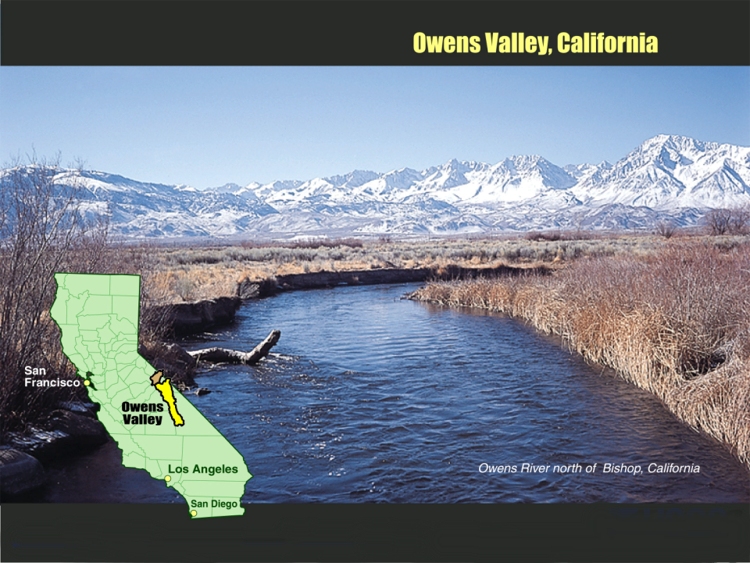 Driving through the Owens Valley on a beautiful sunny clear day, the entire 150 mile stretch with 14000 peaks towering above showed the geological effects of immense glaciers that filled the entire valley during the past ice age. Ice could have been 3000 feet deep gouging up mountains. Even Mauna Kea in Hawaii has clear geological evidence of glaciers! The last ice age was as recent as 10-20,000 years ago and ice covered a large part of North America. Global warming is the end of the current ice age and has provided good weather and prosperity and the growth of civilization and the human race for 20,000 years. The reverse of global warming, namely cooling, is not an attractive alternative. Imagine if cooling began. It would mean summers with snow that did not melt lasting through destroying crops. 4 years of snow on the ground through summer would wipe out most of the world population. 4 years of 40 foot snow accumulation would erase most signs of civilization under a layer of ice. When Krakatoa went off in 1883 the ash plume circled the world and there was no summer in the US that year. Imagine the impact on gnp and the markets if cooling commenced. Its awful to imagine. So its a case of unintended consequences or be careful what you wish for should they figure out how to reverse global warming.
A commenter writes:
Cold weather crops like rye and barley would come back in vogue if we had an ice age which is not unthinkable. The zones for planting crops would change drastically. One would expect that researchers might do some genetic tinkering with corn, wheat, and soybeans, allowing them to flourish in a colder climate. Quite a number of scientists are predicting a Maunder Minimum at the end of this current solar cycle, which coincided with the "Little Ice Age.".
Steve Ellison writes:
Quite a long time ago, I reviewed Evolutionary Catastrophes: The Science of Mass Extinction by Vincent Courtillot. Every one of the 7 mass extinction events identified by M. Courtillot was caused by global cooling. Therefore, I agree that global warming (which I see no reason to doubt) is the lesser evil.
David Lilienfeld writes:
In the 1950s, 1960s, and 1970s, 1980s, and 1990s, the asbestos industry maintained that "there was reasonable disagreement" among scientists about asbestos as a cause of lung cancer; no asbestos-related regulations were needed. In the 1950s, 1960s, 1970s, and 1980s, the same was true of the tobacco industry for tobacco and lung cancer (and other sites, too). In the 1980s, 1990s, and last decade, many in the social conservative school of thought maintained that there was little evidence, or at least controversial evidence, about the role of human papilloma virus in the development of cervical cancer (I won't get into the matter of hand and neck cancer and HPV). In the 1960s, 1970s, and into the 1980s, the US salt industry insisted that the data linking consumed salt and hypertension were controversial and that no regulation of the salt content was needed. The argument against the consensus view holds only so long as additional data do not validate the view of that majority. With Copernicus, that was the case. It was the same with the role of bacteria in the development of peptic ulcers.
Absolute certainty and uniform conclusions by all members of the science community shouldn't be needed for policy formulation. If they were, then the Marlboro Man and Joe Camel would still be roaming the ranges and desserts of our television screens.
Ralph Vince comments:
What a logical stretch David.
In the tobacco litigation, we found secret emails amongst the defendant employee's indicating a nefarious conspiracy to keep their methods and activities secret.
The East Anglia emails are similar in that regard.
I can tell you, from firsthand observation of the computer code that was in the email trove (because I have been writing code since the 70s, and I can tell you from examining someone's code what nationality they are, what mood they were in when they wrote it, and often what they had for breakfast). The code that was dumped was utterly damning to their cause. Not only does it show that the data does NOT sufficiently show that we are experiencing (anthropomorphic or not) temperature rises, but taints the issue because it raises the question of motive. We're left knowing that CO2 in the atmosphere has increased, a seeming understanding that this should have caused temperature rise, and the facts that do not comport to this, and as-yet no legitimate scientific reason (there are some theories, but that's all) to account for this.
Scott Brooks writes:
I suggest that we look at the motives of the people involved in perpetuating what I believe is a giant con job.
Let's say the earth is warming. Is this a man made phenomena or is it just a normal cycle that the earth goes thru from time to time? Who stands to profit from these suggestions to stop global warming? Al Gore and his ilk?
Why do we trust these idiots in DC to make decisions that are common sense based and "special interest group" based?
If we start down this path that global warmists like yourself want us to go down, what happens when the earth keeps warming up (i.e. let's say it's really just a cycle the earth is going thru and not man made)…….what will happen then? Do you think the politicians will say, "Well, it's not mans fault. So let's roll back all the regulations", or do you think that they'll bloviate about how they need even more power to solve this horrible problem?
Why are you so willing to give more and more power to the government when they have a LONG history of abusing that power to their own selfish ends?
If you chose to go down that path, you will find people like me standing in your path actively trying to stop you.
Garrett Baldwin writes:
I wasn't going to jump in on this, but I wanted to shadow something Scott said.
With regard to motives, pay attention to the way that the hearings and the solutions to solving this problem are handled. Some of us want the market to solve the problem. For example, let's say that the biggest threat in the world were something that is hard to measure, like the earth is running out of fresh air.
I'd argue that if that were a serious problem, a man would come a long and invent a machine to solve it. We'd rely on human ingenuity. We'd beat back that threat…
But the people who stand to profit through centralized alchemy only want to do it one way — their way. And any solution that is market based, creates competition, and doesn't enrich allies or decision makers or centralize more power with the government is either demonized, destroyed or regulated from the conversation.
The reality is that central planners can't solve this problem. They claim that they invented the internet, but if the government were still operating the internet, it would just be two dudes from DoD playing pong back and forth between New York and Camp Pendleton. This entire hype has evidence of scam all over it. Naomi Klein has demanded that the U.S. distribute $2 trillion to third-world nations who are "victims" of the U.S. and our energy policy. Ironically, the nations that are demanding the money are also the ones that are near the bottom of the Heritage Economic Freedom Index. Countries that aren't developing because they keep they limit their own people's ingenuity and production are going to get $2 trillion and then do what with it? Usher in a green economy? Come on…
So, when I hear the idea that we have to "do something" and do it fast without exploring the data, without asking questions, and without being allowed to have a debate because doing so would cast the distrustful of government as people who don't care about the children or the future or humanity. Meanwhile, the alarmist will have a moving wardrobe of children follow him as he spouts off how important his intentions are and how we are monsters.
Beyond that, we also ignore one thing in this discussion.
What are the positive benefits of global warming? After all, Greenland had a booming farm trade 1,000 years ago. I'd like to get some beach front property in Greenland. I'd also think that trade through the Arctic Circle would be nice and reduce shipping to Asia in half. Why is global warming such a terrible thing? Is it because we refuse to embrace the challenge, and because there's profit to be made by saving us from ourselves?
So, I will say from my perspective this. I don't consider climate change a big deal, and it's not something that I worry about. Humanity will adapt after government spends trillions of dollars chasing this dragon..
Jan
30
China, from David Lilienfeld
January 30, 2013 | Leave a Comment
 I thought that there had been some consensus emerging that China wasn't headed for a hard landing. Maybe it isn't landing at all? I don't know China that well, but there are many who I think do. Any thoughts?
Leo Jia writes:
Hello David,
I don't have much in-depth analysis to offer, but based on the experiences in China, I don't see much evidence of landing lately, let alone a hard one, though there were worries about it a year or so ago. Things seem OK now. Real estate is picking up speed. The multi-year depression in the stock market seems coming to an end, very likely reflecting some optimism on the new leadership's capability in handling the social issues that threaten the ongoing economy. In any regard, the worries about a hardlanding are being pushed forward.
I can't read Prof. Pettis's post as his blog is blocked lately. But here is a post by Stephen Roach on the same topic, which argues that a reform is still critically needed in order to avoid crashes.
Jan
22
Notes from the Field, from Alan Millhone
January 22, 2013 | Leave a Comment
 I have noticed a lot more ads on AAG reverse mortgages touted by Fred Thompson and Henry Winkler hawking another reverse mtg so you can rob the equity from your home. Anyone know any stats on how many poor souls lose their homes?
Also a lot more ads featuring Alex Trebek and the need for Colonial Penn burial insurance.
Regards,
Alan
David Lillienfeld writes:
Same experience here. My late sister-in-law insisted that if it was good enough for her cousin, it was good enough for her. Besides, she told me, the Fonz wouldn't think of misleading anyone. After all, he's the Fonz. When I finished talking with her, I called my nephew, and he started processing guardianship papers the next day. This was about 5 years ago, too. I have no idea what the fee structure is like now, but I can't believe it's improved much.
Jan
21
Apple’s A Changin’, from David Lillienfeld
January 21, 2013 | 2 Comments
 Any doubts about Apple under Tim Cook being different than the Apple under Steve Jobs are gone by now. Apple capex is up, there's a swing in production back to the US, and there have been at least one "significant" software disaster. Now come the reports of changes in the product cycles and product introduction schedules. Apple hasn't shied from cannibalizing its products in the past, so I don't this it will pause from doing so now. I'm wondering at what point does the smartphone market go generic? Conventional wisdom is that with the Chinese now buying smartphones, the market will only expand. Perhaps. But are the Chinese prepared to pay the premiums for smartphones as Westerners have? That's a problem not just for Apple. Then again, I've yet to walk into an Apple store that wasn't packed. Even during the recession.
"Rumor: Apple to debut 4.8" 'iPhone Math' device alongside next-gen iPhone in June"
Henry Gifford writes:
When I bought my phone the guy in the store (in New York City) told me the US Federal government subsidizes every mobile phone in the US to the tune of $600, limit once per person per two years, thus the two year contracts.
Subtract $600 from the price in China and the price is quite similar to the US price.
Russ Herrold replies:
Yeah, counter clerks will say almost anything. The truth is more commonplace. Some subsidies exist, nominally for low income folks but the people PAYING FOR that subsidy are … [hint: go read your cell phone bill closely] all the other telephone users. This is a good article about it.
Jan
13
The Brain Drain at Hp, from David Lilienfeld
January 13, 2013 | 1 Comment
 I've been hearing from friends around Silicon Valley about the extent of the brain drain that's been going on at HP for the last several years (BW looks at the past 2 years, but it's been in progress for longer than that. The most recent HPQ effort at M&A didn't help matters. A friend put it eloquently: "I get that they can write code. I get that they can't design a circuit. I get that they have no clue what something has to be to be called a system. I get that we're becoming the real-life version of Dilbert. But can't they do something as fundamental for a tech executive who no longer knows much about tech as making an acquisition without getting ripped off? That I don't get." Others have told me about the dysfunction present in many parts of the organization. Someone from my synogogue back in Foster City who was laid off by HPQ during one of Carly's "right sizing" exercises (and who was crushed at the time) is overjoyed that he's no longer there. He told me that his friends still at the company are dispirited at best. Not a good situation.
A great American institution is dying. HPQ is the longest-lived company I know of in Silicon Valley. Hopefully, others will learn from its demise.
Jan
8
The Safety Indicator, from anonymous
January 8, 2013 | Leave a Comment
 On the corporate morality thread, I can offer some experience of the company I first worked for, a large manufacturing business. The number one priority ahead of profits, customer service, quality or value was safety for the employees. We will not injure our employees, and there was zero tolerance on this issue. The quickest way for a manager to lose his job was lax safety practices. And in fact some of the work around machinery was dangerous. Every meeting started and ended with reports and progress on safety. It is the morally right thing and does not conflict with good business. Safety at work or anywhere else is fundamental. Secondly, this focus attracted a culture of employees who cared not just about safety but about the other things that make a business successful, productivity, investment in new ideas, costumers and creating value. I would predict that companies with good safety records internally have equally good performance externally for customers and shareholders, and the opposite.
Jeff Watson writes:
My grandfather had another indicator of the condition of a company. Drive by the place and look at the parking lot. If it's full of older cars, junky cars, it's probably not a good place to work for and probably is a poor credit risk. On the other hand, if a parking lot is full of shiny new cars, it's probably a better place to work and probably has better financials and business.
David Lilienfeld writes:
I don't doubt the morality in corporate behavior. In the pharmaceutical industry there is lots of concern about patient safety. There are two schools of thought about why: The first is that the companies are enlightened and accept George Merck's "Do well by the patient, and you will do well by the society." The second is "A dead patient doesn't buy drugs."
My observation is that while the industry has a sincere interest in patient safety, it can also deceivingly discounts that safety in preference to efficacy, which is perceived to be the reason drugs gets approved. I don't think this is a conscious effort at deceit. That doesn't make it any less real. Many of the leading pharma houses have come to accept that and have tried to design in fail safe safety mechanisms into the approval process. It will take another 4-5 years to see if they are having their intended effects.
Jan
3
Tinkers to Evans to Chance, from David Lilienfeld
January 3, 2013 | 1 Comment
 It's 41 days until pitchers and catchers report to the Orioles spring training camp, so in the spirit of preparations for the onset of spring such an event promises, I'm passing along an interesting piece from today's NYTimes.
There have been many cultural contributions to the lore of American baseball. Perhaps none is better known than Abbott and Costello's "Who's on first?" routine. (I Don't Know is on third. Really, he is. Who's on third? No, Who's on first. and so on) One of the lesser known contributions is a poem referenced in the NYTimes article linked above. It includes the immortal line "Tinkers to Evers to Chance", detailing what is among the more well-known double play combinations in baseball. It was not however, the most potent, just the most celebrated. Even so, the Cubs, upon whose team these three played, managed to post the highest W-L record in modern baseball history, perhaps scant comfort for those Cubs fans who had to endure a seemingly endless series of seasons in which the Cubs contributed little to baseball other than wins for other teams, Ferguson Jenkins, and a few other others like Ernie Banks and Ryne Sandburg. (As a long-time Orioles' fan, I can sympathize with the Cubs' fans: the Os wandered in the "lost games" desert for almost twenty years before showing some life last season. Hopefully, Mr. Angelos continues to stay away from the front office this year like he did last year.) Whether the Cubs will ever again field a combination in the middle that rivals Tinker, Evers, and Chance remains to be seen. It seems unlikely that such a combination will be able to displace that of Tinker to Evers to Chance in the lore of baseball, and in the cultural history of the United States.
42 days until "Play Ball!" is again heard and all becomes right with the world again. (We'll give the boys of summer a day to get the protective gear fitted.)
Dec
30
Does Anyone Believe, from Victor Niederhoffer
December 30, 2012 | 1 Comment
Does anyone believe there is a contagion in things like mass shootings, and pushing people onto the tracks in subways, and that it has to do with the Qe's, the tarps, and the singling out of the successful for "takings" by the remaining 99%? I do.
Jeff Watson writes:
It's just a permutation of the old "madness of crowds" meme.
David Lilienfeld writes:
There are a few papers published in the New England Journal of Medicine and some other venues over the course of the last decade that illustrate social contagion for behaviors such as obesity, smoking, and so on. I don't know that there's been any efforts, though, for less frequent behaviors.
Dec
26
Greek Banks, from David Lilienfeld
December 26, 2012 | 2 Comments
 We're now into Year 3 of the Greek implosion. Lots of austerity measures in place in Greece, though it's not clear if anyone pays any income tax. Government employment rolls have been cut by more than 25%. At what point do Greek banks become buyable? Granted, there may be some social instability short-term, but given that the country has stomached the austerity measures thus far imposed, I'm not sure that my concern about the social fabric further unravelling is well-founded anymore.
Ralph Vince writes:
A good point, but I think we should asses what is and has occurred in Greece, and elsewhere, as not just a function of duration but of time. I don't see the Greek situation improving an any substantial measure any time soon. Or Portugual of Spain or Italy or France or….
I fear europe — and the rest of the world (assuming the US follows suit on austerity) will be in a similar situation wherein the prisoner seems fine after 90 days of incarceration. But he has a 20 year sentence.
I think the real fear isn't so much "social fabric coming apart," lies in the realm of political reaction after sustained periods of hardship. This is where some pretty unsavory actors have made their mark — not in all cases, but it is the ground they have grown in, and no one has been into this long enough or suffered for enough of a prolonged period. We will know it is that time by the symptom of right-wing leadership and if it is sensible or extreme.
Dec
17
The British Navy, from Dan Grossman
December 17, 2012 | 1 Comment
 Today I heard a striking point about the British Navy, a frequent subject on this site.
At the start of WWII the British Navy was the largest in the world, but its effect on WWII was inconsequential. (I know Stefan will probably give various counter-examples but still, this statement is certainly accurate in relative terms compared to, say, the RAF, the American Navy, etc.)
The reason was the British Navy was out of date in forward thinking. It still thought battleships were the key, although they were fairly useless, and it had not really taken into account the effect of airpower — the key role of aircraft carriers and also the effect of enemy aircraft on British naval operations. Maybe also hadn't sufficiently taken submarines into account.
A lesson to all of us about military and other institutions, and life in general.
David Lilienfeld writes:
The Royal Navy had two impacts on the war:
First, it made the Mediterranean a British lake. There was never any contesting that control throughout the war. Second, it prevented Sea Lion. Whether Hitler would have prevailed in such an invasion is great fodder for holiday discussions with cognac by a blazing fire in the fireplace.
As for battleships, they still had a role–shore bombardment–but it was hardly the dominant role it had had pre-war. It's interesting that the Japanese looked at the air raid on Pearl Harbor as a partial success even as they didn't touch the US carriers or the critical US Navy's (and Army Air Forces's) supplies of fuel.
Nov
29
Rome: An Empire’s Story, from Victor Niederhoffer
November 29, 2012 | 2 Comments
 Rome: an Empire's Story By Greg Woolf gives and excellent review of the reasons and history of the rise and decline of Rome's empire which was kept relatively intact for 1500 years. The rise he attributes to efficiency, trade, and military success. The fall he attributes to weak alliances with neighboring countries to rule the provinces, and lack of incentives to produce from the provinces. I find many parallels to the present. The good news is that it took 1500 years to disintegrate.
Steve Ellison writes:
I am partway through volume 1 of Gibbon's The Decline and Fall of the Roman Empire. There was little incentive for the emperor to rule for the benefit of his subjects rather than for his own pleasure. Rome became a military kleptocracy after the murder of Commodus in 192. The armies knew they were the source of power and demanded an exorbitant price for their support, beginning with the Praetorian guard's murder of Pertinax and subsequent auction of the throne to the highest bidder. Frequently contending for rival generals to seize the throne, Roman armies put more energy into fighting one another than fighting the enemies on the frontiers.
Stefan Jovanovich writes:
Details, details:
"Romans imagined [the empire] as a collective effort: Senate and people, Rome and her allies, the men and the gods of the city working together." This continued as Rome passed from the Republic to the Caesars, who were kings "even if [Romans] could never bring themselves to call them by that name." It is "a history of remarkable stability. If it was largely true that (as one historian has put it) 'Emperors don't die in bed,' it was also true that the murders of many individual emperors seem to have done little to shake the system itself."
Since "decline and fall" is the current meme, one should hardly be surprised that publishers and their authors want to cash in on the latest craze. (That is all publishers ever do; and authors, poor things, are usually desperate to oblige.) Professor Woolf should have resisted the impulse. He certainly knows better. The "collective effort" he describes is a complete fairy tale. The Empire never even developed a common language; our "classical" education notions are based entirely on the fact that rich people had too know Greek because that was the commercial language of the eastern provinces — which was where the money was. Latin was for the inscriptions on the public buildings and for the official orations and the school examinations but the "common" people continued to speak their own tongues. Even the Army relied on whistles, drums. and flags for its "commands" when it took to the field. This explains why Latin itself became almost instantly obsolete even south of the Rubicon. No one writing about the Hapsburgs, who did manage to keep their own Empire running for a good long while, would ever have offered up such fictions about "court and people, Vienna and her allies, the men and gods of Vienna working together". But, we have enough information to know that the court spoke French in that Holy Roman empire. The beauty of Roman history is that there are so few actual facts that survive that one can make the story whatever one wants it to be.
Jim Sogi writes:
The key is "1500 years". It's not going to fall apart in the next 100, that's for sure.
Gary Rogan writes:
The difference is that they couldn't do state borrowing in anywhere near the same proportion to their GNP as the US can. It also took less than 100 years from the peak, however defined to really difficult times. And as "mr. grain's" article demonstrates in less than 200 years from the peak free people were volunteering for slavery to avoid taxes, an inflation rate of 15,000% was experienced, free employees were essentially made into slaves at their places of work, and women, children, and parents were physically hauled off and abused to get to the tax evaders. All due to overspending and overtaxation.
Also for whatever reason they limited the free grains to a relatively fixed number of people, and the amount was small for quite a long time. Their modern equivalents today with a much more advance education in economics talk about redistribution with such excitement and such lack of concern for where this is all going that would make Nero proud (I mean the part about fiddling while the Rome burned, except they are not fiddling but setting the fires).
Vince Fulco writes:
I am still trying to understand how a society flourishes with reported median family incomes stagnant or below that of a decade ago? And there is no sign the worker is gaining any bargaining power. Sure the govt can artificially tinker with rates reducing the carrying costs but someday existing debt must be paid; at least at the consumer level. It is debt assumption for non-producing overpriced (after debt service costs are added in) consumer goods which will kill this country.
Tim Melvin writes:
I agree with that to a large degree…..crony capitalism at the expense of everyone else is a cancer in any society….the problem is not capitalism exploiting the workers. it is the complex and intertwined relationship of business and government that does us the most harm. Eisenhower was right.
Anonymous adds:
Tim,
I think the malignancy has metastasized much deeper than that, and now sits in a kind of acid bath (the pending "fiscal crisis') where all else is peeled away and we see it clearly (in fact, the fact that people seem to NOT see this clearly is evidence of its metastastization) and it is this: Our society — at every level — is characterized by a desire for more rules, and an exception of those rules for ourselves.
Talking different tax rates is a carve out. The argument that the elderly should get a carve out. The birth control carve out. The government worker's salaries untouchability as a carve out.
How about when the White House issues exemptions to Obamacare?
Affirmative action is a carve out. All corporate socialism is a carve out. Every bill passed by Congress does not apply to them. I call that a carve out!
The white lady's sinus-snort lament, "This is RIDICULOUS!" always pertains to her being denied her attempted exception carve-out to the rules.
That's the cancer. The cure would take a lot more than Mitt Romney, and likely cannot be cured by a single individual.
History doesn't exactly repeat, usually, an incident is followed by another incident of similar cause but differing results and often differing in duration. I don't think we're going into a 1,000 year long dark ages. I think we're racing headlong now to something far more sudden and shocking, and bigger than any one man or political party can purge from our psyches.
Jim Sogi writes:
I used to think the revolution was just around the corner, society was fragile and was about to come apart. Not now. Look at NYC and Sandy: that was an amazing comeback. The recession was bad, but the economy is slowly coming back. Things are not bad now. In the 1940's there was nuclear world war. Japan, Germany, Europe came back. Russia fell apart, but now is back. China killed 10s of millions, but came back strong. People are resilient and social systems are strong. The apocalypse is Hollywood and journalistic bogus hokum ballyhoo.
David Lilienfeld writes:
The same is true of the US post-Civil War. Nothing before or since has had the social and economic impact that that war had. The US is more adaptable than Rome was. As Peter Drucker often observed, the US genius is political.
One of the signposts that Rome was done was when it was no longer able to rely on client states for security. That isn't the case now with the US.
A better paradigm for guidance might be the Persian Empire.
Gary Rogan writes:
I keep coming back to the debt issue, the current size, and the ability and desire by "the powers that be" to accumulate more at an astonishing clip. Four years ago I predicted a debt-driven collapse that Rocky chided me for so much, and while the timeframe now seems indeterminate, what IS the way out without a currency collapse and all that follows in those types of situations? The bond vigilantes are not too concerned, and they know all, but what is it that they see? Can they see far into the future or are they playing musical chairs?
David Lilienfeld adds:
I'm reminded of the comment by Jim Carville, Bill Clinton's political advisor. In a re-incarnated life, he said, he wanted to come back as the bond market. "It can intimidate anyone it wants to."
Nov
21
From the “Now I’ve Seen Everything File”, from David Lilienfeld
November 21, 2012 | Leave a Comment
 I was looking around at crowdfunding sites. There are a bunch–there's even one focused strictly on Indian companies, another for Malaysian companies and so one. One caught my eye, though: Offbeatr. It's crowdfunding for adult entertainment activities–dollars for "rewards" (their term, not mine). Perhaps I shouldn't have been surprised that there is such a site. Maybe it was, indeed, the first crowdfunding site of any sort. (Adult entertainment frequently sets the trend in our society. For example, it largely determined the winner of the Betamax-VHS war. Betamax was a technically superior system, but Sony refused to license the technology to the adult entertainment industry–thinking the customer was the family gathered around the tv to see the latest movie offerings. Panasonic had no such qualms and let everyone–adult entertainment industry included–have access to the technology. VHS won–in no small part because of sales to the adult entertainment industry, which was the first major customer and remained as much for almost a decade.) There's always supposed to be a bull market lurking somewhere, and I'd guess one such place is in the adult entertainment industry. Has there ever been a bear market in adult entertainment?
Nov
21
Review: A Class with Drucker, from David Lilienfeld
November 21, 2012 | Leave a Comment
 A Class with Drucker: The Lost Lessons of the World's Greatest Management Teacher by William A. Cohen
I've read much of what the late Peter Drucker wrote, including his two novels (which I try to forget). There have also been some books about Drucker that I've also found to be good reads. (For those unaware of Drucker's work, I suggest reading five of his books, in order: Adventures of a Bystander, Innovation and Entrepreneurship, Managing the Non Profit Organization, Concept of the Corporation and Management: Tasks, Principles, and Responsibilities; there are a bunch of other books, but they are essentially commentary on these five.) Cohen's book is the first to be written not as an interpretation of Drucker's writings but as a distillation of the experience of being in one of his courses. Cohen was privileged enough to have been taught by Drucker in the late 1970s. The book is abundantly readable. Cohen has an easy writing style, and at the end of each chapter is a summary of the salient points from that chapter. He talks at length about Drucker's teaching style, how Drucker conducted the class without notes, and that Drucker's instruction would continue into the dinner provided by the college while Drucker sat eating with his students. Within a week of the start of the class, Drucker had learned everyone's name, and by the third week, knew a bit about their families (and the students, his family). For Drucker, management was as much about people and how one interacts with one another as it was any prescriptive policies or approaches to the typical problems a manager encounters on a regular basis.
This book has one limitation: Its focus is exclusively on management. You might wonder if I've lost my mind, considering that the book is about Drucker, considered to be one of the major management gurus of all time. However, Drucker's work as a management guru derived from his strength as a social anthropologist. Drucker viewed a business as a society. (This idea began with his "Concept of the Corporation" study of GM back in the 1940s.) That's the reason, I think, he was so concerned about the legitimacy of a company's management, the value accorded to the individual workers, and so on. I think that this is the reason Drucker picked up so quickly on the rise of the knowledge worker–that rise was a societal phenomenon moreso than a business one. Consider a baseball team–9 people playing 9 positions, and one manager. Each is a specialist in his field, each is a knowledge worker. Yet the team is a society as much as anything else. Its customers are the fans–not just those attending the games but also those listening on the radio/watching tv, etc. (All of which makes one wonder about the rising stars of the game who sign baseballs only for a fee and who never seem to be available for clinics or any other interaction with kids–the future ticket-buying customers. Maybe that's what made Cal Ripken so special–he was always available, and I can't tell you how many baseballs I saw him sign for free–even for two hours in the pouring rain. But I digress.) Ditto for an orchestra. Similarly, if one looks at governments, their customers are voters. Throughout our society, we have these groups of people with a common aim to be undertaken and completed in a coordinated way. Those are businesses, sure, but they are also societies in and of themselves.This may seem a trivial difference, whether one looks at a business as an organization or as a society. But in looking at a business as a society, one can begin to apply all the understandings we have about societies in general to businesses, which is what Drucker did.
There are lots of other insights that Drucker imparted during his career–and they derive, for the most part–from his observations about businesses as societies. That's the reason, I think, he saw himself as a bystander, much as any social anthropologist would. Further, by looking at a business as a society, he provided the means by which his teachings could resonate long after his death, rather than that influence be dependent on his presence. It's "catch a fish for a man, feed him for a day; teach him how to fish, feed him for life."
All in all, a good read. Not one I'd suggest for the holidays, but on a quiet warm beach in February, it will fill the void nicely.
Nov
20
Gaza and the BBC, from David Lilienfeld
November 20, 2012 | 1 Comment
No one has ever accused the BBC of being balanced, or even honest, especially when it comes to Israel. British anti-semitism in full show, or just plain stupidity? A great example.
Mick Tierney writes:
It's kind of surprising how many on the left see the BBC for exactly what it is, but insist that NPR is the epitome of even-handedness. Ann Coulter (certainly no friend of the left) pretty much nailed it when she suggested that NPR stood for "National Palestinian Radio."
David Lilienfeld adds:
From the "You can't make this stuff up" file:
I turned on the radio about 30 minutes ago thinking I was catching the morning business news. Unfortunately, it was the end of the BBC report on our local NPR station. I thought the show was finishing, but it turned out it wasn't. An Israeli commentary was being questioned by the show's host, and the following was heard:
Host: Isn't it true that Israel has killed many, many Palestinians in this 6 day war?
Israeli: Yes, that's true. Also true is that Hamas fired hundreds of rockets at Israel.
H: But wasn't Israel's response out of proportion to those rockets? I mean, those rockets didn't have much ability to kill anyone. Some didn't even have any bombs onboard.
I: No, it wasn't out of proportion. Would your country have tolerated such an attack as well as Israel has?
H: My country didn't kill a leader of a government.
I: A terrorist organization. And he was killed after the rockets starting firing. They have been firing for a long time.
H: But isn't it true that Israel left Hamas with no choice but to do something militarily to break the blockade Israel imposed? Israel says it wants to see a Palestinian state form, but how can one form if it has no chance of trade?
I: Hamas is a terror organization. It kills Israelis. It has been doing so and it will continue to do so if Israel doesn't do such things.
H: No matter. Secretary of State Hilary Clinton is going to the region to try and broker a cease-fire.
I: Yes. Prime Minister Netanyahu has said all along that diplomacy is always better than military action.
H: I'm hearing from lots of our listeners that while they sympathize with Israel needing to do something about the rocket fire, they think the last six days has been an over-reaction. Andy in Lagos, thank you for that observation. Perhaps Israel should have tried diplomacy before sending in its military.
I: Israel took the matter to the UN and the UN had no interest in dealing with the problem.
H: Maybe Israel should have tried harder. Lots of Palestinians would still be alive if it had given the UN more time.
At that point, I turned the radio off. The business news can wait; better to get my blood pressure back to normal.
Oct
26
Reminiscences from the Early Days of Computers, from Marlowe Cassetti
October 26, 2012 | 2 Comments
 I became involved in the personal computer movement back in the early days. I built an 8 bit, Intel 8008 powered computer from a July 1974 magazine article in Radio Electronics. I also started one of the first "home computer" clubs at NASA/Houston in 1975, so I have been a really long-time observer of this technological development.
I have been amazed at the development of what has become the worship of Apple, even from the early days of the Apple 1. Now an anthropologist has confirmed that it has become a religion.
Today Apple Inc. has become a mammoth corporation. All very interesting.
John Bollinger writes:
I was just a few years behind you, starting with a z80 S100 system in 1978. Indeed, I developed Bollinger Bands on such a system. In those years there were a wide of microcomputer choices and many users moved around from platform to platform, but the Apple people were exclusive from the start. They used separate stores, forums, bulletin boards, user groups, ect… It seemed that with Apple you were either in or out, whereas with other platforms there was a lot of cross fertilization, debate and movement. One could work with a Commodore, Radio Shack, S100, cp/m, Atari, Sinclair, etc. user, even with some of the mini-computer users, PDP, VAX, etc., but rarely with an Apple user. The dividing line seemed to be memory mapping versus port mapping, with Apple's 6502 using memory mapping while much of the rest of field used port mapping, a distinction that faded long ago. My take is that the closed culture was deliberately fostered by Apple's founders to ensure the success of their brand.
David Lilienfeld writes:
I too remember those early days, having built the first MITS machine. Running a program meant flipping toggle switches up and down. The 8008 was followed by the 8080, which was a great chip with which to design. It was a lot easier than the 8008. There were only two competitors of note–the Motorola 6800 and the AMD 6502. That's how Motorola and Advanced Micro entered the microprocessor market (and the world introduced to Jerry Saunders, who could have taught Liberace a thing or two about flamboyance).The Z80 followed in due course. By then, the TRS-80 came on the scene, along with the first set of Apple computers. Those were heady days. Just getting a "Star Trek" program to work was considered a major accomplishment.
I'm not so amazed by Apple's development, per se, as by its rescue from the trash heaps of the PC industry. This isn't close to being the arrogant company that built the Lisa and the original Mac. I'm not sure it is a religion, though. Look at what's already happening with the early adopters and the new iPad. This situation is like the original versions of Word, and the Microsoft fans (Microsoft worship in corporations was pretty prevalent, though nothing like Apple). As with Microsoft, this support of Apple will in time pass.
Jeff Watson writes:
I remember my first Commodore and thought that being able to figure out empirical calculations(curve fitting) with major fudge factors to describe grain prices was the cat's meow. But then again I thought my old HP 35 calculator was something.
Oct
13
New Trends Emerge in the Power Markets, from Carder Dimitroff
October 13, 2012 | 2 Comments
 Market prices for bulk power are dropping across most regional transmission organizations (RTOs or regional grids). The introduction of wind power, solar power and new demand-side technologies are three key reasons for lower prices.
Lower market-clearing prices mean lower margins for all market participants, including wind, solar, energy efficiency and nuclear power. Commercial nuclear power is particularly threatened because they lost their long-held position as the market's cost leader.
Five conclusions can be drawn from observing the power markets:
1) Because they have zero production costs, wind and solar power affect the market and lower average market prices for wholesale power.
2) Small amounts of renewable energy production can cause significant changes in market prices.
3) Trading energy efficiency products lowers average market prices even further.
4) Power markets are agnostic towards power generation; the market doesn't care how the energy is sourced.
5) Commercial nuclear power may fall out of favor, as they will likely lose significant margins and earnings.
Power markets are punishing generators of all flavors. Companies, such as Exelon (EXC), Entergy (ETR), Calpine (CPN), NRG Energy (NRG) and GenOn Energy (GEN), will see new pressures on their quarterlies. Summers should be good. Springs and falls should be terrible. Winders should be mediocre.
It appears commercial nuclear power in the United States is in for a rough ride. Existing fleets will become less profitable (see Exelon Generating's 10-Q). Except for TVA, new fleets of nuclear power plants will likely face postponement or cancellation.
The bright spot is transportation. Owning transmission lines will become vogue. Interstate transmission lines remain regulated assets and are a cost-plus business. The federal government is the economic regulator (FERC). New FERC rules favor independent and private ownership of transmission lines.Avoid distribution lines. While they also remain regulated, they are local assets. Their financial performance is subject to the [political] whim of state overseers.
David Lilienfeld writes:
How much more efficient is centralized solar-based generation and then using the grid to deliver it vs decentralized (eg, homeowner/commercial buildings) generation? Are solar and/or wind competitive yet with coal/natural-gas based generation, and if not, what do the trends suggest in terms of parity (non-subsidized)? Are these trends acknowledged by the local regulators?
Carder Dimitroff replies:
Hi David:
I think you are asking about off-grid vs. grid connected. If I'm wrong, please let me know.
Off-grid will always be the most expensive option because more equipment is needed. Specifically, some form of energy storage device is required and two forms of energy conversion are needed. Not only does off-grid cost more to build, it costs more to operate. Every time energy is converted or stored, energy is lost in the process.
Grid connected is the most economic solution. In the utility world, there are two grid-connected options. One is a direct connection tot eh grid using utility-scaled solutions. The other is a net meter arrangement where the consumer pays only for the net amount of energy needed. Most state will not allow consumers to export more energy than they consume.
For most homeowners, net metering is the most practical option. If I were to add an energy storage device, I would not use batteries. If available, I would use water in a pump storage configuration. The benefit of water storage is it is simple, it can be efficient and it has a long operating life.
About economics. Energy analysis is always about point of view. From the point of view of the grid, wind and solar are far more competitive sources of energy than hydroelectric, nuclear, coal or natural gas. This is not a debatable point.
From the point of view of developers, incentives are still required. All forms of power production have incentives. The only incentive the federal government offers wind and solar are cashless tax credits.
Oct
13
Diamonds, Diamonds, Diamonds, from Pitt T. Maner III
October 13, 2012 | Leave a Comment
 A diamond ETF appears to be in the works. Prices are down a bit at the moment. A "One Quadrillion dollar" Russian diamond story that went viral is reassessed by a specialist. A "diamond planet" makes the news. F. Scott Fitzgerald's story "The Diamond as Big as the Ritz" is mentioned.
FactorShares, the ETF issuer known for its suite of spread products, has filed plans with the Securities and Exchange Commission (SEC) to possibly introduce an ETF that tracks companies engaged in the exploration, production and sale of diamonds. The fund could debut as early as the fourth quarter.
Diamond prices are on the slide again, as macro economic gloom continues. The Rapaport Diamond Trade Index, which is derived from the average asking price for the top 25 best-quality one-carat diamonds and is seen a global benchmark, fell to $9,391 last week….
…However, the long-term trend looks positive. Worldwide demand for rough diamonds may climb more than 6pc between 2010 and 2020, according to consultants Bain & Co. This is higher that the expected growth in diamond supply.
Those in the diamond world were shocked. "Holy s—", is how Dustin Chalchinsky, a geological specialist for Eurostar Belgium, one of world's top loose gem companies, decribed his reaction. "This can't be real. This is almost science fiction.
Chalchinsky went on to write a comment on Reddit that explaining just how unlikely the asteroid scenario was. "It seems extraordinarily unlikely," Chalchinsky told Business Insider in a phone interview. "But extraordinarily unlikely things do happen.
Orbiting a star that is visible to the naked eye, astronomers have discovered a planet twice the size of our own made largely out of diamond.
The rocky planet, called '55 Cancri e', orbits a sun-like star in the constellation of Cancer and is moving so fast that a year there lasts a mere 18 hours.
5) From Wiki on Fitzgerald's story:
Washington immediately finds himself in a quandary; the value of diamonds multiplied by the sheer number available for him to mine would make him the richest man ever to live, but, based on the economic law of supply, the sheer number of diamonds, if ever discovered by outsiders, would drive their value to near zero, thus making him a pauper.
David Lillienfeld writes:
The problem with diamonds these days is that DeBeers no longer controls the market, so there's no basis for assuming any sort of price stability. The Russians can flood the market at will, and may choose to do so to raise money if oil prices decline. Whether there's more diamond to be found in Canada is any one's guess, so there is the possibility of additional supply hitting the market from up north, never mind that machine made diamonds are close to marketing, too. (Did you know that one can take the ashes from a cremated loved one and have them placed inside of a man made diamond?) And of course, there's the demand side of the equation–I don't see developing countries having the same demand for diamonds that they do for gold. So while Bain may want to think that diamonds will increase through 2020, I don't see any basis for that contention. It does make for some nice dreams, though.
Oct
11
So You Want to Learn About Gems, from David Lillienfeld
October 11, 2012 | 2 Comments
 In my family's tradition, we give star sapphire–full six-point, not a cat's eye– engagement rings, not diamond ones. At first my then-fiance was ticked off that it wasn't a diamond–and if it had been, it would have been hard as a rock, just not my style. Then we went for a ride in the Lincoln Tunnel, and as we went through, the spacing of the overhead lighting was such that the star would show and then disappear, over and over again. She was sold on the wonders of the star sapphire. No more faceted sapphire for her (which is a shame, since I've since learned how to facet).
When I had wanted to buy the sapphire in the first place, I went down to the gem district (living in NYC at the time) on 47th Street (which gave us such wonders as 47th Street Photo). I hadn't expected to find a place that felt so dead. I was surprised at first, and then went about trying to find a nice, reasonably-priced star sapphire, with the ring to be made in a month or two. After looking for several house over a month, I didn't find much. There weren't many colored gemstone dealers, and there were very few star sapphires (and what there were had quality issues and were over-priced). So we went off to Hong Kong, found the gem and had the ring made to order. My now-wife couldn't understand what was so special about a star sapphire, and besides, it wasn't a diamond. On the other hand, the platinum I had spec'd for the ring she liked a lot. This was back in 1989, pre-Tiananmen Hong Kong. The only other time I've found star sapphires that were as well priced, with translucent stars was in Bangkok, where some of the Israeli ex-pats were in the thick of the gem trade. They tried to bait and switch, but were foolish enough to brag to one another about it in Hebrew. They were shocked when I told them to shut up and bring in some better quality stones–in Hebrew. Some of the gems picked up that day made for some great gifts, but there's still quite a bit in the safe deposit box–lots of tourmaline and lapis lazuli (the prices were just too good to refuse. It wasn't quite as good as negotiating in Hong Kong for luggage (Louis Vuitton, no less; the Rollex watches, though, and the Calvin Klein jeans were beyond negotiation). In any case, colored gemstones were what I was familiar with. Diamonds I still don't know particularly well. There's the Gemological Institute of America (GIA) which will provide a certificate for a given diamond attesting to its properties, like its color. There's the Rappaport List, which lists the current prices for diamonds of various sizes and classifications. But there's nothing like that for colored gems. To make the situation even murkier, there are treatments for the gems to change their appearance–heat treatment, irradiation, etc.
With that background, I began Precious Objects by Alicia Oltuski, a German-born US-raised Jew whose family, not unusually, has been in the diamond trade for generations. Although the book is 330 pages, the pages are small, so it is not of the War and Peace variety of reading. A good book for the holidays or a few days on a secluded beach with nary a cell phone tower in sight. Don't expect to learn much about diamonds from this book. If you want to do that, take the GIA introductory course on diamonds. The on-line one is pretty good (though the intro to colored gems was more fun, but that's just me), and I'm told the F2F version even better. (The advantage to the online one is a little more control of one's time in going through the material.) She does cover some of the basics, like the 4Cs of diamonds, the role of the GIA, the history of the Rappaport List, the blood diamond issue and how the industry addressed it, things like that. But she doesn't do it with a lot of detail–hence, its lightness as reading material. What she does do, though, is describe the world of 47th Street, and she does so with much aplomb. Given that she's a writer with no interest in going into the family business (which will end with her father's death), it's not surprising that the strength of the book is its focus on the people in the diamond trade, particularly those brokers one step removed from the retail jewelers–people like her family. One gets a very clear sense of the issues they negotiate every day–the fickle whims of the public, the security issues associated with diamonds, some wonderful descriptions of some of the trade shows (particularly the Tucson show, which is to the gem trade what CES is to consumer electronics). Her portrait of Morton Rappaport, for its length, is one of the best I've seen. Having said that, finishing this book leaves with a semi-sated feeling, wanting something more.
The bottom line is that if you want to learn about diamonds, think GIA; for a history of diamonds, let me know–there are lots of good books, and this one barely goes beyond noting that Barney Barnato ever existed; but if you're into people, this brief read may be for you.
Oct
9
What’s So Hard About Conducting, from Scott Brooks
October 9, 2012 | 1 Comment
 Ok, I need some help.
My friend recently sent me this video of a 7 year old conducting an orchestra with the subject title "unbelievable!"
As someone who can barely play a guitar, can't sing a lick, and has no musical talent whatsoever, what is the purpose of a conductor, and why is it such a big deal that this 7 year old can conduct a symphony? I've nothing against what the young man has done, I just don't understand it.
My take as a non-music person is as follows:
1. I believe I could stand there and wave the baton and face towards the correct instrumental group that is getting ready to play.
2. Does the conductor really do anything of value standing there. For instance, if someone were to just count of 1 - 2 - 3 -4 couldn't orchestra all start at the same time, and then play their instruments at the right time to the right beat and so forth?
As I watched the video, I really didn't see anyone looking at the conductor. It looked like they were all looking at their sheet music most of the time.
So any elaboration on this subject would be much appreciated.
David Lilienfeld writes:
Sure. I speak as a former cellist and pianist. The role of the conductor is three-fold:
1. The conductor sets the beat so that all players are playing to the same one. Otherwise, you may have one player who is slightly faster or slower than the rest. The conductor provides the means around that problem, since s/he sets the beat and shows with with his/her baton movement. In a similar way, the conductor cues the various instruments.
2. The conductor provides an assessment to the players concerning whether they are playing too loudly, not loudly enough, or just right.
3. If any of the instruments are being played out of tune, the conductor provides the feedback to that player
4. Through movement, facial expressions, and the like, the conductor communicates emotion about the music to the players. A good conductor can use his/her facial expressions and the like to coax the best music out of the members of the orchestra. von Karajan and Bernstein (and to a degree, Ormandy and Toscanini) were masters in the use of their faces and body movements to bring out a uniform interpretation of a given piece.
I hope that helps.
Oct
3
Article of the Day, from Paolo Pezzutti
October 3, 2012 | Leave a Comment
 My submission for article of the day: "Why is the Euro so Perky? "
The article presents a medium term bearish view of the Euro. The view that the Euro is relatively strong because of the 200 days moving average seems ridiculous. Moreover, the ECB as a lender of last resort has been brought on only recently, while the Euro crisis is a long process started back in back 2009. The idea of a weaker Euro because of structural issues that cannot be solved by a divided group of leaders and nations can be shared, however, this has been a European problem (actually THE European problem) for centuries.
The Euro resiliency is a temporary phenomenon. Right, there are several outstanding reasons for the Euro to be near parity vs the USD. None of them has been sufficient, however, over the past 3/4 years to weaken significantly the Euro. If you compare prices between Europe and the US prices are at least 20% lower in the US. One example: the Ipod Touch 32 Gb cost 329 Euro vs 299$ in the US.
The Fed's "quantitative easing" program has provided underpinning for the Euro. The push of the Fed in the direction of a weak dollar is very strong and has so far outweighed the structural Euro weakness. In relative terms, it has to seen how quickly the 2 trends evolve respectively in Europe and in the US. If the US "system" is more resilient and the crisis in Europe accelerates because from the sovereign financial level it spreads heavily at the social and political level then we'll see the parity of the EURUSD. In this context, the unemployment rate in the Eurozone and especially in the southern nations is an important indicator. It is steadily increasing and it emphasizes the risk of a deterioration of the social structure should this trend continue longer.
David Lilienfeld writes:
Based on what I saw and heard in Barcelona in August, I think the matter has now gone out the ECB's domain. Granted it's a very small sample, but as I've noted before, many Barcelonians have become disillusioned with the EU and with their country in particular. That will, at some point, manifest in spending patterns and capital flight–and I doubt that that thinking will change soon. The European leaders "successfully" kicked the can down the road, but with the result of raising both the cost and the pain of the inevitable crisis resolution. Hence, the issue is no longer whether the Fed's efforts with regard to the dollar are stronger than the impact of the EU's structural problems. Those structural problems, in part because they've been unattended to for so long, will ultimately lead to the euro depreciating relative to the dollar. What the Fed is doing is at best temporary, ie, tactical. The problems with the euro, however, are strategic.
Bottom line: I agree with your concern, and at this point, I'm not sure I see how even the exit of Spain and Greece would help matters much. France is now stagnating. That doesn't bode well for crisis resolution anytime soon.
Paolo Pezzutti replies:
David, actually this is not temporary…
John Floyd writes in:
The key, I believe, is to recognize the Euro is a political animal. The politics are now unraveling from both the top (core countries) and bottom (peripheral countries). Bad economics have led to bad politics and the circle is becoming self-reinforcing. The U.S. dollar, rightly or wrongly, remains the world's reserve currency at the moment. There are approximately $200 trillion in derivative contracts denominated in Euros. The size of the decline in European growth, the politics, and the market product entanglement is making the Euro's ultimate price more difficult than ever to forecast as it may be 1.0 or .80, or lower. The expected returns of the thesis that the Euro goes lower in value however are increasing rapidly as the vortex of the deciding forces gather momentum and power.
Anatoly Veltman writes:
That was interesting reading, until you got to "forecast, may be". How to interpret what follows?
John Floyd responds:
My point was not to be interesting but to outline what I think are the key drivers of the Euro and the potential feedback mechanisms through trade and financial channels globally.
As to how to interpret what follows that is up to you. As a guide I would think outside the box and remember some combination of the following: the Tequila Crisis, the ERM crisis, why "hedged GKO's" were not really hedged, the Malaysian Ringgit fixing, how a butterfly flapping its wings in Iceland had a major global impact, etc.
Jeff Rollert writes:
I like to think of it as the behavior of the passengers in a plane, which just lost altitude suddenly.
They suddenly realize the only ones in control are in the cockpit, yet are unable to see where they're going (just where they are and a little of where they've been).
John's point is very good. History is not a (literal) guide but how investors react to the unexpected is useful.
I'm finding many pieces of evidence of avoidance behavior, including an overweight of whatever was last read.
The model may be a reversal from highly regulated markets to highly unregulated ones.
I've been going to ethnic markets for insight recently, as the calmest investors I observe are immigrants, for insight on their interaction.
Oct
3
Fracking, from Gary Rogan
October 3, 2012 | Leave a Comment
 "Matt Damon's Anti-Fracking Movie Financed by Oil Rich Arab Nation ":
A new film starring Matt Damon presents American oil and natural gas producers as money-grubbing villains purportedly poisoning rural American towns. It is therefore of particular note that it is financed in part by the royal family of the oil-rich United Arab Emirates.The creators of Promised Land have gone to absurd lengths to vilify oil and gas companies… Since recent events have demonstrated the relative environmental soundness of hydraulic fracturing – a technique for extracting oil and gas from shale formations – Promised Land's script has been altered to make doom-saying environmentalists the tools of oil companies attempting to discredit legitimate "fracking" concerns.
Pitt T. Maner III writes:
One of the major ceramic proppant companies just put in a 52-week low. The specialized fracking "sand" business might at some point be an interesting area for further research.
David Lilienfeld writes:
Yes, I was thinking of them and also the niche international business, in general, of designing, producing and expertly injecting fracking sands and proppants into formations. CRR had a pretty good run from July 2009 to July 2011. It's interesting that they have plants in Russia and China. But the swoon, as you say, may continue. The following idea appears to be making the internet rounds (one would think fracking will play a role in these future worldwide developments):
The relative fortunes of the United States, Russia, and China — and their ability to exert influence in the world — are tied in no small measure to global gas developments," Harvard University's Kennedy School of Government concluded in a report this summer.
Jack Tierney writes:
Several years back we had a thread related to a coal mine cave in that resulted in numerous deaths and extensive studies to determine the cause(s). A significant portion of the blame fell to "seismicity." The conclusion was that continued use of high explosive well below ground level had a significant enough impact on the earth's composition to create tremors - some serious enough to escalate into earthquakes.
At the time I as a big fan of coal and the study and subsequent developments didn't help my positions at all. Another energy sector I liked was involved in obtaining power through an Enhanced Geothermal System. This involve injecting cold water at very high pressure down to the "hot rocks" below. Though some ""shear" was expected, the reactions received exceeded expectations. Enough so that Switzerland abandoned the idea. Continued seismic events at on-going systems are watched closely and the equities of companies involved in the process (the poster child is Orman [ORA]) have done poorly.
With those developments in mind and ever aware of the not inconsiderable power of the environmentalists opposed to this method, I have re-established those coal positions. Any adverse event substantial enough to even hint at congressional hearings could put a real damper on these current darlings and their numerous fans. And coal would once again be the most abundant and readily available power source for this country's power needs.
I took a flyer similar to this way back in the '90s. Older market types will recall Bre-X and the scandal that surrounded the "seeding" of the gold samples which indicated a huge resource. If I remember the stock went over $100 and might have surpassed $200 (things get foggier as I get older). In any event, after the responsible geologist threw himself out of an aircraft in a successful suicide attempt, the stock was closed to trading.
However, the CEO of the company screamed bloody murder, claimed it was a rush to judgment, and that the results were legitimate and all was well. And the exchanges relented and trading resumed…with stock at 2 3/8 (yes, stocks did trade in fractions). I assumed as most did that the whole thing was, in fact, a hoax. But trading had been re-instated by the responsbile overseer and for a couple of hundred bucks per round lot, the potential upside was enormous - so I made the bet, and lost. But I'd do it again. Maybe I did.
Sep
28
The Value of a Bachelor’s Degree, from anonymous
September 28, 2012 | 7 Comments

She had wanted to go to Wesleyan. It had everything she was after–small liberal arts school with lots of on campus activities, a strong record of graduate/work placements, small size, and a school where parties were not the rule of the day. Oh, and that it was on the other coast, away from my wife and me, only increased her interest in the school. She was also looking at Wellesley, Colby, Bowdoin, Carleton, Grinnell, and so on. Some public ivies too–U Wisconsin Madison, U Washington, and even some of the U of Californias, though the latter is her safety school.
The problem with the liberal arts colleges is that they now cost a fortune. Generally north of $45K a year and often north of $50K. The situation with the ivies isn't much different–they also cost a small fortune. The out-of-state tuitions for many universities (including the public ivies) are in the mid-20K range, and the chances of finishing in 4 years when attending them is diminishing by the semester. Needing to attend a U of Cal for 6 years to finish a major used to be a rarity. Not anymore. And there is no reason to think the status quo will improve any time soon. Here in California, the system developed by Pat Brown (the current governor's father) had the U of California system, the Cal State system, and then regional community college system. Not only are these systems struggling to find some way of increasing their capacity, but they are doing so at a time when the state government is cutting funding for education throughout the state, including these three post-secondary systems. This problem is not limited to California. In the SUNY system, all tuition goes to Albany, and the state legislature decides how much goes back to the individual campuses, rather than looking at each campus as a P&L center (as U of C campuses do).
Why bring all this up? My daughter is now contending with the question of what's the best value for getting a college education rather than what's the "perfect place" for her. So far, so good. This was what we discussed last night at dinner, and it got me thinking about the post-secondary education system here in the US. At the college level, that system has been in place for three centuries or so. At the graduate/professional level, the current system came into being during the mid-to-late 1800s. The problem is that with the current levels of tuition, the cost of a baccalaureate is rapidly becoming (if not already there) out of reach for much of the middle class population. Using loans is rapidly becoming untenable in the face of college grads unable to find jobs and one-in-twelve of the workforce unemployed. (I won't get into the loan fiasco as regards professional grads–the average medical student having debt north of $150K and for more than a third, it's in excess of $200K.) For many of the existing loans, it seems likely that someone other than the college grad will be left paying the bill. That's debt of about $1.2 trillion at risk. The bottom line is that the current system is rapidly becoming–if it is not already–unsustainable.
The question must be asked about what is the value of a bachelor's degree. I ask the question because it is becoming easy to have access online to some of the outstanding courses available at many of America's premiere universities. Will a degree really have much value when an employer is interested in what you have learned somewhere–online or in person? It used to be that the only way to obtain the knowledge was to attend a college or university in a degree program. The degree was a proxy for knowledge. But there are now other sources for obtaining that knowledge–does spending the money on a college degree make sense any longer?
The situation is even more daunting when you consider that during the mid-1970s, when I went to Johns Hopkins, tuition was about $3K a year. That was also the price of a Chevy Nova car at that time. A Chevy Spark now costs under $15K, and has a MSRP of $12K and change. Tuition at Johns Hopkins today? $50K.
All those contributions to one's alma mater are prolonging the day of reckoning for a system that will need to undergo extensive reform, and that reform will need to accommodate other forms of education rather than only in-person class attendance. Western Governor's University (www.wgu.edu) may be one example, but insofar as it is built around actual degrees, I'm not sure that it's the only type of solution.
An educated workforce is a major prerequisite for a competitive United States, yet the education system is in the middle of a crisis about which there is precious little discussion. That has to change.
Richard Owen writes:
Education is becoming the quintessential branded luxury, taking a commodity input and stamping it with a brand.
Markets are made at the margins: the price driver has been (i) the rising share of wealth located abroad and (ii) the higher percentage of production available to the best paid domestic workers. The West is importing the GINI ratio of the Emerging Markets when it comes to high end property, education, etc.
Take British public schools: fees are now $45k/yr for the full school life, rather than just a terminal three years at college. For three children that's $135k/yr post-tax wage dollars. 7% of the UK is privately educated historically, yet the former figure is well into the 1% income range. Whats made up the marginal demand? Wealthy foreigners with untrammeled, untaxed, EM boom dollars. London is undergoing a reverse colonization. Hence in some bijou streets in the capital, residential is up 40% in two years, (having fallen not at all during the crisis, so that's not a bounce off the lows).
Carder Dimitroff adds:
I have two daughters in their 20s. Both have Ivy-league degrees. Frankly, I'm not sure Ivy matters.
There are wonderful state and private colleges. Most decent universities offer inquiring minds incredible opportunities. If a student is looking to learn and grow, most "average" universities can dish out more than most students can handle.
A good example is my cousin's daughter. She attended a low profile public college in Florida. She went in with the attitude of learning and developing. She and several of her classmates became Fulbright Scholars. Now she is Ph.D. candidate at Duke.
If you look at Ph.D. candidates at the nation's leading research institutions, you may notice most of them never attended Harvard, Yale or Princeton. The same can be said for many business, political and military leaders.
Each school has its own culture. In my opinion, a key to a parent's success is matching the college with the student's personality. If the student love the place from day one, all is good.
Sep
24
Imagining the Future, from David Lilienfeld
September 24, 2012 | 3 Comments
 I'm a big science fiction fiend. Growing up, I went through the Asimov trilogies (and lots of his other works, some of which took on new meaning after getting drunk with him at a bar at a science fiction convention), the John Campbell stories, Niven's Ringworld series, Haldeman's Forever War series, and Dickson's Chylde series, with the latter as a particular favorite. Lots of things we now coming to reality were talked about in these novels and stories. As a group, these writers (excepting Haldeman and Heinlein) tended towards optimism about the future–the human condition would improve, albeit with changes in what was defined as work and how societies functioned in the process of that improvement. Then an interesting thing happened during the 1970s/1980s. While many of these authors continued to write, the new writers were hardly optimistic. When I was at the local Barnes and Noble this evening, I was struck by how dreary the worlds portrayed by current science fiction writers have become.
Is it that we as a society are lacking in optimism about the future–so much so that we are no longer able to imagine one with a positive image (I understand that there are those on this list who will suggest that this is merely my perception, to which I acknowledge it as so being)? Much of the talk about raising/lowering taxes represent incremental changes. I'm thinking about paradigmatic changes; those are the changes that might address some of the challenges of the moment, whether it's water, energy/natural resources, pollution, health and disease control. Perhaps it's the dreamer in me, but if we can't imagine a future in which the human condition is uplifted/bettered, how are we going to achieve it?
Ralph Vince writes:
David,
I've been noticing much the same thing, particularly with the 20-somethings I am routinely around. The dark, negative future they all, pervasively envision is something I have never seen in such one-sided fashion before.
I've given this a lot of though in recent years and have come to a few conclusions you may or may not agree with — regardless, I'm interested in yours and others thoughts on the matter.
I think we DO progress — I think man's progress is ever-upwards in fits and starts, but, viewed through the lens of 3 or 4 generations, has persistently been higher. I think much of this is incremental, almost unnoticeable however.
Lately, I see changes in pop-culture themes that would make me think that the dark era of the past decade or so is coming to a close. I've mentioned walking into a high-end furniture stores, and the colorful, Dr. Suess-looking furniture invoking a sensation of almost giddiness. I see it in the extreme use of bold colors in television ads of the past 12 months or so, in women's fashion and the elaborate, loud footwear now, and hear it in the driving vocals, unwavering, non-tremulo female power voices replacing the warbling songbirds of the recent past.
The mass mood is changing, it's moving in a new direction already. You won't see young men in pinstripes, though you may, by next year, see the resurgence of seersucker (I've been trying, really, really hard on this last one!)
However, just as change occurs incrementally, it also comes in BOOMs. Jonas Salk, Louis Pasteur……Air conditioning, transistors…….the magna carta.
The Santa Maria.
I've alluded to the enormous undertaking of the interstate highway system (post 1950s) and the transcontinental railroad here as things that paid off many fold.
And we've just been stuck in a period of stasis which I think is bigger than politics and politicians, era's where things are just intractable, and the stasis, like large fields of ice, just take time til things become dynamic again.. To-wit, I present Barack Obama's administration. I truly think he/they IS/ARE committed liberals. I think there truly DID intend to close Gitmo, and many of the other things that didn't get done and are being pointed to (I'm not taking a political stand here, not making excuses for the administration, just pointing to evidence to support my "over arching stasis as a natural impediment to dynamism" idea. We've had periods in history where this HAS been the case. (the natural state of politics in a democracy IS stasis. I think had Obama NOT had a supermajority in his first year, a situation where he has to have every one of his party on board and, it would have been easier for him, and odd twist in our politics)
At some point, the stasis will give and dynamism return — I would venture a guess as a consequence of some unforseen invention again that elevates our existence in a quick burst once again.
I think the more "paradigmatic changes" as you say, are very rarely, historically, the result of political structure changes, of which there have been few throughout human history. Usually, it seems, these changes are a result of increasing the geographic perimeter of our existence. These things HAVE transformed cultures. Were the Romans not transformed by their excursions into Britain and particularly the Eastern Mediterranean? Wasn't the old world transformed by Columbus and the Iberian explorers of the 16th century? At some point (I will not be here) our perimeter will expand, and political structures will amend to the new reality — new problems will be solved.
In the immediate, when I see the one-sidedness of dark expectations among the young-n-naive (who will not all be right), and I see the mass mood of culture assume a new energy, I don;t think we will see an paradigmatic change any time soon (are these things even predictable?) but I do think we'll see a more optimistic era here in the coming years, regardless of who holds political office.
Russ Sears adds:
Ralph,
While I admire and agree with both your optimism and lovely essay. I believe the turn to pessimism for science fiction has a much simpler explanation. The education system and elite culture has made it a crime to be a boy and has marginalized the importance of exercise, sports and competition for the intellectual boys. The results has been a rigidity of thinking, especially amongst those scientifically inclined. This ignoring of innate emotions causes internalization and depression It has been sad to see as my daughter is attracted to these intellectual young men, but is put-off by the cloud of doom many carry around.
There is an emotional side to all thinking, What the "rational" mind thinks must subconscious join with base instincts signals of the mind to be accepted thought. Rigidity in thinking, without a recognition of the emotions, is the opposite side of the "angry" trader. It causes one to miss the short term bringing out the canes, and the long term emotional side to central planning, fed policy and brinkmanship politics. In both cases, I believe can be shown, that these time periods are not independent random variables, within statistical significant.There also appears to be a symmetry that plays out between short vs long term non independent market movements and respectively stocks vs bond markets. Which I find quite beautiful. But I will leave both these as exercises for the reader.
Sep
23
Tempers and Saunas, from David Lilienfeld
September 23, 2012 | Leave a Comment
 My family joined a new health club (it bills itself as a resort, and Taj Mahal would be a better description) this week. One of the attractions for me was the presence of a sauna. One able to hold maybe 15 or so persons comfortably. When I entered it this morning (to try it out), it was the first time I had been in a sauna since before I was married. That's a while back. My interest in saunas began when I was a resident in Minneapolis. Part of my residency included completing the Master's in Public Health program at the U of M. Kristen was one of my classmates. Shortly after Thanksgiving that first year in the Twin Cities, Kristen and her husband threw a party to which many of my classmates and I were invited. The party was at their house, sitting on one of the 10,000 lakes in Minnesota. (Fortunately, in December, there were no signs of the 10 trillion mosquitos that go along with the 10,000 lakes.) In the basement of their house, they had a sauna, and Kristen's husband, Rob, suggested I might want to try 20 minutes in it. It would be invigorating, he said.
The rule of the house was that no textiles were allowed in the sauna–no towels, no bathing suits, no nothing. The cedar wood inside was maintained in immaculate condition–I've built furniture that I'd given to friends as gifts that weren't as smooth as those cedar planks. It didn't much matter to me, though, since it was just Rob and me in the room. He wasn't much older than me, having completed his residency in anesthesiology barely 3 years before. (The house was 6,000 sq ft, with a pool house and a pool.) We were sitting in the sauna talking about something medical when in walks Kristen. Think Heidi Klum at 25 with platinum blonde hair. Suffice it to say, I left the party with a very positive image of saunas–so much so that when the renovation of our house is finished, it will have a 10 person sauna inside. But I digress.
I'm sitting in the sauna when an elderly gentleman comes in and on the bench opposite me. We exchanged pleasantries, and then after about 15 or so seconds of silence, he looked at me and asked if I had seen some article in the Union-Tribune that morning. I replied that I didn't read the Trib, just the NY Times. He grimaced and said that I must be voting for Obama. After so acknowledging, I and he had a fairly animated discussion over the next 20 or so minutes talking about the state of the country and related matters. It was a heated discussion (at least as heated as one can be in a sauna)–we both have, as it turns out, some strongly held views. But our discourse was civilized. No lost tempers, no shrieks or yells, just civilized. I guess in a sauna one doesn't have much choice–if you get too worked up about anything, your body temperature will skyrocket. In fact, it was so enjoyable a discussion that we agreed to meet again in the sauna in a few days, and exchanged contact info when we got back to our lockers.
Civilized discourse seems to be a dying art in our society. I've commented before on how we have become the iPod/iPhone society, and therefore have no interest in such discourse. Why bother, when you can hear exactly what you want to on tv or your iPod? As I noted, in a sauna is one of those place where losing one's temper can be dangerous. Even if one is inclined to be short-tempered, in the sauna, other behaviors must be present. Not only does one think and behave more rationally when one does not lose one's temper, one's ability for social intercourse is enhanced and one can avoid dangerous outcomes can be avoided.
As has been noted before, there are so many benefits to not losing one's temper, it makes me wonder why we have them in the first place. Are they simply vestigial behaviors from the neanderthal period? If not, there must be some evolutionary benefit to having one (or not, as the case may be).
Sep
21
BARUG Meetup at the Googleplex, from David Lilienfeld
September 21, 2012 | 1 Comment
BARUG Meetup at the Googleplex
via Google Open Source Blog by Stephanie Taylor on 9/20/12
What is R? R is an open-source, statistical programming language that is increasingly becoming the lingua franca of modern data analysis. R developers have created over 4,000 packages to run in the R environment, including several dozen developed by Googlers. We continue to work with the R community through conferences, meetups like this one, Faculty Research Awards, and the annual Google Summer of Code program, which funded 16 students to work with the R Project this summer.
Last week, Google hosted the Bay Area useR Group (BARUG) at our Mountain View HQ. Over 130 R users and developers met for pizza, networking, and presentations by Googlers.
This is interesting since everyone I know at Stanford (not that far from the Googleplex) functions with SAS and Stata. I suspect that this hoopla about R is like the hoopla three decades ago about C, when Bells Labs was proclaiming it to be the next big language, the successor to pl1, fortran, algol, pascal, cobol (if that doesn't date a comment…), and a variety of other languages of the time. C has spun off a number of derivative languages, and it has emerged as the language for systems programming, especially on the net. But much like S and other such languages, it is not used–at least not directly (though SAS may have been rewritten in C by now)–it isn't used for that much statistical analysis. That's not to say one couldn't do so, just that isn't nearly as compelling a language for such purposes as it is for systems work.
SAS if the IBM of statistical software, and everyone else are the dwarves. I don't think that changes until there is some major disruption in the current models of information technology and data analysis. Of course, such disruptions are visible only in hindsight, and I'm hard pressed to see how software along could lead to such disruption. It took rashy personal computers, the TRS-80, the IMSAI 8800 and the Altair 8080 (I speak from personal experience as to how little they could do) to kick off the PC disruption, which itself took a decade to manifest. That was a hardware-led change, much as the 360/370 mainframes and the VAX mini disruptions were hardware-based. I don't see the hardware change leading to a disruption here. Perhaps it's the net itself, but I have my doubts that that's what's unfolding with R. For the net, though, if it is disruptive in software, I would expect to see it in C–and I think SAS is already there.
Sep
21
The Iran Watch, from David Lilienfeld
September 21, 2012 | Leave a Comment
 Tuesday night marks the start of Yom Kippur, the holiest of days among Jews. Hearing Kol Nidre reminds me not only of a time for introspection but also of a moment to think about family and friends with whom I've been in contact with during the prior month wishing them best wishes on the new year. Usually in talking with friends and family in Israel (thanks to Skype for facilitating free face-to-face internet calls), I hear all the news of the family and often some bemoaning of one thing or another ("that corrupt Prime Minister" or "what's so complicated about building a road?" or "The children are thriving, even though they are in kibbutz in the middle of nowhere in the Negev"). These range from adamant Peace Now backers ("why don't the Palestinians begin a non-violent movement like Gandhi") to the far right ("I knew Begin was going to betray us"). In one case, I have a cousin who framed an enlarged copy of the Dry Bones cartoon about Begin lecturing Carter about the US withdrawal from its "occupied territories") (The link shows both the original and an updated version of Netanyahu and Obama–plus ca change…).
I always hear about what's going on with the family, sometimes about a missed article in Globes or TheMarker, and sometimes a sense of the political climate. This year was a little different. I heard lots about family and friends (lots of pregnancies during the past year, and in one instance, triplets born this past weekend). I also heard some about Iran. I was surprised to hear as much as I did from across the political spectrum. One friend, a very conservative (she's the one whose quote about Begin I cited before) retired IDF colonel, commented that if Israel attacks Iran, it will be likely be suicidal but "we have to do what we need to do to defend ourselves"). Another, a fairly liberal cousin (he thinks Israel was stupid to keep the PA from developing an economy), is hopeful that an attack can be avoided, but he's also a realist ("Obama is well intended, but let's face it, Iran wants to destroy us, and given even half-a- chance, it will"). I heard a chorus of concern about Iran, and also the general view that Iran was very much of an existential threat to Israel.
The sense I got was that Israelis across the political spectrum are feeling lonely. Some are more trusting of Obama than others, but for the most part, they don't see the US going to war to deal with Iran. For a couple of folks, the recent decision by the Olympics not to have some moment of silence during the opening ceremonies merely "confirmed" their view of an isolated Israel. Developments with Egypt have been unsettling, and the recent death of the American Ambassador to Libya raised even more concern. There are now reports being published about likely responses from Egypt and Jordan if Israel attacks Iran. Many of those I spoke with indicated an expectation of such a response.
What strikes me as curious, though, is that this article is appearing now. Does anyone doubt that Israel would deal first with a perceived existential threat and then deal with the consequences afterwards? Neither Egypt nor Jordan can pulverize Tel Aviv in less than an hour. On the other hand, for whose benefit, then, is such a story being published? Not the Israelis–they seem to understand this already (and this was before the story was published). The Arabs? Much of Egypt wants to cancel the peace treaty with Israel and the rest are insistent on a renegotiation of the current treaty. The American public? I haven't observed a groundswell of support for any military action in the US by the Israelis, never mind the US. So I'm a bit challenged to figure out why this story is appearing now. Those in Israel that I've spoken with during the past month or so seem to have already factored it into their thinking. Qui bene?
Then there was another story which provides nothing no one doesn't already know. Is this is for domestic Iranian consumption? Perhaps. We know the Iranian economy has taken a hit with the sanctions. Perhaps Iran is taunting Israel and the US? That may not seem logical, but when talking about Iran, there is little that is.
In any case, the Iran watch continues. And my relatives and friends are not only worried about Iran, they are also untrusting of the US to do anything about the Iranian nuclear endeavor. At the same time, Rome isn't that much further from Tehran than is Tel Aviv (2600 miles vs 1000 miles). Is Obama naive enough to think that a nuclear Iran would not hesitate to threaten Italy in its bid to get sanctions lifted? On the other hand, is the Iran nuclear program sufficiently advanced that an attack would have no ability to stop it or slow it down significantly?
For all those celebrating Yom Kippur, have an easy fast.
Sep
14
This Winter, from David Lilienfeld
September 14, 2012 | 3 Comments
 There's an interesting article in Nature about the coming winter–with a prediction for a worse than usual one. It seems to me this is a test of the climatologists' ability to do any long-term predicting–and if they are off on this one, I have to wonder what happens to the global-warming deniers (probably "I told you so").
All of which leads me to ask the commodities traders on this list: is natural gas going to put in a bottom (even if seasonal) on news like this, or is there still so much supply in the US (stored and otherwise) that even with a bad winter, natural gas will remain cheap for a long time to come?
Jeff Watson writes:
Back in the pit days, if it looked like the contract was making a bottom, I'd sell 5,000 bushels a quarter cent below the bid (had to time it just right) to see if there was anything down there. The thing was by doing this, it was very low risk, got me a lot of information, and would cost me a max of $25, but I was usually able to scratch the trade more often than not. The grain market will tell an inside player (one who's always making a market), very clearly, when it's a bottom. Stocks and bonds, I don't know that much about.
Sep
13
Facebook, from David Lilienfeld
September 13, 2012 | Leave a Comment
 Zuck gives an interview and FB kicks up 5%. There's still no clarity on how it will triumph in the mobile space, how it will address the decline in FB use among teens and young adults in the US, or retention of employees given the stock's performance to date. I suppose one could argue that the only place for FB to go is up, but just because it doesn't decline anymore doesn't mean it will go up.
Maybe I'm missing something here?
Easan Katir writes:
Only twenty more speeches and, at this rate, the suffering shareholders will break even.
T.K Marks writes:
So today's philosophical conundrum might be, would it be unethical of him…to front-run his own speeches?
Given the circumstances, that's a question more easily posed than answered.
Sep
12
Going over Eurozone events with Mr. Coker, from Victor Niederhoffer
September 12, 2012 | 1 Comment
Mr. Coker points out that Draghi is Italian and very colorful and he is a real PhD like our chair (and unlike both their predecessors), and his words have great strength. I point out that the jobs of almost everyone in Brussels and the Eurotower depend on keeping the EC intact at any cost. It is not surprising in that context that with their ability to tap every country, every international aid organization, that they have won the battle.
David Lilienfeld writes:
In the absence of political unification, is there any way for the EU to survive as anything other than a trading association? The euro isn't viable in its current form, the political structure requires unanimous agreements (at least that's my understanding from the euro follies), and the folks in Brussels seem wonderfully detached from reality. BTW Brussels has already succeeded in destroying medical research in the EU with its "benign" Clinical Trial Directive.
Sep
11
Remembrance, from David Lilienfeld
September 11, 2012 | Leave a Comment
 Every year on 9/11, I have the same nightmare: watching the plane going into the Pentagon. No doubt many of you were in NYC that day and remember the attacks. I was in Washington DC and was unfortunate enough to see the plane go into the Pentagon. While the attacks in NYC have become the emblem for the 9/11 attacks, it's important to remember that NYC was not the only place attacked. Those killed on 9/11 are remembered each year. We should also remember those among our military who died or were injured/maimed while serving in Afghanistan fighting those who provided the training camps for the 9/11 hijackers.
I have often wondered if the proximity of 9/11 to Rosh Hashannah, Yom Hazicharon, the Day of Remembrance, has itself some meaning, some effort at communication. As an agnostic (where did all that energy released during the Big Bang come from?), I might dismiss such a possibility. On the other hand, many hope to ease the pain associated with the attacks, the suffering of those attacked and their families (including the many 9/11 babies who had not yet been born and who never had the opportunity to meet, never mind know, their fathers), the deaths of those killed during the attacks and subsequent collapse of the towers with an appeal to a supreme being. I can't say whether those thoughts are ever responded to. I can only hope that the grief resulting from the attacks abates with time. I do not think it will ever disappear completely. For today is a day to remember, to consider all that happened on 9/11 and in its wake. For those of us with friends and family who died that day, 9/11 provokes memories of that which one hopes never to live through again. We should assure that not only should those of us alive on 9/11 do not forget the events of that day but that future generations learn about them and come to understand them, much as we did with Pearl Harbor.
Remembrance.
Sep
6
How Government Affects the Market, from Russ Sears
September 6, 2012 | Leave a Comment
I disagree that the Fed is the major long term source of how governments are affecting the markets. This is a short term, old school way of thinking. Not that a trader can ignore this.
The major source, I believe, is benefits to seniors and the uncertainty that surrounds them. This is a global issue. The current projectories are clearly unstable, but the politicians have turned it into brinkmanship maneuvering of Euro and budgetary fiscal cliffs.
If in the 80s we conquered inflation by finally understanding wage expectations, in the 21st century will we conquer deflation and societal extreme risk aversion by benefit expectations? Is there an answer? Are we doomed to politicians promising and giving in the short term more than is possible in the long term for the vote? If so, where and when must it all come crashing down?
Gary Rogan writes:
You say in the 80s we conquered inflation by finally understanding wage expectations. I thought inflation was conquered by raising interest rates by a huge percentage. Is that not the case?
Russ Sears replies:
Yes, that was "how" it was accomplished, I am suggesting "why" it had to be done that way. It was the wage price spiral or "inflation expectations". They had to convince people they were serious in lowering inflation long term. Not flood the world with $ every time it was politically expedient to do so.
Gary Rogan adds:
I realize there were inflation expectations and they were blamed for inflation, but fundamentally there was just too much money being created. I don't think we disagree, I just learned to think of inflation expectations as being derivative to the money supply. Whatever the details of inflation creation, you cut the money supply and inflation will be gone sooner or later. Less money = lower inflation, whatever people believe.
Rocky Humbert writes:
If anyone can demonstrate with any degree of quantitative rigor
(1) How politics can be quantified.
(2) How politics can be predicted.
(3) How either of these things can be useful to investing in an objective way, then I will embrace political discussions wholeheartedly.
But before you folks try to go down that path, I have to point out that if you own stocks, you should pray for Obama's re-election. (hah)
David Lilienfeld writes:
The assumption on the Dem vs Rep analysis is steady-state, i.e, the structure of the economy is steady-state. In the age of globalization, that's probably not true anymore, so the analysis, while interesting, isn't informative about what the future might hold. Further, I don't think it will much matter which party wins the Oval Office economically since both parties are going to try to spend like crazy. The alternative is to control the deficit, which may have long-term benefits but which will have short term political pain. In an age of instant gratification, I doubt that the politicians of either party are willing to take the chance that their prescription for the economy will show its benefits before the next election. Just as Wall Street analysts live and die by the next quarter's earning, so too do politicians. Call me naive, but spend and let someone else figure out how to deal with the consequences has become as American as apple pie. I see neither political party providing any basis to suggest otherwise.
Sep
2
Refis, from David Lilienfeld
September 2, 2012 | Leave a Comment
 We did our refi at 3.5%. I keep hearing about a renaissance in the US housing market, with Toll claiming it has pricing power. Yet mortgage rates continue to drop. This makes no sense to me. If the market for homes is coming back, shouldn't mortgage demand be increasing –leading to higher rates, not lower ones?
Phil McDonnell writes:
If mortgage demand is increasing and that is the only variable that has changed then mortgage rates should be rising. But that is not the only variable that has changed over the last couple of years.Helicopter Ben has been flooding the market with easy money via QEn. that is the dominant factor.
Steve Ellison writes:
In Foreclosure City where I live, sales activity is very brisk at prices 60% off 2006 levels. Homes that are priced appropriately are selling very quickly, and inventory is very low since a new state law went into effect that required lenders to prove they actually held the mortgage before foreclosing.
Aug
27
Letter from Barcelona, from David Lilienfeld
August 27, 2012 | 1 Comment
 Went to Botafumeiro tonight, and in a word, it's outstanding. Heartily recommended.
Went through the Call today. It's the old Jewish Quarter (Jewish niche would be a better description, though).There's not much left of it, though.
There are some things I'd like to see in Barcelona, but for the money and the time, I enjoyed being in Bordeaux (besides the wineries) much more. Then again, I'm not enamored with Paris and think London's a ton of fun to be had (and Amsterdam's great for more than some of the finest Indonesian cooking to be found outside Indonesia–and some great art, too), so you might want to take those views into account when thinking about my thoughts on Barcelona for a get away sometime.
Aug
26
The First Tycoon, from David Lillienfeld
August 26, 2012 | 1 Comment
 I just finished Stiles' The First Tycoon. It's a bio on Cornelius Vanderbilt. The book is well written–it's not short, but it reads short. Not like a Robert Caro-style book. (I enjoy reading Caro a lot–if you haven't plowed through The Power Broker, you're missing out on one of the most cynical descriptions of political corruption in NYC circa 1920-1970. Of course, with that corruption came Jones Beach, the LIE, The Triboro Bridge, the 1964 World's Fair and more. Also the creation of the South Bronx as an exemplar of urban decay.) Caro is a compelling writer, and so is Stiles. The difference, though, is that Caro stays on target. Stiles does, too, but the target is the economic and political climate of the industrializing America, not Vanderbilt. And that's the only real weakness of the book. Nonetheless, it's a fascinating read, and I'd encourage anyone interested in US economic/business history to read it.
Aug
24
Barcelona Thoughts, from David Lilienfeld
August 24, 2012 | 1 Comment
 My second day in Barcelona was spent in the neighborhoods. It was hot, so taking frequent breaks at cafes provided lots of opportunities to speak with the locals. (It's amazing what a heat index of 95+ will do to one's thirst.)
Some observations:
1. The German Foreign Ministry and the German Ambassador to Spain have lots of work to do with the Spanish. I heard many times about how the Germans are "meddling" in Spanish affairs, that the Germans lack compassion, that the Germans needed to be bailed out recently and no one behaved towards them the way that the Germans are now treating Spain. Their words.
2. Roger Arnold asked me to inquire about the state of real estate in Barcelona. I was told by lots of people that now is a great time to buy an apartment or a house if one can get a mortgage. And there's the rub–that seems to be a challenging activity to successfully complete. After hearing about how hard it is to sell residential properties, I started counting "For rent" signs (it's the only Spanish I've learned so far this trip). In two blocks I counted eight signs. Many for for condos, as I didn't see any free-standing houses (I'm sure they are out there, just not easy to get to from the tourist perspective). My take from this is that real estate is hurting. How badly is it hurting? I don't think my stay here is going to help much, though a few folks suggested that the spiral down in prices isn't showing any signs of stopping. And then there were the comments that the Germans are making things hard in Spain so that housing prices fall and the Germans can buy it all on the cheap. Their words. Maybe it's the beer or wine talking.
3. There seem to be a lot of people unemployed, especially among those under 30 years. That's just an impression, though. Two early twenty-somethings told me about their friends; one suggested that a quarter of his friends are out of work, the other was more like one in five. Not good numbers. Of course, these are hardly scientific samples.
4. Commercial real estate: As I walked closer to downtown, the number of shuttered businesses increased. I don't know though that this observation means anything, insofar as there may simply be an increase in the density of such businesses as one gets closer to downtown.
5. Consumer discretionary income: I don't know what's happened in the way of consumer discretionary income in Spain. What I observe from conversations with some of the folks in the restaurants and tapas bars in the Born section of town is that whereas a few years ago, the restaurants in this section (which usually cater to the locals rather than tourists) were full to overflowing during the week. Now, there's always at least one empty table, and for many of the restaurants, more than that–presumably suggestive of softness in their business. "People don't have money to spend on these things" I was told by two maitre d's. On the upside, the restaurants are still full on Friday and Saturday nights.
All in all, thus far, Barcelona seems to be having its challenges economically. No one provided much sense of any impending change in its fortunes. It's hard not to wonder if Spain is now in the summer, 2008 phase of the US financial implosion.
Aug
20
Birds on the Wing, from David Lilienfeld
August 20, 2012 | Leave a Comment
 Some may remember from 1969 until the early 1980s, the Orioles were the dominant team in the American League (As fans may disagree, but I think the numbers speak for themselves.) The bullpen was solid, the pitching staff top notch. In 1971, the Os pulled the rare feat of having 4 20-game winners. Only the White Sox in 1920 had equaled that feat (and that was with a dead ball). (And with today's coddled arms, I doubt we see anyone ever pitch 300 innings again, never win 30 games again, nor ever have so many 20 game winners on a team again. Coddled arms indeed.)
Earl Weaver was in his prime, the teams were built around pitching and defense (not surprising considering you had Brooks Robinson, Mark Belanger, Paul Blair, Jim Palmer, and Rick Dempsey on the field at different times during that period.). There was the some great clutch hitting, some base stealing (the Os have never been much of a base-stealing team), and some an inspired use of a deep bench. Then Peter Angelos bought the team, and what can you say. It's the anti-Midas touch. The last few years (decades?) have seen the Os inhabit the cellar in the AL East, though it's not for lack of opportunities, perhaps the best example of which was hiring Davey Johnson as manager. Why Angelos fired the man will remain one of those angelic mysteries of Orioles history.
Now it seems Camden Yards is getting more and more crowded, the Oriole bullpen has pulled its weight and then some, and there are some signs of late that the hitting may make a showing this year yet. The Os are solidly over 0.500 for the first time in too many seasons. They're in the race for the wild card spot, and perhaps more significant, they may yet catch the Yanks for the Division lead. In any case, the Birds are on the Wing, and all is right with the world. To quote the immortal Chuck Thompson, "Ain't the beer cold Miss Agnes!" Come to think of it, I'll have some National Boh and some crab cakes for dinner. Watching the game against Detroit, of course.
"Buzz at Camden Yards is for the Orioles Again"
« go back — keep looking »Archives
- October 2026
- September 2026
- August 2026
- July 2026
- June 2026
- May 2026
- April 2026
- March 2026
- February 2026
- January 2026
- December 2025
- November 2025
- October 2025
- September 2025
- August 2025
- July 2025
- June 2025
- May 2025
- April 2025
- March 2025
- February 2025
- January 2025
- December 2024
- November 2024
- October 2024
- September 2024
- August 2024
- July 2024
- June 2024
- May 2024
- April 2024
- March 2024
- February 2024
- January 2024
- December 2023
- November 2023
- October 2023
- September 2023
- August 2023
- July 2023
- June 2023
- May 2023
- April 2023
- March 2023
- February 2023
- January 2023
- December 2022
- November 2022
- October 2022
- September 2022
- August 2022
- July 2022
- June 2022
- May 2022
- April 2022
- March 2022
- February 2022
- January 2022
- December 2021
- November 2021
- October 2021
- September 2021
- August 2021
- July 2021
- June 2021
- May 2021
- April 2021
- March 2021
- February 2021
- January 2021
- December 2020
- November 2020
- October 2020
- September 2020
- August 2020
- July 2020
- June 2020
- May 2020
- April 2020
- March 2020
- February 2020
- January 2020
- December 2019
- November 2019
- October 2019
- September 2019
- August 2019
- July 2019
- June 2019
- May 2019
- April 2019
- March 2019
- February 2019
- January 2019
- December 2018
- November 2018
- October 2018
- September 2018
- August 2018
- July 2018
- June 2018
- May 2018
- April 2018
- March 2018
- February 2018
- January 2018
- December 2017
- November 2017
- October 2017
- September 2017
- August 2017
- July 2017
- June 2017
- May 2017
- April 2017
- March 2017
- February 2017
- January 2017
- December 2016
- November 2016
- October 2016
- September 2016
- August 2016
- July 2016
- June 2016
- May 2016
- April 2016
- March 2016
- February 2016
- January 2016
- December 2015
- November 2015
- October 2015
- September 2015
- August 2015
- July 2015
- June 2015
- May 2015
- April 2015
- March 2015
- February 2015
- January 2015
- December 2014
- November 2014
- October 2014
- September 2014
- August 2014
- July 2014
- June 2014
- May 2014
- April 2014
- March 2014
- February 2014
- January 2014
- December 2013
- November 2013
- October 2013
- September 2013
- August 2013
- July 2013
- June 2013
- May 2013
- April 2013
- March 2013
- February 2013
- January 2013
- December 2012
- November 2012
- October 2012
- September 2012
- August 2012
- July 2012
- June 2012
- May 2012
- April 2012
- March 2012
- February 2012
- January 2012
- December 2011
- November 2011
- October 2011
- September 2011
- August 2011
- July 2011
- June 2011
- May 2011
- April 2011
- March 2011
- February 2011
- January 2011
- December 2010
- November 2010
- October 2010
- September 2010
- August 2010
- July 2010
- June 2010
- May 2010
- April 2010
- March 2010
- February 2010
- January 2010
- December 2009
- November 2009
- October 2009
- September 2009
- August 2009
- July 2009
- June 2009
- May 2009
- April 2009
- March 2009
- February 2009
- January 2009
- December 2008
- November 2008
- October 2008
- September 2008
- August 2008
- July 2008
- June 2008
- May 2008
- April 2008
- March 2008
- February 2008
- January 2008
- December 2007
- November 2007
- October 2007
- September 2007
- August 2007
- July 2007
- June 2007
- May 2007
- April 2007
- March 2007
- February 2007
- January 2007
- December 2006
- November 2006
- October 2006
- September 2006
- August 2006
- Older Archives
Resources & Links
- The Letters Prize
- Pre-2007 Victor Niederhoffer Posts
- Vic’s NYC Junto
- Reading List
- Programming in 60 Seconds
- The Objectivist Center
- Foundation for Economic Education
- Tigerchess
- Dick Sears' G.T. Index
- Pre-2007 Daily Speculations
- Laurel & Vics' Worldly Investor Articles
